
Forest City City Zoning Code
CHAPTER 6
- SIGNS
6.1 - Purpose and Applicability.
(A)
The purpose of this Chapter is to support and complement the various land uses allowed in the Forest City area by the adoption of policies and regulations concerning the placement of signs. The outdoor placement of signs is a legitimate use of private property, but the erection of signs shall be controlled and regulated in order to promote the health, safety, welfare, convenience and enjoyment of travel on roadways, as well as protect the public investment in such roadways. The provisions of this Chapter are also intended to promote the reasonable, orderly and effective display of such signs, displays and devices. It is also the intent of this section to prevent signs from dominating the visual appearance of the area in which they are located and to enhance the aesthetic environment of the Forest City area.
(B)
Except as otherwise provided in this Ordinance, it shall be unlawful for any person to construct, place, enlarge, move, or replace any sign, without first having obtained a sign permit for such sign from the Administrator as required by this Ordinance. A fee, in accordance with a fee schedule adopted by the Town Board of Commissioners, shall be charged for each sign permit issued.
(C)
The following signs are exempt from the requirements of this Chapter:
(1)
Wall signs of less than one (1) square foot.
(2)
Murals as defined in Appendix A.
(3)
Repair, replacement or replicas of historic signs, that do not meet the requirements of this Chapter, within the C-1 zoning district and National Register Historic District are permitted. A photo, picture, drawing, or sketch of the original sign shall accompany the sign permit application that reasonably establishes a date of establishment of the original historic sign prior to January 1, 1967.
(4)
Incidental signs not legible from off-site or a public right-of-way. Examples include gas pump signs, drive-through menu boards, on-site directional signs, and signs within a sports stadium.
(5)
Government signs posted or authorized by various local, state and federal agencies in the performance of their duties including providing community information and facilitating economic development. Examples of such signs include regulatory signs, traffic signs, welcome signs, wayfinding signs, bulletin board and directory signs.
(6)
Address signs affixed to structures, mailboxes, decorative light posts, driveway entrances, etc., which serve to identify the address of the structure or occupant for the purposes of postal service and emergency E-911 location.
(7)
Flags attached to a permanent flag pole that is permanently affixed to the ground provided that there are no more than four (4) flags per lot of record and flags are located outside the public right-of-way unless they are installed by a government entity.
(Ord. of 6-20-16(2); Amend. of 6-19-17)
6.2 - General Provisions.
6.2.1 Sign Design Guidelines.
(A)
Materials, colors and shapes of proposed signs shall be compatible with the buildings and the surrounding area of its location.
(B)
The sign shall not be the dominant feature of its location.
(C)
A uniform sign plan shall be required for all office and retail complexes and multi-tenant buildings. All tenants shall comply with the approved uniform sign plan.
6.2.2 Sign Area.
The surface area of a sign is computed as including the entire area within a parallelogram, triangle, circle, semi-circle or other regular geometric figure, including all of the elements of the display, but not including blank masking (a plain strip, bearing no advertising matter around the edge of a sign), frames, display of identification or licensing officially required by any governmental body, or structural elements outside the sign surface and bearing no advertising matter. In the case of signs mounted back-to-back, only one (1) side of the sign shall be included in the area. Otherwise, the surface area of each sign is to be separately computed. In the case of cylindrical signs, signs in the shape of cubes, or other signs which are substantially three-dimensional (3-D) with respect to their display surfaces, the entire display surface or surfaces are included in computations of area. In the case of embellishments (display portions of signs extending outside the general display area), surface area extending outside the general display area and bearing advertising material is to be computed separately (according to the method described immediately above in this Section) as part of the total surface area of the sign. If a sign is attached to an entrance wall or fence, only that portion of that wall or fence onto which the sign face or letters are placed shall be calculated in the sign area onto which the sign face or letter.
FIGURE 6.1: SIGN AREA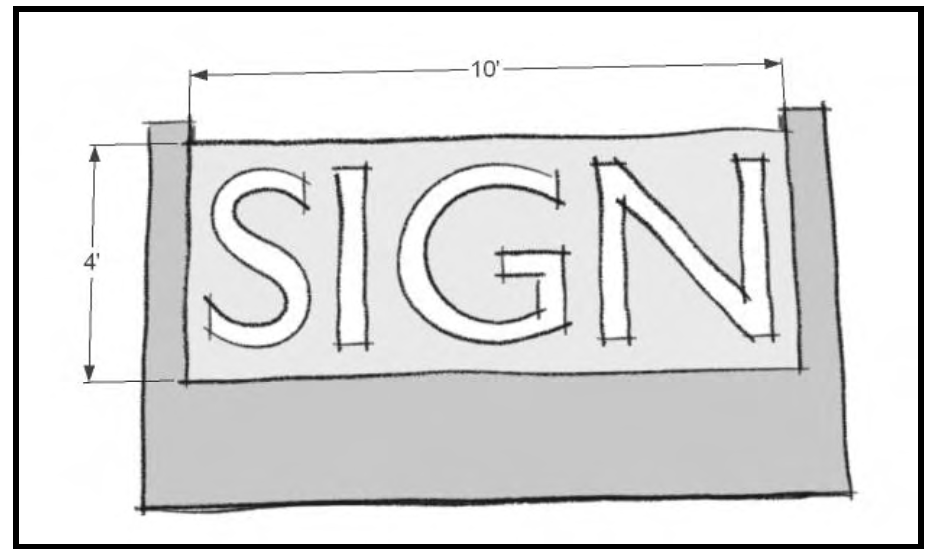
6.2.3 Sign Height.
The height of a sign shall be measured from the highest point of a sign to the point of ground surface beneath it. Ornamentation such as caps, spires and finials shall not extend more than two (2) feet from the top of the sign. The use of berms or raised landscape areas is only permitted to raise the base of the sign to the mean elevation of the fronting street.
FIGURE 6.2: SIGN HEIGHT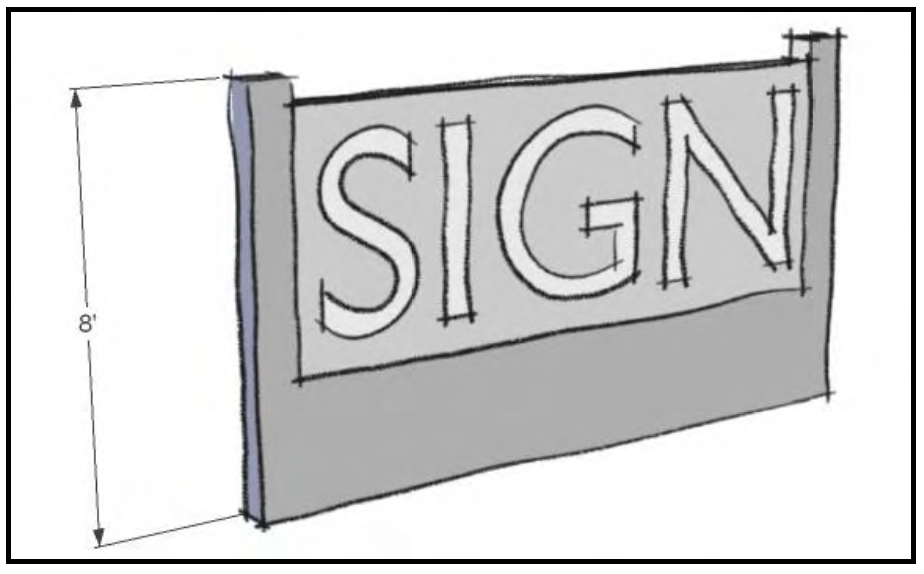
6.2.4 Sign Setbacks.
All freestanding signs shall be set back a minimum five (5) feet from the right-of-way or utility easement of a public or private street or eight (8) feet from the edge of pavement, whichever is greater. The setback shall be measured from the leading edge of the sign. At intersections, no sign shall be in the sight triangle as defined by this Ordinance. No freestanding sign shall be located within 50 feet of any other freestanding sign unless the Administrator determines that practical difficulties exist for locating the sign.
6.2.5 Sign Illumination.
Illuminated signs shall conform to the following:
(A)
All illuminated signs shall have their lighting directed in such a manner as to illuminate only the face of the sign.
(B)
External light sources shall not be visible from the right-of-way nor cause glare hazards to pedestrians, motorists, or adjacent properties.
(C)
All lighting shall meet all applicable electrical codes.
(D)
A new commercial sign within 100 feet of an existing residential structure shall not be illuminated between the hours of 11:00 p.m. and 6:00 a.m.
6.2.6 Maintenance and Upkeep of Signs.
(A)
Every sign and its support, braces, guys, anchors and electrical equipment shall be maintained in safe condition at all times. All signs shall be kept in a state of good repair and aesthetic condition, free from defective, rusting, or missing parts (i.e. broken sign facing, broken supports, loose appendages or struts, disfigured, cracked, ripped or peeling paint or poster paper) or missing letters or numbers and shall be able to withstand the wind pressure as prescribed in the North Carolina Building Code. Illuminated signs shall not be allowed to operate with only partial illumination.
(B)
Signs that are structurally unsafe and thereby endanger the public safety shall be removed unless they are repaired and made to comply with the requirements of the Building Code, as amended. If the Administrator shall find that any sign is dangerous or is menace to the public, he shall give written notice of such violations to the owner of the sign, or by leaving said notice with the manager or other person who is apparently in charge of the premises or by affixing a copy of the notice to the sign, sign structure or building for a period of five (5) days. The notice shall set forth the nature of the violation and order the violator to repair the sign in such a manner to be approved by the Administrator in conformance with the provisions of this Chapter or remove the sign forthwith in the case of imminent instability or immediate danger of falling, and in any case within 10 days of receipt. If within 10 days the notice is not complied with, the Administrator shall have the authority to remove the sign at the recipient's expense and to destroy or otherwise dispose of same. In cases of emergency, the Administrator may cause the immediate removal of a dangerous or unsafe sign without notice.
6.2.7 Removal of Discontinued Signs.
If a sign advertises a business, service, commodity, accommodation, attraction or other enterprise or activity that is no longer operating or being offered or conducted, that sign and sign structure including, but not limited to, the supporting braces, anchors or similar components shall be considered discontinued regardless of reason or intent and shall, within 180 days after such discontinuation, be removed by the owner of the property where the sign is located.
6.2.8 Removal of Signs in the Right-of-Way.
The Administrator or his designee may remove and destroy or otherwise dispose of any sign placed on public property or within any right-of-way of any public or private street. Penalties shall be levied for each such sign as outlined in Chapter 15 of this Ordinance.
(Ord. of 6-20-16(2))
6.3 - Temporary Signs.
The provisions of this section shall apply to the placement and display of temporary signage within the Town's jurisdiction. Any temporary sign that does not comply with the provisions of this Section is prohibited. Any sign which is permanently displayed shall comply with the provisions of Section 6.4, Permanent Signs.
6.3.1 Common Standards.
All temporary signs shall comply with the following common standards:
(A)
Temporary signs shall not be illuminated or be provided with any electric service.
(B)
Temporary signs shall not be placed within any public street right-of-way, including within medians, unless expressly permitted by this ordinance or the North Carolina General Statutes.
(C)
Temporary signs attached to building walls (other than permitted temporary window signs) shall not be placed in a manner that obstructs any window, door, fire department sprinkler connection, or street number sign.
(D)
Temporary signs shall not be affixed to a permanent sign or its supporting structure, including both building mounted and freestanding permanent signs.
(E)
Temporary signs shall not be placed in a manner that obstructs clear sight distance (within the required sight triangle) for motorists at street intersections or driveways.
(F)
Temporary signs, other than Type 4 Freestanding Temporary Signs, shall not be placed upon any sidewalk or other pedestrian walkway.
(G)
Temporary signs shall not be placed on the roof of a building, or affixed to a motor vehicle, tree, utility pole or street sign.
(H)
Where temporary signs are limited in the duration of their display and limited in the total number of displays per calendar year, any required period of separation between such displays shall carry through to the following calendar year, and shall be observed prior to initiating the first allowed display during the new calendar year.
(I)
Temporary signs shall be constructed of durable weatherproof materials and shall not be made with unfinished plywood or paper.
6.3.2 Temporary Freestanding Signs.
6.3.2.1 General Provisions.
The following standards shall apply to all Freestanding Temporary Signs:
(A)
Signs shall not be affixed to poles, posts, stakes or other supporting structures that are permanently installed or anchored into the ground through the use of concrete foundations or similar anchoring techniques.
(B)
Signs, other than Type 4 Freestanding Temporary signs, shall be set back from the edge of the right-of-way by a minimum of five (5) feet.
(C)
No more than one (1) Freestanding Temporary Sign may be displayed on a parcel or group of adjacent parcels under common ownership or tenancy at any given time, regardless of type, unless otherwise expressly permitted.
6.3.2.2 Type 1 Freestanding Temporary Signs.
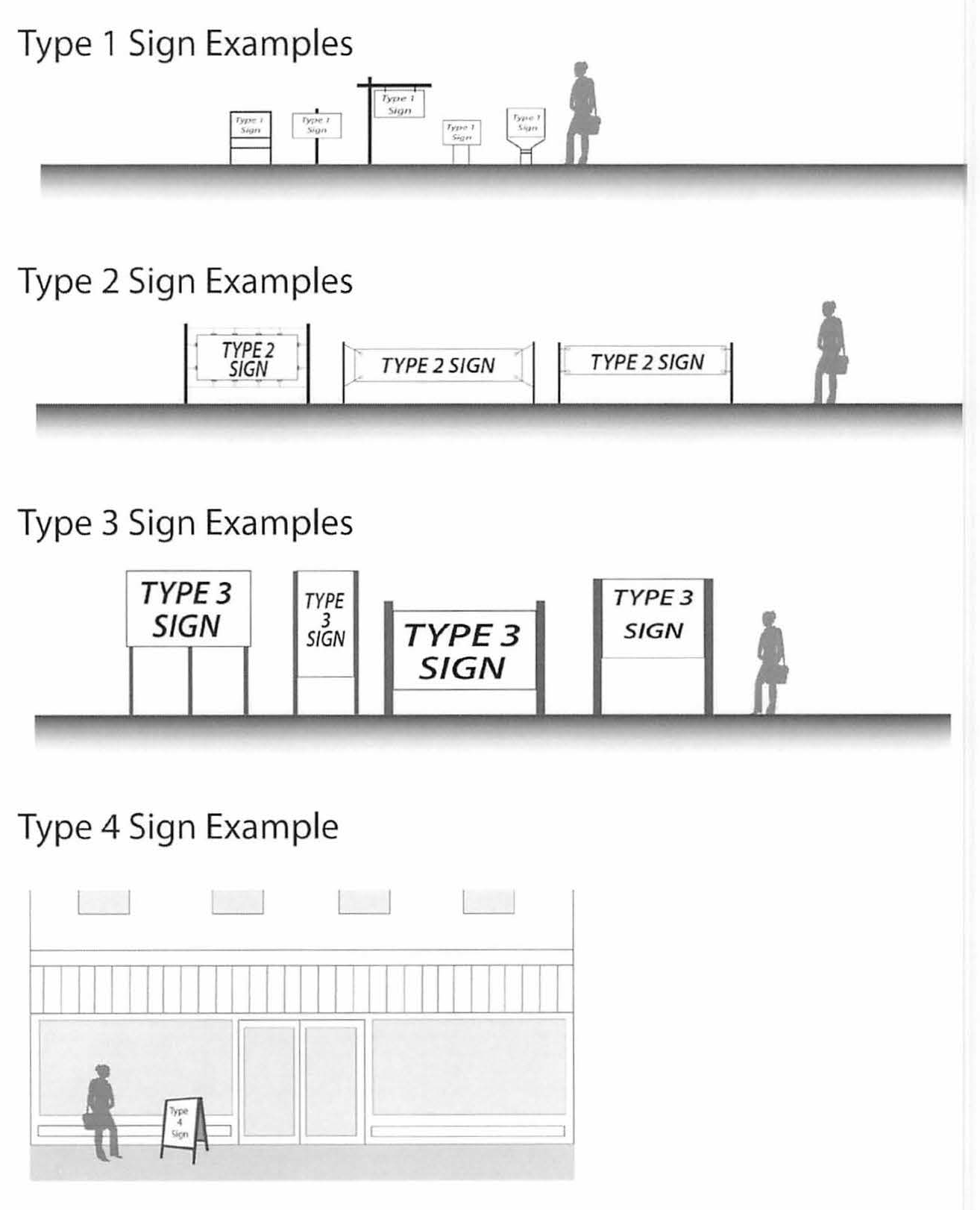
Signs in this category consist of small, temporary yard signs that are typically associated with (but not limited to) the advertisement of real estate, political campaigns and meeting announcements. For examples of Type 1 Temporary Freestanding Signs, see Figure 6.3. Such signs are also subject to NCGS 136-32(b).
6.3.2.3 Type 2 Freestanding Temporary Signs.
Signs in this category are typically referred to as "banners" that are typically associated with (but not limited to) the announcement of community, sporting and similar special events. For examples of Type 2 Temporary Freestanding Signs, see Figure 6.3.
6.3.2.4 Type 3 Freestanding Temporary Signs.
Signs in this category are large temporary signs typically associated with (but not limited to) the advertisement of large tracts of land for sale, construction and development activity or the advertisement of commercial or industrial buildings for sale or lease. For examples of Type 3 Temporary Freestanding Signs, see Figure 6.3.
6.3.2.5 Type 4 Freestanding Temporary Signs.
The category of signs defined as Type 4 Freestanding Temporary signs shall include only those signs which are constructed in a manner that is commonly referred to as an "A-frame" or "sandwich board" sign. The faces of the sign shall be connected at the top by hinges or similar mechanisms and the sign shall be self-supporting when placed in its display position. For examples of Type 4 Temporary Freestanding Signs, see Figure 6.3.
TABLE 6.1: FREESTANDING TEMPORARY SIGN CRITERIA
1
The display area may be either single or dual-sided, but shall not consist of more
than one (1) distinct component.
2
Per parcel or group of adjacent parcels under common ownership or tenancy.
3
Provided that this limit shall not be apply if the land, and any building(s) and/or
structure(s) upon such parcel or group of parcels is not occupied or in active use
for purposes other than a use in the Residential Use Group at any time during the
period of display.
4
Provided there is a separation of a minimum of 50 feet if there is more than one customer
entrance per tenant space.
FIGURE 6.3: SIGN TYPE EXAMPLES
6.3.3 Building-mounted Temporary Signs.
6.3.3.1 Wall Banners.
Flexible signs attached to a building wall.
NA=Not Applicable

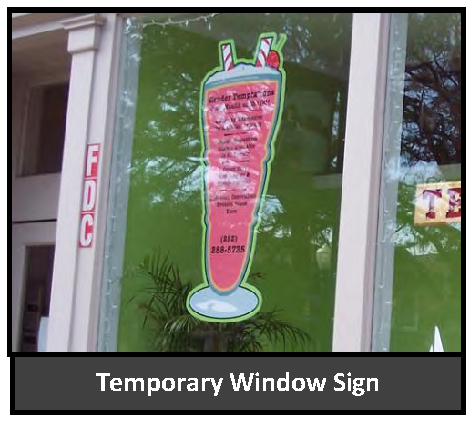
6.3.3.2 Window Signs (temporary).
Signs temporarily attached or temporarily painted to a window or door.
NA=Not Applicable
(Ord. of 6-20-16(2); Amend. of 12-16-19(1))
6.4 - Permanent Signs.
All of the signs enumerated in this section require a Zoning Permit prior to construction or alteration of a sign.
6.4.2 Development Entrance Sign.
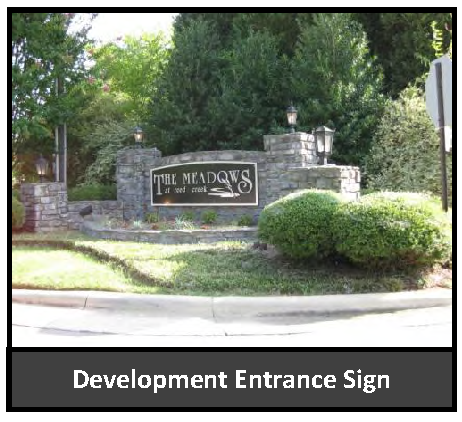
Permanent sign at the entrance of neighborhoods or developments.
P: Sign permitted
C: Sign permitted for Civic, Government and Institutional uses and Recreation uses
only Sign permitted for Civic, Government and Institutional uses and Recreation uses
only (see Section 3.3)
L: Illumination Allowed
*: External illumination only
NA=Not Applicable
6.4.3 Wall Sign.
A permanent sign larger than one (1) square foot that is legible from off-site and is affixed to a building wall, window, canopy or awning.
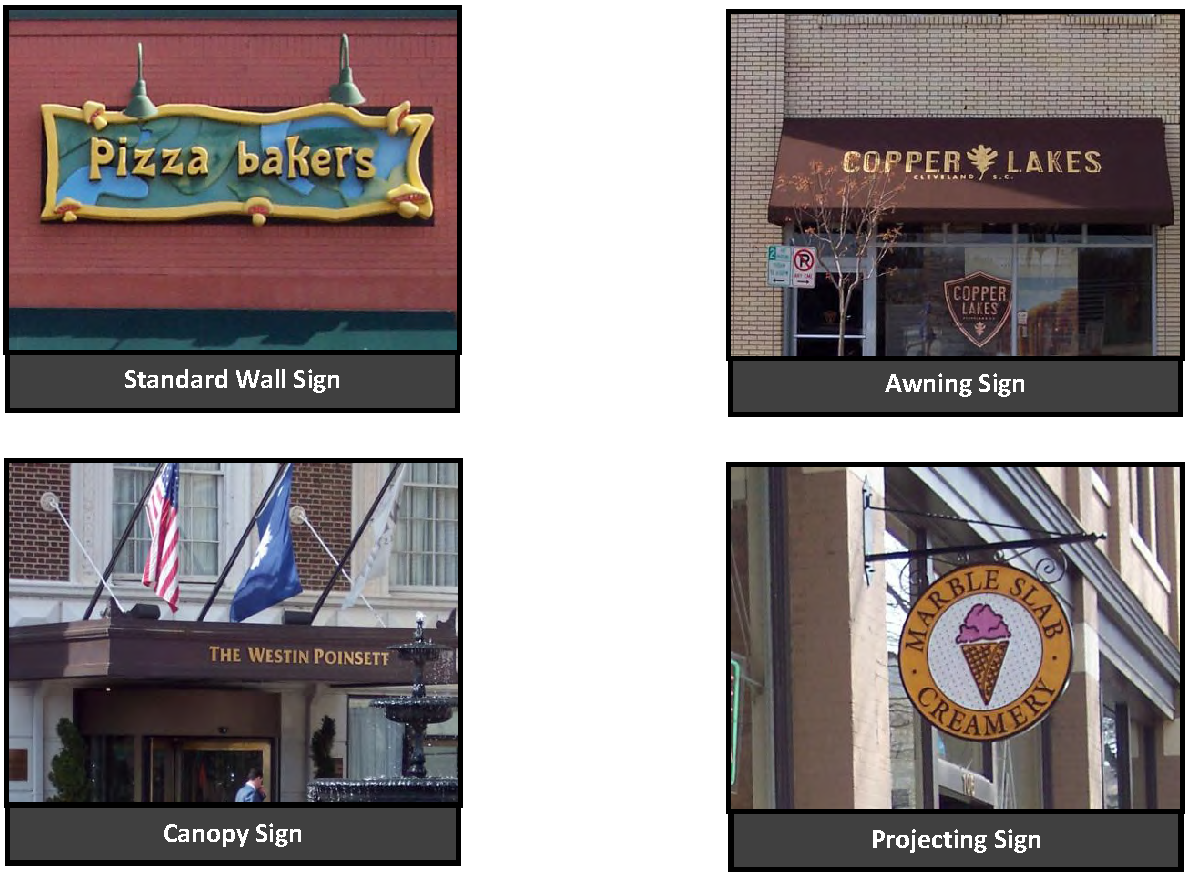
P: Sign permitted
C: Sign permitted for Civic, Government and Institutional uses and Recreation uses
only (see Section 3.3)
L: Illumination Allowed
*: External illumination only
6.4.3.1 Flexibility in Administration.
Lots with more than one (1) permitted sign wall shall be allowed to transfer unused permitted square footage from one (1) wall to another with the following conditions:
(A)
Transferred square footage shall not exceed twenty-five percent (25%) of the total permitted signage for the building, to be calculated by the Administrator.
(B)
Transferred square footage shall not exceed the unused square footage of the wall from which it is transferred.
(C)
Transferred square footage is no longer usable on the wall from which it is transferred.
(D)
The maximum area for any given wall on the building is not exceeded.
(E)
The maximum number of signs for a given wall is not exceeded.
(F)
The holder of the development agreement, and the landowner of the property involved, if the landowner is not the holder of the development approval, shall provide written consent to the sign plan.
6.4.4 Freestanding Sign (on-premises).
A permanent sign that identifies a building's tenant(s) located on-site that is mounted to the ground. A free-standing sign may be monument, arm, pole, or pylon style, unless otherwise specified. Up to 50 percent of the allowable area of a freestanding sign may be manually changeable copy.
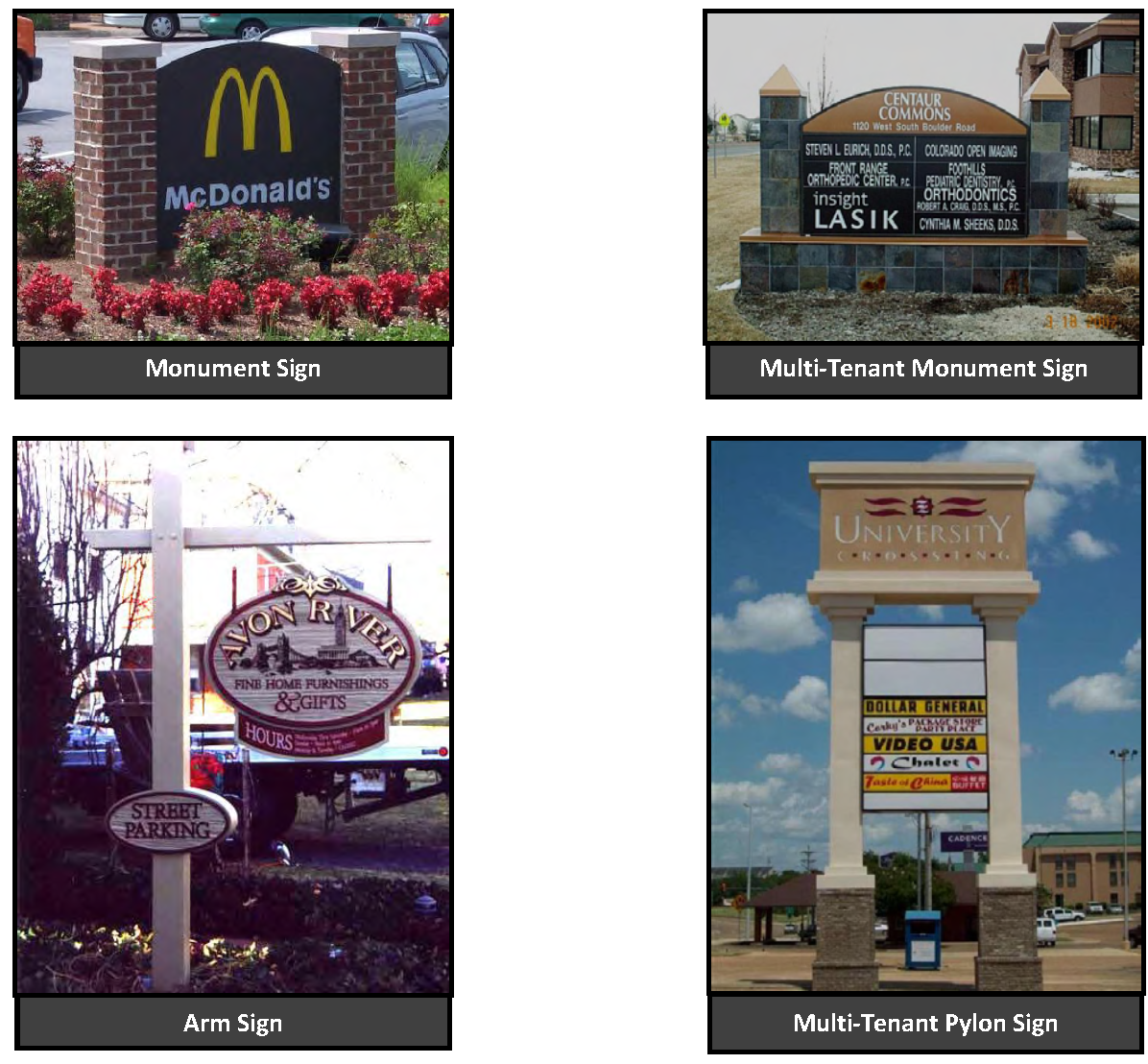
P: Sign permitted
C: Sign permitted for Civic, Government and Institutional uses and Recreation uses
only (see Section 3.3)
L: Illumination Allowed (see section 6.4.3.1 for electronic changeable copy provisions)
*: External illumination only (excluding illuminated permitted by Section 6.4.5)
NA=Not Applicable
6.4.5 Provisions for Changeable Copy on Freestanding Signs.
(A)
Up to 50 percent of the total area of a permitted freestanding sign may be changeable copy.
(B)
In the OI, C-2, C-3, M-1, and PRD zoning districts, electronic changeable copy is permitted. Electronic changeable copy is prohibited in all other districts. Electronic changeable copy is permitted for Civic, Government and Institutional uses in residential districts, pursuant to sections 6.4.4 and 6.4.5.
(C)
The maximum brightness level for electronic changeable copy signs shall not exceed 5,000 nits when measured at the sign's face at its maximum brightness, during daylight hours, and 500 nits when measured at the sign's face between dusk and dawn. An ambient light monitor shall be installed that automatically adjusts the brightness level of the sign to coordinate with the level of ambient light. Light from electronic signs shall not shine directly on surrounding properties or create a traffic hazard or distraction to operators of motor vehicles on the public streets. The Administrator shall have the authority to order a change in the illumination of any sign that becomes a hazard or a nuisance.
(D)
No electronic changeable copy sign which is located within 300 feet of a residence or residentially zoned property shall be illuminated between the hours of 10:00 p.m. and 6:00 a.m.
6.4.6 Billboards.
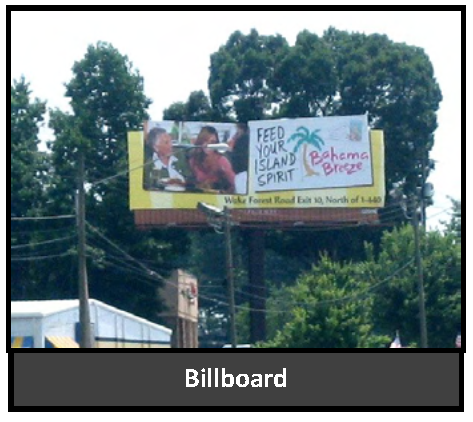
Signs for entities that are not located on the same premises as the sign.
P: Sign permitted
C: Sign permitted for Civic, Government and Institutional uses and Recreation uses
only (see Section 3.3)
L: Illumination Allowed
*: External illumination only
NA=Not Applicable
(Ord. of 6-20-16(2); Amend. of 12-16-19(1); Amend. of 6-21-21(1); Ord. No. FCUDO-2021-04, att., 9-13-21; Amend. of 10-3-22(2))
6.5 - Prohibited Signs.
The following signs are prohibited:
6.5.2 Signs that Obstruct Visibility.
Signs that substantially interfere with the view necessary for motorists to proceed safely through intersections or to enter onto or exit from public streets or private roads or driveways or that obstruct the motorist's view of approaching, merging or intersecting traffic including, but not limited to, signs in excess of three (3) feet in sight triangles.
6.5.3 Signs Emitting Glare.
Signs with light sources or reflectivity of such brightness that result in glare, blinding or any other such adverse effect on motorist vision or into or upon any residential building not related to the signs; or which interfere with the effectiveness of, or obscures an official traffic sign, device or signal.
6.5.4 Simulated Public Safety, Warning, or Traffic Signs.
Signs by their location, color, illumination, size, shape, nature, message or appearance tend to obstruct the view of or be confused with official traffic, safety or warning signs or lights or other devices erected by governmental agencies. This prohibition includes signs having no bona fide safety necessity, involving the terms "CAUTION", "DANGER", "SLOW", "STOP" OR "YIELD", or which utilize geometric figures, symbols, lights, location or message not unlike official traffic, safety or warning signs, signals or lights. Provided, however, this provision is not intended to prevent the placement on private property of signs with "stop", "yield" or other such wording or design where such is necessary for traffic control or other such legitimate notice to the public.
6.5.5 Signs that Obstruct Ingress/Egress.
Any sign located outdoors which interferes with free passage from or obstructs any fire escape, downspout, window, door, stairway, ladder, or opening intended as a means of ingress or egress or providing light or air.
6.5.6 Snipe Signs.
Signs placed upon or attached to any curb, utility pole, post, fence, hydrant, bridge, another sign or other surface, public bench, streetlight, or any tree, rock or other natural object located on, over or across any public street or public property. Provided, however, this provision shall not apply to the posting of signs placed by governmental units.
6.5.7 Signs Below Minimum Clearance.
Signs, marquees, canopies and awnings with vertical clearance of less than eight (8) feet above sidewalks and pedestrian areas and less than 1 feet above parking or vehicular passage areas.
6.5.8 Flashing Signs.
Signs or devices with flashing, intermittent, animated or changing intensity of illumination, provided, however, traffic signals, railroad crossing signals, other official warning or regulatory signs that present messages of public services shall not be considered flashing signs. Electronic changeable copy signs that have a scrolling message or change the message more than once every 15 seconds are considered flashing signs and are prohibited.
6.5.9 Off-premises Signs.
A sign or structure, pictorial or otherwise, regardless of size of shape that draws attention to or communicates information about a business, profession, service, commodity, product, accommodation, event, attraction or other enterprise or activity that exists or is conducted, manufactured, sold offered, maintained or provided at a location other than on the premises where the sign is located. This definition does not include traffic or regulatory signs or notices of the federal, state, county or town government or their public agencies. Off-premises signs may, however, are permitted in the C-3 and M-I Districts subject to the provisions of Section 6.4.4.
6.5.10 Signs in Rights-of-Way.
Any sign erected in or over any public right-of-way except for major special event signs by special permit; and governmental signs.
6.5.11 Obscene Signs.
Signs containing words or graphics that are obscene, as defined in North Carolina General Statute 14-190.1.
6.5.12 Pennants or Streamers.
Pennants, streamers, or flags consecutively strung together to attract attention.
6.5.13 Signs Without Permission.
Signs placed on property without permission of its owners or agent.
6.5.14 Unspecified Temporary Signs.
Portable or temporary signs except as permitted by Section 6.3.
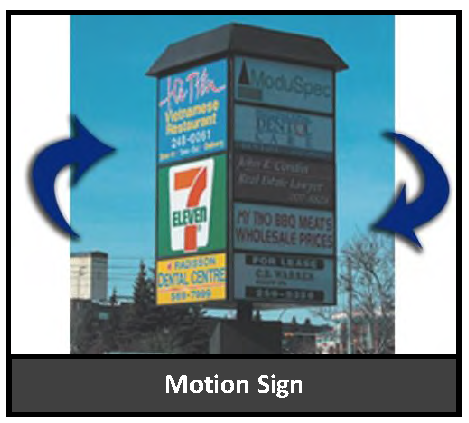
6.5.15 Motion Signs.
Motion signs, rotating signs, other than on-premise rotating identification names which contain a logo and/or business name on it.
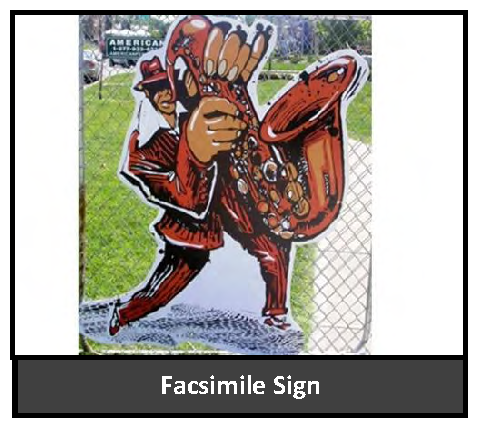
6.5.16 Facsimile Signs.
Three-dimensional objects or human figures which are located in such a manner as to attract attention.
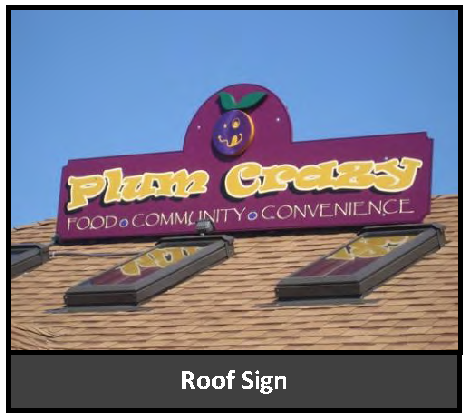
6.5.17 Roof Signs.
Signs erected in whole or in part on, upon or over the roof or parapet of a building or structure and which is wholly or partially dependent upon the roof of the building or structure for support. Signs on mansard roofs, parallel to the sign surface shall be considered canopy signs.
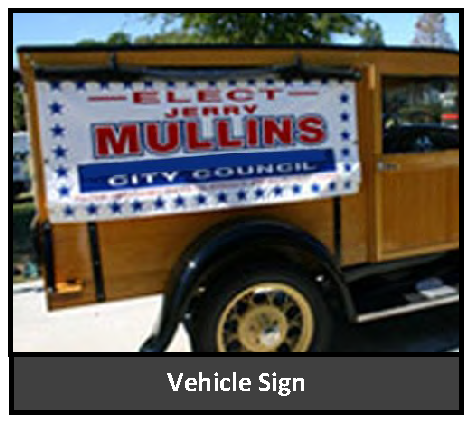
6.5.18 Vehicle Signs.
Signs placed upon, painted on, attached to or displayed on parked vehicles or trailers, where the vehicle or trailer is displayed in a manner to attract attention.
6.5.19 Inflatable Signs.
Including inflated balloons having a diameter of greater than two (2) feet.

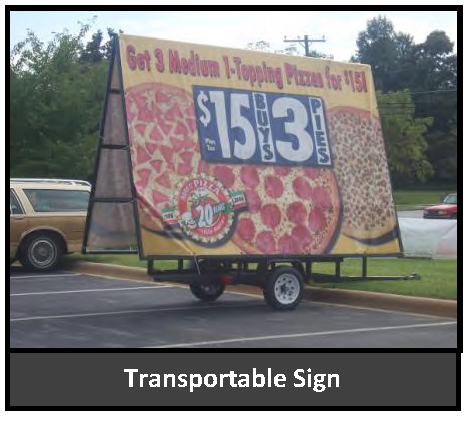
6.5.20 Transportable Sign.
Any sign whose sign face was initially constructed and designed to be placed and/or transported on wheels, regardless if said sign face is removed from its base and placed on or in the ground so as to otherwise classify said sign as a "freestanding" sign as herein defined.
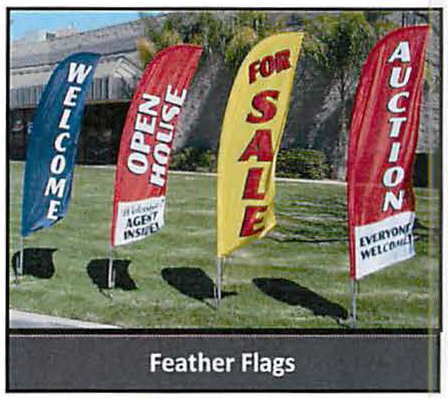
6.5.21 Feather Flags.
Vertically displayed banner signs mounted or attached to poles, which are not permanently attached to the ground, where the height of the banner exceeds 25 percent of the height of the pole when erected in its display position.
6.5.22 Other Signs.
Other signs not expressly permitted in this Ordinance.
(Ord. of 6-20-16(2); Amend. of 6-21-21(1))

