
Forest City City Zoning Code
CHAPTER 4
- SPECIAL REQUIREMENTS
4.1 - Purpose.
The Town of Forest City finds that there are certain uses that exist which may be constructed, continued and/or expanded provided they meet certain mitigating requirements specific to their design and/or operation. Such supplemental requirements ensure compatibility among other uses. The Permitted Uses Table of Chapter 3 contains a column on the far right labeled "SR" for Supplemental Requirements. In any case where a use listed in the Permitted Uses Table has a number in the SR column opposite the use, the use must comply with the additional Supplemental Requirements contained in this section corresponding to the Supplemental Requirement number. Each use shall be permitted in compliance with all conditions listed for the use in this Chapter. Certain uses are also classified as Special Uses and require Board of Adjustment approval.
(Ord. of 6-20-16(2); Ord. No. FCUDO-2021-03, att., 6-21-21)
4.2 - Residential Uses.
4.2.1 Accessory Dwellings.
Accessory dwellings may be located in a building separate from the principal dwelling subject to the following requirements:
(A)
The accessory dwelling shall not exceed one-half (½) of the total area of the principal dwelling.
(B)
Accessory dwellings shall meet the principal structure setbacks as set forth for the zoning district in which it is located in Section 3.4.
(C)
Accessory dwellings shall be built to North Carolina Building Standards in all districts except the R-20 district, where accessory dwellings shall be constructed after July 13, 1994 and shall meet or exceed the construction standards promulgated by the U.S. Department of Housing and Urban Development (HUD) that were in effect at the time of construction.
(D)
In the R-20 district, all dwellings built to HUD standards shall meet the standards of Section 4.2.6(A), (F) and (G) and have continuous underpinning installed around the base perimeter of the home.
(E)
Exclusive of all other provisions of this Section, accessory dwellings defined as Temporary Health Care Structures by NCGS 160D-914 shall not be required to obtain a Special Use Permit, and are subject to the provisions of that statute.
4.2.2 Accessory Structures (Residential).
(A)
No accessory building shall be erected in any front or side yard whether required or provided, except pursuant to Section 3.4.3.
(B)
Accessory buildings may be located in a rear yard not adjacent to a street within 10 feet of the property line. Accessory buildings adjacent to a street shall meet the principal building setback for that side.
(C)
No accessory building shall be erected within ten (10) feet of any other building, excluding open carports described in Section 3.4.3. In residential districts, total square footage of accessory buildings combined shall not exceed one-half (½) of total square footage of the principal dwelling. In the R-15 and R-20 Residential districts, lots two (2) acres or greater in size are exempt from the accessory building size limitation, provided that any building that exceeds the limitation shall be setback a minimum of 20 feet from the property line.
(D)
There shall be a principal residential structure on any lot for which there is an accessory structure. However, a building for the purpose of storing items to maintain the property may be constructed on lots without a principal structure if the following standards are met:
(1)
The property is a minimum of five (5) acres.
(2)
The structure shall be a minimum of 144 square feet and shall not exceed 1,000 square feet.
(3)
The structure shall have a front setback a minimum of 150 feet.
(E)
The maximum height for accessory structures shall be the height of the principal structure.
(F)
Mailboxes, newspaper boxes, walls, fences, birdhouses, flagpoles and pump covers may be placed in any yard, and no zoning permit is needed for these structures.
(G)
Doghouses up to 15 square feet of total area are permitted in the rear yard. No zoning permit is required.
(H)
No accessory structure shall be permitted that involves or requires any external features which are not primarily residential in nature or character.
(I)
Under no circumstances may a vehicle, trailer, manufactured home, POD, similar container, or parts thereof, be used as an accessory structure.
(J)
Swimming pools shall be enclosed with a fence of at least four (4) feet in height.
4.2.3 Conservation Developments.
The purpose of Conservation Development design is to preserve agricultural and forestry lands, natural and cultural features and environmentally sensitive areas that would be likely lost through conventional development approaches. Lot widths and setbacks in residential districts may be reduced subject to the following requirements:
(A)
The development density shall not exceed the overall density permitted in the zoning district in which the development is located. Areas with slopes of greater than 50 percent and floodway areas shall not be included in the overall allowable density calculation.
(B)
The district setbacks set forth in Section 3.4 shall apply along the boundaries of the development. Setbacks within the development shall be set forth as part of the design process as outlined in Subsection (C).
(C)
A minimum of 50 percent of the total area of the development shall be set aside in Common Open Space and shall meet the requirements of Section 7.5.
(D)
Each Master Plan for a Conservation Development shall follow a four-step design process as described below. When the conceptual Master Plan is submitted, applicants shall be prepared to demonstrate to the Town that these four (4) design steps were followed by their site designers in determining the layout of their proposed streets, house lots and greenway lands.
(1)
During the first step all potential Conservation Areas (both Primary and Secondary) shall be identified, using the Existing Features Plan described in Section 7.2.1. Primary Conservation Areas shall consist of wetlands, floodplains, steep slopes (greater than 25%) and other environmentally protected areas. Secondary Conservation Areas shall include the most sensitive and noteworthy natural, scenic and cultural resources including viewsheds, rock outcroppings, specimen trees, significant tree stands and historic sites.
(2)
During the second step, potential building sites are tentatively located. Because the proposed location of the buildings within each lot represents a significant decision with potential impacts on the ability of the development to meet the requirements of the Ordinance, applicants shall identify tentative house sites on the conceptual Sketch Plan. House sites should generally be located not closer than 50 feet to Primary Conservation Areas.
(3)
The third step consists of aligning proposed streets to provide vehicular access to each house in the most reasonable and economical way. When lots and access streets are laid out, they shall be located in a way that avoids, or at least minimizes, adverse impacts on both the Primary and Secondary Conservation Areas. Wetland crossings shall be avoided. Street connections shall be provided to minimize the number of cul-de-sacs and to facilitate easy access to and from homes in different parts of the property (and on adjoining parcels).
(4)
The fourth step is simply to draw the lot lines where applicable.
FIGURE 4.1 CONSERVATION DEVELOPMENT EXAMPLE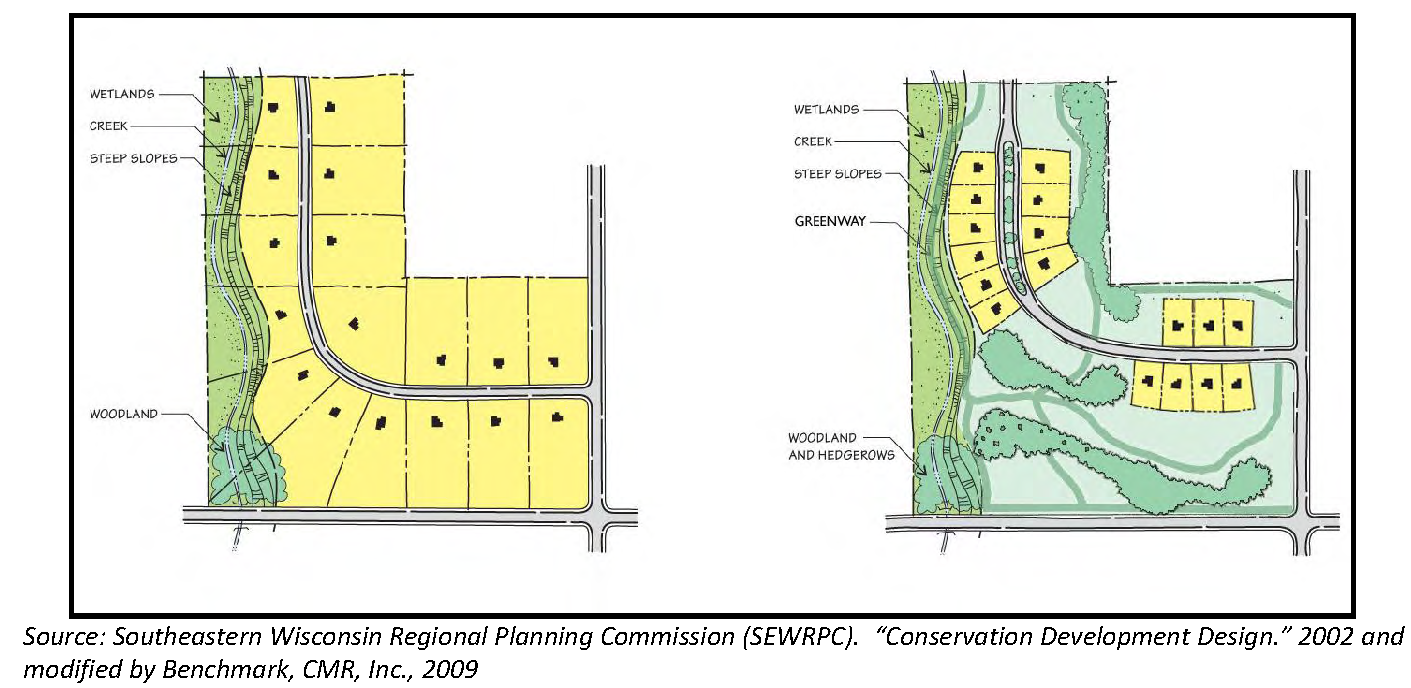
4.2.4 Family Care Homes.
In accordance with NC General Statute 160D-906, these uses are deemed residential uses and are permitted in all residential districts subject to the following conditions:
(A)
No more than six (6) residents other than the homeowner and the homeowner's immediate family are permitted to live in a Family Care Home.
(B)
A Family Care Home must be licensed with the NC Department of Health and Human Services Division of Facility Services before operating.
(C)
No Family Care Home may be located within a one-half (½) mile radius of any other family care home.
(D)
No exterior signage is permitted.
(E)
No lockdown, violent, or dangerous residents.
(F)
Only incidental and occasional medical care may be provided.
4.2.5 Home Occupations.
(A)
Only one (1) person other than those residing in the home shall be engaged in the occupation.
(B)
The use of the dwelling unit for the home occupation shall be clearly incidental and subordinate to its use for residential purposes by its occupants, and not more than 25 percent of the floor area of the dwelling unit shall be used in the conduct of the home occupation.
(C)
There shall be no changes in the outside appearance of the building or premises, or other visible evidence of the conduct of such home occupation except one (1) non-illuminated sign not exceeding four (4) square feet.
(D)
No traffic shall be generated by such home occupation in greater volumes than would normally be expected in a residential neighborhood, and any need for parking generated by the conduct of such home occupation shall be met off the street and other than in a required front yard.
(E)
No equipment or process shall be used in such home occupation, which creates noise, vibration, glare, fumes, odors, or electrical interference detectable to the normal senses off the lot. In the case of electrical interference, no equipment or process shall be used which creates visual or audible interference in any radio or television receivers off the premises or which causes fluctuations in line voltage off the premises.
(F)
Tattoo and/or body piercing operations shall not be considered as customary home occupations.
(G)
A family day care home with five (5) or fewer persons may be operated as customary home occupation.
4.2.6 Manufactured Homes (on individual lots). (A) The provisions of NCGS 160D-909 shall apply to manufactured homes.
(B)
The manufactured home shall be constructed in accordance with federal Manufactured Home Construction and Safety Standards as 24 CFR 3280 (HUD Code) and shall have been manufactured on or after July 13, 1994, the date upon which HUD wind load requirements became effective.
(C)
The manufactured home shall be at least twenty-four (24) feet by forty (40) feet excluding towing apparatus.
(D)
The pitch of the manufactured home's roof shall have minimum vertical rise of two and two-tenths (2.2) feet for each twelve (12) feet of horizontal run and the roof shall be finished with a type of shingle that is commonly used in standard residential construction.
(E)
The exterior siding shall consist predominantly of vinyl or aluminum horizontal lap siding (that does not exceed the reflectivity of gloss white paint), wood, or hardboard, comparable in composition, appearance and durability to the exterior siding commonly used in standard residential construction.
(F)
A continuous, permanent masonry foundation, unpierced except for required ventilation and access, shall be installed under the manufactured home.
(G)
The tongue, axles, transporting lights and removable towing apparatus shall be removed subsequent to final placement.
(H)
Installation shall be in accordance with North Carolina Department of Insurance Standards.
4.2.7 Multi-Family Dwellings.
(A)
Multi-family dwellings shall only be permitted with the issuance of a Special Use Permit in the R-6 and C-2 districts, or by right in the C-3 and C-T districts, subject to the standards of this subsection. Multi-family dwellings are also permitted as part of a PRD district, subject to the standards set forth in the Conditional Zoning District.
(B)
A needs assessment shall be provided with all applications for multi-family dwellings that demonstrates the need for the proposed housing type within the Town of Forest City's jurisdiction.
(C)
No multi-family dwellings or series of attached dwellings, multi-family building or other such arrangements shall exceed a length of three hundred (300) feet when measured along the longest axis of the building or series of attached units. This shall not apply to existing buildings converted to multi-family.
(D)
Any development with more than one hundred (100) dwelling units shall submit a certified traffic engineering report evaluating the capability of the adjoining street system to carry the traffic generated by the development. Reasonable improvements shall be made based on the results of the certified traffic engineering report.
(E)
Developments that are proposed to be developed under the North Carolina Unit Ownership Act shall meet the requirements of that Act by recording the declaration and plan with the Register of Deeds. Where land is to be conveyed in accordance with such declaration and plan, the developer shall comply with the development requirements of this Ordinance.
(F)
The number of dwelling units per unit of land area shall not exceed the number of dwelling units per unit of land area permitted in the district in which the development is located.
(G)
In no case shall any building be closer than twenty (20) feet to any other building in the development. Furthermore, buildings shall not be arranged in straight rows oriented in such a way as to resemble rows of barracks.
(H)
All portions of every building shall be located within three hundred (300) feet of a public street that furnishes direct access to the property unless the Fire Department determines that on site fire hydrants and service drives will offer adequate protection.
(I)
All main utility lines, meters, taps and other appurtenances, up to and including the meter for each individual unit, (but not including the service lines and other facilities extending service to each individual unit) shall be built to the same standard as required for developments. All such facilities, together with an easement of sufficient width, shall be conveyed to and/or dedicated to the city for public use and maintenance. All utilities shall be placed underground.
(J)
Each unit shall be individually metered for all utilities. Responsibility for the maintenance of common utility lines and/or facilities, which have not been conveyed to the Town and/or dedicated for public use shall be the responsibility of the project owner, or in the case of unit ownership clearly established in the declaration, protective covenants and other bylaws.
(K)
All private streets or access ways providing ingress and egress from the development to an existing public street system shall comply with the current standards being required by the infrastructure regulations of Chapter 10, including street drainage.
(L)
Stationary sanitary containers shall be located so as not to interfere with sight distance or the free movement of vehicles on streets or service drives and so as to allow collector trucks adequate maneuvering space to empty the containers and to leave the property without excessive backing. Such containers shall be screened in accordance with Section 8.6. Concrete pads in conformance with the public works department's stationary container location standards shall be located beneath of and in the approach to each stationary sanitary container. Where single-family attached units make up the total development and are all located along a public street in a manner similar to a typical single-family development, the Public Works Director may approve an individual household pick-up system.
4.2.8 Temporary Emergency Manufactured Homes.
Manufactured homes may be allowed on a temporary basis in a zoning district in which such use is not listed as a permitted use, if a disaster occurs which results in an occupied, single-family dwelling being destroyed (i.e., it receives damage greater than 60 percent of its tax value as indicated on the most current tax listings). In this instance, a manufactured home may be placed on the lot containing the dwelling unit which was destroyed. The purpose of allowing such manufactured home on said lot is to give the occupants of the destroyed dwelling unit a place to live while a new dwelling unit is being constructed or damage to the original dwelling unit is being repaired. If a manufactured home is used for such an occurrence, it is subject to the following conditions:
(A)
Temporary emergency residences shall not be placed in the front yard and shall be located no closer than 15 feet to another principal residential structure on another lot and no closer than 10 feet to any lot line.
(B)
The Administrator shall be given the authority to issue a zoning permit for such temporary residence on a one-time basis only for a period of up to one (1) year. Such permit may be renewed on a one-time only basis (for a period of no greater than six months (6) months) by the Administrator.
4.2.9 Traditional Neighborhood Development (TND) (Special Use Permit only).
Traditional Neighborhood Developments are intended to allow for mixed-use, pedestrian-oriented neighborhoods to minimize traffic congestion, suburban sprawl, infrastructure costs and environmental degradation and should be based on the following design principles:
• All neighborhoods have identifiable centers and edges.
• Edge lots are pedestrian accessible to retail and recreation uses (a distance not greater than ¼ mile).
• Uses and housing types are mixed and in close proximity to one another.
• Street networks are interconnected and blocks are small.
• Civic buildings are given prominent sites throughout the neighborhood.
Traditional Neighborhood Developments shall be allowed in the R-6 zoning district with a Special Use Permit only and shall meet the following supplemental requirements:
(A)
The minimum size of a TND shall be 40 acres.
(B)
Any development with more than 100 dwelling units shall submit a certified traffic engineering report evaluating the capability of the adjoining street system to carry the traffic generated by the development.
(C)
All residential uses that are permitted in the R-6 district shall be permitted in a TND, except manufactured homes. A mixture of residential types is encouraged.
(D)
The maximum residential density of residential development area of TND shall be one (1) dwelling unit per 6,000 square feet.
(E)
The following lot requirements shall apply within the TND:
(F)
No multi-family dwellings or series of attached single-family, multi-family building or other such arrangements shall exceed a length of 150 feet when measured along the longest axis of the building or series of attached units when placed in a theoretical straight alignment.
(G)
A minimum of 10 percent of the total area of the TND shall be used for non-residential purposes limited to the following uses associated with the C-2 district:
• Golf, tennis, swimming clubs.
• Recreation facilities (indoor).
• Parks (public).
• Religious institutions.
• Day care centers.
• Family care homes.
• Schools (public and private).
• Banks, financial services.
• Personal service uses.
• Bus stations.
• Services, other (non outdoor storage).
• Retail uses (less than 10,000 square feet).
• Dry cleaning and laundry establishments (non-industrial).
• Professional offices.
• Medical, dental, chiropractor, optical, psychologists or related offices.
• Artists, craftsman.
• Libraries, museums, art galleries and similar uses.
• Structures and uses clearly incidental to the permitted use.
(H)
Vertically mixed buildings are permitted with a non-residential use on the first floor and residential use on the second and subsequent floors.
(I)
A minimum of 30 percent of the total area of the TND shall be set aside in open space as defined in the Section 7.5.
(J)
A minimum 20 foot buffer yard shall be established around the TND adjacent to residential zoning districts.
(K)
Yard trees are required for residential lots within a TND. Trees shall be planted behind the sidewalk outside of the public right-of-way. Maintenance of the trees shall be the responsibility of the individual property owner. Yard trees may be placed anywhere on the property except that at least one (1) tree is placed in the front yard. Each lot shall provide canopy trees in accordance with the following schedule:
The use of existing vegetation to satisfy this requirement is encouraged. Existing canopy trees over six (6) inches in caliper may be counted towards fulfilling this requirement.
(L)
Each street within a TND shall be designated an alley, lane, street, avenue, main street, boulevard or parkway, and the design shall follow that shown in the latest of edition of the NCDOT Division of Highways Traditional Neighborhood Development Guidelines.
(M)
The street network for a TND shall achieve a connectivity ratio of not less than 1.40 (see example below). The phrase "connectivity ratio" means the number of street links divided by the number of nodes or link ends, including cul-de-sac heads. A "link" means and refers to that portion of a street defined by a node at each end or at one (1) end. Approved stubs to adjacent property shall be considered links. However, alleys shall not be considered links. A "node" refers to the terminus of a street or the intersection of two (2) or more streets, except that intersections that use a roundabout shall not be counted as a node. For purposes of this subsection, the street links and nodes within the collector or thoroughfare streets providing access to a proposed development shall not be considered in computing the connectivity ratio.
FIGURE 4.2: TND CONNECTIVITY RATIO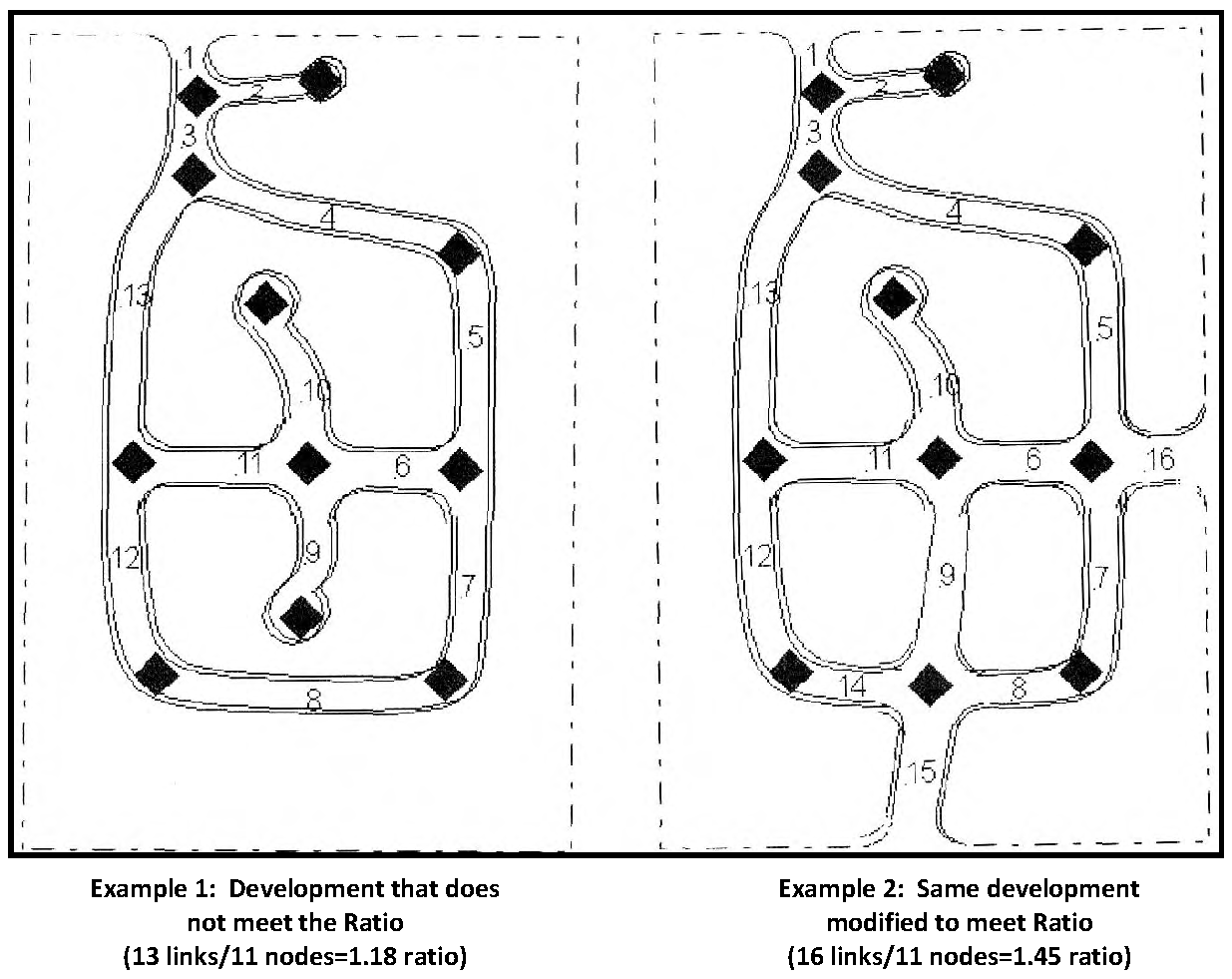
(N)
All portions of every building shall be located within 300 feet of a public street that furnishes direct access to the property unless the fire chief determines that on site fire hydrants and service drives will offer adequate protection.
(O)
All main utility lines, meters, taps and other appurtenances, up to and including the meter for each individual unit, (but not including the service lines and other facilities extending service to each individual unit) shall be built to the same standard as required for developments. All such facilities, together with an easement of sufficient width, shall be conveyed to and/or dedicated to the city for public use and maintenance. All utilities shall be placed underground. Each unit shall be individually metered for all utilities. Responsibility for the maintenance of common utility lines and/or facilities, which have not been conveyed to the Town and/or dedicated for public use shall be the responsibility of the project owner, or in the case of unit ownership clearly established in the declaration, protective covenants and other bylaws.
(P)
Stationary sanitary containers shall be located so as not to interfere with sight distance or the free movement of vehicles on streets or service drives and so as to allow collector trucks adequate maneuvering space to empty the containers and to leave the property without excessive backing. Concrete pads in conformance with the public works department's stationary container location standards shall be located beneath of and in the approach to each stationary sanitary container. Where single-family attached units make up the total development and are all located along a public street in a manner similar to a typical single-family development, the Public Works Director may approve an individual household pick-up system.
(Q)
Parking shall be in accordance with Chapter 9, except that minimum parking space requirements may be completely or partially fulfilled with on-street parking.
(R)
TND Building Design Requirements. Buildings within a TND shall adhere to the following design requirements. Building elevations shall be submitted to the Administrator for approval in accordance with these requirements prior to the issuance of a Zoning Compliance Certificate. Alternate design plans, building materials or construction techniques may be used when unreasonable or impractical situations would result from the application of architectural design standards. Such situations may result from unique site conditions, innovative design applications and/or unified development design. Alternate design plans shall be approved by the Planning Board.
(1)
All Buildings. All buildings shall comply with the design requirements of Chapter 5.
(2)
Residential Buildings.
(a)
Exterior materials shall be durable and residential in character. Exterior wall materials shall be wood clapboard siding, wood shingles, brick, stone, stucco, vinyl, or similar materials. Roof materials shall be asphalt shingles, standing seam metal, slate, or similar materials.
(b)
Pitched roofs shall have a pitch between 4:12 and 12:12. Eaves shall be a minimum of six (6) inches in depth.
(c)
Garages shall not have visual prominence on the front façade. Garages that face the street shall be recessed from the front façade as follows:
i.
If the structure has a usable front porch that is at least six (6) feet deep and extends more than 50 percent of the front façade, then the garage may be flush with the front façade.
ii.
If the structure does not have a usable front porch that is a least six (6) feet deep and extends more than 50 percent of the front façade, then the garage shall be recessed from the front façade a minimum of four (4) feet.
(d)
Attached garages for more than two (2) cars shall not face the primary street. Such garages on corner lots may face the non-fronting street.
(e)
Garage doors are not permitted on the front façade of any two-family or multi-family dwelling unit.
(f)
No more than 20 percent of the residential buildings within a development shall have the same exterior house plan. House plans shall be disbursed throughout the development. Right and left hand versions shall be considered the same exterior house plan.
4.2.10 Two-family Dwellings (Duplexes).
(A)
Developments consisting only of duplexes shall not exceed three (3) acres.
(B)
Duplexes on corner lots shall be designed in a way that each unit fronts on a different street.
4.2.11 Upper-story residential units.
(A)
All of the habitable dwelling area shall be located above the ground floor levels.
(B)
Each dwelling unit shall contain at least 500 square feet of habitable floor area.
(C)
The residential density of the base zoning district shall apply.
(D)
Off-street parking is not required in the C-1 or C-T district. However, additional parking may be required if adequate parking does not exist for all uses within the area.
4.2.12 Single-family Dwellings (detached).
(A)
In C-3 districts, single-family homes must be built on lots where surrounding uses are residential.
(Ord. of 6-20-16(2); Amend. of 8-5-19(1); Amend. of 11-18-19(2); Amend. of 12-16-19(1); Amend. of 4-19-21(1); Ord. No. FCUDO-2021-03, att., 6-21-21; Amend. of 5-1-23(1); Amend. of 10-3-22(3))
4.3 - Civic, Government and Institutional Uses.
4.3.1 Daycare Centers.
(A)
The lot on which the daycare center is located shall have access onto a thoroughfare or collector street in residential zoning districts.
(B)
Evidence that the facility will meet the minimum requirements to qualify for a State of North Carolina License is satisfied shall be submitted with the application.
(C)
Evidence shall be submitted indicating that adequate access to and from the site, as well as adequate space off the road right-of-way, is provided for the safe pick-up and discharge of clients and is provided in such a manner that traffic generated by the facility is not disruptive to adjacent residentially developed properties.
(D)
Fencing and/or screening shall be provided that assures the protection of clients receiving care, protects adjacent residentially developed properties from trespass, effectively screens the view of any outdoor recreational areas, and reduces noise associated with the operation of the use.
4.3.2 Residential Care Facilities.
In the R-20, R-8 and R-6 residential districts:
(A)
A minimum of 10,000 square feet shall be required to establish a residential care facility. Existing uses which do not meet the 10,000 square foot minimum at the time of the adoption of that provision may expand or be reconstructed provided such expansion or reconstruction meets the minimum dimensional requirements of the district in which located.
(B)
All residential care facilities shall meet the requirements of Title 15A Subchapter 18A of the North Carolina Administrative Code.
(C)
All structures including secondary and accessory structures shall be located a minimum of 50 feet from any street line and, 20 feet from any other property line.
(D)
Any use listed above located in a residential district on a site greater than three (3) acres shall have frontage on a collector or thoroughfare street.
(Ord. of 6-20-16(2))
4.4 - Office and Service Uses.
4.4.1 Animal Services.
(A)
No outdoor containment of animals shall be located less than 250 feet from any residentially zoned property and 50 feet from any other adjacent property line.
(B)
Kennel areas must be surrounded by an opaque fence of not less than six (6) feet in height and enclosed as to prevent escape.
(C)
Kennels shall be designed to effectively buffer noise audible to surrounding properties.
(D)
In the R-15 and R-20 Districts:
(1)
Animal Services must be located on a property that is a minimum of ten (10) acres.
(2)
Animal Services shall be setback from property lines a minimum of two hundred (200) feet.
(3)
There shall be no nuisance created.
4.4.2 Body Piercing and Tattoo Studios.
(A)
No such business of either classification shall be located within 700 feet of any other such business or either classification, as measured in a straight line from property line to property line.
(B)
No such business of either classification shall be located within 700 feet of a church, public or private elementary or secondary school, child day care or nursery school, public park, residentially zoned or residentially used property, or any establishment with an on-premises ABC license, as measured in a straight line from property line to property line.
(C)
Ear piercing, as a principal or accessory use shall not be subject to this classification and these provisions.
(D)
Tattoo and or body piercing operations shall not be considered as customary home occupation.
4.4.3 Motor Vehicle or Boat Services.
(A)
All Motor Vehicle or Boat Services (including gasoline sales).
(1)
The lot shall front on a collector or arterial street and have direct access thereto. Proposals for lots with double frontage that desire multiple driveways shall be limited to one (1) curb cut on the higher classified street. Additional cuts shall be on streets of lower classification. Driveway Permits shall be approved by the North Carolina Department of Transportation (NCDOT) for access to State roads.
(2)
Air compressors, hydraulic hoists, pits, repair equipment, greasing and lubrication equipment and similar equipment shall be entirely enclosed within a building.
(3)
No outside storage of materials shall be permitted. The number of vehicles temporarily stored outdoors shall not exceed the number of service bays at the establishment.
(4)
Certification by a registered, licensed engineer shall be required to ensure the prevention of petroleum and petroleum related product runoffs into the existing municipal storm drainage system.
(5)
The Fire Chief shall review and approve a submitted fire protection plan submitted by the applicant prior to the issuance of a Zoning Permit.
(6)
All garbage and refuse shall be stored in mechanical loading containers located at the rear of the lot or building.
(7)
A photometric lighting plan shall be submitted with the site plan that includes fixture details, light intensity contours and overlap and a statement regarding light trespass on adjacent properties. Lighting shall not exceed six (6) footcandles anywhere on the site and shall not exceed one (1) footcandle at the property line.
(8)
No outdoor servicing, repair or disassembly of vehicles shall be permitted.
(9)
Outside storage of secondhand material for resale shall be prohibited.
(B)
Motor Vehicle or Boat Services (with Vehicle Storage). In addition to the requirements for all Motor Vehicle Services in Section 4.4.3(A) above, the following shall apply to motor vehicle services which have vehicle storage:
(1)
Buildings shall be located forward towards the street and parking and vehicle storage areas shall be located to the side and rear of the lot whenever possible. Applicable setbacks shall be observed.
(2)
Any vehicle stored on a lot where such use occurs must have a valid registration, be stored in a substantially enclosed structure, or located within a fenced or walled enclosure. Fences and/or walls used for such enclosure shall be at least six (6) feet in height and completely opaque.
(Ord. of 6-20-16(2); Amend. of 5-1-23(1))
4.5 - Retail and Wholesale Uses.
4.5.1 Motor Vehicle or Boat Sales or Rental.
(A)
A permanent structure with permanent restroom facilities built in accordance with NC Building Code shall be located on the premises.
(B)
A written description of the proposed operation, including square footage, number of employees, hours of operation and activities expected on site shall be submitted with the application.
(C)
The lot shall front on a collector or arterial street and have direct access thereto.
(D)
No outdoor sound system shall be permitted which can be heard beyond the boundaries of the property.
(E)
No vehicle or boat shall be stored or displayed within the right-of-way of any public street.
(F)
A North Carolina auto manufacturer dealership license shall be obtained prior to occupancy and shall be prominently displayed at the place of business.
4.5.2 Retail Sales (outside fully enclosed building).
(A)
A permanent structure with permanent restroom facilities built in accordance with NC Building Code shall be located on the premises.
(B)
A written description of the proposed operation, including square footage, number of employees, hours of operation and activities expected on site shall be submitted with the application.
(C)
Items for sale shall not be displayed within any right-of-way.
(D)
No outdoor sound system shall be permitted which can be heard beyond the boundaries of the property.
(Ord. of 6-20-16(2))
4.6 - Recreational and Entertainment Uses.
4.6.1 Adult Oriented Businesses.
(A)
Adult Oriented Businesses are subject to the provisions of NCGS 160D-902.
(B)
No such business shall be located within 1,000 feet of any other Adult Oriented Business, as measured in a straight line from property line to property line.
(C)
No Adult Oriented Business shall be located within 1,200 feet of a church, public or private elementary or secondary school, child day care or nursery school, public park, residentially zoned or residentially used property, or any establishment with an on-premises ABC license, as measured in a straight line from property line to property line.
(D)
The gross floor area of any Adult Oriented Business shall not exceed 3,000 square feet and all business related activity shall be conducted in a building.
(E)
Except for an adult motel, no Adult Oriented Business may have sleeping quarters.
(F)
There shall not be more than one (1) Adult Oriented Business in the same building, structure, or portion thereof. No other principal or accessory use may occupy the same building, structure, property, or portion thereof with any Adult Oriented Business.
(F)
Except for signs as may be permitted by Chapter 6 of this Ordinance, no printed material, slide, video, photograph, written text, live show, or other visual presentation format all be visible from outside the walls of the establishment, nor shall any live or recorded voices, music, or sounds be heard from outside the walls of the establishment.
(H)
No enclosed or underground parking shall be permitted.
4.6.2 Campgrounds.
(A)
The lot for the park shall be a minimum of two (2) acres.
(B)
Along any public street or public right-of-way, a setback of at least 40 feet from the edge of the public right-of-way shall be maintained.
(C)
A distance of at least 10 feet shall be maintained between any part of the trailers, structures, or tent pads.
(D)
A recreational area of not less than 10 percent of the gross site area or 2,500 square feet, whichever is greater, shall be maintained in a central and convenient location to all camping spaces.
(E)
The density shall not exceed 15 camping spaces per acre of gross area.
(F)
Adequate off-street parking and maneuvering space shall be provided on site. The use of any public street, sidewalk or right-of-way or any other private grounds for the parking or maneuvering of vehicles is prohibited.
(G)
All internal roadways shall be stabilized and of adequate width to accommodate the volume and type of anticipated traffic, and in any event, shall comply with the following minimum requirements:
(1)
Internal one-way roadway and roadways on which parking is prohibited shall not extend for more than 500 feet in total length; service less than 25 trailer spaces; and be at least 11 feet in width.
(2)
Internal one-way roadway and roadways on which parking is permitted on one (1) side and two-way roadways, which do not allow parking, shall be at least 24 feet in width.
(3)
Internal two-way roadways, which permit parking on one (1) side only, shall be at least 27 feet in width.
(4)
Internal two-way roadways, which permit parking on both sides, shall be at least 34 feet in width.
(H)
Each camping space for travel trailers shall be connected to an approved water supply system, which provides an accessible, adequate, safe and potable supply of water.
(I)
An adequate and safe sewer system shall be provided in all camping areas. Such system shall either be a municipal system or a system approved by the appropriate County or State agency vested with the authority to approve sewage disposal systems.
(J)
A screening device at least six (6) feet high and 90 percent opaque shall be provided where the use adjoins residentially zoned property.
(K)
A central service building containing all necessary toilets, bathhouses and other plumbing fixtures specified in the most current edition of the North Carolina State Plumbing Code, as amended, shall be provided in all camping areas. Service building shall be conveniently located within a radius of 300 feet to camping spaces, which it serves.
(L)
The storage, collection and disposal of trash and refuse in the travel trailer-parking area shall comply with all applicable regulations.
(M)
Neither any person nor any mobile unit shall occupy a camping space or the travel trailer parking area for a period in excess of 30 days. A register of all occupants, the space occupied and the time of arrival and departure shall be maintained.
4.6.3 Golf, Tennis, Swimming Clubs and related uses.
(A)
There will be a 50 foot minimum setback between clubhouses, swimming pools, lighted tennis courts, or athletic fields and adjacent residentially zoned property.
(B)
Outdoor swimming pools shall be protected by a fence, or equal enclosure, a minimum of four (4) feet in height, and equipped with a self-closing and positive self-latching gate provided with hardware for permanent locking.
4.6.4 Recreation Facilities (outdoor, including golf driving ranges, miniature golf, skateboard parks, water slides, batting cages and similar uses).
(A)
No principal buildings or structures shall be located within 50 feet of any property line.
(B)
Security fencing, a minimum of six (6) feet in height, shall be provided along the entire boundary of park activities where adjoining a residential or O-I district.
(C)
No amusement equipment, machinery, or mechanical device of any kind may be operated within 200 feet of any residentially zoned property.
4.6.5 Shooting Ranges (outdoor-local government only).
(A)
No such facility shall locate within a 500 foot radius of any residentially zoned property.
(B)
Security fencing shall be provided along the entire boundary of such a facility.
(C)
The facility and its operation shall observe all Fire Prevention and Protection requirements.
(Ord. of 6-20-16(2); Ord. No. FCUDO-2021-03, att., 6-21-21)
4.7 - Industrial, Warehousing, Distribution and Transportation Uses.
4.7.1 Airports and Heliports.
(A)
A configuration diagram depicting the layout of runways, taxiways, approach zones and overrun areas shall be submitted with the application. These diagrams shall also be depicted on aerial photographs that also show the area within five (5) miles of the proposed site.
(B)
A plan indicating isotonic contours that show the effects of aircraft operations upon land within one (1) mile of the boundary of the proposed site shall be submitted with the application.
(C)
The number and type of aircraft proposed to be stored including the storage area for aircraft, fuel and motor vehicles and service areas for the aircraft shall be documented in the application and on the submitted site plan.
(D)
A statement as to how on-site fire and rescue services will be provided, and a letter from the appropriate agency stating services are available and adequate to protect the proposed facility, shall be submitted with the application.
(E)
A list of land uses within the final approach zones of the airport/heliport shall be submitted with the application.
(F)
A certification that all Federal Aviation Administration (FAA) and State standards and requirements have been, or will be, met shall be submitted with the application.
(G)
A minimum of 50 acres is required for Basic Utility Stage 1 airports with a 2,000-foot runway. Additional area is required for larger airports.
(H)
Airport and heliport size and layout shall conform to FAA Advisory Circular 150/5300-4B.
(I)
There shall be a minimum 300-foot distance between the airport/heliport property and the nearest residence.
(J)
Security fencing shall be provided that is sufficient to control access to runways and taxiways. The fencing shall be a minimum of six (6) feet in height.
(K)
The site and its operations shall not adversely affect existing adjacent land uses.
(L)
The land required for the provision of approach zones and overrun areas shall be owned or controlled by the applicant.
(M)
Adequate land area shall be provided for all of the proposed uses, buildings and storage areas.
(N)
Screening of buildings, storage and maintenance areas shall be provided from adjacent residentially-zoned or used land.
(O)
A finding shall be made that compatible land uses are located in the final approach areas of the airport.
4.7.2 Asphalt Plants.
(A)
Any asphalt plant operations shall be located at least 50 feet from any property line.
(B)
Security fencing, a minimum of six (6) feet in height, shall be provided around the perimeter of the operation.
(C)
Rehabilitation:
(1)
Within one (1) year after the cessation of production, all equipment and stockpiles incidental to such operation shall be dismantled and removed by and at the expense of the owner.
(2)
The site shall be drained to prevent the accumulation of standing water, and channelization of the drainage shall be designed and controlled so as not to cause erosion or silting of neighboring properties or public drainage ways, nor to appreciably increase the turbidity of any natural water course, or to occlude any existing drainage course.
(D)
All unpaved storage areas shall be maintained in a manner, which prevents dust from adversely impacting adjacent properties.
(E)
Access:
(1)
Access roads leading to any part of the operation shall be constructed with a gravel or asphalt stone surface and maintained in a dust free manner.
(2)
Access roads shall be located no closer than 15 feet to any property line other than a railroad right-of-way line.
(3)
A plan shall be submitted showing truck routes to and from the site. Such routes shall be designed to minimize impacts on residential areas, schools, or other uses negatively affected by truck traffic. Such routes shall be adhered to.
4.7.3 Broadcast Towers.
(A)
Broadcast towers shall provide proof of compliance with all federal, state, and local regulations including the Federal Communications Commission, the Federal Aviation Agency, the Aviation Division of the North Carolina Department of Transportation, and Federal Radio Frequency Emission Standards.
(B)
Broadcast towers located on properties within 150 feet of any residential district shall not exceed 150 feet in height.
(C)
No telecommunication tower will be located within a front yard (as defined in this Ordinance).
(D)
A buffer yard (as defined in this Ordinance) is required along all sides of the perimeter of the tower site. It shall be the responsibility of the provider to keep all landscaping material free from disease and property maintained in order to fulfill the purpose for which it was established. Any vegetation that constitutes part of the screening shall be replaced in the event it dies.
(E)
The tower shall be situated in such a manner as to not fall across a public street or adjoining property line in the event of structural failure. Such assurance shall be made by either situating the tower a distance from the street or adjoining property line that is greater than the height of the tower or by using a self-collapsing or telescoping structure that will collapse upon itself. Any self-collapsing or telescoping design structure must be documented by a registered engineer or architect. Any lattice-type tower located in a commercial or industrial zoned district which abuts any residential district shall not be located within 150 feet from any residential district.
(F)
Telecommunications towers located within 150 feet of any residential district shall not contain light or light fixtures at a height exceeding 15 feet. Furthermore, lighting of all towers in any district shall be directed toward the tower and/or equipment shelters to reduce the effect of glare. (Strobe lights required by the FAA are exempt.)
(G)
Towers and related facilities must be removed if abandoned for a period greater than six (6) months. Operator must provide a copy to the Town of the notice to the Federal Communications Commission to cease operation.
(H)
Additional provider antennas and equipment shelters to an approved telecommunications tower site may be made with the approval of the Administrator, without additional review by the Board of Adjustment, provided said changes do not increase the height of the tower or type of tower construction.
(I)
No signs, graphics, or text shall be located on the tower unless required for safety or federal law.
(J)
The provider must show proof of adequate insurance coverage for any potential damage caused by or to the broadcast tower prior to the issuance of a zoning permit.
(K)
Outdoor storage of equipment or other related items is prohibited on a broadcast tower site.
4.7.4 Junkyards, Salvage Yards, Recycling Operations and Similar Uses.
(A)
Automobile wrecking or junkyards, salvage and scrap processing uses shall require a minimum of three (3) acres. Any area covered by 600 square feet or more of scrap material or seven (7) or more junk vehicles shall qualify as a use of this category.
(B)
Measures shall be taken to prevent dust and tracking of mud and debris onto adjoining streets.
(C)
Any outdoor storage associated with the use may not be placed within 50 feet of a public street right-of-way.
(D)
Outdoor storage shall be completely screened by a fence and landscaping at least eight (8) feet in height and 90 percent opaque.
(E)
No items may be stacked in a manner so that they protrude above the top of the fence.
(F)
Disposal of garbage shall be in an approved container and regularly maintained. Open dumping of garbage shall be prohibited.
(G)
Disposal of toxic/hazardous matter is prohibited anywhere without a state permit.
(H)
Storage of items shall be so arranged as to permit easy access for firefighting purposes.
4.7.5 Manufacturing, Small Scale.
(A)
The use must be operated in a manner that prevents external effects of the activity such as, but not limited to, smoke, soot, dirt, vibration and odor from being detectable at any property line.
(B)
Newly constructed shipping and receiving facilities shall be designed such that they internal to the site, in service alleys or at the back of the building.
(C)
The use shall not generate a high amount of truck traffic. Trucks should access the property from an arterial street. Traffic of trucks that are four (4) or more axles shall be limited to four (4) times a week.
(D)
Reuse of an existing building shall not exceed twenty thousand (20,000) square feet of building floor space.
(E)
New construction shall not exceed ten thousand (10,000) square feet of building floor space.
(F)
Outdoor storage is discouraged, and will only be permitted when it is screened from view from any public street or adjoining property.
4.7.6 Mining and Quarrying Operations.
(A)
Setback.
(1)
The edges of any pit where a mining operation is taking place, any equipment used in the processing of rock and gravel, any asphalt plant, or other industrial use operated in conjunction with the mine or quarry shall be located at least 50 feet from any property line.
(2)
Where the mining operation site is bounded by a railroad right-of-way currently being used for rail service to the mining operation, no setback shall be required between the railroad right-of-way and such operation.
(B)
Rehabilitation.
(1)
Within one (1) year after the cessation of production at all mining operations, all equipment and stockpiles incidental to such operation shall be dismantled and removed by and at the expense of the owner.
(2)
Except in a case where redevelopment for another permitted use is in progress on the site of an abandoned extraction operation, all excavations shall be graded to reduce the surface to gently rolling topography in substantial conformity to the land area immediately surrounding, and shall be planted with a cover of sod, trees, shrubs, legumes or grasses which will minimize erosion due to wind and rainfall.
(3)
The site shall be drained to prevent the accumulation of standing water, and channelization of the drainage shall be designed and controlled so as not to cause erosion or silting of neighboring properties or public ways, nor appreciably increase the turbidity of any natural watercourse, or to occlude any existing drainage course.
(C)
Access.
(1)
Access roads leading to any part of the operation shall be constructed with a gravel or asphalt stone surface and maintained in a dust-free manner.
(2)
Access roads shall be located no closer than 15 feet to any property line other than a railroad right-of-way line.
(3)
A plan shall be submitted showing truck routes to and from the site. Such routes shall be designed to minimize impacts on residential areas, schools, or other uses negatively affected by truck traffic. Such routes shall be adhered to.
(D)
Other.
(1)
Security fencing, a minimum of six (6) feet in height, shall be provided around the perimeter of both existing and abandoned operations.
(2)
All operations involving blasting discernible beyond the external property line of a quarry shall only be conducted between the hours of 7:00 a.m. and 6:00 p.m. Additionally, all requirements regarding noise in Chapter 12, Article IV in the Town Code of Ordinances shall be met.
(3)
All unpaved storage areas shall be maintained in a manner, which prevents dust from adversely impacting adjacent properties.
4.7.7 Water Treatment Plants and Sewage Treatment Plants (non-government, public).
Except in the M-1 district:
(A)
No use shall be made of the site that is not directly related to the operation of the plant.
(B)
All buildings shall meet the minimum yard setbacks for the district in which located or 20 feet whichever is the greater.
(C)
Screening shall be provided adjoining residential property lines with a six (6) feet high, 90 percent opaque screen.
(D)
All structures shall be enclosed by a chain link fence at least eight (8) feet in height.
4.7.8 Wireless Telecommunications Towers.
Wireless Telecommunications Towers are subject to the provisions of NCGS Chapter 160D, Article 3, Part 9. In recognition of the Telecommunications Act of 1996, it is the intent of the Town of Forest City to allow communication providers the opportunity to locate towers and related facilities within its jurisdiction in order to provide an adequate level of service to its customers while protecting the health, safety and welfare of the citizens of Forest City. Wireless towers may be considered undesirable with other types of uses, most notably in residential zoning districts; therefore, special regulations are necessary to ensure that any adverse effects to existing and future development are mitigated.
(A)
Wireless telecommunications towers (including cellular towers, digital towers and PCS towers) are permitted uses by right in all M-I Industrial zoning districts pursuant to the regulations set forth in this section. Telecommunication towers require the issuance of a special use permit in all other zoning districts pursuant to the regulations set forth in this Section.
(B)
All telecommunications towers constructed within residential zoning districts R-20 and R-15, must be of the monopole variety. Telecommunications towers within the M-1, C-2 and C-3 zoning districts may be either a monopole or lattice type.
(C)
It is the intent of the Town to encourage providers to co-locate facilities in an effort to reduce the number of towers in Forest City's jurisdiction. The Town encourages providers to construct telecommunications towers such that additional telecommunication providers may be afforded the opportunity to co-locate facilities on the tower. The Town further reserves the right to make co-location a condition on any tower permitted by a special use permit under the guidelines listed above.
(D)
The maximum height of telecommunication towers is as follows:
(1)
In all residential districts, the maximum height will be 150 feet.
(2)
In all other districts, the maximum tower height shall be 200 feet unless documentation is provided to show a taller tower is required to meet minimal service levels.
(E)
No telecommunication tower will be located within the front yard (as defined in this Ordinance).
(F)
Town of Forest City, by Federal law, cannot prohibit a telecommunications tower or deny a special use permit on the basis of environmental or health concerns relating to radio emission if the tower complies with the Federal Radio Frequency Emission Standards. The Town requires that the provider must provide documentation proving the proposed tower does comply with the Federal Radio Frequency Emission Standards.
(G)
A buffer yard (as defined in this Ordinance) is required along all sides of the perimeter of the tower site. It shall be the responsibility of the provider to keep all landscaping material free from disease and property maintained in order to fulfill the purpose for which it was established. Any vegetation that constitutes part of the screening shall be replaced in the event it dies.
(H)
The tower shall be situated in such a manner as to not fall across a public street or adjoining property line in the event of structural failure. Such assurance shall be made by either situating the tower a distance from the street or adjoining property line that is greater than the height of the tower or by using a self-collapsing or telescoping structure that will collapse upon itself. Any self-collapsing or telescoping design structure must be documented by a registered engineer or architect. Any lattice-type tower located in a commercial or industrial zoned district which abuts any residential zoned district shall not be located within 100 feet from any residential zoned district.
(I)
Telecommunications towers located in all residential districts shall not contain light or light fixtures at a height exceeding 15 feet. Furthermore, lighting of all towers in any district shall be directed toward the tower and/or equipment shelters to reduce the effect of glare. (Strobe lights required by the FAA are exempt.)
(J)
Towers and related facilities must be removed if abandoned for a period greater than six (6) months. Operator must provide a copy to the town of the notice to the Federal Communications Commission to cease operation.
(K)
Additional provider antennas and equipment shelters to an approved telecommunications tower site may be made with the approval of the Administrator, without additional review by the Board of Adjustment, provided said changes do not increase the height of the tower or type of tower construction.
(L)
Freestanding signs are prohibited. One (1) wall sign, for the purpose of identification, is allowed on any equipment shelter provided it does not exceed 10 percent of the total wall area of the wall upon which it is located. No graphics or text shall be located on the tower.
(M)
The provider must show proof of adequate insurance coverage for any potential damage caused by or to the telecommunications tower prior to the issuance of a zoning permit.
(N)
Outdoor storage of equipment or other related items is prohibited on a telecommunications tower site.
(O)
In addition to the requirements of this subsection, all applications for a telecommunications tower must include the following information on their site plan:
(1)
Identification of intended provider(s);
(2)
Documentation that the tower has been designed by a registered engineer and that the tower has sufficient integrity to accommodate more than one (1) user;
(3)
A statement from the owner indicating intent to allow shared use of the tower and how others will be accommodated, if applicable;
(4)
Documentation that the telecommunications tower complies with the Federal Radio Frequency Emission Standards;
(5)
A statement regarding possible interference, if any, with respect to radio and/or television receptions.
(Ord. of 6-20-16(2); Ord. No. FCUDO-2021-03, att., 6-21-21; Amend. of 10-3-22(1))
4.8 - Agricultural Uses.
4.8.1 Equestrian facilities, riding/boarding stables.
(A)
Common barns and stables and manure storage areas shall be located a minimum of 100 feet from any adjacent residentially used or zoned property.
(B)
All unpaved areas shall be maintained in a manner to prevent dust from adversely impacting adjacent properties.
(C)
Outdoor lighting structures shall be located, angled, shielded, or limited in intensity so as to cast no direct light on adjacent property and to avoid the creation of a visual safety hazard to any adjacent right-of-way.
4.8.2 Produce Stands (permanent).
(A)
A permanent produce stand shall be allowed as an accessory use to an agricultural operation only. All produce sold shall be grown on a lot under the same ownership as the lot upon which the produce stand is located. All other produce stands shall be considered temporary uses and shall follow the supplemental requirements for temporary uses.
(B)
A produce stand shall not be located in a street right-of-way.
(C)
A produce stand shall not be located closer than 10 feet to any side lot line unless a greater setback is required for the zoning district in which it is located.
(D)
Signs for a produce stand shall not be illuminated, nor shall they exceed four (4) square feet in area. Off-premises signs are not permitted.
(E)
During the times of the year in which the produce stand is not in operation, the stand shall be properly closed up and maintained.
(Ord. of 6-20-16(2); Ord. No. FCUDO-2021-03, att., 6-21-21)
4.9 - Other Uses.
4.9.1 Accessory Structures (non-residential).
(A)
No accessory building shall be erected in any front or side yard whether required or provided.
(B)
Accessory buildings may be located in a rear yard not adjacent to a street within 10 feet of the property line. Accessory buildings adjacent to a street shall meet the principal building setback for that side.
(C)
No accessory building shall be erected within 10 feet of any other building.
(D)
There shall be a principal structure on any lot for which there is an accessory structure.
(E)
The maximum height for accessory structures shall be the height of the principal structure.
(F)
Under no circumstances may a vehicle, trailer, manufactured home, POD or similar container, or parts thereof, be used as an accessory structure.
4.9.2 Drive-through Uses.
(A)
Stand alone ATMs and other drive-through service kiosks may be permitted as accessory uses (i.e. in a shopping center parking lot).
(B)
Drive-through lanes shall not be located to the front of a building or facing the primary street.
(C)
Vehicle storage for drive-throughs shall be located outside of and physically separated from the right-of-way of any street. This area shall not interfere with the efficient internal circulation of traffic on the site, adjacent property, or adjacent street right-of-way. There shall be adequate vehicular stacking area so that vehicles waiting for the drive-through do not back up into the street.
4.9.3 Outdoor Storage (associated with a permitted use, excluding outdoor sales display).
(A)
All outdoor storage shall be located in the rear yard only.
(B)
All outdoor storage shall be screened from view of the street with a minimum six (6) foot opaque fence.
4.9.4 Temporary Uses.
Temporary structures and uses, when in compliance with all applicable provisions of this Ordinance and all other ordinances of the Town of Forest City, shall be allowed. The following temporary structures and uses shall be permitted:
(A)
Construction Trailers. Construction trailers used in conjunction with construction projects provided that the following requirements are met:
(1)
Such construction trailers may be located at a building site where there is a valid building permit for the construction project, or, in the case of a residential development, a valid building permit for at least one (1) of the residential units being constructed.
(2)
All construction trailers shall be located at least 10 feet off any street right-of-way and not be placed in any required rear or side yard setback.
(3)
In addition to construction trailers, security guard houses may be installed. Use of such structures may include overnight stay provided adequate sanitary facilities are provided and the same conditions for construction trailers are met.
(B)
Residential Sales Offices.
(1)
Structures, whether temporary or permanent, located in a development containing 20 or more lots and used as sales offices for the development are permitted.
(2)
Any temporary structure used as a sales office shall be located on a lot which is in compliance with the regulations of this Ordinance and shall meet all yard requirements for the applicable zoning district.
(3)
At least five (5) off-street parking spaces shall be provided on the lot to accommodate persons using the sales office.
(4)
If a permanent residential structure is used as the sales office, future use of said structure shall be for residential purposes.
(5)
A trailer may be used as a temporary sales office, provided that the following conditions are met:
(a)
The trailer shall be provided with underpinning, from the bottom of the walls to the ground, made of masonry, vinyl, pre-painted aluminum material, or other similar material.
(b)
Landscaping shall be provided around the base of the trailer.
(c)
At the completion of the sales in a tract, or two (2) years from the date the temporary sales office began operation, whichever is sooner, said sales office shall cease operation unless the Administrator determines that substantial progress is being made in the selling and/or marketing of the lots and/or homes in the development. In such case, one (1) or more extensions (each not to exceed one (1) year in duration) may be so authorized by the Administrator. If a temporary structure is used as the sales office, it shall be removed after its use as a sales office is terminated. Immediately after the structure is removed, the lot shall be returned to a natural state. Any paved or graveled driveway and/or parking area associated with the sales office shall also be removed. All bare soil areas on the lot shall be returned to a natural vegetative state (reseeded or sodded) immediately after removal of the sales office and driveway/parking area.
(C)
School Manufactured Units. Public or private schools may install temporary manufactured classroom units with the issuance of a zoning permit for two-year renewable periods.
(D)
Temporary Sales.
(1)
Certain uses of a temporary nature may be permitted. The Administrator may grant a zoning permit for the following temporary uses:
(a)
Temporary retail sales (excluding produce stands).
(b)
Christmas Trees Sales.
(c)
Civic and religious organization sales.
(d)
Government-sponsored sales.
(2)
Such uses are subject to the following conditions:
(a)
Temporary retail sales shall be limited to the C-1, C-T, C-2, C-3 and M-1 zoning districts only.
(b)
Truck trailers and flat beds are not permitted except for short-term delivery services.
(c)
Temporary uses shall be permitted for a maximum of 45 days per calendar year on any individual property.
(d)
No portion of the temporary use may be located within the public street right-of-way.
(e)
Temporary uses shall present proof of property owner approval prior to the issuance of a permit.
(f)
The proposed use will not materially endanger the public, health, welfare and safety.
(g)
The proposed use will not have a substantial negative effect on adjoining properties.
(h)
The site shall have adequate parking for the temporary use in addition to parking for any permanent use located on the property.
(E)
Produce Stands (temporary).
(1)
Temporary produce stands are permitted in residential districts (R-20, R-15, R-8 and R-6) for up to 90 days per calendar year, provided that the display and sales area does not exceed 100 square feet and the produce is grown on-site.
(2)
Temporary produce stands are permitted in commercial districts (O-I, C-1, C-T, C-2, C-3, M-1 and PRD) up to 365 days a year, provided that the temporary use permit is renewed annually and there is only one (1) temporary use on the property at a time.
(3)
Truck trailers and flat beds are not permitted except for short-term delivery services.
(4)
No portion of the produce stand may be located within the public street right-of-way.
(5)
Temporary produce stands shall present proof of property owner approval prior to the issuance of a permit.
(6)
The proposed use will not materially endanger the public, health, welfare and safety.
(7)
The proposed use will not have a substantial negative effect on adjoining properties.
(8)
The site shall have adequate parking for the temporary use in addition to parking for any permanent use located on the property.
(F)
Yard Sales.
(1)
A yard sale may be conducted by civic or religious organization, an individual occupant of a residence, or in cooperation with neighbors for the purpose of selling surplus household items for profit or for charitable purposes.
(2)
Yard sales shall not be conducted at the same location or by the same organizer(s) more than four (4) days per calendar year.
(G)
Outdoor Display of Merchandise.

(1)
Outdoor display of merchandise on sidewalks is permitted for retail establishments in the C-1, C-T, and C-2 districts provided that not more than one-half (½) of the width of the sidewalk is obstructed and the minimum width to comply with the American's with Disabilities Act (ADA) is maintained.
(2)
Such displays may only take place when the retail establishment is open for business and must be removed from the sidewalk when the business is closed.
(H)
Outdoor Dining. Outdoor dining is permitted on the sidewalks immediately in front of permitted restaurant uses in the C-1, C-T, and C-2 districts provided that that not more than one-half (½) of the width of the sidewalk is obstructed and the minimum width to comply with the American's with Disabilities Act (ADA) is maintained. Outdoor dining is also subject to the requirements of Section 17.9 the Town Code of Ordinances.

(Ord. of 6-20-16(2); Amend. of 12-16-19(1); Amend. of 10-3-22(3))

