
Golden City Zoning Code
CHAPTER 18
04 - DEFINITIONS
18.04.010 - Grammar.
When not inconsistent with the context, words used in the present tense include the future; words in the singular number include the plural number; words in the plural number include the singular number; and the masculine includes the feminine.
(Ord. 682, § 1(1), 1973)
18.04.020 - Definition of terms.
For the purpose of this title, the below listed terms and words shall have the meaning ascribed to them herein.
Accessory building. "Accessory building" means a detached building, subordinate in area to the main building, the use of which is customarily incidental to that of the main building or to the main use of the land and which is located on the same lot with the principal building or use.
Accessory dwelling unit, residential. "Accessory dwelling unit, residential" means a secondary dwelling unit either within a structure containing an existing single-household detached dwelling, or in a separate accessory structure on the same lot as the principal dwelling, for use as a dwelling unit, as defined by this chapter.
Accessory use. "Accessory use" means a use which:
(1)
Is subordinate (in area and intensity) to and serves the principal building or use; and
(2)
Is subordinate in area, extent and purpose to the principal building or use served; and
(3)
Contributes to the comfort, convenience or necessity of occupants of the principal building or use served.
Adult. "Adult" means any person 18 years of age or older who is not a dependent.
Adult entertainment uses. See definition in section 4.60.010, business regulations for adult entertainment.
Affordable for-sale housing unit. In general, "affordable for-sale housing unit" means a for-sale dwelling unit that could be purchased by a household with an annual income of at or below 100 percent of AMI (or other fraction of AMI as may be specifically identified), for which the monthly mortgage payment is affordable because it does not exceed 30 percent of the household's monthly income, and as to which resale price is limited by an affordable housing deed restriction.
Affordable housing deed restriction. "Affordable housing deed restriction" means:
With respect to affordable for-sale housing units, a deed restriction in a form approved by the city attorney that is enforceable and releasable only by the city, and that limits the resale price of the affordable for-sale housing unit such that the unit continues to qualify as affordable for-sale housing after the initial sale of the affordable for-sale housing unit.
With respect to affordable rental housing units, a deed restriction in a form approved by the city attorney that is enforceable and releasable only by the city, and that ensures that the affordable rental housing units continue to qualify as affordable rental housing units after the recordation of the affordable housing deed restriction.
Affordable housing unit. "Affordable housing unit" means an affordable for-sale housing unit or an affordable for-sale rental housing unit. [Note: This definition does not apply to chapter 18.70 and sections 18.40.350 and 18.40.724. For those provisions, see definition of "dwelling unit, affordable", infra]
Affordable rental housing unit. "Affordable rental housing unit" means rental housing affordable to a household with an annual income of at or below 60 percent AMI (or other fraction of AMI as may be specifically identified), and that costs the household less than 30 percent of its monthly income.
Agricultural use. "Agricultural use" means the cultivation of crops for personal or commercial use.
Alley. "Alley" means a minor right-of-way or easement for motor vehicles that gives a primary or secondary means of access to the back or side of lots or parcels that otherwise abut a street or are part of a clustered subdivision. The term "alley" does not include the terms "street," "road," or "highway."
Area, minimum lot. "Minimum lot area" means the total area within the property lines of the lot, excluding adjacent streets.
Area median income ("AMI"). "Area median income" or "AMI" means the median household income of households of a given size in the City of Golden, or if unavailable, Jefferson County, or if unavailable, the metropolitan statistical area encompassing the City of Golden, as calculated and published for a given year by the United States Department of Housing and Urban Development.
Assisted living or congregate care. "Assisted living or congregate care" means a special combination of housing, supportive services, personalized assistance, and/or health care designed to respond to the individual needs of those who need help with activities of daily living. The facility may have a central and/or private kitchen, dining, recreational, and other facilities, with separate bedrooms or living quarters, where the emphasis of the facility remains residential.
Attached wall building. "Attached wall building" means any two household or multiple household dwelling unit building that share a common or attached wall between conditioned space.
Backyard chicken(s). "Backyard chicken(s)" means any female breed of chicken, excluding roosters and all other fowl or poultry.
Bar, tavern, or nightclub. "Bar, tavern, or nightclub" means a business that sells alcoholic beverages for on-premises consumption, and/or evening entertainment such as live music, comedy acts, a floorshow, or dancing. The use may include tables and chairs but does not have fixed theater-style seating. The use may include the sale of light snacks (chips, pretzels, nuts, etc.) and sandwiches (prepackaged pizzas, burritos, subs, etc.) as required by the applicable liquor license (which may be any of the following classes of state alcohol licenses pursuant to C.R.S. § 12-47-401 et seq.: beer and wine, hotel and restaurant, tavern, vintner's restaurant, or lodging and entertainment facility). The phrase "bar, tavern, or nightclub" does not include the phrase "sexually-oriented business" or the temporary sale of alcohol for on-premises consumption.
Basement. "Basement" means any portion of a building that measures less than six feet above finished grade.
Battery energy storage system. "Battery energy storage system" means an electric storage resource capable of receiving electrical energy from the power grid and storing it in batteries for later provision of electrical energy back to the power grid, with a capacity of 150 MWh or greater. Battery energy storage systems with a capacity of less than 150 MWh are classified as "utilities, minor."
Bed and breakfast. "Bed and breakfast" means the use of a residential house or house-type structure as a place of overnight accommodation, in which all of the following occur:
(1)
Five or fewer guest rooms are rented to guests for daily and/or weekly terms, but not for more than 30 days;
(2)
Breakfast or meals are provided to guests; and
(3)
The operator resides on the premises.
Bee. "Bee" shall mean any stage of the common domestic honey bee, Apis mellifera species.
Beekeeping. "Beekeeping" shall mean the placement or maintenance of bees, bee colonies, or bee hives.
Boarding and rooming house. "Boarding and rooming house" means a commercial lodging establishment where, for direct or indirect compensation, lodging, without kitchen facilities in individual rooms or units, is offered for one month or more for one or more boarders or roomers.
Brew pub, distillery pub, or limited winery. "Brew pub, distillery pub, or limited winery" means:
(1)
A brew pub as defined in C.R.S. § 44-3-103(5);
(2)
A distillery pub as defined in C.R.S. § 44-3-103(14);
(3)
A limited winery as defined in C.R.S. § 44-3-103(25);
(4)
A microbrewery with production quantities not to exceed 15,000 barrels of malt liquor per year;
(5)
A microdistillery with production not to exceed 200 barrels of finished product per year; or
(6)
A microwinery with production of wine not to exceed 1,000 cases per year.
Building. "Building" means any enclosed permanent structure with one or more floors and a roof, which is built for the shelter or enclosure of persons, animals, chattels or property of any kind.
Building bulk. "Building bulk" means the dimensional size or mass of structure(s) or building(s).
Building envelope area ("BEA"). "Building envelope area means a measurement technique that divides a lot into different areas, typically front, middle, and rear. Each BEA is subject to a set of standards (e.g., setbacks, building height, and lot coverage) that is independent of the other BEAs, for the purpose of controlling the massing and scale of development.
Building height. "Building height" means the vertical distance from the grade to the highest point of the roof surface. For the purpose of this definition, grade means the average of the finished ground level at the center of each wall of a building containing ten percent or more of the combined perimeter length of all walls of the building, measured either ten feet away from the building, or at the property line if the building is less than ten feet from the property line. If any two points used in the calculation of grade differ by 12 or more feet, grade shall be defined as an elevation five feet higher than the lowest point. Building height limitations of this title shall not apply to church spires, belfries, cupolas, chimneys, ventilators, skylights, parapet walls, roof mounted solar or photovoltaic panels, or cornices without windows provided that none of such features extend more than five feet higher than the zone district height limit. Building height limitations of this title shall also not apply to antennas or necessary mechanical appurtenances usually carried above the roof level, provided that none of the above features extend more than ten feet higher than the zone district height limit.
Building, principal. "Principal building" means a building in which is conducted the main or principal use of the lot on which said building is situated.
Building thermal envelope. "Building thermal envelope" means the exterior walls, including basement walls, floor, roof and any other building element that enclose conditioned spaces.
Bus or taxi terminal, on-demand transportation dispatch. "Bus or taxi terminal, on-demand transportation dispatch" means an off-street premises that is used for the parking or storage of buses or taxis and the loading or unloading of passengers.
Business services. "Business services" means a business that is primarily engaged in providing support services to other businesses, such as advertising and mailing, commercial photography, janitorial services, and temporary labor services. Uses that are included within the phrases "office, general," "light industry," or "retail sales and services" (e.g., attorneys, accountants, contractors, or office supply shops), are not included within the phrase "business services."
Campground or RV park. "Campground or RV park" means an area of land developed and intended to provide short-term accommodations to guests in recreational vehicles or tents.
Cemetery. "Cemetery" means land used or intended to be used for the interment of the remains of human bodies or pets, whether such interment is above-ground or below-ground. The term "cemetery" includes graveyards, mausoleums, tombs, and columbariums.
Cluster development. "Cluster development" means grouping the same number of units allowed in a given subdivision or zoning area into an area having lots smaller than the normal minimum lot size, with the remainder of land available as common open space and used for the preservation of its natural features.
Clustered subdivision/cluster. "Clustered subdivision (or cluster)," for the purposes of chapter 18.29, means a compact residential, commercial, or mixed-use development of a grouping of buildings (including, for example, a grouping of several one household and two-household dwelling units) using one or more form types, with each principal building being situated on its own lot and separate tracts provided for common courts and, if applicable, shared parking of vehicles. [See illustration 0.2.1.]
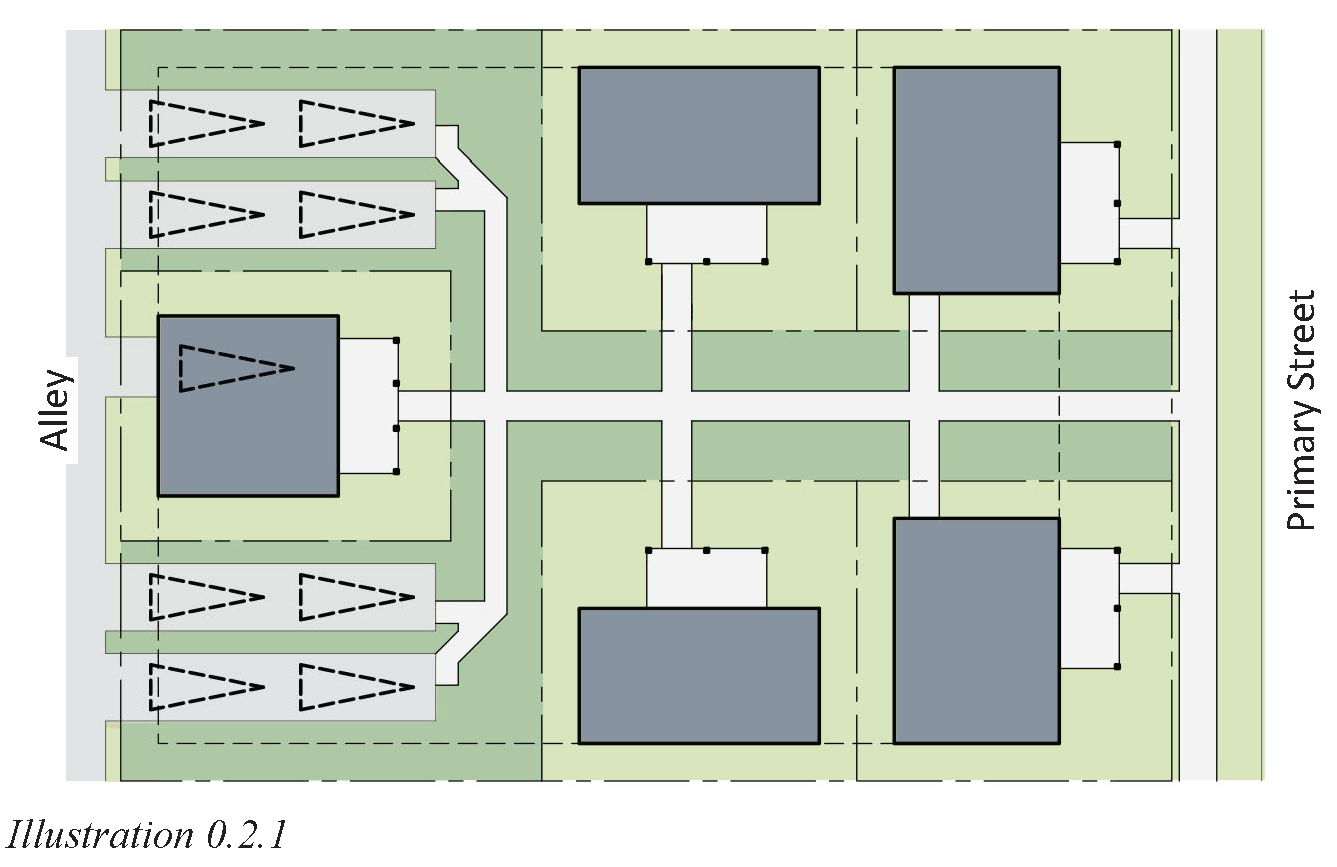
An example of five cottages around a common court (area highlighted with darker green) that provides access from the cottages to the street and to the parking along the alley.
College and university uses. "College and university uses" means teaching, research, administrative, residential and recreational uses associated with an institution of higher learning that awards under graduate and/or professional or graduate degrees.
Commercial equestrian facilities. "Commercial equestrian facilities" means a boarding stable, riding school or academy, riding arena, or exhibition facility for horses, donkeys, or mules, but not facilities that are associated with residential or agricultural uses and solely for the private use of the residential or agricultural landowner or lessee. Commercial equestrian facilities typically include barns, stables, corrals, riding arenas, or paddocks.
Commercial lodging. "Commercial lodging" means a building or group of buildings in which, in the aggregate, six or more rooms are used to provide overnight accommodations. The use may also include services such as meeting rooms, business centers (personal computers and printers for guest use), food service for guests, personal services for guests such as spas or salons, recreational facilities such as swimming pools and fitness centers, ballrooms, exhibit halls, and/or banquet rooms, provided that such services are subordinate to the use of the building or buildings for overnight accommodations.
Commercial vehicle. "Commercial vehicle" means:
(1)
Any motor vehicle, trailer, or semi-trailer that:
(a)
Is designed or used to carry freight, other vehicles, equipment, passengers for a fee, or merchandise in the furtherance of any business enterprise; and
(b)
Has a gross weight of more than 10,000 pounds; or
(2)
Any step van or truck that is designed for commercial moving or parcel delivery services;
(3)
Any truck that is used for mobile retail sales (e.g., ice cream, food trucks);
(4)
Any vehicle with more than four wheels that is used for business purposes;
(5)
Any trailer that is used to haul machinery, supplies, or equipment for business purposes (horse trailers, boat trailers, motorcycle trailers, RV trailers, and car trailers put to personal use are not included in the definition);
(6)
Any trailer that is used for commercial hauling (e.g., waste, junk, lawn clippings) or commercial moving services; or
(7)
Any vehicle that has permanently mounted outside brackets or holders for ladders, tools, pipes, or other similar equipment, unless such vehicle is used for on-call emergency services contracted by the city or other governmental entity.
Common court. "Common court" means a shared amenity among lot owners within a clustered subdivision. A common court may be used for open space and active or passive recreation or to provide pedestrian ingress and egress from interior lots to public right-of-way.
Common interest community. "Common interest community" is defined as set out in the Colorado Common Interest Ownership Act, C.R.S. § 38-33.3-101, et seq.
Community garden. "Community Garden" is a parcel of land where plants are grown and harvested by a non-profit organization or group of individuals. A community garden grows produce and ornamental plants for use by the non-profit and individuals who operate and maintain the garden.
Community scale manufacturing/maker-space. "Community scale manufacturing/maker-space" means a facility, generally open to the public, where tools and space can be rented for light manufacturing, processing, or assembly using wood-working, welding, ceramic kilns, or other tools at a scale for hobbies or small business on site.
Composting facility. "Composting facility" means a facility to which vegetative waste materials, such as lawn clippings, tree trimmings, weeds, and vegetable food scraps from more than one lot or parcel are delivered for composting. The phrase "composting facility" does not include processing of biosolids from wastewater.
Compound development compound. "Compound development (or compound)" means a residential, commercial, or mixed-use development of a grouping of buildings (including, for example a grouping of several one household and two-household dwelling units) using different form types, on one lot. Unlike a clustered subdivision, a compound is not subdivided into multiple lots. [See illustration 0.2.2.]
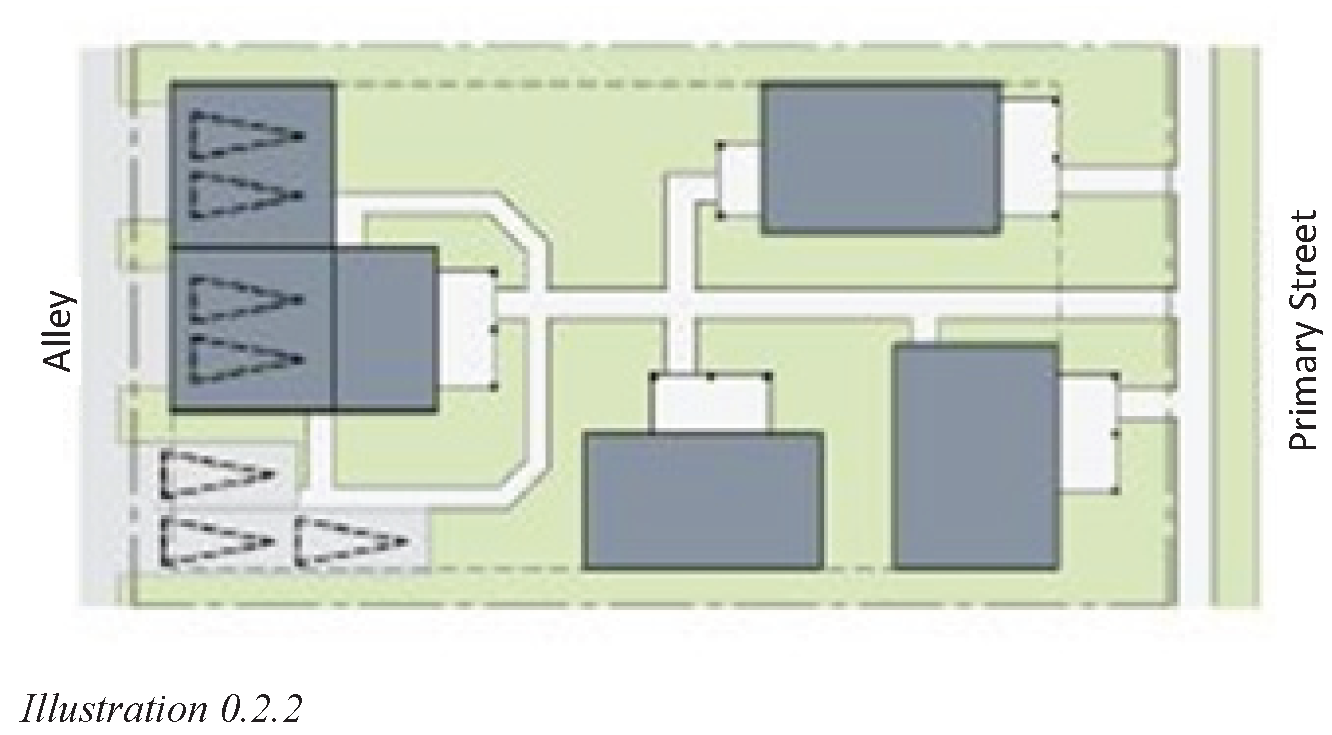
An example of a four-cottage compound. The compound building form types permit cottages with set maximum floor areas to preserve and increase small cottage development.
Conditioned space. "Conditioned space" is an area, room or space that is enclosed within the building thermal envelope and that is heated or cooled, including attached garages whether or not such attached garage is directly heated or cooled.
Construction. "Construction" means non-agricultural land disturbing activities (but does not include ditch or road maintenance or minor landscaping or gardening projects) and the erection of buildings or installation of structures, improvements, or infrastructure on real property. As appropriate to the context, the term "construction" also refers to the thing constructed.
Construction vehicle. "Construction vehicle" means:
(1)
Any tracked vehicle used for construction, grading, or excavation, such as bulldozers, excavators, drilling machines for mining or driving piles, and comparable vehicles;
(2)
Any wheeled vehicle that is used for construction that uses off-highway tires, including loaders, graders, soil compactors, skidders, and comparable vehicles;
(3)
Dump trucks;
(4)
Cement mixer trucks; and
(5)
Bucket trucks.
Convenience lending. "Convenience lending" means:
(1)
A business engaged in providing short-term loans to individuals in exchange for personal checks or bank account access as collateral; or
(2)
A business that, for a fee, cashes checks, warrants, drafts, money orders, or other commercial paper serving the same purpose, but is not a state or federally chartered bank, savings association, credit union, industrial loan company, or retail store that is engaged primarily in the business of selling consumer goods.
Cottage industry and retail. "Cottage industry and retail" means a light manufacturing, assembly, or processing function that is appropriate for commercial contexts and may include retail to customers to participate in the process or sale of goods produced on site. Generally, activity is limited to 1,000 square feet of building area.
Covered balcony. "Covered balcony" means an outdoor covered space that extends from or is integrated into an upper story of a building, which is at least 50 percent open on each vertical elevation that does not abut the building wall. [See illustration 0.2.3.]
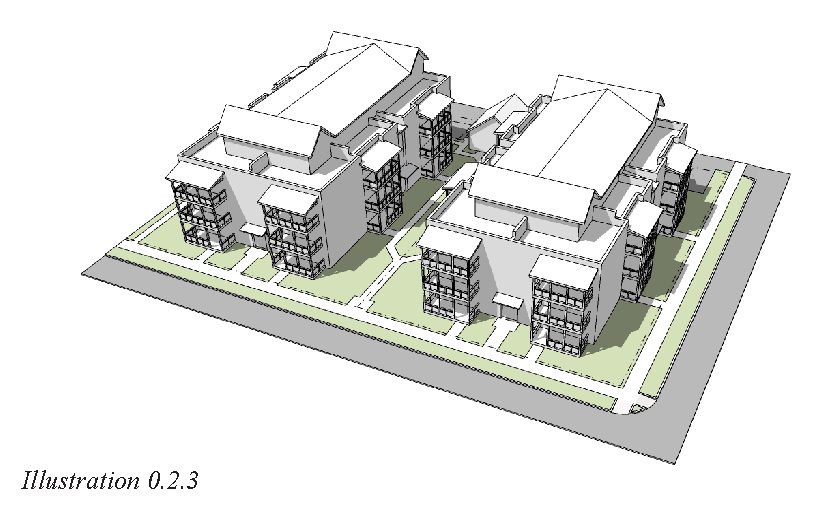
Stacked covered balconies attached to the building is a common way to provide an outdoor private space for each dwelling unit in mixed-use buildings such as the ones shown above.
Covered walkway. "Covered walkway" means a pedestrian-use area that is not exposed to the sky, which has a cover (a ceiling) within 15 feet of the ground surface. Examples of covered walkways include colonnades, arcades, or sidewalk or plaza areas that are sheltered by one or more awnings. [See illustration 0.2.4.]
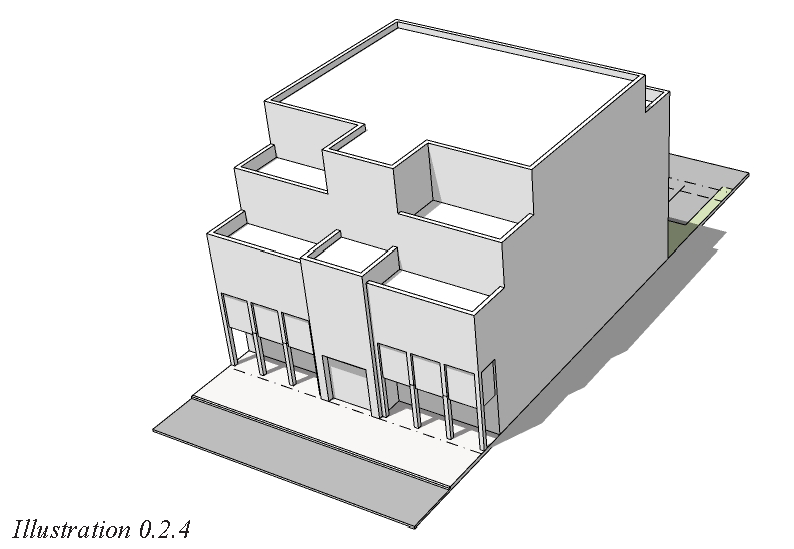
An example of a building with a covered walkway on the first story in the form of an arcade.
Crematorium. "Crematorium" means a facility for the processing of corpses, human or animal, by burning to ashes or dissolution through chemical or other process. Crematoriums do not include establishments where incinerators are used to dispose of toxic or hazardous materials, infectious materials, or narcotics.
Data center. "Data center" means a building or predominant portion thereof that is used by telecommunications carriers, internet access providers, or internet service providers, in which equipment for telecommunications and data processing use (e.g., servers, data storage devices, switches, routers, and other comparable technology infrastructure) is concentrated and physically secured and where a significant portion of floor area and/or electrical capacity and resources are devoted to the data center use. And does not include extractive data mining processes. Equipment in a data center may be owned or operated by more than one entity. The phrase "data center" does not include the phrase "wireless telecommunications facility."
Day care center, adult or child. "Day care center, adult or child" means:
(1)
Adult day care center, which is a facility that is certified by the State of Colorado to provide health and social services on a less than 24-hour basis to elderly, blind, or disabled adults.
(2)
Child day care center, which is a facility, by whatever name known, that is maintained for the whole or part of a day for the care of five or more children under the age of 16 years and not related to the owner, operator, or manager thereof, whether such facility is operated with or without compensation for such care and with or without stated educational purposes. The term includes: (i) facilities commonly known as "day care centers," "day nurseries," "nursery schools," "kindergartens," "preschools," "play groups," "day camps," "summer camps," "centers for children with intellectual or developmental disabilities" and (ii) facilities that provide 24-hour care for dependent and neglected children, and (iii) facilities for children under the age of six years with stated educational purposes operated in conjunction with a public, private, or parochial college or a private or parochial school, except that the term does not apply to any kindergarten maintained in connection with a public, private, or parochial elementary school system of at least six grades. Child care centers may be classified as either "small" (five to 12 children) or "large" (13 or more children).
dB. "dB" is an abbreviation for "decibel" which is a unit for measuring the volume of a sound, equal to 20 times the logarithm to the base ten of the ratio of the pressure of the sound measured to the reference pressure, which is 20 micropascals (20 micronewtons per square meter).
dB(A). "dB(A)" is the standard notation for the sound pressure level as measured with a sound level meter using the A-weighting network.
DBH. "DBH" means the tree diameter measured at four and one-half feet above the ground.
Department. "Department" means the department of planning, a department within the division.
Dependent. "Dependent" means the biological child of an adult, or a person related to an adult by adoption, guardianship or other duly authorized custodial relationship, who receives financial support from the adult and who resides with the adult at least three calendar months in a calendar year.
Detoxification facility. "Detoxification facility" means a facility for the purposes of temporary or long-term inpatient treatment of victims of alcohol or drug use or addiction.
Development. Except as defined in chapters 18.70 and 18.80 for the purposes of those chapters, the term "development" means:
(1)
Land clearing or grading in anticipation of construction for non-agricultural purposes;
(2)
Subdivision of land for use, construction, sale or lease;
(3)
Construction of site improvements, buildings, or infrastructure; or
(4)
The use of any building, structure, or land, including new uses, expansions, and material changes to the operational characteristics of existing uses.
Director. "Director" means the director of the division or the designee of such director.
Disposal facility. "Disposal facility" means facilities for the disposal of nonnuclear waste or fill. The phrase "disposal facility" includes solid waste disposal sites and facilities, as defined by C.R.S. § 30-20-101; and hazardous waste disposal sites, as defined by C.R.S. § 25-15-200.3.
Division. "Division" means the City of Golden, Colorado division of community development, or such department or division designated by the city manager to administer this Code.
DNL. "DNL" means the 24-hour average sound level, in dB(A), for the period from midnight to midnight, obtained after the addition of ten dB(A) to sound levels for the periods between 10:00 p.m. and 7:00 a.m.
Domestic small livestock and fowl includes backyard chickens, miniature goats, miniature pot-bellied pigs, rabbits, chinchillas, and any female breed of duck, excluding drakes.
Dwelling. "Dwelling" means any building or portion thereof which is used as the private residence or sleeping place of one or more human beings, but not including hotels, motels, tourist courts, resort cabins, clubs, hospitals or similar uses.
Dwelling unit. "Dwelling unit" means a building or any portion of a building designed for occupancy as complete, independent living quarters for one or more persons, having direct access from the outside of the building or through a common hall and having living, sleeping, kitchen and sanitary facilities for the exclusive use of the occupants.
Dwelling unit, affordable. "Dwelling unit, affordable", for the purposes of chapter 18.70 and Sections 18.40.350 and chapter 18.40, appendix A, section A-1.12.2 only, means any housing unit that qualifies as low (zero percent to 50 percent AMI), moderate (51 percent to 80 percent AMI) or middle (81 percent to 120 percent AMI) income according to the current area median income (AMI), and remains such for a period of no less than 20 years. [Note: For provisions other than chapter 18.70 and Sections 18.40.350 and chapter 18.40, appendix A, section A-1.12.2, see definition of "affordable housing unit", supra.]
Dwelling unit, efficiency or buffet type. "Efficiency dwelling unit" or "buffet dwelling unit" means an apartment dwelling unit having not less than 300 square feet of floor area with facilities for living, sleeping, cooking and eating as required by the Uniform Building Code.
Dwelling unit, one household. "Dwelling unit, one household" means a building designed exclusively for, and occupied by, not more than one household, except that a one household dwelling unit may incorporate in the same structure one accessory dwelling unit in compliance with this title. One household dwelling units shall include manufactured homes and factory built homes, but shall not include mobile homes unless the mobile home also meets the definition of manufactured home.
Dwelling unit, two household. "Dwelling unit, two household" means a building designed for and occupied by not more than by two households living in separate dwelling units.
Dwelling unit, multiple household. "Dwelling unit—Multiple household" means a building designed for three or more households living in separate dwelling units, but not including, motels, hotels, or tourist homes.
Engineering regulations. "Engineering regulations" means the "Water and Sanitary Sewer Specifications and Street Sidewalk, and Drainage Specifications," as adopted by the Golden City Council including all addendum and amendments thereto.
Essential services. "Essential services" means gas, electrical, steam, or water transmission or distribution systems, collection, communication, and supplierdisposal systems. Such services may include poles, wires, mains, drains, sewers, pipes, conduits, cables, fire alarm boxes, police call boxes, traffic signals, hydrants, cabinets, pedestals, and other similar equipment and accessories in connection therewith, reasonably necessary for the furnishing of adequate service by such public utilities or municipal departments or commissions or for the public health, safety, or general welfare.
Factory built home. "Factory built home" means a dwelling unit designed for one household that is partially or entirely manufactured in a factory and designed for long-term residential use when placed upon a permanent foundation. Factory built homes must be constructed to the standards of the State Factory Built Housing Construction Certification Code (8 CCR 1302-3), as the same is amended from time to time, and must bear the insignia indicating compliance with those standards.
Farmers' market. "Farmers' market" is a seasonal open air market where fruits, produce, flowers, eggs, and food products like jams, jellies, sauces, or baked goods are sold directly to consumers.
Family. See "household."
First story. "First story" means any portion of a building that has its floor line less than six feet above finished grade.
Fitness instruction or gymnasium. "Fitness instruction" or "gymnasium" means a business that provides instruction (generally by way of organized, regularly scheduled classes) related to movement and physical fitness within an enclosed building, including but not limited to:
(1)
Aerobics and stretching;
(2)
Boxing or kickboxing;
(3)
Dance;
(4)
Gymnastics;
(5)
Martial arts;
(6)
Rock climbing;
(7)
Spinning;
(8)
Swimming;
(9)
Weight lifting; or
(10)
Yoga.
Floor area. "Floor area" means that area included within the periphery defined by the outer surfaces of the exterior walls of a building and includes the aggregate area of all floors but excludes attached garages, carports, patios, porches or balconies. In the case of multiple dwelling units or other occupancies where the peripheral walls may consist partially of common walls, measurement shall be along the centerline of such common walls. For the purposes of applying the floor area limitations set out in chapter 18.29, the application of this definition is modified as provided in section 18.29.08.001.5.
Form category. "Form category" means a group of related for types.
Form type. "Form type" means an enumerated type of building, based on its form, as set out in division III of chapter 18.29.
Form zone. "Form zone" means a designated geographic area of the city described by section 18.29.01.003.1.a and division II of chapter 18.29, and established by section 18.29.01.004, within which divisions III, V, VI, VII, and VIII of chapter 18.29 establish intent, standards, guidelines, and certain rules of procedure and rules of measurement.
Foster home. "Foster home" means a facility for child care in a place of residence of a household for the purpose of providing family care and/or training for children who are not related to the head of such home, and provided that such home is licensed or otherwise approved by the State of Colorado Department of Social Services for such purpose.
Fueling, fast-charging, or service station. "Fueling, fast-charging, or service station" means a building or land area used for the retail dispensing or sales of vehicular fuels (and may also include level 3 DC fast-charging of electric vehicles). The phrase "fueling, fast-charging, or service station" does not include the phrase "heavy motor vehicle repairs or service," but does include the phrase "light motor vehicle repairs or service," which may be integrated into the use. A fueling, fast-charging, or service station may include a retail store that sells goods and services, but primarily ready-to-eat food products (not intended for on-premises consumption), groceries, sundries, and automotive fluids and accessories (e.g., windshield washer fluid, batteries, motor oil, car window shades). The phrase "fueling, fast-charging, or service station" does not include the phrase "truck stop."
Funeral home. "Funeral home" means an establishment that provides for:
(1)
Human funeral services; and/or
(2)
Embalming and the performance of other services used in the preparation of the dead for burial.
The phrase "funeral home" does not include the term "crematorium."
Garage. "Garage" is any building, or portion of a building, designed to accommodate or store motor vehicle(s).
Golf course. "Golf course" means land used for the game of golf, which may include accessory uses such as driving ranges, pro-shops, club houses, and restaurants.
Grade. "Grade" (ground level) means the average of the finished ground level at the center of all walls of a building.
Green grocer. "Green grocer" means a temporary structure where local food producers sell fruits, produce, flowers, eggs, meat, plants and food products like jams, jellies, pickles, sauces, or baked goods. It is also known as a produce market.
Group home. "Group home" means a dwelling unit in which people live together (but not more than one who is required to register as a sex offender pursuant to C.R.S. § 18-3-412.5, as amended) and receive supportive services and are supervised by persons who live in the residence. For the purposes of this Code, there are four classifications of group homes:
(1)
Community residential homes (a/k/a group home for up to eight persons with intellectual and developmental disabilities), which is a state-licensed group home, exclusively for the care of persons with developmental disabilities, as defined by C.R.S. § 25.5-10-202.
(2)
Group home for the aged, which is a group home of up to eight persons who are 60 years of age or older who do not need nursing facilities, and who so elect to live in conventional residential surroundings. The phrase "group home for the aged" does not include nursing facilities (as defined in C.R.S. § 25.5-4-103(14)) or institutions providing life care (as defined in C.R.S. § 11-49-101(6)).
(3)
Group home for persons with behavioral or mental health disorders, which is a state-licensed group home for up to eight persons with behavioral or mental health disorders as defined in C.R.S. § 27-65-102, who are screened by a professional person as provided in C.R.S. § 27-65-102(27) prior to occupying the group home, and which does not include persons determined to be not guilty by reason of insanity to a violent offense and persons who have been convicted of a felony involving a violent offense.
(4)
Group home for substance use disorders, which is a state-certified group home serving persons protected by the provisions of the Federal Fair Housing Act living in a recovery residence as defined in Colorado Revised Statute section 27-80-129(1)(b) or as thereafter amended, also known as a sober living residence.
Half-story. "Half-story" means a habitable area within a building with a side wall height of not more than six feet. For the purposes of chapter 18.29, half-stories are identified and measured as provided in section 18.29.08.001.3.d.
Heavy equipment. "Heavy equipment" means non-motorized merchandise of 6,000 pounds or more empty weight, or motorized merchandise of more than 6,000 pounds empty weight, having motors of 20 horsepower or more performance.
Heavy industry. "Heavy industry" means industrial uses that are not specifically defined elsewhere in this Code, that can be described in one of the following three ways:
(1)
Primary processing or manufacturing or repair operations not specifically defined elsewhere in this chapter or this definition, that involve:
(a)
A material risk of significant environmental contamination, explosion, or fire;
(b)
Perceptible ground vibration at the property line;
(c)
Excessive noise or dust emissions at the property line and downwind;
(d)
Large-scale outdoor storage of inputs or products;
(e)
Significant outdoor installations of processing equipment;
(f)
Outside emission of objectionable odors; or
(g)
Twenty-four or more round-trips by semi-trailer trucks per day; or
(2)
Processing of minerals (except precious and semi-precious stone cutting for jewelry or precision instruments such as lasers or watches), ores, logs, pulpwood, or fossil fuels; or
(3)
Activities that are required to undergo new source review under the Federal Clean Air Act, or are subject to construction or operation permits pursuant to the Colorado Stationary Sources Program or Title V of the Federal Clean Air Act.
For illustrative purposes, heavy industrial uses include (if they meet the thresholds of this definition), but are not limited to:
(a)
Coal cleaning plants with thermal dryers; coke oven batteries; carbon black plants (furnace process); petroleum refineries; petroleum storage and transfer units (except retail gasoline stations); and bulk fuel dealers;
(b)
Facilities used in the primary or secondary production of metals (e.g., primary zinc, copper, or lead smelters; primary aluminum ore reduction plants; iron and steel mills; sintering plants; secondary metal production plants; and blacksmith shops);
(c)
Portland cement plants;
(d)
Sawmills and pulp mills;
(e)
Incinerators with the capacity to charge more than 250 tons of refuse per day;
(f)
Lime plants; phosphate rock processing plants; sulfur recovery plants; and hydrofluoric, sulfuric, or nitric acid plants;
(g)
Fossil fuel combustion (except for electricity generation) totaling more than 250 million BTUs per hour of heat input;
(h)
Fabrication of motor vehicles, manufacturing equipment, durable goods, or prefabricated homes or home components;
(i)
Drycleaner processing plants that use large quantities of PERC or comparable petrochemical solvents;
(j)
Manufacture of plastic products (except assembly of parts that are manufactured elsewhere);
(k)
Hot mix asphalt plants; and
(l)
Meat processing involving butchering of large animal carcasses.
Heavy logistics center. "Heavy logistics center" means a wholesaling, warehousing, or distribution use that provides a central location for receiving, storing, and distributing raw materials, semi-finished goods, or finished goods. Heavy logistics centers may be warehouses in which goods are stored (a/k/a "product warehouses"), or truck terminals in which goods are transferred between trucks or between trucks and trains or other transportation modes (a/k/a "truck terminals"), or moving warehouses (including indoor storage of portable on-demand storage containers), or wholesaling operations (but not wholesale membership clubs in which memberships are available to the general public, which are classified as "retail sales and services"). Heavy logistics centers are expected to generate 24 or more truck round-trips per day.
Heavy motor vehicle repairs and service. "Heavy motor vehicle repairs and service" means the following uses, to the extent they do not qualify as "heavy industry":
(1)
The provision of repair or service to passenger vehicles that includes work that does not qualify as "light motor vehicle repairs and service," including but not limited to body repairs (collision centers), paint, upholstery, engine replacement or reconditioning, air conditioning replacement, tire recapping, and custom body work; and
(2)
Any type of repairs to commercial vehicles or construction vehicles.
The phrase "heavy motor vehicle repairs and service" may include light motor vehicle repairs and service, as well as the installation of audio, video, and navigation systems (which, with respect to passenger vehicles, are otherwise classified as "retail sales and services"), but does not include the phrases "light industry" or "heavy industry."
Heavy motor vehicle sales or rental. "Heavy motor vehicle sales or rental" means the sale or rental of commercial vehicles, recreational vehicles, boats, manufactured homes, or construction vehicles at the location where inventory is stored. The phrase "heavy motor vehicle sales or rental" includes outdoor parking of such vehicles for brokers. Not included in the definition are:
(1)
Brokering of commercial or construction vehicles that are stored off-site and delivered directly to customers (an office, general use); and
(2)
Indoor storage of commercial or construction vehicles for brokers who are located off-site (a light industrial or heavy logistics use).
Heavy retail. "Heavy retail" means retail sales or service activities in which more than 25 percent of the area put to the use is located outside or in partially enclosed structures. Illustrative heavy retail uses include heavy equipment sales or rental, retail greenhouses and garden supply stores, and outdoor lumberyards. Heavy retail does not include uses that are specifically defined elsewhere in this Code.
Heliport. "Heliport" means an area of land that is made available to the public or two or more private companies or individuals for the landing and takeoff of helicopters, which may include related buildings and facilities, such as fixed-base operators, hangars, fueling and de-icing facilities, maintenance facilities, and restaurants.
Helistop. "Helistop" means an area of land or portion of a building or structure that is used for the landing and takeoff of helicopters for a single user (e.g., a news station, hospital, or law enforcement agency).
Home occupation. See chapter 18.42.
Hospital. "Hospital" means an institution that is licensed, certified, or approved as a "hospital" by the Colorado Department of Public Health and Environment ("CDPHE"), where sick or injured persons are given medical care and, in the course of same, may be housed overnight, fed, and provided nursing and related services. The term "hospital" also includes a free-standing emergency department.
Hotels and motels. See commercial lodging.
Household. "Household" means a person or group of persons occupying a dwelling unit pursuant to the residential occupancy standards in chapter 18.28.03.01.
Household pets. "Household pets" means the following domesticated animals: Aquarium fishes, psittacine birds, aviary finches, gerbils, guinea pigs, hamsters, laboratory mice and rats and, dogs and cats.
Indoor amusement, recreation, and entertainment. "Indoor amusement, recreation, and entertainment" means a use that provides amusement and recreational activities indoors (except sexually-oriented businesses, indoor firing ranges, fitness instruction or gymnasium, and bars, taverns, or nightclubs), including, but not limited to:
(1)
Arcades;
(2)
Bowling alleys;
(3)
Escape rooms;
(4)
Game arcades (e.g., video games, skee ball, and comparable amusement machines);
(5)
Indoor archery ranges;
(6)
Indoor axe throwing;
(7)
Indoor mini-golf;
(8)
Indoor playgrounds (may include conventional playground equipment, inflatables, trampolines, rock climbing walls, zip lines, and comparable equipment);
(9)
Indoor skydiving;
(10)
Indoor electric go-kart tracks;
(11)
Indoor skating rinks (ice or roller);
(12)
Laser tag;
(13)
Local area network ("LAN") gaming centers;
(14)
Ping-pong centers;
(15)
Pool/billiard rooms; and
(16)
Recreation centers.
Indoor firing range. "Indoor firing range" means an indoor area designed for the safe discharge of rifles, shotguns, handguns, or any other firearm for the purpose of sport shooting or military/law enforcement training. The range may use silhouettes, skeet, trap, or other similar materials to facilitate target practice. Excluded from this use type are amusements that simulate shooting but do not involve bullets (e.g., laser tag, foam darts, etc.) which are classified as "indoor amusement, recreation, and entertainment."
Kennel, indoor. "Kennel, indoor" means an indoor facility (with no outdoor components) in which four or more household pets of the same species are temporarily housed, groomed, bred, boarded, or trained, and may also be incidentally treated for medical conditions. The phrase "kennel, indoor" includes for-profit facilities; as well as not-for-profit or public facilities at which abandoned or rescued animals are housed and offered for adoption.
Kennel, outdoor. "Kennel, outdoor" means a facility in which four or more household pets of the same species are temporarily housed, groomed, bred, boarded, or trained, and may also be incidentally treated for medical conditions, which facility includes an outdoor component, such as dog runs. The phrase "kennel, outdoor" includes for-profit facilities; as well as not-for-profit or public facilities at which abandoned or rescued animals are housed and offered for adoption.
Laboratory. "Laboratory" means a building or a portion of a building devoted to the experimental study in science or the testing and analysis of chemicals, drugs, explosives, minerals, and similar materials.
Landscape and amenity areas. "Landscape and amenity areas" means, for the purposes of chapter 18.29, outdoor areas that provide separation and relief from buildings (including lawns, gardens, and other areas planted with vegetation), ecological benefits (including natural drainage ways and drainage ponds, rain gardens, and swales), or otherwise create outdoor recreational opportunities (including walkways, pedestrian paths, open plazas and malls, terraces, common courts, playgrounds, rooftops that are improved for landscape or recreational purposes, areas with benches, outdoor furnishings, and other places for sitting, and other areas designed specifically for active or passive recreational use). The phrase "landscape and amenity area" does not include portions of a property that are used for outdoor storage or areas that are designed to accommodate motor vehicle circulation or parking.
Landscape surface ratio. "Landscape surface ratio" (a/k/a "LSR") means, of the purposes of chapter 18.29, the ratio of the area of landscaping and amenity areas to the area of the lot upon which they are located.
Landscaped area. "Landscaped area" means the total pervious surface on a lot or parcel, including, but not limited to, ground covers, sod, mulch, as well as pervious pavement (excluding parking spaces).
Legacy use zone. "Legacy use zone" means the RE, M1, M2, CO, AG, or RM use zone.
Light industry. "Light industry" means a land use that involves research and development, assembly, remanufacturing, compounding, packaging, testing, or treatment of products, generally from previously prepared materials or components, with limited outside storage and limited truck traffic, external impacts, or risks, such that the use is not defined as "heavy industry" or "heavy logistics center." Light industry also includes wholesaling, warehousing, and distribution uses that involve fewer than 24 truck round-trips per day. The phrase "light industry" does not include the phrase "light motor vehicle repairs and service." For illustrative purposes, light industrial uses may include:
(1)
Assembly, testing, repair, or refurbishing of products, instruments, electronics, office and computing machines, and fixtures using premanufactured components;
(2)
Offices of general contractors; specialty subcontractors; tradesmen; or telecommunications providers which include:
(a)
Overhead door access to indoor storage of tools, parts, and materials; or
(b)
Parking of commercial vehicles or a fleet of cars, vans, or light trucks that are used in the business.
(3)
Beverage production (alcoholic and nonalcoholic) and bottling, except at scales that place such production within the definition of "brew pub, distillery pub, or limited winery;"
(4)
Furniture making or refinishing;
(5)
Manufacture of textiles or apparel;
(6)
Screen printing of apparel (except low volume screen printing at a retail store);
(7)
Printing and publishing, except copy centers, and except printing presses that require a stationary source permit or title V permit for air emissions;
(8)
Research, development, and testing laboratories (e.g., for development of products, equipment, or materials), if not classified as "office, general," "office, medical," or "heavy industry;"
(9)
Disassembly of consumer electronics and/or appliances into component parts, where all operations and storage are within an enclosed building;
(10)
Manufacture of glass products (e.g., window panes, bottles and jars), including hand-blown products;
(11)
Manufacture or compounding of pharmaceutical products (except retail compounding pharmacies, which are classified as "retail sales and services"), dietary supplements, health and beauty products, and herbal products;
(12)
Packaging of products;
(13)
Storing, selling, and/or distributing merchandise for or to retailers; industrial, commercial, institutional, or professional business users; or wholesalers (but not wholesale membership clubs in which memberships are available to the general public, which are classified as "retail sales and services");
(14)
Personal warehousing/ flexible industrial space;
(15)
Collection, sorting, and processing of recyclable materials for transport (see definition of "recycling collection center"), in which all sorting, processing, and storage of recyclable materials takes place within an enclosed building; or
(16)
Comparable scientific research or manufacture, compounding, assembling, processing or treatment of products, and office and office/warehouse use, provided the following limitations are placed on all such uses are contained entirely within a building.
Light motor vehicle repairs and service. "Light motor vehicle repairs and service" means:
(1)
Routine service to passenger vehicles that generally takes less than 90 minutes to complete (e.g., inspections, tire rotation and balance, brake service, oil changes, glass repair and replacement, fluid changes, etc.);
(2)
Towing of automobiles and light trucks; and
(3)
Repairs and service to motorcycles, scooters, snowmobiles, all-terrain vehicles ("ATVs"), riding lawnmowers, and other vehicles with engines of less than 1,500 cc displacement.
The phrase "light motor vehicle repairs and service" does not include the phrases "heavy motor vehicle repairs and service," "heavy industry," "light industry," "salvage yard," or the storage of inoperable automobiles or light trucks.
Live-work. "Live-work" means a type of residential mixed-use building that combines a dwelling unit with an integrated permissible nonresidential use that is open to the public and principally used or operated by one or more of the residents of the dwelling unit.
Local street. "Local street" means a street with a speed-limit up to 20 miles per hour with limited vehicle traffic.
Loft. "Loft" means a space designated for sleeping on an intermediate level or levels between the floor and ceiling of a story, open on one or more sides to the room in which the space is located, and in accordance and compliance with section R315 of the IRC.
Lot. "Lot" means a contiguous area of land intended for development, with boundaries that are established by plat, court order, recorded deed, lot line adjustment, or statutory boundary line agreement, which is legally described for purposes of transfer of title. The term "lot" does not include the term "parcel" or "tract," nor does it include areas within street or alley rights-of-way. This definition does not itself authorize the creation of new lots by deed or otherwise. New lots shall be created only as provided in title 17 or state law.
Lot, corner. "Corner lot" means a lot of which at least two adjacent lot lines abut for their full length upon a street.
Lot coverage. "Lot coverage," in general, means the sum of the horizontal area of the footprints of buildings and covered vertical structures (e.g., gazebos) on a lot, measured in square feet, divided by the total area of the lot, also measured in square feet. For the purposes of chapter 18.29, lot coverage is calculated as set out in section 18.29.08.001.6.
Lot, flag. "Flag lot" means an irregularly shaped (generally flag-shaped) lot in which most of the lot area (including the buildable area of the lot) is located behind (in relation to the principal street) one or more other lots, and which includes a narrow extension (the "flagpole") that is coterminous with the side lot lines of the other lot or lots, providing vehicular access to the street.
Lot frontage. "Lot frontage" means the length of the front lot line, except that for the purposes of chapter 18.29 as to non-rectilinear lots, flag lots, or lots fronting on a cul-de-sac, minimum lot frontage may be measured at the front setback line. Lot frontage may be further defined for specific form types as provided in chapter 18.29.
Lot, interior. "Interior lot" means a lot other than a corner lot.
Lot line. "Lot line" means a boundary of a lot that extends between two corners or points of curvature.
Lot line, front. "Front lot line" means the lot line dividing a lot from a street, or as chapter 18.29 may permit, a common court. On corner lots, the front lot line is the lot line with the shortest lot frontage. On through lots, the front lot line is the lot frontage that abuts the street from which the property is addressed. On flag lots, the front lot line is the lot line that connect and is roughly perpendicular to the flagpole portion of the lot.
Lot line, rear. "Rear lot line" means the lot line opposite the front lot line.
Lot line, side. "Side lot line" means any lot line other than front lot line or rear lot line.
Lot line, street. "Street lot line" means a front lot line that is coterminous with a street right-of-way.
Lot line, side street. "Side street lot line" means the side lot line of a corner lot that is coterminous with a street right-of-way.
Lot, through. "Through lot" means an interior lot with front and rear lots lines that are conterminous with street right-of-way lines, or a corner lot with lot lines that are conterminous with more than two streets.
Lot width. "Lot width" means the shortest distance between opposite side lot lines, measured in the area between the front setback line and the rear setback line.
Manufactured home. "Manufactured home" means a building that is transportable in one or more sections, which is built on a permanent chassis and is designed for use with or without a permanent foundation when connected to the required utilities, and which has certification required by the United States Secretary of Housing and Urban Development and was constructed in compliance with the requirements of 42 U.S.C. § 5401 et seq., Manufactured Home Construction and Safety Standards, and the regulations of the Department of Housing and Urban Development that are promulgated thereunder. The phrase "manufactured home" does not include the phrases "recreational vehicle," "mobile home," "tiny house" or "tiny home."
Manufacturing. "Manufacturing" means the process of producing a finished product from raw or prepared materials by giving such materials new forms, qualities, properties, or combinations, whether by hand land, labor, or machine.
Mega drive-through facility. "Mega drive-through facility" means a business where the drive-through operations generate a substantial number of vehicle trips and has some or all of the following characteristics: drive-through operation is a predominant feature on the site as indicated by multiple drive-through lanes, employees outside the building to manage vehicle flow, longer or multiple vehicle stacking areas compared to other drive-through facilities similar in use, and/or use of the drive-through as the predominate way to render services compared to parking or walk-up services.
Membership club. "Membership club" means an association of persons, whether incorporated or unincorporated for some common purpose, but not including groups organized primarily to render a service carried on as a business.
Microbrewery. "Microbrewery" means a facility that produces no more than 15,000 barrels per year of fermented malt beverages on-site. Microbreweries may sell their products off-site, but must also include a taproom in which guests/customers sample and/or purchase the product as with bar, tavern, nightclub, and restaurant uses with appropriate liquor licensing.
Microdistillery. "Microdistillery" means a facility that produces no more than 15,000 gallons per year of spirituous beverages on-site. Microdistilleries may sell their products off-site, but must also include a tasting room in which guests/customers may sample and/or purchase the product as with bar, tavern, nightclub, and restaurant uses with appropriate liquor licensing.
Microwinery. "Microwinery" means a facility that produces no more than 250,000 gallons per year of vinous beverages on-site. Microwineries may sell their products off-site, but must also include a tasting room in which guests/customers may sample and/or purchase the product as with bar, tavern, nightclub, and restaurant uses with appropriate liquor licensing.
Miniature goat. "Miniature goat" shall mean a livestock animal from the Nigerian Dwarf Goat or African Pygmy Goat breed that is not taller than 24.5 inches at the withers.
Miniature pot-bellied pig. Miniature pot-bellied pig" shall mean a cloven-hoofed animal, which is domesticated, does not exceed 22 inches in height at the shoulders and does not exceed 100 pounds in weight.
Mining or mineral resource extraction.
(1)
The term "mineral" means an inanimate constituent of the earth in a solid, liquid or gaseous state which, when extracted from the earth, is useable in its natural form or is capable of conversion to a useable form as a metallic compound, or chemical, an energy source or a raw material for manufacturing or construction material, but does not include surface or subsurface water.
(2)
The terms "mining" and "extraction" mean any removal or development of a mineral from its natural occurrence on affected land or from a watercourse, and includes, but is not limited to, drilling, blasting, scaling, crushing, tunneling, excavating, dredging, panning or sluicing and includes any tailings piles, tailing ponds, waste dumps or concentration, milling, evaporation or other on-site processing activities or any buildings, structures or machinery used in such operation. "Mining" and "extraction" does not include the use of battery powered concentrate wheels or hand and mini-sluices or battery powered or hand panning upon any watercourse outside the boundaries of the city's kayak course, on the conditions that such activity takes place below the watercourse's water level and does not disturb or undermine any of the watercourse's vegetation.
Mobile home. "Mobile home" means a dwelling that is built on a chassis designed for long-term residential occupancy, that is capable of being installed in a permanent or semi-permanent location, with or without a permanent foundation, and with major appliances and plumbing, gas, and electrical systems installed but needing the appropriate connections to make them operable, and that may be occasionally drawn over the public highways, by special permit, as a unit or in sections to its permanent or semi-permanent location. Mobile homes are different from manufactured homes in that they were either constructed before the adoption of 42 U.S.C. § 5401, et seq., Manufactured Home Construction and Safety Standards, or are otherwise not in compliance with said federal law and its implementing regulations. The phrase "mobile home" does not include the phrases "manufactured home," "recreational vehicle," "tiny house," or "tiny home."
Mobile home park. "Mobile home park" means a lot, parcel, or tract of land which is designated, improved, and used for the purpose of providing a location or accommodation for one or more mobile homes for occupancy for one household. Mobile home unit sales lots on which unoccupied mobile homes are located for inspection or sale shall not be considered mobile home parks.
Mostly preserved building. "Mostly preserved building" means, for the purposes of chapter 18.29, a building that is proposed for partial demolition, partial reconstruction, or addition of new building volume, but that the director determines will be "mostly preserved" after the completion of the work, according to the standards set forth in section 18.29.07.001.2.
Motorcycle, scooter, or ATV sales or rental. "Motorcycle, scooter, or ATV sales or rental" means the sale or rental of motorcycles, scooters, snowmobiles, or ATVs at the location where inventory is stored. The phrase "motorcycle, scooter, or ATV sales or rental" includes outdoor storage of motorcycles, scooters, snowmobiles, or ATVs for off-site brokers. The phrase does not include:
(1)
Brokering of motorcycles, scooters, snowmobiles, or ATVs that are stored off site and delivered directly to customers (a general office use); or
(2)
Indoor storage of motorcycles, scooters, snowmobiles, and ATVs for brokers who are located off site (a light industrial or heavy logistics use, depending upon the volume of sales).
Motor vehicle and transportation land uses. "Motor vehicle and transportation land uses" means a category of land uses that consists of "bus or taxi terminal, on-demand transportation dispatch," "fueling, fast-charging, or service station," "light motor vehicle repairs and service," "heavy motor vehicle repairs and service," "heavy motor vehicle sales or rental," "heliport," "helistop," "motorcycle, scooter, or ATV sales or rental," "motor vehicle wash," "passenger motor vehicle sales or rental," "RV storage," "surface parking," "structured parking," and "truck stop."
Motor vehicle wash. "Motor vehicle wash" means any area or business using selfservice, in-bay automatic, or conveyor equipment for cleaning and washing motor vehicles, whether as a part of another business operation (e.g., as an accessory use to fueling, fast-charging, or service station), or as a stand-alone operation, of any type, on a commercial basis and is not considered a drive-through facility.
Multi-family residential development. For the purposes of establishing parking requirements in chapter 18.36, "multifamily residential development" means a residential or residential mixed-use development built to the main street, mixed-use, shop form type standards in section 18.29.03, or a combination of multi-unit buildings with integrated site design, shared vehicular circulation systems and parking areas, or comparable development allowed in a PUD/ODP and partially within an applicable transit service area (as defined by C.R.S. § 29-36-102(2)). Multifamily residential developments generally: Are not eligible to be built to the International Residential Code (IRC); are not eligible for a subdivision process for fee-simple ownership of individual dwelling units; and have shared amenities such as open-space, building and pedestrian corridors, and site access. Parking areas are not exclusively integrated into individual dwelling units with attached garages with direct access to the unit.
Multi-tenant site. "Multi-tenant site" means a lot that contains one or more buildings that are designed for lease to different tenants (e.g., a shopping center or office building), or a group of contiguous lots and parcels that are planned and developed to share access and parking areas (e.g., a shopping center that includes "pad sites" that are platted for separate ownership, but which share parking and access with the principal shopping center lot).
Municipal. "Municipal" means owned, operated, or controlled by the City of Golden.
Neighborhood character. "Neighborhood character" means an amalgam of various elements that give neighborhoods their distinct "personality." These elements may include land use, urban design, visual resources, historic resources, and other patterns of development associated with land use. These elements may be specifically identified for distinct areas of the city in the City of Golden Comprehensive Plan or neighborhood plans.
Neighborhood retail store. "Neighborhood retail store" means a use devoted exclusively to the retail sale of a commodity or commodities. The sales area of such use shall be indoors only, and the total enclosed area for such use shall not exceed 4,000 square feet.
Neighborhood farmers' market. "Neighborhood farmer's market" is a seasonal open air market where fruits, produce, flowers, eggs, plants and food products like jams, jellies, sauces, or baked goods, are sold directly to consumers.
Nonconforming access or parking. "Nonconforming access or parking" means parking lots, spaces, driveways, or access aisles that were constructed or installed in conformance with city requirements as they existed prior to the effective date of the ordinance codified in this title or any amendment thereto, and conflicting with the standards for parking lots, spaces, access aisles, or loading areas that are applicable to the subject property under chapter 18.36, Sections 18.40.242, 18.40.442, 18.40.532, or 18.52.020, or other provisions of this title that control the number, design, configuration, surfacing, dimensions, striping, or layout of parking lots, spaces, access aisles, or loading areas.
Nonconforming buffering. "Nonconforming buffering" means a landscape buffer or portion thereof that was created in conformance with city requirements as they existed prior to the effective date of the ordinance codified in this title or any amendment thereto, and conflicting with the width, location, or landscaping standards for buffers that are applicable to the subject property under this title.
Nonconforming building. "Nonconforming building" means a building or portion thereof built prior to the effective date of the ordinance codified in this title or any amendment thereto, and conflicting with the setback or building height provisions of this title applicable to the zone district in which it is situated, or the form or design standards set out in Chapter 18.29 with regard to any of the form types that are permissible within the form zone in which it is situated.
Nonconforming dwelling units. "Nonconforming dwelling units" means the existing residential dwelling units on a subject property, as established in conformance with city requirements as they existed prior to the effective date of the ordinance codified in this title or any amendment thereto, and in excess of the maximum dwelling units allowed pursuant to this title for the subject property.
Nonconforming landscaping. "Nonconforming landscaping" means landscaping of a subject property or portion thereof, except within a required buffer (see "nonconforming buffering"), that was installed in conformance with city requirements as they existed prior to the effective date of the ordinance codified in this title or any amendment thereto, and conflicting with the landscaping standards that are applicable to the subject property under this title.
Nonconforming lighting. "Nonconforming lighting" means exterior lighting that was constructed or installed in conformance with city requirements as they existed prior to the effective date of the ordinance codified in this title or any amendment thereto, and conflicting with the standards for exterior lighting that are applicable to the subject property under chapter 18.34, section 18.40.282, or other provisions of this title that control the design, location, height, brightness, and timing of exterior lighting.
Nonconforming lot. "Nonconforming lot" means a lot which was created prior to enactment of applicable portions of title 17 and this title, or any amendment thereto, and conflicting with the lot area or lot width provisions applicable to the zone district in which it is situated.
Nonconforming sign. "Nonconforming sign" means a sign that was constructed or installed in conformance with city requirements as they existed prior to the effective date of the ordinance codified in this title or any amendment thereto, and conflicting with the standards for signs that are applicable to the subject property under chapter 18.32 or other provisions of this title that control the number, design, display, size, area, location, and materials of signs.
Nonconforming situation. "Nonconforming situation" means any or all of the following: nonconforming buffering, nonconforming building, nonconforming density, nonconforming domestic agriculture, nonconforming landscaping, nonconforming lighting, nonconforming lot, nonconforming parking, nonconforming structure, nonconforming sign, or nonconforming use.
Nonconforming structure. "Nonconforming structure" means a structure that was constructed or installed in conformance with city requirements as they existed prior to the effective date of the ordinance codified in this title or any amendment thereto, and conflicting with the standards for such structure that are applicable to the subject property under this title; except that the phrase "nonconforming structure" does not include the phrases "nonconforming building," "nonconforming lighting," or "nonconforming sign," all of which are separately defined.
Nonconforming use. "Nonconforming use" means the use of all or part of a subject property (including a building, structure, or outdoor areas on the premises) that was established in conformance with city requirements as they existed prior to the effective date of the ordinance codified in this title or any amendment thereto, and conflicting with the provisions of this title regarding the principal or accessory use of the subject property.
Nursing home, memory care, Alzheimer's care. "Nursing home, memory care, Alzheimer's care" means a state-licensed residential facility that is regulated as a skilled nursing facility (as defined in C.R.S. § 26-4-103(11)), which provides meals, assistance with daily activities, such as dressing, grooming, and bathing, and medical care for persons who are temporarily or permanently unable to care for themselves. The phrase "nursing home, memory care, Alzheimer's care" does not include the phrase "group home for the elderly."
Occupied. "Occupied" includes arranged, designed, built, altered, converted, rented or leased, or intended to be occupied.
Office, general. "Office, general" means buildings from which professional, administrative, financial, clerical, brokering, real estate, and limited technical services are provided. The phrase includes, but is not limited to, the following types of businesses:
(1)
Accounting, auditing and bookkeeping;
(2)
Advertising and graphic design (except mailing services, which are "business services");
(3)
Architectural, engineering, and surveying services;
(4)
Attorneys and court reporters;
(5)
Banks, savings and loans, credit agencies, and investment companies;
(6)
Brokering of motor vehicles, commodities, and other items where the thing brokered is not stored on site for any length of time;
(7)
Business incubators (unless the businesses being incubated are classified as another type of use, such as light industry);
(8)
Computer programming and data recovery services;
(9)
Corporate headquarters;
(10)
Data processing and word processing services;
(11)
Detective agencies;
(12)
Government offices;
(13)
Insurance;
(14)
Interior design;
(15)
Real estate sales and off-site rental offices;
(16)
Research and development (not including on-site manufacturing or fabrication, and not including marijuana uses);
(17)
Retail catalog, internet, and telephone order processing, but not warehousing; and
(18)
Virtual office services.
Office, medical. "Office, medical" means office space used for the examination or treatment of patients on an outpatient basis (with no overnight stays by patients), generally by appointment, including:
(1)
Chiropractors, licensed massage therapists, occupational therapists, physical therapists, and acupuncturists;
(2)
Dentists, orthodontists, and oral surgeons;
(3)
Medical lab testing facilities;
(4)
Medical doctors (physicians, pediatricians, obstetricians, gynecologists, radiologists, geriatricians, surgeons, podiatrists, osteopaths, ophthalmologists, anesthesiologists, etc.);
(5)
Medical imaging centers;
(6)
Midwives;
(7)
Nutritionists, Ayurveda medicine practitioners, traditional Chinese medicine practitioners, homeopaths;
(8)
Optometrists;
(9)
Speech therapists;
(10)
Outpatient surgery centers;
(11)
Psychiatrists, clinical psychologists, clinical social workers, hypnotherapists, and marriage and family therapists;
(12)
Physiatrists, physiotherapists, orthotics, prosthetics, recreational therapists, audiologists, respiratory therapists, rehabilitation counselors, prosthetic technicians, and personal care assistants; and
(13)
Other comparable health care professionals.
Outdoor commercial amusement. "Outdoor commercial amusement" means uses that provide commercial amusement outdoors, including but not limited to:
(1)
Amusement parks or theme parks;
(2)
Batting cages;
(3)
Bumper boats;
(4)
Go-kart tracks;
(5)
Golf driving ranges;
(6)
Miniature golf;
(7)
Outdoor archery range;
(8)
Outdoor paintball courses; and
(9)
Water slides and wave pools.
The phrase "outdoor commercial amusement" does not include the phrases "outdoor firing range," "golf course," "outdoor stadium, arena, amphitheater, or drive-in theater," or "race track," or the term "zoo."
Outdoor firing range. "Outdoor firing range" means the use of land designed for the safe discharge of rifles, shotguns, handguns, or any other firearm or similar device for the purpose of sport shooting or military/law enforcement training. The range may use silhouettes, skeet, trap, or other similar materials to facilitate target practice. The phrase "outdoor firing range" does not include general hunting. The phrase "outdoor firing range" does not include amusements that do not involve potentially lethal projectiles (e.g., paintball) which are classified as "outdoor commercial amusement."
Outdoor stadium, arena, amphitheater, or drive-in theater. "Outdoor stadium, arena, amphitheater, or drive-in theater" means:
(1)
Outdoor stadium or arena, which is an outdoor area surrounded by tiered rows of seats or benches, designed for the viewing of live sporting events, rodeos, equestrian events, livestock exhibitions, concerts, or other organized entertainment.
(2)
Amphitheater, which is an outdoor stage (covered or uncovered) designed for live performances and/or the display of films, that faces a lawn or hardscaped area used for temporary or permanent seating.
(3)
Drive-in theater, which is an area of land that includes one or more large outdoor screens or other structures for the display of motion pictures and an area for parking automobiles from which the motion pictures are viewed.
Overhead power lines (110 kV+). "Overhead power lines (110 kV+)" means high voltage (110 kilovolts or more) power lines that are used to transmit electricity over long distances.
Overnight campground. "Overnight campground" means ad or property utilized for or intended for use of renting temporary occupancy space to transient users of recreational vehicles and tents.
Owner occupancy. "Owner occupancy" means a situation in which the fee-simple owner of a lot resides in a dwelling unit that is located on the lot, or the owner of a condominium interest resides in the condominium unit. Ownership is evidenced using title records, while occupancy is typically evidenced by voter registration, vehicle registration, or other similar means.
Parcel. "Parcel" means a specified area of (usually unplatted) land that is legally described using metes and bounds or aliquot parts.
Park. "Park" means an area open to the general public and reserved for recreational, educational, or scenic purposes. Parks are classified as "active" or "passive." See "park, active" and "park, passive."
Park, active. "Park, active" means an area of land that provides for active outdoor recreation opportunities for the public (open to the community) or residents of a subdivision or development, which are generally not commercial in nature. The phrase "park, active" includes areas for active recreational activities including, but not limited to:
(1)
Skate parks;
(2)
Sports fields and play courts (e.g., tennis courts, basketball courts, pickleball courts, and outdoor racquetball or squash courts); and
(3)
Outdoor swimming pools and splash parks.
Park, passive. "Park, passive" means an area of land that provides passive outdoor recreation opportunities for the public (open to the community) or residents of a subdivision or development, which are generally not commercial in nature. The phrase "park, passive" includes areas for passive recreational activities including, but not limited to:
(1)
Jogging, cycling, tot-lots, fitness trails, and playgrounds;
(2)
Arboretums, wildlife sanctuaries, forests, and other natural areas which may be used for walking or hiking; or
(3)
Community gardens.
(4)
Other passive recreation-oriented parks, including picnic areas.
The phrase "park, passive" does not include the term "zoo."
Passenger motor vehicle sales or rental. "Passenger motor vehicle sales or rental" means the sale or rental of passenger vehicles at the location where inventory is stored. The phrase "passenger motor vehicle sales or rental" includes outdoor storage of passenger vehicles for brokers. Not included in the definition are:
(1)
Brokering of passenger vehicles which are stored off-site and delivered directly to customers (an "office, general" use);
(2)
Indoor storage of passenger vehicles for brokers who are located off-site (a light industrial or heavy logistics use, depending upon the volume of sales); and
(3)
Passenger motor vehicle rental locations that have not more than five rental vehicles stored on site at any one time (a "retail sales and services" use).
Pawnbroker. "Pawnbroker" means a business that is regulated by C.R.S. § 29-11.9-101, et seq., that:
(1)
Regularly contracts to advance money to customers on the delivery of tangible personal property by the customer on the condition that the customer, for a fixed price and within a fixed period of time, has the option to cancel the contract; or
(2)
Purchases tangible personal property that has not previously been sold at retail in the course of its business of reselling tangible personal property.
Permanent affordable housing unit. "Permanent affordable housing unit" means an affordable housing unit that is subject to a permanent affordable housing deed restriction.
Permanent affordable housing deed restriction. "Permanent affordable housing deed restriction" means an affordable housing deed restriction with a term of the lesser of 1,000 years or the maximum permissible term under Colorado law.
Person. "Person" means an individual, a corporation, a partnership, any incorporated or unincorporated association of persons, and any legal entity authorized to hold title to real property under the laws of the State of Colorado.
Personal services. "Personal services" means a business that is engaged in the provision of informational, instructional, personal improvement, personal care, or similar services within an enclosed building, including, but not limited to:
(1)
Art, music, or computer programming instruction;
(2)
Beauty salons and barber shops;
(3)
Cooking instruction;
(4)
Driving schools;
(5)
Handicraft or hobby instruction;
(6)
Laundry or dry-cleaning retail outlets;
(7)
Portrait shops or photography studios;
(8)
Shoe repair;
(9)
Tailor/alterations shops;
(10)
Tattoo parlors;
(11)
Spas, massage and related esthetician services.
Photovoltaic arrays (two MW+). "Photovoltaic arrays (two MW+)" means a photovoltaic generation facility with a nameplate capacity of two MW or more that is a principal use of land. Photovoltaic arrays that have a nameplate capacity of less than two MW are classified as "utilities, minor." Photovoltaic arrays that are installed on rooftops or over parking lots are not regulated as principal uses.
Place of amusement. "Place of amusement" means a commercially operated enterprise that supplies various forms of entertainment, including without limitation video arcades, bowling alleys, miniature golf.
Place of assembly. "Place of assembly" means a building, portion of a building, or property in which people assemble for civic, educational, religious, social, or cultural purposes. This use includes facilities used for worship and accessory celebratory events; meeting halls; event centers; fraternal organization facilities; outdoor assembly areas that are not otherwise defined by this Code; and private clubs.
Planned unit development (PUD). "Planned unit development" means a zone district which allows land to be developed under unified control or under a unified plan of development for a number of dwelling units, commercial, educational, recreational or industrial uses, or any combination thereof, the plan for which does not correspond in lot size, bulk, use, density, lot coverage, open space or other restriction of other and use controls.
Porch. "Porch" means an unenclosed, covered or uncovered platform that is connected to the outside of a building, providing pedestrian access to the building's principal entrance.
Prison or jail. "Prison or jail" means a facility for the judicially required detention or incarceration of people, where inmates and detainees are under 24-hour supervision by professionals, except when on approved leave. The facility may also be established in conjunction with a law enforcement or public safety building, established for the temporary detention of adult or juvenile persons while being processed for arrest or detention by law enforcement.
Produce stand. "Produce stand" is a temporary structure where local food producers sell fruits, produce, flowers, eggs, plants, meat and food products like jams, jellies, pickles, sauces, or baked goods.
Protective care. "Protective care" means a licensed homeless youth shelter as defined in C.R.S. § 26-6-102(17), a day treatment center as defined in C.R.S. § 26-6-102(10), a secure residential treatment center as defined in C.R.S. § 26-6-102(35), an acute treatment unit as defined in 2 CCR § 502-1, substance use disorder treatment facilities that provide ASAM Level III residential services as such services are defined in 2 CCR § 502-1 (e.g., nonhospital residential detoxification units), residential child care facilities that are designated to provide mental health services (see § 7.701.2.G, 12 CCR § 2509-8), psychiatric residential treatment facilities, and comparable facilities.
Qualifying affordable housing. "Qualifying affordable housing" means affordable housing units that are located within a qualifying affordable housing project.
Qualifying affordable housing project. "Qualifying affordable housing project" means a residential or residential mixed-use development in which 50 percent or more of the residential units are affordable housing units.
Race track. "Race track" means a commercial facility consisting of a track, either paved or unpaved, which is used primarily for the sport of racing motor vehicles (cars, motorcycles, or all-terrain vehicles, but not go-karts). A racetrack may include seating, concession areas, restaurants, sky boxes, parking facilities, maintenance facilities, accessory offices, garages, and accessory retail facilities. The phrase "race track" includes any facility used for driving automobiles under simulated racing or driving conditions (test tracks, "shakedown" tracks, or other similar facilities), regardless of whether they include seating, concession areas, or retail facilities for the general public.
Recording or TV studio. "Recording or TV studio" means a facility for the recording and production of audio or video material, such as the recording of music, voice, or video, for live broadcast or post-production.
Recreation facility. "Recreation facility" means a building, or portion of a building where activities related to athletics, exercise, arts and crafts, or public assembly, are provided by a commercial or public entity.
Recreational vehicle ("RV"). "Recreational vehicle ("RV")" means a vehicle that is:
(1)
Built on a single chassis;
(2)
Four hundred square feet or less when measured at the largest horizontal projections;
(3)
Designed to be self-propelled or permanently towable by a light duty truck; and
(4)
Designed primarily not for use as a permanent dwelling but as temporary living quarters for recreational, camping, travel, or seasonal use.
The phrase "recreational vehicle" also includes any vehicle that may be used for recreation or personal purposes, including, but not limited to, a boat, motor home, camper trailer, detached camper or detached trailer of any design, whether commercially manufactured or homemade, but not including a manufactured home or mobile home. The phrase "recreational vehicle" includes any trailer used to transport any recreational vehicle(s). For illustrative purposes, the phrase "recreational vehicle" includes:
(1)
Camping trailer or tent trailer, which means a folding structure, constructed of canvas, plastic, or similar water repellent material, designed to be mounted on wheels and designed for travel and recreation.
(2)
Motorized camper, motor home, recreational conversion van or bus, which means a recreational vehicle consisting of a portable, temporary dwelling to be used for travel, recreation, and vacation uses, and constructed as an integral part of a self-propelled vehicle.
(3)
Pick-up camper, which means a vehicle designed to be mounted on or loaded into a pick-up truck chassis for use as a temporary dwelling for travel and recreation.
(4)
Travel trailer, which means a towed vehicle designed as a temporary dwelling for travel and recreation.
(5)
Travel trailer, self-contained, which means a trailer which can operate independently of connections to sewer, water, and electric systems. It contains a water-flushed toilet, lavatory, shower or bath, and kitchen sink, all of which are connected to water storage and sewage holding tanks located within the trailer.
Recycling collection center. "Recycling collection center" means a location for the collection of recyclable materials (e.g., waste paper, motor oil, aluminum and other scrap metal, polystyrene foam, porcelain, batteries, electronic components, textiles, plastics, discarded clothing or shoes, cardboard, and other recyclable household materials), for processing (bailing, compacting, flattening, grinding, shredding, crushing, mechanical sorting, or cleaning) and storage prior to transport to another location for further processing, reuse, or recycling, where some or all processing and storage activities are located outside of a building. Such a facility, if entirely enclosed within a building or buildings, shall be considered "light industry." The phrase "recycling collection center" does not include the phrase "salvage yard."
Redevelopment. "Redevelopment" means the demolition of one or more buildings on a subject property, followed by the construction of one or more new buildings or structures.
Residential land uses. "Residential land uses" means premises designed and intended for long-term habitation by means of ownership or rental, but excluding temporary lodging (short-term rentals/tourist homes) of less than a 30-day duration. Residential use is defined as a building or buildings that include exclusively dwelling units.
Residential mixed-use. "Residential mixed-use" means a mixed-use development containing residential and institutional, commercial, or other non-residential uses for the residents or the public. Amenities such as gyms, fitness centers, pools, lounges, or outdoor or indoor entertainment for exclusive use by residents shall be considered accessory to the residential use for the purposes of calculating residential floor area. However, wrap-around services, community kitchens, classrooms, computer centers, childcare facilities, and other supportive services that are incorporated into affordable housing developments are counted as non-residential floor area.
Residentially zoned area. "Residentially zoned area" means an area zoned for the development of residential dwelling units, including the CO, AG, RE, R1, R1A, R2, R3 zone districts, and portions of PUD developments designed for such use.
Resource extraction, minerals. "Resource extraction, minerals" means the extraction of coal or other mineral resources (including sand and gravel, but not oil and gas) from the land (surface or subsurface). The phrase "resource extraction, minerals" does not include cut and fill operations within a property, construction or maintenance of canals or reservoirs, or the removal and transportation of fill from one property to another as part of an approved development plan; provided, that both properties are controlled by the same landowner.
Resource extraction, oil and gas. "Resource extraction, oil and gas" means any structure, facility, or activity which is constructed on or disturbs land in association with oil or gas drilling, production, or waste treatment and disposal, including but not necessarily limited to wells, tanks or tank batteries, pits, access roads for ingress and egress, and pipelines.
Restaurant. "Restaurant" means an establishment in which the principal business is the sale of food and beverages that are prepared for customers and served in a ready-to-consume state. A restaurant may include indoor and/or outdoor dining areas, and drive-up, drive-in, or drive-through facilities. Restaurants may also provide live entertainment for customers seated at indoor dining tables. Alcoholic beverages may be produced and sold on the premises as provided in applicable alcohol beverage licenses. The term "restaurant" does not include the phrase "bar, tavern, or nightclub" (although they can be co-located as zoning may allow), "brew pub, distillery pub, or limited winery," or "sexually-oriented business."
Retail sales and services. "Retail sales and services" means a use involving the sale, lease, or rental of consumer, home, and business goods and small equipment to consumers. Such uses include but are not limited to department stores, furniture stores, clothing stores, second-hand stores, thrift shops, consignment stores, and establishments providing the following products or services: antiques, appliances, art, art supplies, beauty supplies, bedding and mattresses, bicycles, books, building supplies, magazines and newspapers, craft supplies, copies and copiers, costumes, dry goods, electronics, fabric, framing, games, garden supplies, gifts, groceries, hardware, head shops, home improvement goods, household products, jewelry, lumber, music, musical instruments, office supplies, party supplies, pets and pet supplies, pharmaceuticals, phones, photography equipment, produce, sporting goods, stationary, temporary signs, toys, and videos; and new automotive parts and accessories. The phrase also includes services such as charitable donation collection centers, coin laundries, installation of electronics (e.g., audio systems and navigation systems) into motor vehicles, passenger motor vehicle rentals and pickup trucks; provided, that not more than five rental vehicles are stored on site at any time, picture framing, real estate offices that are open for walk-in traffic; repairs of products sold by the establishment (e.g., a computer store may also repair computers), repairs of consumer electronics, and comparable services.
The phrase "retail sales and services" does not include uses that are classified or defined more specifically in this Code, including but not limited to personal services, restaurants (all types); sexually-oriented businesses; marijuana uses; pawnbrokers, or convenience lending. Retail sales and services uses are generally conducted indoors.
RV storage. "RV storage" means an outdoor area in which spaces are provided for compensation for the storage of unoccupied, individually-owned RVs. The phrase "RV storage" does not include areas associated with heavy motor vehicle sales or rental uses in which inventory is stored for sales or rental purposes, and does not include areas in which RVs are stored for short periods before and after service at a heavy motor vehicle repairs and service use.
Salvage yard. "Salvage yard" means any establishment that is maintained, used, or operated for storing, buying, or selling wrecked, scrapped, ruined, or dismantled motor vehicles or motor vehicle parts. Salvage yards are also referred to by Colorado law as "automobile graveyards." See C.R.S. § 43-1-502.
School. "School" means any building or part or any building used for instructional purposes to provide elementary, secondary, post-secondary, or vocational education. The term "school" does not include the phrase "day care center, adult or child" but does include the following more specific uses: "school, elementary or middle," "school, high," and "school, vocational or trade."
School, elementary or middle. "School, elementary or middle" means a school that provides general full-time educational curriculum for two or more grades from kindergarten through eight.
School, high. "School, high" means a school that provides general full-time educational curriculum for grades nine through 12.
School, vocational or trade. "School, vocational or trade" means an educational facility that primarily teaches skills that directly prepare students for jobs in a trade or profession, resulting in a certificate, diploma, or degree awarded upon the student's completion of the curriculum. Examples include, but are not limited to, art schools, business colleges, trade schools, massage schools, and beauty schools.
Self-storage. "Self-storage" means a facility that provides individual storage compartments within a building for household or commercial goods. Storage spaces may be accessed from interior hallways or individual outside doors or overhead doors. A self-storage use may include a single dwelling unit for one or more persons employed by and residing at the self-storage facility for the purpose of on-site management and security.
Senior housing. "Senior housing" means a facility consisting of three or more dwelling units, the occupancy of which is limited to persons 60 years of age or older. The facility may include medical facilities or care. Senior housing shall typically consist of multiple household attached dwellings, but may include detached dwelling units as part of a wholly owned and managed senior project.
Setback. "Setback" means the minimum distance, extending across the full width of the lot or site between a lot line and that part of the building or structure closest to the respective lot line (excluding measurement from any building surface which, by provision of this title, may occupy the respective setback area).
Setback, front. "Front setback" means the distance between the front lot line and a lot parallel with the front lot line of a lot, tangent to that part of the building or structure (other than an open fire escape, stairway, or chimney) which is closest to the front lot line, and intersecting two other lot lines of the lot; or the line concentrically parallel to the right-of-way of the street on a cul-de-sac (bulb).
Setback, rear. "Rear setback" means the distance between the rear lot line and a line parallel with a rear lot line of a lot, tangent to that part of the building or structure (other than an open fire escape, stairway or chimney) which is closest to the rear lot line, and intersecting two other lot lines of the lot. Setback, side. "Side setback" means the distance between the side lot line and a line parallel with a side lot line of a lot, tangent to that part of the building or structure (other than an open fire escape, stairway or chimney) which is closest to such side lot line, and intersecting two other lot lines of the lot.
Sexually-oriented business. "Sexually-oriented business" means a use of property where the principal use, or a significant or substantial adjunct to another use of the property, is the sale, rental, display or other offering of live entertainment, dancing, or material which is distinguished or characterized by its emphasis on depicting, exhibiting, describing, or relating to specified sexual activities or specified anatomical areas as the primary attraction to the premises, including:
(1)
Adult arcade, which means any place to which the public is permitted or invited wherein coin-operated or slug-operated or electronically, electrically or mechanically controlled still or motion picture machines, projectors, or other image-producing devices are maintained to show images to five or fewer persons per machine at any one time, and where the images so displayed are distinguished or characterized by the depicting or describing of specified sexual activities or specified anatomical areas.
(2)
Adult bookstore or adult video store, which means a place where books, magazines, motion pictures, prints, photographs, periodicals, video or audio recordings, novelties and devices, or any of these things, which have as their primary or dominant theme, matter depicting, illustrating, describing, or relating to specified sexual activities or specified anatomical areas, are sold or offered for sale to adults; and includes a place with only a portion or section of its area set aside for the display or sale of such material to adults, except that any place, otherwise included within this definition, that derives not more than ten percent of its gross income from the sale of such material shall be exempt from the provisions of this section so long as such material is kept in a location where it is not visible and shall not be a self-service item for the customers of such place.
(3)
Adult cabaret, which means a nightclub, bar, restaurant or similar business which regularly features: (a) persons who appear in a state of nudity; (b) live performances which are characterized by the exposure of specified anatomical areas or by specified sexual activities; or (c) films, motion pictures, video cassettes, slides or other photographic reproductions which are characterized by the depiction or description of specified sexual activities or specified anatomical areas.
(4)
Adult motel, which means a hotel, motel, or similar business which offers private rooms to the public and provides patrons live performances or closed-circuit television transmissions, films, motion pictures, video cassettes, slides, or other photographic reproductions which are characterized by the depiction or description of specified sexual activities or specified anatomical areas.
(5)
Adult motion picture theater, which means a business where films, motion pictures, video cassettes, slides, or similar photographic reproductions are regularly shown which are characterized by the depiction or description of specified sexual activities or specified anatomical areas.
(6)
Adult photo studio, which means any establishment which, upon payment of a fee, provides models (and may also provide photographic equipment) for the purpose of photographing specified anatomical areas or specified sexual activities.
(7)
Adult theater, which means a theater, concert hall, auditorium, or similar business which regularly features persons who appear in a state of nudity or live performances which are characterized by the exposure of specified anatomical areas or by specified sexual activities.
(8)
Peep booth, which means a viewing room, other than a private room, of less than 150 square feet of floor space upon the premises of a sexually oriented business where there are exhibited photographs, films, motion pictures, video cassettes, or other video reproductions, slides or other visual representations which depict or describe specified sexual activities or specified anatomical areas.
(9)
Private room, which means a room in an adult motel that is not a peep booth, has a bed in the room, has a bath in the room or adjacent to the room, and is used primarily for lodging for periods of less than 12 hours.
(10)
Sexual encounter establishment, which means a business or commercial establishment which, as one of its primary business purposes, offers for any form of consideration, a place where two or more persons may congregate, associate, or consort for the purpose of specified sexual activities or the exposure of specified anatomical areas, when one or more of the persons exposes any specified anatomical area.
Sidewalk. "Sidewalk" means the portion of a public or private street right-of-way or common court that is designed and intended for pedestrian use, access, and circulation.
Side wall. "Side wall" means the exterior wall of a building (including exterior finishes and cladding) that extends above finished grade to the highest point where the outside plane of the wall intersects the underside of its roof or soffit, or extends to the top of a parapet.
Sign, legal nonconforming. Any sign which was lawfully constructed and maintained prior to September 14, 1989, and which does not conform to all applicable requirements of this ordinance.
Sleeping room, occupied. "Occupied sleeping room" means a potential sleeping room that is in regular use as a room for sleeping, subject to the requirements 18.28.03.01.1.c
Sleeping room, potential. "Potential sleeping room" means a room or space within a dwelling unit having a floor area of at least 70 square feet, a ceiling height of at least five feet, and at least two of the following factors:
(a)
Has walls and doors to separate it from other habitable spaces;
(b)
Meets the definition of a loft;
(c)
Has a closet or similar provision for clothes storage; or
(d)
Has a full or partial bathroom connected to the space or room, or has a path of travel to a full or partial bathroom which does not first pass through a habitable space.
Small-scale agriculture. "Small-scale agriculture" means the use of private land for hobby agriculture or keeping of livestock or bees that meets the thresholds for regulation set forth in chapter 18.26, including the following: (1) urban farms; or (2) keeping of domestic livestock or bees.
SNAP eligible food. "SNAP eligible food" means any food or food product for home consumption, and also includes seeds and plants which produce food for consumption, by SNAP households as determined by the Federal Food and Nutrition Act of 2008, as from time to time updated. "SNAP eligible food" does not include the following items: Alcoholic beverages, tobacco products, hot food and any food sold for on-premises consumption, nonfood items such as pet foods, soaps, paper products, medicines and vitamins, household supplies, grooming items, and cosmetics.
Solar garden. "Solar garden" means:
Solar garden with a rated capacity of 100 kW or less:
Above-grade utilities of less than 10,000 square feet of gross site area that have a localized impact on surrounding properties and are necessary to provide essential services, including, but not limited to, above-ground utilities of less than 10,000 square feet of gross site area and electric services, limited to electrical substations, and electrical relay switching stations, and solar generating stations (NAICS 221114).
Solar gardens with a rated capacity greater than 100 kW:
Electric services, including high-voltage transmission lines (115 kilovolts or more), solar generating stations with a gross site area of 10,000 square feet or greater, and wind generating stations, but not including electrical substations with a gross site area of less than 10,000 square feet (which are defined as minor utility).
Special use permit. "Special use permit" means a permit for use of property issued pursuant to the provisions of chapter 18.30.
Specified anatomical areas. "Specified anatomical areas" means:
(1)
Less than completely and opaquely covered: Human genitals, pubic region, buttocks and breasts below a point above the top of the areola; or
(2)
Human male genitals in a discernibly turgid state even if completely and opaquely covered.
Specified sexual activities. "Specified sexual activities" means acts, simulated acts, exhibitions, representations, depictions or descriptions of:
(1)
Human genitals in a state of sexual stimulation or arousal;
(2)
Fondling or other erotic touching of human genitals, pubic region, buttocks or breasts;
(3)
Intrusion, however slight, of any object, any part of an animal's body, or any part of a person's body into the genital or anal openings of any person's body or into the body of an animal;
(4)
Cunnilingus, fellatio, anilingus, masturbation, bestiality, lewd exhibition of genitals, or excretory function; or
(5)
Flagellation, mutilation, or torture for purposes of sexual arousal, gratification or abuse.
Storage yard. "Storage yard" means a location for outdoor storage of operable equipment and materials for off-site processing, construction projects, or right-of-way maintenance; and/or operable recreational vehicles, boats, trucks, commercial vehicles, or passenger vehicles. A storage yard may include an accessory office and a dwelling unit for one or more persons employed by and residing at the storage yard for the purpose of on-site management and security. The phrase "storage yard" does not include the phrase "salvage yard" and does not include outdoor storage that is accessory to another principal use.
Street. "Street" means an improved urban way or thoroughfare which is designed to accommodate and facilitate motor vehicle traffic, but which may also accommodate pedestrian and non-motorized vehicle traffic. Streets are generally classified as local, collector, minor arterial, principal arterial, or freeway (as defined in the thoroughfare plan), depending upon their function. The term "street" includes the terms "road" and "highway," but does not include the term "alley."
Structure. "Structure" means anything constructed or erected, which requires location on the ground or attached to something having a location on the ground, but not including fences or walls used as fences less than six feet in height, poles, lines, cables or other transmission or distribution facilities of public utilities.
Structured parking. "Structured parking" means a structure that is composed of one or more above-ground or below-ground levels that are used for the parking of passenger motor vehicles. Structured parking may be totally below grade (underground structured parking); or partially or totally above grade (above-ground structured parking); and may be separate from or integrated into a building that is used for other purposes. Structured parking includes parking lifts. Structured parking is the principal use of land if it is not related to a specific land use on the same parcel and may be served by electric vehicle charging stations.
Substantial alteration. "Substantial alteration" means reconstruction, rehabilitation, addition, or other improvements to a building or property resulting in an addition in floor area, or parking or loading area, equal to or greater than 25 percent of the existing area, measured over a period not to exceed five years.
Surface parking. "Surface parking" means an area of land that is designated for the parking of passenger motor vehicles in parking spaces, the related parking aisles, the landscaped areas that are surrounded by parking spaces and parking aisles, and the landscaped areas at the corners of the paved areas insofar as their inclusion in the surface parking area gives it a regular shape. Surface parking lots may be served by electric vehicle charging stations. The phrase "surface parking" does not include driveways on individual residential lots, nor does it include individual garages or carports. Surface parking is a principal use of property if it is not related to a specific land use on the same parcel.
TDM plan. "TDM plan" or "travel demand management plan" means all associated tools, requirements, and strategies for implementing expanding people's travel options through services, infrastructure, parking management, multimodal subsidies, and educational programs to reduce single occupied vehicle trips associated with the development, subject to approval by the director. The TDM plan shall include reporting methods to submit the TDM survey.
TDM survey. "TDM survey" or "travel demand management survey" means an annual survey that reports the commute trip mode share (the percentage of total trips to/from the development, business, or property, by a particular means of travel, including walking, bicycling, using micromobility, riding transit, driving alone, carpooling, vanpooling, telecommuting, etc.) of TDM plan residents or employees and is administered by a qualified third-party professional selected by the owner or owners' representative in the event of individual unit ownership, and subject to approval by the director.
Telecommunication site, commercial. "Commercial telecommunication site" means any facility, and its accessory uses or structures, utilized for the broadcast or reception of electro-magnetically transmitted information, except those facilities as are defined as "noncommercial telecommunication sites."
Tourist home. "Tourist home" means any building containing five or fewer guest rooms used, designed to be used, let or hired out primarily for occupancy by any particular person or persons for periods of less than 30 days.
Transportation demand management or TDM. "Transportation demand management" or "TDM" means a collection of tools, policies, and/or measures intended to be used to decrease the number of SOV trips to a particular location and achieve other goals, such as a reduction in parking, traffic, and emissions.
Tree crown. "Tree crown" means the primary and secondary branches growing out from the main stem, together with twigs and foliage.
Truck stop. "Truck stop" means an establishment engaged primarily in the fueling or charging of large commercial vehicles (e.g., semi-trucks), and may also include facilities for parking, servicing, or repair of such vehicles (but not body repairs (collision centers), paint, upholstery, engine replacement or reconditioning, air conditioning replacement, tire recapping, or custom body work) and the sale of accessories and equipment for such vehicles. A truck stop may include overnight accommodations, showers, or restaurant facilities primarily for the use of truck crews. The phrase "truck stop" does not include the phrase "fueling, fast charging, or service station," but it may include areas for the provision of fuels or charging stations for passenger motor vehicles, motorcycles, and small commercial vehicles.
Turf. "Turf" means areas of continuous plant coverage consisting of nonnative grasses or grasses that have not been hybridized for arid conditions and that, when regularly mowed, form a dense growth of leaf blades and roots. Turf grasses are cool season non-native turf grasses that typically include, but are not limited to: Kentucky bluegrass, including blends and hybrids, Tall fescue, Fine fescue, Perennial ryegrass, Texas hybrid bluegrass, Hybrids of the species above, including those selected for "drought" or "heat" tolerance that are not hybridized for arid conditions.
Turf, artificial. "Turf, artificial" means synthetic materials developed to resemble natural turf/grass.
Turf, functional. "Turf, functional" means turf that is located in a recreational use area or other space that is regularly used for civic, community, or recreational purposes, that may include playgrounds, sports fields, picnic grounds, amphitheaters, portions of parks, and the playing areas of golf courses, such as driving ranges, chipping and putting greens, tee boxes, greens, fairways, and roughs.
Turf, nonfunctional. "Turf, nonfunctional" means turf or artificial turf that is not functional turf. This term includes turf located in a street right-of-way, parking lot, median, or transportation corridor, and is not sized or located to be functional turf. The term does not include turf that is designated to be part of a water quality treatment solution required for compliance with federal, state, or local agency water quality permitting requirements that is not irrigated and does not have herbicides applied.
University or college. "University" or "college" means an educational institution that is authorized by the State of Colorado or other nationally recognized accrediting entity to award associates' or higher degrees.
Urban agriculture sales and markets. "Urban agriculture sales and markets" means temporary, mobile, or seasonal agricultural markets that may be accessory use to a private or public parcel of land as provided in chapter 18.26, including: (1) produce stands; (2) farmers' markets; (3) neighborhood farmers' markets; and (4) green grocer.
Urban farm. "Urban farm" is no more than one-half acre in size where local food producers grow and harvest fresh fruits, produce, flowers, eggs, and plants for distribution and sale.
Upper story. "Upper story" means any story above the first story in a building.
Use. "Use" means the purpose for which land or building is designed, arranged, or intended, or for which either is or may be occupied or maintained.
Use district. See definition of "use zone," below.
Use zone. "Use zone" means a zone established pursuant to section 18.20.010, and mapped as provided in section 18.20.020.
Utilities, major. "Utilities, major" means generating plants (except nuclear and photovoltaic), electrical switching stations, electrical transmission substations, water or wastewater treatment plants, and other comparable infrastructure. The phrase "utilities, major" does not include utility or communications uses that are more specifically defined as "utility, minor" or "essential services."
Utilities, minor. "Utilities, minor" means water booster stations, wastewater lift stations, electrical distribution substations, gas regulator substations, fiber hut, battery energy storage systems with a capacity less than 150 MWh, and other comparable infrastructure used in the provision or distribution of utility service.
Vehicular drive up or drive through activities. "Vehicular drive up" or "drive through activities" means an activity where a service is provided or wholesale or retail transaction is completed where one or more parties arrive by motor vehicle, and remain within a motor vehicle for the purpose of receiving the service or completing the transaction, but not including the dispensing of fuel.
Veterinary facilities, large animal clinic. "Veterinary facilities, large animal clinic" means any facility maintained by or for the use of a licensed veterinarian in the diagnosis, treatment, or prevention of animal diseases wherein the animals are not limited to dogs, cats, or other common household pets (and may include by way of illustration and not limitation horses, cows, bison, elk, deer, llamas, alpacas, sheep, goats, chickens, turkeys, ducks, and pigs), and wherein the overnight care of said animals is limited to cases in which overnight care is necessary in the medical treatment of the animal. The phrase "veterinary facilities, large animal clinic" use may include a wildlife rehabilitation component.
Veterinary facilities, small animal clinic. "Veterinary facilities, small animal clinic" means any facility maintained by or for the use of a licensed veterinarian in the diagnosis, treatment, or prevention of animal diseases wherein the animals are limited to dogs, cats, or other common household pets and wherein the overnight care of said animals is limited to cases in which overnight care is necessary in the medical treatment of the animal.
View corridor. "View corridor" means the line of sight, identified as to height, width, and distance, of an observer looking toward an object of significance to the community (e.g., ridgeline, river, historic building) from a public right-of-way or public property; the route that directs the viewer's attention.
Waste transfer station. "Waste transfer station" means the use of land or a facility, regardless of name or title, to unload solid waste from vehicles, and with or without intermediate processing (bailing, compacting, flattening, grinding, shredding, crushing, mechanical sorting, or cleaning) subsequently reload the waste onto other vehicles for delivery to another waste transfer station, storage site, or disposal site. In addition to transferring solid waste, a waste transfer station may also include a recycling collection center and/or light industrial uses related to recycling.
Watercourse. "Watercourse" means any and all rivers, streams, creeks, intermittent washes, gullies, tributaries, reservoirs, lakes, ponds, wetlands or other types of natural land forms or people-made wetlands, structures or devices to channel, control or retain water.
Wildlife rehabilitation. "Wildlife rehabilitation" means a premises used for wildlife rehabilitation by the holder of a wildlife rehabilitator license or provisional wildlife rehabilitator license issued by the State of Colorado pursuant to 2 CCR § 406-14.
Yard. "Yard" means an open space other than a court, on a lot, unoccupied and unobstructed from the ground upward, except as otherwise provided in this title.
Zone district. See definition of "use zone," above.
Zoo. "Zoo" means a place where live animals are confined and exhibited to the public. The animals may also be studied, given medical treatment, and bred. The term "zoo" does not include the phrase "park, passive" or any of the uses listed under the heading "veterinary and domestic animal uses."
(Ord. No. 2282, § 2(Exh. A), 12-9-2025; Ord. No. 2270, § 2(Exh. A), 8-12-2025; Ord. No. 2271, § 2(Exh. A), 8-12-2025; Ord. No. 2258, § 2(Exh. A), 1-28-2025; Ord. No. 2252, § 12(Exh. K), 1-28-2025; Ord. No. 2229, § 2, 2-13-2024; Ord. No. 2228, § 2, 2-13-2024; Ord. No. 2209, § 2(Exh. B), 6-6-2003; Ord. No. 2181, § 2(Exh. A), 5-24-2022; Ord. No. 2131, § 1, 2-27-2020; Ord. No. 2088, § 3, 10-11-2018; Ord. No. 2100, § 1, 3-7-2019; Ord. No. 2078, §§ 1—3, 5-24-2018; Ord. No. 2068, § 1, 3-22-2018; Ord. No. 2064, § 1, 10-12-2017; Ord. No. 2049, § 1, 2-9-2017; Ord. 1914, § 1, 2012; Ord. 1882, § 1, 2010; Ord. 1847, § 1, 2009; Ord. 1793, § 1, 2007; Ord. 1791, § 1, 2007; Ord. 1671, § 2, 2004; Ord. 1517, 2000; Ord. 1291, 1995; Ord. 1259, § 2, 1995; Ord. 1179, exh. B, 1993; Ord. 769, § 1, 1976; Ord. 682, § 1, 1973)

