
Golden City Zoning Code
CHAPTER 18
28 - USE REGULATIONS6
Editor's note—Ord. No. 2258, § 2(Exh. A), adopted Jan. 28, 2024, repealed the former Ch. 18.28 § 18.28.010—18.28.540, and enacted a Ch. 18.28 as set out herein. The former Ch. 18.28 pertained to similar subject matter and derived from Ord. No. 2209 § 2 (Exh. F)adopted June 6, 2023, Ord. No. 2229 §4 adopted Feb. 13, 2024, Ord. No. 2229 §5 adopted Feb. 13, 2024, and Ord. No. 2252, § 5(Exh. D)adopted Jan. 28, 2025.
APPENDIX A - LEGACY STANDARDS
The standards of this appendix A apply to planned unit developments that cross-reference the sections of this chapter that provide a cross-reference to this appendix.
All AG, RE, R1, R1A, R2, R3 and RM, districts shall comply with the following density schedule as well as all relevant provisions in the subsections of this section:
(1)
Setbacks.
(a)
Accessory buildings shall have the same front setback requirements as the principal building, except that the vehicle entrance for any garage shall be setback a minimum of 20 feet from the front property line.
(b)
Accessory buildings may have side and rear setback of five feet from the property line.
(c)
The minimum front setback designated in the above schedule notwithstanding, the vehicle entrance for any garage shall be setback a minimum of 20 feet from the front property line.
(d)
Cornices, canopies, eaves or similar architectural features may extend into a required setback not more than two feet, provided that all applicable building code requirements are met. Similar architectural features shall not include bay windows or any form of usable living area.
(e)
Front porches on structures within the RE, R1, R1A, R2 and R3 zone districts that comply with the requirements found in [subsection] (4)(b) and 4(c) of this section may encroach up to five feet into the front setback.
(f)
Fire escapes may extend into a required setback not more than six feet provided that all applicable building code requirements are met.
(g)
The setback along both street sides of a corner lot shall be not less than the required front setback for principal buildings along such streets.
(h)
The setback requirement for lot lines that are coincident with an attached or common wall of a two-household attached wall building shall be zero feet, provided that all other setback requirements are met.
(i)
The setback requirement for lot lines that are coincident with an attached or common wall of a multiple household attached wall building in the R2 and R3 districts shall be zero feet, provided that all of the following conditions are met:
1.
Each dwelling unit is located on a separate and distinct lot; and
2.
There is maintained an open space, free of other structures and public streets, between the structure and any other lot lines no less than the otherwise applicable setback. Such open space shall be located only upon the lots upon which the structure is located and adjacent tracts which are designated as a common area, common open space or equivalent.
(2)
Building height.
(a)
No dwellings shall be constructed with a height above grade of less than ten feet.
(b)
The maximum height for principal buildings in the R3 district shall be 30 feet, except that for structures containing more than two dwelling units in the R3 district on lots with more than 10,500 square feet in area, the maximum height shall be 35 feet.
(c)
The maximum height for accessory structures in the R1 and R2 districts shall be 20 feet except that for structures with a minimum roof pitch of 3/12 the maximum building height may be increased to 25 feet.
(d)
Reserved.
(3)
Wall plane changes. For properties within the RE, R1, and R1A zone districts, a minimum of 25 percent of the front wall plane of the structure shall be either projected or recessed to a minimum depth of ten percent of the length of the facade. Front porches may count toward this requirement, which is applicable to all new principal structures as well as existing structures where the length of the front wall is increased by 25 percent or more. The director may approve a reduction to the wall plane requirement from 25 percent to as low as 20 percent projected or recessed, provided that all other requirements of section 18.28.200 have been met and it does not conflict with any other requirement of this title.
(4)
Lot coverage.
(a)
For properties within the RE, R1, R1A, R2, and R3 zone districts, individual accessory structures, and the aggregate total lot coverage of accessory structures shall not exceed ten percent of the lot area.
(b)
For properties within the RE, R1, and R1A zone districts, the aggregate total lot coverage of all structures, both principal and accessory, shall not exceed 40 percent of the lot area, except that an unenclosed front porch with a minimum size of 48 square feet, and is of single-story design, shall be exempted from the 40 percent lot coverage calculation.
(c)
For properties within the R2 zone district, and lots within the R3 zone district upon which a two- family household building or structure is located, the aggregate total lot coverage of all structures, both principal and accessory, shall not exceed 50 percent of the lot area, except that an unenclosed front porch with a minimum size of 48 square feet and a minimum depth of five feet, shall be exempted from the 50 percent lot coverage calculation. Front porches shall be of single-story design, with no second story or third story living area permitted above the front porch. Any cantilevered portion of the structure shall not exceed the maximum lot coverage requirement.
(5)
Lot frontage. In the R2 or R3 districts, the minimum lot frontage for lots upon which a two-household attached wall building is located shall be 25 feet if each dwelling unit in the building is located on a separate lot.
(6)
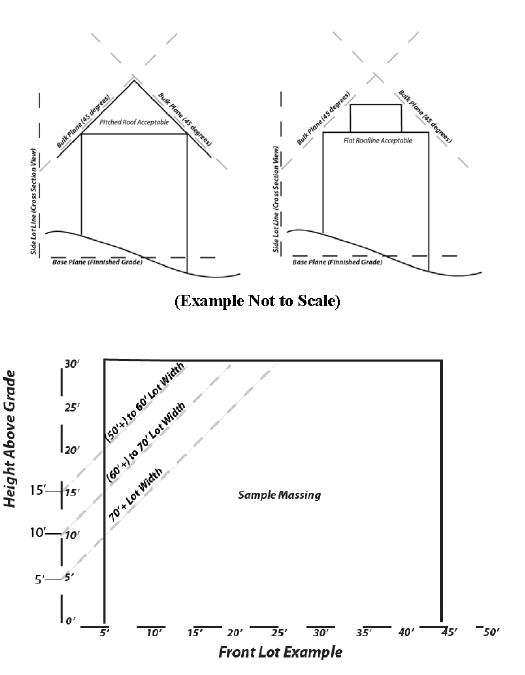
Bulk plane requirements.
(a)
Applicability. The bulk plane requirements in this subsection (6) shall only apply to all residential development of four dwelling units or less in the R2 zone district, and all residential development of one- or two-household dwellings or structures in the R3 zone district.
(b)
Requirements. No part of any structure subject to these bulk plane requirements shall project through the following defined bulk planes, which define a building envelope for the subject lot:
1.
Base plane. A horizontal bottom plane from which the vertical legs of the bulk planes are measured. The vertical position of the base plane is determined by an average of the finished grade of the building, as defined by chapter 18.04.
2.
Bulk plane.
A.
A horizontal line that is located directly above the midpoint of the side lot line, beginning at:
(i)
A point 15 feet above the midpoint of such side lot line for lot frontages up to 60 feet in width; or
(ii)
A point ten feet above the midpoint of such side lot line for lot frontages more than 60 but no greater than 70 feet in width; or
(iii)
A point five feet above the midpoint of such side lot line for lot frontages greater than 70 feet in width; and
B.
The intersecting lines that extend over the lot at a pitch of 12:12 (45-degree angle) from the horizontal lines defined in paragraph (i) above.
(c)
Corner lots.
1.
For corner lots that abut public right-of-way on two sides (double lot frontage), one lot frontage shall serve as a primary frontage. The property owner shall have the discretion to determine which frontage along such abutting public right-of-way shall serve as the lot's primary frontage.
2.
The lot frontage not chosen as the primary frontage shall be deemed the secondary frontage of the lot. The bulk plane requirements as described in subsection (6)(b) above shall apply to the secondary frontage of the lot.
(d)
Alleyways.
1.
The bulk plane requirements as described in subsection (6)(b) above shall apply to the side lot line abutting an alleyway when the subject lot is separated from another lot by an alley. This restriction shall not apply to a subject lot having a rear yard that abuts an alleyway.
(e)
Allowable bulk plane encroachments.
1.
Cornices, canopies, eaves or similar architectural features, may extend into a required bulk plane restriction not more than two feet, provided that all applicable building code requirements are met. Similar architectural features shall not include bay windows, staircases and stairwells, or any form of usable, conditioned living area including dormers.
2.
Mechanical equipment may extend into a required bulk plane restriction not more than five feet.
(7)
Front porches. For all residential development of four dwelling units or less in the R2 zone district, and all residential development of one- or two-household dwellings or structures in the R3 zone district, a front porch shall be required. One porch shall be required per structure if multiple structures are present.
(a)
The front porch shall be unenclosed with a minimum size of 48 square feet and shall be of single story design. No second story or third story living areas shall be permitted above the front porch. No second story or third story decking area shall be permitted above the front porch.
(b)
The front porch shall be required on the primary frontage of the development.
Bulk and Height Schedule for the RC, C1, C2, M1 and M2 Districts
All RC, C1, C2, M1 and M2 districts shall comply with the following density schedule:
(6)
Additional standards.
(a)
Where provided in the site development standards of chapter 18.40, the front setback shall be zero feet.
(b)
When adjacent to a residential zoned area, an additional buffer area as required by chapter 18.40 shall be provided.
(c)
The height limitations of this section shall not apply to church spires, belfries, cupolas, nor to chimneys, ventilators, skylights, water tanks, parapet walls, cornices without windows, antennas or necessary mechanical appurtenances carried above the roof level.
(d)
Setbacks.
1.
Cornices, canopies, eaves or similar architectural features may extend into a required setback not more than two feet.
2.
Fire escapes may extend into a required setback not more than six feet.
3.
The setback along both street sides of a comer lot shall be not less than the required front setback for principal buildings along such streets.
(e)
Properties for which a special use permit approval is required in C-1 and C-2 zone districts to accommodate increased residential use shall meet the standards of the density schedule listed in former section 18.28.200, above, for the R3 zone district, except that properties located in height zones B and C of the downtown area, as defined in section 18.40.724, shall meet the following setback, building height, and open space standards:
1.
The minimum side and rear setback shall be ten feet.
2.
The applicable height criteria set forth in section 18.40.724.
The minimum useable open space shall be equal to or greater than 40 percent of the lot area, and a minimum of 50 percent of this required open space shall be located at ground level.
(Ord. No. 2258, § 2(Exh. A-1), 1-28-2025)
18.28.01.01 - Preamble and intent.
The purpose of this chapter is to establish a framework for land-use categories and landuse types and where they are and are not permitted in the City of Golden. The intent is to guide land-uses into appropriate contexts based on the desire to limit externalities and encourage congruent land-use and development patterns. When use zones are overlayed with form zones, use regulations are intended to supplement the form-based standards for size, scale, and mass to moderate the potential impact of the use.
(Ord. No. 2258, § 2(Exh. A), 1-28-2025)
18.28.01.02 - Interpretation of use.
(1)
The listing of any use in the schedule as being permitted in any particular district shall be deemed to be an exclusion of such use from all other districts, unless the use is specifically permitted in the other district. Uses not specifically authorized within a zone district are not allowed in that district.
(2)
A proposed use which is not specifically provided for in any zone district, and which is not an accessory or secondary use, but which is similar to and compatible with uses otherwise allowed within a specific zone district may, upon a determination by the director of similarity and compatibility, be allowed within that district. The director will notify the planning commission of such determination at the next scheduled meeting.
(a)
In making the determination of similarity and compatibility, the director shall consider factors such as, traffic generation, density of population and hours of operation of the proposed use in comparison to specifically named uses within the zone district, potential for noise and odor, and the location and use criteria set forth in the comprehensive plan.
(b)
Any proposed use not specifically provided for in any zone district and which is not similar or compatible with uses otherwise allowed within a specific zone district shall be deemed to be allowed in the PUD district provided the use is in conformance with the requirements of section 18.28.300 et seq.
(c)
Any appeal from a decision of the director shall be made to the planning commission pursuant to the notification and hearing procedures in section 18.48.040. In considering the appeal, the planning commission shall apply the same standards applicable to the decision of the director.
(Ord. No. 2258, § 2(Exh. A), 1-28-2025)
18.28.02.01 - Interpretation of use tables.
(1)
Generally.The tables set out in this section ("use tables") describe which land uses are allowed ("P"), allowed after notice and comment if certain conditions are met ("L"), allowed after public hearing if certain conditions are met ("S"), and not allowed ("-") in each zoning district.
(2)
Legend.The following symbols are used in the tables in division 18.28.01.02:
(a)
"P" means "permitted." Permitted uses are allowed, subject to administrative review for compliance with the generally applicable requirements of this Code.
(b)
"L" means "limited use." Limited uses are subject to administrative review for compliance with use-specific standards, and for compliance with the generally applicable requirements of this Code.
(c)
"S" means "special use." Special uses are uses are subject to public hearing review for compliance with use-specific standards, general standards for all special use (see chapter 18.30, Special Use Permits), and the generally applicable requirements of this Code. Special uses are not "as-of-right" uses.
(d)
"-" means that the use is not allowed in the specified district.
(3)
Tableformat. The tables are formatted such that the left-hand column ("Land Use") sets out each land use that may be permissible in the city, the 16 columns that follow set out each zoning district within the city, and the right-hand column ("Ref.") provides a cross-reference to the standards that apply to limited ("L") and special ("S") uses. Note, cross-references may not be totally inclusive of all standards or regulations related to a use.
(Ord. No. 2258, § 2(Exh. A), 1-28-2025)
18.28.02.02 - Relationship to form standards.
For the purposes of section 18.28.01.01(2) and the application of this chapter, the standards of chapter 18.29 shall be considered "generally applicable requirements of this Code."
(Ord. No. 2258, § 2(Exh. A), 1-28-2025)
18.28.02.03 - Multiple uses of a lot.
Proposed uses that combine more than one listed use, except those that qualify as "mixed-use," shall meet the requirements for each listed use that applies.
(Ord. No. 2258, § 2(Exh. A), 1-28-2025)
18.28.02.04 - Use tables.
Use tables are separated by the following Use Categories and list the individual landuses allowed by each zone district established in chapter 18.20 in that category. The Ref. column in the use tables is a guide to relevant sections of the zoning code and not intended as a comprehensive list or reference to all requirements in this title:
(1)
Residential, Special Residential, and Residential Mixed-Use (table 18.28.02.04.1).
(2)
Community, Civic, Educational, Healthcare, and Institutional (table 18.28.02.04.2).
(3)
Hospitality, Recreation, and Entertainment (table 18.28.02.04.3).
(4)
General Commercial (table 18.28.02.04.4).
(5)
Motor Vehicle and Transportation (table 18.28.02.04.5).
(6)
Veterinary and Domestic Animal (table 18.28.02.04.6).
(7)
Industrial, Processing, Recycling, Storage, and Disposal (table 18.28.02.04.7).
(8)
Utilities (table 18.28.02.04.8).
(9)
Agricultural Uses (table 18.28.02.04.9).
Table 18.28.02.04.1, Residential, Special Residential, and Residential Mixed-Use
Table 18.28.02.04.2, Community, Civic, Educational, Healthcare, and Institutional
Table 18.28.02.04.3, Hospitality, Recreation, and Entertainment
Table 18.28.02.04.4, General Commercial
Table 18.28.02.04.5, Motor Vehicle and Transportation
Table 18.28.02.04.6, Veterinary and Domestic Animal
Table 18.28.02.04.7, Industrial, Processing, Recycling, Storage, and Disposal
Table 18.28.02.04.8, Utilities
(Ord. No. 2258, § 2(Exh. A), 1-28-2025)
18.28.02.04.10 - Permitted and prohibited uses in all districts.
(1)
Uses permitted in all districts.
(a)
Municipal uses. Development standards for structures, fencing, landscaping, and other standards and guidelines in chapter 18.29 and chapter 18.40 shall be determined by the director with any necessary application process, approval process, or permitting process to match the municipal and public needs for the municipal use.
(b)
Recreation uses that are owned or operated by Jefferson County, the City of Golden, or a C.R.S. Title 32 special district, regardless of format.
(2)
Uses prohibited in all districts. The following uses are prohibited in all zoning districts:
(a)
Intensive Agriculture.
(b)
Outdoor Firing Range.
(c)
Race Track.
(d)
Airports.
(e)
Heliports.
(f)
Zoo.
(Ord. No. 2258, § 2(Exh. A), 1-28-2025)
18.28.03 - Generally.
The standards of this division reference corresponding land uses that are enumerated in the tables of division 18.28.02.004, Use Tables, and apply to the corresponding use if the subject property is located in a zoning district within which the use is designated as "L" or "S". Standards that apply to "All Districts" are applied in addition to standards that apply to specified districts.
(1)
Performance standards for all uses.
(a)
Dust, fumes, odors, smoke, vapor, direct light, and vibrations shall be confined to the premises of the subject property upon which the land use that generates the impact is located. Noise shall be subject to Golden Municipal Code section 5.20.280.
(Ord. No. 2258, § 2(Exh. A-1), 1-28-2025)
18.28.03.01 - Use-specific standards for residential, special residential, and residential mixed-uses.
(1)
Residential occupancy standards. The intent of occupancy standards is to promote health, safety, and welfare by establishing parameters to limit over-crowding of dwellings.
(a)
A residential dwelling unit may have up to four adults and their dependents, if any.
(b)
A permitted residential accessory dwelling unit may have three additional persons.
(c)
The residential occupancy of persons in a dwelling unit in excess of standard (a) and (b) above is limited to two persons per potential sleeping room and is subject to the following requirements.
1.
Occupied sleeping rooms or spaces determined to be potential sleeping rooms, regardless of any names, labels, or intended uses proposed by the building designer or owner or landlord or tenants, shall include the following for health and safety:
A.
Emergency escape and rescue. Potential sleeping rooms including basements, habitable attics, the room to which a sleeping loft is open, and every sleeping room shall have not less than one operable emergency escape and rescue opening. Where basements contain one or more sleeping rooms, an emergency escape and rescue opening shall be required in each sleeping room. Emergency escape and rescue openings shall open directly into a public way, or to a yard or court that opens to a public way.
B.
Smoke alarms. Smoke alarms shall be installed in the following locations:
(i)
In each occupied sleeping room and potential sleeping room.
(ii)
In the immediate vicinity outside each separate occupied sleeping room or potential sleeping room.
(iii)
On each additional story of the dwelling, including basements and habitable attics and not including crawl spaces and uninhabitable attics. In dwellings or dwelling units with split levels and without an intervening door between the adjacent levels, a smoke alarm installed on the upper level shall suffice for the adjacent lower level provided that the lower level is less than one full story below the upper level.
(iv)
Smoke alarms shall be installed not less than three feet (914 millimeters) horizontally from the door or opening of a bathroom that contains a bathtub or shower unless this would prevent placement of a smoke alarm required by this section.
C.
Carbon monoxide alarms. Shall be installed inside of and outside of each separate occupied sleeping room or potential sleeping room. Carbon monoxide alarms installed outside of the sleeping areas shall be in the immediate vicinity of the bedroom.
D.
Portable fire extinguishers. All cooking equipment shall have a fire extinguisher within 30 feet of travel distance from the cooking equipment.
(d)
The residential occupancy of temporary lodging units, residential dwelling units licensed for a short-term rental or tourist home, is limited to four adults and their dependents, if any, and subject to the requirements of chapter 18.22.
(2)
Use specific residential standards.
(a)
Residential single-household.
1.
CO district. In the CO district, one single-unit detached dwelling may be permitted if the subject property is not less than 35 acres in area.
(b)
Residential mixed-use. Residential land uses may be approved in the CMU-NC, CMU-CC1, CMU-CC2, C-1, and C-2 districts as follows:
1.
Multi-household units are allowed as a permitted use when at least 25 percent of the total floor area of the buildings is designed for nonresidential uses, provided that residential dwelling units licensed for temporary lodging such as tourist homes and short-term rentals, or commercial lodging that meets the definition of boarding and rooming house, shall not count toward the nonresidential area requirement; and
A.
If the development includes more than one building, the development provides an integrated site design in which:
(i)
Vehicular circulation systems and parking areas are shared;
(ii)
There are delineated pedestrian connections between residential and nonresidential uses;
(iii)
Building architecture, signage, and site landscaping reflect common themes throughout the development; and
(iv)
The nonresidential uses are listed as permitted by right in the C1 district, except veterinarian hospital, funeral home, or hospital.
2.
Multi-household units are allowed as a permitted use when 100 percent of the units are affordable housing units;
3.
Multi-household units are allowed by special use permit if requirement (a) or (b) are not met; and
4.
Shall meet the criteria for special use permits in chapter 18.30, Special Use Permits.
(c)
Group home. Group homes may be approved if it is demonstrated that they are spaced not less than 750 feet from other group homes pursuant to C.R.S. 31-23303, measured between the nearest property lines.
(d)
Live-work. Live-work uses may be approved in the M1 and M2 districts if it is demonstrated that they are spaced not less than 600 feet from heavy industrial uses, measured property line to property line.
(Ord. No. 2258, § 2(Exh. A-1), 1-28-2025; Ord. No. 2270, § 3(Exh. B), 8-12-2025; Ord. No. 2271, § 3(Exh. B), 8-12-2025)
18.28.03.02 - Community, civic, educational, healthcare, and institutional.
(1)
Crematorium. Crematoriums shall be spaced not less than 500 feet from residential zones measured from the property line.
(2)
School, vocational or trade. School, vocational or trade[s] may be permitted in the M1 district if it relates to vocational training for an industrial activity that is allowed in the M1 district.
(3)
University or college. University or college uses may be permitted in the R3 district if it is demonstrated that:
(a)
They are incorporated into a residential campus; and by special use permit pursuant to (b) and (c) below.
(b)
Except as may be provided by intergovernmental agreement, college and university buildings owned and used by the Colorado School of Mines that have a height greater than 35 feet, but no more than 50 feet, are located in a campus setting where the height of nearby existing campus buildings is in excess of 35 feet.
(c)
Except as may be provided by intergovernmental agreement, college and university buildings owned and used by the Colorado School of Mines that have a front setback less than the standard 20-foot requirement, are located in a campus setting where the front setback of nearby existing campus buildings is less than 20 feet.
(Ord. No. 2258, § 2(Exh. A), 1-28-2025)
18.28.03.03 - Use-specific standards for hospitality, recreation, and entertainment uses.
(1)
Brew pub, distillery pub, or limited winery.
(a)
May be permitted in M1 if the primary use and operation is production and not beverage or food service.
(2)
Campground or RV park. Campground or RV park uses, other than those owned or operated by the City of Golden and therefore a municipal or recreation use under section 18.28.02.04.10, may be approved in the AG or CO districts if it is demonstrated that the facilities are located, designed, and operated as follows:
(a)
The subject property is not less than ten acres in area.
(b)
The campground or RV park is designed to the "modern" standard as defined in 6 CCR 1010-9 § 2.10e.
(c)
The density, dimensions, and distribution of campsites meet the standards set out in table 18.28.03.03.2, Campsite Standards.
Table 18.28.03.03.2, Campsite Standards
(d)
Building coverage on the subject property does not exceed ten percent.
(e)
The route between the nearest arterial street and the campground does not include a local residential street.
(f)
Access to camping spaces is provided from paved internal, private streets.
(g)
Parking spaces are paved or surfaced with a material approved by the director and public works.
(h)
An internal pedestrian circulation system is provided that connects clusters of campsites to each other and to centralized facilities (e.g., office, bathrooms, common recreational facilities, etc.).
(3)
Indoor firing range. Indoor firing range[s] may be permitted if it is demonstrated that:
(a)
The use is located within a free-standing building that is spaced from schools, universities, child day care centers, or active or passive parks not less than 300 feet, measured between property lines;
(b)
The building is sound-proofed so that the shooting activities are not audible from outside the building;
(c)
Closed loop range ventilation systems, including HEPA filtration, are installed and dedicated to the range (i.e., not connected to the general HVAC system);
(d)
The range is designed to prevent dangers from ricochets, backsplash, and lead dust; and
(e)
No door or entrance to the range is located forward of the rearmost firing point, unless secured from the inside of the range.
(f)
A red light is fitted above all doors giving direct access to the range area (not the building), and such light will be lit whenever the range is in use.
(4)
Tourist homes and short-term rentals. See chapter 18.22.
(Ord. No. 2258, § 2(Exh. A), 1-28-2025)
18.28.03.04 - Use-specific standards for general commercial uses.
(1)
Convenience lending. Convenience lending may be approved in the C2 and M2 districts if it is demonstrated that the use is spaced not less than 1,000 feet from other convenience lending uses, places of assembly, public or private schools, pawnbrokers, and residentially-zoned areas, measured from the nearest property lines.
(2)
Heavy retail. Heavy retail uses may be permitted in the C2 district if it is demonstrated that:
(a)
The use is not a nursery;
(b)
The use does not involve the outdoor storage of landscape materials in bulk; and
(c)
Deliveries to customers from the use, if provided, will utilize vehicles that are not larger than Class 5 (medium duty) box trucks.
(3)
Office, general. General office uses may be approved in the M1 district if it is demonstrated that the office provides management, administrative services, consulting services, or technical support services for or to one or more uses that exist, are permitted, or permissible within the M1 district.
(4)
Pawnbroker. Pawnbroker[s] may be allowed in the C2 or M2 district if it is demonstrated that:
(a)
The use is at least 1,000 feet from any place of assembly, public or private school or university, convenience lending use, other pawnbroker, and residentially zoned area, measured from the nearest property lines; and
(b)
The use conforms to the requirements of chapter 4.52.
(Ord. No. 2258, § 2(Exh. A-1), 1-28-2025)
18.28.03.05 - Use-specific standards for motor vehicle and transportation uses.
(1)
Fueling or service station. Fueling or service station[s] may be permitted by special use permit in the C1 district if it meets the special use permit criteria and is demonstrated that the subject property is located outside of the area bounded by Hwy 58 to the north; U.S. 6 to the west and south; and Ford Street, South Golden Road, and Johnson Street to the east.
(2)
Light motor vehicle repairs and service. Light motor vehicle repairs and service may be permitted by special use permit in the C1 district if it is demonstrated that the subject property is located outside of the area bounded by Hwy 58 to the north; U.S. 6 to the west and south; and Ford Street, South Golden Road, and Johnson Street to the east.
(3)
Heavy motor vehicle repairs and service. Heavy motor vehicle repairs and service may be permitted by special use permit in the C2 or M1 district if it meets the special use permit criteria and is demonstrated that:
(a)
The subject property is located outside of the area bounded by Hwy 58 to the north; U.S. 6 to the west and south; and Ford Street, South Golden Road, and Johnson Street to the east;
(b)
The use is at least 300 feet from any residentially zoned area, measured between the nearest property lines;
(c)
Areas used for temporary storage of vehicles prior to and after repairs or service are not the majority area of the site and screened from view from adjacent properties and streets by buildings or a solid wall, berm, or continuous landscaping that is at least three to four feet in height; and
(d)
In the C2 and M1 district, the use is restricted to repairs and service to passenger vehicles and light trucks, and all work is performed inside of an enclosed building.
(4)
Motorcycle, scooter, or ATV sales or rental. Motorcycle, scooter, or ATV sales or rental[s] may be permitted in the C1 district if all inventory is stored and displayed, and all services conducted, within an enclosed building.
(5)
Motor vehicle wash. Motor vehicle wash[es] may be permitted by special use permit in the C1 district if it meets the special use permit criteria and it is demonstrated that:
(a)
The subject property is located outside of the area bounded by Hwy 58 to the north; U.S. 6 to the west and south; and Ford Street, South Golden Road, and Johnson Street to the east;
(b)
Entrances to car wash bays or tunnels are perpendicular to the street (on corner lots, perpendicular to the street with the higher design volume); and
(c)
Areas used for vacuum bays, detailing, or drying are screened from view from streets by buildings or a solid wall, berm, or continuous landscaping that is at least three to four feet in height.
(6)
Passenger motor vehicle sales or rental.
(a)
The subject property is located outside of the area bounded by Hwy 58 to the north; U.S. 6 to the west and south; and Ford Street, South Golden Road, and Johnson Street to the east;
(7)
Surface parking. Surface parking may be permitted by special use permit in the C1 district if it meets the special use permit criteria and is demonstrated that the use does not require the destruction of an existing building on property with any frontage on Eighth Street or Washington Avenue.
(8)
Structured parking. Structured parking may be permitted by special use permit in the C1 district if it meets the special use permit criteria and is demonstrated that the use does not require the destruction of an existing building on property with any frontage on Eighth Street or Washington Avenue, unless it is incorporated into or attached to the rear of a new building that contains a use that is permitted in the C1 district, for which access to the use is provided at street level from Washington Avenue or Eighth Street.
(9)
Truck stop. Truck stop[s] may be permitted by special use permit in the M2 district if it meets the special use permit criteria and demonstrated that the use is:
(a)
Located within 500 feet of an interchange with:
1.
I-70;
2.
Hwy 470; or
3.
U.S. Hwy. 6, east of Johnson Road; and
(b)
The use is not less than 600 feet from any residential use district, measured between the nearest property lines.
(Ord. No. 2258, § 2(Exh. A), 1-28-2025)
18.28.03.06 - Use-specific standards for veterinary and domestic animal uses.
(1)
Commercial equestrian facilities. Commercial equestrian facilities may be permitted in the AG district if it is demonstrated that:
(a)
All horses are kept within a fenced area;
(b)
At least 9,000 square feet of open land is provided for the first horse, and 6,000 square feet for each additional horse;
(c)
Temporary buildings or trailers are not used for the stabling of horses more than one 15-day period during each calendar year;
(d)
No building, riding ring, or corral, is located in any manner so that any part thereof is less than 100 feet from the front lot line or less than 15 feet from any side or rear lot line; and
(e)
Manure storage areas are:
1.
Screened so as to not be in view of other adjacent private property, public thoroughfares, or other areas of public access (e.g., trails);
2.
Managed so that manure does not accumulate so as to cause a hazard to the health, welfare, or safety of humans or animals; and
3.
Set back 100 feet from the front lot line and from side and rear lot lines a distance equal to the setback required for principal buildings.
(2)
Kennel, outdoor. Kennel[s], outdoor may be permitted with a special use permit in the C1, AG, and CO districts if is if it meets the special use permit criteria and is demonstrated that:
(a)
The subject property is:
1.
At least 200 feet from lots used or zoned for residential uses (undeveloped tracts that are zoned for residential purposes are not counted as "lots") within the city; and
(b)
Outdoor areas that are used by animals are:
1.
Enclosed by fencing that does not exceed eight feet in height; and
2.
Not used after 7:00 p.m. or before 7:00 a.m.
(3)
Veterinary facilities, large animal clinic. Veterinary facilities and large animal clinics may be permitted by special use permit in the C2, AG, and CO districts if it meets the criteria for special use permit and is demonstrated that:
(a)
The use is conducted entirely indoors, unless the standards for outdoor areas are also met;
(b)
The use is located in a free-standing building; and
(c)
The subject property does not adjoin property that is used for residential purposes within the city.
(d)
Outdoor areas that are used by animals are:
1.
Enclosed by fencing that does not exceed eight feet in height; and
2.
Outdoor area is not used after 7:00 p.m. or before 7:00 a.m.
(4)
Veterinary facilities, small animal clinic. Veterinary facilities, small animal clinic[s] may be permitted in the C1, AG, and CO districts if it is demonstrated that the use is conducted entirely indoors, and with a special use permit with outdoor areas if the special use criteria and kennel, outdoor standards are also met.
(Ord. No. 2258, § 2(Exh. A-1), 1-28-2025)
18.28.03.07 - Use-specific standards for industrial, processing, recycling, storage, and disposal uses.
(1)
Composting facility. Composting facilities may be permitted in the M2 district if it is demonstrated that:
(a)
The facility is not located within an:
1.
Area of geologic hazard;
2.
Area of special flood hazard; or
3.
Area with fluvial hazards;
(b)
The facility is not located within the area bounded by Hwy 58 to the north; U.S. 6 to the west and south; and Ford Street, South Golden Road, and Johnson Street to the east;
(c)
The subject property is not less than five acres in area;
(d)
All composting operations, including storage of compostable wastes, are set back 200 feet from all property lines;
(e)
The subject property is spaced not less than 1,000 feet, measured between the nearest property lines, from:
1.
Lots that are developed with dwelling units;
2.
Residential zone boundaries;
3.
Parcel boundaries of schools, public parks, and child care centers; and
4.
Places of assembly.
(f)
Piles of mulch or raw materials will not exceed 30 feet in height; and
(g)
The use does not involve processing, storage, or disposal of hazardous materials.
(h)
The material piles will be maintained at all times in an orderly manner such as, not having stock piles visible from the public realm, loose debris is minimized, drive aisles and emergency vehicle access and employee paths are clear and maintained, material storage area do not encroach or obstruct drainage areas or flood plains or other environmental features, or in other manner as determined by the director.
(2)
Heavy industry. Heavy industry may be permitted in the M2 district if it is demonstrated that:
(a)
Dust, fumes, odors, smoke, vapor, direct light and vibration shall be confined within the M2 district. Noise generated by the use shall conform to the standards in section 5.20.280.
(b)
Outdoor storage, equipment and refuse areas shall be concealed from view from abutting rights-of-way and adjoining residential districts.
(3)
Heavy logistics center. Heavy logistics center[s] may be permitted in the M2 district if it is demonstrated that:
(c)
The subject property is outside of the area bounded by Hwy 58 to the north; U.S. 6 to the west and south; and Ford Street, South Golden Road, and Johnson Street to the east.
(4)
Light industry. May be permitted:
(a)
By special use permit in the C2 district if the criteria for special use permit is met and:
1.
The use is not located within the area bounded by Hwy 58 to the north; U.S. 6 to the west and south; and Ford Street, South Golden Road, and Johnson Street to the east;
2.
The use is generally related to light industrial uses including bottling works, dairy processing and distribution plants, ice and cold storage plants, frozen food lockers, not including slaughtering on the premises, roofing shops, sheet metal shops, machine shop, or laboratories and not other uses that may be listed in the light industry use and otherwise meet the use standards for light industry.
(b)
All such uses shall be operated entirely within a completely enclosed structure.
(c)
Dust, fumes, odors, refuse matter, smoke, vapor, direct light and vibrations generated by such uses shall be confined to the structure where such use is located. Noise generated by the use shall conform to the standards in section 5.20.280.
(d)
Vehicular travel and parking portions of the lot shall be paved with asphalt or concrete.
(e)
Light industry with outdoor storage facilities for equipment, goods or materials may be permitted by special use permit in the M1 district and shall not be allowed in the C2 district.
(2)
Salvage yard. Salvage yard[s] may be permitted in the M2 zoning district if it is demonstrated that:
(a)
The subject property is outside of the area bounded by Hwy 58 to the north; U.S. 6 to the west and south; and Ford Street, South Golden Road, and Johnson Street to the east;
(b)
All areas of the subject property that are used to process or store salvaged materials are enclosed by a solid perimeter wall at least six feet in height, with trees planted 30 feet on center outside of the enclosed area along property lines that bounded by a public street (except at points of access); and
(c)
The subject property is spaced not less than 1,000 feet, measured between the nearest property lines, from:
1.
Lots that are developed with dwelling units;
2.
Residential zone boundaries;
3.
Parcel boundaries of schools, public parks, and child care centers; and
4.
Places of assembly.
(3)
Self-storage. Self-storage may be permitted in the M1 district if it is demonstrated that:
(a)
The self-storage facility is secured so that access is limited to tenants (or owners) and fire, police, or emergency service officials;
(b)
The area of the subject property that is used for self-storage facilities (including parking, loading, and landscape areas) does not exceed five acres;
(c)
The self-storage use does not involve outdoor storage of any kind; and
(d)
If the subject property adjoins a residential use or zone boundary, the facility is closed and secured between the hours of 9:00 p.m and 7:00 a.m.
(4)
Storage yard. Storage yards may be approved in the M2 district if it is demonstrated that:
(a)
The subject property is outside of the area bounded by Hwy 58 to the north; U.S. 6 to the west and south; and Ford Street, South Golden Road, and Johnson Street to the east;
(b)
The subject property does not have frontage on a state or federal highway;
(c)
Stored materials do not exceed 20 feet in height;
(d)
The following materials will not be stored outside or disposed of on-site:
1.
Hazardous materials (including explosives and motor fuels);
2.
Liquids, gels, or pastes;
3.
Unsecured materials that may be subject to movement off-site by wind or water.
(e)
The storage yard is screened using one (or a combination) of the following methods:
1.
A solid fence or wall of at least six feet, but not more than eight feet, in height; or
2.
A ten-foot-wide vegetated buffer with hedge composed of coniferous hedge-forming 5-gallon shrubs that grow to a height of at least six feet within two years after planting, planted at a maximum of ten feet on center for the length of the buffer, with security fencing located on the interior side of the buffer.
(f)
The storage yard will be maintained at all times in an orderly manner such as, not having stock piles visible from the public realm, loose debris is minimized, drive aisles and emergency vehicle access and employee paths are clear and maintained, material storage area do not encroach or obstruct drainage areas or flood plains or other environmental features, or in other manner as determined by the director.
(5)
Waste transfer station. Waste transfer stations may be approved in the M2 district if it is demonstrated that the standards of this subsection are satisfied.
(a)
The city shall request a technical review of the site and facility documents and operation plan from CDPHE pursuant to 6 CCR 1007-2 § 7.1 for all applications for approval of a waste transfer station.
(b)
Waste transfer stations shall be located so that truck traffic generated by the station can access a truck route without traveling upon a public street within or adjacent to any residential use or zone, or along thoroughfares adjacent to any public park or public recreational area or facility.
(c)
No building or area in which the unloading, storage, processing, or transfer of wastes or recyclable materials takes place shall be located within:
1.
One hundred feet of the lot line on which the waste transfer station is located; or
2.
Five hundred feet of:
a.
Any nonresidential structure located on property that is not owned or leased by the owner of the waste transfer station;
b.
Any area of special flood hazard, fluvial hazard, or geologic hazard;
c.
Any wetland;
d.
Any water well;
e.
Any natural or artificial pond (including a detention or retention pond or facility), stream, irrigation ditch or canal, water way, or water course; and
3.
One thousand feet of a lot line of a residential use or zone in the city.
(d)
The minimum area of a subject property proposed for use as a waste transfer station shall be ten acres.
(e)
The facility shall be designed such that all activities associated with waste transfer, such as tipping, sorting, storage, compaction, transfer, reloading, and related activities are conducted in a fully enclosed building. No outdoor storage of materials or equipment shall be allowed.
(f)
Appropriate enclosed office / and plumbed employee restroom facilities shall be provided on-site.
(g)
Adequate snow storage areas shall be provided within the subject property. Snow storage areas shall be made accessible and available at all times for exclusive use for snow storage from October 1 to April 30 of each year.
(h)
The facility shall be designed with sufficient drive aisles and parking areas to avoid potential conflicts between facility operations by trucks and passenger vehicles (e.g., for drop-off of household wastes), and the use of emergency access easements and fire lanes. Emergency access easements and fire lanes shall be maintained at all times in an unobstructed and fully accessible condition.
(i)
The driveway surface design shall be suitable for heavy vehicles in all weather conditions, and the road base shall be capable of withstanding all expected loads.
(j)
Ingress, egress, and internal circulation systems shall be designed to eliminate the need for the backing of truck traffic.
(k)
Solid wastes shall not remain at the transfer station for more than 72 hours.
(l)
Processing, tipping, sorting, storage, compaction, and loading areas shall be located within an enclosed building.
(m)
Truck routing shall avoid impacts to residential areas, schools, and public parks.
(n)
The perimeter of the facility shall be enclosed by a fence or wall of at least six feet in height, with trees planted 30 feet on center outside of the fenced area in areas that are visible from a public street, except at points of access.
(o)
The collection and disposal system shall prevent liquids contained in waste materials and generated by normal operations, such as wash-out and cleaning of equipment, trucks, and floors ("waste liquids"), from contaminating the soil, surface water, or ground water. Tipping, loading, and unloading areas shall be constructed of impervious material and equipped with drains connected to either:
1.
A wastewater system; or
2.
A corrosion-resistant holding tank; or
3.
An alternative system, if the applicant demonstrates that the alternate design will prevent waste liquids from contaminating the soil, surface water, and ground water.
(p)
Only household wastes, commercial, and industrial wastes and recyclable materials (except motor vehicles) shall be accepted at any waste transfer station. Unless otherwise collected in accordance with a plan approved by the city, no wastes classified as hazardous in accordance with C.R.S. § 2515-101, et seq., and no asbestos containing materials, shall be knowingly accepted.
(q)
The waste transfer station shall have an on-site operator on duty at all times that the facility is open. Suitable security measures and signage shall be provided to limit unauthorized persons from access to the facility when the station is closed.
(r)
The operation of the waste transfer station and the storage and handling of all solid wastes shall be practiced so as to prevent the attraction, harborage, or breeding of wildlife or insects, rodents, and other vectors (e.g., flies, maggots, roaches, rats, mice, and similar vermin), and to eliminate conditions which cause or may potentially cause:
1.
Harm to the public health and the environment;
2.
Congregation of birds;
3.
Safety hazards to individuals and surrounding property; and
4.
Excessive odor problems, unsightliness, and other nuisances.
(s)
Waste transfer stations shall be maintained in a neat and orderly appearance at all times through the control of uncontained waste, trash, and litter. Operators shall cause periodic monitoring not less than once every day (or more often as needed) of the entire waste transfer station or recycling center site.
(t)
Sanitary conditions shall be maintained through the periodic wash-down or other appropriate cleaning method of the transfer station and transfer vehicles. Frequency of cleaning shall be sufficient to prevent odors and other nuisance conditions from developing. All residuals shall be properly disposed of following cleaning operations.
(Ord. No. 2258, § 2(Exh. A), 1-28-2025)
18.28.03.08 - Use-specific standards for utility uses.
(1)
Data center. Data center[s] may be approved in the C2 or M1 district if it is demonstrated that the subject property is outside of the area bounded by Hwy 58 to the north; U.S. 6 to the west and south; and Ford Street, South Golden Road, and Johnson Street to the east.
(2)
Overhead power lines (110 kV+). Overhead power lines (110 kV or more) may be approved in any district by special use permit if it is demonstrated that the criteria for special use permit are met and:
(a)
If required by state law, a certificate of public convenience and necessity has been issued by the Colorado Public Utilities Commission ("PUC"), or the PUC has issued an exemption certification.
(b)
To the extent practicable, new transmission lines are be located within existing transmission easements or routed outside of the city.
(c)
New transmission lines that are not located within existing transmission easements are routed to minimize the impact of poles and lines on existing development through spacing between the transmission line and the following uses or infrastructure:
1.
Three hundred feet from dwelling units, schools (all types), and places of assembly; and
2.
Five hundred feet from federal and state highways.
(3)
Utilities minor. May be permitted if it is demonstrated that:
(a)
The facility is located and designed to maximize health, safety, and welfare of surrounding properties.
(b)
Above-ground minor utilities with footprints that are 15 square feet or less and heights of five feet or less, are not required to be completely screened, but shall be designed to blend into their context to the extent practicable. Treatments may include, but are not limited to, integration with evergreen landscaping, use of color, and placement behind screen walls or berms.
(c)
Above-ground minor utilities with footprints that are larger than 15 square feet or heights that are greater than five feet shall be completely screened from view from adjacent property and public rights-of-way through:
1.
The use of evergreen landscaping, topography, and/or decorative walls; or
2.
Enclosed in a building that is designed to appear as a residential or agricultural accessory building, as appropriate to its context.
(d)
That the facility, structures, and fencing shall otherwise meet the applicable requirements and standards for the zone district as determined by the director and necessary application, approval process, or permitting process to match the potential impact and utility needs.
(4)
Solar gardens. Solar gardens may be permitted in any district if it is demonstrated that:
(a)
Solar gardens with a rated capacity of 100 kW or less, subject to the following:
1.
Streetscape improvements are required as per site development regulations in chapter 18.29 or 18.40 of this title, as applicable.
2.
Ground-mounted solar energy collectors may not be located within utility easements or drainage easements unless authorized in writing by easement holder.
3.
Roof-mounted systems may be mounted on any legally conforming structure, subject to review through the building permit process. Roof-mounted systems shall be mounted as flush as feasible to the roof.
4.
In M1 and M2 districts, the minimum front setback to solar panels and equipment is five feet.
(b)
Solar garden with a rated capacity greater than 100 kW, up to and including 500 kW, may be permitted by site development plan approved by planning commission and subject to the following:
1.
In M1 and M2 districts, the minimum front setback to solar panels and equipment is five feet.
2.
Streetscape improvements required as per site development regulations in chapter 18.29 or 18.40 of this title, as applicable.
3.
Ground-mounted solar energy collectors may not be located within utility easements or drainage easements unless authorized in writing by easement holder.
4.
A planning commission finding of no significant adverse visual impact on the natural features or neighborhood character of the surrounding area.
5.
A planning commission finding that the proposal is located to minimize glare on adjacent properties and roadways.
6.
Roof-mounted systems may be mounted on any legally conforming structure, subject to review through the building permit process.
7.
If substation interconnection is necessary, an electrical substation with capacity for interconnection (in which case, building permits shall be withheld until the applicant provides proof of a fully- executed interconnection agreement) is available within 300 feet of the boundaries of the subject property.
(c)
Solar garden with a rated capacity of more than 500 kW, may be approved by special use permit and subject to the following:
1.
The property is within the R3, CMU-NC, CMU-CC1, CMU-CC2, C1, C2, M1, or M2 zone districts.
2.
The proposed solar garden meets the criteria of subsection (4)(b)1 through 6, inclusive, above.
3.
The proposed solar garden meets the criteria set out in chapter 18.30.
4.
In the R3 use district, the minimum lot size is one acre.
(Ord. No. 2258, § 2(Exh. A), 1-28-2025)
18.28.03.09 - Use-specific standards for agricultural uses.
(1)
Generally. Horses, cattle, sheep, llamas, and milking goats (collectively, "livestock") may be permitted in the AG and CO districts and in the RE district by special use permit as provided in the following requirements.
(a)
Livestock shall be confined within a fenced area;
(b)
Nine thousand square feet of open lot area shall be provided for the first livestock animal, and 6,000 square feet for each additional livestock animal;
(c)
Temporary buildings or trailers shall not be used for the stabling of livestock more than one 15-day period during each calendar year.
(d)
No building, riding ring, or corral shall be located in any manner so that any part thereof is less than 100 feet from the front lot line or less than 15 feet from any side or rear lot line.
(e)
Manure storage areas are:
1.
Screened so as to not be in view of other adjacent private property, public thoroughfares, or other areas of public access (e.g., trails).
2.
Managed so that manure does not accumulate so as to cause a hazard to the health, welfare, or safety of humans or animals.
3.
Set back 100 feet from the front lot line.
4.
Set back from side and rear lot lines at least:
a.
The setback required for principal buildings on the subject property; or
b.
If the adjacent property has greater corresponding setbacks than the subject property, 75 feet.
(2)
Urban farms. Agricultural uses and farming is permitted in the AG and CO zone districts. Urban farms between one-half acre and up to two acres is permitted in all other zone districts by special use permit and shall meet the requirements of section 18.26.030.
(Ord. No. 2258, § 2(Exh. A), 1-28-2025)
18.28.04 - Generally.
The standards of this division reference temporary and accessory use standards that may be accessory to the uses that are enumerated in the tables of division 18.28.02.04, Use Tables, and may apply generally to all uses, specific zone districts, or specific use categories or uses.
(Ord. No. 2258, § 2(Exh. A), 1-28-2025)
18.28.04.01 - Farmers' markets, neighborhood farmers' markets, and produce stands.
Farmers' markets, neighborhood farmers' markets, and produce stands are permitted pursuant to the standards set out in chapter 18.26.
(Ord. No. 2258, § 2(Exh. A), 1-28-2025)
18.28.04.02 - Storage containers.
In residential and commercial and industrial zone districts:
(1)
Semi-trailers, commercial construction trailers, box cars or any type of train module, shipping or cargo containers, or other storage container as an accessory structure or storage use, provided such storage facilities are associated with a valid temporary use, such as building renovation or the process of moving into or out of the dwelling unit.
(2)
Such containers may be situated on the property for a period not to exceed 180 days in association with activities related to a valid building permit.
(3)
In the absence of a valid building permit, such containers are permitted to be situated on the property for periods not exceeding 30 consecutive days or more than 45 days in any consecutive 12-month period.
(4)
No more than two such containers shall be located on the property at any one time. The director of community development may grant one extension of time, for cause, no greater than the initial maximum time period.
(5)
Storage containers may be permitted in M2 as a permanent accessory structure that meets the zone district and building permit requirements.
(Ord. No. 2258, § 2(Exh. A), 1-28-2025)
18.28.04.03 - Drive through facilities.
(1)
Drive-through facilities are allowed in the CMU-NC, CMU-CC1, and CMU-CC2, C2, and M2 districts only if the principal use which includes the drive-through facility, is approved as a special use (see chapter 18.30, Special Use Permits) and subject to the following standards. Drive-through facilities are not allowed in any other zoning district.
(2)
Access to drive-through facilities adjacent to existing or planned pedestrian and bicycle infrastructure identified in the adopted 2023 Golden Pedestrian and Bicycle Plan as amended should be limited and shall avoid access on, over, or through sidewalks, shared use paths, and bike lanes to the extent feasible by accessing the site through secondary roads or alternative site access when available.
(3)
Spill-over of vehicles onto roadways, sidewalks, shared use paths, and bike lanes shall be avoided by providing adequate space for vehicle stacking or queuing based on trip-generation analysis, traffic reports, and comparable use, operation, and site examples.
(4)
Where permitted, drive-throughs must be placed so that pedestrians entering and exiting the building are not required to cross the drive-through lane(s). When it is necessary for individuals to have to cross drive-through lanes, crosswalks have to be clearly demarcated from the parking area to the building entrance.
(5)
Drive-through lanes must be situated so that other vehicles leaving or entering the parking lot won't be hindered by others using the drive-through.
(6)
Entrances and exits to drive-throughs must be placed so they do not come within 100-feet of the centerlines of intersecting streets. If there is not adequate space to meet this requirement, entrances and exits shall be located from the furthest point feasible from the centerline of an adjacent street used to access the site.
(7)
Mega-drive through facilities: shall not be allowed. Factors that may determine a mega-drive through facility:
(8)
When the drive-through lanes allow for the number of vehicles that meet or exceed the parking requirement for the site; and or
(9)
When there are two or more drive-through lanes that accommodate four or more vehicles per lane and do not include bank drive-up or drive through facilities; and or
(10)
When the linear feet dedicated to drive-through lines on the site meet or exceed the perimeter of the site.
(Ord. No. 2258, § 2(Exh. A), 1-28-2025)
18.28.04.04 - Home occupations.
Home occupations are allowed as provided in chapter 18.42.
(Ord. No. 2258, § 2(Exh. A), 1-28-2025)
18.28.04.05 - Accessory dwelling units.
(1)
Generally. Accessory dwelling units ("ADUs") are allowed in conjunction with all single-household dwelling units and two-household dwelling units in residential zone districts, including RE, R1, R1A, R2, R3, and PUD, as provided in this section.
(2)
Conformance to development standards. ADUs shall be subject to the same development standards required for the principal dwelling unit unless alternative standards are specifically set out in this Code.
(3)
Existing or new development on lot. An ADU is allowed only on lots used or developed as one household dwelling units or two-household dwelling units, regardless of the number of dwelling units allowed on the subject property by this Code. A certificate of occupancy ("CO") will only be issued for an ADU after a CO has been issued for the principal dwelling unit.
(4)
Parking. One on-site parking space shall be required for an ADU. Parking for the ADU is in addition to the required parking for the principal dwelling unit, as set forth in chapter 18.36. The required parking space may be in tandem with other required spaces, but must be identified on a site plan.
(5)
Unit size and configuration.
(a)
For a single-household or two-household dwelling unit of 1,000 square feet or more of living space, the accessory dwelling unit shall be no larger than 50 percent of the living space of such principal dwelling unit, or 800 square feet, whichever is smaller.
(b)
For a principal dwelling unit of less than 1,000 square feet of living space, the accessory dwelling unit shall be no larger than 500 square feet. No accessory dwelling unit shall be less than 200 square feet. For the purposes of this subsection, floor area calculations shall exclude any garage, porch or similar area.
(c)
If a new ADU is enclosed entirely within a building containing an existing single-household or two-household dwelling unit, the accessory dwelling unit shall be no larger than any existing dwelling unit in the building.
(6)
Occupancy. No more than three persons shall occupy an accessory dwelling unit.
(7)
Number of ADUs per lot. Only one ADU shall be allowed for each single household or two-household dwelling unit. ADUs shall be included as separate dwelling units for the purpose of calculating the minimum lot area required by section 18.29.04.002.4.b.1. for RM zone district only.
(8)
Owner occupancy. The property owner, as reflected in title records and evidenced by voter registration, vehicle registration or other similar means, must occupy either the principal dwelling unit or accessory dwelling unit. The director may waive this requirement for temporary absences provided that the owner has occupied the principal or ADU for a minimum of two years and submits proof of the temporary absence.
(9)
Design. To preserve the appearance of the single-household dwelling, accessory dwelling units built as additions or separate structures shall be designed in the following manner:
(a)
The design of the ADU shall be similar to the design of the principal dwelling unit by use of similar exterior wall materials, window types, door and window trims, roofing materials and roof pitch;
(b)
If the entrance to the ADU is visible from an adjacent street, it shall be designed in a manner as to be clearly subordinate to the entrance of the principal dwelling;
(c)
Windows that face an adjoining residential property shall be designed to protect the privacy of neighbors unless fencing or landscaping is provided which adequately accomplishes the same purpose.
(10)
Outdoor areas. The site plan shall provide accessible outdoor space and landscaping for both the ADU and the principal dwelling unit.
(11)
Utility service requirements. ADUs must be connected to the water and wastewater utilities of the principal dwelling unit and may not have separate services, unless the director determines such to be infeasible.
(12)
Mobile homes and RVs. Mobile homes not meeting the definition of manufactured homes, and RVs (including campers, camper buses, travel trailers) shall not be used as an ADU.
(13)
Deed restriction. Before obtaining a building permit for an accessory dwelling unit, the property owner shall file with the county clerk and recorder, in a form acceptable to the director, a declaration of restrictions in reference to the deed under which the property was acquired by the present owner stating that:
(a)
The ADU shall not be sold separately from the principal dwelling unit, nor shall the lot on which it is situated be subdivided unless such subdivision is permissible in accordance with all provisions of titles 17 and 18 of this Code;
(b)
The ADU shall be restricted to the approved size;
(c)
The CO for the ADU shall be in effect only so long as either the principal dwelling unit, or the ADU, is occupied by the owner of record;
(d)
The above restrictions run with the land and are binding upon any successor in ownership of the property;
(e)
It shall be unlawful for any property owner not to comply with the deed restrictions; and
(f)
The deed restrictions shall lapse upon removal of the ADU. To effect this intent, and upon verification of such removal, the city shall record appropriate documentation releasing such encumbrance. The property owner shall pay all required recording fees, and it shall be the property owner's responsibility to ensure that such recording is successfully completed.
(Ord. No. 2258, § 2(Exh. A), 1-28-2025)
18.28.04.06 - Outdoor storage.
(1)
C2 district. In the C2 district, outdoor storage of equipment or raw material is prohibited, unless such equipment or raw material is displayed for the purpose of sale, rental, or lease and shall only be permitted subject to approval of a site development plan by the community and economic development department in accordance with the provisions of chapter 18.40 of this title.
(2)
M1 district. Outdoor storage is allowed in the M1 district only if the principal use, including the outdoor storage facility, is approved as a special use (see chapter 18.30, Special Use Permits).
(3)
Outdoor storage, equipment and refuse areas shall be concealed from view from abutting rights-of-way and adjoining residential districts.
(Ord. No. 2258, § 2(Exh. A), 1-28-2025)
18.28.04.07 - Small wind energy conversion systems.
(1)
Generally. Building or pole mounted wind turbines are permitted in the RC, C1, C2, M1, and M2 districts, including those that exceed the zone district height limit by up to 15 feet (measured to the top of the turbine blade or mechanism). Such use is permitted provided that all of the following standards are met:
(a)
The wind turbine shall meet applicable ratings by the international council of building officials (ICBO) or underwriters laboratory (UL).
(b)
The ICBO or UL rating must indicate that the turbine will not generate noise levels in excess of 65 dB(A).
(c)
Pole-mounted wind turbines shall be set back a distance no less than the combined pole and turbine height from any adjacent or nearby residentially zoned property, park, or public open space, measured to the top of the pole or turbine blade, whichever is taller, and no less than ten feet from any other property line.
(d)
Any wind turbine pole shall be located a distance no less than one-half of its height from any other wind turbine pole on the same lot or parcel, said distance being required for safety purposes.
(e)
For any property subject to the downtown design standards and guidelines of division V of Golden Municipal Code, chapter 18.40, any building or pole mounted wind turbine shall be subject to a special use permit review and approval according to the provisions of chapter 18.30, Special Use Permits.
(Ord. No. 2258, § 2(Exh. A), 1-28-2025)
18.28.04.08 - Urban agriculture accessory uses.
(1)
The keeping of domestic small livestock and fowl, as defined in section 18.04.020, as an accessory use in conjunction with a residential use, school use or municipal use, excluding mobile homes; provided, however, such accessory use is in compliance with chapter 18.26 of the Code.
(2)
Beekeeping, as defined in section 18.04.020, as an accessory use in conjunction with a residential use, school use or municipal use, excluding mobile homes; provided, however, such accessory use is in compliance with section 18.26.070 of the Code.
(3)
Green grocers as defined in section 18.04.020, green grocers must comply with the regulations set forth in section 18.26.050. Where located on a lot with a residential dwelling unit, must meet home occupation regulations in chapter 18.42.
(Ord. No. 2258, § 2(Exh. A), 1-28-2025)
18.28.05.01 - (PUD) Planned unit development district.
(1)
The PUD district permits the community and economic development of land which is suitable in location and character for the uses proposed as unified and integrated developments in accordance with detailed development plans. The PUD district also provides for specific land uses not permitted in other zone districts. The PUD district is intended to provide a means of accomplishing the following objectives:
(a)
To provide for development concepts not otherwise permitted within standard zone districts.
(b)
To provide flexibility, unity and diversity in land community and economic development, resulting in convenient and harmonious groupings of uses, structures and common facilities; varied type design and layout of housing and other buildings; and appropriate relationships of open spaces to intended uses and structures.
(c)
To provide for the public health, safety, integrity and general welfare, and otherwise achieve the purposes as provided for within the Planned Unit Development Act of 1972, Title 24, Article 67, Colorado Revised Statutes 1973, as amended.
(d)
To provide for phased development, the more efficient use of land and the public and private services needed therefor, and reflect changes in the technology of land development.
(e)
To provide for land development flexibility in dwelling type, bulk, density, intensity and open space, as a policy which Golden wishes to encourage; and, as a corollary, regulate certain proposed land development which would distort the objective of Golden's zoning.
(f)
To encourage integrated planning in order to achieve the above purposes.
(2)
Uses within a PUD development may be multiple in nature and may include uses not otherwise permitted within the same zone district. The location and relationship of these uses shall be as established in and conform to the policies and standards contained within the comprehensive plan and other appropriate adopted and approved plans, including, but not limited to, locational criteria within that comprehensive plan.
(3)
When regulations governing setbacks, secondary and accessory uses, off-street parking, fences, walls and obstructions to view, open space, signage, and site elements are not specifically mentioned in the stipulations of the approved official development plan, the director of community and economic development shall have the following options:
(a)
Require the application of regulations as set forth in the most similar zone category for any or all of the site elements listed above.
(b)
Require the applicant to develop standards, prior to site plan submittal, which are in keeping with the intent of the PUD district. Such standards must be recorded as an amendment to the official development plan.
(4)
Except as provided herein, signage standards in any PUD district shall not be less restrictive than the standards of chapter 18.32 of this title. Upon a finding of unique circumstances related to preexisting signs, topography, visibility, or size or shape of a property, city council may approve alternative signage standards, if such standards will not cause substantial detriment to public good, alter the essential character of the neighborhood, or not substantially impair the intent and purpose of this title or the comprehensive plan of the city.
(5)
The provisions of the Golden Municipal Code pertaining to the planned unit developments and the PUD district, including chapter 18.28 division V are intended to supersede the provisions of the Colorado "Planned Unit Development Act of 1972."
(Ord. No. 2258, § 2(Exh. A), 1-28-2025)
18.28.05.02 - Land uses permitted only in the PUD district.
The following land uses are permitted only in the PUD district:
(a)
Mining; mineral resource extraction.
(b)
Major utilities and transmitting stations and substations, including towers, but not to exceed 35 feet in height.
(c)
Correctional facilities.
(d)
Detoxification facilities.
(e)
District and county court facilities.
(f)
Commercial telecommunication sites other than as permitted in chapter 18.90.
(g)
Sanitary landfills.
(Ord. No. 2258, § 2(Exh. A), 1-28-2025)
18.28.05.03 - Special regulations for mining; mineral resource extraction.
(1)
A PUD application for mining or mineral resource extraction shall be subject to the following regulations in addition to other permits, regulations and provisions as may apply:
(a)
The PUD application shall contain the following documents and information in lieu of the standard application documents and information required by section 18.28.330.
1.
All information and maps required by C.R.S. 34-32-110, C.R.S. 3432-111 and/or C.R.S. 34-32-112, depending on which section may be applicable;
2.
The reclamation plan required under (1) above, shall also comply with the following requirements:
A.
All banks should be left with slopes no greater than 15 percent except that a greater slope will be permitted if it is in substantial conformity to the surrounding topography;
B.
Upon the completion of the mining and reclamation, the land shall be left in a safe condition which provides drainage sufficient to prevent water pockets or undue erosion;
C.
Where topsoil (overburden) is removed, sufficient available top soil shall be set aside for replacement. Trees, shrubs, grasses or other ground cover shall be planted and maintained for the length of time needed to become established in order to avoid erosion;
D.
Within one year after completion of the mining operation, all mining and processing equipment, including all buildings, structures (except fences) and scale houses shall be entirely removed from the site;
3.
A statement of mining operation containing:
A.
A description of the method or methods to be employed to avoid unreasonable depreciation or pollution of surface and subsurface water supplies; minimize slope hazard; minimize erosion, fugitive dust, airborne noise and seismic disturbances from blasting.
B.
A statement setting forth anticipated:
(i)
Haul routes including ingress and egress to the site,
(ii)
Hours of haulage,
(iii)
Size of trucks,
(iv)
Anticipated number of trips per day both to and from site.
(b)
The continued operation of the open mine is contingent upon the operator submitting an annual reclamation plan to the city council containing all of the information required by C.R.S. 34-32-116. If terms of the reclamation plan are violated or if the report contains reclamation plans which violate or are contrary to the terms of the final development plan, the council may institute enforcement procedures authorized by section 18.28.400, or seek state enforcement assistance.
(c)
In addition to the above requirements, the operator must obtain necessary state open mining permits pursuant to Colorado Mined Land Reclamation Act, chapter 149, 1976 Session Laws of Colorado; and be subject to all laws contained therein.
(d)
The planning commission and city council shall apply the following standards in reaching their final decision on open mining PUD applications in addition to the criteria in sections 18.28.05.06 and 18.48.060:
1.
Does the application provide reasonable protection for the health, safety and welfare of the surrounding neighborhood from:
A.
Noise and seismic disturbances;
B.
Traffic hazards and congestion;
C.
Depreciation and pollution of surface and subsurface water supplies;
D.
Other health or safety hazards not listed above;
E.
Depreciation of air quality and visibility;
F.
Unnecessary visual disruption.
2.
Does the application provide a reclamation plan reasonably designed to minimize as much as practicable the disruption of the ecology and provide for the rehabilitation of any surface resources adversely affected by such open mining operations or provide other reclamation measures appropriate for the subsequent beneficial use of such mined and reclaimed lands.
(Ord. No. 2258, § 2(Exh. A), 1-28-2025)
18.28.05.04 - Procedure for PUD zoning and official development plans.
(1)
In addition to the submittal and format requirements of this chapter, applications for PUD zoning shall comply with the application and hearing procedures for rezoning contained in chapter 18.10. The application to establish PUD zoning must include written consent from all the real property owners within the boundaries of the property that is the subject of the application. For applications to establish a PUD zoning, the planning commission and city council shall each hold a hearing on the rezoning request, including approval of the official development plan. The city council may approve the requested PUD rezoning and the official development plan in a single ordinance.
(2)
Within existing PUD zone districts, an application for approval of a new or amended official development plan for all or a portion of an the property encompassed within an existing official development plan shall comply with the submittal and format requirements of this chapter and the application and hearing procedures for rezoning contained in chapter 18.48, except that the application to amend or replace an official development plan need only include written consent from all the real property owners within the boundaries of the property that is the subject of the new application. City council's action regarding an application for a new or amended official development plan shall be by ordinance.
(Ord. No. 2258, § 2(Exh. A), 1-28-2025)
18.28.05.05 - Official development plan.
An application for PUD zoning shall include a document hereinafter referred to as an official development plan which will govern development of the PUD district. This official development plan shall consist of:
(1)
A written statement containing the following information:
(a)
The present ownership, legal description, existing zoning and total acreage of all the land within the planned unit development;
(b)
An explanation of the proposed character of the planned unit development and of the manner in which it has been designed to take advantage of the planned unit development regulations;
(c)
Proposed land uses and accessories including dwelling unit density, parking, maximum commercial floor area or floor area ratio, setbacks, height limitations, and buffering;
(d)
A tentative time schedule containing prospective completion dates for various stages of development, including major utility installation schedules;
(e)
An explanation of public facilities and service needs and availability, including water supply and distribution, sewage collection and treatment, and water resource needs above current zoning;
(f)
Impact statements by qualified consultants regarding the effects of the proposed rezoning on air quality, water quality, wetlands, soils and geology, grading, floodplains, biotic resources and cultural (historic) archaeological resources. These statements will be referred to the appropriate agency to determine if additional analysis is required;
(g)
Statements regarding the affects of the proposed rezoning on existing drainage and how increased drainage runoff will be handled, and regarding anticipated traffic and transportation impacts; and
(h)
Copies of any proposed special agreements, performance guarantees, conveyances, restrictions or covenants which will govern the development and use of land and building(s) maintenance and continued protection of the PUD and any of its common use areas.
(2)
An official development plan site map which shall be a map of the site to a scale of not less than one inch equals 100 feet, unless a different scale is approved by the director. Contours shall be at two-foot intervals, provided that five-foot intervals, provided that are acceptable for slopes over ten percent grade. The official development plan site map shall include:
(a)
Existing topography, land use, roads, availability of utilities and rights-of-way;
(b)
Proposed lots and/or usage areas;
(c)
Spatial location of building clusters in relation to site topography and adjoining land use, when known;
(d)
Proposed spatial arrangement of pedestrian and vehicular circulation areas (shown separately), off-street parking and loading areas, public or private common park(s) and/or open space, when known;
(e)
Proposed public rights-of-way, easements, open space or park(s) which are to be conveyed, dedicated or reserved for common or recreation areas and sites for schools and/or public buildings;
(f)
If the PUD official development plan includes a request for site development plan approval all information required by chapter 18.40 shall also be included.
(3)
A vicinity map showing street and tract lines of all abutting subdivisions within one-half mile radius and major thoroughfares in the immediate area;
(4)
Standard certifications in a form provided by the director, to include:
(a)
Owner's agreement statement and signature and notary blocks, as follows:
OWNER'S AGREEMENT STATEMENT
I, _____, owner of the property herein described, do acknowledge and agree that such property shall be developed in compliance with the PUD Official Development Plan, the original of which is on file with the County Clerk and Recorder of Jefferson County, Colorado, and a copy of which is on file with the City Clerk of the City of Golden, Colorado. No variation from any provision of said Official Development Plan shall be permitted unless the plan is amended in accordance with procedures established by ordinance of the City of Golden. Any variation from provisions of said Official Development Plan without prior amendment or addendum of the Plan shall be grounds for revocation of the rezoning ordinance establishing this Planned Unit Development or other appropriate sanctions. I further agree that the Official Development Plan regulations and covenants for this PUD Zone District will be executed to those standards, densities, land uses and criteria specified by the City Council of the City of Golden, Colorado.
Witness my hand and seal this ___day of ___, 20___
Signature
State of Colorado )
) ss
County of Jefferson )
The foregoing instrument was acknowledged before me this ___day of ___, 20___ by
Witness my hand and notarial seal
My Commission expires:_______
Notary Public
The Owner's Agreement Statement shall not be modified except by approval of the director after consultation with the city attorney.
(b)
City council approval block or, for minor amendments planning commission approval block, for administrative amendments director approval block; and
(c)
County clerk and recorder certification block.
(Ord. No. 2258, § 2(Exh. A), 1-28-2025)
18.28.05.06 - Standards for approval.
The official development plan shall be approved only if the city council finds that the proposal meets the following standards:
(1)
The proposed development will be in harmony and compatible with the character of the surrounding areas and neighborhood in terms of use, scale, site design, and operating characteristics (e.g. hours of operation, traffic generation, lighting, noise, odor, dust, and other external impacts) or which are made compatible through appropriate transitions at the boundaries of the PUD district plan (e.g., through decreases in building height; through significant distance or separation by rights-of-way, landscaping or similar features; or through innovative building design);
(2)
Will be in accordance with of the Golden Comprehensive Plan and also result in positive benefits for the surrounding area or an improvement in the quality of the project not possible under existing zoning;
(3)
Will not result in an over-intensive use of land;
(4)
Will not have a material adverse effect on community capital improvements programs;
(5)
Will not require a level of community facilities and services greater than that which is available;
(6)
Will not result in undue traffic congestion or traffic hazards;
(7)
Will not cause significant air, water, or noise pollution;
(8)
Will be landscaped, buffered, and screened to be compatible with the surrounding neighborhood;
(9)
Will not otherwise be detrimental to the health, safety, or welfare of the present or future inhabitants of Golden.
(Ord. No. 2258, § 2(Exh. A), 1-28-2025)
18.28.05.07 - Modifying approved PUD official development plans.
(1)
See chapter 18.10.020 for administrative amendments that may be approved by the director and shall be reviewed by the standards in section 18.28.350 but not section 18.48.060 for rezonings.
(2)
See chapter 18.10.030 for minor amendments that may be approved by planning commission and shall be reviewed by the standards of approval of section 18.28.350 but not section 18.48.060 for rezonings.
(3)
Changes in approved official development plans other than administrative amendments or minor amendments require a new official development plan and must be approved by the procedures as set out in this chapter and shall be reviewed by the standards of approval for section 18.28.350 and section 18.48.060.
(4)
The owner(s) of the fee interest of land in a PUD district or their designated agent may apply for a minor modification of the PUD office development plan on forms available at the community and economic development department. Minor modifications shall be reviewed and approved or denied by the director of community and economic development based upon the standards in section 18.28.05.06, or referred to the planning commission pursuant to subparagraph (5) of this section.
(5)
The director of the department of community and economic development may, at his discretion, refer a modification to the planning commission for consideration. The planning commission may also hear an applicant's appeal from the director's decision with regard to a minor modification. A public hearing before the planning commission shall be held with prior notice thereof as provided in chapter 18.10. Any action by the planning commission shall require payment of an additional review fee in an amount to be established by city council resolution.
(6)
An appeal from a planning commission decision on a requested minor modification may be made to the city council. A public hearing before the city council shall be held with prior notice thereof as provided in chapter 18.10. Any action by the city council shall require payment of an additional review fee in an amount to be established by city council resolution.
(7)
Denial of a minor modification does not preclude the filing of a new rezoning or PUD application.
(Ord. No. 2258, § 2(Exh. A), 1-28-2025)
18.28.05.08 - Review and enforcement.
Construction shall be in accordance with the official development plan and shall be completed within any time limitation established by the official development plan if applicable. Such time limitation may be based on the extent of proposed development in relation to size, amount of physical construction necessary, cost, and other time factors felt to be involved with the subject proposal. If, in the opinion of the city council, circumstances warrant an extension, the city council may extend the initial time period.
(Ord. No. 2258, § 2(Exh. A), 1-28-2025)

