
Golden City Zoning Code
CHAPTER 18
29 FORM ZONING7
Editor's note—Sec. 2(Exh. G), of Ord. No. 2209, adopted June 6, 2023, amended ch. 18.29 in its entirety to read as herein set out. Former ch. 18.29 pertained to the same subject matter, and derived from Ord. No. 2181, adopted May 24, 2022.
18.29.01.001 - PURPOSE AND INTENT OF CHAPTER
1.
PURPOSE
The purpose of chapter 18.29 is to implement the City of Golden Comprehensive Plan and the City's Neighborhood Plans, and to preserve and promote the public health, safety, prosperity, and welfare of the City's inhabitants and property owners by protecting and enhancing the functional, aesthetic, historic, and economic value of the City's built environment.
(Ord. No. 2209, § 2(Exh. G), 6-6-2023)
2.
INTENT
Chapter 18.29 is intended to:
a.
Preserve, maintain, and enhance the established "small town" physical character of Golden by ensuring new development is compatible with the bulk, scale, and massing of existing developments within proximity to the subject property.
b.
Mitigate the impact of design changes in instances where new development is integrated into the existing built environment, particularly from the pedestrian point of view, by ensuring the bulk, scale, massing, and rhythm of new buildings (specifically those elements that are highly visible from the lot frontage) relates to the block presence and scale of existing buildings.
c.
Establish appropriate forms for development on properties that had nonconforming lot sizes prior to the adoption of this chapter 18.29.
d.
Provide appropriate forms to enhance opportunities to preserve existing residential buildings and natural features throughout the City.
e.
Provide opportunities to enhance pedestrian areas through protection of the neighborhood sidewalk pattern and the reduction of potential vehicular-pedestrian conflicts.
f.
Encourage multifamily development that is comprised of multiple, smaller buildings on a lot as opposed to a single large building on a lot.
(Ord. No. 2209, § 2(Exh. G), 6-6-2023)
18.29.01.002 - APPLICABILITY AND FLEXIBILITY
1.
APPLICABILITY
a.
Form Zones. The standards and guidelines in divisions III, V, and VI of this chapter 18.29 apply to the development, redevelopment, or substantial alteration (as defined in section 18.04.020) of buildings within form zones, in the manner set forth herein.
b.
Legacy Use Zones. The standards in division IV of this chapter 18.29 apply to the development, redevelopment, or substantial alteration of buildings within legacy use zones (as defined in 18.04.020).
2.
FLEXIBILITY
a.
Mostly Preserved Building Status. With regard to the expansion or substantial alteration of principal buildings, "mostly preserved building" status is available to qualifying buildings to encourage their preservation. Mostly preserved building status is approved pursuant to section 18.29.07.001.2. Generally, "mostly preserved building" status allows for additional development flexibility in the middle building envelope area.
b.
Adjustments. Adjustments to the standards of divisions III, IV, and VI of this chapter may be approved using the standards and procedures set out in division VII, Adjustments. Adjustments to the standards of division V of this Chapter may be approved using the variance procedure set out in chapter 18.12.
(Ord. No. 2209, § 2(Exh. G), 6-6-2023)
18.29.01.003 - ORGANIZATION, ILLUSTRATIONS AND IMAGES
1.
ORGANIZATION
a.
Form Zones.
1.
This chapter establishes nine form zones. Each form zone is derived from generalized existing and desired characteristics of the City's neighborhoods and corridors. The form zones are distinguished from one another by their overall physical and functional characteristics ("context") including, but not limited to: locational characteristics, building scale and disposition, and lot and block characteristics. The form zones are enumerated in the Form Zone Table in section 18.29.01.004, followed by descriptions of the contexts for the different form zones in division II.
2.
The locations and boundaries of the form zones are depicted on the City of Golden Form Zones Map.
b.
Form Types and Categories of Form Types.
1.
Division III of this chapter establishes 43 form types. A distinct set of form types is allowed in each form zone as set forth in the Form Zone Table in section 18.29.01.004. Each form type has an associated set of lot, building size, density, height, setback, and other standards ("form standards"). Form types are generalized from typical and desirable buildings observed in the built environment of Golden.
2.
Form types are grouped within one of nine categories: houses, cottages, compounds, clusters, duplexes, row houses, main street, mixed-use, and shop buildings. A distinct set of design standards and guidelines is applicable to each category.
c.
Bulk Standards for Legacy Use Zones. Division IV of this chapter establishes basic bulk and setback standards for development of lots in use zones that do not have a corresponding form zone.
d.
Parking. Division V of this chapter provides the standards for off-street parking requirements for each form type. In some instances, specific parking standards are identified per form zone. For development that is subject to division III of this chapter, the standards of division V supersede parking standards that are set out in chapter 18.36 to the extent provided in division V.
e.
Landscaping, Fencing, and Perimeter Walls. Division VI of this chapter provides standards for landscaping, fencing, and perimeter walls. Additional landscaping requirements in chapter 18.40 may be applicable as provided in section 18.40.015.
f.
Adjustments. Division VII of this chapter provides standards and procedures for adjusting the form and design standards that are set out in division III, the bulk and setback standards that are set out in division IV, and the landscaping standards that are set out in division VI.
g.
Rules of Measurement. Division VIII of this chapter provides explanations regarding how to make determinations and measurements for certain standards set forth in this chapter.
2.
ILLUSTRATIONS AND IMAGES
Illustrations and photographic images are provided throughout this chapter to illustrate the intent of regulations and standards. Illustrations and images often are used to illustrate desirable or undesirable massing, siting, and design characteristics. Illustrations, images, and any other graphics or figures are illustrative only and not regulatory. In some cases, illustrations, images, and graphics depict buildings or improvements that do not strictly comply with this chapter. In case of any difference of meaning or implication between the text of title 18, including the text of this chapter, and any illustration, image, or graphic or figure, the text controls. Text provided in table form is regulatory and also controls illustrations and images.
(Ord. No. 2209, § 2(Exh. G), 6-6-2023)
18.29.01.004 - FORM ZONE TABLE
1.
APPLICATION OF FORM ZONE TABLE
a.
Table 18.29.01.004.A., Form Zone Table, below, sets forth:
1.
The form zones established by this chapter 18.29 (each represented by a column under the heading "Form Zones").
2.
The categories of form types (each a group of rows), and the form types within each category (each on its own row).
b.
In the cells at the intersection of "form type" rows and "form zone" columns, an "A" indicates that the form type shown in the row is allowed in the form zone shown in the column.
c.
The cells in the "Form Standards" column provide section cross-references to the form standards that apply to the corresponding form type referenced in the preceding column.
d.
The cells in the "Design Standards and Guidelines" column provide section cross-references to the design standards and guidelines that are applicable to the corresponding category of form types.
2.
FORM ZONE TABLE
(Ord. No. 2209, § 2(Exh. G), 6-6-2023)
18.29.02.001 - PURPOSE AND APPLICATION OF DIVISION II
1.
PURPOSE OF DIVISION II
The purpose of division II is to set out the basis for the creation and application of each of the form zones established by this chapter. Each section that describes an individual form zone provides information regarding its locational characteristics, typical building scale and disposition patterns, and typical lot and block characteristics. Division II provides background information to facilitate understanding of this chapter. It shall be applied to individual applications only as set out in subsection 2, below.
2.
APPLICATION OF DIVISION II
Division II provides context for the standards that are set out in division III. Division II also provides useful information for the evaluation of an application to establish or change a form zone or to evaluate certain adjustments pursuant to division VII. Division II does not set out standards for the evaluation of any other individual applications for development approval.
(Ord. No. 2209, § 2(Exh. G), 6-6-2023)
18.29.02.002 - CORE FORM ZONE - THE CONTEXT
1.
LOCATIONAL CHARACTERISTICS
a.
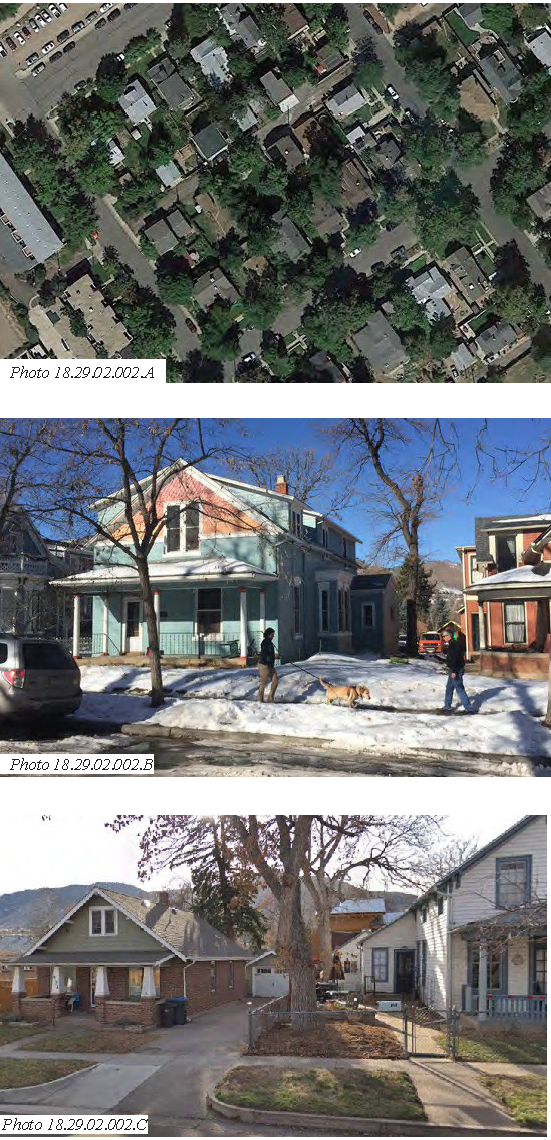
The core form zone is initially mapped to predominately residential lots located near the downtown area of Golden. These lots were, in general, created and developed between 1850 and 1960. The subject neighborhoods include a mix of single-household and multi-household development. The core form zone allows a range of multi-household form types and is initially mapped predominately to lots with R2 or R3 use zones.
b.
Future mapping of the core form zone may be appropriate in areas in which the City seeks to promote small-scale residential development that offers a mix of single-household and multi-household form types.
2.
BUILDING SCALE AND DISPOSITION
a.
Smaller principal building footprints are common in the core form zone and desirable for future developments.
b.
Small-scale buildings (both single and multi- household) with one and one and one-half-stories of building height are common in the core form zone and are desirable for future developments.
c.
The building presence along the lot frontage is consistent regarding:
1.
Orientation of the building's entrance, facing either the primary or secondary right-of-way.
2.
Common presence of front porches in the built environment.
3.
Consistent front setback depth for all buildings and structures along the block.
4.
Consistent building scale for buildings and structures along the block when viewed from the street (notwithstanding the fluctuating size of individual buildings across the lot).
d.
Rarely does the total finished floor area of a building within the built environment exceed 3,000 sq. ft.
3.
LOT AND BLOCK CHARACTERISTICS
a.
An orthogonal street grid with small blocks is typical in this context.
b.
Lots are typically sized at 50 ft. (width) by 140 ft. (depth). Where lot width varies, lot depths of 140 ft., plus or minus 10 ft., generally are consistent; however, some shallower lots facing the side streets are also present.
c.
Most lots are alley served from the rear for resident parking of vehicles.
d.
This context exhibits high levels of walkability with mostly detached sidewalks and mature street trees.
(Ord. No. 2209, § 2(Exh. G), 6-6-2023)
18.29.02.003 - TRANSITION FORM ZONE - THE CONTEXT
1.
LOCATIONAL CHARACTERISTICS
a.
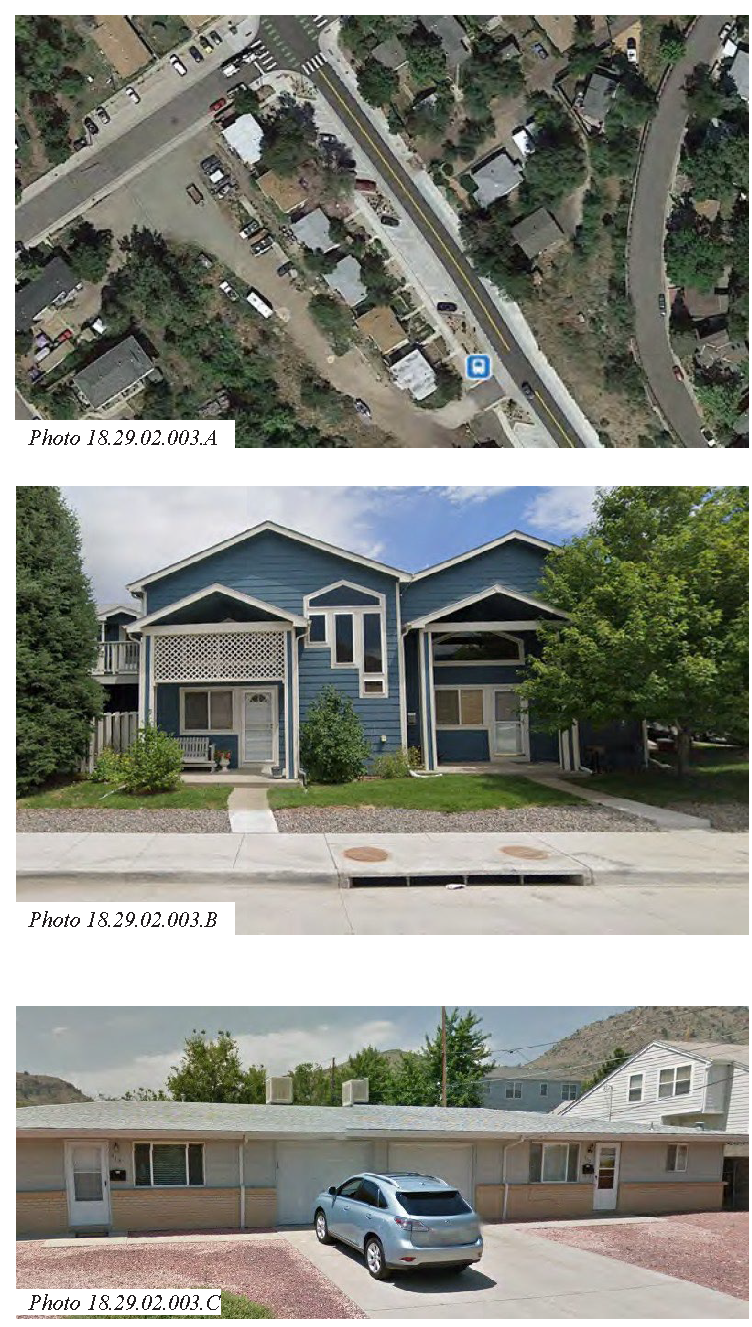
The transition form zone is initially mapped predominately to residential lots that were, in general, created and developed between 1850 and 1960, in R2 and R3 use zones, in neighborhoods that include a mix of single-household and multi-household developments. Within these areas, transition is specifically mapped over lots that border the core form zone or:
1.
Areas located where there is a change in use zone, such as residential use zones neighboring non-residential use zones.
2.
Areas located between a developed corridor or area with moderate commercial, office, industrial, or institutional uses (regardless of the underlying use zone) and residential neighborhoods.
3.
Areas between larger-scale, multi-household developments and low-density, single-household neighborhoods.
b.
Future mapping of the transition form zone is appropriate for lots with multi-household residential use zones such as R2 and R3 where future residential development serves to buffer low-density households from higher intensity uses such as: larger-scale multi-household developments, commercial developments, industrial developments, or major streets. The transition form zone may also be mapped to non-residential use zones such as commercial, if bordering a residential neighborhood.
2.
BUILDING SCALE AND DISPOSITION
a.
Within areas initially mapped transition, small-scale buildings (both single and multi-household) are dominant in the built environment. Future mapping of the transition form zone is appropriate in areas where the City seeks to promote this type of development.
b.
Larger building scales are uncommon and are not desirable.
c.
A consistent building presence exists or is planned along the lot frontage with regard to:
1.
Orientation of building entrances to face the street.
2.
Front setback depth along the block.
d.
Diversity of building heights-one-story, two-story, and occasional three-story buildings-is present.
e.
Multi-household buildings are present on most blocks.
f.
Presence of multi-household developments that exceed 3,000 square feet are uncommon.
g.
Architectural style is varied.
3.
LOT AND BLOCK CHARACTERISTICS
a.
An orthogonal street grid is present. However, block sizes are not consistent in this context.
b.
Most lots are alley served from the rear for resident parking of vehicles.
c.
This context exhibits high levels of walkability with mostly detached sidewalks and mature street trees. However, there are attached sidewalks present.
(Ord. No. 2209, § 2(Exh. G), 6-6-2023)
18.29.02.004 - EDGE FORM ZONE - THE CONTEXT
1.
LOCATIONAL CHARACTERISTICS
a.
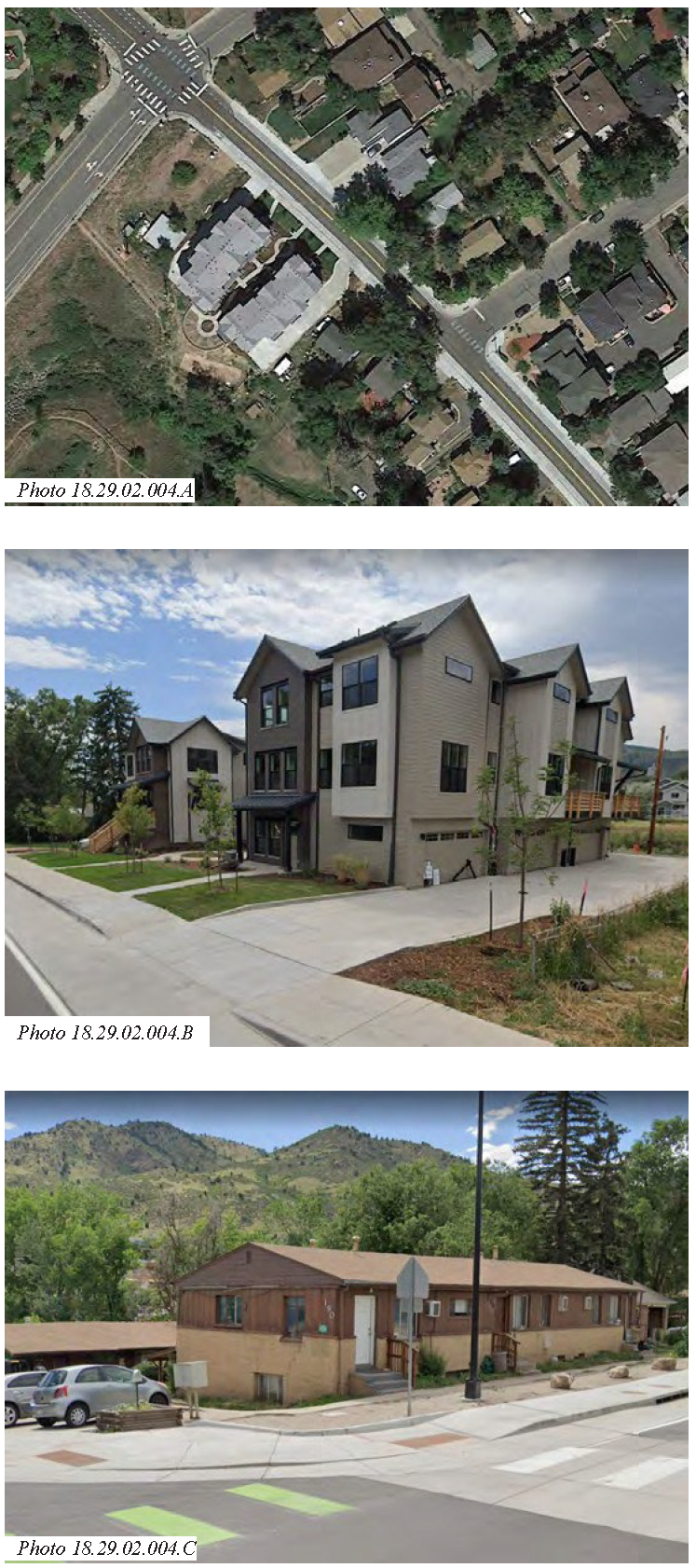
The edge form zone is initially mapped to predominately residential lots that were, in general, created and developed between 1850 and 1960. The edge form zone is also initially mapped to lots with multi-household use zones such as R2 and R3. More specifically, edge is initially mapped in areas that:
1.
Border a C1, C2, RC, M1, M2, or other non-residential use zone; or
2.
Border a developed corridor or area with significant commercial, office, industrial, or institutional uses (regardless of the underlying use zone); or
3.
Contain major streets; or
4.
Contain existing large-scale multi-household developments; or
5.
Contain or plan for multi-modal arterials connecting to the downtown or other mobility hubs within Jefferson County and the surrounding region.
b.
Future mapping of the edge form zone is envisioned for areas with larger-scale, multi-household development present or planned. It may be mapped to neighborhoods with residential use zones; to lots with a non-residential use zone if the non-residential use zone borders a residential area with a residential use zone such as R1, R2, or R3.
2.
BUILDING SCALE AND DISPOSITION
a.
Within the areas initially mapped edge, a diverse set of building footprints are present. Edge is appropriate for areas where comparable diversity of footprints is proposed.
b.
Diversity of building heights-single-story, two-story, and three-story buildings-is present and desirable in this context.
3.
LOT AND BLOCK CHARACTERISTICS
a.
Lot sizes vary.
b.
Large lots, created through the consolidation of small lots, exist alongside smaller, standard lots (50 ft. width, 140 ft. length).
c.
Street-loaded lots are common.
d.
Attached sidewalks exist together with detached sidewalks and at times no sidewalk is present.
(Ord. No. 2209, § 2(Exh. G), 6-6-2023)
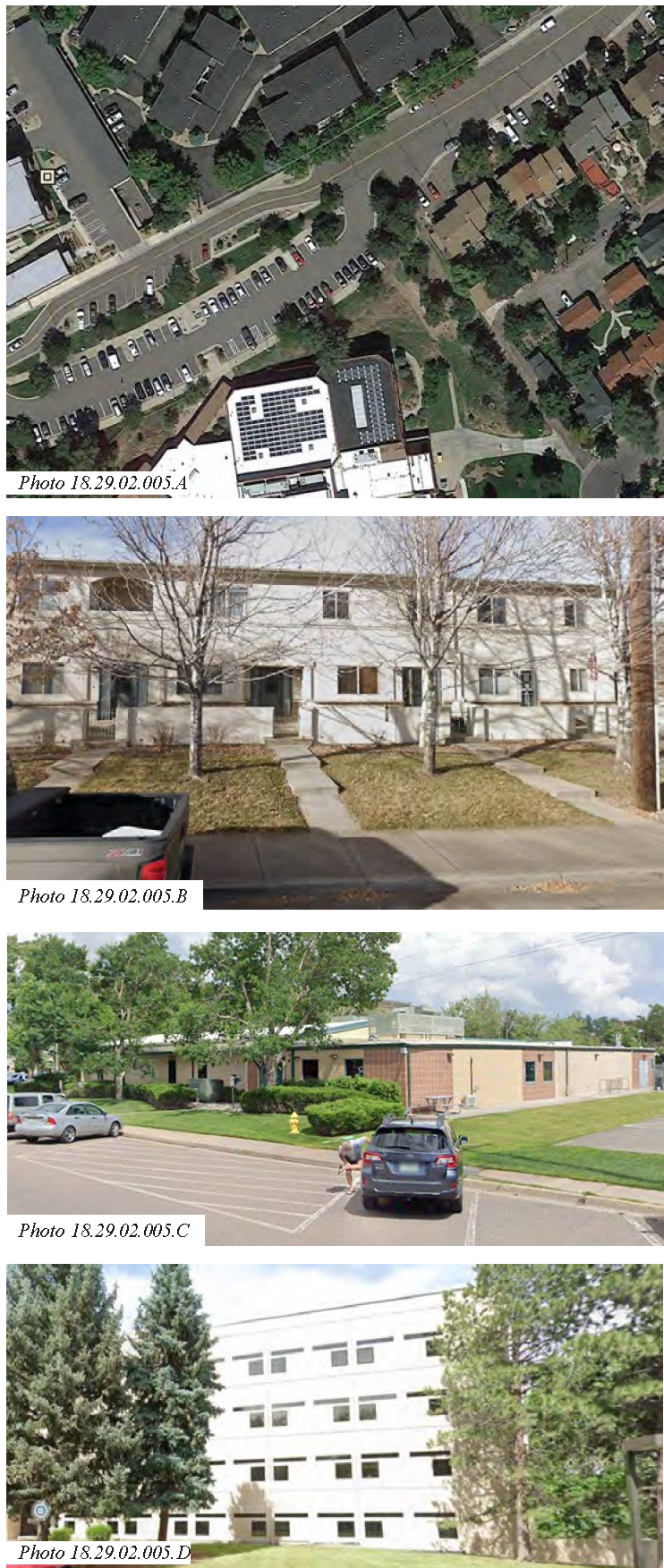
18.29.02.005 - OUTER EDGE FORM ZONE - THE CONTEXT
1.
LOCATIONAL CHARACTERISTICS
a.
The outer edge form zone is initially mapped to lots near neighborhoods that were, in general, created and developed between 1850 and 1960. However, outer edge lots generally developed after the 1970s. These lots are typically zoned for multi-household development and typically have an R3 use zone designation. Several lots within this context have been consolidated and developed with large-scale institutional uses like the Colorado School of Mines. This form zone is also mapped to smaller areas with commercial use zones.
b.
Future mapping of the outer edge form zone is envisioned for office parks, research and laboratory developments, future campuses, and larger-scale multi-household developments around the periphery of Golden. Because of the variety of scale and building types, this context may also be suited for lots with a greater density and taller buildings.
2.
BUILDING SCALE AND DISPOSITION
a.
Existing outer edge lots typically exhibit a diverse set of building footprints both small and large scale is present. Outer edge is appropriate for areas where this type of development is proposed.
b.
Taller buildings (two to three stories or more) are dominant. One-story buildings also are present or desired.
c.
Multi-household buildings that exist together with large-scale civic and campus buildings are present or desired.
d.
This context typically borders open space, major streets, and the City's downtown area.
3.
LOT AND BLOCK CHARACTERISTICS
a.
Lot sizes vary, but larger lots created through consolidation of small lots are common in the built environment.
b.
Some existing lots are alley accessed; others are not.
c.
Walkability varies as some of the larger buildings are located at a significant depth from the sidewalk in the built environment.
(Ord. No. 2209, § 2(Exh. G), 6-6-2023)
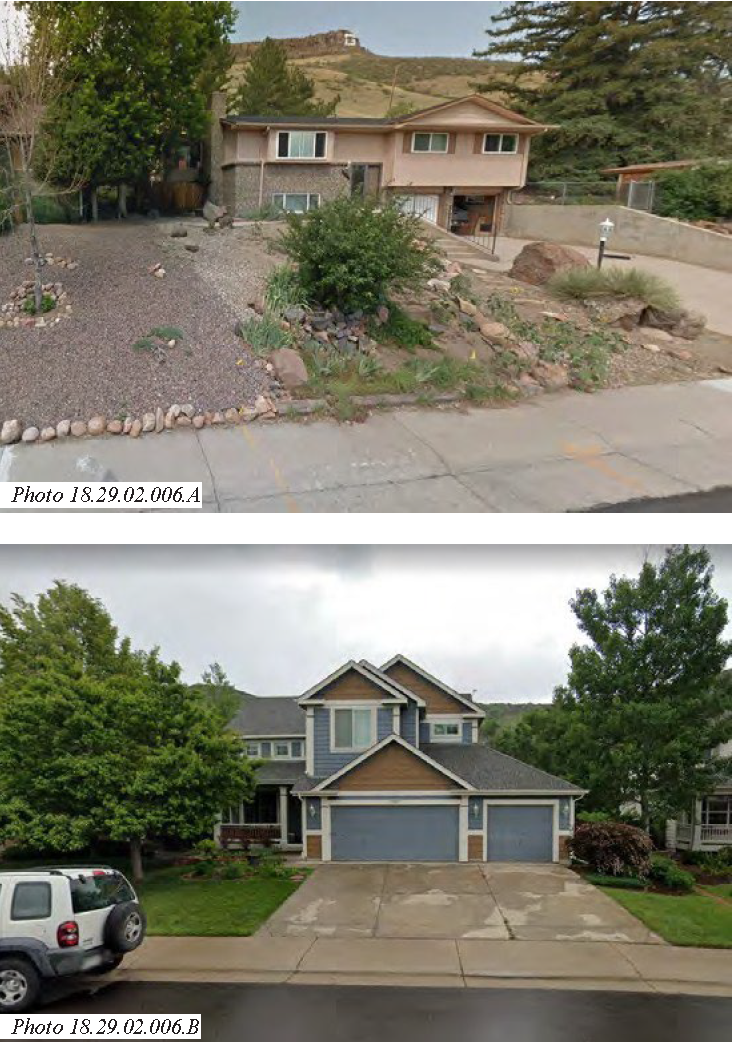
18.29.02.006 - PERIPHERAL FORM ZONE - THE CONTEXT
1.
LOCATIONAL CHARACTERISTICS
a.
The peripheral form zone is initially mapped to the R1 and R1-A use zones. These lots developed at varying points throughout Golden's history.
b.
Future mapping of the peripheral form zone is envisioned for single-household developments of comparable building scale and disposition to initially mapped peripheral form zones.
2.
BUILDING SCALE AND DISPOSITION
a.
Developments range in scale, but are typically one- to two-stories in height, with an occasional third story.
b.
Most lots are developed with floor areas of 3,200 square feet or less.
3.
LOT AND BLOCK CHARACTERISTICS
a.
The dominant development pattern is single- household buildings.
b.
Depending on when development of an area occurred, some existing lots are alley-loaded while other lots have vehicular access from the street.
c.
The most common lot area is approximately 7,000 square feet.
d.
Development that occurred pre-1960 sometimes included multiple single-household buildings on a 7,000 square foot lot.
e.
Attached sidewalks are common in areas that developed post-1970.
f.
Open space sometimes abuts private outdoor spaces at the rear of existing lots.
g.
Wide lot frontages are typical in neighborhoods that developed post-1970.
h.
Deep front and rear setbacks are common on existing lots.
(Ord. No. 2209, § 2(Exh. G), 6-6-2023)
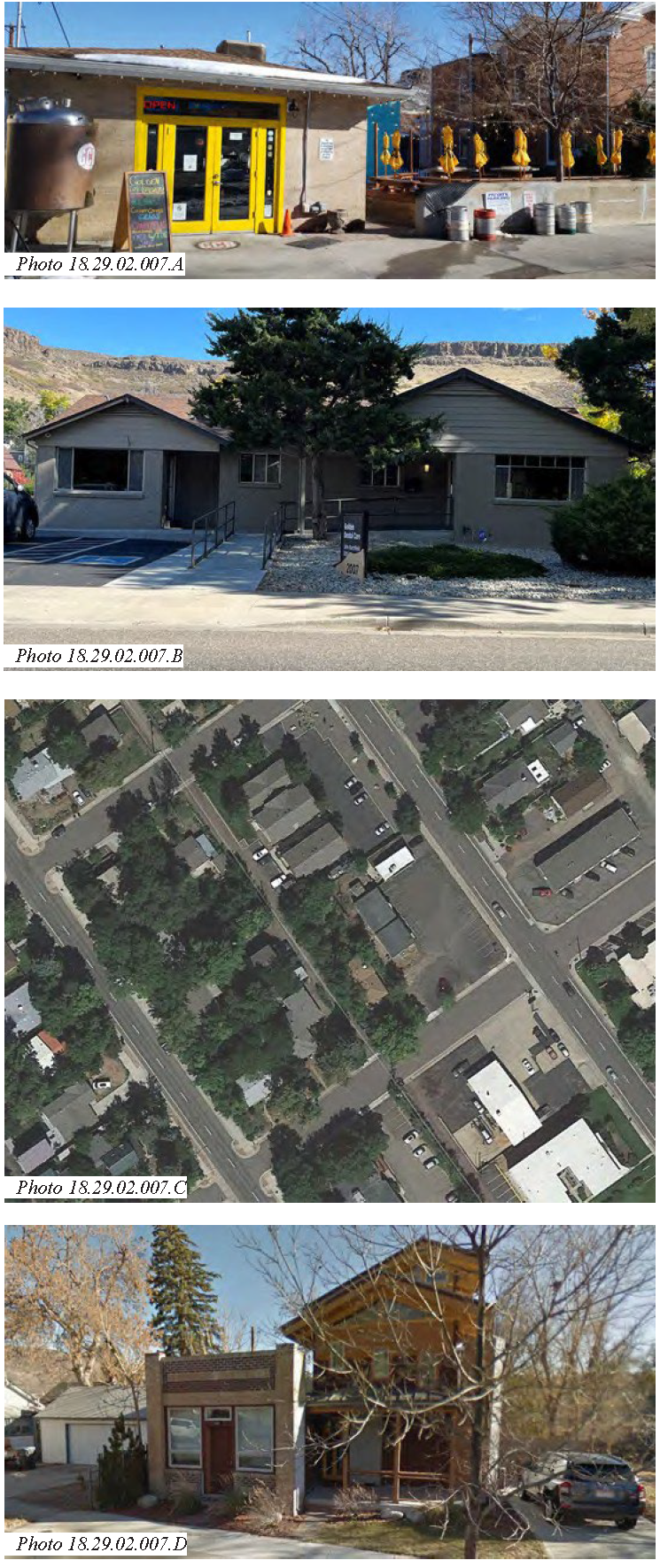
18.29.02.007 - NEIGHBORHOOD CORRIDOR FORM ZONE - THE CONTEXT
1.
LOCATIONAL CHARACTERISTICS
a.
The neighborhood corridor form zone is initially mapped to lots along roadway corridors that border residential neighborhoods. The neighborhood corridor form zone is developed with a mix of non-residential and residential uses. The initial mapping of the neighborhood corridor form zone typically overlays CMU, RC, R3, C1, and C2 use zones.
b.
Future mapping of the neighborhood corridor form zone is envisioned for mixed-use areas that promote both small-scale and medium-scale buildings, and where mixed-use neighborhoods are located or planned in proximity to residential neighborhoods.
2.
BUILDING SCALE AND DISPOSITION
a.
Smaller building footprints are typically mixed with larger building footprints (generally of more recent construction) on the same block. The neighborhood corridor form zone may be appropriate where building footprints of varying sizes are existing or proposed.
b.
Cottage-scaled buildings (i.e., buildings of 1,500 square feet or less) are common.
c.
Architectural style in the built environment varies.
3.
LAND USE, LOT, AND BLOCK CHARACTERISTICS
a.
Residential uses are often (but not necessarily) located on the same block as non-residential development, and such patterns are desirable.
b.
Residential building forms that contain non-residential uses are common, and such use of residential building forms is appropriate.
c.
Lots are typically sized at 50 ft. (width) by 140 ft. (depth), although consolidated lots are common. Consolidated lots are often developed with buildings with larger footprints.
d.
The typical block pattern is an orthogonal street grid with small blocks, and block sizes are generally consistent.
e.
Orientation of buildings vary from lot to lot. A diversity of front setbacks with no consistent depth or street presence is common.
f.
Detached sidewalks with mature street trees are common.
(Ord. No. 2209, § 2(Exh. G), 6-6-2023)
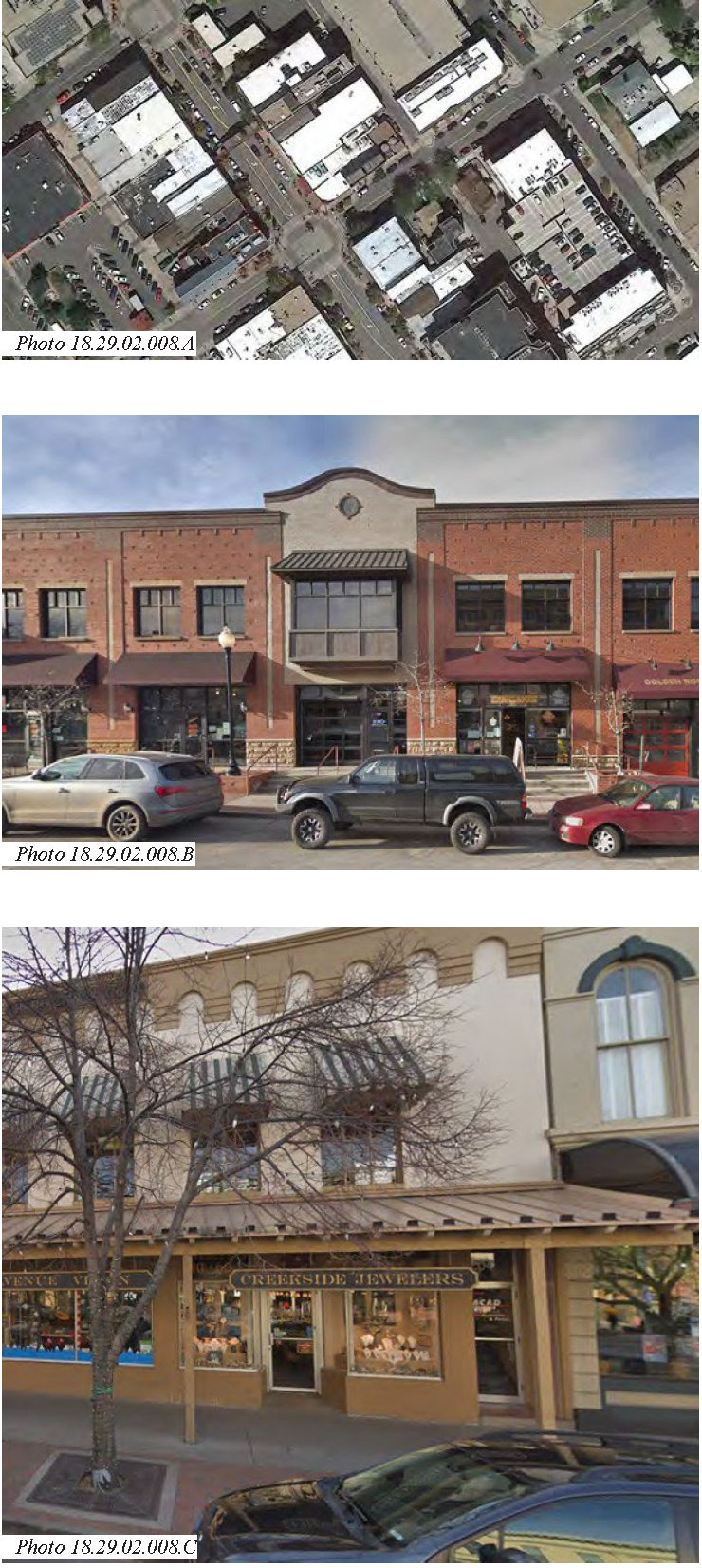
18.29.02.008 - MAIN STREET A FORM ZONE - THE CONTEXT
1.
LOCATIONAL CHARACTERISTICS
a.
The Main Street A form zone is initially mapped to lots along street corridors that express traditional, pedestrian-oriented, commercial developments. These corridors have developments that are located close to the front lot line and typically include store fronts with high levels of transparency along a consistent streetscape.
b.
The development pattern along the block is consistent insofar as there is little to no space between buildings (zero-foot side setbacks). Portions of downtown Golden are initially mapped with the Main Street A form zone.
c.
Future mapping of the Main Street A form zone is envisioned for lots located along street corridors with buildings located or planned to be located close to the front lot line or sidewalk, with little to no space between buildings (zero-foot side setbacks). In addition, these buildings are or are desired to be two-to-three stories in height. This form zone permits form types that facilitate the addition of amenities to the pedestrian realm.
2.
BUILDING SCALE, DISPOSITION, AND DESIGN
a.
Two-to-three story attached buildings located at or near front lot lines are common in this context.
b.
First story commercial store fronts with high levels of transparency at pedestrian eye level are common or desired.
c.
Awnings and colonnades are commonly found above the first-story floor plate.
d.
The horizontal store building face provides accents or articulations typically at intervals of every 25 feet or 50 feet, more or less. These distances also typically correspond with the width of the lot or the attached building.
3.
LOT AND BLOCK CHARACTERISTICS
a.
Wide sidewalks with pedestrian amenities such as benches and street planters are common or desired.
b.
Lots are typically sized at 25 ft. (width) by 140 ft. (depth), and consolidated lots are common.
c.
An orthogonal street grid with small blocks is typical.
d.
Most lots are alley-accessed, with parking located at the rear. While there are instances of street-accessed, front-of-lot parking, such format is not desirable because it interrupts the sidewalk and diminishes the "pedestrian friendly" character.
(Ord. No. 2209, § 2(Exh. G), 6-6-2023)
18.29.02.009 - MAIN STREET B FORM ZONE - THE CONTEXT
1.
LOCATIONAL CHARACTERISTICS
a.
The Main Street B form zone is initially mapped to lots along street corridors that are developed with traditional, pedestrian-oriented, commercial developments. Buildings along these corridors are located close to the front lot line and typically include store fronts with high levels of transparency.
b.
Development is consistent along the block with little to no space between buildings (zero-foot side setbacks). Portions of downtown Golden are initially mapped with the Main Street B form zone.
c.
Main Street B differs from Main Street A in that it has larger four- and five-story buildings mixed with shorter, two- and three-story buildings. The larger buildings typically incorporate upper story building stepbacks and residential dwellings.
d.
Future applications of Main Street B are envisioned for lots along street corridors that exhibit or are planned for attached nonresidential and mixed-use buildings that are located close to the front lot line or sidewalk, with vehicular access behind the buildings. In addition, this form zone may be appropriate for office parks, research and laboratory developments, future campuses, and larger-scale multi-household developments around the periphery of Golden.
2.
BUILDING SCALE, DISPOSITION, AND DESIGN
a.
Two- to three-story attached buildings and four- to five-story attached buildings, located at or near the front lot line, are common.
b.
First-story commercial storefronts with high levels of transparency at pedestrian eye level are common.
c.
Awnings and colonnades are typically found above the first story floor plate.
d.
Upper-story setbacks and other massing articulations are common in four- to five-story buildings.
e.
The horizontal store building face provides accents or articulations typically at intervals of every 25 feet or 50 feet, more or less. These distances also typically correspond with the width of the lot or the attached building.
3.
LOT AND BLOCK CHARACTERISTICS
a.
An orthogonal street grid with small blocks is typical.
b.
Lots are typically sized at 25 ft. (width) by 140 ft. (depth). Consolidated lots are common. Multi-story buildings often occupy quarter- to half-block lots.
c.
Most lots are alley-accessed parking. Structured parking is common for recent, large buildings.
d.
Wide sidewalks with pedestrian amenities such as benches and street planters are common. Attached buildings located at the front lot line form a strong building presence, which is the most identifying factor of this context (existing/proposed).
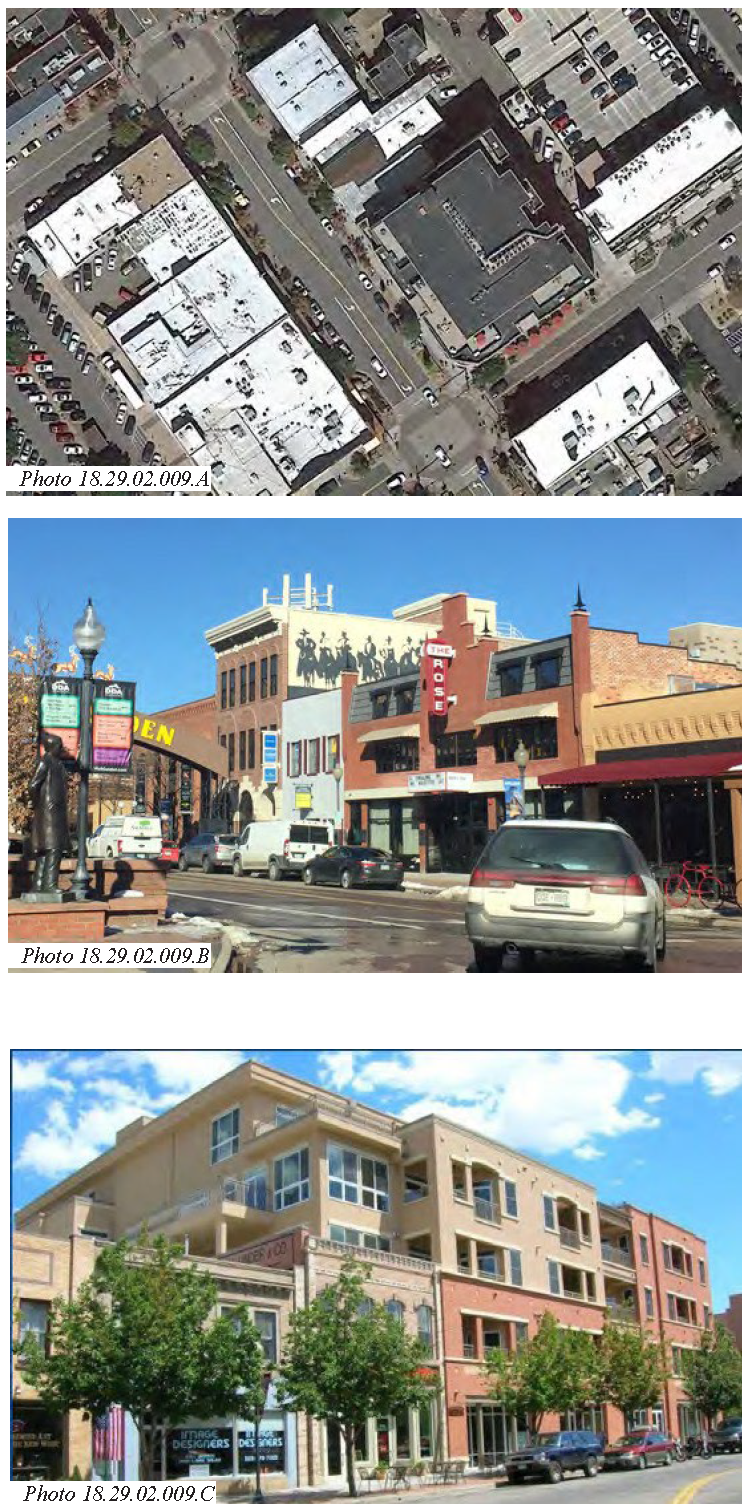
(Ord. No. 2209, § 2(Exh. G), 6-6-2023)
18.29.02.010 - STRIP FORM ZONE - THE CONTEXT
1.
LOCATIONAL CHARACTERISTICS
a.
The Strip form zone is initially mapped to lots along street corridors that developed with automotive access from the adjacent street as the predominant means of ingress and egress. These areas typically developed after 1960.
b.
The purpose of the Strip form zone is to balance land uses and transportation modes in areas that are otherwise auto-oriented and unfriendly to pedestrians, in the existing context of a principally strip commercial layout.
c.
The Strip form zone is the most flexible form zone for non-residential and mixed-use development.
d.
Future mapping of the Strip form zone is envisioned for auto-oriented commercial centers for which an enhanced pedestrian environment is desired.
2.
BUILDING SCALE AND DISPOSITION
a.
Buildings are predominantly one- and two-story.
b.
Building coverage (total building footprint divided by the total area of the lot) between 20 and 30 percent are common in the existing environment.
c.
Free-standing buildings are typically set back a significant distance from the front lot line.
d.
Large surface parking areas are common.
e.
Service drives for truck deliveries are typically located at the rear of buildings.
3.
LOT AND BLOCK CHARACTERISTICS
a.
The existing environment is typically less inviting to pedestrians than other form zones.
b.
Street segments of ¼ to ⅓ of a mile between intersections are common.
c.
Landscape buffers between commercial uses and other uses are common, especially when such other uses abut the commercial property's rear lot line.
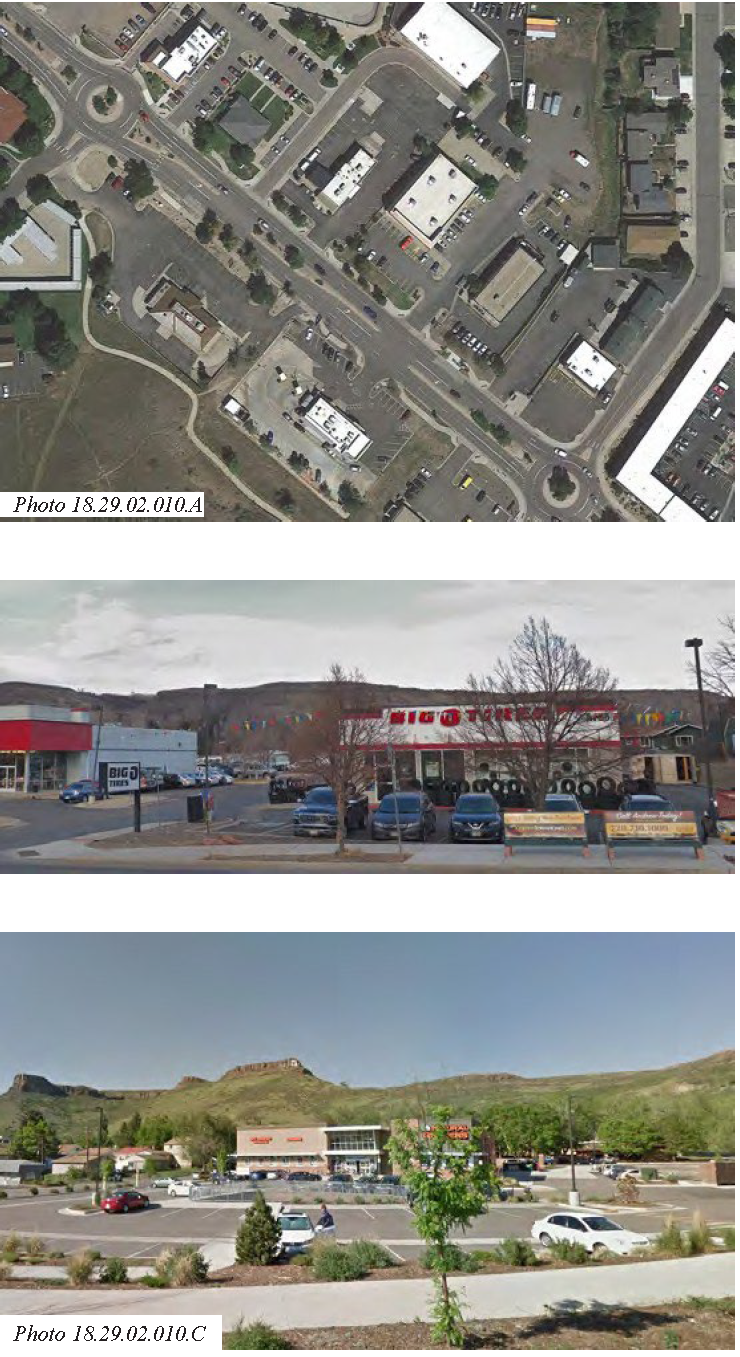
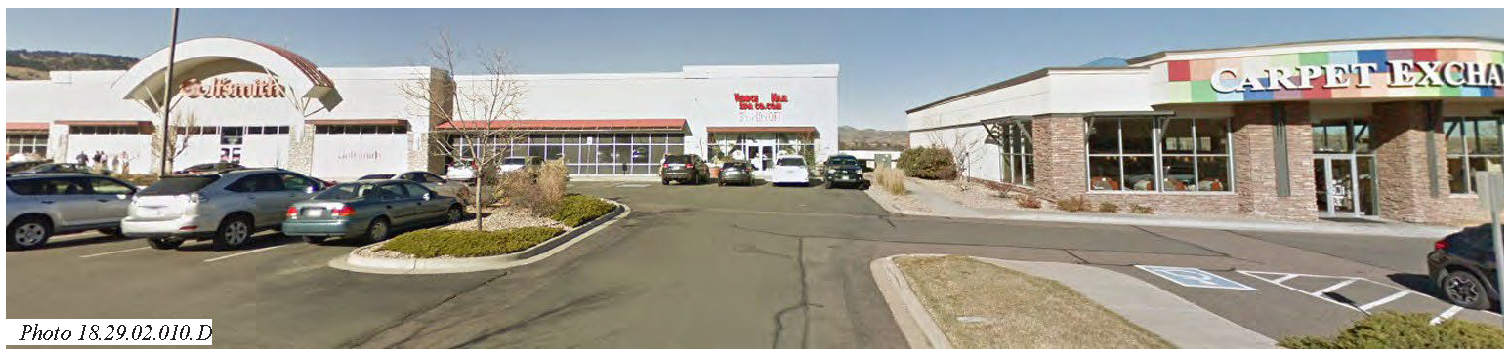
(Ord. No. 2209, § 2(Exh. G), 6-6-2023)
18.29.03.01 - ORGANIZATION AND INTERPRETATION OF DIVISION
1.
ORGANIZATION OF DIVISION
a.
Division III sets forth the following for each of the nine categories of form types: an introduction of and intent statements applicable to each category of form types; the form standards for each form type within each category of form types; and the design standards and guidelines for each category of form types.
b.
The information presented in this division is organized by category of form type as follows:
1.
House Form Types - See Sections 18.29.03.002 to 18.29.03.004.
2.
Cottage Form Types - See Sections 18.29.03.005 to 18.29.03.007.
3.
Compound Form Types - See Sections 18.29.03.008 to 18.29.03.010.
4.
Cluster Form Types - See Sections 18.29.03.011 to 18.29.03.013.
5.
Duplex Form Types - See Sections 18.29.03.014 to 18.29.03.016.
6.
Row House Form Types - See Sections 18.29.03.017 to 18.29.03.019.
7.
Main Street Form Types - See Sections 18.29.03.020 to 18.29.03.022.
8.
Mixed-Use Building Form Types - See Sections 18.29.03.023 to 18.29.03.025.
9.
Shop Form Types - See Sections 18.29.03.026 to 18.29.03.028.
2.
INTERPRETATION OF DIVISION
If a standard is set forth in the form standards for one or more form types, but not for others, such standard shall be deemed inapplicable where omitted.
3.
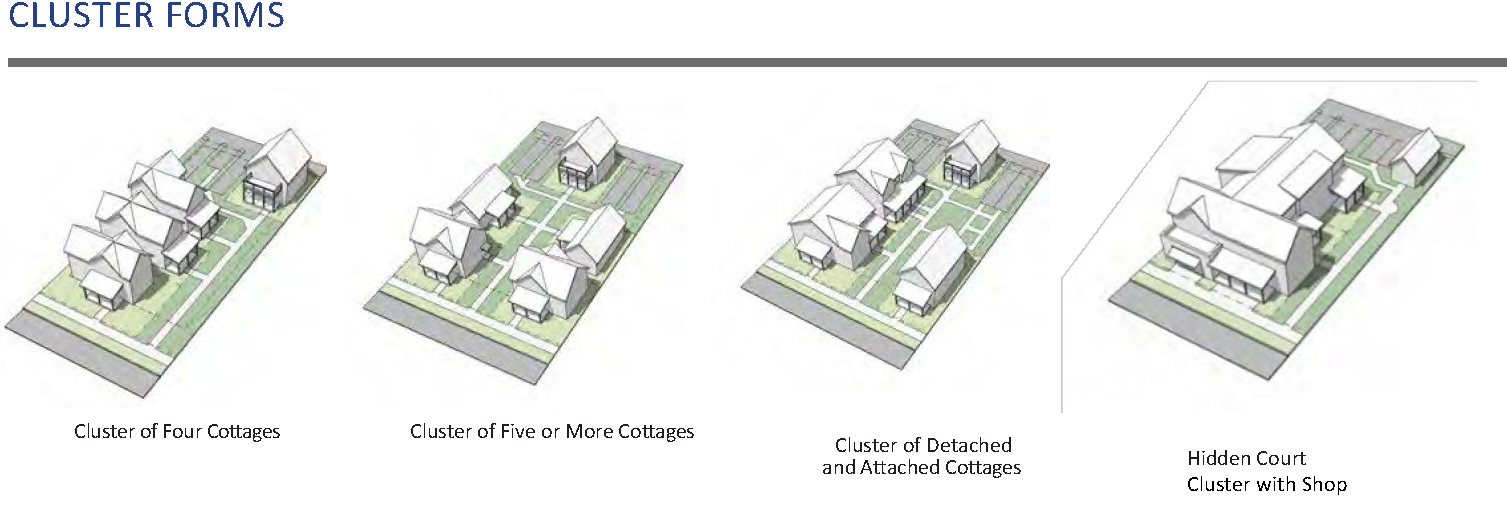
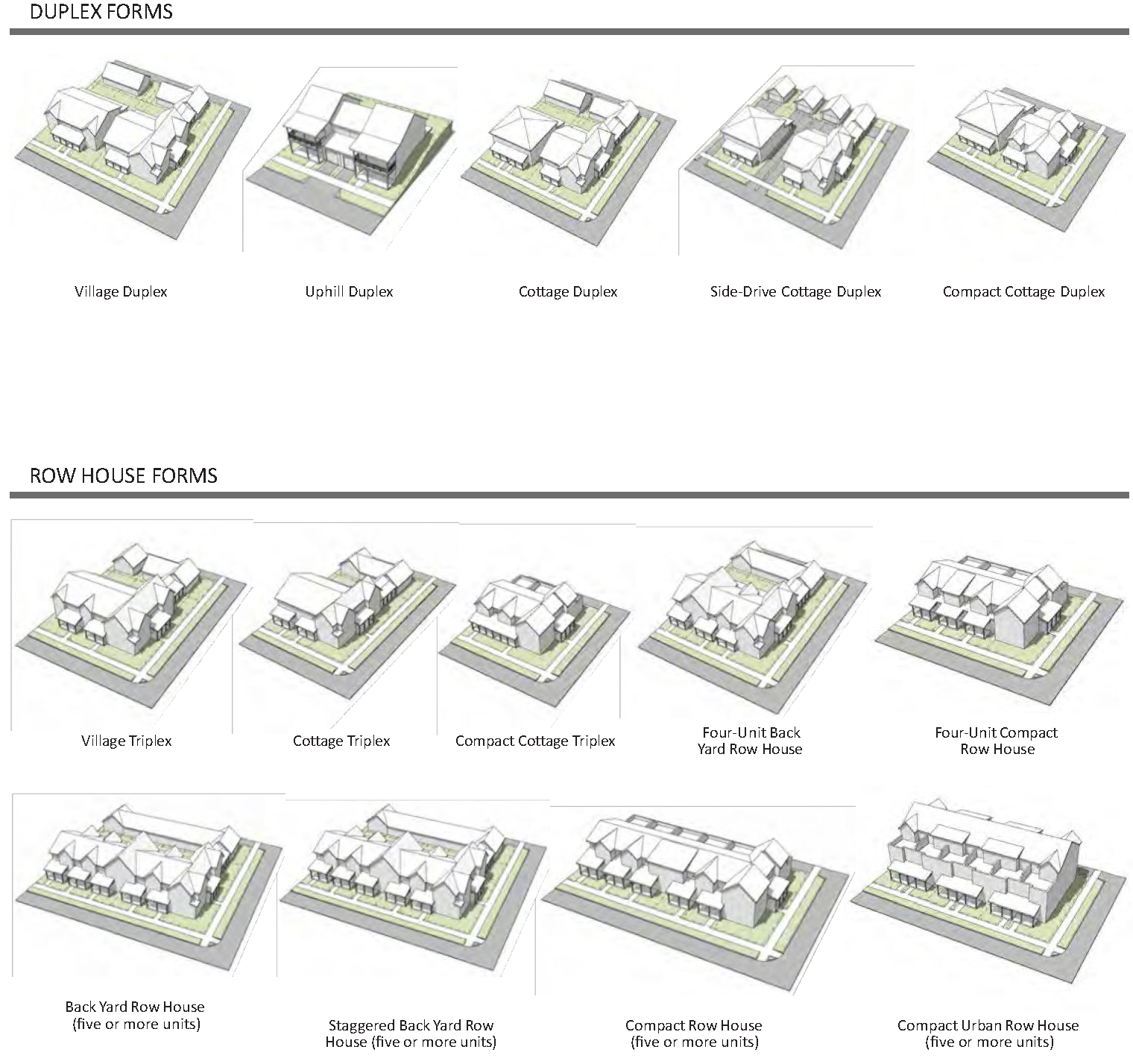
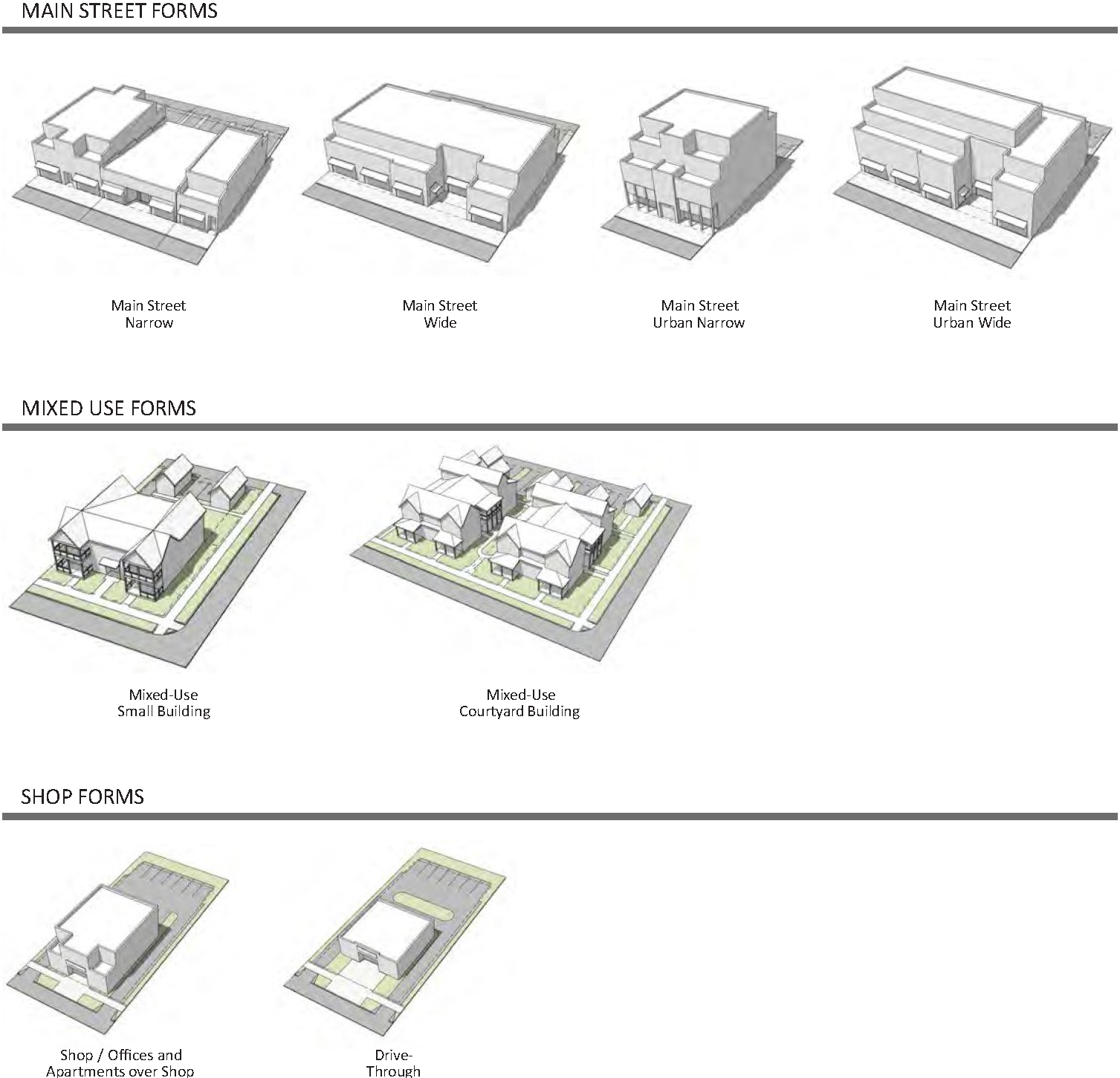
ILLUSTRATIVE DEPICTIONS OF FORM TYPES
Illustration 18.29.03.001.A (following pages) provides illustrative depictions of the form types allowed within each category of form types. These depictions are illustrative in nature and not intended to impose design requirements that are not otherwise set out in this chapter.
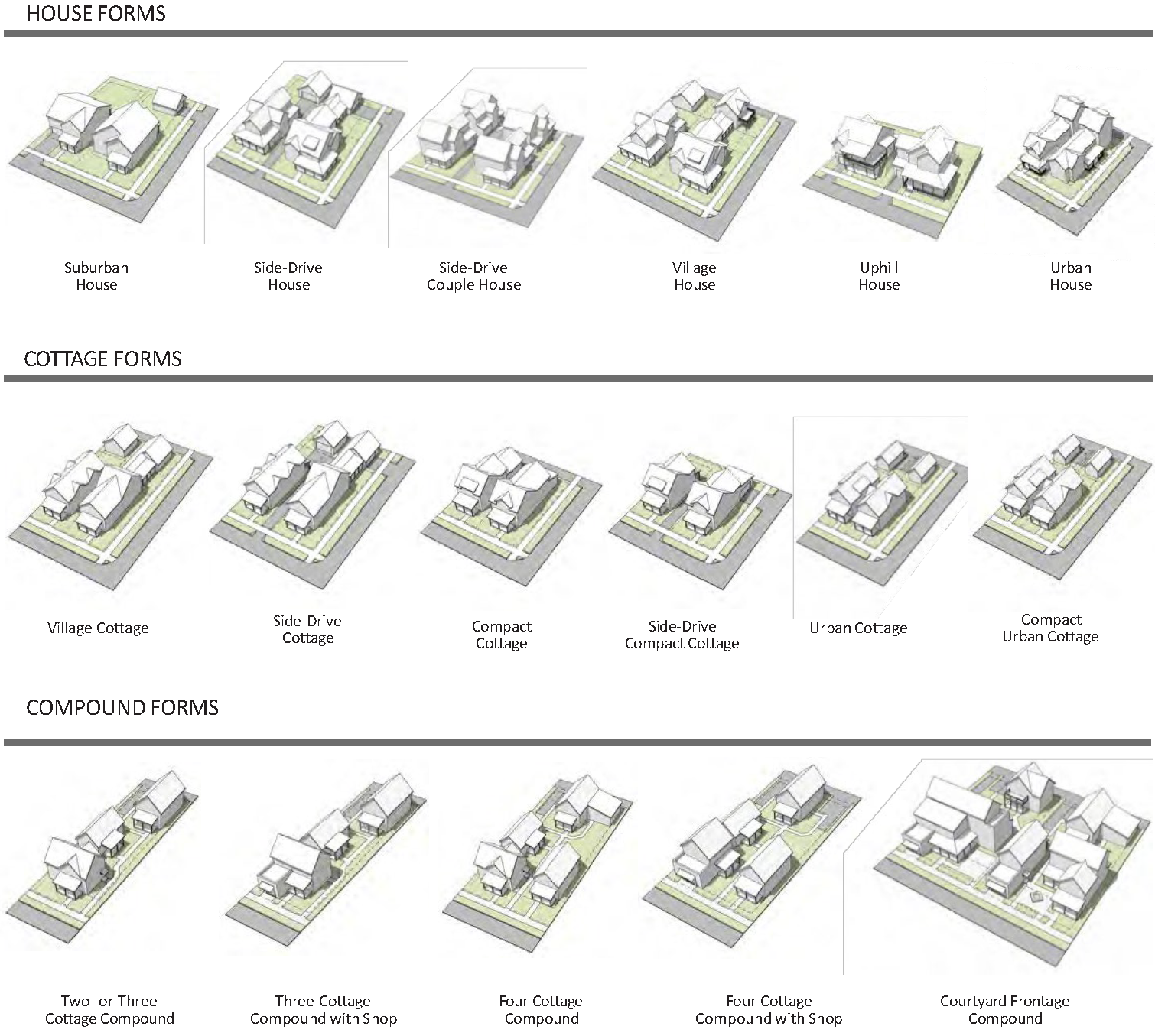
(Ord. No. 2209, § 2(Exh. G), 6-6-2023)
18.29.03.002 - HOUSE FORM TYPES - APPLICATION OF FORM STANDARDS
1.
GENERAL INTENT
a.
The house form types are provided to:
1.
Continue the typical lot development patterns of detached homes;
2.
Provide options for home occupations and for nonresidential use of existing residential buildings; and
3.
Help facilitate the re-use of detached, single household building styles for non-residential uses.
b.
This section shall not be interpreted to set forth substantive requirements.
2.
INTENT AND APPLICATION OF STANDARDS
a.
In General. This subsection 2 sets forth the intent for specific standards that are applied to house form types.
b.
Building Size. Building size regulations are used to:
1.
Ensure that new and expanded single-household buildings are consistent in size and scale with existing single-household buildings in Golden in the same form zone.
2.
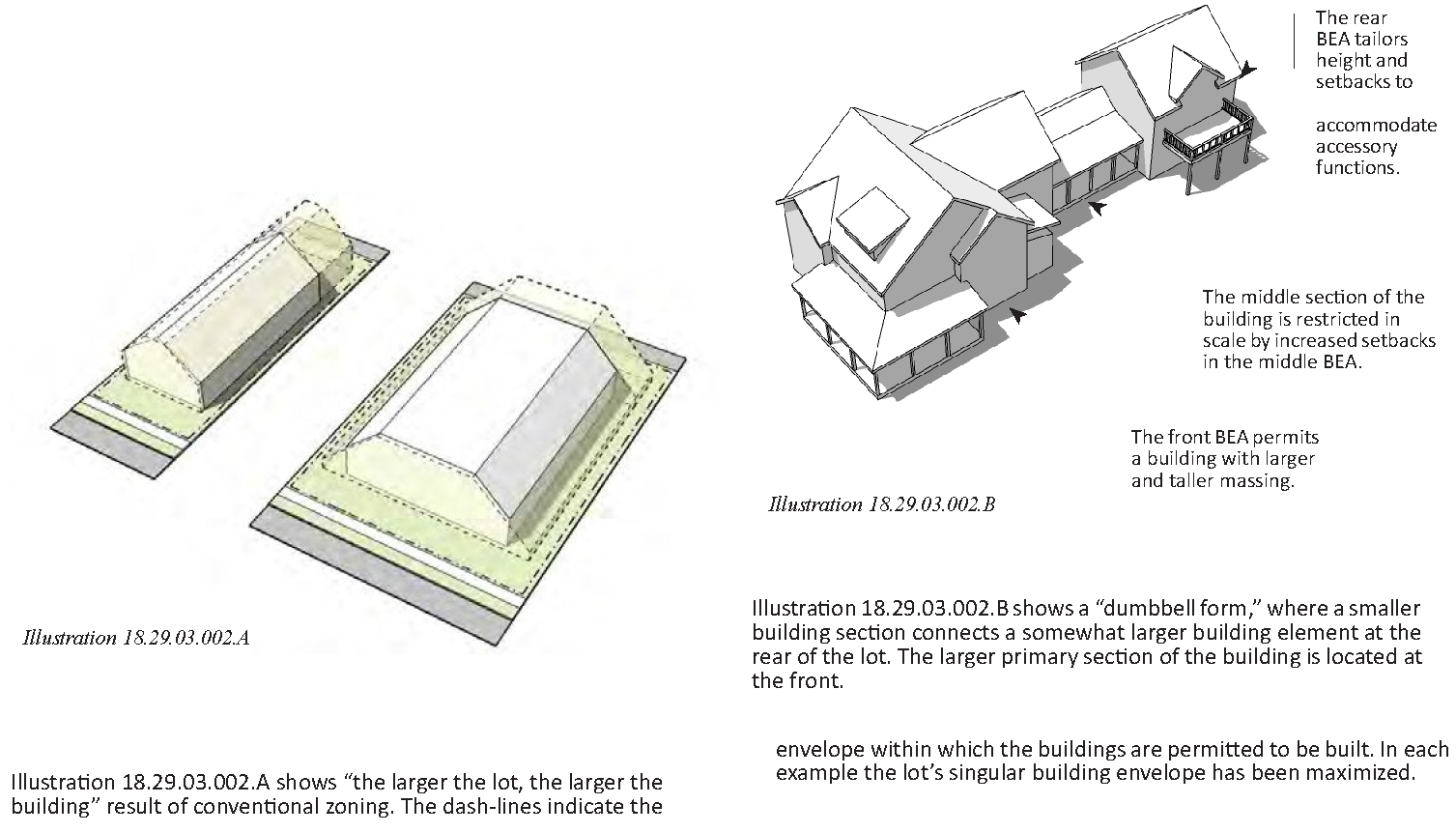
Discourage maximizing floor area and building height to fit all available volume within a building envelope on a large lot, by encouraging the development of multiple smaller buildings on smaller lots. [See illustration 18.29.03.002.A]
c.
Multiple Building Envelope Areas (BEAs). Multiple BEAs with different height, lot coverage, and setback requirements are established at the front, middle, and rear of a lot to:
1.
Ensure that the massing of the principal building is principally located towards the front of the lot.
2.
In some cases, locate accessory buildings away from the principal building mass and primary street.
3.
Decrease the scale of the house at different areas of the lot and create variation in building height and depth when perceived from the lot frontage and also the side street.
4.
Create or maintain building configurations that resemble those that are commonly found in neighborhoods located near downtown Golden or lots that developed between 1850 and 1960. These configurations typically locate the principal building at the front of a lot and accessory buildings and structures (garage as an example) in the middle and rear of a lot. If one building is developed on the lot, the scale of the building in the middle and rear of the lot is intended to be smaller than the front of the lot. [See illustration 18.29.03.002.B]
d.
Building Height. Building height is limited by number of stories and in linear feet to encourage steep gable or hip roof forms that are common in existing dwellings that developed in Golden between the 1850s and 1960s.
e.
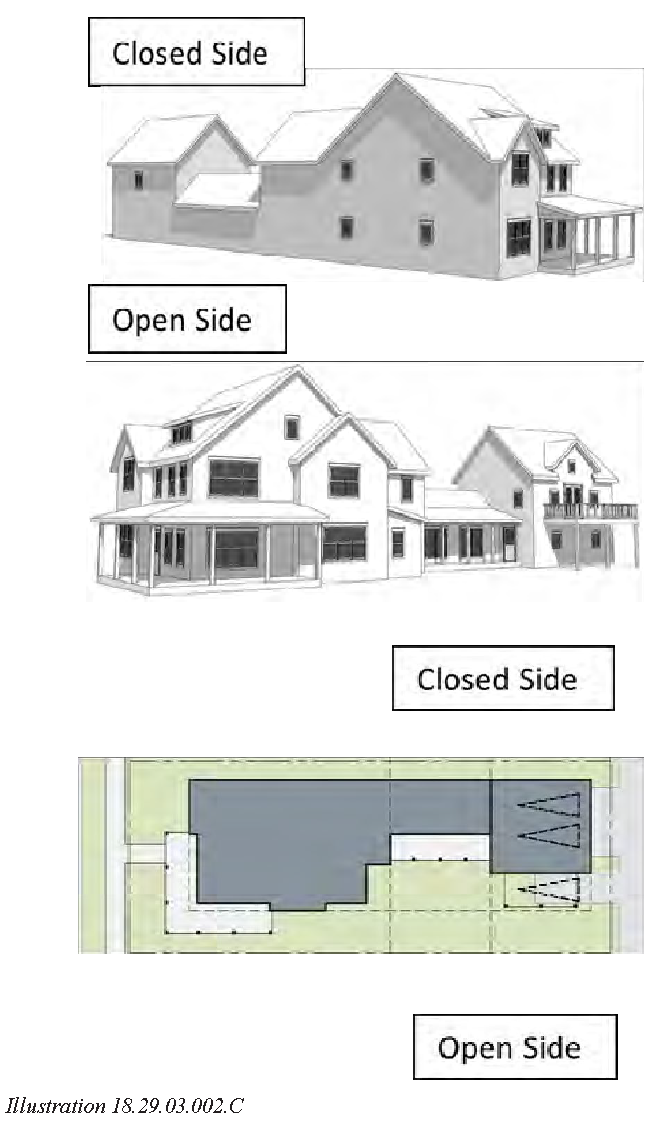
Open Side/Closed Side. Many of the house form types require an "open side" and "closed side." The "open side" is characterized by greater setbacks on the lot to allow for light and air to pass through the development. The larger setback on the "open side" makes the side yard more usable and functional. The "closed side" allows for less restrictive setbacks for additional building area. The "open side" and "closed side" framework also accommodates side-driveway solutions. [See illustration 18.29.03.002.C] Where the "open side" and the "closed side" are differentiated, the regulations are applied in order to:
1.
Ensure better utilization and function of the side yard of the middle BEA.
2.
Further decrease the scale of the house at different areas of the lot.
f.
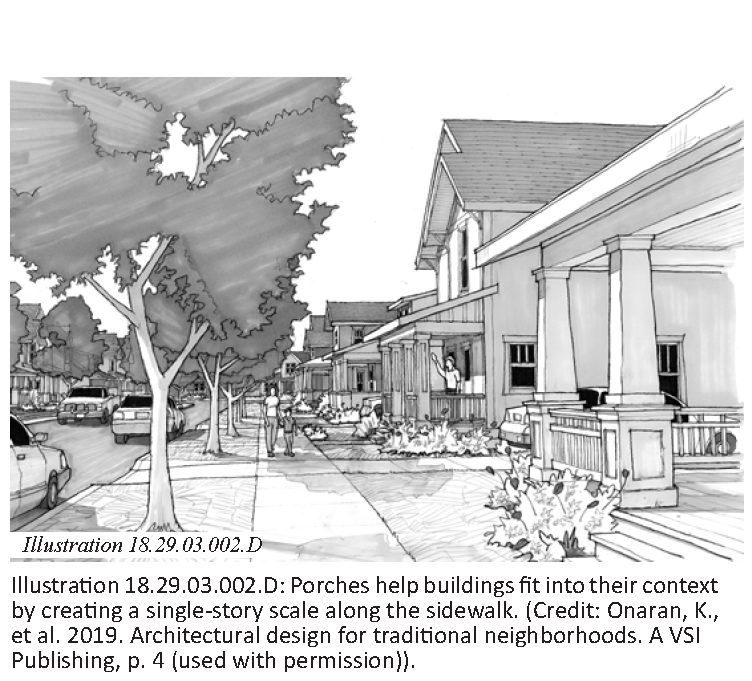
Porch. A porch is required for some of the house form types, in order to:
1.
Accentuate the first-story elements of a building from the pedestrian realm (right-of-way/sidewalk) to reduce the building's perceived scale [See illustration 18.29.03.002.D].
2.
Provide better transition between the front of a building and the pedestrian realm (right-of-way/sidewalk) by creating a stepped approach to the building height and decreasing the distance between these areas.
3.
Maintain the front porch as a common element typically found in single-household buildings constructed between the 1850s and 1960s.
(Ord. No. 2209, § 2(Exh. G), 6-6-2023)
18.29.03.003 - HOUSE FORM TYPES - FORM STANDARDS
1.
SUBURBAN HOUSE
a.
Intent.
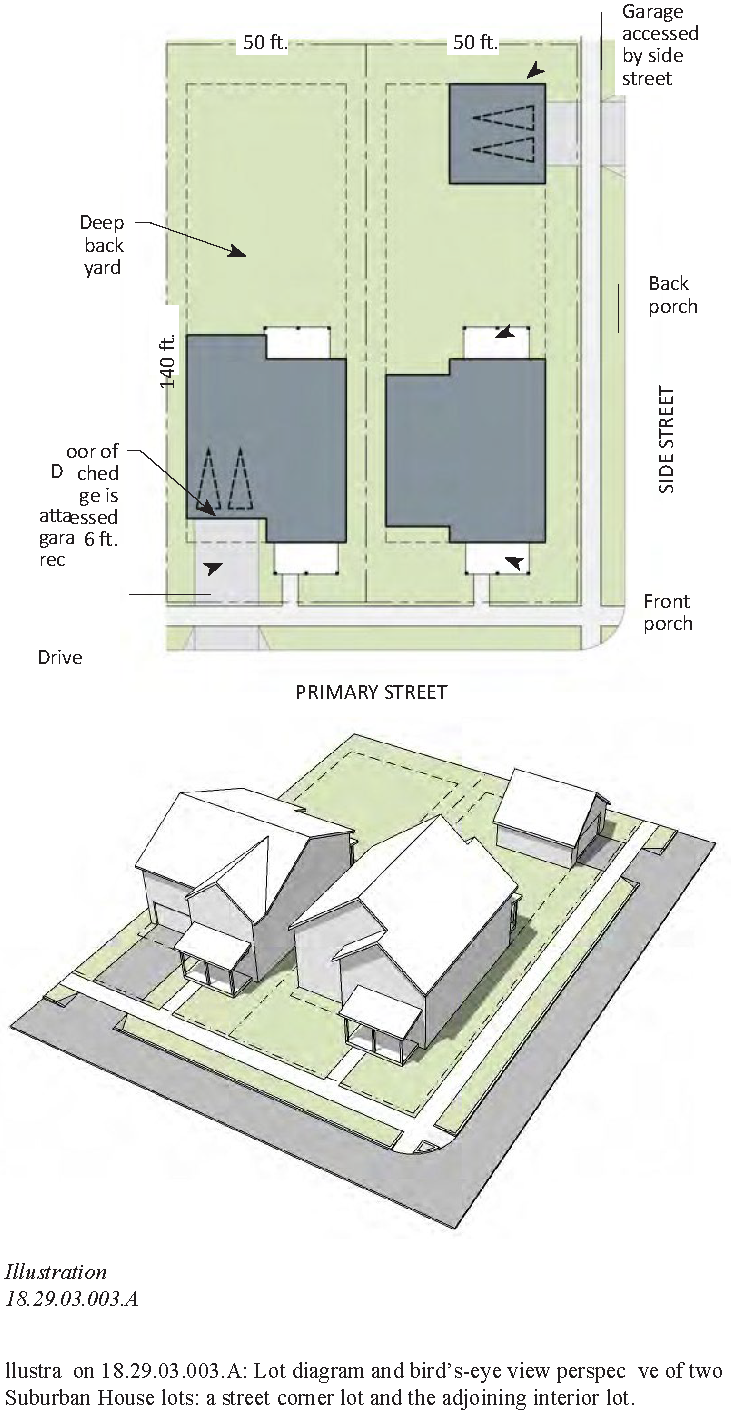
The suburban house form type is intended mostly for single household residential uses. This form type is appropriate for a typical 50 ft. x 140 ft. lot, but it can also be applied to wider or shallower lots.
b.
Lot Standards.
1.
Min. lot area ..... 6,000 s.f.
2.
Min. lot frontage ..... 50 ft.
c.
Building Size and Dwelling Unit Limitations.
1.
Max. total floor area ..... 3,200 s.f. per lot
2.
Max. lot coverage ..... 40%
3.
Max. height (principal building)
A.
70% of footprint ..... 2 stories/28 ft.
B.
30% of footprint ..... 2 stories/35 ft.
4.
Max. height (accessory buildings) ..... 2 stories/32 ft.
5.
Max. no. of dwelling units ..... 1 per lot [See e.4]
d.
Minimum Setbacks.
1.
Primary street ..... 15 ft.
2.
Porch at primary street ..... 7 ft.
3.
Side street ..... 8 ft.
4.
Porch at side street ..... 8 ft.
5.
Interior side lot line ..... 5 ft.
6.
Rear lot line ..... 10 ft.
e.
Additional Standards.
1.
The suburban house form type is permitted only on lots that do not have alley access.
2.
Where a garage is attached to or integrated into the principal building and the garage door faces a street, the garage door shall be recessed at least 6 ft. from the principal building wall on the same building elevation. [See illustration 18.29.03.003.A]
3.
All garage doors that face a primary street or side street shall be set back at least 20 ft. from the lot line that is coterminous with that street.
4.
Driveways shall not exceed 20 ft. in width, exclusive of curb returns.
5.
A multi-household configuration may be permitted based on the use zone:
A.
R2 use zone: Up to 4 dwelling units per principal building.
B.
R3 use zone: The number of dwelling units within the principal building is not restricted, provided that design standards and parking standards are met.
2.
SIDE-DRIVE HOUSE
a.
Intent and Special Characteristics.
1.
Intent. The side-drive house form type is intended to maintain the architectural character along the street on lots where alley access is not available.
2.
Special Characteristics. The side-drive house has:
A.
An open side and a closed side with different setback requirements.
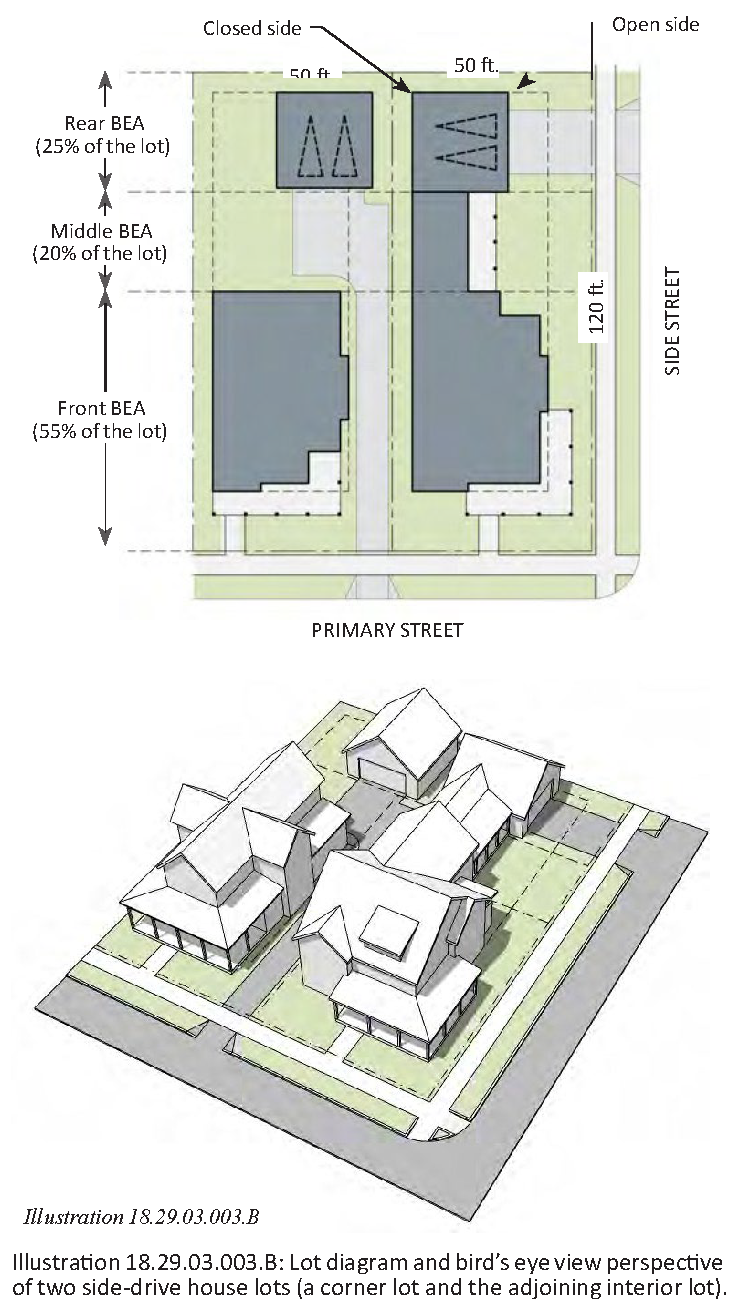
B.
Three building envelope areas (BEAs):
i.
Front: 55%
ii.
Middle: 20%
iii.
Rear: 25%
b.
Lot Standards.
1.
Min. lot area ..... 6,000 s.f.
2.
Min. lot frontage ..... 50 ft.
3.
Min. lot depth ..... 90 ft.
c.
Building Size and Dwelling Unit Limitations.
1.
Max. total floor area ..... 3,000 s.f. per lot
2.
Max. lot coverage -
A.
Front BEA ..... 55%
B.
Middle BEA ..... 32% [See g.]
C.
Rear BEA ..... 40%
3.
Max. building height -
A.
Front BEA:
i.
70% of bldg. footprint: 2 stories/28 ft.
ii.
30% of bldg. footprint: 2 stories/35 ft.
B.
Middle BEA ..... 1 story/20 ft. [See g.]
C.
Rear BEA ..... 2 stories/32 ft.
4.
Max. no. of dwelling units ..... 1 per lot [See f.5]
d.
Setbacks.
1.
Primary street ..... 15 ft. min.
2.
Porch at primary street ..... 7 ft. min./20 ft. max.
3.
Side street ..... 8 ft. min.
4.
Side alley ..... 8 ft. min.
5.
Porch at side street ..... 8 ft. min./20 ft. max.
6.
Interior side lot line -
A.
Open side ..... 10 ft. min.
B.
Closed side ..... 5 ft. min.
7.
Rear lot line ..... 5 ft. min.
e.
Front Porch.
In the peripheral, core, transition, and edge form zones, a minimum 120 s.f. porch facing the primary street, or, if present, the side street, is required.
f.
Additional Standards.
1.
Side-drive house form types are permitted only on lots with no alley or shared driveway access along the rear lot line. Side-loaded alleys or driveways (which may be shared driveways) must serve as the access if the lot is not located on a street corner.
2.
Garages on corner lots shall be accessed by the side street unless the City Engineer determines that alternative access is preferable for traffic safety purposes. All garage doors that face a side street shall be set back at least 20 ft. from the street side lot line.
3.
Garages shall be located in the middle or rear BEA.
4.
Driveway width shall not exceed 10 ft. on the primary street lot line and not be wider than 16 ft. on the side street lot line.
5.
A multi-household configuration may be permitted based on the use zone:
A.
R2 use zone: Up to 4 dwelling units per principal building.
B.
R3 use zone: The number of dwelling units within the principal building is not restricted, provided that design standards and parking standards are met.
g.
Adjustments for Mostly Preserved Buildings
When an existing principal building on the lot is preserved to a degree to be qualified as "mostly preserved building," the following restrictions shall supersede the requirements of subsections c.2 and c.3 with respect to the middle BEA:
1.
Lot coverage ..... not specifically restricted
2.
Max. height ..... 1½ stories/35 ft.
3.
SIDE-DRIVE COUPLE HOUSE
a.
Intent.
The side-drive couple house form provides the opportunity to subdivide an existing lot ("original lot") to create a lot for a second small house on one of the new lots (each of the new lots, a "couple lot") by reducing the minimum lot area required for couple lots.
b.
Lot Standards.
1.
Min. original lot area ..... 6,000 s.f.
2.
Min. original lot frontage ..... 50 ft.
3.
Min. couple lot area ..... 2,500 s.f. per lot
4.
Min. couple lot frontage ..... 50 ft. [See f.3]
c.
Building Size and Dwelling Unit Limitations.
1.
Maximum total floor area per couple (two houses combined): ..... 3,200 s.f.
2.
Max. couple lot coverage ..... 50% per lot
3.
Max. building height ..... 2 stories/35 ft.
4.
Maximum no. of dwelling units per couple lot ..... 1 per lot [See f.4]
d.
Setbacks.
1.
Primary street ..... 15 ft. min.
2.
Porch at primary street ..... 7 ft. min./20 ft. max.
3.
Side street ..... 8 ft. min.
4.
Porch at side street ..... 8 ft. min./20 ft. max.
5.
Interior side lot line ..... 5 ft. min.
6.
Rear lot line ..... 5 ft. min.
e.
Front Porch.
In the transition and edge form zones, a minimum 120 s.f. porch facing the primary street, or, if present, the side street, is required for each couple lot that adjoins a street.
f.
Additional Standards.
1.
Garages on corner lots shall be accessed by the side street unless the City Engineer determines that alternative access is preferable for traffic safety purposes. All garage doors that face a side street shall be set back at least 20 ft. from the street side lot line.
2.
The driveway from the primary street shall not be wider than 10 ft. on the street property line and not be wider than 20 ft. on the side street property line. Alley access in lieu of primary or side drive requirements is permitted. If an alley is present, primary street access is not permitted.
3.
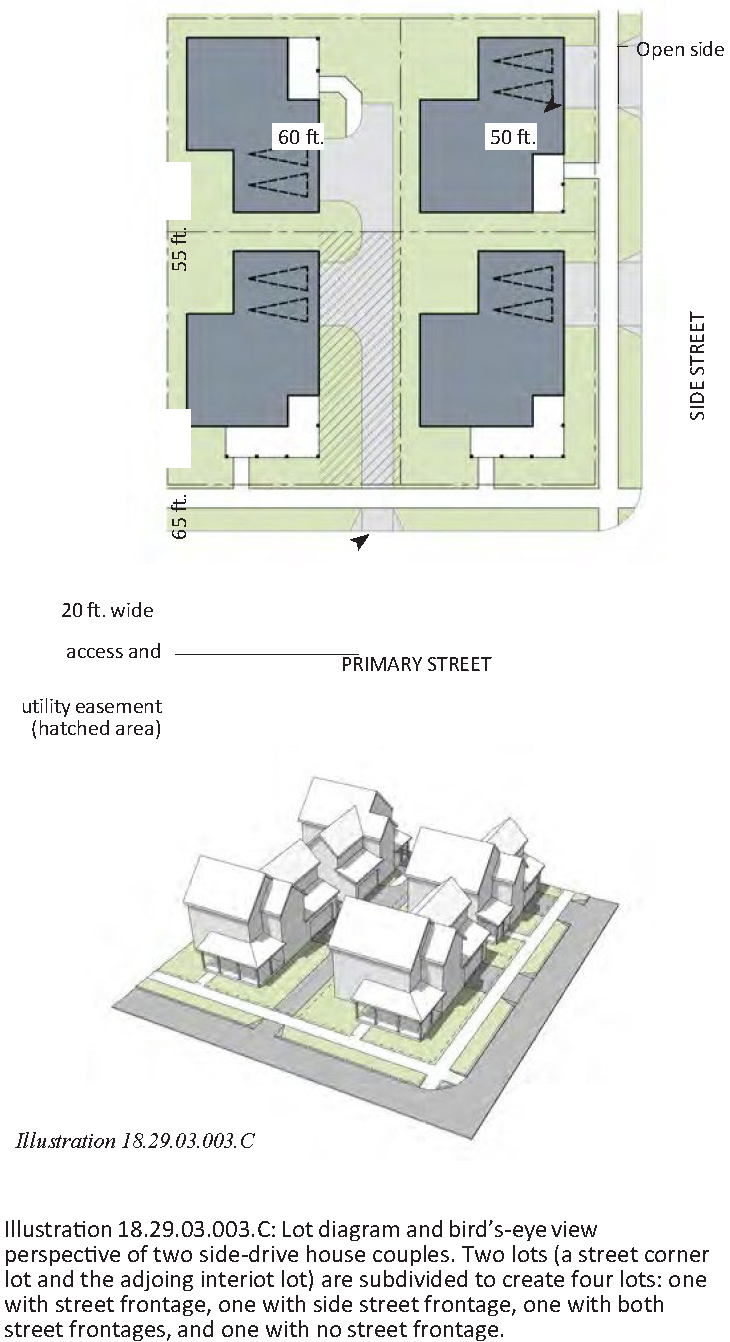
A couple lot without street frontage may be created if ingress and egress to the lot is provided by a perpetual easement (in a form approved by the City Attorney) over the other lot in the couple. The easement width shall be the greater of 20 ft. or the width required to accommodate all utilities that will also utilize the easement. [See illustration 18.29.03.003.C.]
4.
A two-household building configuration is allowed within a side-drive couple house in the R2 and R3 use zones.
4.
VILLAGE HOUSE
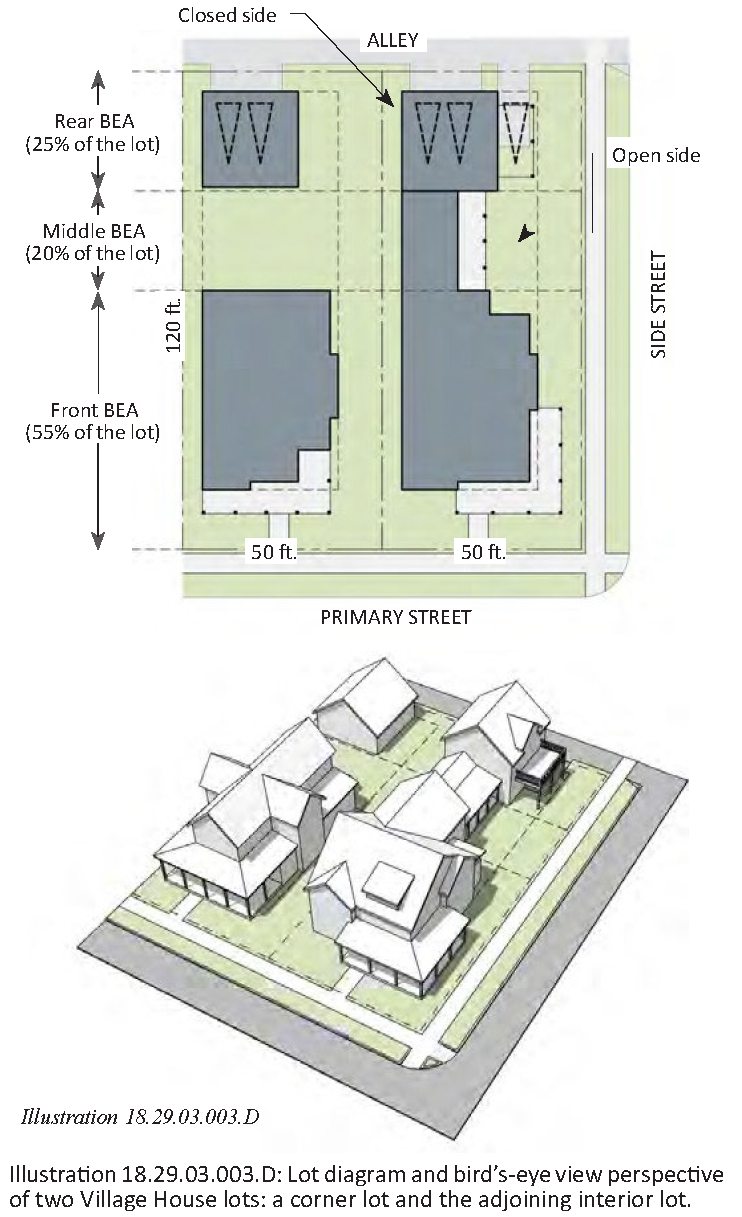
a.
Intent and Special Characteristics.
1.
Intent. The village house form type is intended for lots with alley access.
2.
Special Characteristics. The village house has:
A.
An open side and a closed side with different setback requirements.
B.
Three building envelope areas (BEAs):
i.
Front BEA: 55%
ii.
Middle BEA: 20%
iii.
Rear BEA: 25%
b.
Lot Standards.
1.
Min. lot area ..... 6,000 s.f.
2.
Min. lot frontage ..... 50 ft.
3.
Min. lot depth ..... 90 ft.
c.
Building Size and Dwelling Unit Limitations.
1.
Max. total floor area ..... 3,000 s.f. per lot
2.
Max. lot coverage by BEA -
A.
Front BEA ..... 55%
B.
Middle BEA ..... 32% [See g.]
C.
Rear BEA ..... 40%
3.
Max. height by BEA -
A.
Front BEA
i.
70% of the footprint: 2 stories/28 ft.
ii.
30% of the footprint: 2 stories/35 ft.
B.
Middle BEA ..... 1 story/20 ft. [See g]
C.
Rear BEA ..... 2 stories/32 ft.
4.
Max. no. of dwelling units ..... 1 per lot [See f.3]
d.
Setbacks.
1.
Primary street ..... 15 ft. min.
2.
Porch at primary street ..... 7 ft. min.
3.
Side street ..... 8 ft. min.
4.
Porch at side street ..... 8 ft. min.
5.
Interior side lot line -
A.
Open side ..... 10 ft. min.
B.
Closed side ..... 5 ft. min.
6.
Rear lot line ..... 5 ft. min.
e.
Front Porch.
In the peripheral, core, transition, and edge form zones, a minimum 120 s.f. porch facing the primary street, or, if present, the side street, is required.
f.
Additional Standards.
1.
The village house form type is permitted only on lots with alley access. No curb cuts to serve a village house lot are allowed on the primary street or the side street (if present).
2.
All garage doors that face a rear alley shall be set back not more than 5 ft., or set back 20 ft. or more, from the rear lot line.
3.
A multi-household configuration may be permitted based on the use zone:
A.
R2 use zone: Up to 4 dwelling units per principal building.
B.
R3 use zone: The number of dwelling units within the principal building is not restricted, provided that design standards and parking standards are met.
g.
Adjustments for Mostly Preserved Buildings.
When an existing principal building on the lot is preserved to a degree to be qualified as "mostly preserved building," the following restrictions shall supersede the requirements of subsections c.2 and c.3 with respect to the middle BEA:
1.
Lot coverage ..... not specifically restricted
2.
Maximum height ..... 1½ stories/35 ft.
5.
UPHILL HOUSE
a.
Intent and Special Characteristics.
1.
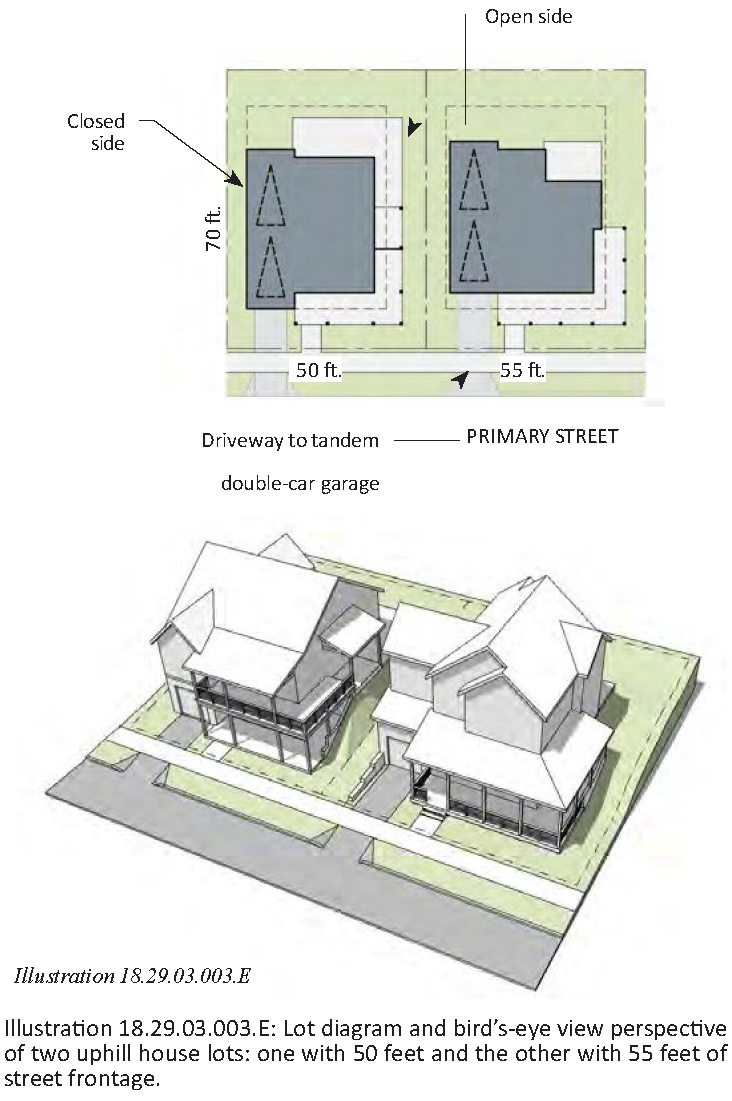
Intent. The uphill house form type is intended for lots with steep slopes where an alley is neither provided nor feasible. It is crafted to fit in a traditional neighborhood context, even though the garage may face the street.
2.
Special Characteristics. The uphill house has an open side and a closed side with different setback requirements.
b.
Lot Standards.
1.
Min. lot area ..... 3,200 s.f.
2.
Min. lot frontage ..... 46 ft.
3.
Min. lot depth ..... 65 ft.
c.
Building Size and Dwelling Unit Limitations.
1.
Max. total floor area ..... 3,000 s.f. per lot
2.
Max. lot coverage ..... 55%
3.
Max. building height ..... 3 stories/35 ft.
4.
Max. no. of dwelling units ..... 1 per lot [See f.5]
d.
Minimum Setbacks.
1.
Primary street ..... 10 ft.
2.
Porch at primary street ..... 4 ft.
3.
Side street ..... 8 ft.
4.
Porch at side street ..... 4 ft.
5.
Interior side lot line -
A.
Open side ..... 10 ft.
B.
Closed side ..... 5 ft.
6.
Porch at interior open side ..... 5 ft.
7.
Rear lot line ..... 10 ft.
e.
Front Porch.
In the peripheral, core, transition, and edge form zones, a minimum 100 s.f. porch facing the primary street, or, if present, the side street, is required.
f.
Additional Standards.
1.
The uphill house form type is permitted only on lots with no alley access and a minimum slope of 10 percent or steeper.
2.
Driveway width at front property line shall not exceed 20 ft., exclusive of curb returns.
3.
Garage door width shall not exceed 20 ft.
4.
All garage doors that face a primary street or side street shall be set back at least 20 ft. from the lot line that is coterminous with the street that the garage door faces.
5.
A multi-household configuration may be permitted based on the use zone:
A.
R2 use zone: Up to 4 dwelling units per principal building.
B.
R3 use zone: The number of dwelling units within the principal building is not restricted, provided that design standards and parking standards are met.
6.
URBAN HOUSE
a.
Intent and Special Characteristics.
1.
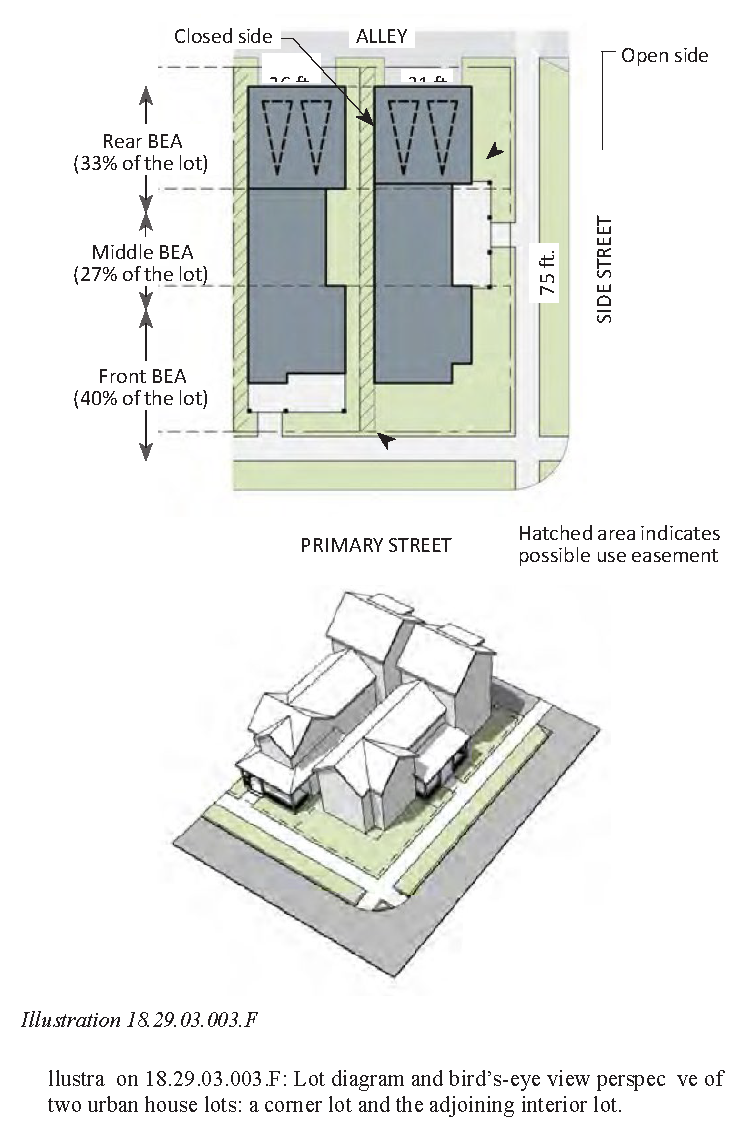
Intent. The urban house form type is intended for denser urban contexts.
2.
Special Characteristics. The urban house has:
A.
An open side and a closed side with different setback requirements.
B.
Three building envelope areas (BEAs):
i.
Front BEA: 40%
ii.
Middle BEA: 27%
iii.
Rear BEA: 33%
b.
Lot Standards.
1.
Min. lot area ..... 1,800 s.f.
2.
Min. lot frontage ..... 26 ft.
3.
Min. lot depth ..... 60 ft.
c.
Building Size and Dwelling Unit Limitations.
1.
Max. total floor area ..... 2,000 s.f. per lot
2.
Max. height by BEA -
A.
Front BEA ..... 2 stories/35 ft.
B.
Middle BEA ..... 2 stories/35 ft.
C.
Rear BEA ..... 3 stories/35 ft.
3.
Max. no. of dwelling units ..... 1 per lot [See f.4]
d.
Table of Setbacks by BEA.
e.
Front Porch.
In the edge form zone, a minimum 100 s.f. porch facing the primary street, or, if present, the side street, is required. [See f.2 and illustration 18.29.03.003.F]
f.
Additional Standards.
1.
The urban house form type is permitted only on lots with alley or shared driveway access. No curb cuts to serve an individual urban house lot are allowed on the primary street or the side street (if present).
2.
The porch and the front entrance of the buildings on street corner lots shall be located within the middle BEA that faces the side street.
3.
All garage doors that face a rear alley shall be set back not more than 5 ft., or set back 20 ft. or more, from the rear lot line.
4.
In the R2 and R3 use zones, up to 2 dwelling units are allowed per principal building.
(Ord. No. 2209, § 2(Exh. G), 6-6-2023)
18.29.03.004 - HOUSE FORM TYPES—DESIGN STANDARDS AND GUIDELINES
1.
APPLICABILITY
a.
This section applies to the houses form types (which are listed below for ease of reference):
1.
Suburban house.
2.
Side-drive house.
3.
Side-drive house couple.
4.
Village house.
5.
Uphill house.
6.
Urban house.
b.
Chapter 18.40 also applies to house form types as set out therein.
c.
Each subsection below sets out a statement of intent, followed by requirements, followed (in some cases) by guidelines. The statement of intent provides background information and is not regulatory in nature. The requirements must be met unless adjusted pursuant to division VII. The guidelines are used in the administration of certain parts of division VII, and are otherwise suggestions (not requirements).
2.
MASSING AND ARTICULATION
a.
Intent. The intent of the massing and articulation standards is to create a varied yet unified building presence at the block level when viewed from the pedestrian realm, and to reduce over articulation of the building facades facing the front and side street.
b.
Requirements.
1.
For buildings with required open sides and closed sides, the open side shall face South, Southeast, East, or Southwest, except for corner lots where the open side shall face the side street.
2.
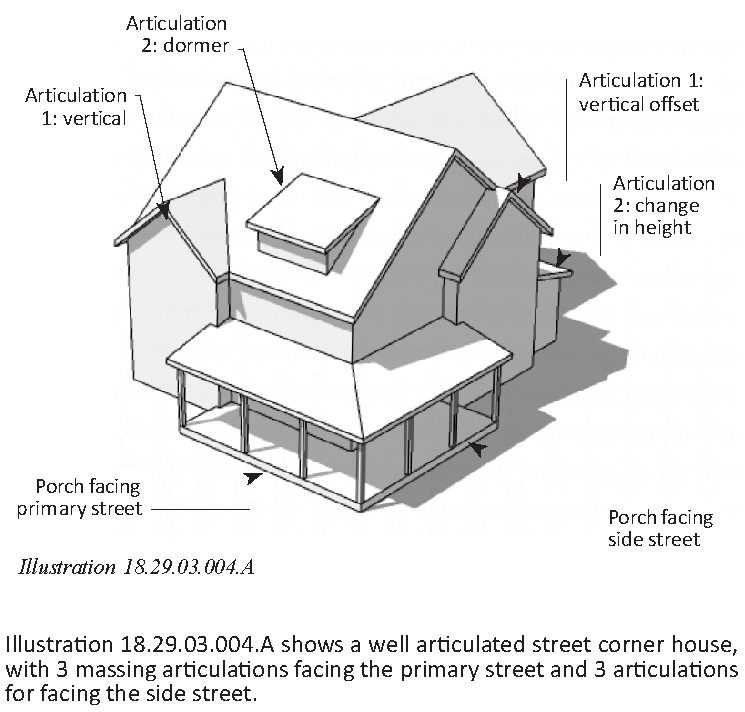
The principal building elevation that faces the street shall have at least two massing articulations that are visible from the sidewalk. [See illustration 18.29.03.004.A.]
3.
For buildings less than 24 feet in width, the building facades that face the street (both primary and side streets) shall have no more than three massing articulations.
4.
For buildings that are 24 or more feet in width, the building facade facing either the primary or secondary street shall have no more than five massing articulations.
5.
Corner buildings with two street facing facades shall comply with standards 1, 2, and 3, above.
c.
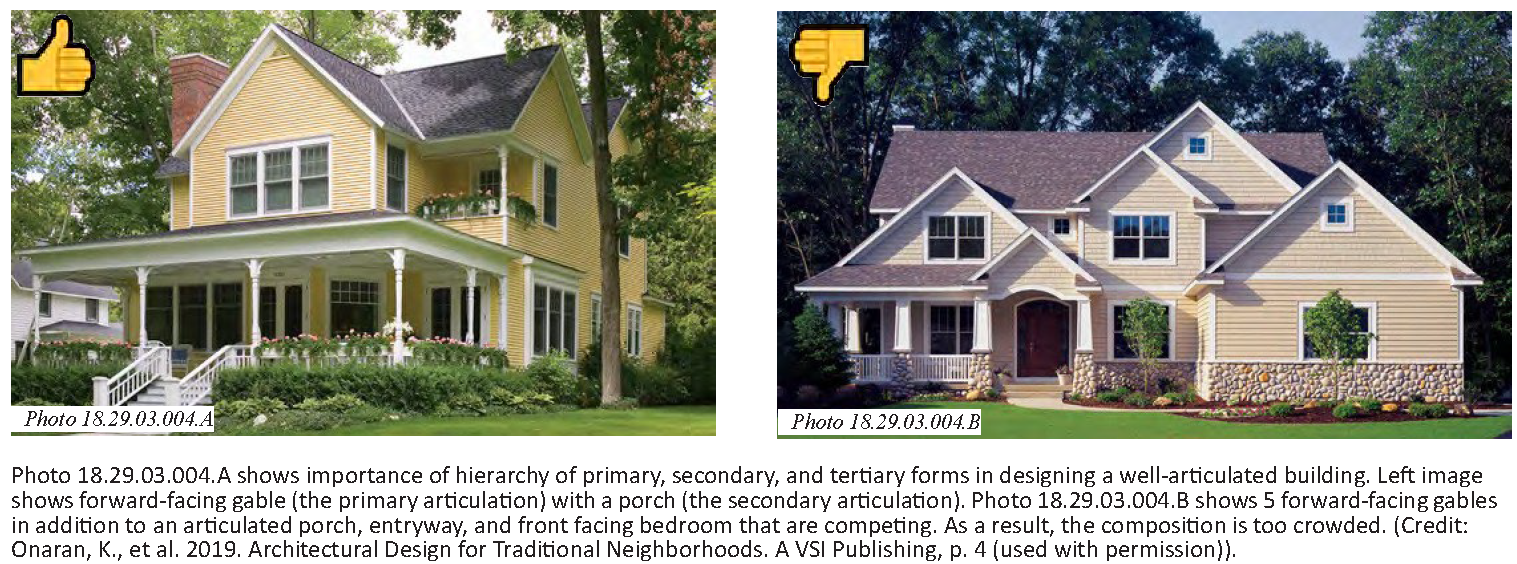
Guidelines. Create a hierarchy of massing articulations of different sizes with a primary articulation and a series of secondary massing articulations. [See photos 18.29.03.004.A and B, previous page.]
3.
PORCH CHARACTERISTICS
a.
Intent. The intent of the porch characteristics standards is to create pronounced first-story building articulations, and to create a transition between the pedestrian realm (sidewalk) and the entry to the house.
b.
Requirements.
1.
With respect to all house form types except the uphill house, porches that are situated between a specified porch setback line and a building setback line shall be one story in height, but may be located below (or be structurally integrated with) an uncovered balcony or deck.
2.
The porch of an uphill house may appear as a two-story element, or a first-story porch below a covered balcony.
3.
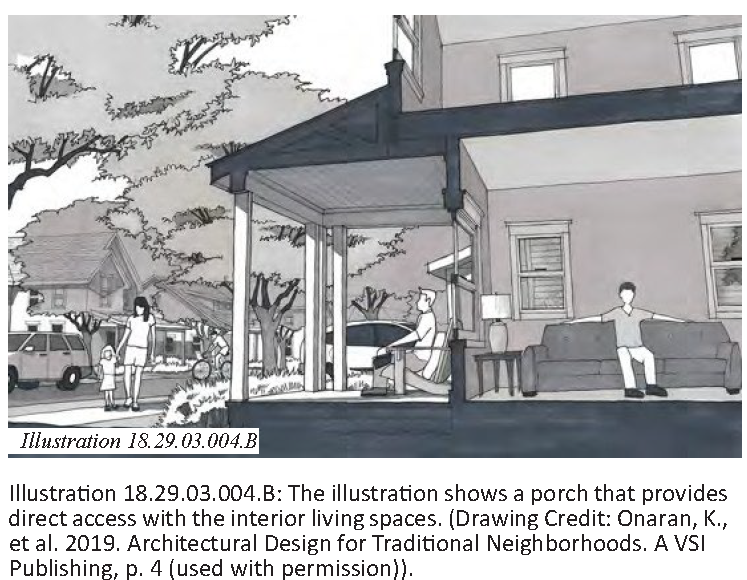
Front porches shall provide direct access to the interior living space via an entryway. [See illustration 18.29.03.004.B.]
4.
The porch shall not be elevated more than one step down from the finished floor of the house's first story.
c.
Guidelines. Houses located on corner lots should have wrapped porches.
4.
EXTERIOR MATERIALS
a.
Intent. The intent of the exterior materials standards is to ensure that cladding materials are used in a manner that offer simplistic, well-designed buildings, while also avoiding the creation of overwhelming and cluttered facades with too many materials.
b.
Requirements.
1.
Buildings shall be clad with one or more of the following materials: Siding (horizontal or vertical), real stucco, or masonry.
2.
Where siding is used, siding patterns shall be one of the following: Horizontal bevel, drop siding, vertical tongue and groove, shingles/shakes, or board and batten.
3.
Where masonry is used, materials shall be brick, stone, [cementitious] siding, or concrete.
4.
Material and color changes shall occur along a vertical line at interior (concave) corners, or along a horizontal line at a floor line or a gable end. [See illustration 18.29.03.004.C.] Material and color changes may also occur along a horizontal line that is at least two feet above the foundation, so long as that change is along the entire length of the facade.
5.
No more than four cladding materials are allowed.
6.
If there are multiple public-facing facades, all public-facing facades shall utilize a comparable composition and pattern of color, materials, and textures.
c.
Guidelines.
1.
Lighter materials should be installed above those of heavier weight.
2.
Heat reflective roof materials should be installed to reduce heat islands. Metal, high albedo (light colored) or minimum 29 SRI (Solar Reflective Index) roofing materials qualify.
5.
ACCESSORY DWELLING UNITS
Accessory dwelling units are allowed as provided in section 18.28.240.
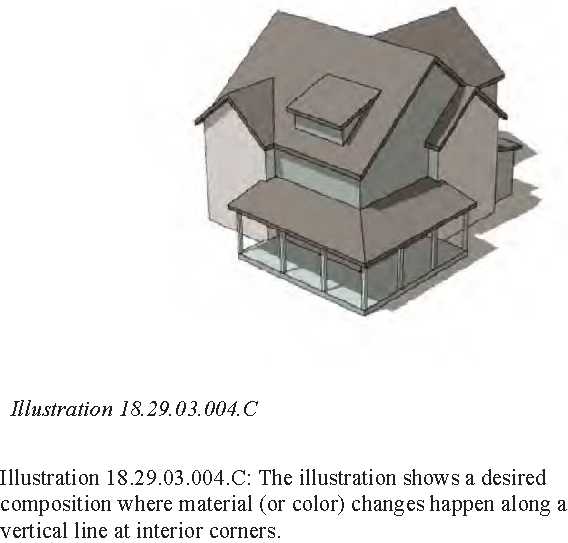
Illustration 18.29.03.004.C. The illustration shows a desired (transition) where patterns (or color) changes happen along a vertical line at interior corners.
(Ord. No. 2282, § 2(Exh. C), 12-9-2025; Ord. No. 2209, § 2(Exh. G), 6-6-2023)
18.29.03.005 - COTTAGE FORM TYPES—APPLICATION OF FORM STANDARDS
1.
GENERAL INTENT
a.
The cottage form types are provided to:
1.
Reinforce and compliment the lot development patterns of smaller, detached, single-household buildings in the City of Golden.
2.
Provide more options for single-household developments on historically smaller (and often irregularly shaped) lots.
3.
Encourage small-scale buildings by allowing relatively small lots.
4.
Facilitate the creation of attainable housing stock by providing opportunities for smaller and more cost-efficient developments.
b.
This section shall not be interpreted to set forth substantive requirements.
2.
INTENT AND APPLICATION OF STANDARDS
a.
In General. This subsection 2 sets forth the intent of specific regulations applied to cottage form types.
b.
Building Size. Building size regulations are used to:
1.
Ensure that new buildings integrate with existing development in detached, single-household neighborhoods, and are scaled comparably with existing buildings that were constructed between the 1850s and 1960s.
2.
Offer opportunities to subdivide large parcels into multiple cottage lots.
c.
Multiple Building Envelope Areas (BEAs). Multiple BEAs with different building height, lot coverage, and setback requirements are established at the front, middle, and rear of a lot to:
1.
Ensure that the massing of the principal building is principally located towards the front of the lot.
2.
In some cases, locate accessory buildings away from the principal building mass and primary street.
3.
Decrease the scale of the cottage at different areas of the lot.
4.
Create variation in building height and depth when perceived from the lot frontage, and especially the side street on corner lots.
5.
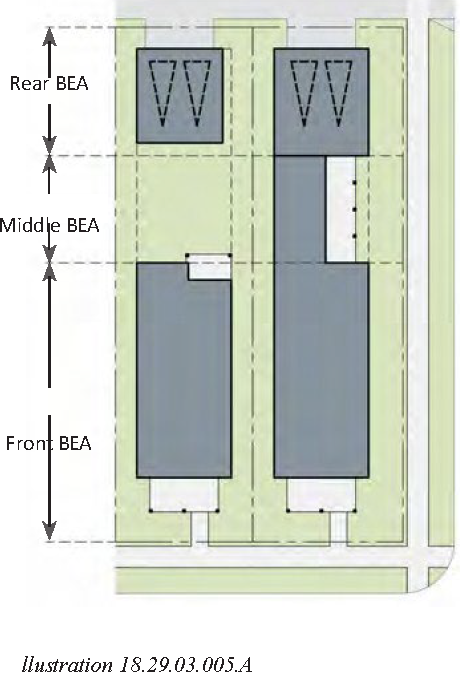
Maintain consistency with building massing that is commonly found in neighborhoods located near downtown Golden or more specifically, lots that developed between 1850 and 1960. These designs typically locate the principal building in the front of a lot and locate accessory buildings and structures (e.g., garages) in the middle and rear of a lot. [See illustration 18.29.03.005.A]
d.
Building Height. Building height is limited by number of stories and in linear feet to:
1.
Encourage steep gable or hip roof forms that are common in existing buildings that developed in Golden between the 1850s and 1960s.
2.
Ensure that new buildings are consistent with height of developments in the built environment, specifically those buildings that developed between the 1850s and 1960s.
e.
Porch. Porch requirements are applied to cottage form types in order to:
1.
Accentuate the first-story elements of a building from the pedestrian realm (right-of-way/sidewalk) and decrease the building's perceived scale.
2.
Provide better transition between the front of a building and the pedestrian realm (right-of-way/sidewalk) by decreasing the distance between these areas.
3.
Maintain the front porch as a common structural element, which is typically found in single-family developments in the period between the 1850s and 1960s.
(Ord. No. 2209, § 2(Exh. G), 6-6-2023)
18.29.03.006 - COTTAGE FORM TYPES - FORM STANDARDS
1.
VILLAGE COTTAGE
a.
Intent and Special Characteristics.
1.
Intent. The village cottage form type provides an opportunity for employing smaller structures on smaller lots where appropriate.
2.
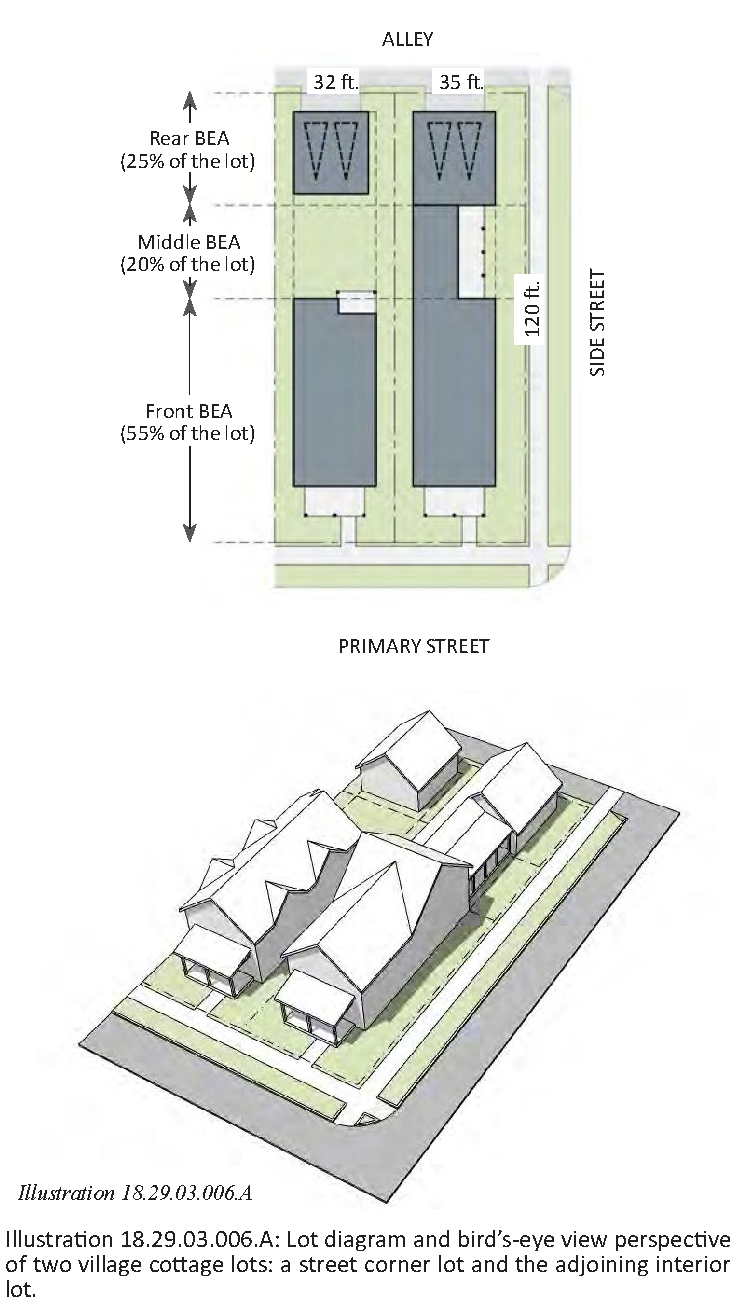
Special Characteristics. The village cottage lot has three building envelope areas (BEAs):
A.
Front BEA ..... 55%
B.
Middle BEA ..... 20%
C.
Rear BEA ..... 25%
b.
Lot Standards.
1.
Min. lot area ..... 3,200 s.f.
2.
Min. lot frontage ..... 32 ft.
c.
Building Size and Dwelling Unit Limitations.
1.
Max. total floor area ..... 2,400 s.f.
2.
Max. lot coverage by BEA -
A.
Front BEA ..... 55%
B.
Middle BEA ..... 45% [See g.]
C.
Rear BEA ..... 60%
3.
Max. building height by BEA -
A.
Front BEA ..... 2 stories/35 ft.
B.
Middle BEA ..... 1 story/18 ft. [See g.]
C.
Rear BEA ..... 1½ stories/32 ft.
4.
Max. no. of dwelling units ..... 1 per lot
d.
Setbacks.
1.
Primary street ..... 15 ft. min.
2.
Porch at primary street ..... 7 ft. min./20 ft. max.
3.
Side street ..... 8 ft. min.
4.
Porch at side street ..... 8 ft. min./20 ft. max.
5.
Interior side lot line ..... 5 ft. min.
6.
Rear lot line/alley ..... 5 ft. min.
e.
Porch.
In the core, transition, and edge form zones, a porch of at least 100 s.f. in area facing the primary street, or, if present, the side street, is required.
f.
Additional Standards.
1.
The village cottage form type is permitted only on lots with alley access. No curb cuts to serve a cottage building lot are allowed on the primary street or the side street (if present).
2.
All garage doors that face a rear alley shall be set back not more than 5 ft., or set back 20 ft. or more, from the rear lot line.
g.
Adjustments for Mostly Preserved Buildings.
When an existing principal building on the lot is preserved to a degree to be qualified as "mostly preserved building," the following standards apply to the middle BEA:
1.
Maximum height: ..... 1½ stories/35 ft.
2.
Lot coverage: not specifically restricted
2.
SIDE-DRIVE COTTAGE
a.
Intent and Special Characteristics.
1.
Intent. The intent of the side-drive cottage form type provides an opportunity for building smaller buildings on smaller lots where an alley is not provided along the rear lot line.
2.
Special Characteristics. The side-drive cottage has:
A.
An open side and a closed side with different setback requirements.
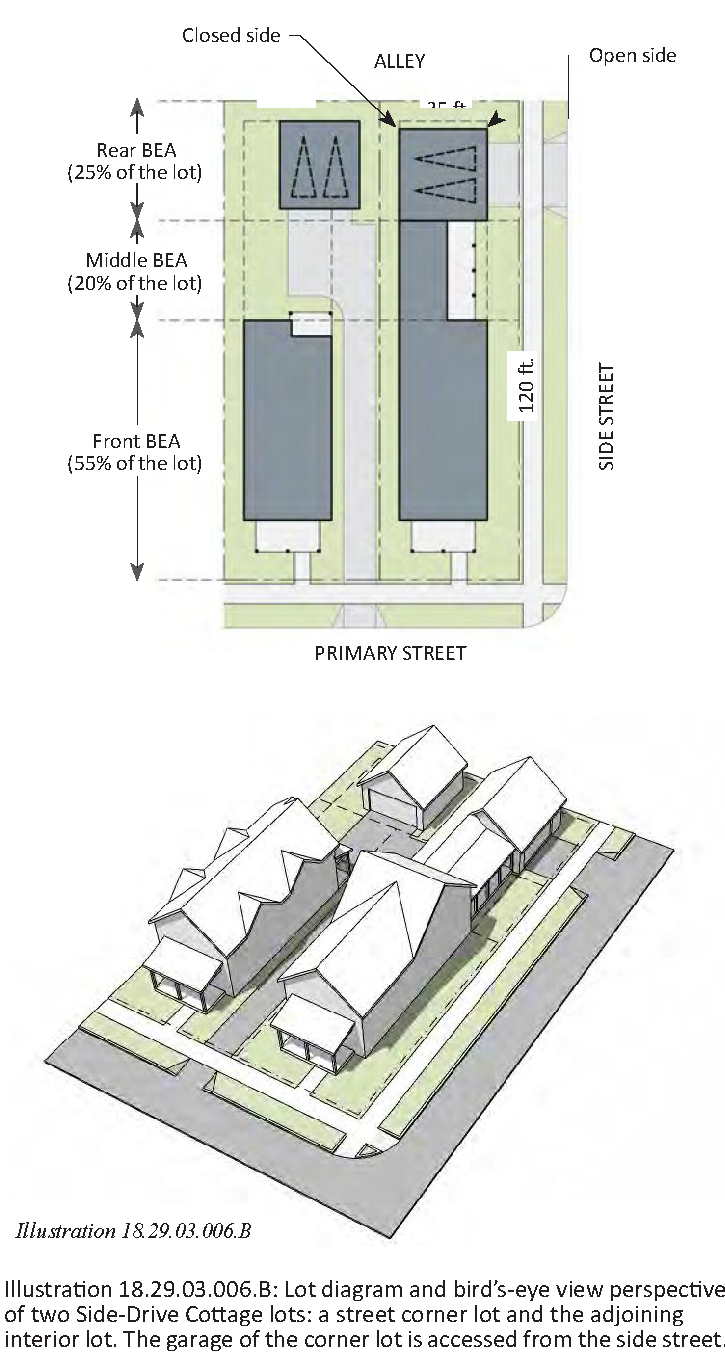
B.
Three building envelope areas (BEAs):
i.
Front BEA: 55%
ii.
Middle BEA: 20%
iii.
Rear BEA: 25%
b.
Lot Standards.
1.
Min. lot area ..... 3,400 s.f.
2.
Min. lot frontage ..... 37 ft.
c.
Building Size and Dwelling Unit Limitations.
1.
Max. total floor area ..... 2,400 s.f. per lot
2.
Max. building height by BEA -
A.
Front BEA ..... 2 story/35 ft.
B.
Middle BEA ..... 1 story/18 ft. [See g.]
C.
Rear BEA ..... 1½ story/32 ft.
3.
Max. lot coverage by BEA -
A.
Front BEA ..... 55%
B.
Middle BEA ..... 45% [See g.]
C.
Rear BEA ..... 60%
4.
Max. no. of dwelling units ..... 1 per lot
d.
Setbacks.
1.
Primary street ..... 15 ft. min.
2.
Porch at primary street ..... 7 ft. min./20 ft. max.
3.
Side street ..... 8 ft. min.
4.
Side alley ..... 8 ft. min.
5.
Porch at side street ..... 8 ft. min./20 ft. max.
6.
Interior side lot line -
A.
Open side in front and middle BEA ..... 10 ft. min.
B.
Open side in rear BEA ..... 5 ft. min.
C.
Closed side ..... 5 ft. min.
7.
Rear lot line ..... 5 ft. min.
e.
Porch.
In the core, transition, and edge form zones, a porch of at least 100 s.f. in area facing the primary street, or, if present, the side street, is required.
f.
Additional Standards.
1.
The side-drive cottage form type is permitted only on lots with no alley access along the rear lot line.
2.
Garages on corner lots shall be accessed by the side street unless the City Engineer determines that alternative access is preferable for traffic safety purposes. All garage doors that face a side street shall be set back at least 20 ft. from the street side lot line.
3.
Garages shall be located in the middle or rear BEA.
4.
Driveways shall not be wider than:
A.
10 ft. at the primary street lot line.
B.
16 ft. at the side street lot line.
g.
Adjustments for Mostly Preserved Buildings.
When an existing principal building on the lot is preserved to a degree to be qualified as "mostly preserved building," the following restrictions shall be applied to the middle BEA:
1.
Max. building height: ..... 1½ stories/35 ft.
2.
Max. lot coverage: ..... not specifically restricted
3.
COMPACT COTTAGE
a.
Intent.
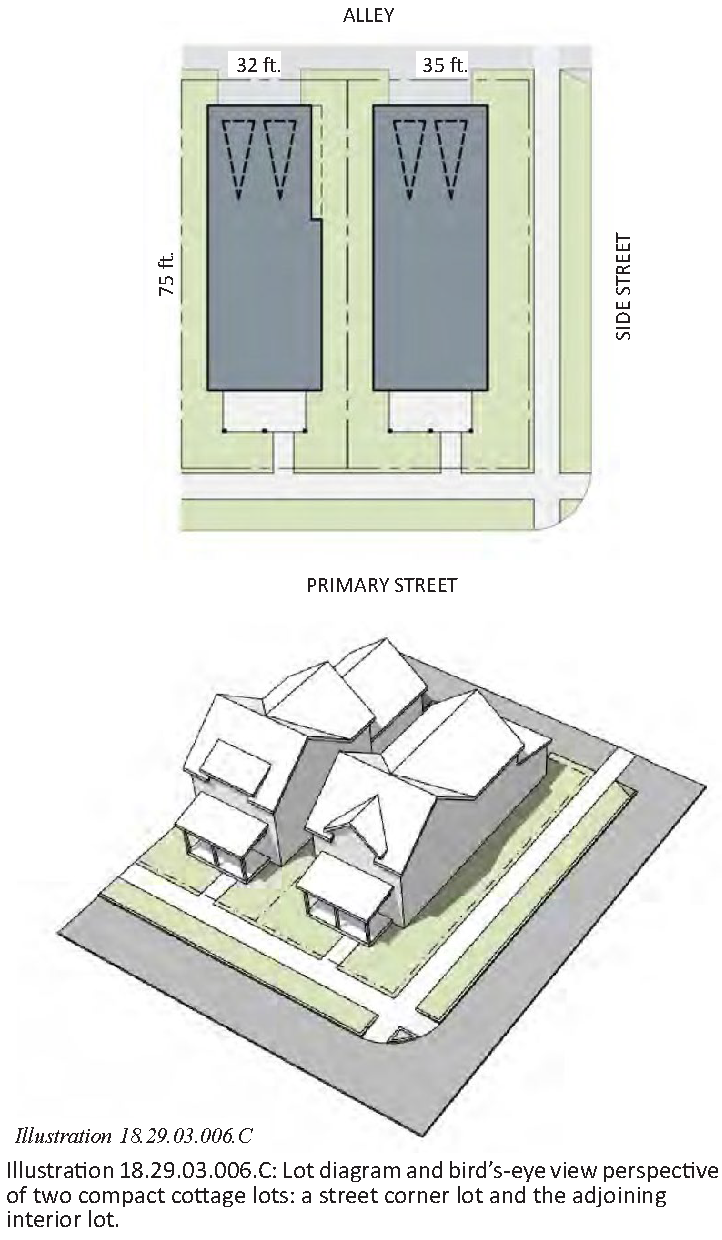
The compact cottage form type provides an opportunity for building smaller buildings on smaller and shallower lots where appropriate.
b.
Lot Standards.
1.
Min. lot area ..... 2,240 s.f.
2.
Min. lot frontage ..... 30 ft.
c.
Building Size and Dwelling Unit Limitations.
1.
Max. total floor area: ..... 2,200 s.f. per lot
2.
Max. building height ..... 2 stories/35 ft.
3.
Max. no. of dwelling units ..... 1 per lot
d.
Setbacks.
1.
Primary street ..... 15 ft. min.
2.
Porch at primary street ..... 7 ft. min./20 ft. max.
3.
Side street ..... 8 ft. min.
4.
Porch at side street ..... 8 ft. min./20 ft. max.
5.
Interior side lot line ..... 5 ft. min.
6.
Rear lot line/alley ..... 5 ft. min.
e.
Porch.
In the core, transition, and edge form zones, a porch of at least 100 s.f. in area facing the primary street, or, if present, the side street, is required.
f.
Additional Standards.
1.
The compact cottage form type is permitted only on lots with alley access. No curb cuts to serve a cottage building lot are allowed on the primary street or the side street (if present).
2.
All garage doors that face a rear alley shall be set back not more than 5 ft., or set back 20 ft. or more, from the rear lot line.
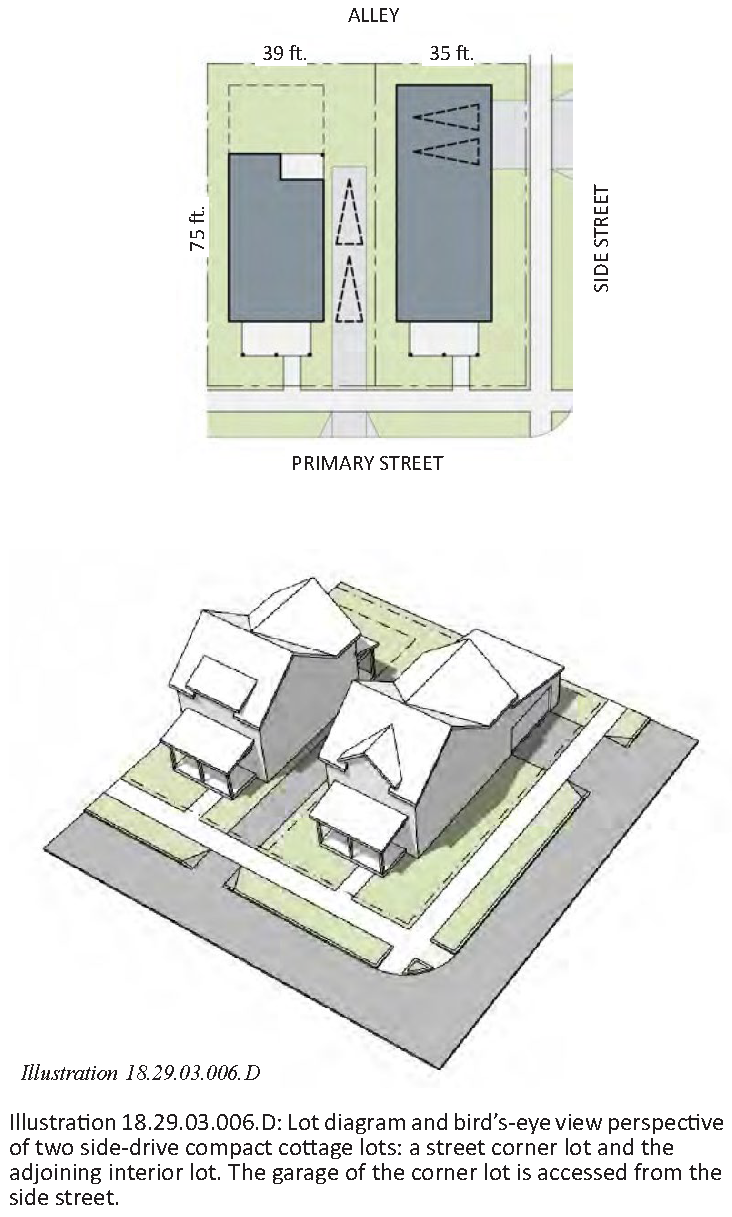
4.
SIDE-DRIVE COMPACT COTTAGE
a.
Intent.
The side-drive compact cottage form type provides an opportunity for constructing smaller buildings on smaller and shallower lots in areas without alleys along the rear lot line.
b.
Lot Standards.
1.
Min. lot area 2,450 s.f.
2.
Min. lot frontage 35 ft.
c.
Building Size and Dwelling Unit Limitations.
1.
Max. total floor area ..... 2,200 s.f. per lot
2.
Max. building height ..... 2 stories/35 ft.
3.
Max. no. of dwelling units ..... 1 per lot
d.
Setbacks.
1.
Primary street ..... 15 ft. min.
2.
Porch at primary street ..... 7 ft. min./20 ft. max.
3.
Side street ..... 8 ft. min.
4.
Porch at side street ..... 8 ft. min./20 ft. max.
5.
Interior side lot line ..... 5 ft. min.
6.
Rear lot line ..... 5 ft. min.
e.
Porch.
In the core, transition, and edge form zones, a porch of at least 100 s.f. in area facing the primary street, or, if present, the side street, is required.
f.
Additional Standards.
1.
The side-drive compact cottage form type is permitted only on lots with no alley access along the rear lot line.
2.
Garages on corner lots shall be accessed by the side street unless the City Engineer determines that alternative access is preferable for traffic safety purposes. All garage doors that face a side street shall be set back at least 20 ft. from the street side lot line.
3.
Driveways shall not be wider than:
A.
10 ft. at the front lot line,
B.
16 ft. at the side street lot line.
5.
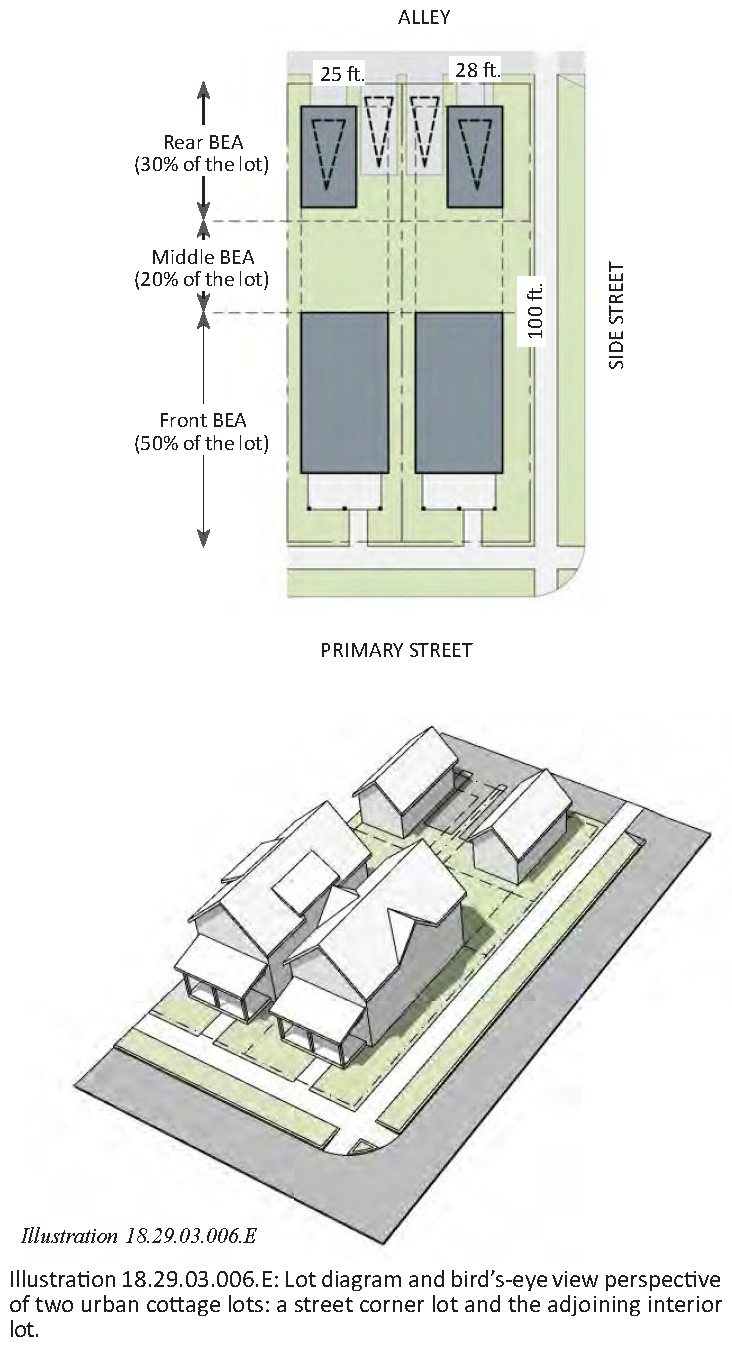
URBAN COTTAGE
a.
Intent and Special Characteristics.
1.
Intent. The urban cottage form type provides an opportunity for constructing "tiny" buildings on smaller lots in urban context where appropriate.
2.
Special Characteristics. The urban cottage lot has three building envelope areas (BEAs):
A.
Front BEA ..... 50%
B.
Middle BEA ..... 20%
C.
Rear BEA ..... 30%
b.
Lot Standards.
1.
Min. lot area ..... 2,400 s.f.
2.
Min. lot frontage ..... 25 ft.
c.
Building Size and Dwelling Unit Limitations.
1.
Max. total floor area ..... 1,400 s.f. per lot
2.
Max. lot coverage by BEA -
A.
Front BEA ..... 55%
B.
Middle BEA ..... no bldg. allowed
C.
Rear BEA ..... not specifically restricted
3.
Max. building height by BEA -
A.
Front BEA ..... 1½ stories/32 ft.
B.
Middle BEA ..... no bldg. allowed
C.
Rear BEA ..... 1 story/18 ft.
4.
Max. no. of dwelling units ..... 1 per lot
d.
Setbacks.
1.
Primary street ..... 15 ft. min.
2.
Side street ..... 6 ft. min.
3.
Porch at primary street ..... 7 ft. min./20 ft. max.
4.
Porch at side street ..... 4 ft. min./20 ft. max.
5.
Interior side lot line ..... 3 ft. min.
6.
Rear lot line/alley ..... 3 ft. min.
e.
Porch.
In the core, transition, and edge form zones, a porch of at least 100 s.f. in area facing the primary street, or, if present, the side street, is required.
f.
Additional Standards.
1.
The urban cottage form type is permitted only on lots with alley access. No curb cuts to serve a cottage building lot are allowed on the primary street or the side street (if present).
2.
All garage doors that face a rear alley shall be set back not more than 5 ft., or set back 20 ft. or more, from the rear lot line.
6.
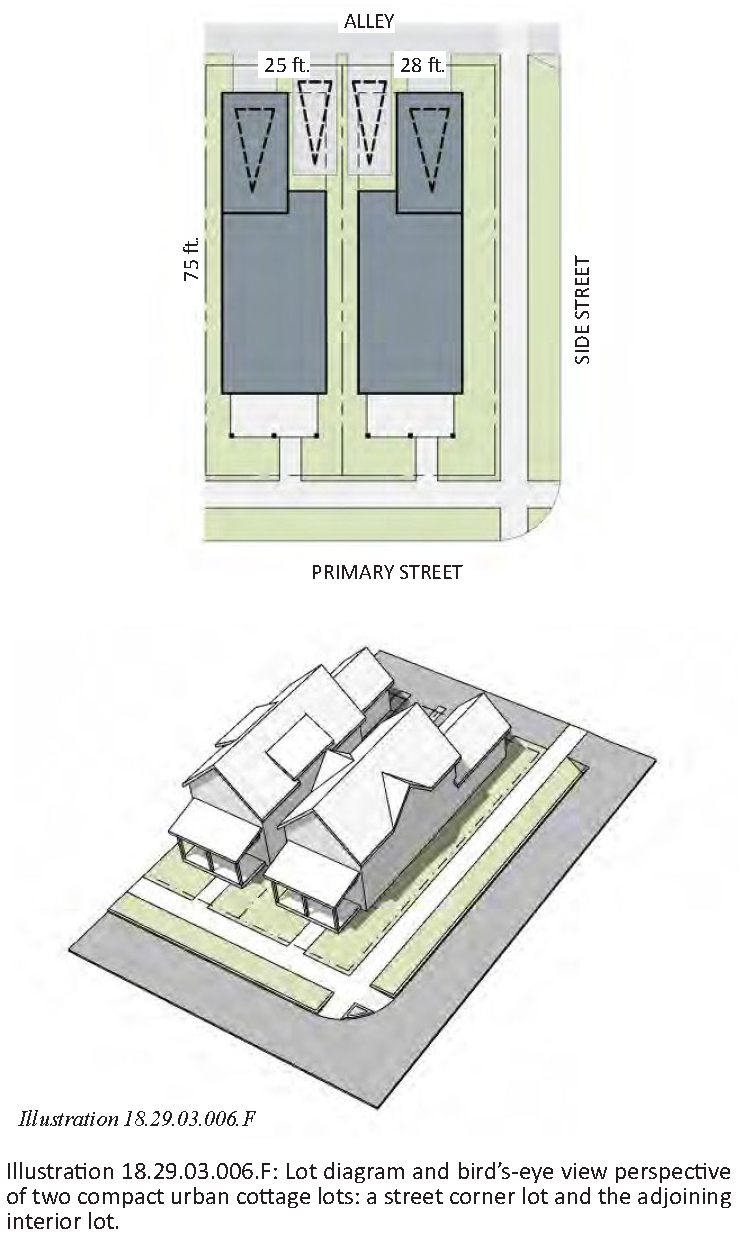
COMPACT URBAN COTTAGE
a.
Intent.
The urban cottage form type provides an opportunity for constructing "tiny" buildings on smaller lots in urban context where appropriate.
b.
Lot Standards.
1.
Min. lot area 1,600 s.f.
2.
Min. lot frontage 20 ft.
c.
Building Size and Dwelling Unit Limitations.
1.
Max. total floor area ..... 1,400 s.f. per lot
2.
Max. building height ..... 1½ stories/32 ft.
3.
Max. no. of dwelling units 1 per lot
d.
Setbacks.
1.
Primary street ..... 15 ft. min.
2.
Side street ..... 6 ft. min.
3.
Porch at primary street ..... 7 ft. min./20 ft. max.
4.
Porch at side street ..... 4 ft. min./20 ft. max.
5.
Interior side lot line ..... 3 ft. min.
6.
Rear lot line/alley ..... 3 ft. min.
e.
Porch.
In the core, transition, and edge form zones, a porch of at least 100 s.f. in area facing the primary street, or, if present, the side street, is required.
f.
Additional Standards.
1.
The compact urban cottage form type is permitted only on lots with alley access. No curb cuts to serve a cottage building lot are allowed on the primary street or the side street (if present).
2.
All garage doors that face a rear alley shall be set back not more than 5 ft., or set back 20 ft. or more, from the rear lot line.
(Ord. No. 2209, § 2(Exh. G), 6-6-2023)
18.29.03.007 - COTTAGE FORM TYPES—DESIGN STANDARDS AND GUIDELINES
1.
APPLICABILITY
a.
This section shall apply to the duplex form types (listed below for ease of reference):
1.
Village duplex.
2.
Uphill duplex.
3.
Cottage duplex.
4.
Side-drive cottage duplex.
5.
Compact cottage duplex.
b.
Chapter 18.40 also applies to duplex form types as set out therein.
c.
Each subsection below sets out a statement of intent, followed by requirements, followed (in some cases) by guidelines. The statement of intent provides background information and is not regulatory in nature. The requirements must be met unless adjusted pursuant to division VII. The guidelines are used in the administration of certain parts of division VII, and are otherwise suggestions (not requirements).
2.
MASSING AND ARTICULATION
a.
Intent. The intent of the massing and articulation standards is to create a varied yet unified building presence at the block level when viewed from the pedestrian realm, and to reduce over-articulation of the street-facing building facades.
b.
Requirement.
1.
For buildings with required open sides and closed sides, the open side shall face south, southeast, east, or southwest, except for corner lots where the open side shall face the side street.
2.
The principal building facade facing the street shall have at least one articulation and no more than three articulations.
c.
Guidelines.
1.
Competition between massing articulations should be avoided.
2.
Facades should be composed of a hierarchy of differently sized massing articulations. For instance, a large primary massing articulation shall be accompanied by smaller secondary massing articulations. [See illustration 18.29.03.007.A.]
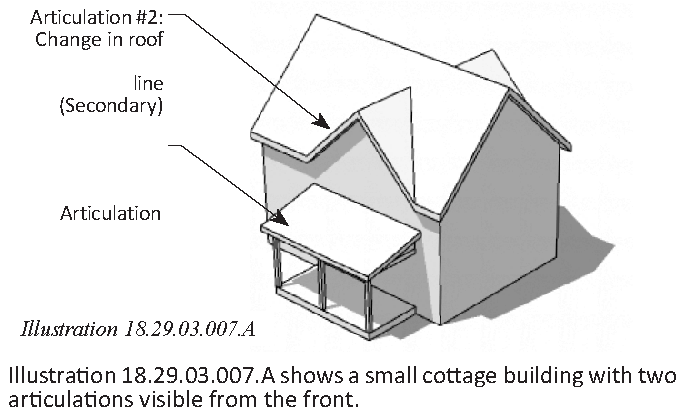
Illustration 18.29.03.007.A shows a small cottage building with two articulations visible from the front.
3.
PORCH CHARACTERISTICS
a.
Intent. The intent of the porch standards is to create pronounced first-story building articulations and to create a transition between the pedestrian realm and the residential living space.
b.
Requirements.
1.
Front porches shall provide direct access to the interior living space.
2.
The porch shall not be elevated more than one step down from the finished floor of the home.
1.
Cottages located on corner lots should have wrapped porches.
2.
Cottages should have large porches to create a shaded outdoor living space.
4.
EXTERIOR MATERIALS
a.
Intent. The intent of the exterior materials standards is to use materials in a manner that offer simplistic, well-designed buildings, while also avoiding the creation of overwhelming and cluttered facades with too many materials.
b.
Requirements.
1.
Allowed exterior wall materials are horizontal and vertical siding, real stucco, or masonry (brick, stone, [cementitious] siding, or concrete). Siding patterns shall be one of the following: Horizontal bevel, drop siding, vertical tongue and groove, shingles/shakes, or board and batten.
2.
Material and color changes shall occur along a vertical line at interior (concave) corners, or along a horizontal line at a floor line or a gable end. Material and color changes may also occur along a horizontal line that is at least two feet above the foundation, so long as that change is along the entire length of the facade.
3.
No more than four cladding materials are allowed.
4.
All public facing facades shall utilize a comparable composition of color, materials, and textures.
c.
Guidelines.
1.
In general, the lighter materials should be placed above those of heavier weight.
2.
Heat reflective roof materials should be installed to reduce heat islands. Metal, high albedo (light colored) or minimum 29 SRI (Solar Reflective Index) roofing materials qualify.
5.
ACCESSORY DWELLING UNITS
Accessory dwelling units are allowed as provided in section 18.28.240.
(Ord. No. 2282, § 2(Exh. C), 12-9-2025; Ord. No. 2209, § 2(Exh. G), 6-6-2023)
18.29.03.008 - COMPOUND FORM TYPES - APPLICATION OF FORM STANDARDS
1.
GENERAL INTENT
a.
The compound form types are provided as development templates to:
1.
Diversify housing options.
2.
Provide opportunities for multi-household developments in areas that have a significant detached, single-household presence.
3.
Promote multi-household developments that consist of several small buildings as opposed to one, large multi-household building.
4.
Increase attainable housing stock by providing opportunities for smaller and more cost-efficient developments.
b.
With the exception of section 18.29.03.008.2.b. below, this section shall not be interpreted to set forth substantive requirements.
2.
INTENT AND APPLICATION OF STANDARDS
a.
In General. This subsection 2 sets forth the intent for specific standards that are applied to compound form types.
b.
Limitations. The compound form types set out in section 18.29.03.009 may be used only for compound development.
c.
Building Size. Building size regulations are used to:
1.
Limit the aggregate size of the buildings in a compound to the same building size permitted for a house form type on the same size lot [See illustration 18.29.03.008.A].
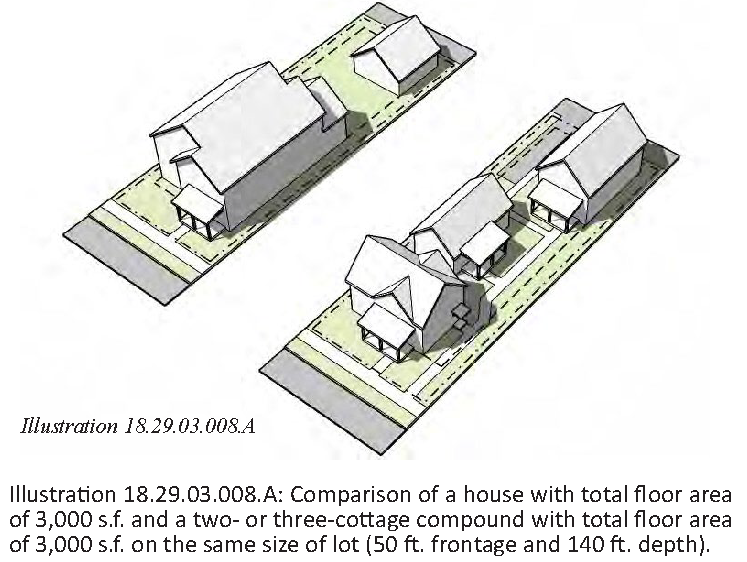
2.
Ensure that developments are scaled similarly with existing buildings that developed between the 1850s and 1960s.
3.
Provide a diversity of multi-household housing options through small-scale, detached building developments.
d.
Building Height. Building height is limited by number of stories and in linear feet to:
1.
Ensure developments are appropriately scaled to their minimum and maximum lot size requirements, which are often small.
2.
Ensure new developments are consistent with the height of buildings in Golden's existing built environment, specifically, developments constructed between the 1850s and 1960s.
3.
Encourage steep gable or hip roof forms that are common in existing dwellings that developed in Golden between the 1850s and 1960s.
e.
Porch Characteristics. Porches are required in compound form types in order to:
1.
Accentuate the first-story elements of a building from the pedestrian realm (right-of-way/sidewalk) and decrease the building's perceived scale.
2.
Provide better transition between the front of a building and the pedestrian realm (right-of-way/sidewalk) by decreasing the distance between these areas.
3.
Maintain the porch as a common element typically found in single-household developments constructed between the 1850s and 1960s.
(Ord. No. 2209, § 2(Exh. G), 6-6-2023)
18.29.03.009 - COMPOUND FORM TYPES - FORM STANDARDS
1.
TWO- OR THREE-COTTAGE COMPOUND
a.
Intent.
The two- or three-cottage compound form type provides opportunity for up to three small buildings in lieu of a large single building to respond to market demand, and to provide more attainable options.
b.
Lot Standards.
1.
Min. lot area ..... 6,000 sf
2.
Min. lot frontage ..... 46 ft.
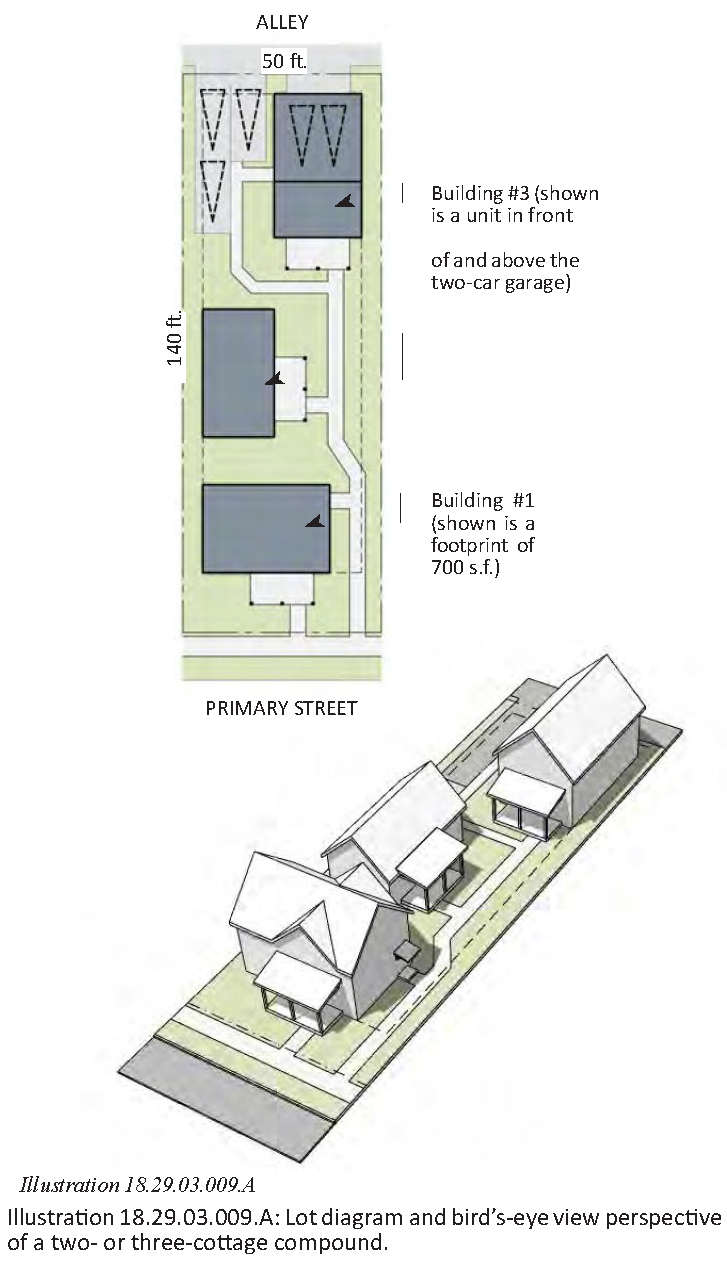
c.
Building Size and Dwelling Unit Limitations.
1.
Max. total floor area
A.
2 cottages ..... 3,600 s.f. per lot
B.
3 cottages ..... 3,900 s.f. per lot
2.
Max. building height ..... 1½ stories/32 ft.
3.
Max. no. of detached buildings ..... 3 per lot
4.
Max. no. of dwelling units ..... 3 per lot
5.
Max. total floor area per building
A.
2 cottages ..... 1,800 s.f.
B.
3 cottages ..... 1,500 s.f.
d.
Setbacks.
1.
Principal street ..... 15 ft. min.
2.
Porch at principal street ..... 7 ft. min./20 ft. max.
3.
Side street ..... 15 ft. min.
4.
Porch at side street ..... 7 ft. min./20 ft. max.
5.
Interior side lot line ..... 5 ft. min.
6.
Rear lot line/alley ..... 5 ft. min.
7.
Separation between buildings on lot ..... 10 ft. min.
e.
Porch.
1.
In the core, transition, and edge form zones, a porch of at least 80 s.f. in area facing the primary street is required on the cottage building that is closest to the front lot line.
2.
All other cottage buildings shall include a porch, deck, or balcony (covered or uncovered) of at least 50 s.f. in area.
f.
Additional Standards.
1.
The two- or three-cottage compound form type is permitted only on lots with alley access. No curb cuts to serve a cottage building lot are allowed on the primary street or the side street (if present).
2.
All garage doors that face a rear alley shall be set back not more than 5 ft., or set back 20 ft. or more, from the rear lot line.
3.
Garage doors shall not face the primary street or be within 20 ft. of the front lot line.
2.
THREE-COTTAGE COMPOUND WITH SHOP
a.
Intent.
The three-cottage compound with shop form type provides opportunity to accommodate non-residential uses in a setting with a cottage-like scale and character where residential uses are located alongside non-residential uses.
b.
Lot Standards.
1.
Min. lot area: 6,000 sf
2.
Min. lot frontage: 46 ft.
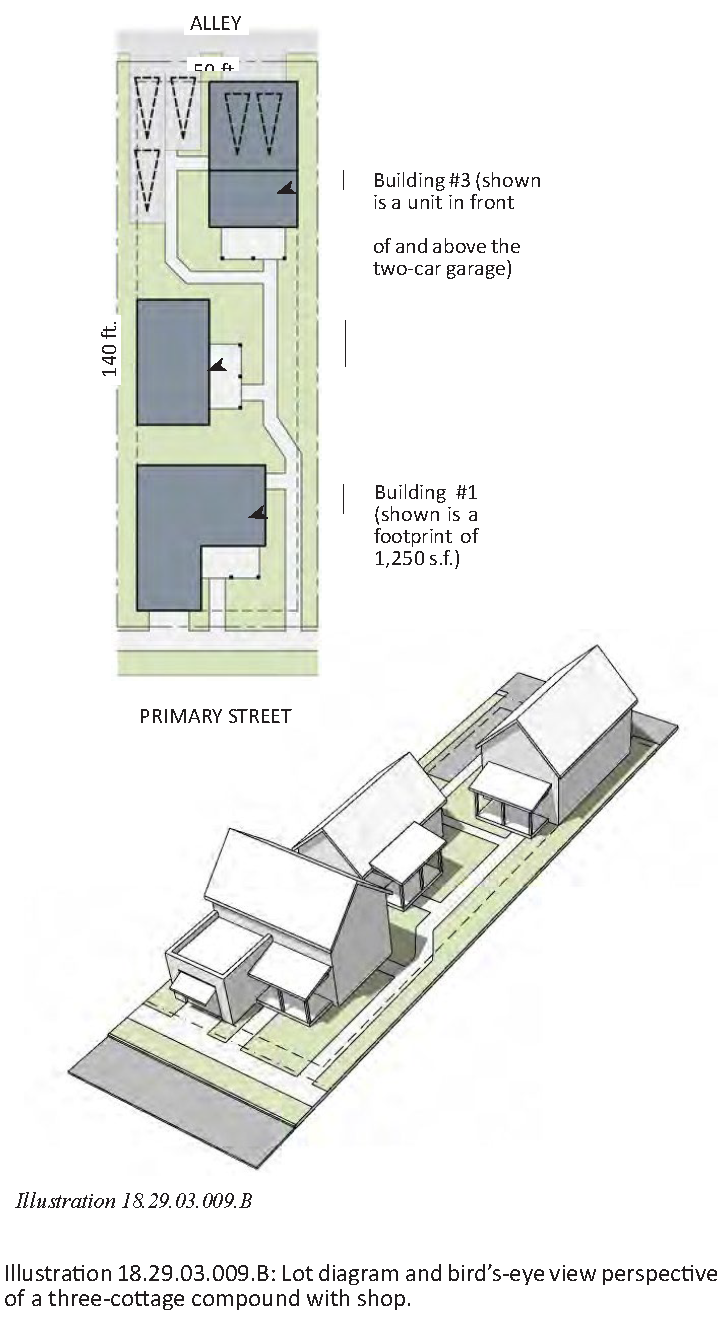
c.
Building Size and Dwelling Unit Limitations.
1.
Max. total floor area ..... 4,000 s.f. per lot
2.
Max. building height -
A.
Within front 15 ft. of the lot: 1 story/18 ft.
B.
Remainder of the lot: 1½ stories/32 ft.
3.
Max. no. of detached buildings ..... 3 per lot
4.
Max. no. of dwelling units ..... 3 per lot
5.
Max. total floor area per building ..... 1,800 s.f.
d.
Setbacks.
1.
Principal street -
A.
Along ⅓ of frontage ..... 4 ft. min.
B.
Along ⅔ of frontage ..... 15 ft. min.
2.
Porch at principal street ..... 7 ft. min.
3.
Side street -
A.
Along ¼ of frontage ..... 4 ft. min.
B.
Along ¾ of frontage ..... 15 ft. min.
4.
Porch at side street ..... 7 ft. min.
5.
Interior side lot line ..... 5 ft. min.
6.
Rear lot line/alley ..... 5 ft. min.
7.
Separation between buildings on
lot
.....
10 ft. min.
e.
Porch.
1.
In the neighborhood corridor and main street A form zones, a porch of at least 80 s.f. in area facing the primary street is required on the building that is closest to the front lot line.
2.
All other buildings shall include a porch or balcony (covered or uncovered) of at least 80 s.f. in area.
f.
Additional Standards.
1.
The three-cottage compound with shop form type is permitted only on lots with alley access. No curb cuts to serve a cottage building lot are allowed on the primary street or the side street (if present).
2.
All garage doors that face a rear alley shall be set back not more than 5 ft., or set back 20 ft. or more, from the rear lot line.
3.
No surface parking is allowed within 60 ft. of the front lot line.
4.
Garage doors shall not face the primary street within 20 ft. of the front lot line.
5.
Three-cottage compound with shop form type is permitted only if at least 25 percent of the total floor area is reserved for non-residential uses.
3.
FOUR-COTTAGE COMPOUND
a.
Intent.
The four-cottage compound form type provides opportunity for building four small buildings in lieu of a large single building in order to respond to market demand, and to provide more attainable housing options.
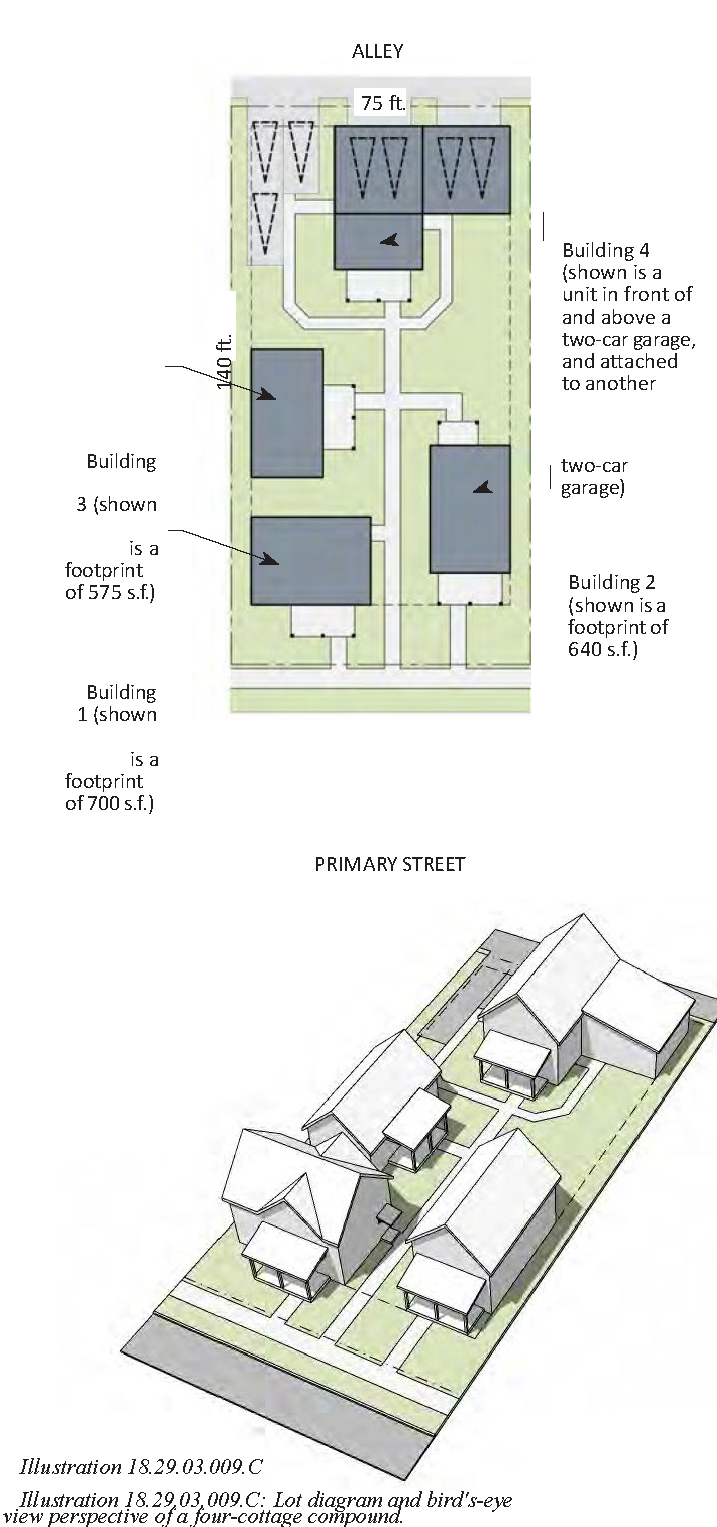
b.
Lot Standards.
1.
Min. lot area ..... 8,000 s.f.
2.
Min. lot frontage ..... 70 ft.
c.
Building Size and Dwelling Unit Limitations.
1.
Max. total floor area ..... 4,800 s.f. per lot
2.
Max. building height ..... 1½ stories/32 ft.
3.
Max. no. of detached buildings ..... 4 per lot
4.
Max. no. of dwelling units ..... 4 per lot
5.
Max. total floor area per building ..... 1,400 s.f.
d.
Setbacks.
1.
Principal street ..... 15 ft. min.
2.
Side street ..... 15 ft. min.
3.
Porch at principal street ..... 7 ft. min./20 ft. max.
4.
Porch at side street ..... 7 ft. min./20 ft. max.
5.
Interior side lot line ..... 5 ft. min.
6.
Rear lot line/alley ..... 5 ft. min.
7.
Separation between buildings on lot ..... 10 ft. min.
e.
Porch.
1.
In the core, transition, and edge form zones, a porch of at least 100 s.f. in area facing the primary street is required on the cottage building that is closest to the front lot line.
2.
All other cottage buildings shall include a porch or balcony (covered or uncovered) of at least 80 s.f. in area.
f.
Additional Standards.
1.
The four-cottage compound form type is permitted only on lots with alley access. No curb cuts to serve a lot are allowed on the primary street or the side street (if present).
2.
All garage doors that face a rear alley shall be set back not more than 5 ft., or set back 20 ft. or more, from the rear lot line.
3.
Garage doors shall not face the primary street within 20 ft. of the compound's front lot line.
4.
FOUR-COTTAGE COMPOUND WITH SHOP
a.
Intent.
The four-cottage compound with shop form type provides opportunity to accommodate non-residential uses in a setting with a cottage-like scale and character where residential uses are located alongside non-residential uses.
b.
Lot Standards.
1.
Min. lot area 8,000 sf
2.
Min. lot frontage 70 ft.
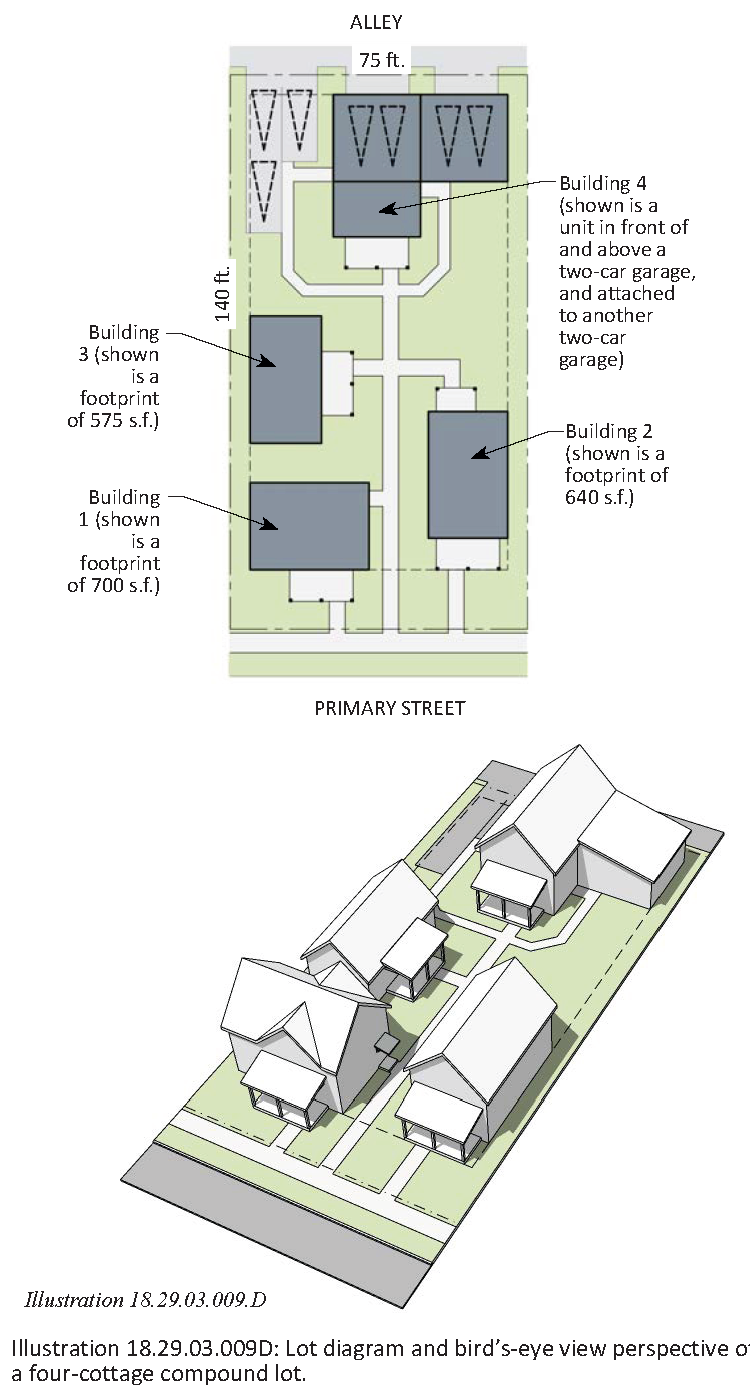
c.
Building Size and Dwelling Unit Limitations.
1.
Max. total floor area ..... 5,300 s.f. per lot
2.
Max. building height -
A.
Within front 15 ft. of the lot ..... 1 story/18 ft.
B.
Remainder of the lot ..... 1½ stories/32 ft.
3.
Max. no. of detached buildings ..... 4 per lot
4.
Max. no. of dwelling units ..... 4 per lot
5.
Max. total floor area per building ..... 1,800 s.f.
d.
Setbacks.
1.
Principal street -
A.
Along ⅓ of frontage ..... 4 ft. min.
B.
Along ⅔ of frontage ..... 15 ft. min.
2.
Porch at principal street ..... 7 ft. min.
3.
Side street -
A.
Along ¼ of frontage ..... 4 ft. min.
B.
Along ¾ of frontage ..... 15 ft. min.
4.
Porch at side street ..... 7 ft. min.
5.
Interior side lot line ..... 5 ft. min.
6.
Rear lot line/alley ..... 5 ft. min.
7.
Separation between buildings on lot ..... 10 ft. min.
e.
Porch.
1.
In the neighborhood corridor and main street A form zones, a porch of at least 80 s.f. in area facing the primary street is required on the building that is closest to the front lot line.
2.
All other buildings shall include a porch or balcony (covered or uncovered) of at least 80 s.f. in area.
f.
Additional Standards.
1.
The four-cottage compound with shop form type is permitted only on lots with alley access. No curb cuts to serve a cottage building lot are allowed on the primary street or the side street (if present).
2.
All garage doors that face a rear alley shall be set back not more than 5 ft., or set back 20 ft. or more, from the rear lot line.
3.
No surface parking is allowed within 60 ft. of the front lot line.
4.
Garage doors shall not face the primary street within 20 ft. of the front lot line.
5.
Four-cottage compound with shop form type is permitted only if at least 25 percent of the total floor area is reserved for non-residential uses.
5.
COURTYARD FRONTAGE COMPOUND
a.
Intent and Special Characteristics.
1.
Intent. The courtyard frontage compound form type is tailored to accommodate larger businesses, together with residential uses in larger buildings, but still in a cottage-like setting.
2.
Special Characteristics. The courtyard frontage compound has two building envelope areas (BEAs):
A.
Front BEA: 50%
B.
Rear BEA: 50%
b.
Lot Standards.
1.
Min. lot area 8,000 sf
2.
Min. lot frontage 65 ft.
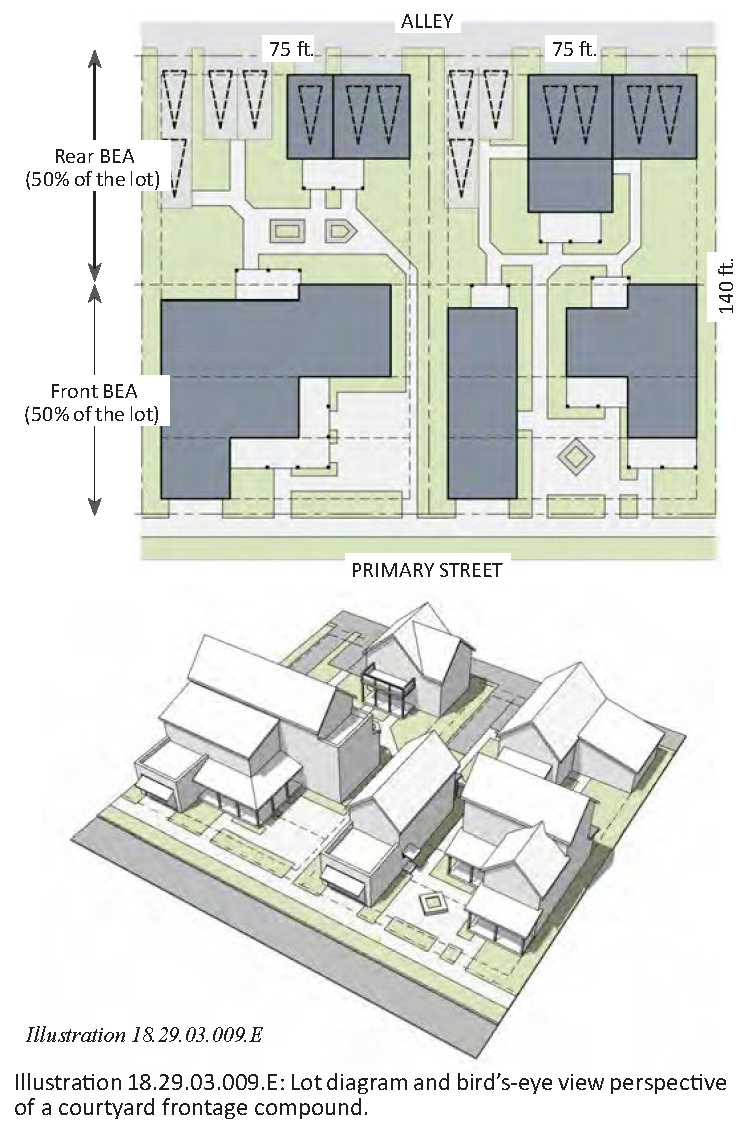
c.
Building Size and Dwelling Unit Limitations.
1.
Max. total floor area -
A.
Front BEA ..... 4,000 s.f.
B.
Rear BEA ..... 1,200 s.f.
2.
Max. building height -
A.
Within front 20 ft. of the lot ..... 1 story/18 ft.
B.
Within 20 to 36 ft. of front lot line ..... 2 stories/32 ft.
C.
Within remainder of front BEA ..... 2½ stories/40 ft.
D.
Rear BEA ..... 1½ stories/32 ft.
3.
Max. no. of detached buildings ..... 4 per lot
4.
Max. no. of dwelling units ..... 4 per lot
5.
Max. total floor area per building ..... 4,000 s.f.
d.
Setbacks.
1.
Principal street -
A.
Along ¼ of frontage ..... 4 ft. min.
B.
Along ¼ of frontage ..... 20 ft. min.
C.
Along ½ of frontage ..... 36 ft. min.
2.
Porch at principal street ..... 4 ft. min.
3.
Side street -
A.
First 2 stories ..... 8 ft. min.
B.
Above 2 stories ..... 18 ft. min.
4.
Porch at side street ..... 4 ft. min.
5.
Interior side lot line ..... 5 ft. min.
6.
Rear lot line/alley ..... 5 ft. min.
7.
Separation between buildings on lot ..... 10 ft. min.
e.
Porch.
1.
In the neighborhood corridor and main street A form zones, a porch of at least 100 s.f. in area facing the primary street is required on the building that is closest to the front lot line.
2.
All other buildings shall include a porch or balcony (covered or uncovered) of at least 80 s.f. in area.
f.
Additional Standards.
1.
The courtyard frontage compound form type is permitted only on lots with alley access. No curb cuts to serve the building lot are allowed on the primary street or the side street (if present).
2.
No surface parking is allowed within the front BEA.
3.
All garage doors that face a rear alley shall be set back not more than 5 ft., or set back 20 ft. or more, from the rear lot line.
4.
Garage doors shall not face the primary street within 20 ft. of the front lot line.
5.
The courtyard frontage compound form type is permitted only if at least 25 percent of the total floor area is reserved for non-residential uses.
(Ord. No. 2209, § 2(Exh. G), 6-6-2023)
18.29.03.010 - COMPOUND FORM STYLES - DESIGN STANDARDS AND GUIDELINES
1.
APPLICABILITY
a.
The standards and guidelines referenced in this section apply to the compound form types (listed below for ease of reference).
1.
Two- or Three-cottage compound
2.
Three-cottage compound with shop
3.
Four-cottage compound
4.
Four-cottage compound with shop
5.
Courtyard frontage compound
b.
Buildings within the compound form are subject to:
1.
Section 18.29.03.004 if their floor area exceeds 1,800 s.f.; or
2.
Section 18.29.03.007 if their floor area is 1,800 s.f. or less.
c.
Chapter 18.40 also applies to compound form types as set out therein.
(Ord. No. 2209, § 2(Exh. G), 6-6-2023)
18.29.03.011 - CLUSTER FORM TYPES - APPLICATION OF FORM STANDARDS
1.
GENERAL INTENT
a.
Cluster form types are intended to be implemented using clustered subdivisions, with each principal building occupying its own lot.
b.
The cluster form types are provided to:
1.
Diversify housing options.
2.
Provide an opportunity to subdivide larger parcels into small lots. [See illustration 18.29.03.011.A.]
3.
Provide opportunities for multi-household developments that consist of smaller detached buildings in areas that have a significant single-household, detached presence.
4.
Promote multi-household developments that consist of several small buildings as opposed to one, large building with several internal units.
5.
Promote preservation of smaller buildings by permitting small-scale subdivision.
6.
Increase attainable housing stock by providing opportunities for smaller and more cost-efficient developments.
c.
Except as provided is subsection 1.a., above, this section shall not be interpreted to set forth substantive requirements.
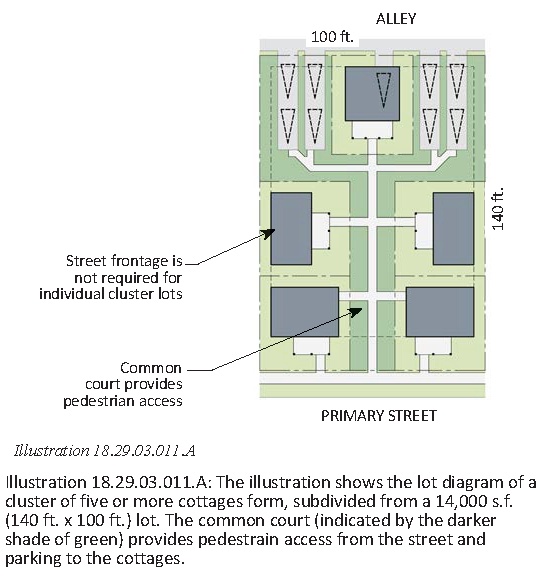
2.
INTENT AND APPLICATION OF STANDARDS
a.
In General. This subsection 2 sets forth the intentions for specific regulatory tools used for cluster form types.
b.
Lot Size. Minimum lot areas are applied in order to:
1.
Ensure the cluster form types are appropriately scaled, spaced, and compatible with similar buildings in the surrounding neighborhood or area.
2.
Ensure adequate space for common court elements and shared elements (e.g., utility and drainage infrastructure).
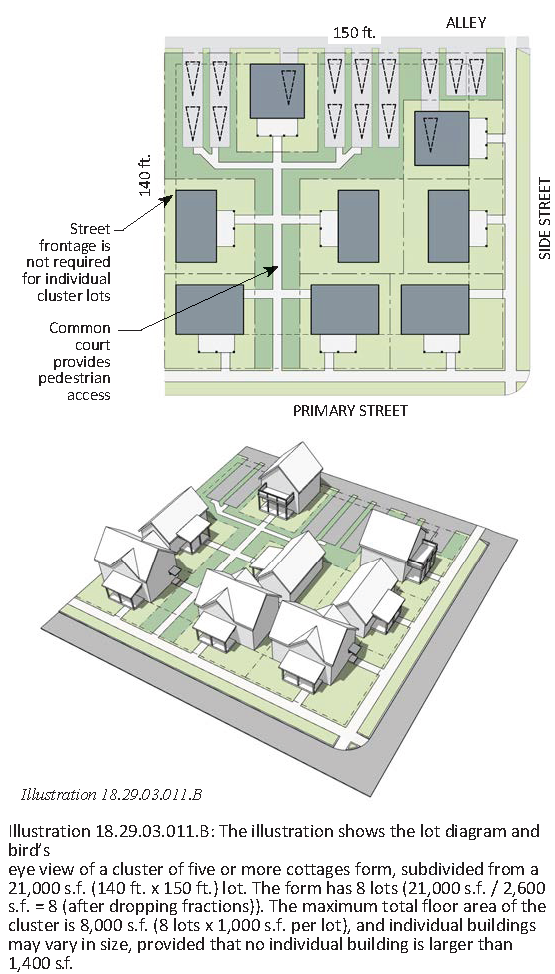
c.
Building Size. Building size regulations are used to:
1.
Preserve and promote cottage-scale buildings, similar to those constructed between the 1850s and 1960s.
2.
Provide a diversity of multi-household housing options through small-scale separated housing developments.
d.
Common Court. Common courts are used to:
1.
Provide an alternative lot frontage.
2.
Provide pedestrian ingress and egress to the right-of-way and to parking spaces.
3.
Provide shared amenities and open space for residents of the cluster development.
e.
Building Height. Building height is limited by number of stories and in linear feet to:
1.
Ensure developments are appropriately scaled to their minimum and maximum lot requirements, which are often small.
2.
Ensure new developments are consistent with the height of buildings in Golden's existing built environment, specifically, developments constructed between 1850 and 1960.
3.
Encourage steep gable or hip roof forms that are common in existing dwellings that developed in Golden between 1850 and 1960.
f.
Porch Characteristics. Porches are required within cluster form types in order to:
1.
Accentuate the first-story elements of building as viewed from the pedestrian realm (right-of-way/sidewalk) and to decrease the building's perceived scale.
2.
Provide transition between the front of a building and the pedestrian realm (right-of-way/sidewalk) and to decrease the distance between these areas.
3.
Maintain the front porch as a common element found in single-family developments constructed between 1850 and 1960.
(Ord. No. 2209, § 2(Exh. G), 6-6-2023)
18.29.03.012 - CLUSTER FORM TYPES - FORM STANDARDS
1.
CLUSTER OF FOUR COTTAGES
a.
Intent.
The cluster of four cottages form type provides an opportunity for existing lots or parcels that are 9,000 s.f. or greater in area ("pre-subdivision lot") to be subdivided into smaller lots ("cluster lots").
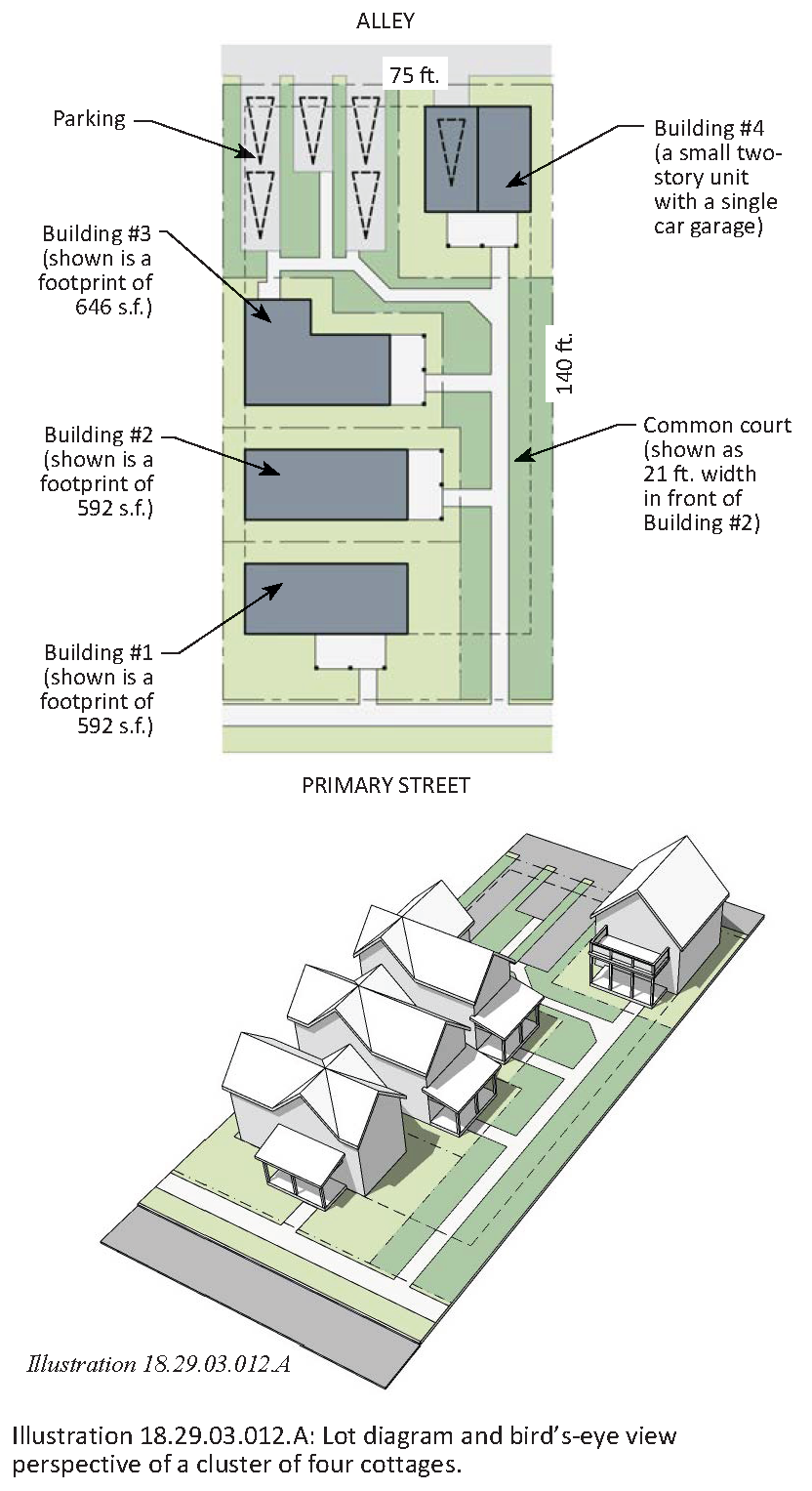
b.
Lot Standards.
1.
Min. pre-subdivision lot area ..... 9,000 s.f.
2.
Min. cluster lot area ..... 1,400 s.f.
3.
Min. pre-subdivision lot frontage ..... 70 ft.
4.
Min. cluster lot frontage (street or common court) [See f.4] ..... 22 ft.
c.
Building Size and Dwelling Unit Limitations.
1.
Max. total floor area (all cottages combined) ..... 4,800 s.f.
2.
Max. building height ..... 1½ stories/32 ft.
3.
Max. no. of detached buildings ..... 4 per cluster
4.
Max. no. of dwelling units ..... 1 per cluster lot
5.
Max. total floor area per building ..... 1,500 s.f.
d.
Setbacks.
1.
Primary street ..... 15 ft. min.
2.
Porches at primary street ..... 7 ft. min./20 ft. max.
3.
Common court ..... 12 ft. min.
4.
Porches at common court ..... 4 ft. min.
5.
Side street ..... 15 ft. min.
6.
Porches at side street ..... 7 ft. min.
7.
Interior side lot line ..... 5 ft. min.
8.
Rear lot line/alley ..... 5 ft. min.
e.
Porch.
1.
In the core, transition, and edge form zones, a porch of at least 90 s.f. in area facing the primary street is required on cottages on cluster lots that have primary street frontage.
2.
All other cottages shall include a porch of at least 80 s.f. in area, facing the common court.
f.
Additional Standards.
1.
Cluster of four cottages building form type is permitted only on pre-subdivision lots with alley access. No curb cuts to serve an individual cluster lot are allowed on the primary street or the side street (if present).
2.
Garage doors shall not face the primary frontage within 20 ft. of the front property line.
3.
All garage doors that face a rear alley shall be set back not more than 5 ft., or set back 20 ft. or
4.
A common court frontage is required for cluster lots that do not have frontage on the primary street or side street.
2.
CLUSTER OF FIVE OR MORE COTTAGES
a.
Intent.
The cluster of five or more cottages form type provides an opportunity for existing lots or parcels that are 12,000 s.f. or greater in area ("pre-subdivision lot") to be subdivided into smaller lots ("cluster lots").
b.
Lot Standards.
1.
Min. pre-subdivision lot size ..... 12,000 s.f.
2.
Min. cluster lot size ..... 1,400 s.f.
3.
Min. pre-subdivision lot frontage ..... 96 ft.
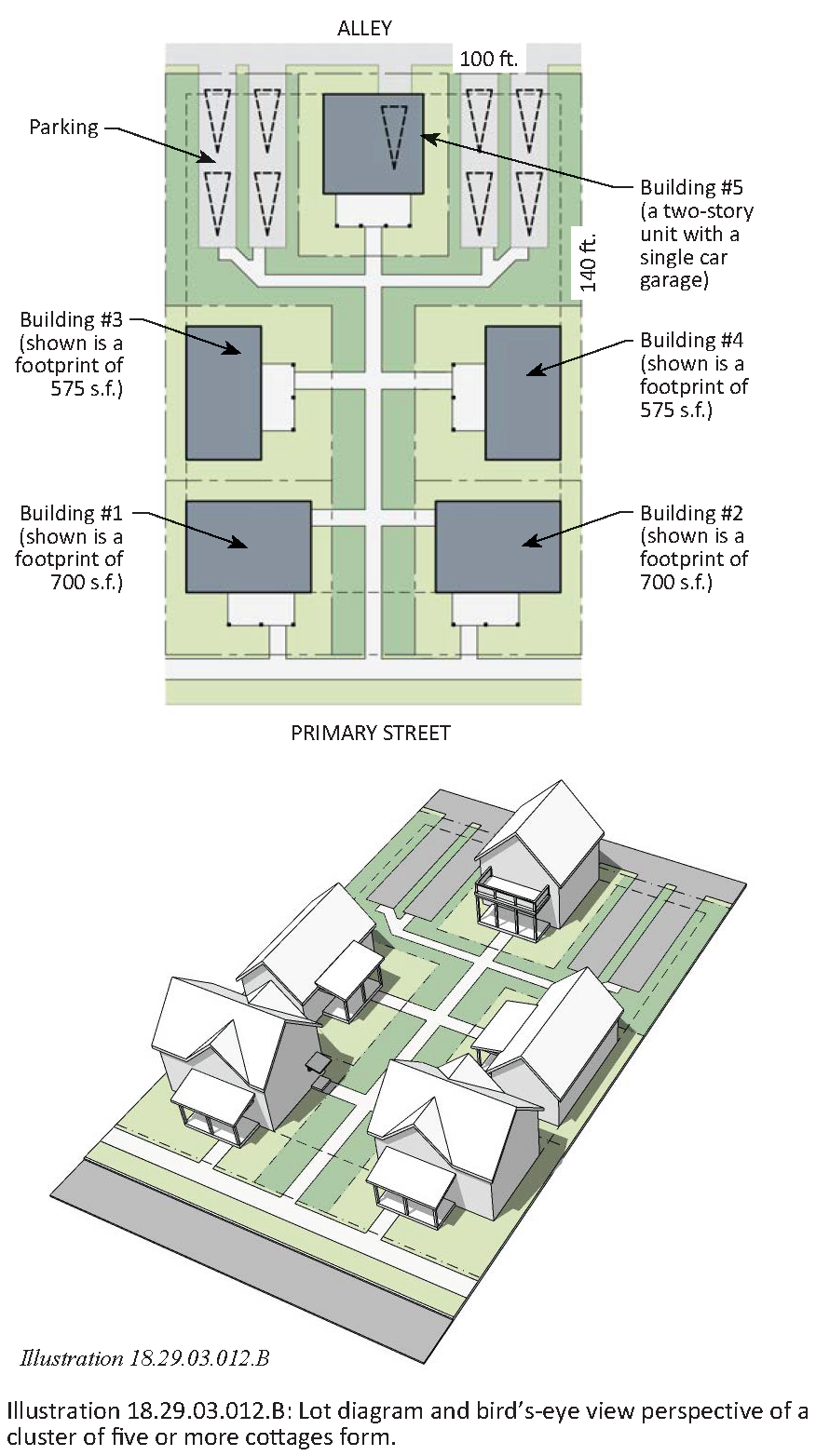
4.
Min. cluster lot frontage (street or common court) [See f.4] ..... 22 ft.
c.
Building Size and Dwelling Unit Limitations.
1.
Max. no. of cluster lots equals the pre-subdivision lot size (in s.f.) divided by 2,600 s.f., with fractions dropped
2.
Max building height ..... 1½ stories/32 ft.
3.
Max. total floor area per cluster ..... 1,100 s.f. x (no. of lots)
4.
Max. total floor area of individual buildings ..... 1,500 s.f.
5.
Max. no. of dwelling units ..... 1 per cluster lot
d.
Setbacks.
1.
Primary street ..... 15 ft. min.
2.
Porches at primary street ..... 7 ft. min./20 ft. max.
3.
Common court ..... 12 ft. min.
4.
Porches at common court ..... 4 ft. min.
5.
Side street ..... 15 ft. min.
6.
Porches at side street ..... 7 ft. min./20 ft. max.
7.
Interior side lot line ..... 5 ft. min.
8.
Rear lot line/alley ..... 5 ft. min.
e.
Porch.
1.
In the core, transition, and edge form zones, a porch of at least 90 s.f. in area facing the primary street is required on cottages on cluster lots that have primary street frontage.
2.
All other cottages shall include a porch of at least 80 s.f. in area, facing the common court.
f.
Additional Standards.
1.
The cluster of five or more cottages form type is permitted only on pre-subdivision lots with alley access. No curb cuts to serve an individual cluster lot are allowed on the primary street or the side street (if present).
2.
Garage doors shall not face the primary frontage within 20 ft. of the front property line.
3.
All garage doors that face a rear alley shall be set back not more than 5 ft., or set back 20 ft. or more, from the rear lot line.
4.
A common court frontage is required for cluster lots that do not have frontage on the primary street or side street.
3.
CLUSTER OF DETACHED AND ATTACHED COTTAGES
a.
Intent.
The cluster of detached and attached cottages form type provides an opportunity for existing lots or parcels that are 12,000 s.f. or greater in area ("pre-subdivision lot") to be subdivided into smaller lots ("cluster lots"). The cluster of detached and attached cottages may be developed with cottages or cottage duplex buildings.
b.
Lot Standards.
1.
Min. pre-subdivision lot size ..... 12,000 s.f.
2.
Min. cluster lot size ..... 1,000 s.f.
3.
Min. pre-subdivision lot frontage ..... 96 ft.
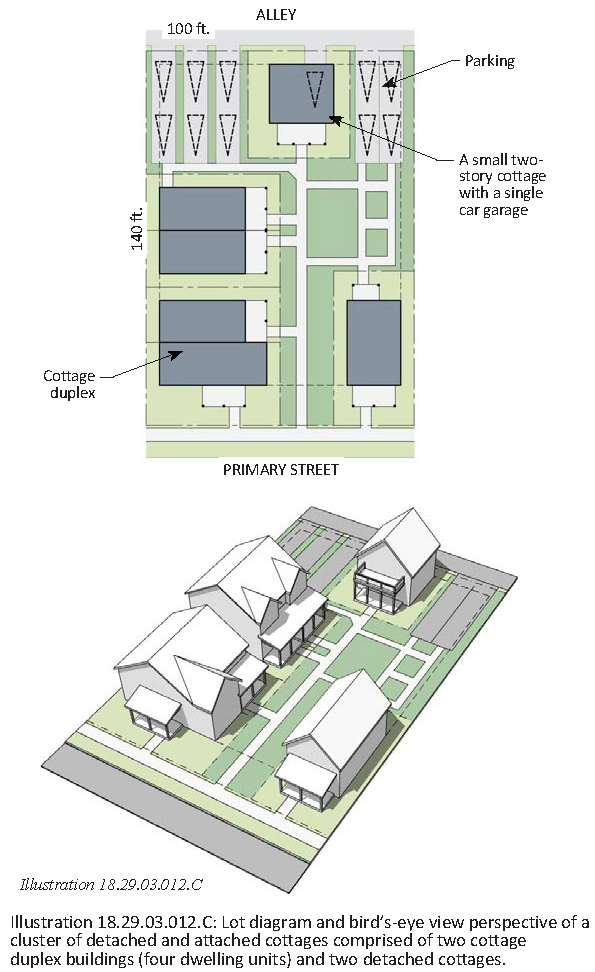
4.
Min. cluster lot frontage (street or common court) [See f.4] ..... 20 ft.
c.
Building Size and Dwelling Unit Limitations.
1.
Max. no. of cluster lots equals the pre-subdivision lot size (in s.f.) divided by 2,300 s.f., with fractions dropped
2.
Max. building height ..... 1½ stories/32 ft.
3.
Max. total floor area of any one detached cottage building ..... 1,400 s.f.
4.
Max. total floor area of any one cottage duplex building (includes both units) ..... 2,200 s.f.
5.
Max. no. of dwelling units ..... 1 per cluster lot
d.
Setbacks.
1.
Primary street ..... 15 ft. min.
2.
Porches at primary street ..... 7 ft. min./20 ft. max.
3.
Common court ..... 12 ft. min.
4.
Porches at common court ..... 4 ft. min.
5.
Side street ..... 8 ft. min.
6.
Porches at side street ..... 4 ft. min.
7.
Interior side lot line ..... 0 ft. (party wall)/5 ft. min.
8.
Rear lot line/alley ..... 5 ft. min.
e.
Porch.
1.
In the core, transition, and edge form zones, a porch of at least 120 s.f. in area facing the primary street is required on cottages on cluster lots with primary street frontage.
2.
All other cottages shall include a porch of at least 80 s.f. in area, facing the common court.
f.
Additional Standards.
1.
The cluster of detached and attached cottages form type is permitted only on pre-subdivision lots with alley access. No curb cuts to serve an individual cluster lot are allowed on the primary street or the side street (if present).
2.
Garage doors within 20 ft. of the front lot line shall not face the primary street frontage.
3.
All garage doors that face a rear alley shall be set back not more than 5 ft., or set back 20 ft. or more, from the rear lot line.
4.
A common court frontage is required for cluster lots that do not have frontage on the primary street or side street.
4.
HIDDEN COURT CLUSTER WITH SHOP
a.
Intent and Special Characteristics.
1.
Intent. The hidden court cluster with shop form type provides for three attached buildings within which both residential and non-residential uses may be located.
2.
Special Characteristics. The hidden court cluster with shop has:
A.
An open side and a closed side with different setback requirements.
B.
Two building envelope areas (BEAs):
i.
Front BEA: 25%
ii.
Rear BEA: 75%
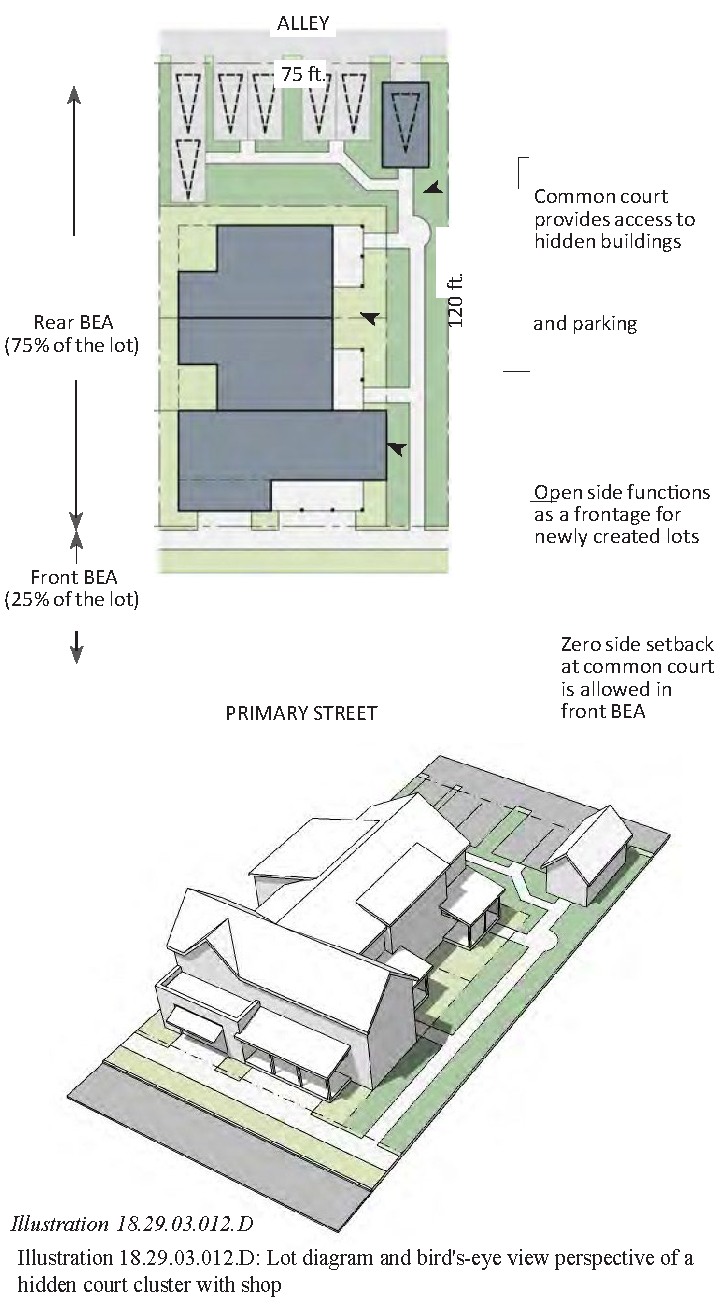
b.
Lot Standards.
1.
Min. pre-subdivision lot size ..... 12,000 s.f.
2.
Min. cluster lot size 1,300 ..... s.f.
3.
Pre-subdivision lot frontage ..... 70 ft. min./100 ft. max.
4.
Min. pre-subdivision lot depth ..... 110 ft.
5.
Min. cluster lot frontage (street or common court) [See f.4] ..... 20 ft.
c.
Building Size and Dwelling Unit Limitations.
1.
Max. building height -
A.
Front 12 ft. of lot ..... 1 story/18 ft.
B.
Remainder of lot ..... 2 stories/35 ft.
2.
Max. total floor area -
A.
Front BEA ..... 2,400 s.f.
B.
Rear BEA ..... 4,000 s.f.
3.
Max. no. of dwelling units ..... 3 (1 per cluster lot)
d.
Setbacks.
1.
Primary street -
A.
Along ⅓ of frontage ..... 4 ft. min.
B.
Along ⅔ of frontage ..... 15 ft. min.
2.
Porches at primary street ..... 7 ft. min./20 ft. max.
3.
Common court -
A.
Front BEA ..... 0 ft. min.
B.
Rear BEA ..... 15 ft. min.
C.
Porches (open side) ..... 7 ft. min.
4.
Side street ..... 15 ft. min.
5.
Porches at side street ..... 7 ft. min.
6.
Interior side lot line -
A.
Exterior wall ..... 5 ft. min.
B.
Party wall ..... 0 ft. min.
7.
Rear lot line/alley ..... 5 ft. min.
e.
Porch.
1.
In the Neighborhood Corridor and Main Street A form zones, a porch of at least 120 s.f. in area facing the primary street is required on cottages on cluster lots that have primary street frontage.
2.
All other cottages shall include a porch of at least 80 s.f. in area, facing the common court.
f.
Additional Standards.
1.
The hidden court cluster with shop form type is permitted only on pre-subdivision lots with alley access. No curb cuts to serve an individual cluster lot are allowed on the primary street or the side street (if present).
2.
Garage doors within 20 feet of the front lot line shall not face the primary street frontage.
3.
All garage doors that face a rear alley shall be set back not more than 5 ft., or set back 20 ft. or more, from the rear lot line.
4.
A common court frontage is required for cluster lots that do not have frontage on the primary street or side street.
5.
No surface parking is allowed within 60 feet of the primary street.
6.
The hidden court cluster with shop form type is permitted only if at least 25 percent of the total floor area is reserved for non-residential uses.
(Ord. No. 2209, § 2(Exh. G), 6-6-2023)
18.29.03.013 - CLUSTER FORM TYPES - DESIGN STANDARDS AND GUIDELINES
1.
APPLICABILITY
a.
The standards that are referenced and set out in this section apply to the cluster form types (listed below for ease of reference).
1.
Cluster of four cottages
2.
Cluster of five or more cottages
3.
Cluster of detached and attached cottages
4.
Hidden court cluster with shop
b.
Section 18.29.03.007 applies to the detached cottages within a cluster form, if any.
c.
Section 18.29.03.016 applies to the duplexes within a cluster form, if any.
d.
Chapter 18.40 also applies to cluster form types as set out therein.
e.
Each subsection below sets out a statement of intent, followed by requirements, followed (in some cases) by guidelines. The statement of intent provides background information and is not regulatory in nature. The requirements must be met unless adjusted pursuant to division VII. The guidelines are used in the administration of certain parts of division VII, and are otherwise suggestions (not requirements).
2.
COMMON COURTS
a.
Intent. The intent of the common courts standards is to require common courts as an amenity and green space for the enjoyment of occupants of the cluster.
b.
Requirements.
1.
A common court is required for all cluster form types. The common court shall be provided in a tract designated on the subdivision plat.
2.
50 percent of the common court shall be landscaped with living plant materials.
3.
The common court shall be sized and configured as follows:
A.
The common court shall provide access from the front of the pre-subdivision lot to the rear of the pre-subdivision lot, and to all cluster lots that do not have street frontage.
B.
The common court shall have a minimum area of 15 percent of the pre-subdivision lot or 800 s.f., whichever is larger.
C.
The common court shall have a minimum frontage of 16 ft. along the front lot line of the pre-subdivision lot.
4.
Common courts shall consist of outdoor areas that provide separation and relief from buildings or create outdoor recreational opportunities such as walkways, pedestrian paths, open plazas, natural drainage ways and drainage ponds, playgrounds, areas with benches, outdoor furnishings, and other places for sitting, and other areas designed specifically for active or passive recreational use.
5.
Common courts shall not include areas that are used for outdoor storage and paved areas that are designed to accommodate motor vehicle uses (e.g., parking, drive aisles, etc.) or trash and recycling facilities.
6.
Common courts shall be designed and landscaped in accordance with section 18.29.06.006.4.
(Ord. No. 2209, § 2(Exh. G), 6-6-2023)
18.29.03.014 - DUPLEX FORM TYPES - APPLICATION OF FORM STANDARDS
1.
GENERAL INTENT AND USE OF FORM TYPE
a.
The duplex form types are provided to diversify housing options and allow for the efficient use of land with attached household dwellings.
b.
This section shall not be interpreted to set forth substantive requirements.
2.
INTENT AND APPLICATION OF STANDARDS
a.
In General. This subsection 2 sets forth the intentions for specific regulatory tools used for duplex form types.
b.
Lot Size.
1.
Minimum lot areas are applied in order to ensure the duplex form types are constructed on sufficient land area to maintain light and air and outdoor use areas.
2.
Maximum lot sizes are applied to some duplex forms to ensure that they are appropriately scaled to other buildings in the surrounding neighborhood or area.
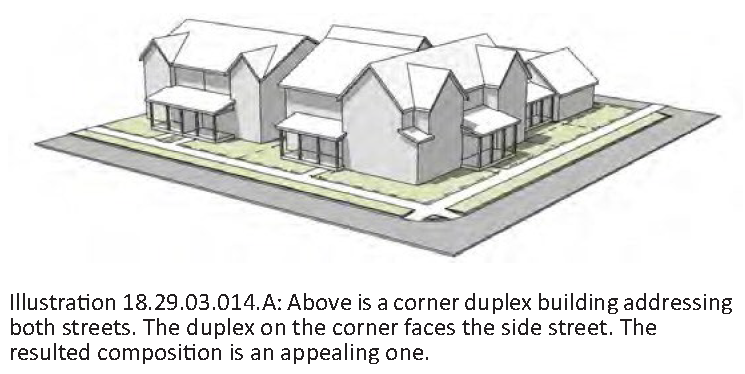
c.
Facing Requirements. Duplex form types on corner lots may include a requirement that a one household unit face the side street via a porch and primary entryway to avoid blank facades from the public right-of-way. [See illustration 18.29.03.014.A.]
d.
Multiple Building Envelope Areas (BEAs). Multiple BEAs with different height, lot coverage, and setback requirements are established for some duplex building form types in order to:
1.
Retain the established lot pattern of buildings that developed between the 1850s and 1960s.
2.
Create consistent backyard space to:
A.
Allow natural light to pass through the lot and block.
B.
Break down overall massing in the interior of the lot. [See illustration 18.29.03.014.B.]
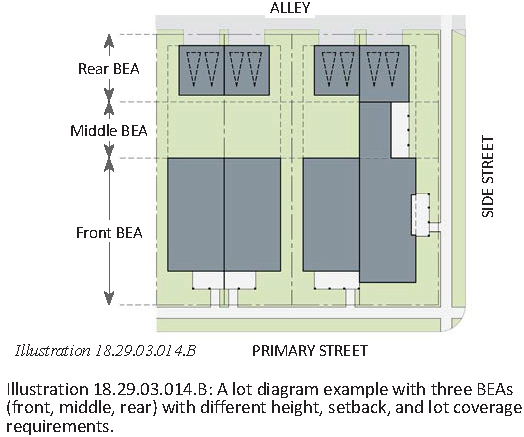
e.
Building Size. Building size regulations limit maximum floor area on a per building, rather than per lot, basis to:
1.
Ensure that duplex developments are scaled similarly with existing buildings in the surrounding neighborhood or area.
2.
Ensure square footage is distributed into multiple household units within a shared building that does not increase in size if lots are consolidated.
f.
Building Height. Building height is limited by number of stories and in linear feet to:
1.
Encourage steep gable or hip roof forms that are common in existing buildings that developed in Golden between the 1850s and 1960s.
2.
Ensure new developments are consistent with the height of buildings in the existing built environment, specifically, buildings that developed between the 1850s and 1960s.
g.
Porch Characteristics. Porch requirements are intended to:
1.
Accentuate the first-story elements of a building from the pedestrian realm (right-of-way/sidewalk) and decrease the building's perceived scale and massing.
2.
Provide better transition between the front of a building and the pedestrian realm (right-of-way/sidewalk) by decreasing the distance between these areas.
3.
Maintain the front porch as a common building element, which is found in existing developments constructed between the 1850s and 1960s.
(Ord. No. 2209, § 2(Exh. G), 6-6-2023)
18.29.03.015 - DUPLEX FORM TYPES - FORM STANDARDS
1.
VILLAGE DUPLEX
a.
Intent and Special Characteristics.
1.
Intent. The intent of the village duplex form type is to provide for two-household buildings, with each dwelling unit located on its own lot ("duplex lot").
2.
Special Characteristics. The village duplex lot has three building envelope areas (BEAs):
A.
Front BEA ..... 55%
B.
Middle BEA ..... 20%
C.
Rear BEA ..... 25%
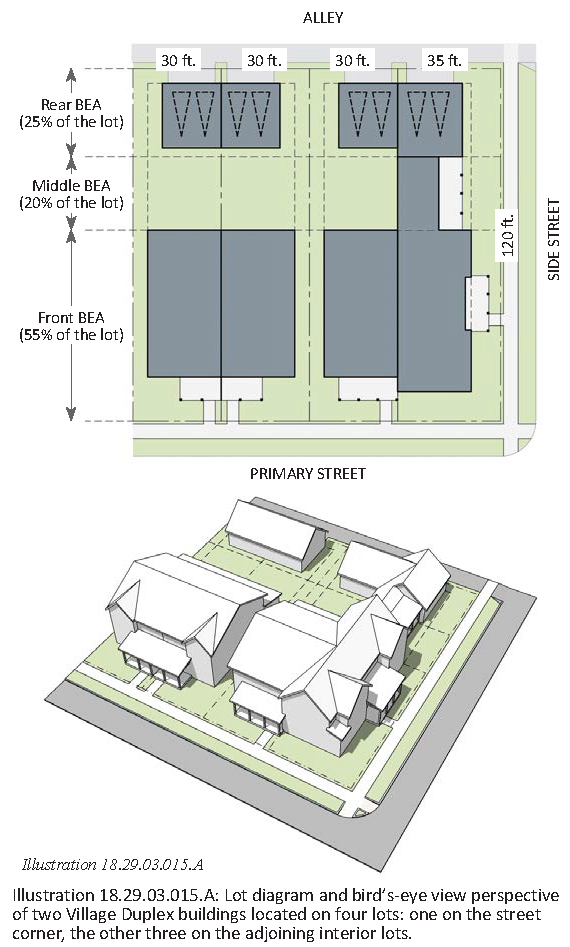
b.
Lot Standards.
1.
Min. duplex lot area ..... 3,000 s.f.
2.
Min. duplex lot frontage ..... 30 ft.
3.
Min. duplex lot depth ..... 90 ft.
c.
Building Size and Dwelling Unit Limitations.
1.
Max. total floor area of duplex building ..... 3,800 s.f.
2.
Max. lot coverage by BEA -
A.
Front BEA ..... 65%
B.
Middle BEA ..... 50% [See g.]
C.
Rear BEA not specifically restricted
3.
Max. building height by BEA -
A.
Front BEA ..... 2 stories/35 ft.
B.
Middle BEA ..... 1 story/18 ft. [See g.]
C.
Rear BEA ..... 1½ stories/32 ft.
4.
Max. no. of dwelling units ..... 1 per duplex lot
d.
Setbacks by Lot Location.
e.
Porch.
In the core, transition, and edge form zones, a porch of at least 100 s.f. in area facing the primary street, or, if present, the side street, is required. [See f.2]
f.
Additional Standards.
1.
The village duplex building form type is permitted only on lots with alley access. No curb cuts to serve a village duplex building lot are allowed on the primary street or the side street (if present).
2.
The porch and the entrance of the buildings on street corner lots shall face the side street.
3.
All garage doors that face a rear alley shall be set back not more than 5 ft., or set back 20 ft. or more, from the rear lot line.
g.
Adjustments for Mostly Preserved Buildings.
When an existing principal building on the lot is preserved to a degree to be qualified as "mostly preserved building," the following restrictions shall be applied to the middle BEA:
1.
Max. building height: ..... 1½ stories/35 ft.
2.
Max. lot coverage: ..... not specifically restricted
2.
UPHILL DUPLEX
a.
Intent.
The uphill duplex form type is intended for lots with steep slopes where an alley is neither provided nor feasible. The form type provides for two-household buildings, with each dwelling unit located on its own lot ("duplex lot"), that fit in a traditional neighborhood context, even though the garage may face the street.
b.
Lot Standards.
1.
Min. duplex lot area ..... 3,200 s.f.
2.
Min. duplex lot frontage ..... 46 ft.
3.
Min. duplex lot depth ..... 65 ft.
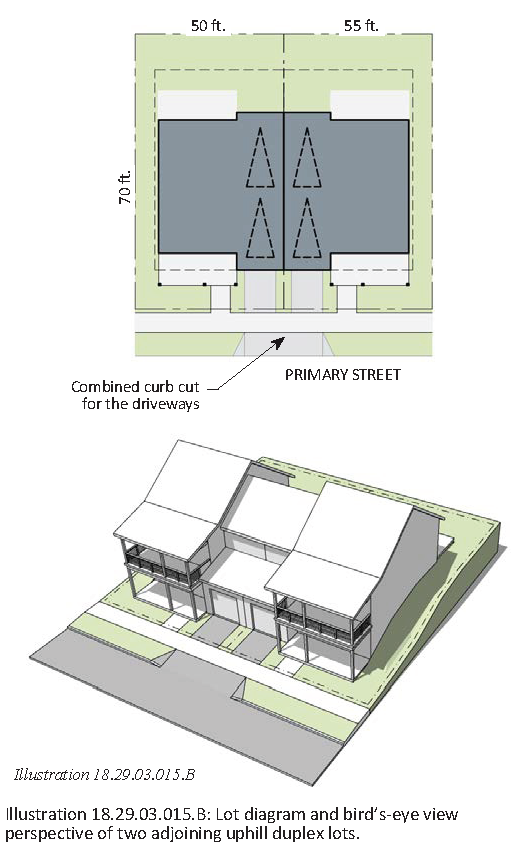
c.
Building Size and Dwelling Unit Limitations.
1.
Max. total floor area of duplex building ..... 3,800 s.f.
2.
Max. duplex lot coverage ..... 65%
3.
Max. building height ..... 3 stories/35 ft.
4.
Max. number of dwelling units ..... 1 per duplex lot
d.
Setbacks.
1.
Primary street ..... 10 ft. min.
2.
Porch at primary street ..... 4 ft. min.
3.
Side street ..... 8 ft. min.
4.
Porch at side street ..... 4 ft. min.
5.
Interior side lot line -
A.
Exterior wall ..... 5 ft. min.
B.
Party wall ..... 0 ft. min.
6.
Rear lot line ..... 10 ft. min.
e.
Porch.
In the core, transition, and edge form zones, a porch of at least 100 s.f. in area facing the primary street, or, if present, the side street, is required.
f.
Additional Standards.
1.
The uphill duplex form type is permitted only on lots with no alley that have a slope of 10 percent or more.
2.
The driveway at the front lot line shall not be wider than 9 ft. per lot.
3.
Garage door width shall not exceed 9 ft. on each lot.
4.
All garage doors that face a primary street or side street shall be set back at least 20 ft. from the lot line that is coterminous with the street that the garage door faces.
3.
COTTAGE DUPLEX
a.
Intent and Special Characteristics.
1.
Intent. The cottage duplex form type provides for the development of a two-household dwelling unit, each located on its own lot ("duplex lot").
2.
Special Characteristics. The cottage duplex lot has three building envelope areas (BEAs):
A.
Front BEA ..... 55%
B.
Middle BEA ..... 20%
C.
Rear BEA ..... 25%
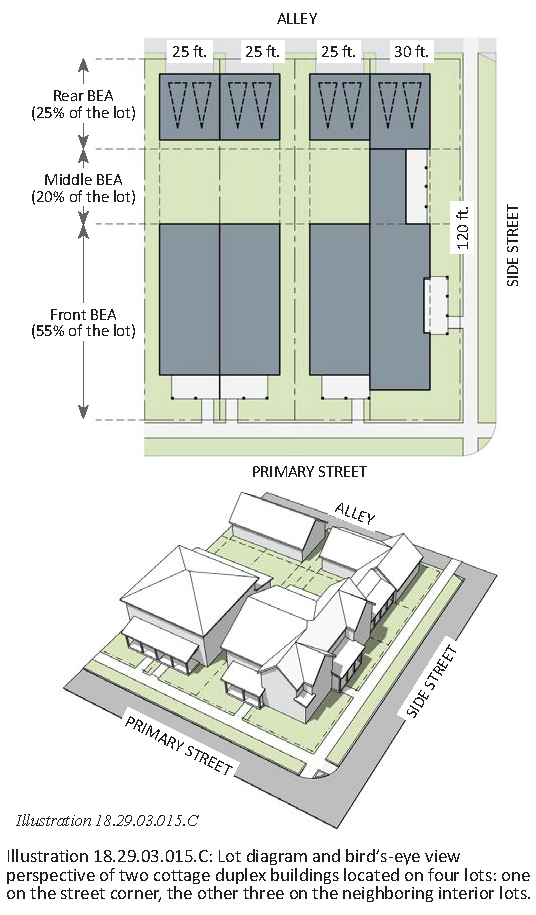
b.
Lot Standards.
1.
Min. duplex lot area ..... 2,500 s.f.
2.
Min. duplex lot frontage ..... 25 ft.
3.
Min. duplex lot depth ..... 90 ft.
c.
Building Size and Dwelling Unit Limitations.
1.
Max. total floor area of duplex building ..... 3,600 s.f.
2.
Max. lot coverage by BEA -
A.
Front BEA ..... 65% max.
B.
Middle BEA on corner lot ..... 50% max.
C.
Middle BEA on interior lot ..... no bldg. allowed
D.
Rear BEA ..... not specifically restricted
3.
Max. building height by BEA -
A.
Front BEA ..... 2 stories/35 ft.
B.
Middle BEA -
i.
Corner duplex lot: 1 story/18 ft.
ii.
Interior duplex lot: no bldg. allowed
C.
Rear BEA ..... 1½ stories/32 ft.
4.
Max. no. of dwelling units ..... 1 per duplex lot
d.
Setbacks.
e.
Porch.
1.
In the core, transition, and edge form zones, a porch of at least 100 s.f. in area facing the primary street, or, if present, the side street, is required.
2.
The porch and the primary entrance of dwelling units on street corner duplex lots shall face the side street.
f.
Additional Standards.
1.
The cottage duplex form type is permitted only on lots with alley access. No curb cuts to serve a lot are allowed on the primary street or the side street (if present).
2.
All garage doors that face a rear alley shall be set back not more than 5 ft., or set back 20 ft. or more, from the rear lot line.
4.
SIDE-DRIVE COTTAGE DUPLEX
a.
Intent and Special Characteristics.
1.
Intent. The side-drive cottage duplex form type provides for the development of a two- household building, with each dwelling unit on its own lot ("duplex lot").
2.
Special Characteristics. The side-drive cottage duplex lot has three building envelope areas (BEAs):
A.
Front BEA ..... 55%
B.
Middle BEA ..... 20%
C.
Rear BEA ..... 25%
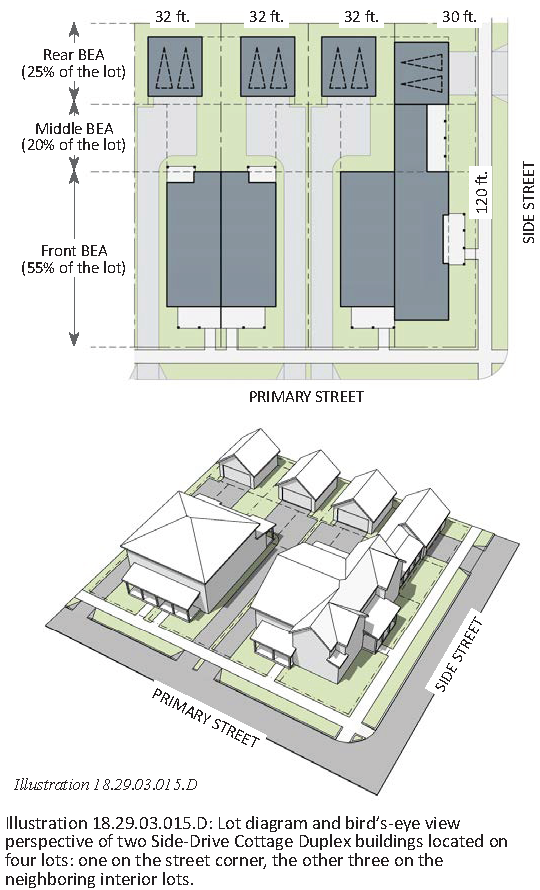
b.
Lot Standards.
1.
Min. duplex lot area ..... 3,000 s.f.
2.
Min. duplex lot frontage ..... 30 ft.
3.
Min. duplex lot depth ..... 90 ft.
c.
Building Size and Dwelling Unit Limitations.
1.
Max. total floor area of duplex building ..... 3,600 s.f.
2.
Max. lot coverage by BEA -
A.
Front BEA ..... 65%
B.
Middle BEA corner lot ..... 50%
C.
Middle BEA interior lot ..... no building allowed
D.
Rear BEA ..... not specifically restricted
3.
Max. height by BEA -
A.
Front BEA ..... 2 stories/35 ft.
B.
Middle BEA corner lot ..... 1 story/18 ft.
C.
Middle BEA interior lot ..... no building allowed
D.
Rear BEA ..... 1½ stories/32 ft.
4.
Max. no. of dwelling units ..... 1 per duplex lot
d.
Setbacks.
e.
Porch.
1.
In the core, transition, and edge form zones, a porch of at least 100 s.f. in area facing the primary street, or, if present, the side street, is required.
2.
The porch and the entrance of dwelling units on corner duplex lots shall face the side street.
f.
Additional Standards.
1.
The side-drive duplex form type is permitted only on lots with no alley access along the rear lot line. Side-loaded alleys must serve as the access if the lot is not located on a street corner.
2.
Garages on corner lots shall be accessed by the side street unless the City Engineer determines that alternative access is preferable for traffic safety purposes.
3.
All garage doors that face a street shall be set back at least 20 ft. from the lot line that is coterminous with the street that the garage door faces.
4.
The driveway shall not be wider than 10 ft. on the front lot line, not be wider than 16 ft. on the side street lot line.
5.
COMPACT COTTAGE DUPLEX
a.
Intent.
The compact cottage duplex form type provides for the development of a two-household building, with each dwelling unit on its own lot ("duplex lot").
b.
Lot Standards.
1.
Min. duplex lot area ..... 1,750 s.f.
2.
Max. duplex lot area ..... 2,800 s.f.
3.
Min. duplex lot frontage ..... 25 ft.
4.
Max. duplex lot depth ..... 90 ft.
5.
Min. duplex lot depth ..... 60 ft.
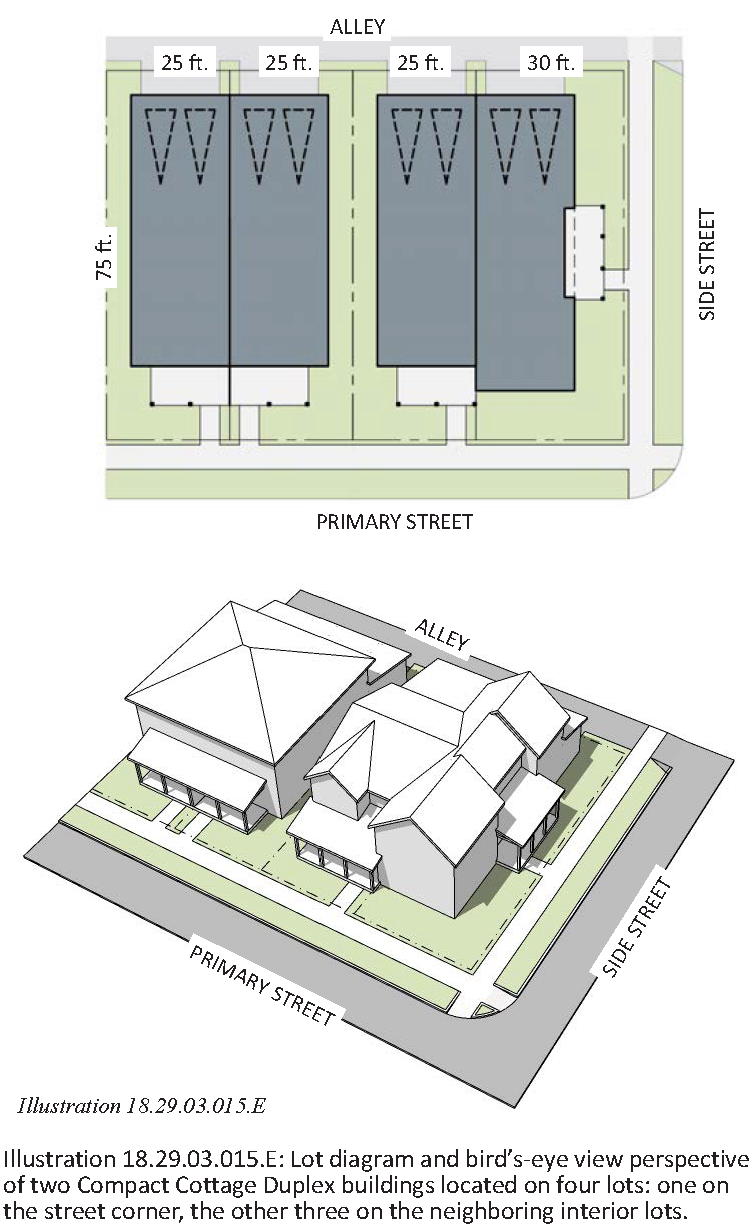
c.
Building Size and Dwelling Unit Limitations.
1.
Max. total floor area of duplex building 3,600 s.f.
2.
Max. building height 2 stories/35 ft.
3.
Max. no. of dwelling units 1 per duplex lot
d.
Setbacks.
e.
Porch.
1.
In the core, transition, and edge form zones, a porch of at least 100 s.f. in area facing the primary street, or, if present, the side street, is required.
2.
The porch and the primary entrance of dwelling units on corner duplex lots shall face the side street.
f.
Additional Standards.
1.
The compact cottage duplex form type is permitted only on lots with alley access. No curb cuts to serve a lot are allowed on the primary street or the side street (if present).
2.
All garage doors that face a rear alley shall be set back not more than 5 ft., or set back 20 ft. or more, from the rear lot line.
(Ord. No. 2209, § 2(Exh. G), 6-6-2023)
18.29.03.016 - DUPLEX FORM TYPES—DESIGN STANDARDS AND GUIDELINES
1.
APPLICABILITY
a.
This section shall apply to the duplex form types (listed below for ease of reference):
1.
Village duplex.
2.
Uphill duplex.
3.
Cottage duplex.
4.
Side-drive cottage duplex.
5.
Compact cottage duplex.
b.
Chapter 18.40 also applies to duplex form types as set out therein.
c.
Each subsection below sets out a statement of intent, followed by requirements, followed (in some cases) by guidelines. The statement of intent provides background information and is not regulatory in nature. The requirements must be met unless adjusted pursuant to division VII. The guidelines are used in the administration of certain parts of division VII, and are otherwise suggestions (not requirements).
2.
MASSING AND ARTICULATION
a.
Intent. The intent of the massing and articulation standards is to create a varied yet unified building presence at the block level when viewed from the pedestrian realm, and to reduce over-articulation of the building facades facing the front and side streets.
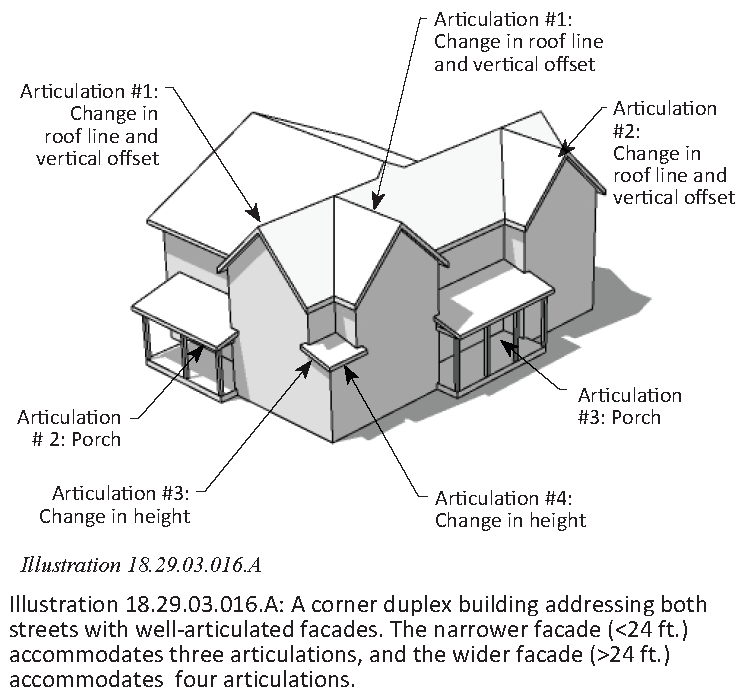
b.
Requirements.
1.
The exterior of the duplex building shall differentiate the individual units through the use of at least two of the three following massing articulations along the front facade of the building:
A.
Substantially different roof lines.
B.
Different porch or entry configurations (e.g., recessed vs. projecting front porches).
C.
An offset of at least three feet in the front building plane and differentiates the units.
2.
For buildings less than 24 feet in width, the primary building facade shall have no more than three articulations.
3.
For buildings greater or equal to 24 feet in width, the primary facade shall have no more than five articulations. [See illustration 18.29.03.016.A.]
3.
PORCH CHARACTERISTICS
a.
Intent. The intent of the porch standards is to create pronounced first-story building articulations and to create a transition between the pedestrian realm and the residential living space.
b.
Requirements.
1.
Front porches shall provide direct access to the interior living space.
2.
The porch shall not be elevated more than one step down from the finished floor of the home.
4.
EXTERIOR MATERIALS
a.
Intent. The intent of the exterior materials standards is to use materials in a manner that offer simplistic, well-designed buildings, while also avoiding the creation of overwhelming and cluttered facades with too many materials.
b.
Requirements.
1.
Allowed exterior wall materials are horizontal and vertical siding, real stucco, or masonry (brick, stone, [cementitious] siding, or concrete). Siding patterns shall be one of the following: Horizontal bevel, drop siding, vertical tongue and groove, shingles/shakes, or board and batten.
2.
Material and color changes shall occur along a vertical line at interior (concave) corners, or along a horizontal line at a floor line or a gable end. Material and color changes may also occur along a horizontal line that is at least two feet above the foundation, so long as that change is along the entire length of the facade.
3.
No more than four cladding materials are allowed.
4.
All public facing facades shall utilize a comparable composition of color, materials, and textures.
c.
Guidelines.
1.
In general, the lighter materials should be placed above those of heavier weight.
2.
Heat reflective roof materials should be installed to reduce heat islands. Metal, high albedo (light colored) or minimum 29 SRI (Solar Reflective Index) roofing materials qualify.
5.
ACCESSORY DWELLING UNITS
Accessory dwelling units are allowed as provided in section 18.28.240.
(Ord. No. 2282, § 2(Exh. C), 12-9-2025; Ord. No. 2209, § 2(Exh. G), 6-6-2023)
18.29.03.017 - ROW HOUSE FORM TYPES - APPLICATION OF FORM STANDARDS
1.
GENERAL INTENT AND USE OF FORM TYPE
a.
The row house form types are provided to:
1.
Permit multiple-household unit developments through large-scale form types.
2.
Allow efficient use of land through use of attached household units.
3.
Promote less-intense, less repetitive multi- household dwelling designs.
4.
Encourage compact urban forms by eliminating side yards and promoting the use of front and rear yards.
b.
This section shall not be interpreted to set forth substantive requirements.
2.
INTENT AND APPLICATION OF STANDARDS
a.
In General. This subsection 2 sets forth the intentions for specific regulatory tools used for row house form types.
b.
Multiple Building Envelope Areas (BEAs) on a Lot. Multiple BEAs are established at the front, middle, and rear of a lot to:
1.
Ensure a back yard is provided for interior lots. This repeats the existing pattern of development for buildings constructed between the 1850s and 1960s.
2.
Increase natural light throughout the development. [See illustration 18.29.03.017.A.]
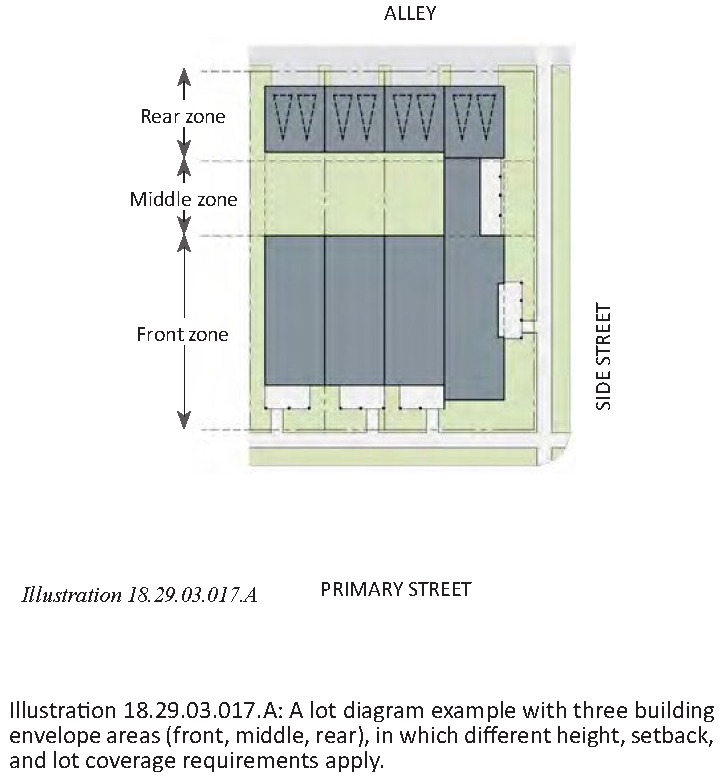
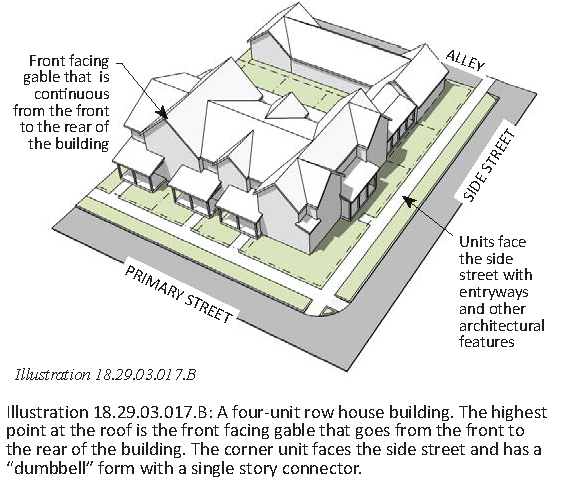
c.
Building Height. Building height is limited by number of stories and in linear feet to:
1.
Encourage steep gable or hip roof forms that are common in existing buildings that developed in Golden between the 1850s and 1960s.
2.
Discourage maximizing building height to fit a square, vertical-building envelope.
3.
Provide enough building height to encourage front-facing major gable roofs that can be continuous from front to back. [See illustration 18.29.03.017.B.]
4.
Encourage creative design.
5.
Allow for flexibility for high-sloped properties that are otherwise hampered by building stepbacks.
d.
Requirements for Corner Lots. Some row house form types require the corner unit to face/provide entry to the side street (if any) to:
1.
Avoid blank side facades at the side street; and
2.
Ensure the design of the building is articulated along all public facing rights-of-way. [See illustration 18.29.03.017.B.]
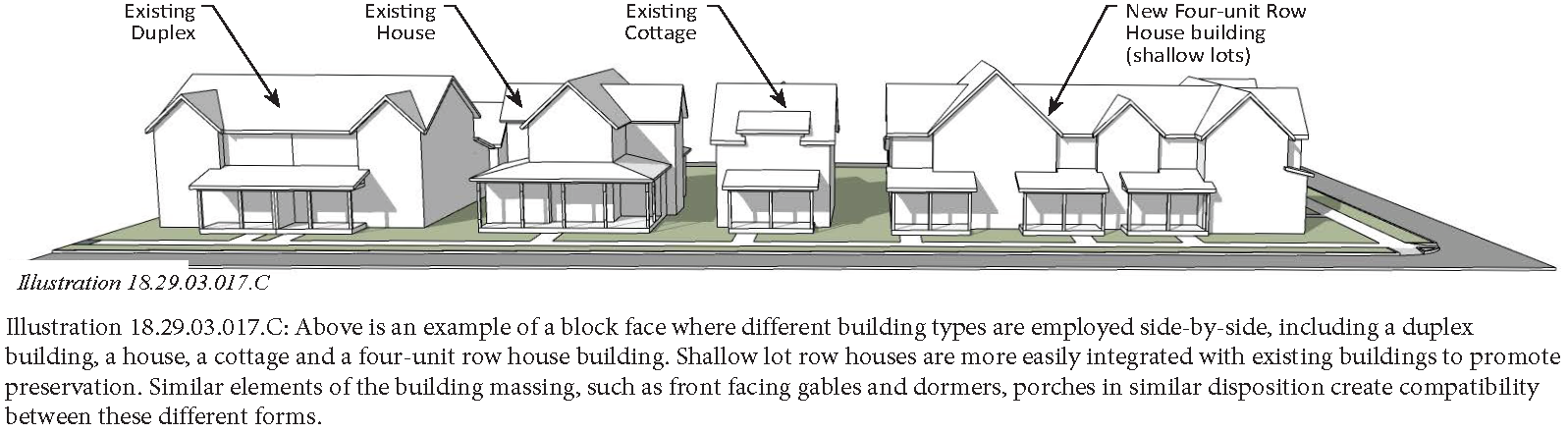
e.
Shallow Lot Row House Form Types. Shallow lots are permitted for some row house form types in order to allow for the integration of row houses into blocks with shallow lots. [See illustration 18.29.03.017.C.]
f.
Front Porch. Front porch requirements are intended to:
1.
Accentuate the first-story elements of a building from the pedestrian realm (right-of-way/sidewalk) and decrease the building's perceived scale and massing.
2.
Create consistency among units within a row house form type.
3.
Provide transition between the front of a building and the pedestrian realm (right-of-way/sidewalk) by decreasing the distance between these areas.
4.
Maintain the front porch as a common building element, which is found in existing developments constructed between the 1850s and 1960s.
(Ord. No. 2209, § 2(Exh. G), 6-6-2023)
18.29.03.018 - ROW HOUSE FORM TYPES - FORM STANDARDS
1.
VILLAGE TRIPLEX
a.
Intent and Special Characteristics.
1.
Intent. The village triplex form type provides for the development of three dwelling units in a single building, with each located on its own lot ("row lot").
2.
Special Characteristics. The village triplex lot has three building envelope areas (BEAs):
A.
Front BEA ..... 55%
B.
Middle BEA ..... 20%
C.
Rear BEA ..... 25%
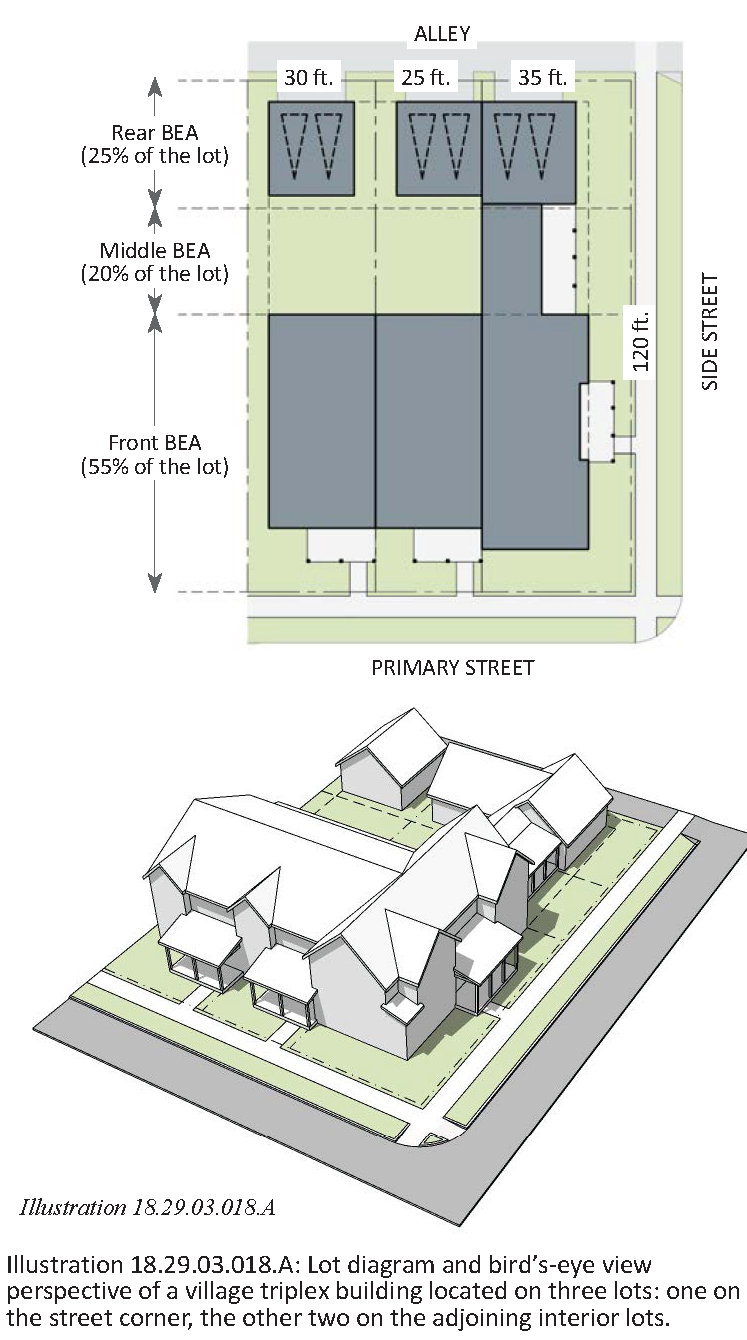
b.
Lot Standards.
1.
Min. row lot area ..... 2,500 s.f.
2.
Min. row lot frontage ..... 25 ft.
3.
Min. row lot depth ..... 90 ft.
c.
Building Size and Dwelling Unit Limitations.
1.
Max. total floor area of triplex building ..... 6,000 s.f.
2.
Max. height by BEA -
A.
Front BEA ..... 2 stories/35 ft.
B.
Middle BEA corner lot ..... 1 story/18 ft.
C.
Middle BEA interior lot ..... no bldg. allowed
D.
Rear BEA ..... 1½ stories/32 ft.
3.
Max. no. of dwelling units ..... 1 per row lot
d.
Setbacks by Row Lot Location.
e.
Porch.
1.
In the transition and edge form zones, a porch of at least 100 s.f. in area facing the primary street, or, if present, the side street, is required.
2.
The porch and the entrance of dwelling units on street corner lots shall face the side street.
f.
Additional Standards.
1.
The village triplex form type is permitted only on lots with alley access. No curb cuts to serve a lot are allowed on the primary street or the side street (if present).
2.
All garage doors that face a rear alley shall be set back not more than 5 ft., or set back 20 ft. or more, from the rear lot line.
2.
COTTAGE TRIPLEX
a.
Intent and Special Characteristics.
1.
Intent. The cottage triplex form type provides for the development of three dwelling units in a single building, with each located on its own lot ("row lot").
2.
Special Characteristics. The cottage triplex lot type has three building envelope areas (BEAs):
A.
Front BEA ..... 55%
B.
Middle BEA ..... 20%
C.
Rear BEA ..... 25%
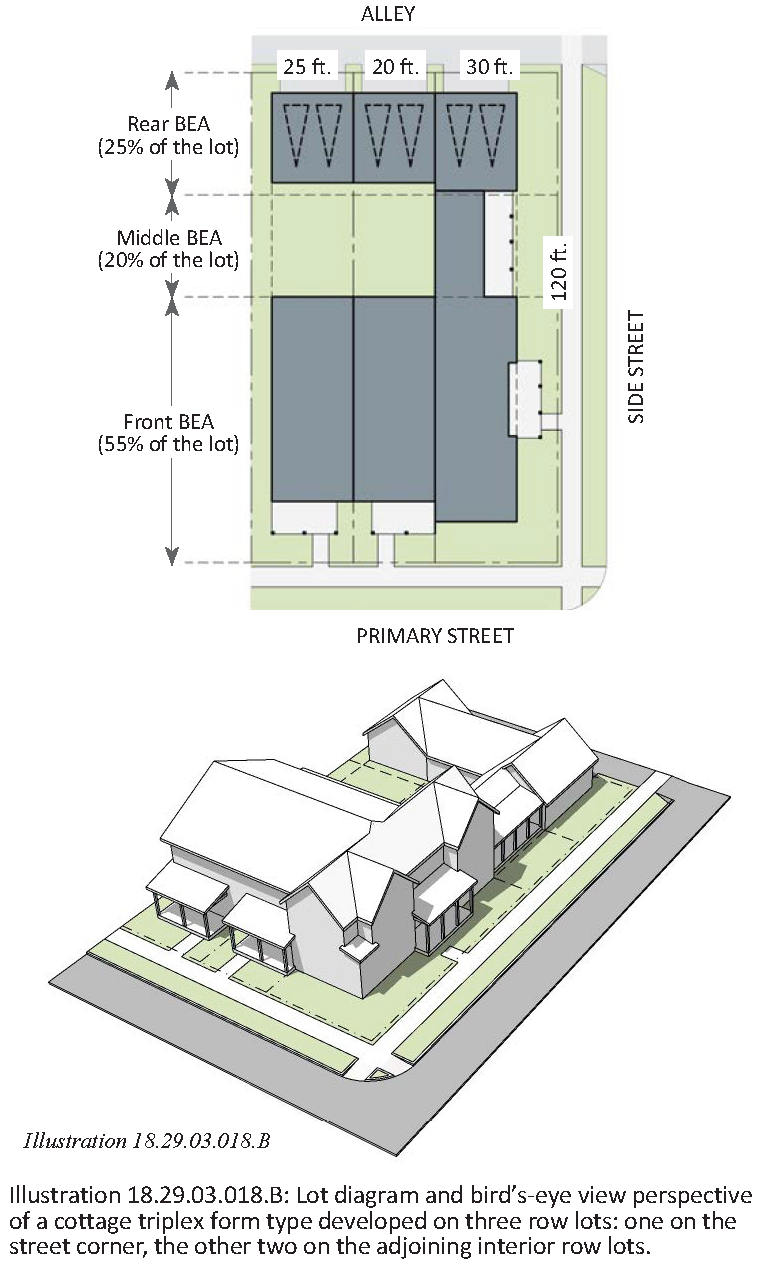
b.
Lot Standards.
1.
Min. row lot area ..... 2,000 s.f.
2.
Min. row lot frontage ..... 20 ft.
3.
Min. row lot depth ..... 90 ft.
c.
Building Size and Dwelling Unit Limitations.
1.
Max. total floor area of triplex building ..... 5,400 s.f.
2.
Max. height by BEA -
A.
Front BEA ..... 2 stories/35 ft.
B.
Middle BEA corner lot ..... 1 story/18 ft.
C.
Middle BEA interior lot ..... no bldg. allowed
D.
Rear BEA ..... 1 story/24 ft.
3.
Max. no. of dwelling units ..... 1 per row lot
d.
Setbacks by Row Lot Location.
e.
Porch.
1.
In the transition and edge form zones, a porch of at least 100 s.f. in area facing the primary street, or, if present, the side street, is required.
2.
The porch and the entrance of dwelling units on street corner row lots shall face the side street.
f.
Additional Standards.
1.
The cottage triplex form type is permitted only at lots with alley access. No curb cuts to serve a lot are allowed on the primary street or the side street (if present).
2.
All garage doors that face a rear alley shall be set back not more than 5 ft., or set back 20 ft. or more, from the rear lot line.
3.
COMPACT COTTAGE TRIPLEX
a.
Intent.
The compact cottage triplex form type provides for the development of three dwelling units in a single building, with each located on its own lot ("row lot").
b.
Lot Standards.
1.
Min. row lot area ..... 1,300 s.f.
2.
Max. row lot area ..... 2,800 s.f.
3.
Min. row lot frontage ..... 20 ft.
4.
Max. row lot depth ..... 90 ft.
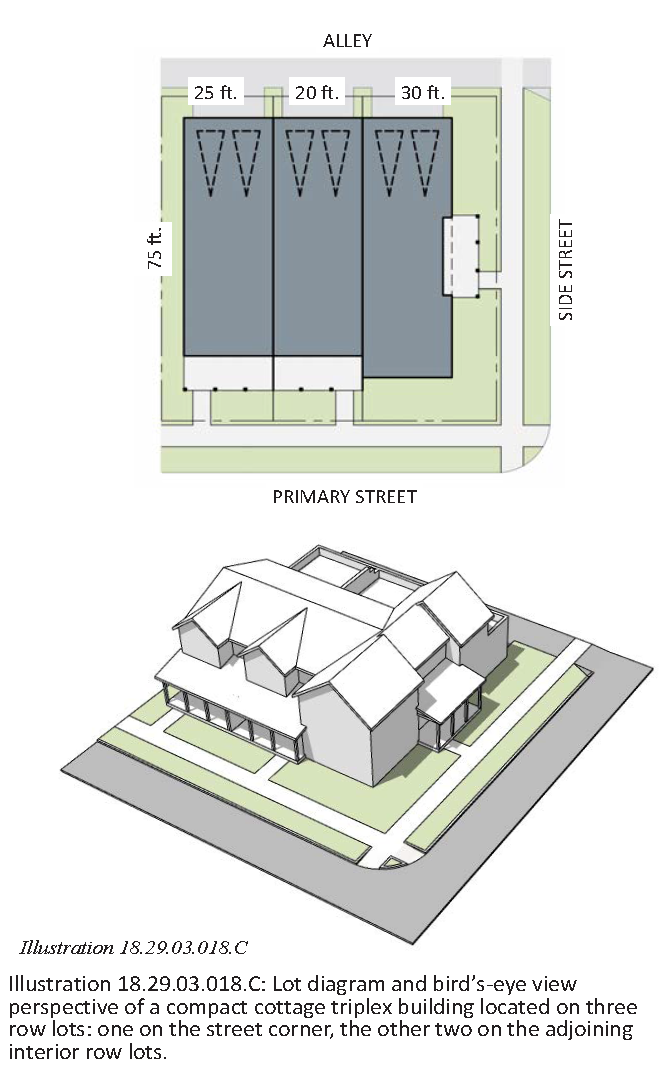
c.
Building Size and Dwelling Unit Limitations.
1.
Max. total floor area of triplex building ..... 5,400 s.f.
2.
Max. building height ..... 2 stories/35 ft.
3.
Max. no. of dwelling units ..... 1 per row lot
d.
Setbacks by Row Lot Location.
e.
Porch.
1.
In the transition and edge form zones, a porch of at least 100 s.f. in area facing the primary street, or, if present, the side street, is required.
2.
The porch and the entrance of dwelling units on street corner row lots shall face the side street.
f.
Additional Standards.
1.
The compact cottage triplex form type is permitted only on lots with alley access. No curb cuts to serve a lot are allowed on the primary street or the side street (if present).
2.
All garage doors that face a rear alley shall be set back not more than 5 ft., or set back 20 ft. or more, from the rear lot line.
4.
FOUR-UNIT BACK YARD ROW HOUSE
a.
Intent and Special Characteristics.
1.
Intent. The four-unit back yard row house form type provides for the development of a four-unit building, with each unit located on its own lot ("row lot").
2.
Special Characteristics. The four-unit back yard row house lot has three building envelope areas (BEAs):
A.
Front BEA ..... 55%
B.
Middle BEA ..... 20%
C.
Rear BEA ..... 25%
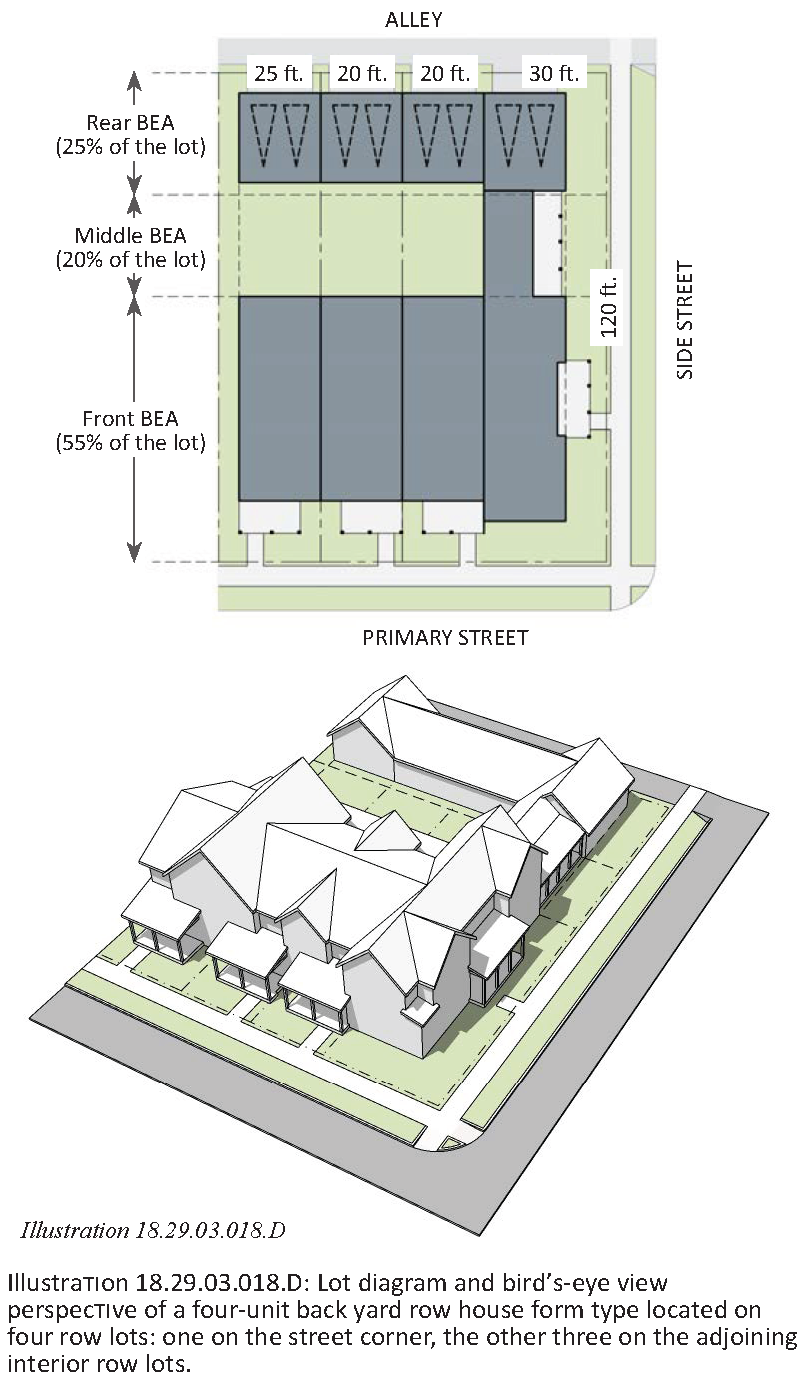
b.
Lot Standards.
1.
Min. row lot area ..... 1,800 s.f.
2.
Min. row lot frontage ..... 20 ft.
3.
Min. row lot depth ..... 90 ft.
c.
Building Size and Dwelling Unit Limitations.
1.
Max. total floor area of four-unit building ..... 8,000 s.f.
2.
Max. height by BEA -
A.
Front BEA ..... 2 stories/35 ft.
B.
Middle BEA corner lot ..... 1 story/18 ft.
C.
Middle BEA interior lot ..... no bldg. allowed
D.
Rear BEA ..... 1½ stories/32 ft.
3.
Max. no. of dwelling units ..... 1 per row lot
d.
Setbacks by Row Lot Location.
e.
Porch.
1.
In the edge form zone, a porch of at least 100 s.f. in area facing the primary street, or, if present, the side street, is required.
2.
The porch and the entrance of dwelling units on street corner row lots shall face the side street.
f.
Additional Standards.
1.
The four-unit back yard row house building form type is permitted only on lots with alley access. No curb cuts to serve a lot are allowed on the primary street or the side street (if present).
2.
All garage doors that face a rear alley shall be set back not more than 5 ft., or set back 20 ft. or more, from the rear lot line.
5.
FOUR-UNIT COMPACT ROW HOUSE
a.
Intent.
The four-unit back yard row house form type provides for the development of a four-unit building, with each unit located on its own shallow lot ("row lot").
b.
Lot Standards.
1.
Min. row lot area ..... 1,300 s.f.
2.
Max. row lot area ..... 2,800 s.f.
3.
Min. row lot frontage ..... 20 ft.
4.
Max. row lot depth ..... 90 ft.
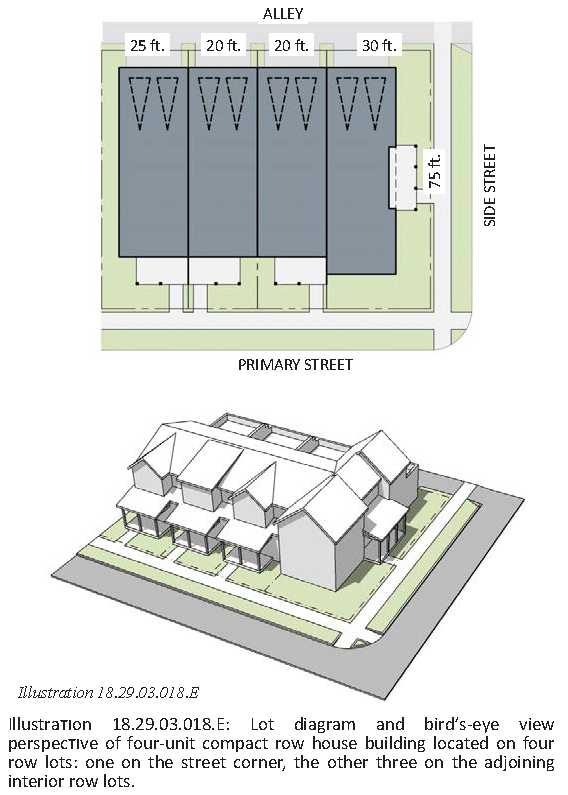
c.
Building Size and Dwelling Unit Limitations.
1.
Max. total floor area of four-unit building ..... 7,200 s.f.
2.
Max. building height ..... 2 stories/35 ft.
3.
Max. no. of dwelling units ..... 1 per lot
d.
Setbacks by Row Lot Location.
e.
Porch.
1.
In the edge form zone, a porch of at least 100 s.f. in area facing the primary street, or, if present, the side street, is required.
2.
The porch and the entrance of dwelling units on street corner row lots shall face the side street.
f.
Additional Standards.
1.
The four-unit compact row house form type is permitted only at lots with alley access. No curb cuts to serve a lot are allowed on the primary street or the side street (if present).
2.
All garage doors that face a rear alley shall be set back not more than 5 ft., or set back 20 ft. or more, from the rear lot line.
6.
BACKYARD ROW HOUSE (FIVE OR MORE UNITS)
a.
Intent and Special Characteristics.
1.
Intent. The back yard row house (five or more units) form type provides for the development of a multi-household building, with each attached dwelling unit located on its own lot ("row lot").
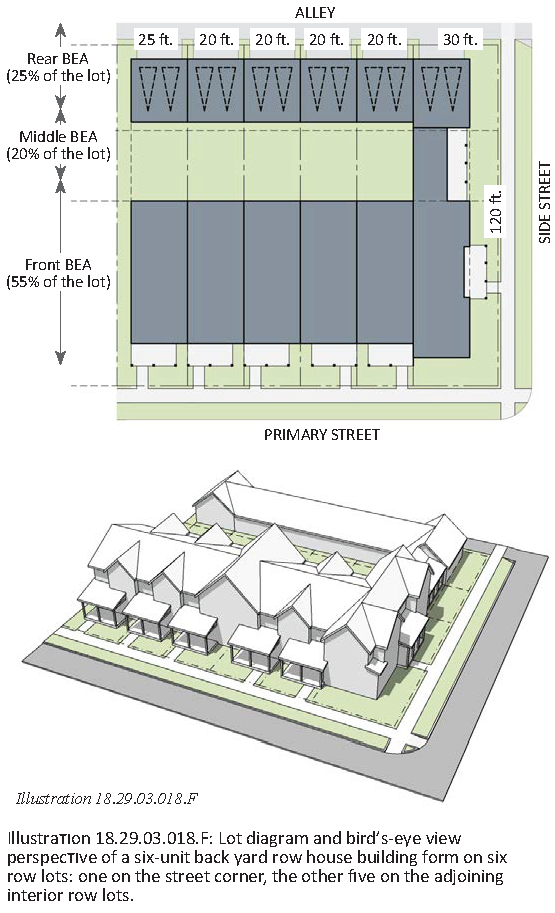
2.
Special Characteristics. The back yard row house lot has three building envelope areas (BEAs):
A.
Front BEA ..... 55%
B.
Middle BEA ..... 20%
C.
Rear BEA ..... 25%
b.
Lot Standards.
1.
Min. row lot area ..... 1,800 s.f.
2.
Min. row lot frontage ..... 20 ft.
3.
Min. row lot depth ..... 90 ft.
c.
Building Size and Dwelling Unit Limitations.
1.
Max. building height by BEA -
A.
Front BEA ..... 2 stories/38 ft.
B.
Middle BEA corner lot ..... 1 story/18 ft.
C.
Middle BEA interior lot ..... no bldg. allowed
D.
Rear BEA ..... 1½ stories/32 ft.
2.
Max. no. of dwelling units ..... 1 per row lot
d.
Setbacks by Row Lot Location.
e.
Additional Standards.
1.
The back yard row house building form type is permitted only at lots with alley access. No curb cuts to serve a lot are allowed on the primary street or the side street (if present).
2.
All garage doors that face a rear alley shall be set back not more than 5 ft., or set back 20 ft. or more, from the rear lot line.
3.
The entrances of dwelling units on street corner row lots shall face the side street.
7.
STAGGERED BACKYARD ROW HOUSE (FIVE OR MORE UNITS)
a.
Intent and Special Characteristics.
1.
Intent. The staggered back yard row house form type is intended to reduce the perception of building mass as perceived from the street. This form type provides for the development of five or more dwelling units, each on its own lot ("row lot").
2.
Special Characteristics. The staggered back yard row house lot type has:
A.
Two "lot versions" (labeled as A and B in illustration 18.29.03.018.G, below); and
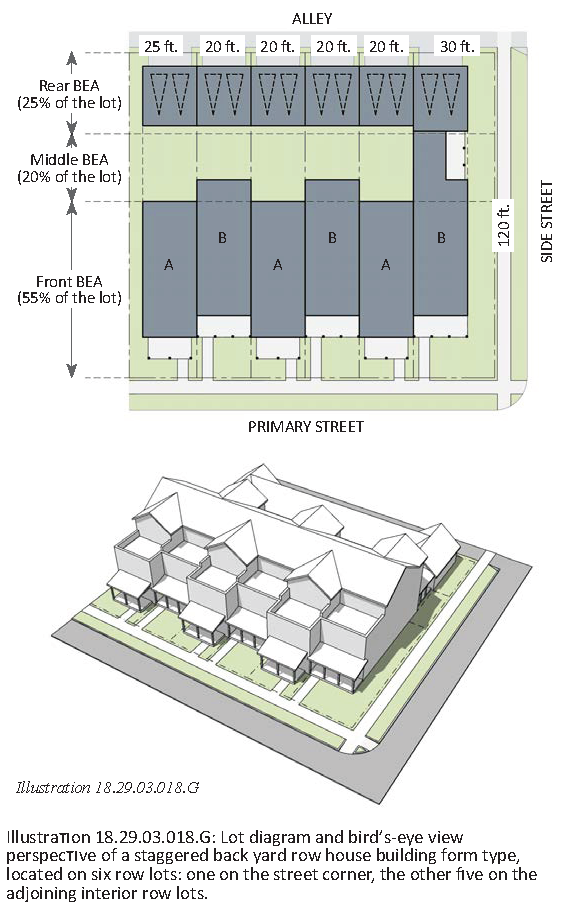
B.
Three building envelope areas (BEAs)—
i.
Front BEA: ..... 55%
ii.
Middle BEA: ..... 20%
iii.
Rear BEA: ..... 25%
b.
Lot Standards.
1.
Min. row lot area ..... 1,800 s.f.
2.
Min. row lot frontage ..... 20 ft.
3.
Min. row lot depth ..... 90 ft.
c.
Building Size and Dwelling Unit Limitations.
1.
Max. building height -
A.
Front BEA ..... 3 stories/45 ft.
B.
Middle BEA corner lot ..... 1 story/18 ft.
C.
Middle BEA interior lot
i.
Lot version A: ..... no bldg. allowed
ii.
Lot version B: ..... [See e.4.]
D.
Rear BEA ..... 1½ stories/32 ft.
2.
Max. no. of dwelling units ..... 1 per row lot
d.
Setbacks by Row Lot Location and Lot Version.
e.
Additional Standards.
1.
The staggered back yard row house building form type is permitted only at lots with alley access. No curb cuts to serve a row lot are allowed on the primary street or the side street (if present).
2.
All garage doors that face a rear alley shall be set back not more than 5 ft., or set back 20 ft. or more, from the rear lot line.
3.
The lot versions shall be staggered in a manner such that the same lot version is not situated side by side more than two times.
4.
Primary residential buildings on version B lots may encroach into the middle BEA up to 8 ft. at all stories.
8.
COMPACT ROW HOUSE (FIVE OR MORE UNITS)
a.
Intent.
The compact row house (five or more units) form type provides an opportunity for building smaller units on smaller and shallower lots. This form type provides for the development of five or more attached dwelling units, each located on its own lot ("row lot").
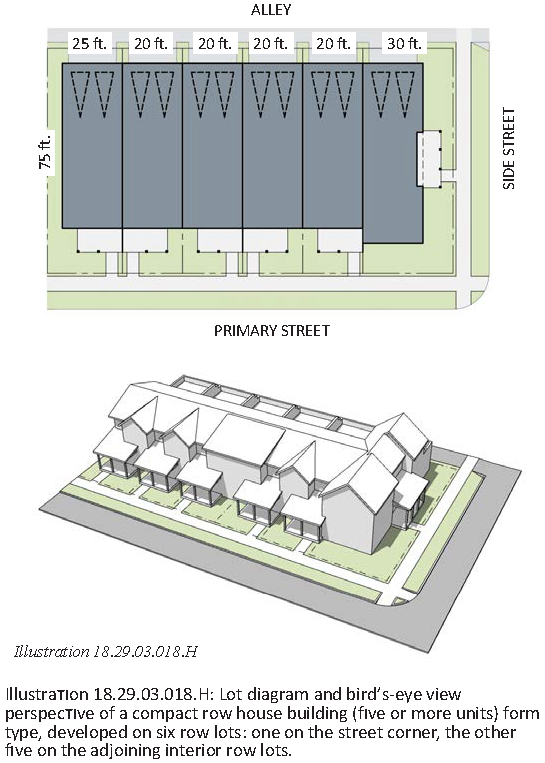
b.
Lot Standards.
1.
Min. row lot area ..... 1,300 s.f.
2.
Max. row lot area ..... 2,800 s.f.
3.
Min. row lot frontage ..... 20 ft.
4.
Max. row lot depth ..... 90 ft.
c.
Building Size and Dwelling Unit Limitations.
1.
Max. building height ..... 2 stories/35 ft.
2.
Max. no. of dwelling units ..... 1 per row lot
d.
Setbacks by Lot Location.
e.
Additional Standards.
1.
The compact row house building form type is permitted only at lots with alley access. No curb cuts to serve a lot are allowed on the primary street or the side street (if present).
2.
All garage doors that face a rear alley shall be set back not more than 5 ft., or set back 20 ft. or more, from the rear lot line.
3.
The entrance to dwelling units on street corner lots shall face the side street.
9.
COMPACT URBAN ROW HOUSE (FIVE OR MORE UNITS)
a.
Intent.
The compact urban row house (five or more units) form type provides an opportunity for building larger row houses on smaller and shallower lots in urban contexts. This form type provides for the development of five or more attached dwelling units, each located on its own lot ("row lot").
b.
Lot Standards.
1.
Min. row lot size ..... 1,300 s.f.
2.
Max. row lot size ..... 2,800 s.f.
3.
Min. row lot frontage ..... 20 ft.
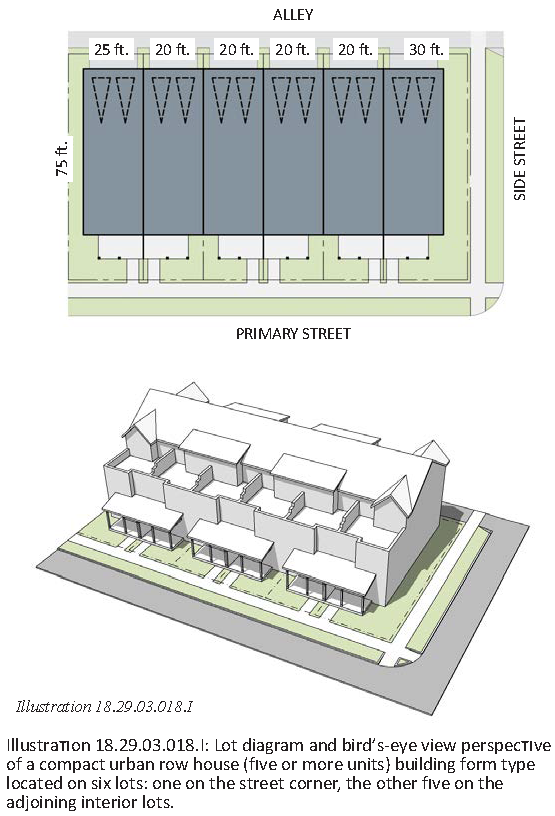
c.
Building Size and Dwelling Unit Limitations.
1.
Max. building height ..... 3 stories/45 ft.
2.
Max. no. of dwelling units ..... 1 per row lot
d.
Setbacks.
1.
Primary street.
A.
1st and 2nd stories: ..... 15 ft.
B.
3rd story: ..... 27 ft.
2.
Porch at primary street ..... 7 ft.
3.
Side street ..... 8 ft.
4.
Porch at side street ..... 4 ft.
5.
Interior side lot line -
A.
Exterior wall ..... 5 ft.
B.
Party wall ..... 0 ft.
6.
Rear lot line ..... 5 ft.
e.
Additional Standards.
The compact urban row house (five or more units) form type is permitted only on lots with alley access. No curb cuts to serve a lot are allowed on the primary street or the side street (if present).
f.
Rotation Option.
The compact urban row house (five or more units) form type may be rotated 90 degrees to face the side street [See illustration 18.29.03.018.K] (in which case lot frontage requirements may be satisfied using common court frontage), provided that:
1.
Parking access is provided by an alley spur; and
2.
Landscaping is provided between the end of the alley spur and the primary street; and
3.
Primary street setbacks (including porch setbacks) are applied to both the primary street and the side street; and
A.
If there are no buildings between the alley spur and the adjoining lot that is not part of the proposed development, a six-foot privacy fence is installed along the adjoining lot line; or
B.
If there is an additional compact urban row house (five or more units) building sharing the alley spur and facing the interior side lot line [See illustration 18.29.03.018.K], a common court that complies with the standards set out in section 18.29.03.013(2) shall be provided, and the primary street setback (including porch setbacks) shall be applied to the interior side lot line.
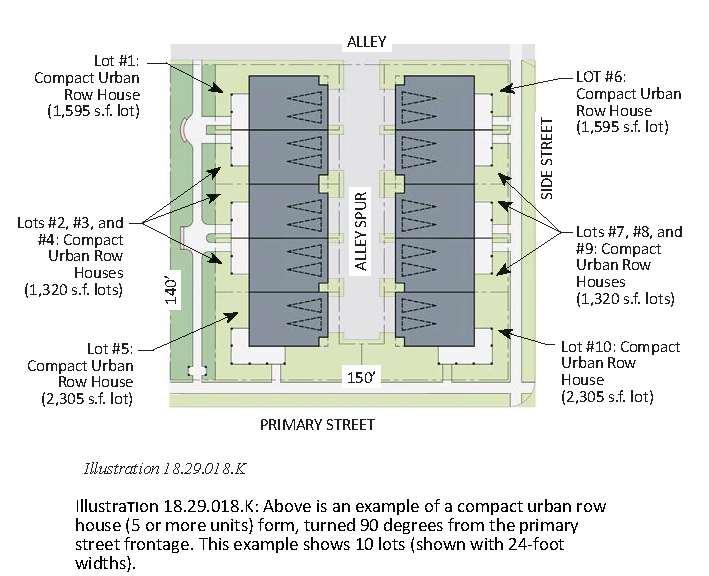
18.29.03.019 - ROW HOUSES - DESIGN STANDARDS AND GUIDELINES
1.
APPLICABILITY
a.
This section applies to the row house form types (listed below for ease of reference):
1.
Village triplex.
2.
Cottage triplex.
3.
Compact cottage triplex.
4.
Four-unit back yard row house.
5.
Four-unit compact row house.
6.
Back yard row house.
7.
Staggered back yard row house.
8.
Compact row house.
9.
Compact urban row house.
b.
Chapter 18.40 also applies to row house form types as set out therein.
c.
Each subsection below sets out a statement of intent, followed by requirements, followed (in some cases) by guidelines. The statement of intent provides background information and is not regulatory in nature. The requirements must be met unless adjusted pursuant to division V. The guidelines are used in the administration of certain parts of division V, and are otherwise suggestions (not requirements).
2.
MASSING AND ARTICULATION
a.
Intent. The intent of the massing and articulation standards is to use facade articulation to reduce the scale of the building (both in building height, to make the building look shorter, and length, to make the building look as if it was composed of smaller buildings).
b.
Requirements.
1.
Each unit within the row house development shall have differentiated articulation in relation to the building facade. Each public facing unit's facade shall not repeat a standard set of articulations across the entire development. [See illustration 18.29.03.019.A.]
2.
The primary building facade facing the primary street shall have a number of massing articulations within the ranges set out in the following table (the number of massing articulations set forth in the table applies to the building face, not the individual unit face). [See illustration 18.29.03.019.A.]
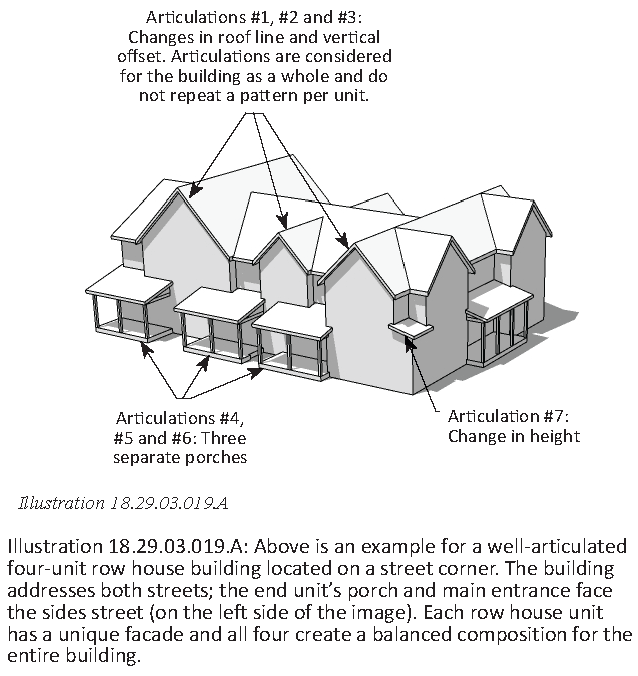
3.
For units with side street frontage, the number of massing articulations facing the side street shall not be less than three nor greater than five.
3.
PORCH CHARACTERISTICS
a.
Intent. The intent of the porch standards is to create pronounced first-story building articulations and to create a transition between the pedestrian realm and the residential living space.
b.
Requirements.
1.
Front porches shall provide direct access to the interior living space.
2.
The porch shall not be elevated more than one step down from the finished floor of the home.
3.
The unit(s) facing the side street of a row house development shall construct the porch to face the side street.
c.
Guidelines.
1.
Continuous porches should be avoided especially for buildings with four or more units. Porches that are not attached to an adjacent unit's porch are encouraged. [See illustration 18.29.03.019.B.]
2.
The side street facing unit of a row house building at a corner lot should have a wrapped porch, when feasible.
4.
EXTERIOR MATERIALS
a.
Intent. The intent of the exterior materials standards is to break up building length and height and create unity on an overall facade.
b.
Requirements.
1.
Allowed exterior wall materials are horizontal and vertical siding, real stucco, or masonry (brick, stone, cementous siding, or concrete). Siding patterns shall be one of the following: horizontal bevel, drop siding, vertical tongue and groove, shingles/shakes, or board and batten.
2.
Material changes shall occur along a vertical line at interior (concave) corners, or along a horizontal line at a floor line or a gable end. Material and color changes may also occur along a horizontal line that is at least 2 ft. above the foundation, so long as that change is along the entire length of the facade.
3.
No more than four cladding materials are allowed.
4.
All public facing facades shall utilize a comparable composition of color, materials, and textures.
c.
Guidelines.
1.
Use contrast (in material or in color) in a way to break up the building length and highlight smaller components of the massing to make the building look like a composition of smaller buildings. [See illustration 18.29.03.019.B.]
2.
In general the lighter materials should be placed above those of heavier weight.
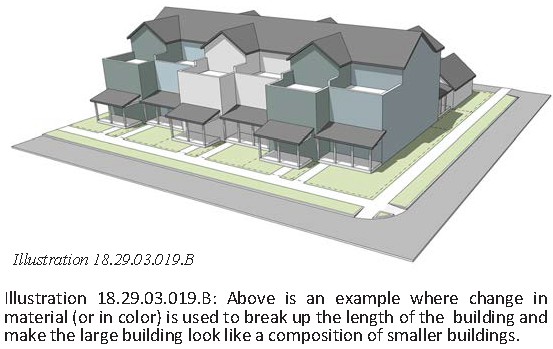
(Ord. No. 2209, § 2(Exh. G), 6-6-2023)
18.29.03.020 - MAIN STREET FORM TYPES - APPLICATION OF FORM STANDARDS
1.
GENERAL INTENT AND USE OF FORM TYPE
a.
The main street form types are provided to:
1.
Allow for attached multi-household buildings to be located close to the front lot line and sidewalk, including two-, three-, four-, and five-story formats.
2.
Provide for high-transparency storefronts that are directly adjacent to sidewalks on the first story of new buildings.
3.
Enhance pedestrian corridors that are adjacent to commercial development through the use of design treatments and street furniture such as awnings, benches, planters, and other amenities that reinforce pedestrian activity.
b.
This section shall not be interpreted to set forth substantive requirements.
2.
INTENT AND APPLICATION OF STANDARDS
a.
In General. This subsection 2 sets forth the intentions for specific regulatory tools used for main street form types.
b.
"Build-to" Requirements. Minimum and maximum setback requirements are established along primary and side street lot lines in order to ensure that buildings are consistently located close to the sidewalk, providing a sense of enclosure along the street, and in combination with street- level transparency requirements, enhancing the pedestrian experience by providing visual interest and security.
c.
Secondary Setbacks. Additional, secondary front setbacks are required for main street form types with frontages of 125 ft. or more, in order to:
1.
Maintain a sense of scale along the block by breaking up the building mass as experienced by the pedestrian;
2.
Create or maintain plazas framed by large buildings, which may serve as pedestrian activity areas; and
3.
Create opportunities for additional ground floor retail frontages.
d.
Upper Floor Setbacks. Upper-story setbacks (a.k.a. step-backs) are required for main street form types in order to:
1.
Maintain a sense of scale along the block by mitigating the impact of building mass as experienced by the pedestrian;
2.
Creating opportunities to enhance the outdoor areas that are available for use by inhabitants of upper building floors, by way of decks, terraces, and balconies; and
3.
Enhancing the aesthetics of buildings by avoiding monolithic presentations of building mass.
e.
Off-Street Parking. Restrictions on the design and location of off-street parking are imposed in order to:
1.
Encourage the maintenance and establishment of small businesses; and
2.
Ensure that the continuity of pedestrian-friendly commercial and mixed-use frontages is not interrupted by surface parking lots and parking access points that may create psychological barriers to movement or increase the probability of vehicular-pedestrian conflicts.
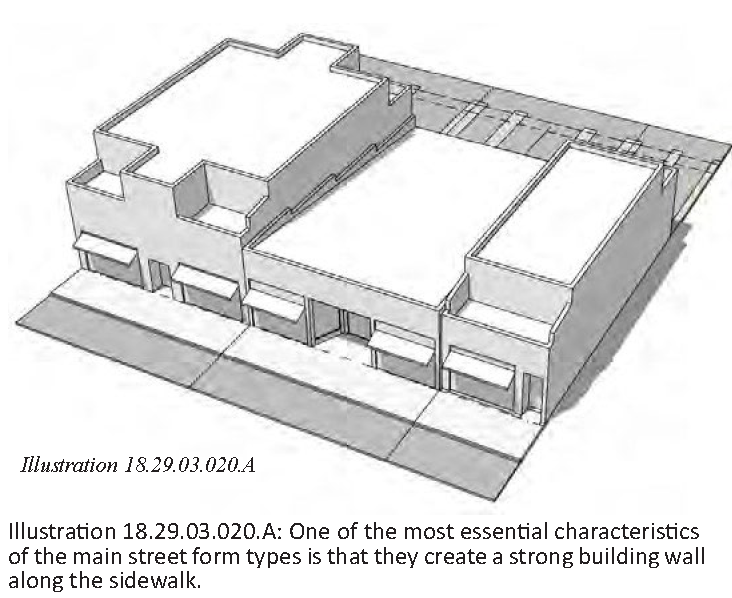
(Ord. No. 2209, § 2(Exh. G), 6-6-2023)
18.29.03.021 - MAIN STREET FORM TYPES - FORM STANDARDS
1.
MAIN STREET NARROW
a.
Intent.
The main street narrow form type is the most traditional and predominate among the form types in the main street form zones. This form type typically has a lot width that is a multiple of 25 ft., with parking at the rear of the lot, in integrated garages or attached parking structures, in basements, or off-site.
b.
Lot Standards.
1.
Min. lot frontage ..... 20 ft.
2.
Max. lot frontage ..... 125 ft.
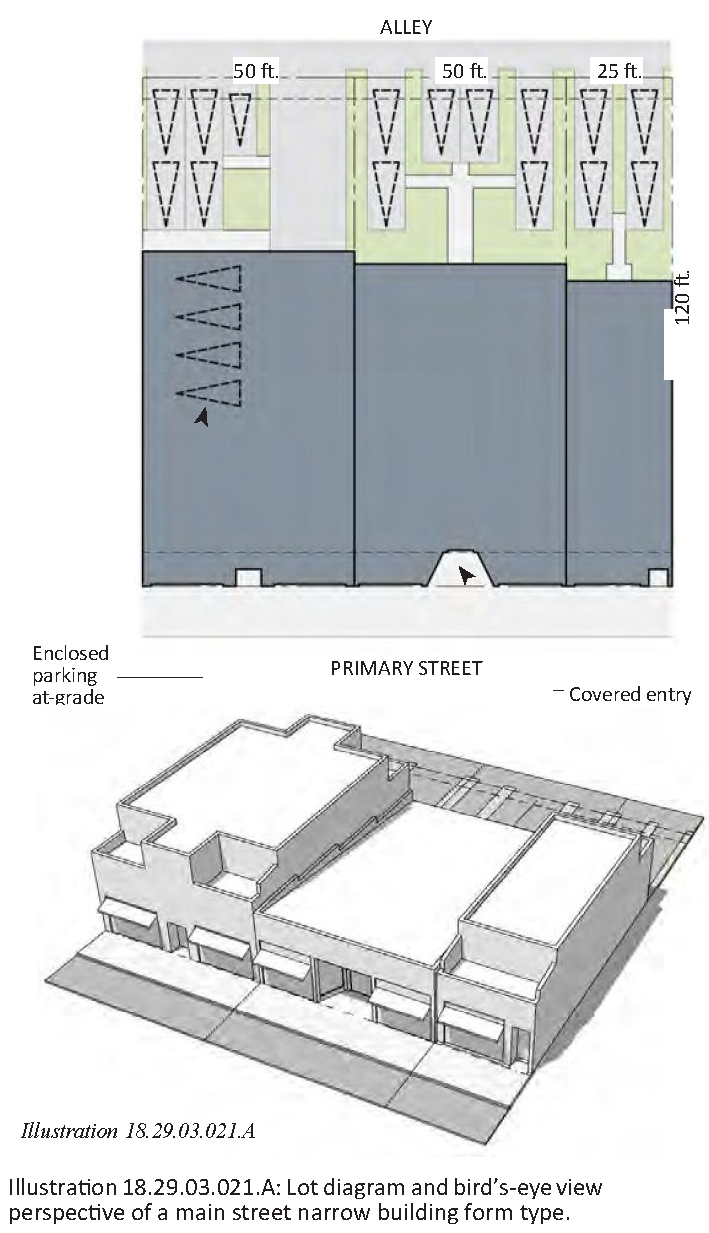
c.
Building Size.
1.
Max. building height ..... 3 stories/38 ft.
d.
Setbacks.
e.
Balconies and Terraces.
1.
Within the main street A and main street B form zones, each upper floor dwelling unit shall have a balcony (covered or uncovered) that is at least 80 s.f. in area.
2.
Any part of the roof of any floor (except the top floor) may be used as an uncovered terrace, which, if so used, is considered a balcony for the purposes of subsection e.1, above.
f.
Additional Standards.
1.
Within the main street A and main street B form zones, no curb cuts are allowed on the primary street or side street.
2.
All garage doors that face a rear alley shall be set back not more than 5 ft., or set back 20 ft. or more, from the rear lot line.
3.
No dwelling units are permitted on the 1st story within 18 ft. of a front or side street lot line.
4.
No parking is permitted within the 1st story within 18 ft. of a front or side street lot line.
2.
MAIN STREET WIDE
a.
Intent.
The main street wide form type is intended to accommodate larger businesses along with office and/or residential uses located on upper floors. The upper story setbacks and plaza setback are intended to ensure that the building fits into the Main Street context. This form type has a street frontage of at least 125 ft., with parking at the rear of the building, in integrated garages or attached parking structures, in basements, or off-site.
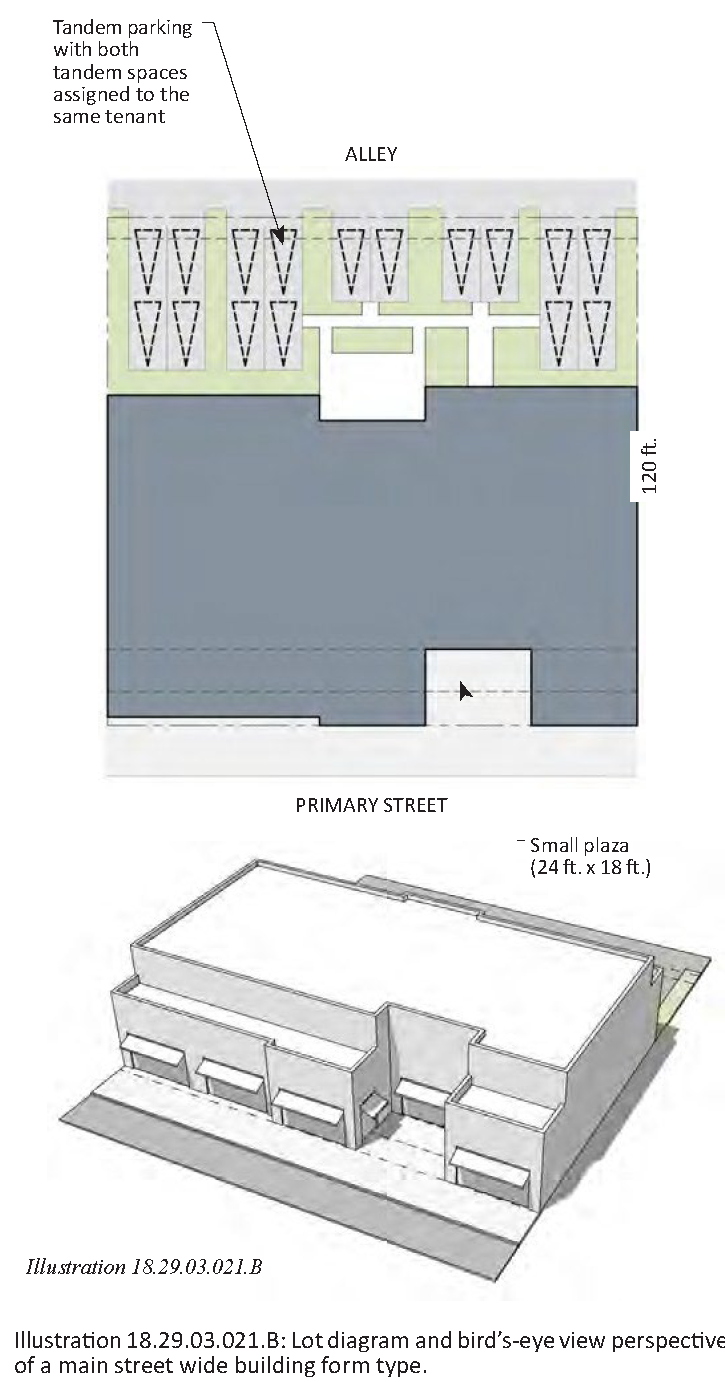
b.
Lot Standards.
1.
Min. lot area ..... 9,000 s.f.
2.
Min. lot frontage ..... 125 ft.
c.
Building Size.
1.
Max. building height ..... 3 stories/38 ft.
d.
Setbacks.
e.
Porch.
1.
Within the main street A and main street B form zones, each upper floor dwelling unit shall have a balcony (covered or uncovered) that is at least 80 s.f. in area.
2.
Any part of the roof of any floor (except the top floor) may be used as an uncovered terrace, which, if so used, is considered a balcony for the purposes of subsection e.1, above.
f.
Additional Standards.
1.
Within the main street A and main street B form zones, no curb cuts are allowed on the primary street or side street.
2.
All garage doors that face a rear alley shall be set back not more than 5 ft., or set back 20 ft. or more, from the rear lot line.
3.
No dwelling units are permitted on the 1st story within 18 ft. of a front or side street lot line.
4.
No parking is permitted on the 1st story within 18 ft. of a front or side street lot line.
3.
MAIN STREET URBAN NARROW
a.
Intent.
The main street urban narrow form type is intended to provide for additional density and intensity in locations where it is appropriate. The main street urban narrow form type provides parking in integrated garages or attached parking structures, in basements, at the rear of the lot, or off-site.
b.
Lot Standards.
1.
Min. lot frontage ..... 50 ft.
2.
Max. lot frontage ..... 125 ft.
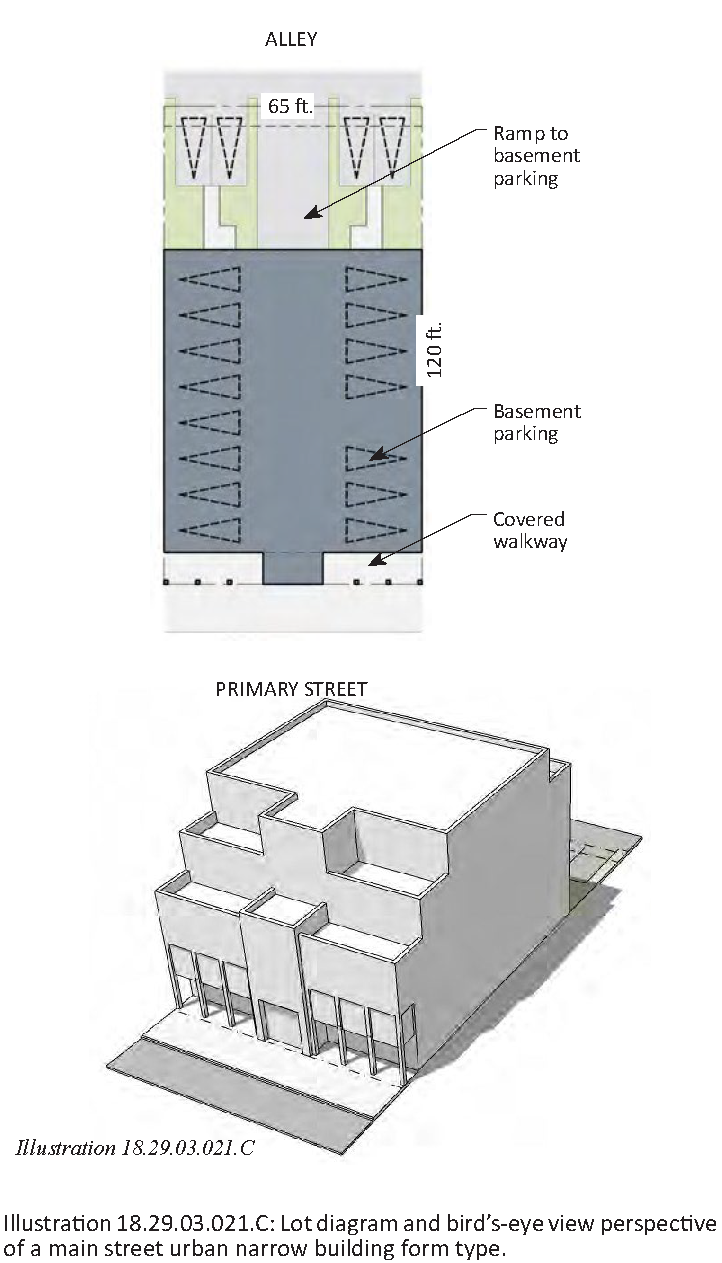
c.
Building Size.
1.
Max. building height ..... 5 stories/55 ft.
d.
Setbacks.
e.
Porch.
1.
Within the main street B form zone, each upper floor dwelling unit shall have a balcony (covered or uncovered) that is at least 80 s.f. in area.
2.
Any part of the roof of any floor (except the top floor) may be used as an uncovered terrace, which, if so used, is considered a balcony for the purposes of subsection e.1, above.
f.
Additional Standards.
1.
No curb cuts are allowed on the primary street or side street.
2.
All garage doors that face a rear alley shall be set back not more than 5 ft., or set back 20 ft. or more, from the rear lot line.
3.
No dwelling units are permitted on the first story within 18 ft. of a front or side street lot line.
4.
No parking is permitted on the ground floor within 18 ft. of a front or side street lot line.
4.
MAIN STREET URBAN WIDE
a.
Intent.
The main street wide form type is intended to provide for additional density and intensity where it is appropriate. The upper story setbacks as well as the plaza setback are intended to ensure that the building fits into the Main Street context. This form type has a street frontage of at least 125 ft., with parking at the rear of the building, in integrated garages or attached parking structures, in basements, or off-site.
b.
Lot Standards.
1.
Min. lot area ..... 9,000 s.f.
2.
Min. lot frontage ..... 125 ft.
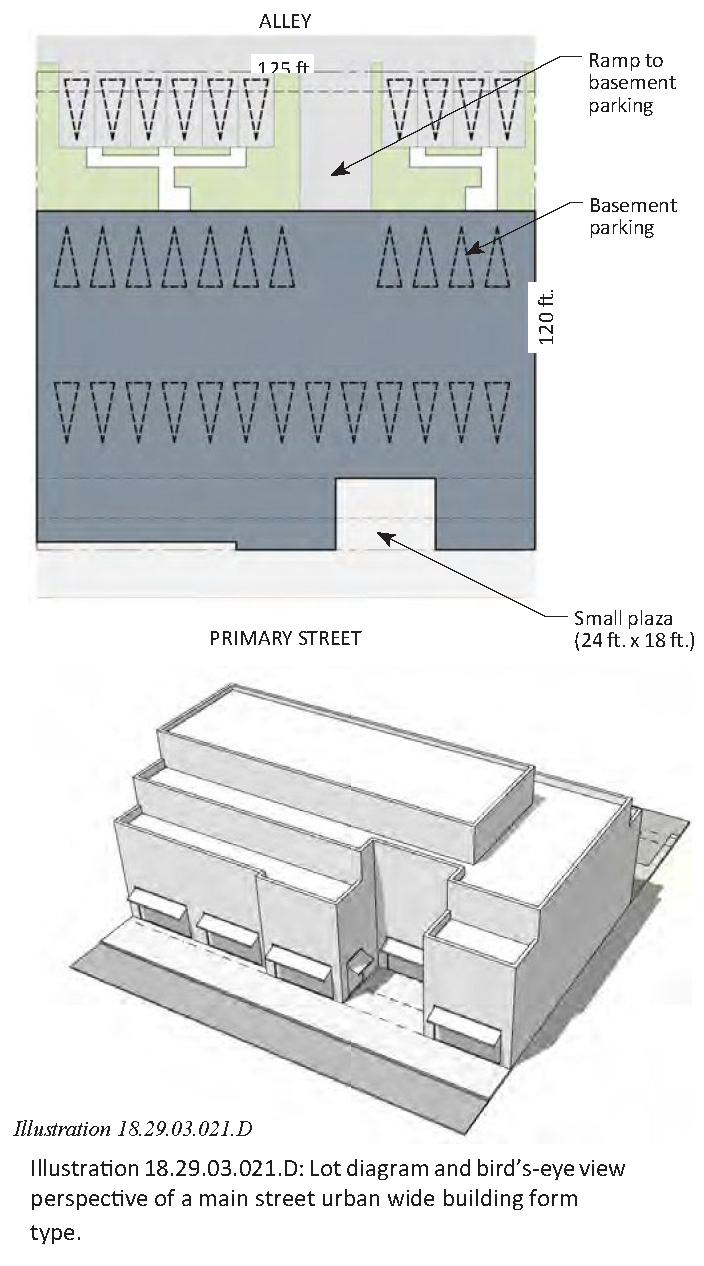
c.
Building Size.
1.
Max. building height ..... 5 stories/55 ft.
d.
Setbacks.
e.
Porch.
1.
Each dwelling unit shall have a porch or balcony (covered or uncovered) that is at least 80 s.f. in area.
2.
Any part of the roof of any floor (except the top floor) may be used as an uncovered terrace, which, if so used, is considered a balcony for the purposes of subsection e.1, above.
f.
Additional Standards.
1.
No curb cuts are allowed on the primary street or side street.
2.
All garage doors that face a rear alley shall be set back not more than 5 ft., or set back 20 ft. or more, from the rear lot line.
3.
No dwelling units are permitted on the first story within 18 ft. of a front or side street lot line.
4.
No parking is permitted on the first story within 18 ft. of a front or side street lot line.
(Ord. No. 2209, § 2(Exh. G), 6-6-2023)
18.29.03.022 - MAIN STREET FORM TYPES - DESIGN STANDARDS AND GUIDELINES
1.
APPLICABILITY
a.
This section applies to the main street form types (listed below for ease of reference):
1.
Main Street Narrow.
2.
Main Street Wide.
3.
Urban Main Street Narrow.
4.
Urban Main Street Wide.
b.
Chapter 18.40 also applies to main street form types as set out therein.
c.
Each subsection below sets out a statement of intent, followed by requirements, followed (in some cases) by guidelines. The statement of intent provides background information and is not regulatory in nature. The requirements must be met unless adjusted pursuant to division VII. The guidelines are used in the administration of certain parts of division VII, and are otherwise suggestions (not requirements).
2.
MASSING AND ARTICULATION
a.
Intent. The intent of the massing and articulation standards is to utilize simplified articulation standards to promote visual compatibility with the historic street-facing facades, and to reduce the vertical scale of buildings by accentuating the first story elements and diminishing building elements above the 3rd story.
b.
Requirements.
1.
Wall plane projections or recessions of at least 2 ft. over a horizontal distance of at least 30 percent of the total facade area:
A.
In one or more intervals that is a multiple of 25 ft., more or less, to visually reinforce the historic facade widths described in Subsection 6.b.4, below; or
B.
In the form of small plazas (as required for main street wide and main street urban wide form types).
2.
All public facing facades shall articulate a building's vertical massing to accentuate specific stories and diminish the upper-most story treatment, by:
A.
Distinguishing the 1st story architecture through use of two of the following tools: color, material, textures, or structural elements. The ground floor shall be anchored to the pedestrian realm to draw the eye from the upper floors.
B.
Diminishing the upper-most story of the building through a change in two of the following categories: color, material, texture, roof pitch, or a recession of the total facade [See photo 18.29.03.022.A].
c.
Guidelines.
1.
Provide different accents (by design, indentation, color, and/or material) to highlight entrances for different uses, such as shops and street-level entrances to upper story offices or residences.
2.
Shopfront garage doors or folding doors should be used when there is an opportunity to expand the indoor use into the sidewalk.
3.
PORCH AND BALCONY CHARACTERISTICS
a.
Intent. The intent of the porch and balcony standards is to provide visual interest through the interplay among solids and voids on the facade, and to soften visual and psychological barriers between the interior and exterior of the building.
b.
Guidelines.
1.
Balconies (covered or uncovered), terraces, porches, and colonnades should be used to break up the appearance of building mass (both horizontally and vertically) when feasible. The design of these elements should be differentiated at various locations on the building to further emphasize the breaks in the massing of the building [See photo 18.29.03.022.B, next page].
2.
When feasible, uncovered balconies and terraces that are accessible to the uppermost stories should be used to deemphasize the building's height.
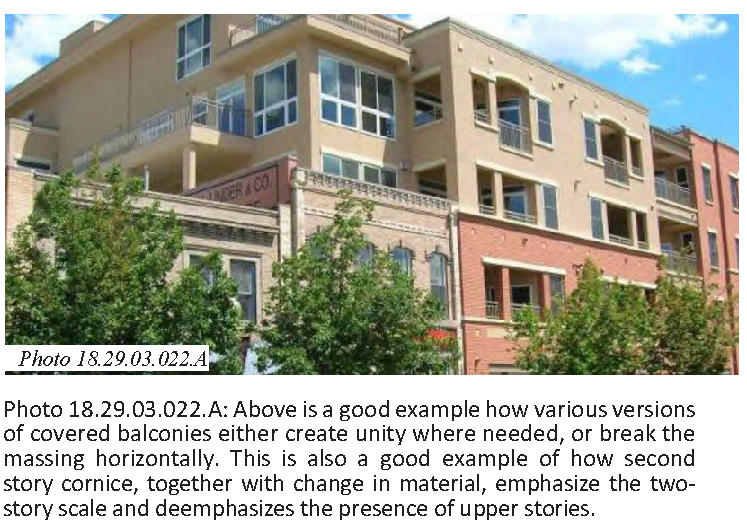
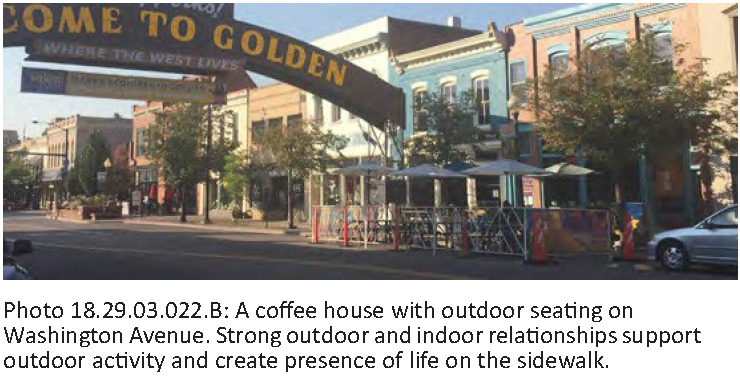
3.
Porches should be integrated into the design of perimeter landscaping, streetscaping, and hardscaping.
4.
TRANSPARENCY AND BLANK WALLS
a.
Intent. The intent of the transparency standards is to avoid blank walls, promote pedestrian interest, and improve security by providing a visual connection between the building interior and the adjacent sidewalk.
b.
Requirements.
1.
Wall planes that exceed 20 ft. in width that face streets, parks, or plazas shall include fenestration such that:
A.
Not less than 50 percent of the area of the facade between 2 ft. and 8 ft. above ground level is transparent (tinted or mirrored glass that diminishes visibility into the building by 50 percent or more is not allowed); and
B.
Not less than 30 percent of the total area of the facade is transparent.
2.
No street-facing area of wall plane that is greater than 10 ft. in width and 10 ft. in height (100 s.f. or more) shall be "blank," in that it does not include:
A.
A substantial change in cladding materials (a simple color change is not sufficient to meet this requirement);
B.
A window or a door; or
C.
A column, pilaster, balcony, cornice, shade element (e.g., awning), or other articulation greater than 12 in. in projecting dimension.
5.
FACADE CONFIGURATION
a.
Intent. The intent of the facade configuration requirements and guidelines is to preserve and enhance the main street character and architectural integrity of Downtown Golden.
b.
Requirements.
1.
Awnings shall not be back-lit or internally illuminated.
2.
A minimum of 8 ft. of clearance is required between the bottom of an awning and the grade below the awning.
c.
Guidelines.
1.
New construction should incorporate architectural elements from adjacent buildings in terms of opening proportions and primary facade features such cornices, awnings, transoms, and trims.
2.
Exterior renovations should be complimentary to the unique architectural style of the existing building. The proportions and the character of building openings should be preserved to the extent feasible.
6.
EXTERIOR MATERIALS
a.
Intent. The intent of the exterior materials standards is to break up building length and height and create unity on an overall facade.
b.
Requirements.
1.
Allowed exterior wall materials are horizontal and vertical siding, real stucco, or masonry (brick, stone, cementous siding, or concrete). Siding patterns shall be one of the following: horizontal bevel, drop siding, vertical tongue and groove, shingles/shakes, or board and batten.
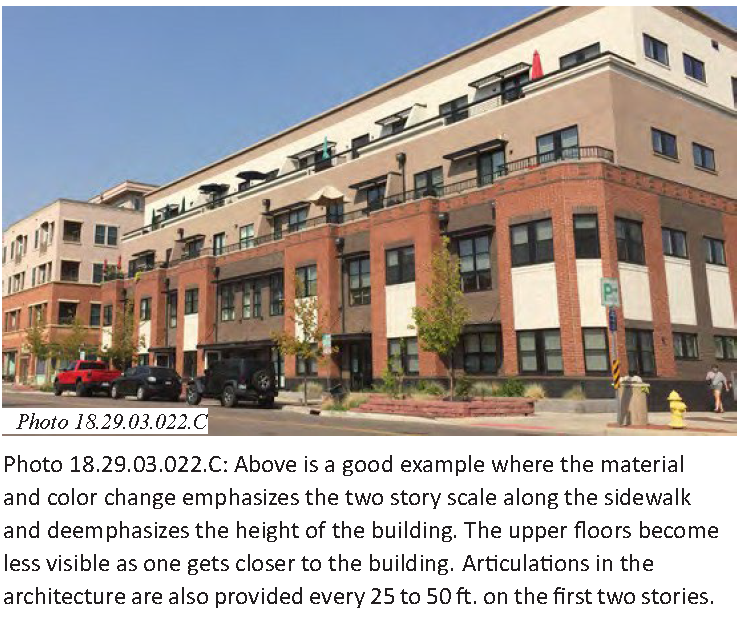
2.
The following materials may be used as accent materials on any facade, provided that they do not cover more than 25 percent of the facade:
A.
Metal panels.
B.
Oversized brick, concrete masonry units, or other similar materials.
3.
Material changes shall occur along a vertical line at interior (concave) corners, or along a horizontal line at a floor line or a gable end. Material and color changes may also occur along a horizontal line that is at least 2 ft. above the foundation, so long as that change is along the entire length of the facade.
4.
No more than four cladding materials are allowed.
5.
Material and color changes shall be used to de-emphasize building height. [See photo 18.29.03.022.C.]
6.
Material and color changes shall be used to express the historic 25 ft. and 50 ft. intervals (more or less), of the historic facade widths that are present in Downtown Golden between 11th Street and 14th Street along Washington Avenue. [See photo 18.29.03.022.C.]
c.
Guidelines.
1.
In general, smooth brick with narrow joints and wood siding with narrow lap should be used for cladding. Stone should be reserved for detailing at cornices and windows and for use at the building base.
2.
In general, lighter materials should be placed above those of heavier weight.
(Ord. No. 2209, § 2(Exh. G), 6-6-2023)
18.29.03.023 - MIXED-USE FORM TYPES - APPLICATION OF FORM STANDARDS
1.
GENERAL INTENT AND USE OF FORM TYPE
a.
The mixed-use form types are provided to:
1.
Provide additional attainable housing options.
2.
Provide additional housing options closely located to urban amenities.
3.
Increase opportunities for social and economic diversity within the community of Golden.
b.
Mixed-use forms may include a mix of uses that are allowed by the applicable use zone, but a mix of uses is not a requirement.
c.
This section shall not be interpreted to set forth substantive requirements.
2.
INTENT AND APPLICATION OF STANDARDS
a.
In General. This subsection 2 sets forth the intentions for specific standards that are applied to mixed-use building form types.
b.
Building Height. Some mixed-use building form types limit the number of stories to promote compatibility with existing buildings that developed between the 1850s and 1960s, specifically those buildings that are two stories in height.
c.
Porches and Balconies. Porch and balcony requirements are imposed on some mixed-use building form types to:
1.
Accentuate the first-story elements of a building from the pedestrian realm (right-of-way/sidewalk) and decrease the building's perceived scale and massing.
2.
Provide better transition between the front of a building and the pedestrian realm (right-of-way/sidewalk) by decreasing the distance between these areas.
3.
Maintain the front porch as a common element found in existing buildings, specifically those constructed between the 1850s and 1960s.
d.
Small Mixed-Use Form Types. Small mixed-use building form types are provided to:
1.
Ensure compatibility of new commercial, residential, or office uses and buildings into the existing built environment of Golden (existing buildings are typically smaller in scale).
2.
Allow for the integration of commercial and office uses close to existing residential neighborhoods through small minimum lot sizes.
(Ord. No. 2209, § 2(Exh. G), 6-6-2023)
18.29.03.024 - MIXED-USE FORM TYPES - FORM STANDARDS
1.
MIXED-USE SMALL BUILDING
a.
Intent and Special Characteristics.
1.
Intent. The intent of the mixed-use small building form type is to provide for mixed-use buildings that are physically compatible in a small-scale neighborhood context. This form may be utilized for residential, nonresidential, or mixes of uses, provided that the uses are allowed in the applicable use zone.
2.
Special Characteristics. The mixed-use small building form types have two building envelope areas (BEAs):
A.
Front BEA ..... 50%
B.
Rear BEA ..... 50%
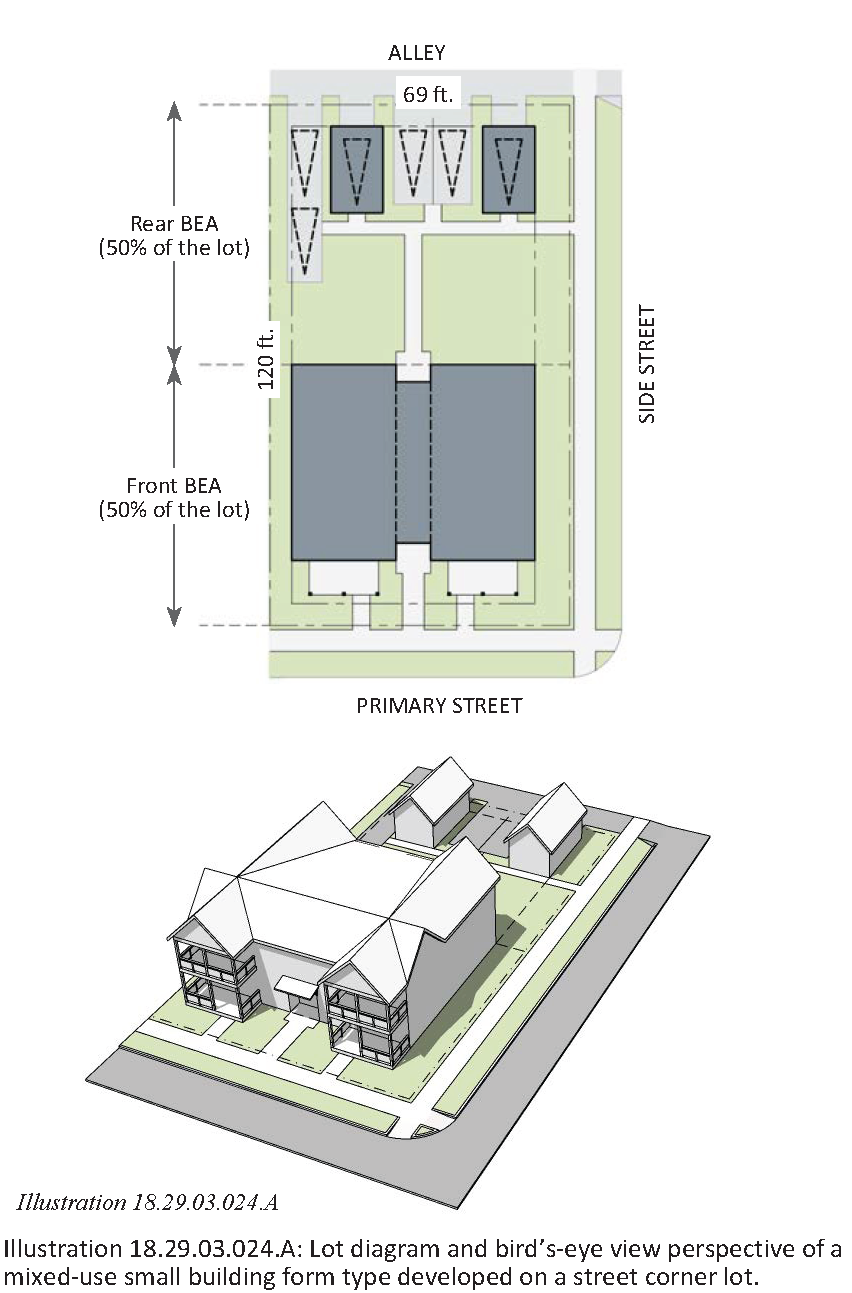
b.
Lot Standards.
1.
Min. lot area ..... 6,500 s.f.
2.
Min. lot frontage ..... 63 ft.
3.
Min. lot depth ..... 90 ft.
c.
Building Size and Dwelling Unit Limitations.
1.
Max. total floor area per mixed-use small building ..... 4,800 s.f.
2.
Max. building height by BEA [See f.3] -
A.
Front BEA ..... 2 stories/35 ft.
B.
Rear BEA ..... 1 story/20 ft.
3.
Max. no. of dwelling units ..... 4 per lot
d.
Setbacks.
1.
Primary street ..... 15 ft. min.
2.
Porch at primary street. 7 ft. min./20 ft. max.
3.
Side street ..... 8 ft. min.
4.
Porch at side street ..... 4 ft. min./20 ft. max.
5.
Interior side lot line ..... 5 ft. min. [See f.4]
6.
Rear lot line/alley ..... 5 ft. min.
e.
Porch.
1.
In the edge form zone, at least 100 s.f. of porch space must be provided in area facing the primary street, or, if present, the side street.
2.
Two-story porches, or porches under or combined with balconies (covered or uncovered), are also allowed, and may be located within the porch setbacks.
f.
Additional Standards.
1.
Mixed-use small building form type is permitted only on lots with alley access. No curb cuts to serve a lot are allowed on the primary street or the side street (if present).
2.
All garage doors that face a rear alley shall be set back not more than 5 ft., or set back 20 ft. or more, from the rear lot line.
3.
The principal building shall be located within the front BEA. Accessory buildings and accessory structures shall be located behind the principal building (in either the front or rear BEA).
4.
A single-story garage may encroach into the interior side lot line setback if the adjacent lot falls within a form zone that allows one or more of the mixed-use building form types.
2.
MIXED-USE COURTYARD BUILDING
a.
Intent and Special Characteristics.
1.
Intent. The mixed-use courtyard building form type may be utilized for residential, nonresidential, or mixes of uses, provided that the uses are allowed in the applicable use zone.
2.
Special Characteristics. The mixed-use courtyard building form type has two building envelope areas (BEAs):
A.
Front BEA ..... 60%
B.
Rear BEA ..... 40%
b.
Lot Standards.
1.
Min. lot area ..... 9,000 s.f.
2.
Min. lot frontage ..... 75 ft.
3.
Min. lot depth ..... 110 ft.
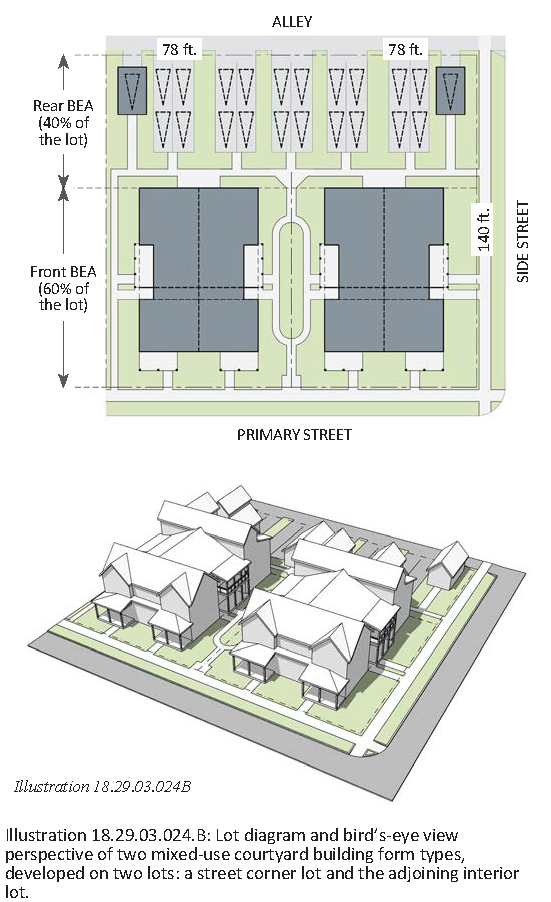
c.
Building Size and Dwelling Unit Limitations.
1.
Max. total floor area ..... 9,000 s.f. per lot
2.
Max. floor area of 3rd floor ..... 1,200 s.f. per lot
3.
Max. building height by BEA -
A.
Front BEA ..... 3 stories/45 ft.
B.
Rear BEA ..... 1 story/20 ft.
4.
Max. no. of dwelling units ..... 8 per lot
d.
Setbacks by BEA.
e.
Porch or Covered Balcony.
1.
In the edge form zone, each dwelling unit shall have a porch or covered balcony. For not less than half of the dwelling units with outer walls that are within 20 ft. of a front or side street lot line, the porch or covered balcony shall face the street and be at least 50 s.f. in area.
2.
Two story porches, or porches under or combined with balconies (covered or uncovered), are also allowed, and may be located within the porch setbacks.
f.
Additional Standards.
1.
The mixed-use courtyard building form type is permitted only at lots with alley access. No curb cuts to serve a lot are allowed on the primary street or the side street (if present).
2.
All garage doors that face a rear alley shall be set back not more than 5 ft., or set back 20 ft. or more, from the rear lot line.
3.
The rear BEA shall be used only for accessory buildings and accessory structures.
4.
A single-story garage may encroach into the interior, side lot line setback if the adjacent lot falls within a form zone that allows one or more of the mixed-use building form types.
(Ord. No. 2209, § 2(Exh. G), 6-6-2023)
18.29.03.025 - MIXED-USE FORM TYPES - DESIGN STANDARDS AND GUIDELINES
1.
APPLICABILITY
a.
This section applies to the mixed-use form types (listed below for ease of reference):
1.
Small mixed-use building.
2.
Mixed-use courtyard building.
b.
Chapter 18.40 also applies to mixed-use form types as set out therein.
c.
Each subsection below sets out a statement of intent, followed by requirements, followed (in some cases) by guidelines. The statement of intent provides background information and is not regulatory in nature. The requirements must be met unless adjusted pursuant to division VII. The guidelines are used in the administration of certain parts of division VII, and are otherwise suggestions (not requirements).
2.
OUTDOOR AMENITIES
a.
Intent. The intent of the outdoor amenities standards is to ensure that mixed-use building forms are enhanced with outdoor spaces that include amenities for the benefit of their occupants.
b.
Requirements.
1.
An area equal to 15 percent of the lot size shall be used for outdoor amenities. This area may include:
A.
Ground-level outdoor areas;
B.
Balconies that are 100 s.f. in area or larger; and
C.
Areas of rooftops that are improved with recreational amenities that are available to building occupants.
2.
Outdoor amenities include walkways, pedestrian paths, open plazas, terraces, natural drainage ways and drainage ponds, playgrounds, areas with benches, outdoor furnishings, and other places for sitting, and other areas designed specifically for active or passive recreational use.
3.
Areas allocated for outdoor amenities shall not include areas that are used for outdoor storage, paved areas that are designed to accommodate motor vehicle uses (e.g., parking, drive aisles, etc.), or areas used for trash and recycling facilities.
4.
At least 50 percent of ground-level outdoor amenity areas shall be landscaped with living plant material.
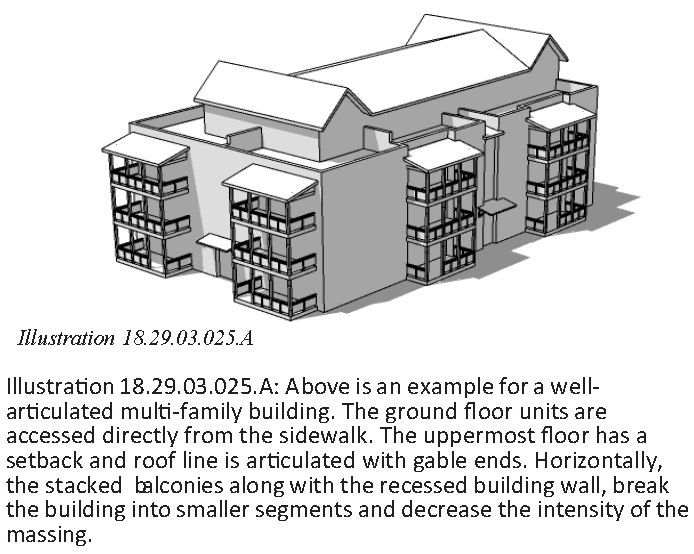
c.
Guidelines. Outdoor amenity areas should be:
1.
Organizing features of the lot.
2.
Designed and configured to encourage outdoor activity by building occupants (the types of amenities provided should relate to the anticipated occupancy of the building).
3.
High-quality, including durable, attractive, low maintenance structures and furnishings.
4.
Designed, dimensioned, and configured with seasonal solar access in mind.
3.
MASSING, ARTICULATION, AND TRANSPARENCY
a.
Intent. The intent of the massing and articulation standards is to use facade articulation to reduce the scale of the building (both in height, to make the building look shorter, and length, to make the building look as if it was composed of smaller buildings), and to avoid excessive repetition, as well as too much complexity in the facade design.
b.
Requirements.
1.
All public facing facades shall be articulated horizontally. Wall planes that exceed 30 ft. in width that face streets, sidewalks, parks, or plazas must include at least one of the following:
A.
Fenestration such that not less than 50 percent of the area of the facade between 2 ft. and 8 ft. above ground level is transparent (tinted or mirrored glass that diminishes visibility into the building by 50 percent or more are not allowed); and not less than 30 percent of the total area of the facade is transparent; or
B.
Wall plane projections or recessions of at least 2 ft. over a horizontal distance of at least 30 percent of the total facade area.
2.
All public facing facades shall articulate a building's vertical massing to accentuate specific stories and diminish the upper-most story treatment.
A.
The building design shall distinguish the ground floor (1st story) architecture through use of two of the following: color, material, textures, or structural elements. The ground floor shall be anchored to the pedestrian realm and draw the eye from the upper-most stories of a building.
B.
The building design shall diminish the upper-most story of the building through a change in two of the following: color, material, texture, roof pitch, or a recession of the total facade. The upper-most story treatment shall deemphasize the impact building mass.
3.
Distinct entrances shall be included on all facades facing the public realm.
c.
Guidelines.
1.
Architectural elements such as entries, porches, balconies, bays, cornices, and parapets should be accentuated.
2.
Building massing should be broken up with common areas and landscaping when feasible.
3.
Changes in building height by means of vertical extensions or recessions of the facade are encouraged to emphasize important building elements particularly at courtyard entries, building entries, and street corners.
4.
PORCH CHARACTERISTICS
a.
Intent. The intent of the porch standards is to provide valuable amenities for internal units, to create a desirable scale along the sidewalk, to articulate the building's massing when residential units are present on the first story, and to provide access from the sidewalk through a well-sized porch.
b.
Requirements.
1.
The porches and balcony shall not be elevated more than one step down from the finished floor of a unit.
2.
Secondary entries shall be provided to all first story dwelling units by means of porches, decks, patios, stoops, or above-grade stairways at street level. Secondary entries shall be at least 50% open except for the side abutting the facade.
c.
Guidelines.
1.
Large porches and balconies are encouraged.
2.
At corners a wraparound configuration should be employed when feasible for residential uses.
5.
EXTERIOR MATERIALS
a.
Intent. The intent of exterior material standards is to provide for changes in materials that accentuate massing articulations, and break up the appearance of building mass such that large buildings resemble multiple smaller buildings.
b.
Requirements.
1.
Allowed exterior wall materials are horizontal and vertical siding, real stucco, or masonry (brick, stone, cementous siding, or concrete). Siding patterns shall be one of the following: horizontal bevel, drop siding, vertical tongue and groove, shingles/shakes, or board and batten.
2.
Material changes shall occur along a vertical line at interior (concave) corners, or along a horizontal line at a floor line or a gable end. Material and color changes may also occur along a horizontal line that is at least 2 ft. above the foundation, so long as that change is along the entire length of the facade.
c.
Guidelines.
1.
Material changes should be used to accentuate massing articulations.
2.
In general the lighter materials should be placed above those of heavier weight.
(Ord. No. 2209, § 2(Exh. G), 6-6-2023)
18.29.03.026 - SHOP FORM TYPES - APPLICATION OF FORM STANDARDS
1.
GENERAL INTENT
a.
The shop form types are provided to encourage development of auto-oriented buildings that create a unique pedestrian experience near the street by:
1.
Situating parking near the rear of the lot.
2.
Locating the principal buildings near the front of the lot and sidewalk to generate pedestrian interest.
b.
The shop form types compliment main street form types that promote a walkable environment and other developments that promote sidewalk corridors along Golden's streets.
c.
This section shall not be interpreted to set forth substantive requirements.
2.
INTENT AND APPLICATION OF STANDARDS
a.
In General. This subsection 2 sets forth the intentions for specific standards that are applied to shop form types.
b.
Building Height. Building height for shop form types is limited to 38 ft. to provide for compatibility of building mass with other form types that are typically located adjacent to shop form types, including main street form types.
c.
No Parking in Front. No parking is permitted within a certain distance of the front lot line for shop form types, in order to:
1.
Encourage locating building in the front of the lot, close to the sidewalk.
2.
Create a more pedestrian friendly environment along the street.
3.
Ensure continuity of the pedestrian sidewalk experience by locating shop form types next to other form types that promote pedestrian activity. [See illustration 18.29.03.026.A.]
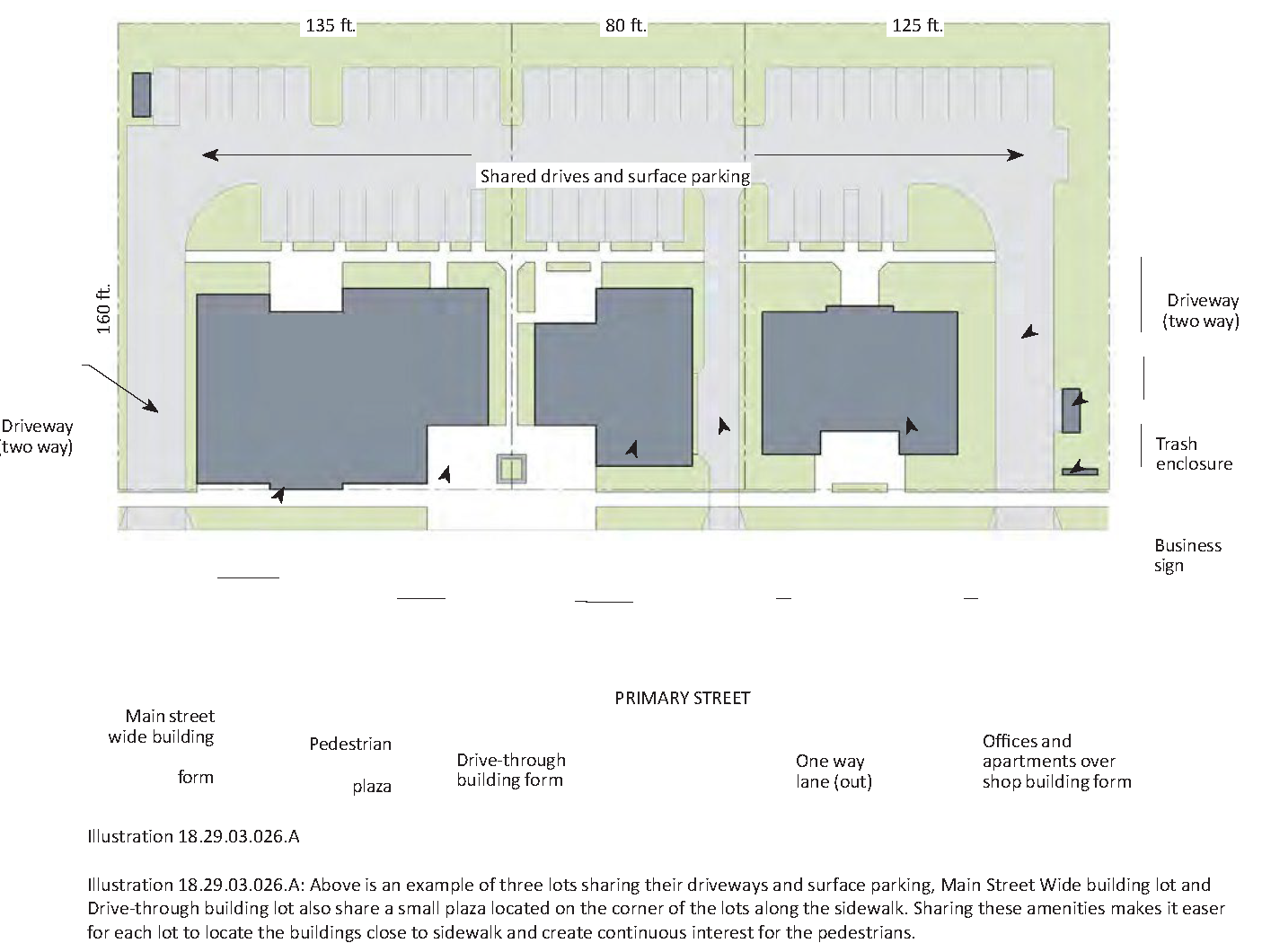
(Ord. No. 2209, § 2(Exh. G), 6-6-2023)
18.29.03.027 - SHOP FORM TYPES - FORM STANDARDS
1.
SHOP/OFFICES AND APARTMENTS OVER SHOP
a.
Intent.
The shop/offices and apartments over shop form type permits a wide range of buildings that can accommodate a wide range of uses, from a single user to multiple-tenant buildings that may include a mix of residential and non-residential uses. When opportunities are available and such connections are appropriate, sharing driveways and connecting parking lots across adjacent properties is both permitted and encouraged.
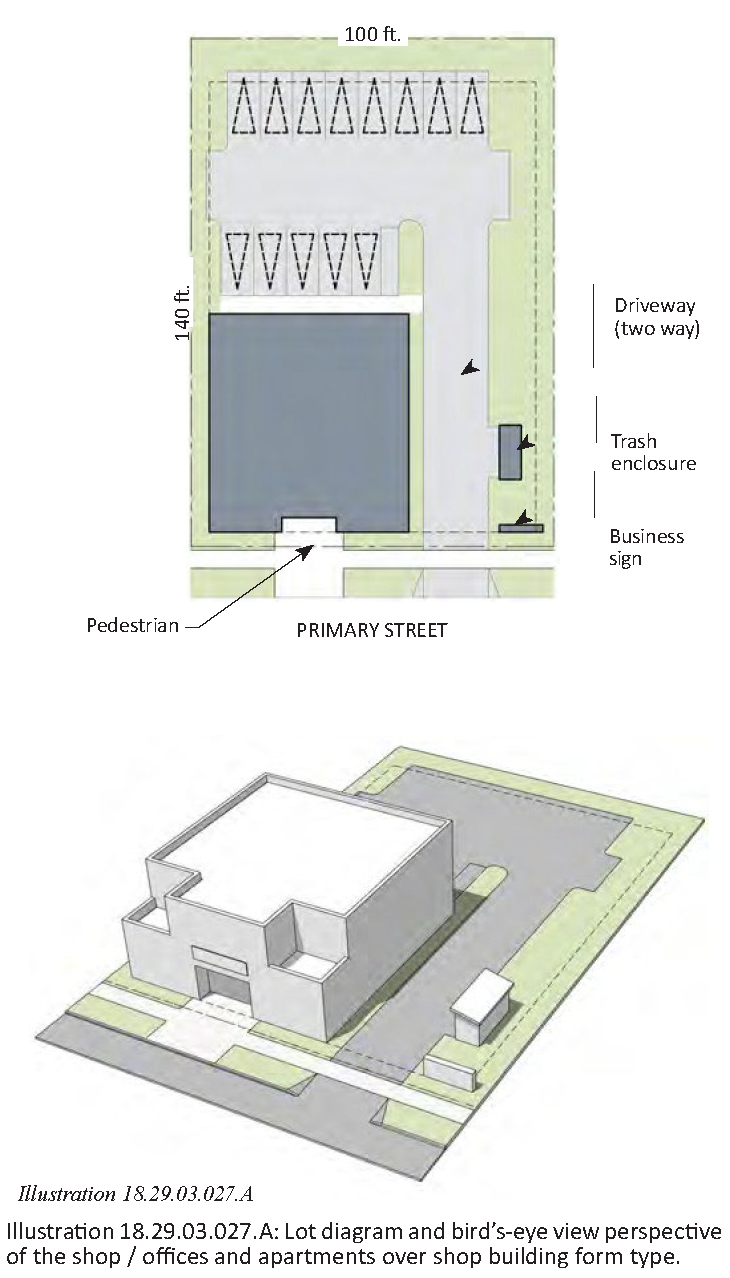
b.
Lot Standards.
1.
Min. lot area ..... 8,000 s.f.
2.
Min. lot frontage ..... 70 ft.
3.
Min. lot depth ..... 120 ft.
c.
Building Size.
1.
Max. building height ..... 3 stories/38 ft.
d.
Setbacks.
1.
Primary street ..... 4 ft. min.
2.
Side street ..... 4 ft. min.
3.
Interior side lot line ..... 5 ft. min.
4.
Rear lot line -
A.
With alley present ..... 5 ft. min.
B.
With no alley present ..... 12 ft. min.
e.
Additional Standards.
1.
The primary entrance to the building shall face the primary street. Secondary entrances at the rear or sides of buildings are also permitted.
2.
No residential use is allowed on the ground floor.
3.
No surface parking is allowed:
A.
Within 40 ft. of the primary street property line along 50 percent of the frontage; and
B.
Within 16 ft. of the primary street property along the other 50 percent of the frontage.
4.
All garage doors that face a rear alley shall be set back not more than 5 ft., or set back 20 ft. or more, from the rear lot line.
5.
All garage doors that face a primary street or side street shall be set back at least 20 ft. from the lot line that is coterminous with that street.
6.
Buildings that contain a residential use shall comply with the "Outdoor Amenities" standards found in Section 18.29.03.025(2).
2.
DRIVE-THROUGH
a.
Intent.
The drive-through building form type accommodates drive-through, "app-through", vehicle service, delivery businesses. This form type permits one or more drive-through businesses in a single building, and may also accommodate offices and apartments in the building's upper stories (if any). This form type is intended to be flexible and inclusive. When available, sharing driveways and connecting parking lots with the parking lots of the neighboring properties shall be permitted and encouraged.
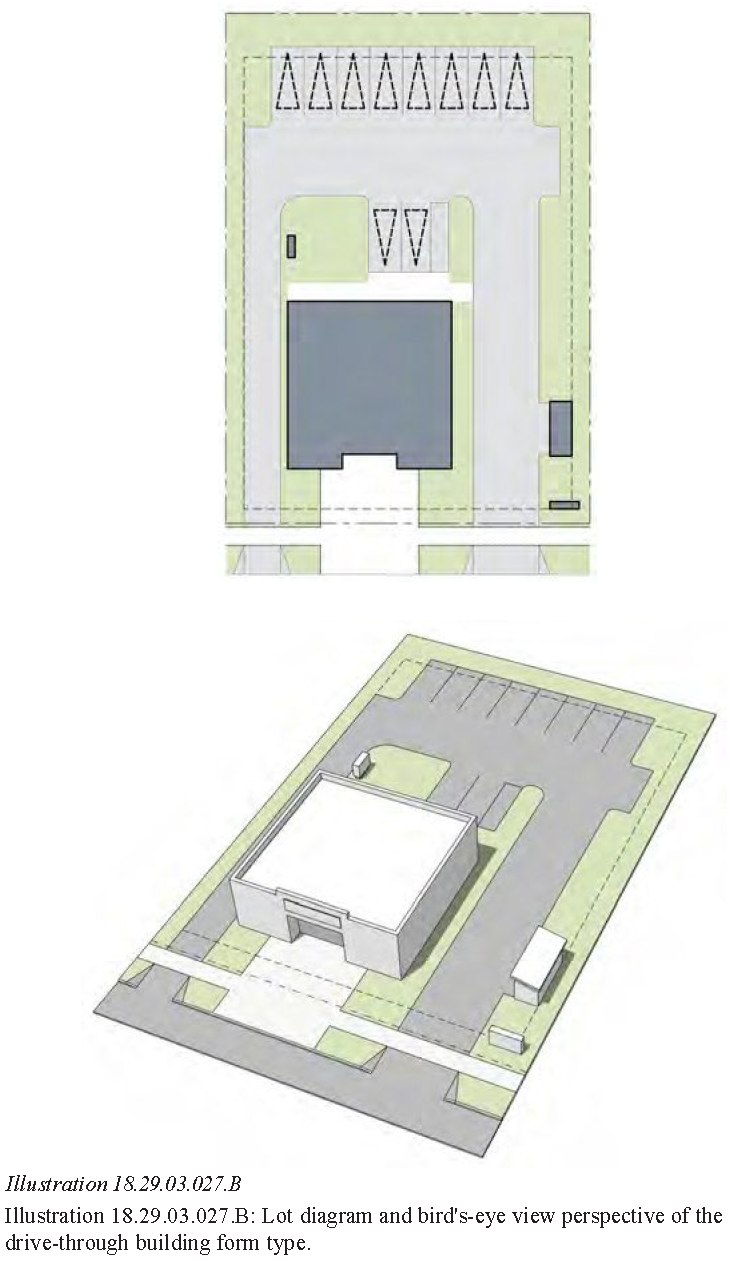
b.
Lot Standards.
1.
Min. lot area ..... 8,000 s.f.
2.
Min. lot frontage ..... 70 ft.
3.
Min. lot depth ..... 120 ft.
c.
Building Size.
1.
Max. building height ..... 3 stories/38 ft.
d.
Setbacks.
1.
Primary street ..... 4 ft. min.
2.
Side street ..... 4 ft. min.
3.
Interior side lot line ..... 5 ft. min.
4.
Rear lot line -
A.
With alley present ..... 5 ft. min.
B.
With no alley present ..... 12 ft. min.
e.
Additional Standards.
1.
No drive-through pick-up window shall face the primary or side street; it may be located at either the interior side or rear lot lines.
2.
The primary pedestrian entrance to the building shall face the primary street. Secondary entrances at the rear or sides of buildings are also permitted.
3.
No residential use is allowed on the ground floor.
4.
No surface parking is allowed:
A.
Within 40 ft. of the primary street property line along 50 percent of the frontage; and
B.
Within 16 ft. of the primary street property line along the other 50 percent of the frontage.
5.
All garage doors that face a rear alley shall be set back not more than 5 ft., or set back 20 ft. or more, from the rear lot line.
6.
All garage doors that face a primary street or side street shall be set back at least 20 ft. from the lot line that is coterminous with that street.
7.
Buildings that contain a residential use shall comply with the "Outdoor Amenities" standards found in Section 18.29.03.025(2).
(Ord. No. 2209, § 2(Exh. G), 6-6-2023)
18.29.03.028 - SHOP FORM TYPES - DESIGN STANDARDS AND GUIDELINES
1.
APPLICABILITY
a.
This section applies to the mixed-use form types (listed below for ease of reference):
1.
Shop/Offices and Apartments over Shop.
2.
Drive-Through.
b.
Chapter 18.40 also applies to shop form types as set out therein.
c.
Each subsection below sets out a statement of intent, followed by requirements, followed (in some cases) by guidelines. The statement of intent provides background information and is not regulatory in nature. The requirements must be met unless adjusted pursuant to division VII. The guidelines are used in the administration of certain parts of division VII, and are otherwise suggestions (not requirements).
2.
MASSING AND ARTICULATION
a.
Intent. The intent of the massing and articulation standards is to use facade articulation to reduce the scale of the building (both in height, to make the building look shorter, and length, to make the building look as if it was composed of smaller buildings), and to avoid excessive repetition.
b.
Requirements.
1.
Building facades that are wider than 50 feet shall be articulated to make the building look as if it is a composition of multiple buildings ("modules") at intervals of 25 or 50 feet (more or less). Articulation shall be accomplished by indentations, projections, and/or changes in color or material.
2.
Building facades that are wider than 125 ft. shall not have more than two modules that are substantially similar in terms of architectural composition.
3.
No sidewalk-facing or plaza-facing area of wall plane that is greater than 15 ft. in width and 10 ft. in height (150 s.f. or more) shall be "blank," in that it does not include:
A.
A substantial change in cladding materials (a simple color change is not sufficient to meet this requirement);
B.
A window or a door;
C.
A column, pilaster, balcony, cornice, shade element (e.g., awning), or other articulation greater than 12 in. in projecting dimension; or
D.
Landscaping material that grows to a height of not less than 5 ft., planted between the sidewalk and the building wall.
c.
Guidelines.
1.
Buildings should be broken up using courtyards, plazas, and green space when feasible.
2.
Changes in building height should be used to emphasize important building elements, particularly at courtyard entries and street corners.
3.
ENTRANCES, PATIOS, AND OUTDOOR AMENITIES
a.
Intent. The intent of the entrances, patios, and outdoor amenities requirement and guidelines is to create inviting entrances to attract customers and to create an appealing pedestrian environment along the sidewalk.
b.
Requirement. For buildings that contain a residential use, the requirement is to follow the "Outdoor Amenities" standards found in 18.29.03.025(2).
c.
Guidelines.
1.
Entrances should be emphasized using building articulations such as a change in height, cornice, or parapet, or by integrated signage.
2.
Dining patios should be visible from the street.
4.
EXTERIOR MATERIALS
a.
Intent. The intent of exterior material standards is to provide for changes in materials that accentuate massing articulations, and break up the appearance of building mass such that large buildings resemble multiple smaller buildings.
b.
Requirements.
1.
Allowed exterior wall materials are horizontal and vertical siding, real stucco, or masonry (brick, stone, cementous siding, or concrete). Siding patterns shall be one of the following: horizontal bevel, drop siding, vertical tongue and groove, shingles/shakes, or board and batten.
2.
Material changes shall occur along a vertical line at interior (concave) corners, or along a horizontal line at a floor line or a gable end. Material and color changes may also occur along a horizontal line that is at least 2 ft. above the foundation, so long as that change is along the entire length of the facade.
c.
Guidelines.
1.
Material changes should be used to accentuate massing articulations.
2.
In general the lighter materials should be placed above those of heavier weight.
(Ord. No. 2209, § 2(Exh. G), 6-6-2023)
18.29.04.01 - ORGANIZATION AND APPLICABILITY OF DIVISION
Division IV sets out bulk and supplemental standards for "legacy use zones", which refers to the RE, M1, M2, CO, AG, and RM use zones. The legacy use zones are not overlaid with a corresponding form zone. The standards in this Division are applied in addition to the standards of Chapter 18.40 as set out therein.
(Ord. No. 2209, § 2(Exh. G), 6-6-2023)
18.29.04.02 - BULK STANDARDS BY LEGACY USE ZONE
1.
RE LEGACY USE ZONE
a.
Applicability.
The standards of this subsection apply within the RE legacy use zone.
b.
Lot Standards.
1.
Min. lot area ..... 9,000 s.f.
2.
Min. lot frontage ..... 75 ft.
c.
Building Size and Number of Dwelling Units.
1.
Building height -
A.
Min. (principal building) ..... 10 ft.
B.
Max. (principal building) ..... 25 ft.
C.
Max. (accessory building) ..... 15 ft.
2.
Max. lot coverage [See e.1] -
A.
All structures (including
accessory)
.....
40%
B.
Accessory structures ..... 10%
3.
Max. no. of dwelling units ..... 1 per lot
d.
Minimum Setbacks (All Buildings).
1.
Primary street ..... 20 ft. [See e.2]
2.
Side street ..... 20 ft.
3.
Interior side lot line -
A.
Principal buildings ..... 10 ft.
B.
Accessory buildings ..... 5 ft.
4.
Rear lot line/alley -
A.
Principal buildings and detached garages ..... 20 ft.
B.
Accessory buildings ..... 5 ft.
e.
Additional Standards.
1.
Lot coverage applies to all structures, both principal and accessory, except that an unenclosed single-story front porch is not counted if it covers a minimum area of 48 s.f.
2.
Front porches may encroach up to 5 ft. into the primary street setback.
3.
If the front wall plane of the principal building is wider than 50 ft., 20 to 50 percent of the front wall plane shall be offset a minimum depth of 5 ft. For the purposes of this standard, a covered porch is counted as part of the front wall plane.
2.
M1 AND M2 LEGACY USE ZONES
a.
Applicability.
The standards of this subsection apply within the M1 and M2 legacy use zones.
b.
Building Size.
1.
Max. building height -
A.
M1 Zone ..... 35 ft.
B.
M2 Zone ..... 65 ft.
2.
Max. lot coverage for all accessory structures ..... 10%
c.
Minimum Setbacks (All Buildings).
1.
Primary street -
A.
Principal/accessory building ..... 5 ft.
B.
Garage (attached or detached) ..... 20 ft.
2.
Side street ..... 5 ft.
3.
Interior side lot line ..... 0 ft.
4.
Rear lot line -
A.
Alley present ..... 5 ft.
B.
No alley ..... 0 ft.
d.
Additional Standards.
1.
Where provided in the site development standards of chapter 18.40, the front setback shall be zero feet.
2.
If a boundary of an M1 or M2 lot is coterminous with or directly across a right-of-way from an R1, R1A, R2, R3, or RM use zone, an additional buffer area as required by chapter 18.40 shall be provided along that boundary.
3.
CO AND AG LEGACY USE ZONES
a.
Applicability.
The standards of this subsection apply within the CO and AG legacy use zones.
b.
Lot Standards.
1.
CO Zone
A.
Min. lot area ..... 35 ac.
B.
Min. lot frontage ..... 150 ft.
2.
AG Zone
A.
Min. lot area ..... 3 ac.
B.
Min. lot frontage ..... 150 ft.
c.
Building Size.
1.
Max. building height (all buildings) ..... 35 ft.
d.
Minimum Setbacks (All Buildings).
1.
Primary street ..... 20 ft.
2.
Side street ..... 20 ft.
3.
Interior side lot line.
A.
Principal buildings ..... 15 ft.
B.
Accessory buildings ..... 5 ft.
4.
Rear lot line.
A.
Principal buildings ..... 20 ft.
B.
Accessory buildings ..... 5 ft.
4.
RM LEGACY USE ZONE
a.
Applicability.
The standards of this subsection apply within the RM legacy use zone.
b.
Lot Standards.
1.
Manufactured home park (in the aggregate).
A.
Min. lot area ..... 5 ac.
2.
Each manufactured home lot (whether platted or designated on a site plan).
A.
Min. lot area ..... 3,500 s.f.
B.
Min. lot frontage ..... 40 ft.
c.
Building Size.
1.
Principal building height -
A.
Min. ..... 10 ft.
B.
Max. ..... 35 ft.
2.
Max. accessory building height ..... 15 ft.
3.
Max. lot coverage for all accessory structures ..... 10%
d.
Minimum Setbacks (All Buildings).
1.
Primary street -
A.
Principal building ..... 10 ft.
B.
Garage (attached or detached) and accessory buildings ..... 20 ft.
2.
Side street ..... 10 ft.
3.
Interior side lot line ..... 5 ft.
4.
Rear lot line/alley.
A.
Principal buildings ..... 10 ft.
B.
Detached garages facing alley ..... 20 ft.
C.
Accessory buildings ..... 5 ft.
e.
Additional Standards.
1.
All utility service lines, including all telephone lines and television signal cables, within the mobile home district shall be installed underground; and
2.
A mobile home park shall be allowed only where the same abuts on or has access to streets and highways classified as collector or arterial streets by the engineering regulations. At least two entrances shall be provided to the park.
(Ord. No. 2209, § 2(Exh. G), 6-6-2023)
18.29.05.01 - PARKING DESIGN AND MINIMUM PARKING REQUIREMENTS
1.
APPLICABILITY
The parking requirements of this division V apply only to the form types within the form zones established by this chapter. Parking areas shall be designed and located as provided in this section and the applicable provisions of chapter 18.36.
2.
PARKING SPACE LOCATION AND ACCESS
a.
In General. Except as provided in this subsection 2, off-street parking spaces for each form type shall be provided on the same lot as the building to which the parking relates.
b.
Access. Access to parking shall be provided directly from the street or alley that provides access to the lot.
c.
Cluster Form Types.
1.
In cluster form types, unless parking is provided on individual lots, it shall be located in a separate, commonly owned tract specifically designated for such use. The parking tract may also include facilities for trash and recycling collection.
2.
Parking for lots within cluster subdivisions is not required to meet the requirements of subsection 2.a, above, provided that the off-street parking requirements are satisfied within one or more shared parking tracts, and a common court tract provides pedestrian access from each lot (that does not otherwise have direct access to the shared parking tract) to the shared parking tract(s).
3.
In cluster form types, no surface parking is allowed within 60 ft. of the primary street.
d.
Compound Form Types. In compound form types, no surface parking is allowed within 60 ft. of the primary street.
3.
TANDEM PARKING
Tandem parking design is allowed, provided that:
a.
No more than two parking spaces are arranged in tandem; and
b.
If used for residential purposes, both tandem parking spaces are allocated to a single dwelling unit and the use of the parking spaces by the owner or occupant of the dwelling unit is exclusive; and
c.
If used for nonresidential purposes:
1.
The subject property is located in the neighborhood corridor form zone; or
2.
The parking spaces are used exclusively for valet parking; or
3.
The director finds that the tandem configuration is necessary to preserve an existing building and optimize parking for the site.
(Ord. No. 2209, § 2(Exh. G), 6-6-2023)
18.29.06.001 - PURPOSE, INTENT, AND APPLICABILITY
1.
PURPOSE
The purposes of this division VI are to:
a.
Create a fiscally and environmentally sustainable landscape along streets and alleys, and within plazas, yards, and other private open spaces throughout the City of Golden;
b.
Encourage landscaping designs that are inspired by native species;
c.
Create comfort zones, increase livability, and contribute positively to the City's environment and ecology; and
d.
Encourage inclusion of landscape and hardscape elements in site development plans that contribute to the character of development and its surrounding context.
2.
INTENT
It is the intent of this division VI to set forth landscaping regulations that result in designs that:
a.
Reinforce or enhance the human scale of buildings;
b.
Soften the transition between areas with different character;
c.
Screen views of unsightly elements, such as utility boxes and parking areas;
d.
Encourage pedestrian activity by creating comfort zones and enhancing visual interest at the pedestrian scale; and
e.
Facilitate improvements in water efficiency.
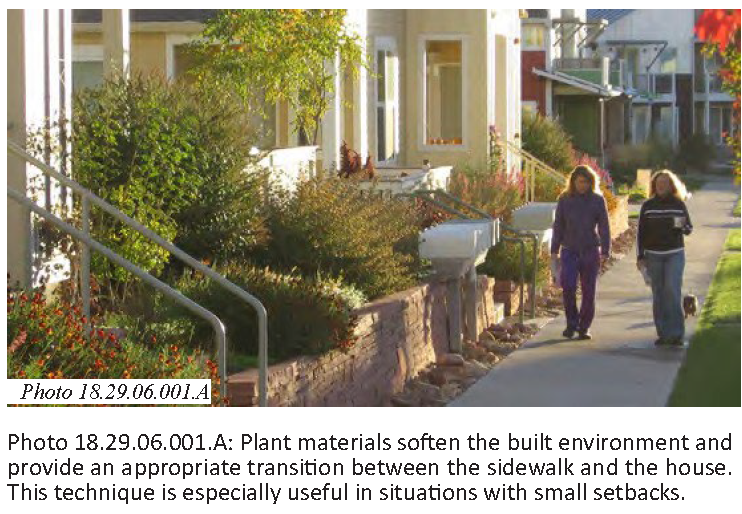
3.
APPLICABILITY
a.
In General. The standards and guidelines in this division VI apply to all properties within form zones. However, sections or subsections within this division may provide for specific exceptions or a more limited scope of application for certain standards or guidelines.
b.
Relationship to Chapters 18.38 and 18.40. The standards and guidelines of this division VI supersede chapter 18.38. Chapter 18.40 may provide additional standards as set out therein.
c.
Standards. The standards in this division VI are minimum requirements.
d.
Considerations and Guidelines. The considerations and guidelines in this division VI are considered best practices by the City. They are intended to provide additional information to encourage creative landscape designs, but are not requirements.
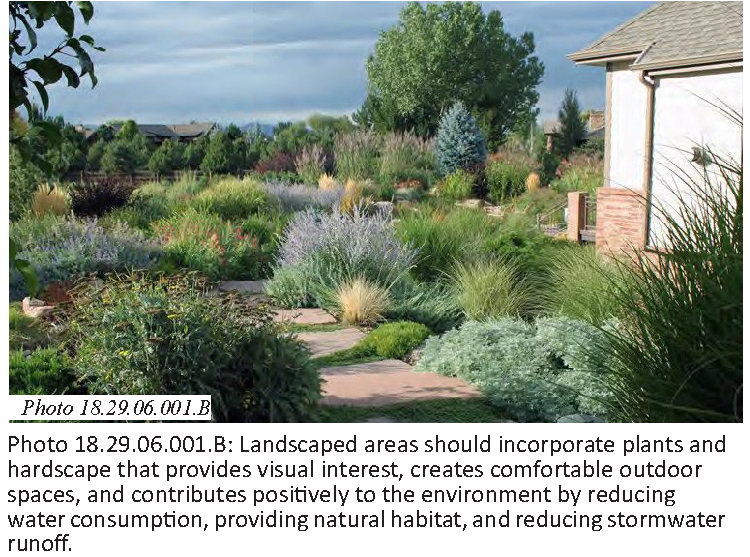
(Ord. No. 2209, § 2(Exh. G), 6-6-2023)
18.29.06.002 - DESIGN CONSIDERATIONS
1.
INTENT
This section is intended to encourage creative and context-sensitive landscape designs. Due to the variability in site-specific conditions, the provisions of this section are not enforced as development standards. They are presented only as suggested considerations for landscape design.
2.
SPECIES SELECTION
a.
Applicants should cross-reference the City of Golden Recommended Plant List for plant selection.
b.
Xeric, ornamental plantings that are low- maintenance and require little water should be used.
c.
Plantings should create visual interest and variety for all four seasons, as well as provide shade for seating areas in warmer months along with other functional considerations.
3.
LANDSCAPE ARRANGEMENT
a.
Trees should be positioned to provide shade for paved areas to reduce heat generated from direct sun exposure.
b.
Deciduous trees that provide shade in the summer and allow sunlight to pass through their limbs in the winter are recommended for planting on the south side of buildings. The trees should be drought-tolerant, provide fall color, and minimize litter and other maintenance problems.
c.
Evergreen trees that provide a buffer from cold winds, snow, and ice are recommended along the north side of buildings.
d.
Tree placement and overall landscape design should take into account the effects on solar access with regard to neighboring properties.
e.
Particularly in the Main Street A, Main Street B, and Strip form zones, landscaping should not create isolated areas or areas that are not visible from adjacent public and private space.
4.
WATER QUALITY AND WATER EFFICIENCY
a.
Irrigated turf grass should not be used in areas that are narrower than 4 ft.
b.
Except in the Main Street A and Main Street B form zones, directly connected impervious areas should be minimized to reduce runoff from hardscaped driveways, sidewalks, and patios.
5.
GRADING AND EXCAVATION
The Mile High Flood District Topsoil Management Guidance manual should be used for salvaging, stockpiling, and re-purposing existing soils associated with a development.
(Ord. No. 2209, § 2(Exh. G), 6-6-2023)
18.29.06.003 - LANDSCAPING PLANS AND MATERIALS
1.
INTENT
This section applies as set out in section 18.29.06.001.3, except that plant material located within an applicable sight distance triangle, as defined by the City of Golden Street, Drainage and Sidewalk Specifications, shall conform to the specifications set out therein.
2.
LANDSCAPE PLAN PREPARATION
Landscape plans for cluster, compound, row house, main street, mixed-use, and shop forms shall be prepared and stamped by a Colorado-licensed landscape architect.
3.
PLANT SELECTION
a.
In General. Plant material that is counted towards the requirements of this division shall be selected from the species approved by the Colorado State University (CSU) Extension Guides.
b.
Xeric Requirements. At least 50 percent of required landscape planting areas that are required by this division, exclusive of hardscape, shall be irrigation zoned for, and planted with, xeric species.
c.
Biodiversity Requirements. Monoculture plantings of trees shall be avoided. With regard to trees, no more than 50 percent of the same genus shall be installed.
(Ord. No. 2209, § 2(Exh. G), 6-6-2023)
18.29.06.004 - UNITS OF MEASUREMENT
1.
IN GENERAL
This chapter measures landscaping materials in terms of tree equivalents (TE) and shrub equivalents (SE) in order to maximize flexibility for landscape designers, while ensuring that the appearance of the volume of landscaping remains consistent. TEs and SEs relate to nursery stock measurements, and are evaluated at the time of planting.
2.
TREE EQUIVALENTS (TE)
One TE is equal to:
a.
A two and one-half-inch caliper deciduous tree; or
b.
A six-foot tall coniferous tree.
3.
SHRUB EQUIVALENTS (SE)
One SE is equal to:
a.
One large shrub (five gallon container);
b.
Two medium shrubs (two gallon container); or
c.
Four small shrubs (one gallon container).
4.
OTHER MATERIALS
The minimum size and characteristics of other landscape materials at the time of planting or installation, shall be as follows:
a.
Ground covers (except turf) and vines.
1.
In general one gallon container.
2.
Prostrate junipers and similar shrub-like ground covers five gallon container.
b.
Wood chip mulch.
1.
Minimum depth two inches.
c.
Rock or stone mulch.
1.
Minimum cobble size two inches.
2.
Minimum depth three inches.
5.
EXISTING MATURE TREES
Healthy existing mature trees (five-inch DBH or greater) shall be preserved on site. If healthy existing mature trees must be removed, two TEs shall be planted for each tree removed. The director may require fewer but higher caliper deciduous trees or taller coniferous trees depending on available planting area, healthy spacing, or resilient landscaping standards in section 18.40.216, "Resilient landscaping standards." Nuisance species, such as Siberian elm, Russian olive, and Tree of Heavan, or other trees designated as nuisance trees by the director or city arborist are not subject to the tree replacement requirement of this subsection.
(Ord. No. 2282, § 1(Exh. C), 12-9-2025; Ord. No. 2209, § 2(Exh. G), 6-6-2023)
18.29.06.005 - LANDSCAPE REQUIREMENTS FOR THE PUBLIC REALM
1.
STREETSCAPES AND SIDEWALKS
a.
Sidewalk and Landscaping Strip Required.
A sidewalk and landscaping strip shall be installed parallel to the street along the lot frontage and parallel to the side street on corner lots. If new sidewalk is required to be installed, the application shall demonstrate that the sidewalk will be installed, repaired, or modified in such manner as to be safe and compliant with the Americans with Disabilities Act Accessibility Guidelines.
Minor adjustments to maintain the existing sidewalk without requiring the installation of new sidewalk may be considered pursuant to minor adjustment section 18.29.07.001.3.g.3.
b.
Sidewalk Width.
1.
The standard required sidewalk width is seven feet. The sidewalk width may be reduced to six feet without adjustment if installed to meet engineering regulations and on a local street. Minor adjustments for any other reductions in the sidewalk width shall be considered pursuant to minor adjustment section 18.29.07.001.3.g.2.
Landscape strips, when required, shall meet the standards of 18.29.06.005.1.d.
c.
Sidewalk Design.
1.
The sidewalk shall be detached from the street, unless it is demonstrated that the existing block and nearby blocks are developed with an attached sidewalk.
2.
All sidewalks shall be designed in compliance with the City of Golden Street, Drainage, And Sidewalk Specifications.
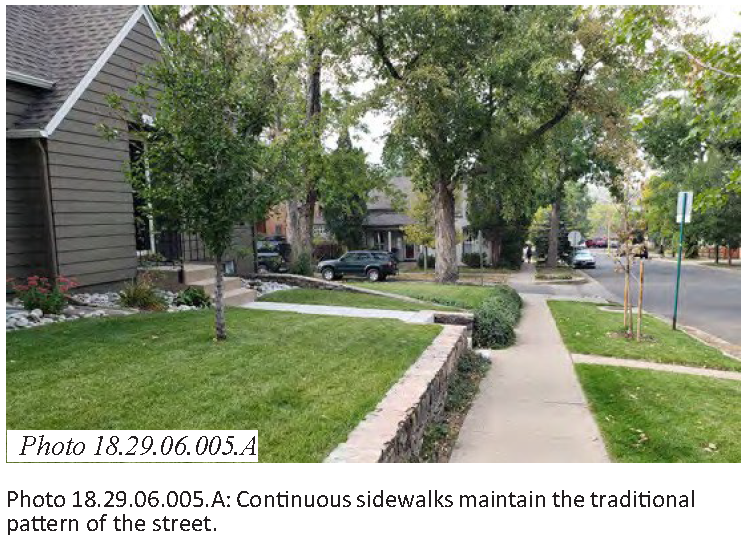
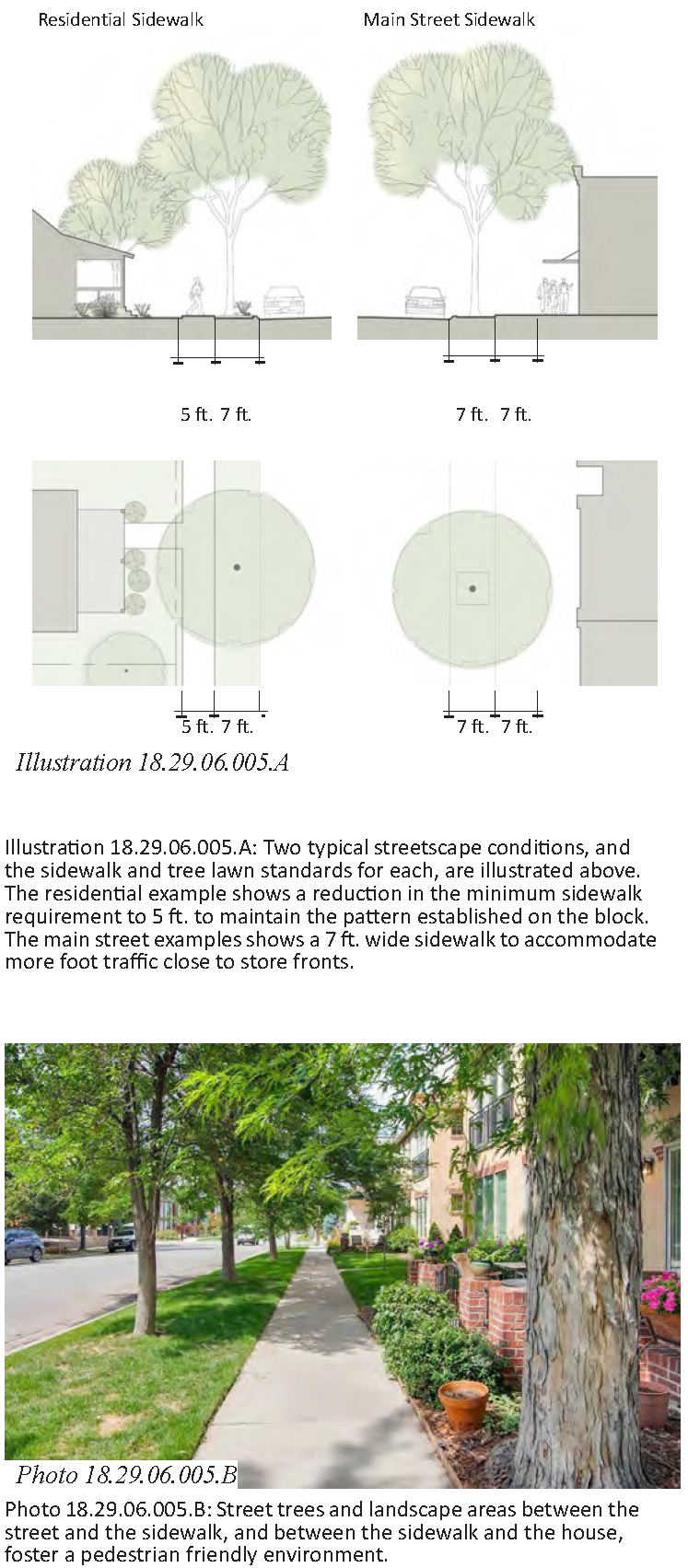
d.
Landscape Strip Width.
1.
The standard required landscaping strip width is seven feet. [See illustration 18.29.06.005.A.]
2.
The landscape strip width may be reduced pursuant to minor adjustment section 18.29.07.001.3.g.4 in order to integrate the sidewalk into the existing right-of-way design.
e.
Landscape Strip Design.
1.
Street trees shall be planted within the landscape strip, spaced 35 ft. on-center. Each street tree shall be one TE, installed such that a canopy of foliage will form over the street. Coniferous trees shall not be used as street trees.
2.
Ground cover and/or shrubs shall also be planted in the landscaping strip in which the trees are placed.
3.
Landscape strips that adjoin streets with on-street parking shall be designed with periodic hardscaped connections from the street to the sidewalk.
2.
ADDITIONAL REQUIREMENTS AND GUIDELINES FOR MAIN STREET FORM TYPES
a.
In General.
Main Street form types shall comply with the requirements set out in subsection 1, above, as well as the requirements set out in subsection 2.b. The guidelines set out in subsection 2.c are intended to encourage good design, and are not specifically regulatory in nature.
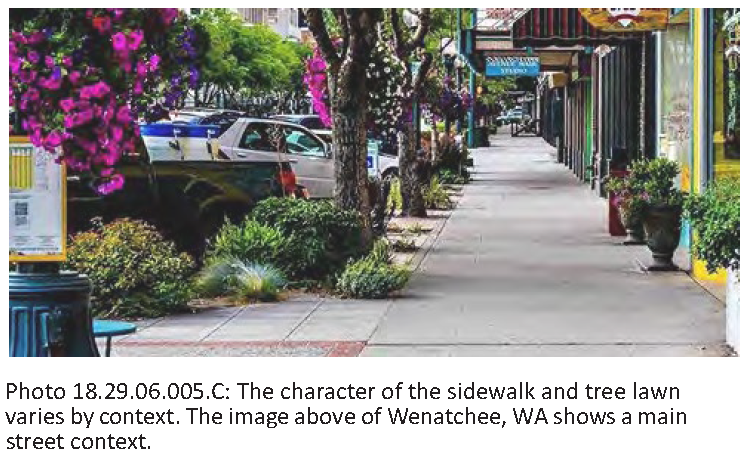
b.
Requirements.
1.
Where a landscape strip is unavailable, street trees shall be planted on either the private property or within the right-of-way parallel and adjacent to the adjoining street or streets such that a canopy of foliage will form over the street. Trees shall be spaced 35 ft. on center, parallel to the street. Spacing may be adjusted to accommodate the location of alleys and existing curb cuts. Ground cover and/or shrubs shall also be planted in the street-side landscaping strip in which the trees are placed. Coniferous trees shall not be used for street trees.
2.
Pedestrian connections shall be provided from walkways, transit stops, trails, parks, and bike paths in the public right-of-way adjacent to the lot to the building(s) on the lot and through any parking areas within the lot.
3.
The minimum width of an on-site walkway shall be 5 ft., unless head-in parking is permitted adjacent to the walkway, in which case the walkway shall have a minimum width of 7 ft.
4.
On-site walkways designed to accommodate bicycles shall be referred to as bike/pedestrian paths and shall have a minimum width of 8 ft., unless head-in parking is permitted adjacent to the bike/pedestrian path, in which case the walkway shall have a minimum width of 10 ft.
5.
Grades for walkways and bike/pedestrian paths shall not exceed 8 percent or the grade of the adjacent public street, except short stretches not to exceed 200 ft. in length may be permitted by the City Engineer provided that the City Engineer finds that the criteria in the Golden Street, Drainage & Sidewalk Specifications manual for sidewalks within the right-of-way are met.
6.
Walkways and bike/pedestrian paths shall be designed to be free of hazards and to minimize conflicts with external factors such as noise, vehicular traffic and protruding architectural elements.
7.
Walkways shall accommodate mobility for all users by addressing the needs of people regardless of age or ability.
c.
Guidelines.
1.
Walkways and bike/pedestrian paths should provide a continuous connection to adjacent pedestrian networks and be designed so users can easily find direct access to a route.
2.
Streetscape design should contain elements that provide visual continuity along the public right-of-way.
3.
Streetscape should integrate stormwater management, when possible.
4.
Streetscape elements should include flowers in pots, ornamental trees in raised beds, and layering of shrubs against the building walls. Providing retaining walls, raised planters and low garden walls in the form of seating is another recommended landscaping strategy in these areas [See photo 18.29.06.005.D].
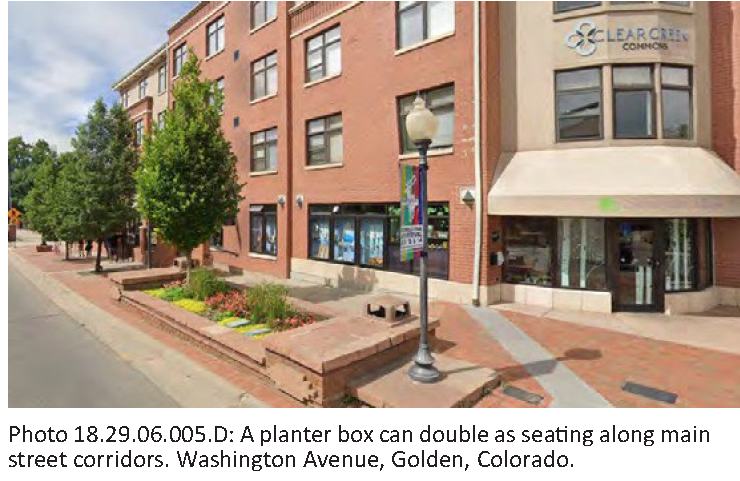
(Ord. No. 2228, § 5, 2-13-2024; Ord. No. 2209, § 2(Exh. G), 6-6-2023; Ord. No. 2273, § 2(Exh. A), 8-12-2025)
18.29.06.006 - REQUIREMENTS BY FORM TYPE AND LANDSCAPE AREA
1.
MINIMUM LANDSCAPE SURFACE
a.
In General.
The minimum amount of landscape and amenity area on a lot shall be the greater of the landscape surface ratio ("LSR") set out in subsection 1.b, below (which is inclusive of all landscaping required by this section 18.29.06.006); or the total landscaping required by this section 18.29.06.006.
b.
Minimum Landscape Surface Ratio by Form Zone
1.
Min. LSR in Core, Transition, Edge, Outer Edge, Neighborhood Corridor, Main Street A, Main Street B, and Strip form zones ..... 15%
2.
Min. LSR in Peripheral form zone ..... N/A
c.
Minimum Requirement for Main Street Form Types
For Main Street form types, all portions of the lot that are not occupied by driveways, sidewalks, patios, decks, plazas, or buildings shall be landscaped or mulched.
2.
LANDSCAPING ASSOCIATED WITH SURFACE PARKING AREAS
a.
Applicability.
The standards of this subsection 2 apply to all surface parking areas that include 5 or more parking spaces, except in the Main Street A and Main Street B form zones.
b.
In General.
1.
Surface parking areas shall be landscaped with one TE per five parking spaces and one SE per parking space.
2.
Trees shall be installed within six feet of the boundaries of the parking area, or within landscape islands of not less than 80 s.f. in area and no dimension less than 6 ft., located within the parking area (between the long edges of angled parking spaces or at endcaps) or between rows of facing parking spaces.
3.
Trees shall be distributed to optimize shade on the parking lot.
4.
Parking lot landscape areas shall be served with a permanent irrigation system.
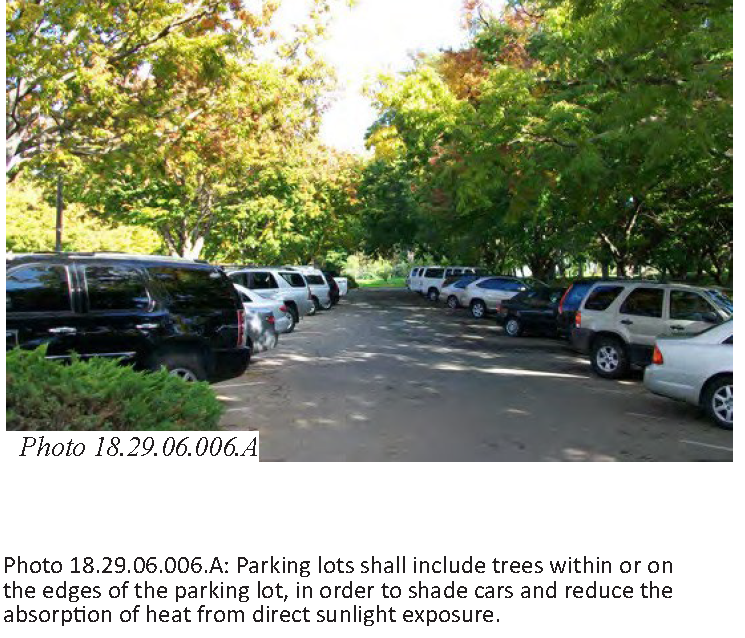
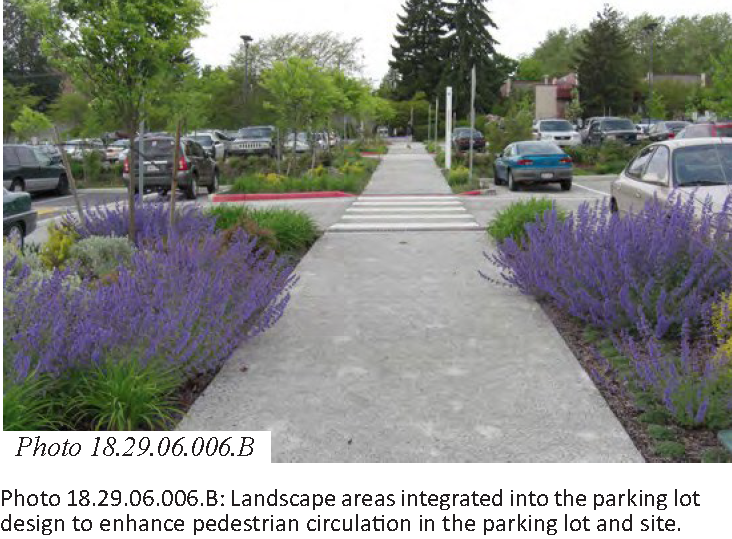
c.
Large Surface Parking Lots.
1.
Parking lots that include 20 or more parking spaces shall also include an additional landscaped areas within landscape islands that is equal to 10 percent of the total paved parking area.
2.
The parking lot landscape islands shall include trees, shrubs, and ground covers, and shall be distributed throughout the paved parking area, such that landscape islands that are located between the long edge of angled parking spaces or at endcaps are spaced no more than 230 ft. apart, measured along each row of parking spaces.
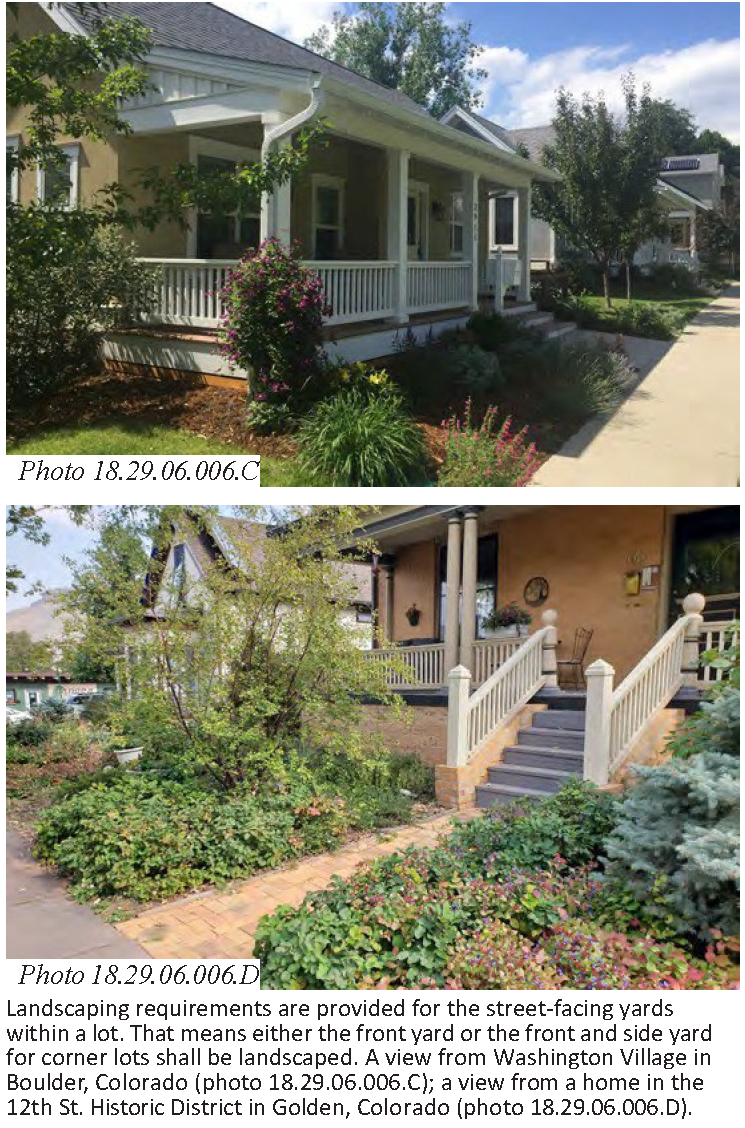
3.
STREET-FACING YARDS
a.
Intent.
The intent of the landscaping requirements for street-facing yards is to create a consistent landscaped area observed from the pedestrian sidewalk along all front and side streets; and to improve the aesthetics of buildings and streetscapes through the combined use of trees (as appropriate) and shrubs in street-facing yards.
b.
Applicability.
The standards and guidelines in this subsection 3 apply to all front yards, and to all side yards of corner lots, except with regard to Main Street and Shop form types.
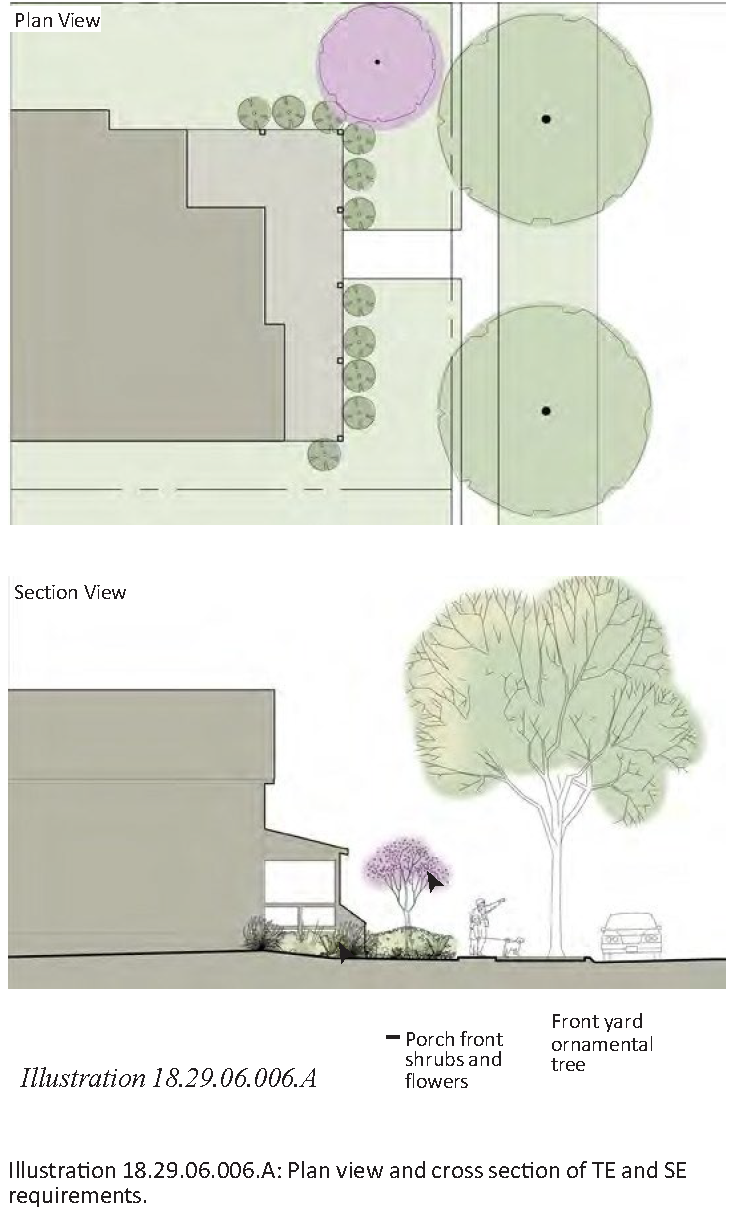
c.
Standards.
1.
At least 50 percent of all areas of front yards that are not occupied by driveways, sidewalks, or patios shall be landscaped with living materials.
2.
Except as provided in subsection c.3, below, ornamental or mid-sized trees shall be installed in street-facing yards as follows:
A.
25 ft. to, but not including, 42 ft. of lot frontage ..... 1 TE
B.
42 ft. of lot frontage or more [See illustration 18.29.06.006.A] ..... 2 TE
3.
The tree-planting requirements of subsection c.2, above, do not apply where the applicant demonstrates that utility easements (including, but not limited to, overhead power lines), poor growing conditions due to building orientation or shade, or lack of space (due to building or porch disposition) would create a harmful condition or prevent healthy tree growth.
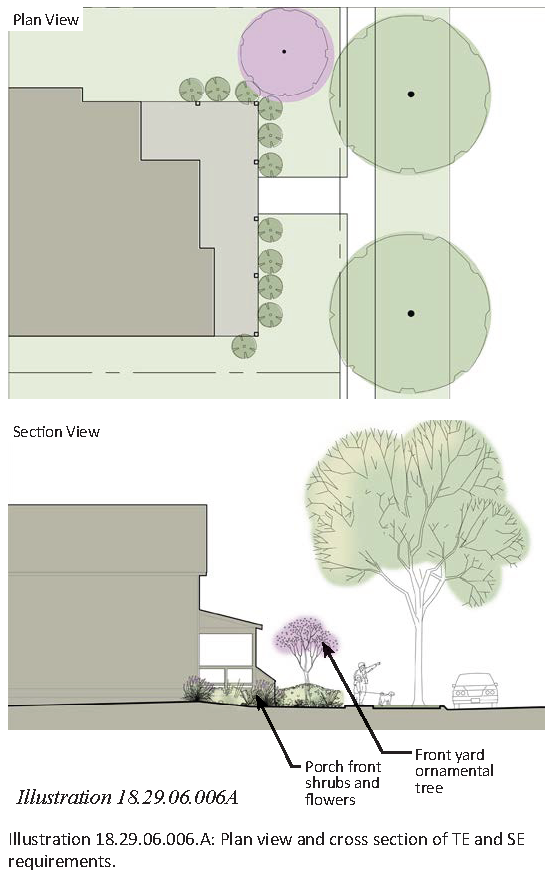
4.
A minimum of one SE of plant material shall be installed for each 10 ft. of primary street, side street, and common court frontage of the lot (as each may be present) between the building and the frontage.
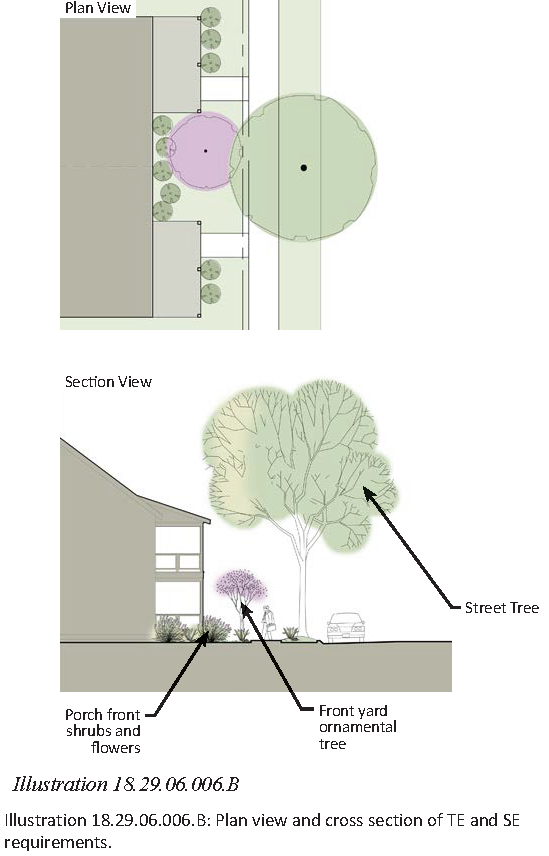
d.
Guidelines.
1.
Irrigated turf grass should not be planted in yards (front and side) that are narrower than 4 feet. Layering of flowering bushes and perennials should be planted instead. Rock mulch, wood mulch, and ground covers are also suggested.
2.
A combination of ornamental trees, large shrubs, and small shrubs are recommended for street-facing yards (front and side) where there is sufficient space and appropriate conditions for their healthy growth.
3.
Where tree-planting is not applicable pursuant to subsection 2.c.3, layered shrub landscaping, including flowering shrubs, should be installed near the buildings along street-facing elevations; however, the center third of the buildings' facades should be kept clear from the shrubs.
4.
COMMON COURTS
a.
Intent.
Specific landscape standards and guidelines are established in this subsection 4 to ensure that common courts serve as amenities for occupants of buildings in subdivisions with common courts.
b.
Applicability.
The standards and guidelines in this subsection 4 apply to all form types that require (or are designed to include) a common court.
c.
Planting Requirements.
1.
At least 50 percent of the area of the common court shall be landscaped with living material.
2.
A minimum of 1 TE of shade tree shall be provided per 800 s.f. of total landscaped area of the common court. If shade trees are provided in the front yard along the common court, the area under the projected mature canopy of the shade trees shall be subtracted from the area of the common court for the purposes of calculating the number of shade trees that are required in the common court.
d.
Planting Guidelines.
1.
Two rows of trees should be provided, one on either side of the common court, where space allows.
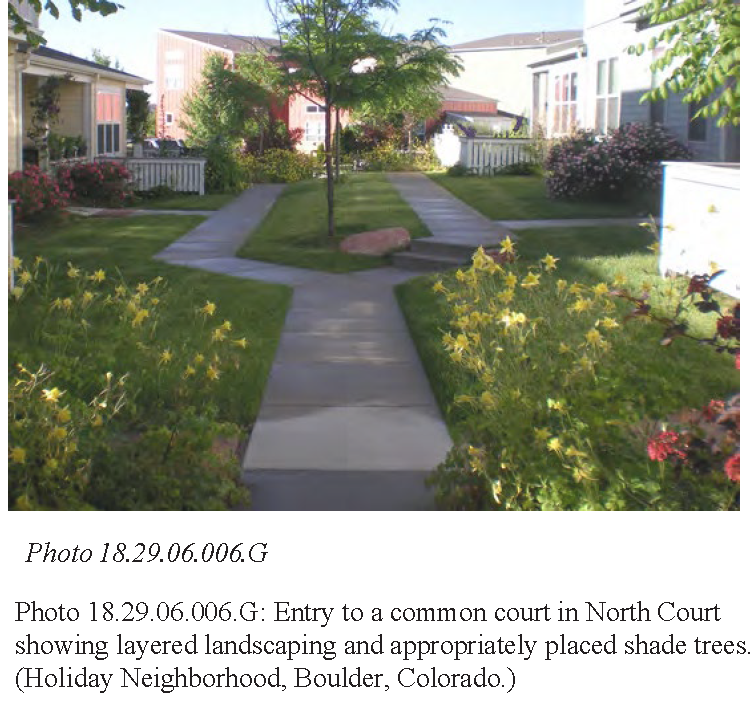
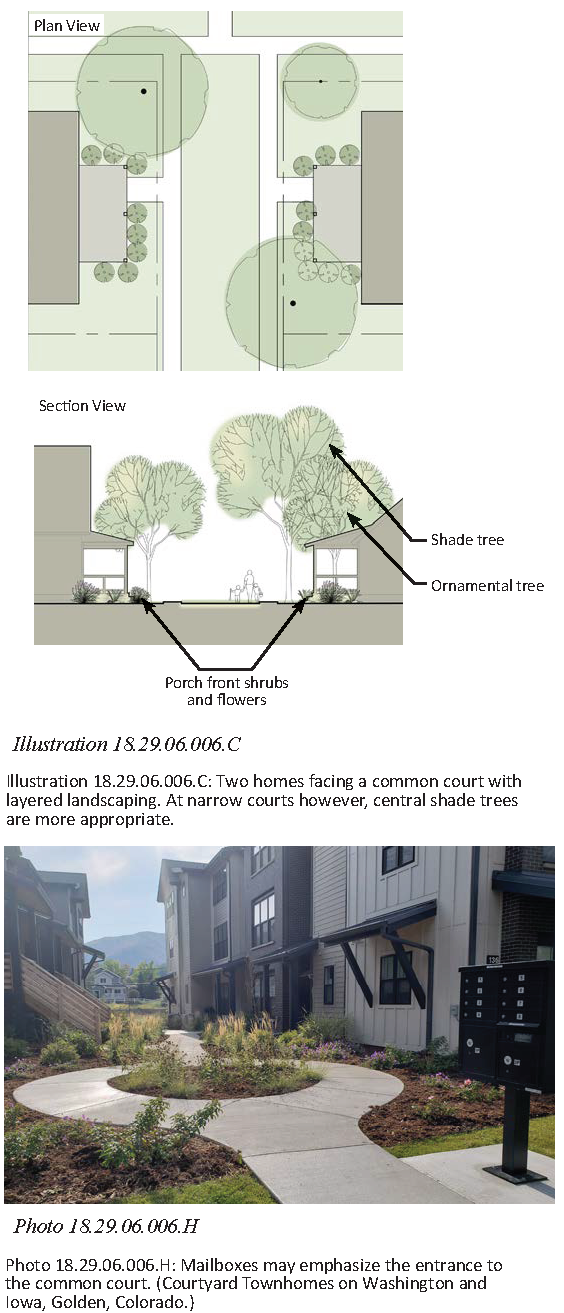
2.
On narrower common courts where it is not feasible to provide two rows of trees, a few high canopy shade trees should be provided at the center of the common court.
3.
Best practices in stormwater management with swales, filter strips, and rain gardens should be integrated into site design to reduce runoff and filter pollutants. Simple bridges or culverts should be installed across the drainage ways or swales to maintain continuous pedestrian walkways.
e.
Hardscape Requirements.
In areas that transition between hardscape and landscape and where runoff will be directed, a stabilized surface shall be installed in order to prevent erosion of unpaved surfaces.
f.
Hardscape Guidelines.
When feasible, two narrow sidewalks (generally no more than 3 feet in width) should be located at either side of the common court close to front porches, rather than one sidewalk at the center of the common court. [See photo 18.29.06.006.G.]
5.
ALLEYS AND SHARED DRIVEWAYS
a.
Intent.
The intent of this subsection 5 is to provide guidelines for alleys and shared driveways in order to improve their character and function.
b.
Applicability.
The standards and guidelines in this subsection 5 apply to all form types except Main Street and Shop.
c.
Guidelines for Landscaping.
1.
Landscape islands should be provided between head-in parking stalls.
2.
Narrow detached sidewalks (3 ft. in width) should be provided along the parking areas, and low shrubs should be installed behind car stops.
3.
To the extent practical, a diverse and layered landscape should be installed along alleys, including shade trees, small ornamental trees, upright shrubs, and low ground covers. However, plant selections and installation locations should prevent:
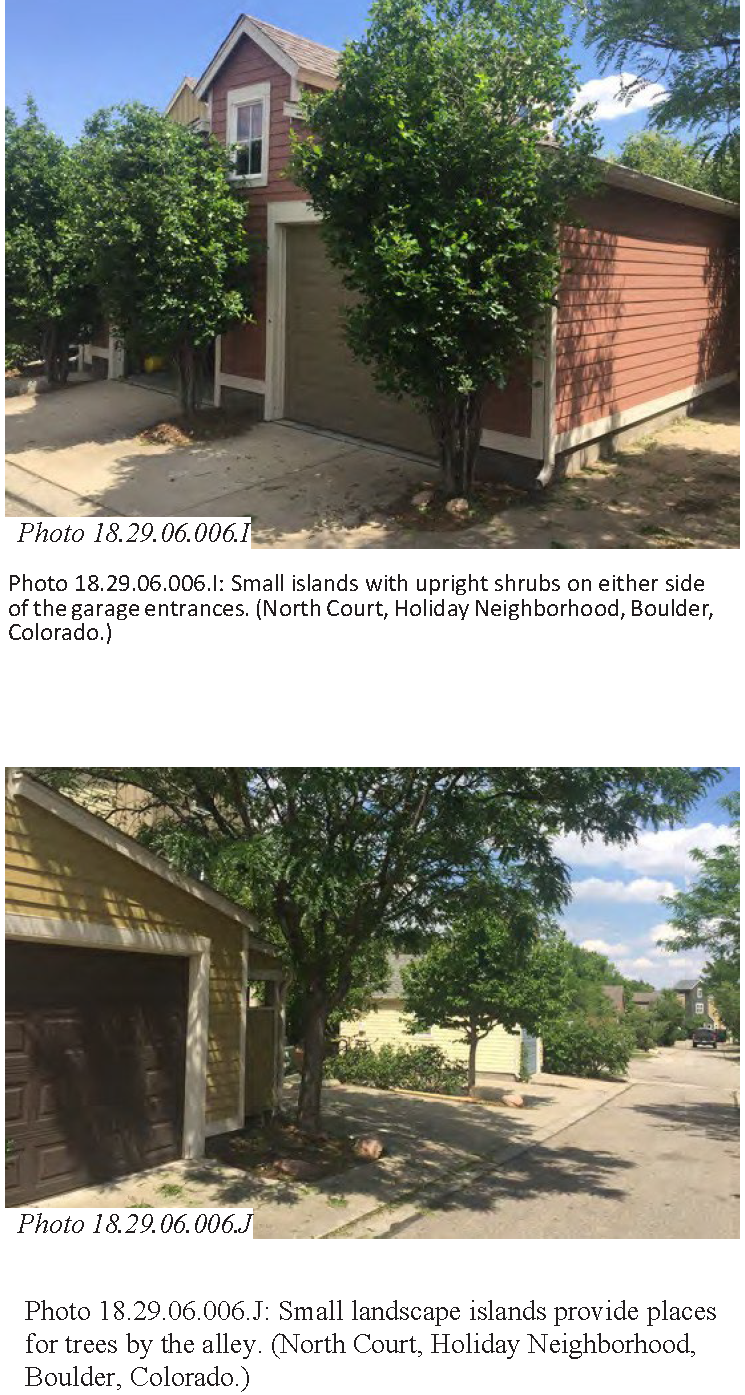
A.
Encroachments into the alleys that will interfere with their use; and
B.
Conflicts between trees and overhead or underground utilities.
d.
Guidelines for Pavement and Edges.
1.
Unnecessary pavement and hardscape on portions of the lot directly adjacent to the alley or shared driveways along the rear of several properties should be avoided.
2.
Pavement should be used only for the width of the garage door and gaps in pavement should be provided for planting when feasible.
3.
Use of straight concrete edge in lieu of regular curbs is encouraged, for it makes it easier to create landscape islands.
4.
The use of slotted curbs and standards is encouraged to facilitate water runoff.
(Ord. No. 2209, § 2(Exh. G), 6-6-2023)
18.29.06.007 - FENCING, RETAINING WALLS, AND PERIMETER WALLS
1.
INTENT
The intent of this section is to permit fencing that balances the interaction between the sidewalk and the front yard or entrance of a property. Further, to provide both privacy to the property owner and an attractive visual appearance to the pedestrian.
2.
HEIGHT AND SETBACKS
a.
Height.
The height of fences and perimeter walls is limited as follows:
1.
Max. height (except as provided below) ..... 6 ft.
2.
Max. height within 15 ft. of front lot line adjoining a primary street ..... 3 ft.
3.
Max. height within front yard adjoining common court ..... 3 ft.
b.
Setbacks.
Fences and perimeter walls shall be set back from lot lines as follows:
1.
Primary street and side street (from sidewalk or property line, whichever results in a greater setback) ..... 2 ft. min.
2.
Interior side lot line ..... 0 ft.
3.
Rear lot line (no alley) ..... 0 ft.
4.
Alley (from rear lot line) ..... 6 ft. min.
3.
DESIGN
a.
Materials and Color.
1.
All fences, perimeter walls, or retaining walls must be made from traditional fence or wall materials such as:
A.
Fence materials: wood, vinyl, or composite wood (in picket, shadowbox, or post-and-rail formats); or metal (aluminum or wrought iron decorative fencing).
B.
Perimeter and retaining wall materials: stacked stone; tinted split-face concrete masonry units; brick; stucco-finished block.
2.
The director may approve materials that are comparable in appearance and durability to the materials listed in subsection 3.a.1, above.
3.
Chain link fences are not allowed in front yards.
4.
Fences and perimeter walls shall be white, black, gray, or natural or earth tones, regardless of material.
b.
Orientation and Height.
1.
Privacy fences and perimeter walls shall be arranged and designed so as not to prevent visibility between the sidewalk and the principal building entry in front yards.
2.
All privacy fences shall be constructed to orient any exposed structural framework to the interior of the fenced property.
3.
No fencing or perimeter wall taller than three feet that is located between the principal building and the street that the principal building entry faces shall exceed 25 percent opacity [See photos 18.29.06.007.A and 18.29.06.007.B]
4.
No fence greater than six feet in height shall be installed within a front yard unless a building permit that is for or includes the fence has been issued by the City, and all portions of the fence that are greater than three feet in height are set back from the front lot line as provided in subsection 2.b.
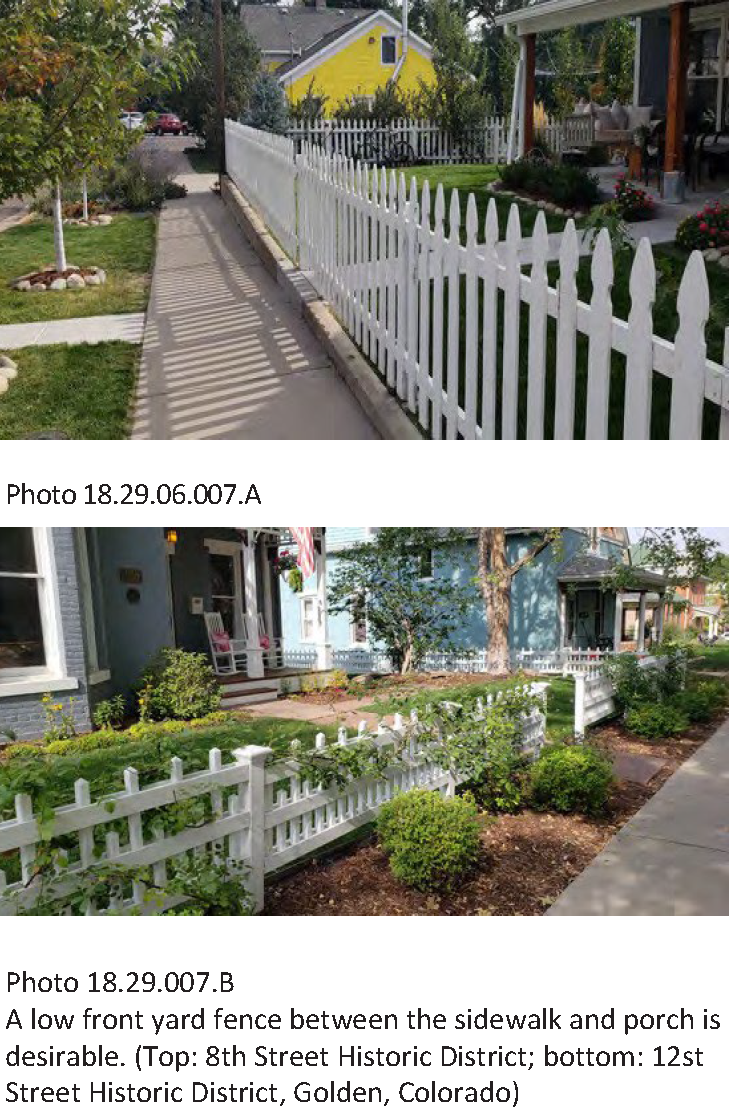
5.
In order to allow for visual access, fences, walls, or hedges that are used to separate open space areas from public rights-of-way:
A.
Shall not exceed 50 percent opacity; or
B.
Shall be less than two feet 10 in. in height.
6.
Fences that are located within a sight distance area for a street, driveway, alley, or intersection shall conform with the requirements for such sight distance areas contained in the City's Street, Sidewalk, and Drainage Specifications.
4.
SPECIALIZED SECURITY FENCING
Barbed wire, razor wire, and electric fences shall not be permitted unless required by the city as a condition of approval of a special use permit.
5.
TEMPORARY FENCING
a.
Temporary fencing utilized for the purposes of screening construction shall conform to the setback standards identified in subsection 3.b.
b.
Temporary fencing utilized for the purposes of screening construction shall not exceed 8 ft. in height and shall be opaque.
c.
Temporary fencing used to provide temporary security in response to a demonstrated need (e.g., to secure a damaged building) may be approved by the director. The type and height of the fencing shall correspond to the demonstrated need.
d.
Temporary fencing utilized shall be removed after not more than 18 months, except in cases where the City approves a longer term for temporary fencing (e.g. in a construction staging plan), in order to protect public safety and provide security.
6.
RETAINING WALLS
Retaining walls shall consist of materials consistent with the natural surroundings and/or proposed buildings. Where retaining walls exceed 8 ft. in height, they shall be designed in a manner that steps the retaining walls and provides landscaping on each step.
(Ord. No. 2209, § 2(Exh. G), 6-6-2023)
18.29.06.008 - SCREENING AND BUFFERING
1.
APPLICABILITY
The standards of this section require screening and buffering in certain circumstances that are described herein.
2.
SCREENING
a.
Outdoor Storage. All outdoor storage areas shall be screened from public view and rights-of-way and from adjacent property by use of landscaping, opaque fencing, berms or a combination of landscaping and other structural elements to a minimum height of six feet and a maximum height of eight feet.
b.
Nonresidential Parking and Loading. Any non-residential use that is contiguous to or facing any residential use zone shall screen its parking areas, loading docks or similar uses through the use of landscaping elements. Selected species shall grow to a minimum height of four feet.
c.
Trash and Recycling Containers and Enclosures.
1.
All trash and recycling containers shall comply with the requirements of chapter 5.03, Golden Municipal Code, and shall not be located in the public right-of-way.
2.
Trash and recycling enclosures shall be integrated into the site to minimize enclosure visibility and accommodate truck access. Enclosures shall accommodate receptacles for both trash and recycling pick-up. Trash enclosures shall be constructed of durable, opaque materials and the color, texture, and architectural detailing shall be consistent with the overall site and building design.
d.
Roof-Mounted Equipment. Roof-mounted electrical, heating, ventilation or air conditioning units, and mechanical equipment shall be placed or screened such that the equipment is not visible from any point ten feet above the ground at any point within a 200 ft. radius of the building upon which it is mounted. Building-mounted cell antennae, cable dishes, and roof ladders shall be located so as to minimize their view from adjacent properties.
e.
Ground-Mounted Equipment. Utility cabinets, meters, generators, and other ground-mounted mechanical equipment shall be contained within the building or otherwise fully screened.
3.
BUFFERING
a.
Buffering of non-residential use zones from residential use zones shall occur for the length of the shared property line through one of the following methods:
1.
A solid fence or wall of at least six feet in height; or
2.
A 10 ft. wide vegetated buffer with hedge composed of coniferous hedge-forming 5-gal. shrubs, planted at a maximum of 10 ft. on center for the length of the buffer; or
3.
A vegetated berm that does not exceed a slope of one foot of rise for each three feet of run, planted with coniferous hedge-forming 5-gal. shrubs, planted at a maximum of 10 ft. on center for the length of the buffer.
b.
Screening such as low fencing, shrubs, or other landscape elements shall be provided between parking lots and streets, walkways, or trails.
(Ord. No. 2209, § 2(Exh. G), 6-6-2023)
18.29.06.009 - SITE PREPARATION AND IRRIGATION
1.
SITE PREPARATION
a.
Prior to installing irrigation systems and planting, all sites for plantings shall incorporate soil amendments at a rate of three cubic yards per 1,000 s.f. to a depth of at least 6 in.
b.
Existing topsoil shall be salvaged and stockpiled for use in amending area soil except in instances where the topsoil is not suitable for that purpose.
c.
Trees that must be removed shall be disposed of as organic waste, including chipping or composting, and when possible used on site for mulch or soil amendment.
2.
IRRIGATION
a.
Irrigation System Required; Exceptions.
1.
Except as provided in subsection 2.a.2, below, irrigated turf areas and live planting areas in excess of 100 s.f. in area shall be served by a permanently installed irrigation system.
2.
The director way waive the requirement of subsection 2.a.1, above, upon a determination that an irrigation system is unnecessary as a result of the size, location or alternate maintenance accommodations applicable to the area (e.g., the area is planted with Xeric plants that do not require a permanent irrigation system).
b.
Irrigation System Design.
Landscape plans shall demonstrate that irrigation systems are designed as high-efficiency systems that minimize overspray and water waste through use of appropriately placed (and where appropriate, directional) sprinkler heads, automatic controllers, rain sensors, moisture sensors and, for non-turf areas, subsurface drip systems.
c.
Planting Arrangements.
Plants with similar water requirements shall be grouped together to avoid over-watering.
(Ord. No. 2209, § 2(Exh. G), 6-6-2023)
18.29.06.010 - MAINTENANCE AND WARRANTY OBLIGATIONS
1.
MAINTENANCE OF SIDEWALKS AND LANDSCAPE STRIPS
City right-of-way, or the area between the flowline of the street and the street-facing lot line, shall be maintained by the owner of the adjoining property.
2.
CONTINUING OBLIGATIONS
a.
Provisions for landscaping, screening and maintenance are a continuing obligation of the property owner, and where approved trees, shrubs or other landscaping materials die or are removed, it shall be the responsibility of the owner to replace them with materials of a comparable nature and size to those originally approved. Replacement shall occur in the next planting season, but in any event, such replacement time shall not exceed one year. Any replacement which conforms to the requirements of this subsection shall not be considered an amendment to the site development plan.
b.
The owner of the property shall be responsible for the proper maintenance of the area subject to an approved site development plan. That area shall be deemed to include an area as measured from the back of the curb line to, and including all areas subject to the approved site development plan. Landscaping shall be regularly maintained including necessary watering, weeding, pruning, pest control and replacement of dead or diseased plant material.
3.
PERFORMANCE WARRANTIES
A performance warranty in the minimum amount of 20 percent of the cost of installation of landscaping shall be provided to the City for projects where the City-approved cost estimate for landscaping exceeds $25,000. This performance warranty shall be held until completion of the first full growing season after the growing season of installation, and shall secure the replacement of any dead or diseased plant material.
(Ord. No. 2209, § 2(Exh. G), 6-6-2023)
18.29.07.001 - ALTERNATIVES AND ADJUSTMENTS TO FORM, DESIGN, AND LANDSCAPING STANDARDS
1.
IN GENERAL
a.
Alternative Standards. In certain circumstances, alternative standards may apply to proposed development. These include modifications to existing buildings that qualify as "mostly preserved buildings."
b.
Standards That May Be Adjusted. This division allows for adjustments to certain standards that are set out in this chapter 18.29, as provided herein. The following standards may be adjusted:
1.
Form Standards. Form standards are the standards that are set out in division III, sections 18.29.03.003, 18.29.03.006, 18.29.03.009, 18.29.03.012, 18.29.03.015, 18.29.03.018, 18.29.03.021, 18.29.03.024, and 18.29.03.027.
2.
Design Standards. Design standards are the requirements that are set out in division III, sections 18.29.03.004, 18.29.03.007, 18.29.03.010, 18.29.03.013, 18.29.03.016, 18.29.03.019, 18.29.03.022, 18.29.03.025, and 18.29.03.028.
3.
Bulk Standards in Legacy Use Zones. Bulk standards are the standards set out in division IV.
4.
Landscaping, Fencing, and Perimeter Wall Standards. Landscaping, fencing, and perimeter wall standards are the requirements that are set out in division VI.
c.
Limitations.
1.
No adjustment pursuant to this division shall be used to increase the number of permissible dwelling units, including allowing accessory dwelling units that are not otherwise allowed.
2.
Parking standards in division V are not subject to this division. Parking standards may be modified only as provided in chapter 18.12.
3.
Guidelines, statements of intent, and policy statements in this chapter are not requirements, and are therefore not subject to adjustment.
4.
"Special characteristics," such as the percentages of a lot that are within specified building envelope areas and the designation of "open side" and "closed side" cannot be adjusted, although the standards that apply to those special characteristics may be adjusted.
2.
MOSTLY PRESERVED BUILDINGS
a.
Generally. In order to preserve the street-facing elements of existing buildings in certain form zones, additional flexibility is provided in the middle building envelope area for certain building form types for those buildings that qualify as a "mostly preserved building."
b.
Criteria for Qualification.
1.
The director shall qualify a building as a "mostly preserved building" if 75 percent or more of the exterior facade, measured as the surface area, is preserved; and 75 percent or more of the front facade's roof line, measured as the surface area, is preserved.
2.
If the building is located within an historic district, the director's qualification of the building pursuant to subsection 2.b.1, above, shall not be final unless and until the Historic Preservation Board conducts certificate of appropriateness review pursuant to sections 18.58.060 and 18.58.070. A building's qualification as a mostly preserved building shall be conditioned upon the applicant's compliance with any commitments made by the applicant on the record as part of the certificate of appropriateness review and specified in the Board's resolution on the certificate of appropriateness.
3.
MINOR ADJUSTMENTS
a.
Minimum Setbacks. As to minimum setbacks, adjustments may be approved if:
1.
The adjustment will not allow for an increase in floor area that exceeds the floor area allowed for the form type;
2.
The adjustment is necessary to overcome a practical difficulty that is presented by the unusual physical conditions of the lot, which may include the location and configuration of existing buildings, structures, or natural features; and
3.
The adjustment does not reduce the setback by more than 20 percent.
b.
Maximum Setbacks. As to maximum setbacks (including porch setbacks) adjustments may be approved if the adjustment is necessary to avoid construction within an easement that does not allow for construction of buildings or structures.
c.
Maximum Stories. As to the maximum number of stories, adjustments may be approved if the adjustment is necessary because the lot upon which the building is located has a slope that exceeds 8 percent (exposing the basement), and the building height does not exceed the maximum building height that is allowed for the form type.
d.
Orientation of Porches and Building Entrances. As to orientation of porches or building entrances, where form standards require that the porch and the principal entrance of the building on a street corner lot face the side street, adjustments may be approved to allow the porch and principal entrance to face the primary street, provided that the side street is three or more lanes in width (including center left-turn lanes), and the primary street has a lower capacity or traffic volume.
e.
Building Envelope Areas. As to building envelope areas ("BEA"), adjustments may be approved to allow for:
1.
The encroachment of eaves, overhangs, chimneys, and mechanical equipment into BEAs where buildings are not otherwise allowed; or
2.
An encroachment into, or increase in lot cover within, a BEA, provided that such encroachment or increase is existing and necessary to preserve an existing house or cottage form;
3.
An encroachment into a BEA of not more than 5 ft. in order to resolve a practical difficulty, provided that the open area lost to the encroachment is offset by open area elsewhere on the lot;
4.
An increase in lot cover within at BEA of not more than 5 percentage points in order to resolve a practical difficulty, provided that the open area lost to the increase in BEA lot cover is offset by open area elsewhere on the lot.
f.
Porches and Balconies.
1.
As to requirements for porches set out in division III of this chapter, adjustments may be approved to allow for reduction or elimination of porch requirements for house, cottage (whether individual or within a cluster or compound), and duplex forms if the design and size of the proposed porch (or elimination of the proposed porch) is consistent with the design and size of not less than 50 percent of comparable forms within 200 feet (or to the next intersection, whichever distance is shorter) in either direction on the same side of the street.
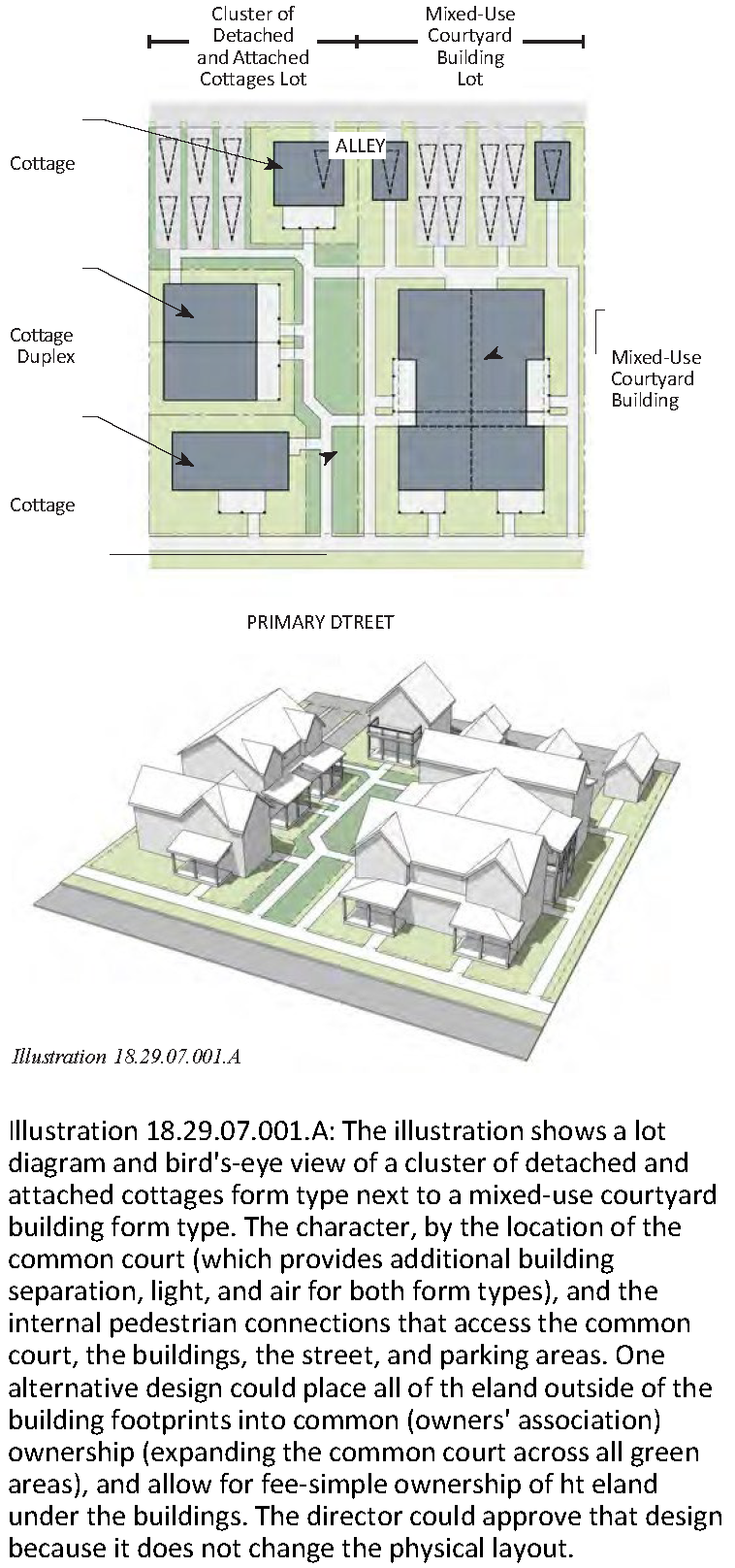
2.
As to requirements for balconies set out in division III of this chapter, adjustments may be approved to allow for reduction of the number or area of balconies, provided that:
A.
The reduction is justified by:
i.
The context of the building (e.g., adjacency to an industrial area, a limited access highway, etc.);
ii.
The orientation of the building (e.g., north-facing facades, adjacency to lots with zero side setbacks); or
iii.
The anticipated use of the building (e.g., offices, health care facilities, etc.); and
B.
If the building is to be used for residential purposes, the loss of outdoor amenity space is compensated for elsewhere on the lot.
g.
Landscaping, Fencing, and Perimeter Walls. As to requirements set out in division VI of this chapter:
1.
Adjustments may be approved for use of attached sidewalks pursuant to section 18.29.06.005.1.c.
2.
The sidewalk width may be reduced below the standard required in section 18.29.06.005.1.b if at least one of the following are met:
A.
A wider sidewalk would create an obvious disruption of the sidewalk or landscape strip pattern along the same side of the block [see illustration 18.29.06.005.A] and existing pedestrian traffic is minimal and not anticipated to materially increase;
B.
The application is for a site modification and/or building expansion that is located only in the middle or rear building envelope area ("BEA") as to form types that have BEA-specific standards, or more than 50 feet from the front street as to form types that do not have BEA-specific standards;
C.
A wider sidewalk would cause an existing driveway to be less than 18 feet long when measured from the edge of the sidewalk;
D.
Utility conflicts, drainage, grades and slopes, infrastructure conflicts, or other physical challenges that make the provision of bringing a wider sidewalk into compliance undesirable from a construction and long-term service perspective; or
E.
Installation of a wider sidewalk would cause one or more existing, healthy trees on the "recommended plant list" that are a least two inches DBH to be removed or damaged.
3.
The existing sidewalk may be allowed to be maintained at its existing width where all of the following requirements are met:
A.
At least one of the criteria of 18.29.07.001.3.g.2 is met;
B.
The application is for an addition to an existing structure or for a new detached accessory structure and is not: (i) A construction of a new principal dwelling on a vacant lot; or (ii) a scrape and rebuild of a principal dwelling on the site, including processes which leave only a nominal portion of the existing structure, such as demolishing the structure and leaving only one building wall;
C.
The application does not impact the existing sidewalk by changing or modifying the existing curb cut width or driveway access location; and
D.
The existing or proposed curb cut width and driveway access location meet the applicable form standards, such as allowed width and location when alley access is proposed, and engineering regulations for separation from the property line.
4.
Landscape strip width may be reduced provided there is sufficient room for healthy growth of required landscaping within the landscape strip and if the application demonstrates that:
A.
A seven-foot-wide landscape strip would create an obvious disruption of the sidewalk pattern along the same side of the block (e.g., if the existing landscape strip is narrower or the existing sidewalk is attached);
B.
Provision of a seven-foot-wide landscape strip would interfere with the continuity of front lot lines along the block face or result in a jog in the sidewalk;
C.
The application is for a site modification and/or building expansion that is located in the middle or rear building envelope area ("BEA") as to form types that have BEA-specific standards, or more than 50 feet from the street as to form types that do not have BEA-specific standards;
D.
A seven-foot-wide landscape strip would cause an existing driveway to be less than 18 feet long when measured from the edge of the sidewalk;
E.
There is insufficient dimension to accommodate a seven-foot-wide landscape strip;
F.
Utility conflicts, drainage infrastructure conflicts, or other challenges make provision of a seven-foot-wide landscape strip undesirable from a construction and long-term service perspective; or
G.
Installation of a seven-foot-wide landscape strip would cause one or more existing, healthy trees on the "recommended plant list" that are a least two inches DBH to be removed or damaged.
5.
Adjustments may be approved for the reduction of any required landscape area (e.g., parking lot landscape islands) by not more than five percent, provided that:
A.
There is sufficient room for healthy growth of required landscaping within the landscape area; and
B.
Due to the size or geometry of the subject property, the reduction is necessary to allow for the accommodation of other code requirements (e.g., required parking spaces, required parking aisle widths, required sidewalks, etc.).
6.
Adjustments may be approved to improve buffering between a residence and an adjoining collector or arterial street, provided that no fence or perimeter wall within a required building setback area exceeds six feet in height.
7.
Adjustments may be approved to allow for an alternative arrangement of the required plantings within a development (e.g., trees that are required on private lots may be planted in common areas, etc.), provided that:
A.
The character of the streetscape to be provided by the lot is not compromised;
B.
There is sufficient room where the landscaping is installed to allow for its healthy growth; and
C.
The arrangement does not interfere with access, utilities, or drainage or utility easements.
h.
Access.
1.
Private Access Easements and Access Tracts. For the purposes of this chapter, adjustments may be approved to allow alleys to be public rights-of-way. The City may require that alleys be created through private easements or that they be delineated on site development plans. Where an applicant subdivides property in a form zone, the plat shall delineate all private alleys as tracts.
2.
Traffic Safety Exceptions. In general, alleys are accessed from side streets. However, if reasonably safe access to the side street is infeasible due to traffic volumes or physical conditions (e.g., grades, sight distances, obstructions, or higher-level functional classifications), adjustments may be approved to allow alternate access upon a finding that:
A.
The alternative access does not substantially compromise the character and function of the proposed form type; and
B.
The alternative access is not inconsistent with the character or function of other lots along the same primary street frontage; and
C.
The alternative access provides a material public safety or traffic circulation benefit.
3.
Feasibility Exceptions. For those form types that require rear or side alley access, and where the creation of a continuous alley that crosses two or more properties proves infeasible due to physical constraints or an inability to create an access agreement among all impacted property owners, adjustments may be approved to allow a rear or side drive access under the following conditions:
A.
The number of curb cuts along the street frontage of the block is minimized using shared access drives; and
B.
Curb cuts shall be 20 ft. in width; and
C.
The rear or side access drive shall take the form of a shared access drive along the rear or side property line, with an easement in place for access by adjacent property owners; and
D.
Where an alley could be installed through the block over time, rear drives shall provide for future connectivity.
i.
Alternative Lot and Tract Layout. In order to allow for alternative ownership and maintenance arrangements, lot and tract lines within a subdivision that is created in compliance with this chapter may be moved or eliminated, provided that the physical layout of buildings, landscaped areas, and parking would otherwise be allowed without the modification. For example, within a clustered subdivision, the minimum lot area for cluster lots may be reduced to accommodate a corresponding expansion of the common court area in order to provide for common maintenance of all landscape areas or, alternatively, the common court may be created by permanent easements in lieu of by a tract in order to provide for private maintenance of landscape areas by each individual lot owner. [See illustration 18.29.07.001.A.]
j.
Open Side/Closed Side Orientation. As to buildings with a required open side and closed side, where design standards require that the open side and closed side face a certain direction, an adjustment may be approved, provided that the adjustment:
1.
Enhances the privacy of an adjoining lot by orienting the open side away from it; or
2.
Enhances the privacy or function of the lot by allowing for the closed side to face a high-volume side street; or
3.
Allows for the open side to face a significant view (or face away from a poor view); or
4.
Maintains the consistency of building orientation along the block face.
k.
Location of Parking. For form types that restrict the location of parking, adjustments may be approved that allow for parking spaces or areas in alternative locations as necessary to:
1.
Maintain consistency of parking locations along a block face; or
2.
Avoid extensive grading of a slope that is greater than 8 percent.
l.
Bulk Standards in Legacy Use Zones. Adjustments to height and setback standards set out in division IV may be approved to accommodate an additional story on an existing building over an area that is nonconforming as to front or side setbacks, add a front porch or covered entry to a building or extend or reconstruct a nonconforming wall, provided that:
1.
The extension of an encroaching wall in a side setback shall not exceed 50 percent of the horizontal dimension of the existing encroaching wall;
2.
New construction that encroaches into front setbacks is limited to open entries and porches, which may encroach not more than five feet;
3.
Reconstruction of existing walls that encroach into front setbacks is allowed;
4.
In the RE legacy use zone, the side setback on the building elevation that is affected by the improvement is not less than 5 ft., and the height of the building where it encroaches into the setback does not exceed 20 ft.
4.
MAJOR ADJUSTMENTS
a.
Major Adjustments for Practical Difficulties. Major adjustments to any form, design, or landscaping, fencing, and perimeter wall standard may be approved, provided that:
1.
All Applications. For all applications:
A.
The adjustment is appropriate to overcome a practical difficulty that is presented by the unusual physical conditions of the lot, which may include (but are not limited to) the location and configuration of existing buildings, structures, or natural features, an irregular lot shape, or the elevation of the lot compared to other lots in the vicinity;
B.
The adjustment will not materially reduce the light, air, or privacy of adjoining lots; and
C.
The adjustment does not materially undermine the purposes and guidelines (considered in their totality) that are associated with the standards sought to be adjusted.
2.
Minimum Setbacks. With regard to adjustments to minimum setbacks:
A.
The adjustment does not reduce the setback by more than 50 percent; and
B.
The adjustment will not create a fire hazard to, or a building code or fire code nonconformity on, the adjoining lot; and
C.
The adjustment will not interfere with required sight distance triangles or encroach upon drainage, access, or utility easements.
3.
Building Height. With regard to building height:
A.
The adjustment does not allow for the addition of usable floor area; and
B.
The adjustment improves the architectural presentation of the building; and
C.
The adjustment does not increase building height by more than 15 percent.
b.
Major Adjustments for Enhanced Compatibility. Major adjustments to any form, design, or landscaping, fencing, and perimeter wall standard may be approved, provided that:
1.
All Applications. For all applications:
A.
The proposed adjustment will maintain or enhance the character, compatibility,or function of the proposed development in its particular context compared to development that could occur without the adjustment (including development of an alternative permissible form type); and
B.
Within form zones, the adjustment does not compromise the general intent of the form standards, and, where applicable, the intent of the specific form standard for which the adjustment is sought, as described in, as applicable, sections 18.29.03.002, 18.29.03.005, 18.29.03.008, 18.29.03.011, 18.29.03.014, 18.29.03.017, 18.29.03.020, 18.29.03.023, and 18.29.03.026.
2.
Major Adjustments of Design Standards. An adjustment to any design standard in division III may be approved if it is demonstrated that the proposed design advances the intent of the design standard for which the adjustment is sought in a manner that provides a comparable or better aesthetic or functional outcome than would be achieved through strict compliance with the referenced standard. In the evaluation of the aesthetic or functional impacts of a proposed adjustment, the design guidelines, if any, that address the same topic as the design standard sought to be adjusted shall be considered.
3.
Major Adjustments of Landscaping, Fencing, and Perimeter Wall Requirements. An adjustment to any landscaping, fencing, or perimeter wall standard in division VI may be approved if it is demonstrated that the proposed design advances the purpose and intent of division VI and the intent (if any) of the specific standard for which the adjustment is sought in a manner that provides a comparable or better aesthetic or functional outcome than would be achieved through strict compliance with the referenced standard. In the evaluation of the aesthetic or functional impacts of a proposed adjustment, the design guidelines, if any, that address the same topic as the landscaping, fencing, or perimeter wall standard sought to be adjusted shall be considered.
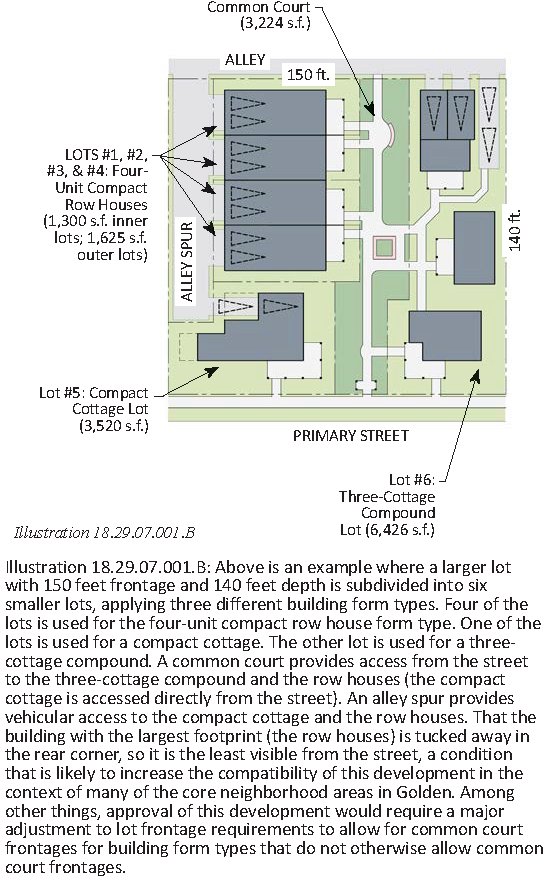
4.
Major Adjustments Related to Combinations of Forms. An adjustment may be approved to allow for a combination of form types to be organized in a way that is not contemplated by this chapter 18.29 (e.g., a combination of row homes and cottages in a subdivision that is designed in a way that resembles a compound [See illustrations 18.29.07.001.B, previous page, and 18.29.07.001.C]), if it is demonstrated that:
A.
All of the form types are allowed in the form zone in which the subject property is located; and
B.
The massing of the development is consistent with other development on the same block face or appropriately transitions to the massing of adjoining lots; and
C.
The design of the development allows for safe and efficient circulation of vehicles and pedestrians; and
D.
The design of the development brings the building forms together in an integrated arrangement (e.g., with buildings that relate to each other, shared access or shared amenities, and consistent or complimentary architectural styles and building materials); and
E.
The development includes outdoor amenities or common court areas that are appropriately designed and scaled to its intended use.
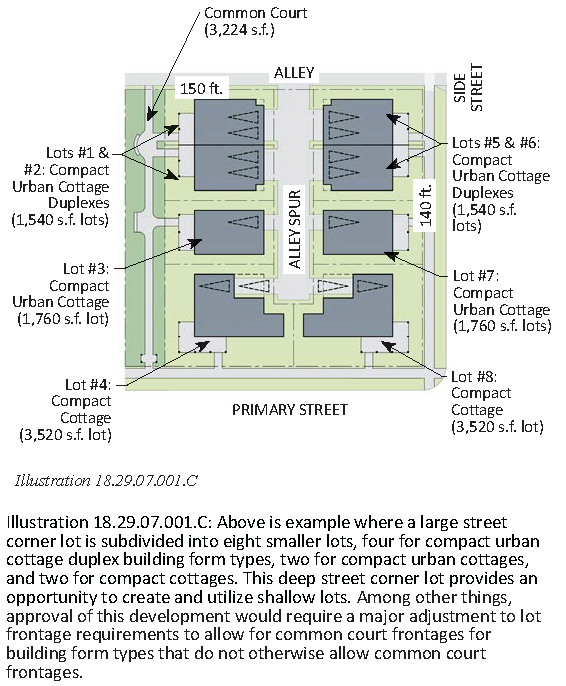
(Ord. No. 2209, § 2(Exh. G), 6-6-2023; Ord. No. 2273, § 2(Exh. A), 8-12-2025)
18.29.07.02 - ADJUSTMENTS PROCEDURE
1.
IN GENERAL
a.
Minor Adjustments. Applications for minor adjustments are decided by the director. The director, in their discretion, may refer any application for a minor adjustment to the planning commission for review and decision at a public meeting.
b.
Major Adjustments. Applications for major adjustments are heard and decided by the planning commission.
2.
APPLICATIONS
a.
Generally. Applications shall be submitted on a form approved by the director, and accompanied by the required application fee. All standards for which adjustments are sought must be identified, along with the corresponding location on the site development plan ("SDP") that is affected by the proposed minor adjustment. For major adjustments that are submitted prior to an SDP application, such adjustments shall be shown on conceptual plans.
b.
Minor Adjustment Timing. An application for a minor adjustment shall be included with the related application for SDP approval.
c.
Major Adjustment Timing.
1.
An application for a major adjustment may be submitted prior to or concurrently with an application for SDP approval.
2.
If a major adjustment is approved prior to a site development plan, an SDP application that is consistent with the approval shall be submitted within one year after the approval or the approval shall lapse.
3.
The director shall not approve SDPs that involve major adjustments unless and until the planning commission approves the major adjustment.
3.
PUBLIC NOTICE
a.
See section 18.10.040 for notice and public hearing procedures.
4.
PLANNING COMMISSION DECISION
a.
Referrals of minor adjustments. The planning commission shall decide referred minor adjustments at a public meeting.
b.
Major adjustments. The planning commission shall, as provided in the public notice, conduct a public hearing, review the proposed major adjustment against the applicable major adjustment criteria contained in section 18.29.07.001, and at the close of the public hearing, render its decision.
c.
Approval conditions. The planning commission may impose conditions of approval that will secure substantially the objectives of the standard that is adjusted, and that will substantially mitigate potential adverse impacts on the environment or on adjacent properties, including, but not limited to, additional landscaping or buffering.
5.
ANNOTATIONS
The director shall annotate approved SDPs to indicate approved adjustments.
6.
APPEALS
Appeals shall be processed as provided in section 18.10.040.
(Ord. No. 2252, § 6(Exh.E), 1-28-2025; Ord. No. 2209, § 2(Exh. G), 6-6-2023)
18.29.08.001 - RULES OF MEASUREMENT
1.
IN GENERAL
This section 18.29.08.001 provides explanations of how to make determinations and measurements for standards contained in this chapter 18.29.
2.
BUILDING ENVELOPE AREAS
a.
In General. Building envelope areas are divisions within a lot that are represented by a percentage of average lot depth. The boundary lines of building envelope areas run parallel to the rear lot line. [See illustrations 18.29.08.001.A and 18.29.08.001.B]
b.
Front Building Envelope Area. The front building envelope area is the building envelope area between the front (primary street) lot line and a line parallel to the rear lot line that is between the front lot line and the rear lot line, a distance from the midpoint of the front lot line (measured as a percentage of average lot depth) that is specified for the building form type.
c.
Middle Building Envelope Area. The middle building envelope area is the building envelope area between the front building envelope area and the rear building envelope area.
d.
Rear Building Envelope Area. The rear building envelope area is the building envelope area between the rear lot line and a line parallel to the rear lot line that is between the rear lot line and the front lot line, a distance from the rear lot line (measured as a percentage of average lot depth) that is specified for the building form type.
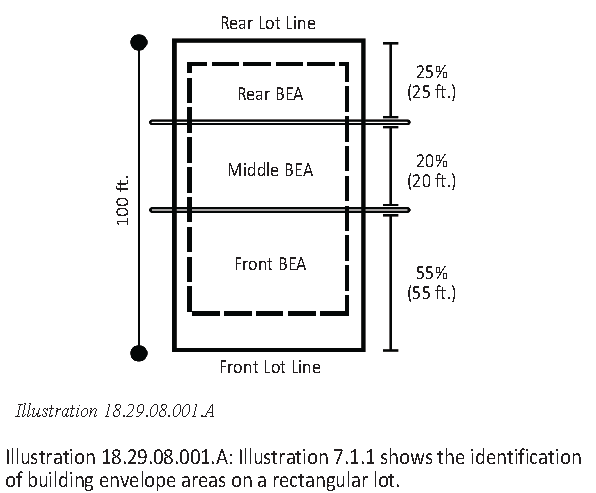
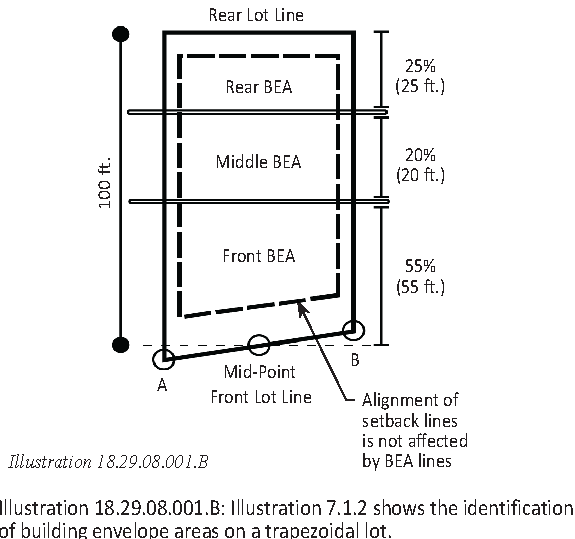
3.
BUILDING HEIGHT
a.
Vertical distance rule. Building height in vertical distance is measured from the finished grade to the highest point of the roof surface. For this rule of measurement, finished grade means the average of the finished ground level at the center of each wall of a building containing ten percent or more of the combined perimeter length of all walls of the building, measured either 10 ft. away from the building, or at the lot line if the building is less than 10 ft. from the lot line. If any two points used in the calculation of grade differ by 12 or more ft., finished grade is defined as an elevation 5 ft. higher than the lowest point. [See illustration 18.29.08.001.C.]
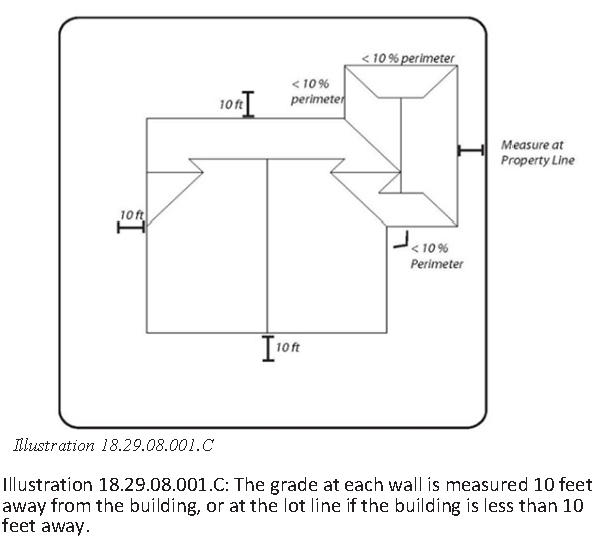
b.
Multiple Building Envelope Areas (BEAs) Rule.
1.
When multiple BEAs are permitted on a lot, the building height in vertical distance shall be measured from the finished grade within each BEA to the highest point of the roof surface within each BEA, as provided in paragraph a, above.
2.
If the units within attached buildings are located on separate lots (e.g., duplexes and row house building forms), the building height in vertical distance is measured from the finished grade of each lot to the highest point of the roof surface for each unit, as provided in paragraph a, above.
c.
Exceptions to Building Height Limitations.
1.
Building height limitations of this chapter shall not apply to spires, belfries, cupolas, chimneys, ventilators, skylights, parapet walls, roof-mounted solar or photovoltaic panels, or cornices without windows, provided that such features shall not extend more than five feet higher than the applicable height limit.
2.
Building height limitations shall also not apply to antennas or necessary mechanical infrastructure and equipment usually carried above the roof level, provided that such features shall not extend more than ten feet higher than the form height limit.
d.
Stories Rule. Building height in stories applies to Form Zones and shall be measured as the total number of building stories.
1.
In General.
A.
A story shall count towards the total number of building stories when it has a finished floor surface entirely above finished grade.
B.
The floor-to-floor measurement of a single story shall not exceed 12 ft. for residential stories and 14 ft. for non-residential stories, except where a pitched roof line provides an extension to the upper-most story.
2.
Multiple Building Envelope Areas. When multiple BEAs are permitted on a lot, the number of stories shall be measured from the finished grade independently within each BEA.
3.
Half-Stories.
A.
A half-story is an uppermost story of a building with a side wall height, measured from the finished floor of the uppermost story to the eave line of the building, of not more than 6 ft. for at least 40 percent of the perimeter of the building.
B.
Dormers that are eight feet or less in width and originate from a wall with a plate height that is 6 ft. or less in height shall be counted towards the 40 percent perimeter identified in subsection 3.d.3.A.
C.
Where the exterior wall of the uppermost floor is recessed from the ground-floor building wall, the maximum side wall height to count towards the 40 percent perimeter identified in subsection 3.d.3.A. may be increased by one foot for every one foot the wall is inset from the edge of the foundation, up to the maximum story height set out in subsection 3.d.1.B.
D.
Areas that are not counted towards the 40 percent perimeter identified in subsection 3.d.3.A. shall not exceed one story in height, as measured in subsection 3.d.1.
4.
Partially Subterranean Stories (e.g., Walkout Basements). If two or more side walls have a side wall height, measured from finished grade to the first finished floor above finished grade, of more than 6 ft., the floor shall be considered a story.
5.
Side Wall Height (for Half-Story and Partially Subterranean Story Measurements).
A.
Side wall height is a measurement of height taken along the side wall. [See definition of "side wall" in section 18.04.020]
B.
For any portion of a building where the side wall extends above the elevation of the roof, or where there is a parapet, railing, or similar element above the elevation of the roof, the height of the side wall, unless otherwise indicated, is measured to the highest point of the exterior wall, parapet, railing, or similar element.
e.
Building Height as Percentage of Building Area rule. Some building form types apply percentages of building footprints to control building height. For instance, they require 70 percent of the building footprint to have a maximum building height of 28 ft. (as depicted by the shaded plane below) and 30 percent of the building footprint to have a maximum building height of 35 ft. This restriction does not specify where 30 percent of the building may be taller. [See illustration 18.29.08.001.D next page.]
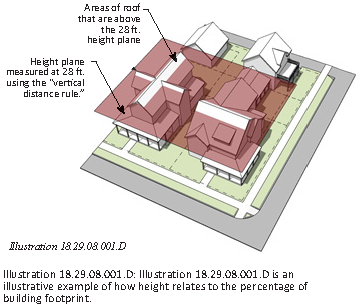
4.
BUILDING SEPARATION
a.
In General. Building separation is the distance from the nearest point of one building's foundation to the nearest point of the foundation of the building from which the separation is measured.
b.
Limited Exception. Minor architectural elements (e.g., cornices, canopies, eaves, or similar features) and materials (e.g., bricks) from each of the buildings are permitted to encroach into the required separation distance by up to one foot.
5.
FLOOR AREA
a.
In General. Except as provided in subsections 5.b, 5.c, 5.d, and 5.e, below, floor area is measured according to the definition of "floor area" in section 18.04.020.
b.
Partially Subterranean Stories. For partially subterranean stories (e.g., walkout basements) [See subsection 3.d.3], floor area shall be calculated as the product of the longest horizontal distance of side building wall that is exposed more than 6 ft. from finished grade to the first finished floor above finished grade (such side building wall, an "exposed wall") times the longest horizontal distance of an intersecting exposed wall. For example, in the case of a walkout basement facing a 40 ft. wide rear building elevation that has a width of exposed wall of 8 ft. on one side and 10 ft. on the other, the floor area would be equal to 40 ft. times 10 ft. (the wider of the two exposed walls on the side building elevations), or 400 s.f.
c.
Subterranean Stories. Building stories with side building walls that are not exposed more than six feet above finished grade are not counted towards the calculation of floor area for the purpose of this chapter 18.29.
d.
Attics and Stairs. Attics are not counted towards the calculation of floor area for the purpose of this chapter 18.29. Stairwells are counted only on the first floor.
e.
Detached Garages. Detached garages are not counted towards floor area for the purpose of this chapter 18.29, but they are counted towards lot coverage.
6.
LOT COVERAGE
a.
Generally. Lot coverage is measured as the total covered area of the lot or BEA, divided by the area of the lot or BEA, as applicable.
b.
Inclusions. The following areas are included in the calculation of the covered area of the lot:
1.
Areas covered by a building or roofed structure (including shade structures such as pergolas), or extension of same, as measured from the foundation.
2.
Elevated decks or uncovered porches that have more than 30 in. of clearance above ground, and projections and cantilevers that extend more than 5 ft. from the building wall are measured from the exterior of the railing or framing.
c.
Exclusions. Covered areas do not include the following:
1.
Exterior cladding that does not project beyond the foundation by more than 4 in.
2.
Structures or portions of structures that do not extend more than 30 in. (or have more than 30 in. of clearance) above ground.
3.
Roof and covered structural overhangs extending no more than 2 ft. from the foundation, measured perpendicular from the exterior face of the exterior wall to the furthest edge of the projection.
4.
Fences, retaining walls, planter boxes, fountains, and play structures.
5.
Detached ground-mounted mechanical equipment serving permitted uses on the property (e.g., air conditioning units).
7.
SETBACKS
a.
In General. All setbacks shall be measured from the lot line to that part of the building's foundation that are closest to the lot line. Setback standards are applied to all buildings and structures on the lot (except fences), unless an alternative setback standard is listed for a specific structure or building element type, or an encroachment is specifically allowed by paragraph b.
b.
Limited Exceptions.
1.
Minor architectural elements (e.g., cornices, canopies, or similar features) and materials (e.g., bricks) are permitted to encroach into the setbacks up to 6 in.
2.
Eaves, rakes, chimneys, scuppers, light fixtures, and similar appurtenances on the building face, are permitted to encroach into the setbacks up to 2 ft.
3.
Open staircases with side walls that are no more than 50 percent opaque are permitted to encroach into the side and rear setbacks up to 4 ft. where an alley is not present. Fire escapes may extend into a required setback not more than 6 ft., provided that all applicable building code requirements are met.
4.
Window-wells may encroach into the setbacks up to 3 ft.
5.
Structural retaining walls may encroach into the setback as necessary.
c.
Fire Separation Distances. The setback standards of this chapter 18.29 do not address fire separation distances. Building and fire code compliance is required.
(Ord. No. 2209, § 2(Exh. G), 6-6-2023)

