
Haines City City Zoning Code
CHAPTER 8
ENVIRONMENTAL PROTECTION
Sec. 8.1.1. - Purpose.
The city is committed to the protection of environmental resources through the adoption of the comprehensive plan and more specifically the adoption of the conservation element of the plan. Some of the issues addressed in this element include surface water, water wells, lakes, fisheries, and wetlands. Other issues contained in the element are addressed as appropriate in other chapters of the land development regulations. This chapter provides the regulations necessary to implement stormwater management systems, water will protection, impervious surface coverage, and protection of lakes, wetlands threatened or endangered species habitat, conservation area, native ecological communities, and water shortages.
Sec. 8.2.1. - Stormwater management systems.
A.
Stormwater management systems shall be installed by the developer which the city (consulting) engineer certifies as adequate to handle a minimum rainfall of five and one-half inches per hour without damage to the facilities and shall be governed by the city drainage plan. When existing off-site drainage facilities would be adversely impacted by the proposed discharge, the developer shall install and pay for such additional improvements as may be required. Where additional capacity is required to handle the needs of the general stormwater system of the city, costs of such extra capacity shall be prorated between the developer and other interests in a manner acceptable to the city.
B.
Stormwater management systems shall be designed so that the peak pre-development discharge rate at the point of stormwater discharge is not exceeded by the peak post-development rate during a 25-year -24-hour storm event, having a total rainfall of eight and one-half inches as required by the water management district (WMD). Detention and/or retention with filtration of the first one-half inch of runoff or the runoff from the first inch of rainfall shall be provided as required by department of environmental regulation (DER).
C.
All installations shall be in conformance with all applicable WMD and DER rules. The developer shall furnish the city with approved stormwater permits and/or exemptions prior to commencing any site work. However, if the developer can produce written evidence to the city staff demonstrating that an accepted application to either or both of these agencies has been in process for more than 120 days, but with no permit issued, and in the opinion of the city (consulting) engineer, all of the developer's construction plans are in order and meet the requirements of the land development regulations, then the city commission may waive this requirement, if in their opinion the public health, safety, and welfare would not be impaired by such action.
D.
If on-site retention with no positive outfall is to be provided, the stormwater management system shall be designed to retain all runoff from a 100-year -72-hour storm event (13.5 inches in a continuous 72-hour period) without flooding of buildings. In addition, the plat or drainage plan shall indicate that no positive outfall is provided and that, if applicable, some lots may flood during extreme storm events.
E.
Along with preliminary construction plans, a drainage plan, and a complete set of drainage calculations shall be provided the city for review by the city (consulting) engineer. The drainage plan shall include all areas that drain into, or through, the proposed subdivision or development, and the subdivision or development outfall system. The diameter, types, sizes, and flow lines of all existing and proposed storm sewer or cross-drain pipes shall be shown, along with the inlets and manholes. The drainage areas that drain into each inlet shall be depicted, along with the drainage areas to the nearest one-tenth of an acre and the "C" factor used. In addition, the drainage plan shall indicate flood plain areas as indicated on the FEMA Maps, locations, and boundaries of wetland areas or waters of the state; locations, results of soils borings, and percolation tests; and an SCS soil classifications, and descriptions of characteristics.
F.
All retention areas shall be designed based on a SCS Type II Florida Modified storm distribution with antecedent moisture condition per WMD regulations.
G.
Cross drains shall be designed for a ten year storm for minor cross drains, collector road culverts, and a 25-year storm for arterial road culverts. All culverts and cross drains shall be designed so that under full flow conditions, the hydraulic grade line is at least one foot below the gutter profile. When pipes are sized based on partial depth flows, the depth of flow shall be not more than two-third of the pipe diameter at velocities exceeding 15 feet per second. All pipes shall be designed for a minimum velocity of two and one-half feet per second.
H.
All construction shall be in accordance with city specifications and standard details contained in the administration and procedures manual and all structures shall be in accordance with FDOT specifications. The storm sewer system may empty into an existing storm sewer system or any other outlet approved by the city (consulting) engineer at a rate not to exceed the peak pre-development rate. Overland flow over roadways shall not be permitted.
I.
Any new construction that is proposed to drain to a FDOT drainage system shall be required to secure a FDOT drainage permit and submit such to the administrative official prior to the issuance of a development order.
Sec. 8.2.2. - Sub-drainage.
A.
Sub-drainage facilities shall be required in "wet soil" areas if the city (consulting) engineer determines that the bottom of any base material used for foundations or streets would otherwise be less than one foot above highest anticipated groundwater levels. Such decisions shall be based on SCS soil surveys, wet season water table determined by field borings, or area history of flooding. Soil-cement base may be used in lieu of sub drains when approved by the city (consulting) engineer. Sub drainage facilities shall conform to FDOT specifications and standards.
Sec. 8.2.3. - Polk county stormwater quality management.
A.
For enforcement purposes, the city has adopted by reference Polk.
1.
General provisions.
a.
Short title: This section shall be known as the Polk County Stormwater Quality Management Ordinance.
b.
Finding of facts: The contribution of pollutants through discharges from storm sewer systems has a significant impact on the receiving waters in Polk County. Improperly treated discharges from industrial activities and interconnected municipal separate storm sewer systems (MS4's) and illicit discharges from spilling, dumping or disposal of material other than stormwater to the municipal separate storm sewer system will adversely affect the quality of waters receiving such discharges. The United States Environmental Protection Agency, pursuant to title 40, section 122.26 of federal regulations, has mandated that municipalities provide the legal authority to control discharges to the municipal separate storm sewer system under the national pollutant discharge system (NPDES) in order to control the quality of discharges from the MS4. The Board of County Commissioners of Polk County, Florida, therefore finds it necessary and in the public interest, to protect the quality of waters receiving stormwater discharges from becoming contaminated, for the health, safety, and general welfare of the citizens of Polk County.
c.
Applicability: The regulations herein set forth shall apply to all the unincorporated areas of Polk County and within the corporate limits of each Polk County municipality. Charter provisions or ordinances within municipalities that are in conflict with the provisions of this chapter shall take precedence and shall be used to supplement the requirements of this chapter.
2.
Definitions.
a.
Section 2-1 definitions: Unless specifically defined below, words or phrases used in this chapter shall be interpreted so as to give them the meaning they have in common usage and to give this chapter its most reasonable application. Use of the word "shall" means mandatory and not merely discretionary.
Best management practices (BMP). Schedules of activities, prohibitions of practices, maintenance procedures, and other management practices to prevent or reduce pollutants from entering the MS4 or being discharged from the MS4 so as to protect or to restore the quality of "Waters of the United States. BMP's include, but are not limited to treatment methods and practices to control; site runoff, spillage, leaks, sludge, waste disposal, or runoff from raw material.
Board. The Board of County Commissioners of Polk County, Florida.
Code of federal regulations (CFR). The codification of the general and permanent rules published by the federal register by the executive departments and agencies of the federal government.
County. Shall mean Polk County, a political subdivision of the State of Florida.
Discharge. Includes, but is not limited to, any spilling, leaking, seeping, pouring, emitting, emptying, or dumping of any material.
Emergency management division. A division of the Polk County Public Safety Department.
Florida administrative code (FAC). An annotated official compilation of the rules and regulations of the State of Florida Secretary of State.
Illicit discharge. Any discharge to a municipal separate storm sewer system or to waters of the U.S. that is not composed entirely of stormwater; with the exception of discharges which are exempt, pursuant to section 6-2 of this article.
Industrial activities. Activities which are conducted on properties designated for Industrial Land Use in accordance with local comprehensive plans and at facilities identified by the U.S. EPA as requiring a NPDES stormwater permit under the definition of "Storm Water Discharge Associated with Industrial Activity" in Title 40, Section 122.26 of the Code of Federal Regulations or any modification or derivative thereof.
Inspection. Includes, but not limited to a review of all components of the stormwater management system, records on operation, and maintenance of facilities and the results of any monitoring performed for compliance with state, federal and local regulations or permit conditions.
Municipal or municipality. Shall include the county and all cities, towns, or other public entities, created by or pursuant to Florida law, which own or operate a municipal separate storm sewer system within Polk County.
Municipal separate storm sewer system (MS4). A conveyance or system of conveyance (including roads with drainage, systems, municipal streets, catch basins, curbs, gutters, ditches, manmade channels or storm drains) owned or operated by a municipality that discharges to waters of the United States and that is designed solely for collecting or conveying stormwater that is not part of a publicly owned treatment works (POTW) as defined by 40 CFR 122.2.
National pollutant discharge elimination system (NPDES). The federal program, implemented by the U.S. EPA, for controlling discharges from point source discharges directly into waters of the U.S. under the Clean Water Act.
Person. Any individual, partnership, firm, organization, corporation, association or other legal entity, whether singular or plural, as the context may require.
Stormwater. Surface runoff and drainage of water resulting from rainfall.
Waters of the United States. As defined by the U.S. Environmental Protection Agency (EPA) in Title 40, Section 122 of the Code of Federal Regulations or any modification or derivative thereof.
3.
Control of stormwater discharges.
Section 3-1 stormwater discharges to the municipal system and U.S. waters.
3-1.
1. The discharge of stormwater to an MS4 shall be controlled to the extent that such discharge will not impair the operation of the MS4 or contribute to the failure of the MS4 to meet any state or federal requirements. Discharges to waters of the U.S. shall be controlled to the extent that the discharge will not adversely impact the quality or beneficial uses of the receiving water.
3-1.
2. Any person responsible for stormwater discharges determined by the municipality to be contributing to the impairment of waters of the U.S., either directly or through an MS4, shall provide corrective measures in accordance with a schedule approved by the municipality.
Section 3-2 stormwater discharges from industrial activities and construction sites.
3-2.
1. Stormwater from construction sites shall be controlled in such a way as to retain sediment on-site and prevent violations of state water quality standards. All erosion and sediment controls required pursuant to the pollution prevention plan of a NPDES stormwater permit for construction or required pursuant to a state stormwater permit issued by either the Florida Department of Environmental Regulation or appropriate water management district shall be properly implemented, maintained and operated.
3-2.
2. Stormwater from areas of industrial activity shall be treated or managed on-site, using best management practices, prior to discharging to an MS4 or to U.S. Waters. All stormwater discharges from the site shall be of a quality which will not adversely impact the water quality or beneficial uses of the receiving water.
3-2.
3. The owners of industrial facilities or construction sites which will discharge stormwater to an MS4, must provide written notification to the appropriate municipality prior to discharging.
Section 3-3 control of pollutant contributions from interconnected MS4's:
The discharge of stormwater between interconnected state, county or other municipal storm sewer systems shall not impair the quality of the discharge from the receiving storm sewer system. Owners of sections of an interconnected MS4 shall be responsible for the quality of discharge from their portion of the system and shall coordinate with the owners of the downstream segments prior to initiating any modifications to the system.
4.
Control of nonstormwater discharges.
3-4-1.
Prohibition of illicit discharges: Any discharge, other than stormwater, to an MS4 or to waters of the U.S. which is not exempt under section 6-2 of this article is considered an illicit discharge as defined in this article and is prohibited.
3-4-2.
Reporting illicit discharges: Upon discovery of an illicit discharge, persons responsible for the discharge shall report their findings immediately to the municipality in which the discharge occurs.
3-4-3.
Control of illicit discharges: Persons responsible of illicit discharges shall immediately, upon notification, initiate procedures to cease discharging or provide suitable containment facilities until modifications are made to properly treat the discharge, or a NPDES permit is obtained. Such procedures shall include a requirement to obtain approval of a schedule for implementing proposed corrective measures from the appropriate municipality.
5.
Inspection and maintenance of systems.
3-5-1.
Inspection and monitoring for compliance: Municipal personnel shall be granted access for inspection of facilities discharging or suspected of discharging to an MS4 or waters of the U.S. in order to evaluate the potential for release of materials other than stormwater. All structures which allow discharges to an MS4 shall be made accessible to municipal personnel for continued monitoring of the quality of the discharges.
3-5-2.
Maintenance of control structures: Structural controls and other BMP's used to reduce pollutants in stormwater discharges shall be operated and maintained so as to function in accordance with the original design or performance criteria. Operation and maintenance shall be done so as to assure treatment of stormwater or reduction in pollutants in stormwater discharges consistent with appropriate federal, state or water management district rules or permit requirements.
6.
Variances and exemptions.
3-6.1.
Variances: Variances from specific requirements of this article shall be considered by the appropriate municipalities on a case by case basis to the extent that the granting of such variance will not adversely impact the quality of the receiving water or relieve a person from any federal, state or local requirements which may apply. Notification of variance application shall be provided to the owners of all MS4's within Polk County.
3-6.2.
Exemptions: The following activities shall be exempt from the requirements of this article:
a)
Discharges from fire fighting and emergency response activities employing best management practices.
b)
Discharges which meet the water quality standard of Chapter 17-302 FAC.
c)
Discharges from facilities in compliance with the conditions of all required NPDES permits issued under the authority of the U.S. Environmental Protection Agency.
d)
The storage, use or disposal of fertilizers, pesticides, herbicides or other regulated substances in strict conformance with the EPA registration, manufacturer's label requirements and any applicable federal, state or local regulations.
B.
For enforcement purposes, the city has adopted a stormwater management program.
Sec. 8.3.1. - Intent.
A.
The intent and purpose of this article is to protect and safeguard the health, safety and welfare of the residents and visitors of the city by providing criteria for regulating and prohibiting the use, handling, production and storage of certain deleterious substances which may impair present and future public potable water supply wells and well fields.
B.
The generic substance list contained in chapter 11 of this administrative and procedures manual as exhibit A is provided for informational purposes and may be revised from time to time by the city commission. Persons using, handling, producing or storing a substance on the generic list may be using, handling, producing or storing a regulated substance as defined by this article and, therefore, may be subject to the requirements of this article. Persons unsure as to whether they are subject to this article may wish to consult with the city.
C.
All provisions of this article shall be effective within the corporate limits of the city and shall set restrictions, constraints and prohibitions to protect present and future public potable water supply wells and well fields from degradation by contamination of deleterious substances.
D.
All institutional, commercial and/or industrial land uses with high pollution potential shall be prohibited from locating within any designated Wellhead Protection Area. Use of any materials contained in the above referenced generic substance list shall be a determining factor in whether such use is or is not prohibited.
Sec. 8.3.2. - Definitions.
In addition to the definitions contained in Chapter 4, of the land development regulations, the following definitions apply within this article:
Aquifer. A formation that contains sufficient saturated permeable material to yield significant amounts of water to wells or springs.
Closure permit. That permit required by activities which must cease operation, the criteria for which are set forth under section 8.3.5.
Completed application. An application which includes all materials and documents which are necessary to support the application and which has been accepted as complete by the city staff.
Cone of depression. An area of reduced water levels which results from the withdrawal of groundwater from a point of collective source such as a well, well field, or de-watering site. The area extent and depth of the depression is a function of the hydraulic properties of the aquifer, the pumpage rates and recharge rates.
Contaminant. An undesirable substance not normally present, or an unusually high concentration of a naturally occurring substance in water, soil, or other environmental medium.
Emergency hazardous situation. Exists whenever there is an immediate and substantial danger to human health, safety or welfare, or to the environment.
EPA. Environmental Protection Agency, a federal agency.
Ex-filtration system. Any gallery, perforated or "leaky" pipe or similarly designed structure which is used to dispose of untreated stormwater by allowing the routed water to percolate by subsurface discharge directly or indirectly into the groundwater.
Facility. Something that is built, installed, or established for a particular purpose.
FDEP. The Florida Department of Environmental Protection.
FRWA. Florida Rural Water Association.
Generic substance list. These general categories of substances set forth in exhibit A chapter 11 attached hereto and incorporated herein.
Groundwater. Water contained in the zone of saturation in the aquifer; all water beneath the surface of the ground.
Head. Pressure, expressed as the height of a column of water that can be supported by the pressure.
Hydraulic gradient. The change of pressure head per unit distance from one point to another in the aquifer.
Laboratory. A designated area or areas used for testing, research, experimentation, quality control, or prototype construction, but not used for repair or maintenance activities (excluding laboratory equipment), the manufacturing of products for sale, or pilot plant testing.
One-foot drawdown contour. The locus of points around a well or well field where the free water elevation is lowered by one foot due to a specified pumping rate of the well or well field.
Operating permit. The permit required of certain activities under section 8.3.4. to operate the criteria for which are set forth under section 8.3.5.
Ordinary high water line (OHWL). A line determined by examining the bed and banks, and ascertaining where the presence and action of the water are so common and usual, and so long continued in all ordinary years, as to mark upon the soil of the bed a character distinct from that of the banks, in respect to vegetation, as well as respects the nature of the soil itself.
Porosity. Pore spaces that were created at the time the aquifer formation was formed.
Potable water. Water suitable for human consumption as drinking water.
Regulated substance. Any substance, including petroleum or derivatives thereof, or combination of substances which because of their quantity, concentration, physical, chemical, infectious, flammable, combustible, radioactive, or toxic characteristics, may cause or significantly contribute to a present or potential risk to human health, safety, welfare, to groundwater resources or to the natural environment.
Spill. The un-permitted release or escaped of a regulated substance, irrespective of the quantity thresholds in paragraph 8.3.2.N.2. above, directly or indirectly, to soils, surface waters or ground waters.
SWFWMD. The South West Florida Water Management District.
Sinkhole. Any enclosed karst depression. Sinkholes may occur as isolated individuals or in densely packed groups.
Surface water. Water on the surface of the earth, including snow and ice.
Transmissivity. The rate at which water of a prevailing viscosity is transmitted through a unit hydraulic gradient.
Water table. The surface in an unconfined water body at which pressure is atmospheric. It is generally the top of the saturated zone.
Well. Any excavation this is drilled, cored, bored, washed, drive, dug, jetted, or otherwise constructed when the intended use of such excavation is to conduct ground water from a source bed the surface by pumping, natural flow or any other method.
Well field. An area containing two or more wells.
Wellhead. The physical feature, facility, or devise at the land surface level from or through which groundwater flows are pumped from the subsurface, water-bearing formations.
Wellhead protection area. An area designated by the city consisting of the surface and subsurface area surrounding a water well through which contaminants are likely to move toward and reach the water well.
WhAEM. Wellhead analytic element model and EPA modeling program that produces time related capture zones based on the pumping rates, aquifer characteristics, and surface water evaluations.
Zone of saturation. Rock or soil in which every available space is filled with water.
Sec. 8.3.3. - Wells in treatment plants.
A.
Wells in treatment plant one identified. The following wells exist in treatment plant one:
1.
Well #3: The total depth is 750 feet with a casing depth to 170 feet with a 12-inch diameter casing. The well is located at north latitude 28.06.35.816 and west longitude 81.47.23.461 with a Florida Unique Well ID # AAC5840.
2.
Well #4: The total depth is 810 feet with a casing depth to 171 feet with a 12-inch diameter casing. The well is located at north latitude 28.06.34.918 and west longitude 81.37.39.486 with a Florida Unique Well ID # AAC 5841.
3.
Well #7: The total depth is 600 feet with a casing depth to 200 feet with a 16-inch diameter casing. The well is located at north latitude 28.06.49.405 and west longitude 81.37.39.486 with a Florida Unique Well ID # AAC5843.
4.
Well # 8: The total depth is 600 feet with a casing depth of 200 feet with a 16-inch diameter casing. The well is located at north latitude 28.06.44.727 and west longitude 81.37.32.506 with a Florida Unique ID # AAC5842.
B.
Wells in treatment plant two identified. The following wells exist in treatment plant two:
1.
Well # 9: The total depth is 950 feet with a casing depth to 225 feet with a 16-inch diameter casing. The well is located at north latitude 28.05.42.16 and west longitude 81.36.54.11 with a Florida Unique ID # AAC5837.
2.
Well # 10: The total depth is 850 feet with a casing depth to 135 feet with a 16-inch diameter casing. The well is located at north latitude 28.05.39.57 and west longitude 81.37.21.08 with a Florida Unique ID # AAC5839.
3.
Well # 11: The total depth is 750 feet with a casing depth to 297 feet with an 18-inch diameter casing. The well is located at north latitude 28.05.35.66 and west longitude 81.36.52.73 with a Florida Unique ID # AAC5838.
Sec. 8.3.4. - Wellhead protection area maps.
A.
Establishing wellhead protection areas. The city hereby establishes the wellhead protection areas for existing and future wells as shown in tables 8.1, 8.2 and 8.3 below. Table 8.1 establishes wellhead protection areas for water treatment plant one. Table 8.2 establishes wellhead protection areas for water treatments plant two. Table 8.3 establishes wellhead protection areas for designated future well sites. Any amendments, additions or deletions to the wellhead protection maps shall be approved by the city commission following written notice, by the city to property owners within the area covered by the amendment, addition or deletion, and after public hearing.
TABLE 8.1
TREATMENT PLANT ONE WELLS
(See diagrams #1 through #4)
TABLE 8.2
TREATMENT PLANT TWO WELLS
(See diagrams #5 through #7)
TABLE 8.3
FUTURE WELL SITES
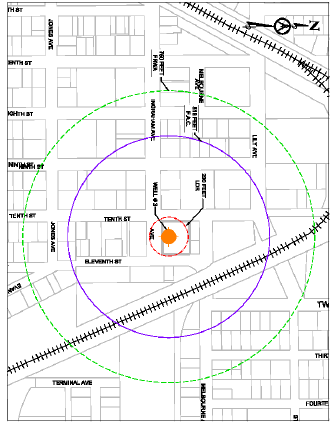
Diagram #1
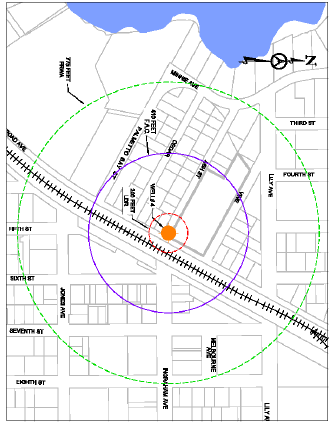
Diagram #2
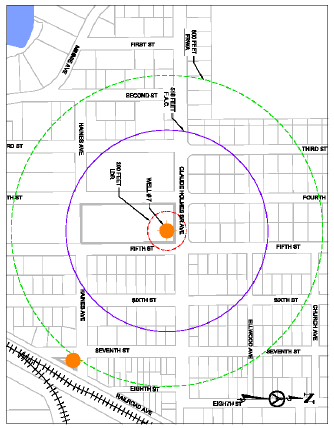
Diagram #3
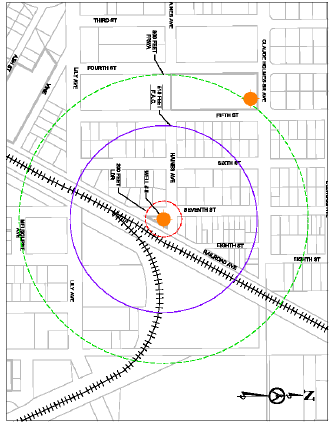
Diagram #4
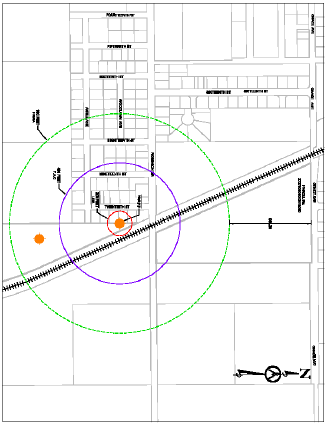
Diagram #5
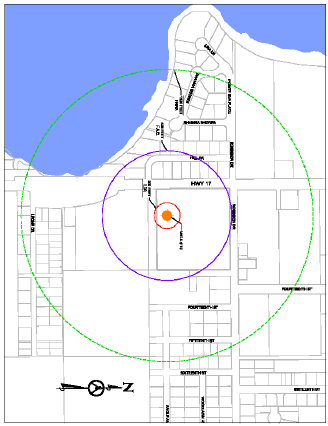
Diagram #6
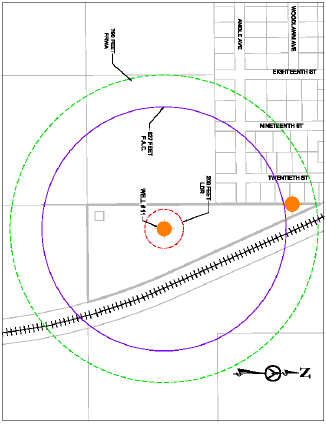
Diagram #7
B.
Adopting maps showing the wellhead protection zones. The city commission has reviewed and approved "Wellhead Protection Maps" which delineate the wellhead protection areas designated by the city in tables 8.1, 8.2, and 8.3 above. The maps are shown as exhibit "A" to this article 3 and are adopted by reference and made a part of this article. The wellhead protection areas designated in the wellhead protection maps shall be considered overlay districts which supplement otherwise applicable requirements of the city's land development regulations.
a.
Review of maps. The public works director shall review the "Wellhead Protection Maps" on an annual basis to determine if modifications are needed. Failure to conduct a review will not affect the validity of the existing approved map.
b.
Modification of maps. The maps may be modified at any time by the city commission where it determines that it is in the best interest of the public to do so, including modifications required due to changes in technical knowledge, such as transmissivity, porosity, changes in pumping rates, fouling or other loss of or damage to a well, reconfiguration of well fields, installation of new wells or well fields, and to accommodate changes in topography, such as sinkholes or newly approved mining areas. Any such modification of the maps shall be made after notice of an advertised public hearing in accordance with Florida law.
Sec. 8.3.5. - Restriction within wellhead protection areas.
A.
All nonresidential activities within the wellhead protection areas which store, handle, use or produce any regulated substance are prohibited from doing so unless they qualify as a general exemption, obtain a special exemption, or receive an operating permit from the city which complies with the following conditions:
1.
Containment of regulated substances. Leak proof trays under containers, floor curbing or other containment systems to provide secondary liquid containment shall be installed. The containment shall be of adequate size to handle all spills, leaks, overflows and precipitation until appropriate action can be taken. The specific design and selection of materials shall be sufficient to preclude any regulated substance loss to the external environment. Containment systems shall be sheltered so that the intrusion of precipitation is effectively prevented. The owner/operator may choose to provide adequate and appropriate liquid collection methods rather than a sheltering only after approval of the design by the city staff. These requirement shall apply to all areas of use, production and handling; to all storage areas; to loading and off-loading areas, and to above ground and underground storage areas. The containment devices and liquid collection systems shall be certified in the operating permit application by the professional engineer registered or professional geologist licensed in the state.
2.
Emergency collection devices. Vacuum suction devices, absorbent scavenger materials or other devices approved by the department shall be present on the site or available within two hours by contract with a cleanup company approved by the city, in sufficient magnitude so as to control and collect the total quantity of regulated substances present. To the degree feasible, emergency containers shall be present and of such capacity as to hold the total quantity of regulated substances plus absorbent material. The presence of such emergency collection devices shall be certified in the operating permit application for existing activities. Such certification for new activities shall be provided to the city prior to the presence of regulated substances on the site. Certification shall be provided by a professional engineer registered or professional geologist licensed by the state.
3.
Emergency plan. An emergency plan shall be prepared and filed with the operating permit application indicating the procedures which will be followed in the event of a spill of a regulated substance so as to control and collect all such spilled material in such a manner as to prevent it from reaching any storm or sanitary drains or the ground.
4.
Inspection. A responsible person designated by the permittee who stores, handles, uses or produces the regulated substances shall check on every day of operation, for breakage or leakage of any container holding the regulated substances. Electronic sensing devices may be employed as part of the inspection process, if approved by the department, and provided the sensing system is checked daily for malfunctions. The manner of daily inspection shall not necessarily require physical inspection of each container provided the location of the containers can be inspected to a degree which reasonably assures the city that breakage or leakage can be detect by the inspection. Monitoring records shall be kept and made available to the city at all reasonable times for examination.
5.
Proper and adequate regular maintenance of containment and emergency equipment. Procedures shall be established for the quarterly in-house inspection and maintenance of containment and emergency equipment. Such procedures shall be in writing, a regular checklist and schedule of maintenance shall be established, and a log shall be kept of inspections and maintenance. Such logs and records shall be available for inspection by the city.
6.
Reporting of spills. Any spill of a regulated substance shall be reported by telephone to the County Health Department and the city within 24 hours of discovery of the spill. Cleanup shall commence immediately upon discovery of the spill. A full written report, including the steps taken to contain and clean up the spill, shall be submitted to the city within 15 days of discovery of the spill.
7.
Monitoring for regulated substances in the potable water well. Arrangements shall be made with the public works department to establish a semiannual schedule of raw water analysis unless sampling results indicate the presence of a contaminant, in which case the city shall require an increased sampling schedule. The analysis shall be for all substances which are listed on the operating permit. The analytical reports shall be prepared by a state-certified laboratory, certified for the applicable analyses. It shall be the responsibility of the public works department to provide for the sampling and analyses. Samples shall be taken by the state-certified laboratory performing the analyses, or its authorized representative. A reference set of raw water analyses shall be completed for each well for which a wellhead protection area has been established. These analyses shall be completed within 185 days after the effective date of the LDR, and a copy shall be forwarded to the administrative official within 14 days of completion. These analyses shall address inorganic priority pollutants and organic priority pollutants. The analytical reports shall be prepared by the state-certified laboratory, certified for applicable analyses.
8.
Monitoring for regulated substances in groundwater monitoring wells. Groundwater monitoring well(s) shall be provided in a manner, number and location approved by the city. Except for existing wells found by the city to be adequate for this provision, the required well or wells shall be installed by the state-licensed water well contractor. Sample shall be taken by the state certified laboratory performing the analyses, or its authorized representative. Analytical reports prepared by a state-certified laboratory of the quantity present in each monitoring well of the regulated substances listed in the activity's operating permit shall be file at least annually, or more frequently, as determined by the department, based upon site conditions and operations.
9.
Alterations and expansion. The city shall be notified in writing prior to the expansion, alteration or modification of an activity holding an operating permit. Such expansion, alteration or modification may result from increased square footage of production or storage capacity, or increased quantities of regulated substances, or changes in types of regulated substances beyond those square footages, quantities and types upon which the permit was issued. Excluded from notification prior to alteration or modification are changes in types of regulated substances listed in the permit based upon the generic substance list as chapter 11 of this administration and procedures manual. Should a facility add new regulated substances which individually are below the nonaggregate limits, it shall notify the city on the annual basis of the types and quantities of such substances added and the location of the use, handling, storage and production of said substances. Any such expansion, alteration or modification shall be in strict conformity with this article. Further, except as provided herein, any existing operating permit shall be amended to reflect the introduction of any new regulated substances resulting from the change. However, the introduction of any new regulated substance shall not prevent the revocation or revision of any existing operating permit if, in the opinion of the city, such introduction substantially or materially modifies, alters or affects the conditions upon which the existing operating permit was granted or the ability to remain qualified as a general exemption, if applicable, or to continue to satisfy any conditions upon which the existing operating permit was granted or the ability to remain qualified as a general exemption, if applicable, or to continue to satisfy any conditions that have been imposed as part of a special exemption, if applicable. The city shall notify the permittee in writing within 60 days of receipt of the permittee's notice that the city proposes to revoke or revise the permit and stating the grounds therefore.
10.
Reconstruction after catastrophe. Reconstruction of any portion of a structure or building in which there is any activity subject to the provisions of this regulation which is damaged by fire, vandalism, flood, explosion, collapse, wind, war or other catastrophe shall be in strict conformity with this article.
11.
Operating permit. All existing nonresidential activities situated in a designated wellhead protection area which use, handle, store or produce regulated substances shall file an application for an operating permit within 90 days or a closure permit application or special exemption application within 120 days of the receipt of written notice from the city. The permit application shall be prepared and signed by a professional geologist licensed by the state. Within 30 days of receipt of the notice, the owner or operator shall file with the city proof of retention of said engineer or geologist. If application is made for an operating permit, such a permit shall be issued or denied within 60 days of filing of the completed application. If the application for an operating permit is denied, then the activity shall cease within 12 months of the denial and an application for a closure permit shall be filed with the city within 120 days of the denial of the operating permit.
12.
Prohibiting activities within wellhead protection areas.
a.
Solid waste disposal.
b.
Discharges from commercial and industrial wastewater treatment plants and industrial septic systems and commercial and industrial wastewater effluent disposal, other than mine settling ponds.
c.
New discharges from domestic wastewater treatment plants. Expansion of existing domestic waste water treatment plants will be prohibited unless advanced secondary treatment standards are met. Public access reuse of reclaimed water and land application of domestic wastewater effluent may be allowed upon demonstration of advanced secondary treatment.
d.
Dairy farms as defined in Chapter 5D of the Florida Administrative Code.
e.
Concentrated animal feeding operations.
f.
Land application of wastewater residuals (sludge) or septage, which requires a permit from the Florida Department of Environmental Protection and/or the Florida Department of Health and Rehabilitative Services.
g.
New underground storage tanks not associated with an existing nonconforming use.
h.
Mining and borrow pits.
i.
New residential subdivisions, with a density of greater than one unit per acre, that do not provide for a central sanitary facility and wastewater treatment plant.
j.
Hazardous waste treatment, storage or disposal facilities as defined in F.S. § 403.703(22), or 40 Code of Federal Regulations 260.10 or chapter 17-730 Florida Administrative Code, including transfer facilities, such facilities ancillary to recycling facilities and facilities which burn such hazardous waste for fuel.
k.
Hazardous waste generators other than conditionally except small quantity generators or small quantity generators.
l.
Facilities regulated by the Emergency Planning and Community Right-to-Know Act of 1986, 42 U.S.C. §§ 11001-11050.
m.
Landscape improvements for golf courses, greens, fairways, or tees. Land associated with golf courses maintained without the application of pesticides, fertilizers or other horticultural chemicals is not prohibited in wellhead protection areas for wells #1, #2, and #3.
n.
Salvage yards.
o.
Land farming of soil contaminated with regulated substances.
p.
Stormwater retention ponds that will receive stormwater from land-uses prohibited in wellhead protection areas and that are constructed after the effective date of this article.
q.
The siting of underground petroleum product lines, including, but not limited to, pipelines designed for the transportation of gasoline and oil.
r.
Hazardous waste treatment, storage or disposal facilities as defined in F.S. § 403.703(22), or 40 Code of Federal Regulations 260.10 or chapter 17-730 Florida Administrative Code, including transfer facilities, such facilities ancillary to recycling facilities and facilities which burn such hazardous waste for fuel.
s.
Unlined solid waste disposal facilities.
t.
Land farming of soil contaminated with regulated substances.
u.
The siting of underground petroleum product lines, including, but not limited to, pipelines, designed for the transportation of gasoline and oil.
v.
Stormwater discharge retention-detention facilities.
w.
Any industrial or commercial activities that utilize, generate, or store any of the substances found under the "Potential Hazardous Contaminant Sources."
13.
Potential hazardous contaminant sources. The following is an inventory of potential contaminant sources:
a.
Abandoned wells (properly);
b.
Abandoned wells (improperly);
c.
Above ground storage tanks;
d.
Airports;
e.
Animal feed stores;
f.
Animal waste storage;
g.
Armory/depot;
h.
Asphalt plant;
i.
Auto/repair body shop;
j.
Auxiliary engine;
k.
Cemetery;
l.
Chemical plant/mixing/storage;
m.
DOT facility;
n.
Drainage canal/storm drainage;
o.
Dry cleaners;
p.
Dumps/landfills;
q.
Farming/agricultural;
r.
Farming coops;
s.
Fertilizer storage;
t.
Force mains;
u.
Gasoline service stations;
v.
Golf course/nurseries;
w.
Grains/storage bins;
x.
Hazardous waste;
y.
Holding ponds;
z.
Injection wells irrigation/spray fields;
aa.
Lab/medical facilities;
bb.
Lift stations;
cc.
Machine shop;
dd.
Major highways;
ee.
Military base;
ff.
Mining/excavation (ross excavation);
gg.
Oil/gas storage (county maintenance);
hh.
Pesticide/herbicide storage;
ii.
Pesticide/herbicide mixing;
jj.
Power generation;
kk.
Power sub-station;
ll.
Railroads;
mm.
Retention pond;
nn.
Salvage yards;
oo.
Septic tanks;
pp.
Underground storage tanks/swimming pools;
qq.
Utilities;
rr.
Sewage plants;
ss.
Water storage;
tt.
Lake/channel; and
uu.
Public park.
14.
General exemptions. The following activities are exempt from the land use prohibitions applicable to wellhead protection areas under this article:
a.
Continuous transport of regulated substances. The transportation of any regulated substance throughout the city shall be exempt from the provisions of this ordnance provided the transporting motor vehicle is in continuous transit and meets all applicable state and federal requirements.
b.
Office use. Use, handling, or storage of regulated substances by offices shall be exempt from the provisions of this article providing that the regulated substances are auxiliary to the operating activities of the business.
c.
Janitorial uses. The use of regulated substances for the maintenance and cleaning of residential, commercial and office buildings shall be exempt from the provisions of this article.
d.
Application of pesticides, herbicides, fungicides, and rodenticides. The application of those regulated substances used as pesticides, herbicides, fungicides, and rodenticides in recreation, agriculture, pest control, and aquatic weed control activities shall be exempt from the prohibitions of this ordinance provided that the procedure below is followed:
The application of any pesticides, herbicides, fungicides, and rodenticides shall be flagged in the records of the certified operator supervising the use. The certified operator shall provide specific notification in writing to the applicators under his or her supervision that they are working at a site located in a wellhead protection area. Records shall be kept of the date and amount of those substances applied at each location and said records shall be available for inspection at reasonable times by the city.
e.
Fire, police, emergency medical services and city emergency management facilities. Existing fire, police, emergency medical services and city emergency management center facilities are exempt from the prohibitions of this article to the extent necessary to implement emergency measures required from time to time.
15.
Managing wellhead protection areas.
A.
The public works director shall have the primary responsibility to manage the wellhead protection areas. The public works director shall, as part of its duties under this section, do one or more of the following as he or she deems necessary or prudent.
a.
Intergovernmental involvement. The public works director will coordinate with local, state and county government agencies to improve wellhead protection and to better protect the groundwater in the area. The public works director may send written notice to the Polk County Department of Planning and Development explaining the wellhead protection ordinance. The public works director may also utilize information from SWFWMD on existing or proposed studies on the quality and quantity of water in the Florida aquifer to make recommendations to the city commission on wellhead maps and associated issues.
b.
Community awareness. The public works director will engage the city in community awareness regarding this article. The public works director will take reasonable steps to ensure the residents, visitors, and up-gradient landowners are aware of the wellhead protection areas established in the city. Reasonable steps will be taken to educate these individuals on actions they may take to prevent contamination of potable water. The public works director shall take such other reasonable steps to promote community awareness as it deems necessary.
B.
Other requirements and liabilities. A notice to cease a permit or exemption issued under this article shall not relieve the owner or operator of the obligation to comply with any other applicable federal, state, regional or city regulation, rule, ordinance or requirement. Nor shall the notice, permit or exemption relieve any owner or operator of any liability for violation of such regulations, rules, ordinances or requirements.
C.
Requirements for sanitary sewers and ex-filtration systems.
1.
All new or replacement installations of sanitary sewer mains in the designated wellhead protection area of a public drinking water well field shall be constructed to force main standards.
2.
No new ex-filtration system shall be constructed in the designated wellhead protection area of a public drinking water well field.
Sec. 8.3.6. - Permits required.
Any new business, commercial, industrial, or other nonresidential activity proposed to be established or expanded on property (a) within the wellhead protection area of an existing city potable water supply well, or (b) within the wellhead protection area of future city well sites, (or, if city has not completed it analysis under section 8.3.9., then within 500 feet of the designated future well location) shall obtain all of the following which applies under this section 8.3.6.:
(a)
An operating permit under section 8.3.6.B.;
(b)
A wellhead protection permit (if no operating permit is required); and,
(c)
A closure permit.
Based on the information proved in the application, the city staff will determine if the operating permit or the wellhead protection permit is required under this administrative and procedures manual. No local business tax receipt or development order, including any building permit, shall be issued without first obtaining the applicable permit when one is required under this section.
A.
Well field protection permits.
1.
This section provides the requirements and procedures for the issuance by the city of operating, wellhead protection and closure permits required by this article.
2.
An application which satisfies the requirements of this section shall be approved and a permit issued. In addition to the failure to satisfy these requirements, the city may deny a permit based on repeated violations of this article.
3.
An operating permit or wellhead protection permit (as applicable) shall remain valid provided the permittee is in compliance with the terms and conditions of the permit.
4.
Permittees shall not be required to pay annual renewal fees until October 1, 1992. Beginning October 1, 1992, all current and future permittees are subject to an annual renewal license fee as stated in 8.3.5.C. notification the city under 8.3.5.A.9. is due with the renewal fee.
5.
The city shall have the right to make inspections of permittee facilities at reasonable times to determine compliance with this article.
6.
All of the facilities owned and/or operated by one person when these structures and activities are located on contiguous parcels of property, even where there are intervening public or private roads, may be covered under one permit.
B.
Permit applications.
1.
Operating permit. All applications for operating permits or wellhead protection permits (whichever applies), as a minimum, shall provide the following information:
a.
A list of any regulated substances and substances on the generic substance list which are to be stored, handled, used or produces in the nonresidential activity being permitted including their quantities.
b.
A detailed description of the nonresidential activities planned, including those that involve the storage, handling, use or production of the regulated substances indicating the unit quantities in which the substances are contained or manipulated.
c.
A description of any containment, the emergency collection devices and containers, and emergency plan that will be employed to comply with the restrictions required as set forth above.
d.
A description of any daily monitoring activities that have been or will be instituted as necessary to comply with the restrictions as set forth above.
e.
A description of any maintenance that will be provided for the containment facility, monitoring system, and emergency equipment required to comply with the restrictions as set forth above.
f.
A description of any groundwater monitoring wells that have been or will be installed, other pertinent well construction information, and the arrangements which have been made or which will be made for certified analyses for specified regulated substances.
g.
Evidence of arrangements made with the public works department for sampling analysis of the raw water from the potable water well if required to comply with the restrictions above.
h.
An agreement to indemnify and hold the city harmless from any and all claims, liabilities, causes of action, or damages arising out to the issuance of the permit. The city shall provide reasonable notice to the permittee of any such claims.
i.
The application for the operating permit or wellhead protection permit shall be filed with the city within 90 days of receipt of written notification from the city.
2.
Closure permit. Closure permit applications shall provide the following information:
a.
A schedule of events to complete the closure of an activity that does or did store, handle, use or produce regulated substances. As a minimum, the following actions shall be addressed:
1.
Disposition of all regulated substances and contaminated containers.
2.
Cleanup of the activity and environs to preclude leaching of unacceptable levels of residual regulated substances into the aquifer.
3.
Certification by a professional engineer registered or professional geologist licensed by the state that the disposal and cleanup have been completed in a technically acceptable manner. The requirement for certification by a professional engineer or professional geologist may be waived if the applicant provides evidence to the city that all of the following items are applicable:
a.
The entire operation is maintained inside the building(s) of the facility.
b.
The standard method of removing operating waste is not by septic tank, sewer mains or floor drains.
c.
There is no evidence of spills permeating floors or environs.
d.
There are no outstanding or past notices of violation from any regulatory agency concerned with hazardous, industrial or special waste.
e.
There is no evidence of past contamination in the public drinking water well(s).
f.
The applicant shall provide a sworn statement that disposal and have been completed in a technically acceptable manner.
4.
An appointment for an inspection by the city.
5.
An agreement to indemnify and hold the city harmless from any and all claims, liabilities, causes of action or damages arising out of the issuance of the permit. The city shall provide reasonable notice to the permittee of any such claims.
b.
The issue of well configuration shall be evaluated by the city as an alternative to a closure permit during the permit application process. Should the city intend to reconfigure a well field and the configuration no longer subjects a facility to the wellhead protection area requirements, the city may issue an operating permit providing conditions under which the facility may continue to operate.
c.
The department of environmental regulation and the Polk County Health Department shall be advised in writing of each closure permit application.
3.
Permit conditions. The permit conditions shall ensure compliance with all the prohibitions, restrictions and requirements set forth in this article. Such conditions may include but not be limited to monitoring wells, periodic groundwater analysis reports, and compliance schedules. Such conditions may also include requirements in a closure permit to reduce the risk in the interim of contamination of the ground waters, taking into account cost, likely effectiveness and degree of risk to the groundwater.
4.
Bond required. Except as provided in 8.3.6.B.4.e below, no operating or closure permit herein required shall be issued unless there is filed at the time of application, except in the case of an application by a political subdivision or agency of the state, a cash bond, or permit bond with a corporate surety in the amount required to assure compliance with the requirement of this article.
a.
The permittee will operate its nonresidential activities and/or closure of such nonresidential activities, as applicable, in accordance with the conditions and requirements of this article and permits issued hereunder.
b.
The permittee shall reimburse the city in accordance with paragraphs 8.3.6.B.1.h, and 8.3.6.B.5 of this subsection, 8.3.6.B.4.b for any and all expenses and costs which the city incurs as a result of the permittee's failing to comply with the conditions and requirements of this article.
c.
Before a bond is accepted by the city as being in compliance with this section, the bond shall be reviewed and approved by the city attorney and shall be filed with the city clerk. A corporate bond shall be executed by a corporation authorized to do business in the state as a surety. A cash bond shall be deposited with the city which shall give receipt therefore.
d.
The bond required by this section shall be kept in full force and effect for the term of the permit and for one year after voluntary cessation of activities permitted hereunder, expiration, or revocation of the permit.
e.
No bond is required for issuance of a permit for the following:
Closure of a facility, provided that the conditions listed in paragraph 8.3.6.B.2.a.3. for waiver of certification by an engineer or geologist are applicable.
5.
Cleanup and reimbursement. Any person subject to regulation under this article shall be liable with respect to regulated substances emanating on from the person's property for all costs of removal or remedial action incurred by the city and damages for injury to, destruction of, or loss of natural resources, including the reasonable costs of assessing such injury, destruction or loss resulting from a spill of a regulated substance as defined in this article. Such removal or remedial action by the city may include but is not limited to prevention of further contamination of groundwater, monitoring, containment, and cleanup or disposal of regulated substances resulting from the spilling, leaking, pumping, pouring, emitting or dumping of any regulated substance or material which creates an emergency hazardous situation or is expected to create an emergency hazardous situation.
C.
Fee schedule.
1.
Wellhead protection permit. The fee for an operating permit under this regulation shall be $150.00. A fee of $25.00 shall be charged if application for a permit or renewal is late. The wellhead protection permit fee shall be used to defray the cost of monitoring compliance with this article.
2.
Operating permit fee. The fee for an operating permit under this regulation shall be $150.00. A fee of $25.00 shall be charged if application for a permit or renewal is late. The operating permit fee shall be used to defray the cost of monitoring compliance with this article.
3.
Closure permit fee. The fee for a closure permit under this regulation shall be $75.00.
4.
Permit transfer fee. The fee for transfer of an operating permit or closure permit shall be $50.00 to defray the cost of processing the transfer. Application for transfer permit is to be made within 60 days of transfer of ownership of the activity.
D.
Revocation or revision of permit or general or special exemption.
1.
Any permit issued under the provisions of this article shall not become vested in the permittee. The city may revoke any permit issued by it by first issuing a written notice of intent to revoke (certified mail return receipt requested or hand delivery) if it finds that the permit holder:
a.
Has filed or refused to comply with any of the provisions of this article, including but not limited to permit conditions and bond requirements of subsection 8.3.6.B.4.d. of this section; or
b.
Has submitted false or inaccurate information in this application; or
c.
Has failed to submit operational reports or other information required by this article; or
d.
Has refused lawful inspection under subsection 8.3.5.A.5. of this section.
2.
The city may revise any permit pursuant to subsection 8.3.6.D.5. by first issuing a written notice of intent to revise (certified mail return receipt requested, or hand delivery).
3.
In addition to the provisions of paragraphs 8.3.6.D.1 and 8.3.6.D.2. above, within 30 days of any spill of a regulated substance, the city shall consider revocation or revision of the permit. Upon such consideration, the city may issue a notice of intent to revoke or revise, or elect not to issue such notice. In consideration of whether to revoke or revise the permit, the city may consider the intentional nature or degree of negligence, if any, associated with this spill, and the extent to which containment or cleanup is possible, the nature, number and frequency of previous spills by the permittee and the potential degree of harm to the groundwater and surrounding wells due to such spill.
4.
For any revocation or revision by the city of a special exemption or general exemption that requires an operating permit as provided under the terms of this article, the department shall issue a notice of intent to revoke or revise which shall contain the intent to revoke or revise both the applicable exemption and the accompanying operating permit.
5.
The written notice of intent to revoke or revise shall contain the following information:
a.
The name and address of the permittee, if any, and property owner, if different.
b.
A description of the facility which is the subject of the proposed revocation or revision.
c.
Location of the spill, if any.
d.
Concise explanation and specific reasons for the proposed revocation or revision.
e.
A statement that "Failure to file a petition with the city clerk within 20 days after the date upon which the permittee receives written notice of the intent to revoke or revise shall render the proposed revocation or revision final and in full force and effect."
f.
Failure of the permittee to file a petition shall render the proposed revocation or revision final and in full force and effect.
g.
Nothing in this article shall preclude or be deemed a condition precedent to the city seeking a temporary or permanent injunction.
(Ord. No. 23-2041, § 1(Exh. A), 5-18-2023)
Sec. 8.3.7. - Location of future well sites.
As populations grow and public drinking water systems expand to meet the needs of their communities, the need to identify and protect potential future well sites becomes an integral part of wellhead protection.
Sec. 8.3.8. - Annual report on well capacity.
The public works director shall on an annual basis provide the city commission detailed information on the current city potable water well production capability, the current demand served by the wells, the projected need for water consumption over the subsequent 5-year period and recommendations (if applicable) for additional well sites to meet future potable water needs of the city. Based upon the results of such information, the city commission shall determine if additional future well sites should be identified and designated on the wellhead protection map in order to meet the future consumption needs of the city's potable water customers. Upon a determination that future well sites are needed, the city commission shall take the appropriate steps to amend the wellhead protection maps to add any such future well sites.
Sec. 8.3.9. - Criteria for future well sites.
In designating future well sites, the public works director must consider the following factors:
Up gradient and up flow. Future well sites should be both "up gradient" and "up flow" from the current well locations, centers of activity and resulting potential surface contaminants. Topography and hydrogeology must be taken into account when assessing the "fitness" of any land under consideration as a well site. Groundwater movement is of particular concern when combined with an audit of possible surficial contamination sources.
Land use considerations. A complete history of how the land has been used in the past will weight heavily on the permitting process. Any possible contamination sources should be identified prior to consideration, and the extent of contamination should be determined. It is always advisable to secure future well sites adjacent to upflow protected lands were possible.
Fluctuation. In any groundwater supply there will be a natural "fluctuation" in the level of the water due to seasonal variations, drought conditions, and floods. Any well drilled should be cased to a depth of at least 200 feet below the historic minimum water table after taking drawdown into account. Each foot of vertical casing decreases the risk of contamination from the surface. Wells constructed into shallow aquifers should be cased to at least 100 feet if water quality is not diminished.
Test wells. Before any site is seriously considered, test wells should be drilled prior to the final permanent production wells. Test wells should be used to assess both quality and capacity of the groundwater available and to help determine construction features such as casing depths and grouting procedures at the site. Raw water quality must be determined in order to assess treatment processes available to the system and to allow for any necessary fiscal budgeting.
Well construction. Planners should consider the use of the most reputable contractors and the highest quality of drilling equipment available. Quality construction is a "must." Proper well design and construction reduces the risk of contamination by sealing the well from anything that might enter it from the surface or any aquifer or formation penetrated during construction. In addition to casing wells as deep as practical as outlined above, casing should be full bottom to top grouted to prevent fluid contamination transfers outside of the casing.
Observation of setback distances. Wellhead protective area setback distances for existing and planned wells should be observed when location of well is being determined. Wells should not be constructed in close proximity to each other, as multiple wells can be lost to a common contamination occurrence. Proper wellhead protection would suggest that wells be separated from all other wells by 1,000 feet to eliminate cross contamination and hydraulic inter connection or interference.
Sec. 8.3.10. - Delineation methods to establish wellhead protection areas for future well sites.
The wellhead protection area delineation methods for future wells sites shall be recommended by the public works director and approved by the city commission. The public works director shall base its recommendation on one of the following methodologies and data provided by the SWFWMD and the FRWA Groundwater section:
A.
Arbitrary fixed radius: FDEP developed a statewide Wellhead Protection Rule, Chapter 62-521, Florida Administration Code. The protected zone consists of a 500 foot radial setback distance around a potable water well where groundwater is provided.
B.
Calculated fixed radius: The radius is calculated using the volumetric flow equation that incorporates the well pumping rate and basic hydro-geologic parameters, including porosity and one of the following: aquifer saturated thickness, penetrating aquifer thickness, open hole interval, or length of well screen.
C.
Uniform flow field: The EPA developed a computer generated modeling program: wellhead analytic element method (WhAEM). An estimated time-related capture zone plot based on aquifer characteristics and performance data is calculated. The parameters used in the model are listed in the table below.
D.
Default wellhead protection area: Until the public works director is able to analyze the well site data and apply the different delineation methods to determined the most appropriate wellhead protection areas for a designated future well site, the wellhead protection area for such site shall be deemed to be the 500 foot radial setback distance required by FDEP in chapter 62-521, Florida Administrative Code.
Sec. 8.4.1. - Purpose.
The city has determined, as a part of the conservation element of the comprehensive plan, that it is necessary to protect the existing recharge capabilities of the land areas within the corporate limits. The method utilized to implement this objective is to regulate the amount of impervious surfaces permitted on a site in order to provide for downward movement of water to replenish the aquifer.
Sec. 8.4.2. - Definition.
Impervious surface. A land surface which has been covered with a layer of material(s) or compacted sufficiently so that it is incapable of being penetrated or infiltrated by water. This material covering includes but is not limited to, principal buildings, sidewalks, walkways, driveways, accessory structures, pools and decks.
Sec. 8.4.3. - Percent of coverage.
A.
The maximum amount of impervious surface coverage for all land uses that can be placed on upland soils is hereby established by zoning district classifications as follows:
The percent of impervious surface coverage is stated by zoning district classification in chapter 5 of the land development regulations.
Sec. 8.5.1. - Protection standards.
All natural lakes and water bodies within the city shall be protected as fishery areas under the provisions of this article. The protection of fishery habitats, shall be accomplished by following the combined standards established within the land development regulations. Measures to ensure surface water quality, erosion control and endangered or threatened species habitat preservation shall apply to the preservation of lakes and fisheries.
Sec. 8.6.1. - General.
Wetland boundaries shall be determined by the competent compilation of relevant evidence collected by professional field survey methods to derive botanical, physical, geomorphological and historic indicators compounded with the geographical proximity to the following areas:
A.
Areas within the dredge and fill jurisdiction of the FDER as authorized by F.S. ch. 403;
B.
Areas within the jurisdiction of the Army Corps of Engineers as authorized by section 10, River and Harbor Act; or
C.
Areas within the jurisdiction of the Southwest Florida Water Management District pursuant to section 40D-4 and 40D-40, Florida Administrative Code.
Sec. 8.6.2. - Protection.
A.
Identification within the site plan. Site plans submitted for development approval by the city shall be required to identify the extent and location of all wetlands upon or adjacent to the development site and provide measures that maintain their normal function and quality.
B.
Dredge and fill activity. All dredge and fill activities are hereby prohibited within designated wetland areas except for necessary efforts to establish minimal access to a residence and the placement of pilings to support a residential structure.
C.
Areas receiving fill. Areas of fill deposition shall only be permissible upon the least ecologically valuable portion of a parcel identified within the site plan.
D.
Permits and plans for dredge and fill activity. All permits required from the Florida Department of Environmental Regulation and a site plan indicating the location and amount o f dredge and/or fill shall be presented to the administrative official prior to any dredge and fill activity.
E.
Wetlands area setback. An undisturbed vegetative buffer adjacent to surface waters with an average width of 25 feet and a minimum width of 15 feet shall be maintained for stormwater treatment and wildlife utilization measured perpendicularly from the OHWL or the jurisdictional wetland line, whichever is greater.
Sec. 8.7.1. - Criteria for the determination of habitat boundaries.
It shall be the responsibility of the developer or landowner, the city and all effected regulatory agencies to establish to what extent natural habitats exist upon a site prior to development or site alteration activity.
Sec. 8.7.2. - Endangered or threatened species habitat.
Areas harboring or supporting threatened or endangered species shall be delineated by standardized, in the field, assessments. Environmental assessments shall be performed in response to documented presence or sightings of the species and the fragility, size and ecological diversity of the proposed development site.
Designation of a site as an area with threatened or endangered species shall only be determined by a qualified professional.
Sec. 8.7.3. - Threatened and endangered species habitat protection survey.
The city shall reserve the right to request a professionally prepared habitat survey of a site in the following conditions:
A.
The city has documented evidence or reported sightings indicating the presence of endangered or threatened species upon a given site;
B.
The proposed site has designated wetland, conservation or ecologically pristine habitats; or
C.
The magnitude or remoteness of a site creates areas isolated from human encroachment in a sufficient concentration.
Sec. 8.7.4. - Identification within the site plan.
Development plans submitted for site plan review shall be required to identify, via a professionally prepared biological survey, the extent and location of all habitat areas harboring or supporting endangered or threatened species within the proposed development site.
Sec. 8.7.5. - Required habitat management.
Upon establishing a biological inventory of supporting habitat for threatened or endangered species present, special management programs shall be proposed for implementation to promote the preservation of the species upon the site. Management programs shall use buffer zones, setbacks, conservation areas and other devices to preserve the habitat.
Sec. 8.8.1. - Conservation areas.
Conservation areas are designated on the future land use map of the comprehensive plan.
Sec. 8.8.2. - Identification within the site plan.
Development plans submitted for site plan review shall be required to identify the extent and location of any conservation areas within the proposed development site.
Sec. 8.8.3. - Uses permitted and maximum gross density.
Single family detached residential, docks, nature trails and boardwalks, and lake access not exceeding six parking spaces. The maximum gross density within a designated conservation area shall not exceed one residential unit per ten acres of gross land area.
Sec. 8.8.4. - Residential construction.
Construction within conservation areas shall occur with minimal disruption to the natural environment and abide by all related habitat protection standards.
Sec. 8.9.1. - Native ecological communities.
Native ecological communities shall be delineated by means similar to those used to determine areas harboring threatened or endangered species. However, criteria for evaluation shall vary by encompassing the entire environment versus a single species and its necessary ecosystem. The presence of wetlands or endangered or threatened species may increase the designation of the habitat boundary.
Sec. 8.9.2. - Vegetation survey request.
The city shall reserve the right to request a professionally prepared vegetation survey upon a site in the following conditions:
A.
The magnitude or remoteness of a site creates areas isolated from human encroachment in a sufficient concentration.
B.
On-site inspection reveals that 50 percent or more of the site contains a natural vegetative environment.
C.
The proposed site is undeveloped and adjacent to an area protected from development due to environmental preservation efforts.
D.
The city has documented evidence indicating the presence of native ecological communities upon a given site.
Sec. 8.9.3. - Identification within the site plan.
Development plans submitted for site plan review shall be required to identify, via a professionally prepared biological survey, the extent and location of all native ecological communities within the proposed development site.
Sec. 8.9.4. - Protection of ecological communities.
Ecological communities that are documented as existing in an ideal preservation condition by a qualified person shall be protected from all development activity if they are deemed a benefit to the health, safety and welfare of the community. Such communities shall include:
A.
Sand scrub communities;
B.
Climax coniferous and deciduous forest; and
C.
Long-leaf pine flat woods.
Sec. 8.10.1. - General.
The city finds that a water shortage exists within the city when a water shortage or water shortage emergency is declared to exist within the Haines City area of Polk County by the Southwest Florida Water management District and the St. Johns Water Management District, or declared to exist by the administrative official because of local conditions.
Sec. 8.10.2. - Restriction or curtailment of water uses.
Certain nonessential uses of water shall be restricted or curtailed during the existence of a water shortage or water shortage emergency. The following shall apply:
A.
All water use restrictions established and required by the Southwest Florida Water Management District.
B.
The escape of water through defective plumbing, which means to knowingly allow water to escape through a system that is in disrepair shall be prohibited.
Sec. 8.11.1. - General.
The Haines City Drainage District, established in 1926, is responsible for maintaining the drainage ditch meandering in a southerly direction on both the East and West side of U.S. Highway 27. This ditch is located both within the corporate limits of the city and the unincorporated area of the county. Maintenance consist primarily of keeping the ditch clean and free of vegetation, debris, materials and any other matter from restricting the flow of water draining into the ditch from the adjoining uplands. Access to the entire length of the ditch is critical to maintenance. The width of the ditch varies and there is not consistent dimension from shoreline to shoreline. It is critical that no improvements or construction be permitted adjacent to the ditch which will interfere with or limit maintenance access. Such restrictions shall be accomplished through the use of setbacks as identified below.
Sec. 8.11.2. - Setback restrictions.
Due to the inconsistent dimensions from shoreline to shoreline along the length of the ditch, three forms of measurement for setbacks shall be adopted. Where there are conflicts between these requirement and others contained within the LDR, the most restrictive requirements shall apply.
A.
No principal structure shall be constructed within 50 feet of the shoreline of the ditch where the ditch has a width of ten feet or greater at its normal water elevation.
B.
No principal structure shall be constructed within 55 feet of the centerline of the ditch where the ditch has less than a width of ten feet at its normal water elevation.
C.
No accessory structure shall be constructed nor site improvements made within 30 feet of the shoreline of the ditch, regardless of the width of the ditch at its normal water elevation.
As required in other chapters in the LDR, development orders for construction or site improvements shall not be issued until all other restrictions established and required by the water management districts have been meet.
Sec. 8.11.3. - Exceptions.
The setback restrictions shall not apply to sit improvements for providing means of traffic ingress and egress from private or public properties if such improvements cross the ditch in no less than and 80 degree intersection.
Sec. 8.12.1. - General.
These regulations are another tool to reduce sources of nutrients coming from urban landscapes to reduce the impact of nutrients on Florida's surface and ground waters. However, restricting fertilizer use by itself will not eliminate the impacts of nutrients from urban landscapes. Rather, a comprehensive approach is needed that includes site plan design, landscape design, irrigation system design, and fertilizer application.
(Ord. No. 12-1426, § 3, 9-5-12)
Sec. 8.12.2. - Findings.
As a result of impairment to the City of Haines City's surface waters caused by excessive nutrients, or, as a result of increasing levels of nitrogen in the surface and/or ground water within the aquifers or springs within the boundaries of Haines City, the city commission has determined that the use of fertilizers on lands within the city creates a risk to contributing to adverse effects on surface and/or ground water. Accordingly, the city commission finds that management measures contained in the most recent edition of the "Florida-Friendly Best Management Practices for Protection of Water Resources by the Green Industries, 2008," may be required by these regulations.
(Ord. No. 12-1426, § 3, 9-5-12)
Sec. 8.12.3. - Purpose and intent.
These regulations address the proper use of fertilizers by any applicator; requires proper training of commercial and institutional fertilizer applicators; establishes training and licensing requirements; establishes a prohibited application period; specifies allowable fertilizer application rates and methods, fertilizer-free zones, low maintenance zones, and exemptions. These regulations require the use of best management practices which provide specific management guidelines to minimize negative secondary and cumulative environmental effects associated with the misuse of fertilizers. These secondary and cumulative effects have been observed in and on Haines City's natural and constructed stormwater conveyances, creeks, canals, springs, lakes, and other water bodies. Collectively, these water bodies are an asset critical to the environmental, recreational, cultural and economic well-being of Haines City residents and the health of the public. Overgrowth of algae and vegetation hinder the effectiveness of flood attenuation provided by natural and constructed stormwater conveyances. Regulation of nutrients, including both phosphorus and nitrogen contained in fertilizer, will help improve and maintain water and habitat quality.
(Ord. No. 12-1426, § 3, 9-5-12)
Sec. 8.12.4. - Applicability.
This article shall be applicable to and shall regulate any and all applicators of fertilizer and areas of application of fertilizer within the area of the City of Haines City, unless such applicator is specifically exempted by the terms of this article from the regulatory provisions of this article. This article shall be prospective only, and shall not impair any existing contracts.
(Ord. No. 12-1426, § 3, 9-5-12)
Sec. 8.12.5. - Timing of fertilizer application.
No applicator shall apply fertilizers containing nitrogen and/or phosphorus to turf and/or landscape plants during the prohibited application period.
(Ord. No. 12-1426, § 3, 9-5-12)
Sec. 8.12.6. - Fertilizer free zones.
Fertilizer shall not be applied within ten feet, or three feet if a deflector shield or drop spreader is used, of any pond, stream, watercourse, lake, canal, or wetland as defined by the Florida Department of Environmental Protection (Chapter 62-340, Florida Administrative Code) or from the top of a seawall. Newly planted turf and/or landscape plants may be fertilized in this zone only for the first 60-day establishment period, but caution shall be used to prevent direct deposition of nutrients into the water.
(Ord. No. 12-1426, § 3, 9-5-12)
Sec. 8.12.7. - Low maintenance zones.
A voluntary six-foot low maintenance zone is strongly recommended, but not mandated, from any pond, stream, water course, lake, wetland or from the top of a seawall. A swale/berm system is recommended for installation at the landward edge of this low maintenance zone to capture and filter runoff. No mowed or cut vegetative material should be deposited or left remaining in this zone or deposited in the water. Care should be taken to prevent the over-spray of aquatic weed products in this zone.
(Ord. No. 12-1426, § 3, 9-5-12)
Sec. 8.12.8. - Fertilizer content and application rates.
A.
Fertilizers applied to turf and/or landscape plants within the City of Haines City shall be formulated and applied in accordance with requirements and directions provided by Rule 5E-1.003(2), Florida Administrative Code, Labeling Requirements For Urban Turf Fertilizers.
B.
Nitrogen or phosphorus fertilizer shall not be applied to turf or landscape plants except as provided in subsection A. above unless a soil or tissue deficiency has been verified by an approved test.
(Ord. No. 12-1426, § 3, 9-5-12)
Sec. 8.12.9. - Application practices.
A.
Spreader deflector shields are required when fertilizing via rotary (broadcast) spreaders. Deflectors must be positioned such that fertilizer granules are deflected away from all impervious surfaces, fertilizer-free zones and water bodies, including wetlands.
B.
Fertilizer shall not be applied, spilled, or otherwise deposited on any impervious surfaces.
C.
Any fertilizer applied, spilled, or deposited, either intentionally or accidentally, on any impervious surface shall be immediately and completely removed to the greatest extent practicable.
D.
Fertilizer released on an impervious surface must be immediately contained and either legally applied to turf or any other legal site, or returned to the original or other appropriate container.
E.
In no case shall fertilizer be washed, swept, or blown off impervious surfaces into stormwater drains, ditches, conveyances, or water bodies.
(Ord. No. 12-1426, § 3, 9-5-12)
Sec. 8.12.10. - Management of grass clippings and vegetative matter.
In no case shall grass clippings, vegetative material, and/or vegetative debris either intentionally or accidentally, be washed, swept, or blown off into stormwater drains, ditches, conveyances, water bodies, wetlands, or sidewalks or roadways.
(Ord. No. 12-1426, § 3, 9-5-12)
Sec. 8.12.11. - Exemptions.
The provisions set forth above in this article shall not apply to:
A.
Bona fide farm operations as defined in the Florida Right to Farm Act, F.S. § 823.14, provided that fertilizers are applied in accordance with the appropriate best management practices manual adopted by the Florida Department of Agriculture and Consumer Services, Office of Agricultural Water Policy for the crop in question.
B.
Other properties not subject to or covered under the Florida Right to Farm Act that have pastures used for grazing livestock provided that fertilizers are applied in accordance with the appropriate best management practices manual adopted by the Florida Department of Agriculture and Consumer Services, Office of Agricultural Water Policy for the crop in question.
(Ord. No. 12-1426, § 3, 9-5-12)
Sec. 8.12.12. - Training.
A.
All commercial and institutional applicators of fertilizer within the City of Haines City, shall abide by and successfully complete the six-hour training program in the "Florida-Friendly Best Management Practices for Protection of Water Resources by the Green Industries" offered by the Florida Department of Environmental Protection through the University of Florida Extension "Florida-Friendly Landscapes" program.
B.
Non-commercial applicators not otherwise required to be certified, such as private citizens on their own residential property, are encouraged to follow the recommendations of the University of Florida IFAS Florida Yards and Neighborhoods program when applying fertilizers.
(Ord. No. 12-1426, § 3, 9-5-12)
Sec. 8.12.13. - Licensing of commercial applicators.
A.
All commercial applicators of fertilizer within the City of Haines City shall abide by and successfully complete training and continuing education requirements in the "Florida-friendly Best Management Practices for Protection of Water Resources by the Green Industries," offered by the Florida Department of Environmental Protection through the University of Florida IFAS "Florida-Friendly Landscapes" program, prior to obtaining a City of Haines City Local Business Tax Receipt for any category of occupation which may apply any fertilizer to turf and/or landscape plants. Commercial fertilizer applicators shall provide proof of completion of the program to the city within 180 days of the effective date of this ordinance.
B.
All businesses applying fertilizer to turf and/or landscape plants (including but not limited to residential lawns, golf courses, commercial properties, and multi-family and condominium properties) must ensure that at least one employee has an appropriate "Florida-Friendly Best Management Practices for Protection of Water Resources by the Green Industries" training certificate prior to the business owner obtaining a City of Haines City business tax receipt. Owners for any category of occupation which may apply any fertilizer to turf and/or landscape plants shall provide proof of completion of the program to the city.
(Ord. No. 12-1426, § 3, 9-5-12)

