
Haines City City Zoning Code
CHAPTER 11
OFF-STREET PARKING, LOADING, STORAGE
Sec. 11.1.1. - Purpose.
All developments within the city, except where expressly provided otherwise, shall provide off-street parking spaces for the purpose of reducing on-street traffic congestion, minimizing vehicular and pedestrian conflicts and generally to improve traffic flow on public streets.
Sec. 11.1.2. - Application.
A.
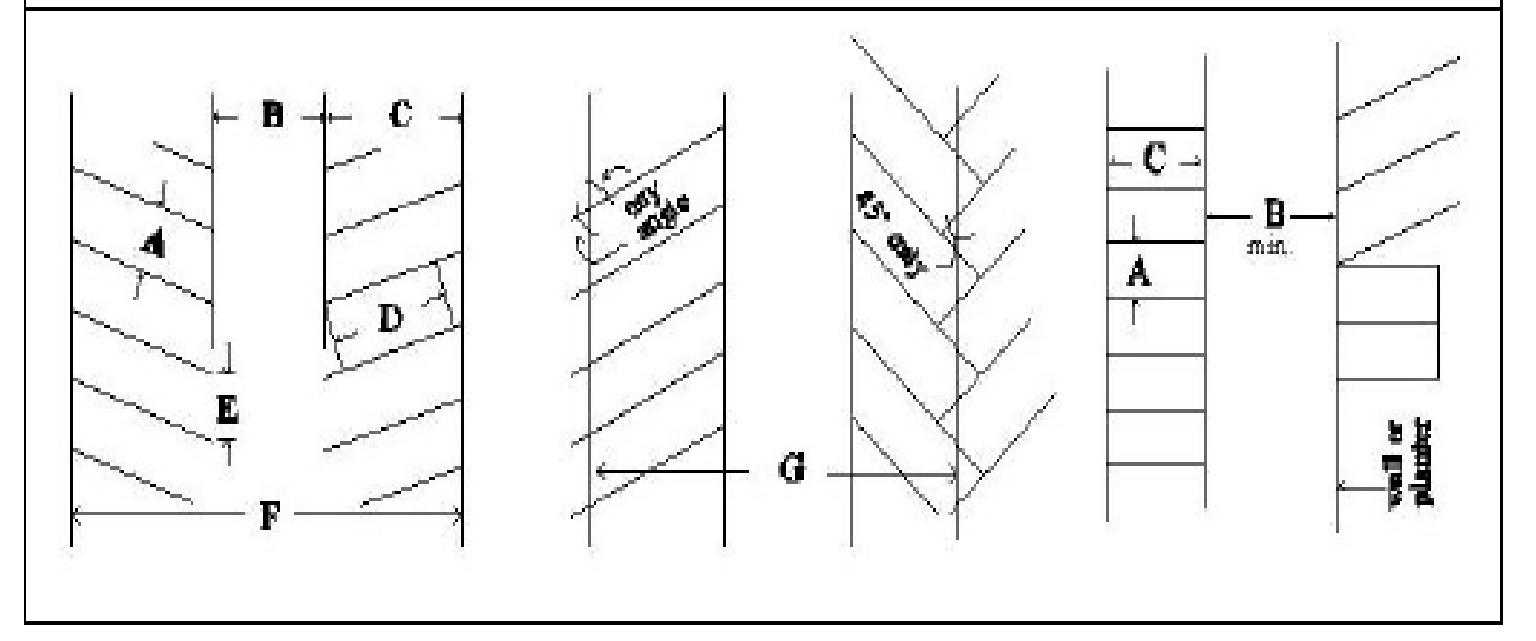
Off-street parking facilities shall be provided as required by this chapter. For purposes of this chapter, an off-street parking space shall consist of a space adequate for parking a standard size automobile with room for opening doors on both sides, together with properly related access to a public street or alley and maneuvering room. Required off-street parking areas for three or more automobiles shall have individual spaces marked, except as provided below, and shall be so designed, maintained and regulated that no parking or maneuvering incidental to parking shall be on any public street, walk or alley, and in such a manner that any automobile may be parked and un-parked without moving another.
B.
For purposes of rough computation, an off-street parking space and necessary access and maneuvering room shall be estimated at 400 square feet and the minimum as shown on the table below; however, off-street parking requirements shall be considered to be met only where actual spaces meeting the requirements above are provided and maintained and improved in the manner required by this chapter and in accordance with all other regulations of the city.
Parking space standards and dimensions shall be permitted as follows:
Parking Space Dimensions
(in feet)
C.
Except as provided below, all off-street parking spaces, loading areas, storage and related access areas shall be constructed in accordance with chapter 13 of the LDR construction requirements for minor streets and maintained in a manner permitting safe and convenient use, and so as to avoid adverse effects on neighboring property as a result of dust or drainage.
D.
Driveways, access aisles, and parking spaces for public and private schools offering academic courses, churches and other large noncommercial areas of assembly may be surfaced with turf in areas involving only occasional use, which shall be considered not in excess of an average of three times per week.
E.
When it can be demonstrated to the satisfaction of the administrative official that an alternate method of surfacing the parking, storage and driving areas meets the intent and requirements of more conventional surfacing methods, then the administrative official may permit such improvements. However, the burden of proof is on the developer and not the city to demonstrate that the alternative method of surfacing parking areas exceeds asphalt or concrete in the areas of stability, level of maintenance, wear, and durability. The applicable minimum requirements for minor streets contained in chapter 7 of the APM shall be used as the standard upon which the alternative will be judged. Where city service and emergency vehicles are to have access, the roadway shall be stabilized to accommodate such vehicles and approval must be secured from the applicable department head for the requested alternative method of surfacing. Examples of surfacing materials which may be used are turf blocks, cypress mulch on compacted shell base and concrete.
F.
All new residential shall have a paved driveway consisting of asphalt or concrete. When it can be demonstrated to the satisfaction of the administrative official that an alternate method of surfacing meets the requirements of more conventional surfacing methods, then the administrative official may permit such improvements. However, the burden of proof is on the developer and not the city to demonstrate that the alternative method of surfacing driveways equivalent to asphalt and concrete in the areas of stability, level of maintenance, wear, and durability.
G.
Parking on landscaped areas of single family lots. Vehicular parking shall be prohibited on landscaped lawn and yard areas. Temporary parking for the loading or unloading or maneuvering of vehicles for 12 hours shall be exempt. Parking on landscaped lawn and yard areas of single family lots shall be allowed for the following circumstances:
1.
Improved single family lots that front on a street with a right-of-way width of 30' or less and were subdivided prior to September 9, 1971 are exempt.
2.
Improved single family lots that front on a street with a right-of-way width of greater than 30 feet and were subdivided prior to September 9, 1971, are required to park on their driveway if one exists. A driveway shall include all paved surfaces intended for parking of permitted vehicles or transporting residential vehicles from the adjacent streets or alleys to garages, carports or parking areas. For single family lots that did not require a paved driveway, existing areas that are used as driveways, which may include existing hard pack sand, crushed rock and crushed shall, brick and ribbon pavement and other similar materials may be used for parking. Owners of these properties that do not have a driveway shall be allowed two permitted vehicles on non-driveways or grass surfaces and yards.
3.
Exemptions shall be allowed for temporary, special residential events including parties, family gatherings and funerals.
(Ord. No. 09-1355, § 6(Att. E), 11-19-2009; Ord. No. 10-1388, § 2, 12-18-2010; Ord. No. 24-2068, § 1(Exh. A), 4-4-2024)
Sec. 11.1.3. - Parking for existing buildings or uses.
A.
Buildings existing as of the effective date of this chapter may be modernized, altered, repaired or expanded up to ten percent of the existing floor area at the time of permit petition without providing additional off-street parking or off-street loading facilities. Any increase in the existing floor area beyond the original allowable ten percent, whether at the time of the first petition or any future petition shall cause the remaining applicable requirements to be met.
B.
Where a building or use existed as of the effective date of this chapter and such building or use is enlarged in floor area, volume, capacity or space occupied, except as provided above, off-street parking and off-street loading as herein specified shall be provided for the additional floor area, volume, capacity or space so created or used.
C.
Where change in use of a building or land requires additional parking or loading spaces, such spaces shall be provided in addition to the number existing for the prior use. Where the change in use decreases requirements, only the number required for the new use need be maintained.
D.
The required off-street parking facilities shall be located on the same lot or parcel of land they are intended to serve. Owners and/or tenants and their employees shall be required to use said on-site, off-street parking of the subject parcel, if available, as well as for the loading and unloading of deliveries. The administrative official may approve the establishment of such off-street parking facilities a maximum of 400 feet from the premises they are intended to serve when:
1.
Practical difficulties prevent the placing of the facilities on the same lot as the premises they are designed to serve;
2.
The business entity for whom the parking area is provided for, shall enter into a written agreement with the city, with enforcement running to the city providing that the land comprising the parking area shall never be disposed of except in conjunction with the sale of the building which the parking area serves, so long as the facilities are required;
3.
The business entity and/or owner agrees to bear the expense of recording the agreement with the Polk County Clerk of Court and agrees that the agreement shall bind his heirs, successors and assigns. The written agreement shall be released by the city if equivalent off-street facilities are provided elsewhere in accord with this chapter.
(Ord. No. 11-1403, §§ 16, 17, 8-18-2011)
Sec. 11.1.4. - Plans for off-street parking.
Except for an individual single family detached dwelling on an individual lot, a plan shall be submitted with every application for a building permit for any building or use that is required to provide off-street parking. The plan shall accurately designate, by dimensions the required parking spaces, access aisles and driveways, the relation of the off-street parking facilities to the uses or structures such facilities are designed to serve and materials to be used for surfacing the parking area.
Sec. 11.1.5. - Combined off-street parking.
A.
Two or more owners or operators of buildings or land uses requiring off-street parking facilities may make collective provision for such facilities; provided that the total of such parking spaces when combined or used together shall not be less than the sum of the requirements computed separately.
B.
No part of an off-street area required for any building or use shall be included as a part of an off-street parking area similarly required for another building or use unless the administrative official shall find that type of use indicates that the period of usage will not overlap or be concurrent with each other.
Sec. 11.1.6. - Employee parking.
Where off-street parking facilities are specified on the basis of number of employees, such parking shall be clearly marked and reserved for use of such employees. Where a use is required to provide and reserve a certain number of spaces for employees and the number of employees increase after the building is occupied, then the amount of off-street parking provided shall be increased in ration to the increase in the number of employees. Plans submitted shall make provision for projected full or peak employment.
Sec. 11.1.7. - Nonconforming uses.
Where major repairs, alterations or extensions of use are to be made in a building occupied by a nonconforming use, no such repairs, alterations or extensions shall be permitted unless and until the off-street parking requirements for a conforming use of the type involved in the district in which such use is first permitted are applied to the existing building or use and full provision for off-street parking facilities is made.
Sec. 11.1.8. - Off-street parking space requirements.
RESIDENTIAL TABLE
COMMERCIAL TABLE
INDUSTRIAL TABLE
HEALTH SERVICES TABLE
EDUCATIONAL TABLE
ENTERTAINMENT AND RECREATION TABLE
MISCELLANEOUS TABLE
(Ord. No. 10-1388, § 2, 12-18-2010; Ord. No. 23-2041, § 1(Exh. A), 5-18-2023)
Sec. 11.2.1. - Accessibility to street and interior of building.
Each off-street loading space shall be directly accessible from a street or alley without crossing or entering any other required off-street loading space. Such loading space shall be accessible from the interior of the building it serves and shall be arranged for convenient and safe ingress and egress by straight truck and/or tractor trailer combination or service vehicle.
Sec. 11.2.2. - Change of use or enlargement of structure.
When the use of a structure or land or any part thereof is changed to a use requiring off-street loading facilities, the full amount of off-street loading space required shall be supplied and maintained. When any structure is enlarged or any use extended so that the size of the resulting occupancy requires off-street loading space, the full amount of such space shall be supplied and maintained for the structure or use in its enlarged or extended size.
Sec. 11.2.3. - Combined parking facilities.
Collective, joint or combined provisions for off-street loading facilities for two or more buildings or uses may be made; provided, that such off-street loading facilities are equal in size and capacity to the combined requirements of the several buildings or uses and are designed, located and arranged to be usable by the uses so involved.
Sec. 11.2.4. - Minimum requirements.
Off-street loading spaces shall be provided and maintained as follows:
A.
Each retail store, storage warehouse, wholesale establishment, industrial plant, factory, freight terminal, market, restaurant, mortuary, laundry, dry cleaning establishment or similar use(s) which has an aggregate floor area of:
Plus one additional off-street loading space for each additional 100,000 square feet over 300,000 square feet or major fraction thereof.
B.
For each multiple family dwelling, motel or hotel having at least 20 dwellings or units but not more than 50 dwellings or units; one space.
C.
For each multiple family dwelling, motel or hotel having over 50 dwellings or units; one space, plus one space for each additional 50 dwellings or units, or major fraction thereof.
D.
For each auditorium, office building, hospital, stadium, welfare institution or similar use which has an aggregate floor area of: over 10,000 square feet but not over 40,000 square feet, one space; plus for each additional 60,000 square feet over 40,000 square feet or major fraction thereof, one space.
E.
For any use not specifically listed, the requirements for off-street loading facilities for a use which is so listed and to which the unlisted use is similar shall apply.
F.
An off-street loading space for straight type trucks shall have minimum dimensions of:
Length: 25 feet
Width: 12 feet
Height: 14 feet
G.
An off-street loading space for tractor trailer shall have minimum dimensions of:
Length: 50 feet
Width: 12 feet
Height: 14 feet
Sec. 11.3.1. - General.
For purposes of these regulations, recreational equipment is defined to include boats and boat trailers, houseboats, travel trailers, buses, race cars, pick-up campers of coaches (designed to be mounted on automotive vehicles), motorized dwellings, pop-up tent trailers and similar vehicles, and cases or boxes used for transporting recreational equipment, whether occupied with such equipment or not.
(Ord. No. 09-1355, § 6(Att. E), 11-19-2009)
Sec. 11.3.2. - Application.
A.
No recreational equipment shall be parked or stored on any lot in a residential district within a required front yard; provided, that such equipment may be parked anywhere on residential premises for not to exceed 48 hours during loading or unloading.
B.
Two race cars are permitted per property owner, only one of which can be inoperable, and shall be concealed by a commercial grade car cover. All other provisions of Article 3, Parking, Storage, or Use of Recreational Equipment, shall apply.
C.
Any recreational equipment less than eight feet in height above the ground or less than 20 feet in length may be stored in any required side or rear yard except when such yard is adjacent to a street. Minor portions of such equipment not exceeding three square feet in vertical cross section as viewed perpendicular to the adjacent lot line shall be permitted to extend above the eight foot limit.
D.
Where a fence, wall, or hedge over eight feet in height, but not exceeding maximum heights permitted elsewhere in these development regulations, is place and maintained in such a manner as to screen portions of recreational equipment above the height limits established in the preceding paragraph from view across side and/or rear lot lines within ten feet of the nearest portion of the recreational equipment, permissible height of such equipment shall be increased to the height of the fence, wall, or hedge, with minor portions above such height.
E.
Recreational equipment eight feet or more in average height above the ground or 20 feet or greater in length shall be considered as accessory buildings and all minimum required yards shall not be encroached upon by these vehicles any more than would an accessory building.
F.
Storage of vehicles or trailers shall not be permitted in any residential zoning district except in conjunction with the principle residence. No vacant lots or parcels within any residential zoning district shall be used for storage of any such above referenced vehicles.
(Ord. No. 09-1355, § 6(Att. E), 11-19-2009)
Sec. 11.3.3. - Occupancy.
No such equipment shall be used for living, sleeping, or housekeeping purposes when parked or stored on a residential lot, or in any location not approved for such use.
Sec. 11.4.1. - General.
A.
Within any zoning district, no vehicles or trailers of any kind without applicable current license plates or in excess of one ton capacity, including recreational equipment in excess of eight feet or more in average height above the ground or 20 feet in length, shall be parked for storage purposes, including overnight, on any public right-of-way or on private property except within and under a carport or other enclosed structure.
B.
No vehicles or trailers of any kind shall be parked in such a manner as to obstruct vehicular access by public emergency vehicles.
C.
Use of wheel stops in parking areas. The use of wheel stops shall be prohibited in parking areas. Wheel stops shall only be permitted for parking spaces where there is not a raised curb, such as for handicapped parking. Where allowed, wheel stops shall be a minimum height of six inches above finished grade of the parking areas. Wheel stops shall be properly anchored and shall be continuously maintained in good condition.
(Ord. No. 10-1388, § 2, 12-18-2010; Ord. No. 18-1594, § 5, 3-1-2018)
Sec. 11.4.2. - Residential districts.
Off-street parking of vehicles other than automobiles, pickup trucks, vans, commercial vehicles, and similar sized motor vehicles in residential districts is recognized as a necessity under certain conditions. However, residential districts are to be protected from the adverse effects of parking of certain vehicles on a short and long term basis. The following requirements shall apply to the parking of these vehicles in residential districts:
A.
Trailers of less than one ton capacity, including cargo trailers, may be parked on nonpublic residentially zoned property; provided that such vehicles are not to be parked or stored within any required front yard. Such equipment may be parked anywhere on residential premises for not to exceed 48 hours during loading or unloading.
B.
Storage of vehicles or trailers shall not be permitted in any residential zoning district except in conjunction with the principle residence. No vacant lots or parcels within any residential zoning district shall be used for storage of any such above referenced vehicles.
C.
Heavy industrial equipment such as trucks, tractors, bulldozers, draglines, cranes, heavy tree trimming and tree removal equipment and similar equipment may be parked on private residential property in a residential district only during periods when actually in use on such property, and for 48 hours preceding and after each use.
D.
The parking of tractor units (used for pulling trailers), tractor trailers, full trailers, straight, panel, dump trucks, buses and any vehicle rated greater than one ton by the manufacturer, except as provided otherwise herein, is not permitted in any residential district. Such vehicles may be parked on private property only in the course of making deliveries or pickups or in rendering services on the premises for the occupants.
(Ord. No. 10-1388, § 2, 12-18-2010)
Sec. 11.4.3. - Other zoning districts.
A.
The overnight parking of commercial vehicles shall be prohibited on public right-of-way in any zoning district within the city.
B.
The overnight parking of tractor trailers and similar equipment shall be prohibited in any commercial district except at truck stops or truck parking lots approved under the provisions of these development regulations.
C.
The parking of public utility emergency vehicles is permitted in any zoning district.
D.
Overnight parking on city right-of-way of vehicles in the central business district (CBD) and the central business district extra (CBDX) is prohibited between the hours of 2:00 a.m. and 6:00 a.m. Vehicles of companies performing cleaning services for building during these hours, as well as downtown residents, within the above-stated districts shall obtain an on-street parking permit. Parking of vehicles with weight of 5,000 pounds or less in commercial parking lots is permitted without a permit.
(Ord. No. 09-1355, § 6(Att. E), 11-19-2009; Ord. No. 10-1388, § 2, 12-18-2010; Ord. No. 18-1594, § 5, 3-1-2018)
Sec. 11.4.4. - Parking at intersections.
A.
No motorized vehicles, boat trailers or any other type trailers shall be parked on public right-of-way or on private property within the visibility triangle of any street intersection, or within 50 feet of any street intersection.

