
Haines City City Zoning Code
CHAPTER 5
ZONING
ARTICLE 1. - GENERAL REGULATIONS
Zoning district regulations prescribe detailed requirements that have application for every land use within the boundaries of a given zoning district. However, general or supplementary regulations are necessary to prescribe regulations that have application in more than one district or groups of districts but not necessarily throughout the city. The requirements described below apply in some cases to residential districts, some in institutional districts, some in commercial districts and others in industrial districts.
Sec. 5.2.1. - Fences, walls, hedges and architectural features.
A.
Fences.
1.
Except as required for maintenance of visibility at street intersections or at intersections of driveways with streets, fences, walls and hedges shall be permitted in any required yard; provided, however that no solid fence or solid wall shall be permitted to exceed six feet in height in any side or rear yard, nor more than three feet in height in any required front yard or front side yard provided the fence is 50 percent open and meets all visibility triangle requirements.
2.
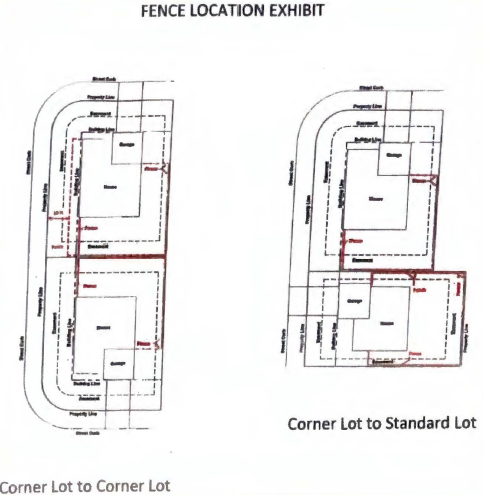
On residential corner lots, where the rear yard abuts the adjoining rear yard the property owner may elect to provide a solid decorative fence or wall, a maximum of six feet in height within the front side yard, but no closer than ten feet to the front side property line. This does not apply to corner lots where the rear yard abuts the side yard of the adjoining property. (See Fence Location Exhibit below) (Sight visibility requirements still apply per section 12.4.1)
3.
In the event that a structure abuts into the front yard setback, fences shall not exceed the front of the structure nor be more than four feet in height.
4.
Chain fences shall not be permitted in any required front yard or front side yard; however, the administrative official may grant a waiver to allow a maximum four-foot high chain fence if two-thirds of the lots or parcels in the neighborhood or subdivision have a chain fence in the front yard.
5.
Fences shall be permitted on vacant lots, subject to the approval of the administrative official. These fences shall be required have 75 percent transparency (clear vision).
6.
All fences shall require a permit.
B.
Architectural features, eaves, chimneys, fireplaces, balconies and the like may project into required front, side or rear yards not more than three feet where the required yard is eight feet or more in width. Ordinary projections of window sills, belt courses, cornices, and other ornamental features may project into these required yards to the extent of not more than seven inches.
C.
Swimming pools shall be fenced as required in chapter 18 of the LDR.
D.
Barbed wire, and razor wire fencing is prohibited in all residential, commercial, and office districts, and may be permitted in industrial districts only after the issuance of a conditional use permit. The amendments to fences are effective immediately.
(Ord. No. 08-1315, § 2, 3-20-2008; Ord. No. 09-1355, § 3(Att. B), 11-19-2009; Ord. No. 10-1388, § 2, 12-18-2010; Ord. No. 12-1417, § 3, 3-15-2012; Ord. No. 14-1467, § 2, 1-23-2014; Ord. No. 21-1773, § 1(Exh. A), 1-6-2022; Ord. No. 22-1789, § 1, 3-17-2022; Ord. No. 23-2041, § 1(Exh. A), 5-18-2023)
Sec. 5.2.2. - Accessory uses or structures.
A.
In residential districts, accessory structures and uses shall not be located in required front yards but may be located in required side or rear yards except for side street yards, but not closer than five feet to the property line; provided, that accessory structures for the housing of persons, such as guest houses and garage apartments, shall not be located in any required yard. On double frontage lots in residential districts, accessory uses and structures shall not be located in either of the required front yards, but may be located in side yards, except as provided otherwise herein. No separate accessory building shall be located within five feet of any other building.
B.
Surface constructed uses, such as pool deck (to include screen enclosures for pools), patio or similar features, when not greater than 30 inches in height above the median grade covered by such proposed use, shall be permitted within the required side and rear yards, but not closer than five feet to the property line. Screen enclosures for pools, pergolas, and similar structures shall be required to comply with accessory structure setbacks.
C.
Portable storage units such as "PODS" or similar storage units used for storage and/or moving purposes shall be allowed for 14 days per calendar year and shall be placed in driveways or paved surfaces only. Units that exceed eight feet by eight feet by 16 feet in size are prohibited.
D.
Where a building is attached to the principal building, it shall be considered a part thereof and not an accessory building. Porches with solid roofs that are attached to the principal building shall be considered part of the principal structure, and shall be required to meet the required setback for the principal building.
E.
A facility for the service of malt, vinous or other alcoholic beverages shall be deemed an accessory use for a motel, hotel, private club, country club, yacht club or golf club; provided that all other applicable requirements of state and county law and city regulations are met.
(Ord. No. 08-1315, § 2, 3-20-2008; Ord. No. 10-1388, § 2, 12-18-2010; Ord. No. 14-1467, § 2, 1-23-2014)
Sec. 5.2.3. - Erection of more than one principal structure on a lot.
With the exception of the R-1-AAA, R-1-AA, R-1-AX, R-1-A, R-1 and R-2 zoning districts, more than one structure housing a permitted or permissible principal use may be erected on a single lot; provided, that minimum yard area, access and other requirements of the Land Development Regulations shall be met for each structure as though it were on an individual lot. A solid wall, with no windows or doors, shall be required along a zero lot line of a dwelling, beginning at the rear of the required front yard and continuing to the front of the required rear yard. That portion of such zero lot line walls situated between dwellings shall be constructed to two-hour fire wall requirements as specified in the building code of the city.
(Ord. No. 10-1388, § 2, 12-18-2010)
Sec. 5.2.4. - Exceptions to height limitations.
The height limitations contained in article 6 of this chapter shall not apply to spires, belfries, cupolas, antennas, water tanks, ventilators, chimneys or other appurtenances usually required to be placed above the roof level and not intended for human occupancy. The heights of these structures or appurtenances thereto shall not exceed any height limitations prescribed by the federal aviation agency within the flight approach zone of airports.
Sec. 5.2.5. - Structures to have access to public street.
Every building hereafter erected or moved shall be on a lot with a minimum width of 20 feet adjacent to or abutting on a paved public street, or with access to a paved public street by means of a private street approved by the city commission, which has a minimum of 24 feet wide right-of-way or easement. All structures shall be located on lots so as to provide safe and convenient access for servicing, fire protection and related emergencies and required off-street parking.
Sec. 5.2.6. - Service stations and/or convenience stores (location, design, operation of).
A.
The following regulations shall apply to the location, design, construction, operation and maintenance of all service stations and/or convenience stores, including the sale of all fuels and systems and any other types, petroleum or otherwise, to be devised and established for similar and related activities:
1.
A service station and/or convenience store lot shall be of adequate width and depth to meet all district setback requirements, but in no case shall the width of a lot be less than 140 feet and contain less than a minimum area of 15,000 square feet. The board of adjustment shall have no power to grant variances below minimum lot requirements for such land uses.
2.
All lights and lighting on and for a service station and/or convenience store and lot shall be so designed and arranged that the light source and glare shall not be directly visible from a residential district.
3.
No service station and or convenience store building or fuel pump or storage tank shall be located within 25 feet of any property that is zoned residential or institutional.
4.
Where a lot to be used for a service station and/or convenience store abuts on any property which is zoned residential or institutional, there shall be a solid wall designed and installed on all such property lines, other than street lines, which will prevent auto lights smoke, fumes, dust and other obnoxious materials (from ground level to the required fence height) from penetrating into the residential or institutional district. The solid wall shall be a minimum of six feet in height.
5.
No fuel pump or storage tank shall be located within 15 feet of any street right-of-way line. Where a street setback line has been established, no fuel pump or storage tank shall be located within 15 feet of such setback line. Where conditions of traffic safety, due to street intersections, lack of visibility at a street crown or other peculiar circumstances prevail, additional setbacks may be required to exceed 25 feet.
6.
The number of curb breaks for a service station and/or convenience store shall not exceed two for each 100 feet of street frontage, each having a width of not more than 40 feet and located not closer than 30 feet to the right-of-way lines of any intersection. Such curb breaks shall not be closer than 15 feet to any other private property line and there shall be a minimum distance of 15 feet between such curb breaks. Clearance for curb breaks shall be obtained from the Florida Department of Transportation for any proposed service station and/or convenience store located on a street under Polk County of Florida Department of Transportation jurisdiction.
B.
The following regulations shall apply to the sale of automotive fuels as an accessory use, at locations other than at service stations:
1.
The sale of automotive fuel as an accessory use shall be permitted in connection with principal uses in all commercial and industrial districts. No such sale of automotive fuel as an accessory use shall be permitted or permissible by special exception in connection with conforming or nonconforming uses in any other zoning district.
2.
Accessory sales of this nature, and services performed in connection therewith, shall be limited to sale of automotive fuel, replenishing oil, washing windshields, windows and lights, providing air for tires, providing water and additives for radiators, and other routine minor services. Activities at such establishments shall not include lubrication, changing oil, washing vehicles, tire repairs, painting, mechanical or body repairs, and the like unless permitted in the zoning district as a principal use.
3.
The number of dispensing islands shall not exceed four, with not more than four fuel pumps concentrated in one pump island or service area. No such dispensing facilities shall be located within 25 feet of any property zoned residential or institutional. No pump or other dispensing facility shall be located within 15 feet or any street right-of-way line or established setback line. Where conditions of traffic safety at intersections, impaired visibility, or other conditions make such requirements reasonable for protection of vehicles or pedestrians, additional setbacks may be established by the administrative official, but in no case shall such setbacks be required to exceed 25 feet.
4.
Parking areas and vehicular lanes shall be clearly marked and shall provide for safe and convenient parking, vehicular circulation and pedestrian movement. Except for vehicles attended by the driver and awaiting servicing, there shall be no parking within 12 feet of any pump or other dispensing outlet. Vehicular lanes shall be a least 12 feet in width, and shall be so located and arranged that parking in relation to the principal use will not interfere with convenient movement and service at the dispensing outlet.
Sec. 5.2.7. - Essential services.
Essential services, herewith defined as services authorized and regulated by state or national public utility commissions or services owned or franchised by the city or county, may be located within any zoning district after review and approval by the city commission. This provision includes both structures and uses and includes gas, water, electric, sewerage and telephone facilities. However, this provision shall not be deemed to permit the location in a district of such establishments as electric or gas generating plants, sewage treatment plants, water pumping facilities or aeration facilities, liquid petroleum gas storage facilities above or below ground from which they would be otherwise prohibited and provided, further, that this provision shall not be deemed to include the establishment of structures for commercial activities such as sales or the collection of bills in districts from which such activities would be otherwise prohibited.
Under this provision, where structures are involved, such structures shall conform insofar as possible to the character of the district as to architecture and landscaping and shall meet all yard, area and similar requirements as provided for in the district in which they are to be located.
Sec. 5.2.8. - Government facilities.
Government facilities shall be permitted as a conditional use where not specifically permitted in any zoning district. A conditional use is permissible by the city commission after public hearing and subject to appropriate conditions and safeguards. The city commission may approve, deny or add additional conditions for all conditional use requests. (See section 19.2.4. of the LDR.)
(Ord. No. 15-1490, § 2, 3-19-2015)
Sec. 5.2.9. - Location of structure near bodies of water; grade level of building sites; 100-year flood level.
A.
A building or structure, other than a boat house or dock, shall be erected in accordance with the Southwest Florida Water Management District (SWFWMD) standards as to setbacks.
B.
In all districts, no building for human habitation shall be erected on a site where the grade level is less than 100-year flood level of the nearest lake.
In all districts, no building for human habitation shall be erected with floors less than one foot above the 100-year flood level of the nearest lake.
C.
For purposes of the Land Development Regulations, normal water level and 100-year flood levels shall be considered to be those established on the flood insurance rate maps.
(Ord. No. 09-1355, § 3(Att. B), 11-19-2009; Ord. No. 15-1490, § 2, 3-19-2015)
Editor's note— Ord. No. 15-1490, § 2, adopted March 19, 2015, renumbered §§ 5.2.8—5.2.21 as §§ 5.2.9—5.2.22. This historic notation has been preserved for reference purposes.
Sec. 5.2.10. - Temporary construction structures and temporary tents, general.
A.
Temporary construction structures. Temporary structures in connection with land development or construction projects may be erected or moved onto the site, for occupancy other than as dwelling or lodging units, in any zoning district, but shall require a permit from the administrative official. Such permit shall specify location, type of construction, maintenance requirements and period for which such structure may be erected; provided, that no such permit shall be for a period of more than six months, subject to renewal upon approval of the administrative official. Failure to obtain such permit or violation of conditions specified therein shall be a violation of the Land Development Regulations.
B.
Temporary tents. Tents may be erected temporarily on property in a commercial district where a commercial structure is established, within a public park, or on property occupies by a church, regardless of the zoning district, subject to the following conditions:
1.
Tents on commercial property may be erected two times a year, not to exceed a total of two weeks.
2.
No more than ten percent of an existing parking lot area may be used. The tent shall not block any point of ingress or egress to the site.
3.
All electrical connections must be inspected and approved by the building official.
4.
The tent must be inspected and approved by the Haines City Fire Marshal.
(Ord. No. 15-1490, § 2, 3-19-2015)
Editor's note— See § 5.2.9 editor's note.
Sec. 5.2.11. - Lots—Yards; diagrams.
A.
Lot. For purposes of the Land Development Regulations, a lot is defined as a parcel of land of at least sufficient size to meet minimum requirements for use, width, coverage and total area, and to provide such yards and other open spaces as are required.
1.
Lots shall have lot frontage on an improved public street, or on an approved private street, and may consist of:
a.
A single lot of record;
b.
A portion of a lot of record;
c.
A combination of complete lots of records, of complete lots of records and portions of lots of record, or of portions of lots of records;
d.
A parcel of land described by metes and bounds; provided that in no case of division or combination shall any residual lot or parcel be created which does not meet the requirements of the Land Development Regulations and the Code of Ordinances.
B.
Lot frontage. The front of a lot shall be defined to be that portion of the lot nearest the street established as the street address. For the purposes of determining yard requirements on corner lots and through lots, all sides of a lot adjacent to streets shall be considered frontage, and yards shall be provided as indicated in this chapter.
C.
Lot measurements.
1.
Depth of a lot shall be defined to be the distance between the midpoints of straight lines connecting the foremost points of the side lot lines in front and the rear most points of the side lot lines in the rear.
2.
Lot width determines as related to minimums prescribed in the Land Development Regulations, shall be measured across the rear of the required front yard; provided, that in the case of wedge shaped lots with narrow ends and cul-de-sac or other acute street curvatures, the rear line of the required front yard shall be moved sufficiently from the front line to provide at least 80 percent of the generally required lot width at the rear line of the required front yard.
3.
Lot area, for determinations relating to minimum lot size as required by the Land Development Regulations, shall include the total area of the lot; except, that where lots are of such peculiar or irregular shape that portions have no useful functions in relation to buildable areas, such portions shall not be included in computation of total area.
4.
Lot of record. A lot which is part of a subdivision recorded in the office of the county clerk, or a lot or parcel described by metes and bounds, the description of which has bee so recorded on or before the effective date of the original zoning ordinance of the city which shall be September 2, 1971, Ordinance No. 445, and all subsequent amendments.
5.
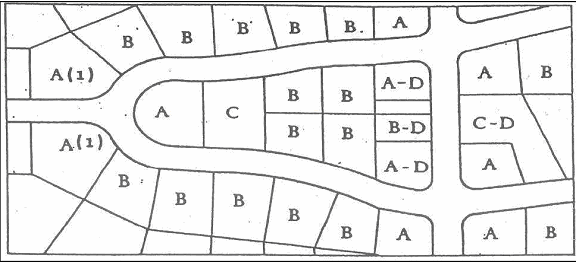
Lot types. The diagram below illustrates descriptive terminology used in the Land Development Regulations with reference to corner lots, interior lots, through lots, and reversed frontage lots.
a.
In the diagram, A is a corner lot, defined as a lot located at the intersection of two or more streets. A lot abutting on a curved street or streets shall be considered a corner lot if straight lines drawn from the foremost points of the side lot lines to the foremost point of the lot meet at an interior angle of less than 135 degrees. See lots marked A (1) in the diagram.
b.
B is an interior lot, defined as a lot other than a corner lot with only one frontage on a street.
c.
C is a through lot, defined as a lot other than a corner lot with frontage on more than one street. Through lots abutting two streets may be referred to as double frontage lots.
d.
D is a reversed frontage lot, defined as a lot on which the frontage is at right angles or approximate right angles (interior angle less than 135 degrees) to the general pattern in the area. A reversed frontage lot may be a corner lot (A-D in the diagram), an interior lot (B-D) or a through lot (C-D).
e.
Flag lots. (Not illustrated.) An irregular shaped or stem lot whose main body does not abut a roads, but is accessed by a narrow extension which connects the main body to the road. This definition is intended to include any lot located behind the rear or to the side of any other lot which would require a narrow arm to provide access. This definition is not intended to include pie-shaped or other irregular shaped lots which front directly upon a road and are not located behind any other lot.
f.
Lot coverage. That percentage of lot area that is or may be covered or occupied by buildings, including accessory buildings, under the terms of the Land Development Regulations.
1 LOT DIAGRAMS
(Ord. No. 10-1388, § 2, 12-18-2010; Ord. No. 15-1490, § 2, 3-19-2015)
Editor's note— See § 5.2.9 editor's note.
Sec. 5.2.12. - Yard; definitions and methods for measurements.
A.
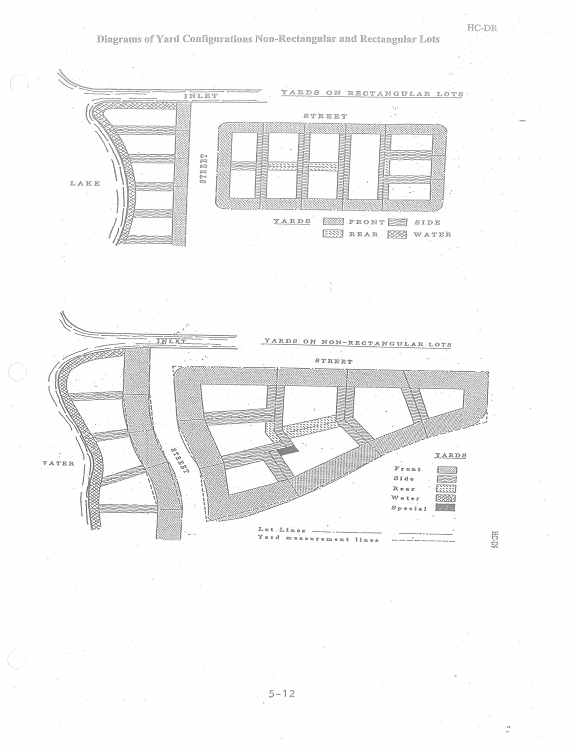
Yard. For purposes of the Land Development Regulations a yard is defined as the minimum required open space, other than a court, unoccupied and unobstructed by any structure or portion of a structure from 30 inches above the general ground level of the graded lot upward; provided, that fences, walls, poles, posts and other customary yard accessories, such as ornaments and furniture may be permitted in any yard subject to height limitations and requirements limiting obstruction of visibility. A court is an uncovered open space enclosed on two or more sides by exterior walls of a building.
B.
Yard, front.
1.
A yard adjacent to a public street and extending across the entire front of the lot. Lots extending through blocks in such a way as to have frontage on two public or private streets shall provide front yards adjacent to each street.
2.
Depth of required front yards shall be measured perpendicular to a straight line joining the foremost points of the side lot lines. The foremost points of side lot lines, in the case of rounded property corners, as at street intersections, or irregular corners, shall be assumed to be the points at which lines would have met without rounding or irregularity. Front and the front of the rear yard lines shall be parallel.
3.
Yard, side.
a.
A yard extending from the rear line of a required front yard to the rear or back property line, or in cases where more than one front yard is required, as on a through lot, to the rear line of the second front yard. In the case of corner lots, those yards adjacent to streets remaining after front yards have been established shall be considered side yards, and shall be required to have the same distance as the required front yard.
b.
Width of a required side yard shall be measured in a manner similar to that employed in measurement of depth for required front yards, so that the yard established is a strip of the minimum width required with its inner edge parallel to the side lot line at its outer edge.
4.
Yard, rear.
a.
A yard extending between required side yards at the rear of the lot. In the case of lots have more than on front yard, remaining yards shall be considered side yards.
b.
Depth of a required rear yard shall be measured in a manner similar to that employed in measurement of depth for required front yards, so that the yard established is a strip of the minimum depth required with its inner edge parallel to the rear lot line at its outer edge.
5.
Yard, special. A yard behind any required yard adjacent to a public or private street, required to perform the same functions as a side or rear yard, but adjacent to a lot line and so placed or oriented that neither the term "side yard" nor the term "rear yard" clearly applies. In such cases the administrative official shall require a yard with minimum dimensions as generally required for a side yard or a rear yard in the zoning district, determining which shall apply by the relation of the portion of the lot on which the yard is to be located to the adjoining lot or lots, with due regard to the orientation and location of structures and buildable areas thereon.
6.
Yard, water. A yard adjacent to a public body of water or an inlet or stream with a width of ten feet or greater and extending across the entire water side of the lot.
(Ord. No. 15-1490, § 2, 3-19-2015)
Editor's note— See § 5.2.9 editor's note.
Sec. 5.2.13. - Home occupation.
A.
Definition. A home occupation is defined as any activity carried out for gain by a resident and conducted as an accessory use in the resident's dwelling unit in a zoning district where such use is permitted.
B.
Requirements.
1.
No person other than members of the family residing on the premises shall be engaged in such occupation.
2.
The use of the dwelling unit for the home occupation shall be clearly incidental and subordinate to its use for residential purposes by its occupants, and shall under no circumstances change the residential character thereof.
3.
There shall be no change in the outside appearance of the building or premises or other visible evidence of the conduct of such home occupation. Signage shall be prohibited. The activity shall be conducted only between the hours of 7:00 a.m. and 7:00 p.m.
4.
No home occupation shall be conducted in any accessory building.
5.
No home occupation shall occupy more than 25 percent of the first floor area of the residence.
6.
No traffic shall be generated by such occupation in greater volumes than would normally be expected in a residential neighborhood, and any need for parking generated by the conduct of such home occupation shall be met off the street and other than in the required front yard.
7.
No retail or wholesale sales may be conducted on the premises.
8.
Outdoor storage or display materials or products shall not be permitted.
9.
In the case of electrical interference, no equipment or process shall be used which creates visual or audible interference in any television or radio receivers off the premises or cause fluctuation in line voltage off the premises. No equipment, tools or process shall be used in such home occupation which creates noise, vibration, glare, fumes, odors or electrical interference detectable to the normal senses off the lot, if the occupation is conducted in a single family residence, or outside the dwelling unit if conducted in other than a single family residence.
10.
No goods, chattels, materials, supplies or items of any kind except normal postal and related types of materials can be delivered either to or from the premises in connection with the home occupation except in a passenger vehicle owned by the resident.
C.
Permitted home occupations. Customary home occupation may include but are not limited to the following uses, provide all requirements of the Land Development Regulations are met:
1.
Artists, sculptors, authors and composers.
2.
Bookkeepers, certified public accountants.
3.
Dress makers, milliners, seamstresses, and tailors.
4.
Handicrafts such as ceramics, model making, quilting, rug weaving and wood working.
5.
Photo lab.
6.
Professional office such as landscape architect, engineer, physician, lawyer.
7.
Secretarial service, telephone answering service.
8.
Computer programmer and operator.
9.
The giving of individual instruction to one person at a time such as an art or piano teacher and swimming instructor.
10.
Internet business or sales.
D.
Prohibited uses as home occupations.
1.
Beauty and barber shops.
2.
Band instruction or dance instruction.
3.
Studio for group instructions.
4.
Public dining facility or tearoom.
5.
Antique or gift shops.
6.
Photographic studio.
7.
Fortune telling of similar activity.
8.
Outdoor repairs, food processing.
9.
Retail or wholesale sales.
10.
Child care centers or kindergartens.
11.
Group instructions of any type.
12.
Similar uses to those listed in 5.2.12.D. above.
E.
Occupational license. A home occupation shall be subject to all applicable city occupational license and other business taxes.
(Ord. No. 08-1334, § 2, 9-4-2008; Ord. No. 09-1346, § 4, 8-6-2009; Ord. No. 15-1490, § 2, 3-19-2015)
Editor's note— See § 5.2.9 editor's note.
Sec. 5.2.14. - Determinations concerning uses not specified.
A.
Intent.
1.
Where there is substantial doubt as to whether particular uses or classes of uses, not specifically identified in the Land Development Regulations, are of the same general character as those listed as permitted principal or accessory uses, or uses permissible by special exception, the administrative official may request the planning commission to make a determination on the matter, giving due consideration to the intent of the Land Development Regulations concerning the zoning district, the character of the use(s) specifically identified, and the character of the use(s) in question.
2.
Requests for such determinations shall be made only by the administrative official, and shall not involve cases where the administrative official has made a negative finding, in which case appeals shall be made to the board of adjustment on grounds of error in his determination. After determinations have been made by the planning commission, appeals from its determinations may also be made to the city commission on grounds of error.
B.
Notifications concerning determinations. Upon making its determinations, the planning commission shall notify the administrative official and any other officer or agency of the city likely to be affected by its findings.
C.
Effect of planning commission findings.
1.
If the planning commission finds that the particular use or class of use in question is of such an unusual or transitory nature, or is unlikely to recur frequently, unless its determination is reversed on grounds of error by the city commission, the determination shall thereafter be binding without further action or amendment of the regulations as an administrative ruling.
2.
If the planning commission finds that the particular use or class of uses is likely to be common or recurrent, and that omission by specific reference in the Land Development Regulations is likely to lead to public uncertainty, it shall initiate a proposed amendment rectifying the omission. Until final action on such proposed amendment, the determination of the planning commission shall be binding as an interim administrative ruling.
(Ord. No. 15-1490, § 2, 3-19-2015)
Editor's note— See § 5.2.9 editor's note.
Sec. 5.2.15. - Houses displayed for advertising purposes, model homes.
Construction of a house(s) displayed for advertising purposes, not intended to be sold or occupied as a dwelling, whether in connection with a residential development or otherwise may be permitted in residential or certain commercial zones but shall not commence until a performance bond adequate to ensure the removal of the structure, if located other than in a residential district, has been posted with the administrative official and approved by the city attorney. Such structure, if in a commercial district, shall be removed at the end of the permit period unless the administrative official grants an extension. If the structure is in a residential district, a certificate of occupancy for residential use shall be required prior to uses as a residence or any other use. No permit or extension thereof shall exceed one year time increments.
Model homes and temporary sales office may be permitted within residential subdivisions for the sale of lots/homes.
The following standards apply:
1.
The number of model homes within a subdivision shall be determined on a case by case basis by the administrative official. One or more of the model homes, or a separate modular unit, may also be permitted as a temporary sales office for the project developer, builders, or their agents.
2.
Model homes shall meet all lot area, setbacks, square footage, and all other zoning code requirements of the district in which they are located.
3.
A stabilized road base and fire protection facilities shall be in place and approved by the fire department and police department to the model home lots prior to the issuance of the model home or temporary sales office permit.
4.
Model homes and temporary sales offices may continue operation until all lots or houses within that subdivision are sold. Certificates of occupancy shall not be issued for model homes until the subdivision plat has been approved by the city and has been given a plat book and page number by Polk County.
5.
All improvements not installed shall be bonded according to the Land Development Regulations, before a model home or temporary sales office permit can be issued.
)Ord. No. 15-1490, § 2, 3-19-2015)
Editor's note— See § 5.2.9 editor's note.
Sec. 5.2.16. - Excavation, borrow pits.
A.
Excavations of any type or creation of borrow pits, shall be permitted in certain zoning districts only after approval of a site plan, as required by the Land Development Regulations, by the administrative official and city staff. Such excavations shall meet the following requirements:
1.
Excavation and borrow pit operations shall be controlled to provide reasonable and continued protection of the surrounding properties with regard to the use and cleanliness of the streets for access to the subject premises. Hours of operation may be imposed to protect the peace, well being, compatibility and character of surrounding properties.
2.
No excavation of earth shall be within 100 feet of any road right-of-way line. No excavation of earth shall be closer than 50 feet to an adjoining lot or parcel.
3.
Sides of an excavation shall be sloped inwardly and not more than one foot vertical drop for each three feet horizontal dimension measured from the edge of the excavation to a depth of two feet below the water table or to the bottom of the excavation, whichever is greater.
4.
In no case shall the aquifer be penetrated.
5.
No excavation shall be permitted which in any way interferes with natural or planned drainage.
6.
Prior to the issuance of site plan approval, the city engineer (consulting) shall make a determination of drainage plan conformity. No site plan shall be approved which, in the opinion of the engineer or administrative official, shall be detrimental to the public health, safety, or general welfare.
7.
No excavation or borrow pit shall exceed 50,000 cubic yards or five acres per each site.
8.
As a part of the site plan review, a reclamation or restoration plan shall be required prior to approval and issue of permits.
B.
The following activities and conditions are exempt from the provisions in 5.2.12.A. above:
1.
Excavation or grading incidental to the construction of a building on a lot or parcel for which a building permit has been issued.
This authorization shall only apply to the land shown on the site plan submitted with the application for a building permit. Once a certificate of occupancy has been issued pursuant to said building permit, that authorization shall not apply to any subsequent acquisition of land.
2.
Excavation or grading performed in accordance with a site plan or subdivision plat which has been reviewed and approved by the administrative official and city staff and for which all necessary permits have been issued. Development plans qualifying for this exception shall be those under active development at the effective date of the Land Development Regulations and those approved thereafter.
3.
The construction and maintenance of roads by or for the city, Polk County or the State of Florida.
4.
Bona fide agricultural operations provided such operations have been permitted or exempted from permits by FDER, SWFWMD, DNR and/or environmental protection agencies.
5.
Activities incidental to the operation of public utilities.
6.
Any excavation of less than a total of 15 yards of dirt removed from a lot or parcel for any reason whatsoever.
(Ord. No. 15-1490, § 2, 3-19-2015)
Editor's note— See § 5.2.9 editor's note.
Sec. 5.2.17. - Recording of common areas.
A.
The following procedure shall be required after development approval by the city commission, planning commission, board of adjustment or administrative official as appropriate to the specific case:
1.
Any development, project or improvement of whatever kind, approved as meeting applicable requirements of the Land Development Regulations which contains commonly owned areas, whether in the form of easements, drainage ways, open space, recreation space, buildings or other structures, shall not be issued building permits until all such common areas have been recorded in the office of the Polk County Clerk.
2.
All documents pertaining to common ownership, such as maintenance responsibilities, assessments, payment of taxes, homeowners association or condominium articles, by laws and rules shall be included and made a part of this submission.
3.
Such common area documentation shall not be recorded until the administrative official and city attorney have reviewed and approved such documents, plans and drawings as having met the requirements of the approved development or project.
4.
Evidence in the form of certified copies of the recorded documents shall be required for permit issue, and shall be made a part of the permit file until completion thereof.
(Ord. No. 15-1490, § 2, 3-19-2015)
Editor's note— See § 5.2.9 editor's note.
Sec. 5.2.18. - Site compatibility requirements for certain residential, institutional, commercial and industrial development.
A.
Intent. In order to promote safety, improve traffic circulation on and around a site and to prevent potential adverse effects, petitioners for all residential, institutional, commercial and industrial development activities, except as provided otherwise within the LDR, shall submit a site plan meeting the requirements as stated in chapter 5 of the Administration and Procedures Manual.
The site plan shall be submitted for review to the administrative official indicating proposed uses and structures, driveways and parking areas, minimum required yards, buffering, signs, landscaping, drainage and such other details as are required by these sections by general rule or in the particular circumstances of the case, and shall indicate a schedule for initiation and completion of development.
If approved, the site plan shall be binding upon the petitioners and any successors in title, and no substantial change shall be permitted without approval from the administrative official.
B.
Review criteria.
1.
Limitations on vehicular access. Except for public service vehicles, principal vehicular access to the property for nonresidential developments shall not be through an adjacent residential district.
2.
Limitations on operations. Site planning, design and location of structures and open spaces, and management of operations shall be such that orientation of institutional, commercial, and industrial activities is toward the frontage of the street and the following conditions shall apply:
a.
These shall be no sales, service, storage or display of goods or materials and no off-street loading operations, garbage or trash storage, or collection or disposal facilities visible in any portion of the property from any portion of any abutting residential district.
b.
Signs for nonresidential development on the property shall be oriented away from any abutting residential zoning district. Lighting of structures and premises on the property shall be arranged in such a manner as to prevent nuisance effects on any abutting residential zoning district.
c.
Yard requirements; buffering. Yards and structural buffing shall be provided to minimize the impact of nonresidential development on any abutting residential district. The following minimum requirements may be increased to achieve a stated public purpose, but shall not be diminished:
1.
Required yards of nonresidential development adjacent to public streets shall be a minimum of 25 feet in depth unless a greater depth is specified otherwise the Land Development Regulations.
2.
Off-street parking shall not be permitted within the required setback (not minimum required yard) area in commercial zoning districts.
3.
Required yards for all nonresidential uses adjoining any residential zoning district shall be a minimum of 25 feet.
4.
All required yards provided for nonresidential uses which abut any residential district shall be landscaped and maintained as required in the Land Development Regulations and as is appropriated to the residential surroundings. No portion of any required yard abutting any residential district shall be used for off-street parking except as provided below.
5.
As an alternate to the yard and landscaping requirements in 3. and 4. above, the property owner of nonresidential uses may elect to provide a solid decorative fence or wall, a minimum of six feet in height along all sides and rear property lines adjoining a residential district, except that such wall or fence shall not project beyond the rear line of an adjacent required front yard in the residential district.
6.
Where the nonresidential property owner elects to go to yard and landscaping provisions as provided for in 3. and 4. above, the administrative official may also require additional appropriate fences, walls or vegetative screening in order to protect adjacent property in residential districts from lights, noise or undesirable views. Plant materials shall be at least Florida No. 1 materials (see F.S. ch. 581, as amended) and hedge material shall be a minimum of four to five feet in height and spaced a maximum of four feet on centers at the time of planting. These plant materials shall be maintained in such a manner to fulfill the screening intent of this provision. Failure to maintain in such manner shall constitute a violation of these provisions.
C.
Compatibility with CRA plans. Where a site plan or building plan is affected by the CRA master plan, a CRA neighborhood plan, the CRA Downtown Master Plan of other CRA plan, the proposed site plan shall conform to the intent approved CRA plan to the fullest extent possible as determined by the administrative official. If the proposed site or building plan deviates from the approved CRA plans, the developer may request an amendment to the CRA plans. Amendments are reviewed by the CRA board and approved by the city commission as a conditional use. The city commission may approve, deny, or modify the proposed site and building plans.
D.
After examination of the site plan, the city commission may require changes where necessary for stated public purposes as a condition for approval, and may attach additional conditions and safeguards, including limitations on hours and manner of operation, beginning and conclusion of construction and related matters.
E.
Exclusions. The provisions of this section apply to all developments (other than individually owned single family detached dwellings) including residential, institutional, commercial and industrial uses except under the following conditions:
1.
Permitted residential, institutional, commercial and industrial uses wishing to locate in existing structures and/or for premises where alterations, expansions or enlargement of such facilities do not increase the existing floor and/or ground area, or parking requirements.
2.
Normal building modernization and improvements such as roofing, painting, false fronting with facades, walkway coverings and related improvements shall not be required to meet these requirements unless building floor areas are in fact increased.
(Ord. No. 12-1471, § 3, 3-15-2012; Ord. No. 15-1490, § 2, 3-19-2015; Ord. No. 23-2041, § 1(Exh. A), 5-18-2023)
Editor's note— See § 5.2.9 editor's note.
Sec. 5.2.19. - Bed and breakfast establishments.
A.
Bed and breakfast establishments, allowed as a conditional use is permissible by the city commission after public hearing and subject to appropriate conditions and safeguards. The city commission may approve, deny or add additional conditions for all conditional use requests, (see section 19.2.4 of the LDR). Bed and breakfast establishments shall conform to the following conditions in the bed and breakfast overlay zone, within 3,000 feet of the central business district (CBD), R-3 multiple family residential district, commercial general (CG) and residential institutional office (RIO) zoning districts:
a.
The owner and/or manager of the establishment shall be present on the premises during a majority of the time guests are occupying the unit(s).
b.
Rentals shall be on a daily basis and the maximum stay for individual guests shall be 30 days.
c.
There shall be no appearance of commercial activity (as opposed to use) as the structure shall maintain its residential character.
d.
A bed and breakfast establishment shall be limited to one wall sign not to exceed six square feet in size or one ground sign not to exceed 18 square feet. All signs shall be in keeping with the architectural character of the establishment.
e.
Bed and breakfasts establishments shall comply with all city, county and state, including but not limited to health permits, building and fire codes, and business licenses, including but not limited to licenses from the division of hotels and restaurants applicable to such use and the Southwest Florida Water Management District, if applicable.
f.
Except in the residential, institutional and office, RIO zoning district and all commercial zoning districts, such facility shall be permitted to have no more than 15 sleeping rooms as per F.S. § 509.242(h), shall not operate a restaurant open to the general public and shall provide one off-street parking space for each guest bedroom. All permits required by state and county agencies shall be secured and submitted to the city prior to the city permitting such use.
(Ord. No. 08-1315, § 2, 3-20-2008; Ord. No. 10-1388, § 2, 12-18-2010; Ord. No. 15-1490, § 2, 3-19-2015)
Editor's note— See § 5.2.9 editor's note.
Sec. 5.2.20. - Yard/garage sales.
A.
Yard/garage sales are allowed up to four times per calendar year and are limited to three consecutive days per event.
B.
Yard/garage sales in residential areas are allowed between the hours of 7:00 a.m. to 5:00 p.m.
C.
Yard/garage sales on commercial property are subject to the regulations for special events (see section 5.2.20). These events require authorization from the property owner and shall be allowed between the hours of 7:00 a.m. to 5:00 p.m. and shall be considered a special event (see section 5.2.20).
(Ord. No. 09-1346, § 8, 8-6-2009; Ord. No. 10-1388, § 2, 12-18-2010)
Sec. 5.2.21. - Special events.
Special events are permitted in a non-residential district provided that:
a.
Special events are permitted four times per calendar year for a period not to exceed 14 days for any single event.
b.
Special events, including the use of a tent, must obtain the required permits. Tents smaller than 30 feet by 30 feet (900 square feet) are exempt from permits.
c.
One application may include up to four special events, provided that the times for the special events are pre-determined. If the special event and associated equipment/signage is not removed after the end of the 14-day period, then the permit allowing the remaining special events for the calendar year shall become void. A new permit shall then be required for subsequent special event permits.
(Ord. No. 09-1346, § 8, 8-6-2009; Ord. No. 14-1476, § 2, 10-16-2014; Ord. No. 15-1490, § 2, 3-19-2015)
Editor's note— See § 5.2.9 editor's note.
Sec. 5.2.22. - Townhouse or row house side yards.
Side yards are not required for interior townhouses but front and rear yards shall be for all townhouses as for multiple family dwellings for the district in which the townhouses are located. End units shall have side yards or, if on a corner lot, front yards, as for multiple dwellings in the district in which the townhouses are located.
(Ord. No. 10-1388, § 2, 12-18-2010; Ord. No. 15-1490, § 2, 3-19-2015)
Editor's note— See § 5.2.9 editor's note.
Sec. 5.2.23. - Medical marijuana dispensing facilities.
As required through F.S. § 381.986, medical marijuana dispensing facilities must meet the following requirements:
A.
A medical marijuana dispensing facility or a medical marijuana treatment center cultivating or processing facility may not be located within 500 feet of the real property that comprises a public or private elementary school, middle school, or secondary school.
B.
Conditional use. The city commission may approve medical marijuana dispensing facilities closer than 500 feet from a public or private elementary school, middle school, or secondary school as a conditional use, subject to the following criteria:
1.
The facility must comply with the applicable requirements for drugstores and pharmacies within the applicable zoning district.
2.
As part of the conditional use approval, the city commission must make a finding that the proposed facility location promotes the public health, safety, and general welfare of the community.
C.
Maintain a fully operational security alarm system that secures all entry points and perimeter windows and is equipped with motion detectors; pressure switches; and duress, panic, and hold-up alarms; and
D.
Maintain a video surveillance system that records continuously 24 hours a day and meets the following criteria:
1.
Cameras are fixed in a place that allows for the clear identification of persons and activities in controlled areas of the premises. Controlled areas include grow rooms, processing rooms, storage rooms, disposal rooms or areas, and point-of-sale rooms.
2.
Cameras are fixed in entrances and exits to the premises, which shall record from both indoor and outdoor, or ingress and egress, vantage points.
3.
Recorded images must clearly and accurately display the time and date.
4.
Retain video surveillance recordings for at least 45 days or longer upon the request of a law enforcement agency.
E.
Ensure that the medical marijuana treatment center's outdoor premises have sufficient lighting from dusk until dawn.
F.
Not dispense from its premises marijuana or a marijuana delivery device between the hours of 9 p.m. and 7 a.m., but may perform all other operations and deliver marijuana to qualified patients 24 hours a day.
G.
Store marijuana in a secured, locked room or a vault.
H.
Require at least two of its employees, or two employees of a security agency with whom it contracts, to be on the premises at all times where cultivation, processing, or storing of marijuana occurs.
I.
All employees must be 21 years of age or older and have passed a background screening.
(Ord. No. 17-1584, § 2, 11-16-2017)
Editor's note— Ord. No. 17-1584, § 2, adopted November 16, 2017, set out provisions intended for use as § 5.2.24. For purposes of classification, and at the editor's discretion, these provisions have been included as § 5.2.23.
Sec. 5.2.24. - Transitional uses permitted by annexation agreement.
Transitional uses may be allowed as conditional land uses by zoning district or by a development agreement. These uses are established by annexation agreement and are intended to recognize and provide for a smooth transition from existing, permitted uses by Polk County prior to annexation to Haines City permitted uses after annexation. The criteria for approving a transitional use may include:
1.
Provided a listing of uses in transition.
2.
Establish conditions related to the operation of uses.
3.
Timing related to the transition period.
4.
Other appropriate and mutually agreeable use criteria.
(Ord. No. 18-1594, § 2, 3-1-2018)
Sec. 5.3.1. - Application.
After the effective date of the Land Development Regulations any use established or changed to, and any building, structure or tract of land developed, constructed or used for any permitted or permissible principal or accessory use shall comply with the applicable performance standards herein set out for the district involved. As any existing use or building or other structure is extended, enlarged or reconstructed, the performance standards for the district involved shall apply with respect to such extended, enlarged or reconstructed portion or portions of such use of building or other structure.
A.
Standard manuals and measuring devices. The following devices and instruments standardized by the American Standard Association shall be used:
S.L.M. Sound level meter
V.M.D. Three component vibration measuring device
A.D.I. Atmospheric dust impinger
B.
Cup flash point. One of the following devices or its equivalent for measuring cup flash points shall be used:
Pensky-Martens
Tagliabue
C.
Charts and manuals. The provisions of the following charts and manuals shall be used as performance criteria:
40CFR Code of Federal Regulations, Title 40, "Protection of Environment."
FAC17-2 Chapter 17-2, Florida Administrative Code, "Air Pollution."
APAM "Air Pollution Abetment Manual" of the Manufacturing Chemist Association.
PHR47 U.S. Public Health Report 47, No. 12, "Measurement of Density of Mineral Dust."
ICR12 Industrial Code Rule No. 12 adopted by the Board of Standards and Appeals of the New York State Department of Labor.
CFR10 Title 10, Chapter1, Part 20, Code of Federal "Regulations, Standards for Protection Against Radiation."
Sec. 5.3.2. - Certification.
Before issuing a development order for any proposed use, the administrative official shall be satisfied to the extent feasible, that the proposed use will not violated any of the provisions of the article. The administrative official may, if deemed necessary, require certification by a professional engineer registered in the State of Florida or other certified individual that the proposed use will meet the performance criteria contained herein.
Sec. 5.3.3. - Noise.
A.
Definitions. For the purpose of section, certain terms or words used herein shall have the following meanings unless the context clearly indicates otherwise.
Background sound level. The total sound pressure level in an area of interest excluding the noise source of interest.
Commercial Facility is any premises, property, or facility involving traffic in goods or furnishing of services for sale or profit, including but not limited to:
1.
Banking and other financial institutions;
2.
Dining establishments;
3.
Establishments for recreation and entertainment;
4.
Office buildings;
5.
Transportation; and
6.
Warehouse.
Construction. Any site preparation, assembly, erection, repair, alteration or similar action, or demolition of buildings or structure.
dBa. The A-weighted unit of sound pressure level.
Emergency work. Any work or action necessary to deliver essential service including, but not limited to, repairing water, gas, electric, telephone, sewer facilities, or public transportation facilities, removing fallen trees on public right-of-way, or abating life-threatening conditions.
Muffler. A sound-dissipative device or system for attenuating the sound of escaping gases of an internal combustion engine.
Multi-dwelling unit building. Any building wherein there are two or more dwelling units.
The Municipality. The City of Haines City.
Noise. Any sound of such a level and duration as to be or tend to be injurious to human health or welfare, or which would unreasonably interfere with the enjoyment of life or property throughout the Municipality or in any portions thereof, but excludes all aspects of the employer-employee relationship concerning health and safety hazards within the confines of a place of employment.
Noise disturbance. Any sound that (a) endangers the safety or health of any persons, (b) disturbs a reasonable person of normal sensitivities, or (c) endangers personal or real property.
Person. Any individual, corporation, company, association, society, firm partnership, joint stock company, business, the Municipality or any political subdivision, agency or instrumentality of the Municipality.
Public right-of-way. Any street, avenue, boulevard, road, highway, sidewalk, or alley that is leased, owned, or controlled by a governmental entity.
Public space. Any real property or structures thereon that is owned, leased or controlled by a governmental entity.
Pure tone. Any sound that can be judged as a single pitch or a set of pitches.
Real property line. Either (a) the imaginary line, including its vertical extension that separates one parcel of real property from another, or (b) the vertical and horizontal boundaries of a dwelling unit that is one in a multi-dwelling unit building.
Residential. Property used for human habitation, including but not limited to:
a.
Private property used for human habitation.
b.
Commercial living accommodations and commercial property used for human habitation.
c.
Recreational and entertainment property used for human habitation.
d.
Community service property (hospitals, nursing homes, and assisted living facilities)
e.
Used for human habitation.
Sound level. The instantaneous sound pressure level measured in decibels with a sound level meter set for A-weighting on slow integration speed unless otherwise noted.
B.
Qualifications for measuring noise levels.
1.
A person shall be qualified to measure noise if the person has completed any of the following:
a.
An instructional program in community noise from a certified noise control engineer, as evidenced by certification from the Institute of Noise Control Engineering (INCE);
b.
An instructional program in community noise control.
C.
Sound level limitations.
1.
No person shall cause, suffer, allow, or permit the operation of any sound source on a particular category of property or any public space or right-of-way in such a manner as to create a sound level that exceeds the background sound level by at least 10 dBA during the daytime (7:00 a.m. to 9:00 p.m.) hours and by at least 5 dBA during nighttime (9:00 p.m. to 7:00 a.m.) hours when measured at or within the real property line of the receiving property, except as provided in Section 5.3.3.D.1. Such a sound source would constitute a noise disturbance.
a.1).
If the background sound level cannot be determined, the absolute sound level limits set forth in Table 2 shall be used.
b.2).
If the sound source in question is a pure tone, the limits of Table 2 shall be reduced by 5 dBA.
Table 2 Maximum Permissible Sound Levels*
* In dBA. These levels would be appropriate for typical suburban environments. Urban environments may allow for limits that are 5 to 10 dBA higher and rural or quiet suburban environments may be allow for limits that are 5 to 10 dBA lower than those listed. The specific limitations should be based on environment.
c.3).
Non-repetitive impulsive sources shall not exceed 90 dBA or 120 dBA at or within a residential real property line, using the fast meter response speed.
d.4).
In multi-dwelling unit buildings, if the background sound level cannot be determined, the daytime limit is 45 dBA and nighttime limit is 35 dBA for sounds originating in another dwelling within the same building.
2.
Procedures for sound measurement shall be conducted in accordance to "Investigating Noise Complaints" Policy adopted by the City Commission on April 2, 2020.
D.
Exceptions. The following are exempt from the sound levels limits in Section 5.3.3.C.
1.
Noise from emergency signaling device, the generation of sound for the purpose of alerting persons to the existence of an emergency;
2.
The generation of sound in the performance of emergency work:
3.
The generation of sound in situations within the jurisdiction of the Federal Occupational Safety and Health Administration;
4.
Noise generated from municipally or governmental entity sponsored or approved events:
5.
Noise from an exterior burglary alarm of any building provided such alarm shall terminate its operation within 10 minutes of its activation:
6.
Noise from domestic power tools, lawn mowers, and agricultural equipment when operated between 7:00 a.m. and 9:00 p.m., provided they generate less than 85 dBA at or within any real property line of a residential property;
7.
Sound from church bells and chimes when part of a religious observance or service:
8.
Noise from construction activity when equipment is operated between 7:00 a.m. and 9:00 p.m. provided all motorized equipment are equipped with functioning mufflers.
E.
Low Frequency Signals. When the source being analyzed is a stereo system with low frequency signals as part of its output, the stereo shall not cause a "C" weighted level of 10 dBA or greater above the "C" weighted ambient level at a distance of ten feet from the source, or the complainant's property line, whichever is greater.
F.
Penalties. Any person who has been found in violation of this regulation will be given a warning for the first offense. Any subsequent violations within a 12 month period will be issued a citation in accordance with Haines City Code of Ordinances Section 2-44-.5(f).
(Ord. No. 20-1695, § 2, 8-6-2020)
Sec. 5.3.4. - Vibrations.
A.
Definitions. For the purposes of this section, certain terms are defined as follows:
Frequency. The number of oscillations per second of a vibration.
Impact vibrations. Earth-borne oscillations occurring in discrete pulses at or less than 100 per minute.
Steady-state vibrations. Continuous earth-borne oscillations occurring more than 100 times per minute.
Three-component measuring device. A device for recording the intensity of any vibration in three mutually perpendicular directions.
B.
Method of measurement generally. For the purposes of measuring vibration, a three component measuring system recognized as standard for such purpose shall be used. Location and timing of measurements shall be arranged insofar as possible to exclude vibrations emanating from off the premises involved, or a correction factor reasonable under the circumstances shall be applied to compensate for off-premises vibrations.
C.
Method of measurement in industrial districts. In industrial zoning districts steady state or impact vibrations from any use shall not exceed at any point at or beyond lot lines the levels set forth in the table below.
D.
Maximum permitted steady state and impact vibration displacement in inches.
Sec. 5.3.5. - Air pollution.
To protect and enhance the air quality of the city, all sources of air pollution shall comply with rules set forth by the environmental protection agency (Code of Federal Regulations, Title 40) and the Florida Department of Environmental Regulation (Florida Administrative Code, chapter 17-2) as amended. No person shall operate a regulated source of air pollution without a valid operating permit issued by the department of environmental regulation.
A.
Air pollution emissions shall be tested and results reported in accordance with techniques and methods adopted by the Florida Department of Environmental Regulation and submitted to the state. These tests shall be carried out under the supervisions of the state and at the expense of the person responsible for the source of pollution.
B.
All development orders shall contain provisions to require construction activity to keep dust and dirt particles from blowing from the construction site through the use of approved liquid treatment or other acceptable methods in order to minimize emissions generated by the construction activity.
Sec. 5.3.6. - Radiation hazards.
No operation involving radiation hazards shall be conducted in any zoning district which violates the regulations and standards established in title 10, chapter 1, Part 20, Code of Federal Regulations, "Standards for Protection Against Radiation," in its latest revised form.
Sec. 5.3.7. - Odors.
In any zoning district, no odor shall be permitted at any lot line exceeding the lowest amount set forth in table III, "Odor Thresholds," of chapter 5, "Physiological effects," of the air pollution abatement manual of the Manufacturing Chemists Association, according to the latest edition of such table for the compounds therein described. For compounds not described in Table III, odor thresholds may be established by methods indicated in chapter 5 of the manual, and no odor shall be permitted at any lot line exceeding the amount determined by the application of such methods.
Sec. 5.3.8. - Toxic or noxious matter.
In all zoning districts, the concentration of toxic or noxious odors shall not exceed, at any point on or beyond any lot line, one-tenth of the maximum allowable concentration set forth in section 12-20 of ICR12 measured with the A.D.I.
Sec. 5.3.9. - Fire hazards and explosives.
A.
Definitions. For the purposes of this section, certain terms are defined as follows:
Closed cup flash point. The temperature at which a liquid sample produces sufficient vapor to flash, but not to ignite, when in contact with a flame in a closed up tester, such as a Pensky-Martens, tagliabur, or equivalent standard test equipment.
Flammable or explosive materials. Materials which produce flammable or explosive gases or vapors under ordinary temperature conditions, including liquids with a closed cup flash point of less than 105 degrees Fahrenheit.
Free burning materials. Materials which burn actively and easily support combustion.
Intense burning materials. Materials which have a low ignition temperature, a high rate of burning and created a great heat.
Moderate burning materials. Materials which in themselves support combustion or are consumed slowly as they burn.
Original sealed containers. Containers with a capacity of not more than 55 gallons.
Slow burning materials. Materials that will not ignite or actively support combustion during an exposure of five minutes to a temperature of 1,200 degrees Fahrenheit, and therefore, do not constitute ac active fuel.
B.
Storage, use, manufacture. In all zoning districts in which their storage, use or manufacture is permitted, the following regulations shall apply:
1.
Incombustible to moderate burning solid materials may only be stored, used or manufacture, subject to the Fire Code and the LDR.
2.
Free burning and intense burning solid materials may be stored, used or manufactured only within completely enclosed buildings having incombustible walls and protected throughout by an automatic fire extinguishing system.
The requirement for an automatic fire extinguishing system may be waived by the administrative official in those cases where the introduction of water to a burning substance would cause additional hazard.
3.
Flammable liquids or materials which produce flammable, explosive vapors, or gases are permitted in industrial districts, subject to storage, handling, and use requirements of the "Standards of National Board of Fire Underwriters for Storage, Handling and Use of Flammable Liquids" National Board of Fire Underwriters Pamphlet No. 30, June, 1959. When flammable gases are stored, used, or manufactured, and measure in cubic feet, the quantity in cubic feet (S.T.P.) permitted shall not exceed 300 times the quantities listed in the table where the factor 300 is the volume in cubic feet occupied by one gallon of water.
C.
Total capacity of flammable materials permitted (in gallons). In zoning districts other than industrial in which storage or use is permitted:
Sec. 5.3.10. - Humidity, heat and glare.
A.
In all zoning districts except industrial zoned districts, any activity producing humidity in the form of steam or moist air, or producing heat or glare, shall be carried on in such a manner that the steam, humidity, heat or glare is not perceptible at any lot line.
B.
In industrial zoned districts, any activity producing humidity in the form of steam or moist air, or producing heat or glare, shall be carried on in such a manner that the steam, humidity, heat or glare is not perceptible at any industrial district line.
Sec. 5.3.11. - Electromagnetic interference.
In all zoning districts, no use, activity or process shall be conducted which produces electromagnetic interference with normal radio or television reception off the premises where the activity is conducts.
Sec. 5.3.12. - Outside operations and storage.
A. In an industrial zoning district, outside operations and storage normally associated with and incidental to a permitted use shall be permitted; provided, however, that when abutting a residential, institutional or commercial district not divided by a street or alley, such outside operations and storage shall be effectively screened from such district by a solid wall or fence a minimum of six feet high, to provide a visual barrier.
B. Other nonresidential districts: outdoor display and storage. Excluding, residential institutional office (RIO), commercial neighborhood convenience (CNC), central business district (CBD) and central business district extra (CBDX), outdoor display or storage of merchandise for sale or rent may be permitted by conditional use permit subject to the following conditions (See section 19.2.4 LDR):
1.
The location and extent of outdoor storage and display areas are identified on a site plan and are approved as part of the conditional use.
2.
Display and storage areas are subordinate in area and incidental to permitted principal uses.
3.
Outdoor storage areas shall be effectively screened by a solid fence or commercial grade, 70 percent opaque, mesh material applied to a fence.
4.
Display and storage areas shall be paved according to the standards of the Land Development Regulations.
5.
Outdoor display areas shall be indicated on the site plan as permanent or temporary and approved as part of the conditions of approval.
6.
Additional landscaping and/or site enhancements may be required as part of the site plan to ensure site compatibility or improve visual screening.
7.
A minimum five-foot-wide clearance on the sidewalk and/or walkway shall be required.
8.
All propane tanks and other related-type vending stations shall be properly enclosed or secured to avoid any potential hazards.
C.
Permitted use. Outdoor display shall be permitted within ten percent of the business store front subject to the following conditions:
1.
A site plan shall be provided distinguishing the proposed outdoor display area and the items proposed outdoor display, i.e. vending and/or ice machines.
2.
Outdoor display area shall be allowed only to the area set for on the site plan, shall be paved and all electrical outlets supplying power to display area shall meet all applicable codes.
3.
A clearance of five feet on the sidewalk and/or walkway shall be required.
4.
All propane tanks and other related-type vending stations shall be properly enclosed to avoid any potential hazards.
5.
Outdoor display exceeding the ten percent allowance shall require a conditional use permit (see section 20.2.2).
6.
All outdoor storage shall require a conditional use permit (see section 20.2.2).
D.
Residential. In all residential districts, outdoor storage shall be completely enclosed in an approved structure with exemptions to those permitted uses set forth in section 5.6.2.C., section 5.6.3.C. and section 5.6.4.C.
(Ord. No. 08-1315, § 2, 3-20-2008; Ord. No. 11-1403, § 4, 8-18-2011)
Sec. 5.3.13. - Disposal of liquids.
Disposal of all liquids, including water, used in any way or for any purpose whatsoever shall be done in such a manner as to not harm the potable water supplies of the city and county, the Floridian Aquifer or any of the bodies of water in the city and county. All applicable requirements of the department of environmental regulation (DER), the environmental protection agency (EPA), the Southwest Florida Water Management (SWFWMD) and other federal, state, county and city regulatory agencies shall be met in all zoning districts.
Sec. 5.3.14. - Administration and enforcement—-General.
A.
Determinations necessary for administration and enforcement of performance standards range from those which can be made by a reasonable person using normal senses and no equipment to those which require highly technical competence and complex equipment.
B.
Where determinations can reasonably be made the administrative official or other city employees using equipment and personnel normally available to the city or obtainable without extraordinary expense, such determinations shall be so made before notice of violation is issued.
C.
Where technical complexity or extraordinary expense make it unreasonable for the city to maintain personnel or equipment necessary for making difficult or unusual determinations, procedures as herein set out shall be available for protecting individuals from arbitrary and capricious administration and enforcement of performance standards regulations, and for protecting the general public from unnecessary costs for administration and enforcement.
Sec. 5.3.15. - Same—When determinations can be made without great expense.
Where determination of violation of performance standards can be made by the administrative official or other duly designated city employees using equipment and personnel available to the city or obtainable without extraordinary expense, determination of violation shall be made; and the administrative official shall take or cause to be taken lawful action as provided by this chapter to eliminate such violation. Failure to obey lawful orders concerning cessation of violation shall be punishable as provided in the chapter.
Sec. 5.3.16. - Same—When determination of violation requires highly skilled personnel and expensive instruments.
Where determination of violation of performance standards entails the use of highly skilled personnel and expensive instrumentation not ordinarily available to the city and when, in the considered judgment of the administrative official a violation exists, procedure shall be as follows:
A.
Notice. The administrative official shall give written notice, by certified mail, return receipt requested, or other means insuring a signed receipt for such notice, to those responsible for the alleged violation. Such notice shall describe the particulars of the alleged violation and the reasons why the administrative official believes there is a violation in fact, and shall require an answer or a correction of the alleged violation to the satisfaction of the administrative official within a reasonable time limit set by the administrative official but in no case more than ten days. The notice shall state, and it is hereby declared, that failure to reply or to correct the alleged violation to the satisfaction of the administrative official within the time limit set constitutes admission of violation. The notice shall further state that upon request of those to whom it is directed, technical determinations as described in the appropriate portions of the chapter will be made; and that if violation as alleged is found, costs of the determinations shall be charged against those responsible, in addition to such other penalties as may be appropriate; and that if it is determined that no violation exists, costs of the determinations will be paid by the city.
B.
Correction of violation within time limit. If, within the time limit set, there is no reply but the alleged violation is corrected to the satisfaction of the administrative official, he shall note "Violation Corrected" on his copy of the notice and shall retain it as part of his records, taking such other action as may be warranted by the circumstances of the case.
C.
No correction; no reply. If there is no reply within the time limit set, thus establishing admission of violation as provided in subsection 5.3.16.A. above, and the alleged violation is not corrected to the satisfaction of the administrative official, within time limit set, he shall take or cause to be taken such action as warranted by continuation of an admitted violation after notice to cease.
D.
Reply requesting extension of time. If a reply is received within the time limit set indicating that an alleged violation will be corrected to the satisfaction of the administrative official, but that more time is required than was granted by the original notice, the administrative official may grant an extension of time, if he deems such extension warranted in the circumstances of the case, and if such extension will not, in his opinion, cause imminent peril to life, health, or property. In acting on such requests for extension time, the administrative official shall in writing state his reasons for granting or refusing to grant the extension and shall transmit the same by certified mail, return receipt requested, or other means insuring a signed receipt, as provided in subsection 5.3.16.A above, to those to whom original notice was sent. Such extension(s) shall have a maximum 30 day time limit.
E.
Reply requesting technical determination. If a reply is received within the time limit set requesting technical determinations as described in the appropriate provisions of this article, and if the alleged violations continue, the administrative official may call in properly qualified experts to make the determinations. If expert findings indicate violation of the performance standards, the costs of the determination shall be assessed against the properties or persons responsible for the violations, in addition to such other penalties as may be appropriate under chapter 24 of the Land Development Regulations. If no violation is found, costs of the determination shall be paid by the city without assessment against the properties or persons involved.
Sec. 5.4.1. - Intent.
It is the intent of this article to permit certain of these nonconformities to continue without an increase in the degree of nonconformity but to discourage the survival of certain other nonconformities.
A.
Within the districts established by the Land Development Regulations or amendments that may later be adopted there exist:
1.
Lots;
2.
Structures;
3.
Uses of land and structures; and
4.
Characteristics of use which were lawful prior to the effective date of the original zoning ordinance adopted on September 2, 1971, and all subsequent amendments which would be prohibited, regulated, or restricted under the terms of the Land Development Regulations or future amendments.
B.
Nonconforming uses and nonconforming characteristics of either conforming or nonconforming uses are declared by this article to be incompatible with permitted uses in the zoning district involved, to be a threat to the character and stability of the district, and to economic values generally within the district. In view of these effects, it is the intent of this article that certain nonconforming uses be discontinued and that no existing nonconforming use be extended or enlarged, except as provided herein by the addition of other uses of a nature prohibited generally in the district involved.
C.
To avoid undue hardship, nothing in this chapter shall be deemed to require change in plans approved by the administrative official prior to the effective date of adoption of the Land Development Regulations or amendment thereof; construction or designated use of any building on which actual construction was lawfully begun prior to the effective date of adoption of the Land Development Regulations or amendment thereof and upon which actual building construction has been carried on diligently. Actual construction is hereby defined to include the placing of construction materials in permanent position on the site and fastened in a permanent manner. Where excavation or demolition or removal of an existing building has been substantially begun preparatorily to rebuilding, such excavation or demolition or removal shall be deemed to be actual construction, provided that work shall be carried on diligently until the completion of the new construction involved.
Sec. 5.4.2. - Nonconforming lot(s) of record.
A.
In any district in which single family detached dwellings are permitted, a single family detached dwelling and customary accessory buildings may be erected on any single lot of record existing at the effective date of adoption subsequent or amendments of the original zoning ordinance adopted September 2, 1971, notwithstanding limitations imposed by other provisions of the article. The provision shall apply even though such lot fails to meet the requirements for area or width, or both, that are generally applicable in the zoning district; provided that yard dimensions and requirements other than those applying to area or width, or both, of the lot shall conform to the regulations for the district in which such lot is located. Variance of yard requirements shall be obtained only through action of the board of adjustment. No lot presently classified nonconforming under the preceding administered zoning chapter shall be declared a conforming lot under the provisions of this article unless or until such lot meets the minimum requirements set forth herein and as applied in the zoning district in which such lot is located.
B.
There shall not be any division of any parcel of land which creates a lot with a width or area below the minimum requirements stated in this chapter, except as provided below.
C.
Minimum residential district front yard exception: When the majority of lots on one side of street, between intersecting streets are developed; and the principal buildings have an average front yard less than the required front yard but, not more than ten feet, the building official may issue a building permit to provide a front yard of no less than the average of all lots on that side of the street.
D.
All approvals required: All uses permitted within these regulations must have approvals of all agencies with jurisdiction, prior to issuing an occupancy permit or an occupational license.
E.
Infill pre-existing residential areas: Existing residential development in certain areas of the city has been irregular, resulting in frequent incompatibility of land uses and the intrusion of commercial activities. This section's purpose is to recognize existing land uses and to minimize hardships to those activities and owners. This section applies only to those areas that are partially or fully developed as of the date of the original zoning ordinance (September 2, 1971).
1.
All new residential development on substandard lots that cannot meet the lower residential district yard requirements, except that no yard shall be less than those required in an R-2 district.
2.
Where a neighborhood or a subdivision is two-thirds developed, at the discretion of the administrative official, the minimum living area and garage size requirements for homes on vested lots may be based on the average of the homes already built in that neighborhood or subdivision.
3.
A house that is being reconstructed following the condemnation and demolition of the previous structure, with the assistance of a government or housing agency, may be exempt from the following standards, if approved by the administrative official:
i.
Garage requirement.
ii.
Minimum house size.
** See definition of lot of record 5.2.10.D.
(Ord. No. 09-1355, § 3(Att. B), 11-19-2009; Ord. No. 10-1388, § 2, 12-18-2010; Ord. No. 14-1476, § 2, 10-16-2014)
Sec. 5.4.3. - Nonconforming land or land with minor structures only.
A.
If at time of passage or amendment of the Land Development Regulations lawful use of land exists which would not be permitted by the regulations imposed, and where such use involves no individual structure with a replacement cost exceeding $2,000.00.
B.
No such nonconforming use shall be enlarged or increased, nor extended to occupy a greater area of land than was occupied at the effective date of adoption of the LDR or subsequent amendment of the LDR.
C.
No such nonconforming use shall be moved in whole or in part to any portion of the lot or parcel other than that occupied by such use on the effective date of adoption of the LDR or subsequent amendment of the LDR.
D.
If any such nonconforming use of land ceases for any reason for a period of more than 24 months, any subsequent use of such land shall conform to the regulations specified by the LDR for the zoning district in which such land is located.
E.
No additional structure not conforming to the requirements of the LDR shall be erected in connection with such nonconforming use of land, nor shall any structure destroyed or deteriorated to the extent of 50 percent or more of replacement value be replaced; and
F.
Such nonconforming use shall be discontinued within three years from the date it becomes nonconforming and any minor structures shall be removed unless converted to conforming use and unless the structure would be a conforming structure in the district.
(Ord. No. 12-1417, § 4, 3-15-2012)
Sec. 5.4.4. - Nonconforming structures.
Where a lawful structure exists at the effective date of adoption of the LDR or subsequent amendment of the LDR that could not be built under the terms of this chapter by reason of restrictions on area, lot coverage, height, yards, its location on the lot or other requirements concerning the structure, such structure may be continued so long as it remains otherwise lawful, subject to the following provisions:
A.
No such nonconforming structure may be enlarge or altered in a way which increases its nonconformity, but any structure or portion thereof may be altered to decrease its nonconformity;
B.
Should such nonconforming structure, or nonconforming portion of the structure be destroyed by any means to an extent of more than 50 percent of its replacement cost at time of destruction, it shall not be reconstructed, except in conformity with the provisions of the LDR;
C.
Should such structure be moved for any reason for any distance whatsoever, it shall thereafter conform to the regulations for the zoning district in which it is located after it is removed.
Sec. 5.4.5. - Nonconforming structures or structures and premises combined.
If, except as hereinafter provided in section 5.4.4., at the effective date of the LDR or subsequent amendment of the LDR lawful use exists involving individual structures with a replacement cost exceeding $2,000.00, or such structures and premises in combination, and such use would not be permitted by the regulations imposed:
A.
Except as hereinafter provided, no such structure shall be enlarged, extended, constructed, reconstructed, moved or structurally altered except in changing the use to one permitted in the zoning district.
B.
Any nonconforming use may be extended through parts of a building manifestly arranged or designed for such use at the effective date of the LDR or subsequent amendment of the LDR but no such use shall be extended to occupy any land outside such building.
C.
If no structural alterations are made, any nonconforming use of such structure, or structure and premises, may as a conditional use be changed to another nonconforming use; provided, that the city commission shall find that the proposed use is equally or more appropriate in the location than the existing nonconforming use. In permitting such change, the city commission may require appropriate conditions and safeguards in accord with the provisions of the LDR.
D.
If a nonconforming use of such structure, or structure and premises, is superseded by a permitted use, such use shall thereafter conform to the regulations for the zoning district, and no nonconforming use shall thereafter be begun or resumed.
E.
If a nonconforming use of a structure, or structure and premises in combination, is discontinued or abandoned for 24 consecutive months (except, when government action impedes access to the premises), the structure, or structure and premises in combination, shall not thereafter be used except in conformity with the regulations of the zoning district in which it is located.
F.
Where nonconforming use status applies to such structure and premises in combination, removal or destruction or major deterioration of the structure to the extent of more than 50 percent of replacement cost shall eliminate the nonconforming status of the land.
G.
Existing single family homes, which are owner occupied, and maintain a homestead exemption shall be exempt from provisions of this section.
(Ord. No. 11-1403, § 7, 8-18-2011; Ord. No. 18-1594, § 2, 3-1-2018)
Sec. 5.4.6. - Reconstruction or alteration of some structures.
Except as provided for otherwise herein, the city commission may permit, as a conditional use, reconstruction or structural alteration of individual structures with a replacement cost exceeding $2,000.00, containing nonconforming uses, upon a finding that such use is likely to continue indefinitely with or without such reconstruction or structural alteration, and that the proposed reconstruction or structural reconstruction or structural alteration will result in substantial improvement in appearance of the premises or other public benefits in keeping with the purposes of zoning. The provisions of this section shall not apply to those nonconforming prohibited uses listed in section 5.6.11. of the LDR. Site and building plans shall be included with applications for such conditional uses as required in the LDR, and if approved shall be binding on the petitioner and his successors in title. Such reconstruction or alteration shall be subject to the following general requirements and limitations, in addition to conditions and safeguards which may be added to fit the particular circumstances of the case:
A.
Where a lot abuts or adjoins a lot in a residential zoned district, a solid wall or solid structure screen shall be provided and maintained as necessary to protect adjoining residential property from lights, noise or undesirable views, dust, fumes or other obnoxious conditions. Such solid wall or solid structural screen shall be a minimum of six feet in height.
B.
In nonresidential use, off-street parking areas for short term use by customers or other visitors to the premises shall be located and improved in such a manner as to minimize potential adverse effects from light, noise or dust. Off-street parking space shall be provided as required for the first district in which the use is permitted.
C.
If the use is nonresidential, signs shall be limited as to location and illumination as for the most restrictive commercial zoning district number of signs shall not exceed three, with total surface area not exceeding 30 square feet orientation of signs shall be toward the street, with as little exposure as practicable to adjoining residential districts.
D.
Minimum yard requirements, and maximum height and percent of lot coverage and impervious surface coverage requirements for the zoning district in which the nonconforming use is located shall apply.
E.
The floor area devoted to nonconforming uses shall not be increased more that 40 percent for any structure with 2,000 square feet or less; or more than 20 percent for any structure with more than 2,000 square feet in any reconstruction or alteration authorized by any such special exception. In all cases of floor area increase, the allowable percentage shall be based upon the existing floor area as of the date of adoption of this chapter and no further increases shall be permitted for the nonconforming use.
Sec. 5.4.7. - Nonconforming signs, off-street parking, and related characteristics of use.
If characteristics of use, such as signs, off-street parking or other matters pertaining to the use of land, structures or premises, are made nonconforming by the LDR, no change shall be made in such characteristics of use which increases the degree of nonconforming with the regulations of the LDR, but changes may be made which decreases such nonconformity.
Sec. 5.4.8. - Ordinary repairs and maintenance.
A.
Except as provided in this article, on any nonconforming structure or portion of structure, and on any structure or portion containing a nonconforming use, work may be done on ordinary repairs or on repair on maintenance of nonbearing walls, fixtures, wiring or plumbing; provided:
1.
That the cubic content of the nonconforming structure or portion shall not be increased, and
2.
That these provisions shall apply only where deterioration is not to an extent of 50 percent or more of replacement cost of the structure or portion thereof.
B.
Nothing contained herein shall prevent the strengthening or restoring to safe condition of a structure or portion thereof declared to be unsafe by any official charged with protecting the public safety, upon order of such official.
Sec. 5.4.9. - Uses permissible under conditional use provisions not to be considered nonconforming uses.
A.
Any use which is permissible as a conditional use in a district under the terms of the LDR, other than a change through city commission action from a nonconforming use to another use not generally permitted in the district, shall not be deemed a nonconforming use in such zoning district, but shall without further action be considered conforming use.
B.
If changes are made in district boundaries or other matter portrayed on the official zoning map, such changes shall be entered on the official zoning map promptly after the amendment has been approved by the city commission with an entry on the official zoning map as follows: "On March 6, 2003, by official action of the city commission the following changes were made in the official zoning map: outline the city boundary and change the zoning to be in agreement with the future land use map and adopted ordinance number 03-1060 to amend ordinance number 796," which entry shall be signed by the mayor and attested by the city clerk. No amendment which involves matter portrayed on the official zoning map shall become effective until after such change and entry has been made on said map.
C.
No changes of any nature shall be made in the official zoning map or matter shown thereon except in conformity with the procedures set forth in the LDR. Any unauthorized change of whatever kind by any person shall be considered a violation of the LDR and punishable as provided under the provisions of the Land Development Regulations.
D.
Regardless of the existence of purported copies of the official zoning map which may from time to time be made or published, the official zoning map which shall be located in the office of the city clerk shall be the final authority as to the current zoning status of land and water areas, buildings and other structures in the city.
Sec. 5.5.1. - Official zoning map adopted.
A.
The city is hereby divided into zoning districts, as shown on the official zoning map which, together with all explanatory matter thereon, is hereby adopted by reference and declared to be a part of the Land Development Regulations.
B.
The official zoning map shall be identified by the signature of the mayor, attested by the city clerk, and bearing the seal of the city under the following words: "This is to certify that this is the official zoning map referred to in chapter 5, article 5 of the Land Development Regulations of the City of Haines City, Florida," together with the date of adoption.
C.
If changes are made in district boundaries or other matter portrayed on the official zoning map, such changes shall be entered on the official zoning map promptly after the amendment has been approved by the city commission with an entry on the official zoning map as follows: "On March 6, 2003, to amend ordinance number by official action of the city commission the following (change) changes were made in the official zoning map: To redefine the boundaries of the city to reflect property which has been annexed into the city and to change the zoning designations to be in conformity with the future land use map by adopting ordinance number 03-1060 (brief description of nature of change or reference to amendment ordinance number)," which entry shall be signed by the mayor and attested by the city clerk. No amendment which involves matter portrayed on the official zoning map shall become effective until after such change and entry has been made on said map.
D.
No changes of any nature shall be made in the official zoning map or matter shown thereon except in conformity with the procedures set forth in the LDR. Any unauthorized change of whatever kind by any person shall be considered a violation of the LDR and punishable as provided under the provisions of the Land Development Regulations.
E.
Regardless of the existence of purported copies of the official zoning map which may from time to time be made or published, the official zoning map which shall be located in the office of the city clerk shall be the final authority as to the current zoning status of land and water areas, buildings and other structures in the city.
Sec. 5.5.2. - Replacement of official zoning map.
A.
In the event that the official zoning map becomes damaged, destroyed, lost or difficult to interpret because of the nature or number of changes and additions, the city commission may by resolution adopt a new official zoning map, may correct drafting or other errors or omissions in the prior official zoning map, but no such correction shall have the effect of amending the original official zoning map or any subsequent amendment thereof. The new official zoning map shall be identified by the signature of the mayor attested by the city clerk, and bearing the seal of the city under the following words: "This is to certify that this official zoning map supersedes and replaces the official zoning map adopted December 5, 1991, (date of adoption of map being replaced) as part of Ordinance No. 796 of the City of Haines City, Florida."
B.
Unless the prior official zoning map has been lost, or has been totally destroyed, the prior map or any significant parts thereof remaining shall be preserved, together with all available records pertaining to its adoption or amendment.
C.
Nothing in this article shall prevent the city clerk from maintaining an official zoning map on floppy disk for computer use as well as a hard copy drawing of the official zoning map.
(Ord. No. 10-1388, § 2, 12-18-2010)
Sec. 5.5.3. - Rules for interpretation of district boundaries.
Where uncertainty exists as to the boundaries of districts as shown on the official zoning map, the following rules shall apply:
A.
Boundaries indicated as approximately following the center lines of highways, streets or alleys shall be construed to follow such center lines.
B.
Boundaries indicated as approximately following the rights-of-way of highways, streets or alleys shall be construed to follow such right-of-way lines.
C.
Boundaries indicated as approximately followed platted lot lines shall be construed as following such lot lines.
D.
Boundaries indicated as approximately following city limits shall be construed as following such city limits.
E.
Boundaries indicated as following shore lines shall be construed to follow such shore lines, and in the event of change in the shore line shall be construed as moving with the actual shore line; except, where such moving would change the zoning status of a lot or parcel; and in such case the boundary shall be interpreted in such a manner as to avoid changing the zoning status of any lot or parcel.
F.
Boundaries indicated as approximately following the center lines of streams, canals, lakes or other bodies of water shall be construed to follow such center line and to be at the limit of the jurisdiction of the city, unless otherwise indicated.
G.
Boundaries indicated as following railroad tracks shall be construed as being midway between the main tracks, unless specifically shown otherwise.
H.
Boundaries indicated as parallel to or extensions of features indicated in subsections 5.5.3.A. through 5.5.3.G. above shall be so construed. Distances not specifically indicated on the official zoning map shall be determined by the scale of the map.
I.
Where physical or cultural features existing on the ground are at variance with those shown on the official zoning map, or in other circumstances not covered by subsections 5.5.3.A. through 5.5.3.H. above, the planning commission shall interpret the district boundaries.
J.
Where a district boundary line divides a lot which was in single ownership prior to the adoption date of the zoning ordinance which was in effect at the time of adoption of these Land Development Regulations, the board of adjustment may permit, as a special exception, the extension of the regulations for either portion of the lot not to exceed 50 feet beyond the district line into the remaining portion of the lot.
Sec. 5.5.4. - Application of district regulations.
The regulations set by this chapter within each zoning district shall be minimum or maximum limitations, as appropriate to the case and shall apply uniformly to each class or kind of structure or land; except as hereinafter provided:
A.
No building, structure or land shall hereafter be used or occupied, and no building or structure or part thereof shall hereafter be erected, constructed, reconstructed, moved or structurally altered except in conformity with all of the regulations herein specified for the zoning district in which it is located.
B.
No building or other structure shall hereafter be erected or altered:
1.
To exceed the height or bulk;
2.
To accommodate or house a greater number of families;
3.
To occupy a greater percentage of lot area;
4.
To have narrower or smaller rear yards, front yards, side yards or other open spaces; than herein required; or in any other manner contrary to the provisions of this chapter and the LDR.
C.
Except as otherwise provided herein, no part of a yard or other open space or off-street parking or loading space required in connection with any building for the purpose of complying with the LDR, shall be included as part of a yard, open space or off-street parking or loading space similarly required for any other building.
D.
No yard or lot existing at the time of passage of the LDR shall be reduced in dimension or area below the minimum requirements set forth herein.
E.
All territory which may hereafter be annexed to the city shall be considered to be zoned in the same manner as the contiguous territory within the city limits unless otherwise classified at a public hearing to be held by the city commission advertising the proposed amendment, at the time of annexation.
Sec. 5.5.5. - Schedule of district regulations; adopted by reference.
District regulations for individual zoning districts, other than special districts, shall be as set forth in the schedule of district regulations, article 6 of this chapter. The official schedule of district regulations shall be on file in the office of the city clerk. Authentication, effect amendments, and provisions concerning unauthorized changes and replacement shall be the same as for the official zoning map as set forth in section 5.5.1. and section 5.5.2.
AG—Agricultural use
R-1-AAA, R-1-AA, R-1-AX, R-1-A, R-1, R-2—Single family residential
R-3, R-3X—Multiple family residential
RIO—Residential, institutional and office
CNC—Commercial neighborhood convenience
MLK-NCD—Dr. Martin Luther King, Jr. Way-neighborhood commercial district
CBD—Central business district (downtown core district)
CBDX—Central business district (remaining portion of old CBD area)
CG—General commercial
CH—Highway commercial
BP, BPM—Business park, and business park modified
ILW—Industrial light, warehousing
IM—Industrial medium, warehousing
IH—Industrial heavy
CP—Commerce park
IP—Industrial park
(Ord. No. 12-1417, § 5, 3-15-2012)
Sec. 5.5.6. - Interpretation of provisions.
In their interpretation and application, the provisions of this chapter shall be held to be minimum requirements, adopted for promotion of the public health, safety, morals, appearance or general welfare. Wherever the requirements of this chapter are at variance with the requirements of any other provisions of the Land Development Regulations, the most restrictive or that imposing the higher standards shall govern.
Sec. 5.6. - District regulations for individual zoning districts shall be se forth in Ordinance No. 961.
The following districts are hereby adopted by reference:
AG—Agricultural uses
R-1-AAA}
R-1-AA }
R-1-AX }
R-1-A }
R-1 }
R-2 } Single family residential
R-3 Multiple family residential
R-3-X Multiple family residential
RIO Residential, institutional, and office
CNC Commercial neighborhood convenience
MLK-NCD Dr. Martin Luther King, Jr. Way-neighborhood commercial district
CBD Central business district (downtown core area)
CBDX Central business district (remaining portion of old CBD area)
CG General commerce
CH Highway commercial
BP Business park
BPM Business park modified
ILW Industrial, light, warehousing
IM Industrial, medium, warehousing
IL Industrial, heavy
CP Commercial park
IP Industrial park
(Ord. No. 12-1417, § 6, 3-15-2012)
Sec. 5.6.1. - Agricultural uses (AG).
A.
Statement of intent. The agricultural uses district is intended for agricultural uses, and to preserve for agricultural uses those lands with agricultural development potential. Open spaces, park lands, water sheds and water recharge areas are also intended to be protected in these districts. The regulations discourage or prohibit nonagriculturally oriented residential development and generally prohibit commercial and industrial development. Certain recreational activities appropriate to the district are permitted.
B.
Permitted principal uses and structures.
1.
Agricultural and horticultural uses, including keeping and raising of livestock.
2.
Permanent or temporary structures on farm site for housing farm labor, with at a density of one dwelling unit per five acres.
3.
Roadside stands for sale of products grown on site, and sale limited only to such products.
4.
Riding academy, or boarding stable, provided no building for the housing of animals shall be located within 200 feet of any residentially zoned property.
5.
Single family detached dwellings.
6.
Churches (including temporary revival establishments), or houses of worship.
7.
Public parks, playgrounds, play fields, and city buildings in keeping with the character and requirements of the district.
8.
Existing cemeteries, or places of interment.
C.
Permitted accessory uses and structures. Uses and structures which are:
1.
Customarily accessory and clearly incidental and subordinate to permitted or permissible uses and structures.
2.
Located on the same lot as the permitted principal use or structure, or on a contiguous lot in the same ownership.
D.
Prohibited uses and structures. Any use or structure not specifically or provisionally permitted herein. Listed permitted or permissible uses do not include either as a principal or an accessory use any of the following which are specifically prohibited:
1.
Manufacturing or industrial establishments.
2.
Wholesale warehouses or storage establishments.
3.
Junk yards, automobile wrecking yards or salvage.
4.
Sale of new or secondhand merchandise.
5.
Contractor, construction, or equipment yard.
6.
Slaughter houses, or livestock auction.
7.
Keeping and raising of swine and/or poultry.
8.
Land fills.
9.
Toxic or hazardous waste disposal, storage, and/or treatment sites.
10.
Manufactured housing.
11.
Uses similar in character to any of the above named uses.
12.
Any use or structure not specifically or provisionally permitted by this section shall be considered prohibited.
E.
Conditional use. Permissible by the city commission after public hearing and subject to appropriate conditions and safeguards. The city commission may approve, deny or add additional conditions for all conditional use requests. (See section 19.2.4. of the LDR.)
1.
New cemeteries.
2.
Golf courses, not including miniature golf courses, provided the lot or parcel comprises at least 110 acres of land in one parcel and that any building, accessory park area, or structure is located at least 50 feet from any street right-of-way line and at least 100 feet from any property in separate ownership.
3.
Country club, private club, or outdoor recreation club and camp provided all structures or parking must be at least 50 feet from any street right-of-way line and 100 feet from any property in private ownership.
4.
Radio, television, or wireless telephone transmitting and/or receiving station, sites, or towers, line of sight relay devices, structures, or towers over 60 feet in height above the ground and meeting all FCC and FAA requirements.
5.
Temporary or permanent housing for farm laborers, when such farm laborers are not employed on the same property upon which housing is located, or when housing has greater capacity than one dwelling unit for each five acres of land contained in the property upon which the housing is located and the farm labor used.
6.
Animal hospital, veterinary clinic, animal boarding place, dog kennels, provided no building for the housing of animals shall be located within 125 feet of any lot line.
7.
Outdoor or indoor rifle, shotgun, or pistol shooting range, field archery range, golf driving range, par three golf courses.
8.
Public or non public academic preschool through high school and post secondary collegiate institutions.
F.
Administrative conditional use. These uses are permitted by a waiver granted by the administrative official, with denials of an administrative waiver appealable to the city commission:
1.
Sign, electronic community bulletin board. Permitted as a conditional use and subject to the following conditions:
a.
Located on arterial or collector roadways.
b.
Maximum height eight feet, maximum width 12 feet and designed as a monument sign.
c.
Maximum size for electronic bulletin board is 20 square feet.
d.
All signs will need to be brought into conformity.
e.
Bulletins shall be incidental in the principal use.
f.
No off premise signs will be permitted.
g.
The applicant must own the property on which the sign is to be located.
h.
Color and intensity of illumination shall be appropriate for the specific site and sign location.
i.
Illumination shall be limited to a maximum of 11 watt incandescent bulbs and limited to the hours between 6:00 a.m. to 11:00 p.m.
j.
The base of the monument sign shall be landscaped with appropriate shrubbery and ground material as approved by the technical review board.
k.
Subject to any other condition deemed appropriate by the administrative official or the city commission including but not limited to hours of operation and level of illumination.
G.
Minimum lot requirements (area and width).
1.
Single family dwellings:
Minimum lot width: 200 feet on or abutting a public street or right-of-way.
Minimum lot area: five acres.
2.
The utilization or platting of flag lots, irregularly shaped or stem lots whose main body does not abut a road, but is accessed by a narrow extension of land or easement which connects the main body to the road and does not meet the minimum lot width specified in 5.6.1.F.1., is prohibited within the agricultural use zoning district. This section is intended to address any lot located behind the rear or to the side of any other lot which would require a narrow arm, strip of land, or easement to provide access to the rear lot.
3.
The utilization of cluster development techniques or density transfer shall only be permitted for single family detached homes within the agricultural use zoning district with a minimum lot size of one acre.
4.
Other permitted or permissible uses or structures: None, except as needed to meet other requirements as specified in this zoning district.
H.
Maximum lot coverage by all buildings. (Includes accessory buildings.)
1.
Single family detached dwellings: ten percent.
2.
Other permitted or permissible buildings in connection with permitted or permissible uses, including their accessory buildings: 15 percent.
I.
Maximum impervious surface coverage: 20 percent.
J.
Minimum yard requirements. (Depth of front and rear yards, width of side yards.)
1.
Single family dwellings:
Front: 50 feet.
Side: 25 feet.
Rear: 25 feet.
2.
Other permitted or permissible uses and structures: Same as for single family dwelling unless otherwise specified.
K.
Maximum height of structures. No portion shall exceed:
1.
Residential uses: 35 feet.
2.
Other permitted or permissible uses: None.
L.
Minimum off-street parking and loading requirements. Refer to parking chapter 11.
(Ord. No. 14-1476, § 2, 10-16-2014; Ord. No. 18-1594, § 2, 3-1-2018)
Sec. 5.6.2. - R-1-AAA, R-1-AA, R-1-AX, R-1-A, R-1 single family residential.
A.
Statement of intent. These districts are intended to include lands developed for low to medium density single family detached residences and vacant or partially developed lands indicated in the comprehensive plan as proposed for such use. Within the areas designated as single family residential districts R-1-AAA, R-1-AA, R-1-AX, R-1-A, or R-1, the nature of the use of property is the same with distinctions being made as to lot area, width, and certain yards. The R-1 zone is reserved for the existing urban core areas and limited existing urban infill areas.
B.
Permitted principal uses and structures.
1.
Single family detached dwellings.
a.
The proportion of the facades of new single family dwellings the relationship of a building's width to its height should be compatible with adjacent buildings as seen from the public street and/or other publicly accessible areas.
b.
New single family dwellings shall be compatible with the height of adjacent buildings in the adjacent neighborhood.
c.
The roofs of new single family residential structures visible from the street and public areas should relate in shape and pitch to the roofs of adjacent single family dwellings. Further, flat roof areas that are less than 5:12 pitch (rise to run) shall only be permitted on new single family structures within the R-1-AAA, R-1-AA, R-1-AX, R-1-A, or R-1 residential districts, provided they do not exceed 15 percent of the total horizontal ground surface area covered by the roof, including but not limited to all living areas, porches, patios, garages, carports, entrances, and exterior balconies. The maximum permitted pitch shall be limited to 14:12 (rise to run). Flat roof areas may be increased to 20 percent, if at least five percent is utilized as a deck, porch or usable outdoor space.
2.
Public recreational facilities, owned or leased by the city, county or state and public buildings operated by governmental entities.
3.
Public or non public academic preschool through high school and post secondary collegiate institution.
4.
Churches, or houses of worship.
5.
Existing cemeteries, or places of interment.
6.
Uses in which are consistent with the character and requirements of this residential district.
7.
Foster care homes meeting all state, county and city requirements.
8.
Home occupations, subject to the conditions of section 5.2.12.
9.
Vegetable gardens in accordance with F.S. § 604.71.
C.
Permitted accessory uses and structures. Uses and structures shall be permitted in the Single Family Residential Districts designated R-1-AAA, R-1-AA, R-1-AX, R-1-A, or R-1 which:
1.
Are customarily accessory and clearly incidental and subordinate to permitted or permissible uses and structures.
2.
Do not involve the conduct of business on the premises.
3.
Are located on the same lot as the permitted or permissible use or structure, or on a contiguous lot in the same ownership.
4.
Are not of a nature likely to attract visitors in larger numbers than would normally be expected in a residential neighborhood.
5.
Do not involve operations or structures not in keeping with the character of a single family residential neighborhood.
6.
Non commercial greenhouses, tool and garden sheds, children's play areas and play equipment, boat houses, and docks, provided that such structures do not exceed 600 square feet in area.
7.
Swimming pools and pool enclosures.
8.
Retail is permitted as an accessory use as part of a public park or public or semi-public golf course. Examples of these accessory uses may include pro shops, restaurants/concession stands and other similar uses.
D.
Prohibited uses and structures.
1.
Trade or service establishments or storage in connection with such establishments, outdoor storage or long-term outdoor parking of commercial or industrial or passenger motor vehicles, storage of building materials (except in connection with active construction activities on the premises), outdoor storage or use of manufactured homes, recreational vehicles or trailers except as specifically permitted in section 6.3.1. of the LDR, signs except as specifically permitted and any use or structure not specifically permitted herein or permissible as a special exception.
2.
No on site sign of either a permanent or temporary nature shall be permitted within this zoning district which would serve to advertise a home occupation.
3.
Bed and breakfast.
4.
Any use or structure not specifically or provisionally permitted by this section shall be considered prohibited.
E.
Conditional use. Permissible by the city commission after public hearing and subject to appropriate conditions and safeguards. The city commission may approve, deny or add additional conditions for all conditional use requests. (See section 19.2.4. of the LDR.)
1.
Agricultural uses.
a.
Citrus (but not packing houses or similar activities).
b.
Forestry (but not lumberyards, processing areas, or similar facilities).
c.
Grazing, pasture and growing of hay.
d.
Limited housing of animals, provided no building for the housing of animals shall be located within 200 feet of any residentially zoned property. Such limitations shall be defined through the conditional use process.
e.
A minimum of five acres is required.
2.
Short term rental units in the R-1 single family residential zones. The rental of a dwelling for less than 30 days in a residential district when the use is listed and approved as a conditional use in a residential district and shall also meet the following minimum criteria:
a.
Minimum project size: Two acres and at least 12 dwelling units.
b.
Roadway access: Direct access to a collector or arterial road.
c.
Buffer: All short term rental developments shall be separated on each side from areas which have not been approved for short term rental or time-share dwelling use by a 15-foot or wider common area buffer with dense vegetation or buffer and wall at least six feet high. A waiver to the size of the buffer may be granted by the city commission when the short term rental development is adjacent to a nonresidential district.
d.
Location within mixed developments: All short term rental developments which have one or more sections approved for short term rentals and one or more sections not approved for short term rentals or time-share dwellings shall locate the sections approved for short term rentals and time-share dwellings in the front of the development or shall provide separate driveway access to such sections.
e.
Project security: All short term rental development sections approved for short term rentals shall be provided with security gates at all private street or driveway entrances and exits to such sections.
f.
Fire standards: All short term rentals shall comply with fire code standards for commercial structures and have adequate smoke alarms and fire extinguishers.
g.
Property owners association: All short term rental developments shall be subject to a property owners association which is responsible for suitably maintaining all common area buffers and which has the authority to assess all property owners for common area buffer maintenance expenses.
h.
Sales contracts: All sales contracts involving the sale of lots or dwelling units in short term rental developments shall indicate in bold red type that residential lots in the development may be used for short term rental residential units.
i.
Other conditions: All short term rental developments shall comply with any other conditions deemed necessary and just.
3.
Golf courses and country clubs, not including miniature golf courses, provided the parcel comprises a minimum of 80 acres of land and that required parking and all structures are located a minimum of 100 feet from any other residentially zoned property.
4.
New cemeteries, or places of interment.
5.
Reserved.
6.
Reserved.
7.
Amateur radio or ham radio antenna subject to the following conditions:
a.
Maximum height of 100 feet.
b.
Antenna to be located in the most compatible area and in the required side or rear yard.
c.
Subject to any other condition as recommended by the city commission.
F.
Minimum lot requirements. (Area and width and depth).
1.
R-1-AAA: Lot width 120 feet on or abutting a public street or right-of-way.
Lot area 40,000 square feet.
Lot depth 150 feet.
2.
R-1-AA: Lot width 100 feet on or abutting a public street or right-of-way.
Lot area 14,500 square feet.
Lot depth 130 fee.
3.
R-1-AX: Lot width 85 feet on or abutting a public street or right-of-way.
Lot area 10,000 square feet.
Lot depth 115 feet.
4.
R-1-A: Lot width 85 feet on or abutting a public street or right-of-way.
Lot area 10,000 square feet.
Lot depth 115 feet.
5.
R-1: Lot width 70 feet on or abutting a public street or right-of-way.
Lot area 8,000 square feet.
Lot depth 110 feet.
6.
The utilization or platting of flag lots, irregularly shaped or stem lots whose main body does not abut a road, but is accessed by a narrow extension of land or easement which connects the main body to the road and does not meet the minimum lot width specified in 5.6.2.F.1.a., 5.6.2.F.1.b., and 5.6.2.F.1.c., is prohibited within R-1, R-1-A, R-1-AX, and R-1-AA, R-1-AAA zoning districts. This section is intended to address any lot located behind the rear or to the side of any other lot which would require a narrow arm, strip of land, or easement to provide access to the rear lot.
The measurement of lot width (only) on curvilinear lots, corner lots, irregular or pie shaped lots formed at the end of cul-de-sac streets shall be measured at the required minimum front set back distance for the structure.
7.
The utilization of cluster development techniques or density transfer shall not be permitted within the R-1, R-1-A, R-1-AX, or R-1AA, R-1-AAA districts.
8.
Other permitted or permissible uses and structures:
None, except as needed to meet all other requirements specified in this zoning district.
G.
Maximum lot coverage by all buildings. (Includes accessory buildings.)
1.
Single family detached dwellings and their accessory buildings: 30 percent.
2.
Other permitted or permissible uses and structures: 30 percent.
H.
Maximum impervious surface coverage:
1.
R-1-AAA: 20 percent
2.
R-1-AA: 30 percent
3.
R-1-AX: 40 percent
4.
R-1-A: 40 percent
5.
R-1: 50 percent
I.
Minimum yard requirements. (Depth of front and rear yards, width of side yards.)
1.
R-1-AAA:
Front: 40 feet.
Side: 20 feet interior, 40 feet adjacent to street.
Rear: 40 feet.
2.
R-1-AA:
Front: 30 feet.
Side: 15 feet interior, 25 feet adjacent to street.
Rear: 20 feet.
3.
R-1-AX:
Front: 25 feet.
Side: 12 feet interior, 25 feet adjacent to street.
Rear: 15 feet.
4.
R-1-A:
Front: 25 feet.
Side: 12 feet interior, 25 feet adjacent to street.
Rear: 15 feet.
5.
R-1:
Front: 25 feet.
Side: seven feet interior, 25 feet adjacent to street.
Rear: 15 feet.
6.
Other permissible structures:
Set backs for any permitted structure shall conform to those specified for single family residences within the specific zoning district.
J.
Maximum height of structures. No portion shall exceed 35 feet, except that boat houses on water frontage shall not exceed 12 feet in height above normal water level.
K.
Minimum off-street parking requirements.
Refer to parking chapter 11.
L.
Minimum living area size of residential structures in R-1-AAA, R-1AA, R-1-A, AND R-1 districts.
1.
R-1-AAA district:
2,100 square feet.
2.
R-1-AA district:
1,900 square feet.
3.
R-1-AX district:
1,900 square feet.
4.
R-1-A district:
1,700 square feet.
5.
R-1 district:
1,500 square feet.
M.
Minimum garage requirement for residential structures in R-1-AAA, R-1-AA, R-1-AX, R-1-A, AND R-1 districts.
1.
R-1AAA, R-1-AA, R-1-AX, R-1-A, and R-1 districts.
Must be a standard two car, 400 square feet, garage capable of enclosing two full size automobiles.
N.
Administrative conditional use. These uses are permitted by a waiver granted by the administrative official, with denials of an administrative waiver appealable to the city commission.
1.
Flag lots. Subject to the following criteria:
a.
The parcel of land being developed is an odd shape. (E.g. nonrectangular or nonsquare.)
b.
The stem of the flag lot must be a minimum of 1,000 feet from any other flag lot (proposed or existing).
c.
The proposed development shall not include more than one flag lot for every ten lots.
d.
After meeting the above criteria, a request may be made to allow a maximum ratio of one flag lot for each ten lots platted concurrently.
e.
The proposed flag lot stem or narrow extension which connect the lot to a public or private street or right-of-way has a width of greater than 24 feet have a ten-foot minimum separation between any adjacent proposed or existing driveways, and the flag lot access or driveway is not shared with any adjacent properties.
2.
Private child care centers may be permitted within areas designated R-1-AAA, R-1-AA, R-1-AX, R-1-A, or R-1 in accordance with Florida Statutes, subject to the following conditions.
a.
Must have a minimum of 20 square feet of usable indoor floor space for each child.
b.
Must have a minimum of 45 square feet of usable outdoor play area for each child. Outdoor play area shall be calculated at the rate of 45 feet per child in any group using the play area at one time. A minimum play area shall be provided for one half of the licensed capacity. This standard applies as long as the child care facility remains licensed at the site occupied on October 1, 1992, and shall not be affected by any change in the ownership of the site.
c.
A child care facility that does not hold a valid license on October 1, 1992, and seeks regulatory approval to operate as a child care facility must have a minimum of 35 square feet of usable floor space for each child and a minimum of 45 square feet of usable outdoor play area for each child.
d.
The minimum standard for outdoor play area does not apply in calculating square footage for children under one year of age. However, appropriate outdoor infant equipment shall be substituted for outdoor play space. The center shall provide facilities and equipment conducive to the physical activities appropriate for the age and physical development of the child.
e.
No portion of the fenced play area shall be closer than five feet to any residential lot line not closer than 40 feet to any public street.
f.
A five-foot high solid masonry wall, or vegetative screening which furnishes equal protection against noise, shall be provided between fenced play areas and residential lot lines in such locations as may be directed by the planning commission.
g.
All outdoor play activities shall be conducted within the fenced play area, and no outdoor play activities shall be conducted before 8:00 a.m. or after 8:00 p.m.
h.
All facilities, operation and maintenance shall meet city, county and state requirements of the operation of child care centers.
3.
Sign, electronic community bulletin board. Permitted as a conditional use and subject to the following conditions:
a.
Located on arterial or collector roadways.
b.
Maximum height eight feet, maximum width 12 feet and designed as a monument sign.
c.
Maximum size for electronic bulletin board is 20 square feet.
d.
All signs will need to be brought into conformity.
e.
Bulletins shall be incidental in the principal use.
f.
No off premise signs will be permitted.
g.
The applicant must own the property on which the sign is to be located.
h.
Color and intensity of illumination shall be appropriate for the specific site and sign location.
i.
Illumination shall be limited to a maximum of 11 watt incandescent bulbs and limited to the hours between 6:00 a.m. to 11:00 p.m.
j.
The base of the monument sign shall be landscaped with appropriate shrubbery and ground material as approved by the technical review board.
k.
Subject to any other condition deemed appropriate by the administrative official or the city commission including but not limited to hours of operation and level of illumination.
(Ord. No. 07-1309, 11-1-2007; Ord. No. 09-1346, § 6, 8-6-2009; Ord. No. 12-1424, § 2, 7-5-2012; Ord. No. 14-1476, § 2, 10-16-2014; Ord. No. 16-1526, § 1, 3-3-2016; Ord. No. 18-1594, § 2, 3-1-2018; Ord. No. 21-1773, § 1(Exh. A), 1-6-2022)
Sec. 5.6.2.5. - Short term rental (STR) overlay zone.
A.
Statement of intent. The short term rental overlay zone is intended to designate where the establishment of short term rental uses are likely to be appropriate. These overlay zones are located where adequate land exists with direct access to collector and arterial roadways; where there is not currently a predominance of long term, established residential neighborhoods and where established neighborhoods can be separated and buffered from the short term rental residential uses. Short term rental uses shall be established by a residential planned unit development or by a conditional use permit subject to stated conditions. Mobile home parks cannot be converted to short term rental so long as they are age restricted to 55 and older.
(Ord. No. 18-1594, § 2, 3-1-2018)
Sec. 5.6.3. - R-2 single family residential.
A.
Statement of intent. This district is intended to include low to medium density single family residential uses, with emphasis on residential uses utilizing a smaller minimum house size than the R-1 single family residential districts. The R-2 zone is reserved for the existing urban core areas and limited existing urban infill areas.
B.
Permitted principal uses and structures.
1.
Single family detached dwellings.
The roofs of new single family residential structures visible from the street and public areas should relate in shape and pitch to the roofs of adjacent single family dwellings. Further, flat roof areas that are less than 5:12 pitch (rise to run) shall only be permitted on new single family structures within the R-2 residential district, provided they do not exceed 15 percent of the total horizontal ground surface area covered by the roof, including but not limited to all living areas, porches, patios, garages, carports, entrances, and exterior balconies. The maximum permitted pitch shall be limited to 14:12 (rise to run). Flat roof areas may be increased to 20 percent, if at least five percent is utilized as a deck, porch or usable outdoor space.
2.
Public recreational facilities owned or lease by the city, county or state and public buildings and uses in keeping with the character and requirements of the district.
3.
Public or non public academic preschool through high school and post secondary collegiate institutions.
4.
Churches, or houses of worship.
5.
Existing cemeteries, or places of interment.
6.
Existing duplexes, triplexes and multi-family structures developed, or permitted for construction prior to September 16, 1999.
7.
Vegetable gardens in accordance with F.S. § 604.71.
C.
Permitted accessory uses and structures. Uses and structures which:
1.
Are customarily accessory and clearly incidental and subordinate to permitted or permissible uses and structures.
2.
Do not involve the conduct of business on the premises.
3.
Are located on the same lot as the permitted or permissible principal use or structure, or on a contiguous lot in the same ownership.
4.
Are not of nature likely to attract visitors in larger numbers than would normally be expected in a residential neighborhood.
5.
Permitted accessory uses and structures in this district shall be of a type that does not involve operations or structures not in keeping with the character of a low to medium density general residential neighborhood.
6.
Non commercial greenhouses, tool and garden sheds, children's play areas and play equipment, boat houses, and docks, provided that such structures do not exceed 600 square feet in area.
7.
Swimming pools and pool enclosures.
8.
Home occupations, subject to the conditions of 5.2.12.
9.
Retail is permitted as an accessory use as part of a public park or public or semi-public golf course. Examples of these accessory uses may include pro shops, restaurants/concession stands and other similar uses.
D.
Prohibited uses and structures.
1.
Trade or service establishments or storage in connection with such establishments, outdoor storage or long-term outdoor parking of commercial, industrial or passenger motor vehicles, storage of building materials (except in connection with active construction activities on the premises), outdoor storage or use of manufactured homes, recreational vehicles or trailers except as specifically permitted in section 6.3.1. of the LDR, signs except as specifically permitted herein or permissible as an exception.
2.
No on site sign of either a permanent or temporary nature shall be permitted within this zoning district which would serve to advertise a home occupation.
3.
Bed and breakfast.
4.
Any use of structure not specifically or provisionally permitted by this section shall be considered prohibited.
E.
Conditional use. Permissible by the city commission after public hearing and subject to appropriate conditions and safeguards. The city commission may approve, deny or add additional conditions for all conditional use requests. (See section 19.2.4. of the LDR.)
1.
Agricultural uses.
a.
Citrus (but not packing houses or similar activities).
b.
Forestry (but not lumberyards, processing areas, or similar facilities).
c.
Grazing, pasture and growing of hay.
d.
Limited housing of animals, provided no building for the housing of animals shall be located within 200 feet of any residentially zoned property. Such limitations shall be defined through the conditional use process.
e.
A minimum of five acres is required.
2.
Reserved.
3.
Reserved.
4.
Duplexes and triplexes, as infill development, subject to the following conditions:
a.
Proposed duplex or triplex is located adjacent to existing duplex and triplex developed units.
b.
Providing that an over 50 percent of the lots in the neighborhood are developed as duplex, triplex, or multi-family. Generally considered within 300 feet of the proposed one.
c.
Minimum lot size shall be 7,500 square feet per unit.
5.
Reserved.
6.
Short term rental units. The rental of a dwelling for less than 30 days in a residential district when the use is listed and approved as a conditional use in a residential district and shall also meet the following minimum criteria:
(a)
Minimum project size: Two acres and at least 12 dwelling units.
(b)
Roadway access: Direct access to a collector or arterial road.
(c)
Buffer: All short term rental developments shall be separated on each side from areas which have not been approved for short term rental or time-share dwelling use by a 15-foot or wider common area buffer with dense vegetation or buffer and wall at least six feet high. A waiver to the size of the buffer may be granted by the city commission when the short term rental development is adjacent to a nonresidential district.
(d)
Location within mixed developments: All short term rental developments which have one or more sections approved for short term rentals and one or more sections not approved for short term rentals or time-share dwellings shall locate the sections approved for short term rentals and time-share dwellings in the front of the development or shall provide separate driveway access to such sections.
(e)
Project security: All short term rental development sections approved for short term rentals shall be provided with security gates at all private street or driveway entrances and exits to such sections.
(f)
Fire standards: All short term rentals shall comply with fire code standards for commercial structures and have adequate smoke alarms and fire extinguishers.
(g)
Property owners association: All short term rental developments shall be subject to a property owners association which is responsible for suitably maintaining all common area buffers and which has the authority to assess all property owners for common area buffer maintenance expenses.
(h)
Conversions: All short term rental developments involving a conversion of existing dwellings to short term rental residential units shall not be approved unless at least 80 percent, or the more restrictive standard in any specific property regulations controlling the property (example: association documents), of the owners in the development demonstrate acceptance of the conversion in a manner suitable to the city attorney.
(i)
Sales contracts: All sales contracts involving the sale of lots or dwelling units in short term rental developments shall indicate in bold red type that residential lots in the development may be used for short term rental residential units.
(j)
Other conditions: All short term rental developments shall comply with any other conditions deemed necessary and just.
F.
Minimum lot requirements. (Area and width).
1.
Single family detached:
Lot width: 50 feet on or abutting a public street or right-of-way.
Lot area: 5,000 square feet.
Lot depth: 100 feet.
2.
The utilization or platting of flag lots irregularly shaped or stem lots whose main body does not abut a road, but is accessed by a narrow extension of land or easement which connects the main body to the road and does not meet the minimum lot width specified in 5.6.3.F.1., is prohibited within the R-2 zoning district. This section is intended to address any lot located behind the rear or to the side of any other lot which would require a narrow arm, strip of land, or easement to provide access to the rear lot.
3.
The utilization of cluster development techniques or density transfer shall be permitted within the R-2 zoning district for single family detached homes. Existing bodies of water, or any bodies of water created during development, shall not be included in the calculations for any density transfers.
4.
Other permitted or permissible uses and structures:
None, except as needed to meet all other requirements specified in this zoning district.
G.
Maximum lot coverage by all buildings. (Includes accessory buildings.)
Single family detached dwellings: 40 percent.
H.
Maximum impervious surface coverage: 55 percent.
I.
Minimum yard requirements. (Depth of front and rear yards, width of side yards.)
Front: 20 feet.
Side: Six feet interior, 15 feet adjacent to street, provided that for single family attached, side yard requirements apply only to end units.
Rear: Ten feet.
Other permitted or permissible structures:
Setbacks for any permitted structure shall conform to those specified for single family residences within the R-2 zoning district.
J.
Maximum height of structures.
1.
Single family dwellings: 35 feet.
2.
Other permitted or permissible structures: No portion shall exceed 35 feet except that boat houses on water frontage shall not exceed 12 feet in height above normal water level.
K.
Minimum off-street parking requirements.
Refer to parking chapter 11.
L.
Minimum living area size of residential structures in R-2 district.
R-2 district:
1,200 square feet.
M.
Minimum garage requirement for residential structures in R-2 district.
R-2 district:
Must be a standard one car 200 square feet garage, capable of enclosing one full size automobile.
N.
Administrative conditional use. These uses are permitted by a waiver granted by the administrative official, with denials of an administrative waiver appealable to the city commission.
1.
Flag lots. Subject to the following criteria:
a.
The parcel of land being developed is an odd shape. (E.g. nonrectangular or nonsquare.)
b.
The stem of the flag lot must be a minimum of 1,000 feet from any other flag lot (proposed or existing).
c.
The proposed development shall not include more than one flag lot for every ten lots being concurrently platted.
d.
After meeting the above criteria, a request may be made to allow a maximum ratio of one flag lot for each ten lots platted concurrently.
e.
The proposed flag lot stem or narrow extension which connect the lot to a public or private street or right-of-way has a width of greater than 24 feet have a ten-foot minimum separation between any adjacent proposed or existing driveways, and the flag lot access or driveway is not shared with any adjacent properties.
2.
Private child care centers may be permitted in accordance with Florida Statutes, subject to the following conditions.
a.
Must have a minimum of 20 square feet of usable indoor floor space for each child.
b.
Must have a minimum of 45 square feet of usable outdoor play area for each child. Outdoor play area shall be calculated at the rate of 45 feet per child in any group using the play area at one time. A minimum play area shall be provided for one half of the licensed capacity. This standard applies as long as the child care facility remains licensed at the site occupied on October 1, 1992, and shall not be affected by any change in the ownership of the site.
c.
A child care facility that does not hold a valid license on October 1, 1992, and seeks regulatory approval to operate as a child care facility must have a minimum of 35 square feet of usable floor space for each child and a minimum of 45 square feet of usable outdoor play area for each child.
d.
The minimum standard for outdoor play area does not apply in calculating square footage for children under one year of age. However, appropriate outdoor infant equipment shall be substituted for outdoor play space. The center shall provide facilities and equipment conducive to the physical activities appropriate for the age and physical development of the child.
e.
No portion of the fenced play area shall be closer than five feet to any residential lot line not closer than 40 feet to any public street.
f.
A five-foot high solid masonry wall, or vegetative screening which furnishes equal protection against noise, shall be provided between fenced play areas and residential lot lines in such locations as may be directed by the planning commission.
g.
All outdoor play activities shall be conducted within the fenced play area, and no outdoor play activities shall be conducted before 8:00 a.m. or after 8:00 p.m.
h.
All facilities, operation and maintenance shall meet city, county and state requirements of the operation of child care centers.
3.
Sign, electronic community bulletin board. Permitted subject to the following conditions:
a.
Located on arterial or collector roadways.
b.
Maximum height eight feet, maximum width 12 feet and designed as a monument sign.
c.
Maximum size for electronic bulletin board is 20 square feet.
d.
All signs will need to be brought into conformity.
e.
Bulletins shall be incidental in the principal use.
f.
No off premise signs will be permitted.
g.
The applicant must own the property on which the sign is to be located.
h.
Color and intensity of illumination shall be appropriate for the specific site and sign location.
i.
Illumination shall be limited to a maximum of 11 watt incandescent bulbs and limited to the hours between 6:00 a.m. to 11:00 p.m.
j.
The base of the monument sign shall be landscaped with appropriate shrubbery and ground material as approved by the technical review board.
k.
Subject to any other condition deemed appropriate by the administrative official or the city commission including but not limited to hours of operation and level of illumination.
i.
Where a property owner has three or less contiguous lots platted prior to September 9. 1971, each of which is a minimum of 50 feet in width and 5,000 square feet in area in which a dwelling occupies one of these lots in case of two or on the center lot in cases of three, the owner may build upon, sell or convey in some legal manner those remaining 50-foot lots for use for one family detached dwelling. Unless otherwise stated, all other requirements within this district shall apply to the lot and land use.
(Ord. No. 07-1309, 11-1-2007; Ord. No. 09-1346, § 7, 8-6-2009; Ord. No. 12-1424, § 2, 7-5-2012; Ord. No. 14-1476, § 2, 10-16-2014; Ord. No. 16-1526, § 1, 3-3-2016; Ord. No. 18-1594, § 2, 3-1-2018; Ord. No. 21-1761, § 1(Exh. A), 10-21-2021; Ord. No. 21-1773, § 1(Exh. A), 1-6-2022)
Sec. 5.6.4. - R-3 and R-3-X multiple family residential.
A.
Statement of intent. This district is intended to be for medium to high density residential uses, with an emphasis on multiple family residential uses. The R-3 and R-3-X districts are so located that they are well served by public and commercial services and have convenient access to the major street system of the city.
B.
Permitted principal uses and structures.
1.
One family, detached, semi-detached and attached, two-family and multiple family dwellings.
Roof pitch, elevation and covering. Flat roof areas, that are less than 5:12 pitch (rise to run) are only permitted on new structures within the R-3 and R-3-X multiple family residential district, provided they do not exceed 15 percent of the total horizontal ground surface area covered by the roof, including but not limited to all living areas, porches, patios, garages, carports, entrances, and exterior balconies. The maximum permitted pitch shall be limited to 14:12 (rise to run). Flat roof areas may be increased to 20 percent, if at least five percent is utilized as a deck, porch or usable outdoor space.
2.
Public recreational facilities owned or leased by the city, county or state and public buildings and uses in keeping with the character and requirements of the district.
3.
Public or non public academic preschool through high school and post secondary collegiate institutions.
4.
Churches, or houses of worship.
5.
Existing cemeteries, or places of interment.
6.
Reserved.
7.
Reserved.
8.
Private clubs of fraternal or social character not operated or maintained for profit which may include a dining facility incidental to the club activity and may be operated only for the benefit of members.
9.
Nursing homes, provided that no building in connection with such facilities shall be closer than 50 feet to the lot line of any adjoining property, and that all other state, county and city regulations shall be met. In the case of adult congregate living facilities and boarding homes, the number of rooms provided to accommodate residents shall not exceed the density of the zoning district for which it is permitted or permissible.
10.
Foster care, family group homes meeting all state, county and city requirements.
11.
Vegetable gardens in accordance with F.S. § 604.71.
C.
Permitted accessory uses and structures. Uses and structures which:
1.
Are customarily accessory and clearly incidental and subordinate to permitted or permissible uses and structures.
2.
Do not involve the conduct of business on the premises.
3.
Are located on the same lot as the permitted or permissible principal use or structure, or on a contiguous lot in the same ownership.
4.
Are not of a nature likely to attract visitors in larger numbers than would normally be expected in a residential neighborhood.
5.
Non-commercial greenhouses, tool and garden sheds, children's play areas and play equipment, boat houses, and docks, provided that such structures do not exceed 600 square feet in area.
6.
Swimming pools and pool enclosures.
7.
Home occupations which are not of a nature likely to attract visitors or customers in larger numbers than would normally be expected in a residential neighborhood.
8.
Permitted accessory uses and structures in this district shall be of a type that does not involve operations or structures not in keeping with the character of a medium to high density general residential neighborhood.
9.
Retail is permitted as an accessory use as part of a public park or public or semi-public golf course. Examples of these accessory uses may include pro shops, restaurants/concession stands and other similar uses.
D.
Prohibited uses and structures.
1.
Trade or service establishments or storage in connection with such establishments, outdoor storage or long-term outdoor parking of commercial, industrial or passenger motor vehicles, storage of building materials (except in connection with active construction activities on the premises), outdoor storage or use of manufactured homes, recreational vehicles or trailers except as specifically permitted in section 6.3.1. of the LDR, signs except as specifically permitted, off-site built dwellings and any use or structure not specifically permitted herein or permissible as an exception.
2.
No on site sign of either a permanent or temporary nature shall be permitted within this zoning district which would serve to advertise a home occupation.
3.
Any use or structure not specifically or provisionally permitted by this section shall be considered prohibited.
E.
Conditional use. Permissible by the city commission after public hearing and subject to appropriate conditions and safeguards. The city commission may approve, deny or add additional conditions for all conditional use requests. (See section 19.2.4. of the LDR.)
1.
Agricultural uses.
a.
Citrus (but not packing houses or similar activities).
b.
Forestry (but not lumberyards, processing areas, or similar facilities).
c.
Grazing, pasture and growing of hay.
d.
Limited housing of animals, provided no building for the housing of animals shall be located within 200 feet of any residentially zoned property. Such limitations shall be defined through the conditional use process.
e.
A minimum of five acres is required.
2.
Site specific redevelopment plans for infill development. Where a parcel exists adjacent to a minimum of two developed parcels, the developer may file for a site specific redevelopment plan. The administrative official may approve the proposed infill development plan and authorize up to a 25 percent reduction in zoning standards as an administrative conditional use. The city commission may approve the proposed infill development plan and authorize up to a 50 percent reduction in zoning standards for setbacks, height, parking, buffering, and other related zoning standards, subject to the following standards:
a.
The reduction of the specific zoning development standards are necessary to allow a reasonable development of the property shall not impede the use and development of any adjoining property.
b.
The administrative official or city commission may establish any conditions which are warranted.
3.
In connection with multi-family dwellings having a minimum of 100 dwelling units, establishments for sale of convenience goods, personal and professional service establishments, and eating and drinking establishments, provided that all such establishments shall be designed and scaled to meet only the requirements of occupants and their guests, and that there shall be no external evidence of the existence of such establishments. Floor area devoted to such incidental and accessory uses other than parking shall not exceed 20 percent of the total residential floor area.
4.
Supervised living facilities meeting all state, county and city requirements. In the case of adult congregate living facilities and boarding homes, the number of rooms provided to accommodate residents shall not exceed the density of the zoning district for which it is permitted or permissible.
5.
Bed and breakfast.
6.
Short term rental units. The rental of a dwelling for less than 30 days in a residential district when the use is listed and approved as a conditional use in a residential district and shall also meet the following minimum criteria:
(a)
Minimum project size: Two acres and at least 12 dwelling units.
(b)
Roadway access: Direct access to a collector or arterial road.
(c)
Buffer: All short term rental developments shall be separated on each side from areas which have not been approved for short term rental or time-share dwelling use by a 15-foot or wider common area buffer with dense vegetation or buffer and wall at least six feet high. A waiver to the size of the buffer may be granted by the city commission when the short term rental development is adjacent to a nonresidential district.
(d)
Location within mixed developments: All short term rental developments which have one or more sections approved for short term rentals and one or more sections not approved for short term rentals or time-share dwellings shall locate the sections approved for short term rentals and time-share dwellings in the front of the development or shall provide separate driveway access to such sections.
(e)
Project security: All short term rental development sections approved for short term rentals shall be provided with security gates at all private street or driveway entrances and exits to such sections.
(f)
Fire standards: All short term rentals shall comply with fire code standards for commercial structures and have adequate smoke alarms and fire extinguishers.
(g)
Property owners association: All short term rental developments shall be subject to a property owners association which is responsible for suitably maintaining all common area buffers and which has the authority to assess all property owners for common area buffer maintenance expenses.
(h)
Conversions: All short term rental developments involving a conversion of existing dwellings to short term rental residential units shall not be approved unless at least 80 percent, or the more restrictive standard in any specific property regulations controlling the property (example: association documents), of the owners in the development demonstrate acceptance of the conversion in a manner suitable to the city attorney.
(i)
Sales contracts: All sales contracts involving the sale of lots or dwelling units in short term rental developments shall indicate in bold red type that residential lots in the development may be used for short term rental residential units.
(j)
Other conditions: All short term rental developments shall comply with any other conditions deemed necessary and just.
7.
Reserved.
8.
Private child care centers in accordance with Florida Statutes, provided:
a.
Must have a minimum of 20 square feet of usable indoor floor space for each child.
b.
Must have a minimum of 45 square feet of usable outdoor play area for each child. Outdoor play area shall be calculated at the rate of 45 feet per child in any group using the play area at one time. A minimum play area shall be provided for one-half of the licensed capacity. This standard applies as long as the child care facility remains licensed at the site occupied on October 1, 1992, and shall not be affected by any change in the ownership of the site.
c.
A child care facility that does not hold a valid license on October 1, 1992, and seeks regulatory approval to operate as a child care facility must have a minimum of 35 square feet of usable floor space for each child and a minimum of 45 square feet of usable outdoor play area for each child.
d.
The minimum standard for outdoor play area does not apply in calculating square footage for children under one year of age.
However, appropriate outdoor infant equipment shall be substituted for outdoor play space. The center shall provide facilities and equipment conducive to the physical activities appropriate for the age and physical development of the child.
e.
No portion of the fenced play area shall be closer than five feet to any residential lot line not closer than 40 feet to any public street.
f.
A five-foot high solid masonry wall, or vegetative screening which furnishes equal protection against noise, shall be provided between fenced play areas and residential lot lines in such locations as may be directed by the city commission.
g.
All outdoor play activities shall be conducted within the fenced play area, and no outdoor play activities shall be conducted before 8:00 a.m. or after 8:00 p.m.
h.
All facilities, operation and maintenance shall meet city, county and state requirements of the operation of child care centers.
9.
Transitional housing. Transitional housing establishments, allowed as a conditional use are permissible by the city commission after public hearing and subject to appropriate conditions and safeguards. The city commission may approve, deny or add additional conditions for all conditional use request. (See section 19.2.4. of the LDR). Transitional housing establishments shall conform to the following conditions:
a.
The house manager or owner manager of the establishment shall be present on the premises during a majority of the time that there are residents at the transitional house.
b.
Temporary accommodations shall not exceed one year for any one resident unless an extension of the specified duration is approved by the conditional use.
c.
Transitional housing establishments shall be designed and built to a comparable scale and intensity as surrounding residential structures, or shall provide setbacks and buffering to mitigate dissimilar scales.
d.
Transitional housing establishments shall not be located within 2,000 feet of another transitional housing establishment.
e.
Transitional housing establishments shall have direct access to a collector or arterial roadway.
f.
The number of residents shall be established at the time of the conditional use approval.
g.
A transitional housing establishment shall be limited to one wall sign not to exceed six square feet in size and shall be in keeping with the architectural character of the establishment.
h.
Transitional housing establishments shall comply with all city, county and state, including but not limited to health permits, building and fire codes, and business licenses.
F.
Minimum lot requirements (area, depth and width).
1.
Single family detached:
Lot width: 50 feet on or abutting a public street or right-of-way.
Lot area: 5,000 square feet.
Lot depth: 100 feet.
2.
Semi-detached and attached.
Lot width: 50 feet on or abutting a public street or right-of-way.
Lot area: 5,000 square feet.
Lot depth: 100 feet.
3.
Two-family:
Lot width: 75 feet on or abutting a public street or right-of-way.
Lot area: 7,500 square feet.
Lot depth: 100 feet.
4.
Multiple family, one and two stories:
Lot width: 100 feet on or abutting a public street or right-of-way.
Lot area: 10,000 square feet plus 2,500 square feet for each dwelling unit in excess of four.
Lot depth: 100 feet.
5.
Multiple family, more than two stories:
Lot width: 100 feet on or abutting a public street or right-of-way.
Lot area: 10,000 square feet plus 2,500 square feet for each dwelling unit in excess of four for first two stories and above second story an additional 1,000 square feet of area for each dwelling unit.
Lot depth: 100 feet.
6.
Townhomes:
Lot width: 25 feet on or abutting a public street or right-of-way.
Lot area: 2,500 square feet plus 2,500 square feet for each dwelling unit in excess of four.
Lot depth: 100 feet.
7.
Other permitted or permissible uses and structures:
None, except as needed to meet all other requirements specified in this zoning district.
8.
The utilization or platting of flag lots, irregularly shaped or stem lots whose main body does not abut a road, but is accessed by a narrow extension of land or easement which connects the main body to the road and does not meet the minimum lot width specified in 5.6.4.F.1. through 5.6.4.F.6., is prohibited within the R-3 and R-3X zoning district. This section is intended to address any lot located behind the rear or to the side of any other lot which would require a narrow arm, strip of land, or easement to provide access to the rear lot.
9.
The utilization of cluster development techniques or density transfer shall not be permitted within the R-3 and R-3X zoning district.
G.
Maximum lot coverage by all buildings (includes accessory buildings).
1.
Single family detached dwellings: 40 percent.
2.
Single family semi-detached and attached, two-family, and multiple family dwellings: 50 percent.
3.
Other permitted or permissible buildings: 40 percent.
H.
Maximum impervious surface coverage: 55 percent.
I.
Minimum yard requirements (depth of front and rear yards, width of side yards).
Front: 20 feet.
Side: Eight feet interior, 20 feet adjacent to street, provided that for single family attached, side yard requirements apply only to end units.
Rear: Ten feet.
1.
Other permitted or permissible structures: Setbacks for any permitted structure shall conform to those specified for other residences within this R-3 and R-3X zoning district.
J.
Maximum height of structures.
1.
Single and two-family dwellings: 35 feet.
2.
Multiple family dwellings: 35 feet at side and rear of buildable area boundaries, increasing one foot for each one foot of such boundaries to maximum height of 50 feet.
3.
Other permitted or permissible structures: No portion shall exceed 35 feet except that boat houses on water frontage shall not exceed 12 feet in height above normal water level.
K.
Minimum living area size of residential structures in R-3 district.
1.
R-3 District:
1,200 Square feet.
L.
Minimum off-street parking requirements.
Refer to parking chapter 11.
M.
Minimum garage requirement for residential structures in R-3 district.
R-3 District. Single-family detached, semi-detached and attached, two family structures and townhomes:
Must be a standard one car 200 square feet garage, capable of enclosing one full size automobile. Garages for townhomes will have rear access.
N.
Administrative conditional use. These uses are permitted by a waiver granted by the administrative official, with denials of an administrative waiver appealable to the city commission.
1.
Private child care centers may be permitted in accordance with Florida Statutes, subject to the following conditions.
a.
Must have a minimum of 20 square feet of usable indoor floor space for each child.
b.
Must have a minimum of 45 square feet of usable outdoor play area for each child. Outdoor play area shall be calculated at the rate of 45 feet per child in any group using the play area at one time. A minimum play area shall be provided for one half of the licensed capacity. This standard applies as long as the child care facility remains licensed at the site occupied on October 1, 1992, and shall not be affected by any change in the ownership of the site.
c.
A child care facility that does not hold a valid license on October 1, 1992, and seeks regulatory approval to operate as a child care facility must have a minimum of 35 square feet of usable floor space for each child and a minimum of 45 square feet of usable outdoor play area for each child.
d.
The minimum standard for outdoor play area does not apply in calculating square footage for children under one year of age. However, appropriate outdoor infant equipment shall be substituted for outdoor play space. The center shall provide facilities and equipment conducive to the physical activities appropriate for the age and physical development of the child.
e.
No portion of the fenced play area shall be closer than five feet to any residential lot line not closer than 40 feet to any public street.
f.
A five-foot high solid masonry wall, or vegetative screening which furnishes equal protection against noise, shall be provided between fenced play areas and residential lot lines in such locations as may be directed by the planning commission.
g.
All outdoor play activities shall be conducted within the fenced play area, and no outdoor play activities shall be conducted before 8:00 a.m. or after 8:00 p.m.
h.
All facilities, operation and maintenance shall meet city, county and state requirements of the operation of child care centers.
2.
Sign, electronic community bulletin board. Permitted subject to the following conditions:
a.
Located on arterial or collector roadways.
b.
Maximum height eight feet, maximum width 12 feet and designed as a monument sign.
c.
Maximum size for electronic bulletin board is 20 square feet.
d.
All signs will need to be brought into conformity.
e.
Bulletins shall be incidental in the principal use.
f.
No off premise signs will be permitted.
g.
The applicant must own the property on which the sign is to be located.
h.
Color and intensity of illumination shall be appropriate for the specific site and sign location.
i.
Illumination shall be limited to a maximum of 11 watt incandescent bulbs and limited to the hours between 6:00 a.m. to 11:00 p.m.
j.
The base of the monument sign shall be landscaped with appropriate shrubbery and ground material as approved by the technical review board.
k.
Subject to any other condition deemed appropriate by the administrative official or the city commission including but not limited to hours of operation and level of illumination.
(Ord. No. 07-1309, 11-1-2007; Ord. No. 09-1346, § 5, 8-6-2009; Ord. No. 10-1388, § 2, 12-18-2010; Ord. No. 12-1424, § 2, 7-5-2012; Ord. No. 14-1476, § 2, 10-16-2014; Ord. No. 16-1526, § 1, 3-3-2016; Ord. No. 18-1594, § 2, 3-1-2018; Ord. No. 21-1773, § 1(Exh. A), 1-6-2022)
Sec. 5.6.5. - PUD—Planned unit development.
A.
Statement of intent. Planned unit development districts are intended to create design to promote efficient and economical use of the land, improved amenities, appropriate and harmonious serve those uses or mix of uses that are not directly addressed in these regulations. They are intended to allow detailed community review of such projects and to encourage innovative design and standard solution that meet or exceed the intent of these regulations. They are intended to provide for planned centers at appropriate locations with carefully organized buildings, with demonstrated public need, with improved traffic flow, with planned uses, and with protection of the communities stability and property values.
B.
See chapter 6 of the LDR for regulations applicable to these districts.
C.
Sign, electronic community bulletin board. Permitted as a conditional use and subject to the following conditions:
a.
Located on arterial or collector roadways.
b.
Maximum height eight feet, maximum width 12 feet and designed as a monument sign.
c.
Maximum size for electronic bulletin board is 20 square feet.
d.
All signs will need to be brought into conformity.
e.
Bulletins shall be incidental in the principal use.
f.
No off premise signs will be permitted.
g.
The applicant must own the property on which the sign is to be located.
h.
Color and intensity of illumination shall be appropriate for the specific site and sign location.
i.
Illumination shall be limited to a maximum of 11 watt incandescent bulbs and limited to the hours between 6:00 a.m. to 11:00 p.m.
j.
The base of the monument sign shall be landscaped with appropriate shrubbery and ground material as approved by the technical review board.
k.
Subject to any other condition deemed appropriate by the city commission including but not limited to hours of operation and level of illumination.
Sec. 5.6.6. - RPUD, residential planned unit development.
A.
Statement of intent. Within areas classified low density, medium density and high density residential on the future land use map of the comprehensive plan, it is intended to permit, on application and approval of detailed site, use and building plans, amendments to the official zoning map which create residential planned unit development—RPUD districts, where structures proposed are to be planned and developed on sites as a complete unit or units, suitability of such tracts for the plans and development proposed shall be determined by reference to the comprehensive plan and the existing and prospective character of the surrounding development. Land areas zoned to RPUD districts with lands classified high density residential shall have a land use intensity (LUI) rating of 55.
B.
See chapter 6 of the LDR for regulations applicable to these districts.
C.
Sign, electronic community bulletin board. Permitted as a conditional use and subject to the following conditions:
a.
Located on arterial or collector roadways.
b.
Maximum height eight feet, maximum width 12 feet and designed as a monument sign.
c.
Maximum size for electronic bulletin board is 20 square feet.
d.
All signs will need to be brought into conformity.
e.
Bulletins shall be incidental in the principal use.
f.
No off premise signs will be permitted.
g.
The applicant must own the property on which the sign is to be located.
h.
Color and intensity of illumination shall be appropriate for the specific site and sign location.
i.
Illumination shall be limited to a maximum of 11 watt incandescent bulbs and limited to the hours between 6:00 a.m. to 11:00 p.m.
j.
The base of the monument sign shall be landscaped with appropriate shrubbery and ground material as approved by the technical review board.
k.
Subject to any other condition deemed appropriate by the city commission including but not limited to hours of operation and level of illumination.
Sec. 5.6.7. - RIO, residential, institutional and office.
A.
Statement of intent. These districts are intended for institutional, office, multiple family residential, cultural, and allied uses. Erection of new one and two-family dwellings is not permitted as being out of character with the intent of the district. The district is not to be commercial in character. Those limited commercial activities permitted are permitted only in support of office and institutional uses in the particular RIO district.
B.
Permitted principal uses and structures.
1.
Existing one or two-family dwellings.
2.
Attached dwellings (townhouses) and multiple family dwellings.
3.
Public recreational facilities, owned or leased by the city, county or state and public buildings and uses in keeping with the character and requirements of the district.
4.
Public or non public academic preschool through high school and post secondary collegiate institutions.
5.
Churches, or houses of worship.
6.
Existing cemeteries, or places of interment.
7.
Reserved.
8.
Reserved.
9.
Private clubs of fraternal or social character not operated or maintained for profit which may include a dining facility incidental to the club activity and may be operated only for the benefit of members.
10.
Reserved.
11.
Hospitals, rest homes, nursing homes, convalescent homes, or congregate care facilities, provided that no building in connection with such facilities shall be closer than 50 feet to the lot line of any adjoining property, and that all other state, county and city regulations shall be met. In the case of adult congregate living facilities and boarding homes, the number of rooms provided to accommodate residents shall not exceed the density of the zoning district for which it is permitted or permissible.
12.
Medical and dental clinics, but not veterinary clinics.
13.
Art gallery, library, museum, community center, publicly owned and operated recreational facilities, little theater (but not motion picture theaters).
14.
Research laboratories which do not allow odor, noise, smoke or other obnoxious effects to travel off site, including the off site effects of electrical or radio interference.
15.
Professional and business offices.
16.
Banks and financial institutions, travel agencies, employment offices and similar establishments.
17.
Dance, art, and music studios.
18.
Limited commercial and service activities in support of institutional and office uses such as:
a.
Retail outlet for sale of books, educational materials, and art supplies, florist or gift shop, delicatessen, prescription drug store, prosthetic appliance establishments, and similar establishments.
b.
Service establishments such as barber or beauty shop, restaurant (but not drive-in restaurant), laundry or dry cleaning pickup station, and similar activities.
c.
Those above uses of 5.6.7.B.18.a. and 5.6.7.B.18.b. are subject to the following limitations:
1.
Sale, display, preparation, and storage to be conducted within a completely enclosed building, and no more than 20 percent on floor space to be devoted to storage.
2.
Products to be sold only at retail.
3.
No sale, display, or storage of secondhand merchandise except as incidental to sale of new merchandise.
19.
Funeral homes.
20.
Bed and breakfast.
21.
Foster care, family group and group homes meeting all state, county and city requirements.
22.
Group homes meeting all state, county and city requirements.
23.
Supervised living facilities meeting all state, county and city requirements.
24.
Medical marijuana dispensing facilities.
C.
Permitted accessory uses and structures. Uses and structures which:
1.
Are customarily accessory and clearly incidental and subordinate to permitted or permissible uses and structures.
2.
Are located on the same lot as the permitted or permissible use or structure, or on a contiguous lot in the same ownership.
3.
Do not involve operations or structures not in keeping with the character of this district.
4.
Home occupations which are not of a nature likely to attract visitors or customers in larger numbers than would normally be expected in this zoning district.
D.
Prohibited uses and structures. Any use or structure which is not specifically, provisionally or by reasonable implication permitted herein and the following:
1.
New single family detached and semi-detached dwellings.
2.
New two-family dwellings.
3.
Any use or structure not specifically or provisionally permitted by this section shall be considered prohibited.
E.
Conditional use. Permissible by the city commission after public hearing and subject to appropriate conditions and safeguards. The city commission may approve, deny or add additional conditions for all conditional use requests. (See section 19.2.4. of the LDR.)
1.
Colleges and universities.
2.
Vocational, trade, or business schools.
3.
In connection with multi-family dwellings having a minimum of 100 dwelling units, establishments for sale of commercial goods, personal and professional service establishments, and eating and drinking establishments, provided that all such establishments shall be designed and scaled to meet only the requirements of occupants and their guests, and that there shall be no external evidence of the existence of such establishments. Floor area devoted to such incidental and accessory uses other than parking shall not exceed 20 percent of the total residential floor area.
4.
Crematoriums, as defined by chapter 4 of this land development regulation, may be permitted as a conditional use as an accessory use to a funeral home, subject to the following conditions:
a.
The proposed crematorium shall comply with all performance standards of the Land Development Regulations and specifically the performance standards listed in article 3 of chapter 5 including noise, odors, and air pollution.
b.
The city commission may consider the compatibility of the location of the proposed crematorium to existing and proposed businesses and residents of the area. Use compatibility criteria shall include, at a minimum, the number of cremations to occur annually and the hours of operation.
c.
The proposed crematorium shall comply with all applicable standards listed under rule 62-296.401 of the Florida Administrative Code.
5.
Commercial infill—Site specific redevelopment plans for infill development. Where a parcel exists adjacent to a minimum of two developed parcels, the developer may file for a site specific redevelopment plan. The city commission may approve the proposed infill plan and authorize up to a 50 percent reduction in zoning standards for setbacks, height, parking, buffering, and other related zoning standards, subject to the following standards:
a.
A public hearing has been held in accordance with this section.
b.
All activities conducted as part of the business shall be contained within an enclosed structure.
c.
The reduction of the specific zoning development standards are necessary to allow a reasonable development of the property shall not impede the use and development of any adjoining property.
d.
The city commission may establish any conditions which are warranted.
6.
Pain management clinics per the following requirements:
a.
Operational hours shall be from 7:00 a.m. to 6:00 p.m.
b.
Authorization and/or verification from the State of Florida is required at the time of application for a business tax receipt.
c.
The conditional use approval shall be valid for a period of three years. Upon expiration, request for renewal may be applied for.
d.
Applicant must clearly and affirmatively demonstrate the need for pain management clinic otherwise the city cannot grant and must deny said application for the conditional use permit.
7.
Medical marijuana dispensing facilities (Located less than 500 feet from a school).
8.
Transitional housing. Transitional housing establishments, allowed as a conditional use are permissible by the city commission after public hearing and subject to appropriate conditions and safeguards. The city commission may approve, deny or add additional conditions for all conditional use request. (See section 19.2.4. of the LDR). Transitional housing establishments shall conform to the following conditions:
a.
The house manager or owner manager of the establishment shall be present on the premises during a majority of the time that there are residents at the transitional house.
b.
Temporary accommodations shall not exceed one year for any one resident unless an extension of the specified duration is approved by the conditional use.
c.
Transitional housing establishments shall be designed and built to a comparable scale and intensity as surrounding residential structures, or shall provide setbacks and buffering to mitigate dissimilar scales.
d.
Transitional housing establishments shall not be located within 2,000 feet of another transitional housing establishment.
e.
Transitional housing establishments shall have direct access to a collector or arterial roadway.
f.
The number of residents shall be established at the time of the conditional use approval.
g.
A transitional housing establishment shall be limited to one wall sign not to exceed six square feet in size and shall be in keeping with the architectural character of the establishment.
h.
Transitional housing establishments shall comply with all city, county and state, including but not limited to health permits, building and fire codes, and business licenses.
9.
Other uses that are interpreted to be consistent with the intent of the RIO district and with the application of conditions are determined to be compatible with the other permitted and conditional uses in the RIO district.
F.
Minimum lot requirements. (Area and width):
1.
Multiple family, one and two stories:
Lot width: 100 feet on or abutting a public street or right-of-way.
Lot area: 10,000 square feet plus 2,500 square feet for each dwelling unit in excess of four.
2.
Multiple family, more than two stories:
Lot width: 100 feet on or abutting a public street or right-of-way.
Lot area: 10,000 square feet plus 2,500 square feet for each dwelling unit in excess of four for first two stories and above second story an addition 1,000 square feet of area for each dwelling unit.
3.
Other permitted or permissible uses and structures:
None, except as needed to meet all other requirements specified in this zoning district.
G.
Maximum lot coverage by all buildings: (Includes accessory buildings.)
1.
Multiple family dwellings: 45 percent.
2.
Other permitted or permissible uses and structures: 35 percent.
H.
Maximum impervious surface coverage: 55 percent.
I.
Minimum yard requirements. (Depth of front and rear yard, width of side yards.)
Front: 20 feet.
Side: Eight feet interior, 20 feet adjacent to street, provided that for single family attached, side yard requirements apply only to end units.
Rear: Ten feet.
1.
Other permitted or permissible structures: Same as for single family detached dwellings in this district unless specified otherwise.
J.
Maximum height of structures. No portion shall exceed: 35 feet, provided any building constructed in excess of 35 feet shall meet requirements for multiple-family dwellings as below.
1.
Multiple family dwellings: 35 feet at side and rear of buildable area boundaries, increasing one foot for each one foot of such boundaries to maximum height of 50 feet.
K.
Minimum off-street parking requirements.
Refer to parking chapter 11.
L.
Administrative conditional use. These uses are permitted by a waiver granted by the administrative official, with denials of an administrative waiver appealable to the city commission.
1.
Private child care centers may be permitted in accordance with Florida Statutes, subject to the following conditions.
a.
Must have a minimum of 20 square feet of usable indoor floor space for each child.
b.
Must have a minimum of 45 square feet of usable outdoor play area for each child. Outdoor play area shall be calculated at the rate of 45 feet per child in any group using the play area at one time. A minimum play area shall be provided for one half of the licensed capacity. This standard applies as long as the child care facility remains licensed at the site occupied on October 1, 1992, and shall not be affected by any change in the ownership of the site.
c.
A child care facility that does not hold a valid license on October 1, 1992, and seeks regulatory approval to operate as a child care facility must have a minimum of 35 square feet of usable floor space for each child and a minimum of 45 square feet of usable outdoor play area for each child.
d.
The minimum standard for outdoor play area does not apply in calculating square footage for children under one year of age. However, appropriate outdoor infant equipment shall be substituted for outdoor play space. The center shall provide facilities and equipment conducive to the physical activities appropriate for the age and physical development of the child.
e.
No portion of the fenced play area shall be closer than five feet to any residential lot line not closer than 40 feet to any public street.
f.
A five-foot high solid masonry wall, or vegetative screening which furnishes equal protection against noise, shall be provided between fenced play areas and residential lot lines in such locations as may be directed by the planning commission.
g.
All outdoor play activities shall be conducted within the fenced play area, and no outdoor play activities shall be conducted before 8:00 a.m. or after 8:00 p.m.
h.
All facilities, operation and maintenance shall meet city, county and state requirements of the operation of child care centers.
2.
Sign, electronic community bulletin board. Permitted subject to the following conditions:
a.
Located on arterial or collector roadways.
b.
Maximum height eight feet, maximum width 12 feet and designed as a monument sign.
c.
Maximum size for electronic bulletin board is 20 square feet.
d.
All signs will need to be brought into conformity.
e.
Bulletins shall be incidental in the principal use.
f.
No off premise signs will be permitted.
g.
The applicant must own the property on which the sign is to be located.
h.
Color and intensity of illumination shall be appropriate for the specific site and sign location.
i.
Illumination shall be limited to a maximum of 11 watt incandescent bulbs and limited to the hours between 6:00 a.m. to 11:00 p.m.
j.
The base of the monument sign shall be landscaped with appropriate shrubbery and ground material as approved by the technical review board.
k.
Subject to any other condition deemed appropriate by the administrative official or the city commission including but not limited to hours of operation and level of illumination.
(Ord. No. 07-1309, 11-1-2007; Ord. No. 08-1331, § 2, 7-17-2008; Ord. No. 10-1388, § 2, 12-18-2010; Ord. No. 11-1403, § 3, 8-18-2011; Ord. No. 14-1476, § 2, 10-16-2014; Ord. No. 17-1584, § 2, 11-16-2017; Ord. No. 18-1594, § 2, 3-1-2018)
Sec. 5.6.8. - CNC, commercial neighborhood convenience.
A.
Statement of intent. These districts are intended to apply to areas where small groups of selected commercial and service establishments may be appropriately located to serve within convenient traveling distance from one or several neighborhoods. CNC districts are not primarily automotive oriented commercial districts but service stations are permissible as a conditional use. The district is not intended for use by major or larger scale commercial or service establishments. Professional and business offices and other similar uses are encouraged. Orientation to and compatibility with the neighborhoods to be served is of extreme importance.
B.
Permitted principal uses and structures.
1.
Retail outlets for sale of food, wearing apparel, toys sundries and notions, books and stationery, leather goods and luggage, jewelry, art, cameras or photographic supplies (including camera repair), sporting goods, hobby shops, toy stores, pet shops (but not animal kennels or veterinarians), musical instruments, television and radio (including repair incident to sales), florist or gift shops, antique stores, delicatessens, bake shops (but not wholesale bakery), drugstores, garden shops, and hardware stores.
2.
Service establishments such as barber or beauty shop, shoe repair shop, restaurant (but not drive-in restaurant), interior decorator, photographic studio, dance or music studio, reducing salon or gymnasium, self-service laundry or dry cleaning pick up station.
3.
Banks and financial establishments, travel agencies, employment offices, and newspaper offices, but not to include newspaper printing.
4.
Professional and business offices.
5.
Medical and dental clinics; but not veterinary clinics.
6.
The above are uses subject to the following limitations:
a.
Sale, display, preparation and storage to be conducted within a completed enclosed building (not including enclosed interior malls), and no more than 20 percent of floor space to be devoted to storage.
b.
Products to be sold only at retail.
c.
No sale, display, or storage of secondhand merchandise except as incidental to sale of new merchandise.
7.
Outdoor display shall be permitted within ten percent of the business store front subject to the following conditions:
a.
A site plan shall be provided distinguishing the proposed outdoor display area and the items proposed outdoor display, i.e. vending and/or ice machines.
b.
Outdoor display area shall be allowed only to the area set for on the site plan, shall be paved and all electrical outlets supplying power to display area shall meet all applicable codes.
c.
A clearance of five feet on the sidewalk and/or walkway shall be required.
d.
All propane tanks and other related-type vending stations shall be properly enclosed to avoid any potential hazards.
e.
Outdoor display exceeding the ten percent allowance shall require a conditional use permit (see section 20.2.2.)
f.
All outdoor storage shall require a conditional use permit (see section 20.2.2.).
8.
Medical marijuana dispensing facilities.
C.
Permitted accessory uses and structures. Uses and structures which:
1.
Are customarily accessory and clearly incidental and subordinate to permitted or permissible uses and structures.
2.
Are located on the same lot as the permitted or permissible use or structure, or on a contiguous lot in the same ownership.
3.
Do not involve operations or structures not in keeping with the character of the district.
4.
Dwelling units, when a part of the permitted principal use, provided all minimum requirements for area, setback, height and related requirements for the district are met, and provided further, that all such dwellings shall be confined to the rear one-half of the ground floor, or to a floor other than the ground floor of the principal permitted use. Dwelling units shall be limited to two for each permitted principal use and in no case shall the aggregate residential floor area exceed the aggregate floor area of the permitted principal use. One off-street parking space shall be provided for each dwelling unit in addition to the required off-street parking for the permitted principal use and shall be provided at the rear or side of the principal permitted one.
D.
Prohibited uses and structures. Any use or structure not specifically, provisionally, or by reasonable implication permitted herein.
1.
Residential uses, except as specified under CNC accessory uses.
2.
Any use or structure not specifically or provisionally permitted by this section shall be considered prohibited.
E.
Conditional use. Permissible by the city commission after public hearing and subject to appropriate conditions and safeguards. The city commission may approve, deny or add additional conditions for all conditional use requests. (See section 19.2.4. of the LDR.)
1.
Service stations.
2.
Commercial infill: Site specific redevelopment plans for infill development. Where a parcel exists adjacent to a minimum of two developed parcels, the developer may file for a site specific redevelopment plan. The city commission may approve the proposed infill plan and authorize up to a 50 percent reduction in zoning standards for setbacks, height, parking, buffering, and other related zoning standards, subject to the following standards:
a.
A public hearing has been held in accordance with this section.
b.
All activities conducted as part of the business shall be contained within an enclosed structure.
c.
The reduction of the specific zoning development standards are necessary to allow a reasonable development of the property shall not impede the use and development of any adjoining property.
d.
The city commission may establish any conditions which are warranted.
3.
Educational facilities.
4.
Outdoor display and storage. Outdoor display or storage of merchandise for sale or rent which exceeds the permitted ten percent of the business store front may be permitted by conditional use permit subject to the following conditions:
a.
The location and extent of outdoor storage and display areas are identified on a site plan and are approved as part of the conditional use.
b.
Display and storage areas are subordinate in area and incidental to permitted principal uses.
c.
Outdoor storage areas shall be effectively screened by a solid fence or commercial grade, 70 percent opaque, mesh material applied to a fence.
d.
Display and storage areas shall be paved according to the standards of the Land Development Regulations.
e.
Outdoor display areas shall be indicated on the site plan as permanent or temporary and approved as part of the conditions of approval.
f.
Additional landscaping and/or site enhancements may be required as part of the site plan to ensure site compatibility or improve visual screening.
g.
A minimum five-foot-wide clearance on the sidewalk and/or walkway shall be required.
h.
All propane tanks and other related-type vending stations shall be properly enclosed or secured to avoid any potential hazards.
5.
Other uses that are interpreted to be consistent with the intent of the CNC district and with the application of conditions are determined to be compatible with the other permitted and conditional uses in the CNC district.
6.
Medical marijuana dispensing facilities (Located less than 500 feet from a school).
F.
Minimum lot requirements. (Area and width).
None, except as needed to meet other requirements specified herein.
G.
Maximum lot coverage by all buildings. (Includes accessory buildings.) 50 percent.
H.
Maximum impervious surface coverage: 70 percent.
I.
Minimum yard requirements. (Depth of front and rear yards, width of side yards.)
1.
Commercial, service, or office activities:
a.
Front: 20 feet if frontage of lot is 100 feet or more or if adjacent land is not built upon, or if buildings on adjacent lots have provided front yards of 20 feet or more. If frontage is less than 100 feet and if a building on an adjacent lot, or building on adjacent lots provide yards less than 20 feet in depth, a front yard equal to average of adjacent front yards is required. Where a CNC parcel is located within a block any portion of which is zoned R-1-AAA, R-1-AA, R-1-AX, R-1-A, R-1, R-2, R-3, R-3X, or RIO, requirements of those districts apply to said CNC parcel.
b.
Side: None, if building on adjacent lot is built to property line, or if adjacent lot is vacant and the owner thereof agrees by deed restriction with enforcement running to the city than any building constructed on vacant lot will either be built in such a manner as to:
1.
Leave no space between the building on his property and the building on the subject property; or
2.
To leave at least six feet of space between the buildings involved.
c.
Rear: Ten feet, except where CNC parcel abuts on an R-1-AAA, R-1-AA, R-1-A, R-1-AX, R-1, R-2, R-3, R-1-3X, or RIO district, then 20 feet rear yard must be provided.
d.
Other permitted or permissible structures: Same as multiple family dwellings in this district unless otherwise specified.
2.
Multiple family dwellings:
Front: 20 feet.
Side: Eight feet interior, 12 feet adjacent to street.
Rear: Ten feet.
J.
Maximum height of structures: 35 feet.
K.
Minimum off-street parking and loading requirements. (Chapter 11)
L.
Administrative conditional use. These uses are permitted by a waiver granted by the administrative official, with denials of an administrative waiver appealable to the city commission.
1.
Sign, electronic community bulletin board. Permitted subject to the following conditions:
a.
Located on arterial or collector roadways.
b.
Maximum height eight feet, maximum width 12 feet and designed as a monument sign.
c.
Maximum size for electronic bulletin board is 20 square feet.
d.
All signs will need to be brought into conformity.
e.
Bulletins shall be incidental in the principal use.
f.
No off premise signs will be permitted.
g.
The applicant must own the property on which the sign is to be located.
h.
Color and intensity of illumination shall be appropriate for the specific site and sign location.
i.
Illumination shall be limited to a maximum of 11 watt incandescent bulbs and limited to the hours between 6:00 a.m. to 11:00 p.m.
j.
The base of the monument sign shall be landscaped with appropriate shrubbery and ground material as approved by the technical review board.
k.
Subject to any other condition deemed appropriate by the administrative official or the city commission including but not limited to hours of operation and level of illumination.
(Ord. No. 10-1388, § 2, 12-18-2010; Ord. No. 11-1403, §§ 5, 6, 3-18-2011; Ord. No. 14-1476, § 2, 10-16-2014; Ord. No. 17-1584, § 2, 11-16-2017; Ord. No. 18-1594, § 2, 3-1-2018)
Sec. 5.6.9. - RVCPUD, recreational vehicle campground planned unit development.
A.
Statement of intent. Within areas classified commercial corridor on the future land use map of the comprehensive plan it is intended to permit, on application and approval of detailed site, use and building plans and amendment to the official zoning map, creation of RVCPUD, recreational vehicle campground planned unit development districts, where tracts suitable in location and character for the uses and structures proposed are to be planned and developed as total components.
Suitability of such tracts for the plans and development proposed shall be determined by reference to the comprehensive plan and the existing and prospective character of the surrounding development. It is intended to permit the establishment of such districts only where planned campgrounds with carefully organized sites, buildings, recreation facilities, open spaces, buffering, streets and related facilities will serve clearly demonstrated public need and protect stability and property values in surrounding neighborhoods.
B.
See chapter 6 of the Land Development Regulations for requirements applicable to this district.
C.
Administrative conditional use. These uses are permitted by a waiver granted by the administrative official, with denials of an administrative waiver appealable to the city commission.
1.
Sign, electronic community bulletin board. Permitted subject to the following conditions:
a.
Located on arterial or collector roadways.
b.
Maximum height eight feet, maximum width 12 feet and designed as a monument sign.
c.
Maximum size for electronic bulletin board is 20 square feet.
d.
All signs will need to be brought into conformity.
e.
Bulletins shall be incidental in the principal use.
f.
No off premise signs will be permitted.
g.
The applicant must own the property on which the sign is to be located.
h.
Color and intensity of illumination shall be appropriate for the specific site and sign location.
i.
Illumination shall be limited to a maximum of 11 watt incandescent bulbs and limited to the hours between 6:00 a.m. to 11:00 p.m.
j.
The base of the monument sign shall be landscaped with appropriate shrubbery and ground material as approved by the technical review board.
k.
Subject to any other condition deemed appropriate by the administrative official including but not limited to hours of operation and level of illumination.
(Ord. No. 18-1594, § 2, 3-1-2018)
Sec. 5.6.10. - CPUD, commercial planned unit development.
A.
Statement of intent. Within areas classified commercial corridor and neighborhood activity center convenience on the future land use map of the comprehensive plan it is intended to permit, on application and approval of detailed site, use and building plans and amendment to the official zoning map, creation of CPUD, commercial planned unit development districts, where planned shopping centers are appropriate and will serve areas not already conveniently and adequately provided with commercial and service facilities of the kind proposed. It is intended to permit the establishment of such districts only where planned centers with carefully organized building, service and parking areas, and open space will serve clearly demonstrated public need, reduce traffic congestion below that which would result from strip commercial development along highways, and protect stability and property values in surrounding neighborhoods.
B.
See chapter 6 of the Land Development Regulations.
C.
Conditional use.
1.
Outdoor display and storage. Outdoor display or storage of merchandise for sale or rent may be permitted by conditional use permit subject to the following conditions:
a.
The location and extent of outdoor storage and display areas are identified on a site plan and are approved as part of the conditional use.
b.
Display and storage areas are subordinate in area and incidental to permitted principal uses.
c.
Outdoor storage areas shall be effectively screened by a solid fence or commercial grade, 70 percent opaque, mesh material applied to a fence.
d.
Display and storage areas shall be paved according to the standards of the Land Development Regulations.
e.
Outdoor display areas shall be indicated on the site plan as permanent or temporary and approved as part of the conditions of approval.
f.
Additional landscaping and/or site enhancements may be required as part of the site plan to ensure site compatibility or improve visual screening.
g.
A minimum five-foot-wide clearance on the sidewalk and/or walkway shall be required.
h.
All propane tanks and other related-type vending stations shall be properly enclosed or secured to avoid any potential hazards.
2.
Reserved.
3.
Medical marijuana dispensing facilities (Located less than 500 feet from a school).
D.
Permitted use.
1.
Outdoor display shall be permitted within ten percent of the business store front subject to the following conditions:
a.
A site plan shall be provided distinguishing the proposed outdoor display area and the items proposed outdoor display, i.e. vending and/or ice machines.
b.
Outdoor display area shall be allowed only to the area set for on the site plan, shall be paved and all electrical outlets supplying power to display area shall meet all applicable codes.
c.
A clearance of five feet on the sidewalk and/or walkway shall be required.
d.
All propane tanks and other related-type vending stations shall be properly enclosed to avoid any potential hazards.
e.
Outdoor display exceeding the ten percent allowance shall require a conditional use permit (see section 20.2.2.).
f.
All outdoor storage shall require a conditional use permit (see section 20.2.2.).
E.
Administrative conditional use. These uses are permitted by a waiver granted by the administrative official, with denials of an administrative waiver appealable to the city commission.
1.
Sign, electronic community bulletin board. Permitted subject to the following conditions:
a.
Located on arterial or collector roadways.
b.
Maximum height eight feet, maximum width 12 feet and designed as a monument sign.
c.
Maximum size for electronic bulletin board is 20 square feet.
d.
All signs will need to be brought into conformity.
e.
Bulletins shall be incidental in the principal use.
f.
No off premise signs will be permitted.
g.
The applicant must own the property on which the sign is to be located.
h.
Color and intensity of illumination shall be appropriate for the specific site and sign location.
i.
Illumination shall be limited to a maximum of 11 watt incandescent bulbs and limited to the hours between 6:00 a.m. to 11:00 p.m.
j.
The base of the monument sign shall be landscaped with appropriate shrubbery and ground material as approved by the technical review board.
k.
Subject to any other condition deemed appropriate by the administrative official or the city commission including but not limited to hours of operation and level of illumination.
(Ord. No. 11-1403, § 4, 8-18-2011; Ord. No. 17-1584, § 2, 11-16-2017; Ord. No. 18-1594, § 2, 3-1-2018)
Sec. 5.6.11. - CBD, central business district.
A.
Statement of intent. This district is intended to define the central business district of the city, and forms the downtown area of Haines City. It is intended to protect the character and historic structures and features of the city's downtown. Regulations are designed to protect and enhance district suitability for development and redevelopment which will enhance the economic and social viability of the downtown area, and to discourage uses not requiring central city location. It discourages uses which are of a nature likely to create friction with pedestrian traffic and the primary activities for which the district is needed.
B.
Permitted principal uses and structures.
1.
Retail outlets for sale of food, wearing apparel, toys, sundries and notions, books and stationery, leather goods and luggage, jewelry, art, cameras or photographic supplies (including camera repair), sporting goods, hobby shops, toy stores, pet shops (but not animal kennels or veterinarians), musical instruments, television and radio (including repair incident to sales), florist or gift shops, antique stores, delicatessens, bake shops (but not wholesale bakery), drugstores, garden shops, and hardware stores.
2.
Service establishments such as barber or beauty shop, shoe repair shop, restaurant (including outdoor eating area, but not one located on public sidewalks, not including drive-in restaurants), interior decorators, photographic studios, dance or music studios, gymnasiums, dry cleaners (including those business engaged in the alteration of customer's clothes).
3.
Banks and financial establishments, travel agencies, employment offices, newspaper offices (but not actual printing of newspapers), and similar establishments.
4.
Professional and business offices.
5.
Reserved.
6.
Retail outlets for sale of home furnishings and appliances (including repair, incidental to sales), office equipment or furniture.
7.
Service establishments such as radio or television stations, funeral homes, radio and television repair shops.
8.
Hotels and motels.
9.
Retail establishments manufacturing goods for sale only at retail and on the premises.
10.
Existing bars in operation prior to April 1, 1999.
11.
Wine bars and microbreweries. These uses are exempt in the central business district, from the distance requirements set forth in chapter 4, section 4-3, of the Code [of] Ordinances.
12.
Printing establishment or print shops including: lithograph printing, blueprinting, computer word processing and laser printing, copying, and offset printing but not to include newspaper publishing.
13.
Governmental uses.
14.
The above are uses subject to the following limitations:
a.
Sale, display, preparation and storage to be conducted within a completely enclosed building (not including enclosed interior malls or sales areas), and no more than 20 percent of floor space to be devoted to storage.
b.
Products to be sold only at retail.
c.
No sale, display, or storage of secondhand merchandise except as incidental to sale of new merchandise. The display and retail sale of antique merchandise and related artifacts is specifically exempted from this requirement.
15.
Outdoor display shall be permitted within ten percent of the business store front subject to the following conditions:
a.
A site plan shall be provided distinguishing the proposed outdoor display area and the items proposed outdoor display, i.e. vending and/or ice machines.
b.
Outdoor display area shall be allowed only to the area set for on the site plan, shall be paved and all electrical outlets supplying power to display area shall meet all applicable codes.
c.
A clearance of five feet on the sidewalk and/or walkway shall be required.
d.
All propane tanks and other related-type vending stations shall be properly enclosed to avoid any potential hazards.
e.
Outdoor display exceeding the ten percent allowance shall require a conditional use permit (see section 20.2.2.).
f.
All outdoor storage shall require a conditional use permit (see section 20.2.2.).
16.
Sidewalk cafes, subject to the requirements of Ordinance 04-1116 (minimum maintenance standards and guidelines for the central business district area).
17.
Retail sales of second hand and/or used merchandise, including clothing, furniture and major household appliances and expansion of existing retail outlets for sale of second hand and/or used merchandise, including attendant operated car washes, subject to the following conditions:
a.
All activities conducted as part of the business shall be contained within an enclosed structure, or within an approved service bay or area, properly screened or buffered from view.
b.
All premises shall be maintained in a clean manner, free of conditions which might harbor rodents, insects and other vermin, with no junk, new or used materials or parts or other materials stored outside.
c.
All signage and building facades shall comply with minimum maintenance and signage requirements of the city. Window displays shall be exhibited in a manner that is compatible in appearance with permitted and permissible uses in the district.
18.
Medical marijuana dispensing facilities.
C.
Permitted accessory uses and structures. Uses and structures which:
1.
Are customarily accessory and clearly incidental and subordinate to permitted or permissible uses and structures.
2.
Are located on the same lot as the permitted or permissible use or structure, or on a contiguous lot in the same ownership.
3.
Do not involve operations or structures not in keeping with the character of the district.
4.
Dwelling units, when a part of the permitted principal use, provided all minimum requirements for area, setback, height and related requirements for the district are met, and provided further, that all such dwellings shall be at other than first floor level of the principal permitted use.
D.
Prohibited uses and structures.
1.
One and two family dwellings, except as provided under 5.6.11.C, Permitted accessory uses and structures, or as provided under 5.6.11.P, Administrative conditional use.
2.
Manufacturing, except for production of products for sale at retail, on the premises or as involved in production of eyeglasses, hearing aids, prosthetic appliances, and similar products.
3.
Warehousing and storage except as accessory to a permitted principal use and any warehousing or storage is conducted in a completely enclosed building.
4.
Sales, services, display or storage of goods except in completely enclosed buildings unless otherwise permitted in this chapter.
5.
New service stations.
6.
Any use or structure not specifically or provisionally permitted by this section shall be considered prohibited.
7.
New fuel pumps added to existing convenience stores or other types of retail or service businesses.
8.
Any uses or business which involves operations or structures not in keeping with the character of the district shall be prohibited.
9.
Pawn shops, day labor office and probation offices.
10.
Fortune-telling businesses.
E.
Conditional use. Permissible by the city commission after public hearing and subject to appropriate conditions and safeguards. The city commission may approve, deny or add additional conditions for all conditional use requests. (See section 19.2.4. of the LDR.)
1.
Registered motor carrier office and terminal.
2.
Bars serving alcoholic beverages for on premises consumption; providing the conditions set forth in chapter 4, section 4-3, of the Code [of] Ordinances are met:
a.
The distance between the property (or lot) line of any existing business engaged in the licensed sale and/or consumption on the premises of alcoholic beverages, to the property (or lot) line of a proposed bar, liquor lounge, or tavern requesting approval to locate within the CBD and serve alcoholic beverages for on premises consumption, must be greater than 600 feet, as measured in a straight line between the closest points.
b.
The distance from the property (or lot) line of a proposed bar, liquor lounge, or tavern requesting approval to located within the CBD and serve alcoholic beverages for on premises consumption, to the property (or lot) line of any church, school, or institutional or governmental use must be greater than 600 feet, as measured in a straight line between the closest points.
c.
Bars and taverns may be exempt in the Downtown Core Area from the distance requirements with regards to public or private schools or churches, however a Conditional Use must first be obtained as outlined in Chapter 20 of the Land Development Regulations.
3.
Bed and breakfast which shall have no more than 15 sleeping rooms as per F.S. § 509.242(h).
4.
Commercial expansions. Expansion of existing vehicular paint and body shops, vehicular repair garage and parts rebuilding shops, including engine transmission and similar components of such vehicles subject to the following conditions:
a.
All activities conducted as part of the business shall be contained within an enclosed structure.
b.
Building additions and/or expansions shall not be permitted to closer to the front property line than the existing principal structure.
c.
All vehicles awaiting repair or being stored shall not be visible from the street.
d.
All vehicles awaiting any type of repair, under repair or being stored following repair shall bear a current vehicle registration and license tag.
e.
All non-permitted and unfinished expansions shall be removed from the site.
f.
All premises shall be maintained in a clean manner, free of conditions which might harbor rodents, insects and other vermin, with no junk, parts or other materials stored outside.
g.
Site plan and impact requirements, as applicable in the Administration and Procedures Manual, are met.
h.
Business tax receipts will be transferable subject to review by the building official and further provided, all of the stipulated conditions contained in the original special approval are met.
5.
Commercial infill. Site specific redevelopment plans for infill development. Where a parcel exists adjacent to a minimum of two developed parcels, the developer may file for a site specific redevelopment plan. The city commission may approve the proposed infill plan and authorize up to a 50 percent reduction in zoning standards for setbacks, height, parking, buffering, and other related zoning standards, subject to the following standards:
a.
A public hearing has been held in accordance with this section.
b.
All activities conducted as part of the business shall be contained within an enclosed structure.
c.
The reduction of the specific zoning development standards are necessary to allow a reasonable development of the property shall not impede the use and development of any adjoining property.
6.
Reserved.
7.
Motorcycle and bicycle specialty shops, allowed as a conditional use are permissible by the city commission after public hearing and subject to appropriate conditions and safeguards. The city commission may approve, deny or add additional conditions to all conditional use requests obtained under this section. (See chapter 5, section 5.6.11.E. of the Land Development Regulations.) Motorcycle and bicycle specialty shops shall conform to the following requirements in the central business district (CBD) zone:
a.
All activities conducted as part of the business shall be contained within an enclosed structure with no junk, parts or other materials stored outside.
b.
Times of operation shall be from 7:00 a.m. to 10:00 p.m. unless otherwise modified by the city commission.
c.
All activities shall comply with the noise requirements as stated in chapter 5, section 5.3.3.
8.
Food trucks. May be permitted if determined to be compatible with the surrounding permitted uses. Must maintain all State, County and City licenses and required inspections and have access to 4 parking spaces per food truck in a paved parking lot.
9.
Existing churches, houses of worship. Those churches and houses of worship located within the central business district as of June 1, 2011, shall be allowed to reconstruct or expand. Any expansion will require approval by the city commission as a conditional use. As part of any application, existing churches and houses of worship shall be required to demonstrate that there are adequate provisions for parking.
10.
Private schools may be permitted when determined to be compatible with surrounding permitted uses.
11.
Adult educational schools may be permitted when determined to be compatible with surrounding permitted uses.
12.
Other uses that are interpreted to be consistent with the intent of the CBD district and with the application of conditions are determined to be compatible with the other permitted and conditional uses in the CBD.
13.
Private child care centers in accordance with Florida Statutes, provided:
a.
Must have a minimum of 20 square feet of usable indoor floor space for each child.
b.
Must have a minimum of 45 square feet of usable outdoor play area for each child. Outdoor play area shall be calculated at the rate of 45 feet per child in any group using the play area at one time. A minimum play area shall be provided for one half of the licensed capacity. This standard applies as long as the child care facility remains licensed at the site occupied on October 1, 1992, and shall not be affected by any change in the ownership of the site.
c.
A child care facility that does not hold a valid license on October 1, 1992, and seeks regulatory approval to operate as a child care facility must have a minimum of 35 square feet of usable floor space for each child and a minimum of 45 square feet of usable outdoor play area for each child.
d.
The minimum standard for outdoor play area does not apply in calculating square footage for children under one year of age. However, appropriate outdoor infant equipment shall be substituted for outdoor play space. The center shall provide facilities and equipment conducive to the physical activities appropriate for the age and physical development of the child.
e.
No portion of the fenced play area shall be closer than five feet to any residential lot line not closer than 40 feet to any public street.
f.
A five-foot high solid masonry wall, or vegetative screening which furnishes equal protection against noise, shall be provided between fenced play areas and residential lot lines in such locations as may be directed by the city commission.
g.
All outdoor play activities shall be conducted within the fenced play area, and no outdoor play activities shall be conducted before 8:00 a.m. or after 8:00 p.m.
h.
All facilities, operation and maintenance shall meet city, county and state requirements of the operation of child care centers.
14.
Medical marijuana dispensing facilities (Located less than 500 feet from a school).
15.
Additional requirements. Additional conditions and requirements may be applied by the city commission when such provisions address appearance, lighting, fire prevention, and any other provisions contained in the Land Development Regulations.
16.
Violations. Violations of these and any other conditions established by the city commission as a part of the conditional use may be grounds for revocation of the status of the use. Such action to consider revocation of a conditional use shall take place only at an advertised public hearing by the city commission with a 30-day notice to the affected parties.
F.
Minimum lot requirements (area and width). None; except as needed to meet other requirements specified herein.
G.
Maximum lot coverage by all buildings (includes accessory buildings.) Unrestricted; except as needed to meet other requirements specified herein.
H.
Maximum impervious surface coverage: 100 percent.
I.
Minimum yard requirements (depth of front and rear yards, width of side yards.) None; except as needed to meet other requirements specified herein.
J.
Maximum yard requirements.
Front: Zero to five feet maximum.
K.
Maximum height of structures. No portion shall exceed 100 feet except for structures exceeding 100 feet; that portion of the building above this height must be set back one horizontal foot for each five vertical feet in excess of 100 feet on all sides or the entire building mass may be set back from all property or lot lines to comply with the requirements.
L.
Minimum off-street parking and loading requirements. No off-street parking required for non-residential uses. See parking chapter 11 for loading requirements. If off-street parking is used in combination with a non-residential use, applicable LDR and code provisions will apply to the off-street parking. Multi-family uses shall be required to only provide one parking space per dwelling unit within the CBD zoning district. This requirement may be modified or waived by the Administrative Official, using the procedures contained in Chapter 20 Article 4 (Administrative Waivers) of the Land Development Regulations.
M.
Residential standards.
1.
Minimum lot size:
Multi-family:
Lot width: 75 feet.
Lot area: 7,500 square feet.
2.
Yard requirements:
Front: Zero to five feet maximum.
Side: Zero to five feet maximum, except in the case of semi-detached and attached units, applies only to the end units.
Rear: Ten feet.
3.
Maximum height of residential structures: 100 feet.
4.
Minimum Living Area: 400 square feet.
5.
Multi-family uses in the Downtown Core Area containing more than one floor shall have non-residential uses occupy at least 50 percent of the building street frontage at the street level.
6.
Site plan and impact requirements, as applicable in the Administrative and Procedures Manual, are met.
N.
Design requirements. Unless otherwise provided herein, no person may undertake the following actions, in the CBD district, or any property designated or potential historic district or any appurtenance, improvement or landscape feature thereto, without first having the proposed improvement reviewed for compliance with chapter 6, article 6, section 6.6.2 (HADS), whether or not a building permit is required:
1.
Alterations of an archaeological site or the exterior part of a building or structure;
2.
New construction;
3.
Demolition;
4.
Relocation.
The application form shall be provided by the administrative official containing at least the following information:
1.
A site plan, rendering sketch or drawing of the proposed work, specifically indicating proposed changes in appearance, color, texture of a structure, including the front, sides, rear (if visible from a public right-of-way), roof and any alterations to or additions of any outbuilding, courtyard, fence or other accessory structure of improvements;
2.
Photographs of the existing buildings or structure and adjacent properties;
3.
Information identifying the building materials and paint color to be used;
4.
Any proposed waiver of development regulations which may be permitted by this code; and
5.
Any other information which may be reasonably required by the administrative official in order to convey a clear understanding of the applicant's proposed action.
O.
Special landscaping requirements. In addition to the requirements of chapter 10 (Landscaping), the following special landscaping standards shall apply within the CBD district:
1.
The width of a perimeter landscape buffer for a parking area shall be five feet wide (exclusive of any curbing). While a greater width is allowed, it is not required in this district.
2.
For a front parking lot buffer, a wall shall be permitted in lieu of a perimeter landscape buffer where such landscape buffers are required. The wall shall be a maximum height of three feet, and shall be constructed of either concrete masonry units with decorative stucco, reinforced concrete with decorative stucco, or brick. All other types of walls are prohibited.
3.
For side and rear property lines, in lieu of the perimeter landscaping requirements in chapter 10, landscape islands shall be permitted. The administrative official shall have the authority to vary the standards to meet the intent of the landscaping provisions.
P.
Administrative conditional use. These uses are permitted by a waiver granted by the administrative official, with denials of an administrative waiver appealable to the city commission.
1.
Sign, electronic community bulletin board. Permitted subject to the following conditions:
a.
Located on arterial or collector roadways.
b.
Maximum height eight feet, maximum width 12 feet and designed as a monument sign.
c.
Maximum size for electronic bulletin board is 20 square feet.
d.
All signs will need to be brought into conformity.
e.
Bulletins shall be incidental in the principal use.
f.
No off-premises signs will be permitted.
g.
The applicant must own the property on which the sign is to be located.
h.
Color and intensity of illumination shall be appropriate for the specific site and sign location.
i.
Illumination shall be limited to a maximum of 11 watt incandescent bulbs and limited to the hours between 6:00 a.m. to 11:00 p.m.
j.
The base of the monument sign shall be landscaped with appropriate shrubbery and ground material as approved by the technical review board.
k.
Subject to any other condition deemed appropriate by the administrative official or the city commission including, but not limited to, hours of operation and level of illumination.
2.
Adult Education Facilities (Small).
3.
Private School (Small).
4.
Multi-family providing the location of the required parking is designated either in an off-street or on-street location.
5.
Single-Family Attached, three or more townhome units.
6.
Outdoor display and storage. Outdoor display or storage of merchandise for sale or rent may be permitted by conditional use permit subject to the following conditions:
a.
The location and extent of outdoor storage and display areas are identified on a site plan and are approved as part of the conditional use.
b.
Display and storage areas are subordinate in area and incidental to permitted principal
c.
Outdoor storage areas shall be effectively screened by a solid fence or commercial grade. 70 percent opaque, mesh material applied to a fence.
d.
Display and storage areas shall be paved according to the standards of the Land Development Regulations.
e.
Outdoor display areas shall be indicated on the site plan as permanent or temporary and approved as part of the conditions of approval.
f.
Additional landscaping and/or site enhancements may be required as part of the site plan to ensure site compatibility or improve visual screening.
g.
A minimum of five-foot-wide clearance on the sidewalk and/or walkway shall be required.
h.
All propane tanks and other related-type vending stations shall be properly enclosed or secured to avoid any potential hazards.
(Ord. No. 08-1331, § 2, 7-17-2008; Ord. No. 09-1355, § 3(Att. B), 11-19-2009; Ord. No. 10-1388, § 2, 12-18-2010; Ord. No. 11-1403, § 4, 8-18-2011; Ord. No. 12-1417, § 6, 3-15-2012; Ord. No. 13-1453, § 2, 7-18-2013; Ord. No. 14-1476, § 2, 10-16-2014; Ord. No. 17-1584, § 2, 11-16-2017; Ord. No. 18-1594, § 2, 3-1-2018; Ord. No. 18-1624, § 2, 11-15-2018; Ord. No. 20-1695, § 2, 8-6-2020; Ord. No. 21-1761, §1(Exh. A), 10-21-2021; Ord. No. 22-2024, § 1, 10-4-2022; Ord. No. 24-2089, § 1(Exh. A), 11-21-2024; Ord. No. 25-2114, § 1(Exh. A), 7-17-2025)
Sec. 5.6.12. - CBDX, central business district extra.
A.
Statement of intent. This district is intended to define the area adjacent to the central business district core of the city. It is intended to protect the character and historic structures and features of the city's downtown. Regulations are designed to protect and enhance district suitability for development and redevelopment which will enhance the economic and social viability of the area adjacent to the CBD, and to encourage uses which support the central city.
B.
Permitted principal uses and structures.
1.
Retail outlets for sale of food, wearing apparel, toys, sundries and notions, books and stationery, leather goods and luggage, jewelry, art, cameras or photographic supplies (including camera repair), sporting goods, hobby shops, toy stores, pet shops (but not animal kennels or veterinarians), musical instruments, television and radio (including repair incident to sales), florist or gift shops, antique stores, delicatessens, bake shops (but not wholesale bakery), drugstores, garden shops, and hardware stores.
2.
Service establishments such as barber or beauty shop, shoe repair shop, restaurant (including outdoor eating area, but not one located on public sidewalks, not including drive-in restaurants), interior decorator, photographic studios, dance or music studios, gymnasium, dry cleaners (including those business engaged in the alteration of customer's clothes) upholstery including automotive and furniture.
3.
Banks and financial establishments, travel agencies, employment offices, newspaper offices (but not actual printing of newspapers), and similar establishments.
4.
Professional and business offices.
5.
Multiple family dwellings (but not new single family or duplex dwellings).
6.
Retail outlets for sale of home furnishings and appliances (including repair, incidental to sales), office equipment or furniture.
7.
Service establishments such as radio or television stations, funeral homes, radio and television repair shops.
8.
Hotels and motels.
9.
Retail establishments manufacturing goods for sale only at retail and on the premises.
10.
Existing bars in operation prior to April 1, 1999.
11.
Wine bars and microbreweries. These uses are exempt in the central business district extra, from the distance requirements set forth in chapter 4, section 4-3, Of the Code [of] Ordinances.
12.
Printing establishment or print shops including: lithograph printing, blueprinting, computer word processing and laser printing, copying, and offset printing but not to include newspaper publishing.
13.
Governmental uses.
14.
Wholesaling from sample stock only, providing no manufacturing for distribution is permitted on the premises.
15.
Bed and breakfast, but with no specific limit as to number of guests and bedrooms.
16.
Tents, for a maximum time period of two consecutive weeks, but only upon special approval by the city commission at a regular scheduled commission meeting and not requiring an advertised public hearing.
17.
Retail sales of second hand and/or merchandise, including clothing, furniture and major household appliances and expansion of existing retail outlets for sale of second hand and/or used merchandise, including attendant operated car washes, subject to the following conditions:
a.
All activities conducted as part of the business shall be contained within an enclosed structure, or within an approved service bay or area, properly screened or buffered from view.
b.
All premises shall be maintained in a clean manner, free of conditions which might harbor rodents, insects and other vermin, with no junk, new or used materials or parts or other materials stored outside.
c.
All signage and building facades shall comply with minimum maintenance and signage requirements of the city. Window displays shall be exhibited in a manner that is compatible in appearance with permitted and permissible uses in the district.
18.
The above are uses subject to the following limitations:
a.
Sale, display, preparation and storage to be conducted within a completely enclosed building (not including enclosed interior malls or sales areas), and no more than 20 percent of floor space to be devoted to storage.
b.
Products to be sold only at retail.
c.
No sale, display, or storage of secondhand merchandise except as incidental to sale of new merchandise. The display and retail sale of antique merchandise and related artifacts is specifically exempted from this requirement.
19.
Outdoor display shall be permitted within ten percent of the business store front subject to the following conditions:
a.
A site plan shall be provided distinguishing the proposed outdoor display area and the items proposed for outdoor display, i.e. vending and/or ice machines.
b.
Outdoor display area shall be allowed only to the area set forth on the site plan, shall be paved and all electrical outlets supplying power to display area shall meet all applicable codes.
c.
A clearance of five feet on the sidewalk and/or walkway shall be required.
d.
All propane tanks and other related-type vending stations shall be properly enclosed to avoid any potential hazards.
e.
Outdoor display exceeding the ten percent allowance shall require a conditional use permit (see section 20.2.2.).
f.
All outdoor storage shall require a conditional use permit (see section 20.2.2.).
20.
Medical marijuana dispensing facilities.
C.
Permitted uses and structures. Uses and structures which:
1.
Are customarily accessory and clearly incidental and subordinate to permitted or permissible uses and structures.
2.
Are located on the same lot as the permitted or permissible use or structure, or on a contiguous lot in the same ownership.
3.
Do not involve operations or structures not in keeping with the character of the district.
4.
Dwelling units, when a part of the permitted principal use, provided all minimum requirements for area, setback, height and related requirements for the district are met, and provided further, that all such dwellings shall be at other than first floor level of the principal permitted use. Dwelling units shall be limited to two for each permitted principal use and in no case shall the aggregate residential floor area exceed the aggregate floor area of the permitted principal use. In addition to the required parking specified the Haines City parking ordinance number 933, one additional off-street parking space shall be provided for each dwelling unit for the permitted principal use and shall be provided at the rear or side of the principal permitted use.
D.
Prohibited uses and structures.
1.
One and two family dwellings, except as provided under 5.6.12.C, Permitted accessory uses and structures, or as provided under 5.6.12.N, Administrative conditional use.
2.
Manufacturing, except for production of products for sale at retail, on the premises or as involved in production of eyeglasses, hearing aids, prosthetic appliances, and similar products.
3.
Warehousing and storage except as accessory to a permitted principal use and any warehousing or storage is conducted in a completely enclosed building.
4.
Sales, services, display or storage of goods except in completely enclosed buildings.
5.
New service stations.
6.
Any use or structure not specifically or provisionally permitted by this section shall be considered prohibited.
7.
New fuel pumps added to existing convenience stores or other types of retail or service businesses.
8.
Any uses or business which involves operations or structures not in keeping with the character of the district shall be prohibited.
9.
Pawn shops and day labor office.
10.
Fortune-telling businesses.
E.
Conditional use. Permissible by the city commission after public hearing and subject to appropriate conditions and safeguards. The city commission may approve, deny or add additional conditions for all conditional use requests. (See section 19.2.4. of the LDR.)
1.
Registered motor carrier office and terminal.
2.
Bars serving alcoholic beverages for on premises consumption; providing the conditions set forth in chapter 4, section 4-3, of the Code [of] Ordinances.
3.
Commercial expansions. Expansion of existing vehicular paint and body shops, vehicular repair garage and parts rebuilding shops, including engine transmission and similar components of such vehicles subject to the following conditions:
a.
All activities conducted as part of the business shall be contained within an enclosed structure.
b.
Building additions and/or expansions shall not be permitted to closer to the front property line than the existing principal structure.
c.
All vehicles awaiting repair or being stored shall not be visible from the street.
d.
All vehicles awaiting any type of repair, under repair or being stored following repair shall bear a current vehicle registration and license tag.
e.
All non-permitted and unfinished expansions shall be removed from the site.
f.
All premises shall be maintained in a clean manner, free of conditions which might harbor rodents, insects and other vermin, with no junk, parts or other materials stored outside.
g.
Site plan and impact requirements, as applicable in the Administration and Procedures Manual, are met.
h.
Occupational licenses will be transferable subject to review by the building official and further provided, all of the stipulated conditions are met.
4.
Commercial infill: Site specific redevelopment plans for infill development. Where a parcel exists adjacent to a minimum of two developed parcels, the developer may file for a site specific redevelopment plan. The administrative official may approve the proposed infill development plan and authorize up to a 25 percent reduction in zoning standards as an administrative conditional use. The city commission may approve the proposed infill plan and authorize up to a 50 percent reduction in zoning standards for setbacks, height, parking, buffering, and other related zoning standards, subject to the following standards:
a.
A public hearing has been held in accordance with this section.
b.
All activities conducted as part of the business shall be contained within an enclosed structure.
c.
The reduction of the specific zoning development standards is necessary to allow a reasonable development of the property shall not impede the use and development of any adjoining property.
d.
The administrative official or the city commission may establish any conditions which are warranted.
5.
Outdoor display and storage. Outdoor display or storage of merchandise for sale or rent may be permitted by conditional use permit subject to the following conditions:
a.
The location and extent of outdoor storage and display areas are identified on a site plan and are approved as part of the conditional use.
b.
Display and storage areas are subordinate in area and incidental to permitted principal uses.
c.
Outdoor storage areas shall be effectively screened by a solid fence or commercial grade, 70 percent opaque, mesh material applied to a fence.
d.
Display and storage areas shall be paved according to the standards of the Land Development Regulations.
e.
Outdoor display areas shall be indicated on the site plan as permanent or temporary and approved as part of the conditions of approval.
f.
Additional landscaping and/or site enhancements may be required as part of the site plan to ensure site compatibility or improve visual screening.
g.
A minimum five-foot-wide clearance on the sidewalk and/or walkway shall be required.
h.
All propane tanks and other related-type vending stations shall be properly enclosed or secured to avoid any potential hazards.
6.
Reserved.
7.
Existing churches, houses of worship. Those churches and houses of worship located with the CBDX district as of June 1, 2011, shall be allowed to reconstruct or expand. Any expansion will require approval by the city commission as a conditional use. As part of any application, existing churches and houses of worship shall be required to demonstrate that there are adequate provisions for parking.
8.
Food Trucks. May be permitted if determined to be compatible with the surrounding permitted uses. Must maintain all State, County and City licenses and required inspections and have access to four parking spaces per food truck in a paved parking lot.
9.
Private schools may be permitted when determined to be compatible with surrounding permitted uses.
10.
Adult educational schools may be permitted when determined to be compatible with surrounding permitted uses.
11.
Medical marijuana dispensing facilities (Located less than 500 feet from a school).
12.
Other uses that are interpreted to be consistent with the intent of the CBDX district and with the application of conditions are determined to be compatible with the other permitted and conditional uses in the CBDX district.
13.
Additional requirements. Additional conditions and requirements may be applied by the city commission when such provisions address vehicular and pedestrian traffic, appearance, lighting, fire prevention, landscaping, and any other provisions contained in the Land Development Regulation.
14.
Violations. Violations of these and any other conditions established by the city commission as a part of the conditional use, may be grounds for revocation of the status of the use. Such action to consider revocation of a conditional use shall take place only at an advertised public hearing by the city commission with a 30-day notice to the affected parties.
F.
Minimum lot requirements (area and width). None, except as needed to meet other requirements specified herein.
G.
Maximum lot coverage by all buildings (includes accessory buildings). Unrestricted, except as needed to meet other requirements specified herein.
H.
Maximum impervious surface coverage: 100 percent.
I.
Minimum yard requirements (depth of front and rear yards, width of side yards). None, except as needed to meet other requirements specified herein.
J.
Maximum height of structures. No portion shall exceed: 100 feet except, for structures exceeding 100 feet that portion of the building above this height must be set back one horizontal foot for each five vertical feet in excess of 100 feet on all sides or the entire building mass may be set back from all property or lot lines to comply with the requirements.
K.
Minimum off-street parking and loading requirements. See parking chapter 11 for parking requirements.
L.
Residential standards.
1.
Minimum lot size:
Multi-family:
Lot width: 75 feet.
Lot area: 7,500 square feet.
2.
Minimum yard requirements:
Front: Ten feet.
Side: Six feet, except in the case of semi-detached and attached units, applies only to the end units.
Rear: Ten feet.
3.
Maximum height of residential structures: 35 feet.
4.
Site plan and impact requirements, as applicable in the Administrative and Procedures Manual, are met.
5.
Additional conditions and requirements may be applied by the city commission when such provisions address appearance, lighting, fire prevention, and any other provisions contained in the Land Development Regulations.
M.
Special landscaping requirements. In addition to the requirements of chapter 10 (Landscaping), the following special landscaping standards shall apply within the CDBX district:
1.
The width of a perimeter landscape buffer for a parking area shall be five feet wide (exclusive of any curbing). While a greater width is allowed, it is not required in this district.
2.
For a front parking lot buffer, a wall shall be permitted in lieu of a perimeter landscape buffer where such landscape buffers are required. The wall shall be a maximum height of three feet, and shall be constructed of either concrete masonry units with decorative stucco, reinforced concrete with decorative stucco, or brick. All other types of walls are prohibited.
3.
For side and rear property lines, in lieu of the perimeter landscaping requirements in chapter 10, landscape islands shall be permitted. The administrative official shall have the authority to vary the standards to meet the intent of the landscaping provisions.
N.
Administrative conditional use. These uses are permitted by a waiver granted by the administrative official, with denials of an administrative waiver appealable to the city commission.
1.
Private child care centers may be permitted in accordance with Florida Statutes, subject to the following conditions.
a.
Must have a minimum of 20 square feet of usable indoor floor space for each child.
b.
Must have a minimum of 45 square feet of usable outdoor play area for each child. Outdoor play area shall be calculated at the rate of 45 feet per child in any group using the play area at one time. A minimum play area shall be provided for one half of the licensed capacity. This standard applies as long as the child care facility remains licensed at the site occupied on October 1, 1992, and shall not be affected by any change in the ownership of the site.
c.
A child care facility that does not hold a valid license on October 1, 1992, and seeks regulatory approval to operate as a child care facility must have a minimum of 35 square feet of usable floor space for each child and a minimum of 45 square feet of usable outdoor play area for each child.
d.
The minimum standard for outdoor play area does not apply in calculating square footage for children under one year of age. However, appropriate outdoor infant equipment shall be substituted for outdoor play space. The center shall provide facilities and equipment conducive to the physical activities appropriate for the age and physical development of the child.
e.
No portion of the fenced play area shall be closer than five feet to any residential lot line not closer than 40 feet to any public street.
f.
A five-foot high solid masonry wall, or vegetative screening which furnishes equal protection against noise, shall be provided between fenced play areas and residential lot lines in such locations as may be directed by the planning commission.
g.
All outdoor play activities shall be conducted within the fenced play area, and no outdoor play activities shall be conducted before 8:00 a.m. or after 8:00 p.m.
h.
All facilities, operation and maintenance shall meet city, county and state requirements of the operation of child care centers.
2.
Sign, electronic community bulletin board. Permitted subject to the following conditions:
a.
Located on arterial or collector roadways.
b.
Maximum height eight feet, maximum width 12 feet and designed as a monument sign.
c.
Maximum size for electronic bulletin board is 20 square feet.
d.
All signs will need to be brought into conformity.
e.
Bulletins shall be incidental in the principal use.
f.
No off premise signs will be permitted.
g.
The applicant must own the property on which the sign is to be located.
h.
Color and intensity of illumination shall be appropriate for the specific site and sign location.
i.
Illumination shall be limited to a maximum of 11 watt incandescent bulbs and limited to the hours between 6:00 a.m. to 11:00 p.m.
j.
The base of the monument sign shall be landscaped with appropriate shrubbery and ground material as approved by the technical review board.
k.
Subject to any other condition deemed appropriate by the administrative official or the city commission including but not limited to hours of operation and level of illumination.
3.
Adult Education Facilities (Small).
4.
Private School (Small).
5.
Single-Family Attached, three or more townhome units.
(Ord. No. 10-1367, § 2, 5-20-2010; Ord. No. 11-1403, § 4, 8-18-2011; Ord. No. 12-1417, § 6, 3-15-2012; Ord. No. 13-1453, § 2, 7-18-2013; Ord. No. 14-1476, § 2, 10-16-2014; ; Ord. No. 17-1584, § 2, 11-16-2017; Ord. No. 18-1594, § 2, 3-1-2018; Ord. No. 20-1695, § 2, 8-6-2020; Ord. No. 22-2024, § 1, 10-4-2022; Ord. No. 24-2089, § 1(Exh. A), 11-21-2024; Ord. No. 25-2114, § 1(Exh. A), 7-17-2025)
Sec. 5.6.13. - CG, general commercial.
A.
Statement of intent. This district is intended to permit and encourage general commercial activity and automotive oriented uses that require a conspicuous and accessible location convenient to streets carrying substantial volumes of traffic. Such activities generally require sizable land areas, do not necessarily cater directly to pedestrians, though pedestrian traffic will be found in the district, and require ample off-street parking and loading space. This district permits uses more extensive in nature than neighborhood commercial types, but may serve much of the entire city. No new single and two-family dwellings are permitted. It is the intent of the zoning chapter that this district not be used to encourage extension of strip commercial areas.
B.
Permitted principal uses and structures.
1.
Retail outlets for sale of food, wearing apparel, toys, sundries and notions, books and stationery, leather goods and luggage, jewelry, (including watch repair but not pawn shop), art, cameras or photographic supplies (including camera repair), sporting goods, hobby shops and pet shops (but not animal kennels or veterinarians), musical instruments, television and radio (including repair incident to sales), florist or gift shops, delicatessens, bake shops (but not wholesale bakery), drugs, gardens, hardware and similar products.
2.
Service establishments such as barber or beauty shop, shoe repair shop, restaurant, drive-in restaurant, interior decorator, photographic studio, dance or music studio, reducing salon or gymnasium, self-service laundry or dry cleaning pick up station, and similar activities.
3.
Banks and financial establishments, travel agencies, employment offices, newspaper business offices (but not printing), and similar establishments.
4.
Professional and business offices.
5.
Multiple family dwellings (but not new one or two-family dwellings.)
6.
Retail outlet for sale of home furnishings and appliances (including repair, incidental to sales), office equipment or furniture in a completely enclosed building.
7.
Service establishments such as radio or television stations, funeral homes, radio and television repair shop in a completely enclosed building.
8.
Commercial recreational facilities such as indoor motion picture theater, billiard parlor, swimming pool, nightclub, bowling alley, and similar uses in completely enclosed buildings.
9.
Hotels and motels.
10.
Vocational, trade, and business schools.
11.
Retail establishments manufacturing goods for sale in a completely enclosed building at retail, and only on the premises.
12.
Printing establishment or print shops including: lithograph printing, blueprinting, computer word processing and laser printing, copying, and offset printing but not to include newspaper publishing.
13.
Governmental uses.
14.
Wholesaling only from sample stock only in a completely enclosed building, providing no manufacturing for distribution is permitted on the premises.
15.
Convention centers.
16.
Package store sale of alcoholic beverages.
17.
Retail outlets for sale of motor cycles, trucks and tractors, manufactured homes, boats, automotive vehicle parts and accessories (but not to include salvage and junkyards, or automobile wrecking yards), heavy machinery and equipment, dairy supplies, feed, fertilizer, lumber and building supplies, monuments and similar uses. Retail establishments within this zoning district, excluding new and used auto sales, must be housed and/or conducted in a completely enclosed building.
18.
Service establishments such as automobile filling station, truck stop, repair garage, motor vehicle body shop, rental of automobile vehicles, trailers, and trucks, auto laundry, drive-in restaurant, auction house, laundry and or dry cleaning establishment, veterinarian or animal boarding kennels in soundproof buildings, pest control, plant nursery or landscape contractor, carpenter or cabinet shop, home equipment rental, ice delivery station, job printing or newspaper establishment, upholstery shop, boat sales, and dry storage of pleasure craft. Service establishments, excluding new and used auto sales, within this zoning district must be housed and/or conducted in a completely enclosed building.
19.
Miscellaneous uses such as outdoor fruit, vegetables, poultry, or fish market.
20.
Churches or houses or worship.
21.
Bed and breakfast establishments.
22.
Existing single family homes which are owner occupied and maintain a homestead exemption.
23.
Outdoor display shall be permitted within ten percent of the business store front subject to the following conditions:
a.
A site plan shall be provided distinguishing the proposed outdoor display area and the items proposed outdoor display, i.e. vending and/or ice machines.
b.
Outdoor display area shall be allowed only to the area set for on the site plan, shall be paved and all electrical outlets supplying power to display area shall meet all applicable codes.
c.
A clearance of five feet on the sidewalk and/or walkway shall be required.
d.
All propane tanks and other related-type vending stations shall be properly enclosed to avoid any potential hazards.
e.
Outdoor display exceeding the ten percent allowance shall require a conditional use permit (see section 20.2.2.)
f.
All outdoor storage shall require a conditional use permit (see section 20.2.2).
24.
The above are uses permitted subject to the following limitations:
a.
Sale, display, preparation and storage to be conducted within a completed enclosed building and no more than 20 percent of floor space to be devoted to storage.
b.
Products to be sold only at retail.
c.
No sale, display, or storage of secondhand merchandise except as incidental to sale of new merchandise.
25.
New retail outlets for sale of second hand and/or used merchandise.
26.
Medical marijuana dispensing facilities.
27.
Private child care centers. Subject to the requirements of Florida Statutes, provided:
a.
Must have a minimum of 20 square feet of usable indoor floor space for each child.
b.
Must have a minimum of 45 square feet of usable outdoor play area for each child. Outdoor play area shall be calculated at the rate of 45 feet per child in any group using the play area at one time. A minimum play area shall be provided for one-half of the licensed capacity. This standard applies as long as the child care facility remains licensed at the site occupied on October 1, 1992 and shall not be affected by any change in the ownership of the site.
c.
A child care facility that does not hold a valid license on October 1, 1992, and seeks regulatory approval to operate as a child care facility must have a minimum of 35 square feet of usable floor space for each child and a minimum of 45 square feet of usable outdoor play area for each child.
d.
The minimum standard for outdoor play area does not apply in calculating square footage for children under one year of age. However, appropriate outdoor infant equipment shall be substituted for outdoor play space. The center shall provide facilities and equipment conducive to the physical activities appropriate for the age and physical development of the child.
e.
No portion of the fenced play area shall be closer than five feet to any residential lot line not closer than 40 feet to any public street.
f.
A five-foot high solid masonry wall, or vegetative screening which furnishes equal protection against noise, shall be provided between fenced play areas and residential lot lines in such locations as may be directed by the city commission.
g.
All outdoor play activities shall be conducted within the fenced play area, and no outdoor play activities shall be conducted before 8:00 a.m. or after 8:00 p.m.
h.
All facilities, operation and maintenance shall meet city, county and state requirements of the operation of child care centers.
C.
Permitted uses and structures. Uses and structures which:
1.
Are customarily accessory and clearly incidental and subordinate to permitted or permissible uses and structures.
2.
Are located on the same lot as the permitted or permissible use or structure, or on a contiguous lot held by the same owner or owners.
3.
Do not involve operations or structures not in keeping with the character of the district.
4.
Multi-family residential, when located on a separate development lot.
D.
Prohibited uses and structures.
1.
New single or two-family (or duplex) dwellings.
2.
Manufacturing activities, except as specifically permitted or permissible.
3.
Warehousing or storage, except in connection with a permitted or permissible use.
4.
Any use or structure not specifically or provisionally permitted by this section shall be considered prohibited.
5.
Any use which is potentially dangerous, noxious or offensive to neighboring uses in the district or to those who pass on public ways by reason of smoke, odor, noise, glare, fumes, gas, vibration, threat of fire or explosion, emission of particulate matter, interference with radio or television reception, radiation, or likely for other reasons to be incompatible with the character of the district.
E.
Conditional use. Permissible by the city commission after public hearing and subject to appropriate conditions and safeguards. The city commission may approve, deny or add additional conditions for all conditional use requests. (See section 19.2.4. of the LDR.)
1.
Bar for on premises consumption of alcoholic beverages.
2.
Mini warehouses subject to the following conditions:
a.
The design and architecture of the building and the materials used is consistent with the existing development in the surrounding area.
b.
Enhanced landscaping shall used as a tool to minimize the visual impact of blank walls in excess of 50 feet.
c.
A six-foot buffer masonry wall with landscaping shall be provided adjacent to residentially zoned properties.
3.
Commercial recreation facilities such as an indoor shooting range housed in a soundproof building, skating rinks, or miniature golf courses.
4.
Outdoor display and storage. Outdoor display or storage of merchandise for sale or rent may be permitted by conditional use permit subject to the following conditions:
a.
The location and extent of outdoor storage and display areas are identified on a site plan and are approved as part of the conditional use.
b.
Display and storage areas are subordinate in area and incidental to permitted principal uses.
c.
Outdoor storage areas shall be effectively screened by a solid fence or commercial grade, 70 percent opaque, mesh material applied to a fence.
d.
Display and storage areas shall be paved according to the standards of the Land Development Regulations.
e.
Outdoor display areas shall be indicated on the site plan as permanent or temporary and approved as part of the conditions of approval.
f.
Additional landscaping and/or site enhancements may be required as part of the site plan to ensure site compatibility or improve visual screening.
g.
A minimum five-foot-wide clearance on the sidewalk and/or walkway shall be required.
h.
All propane tanks and other related-type vending stations shall be properly enclosed or secured to avoid any potential hazards.
5.
Pawn shops, day labor office and probation offices.
6.
Fortune-telling businesses.
7.
Social service facilities. New facilities for social services whether separately or in conjunction with a retail outlet, retail outlets for sale of second hand clothing, furniture and major household appliances and expansion of existing retail outlets for sale of second hand and/or used merchandise are allowable, based on the requirements of the applicable zoning district and subject to the following conditions:
a.
An itemized list of all services and amenities that will be provided by the social service facility during operation hours.
b.
Operating hours for the social service facilities shall be no earlier than 8:00 a.m. to no later than 6:00 p.m.
c.
Preparation and/or selling of meals are prohibited on the premises.
8.
Transitional housing. Transitional housing establishments, allowed as a conditional use are permissible by the city commission after public hearing and subject to appropriate conditions and safeguards. The city commission may approve, deny or add additional conditions for all conditional use request. (See section 19.2.4. of the LDR). Transitional housing establishments shall conform to the following conditions:
a.
The house manager or owner manager of the establishment shall be present on the premises during a majority of the time that there are residents at the transitional house.
b.
Temporary accommodations shall not exceed one year for any one resident unless an extension of the specified duration is approved by the conditional use.
c.
Reserved.
d.
Reserved.
e.
Transitional housing establishments shall have direct access to a collector or arterial roadway.
f.
The number of residents shall be established at the time of the conditional use approval.
g.
A transitional housing establishment shall be limited to one wall sign not to exceed six square feet in size and shall be in keeping with the architectural character of the establishment.
h.
Transitional housing establishments shall comply with all city, county and state, including but not limited to health permits, building and fire codes, and business licenses.
9.
Commercial infill: Site specific redevelopment plans for infill development. Where a parcel exists adjacent to a minimum of two developed parcels, the developer may file for a site specific redevelopment plan. The administrative official may approve the proposed infill development plan and authorize up to a 25 percent reduction in zoning standards as an administrative conditional use. The city commission may approve the proposed infill plan and authorize up to a 50 percent reduction in zoning standards for setbacks, height, parking, buffering, and other related zoning standards, subject to the following standards:
a.
A public hearing has been held in accordance with this section.
b.
All activities conducted as part of the business shall be contained within an enclosed structure.
c.
The reduction of the specific zoning development standards is necessary to allow a reasonable development of the property shall not impeded the use and development of any adjoining property.
d.
The administrative official or the city commission may establish any conditions which are warranted.
10.
Other uses that are interpreted to be consistent with the intent of the CG district and with the application of conditions are determined to be compatible with the other permitted and conditional uses in the CG district.
11.
Medical marijuana dispensing facilities (Located less than 500 feet from a school).
F.
Minimum lot requirements (area and width).
1.
Other permitted or permissible uses and structures:
None, except as needed to meet all other requirements specified in this zoning district.
G.
Maximum lot coverage by all buildings (includes accessory buildings).
1.
Other permitted or permissible uses and structures:
None, except as needed to meet all other requirements specified in this zoning district.
H.
Maximum impervious surface coverage: 70 percent.
I.
Minimum yard requirements (depth of front and rear yard, width of side yards).
1.
Commercial, service, office, or similar activities:
Front: None.
Side: None, if building on adjacent lot is built to property line, or if adjacent lot is vacant and the owner thereof agrees by deed restriction with enforcement running to the city than any building constructed on vacant lot will either be built in such a manner as to:
a.
Leave no space between the building n his property and the building on the subject property; or
b.
To leave at least six feet of space between the buildings involved.
Rear: Ten feet, except where CG parcel abuts on an R-1-AAA, R-1-AA, R-1-AX, R-1-A, R-1, R-2, R-3,R-3-X, or RIO district, then 20 feet rear yard must be provided.
2.
Activities other than those covered immediately above for this district.
Front: 20 feet.
Side: Same as for commercial, service, office or similar activities in this district.
Rear: Same commercial, service, office or similar uses in this district.
J.
Maximum height of structures. No portion shall exceed:
1.
Other permitted or permissible uses: 60 feet, except for structures exceeding 60 feet, that portion of the building above 60 feet must be set back one horizontal foot for each six vertical feet in excess of 60 feet on all sides, or the entire building mass may be set back from all property lines to comply with this requirement.
K.
Minimum off-street parking requirements. Refer to parking chapter 11.
L.
Administrative conditional use. These uses are permitted by a waiver granted by the administrative official, with denials of an administrative waiver appealable to the city commission.
1.
Sign, electronic community bulletin board. Permitted subject to the following conditions:
a.
Located on arterial or collector roadways.
b.
Maximum height eight feet, maximum width 12 feet and designed as a monument sign.
c.
Maximum size for electronic bulletin board is 20 square feet.
d.
All signs will need to be brought into conformity.
e.
Bulletins shall be incidental in the principal use.
f.
No off premise signs will be permitted.
g.
The applicant must own the property on which the sign is to be located.
h.
Color and intensity of illumination shall be appropriate for the specific site and sign location.
i.
Illumination shall be limited to a maximum of 11 watt incandescent bulbs and limited to the hours between 6:00 a.m. to 11:00 p.m.
j.
The base of the monument sign shall be landscaped with appropriate shrubbery and ground material as approved by the technical review board.
k.
Subject to any other condition deemed appropriate by the administrative official or the city commission including but not limited to hours of operation and level of illumination.
2.
Retail outlets for sale of new and used automobiles; subject to the following requirements:
A.
A site plan in accordance with the requirements of Chapter 6 of the Administrative Procedures Manual, that also includes the following:
(1)
Vehicle display, customer parking, employee. and ADA-accessible parking spaces.
(2)
Adequate vehicle maneuvering areas, using the 400-square feet per parking space standard contained in Chapter 11 (Parking) of the Land Development Regulations.
(3)
Landscaping and Buffering, as required by Chapter 10 (landscaping) of the City's Land Development Regulations.
B.
All parking and vehicle display areas shall be paved.
C.
Wheel stops are not permitted, unless otherwise approved by the Administrative Official.
D.
All sales buildings shall meet commercial building standards.
E.
All onsite service and repair operations shall be performed within enclosed structures. thereby limiting the extent of their external impacts upon adjacent and nearby properties.
F.
Wind signs are prohibited.
G.
Joint/shared parking facilities with other uses are prohibited.
(Ord. No. 08-1328, § 2, 5-15-2008; Ord. No. 09-1346, § 9, 8-6-2009; Ord. No. 11-1403, §§ 4, 8, 8-18-2011; Ord. No. 12-1417, § 6, 3-15-2012; Ord. No. 14-1476, § 2, 10-16-2014; Ord. No. 17-1584, § 2, 11-16-2017; Ord. No. 18-1594, § 2, 3-1-2018; Ord. No. 20-1695, § 2, 8-6-2020; Ord. No. 21-1761, § 1(Exh. A), 10-21-2021; Ord. No. 24-2089, § 1(Exh. A), 11-21-2024)
Sec. 5.6.14. - CH, highway commercial.
A.
Statement of intent. These districts are intended to apply to areas where adequate lot depth is available to provide meaningful development for service oriented automotive uses, tourist accommodations, and supporting facilities. One stop complexes of automobile filling stations, motels, restaurants, and similar uses are encouraged. The district has particular, though not exclusive, applicability at major highway interchanges and intersections. It is not intended that this district become or be used for highway strip commercial purposes.
B.
Permitted principal uses and structures.
1.
Automobile filling stations and truck stops.
2.
Existing automobile repair garages in completely enclosed buildings.
3.
Motels and hotels.
4.
Restaurants, including drive in and drive through restaurants.
5.
Shops for sale at retail of gifts, jewelry, art, antiques, sundries and notions, camera and photographic supplies, and uses catering specifically to tourists.
6.
Outdoor display shall be permitted within ten percent of the business store front subject to the following conditions:
a.
A site plan shall be provided distinguishing the proposed outdoor display area and the items proposed outdoor display, i.e. vending and/or ice machines.
b.
Outdoor display area shall be allowed only to the area set for on the site plan, shall be paved and all electrical outlets supplying power to display area shall meet all applicable codes.
c.
A clearance of five feet on the sidewalk and/or walkway shall be required.
d.
All propane tanks and other related-type vending stations shall be properly enclosed to avoid any potential hazards.
e.
Outdoor display exceeding the ten percent allowance shall require a conditional use permit (see section 20.2.2.).
f.
All outdoor storage shall require a conditional use permit (see section 20.2.2.).
C.
Permitted accessory uses and structures. Uses and structures which:
1.
Are customarily accessory and clearly incidental and subordinate to permitted or permissible uses and structures.
2.
Are located on the same lot as the permitted or permissible use or structure, or on a contiguous lot in the same ownership.
3.
Do not involve operations or structures not in keeping with the character of the district.
D.
Prohibited uses and structures. Any use or structure not specifically or provisionally permitted by this section shall be considered prohibited.
E.
Minimum lot requirements (area and width).
1.
Minimum lot width: 100 feet on or abutting a public street, highway, or public right-of-way.
2.
Minimum lot area: 15,000 square feet.
3.
Service stations: Shall meet all requirements set out in section 5.26 of the LDR.
F.
Maximum lot coverage by all buildings (includes accessory buildings). 40 percent.
G.
Maximum impervious surface coverage: 65 percent.
H.
Minimum yard requirements (depth of front and rear yards, width of side yards).
Front: 20 feet.
Side: 15 feet.
Rear: 20 feet.
Off-street parking may be permitted in a side or rear yard, but off-street parking is not permitted in a required front yard. Sign structures are not permitted in the required front yard.
I.
Maximum height of structures. There are no height limitations in the CH district; provided however, for buildings exceeding 40 feet, that portion of the building above this height must be set back one horizontal foot for each one and one-half vertical feet in excess of 40 feet on all sides where the lot is adjacent to lots zoned residential or to alleys adjacent to lots zoned residential.
J.
Minimum off-street parking requirements. Refer to parking chapter 11.
K.
Conditional use.
1.
Outdoor display and storage. Outdoor display or storage of merchandise for sale or rent may be permitted by conditional use permit subject to the following conditions:
a.
The location and extent of outdoor storage and display areas are identified on a site plan and are approved as part of the conditional use.
b.
Display and storage areas are subordinate in area and incidental to permitted principal uses.
c.
Outdoor storage areas shall be effectively screened by a solid fence or commercial grade, 70 percent opaque, mesh material applied to a fence.
d.
Display and storage areas shall be paved according to the standards of the Land Development Regulations.
e.
Outdoor display areas shall be indicated on the site plan as permanent or temporary and approved as part of the conditions of approval.
f.
Additional landscaping and/or site enhancements may be required as part of the site plan to ensure site compatibility or improve visual screening.
g.
A minimum five-foot-wide clearance on the sidewalk and/or walkway shall be required.
h.
All propane tanks and other related-type vending stations shall be properly enclosed or secured to avoid any potential hazards.
2.
Commercial infill: site specific redevelopment plans for infill development. Where a parcel exists adjacent to a minimum of two developed parcels, the developer may file for a site specific redevelopment plan. The administrative official may approve the proposed infill development plan and authorize up to a 25 percent reduction in zoning standards as an administrative conditional use. The city commission may approve the proposed infill plan and authorize up to a 50 percent reduction in zoning standards for setbacks, height, parking, buffering, and other related zoning standards, subject to the following standards:
a.
A public hearing has been held in accordance with this section.
b.
All activities conducted as part of the business shall be contained within an enclosed structure.
c.
The reduction of the specific zoning development standards is necessary to allow a reasonable development of the property shall not impede the use and development of any adjoining property.
d.
The administrative official or the city commission may establish any conditions which are warranted.
3.
Other uses that are interpreted to be consistent with the intent of the CH district and with the application of conditions are determined to be compatible with the other permitted and conditional uses in the CH district.
L.
Administrative conditional use. These uses are permitted by a waiver granted by the administrative official, with denials of an administrative waiver appealable to the city commission.
1.
Sign, electronic community bulletin board. Permitted subject to the following conditions:
a.
Located on arterial or collector roadways.
b.
Maximum height eight feet, maximum width 12 feet and designed as a monument sign.
c.
Maximum size for electronic bulletin board is 20 square feet.
d.
All signs will need to be brought into conformity.
e.
Bulletins shall be incidental in the principal use.
f.
No off premise signs will be permitted.
g.
The applicant must own the property on which the sign is to be located.
h.
Color and intensity of illumination shall be appropriate for the specific site and sign location.
i.
Illumination shall be limited to a maximum of 11 watt incandescent bulbs and limited to the hours between 6:00 a.m. to 11:00 p.m.
j.
The base of the monument sign shall be landscaped with appropriate shrubbery and ground material as approved by the technical review board.
k.
Subject to any other condition deemed appropriate by the administrative official or the city commission including but not limited to hours of operation and level of illumination.
(Ord. No. 11-1403, § 4, 8-18-2011; Ord. No. 18-1594, § 2, 3-1-2018)
Sec. 5.6.15. - IPUD, industrial planned unit development.
A.
Statement of intent. Within areas classified business park and industrial on the future land use map of the comprehensive plan it is intended to permit, on application and approval of detailed site, use and building plans and amendment to the official zoning map, creation of IPUD, industrial planned unit development districts, where planned industrial parks are appropriate and will serve areas not already conveniently and adequately provided with commercial and service facilities of the kind proposed. It is intended to permit the establishment of such districts only where planned centers with carefully organized building, service, access and parking areas, and open space will serve clearly demonstrated public need, reduce traffic congestion below that which would result from strip industrial development along highways, and protect stability and property values in surrounding neighborhoods.
B.
See chapter 6 of the Land Development Regulations for requirements applicable to this district.
C.
Conditional use.
1.
Outdoor display and storage. Outdoor display or storage of merchandise for sale or rent may be permitted by conditional use permit subject to the following conditions:
a.
The location and extent of outdoor storage and display areas are identified on a site plan and are approved as part of the conditional use.
b.
Display and storage areas are subordinate in area and incidental to permitted principal uses.
c.
Outdoor storage areas shall be effectively screened by a solid fence or commercial grade, 70 percent opaque, mesh material applied to a fence.
d.
Display and storage areas shall be paved according to the standards of the Land Development Regulations.
e.
Outdoor display areas shall be indicated on the site plan as permanent or temporary and approved as part of the conditions of approval.
f.
Additional landscaping and/or site enhancements may be required as part of the site plan to ensure site compatibility or improve visual screening.
g.
A minimum five-foot-wide clearance on the sidewalk and/or walkway shall be required.
h.
All propane tanks and other related-type vending stations shall be properly enclosed or secured to avoid any potential hazards.
2.
Reserved.
3.
Reserved.
D.
Permitted use.
1.
Outdoor display shall be permitted within ten percent of the business store front subject to the following conditions:
a.
A site plan shall be provided distinguishing the proposed outdoor display area and the items proposed outdoor display, i.e. vending and/or ice machines.
b.
Outdoor display area shall be allowed only to the area set for on the site plan, shall be paved and all electrical outlets supplying power to display area shall meet all applicable codes.
c.
A clearance of five feet on the sidewalk and/or walkway shall be required.
d.
All propane tanks and other related-type vending stations shall be properly enclosed to avoid any potential hazards.
e.
Outdoor display exceeding the ten percent allowance shall require a conditional use permit (see section 20.2.2.).
f.
All outdoor storage shall require a conditional use permit (see section 20.2.2.).
E.
Administrative conditional use. These uses are permitted by a waiver granted by the administrative official, with denials of an administrative waiver appealable to the city commission.
1.
Sign, electronic community bulletin board. Permitted subject to the following conditions:
a.
Located on arterial or collector roadways.
b.
Maximum height eight feet, maximum width 12 feet and designed as a monument sign.
c.
Maximum size for electronic bulletin board is 20 square feet.
d.
All signs will need to be brought into conformity.
e.
Bulletins shall be incidental in the principal use.
f.
No off premise signs will be permitted.
g.
The applicant must own the property on which the sign is to be located.
h.
Color and intensity of illumination shall be appropriate for the specific site and sign location.
i.
Illumination shall be limited to a maximum of 11 watt incandescent bulbs and limited to the hours between 6:00 a.m. to 11:00 p.m.
j.
The base of the monument sign shall be landscaped with appropriate shrubbery and ground material as approved by the technical review board.
k.
Subject to any other condition deemed appropriate by the administrative official or the city commission including but not limited to hours of operation and level of illumination.
2.
Multi-user signs. A multi-user sign may be allowed where two or more industrial users agree to share a common multi-user sign subject to the following conditions:
a.
Maximum height: 15 feet.
b.
Maximum sign area: 80 square feet.
c.
Maximum individual user panel size: 20 square feet.
d.
Maximum of ten panels, plus complex identification.
e.
Signage shall have unified sign design to be approved for materials, lettering, lighting, and colors.
f.
Shall require permission to locate from property owner and include maintenance agreement.
(Ord. No. 11-1403, § 4, 8-18-2011; Ord. No. 14-1476, § 2, 10-16-2014; Ord. No. 18-1594, § 2, 3-1-2018)
Sec. 5.6.16. - Business park and business park modified district.
A.
Statement of intent. The intent of this district is to provide a protective zone for park-like development of industrial and related uses which have limited objectionable external effects and provide a high quality setting. Manufacturing, warehousing research, wholesale trade, and office uses are among the allowable uses. Development in this district is particularly characterized by unified planning, controlled ingress and egress to major streets, extensive setbacks, screening, and landscaping necessary to create a quality design.
B.
Permitted uses.
1.
Finance, insurance, and real estate office establishments such as bank, savings and loan associations, credit unions, security and commodity brokers, life insurance companies, car insurance companies and real estate companies.
2.
Professional service establishments such as doctor's offices, medical clinics and laboratories, legal services, engineering and architectural services, and accounting, auditing, and bookkeeping services. Hospitals are not allowed.
3.
Business service office establishments such as advertising services, computer programming services, consumer credit and reporting services collection services, permanent and temporary employment services, and mailing services. Temporary labor service establishments are not allowed as a permitted use.
4.
Communication service establishments such as newspaper and printing services, television and radio studios, telephone and telegraph offices, communication towers, and other communication facilities.
5.
Travel agencies.
6.
Administrative offices for businesses, public uses, or semi-public uses.
7.
Facilities for the production, assembling, and/or packaging of precision instruments.
8.
Jewelry and precious metal products manufacturing.
9.
Signs and advertising display manufacturing.
10.
Research and development establishments associated with biochemical, chemical, electrical, photographical, medical, metallurgical, pharmaceutical or X-ray research.
11.
Electrical manufacturing establishments involved in making: small electrical or electronic apparatus; coils, tubes, and semiconductors; communication, navigation, guidance, and control equipment; data processing equipment (including computer software); glass edging and silvering equipment; graphics, and art equipment; metering equipment; radio, and television equipment; photographic equipment; radar, infrared, and ultraviolet equipment; optical devices and equipment; or filling and labeling equipment.
12.
Wholesale trade, warehouse, and distribution establishments. Those businesses selling, storing, or distributing motor vehicles, head equipment, mobile homes, or manufactured homes are not allowed.
13.
Business park support uses listed under divisions (B)(13)a) and b) below shall be permitted, provided that such uses shall not occupy more than five percent of the gross floor area of all buildings on any lot or group of contiguous lots in common ownership or control; shall be within a building or enclosure such that there are no external signs or evidence of such uses; and shall have no external access to the uses:
a)
Facilities for the furnishing of meals and sale of refreshments and personal convenience items solely to the employees of authorized establishments and visitors doing business on the premises.
b)
Pharmacy, medical marijuana dispensing facilities.
c)
Medical and law enforcement heliports (any maintenance facilities shall be accessory).
14.
Outdoor display shall be permitted within ten percent of the business store front subject to the following conditions:
a.
A site plan shall be provided distinguishing the proposed outdoor display area and the items proposed outdoor display, i.e. vending and/or ice machines.
b.
Outdoor display area shall be allowed only to the area set for on the site plan, shall be paved and all electrical outlets supplying power to display area shall meet all applicable codes.
c.
A clearance of five feet on the sidewalk and/or walkway shall be required.
d.
All propane tanks and other related-type vending stations shall be properly enclosed to avoid any potential hazards.
e.
Outdoor display exceeding the ten percent allowance shall require a conditional use permit (see section 20.2.2.)
f.
All outdoor storage shall require a conditional use permit (see section 20.2.2.).
C.
Conditional use. Permissible by the city commission after public hearing and subject to appropriate conditions and safeguards. The city commission may approve, deny or add additional conditions for all conditional use requests. (See section 19.2.4. of the LDR.)
1.
Establishments not allowed as a permitted use which are engaged in the production, assembling, packaging, or treatment of materials, goods, food stores, and other semi-finished or finished products from semi-finished or raw materials.
2.
Commercial and industrial laundries.
3.
Cold storage and ice processing facilities.
4.
Contract construction service establishments.
5.
Temporary labor service establishments on lots located at least 200 feet from residential district boundaries.
6.
Restaurants.
7.
Retail sales of products assembled or manufactured on the premises, provided that such sales uses shall not occupy more than 25 percent of all buildings on any lot or group of contiguous lots in common ownership or control; shall be within a building or enclosure such that there are no external signs or evidence of such uses; and shall have no external access to the uses.
8.
Gasoline service stations.
9.
Motion picture production establishments.
10.
Vocational, technical, trade, and industrial schools.
11.
Day care centers.
12.
Fire stations.
13.
Heliports not allowed as a permitted use (any maintenance facilities shall be accessory.)
14.
Bus depots, rail stations and taxi stations.
15.
Commercial off-street parking lots and garages.
16.
Park and recreation areas.
17.
Security guard quarters.
18.
Sewage treatment plants, water plants, power plants, and similar facilities.
19.
Communication towers and other communication.
20.
Recycling collection centers.
21.
Uses allowed as a permitted use when conducted wholly or partly out of door.
22.
Outdoor display and storage. Outdoor display or storage of merchandise for sale or rent may be permitted by conditional use permit subject to the following conditions:
a.
The location and extent of outdoor storage and display areas are identified on a site plan and are approved as part of the conditional use.
b.
Display and storage areas are subordinate in area and incidental to permitted principal uses.
c.
Outdoor storage areas shall be effectively screened by a solid fence or commercial grade, 70 percent opaque, mesh material applied to a fence.
d.
Display and storage areas shall be paved according to the standards of the Land Development Regulations.
e.
Outdoor display areas shall be indicated on the site plan as permanent or temporary and approved as part of the conditions of approval.
f.
Additional landscaping and/or site enhancements may be required as part of the site plan to ensure site compatibility or improve visual screening.
g.
A minimum five-foot-wide clearance on the sidewalk and/or walkway shall be required.
h.
All propane tanks and other related-type vending stations shall be properly enclosed or secured to avoid any potential hazards.
23.
Crematoriums, as defined by chapter 4 of this land development regulation, may be permitted as a conditional use subject to the following conditions:
a.
The proposed crematorium shall comply with all performance standards of the Land Development Regulations and specifically the performance standards listed in article 3 of chapter 5 including noise, odors, and air pollution.
b.
The city commission may consider the compatibility of the location of the proposed crematorium to existing and proposed businesses and residents of the area. Use compatibility criteria shall include, at a minimum, the number of cremations to occur annually and the hours of operation.
c.
The proposed crematorium shall comply with all applicable standards listed under Rule 62-296.401 of the Florida Administrative Code.
24.
Reserved.
25.
Multi-user signs. A multi-user sign may be allowed as a conditional use where two or more industrial users agree to share a common multi-user sign subject to the following conditions:
a.
Maximum height: 15 feet.
b.
Maximum sign area: 80 square feet.
c.
Maximum individual user panel size: 20 square feet.
d.
Maximum of ten panels, plus complex identification.
e.
Signage shall have unified sign design to be approved for materials, lettering, lighting, and colors.
f.
Shall require permission to locate from property owner and include maintenance agreement.
D.
Tract size. Each permitted or conditional use shall be part of a development governed by a common preliminary plan which contains a minimum of five acres of contiguous land, other than street separations, unless the city commission finds that a tract which contains less than five acres is suitable by virtue of some unusual conditions in which case this minimum may be waived by the city commission upon the recommendation of the planning commission board.
E.
Prohibited uses.
1.
Automobile, RV, and camper sales/rental;
2.
Campgrounds;
3.
Communication towers;
4.
Flea markets;
5.
Mini-warehouses;
6.
Recreational vehicle developments; and
7.
Sexually oriented businesses.
F.
Basic site design standards:
1.
Lot size:
a)
The minimum lot area shall be 60,000 square feet.
b)
The minimum lot width shall be 200 feet.
c)
The minimum lot depth shall be 300 feet.
2.
Yards: Business park.
a)
The minimum front yard depth shall be 25 feet.
b)
The minimum side yard depth shall be ten feet.
c)
The minimum rear yard depth shall be ten feet.
d)
The first 25 feet of any yard abutting a public right-of-way shall be landscaped in accordance with the Land Development Regulations.
3.
Yards: Business park modified.
a)
The minimum front yard depth shall be 40 feet.
b)
The minimum side yard depth shall be 25 feet.
c)
The minimum rear yard depth shall be 40 feet.
d)
The first 40 feet of any yard abutting a public right-of-way shall be landscaped in accordance with the Land Development Regulations.
4.
Parking space setback: Business park—Parking spaces shall be set back 20 feet from a public or private right-of-way or five feet from an interior property lines.
5.
Parking space setback: Business park modified—Parking spaces shall be set back 40 feet from a public or private right-of-way or 105 feet from an interior property lines.
6.
Lot coverage: Impervious surfaces shall not cover more than 80 percent of the lot area.
7.
Structure height: Business par—Maximum height four stories, but no more than 50 feet high.
8.
Structure height: Business park modified—Maximum height two stories, but no more than 35 feet high.
G.
Other uses standards. Business park.
1.
Outdoor storage, other than operable vehicles: No outdoors storage shall be allowed in this area shall cover an area in excess of ten percent of the site and no outdoor storage shall be allowed in the principal building or in any required yard area. All outdoor storage areas shall be screened on all sides by a solid wall or a solid fence at least six feet high.
2.
Repairs and manufacturing: All repair and manufacturing processes shall be in completely enclosed buildings.
H.
Other uses standards. Business park modified.
1.
Outdoor storage, other than operable vehicles: No outdoors storage shall be allowed.
2.
Repairs and manufacturing: All repair and manufacturing processes shall be in completely enclosed buildings.
I.
Other site design standards. All BP development shall meet the applicable provisions of the following sections or articles:
1.
Prohibited signs: Canopy, flashing, moving, portable, pole, projecting pylon, roof, temporary point of purchase or trailer signs, and wind signs shall be prohibited.
2.
Permitted signs: Only monument or ground signs (also known as low profile signs) shall be permitted. Monument and ground-mounted signs shall have a maximum height of 15 feet, and a maximum surface area of 80 square feet. Only roof signs that do not project above the main roof are prohibited. Wall signs shall be limited to one sign per structure (or business in a multi-business structure), and have a maximum surface area of 50 square feet.
3.
Relationship with city's signage regulations: All other sign usage shall comply with the requirements found in the city's Land Development Regulations. Where there is a conflict between this SAP and the Land Development Regulations, the more restrictive standard shall apply.
4.
Parking and access: Chapter 11, articles 1 and 2.
5.
Landscaping: Chapter 10, article 1.
6.
Signs: Chapter 7, article 4.
7.
General regulations for nonresidential uses: Chapter 5, article 2.
J.
Preliminary plan required.
1.
General: In order to ensure that the intent of the district is being met a preliminary plan shall be required for all areas within the district. This preliminary plan must be approved by the city commission after a public hearing and prior to or concurrently with any preliminary plat approval or site plan approval. The preliminary plan shall be a conceptual drawing of the areas proposed for development and should provide enough detail to enable all reviewers to understand how the proposed development will function in a unified park-like environment.
2.
Submittals: The following information shall be submitted for preliminary plan approval:
a)
Written information: The following written information shall be provided and where appropriate may be include on required maps:
1.
Name, address and phone number of owner, developer and agent.
2.
Material which is intended to present evidence of ownership or control.
3.
A statement describing the objectives and characteristics of the development and indicating intent regarding the future selling or leasing of portions of the development.
4.
A list of proposed land uses and an indication of the parts of the site where each use would be allowed to occur.
5.
A table of land use distribution showing proposed uses, acreage by land use, and the gross floor area of uses.
6.
A statement explaining the desired phasing, including the approximated timing, and the rationale for the phasing approach.
b)
Mapping of existing features: One or more maps and surveys at a scale of no less than one inch equals 100 feet, except the vicinity map, showing the following for the entire tract:
1.
The location of the development site in relation to existing streets.
2.
A boundary survey and legal description prepared by a surveyor registered in the state.
3.
Approximate topography defining the character of the land.
4.
The comprehensive plan future land use designations, zoning classifications, and existing land uses for the development site and all properties within 100 feet of property lines and adjacent rights-of-way.
5.
The location of all existing structures, rights-of-way, easements and other natural and man-made features on site and within 100 feet of the property lines and adjacent rights-of-way.
c)
Mapping of proposed features: One or more maps at the same scale as the existing features maps, shall include the following:
1.
A schematic representation of proposed land uses (including common open space), conceptual building locations, parking lots, and driveway entrances and exits.
2.
A delineation of proposed roads with the functional classification of streets and an indication of required off-site street improvements.
3.
A schematic depiction of existing and proposed surface water management elements, including wetlands and major detention facilities.
4.
The general location and size of any community facility included within the development.
5.
Any proposed phasing of the project.
d)
Schedule of amenity/compatibility features: A schedule indicating any proposed amenity or compatibility features which may include: Natural open or landscaped areas; wall, berming, and screening waterway and flood protection measures.
e)
Miscellaneous information: Any other information needed to satisfy the criteria in 8 c) below.
3.
Criteria: The preliminary plan shall indicate that the following conditions shall be met:
a.
Unified development: All lots within the development shall be linked with driveways and a pedestrian network and will have other unifying features, such as unified signage plan, landscape plan, architectural features, and the like (all of which are designed to promote a unified, park-like environment).
b.
Compatibility: The location and arrangement of uses and buildings, roads, driveways, parking areas, pedestrian ways, and other features shall be compatible with surrounding land uses.
c.
Traffic: The proposed development shall be planned such that the traffic generated can be easily accommodated without causing excessive volumes of traffic, particularly on residential streets.
d.
Landscaping: All parts of the site not used for buildings, roads, driveways, parking, and other structures shall be suitably landscaped with vegetative materials.
4.
Special conditions of approval: Under most circumstances the use, lot size, lot coverage, structure height and other requirements of the district which are listed above and the general standards of this chapter shall apply to developments in the district. However, where necessary to ensure compatibility of buildings and uses with each other and with off-site properties, the city commission may eliminate uses which would otherwise be allowed. In addition, the city commission may increase regulations, requirements, and standards, including but not limited to: lot coverage, yard size, structure height, landscaping, screening, signage, and lighting. Also, the city commission may require business park district developments which are adjacent to other business park district developments governed by a separate plan to coordinate the design and placement of buildings, roads, driveways, parking, pedestrian ways, fences/walls, and landscaping.
5.
Preliminary plan review procedure: The city commission shall hold at least one public hearing on the preliminary plan prior to taking action on the plan.
6.
Effective period of preliminary plan approval: Approval of a preliminary plan shall be effective for a period of 18 months.
K.
Site plans and subdivisions.
1.
Site plan required: A site plan review shall be required in accordance with chapter 5, article 2, section 5.2.17.A.3. In conformance with the intent, a high level of site design and landscaping is expected.
2.
Site plan and plat reviews: The approved preliminary plan shall form the basis for the more detailed subdivision plat and/or site plan applications which follow. Preliminary plat and site plan reviews may be done in phases but must conform to the preliminary plan. See division (I)(3) below if the site plans or plats do not conform to the preliminary plan.
3.
Conformance to preliminary plan and preliminary plan amendments:
a.
Conformance: No permits shall be issued by the city, and no development shall commence unless in conformance with the approved preliminary plan, unless a change or deviation is approved under one of the three alternatives outlined below. The provisions below shall also govern any changes included in a plat or site plan. Any request for a change shall be accompanied by a written request stating the reasons.
b.
Minor changes: The director or designee may approve minor changes and deviations from the approved preliminary plan which are in compliance with the provisions and intent of these regulations, and which do not depart from the principal concept of the approved preliminary plan. Examples would be a minor shift of a parking lot location. All other requested changes and deviations shall be referred to the city commission.
c.
Moderate changes: After review by the planning board, the city commission may at the request of the owner, without requiring a new application, authorize changes to approved preliminary plans that pertain to location and configuration of buildings, landscaping, and similar changes when the full character and intent of the approved preliminary plan is no violated.
d.
Major changes: After review by the planning board, the city commission may determine that requested changes and deviations from an approved preliminary plan constitute a substantial alteration to the character of the development and thus require that the requested changes be subject to the same procedures as required for new applications. Examples include a change in overall intensity or a substantial shift in the traffic circulation system.
L.
Administrative conditional use. These uses are permitted by a waiver granted by the administrative official, with denials of an administrative waiver appealable to the city commission.
1.
Sign, electronic community bulletin board. Permitted subject to the following conditions:
a.
Located on arterial or collector roadways.
b.
Maximum height eight feet, maximum width 12 feet and designed as a monument sign.
c.
Maximum size for electronic bulletin board is 20 square feet.
d.
All signs will need to be brought into conformity.
e.
Bulletins shall be incidental in the principal use.
f.
No off premise signs will be permitted.
g.
The applicant must own the property on which the sign is to be located.
h.
Color and intensity of illumination shall be appropriate for the specific site and sign location.
i.
Illumination shall be limited to a maximum of 11 watt incandescent bulbs and limited to the hours between 6:00 a.m. to 11:00 p.m.
j.
The base of the monument sign shall be landscaped with appropriate shrubbery and ground material as approved by the technical review board.
k.
Subject to any other condition deemed appropriate by the administrative official or the city commission including but not limited to hours of operation and level of illumination.
2.
Multi-user signs. A multi-user sign may be allowed where two or more industrial users agree to share a common multi-user sign subject to the following conditions:
a.
Maximum height: 15 feet.
b.
Maximum sign area: 80 square feet.
c.
Maximum individual user panel size: 20 square feet.
d.
Maximum of ten panels, plus complex identification.
e.
Signage shall have unified sign design to be approved for materials, lettering, lighting, and colors.
f.
Shall require permission to locate from property owner and include maintenance agreement.
(Ord. No. 08-1331, § 2, 7-17-2008; Ord. No. 11-1403, § 4, 8-18-2011; Ord. No. 14-1476, § 2, 10-16-2014; Ord. No. 17-1584, § 2, 11-16-2017; Ord. No. 18-1594, § 2, 3-1-2018)
Sec. 5.6.17. - ILW, industrial light, warehousing.
A.
Statement of intent. These districts are intended for light manufacturing, processing, storage and warehousing, wholesaling, and distribution. Institutional and residential uses are prohibited as not in character with the activities conducted in these districts. Service and commercial activities relating to the character of the district are permitted. Regulations are intended to prevent or reduce friction between uses in this district and land uses in adjoining districts and to protect nearby residential districts. Performance standards are applied at lot lines.
B.
Permitted principal uses and structures.
1.
Fully enclosed: wholesaling, warehousing, storage, or distribution establishments.
2.
Fully enclosed: light manufacturing, processing (including food processing, but not to include slaughter houses), packaging, or fabricating, mobile and modular home manufacturing.
3.
The printing, publishing, and distribution of newspaper, magazines, and other written materials.
4.
Bulk storage yards, including bulk storage of flammable liquids, subject to the provisions of the performance standards in chapter 5 of the LDR, and acids.
5.
Outdoor storage yards and lots, provided such outdoor storage yard shall not be located closer than 25 feet to any public street and that such yard shall be completely enclosed, except for necessary ingress and egress, and have a solid fence or wall or commercial grade, 70 percent opaque, mesh material applied to a fence not less than six feet high and provided further that this provision shall not permit wrecking yards (including automobile wrecking or salvage yards), junk yards, or yards used in whole or in part for scrap or salvage operations or for processing storage, display or sales of any scrap, salvage, or secondhand building materials, junk automotive vehicles, or secondhand automotive vehicle parts.
6.
Retail establishments for sale of new and used automobiles, motor cycles, trucks and tractors, manufactured homes, boats, automotive vehicle parts and accessories, heavy machinery and equipment, farm equipment and supplies, lumber and building supplies, monuments. Retail establishments within this zoning district must be housed and/or conducted in a completely enclosed building.
7.
Service establishments catering to commerce and industry including linen supply, freight movers, communication services, business machine services, canteen services, restaurants (including drive-in restaurants), employment agencies, sign companies,automobile filling stations and commercial truck stops. Service establishments within this zoning district must be housed and/or conducted in a completely enclosed building.
8.
Public and nonpublic schools.
9.
Medical clinics in connection with industrial activities.
10.
The growing and harvesting of all varieties of citrus trees and citrus fruits, including such customary care taking and husbandry practices generally accepted and used in citrus groves located within the city.
11.
Outdoor display shall be permitted within ten percent of the business store front subject to the following conditions:
a.
A site plan shall be provided distinguishing the proposed outdoor display area as permanent or temporary and the items proposed for outdoor display, i.e. vending and/or ice machines.
b.
Outdoor display area shall be allowed only to the area set forth on the site plan, shall be paved and all electrical outlets supplying power to display area shall meet all applicable codes.
c.
A clearance of five feet on the sidewalk and/or walkway shall be required.
d.
All propane tanks and other related-type vending stations shall be properly enclosed to avoid any potential hazards.
e.
Display areas shall be paved according to the standards of the Land Development Regulations.
f.
Additional landscaping and/or site enhancements may be required as part of the site plan to ensure site compatibility or improve visual screening.
g.
Outdoor display exceeding the ten percent allowance shall require a conditional use permit.
C.
Permitted accessory uses and structures.
Uses and structures which are customarily accessory and clearly incidental and subordinate to permitted principal uses and structures, provided however, that no residential facilities shall be permitted in the district except for watchmen or caretakers whose work requires residence on the premises or for employees who will be temporarily quartered on the premises.
D.
Prohibited uses and structures.
1.
Dwelling units (including motel and hotel) except as provided under accessory uses, hospitals or clinics (except clinics in connection with industrial activity), nursing homes and similar uses, private or public elementary or high schools, yards or lots for scrap or salvage operations or for processing, storage, display, or sale of any scrap, salvage, or secondhand building materials and automotive vehicle parts.
2.
Wrecking yards (including automotive vehicle wrecking yards) and junkyards.
3.
Any use or structure not specifically or provisionally permitted by this section shall be considered prohibited.
4.
Any use not conforming to performance standards in chapter 5 of the LDR.
E.
Conditional use. Permissible by the city commission after public hearing and subject to appropriate conditions and safeguards. The city commission may approve, deny or add additional conditions for all conditional use requests. (See section 19.2.4. of the LDR.)
1.
Repairs and manufacturing: Repairs and manufacturing processes located at a greater distance than 300 feet of a residential district may be located outdoors as a conditional use if enclosed by a solid wall or solid fence at least six feet high. Conditions of approval may be required to ensure that the proposed use is compatible with its surroundings. Uses may not be allowed based entirely on the location of the site with its surrounding.
2.
Crematoriums, as defined by chapter 4 of this land development regulation, may be permitted as a conditional use subject to the following conditions:
a.
The proposed crematorium shall comply with all performance standards of the Land Development Regulations and specifically the performance standards listed in article 3 of chapter 5 including noise, odors, and air pollution.
b.
The city commission may consider the compatibility of the location of the proposed crematorium to existing and proposed businesses and residents of the area. Use compatibility criteria shall include, at a minimum, the number of cremations to occur annually and the hours of operation.
c.
The proposed crematorium shall comply with all applicable standards listed under Rule 62-296.401 of the Florida Administrative Code.
3.
Retail outlets for sale of food, wearing apparel, toys, sundries and notions, books and stationery, leather goods and luggage, jewelry, (including watch repair but not pawn shop), art, cameras or photographic supplies (including camera repair), sporting goods, hobby shops and pet shops (but not animal kennels or veterinarians), musical instruments, television and radio (including repair incident to sales), florist or gift shops, delicatessens, bake shops (but not wholesale bakery), drugstores, medical marijuana dispensing facilities, gardens, hardware and similar products.
4.
New retail outlets for sale of second hand and/or used merchandise.
5.
Service establishments such as barber or beauty shop, shoe repair shop, restaurant, drive-in restaurant, interior decorator, photographic studio, dance or music studio, reducing salon or gymnasium, self-service laundry or dry cleaning pick up station, and similar activities.
6.
Churches.
F.
Maximum lot requirements (area and width). None.
G.
Maximum lot coverage by all buildings (includes accessory buildings).
H.
Maximum impervious surface coverage: 70 percent.
I.
Minimum yard requirements (depth of front and rear yards, width of side yards).
1.
Front yards adjacent to residential districts: Where an ILW district adjoins a residential district without an intervening street or alley, and where lots separated by the boundary have adjacent front yards, the first lot in the ILW district, or 100 feet of such lot (whichever is less), shall provide a front yard of the minimum depth required in the adjoining district. Such yard shall be maintained as an area, except for necessary access drives and walkways, and shall not be used for parking.
2.
Other than indicated above: All yards adjacent to streets: Ten feet, which shall be maintained as a landscaped area, except for necessary drives and walkways, and shall not be used for parking.
3.
Side and rear yards adjacent to residential districts: When such conditions exist without an intervening street or alley, the minimum dimensions as required for the adjoining yard in the residential district shall apply. Solid fences or walls at least six feet in height shall be erected by the ILW land use along all side and rear property lines so adjoining, except that such walls shall not project beyond the rear line of an adjacent front yard in the residential district.
J.
Maximum height of structures. Unlimited.
K.
Minimum off-street parking requirements. Refer to parking chapter 11.
L.
Administrative conditional use. These uses are permitted by a waiver granted by the administrative official, with denials of an administrative waiver appealable to the city commission.
1.
Outdoor display and storage. Outdoor display or storage of merchandise for sale or rent may be allowed subject to the following conditions:
a.
The location and extent of outdoor storage and display areas are identified on a site plan and are approved as part of the conditional use.
b.
Display and storage areas are subordinate in area and incidental to permitted principal uses.
c.
Outdoor storage areas shall be effectively screened by a solid fence or commercial grade, 70 percent opaque, mesh material applied to a fence.
d.
Display and storage areas shall be paved according to the standards of the Land Development Regulations.
e.
Outdoor display areas shall be indicated on the site plan as permanent or temporary and approved as part of the conditions of approval.
f.
Additional landscaping and/or site enhancements may be required as part of the site plan to ensure site compatibility or improve visual screening.
g.
A minimum five-foot-wide clearance on the sidewalk and/or walkway shall be required.
h.
All propane tanks and other related-type vending stations shall be properly enclosed or secured to avoid any potential hazards.
2.
Sign, electronic community bulletin board. Permitted subject to the following conditions:
a.
Located on arterial or collector roadways.
b.
Maximum height eight feet, maximum width 12 feet and designed as a monument sign.
c.
Maximum size for electronic bulletin board is 20 square feet.
d.
All signs will need to be brought into conformity.
e.
Bulletins shall be incidental in the principal use.
f.
No off premise signs will be permitted.
g.
The applicant must own the property on which the sign is to be located.
h.
Color and intensity of illumination shall be appropriate for the specific site and sign location.
i.
Illumination shall be limited to a maximum of 11 watt incandescent bulbs and limited to the hours between 6:00 a.m. to 11:00 p.m.
j.
The base of the monument sign shall be landscaped with appropriate shrubbery and ground material as approved by the technical review board.
k.
Subject to any other condition deemed appropriate by the administrative official or the city commission including but not limited to hours of operation and level of illumination.
3.
Multi-user signs. A multi-user sign may be allowed where two or more industrial users agree to share a common multi-user sign subject to the following conditions:
a.
Maximum height: 15 feet.
b.
Maximum sign area: 80 square feet.
c.
Maximum individual user panel size: 20 square feet.
d.
Maximum of ten panels, plus complex identification.
e.
Signage shall have unified sign design to be approved for materials, lettering, lighting, and colors.
f.
Shall require permission to locate from property owner and include maintenance agreement.
M.
Maximum lot coverage by all buildings (includes accessory buildings). 70 percent.
(Ord. No. 08-1331, § 2, 7-17-2008; Ord. No. 11-1403, §§ 4, 9, 8-18-2011; Ord. No. 14-1476, § 2, 10-16-2014; Ord. No. 17-1584, § 2, 11-16-2017; Ord. No. 18-1594, § 2, 3-1-2018; Ord. No. 24-2068, § 1(Exh. A), 4-4-2024)
Sec. 5.6.18. - IM, industrial, medium.
A.
Statement of intent. These districts are intended primarily for medium manufacturing and closely related uses. It is intended to preserve such lands for the functions of medium industrial activity, wholesaling, warehousing, and distribution. To allow maximum latitude for operations, performance standards are applied at district boundary lines. It is not intended to permit uses not of the general character indicated as principal uses, nor to permit general commercial operations, residential or institutional uses within the district.
B.
Permitted principal uses and structures.
1.
Wholesaling, warehousing, storage, or distribution establishments.
2.
Manufacturing, processing (including food processing, but not slaughter houses), packaging, or fabricating, mobile and modular home manufacturing.
3.
The printing, publishing, and distribution of newspapers, magazines, and other written materials.
4.
Bulk storage yards, including bulk storage of flammable liquids, subject to the provisions of section 27-5(t), and acids.
5.
Outdoor storage yards and lots, provided such outdoor storage yard shall not be located closer than 25 feet to any public street and that such yard shall be completely enclosed, except for necessary ingress and egress, and have a solid fence or wall or commercial grade, 70 percent opaque, mesh material applied to a fence not less than six feet high and provided further that this provision shall not permit wrecking yards (including automobile wrecking or salvage yards), junk yards, or yards used in whole or in part for scrap or salvage operations or for processing storage, display or sales of any scrap, salvage, or secondhand building materials, junk automotive vehicles, or secondhand automotive vehicle parts.
6.
Service establishments catering to commerce and industry including linen supply, freight movers, communication services, business machine services, canteen services, employment agencies, sign companies.
7.
Vocational, technical, trade, or industrial schools.
8.
Medical clinics in connection with industrial activities.
9.
The growing and harvesting of all varieties of agriculture, including such customary care taking and husbandry practices generally accepted and used in citrus groves located within the city.
10.
Outdoor manufacturing yards, provided the outdoor activity shall not be located closer than 25 feet to any public street and that such yard shall be completely enclosed, except for necessary ingress and egress, and be a solid fence or wall or commercial grade, 70 percent opaque, mesh material applied to a fence not less than six feet high. Landscaping shall be required within the 25-foot setback equivalent to section 10.6.2 for landscaping the perimeter of lots. Outdoor manufacturing shall not occupy more than 65 percent of the total lot area. When outdoor storage and outdoor manufacturing are in operation on the same lot the total of both uses shall not occupy more than 65 percent of the lot.
11.
Any industrial use which is otherwise lawful (except those uses requiring special controls and permissible as exceptions) and which conforms to performance standards as set out in chapter 5 of the LDR.
12.
Outdoor display shall be permitted within ten percent of the business store front subject to the following conditions:
a.
A site plan shall be provided distinguishing the proposed outdoor display area as permanent or temporary and the items proposed for outdoor display, i.e. vending and/or ice machines.
b.
Outdoor display area shall be allowed only to the area set forth on the site plan, shall be paved and all electrical outlets supplying power to display area shall meet all applicable codes.
c.
A clearance of five feet on the sidewalk and/or walkway shall be required.
d.
All propane tanks and other related-type vending stations shall be properly enclosed to avoid any potential hazards.
e.
Display areas shall be paved according to the standards of the Land Development Regulations.
f.
Additional landscaping and/or site enhancements may be required as part of the site plan to ensure site compatibility or improve visual screening.
g.
Outdoor display exceeding the ten percent allowance shall require a conditional use permit.
C.
Permitted accessory uses and structures.
Uses and structures which are customarily accessory and clearly incidental and subordinate to permitted principal uses and structures, provided however, that no residential facilities shall be permitted in the district except for watchmen or caretakers whose work requires residence on the premises or for employees who will be temporarily quartered on the premises. This includes the normal outdoor industrial operation associated with the permitted uses within this district.
D.
Prohibited uses and structures.
1.
Any dwelling units except as provided under 5.6.16.C. Permitted accessory uses and structures.
2.
Hospitals (except medical clinics in connection with industrial activity), sanitariums, convalescent and other institutional homes.
3.
Public or non public academic preschool through high school and post secondary collegiate institutions.
4.
Any use not conforming to performance standards in chapter 5 of the LDR.
5.
Any use or structure not specifically or provisionally permitted by this section shall be considered prohibited.
E.
Conditional use. Permissible by the city commission after public hearing and subject to appropriate conditions and safeguards. The city commission may approve, deny or add additional conditions for all conditional use requests. (See section 19.2.4. of the LDR.)
1.
Retail establishments for sale of new and used automobiles, motor cycles, trucks and tractors, manufactured homes, boats, automotive vehicle parts and accessories, heavy machinery and equipment, farm equipment and supplies, lumber and building supplies, and monuments.
2.
Wireless telephone sites or towers.
3.
Crematoriums, as defined by chapter 4 of this land development regulation, may be permitted as a conditional use subject to the following conditions:
a.
The proposed crematorium shall comply with all performance standards of the Land Development Regulations and specifically the performance standards listed in article 3 of chapter 5 including noise, odors, and air pollution.
b.
The city commission may consider the compatibility of the location of the proposed crematorium to existing and proposed businesses and residents of the area. Use compatibility criteria shall include, at a minimum, the number of cremations to occur annually and the hours of operation.
c.
The proposed crematorium shall comply with all applicable standards listed under Rule 62-296.401 of the Florida Administrative Code.
F.
Minimum lot requirements: 40,000 square feet.
G.
Maximum lot coverage by all buildings (includes accessory buildings). 70 percent.
H.
Maximum impervious surface coverage: 80 percent.
I.
Minimum yard requirements (depth of front and rear yards, width of side yards).
1.
Front yard: 25 feet for structures, fences, walls, outdoor manufacturing, or outdoor storage.
2.
Side yard: 15 feet for structures.
3.
Rear yard: 15 feet for structures.
4.
Front yards adjacent to residential districts: Where an IM district adjoins a residential district without an intervening street or alley, and where lots separated by the boundary have adjacent front yards, the first lot in the IM district, or 100 feet of such lot (whichever is less), shall provide a front yard of the minimum depth required in the adjoining district. Such yard shall be maintained as a landscaped area, except for necessary access drives and walkways, and shall not be used for parking.
5.
Other than indicated above: All yards adjacent to streets: Ten feet, which shall be maintained as a landscaped area, except for necessary drives and walkways, and shall not be used for parking.
6.
Side and rear yards adjacent to residential districts: When such condition exists without an intervening street or alley, the minimum dimensions as required for the adjoining yard in the residential district shall apply. Solid fences or walls at least six feet in height shall be erected by the IM activity along all side and rear property lines so adjoining, except that such walls shall not project beyond the rear line of an adjacent front yard in the residential district.
J.
Maximum height of structures. 100 feet.
K.
Minimum off-street parking requirements. Refer to parking chapter 11.
L.
Administrative conditional use. These uses are permitted by a waiver granted by the administrative official, with denials of an administrative waiver appealable to the city commission.
1.
Outdoor display and storage. Outdoor display or storage of merchandise for sale or rent may be allowed subject to the following conditions:
a.
The location and extent of outdoor storage and display areas are identified on a site plan and are approved as part of the conditional use.
b.
Display and storage areas are subordinate in area and incidental to permitted principal uses.
c.
Outdoor storage areas shall be effectively screened by a solid fence or commercial grade, 70 percent opaque, mesh material applied to a fence.
d.
Display and storage areas shall be paved according to the standards of the Land Development Regulations.
e.
Outdoor display areas shall be indicated on the site plan as permanent or temporary and approved as part of the conditions of approval.
f.
Additional landscaping and/or site enhancements may be required as part of the site plan to ensure site compatibility or improve visual screening.
g.
A minimum five-foot-wide clearance on the sidewalk and/or walkway shall be required.
h.
All propane tanks and other related-type vending stations shall be properly enclosed or secured to avoid any potential hazards.
2.
Sign, electronic community bulletin board. Permitted subject to the following conditions:
a.
Located on arterial or collector roadways.
b.
Maximum height eight feet, maximum width 12 feet and designed as a monument sign.
c.
Maximum size for electronic bulletin board is 20 square feet.
d.
All signs will need to be brought into conformity.
e.
Bulletins shall be incidental in the principal use.
f.
No off premise signs will be permitted.
g.
The applicant must own the property on which the sign is to be located.
h.
Color and intensity of illumination shall be appropriate for the specific site and sign location.
i.
Illumination shall be limited to a maximum of 11 watt incandescent bulbs and limited to the hours between 6:00 a.m. to 11:00 p.m.
j.
The base of the monument sign shall be landscaped with appropriate shrubbery and ground material as approved by the technical review board.
k.
Subject to any other condition deemed appropriate by the administrative official or the city commission including but not limited to hours of operation and level of illumination.
3.
Multi-user signs. A multi-user sign may be allowed where two or more industrial users agree to share a common multi-user sign subject to the following conditions:
a.
Maximum height: 15 feet.
b.
Maximum sign area: 80 square feet.
c.
Maximum individual user panel size: 20 square feet.
d.
Maximum of ten panels, plus complex identification.
e.
Signage shall have unified sign design to be approved for materials, lettering, lighting, and colors.
f.
Shall require permission to locate from property owner and include maintenance agreement.
(Ord. No. 08-1331, § 2, 7-17-2008; Ord. No. 11-1403, § 4, 8-18-2011; Ord. No. 14-1476, § 2, 10-16-2014; Ord. No. 18-1594, § 2, 3-1-2018; Ord. No. 23-2053, § 1(Exh. A), 12-7-2023)
Sec. 5.6.19. - IH, industrial, heavy.
A.
Statement of intent. These districts are intended primarily for heavy manufacturing and closely related uses. It is intended to preserve such lands for the functions of heavy industrial activity, wholesaling, warehousing, and distribution. To allow maximum latitude for operations, performance standards are applied at district boundary lines. It is not intended to permit uses not of the general character indicated as principal uses, nor to permit general commercial operations, residential or institutional uses within the district.
B.
Permitted principal uses and structures.
1.
Fully enclosed wholesaling, warehousing, storage, or distribution establishments.
2.
Light manufacturing, processing (including food processing but not slaughter houses), packaging, or fabricating, mobile and modular home manufacturing.
3.
The printing, publishing, and distribution of newspapers, magazines, and other written materials.
4.
Bulk storage yards, including bulk storage of flammable liquids or solids, subject to the provisions of section 27-5(t), and acids.
5.
Outdoor storage yards and lots, provided such outdoor storage yard shall not be located closer than 25 feet to any public street and that such yard shall be completely enclosed, except for necessary ingress and egress, and have a fence or wall or commercial grade, 70 percent opaque, mesh material applied to a fence not less than six feet high.
6.
Retail establishments for the sale of new and used automobiles, motor cycles, trucks and tractors, manufactured homes, boats, automotive vehicle parts and accessories, heavy machinery and equipment, farm equipment and supplies, lumber and building supplies, and monuments. Retail establishments within this zoning district must be housed and/or conducted in a completely enclosed building.
7.
Service establishments catering to commerce and industry including linen supply, freight movers, communication services, business machine services, canteen services, restaurants (including drive-in restaurants), employment agencies, sign companies, automobile filling stations and commercial truck stops. Service establishments within this zoning district must be housed and/or conducted in a completely enclosed building.
8.
Vocational, technical, trade, or industrial schools.
9.
Medical clinics in connection with industrial activities.
10.
The growing and harvesting of all varieties of citrus trees and citrus fruits, including such customary care taking and husbandry practices generally accepted and used in citrus groves located within the city.
11.
Petroleum/chemical engineering processing and manufacturing and hydrocarbon processing/recycling activities.
12.
Any industrial use which is otherwise lawful (except those uses requiring special controls and permissible as exceptions) and which conforms to performance standards as set out in chapter 5 of the LDR.
13.
A medical marijuana treatment center cultivating or processing facility.
C.
Permitted accessory uses and structures.
Uses and structures which are customarily accessory and clearly incidental and subordinate to permitted principal uses and structures, provided however, that no residential facilities shall be permitted in the district except for watchmen or caretakers whose work requires residence on the premises or for employees who will be temporarily quartered on the premises.
D.
Prohibited uses and structures.
1.
Any dwelling units except as provided under "5.6.16.3. Permitted accessory uses and structures."
2.
Hospitals (except medical clinics in connection with industrial activity), sanitariums, convalescent and other institutional homes.
3.
Public or non public academic preschool through high school and post secondary collegiate institutions.
4.
Any use not conforming to performance standards in chapter 5 of the LDR.
5.
Any use or structure not specifically or provisionally permitted by this section shall be considered prohibited.
E.
Conditional use. Permissible by the city commission after public hearing and subject to appropriate conditions and safeguards. The city commission may approve, deny or add additional conditions for all conditional use requests. (See section 19.2.4. of the LDR.)
1.
Automobile wrecking and wrecking yards not housed in a completely enclosed building.
2.
The manufacturing, storage and distribution of agricultural chemicals and fertilizer.
3.
The manufacturing, storage and distribution or explosives, chemicals, or other volatile materials.
4.
Manufacturing facilities of a general nature that have the potential for nuisance to adjacent properties due to operational characteristics such as noise, odor, environmental, or visual impact.
5.
Wireless telephone sites, or towers.
6.
Petroleum refining, storage, and distribution.
7.
Stockyards or feeding pens, livestock auction, and the slaughter of animals.
8.
Nonenclosed wholesaling, warehousing, storage, or distribution establishments.
9.
Crematoriums, as defined by chapter 4 of this land development regulation, may be permitted as a conditional use subject to the following conditions:
a.
The proposed crematorium shall comply with all performance standards of the Land Development Regulations and specifically the performance standards listed in article 3 of chapter 5 including noise, odors, and air pollution.
b.
The city commission may consider the compatibility of the location of the proposed crematorium to existing and proposed businesses and residents of the area. Use compatibility criteria shall include, at a minimum, the number of cremations to occur annually and the hours of operation.
c.
The proposed crematorium shall comply with all applicable standards listed under rule 62-296.401 of the Florida Administrative Code.
F.
Minimum lot requirements (area and width). None.
G.
Maximum lot coverage by all buildings. (Includes accessory buildings.) Unrestricted.
H.
Maximum impervious surface coverage: 70 percent.
I.
Minimum yard requirements. (Depth of front and rear yards, width of side yards.)
1.
Front yards adjacent to residential districts: Where an IH district adjoins a residential district without an intervening street or alley, and where lots separated by the boundary have adjacent front yards, the first lot in the IH district, or 100 feet of such lot (whichever is less), shall provide a front yard of the minimum depth required in the adjoining district. Such yard shall be maintained as a landscaped area, except for necessary access drives and walkways, and shall not be used for parking.
2.
Other than indicated above: All yards adjacent to streets: Ten feet, which shall be maintained as a landscaped area, except for necessary drives and walkways, and shall not be used for parking.
3.
Side and rear yards adjacent to residential districts: When such condition exists without an intervening street or alley, the minimum dimensions as required for the adjoining yard in the residential district shall apply. Solid fences or walls at least six feet in height shall be erected by the IH activity along all side and rear property lines so adjoining, (unless released by adjoining property owners) except that such walls shall not project beyond the rear line of an adjacent front yard in the residential district.
J.
Maximum height of structures. Unrestricted.
K.
Minimum off-street parking requirements. Refer to parking chapter 11.
L.
Administrative conditional use. These uses are permitted by a waiver granted by the administrative official, with denials of an administrative waiver appealable to the city commission.
1.
Outdoor display and storage. Outdoor display or storage of merchandise for sale or rent may be allowed subject to the following conditions:
a.
The location and extent of outdoor storage and display areas are identified on a site plan and are approved as part of the conditional use.
b.
Display and storage areas are subordinate in area and incidental to permitted principal uses.
c.
Outdoor storage areas shall be effectively screened by a solid fence or commercial grade, 70 percent opaque, mesh material applied to a fence.
d.
Display and storage areas shall be paved according to the standards of the Land Development Regulations.
e.
Outdoor display areas shall be indicated on the site plan as permanent or temporary and approved as part of the conditions of approval.
f.
Additional landscaping and/or site enhancements may be required as part of the site plan to ensure site compatibility or improve visual screening.
g.
A minimum five-foot-wide clearance on the sidewalk and/or walkway shall be required.
h.
All propane tanks and other related-type vending stations shall be properly enclosed or secured to avoid any potential hazards.
2.
Sign, electronic community bulletin board. Permitted subject to the following conditions:
a.
Located on arterial or collector roadways.
b.
Maximum height eight feet, maximum width 12 feet and designed as a monument sign.
c.
Maximum size for electronic bulletin board is 20 square feet.
d.
All signs will need to be brought into conformity.
e.
Bulletins shall be incidental in the principal use.
f.
No off premise signs will be permitted.
g.
The applicant must own the property on which the sign is to be located.
h.
Color and intensity of illumination shall be appropriate for the specific site and sign location.
i.
Illumination shall be limited to a maximum of 11 watt incandescent bulbs and limited to the hours between 6:00 a.m. to 11:00 p.m.
j.
The base of the monument sign shall be landscaped with appropriate shrubbery and ground material as approved by the technical review board.
k.
Subject to any other condition deemed appropriate by the administrative official or the city commission including but not limited to hours of operation and level of illumination.
3.
Multi-user signs. A multi-user sign may be allowed where two or more industrial users agree to share a common multi-user sign subject to the following conditions:
a.
Maximum height: 15 feet.
b.
Maximum sign area: 80 square feet.
c.
Maximum individual user panel size: 20 square feet.
d.
Maximum of ten panels, plus complex identification.
e.
Signage shall have unified sign design to be approved for materials, lettering, lighting, and colors.
f.
Shall require permission to locate from property owner and include maintenance agreement.
(Ord. No. 08-1331, § 2, 7-17-2008; Ord. No. 14-1476, § 2, 10-16-2014; Ord. No. 16-1526, § 1, 3-3-2016; Ord. No. 17-1584, § 2, 11-16-2017; Ord. No. 18-1594, § 2, 3-1-2018)
Sec. 5.6.20. - Commerce park and industrial park districts.
A.
Development in this district is particularly characterized by unified planning featuring controlled ingress and egress to major streets, protected gateways; extensive setbacks, screening, and landscaping; special design and location features visible from SR 17 or CR 544 including building facades, entryways, roof-top utilities, outside storage, cargo bay and parking areas; and controlled signage and outdoor lighting in order to create a quality design. Regulations are intended to prevent or reduce friction between uses in this district and land uses in adjoining districts and to protect nearby residential districts. Performance standards are applied at lot lines. Rail dependent uses are especially encouraged. Approved uses within the commerce park and industrial park districts shall be located within a completely enclosed building, unless otherwise expressly stated herein, and shall meet all applicable public laws, administrative rules, and ordinances, including but not limited to provisions of these regulations.
1.
Commerce park district. The intent of commerce park district is to establish a regulatory framework that accommodates development of commercial trades; light and medium industrial and manufacturing activities that have limited objectionable external effects and are located on appropriate sites within the district, and effectively setback, buffered, and landscaped from the gateway corridors as well as less intensive uses; and warehousing and wholesale activities.
2.
Industrial park district. The intent of the industrial park district is to establish a regulatory framework that accommodates development of light and medium intensive manufacturing, processing, storage and warehousing, wholesaling, distribution, and industries dependent on rail service that comply with the standards of the Land Development Code. Uses dissimilar in general character to permitted principal uses are not intended as principal uses. Similarly, general retail commercial operations, residential or institutional uses, excepting essential public services required to support industrial land uses are not intended in the district.
B.
Protection of SR 17 and CR 544 gateway corridors.
1.
Gateway and other road setbacks, street trees, curb cut controls and controlled access.
a.
Gateway SR 17 and CR 544 gateway setback. A 40-foot "gateway setback" shall be preserved abutting the east right-of-way line of SR 17 and the south right-of-way line of CR 544. The gateway setback shall include a berm with a typical slope of four to one and no greater than three to one. The required landscaping shall meet the standards herein presented in section 5.6.20. Plantings shall not interfere with slight distance for egress and ingress. The city may vary the specifications if it determines alternative specifications are necessary due constraints imposed by utilities. Rail dependent operations and industrial activities with potentially incompatible impacts or activities that are not fully enclosed, shall be located a minimum of 600 feet from the SR 17 and the CR 544 right-of-way.
b.
Other roadway setbacks. A minimum 25-foot road setback will be required on all roads within the commerce park and industrial park.
c.
SR 17/CR 544 Access and curb cut control. Site plans for lots fronting on SR 17 or CR 544 shall include a frontage road or other vehicular access and circulation system with controlled curb cuts that meets criteria stated herein. The access and circulation system shall include right-of-way and intersection improvements that meet city and other applicable public agency standards, including but not limited to, overall design, curb cut separation, cross access and joint use, turning radii, special specifications and restrictions governing cargo vehicles, cargo loading and unloading, rail access, and other design standards or specifications deemed necessary to protect the gateway and enhance the overall transportation of people and goods within the SR 17/CR 544 area. Any proposed frontage road shall be setback a minimum of 25 feet from the SR 17 and/or CR 544 right-of-way. Internal vehicular circulation design standards shall be governed by best management practices and principles.
2.
Gateway SR 17 and CR 544 curb cut controls, cross easement dedication, and related regulatory measures.
a.
Easement dedication. The city may mandate dedication of an easement for cross-access and for all required utilities. The easement shall run the length of the site and include a minimum width necessary to fulfill the intent and purpose of the easement. The dedication shall be recorded on a form supplied by the city.
b.
Controlled access to SR 17 and CR 544. The city's administrative official, in concert with other public agencies as may be appropriate, shall determine the long term permanent points of access to and egress from (curb cuts) SR 17 and CR 544. Since the design and construction of the street and rail systems serving the commerce park and industrial park will occur in indeterminate phases, the city, in concert with other public agencies as may be appropriate, may permit temporary cuts upon request of the applicant as part of the site plan review procedure. The following provisions shall regulate considerations of such requests.
c.
Conditions regulating the granting of a temporary curb cut. A temporary curb cut may be granted under the following conditions:
1.
No other access to SR 17 or CR 544, as applicable, is available from the subject property, from an adjacent frontage road via dedicated cross easements and existing curb cuts.
2.
The applicant agrees to post a performance bond assuring removal of the temporary curb cut pursuant to provisions cited below.
3.
The applicant agrees to submit legal assurances which shall be approved by the city attorney and shall ensure that all conditions established by the city shall be carried out at the applicant's expense and that the city shall be held harmless from incurring any associated costs unless otherwise agreed to by the city.
d.
Conditions for denying a temporary curb cut. Any denial of a temporary curb cut shall be predicated upon a finding that one or more of the following conditions are evidenced:
1.
An existing alternate access is available either on the subject site, on an adjacent side street, or is available via dedicated cross-easements to an existing curb cut(s).
2.
The city finds that the applicant has not demonstrated compliance with the city's Land Development Code or other applicable rules and regulations.
e.
Removal of temporary curb cuts/performance bond. Whenever a temporary curb cut is granted, the applicant shall be required to file legal assurances guaranteeing that the applicant and successors in ownership shall comply with the following conditions. A performance bond shall be required which stipulates that the applicant shall remove the temporary curb cut within 60 days after the construction of a duly authorized permanent curb cut. The performance bond shall assure that the temporary curb cut shall be excavated, pavement removed, and requisite landscaping and parking improvements installed pursuant to requirements of the Land Development Code. Furthermore, the applicant's legal assurance shall include a statement that the temporary curb cut shall be blocked off as soon as the certificate of occupancy referred to above is issued.
f.
Legal assurances. All requisite legal assurances required to demonstrate compliance with provisions of the Land Development Code shall be filed as a part of the site plan. Such assurances shall be approved by the city attorney. Such legal assurances shall include any legal instruments required pursuant to a granting of a temporary curb cut, including a requisite performance bond assuring closure of the temporary curb cut, together with appropriate grading and landscaping and any other conditions underlying the granting of the temporary curb cut permit.
C.
Commerce park (CP) district permitted conditional, and prohibited uses. The minimum size lot within the CP district shall be one and one-half acres. All uses unless otherwise stated herein shall be located within a completely enclosed building:
1.
Permitted uses within the commerce park (CP) district. No front or side yard facing SR 17 within areas designated "Commerce Park" shall include distribution activities with overhead doors, loading docks, or bays. The front facade and all facades within 40 feet of the front facade must be design to achieve an "office-front" appearance and have a decorative front pedestrian entryway. Cargo bays, overhead doors, and docks, shall be permitted only at the rear of building away from public view and view from residential areas. No parking shall be allowed to encroach into a required landscaped setback or buffer areas. Approved land uses in the CP district shall meet all applicable provisions of these regulations. The following uses are permitted in the CP district upon approval of a site plan compliant with applicable laws and ordinances:
a.
Commercial trades, including machine shops; building contract services such as plumbing, electrical services, construction, and related trades; machine, furniture, and equipment repair; manufacturing of signs and advertising displays.
b.
Facilities for the production, assembling, and/or packaging of precision instruments.
c.
Manufacture of small electrical or electronic apparatus; coils, tubes, optics, and semiconductors; communication, navigation, guidance, and control equipment; data processing equipment (including computer software); glass edging and silvering equipment; graphics, and art equipment; metering equipment; radio, and television equipment, photographic equipment; radar, infrared, and ultraviolet equipment; optical devices and equipment; filing and labeling equipment; or jewelry and precious metal product; or apparel.
d.
Research and development, including laboratories, engineering and design of electronics, machinery, equipment, and biochemical, chemical, electrical, photographical, medical, metallurgical, pharmaceutical or X-ray research.
e.
Wholesale trade, warehouse, and distribution establishments. Those businesses selling, storing, or distributing mobile homes, or manufactured homes are not allowed.
f.
Commercial and industrial laundries.
g.
Essential public services supporting commerce and industry, including but not limited to the rail infrastructure; water distribution and wastewater collection systems; law enforcement, security, fire protection, and emergency services infrastructure and service delivery systems.
h.
Accessory uses. Any permitted accessory uses but be co-located within the structure accommodating the principal use and shall be customarily incidental and subordinate to such principal use.
1.
Accessory outside operations such as conveyance systems, storage areas, cargo trailer or fleet parking, and cargo handling areas shall not encroach into any front or street yards or required side yards and shall not exceed 40 percent of the area of the site. Where such outside operations abut an active rail line services the facility, the cumulative area of outside operations may cover 50 percent of the site area. Such areas may be buffered by an on-site building that screens the area from adjacent sites or streets.
Otherwise, the area must comply with all screening, buffer, landscaping, and setback regulations. All surface areas accommodating outside operations, cargo handling, and parking shall be paved to city standards.
2.
Accessory retail or service uses to a principal permitted use. Such accessory use shall be permitted, provided that such uses shall not occupy more than five percent of the gross floor area of all buildings on any lot or group of contiguous lots in common ownership or control; shall be within a building or enclosure such that there are no external signs or evidence of such uses; and shall have no external access to the uses.
3.
Accessory facilities for the furnishing of meals and sale of refreshments and personal convenience items solely to the employees of the principal industrial or service commercial use and visitors doing business on the premises.
4.
Accessory offices subordinate to the principal industrial or service commercial use on site.
5.
Outside storage compliant with all location, screening, landscaping and setback requirements and all other applicable laws and ordinances.
6.
Day care service for commerce and industrial park employees.
7.
Accessory medical or pharmacy services.
8.
Accessory helipads.
2.
Conditional uses within the commerce park (CP) district. The city commission may approve the following uses as a conditional use after a public hearing and subject to appropriate conditions and safeguards. The city commission may approve, deny or add additional conditions for all conditional use requests.
a.
Establishments not allowed as a permitted use which are engaged in the processing, production, assembling, packaging, and/or distribution food, goods, or products that do not involve noxious impacts, including odor, noise, vibrations, emission of smoke and particulate matter and do not require processing plants with large stacks or similar impact producing infrastructure for such activities as pasteurizing, distilling, and vaporizing.
b.
Warehousing/Distribution Centers and similar activities related to the sale, storage, and minor repair of automobiles, trucks, recreational vehicles, campers or other large machinery and equipment.
c.
Indoor Climate Control Self Storage with three stories. See design standards:
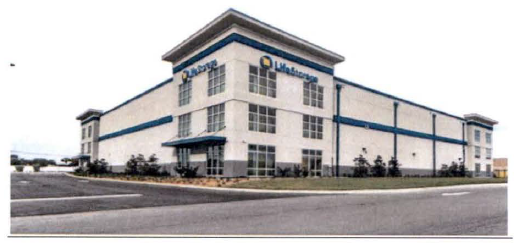
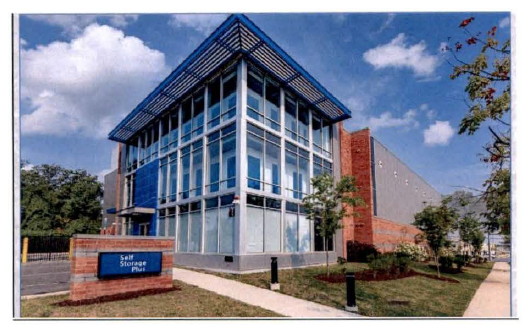
3.
Prohibited uses within the commerce park (CP) district. The following land uses are prohibited: extraction of raw materials; stockyards or slaughter of animals: scrap metal operations, junk yards, wrecking yards, or salvage yards: manufacture or storage of explosive materials: smelting of ores and heavy metal fabrication: textile mills: leather or allied products manufacturing; pulp mills: petroleum manufacturing or refining and coal, or mineral products manufacturing: rubber. clay, or refractory manufacturing product manufacturing: manufacture of acid. glue. fertilizer. lime or gypsum: fat rendering; campgrounds; flea markets: sexually oriented business such as adult entertainment: outdoor structures used to perform heavy industrial activities such as heating, cooking, vaporizing, pasteurizing, distilling, or similar heavy industrial activities: or any form of residential development, excepting approved accommodation of a security guard, night watchman. or on-site manager. and institutional uses other than essential public services required to support principal uses allowed in the CP District are prohibited. Commercial services that are not accessory use to permitted principal uses. including commercial trades and industrial uses, are prohibited.
In addition to the prohibited uses above, any use or structure not specifically or provisionally permitted by this section, or not conforming to the performance standards in chapter 5 or chapter 6 of the Land Development Regulations, shall also be considered prohibited.
4.
Administrative conditional use. These uses are permitted by a waiver granted by the administrative official, with denials of an administrative waiver appealable to the city commission.
a.
Sign, electronic community bulletin board. Permitted subject to the following conditions:
(1)
Located on arterial or collector roadways.
(2)
Maximum height eight feet, maximum width 12 feet and designed as a monument sign.
(3)
Maximum size for electronic bulletin board is 20 square feet.
(4)
All signs will need to be brought into conformity.
(5)
Bulletins shall be incidental in the principal use.
(6)
No off premise signs will be permitted.
(7)
The applicant must own the property on which the sign is to be located.
(8)
Color and intensity of illumination shall be appropriate for the specific site and sign location.
(9)
Illumination shall be limited to a maximum of 11 watt incandescent bulbs and limited to the hours between 6:00 a.m. to 11:00 p.m.
(10)
The base of the monument sign shall be landscaped with appropriate shrubbery and ground material as approved by the technical review board.
(11)
Subject to any other condition deemed appropriate by the administrative official or the city commission including but not limited to hours of operation and level of illumination.
b.
Multi-user signs. Subject to the requirements of this section.
D.
Industrial park (IP) district permitted, conditional, and prohibited uses. The minimum size lot shall be five acres.
1.
Permitted industrial uses within the industrial park (IP) district. No distribution activities shall occur on land adjacent to CR 544 and no more than 5 overhead doors, docks, or bays shall be located within the front facade of a building located on a lot or parcel abutting CR 544. Similarly, no distribution activities shall occur within a side yard of a lot or parcel abutting CR 544 unless the activity is setback 200 feet from CR 544 and the vehicles and related activities are screened from public view along the CR 544 corridor. Approved land uses in the IP district shall meet all applicable provisions of these regulations. Rail dependent operations and other industrial activities with potentially incompatible impacts or activities that are not fully enclosed, shall be located a minimum of 500 feet from the SR 17 and the CR 544 right-of-way. The following uses are permitted in the IP district upon approval of a site plan compliant with applicable laws and ordinances:
a.
Commercial trades, including machine shops; building contract services and supplies, including construction materials, plumbing and electrical services, and related building trades; machine, furniture, and equipment repair; manufacturing of signs and advertising displays.
b.
Facilities for the production, assembling, packaging, and/or distribution of precision instruments, and other products that do not involve noxious impacts, including odor, noise, vibrations, emission of smoke and particulate matter.
c.
Manufacture of small electrical or electronic apparatus; coils, tubes, optics, and semiconductors; communication, navigation, guidance, and control equipment; data processing equipment (including computer software); glass edging and silvering equipment; graphics, and art equipment; metering equipment; radio, and television equipment, photographic equipment; radar, infrared, and ultraviolet equipment; optical devices and equipment; filing and labeling equipment; or jewelry and precious metal product.
d.
Research and development, including laboratories, engineering and design of electronics, machinery, equipment, as well as biochemical, chemical, electrical, photographical, medical, metallurgical, pharmaceutical or X-ray research.
e.
Wholesale trade, warehouse, and distribution establishments. Those businesses selling, storing, or distributing mobile homes, or manufactured homes are not allowed.
f.
Apparel manufacturing and commercial and industrial laundries.
g.
Boutique, small scale milk processing and fresh fruit processing but not from concentrate, and may include oils and essence but not processing plants requiring stacks or similar impact producing infrastructure for such activities as pasteurizing, distilling, and vaporizing.
h.
Low to moderate intensive metal, plastics, rubber, and aluminum fabrication, including liquefying molding, extrusion operations; low to moderate intensive rubber, clay and refractory manufacturing; low to moderate intensive petroleum/chemical engineering processing and manufacturing; and low to moderate hydrocarbon processing/recycling activities.
i.
Cold storage and ice processing facilities.
j.
Essential public services supporting commerce and industry, including but not limited to the rail infrastructure; water distribution and wastewater collection systems; law enforcement, security, fire protection, and emergency services infrastructure and service delivery systems.
k.
Accessory uses. Any permitted accessory uses must be co-located within the structure accommodating the principal use and shall be customarily incidental and subordinate to such principal use.
1.
Accessory outside operations such as conveyance systems, storage areas, cargo trailer or fleet parking, and cargo handling areas shall not encroach into any front or street yards or buffer area or required side yards of buffer area and shall not exceed 50 percent of the area of the site. Where such outside operations abut an active rail line services the facility, the cumulative area of outside operations may cover 60 percent of the site area. Such areas may be buffered by an on-site building that screens the area from adjacent sites or streets. Otherwise, the area must comply with all screening, buffer, landscaping, and setback regulations. All surface areas accommodating outside operations, cargo handling, and parking shall be paved to city standards.
2.
Accessory retail or service uses to a principal permitted use. Such accessory use shall be permitted, provided that such uses shall not occupy more than five percent of the gross floor area of all buildings on any lot or group of contiguous lots in common ownership or control; shall be within a building or enclosure such that there are no external signs or evidence of such uses; and shall have no external access to the uses.
3.
Accessory facilities for the furnishing of meals and sale of refreshments and personal convenience items solely to the employees of the principal industrial or service commercial use and visitors doing business on the premises.
4.
Accessory offices subordinate to the principal industrial or service commercial use on site.
5.
Day care service for commerce and industrial park employees.
6.
Accessory medical or pharmacy services.
7.
Accessory helipads.
2.
Conditional uses within the industrial park (IP) district. The city commission may approve the following uses as a conditional use by after a public hearing and subject to appropriate conditions and safeguards. The city commission may approve, deny or add additional conditions for all conditional use requests.
a.
Establishments not allowed as a permitted use which are engaged in the processing, production, assembling, packaging, and/or distribution of food, goods, or products that do not involve noxious impacts, including odor, noise, vibrations, emission of smoke and particulate matter and do not require processing plants with large stacks or similar impact producing infrastructure for such activities as pasteurizing, distilling, and vaporizing.
b.
Cold storage and ice processing facilities.
c.
Vehicle maintenance facilities.
d.
Warehousing/Distribution Centers and similar activities related to the sale, storage, and minor repair of automobiles, trucks, recreational vehicles, campers or other large machinery and equipment.
3.
Prohibited uses in the industrial park (IP) district. The following land uses are prohibited: extraction of raw materials; stockyards or slaughter of animals; scrap metal operations, junk yards, wrecking yards, or salvage yards; manufacture or storage of explosive materials; smelting of ores and heavy metal fabrication; textile mills; leather or allied products manufacturing; pulp mills; mineral products manufacturing; manufacture of acid, glue, fertilizer, or lime; fat rendering; outdoor structures used to perform heavy industrial activities such as heating, cooking, non-cooling tower water vaporizing, pasteurizing, or similar heavy industrial activities; flea markets, campgrounds; sexually oriented business such as adult entertainment; or any form of residential development, excepting approved accommodation of a security guard, night watchman, or on-site manager.
In addition to the prohibited uses above. any use or structure not specifically or provisionally permitted by this section, or not conforming to the performance standards in chapter 5 or chapter 6 of the Land Development Regulations, shall also be considered prohibited.
4.
Administrative conditional use. These uses are permitted by a waiver granted by the administrative official, with denials of an administrative waiver appealable to the city commission.
a.
Sign, electronic community bulletin board. Permitted subject to the following conditions:
(1)
Located on arterial or collector roadways.
(2)
Maximum height eight feet, maximum width 12 feet and designed as a monument sign.
(3)
Maximum size for electronic bulletin board is 20 square feet.
(4)
All signs will need to be brought into conformity.
(5)
Bulletins shall be incidental in the principal use.
(6)
No off premise signs will be permitted.
(7)
The applicant must own the property on which the sign is to be located.
(8)
Color and intensity of illumination shall be appropriate for the specific site and sign location.
(9)
Illumination shall be limited to a maximum of 11 watt incandescent bulbs and limited to the hours between 6:00 a.m. to 11:00 p.m.
(10)
The base of the monument sign shall be landscaped with appropriate shrubbery and ground material as approved by the technical review board.
(11)
Subject to any other condition deemed appropriate by the administrative official or the city commission including but not limited to hours of operation and level of illumination.
b.
Multi-user signs. Subject to the requirements of this section.
E.
General standards applicable to the commerce park and industrial park districts. Proposed development within the CP and IP districts shall meet all the applicable provisions of this section. Medium to heavy impact structures or activities may be required to include a minimum of 200-foot setback from the detour road and the proposed 30th Street extension right-of-way.
1.
Basic site design standards. Table 1: "Basic Site Design Standards" shall be applied in the commerce park district and in the industrial park district. Any yard abutting a public or private road right-of-way shall be a street frontage yard.
Setbacks from a rail right-of-way shall be compliant with applicable laws and administrative rules. The administrative official may administratively approve adjustments to setbacks from rail right-of-way to accommodate conveyance systems designed pursuant to best management principles and practices.
2.
Sign regulations. [Also reference "signs," chapter 7, Land Development Regulations.] All sign usage shall comply with the requirements found in the city's Land Development Regulations. Where there is a conflict between the regulations of article 4 and other applicable provisions of the Land Development Regulations, the more restrictive standard shall apply.
a.
Sign regulations for the commerce park district and industrial park district.
1.
Permitted signs. Freestanding signs, excepting duly approved instructional or directional signs, shall be limited exclusively to monument signs (i.e., low profile ground signs supported by a decoratively designed masonry base or equivalent durable decorative material that complements the material, color, and architectural features of the building(s) advertised. The monument sign should be incorporated into the overall landscape plan and the base of the monument should include ornamental plants that promote a pleasing and harmonious design. May be freestanding pole signs. Monument signs shall have a maximum height of ten feet, and a maximum surface area of 36 square feet per side. Monument signs generally shall be located at the vehicular entrance to the building. Generally, there should be no more than one such monument sign for each site. Wall signs shall be limited to one sign per structure (or business in a multi-business structure), and have a maximum surface area of 50 square feet.
2.
Prohibited signs. Canopy, flashing, moving, portable, pole, projecting pylon, roof, temporary point of purchase or trailer signs, and wind signs shall be prohibited, excepting instructional or directional signs which may be pole signs. No signs shall project above the roof cornice line. No on-site billboards or advertising of off-premise goods or services shall be permitted within a commerce park or an industrial park district.
3.
Multi-user signs. A multi-users monument sign may be allowed where two or more industrial users agree to share a common multi-user identification sign subject to the following conditions:
i.
Maximum height: 15 feet.
ii.
Maximum sign area: 80 square feet.
iii.
Maximum individual user panel size: 20 square feet.
iv.
Maximum of ten panels, plus complex identification.
v.
Signage shall have unified sign design to be approved for materials, lettering, lighting, and colors. Colors and materials shall blend with the building design.
vi.
Installation of sign shall require permission from the property owner of the land where sign is to be located. In addition, a maintenance agreement is required.
4.
Illumination. Illumination shall not create glare or excessive brightness. External lighting fixtures for monument signs should be concealed or screened by landscaping, provided with cut-off shields, and directed so that no glare impacts motorists. High pressure sodium vapor lighting is prohibited.
3.
Landscaping. See chapter 10, article 1, Land Development Regulations.
4.
Parking and access. Chapter 11, articles 1 and 2.
5.
General regulations for nonresidential uses. See chapter 5, article 2.
F.
Buffer yards, screening, landscaping and design specifications.
1.
Buffer yards. The buffer area is intended to minimize any potential adverse impact on the SR 17 and CR 544 gateway corridors; avoid adverse impacts between adjacent land uses of differing types and intensity; and promote land use compatibility. A buffer yard is a portion of a yard on which the city shall require the installation of trees and plant material and may also require decorative walls and/or berms to prevent land use incompatibility. Screening and buffering shall be required to shield unsightly or potentially incompatible features of development from public view and to minimize impacts on adjacent lots, especially where most restrictive and less intensive use of land occurs. Buffer yards shall be required to screen unsightly structures and potentially incompatible uses, including outdoor storage, parking areas, cargo bays, areas frequented by trailer trucks, heavy equipment areas, outdoor distribution activities, conveyance systems, and similar potentially incompatible features of heavy commercial and industrial operations.
The required design specifications of the buffer yard and screening shall vary based on the location of the land use, the nature and potential incompatibility, and spatial relationships between the subject property, adjacent lots and SR 17 and CR 544 gateway corridors. A buffer yard must be a portion of the property under unity of title and may be a portion of the rear, side or front yard setback requirements. Buffer yards are inclusive of required setbacks.
The yard depths shown in the buffer yard illustrations are the minimum required unless the city administrative official determines that a lesser standard is in the public interest as discussed in these regulations as discussed in sub-section (2) below.
2.
Buffer yard specifications and options. The buffer yard requirement is specified in Table 2: Front, side, and rear buffer yard requirements by matching the proposed use in the first column with the abutting use shown in the top row. Should a question arise as to the land use classification of a proposed or abutting use or the nature of a potential land use incompatibility, the administrative official shall determine whether a potential land use incompatibility is "moderate," "moderately high," or "high." Table 2: and the buffer yard legend and illustrations denote the specifications for the buffer yards. The city administrative official shall determine the appropriate buffer yards during site plan review. The buffer yard illustrations include required units of landscaping as measured in 100 linear foot units along the property line. During the site plan review process, the administrative official may adjust the specifications for a site based on sight distance requirements established by the city administrative official in concert with other public agencies as appropriate.
The city may require that any buffer yard be installed along the entire length of the property line separating two uses if the city administrative official or renders a finding that the absence of such extended buffer could potentially result in incompatible land uses or activities that may disrupt or otherwise adversely impact the more restrictive or less intense use. Where the city administrative official finds that installation of the buffer along certain segment(s) of the property line is: 1) impractical; 2) unreasonable; and 3) will not serve the public interest, the city administrative official may modify the buffer requirement. The intent is to ensure that adjacent nonresidential uses within the commerce park district or industrial park district having a different character and intensity are separated by a buffer yard that effectively protects the more restrictive (i.e., less intense use) from potential dissimilar and adverse impacts that may be associated with the less restrictive (i.e., more intensive) abutting use, such as traffic, noise, odor, unsightly appearance, or other adverse impacts.
3.
Use of existing vegetation in buffer yard areas. Existing vegetation within a required buffer year may be retained and used to defray the require number of new tree or plant installations to the degree practical and feasible. However, no credit shall be extended for citrus trees. The use of existing vegetation shall be approved only if it meets or exceeds the specifications of required plantings. Site plans shall show location and extent of existing vegetation within buffer yards areas.
4.
Design of buffer to achieve opaque screen. When landscaping is required to conceal an outdoor storage area, high intensity operations area, cargo bays, refuse storage, or other potentially disruptive, incompatible, or otherwise noxious use, the city administrative official may require that only conifer (evergreen) plants, suitable for local conditions with or without a decorative masonry wall be installed to achieve an opaque screen. Deciduous trees may be planted along with the evergreens to enhance the height of the screen. Lower story deciduous shrubs may be used in front of evergreen screens as part of the required number of plants. When structures are used, the materials shall be durable and suitable for screening.
5.
Berms, wall, tree caliper, and plant size. Berms shall be applied in the design of landscaped gateway setbacks as stated below. Walls with plants and trees shall generally be used to screen outside storage areas, cargo bays, loading, unloading, and related outdoor distribution operations. Materials, products, or equipment outside of a fully enclosed building shall be concealed from public view from SR 17 or CR 544 and from adjacent properties. However, such screening may not be required merely to screen one outside operation from a similar use or activity on an adjacent site unless the city administrative official deems that a potential for incompatibility exists. The city administrative official may require a wall in combination with required screening based on the location, intensity, and nature of the outdoor use or activity, and line of sight from a gateway or adjacent site. The minimum tree and shrub specifications are described in the buffer yard illustrations.
a.
Berms. A berm system with trees and shrubbery shall be required along the SR 17 and CR 544 gateway setback. All berms shall be landscaped as herein required. The city administrative official may require a berm system as part of a buffer and screening design if the added height is necessary to improve upon the screening required by a proposed use or activity. Berms generally shall have a four to one slope and shall not exceed a three to one slope. The buffer yard width and site conditions will determine the proper slope ratio to be used for berms. Generally, all berms shall have compacted and stabilized dirt, shall be landscaped with trees and shrubs, have no more than ten percent mulch and all other areas shall be sodded.
b.
Wall specifications. Where walls are used in design of a buffer or other project feature, the walls must be made of decorative textured masonry material, including poured concrete, cut block, concrete block covered with stucco, brick, or equivalent durable decorative material. The materials and design elements shall be consistent with the overall project design. Any gate components, including gates visible from a gateway corridor or detour road shall be constructed with a decorative, opaque, high density perforated metal screening or equivalent durable material and shall be painted to match or complement the wall of the building. Site entries requiring gates shall be offset from direct view to loading areas where possible to minimize extent of screening, and avoid direct view to loading areas when gates are open. Where the applicant proposes chain link fences for security or safety purposes and such fence is potentially visible from a public right-of-way or residential zone, the chain link fence shall be screened with a durable and decorative feature and/or covered with a durable and decorative green vinyl or equivalent material. All plants must be sized and spaced to obscure the chain link fence at the time of planting. Chain link fences with wood, plastic, or metal strips are expressly prohibited. No chain link fence shall be placed within the required 25 feet arterial road setback.
c.
Height of walls. Street side walls shall adequately screen views to the top of loading bays and parked vehicles and/or trailers. The height of walls should not exceed 12 feet from the highest finished grade. The area of walls shall be landscaped with shrubs and trees reaching a mature height that exceed the height of the wall.
d.
Special design considerations. Long expanses of uninterrupted walls shall be avoided. No wall shall contain a continuous, uninterrupted wall plane greater than 40 feet. Landscaping, including trees and shrubs as a minimum, shall be provided on the outside wall face providing visual relief. Design features shall include: raised planters, openings, material change, staggered sections, pilasters or posts, or other equivalent functioning features. Wall openings shall be provided to connect walkways as needed to avoid circuitous routes for pedestrians. The pedestrian gates should be enhanced by pilasters, trellises, special landscaping, or other decorative features. Landscape berms should be provided to minimize the height impact of the screen walls.
6.
Maintenance. The maintenance of required buffer yards shall be the responsibility of the property owner. All such areas shall be properly maintained on a continued basis so as to ensure perpetual buffering and screening. Plant materials which exhibit evidence of insects or other pests, disease and/or damage shall be appropriately treated, and dead plants promptly removed and replaced with correct sized plants. Debris and litter shall be cleaned; and berms and walls shall be maintained at all times.
7.
Use of buffer yards. A buffer yard shall be a passive green open space and may be interrupted by access driveways. All other uses are prohibited, including off-street parking and accessory uses.
8.
Sight clearance. Buffer yards may not obscure a clear line of sight for vehicular traffic.
9.
Storage and screening of approved outdoor storage and fleet vehicles. Unsightly structures or activities such as dumpsters or other waste storage areas, loading docks, storage tanks, other or like equipment shall be stored at the side or rear of the building and shall be screened from public view.
Screening materials shall be constructed and designed in such a manner so that they equal a height equal to that of the materials or equipment being stored but in no event less than six feet in height. The screening to the maximum practical extent, shall shield said material and equipment from both public view. Reference buffer and landscaping requirement illustrated in Table 2: "Front, side, and rear buffer yard requirements" and in side and rear buffer yard illustrations, especially illustrations 3 through 5. Storage of fleet vehicles, service vehicles and other such vehicles shall not be stored in a parking lot fronting SR 17 or CR 544.
Such vehicles must be stored within a rear yard service area or within a side yard that is appropriately screened by a landscaped buffer yard meeting the specifications required for the principle use.
10.
Compatible land use; compatibility defined. In land use planning, "compatibility" means the extent to which a use(s) or development is capable of existing in harmony with other uses situated in its immediate vicinity. The State of Florida defines "compatibility" as "a condition in which land uses or conditions can coexist in relative proximity to each other in a stable fashion over time such that no use or condition is unduly negatively impacted directly or indirectly by another use or condition."
In these regulations potentially incompatible land uses are regulated and required to be screened by buffer yards and landscaping which may consist of berms, wall, trees, and plant material. The landscaping specifications are based on the degree of potential incompatibility: "moderate," "moderately high," and "high." The relative degree of incompatibility will be based on the zoning district, size of site; the type and location of the use; structure, or activity; mass, dimensions and height; the scale, extent and intensity of the use or activity as measured by potential noise, vibration, odor, emissions of particulate matter, or other potentially adverse noxious environmental impacts; traffic generation, hours of operation, setbacks from site perimeter and pre-existing screening by buildings, trees, or vegetation. The intent of the city is to ensure functional and attractive development.
For example, a potential "moderate incompatibility" may be a small outside storage area, a freestanding storage tank, mechanical hardware, cargo bay area, or small vehicle fleet parking area within the industrial park that is low intensity and sufficiently setback from the perimeter of the site so that that "buffer yard 3" specifications provided herein adequately screen the activity from the adjacent property. However, a potentially "moderate high" or "high incompatibility" may be any one of the same or more intense uses or activities or larger freestanding structures that require a greater buffer and more screening due to the higher potential for incompatibility. If the "potential incompatibility of a land use, structure, or activity cannot be adequately addressed by the required buffer and screening, the location, size, scale, intensity, or other attributes of the use, structure, or activity shall be modified to comply with the provisions of the Land Development Code.
11.
Screening and buffer yards. Table 2: "Front, side, and rear buffer yard requirements" lists required screening and buffer specifications for front, side and rear yards required along SR 17 and CR 544 corridors and to separate potentially incompatible land uses, structures, or operations of dissimilar character and/or intensity.
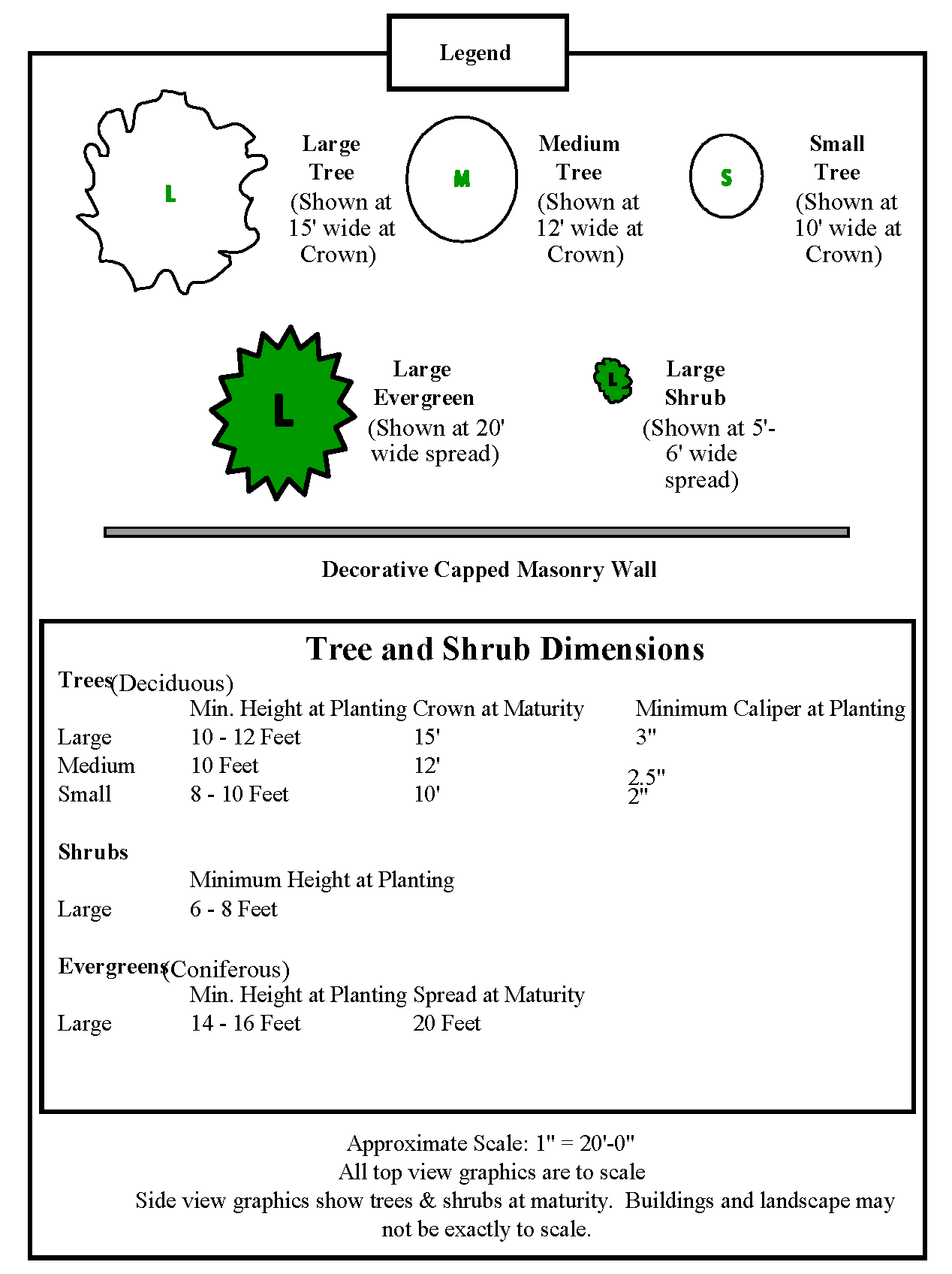
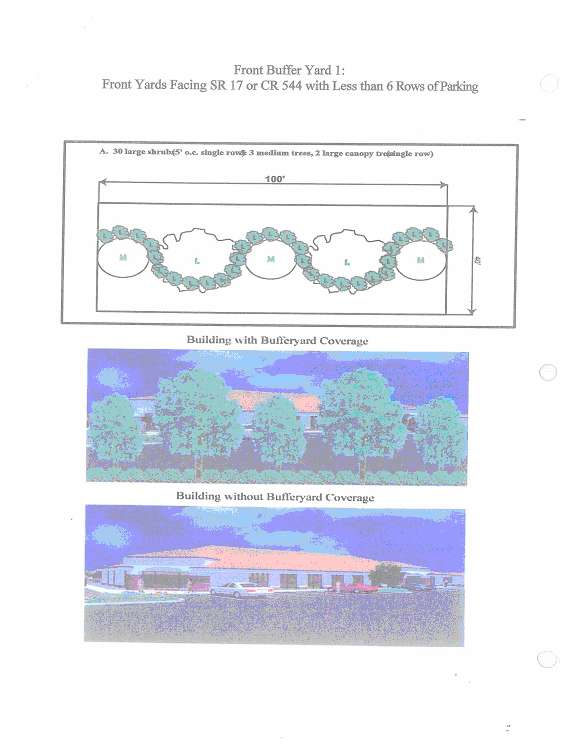
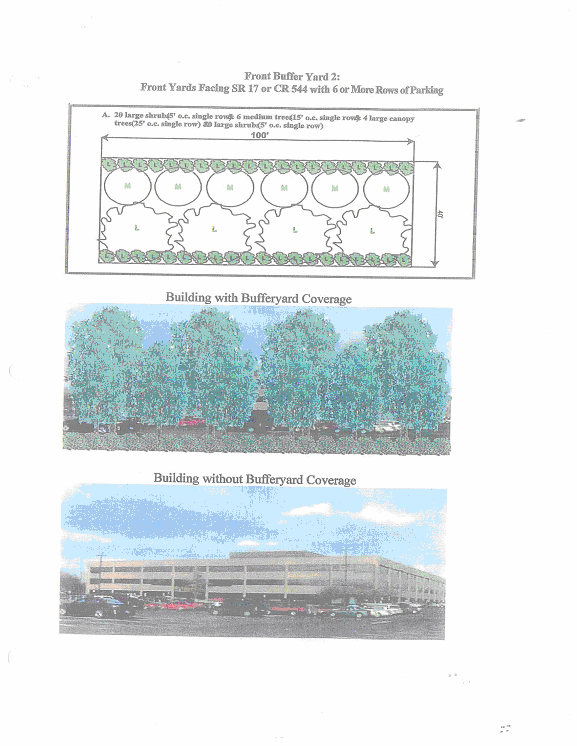
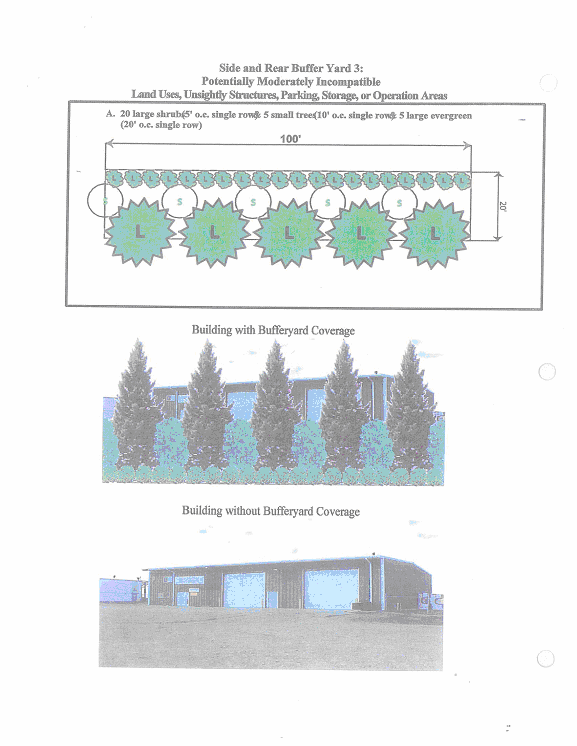
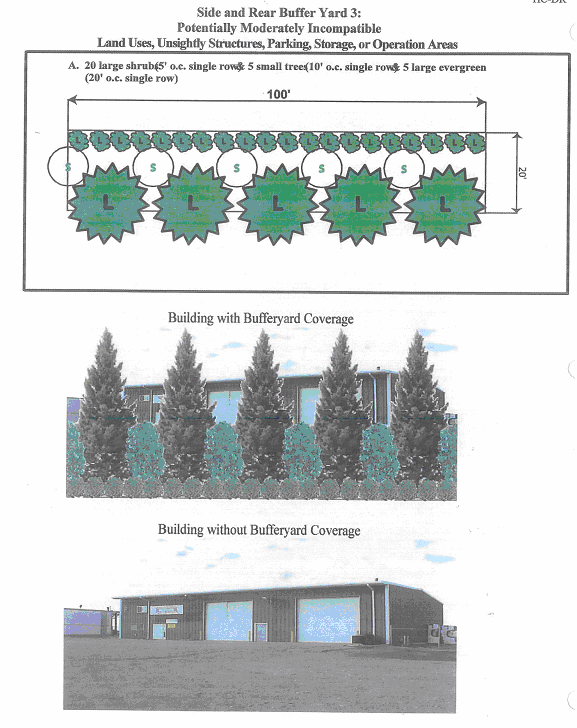
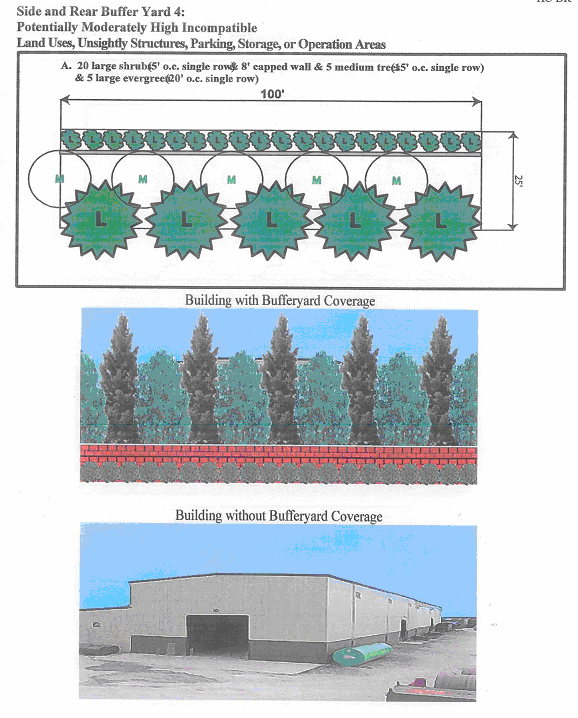
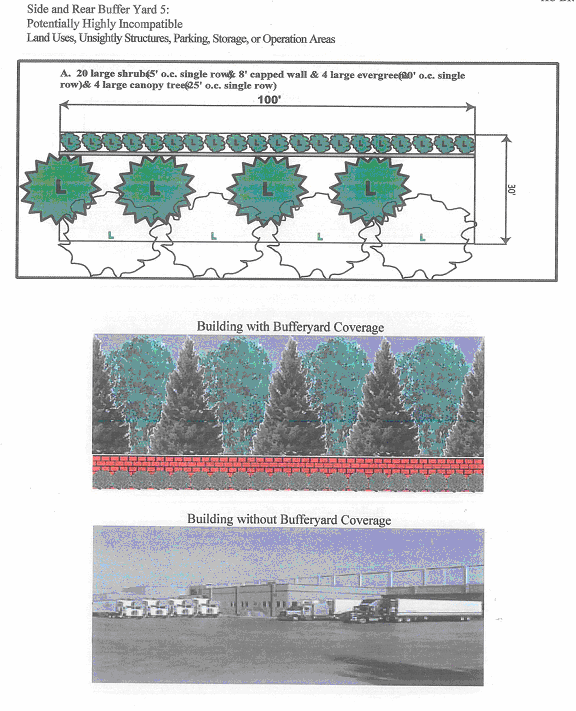
G.
SR 17 OR CR 544 CORRIDOR LAND USE AND ARCHITECTURAL APPEARANCE.
1.
Front facade. Any facade of any building that faces SR 17 or CR 544 or a frontage road running parallel to these facilities shall be deemed to be a front facade. The front facade and all facades within 40 feet of the front facade must be design to achieve an "office-front" appearance and have a decorative front pedestrian entryway. The front facade of any such building shall be faced with one of, or a combination of, the following:
• Face brick, stone, glass or similar material;
• Architecturally treated concrete;
• Stucco or other decorative coating applied to a code compliant building material in a manner as to create a harmonious design with other exterior materials.
• Architecturally designed metal fascia, soffit, and roof components can comprise a maximum of 25 percent of the front facade.
Front facades adjacent to SR 17 and CR 544 shall avoid large blank areas between massing breaks, have a recognizable base and top, and include texture, revealed pilaster, change in plane (two feet minimum; four feet recommended), vertical variation in roof line, windows, lattice, accent trees, or equivalent. The "base" should visually relate to the proportion and scale of the building. Techniques for establishing a base include (but are not limited to) richly textured materials such as tile or masonry treatments; darker colored materials, mullions, panels, reveals, and/or enriched landscaping. The "top" should take advantage of the visual prominence of the building's silhouette. Techniques for clearly expressing a top may include (but are not limited to) cornice treatments, roof overhangs with brackets, richly textured materials such a tile, masonry, or fluted concrete), and/or differently colored materials. Colored "stripes" are not acceptable as the only treatment. Texture, reveals, and color may be appropriate in some applications.
Said facing shall extend across the full front of the building and also extend a distance of not less than 40 feet on each side of the building adjacent to the front of the building. That portion of any building facing Detour Road shall also be deemed to be a front facade and shall be finished in an attractive manner in keeping with the general standard for industrial buildings but need not be finished in a manner as a front facade facing SR 17 or CR 544. It is the intent of this provision that all structures in the commerce park and industrial park be designed and constructed in such a manner as to provide an aesthetically pleasing and harmonious development. All building facades should be made attractive through the use of careful detailing, especially at the base of buildings, along cornices, eaves, parapets, or ridge tops, and around entries and windows. Appearance may also be enhanced through the correct use of materials, expansion joints, and reveals. Window frames should appear substantial and should not be flush with the exterior finish. Glazing should be inset at least two inches from the front face of the exterior finish. Buildings shall be kept in good repair and appearance at all times and shall be compliant with all federal, state, and local building codes and other applicable laws. The following provisions shall be applicable to all sites located adjacent to SR 17 or CR 544 or a frontage road running parallel to these facilities. All landscaping shall be located outside of the public right-of-way.
2.
Side faces on IP sites abutting CR 544. No overhead doors, loading docks or cargo bays shall be located within a side facade of a building located on a site CR 544 unless the same are located at least 200 feet south of CR 544 and shall be screened from public view along CR 544. Cargo bays and docks, that are located along such a side facade shall be inset in below grade wells and designed so that the cargo trucks and trailers park parallel to the facade.
3.
Roof top utilities. Roof-top mechanical equipment shall be integrated into the overall mass of the building and shall be located and screened from public view by an appropriate barrier. At a minimum, roof mounted equipment shall be screened through the use of parapets, screen walls, equipment wells, mechanical room enclosures and similar design features.
Screening devices other than parapet walls shall be designed as an integral part of the building mass. Picket fencing, chain-link fencing and metal boxes shall be avoided. The top of screens shall be at least as tall as the top of the equipment to be screened and shall provide additional height where larger equipment units are likely to be installed in the future. Cross section drawing should be prepared to illustrate the method in which the equipment will be screened from view of SR 17 and CR 544. Flues, vents, and pipes on the roof should be painted a color that matches their background or roof material in order to reduce their visibility.
4.
Front and side yards; drainage. All front and side yards not used for structures, parking, sidewalks, access roads, or approved land use activity shall be graded with adequate drainage provided and shall be sodded and maintained in grass and landscaped areas with trees and shrubs. All drainage retention/detention facilities shall be designed as a project amenity and the design shall be approved by the administrative official. No drainage retention shall be located between the street and the front building facade unless the specific location and design is approved by the administrative official and must be predicted on a demonstrated need and lack of effective alternatives sites. The overall amount of landscaping required for each site will be based on the landscape plans approved by the city pursuant to the landscape ordinance within the Land Development Code. However, in no case shall approval of a plan be granted which does not contain at least the minimum standards as specified in these criteria.
5.
Front facade foundation landscaping. A minimum of at least one three- to five-gallon foundation shrub for every three linear feet of building front facade and one specimen tree of at least two inch caliper per 35 linear feet of building facade shall be placed along the foundation of any front facade facing SR 17 or CR 544. The shrubs shall be a minimum of 30 inches tall at the time of planting. This landscaping requirement does not apply to portions of the building facade that provide access for pedestrians. The front facade landscaped area shall be at least five feet wide. Ground cover plants must fully cover the remainder of the five-foot landscaped area along the foundation.
6.
Separation of customer parking and service area parking. Areas for customer parking shall be separated from any areas designated for commercial or industrial cargo bay and service areas, loading and unloading, storage areas, or other outside business related operations. Customer parking shall be located on a paved parking surface compliant with city design standards and the customer parking lot shall be located within a front or side yard. No parking shall occur on a frontage road or within grassed open space areas. Customer parking lots may be located within a rear yard if there is a clear separation from any outside business service areas as herein described. Concrete walkways shall be provided that link front, side, or rear yard patron parking areas to building entryways.
7.
Perimeter landscaping for customer parking lots. Parking lots as well as related internal and perimeter landscaping shall comply with applicable Land Development Code. No parking shall be allowed to encroach into a required landscaped setback of buffer areas. A landscaped divider with concrete curbing shall be constructed to separate every 15 contiguous parking stalls. The landscape divider shall have a minimum dimension of ten feet and shall comprise a minimum total 100 square feet of landscaped area. One deciduous tree shall be required for each such divider.
8.
Building entrances for customers. Entryways on building facades visible from SR 17 or CR 544 shall be connected via pedestrian walkways with customer parking areas. The front facades shall include a major entry feature and fenestration over at least 25 percent of the facade's surface. A monolithic appearance shall be avoided. Entryways shall incorporate special materials, color, detailing, or equivalent architectural treatment at major entries. Primary building entries shall be highlighted through the massing of the building. Greater height can be used to highlight and accentuate entries in the form of corner tower elements, tall voids, or a central mass meeting an entry plaza. Conversely, smaller building masses can also communicate the location of entries. Landscaping at major building entryways shall be provider along with a sidewalk connecting to the front parking area.
H.
Maintenance of plant materials and trees. All plant material shall meet Florida Nursery No. 1 or better standards. All landscaped areas shall be appropriately irrigated and plants, grass, and trees shall be orderly and well maintained. Any areas of disturbed earth not in landscaped areas shall be sodded to reduce erosion and dust particles. Plant materials which exhibit evidence of insect pests, disease, and/or damage shall be removed within 60 days following notification by the city and shall be replaced within the next appropriate planting season or within one year, whichever occurs first.
I.
Outdoor lighting.
1.
Pole lighting. Pole height shall not exceed 30 feet measured at the street frontage or measured from finished grade to top of pole or light source/luminaire, whichever is highest. Pole mounted lighting shall be restricted to horizontal lamps with flat lenses. Wattage should generally be 250 watts but shall not exceed 400 watts. The design components shall effectively reduce glare to an acceptable IES standard.
2.
Illumination. The footcandle level adjacent to nonresidential development shall be consistent with IES recommended standards and general should not exceed one footcandle level. The footcandle level at the front property line of SR 17 or CR 544 shall not exceed 0.4 footcandles. The source of the illumination shall not be visible from off sight.
3.
House shields. House shields generally shall be required on all perimeter lighting to avoid spill over of light and glare onto adjacent properties that have a less intense use.
4.
Flood lighting. No flood lighting shall be directed into a parking lot and no flood lighting shall be directed away from a building (i.e., no flood light shall be building mounted and directed toward a parking area).
5.
Location and design. Lights used to illuminate parking and or building shall be arranged in a manner that does not create a hazard or nuisance to traffic.
J.
Site plan procedures.
1.
Site plan; general. A site plan shall be require for all development within the commerce park district and the industrial park district. The plan for development includes the dedication of rights-of-way or easements for roads, rail service, utilities or conservation measures, or otherwise includes the division of land into two or more units for resale, the applicant shall be required to obtain city commission approval of the subdivision plat compliant with chapter 13 subdivision regulations. The site plan shall be approved by the administrative official upon a finding of compliance with all applicable laws and ordinance. Prior to approving the site plan the administrative official shall render a finding the proposed development.
2.
Mandatory pre-application. The applicant shall schedule a pre-application conference with the administrative official. The pre-application shall include a brief narrative of the proposed activity and a sketch of the proposed site plan.
3.
Site plan application; ownership/disclosure. Following the pre-application, the applicant shall file a site plan with the administrative official to commence the site plan review process. All applications shall include a notarized affidavit showing each and every individual person having a legal and/or equitable ownership interest in the property upon which the application for site plan approval is sought, except publicly held corporations, in which case the name and address of the corporation and principal executive officers together with any majority stockholder will be sufficient. If the applicant is not the owner, the applicant must provide an original notarized statement from the current property owner authorizing representation of the specific site plan review application.
4.
Review by administrative official. Each application shall be reviewed by the administrative official and transmitted to appropriate city staff for review based upon the development issues surrounding the proposed site plan. The administrative official shall review each application for compliance with all applicable Land Development Regulations and other local, state, and/or federal laws.
5.
Conformance with Land Development Regulations required. All buildings, structures or uses shall be erected, altered, installed, and maintained in full conformity with the provisions of the Land Development Regulations and approved site plans.
6.
Performance guarantee may be required. A performance guarantee may be required from applicants as a condition of site plan approval if all required on- or off-site infrastructure improvements are not in place at the time of site plan approval. The performance guarantee shall be in the form of a performance bond or other instrument recommend by the planning and zoning commission and approved by the city council after considering the recommendation of the city attorney. The performance guarantee shall be furnished and payable to the city in the sum of 125 percent of the total cost of the engineer's estimates for extension of potable water distribution system components; sanitary sewerage system components; street improvements, including acceleration and/or deceleration lanes, traffic control devices, marking signage, and/or related street improvements; sidewalks, curbs, and/or gutters; stormwater management improvements; and/or other improvements required in the site plan approval. The terms of the performance guarantee may be modified by the city council after considering recommendations of staff and the city attorney.
7.
Information required in site plan. A site plan shall include, but not necessarily be limited to, the following requirements. With the exception of subsections (a)(1-3), the administrative official may waive or modify information requirements, information for site plan review after rendering a finding in writing that such requirements: 1) Are not necessary prior to site plan approval in order to protect the public interest or adjacent properties; 2) bear no relationship to the proposed project or its impacts; and 3) are found to be impractical based on the characteristics of the use, including the proposed scale, density/intensity, and anticipated impacts on the environment, public facilities and adjacent land uses.
a.
Title block.
1.
Name of development.
2.
Name of owner/developer.
3.
Scale.
4.
North arrow.
5.
Preparation and revision date.
6.
Location/street address of development.
b.
Project information to be included on site plan.
1.
Zoning (include any special districts).
2.
Project site size (acreage and/or square footage).
3.
Legal description.
4.
Square footage together with maximum allowed/ proposed building coverage.
5.
Impervious surface ratio, maximum allowed and proposed.
6.
Impervious surface, including maximum allowed and proposed open space and green space.
7.
Parking spaces, including minimum required and proposed as well as total handicapped spaces provided.
8.
Delineate location of existing and proposed structures.
9.
Denote existing and proposed development type by land use including density/intensity.
10.
Setbacks.
11.
Finished floor elevation.
12.
Proposed height and elevation of the crown of the road of the lowest adjacent street.
c.
Supplemental documentation.
1.
Identification of key persons (name, business name, mailing address, phone number).
i.
Owner.
ii.
Owner's authorized agent.
iii.
Developer.
iv.
Surveyor.
v.
Engineer, architect, and landscape architect.
vi.
Others involved in the application.
vii.
Verified statement showing each and every individual person having a legal and/or equitable ownership interest in the subject property, except publicly held corporations whose stock is traded on a nationally recognized stock exchange, in which case the names and addresses of the corporation and principal executive officers together with any majority stockholders will be sufficient.
2.
A statement describing the objectives and characteristics of the development and indicating intent regarding the future selling or leasing of portions of the development.
3.
A tabular summary keyed to the site plan that lists the proposed land uses, their location, acreage by land use, and gross floor area of each proposed use.
4.
A statement explaining the desired phasing, including the approximate timing of commencement and completion of each phase, and the rationale for the phasing approach.
K.
Site plan: Existing features. One or more maps and surveys at a scale of no less than one inch equals 100 feet, except the vicinity map, showing the following for the entire tract:
1.
The location of the development site in relation to existing streets.
2.
A boundary survey and legal description prepared by a surveyor registered in the state.
3.
Approximate topography defining the character of the land.
4.
The comprehensive plan future land use designations, zoning classifications, and existing land uses for the development site and all properties within 100 feet of property lines and adjacent rights-of-way.
5.
The location of all existing structures, rights-of-way, easements and other natural and man-made features on site and within 100 feet of the property lines and adjacent rights-of-way.
L.
Site plan: Proposed features. One or more maps at the same scale as the maps of existing features shall include the following:
1.
A schematic representation of proposed land uses (including common open space), conceptual building locations, parking lots, and driveway entrances and exits.
2.
A delineation of proposed roads with the functional classification of streets and an indication of required off-site street improvements.
3.
A schematic depiction of existing and proposed surface water management elements, including wetlands and major detention facilities.
4.
The general location and size of any community facility included within the development.
5.
Any proposed phasing of the project.
M.
Schedule of amenity/compatibility features. A schedule indicating any proposed amenities or compatibility features which may include: Natural open or landscaped areas; buffers; walls, berming, and screening; waterway and flood protection measures.
N.
Miscellaneous information. Any other information needed to satisfy the criteria in 8 c) below.
O.
Site plan review criteria. The site plan shall effectively demonstrate how the following conditions shall be met:
1.
Unified development. All lots within the development shall be linked with driveways and a pedestrian network and will have other unifying features, such as a unified signage plan, landscape plan, architectural features, and the like (all of which are designed to promote a unified, park-like environment).
2.
Compatibility. The location and arrangement of uses and buildings, roads, driveways, parking areas, pedestrian ways, and other features shall be compatible with surrounding land uses.
3.
Access, egress, and on- and off-site circulation system vehicular and pedestrian. The proposed development shall be planned such that the traffic generated can be easily accommodated without causing excessive volumes of traffic, particularly on residential streets.
4.
Open space, buffers, screening, and facade and parking lot landscaping. All parts of the site not used for buildings or impervious roadways, driveways, and parking lots or other impervious surfaces shall be landscaped pursuant to land development requirements.
P.
Special conditions of approval. In order to ensure compliance with section 5.6.4 F (10) "compatible land use," where necessary to ensure compatibility of buildings and uses with each other and with off-site properties, the administrative official or the city commission, on appeal, may require significant revisions to site plans. For example, if a potential incompatibility of a land use, structure, or activity cannot be adequately addressed by the required buffers and screening, the location, size, scale, intensity, or other attributes of the use, structure, or activity shall be modified to comply with the provisions of the Land Development Code.
Q.
Effective period of site plan approval. Approval of a site plan shall be effective for a period of 18 months.
R.
Conformance to site plan approval and minor amendments thereto. No permits shall be issued by the city, and no development shall commence unless in conformance with the approved site plan, unless a change or deviation is approved under provisions of the Land Development Regulations. The administrative official may approve minor changes and deviations from the approved site plan which are in compliance with the provisions and intent of these regulations, and which do not depart from the principal concept of the approved site plan. Examples would be a minor shift of a parking lot location. All other requested changes and deviations shall be referred to the city commission.
S.
Administrative conditional use. These uses are permitted by a waiver granted by the administrative official, with denials of an administrative waiver appealable to the city commission.
a.
Sign, electronic community bulletin board. Permitted subject to the following conditions:
(1)
Located on arterial or collector roadways.
(2)
Maximum height eight feet, maximum width 12 feet and designed as a monument sign.
(3)
Maximum size for electronic bulletin board is 20 square feet.
(4)
All signs will need to be brought into conformity.
(5)
Bulletins shall be incidental in the principal use.
(6)
No off premise signs will be permitted.
(7)
The applicant must own the property on which the sign is to be located.
(8)
Color and intensity of illumination shall be appropriate for the specific site and sign location.
(9)
Illumination shall be limited to a maximum of 11 watt incandescent bulbs and limited to the hours between 6:00 a.m. to 11:00 p.m.
(10)
The base of the monument sign shall be landscaped with appropriate shrubbery and ground material as approved by the technical review board.
(11)
Subject to any other condition deemed appropriate by the administrative official or the city commission including but not limited to hours of operation and level of illumination.
(Ord. No. 12-1417, § 6, 3-15-2012; Ord. No. 14-1476, § 2, 10-16-2014; Ord. No. 16-1526, § 1, 3-3-2016; Ord. No. 18-1594, § 2, 3-1-2018; Ord. No. 19-1647, § 1, 6-20-2019; Ord. No. 23-2053, § 1(Exh. A), 12-7-2023)
Sec. 5.6.21. - MUPUD—Mixed use planned unit development.
A.
Statement of intent. The following regulations and requirements apply to planned unit developments established primarily to encourage and promote well planned, suitable and appropriate mixed use developments. The focus is to allow a more balanced mix of uses in a mixed-use development, and to provide for the diverse needs of the residents of the city and to allow developers the flexibility to accomplish such goals without sacrificing the existing image and character of the surrounding neighborhoods. The focus also intends to encourage efficient land use by facilitating compact, medium to high-intensity development and minimizing the amount of traffic impacting the area, as well as support public transit where applicable. A mixed-use development shall be safe, comfortable and attractive to pedestrians, patrons, and residents. There are general requirements applied to the overall site as it is being designed, as well as requirements for the individual components (residential and nonresidential, to be known as a town center district).
(Ord. No. 08-1315, § 2, 3-20-2008)
Sec. 5.6.22. - MLK-NCD—Dr. Martin Luther King, Jr. Way-Neighborhood commercial district.
A.
Statement of intent. This district is intended to apply to areas where small groups of selected commercial and service establishments may be appropriately located to serve within convenient traveling distance from one or several neighborhoods. The MLK-NCD district is primarily not an automotive-oriented commercial district, but service stations are permissible by conditional use. The district is not intended to be used by major or larger scale commercial or service establishments. Professional and business offices and other similar uses are encouraged. Orientation to and compatibility with the neighborhoods to be served is of extreme importance.
B.
Permitted principal uses and structures.
1.
Retail outlets for sale of food, wearing apparel, toys sundries and notions, books and stationery, leather goods and luggage, jewelry, art, cameras or photographic supplies (including camera repair), computer and wireless phone sales sporting goods, hobby shops, toy stores, pet shops (but not animal kennels or veterinarians), musical instruments, television and radio (including repair incident to sales), florist or gift shops, antique stores, delicatessens, bake shops (but not wholesale bakery), drugstores, garden shops, and hardware stores.
2.
Service establishments such as barber or beauty shop, shoe repair shop, restaurant (but not drive-in restaurant), interior decorator, photographic studio, dance or music studio, reducing salon or gymnasium, self-service laundry or dry cleaning pick up station.
3.
Banks and financial establishments, travel agencies, employment offices, and newspaper offices, (but not to include newspaper printing).
4.
Professional and business offices.
5.
Medical and dental clinics (but not veterinary clinics).
The above are uses subject to the following limitations:
a.
Sale, display, preparation and storage to be conducted within a completed enclosed building (not including enclosed interior malls), and no more than 20 percent of floor space to be devoted to storage.
b.
Products to be sold only at retail.
c.
No sale, display, or storage of secondhand merchandise except as incidental to sale of new merchandise.
6.
Outdoor display shall be permitted within ten percent of the business store front subject to the following conditions:
a.
A site plan shall be provided distinguishing the proposed outdoor display area and the items proposed for outdoor display, i.e., vending and/or ice machines.
b.
Outdoor display area shall be allowed only to the area set for on the site plan, shall be paved and all electrical outlets supplying power to display area shall meet all applicable codes.
c.
A clearance of five feet on the sidewalk and/or walkway shall be required.
d.
All propane tanks and other related-type vending stations shall be properly enclosed to avoid any potential hazards, and shall comply with all applicable regulations.
e.
Outdoor display exceeding the ten percent allowance shall require a conditional use permit (see section 20.2.2.).
f.
All outdoor storage shall require a conditional use permit (see section 20.2.2.).
7.
Medical marijuana dispensing facilities.
C.
Permitted accessory uses and structures. Uses and structures which:
1.
Are customarily accessory and clearly incidental and subordinate to permitted or permissible uses and structures.
2.
Are located on the same lot as the permitted or permissible use or structure, or on a contiguous lot in the same ownership.
3.
Do not involve operations or structures not in keeping with the character of the district.
4.
Dwelling units, when a part of the permitted principal use, provided all minimum requirements for area, setback, height and related requirements for the district are met, and provided further, that all such dwellings shall be confined to the rear one-half of the ground floor, or to a floor other than the ground floor of the principal permitted use. The aggregate residential floor area of the dwelling units shall not exceed the aggregate floor area of the permitted principal use. One off-street parking space shall be provided for each dwelling unit in addition to the required off-street parking for the permitted principal use and shall be provided at the rear or side of the principal permitted one.
D.
Prohibited uses and structures. Any use or structure not specifically, provisionally, or by reasonable implication permitted herein.
1.
Residential uses, except as specified under MLK-NCD accessory uses.
2.
Any use or structure not specifically or provisionally permitted by this section shall be considered prohibited.
E.
Conditional use. Permissible by the city commission after public hearing and subject to appropriate conditions and safeguards. The city commission may approve, deny or add additional conditions for all conditional use requests. (See section 19.2.4 of the LDR.)
1.
Service stations.
2.
Commercial infill. Site specific redevelopment plans for infill development. Where a parcel exists adjacent to a minimum of two developed parcels, the developer may file for a site specific redevelopment plan. The city commission may approve the proposed infill plan and authorize up to a 50 percent reduction in zoning standards for setbacks, height, parking, buffering, and other related zoning standards, subject to the following standards:
a.
A public hearing has been held in accordance with this section.
b.
All activities conducted as part of the business shall be contained within an enclosed structure.
c.
The reduction of the specific zoning development standards are necessary to allow a reasonable development of the property and shall not impede the use and development of any adjoining property.
d.
The city commission may establish any conditions which are warranted.
3.
Educational facilities.
4.
Outdoor display and storage. Outdoor display or storage of merchandise for sale or rent which exceeds the permitted ten percent of the business store front may be permitted by conditional use permit subject to the following conditions:
a.
The location and extent of outdoor storage and display areas are identified on a site plan and are approved as part of the conditional use.
b.
Display and storage areas are subordinate in area and incidental to permitted principal uses.
c.
Outdoor storage areas shall be effectively screened by a solid fence or commercial grade, 70 percent opaque, mesh material applied to a fence.
d.
Display and storage areas shall be paved according to the standards of the Land Development Regulations.
e.
Outdoor display areas shall be indicated on the site plan as permanent or temporary and approved as part of the conditions of approval.
f.
Additional landscaping and/or site enhancements may be required as part of the site plan to ensure site compatibility or improve visual screening.
g.
A minimum five-foot-wide clearance on the sidewalk and/or walkway shall be required.
h.
All propane tanks and other related-type vending stations shall be properly enclosed or secured to avoid any potential hazards and shall comply with all applicable regulations.
5.
Reserved.
6.
Parking lots.
7.
Appliance, small equipment, and small engine repair, subject to the following conditions:
a.
All activities conducted as part of the business shall be contained within an enclosed structure, or within an approved service bay or area, properly screened or buffered from view.
b.
All premises shall be maintained in a clean manner, free of conditions which might harbor rodents, insects and other vermin, with no junk, new or used materials or parts or other materials stored outside.
c.
All signage and building facades shall comply with minimum maintenance and signage requirements of the city. Window displays shall be exhibited in a manner that is compatible in appearance with permitted and permissible uses in the district.
d.
Site plan and impact requirements as applicable in the Administration and Procedures Manual, are met.
e.
Business tax receipts will be transferable subject to review by the building official and further provided all of the stipulated conditions contained in the original special approval are met.
f.
Additional conditions and requirements may be applied by the city commission when such provisions address vehicular and pedestrian traffic, appearance, lighting, fire prevention, landscaping, and any other provisions contained in the Land Development Regulation.
8.
Churches or houses of worship. As part of the conditional use application, proposed churches and houses of worship shall be required to demonstrate that there are adequate provisions for parking.
9.
Second hand/used sales. New retail outlets for sale of second hand clothing, furniture and major household appliances and expansion of existing retail outlets for sale of second hand and/or used merchandise, subject to the following conditions:
a.
All activities conducted as part of the business shall be contained within an enclosed structure, or within an approved service bay or area, properly screened or buffered from view.
b.
All premises shall be maintained in a clean manner, free of conditions which might harbor rodents, insects and other vermin, with no junk, new or used materials or parts or other materials stored outside.
c.
All signage and building facades shall comply with minimum maintenance and signage requirements of the city. Window displays shall be exhibited in a manner that is compatible in appearance with permitted and permissible uses in the district.
d.
Site plan and impact requirements as applicable in the Administration and Procedures Manual, are met.
e.
Business tax receipts will be transferable subject to review by the building official and further provided all of the stipulated conditions contained in the original conditional use approval are met.
f.
Additional conditions and requirements may be applied by the city commission when such provisions address vehicular and pedestrian traffic, appearance, lighting, fire prevention, landscaping, and any other provisions contained in the Land Development Regulation.
10.
Medical marijuana dispensing facilities (Located less than 500 feet from a school).
F.
Minimum lot requirements (area and width). None, except as needed to meet other requirements specified herein.
G.
Maximum lot coverage by all buildings (includes accessory buildings). Unrestricted, except as needed to meet other requirements specified herein.
H.
Maximum impervious surface coverage: 100 percent.
I.
Minimum yard requirements (depth of front and rear yards, width of side yards).
1.
Front: None, except as needed to meet other requirements specified herein.
2.
Side: None, if building on adjacent lot is built to property line, or if adjacent lot is vacant and the owner thereof agrees by deed restriction with enforcement running to the city than any building constructed on vacant lot will either be built in such a manner as to:
a.
Leave no space between the building on his property and the building on the subject property; or
b.
To leave at least six feet of space between the buildings involved.
3.
Rear: Ten feet, except where MLK-NCD parcel abuts on an R-1-AAA, R-1-AA, R-1-A, R-1-AX, R-1, R-2, R-3, R-1-3X, or RIO district, then 20 feet rear yard must be provided.
J.
Maximum height of structures: 35 feet.
K.
Minimum off-street parking and loading requirements. No off-street parking or loading is required for non-residential uses. However, parking is recommended and if desired, see chapter 11 for parking requirements for non-residential uses. If off-street parking is used in combination with a non-residential use, applicable LDR and code provisions will apply to the off-street parking.
L.
Special landscaping requirements. In addition to the requirements of chapter 10 (Landscaping), the following special landscaping standards shall apply within the MLK-NCD district:
1.
The width of a perimeter landscape buffer shall be five feet wide (exclusive of any curbing). While a greater width is allowed, it is not required in this district.
2.
For front yards, a fence shall be permitted in lieu of a perimeter landscape buffer where such landscape buffers are required. The fence shall be a maximum height of three feet, and shall be constructed of vinyl, wood (termite resistant), concrete masonry units with decorative stucco, reinforced concrete with decorative stucco, wrought iron, or brick. All other types of fencing are prohibited.
3.
For side and rear yards, fences shall be permitted in lieu of a perimeter landscape buffer where such landscape buffers are required. The fence shall be a minimum height of six feet, a maximum height of eight feet, and shall be constructed of vinyl, wood (termite resistant), concrete masonry units with decorative stucco, reinforced concrete with decorative stucco, wrought iron, or brick. All other types of fencing are prohibited.
M.
Administrative conditional use. These uses are permitted by a waiver granted by the administrative official, with denials of an administrative waiver appealable to the city commission.
1.
Sign, electronic community bulletin board. Permitted subject to the following conditions:
a.
Located on arterial or collector roadways.
b.
Maximum height eight feet, maximum width 12 feet and designed as a monument sign.
c.
Maximum size for electronic bulletin board is 20 square feet.
d.
All signs will need to be brought into conformity.
e.
Bulletins shall be incidental in the principal use.
f.
No off premise signs will be permitted.
g.
The applicant must own the property on which the sign is to be located.
h.
Color and intensity of illumination shall be appropriate for the specific site and sign location.
i.
Illumination shall be limited to a maximum of 11 watt incandescent bulbs and limited to the hours between 6:00 a.m. to 11:00 p.m.
j.
The base of the monument sign shall be landscaped with appropriate shrubbery and ground material as approved by the technical review board.
k.
Subject to any other condition deemed appropriate by the administrative official or the city commission including but not limited to hours of operation and level of illumination.
2.
Single-family dwellings.
3.
Duplexes, triplexes, and multiple-family dwellings.
4.
Adult education facilities {small).
5.
Private school {small).
(Ord. No. 12-1418, § 3, 3-1-2012; Ord. No. 17-1584, § 2, 11-16-2017; Ord. No. 18-1594, § 2, 3-1-2018; Ord. No. 20-1695, § 2, 8-6-2020)

