
Haines City City Zoning Code
CHAPTER 13
SUBDIVISION
ARTICLE 5. - PLATS AND DATA
In connection with subdivision or re-subdivision other than re-subdivision of ten or less lots and as provided otherwise in this chapter, the following regulations apply:
ARTICLE 13. - ENFORCEMENT; RIGHT OF ACCESS
The administrative official shall be responsible for enforcing the provisions of this chapter and here or his duly authorized representative(s), may enter upon any premises or land to perform any duty imposed upon him by this chapter.
Sec. 13.1.1. - Purpose and intent.
A.
The purpose of this chapter is to promote and protect the public safety, comfort, economy, order, appearance, convenience, morals, and general welfare of the city residents which requires harmonious, orderly and progressive development of land within the corporate limits of the city.
B.
The regulations of the subdivision of land is intended:
1.
To provide coordination of land development within the city in accordance with orderly physical patterns;
2.
To require fiscal responsibility and stable land development by avoiding haphazard, premature, uneconomic or scattered land development;
3.
To insure the adequate provision of safe and convenient traffic access and circulation, including motorized, nonmotorized and pedestrian traffic, within new development;
4.
To insure the adequate provision of streets, utilities, and other facilities, also services to development at the level of service adopted by the city;
5.
To prevent periodic and seasonal flooding by requiring protective flood control and stormwater management facilities;
6.
To provide public open spaces for recreation and building sites in new developments through the dedication or reservation of land for recreational, educational and other established public purposes;
7.
To insure that the residents and taxpayers of the city will not have to bear the costs resulting from haphazard subdivision of land and the lack of authority to require installation by the developer of adequate and necessary physical improvements;
8.
To insure to the consumer that necessary site improvements meeting uniform quality standards have been installed;
9.
To assure equitable processing of all subdivision plans and plats by providing uniform procedures and standards to be utilized by the developer and the city; and
10.
To serve as one of the several instruments utilized by the city to implement the provisions of the adopted comprehensive plan.
Sec. 13.1.2. - Definitions.
Additional definitions having application for provisions contained in this chapter are to be found in chapter 4 of the Land Development Regulations.
Sec. 13.2.1. - Procedures for re-subdivision of ten or less platted lots.
Where it is proposed to re-subdivide ten or less lots, which have been previously platted and recorded; and where no new street is required, the procedures shall be as follows:
A.
The petitioner shall submit to the administrative official six copies of a preliminary plat, prepared by a Florida registered engineer or surveyor, at a scale of one inch which equals not less than 50 feet, indicating the nature of the proposed re-subdivision, including:
1.
Identification of present lots, including lot numbers, and subdivision designation.
2.
Names of streets abutting or running through the proposed re-subdivision.
3.
Existing and proposed lot pattern, including dimensions.
4.
Existing alleys and easements, dedications for street widening, alley or street closing, and similar conditions.
5.
Methods to be used to meet FDER and water management district drainage requirements or if exempt, submit proof of exemption.
B.
Copies of the preliminary plat shall be submitted to the administrative official at least 14 days prior to the city commission meeting, at which time the proposed replat is to be considered.
C.
The TRB shall review the preliminary plat for adequacy in meeting applicable requirements of this chapter and any applicable provisions of the Land Development Regulations.
D.
Within ten days after receipt of the preliminary plat, the TRB shall make recommendations to the city commission those actions to be taken on the plat. At the city commission meeting, the commission shall indicate, on all copies of the preliminary plat, (a) approval as submitted; (b) conditional approval, stating conditions recommended; or (c) disapproval, with reasons therefore; and then shall transmit two copies to the petitioner while retaining four copies for the city files.
E.
Final plats shall be submitted to the administrative official 14 days prior to the next regularly scheduled city commission meeting following preliminary plat approval. Final plats shall be reviewed by the city staff for the recommendations of approval with modifications or denial prior to submittal to the city commission.
F.
After the city commission has approved the final plat, such plats shall be signed by all applicable parties and recorded with the clerk of the Court of Polk County, by the city clerk.
G.
Building permits shall not be issued until proof of the plat recording is furnished to the administrative official.
Sec. 13.2.2. - Small lot subdivision with existing improvements.
Where it is proposed to subdivide or modify three or less lots that will front on an existing public street which is served by existing water and sewer, solid waste disposal, and related public services. all at a level of services sufficient to accommodate the proposed land uses without any enlargement or expansion. the provisions of section 13.2.3.D below shall apply.
(Ord. No. 23-2041, § 1(Exh. A), 5-18-2023)
Sec. 13.2.3. - Procedure for other subdivision or re-subdivision.
A.
Pre-application procedure.
1.
Prior to filing of an application for conditional approval of the preliminary plat, the developer shall submit to the administrative official six sets of the concept plans and data as specified in article 5 of this chapter. Application fees shall be paid to the city with this submittal.
2.
Within 15 days the administrative official shall inform the developer, based upon city staff review, that the concept plans and data as submitted, or as modified to or do not meet the objectives of this chapter. When the administrative official finds the concept plans and data do not meet the objectives of the regulation, he shall express his reasons in writing, retaining four copies for city records and submitting two copies to the developer or his agent(s).
3.
If concept plans and data are determined not to meet the objectives of this chapter and the developer wishes to proceed, then revised concept plans and data shall be submitted to the administrative official for review and recommendations. Then the provisions of 13.2.3.A.2. above shall apply.
B.
Procedure for conditional approval of preliminary plat.
1.
On reaching conclusions on a concept plan, as required in 13.2.3.A. above, regarding the general program and objectives, the developer shall cause to be prepared, by a Florida registered supplementary material in article 5 of this chapter, engineer or a surveyor, a preliminary plat, together with improvement plans and other.
2.
Six copies of the preliminary plat and specified supplementary material shall be submitted to the administrative official with written application for conditional approval at least 20 days prior to the meeting at which it is to be considered.
3.
One copy of the preliminary plat shall be forwarded to the city commission and five copies to the city staff for review with each to be returned to the administrative official 15 days after their receipt, showing comments, revisions, and recommendations.
4.
Following (a) review of the preliminary plat by city staff and the appropriate agencies and other material submitted for conformity thereof with the regulations of this chapter, and (b) negotiations with the developer on changes required and the kind and extent of improvements to be made, the planning commission shall, within 30 days, act thereon as submitted, or modified, and if approved, the planning commission shall express in writing, its approval as conditional approval and state the conditions of such approval, if any, or if disapproved, shall express its disapproval and its reasons. Plans shall not be submitted for planning commission review until all required data and conditions have been met by city staff. This recommendation shall be forwarded to the city commission for their review and action. The city commission shall, within 30 days, act upon the petition.
5.
The action of the city commission shall be noted on all copies of the preliminary plat, referenced and attached to any conditions established. Two copies shall be returned to the developer, his agent or agents, and the others retained by the administrative official.
6.
Conditional approval of the preliminary plat shall not be binding on the city and shall not constitute approval of the final plat. Rather, it shall be deemed an approval of the concept to the layout submitted on the preliminary plat and serve as a guide to the preparation of the final plat. The final plat will be submitted for approval of and acceptance by the city commission and for recording upon fulfillment of the requirements of these regulations and the stipulations contained in the conditional approval, if any.
7.
If it is determined to be necessary to hold an advertised public hearing on any subdivision development plan and plats submitted to the planning commission and city commission for consideration, the parties in interest shall be notified by due public notice, with the petitioner paying the necessary fees for the public hearing notices and the related cost.
C.
Construction plans.
1.
Following conditional approval of the preliminary plat, the developer shall prepare the necessary construction plans and specifications for all proposed subdivision improvements as specified in article 4 of this chapter. These construction plans shall be prepared by a Florida registered engineer and in conformity with these regulations. Approvals for water supply, sanitary waste disposal, also for surface and stormwater management systems shall be received, in writing, from the appropriate state and local agencies and made part of the submission.
2.
To secure formal action on construction plans and specifications prior to obtaining final approval of the plat, the developer shall submit to the administrative official six sets of prints of the construction plans and specifications, containing written approval from the state and local agencies. The city staff shall review the construction plans, the approvals of other applicable agencies, and notify the administrative official of their findings. The administrative official shall notify the developer, in writing, of the approval or disapproval within 30 days of the action taken.
3.
Approval shall mean the developer is now authorized to proceed with the construction of the physical site improvements in the subdivision, after securing the required construction permits, and to submit the final plat for processing and recording. The developer shall be provided two copies of the approved construction plans, signed by the administrative official, with the city retaining four copies of such approved and signed plans.
4.
Conditional approval means the developer may proceed as outlined in the preceding paragraph, but only after he has submitted six copies of the revised construction plans to the administrative official with changes as recommended by the city staff.
5.
Disapproval means that the developer must revise his plans to conform to the changes as recommended by the city staff and resubmit them for approval as provided for in this section.
D.
Procedure for approval of final plat.
1.
The final plat shall conform substantially to the preliminary plat as approved, and if desired by the developer, it may constitute only that portion of the approved preliminary plat which he proposes to record and develop at the time, provided however, that such portion conforms to all requirements of these regulations.
2.
Application for approval of the final plat shall be submitted, in writing, to the administrative official at least 14 days prior to the meeting at which it is to be considered by the city commission.
3.
Six copies of the final plat and other exhibits required for approval shall be submitted as specified in article 5 to be reviewed by the city staff to determine if all applicable requirements contained in this chapter are met. Such plats shall be submitted to the administrative official within 12 months after approval of the preliminary plat. Otherwise, such approval shall become null and void unless an extension of time is applied for and granted by the city commission.
4.
Accompanying the final plat shall be; the final plat application fee, final approval of construction plans, required documents, exhibits, legal instruments to guarantee performance, attorney's opinion or title insurance regarding the title of the property subdivided, properly executed certificates from the Department of Health, Florida Department of Environmental Regulations and other required agencies and parties as required by these regulations, along with a written request from the developer for final approval of the plat. Immediately following the final approval of the plat by the city commission, the plat shall be delivered to the clerk of the court for recording, along with other instruments to be recorded in connection with the plat and along with the required filing fee.
5.
Building permits shall not be issued until proof of plat recording is furnished to the administrative official.
Sec. 13.3.1. - Intent.
The goals, objectives and policies adopted as a part of the traffic circulation element of the comprehensive plan shall serve as the guiding principles for the sections herein with regard to street network function, layout and safety features. In addition, the intent of this section further addresses easements/dedications, blocks, lots, public sites and open spaces, buffering of roadways, and architectural design standards.
(Ord. No. 23-2053, § 1(Exh. A), 12-7-2023)
Sec. 13.3.2. - Streets.
See the Administration and Procedures Manual. Chapter 7.
Sec. 13.3.3. - Alleys.
See the Administration and Procedures Manual. Chapter 7.
Sec. 13.3.4. - Easements/dedications.
A.
In general, easements shall be prohibited. However, where no other solution is available, easements across lots or centered on rear or side lot lines shall be at least 15 feet wide. Such variation shall be reviewed by the city (consulting) engineer and approved only if conditions warrant such easement. Where utility and/or drainage easements are planned adjacent to a subdivision boundary or development phase line, the full easement width necessary shall be platted within the proposed subdivision or development phase.
B.
Where a subdivision is traversed by a water course, drainage way, channel, or stream, there shall be provided a storm water easement or drainage right-of-way conforming substantially with the lines of such water course, and such further width or construction, or both, as will be adequate for the purpose. Parallel streets or parkways may be required in connection therewith.
C.
Where indicated the future land use and traffic circulation elements, and in such other areas as the city commission and developers may agree, pedestrian and service easements shall be provided. Such pedestrian and service easements may include, or be included in, easements required in 13.3.D.1. and 13.3.D.2. above.
D.
Where utilities are placed in easements, no fences, planting, or structures of a permanent nature shall be located on or within such easement.
E.
Where a subdivision is located within an area planned to be served by rail, the required rail right-of-way shall be dedicated to the city.
(Ord. No. 09-1346, § 21, 8-6-2009)
Sec. 13.3.5. - Blocks.
As used in this chapter, a block is a group of lots entirely surrounded by streets, railroad right-of-way, water courses, subdivision boundaries or any combination thereof.
A.
The lengths, widths and shapes of blocks shall be determined with due regard to:
1.
Provision of adequate building sites suitable to the special needs of the type of use contemplated;
2.
Zoning requirements as to lot size and dimensions;
3.
Needs for convenient access, circulation, control and safety of street traffic, fire protection;
4.
Limitations and opportunities of topography, natural resources and features.
B.
Blocks lengths shall not exceed 1,000 feet, or be less than 500 feet, except where substantial public purposes can be demonstrated for modifications of these lengths and as may be approved by the city commission. In blocks over 1,000 feet in length the city commission may require one or more public crosswalks with a right-of-way not less than ten feet and to extend entirely across the block and at locations deemed necessary. Cul-de-sac or "T" block arrangements may be less than 500 feet in length.
Sec. 13.3.6. - Lots.
As used in this chapter a lot is a portion of a subdivision intended for transfer of ownership as a unit, or for development as a unit or both, the boundaries of which have been clearly designated upon the plat. This definition is deemed to be in furtherance of the lot definition in chapter 4 of the Land Development Regulations.
A.
The lot size, width, depth, shape, and orientation, and the minimum building setback lines shall be appropriate for the location of the subdivision and for the type of development and use contemplated.
B.
Lot dimensions shall conform to the requirements of the zoning requirements and:
1.
Residential lots, where not served by public sewer, shall be of a size and dimension approved by the Department of Health, but in no case less than as specified in the zoning requirements.
2.
Depth and width of properties reserved or designated for commercial and industrial purposes shall be adequate to provide for the off-street and parking facilities required by the type of use and development contemplated.
3.
Corner lots for residential use shall have extra width meeting zoning requirements to permit minimum building setback from and orientation to both streets.
4.
The subdividing of the land shall be such as to provide, by means of a public street or an approved private street, each lot with satisfactory access to an existing public street. In no case shall a lot be less than 24 feet in width at the front property line.
5.
Double frontage, and reverse frontage lots, shall be avoided except where essential to provide separation of residential development from arterial streets or to overcome specific disadvantages of topography and development orientation. A planting buffer easement of at least ten feet and across which there shall be no right of access, shall be provided along the line of lots abutting such an arterial street or other incompatible use and as may be required in chapter 5 of the LDR.
6.
Side lot lines shall be substantially at right angles or radial to street lines. Unless otherwise approved, no lot shall have an interior angle less than 30 degrees.
Sec. 13.3.7. - Public sites and open spaces.
A.
All subdivisions of 20 lots or greater shall be required to provide a neighborhood park subject to the following standards:
1.
Shall 510 square feet of park area per subdivision unit: Formula based on required park land of 4.5 acres of park per 1,000 DU at 2.6 persons per DU for neighborhood parks.
2.
Neighborhood park area shall have a minimum dimension of 100 feet in width and 100 feet in depth in order to be counted as a neighborhood park area.
3.
Neighborhood park area(s) shall be the focal point of the subdivision being centrally located and within convenient walking distance (1/4 mile of all residential lots), be integrated into the subdivision plan, and encourage pedestrian access.
4.
Sidewalks and bicycle trails shall be connecting throughout the neighborhood park area with the subdivision sidewalks and bicycle trails.
5.
Non-buildable land and/or wetlands shall not be considered as part of the required neighborhood park area.
6.
Benches, play equipment, recreational equipment and pavilions, when appropriate, shall be provided as part of the required construction plans and constructed as part of the subdivision improvements.
7.
The neighborhood park area shall be landscaped, sodded, irrigated and maintained with a maximum of a ten percent grade.
B.
In order to provide adequate recreation sites and facilities for the residents of the city, in accordance with the goals, standards, policies and plans of the recreation and open space element, a recreation impact fee shall be charged for each new dwelling constructed after adoption of this chapter. The recreation impact fee shall be established by the city commission and collected at the time of building permit application. Such fees shall be held in escrow and used by the city only for the purpose of acquiring lands for parks and recreation and improvements thereon. Such lands and improvements shall be as near as practical to the fee payers, depending upon needs as established in the recreation and open space element.
C.
When required by the comprehensive plan or deemed essential by the city commission, upon consideration of the particular type of development proposed in the subdivision and especially in large-scale planned development, the city commission may require the dedication or reservation of such other areas or sites of character, extent, and location suitable to the needs created by such development for schools, parks, and other neighborhood purposes. Such sites shall be made available by the developer to the governmental agency responsible for such facilities for their acceptance for a period of two years.
If the applicable governmental agency fails to purchase or make arrangements for the acquisition of the site within two year period, the city commission shall be required to review the continued need of the reserved sites and may extend the reservations for another two year period. Subsequent reviews on a two year time basis shall be required until a determination is made by the city commission that the reserved sites are no longer required or necessary. If it is determined by the city commission that the reserved sites are no longer required or necessary then the developer may replat the reserved site for uses compatible with the development and in accordance with the comprehensive plan.
D.
If a significant surface drainage course or water body is located in an area being considered for subdividing, the city commission may require the dedication of lands or easements along each side of the drainage course or water body for the purpose of widening, deepening, sloping, ponding, improving or protecting the drainage course or water body for drainage, parkway or recreational purpose.
(Ord. No. 09-1355, § 7(Att. F), 11-19-2009; Ord. No. 21-1724, § 1(Exh. A), 2-18-2021)
Sec. 13.3.8. - Buffering from a neighborhood, collector and arterial streets.
A.
Residential subdivisions shall provide buffering when located adjacent to an arterial or collector roadway or when a residential subdivision is designed to have the rear yards of a proposed subdivision located along a neighborhood street according to the following schedule and in accordance with the standards depicted in figure 13-1.
B.
Buffer Wall Standards. Buffer walls shall be solid masonry and decorative in design with a cap on the top of the wall and wall posts. The height shall be a minimum of six feet, measured from the crown of the adjacent road.
Typical Buffer Wall with Cap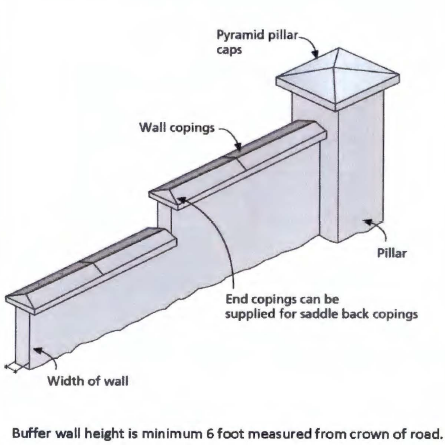
C.
Portions of buffer walls may be administratively exempted when non-residential sections, such as commercial uses, parks, wetlands, retention areas, or like uses, abut neighborhood, collector and arterial streets within a development. All exempted portions shall be permanent design features that are intended to last in perpetuity. Buffer walls that are not exempt shall extend beyond the residential property an adequate distance to accomplish the required visual and noise buffer(s).
(Ord. No. 21-1761, § 1(Exh. A), 10-21-2021; Ord. No. 23-2041, § 1(Exh. A), 5-18-2023; Ord. No. 23-2053, § 1(Exh. A), 12-7-2023)
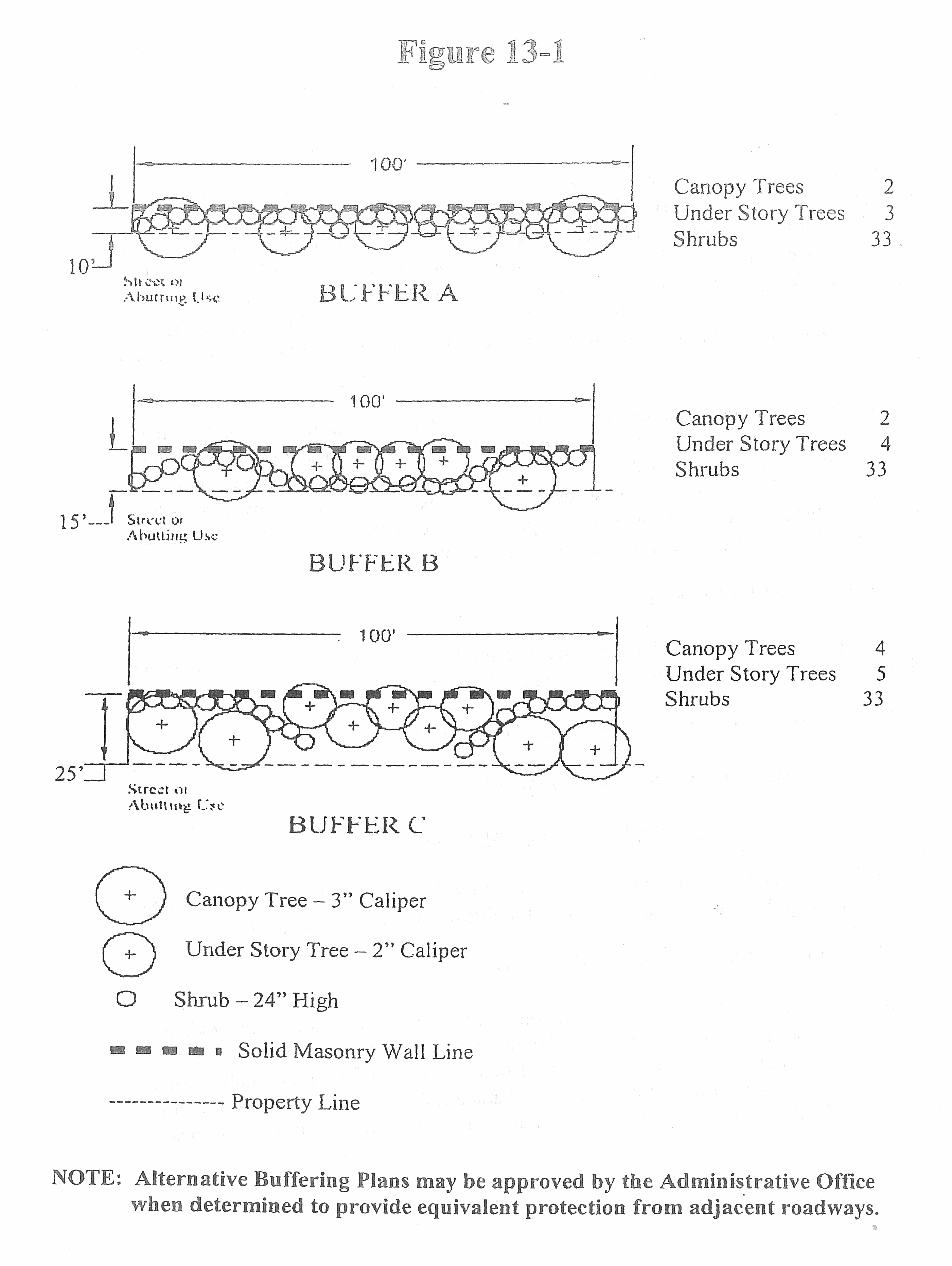
Sec. 13.3.9. - Architectural design standards.
A.
Residential design standards. The intent of these design standards is to ensure that future residential development will positively contribute to the built environment and aesthetic appeal of the City of Haines City and promote high-quality architectural design in an effort to increase Haines City's standing in the region as a livable, sustainable, and well-designed community.
1.
The applicability of these residential design standards as set forth in this section shall apply to the proposed building design details, including architectural style, building materials and colors. Further, these standards shall apply to residential development such as, but not limited to, single-family detached, duplexes, single-family attached including townhomes, unless otherwise excluded in this section, and shall apply when an application is made for a final subdivision plan, planned unit development plan, or site development plan that includes residential development. These standards shall also apply to existing residential development if a residential structure's gross floor area is increased by 50 percent or more.
2.
Separation of product. In order to encourage architectural building variety, with similar residential units, said units shall be separated by a minimum of 120 feet or four (4) units, whichever is greater.
3.
Variety of product. Architectural elevations and facades shall vary so that the type (model), paint color and elevation (all three) shall not match adjacent homes nor the building site located directly or diagonally across the street.
4.
Massing and composition. Buildings shall have elements that clearly delineate a base, middle, and top through the use of color, materials, banding, and enhanced roofline elements. Twenty percent of the front facade must contain brick, stone, or other acceptable material. All walls facing the street or the public realm shall have a level of treatment similar to the front facade. Blank walls shall be reduced by the inclusion of windows, vertical elements with a plane change from the wall surface, shadow-casting elements, material changes, or other methods. Vertical material transitions shall occur at inside corners or wrap at least 18 inches around an outside corner.
5.
Garages. Where the garage door (measurement shall be from each end of the garage door itself) comprises more than 50 percent of the front facade, remedies must be taken to reduce the visual impact of the garage mass. This shall include recessing the garage, overhangs, or separate door entries. Garages that are side-loaded or rear-loaded are exempt from this provision.
6.
Adequate storage. Where a garage is not provided, a minimum of 40 square feet of enclosed storage area shall be constructed so that residents will have space to store bulky personal effects (i.e., recreational equipment).
7.
Windows/doors. Windows and doors shall be accentuated through measures such as: adding trim/sills and lintels or other similar treatment; providing shutters or awnings; framing through the use of facade materials; use of bay window; and/or recessing the window. Decorative shutters shall be scaled and affixed to have the appearance of functioning shutters.
8.
Roofline elements. If using roofline elements to meet the requirements for massing and composition, enhanced roofline elements include but are not limited to: molded or decorative fascia, frieze boards, and gable details and treatments.
9.
Air conditioning equipment/mechanical equipment. Air conditioner pads and condensing units will be staggered a minimum often (10) feet from air conditioner condensing units on adjacent properties to provide for drainage and accessibility.
10.
Compliance. Compliance with these standards is the responsibility of the developer, owner, or applicant. At the time of the building permit, applicant will provide proof of compliance.
11.
Exemption. These residential design standards do not apply when the city commission has established specific design standards for a unique overlay district, like the downtown historic district or any other overlay, unless the specific design standards otherwise expressly state their applicability. In addition, the city commission may require design standards that exceed the requirements in this section for a planned unit development, when the city commission determines that these enhanced design standards would be in the best interest of the health, safety, and welfare of the public.
12.
Deviation. Deviations from the provisions outlined in this section may be appealed to the city commission, provided that the deviation will not be contrary to the public interest and meets the general intent and purpose of this section, or where the following exist:
a.
Conditions exist that were not created by the applicant, either by intention, or failure to act, and are such that a literal enforcement of the regulations involved would result in unnecessary or unique hardship; or
b.
Literal conformity with the regulations would inhibit innovative or creative design.
13.
If any of the residential design standards set forth in this section conflict with any other provision of the City of Haines City Code of Ordinances or Land Development Regulations, the provision that establishes the more specified design standards shall govern. If neither conflicting provision establishes a specific design standard, then the more restrictive provision governs unless otherwise expressly provided.
14.
These standards shall be incorporated into the Homeowners' Association documents/Declaration of Covenants prior to the final plat approval or the sale of building lots.
(Ord. No. 23-2053, § 1(Exh. A), 12-7-2023)
Sec. 13.4.1. - Monuments.
Monuments shall be placed in all block corners, angle points, points of curves in the street rights-of-way, and intermediate points, but not to exceed 1,400 feet apart. At least one permanent bench mark shall be set in each subdivision, properly referenced, for both construction use and future city use. The location of all monuments shall be indicated on the final plat. On public lands, a cross mark cut in a concrete structure will suffice. On other lands the monuments shall be four by four inches concrete, at least 24 inches long, said monuments having the reference point marked thereon. The nave of the surveyor shall be placed on all monuments.
All original land corner monuments shall be protected throughout the development. Should any monuments, iron pipes, or iron pins serving as monuments fall within pavements, driveways, or sidewalks, they shall be secured to proposed grades by eight-inch concrete pipes and cast iron cap for access to the original monument. Any and all land monuments disturbed or destroyed in the process of construction shall be accurately witnessed and replaced upon completion of construction.
Sec. 13.4.2. - Street markers.
The developer will furnish and install street markers at all intersections. Such street markers will be of the quality and design approved by the city.
Sec. 13.4.3. - Utility and street improvements.
See Administration and Procedures Manual.
Sec. 13.5.1. - Pre-application plans and data.
A.
General subdivision information shall describe or outline the existing conditions of the site and the proposed development as necessary to supplement the drawing required below. This information shall include data on existing covenants, land characteristics, and available community facilities and utilities; and information describing the subdivision proposal such as number of residential or nonresidential lots, typical lot width and depth, land uses, playgrounds, park areas, and other public areas, proposed protective covenants and proposed utilities and street improvements.
B.
The location map shall show the relationship of the proposed subdivision to existing community facilities which serve or impact it. Included shall be development name and location, main traffic arteries, public transportation lines, shopping centers, elementary and high schools, parks and playgrounds; principal places of employment, other community features such as railroad stations, airports, hospitals and churches; title; scale; north arrow and date.
C.
The sketch plan on topographic survey shall show in simple form the proposed layout of streets, lots and other features in relation to existing conditions. The sketch shall include approximate locations of proposed stormwater management facilities and outfall points, nearest point of connection to city sanitary sewer and water facilities and approximate location of lift stations, if required. Additional data may be required if city staff decides that such information is required for a conceptual reviews. The sketch may be a free-hand sketch made directly on a copy of the topographic survey. In any event, the sketch plan shall include as a minimum the information listed in section 13.5.2.A. below.
Sec. 13.5.2. - Plats and data for conditional approval.
A.
Topographic map and data required as a basis for the preliminary plat, in section 13.5.3. below, shall include existing conditions as follows except when otherwise specified by the planning commission:
1.
Key plan: Showing location of the tract in relation to the total community.
2.
Boundary lines: Bearing and distances of present property and/or section lines.
3.
Easements: Existing location, width and purpose and rail spur dedication, if applicable.
4.
Streets on and adjacent to the tract: Name and right-of-way width and locations; type, with and elevation of surfacing; and legally established centerline elevations; walks, curbs, gutters, culverts and related information.
5.
Utilities on and adjacent to the tract: Location, size and invert elevation of sanitary, storm and combined sewers; location and size of water mains; location of gas line, fir hydrants, overhead and underground electric and telephone systems, and street lights; if water mains and sewers are not on or adjacent to the tract, the direction and distance to, and size of nearest such systems, showing extensions of lines to proposed subdivision.
6.
Proposed and existing ground elevations on the tract: Based on U.SG.S. datum level shall be shown at one foot contour levels.
7.
Other conditions on the tract: Water courses, marshes, wetlands, wooded areas, preservable trees with four inch caliper measured four feet above ground, houses, structures, and other significant features.
8.
Other conditions on adjacent land: Approximate direction and gradient of ground slope within 100 feet of the tract boundary, including any embankments or retaining walls; character and location of buildings, railroads, power lines, towers, and other nearby nonresidential land uses or incompatible influences; owners of adjacent unplatted land; for adjacent platted land refer to subdivision plat by name, recording date, and number, and show approximate percent built-up, typical lot size, and dwelling type.
9.
Subsurface conditions on the tract: Location and results of tests made to ascertain subsurface soil, rock and groundwater conditions; depth of ground water unless test pits are dry at a depth of five feet; location and results or soil percolation test if individual sewage disposal systems are proposed. If on site percolation and stormwater is proposed, a double ring infiltrometer test shall be provided at each proposed retention pond.
10.
Photographs: If required, show camera locations, directions of views and key numbers.
11.
Zoning: On and adjacent to the tract.
12.
Proposed public improvements: Highways or other major improvements planned by public authorities for future construction on or near the tract.
13.
Title and certificates: Legal description of proposed development; title under which proposed subdivision is to be recorded, with names and addresses of owners, notion stating acreage, scale, north arrow, datum bench marks, certification of registered surveyor of compliance with minimum technical standards according to Florida laws regulating practice and date of survey. Developer shall also submit a title certification as required by F.S. ch. 177.
(Ord. No. 08-1334, § 2, 9-4-2008; Ord. No. 09-1346, § 22, 8-6-2009)
Sec. 13.5.3. - Preliminary construction plans and preliminary plat.
A.
Preliminary construction plans shall be submitted and approved prior to submittal of the preliminary plat. The preliminary construction plans shall show, in preliminary form, all improvement to be installed on the tract. The plans shall be reviewed by the city staff for compliance with these regulations and with all applicable city, county and state regulations. Preliminary construction plans shall include, as a separate sheet, a topographic survey including all the information required in section B.1. above. In addition, the preliminary construction plans shall indicate:
1.
Boundary lines.
2.
Proposed easements: Location, width, and purposes.
3.
Proposed streets: Right-of-way width and location; type and width of construction; sidewalks; curbs; and related information. A cross-section of the proposed right-of-way indicating the roadway construction and the location of utilities in relationship to the roadway and rights-of-way shall be supplied.
4.
Proposed utilities: Location of proposed water, sanitary sewer and force main lines; location and approximate size of lift station; required off-site lines for connection to existing utilities.
5.
Proposed stormwater management facilities: Drainage map at a scale of no less than 1:50 [unless previously approved by city (consulting) engineer] indicating watershed boundaries, including off-site contributing areas; approximate area and volume of each stormwater management facility total area draining to each facility; approximate percentage impervious in each basin; SCS mapping of the site with soils survey classification; and infiltration rate determined by double-ring infiltrometer testing for those projects having no positive outfall. On construction plans, indicate approximate locations of stormwater management facilities; drainage paths to outfall point, if any; any required off-site improvements and approximate locations of stormwater conveyance facilities. Identify the legal entity which will be responsible for maintaining the stormwater management facilities.
B.
Preliminary plat (general subdivision plan0. Shall be at a scale of no less than 1:50. It shall show all existing conditions required above in 13.5.2.A., topographic data and shall show all proposals including the following:
1.
Streets: Names; right-of-way and roadway widths; approximate grades and gradients; similar data for alleys, if any.
2.
Other rights-of-way or easements: Locations, width and purpose and rail spur dedication, if applicable.
3.
Location of utilities: If not shown on other exhibits.
4.
Lot lines, lot numbers, and block numbers.
5.
Sites: Sites, if any to be reserved or dedicated for parks, playgrounds, or other public uses.
6.
Sites: Sites, if any, for multifamily dwellings, commercial areas, shopping centers, industry, or other nonpublic land uses, exclusive of single family dwellings.
7.
Minimum building setback lines.
8.
Site data: Include number of residential and nonresidential lots, typical lot size, and acres in parks.
9.
Title, scale, north arrow, and date.
C.
When required by the city (consulting) engineer, the preliminary plat shall be accompanied by profiles showing existing ground surface and proposed street grades, including extensions for a reasonable distance beyond the limits of the proposed subdivision; typical cross sections of the proposed grading, roadway, and sidewalk; pedestrian and service easement and preliminary plan for proposed sanitary and stormwater sewers, with grades and sizes indicated. All elevations shall be based on a U.S.G.S. datum plane.
D.
The developer shall provide traffic impact and environmental reports regarding the land to be subdivided and the development impact on adjoining properties with regard to natural resources and features.
E.
Protective covenants, in draft form, whereby the developer proposes to regulate structural and other improvements in the subdivision to protect the proposed development, shall be provided the city for city staff review.
(Ord. No. 09-1346, § 23, 8-6-2009; Ord. No. 23-2053, § 1(Exh. A), 12-7-2023)
Sec. 13.5.4. - Final construction plans and specifications.
A.
Final construction plans and specifications shall be submitted and approved before submittal of the final plat. These plans shall indicate in final form all proposed construction on the project site and all required off-site improvements. The final plan sheets shall be drawn at a scale no less than 1:50, on more than one sheet when necessary and shall consist of the below material data.
1.
A topographic map: A topographic map conforming to 13.5.2.A. above.
2.
Plan sheets: Plan sheets indication all proposed boundaries, phase lines, rights-of-way, easements, including purpose and size; lot sizes and location and proposed streets.
3.
Proposed streets: Plan and profile sheets for all proposed roads, showing right-of-way width and location; proposed elevations; return curve profiles; connections to existing streets; type and width of construction; sidewalks, curbs; a cross-section of the proposed right-of-way indicating the roadway construction and the location of utilities in relationship to the roadway and rights-of-way.
4.
Proposed stormwater management facilities: Drainage map indicating watershed boundaries, including off-site contributing areas; area and volume of each stormwater management facilities, including stage-storage-discharge information; total area draining to each facility; approximate percentage impervious in each basin; SCS soils mapping with soils survey classification; depth to water table, and infiltration rate determined by double-ring infiltrometer testing for those projects having no positive outfall. On construction plans, indicate locations of stormwater management facilities; drainage paths; and locations of stormwater conveyance facilities; provide legal documents establishing entity to maintain stormwater management facilities and remedies for nonperformance.
5.
Proposed ground elevations on tract: Proposed ground elevations on tract, based on U.S.G.S. datum, shown at one foot contour intervals.
6.
Title and certificates: Title and certificates as described in 13.5.2.A. above.
7.
Technical specification: A complete set of all technical specifications applicable to the work to be performed including a list of estimated quantities of construction item.
Sec. 13.5.5. - Plats and data for final approval.
A.
Final plats shall be drawn or platted in ink, on tracing materials, on sheets (mylars) as required for filing for record in the county, and in accordance with design standards and provisions of F.S. ch. 177, (platting). Where necessary, the plat may be on several sheets accompanied by an index sheet showing the entire subdivision. For large subdivisions the final plat may be submitted for approval progressively in contiguous sections satisfactory to the city commission. The final plat shall show the following:
1.
Primary control points: Primary control points, approved by the city (consulting) engineer or descriptions and "ties" to such control points, to which all dimensions, angles, bearing and similar data on the plat shall be referred.
2.
Tract boundary lines: Tract boundary lines, right-of-way lines of streets, easements and other rights-of-way, and property lines of residential and nonresidential lots and other sites; with accurate dimensions, bearings or reflection angles, bearings and similar data on the plat shall be referred.
3.
Name and right-of-way width: Name and right-of-way width of each street or right-of-way.
4.
Location, dimensions and purpose of any easement(s).
5.
Number to identify each lot or site.
6.
Purpose for which sites are dedicated or reserved.
7.
Minimum building setback line on all lots and other sites.
8.
Location and description of monuments.
9.
Names of recorded owners: Names of recorded owners of adjoining unplatted land.
10.
Reference to recorded subdivision plats: Reference to recorded subdivision plats of adjoining platted land by record name, date and number.
11.
Certification by surveyor or engineer: Certification by surveyor or engineer certifying to accuracy of survey and plat.
12.
Certification of title: Certification of title showing that the applicant is the land owner.
13.
Statement by owner dedicating infrastructure and improvements and defining the responsible party for maintenance and shall be stated as follows:
The undersigned, as Owner of the land described in the legal description hereon, hereby dedicates this plat of Subdivision Name for record, does hereby state and declare the following:
l.
Owner hereby dedicates to ___ all roads and rights-of-ways shown hereon for the perpetual use of the public and to hereinafter be maintained by the ___.
2.
Owner hereby dedicates to ___ all potable and reuse water lines located within any rights-of-ways and/or easements shown hereon for the perpetual use of the public and hereinafter to be maintained by ___.
3.
Owner hereby dedicates to ___ all sanitary sewer and force main lines located within any rights-of-ways and/or easements shown hereon for the perpetual use of the public and hereinafter to be maintained by ___.
4.
Owner hereby dedicates to ___ the lift station(s) located on Tract(s) ___ within for the perpetual use of the public and hereinafter to be maintained by ___.
5.
Owner hereby dedicates to ___ the sidewalks and multi-use pathways located within any rights-of-ways shown hereon for the perpetual use of the public and hereinafter maintained by ___.
6.
Owner hereby dedicates all utility easements shown hereon to the providers of Public Utilities forever for the purpose of installation, operation, repairs, and maintenance of public utilities.
7.
Owner hereby dedicates to ___ all drainage easements shown hereon for the purposes of maintaining, replacing and accessing the stormwater retention facilities for the purpose of controlling drainage and hereinafter said stormwater retention facilities will be maintained by ___.
8.
Owner hereby dedicates to be owned and maintained by the ___ Home Owner's Association the following tracts: ___ and these said tracts shall be the perpetual maintenance obligation of the ___.
14.
Title, scale, north arrow, and date.
15.
Certification of approval by city commission: Certification shall be signed by the city manager or their designee.
B.
Cross sections and profiles of streets showing grades approved by the city (consulting) engineer. The profiles shall be drawn to city standards scales and elevations shall be based on a U.S.G.S. datum plane.
C.
A certificate by the city (consulting) engineer certifying that the developer has complied with the following:
1.
All improvements (See Chapter 4 Definitions) have been installed in accord with the requirements of these regulations and with the action of the city commission giving conditional approval of the preliminary plat; or
2.
In the event that all improvements (See Chapter 4 Definitions) have not been installed, a surety bond executed by a corporation authorized to do business in the State that is satisfactory to the city, or a certified check has been posted, which is available to the city, in an amount of 120 percent of the estimated completed construction cost as determined by the city (consulting) engineer. This estimate shall be based upon recent construction costs to assure such completion of all required improvements. A construction beginning and completion time period shall be required by the city commission and expressed in bond agreement to secure to the public the actual construction and installation of improvements as required by these regulations.
3.
A surety bond executed by a corporation authorized to do business in the state that is satisfactory to the city, or a certified check for ten percent of the total costs of the improvements to be held by the city for a period of at least 24 months.
However, a surety bond, or certified check shall not be required should a Community Development District (COD) be approved and active for the subdivision and maintaining all public improvements. Any improvement(s) to be maintained by the city, pursuant to the Plat. shall require a surety bond, or a certified check.
4.
A surety bond executed by a corporation authorized to do business in the state that is satisfactory to the city, or certified check for 120 percent of the total costs of the landscaping for the project's common areas for a period of at least 24 months.
However, a surety bond, or certified check shall not be required should a Community Development District (CDD) be approved and active for the subdivision and maintaining all public improvements. Any landscaping to be maintained by the city pursuant to the Plat, shall require a surety bond, or a certified check.
D.
Developers agreements. The developer shall have entered into an agreement, in form for recording, with the city specifying the following:
1.
The work to be done; and the time specified therefore, by the developer.
2.
The alternatives, if any, accepted by the city commission, but meeting city standards.
3.
The participation in the development, if any, by the city and the time for completion of such work.
4.
The lien, if any, imposed upon the land being developed for any work performed by the city.
5.
The conditions under which building permits will be allowed within the subdivision by the city.
6.
The conveyance by the developer to the city of all water, sewer, and storm sewer lines installed within the dedicated public rights-of-way and/or easements.
7.
The agreement of the developer to maintain and repair all public streets constructed by the developer in the subdivision for a prior of one year after completion of the same, and prior to acceptance of maintenance thereof by the city.
E.
Protective covenants in form for recording.
F.
Other data: Such other certificates, affidavits, endorsements, or deductions as may be required by the city commission in the enforcement of the regulations including the following:
1.
Maintenance agreement: The developer shall have provided the city evidence of establishment of a property owners' association or other legal entity acceptable to the city commission and an agreement, in form for recording, between said association (or entity) and the city specifying the following:
a.
The legal establishment of the property owners association or other entity.
b.
The responsibility and ability of the owners association or other entity to raise monies necessary for agreed upon common maintenance and operations, including but not limited to the maintenance and enforcement of all common area landscaping.
c.
The agreement of the association or other entity to maintain in working order all utilities, fire hydrants and roadways not dedicated to the city.
d.
The agreement of the association or other entity to maintain stormwater retention/detention facilities, if any.
2.
Said agreement between the city and the property owners association or other entity shall be recorded upon approval of final plat and proof thereof provided to the city.
(Ord. No. 08-1334, § 2, 9-4-2008; Ord. No. 18-1594, § 7, 3-1-2018; Ord. No. 21-1732, § 1(Exh. A), 6-17-2021; Ord. No. 22-2024, § 1, 10-4-2022; Ord. No. 23-2041, § 1(Exh. A), 5-18-2023)
Sec. 13.6.1. - Requirements.
No building shall be erected on a lot or parcel of land within the city, nor shall any building permit be issued thereto unless the street giving access to the lot or parcel on which such building is proposed to be placed has been accepted and opened as a public street or has otherwise received the legal status of a public street or such street has been accepted by the city and is shown on a recorded subdivision plat or is a private street dedicated for the use of certain lots or parcels but not accepted for maintenance by the city or available for use by the public.
Sec. 13.7.1. - General.
The owner of any land subdivided into lots may file for record a plat for the purpose of showing such land as acreage. Such a plat and the procedure in connection therewith shall conform to the requirements of these regulations and F.S. ch. 177 except that:
Sec. 13.7.2. - Owner application.
A.
No survey or certificate of any surveyor or engineer shall be required; provided, however, that the city commission may require a survey of the exterior boundaries of the land and the placing of suitable monuments along such boundaries if the city staff finds that the lasting preceding survey of record is faulty or inadequate or that insufficient monuments are in position along such boundaries and recommends such action be taken.
B.
No owner of any parcel of land in a subdivision shall be deprived, by the revision to acreage of all or any part of the subdivision, of reasonable access, as provided hereafter in this chapter and the applicable provisions of the Land Development Regulations.
Sec. 13.7.3. - City initiation.
The city commission may, on its own motion, order the vacation and revision to acreage all or any part of a subdivision within its jurisdiction. This action may include the vacation of streets or other parcels of land dedicated for public purposes or any of such streets or other parcels if the plat of such subdivision was recorded as provided by law not less than five years before the date of such action. Such steps may only be taken when the subdivision or part thereof has not had more than ten percent if the total subdivision area sold as lots by the original subdivide or their successor in title. Such action shall be based on findings by the city staff that the proposed vacation and revision to acreage on a findings by the city staff that the proposed vacation and revision to acreage of subdivided land conforms to the comprehensive plan and that the public health, safety, economy, comfort, order, convenience and welfare will be promoted thereby. Before action on a proposal for vacation and revision of subdivided land to acreage, the city commission shall hold a public hearing thereon, with due public notice with all affected parties so notified in writing of the contemplated action.
Sec. 13.7.4. - Effect on zoning.
A.
If land in a subdivision or part thereof is proposed for revision to acreage, either at the initiation by the city or by filing a plat by the owner, the city shall, upon recommendation of the city staff and concurrently with the proceedings for amendment of the zoning map as may be deemed advisable in view of the conditions that will exist subsequent to such revision to acreage.
B.
No owner of any parcel of land in a subdivision shall be deprived, by the revision to acreage of all or any part of the subdivision, of reasonable access to such parcel nor of reasonable access there from to existing facilities to which such parcel has theretofore had access; provided that such access remaining or provided after such vacation need not to be the same as that theretofore existing, but shall be reasonably equivalent thereto.
Sec. 13.8.1. - Hardship.
Where the city commission finds that extraordinary hardships may result from strict compliance with the requirements of this chapter, or where topographic or other conditions peculiar to the site exist, it may very the requirements of this chapter so that substantial justice may be done and the public interest secured; provided that such variation will not have the effect of nullifying the intent and purpose of the comprehensive plan or the Land Development Regulations.
Sec. 13.8.2. - Large scale development.
The standards and requirements of these regulations may be modified by the city commission in the case of plan and program for large scale community, a neighborhood unit or a planned development, which in the judgment of the city staff provide adequate public spaces and improvements for the circulation, recreation, light, air, and service needs of the tract when fully developed and populated, and which also provides such covenants or other legal provisions as will assure compliance with the achievement of the comprehensive plan.
Sec. 13.8.3. - Conditions.
In granting variances and modifications, the city commission may require such conditions as will, in its judgment, secure substantially the objectives of the standards or requirements so varied or modified.
Variances are not to be granted for minimum lot width or lot area requirements nor on the basis of economic hardship. Establishment or expansion of a use otherwise prohibited or not permitted shall not be allowed by variance, nor shall a variance be granted because of the presence of existing non-conformities in the zoning district or adjoining zoning districts.
(Ord. No. 10-1388, § 2, 12-18-2010)
Sec. 13.9.1. - Purpose.
The city commission shall, upon recommendation by the city staff, establish a schedule of fees and charges for the cost incurred in plan reviews, legal advertising, consultant review time and expenses, and other services and activities necessary to the administration of this chapter. The fee schedule for subdivisions shall be, at a minimum, on the basis of a minimum fee plus a per lot fee. Other cost incurred shall be established according to the cost of advertising and municipal expenses incurred in the review process. See chapter 10 of the APM for such fee schedule.
If the developer selects to challenge or deviate from the minimum requirements of this chapter, the cost incurred by the city as a result of additional plan review, meeting, inspection and related activities shall be reimbursed by the developer. The reimbursements shall take place prior to any building permits being issued or in the event of bonding, prior to final inspection and subdivision approvals. If the developer does not reimburse the city within 60 days of billing, the city shall file liens as provided by law.
Sec. 13.10.1. - Planning commission; city commission.
A.
Approval of subdivision plan and plats by the planning commission shall not constitute or affect an acceptance of the dedication of any street or any other ground shown upon the plat. The authority to accept dedications of land for whatsoever purpose shall be exercised exclusively by the city commission to which the dedication is deemed to be made, and such authority shall not be delegated.
B.
The city commission, acting as the administrative body, shall have the power of final determination on all matters relating to administration of this chapter.
C.
The city commission shall not take administrative action, with respect to this chapter, unless and until the planning commission has acted thereon. If the planning commission is unable to act, or fails to act, as required herein, the city commission shall then do so.
D.
In its administrative actions, with retard to this chapter, the city commission shall be bound by the standards and procedures set forth herein, in the applicable Land Development Regulations and the administration and procedures manual.
Sec. 13.11.1. - Unlawful transaction; recourse.
It shall be unlawful for anyone who is the owner or agent for the owner of any land to transfer, sell agree to sell, or negotiate to sell such land by reference to or exhibition of or by other use of a plat of subdivision of such land without having submitted a plan and plat of such subdivision for approval as required by these regulations and recorded the approved subdivision plat as required. If such unlawful use be made of a plat before it is properly approved and recorded, the owner or agent of the owner of such land shall be deemed guilty of a violation and shall be punishable as provided by law. The city commission through its legal representative may enjoin such transfer, sale or agreement. Failure to comply with the provisions of this chapter shall not impair the title of land so transferred or affect the validity of the title conveyed. However, a purchaser of land sold in violation of this chapter shall, within one year from the date of purchase thereof, be entitled to bring an appropriate action to void such sale or bring action against the seller for any damages which he suffers as a result of the seller's unlawful act or both.
Sec. 13.12.1. - Violations.
Violation of the provisions of this chapter or failure to comply with any of its requirements, including violations of conditions and safeguards established in connection with grants or variances, shall constitute a violation. The owner of any land or part thereof, any builder, contractor, agent or other person who commits, participates in, assist in or maintains such violation may each be found guilty of a separate offence and suffer in the penalties herein provided. Each day a violation continues shall be considered a separate offence.
Sec. 13.12.2. - Penalties.
Any person who violates this chapter or fails to comply with any of its requirements shall upon conviction thereof be fined not more than $500.00 or imprisoned for not more than 60 days, or both, and in addition shall pay all cost and expenses involved in the case.
Sec. 13.14.1. - Purpose.
As a result of the adoption of this chapter by the city commission, certain responsibilities shall be assigned to the administrative official, city staff, the planning commission and the city commission in order to properly serve the public and to administer and enforce these regulations.
Sec. 13.14.2. - Description.
These responsibilities are described as follows:
A.
Administrative official (city manager), is charged with the duty of administering the provisions of this chapter. As used herein the term shall be construed to include the words "or their designated representative."
B.
Building and zoning director, shall be responsible for reviewing all phases of plats for compliance with the zoning requirements, i.e. lot sizes, setbacks, street rights-of-way and related provisions, issuing building permits and processing of applications. All recommendations shall be made to the administrative official on necessary actions to be taken by the city.
C.
City commission, shall be responsible for reviewing and approving, approving with conditions or denying all sketch plats, preliminary plats, and final plats after review and recommendation by city staff and the planning commission. The city commission may amend the subdivision regulations, grant variances for hardship and shall be the only body to accept streets and/or lands for public use.
D.
City staff, shall review plats and construction drawing for compliance with design standards of this chapter, requirements of the comprehensive plan and the implementation of construction plans.
E.
City or consulting engineer, shall be responsible for reviewing all phases of plat application for conformance with the engineering requirements of this chapter, certain elements of the comprehensive plan and making recommendations to the planning commission and city commission as to the appropriateness of plats and plans submitted. All construction plans shall be reviewed by the city (consulting) engineer and recommendations as to adequateness of plans shall be made to the administrative official.
F.
Consulting planners, shall be responsible for reviewing all phases of plat applications for conformance with the comprehensive plan, and applicable Land Development Regulations. All recommendations are to be made to the administrative official, the planning commission and/or the city commission as required.
G.
Fire chief, shall be responsible for reviewing all phases of plats and construction plans and making recommendations to the administrative official with respect to fire protection, fire code enforcement and fire safety equipment inspection as required by these and other city regulations.
H.
Planning commission, shall be responsible for reviews and recommendations on preliminary plats as such developments relate to the comprehensive plan and chapter 5 of the LDR. The planning commission shall not become involved in construction plan reviews.
I.
Public utilities director, shall be responsible for reviewing all phases of plats and construction plans and making recommendations to the administrative official with respect to water and sewer facilities as required by the applicable comprehensive plan elements and the Land Development Regulations.
J.
Public works director, shall be responsible for reviewing all phases of plats and construction plans and making recommendations to the administrative official with respect to streets, sidewalks, storm sewers and easements as required by the applicable comprehensive plan elements and the Land Development Regulations.

