
Hendersonville City Zoning Code
ARTICLE XV
BUFFERING, SCREENING AND LANDSCAPING
Sec. 15-1.- Purpose and intent.
The City of Hendersonville has an abundant and diverse tree and vegetative cover that contributes to the aesthetic value of the city and provides numerous ecological and economic benefits. The landscaping, buffering and screening standards set forth below require landscaping in certain circumstances and locations in order to:
a)
Encourage the preservation of existing trees and vegetation and replenish removed vegetation;
b)
Improve the visual quality of the City of Hendersonville and minimize potential negative impacts of development such as noise, dust, glare of lights, parking lots, traffic, heat, overcrowding, and odor;
c)
Provide environmental benefits such as climate modification, decreased energy consumption, reduced stormwater runoff, decreased erosion, improved water and air quality, and protection of wildlife habitat;
d)
Provide a transition between dissimilar land uses to protect abutting properties from potential negative impacts of neighboring development and preserve the character and value of a property and provide a sense of privacy;
e)
Improve standards for quantity, location, size, spacing, protection, and maintenance of plants and other screening materials to assure a high level of quality in the appearance of Hendersonville while allowing flexibility to promote well designed and creative landscape plantings;
f)
Require the maintenance of landscaping installed to meet the requirements of these standards to ensure that the landscaping continues to thrive and enhance the visual quality of the City of Hendersonville.
Sec. 15-2. - Landscaping, buffering and screening required.
Landscaping, buffering and screening shall be required for developments within the planning jurisdiction of the City of Hendersonville, including its extraterritorial jurisdiction, as set forth herein.
a)
Unless exempted pursuant to section 15-4(c)(10) below, the following developments must bring the entire site into full compliance with the requirements of this article:
1)
Any new public or private development, with the exception of single or two-family homes on lots that were created by a method excluded from subdivision authority pursuant to G.S. 160D-802(1)—(5);
2)
A change of use to a higher impact. For purposes of this section, the following list ranks differing uses from lowest to highest impact: residential, mobile home park, institutional and cultural, commercial, industrial;
3)
Renovations with a total cost exceeding 50 percent of the assessed value of the building according to Henderson County tax records or an appraisal by a state licensed appraiser;
4)
Expansions exceeding 50 percent of the pre-expansion floor area or paved surface;
5)
Existing unpaved parking lots which are paved over.
b)
Expansions or additions that are less than 50 percent of the pre-expansion floor area and/or pavement surface must meet the landscaping requirements only in the area around the addition which is parallel to any edge of the expansion area and extending to the property line or street pavement edge.
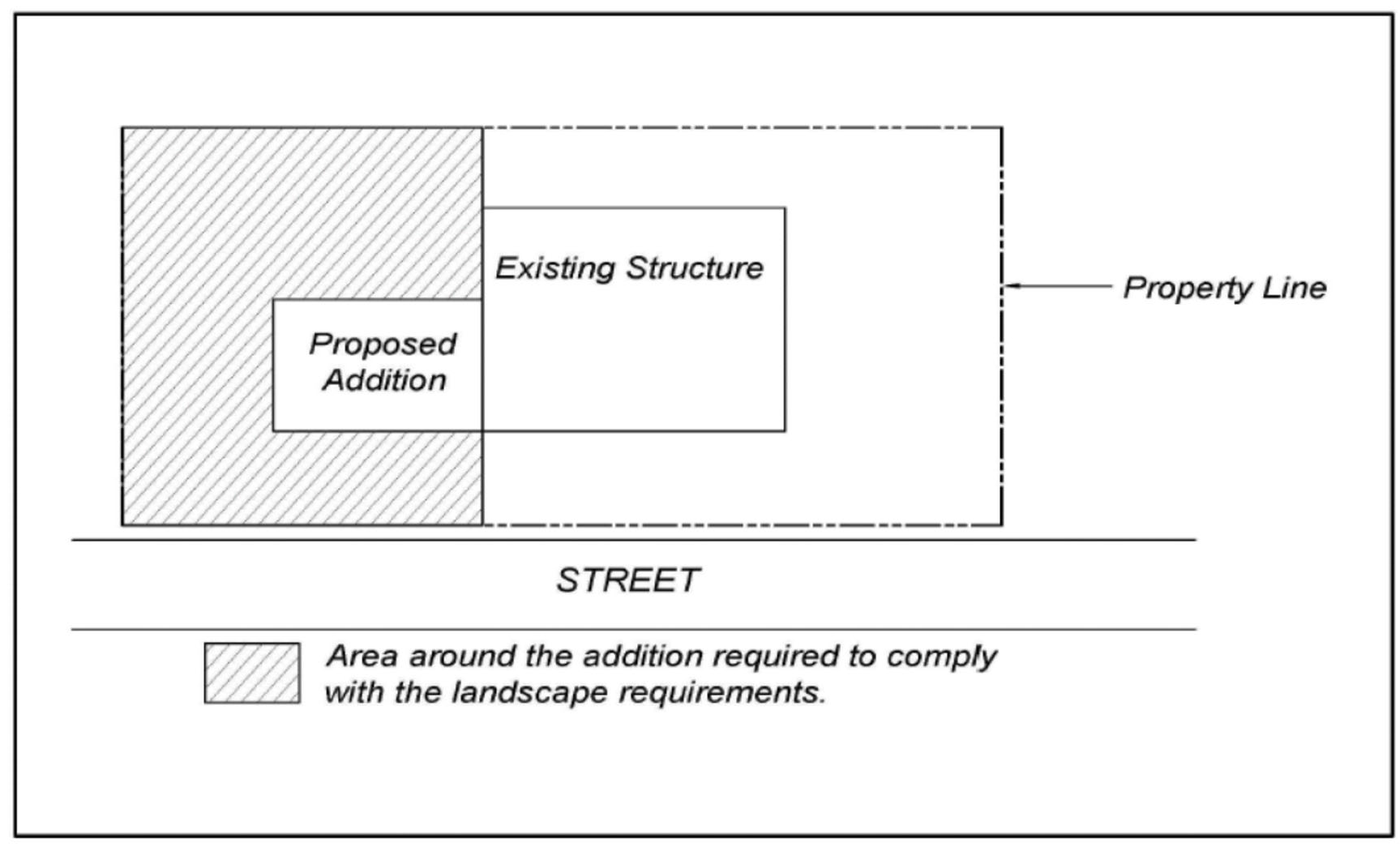
(Ord. No. O-24-08, § 3, 4-4-24)
Sec. 15-3. - Alternative compliance.
The landscape requirements are intended to set minimum standards for quality development and environmental protection and are not intended to be arbitrary or inhibit creative solutions. Site conditions or other reasons may justify the need to request an alternate method of compliance with the landscape requirements. The reviewing authority, as specified in article VII, above, may alter the requirements of this section as long as existing or added landscape features of the development site comply with the intent of this article. Requests for alternative compliance shall be accepted if one or more of the following conditions are met:
a)
Topography, geologic features, drainage channels or streams, existing natural vegetation, overhead or underground utilities, or other conditions make it unreasonable or meaningless to plant a buffer or meet other landscape requirements;
b)
Space limitations, unusually shaped lots, unique relationships to other properties, and/or prevailing practices in the surrounding neighborhood (such as use of a specific type of vegetation) may justify alternative compliance when changing the use type of an existing building in an established mature neighborhood or when developing in an historic district; or
c)
An alternative compliance proposal is equal or better than normal compliance in its ability to fulfill the intent of this article and exhibits superior design quality.
Sec. 15-4. - Existing vegetation.
a)
Preservation of existing vegetation. Preserving trees can improve the aesthetic quality of the site and improve property values, provide environmental benefits, mitigate the impacts of development on the community, and help minimize opposition to a proposed development. It is recommended that groups of trees be preserved, as well as individual trees. Existing preserved trees and shrubs may be credited towards required buffer trees, street trees, and parking lot trees, in accordance with paragraph b), below.
b)
Credits and other incentives to preserve vegetation. Preserved trees may be credited at the following rate:
2—12 inch DBH (diameter at breast height) tree = 1 tree
13—18 inch DBH tree = 2 trees
19—24 inch DBH tree = 3 trees
25+ inch DBH tree = 4 trees
In order to receive credit, preserved vegetation must be in good health and condition, and must not be listed as an invasive plant on the recommended species list. Trees designated to be preserved must be indicated on the site plan and on landscape and grading plans. Protective barriers, if utilized in accordance with paragraph d), below, must also be shown on the landscape and grading plans. A preserved tree shall be replaced with the total number of trees which were credited to the existing tree if the preserved tree dies within ten years of completion of the project.
c)
Tree canopy preservation. All developments required to comply with this article pursuant to section 15-2 herein, with the exception of development of sites with existing tree canopy of less than 30,000 square feet, shall preserve existing tree canopy in compliance with this section.
1)
Tree canopy coverage map: The tree canopy coverage map is hereby adopted. The tree canopy coverage map is based on the existing tree canopy data as established by the city's tree canopy cover assessment. The tree canopy coverage map shall be rendered digitally and maintained via GIS or similar software. The tree canopy coverage map shall be updated at least every five years to reflect the city's most recent tree canopy cover assessment.
2)
Existing tree canopy: Any reference in this chapter to existing tree canopy shall refer to the most recent tree canopy coverage map created by the City of Hendersonville.
3)
Methodology: Developers must comply with the requirements of sections 7-3-3.2(n) and 7-3-4.3(w) by one of the following methods:
a.
Using the tree canopy data shown on the tree canopy coverage map (reference definition of tree canopy in section 12-2);
b.
For any development site for which the tree canopy coverage map does not provide data, the developer shall submit a plan, showing the dripline of the existing tree canopy, and such plan shall be prepared by a land surveyor, civil engineer, landscape architect licensed by the State of North Carolina or arborist certified by the International Society of Arboriculture; or
c.
A developer may submit a plan showing the existing tree canopy as of the date of the most recent tree canopy coverage map, such plan prepared and sealed by a land surveyor, civil engineer, landscape architect licensed by the State of North Carolina or arborist certified by the International Society of Arboriculture.
4)
Preservation requirements.
a.
Tier one requirement: Twenty percent of the existing tree canopy on the site shall be preserved. The specific tree canopy preserved shall be at the discretion of the developer. Tier one canopy is not eligible for fee-in-lieu without a variance issued by the board of adjustment.
b.
Tier two requirement: In addition to the tier one requirement, existing tree canopy on the site shall be preserved, and new tree canopy shall be installed, in accordance with one of the options in the table below:
The developer may request to pay a fee-in-lieu of the tier two canopy preservation requirements pursuant to this section.
c.
In calculating the percentage preserved, only trees that are fixtures on the site shall be counted towards existing tree canopy preserved.
d.
Specimen trees preserved shall receive 1.5 times their actual canopy coverage in the calculation of preserved tree canopy if such tree is protected during construction in accordance with the standards contained in section 15-4(d) below.
e.
As an example, a five-acre development site with two-acres, or 87,120 sq. ft., of existing tree canopy would be required to preserve existing tree canopy as shown in the table below:
5)
Protection of trees during construction: All trees required to be preserved by this section shall be protected during construction in accordance with the standards contained in section 15-4(d) below.
6)
Credit for existing vegetation: All trees preserved pursuant to this section may be credited towards the requirements of this article in accordance with the provisions of section 15-4(b) above.
7)
Fee in lieu. Where specifically provided, community development director shall, in lieu of preserving trees pursuant to this section, allow the developer to pay a fee-in-lieu of tree preservation to the city's tree fund. The fee-in-lieu shall be established in the city's fee schedule.
The fee-in-lieu shall be based on the average cost of tree canopy replacement per square foot, and shall be calculated using a weighted average of large, medium, and small maturing trees as shown below:
As an example, assume the city's cost to plan and establish a tree is $350.00. Three hundred fifty dollars divided by 228.84 square feet equals $1.53 per square foot of tree canopy. Now assume the tier two requirement for tree canopy preservation is 8,712 square feet. The fee-in-lieu of tree canopy preservation would be 8,712 square feet multiplied by $1.53 for a total fee-in-lieu of $13,329.36.
8)
Delay of development approval. In addition to any other method of enforcement or remedy available, the city may refuse to issue a development approval for a period of three years following the removal of all or substantially all of the trees that are required to be protected under this article.
9)
Civil penalties. Civil penalties for violation of this subsection, including but not limited to removal of tree canopy required to be preserved and failure to protect trees during construction, shall be assessed on a per tree basis.
10)
The following development sites shall be exempt from the tree canopy preservation requirements of this section 15-4(c):
a.
The development site has less than or equal to 30,000 square feet of existing tree canopy;
b.
Less than one acre of the site will be disturbed; or
c.
The site is less than one acre in area.
d)
Protection of existing trees during construction. The regulations contained in this paragraph shall apply in those circumstances when a developer has either: (1) elected to protect trees during construction in order to receive credit under section 15-2(b), or (2) been required to preserve canopy under section 15-2(c).
1)
No grading or other land-disturbing activity can occur on a site with existing trees which are designated to be preserved in order to meet landscaping requirements until protective barriers are installed by the developer and approved by the community development director or a designee appointed by the community development director. Trees designated for preservation which are counted toward the landscape requirements must be protected by barriers, while trees designated for preservation which do not count toward the landscape requirements are encouraged to be protected by barriers. The diameter of the preserved trees and the location of protective barriers must be shown on landscape and grading plans with the dimension between the tree trunk and barrier indicated.
Barricades shall be placed around the critical root zone of preserved trees that are within 50 feet of any grading or construction activity. The critical root zone is a circle extending around the tree with a one-foot radius for every one inch of tree diameter. For example, a ten-inch diameter tree would have a barricade surrounding it, erected ten feet away from the trunk. All protective barriers must be maintained throughout the building construction process.
Protective barriers shall consist of either:
A)
A fence which is at least three feet high and constructed in a post and rail configuration, using two-by-four posts and one-by-four rails; or
B)
A fence with two-by-four posts placed no farther than ten feet apart covered with a four-foot orange polyethylene laminar safety fencing.
2)
All contractors must be made aware of the areas designated for protection. No disturbance can occur within the tree protection areas including the following:
A)
Grading;
B)
Filling, unless an aeration system, certified by a registered landscape architect, certified arborist, or North Carolina Agricultural Extension Specialist, is installed to protect the tree from suffocation;
C)
Parking;
D)
Storage of debris or materials, including topsoil;
E)
Disposal of hazardous wastes or concrete washout; and
F)
Attaching of nails, ropes, cables, signs, or fencing to any tree designated for preservation.
If any area within the critical root zone will be disturbed for any reason, a registered landscape architect, certified arborist, or North Carolina Agricultural Extension Specialist must recommend measures to minimize any potential impact and certify that the activity will not damage the tree under normal circumstances.
3)
The developer should coordinate with utility companies early in the design process to resolve potential conflicts about the placement of utilities and landscape requirements. Utilities must either be placed outside of the tree protection area or, with planning department approval, tunneled at least two feet directly below the tree roots, to minimize root damage.
4)
If silt fencing is required to control sedimentation, the fencing must be placed along the uphill edge of a tree protection zone in order to prevent sediment from accumulating in the critical root zone area.
e)
Trees in public rights-of-way. Trees located in any public right-of-way cannot be pruned or removed without a permit from the public works department in accordance with the City of Hendersonville Tree Ordinance.
(Ord. No. O-24-08, § 3, 4-4-24)
Sec. 15-5. - General standards.
The following general standards shall apply to all landscaping requirements in this article.
a)
Unless otherwise specified, the exact placement of required plants and structures shall be the decision of the developer. The type of plants used shall be limited to those on the recommended species list. No plants listed as an invasive plant in the recommended species list may be used to meet the requirements of this ordinance. Required landscaping shall be designed in such a manner as to impart its aesthetic character when viewed from any area accessible to the public or from adjacent properties.
b)
Plant material. Plant materials used for installation shall conform to the standards established by the American Association of Nurserymen in the "American Standard for Nursery Stock," for each type (i.e., canopy tree, shrub, etc.) with minimum size as appropriate for the minimum caliper size designated in paragraph a), above. Grass sod, when made a part of a buffer, must be healthy, clean and reasonably free of weeds, noxious pests or diseases.
c)
Installation. All landscaping/screening shall be installed in a sound, workmanlike manner and according to accepted good planting procedures with the quantity and quality of plant materials as described. All elements of landscaping shall be installed so as to meet all other applicable ordinances and code requirements.
d)
Maintenance. The owner, occupant, tenant and the respective agent of each, if any, shall be jointly and severally responsible for the maintenance of all buffer and landscaping. Buffers and landscaping shall be maintained in a good condition so as to present a healthy, neat and orderly appearance at least equal to the original installation and shall be kept free from refuse and debris. Dead vegetation and landscaping material shall be promptly replaced with healthy, living plantings. Evergreen hedges shall be trimmed annually or as needed to provide a full visual screen and, in any event, shall not be allowed to exceed eight feet in height without written approval of the zoning administrator.
e)
Walls and fences. Any walls used for screening or as part of a buffer shall be constructed in a durable fashion of brick, stone, or other masonry materials. When concrete block is utilized, it shall be finished with stucco on both sides. Wood posts and planks or metal or other materials specifically designed as fencing materials may be approved by the zoning administrator for use in a Type C Buffer. Other materials may also be considered through the alternative buffer and screening process described in section 15-3. No more than ten percent of the surface of a fence or wall shall be left open and the finished side of the fence or wall shall face the abutting property. A chain link fence may not be used to satisfy the requirements of this article.
f)
Overhead utilities. Landscaping plans, including plant spacing and species selection shall be such that landscaping required under this article does not conflict with overhead utilities.
g)
Species diversity. When the total number of trees required under the provisions of this article equals 20 or more, then no single tree species shall comprise more than 25 percent of the trees planted on the development site.
h)
Native species. For each development site, at least 75 percent of the trees required to be planted under the provisions of this article shall be native species as listed on the recommended species list.
(Ord. No. O-24-08, § 3, 4-4-24)
Sec. 15-6. - Bufferyards.
Certain land uses may create an adverse impact when developed adjacent to other less intensive land uses. A bufferyard is a permanent unit of land together with plantings and structure(s), if any, which is designed to ameliorate such adverse impacts. Bufferyards, as required in this section, shall be depicted on any site plans reviewed under this ordinance and shall be depicted and described on drawings submitted for the purpose of zoning compliance review. Unless deferred pursuant to a letter of compliance issued under section 15-8, below, buffers shall be emplaced and approved prior to issuance of any certificate of occupancy for the development.
a)
Location of buffers. Buffers shall be located on lot or parcel boundary lines. Buffers shall not be located on any portion of an existing public or private street or right-of-way, whether opened or unopened.
b)
Determination of buffer requirements. To determine a buffer required between two adjacent parcels or between a parcel and a street, the following procedure shall be followed:
1)
Identify the proposed land use;
2)
Identify the use or, if vacant, the zoning district classification, of land adjacent to the proposed use;
3)
Determine the buffer required on each boundary (or segment thereof) of the subject parcel by referring to the following Table of Buffer Requirements. This specifies the buffer required between proposed land uses and existing adjacent land uses or zoning districts.
TABLE OF BUFFER REQUIREMENTS
Notes for Table of Buffer Requirements:
1
Buffering is required if adjacent parcel of land is used or zoned for the category noted regardless whether adjacent parcel is located in the city, the city's extraterritorial jurisdiction (ETJ), or the planning jurisdiction of another governmental entity. Existing adjacent land use takes precedence over zoning district. Buffer requirement for the district will be used if adjacent land is vacant.
2
Includes the following use districts: R-40, R-20, R-15, R-10, R-6, RCT, PRD.
3
Includes only those sites developed as multi-family.
4
Includes the PMH district or an existing mobile/manufactured home park.
5
This category includes religious, recreational, child care and educational uses and the following use districts: MIC and PID.
6
Includes the following use districts: C-1, C-2, C-3, C-4, PCD, CMU, GHMU, HMU, UV, UR and CHMU.
7
Includes the following use districts: I-1, PMD.
c)
Buffer specifications.
1)
The following schedule sets forth the specifications of each of the buffers included in the Table of Buffer Requirements. Unless noted differently, the column entitled planting requirements refers to number of individual plants required per 100 linear feet of the buffer. The column entitled size requirements refers to the minimum size of individual plants at the time of planting. Unless otherwise noted, dimensions refer to height.
2)
For type A and B buffers, the developer may, at their option, substitute a masonry wall for the evergreen shrubs. A wooden fence may be incorporated into a buffer but shall not be allowed to substitute for evergreen shrubs.
d)
Use of buffer. If approved by the planning department, a buffer may be used for passive recreation; however, no plant material may be removed and such use shall not be a nuisance.
e)
Buffers part of required yards. Where front, side and rear yards are required by this ordinance, buffers may be established within such required yards.
f)
Buffer requirements when a street separates incompatible uses. If a street with right-of-way of less than 30 feet lies between two land uses which would require a bufferyard between them, a buffer shall be required along the affected side or rear property lines of the developing use. No bufferyard is required along the front property line.
g)
Bufferyards in the Central Business District. In order to preserve and promote existing development patterns within the Central Business District, the bufferyard requirements of article XV shall not apply within the Central Business District.
(Ord. No. O-24-08, § 3, 4-4-24)
Sec. 15-7. - Screening.
These screening requirements shall apply to any development or use other than single-family or two-family residences. A buffer as specified in this article may be used to meet the requirements of this section. Where practicable, the following uses must be screened from abutting property and from public view from a public right-of-way or a parking lot:
a)
Dumpsters or trash handling areas;
b)
Utility structures associated with a building;
c)
Loading docks or spaces;
d)
Outdoor storage of materials, stock and equipment, which shall not include the display of goods for sale; and
e)
Any other uses for which screening is required under this ordinance.
As far as practicable, any screening used to comply with the provisions of this section shall consist of a planting area which is at least five feet wide. This area may contain any type screening materials sufficient to separate visually the land uses, provided such materials meet the requirements of this article. If only a wall or fence is used, then the area devoted to the screen need only be wide enough to accommodate the wall or fence and allow for its maintenance. Where practicable, screening shall be designed and maintained in such a manner as to conceal the use from view from the street, from vehicular use areas, and from adjoining properties.
Sec. 15-8. - Letter of compliance.
It is recognized that land development occurs continuously and that vegetation used in buffers should be planted at certain times of the year to ensure the best chance of survival. In order to ensure compliance with this article and to reduce the potential expense of replacing buffering, landscaping or screening materials which were installed in an untimely or improper fashion, a letter of compliance must be filed with the zoning administrator at the time of zoning compliance review. A letter of compliance will allow the issuance of a conditional certificate of occupancy. This letter will acknowledge that the applicant for a certificate of zoning compliance is aware of any buffer, landscaping or screening requirements which may apply to their property and that the applicant will comply with those requirements by a specific date, generally to be within the next planting season, but in no case more than one year after the completion of construction of that portion of the project or building for which the certificate was issued. In no event shall a final certificate of occupancy be issued prior to emplacement and approval of the required buffer, landscaping or screening. Failure to comply with the provisions of this section within the time noted in the letter of compliance will be a violation of the zoning ordinance.
Sec. 15-9. - Landscaping for vehicular use areas.
Trees and shrubs are required in and around vehicular use areas with more than six spaces to provide attractive views from roads and adjacent properties, provide shade to reduce the heat generated by impervious surfaces, reduce glare from vehicular use areas, and to help filter exhaust from vehicles.
a)
Perimeter and interior plantings. Vehicular use areas must be planted with at least one tree and two shrubs for every 3,000 square feet of vehicular use area, which includes parking spaces, aisles, driveways, and loading areas. Trees shall be evenly distributed throughout the vehicular use area. At least 75 percent of the required parking lot trees must be broadleaf canopy trees. Trees and shrubs must be planted within 20 feet of the vehicular use area to count as parking lot landscaping; provided, however, all street trees required by other provisions of this zoning ordinance shall count as parking lot landscaping.
When a parking lot contains 20 or more parking spaces, 50 percent of the trees and shrubs required by paragraph a), above, must be planted in islands or medians located within the parking lot. Tree islands shall be evenly distributed throughout the parking lot in order to provide an even tree canopy throughout the lot. At a minimum, such tree islands shall consist of an area at least equal in size to two parking places side-by-side (360 square feet). Parking bays shall be broken up with landscaped islands or medians to avoid long monotonous rows of parking. Planting trees in groups is encouraged to increase the total amount of planting area for roots to grow.
b)
Planting strips. When a vehicular use area lot is located within 100 feet of an abutting property and no bufferyard is required, a planting strip which is a minimum of five feet wide shall be planted between the vehicular use area and the abutting property, except along approved driveway openings which run perpendicular to the planting strip. One large evergreen or deciduous tree and five evergreen or deciduous shrubs shall be planted for every 40 linear feet of property line that parallels the vehicular use area. Fifty percent of these trees and shrubs may be counted toward the parking lot trees and shrubs required in paragraph a), above, if the planting strip is located within 20 feet of the vehicular use area. Adjacent businesses on separate lots which share parking or driveways shall be exempt from this requirement provided that the required planting strip would interfere with the reasonable use of the shared parking or driveway. Vehicular use areas located behind buildings and screened from view from public rights-of-way shall be exempt from this requirement.
c)
Buffering from street. Vehicular use areas greater than 4,000 square feet any portion of which is located within 50 feet of the right-of-way of a street must be buffered from the street. The buffer shall be at least three feet high at maturity and can consist of plant material alone, or berms, fences, walls, or grade changed combined with plant material. A vegetative buffer shall consist of at least one evergreen or deciduous shrub planted for every five linear feet of buffer required. If a fence or wall is used, it must be constructed of wood, brick, stone or other masonry and be architecturally compatible with the proposed structure. Seventy-five percent of the fence or wall must be opaque with any spaces evenly distributed. The finished side of the fence or wall shall face the street. At least one shrub shall be planted on the street side for each eight linear feet of fence or wall. Berms and grade changes must be completely covered with vegetation. All shrubs planted can count toward the parking lot landscaping requirements.
d)
Structured parking facilities. Structured parking facilities, or parking decks, shall be excused from the parking lot landscaping requirements contained in this section but shall comply with the provisions of this paragraph. In the event that any openings for ventilation, service, or emergency access are located at the first floor level in the building facade, then they shall be an integral part of the overall building design. These openings as well as pedestrian and vehicular entrances shall be designed to minimize visibility of parked cars. The remainder of street level frontage shall be either commercial space or an architecturally articulated facade designed to minimize the visibility of parked cars. All levels of a structured parking facility shall be designed and screened in such a way as to minimize visibility of parked cars. In no instance will rails or cabling alone be sufficient to meet this screening requirement.
The design elements of this paragraph shall only apply to building facades which are visible from a public right-of-way.
e)
Automobile sales facilities. Automobile sales facilities, due to the fact that inventory is typically stored and displayed for sale on vehicular use areas, require separate analysis with regard to the parking lot landscaping requirements in this section. Automobile sales facilities are, accordingly, exempted from the need to comply with interior parking lot landscaping requirements for that portion of an automobile sales facility utilized exclusively for the display of goods for sale. Automobile sales facilities are required to comply with the perimeter and planting strip requirements of this section; provided, however, such facilities shall be permitted one display area, which shall not be required to be screened, for each 100 feet of roadway frontage. Each display area shall extend no more than 50 feet in length.
f)
Effect on other regulations. Areas devoted to meeting the landscaping requirements of this section may count toward the common open space requirements contained in section 6-16, above. Where site characteristics and development considerations make it prudent and feasible, landscaping proposed to meet the requirements of this section may also contribute toward meeting the buffering and screening requirements contained in this article.
g)
Small lots. Small lots, defined as lots with less than 100 feet of frontage on a roadway or with less than 100 feet of depth, may have site constraints which make strict compliance with the regulations contained in this section a hardship. In such cases, the approving authority for the city may approve deviations from such regulations so long as the plans of development are consistent with the goals and objectives stated herein.
(Ord. No. O-24-08, § 3, 4-4-24)
Sec. 15-10. - Buffer requirements when a street separates incompatible uses.
If a street with right-of-way of less than 30 feet lies between two land uses which would require a bufferyard between them, a buffer shall be required along the affected side or rear property lines of the developing use. No bufferyard is required along the front property line.
Sec. 15-11. - Bufferyards in the Central Business District.
In order to preserve and promote existing development patterns the bufferyard requirements of article XV shall not apply within the C-1 Central Business District.
Sec. 15-12. - Special provisions regarding residential dwellings in nonresidential zoning designations.
Residential uses developed after January 8, 1998 and situated in areas zoned C-2, C-3, C-4 or I-1 shall receive special treatment with regard to these buffering, screening and landscaping regulations. They shall be treated as if they were commercial uses, if located in a commercial designation, or industrial uses, if located in an industrial designation, for the purpose of determining what buffering requirements will be imposed on adjacent uses which develop subsequent to such residential uses.
Sec. 15-13. - Common open space landscaping.
In addition to all other landscaping required by this zoning ordinance, each development parcel required to provide common open space pursuant to section 6-16 shall contain a minimum of one tree and five shrubs for every 1,200 square feet of common open space on such development parcel. A minimum of 50 percent of the trees shall be canopy trees.
At least 70 percent of the street trees planted shall be large-maturing trees (>50 feet in height). The remaining trees shall be medium maturing trees (25—50 feet in height).
No landscaped area shall be constructed with more than ten percent of the total area of gravel, stone, concrete, asphalt, or other similar material, excepting necessary walks.
(Ord. No. O-24-08, § 3, 4-4-24)
Sec. 15-14. - Open space landscaping.
In addition to all other landscaping required by this zoning ordinance, each development parcel required to provide open space shall contain a minimum of one tree and five shrubs for every 4,000 square feet of common open space on such development parcel. A minimum of 50 percent of the trees shall be canopy trees.
At least 70 percent of the street trees planted shall be large-maturing trees (>50 feet in height). The remaining trees shall be medium maturing trees (25—50 feet in height).
No landscaped area shall be constructed with more than ten percent of the total area of gravel, stone, concrete, asphalt, or other similar material, excepting necessary walks.
(Ord. No. O-24-08, § 3, 4-4-24)
Sec. 15-15. - Street trees.
Street trees shall be required at the rate of one tree for every 35 linear feet of property abutting a street. Trees do not need to be spaced evenly. They may be clustered with a minimum spacing of 15 feet and a maximum spacing of 75 feet.
At least 70 percent of the street trees planted shall be large-maturing trees (>50 feet in height). The remaining street trees shall be medium maturing trees (25—50 feet in height).
Where overhead utility lines are present, streets trees shall be planted at the rate of one small-maturing tree (<25 feet in height) for every 25 linear feet of property abutting a street. Nothing herein shall be construed to prohibit a deviation from the mature height requirements or planting distance from the street right-of-way to accommodate existing overhead utility lines.
Street trees shall be placed in a planting strip on private property and not within the street right-of-way. No street tree can be planted farther than 35 feet from the edge of the right-of-way to count as a street tree. The width of the planting strip may vary, but the minimum width cannot be less than seven feet and the average width shall be at least ten feet. The planting area must be covered with living material, including ground cover and/or shrubs, except for mulched areas directly around trees and shrubs, so that no soil is exposed. When a sidewalk is proposed to be constructed on a development site and right-of-way configuration requires that it be constructed on the developer's property, the width of the planting strip may be reduced to an average of seven feet.
Street trees shall not be required on a property line abutting a street when the minimum setback provided is less than ten feet. By way of example, if the minimum setback required for a development is less than ten feet from a property line abutting a street, but the setback provided is ten feet or more, street trees are required.
During the development review process, the approving authority for the city may permit minor deviations in the placement of trees in order to avoid conflict with utility structures and utility lines.
(Ord. No. O-24-08, § 3, 4-4-24)

