
Hendersonville City Zoning Code
ARTICLE XVI
SUPPLEMENTARY STANDARDS FOR CERTAIN USES
Sec. 16-1.- Purpose.
This article provides for the regulation of certain land uses which, because of their nature or locational requirements, demand additional unique standards in order to be compatible with other permitted or conditional uses within the relevant zoning district.
Sec. 16-2. - Applicability.
These standards apply to a particular use only when it is designated as a special use, conditional zoning district or a "permitted use subject to supplementary standards" in any particular zoning classification. They do not apply when a use is a permitted use that is permitted by right. In such a situation, the general development standards contained in article VI and the applicable district standards will guide development and use. It is important to note this distinction because the same use may be a conditional use or a permitted use subject to supplementary standards in one zoning classification, in which case the standards contained in this article would apply, and a permitted use in another classification in which case they would not.
The standards contained in this article also serve as minimum requirements for developments undergoing rezoning to a conditional zoning district; provided, however, nothing herein shall be construed to limit applicants from proposing, and city council from approving, plans which exceed these standards.
Sec. 16-3. - Procedures for applying standards.
This article does not distinguish between standards on the basis of procedural review. Please refer to the appropriate zoning classification to determine if the proposed use is a conditional zoning district, a special use or a permitted use subject to supplementary standards. If it is a special use, then a special use permit must be obtained from the board of adjustment in accordance with article X, above. If the proposed use is a conditional zoning district or a permitted use subject to supplementary standards, then the standards will be applied during the applicable development review procedure in accordance with article VII, above.
Sec. 16-4. - Standards.
As stated herein, the following standards apply to the indicated use when such use is either a conditional zoning district, special use or a permitted use subject to supplementary standards. These standards are in addition to other applicable development standards contained in this ordinance.
16-4-1 - Accessory dwelling units.
a)
Accessory dwelling units may only be situated on a lot on which a principal structure is also situated and shall be clearly incidental or accessory to such principal structure.
b)
No more than one accessory dwelling unit may be situated on any lot.
c)
Accessory dwelling units may not exceed the square feet of heated floor area as outlined below:
1)
All properties with principal structures 1,200 square feet or less are permitted to have an accessory dwelling unit up to a maximum of 100% of the size of the principal structure and
2)
All properties with principal structures greater than 1,200 square feet are permitted an accessory dwelling up to a maximum of 1,200 square feet in heated floor area.
Examples. If a principal structure is 900 square feet, the maximum heated floor area of the accessory dwelling unit is 900 square feet. If a principal structure is 2,600 square feet, the maximum heated floor area of the accessory dwelling is 1,200 square feet.
16-4-2 - Adaptive reuses.
This section is intended to allow a means for the development of new uses for a building originally designed for a different use. It is intended to have application in two particular areas. The first is for the reuse of a structure which has been used historically for a use permitted in the zoning district classification but for which there is no longer any reasonable demand for such previous use. Example of this first class include church buildings and schools. The second class involves situations in which structures have been devoted historically to a nonconforming use, the owner of the property no longer desires to devote the property to that use or the use has ceased, and there is no reasonable likelihood that the property will revert to a use permitted in the zoning district classification.
Adaptive reuses may only be authorized by means of a rezoning to a conditional zoning district processed through the conditional zoning district requirements of article VII, above. In addition to the standards set forth therein, adaptive reuses must also meet the following special requirements:
a)
The developer proposes the reuse of a structure or structures used historically for a use permitted in the zoning district classification but for which there is no longer any reasonable demand for such previous use, or the developer proposes the reuse of a structure or structures used historically as nonconforming use and there is no reasonable likelihood that the property will revert to a use permitted in the zoning district classification.
b)
The developer shall state the precise nature of the proposed adaptive reuse, which shall be compatible with neighboring residential uses. If a special use permit is granted for the adaptive reuse, future use of the property shall be limited to the specified use unless 1) the use is changed to another use permitted in the zoning classification or 2) a new adaptive reuse is approved.
c)
The adaptive reuse shall be housed in an existing structure or structures.
d)
Such structures may be modified or expanded so long as the gross floor area is not increased by more than ten percent and so long as the appearance of the modification is in harmony with the neighboring residential uses.
e)
Off-street parking meeting the requirements of section 6-5, above, shall be provided. Such off-street parking shall be screened so that it is not readily visible from the street or from adjoining residential uses.
f)
The adaptive reuse may have one sign not exceeding four square feet in area.
g)
The developer shall propose, install and maintain landscaping which will assist in giving it a residential appearance.
h)
The adaptive reuse shall provide open space which shall be not less than 60 percent of the total area of the development parcel.
i)
Lighting for the adaptive reuse shall be no more than is necessary for safe use of the facility, and shall be designed and installed so that it is directed away from the roadway and any adjacent properties.
j)
Traffic generated by the adaptive reuse shall not be expected to cause an inconvenience to residents of the neighborhood.
k)
The developer shall propose hours of operation for the adaptive reuse which are designed to be compatible with neighboring residential uses. Such hours of operation shall become a condition of the special use permit, violation of which shall be grounds for revocation of the permit.
16-4-3 - Adult establishments.
a)
It shall be unlawful to develop or operate an adult establishment within the planning jurisdiction of the City of Hendersonville without a special use permit issued by the board of adjustment as provided herein.
b)
The standards for issuance of a special use permit are as follows:
1)
The owner/operator of the adult establishment must have a current, valid permit to operate an adult establishment issued pursuant to article V, chapter 5, City Code.
2)
No portion of the premises on which the adult establishment is located shall be situated within 300 feet of any of the following zoning districts: R-40 Estate Residential, R-20 Low Density Residential, R-15 Medium Density Residential, R-10 Medium Density Residential, R-6 High Density Residential, PRD Planned Residential Development, PMH Planned Manufactured Housing, MIC Medical Institutional Cultural, RCT Residential Commercial Transition.
3)
No portion of the premises on which the adult establishment is located shall be situated within 750 feet of a lot line of a primary or secondary school or a public park.
4)
No portion of the premises on which the adult establishment is located shall be situated within 1,000 feet of a lot line of another adult establishment or of any enterprise engaged in the retail sale or distribution of alcoholic beverages.
5)
There shall be no more than one adult establishment business in the same building, structure, or portion thereof. No other principal or accessory use may occupy the same building, structure, property, or portion thereof with any adult establishment business.
6)
The structure in which the adult establishment is located shall contain no sleeping quarters.
7)
The adult establishment shall not be open for business between the hours of 12:00 midnight and 12:00 noon.
8)
If dancers are employed as a feature of the adult establishment, the performing areas for such dancers shall be separated from patrons by at least ten feet.
9)
If viewing booths are provided, such are to be designed so as to allow the person of occupants to be completely visible from a portion of the premises open and available to the public.
10)
The applicant shall propose and implement a site-lighting plan adequate to ensure public safety.
11)
An adult establishment may be advertised by one sign on the premises which is not greater than 70 square feet in size and which is illuminated by not more than one 150-watt bulb. No printed material, video, photograph, written text, live show, or other visual presentation format shall be visible from outside the walls of the establishment, nor shall any live or recorded voices, music, or sounds be heard from outside the walls of the establishment.
12)
No off-site advertising (billboard) signs shall be allowed on the site of an adult establishment.
13)
No alcoholic beverage as defined by G.S. 18B-101.4 or any successor statute shall be served, possessed or consumed on the premises. No person who is under the influence of an impairing substance or alcohol or who has an alcohol concentration of 0.08 or more shall be or remain upon the premises of any adult establishment.
c)
A special use permit issued pursuant to this section shall function as an operating permit and shall have a term of one year. The operator of an adult establishment must reapply each year and be issued a new conditional use permit in order to continue in operation. Such conditional use permit shall be issued so long as the operator demonstrates compliance with the standards set forth in paragraph b), above, and so long as the establishment has not violated any of the grounds for revocation contained in paragraph e), below.
d)
Anyone desiring to operate an adult establishment shall make application for a conditional use permit, shall pay a fee therefor as established by resolution of city council, and shall demonstrate compliance with the standards contained in paragraph b), above. Such application shall include the names, including aliases, and addresses of the owners, operators, and employees of such adult establishment.
e)
Notwithstanding any of the foregoing, a conditional use permit issued to operate an adult establishment may be revoked by the board of adjustment, after notice and hearing, upon one or more of the following grounds:
1)
Failure to maintain the premises in such a way as to comply with the standards for issuance of a conditional use permit contained in paragraph b), above;
2)
Employment of any person under the age of 18;
3)
Operating an establishment disruptive of peace and good order as evidenced by three convictions, in any one year period, of criminal offenses, a material element of which occurred on the premises of the adult establishment;
4)
Ownership by or employment of a person with a criminal record that includes offenses reasonably related to the legal or illegal operation of sexually oriented businesses.
16-4-4 - Animal boarding facilities.
The standards in this section shall apply to facilities, such as animal kennels and animal shelters, where the primary purpose is the boarding of household pets. It shall not apply to boarding facilities incidental to the operation of an animal hospital or clinic or to pet stores.
a)
No animal boarding facility shall be operated without all necessary licensure, certification or other form of permission from the state and any other governmental agency with jurisdiction over its operation. Loss of such permission shall be grounds for revocation of any conditional use permit or conditional zoning district authorizing an animal boarding facility.
b)
No animal boarding facility shall be located within 500 feet of the nearest lot line of a residential use or a residential zoning district.
c)
Animal boarding facilities shall be adequately buffered to prevent sounds from constituting a nuisance to neighboring properties.
d)
Housing facilities for animals shall be structurally sound and shall be maintained in good repair, shall be designed so as to protect the animals from injury, shall contain the animals, and shall restrict the entrance of other animals.
e)
Electric power shall be supplied in conformance with the state electrical codes adequate to supply lighting and heat as may be required by this section. Water shall be supplied at sufficient pressure and quantity to clean indoor housing facilities and primary enclosures of debris and excreta.
f)
Food and bedding shall be stored at facilities adequate to provide protection against infestation or contamination by insects or rodents. Refrigeration shall be provided for the protection of perishable foods.
g)
The applicant shall establish procedures for the safe and sanitary removal and disposal of animal and food waste, bedding, dead animals and debris and shall abide by such procedures. Disposal facilities shall be maintained in a sanitary condition, free from the infestation or contamination of insects or rodents or disease, and from obnoxious or foul odors.
h)
Washroom facilities, including sinks and toilets, shall be provided for animal caretakers.
i)
Indoor housing facilities shall be adequately ventilated to provide for the health of animals contained therein and to assist in the removal of foul and obnoxious odors. Provision shall be made so that the volume of air within any enclosed indoor facility shall be changed three times or more each hour. This may be accomplished through the location and periodic opening of doors and windows. If fans or ventilating equipment are used, they shall be constructed in conformance with current standards of good engineering practice with respect to noise and minimization of drafts.
j)
Indoor housing facilities for animals shall have sufficient natural or artificial lighting to permit routine inspection and cleaning at any time of day. In addition, sufficient natural or artificial lighting shall be supplied in the area of sinks and toilets to provide for the hygiene of animal caretakers.
k)
Interior wall, ceiling and floor surfaces of indoor housing facilities shall be constructed of materials which are resistant to the absorption of moisture and odors, or such surfaces shall be treated with a sealant or with paint when such materials are not originally resistant to moisture or odors. Floor surfaces shall not be unsealed wood. In addition, interior walls shall be constructed so that the interface with floor surfaces is sealed from the flow or accumulation of moisture or debris.
l)
Indoor housing facilities shall contain a drainage system which shall be connected to a sanitary sewer or septic tank system which conforms to the standards of the state building code and shall be designed to rapidly remove water and excreta in the cleaning of such indoor housing facility under any condition or weather or temperature.
m)
Outdoor facilities shall be constructed to provide shelter from excessive sunlight, rain, snow, wind or other elements. In addition, such facilities shall be constructed to provide sufficient space for the exercise and movement of each animal contained therein.
n)
All outdoor facilities shall be constructed to provide drainage and to prevent the accumulation of water, mud, debris, excreta or other materials, and shall be designed so that all animal and food wastes are directed into an approved sanitary sewer system or septic tank.
o)
All outdoor facilities shall be constructed with adequate walls or fences to contain the animals kept therein and to prevent entrance of other animals.
p)
Primary enclosures for animals shall be constructed and maintained so as to provide sufficient space to allow each animal to turn about freely and to easily stand, sit and lie in a comfortably normal position.
q)
Facilities shall be operated in compliance with regulations adopted pursuant to the Animal Welfare Act, G.S. 19A-20 et seq., as it may be amended from time to time.
r)
No animal boarding facility shall be operated at any time after it has been designated by a public health official pursuant to city, state or federal statues or regulations concerning health, as being infested with insects, rodents or disease which may endanger the public health, until the health officer having jurisdiction shall have certified that the condition has been corrected and the premises then comply with applicable health standards and regulations.
16-4-5 - Automobile car washes.
a)
If located adjacent to a single-family or two-family residential use, setbacks along adjacent side and/or rear property lines will be increased by an additional ten feet.
b)
No attendants shall be employed on the premises.
16-4-6 - Bed and breakfast facilities.
a)
The facility shall be located in a structure originally constructed as a single-family dwelling or as an inn.
b)
The facility shall be limited in the number of guest rooms it contains. Bed and breakfast facilities in residential districts shall contain no more than six guest rooms. Bed and breakfast facilities in other zoning districts shall contain no more than eight guest rooms.
c)
The owner of the bed and breakfast or a resident manager shall live on the premises.
d)
There shall be no exterior advertising except a sign not to exceed four square feet in area in a residential district. Bed and breakfasts in other districts shall conform with the sign requirements for the district in which they are located.
e)
The facility shall meet all building and fire codes, as well as all applicable requirements, including any regulations adopted under authority of the G.S.
f)
There shall be a buffer strip meeting the specifications of article XV of the zoning ordinance along any property adjoining a residential use or district.
g)
No cooking facilities shall be allowed in the lodging units.
h)
Off-street parking meeting the requirements of section 6-5, above, shall be provided. Parking area(s) in or adjacent to residential use districts shall be screened by vegetation, fencing or walls so that vehicles are not visible from the street or from adjacent properties. The applicant shall submit a site plan which shall indicate where the parking is to be located and the manner in which it is to be screened.
16-4-7 - Bus stations.
a)
The facility shall provide one off-street loading and unloading space for each bus reasonably expected to utilize the facility at any one time.
b)
Off-street parking meeting the requirements of section 6-5, above, shall be provided.
16-4-8 - Cemeteries.
a)
Tombstones, crypts, monuments, mausoleums, and other structures associated with cemeteries must be located at least 25 feet from any side or rear lot line which adjoins lots in a residential district and at least ten feet from any side or rear lot line which adjoins lots in nonresidential districts. In any case, they must be at least 40 feet from any street right-of-way.
b)
Buildings for the maintenance, management, rent and/or sale of cemetery lots must be located at least 100 feet from any lot lines which adjoin lots in any residential district. Otherwise any such buildings must conform to the requirements for principal uses in the district where they are located.
c)
Crematory services may be provided for human corpses as an accessory use within cemeteries situated on a site containing at least 30 acres, subject to the following special requirements:
1)
All applicable local, state, and federal laws and regulations shall be complied with.
2)
The crematory shall be enclosed within a building meeting building and fire code requirements.
3)
The placement of crematory facilities within property in any residential district shall be 100 feet or more from any exterior property line.
16-4-9 - Child care centers.
a)
Play space must be provided in accordance with the regulations of the NC Department of Health and Human Services (DHSS). Any required outdoor play space must be fenced or otherwise enclosed on all sides and may not include driveways, parking areas or land otherwise unsuited for children's play space and may not be in the required setback.
b)
Setback, yard and height requirements will be the minimum required for the district in which it is located.
c)
Parking shall be provided as specified in section 6-5.
d)
No outdoor play shall be permitted after sundown.
16-4-10 - Civic clubs and fraternal organizations.
a)
All buildings, off-street parking and service areas will be separated by a buffer meeting the requirements of article XV from any abutting residential use or residential district.
b)
The use will be located on a lot that fronts a minor or major thoroughfare and primary vehicular access will be provided by means of such minor or major thoroughfare.
16-4-11 - Congregate care facilities.
a)
Such facilities may only be situated on a site which contains no less than three acres.
b)
A minimum of 65 percent of the project tract shall be designated as open space.
c)
Maximum density for congregate care facilities shall be 20 people per acre in all districts. City council shall have the right to determine a lower density applying as criteria the following: Site constraints including but not limited to slopes over 20 percent, poor soils, presence of floodplain or other factors such as the traffic-bearing capability of existing roads that would pose a threat to public health, safety or welfare, or violate any of the review standards contained in this article.
d)
Density under this subsection shall be calculated according to the following formula:
1)
Studio apartments shall be assumed to house one person.
2)
One-bedroom apartments shall be assumed to house one and one-half persons.
3)
Two-bedroom apartments shall be assumed to house two persons.
16-4-12 - Convenience stores with or without gasoline sales.
a)
If located adjacent to a single-family or two-family residential use, setbacks along adjacent side and/or rear property lines will be increased by an additional ten feet.
16-4-13 - Cultural arts buildings.
a)
The provision of off-street parking in accordance with the standard for places of public assembly contained in section 6-5.
b)
When the facility is to be located adjacent to either a residential district or existing residential uses, any boundaries adjoining such residential district or use shall contain a ten-foot B-type buffer consistent with the requirements of article XV, above.
c)
Any structures associated with the cultural arts building shall be set back from any adjoining residential use or district a minimum of 100 feet.
16-4-14 - Day center.
a)
The parcel on which a day center is situated shall not be closer than 1,500 feet to any parcel on which another day center is situated. The application of the 1,500 foot separation standard shall be determined by measuring from the two points which represent the closest two points between the two day center parcel boundaries, and shall be measured as the crow flies.
b)
A day center shall be separated from any adjacent residential use, regardless of the zoning district where located, by a 15-foot B-type buffer meeting the requirements of article XV. Additionally, the buffer shall include a fully opaque vertical masonry wall or wood fence at least six feet in height. "Fully opaque" shall mean that no more than ten percent of the surface of the fence or wall shall be left open and the finished side of the fence or wall shall face the abutting property. For purposes of this paragraph, parcels situated across a public or private street right-of-way from a proposed day center shall be deemed to be adjacent. Additionally, for the purposes of this paragraph, these buffer standards shall prevail over the standards found in section 15-6(b).
c)
A day center parcel shall be buffered from any residential district within 200 feet by a 15-foot B-type buffer meeting the requirements of article XV. Additionally, the buffer shall include a fully opaque vertical masonry wall or wood fence barrier at least six feet in height. "Fully opaque" shall mean that no more than ten percent of the surface of a fence or wall shall be left open and the finished side of the fence or wall shall face the abutting property. For the purposes of this paragraph:
1)
These buffer standards shall prevail over the standards found in section 15-6(b);
2)
The application of the 200 foot separation standard shall be determined by measuring from the two points which represent the closest two points between the proposed day center parcel boundary and any residential zoning district boundary, and shall be measured as the crow flies; and
3)
Residential zoning district means the following use districts: R-40, R-20, R-15, R-10, R-6, RCT, PRD.
d)
Permissible hours of operations shall be limited to the hours between 6:00 a.m. and 6:00 p.m.
(Ord. No. 22-36, 6-2-22)
16-4-15 - Food pantries.
a)
The parcel on which a food pantry is situated shall not be closer than 1,500 feet to any parcel on which another food pantry is situated.
b)
Storage of items for distribution shall be located entirely within the building.
16-4-16 - Golf driving ranges.
a)
Lighting, if any, shall be designed and installed so that it is directed away from the roadway and adjacent residentially-zoned or used properties and does not interfere with the safe use of public rights-of-way.
b)
Adequate assurance shall be provided, by means of separation, fencing or other means, that the operation of such facility shall not constitute a danger to person or property.
c)
Total signage on the property shall not exceed 32 square feet. One freestanding sign may be installed provided it does not exceed eight feet in height. Signs shall not be illuminated except by means of one light bulb per sign face not exceeding 150 watts.
16-4-17 - Laundries, coin-operated.
a)
If located adjacent to a single-family or two-family residential use, setbacks along adjacent side and/or rear property lines will be increased by an additional ten feet.
16-4-18 - Microbreweries, micro-distilleries, micro-cideries, and micro-wineries.
a)
Shall include one or more accessory uses such as a tasting room, tap room, restaurant, retail, demonstration area, education and training facility or other uses incidental to the brewery, distillery, hard cidery, or winery and open and accessible to the public.
b)
Storage of materials used in the manufacturing, processing and for distribution shall be located entirely within the building.
c)
Shall be designed such that all newly constructed loading and unloading facilities are internal to the site, in service alleys or at the back of the building.
d)
The sides and rear yard or setback requirement shall be increased to 25 feet for the C-2 Secondary Business, C-3 Highway Business, GHMU Greenville Highway Mixed Use and HMU Highway Mixed Use Zoning District Classifications.
e)
Shipping and receiving needs shall not exceed the equivalent of (1) FHW A Class 8 truck per week.
f)
Reuse of an existing building shall not exceed 20,000 square feet of building floor space.
g)
New construction shall not exceed 10,000 square feet of all building floor space.
16-4-19 - Mini-warehouses.
a)
One way interior travel lanes shall have a minimum width of 15 feet in addition to a ten-foot wide parking lane. All two-way interior travel lanes serving storage units shall have two 12-foot wide travel lanes and be provided with a ten-foot wide parking lane. All portions of the site shall be readily accessible by police and fire equipment and personnel.
b)
Storage units shall be designed for individual storage. They shall contain no facilities for utility service. They shall not be used for sales or service or for habitation by humans or animals.
c)
No outside storage shall be permitted when the proposed use is situated in a zoning district classification other than I-1.
16-4-20 - Mobile food vendor.
a)
Zoning compliance permits for mobile food vendor sites shall be accompanied by a conceptual site plan depicting a location on the subject property that meets all applicable requirements of this section.
1)
Exemption: A mobile food vendor associated with an event with an active City of Hendersonville Special Event Permit.
b)
There shall be no limit to the number of mobile food vendors per parcel so long as all other separation and site requirements as set forth below are met.
c)
Mobile food vendors shall:
1)
Not encroach onto any street, sidewalk, or travel way, and shall not obstruct any loading zone or handicapped parking space.
2)
Be located on property in a manner that does not eliminate required parking for a development or impede the flow of traffic in any way.
3)
Be situated at least ten feet away from buildings, structures, vehicles, and any combustible materials.
4)
Not be located within 100 feet from any residential structure or residential zoning district lot line unless their hours of operation are limited to 7:00 a.m. to 10:00 p.m.
5)
Be set back a minimum of ten feet in all directions from fire hydrants.
6)
Be situated at least ten feet from one another.
16-4-21 - Nursing homes.
a)
Such facilities may only be situated on a site which contains no less than three acres.
b)
A minimum of 65 percent of the project tract shall be designated as open space.
c)
Maximum density for nursing homes shall be 26 people per acre. In determining the number of people per acre, it is assumed that each room where ambulatory assistance or skilled nursing care is given contains one person per bed in the room. City council shall have the right to determine a lower density applying as criteria the following: site constraints including but not limited to slopes over 20 percent, poor soils, presence of floodplain, or other factors such as the traffic-bearing capability of existing roads that would pose a threat to public health, safety or welfare, or violate any of the review standards contained in this article.
d)
No application for a conditional zoning district for a nursing home facility shall be considered unless a certificate of need has been issued. The certificate of need shall accompany the application.
16-4-22 - Pet-sitting.
a)
No person other than members of the family residing on the premises shall be engaged in pet-sitting.
b)
There shall be no change in the outside appearance of the building or premises, or other visible evidence of pet-sitting other than one sign, not exceeding four square feet in area, non-illuminated.
c)
At no time are animals permitted to be outdoors unsupervised.
d)
No more than six animals total may be boarded for a fee at one time.
e)
All animals must be over the age of six months.
f)
No outdoor storage of materials or equipment or outdoor facilities, accessory structures, outdoor kennels, or similar devises are permitted in connection with pet-sitting.
g)
Animals boarded are restricted to domestic dogs and/or cats.
h)
Facilities shall be kept clean, sanitary, and free from accumulations of animal waste.
i)
Pet-sitting facilities are subject to all applicable city ordinances including, but not limited to, the noise control ordinance.
j)
Facilities shall be operated in compliance with regulation adopted pursuant to the Animal Welfare Act, G.S. 19A-20 et seq., as it may be amended from time to time.
k)
No pet-sitting facility shall be operated without all necessary licensure, certification or other form of permission from the state and any other governmental agency with jurisdiction over its operation. Loss of such permission shall be grounds for revocation of any conditional use or zoning compliance permit authorizing pet-sitting.
16-4-23 - Progressive care facilities.
a)
Such facilities may only be situated on a site which contains no less than three acres.
b)
A minimum of 65 percent of the project tract shall be designated as open space.
c)
The facility shall provide housing for retirees or the elderly.
d)
The facility shall be owned and operated as one facility and shall have two or more of the following uses, which may or may not be contained under one roof:
1)
Independent dwelling units constructed as detached or attached units;
2)
Apartments, where care and assistance in bathing, dressing, house cleaning and other activities may or may not be provided. Complete or partial kitchen facilities shall be provided, in addition to common dining facilities for residents;
3)
Rooms where ambulatory assistance is given in addition to all meals and a more intensive level of care by semi-skilled nursing staff;
4)
Rooms where skilled nursing care and life support systems are available.
e)
Maximum density for progressive care facilities shall be 23 people per acre. In determining the number of people per acre, the formula given above for nursing and rest homes and the formula given above for congregate care facilities shall be combined based on the actual plans for the facility to be constructed. City council shall have the right to determine a lower density applying as criteria the following: Site constraints including but not limited to slopes over 20 percent, poor soils, presence of floodplain, or other factors such as the traffic-bearing capability of existing roads that would pose a threat to public health, safety or welfare, or violate any of the review standards contained in this article.
16-4-24 - Public utility facilities.
a)
Lots must conform to minimum setback and yard requirements of the district in which they are located. Unstaffed utility structures with internal floor space of less than 600 square feet are exempted from the minimum lot size requirement.
b)
Electric and gas substations and sewage treatment plants will be separated by a ten-foot B type buffer meeting the specifications of article XV from the street and any abutting residential use or any property located in a residential zoning district.
c)
Control houses, pump and lift stations, and other similar uses shall be screened from the street and any abutting residential use or any property located in a residential zoning district.
d)
A fence not easily climbable or comparable safety devices must be installed and maintained in order to deter access to the facility.
e)
The design of buildings, structures and facilities on a site should conform as closely as possible to the character of the area or neighborhood.
f)
The facility's lighting shall be shielded to prevent light and glare spill-over on to any adjacent residential properties, if such exist.
g)
The board of adjustment may give relief from these requirements so long as public safety and neighborhood compatibility are protected, if strict adherence would constitute a hardship or is unnecessary.
16-4-25 - Residential care facilities.
a)
The facility shall be situated in an existing residential structure. This structure may be expanded or altered so long as the facility remains residential in scale and appearance.
b)
One off-street parking space shall be provided for each six beds in the facility. Such off-street parking shall be screened so that it is not readily visible from the street or from adjoining residential uses.
c)
The facility may have one sign not exceeding four square feet in area. Such sign shall not be illuminated.
d)
The facility shall not exceed two stories in height.
e)
The facility shall propose, install and maintain landscaping which will assist in giving it a residential appearance.
f)
The facility shall propose, develop and maintain common open space for the use of its residents, which shall amount to not less than 15 percent of the site.
g)
Lighting for the facility shall be designed and installed so that it is directed away from the roadway and any adjacent properties.
h)
Density for residential care facilities shall not exceed 26 persons per acre.
i)
No traffic shall be generated by such facility in greater volumes than would normally be expected in a residential neighborhood.
16-4-26 - Residential dwellings, multi-family.
a)
The property must be within the Seventh Avenue Depot National Register Historic District.
b)
Multi-family dwellings may only be permitted on the second floor.
c)
There shall be no maximum density other than the minimum dwelling size is 400 square feet.
d)
Multi-family dwellings must be occupied by three or more families living independently of each other.
16-4-27 - Residential dwellings, small-scale multi-family.
a)
For the purposes of these standards, small-scale multi-family shall include all developments not subject to the N.C. Residential Code for One- and Two-Family Dwellings including triplexes, quadplexes, and other small apartment buildings. Any of the architectural design standards below may be implemented voluntarily for single-family attached (townhomes) and multiple detached units on a single parcel (detached multi-family) constructed subject to N.C. Residential Code for One- and Two-Family Dwellings.
b)
Maximum height for any structure shall be 42 feet.
c)
Maximum footprint for any principal structure shall be 4,000 square feet.
d)
All street-facing sides of a corner lot are considered fronts.
e)
Building placement.
a.
Buildings shall be situated as close to the minimum front setback as practicable.
b.
Buildings shall be situated to provide off-street parking to the rear and/or side of the building(s).
c.
Buildings shall be situated to protect and accentuate important mountain vistas and views of significant historic sites.
d.
Buildings shall be situated to provide well-defined, street-facing entrance(s) with a connecting walkway with a direct, safe, pedestrian connection to the street.
i.
For buildings on corner lots, an entrance may be placed at the corner, thereby eliminating the need for side entrances.
e.
Buildings shall offset front-loading garages and carports, if provided, behind the front façade by a minimum of ten feet.
i.
Front-loading garages and carports shall be visually designed to form a secondary building volume.
ii.
The width of an attached garage shall not exceed 50 percent of the total building façade.
f.
Canopies, awnings, cornices, balconies, front-facing covered porches and stoops and similar architectural accents are permitted to extend from the building up to five feet into a required minimum setback and/or required common open space.
f)
Architectural design standards.
a.
The following standards apply to all façades (front, rear and side) of buildings:
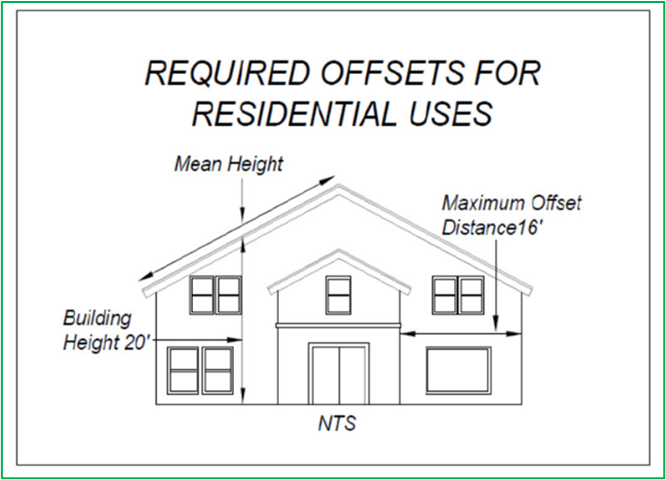
i.
No wall shall exceed 16 feet in length without an offset. A building façade which is less than 16 feet in length shall not require an offset.
ii.
Offsets shall have a minimum depth or projection of one and one-half feet.
iii.
Each façade shall use fenestration and do so in a manner which is proportional to the overall scale of the building.
iv.
All building façades shall contain at least two building materials which shall contrast in color and texture.
v.
When multiple wall materials are combined on one façade, the designer is encouraged to place the heavier material(s) below.
vi.
Building materials shall be used consistently on the exterior of the building. The following building materials are prohibited for exterior façade application:
1)
Plain concrete block (with or without paint);
2)
Reflective glass;
3)
More than 50 percent glass on any façade;
4)
Vinyl siding; and
5)
Any other materials not customarily used in conventional construction.
vii.
Exposed foundations shall consist of stone, stucco, brick or decorative block. If crawlspaces of porches are enclosed, they shall be enclosed with similar materials or lattice or any combination thereof.
viii.
Windows. Windows shall either be (1) recessed a minimum of three inches from the façade, or (2) trimmed. If trim is used, it shall be a minimum of four inches (nominal) in width and shall project beyond the façade.
b.
The following standards apply to all street-facing façades (fronts) of buildings:
i.
Detailed design shall be provided by using at least two of the following architectural features on all elevations.
i.
Dormers.
ii.
Gables.
iii.
Recessed entries.
iv.
Cupolas or towers.
v.
Pillars, columns or posts.
vi.
Corbels.
vii.
Bay windows.
viii.
Balconies.
ix.
Decorative patterns on exterior finish (e.g., scales/shingles, wainscoting, ornamentation).
x.
Parapets/Decorative cornices and roof lines (required for buildings with flat roofs).
xi.
Wood siding with two and one-half inch to four and one-half inch reveal.
c.
Pitched roofs on residential buildings shall have a pitch between 5:12 and 12:12. Eaves (with a minimum 12-inch projection) shall be provided with a pitched roof.
d.
Useable porches and/or stoops, at least eight feet in width and six feet in depth, shall be located on the front and/or side of the home. Porches and stoops may encroach into front setback up to five feet.
e.
Accessory buildings with a floor area greater than 150 square feet shall be clad in materials similar in appearance to the principal structure and with similar roof pitch.
f.
Walls and fences located in the front yard shall be no more than four feet above grade. The use of chain link fencing is prohibited in front yards. For corner lots, both street-facing sides shall be considered fronts. Rear yard and side yard fences are not subject to these standards.
g)
On-street parking. On-street parking is encouraged for all local streets and thoroughfares.
a.
On-street parking abutting the development parcel shall count toward meeting the off-street parking requirements for the district.
b.
On-street parking may take the form of parallel or angle parking and shall be built according to city or state standards as applicable in order to count towards minimum parking requirements.
h)
Off-street parking.
a.
All off-street parking lots shall be provided at the side or rear of buildings or the interior of a block of buildings and not closer to the street than the edge profile of the structures.
b.
Off-street parking shall not be adjacent to street intersections.
16-4-28 - Rest homes.
a)
Such facilities may only be situated on a site which contains no less than three acres.
b)
A minimum of 65 percent of the project tract shall be designated as open space.
c)
Maximum density for rest homes shall be 26 people per acre in all zoning district classifications. In determining the number of people per acre, it is assumed that each room where ambulatory assistance or skilled nursing care is given contains one person per bed in the room. City council shall have the right to determine a lower density applying as criteria the following: Site constraints including but not limited to slopes over 20 percent, poor soils, presence of floodplain, or other factors such as the traffic-bearing capability of existing roads that would pose a threat to public health, safety or welfare, or violate any of the review standards contained in this article.
16-4-29 - Restaurants.
a)
The use must be located on, and have primary access from, a major or minor thoroughfare.
b)
All outside storage areas including dumpsters must be:
1)
Sited to the rear of the building;
2)
In compliance with the setback requirements for the zoning district classification within which it is located; and
3)
Made unnoticeable from both residential adjacent properties and public rights-of-way through installation of screening meeting the specifications of article XV.
c)
The use shall be limited to no more than 40 seats.
d)
Permissible hours of operation shall be limited to the hours between 7:00 a.m. and 11:00 p.m.
16-4-30 - Schools, primary and secondary.
a)
The following standards shall be used to govern the establishment or development of new public and private schools:
1)
No structure or parking shall be placed within 50 feet of a property line.
2)
Off-street parking meeting the requirements of section 6-5 shall be provided.
3)
The use will be on a lot which may be accessed by means of a collector, minor thoroughfare or major thoroughfare for elementary schools and junior high schools, and by means of a minor thoroughfare or major thoroughfare for senior high schools; provided, however, the board of adjustment may waive this requirement to accommodate a public need so long as traffic shall not be increased on residential streets to an unacceptable level.
b)
The foregoing standards shall serve as guidelines for the expansion or redevelopment of existing schools; however, the board of adjustment shall waive any such guidelines when their application would constitute a hardship.
16-4-31 - Service stations.
a)
If located adjacent to a single-family or two-family residential use, setbacks along adjacent side and/or rear property lines will be increased by an additional ten feet.
16-4-32 - Shelter facilities.
a)
The parcel on which a shelter facility is situated shall not be closer than 1,500 feet to any parcel on which another shelter facility is situated.
b)
The parcel on which a shelter facility is situated shall not be within 200 feet of a residential zoning district.
16-4-33 - Small-scale manufacturing.
a)
The front of the building at street level shall remain open and visible from the sidewalk with a view of the activities inside; and
b)
A showroom, display area, or sales area shall be provided.
c)
Outdoor storage of goods and materials shall not be permitted in zoning district classifications C-1, CMU, GHMU, HMU and CHMU.
d)
Outdoor storage of goods and materials shall not exceed 25 percent of the total footprint of all buildings on the property in zoning district classifications C-2 and C-3.
e)
Newly constructed shipping and receiving facilities shall be designed such that they are internal to the site, in service alleys or at the back of the building.
f)
Shipping and receiving needs shall not exceed the equivalent of one FHWA Class 8 truck per week.
g)
Reuse of an existing building shall not exceed 20,000 square feet of building floor space.
h)
New construction shall not exceed 10,000 square feet of building floor space.
16-4-34 - Telecommunications towers and antennas.
Special application requirements, procedures, and permitting standards, as set forth herein, apply to telecommunication towers and antennas.
16-4-34.1 Application requirements. Anyone desiring to construct or install a telecommunications tower shall submit an application for a permit and shall pay a fee which shall be established by resolution of city council. The fee established for applications requiring a rezoning to a conditional zoning district shall include a reasonable amount to enable the city to employ technical assistance in determining the issue of feasibility as required by section 16-4-29.4, below. The application shall contain the following:
a)
Site development plan. A site development plan prepared by a North Carolina Registered Land Surveyor, Registered Landscape Architect or Registered Professional Engineer containing the following:
1)
The tower applicant's name and property owner's name and their addresses, scale, north arrow, vicinity map, tax parcel identification number, and the tower's latitude and longitude coordinates;
2)
The name, address, signature and seal of the professional preparing the site development plan;
3)
The surveyed boundary lines of the parcel(s) that will contain the proposed tower and its fall area;
4)
The tax parcel identification number of all property abutting the subject property and the names and addresses of the owners of such properties;
5)
All identifiable structures located on the parcel, all private and public roads, highways, and underground and overhead utilities;
6)
All existing towers on the property or any towers whose fall area encroaches onto the property;
7)
The proposed tower's location, the proposed fall area and the location of all support structures and guy line anchors;
8)
The ground elevation of the proposed tower's base, all proposed support structures, property corners, and a permanent site bench mark. All elevations shall be determined using the National Geodetic Vertical Datum of 1929.
b)
Preliminary tower design plan. A preliminary tower design plan prepared by a North Carolina Registered Professional Engineer containing the following:
1)
The tower permit applicant's name and address, scale, north arrow, vicinity map and tax parcel identification number;
2)
The name, address, signature and seal of the engineer preparing the preliminary tower design plan;
3)
A plan showing the base of the tower and the foundations for all guy line anchors and support structures, all proposed buildings, and any other proposed improvements, including access roads and utility connections within and to the proposed site;
4)
A tower elevation drawing showing the proposed lighting and all proposed antennas;
5)
The proposed tower design loads.
c)
Search area. A propagation study or similar documentation showing the search area(s) for the proposed tower's antenna(s).
d)
Proof of regulatory compliance. Written statements from the Federal Aviation Administration (FAA) and the Federal Communications Commission (FCC) showing that the proposed tower complies with all permit regulations administered by that agency or evidence that the proposed tower is exempt from those regulations.
e)
Collocation alternatives. Identification of all other possible alternatives considered within the service area for the proposed tower's antenna(s) and an explanation why the proposed tower is necessary and why existing towers and structures (e.g., Duke Power transmission tower) cannot accommodate the proposed antenna(s).
f)
Variances. Identification of any variance(s) to the ordinance, the reason(s) for seeking the variance(s) and any measures that are proposed to mitigate possible adverse effects of the proposed variance(s).
g)
Feasible alternatives. Towers to be sited in zoning districts requiring rezoning to a conditional zoning district shall demonstrate the lack of a feasible alternative as required by paragraph 16-4-29.4, below.
16-4-34.2 Standards for siting telecommunications antennas and wireless facilities. The following standards shall regulate the siting of telecommunications antennas and wireless facilities:
a)
No antenna shall interfere with usual and customary radio and television reception excepting broadcast facilities as provided for in the regulations of the Federal Communications Commission.
b)
All antennas shall comply with FCC and FAA guidelines. The antenna owner shall provide the city each year with a copy of any FCC and FAA license issued.
c)
Antennas shall be restricted to the minimum standards of lighting required by the FAA. All antennas that require flashing lights by the FAA shall utilize a dual lighting system consisting of a white strobe light for daytime lighting and a red flashing light for nighttime lighting.
d)
All antennas placed on structures other than towers, except for those owned by government entities and providing emergency services communications, shall be concealed antennas. Antennas located on top of buildings or other structures shall not exceed 30 percent of the building height. In no event shall an antenna extend beyond the structure in any direction greater than 25 feet.
e)
No antennas, except for those owned by governmental entities and providing emergency services communications, shall be constructed on the property on which a National Register or locally designated historic landmark is located.
f)
No antennas shall be located on structures containing residential dwelling units. Antennas may be located in residential zoning districts by placing them on existing water tanks, towers, and similar structures.
g)
No antenna shall exceed 25 feet in length.
h)
Antennas erected solely for a residential, non-commercial individual use, such as residential television antennas, satellite dishes, or ham radio antennas are exempt from these requirements.
i)
Applications for collocation of antennas and/or wireless facilities are entitled to streamlined processing if the addition of the additional antenna and/or wireless facility does not exceed the number of antenna and/or wireless facilities previously approved for the telecommunication tower on which the collocation is proposed and meets all the requirements and conditions of the original approval. This provision applies to telecommunication towers which are approved on or after December 1, 2007 and shall meet the following:
1)
Applications shall be reviewed for conformance with applicable site plan and building permit requirements but shall not otherwise be subject to zoning requirements, including design or placement requirements, or public hearing review.
2)
A collocation application entitled to streamlined processing shall be deemed complete unless the city provides notice in writing to the applicant within 45 days of submission or within some other mutually agreed upon timeframe. The notice shall identify the deficiencies in the application which, if cured, would make the application complete.
3)
The city shall issue a written decision approving or denying a collocation application entitled to streamlined processing within 45 days.
j)
The streamlined process set forth in subsection (i) of this section shall apply to all collocations, in addition to collocations qualified for streamlined processing, that meet the following requirements:
1)
The collocation does not increase the overall height and width of the telecommunication tower or wireless support structure to which the antenna and/or wireless facilities are to be attached.
2)
The collocation does not increase the ground space area approved in the site plan for equipment enclosures and ancillary facilities.
3)
The antenna and/or wireless facility in the proposed collocation complies with applicable regulations, restrictions, or conditions, if any, applied to the initial wireless facilities placed on the telecommunication tower or other wireless support structure.
4)
The additional antenna and/or wireless facilities comply with all federal, state and local safety requirements.
5)
The collocation does not exceed the applicable weight limits for the wireless support structure.
16-4-34.3 Basic standards for siting telecommunications towers. The following basic standards shall regulate the siting of telecommunications towers:
a)
Fall area. Telecommunication towers shall be sited to contain all ice-fall and debris from tower failure. The applicant must present proof of either fee simple ownership, a recorded leasehold interest, or an easement from the record owner of all property within the engineer-certified fall radius of the proposed tower. If the applicant does not submit an engineer's certification as to the fall radius of the proposed tower, this requirement shall be a radius equal to the height of the tower. The area included within the fall radius may include NCDOT right-of-way if the applicant provides written consent to that effect from the division engineer.
b)
Lighting. Telecommunication towers and antennas shall be restricted to the minimum standards of lighting required by the FAA. Strobe lights shall be red at night and may be either red or white during daylight unless otherwise required by federal or state regulations.
c)
Signs. A single sign, two square feet in size, shall be displayed in a visible location near a telecommunication tower. The purpose of the sign is for use by law enforcement departments to contact the company operating the equipment in the event of an emergency. The sign shall contain a number to be assigned to the company and a telephone number for 24-hour emergency contact. No other signs shall be permitted on the facility.
d)
Collocation. The applicant must prove that reasonable attempts to collocate antennas on an existing tower or other suitable structure have been exhausted so as to require the erection of a new tower. Such evidence shall indicate that alternative towers, buildings or other structures are not available at fair market value within the vicinity of the proposed tower which can provide coverage to the proposed service area and which are structurally capable of supporting the intended equipment or which meet the necessary height criteria, and which do not cause interference between the existing and proposed frequencies. The applicant shall provide written documentation that no existing or approved telecommunications tower with a top elevation similar to the proposed tower is able to share space for a new antenna. For purposes of this section an elevation similar to the proposed tower shall include all towers with a top elevation within ten percent of the total height of the proposed tower.
The applicant shall assess whether existing towers could accommodate the antenna to be attached to the proposed tower without causing structural instability or electromagnetic interference. If the antenna to be attached to the proposed tower cannot be accommodated on an existing tower, the applicant shall assess, as to each existing tower, whether such tower could be structurally strengthened or whether the antennas, transmitters and related equipment could be protected from electromagnetic interference. The applicant shall also generally describe the means and projected cost of shared use of existing tower which is capable of being used for co-location.
A proposed telecommunications tower shall be designed and constructed to permit the capability for collocation of at least one telecommunication use if the tower is taller than 75 feet. If a new tower is approved, the owner shall provide written authorization that the tower and its accessories will be available for sharing by other telecommunication facilities at fair market value. The owner shall record in the office of the register of deeds a letter evidencing such intent prior to the issuance of a permit. The letter of intent shall bind all subsequent owners of the approved telecommunications tower.
e)
Public use. The applicant shall allow public entities use of a telecommunications tower at fair market value on a non-interfering basis if a request is made for such use within 30 days of the filing of the permit application. If it is determined that the proposed tower is situated in a location that will benefit the telecommunication system of either the city or Henderson County, the tower shall be engineered and constructed to accommodate the additional telecommunication equipment beneficial to the public system.
f)
Noise. If a telecommunications tower or equipment on the site is of a type which will emit a continuous or frequent noise, the applicant must prove that sufficient actions are being taken to prevent such noise from being audible to surrounding residents and businesses.
g)
Regulatory compliance. The applicant shall be required to provide documentation satisfactory to the city of compliance with all applicable federal and state regulations.
h)
Maximum height. No telecommunication tower shall exceed 200 feet in height; provided, however, towers may be permitted up to 220 feet in height if they accommodate an additional antenna and up to 240 feet in height if they accommodate two additional antennas. No telecommunication towers shall be located on top of buildings. Antennas located on top of buildings or other structures shall not exceed 25 feet or 30 percent of the structure's height, whichever is less. For purposes of this paragraph, the term "structures" shall be deemed to refer to structures other than telecommunication towers.
i)
Cessation of use. Whenever a tower has not been used for a continuous period of one year, the property owner shall cause such tower to be removed within 120 days of the end of such one-year period.
j)
Setbacks. A tower shall be separated from other on-site and off-site towers and supporting structures such that one tower will not strike another tower or its support structure if it falls. In districts in which telecommunications towers are permitted uses, they shall be set back from property lines in accordance with the setback requirements for the district or ten percent of the tower height, whichever is greater. Additionally, telecommunications towers must set back from any residential districts or uses a distance equivalent to the fall radius of the tower being erected or 200 feet, whichever is greater. Notwithstanding any provision of this ordinance, telecommunications towers erected on property owned by the United States of America, the State of North Carolina, or any county or municipality, which towers are used at least in part for the purpose of accommodating emergency services communications antennas, shall be set back from any residential districts or uses a distance equivalent to the fall radius of the tower being erected or 100 feet, whichever is greater.
k)
Replacement towers. Provided it does not exceed the height of an existing tower by more than 20 percent, no permit shall be required for the erection of a replacement tower which is located at the same site and within 300 feet of the tower being replaced. To qualify as a replacement tower, the replacement shall not be closer to existing residences within a radius equal to the height of the replacement tower and shall comply with the basic standards for siting telecommunications towers contained in this section with the following exception: the requirement contained in the last sentence of paragraph (j) is modified so that the replacement tower must be set back from residential uses or districts a distance not less than the engineer-certified fall radius of the replacement tower.
The tower being replaced shall be removed within 90 days of activation of the replacement tower.
l)
Fencing. The base of the telecommunications tower along with any individual guy wires shall be enclosed by a commercial grade chain link fence (or some other fence of equal or greater quality) a minimum of eight feet in height.
m)
Signal interference. No telecommunications tower or antenna shall interfere with usual and customary radio and television reception excepting broadcast facilities as provided for in regulations of the Federal Communications Commission.
n)
Historic properties. No telecommunication towers shall be constructed in a designated historic district or on property on which a designated historic landmark is located. In addition, telecommunications towers shall not be constructed within 500 feet of a designated historic district. For purposes of this paragraph, the term "historic" shall refer to districts or landmarks which have been nominated to the National Register of Historic Places or designated pursuant to chapter 28 of the City Code.
o)
Insurance. Telecommunications towers shall not be constructed unless the company erecting the tower has general liability coverage of at least $1,000,000. The owner of a telecommunications tower shall provide the city with a certificate of insurance showing evidence that it has general liability coverage of at least $1,000,000, and the certificate shall contain a requirement that the insurance company notify the city 30 days prior to the cancellation, modification or failure to renew the insurance coverage required.
p)
Bufferyard. A buffer conforming to the requirements of article XV, if necessary.
q)
Timeline. The city may condition a permit on a requirement to construct facilities within a reasonable period of time, which shall be no less than 24 months.
16-4-34.4 Additional standards for siting telecommunications towers pursuant to conditional zoning districts. The following standards shall supplement the basic standards for siting telecommunications towers contained in subsection 16-4-29.3 when an application requires rezoning to a conditional zoning district.
a)
Setbacks. The tower shall be set back from property lines abutting any residential district or use a distance equal to the tower height or 200 feet, whichever is greater. Notwithstanding any provision of this ordinance, telecommunications towers erected on property owned by the United States of America, the State of North Carolina, or any county or municipality, which towers are used at least in part for the purpose of accommodating emergency services communications antennas, shall be set back from any residential districts or uses a distance equivalent to the fall radius of the tower being erected or 100 feet, whichever is greater.
b)
Screening. The purpose of this standard is to establish control for the visual quality of telecommunications facilities from ground level. The screening requirement specified in this paragraph applies to the tower and the land and everything within the required security fencing including any other building and equipment. The screen shall be a minimum of ten feet of land supporting an appropriate vegetative screen which shall surround the security fence except for one service access. The vegetative screen shall consist of two staggered rows of evergreen shrubs on five-foot centers, six feet tall at time of planting, unless existing vegetation or topography is determined to provide a screen which is at least as effective as the planted screen. If the applicant elects to leave additional areas outside the fence, that is, in addition to the required screen, such areas shall either be landscaped in a manner which is compatible with neighboring properties or shall be left in a natural wooded condition.
c)
Feasibility. No rezoning to a conditional zoning district shall be approved for a telecommunications tower unless the applicant proves that there is no feasible alternative in order to meet the applicant's minimal service level as required by the Federal Communications Commission. In demonstrating "no feasible alternative" the applicant shall show that collocation of an antenna or antennas or location of a tower or towers on property which is either unzoned or on which telecommunications towers are permitted uses will not enable it to meet its minimum service levels. The fact that property which is unzoned or zoned in a classification in which telecommunications towers are permitted uses costs more than property for which a conditional zoning district is required shall be immaterial as to the issue of feasibility. So long as suitable property is available for purchase or lease, it shall constitute a feasible alternative. The city may, in its discretion, employ a communications expert to assess the applicant's proof of compliance with this standard.
d)
Concealment. Only concealed towers as defined in this ordinance or towers which, due to existing topography, vegetation, or other site conditions, would not be readily visible from adjoining properties, shall be granted conditional zoning district approval.
e)
Noise. The tower shall be designed in such a manner that it is not reasonably likely that wind noise associated with the tower would be audible on adjoining properties.
f)
Height. The maximum height for a telecommunications tower requiring a conditional zoning district shall be 100 feet; provided, however, telecommunications towers erected on property owned by the United States of America, the State of North Carolina, or any county or municipality and used at least in part for the purpose of accommodating emergency services communications antennas shall be entitled to a maximum tower height in accordance with the basic standards for siting telecommunications towers as set forth in paragraph 16-4-29.3(h), above.
g)
Planned development district exception. Telecommunications towers proposed as part of a PCDCZD Planned Commercial Development Conditional Zoning District or a PMDCZD Planned Manufacturing Development Conditional Zoning District need only comply with the basic standards contained in section 16-4-29.3, above. Notwithstanding the fact that development in such districts requires a rezoning to a conditional zoning district, such towers are not required to comply with the additional standards contained in this section. The applicant may, however, at its option, propose a tower design which incorporates some or all of these standards.
16-4-34.5 Annual report. The holder of a permit for a telecommunications tower shall file an annual report on forms prescribed by the planning department which shall demonstrate continuing compliance with the requirements of this section.
16-4-34.6 Violations. Violations of these requirements or the terms or conditions of any permit shall constitute a violation of the zoning ordinance and shall subject the violator to the penalties provided in article IX, above.
(Ord. No. 21-44, 9-22-21; Ord. No. 22-11, 2-10-22; Ord. No. 21-58, 12-2-21; Ord. No. 23-54, 9-7-23; Ord. No. O-23-57, 10-5-23; Ord. No. 23-60, 10-5-23; Ord. No. O-25-26, 5-1-25; Ord. No. O-25-63, 12-4-25)

