
Hendersonville City Zoning Code
ARTICLE V
- ZONING DISTRICT CLASSIFICATIONS
Sec. 5-1.- R-40 Estate Residential Zoning District Classification.
This zoning district classification is designed to accommodate single-family dwellings in an area characterized by extremely low-density.
Sec. 5-2.- R-20 Low-Density Residential Zoning District Classification.
This zoning district classification is intended for areas in which the principal use of the land is for low-density residential or agricultural purposes.
Sec. 5-3.- R-15 Medium-Density Residential Zoning District Classification.
This zoning district classification is for areas in which the principal use of land is for medium-density single-family residences. It is expected that all dwellings in such district will have access to public water supplies or public sewage disposal facilities or a reasonable expectation of such service in the future.
Sec. 5-4.- R-10 Medium-Density Residential Zoning District Classification.
This zoning district classification is intended for areas in which the principal use of the land is for single-family residences.
Sec. 5-5.- R-6 High-Density Residential Zoning District Classification.
This zoning district classification is intended for areas in which the principal use of land is to permit high-density residential development.
Sec. 5-6.- C-1 Central Business Zoning District Classification.
This zoning district classification is designed to provide a) a concentrated central core of retailing and services, b) areas accommodating central administrative business, financial, general, and professional offices and related services and c) residential uses. The district regulations are designed to promote convenient, pedestrian shopping and the stability of retail development by encouraging continuous retail frontage in a concentrated area.
Sec. 5-7.- C-2 Secondary Business Zoning District Classification.
This zoning district classification is designed primarily to accommodate a) existing developments of mixed commercial and light industrial uses, and b) certain commercial and light industrial uses compatible with one another but inappropriate in certain other zoning district classifications.
Sec. 5-8.- C-3 Highway Business Zoning District Classification.
This zoning district classification is designed primarily to encourage the development of recognizable, attractive groupings of facilities to serve persons traveling by automobile and local residents. Since these areas are generally located on the major highways, they are subject to the public view. They should provide an appropriate appearance, ample parking, and be designed to minimize traffic congestion.
Sec. 5-9.- C-4 Neighborhood Commercial Zoning District Classification.
The purpose of this zoning district classification is to provide for the most frequent daily needs of residents of an immediate neighborhood. Because these shops and stores will be most closely associated with residential uses, more restrictive requirements for light, air, open space, etc., are necessary.
Sec. 5-10.- Medical, Institutional and Cultural Zoning District Classification (MIC).
This zoning district classification is established primarily for medical, institutional and cultural uses.
Sec. 5-11.- PMD Planned Manufacturing Development Conditional Zoning District Classification.
This zoning district classification is designed to accommodate planned manufactured developments with a rezoning to a Planned Manufacturing Development Conditional Zoning District. The rezoning shall insure that the proposed use or development is consistent with the requirements of this section and may further specify the timing of development, the location and extent of rights-of-way and other areas to be dedicated for public use, and other such matters as the applicant may propose as conditions upon the request. In granting the rezoning for a planned manufacturing district, city council may impose such additional reasonable and appropriate safeguards upon such approval as it may deem necessary in order that the purpose and intent of this chapter are served, public welfare secured and substantial justice done.
Sec. 5-12.- I-1 Industrial Zoning District Classification.
This zoning district classification is established for those areas of the city where the principal use of the land is for industrial activities that by their nature may create some nuisance and which are not properly associated with residential, commercial and/or service establishments. This district is also established to preserve areas exhibiting industrial potential. Selected business uses of a convenience character are also permitted in this district. Some of the permitted uses in this district are exempt from the size limitations contained in section 4-5(e)(2) of the Zoning Ordinance, as is indicated specifically below.
Sec. 5-13.- RCT Residential Commercial Transition Zoning District Classification.
This classification is intended to provide for a more orderly transition of older residential and transitional areas to commercial redevelopment. Prior to assigning this classification, city council shall find as a fact that the area is in transition from residential to commercial development, and that the area is best suited for commercial development in the future. By way of illustration of what is meant by "in transition", properties located in the general vicinity of the rezoning request could include home occupations or existing nonconforming businesses. Road improvements, the provision or upgrade of water and sewer facilities and other infrastructure improvements may be needed in order to make a viable commercial district. While it is recognized that the long-term plan for this district is for commercial redevelopment, there is also a need to provide for the health and safety of the existing residential development in the district.
In order for property to be considered for rezoning from residential or commercial to RCT, it shall meet the following conditions:
a)
The property or properties initially requesting rezoning to RCT shall total at least one acre in area. Subsequent requests for rezoning adjacent to property already zoned RCT may be smaller than one acre.
b)
A portion of the property or properties requesting rezoning to RCT shall be located adjacent to property zoned C-1, C-2, C-3 or I-1. For the purpose of this ordinance, "adjacent" shall include property located across a street right-of-way.
Regardless of the fact that property may meet the above conditions, it is understood that the actual change of zoning to RCT shall be within the sole discretion of the city council.
Sec. 5-14.- PRD Planned Residential Development Conditional Zoning District Classification.
This zoning district classification is designed to accommodate planned residential developments with a rezoning to a Planned Residential Development Conditional Zoning District in accordance with article VII herein. Such rezoning to a Planned Residential Conditional Zoning District is required as a prerequisite to any use or development in the PRD Zoning District Classification, and no use shall be permitted except pursuant to such permit. The rezoning shall insure that the proposed use or development is consistent with the requirements of this section and may further specify the timing of development, the location and extent of rights-of-way and other areas to be dedicated for public use, and other such matters as the applicant may propose as conditions upon the request. In granting the rezoning for a planned residential district, city council may impose such additional reasonable and appropriate safeguards upon such approval as it may deem necessary in order that the purpose and intent of this chapter are served, public welfare secured and substantial justice done.
Sec. 5-15.- PCD Planned Commercial Development Conditional Zoning District Classification.
This classification is designed to accommodate the development of shopping centers and retail establishments larger than 50,000 square feet of floor area or which contain commercial uses which are proposed to be developed in conjunction with residential uses. A rezoning of the property to a Planned Commercial Development Conditional Zoning District is required. Such rezoning shall insure that the proposed use or development is consistent with the requirements of this section and may further specify the timing of development, the location and extent of rights-of-way and other areas to be dedicated for public use, and other such matters as the applicant may propose as conditions upon the request. In granting the rezoning for a planned commercial development conditional zoning district, city council may impose such additional reasonable and appropriate safeguards upon such approval as it may deem necessary in order that the purpose and intent of this chapter are served, public welfare secured and substantial justice done.
Sec. 5-16.- PMH Planned Manufactured Housing Development Conditional Zoning District Classification.
This zoning district classification is designed to accommodate planned manufactured housing developments with a rezoning to a Planned Manufactured Housing Development Conditional Zoning District in accordance with article VII herein. Such rezoning is required as a prerequisite to any use or development in the PMHCZD Zoning District Classification, and no use shall be permitted except pursuant to such approval. Such rezoning shall insure that the proposed use or development is consistent with the requirements of this section and may further specify the timing of development, the location and extent of rights-of-way and other areas to be dedicated for public use, and other such matters as the applicant may propose as conditions upon the request. In granting the rezoning for a planned manufacturing district, city council may impose such additional reasonable and appropriate safeguards upon such approval as it may deem necessary in order that the purpose and intent of this chapter are served, public welfare secured and substantial justice done.
Sec. 5-17.- HHH Hyman Heights Historic Overlay District.
This district is designed to establish the Hyman Heights Historic District, a local historic district created pursuant to chapter 28 of the City Code. It is an overlay zone, affecting the underlying zoning district only as stated herein.
Sec. 5-18.- EC Entry Corridor Overlay Districts.
These districts are established to provide development standards for particular roadway corridor areas which are in addition to those provided by the other zoning districts established by the zoning ordinance. The purpose for establishing these entry corridor overlay districts is first, to recognize the importance that different roadway corridors play in defining the city's character as city entryways and, second, to protect and preserve both the aesthetics of these important roadways and their traffic-handling capabilities, thereby contributing to the general welfare of the City of Hendersonville.
It is the intent of this ordinance that development existing as of the date of its enactment shall not be required to comply with the regulations contained herein unless such development is expanded or substantially altered.
Sec. 5-19.- CMU Central Mixed Use Zoning District Classification.
The CMU Central Mixed Use Zoning District Classification is intended to strengthen the Central Business District and the perimeter surrounding that district by encouraging and permitting the coordinated development of dwellings, retail, professional and financial trades, institutional, governmental and other public facilities. This classification is designed to facilitate the coordination of future developments, stressing sensitivity to urban design, pedestrian environment, urban open spaces and streetscapes. It will permit higher density residential developments, provided adequate facilities are, or will be, in place to serve such developments.
Sec. 5-20.- DHH Druid Hills Historic Overlay District.
This district is designed to establish the Druid Hills Historic District, a local historic district created pursuant to chapter 28 of the City Code. It is an overlay zone, affecting the underlying zoning district only as stated herein.
Sec. 5-21.- PID Planned Institutional Development Conditional Zoning District Classification.
This classification is designed to accommodate the development of public or quasi-public uses or institutions such as churches, libraries, schools, hospitals, municipally-owned or operated buildings, or other structures or land used for public purposes in which the floor area of all associated structures exceeds 50,000 square feet. A rezoning issued in accordance with article VII, below, is required as a prerequisite to any use or development in a PID conditional zoning district, and no use shall be permitted except pursuant to such approval. Such approval shall insure that the proposed use or development is consistent with the requirements of this section and may further specify the timing of development, the location and extent of rights-of-way and other areas to be dedicated for public use, and other such matters as the applicant may propose as conditions upon the request, In granting the rezoning to a planned institutional development conditional zoning district, city council may impose such additional reasonable and appropriate safeguards upon such approval as it may deem necessary in order that the purpose and intent of this chapter are served, public welfare secured and substantial justice done.
Sec. 5-22.- GHMU Greenville Highway Mixed Use Zoning District Classification.
The Greenville Highway Mixed Use Zoning District Classification is intended to encourage a mix of medium density residential development in conjunction with appropriately scaled and compatible commercial development, consisting of retail sales and services, professional offices, accommodations services and similar uses. Development design becomes a critical consideration when uses which previously have been deemed incompatible are authorized to be placed in close proximity to each other. In addition to the general dimensional and use provisions, the regulations contained herein, along with those in article XVIII which apply to mixed use zoning district classifications generally, address the design of buildings and development sites.
Sec. 5-23.- HMU Highway Mixed Use Zoning District Classification.
The Highway Mixed Use Zoning District Classification is intended to encourage a mix of medium density residential development in conjunction with appropriately scaled and compatible commercial development, consisting of retail sales and services, professional offices, accommodations services and similar uses. Development design becomes a critical consideration when uses which previously have been deemed incompatible are authorized to be placed in close proximity to each other. In addition to the general dimensional and use provisions, the regulations contained herein, along with those in article XVIII which apply to mixed use zoning district classifications generally, address the design of buildings and development sites.
Sec. 5-24.- UV Urban Village Conditional Zoning District Classification.
The Urban Village Conditional Zoning District Classification is intended to create mixed use development that is economically vital, pedestrian-oriented and contributes to the place-making character of the built environment. This classification offers the unique opportunity to provide quality and long-lasting retail, office and residential uses in an organized layout that encourages the full range of access by patrons and users, and offers innovative high-quality design of structures, public amenities and pedestrian facilities. The development and design standards set forth in this section are intended to accomplish the following purposes:
a)
Provide safe and convenient access to shopping and other essential services to pedestrians, bicyclists, transit riders, motorists, and persons with disabilities.
b)
Provide effective traffic flow through access management and improved internal and external connectivity.
c)
Create a built environment that serves to enhance gateway corridors, preserve historic heritage, promote economic development and an improved tax base for the city, and celebrate Hendersonville's distinction from other cities.
d)
Promote sustainable use of limited land and investment resources through the following means:
1)
Encouraging higher building densities;
2)
Allowing efficient shared parking areas, making cost effective use of existing infrastructure;
3)
Showcasing innovative high-quality development;
4)
Providing adaptive reuse of under-performing retail properties;
5)
Ensuring multi-modal transportation access;
6)
Ensuring internal and external connectedness;
7)
Developing a durable framework of infrastructure and built structures that can accommodate future renovations; and
8)
Reestablishing the public realm, civic pride, and sense of community ownership in new developments.
Sec. 5-25.- UR Urban Residential Conditional Zoning District Classification.
Urban areas are recognized as unique areas with many assets and opportunities. In order to foster the urban characteristics of these areas, development within an urban area should promote an environment of diverse uses at higher than normal density which focuses on pedestrian activities, needs and movement, while at the same time recognizing the limited supply of urban land. It is necessary and desirable to promote the residential nature of these areas through zoning classifications, which are intended to realize the growing opportunities for new infill development and redevelopment. Such residential development, properly located and developed, can enhance and support the overall mix of uses characteristic of urban areas.
a)
The Urban Residential Conditional Zoning District is intended for use in special areas of the community where the prime considerations are the support and sustainability of existing commercial nodes and corridors, appropriate transitioning between commercial and residential areas, availability of appropriate infrastructure, and compatibility with existing topography, and thus may be considered for limited application. The comprehensive plan will be used to determine applicability. The official Zoning Map of the City of Hendersonville will designate Urban Residential Conditional Zoning District boundaries.
b)
This district is designed to provide standards and incentives, which will promote the development or redevelopment of urbanizing areas that contain a mix of land uses with a predominantly residential character. Emphasis is given to provisions, which will provide opportunities for imaginative new urban development compatible with the development objectives of these areas. Accordingly, the development objectives are:
1)
To maximize residential development potentials in urbanizing areas;
2)
To maintain a predominantly residential character at higher residential densities;
3)
To provide for sufficient local retail and office uses to support residential areas;
4)
To protect all residential areas from inappropriate and intrusive uses;
5)
To maximize open space and other amenities within residential areas;
6)
To transition existing single family residential areas from nearby high intensity commercial developments;
7)
To provide for the efficient utilization of scarce urbanizing land;
8)
To provide coordination and support between zoning districts within the City of Hendersonville;
9)
To provide sustainable growth and development patterns.
Sec. 5-26.- MSH Main Street Historic Overlay District.
This district is designed to establish the Main Street Historic District, a local historic district created pursuant to chapter 28 of the City Code. It is an overlay zone, affecting the underlying zoning district only as stated herein.
Sec. 5-27.- CHMU Commercial Highway Mixed Use Zoning District Classification.
The Commercial Highway Mixed Use Zoning District Classification is intended to encourage a mix of high density residential development in conjunction with appropriately scaled and compatible commercial development, consisting of community and regional retail sales and services, professional offices, research facilities, restaurants, accommodations services and similar uses. Development design becomes a critical consideration when establishing regional activity centers that create attractive and functional roadway corridors which also encourage mixed-use and walkable design. In addition to the general dimensional and use provisions, the regulations contained herein, along with those in article XVIII which apply to mixed use zoning district classifications generally, address the design of buildings and development sites.
5-1-1.- Permitted Uses
The following uses are permitted by right in the R-40 Estate Residential Zoning District Classification, provided that they meet all requirements of this section and all other requirements established in this appendix:
Accessory dwelling units, subject to supplementary standards contained in section 16-4, below
Accessory structures
Adult care homes, so long as the use is clearly incidental to the residential use of the dwelling and does not change the essential residential character of the dwelling
Agriculture
Camps
Child care homes, so long as the use is clearly incidental to the residential use of the dwelling and does not change the essential residential character of the dwelling
Home occupations
Parks
Planned residential developments (minor), subject to the requirements of article VII, below
Religious institutions containing no more than 50,000 square feet of gross floor area
Residential dwellings, single-family
Signs, subject to the provisions of article XIII
Telecommunications antennas, subject to supplementary standards contained in section 16-4, below
5-1-2. - Special uses.
The following uses shall be permitted in the R-40 Estate Residential Zoning District Classification only upon issuance of a special use permit pursuant to article X and shall be subject to special use requirements contained in section 16-4, below:
Bed and breakfast facilities
Golf driving ranges
Public utility facilities
Schools, primary and secondary, containing no more than 50,000 square feet of gross floor area
5-1-3. - Dimensional requirements.
Subject to the zoning district's permitted uses, accessory dwelling units (ADU), single-family dwellings and two-family dwellings may be developed using alternative dimensional requirements. See article VIII, exceptions and modifications, section 8-4, reduced flag pole lots and small lots.
5-1-4. - R-40 CZD Estate Residential Conditional Zoning District Classification.
The purpose, requirements and standards of this zoning district classification are identical to the R-40 Estate Residential Zoning District Classification except that rezoning to R-40 Conditional Zoning District as provided for in article VII herein, is required as a prerequisite to any use or development. The following uses shall be permitted in the R-40 Estate Residential Conditional Zoning District Classification upon rezoning to R-40CZD, regardless of the square footage or number of residential units for the use:
Adaptive reuses
Telecommunications towers
Permitted uses for the R-40, Estate Residential Zoning District Classification as specified in subsection 5-1-1, above.
Special uses for the R-40, Estate Residential Zoning District Classification as specified in subsection 5-1-2, above.
(Ord. No. 22-22, 5-5-22; Ord. No. 25-17, § 1, 4-3-25; Ord. No. O-25-26, 5-1-25)
5-2-1.- Permitted uses.
The following uses are permitted by right in the R-20 Low Density Residential Zoning District Classification provided that they meet all requirements of this section and all other requirements established in this appendix:
Accessory dwelling units, subject to supplementary standards contained in section 16-4, below
Accessory structures
Adult care homes so long as the use is clearly incidental to the residential use of the dwelling and does not change the essential residential character of the dwelling
Camps
Child care homes so long as the use is clearly incidental to the residential use of the dwelling and does not change the essential residential character of the dwelling
Home occupations
Parks
Planned residential developments (minor), subject to the requirements of article VII, below
Religious institutions containing no more than 50,000 square feet of gross floor area
Residential dwellings, single-family
Residential dwellings, two-family
Signs, subject to the provisions of article XIII
Telecommunications antennas, subject to supplementary standards contained in section 16-4, below.
5-2-2. - Special uses.
The following uses shall be permitted in the R-20 Low Density Residential Zoning District Classification only upon issuance of a special use permit pursuant to article X and shall be subject to special use requirements contained in section 16-4, below:
Bed and breakfast facilities
Cemeteries
Public utility facilities
Schools, primary and secondary, containing no more than 50,000 square feet of gross floor area
5-2-3. - Dimensional requirements.
Subject to the zoning district's permitted uses, accessory dwelling units (ADU), single-family dwellings and two-family dwellings may be developed using alternative dimensional requirements. See article VIII, exceptions and modifications, section 8-4, reduced flag pole lots and small lots.
5-2-4. - R-20CZD Low-Density Residential Conditional Zoning District Classification.
The purpose, requirements and standards of this zoning district classification are identical to the R-20 Low-Density Residential Zoning District Classification except that rezoning to R-20 Conditional Zoning District as provided for in article VII herein, is required as a prerequisite to any use or development. The following uses shall be permitted in the R-20 Low-Density Residential Conditional Zoning District Classification upon rezoning to R-20CZD, regardless of the square footage or number of residential units for the use:
Adaptive reuses
Telecommunications towers
Permitted uses for the R-20, Low-Density Residential Zoning District Classification as specified in subsection 5-2-1, above.
Special Uses for the R-20, Low Density Residential Zoning District Classification as specified in subsection 5-2-2 above.
(Ord. No. 22-22, 5-5-22; Ord. No. 25-17, § 1, 4-3-25; Ord. No. O-25-26, 5-1-25)
5-3-1.- Permitted uses.
The following uses are permitted by right in the R-15 Medium Density Residential Zoning District Classification, provided that they meet all requirements of this section and all other requirements established in this appendix:
Accessory dwelling units, subject to supplementary standards contained in section 16-4, below
Accessory structures
Adult care homes so long as the use is clearly incidental to the residential use of the dwelling and does not change the essential residential character of the dwelling
Camps
Child care homes so long as the use is clearly incidental to the residential use of the dwelling and does not change the essential residential character of the dwelling
Home occupations
Parks
Planned residential developments (minor), subject to the requirements of article VII, below
Religious institutions containing no more than 50,000 square feet of gross floor area
Residential dwellings, single-family
Residential dwellings, two-family
Signs, subject to the provisions of article XIII
Telecommunications antennas, subject to special use requirements contained in section 16-4, below.
5-3-2. - Special uses.
The following uses shall be permitted in the R-15 Medium Density Residential Zoning District Classification only upon issuance of a special use permit pursuant to article X and shall be subject to special use requirements contained in section 16-4, below:
Bed and breakfast facilities
Cemeteries
Public utility facilities
Schools, primary and secondary, containing no more than 50,000 square feet of gross floor area
5-3-3. - Dimensional requirements.
Subject to the zoning district's permitted uses, accessory dwelling units (ADU), single-family dwellings and two-family dwellings may be developed using alternative dimensional requirements. See article VIII, exceptions and modifications, section 8-4, reduced flag pole lots and small lots.
5-3-4. - R-15CZD Medium-Density Residential Conditional Zoning District Classification.
The purpose, requirements and standards of this zoning district classification are identical to the R-15 Medium-Density Residential Zoning District Classification except that rezoning to R-15 Conditional Zoning District as provided for in article VII herein, is required as a prerequisite to any use or development. The following uses shall be permitted in the R-15 Medium-Density Residential Conditional Zoning District Classification enly-upon rezoning to R-l 5CZD, regardless of the square footage or number of residential units for the use:
Adaptive reuses
Telecommunications towers
Permitted uses for the R-15 Medium-Density Residential Zoning District Classification as specified in subsection 5-3-1, above.
Special Uses for the R-15 Medium-Density Residential Zoning District Classification as specified in subsection 5-3-2, above.
(Ord. No. 22-22, 5-5-22; Ord. No. 25-17, § 1, 4-3-25; Ord. No. O-25-26, 5-1-25)
5-4-1.- Permitted uses.
The following uses are permitted by right in the R-10 Medium Density Residential Zoning District Classification, provided that they meet all requirements of this section and all other requirements established in this appendix:
Accessory dwelling units, subject to supplementary standards contained in section 16-4, below
Accessory structures
Adult care homes so long as the use is clearly incidental to the residential use of the dwelling and does not change the essential residential character of the dwelling
Camps
Child care homes so long as the use is clearly incidental to the residential use of the dwelling and does not change the essential residential character of the dwelling
Home occupations
Parks
Planned residential developments (minor), subject to the requirements of article VII, below
Religious institutions containing no more than 50,000 square feet of gross floor area
Residential dwellings, single-family
Residential dwellings, two-family
Signs, subject to the provisions of article XIII
Telecommunications antennas, subject to supplementary standards contained in section 16-4, below
5-4-2. - Special uses.
The following uses shall be permitted in the R-10 Medium Density Residential Zoning District Classification only upon issuance of a special use permit pursuant to article X and shall be subject to special use requirements contained in section 16-4, below:
Bed and breakfast facilities
Public utility facilities
Schools, primary and secondary, containing no more than 50,000 square feet of gross floor area
5-4-3. - Dimensional requirements.
Subject to the zoning district's permitted uses, accessory dwelling units (ADU), single-family dwellings and two-family dwellings may be developed using alternative dimensional requirements. See article VIII, exceptions and modifications, section 8-4, reduced flag pole lots and small lots.
5-4-4. - R-10 CZD Medium-Density Residential Conditional Zoning District Classification.
The purpose, requirements and standards of this zoning district classification are identical to the R-10 Medium-Density Residential Zoning District Classification except that rezoning to R-10 Conditional Zoning District as provided for in article VII herein, is required as a prerequisite to any use or development. The following uses shall be permitted in the R-10 Medium-Density Residential Conditional Zoning District Classification upon rezoning to R-10CZD, regardless of the square footage or number of residential units for the use:
Adaptive reuses
Telecommunications towers
Permitted uses for the R-10 Medium-Density Residential Zoning District Classification as specified in subsection 5-4-1, above.
Special uses for the R-10 Medium-Density Residential Zoning District Classification as specified in subsection 5-4-2, above.
(Ord. No. 22-22, 5-5-22; Ord. No. 25-17, § 1, 4-3-25; Ord. No. O-25-26, 5-1-25)
5-5-1.- Permitted uses.
The following uses are permitted by right in the R-6 High Density Residential Classification, provided that they meet all requirements of this section and all other requirements established in this appendix:
Accessory dwelling units subject to supplementary standards contained in section 16-4, below
Accessory structures
Adult care homes so long as the use is clearly incidental to the residential use of the dwelling and does not change the essential residential character of the dwelling
Camps
Child care homes so long as the use is clearly incidental to the residential use of the dwelling and does not change the essential residential character of the dwelling
Home occupations
Neighborhood community centers
Parks
Planned residential developments (minor), subject to the requirements of article VII, below
Religious institutions containing no more than 50,000 square feet of gross floor area
Residential dwellings, single-family
Residential dwellings, two-family
Signs, subject to the provisions of article XIII
Telecommunications antennas, subject to supplementary standards contained in section 16-4, below
5-5-2. - Special uses.
The following uses shall be permitted in the R-6 High Density Residential Zoning District Classification only upon issuance of a special use permit pursuant to article X and shall be subject to special use requirements contained in section 16-4, below:
Bed and breakfast facilities
Public utility facilities
Residential care facilities
Schools, primary and secondary, containing no more than 50,000 square feet of gross floor area
5-5-3. - Dimensional requirements.
Subject to the zoning district's permitted uses, accessory dwelling units (ADU), single-family dwellings and two-family dwellings may be developed using alternative dimensional requirements. See article VIII, exceptions and modifications, section 8-4, reduced flag pole lots and small lots.
5-5-4. - R-6 CZD High-Density Residential Conditional Zoning District Classification.
The purpose, requirements and standards of this zoning district classification are identical to the R-6 High-Density Residential Zoning District Classification except that rezoning to R-6 Conditional Zoning District as provided for in article VII herein, is required as a prerequisite to any use or development. The following uses shall be permitted in the R-6 High-Density Residential Conditional Zoning District Classification upon rezoning to R-6CZD, regardless of the square footage or number of residential units for the use:
Adaptive reuses
Telecommunications towers
Permitted uses for the R-6 High-Density Residential Zoning District Classification as specified in subsection 5-5-1, above.
Special Uses for the R-6 High-Density Residential Zoning District Classification as specified in subsection 5-5-2, above.
(Ord. No. 22-22, 5-5-22; Ord. No. 25-17, § 1, 4-3-25; Ord. No. O-25-26, 5-1-25)
5-6-1.- Permitted uses.
The following uses are permitted by right in the C-1 Central Business Zoning District Classification, provided that they meet all requirements of this section and all other requirements established in this appendix:
Accessory dwelling units subject to supplementary standards contained in section 16-4, below
Adult care centers registered with the NC Department of Health and Human Services (DHSS)
Banks and other financial institutions
Bed and breakfast facilities
Business services
Convenience stores (not including gasoline sales)
Dance and fitness facilities
Dry cleaning and laundry establishment containing less than 6,000 square feet of floor area
Home occupations
Hotels and motels
Laundries, coin-operated
Microbreweries, micro-distilleries, micro-cideries, and micro-wineries, subject to supplementary standards contained in section 16-4, below
Music and art studios
Newspaper offices and printing establishments
Offices, business, professional and public
Parking lots and parking garages
Parks
Personal services
Private clubs
Public and semi-public buildings
Recreational facilities, indoors
Religious institutions
Repair services, miscellaneous, so long as the use is contained within an enclosed building
Residential dwellings, single-family
Residential dwellings, two-family
Residential dwellings, multi-family, subject to Supplementary Standards contained in this section
Restaurants
Retail stores
Schools, post-secondary, business, technical and vocational
Service stations
Signs, subject to the provisions of article XIII
Small scale manufacturing, subject to the supplementary standards contained in section 16-4, below.
Telecommunications antennas, subject to supplementary standards contained in section 16-4, below
Theaters, indoor
5-6-2. - Special uses.
The following uses shall be permitted in the C-1 Central Business Zoning District Classification only upon issuance of a special use pursuant to article x and shall be subject to special use requirements contained in section 16-4, below:
Child care centers
Civic clubs and fraternal organizations
Cultural arts buildings
Public utility facilities
5-6-3. - Development standards.
The following standards shall apply to development within the C-1 Central Business Zoning District Classification and Central Business Conditional Zoning District Classification in addition to all other applicable standards contained in this appendix.
5-6-3.1. Parking and Loading. For non-residential developments and residential developments containing fewer than five dwelling units, no off-street parking is required. For residential developments containing five or more dwelling units, off-street parking of one space per dwelling unit shall be provided.
As far as practicable, off-street parking, when provided, shall be accessed by means of east-west streets or alley ways and shall be designed so that it is screened, as far as practicable, to minimize motor vehicles and parking areas from view from Main, Church and King Streets. This provision is not intended to require that buildings be screened from view.
5-6-3.2. Dimensional requirements:
5-6-3.3. Streetscape design. The relationship between a building and areas for pedestrian or vehicular circulation shall be carefully planned in order to avoid negative impacts of one upon the other. All buildings and uses developed in this zoning district classification shall meet the following minimum standards; provided, however, buildings undergoing renovation and rehabilitation, in which the footprint of existing structures is not being increased or altered, may be exempted from regulations regarding street walls and urban open spaces if site conditions make compliance therewith impractical.
a)
Street walls. The first floors of all buildings, including structured parking, shall be designed to encourage and complement pedestrian-scale interest and activity.
To the extent practicable, in consideration of the nature of the uses proposed, this is to be accomplished in part by the use of transparent windows and doors arranged so that the uses are visible from and/or accessible to the street on the first floor street frontage.
In addition, a combination of design elements shall be used on the building facade and/or in relationship to the building at street level to animate and enliven the streetscape. These design elements may include, but are not limited to, the following: ornamentation, molding, changes in material or color, architectural lighting, works of art, fountains and pools, street furniture, landscaping and garden areas, and display areas.
Any design elements which extend into the public right-of-way on city or state maintained streets require an encroachment agreement with the City of Hendersonville Department of Public Works or the NC Department of Transportation (NCDOT), as appropriate.
Where expanses of blank wall are necessary, they may not exceed 20 feet in length. A blank wall is a facade which does not add to the character of the streetscape and does not contain transparent windows or doors or sufficient ornamentation, decoration or articulation as listed in the above paragraph.
The first floor and street level shall be designed with attention to adjacent public or private open spaces and existing streetscape improvements. The provision of multiple entrances from the public sidewalk or open spaces is encouraged.
b)
Structured parking facilities. In addition to the above requirements, in the event that any openings for ventilation, service, or emergency access are located at the first floor level in the building facade, then they shall be an integral part of the overall building design. These openings as well as pedestrian and vehicular entrances shall be designed to minimize visibility of parked cars. The remainder of the street level frontage shall be either commercial space or an architecturally articulated facade designed to minimize the visibility of parked cars.
All levels of a structured parking facility shall be designed and screened in such a way as to minimize visibility of parked cars. In no instance will rails or cabling alone be sufficient to meet this screening requirement.
The design requirements of paragraph (b) apply to all building facades which are visible from any public right-of-way.
c)
Screening. All structures and facilities for trash, loading, outdoor equipment, and storage, including the storage of inventory, shall be screened so as not to be visible from the street and pedestrian circulation areas. Solar technology components including solar panels and solar thermal collectors used for on-site private purposes are exempt from this provision provided that no other functional location exists for optimized performance that is not visible from the street and pedestrian circulation areas. This determination may be made either by the community development director or a designee.
Solid walls shall be faced with brick, stone or other decorative finish with the decorative side adjacent to the public right-of-way. Fences shall be opaque and either painted or stained with the decorative side adjacent to the public right-of-way. In no instance will a chain link or barbed wire fence be acceptable.
Trees used to fulfill this requirement shall be located on private property in planters, a planting strip, berm or tree lawn, any of which shall be at least eight feet wide and at least two feet deep. The trees shall be of a small maturing evergreen variety and be at least ten feet tall at the time of planting. All shrubs shall be between 24 inches and 36 inches tall at time of planting. All plant material shall conform to the American Standard for Nursery Stock published by the American Association of Nurserymen. Trees employed to meet the screening requirement may not be counted toward the street tree planting or urban open space tree requirements.
Any lot which becomes vacant through the removal of a structure for any reason shall be screened from all abutting public street rights-of-way in accordance with the provisions of this section or cleared of rubbish and debris and seeded with grass. However, if the lot is to be used for parking either as a transitional or permanent use, it shall meet all the minimum requirements for that use as established by this appendix.
Maintenance of screening required under these provisions shall conform to the requirements of article XV of this appendix, including the requirement to promptly replace dead vegetation with healthy, living plantings.
d)
Street trees. In addition to all other requirements of this section, at least one tree of three to three and one-half inches caliper minimum, measured six inches above ground, shall be planted for each 25 feet for small maturing trees and for each 35 feet for large maturing trees of the entire building lot which abuts any public street right-of-way with a minimum of one tree required for any distance up to 35 feet. Trees shall not be planted closer than two feet, nor more than ten feet, from the back of the curb. Street trees shall not be required within the boundaries of the Downtown Municipal Services District.
For the purposes of this paragraph, all specifications for measurement and quality of trees shall be in accordance with the American Standard for Nursery Stock published by the American Association of Nurserymen. All trees planted to meet this requirement shall be well-matched specimen grade and shall be limbed up six feet. Trees used to fulfill this requirement may be located on public or private property. Maintenance of street trees required under these provisions shall conform to the requirements of section 15-5 of this appendix, including the requirement to promptly replace dead vegetation with healthy, living plantings.
e)
Reflective surfaces. No development subject to these provisions may have exterior walls with a reflectivity value in excess of 36 percent, as measured under the applicable provisions of ASTM-C-1036. No reflective surfaces may be used on street level exterior facades.
f)
Urban open spaces. Open spaces for public congregation and recreational opportunities are required for non-residential developments and shall be equipped or designed to allow pedestrian seating and to be easily observed from the street or pedestrian circulation areas. All urban open spaces shall comply with the minimum required design standards of this ordinance. In light of the requirement for urban open space, development in the C-1 Central Business Zoning District Classification is excused from complying with the requirements for common open space contained in section 6-16 of this appendix.
1)
Urban open space size. Buildings shall be provided with public open space behind the required setback and on private property on the basis of five square feet of urban open space per 100 square feet of gross floor area (5/100). A maximum of 30 percent of this required urban open space may be provided on an enclosed ground floor level provided the enclosed space meets all other requirements of these provisions.
2)
Accessibility to the street. Urban open space shall be designed so that it is accessible to and visible from the street.
3)
Trees. Within the open space area(s), one tree shall be planted for each 500 square feet. Trees shall have a minimum caliper of three to three and one-half inches measured six inches above ground at the time of planting.
4)
Amenities. The following amenities are permitted within an urban open space area: ornamental fountains, stairways, seating, waterfalls, sculptures, arbors, trellises, planted beds, drinking fountains, clock pedestals, public telephones, awnings, canopies, and similar structures.
5)
Maintenance. The building owner, lessee, management entity or authorized agent are jointly and severally responsible for the maintenance of the urban open space area including litter control and care and the replacement of trees and shrubs, as required by section 15-4.
6)
Utilities. All utilities service lines and connections shall be underground.
g)
Exceptions for single-, two-, three-, and four-family residences. Single-, two-, three-, and four-family residential dwellings shall not be required to comply with subsection 5-6-3.3 e) Reflective Surfaces.
5-6-4. - Residential development.
There shall be no density cap for developments within the C-1 Central Business Zoning District Classification.
5-6-5. - C-1 CZD Central Business Conditional Zoning District Classification.
The purpose, requirements and standards of this zoning district classification are identical to the C-1 Central Business Zoning District Classification except that rezoning to C-1 Conditional Zoning District as provided for in article VII herein, is required as a prerequisite to any use or development. The following uses shall be permitted in the C-1 Central Business Conditional Zoning District Classification upon rezoning to C-1CZD, regardless of the square footage or number of residential units for the use:
Shelter facilities, subject to supplementary standards contained in section 16-4, below.
Permitted uses for the C-1 Central Business Zoning District Classification as specified in subsection 5-6-1, above.
Special uses for the C-1 Central Business Zoning District Classification as specified in subsection 5-6-2, above.
(Ord. No. 21-44, 9-22-21; Ord. No. 21-58, 12-2-21; Ord. No. 22-11, 2-10-22; Ord. No. 22-22, 5-5-22; Ord. No. 22-57, 10-6-22; Ord. No. O-25-49, 9-4-25)
5-7-1.- Permitted uses.
The following uses are permitted by right in the C-2 Secondary Business Zoning District Classification, provided that they meet all requirements of this section and all other requirements established in this appendix:
Accessory dwelling units subject to supplementary standards contained in section 16-4, below
Accessory uses and structures
Adult care centers registered with the NC Department of Health and Human Services (DHSS)
Animal hospitals and clinics so long as the use contains no outdoor kennels
Automobile car washes
Automobile sales & service establishments
Banks and other financial institutions
Bed and breakfast facilities
Business services
Congregate care facilities, subject to supplementary standards contained in section 16-4, below
Construction trades facilities so long as the storage of equipment and materials is screened from view from public rights-of-way
Convenience stores with or without gasoline sales
Cultural arts buildings
Dance and fitness facilities
Dry cleaning and laundry establishments containing less than 6,000 square feet of floor area
Farm equipment sales and service
Food pantries, subject to the supplementary standards contained in section 16-4, below
Funeral homes
Golf driving ranges and par three golf courses
Greenhouses and nurseries, commercial
Home occupations
Hotels and motels
Laundries, coin-operated
Microbreweries, micro-distilleries, micro-cideries, and micro-wineries, subject to supplementary standards contained in section 16-4, below
Mobile food vendors, subject to supplementary standards contained in section 16-4, below
Music and art studios
Neighborhood community centers
Newspaper offices and printing establishments
Nursing homes subject to supplementary standards contained in section 16-4, below
Offices, business, professional and public
Parking lots and parking garages
Parks
Personal services
Planned residential developments (minor), subject to the requirements of article VII, below
Private clubs
Progressive care facilities subject to supplementary standards contained in section 16-4, below
Public and semi-public buildings
Recreational facilities, indoors
Recreational facilities, outdoors, commercial
Religious institutions
Repair services, miscellaneous
Residential care facilities
Residential dwellings, single-family
Residential dwellings, two-family
Residential dwellings, multi-family, subject to supplementary standards contained in section 16-4, below
Rest homes, subject to supplementary standards contained in section 16-4, below
Restaurants
Retail stores
Schools, post-secondary, business, technical and vocational
Schools, primary and secondary
Service stations
Signs, subject to the provisions of article XIII
Small scale manufacturing, subject to the supplementary standards contained in section 16-4, below
Telecommunications antennas, subject to supplementary standards contained in section 16-4, below
Theaters, indoor
Wholesale businesses
5-7-2. - Special uses.
The following uses shall be permitted in the C-2 Secondary Business Zoning District Classification only upon issuance of a special use pursuant to article X and shall be subject to special use requirements contained in section 16-4, below:
Animal kennels
Automotive paint and body work
Bus stations
Child care centers
Civic clubs and fraternal organizations
Light manufacturing
Public utility facilities
5-7-3. - Dimensional requirements.
5-7-4. - C-2 CZD Secondary Business Conditional Zoning District Classification.
The purpose, requirements and standards of this zoning district classification are identical to the C-2 Secondary Business Zoning District Classification except that rezoning to C-2 Conditional Zoning District as provided for in article VII herein, is required as a prerequisite to any use or development. The following uses shall be permitted in the C-2 Secondary Business Conditional Zoning District Classification upon rezoning to C-2CZD, regardless of the square footage or number of residential units for the use:
Day center.
Shelter facilities.
Telecommunications towers.
Permitted uses for the C-2 Secondary Business Zoning District Classification as specified in subsection 5-7-1, above.
Special uses for the C-2 Secondary Business Zoning District Classification as specified in subsection 5-7-2, above.
(Ord. No. 21-44, 9-22-21; Ord. No. 21-58, 12-2-21; Ord. No. 22-11, 2-10-22; Ord. No. 22-22, 5-5-22; Ord. No. O-25-26, 5-1-25)
5-8-1.- Permitted uses.
The following uses are permitted by right in the C-3 Highway Business Zoning District Classification, provided that they meet all requirements of this section and all other requirements established in this appendix:
Accessory dwelling units subject to supplementary standards contained in section 16-4, below
Accessory uses and structures
Adult care centers registered with the NC Department of Health and Human Services (DHSS)
Animal hospitals and clinics as long as they contain no outdoor kennels
Automobile car washes
Automobile sales and service establishments
Automotive paint and body work
Banks and other financial institutions
Bed and breakfast facilities
Business services
Congregate care facilities, subject to supplementary standards contained in section 16-4, below
Construction trades facilities so long as the storage of equipment and materials is screened from view from any public rights-of-way
Convenience stores with or without gasoline sales
Cultural arts buildings
Dance and fitness facilities
Dry cleaning and laundry establishment containing less than 6,000 square feet of floor area
Farm equipment sales and service
Food pantries, subject to the supplementary standards contained in section, 16-4 below)
Food processing establishments containing less than 10,000 square feet of gross floor area
Funeral homes
Golf driving ranges and par three golf courses
Greenhouses and commercial nurseries
Home occupations
Hotels and motels
Laundries, coin-operated
Microbreweries, micro-distilleries, micro-cideries, and micro-wineries, subject to supplementary standards contained in section 16-4, below
Mobile food vendors, subject to supplementary standards contained in section 16-4, below
Mobile homes sales establishments so long as they are situated on a major thoroughfare containing four or more traffic lanes
Music and art studios
Newspaper offices and printing establishments
Nursing homes subject to supplementary standards contained in section 16-4, below
Offices, business, professional and public
Parking lots and parking garages
Parks
Personal services
Planned residential developments (minor), subject to the requirements of article VII, below
Private clubs
Progressive care facilities subject to supplementary standards contained in section 16-4, below
Public and semi-public buildings
Recreational facilities, indoors
Recreational facilities, outdoors, commercial
Religious institutions
Repair services, miscellaneous
Residential care facilities
Residential dwellings, single-family
Residential dwellings, two-family
Rest homes subject to supplementary standards contained in section 16-4, below
Restaurants
Restaurants, drive-in
Retail stores
Schools, post-secondary, business, technical and vocational
Schools, primary and secondary
Service stations
Signs, subject to the provisions of article XIII
Small scale manufacturing, subject to the supplementary standards contained in section 16-4, below
Telecommunications antennas, subject to supplementary standards contained in section 16-4, below
Telecommunications towers, subject to supplementary standards contained in section 16-4, below
Theaters, indoor
Wholesale businesses
5-8-2. - Special uses.
The following uses shall be permitted in the C-3 Highway Business Zoning District Classification only upon issuance of a special use pursuant to article x and shall be subject to special use requirements contained in section 16-4, below:
Animal boarding facilities
Bus stations
Child care centers
Civic clubs and fraternal organizations
Mini-warehouses
Public utility facilities
5-8-3. - Dimensional requirements.
5-8-4. - C-3CZD Highway Business Conditional Zoning District Classification.
The purpose, requirements and standards of this zoning district classification are identical to the C-3 Highway Business Zoning District Classification except that rezoning to C-3 Conditional Zoning District as provided for in Article VII herein, is required as a prerequisite to any use or development. The following uses shall be permitted in the C-3 Highway Business Conditional Zoning District Classification upon rezoning to C-3CZD, regardless of the square footage or number of residential units for the use:
Day centers
Shelter facilities
Permitted uses for the C-3, Highway Business Zoning District Classification as specified in subsection 5-8-1, below)
Special uses for the C-3, Highway Business Zoning District Classification as specified in subsection 5-8-2, below
(Ord. No. 21-44, 9-22-21; Ord. No. 21-58, 12-2-21; Ord. No. 22-11, 2-10-22; Ord. No. 22-22, 5-5-22; Ord. No. O-25-26, 5-1-25)
5-9-1.- Permitted uses.
The following uses are permitted by right in the C-4 Neighborhood Commercial Zoning District Classification, provided they meet all requirements of this Section and all other requirements established in this appendix:
Accessory dwelling units subject to supplementary standards contained in section 16-4, below
Accessory uses and structures
Agriculture
Camps
Childcare homes
Dry cleaning and laundry establishment containing less than 2,000 square feet of floor area
Garage apartments
Home occupations
Neighborhood community centers
Parks
Planned residential developments (minor), subject to the requirements of article VII, below
Residential dwellings, single-family
Residential dwellings, two-family
Residential dwellings, three-family
Residential dwellings, four-family
Residential dwellings, small-scale multi-family subject to supplementary standards contained in section 16-4, below
Signs, subject to the provisions of article XIII
Telecommunications antennas, subject to supplementary standards contained in section 16-4, below
The following uses are permitted by right in the C-4 Neighborhood Commercial Zoning District Classification, provided they meet all requirements of this section and all other requirements established in this appendix and have no more than 10,000 gross square feet of floor area, including all proposed phases of development or redevelopment. Expansions of any of the following uses which, when added to the gross floor area of the existing use, bring the total gross square footage of floor area for all existing and planned phases to more than 10,000 square feet are prohibited.
Adult care centers registered with the NC Department of Health and Human Services (DHSS)
Automobile car washes so long as no attendants are employed on the premises, subject to supplementary standards contained in section 16-4, below
Banks and other financial institutions
Business services
Convenience stores with or without gasoline sales, subject to supplementary standards contained in section 16-4, below
Dance and fitness facilities
Laundries, coin-operated, subject to supplementary standards contained in section 16-4, below
Music and art studios
Offices, business, professional and public
Personal services
Religious institutions
Retail stores customarily serving neighborhoods and designed to serve a neighborhood
Service stations, subject to supplementary standards contained in section 16-4, below
5-9-2. - Special uses.
The following uses shall be permitted in the C-4 Neighborhood Commercial Zoning District Classification only upon issuance of a Special Use pursuant to article X and shall be subject to special use requirements contained in section 16-4, below:
Bed and breakfast facilities
Cemeteries
Child care centers
Civic clubs and fraternal organizations
Golf driving range
Pet-sitting
Public utility facilities
Restaurants
Residential care facilities
Schools, primary and secondary, containing no more than 50,000 square feet of gross floor area
5-9-3. - Dimensional requirements.
5-9-4. - Building coverage.
The total ground area covered by the principal building and all accessory buildings shall not exceed 40 percent of the total lot area.
5-9-5. - C-4CZD Neighborhood Commercial Conditional Zoning District Classification.
The purpose, requirements and standards of this district are identical to the C-4 Neighborhood Commercial Zoning District Classification except that a rezoning to C-4 Conditional Zoning District, as provided for in article VII herein, is required as a prerequisite to any use or development. The following uses shall be permitted in the C-4 Neighborhood Commercial Conditional Zoning District Classification upon rezoning to C-4CZD, regardless of the square footage or number of residential units for the use:
Permitted uses for the C-4 Neighborhood Commercial Zoning District classification as specified in subsection 5-9-1, above.
Special uses for the C-4 Neighborhood Commercial Zoning District classification as specified in subsection 5-9-2, above.
(Ord. No. 22-22, 5-5-22; Ord. No. O-25-26, 5-1-25; Ord. No. O-25-33, 6-5-25; Ord. No. O-25-63, 12-4-25)
5-10-1.- Permitted uses.
The following uses are permitted by right in the MIC Medical Institutional Cultural Zoning District Classification, provided they meet all requirements of this section and all other requirements established in this appendix:
Accessory dwelling units subject to supplementary standards contained in section 16-4 below
Accessory uses and structures
Adult care centers registered with the NC Department of Health and Human Services (DHSS)
Adult care homes so long as the use is clearly incidental to the residential use of the dwelling and does not change the essential residential character of the dwelling
Animal hospitals and clinics as long as they contain no outdoor kennels
Banks and other financial institutions
Child care centers subject to supplementary standards contained in section 16-4, below
Child care homes so long as the use is clearly incidental to the residential use of the dwelling and does not change the essential residential character of the dwelling
Congregate care facilities subject to supplementary standards contained in section 16-4, below
Home occupations
Hospitals
Laundries, coin-operated
Music and art studios
Neighborhood community centers
Nursing homes subject to supplementary standards contained in section 16-4, below
Offices, business, professional and public
Parking lots and parking garages
Parks
Personal services consistent with the purposes of this classification, such as barber and beauty shops, medical and dental labs and clinics, opticians and optical services and prosthetics & orthopedics
Planned residential developments (minor)
Progressive care facilities subject to supplementary standards contained in section 16-4, below
Public and semi-public buildings
Religious institutions
Residential care facilities subject to supplementary standards contained in section 16-4, below
Residential dwellings, single-family
Residential dwellings, two-family
Residential dwellings, small-scale multi-family subject to supplementary standards contained in section 16-4, below
Rest homes subject to supplementary standards contained in section 16-4, below
Retail stores consistent within the purposes of this classification, such as gift shops, florist shops and pharmacies
Schools, post-secondary, business, technical and vocational
Signs, subject to the provisions of article XIII
Telecommunications antennas, subject to supplementary standards contained in section 16-4, below
5-10-2. - Special uses.
The following uses shall be permitted in the MIC Medical Institutional Cultural Zoning District Classification only upon issuance of a special use permit pursuant to article X and shall be subject to special use requirements contained in section 16-4, below:
Bed and breakfast facilities
Civic clubs and fraternal organizations
Cultural arts buildings
Public utility facilities
Restaurants
5-10-3. - Dimensional requirements.
Subject to the zoning district's permitted uses, accessory dwelling units (ADU), single-family dwellings and two-family dwellings may be developed using alternative dimensional requirements. See article VIII, exceptions and modifications, section 8-4, reduced flag pole lots and small lots.
5-10-4. - MICCZD Medical, Institutional, Cultural Conditional Zoning District Classification.
The purpose, requirements and standards of this zoning district classification are identical to the MIC Medical, Institutional and Cultural Zoning District Classification except that rezoning to MIC Conditional Zoning District as provided for in article VII herein, is required as a prerequisite to any use or development. The following uses shall be permitted in the MIC Medical, Institutional and Cultural Zoning District Classification upon rezoning to MICCZD, regardless of the square footage or number of residential units for the use:
Telecommunications towers, subject to supplementary standards contained in section 16-4 below
Permitted uses for the MIC, Medical, Institutional, Cultural Zoning District Classification as specified in subsection 5-10-1, above
Special Uses for the MIC, Medical, Institutional, Cultural Zoning District Classification as specified in subsection 5-10-2, above
(Ord. No. 22-22, 5-5-22; Ord. No. 22-50, 8-4-22; Ord. No. 23-54, 9-7-23; Ord. No. O-25-26, 5-1-25)
5-11-1.- Application.
The reclassification of property to PMD Planned Manufacturing Development Conditional Zoning District shall constitute an amendment of the official zoning map which may be initiated only by all of the owner(s) of a legal interest in the affected property. Such amendment shall be initiated by means of an application for rezoning to a PMD Planned Manufacturing Development Conditional Zoning District. No permit shall be issued for any development within a PMD Planned Manufacturing Development Conditional Zoning District except in accordance with an approved rezoning.
5-11-2. - Permissible uses.
A building or land shall be used only for those purposes specified in the rezoning for the project which may include one or more of the following:
Any development or redevelopment involving more than 50,000 square feet of gross floor area.
Permitted uses for the I-1 Industrial Zoning District Classification as specified in subsection 5-12-1, below
Special uses for the I-1 Industrial Zoning District Classification as specified in subsection 5-12-2, below
5-11-3. - Development standards.
5-11-4. - Circulation and access.
Streets, drives and parking areas shall provide safe and convenient access to appropriate project facilities. Sidewalks shall be installed along all public streets and roads and shall provide a logical, safe and convenient system for pedestrian access to appropriate project facilities. Greenways or pedestrian/bicycle pathways may be substituted for sidewalks, if appropriate.
5-11-5. - Open space and footprint requirements.
There is no maximum footprint requirement for development in a PMD Planned Manufacturing Development Conditional Zoning District Classification. The district shall have a minimum of 30 percent of the site reserved as open space. The development shall also meet the common open space requirements contained in section 6-16, below.
5-11-6. - Abandoned vehicles.
No abandoned vehicles, including all machines intended to travel over land or water by self-propulsion or while attached to any self-propelled vehicle shall be permitted within this district.
5-11-7. - Site lighting.
Exterior site lighting shall be designed so as to prevent the shedding of any direct light upon any adjoining residential property.
5-11-8. - Transportation facilities.
All planned manufacturing developments shall have access to a boulevard or major or minor thoroughfare as designated in the city's comprehensive transportation plan. The access shall be designed so as to prevent increased traffic on minor streets in nearby residential areas.
5-11-9. - Vehicular access.
Primary vehicular access to the planned manufacturing development shall be by means of a thoroughfare (major or minor) designated as such in the current comprehensive transportation plan. Alternatively, access may be provided by means of streets other than a boulevard or major or minor thoroughfares when it is clearly demonstrated that the development will not result in a significant increase in traffic on any such street.
5-11-10. - Storage areas.
The purpose of this subsection is to insure that all stored material will be screened from adjacent properties, parking areas, and public and private streets. Storage requirements are as follows:
a)
Exterior storage will only be permitted at the side or rear of a building and only in totally enclosed screened areas.
b)
The exterior storage of materials, supplies or equipment will not be permitted to the front of any buildings.
5-11-11. - Buffers.
The applicant shall propose, plant, construct and make satisfactory arrangements for the preservation of a buffer and/or setbacks adequate to protect adjoining properties from the impacts of the proposed development. Such buffers shall, at a minimum, meet the requirements of article XV, below.
5-12-1.- Permitted uses.
5-12-1(a) Permitted uses: The following uses are permitted by right in the I-1 Industrial Zoning District Classification and are not exempted from the size limitations contained in section 4-5(e)(2) of this ordinance, provided that they meet all requirements of this section and all other requirements established in this ordinance. SIC references are to the 1987 edition of the Standard Industrial Classification Manual published by the Office of Management and Budget.
Accessory dwelling units subject to supplementary standards contained in section 16-4, below
Accessory uses and structures
Agricultural supplies, bulk
Animal hospitals and clinics as long as they contain no outdoor kennels
Automobile car washes
Automobile sales and service
Automobile paint and body work
Bus stations
Business services
Cemeteries, mausoleums, columbariums, memorial gardens, and crematoriums
Civic centers
Concrete plants
Congregate care facilities, subject to supplementary standards contained in section 16-4, below
Construction trades facilities
Convenience stores with or without gasoline sales
Day care facilities
Dry cleaning and laundry
Exhibition buildings
Exterminators
Fairgrounds
Farm equipment sales and service
Feed and grain storage
Freight terminals (SIC Groups 40, 41, 42)
Funeral homes
Golf courses and related activities
Government facilities
Health clubs and athletic facilities
Heavy equipment, sales, rentals, leases, and service
Heavy equipment storage
Hospitals
Hotels
Laboratories with or without outdoor storage or operations
Merchandise gaming operations
Mini-warehouses
Mobile food vendors, subject to supplementary standards contained in section 16-4, below
Motels
Motor freight terminals
Nursing homes, subject to supplementary standards contained in section 16-4, below
Parking lots and parking garages
Parks
Passenger transportation terminals
Personal services
Private clubs
Progressive care facilities, subject to supplementary standards contained in section 16-4, below
Public and semi-public structures
Publishing and printing establishments
Radio and television broadcasting studios
Recreational facilities, commercial, indoor
Recreational facilities, commercial, outdoor
Recycling centers
Religious institutions
Repair services, miscellaneous
Research and development with or without outdoor storage and operations
Rest homes, subject to supplementary standards contained in section 16-4, below
Restaurants
Restaurants, drive-in
Retail stores
Service stations
Signs, subject to the provisions of article XIII
Storage yards
Telecommunications antennas, subject to supplementary standards contained in section 16-4, below
Telecommunications towers, subject to supplementary standards contained in section 16-4, below
Travel trailer sales
Treatment plants, water and sewer
Vehicle repair shops with or without outdoor operations and storage
Vehicle storage areas, not to include junk yards and wrecking yards as defined by G.S. 136-143, warehouses
Wholesaling establishments
5-12-1(b) Permitted uses: The following uses are permitted by right in the I-1 Industrial Zoning District Classification and are exempt from the size limitations contained in section 4-5(e)(2) of this ordinance, provided that they meet all requirements of this section and all other requirements established in this ordinance. SIC references are to the 1987 edition of the Standard Industrial Classification Manual published by the Office of Management and Budget:
Accessory uses & structures, when accessory to another permitted use that is also exempt from section 4-5(e)(2) of the Zoning Ordinance
Bottling plants
Breweries
Cideries
Cideries, hard
Distilleries
Food processing establishments, limited to dairy products, bakery products, canneries, and beverage products (SIC codes 202, 203, 205 and 208), not to include slaughtering plants
Greenhouses and commercial nurseries
Microbreweries, micro-distilleries, micro-cideries, and micro-wineries, subject to supplementary standards contained in section 16-4, below
Wineries
Manufacturing (selected industries) - Those manufacturing industries defined by the following SIC Codes are permitted:
5-12-2. - Special uses.
The following uses shall be permitted in the I-1 Industrial Zoning District classification only upon issuance of a special use permit pursuant to article X and shall be subject to special use requirements contained in section 16-4, below:
Adult establishments
Animal boarding facilities
Civic clubs & fraternal organizations
Electronic gaming operations
Public utility facilities
5-12-3. - Dimensional requirements.
5-12-4. - I-1CZD Industrial Conditional Zoning District Classification.
The purpose, requirements and standards of this zoning district classification are identical to the I-1 Industrial Zoning District Classification except that rezoning to I-1 Conditional Zoning District as provided for in article VII herein, is required as a prerequisite to any use or development. The following uses shall be permitted in the I-1 Industrial Conditional Zoning District Classification upon rezoning to I-1CZD, regardless of the square footage or number of residential units for the use:
Adaptive Reuse for multi-family residential units subject to supplementary standards in Section 16-4-2
Day centers
Shelter facilities
Permitted uses for the I-1 Industrial Zoning District Classification as specified in subsection 5-12-1, above
Special uses for the I-1 Industrial Zoning District Classification as specified in subsection 5-12-2, above
(Ord. No. 21-58, 12-2-21; Ord. No. 22-06, 1-6-22; Ord. No. 22-11, 2-10-22; Ord. No. 22-22, 5-5-22; Ord. No. 22-50, 8-4-22; Ord. No. O-25-26, 5-1-25)
5-13-1.- Permitted uses:
The following uses are permitted by right in the Residential Commercial Transition Classification, provided that they meet all requirements of this section and all other requirements established in this appendix:
Accessory dwelling units, subject to supplementary standards contained in section 16-4, below
Accessory uses and structures
Adult care centers registered with the NC Department of Health and Human Services (DHSS)
Adult care homes so long as the use is clearly incidental to the residential use of the dwelling and does not change the essential residential character of the dwelling
Animal hospitals and clinics, subject to dimensional requirement for commercial uses and so long as they contain no outdoor kennels
Automobile car washes so long as no attendants are employed on the premises
Banks and other financial institutions subject to dimensional requirements for commercial uses
Business services subject to dimensional requirements for commercial uses
Child care homes so long as the use is clearly incidental to the residential use of the dwelling and does not change the essential residential character of the dwelling
Greenhouses and nurseries, commercial, subject to dimensional requirements for commercial uses
Home occupations
Laundries, coin-operated, subject to dimensional requirements for commercial uses
Music and art studios
Neighborhood community centers
Offices, business, professional and public, subject to dimensional requirements for commercial uses
Parks
Personal services, subject to dimensional requirements for commercial uses
Planned residential developments (minor), subject to procedures and regulations contained in article VII
Religious institutions
Residential dwellings, single-family
Residential dwellings, two-family
Retail stores, subject to dimensional requirements for commercial uses
Signs, subject to the provisions of article XIII
Telecommunications antennas, subject to supplementary standards contained in section 16-4, below
5-13-2. - Special uses.
The following uses shall be permitted in the RCT Residential Commercial Transition Zoning District Classification only upon issuance of a special use permit pursuant to article X and shall be subject to special use requirements contained in section 16-4, below:
Bed & breakfast facilities
Child care centers
Civic clubs & fraternal organizations
Public utility facilities
Pet-sitting
Residential care facilities
Restaurants
5-13-3. - Dimensional requirements.
Subject to the zoning district's permitted uses, accessory dwelling units (ADU), single-family dwellings and two-family dwellings may be developed using alternative dimensional requirements. See article VIII, exceptions and modifications, section 8-4, reduced flag pole lots and small lots.
5-13-4. - Access.
To provide adequate room for increased vehicular traffic, at the time the use of the property changes to a commercial use, the street or streets on which the property fronts shall be widened to a minimum pavement width of 12 feet as measured from the center line of the street, from property line to property line. The widened streets shall meet the design and construction specifications of NCDOT.
5-13-5. - RCTCZD Residential Commercial Transition Conditional Zoning District Classification.
The purpose, requirements and standards of this classification are identical to the RCT Residential Commercial Transition Zoning District Classification except that rezoning to RCT Conditional Zoning District as provided for in article VII herein, is required as a prerequisite to any use or development. The following uses shall be permitted in the RCTCZD Residential Commercial Transition Conditional Zoning District Classification upon rezoning to RCTCZD, regardless of the square footage or number of residential units for the use:
Permitted uses for the RCT, Residential Commercial Transition Zoning District Classification as specified in subsection 5-13-1, below)
Special uses for the RCT, Residential, Commercial Transition Zoning District Classification as specified in subsection 5-13-2, below
(Ord. No. 22-22, 5-5-22; Ord. No. 25-17, § 1, 4-3-25)
5-14-1.- Application.
The reclassification of property to PRD Planned Residential Development Conditional Zoning District shall constitute an amendment of the official zoning map which may be initiated only by all of the owner(s) of a legal interest in the affected property. Such amendment shall be initiated by means of an application for rezoning to a PRD Planned Residential Development Conditional Zoning District. No permit shall be issued for any development within a PRD Planned Residential Development Conditional Zoning District except in accordance with an approved rezoning.
5-14-2. - Permissible uses subject to rezoning to a Planned Residential Development Conditional Zoning District.
A building or land shall be used only for those purposes specified in the rezoning for the project which may include one or more of the following:
Accessory structures
Accessory dwelling units subject to supplementary standards contained in section 16-4, below
Adult care centers registered with the NC Department of Health and Human Services (DHSS)
Adult care homes
Camps
Child care centers subject to supplementary standards contained in section 16-4, below
Child care homes
Congregate care facilities, subject to supplementary standards contained in section 16-4, below
Customary accessory uses
Home occupations
Neighborhood-oriented offices located, designed, and proposed to be operated so as to be compatible with the particular neighborhood in which they are to be located
Neighborhood-oriented personal services consistent with the purposes of this classification, such as barber and beauty shops, medical and dental labs and clinics, opticians and optical services and prosthetics and orthopedics where the gross floor area of any individual unit does not exceed 2,000 square feet. In combination, neighborhood-oriented nonresidential uses may not exceed a footprint of 8,000 square feet per building.
Neighborhood-oriented restaurants, consistent with the purposes of this classification (no drive-thrus) where the gross floor area of any individual unit does not exceed 2,000 square feet. In combination, neighborhood-oriented nonresidential uses may not exceed a footprint of 8,000 square feet per building.
Neighborhood-oriented retail stores consistent with the purposes of this classification, such as gift shops, florist shops and pharmacies where the gross floor area of any individual unit does not exceed 2,000 square feet. In combination, neighborhood-oriented nonresidential uses may not exceed a footprint of 8,000 square feet per building.
Nursing homes, subject to supplementary standards contained in section 16-4, below
Parks
Progressive care facilities, subject to supplementary standards contained in section 16-4, below
Public utility facilities, subject to supplementary standards contained in section 16-4, below
Religious institutions
Residential dwellings, single-family
Residential dwellings, two-family
Residential dwellings, three-family
Residential dwellings, four-family
Rest homes, subject to supplementary standards contained in section 16-4, below
Schools, primary, elementary and secondary
Telecommunications antennas, subject to supplementary standards contained in section 16-4, below
Telecommunications towers, subject to supplementary standards contained in section 16-4, below
5-14-3. - Site requirements.
Planned residential development conditional zoning districts shall have the following site and density requirements:
a)
Sites should be located in one of the following Future Land Use designations as illustrated in the City's most recently adopted Comprehensive Plan: Rural Residential, Family Neighborhood Living, Multi-Generational Living.
b)
Density authorized for a planned residential development conditional zoning district shall not exceed 10 units per acre. The following recommended maximum densities are based on the Future Land Use designation of the site:
i.
Rural Residential = 2 units per acre
ii.
Family Neighborhood Living = 6 units per acre
iii.
Multi-Generational Living = 10 units per acre
5-14-4. - Development standards.
Unless noted otherwise, the following development standards shall apply to all planned residential developments, whether major or minor. In addition, planned residential developments shall meet all applicable standards contained in article VI, below.
5-14-4.1. Open space and footprint requirements. Planned residential developments shall have a maximum footprint of 40 percent of the site and shall have, as a minimum, 40 percent of the site as open space. In addition, planned residential developments shall meet the common open space requirements of section 6-16.
5-14-4.2. Dimensional standards. City council shall require reservations of rights-of-way, as well as increased setbacks, for roads identified in the comprehensive transportation plan, including existing roads to be widened as well as corridors of new roads.
5-14-4.3. Subdivision of planned residential developments. Planned residential development projects may be subdivided provided that arrangements for such subdivision are made at the time of the planned residential development application.
5-14-4.4. Circulation and access. Internal streets, drives and parking areas shall provide safe and convenient access to dwelling units and recreation facilities, and for service and emergency vehicles. Connectivity is a goal of the internal street system and external connections to areas outside and adjacent to the Planned Residential Development Conditional Zoning development shall be constructed.
i.
The site shall be traversed by a network of internal streets built according to city standards. Internal streets should seek to avoid cul-de-sacs and dead-end roads and other features that hamper connectivity. However, roads may terminate at a monumental structure or green space. In such cases a sidewalk or other connection shall be provided to ensure the goals of connectivity.
ii.
Internal streets shall have sidewalks and street trees.
iii.
If a bus line serves, or is expected to serve, the district, a bus shelter is required. Larger projects may require more shelters as determined by a traffic impact analysis.
iv.
Alleys providing access to the rear of lots are encouraged. Public alleys shall meet the specifications of relevant city standards. Where individual lots have frontage on another city street, private drives may be used as alleys, in which case they may be constructed within common space at the rear of lots or, in conjunction with the use of cross-access easements, they may be constructed within a series of rear setbacks. One-way alleys shall be a minimum of eight feet wide. Two-directional alleys shall be a minimum of 16 feet wide.
v.
All new development with fewer than ten dwelling units are required to provide stub-outs to adjacent property to extend and connect streets and drives with future streets and drives where feasible and practical.
vi.
All new development with more than ten but fewer than 100 dwelling units are required to provide at least one stub-out to extend and connect streets and drives with future streets and drives on adjacent property. In the event that adjacent land is already developed with stub-outs present, the developer shall connect to the existing stub-out(s). In the event that the proposed development is able to provide three or more points of access to the existing street network, this provision may be waived.
vii.
Residential developments containing 100 or more dwelling units shall provide required street connections and stub-outs at a ratio of one stub-out per 100 dwelling units to extend and connect streets and drives with future streets and drives on adjacent property. In the event adjacent land is already developed with stub-outs present, the developer shall connect to the existing stub-out(s).
5-14-4.5. Maintenance of common facilities. The developer, project owner, or a properly established homeowners association shall provide for the continuing maintenance of common open space, recreational facilities, sidewalks, parking, private streets and other privately owned but common facilities serving the project.
5-14-4.6. Site design.
i.
It is preferred that primary façades face the adjacent street or common space. A main entrance shall face a connecting walkway with a direct, safe, pedestrian connection to the street. Where the main entrance does not face the adjacent street, buildings should nonetheless be designed to provide an attractive streetside façade.
ii.
Buildings shall be situated with regard to pedestrian and vehicular connectivity. It is preferred that they be located close to the pedestrian street with off-street parking behind and/or beside the building. Important mountain vistas and/or views of significant historic sites shall be protected and accentuated to the extent practicable.
iii.
Front-facing garages should be recessed from the front façade of the house and visually designed to form a secondary building volume. Developers are encouraged to turn garages and carports so the openings or doors are not visible from the street.
5-14-5. - Minor planned residential developments.
An applicant may elect to have a development processed as a minor planned residential development so long as the proposed development, including all phases, is greater than two dwelling units but does not exceed 50 dwelling units. Minor planned residential developments may consist of any residential uses permitted under section 5-14-2, regardless of the underlying zoning district. No commercial development may be part of a minor planned residential development. A minor planned residential development may be located in one or more of the following zoning district classifications: R-40, R-20, R-15, R-10, R-6, MIC, RCT, C-2, C-3, C-4.
5-14-5.1. Density. The maximum number of dwelling units which may be constructed in a minor planned residential development shall be 50 or a number computed on the basis of the following table, whichever is less.
5-14-5.2. Development standards for minor planned residential developments. Except as otherwise noted herein, minor planned residential developments shall be governed by the development standards for planned residential developments contained in subsection 5-14-4, above.
5-14-5.3. Procedures for reviewing. Unlike other planned developments which undergo rezoning to a conditional zoning district, minor planned residential developments undergo site plan review pursuant to section 7-3.
5-14-6. - Procedures for reviewing rest homes, nursing homes, congregate care facilities and progressive care facilities.
Rest homes, nursing homes, congregate care facilities and progressive care facilities are permitted uses, subject to supplementary standards contained in section 16-4, below, in the following use districts: C-3, C-2, I-1 and MIC. When it is proposed to locate one of these uses in one of the foregoing districts, it shall undergo site plan review pursuant to the provisions of section 7-3, below. These uses are permitted uses in a PRD Planned Residential Development Conditional Zoning District, in which case it shall undergo rezoning in accordance with section 7-4, below.
(Ord. No. 22-57, 10-6-22; Ord. No. O-25-33, 6-5-25)
5-15-1.- Application.
The reclassification of property to PCD Planned Commercial Development Conditional Zoning District shall constitute an amendment of the official zoning map which may be initiated only by all of the owner(s) of a legal interest in the affected property. Such amendment shall be initiated by means of an application for rezoning to a PCD Planned Commercial Development District Conditional Zoning District. No permit shall be issued for any development within a PCD Planned Commercial Development Conditional Zoning District except in accordance with an approved rezoning.
5-15-2. - Permissible uses, subject to rezoning to a Planned Commercial Development Conditional Zoning District.
A building or land shall be used only for those purposes specified in the rezoning for the project which may include one or more of the following:
Accessory uses and structures
Adult care centers registered with the NC Department of Health and Human Services (DHSS)
Animal hospitals and clinics
Animal boarding facilities
Automobile car washes
Automobile sales and service establishments
Automotive paint and body work
Banks and other financial institutions
Bed & breakfast facilities, subject to supplementary standards contained in section 16-4, below
Business services
Child care center, subject to supplementary standards contained in section 16-4, below
Civic clubs and fraternal organizations
Congregate care facilities, subject to supplementary standards contained in section 16-4, below
Construction trades facilities
Convenience stores with or without gasoline sales
Dance and fitness facilities
Dry cleaning and laundry establishments
Farm equipment sales and service
Food processing establishments
Funeral homes
Golf courses
Golf driving ranges
Hotels and motels
Laundries, coin-operated
Microbreweries, micro-distilleries, micro-cideries, and micro-wineries, subject to supplementary standards contained in section 16-4, below
Mini-warehouses
Music and art studios
Newspaper offices and printing establishments
Nursing homes, subject to supplementary standards contained in section 16-4, below
Offices, business, professional and public
Parking lots and parking garages
Parks
Personal services
Progressive care facilities, subject to supplementary standards contained in section 16-4, below
Public and semi-public buildings
Public utility facilities, subject to supplementary standards contained in section 16-4, below
Recreational facilities, indoors
Recreational facilities, outdoors, commercial
Religious institutions
Repair services, miscellaneous
Residential dwellings, single-family
Residential dwellings, two-family
Rest homes, subject to supplementary standards contained in section 16-4, below
Restaurants
Restaurants, drive-in
Retail stores
Service stations
Signs, subject to the provisions of article XIII
Telecommunications antennas, subject to supplementary standards contained in section 16-4, below
Telecommunications towers, subject to supplementary standards contained in section 16-4, below
Theaters, indoor
Wholesale businesses
5-15-3. - District requirements.
Primary vehicular access for a PCD Planned Commercial Development Conditional Zoning district shall be by means of a boulevard or major or minor thoroughfare designated as such in the comprehensive transportation plan. Alternatively, access may be provided by means of streets other than a boulevard, major or minor thoroughfares when it is clearly demonstrated that the development will not result in a significant increase in traffic on any such street.
5-15-4. - Development standards.
Except as modified herein, all uses and structures in the PCD Conditional Zoning District Classification shall meet all applicable standards contained in article VI, below. Such uses and structures shall also meet the following development standards:
5-15-4.1. Setbacks. All buildings and structures shall be set back not less than 40 feet from the nearest right-of-way line for any street adjoining the site; provided, however, such setback may be reduced to ten feet when parking is situated to the side or rear of the lot and screened from view from public rights-of-way. Furthermore, such buildings and structures shall be set back not less than 25 feet from any exterior property line, which is not contiguous with a street or other right-of-way.
5-15-4.2. Parking, driveways, and loading areas. Off-street parking, driveways and loading areas shall be provided as required in article VI, below, and shall be paved according to the specifications of the NCDOT.
5-15-4.3. Buffering and landscaping. The applicant shall propose, plant, construct and make satisfactory arrangements for the preservation of a buffer and/or setbacks adequate to protect adjoining properties from the impacts of the proposed development. Such buffers shall, at a minimum, meet the requirements of article XV, below. Any part of the project area not used for buildings or other structures, loading and access ways shall be left in a natural state or landscaped with grass, trees and shrubs.
5-15-4.4. Building height. The maximum height of any building in the district shall be 48 feet.
5-15-4.5. Circulation and access. Streets, drives and parking areas in a planned commercial development shall provide safe and convenient access to appropriate project facilities. Sidewalks shall be included to provide a logical, safe and convenient system for pedestrian access to appropriate project facilities. Greenways or pedestrian/bicycle pathways may be substituted for sidewalks, if appropriate. Sidewalks meeting the city sidewalk standards shall be provided along all public streets and roads in accordance with section 6-12 of the zoning ordinance.
5-15-5. - Subdivision of planned commercial developments.
The following standards shall apply to all subdivisions in planned commercial development conditional zoning district projects which are intended to function as a unified whole with common access, design and parking. Certain exceptions, as listed below, may be made to the standards and requirements set forth in the subdivision ordinance.
5-15-5.1. Setbacks. The setback for the perimeter of the entire planned commercial development shall be maintained as per subsection 5-15-4.1, above. All buildings and structures within each individual parcel shall be set back not less than ten feet from the property line running parallel with the nearest right-of-way and not less than ten feet from the property line of adjoining parcels that are located within the planned commercial development.
5-15-5.2 Circulation and access. Each individual parcel shall be assured safe and reasonable vehicular and pedestrian access to and from an approved street.
a)
All individual parcels created within a planned commercial development shall abut on a public street, private street or vehicular parking area.
b)
If the planned commercial development as a whole meets the total off-street vehicular parking requirement, each individual parcel is not required to provide all the required vehicular parking on that parcel.
c)
Individual parcels shall have shared rights of access to common vehicular parking, private streets, private drives, private driveways and sidewalks leading to a publicly maintained street. Shared rights of access shall be established by a binding legal agreement such as a cross access easement. Said document shall be recorded in the Office of the Register of Deeds for Henderson County.
d)
All newly created parcels shall have established by a binding legal agreement a maintenance agreement which identifies the responsibilities for the maintenance of stormwater facilities, landscaping, common vehicular parking areas, private streets, private drives, private driveways and sidewalks. Maintenance of all stormwater facilities, landscaping, common vehicular parking areas, private streets, private drives, private driveways and sidewalks shall be a mandatory responsibility, running with the land, exercised by a single entity which shall be composed of one dominant landowner, an owners' association, or all owners acting collectively pursuant to a binding agreement. Said document shall be recorded in the Office of the Register of Deeds for Henderson County.
5-15-5.3 Common open space. All individual interior parcels created within a planned commercial development shall meet the common open space requirement in section 6-16, below.
(Ord. No. 22-11, 2-10-22; Ord. No. O-25-33, 6-5-25)
5-16-1.- Application.
The reclassification of property to PMH Planned Manufactured Housing Conditional Zoning District shall constitute an amendment of the official zoning map which may be initiated only by all of the owner(s) of a legal interest in the affected property. Such amendment shall be initiated by means of an application for rezoning to a PMH Planned Manufactured Housing Conditional Zoning district. No permit shall be issued for any development within a PMH Planned Manufactured Housing Conditional Zoning District except in accordance with an approved rezoning.
In addition to the requirements for a planned development application contained in article VII, the application for a rezoning for a planned manufactured housing conditional zoning district shall contain a site plan depicting the location and dimensions of all proposed manufactured home sites.
5-16-2. - Permissible uses, subject to rezoning.
A building or land shall be used only for those purposes specified in the rezoning for the project which may include the following:
Accessory uses and structures
Adult care centers registered with the NC Department of Health and Human Services (DHSS)
Adult care homes so long as the use is clearly incidental to the residential use of the dwelling and does not change the essential residential character of the dwelling
Child care centers, subject to supplementary standards contained in section 16-4, below
Child care homes so long as the use is clearly incidental to the residential use of the dwelling and does not change the essential residential character of the dwelling
Home occupations
Manufactured homes
Mobile homes
Religious institutions
Parks
Signs, subject to the provisions of article XIII
Public utility structures
5-16-3. - District requirements.
A planned manufactured housing conditional zoning district shall be at least three acres in area and shall not exceed 15 acres in area. Primary vehicular access for a planned manufactured housing development shall be by means of a boulevard or thoroughfare (major or minor) designated as such on the current comprehensive transportation plan. Alternatively, access may be provided by means of streets other than a boulevard or major or minor thoroughfares when it is clearly demonstrated that the development will not result in a significant increase in traffic on any such street.
5-16-4. - Development standards.
All uses and structures in a PMHCZD district shall meet the following development standards:
5-16-4.1. Lot size. Each manufactured home shall occupy a designated space having at least 4,000 square feet, with a width of at least 40 feet, exclusive of common driveways. No more than one home may be erected or installed on one space.
5-16-4.2. Streets. Each manufactured home space shall abut a street within the park. Said streets shall be graded and surfaced with not less than four inches of crushed stone or other suitable material on a well compacted sub-base to a continuous width of 25 feet, exclusive of required parking spaces. Internal streets and circulation patterns shall be adequate to handle the traffic to be generated by the development.
5-16-4.3. Parking. One off-street parking space with not less than four inches of crushed stone or other suitable material, on a well compacted sub-base, shall be provided for each manufactured home space. The required parking space may be included within the 4,000 square feet minimum lot size for a manufactured home.
5-16-4.4 Recreation space. At least eight percent of the total area of a planned manufactured housing district shall be devoted and developed to recreational use by the residents of the district. Such use may include space for community buildings, gardens, outdoor play areas, swimming pools, ball courts, etc.
5-16-4.5. Interior setbacks. Any structure shall be located at least 20 feet from any internal street and at least ten feet from any adjacent space within the district; provided, however, that these interior setbacks shall not apply to storage or other auxiliary structures for the exclusive use of a manufactured home.
5-16-4.6. Exterior setbacks. No manufactured home shall be located closer than 30 feet to the exterior boundary of the district or abutting street right-of-way. Buildings used for laundry or recreation purposes shall be located no closer than 40 feet to the exterior boundary or the right-of-way of an abutting street.
5-16-4.7 Density. The overall density of homes within the district shall not exceed eight units per acre.
5-16-4.8 Utilities. Each lot or space shall be equipped with electricity, drinking water, and wastewater disposal facilities.
5-16-4.9 Foundations, patios and walkways.
a)
Each home shall be placed on a permanent stand in accordance with standards set by the NC Department of Insurance.
b)
Each home shall have an area on site for provision of a permanent patio or deck adjacent or attached to the permanent stand of at least 180 square feet.
c)
A walkway shall be constructed for each lot or space to connect parking spaces to the manufactured home entrance.
d)
An attached structure such as an awning, cabana, storage building, carport, windbreak, or porch, which has a floor area larger than 25 square feet and is roofed shall be considered part of the stand for purposes of all setback requirements.
e)
The area beneath a home must be fully enclosed with durable skirting within 60 days of placement in the district. As a minimum, such skirting must be a product designed and sold for use as skirting or as approved by the community development director or a designee.
5-16-4.10. Buffers. The applicant shall propose, plant, construct and make satisfactory arrangements for the preservation of a buffer and/or setbacks adequate to protect adjoining properties from the impacts of the proposed development. Such buffers shall, at a minimum, meet the requirements of article XV, below.
5-16-4.11 Structure height. No structure in a PMH Planned Manufactured Housing district shall exceed 35 feet in height.
5-17-1.- Permitted uses.
Same as for underlying zoning district.
5-17-2. - Special uses.
Same as for underlying zoning district.
5-17-3. - Development requirements.
Shall be the same as for underlying zoning district with the added requirement that no exterior portion of any building or other structure, nor above-ground utility structure nor any type of outdoor advertising sign shall be erected, altered, restored, moved, or demolished without a certificate of appropriateness issued by the Hendersonville Historic Preservation Commission pursuant to chapter 28, City Code.
5-18-1.- Permitted uses.
Same as for underlying zoning district(s).
5-18-2. - Special uses.
Same as for underlying zoning district(s).
5-18-3. - Prohibited uses.
Same as for underlying zoning district(s).
5-18-4. - Development standards.
Dimensional requirements and all other development standards shall be the same as for underlying zoning district(s) except as modified herein.
5-18-4.1. Thoroughfare protection. No improvements other than driveways, sidewalks, parking and landscaping shall be permitted within the limits of projected rights-of-way as specified in the comprehensive transportation plan.
5-18-4.2. Setbacks. Setbacks shall be the same as for the underlying zoning district provided, however, one or more principal structures may be authorized within the setback under the following circumstances:
a)
Such principal structure(s) is not situated within ten feet of the projected right-of-way line of an entry corridor roadway;
b)
Parking for the site is placed to the side or rear of such structure(s) so that it is screened from view from the entry corridor by means of such structure(s) and landscaping, as necessary;
c)
When siting principal structures within the setback, the developer is encouraged to design the site, including any proposed structures, in such a way as to protect and preserve the aesthetics of the entry corridor, thereby furthering the purpose of this section.
5-18-4.3. Driveways. Driveways serving a development parcel shall be permitted in accordance with the standards of the NCDOT; provided, however, a development parcel shall be limited to no more than two driveways on any road and no more than three driveways total. Additional driveways may be permitted when they are necessary to improve traffic movement, increase sight distances or for other safety reasons. Developers are encouraged to share parking areas and driveways with adjoining developments.
No landscaping or structures of any kind shall be required or allowed to be placed near the intersections of driveways and streets that would impede safe vision of traffic.
5-18-4.4. Outdoor storage. Outdoor storage shall be screened from view so that it is not visible from a roadway or adjacent properties.
5-18-4.5. Lighting. Lighting for the site shall be designed and installed so that it is directed away from the roadway and any adjacent properties and does not interfere with the safe use of public rights-of-way.
5-18-4.6. Signs. Signs shall be governed by the regulations contained in article XIII except as modified below:
a)
Outdoor advertising signs. Outdoor advertising signs, commonly known as billboards, are prohibited.
b)
Freestanding signs. Each development parcel may include no more than one freestanding sign, which shall not exceed 70 square feet in size and 18 feet in height, measured from street grade, for each thoroughfare on which the site has driveway access. For purposes of this paragraph, a development parcel does not include out parcels associated with shopping centers and other multiple-business development sites.
c)
Business identification signs. Each business on a development parcel shall be entitled to install one or more business identification signs on the premises where the business is located so long as the total amount of such signage does not exceed one square foot for each linear foot of the front facade for that business, or 250 square feet, whichever is less. Such signs may be placed on the front wall of the business or on awnings, canopies or marquees attached to or closely associated with such facade. Any additional facade which has a door designed and used for public access may contain a business identification sign so long as the total amount of such signage does not exceed one square foot for each three linear feet of such facade frontage for that business, or 250 square feet, whichever is less.
Also, in shopping centers, one suspended sign may be incorporated per business, which sign shall not exceed three square feet per face per sign.
5-18-4.7. Parking. In consideration of the goals of this section and the increased landscaping requirements contained herein, the off-street parking requirements contained in section 6-5 above may be reduced, at the discretion of the developer, by up to 20 percent.
5-18-4.8. Street trees. Street trees shall be required at the rate of one large-maturing tree (>35 in height) for every 50 linear feet of property abutting a street, or one small-maturing tree (<25 feet in height) for every 40 linear feet of property abutting a street if overhead utility lines are present. Trees do not need to be spaced evenly. They may be clustered with a minimum spacing of 15 feet and a maximum spacing of 75 feet.
Street trees shall be placed in a planting strip on private property and not within the street right-of-way. No street tree can be planted farther than 35 feet from the edge of the right-of-way to count as a street tree. The width of the planting strip may vary, but the minimum width cannot be less than seven feet and the average width shall be at least ten feet. The planting area must be covered with living material, including ground cover and/or shrubs, except for mulched areas directly around trees and shrubs, so that no soil is exposed. When a sidewalk is proposed to be constructed on a development site and right-of-way configuration requires that it be constructed on the developer's property, the width of the planting strip may be reduced to an average of seven feet.
During the development review process, the approving authority for the city may permit minor deviations in the placement of trees in order to avoid conflict with utility structures and utility lines.
Existing vegetation on a development parcel may count toward meeting the requirements of this section when such is in good condition and helps to further the purpose of the district.
5-18-4.9. Exceptions. Small lots, defined as lots with less than 100 feet of frontage on an entry corridor roadway or with less than 100 feet of depth, may have site constraints which make strict compliance with the regulations contained in this section a hardship. In such cases, the approving authority for the city may approve deviations from such regulations so long as the plans of development are consistent with the goals and objectives stated herein.
5-18-4.10. Variances. Variances may be authorized from these regulations pursuant to the standards and procedures for variances contained in article X of the zoning ordinance.
5-18-4.11. Nonconformities. Uses, structures and lots rendered nonconforming by this ordinance shall be governed by the provisions of section 6-2 of the zoning ordinance; provided, however, structures, other than signs, existing as of the effective date of this ordinance which are destroyed by fire or other act of God shall be entitled to be rebuilt in their preexisting location regardless of the degree of damage.
(Ord. No. O-25-49, 9-4-25)
5-19-1 - Permitted uses.
The following uses are permitted by right in the CMU Central Mixed Use Zoning District Classification provided they meet all requirements of this section and all other requirements established in this ordinance:
Accessory dwelling units
Accessory uses & structures
Adult care centers registered with the NC Department of Health and Human Services (DHSS)
Adult care homes
Animal hospitals so long as they are totally enclosed
Automobile car washes
Banks & other financial institutions
Bed & breakfast facilities
Bus stations
Business services
Child care homes
Congregate care facilities, subject to supplementary standards contained in section 16-4, below
Construction trades facilities
Convenience stores with or without gasoline sales
Cultural art buildings
Dance & fitness facilities
Dry cleaning & laundry establishments containing less than 2,000 square feet of floor space
Funeral homes
Garage apartments
Home occupations
Hotels & motels
Laundries, coin-operated
Microbreweries, micro-distilleries, micro-cideries, and micro-wineries, subject to supplementary standards contained in section 16-4, below
Mobile food vendors, subject to supplementary standards contained in section 16-4, below
Music & art studios
Newspapers and printing companies
Nursing homes, subject to supplementary standards contained in section 16-4, below
Offices, business, professional and public
Parking lots & parking garages
Parks
Personal services
Planned residential developments (minor), subject to the requirements of article VII, below
Private clubs
Progressive care facilities, subject to supplementary standards contained in section 16-4 below
Public & semi-public buildings
Recreational facilities, indoors
Religious institutions
Repair services, miscellaneous
Residential dwellings, single family
Residential dwellings, multi-family
Residential dwellings, two-family
Rest homes, subject to supplementary standards contained in section 16-4, below
Restaurants
Retail stores
Schools, post-secondary, business, technical and vocational
Schools, elementary & secondary
Signs, subject to the provisions of article XIII, below
Small scale manufacturing, subject to the supplementary standards contained in section 16-4, below
Telecommunications antennas, subject to supplementary standards contained in section 16-4, below
Theaters, indoors
5-19-2 - Special uses.
The following uses shall be permitted in the CMU Central Mixed Use Classification only upon issuance of a special use permit pursuant to article X and shall be subject to special use requirements contained in section 16-4, below:
Child care centers
Civic clubs & fraternal organizations
Public utility facilities
Vehicle repair & service, without outdoor operations
5-19-3 - Development standards.
The following standards shall apply to development within the CMU Central Mixed Use Zoning District Classification in addition to all other applicable standards contained in this ordinance.
5-19-3.1 Parking and loading. For non-residential developments, the requirements of section 6-5, below, shall apply. Residential developments shall be provided with a minimum of one on- or off-street parking space per dwelling unit.
a)
On-street parking.
i.
On-street parking may not exceed one-third of a development's total parking requirement.
ii.
Only eligible on-street parking spaces may be utilized to meet parking requirements. To be eligible, an on-street parking space shall be:
a.
An existing delineated parking space within the right-of-way directly abutting the frontage of the development or
b.
A newly-delineated on-street parking space within the right-of-way directly abutting the frontage of the development subject to the following:
1.
Newly-delineated on-street parking spaces shall meet MUTCD Standards.
2.
Proposed newly-delineated on-street parking shall be illustrated in a site plan in accordance with article VII and reviewed and approved by NCDOT (for state-maintained roads) or the City of Hendersonville Public Works Director (for local streets).
3.
Installation of newly-delineated on-street parking spaces shall be the responsibility of the developer.
b)
Off-street parking.
i.
As far as practicable, in consideration of site constraints and reasonable development requirements, off-street parking for non-residential and residential developments shall be situated to the side or rear of principal structures.
ii.
All off-street parking areas shall be separated from the back of the curb by a planting strip at least five feet in width and screened from view from public streets by principal structures or by shrubs and/or evergreen trees planted at the most appropriate spacing for the species used. The reviewing authority may authorize the use of walls and or fences not exceeding five feet in height in lieu of a vegetative screen where site constraints or design considerations justify such substitution.
5-19-3.2 Dimensional requirements.
5-19-3.3 Streetscape design. The relationship between a building and areas for pedestrian or vehicular circulation shall be carefully planned in order to avoid negative impacts of one upon the other. All buildings and uses developed in this district shall meet the following minimum standards; provided, however, buildings undergoing renovation, rehabilitation and expansion may be exempted from individual streetscape design regulations if site conditions are such that strict compliance therewith would result in practical difficulty or unnecessary hardship.
a)
Street walls. The first floors of all buildings, including structured parking, shall be designed to encourage and complement pedestrian-scale interest and activity.
To the extent practicable, in consideration of the nature of the uses proposed, this is to be accomplished in part by the use of transparent windows and doors arranged so that the uses are visible from and/or accessible to the street on the first floor street frontage.
In addition, a combination of design elements shall be used on the building facade and/or in relationship to the building at street level to animate and enliven the streetscape. These design elements may include, but are not limited to, the following: ornamentation, molding, changes in material or color, architectural lighting, works of art, fountains and pools, street furniture, landscaping and garden areas, and display areas.
Any design elements which extend into the public right-of-way on city or state maintained streets require an encroachment agreement with the City of Hendersonville Department of Public Works or the NCDOT, as appropriate.
Where expanses of blank wall are necessary, they may not exceed 20 feet in length. A blank wall is a facade which does not add to the character of the streetscape and does not contain transparent windows or doors or sufficient ornamentation, decoration or articulation as listed in the above paragraph.
The first floor and street level shall be designed with attention to adjacent public or private open spaces and existing streetscape improvements. The provision of multiple entrances from the public sidewalk or open spaces is encouraged.
b)
Structured parking facilities. In addition to the above requirements, in the event that any openings for ventilation, service, or emergency access are located at the first floor level in the building facade, then they shall be an integral part of the overall building design. These openings as well as pedestrian and vehicular entrances shall be designed to minimize visibility of parked cars. The remainder of the street level frontage shall be either commercial space or an architecturally articulated facade designed to minimize the visibility of parked cars.
All levels of a structured parking facility shall be designed and screened in such a way as to minimize visibility of parked cars. In no instance will rails or cabling alone be sufficient to meet this screening requirement.
The design requirements of paragraph (b) apply to all building facades which are visible from any public right-of-way.
c)
Screening. All structures and facilities for trash, loading, outdoor equipment, and storage, including the storage of inventory, shall be screened so as not to be visible from the street and pedestrian circulation areas. Solar technology components including solar panels and solar thermal collectors used for on-site private purposes are exempt from this provision provided that no other functional location exists for optimized performance that is not visible from the street and pedestrian circulation areas. This determination may be made either by the zoning administrator or the planning director acting alone.
Solid walls shall be faced with brick, stone or other decorative finish with the decorative side adjacent to the public right-of-way. Fences shall be opaque and either painted or stained with the decorative side adjacent to the public right-of-way. In no instance will a chain link or barbed wire fence be acceptable.
Trees used to fulfill this requirement shall be located on private property in planters, a planting strip, berm or tree lawn, any of which shall be at least eight feet wide and at least two feet deep. The trees shall be of a small maturing evergreen variety and be at least ten feet tall at the time of planting. All shrubs shall be between 24 inches and 36 inches tall at time of planting. All plant material shall conform with the American Standard for Nursery Stock published by the American Association of Nurserymen. Trees employed to meet the screening requirement may not be counted toward the street tree planting or urban open space tree requirements.
Any lot which becomes vacant through the removal of a structure for any reason shall be screened from all abutting public street rights-of-way in accordance with the provisions of this section or cleared of rubbish and debris and seeded with grass. However, if the lot is to be used for parking either as a transitional or permanent use, it shall meet all the minimum requirements for that use as established by this ordinance.
Maintenance of screening required under these provisions shall conform to the requirements of section 15-4 of this ordinance, including the requirement to promptly replace dead vegetation with healthy, living plantings.
d)
Street trees. In addition to all other requirements of this section, at least one tree of three to three and one-half inches caliper minimum, measured six inches above ground, shall be planted for each 25 feet for small maturing trees and for each 35 feet for large maturing trees of the entire building lot which abuts any public street right-of-way with a minimum of one tree required for any distance up to 35 feet. Trees shall not be planted closer than two feet, nor more than 15 feet, from the back of the curb.
For the purposes of this paragraph, all specifications for measurement and quality of trees shall be in accordance with the American Standard for Nursery Stock published by the American Association of Nurserymen. All trees planted to meet this requirement shall be well-matched specimen grade and shall be limbed up six feet. Trees used to fulfill this requirement may be located on public or private property. Maintenance of street trees required under these provisions shall conform to the requirements of section 15-4 of this ordinance, including the requirement to promptly replace dead vegetation with healthy, living plantings
e)
Reflective surfaces. No development subject to these provisions may have exterior walls with a reflectivity value in excess of 36 percent, as measured under the applicable provisions of ASTM-C-1036. No reflective surfaces may be used on street level exterior facades.
f)
Urban open spaces. Open spaces for congregation and/or recreational opportunities are required and shall be equipped or designed to allow pedestrian seating and to be easily observed from the street or pedestrian circulation areas. All urban open spaces shall comply with the minimum required design standards of this ordinance. In light of the requirement for urban open space, development in the CMU Central Mixed Use Zoning District Classification is excused from complying with the requirements for common open space contained in section 6-16 of this ordinance.
1)
Urban open space size. Buildings shall be provided with open space behind the required setback and on private property on the basis of five square feet of urban open space per 100 square feet of gross floor area (5/100). Provided, however, buildings containing less than 20,000 square feet of gross floor area shall be excused from complying with the urban open space requirement. A maximum of 30 percent of this required urban open space may be provided on an enclosed ground floor level provided the enclosed space meets all other requirements of these provisions.
2)
Accessibility to the street. Urban open space shall be designed so that it is accessible to and visible from the street.
3)
Trees. Within the open space area(s), one tree shall be planted for each 500 square feet. Trees shall have a minimum caliper of three to three and one-half inches measured six inches above ground at the time of planting.
4)
Amenities. The following amenities are permitted within an urban open space area: ornamental fountains, stairways, seating, waterfalls, sculptures, arbors, trellises, planted beds, drinking fountains, clock pedestals, public telephones, awnings, canopies, and similar structures.
5)
Maintenance. The building owner, lessee, management entity or authorized agent are jointly and severally responsible for the maintenance of the urban open space area including litter control and care and the replacement of trees and shrubs, as required by section 15-4, below.
6)
Utilities. All utilities service lines and connections shall be underground.
g)
Exceptions for single-, two-, three-, and four-family residences. Single-, two-, three-, and four-family residential dwellings are encouraged to, but not required to comply with the architectural design regulations contained in section 5-19-3.3 a) and e) above per G.S. 160D-702(b).
5-19-4 - CMUCZD Central Mixed Use Conditional Zoning District Classification.
The purpose, requirements and standards of this classification are identical to the CMU Central Mixed Use Zoning Classification except that a, rezoning as provided for in article VII herein, is required as a prerequisite to any use or development. The following uses shall be permitted in the CMU Central Mixed Use Conditional Zoning District Classification upon rezoning to CMUCZD, regardless of the square footage or number of residential units for the use:
Day centers, subject to the supplementary standards contained in section 16-4, below.
Shelter facilities, subject to the supplementary standards contained in section 16-4, below.
Telecommunications towers, subject to supplementary standards contained in section 16-4, below.
Permitted uses for the CMU Central Mixed Use Zoning District Classification as specified in section 5-19-1, above.
Conditional uses for the CMU Central Mixed Use Zoning District Classification as specified in section 5-19-2, above.
(Ord. No. 21-44, 9-22-21; Ord. No. 21-58, 12-2-21; Ord. No. 22-11, 2-10-22; Ord. No. 22-22, 5-5-22; Ord. No. O-25-49, 9-4-25; Ord. No. O-25-54, 10-2-25)
5-20-1 - Permitted uses.
Same as for underlying zoning district.
5-20-2 - Special uses.
Same as for underlying zoning district.
5-20-3 - Development requirements.
Shall be the same as for underlying zoning district with the added requirement that no exterior portion of any building or other structure, nor above-ground utility structure, nor any type of outdoor advertising sign, nor significant site characteristics, shall be erected, altered, restored, moved, or demolished without a certificate of appropriateness issued by the Hendersonville Historic Preservation Commission.
5-21-1 - Application.
The reclassification of property to PID Planned Institutional Development Conditional Zoning District shall constitute an amendment of the official zoning map which may be initiated only by all of the owner(s) of a legal interest in the affected property. Such amendment shall be initiated by means of an application for rezoning to PID Planned Institutional Development Conditional Zoning District.
5-21-2 - Permissible uses.
Subject to rezoning to a Planned Institutional Development Conditional Zoning District. A building or land shall be used only for those purposes specified in the rezoning for the project which may include the following:
Accessory uses & structures
Adult care centers registered with the NC Department of Health and Human Services (DHSS)
Child care centers registered with the NC Department of Health and Human Services (DHSS)
Civic clubs & fraternal organizations
Congregate care facilities
Cultural arts buildings
Hospitals
Neighborhood community centers
Nursing homes
Parking lots & parking garages
Parks
Progressive care facilities
Public & quasi-public buildings
Religious institutions
Residential dwellings, single-family
Residential dwellings, two-family
Rest homes
Schools, post-secondary, business, technical and vocational
Schools, elementary and secondary
Signs, subject to the provisions of article XIII
Telecommunications antennas, subject to supplementary standards contained in section 16-4, below
5-21-3 - Site requirements.
Primary vehicular access to a planned institutional development shall be by means of a boulevard or major or minor thoroughfare designated as such in the current comprehensive transportation plan. Alternatively, access may be provided by means of streets other than a boulevard or major or minor thoroughfares when it is clearly demonstrated that the planned institutional development will not result in a significant increase in traffic on any such street.
5-21-4 - Development standards.
Except as modified herein, all uses and structures in a planned institutional development district shall meet all applicable standards contained in article VI, below. Such uses and structures shall also meet the following development standards:
5-21-4.1 Setbacks. All buildings and structures shall be set back not less than 40 feet from the nearest right-of-way line for any street adjoining the site; provided, however, such setback may be reduced to ten feet when parking is situated to the rear or side of the lot and screened from view from public rights-of-way. Buildings and structures shall be set back not less than 25 feet from any exterior property line.
5-21-4.2 Parking, driveways, and loading areas. Off-street parking, driveways and loading areas shall be provided as required in article VI, below, and shall be paved according to the specifications of the NCDOT.
5-21-4.3 Buffering and landscaping. Where a planned institutional development district abuts a residential district or a residential use, there shall be provided and maintained a buffer adequate to protect neighboring properties, which shall, at a minimum, meet the requirements of article XV of the zoning ordinance. Any part of the project area not used for buildings or other structures, loading and access ways shall be landscaped with grass, trees and shrubs.
5-21-4.4 Building height. The maximum height of any building in the district shall be 50 feet.
(Ord. No. O-25-33, 6-5-25)
5-22-1 - Permitted uses.
The following uses are permitted by right in the GHMU Greenville Highway Mixed Use Zoning District Classification, provided they meet all requirements of this section and all other requirements established in this ordinance:
Accessory dwelling units
Accessory uses & structures
Banks & other financial institutions
Bed & breakfast facilities
Business services
Convenience stores, not including gasoline sales
Cultural arts buildings
Dance, health & fitness facilities
Dry cleaning and laundry establishments containing less than 2,000 square feet of floor area
Funeral homes
Home occupations
Hotels & motels
Laundries, coin-operated
Microbreweries, micro-distilleries, micro-cideries, and micro-wineries, subject to supplementary standards contained in section 16-4, below
Music & art studios
Neighborhood community centers
Newspaper offices & printing establishments
Offices, business, professional and public
Parks
Personal services
Public & semi-public buildings
Religious institutions
Residential dwellings, single-family
Residential dwellings, multi-family
Residential dwellings, two-family
Restaurants
Retail stores (not including automotive, boat & heavy equipment, and/or gasoline sales)
Signs, subject to the provisions of article XIII, below
Small scale manufacturing, subject to the supplementary standards contained in section 16-4, below
Telecommunications antennas, subject to supplementary standards contained in section 16-4, below
Theaters, indoors
Veterinarian clinics
5-22-2 - Special uses.
The following uses shall be permitted in the GHMU Greenville Highway Mixed Use Zoning District Classification only upon issuance of a special use permit pursuant to article X and shall be subject to special use requirements contained in section 16-4, below:
Adult care centers
Adult care homes
Child care centers
Child care homes
Lawn & garden centers
Public utility facilities
Schools
5-22-3 - Development standards.
The following standards shall apply to development within the GHMU Greenville Highway Mixed Use Zoning District Classification.
5-22-3.1 Parking and loading. For non-residential developments, the requirements of section 6-5, below, shall apply. Residential developments shall be provided with a minimum of one off-street parking space per dwelling unit.
5-22-3.2 Dimensional requirements.
5-22-3.3 Residential density. There shall be no limit on the number of residential dwellings on any development tract.
5-22-4 - Design standards.
These standards are intended to apply to all development and redevelopment within the Greenville Highway Mixed Use Zoning District Classification. Applicants for authorization to undertake development or redevelopment within such zoning district must demonstrate compliance with these standards or must undergo alternative design review. NOTE: "Building design element" subsections noted below are encouraged but not required for one-, two-, three- and four-family dwellings; property owners/developers may voluntarily consent to these standards per G.S. 160D-702(b).
5-22-4.1 Standards of general applicability. The following standards shall apply to all development in the Greenville Highway Mixed Use Zoning District Classification regardless of use or building type.
5-22-4.1.1 General site development. Site development shall not result in the removal of lateral support for adjoining properties. Furthermore, development shall not create hazardous or dangerous conditions or result in the creation of a nuisance as specified in section 6-13, below.
5-22-4.1.2 Physical integration of uses. Residential and commercial uses may be located within the same or adjoining structures provided appropriate health and safety regulations are followed.
5-22-4.1.3 Building orientation. Primary façades, which may or may not contain an entrance to the building, shall face the adjacent street or significant public space. A main entrance shall face a connecting walkway with a direct, safe, pedestrian connection to the street.
5-22-4.1.4 Common space. Common space is intended to shape the design and character of a project through a connecting system of pedestrian areas that create a relationship among the various components of the built environment. It shall be designed to create areas where workers, residents and shoppers, as the case may be, are directly or indirectly invited to gather, browse, sit, interact or congregate. It shall be arranged as community space with open areas, landscaping, seating facilities and lighting fixtures which provide for safety and visual effects.
Common spaces are intended to be places for social interaction and, thus, may include impervious surfaces. Unless interior common space is approved by the reviewing authority, common space shall be out-of-doors. Common space design shall comply with the following:
a)
Size. At least ten percent of the acreage of a site shall be devoted to common space. Common space shall count toward meeting open space requirements for a project.
b)
Trees. One tree shall be planted for each 500 square feet of common space. Trees shall have a minimum caliper of three to three and one-half inches measured six inches above ground at the time of planting.
c)
Utilities. All utilities service lines and connections shall be underground.
d)
Seating. Seating shall be provided to accommodate workers, residents and/or shoppers. Seating may be accomplished in whole or in part using planters or other similar structures.
e)
Amenities. Common space for a development shall include two or more of the following amenities: ornamental fountains, stairways, waterfalls, public art, arbors, trellises, planted beds, drinking fountains, clock pedestals, awnings, canopies, informational kiosks, and similar amenities.
5-22-4.1.5 Architectural details. NOTE: This section is not required for one-, two-, three-, and four-family dwellings; property owners/developers may voluntarily consent to these standards per G.S. 160D-702(b). The appearance of all exposed façades (not just the streetside façade) is important and shall be addressed in development design. Architectural elements like openings, sill details, bulkheads, posts, and other architectural features shall be used to establish human scale at the street level. On corner lots, the applicant shall provide distinctive architectural elements at the corner of buildings facing the intersection. Windows, doors, columns, eaves, parapets, and other building components shall be proportional to the overall scale of the building. Windows shall be vertically aligned.
All buildings other than one-, two-, three-, and four-family dwellings shall provide detailed design along all elevations. Detailed design shall be provided by using at least three of the following architectural features on all elevations. Features may be varied on rear/side/front elevations.
Dormers
Gables
Recessed entries
Covered porch, entries
Cupolas or towers
Pillars or posts
Eaves (minimum 6-inch projection)
Off-sets in building face or roof
Window trim (minimum nominal four inches wide)
Bay windows
Balconies
Decorative patterns on exterior finish (e.g. scales/shingles, wainscoting, ornamentation)
Decorative cornices and roof lines (for flat roofs)
5-22-4.1.6 Building façades. NOTE: This section is not required for one-, two-, three-, and four-family dwellings; property owners/developers may voluntarily consent to these standards per G.S. 160D-702(b). Façades of buildings shall contain at least two building materials which shall contrast in color and texture. At least 15 percent of the façade, exclusive of windows, doors and trim, shall consist of stone, brick or decorative block.
5-22-4.1.7 Windows. NOTE: This section is not required for one-, two-, three-, and four-family dwellings; property owners/developers may voluntarily consent to these standards per G.S. 160D-702(b). Windows shall either be (1) recessed a minimum of three inches from the façade or (2) trimmed. If trim is used, it shall be a minimum of four inches (nominal) in width and shall project beyond the façade.
5-22-4.1.8 Building scale. NOTE: This section is not required for one-, two-, three-, and four-family dwellings; property owners/developers may voluntarily consent to these standards per G.S. 160D-702(b). The scale of a building is a function of the size of the individual pieces of a building and their relationship to each other. The scale of a building is important in order to contribute to the overall diversity of building types, to give visual interest, and to maintain compatibility between buildings. These design standards regulate scale by means of offsets that is protrusions or breaks in the plane of façades.
a)
Scale, buildings containing nonresidential uses. The following requirements apply to any building containing nonresidential uses, regardless whether the building also contains residential uses:
1)
The distance between required offsets is related to the height of the building wall on a one-to-one basis. A building façade which is less than or equal to the height of the building shall not require an offset.
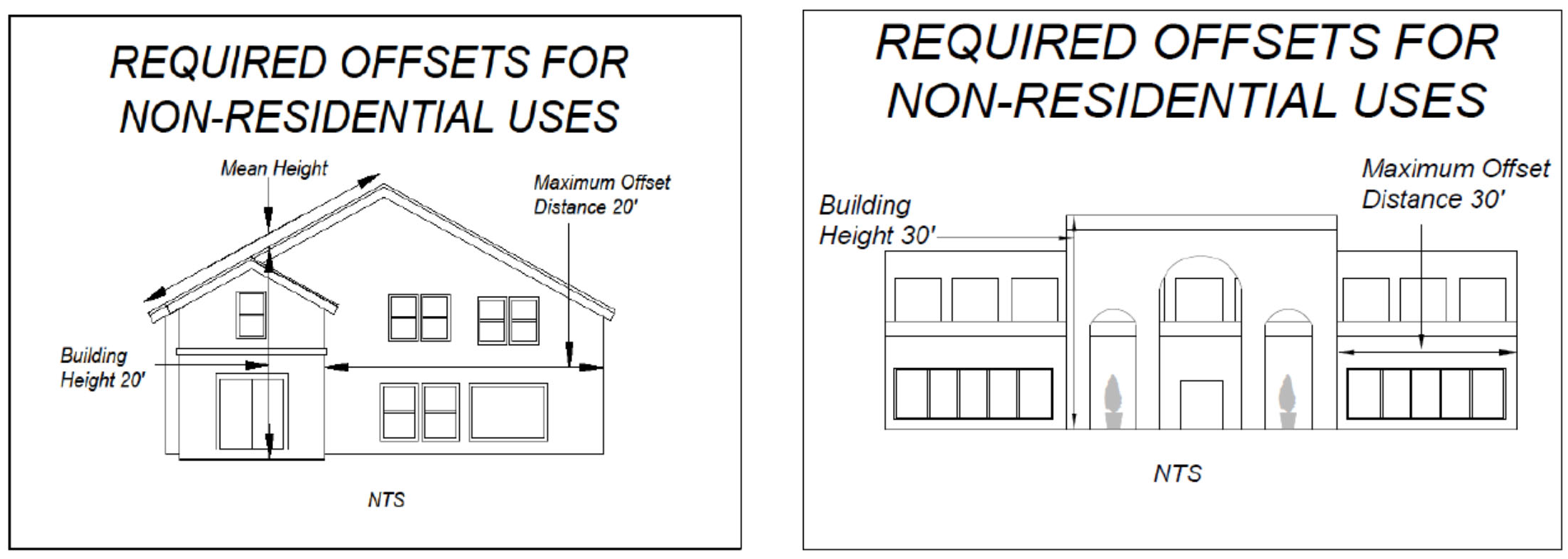
2)
The depth or projection of the offset shall be 1/10th the length of the longest adjacent wall panel; provided, however, the minimum offset depth shall be one foot. By means of illustration, a building with a 20-foot wall panel shall have a two-foot offset adjacent to such wall panel.
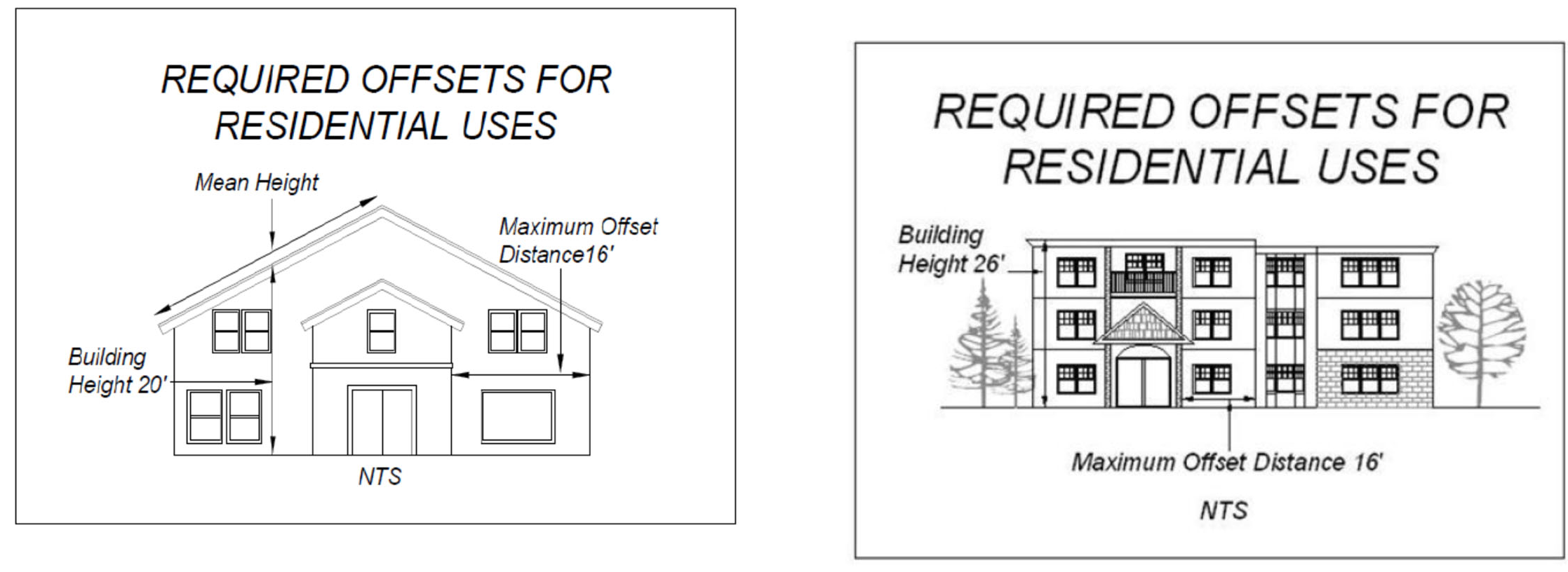
3)
Each façade of a building shall comply with the offset requirements contained herein.
b)
Scale, buildings containing only residential uses. The following requirements apply to any building containing only residential uses:
1)
The distance between required offsets shall be related to the height of the building on a one-to-one basis; provided, however, no wall shall exceed 16 feet in length without an offset. A building façade which is less than 16 feet in length shall not require an offset.
2)
Offsets shall have a minimum depth or projection of two feet regardless of the length of adjacent wall façades.
3)
Each façade of a building shall comply with the offset requirements contained herein.
5-22-4.1.9 Streets and sidewalks. Streets and sidewalks shall comply with the circulation and access requirements contained in section 18-6-4.6, below.
5-22-4.1.10 Building materials. NOTE: This section is not required for one-, two-, three-, and four-family dwellings; property owners/developers may voluntarily consent to these standards per G.S. 160D-702(b). Building materials shall be used consistently on the exterior of the building and shall comply with the lists of prohibited and restricted materials contained herein.
a)
Prohibited building materials. Unless authorized through alternative design compliance, the following building materials shall be prohibited within the Greenville Highway Mixed Use Zoning District Classification: "Jumbo brick"; plain concrete block (with or without paint); corrugated metal; reflective glass; more than 50 percent glass on any façade; roll roofing; roll siding; plain unfinished concrete (painting does not constitute a finish); aluminum; unpainted metal; exposed pipe columns; logs, log siding, wain-edged siding; and any other materials not customarily used in conventional construction.
b)
Restricted building materials. Unless authorized through alternative design compliance, the following building materials shall be restricted as noted within the Greenville Highway Mixed Use Zoning District Classification: vinyl siding, aluminum siding and grooved plywood siding (T1-11) are permitted only behind the roadway corridor; chain link fencing is permitted so long as it is not readily visible from a street or public right-of-way.
5-22-4.2 General standards for residential developments. NOTE: This section is not required for one-, two-, three-, and four-family dwellings; property owners/developers may voluntarily consent to these standards per G.S. 160D-702(b). The following standards shall apply to developments containing only residential uses with the exception that multi-family buildings must comply with the general standards contained in section 5-22-5.3, below.
5-22-4.2.1 General appearance. Residential development shall contain a variation of façades and materials so that there shall not be a row or strip housing appearance. Means to accomplish this goal may include the use of dormers, gables, recessed entries, covered porch entries, bay windows, cupolas or towers, and a variation in the depth and height of walls, among others.
5-22-4.2.2 Architectural.
a)
Useable porches and/or stoops, at least eight feet in width, shall be located on the front and/or side of the home.
b)
Front-loading garages and carports (if permitted) shall be recessed from the front façade of the house and visually designed to form a secondary building volume. Developers are encouraged to turn garages and carports so the openings or doors are not visible from the street. At no time shall the width of an attached garage exceed 50 percent of the total front building façade.
c)
Accessory buildings with a floor area greater than 150 square feet shall be clad in materials similar in appearance to the principal structure.
d)
Walls and fences located in the front yard shall be decorative and limited in height to no more than four feet above grade. Front-yard walls shall be of brick, stone or stucco. Front yard fences shall be wood, wrought iron, vinyl or materials similar in appearance and durability. Side and rear yard fences may be chain link, wood, wrought iron, vinyl or similar material.
5-22-4.2.3 Configurations.
a)
Main roofs on residential buildings shall be gables, hips or clerestory with a pitch between 5:12 and 12:12. Monopitch (shed) roofs are allowed only if they are attached to the wall of the main building.
b)
Foundation walls (except those under porches) shall be finished with split face concrete block, brick, stucco or stone. If crawlspaces of porches are enclosed, they shall be enclosed with split face concrete block, brick, stucco, stone, lattice or any combination thereof.
5-22-4.3 General standards for nonresidential buildings and multi-family buildings. The following standards shall apply to all buildings containing nonresidential and multi-family uses:
5-22-4.3.1 Storage, utility & service areas. Areas devoted to storage, garbage, recycling collection and utilities shall be enclosed and screened around their perimeter, and constructed of materials consistent with the principal building. Gas meters, electric meters, ground-mounted mechanical units, and any other similar structures shall be screened with approved construction materials or landscaping. Fences designed for screening shall be constructed of brick, stone, architectural stucco, concrete, vinyl, wood or iron. Commercial exhaust vents, mechanical units, utility equipment and telecommunication receiving devices located on the roof shall be screened from view. Solar technology components including solar panels and solar thermal collectors used for on-site private purposes are exempt from this provision.
5-22-4.3.2 Parking and vehicular access. All vehicular use areas shall be set back a minimum of 20 feet from the right-of-way line of principal public roadways and shall be screened from view from such roadways, in accordance with article XV, above.
5-22-4.3.3 Encroachments. Balconies, stoops, chimneys and bay windows are permitted to encroach into any setback up to five feet.
5-22-4.3.4 Building façades. No wall facing a principal roadway shall remain unpierced by a window or functional general access doorway for more than 20 feet. For buildings within 20 feet of the sidewalk, at least 20 percent of the ground floor frontage shall be in windows and doorways.
5-22-4.3.5 Pedestrian access shall be provided from street sidewalks to principal entrances by means of a sidewalk or other all-weather walkway.
5-22-4.3.6 Roofs. Parapets and decorative cornices are required for buildings with a flat roof. Eaves shall be provided with a pitched roof.
5-22-4.3.7 Canopies and awnings. If a building canopy, awning, or similar weather protection is provided, it shall project between three to five feet from the façade.
5-22-4.3.8 Architectural styles. Pseudo-historical and pseudo-cultural themes shall not be allowed. New building projects that are not part of a renovation or addition shall not be designed to replicate non-regional historical styles. Buildings that are stylized in an attempt to use the building itself as advertising shall not be allowed, particularly where the proposed architecture is the result of a "corporate" or franchise style. Buildings that are obviously a nationally or regionally prototypical design shall not be allowed.
5-22-4.4 Specific standards for detached houses.
Type A: Street lot. The street lot is a medium or large sized lot (50 feet or greater in width) that provides primary vehicular access from the street.
Type B: Alley lot. The alley lot is a lot for which primary vehicular access is provided using a rear lane or alley only. No curb cuts or driveways are permitted along the frontage except on previously platted lots.
5-22-4.5 Specific standards for townhouses. The townhouse is a building with two or more residential units that are located side-by-side. When an entrance is provided at-grade, the townhouse may be used as a live-work unit.
5-22-4.6 Specific standards for multi-family buildings. A multi-family building is a multiple-unit building with residential units vertically arranged. Units may be for rental or for sale in condominium ownership or may be designed as continuing care facilities. For buildings containing both residential and commercial uses see section 5-22-5.7.
5-22-4.7 Specific standards for commercial & institutional buildings. Commercial buildings are structures which can accommodate a variety of uses mixed either horizontally (shopping center) or vertically (apartment over a store). Office buildings, hotels and inns can be placed in commercial buildings. Buildings containing both commercial and residential uses shall be classified as commercial buildings for the purposes of this section. Institutional buildings are specialized public or semi-public buildings intended to serve as public gathering places. Such uses include governmental offices, churches or other places of worship, schools, hospitals, post offices, and nonprofit or charitable clubs and organizations. Note there are exceptions from the maximum height restrictions for steeples, cupolas and similar structures. These are contained in section 8-2, below.
5-22-5 - GHMUCZD Greenville Highway Mixed Use Conditional Zoning District Classification.
The purpose, requirements and standards of this zoning district classification are identical to the Greenville Highway Mixed Use Zoning District Classification except that rezoning to GHMU Conditional Zoning District as provided for in article VII herein, is required as a prerequisite to any use or development. The following uses shall be permitted in the GHMU Greenville Highway Mixed Use Conditional Zoning District Classification upon rezoning to GHMUCZD, regardless of the square footage or number of residential units for the use:
Telecommunications towers, subject to supplementary standards contained in section 17-4 below.
Structures with a footprint greater than the maximum allowed under section 5-22-3.2 dimensional requirements.
Permitted uses for the GHMU Zoning District Classification as specified in 5-22-1, above.
Special uses for GHMU Zoning District Classification as specified in 5-22-2, above.
(Ord. No. 21-44, 9-22-21; Ord. No. 22-11, 2-10-22; Ord. No. 22-22, 5-5-22; Ord. No. O-25-49, 9-4-25)
5-23-1 - Permitted uses.
The following uses are permitted by right in the HMU Highway Mixed Use Zoning District Classification, provided they meet all requirements of this section and all other requirements established in this ordinance:
Accessory dwelling units subject to supplementary standards contained in section 16-4, below
Accessory uses & structures
Adult care centers registered with the NC Department of Health and Human Services (DHSS)
Adult care homes
Animal hospitals & clinics so long as they contain no outdoor kennels
Automobile car washes
Banks & other financial institutions
Bed & breakfast facilities
Business services
Child care centers, subject to supplementary standards contained in section 16-4, below
Child care homes
Civic clubs & fraternal organizations, subject to supplementary standards contained in section 16-4 below
Congregate care facilities, subject to supplementary standards contained in section 16-4, below
Construction trades facilities, so long as the storage of equipment and materials is screened from view from any public rights-of-way
Convenience stores with or without gasoline sales
Cultural arts buildings
Dance, health & fitness facilities
Dry cleaning and laundry establishments containing less than 6,000 square feet of floor area
Funeral homes
Greenhouses & commercial nurseries
Home occupations
Hotels & motels
Laundries, coin-operated
Lawn & garden centers
Microbreweries, micro-distilleries, micro-cideries, and micro-wineries, subject to supplementary standards contained in section 16-4, below
Mobile food vendors, subject to supplementary standards contained in section 16-4, below
Music & art studios
Neighborhood community centers
Newspaper offices & printing establishments
Nursing homes, subject to supplementary standards contained in section 16-4, below
Offices, business, professional and public
Parking lots & parking garages
Parks
Personal services
Progressive care facilities, subject to supplementary standards contained in section 16-4, below
Public & semi-public buildings
Recreational facilities, indoors
Recreational facilities, outdoors, commercial
Religious institutions
Repair services, miscellaneous
Residential care facilities
Residential dwellings, single-family
Residential dwellings, multi-family
Residential dwellings, two-family
Restaurants
Restaurants, drive-in
Retail stores (not including automobile, manufactured housing, and boat & heavy equipment sales)
Schools, post-secondary, business, technical and vocational
Schools, primary & secondary
Service stations
Signs, subject to the provisions of article XIII, below
Small scale manufacturing, subject to the supplementary standards contained in section 16-4, below
Telecommunications antennas, subject to supplementary standards contained in section 16-4, below
Theaters, indoors
5-23-2 - Special uses.
The following uses shall be permitted in the HMU Highway Mixed Use Zoning District Classification only upon issuance of a special use permit pursuant to article X and shall be subject to special use requirements contained in section 16-4, below:
Bus stations
Public utility facilities
5-23-3 - Development standards.
The following standards shall apply to development within the HMU Highway Mixed Use Zoning District Classification.
5-23-3.1 Parking and loading. For non-residential developments, the requirements of section 6-5, below, shall apply. Residential developments shall be provided with a minimum of one off-street parking space per dwelling unit.
5-23-3.2 Dimensional requirements.
5-23-3.3 Residential density. The number of residential dwellings permitted on any development tract varies with regard to the open space ratio provided as noted on the following table.
5-23-4 - Design standards.
NOTE: "Building design element" subsections noted below are not required for one-, two-, three-, and four-family dwellings; property owners/developers may voluntarily consent to these standards per G.S. 160D-702(b). These standards are intended to apply to all development and redevelopment (excluding one-, two-, three-, and two four-family dwellings) within the HMU Highway Mixed Use Zoning District Classification. Applicants for authorization to undertake development or redevelopment within such zoning district must demonstrate compliance with these standards or must undergo alternative design review.
5-23-4.1 Standards of general applicability. The following standards shall apply to all development in the HMU Highway Mixed Use Zoning District Classification regardless of use or building type.
5-23-4.1.1 General site development. Site development shall not result in the removal of lateral support for adjoining properties. Furthermore, development shall not create hazardous or dangerous conditions or result in the creation of a nuisance as specified in section 6-13, below.
5-23-4.1.2 Physical integration of uses. Residential and commercial uses may be located within the same or adjoining structures provided appropriate health and safety regulations are followed.
5-23-4.1.3 Building orientation. NOTE: Section 5-23-4.1.3 is not required for one- and two-family dwellings; property owners/developers may voluntarily consent to these standards per G.S. 160D-702(b).
Primary façades, which may or may not contain an entrance to the building, shall face primary vehicular access or significant public space. A main entrance shall face a connecting walkway with a direct, safe, pedestrian connection to the street.
5-23-4.1.4 Common space. Common space is intended to shape the design and character of a project through a connecting system of pedestrian areas that create a relationship among the various components of the built environment. It shall be designed to create areas where workers, residents and shoppers, as the case may be, are directly or indirectly invited to gather, browse, sit, interact or congregate. It shall be arranged as community space with open areas, landscaping, seating facilities and lighting fixtures which provide for safety and visual effects.
Common spaces are intended to be places for social interaction and, thus, may include impervious surfaces. Unless interior common space is approved by the reviewing authority, common space out-of-doors. Common space design shall comply with the following:
a)
Size. At least ten percent of the acreage of a site shall be devoted to common space. Common space shall count toward meeting open space requirements for a project.
b)
Trees. One tree shall be planted for each 500 square feet of common space. Trees shall have a minimum caliper of three to three and one-half inches measured six inches above ground at the time of planting.
c)
Utilities. All utilities service lines and connections shall be underground.
d)
Seating. Seating shall be provided to accommodate workers, residents and/or shoppers. Seating may be accomplished in whole or in part using planters or other similar structures.
e)
Amenities. Common space for a development shall contain adequate amenities to animate and enliven the environment and to make it conducive for social interaction. Following is a list of such amenities: ornamental fountains, stairways, waterfalls, public art, arbors, trellises, planted beds, drinking fountains, clock pedestals, awnings, canopies, informational kiosks, and similar structures. This list is not intended to be exhaustive.
5-23-4.1.5 Architectural details. NOTE: This section is encouraged but not required for one-, two-, three-, and four-family dwellings; property owners/developers may voluntarily consent to these standards per G.S. 160D-702(b).
The appearance of all exposed façades (not just the streetside façade) is important and shall be addressed in development design. Architectural elements like openings, sill details, bulkheads, posts, and other architectural features shall be used to establish human scale at the street level. On corner lots, the applicant shall provide distinctive architectural elements at the corner of buildings facing the intersection. Windows, doors, columns, eaves, parapets, and other building components shall be proportional to the overall scale of the building. Windows shall be vertically aligned.
All buildings shall provide detailed design along all elevations. Detailed design shall be provided by using at least three of the following architectural features on all elevations. Features may be varied on rear/side/front elevations.
Dormers
Gables
Recessed entries
Covered porch, entries
Cupolas or towers
Pillars or posts
Eaves (minimum six-inch projection)
Off-sets in building face or roof
Window trim (minimum nominal four inches wide)
Bay windows
Balconies
Decorative patterns on exterior finish (e.g. scales/shingles, wainscoting, ornamentation)
Decorative cornices and roof lines (for flat roofs)
5-23-4.1.6 Building façades. NOTE: This section is not required for one-, two-, three-, and four-family dwellings; property owners/developers may voluntarily consent to these standards per G.S. 160D-702(b).
Façades of buildings shall contain at least two building materials which shall contrast in color and texture. At least 15 percent of the façade, exclusive of windows, doors and trim, shall consist of stone, brick, decorative concrete or decorative block.
5-23-4.1.7 Windows. NOTE: This section is not required for one-, two-, three-, and four-family dwellings; property owners/developers may voluntarily consent to these standards per G.S. 160D-702(b).
Windows shall either be (1) recessed a minimum of three inches from the façade or (2) trimmed. If trim is used, it shall be a minimum of four inches (nominal) in width and shall project beyond the façade.
5-23-4.1.8 Building scale. NOTE: This section is not required for one-, two-, three-, and four-family dwellings; property owners/developers may voluntarily consent to these standards per G.S. 160D-702(b).
The scale of a building is a function of the size of the individual pieces of a building and their relationship to each other. The scale of a building is important in order to contribute to the overall diversity of building types, to give visual interest, and to maintain compatibility between buildings. These design standards regulate scale by means of offsets, that is, protrusions or breaks in the plane of façades.
a)
Scale, buildings containing nonresidential uses. The following requirements apply to any building containing nonresidential uses, regardless whether the building also contains residential uses:
1)
The distance between required offsets is related to the height of the building wall on a two-to-one basis. Thus, a building which is 20 feet tall may have no more than 40 feet of façade wall between offsets. A building façade which is less than or equal to the height of the building shall not require an offset.
2)
The height of any particular façade shall be measured from the average ground level to the soffit, or, if there is no soffit, to the parapet.
3)
The depth or projection of the offset shall be 1/10th the length of the longest adjacent wall panel; provided, however, the minimum offset depth shall be one foot. By means of illustration, a building with a 20-foot wall panel shall have a two-foot offset adjacent to such wall panel.
4)
Each façade of a building shall comply with the offset requirements contained herein.
b)
Scale, buildings containing only residential uses. The following requirements apply to any building containing only residential uses:
1)
The distance between required offsets shall be related to the height of the building on a basis of 0.75/1; provided, however, no wall shall exceed 16 feet in length without an offset. By way of illustration, a façade wall which is 20 feet tall may have no more than 15 feet of wall between offsets; however, a façade wall which is 30 feet tall, owing to the proviso, may have no more than 16 feet of wall between offsets. A building façade which is less than 16 feet in length shall not require an offset. Provided, however, the provisions of this paragraph shall not be construed to require an offset for that portion of a façade containing a two-car garage.
2)
Offsets shall have a minimum depth or projection of two feet regardless of the length of adjacent wall façades.
3)
Each façade of a building visible from a street or common space shall comply with the offset requirements contained herein.
5-23-4.1.9 Streets and sidewalks. Streets and sidewalks shall comply with the circulation and access requirements contained in section 18-6-4.6, below.
5-23-4.1.10 Building materials. NOTE: This section is encouraged but not required for one-, two-, three-, and four-family dwellings; property owners/developers may voluntarily consent to these standards per G.S. 160D-702(b).
Building materials shall be used consistently on the exterior of the building and shall comply with the lists of prohibited and restricted materials contained herein.
a)
Prohibited building materials. Unless authorized through alternative design compliance, the following building materials shall be prohibited within the HMU Highway Mixed Use Zoning District Classification: plain concrete block (with or without paint); corrugated or ribbed metal siding; reflective glass; more than 50 percent glass on any façade; roll roofing; roll siding; plain unfinished concrete (painting does not constitute a finish); aluminum; unpainted metal; exposed plain pipe columns; logs, log siding, wain-edged siding; metal wall siding; and any other materials not customarily used in conventional construction.
b)
Restricted building materials. Unless authorized through alternative design compliance, the following building materials shall be restricted as noted within the HMU Highway Mixed Use Zoning District Classification: vinyl siding, aluminum siding and grooved plywood siding (T1-11) are permitted only behind the roadway corridor; chain link fencing is permitted so long as it is not readily visible from a street, or public right-of-way, or common space.
5-23-4.2 General standards for residential developments. NOTE: This section is not required for one-, two-, three-, and four-family dwellings; property owners/developers may voluntarily consent to these standards per G.S. 160D-702(b).
The following standards shall apply to developments containing only residential uses with the exception that apartment buildings must comply with the general standards contained in section 5-23-5.3, below.
5-23-4.2.1 General appearance. Residential development shall contain a variation of façades and materials so that there shall not be a row or strip housing appearance. Means to accomplish this goal may include the use of dormers, gables, recessed entries, covered porch entries, bay windows, cupolas or towers, and a variation in the depth and height of walls, among others.
5-23-4.2.2 Architectural.
a)
Useable porches and/or stoops, at least eight feet in depth, shall be located on the front and/or side of the home.
b)
Front-loading garages and carports (if permitted) shall be offset from the front façade of the house and visually designed to form a secondary building volume. Developers are encouraged to turn garages and carports so the openings or doors are not visible from the street. At no time shall the width of an attached garage exceed 50 percent of the total building façade.
c)
Accessory buildings with a floor area greater than 150 square feet shall be clad in materials similar in appearance to the principal structure.
d)
Walls and fences located in the front yard shall be decorative and limited in height to no more than four feet above grade. Front-yard walls shall be of brick, stone or stucco. Front yard fences shall be wood, wrought iron or materials similar in appearance and durability. Side and rear yard fences may be chain link, wood, wrought iron, or similar material.
5-23-4.2.3 Configurations.
a)
Main roofs on residential buildings shall be gables, hips or clerestory with a pitch between 5:12 and 12:12. Monopitch (shed) roofs are allowed only if they are attached to a wall of the main building.
b)
Foundation walls (except those under porches) shall be finished with brick, stucco or stone. If crawlspaces of porches are enclosed, they shall be enclosed with brick, stone, lattice or any combination thereof.
5-23-4.3 General standards for nonresidential buildings and apartments. The following standards shall apply to all buildings containing nonresidential uses and to apartment buildings:
5-23-4.3.1 Storage, utility & service areas. Areas devoted to storage, garbage, recycling collection and utilities shall be enclosed and screened around their perimeter, and constructed of materials consistent with the principal building. Gas meters, electric meters, ground-mounted mechanical units, and any other similar structures should be hidden from public view or screened with approved construction materials. Fences designed for screening shall be constructed of brick, stone, architectural stucco, concrete, wood or iron. Roof vents, mechanical units, utility equipment and telecommunication receiving devices located on the roof shall be screened from view.
Solar technology components including solar panels and solar thermal collectors used for on-site private purposes are exempt from this provision.
5-23-4.3.2 Parking and vehicular access. All vehicular use areas shall be set back a minimum of 20 feet from the right-of-way line of any primary arterial roadway and shall be screened from view from such roadways in accordance with article XV, below.
5-23-4.3.3 Encroachments. Balconies, stoops, chimneys and bay windows are permitted to encroach into any setback up to five feet.
5-23-4.3.3 Pedestrian access shall be provided from street sidewalks to principal entrances by means of a sidewalk or other all-weather walkway.
5-23-4.3.4 Roofs. Parapets and decorative cornices are required for buildings with a flat roof. Eaves shall be provided with a pitched roof.
5-23-4.4 Specific standards for detached houses.
Type A: Street lot. The street lot is a medium or large sized lot (50 feet or greater in width) that provides primary vehicular access from the street.
Type B: Alley lot. The alley lot is a lot for which primary vehicular access is provided using a rear lane or alley only. No curb cuts or driveways are permitted along the frontage except on previously platted lots.
5-23-4.5 Specific standards for townhouses. The townhouse is a building with two or more residential units that are located side-by-side. When an entrance is provided at-grade, the townhouse may be used as a live-work unit.
5-23-4.6 Specific standards for apartment buildings. An apartment is a multiple-unit building with apartments vertically arranged. Units may be for rental or for sale in condominium ownership or may be designed as continuing care facilities. The ground floor may be available for commercial uses.
5-23-4.7 Specific standards for commercial & institutional buildings. Commercial buildings are structures which can accommodate a variety of uses mixed either horizontally (shopping center) or vertically (apartment over a store). Office buildings, hotels and inns can be placed in commercial buildings. Buildings containing both commercial and residential uses shall be classified as commercial buildings for the purposes of this section. Institutional buildings are specialized public or semi-public buildings intended to serve as public gathering places. Such uses include governmental offices, churches or other places of worship, schools, hospitals, post offices, and nonprofit or charitable clubs and organizations. Note there are exceptions from the maximum height restrictions for steeples, cupolas and similar structures. These are contained in section 8-2, below.
5-23-5 - Transportation.
The section is intended to put in place regulations which will provide for a multi-modal transportation environment conducive to a pedestrian-friendly mixed-use community.
5-23-5.1 Corridor circulation plan. If a corridor circulation plan has been adopted for the HMU zoning district, all new development and redevelopment must demonstrate consistency with that plan.
5-23-5.2 Transportation plan submittals. In addition to other submittal requirements for development review, applicants for development authorization within the HMU zoning district shall submit the following documents:
a)
Pedestrian circulation plan to include type of infrastructure (for example, sidewalk, multi-use path), and connections to adjacent pedestrian facilities.
b)
Vehicular circulation plan to include parking, loading, stubs to adjacent properties, and any cross-access easements.
c)
When required, a traffic impact study (TIS) performed by a registered engineer in accordance with NCDOT standards for all developments that generate 100 peak hour trips or 1,000 daily trips in accordance with the Institute of Traffic Engineers current Trip Generation Manual. The community development director may also require a TIS without regard to the expected trip generation of the development due to the existence of special circumstances including, without limitation, existing level-of-service deficiencies in the area of the proposed development or when available accident data and/or operational and geometric factors indicate safety concerns.
5-23-5.3 Street connectivity. In an effort to improve and promote overall street connectivity, public streets constructed within an HMU zoning district shall provide connections to existing adjacent public streets. When no off-site street stubs are present, the following connections shall be provided to undeveloped properties at the appropriate rate indicated below.
a)
All new development with fewer than 100 dwelling units are required to provide at least one stub-out street to extend and connect with future streets. In the event that adjacent land is already developed with stub-outs present, the developer shall build streets to connect to the existing stub-out(s).
b)
Residential developments containing 100 or more dwelling units shall include street connections or stubs at a ratio of one stub/connection per 100 dwelling units. In the event adjacent land is already developed with streets, the developer shall connect to the existing stub-out(s). Required collector street connections are included in this calculation.
c)
Non-residential developments shall provide one stub to each adjoining parcel where, considering topography, land use compatibility and future development or redevelopment potential, it is deemed feasible and appropriate.
5-23-5.4 Pedestrian accommodations. Pedestrian accommodations, which may be sidewalks, multi-purpose paths, or other approved alternatives, shall be provided as a part of a development on both sides of all public roadways and of all private roadways unless site constraints or proposed uses make it impractical or unnecessary. Pedestrian access and circulation shall be consistent with any and all adopted corridor circulation plans.
5-23-5.5 Vehicular access. It is the intent of these regulations to encourage interconnectivity between development parcels in order to provide alternative transportation routes to existing thoroughfares. Accordingly, when development parcels have potential to provide access to adjoining parcels, developers are encouraged to utilize public streets, rather than private streets or driveways, for access to major arterial roadways. The regulations contained in this section shall apply to all new development and redevelopment within the district.
5-23-5.5.1 Driveways. Where permitted, driveways shall comply with the requirements of this section and, if applicable, the regulations of the North Carolina Department of Transportation.
a)
The number of driveways permitted for new development shall relate to the amount of linear frontage for the proposed development as depicted below:
1 With approval of the city after demonstration of need in the required TIS.
b)
All driveway approaches for both mid-block and corner lots along major thoroughfares shall have both minimum corner and side clearances as below:
2 Corner clearance shall be measured from the point of tangency of the radius curvature of the intersection streets.
3 Side clearance shall represent the distance from the driveway to the side property line.
c)
No driveways shall be allowed along a major thoroughfare within 250 feet of any intersection, as measured from the intersection of the projected right-of-way lines, except for properties which cannot meet this restriction due to limited frontage within the desired corner clearance.
d)
One-way driveways are not considered full-movement driveways therefore, two, one-way driveways may be considered as a single driveway provided that:
1)
The minimum spacing between the two driveway segments is 60 feet.
2)
The driveway segments are clearly signed and marked as one-way driveways, using pavement arrows and directional signs.
3)
The maximum combined pavement width of both driveway segments at the right-of-way line is 40 feet and the minimum width of a single segment is 14 feet.
5-23-5.5.2 Outparcels. Access to development outparcels shall be oriented to the interior of the development site, not to the roadway.
5-23-5.5.3 Cross-access easements. Cross-access easements between parking areas on adjacent developments are an effective way to improve corridor circulation and to reduce vehicle trips. For each adjoining property with accessible parking areas, applicants for development authorization shall provide either (1) a cross-access easement or (2) confirmation that the applicant has attempted to negotiate a cross-access easement with that property owner and has not been able to reach agreement thereon.
5-23-6 - HMUCZD Highway Mixed Use Conditional Zoning District Classification.
The purpose, requirements and standards of this zoning district classification are identical to the Highway Mixed Use Zoning District Classification except that rezoning to HMU Conditional Zoning District as provided for in article VII herein, is required as a prerequisite to any use or development. The following uses shall be permitted in the HMU Highway Mixed Use Conditional Zoning District Classification upon rezoning to HMUCZD, regardless of the square footage or number of residential units for the use:
Telecommunications towers, subject to supplementary standards contained in section 16-4, below.
Structures with a footprint greater than the maximum allowed under section 5-23-3.2 dimensional requirements.
Permitted uses for the GHMU Zoning District Classification as specified in 5-23-1, above.
Special uses for GHMU Zoning District Classification as specified in 5-23-2, above.
(Ord. No. 21-44, 9-22-21; Ord. No. 22-11, 2-10-22; Ord. No. 22-22, 5-5-22; Ord. No. O-25-49, 9-4-25)
5-24-1 - Procedure.
The reclassification of property to UVCZD Urban Village Conditional Zoning District shall constitute an amendment of the zoning map which may be initiated only by all of the owner(s) of a legal interest in the affected property. UVCZD Urban Village Conditional Zoning Districts shall be created only in locales designated in the Comprehensive Plan as Multi-Generational Living, Neighborhood Center, Mixed Use-Commercial, Mixed Use-Employment, and Downtown and may be considered in Focused Intensity Nodes regardless of Character Area Designation. Notwithstanding the foregoing, an Urban Village District may be located on a lot(s) all or part of which fall within locales designated as Multi-Generational Living in the comprehensive plan only if any part of the boundary of the Urban Village Conditional Zoning District is located no more 350 feet from the boundary of a zoning district having a nonresidential zoning designation.
5-24-1.1 Pre-Application Conference. Every person proposing to apply for creation of a UVCZD Urban Village Conditional Zoning District is required to meet with the community development department staff prior to the submittal of such application. This conference is intended to provide the applicant with an opportunity to discuss requirements, standards and procedures and to identify and solve potential problems for the proposed application. The applicant shall bring a sketch plan for the project showing, at a minimum, the location, the existing and proposed transportation network, phasing, general development plans and a written synopsis of the development proposal. The pre-application conference shall take place at least one week prior to submitting of an application to create an Urban Village District Conditional Zoning District.
5-24-1.2 Application. Creation of an urban village district shall be initiated by means of an application for rezoning to a UV Urban Village Conditional Zoning District. No permit shall be issued for any development within a UV Urban Village Conditional Zoning District except in accordance with an approved rezoning.
5-24-1.3 Master plan. Applicants for creation of an urban village conditional zoning district project are required to submit a master plan for the entire development that indicates the following: (1) the general street network; (2) the proposed land use configuration within that network; (3) phasing boundaries if phasing is proposed; (4) the ultimate proposed development intensity (including the number of residential units and gross square footage of all nonresidential uses) for the entire development and for each phase; (5) a conceptual landscape plan; (6) proposed setback, height, signage, architectural and other design standards for the overall project and for proposed uses; (7) building elevations or perspective drawings to demonstrate proposed building character; and (8) a conceptual stormwater plan for the development. For initiation of this zoning classification, properties may fall under more than one ownership so long as there exist covenants or other legally binding agreements that address cross-access, cross-parking and other similar issues affecting joint operation of the projects.
5-24-1.3.1 Traffic impact analysis. A traffic impact analysis is required for all urban village projects and shall be submitted with the application to create the urban village. The city may defer the traffic impact analysis until after a rezoning to a conditional zoning district is approved for the project only in those circumstances where city council, in the absence of a traffic impact analysis, determines that the existing public road system has adequate capacity to handle projected traffic flow as required by section 7-11, below.
5-24-1.3.2 Subsequent review. After the establishment of the urban village district, individual development projects within the district shall be subject to final site plan review in accordance with section 7-3-4, below. In addition to the site plan requirements contained in section 7-3-4.3, applicants shall comply with the design submittal requirements of section 18-3-3.
5-24-1.3.3 Modifications. Revisions to approved urban village district master plans may be approved by city council or by the city manager, or a designee appointed by the city manager, depending on the type of revisions being requested. City council shall review any revisions to a master plan that increase the overall development intensity, change the proposed mix of uses by increasing or reducing any use category by ten percent or more, or increases maximum building heights from that shown on the approved master plan. Additionally, city council shall review any revision to a master plan that results in a decrease in the amount of perimeter open space or perimeter parking lot buffering, or in a 25 percent or greater reduction in the number of proposed blocks from that shown on the approved master plan. For the purpose of determining overall development intensity, one residential unit shall be regarded as the equivalent of 500 square feet of office floor area; one residential unit shall be regarded as the equivalent of 200 square feet of commercial floor area; and 1,000 square feet of office space shall be regarded as the equivalent of 350 square feet commercial. For other uses, the community development director shall determine the equivalency factor.
5-24-2 - Permitted uses.
The following uses are permitted by right in the UV Urban Village Conditional Zoning District Classification, provided they meet all requirements of this section and all other relevant requirements of this zoning ordinance.
Accessory dwelling units subject to supplementary standards contained in section 16-4, below
Accessory uses & structures
Adult care centers registered with the NC Department of Health and Human Services (DHSS)
Adult care homes
Animal hospitals & clinics so long as they contain no outdoor kennels
Banks & other financial institutions
Bed & breakfast facilities
Business services
Child care centers, subject to supplementary standards contained in section 16-4, below
Child care homes
Civic clubs and fraternal organizations
Congregate care facilities, subject to supplementary standards contained in section 16-4, below
Cultural arts buildings
Dance, health & fitness facilities
Dry cleaning and laundry establishments containing less than 6,000 square feet of floor area
Funeral homes
Home occupations
Hotels & motels
Laundries, coin-operated
Lawn & garden centers
Microbreweries, micro-distilleries, micro-cideries, and micro-wineries, subject to supplementary standards contained in section 16-4, below
Music & art studios
Neighborhood community centers
Newspaper offices & printing establishments
Offices, business, professional and public
Parking lots & parking garages
Parks
Personal services
Planned residential developments (minor), subject to the requirements of article VII, below
Public & semi-public buildings, including, without limitation, post offices, police stations and fire stations
Public utility facilities
Recreational facilities, indoors
Religious institutions
Repair services, miscellaneous
Residential care facilities
Residential dwellings, single family
Residential dwellings, multi-family
Residential dwellings, two-family
Restaurants
Retail stores (not including automobile, manufactured home, farm equipment, gasoline, and boat & heavy equipment sales)
Schools, post-secondary, business, technical and vocational
Schools, primary & secondary
Signs, subject to the provisions of article XIII, below
Telecommunications antennas, subject to supplementary standards contained in section 16-4, below
Theaters, indoors or outdoors but not including drive-in theaters
5-24-3 - Development standards.
Some development standards for the UV Urban Village Conditional Zoning District are specified in this ordinance. Where no standard is specified, it is incumbent upon the applicant to propose development standards which, if city council concurs, will be incorporated into the project. The following standards shall apply to development within the UV Urban Village Conditional Zoning District Classification.
5-24-3.1 Density. Residential density for an urban village district shall be established by city council in consideration of surrounding land uses and the existence of adequate public facilities. The maximum density which may be approved shall not be otherwise limited except by other standards such as building height, parking, landscaping and buffering, open space, and traffic impact.
5-24-3.2 Structure size. The maximum size of any structure shall be established by city council.
5-24-3.3 Area. The minimum area required to establish an urban village district is ten acres.
5-24-3.4 Lot size. There is no minimum lot size required for an urban village district; although, the applicant may specify minimum standards in its development document.
5-24-3.5 Lot width. There is no minimum lot width required.
5-24-3.6 Setbacks. There are no minimum setback requirements within the Urban Village Conditional Zoning District Classification; provided, however, setbacks shall be established around the perimeter of the district sufficient to protect adjoining properties from the impacts of proposed development within the district.
5-24-3.7 Height. There are no maximum height restrictions. The applicant shall propose minimum and maximum height restrictions for all building types and locations.
5-24-3.8 Design considerations. NOTE: "Building design element" subsections noted below are encouraged but not required for one-, two-, three-, and four-family dwellings; property owners/developers may voluntarily consent to these standards per G.S. 160D-702(b).
Design is critical to the creation of an Urban Village District and to achieving the goals of this classification, as set forth in section 5-24, above. The design considerations set forth in this section are intended in some instances to guide project design and in others to provide specific design requirements, and the text is intended to make this distinction clear. In general, the use of the term "shall" indicates a specific design requirement, whereas the term "should" indicates design guidance. In order to obtain a rezoning to develop an Urban Village Conditional Zoning District, an applicant must demonstrate, among other things, that the design of the proposed development (1) meets the specific standards contained herein, (2) is generally in harmony with the design guidelines contained herein, and (3) will result in a development which is consistent with the purposes set forth in section 5-24, above.
5-24-3.8.1 General site arrangement. Structures shall be placed and arranged so as not to adversely affect adjacent property. Adverse effects shall include, but are not limited to, the removal of lateral support on adjacent property, the creation of hazard, nuisance, danger, or inconvenience, or unreasonable loss of privacy. Development shall be arranged so as to be visually harmonious within the district. Insofar as is practicable, developments should be arranged so as to preserve or enhance vistas. Urban villages shall be oriented around one or more significant public spaces, such as parks or plazas.
5-24-3.8.2 Physical integration of uses. All urban villages shall be designed and developed to provide an appropriate interrelationship between the various uses and structures within the development. Residential and commercial uses may be located within the same or adjoining structures.
5-24-3.8.3 Preservation of natural features and open space. Permitted flexibility in lot sizes, setbacks, street alignments and widths, and landscaping shall be utilized to preserve natural features and drainage patterns and to provide open space.
5-24-3.8.4 Architectural character. NOTE: This section is not required for one-, two-, three-, and four-family dwellings; property owners/developers may voluntarily consent to these standards per G.S. 160D-702(b).
The rich architectural vocabulary of the City of Hendersonville presents a wide variety of development opportunities using traditional forms while avoiding any perception of monotony. Each building proposed for an urban village district shall have a well-proportioned form consistent with the building use, and its construction materials. Materials shall be durable, attractive and compatible with the architectural vernacular of the region. Massing of the building(s) shall create a building envelope that reflects simple, clearly articulated building volumes.
5-24-3.8.5 Building orientation. It is preferred that primary façades face the adjacent street or significant public space. Apartment buildings and buildings containing commercial or institutional uses shall have a main entrance facing a connecting walkway with a direct, safe, pedestrian connection to the street. Where the main entrance does not face the adjacent street, buildings shall nonetheless be designed to provide an attractive streetside façade.
5-24-3.8.6 Building placement. Buildings shall be situated with regard to pedestrian and vehicular connectivity. Apartment buildings and buildings containing commercial or institutional uses should be located close to the pedestrian street with off-street parking behind and/or beside the building. Important mountain vistas and/or views of significant historic sites should be protected and accentuated.
5-24-3.8.7 Privacy considerations. Elements of the development plan should be arranged to maximize the opportunity for privacy by the residents of the project and minimize infringement on the privacy of adjoining land uses.
5-24-3.8.8 Architectural details. NOTE: This section is not required for one-, two-, three-, and four-family dwellings; property owners/developers may voluntarily consent to these standards per G.S. 160D-702(b).
Architectural elements like openings, details, bulkheads, posts, and other architectural features shall be used to establish human scale at the street level. On corner lots, the applicant is encouraged to provide a building entry, additional building mass, and distinctive architectural elements at the corner of buildings. Windows, doors, columns, eaves, parapets, and other building components shall be proportional to the overall scale of the building. Windows shall be vertically aligned wherever practical. The appearance of all exposed façades (not just the streetside façade) is important and shall be addressed in development design.
5-24-3.8.9 Building walls. NOTE: This section is not required for one-, two-, three-, and four-family dwellings; property owners/developers may voluntarily consent to these standards per G.S. 160D-702(b).
Buildings shall avoid long, monotonous, uninterrupted walls or roof planes on their visible façades. It is preferred that this design goal be achieved by means of building wall offsets, including projections, recesses, and changes in floor level, and roofline offsets. Such offsets add architectural interest and variety and can assist in creating human size proportions. Parapets shall be designed as integral to the mass of the building. When multiple wall materials are combined on one façade, the designer is encouraged to place the heavier material(s) below.
5-24-3.8.10 Building entrances. All buildings should include well-defined entrances facing the street at regular intervals. An operable entrance on each primary façade should be provided to encourage access by pedestrians. For buildings on corner lots, an entrance may be placed at the corner, thereby eliminating the need for side entrances.
5-24-3.8.11 Internal access and connectivity. The site shall be traversed by a network of internal streets built according to city standards. Internal streets should seek to avoid cul-de-sacs and dead end roads and other features that hamper connectivity. However, roads may terminate at a monumental structure or green space. In such cases a sidewalk or other connection must be provided to ensure the goals of connectivity. In addition, internal streets are also required to have sidewalks and street trees. If a bus line serves, or is expected to serve, the district, a bus shelter is required. Larger projects may require more shelters as determined by traffic impact analysis.
Connectivity is a goal of the internal street system and external connections to areas outside and adjacent to the urban village should be created where possible. Only one driveway per block face is allowed. Detached single-family housing and duplex housing are exempt from the driveway restriction. Parking access from alleyways, however, is encouraged.
5-24-3.8.12 Block length. Block length may vary but shall not exceed 500 feet in length. For blocks on local streets that are 350 feet or longer, a mid-block pedestrian street crossing is required which may also include a parking lot driveway and/or pedestrian passageway between two or more buildings, and shall have curb extensions (bulb-outs) for ease and safety of pedestrian street crossing. Collector streets may also require mid-block pedestrian crossings as noted above.
5-24-3.8.13 Pedestrian zone and sidewalks. The pedestrian zone is the area between the street curb and the building edge or, for access roads, the street curb and the right-of-way area. The pedestrian zone includes sidewalks, street trees and other pedestrian amenities. The pedestrian zone will generally be 15 feet wide but may be wider depending on the setback pattern. Sidewalks in urban village districts shall be required along one side of access streets and both sides of internal streets throughout the development. If appropriate to the design of the village, greenway paths may be substituted for sidewalks in residential areas to provide connections. The sidewalk shall be a minimum of seven feet wide in the Urban Village Conditional Zoning District Classification. In solely residential areas containing less than eight units per acres, sidewalks are only required to be five feet wide. With institutional and public uses that have an increased setback, a sidewalk shall connect the building façade entrance with the street. The sidewalk may be as wide as the entire pedestrian area. Arcades, awnings, outdoor dining, shelters, seating areas, fountains, street trees, additional landscaped areas and other pedestrian amenities may be a part of this pedestrian area so long as seven feet of clear walking space is maintained. The pedestrian area may also be used to create an area for waiting, pick-up and drop-off. At locations such as intersections and other crosswalks, curb extensions (bulb-outs) are required to create safer pedestrian crossings.
5-24-3.8.14 Parking/loading standards. Parking and loading facilities shall be reviewed at the master plan level. The applicant shall demonstrate that the amount of parking proposed is adequate to serve the needs of the district and is located and designed in such a fashion that it does not detract from the overall appearance of the district or unreasonably interfere with pedestrian activity.
a)
Amount of parking. Owing to the possibilities for shared use of parking, the number of parking spaces in the urban village district should not exceed the minimum parking requirements for the district computed by means of the formulas contained in section 6-5, below.
b)
On-street parking. On-street parking is required for all local streets and for collector streets and shall count toward meeting parking needs for the district. On-street parking may take the form of parallel or angle parking and shall be built according to city standards.
c)
Off-street parking. Applicants for rezoning to the UV Urban Village Conditional Zoning District Classification shall propose a master parking plan which shall provide sufficient parking for the entire project consistent with requirements of this section. Off-street parking lots are encouraged to be provided at the side or rear of buildings or the interior of a block of buildings and not closer to the street than the edge profile of the structures. No more than 20 percent of parking that is provided in an urban village district may be in the form of stand-alone surface lots not located to the side or rear of buildings. Off-street parking shall not be adjacent to street intersections. No parking is permitted in any setback area. Individual uses in the urban village district are not required to provide off-street parking or loading.
d)
Loading standards. Urban village districts may share off-street loading facilities and are therefore allowed to provide these facilities at half the rate listed for the applicable uses. On-street loading spaces may be counted towards the project loading requirements.
5-24-3.8.15 Street trees. Street trees are required in the pedestrian zone and along access roads at an average of one tree every 30 feet for mid-story and understory trees, and one tree for every 40 feet for canopy trees. In selecting street trees, priority should be given to long lived species proven to function well in urban settings with a form and branching pattern compatible with the space and type of adjacent traffic. Trees may be planted in minimum six-foot by six-foot pits. Tree frames and grates are not required but are recommended especially near store entrances, other sidewalk constraints, points of ingress, egress or public gathering areas. If tree grates are not used, an organic surfacing material shall be used to level the surface of the tree pit with the sidewalk. This material shall receive regular maintenance. To offer flexibility in the tree planting requirement, trees may be planted in planting strips adjacent to the curb edge of the sidewalk. Planting strips shall be no narrower than six feet wide. Planting strips may include grass, flowers and other plant material where appropriate. Planting strips may not be appropriate in pedestrian gathering areas.
5-24-3.8.16 Landscape/buffering standards. Landscaping and buffering shall be in accordance with article XV of this ordinance except as noted herein. Parking lots shall include interior and perimeter tree plantings made up of deciduous trees at a rate of one tree for every 1,500 square feet of vehicular use area. No parking space may be farther than 45 feet from a tree. No shrubs are required for interior plantings for parking lots that are behind, to the side or located at the interior of the block of buildings. Parking areas adjacent to roadways require buffering from the street as specified in article XV with the exception that the planting area will be eight feet wide. Stand-alone parking lots shall comply with all applicable landscape and buffering standards except that trees shall be provided at a rate of one tree for every 1,500 square feet of parking and parking spaces shall be no further than 45 feet from a tree. Shrubs are also required as per the regular schedule. Landscaped islands within parking lots should be a minimum of 162 square feet in area with a minimum width of eight feet if they are to include tree plantings. Residential structures within an urban village may have up to a 100 percent reduction in buffering requirements from the rest of the urban village. Buffering for urban village district projects is measured and reviewed from the parcel lot lines used to establish the district and not on an internal lot by lot basis.
5-24-3.8.17 Open space standards. Functional open space enhances circulation within a site and contributes to the site's aesthetic qualities. All open space should be designed to be accessible and usable for occupants and invitees of the development. An urban village district shall have an open space ratio of not less than 0.30. Open space includes any portion of the site not covered by a building or vehicular use area and any common space meeting the standards listed in the paragraph below.
5-24-3.8.18 Common space standards. Common space is intended to shape the design and character of a project through a connecting system of pedestrian areas that create a relationship among the various components of the built environment. It shall be designed to create areas where workers, residents and shoppers, as the case may be, are directly or indirectly invited to gather, browse, sit, interact or congregate. It shall be arranged as community space with open areas, landscaping, seating facilities and lighting fixtures which provide for safety and visual effects.
Common spaces are intended to be places for social interaction and, thus, may include impervious surfaces. Unless interior common space is approved by the reviewing authority, common space shall be out-of-doors. Common space design shall comply with the following:
a)
Size. At least ten percent of the acreage of a site shall be devoted to common space. Common space shall count toward meeting open space requirements for a project.
b)
Trees. One tree shall be planted for each 500 square feet of common space. Trees shall have a minimum caliper of three to three and one-half inches measured six inches above ground at the time of planting.
c)
Utilities. All utilities service lines and connections shall be underground.
d)
Seating. Seating shall be provided to accommodate workers, residents and/or shoppers. Seating may be accomplished in whole or in part using planters or other similar structures.
e)
Amenities. Common space for a development shall include two or more of the following amenities: ornamental fountains, stairways, waterfalls, public art, arbors, trellises, planted beds, drinking fountains, clock pedestals, public telephones, awnings, canopies, informational kiosks, and similar structures.
(Ord. No. 22-11, 2-10-22; Ord. No. O-24-47, 12-5-24; Ord. No. O-25-49, 9-4-25)
5-25-1 - Minimum district size.
There shall be no minimum size requirement for the creation of an Urban Residential District. However, the applicant for an Urban Residential Conditional Zoning District shall be required to specify the proposed district size. In considering whether to approve the size of the proposed district, the city council shall consider the surrounding land uses, the existence of adequate public facilities, proposed buffering, open space, and traffic impact.
5-25-2 - Procedure.
The reclassification of property to Urban Residential Conditional Zoning District shall constitute an amendment of the zoning map which may be initiated only by all of the owner(s) of a legal interest in the affected property. Urban Residential Conditional Zoning Districts shall be created only in locales designated in the comprehensive plan as Multi-Generational Living, Neighborhood Center, Mixed Use-Commercial, Mixed Use-Employment, and Downtown and may be considered in Focused Intensity Nodes regardless of Character Area Designation. Notwithstanding the foregoing, an Urban Residential Conditional Zoning District may be located on a lot(s) all or part of which fall within locales designated as Multi-Generational Living in the comprehensive plan only if any part of the boundary of the Urban Residential Conditional Zoning District is located no more than 350 feet from the boundary of a zoning district having a nonresidential zoning designation.
5-25-2.1 Pre-application conference. Every person proposing to apply for creation of an Urban Residential District is required to meet with the community development department staff prior to the submittal of such application. This conference is intended to provide the applicant with an opportunity to discuss requirements, standards and procedures and to identify and solve potential problems for the proposed application. The applicant shall bring a sketch plan for the project showing, at a minimum, the location, the existing and proposed transportation network, phasing, general development plans and a written synopsis of the development proposal. The pre-application conference shall take place at least 20 days prior to submitting an application to create an Urban Residential Conditional Zoning District.
5-25-2.2 Application. Creation of an Urban Residential Conditional Zoning District shall be initiated by means of an application for rezoning to an Urban Residential District. No permit shall be issued for any development within an Urban Residential Conditional Zoning District except in accordance with an approved rezoning.
5-25-2.3 Master plan. Applicants for creation of an Urban Residential Conditional Zoning District project shall submit a master plan for the entire district, including the urban residential development, that indicates the following: (1) the general street network; (2) the proposed land use configuration within that network; (3) phasing boundaries if phasing is proposed; (4) the ultimate proposed development intensity (including the number of residential units and gross square footage of all nonresidential uses) for the entire development and for each phase; (5) a conceptual landscape plan; (6) proposed setback, height, signage, architectural and other design standards for the overall project and for proposed uses; (7) building elevations or perspective drawings to demonstrate proposed building character; and (8) a conceptual storm-water plan for the development. For initiation of this zoning classification, properties may fall under more than one ownership so long as there exist covenants or other legally binding agreements that adequately address cross-access, cross-parking and other similar issues affecting joint operation of the projects.
5-25-2.3.1 Traffic impact analysis. A traffic impact analysis developed in compliance with section 6-19 below is required for all urban residential developments and shall be submitted with the application for the urban residential development. The city may defer the traffic impact analysis until after a rezoning to a conditional zoning district is approved for the project only in those circumstances where city council, in the absence of a traffic impact analysis, finds that the existing public road system has adequate capacity to handle projected traffic flow as required by section 7-11, below.
5-25-2.3.2 Subsequent review. After the establishment of the Urban Residential Conditional Zoning District, individual development projects within the district shall be subject to final site plan review in accordance with section 7-3-4, below. In addition to the site plan requirements contained in section 7-3-4.3, applicants shall comply with the design submittal requirements of section 18-3-3.
5-25-2.3.3 Modifications. Revisions to approved Urban Residential Conditional Zoning District master plans may be approved by city council or by the city manager, or a designee appointed by the city manager, depending on the type of revisions being requested. City council shall review any revisions to a master plan that increases the overall development intensity, changes the proposed mix of uses by increasing any use category by ten percent or more, or increases maximum building heights from that shown on the approved master plan. Additionally, city council shall review any revision to a master plan that results in a decrease in the amount of perimeter open space or perimeter parking lot buffering, or in a 25 percent or greater reduction in the number of proposed blocks from that shown on the approved master plan. For the purpose of determining overall development intensity, one residential unit shall be regarded as the equivalent of 500 square feet of office floor area; one residential unit shall be regarded as the equivalent of 200 square feet of commercial floor area; and 1,000 square feet of office space shall be regarded as the equivalent of 350 square feet of commercial. For other uses, the community development director or a designee shall determine the equivalency factor. Such determination shall be made in writing and shall be applied consistently to all Urban Residential Conditional Zoning Districts.
5-25-3 - Permitted uses.
The following uses are permitted within the UR Urban Residential Zoning District Classification.
Residential dwellings, multi-family
Residential dwellings, single-family subject to the stipulations provided in section 5-25-6, below
Residential dwellings, two-family
Accessory uses, limited. The following uses shall be permitted as accessory uses. These uses must be located within a building that is predominantly residential. The total maximum gross floor area (within a building) of these accessory uses listed below is 50 percent of the footprint of the building in which they are located. Any single tenant or commercial use within a building shall be limited to a maximum of 3,000 square feet within the building. There is no restriction as to where within the buildings these uses may be located; however, no drive-in windows are permitted:
Adult care centers registered with the NC Department of Health and Human Services (DHSS)
Banks and other financial institutions
Business services
Child care centers
Civic clubs & fraternal organizations
Copy centers
Cultural arts facilities
Dance and fitness facilities
Dry cleaning establishments, pickup and drop-off only
Home occupations
Laundries, coin-operated, for the sole use of the occupants of the building within which they are located
Movie-theaters, indoor
Music and art studios
Offices, business, professional and public
Personal services
Private clubs, provided the requirements of article XVI are met
Religious institutions
Repair services (non-automotive), miscellaneous, so long as the use is contained within an enclosed building
Restaurants, indoor and outdoor
Retail stores so long as the use contains no outdoor storage (in this regard the display of merchandise during operating hours only shall not be deemed outdoor storage)
Schools, post-secondary, business, technical and vocational
Theaters, indoor
Accessory uses, other. The following accessory uses are permitted:
Amphitheaters, outdoor
Bed & breakfast facilities
Hotels and motels
Parking lots and parking garages
Parks, public and private
Public and private recreational facilities, indoor and outdoor, including uses accessory to the recreational facility such as snack bars, cabanas, etc.
Public & semi-public buildings
Public utility facilities
Signs, subject to the provisions of article XIII
Theaters, outdoor
Telecommunications antennas, subject to supplementary standards contained in section 16-4, below
5-25-4 - Dimensional requirements.
Dimensional requirements for each parcel within the UR Urban Residential Zoning District Classification are listed below:
4 Minimum setback: 14 feet minimum from back of existing or proposed curb, whichever is greater. If the existing right-of-way is greater than the minimum setback from the back of existing or future curbs, the right-of-way line will become the minimum setback. However, if new construction incorporates an existing structure located within the required setback, the setback for the addition may be reduced to the established setback but in no event be less than ten feet from the back of the existing or proposed curb. For the purposes of this section, the front yard applies to all street frontages, not just to the street toward which the structure is oriented.
5-25-5 - Design considerations.
NOTE: "Building design element" subsections noted below are encouraged but not required for one-, two-, three-, and four-family dwellings; property owners/developers may voluntarily consent to these standards per G.S. 160D-702(b).
Design is critical to the creation of an Urban Residential District and to achieving the goals of this classification, as set forth in section 5-25, above. The design considerations set forth in this section are intended in some instances to guide project design and in others to provide specific design requirements, and the text is intended to make this distinction clear. The use of the term "shall" indicates a specific design requirement, whereas the term "should" indicates design guidance. In order to be granted a rezoning to develop an Urban Residential development, an applicant must demonstrate, among other things, that the design of the proposed development (1) meets the specific standards contained herein, (2) is generally in harmony with the design guidelines contained herein, and (3) will result in a development which is consistent with the purposes set forth in section 5-25, above.
5-25-5.1 General site arrangement. Structures shall be placed and arranged so as not to adversely affect adjacent property. Adverse effects shall include, but are not limited to, the removal of lateral support on adjacent property, the creation of hazard, nuisance, danger, or unreasonable loss of privacy. Development shall be arranged so as to be visually harmonious within the district. Insofar as is practicable, developments should be arranged so as to preserve or enhance vistas. Urban Residential developments shall be oriented around one or more significant open spaces, such as parks or plazas.
5-25-5.2 Physical integration of uses. All Urban Residential Conditional Zoning developments shall be designed and developed to provide an appropriate interrelationship between the various uses and structures within the development. Residential and commercial uses shall be located within the same structures unless otherwise indicated in section 5-25-3. This limitation shall not apply to small commercial uses accessory to a private or public recreational use.
5-25-5.3 Preservation of natural features and open space. Permitted flexibility in lot sizes, setbacks, street alignments and widths, and landscaping should be utilized to preserve natural features and drainage patterns and to provide open space.
5-25-5.4 Architectural character. NOTE: This section is not required for one-, two-, three-, and four-family dwellings; property owners/developers may voluntarily consent to these standards per G.S. 160D-702(b).
The rich architectural vocabulary of the City of Hendersonville presents a wide variety of development opportunities using traditional forms while avoiding any perception of monotony. Each building proposed for an Urban Residential District shall have a well-proportioned form consistent with the building use, and its construction materials. Materials shall be durable, attractive and compatible with the architectural vernacular of the region. Massing of the building(s) shall create a building envelope that reflects simple, clearly articulated building volumes.
5-25-5.5 Building orientation. It is preferred that primary façades face the adjacent street or significant open space. Residential buildings and buildings containing commercial or institutional uses shall have a main entrance facing a connecting walkway with a direct, safe, pedestrian connection to the street. Where the main entrance does not face the adjacent street, buildings shall nonetheless be designed to provide an attractive street-side façade.
5-25-5.6 Building placement. Buildings shall be situated with regard to pedestrian and vehicular connectivity. Residential buildings and buildings containing commercial or institutional uses should be located close to the pedestrian street with off-street parking behind and/or beside the building. Important mountain vistas and views of significant historic sites should be protected and accentuated.
5-25-5.7 Privacy considerations. Elements of the development plan should be arranged to maximize the opportunity for privacy by the residents of the project and minimize infringement on the privacy of adjoining land uses.
5-25-5.8 Architectural details. NOTE: This section is not required for one-, two-, three-, and four-family dwellings; property owners/developers may voluntarily consent to these standards per G.S. 160D-702(b).
Architectural elements like openings, details, bulkheads, posts, and other architectural features shall be used to establish human scale at the street level. On corner lots, the applicant is encouraged to provide a building entry, additional building mass, and distinctive architectural elements at the corner of buildings. Windows, doors, columns, eaves, parapets, and other building components shall be proportional to the overall scale of the building. Windows shall be vertically aligned wherever practical. The appearance of all exposed façades (not just the street-side façade) is important and shall be addressed in development design. No development shall have exterior walls with a reflectivity value in excess of 35 percent, as measured under the applicable provisions of ASTM-C-1036. No reflective surfaces may be used on street level exterior facades.
5-25-5.9 Building walls. NOTE: This section is not required for one-, two-, three-, and four-family dwellings; property owners/developers may voluntarily consent to these standards per G.S. 160D-702(b).
Buildings shall avoid long, monotonous, uninterrupted walls or roof planes on their visible façades. It is preferred that this design goal be achieved by means of building wall offsets, including projections, recesses, and changes in floor level, and roofline offsets. Such offsets add architectural interest and variety and can assist in creating human size proportions. Parapets shall be designed as integral to the mass of the building. When multiple wall materials are combined on one façade, the designer is encouraged to place the heavier material(s) below.
5-25-5.10 Building entrances. All buildings should include well-defined entrances facing the street at regular intervals. An operable entrance on each primary façade should be provided to encourage access by pedestrians. For buildings on corner lots, an entrance may be placed at the corner, thereby eliminating the need for side entrances.
5-25-5.11 Extensions into building setback. In addition to being permitted in urban open space areas, canopies, awnings, cornices and similar architectural accents are permitted on exterior building walls. Such features may be constructed of rigid or flexible material designed to complement the streetscape of the area. Any such facility may extend from the building up to one half of the width of the sidewalk area in front of the building or nine feet, whichever is less. Additionally, balconies and bay windows shall be allowed to extend from the building plane up to one-half of the width of the sidewalk area in front of the building or nine feet whichever is less provided they are located on the second floor or higher floor of the building on which they are located. Overhead walkways between buildings shall be allowed provided they are located on the third floor or higher floor of the buildings which they connect. If any extension allowed by this paragraph would reach into the public right-of-way, an encroachment agreement from the city or state is required. In no case shall any such facility extend beyond the curb line of any public street, nor should it interfere with the growth or maintenance of street trees. A minimum overhead clearance of ten feet from the sidewalk shall be maintained.
5-25-5.12 Building scale. NOTE: This section is not required for one-, two-, three-, and four-family dwellings; property owners/developers may voluntarily consent to these standards per G.S. 160D-702(b).
The scale of a building is a function of the size of the individual pieces of a building and their relationship to each other. The scale of a building is important in order to contribute to the overall diversity of building types, to give visual interest, and to maintain compatibility between buildings and the adjacent community. Thus the following standards shall apply within the Urban Residential Conditional Zoning District.
a)
Scale, buildings containing nonresidential uses. The following requirements apply to any building containing nonresidential uses, regardless whether the building also contains residential uses:
1)
The distance between required offsets is related to the height of the building wall on a one-to-one basis. Thus, a building which is 20 feet tall may have no more than 20 feet of façade wall between offsets. A building façade which is less than or equal to the height of the building shall not require an offset.
2)
The height of any particular façade shall be measured from the average ground level to the soffit, or, if there is no soffit, to the parapet.
3)
The depth or projection of the offset shall be 1/10th the length of the longest adjacent wall panel; provided, however, the minimum offset depth shall be one foot. By means of illustration, a building with a 20-foot wall panel shall have a two-foot offset adjacent to such wall panel.
4)
Each façade of a building shall comply with the offset requirements contained herein.
b)
Scale, buildings containing only residential uses. The following requirements apply to any building containing only residential uses:
1)
The distance between required offsets shall be related to the height of the building on a basis of 0.75/1; provided, however, no wall shall exceed 16 feet in length without an offset. By way of illustration, a façade wall which is 20 feet tall may have no more than 15 feet of wall between offsets; however, a façade wall which is 30 feet tall, owing to the proviso, may have no more than 16 feet of wall between offsets. A building façade which is less than 16 feet in length shall not require an offset.
2)
Offsets shall have a minimum depth or projection of two feet regardless of the length of adjacent wall façades.
3)
Each façade of a building visible from a street shall comply with the offset requirements contained herein.
5-25-5.13 Internal access and connectivity. The site shall be traversed by a network of internal streets built according to city standards. Internal streets should seek to avoid cul-de-sacs and dead end roads and other features that hamper connectivity. However, roads may terminate at a monumental structure or green space. In such cases a sidewalk or other connection shall be provided to ensure the goals of connectivity. In addition, internal streets shall have sidewalks and street trees. If a bus line serves, or is expected to serve, the district, a bus shelter is required. Larger projects may require more shelters as determined by traffic impact analysis. Connectivity is a goal of the internal street system and external connections to areas outside and adjacent to the Urban Residential Conditional Zoning development should be created where possible. Only two driveways per block face are allowed. Single-family and two-family housing are exempt from the driveway restriction.
5-25-5.14 Block length. Block length may vary but shall not exceed 500 feet in length. For blocks on local streets that are 350 feet or longer, a mid-block pedestrian street crossing is required which may also include a parking lot driveway and/or pedestrian passageway between two or more buildings, and shall have curb extensions (bulb-outs) for ease and safety of pedestrian street crossing. Collector streets may also require mid-block pedestrian crossings as noted above.
5-25-5.15 Pedestrian zone and sidewalks. The pedestrian zone is the area between the street curb and the building edge or, for access roads, the street curb and the right-of-way area. The pedestrian zone includes sidewalks, street trees and other pedestrian amenities. The pedestrian zone will generally be 15 feet wide but may be wider depending on the setback pattern. Sidewalks in Urban Residential Districts shall be required along one side of access streets and both sides of internal streets throughout the development. If appropriate to the design of the development, greenway paths may be substituted for sidewalks in residential areas to provide connections. The sidewalk shall be a minimum of seven feet wide in the Urban Residential Conditional Zoning District. All structures shall connect the building façade entrance with the street. The sidewalk may be as wide as the entire pedestrian area. Arcades, awnings, outdoor dining, shelters, seating areas, fountains, street trees, additional landscaped areas and other pedestrian amenities may be a part of this pedestrian area so long as seven feet of clear walking space is maintained. The pedestrian area may also be used to create an area for waiting, pick-up and drop-off. At locations such as intersections and other crosswalks, curb extensions (bulb-outs) are required to create safer pedestrian crossings.
5-25-5.16 Parking/loading standards. Parking and loading facilities shall be reviewed at the preliminary plan level. The applicant shall demonstrate that the amount of parking proposed is adequate to serve the needs of the development and is located and designed in such a fashion that it does not detract from the overall appearance of the development or unreasonably interfere with pedestrian activity.
a)
Amount of parking. Owing to the possibilities for shared use of parking, the number of parking spaces in the Urban Residential Conditional Zoning District should not exceed the minimum parking requirements for the District computed by means of the formulas contained in section 6-5, below.
b)
On-street parking. On-street parking is required for all local streets, and for collector streets when determined by the council, and shall count toward meeting the off-street parking requirements for the district. On-street parking may take the form of parallel or angle parking and shall be built according to city or state standards as applicable.
c)
Off-street parking. Applicants for rezoning to the Urban Residential Conditional Zoning District Classification shall propose a master parking plan which shall provide sufficient parking for the entire project consistent with requirements of this section. Off-street parking lots are encouraged to be provided at the side or rear of buildings or the interior of a block of buildings and not closer to the street than the edge profile of the structures. No more than 20 percent of parking that is provided in an Urban Residential District may be in the form of stand-alone surface lots not located to the side or rear of buildings. Off-street parking shall not be adjacent to street intersections. Parking shall be permitted to extend into any setback area no more than two feet.
d)
Loading standards. Urban Residential Districts may share off-street loading facilities and are therefore allowed to provide these facilities at half the rate listed for the applicable uses. On-street loading spaces may be counted towards the project loading requirements as per section 6-6 below.
e)
Landscaping. Landscaping shall meet the requirements of section 5-25-5.18.
5-25-5.17 Street trees. Street trees are required in the pedestrian zone and along access roads at an average of one small maturing tree every 30 feet and one large maturing tree for every 40 feet for canopy trees. In selecting street trees, priority should be given to long-lived species proven to function well in urban settings with a form and branching pattern compatible with the space and type of adjacent traffic. Trees may be planted in minimum six-foot by six-foot pits. Tree frames and grates are not required but are recommended especially near store entrances, other sidewalk constraints, points of ingress, egress or public gathering areas. If tree grates are not used, an organic surfacing material shall be used to level the surface of the tree pit with the sidewalk. This material shall receive regular maintenance. To offer flexibility in the tree planting requirement, trees may be planted in planting strips adjacent to the curb edge of the sidewalk. Planting strips shall be no narrower than six feet wide. Planting strips may include grass, flowers and other plant material where appropriate. Planting strips may not be appropriate in pedestrian gathering areas. Notwithstanding the restrictions contained in other sections of this ordinance or the City Code, no trees may be planted within 35 feet of street intersections.
5-25-5.18 Landscape/buffering standards. Landscaping and buffering shall be in accordance with article XV of this ordinance except as noted herein. Parking lots shall include interior and perimeter tree plantings made up of deciduous trees at a rate of one tree for every 1,500 square feet of vehicular use area. No parking space shall be farther than 45 feet from a tree. No shrubs are required for interior plantings for parking lots that are behind, to the side of, or located at the interior of the block of buildings. Parking areas adjacent to roadways require buffering from the street as specified in article XV with the exception that the planting area will be eight feet wide. Stand-alone parking lots shall comply with all applicable landscape and buffering standards except that trees shall be provided at a rate of one tree for every 1,500 square feet of parking and parking spaces shall be no further than 45 feet from a tree. Shrubs are also required as per the regular schedule. Landscaped islands within parking lots should be a minimum of 162 square feet of planting area with a minimum width of eight feet if they are to include tree plantings. Buffering for Urban Residential Conditional Zoning District projects is measured and reviewed from the parcel lot lines used to establish the district and not on an internal lot by lot basis.
5-25-5.19 Open space standards. Functional open space enhances circulation within a site and contributes to the site's aesthetic qualities. All open space should be designed to be accessible and usable for occupants and invitees of the development. An Urban Residential Conditional Zoning District shall have an open space ratio of not less than 30 percent.
5-25-5.20 Common space standards. Common space is intended to shape the design and character of a project through a connecting system of pedestrian areas that create a relationship among the various components of the built environment. It shall be designed to create areas where workers, residents and shoppers, as the case may be, are directly or indirectly invited to gather, browse, sit, interact or congregate. It shall be arranged as community space with open areas, landscaping, seating facilities and lighting fixtures which provide for safety and visual effects. Common spaces are intended to be places for social interaction and, thus, may include impervious surfaces. Common space design shall comply with the following:
a)
Size. At least ten percent of the acreage of a development shall be devoted to common space. Common space shall count toward meeting open space requirements for a project.
b)
Trees. One tree shall be planted for each 500 square feet of common space. Trees shall have a minimum caliper of three to three and one-half inches measured six inches above ground at the time of planting.
c)
Utilities. All utilities service lines and connections shall be underground.
d)
Seating. Seating shall be provided to accommodate workers, residents and/or shoppers. Seating may be accomplished in whole or in part using planters or other similar structures.
e)
Amenities. Common space for a development shall include two or more of the following amenities: ornamental fountains, stairways, waterfalls, public art, arbors, trellises, planted beds, drinking fountains, clock pedestals, public telephones, awnings, canopies, informational kiosks, and similar structures.
f)
Location. A maximum of 30 percent of this required common space may be provided on an enclosed ground floor level provided the enclosed space meets all other requirements of these provisions.
5-25-6 - Limitations to single-family detached dwellings.
5-25-6.1 Single-family detached. Single-family detached dwellings shall comprise no more than 50 percent of the total units of any development. The remaining balance of residential units may be any combination of single-family attached, two-family and multi-family residential dwellings,
5-25-6.2 Single-family attached. Single-family attached dwellings are permitted to comprise 100 percent of the total units of any development.
(Ord. No. O-24-47, 12-5-24; Ord. No. O-25-49, 9-4-25)
5-26-1 - Permitted uses.
Same as for underlying zoning district.
5-26-2 - Special uses.
Same as for underlying zoning district.
5-26-3 - Development requirements.
Shall be the same as for underlying zoning district with the added requirement that no exterior portion of any building or other structure, nor above-ground utility structure, nor any type of outdoor advertising sign shall be erected, altered, restored, moved, or demolished without a certificate of appropriateness issued by the Hendersonville Preservation Commission pursuant to chapter 28, City Code.
5-27-1 - Permitted uses.
The following uses are permitted by right in the CHMU Commercial Highway Mixed Use Zoning District Classification, provided they meet all requirements of this section and all other requirements established in this ordinance:
Accessory dwelling units subject to supplementary standards contained in section 16-4, below
Accessory uses & structures
Adult care centers registered with the NC Department of Health and Human Services (DHSS)
Adult care homes
Agriculture
Animal hospitals & clinics so long as they contain no outdoor kennels
Automobile car washes
Automobile sales & service
Banks & other financial institutions
Business services
Camps
Child care centers, subject to supplementary standards contained in section 16-4, below
Child care homes
Civic clubs & fraternal organizations, subject to supplementary standards contained in section 16-4
Congregate care facilities, subject to supplementary standards contained in section 16-4, below
Construction trades facilities, so long as the storage of equipment and materials is screened from view from any public rights-of-way
Convenience stores with or without gasoline sales
Cultural arts buildings
Dance, health & fitness facilities
Day care facilities
Dry cleaning and laundry establishments containing less than 6,000 square feet of floor area
Equipment rental & sales
Funeral homes
Greenhouses & commercial nurseries
Health clubs & athletic facilities
Home occupations
Hotels & motels
Laundries, coin-operated
Lawn & garden centers
Manufacturing, light
Microbreweries, micro-distilleries, micro-cideries, and micro-wineries, subject to supplementary standards contained in section 16-4, below
Music & art studios
Neighborhood community centers
Newspaper offices & printing establishments
Nursing homes, subject to supplementary standards contained in section 16-4, below
Offices, business, professional and public
Parking lots & parking garages
Parks
Personal services
Progressive care facilities, subject to supplementary standards contained in section 16-4, below
Public & semi-public buildings
Recreational facilities, indoors
Recreational facilities, outdoors, commercial
Religious institutions
Repair services, miscellaneous
Research & development with no outdoor storage and operations
Residential care facilities
Residential dwellings, single family
Residential dwellings, multi-family
Residential dwellings, two-family
Restaurants
Restaurants, drive-in
Retail stores (not including manufactured housing, boat & heavy equipment sales)
Schools, post-secondary, business, technical and vocational
Schools, primary & secondary
Service stations
Signs, subject to the provisions of article XIII, below
Small scale manufacturing, subject to the supplementary standards contained in section 16-4, below
Telecommunications antennas, subject to supplementary standards contained in section 16-4, below
Theaters, indoors
5-27-2 - Special uses.
The following uses shall be permitted in the CHMU Commercial Highway Mixed Use Zoning District Classification only upon issuance of a special use permit pursuant to article X and shall be subject to supplementary standards contained in section 16-4, below:
Bus stations
Public utility facilities
5-27-3 - Development standards.
The following standards shall apply to development within the CHMU Commercial Highway Mixed Use Zoning District Classification.
5-27-3.1 Parking and loading. The requirements of section 6-5, below, shall apply.
5-27-3.2 Dimensional requirements.
5-27-3.3 Residential density. The number of residential dwellings permitted on any development tract varies with regard to the open space ratio provided as noted on the following table.
5-27-4 - Design standards.
NOTE: "Building design element" subsections noted below are encouraged but not required for one-, two-, three-, and four-family dwellings.
These standards are intended to apply to all development and redevelopment within the CHMU Commercial Highway Mixed Use Zoning District Classification. Applicants for authorization to undertake development or redevelopment within such zoning district shall demonstrate compliance with these standards or shall undergo alternative design review as provided for in article XVIII, below.
5-27-4.1 Standards of general applicability. The following standards shall apply to all development in the CHMU Commercial Highway Mixed Use Zoning District Classification regardless of use or building type.
5-27-4.1.1 General site development. Site development shall not result in the removal of lateral support for adjoining properties. Furthermore, development shall not create hazardous or dangerous conditions or result in the creation of a nuisance as specified in section 6-13, below.
5-27-4.1.2 Physical integration of uses. Residential and commercial uses may be located within the same or adjoining structures provided appropriate health and safety regulations are followed.
5-27-4.1.3 Building orientation. Primary façades, which may or may not contain an entrance to the building, shall face primary vehicular access or significant public space. A main entrance shall face a connecting walkway with a direct, safe, pedestrian connection to the street.
5-27-4.1.4 Common space. Common space is intended to shape the design and character of a project through a connecting system of pedestrian areas that create a relationship among the various components of the built environment. It shall be designed to create areas where workers, residents and shoppers, as the case may be, are directly or indirectly invited to gather, browse, sit, interact or congregate. It shall be arranged as community space with open areas, landscaping, seating facilities and lighting fixtures which provide for safety and visual effects. Common spaces are intended to be places for social interaction and, thus, may include impervious surfaces.
Unless interior common space is approved by the reviewing authority, common space shall be out-of-doors. Common space design shall comply with the following:
a)
Size. At least ten percent of the acreage of a site shall be devoted to common space. Common space shall count toward meeting open space requirements for a project.
b)
Trees. One tree shall be planted for each 1,000 square feet of common space. Trees shall have a minimum caliper of three to three and one-half inches measured six inches above ground at the time of planting.
c)
Utilities. All utilities service lines and connections shall be underground.
d)
Seating. Seating shall be provided to accommodate workers, residents and/or shoppers. Seating may be accomplished in whole or in part using planters or other similar structures.
e)
Amenities. Common space for a development shall contain adequate amenities to animate and enliven the environment and to make it conducive for social interaction. Following is a list of such amenities: ornamental fountains, stairways, waterfalls, public art, arbors, trellises, planted beds, drinking fountains, clock pedestals, awnings, canopies, informational kiosks, and similar structures. This list is not intended to be exhaustive.
5-27-4.1.5 Architectural details. NOTE: This section is not required for one-, two-, three-, and four-family dwellings, property owners/developers may voluntarily consent to these standards per G.S. 160D-702(b). The appearance of all street side façades is important and shall be addressed in development design. Architectural elements like openings, sill details, posts, and other architectural features shall be used to establish human scale at the street level. On corner lots, the applicant shall provide distinctive architectural elements at the corner of buildings facing the intersection. Windows, doors, columns, eaves, parapets, and other building components shall be proportional to the overall scale of the building. Windows shall be vertically aligned.
All buildings shall provide detailed design along all façades which are visible from a street or common space. Detailed design shall be provided by using at least three of the following architectural features:
Dormers.
Gables.
Recessed entries.
Covered porch, entries.
Cupolas or towers.
Pillars or posts.
Eaves (minimum 6-inch projection).
Off-sets in building face or roof.
Window trim (minimum nominal four inches wide).
Bay windows.
Balconies.
Decorative patterns on exterior finish (e.g. scales/shingles, wainscoting, ornamentation).
Decorative cornices and roof lines (for flat roofs).
5-27-4.1.6 Building façades. NOTE: This section is not required for one-, two-, three-, and four-family dwellings, property owners/developers may voluntarily consent to these standards per G.S. 160D-702(b). Front, rear and side façades of buildings shall contain at least two building materials which shall contrast in color and texture. At least 15 percent of the façade, exclusive of windows, doors and trim, shall consist of stone, brick, decorative concrete or decorative block.
5-27-4.1.7 Windows. NOTE: This section is not required for one-, two-, three-, and four-family dwellings, property owners/developers may voluntarily consent to these standards per G.S. 160D-702(b). Windows shall either be (1) recessed a minimum of three inches from the façade or (2) trimmed. If trim is used, it shall be a minimum of four inches (nominal) in width and shall project beyond the façade.
5-27-4.1.8 Building scale. NOTE: This section is not required for one-, two-, three-, and four-family dwellings, property owners/developers may voluntarily consent to these standards per G.S. 160D-702(b). The scale of a building is a function of the size of the individual pieces of a building and their relationship to each other. The scale of a building is important in order to contribute to the overall diversity of building types, to give visual interest, and to maintain compatibility between buildings. These design standards regulate scale by means of offsets, that is, protrusions or breaks in the plane of façades.
a)
Scale, buildings containing nonresidential uses. The following requirements apply to any building containing nonresidential uses, regardless whether the building also contains residential uses:
1)
The distance between required offsets is related to the height of the building wall on a two-to-one basis. A building façade which is less than or equal to the height of the building shall not require an offset.
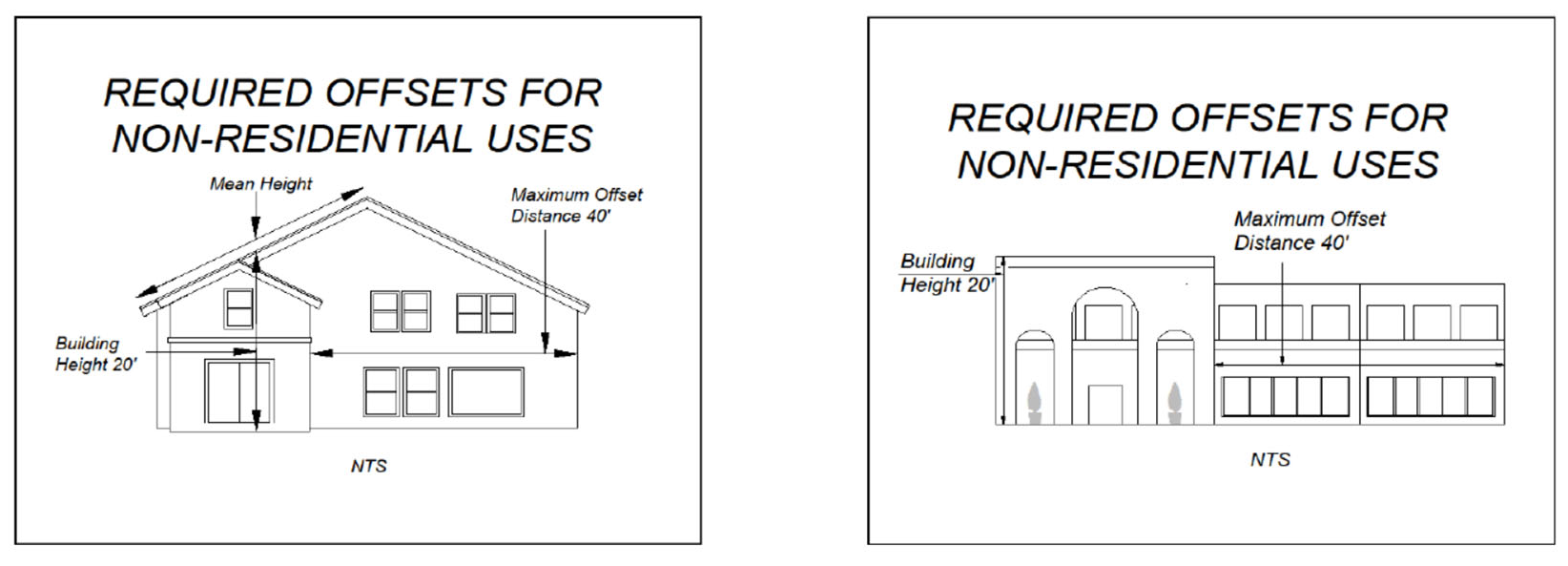
2)
The height of any particular façade shall be measured from the average ground level to the mean height level between the eaves and ridge of a gable, hip or gambrel roof, or for flat roofs, to the top of the parapet.
3)
The depth or projection of the offset shall be 1/10th the length of the longest adjacent wall panel; provided, however, the minimum offset depth shall be one foot. By means of illustration, a building with a 20-foot wall panel shall have a two-foot offset adjacent to such wall panel.
4)
Each façade of a building visible from a street or common space shall comply with the offset requirements contained herein.
b)
Scale, buildings containing only residential uses. The following requirements apply to any building containing only residential uses:
1)
The distance between required offsets shall be related to the height of the building on a one-to-one basis; provided, however, no wall shall exceed 30 feet in length without an offset. A building façade which is less than or equal to the height of the building shall not require an offset. Provided, however, the provisions of this paragraph shall not be construed to require an offset for that portion of a façade containing a two-car garage.
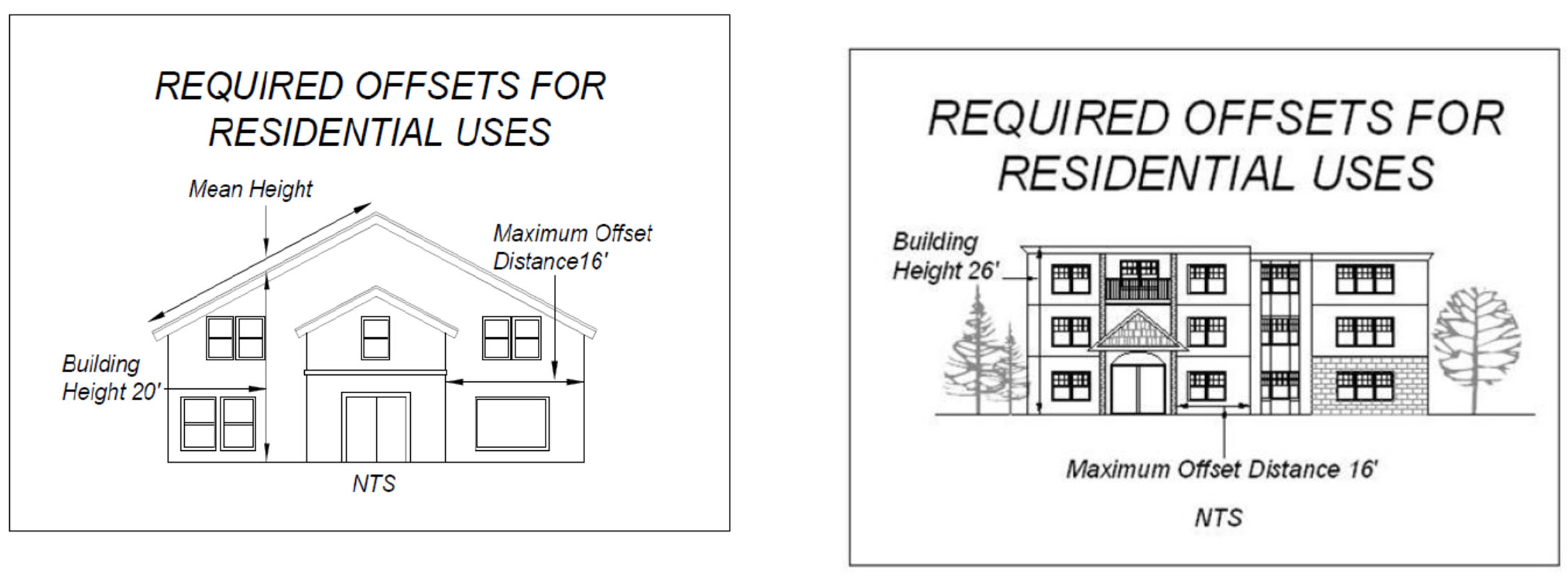
2)
The height of any particular façade shall be measured from the average ground level to the mean height level between the eaves and ridge of a gable, hip or gambrel roof, or, for flat roofs, to the top of the parapet.
3)
Offsets shall have a minimum depth or projection of two feet regardless of the length of adjacent wall façades.
4)
Each façade of a building visible from a street or common space shall comply with the offset requirements contained herein.
5-27-4.1.9 Streets and sidewalks. Streets and sidewalks shall comply with the circulation and access requirements contained in section 5-27-5 and section 18-6-4.6, below.
5-27-4.1.10 Building materials. NOTE: This section is not required for one-, two-, three-, and four-family dwellings, property owners/developers may voluntarily consent to these standards per G.S. 160D-702(b).
Building materials shall be used consistently on the exterior of the building and shall comply with the lists of prohibited materials contained herein.
Prohibited building materials. Unless authorized through alternative design compliance, the following building materials shall be prohibited within the CHMU Commercial Highway Mixed Use Zoning District Classification: plain concrete block (with or without paint); corrugated or ribbed metal siding; reflective glass; more than 50 percent glass on any façade; roll roofing; roll siding; plain unfinished concrete (painting does not constitute a finish); unpainted metal; exposed plain pipe columns; metal wall siding; vinyl siding and any other materials not customarily used in conventional construction.
5-27-4.2 General standards for residential developments. NOTE: This section is not required for one-, two-, three-, and four-family dwellings, property owners/developers may voluntarily consent to these standards per G.S. 160D-702(b).
The following standards shall apply to developments containing only residential uses with the exception that multi-family buildings must comply with the general standards contained in section 5-27-4.3, below.
5-27-4.2.1 General appearance. NOTE: This section is not required for one-, two-, three-, and four-family dwellings, property owners/developers may voluntarily consent to these standards per G.S. 160D-702(b).
Residential development shall contain a variation of façades and materials so that there shall not be a row or strip housing appearance. Means to accomplish this goal may include the use of dormers, gables, recessed entries, covered porch entries, bay windows, cupolas or towers, and a variation in the depth and height of walls, among others.
5-27-4.2.2 Architectural. NOTE: This section is not required for one-, two-, three-, and four-family dwellings, property owners/developers may voluntarily consent to these standards per G.S. 160D-702(b).
a)
Useable porches and/or stoops, at least eight feet in width, shall be located on the front and/or side of the home.
b)
Front-loading garages and carports shall be offset from the front façade of the house and visually designed to form a secondary building volume. Developers are encouraged to turn garages and carports so the openings or doors are not visible from the street. At no time shall the width of an attached garage exceed 50 percent of the total building façade.
c)
Accessory buildings with a floor area greater than 150 square feet shall be clad in materials similar in appearance to the principal structure.
d)
Walls and fences located in the front yard shall be decorative and limited in height to no more than four feet above grade. Front-yard walls shall be of brick, stone or stucco. Front yard fences shall be wood, wrought iron or materials similar in appearance and durability. Side and rear yard fences may be chain link, wood, wrought iron, or similar material.
5-27-4.2.3 Configurations. NOTE: This section is not required for one-, two-, three-, and four-family dwellings, property owners/developers may voluntarily consent to these standards per G.S. 160D-702(b).
a)
Main roofs on residential buildings shall be gables, hips or clerestory with a pitch between 5:12 and 12:12. Monopitch (shed) roofs are allowed only if they are attached to a wall of the main building.
b)
Foundation walls (except those under porches) shall be finished with brick, stucco or stone. If crawlspaces of porches are enclosed, they shall be enclosed with brick, stone, and lattice or any combination thereof.
5-27-4.3 General standards for nonresidential and multi-family buildings. The following standards shall apply to all buildings containing nonresidential uses and multi-family dwellings:
5-27-4.3.1 Storage, utility & service areas. Areas devoted to storage, garbage, recycling collection and utilities shall be enclosed and screened around their perimeter, and constructed of materials consistent with the principal building. Gas meters, electric meters, ground-mounted mechanical units, and any other similar structures shall be hidden from public view or screened with approved construction materials. Fences designed for screening shall be constructed of brick, stone, architectural stucco, concrete, wood or iron. Roof vents, mechanical units, utility equipment and telecommunication receiving devices located on the roof shall be screened from view. Solar technology components including solar panels and solar thermal collectors are exempt from this provision.
5-27-4.3.2 Parking and vehicular access. All vehicular use areas shall be set back a minimum of 20 feet from the right-of-way line of public right-of-way and shall be screened from view from such rights-of-way in accordance with article XV, below.
5-27-4.3.3 Encroachments. Balconies, stoops, chimneys and bay windows are permitted to encroach into any setback up to five feet.
5-27-4.3.4 Roofs. Parapets and decorative cornices are required for buildings with a flat roof. Eaves shall be provided with a pitched roof.
5-27-4.4 Specific standards for single-family and two-family detached dwellings.
5-27-4.5 Specific standards for townhouses. The townhouse is a building with two or more residential units that are located side-by-side. When an entrance is provided at-grade, the townhouse may be used as a live-work unit.
5-27-4.6 Specific standards for multi-family dwellings. Multi-family dwelling consists of three or more dwelling units vertically and/or horizontally arranged. The ground floor may be available for commercial uses.
5-27-4.7 Specific standards for commercial and institutional buildings. Commercial buildings are structures which can accommodate a variety of uses mixed either horizontally (shopping center) or vertically (dwelling unit over a store). Office buildings, hotels and inns can be placed in commercial buildings. Buildings containing both commercial and residential uses shall be classified as commercial buildings for the purposes of this section. Institutional buildings are specialized public or semi-public buildings intended to serve as public gathering places. Such uses include governmental offices, churches or other places of worship, schools, hospitals, post offices, and nonprofit or charitable clubs and organizations. Note there are exceptions from the maximum height restrictions for steeples, cupolas and similar structures. These are contained in section 8-2, below.
5-27-5 - Transportation.
The section is intended to put in place regulations which will provide for a multi-modal transportation environment conducive to a pedestrian-friendly mixed-use community.
5-27-5.1 Pedestrian accommodations. Pedestrian accommodations, which may be sidewalks, multi-purpose paths, or other approved alternatives, shall be provided as a part of a development on each side of all public roadways and of all private roadways which the development directly abuts unless site constraints or proposed uses make it impractical or unnecessary. Pedestrian access and circulation shall be consistent with any and all adopted corridor circulation plans.
5-27-5.2 Vehicular access. It is the intent of these regulations to create interconnectivity between development parcels in order to provide alternative transportation routes to existing thoroughfares. Accordingly, when development parcels have potential to provide access between major arterial roadways and adjoining parcels, developers are encouraged to utilize public streets, rather than private streets or driveways. The regulations contained in this section shall apply to all new development and redevelopment within the district.
5-27-5.2.1 Driveways. Where permitted, driveways shall comply with the requirements of this section and, if applicable, the regulations of the North Carolina Department of Transportation.
a)
The number of driveways permitted for new development shall relate to the amount of linear frontage for the proposed development as depicted below:
1 With approval of the city after demonstration of need in the required TIA.
b)
All driveway approaches for both mid-block and corner lots along major thoroughfares shall have both minimum corner and side clearances as below:
2 Corner clearance shall be measured from the point of tangency of the radius curvature of the intersection streets.
3 Side clearance shall represent the distance from the driveway to the side property line.
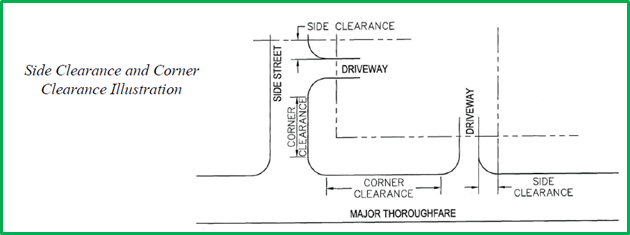
c)
No driveways shall be allowed along a major thoroughfare within 250 feet of any intersection, as measured from the intersection of the projected right-of-way lines, except for properties which cannot meet this restriction due to limited frontage within the desired corner clearance.
d)
One-way driveways are not considered full-movement driveways therefore, two, one-way driveways may be considered as a single driveway provided that:
1)
The minimum spacing between the two driveway segments is 60 feet.
2)
The driveway segments are clearly signed and marked as one-way driveways, using pavement arrows and directional signs.
3)
The maximum combined pavement width of both driveway segments at the right-of-way line is 40 feet and the minimum width of a single segment is 14 feet.
5-27-5.2.2 Outparcels. Access to development outparcels shall be oriented to the interior of the development site, not to the roadway.
5-27-5.2.3 Cross-access easements. Cross-access easements between parking areas on adjacent developments are an effective way to improve corridor circulation and to reduce vehicle trips. For each adjoining property with accessible parking areas, applicants for development authorization shall provide either (1) a cross-access easement or (2) confirmation that the applicant has attempted to negotiate a cross-access easement with that property owner and has not been able to reach agreement thereon.
5-27-5.2.4 Connectivity. In an effort to improve and promote overall street connectivity, public streets and private drives constructed within the CHMU zoning district shall provide connections to existing adjacent public streets and adjacent parcels. Primary access from major arterials should be provided by public streets.
When no off-site stub-outs are present, the following connections shall be provided to adjacent properties at the appropriate rate indicated below.
a)
All new development with fewer than 100 dwelling units are required to provide at least one stub-out to extend and connect with future streets or drives. In the event that adjacent land is already developed with stub-outs present, the developer shall connect to the existing stub-out(s).
b)
Residential developments containing 100 or more dwelling units shall include street connections or stub-outs at a ratio of one stub-out/connection per 100 dwelling units. In the event adjacent land is already developed with stub-outs present, the developer shall connect to the existing stub-out(s). Required collector street connections are included in this calculation.
c)
Non-residential developments shall provide one stub-out to each adjoining parcel where, considering topography, land use compatibility and future development or redevelopment potential, it is deemed feasible and appropriate.
5-27-6 - CHMUCZD Commercial Highway Mixed Use Conditional Zoning District Classification.
The purpose, requirements and standards of this classification are identical to the CHMU Commercial Highway Mixed Use Zoning District Classification except that a rezoning to CHMU Conditional Zoning District as provided for in article VII herein, is required as a prerequisite to any use or development. The following uses shall be permitted in the CHMU Commercial Highway Mixed Use Conditional Zoning District Classification upon rezoning to CHMUCZD, regardless of the square footage or number of residential units for the use:
Telecommunications towers, subject to supplementary standards contained in section 16-4, below.
Permitted uses for the CHMU Commercial Highway Mixed Use Zoning District Classification as specified in section 5-27-1, above.
Special uses for the CHMU Commercial Highway Mixed Use Zoning District Classification as specified in section 5-27-1, above.
(Ord. No. 21-44, 9-22-21; Ord. No. 22-11, 2-10-22; Ord. No. 22-22, 5-5-22; Ord. No. O-23-58, 10-5-23; Ord. No. O-23-61, 10-5-23; Ord. No. O-25-49, 9-4-25)

