


Hendersonville City Zoning Code
17-3-4
Stream buffer protection measures.
To prevent adverse impacts to required stream buffer areas and to assure the stream buffer remains undisturbed and protected during and after land disturbing activities and development, adequate protections shall be in place prior to and after land disturbing activities and development commences.
a)
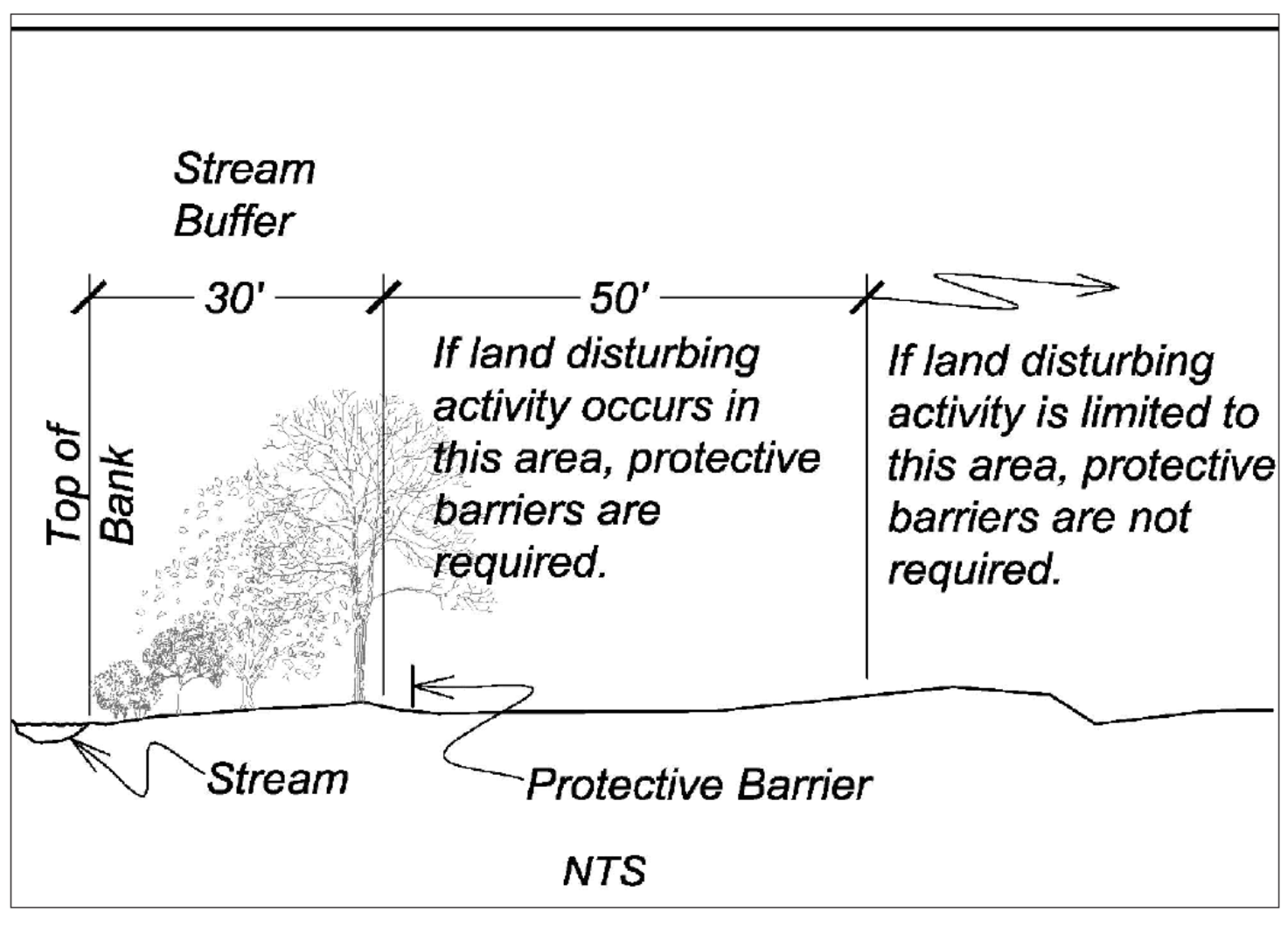
When land disturbing activity or development is to take place within 50 feet of the outside edge of the stream buffer, temporary stream buffer protective barriers shall be in place prior to the land disturbing activity or development work commencing.
b)
Prior to commencing any land disturbing activity or development on a site, the planning director or the director's designee shall inspect and approve the installation of stream buffer protective barriers.
c)
Stream buffer protective barriers shall consist of:
1)
A fence which is at least three feet high and constructed in a post and rail configuration, using two-by-four posts and one-by-four rails;
2)
A fence with two-by-four posts placed no farther than ten feet apart covered with a four-foot orange polyethylene laminar safety fencing; or
3)
Certain erosion and sedimentation control devices such as silt fencing may also serve as the stream buffer protective barrier.
d)
All contractors shall be made aware of the stream buffer designated for protection. Unless otherwise provided by ordinance, no disturbance shall occur within the stream buffer, including the following:
1)
Clear-cutting of trees and other vegetation;
2)
Selective cutting of trees and/or the clearing of other vegetation;
3)
Removal or disturbance of existing vegetation;
4)
Grading;
5)
Filling;
6)
Storage, parking or operating motorized vehicles;
7)
Storage of debris or materials, including topsoil;
8)
Use, storage or application of herbicides and/or pesticides;
9)
Draining the stream buffer area by ditching, underdrains or other systems.
e)
Stream buffer protective barriers shall be maintained throughout the developer's activities.
f)
For planned developments and commercial uses, permanent boundary markers, in the form of signage approved by the planning department, shall be installed once the land disturbing activity or development is complete. Clearly visible stream buffer boundary markers shall be placed along the outside edge of the stream buffer and spaced at a maximum every 100 feet.
g)
Prior to issuing a certificate of occupancy for planned developments, documentation shall be in place to inform property owners of the stream buffer presence and location along with management and maintenance requirements. Documentation shall be in a form that will run with the property such as inclusion in covenants, conditions and restriction documents or deed reference.