
Hendersonville City Zoning Code
ARTICLE VIII
EXCEPTIONS AND MODIFICATIONS
Compliance with the requirements of this ordinance is mandatory except that under the specific conditions enumerated in the following sections, the requirements may be waived or modified as so stated.
8-1-1. - Exception to front yard setbacks.
The minimum required front yard requirements of this ordinance for dwellings shall not apply on any lot where the average front yard of existing buildings located wholly or in part within 350 feet on each side of such lot within the same block and zoning district and fronting on the same side of the street is less than the minimum required front yard. In such cases, front yard on such lot may be less than the required front yard, but not less than the average of the front yards of the aforementioned existing buildings.
8-1-2. - Exceptions to other setback regulations.
The following features shall not be subject to the required minimum setbacks:
Bridges
Doghouses
Driveways, walks and parking areas
Fences and walls not exceeding nine feet in height
Landscape features such as entrance piers, columns, gates, planters and gardens
Mobile food vendors
Playhouses, not exceeding 64 square feet in floor area
Required building entry ramps
Retaining walls
Stormwater management facilities such as head walls and culverts
The outermost five feet of any porches, steps, eaves, gutters and similar fixtures on the front of a structure
The outermost three feet of any uncovered porches, steps, eaves, gutters and similar fixtures on the side and/or rear of a structure
(Ord. No. O-23-57, 10-5-23; Ord. No. 23-60, 10-5-23; Ord. No. O-25-26, 5-1-25)
Sec. 8-2. - Height limitations.
The following structures may exceed the height limitations contained in article V of this ordinance by no more than 20 percent of that specified for any zoning district classification: church spires, belfries, cupolas and domes not intended for human occupancy; monuments, water towers, observation towers, chimneys, smokestacks, conveyors, flag poles, masts and similar structures, except as otherwise restricted in the vicinity of airports or elsewhere in this ordinance.
Sec. 8-3. - Temporary use permits for manufactured/mobile homes and recreational vehicles.
a)
Manufactured/mobile homes. No more than one manufactured/mobile home may be permitted in the rear yard of a residential dwelling on a platted lot as an accessory structure, provided, the manufactured/mobile home shall meet the principal structure setback requirements for the district in which it is located. Such use shall be temporary and shall be based on a finding by board of adjustment that a personal hardship situation exists (such as the need to care for elderly parents or other dependents) which justifies a special exception of this nature. Temporary use permit shall be issued in such cases for one year, and may be renewed by the zoning administrator so long as the approved hardship continues to exist.
All such manufactured/mobile homes situated in rear yards must have access to city water and sewer service or individual systems approved in writing by the county health officer and such manufactured/mobile homes must be maintained in such a way as to create no nuisance conditions. Furthermore, if any such manufactured/mobile home must be situated closer to the side or rear yard line than the required setback for the district involved, a variance must be obtained from the board of adjustment.
b)
Recreational vehicle.
(1)
The zoning administrator may issue a temporary use permit for recreation vehicles to be used and maintained as a temporary shelter or office located on a construction site during the actual period of construction on such site; provided, however, that the vehicles shall be removed therefrom within 72 hours next following completion of the construction processes. The recreational vehicle must be maintained in such a way as to not create a nuisance. The temporary use permit shall specify the placement of the recreational vehicle on the property on which it is located with regards to front, rear, or side yard, and setbacks.
(2)
During a mayoral declared state of emergency for the City of Hendersonville, the zoning administrator may issue a temporary use permit for a particular tract of land to allow the placement of a recreational vehicle in any zoning district for up to 180 days. Extensions for hardship may be granted by the zoning board of adjustment. The recreational vehicle must be maintained in such a way as to not create a nuisance. The temporary use permit shall specify the placement of the recreational vehicle on the property on which it is located with regards to front, rear, or side yard, and setbacks.
(Ord. No. O-25-11, 2-12-25)
8-4-1. - Purpose.
The purpose of this section is to provide greater flexibility in the development of housing units and use of available land by allowing small footprint housing on small lots and reduced pole flag lots to encourage residential infill development, provide missing middle housing, and allow more opportunities for the construction of workforce housing, all within parameters that will preserve the identity and character of the community.
8-4-2. - Applicability.
In applicable zoning districts (reference article V, zoning district classifications for applicable zoning districts), reduced pole flag lots or small lots or a combination thereof can be applied to any lot of record two acres in size or less. Residential uses shall be allowed subject to the applicable zoning district's permitted uses.
8-4-3. - Dimensional requirements.
* Accessory dwelling unit (ADU) conversions to fee-simple lots shall install independent water and sewer connections for the unit.
** 1,200 SF GFA may be allocated to one dwelling unit or split over one to three units (i.e., ADU, single-family, or two-family). Accessory dwelling units on a small lot or flag lot shall remain subject to the requirements of section 16-4-1.
NOTE: Any plat created for this option shall require a note stipulating a maximum home size of 1,200 SF GFA.
*** City of Hendersonville Code of Ordinances, chapter 22, fire prevention and protection, section 22-6, access requirements for fire apparatus.
# See article XII for definition of "flag" and "pole".
NOTE: This section contains zoning requirements only. Compliance with zoning requirements does not guarantee compliance with private restrictions. Developers are encouraged to consult with an attorney concerning private restrictions.
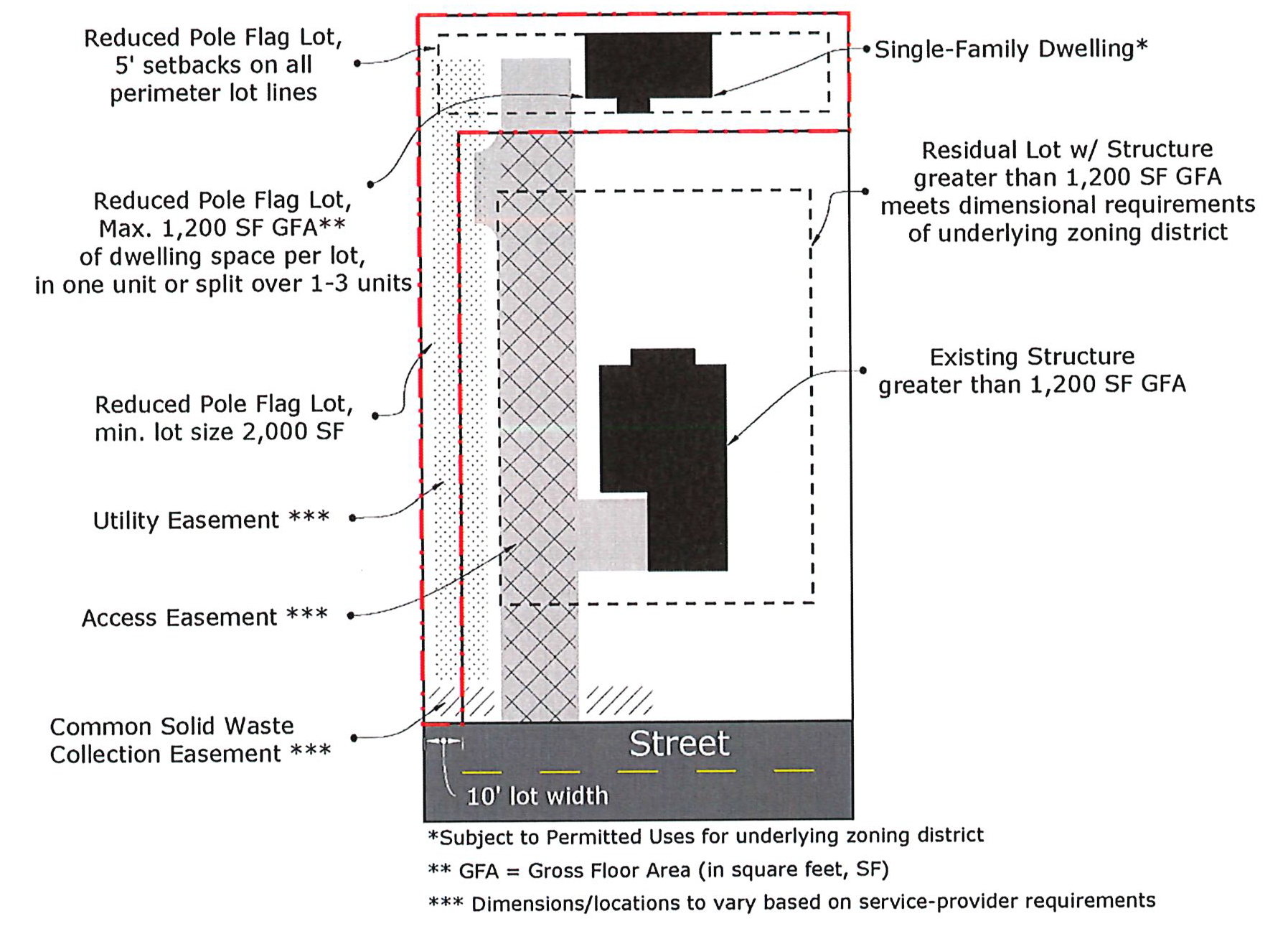
Figure 1: Reduced Pole Flag Lot
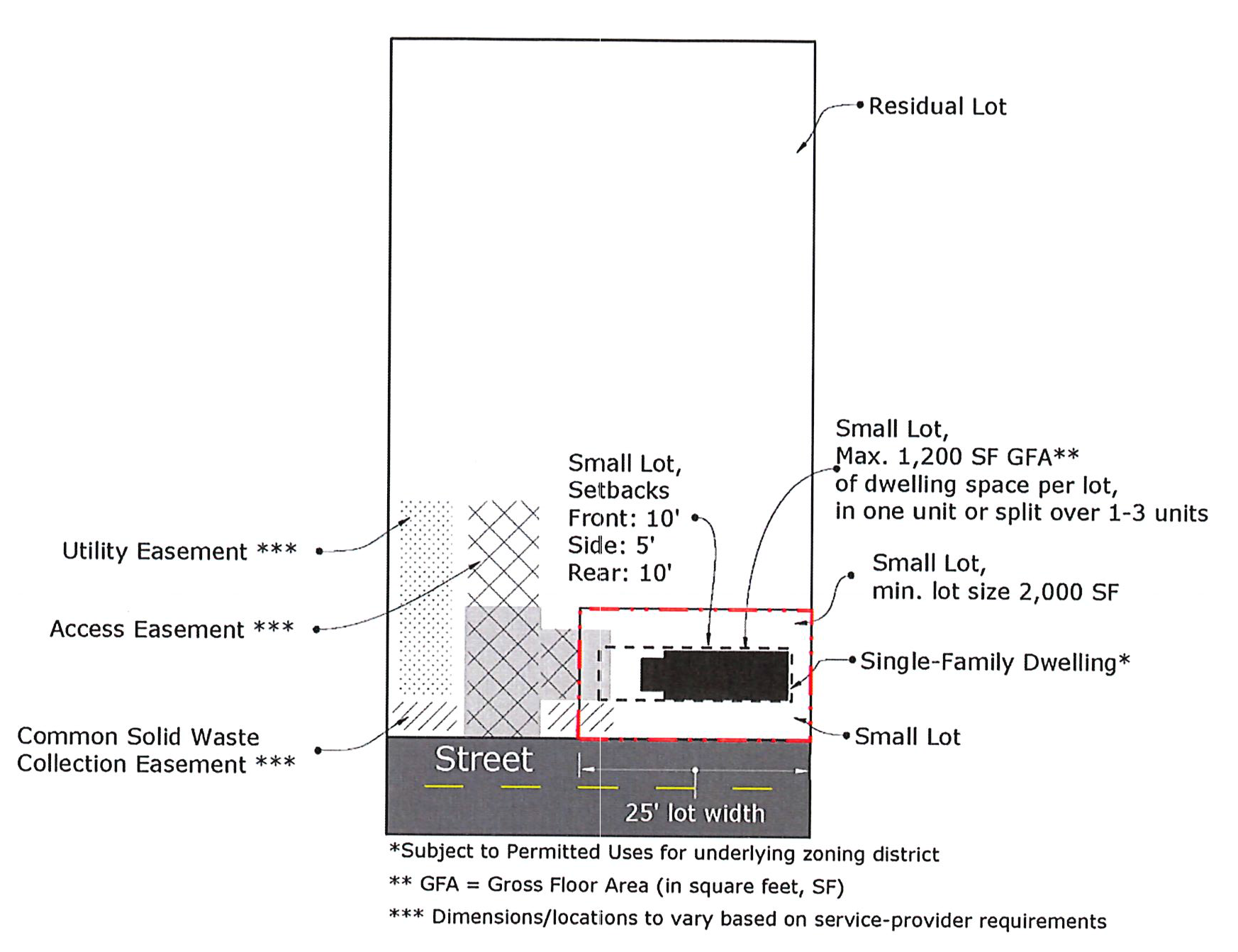
Figure 2: Small Lot
8-4-4. - Access and frontage improvements.
a)
Driveways, utilities and accessways may be placed within the "pole" or an alternate site location via "access" and/or "utility" easements.
b)
Shared driveways:
Use of a shared driveway to serve one reduced pole flag lot and one or more adjoining small lots, residual lots, or conventional lots is permitted. When using a shared driveway, placing the driveway within the pole(s) is encouraged but not required. (ref. Figures 1 and 2)
Where the poles of two or more reduced flag pole lots adjoin, use of a shared driveway to serve the reduced pole flag lots is required. The shared driveway must be located within the adjoining pole(s) (ref. Figure 3).
Shared driveways must meet the following standards:
i.
The shared driveway must have a minimum of unobstructed width of ten feet,
ii.
The shared driveway must be shown on the recorded plat, and
iii.
The shared driveway must be memorialized in a recorded* access easement containing provisions for the maintenance of the shared driveway. If utility infrastructure (e.g., water, sewer, electric, etc.) is located within a shared driveway, the recorded access easement shall also allow access within the easement for repair, maintenance and placement of the utility infrastructure.
*Recorded in the Henderson County Register of Deeds Office
c)
Utility easements:
Where utility service lines and/or equipment serving a reduced pole flag lot, small lot or residual lot are located on or cross another lot, a shared utility easement is required. Shared utility easements may be placed on "pole" and other alternative site locations including within a shared driveway. Shared utility easements must meet the following standards:
i.
The shared utility easement must have a minimum of width of ten feet,
ii.
The shared utility easement must be shown on the recorded plat, and
iii.
The shared utility must be memorialized in a recorded* easement and must contain provisions allowing the repair, maintenance and placement of utility infrastructure, and access for the foregoing purposes.
*Recorded in the Henderson County Register of Deeds Office
Utility meters and associated infrastructure shall be located according to service-provider requirements.
(Please see chapter 52 of the Hendersonville Code of Ordinances for additional requirements.)
d)
Solid waste collection easements:
Appropriately-sized "common solid waste collection easements" are required for the orderly placement of, and access to, solid waste containers and bulk item/brush collection. These easements shall be sized according to container dimensions and the number of containers serving the development along with sufficient space to meet brush collection standards. These easements shall be located in accordance with best practices and avoid being placed on/near/under water meters, sewer cleanouts, power lines, guy wires, fire hydrants, etc., and shall comply with any additional locational or sizing standards contained within chapter 44 of the Hendersonville Code of Ordinances.
Solid waste collection easements must be shown and identified as a "common solid waste collection easement" on the plat and shall require review and approval from planning staff and the city public works director.
e)
Sidewalks (section 6-12) and street trees (section 15-15) shall apply to all reduced pole flag lot developments and small lot developments.
8-4-5. - Reduced pole flag lot developments.
In all reduced pole flag lot developments or small lot developments containing more than one reduced flag pole lot, the following provisions shall apply:
a)
Each lot within the development shall have at least ten feet of street frontage. The pole of a reduced pole flag lot may serve as the street frontage.
b)
A shared driveway shall be used as the sole access to reduced pole flag lots whose poles are adjacent.
c)
Reduced pole flag lot developments and/or small lot developments consisting of two or more lots, shall not abut another reduced pole flag lot development or small lot development consisting of two or more lots.
8-4-6 - Landscaping.
In addition to required street trees, at least one large maturing and one small maturing tree shall be planted or preserved on the lot.
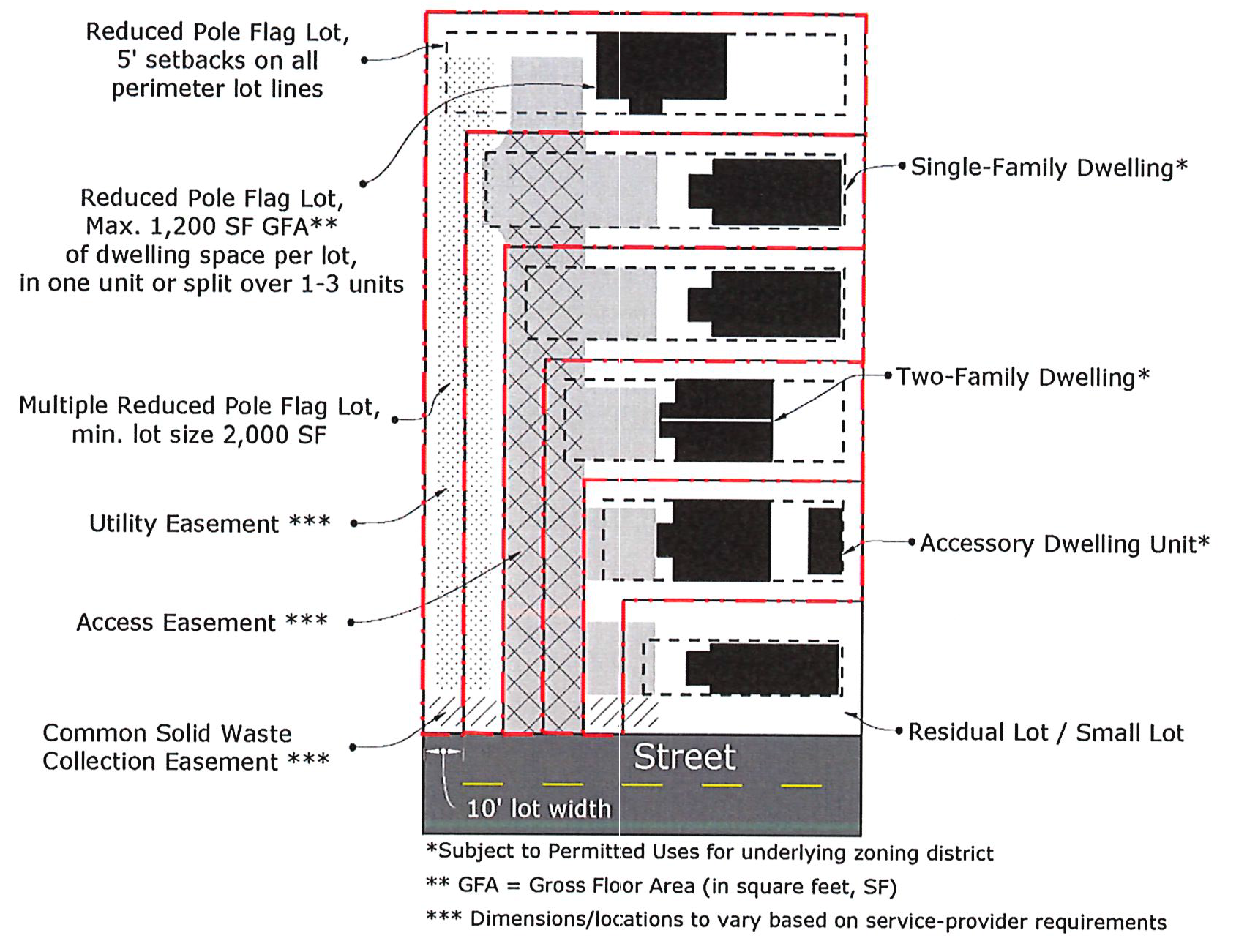
Figure 3: Reduced Pole Flag Lot Development + Small Lot
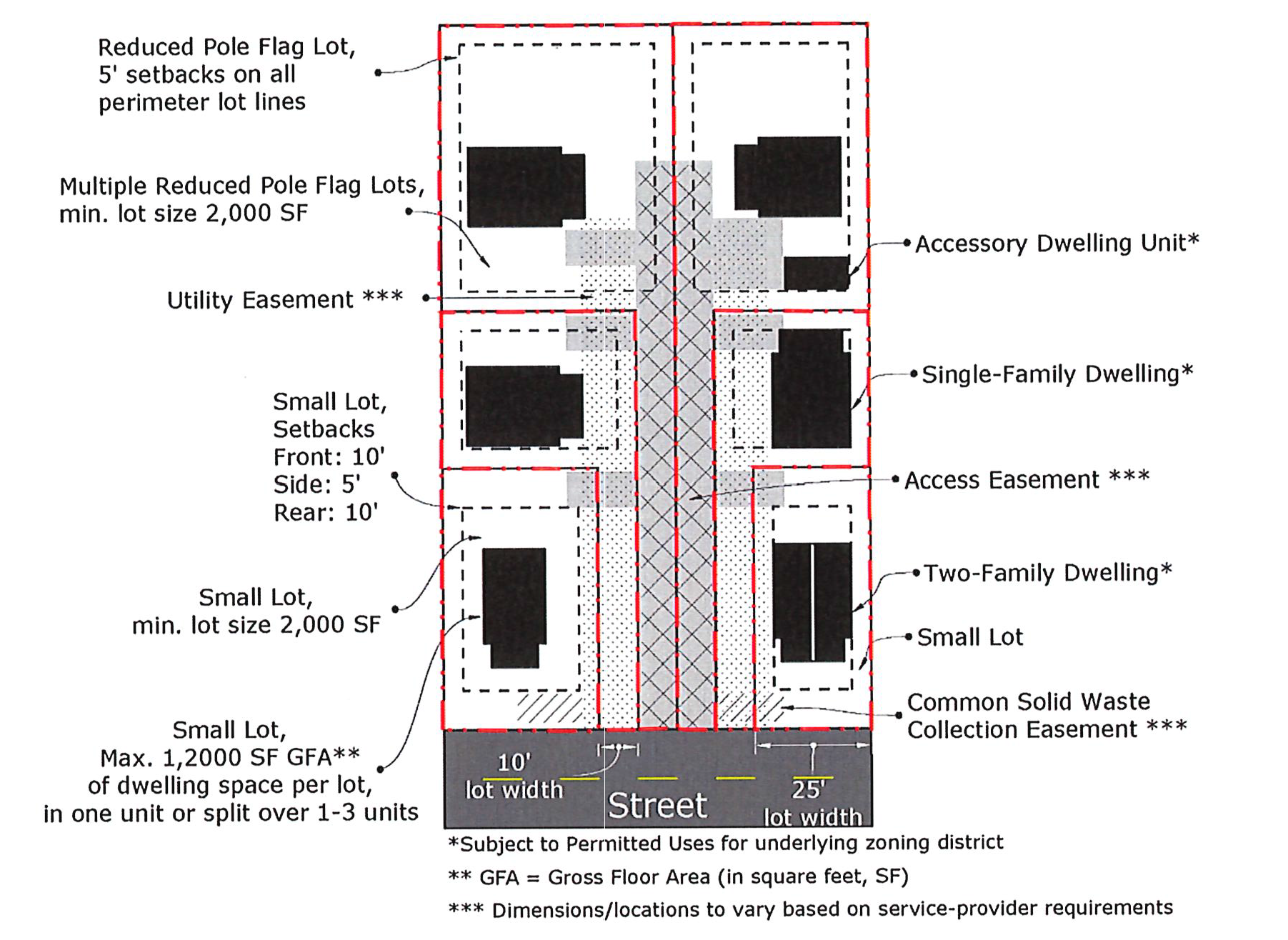
Figure 4: Small Lot combined with Reduced Pole Flag Lot Development, six (6) lot maximum
(Ord. No. 25-17, § 2, 4-3-25)

