
Hilliard City Zoning Code
CHAPTER 1113
INDUSTRIAL DISTRICTS10
Cross reference— Conditional use requirements, Ch. 1123; landscaping and lighting requirements, Ch. 1125; off-street parking and loading, Ch. 1127; signs see P. & Z. Ch. 1129; site plan review requirements, Ch. 1131.
1113.01 - PURPOSE.
(a)
"M-1," Restricted Industrial District. The M-1 District is established for light industries such as light manufacturing or processing of previously refined materials and other industrial uses that have little or no adverse impact upon neighboring districts. This district also allows certain commercial uses of an industrial character or that are necessary to provide services to employees within the district.
(b)
"M-2," General Industrial District. The M-2 District is established to accommodate industrial uses that are primarily of a manufacturing, assembly and fabricating character. These tend to be large scale or specialized industrial operations more likely to produce external physical effects potentially impacting, to some degree, adjoining districts. This district is intended to be located in areas where the allowed uses can most efficiently utilize major roadways, utilities and other infrastructure, while minimizing potentially incompatible influences upon neighboring districts.
(Ord. 14-29. Passed 10-27-14.)
1113.02 - SCHEDULE OF USES.
Buildings or land shall not be used and buildings shall not be erected, except for the following specified uses, unless otherwise provided for in this code. Land and/or buildings in the districts indicated at the top of Table 1113-2 may be used for the purposes denoted by the following abbreviations:
(a)
Permitted Use (P). Land and/or buildings in this district may be used by right.
(b)
Conditional Use (C). Land and/or buildings in this district may be used if approval is granted, based on compliance with applicable review standards and specific conditions that may additionally apply, as found in Chapter 1123.
(c)
Specific Conditions. Indicates requirements or conditions applicable to conditional uses, as listed in Chapter 1123, Conditional Uses.
(Ord. 14-29. Passed 10-27-14; Ord. No. 20-12, § 2(Exh. A), 4-27-20; Ord. No. 20-36, § 2(Exh. A), 11-23-20; Ord. No. 21-33, § 1(Exh. A), 11-8-21.)
1113.03 - SPATIAL REQUIREMENTS.
(a)
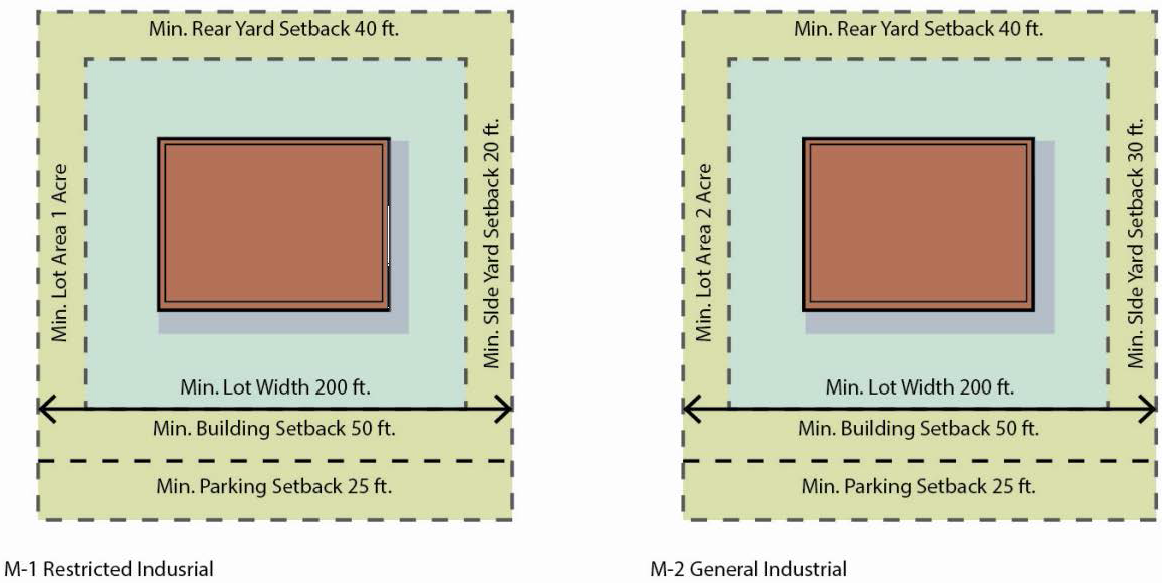
All lots and buildings shall meet the minimum area and width requirements of Table 1113-3. New lots shall not be created, except in conformance with these requirements.
(b)
All structures and their placement on a lot shall conform to the minimum dimensional requirements listed in Table 1113-3a.
1 This setback requirement shall also apply to quarries and other similar commercial excavation sites.
1113.04 - SITE DEVELOPMENT REGULATIONS.
In addition to the requirements of this article, all development in the industrial districts shall meet the applicable requirements as listed elsewhere in this ordinance:
(a)
Special Purpose District Requirements, see Chapter 1115.
(b)
General Provisions, see Chapter 1121.
(c)
Conditional Use Requirements, see Chapter 1123.
(d)
Landscaping and Lighting Requirements, see Chapter 1125.
(e)
Off-Street Parking and Loading, see Chapter 1127.
(f)
Signs, see Chapter 1129.
(g)
Site Plan Review Requirements, see Chapter 1131.
(Ord. 14-29. Passed 10-27-14.)

