
Hilliard City Zoning Code
CHAPTER 1105
DEFINITIONS4
Cross reference— Definitions generally, § 101.02; Housing Code definitions, § 1317.02.
1105.01 - INTERPRETATION.
For the purpose of this Zoning Code the following definitions shall apply unless the context clearly indicates or requires a different meaning. Words used in the code shall have their customary meaning, unless specifically defined here.
(Ord. 14-29. Passed 10-27-14.)
1105.02 - DEFINITIONS: A-B.
Accessory building or structure. A detached subordinate structure or building, the use of which is incidental to, customarily associated with, and related to the principal structure or building or use of the land and which is located on the same lot as the principal structure or use.
Accessory use. A use incidental to, and on the same lot as, a principal use.
Addition. Any construction which increases the size of a building or facility in terms of site coverage, height, length, width or gross floor area, such as a porch, attached garage or carport, or a new room or wing.
Agribusiness. A business and/or commercial use operated primarily for the support of agricultural needs. It may consist of products, materials, and equipment servicing and sales; storage and/or processing of agricultural products and/or animals (but not including slaughtering, rendering or tanning); veterinarian and/or technical support facilities.
Agriculture. Farming, dairying, pasturage, agriculture, horticulture, viticulture, animal and poultry husbandry, and the limited processing and sale of agricultural products from land under one ownership.
Alley. A public right-of-way thirty feet or less in width, but not less than twelve feet, which affords only secondary means of access to abutting property.
Alterations, structural. Any change in the supporting members of a building, such as walls, floors, columns, beams or girders.
Attic. That part of a building that is immediately below and wholly or partly within the roof framing.
Awning. A roof-like structure, generally made of canvas or plastic, mounted above a storefront, window or door and projects from the building wall as an architectural detail and provides shelter from sun and rain.
Bar. A lounge, tavern, beer parlor, night club or similar establishment principally operated for the sale of alcoholic beverages to be served on the premises.
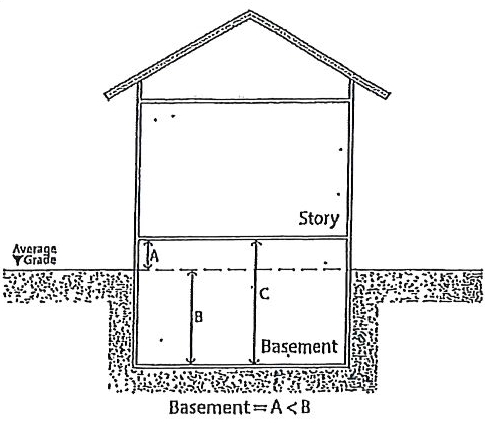
Basement. A story, all or partly underground, having at least one-half of its height below the average level of the adjoining ground with a floor-to-ceiling height of not less than six and a half feet.
Bed and breakfast inn. A house, or portion thereof, where short-term lodging rooms and breakfast and light snacks are provided and where the operator lives on the premises or in adjacent premises.
Berm. A mound of earth or the act of pushing earth into a mound. (New)
Bicycle Fitting Studio. A facility in which a system using a computer scanner and/or software and a riding platform to accurately measure individual bicycle fit needs to optimize cycling performance.
Block. A piece or parcel of land entirely surrounded by public highways, public streets, railroad rights-of-way, parks, streams, lakes or bodies of water, or a combination of these bounds.
Board. The Board of Zoning Appeals of the City.
Brew pubs. A restaurant, bar, or similar establishment which serves 25% or more of its beer which is produced on-site.
Brewery. An establishment or building that brews beer or other malt liquors on-site, which will be sold commercially.
Buffer. A strip of land which provides visual separation and aesthetic relief between potentially incompatible uses through some combination of screen and greenbelt.
Building. Any structure other than a boundary wall, fence, trellis, pergola or carport, which has a roof and walls or column supports and is designed or intended for the enclosure, shelter or protection of persons, animals or property. This definition does not include mobile homes.
Building envelope. The maximum three dimensional volume on a lot within which a structure can be built, as permitted by applicable height and setback requirements.
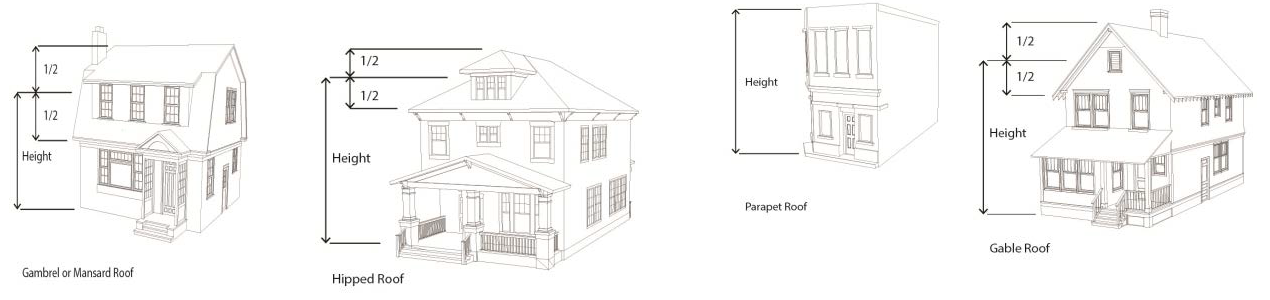
Building, height of. The vertical distance from the average finished grade to the highest point of the coping of a flat and shed roof or to the deck line of a mansard roof or to the mean height level between eaves and ridge for gable, hip and gambrel roofs.
Building, principal. A building in which is conducted the main or principal use of the lot on which the building is situated.
Building Site. The portion of the lot or parcel of land upon which the building and appurtenance are to be placed, or are already existing, including adequate areas for sewage disposal, clearance, proper drainage, and appropriate easements.
Build-To-Zone. An area parallel to the front lot line of a prescribed depth, running the width of the lot, in which the front of a building must be located.
(Ord. 14-29. Passed 10-27-14; Res. 19-R-03. Passed 2-25-19; Ord. No. 20-12, § 2(Exh. A), 4-27-20.)
1105.03 - DEFINITIONS: C-D.
Canopy. A rigid, permanent cover over a walkway, attached to a building (see "awning").
Carport. An accessory structure or portion of a principal structure, consisting of a roof and supporting members such as columns or beams, unenclosed from the ground to the roof on at least two sides and designed or used for the storage of motor vehicles.
Certificate of Compliance. A document issued by the Planning Director certifying that the plans for a proposed use meet all applicable standards and regulation and that the use of the building or land in question is in conformity with this code or that a legal variance has been approved. (New)
Child Day Care. Administering to the needs of infants, toddlers, preschool children and school children outside of school hours by persons other than their parents or guardians, custodians, or relatives by blood, marriage, or adoption, for any part of the 24-hour day in a place or residence other than the child's own home.
Child Day Care Center. Any place in which child day care is provided, with or without compensation, for 13 or more children at one time or any place that is not the permanent residence of the licensee or administrator in which child day care is provided, with or without compensation, for seven to 12 children at one time. In counting children for the purposes of this Zoning Code, any children under six years of age who are related to the licensee, administrator, or employee and who are on the premises of the center shall be counted.
Child Day Care Home, Type A. Providing care for seven to 12 children (or four to 12 children if four children are under two years of age) cared for in the provider's personal residence. The provider's own children under six years of age must be included in the total count. Type A homes must be licensed by the Department of Job and Family Services.
Child Day Care Home, Type B. Providing care for one to six children cared for in the provider's personal residence. No more than three children may be under two years of age. The provider's own children under six years of age must be included in the total count. Anyone can operate a Type B Home without a license. However, care for more than six children requires a license. Type B homes must be certified by the county department of Job and Family Services if the child care is paid for with public funds.
Church. See "Place of worship."
City Engineer. The City Engineer of Hilliard, Ohio.
City Manager. The duly appointed administrative head of the municipal government or his/her designated representative.
Clerk. The City Clerk of Hilliard, Ohio.
Clinic. An establishment where patients are admitted for examination and treatment on an outpatient basis by one or more physicians, dentists, other medical professionals, psychologists or social workers.
Club. A building or portion thereof owned or operated by a group of people organized for a common purpose to pursue common goals, interests, or activities and usually characterized by certain membership qualifications, payment of fees and dues, regular meetings, and a constitution or bylaws.
Cluster housing. A type of housing characterized by higher densities and variation in side yard and setback standards in order to create unique and high amenity private open spaces. Usually a minimum of three homes which are grouped around a courtyard either for pedestrian or vehicular use.
Code. The Zoning Code of the City of Hilliard, Part Eleven of the City of Hilliard, Ohio Code of Ordinances.
Commercial vehicle. Vehicles which are described as:
(a)
Every vehicle except a personal vehicle, noncommercial trailer or a recreational vehicle including, but not limited to:
(1)
Mobile mechanized equipment, such as cranes, bulldozers, trenchers, tractors, compressors and similar equipment used in construction work and not designed for or employed in general highway transportation;
(2)
Tractor cabs used for hauling semi-trailers and the semi-trailers;
(3)
Well drilling, ditch digging machinery and farm machinery;
(4)
Trailers registered with the State of Ohio Bureau of Motor Vehicles as a commercial trailer or weighting in excess of 3,000 pounds;
(5)
Horse trailers and trailers used to transport agricultural animals, produce or other agricultural products; and
(6)
Tractors and other machinery used in the production of horticultural, agricultural and vegetable production.
(b)
Every vehicle with a commercial registration, except a vehicle with a State Bureau of Motor Vehicles weight sticker of 14 or less or if the vehicle is not registered in the State it shall not have a gross vehicle weight in excess of 14,000 pounds.
Code Enforcement Officer. The person assigned by the City Manager to perform the duties and enforcement hereunder in enforcing one or more of the codified ordinances under Part Eleven. Where expressly designated, a Code Enforcement Officer may also be any officer of the Hilliard Division of Police.
Commission. The Planning and Zoning Commission of the City of Hilliard.
Community Development Director. That person designated by the City Manager as its Community Development Director.
Comprehensive Plan. The City of Hilliard Comprehensive Plan, which may be updated from time to time.
Council. The City Council; the legislative authority of the City of Hilliard, Ohio.
County. Franklin County, State of Ohio.
Crosswalk. A right-of-way which cuts across a block to facilitate access to adjacent streets and properties.
Data Center. A data center is a facility used to house computer systems and associated components, such as telecommunications and storage systems.
Developer. Any person, partnership or corporation or duly authorized agent who constructs or contracts to construct improvements on subdivided land.
Districts, zoning. Administrative tracts designating the uses to which land can legally be utilized. Boundaries of the districts are shown on the district map which is part of this Zoning Code.
Drive-in commercial uses. Any commercial use providing considerable off-street parking, and catering primarily to customers within parked vehicles, such as drive-in restaurants, drive-in theaters and similar uses.
Drive-thru facility. An accessory use for a business (such as a bank, restaurant, dry cleaners or pharmacy) where the delivery of customer services is done, usually from within the building via a service window while patrons are in their motor vehicle.
Dwelling:
(a)
Multiple-family. A building or portion of a building containing three or more dwelling units where each unit may have access to a common hallway, stairs, or elevator or where each unit may have individual access to a street or common courtyard.
(b)
Single-family, attached. A building designed for occupancy in a row of at least three dwelling units in which each unit has its own front and rear access to the outside, no unit is located over another unit, and each unit is separated from any other unit by one or more vertical common fire-resistant walls.
(c)
Single-family, detached. A detached building or manufactured home designed for and occupied exclusively by one family.
(d)
Two-family. A building designed for occupancy exclusively by two families, living in separate dwelling units attached to one another by a common wall.
(e)
Zero lot line. A detached single family dwelling designed for and occupied exclusively by one family and containing one blank side wall on or within five feet of a side property line.
Dwelling unit. A permanent building or portion thereof which is designated or used exclusively for residential occupancy containing sleeping, cooking and sanitary facilities.
(Ord. 14-29. Passed 10-27-14; Ord. 15-26. Passed 7-13-15; Ord. 19-31. Passed 12-9-19; Ord. No. 21-09, § 1(Exh. A), 3-22-21; Ord. No. 24-11, § 1(Exh. B), 6-10-24.)
1105.04 - DEFINITIONS: E-F-G.
Easement. The legal right for a person, government, agency or public utility company to use public or private land owned by another for a specific purpose.
Essential services. The erection, construction, alteration, operation or maintenance, by public utilities or municipal or other government agencies, of underground gas, electrical, steam or water transmission or distribution systems, or collection, communication, supply or disposal systems or sites, including poles, wires, mains, drains, sewers, pipes, traffic signals, hydrants or other similar equipment and accessories in connection therewith which are necessary for the furnishing of adequate service by such public utilities or municipal or other governmental agencies or for the public health or safety or general welfare, but not including buildings or wireless service facilities.
Family. A group of individuals not necessarily related by blood, marriage, adoption, or guardianship living together in a dwelling unit as a single housekeeping unit as distinguished from a group occupying a boarding house, short-term rental, dormitory, fraternity, sorority, motel or hotel.
Farm. Any parcel of land containing at least three acres which is used for gain in the raising of agricultural products, livestock, poultry or dairy products, including farm structures within the prescribed limits and the storage of farm equipment. Riding stables, dog kennels, establishments for the raising of fur-bearing animals and retail sales buildings offering products not produced on the premises shall not be considered a farm.
Farm animal. Any domestic species of cattle, sheep, swine, goats, llamas, or horses, which are normally and have historically, been kept and raised on farms and used or intended for use as food or fiber, or for improving animal nutrition, breeding, management, or production efficiency, or for improving the quality of food or fiber. This term also includes animals such as rabbits, mink, and chinchilla, when they are used solely for purposes of meat or fur, and animals such as horses and llamas when used solely as work and pack animals.
Fence. An accessory wall or structure composed of wood, iron, steel, vinyl, shrubbery, hedges or other similar fencing material, as approved by the Enforcement Officer, erected in such a manner and positioned to enclose, or partially enclose, or inhibit the view of any premises or along any part of any premises. Trellises or other structures supporting, or for the purpose of supporting vines, flowers and other vegetation when erected in such position as to enclose any premises or any part of any premises shall be included within the definition of "fence".
(a)
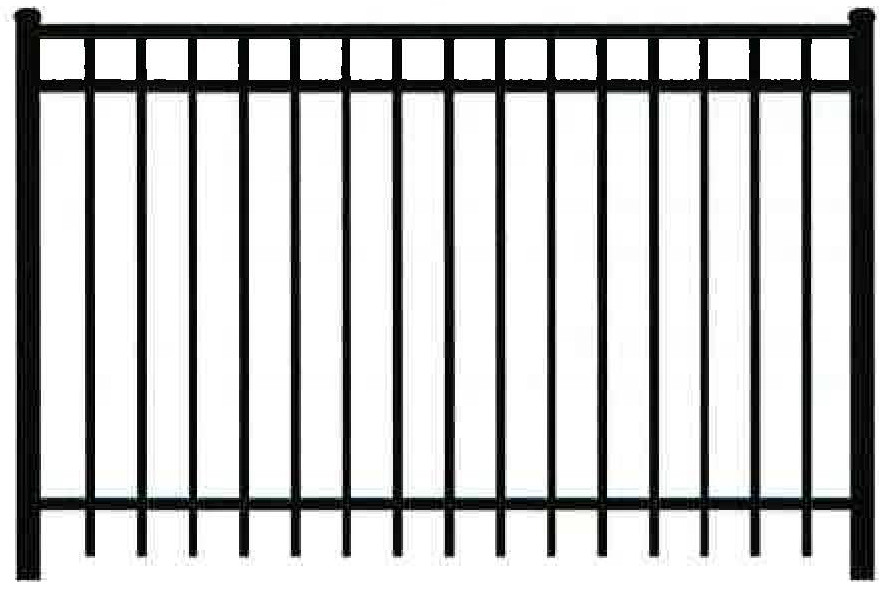
Fence, Aluminum, Wrought Iron Style means an open ornamental fence made of narrow upright aluminum, steel, or iron poles. All fences of this type must have a top rail to prevent exposed posts, similar to the diagram below:
(b)
Fence, Barbed Wire means a fence made with metal wire having sharp points or bars along its length and includes razor or concertina wire.
(c)
Fence, Basket Weave means a fence made of interwoven strips or slats of flexible or semi-flexible material in which the pattern has the appearance of a plaited basket.
(d)
Fence, Chain Link (also referred to as wire netting, wire-mesh fence, chain-wire fence, cyclone fence, hurricane fence, or diamond-mesh fence) is a type of woven fence usually made from galvanized, or LLDPE vinyl-coated, steel wire usually consisting of loops of wire interconnected in a series of joined links.
(e)
Fence, Electric means a fence or structure, in which or attached is any device or object which emits or produces an electric charge, impulse or shock when the same comes into contact with any other object, person, animal or thing which causes or may cause burns. Electric Fence does not include underground devices used to control animals or for security purposes.
(f)
Fence, Invisible means an underground electronic system used to prevent pets from leaving a yard, or is used for security purposes, and may be wireless.
(g)
Fence, Picket means an open ornamental fence made of upright wood or vinyl slats. The width of the wooden or vinyl slats shall not exceed six (6) inches and the spacing between slats (horizontally or vertically) shall not be greater than twice the width of the slat.
(h)
Fence, Post and Board means an open ornamental fence placed horizontally either between upright supporting posts or on the same.
(i)
Fence, Rail or Split Rail means an open ornamental fence constructed of narrow whole or split wood timbers, placed horizontally between supporting posts.
(j)
Fence, Snow Fence means a fence that forces windblown, drifting snow to accumulate in a desire place.
(k)
Fence, Stockade means a privacy fence constructed with a row of large pointed stakes placed upright and against each other.
Final plat. The final map, drawing, or chart on which the subdivider's plan is presented to the City Planning and Zoning Commission for approval and which, if approved, will be submitted to the Recorder of Franklin County.
Floodplain. That portion of a river or creek valley adjacent to the drainage channel which is periodically covered with water when the river or creek overflows its bank during flood stage.
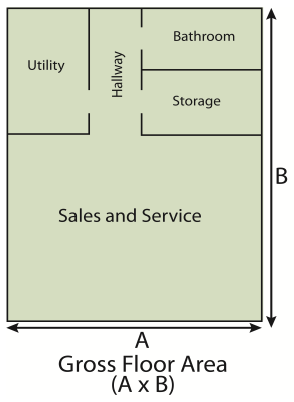
Floor area, gross. The sum of all gross horizontal areas of the several floors of a building or buildings, measured from the outside dimensions of the structure or from the centerline of a wall separating two buildings, but excluding any space where the floor-to-ceiling height is less than six feet.
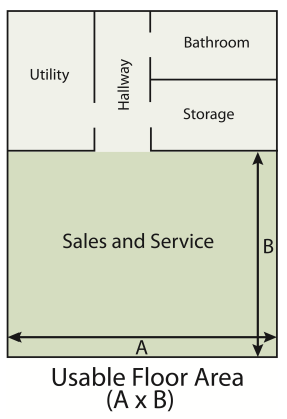
Floor area, usable. That area to be used for the sale of merchandise or services, or for use to serve patrons, clients or customers, measured from the interior faces of the exterior walls. Areas used principally for the storage or processing of merchandise, for hallways, stairways and elevator shafts or for utilities or sanitary facilities shall be excluded from this computation.
Food processing plant. An establishment in which food is processed, canned, packaged or otherwise prepared for eventual consumption but is not consumed on the premises. Examples of activities included large scale plants that process fat and oil products, fruit and vegetables, grain mill products and by-products, meat, seafood and poultry, and other raw products.
Frontage. All of the property on one side of a street between two intersecting streets, measured along the front lot lines or right-or-way line. If the street is a dead-end, the term refers to all property abutting one side between an intersecting street and the end of the street.
Grade, average. The mean or midway point between the highest and lowest elevation of the ground abutting the existing or proposed location of each face of a building, wall or other area being measured. The measurement of average grade may include the following:
(a)
Grade, finished. The final grade of a site after grading, filling or excavating.
(b)
Grade, natural. The grade of a site that exists or existed prior to manmade alterations, such as grading, filling or excavating.
Grocery store. Retail store primarily engaged in selling food and daily needed items.
(Ord. 14-29. Passed 10-27-14; Ord. 15-26. Passed 7-13-15; Res. 19-R-04. Passed 2-25-19; Ord. No. 21-09, § 1(Exh. A), 3-22-21; Ord. No. 21-33, § 1(Exh. A), 11-8-21; Ord. No. 21-44, § 1(Exh. A), 1-10-22.)
1105.05 - DEFINITIONS: H-I-J-K.
Home occupation. An occupation or profession conducted, as an accessory use in a dwelling or a detached accessory building on the same lot as a principal dwelling, by a member or members of the resident family and which is clearly accessory and incidental to the residential use of the lot. Also referred to as a "home-based business."
Hookah Lounge. Any facility or location whose business operation, whether as its primary use or as an ancillary use, is devoted to the on premise smoking of tobacco or any organic or synthetic material, including but not limited to plants, herbs, or tobacco, through one or more pipes (commonly known as a hookah, waterpipe, shisha or narghile). Also referred to as hookah bars, hookah cafes, or hookah parlor.
Hotel/Motel. A building or group of buildings that provides rooms or suites intended primarily as sleeping accommodations for public rental on a daily basis for registered guests. Other supportive facilities may also be included such as, but not limited to, meeting rooms, incidental retail sales, restaurants, lounges, swimming pools, recreational and fitness facilities and similar facilities/services intended principally to serve registered guests.
Hotel, extended stay. A facility specifically constructed, kept, used, maintained, advertised or held out to the public to offer temporary residence to persons either relocating their residence to the area or on temporary work assignment in the area, for a minimum stay within the units in the facility of more than thirty days.
Impervious surface. Any material that substantially reduces or prevents the infiltration of stormwater into previously undeveloped land.
Improved surface. In connection with the parking, storing or keeping of a vehicle, means concrete, asphalt, sub-base, asphalt concrete, brick or such other improved surface of a permanent, dense and compact nature as may be approved by the City Engineer. Aggregate base or similar type of non-compact mixture is not an improved surface.
Improvements. Street improvements, with or without curb or gutter, sidewalks, crosswalks, water mains, sanitary and storm sewers, street, trees and other appropriate items.
Interior parking lot landscaping. The use of landscape islands and landscape material distributed within the boundary of a parking lot.
Interior property landscaping. The use of landscape material within the boundaries of the property, not including the landscape buffer, or perimeter property landscape buffer.
Junk storage and sales. Also known as a salvage operation, any lot, land, structure or part thereof, used primarily for the collection, storage and sale of waste paper, rags, scrap metal or discarded material, or for the collecting, dismantling, storage and salvaging of machinery or vehicles not in operating condition, and for the sale of parts thereof.
(Ord. 14-29. Passed 10-27-14; Ord. 16-17. Passed 5-9-16.)
1105.06 - DEFINITIONS: L-M-N.
Landscaping/landscaped area. Any portion of a parcel of land that includes trees, planting beds, hedges, earth mounds or other material designed and located in a manner complimentary to the overall architecture of the surrounding building and the character of the surrounding neighborhood.
Loading space. An off-street portion of a parcel or lot designated for the temporary parking of commercial vehicles while loading or unloading materials used, sold or made on the premises.
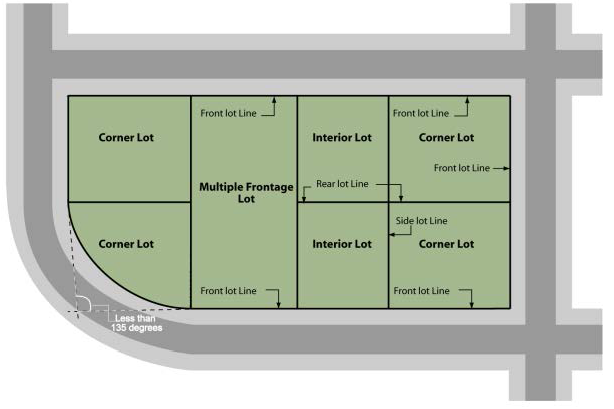
Lot. A legally described and recorded parcel of land occupied, or intended to be occupied by a main building or group of such buildings and accessory buildings, or utilized for the principal use and its accessory uses, together with such yards and open spaces as are required by this code.
(a)
Lot, corner. A lot having contiguous frontage on two intersecting streets if the interior angle at the intersection of the streets is less than 135 degrees. Also, a lot located on a curved street or streets, if tangents of the curve, at the point of beginning with the lot or the points of intersection of the side lot lines with the street line, intersect at an interior angle of less than 135 degrees.
(b)
Lot, interior. A lot other than a corner or through lot.
(c)
Lot, through. A lot having frontage on two approximately parallel streets or a water body and a street.
Lot coverage. The lot area, expressed as a percentage of the total, covered by buildings and areas under roof.
Lot lines. The lines bounding a lot, as defined below:
(a)
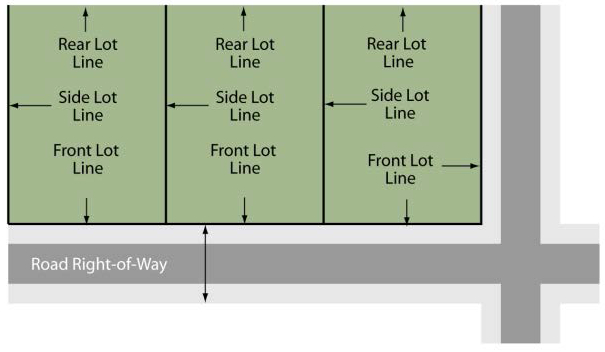
Lot line, front. In the case of an interior lot, the line separating the lot from the street right-of-way or road easement. Through lots shall have two front lot lines. Corner lots shall have two front lot lines identified as a primary front lot line and a secondary front lot line.
(i)
Corner Lot, Primary Front Lot Line. The lot line with the shortest right-of-way frontage.
(ii)
Corner Lot, Secondary Front Lot Line. The lot line with the longest right-of-way frontage.
(b)
Lot line, rear. The lot line opposite and most distant from the front lot line. On a corner lot, the rear lot line is opposite the primary front lot line. In the case of a triangular lot, the rear lot line shall be an imaginary line parallel to the front lot line, not less than ten feet long, lying furthest from the front lot line and wholly within the lot. A through lot has no rear lot line.
(c)
Lot line, side. The lot lines connecting the front and rear lot lines of an interior lot or connecting the front lot lines of a through lot. On a corner lot, the side lot line is the lot line opposite the secondary front lot line.
Lot of record. Any lot which individually or as a part of a subdivision has been surveyed and recorded in the office of the Recorder of Deeds of the county.
Lot, minimum area of. The area of a lot computed exclusive of any portion of the right-of-way of any public thoroughfare.
Lot width. The horizontal straight line distance between the side lot lines, measured at the two points where the front setback line intersects the side lot lines. On a corner lot this line shall be between the designated side and opposite front lot line of the lot.
Manufactured home. A factory-built, single family structure, transportable in one or more sections, which is built on a permanent chassis in compliance with the National Manufactured Home Construction and Safety Standards (42 USC, sec. 4301) and designed to be used as a single family dwelling, with or without a permanent foundation, when connected to utilities. The term "manufactured home" includes "mobile home." Recreational vehicles and temporary buildings are not included in this definition.
Master Plan. The comprehensive plan which may consist of several maps and data, or any portion thereof, made and adopted by the City Planning and Zoning Commission and approved by City Council, and which shows the general location and extent of physical facilities including major streets and main thoroughfares, parks, schools and other public open spaces, and public building sites.
Microbrewery. A brewery that produces less than 15,000 barrels of beer per year with 75% or more of its beer sold off-site.
Mineral extraction, storage and processing. Any mining, quarrying or processing of limestone, sand, gravel, petroleum or other mineral resources.
Mixed occupancy. Also known as mixed use, the combination of two or more differing principal uses, such as of residential and office or residential and commercial units in the same structure.
Manufactured home community. A parcel or tract containing spaces for three or more manufactured homes, with required improvements, that are leased for the long-term placement of manufactured homes as year-round residences on a non-recreational basis and which may also include services and facilities for the residents.
Medical Marijuana Cultivator. An entity that has been issued a certificate of operation by the Ohio Department of Commerce to grow, harvest, package, and transport medical marijuana as permitted under Chapter 3796 of the Ohio Revised Code.
Medical Marijuana Level I Cultivator. A Cultivator that is permitted to operate up to twenty-five thousand square footage of space designated as the marijuana cultivation, unless a request for expansion has been approved by the Ohio Department of Commerce.
Medical Marijuana Level II Cultivator. A Cultivator that is permitted to operate up to three thousand square footage of space designated as the marijuana cultivation, unless a request for expansion has been approved by the Ohio Department of Commerce.
Medical Marijuana Plant-only Processor. A Cultivator that has been issued a certificate of operation from the Ohio Department of Commerce for the limited purpose of packaging, selling, and delivering finished plant material directly to a licensed Medical Marijuana Retail Dispensary.
Medical Marijuana Processor. An entity that has been issued a certificate of operation by the Ohio Department of Commerce to manufacture medical marijuana products.
Medical Marijuana Retail Dispensary. A building or structure licensed by the State Board of Pharmacy as a medical marijuana retail dispensary.
Mosque. See "Place of worship".
Net acre. The total amount of land in a tract of land after street areas and community facilities such as schools and parks are subtracted.
Noncommercial Trailer. A vehicle that is registered with the State of Ohio Bureau of Motor Vehicles as a noncommercial trailer and weighs less than 3,000 pounds.
Nonconforming building or structure. Any building or structure that was legally established and in existence at the time this code, or any amendment, was adopted and which does not conform to the current dimensional requirements of the district in which it is now located.
Nonconforming lot. Any lot of record that was legally established and in existence at the time this code, or any amendment, was adopted and which does not conform to the current area, width or frontage regulations of the district in which it is now located.
Nonconforming use. Any use of land, building or structure that was legally established and operating at the time this code, or any amendment, was adopted and which is not permitted in the district in which it is now located.
Nursing home. A facility licensed as a rest home, nursing home, convalescent home, home for the aged, or similar use established and operated on a profit or non-profit basis to provide lodging and/or meals and/or domiciliary care for the aged, infirm, chronically ill, terminally ill, mentally incapacitated or convalescent persons, but not including hospitals, clinics or similar institutions devoted primarily to diagnosis and treatment. The term does not include facilities devoted to independent living units which include kitchen facilities in which residents have the option of preparing and serving some or all of their own meals or boarding facilities which do not provide personal care.
(Ord. 14-29. Passed 10-27-14; Ord. 15-26. Passed 7-13-15; Res. 19-R-03. Passed 2-25-18; Ord. No. 21-33, § 1(Exh. A), 11-8-21.)
1105.07 - DEFINITIONS: O-P-Q.
Official map. A map showing the future location of streets, highways, and parks theretofore laid out, adopted and established by law, and any amendments or additions thereto adopted by the Planning and Zoning Commission.
Off-street parking space. An area of required size, exclusive of necessary driveways, aisles or maneuvering areas suitable to accommodate one motor vehicle and having direct unobstructed access to a street or alley, but located totally outside of any street or alley right-of-way.
Open space. An area of land unoccupied by buildings, structures, storage or parking areas, except for recreational structures and which is generally used for the purpose of active or passive recreation, environmental protection, preservation of scenic views or similar purposes. Open space does not include street rights-of-way or easements, or required yards.
Outdoor storage. Storing equipment, supplies, material, goods, products, inventory or other such items on property in a commercial or industrial district. This shall not apply to storage or keeping of yard equipment, firewood, play equipment or other items normally incidental to a residential use on the same property and to which those items are customarily used outside the residential unit.
Overlay zone. A special purpose zoning district that encompasses all or a portion of one or more underlying zones and imposes additional requirements beyond those of the underlying zone(s).
Owner. Any person, firm, association, syndicate, co-partnership, corporation, trust, or any other legal entity having sufficient proprietary interest in the land sought to be subdivided to commence and maintain proceedings to subdivide the land under these Subdivision Regulations.
Parapet wall. A low wall barrier at the edge of a roof or structure which may serve to prevent falls over the edge or serve as a stylistic feature.
Parking lot. A designated area, not within a building, where motor vehicles may be stored for the purpose of temporary, daily or overnight off-street parking.
Performance guarantee/bond. An agreement by a subdivider or developer with the City for the amount of the estimated construction cost guaranteeing the completion of physical improvements according to plans and specifications within the time prescribed by the subdivider's/developers agreement. The subdivider's agreement may provide that the subdivider or developer is permitted to present a cashier's check/bank check, cash deposit, or an irrevocable, unconditional letter of credit as an alternate form of security rather than a performance bond or surety bond. Any cash or cash equivalent that is returned shall not be returned with interest.
Perimeter parking lot landscaping buffer. The use of landscape materials within and adjacent to the outer boundary of a parcel.
Perimeter property landscaping buffer. The use of landscape materials placed within the property and adjacent to the property line.
Permitted use. A use by right which is specifically authorized in a particular zoning district.
Person. A firm, association, organization, partnership, trust, company or corporation, as well as an individual.
Personal services. Any enterprise conducted for gain which primarily offers services of a personal nature to the general public such as but not limited to pet grooming and training, barber and beauty shops, tailors, photo studios, body art studios, nail salons and spas.
Personal vehicle. Any motor vehicle with a passenger car registration or a noncommercial registration.
Place of worship. A place of assembly of a religious group for the purpose of worship, ceremonies, or rituals, and accessory uses thereto.
Planned unit development. A lot or parcel of land, developed as a unit under single ownership or unified control that is unique and incorporates one or more of the following: a variety of uses, varied density of development, dedicated open space, preservation of significant natural features, reduced lot sizes or similar attributes.
Planning Director. That person designated by the City Manager as its Planning Director.
Plat. A map upon which the subdivider's plan of a subdivision is presented and which is submitted for approval and intended to be recorded in the final form.
Preliminary plan. The preliminary plan, drawing or chart indicating the proposed layout of the subdivision.
Principal use. The main or primary use of land or structures, as distinguished from a secondary or accessory use.
Public places. All property, sites or places owned by the city, including but not limited to park land, rights-of-way and municipal buildings.
Public trees. All shade and ornamental trees now or hereafter growing on any street, highway or any public places.
Public utility. Any person, firm, corporation, municipality, board or commission duly authorized to furnish, under federal, state or municipal regulations, to the public electricity, gas, steam, communications (excluding wireless communications), telephone, transportation, sewer or water services; provided that this definition shall not include any person, firm or corporation engaged in radio or television broadcasting.
(Ord. 14-29. Passed 10-27-14; Ord. 15-26. Passed 7-13-15; Ord. No. 21-09, § 1(Exh. A), 3-22-21.)
1105.08 - DEFINITIONS: R-S.
Recreational facilities.
(a)
Noncommercial recreational facilities. Private and semipublic recreational facilities which are not operated for commercial gain, including private country clubs, riding clubs, golf courses, city pools and facilities, and other private noncommercial recreation areas and facilities or recreation centers including private community swimming pools.
(b)
Commercial recreational facilities. Recreational facilities open to the public and established and operated for a profit, such as commercial golf courses, golf driving ranges, swimming pools, ice skating rinks, riding stables, race tracks, amusement parks, carnivals and similar commercial enterprises.
Recreational vehicle. Includes, but is not limited to:
(a)
Camper Trailer. A folding or collapsible vehicular structure, mounted on wheels but without its own power, designed as a temporary living quarters for travel, camping, recreation and vacation uses, which is not encompassed in the definition of travel trailer.
(b)
Motor bus. Any motor vehicle having motor power designed and used for carrying more than nine passengers.
(c)
Motor home. A self-propelled recreational vehicle constructed with permanently installed facilities for cold storage, cooking and consuming of food and for sleeping.
(d)
Recreational Trailers. Any form of device, equipment, or machinery on wheels, or a single wheel, that is intended to be pulled by a motor vehicle, whether or not attached to a motor vehicle. This shall include every vehicle designed and utilized for the sole purpose of transporting any boat, auto, snowmobile, recreational habitation, and the like, which does not have motive power, but is designed to be drawn by another vehicle.
(e)
Travel Trailer. A non-self-propelled recreational vehicle, including a tent type fold out camping trailer as defined in ORC 4517.01(S).
(f)
Truck Camper. A non-self-propelled recreational vehicle, without wheels for road use but with sufficient equipment to render it suitable for use as a temporary dwelling for travel, recreation and vacation use, and designed to be placed upon and attached to a motor vehicle. Truck camper does not include truck covers, which consist of walls and roof, but do not have floors and facilities for using same as a dwelling.
(g)
Watercraft. This term shall include, but is not limited to, any of the following when used or capable of being used for transportation on the water:
(i)
A boat operated by machinery either permanently or temporarily affixed.
(i)
A sailboat other than a sailboard.
(iii)
An inflatable, manually propelled boat having a hull identification number meeting the requirements of the United States Coast Guard.
(iv)
A canoe or row boat.
Recycling center. A facility or location in which used material is separated and processed prior to shipment to others who will use the materials to manufacture new products.
Residential district. Includes the following:
(a)
Any property included in an area zoned R-R, R-1, R-2, R-3, R-4, or OH-RD Districts.
(b)
Any property designated for residential use in a planned unit development.
Residential floor area. Interior floor areas with a minimum ceiling height of seven feet, including interior walls, finished and livable, of the story or stories above grade of the dwelling, including stairways, halls, closets, bathrooms, toilet compartments, storage, utility spaces and habitable attics, meeting the requirements of a habitable room. Basements, porches, garages, breezeways or carports do not contribute to the residential floor area.
Restaurant. An establishment principally operated for the sale of food and beverages to be served for consumption on the premises, which may also include carry-out service or delivery of food through a drive-in and drive-thru facility for consumption off the premises.
(a)
Restaurant, Drive-in means a restaurant where patrons order and are served food while remaining in an automobile.
(b)
Restaurant, Drive-thru means a restaurant where patrons order and are served food from a window for consumption on or off the premises.
Reverse frontage. Lots within a subdivision that have frontage on a public street and back to a highway or major street.
Right-of-way. A strip of land dedicated for public use and occupied or intended to be occupied by a street, crosswalk, railroad, road, electric transmission line, oil or gas pipeline, water main, sanitary or storm sewer main or other essential services.
Routine Maintenance. Work that is planned and performed to maintain and preserve the condition of the building, structure, or site including but not limited to painting, landscaping, roof repair, parking rehabilitation, and window replacement and treatment.
Setback. The required minimum horizontal distance between the line at which the building may be built and the related front, rear and side lot line.
Setback line. A line indicating the minimum horizontal distance between the street easement or right-of-way line and buildings, or any projection thereof other than steps or permanently open porches, unless otherwise specifically defined.
Sexually oriented business. Those businesses defined, as follows:
(a)
Adult arcade. An establishment where, for any form of consideration, one or more still or motion picture projectors, slide projectors, or similar machines, or other image producing machines, or other visual representations, for viewing by five or fewer persons each, are regularly used to show films, motion pictures, video cassettes, digital video discs, slides, or other photographic reproductions which are characterized by the depiction or description of specified sexual activities or specified anatomical areas.
(b)
Adult bookstore, adult novelty store or adult video store.
(1)
A commercial establishment which has as a significant or substantial (i.e., 50% or more) portion of its stock-in-trade or derives a significant or substantial (i.e., 50% or more) portion of revenues or devotes a significant or substantial (i.e., 50% or more) portion of its interior business or advertising to the sale or rental for any form of consideration, of any one or more of the following:
A.
Books, magazines, periodicals or other printed matter, or photographs, films, motion pictures, video cassettes, slides, digital video discs, or other visual representations which are characterized by the depiction or description of specified sexual activities or specified anatomical areas;
B.
Instruments, devices, or paraphernalia which are designed for use or marketed primarily for stimulation of human genital organs or for sadomasochistic use or abuse of themselves or others;
(2)
An establishment may have other principal business purposes that do not involve the offering for sale, rental or viewing of materials depicting or describing specified sexual activities or specified anatomical areas, and still be categorized as adult bookstore, adult novelty store, or adult video store. Such other business purposes will not serve to exempt such establishments from being categorized as an adult bookstore, adult novelty store or adult video store so long as the definition above is met.
(c)
Adult cabaret. A nightclub, bar, restaurant, private club, bottle club, juice bar or similar commercial establishment, whether or not alcoholic beverages are served, which features: (a) persons who appear nude or semi-nude or in a state of nudity or semi-nudity; (b) live performances which are characterized by the exposure of specified anatomical areas or by specified sexual activities; or (c) films, motion pictures, video cassettes, digital video discs, slides, or other photographic reproductions which are characterized by the depiction or description of specified sexual activities or specified anatomical areas. "Private club" shall mean an establishment where patrons may bring in their own bottle or other container of alcohol (including beer, wine or liquor) and purchase a mixture for the same or use of a glass from the club or business.
(d)
Adult motel. A motel, hotel or similar commercial establishment which offers public accommodation, for any form of consideration, which provides patrons with closed-circuit television transmissions, films, motion pictures, video cassettes, digital video discs, slides or other photographic reproductions which are characterized by the depiction or description of specified sexual activities or specified anatomical areas and which advertises the availability of this sexually oriented type of material by means of a sign visible from the public right-of-way, or by means of any off-premises advertising, including but not limited to newspapers, magazines, pamphlets or leaflets, radio or television.
(e)
Adult motion picture theater. A commercial establishment where films, motion pictures, video cassettes, digital video discs, slides or similar photographic reproductions which are characterized by the depiction or description of specified sexual activities or specified anatomical areas are shown for any form of consideration.
(f)
Adult theater. A theater, concert hall, auditorium, or similar commercial establishment which, for any form of consideration features persons who appear in a state of nudity or semi-nudity or live performances which are characterized by exposure of specified anatomical areas or by specified sexual activities which is not customarily open to the general public during such features because it excludes minors by reason of age.
(g)
Escort agency. A person or business association that furnishes, offers to furnish, or advertises to furnish escorts as one of its primary business purposes for a fee, tip, or other consideration. "Escort" means a person who, for any form of consideration, agrees or offers to act as a companion, guide or date for another person, or who agrees or offers to privately model lingerie or to privately perform a striptease for another person or to privately appear in the state of nudity or semi-nudity for another person.
(h)
Massage parlor. Any place where, for any form of consideration or gratuity, massage, alcohol rub, administration of fomentations, electric or magnetic treatments, or any other treatment or manipulation of the human body which occurs as a part of or in connection with specified sexual activities is offered, or where any person providing such treatment, manipulation, or service related thereto, exposes his or her specified anatomical areas. The definition of sexually oriented businesses shall not include the practice of massage in any licensed hospital, nor by a licensed hospital, nor by a licensed physician, surgeon, chiropractor or osteopath, nor by any nurse or technician working under the supervision of a licensed physician, surgeon, chiropractor or osteopath, nor by trainers for any amateur, semiprofessional or professional athlete or athletic team or school athletic program, nor barber shops or beauty salons in which massages are administered only to the scalp, the face, the neck or the shoulder, nor by any other individual licensed by the State of Ohio to perform massages.
(i)
Semi-nude model studio. Any place where a person regularly appears in a state of nudity or semi-nudity or displays specified anatomical areas for money or any form of consideration to be observed, sketched, drawn, painted, sculptured, photographed or similarly depicted by other persons. This definition does not include an accredited state licensed public or private educational institution or bona-fide art organization offering instruction, which may involve the exposure of the human body for purposes of drawing, filming or photographing as part of a course.
(j)
Sexual encounter establishment. A business or commercial establishment that as one of its principal business purposes offers for any form of consideration:
(1)
A place where two or more persons may congregate, associate, or consort for the purpose of specified sexual activities or the exposure of specified anatomical areas; or
(2)
Activities between male and female persons and/or persons of the same sex when one or more of the persons is in a state of nudity or semi-nudity. The definition of sexually oriented businesses shall not include an establishment where a medical practitioner, psychologist, psychiatrist, or similar professional person licensed by the State of Ohio engages in medically approved and recognized sexual therapy.
(k)
Simulated. To assume the mere appearance of something, without the reality, to imitate or pretend.
(l)
Specified anatomical areas. Includes any of the following:
(1)
Less than completely and opaquely covered human genitals, pubic region, anus or any portion of the female breast below the top of the areola or nipple; or
(2)
Human male genitals in a discernibly turgid state, even if completely and opaquely covered.
(m)
Specified sexual activities. Includes any of the following:
(1)
The fondling or other intentional touching of human genitals, pubic region, anus, or female breast;
(2)
Sex acts, normal or perverted, actual or simulated, including intercourse, oral copulation or sodomy;
(3)
Masturbation, actual or simulated;
(4)
Human genitals in a state of sexual stimulation, arousal or tumescence; or
(5)
Excretory functions as part of or in connection with any specified sexual activities defined in this section.
Short-term lending establishment. A business engaged in providing short-term loans to members of the general public as an element of its operation and which is not licensed by the appropriate state or federal agency as a bank, savings and loan association, or credit union. Short-term lending establishments include businesses offering title loans, payday loans, signature loans, small loans, pawnshops, and other similar businesses. This definition does not include investment companies and state or federally chartered banks or financial institutions.
Sign. A structure, device, fixture, or placard which may or may not use graphics, symbols and/or written copy designed specifically for the purpose of advertising, providing information, or identifying an establishment, product, service or activity.
(a)
Sign, A-frame. A free-standing sign usually hinged at the top. Such signs are considered temporary. This includes, but is not limited to, "A"-frame signs.
(b)
Sign, abandoned. A sign associated with an abandoned use, a sign that remains after the termination of the business, or a sign on its immediate premises not adequately maintained and not repaired within the specified time as provided in this code.
(c)
Sign, animated. Any sign, other than a time and temperature display, which uses motion, lighting, or special materials to depict action or create a special effect or scene. This includes, but is not limited to, blinding, moving, flashing, or rotating signs as well as projected images.
(d)
Sign, announcement. A ground or mounted bulletin board or similar device with or without changeable copy used to identify events for public and semi-public activities.
(e)
Sign, awning. A non-electric sign that is printed on, or attached to, an awning or canopy and is only permitted on the vertical surface. This includes, but is not limited to, canopy signs.
(f)
Sign, backlit silhouetted halo. A sign with channel letters with an open or translucent back that is illuminated. Light is directed against a surface behind the letter. The face and sides of the channel letters are opaque.
(g)
Sign, banner. A temporary sign, with or without characters, letters, illustrations, or ornamentations, applied to plastic or vinyl.
(h)
Sign, billboard. Any sign situated on private premises with an area greater than 100 square feet on which the written or pictorial information is not directly related to the principal use of the land on which the sign is located.
(i)
Sign, business. A sign which directs attention to a business or profession conducted on the premises.
(j)
Sign, cabinet. A one or two-sided sign encompassed in a frame, which supports and retains the removable sign face panel(s) and/or background constructed of plastic or similar translucent or opaque materials and which has an internal light source. Sign faces for cabinet signs shall be translucent or opaque, and only 50 percent of the total sign face shall be internally-illuminated.
(k)
Sign, changeable copy. A sign designed to allow the changing of copy through manual, mechanical, or electrical means. This includes, but is not limited to, electronic variable message signs and digital signs.
(l)
Sign, channel letter. A three-dimensional sign composed of individual letters where the sign is illuminated from the interior of each individual letter. Sign faces with channel letters shall be translucent or opaque but not transparent.
(m)
Sign, community activity. A temporary off-premise sign used to announce community activities that are open to the general public.
(n)
Sign, conforming. A sign that complies with the requirements of this chapter.
(o)
Sign, construction project. A sign announcing the names of firms or persons involved in a construction project on-site.
(p)
Sign, display area. The surface of a sign to be included when computing the maximum allowable square footage of sign. This area includes molding and framing, but excludes supporting members. In the case of double-faced or multi-faced signs, the display area is the area of all sign faces. The display area of a sign consisting of individual letters or symbols, either free-standing or attached to or painted on a surface, building, wall, or window, shall be considered to be that of the smallest single rectangle which encompasses all the letters and symbols.
(q)
Sign, double faced. A sign having two display surfaces. that are separated by no greater than twelve (12) inches apart at any point.
(r)
Sign, flag. A fabric, banner, or bunting containing distinctive colors, patterns, or symbols.
(s)
Sign, fuel pricing. The portion of a sign limited to the display of fuel price information.
(t)
Sign, fuel pump. Any sign or logo attached to a fuel pump.
(u)
Sign, gas-inflatable sign/device. Any device which is capable of being expanded by any gas and used on a permanent or temporary basis to attract attention to a product or event. This definition includes both hot- and cold-air balloons tethered or otherwise anchored to the ground.
(v)
Sign, ground. Any sign which is physically attached to a foundation. This includes, but is not limited to, free-standing, pole, pylon, or monument signs. For the purposes of this Code, ground signs shall be limited to monument type signs only, except for Old Hilliard, which may have two-post or one-post ground signs.
(w)
Sign, incidental. An on-premise sign containing neither advertising nor the name of the business.
(x)
Sign, interior-illuminated. Any sign which has a light source entirely enclosed or concealed within the sign and is not externally visible to the eye.
(y)
Sign, marquee. A vertically-oriented sign supported solely by the building to which it is attached and projecting horizontally over part of the public right-of-way. The sign may project perpendicular to the façade.
(z)
Sign, menu. A sign used in connection with a drive-through window of a restaurant to advise the customer what items may be ordered.
(aa)
Sign, mobile. A portable sign supported by multiple standards or on a wheeled chassis.
(bb)
Sign, multi-faced. A sign having more than two display surfaces, including spheres and cubes.
(cc)
Sign, neon. Illuminated signs lighted by exposed tubes filled with light-emitting neon or other gases.
(dd)
Sign, nonconforming. A sign that does not comply with the requirements of this Chapter.
(ee)
Sign, official public. Governmental notices, posted regulations, government offices or traffic signs.
(ff)
Sign, off-premise. A sign located on a property other than the property where the goods or services are available.
(gg)
Sign, off-premise sign advertising on display surfaces. Permanent advertising approved by the Planning and Zoning Commission for attachment to benches.
(hh)
Sign, off-premise directional. An "off-premise sign" displaying the name of a business or complex and no other advertising, serving to direct traffic to a location not adjacent to and usually not visible from the main thoroughfare.
(ii)
Sign, on-premise directional. A sign displaying no advertising, including the name or logo of the business, used to facilitate the circulation of traffic on premises. An "on-premise directional sign" is a type of incidental sign.
(jj)
Sign, permanent. Any sign except designated temporary signs or real estate signs.
(kk)
Sign, plastic. Any sign constructed entirely of plastic.
(ll)
Sign, political. A sign concerning candidates for elective office, public issues and similar matters to be decided by the public at an election.
(mm)
Sign, portable. An impermanent or movable sign.
(nn)
Sign, projecting. Any sign which is attached to the face of a building and projects perpendicular to the building and adjacent roadway or street.
(oo)
Sign, push-thru. An internally lit sign cabinet with letters or logos cut from a translucent material thicker than the cabinet sign face. The letters or logos are mounted on the inside of the cabinet so that it extends through and beyond the front of the sign face. The face of the letters or logos are covered with an opaque material, allowing the only visible light to be from the 'pushed thru' sides of the letters or logos.
(pp)
Sign, real estate. Any sign advertising the sale, lease, rental, or development of real property on which the sign is located.
(qq)
Sign, roof. Any sign located on or structurally attached to the roof.
(rr)
Sign, single-faced. A sign having one display surface.
(ss)
Sign, street number. The display of the numbered street address of a specific location.
(tt)
Sign, subdivision development. A sign advertising the sale of lots in a subdivision.
(uu)
Sign, temporary. A sign specifically meant to be displayed for a short period of time and not permanently affixed to a building, structure, surface, or ground.
(vv)
Sign, wall. A sign painted on or attached and parallel to the exterior wall of a building, extending no more than 12 inches from the exterior face of the wall to which it is attached.
(ww)
Sign, window. Any permanent or temporary signs, posters, symbols and other types of identification or information about the use or premises directly attached to or painted on the glass part of a door and/or on the window of a building or erected within six feet of a door or window inside the building with a printed side facing the door or window.
(xx)
Sign, yard. A small, temporary advertising sign typically made of corrugated plastic and placed in a yard with metal stakes.
Site plan. A drawing, prepared to scale, showing accurately and with complete dimensioning, the boundaries of a site and the location of all buildings, structures, uses and principal site development features proposed for a specific lot or parcel.
Skilled nursing care. Procedures that require technical skills and knowledge beyond those of an untrained individual and commonly employed in providing for the physical, mental and emotional needs of the ill or otherwise incapacitated.
Specialized animal raising and care. The use of land and buildings for the raising and care of furbearing animals such as rabbits and domestic pets, and the stabling and care of horses, animal kennels, pigeon raising and raising of any other domestic animals or birds of a similar nature.
Story. That portion of a building included between the upper surface of a floor and the upper surface of the floor or roof next above which is a minimum of seven feet in height, and also any portion of a building used for human occupancy between the topmost floor and the roof.
Street line, right-of-way line. A dividing line between a lot, tract or parcel of land and contiguous street.
Street. A way for vehicular traffic, whether designated a street, highway, thoroughfare, parkway, throughway, freeway, road, boulevard, avenue, lane, place, arterial, collector or any other designation.
(a)
"Intercommunity thoroughfares" means:
(1)
Interstate or expressway which possesses an extra-wide right-of-way carrying high traffic volumes of unobstructed, limited-access vehicular movement.
(2)
Limited access highways which intercept several major streets and may or may not have a separated intersection. This is a principal or heavy traffic street of considerable continuity and used primarily as a traffic artery for intercommunication between large areas.
(b)
"Intracommunity streets" means:
(1)
"Major streets" means local thoroughfares which carry crosstown traffic from several neighborhoods, thereby servicing several residential collector streets.
(2)
"Collector street" means primary streets servicing industrial and commercial areas or the principal street which carries traffic from minor streets to major streets, including the principal entrance streets of residential developments and primary circulation routes within such developments.
(3)
"Minor streets" or "local streets" means streets used primarily for access to abutting properties.
(4)
"Marginal access streets" means a minor street which is parallel and adjacent to an arterial street and which provides access to abutting properties and protection from major streets or thoroughfares.
(5)
"Cul-de-sac" or "dead-end streets" means a minor street with only one outlet.
(6)
"Alley" means minor ways which are used primarily for vehicular service access to the back or the side of properties otherwise abutting a street.
(7)
"Street width" means the shortest distance between the lines delineating the right-of-way of a street.
Structure. Anything constructed or erected, the use of which requires permanent location on the ground, or which must be attached to something which has a permanent location on the ground, including but not limited to, advertising signs, billboards, parking lots and buildings.
Structural alterations. Any change which would tend to prolong the life of a supporting member of a structure or building such as bearing walls, columns, beams, or girders.
Subdivider. Any individual, firm, association, syndicate, co-partnership, corporation, trust or other legal entity commencing proceedings under this chapter to effect a subdivision of land hereunder for himself/herself or for another.
Subdivision.
(a)
The division of any parcel of land shown as a unit or as contiguous units on the last preceding tax roll, into two or more parcels, sites or lots from the parent tract, any one of which is less than five acres for the purposes, whether immediate or future, of transfer of ownership. However, the division or partition of land into parcels of more than five acres not involving any new streets or easements of access, and the sale or exchange of parcels between adjoining lot owners where such sale or exchange does not create additional building sites, shall be exempted.
(b)
The improvement of one or more parcels of land for residential, commercial or industrial structures involving the division or allocation of land for the opening, widening or extension of any street or streets, except private streets serving industrial structures, and the division or allocation of land as open spaces for common use by owners, occupants or lease holders, or as easements for the extension and maintenance of public sewer, water, storm drainage or other public facilities.
Synagogue. See "Place of worship".
(Ord. 14-29. Passed 10-27-14; Ord. 15-26. Passed 7-13-15; Res. 19-R-03. Passed 2-25-19; Res. 19-R-05. Passed 2-25-19; Ord. No. 21-33, § 1(Exh. A), 11-8-21; Ord. No. 22-18, § 1(Exh. A), 7-11-22; Ord. No. 24-11, § 1(Exh. B), 6-10-24.)
1105.09 - DEFINITIONS: T-U.
Temple. See "Place of worship".
Temporary structure. A structure erected for a period of time, as specified in the regulations of this code, for such use as construction offices, storage buildings at a construction site, model homes and development sales offices.
Treelawn. The unpaved portion of right-of-way lying between the right-of-way line and the curb or pavement line when no paved sidewalk or path is present. In areas where a paved sidewalk or path is present, the Treelawn shall include only the unpaved portion of right-of-way lying between the paved sidewalk or path and the curb or pavement line of the street.
Tree preservation and protection plan. The inventory of trees on a site prior to demolition or construction naming each species, size and condition of each tree, and the steps that will be undertaken to protect trees on site, and to provide for the protection of trees at a distance in feet.
Trees.
(a)
Small tree. Tree species designated as "Small Tree Species" as specified within the Hilliard Development Handbook.
(b)
Medium tree. Tree species designated as "Medium Tree Species" as specified within the Hilliard Development Handbook.
(c)
Large tree. Tree species designated as "Large Tree Species" as specified within the Hilliard Development Handbook.
(d)
Shrubs. Deciduous or evergreen species designated as "shrubs" as specified within the Hilliard Development Handbook.
Tree size measurement. The caliper of a tree shall be measured in accordance with the American Association of Nurserymen's Standards, which provides that a tree is measured six inches above ground if four inches or less caliper size and twelve inches above ground for larger sizes. For trees exceeding 12 feet in height, the tree measurement size is the trunk measurement at four foot five inches above the ground.
Tree survey. A plan showing the location of all trees greater than six inch diameter existing on the lot that indicates the species, height, diameter and health of all trees shown.
Tree topping. The severe cutting back of limbs to stubs larger than three inches in diameter within the tree's crown to such a degree so as to remove the normal canopy and disfigure the tree.
Use. The specific purposes for which land or a building is designed, arranged or intended, or for which it is or may be occupied or maintained.
(Ord. 14-29. Passed 10-27-14.)
1105.10 - DEFINITIONS: V-W.
Vapor Lounge. Any facility or location whose business operation includes the utilization of a heating element that vaporizes a substance that releases nicotine, tobacco, flavored vapor or vapor or fumes from any other organic or synthetic material, including but not limited to plants, herbs, or tobacco, through one or more electronic or battery operated delivery device (commonly referred to as electronic cigarette, e-cig, e-cigarette, e-pipe, hookah pen, vape pen, vape pipe). Also referred to as Vapor/Vape bar, Vapor/Vape café, Vapor/Vape Lounge.
Variance. A relaxation or modification of the requirements of this code permitted as a method of alleviating practical difficulty in meeting the minimum requirements of the code as authorized by the governing board or commission of the City.
Vehicle. Except as provided herein, every device, including trailers, in, upon or by which any person or property may be transported or drawn upon a street, highway, waterway, watercourse, roadway or path (whether paved or unpaved), except that "vehicle" does not include any motorized wheelchair, electric assistive mobility device, or any device that is moved by human power.
Vehicle repair, major. The repair, rebuilding or reconditioning of motor vehicles, trailers or parts thereof, including general repair, collision service, bodywork, welding, painting, steam cleaning, rebuilding, or reconditioning.
Vehicle repair, minor. General maintenance on vehicles such as oil changes and lubrication; servicing an repair of spark plugs, batteries, pumps, belts, hoses, air filters, windshield wipers and distributors; replacement of mufflers and exhaust systems, brakes and shock absorbers; radiator cleaning and flushing; sale and installation of accessories such as tires, radios and air conditioners; wheel alignment and balancing; but excluding tire recapping or grooving or any major mechanical repairs, collision work, painting, or replacement or repair of any vehicle part that requires removal of the engine head or pan, and engine transmission.
Vehicle sales. The sale or rental of new or used motor vehicles or trailers.
Vehicle service station. Any building, land area, or other premises, or portion thereof, used for the retail dispensing or sales of vehicular fuels and may also include minor vehicle repair; and including as an accessory use the sale and installation of lubricants, tires, batteries, and similar vehicle accessories.
Vehicle wash. A building or portion of a building with machine or hand-operated facilities used principally for the cleaning, washing, polishing or waxing of motor vehicles.
Vehicular use area. Any area of a lot not located within an enclosed or partially enclosed building and that is devoted to a use by or for motor vehicles, including parking; storage of automobiles, trucks or other vehicles; gasoline stations; car washes; vehicle repair establishments; loading areas; and access drives and driveways.
Veterinary hospital or clinic. A building where care and treatment of animals, including household pets, is provided.
Winery. A structure with an emphasis on pedestrian-ordered retail sales and services and on-site tasting, which may include primary fruit processing or bulk fermentation.
Wireless communication facility. The plant, equipment and property including, but not limited to, cables, wires, conduits, ducts, pedestals, antennas, electronics and other appurtenances used or to be used to transmit, receive, distribute, provide or offer wireless communications services.
Wireless communication tower. Any structure, such as a mast, pole, monopole, guyed tower or lattice tower that is designed and constructed primarily for the purpose of supporting one or more antennas.
(Ord. 14-29. Passed 10-27-14; Ord. 16-17. Passed 5-9-16; Ord. No. 21-44, § 1(Exh. B), 1-10-22.)
1105.11 - DEFINITIONS: X-Y-Z.
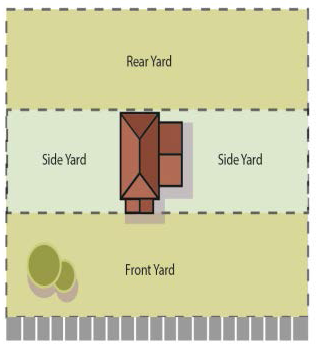
Yard. The open spaces on a lot or parcel located between a building and a lot line.
(a)
Yard, front. The space extending across the full width of the lot, the depth of which is the shortest horizontal distance between the front lot line and the nearest wall of the principal building.
(b)
Yard, rear. The space extending across the full width of the lot, the depth of which is the shortest horizontal distance between the rear lot line and the nearest wall of the principal building.
(c)
Yard, side. The space between a principal building and the side lot lines, extending from the front yard to the rear yard, the width of which is the shortest horizontal distance from the side lot line to the nearest wall of the principal building.
Yard, required. That portion of the yard lying between the lot line and the required building setback line.
Zoning Certificate. The document issued by the Planning Director or designee authorizing the use of the land or buildings.
Zoning District Map. The Zoning District Map or Maps of the City of Hilliard, Ohio, together with all amendments subsequently adopted.
(Ord. 14-29. Passed 10-27-14; Ord. 15-26. Passed 7-13-15; Ord. No. 21-09, § 1(Exh. A), 3-22-21.)

