
Hilliard City Zoning Code
CHAPTER 1111
BUSINESS DISTRICTS9
Cross reference— Conditional use requirements, Ch. 1123; landscaping and lighting requirements, Ch. 1125; off-street parking and loading, Ch. 1127; signs, Ch. 1129; site plan review requirements, Ch. 1131.
1111.01 - PURPOSE.
(a)
"B-1," Neighborhood Business District. The purpose of the B-1 District is to permit those uses necessary to satisfy the basic day-to-day convenience shopping and/or service needs of persons residing in nearby residential areas. Allowed uses should be of a low intensity nature, appropriate in scale and appearance and compatible with the surrounding residential character. Businesses will ideally be served by common/shared parking, as well as integrated pedestrian access, and be located within an area of five acres or less. It is further the intent of this District to encourage the concentration of businesses in nodes and avoid strip development along major roads.
(b)
"B-2," Community Business District. The B-2, Community Business District, is characterized by more diversified and larger scale businesses than found in the B-1 District and serves a broader community-wide base. This District is intended to create attractive, cohesive commercial areas that take advantage of visibility and accessibility along major thoroughfares, while avoiding linear development patterns through creative site planning, shared access and cooperation between neighboring owners.
(c)
"B-3," Office/Institutional District. This District is intended primarily to accommodate corporate and professional offices, research facilities, philanthropic institutions and related uses. This is an employment district, not intended for most retail uses or other high traffic-generating activities. The B-3 District can serve as a buffer or transitional use between residential development and more intense commercial or industrial activities.
(d)
"B-4," I-270 Corridor District. Providing for intense, mixed-use, high quality development that combines office-related employment with residential, neighborhood retail and personal service opportunities is the purpose of the B-4 District. This District is located along the I-270 corridor and affords high visibility with excellent access. The scale of development is intended to be very urban, allowing taller buildings, greater residential density, parking structures and public spaces to be combined in ways that will make the District walkable, livable, vibrant and transit-friendly. Quality design and construction are to be emphasized.
(Ord. 14-29. Passed 10-27-14.)
1111.02 - SCHEDULE OF USES.
Buildings or land shall not be used and buildings shall not be erected, except for the following specified uses, unless otherwise provided for in this code. Land and/or buildings in the districts indicated at the top of Table 1111-2 may be used for the purposes denoted by the following abbreviations:
(a)
Permitted Use (P). Land and/or buildings in this district may be used by right.
(b)
Conditional Use (C). Land and/or buildings in this district may be used if approval is granted, based on compliance with applicable review standards and specific conditions that may additionally apply, as found in Chapter 1123.
(c)
Specific Conditions. Indicates requirements or conditions applicable to conditional uses, as listed in Chapter 1123, Conditional Uses.
(Ord. 14-29. Passed 10-27-14; Ord. 16-17. Passed 5-9-16; Res. 17-R-101. Passed 11-20-17; Res. 19-R-03. Passed 2-25-19; Ord. No. 20-12, § 2(Exh. A), 4-27-20; Ord. No. 21-33, § 1(Exh. A), 11-8-21; Ord. No. 21-44, § 1(Exh. C), 1-10-22.)
1111.03 - SPATIAL REQUIREMENTS.
(a)
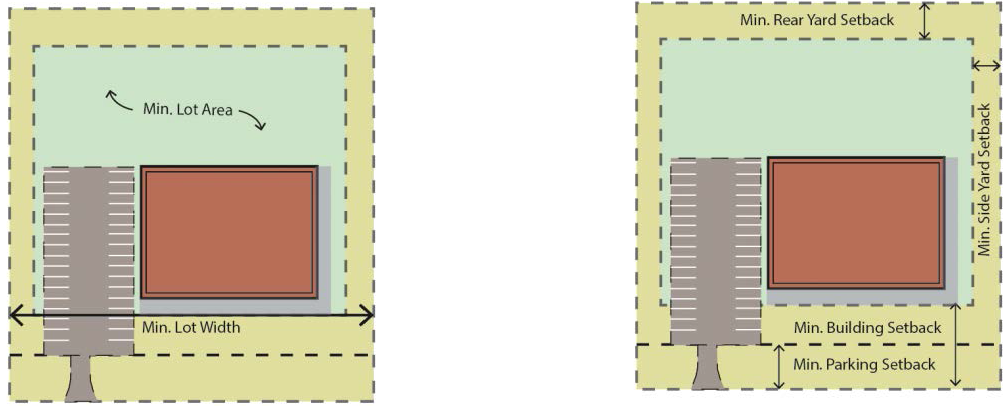
All lots and buildings shall meet the minimum area and width requirements of Table 1111-3. New lots shall not be created, except in conformance with these requirements.
(b)
All structures and their placement on a lot shall conform to the minimum dimensional requirements listed in Table 1111-3a.
1. Front yard building setbacks may be reduced by 50 percent, if parking is not located in the front yard.
2. Minimum required setback shall be increased one foot for every one foot of building height above 45 feet.
3. Institutional and multiple family buildings may exceed the height limits of the district; provided, the required front, side and rear yards shall be increased by two feet for each foot of additional building height above the maximum permitted in this table. In any case, no building shall exceed a height of 70 feet.
(Ord. 14-29. Passed 10-27-14.)
1111.04 - SPECIAL COMMERCIAL DEVELOPMENT STANDARDS.
(a)
Introduction.
(1)
These standards were established to enhance the development pattern along primary commercial corridors. In the past the development of primary commercial corridors focused on automobile travel and usually overlooked pedestrian mobility. Thus, commercial development resulted in challenging pedestrian travel and a lack of connectivity between the streets and buildings due to large parking lots. In addition, the overall architectural pattern of these corridors has not contained significant traditional or natural materials. The existing building setbacks and site orientation have also created a disjointed pattern in areas which have contributed to the lack of overall character and image of the City.
(2)
Important goals of these standards include improving pedestrian mobility, accommodating multiple transportation options, and enhancing landscaping and building appearance. Improving these corridors will help maintain a high-quality community for residents and businesses, and create an economic environment to attract and support future development. The overlay standards are intended to achieve the following objectives:
A.
Implement appropriate building and parking setback standards that accommodate redevelopment and establish continuity and consistency along the corridors;
B.
Promote high-quality building materials and timeless architecture;
C.
Establish, and reinforce pedestrian-orientation;
D.
Promote development that features landscaping, facade transparency, rear parking lots, user-friendly access, appropriately scaled lighting and signage;
E.
Enhance connectivity between uses to allow for easy flow of automobile and pedestrian traffic; and
F.
Enhance the attractiveness of primary corridors to further economic development.
(b)
Applicability and Extent.
(1)
These standards shall apply to all properties zoned as a Business District (B) zoning designation in the following areas:
A.
Low-Impact Auto Area. All parcels fronting on Main Street/Hilliard Rome Road from Madison Street (northern extent) to Whirlwind Cove Drive (southern extent).
B.
Pedestrian Oriented Sub District. All parcels fronting on Cemetery Road from Main Street to I-270, and all parcels fronting on Leap Road and Britton Parkway extending from Cemetery Road to Davidson Road.
(2)
These standards shall apply and extend as follows:
A.
Maintenance and in-kind replacement of materials are exempt from these provisions;
B.
All new construction as to the area being developed shall be subject to these provisions;
C.
The expansion or redevelopment of a building's gross floor area by more than 50 percent over a three year period shall subject the entire building and site to all these provisions;
D.
Exterior alteration, enhancement, or reconfiguration of a building, other than that listed above, shall be subject to all other city standards;
E.
The construction or installation of a parking lot shall be subject to all applicable provisions herein; and
F.
Exterior lighting, fencing, or other accessory structures are subject to all these provisions.
(c)
Site Orientation.
(1)
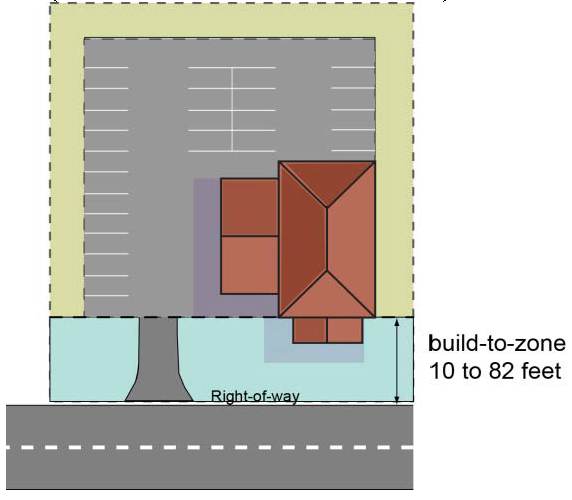
Pedestrian Sub District. The front face of all principal structures shall be located in the build-to-zone. The build-to-zone for a building or structure shall be located between 10 and 20 feet from the right-of-way, unless Planning and Zoning Commission allows 30 feet where a drive aisle exists in front of a building. Architectural features including, but not limited to, signage, awnings, columns, porticos, public art or landscape features may project beyond the build-to-zone if approved by the Planning Director.
(2)
Low-Impact Auto Sub District. The front face of all principal structures shall be located in the build-to-zone. The build-to-zone for a building or structure shall be between 10 and 82 feet from the right-of-way. Architectural features including, but not limited to, signage, awnings, columns, porticos may project beyond the build-to-zone if approved by the Planning Director.
(d)
Accessibility.
(1)
In the Low-Impact Auto Sub District, a minimum five foot wide public sidewalk shall be provided along all streets (excluding alleys) and extend along the entire frontage of the lot and connect to the sidewalks on adjacent properties.
(2)
In the Pedestrian Oriented Sub District a minimum six foot wide public sidewalk shall be provided along all streets (excluding alleys) and extend along the entire frontage of the lot and connect to the sidewalks on adjacent properties.
(3)
A pedestrian walkway with a minimum width of five feet shall be provided from the public sidewalk to a primary building entrance (note the area shall be striped if extending through a parking area).
(e)
General Design Standards.
(1)
A primary building shall be oriented parallel to a primary street, or as parallel as the site permits.
(2)
Any new building or redevelopment of a building façade shall include 100 percent traditional and natural materials on the front façade, and a minimum 40 percent traditional or natural materials on side façades. There is no requirement for rear facades except for corner lots which shall have a minimum of 40 percent traditional and natural materials. Note that any façade facing a street shall be considered a front façade.
(3)
The height of a building shall be a minimum of 18 feet above grade.
(4)
A building frontage that exceeds a width of 50 feet shall incorporate articulation and offset of the wall plane to inhibit a large expanse of blank wall and add interest to the facade.
(5)
For any façade facing a street, a minimum of 40 percent of the area between the height of two feet and 10 feet above grade shall be in clear window glass that permits a full, unobstructed view of the interior to a depth of at least four feet, with the exception of blinds, curtains or other interior decorative elements.
(6)
The general pattern of window glass shall continue from the primary building frontage to the sides of the building/secondary frontage.
(7)
Any roof-mounted mechanical equipment shall be screened from public view to the height of the equipment. The materials used in screening must be architecturally compatible with the rooftop and the aesthetic character of the building.
(8)
Gables shall have a minimum depth of eight feet.
(9)
Parapet walls if integrated into the architecture of the building shall extend around all four sides of the building.
(f)
Lighting.
(1)
Exterior lighting shall be designed, located, constructed and maintained to minimize light and reflected light trespass and spill over off the subject property.
(2)
The light level along a property line adjacent to a residentially-zoned or used property shall not exceed an average intensity of one-half (½) footcandle.
(3)
Parking lot lighting fixtures and poles shall be black in color.
(4)
Exterior building illumination shall be from concealed sources. Strobe or flashing lights and exposed neon lights are not permitted. Lighting fixtures shall not generate excessive light levels, cause glare, or direct light beyond the facades onto neighboring property, streets, or the night sky.
(5)
Security lighting shall be full cut-off type fixtures, shielded and aimed so that illumination is directed to the designated areas.
(g)
Parking.
(1)
Parking or stacking spaces between the right-of-way and the building:
A.
No parking, staking spaces or drive aisles are permitted between the right-of-way and building in the Pedestrian Oriented Sub District. Parking must be located on the side or rear of the structure, or some combination thereof.
B.
Two rows of parking and one drive aisle are permitted between the right-of-way and building in the Low-Impact Auto Sub District. Remaining parking must be located on the side or rear of the structure, or some combination thereof.
C.
In some instances where, due to the size or shape of the lot, the site is rendered undevelopable the Planning and Zoning Commission may grant relief from these general parking and circulation standards.
(2)
The Planning and Zoning Commission may reduce the required number of off-street parking spaces in the Pedestrian and Low-Impact Auto District by up to 50 percent in conjunction with a concept or major site plan approval after giving due consideration to the following factors:
A.
Type of land use/development;
B.
Hours of operation;
C.
Pedestrian traffic and accessibility;
D.
Availability of transit service;
E.
Opportunities for shared parking;
F.
Availability of on street parking;
G.
Availability of other public parking; and
H.
Elimination of arterial curb cuts.
(3)
The Planning and Zoning Commission may reduce or eliminate the required number of loading spaces in conjunction with concept plan or major site plan approval after giving due consideration to the following factors:
A.
Frequency and time of deliveries;
B.
Necessary size and nature of delivery vehicles;
C.
Impact on adjoining streets or alleys; and
D.
Neighborhood character.
(h)
Screening of Trash Container Receptacles.
(1)
For retail, commercial, community service, industrial, office, institutional and multiple family uses, all trash containers, receptacles, or outdoor grease bins shall be screened or enclosed. All waste and refuse storage areas shall be containerized and screened from view on three sides by a solid brick wall, wood fence, or materials compatible with the main buildings' materials and shall be at least 6 inches taller than the height of the container. The fourth side shall contain a wood or painted metal gate, which shall also be at least 6 inches taller than the height of the dumpster.
(2)
The use of curbs or steel pipes filled with concrete, or other similar measures, shall be required to control the placement of the trash container, receptacle, or outdoor grease bin.
(3)
The use of concrete curbs around planting beds shall be required to protect plantings from damage caused by traffic movement.
(Ord. 14-29. Passed 10-27-14; Ord. 15-26. Passed 7-13-15; Ord. No. 21-09, § 1(Exh. A), 3-22-21; Ord. No. 21-33, § 1(Exh. A), 11-8-21.)
1111.05 - SITE DEVELOPMENT REGULATIONS.
In addition to the requirements of this Chapter, all development in the Business Districts shall meet the applicable requirements as listed elsewhere in this Code:
(a)
Special Purpose District Requirements, see Chapter 1115.
(b)
General Provisions, see Chapter 1121.
(c)
Conditional Use Requirements, see Chapter 1123.
(d)
Landscaping and Lighting Requirements, see Chapter 1125.
(e)
Off-Street Parking and Loading, see Chapter 1127.
(f)
Signs, see Chapter 1129.
(g)
Site Plan Review Requirements, see Chapter 1131.
(Ord. 14-29. Passed 10-27-14.)

