
Hilliard City Zoning Code
CHAPTER 1121
ZONING GENERAL PROVISIONS
1121.01 - COMPLIANCE WITH PROVISIONS.
Except as specified in this chapter, no building, structure or premises shall be used or occupied and no building or part of any building or other structures shall be erected, razed, moved, placed, reconstructed, extended, enlarged or altered except in conformity with the provisions of this chapter.
(Ord. 14-29. Passed 10-27-14.)
1121.02 - BUILDINGS AND STRUCTURES.
(a)
Unlawful Buildings and Uses. Any building, use, or lot which has been unlawfully constructed, occupied, or created prior to the date of adoption of this code shall continue to be unlawful, unless expressly permitted by this zoning code. Such buildings, uses or lots shall not be considered to be nonconforming buildings, uses or lots of record under this code.
(b)
Accessory Buildings.
(1)
Accessory buildings or garages shall be considered to be part of the principal building and subject to all setback requirements of the principal building, if structurally and architecturally integrated into the building or if attached by an enclosed breezeway or similar enclosed structure not greater than 10 feet in length. Detached accessory buildings shall be located at least 10 feet from any principal building.
(2)
Accessory buildings shall not be erected in any front yard or within any easement.
(3)
Accessory buildings may be erected in a rear yard if set back not less than six feet from the rear property line and three feet from the side property line. In any case, accessory buildings shall not occupy more than 30 percent of the required rear yard.
(4)
Buildings and structures accessory to non-residential uses shall meet the minimum setback requirements and height limitations for principal buildings in the respective zoning district.
(5)
An accessory building designed for and containing a vehicle entrance to be accessed from an existing publicly dedicated and commonly used alley may be located on the rear lot line, if parking space plans have been approved by the Planning Director or designee.
(6)
The height of an accessory building shall not exceed 14 feet.
(7)
Accessory buildings shall not exceed 50 percent of the principal building floor area or 900 square feet, whichever is less.
(8)
An accessory building shall not be constructed or occupied on a lot before the principal building or use on the lot is constructed.
(9)
Accessory buildings in planned developments shall be subject to the same requirements as in the Residential Districts.
(10)
Swing sets, playground equipment, garden trellises, well-head covers and similar above-ground yard equipment accessory to a residential use shall be exempt from the provisions of this zoning code, except for height limitations, or unless specific provision is made for such equipment by city code. However, doll houses, club houses or other similar structures shall meet the requirements of the City's code.
(11)
Accessory buildings shall share all public utilities (water/sewer/electric) with the principal building. Accessory buildings shall not be separately metered.
(c)
Temporary Buildings.
(1)
Construction. Temporary buildings used only in conjunction with construction work may be permitted in any district during the period construction work is in progress, but shall be removed upon completion of the construction work.
(2)
Model Homes and Sales Offices. Upon application, the Planning Director or designee may issue a permit for a temporary sales office or model home which is both incidental and necessary for the sale or rental of real property in a new subdivision or housing development. Each permit shall specify the location of the office and shall be valid for a period of not more than two years and may be renewed by the Planning Director or designee for additional successive periods of six months or less each, at the same location, if the office or model home is still incidental and necessary for the sale or rental of real property in the subdivision or housing development where it is located.
(d)
Fences.
(1)
General Standards.
A.
Fences shall not be permitted to encroach upon public easements. Fences placed on utility easements shall provide access to manholes, utility boxes, cleanouts or other apparatus that may be used from time to time for maintenance of the utility. Fences in drainage easements shall require prior approval of the city engineer to allow for proper flow of water.
B.
All fences, regardless of the zoning district where located, shall be a neutral color of white, tan, light gray, light brown, or similar color.
C.
If both sides of a fence are not identical, the finished side (with no exposed posts or supporting cross elements) shall face outward from the property toward adjoining property or right-of-way.
D.
The height of a fence or wall shall be measured from the established grade line to the highest point of the fence excluding posts and finials; provided, the posts or finials shall not exceed the fence height by more than six inches. The height of the fence may not be artificially increased by the use of mounding, unless otherwise required by the zoning district regulations.
E.
All fences shall extend to the ground, or the bottom of the fence panels shall be no higher than six inches above the ground, and those inches count toward the maximum fence height.
F.
Fences and walls may not interfere with the visibility at any right-of-way, regardless of other standards.
G.
Only one style of fence or wall may be permitted per property line.
H.
Barbed wire fences, stockade fences, basket weave fences, electric fences, fences made out of razor wire, concertina wire, solid plywood, scrap lumber, common concrete, cinderblock or other similar non-customary materials are prohibited. Examples and depictions of prohibited fences are included in the Hilliard Design Manual.
I.
Fences shall not be located past the build-to line of the main structure on the parcel, except that on a corner lot, an aluminum/wrought iron style fence shall be permitted to pass the build-to line parallel to the secondary front lot line by half the linear distance between the build-to line and the right-of-way line, and shall not be greater than forty-eight inches (48") in height.
(2)
Permitting.
A.
A permit from the City is required prior to the installation of a fence, including a new fence or fence section, replacement fence, the relocation of any part of an existing fence located on a property. A permit is not required for regular fence maintenance. Regular Fence Maintenance is for the approved permitted fence only.
B.
The application for a permit shall include plans or drawings showing the actual and accurate shape and dimensions of the property on which the fence is to be erected as described in subsection C below; the exact height, location, length, type of material, type of construction of such proposed fence; the location of all buildings on the lot; and other information deemed necessary by the zoning inspector or designee in order to ensure that the fence is constructed in compliance with this code.
C.
An applicant shall determine property lines prior to constructing a fence and shall ensure the fence does not encroach upon another lot or parcel of land. The owner shall submit a copy of a survey or similar drawing indicating the location of property lines in the area of the proposed fence with the application for a permit.
(3)
Front Yards. No fence shall be permitted in any front yard except for invisible fences and on corner lots consistent with Hilliard Code Section 1121.02(d)(1)(I). Shrubbery and hedges may be permitted in the front yard; provided, they do not exceed a height of three feet.
(4)
Side and Rear Yards. Fences in side and rear yards shall comply with the following standards:
A.
Except for the M-1 and M-2 Districts, the maximum height in all Districts is six feet, except chain link fences in Residential Districts, or that part of a PUD that is exclusively for Residential Uses, which shall not exceed four feet in height. For the M-1 and M-2 Districts, the maximum height is seven feet. Fences on corner lots shall conform to the provisions of Code Section 1121.02(d)(1)(I).
B.
All fences may be placed on the property line; provided, the location conforms to all other applicable regulations of this code section.
(5)
Private Swimming Pools. Fences shall be installed to surround all private swimming pools as defined by Section 1121.06(f), whether in-ground or above-ground or any combination thereof, as follows:
A.
The immediate surrounds of the private swimming pool or the yard in which it is located, shall be fenced and equipped with a self-latching gate with a self-closing lock to prevent uncontrolled access into any private swimming pool.
B.
Any ladders or stairs providing access to a private swimming pool shall be enclosed by a fence and/or self-latching and self-locking gate to prevent uncontrolled access.
C.
The fence shall be designed, constructed and maintained in a manner to secure the private swimming pool from unauthorized entry.
D.
The fence shall be at least four, but not more than six, feet above the natural grade and comply with all other applicable provisions of Section 1121.02(d).
E.
Private swimming pools with a locking safety cover that complies with the American Society of Testing and Materials standard for Pool & Spa Covers (ASTM F1346-91), as may be amended, shall be exempt from the provisions of Section 1121.02(d)(5)A.—D. subject to the following standards:
1.
Retractable safety covers for pools must be extended (closed) and locked when not in use.
2.
Safety covers for spas and hot tubs must be used and locked when not in use.
3.
Safety covers of any kind must be maintained in good condition and working order at all times.
(6)
Landscaping. Chain link or privacy fences/walls exceeding four feet in height in Commercial, Business and Manufacturing Districts that abut a Residential District or Residential Use or are located directly across a street or right-of-way from a Residential District or Use shall be bordered by landscaping. A landscape plan shall be submitted with the application and shall include planting adjacent to the fence or wall, facing the Residential District and shall include:
A.
One shrub for every six feet of fence.
B.
At least one-half of all shrubs shall be evenly spaced and all shrubs shall be attractively arranged, with a minimum 50 percent year round opacity. At least 50 percent of the shrubs shall be evergreen. Shrubs shall be a minimum of two feet in height at the time of planting and shall be of a type expected to reach at least six feet at maturity with a spread of at least six feet.
(7)
Maintenance.
A.
All fences, walls, and hedges shall be maintained in good condition, with all boards, posts, slats and gates securely in place, structurally sound and completely finished at all times, including painted surfaces. Any grounds between the structures and property lines shall be well maintained at all times, and clear of debris, weeds and overgrowth.
B.
All fences located within an R-R District, and which are constructed in order to, at any time, confine livestock, shall be locked securely and maintained in a manner to prevent the wandering of livestock from the fenced area.
(e)
Mechanical Equipment Screening.
(1)
Mechanical units located on the ground shall be located in the rear or side yard not closer than three feet to adjoining property. When attached to a building, the mechanical equipment shall be architecturally integrated or appropriately screened by shrubbery or fencing so as not to be visible from neighboring property. Fences shall comply with the requirements of Section 1121.02(d).
(2)
If located on the roof of a building or in a location that cannot otherwise be screened, the equipment shall be enclosed or designed in a manner that is architecturally integrated with the building where it is located.
(f)
Solar Panels. It is the purpose of this regulation to promote the safe, effective and efficient use of solar energy systems to reduce the on-site consumption of utility-supplied energy and/or hot water, while protecting the health, safety and welfare of adjacent and surrounding land uses through appropriate zoning and land use controls.
(1)
The installation and construction of a solar energy system shall be subject to the following development and design standards:
A.
A solar energy system is permitted in all zoning districts as accessory to a principal use.
B.
A solar energy system shall provide power for the principal use and/or accessory use of the property on which the solar energy system is located and shall not be used for the generation of power for the sale of energy to others; provided, excess power generated from time to time may be sold to an electric utility company.
C.
The owner of a solar energy system connected to the utility grid shall provide written authorization from the local utility company to the City of Hilliard acknowledging and approving such connection.
D.
A solar energy system may be roof-mounted or ground-mounted, subject to all applicable requirements for that location, as follows:
1.
A roof-mounted system may be mounted on a principal building or accessory building.
2.
On a flat roof, a roof-mounted system may exceed the maximum principal building height or accessory building height specified in the zoning district by up to 6-feet above the deck of the roof to which it is attached. In no instance shall any part of the solar energy system extend beyond the edge of the roof. Whether mounted on the principal building or accessory building, a roof-mounted system may not exceed the maximum principal building height or accessory building height specified in the zoning district. In no instance shall any part of the solar energy system extend beyond the edge of the roof.
3.
A ground-mounted system shall not exceed the maximum building height for accessory buildings.
4.
The area covered by ground-mounted solar energy systems, where the ground beneath is permeable or pervious, shall not be included in calculations for lot coverage or impervious cover.
5.
A ground-mounted system shall not be located within the front yard.
6.
The minimum setback distance for a ground-mounted system from the property lines shall be equivalent to the required setback for the principal building.
E.
All mechanical equipment associated with and necessary for the operation of the solar energy system shall comply with the following:
1.
Mechanical equipment associated with the solar energy system except for the photovoltaic (PV) panels shall be screened from any adjacent property that is residentially zoned or used for residential purposes. The screen shall consist of shrubbery, trees, or other non-invasive plant species which provides a visual screen. In lieu of a planting screen, a decorative fence meeting the requirements of this code and providing effective screening may be used.
2.
Mechanical equipment shall not be located within the front yard.
3.
Mechanical equipment shall comply with the setbacks specified for accessory structures in the zoning district, but not less than 10 feet from all side and rear lot lines.
F.
Solar panels shall be placed such that concentrated solar radiation or glare shall not be directed onto nearby properties or roadways.
G.
Solar panels shall not be placed in the vicinity of any airport in a manner that would interfere with airport flight patterns.
H.
All power transmission lines from a ground mounted solar energy system to any building or other structure shall be located underground.
I.
A solar energy system shall not be used to display advertising, including signage, streamers, pennants, spinners, reflectors, ribbons, tinsel, balloons, flags, banners or similar materials.
J.
The design of the solar energy system shall conform to applicable industry standards. All necessary permits shall be obtained for a solar energy system prior to installation. The local utility provider shall be contacted to determine grid interconnection and net metering policies. The applicant shall submit certificates of design compliance obtained by the equipment manufacturer from a certifying organization and any such design shall be certified by an engineer registered in the State of Ohio.
K.
The solar energy system shall comply with all applicable codes to ensure the structural integrity of the solar energy system.
L.
Before any construction shall commence on any solar energy system, the property owner must acknowledge, in writing, that he/she is the responsible party for owning and maintaining the solar energy system.
M.
Emergency Access. Roof-mounted solar energy systems shall be located in such a manner as to ensure emergency access to the roof, provide pathways to specific areas of the roof, provide for smoke ventilation opportunities, and provide emergency egress from the roof.
1.
For buildings with pitched roofs, solar collectors shall be located in a manner that provides a minimum of one three-foot wide clear access pathway from the eave to the ridge on each roof slope where solar energy systems are located as well as one three-foot smoke ventilation buffer along the ridge.
2.
Rooftops that are flat shall have a minimum three-foot wide clear perimeter between a solar energy system and the roofline, as well as a three-foot wide clear perimeter around roof-mounted equipment such as HVAC units.
N.
Installation on Building Listed in the National Register of Historic places.
1.
A low-profile solar energy system should be installed on a historic building so the device is not visible or is minimally visible from the primary public right-of-way; for example, installation should be on a flat roof and set back to take advantage of a parapet or other roof feature to screen solar panels from view, or on a secondary slope of a roof out of view from the primary public right-of-way.
2.
A solar energy system on a historic building should be installed in a manner that does not damage historic roofing material, does not negatively impact the building's historic character, and is reversible.
3.
Solar energy systems should be installed horizontally—flat or parallel to the roof slope—to reduce visibility.
(2)
If a ground mounted solar energy system is removed, any earth disturbance as a result of the removal shall be graded and reseeded.
(3)
If a ground mounted solar energy system has been abandoned (meaning not having been in operation for a period of six months) or is defective or is deemed to be unsafe by the city building official, the solar energy system shall be required to be repaired by the owner to meet federal, state and local safety standards, or be removed by the property owner within the time period allowed by the building official. If the owner fails to remove or repair the defective or abandoned solar energy system, the City of Hilliard may pursue a legal action to have the system removed at the owner's expense.
(Ord. 14-29. Passed 10-27-14; Ord. 15-26. Passed 7-13-15; Res. 19-R-04. Passed 2-25-19; Ord. No. 21-09, § 1(Exh. A), 3-22-21; Ord. No. 21-33, § 1(Exh. A), 11-8-21; Ord. No. 22-35, § 1(Exh. A), 10-10-22.)
1121.03 - DIMENSIONAL REQUIREMENTS.
(a)
Front Yard. All yards abutting upon a public street right-of-way or private street easement shall be considered front yards for setback purposes, except as provided for accessory buildings on double frontage lots.
(b)
Front Setback Requirements. The following setback requirements shall apply to all Residential Districts:
(1)
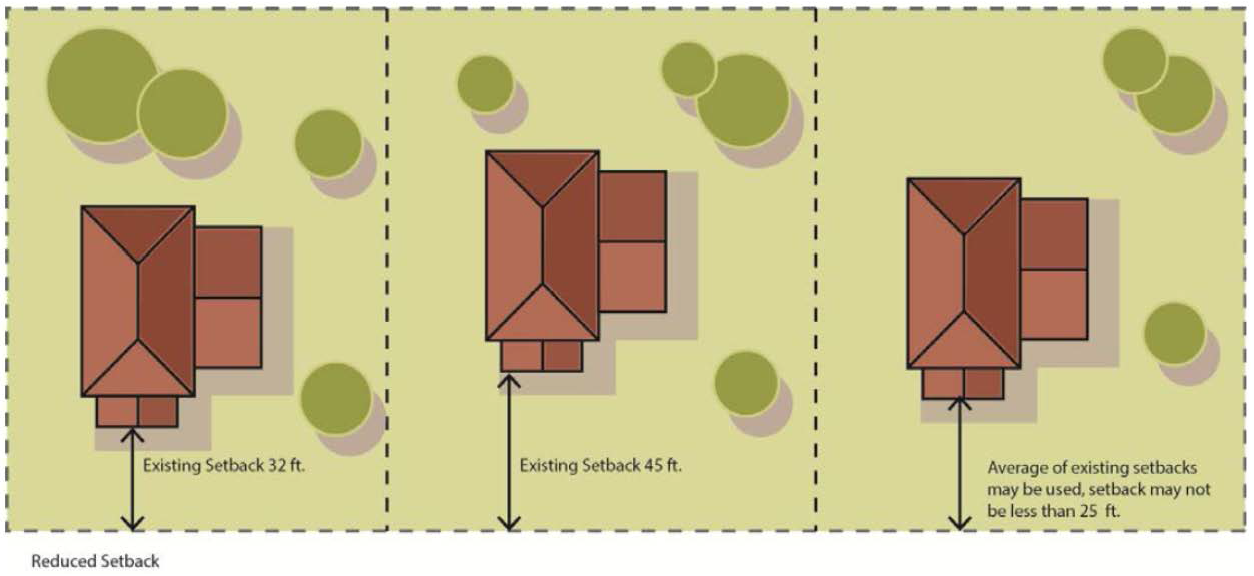
Where the established front yards for existing principal buildings located within 200 feet of a side lot line of, and in the same zoning district as, a subject lot are less than the required front yard for the zoning district of the subject lot, the required front yard for the subject lot shall be the average front yard of the existing main buildings on the same side of the street, on the same block and entirely or partially within 200 feet of the side lot lines of the subject lot.
(2)
The front yard reduction provided for in this section shall only be permitted if two or more lots are occupied by main buildings within the area described for computing the average front yard.
(3)
In no case shall the front yard setback resulting from the application of these provisions, be less than 25 feet.
(c)
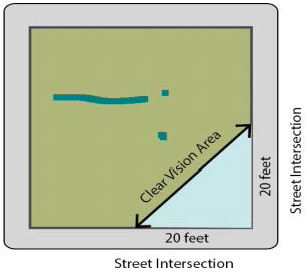
Clear Vision Corners. Fences, walls, structures, shrubbery or other potential obstructions to vision, except utility poles, lights and street signs, shall not be permitted to exceed a height of 30 inches within a triangular area formed by the intersection of the street right-of-way lines and a line connecting two points located on those intersecting right-of-way lines 20 feet from the point of intersection with the right-of-way lines. Nor shall a property owner permit tree limbs from a private tree to hang at a length that obstructs vision at an intersection or is otherwise a safety hazard.
(d)
Encroachment in Right-of-Way. No buildings, structures, service areas or required off-street parking and loading facilities, except driveways, shall be permitted to encroach within public rights-of-way.
(e)
Required Yards or Lots. No lot or lots in common ownership and no yard, court, parking area or other space shall be so divided, altered, or reduced as to make the area or space less than the minimum size required under this code. If already less than the minimum size required, the area or space shall not be further divided or reduced.
(f)
Minimum Lot Frontage. Any lot created after the effective date of this code shall front upon a public street right-of-way, private street easement, or approved access easement and shall have frontage on the public street, private street or approved access easement equal to the lot width required in the applicable zoning district.
(g)
Cul-de-Sac Lots. In the case of lots abutting cul-de-sac streets, the minimum required lot width shall be measured at the required front setback line. Cul-de-sac lots shall have a minimum width of 40 feet at the front lot line. For lots in the R-R district that have their entire frontage on a cul-de-sac, a minimum lot width of 150 feet shall be achieved at a point 125 feet from the front lot line.
(h)
Existing Lots of Record. Any residentially zoned lot of record, existing on the effective date of this code, that is 50 feet or wider, but less than the minimum area and/or width required for the zoning district, may be used for the erection of a single family dwelling; provided, the front and rear yard setback requirements of the district are met and each side yard is no less than the percent of the lot width in relation to the required lot width.
(i)
Corner Lots and Through Lots. Lots having frontage on more than one street shall provide required front yards along all streets.
(j)
Projections into Required Yards. The following elements and appurtenances may encroach into or over a required yard setback, as provided in Table 1121-3:
;adv=6; 1 In the case of vehicle service stations, hotels, funeral homes and similar uses, canopies may be permitted over a driveway or walkway within the front yard but shall not be closer than 15 feet to the street right-of-way or easement line.
2 Any covered or roofed porch, deck, patio, stoop or similar structure shall be considered part of the principal building and shall comply with the required setbacks for the principal building.
(k)
Height Exceptions. The height regulations of any zoning district shall not apply to television and radio towers, church spires, belfries, monuments, tanks, water and fire towers, stage towers or scenery lofts, cooling towers, ornamental towers and spies, chimneys, silos and similar structures, elevator bulkheads, smoke stacks, or conveyors and flagpoles, except where the height of such structures will constitute a hazard to the safe landing or takeoff of aircraft at an established airport.
(l)
Maximum Width/Depth Ratio. In all zoning districts, no lot or parcel shall be created whose depth exceeds four times its width; provided, for cul-de-sac lots or parcels the width shall be measured at the required front setback line.
(Ord. 14-29. Passed 10-27-14; Ord. 15-26. Passed 7-13-15.)
1121.04 - DWELLINGS.
(a)
Illegal Dwellings. The use of any basement for dwelling purposes is prohibited in any zoning district, unless the basement meets the appropriate city building codes. Buildings erected as garages or accessory buildings shall not be occupied for dwelling purposes, except if specifically constructed and authorized as an accessory dwelling.
(b)
Temporary Dwellings. No cabin, garage, basement, tent, recreational vehicle, or other temporary structure shall be used in whole or in part for dwelling purposes in any district; provided a manufactured home may be used as a temporary dwelling for a period not to exceed six months upon application for and approval of a permit for such occupancy by the Planning Director or designee upon determination that the following conditions exist and are met:
(1)
The permanent dwelling of the resident applicant on the subject property has become uninhabitable due to damage caused by fire, wind or other natural calamity or emergency.
(2)
Due to undue hardship, the applicant is unable to obtain another dwelling unit as a temporary residence.
(3)
The temporary dwelling shall be served by sanitary sewer and potable water, approved by the city.
(4)
The temporary dwelling will be removed prior to the issuance of a certificate of occupancy for the new dwelling.
(c)
Conversion of Dwellings. In the R-3 and R-4 Districts, a single family dwelling may be converted to accommodate additional dwelling units, provided:
(1)
The exterior of the building shall not be changed in a way that alters the appearance of a single family dwelling and the yards shall not be reduced to less than the minimum requirements of the zoning district.
(2)
The minimum lot area per unit is equal to the lot area requirements for two family or multiple family dwellings, as applicable, in that district.
(3)
Each dwelling unit meets the minimum floor area requirements for single or multiple family dwellings, as applicable, within the zoning district.
(Ord. 14-29. Passed 10-27-14; Ord. No. 21-09, § 1(Exh. A), 3-22-21.)
1121.05 - PARKING AND STORAGE.
(a)
Outdoor Storage. Outdoor storage of merchandise, equipment, supplies, products or other materials shall only be permitted in those districts and under such conditions as specifically authorized by this code.
(b)
Temporary Storage Units.
(1)
Registration of Temporary Storage Units.
A.
Prior to the initial delivery of a temporary storage unit, the property owner, occupant of the premises (if not the owner) or storage unit supplier shall register the placement of the storage unit with the building department; provided, however, such registration shall not be required if the storage unit will be removed within 72 hours of its delivery.
B.
Registration requires the following:
1.
Completing the required application form and providing the property owner's or occupant's (if not the owner) name, size of the temporary storage unit to be registered, the address at which the storage unit will be placed, delivery date, removal date and a sketch illustrating the location and placement of the storage unit;
2.
Written approval of the application by the Planning Director or designee.
3.
The effective date of the registration shall be the date of the application's approval.
(2)
Placement Requirements.
A.
It shall be unlawful to place or permit the placement of a temporary storage unit on property located within the City of Hilliard, unless it is registered with the building department, as required in subsection (b)(1), above.
B.
Temporary storage units shall only be placed upon or within a driveway or a parking area or, if access exists at the side or rear of the lot, the side or rear yard.
C.
No temporary storage unit shall be placed upon or within public property or a public place, including without limitation, a street, sidewalk or outlawn.
D.
The temporary storage unit shall not be located at the registered address for more than 14 consecutive days, including the days of delivery and removal; provided, if the unit is needed to facilitate cleanup and/or restoration of activities resulting from natural disasters, fire, or remodeling the unit may be located on the property for up to 90 consecutive days.
E.
Each lot may contain two storage units at the time and each lot is permitted a maximum of two registrations in a 12 month period.
F.
The temporary storage unit shall not exceed 200 square feet.
G.
The temporary storage unit shall be secured in a manner that does not endanger the safety of persons or property in the vicinity of the unit.
H.
The temporary storage unit shall be maintained in good condition, free from evidence of deterioration, weathering, discoloration, graffiti, rust, ripping, tearing or other holes or breaks at all times.
I.
No temporary storage unit shall be used for human occupancy or to store solid waste, business inventory, commercial goods, goods for property other than the property where the storage unit is located or any other illegal or hazardous material. Upon reasonable notice, the building department may inspect the contents of any temporary storage unit at any reasonable time to ensure compliance with these requirements.
J.
Any temporary storage unit which is not removed at the end of the time for which the unit was registered, may be removed by the City upon providing the registered party with 24 hours advance notice. Upon failure of the registered party to reimburse the City for the cost of such removal, the City may certify the amount unpaid to the Franklin County Auditor's Office and be assessed against the property on which the unit was located in the same manner as real property taxes.
K.
A sign identifying the storage unit supplier, mounted on the temporary storage unit, shall not require a sign permit; provided, the storage unit is in compliance with this section and all other applicable codes.
(c)
Vehicles. Unless stated otherwise in this Section, all Vehicles shall be parked on an improved surface as defined in Section 1105.05 of the City's Codified Ordinances.
(1)
Storage and Repair of Vehicles.
A.
The repair, restoration and maintenance of vehicles in any Residential District, shall be conducted entirely within an enclosed building, except for those activities that can be and are completed in less than 24 hours. All such repair shall take place on private property and shall not be conducted within the public right-of-way.
B.
It shall be unlawful for the owner, tenant or lessee of any building or lands within the City to permit the open storage or parking of any inoperable motor vehicle, machinery or equipment, or parts thereof, outside of an enclosed garage or enclosed building, for a period of more than 48 hours. An inoperable motor vehicle for purposes of this subsection shall include motor vehicles which, by reason of dismantling, disrepair or other cause, are incapable of being propelled under their own power, or are unsafe for operation on the streets and highways of this state because of the inability to comply with the State Motor Vehicles and Traffic Code, or do not have a current license plate and registration as required for operation by the State Motor Vehicles and Traffic Code.
C.
It shall be unlawful for the owner, tenant or lessee of any lot or building in a Residential District to permit the open storage or parking outside of a building of semi-truck tractors and/or semi-truck trailers, bulldozers, earth carriers, cranes or any other similar equipment or machinery, unless parked for purposes of construction being conducted on that lot.
(2)
Recreational Vehicle Parking.
A.
It shall be unlawful for any person to park or cause to be parked any recreational vehicle on any street, alley, highway, or other public place in the city and to use the same as a dwelling.
B.
One Recreational vehicle may be stored in the rear yard in a Residential District or Residential Use, subject to the following conditions:
1.
the Recreational Vehicle shall be located not less than 5 feet from the side lot line;
2.
the Recreational Vehicle shall be located not less than 10 feet from the rear lot line;
3.
the Recreational Vehicle shall be located not less than 4 feet to the primary building/structure; and
4.
the Recreational Vehicle shall be either parked on an improved surface or in a fully enclosed structure. For purposes of this section, "improved surface" has the same meaning as in Section 1105.05.
(3)
Commercial Vehicles in Residential Districts. Commercial vehicles shall not be located on any property within a Residential District or Use, unless parked or stored within a completely enclosed garage or building. This shall not prevent the temporary location of any such vehicle on property while engaged in a delivery, pickup or service run to the property where located.
(Ord. 14-29. Passed 10-27-14; Ord. 15-26. Passed 7-13-15; Ord. No. 21-09, § 1(Exh. A), 3-22-21; Ord. No. 21-33, § 1(Exh. A), 11-8-21; Ord. No. 23-04, § 1(Exh. A), 3-27-23.)
1121.06 - USES.
(a)
Principal Use per Lot. A lot or parcel shall not be devoted to more than one principal use, or contain more than one principal building, except for groups of multiple family dwellings, agricultural buildings, or commercial or industrial buildings contained within a single, integrated development, sharing parking and access and determined to be a single use collectively. Examples include vehicle service stations/convenience stores/car washes and vehicle sales lots/repair/body shops.
(b)
Legal Use. No building, structure or land shall be used or occupied and no building structure or part thereof shall be erected, constructed, reconstructed, moved, enlarged or structurally altered unless in conformity with the regulations of this code.
(c)
Legal Lot. Every building, structure or use erected or established within the city shall be located on a legally recorded lot or parcel and shall conform to all applicable requirements of this code.
(d)
Essential Services. The erection, construction, alteration or maintenance of essential public services is permitted in all zoning districts and exempt from the provisions of this code.
(e)
Home Occupation.
(1)
A permit shall be required prior to establishing a home occupation. Application for a home occupation permit shall be made in writing to the Planning Director or designee, together with payment of such fee, if any, as may be established by City Council. The requirement for a permit is to ensure compliance with the conditions of this subsection and to establish a record to determine future compliance.
(2)
If the Planning Director or designee cannot determine if the home occupation requirements are met, in his/her sole discretion, the Planning Director or designee may refer the matter to the Planning and Zoning Commission for consideration.
(3)
The home occupation shall be operated in its entirety within the principal dwelling.
(4)
Only residents living in the principal dwelling shall be engaged in the home occupation.
(5)
The use of the dwelling unit for the home occupation shall be clearly incidental and subordinate to its use for residential purposes by its occupants. Not more than 25 percent of the gross floor area of the dwelling or 250 square feet, whichever is less, shall be used in the conduct of the home occupation.
(6)
There shall be no change in the outside appearance of the dwelling or other visible evidence of the conduct of the home occupation, except that one sign, not exceeding two square feet, non-illuminated and mounted flat against the wall of the dwelling, may be permitted.
(7)
The direct sale of goods, merchandise, supplies, products or services to customers shall not be permitted on the premises. Phone and internet sales may be permitted, provided the items purchased are shipped directly to the customer so no pick-up is required at the location of the home occupation.
(8)
Outdoor storage, activities or displays shall be prohibited.
(9)
No traffic shall be generated by the home occupation in greater volume than would normally be expected in a residential neighborhood. Any parking needed to accommodate the home occupation shall be provided off-street behind the required front setback line.
(10)
No equipment or process shall be used in the home occupation which creates noise, vibration, glare, fumes, odors or electrical interference detectable to the normal senses off the premises, if the occupation is conducted in a single-family dwelling, or detectable outside the dwelling unit if conducted in an attached or multiple family dwelling. In the case of electrical interference, no equipment or process shall be used which creates visual or audible interference in any radio or television receivers off the premises or causes fluctuation in line voltage of the premises.
(11)
Uses such as, but not limited to: clinics, hospitals, medical offices, nurseries, day care centers, ambulance service, amusement arcades, vehicle repair or maintenance, pawn shop, fortune teller, veterinarian offices, permanent basement or garage sales or kennels shall not be considered home occupations.
(f)
Pools. Temporary pools, private swimming pools and other bodies of water for the purposes of the Zoning Code shall be defined herein and shall be regulated according to the following definitions and requirements:
(1)
Temporary Pool. Any short-term wading, children's or pet pool structure capable of containing a maximum depth of eighteen inches of water at any point and is able to be drained daily and moved easily. Temporary pools are intended for play and are not deep enough for swimming. Temporary Pools are not subject to the requirements of this Section but must be located behind the required front building line and within the side or rear yard. Temporary pools that exceed 50 square feet in area shall be considered a private swimming pool.
(2)
Private Swimming Pool. Any structure capable of containing water over eighteen inches in depth and which is used or intended to be used for swimming, bathing or physical therapy purposes that is supplied with water from a controlled water source and is not refilled daily and may or may not include mechanical equipment that requires an approved electrical source. Private swimming pools may be in-ground, above-ground or any combination thereof. Private swimming pools include, but are not limited to portable pools, inflatable pools, permanent pools, hot tubs, spas and private decorative ponds.
(3)
Other Bodies of Water. Other natural water sources and features such as rivers, streams, wetlands and lakes and manmade water sources that include farm/agricultural ponds, stormwater retention ponds stormwater detention basins or other public features are not subject to the requirements of this Section.
(4)
Requirements. No Private Swimming Pool shall be permitted in any zoning district except as an accessory use with an approved zoning certificate and in compliance with the following:
(A)
Private swimming pools shall be intended and used for the sole enjoyment of the occupants of the principal use of the property on which it is located.
(B)
Private swimming pools shall only be located within the rear yard of the property.
(C)
The private swimming pool and adjacent associated walks, paved areas and accessory structures shall not be located closer than 10 feet to any side or rear property line.
(D)
Fencing or other approved barriers for safety shall be required around the private swimming pool in conformance with Section 1121.02(d).
(E)
Private swimming pools shall not be considered as a detached accessory structures for the purposes of calculating maximum permitted area based on the size of the principle structure.
(F)
A minimum separation often feet shall be provided between a private swimming pool and the primary structure for safe egress.
(G)
No private swimming pool may be placed within a platted utility easement, stormwater easement, no-build zone, preservation zone or other recorded easement area.
(H)
All private swimming pools shall be required to obtain a zoning certificate as required by Section 1141.03.
(g)
Voting Place. The provisions of this code shall not be construed in any manner that would interfere with the temporary use of any property as a voting place in connection with a municipal, school or other public election.
(h)
Similar Uses. Since every potential use cannot be addressed in this code, each district provides for similar uses, referencing this section. All applications for a use not specifically listed in a zoning district shall be submitted to the Planning Director or designee for review and decision, based on the following standards:
(1)
The Planning Director or designee shall find that the proposed use is not listed as a named permitted or conditional use in any zoning district.
(2)
If the use is not addressed in any district, the Planning Director or designee shall review the uses listed as permitted and conditional in the zoning district in which the use is proposed and determine if a use listed in the district closely resembles the proposed use. This determination shall be based upon criteria such as consistency with the district purpose statement, similar character, service or market area, customer or visitor draw, scale of building and parking, potential impact on property values, traffic generated, aesthetics, noise or potentially objectionable impacts on the health, safety, and welfare in the immediate vicinity or City-wide.
(3)
If a use is determined to be similar to a named use within the district, the proposed use shall comply with specific standards or other code requirements that apply to the named use. If the named use is a conditional use, the similar use may only be approved as a conditional use in accordance with the provisions of Chapter 1123.
(4)
The Planning Director or designee may, at his/her discretion, submit the proposed use to the Planning and Zoning Commission for determination of the appropriateness of the use.
(5)
Where the Planning Director or designee or Planning and Zoning Commission determines a proposed use is not similar to any named use addressed within the district, the applicant may petition for an amendment to this code.
(6)
The determination as to whether a proposed use is similar in nature and classification to another named permitted or conditional use within a district shall be considered as an interpretation of the use regulations, and not as a use variance; this determination may be appealed as provided in Chapter 1106.
(7)
Upon determination by the Planning Director or designee or Planning and Zoning Commission that a use is similar to a named use, the Planning Director or designee shall initiate an amendment to this chapter to list the similar use in the schedule of uses for the zoning district as permitted or conditional as the case may be.
(i)
Short-term Rental.
(1)
Zoning Certificate Required. No person, including but not limited to an owner, operator, manager, or employee shall engage in, conduct, or carry on, or permit to be engaged in, conducted or carried on, in or upon any premises, the operation of a short-term rental without an approved Zoning Certificate in accordance with Section 1141.03.
(A)
A separate short-term rental registration is required for each dwelling unit; for two-family or multi-family dwellings, a separate Zoning Certificate is required for each dwelling unit.
(B)
A copy of the approved Zoning Certificate for the short-term residence must be maintained on-site and available for inspection upon request.
(2)
Registration Fee. The fee for a Zoning Certificate as specified in Section 1143.03 to operate a short-term residence shall be established as set forth in Chapter 190 of the Codified Ordinances.
(3)
Registration Requirements. The application for a Zoning Certificate as specified in Section 1143.03 to operate a short-term residence shall include the following:
(A)
Address of the proposed short-term residence.
(B)
Type of dwelling unit.
(C)
Name of the applicant, including contact address, telephone number and email address.
(D)
Emergency contact information for the local rental host available at all times for any issues related to the short-term rental unit and/or transient guests who must be able to respond within an hour of being notified of an on-site emergency.
(E)
Maximum number of occupants that will be accommodated at the short-term rental, not to exceed two (2) per bedroom.
(F)
Minimum of one (1) parking space per guest bedroom that must park on-site on an approved surface.
(G)
A labelled site plan or aerial photograph that identifies parking spaces in compliance with Code and other information that demonstrates the requirements of this section.
(H)
A floor plan with square footages that identifies rooms on all floors and the specific location of bedrooms in a manner that demonstrates the requirements of this section.
(I)
Any additional information as deemed necessary by the Planning Director or designee to evaluate an application as to the requirements of the Code.
(4)
Short-term Rental Standards. The following standards of operation shall be met as a minimum requirement for any short-term rental within the City of Hilliard:
(A)
A short-term rental shall not provide more than six guest rooms plus a common area for use by all guests.
(B)
A short-term rental shall contain at least 800 square feet of usable floor area. For each guest room in excess of two, an additional 100 square feet of floor area shall be required.
(C)
Cooking facilities shall not be permitted in short-term rental guest rooms.
(D)
On-site parking shall only be in designated spaces as identified on the approved site plan. Overnight occupancy or parking of recreational vehicles, camper trailers and tents at the property of the short-term residence is not permitted.
(E)
No exterior advertising of the short-term rental shall be allowed.
(F)
Premises of short-term rentals shall not be utilized for holding commercial or social events/gatherings.
(G)
A licensee or guest of a short-term rental shall not use or allow the use of sound equipment or amplified music.
(H)
Operators shall comply with applicable State and local laws, including those pertaining to fire and building codes, smoke detecting and carbon monoxide detecting equipment and housing/property maintenance codes.
(I)
Short-term rentals shall not adversely affect the character of the surrounding area in a manner that violates municipal noise regulations as specified in Chapter 531 of the City's Codified Ordinances.
(J)
Premises shall be maintained in a manner that remains free of any Zoning Code or Building Code violations.
(K)
Residences shall not be altered in a manner that would make it appear less residential, including but not limited to installing parking lots and commercial lighting.
(L)
Within the Old Hilliard Mixed-Use Residential District (OH-RD), no short-term rental shall be located within a 1,000-foot radius, as measured starting at the primary public entrance of such establishment, to another short-term rental.
(5)
Grounds for Denial. The Planning Director or designee shall approve a Zoning Certificate for a short-term residence except for the following conditions:
(A)
Submission of an incomplete application and/or non-payment of an application fee.
(B)
The applicant makes a material misrepresentation of fact on the application.
(C)
Information provided does not comply with applicable use standards or other provisions of Section 1121.06(i).
(D)
The property has outstanding Zoning Code, Building Code or other regulatory violations for the property.
(E)
The short-term rental has a documented history of repeated conduct that endangers neighborhood or public safety that violates Section 1121.06(i)(6).
(6)
Revocation of Registration. The Planning Director or designee may revoke the Zoning Certificate for a short-term rental registration and restrict the short-term rental host from re-registering that property for a period of six months for any of the following:
(A)
Violating any of the use standards or requirements as set forth in Section 1121.06(i).
(B)
Failure to permit entry for the Planning Director and/or designee to inspect the premises to verify compliance with the provisions of this chapter.
(7)
Appeal of Denial or Revocation. In the event an applicant has been denied a Zoning Certificate for a short-term rental application or if a registration has been revoked or suspended, the affected party shall have the right to file an administrative appeal to the Board of Zoning Appeals in accordance with the provisions of Section 1106.03.
(8)
Authority to Conduct Inspections. By submitting the Zoning Certificate application for a short-term residence, the owner grants authorization to the Planning Director or designee to enter onto the property to inspect and ensure compliance with the short-term rental ordinance. In the event that consent is denied, the Planning Director or designee may pursue other legal authority for inspection and/or revoke the Zoning Certificate.
(9)
Severability. In the event that any provision of this chapter shall be declared by a court of competent jurisdiction to be invalid or unconstitutional, such decision shall not affect the validity of this chapter as a whole or any part thereof other than the part so declared to be invalid or unconstitutional.
(10)
Penalty. Whoever violates any provision of this chapter shall be guilty of a minor misdemeanor and punishable as permitted by law (see Section 1141.06 for penalty and enforcement). Each day such violation is committed or permitted to continue shall constitute a separate offense and shall be punishable as such. Any person who commits a subsequent offense within one year of a prior offense hereunder shall be guilty of a misdemeanor of the fourth degree. Each day such violation is committed or permitted to continue shall constitute a separate offense and shall be punishable as such.
(Ord. 14-29. Passed 10-27-14; Ord. 15-26. Passed 7-13-15; Ord. No. 21-09, § 1(Exh. A), 3-22-21; Ord. No. 22-18, § 1(Exh. A), 7-11-22; Ord. No. 22-35, § 1(Exh. A), 10-10-22.)
1121.07 - OTHER PROVISIONS.
(a)
Domestic Animals.
(1)
The keeping of household pets, including dogs, cats, fish, birds, hamsters and other animals generally regarded as household pets is permitted as an accessory use in any Residential District. However, no more than four dogs or cats, six months of age or older, in any combination, shall be kept or housed in or at one dwelling unit.
(2)
Agricultural animals such as, but not limited to, horses, cattle, goats, pigs, and sheep are permitted in the R-R District on parcels of three acres or more; provided that the total number of agricultural animals permitted on parcels of 10 acres or less shall be limited to one animal per gross acre. Manure storage areas shall be located at least 75 feet from any adjoining property line.
(3)
Any area where permitted animals are kept shall be maintained in a safe and sanitary condition.
(4)
Non-commercial raising of chickens and honeybees on permitted residential properties shall be maintained in accordance with Sections 1121.08 and 1121.09 of the Codified Ordinances of the City of Hilliard, Ohio, respectively.
(b)
Trash, Litter and Junk. It shall be unlawful for any person to accumulate, place, store or allow or permit the accumulation, placement or storage of trash, litter or junk on premises in the city, except in a lawful sanitary landfill or junkyard.
(c)
Control of Heat, Glare, Fumes, Odor, Dust, Noise or Vibration. Every use shall be conducted and operated in a way that does not create a nuisance and is not dangerous by reason of heat, glare, fumes, odor, dust, noise or vibration beyond the lot on which it is located.
(d)
Excavations or Holes. The construction, maintenance or existence within the city of any unprotected, unbarricaded, open or dangerous excavations, holes, pits or wells which constitute or are likely to constitute a hazard or menace to the public health, safety or welfare is hereby prohibited; provided, this section shall not apply to the following:
(1)
Any excavation for which a permit has been issued by the city and which is properly protected and where warning signs have been posted in a manner approved by the city;
(2)
Any excavation approved and operated as a special land use in accordance with this code for mining extraction operations; and
(3)
Streams, natural bodies of water or ditches, reservoirs and other bodies of water created or existing by authority of governmental units or agencies.
(Ord. 14-29. Passed 10-27-14; Ord. 15-26. Passed 7-13-15; Ord. No. 22-27, § 1(Exh. A), 9-12-22.)
1121.08 - BACKYARD CHICKENS.
(a)
Purpose. The purpose of this section is to provide general criteria for the raising of small-scale chickens in an environment for personal use within the municipality.
(b)
General Requirements. The keeping of chickens is permitted on residential parcels within the R-R, Rural Residential District; R-1, Low Density Residential District; the R-2, Low/Medium Residential District; PUD, Planned Unit Development District and the HCD, Hilliard Conservation District subject to the following requirements:
(1)
The keeping of more chickens than permitted above as an accessory use shall be regulated as a general agricultural operation that must comply with Section 1121.07(a).
(2)
In addition to the regulations provided in this chapter, property owners shall be responsible for adherence to all applicable deed restrictions and homeowners association requirements.
(3)
Chickens shall be kept for personal use only. Selling chickens, eggs, meat or other chicken-derived products or manure on-site and the breeding of chickens for commercial purposes is prohibited.
(4)
No chickens shall be permitted within the residence, on an enclosed porch or within an attached garage.
(5)
Slaughtering of animals on-site is prohibited. Any broilers raised on site must be processed off-site in an approved facility in accordance with all State and Federal laws.
(6)
No roosters are allowed except as permitted by Sections 1121.07(a)(2) and 1121.08(b)(7).
(7)
For applicable properties one acre or greater in size, ducks and roosters shall be permitted in lieu of or in combination with chickens. The maximum number of ducks, roosters and/or chickens or any combination thereof shall not exceed the maximum number prescribed by the table in Section 1121.08(b). No ducks, geese, pigeons, turkeys, peafowl or other poultry/fowl are otherwise permitted except as permitted by Section 1121.07(a)(2).
(c)
Shelter. All chickens must be maintained on a parcel with a kept shelter for the health and welfare of the animal that will protect them from the elements and predators. All shelters must be constructed of quality materials utilizing standard building techniques, be adequately ventilated and be kept in good working order. A minimum of 4 square feet of enclosed space is required per chicken.
(d)
Foraging. All chickens must be kept in a confined yard that provides at least 8 square feet of space per chicken. Chickens shall be managed in such a way as to prevent trespassing or creation of a nuisance to surrounding properties or the public right-of-way. No foraging is permitted forward of the primary structure.
(e)
Placement. All structures shall only be permitted within the rear yard and shall be located at least 15 feet from all property lines. No structure for the purpose of raising chickens shall be placed within any utility or stormwater easement.
(f)
Sanitation. Areas devoted to the keeping of chickens shall be maintained in a clean and sanitary condition free from accumulations of animal waste, feed, debris, etc. with the following requirements:
(1)
All feed must be kept in a rodent-proof and predator-proof container.
(2)
Composting manure must be maintained in a safe and sanitary condition and be located no less than 25 feet from the side or rear property line.
(g)
Zoning Certificate Required. Prior to the installation of any chicken shelter or prior to the commencement of any animal husbandry activities regulated within this section of the Code, an approved zoning certificate is required in conformance with Section 1141.03.
(h)
Fence Permit Required. Prior to the installation of any confined chicken yard or prior to the commencement of any husbandry activities regulated within this section of the Code, an approved fence permit is required in conformance with Section 1121.02(d)(2).
(i)
Penalty. Whoever violates any provision of this chapter shall be guilty of a minor misdemeanor and punishable as permitted by law (see Section 1141.06 for penalty and enforcement). Each day such violation is committed or permitted to continue shall constitute a separate offense and shall be punishable as such. Any person who commits a subsequent offense within one year of a prior offense hereunder shall be guilty of a misdemeanor of the fourth degree. Each day such violation is committed or permitted to continue shall constitute a separate offense and shall be punishable as such.
(Ord. No. 22-27, § 1(Exh. A), 9-12-22; Ord. No. 24-03, § 1(Exh. A), 2-26-24.)
1121.09 - REAR YARD BEEKEEPING.
(a)
Purpose. The purpose of this section is to provide general requirements for backyard beekeeping as a personal use within the municipality.
(b)
General Requirements. The keeping of honeybee hives (colonies) is permitted on residential parcels within the R-R, Rural Residential District; R-1, Low Density Residential District; the R-2, Low/Medium Residential District; PUD, Planned Unit Development District and the HCD, Hilliard Conservation District subject to the following requirements:
(1)
The keeping of more hives than permitted above as an accessory use shall be regulated as a general agricultural operation that must comply with Section 1121.07(a).
(2)
For each colony permitted to be maintained in accordance with this section, there may also be maintained on the same property one additional hive derived from a swarm or split made during the foraging season. Such hives as a part of natural expansion may be sold to other beekeepers to maintain the maximum permitted number of hives.
(3)
Any property containing a hive shall have a currently valid Apiary License for the beekeeper, as obtained from the Ohio Department of Agriculture (ODA) Division of Plant Health and be subject to annual inspection from the ODA. A copy of the license must be made available to the Planning Director or designee upon request.
(4)
Colonies shall be kept for personal use or be maintained by a registered beekeeper. Selling honey, beeswax propolis or other hive-derived products on-site and the breeding of honeybees for commercial purposes is prohibited.
(5)
No leasing of land for the placement of hives by another beekeeper is permitted unless done so with a beekeeper who is a registered member of a local beekeeping organization as recognized by the Ohio State Beekeepers Association.
(6)
In addition to the regulations provided in this chapter, property owners shall be responsible for adherence to all applicable deed restrictions and homeowners association requirements.
(c)
Placement. All hives and associated equipment shall only be permitted within the rear yard. All hives shall be set back a minimum of 20 feet from the rear and side property lines. All hives shall also be placed a minimum of 75 feet from an adjacent primary residence.
(d)
Orientation. Hive entrances should be oriented away from adjacent properties whenever possible so that flight paths do not interfere with adjacent properties. In all cases, placement of hives shall adhere to applicable Flyway Barrier requirements in paragraph (e) of this section.
(e)
Flyway Barrier. In all cases, a flyway barrier 6 feet in height shall be provided to shield any part of a property line that is within 30 feet of a ground hive. The barrier shall consist of a wall, fence, dense vegetation or a combination thereof, such that honeybees will fly over rather than through the material to reach the colony. Vegetative solutions are recommended to provide additional opportunity for foraging and pollination.
(1)
Any required flyway barrier must continue parallel to the property line of the lot upon which the apiary is located for 10 feet in any direction beyond the extent of the hives.
(2)
If a barrier of dense vegetation is to be used, the initial planting shall be four feet in height at the time of installation.
(3)
A flyway barrier is not required if the property adjoining the property upon which an apiary is located is undeveloped, zoned agricultural or industrial or is a wildlife management area or naturalized parkland with no trails located within 50 feet of the apiary.
(4)
A flyway barrier is not required if the hives are located on the roof of a structure containing at least one full story, provided that the hives are located at least 75 feet from any adjacent and occupied structure.
(f)
Fence Permit Required. Prior to the installation of any flyway barrier, hives or prior to the commencement of any apiary activities regulated within this section of the Code, an approved fence permit for flyway barrier fencing is required in conformance with Section 1121.02(d)(2).
(g)
Standards of Practice. All beekeeping activities shall be maintained utilizing best management practices and are encouraged to adhere to the Ohio Department of Agriculture's Apiary Best Practices, as may be amended hereafter.
(1)
All bee colonies shall be kept in hives with removable frames and other hive body components (supers, brood chambers, bottom boards, covers, etc.) that are maintained in sound and usable condition.
(2)
A suitable supply of water shall be made available to the colonies (excepting Winter dormancy from November 1 through March 1) that is placed in a location near the hives to minimize bees seeking water on surrounding properties. No water source shall be permitted in a manner that creates a health hazard.
(3)
Each beekeeper shall ensure that no wax comb or other material is left on the ground that might encourage robbing or aggressive behavior.
(4)
In any instance in which a colony exhibits unusually aggressive behavior, it shall be the responsibility of the beekeeper to promptly implement actions to address the behavior.
(h)
Liability. The beekeeper shall assume any and all liability for their bees and therefore are advised to determine whether personal insurance policies cover beekeeping activities.
(i)
Zoning Certificate Required. Prior to the installation of any hives or prior to the commencement of any apiary activities regulated within this section of the Code, an approved zoning certificate is required in conformance with Section 1141.03.
(j)
Penalty. Whoever violates any provision of this chapter shall be guilty of a minor misdemeanor and punishable as permitted by law (see Section 1141.06 for penalty and enforcement). Each day such violation is committed or permitted to continue shall constitute a separate offense and shall be punishable as such. Any person who commits a subsequent offense within one year of a prior offense hereunder shall be guilty of a misdemeanor of the fourth degree. Each day such violation is committed or permitted to continue shall constitute a separate offense and shall be punishable as such.
(Ord. No. 22-27, § 1(Exh. A), 9-12-22; Ord. No. 24-03, § 1(Exh. A), 2-26-24.)

