
Hilliard City Zoning Code
CHAPTER 1125
LANDSCAPE AND TREE STANDARDS14
Cross reference— General regulations, Ch. 921.
State Law reference— Assessments for tree planting and shrubbery, ORC 715.20.
1125.01 - PURPOSE.
The purpose of landscaping, open space and natural feature requirements is to promote the public health, safety and welfare through the preservation and protection of the environment. It is further the purpose of this chapter to:
(a)
Promote the preservation of trees and the replacement of trees removed in the course of land development to mitigate the impact of development;
(b)
Promote the proper utilization of landscaping as a buffer between certain land uses and minimize the possibility of nuisances including potential noise, glare, litter and visual clutter of parking and service areas;
(c)
Protect, preserve and promote the aesthetic appeal, character and value of neighborhoods with the placement of landscaping;
(d)
Offer a minimum standard for the consistent appearance of plant material in the community landscape; and
(e)
Soften the appearance of building masses and paved areas and reduce the generation of heat and stormwater runoff.
(Ord. 14-29. Passed 10-27-14.)
1125.02 - APPLICABILITY.
(a)
New Sites. No certificate of zoning compliance or certificate of occupancy shall be issued hereafter for any site development or the construction or improvement of any building, structure or vehicular use area, except where landscaping for such development or construction has been approved as required by the provisions of this section.
(b)
Existing sites. No building, structure or vehicular use area shall be constructed or expanded unless the minimum landscaping required by the provisions in this section is provided to the property to the extent of its alteration or expansion. In the case of a substantial expansion, the entire site must be brought into compliance with the minimum requirements of this section. An alteration or expansion to an existing property is substantial when the alteration or expansion exceeds 25 percent of the square footage of the existing building, structure or vehicular use area.
(Ord. 14-29. Passed 10-27-14.)
1125.03 - SHADE TREE COMMISSION.
Pursuant to Chapter 921 of the Codified Ordinances, the Shade Tree Commission shall review and make recommendations on site plans and streetscape plans for developments and redevelopments within the City.
(Ord. 19-31. Passed 12-9-19; Ord. No. 21-29, § 1(Exh. B), 10-11-21.)
1125.04 - LANDSCAPE DESIGN STANDARDS.
(a)
General Requirements. For all development following the effective date of this chapter, the following requirements shall apply and be met regardless of whether a specific written plan is required.
(b)
Individual Lots Under R1, R2, R3, R4, PUD, and HCD Districts. There shall be tree plantings equal to one-half inch in caliper for every 500 square feet of surface covered by the structure. Such plantings shall be required within the lot. The Planning Director or designee may grant the applicant credit toward the tree planting requirements of this section for other proposed landscaping materials as defined Section 1125.04(d) which is to be located within the lot. Such credit shall be within the discretion of the Planning Director or designee with the intention of accomplishing the purpose of this chapter. No such credit shall be given for the street tree requirements of Section 1125.04(g) and street tree planting requirements shall be fulfilled as required.
(c)
All Other Zoning Districts, Except Individual Lots in R1, R2, R3, R4 PDD, and HCD. In addition to the requirements outlined within this chapter, the following shall apply: there shall be landscaped areas equal to 20 square feet for every 1,000 square feet of building surface coverage area, or fraction thereof, and one inch in tree size for every 1,500 square feet of building surface coverage with a minimum tree caliper of two inches, whichever is greater. Such landscaped areas shall contain trees, planting beds, hedges, earthmounds, or other materials designed and located in a manner complimentary to the overall architecture of the surrounding buildings.
(d)
Selection. Landscaping plantings, as required within this chapter, shall conform to the planting types and placements listed within this Section. The proposed landscape materials must complement the form of the existing trees and plantings, as well as the development's general design and architecture. Landscaping design and material shall consist of the following:
(1)
Trees.
A.
Large Trees - Species as defined in Section 12.2.A.3 of the Hilliard Design Manual.
B.
Medium Trees - Species as defined in Section 12.2.A.2 of the Hilliard Design Manual.
C.
Small Trees - Species as defined in Section 12.2.A.1 of the Hilliard Design Manual.
D.
Evergreen Trees - Species as defined in Section 12.2.A.4 of the Hilliard Design Manual.
(2)
Shrubs and Grasses.
A.
Shrubs - Species as defined in Section 12.2.B.1 of the Hilliard Design Manual.
B.
Ornamental Grasses - Species as defined in Section 12.2.B.2 of the Hilliard Design Manual.
(3)
Native Prairie Grasses and/or Wildflowers.
A.
Prairie Grass - Species as defined in Section 12.2.C.1 of the Hilliard Design Manual.
B.
Wildflower Pockets - Species as defined in Section 12.2.C.2 of the Hilliard Design Manual.
C.
No-Mow Turf - Species as defined in Section 12.2.C.3 of the Hilliard Design Manual.
D.
Naturalized - Species as defined in Section 12.2.C.4 of the Hilliard Design Manual.
E.
Temporary Cover Crop - Species as defined in Section 12.2.C.5 of the Hilliard Design Manual.
(4)
Prohibited Landscape Materials.
A.
Trees - Species as defined in Section 12.2.D.1 of the Hilliard Design Manual.
B.
Miscellaneous - Species as defined in Section 12.2.D.2 of the Hilliard Design Manual.
(e)
Placement.
(1)
Clustering. As defined in Section 12.2.E.1 of the Hilliard Design Manual.
(2)
Staggering. As defined in Section 12.2.E.2 of the Hilliard Design Manual.
(3)
Landscaping at Driveway and Street Intersections. To insure that landscape materials do not constitute a driving hazard, a sight triangle shall be observed at all street intersections or intersections of driveways and streets, in accordance with Section 1121.03(c). Within this sight triangle, neither landscape material nor parked vehicles, except for required grass or ground cover, shall be permitted. Within the sight triangle, trees shall be permitted as long as, except during early growth stages, only the tree trunk is visible between the ground and eight feet above the ground, and/or otherwise does not present a traffic visibility hazard.
(f)
Duplicate Planting Requirements. In instances where multiple planting requirements are applicable within the same area, the more restrictive of the requirements shall control.
(g)
Public Street Tree Planting Requirements in All Zoning Districts.
(1)
All builders and/or developers are required to plant trees along the public streets of their developments in a manner consistent with the Hilliard Design Manual. Any undeveloped street or existing street with undeveloped frontage shall conform to these requirements at the time of occupancy of each unit.
(2)
The developer shall be required to maintain and warrant the survivability of public trees for one year after each tree is inspected and approved by the City and planted. During this one-year warranty and maintenance period, the developer shall immediately replace any such tree that fails to survive or that does not exhibit normal growth characteristics of health and vigor.
Each public tree replaced during the one-year warranty and maintenance period shall also be warranted and maintained by the developer for a period of one-year. A final inspection shall be made at the end of the warranty period. All such trees not exhibiting healthy, vigorous growing conditions, as determined by the zoning inspector, during the warranty period shall be replaced within one month at the expense of the developer.
Pruning and maintenance of public trees after the one year warranty required for developers shall be the responsibility of the City.
A.
Tree topping. Topping of public trees, as defined within the Hilliard Design Manual, shall be unlawful as a normal practice for any public tree within the public right-of-way. Trees severely damaged by storms or other causes, or trees under utility wires or other obstructions where other pruning practices are impractical are hereby exempted from this section, as determined by the City.
B.
Tree maintenance. Public trees shall be maintained in a manner consistent with the requirements as outlined within the Hilliard Design Manual.
C.
Reducing treelawn. No person shall by any type of construction reduce the size of a treelawn without first procuring permission from the Designated Enforcement Officer. A person who removes, damages or causes to be removed a public tree from the treelawn or other public place without prior approval shall be required to replace such tree at his/her own expense; the replacement tree shall have a minimum diameter of two inches.
(h)
Tree Protection.
(1)
All existing trees shall be preserved by the property owner, developer or person in possession and control of the property. However, the Planning Director or designee may approve the removal of an existing tree, and issue a permit to do so, when the tree interferes with the proper development of a parcel; provided, that the parcel is the subject of an application for approval of a preliminary or final plat, a zoning certificate, site plan, variance or a conditional use permit, or demolition permit, and one of the following applies:
A.
The tree is located within a public right-of-way or easement; or
B.
The tree is located within the area to be covered by a proposed structure or within 12 feet from the perimeter of a structure, and the proposed structure cannot be located in a manner to avoid removal of the tree, while at the same time permitting desirable and logical development of the lot; or
C.
The tree is located within a proposed driveway, vehicular use area, lot or structure; or
D.
In the judgment of the Planning Director or designee, the trees are damaged, diseased, overmature, interfere with utility lines, are an inappropriate or undesirable species, are located in an unsafe manner or are located in an undesirable location
(2)
Tree Survey and Protection. Prior to clearing or grading a site and prior to any construction or demolition activities on a site containing existing trees, a tree preservation plan including a tree survey of existing trees (including trunk diameter, location and species) must be submitted to the City for review and approval. During all phases of clearing, grading, demolition or construction, all steps necessary to prevent the destruction or damage to protected trees, including a 10 foot radius from any public tree, shall be taken by the owner or developer or person in possession and control of the premises (the "tree preservation area"). All required protective fencing, frame or box, or other physical barrier must be erected around the tree preservation area and approved by the City prior to any clearing, grading, construction, demolition or site clearing, The fencing or other physical barrier must remain in place and be secured in an upright position during the entire construction period to prevent encroachment and interference of construction vehicles, materials, spoils and equipment into or upon the tree preservation area.
(3)
The Developer or owner or person in possession of the property shall submit a tree preservation plan to the Planning Director or designee who may seek recommendations from the Shade Tree Commission. When preparing and reviewing subdivision plans and landscaping plans, the plan shall be designed to preserve natural growth areas. Streets, parcels, structures, and parking areas shall be laid out to avoid the unnecessary destruction of heavily wooded areas and outstanding tree specimens which are unique to the site and not easily replaceable. Developers of land are encouraged to designate heavily wooded areas as open space or park reserves.
(i)
Tree Replacement.
(1)
All trees removed during the course of development shall be replaced with the following minimum standards:
A.
One inch of caliper replacement must be provided for every inch of Diameter Breast Height (DBH) removed from the site.
B.
To reduce the burden of developing heavily wooded sites, a reduction of 50 percent may be granted by the Planning Director for any tree replacement requirements in excess of 30 caliper inches per acre for the entire site.
C.
Trees with a Diameter Breast Height (DBH) of less than six inches shall not require replacement.
D.
To incentivize the preservation of large trees, trees with Diameter Breast Height (DBH) of 24 inches or greater at the time of removal shall be measured as double.
(2)
Tree replacement must be completed prior to issuance of a certificate of occupancy, or by later date upon good cause shown as approved in writing by the Planning Director or designee. Failure to do so shall be penalized as specified within Section 1141.06.
(j)
Application Variations. The City Engineer, who may consult with the Planning Director or designee, City Arborist or Forester, or the Shade Tree Commission, may vary the requirements for public trees if it is deemed that the placement of such trees will be in conflict with the placement or operation of any utilities.
(Res. 19-R-07. Passed 2-25-19; Ord. No. 21-09, § 1(Exh. A), 3-22-21; Ord. No. 21-29, § 1(Exh. B), 10-11-21.)
1125.05 - VEHICULAR USE AREAS.
(a)
Extent/Applicability. Where a vehicular use area or vehicular use area landscaping is legally existing as of the effective date of this code, but does not conform to the provisions of this code, such areas shall be considered legally non-conforming. Upon any expansion to such non-conforming vehicular use area of up to 25 percent of the original area of the location, the provisions within this section shall apply to the area of expansion. Vehicular use area expansions of over 25 percent of the original area of the lot shall be required to bring the entire vehicular use area into conformance with all provisions within this section.
(b)
Perimeter Landscaping. The requirements for Perimeter Landscaping of vehicular use areas are intended to promote a uniform scheme, to protect the aesthetic quality of areas along public streets, and to minimize conflicts between different land uses.
Figure 1125-5.2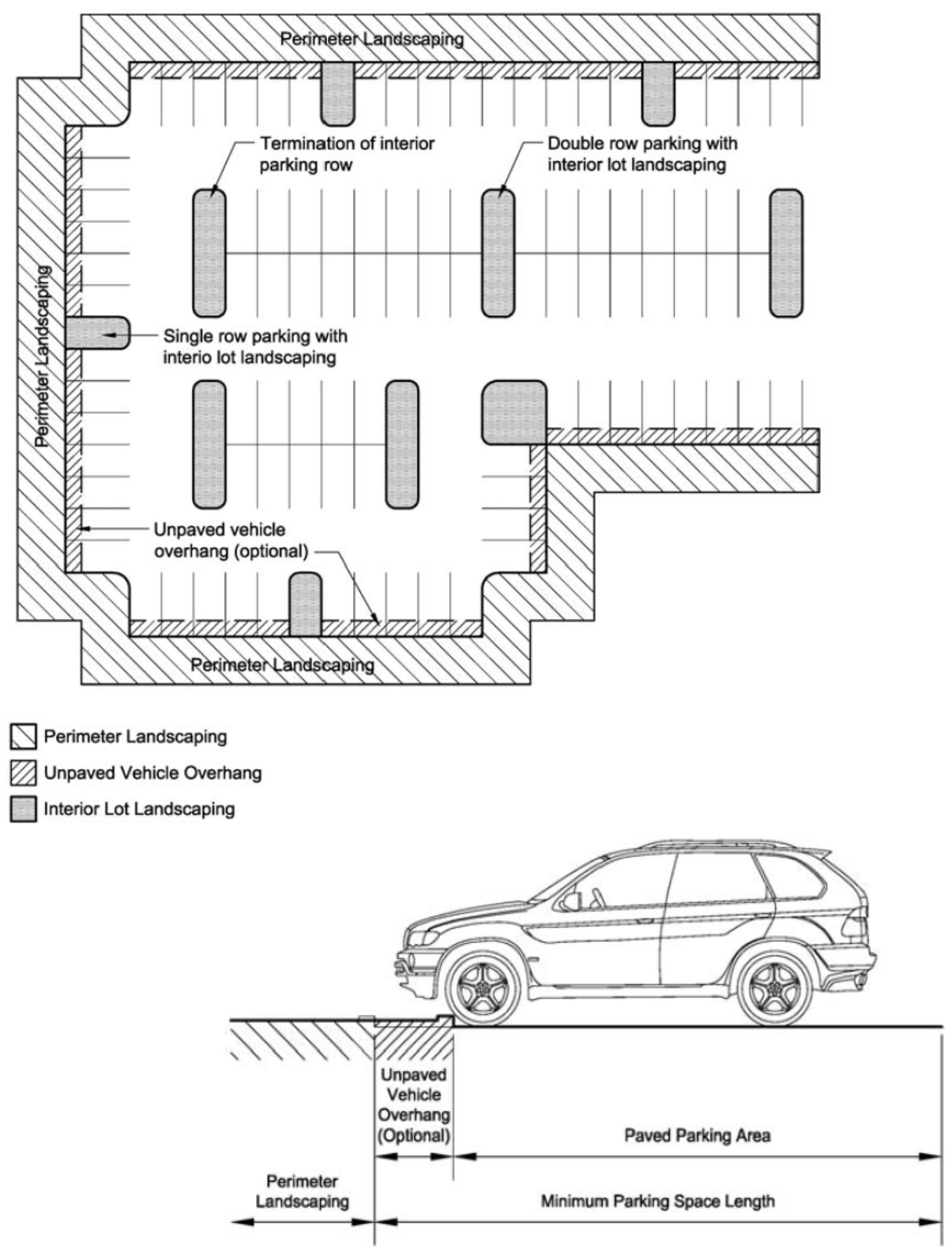
(1)
The City planning staff or Planning Commission shall have the authority to alter the perimeter landscape requirements by the minimum amount necessary if the specific application of those requirements will seriously limit the function or safety of traffic and pedestrians using the site.
(2)
Where perimeter vehicular use area landscape buffering is required in addition to an overlapping land use buffer zone, the required vehicular use area landscape buffer may be satisfied concurrently with other buffering requirements, so long as the minimum plantings and buffer widths in this section are met.
(3)
Allowable vehicle overhang of curb or edge of pavement shall not count toward the required perimeter landscaping area. Such vehicle overhang areas shall be planted with turf and kept free of landscape materials that could interfere with vehicle parking.
(4)
Perimeter landscape requirements for all vehicular use areas within the Old Hilliard Districts may be satisfied by the construction of a brick screening wall not less than two feet six inches in height and subject to approval by the Planning Director.
(c)
Interior Landscaping. Any vehicular use area containing more than 4,000 square feet of area or being comprised of 12 or more vehicular parking spaces, shall provide "interior" landscaping that may be peninsular or island in nature and shall be distributed throughout the vehicular use area.
(1)
All single row parking landscape islands and peninsulas shall be a minimum of 180 square feet in area with a minimum width of nine feet measured from back of curb to back of curb. Each island and peninsula shall contain a minimum of one large or medium tree and four evergreen or deciduous shrubs or ornamental grasses.
(2)
All double row parking landscape islands shall be a minimum of 240 square feet in area with a minimum width of nine feet measured from back of curb to back of curb. Each island and peninsula shall contain a minimum of two large or medium trees and eight evergreen or deciduous shrubs or ornamental grasses.
(3)
All interior parking rows shall be terminated at both ends with landscape islands. All parking islands shall be dispersed so as to define aisles and limit unbroken rows of parking to a maximum of one hundred feet in length.
(4)
Any area of interior lot landscaping not occupied by trees or shrubs shall be planted in turf or other approved ground cover in an appropriate density to achieve complete cover within two years.
(5)
If the specific application of the interior landscape requirements will seriously limit the functions of the building site, the city planning staff or Planning Commission shall have the authority to permit consolidation and relocation of these landscaped areas on the building site.
(Ord. 14-29. Passed 10-27-14; Ord. No. 21-09, § 1(Exh. A), 3-22-21.)
1125.06 - BUFFERING AND SCREENING.
(a)
Extent/Applicability. Land use buffers shall be provided in accordance with the standards of this section, provided the city planning staff and/or Planning Commission shall be authorized to modify or waive buffer or landscape planting requirements. When landscape buffer requirements are modified or waived, the city planning staff and/or Planning Commission may require that additional plant material be added within remaining buffers or elsewhere on the site. Buffer requirements may only be waived if it is determined that:
(1)
Buffers will not serve any useful purpose due to the fact that fences, walls, berms, or landscaping of at least equivalent height, opacity and maintenance already exist on the adjacent parcel;
(2)
Buffers will not serve any useful purpose due to the location of uses, vehicles, buildings, structures, or storage, loading display or service areas; or
(3)
The area of required buffers would exceed 25 percent of the site proposed for development.
(b)
Exemptions. Single family development on individual lots shall be exempt from the land use buffer requirements of this Section.
(c)
Determination of Required Buffers. The following procedure shall be used in determining which of the buffer types in the Land Use Buffer Table of this Section shall apply:
(1)
Determine the type of use proposed for the site that is being developed. This is the "Proposed Use" (Column 1);
(2)
Determine the use type that exists on the adjacent parcels. This is the "Use or Zoning of Adjacent Site";
(3)
Identify the type of landscape buffer required along the developing site's boundary (A, B, C, D, E, or F);
(4)
Refer to the "Buffer Types" table to determine the dimensions and landscaping/improvements required within the buffer area.
Residential Types: Type 1 = Single family detached, Single family attached, Two family, Bed & breakfast. Type 2 = All other residential uses.
Civic/Institutional: Churches, schools and public or semipublic buildings.
Business Types: Type 1 = All properties within B-1 and B-2 Districts. Type 2 = All properties within B-3 and B-4 Districts.
Industrial Types: Type 1 = All properties within the M-1 District. Type 2 = All properties within the M-2 District.
Miscellaneous Types: Type 1 = Outside sale or storage of building material or construction equipment. Type 2 = Auto and metal salvage operations and mineral extraction, storage or processing. Type 3 = Any railroad. Any freeway or arterial street prohibiting driveways.
(Ord. 14-29. Passed 10-27-14; Ord. No. 21-09, § 1(Exh. A), 3-22-21.)
1125.07 - RESERVED.
Editor's note— Ord. No. 21-29, § 1(Exh. B), adopted October 11, 2021, repealed § 1125.07, which pertained to public trees and derived from Ord. 14-29. Passed 10-27-14; Ord. 15-26. Passed 7-13-15; Ord. No. 21-09, § 1(Exh. A), 3-22-21.

