
Hillsboro City Zoning Code
SUB CHAPTER 12.23
COMMERCIAL ZONES
12.23.010 - Commercial Zones.
There are 5 commercial zones in the City:
A.
C-N Commercial-Neighborhood;
B.
C-G Commercial-General;
C.
SCC-DT Station Community Commercial-Downtown;
D.
SCC-SC Station Community Commercial-Station Commercial; and
E.
SCC-MM Station Community Commercial-Multi-Modal.
(Ord. 6401 § 1, 2022)
12.23.020 - Locational Characteristics.
On the Comprehensive Plan Land Use Map, commercial zones implement the Medium Density Residential, High Density Residential, Industrial, and Station Community Planning Area designations as follows:
A.
C-N does not implement a specific Plan designation, but may be applied in the Medium Density, High Density Residential, or Industrial Plan designations.
B.
C-G implements the Commercial Plan designation.
C.
SCC-DT, SCC-SC, and SCC-MM (among other zones) implement certain locations in the SCPA Station Community Planning Area designation where these zones are designated on the Zoning Map.
(Ord. 6401 § 1, 2022)
12.23.030 - Organization within This Subchapter.
A.
Common Elements. Each section in this Subchapter contains the following subsections:
1.
Purpose;
2.
Permitted, Conditional, Limited, and Not Permitted Housing Types (organized in tables);
3.
Permitted, Conditional, Limited and Not Permitted Uses (organized in tables);
4.
Accessory Uses Permitted;
5.
Special Provisions Regarding Uses;
6.
Development Standards (organized in tables, illustrated in figures);
7.
Variances and Adjustments; and
8.
Other Pertinent Regulations.
B.
Purpose. Purpose statements for each zone subchapter are descriptive of the zone's characteristics and intent, and are drawn from the Comprehensive Plan and/or the Community Development Code. Purpose statements are informational and not intended to be regulations.
C.
Allowed Housing Types. Residential uses (where allowed in commercial zones) occupy a variety of Housing Types. Permitted, Conditionally Permitted, Limited and Not Permitted Housing Types within each zone are summarized in tables based on the definitions of Housing Types listed in Section 12.01.500. Neither the residential Use categories nor the Housing Types distinguish between owner- or renter-occupation.
D.
Uses. Permitted, Conditionally Permitted, Limited and Not Permitted Uses within each zone are summarized in tables based on the standardized Use categories contained in Subchapter 12.10.
1.
Permitted Uses (P) are permitted by right, subject to all applicable provisions of this Code.
2.
Conditionally Permitted Uses (C) may be allowed, subject to approval on an individual basis as conditional uses. The Conditional Use application process and approval criteria are described in Sections 12.70.050 and 12.80.020. Certain conditional uses may have additional standards as described in Subchapter 12.40.
3.
Limited Uses (L) are permitted by right, but are subject to specified requirements, exceptions, or restrictions which may vary with the nature, size or location of the use.
4.
Not Permitted Uses (N) are not permitted in the zone under any circumstance.
E.
Accessory Uses. Accessory Uses are permitted in each zone in conjunction with the primary use on the site and subject to the same regulations as the primary use unless stated otherwise in the Code. Characteristics and standards for certain accessory uses are listed in Subchapter 12.40.
F.
Special Provisions Regarding Uses. Where certain notations in the Clarifications column of the Uses tables require further explanation, they are noted in this section.
G.
Development Standards.
1.
Development standards in each commercial zone are summarized in tables. Development standards are typically numerical standards: minimum and maximum densities (if applicable); minimum and maximum lot dimensions; structural setbacks; maximum building height and lot coverage. All development must comply with the development standards unless a discretionary Variance or Adjustment is approved as described in subsection H below.
2.
Maximum residential densities in each commercial zone that allows residential development are generally derived from the minimum lot size; minimum densities are approximately 80% of the maximum density. Density calculation formulas for minimum and maximum density are described in Section 12.50.120. Minimum and maximum residential densities apply to all residential Use categories.
3.
With the exception of the SCC-DT zone, certain development standards are illustrated in a Figure immediately following the development standards table.
H.
Variances and Adjustments. Applications to vary or adjust certain numeric standards in each zone may be requested and approved under Sections 12.80.152, 12.80.154, and 12.80.156. Certain numeric standards may also be subject to exceptions under specific circumstances, as described in the Standards section.
I.
Other Pertinent Regulations. Additional standards such as parking, landscaping, vision clearance, and street improvements may also apply to development in commercial zones. These site design and development standards may also have exceptions as described in those sections.
(Ord. 6401 § 1, 2022)
12.23.100 - C-N Commercial—Neighborhood Zone.
The C-N zone includes the following sections:
12.23.110 Purpose
12.23.120 Housing Types
12.23.130 Uses
12.23.140 Accessory Uses and Structures Permitted by Right
12.23.150 Special Provisions Regarding Uses
12.23.160 Development Standards
12.23.170 Variances and Adjustments
12.23.180 Other Pertinent Regulations
(Ord. 6401 § 1, 2022)
12.23.110 - Purpose.
A.
Provide Neighborhood-Scale Services. The C-N zone does not implement a single specific Comprehensive Plan designation, but may be allowed in the Residential Medium Density, Residential High Density, or Industrial Plan designations. In these areas, the C-N zone provides opportunity to locate small-scale commercial nodes within residential and industrial neighborhoods, giving residents and employees more convenient access to goods and services.
B.
Reduce Vehicle Trips and Encourage Active Transportation. The C-N zone reduces automobile use and increases walking and bicycling opportunities by allowing small-scale retail, service and office commercial uses in closer proximity to homes and businesses.
(Ord. 6401 § 1, 2022; Ord. 6322 § 1, 2019)
12.23.120 - Housing Types.
Table 12.23.120-1 lists housing types permitted in the C-N zone. Housing types are defined in Section 12.01.500.
(P) Permitted (C) Conditional (L) Limited (N) Not Permitted
(Ord. 6401 § 1, 2022; Ord. 6322 § 1, 2019)
12.23.130 - Uses.
Table 12.23.130-1 lists uses permitted, conditionally permitted, limited or not permitted in the C-N zone.
(P) Permitted (C) Conditional (L) Limited (N) Not Permitted
(Ord. 6451 § 1, 2023; Ord. 6417 § 1, 2022; Ord. 6401 § 1, 2022; Ord. 6322 § 1, 2019; Ord. 6294 § 1, 2019; Ord. 6149 § 1, 2015)
12.23.140 - Accessory Uses and Structures Permitted by Right.
Accessory uses vary based on the applicable use category, as described in Subchapter 12.10. Accessory uses are permitted in conjunction with the primary commercial use on the site and are subject to the same regulations as the primary commercial use unless stated otherwise in the Code. Accessory structures as defined in Section 12.01.500 are permitted subject to the additional requirements in Section 12.40.104.
(Ord. 6401 § 1, 2022; Ord. 6323 § 1, 2019; Ord. 6322 § 1, 2019; Ord. 6149 § 1, 2015)
12.23.150 - Special Provisions Regarding Uses.
A.
For All Commercial Uses.
1.
All business activities, including any service, repair, processing and storage shall be conducted wholly within an enclosed building. Refuse containment shall be located within a screened enclosure. Outdoor seating and display of plants is permitted.
2.
Maximum floor area of each use (except educational services as noted in Table 12.23.130-1) shall be 4,000 square feet on the first floor. Floor area constructed below finished grade area is not included in this maximum.
3.
Second-floor commercial uses on properties not designated MU Mixed-Use on the Comprehensive Plan Map are subject to Conditional Use approval pursuant to Section 12.80.020.
B.
Eating and Drinking Establishments. Eating and drinking establishments are permitted if in compliance with the limitations in subsection A above and the following additional standards:
1.
Maximum floor area of the establishment does not exceed 1,500 square feet;
2.
Carry-out service and limited seating are available;
3.
Drive-thru service is not available; and
4.
Alcoholic beverages are not served.
C.
Eating and Drinking Establishments Permitted with Conditional Use Approval. Eating and drinking establishments larger than those described in subsection B.1 above are permitted with Conditional Use approval if in compliance with the limitations of subsection A above and the following additional standards:
1.
Maximum seating capacity of the establishment is 50 or fewer patrons;
2.
Drive-through service is not available; and
3.
Distilled liquors are not served. Beer, wine, and cider may be served.
D.
Animal Service Facilities. Animal service facilities without outdoor exercise areas are permitted. Overnight boarding is permitted at veterinary clinics only, but may be permitted with Conditional Use approval at other facilities.
(Ord. 6401 § 1, 2022; Ord. 6322 § 1, 2019; Ord. 6294 § 1, 2019; Ord. 6149 § 1, 2015)
12.23.160 - Development Standards.
Base zone development standards in the C-N zone are listed in Table 12.23.160-1. Certain standards are illustrated in Figure 12.23.160-A.
* Standards illustrated in Figure 12.23.160-A
Figure 12.23.160-A:
Minimum Lot Dimensions, Setbacks
and Height Requirements in the C-N Zone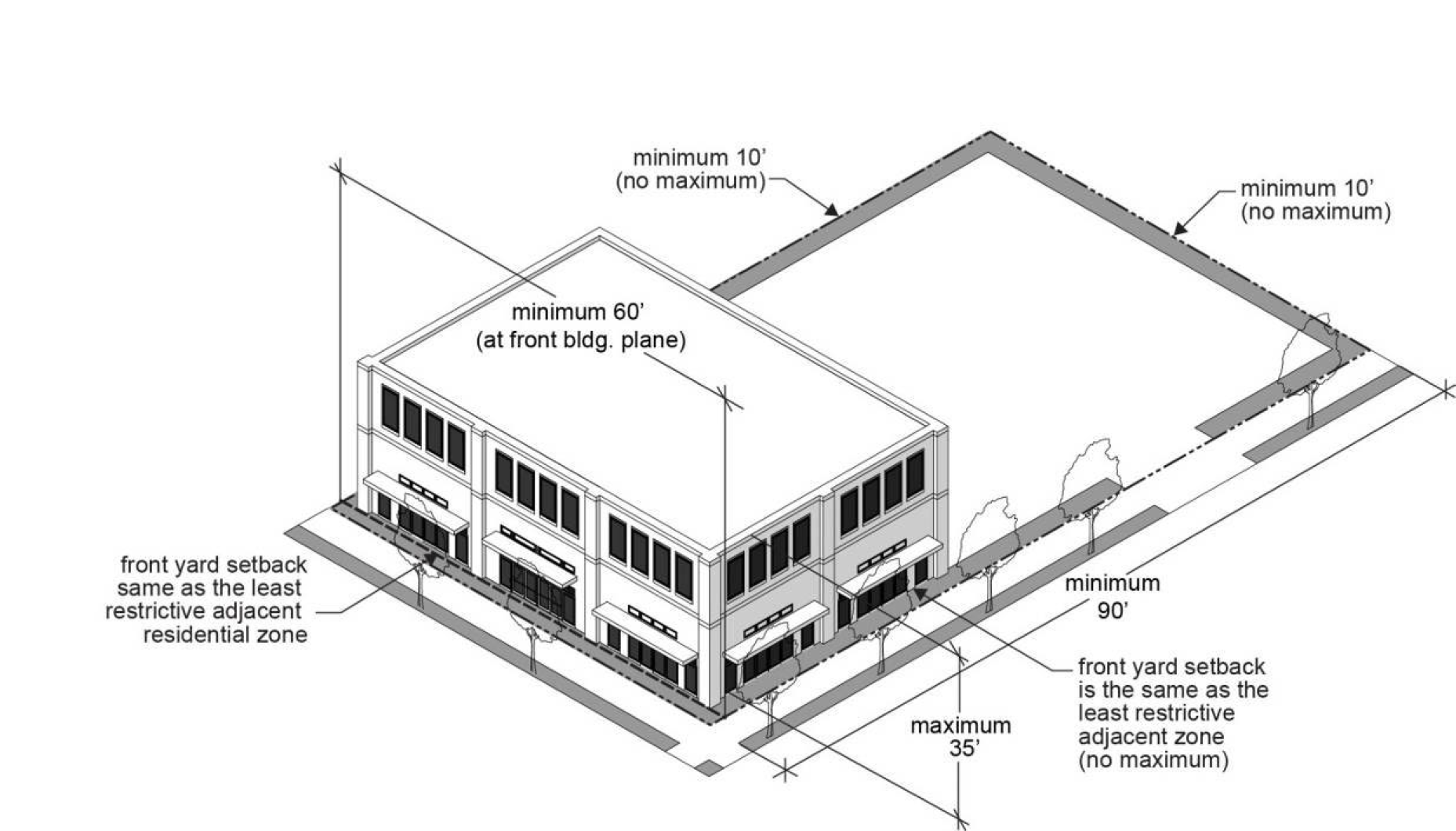
(Ord. 6401 § 1, 2022; Ord. 6120 § 1, 2015)
12.23.170 - Variances and Adjustments.
Applications for Variances and Adjustments per Section 12.80.150 to standards in the C-N zone may be approved under 1 of 4 processes:
A.
As a Variance pursuant to Section 12.80.152;
B.
As a Minor Adjustment in conjunction with a primary Type II or Type III application pursuant to Section 12.80.154;
C.
As a Major Adjustment in conjunction with a primary Type III application pursuant to Section 12.80.156; or
D.
With a Significant Natural Resource Permit pursuant to Section 12.80.130.
(Ord. 6401 § 1, 2022; Ord. 6120 § 1, 2015)
12.23.180 - Other Pertinent Regulations.
Additional standards such as parking, landscaping, vision clearance, and street improvements also apply to development in the C-N zone as follows:
•
Section 12.50.200 Site Design
•
Section 12.50.300 Vehicle Parking
•
Section 12.50.400 Bicycle Parking/Bicycle and Pedestrian Circulation and Connectivity
•
Section 12.50.500 Access and Street Standards
•
Section 12.50.600 Public Utilities, Site Grading and Storm Water Management Facilities Site Integration
•
Section 12.50.800 Design Standards for Non-Residential and Mixed-Use Development
(Ord. 6401 § 1, 2022)
12.23.200 - C-G Commercial—General Zone.
The C-G zone includes the following sections:
12.23.210 Purpose
12.23.220 Housing Types
12.23.230 Uses
12.23.240 Accessory Uses and Structures Permitted by Right
12.23.250 Special Provisions Regarding Uses
12.23.260 Development Standards
12.23.270 Variances and Adjustments
12.23.280 Other Pertinent Regulations
(Ord. 6401 § 1, 2022)
12.23.210 - Purpose.
A.
Provide Full Range of Commercial Activities. The C-G zone implements the Commercial Comprehensive Plan designation, providing opportunities for all types of retail, service, and office commercial Uses in a variety of locations throughout the City. Within the C-G zone, certain retail Uses may be subject to square footage limitations based on Metro Title 4 requirements.
B.
Reduce Vehicle Trips and Encourage Use of Alternative Transportation. By siting a wide mix of commercial Uses in central locations and on transit routes, the C-G zone provides customers and employees with opportunities to undertake several errands in a single trip and/or to access the commercial Uses by walking, bicycling or transit.
(Ord. 6401 § 1, 2022)
12.23.220 - Housing Types.
Table 12.23.220-1 lists Housing Types permitted in the C-G zone. Housing Types are defined in Section 12.01.500.
(P) Permitted (C) Conditional (L) Limited (N) Not Permitted
(Ord. 6401 § 1, 2022; Ord. 6294 § 1, 2019)
12.23.230 - Uses.
Table 12.23.230-1 lists Uses Permitted, Conditionally Permitted, Limited or Not Permitted in the C-G zone.
(P) Permitted (C) Conditional (L) Limited (N) Not Permitted
(Ord. 6451 § 1, 2023; Ord. 6417 § 1, 2022; Ord. 6401 § 1, 2022; Ord. 6393 § 1, 2021; Ord. 6322 § 1, 2019; Ord. 6294 § 1, 2019; Ord. 6149 § 1, 2015; Ord. 6116 § 1, 2015)
12.23.240 - Accessory Uses and Structures Permitted by Right.
Accessory uses vary based on the use categories contained in Subchapter 12.10. Accessory uses are permitted in conjunction with the primary commercial use on the site and subject to the same regulations as the primary commercial use unless stated otherwise in the Code. Accessory structures as defined in Section 12.01.500 are permitted subject to the additional requirements in Section 12.40.104.
(Ord. 6401 § 1, 2022; Ord. 6323 § 1, 2019; Ord. 6322 § 1, 2019; Ord. 6149 § 1, 2015)
12.23.250 - Special Provisions Regarding Uses.
A.
Abutting a Residential Zone. All business activity on property abutting a residential zone shall occur within an enclosed building, unless screening from the residential zone is provided by a sight-obscuring fence at least 6 feet high.
B.
Adjacent to or Across the Street from a Residential Zone. Openings in commercial structures adjacent or across the street from a residential zone shall be designed to prevent glare, excessive noise or other adverse impacts upon nearby residences.
C.
Motor Vehicle, Boat or Trailer Rental or Sales Lots. Vehicle rental or sales lots shall be drained and surfaced with crushed rock or paved with asphalt except where required landscaping is installed pursuant to Sections 12.50.220 and 12.50.360.
D.
Major Retail Uses Restrictions Based on Metro Title 4. Figure 12.23.250-A illustrates the application of Metro Urban Growth Management Functional Plan Title 4 Retail in Employment and Industrial Areas. Within the employment areas shown on Figure 12.23.250-A, a new major retail use as defined in Section 12.01.500 may be permitted in a C-G zone only with Conditional Use approval pursuant to Section 12.80.020. In addition to the Conditional Use approval criteria, the Conditional Use application shall demonstrate compliance with the following approval criteria:
1.
Transportation facilities are adequate to serve the major retail use consistent with the City's Transportation System Plan and adopted Metro Regional Transportation System Plan and these facilities will be in place at the time when the retail use begins operation; and
2.
Transportation facilities are adequate to meet the transportation need for other planned land uses within the surrounding employment area or are contained within the City's Transportation System Plan.
E.
Additional Regulations for Special Uses. The following retail products and services uses are subject to additional standards in Subchapter 12.40 as noted:
1.
Animal service facilities: see Section 12.40.110;
2.
Day care facilities: see Section 12.40.150; and
3.
Medical marijuana dispensaries: see Section 12.40.194.
4.
Marijuana retail sales: see Section 12.40.194.
(Ord. 6401 § 1, 2022; Ord. 6322 § 1, 2019; Ord. 6294 § 1, 2019; Ord. 6160 § 1, 2016; Ord. 6149 § 1, 2015)
Figure 12.23.250-A:
C-G Zone Title 4 Major Retail Use Restrictions Map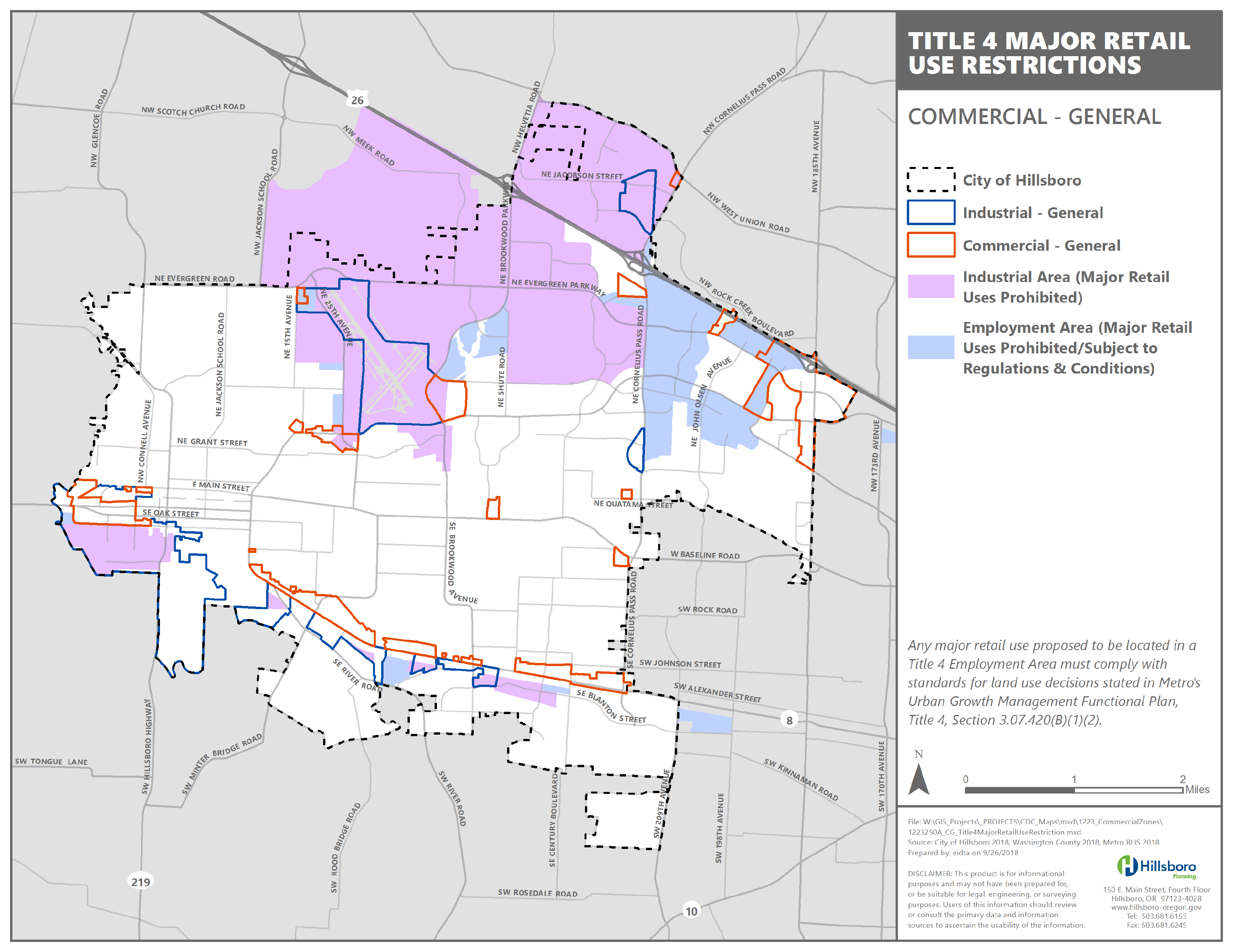
12.23.260 - Development Standards.
Base zone development standards in the C-G zone are listed in Table 12.23.260-1. Certain standards are illustrated in Figure 12.23.260-A.
* Standards illustrated in Figure 12.23.260-A
Figure 12.23.260-A:
Minimum Lot Dimensions, Setbacks
and Height Requirements in the C-G Zone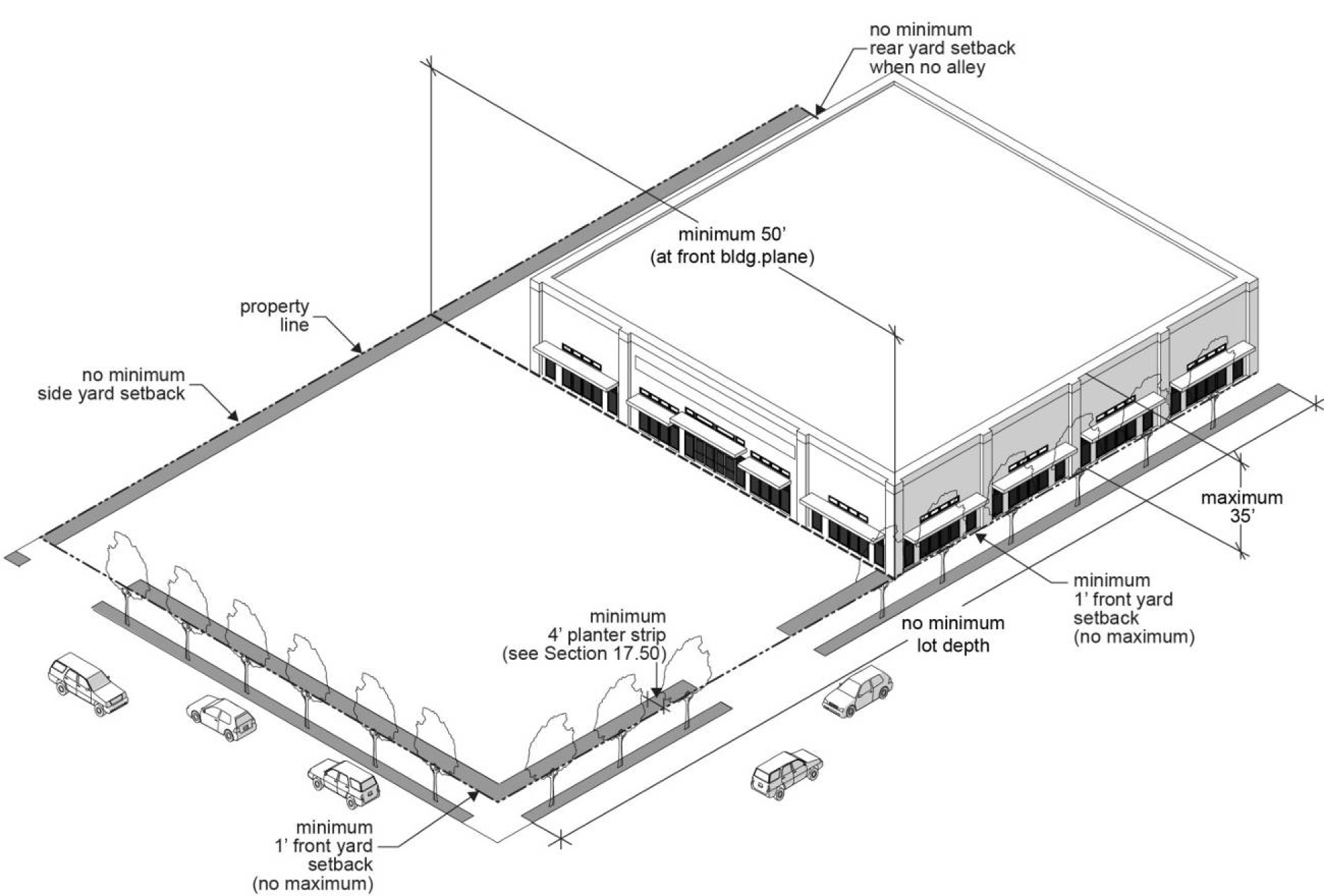
(Ord. 6401 § 1, 2022; Ord. 6120 § 1, 2015)
12.23.270 - Variances and Adjustments.
Applications for Variances and Adjustments per Section 12.80.150 to standards in the C-N zone may be approved under 1 of 4 processes:
A.
As a Variance pursuant to Section 12.80.152;
B.
As a Minor Adjustment in conjunction with a primary Type II or Type III application pursuant to Section 12.80.154;
C.
As a Major Adjustment in conjunction with a primary Type III application pursuant to Section 12.80.156; or
D.
With a Significant Natural Resource Permit pursuant to Section 12.80.130.
(Ord. 6401 § 1, 2022; Ord. 6120 § 1, 2015)
12.23.280 - Other Pertinent Regulations.
Additional standards such as parking, landscaping, vision clearance, and street improvements also apply to development in the C-G zone as follows:
•
Section 12.50.200 Site Design
•
Section 12.50.300 Vehicle Parking
•
Section 12.50.400 Bicycle Parking/Bicycle and Pedestrian Circulation and Connectivity
•
Section 12.50.500 Access and Street Standards
•
Section 12.50.600 Public Utilities, Site Grading and Storm Water Management Facilities Site Integration
•
Section 12.50.800 Design Standards for Non-Residential and Mixed-Use Development
(Ord. 6401 § 1, 2022)
12.23.300 - SCC-DT Station Community Commercial—Downtown Zone.
The SCC-DT zone includes the following sections:
12.23.310 Purpose
12.23.320 Housing Types
12.23.330 Uses
12.23.340 Accessory Uses and Structures Permitted by Right
12.23.350 Special Provisions Regarding Uses
12.23.360 Development Standards
12.23.370 Variances and Adjustments
12.23.380 Other Pertinent Regulations
(Ord. 6401 § 1, 2022)
12.23.310 - Purpose.
A.
Implement the Downtown Core Vision. The SCC-DT zone implements the Station Community Planning Area Comprehensive Plan designation, and implements the Downtown Core Vision Statement from the Downtown Framework Plan (Comprehensive Plan Section 28).
B.
Create a Vibrant Downtown Core. The standards of the SCC-DT zone are intended to create a downtown core that is a vibrant and active place, with shopping, dining, entertainment venues, arts and cultural experiences, civic activities and spaces and public gathering places supported by existing and new residents, employees and students living and working in and around the historic core.
C.
Provide Opportunities for Higher Density Residential and Mixed-Use Development. The higher density residential and Mixed-Use residential/commercial development opportunities provided in the SCC-DT zone increase housing choices and entrepreneurial opportunities in the historic downtown.
D.
Reduce Vehicle Trips and Encourage Active Transportation. The SCC-DT zone reduces automobile use for some daily activities by allowing higher density residential, commercial and Mixed-Use development in close proximity to light rail stations, increasing both transit use and walking and bicycling opportunities.
(Ord. 6401 § 1, 2022; Ord. 6250 § 1, 2017)
12.23.320 - Housing Types.
Table 12.23.320-1 lists Housing Types permitted in the SCC-DT zone. Housing Types are defined in Section 12.01.500.
(P) Permitted (C) Conditional (L) Limited (N) Not Permitted
(Ord. 6401 § 1, 2022; Ord. 6322 § 1, 2019)
12.23.330 - Uses.
Table 12.23.330-1 lists uses permitted, conditionally permitted, limited or not permitted in the SCC-DT zone. Within each use category, certain uses may be restricted pursuant to Section 12.30.900.
(P) Permitted (C) Conditional (L) Limited (N) Not Permitted
(Ord. 6451 § 1, 2023; Ord. 6417 § 1, 2022; Ord. 6401 § 1, 2022; Ord. 6393 § 1, 2021; Ord. 6322 § 1, 2019; Ord. 6294 § 1, 2019; Ord. 6178 § 1, 2016; Ord. 6149 § 1, 2015)
12.23.340 - Accessory Uses and Structures Permitted by Right.
Accessory uses vary based on the use categories contained in Subchapter 12.10. Accessory uses are permitted in conjunction with the primary use on the site and subject to the same regulations as the primary use unless stated otherwise in the Code. Accessory structures as defined in Section 12.01.500 are permitted subject to the additional requirements in Section 12.40.104.
(Ord. 6401 § 1, 2022; Ord. 6323 § 1, 2019; Ord. 6322 § 1, 2019; Ord. 6149 § 1, 2015)
12.23.350 - Special Provisions Regarding Uses.
A.
Accessory Uses to Household Uses. Home occupations are defined in Section 12.01.500 and are permitted as accessory uses in permitted housing types subject to the additional standards in Section 12.40.170.
B.
Drive-Through Facilities. New drive-through facilities are not permitted except as provided in Subsection 12.30.900.E.
C.
Animal Service Facilities. Overnight pet boarding permitted at veterinary clinics; elsewhere only with Conditional Use approval. Outdoor exercise areas not permitted. See Section 12.40.110 for additional standards on this use.
D.
Institutional Uses. Colleges and universities, hospitals, and medical centers are permitted with Planned Unit Development approval. Modifications of existing approved concept plans are also permitted with Planned Unit Development approval.
E.
Mixed-Use Buildings. Any combination of permitted, conditional, or limited uses is permitted on any floor.
(Ord. 6401 § 1, 2022; Ord. 6322 § 1, 2019; Ord. 6294 § 1, 2019)
12.23.360 - Development Standards.
Base zone development standards in the SCC-DT zone are listed in Table 12.23.360-1. Certain standards are illustrated in Figures 12.61.400-A through 12.61.400-D in the Downtown Plan District section.
(Ord. 6401 § 1, 2022; Ord. 6322 § 1, 2019; Ord. 6120 § 1, 2015)
12.23.370 - Variances and Adjustments.
Applications for Variances and Adjustments per Section 12.80.150 to standards in the SCC-DT zone may be approved under 1 of 4 processes:
A.
As a Variance pursuant to Section 12.80.152;
B.
As a Minor Adjustment in conjunction with a primary Type II or Type III application pursuant to Section 12.80.154;
C.
As a Major Adjustment in conjunction with a primary Type III application pursuant to Section 12.80.156; or
D.
With a Significant Natural Resource Permit pursuant to Section 12.80.130.
(Ord. 6401 § 1, 2022; Ord. 6120 § 1, 2015)
12.23.380 - Other Pertinent Regulations.
Additional standards such as parking, landscaping, vision clearance, and street improvements also apply to development in the SCC-DT zone as follows:
•
Section 12.50.200 Site Design
•
Section 12.50.300 Vehicle Parking
•
Section 12.50.400 Bicycle Parking/Bicycle and Pedestrian Circulation and Connectivity
•
Section 12.50.500 Access and Street Standards
•
Section 12.50.600 Public Utilities, Site Grading and Storm Water Management Facilities Site Integration
•
Section 12.50.800 Design Standards for Non-Residential and Mixed-Use Development
•
Subchapter 12.61 Downtown Plan District Standards
(Ord. 6401 § 1, 2022)
12.23.400 - SCC-SC Station Community Commercial—Station Commercial Zone.
The SCC-SC zone includes the following sections:
12.23.410 Purpose
12.23.420 Housing Types
12.23.430 Uses
12.23.440 Accessory Uses and Structures Permitted by Right
12.23.450 Special Provisions Regarding Uses
12.23.460 Development Standards
12.23.470 Variances and Adjustments
12.23.480 Other Pertinent Regulations
(Ord. 6401 § 1, 2022)
12.23.410 - Purpose.
A.
Provide Full Range of Commercial Activities. The SCC-SC zone implements the Station Community Planning Area Comprehensive Plan designation, providing opportunity to locate high intensity commercial and community service Uses in close proximity (less than 1,300 feet) to light rail stations outside downtown.
B.
Provide Opportunities for Higher Density Residential and Mixed-Use Development. The higher density residential and mixed-use residential/commercial development opportunities provided in the SCC-SC zone increase housing choices and entrepreneurial opportunities for smaller scale businesses near light rail stations.
C.
Reduce Vehicle Trips and Encourage Active Transportation. The SCC-SC zone reduces automobile use for some daily activities by allowing higher density residential, commercial and mixed-use development in close proximity to light rail stations, increasing both transit use and walking and bicycling opportunities.
(Ord. 6401 § 1, 2022)
12.23.420 - Housing Types.
Table 12.23.420-1 lists Housing Types permitted in the SCC-SC zone. Housing Types are defined in Section 12.01.500.
(P) Permitted (C) Conditional (L) Limited (N) Not Permitted
(Ord. 6401 § 1, 2022)
12.23.430 - Uses.
Table 12.23.430-1 lists uses permitted, conditionally permitted, limited or not permitted in the SCC-SC zone. Within each use category, certain uses may be restricted pursuant to Section 12.30.900.
(P) Permitted (C) Conditional (L) Limited (N) Not Permitted
(Ord. 6451 § 1, 2023; Ord. 6417 § 1, 2022; Ord. 6401 § 1, 2022; Ord. 6393 § 1, 2021; Ord. 6322 § 1, 2019; Ord. 6294 § 1, 2019; Ord. 6160 § 1, 2016; Ord. 6149 § 1, 2015; Ord. 6116 § 1, 2015)
12.23.440 - Accessory Uses and Structures Permitted by Right.
Accessory uses vary based on the use categories contained in Subchapter 12.10. Accessory uses are permitted in conjunction with the primary use on the site and subject to the same regulations as the primary use unless stated otherwise in the Code. Accessory structures as defined in Section 12.01.500 are permitted subject to the additional requirements in Section 12.40.104.
(Ord. 6401 § 1, 2022; Ord. 6323 § 1, 2019; Ord. 6322 § 1, 2019; Ord. 6149 § 1, 2015)
12.23.450 - Special Provisions Regarding Uses.
A.
Accessory Uses to Household Uses. Home occupations are defined in Section 12.01.500 permitted as accessory uses in permitted housing types subject to the additional standards in Section 12.40.170.
B.
Commercial Building Footprint Limitation. Commercial uses are limited in size and intensity to promote a local orientation and to limit adverse impacts on nearby residential areas. Multi-story commercial buildings or mixed-use commercial/residential buildings are permitted with a footprint up to 20,000 square feet.
C.
Mixed-Use Buildings.
1.
Within 200 feet of an HCT station site, multi-dwelling residential developments with densities above 25 units per net acre shall include at least 10% of the ground floor (up to 5,000 square feet) as retail products and services or office commercial uses. Live/work units do not meet this standard.
2.
In mixed-use buildings including residential uses, retail products and service and office uses are permitted on all floors. Commercial uses in a mixed-use building shall occupy at least 5,000 square feet of the ground floor.
D.
Animal Service Facilities. Overnight pet boarding is permitted at veterinary clinics; but is allowed elsewhere only with Conditional Use approval. Outdoor exercise areas are not permitted. See Section 12.40.110 for additional standards on this use.
E.
Drive-Through Facilities. New drive-through facilities are not permitted except as provided in Subsection 12.30.900.E.
F.
Institutional Uses. Colleges and universities are permitted with Planned Unit Development approval. Modifications of existing approved concept plans are also permitted with Planned Unit Development approval.
G.
Additional Regulations for Special Uses. The following retail products and services uses are subject to additional standards in Subchapter 12.40 as noted:
1.
Day care facilities: see Section 12.40.150;
2.
Marijuana retail sales: see Section 12.40.194.
(Ord. 6401 § 1, 2022; Ord. 6322 § 1, 2019; Ord. 6294 § 1, 2019; Ord. 6160 § 1, 2016)
12.23.460 - Development Standards.
Development standards in the SCC-SC zone are listed in Table 12.23.460-1. Certain standards are illustrated in Figure 12.23.460-A.
* Standards illustrated in Figure 12.23.460-A
Figure 12.23.460-A:
Minimum Lot Dimensions, Setbacks
and Height Requirements in the SCC-SC Zone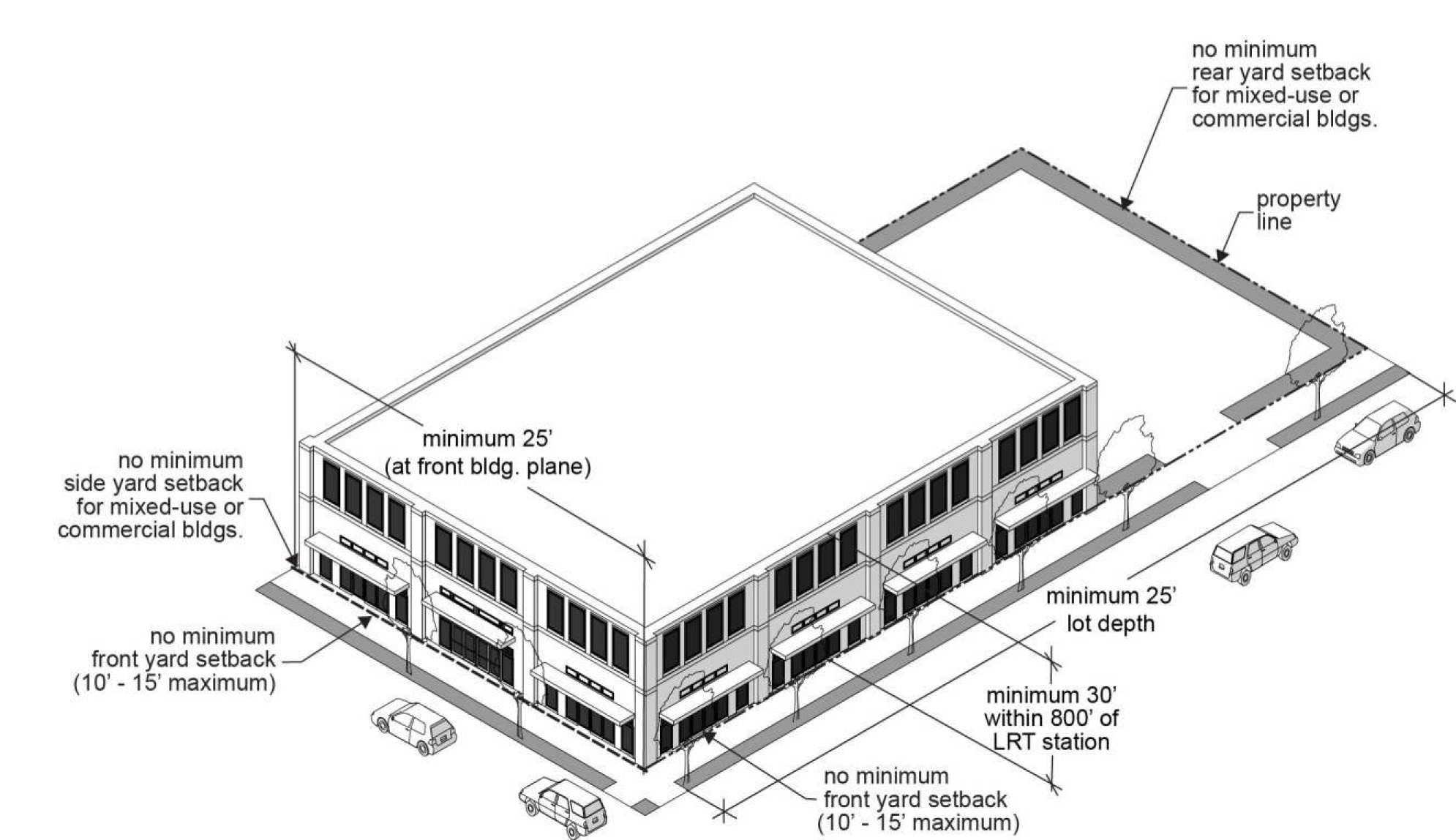
(Ord. 6401 § 1, 2022; Ord. 6120 § 1, 2015)
12.23.470 - Variances and Adjustments.
Applications for Variances and Adjustments per Section 12.80.150 to standards in the SCC-SC zone may be approved under 1 of 4 processes:
A.
As a Variance pursuant to Section 12.80.152;
B.
As a Minor Adjustment in conjunction with a primary Type II or Type III application pursuant to Section 12.80.154;
C.
As a Major Adjustment in conjunction with a primary Type III application pursuant to Section 12.80.156; or
D.
With a Significant Natural Resource Permit pursuant to Section 12.80.130.
(Ord. 6401 § 1, 2022; Ord. 6120 § 1, 2015)
12.23.480 - Other Pertinent Regulations.
Additional standards such as parking, landscaping, vision clearance, and street improvements also apply to development in the SCC-SC zone as follows:
•
Section 12.50.200 Site Design
•
Section 12.50.300 Vehicle Parking
•
Section 12.50.400 Bicycle Parking/Bicycle and Pedestrian Circulation and Connectivity
•
Section 12.50.500 Access and Street Standards
•
Section 12.50.600 Public Utilities, Site Grading and Storm Water Management Facilities Site Integration
•
Section 12.50.800 Design Standards for Non-Residential and Mixed-Use Development
•
Subchapter 12.61 Downtown Plan District Standards
(Ord. 6401 § 1, 2022)
12.23.500 - SCC-MM Station Community Commercial—Multi-Modal Zone.
The SCC-MM zone includes the following sections:
12.23.510 Purpose
12.23.520 Housing Types
12.23.530 Uses
12.23.540 Accessory Uses and Structures Permitted by Right
12.23.550 Special Provisions Regarding Uses
12.23.560 Development Standards
12.23.570 Variances and Adjustments
12.23.580 Other Pertinent Regulations
(Ord. 6401 § 1, 2022)
12.23.510 - Purpose.
A.
Provide Full Range of Commercial Activities. The SCC-MM zone implements the Station Community Planning Area Comprehensive Plan designation at locations on arterial streets approximately 2,600 feet from an LRT platform, providing opportunity to locate a mixture of commercial and community service uses oriented City-wide.
B.
Provide Opportunities for Higher Density Residential and Mixed-Use Development. The higher density residential and mixed-use residential/commercial development opportunities provided in the SCC-MM zone increase housing choices and entrepreneurial opportunities for larger scale businesses.
C.
Reduce Vehicle Trips and Encourage Active Transportation. By siting a wider mix of commercial uses in SCC-MM locations on arterial streets where existing and planned street systems will support such uses, shoppers have opportunities to undertake several errands in a single trip and/or to access the commercial center by walking, bicycling or transit.
(Ord. 6401 § 1, 2022; Ord. 6322 § 1, 2019)
12.23.520 - Housing Types.
Table 12.23.520-1 lists housing types permitted in the SCC-MM zone. Housing types are defined in Section 12.01.500.
(P) Permitted (C) Conditional (L) Limited (N) Not Permitted
(Ord. 6401 § 1, 2022; Ord. 6322 § 1, 2019)
12.23.530 - Uses.
Table 12.23.530-1 lists uses permitted, conditionally permitted, limited or not permitted in the SCC-MM zone. Within each use category, certain uses may be restricted pursuant to Section 12.30.900.
(P) Permitted (C) Conditional (L) Limited (N) Not Permitted
(Ord. 6451 § 1, 2023; Ord. 6417 § 1, 2022; Ord. 6401 § 1, 2022; Ord. 6393 § 1, 2021; Ord. 6322 § 1, 2019; Ord. 6294 § 1, 2019; Ord. 6160 § 1, 2016; Ord. 6149 § 1, 2015; Ord. 6116 § 1, 2015)
12.23.540 - Accessory Uses and Structures Permitted by Right.
Accessory uses vary based on the use categories contained in Subchapter 12.10. Accessory uses are permitted in conjunction with the primary use on the site and subject to the same regulations as the primary use unless stated otherwise in the Code. Accessory structures as defined in Section 12.01.500 are permitted subject to the additional requirements in Section 12.40.104.
(Ord. 6401 § 1, 2022; Ord. 6323 § 1, 2019; Ord. 6322 § 1, 2019; Ord. 6149 § 1, 2015)
12.23.550 - Special Provisions Regarding Uses.
A.
Accessory Uses to Household Uses. Home occupations as defined in Section 12.01.500 are permitted as accessory uses in permitted housing types subject to the additional standards in Section 12.40.170.
B.
Mixed-Use Buildings. In mixed-use buildings including residential uses, retail products and service and office uses are permitted on all floors. Commercial uses in a mixed-use building shall occupy at least 5,000 square feet of the ground floor.
C.
Animal Service Facilities. Overnight pet boarding is permitted at veterinary clinics; but is allowed elsewhere only with Conditional Use approval. Outdoor exercise areas are not permitted. See Section 12.40.110 for additional standards on this use.
D.
Durable Goods. Durable goods sales are permitted only on sites farther than 2,600 feet from a light rail station.
E.
Self-Service Storage. Self-service storage facilities shall be at least 2 stories in height, and shall meet applicable FAR requirements. Exterior access to individual units is not permitted if visible from a public right-of-way. Vehicle storage is not permitted.
F.
Institutional Uses. Colleges and universities, hospitals and medical centers, are permitted with Planned Unit Development approval. Modifications of existing approved concept plans are also permitted with Planned Unit Development approval.
G.
Additional Regulations for Special Uses. The following retail products and services uses are subject to additional standards in Subchapter 12.40 as noted:
1.
Day care facilities: see Section 12.40.150;
2.
Marijuana retail sales: see Section 12.40.194.
(Ord. 6401 § 1, 2022; Ord. 6322 § 1, 2019; Ord. 6294 § 1, 2019; Ord. 6160 § 1, 2016)
12.23.560 - Development Standards.
Development standards in the SCC-MM zone are listed in Table 12.23.560-1. Certain standards are illustrated in Figure 12.23.560-A.
* Standards illustrated in Figure 12.23.560-A
Figure 12.23.560-A:
Minimum Lot Dimensions, Setbacks
and Height Requirements in the SCC-MM Zone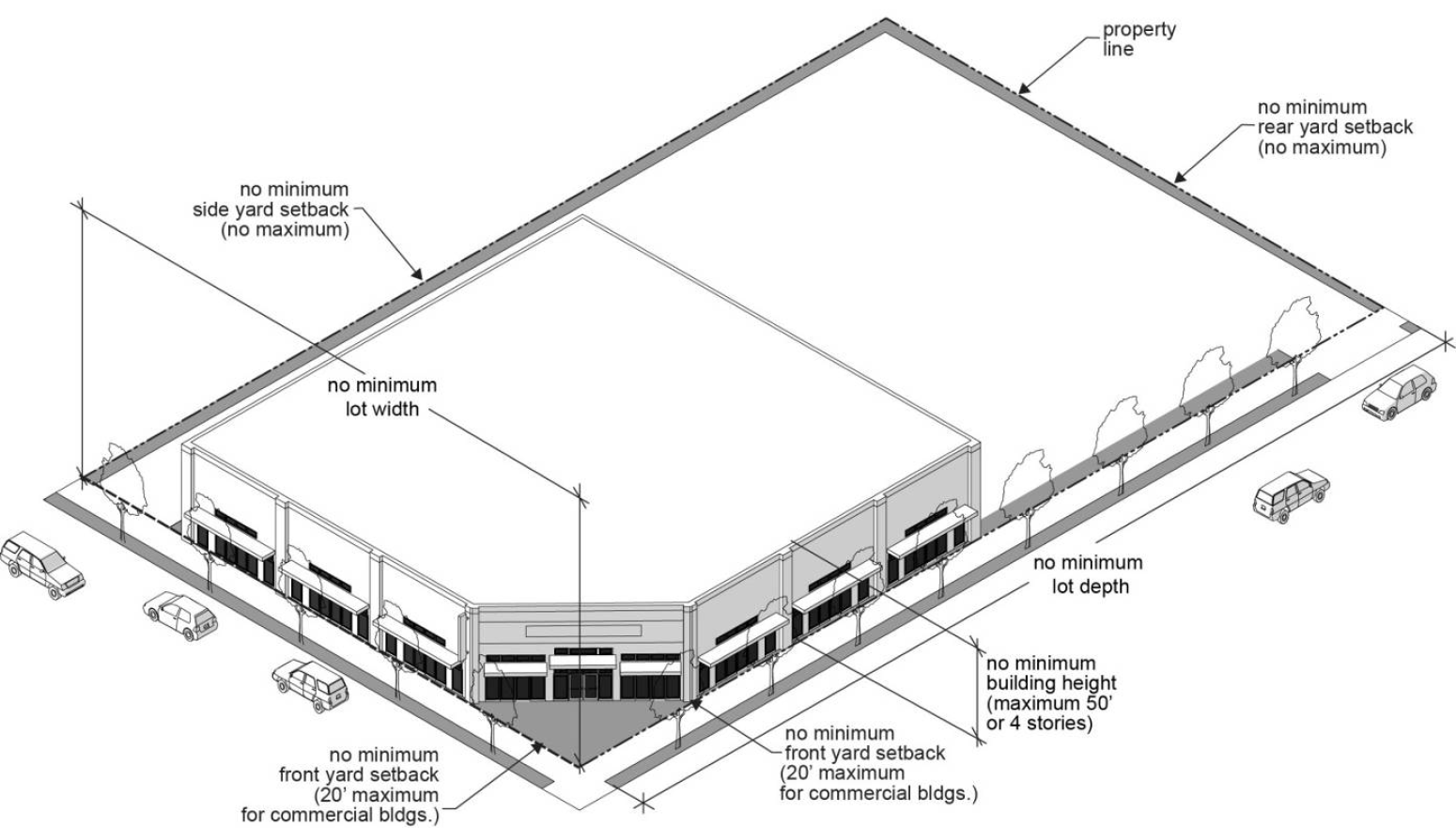
(Ord. 6401 § 1, 2022; Ord. 6322 § 1, 2019; Ord. 6120 § 1, 2015)
12.23.570 - Variances and Adjustments.
Applications for Variances and Adjustments per Section 12.80.150 to standards in the SCC-MM zone may be approved under 1 of 4 processes:
A.
As a Variance pursuant to Section 12.80.152;
B.
As a Minor Adjustment in conjunction with a primary Type II or Type III application pursuant to Section 12.80.154;
C.
As a Major Adjustment in conjunction with a primary Type III application pursuant to Section 12.80.156; or
D.
With a Significant Natural Resource Permit pursuant to Section 12.80.130.
(Ord. 6401 § 1, 2022; Ord. 6322 § 1, 2019; Ord. 6120 § 1, 2015)
12.23.580 - Other Pertinent Regulations.
Additional standards such as parking, landscaping, vision clearance, and street improvements also apply to development in the SCC-MM zone as follows:
•
Section 12.50.200 Site Design
•
Section 12.50.300 Vehicle Parking
•
Section 12.50.400 Bicycle Parking/Bicycle and Pedestrian Circulation and Connectivity
•
Section 12.50.500 Access and Street Standards
•
Section 12.50.600 Public Utilities, Site Grading and Storm Water Management Facilities Site Integration
•
Section 12.50.800 Design Standards for Non-Residential and Mixed-Use Development
(Ord. 6401 § 1, 2022)

