
Hillsboro City Zoning Code
SUB CHAPTER 12.25
INDUSTRIAL ZONES
12.25.010 - Industrial Zones.
There are 8 industrial zones in the City:
A.
I-G Industrial General;
B.
I-P Industrial Park;
C.
I-S Industrial Sanctuary;
D.
SCBP Station Community Business Park;
E.
SCI Station Community Industrial;
F.
SSID Shute Road Special Industrial District;
G.
ESID Evergreen Area Special Industrial District; and
H.
HSID Helvetia Area Special Industrial District.
(Ord. 6401 § 1, 2022)
12.25.020 - Locational Characteristics.
On the Comprehensive Plan Land Use Map, industrial zones implement the Industrial and Station Community Planning Area designations.
A.
The I-G, I-P, I-S, SSID, ESID and HSID zones implement or partially implement both the Industrial and the Employment designations on the Metro Functional Plan Map.
B.
Within the SCPA designation, the SCBP and SCI zones allow development of higher intensity, transit-supportive industrial Uses in proximity to light rail stations.
(Ord. 6401 § 1, 2022)
12.25.030 - Organization within This Subchapter.
A.
Common Elements. Each section in this Subchapter contains the following subsections:
1.
Purpose;
2.
Permitted, Conditional, Limited and Not Permitted Housing Types (organized in tables);
3.
Permitted, Conditional, Limited and Not Permitted Uses (organized in tables);
4.
Accessory Uses Permitted by Right;
5.
Special provisions Regarding Uses;
6.
Development Standards (organized in tables, illustrated in figures);
7.
Variances and Adjustments; and
8.
Other Pertinent Regulations.
B.
Purpose. Purpose statements for each zone subchapter are descriptive of the zone's characteristics and intent, and are drawn from the Comprehensive Plan and/or the Community Development Code. Purpose statements are informational and not intended to be regulations.
C.
Allowed Housing Types. Residential Uses are limited in industrial zones. Permitted, conditionally permitted, limited and not permitted Housing Types within each zone are summarized in tables based on the definitions of Housing Types listed in Section 12.01.500. Neither the residential Use categories nor the Housing Types distinguish between owner- or renter-occupation.
D.
Uses. Permitted, Conditionally Permitted, Limited and Not Permitted Uses within each zone are summarized in tables based on the standardized Use categories contained in Subchapter 12.10.
1.
Permitted Uses (P) are permitted by right, subject to all applicable provisions of this Code.
2.
Conditionally Permitted Uses (C) may be allowed, subject to approval on an individual basis as Conditional Uses. The Conditional Use application process and approval criteria are described in Section 12.80.020. Certain Conditional Uses may have additional standards as described in Subchapter 12.40.
3.
Limited Uses (L) are permitted by right, but are subject to specified requirements, exceptions, or restrictions which may vary with the nature, size or location of the Use.
4.
Not Permitted Uses (N) are not permitted in the zone under any circumstances.
E.
Accessory Uses Permitted by Right. Accessory Uses are permitted in each zone in conjunction with the primary industrial use on the site and are subject to the same regulations as the primary use unless stated otherwise in the Code. Characteristics and standards for certain accessory Uses are listed in Subchapter 12.40.
F.
Special Provisions Regarding Uses. Where certain notations in the Clarifications column of the Uses tables require further explanation, they are noted in this section.
G.
Development Standards.
1.
Development standards in each industrial zone are summarized in tables. Development standards are typically numerical standards: minimum and maximum lot dimensions, minimum and maximum floor area ratios; structural setbacks; maximum building height and lot coverage. All development must comply with the development standards unless a discretionary Variance or Adjustment is approved as described in subsection H below.
2.
Certain development standards are illustrated in a Figure following the development standards table in each zone.
H.
Variances and Adjustments. Applications to vary or adjust certain numeric standards in each zone may be requested and approved under Sections 12.80.152, 12.80.154, and 12.80.156. Certain numeric standards may also be subject to exceptions under specific circumstances, as described in the Standards section.
I.
Other Pertinent Regulations. Additional standards such as parking, landscaping, vision clearance, and street improvements, may also apply to development in industrial zones. These site design and development standards may also have exceptions as described in those sections.
(Ord. 6401 § 1, 2022)
12.25.100 - I-G Industrial—General.
The I-G zone includes the following sections:
12.25.110 Purpose
12.25.120 Housing Types
12.25.130 Uses
12.25.140 Accessory Uses and Structures Permitted by Right
12.25.150 Special Provisions Regarding Uses
12.25.160 Development Standards
12.25.170 Variances and Adjustments
12.25.180 Other Pertinent Regulations
(Ord. 6401 § 1, 2022)
12.25.110 - Purpose.
A.
Provide a Full Range of Commercial and Industrial Activities. The I-G zone implements the Industrial Comprehensive Plan designation primarily near the downtown or at locations on freight routes, providing opportunities for all types of manufacturing, warehouse, and wholesale industrial uses, and retail, service, and office commercial uses. Certain retail uses may be subject to square footage limitations based on Metro Title 4 requirements.
B.
Encourage Use of Alternative Transportation. The I-G zone allows the opportunity to site a wide mix of commercial and industrial uses near the downtown or at locations on freight routes, increasing rail and vehicle freight use, and providing access to transit routes for employees and customers.
(Ord. 6401 § 1, 2022; Ord. 6322 § 1, 2019)
12.25.120 - Housing Types.
Table 12.25.120-1 lists housing types permitted in the I-G zone. Housing types are defined in Section 12.01.500.
(P) Permitted (C) Conditional (L) Limited (N) Not Permitted
(Ord. 6401 § 1, 2022)
12.25.130 - Uses.
Table 12.25.130-1 lists uses permitted, conditionally permitted, limited or not permitted in the I-G zone. Within each use category, specific uses may be restricted pursuant to Subchapter 12.40.
(P) Permitted (C) Conditional (L) Limited (N) Not Permitted
(Ord. 6417 § 1, 2022; Ord. 6401 § 1, 2022; Ord. 6393 § 1, 2021; Ord. 6322 § 1, 2019; Ord. 6294 § 1, 2019; Ord. 6160 § 1, 2016; Ord. 6149 § 1, 2015; Ord. 6116 § 1, 2015)
12.25.140 - Accessory Uses and Structures Permitted by Right.
Accessory uses vary based on the use categories contained in Subchapter 12.10. Accessory uses are permitted in conjunction with the primary commercial or industrial use on the site and subject to the same regulations as the primary commercial use unless stated otherwise in the Code. Accessory structures as defined in Section 12.01.500 are permitted subject to the additional requirements in Section 12.40.104.
(Ord. 6401 § 1, 2022; Ord. 6323 § 1, 2019; Ord. 6322 § 1, 2019; Ord. 6149 § 1, 2015)
12.25.150 - Special Provisions Regarding Uses.
A.
Retail Products and Services.
1.
Day care facilities are permitted with Conditional Use approval, subject to the additional standards in Section 12.40.150.
2.
Outdoor exercise areas for animal service facilities are permitted with Conditional Use approval, and are subject to the additional standards in Section 12.40.110.
3.
Minor assembly facilities are permitted with Conditional Use approval, and are subject to additional regulations in Section 12.40.210.
B.
Aviation Uses. The following types of aviation uses are limited to properties owned by the Port of Portland at the Portland-Hillsboro Airport: runways; taxiways; aprons; air operations areas for unobstructed movement of aircraft; security areas; terminals and associated parking; and aircraft storage hangars.
(Ord. 6401 § 1, 2022; Ord. 6294 § 1, 2019; Ord. 6149 § 1, 2015)
12.25.160 - Development Standards.
Base zone development standards in the I-G zone are listed in Table 12.25.160-1. Certain standards are illustrated in Figure 12.25.160-A.
* Standards illustrated in Figure 12.25.160-A
Figure 12.25.60-A:
Minimum Lot Dimensions, Setbacks
and Height Requirements in the I-G Zone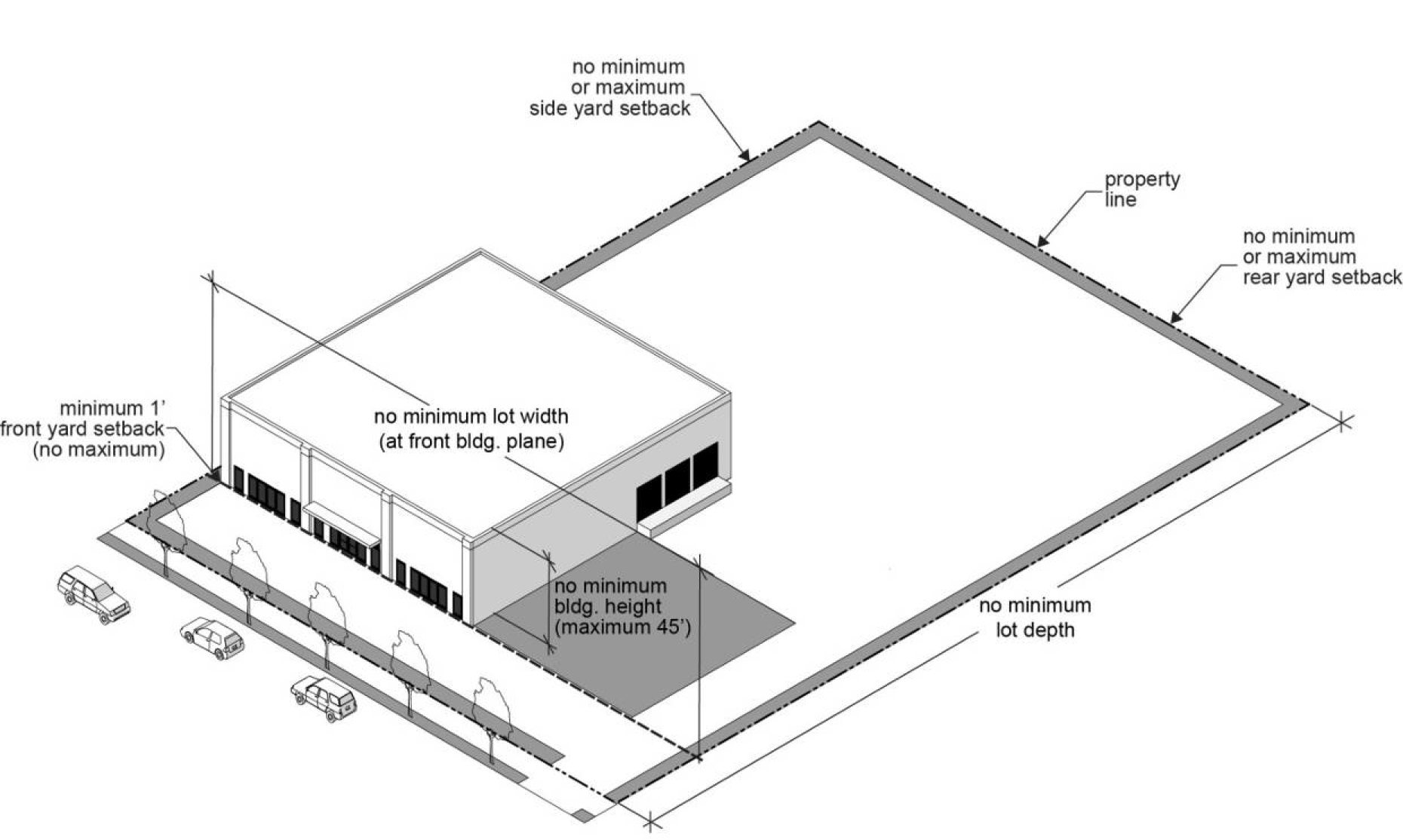
(Ord. 6401 § 1, 2022; Ord. 6120 § 1, 2015)
12.25.170 - Variances and Adjustments.
Applications for Variances and Adjustments to base zone standards in the I-G zone may be approved under 1 of 4 processes:
A.
As a Variance pursuant to Section 12.80.152;
B.
As a Minor Adjustment in conjunction with a primary Type II or Type III application pursuant to Section 12.80.154;
C.
As a Major Adjustment in conjunction with a primary Type III application pursuant to Section 12.80.156; or
D.
With a Significant Natural Resource Permit pursuant to Section 12.80.130.
(Ord. 6401 § 1, 2022; Ord. 6120 § 1, 2015)
12.25.180 - Other Pertinent Regulations.
A.
Applicable Sections. Additional standards such as parking, landscaping, vision clearance, and street improvements also apply to development in the I-G zone as follows:
•
Section 12.50.200 Site Design
•
Section 12.50.300 Vehicle Parking
•
Section 12.50.400 Bicycle Parking/Bicycle and Pedestrian Circulation and Connectivity
•
Section 12.50.500 Access and Street Standards
•
Section 12.50.600 Public Utilities, Site Grading and Storm Water Management Facilities Site Integration
•
Section 12.50.800 Design Standards for Non-Residential and Mixed-Use Development
B.
Additional Standards. In addition to the standards listed in subsection A above, the following standards apply to all development in the I-G zone:
1.
Site Storage and Maintenance.
a.
Materials, equipment and waste must be stored and grounds must be maintained in a manner which will not attract insects or vermin or create a health hazard.
b.
Yards adjacent to streets and those abutting a residential zone shall be landscaped and continuously in groundcovers, trees or shrubs as required by Section 12.50.220. All other yards and unused property shall be maintained in grass or other suitable ground cover.
2.
Boundary Fences and Landscaping.
a.
Properties abutting a residential zone shall provide and maintain a dense evergreen landscape buffer with a minimum mature height of 7 feet.
b.
Yards adjacent to streets and those abutting a residential zone shall be landscaped and continuously maintained in suitable groundcovers, trees or shrubs as required by Section 12.50.220. All other yards and unused property shall be maintained in grass or other suitable ground cover.
c.
Wire or similar open fences may be permitted at property lines adjacent to landscaped yards.
3.
Heat, Glare and Lighting.
a.
Except for exterior lighting, industrial operations producing heat or glare shall be conducted entirely within an enclosed building.
b.
Exterior lighting shall be shielded and directed away from adjacent properties as required by Section 12.50.240.
4.
Compliance with State Requirements. All Uses or operations shall comply with current state air quality and noise statutes and rules as administered by the Department of Environmental Quality.
(Ord. 6401 § 1, 2022)
12.25.200 - I-P Industrial Park.
The I-P zone includes the following sections:
12.25.210 Purpose
12.25.220 Housing Types
12.25.230 Uses
12.25.240 Accessory Uses and Structures Permitted by Right
12.25.250 Special Provisions Regarding Uses
12.25.260 Development Standards
12.25.270 Variances and Adjustments
12.25.280 Other Pertinent Regulations
(Ord. 6401 § 1, 2022)
12.25.210 - Purpose.
A.
Provide a Full Range of Industrial Uses and Limited Commercial Support Services. The I-P zone implements the Industrial Comprehensive Plan designation in the City's newer industrial areas, providing opportunities for all types of industrial service, manufacturing, warehouse and wholesale uses, and limited opportunities for convenient service and office commercial uses.
B.
Create High-Quality, Attractive Industrial Parks. The standards of the I-P zone are intended to create attractive site amenities such as deeper setbacks and increased landscaping, thereby creating high-quality industrial neighborhoods which attract and maintain the value of their investments.
C.
Reduce Vehicle Miles Traveled. By allowing siting of supporting commercial uses within industrial areas, the standards of the I-P zone help to reduce vehicle trips and miles travelled by employees to these services and/or to access them by walking or bicycling.
D.
Accommodate the Region-Wide Need to Create and Preserve Industrial Lands, as set forth in Title 4 of the Metro 2040 Urban Growth Management Functional Plan.
(Ord. 6401 § 1, 2022; Ord. 6322 § 1, 2019)
12.25.220 - Housing Types.
Table 12.25.220-1 lists housing types permitted in the I-P zone. Housing types are defined in Section 12.01.500.
(P) Permitted (C) Conditional (L) Limited (N) Not Permitted
(Ord. 6401 § 1, 2022; Ord. 6322 § 1, 2019)
12.25.230 - Uses.
Table 12.25.230-1 lists uses permitted, conditionally permitted, limited, or not permitted in the I-P zone.
(P) Permitted (C) Conditional (L) Limited (N) Not Permitted
(Ord. 6417 § 1, 2022; Ord. 6401 § 1, 2022; Ord. 6393 § 1, 2021; Ord. 6322 § 1, 2019; Ord. 6294 § 1, 2019; Ord. 6160 § 1, 2016; Ord. 6149 § 1, 2015)
12.25.240 - Accessory Uses and Structures Permitted by Right.
Accessory uses vary based on the use categories contained in Subchapter 12.10. Accessory uses are permitted in conjunction with the primary industrial or commercial use on the site and are subject to the same regulations as the primary use unless stated otherwise in the Code. Accessory structures as defined in Section 12.01.500 are permitted subject to the additional requirements in Section 12.40.104.
(Ord. 6401 § 1, 2022; Ord. 6323 § 1, 2019; Ord. 6322 § 1, 2019; Ord. 6149 § 1, 2015)
12.25.250 - Special Provisions Regarding Uses.
A.
Commercial Lodging. Executive suites hotels with restaurants and other amenities serving the industrial/business community are permitted; bed and breakfast inns are permitted with Conditional Use approval. Any other uses in this category are not permitted.
B.
Educational Services.
1.
Tutoring services for students ages 5 through 18 are permitted only up to a maximum occupancy of 5,000 square feet and only in existing buildings.
2.
Private universities are limited to a maximum occupancy of 15,000 square feet NLA.
3.
Any other educational services uses not listed in paragraphs 1 and 2 above are not permitted.
C.
Retail Products and Services.
1.
Retail Products and Services Permitted. The following are the only uses in this category that are permitted:
a.
Banks;
b.
Restaurants;
c.
Day care facilities;
d.
Quick print shops;
e.
Beauty salons and barber shops;
f.
Exercise or fitness center (maximum floor area 6,000 square feet);
g.
Private mailbox service center;
h.
Office supply retailer.
2.
Animal service facilities, with or without overnight boarding and/or outdoor exercise areas, are permitted with Conditional Use approval, and are subject to additional standards in Section 12.40.110.
3.
Minor assembly facilities are permitted with Conditional Use approval and are subject to additional standards in Section 12.40.210.
D.
Other Commercial Uses by Interpretation. Pursuant to Section 12.80.050, the Planning Director may consider a Request for Interpretation of another retail products and services use or other commercial use in addition to the uses listed in subsections A through C above.
E.
Manufacturing and Production. All Uses are permitted except manufacture or production of the following:
1.
Explosive materials;
2.
Concrete and asphalt mixing or batching plants; and/or
3.
Rock crushing and aggregate storage.
F.
Aviation Uses. The following types of aviation uses are limited to properties owned by the Port of Portland at the Portland-Hillsboro Airport: runways; taxiways; aprons; air operations areas for unobstructed movement of aircraft; security areas; terminals and associated parking; and aircraft storage hangars.
(Ord. 6401 § 1, 2022; Ord. 6322 § 1, 2019; Ord. 6294 § 1, 2019; Ord. 6149 § 1, 2015; Ord. 6120 § 1, 2015)
12.25.260 - Development Standards.
Base zone development standards in the I-P zone are listed in Table 12.25.260-1. Certain standards are illustrated in Figure 12.25.260-A.
* Standards illustrated in Figure 12.25.260-A
Figure 12.25.260-A:
Minimum Lot Dimensions, Setbacks
and Height Requirements in the I-P Zone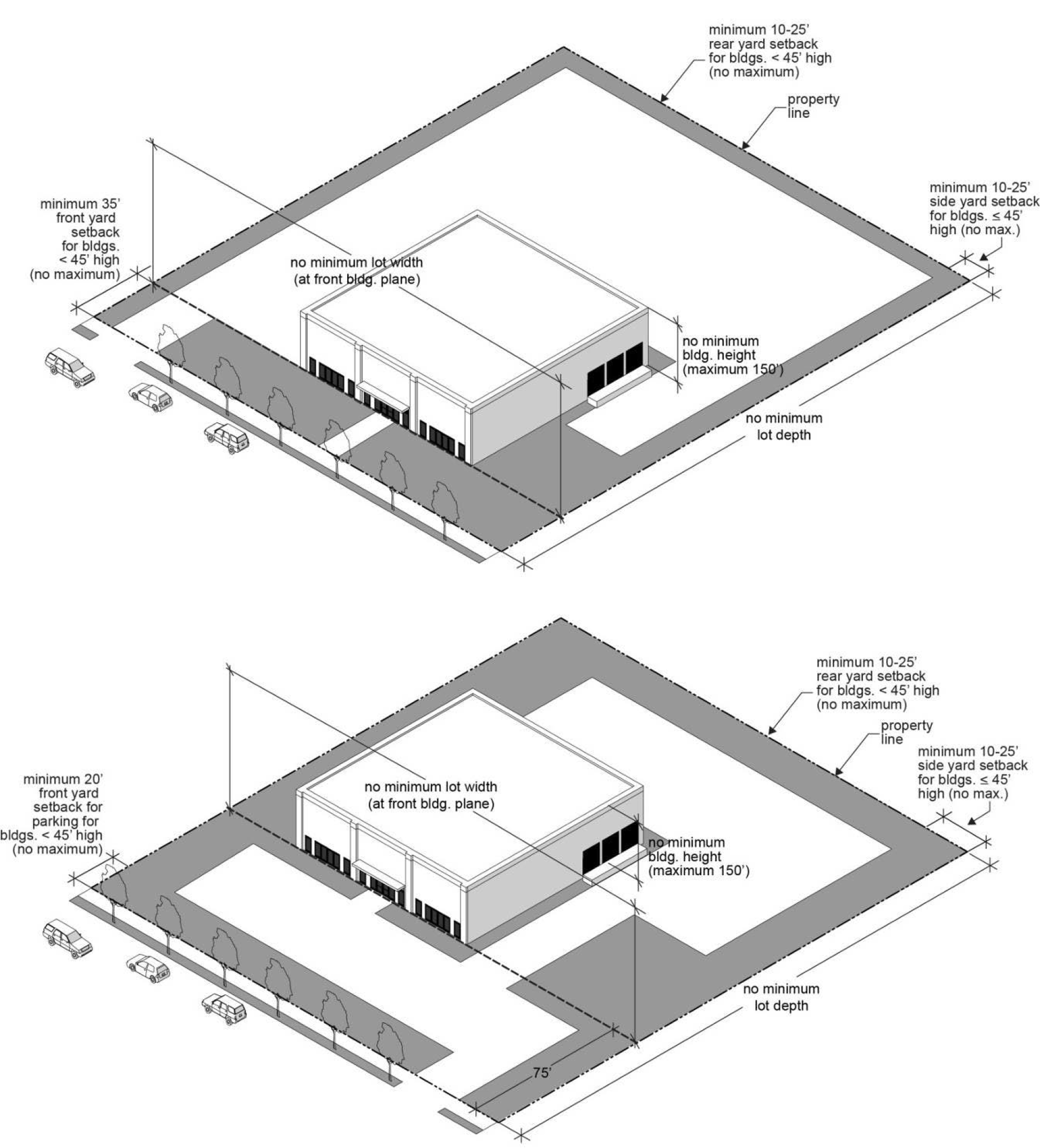
(Ord. 6401 § 1, 2022)
12.25.270 - Variances and Adjustments.
Applications for Variances and Adjustments to other base zone standards in the I-P zone may be approved under 1 of 4 processes:
A.
As a Variance pursuant to Section 12.80.152;
B.
As a Minor Adjustment in conjunction with a primary Type II or Type III application pursuant to Section 12.80.154;
C.
As a Major Adjustment in conjunction with a primary Type III application pursuant to Section 12.80.156; or
D.
With a Significant Natural Resource Permit pursuant to Section 12.80.130.
(Ord. 6401 § 1, 2022; Ord. 6120 § 1, 2015)
12.25.280 - Other Pertinent Regulations.
A.
Applicable Sections. Additional standards such as parking, landscaping, vision clearance, and street improvements also apply to development in the I-P zone as follows:
•
Section 12.50.200 Site Design
•
Section 12.50.300 Vehicle Parking
•
Section 12.50.400 Bicycle Parking/Bicycle and Pedestrian Circulation and Connectivity
•
Section 12.50.500 Access and Street Standards
•
Section 12.50.600 Public Utilities, Site Grading and Storm Water Management Facilities Site Integration
•
Section 12.50.800 Design Standards for Non-Residential and Mixed-Use Development
B.
Site Development Standards. In addition to the standards listed in subsection A above, the following standards apply to all development in the I-P zone:
1.
Off-Street Parking and Loading. Off-street parking and loading are not permitted in required front yards, or in required side or rear yards abutting a residential zone, unless building setbacks are increased to 75 feet and a 20-foot landscaped buffer is provided adjacent to the property line.
2.
Site Storage and Maintenance.
a.
Materials, equipment and waste must be stored and grounds must be maintained in a manner which will not attract insects or vermin or create a health hazard.
b.
Yards adjacent to streets and those abutting a residential zone shall be landscaped and continuously in groundcovers, trees or shrubs as required by Section 12.50.220. All other yards and unused property shall be maintained in grass or other suitable ground cover.
3.
Boundary Fences and Landscaping.
a.
Properties abutting a residential zone shall provide and maintain a dense evergreen landscape buffer with a minimum mature height of 7 feet.
b.
Yards adjacent to streets and those abutting a residential zone shall be landscaped and continuously maintained in suitable groundcovers, trees or shrubs as required by Section 12.50.220. All other yards and unused property shall be maintained in grass or other suitable ground cover.
c.
Wire or similar open fences may be permitted at property lines adjacent to landscaped yards.
4.
Heat, Glare and Lighting.
a.
Except for exterior lighting, industrial operations producing heat or glare shall be conducted entirely within an enclosed building.
b.
Exterior lighting shall be shielded and directed away from adjacent properties as required by Section 12.50.240.
5.
Compliance with State Requirements. All Uses or operations shall comply with current State air quality and noise statutes and rules as administered by the Department of Environmental Quality.
(Ord. 6401 § 1, 2022)
12.25.300 - I-S Industrial Sanctuary.
The I-S zone includes the following sections:
12.25.310 Purpose and Applicability
12.25.320 Housing Types
12.25.330 Uses
12.25.340 Accessory Uses Permitted by Right
12.25.345 Accessory Uses and Structures Permitted by Right
12.25.350 Special Provisions Regarding Uses
12.25.360 Development Standards
12.25.370 Variances and Adjustments
12.25.380 Other Pertinent Regulations
(Ord. 6401 § 1, 2022; Ord. 6323 § 1, 2019)
12.25.310 - Purpose and Applicability.
A.
Provide a Full Range of Industrial Uses and Limited Commercial Support Services. The I-S zone implements the Industrial Comprehensive Plan designation, and is intended to provide a full range of industrial uses and limited support services in areas brought into the Regional Urban Growth Boundary (UGB) for industrial development, in order to support the goals and policies of Section 14 (Economic Development) of the City's Comprehensive Plan and Statewide Planning Goal 9 (Economy of the State).
B.
Accommodate the Region-Wide Need to Create and Preserve Industrial Lands. The I-S zone accommodates the region-wide need to create and preserve large lots for industrial use, as set forth in Title 4 of the Metro 2040 Urban Growth Management Functional Plan.
C.
Create High-Quality, Attractive Industrial Parks. The standards of the I-S zone are intended to create attractive site amenities such as deeper setbacks and increased landscaping, thereby creating high-quality industrial neighborhoods which attract and maintain the value of their investments.
D.
Reduce Vehicle Miles Traveled. By allowing siting of supporting commercial uses within industrial areas, the standards of the I-S zone help to reduce vehicle trips and miles travelled by employees to these services and/or to access them by walking or bicycling.
E.
Applicability. The I-S zone can be applied generally to properties north of NE Evergreen Rd or NE Jacobsen St, and west of NE Cornelius Pass Rd. The zone contains 8 Sub-Areas as shown on Figure 12.25.310-A: West Union; Helvetia; Shute Road; Evergreen East; Evergreen West; Meek Road; Jackson East-South; and Jackson East-North.
(Ord. 6410 § 1, 2022; Ord. 6401 § 1, 2022; Ord. 6322 § 1, 2019; Ord. 6294 § 1, 2019; Ord. 6250 § 1, 2017)
Figure 12.25.310-A:
I-S Industrial Sanctuary Zone Sub-Areas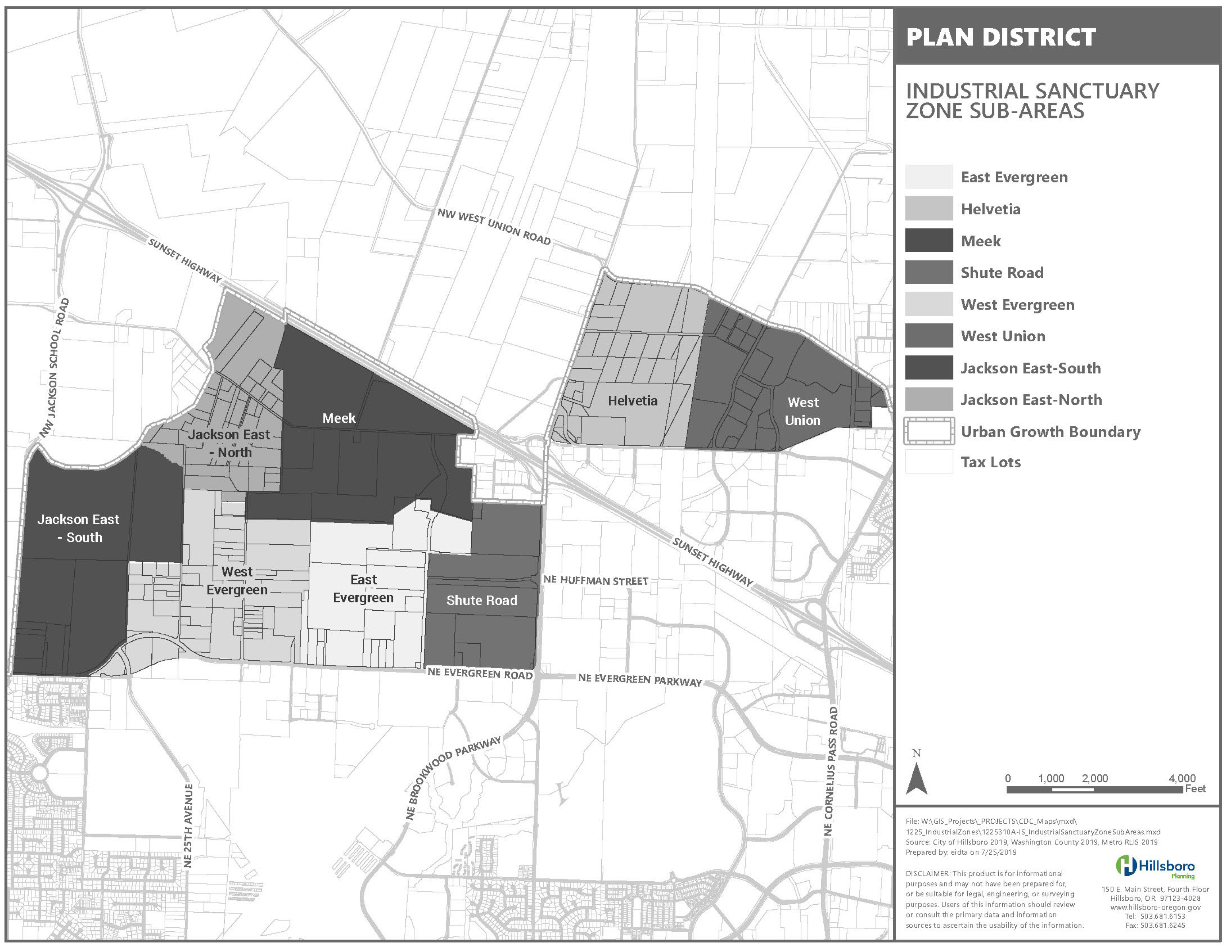
12.25.320 - Housing Types.
Table 12.25.320-1 lists housing types permitted in the I-S zone. Housing types are defined in Section 12.01.500.
(P) Permitted (C) Conditional (L) Limited (N) Not Permitted
(Ord. 6410 § 1, 2022; Ord. 6401 § 1, 2022; Ord. 6322 § 1, 2019)
12.25.330 - Uses.
Table 12.25.330-1 lists uses permitted, conditionally permitted, limited, or not permitted in the I-S zone.
(P) Permitted (C) Conditional (L) Limited (N) Not Permitted
(Ord. 6417 § 1, 2022; Ord. 6410 § 1, 2022; Ord. 6401 § 1, 2022; Ord. 6393 § 1, 2021; Ord. 6322 § 1, 2019; Ord. 6294 § 1, 2019; Ord. 6232 § 1, 2017; Ord. 6160 § 1, 2016; Ord. 6149 § 1, 2015)
12.25.340 - Accessory Uses Permitted by Right.
Accessory uses are permitted in conjunction with the primary industrial use on the site and subject to the same regulations as the primary use unless stated otherwise in the Code. Accessory uses to permitted uses shown on Table 12.25.330-1 include, but are not limited to: administrative offices; conference rooms/conference facilities; data storage, processing and information technology centers; food service such as cafeterias, delicatessens and coffee shops; personal retail services, exercise facilities; and child care. Such accessory uses are subject to the following standards:
A.
The accessory uses are intended to serve only employees, visitors, and operations of the primary use; and
B.
The accessory uses are located entirely within the building containing the primary permitted use. If the primary use has a multiple-building campus, the accessory uses may be located in a free-standing building within the campus perimeter.
(Ord. 6410 § 1, 2022; Ord. 6401 § 1, 2022; Ord. 6322 § 1, 2019)
12.25.345 - Accessory Uses and Structures Permitted by Right.
Accessory uses vary based on the use categories contained in Subchapter 12.10. Accessory uses are permitted in conjunction with the primary industrial use on the site and are subject to the same regulations as the primary use unless stated otherwise in the Code. Accessory structures as defined in Section 12.01.500 are permitted subject to the additional requirements in Section 12.40.100.
(Ord. 6410 § 1, 2022; Ord. 6401 § 1, 2022; Ord. 6323 § 1, 2019; Ord. 6149 § 1, 2015)
12.25.350 - Special Provisions Regarding Uses.
A.
Eating and Drinking Establishments, Office Uses, Retail Products and Services, and Vehicle Service and Repair. Eating and drinking establishments, office uses except as described in subsection C below, retail products and services and vehicle service and repair shall be limited in scale and location to serve primarily the needs of the businesses and employees in the surrounding industrial area. Such uses are subject to the following limitations in location and size:
1.
Permitted uses are limited to locations only in those commercial support nodes identified in Comprehensive Plan Section 30 North Hillsboro Industrial Area Community Plan. The node between the Shute Road and Evergreen East Sub-Areas shall be located in the Evergreen East Sub-Area.
2.
Development of a commercial support node in an identified sub-area is permitted only after certain thresholds of industrial development are met or exceeded. These thresholds are considered met when the City has issued building permits for permitted manufacturing and production and industrial services uses as categorized in Subchapter 12.10 within the sub-area at the cumulative levels established in Table 12.25.350-1 below.
3.
No single commercial node shall occupy more than 5 gross acres of developed land; with not more than 50,000 gross square feet of total structural or building floor area per node.
4.
Within any commercial support node, no single use shall exceed 20,000 square feet gross floor area.
5.
Certain retail products and services uses and vehicle service and repair uses are subject to additional standards in Subchapter 12.40 as follows:
a.
Animal service facilities: see Section 12.40.110;
b.
Day care facilities: see Section 12.40.150; and
c.
Automobile service stations: see Section 12.40.120.
B.
Commercial Lodging. Executive suite hotels are permitted within the Jackson East-North Sub-Area. All food service and other business-oriented amenities associated with the hotel shall be located entirely within the building or group of buildings containing the lodging units.
C.
Educational Services. Community colleges or trade schools are limited to those with offerings that provide basic skills and vocational training to employees in the industrial area.
D.
Corporate or Company Headquarters Office Uses. Corporate or company headquarters offices are permitted in the Jackson East-South and Jackson East-North Sub-Areas, and are permitted with Conditional Use approval in all other sub-areas. Such headquarters offices are not subject to the limitations in Section 12.25.350 while they remain in use by the original occupant.
E.
Corporate Office Uses. Corporate offices are permitted in the Jackson East-South and Jackson East-North Sub-Areas. A corporate office is a single tenant office building with key managerial staff that provide internal administration services for a large organization serving regional, national, or international clientele.
F.
Industrial Services Uses.
1.
The following types of industrial services uses are not permitted:
a.
Building, heating, plumbing and electrical contractors except in the Jackson East-South and Jackson East-North Sub-Areas;
b.
Extermination services;
c.
Fuel oil distribution and solid fuel yards;
d.
Heavy truck servicing and repair;
e.
Bulk sales of building materials and landscaping materials;
f.
Repair and servicing of heavy construction or farm equipment;
g.
Tire retreading or recapping;
h.
Truck driving schools;
i.
Truck stops.
j.
Marijuana testing laboratories.
2.
Building, heating, plumbing and electrical contractors are limited in the Jackson East-South and Jackson East-North Sub-Areas as follows:
a.
The cumulative acreage of building, heating, plumbing and electrical contractors as a primary use in the Jackson East-South Sub-Area may not exceed 35 total gross acres and may not exceed 21 total gross acres in the Jackson East-North Sub-Area.
i.
For development sites with multiple uses, the number of gross acres of the site area which counts toward this limitation is equal to the fraction of the building(s) footprint devoted to building, heating, plumbing and electrical contractor primary uses.
3.
Data storage, processing and information technology centers are limited as follows:
a.
Data storage, processing and information technology centers in the Meek Sub-Area are limited to accessory use(s) to a permitted primary use in the zone and subject to Section 12.25.340.
b.
Data storage, processing and information technology centers in the Jackson East-South and Jackson East-North Sub-Areas are limited to accessory use(s) to a permitted primary use except as follows:
i.
The cumulative acreage of data storage, processing and information technology centers as a primary use in the Jackson East-South Sub-Area may not exceed 62 total gross acres and may not exceed 21 total gross acres in the Jackson East-North Sub-Area.
ii.
For development sites in the Jackson East-South and Jackson East-North Sub-Areas with multiple uses, the number of gross acres of the site area which counts toward this limitation is equal to the fraction of the building(s) footprint devoted to data storage, processing and informational technology centers.
G.
Manufacturing and Production Uses. The following types of manufacturing and production uses are not permitted:
1.
Concrete and asphalt batch plants;
2.
Animal slaughtering and processing;
3.
Fossil fuel products manufacturing;
4.
Production of soil amendments (fertilizers, pesticides, fungicides, etc.);
5.
Marijuana production and processing facilities.
H.
Warehouse And Freight Movement Uses. Warehouse and Freight Movement are limited in the Jackson East-South and Jackson East-North Sub-Areas as follows:
1.
The cumulative acreage of Warehouse and Freight Movement in the Jackson East-South Sub-Area as a primary use may not exceed 52 total gross acres and may not exceed 21 gross acres in the Jackson East-North Sub-Area.
a.
For development sites with multiple uses, the number of gross acres of the site area which counts toward this limitation is equal to the fraction of the building(s) footprint devoted to Warehouse and Freight Movement.
I.
Wholesale Sales. Marijuana wholesale facilities are not permitted.
J.
Institutional Uses. Major assembly facilities are subject to additional standards in Section 12.40.210.
1.
In the West Union and West Evergreen Sub-Areas, major assembly facilities uses and schools are permitted with Conditional Use approval.
2.
In the Helvetia, Shute Road, East Evergreen and Meek Road Sub-Areas, the following types of major assembly facilities are not permitted:
a.
Auditoriums;
b.
Coliseums, stadiums and sports arenas;
c.
Convention and conference centers;
d.
Outdoor amphitheaters.
3.
In the Jackson East-North and Jackson East-South Sub-Areas, major assembly facilities and schools are not permitted.
K.
Infrastructure and Utilities Uses.
1.
The following types of aviation uses are limited to properties owned by the Port of Portland at the Portland-Hillsboro Airport: runways, taxiways, aprons, air operations areas for unobstructed movement of aircraft, security areas, terminals and associated parking, and aircraft storage hangars.
2.
Parks and open space uses are permitted with Conditional Use approval, unless otherwise not permitted by the Code.
(Ord. 6410 § 1, 2022; Ord. 6401 § 1, 2022; Ord. 6322 § 1, 2019; Ord. 6294 § 1, 2019; Ord. 6160 § 1, 2016; Ord. 6149 § 1, 2015)
12.25.360 - Development Standards.
Base zone development standards in the I-S zone are listed in Table 12.25.360-1. Certain standards are illustrated in Figure 12.25.360-A.
* Standards illustrated in Figure 12.25.360-A
Figure 12.25.360-A:
Minimum Lot Dimensions, Setbacks
and Height Requirements in the I-S Zone*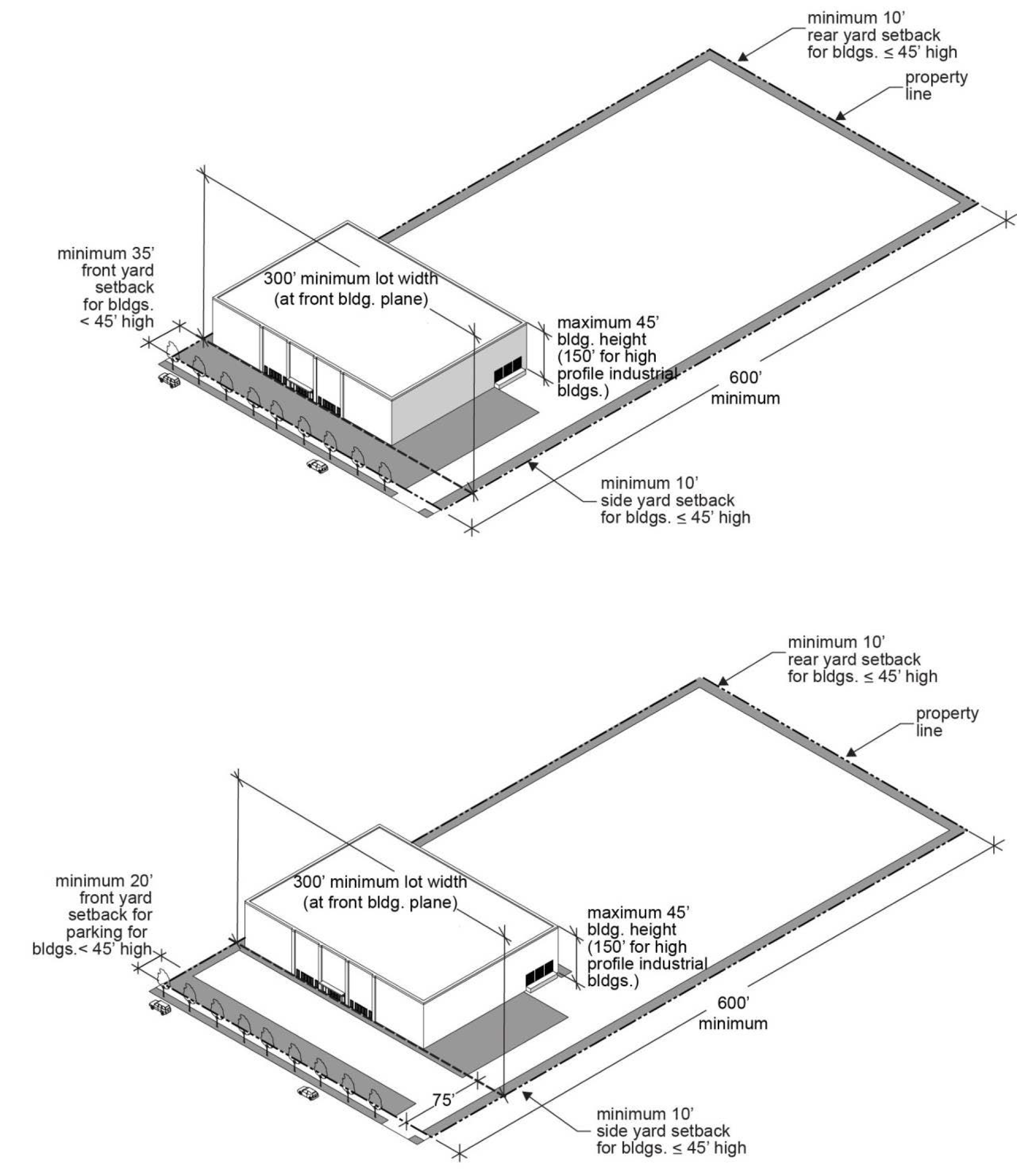
*Minimum lot width and depth standards do not apply in the Jackson East-North Sub-Area.
(Ord. 6451 § 1, 2023; Ord. 6410 § 1, 2022; Ord. 6401 § 1, 2022)
12.25.370 - Variances and Adjustments.
Applications for Variances and Adjustments to base zone standards in the I-S zone may be approved under one of 4 processes:
A.
As a Variance pursuant to Section 12.80.152;
B.
As a Minor Adjustment in conjunction with a primary Type II or Type III application pursuant to Section 12.80.154;
C.
As a Major Adjustment in conjunction with a primary Type III application pursuant to Section 12.80.156; or
D.
With a Significant Natural Resource Permit pursuant to Section 12.80.130.
(Ord. 6410 § 1, 2022; Ord. 6401 § 1, 2022; Ord. 6120 § 1, 2015)
12.25.380 - Other Pertinent Regulations.
A.
Applicable Sections. Additional standards such as parking, landscaping, vision clearance, and street improvements also apply to development in the I-S zone as follows:
•
Sections 12.50.200 and 12.66.200 Site Design
•
Sections 12.50.300 and 12.66.300 Vehicle Parking
•
Sections 12.50.400 and 12.66.400 Bicycle Parking/Bicycle and Pedestrian Circulation and Connectivity
•
Sections 12.50.500 and 12.66.500 Access and Street Standards
•
Sections 12.50.600 and 12.66.600 Public Utilities, Site Grading and Storm Water Management Facilities Site Integration
•
Sections 12.50.800 and 12.66.800 Design Standards for Non-Residential and Mixed-Use Development
B.
Site Development Standards. In addition to the standards listed in subsection A above, the following standards apply to all development in the I-S zone:
1.
Off-Street Parking and Loading. Off-street parking and loading are not permitted in required front yards, or in required side or rear yards abutting a residential zone, unless building setbacks are increased to 75 feet and a 20-foot landscaped buffer is provided adjacent to the property line.
2.
Site Storage and Maintenance.
a.
Materials, equipment and waste must be stored and grounds must be maintained in a manner which will not attract insects or vermin or create a health hazard.
3.
Boundary Fences and Landscaping.
a.
The following properties shall provide and maintain a dense evergreen landscape buffer with a minimum mature height of 7 feet:
i.
In any Sub-Area, properties abutting a residential zone; and
ii.
In the Jackson East-North Sub-Area, properties abutting a residential use.
b.
The following properties shall be landscaped and continuously maintained in suitable groundcovers, trees or shrubs as required by Section 12.50.220:
i.
In any Sub-Area, yards adjacent to streets and those abutting a residential zone, and
ii.
In the Jackson East-North Sub-Area, yards abutting a residential use.
c.
All other yards and unused property shall be maintained in grass or other suitable cover.
d.
Wire or similar open fences may be permitted at property lines adjacent to landscaped yards.
4.
Heat, Glare and Lighting.
a.
Except for exterior lighting, industrial operations producing heat or glare shall be conducted entirely within an enclosed building.
b.
Exterior lighting shall be shielded and directed away from adjacent properties as required by Section 12.50.240.
5.
Compliance with State Requirements. All uses or operations shall comply with current State air quality and noise statutes and rules as administered by the Department of Environmental Quality.
C.
Lot Reconfiguration and Division Standards.
1.
Intent of Lot Reconfiguration and Division Requirements. Land in the I-S zone was added to the regional Urban Growth Boundary with the expressed purpose of maintaining and creating large lots for industrial use. To accomplish this purpose, lot reconfiguration and division approvals shall require retention and creation of lots of certain sizes, as described in paragraphs 2 through 5 below.
2.
Development on Lots of Record. Lots of record or contiguous lots of record, existing on or after January 12, 2012 in common ownership may be developed in compliance with Tables 12.25.380-1 and 12.25.380-2 below:
3.
Lot Reconfiguration and Division Requirements in Shute Road Sub-Area. Prior to development, properties shall be aggregated into parcels at least 50 gross acres in area, with the exception of the area north of the Waible Creek drainage, which may be reconfigured as a separate lot less than 50 gross acres in area.
4.
Lot Reconfiguration and Division Requirements in Meek Sub-Area. Lot division, assembly and/or reconfiguration shall provide for, or not preclude the creation of, at least 1 lot of 100 acres or more in area, and at least 2 lots of 50 acres or more in area. Lots 50 acres in size or greater shall be limited to a single user of permitted uses shown on Table 12.25.330-1.
5.
Minimum Lot Size in the Jackson East-South Sub-Area. Lot division, assembly and/or reconfiguration shall provide for at least one development site in the Jackson East-South Sub-Area of 50 acres or more in size. Development on this site is limited to a single user of a permitted use.
6.
Exceptions to Minimum Lot Sizes. Lot sizes in the West Union, Helvetia, Shute Road, Evergreen East, Evergreen West, and Meek Sub-Areas may be reduced below the standards listed in paragraphs 2, 3 or 4 above to allow:
a.
Provision of public facilities and services;
b.
Dedication and/or construction of public Collector or Arterial streets necessary to implement Comprehensive Plan Section 20 Transportation and the adopted Transportation System Plan cited in Comprehensive Plan Section 23;
c.
To separate common or public ownership of natural areas or flood hazard areas; or
d.
To separate an existing non-conforming Use from the remainder of the lot.
7.
Property Line Adjustments. Property line adjustments between lots of record individually smaller than 5 acres are exempt from the standards listed paragraphs 2 and 3. If an applicant proposes to reconfigure 2 lots of record in common or varied ownership, such reconfiguration may be approved as a Property Line Adjustment under Section 12.80.092. All other property line adjustments shall result in lots which are in compliance with Subsections 2 through 5 above, as applicable.
8.
Lot Division, Assembly and/or Reconfiguration by Partition or Subdivision. A land division or reconfiguration of lots may be approved as a Partition or as a Subdivision under Section 12.80.090.
9.
Sequential Lot Reconfiguration or Division Restrictions. Lots of record or lot assemblies reconfigured or divided through property line adjustments, partitions or subdivisions under paragraph 7 or 8 above shall not be reconfigured or redivided for a minimum of 5 years following the recordation of the deed or plat for such reconfiguration or division. This restriction against reconfiguration or redivision may be waived for purposes described in paragraph 6 above. This restriction does not apply to the Jackson East-South and Jackson East-North Sub-Areas.
(Ord. 6410 § 1, 2022; Ord. 6401 § 1, 2022; Ord. 6250 § 1, 2017; Ord. 6232 § 1, 2017)
12.25.400 - SCBP Station Community Business Park.
The SCBP zone includes the following sections:
12.25.410 Purpose
12.25.420 Housing Types
12.25.430 Uses
12.25.440 Accessory Uses and Structures Permitted by Right
12.25.450 Special Provisions Regarding Uses
12.25.460 Development Standards
12.25.470 Variances and Adjustments
12.25.480 Other Pertinent Regulations
(Ord. 6401 § 1, 2022)
12.25.410 - Purpose.
A.
Provide a Range of Industrial Activities. The SCBP zone implements the Station Community Planning Area Plan designation, providing opportunities for light industrial and industrial service uses, and limited opportunities for convenient service and office commercial uses, up to 5,200 feet from an LRT Station.
B.
Create High-Quality, Attractive Industrial Parks. The standards of the SCBP zone are intended to create high-quality industrial neighborhoods incorporating development and design elements to create transit-supportive and pedestrian-friendly yet automobile-accommodating developments.
C.
Reduce Vehicle Miles Traveled. The SCBP zone allows light industrial uses and limited commercial uses in light rail zones, thereby reducing vehicle miles travelled by industrial employees for commuting and convenience trips.
(Ord. 6401 § 1, 2022)
12.25.420 - Housing Types.
Table 12.25.420-1 lists Housing Types permitted in the SCBP zone. Housing Types are defined in Section 12.01.500.
(P) Permitted (C) Conditional (L) Limited (N) Not Permitted
(Ord. 6401 § 1, 2022)
12.25.430 - Uses.
Table 12.25.430-1 lists uses permitted, conditionally permitted, limited or not permitted in the SCBP zone.
(P) Permitted (C) Conditional (L) Limited (N) Not Permitted
(Ord. 6417 § 1, 2022; Ord. 6408 § 1, 2022; Ord. 6401 § 1, 2022; Ord. 6393 § 1, 2021; Ord. 6322 § 1, 2019; Ord. 6294 § 1, 2019; Ord. 6160 § 1, 2016; Ord. 6149 § 1, 2015)
12.25.440 - Accessory Uses and Structures Permitted by Right.
Accessory uses vary based on the use categories contained in Subchapter 12.10. Accessory uses are permitted in conjunction with the primary industrial use on the site and are subject to the same regulations as the primary use unless stated otherwise in the Code. Accessory structures as defined in Section 12.01.500 are permitted subject to the additional requirements in Section 12.40.104.
(Ord. 6401 § 1, 2022; Ord. 6323 § 1, 2019; Ord. 6322 § 1, 2019; Ord. 6149 § 1, 2015)
12.25.450 - Special Provisions Regarding Uses.
A.
Eating and Drinking Establishments and Retail Products and Service Uses. In the SCBP zone, commercial uses are limited in size and intensity to promote a local orientation and to limit adverse impacts on nearby residential areas. Eating and drinking establishments and retail products and service uses shall not exceed 6,000 square feet per use. Multi-tenant commercial buildings in the SCBP zone are permitted with a footprint up to 20,000 square feet.
B.
Animal Service Facilities. Animal services facilities, with or without outdoor exercise areas and/or overnight boarding, are permitted with Conditional Use approval, and subject to additional standards in Section 12.40.120.
C.
Industrial Use Limitations. Industrial service, manufacturing and production, and wholesale sales uses must be wholly contained within a building, with no unscreened outdoor storage of materials, products or vehicles, and shall not include external heavy industrial equipment such as upright tanks, stacks or exhaust pipes.
D.
Residential Service. Residential Service uses are permitted in the SCBP and SCI zones if in compliance with the following standards:
1.
The facility has received a Certificate of Need from the State of Oregon.
2.
The maximum size of the facility is 100 beds.
(Ord. 6408 § 1, 2022; Ord. 6401 § 1, 2022; Ord. 6322 § 1, 2019; Ord. 6294 § 1, 2019; Ord. 6149 § 1, 2015)
12.25.460 - Development Standards.
Development standards in the SCBP zone are listed in Table 12.25.460-1. Certain standards are illustrated in Figure 12.25.460-A.
* Standards illustrated in Figure 12.25.460-A
Figure 12.25.460-A:
Minimum Lot Dimensions, Setbacks
and Height Requirements in the SCBP Zone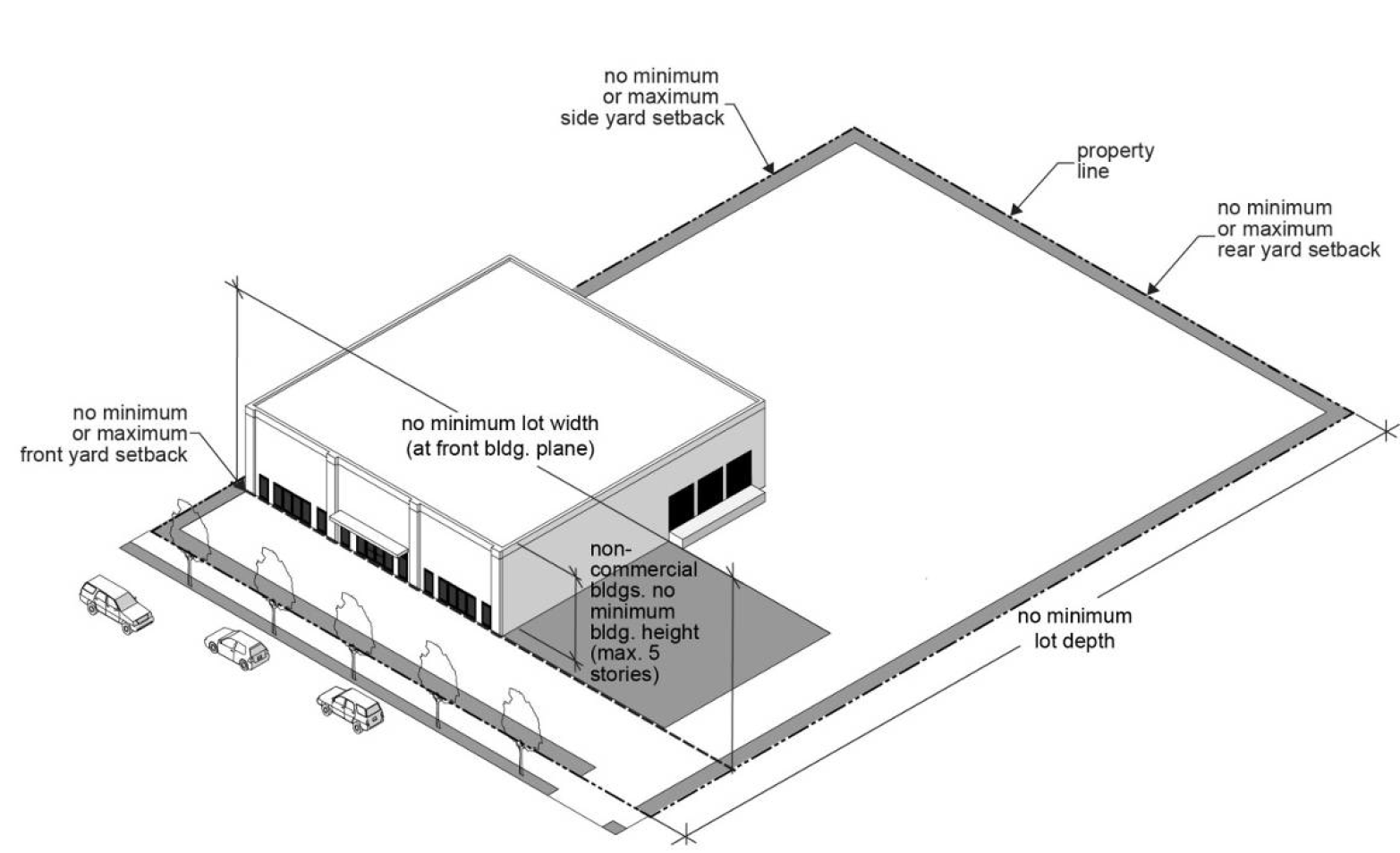
(Ord. 6401 § 1, 2022; Ord. 6120 § 1, 2015)
12.25.470 - Variances and Adjustments.
Applications for Variances and Adjustments to other base zone standards in the SCBP zone may be approved under 1 of 4 processes:
A.
As a Variance pursuant to Section 12.80.152;
B.
As a Minor Adjustment in conjunction with a primary Type II or Type III application pursuant to Section 12.80.154;
C.
As a Major Adjustment in conjunction with a primary Type III application pursuant to Section 12.80.156; or
D.
With a Significant Natural Resource Permit pursuant to Section 12.80.130.
(Ord. 6401 § 1, 2022; Ord. 6120 § 1, 2015)
12.25.480 - Other Pertinent Regulations.
Additional standards such as parking, landscaping, vision clearance, and street improvements also apply to development in the SCBP zone as follows:
•
Section 12.50.200 Site Design
•
Section 12.50.300 Vehicle Parking
•
Section 12.50.400 Bicycle Parking/Bicycle and Pedestrian Circulation and Connectivity
•
Section 12.50.500 Access and Street Standards
•
Section 12.50.600 Public Utilities, Site Grading and Storm Water Management Facilities Site Integration
•
Section 12.50.800 Design Standards for Non-Residential and Mixed-Use Development
(Ord. 6401 § 1, 2022)
12.25.500 - SCI Station Community Industrial.
The SCI zone includes the following sections:
12.25.510 Purpose
12.25.520 Housing Types
12.25.530 Uses
12.25.540 Accessory Uses and Structures Permitted by Right
12.25.550 Special Provisions Regarding Uses
12.25.560 Development Standards
12.25.570 Variances and Adjustments
12.25.580 Other Pertinent Regulations
(Ord. 6401 § 1, 2022)
12.25.510 - Purpose.
A.
Provide a Full Range of Industrial Activities. The SCI zone implements the Station Community Planning Area Plan designation, providing opportunities for all types of general and light industrial and industrial service Uses, and limited opportunities for convenient service and office commercial Uses, within 3,900 feet of an LRT Station.
B.
Retain and Create Industrial Employment. The SCI zone is intended to provide opportunities to site certain industrial Uses within light rail zones while encouraging transit-oriented design in new developments.
C.
Reduce Vehicle Miles Traveled. By allowing siting of light industrial Uses and supporting commercial Uses in light rail zones, the standards of the SCI zone help to reduce vehicle trips and miles travelled by industrial employees to work and to these services by walking or bicycling.
(Ord. 6401 § 1, 2022)
12.25.520 - Housing Types.
Table 12.25.520-1 lists housing types permitted in the SCI zone. Housing types are defined in Section 12.01.500.
(P) Permitted (C) Conditional (L) Limited (N) Not Permitted
(Ord. 6401 § 1, 2022)
12.25.530 - Uses.
Table 12.25.530-1 lists Uses Permitted, Conditional Permitted, Limited, or Not Permitted in the SCI zone.
(P) Permitted (C) Conditional (L) Limited (N) Not Permitted
(Ord. 6408 § 1, 2022; Ord. 6401 § 1, 2022; Ord. 6393 § 1, 2021; Ord. 6322 § 1, 2019; Ord. 6294 § 1, 2019; Ord. 6160 § 1, 2016; Ord. 6149 § 1, 2015)
12.25.540 - Accessory Uses and Structures Permitted by Right.
Accessory uses vary based on the use categories contained in Subchapter 12.10. Accessory uses are permitted in conjunction with the primary industrial use on the site and are subject to the same regulations as the primary use unless stated otherwise in the Code. Accessory structures as defined in Section 12.01.500 are permitted subject to the additional requirements in Section 12.40.104.
(Ord. 6401 § 1, 2022; Ord. 6323 § 1, 2019; Ord. 6322 § 1, 2019; Ord. 6149 § 1, 2015)
12.25.550 - Special Provisions Regarding Uses.
A.
Eating and Drinking Establishments and Retail Products and Service Uses. In the SCI zone, commercial uses are limited in size and intensity to promote a local orientation and to limit adverse impacts on nearby residential areas. Eating and drinking establishments and retail products and service uses shall not exceed 6,000 square feet per use. Multi-tenant commercial buildings in the SCI zone are permitted with a footprint up to 20,000 square feet.
B.
Animal Service Facilities. Animal services facilities, with or without outdoor exercise areas and/or overnight boarding, are permitted with Conditional Use approval, and subject to additional standards in Section 12.40.110.
(Ord. 6401 § 1, 2022; Ord. 6322 § 1, 2019; Ord. 6294 § 1, 2019; Ord. 6149 § 1, 2015)
12.25.560 - Development Standards.
Base zone development standards in the SCI zone are listed in Table 12.25.560-1. Certain standards are illustrated in Figure 12.25.560-A.
* Standards illustrated in Figure 12.25.560-A
Figure 12.25.560-A:
Minimum Lot Dimensions, Setbacks
and Height Requirements in the SCI Zone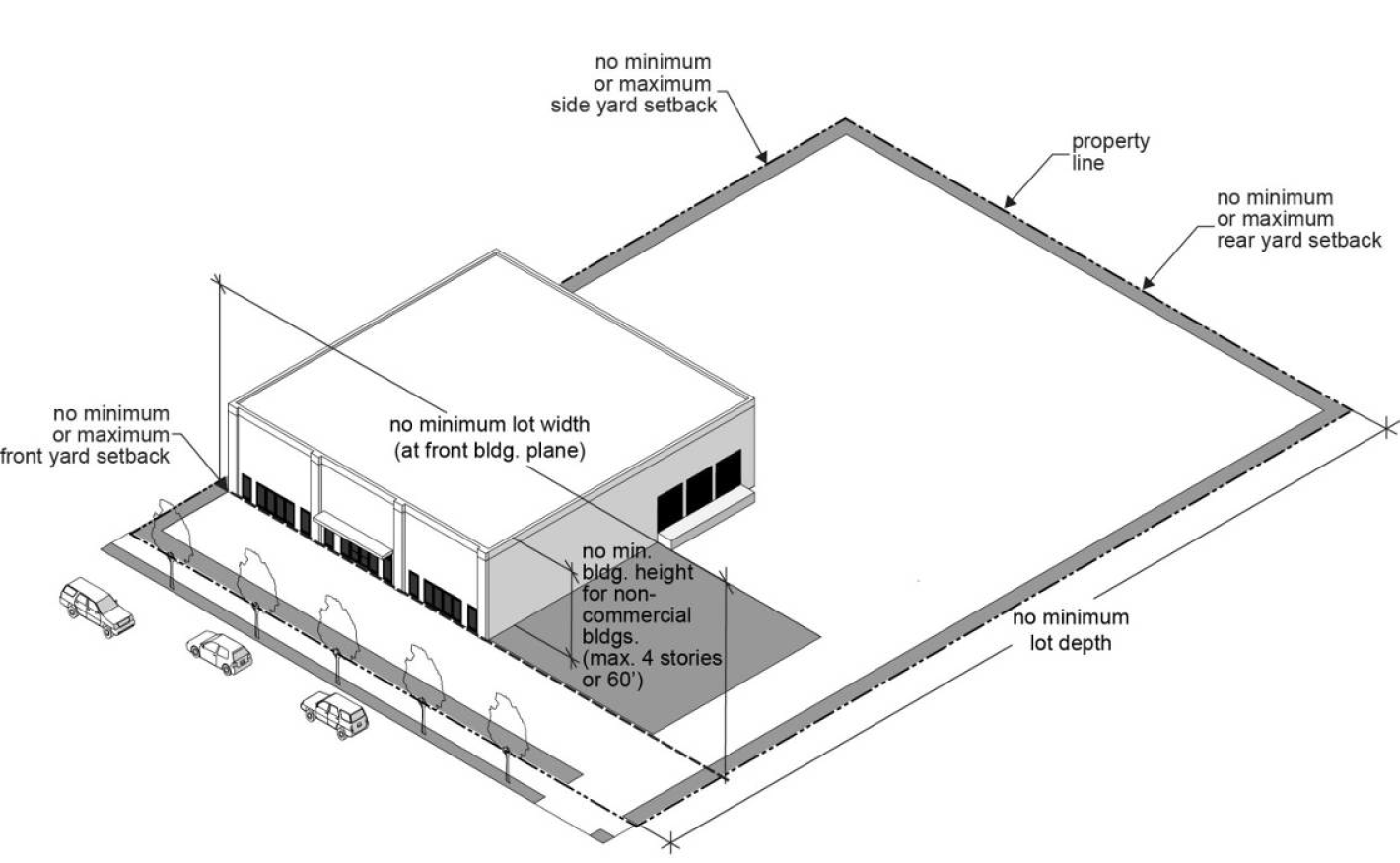
(Ord. 6401 § 1, 2022; Ord. 6120 § 1, 2015)
12.25.570 - Variances and Adjustments.
Applications for Variances and Adjustments to other base zone standards in the SCI zone may be approved under 1 of 4 processes:
A.
As a Variance pursuant to Section 12.80.152;
B.
As a Minor Adjustment in conjunction with a primary Type II or Type III application pursuant to Section 12.80.154;
C.
As a Major Adjustment in conjunction with a primary Type III application pursuant to Section 12.80.156; or
D.
With a Significant Natural Resource Permit pursuant to Section 12.80.130.
(Ord. 6401 § 1, 2022; Ord. 6120 § 1, 2015)
12.25.580 - Other Pertinent Regulations.
Additional standards such as parking, landscaping, vision clearance, and street improvements also apply to development in the SCI zone as follows:
•
Section 12.50.200 Site Design
•
Section 12.50.300 Vehicle Parking
•
Section 12.50.400 Bicycle Parking/Bicycle and Pedestrian Circulation and Connectivity
•
Section 12.50.500 Access and Street Standards
•
Section 12.50.600 Public Utilities, Site Grading and Storm Water Management Facilities Site Integration
•
Section 12.50.800 Design Standards for Non-Residential and Mixed-Use Development
(Ord. 6401 § 1, 2022)
12.25.600 - SSID Shute Road Special Industrial District.
The SSID zone includes the following sections:
12.25.610 Purpose and Applicability
12.25.620 Housing Types
12.25.630 Uses
12.25.640 Accessory Uses and Structures Permitted by Right
12.25.650 Special Provisions Regarding Uses
12.25.660 Development Standards
12.25.670 Variances and Adjustments
12.25.680 Other Pertinent Regulations
12.25.690 Definitions Unique to the SSID
(Ord. 6401 § 1, 2022)
12.25.610 - Purpose and Applicability.
A.
Provide Large "High Technology" Industrial Sites. The SSID zone implements the Industrial Comprehensive Plan designation on properties added to the Urban Growth Boundary in 2002, providing development opportunities in campus industrial park settings for businesses engaged in "high technology product manufacturing" as defined in Section 12.25.690, that may require large sites, and for supporting industrial uses and accessory commercial businesses that may also locate within the same large sites.
B.
Provide Supporting Small and Medium Industrial Sites. The standards of the SSID zone are intended to also provide opportunity for smaller, compatible industrial Uses and accessory commercial uses that can support high-technology product manufacturing Uses and that require small and medium size sites in campus industrial park settings.
C.
Create High-Quality, Attractive Industrial Parks. The standards of the SSID zone are intended to create attractive site amenities such as deeper setbacks and increased landscaping, thereby creating high-quality industrial neighborhoods for large, medium and small industrial Uses which attract and maintain the value of their investments.
D.
Applicability. Properties eligible for the SSID zone designation are shown on Figure 12.25.610-A:
Figure 12.25.610-A:
Shute Road Special Industrial District Boundaries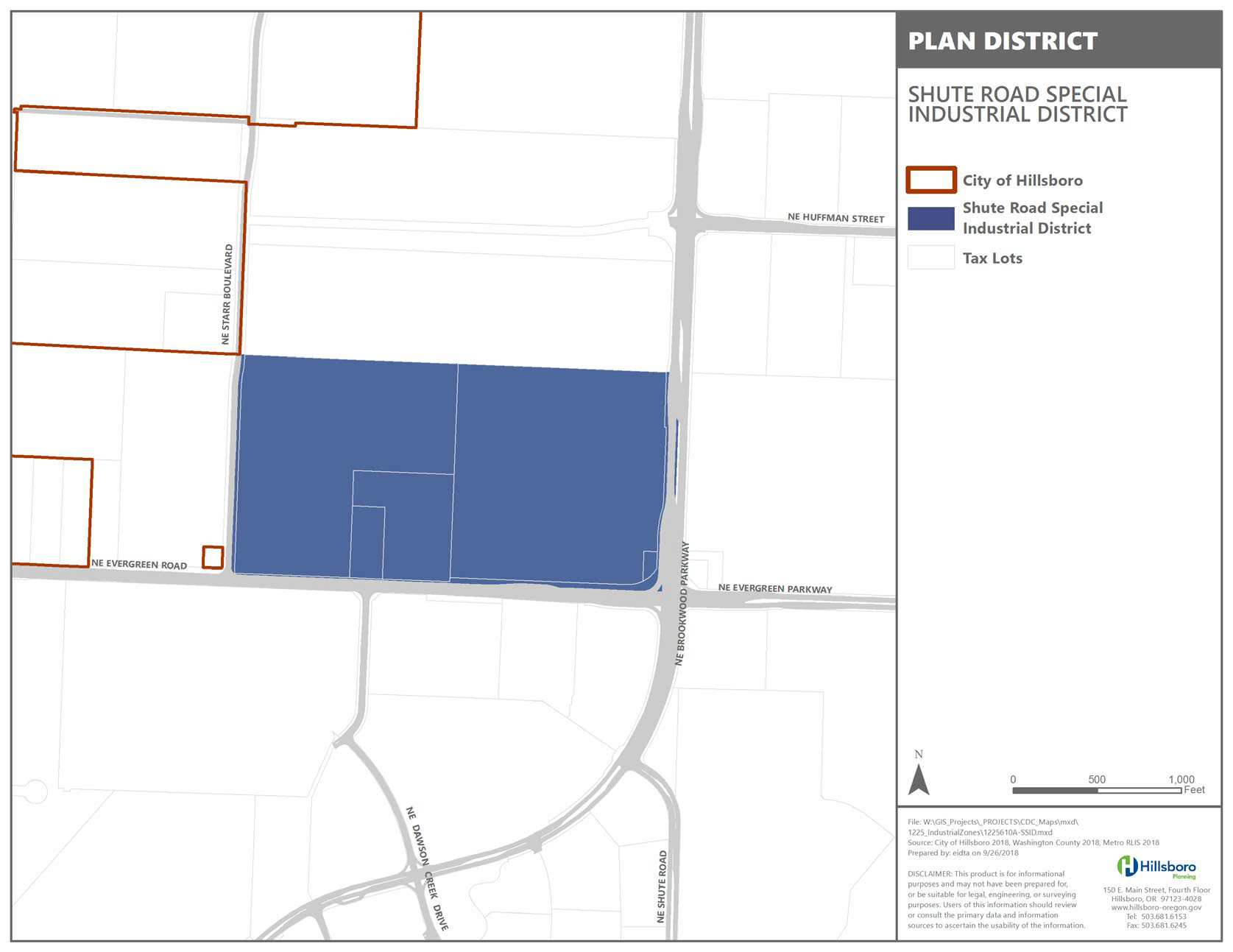
(Ord. 6401 § 1, 2022; Ord. 6322 § 1, 2019; Ord. 6294 § 1, 2019; Ord. 6120 § 1, 2015)
12.25.620 - Housing Types.
Table 12.25.620-1 lists housing types permitted in the SSID zone. Housing types are defined in Section 12.01.500.
(P) Permitted (C) Conditional (L) Limited (N) Not Permitted
(Ord. 6401 § 1, 2022; Ord. 6322 § 1, 2019)
12.25.630 - Uses.
Table 12.25.630-1 lists uses permitted, conditionally permitted, limited, or not permitted in the SSID zone.
(P) Permitted (C) Conditional (L) Limited (N) Not Permitted
(Ord. 6401 § 1, 2022; Ord. 6322 § 1, 2019; Ord. 6294 § 1, 2019)
12.25.640 - Accessory Uses and Structures Permitted by Right.
Accessory uses vary based on the use categories contained in Subchapter 12.10. Accessory uses are permitted in conjunction with the primary industrial use on the site and subject to the same regulations as the primary use unless stated otherwise in the Code. Accessory structures as defined in Section 12.01.500 are permitted subject to the additional requirements in Section 12.40.104.
(Ord. 6401 § 1, 2022; Ord. 6323 § 1, 2019; Ord. 6322 § 1, 2019; Ord. 6149 § 1, 2015)
12.25.650 - Special Provisions Regarding Uses.
A.
Permitted Uses. Uses in the SSID zone shall be limited to the following:
1.
Businesses engaged in high-technology product manufacturing as defined in Section 12.25.690;
2.
Businesses and other uses that support high-technology product manufacturing; and
3.
Commercial office uses that are accessory to and in the same building containing businesses engaged in high-technology product manufacturing or businesses and other uses that support high-technology product manufacturing.
B.
Not Permitted Uses. The following uses shall not be permitted in the SSID zone:
1.
New retail products and services; and
2.
Any other use not specifically listed in Table 12.25.630-1 or Section 12.25.650.
(Ord. 6401 § 1, 2022; Ord. 6322 § 1, 2019)
12.25.660 - Development Standards.
Base zone development standards in the SSID zone are listed in Table 12.25.660-1. Certain standards are illustrated in Figure 12.25.660-A.
* Standards illustrated in Figure 12.25.660-A
Figure 12.25.660-A:
Minimum Lot Dimensions, Setbacks
and Height Requirements in the SSID Zone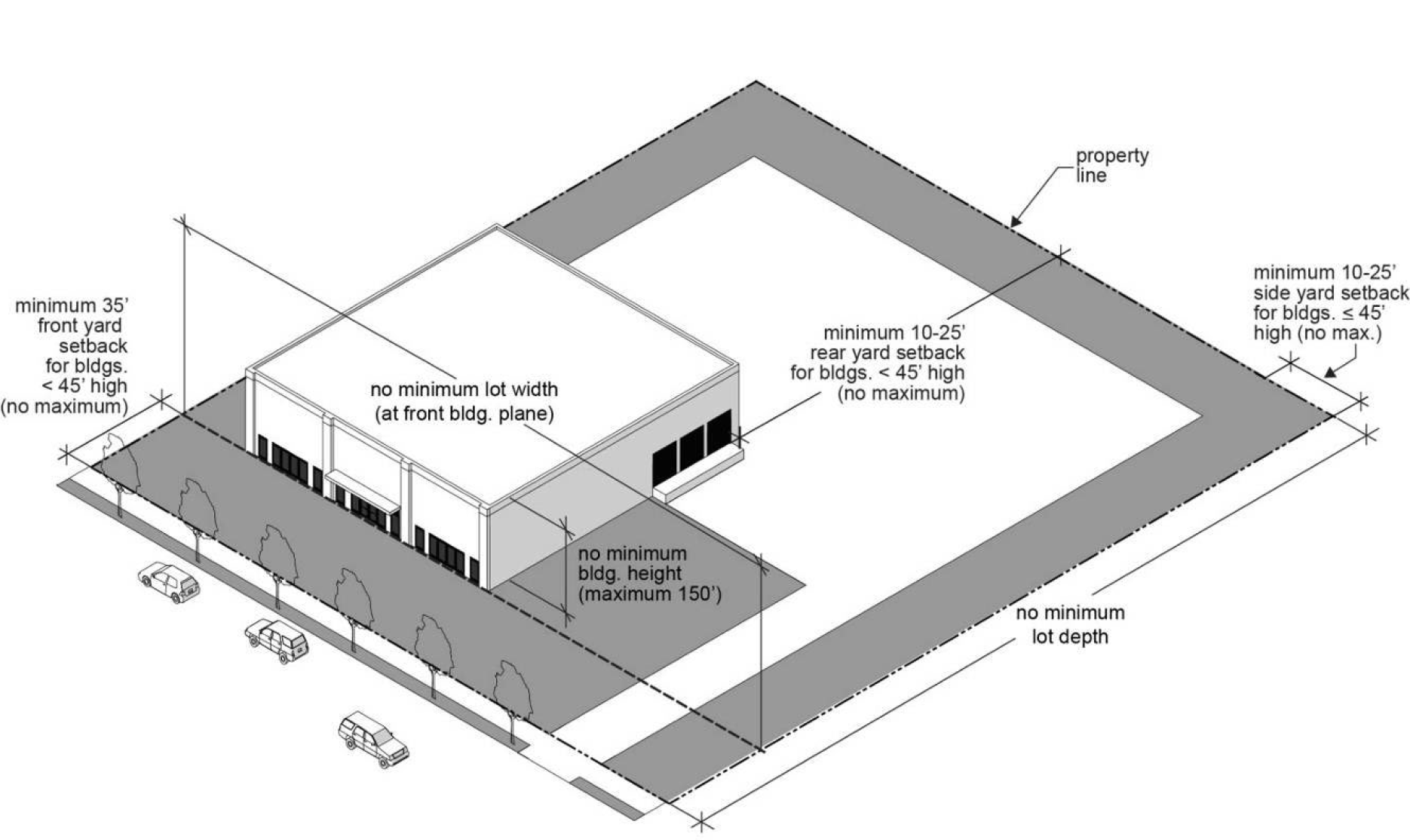
(Ord. 6401 § 1, 2022)
12.25.670 - Variances and Adjustments.
Applications for Variances and Adjustments to other base zone standards in the SSID zone may be approved under 1 of 4 processes:
A.
As a Variance pursuant to Section 12.80.152;
B.
As a Minor Adjustment in conjunction with a primary Type II or Type III application pursuant to Section 12.80.154;
C.
As a Major Adjustment in conjunction with a primary Type III application pursuant to Section 12.80.156; or
D.
With a Significant Natural Resource Permit pursuant to Section 12.80.130.
(Ord. 6401 § 1, 2022; Ord. 6120 § 1, 2015)
12.25.680 - Other Pertinent Regulations.
A.
Applicable Sections. Additional standards such as parking, landscaping, vision clearance, and street improvements also apply to development in the SSID zone as follows:
•
Section 12.50.200 Site Design
•
Section 12.50.300 Vehicle Parking
•
Section 12.50.400 Bicycle Parking/Bicycle and Pedestrian Circulation and Connectivity
•
Section 12.50.500 Access and Street Standards
•
Section 12.50.600 Public Utilities, Site Grading and Storm Water Management Facilities Site Integration
•
Section 12.50.800 Design Standards for Non-Residential and Mixed-Use Development
B.
Site Development Standards. In addition to the standards listed in subsection A above, the following standards apply to all development in the SSID zone:
1.
Off-Street Parking and Loading. Off-street parking and loading are not permitted in required front yards, or in required side or rear yards abutting a residential zone, unless building setbacks are increased to 75 feet and a 20-foot landscaped buffer is provided adjacent to the property line.
2.
Site Storage and Maintenance.
a.
Materials, equipment and waste must be stored and grounds must be maintained in a manner which will not attract insects or vermin or create a health hazard.
b.
Yards adjacent to streets and those abutting a residential zone shall be landscaped and continuously maintained in suitable groundcovers, trees or shrubs as required by Section 12.50.220. All other yards and unused property shall be maintained in grass or other suitable ground cover.
3.
Boundary Fences and Landscaping. Properties abutting a residential zone shall provide and maintain a dense evergreen landscape buffer with a minimum mature height of 7 feet.
a.
Yards adjacent to streets and those abutting a residential zone shall be landscaped and continuously in suitable groundcovers, trees or shrubs as required by Section 12.50.220. All other yards and unused property shall be maintained in grass or other suitable ground cover.
b.
Wire or similar open fences may be permitted at property lines adjacent to landscaped yards.
4.
Heat, Glare and Lighting.
a.
Except for exterior lighting, industrial operations producing heat or glare shall be conducted entirely within an enclosed building.
b.
Exterior lighting shall be shielded and directed away from adjacent property as required by Section 12.50.240.
5.
Compliance with State Requirements. All Uses or operations shall comply with current State air quality and noise statutes and rules as administered by the Department of Environmental Quality.
C.
Lot Reconfiguration and Division Standards. The land area of any lot of record or contiguous lots of record in common ownership in the SSID zone shall not be reduced in size without prior approval by Metro and the City.
1.
The lotting pattern in the SSID shall include at least one 100-acre lot of record or contiguous lots of record in common ownership, or three 50-acre lots of record or sets of contiguous lots of record in common ownership on which land uses shall be limited to high technology product manufacturing as specified in Subsection 12.25.650.A. All other lots of record or contiguous lots of record in common ownership within the SSID may be smaller than 50 acres in size and may contain any business or use described in Subsection 12.25.650.A.
2.
Implementing the Transportation Plan. The required 100-acre lot or 50-acre lots may be reduced in size to the extent necessary to allow the dedication and/or construction of public Collector or Arterial roadways necessary to implement Comprehensive Plan Section 20 Transportation and the adopted Transportation System Plan cited in Comprehensive Plan Section 23.
3.
Natural and Hazard Areas. The lot sizes required in paragraph 1 above may be reduced in size to accommodate the following conditions:
a.
The presence of a natural division of the lot(s) by a significant natural resource area, flood hazard area or other resource or hazard designation in which standards may restrict development under Subchapter 12.27; or
b.
The intent to divide the lot(s) to provide for separate common or public ownership of natural areas, flood hazard areas or other natural resource or hazard areas within an industrial park.
(Ord. 6401 § 1, 2022; Ord. 6250 § 1, 2017)
12.25.690 - Definitions Unique to the SSID.
"High-technology product manufacturing" includes any manufacturing of high-technology-related products, either as the main on-site activity or in conjunction with on-site experimental product research, testing or prototype production; or any other high-technology industrial use that needs to use a dependable and uninterruptible supply of specialized dual-feed electric power or nitrogen gas.
(Ord. 6401 § 1, 2022)
12.25.700 - ESID Evergreen Area Special Industrial District.
The ESID zone includes the following sections:
12.25.710 Purpose and Applicability
12.25.720 Housing Types
12.25.730 Uses
12.25.740 Accessory Uses and Structures Permitted by Right
12.25.750 Special Provisions Regarding Uses
12.25.760 Development Standards
12.25.770 Variances and Adjustments
12.25.780 Other Pertinent Regulations
12.25.790 Definitions Unique to the ESID
(Ord. 6401 § 1, 2022)
12.25.710 - Purpose and Applicability.
A.
Provide Sites for the High Technology and Sustainable Industries. The ESID zone implements the Industrial Comprehensive Plan designation on properties added to the Urban Growth Boundary in 2004, providing large and small industrial sites to accommodate high technology and related companies and businesses and local, national and international "sustainable industries" businesses and companies (including Uses that support or complement such companies and businesses).
B.
Provide Opportunities for Large Industrial Clusters. The standards of the ESID zone are intended to facilitate and nurture the establishment, development and growth of a "sustainable industries" cluster and a "bio-tech/bio-medical/bio-pharmaceutical" industry cluster.
C.
Provide Large Industrial Sites. The standards applicable to the eastern portion of the ESID zone encourage and accommodate the creation of larger industrial parcels including at least 1 parcel 100-acres or larger in size through provisions that facilitate lot consolidation and land assembly.
D.
Provide Small to Medium Industrial Sites. The standards applicable to the western portion of the ESID zone facilitate and accommodate business clusters on smaller industrial sites for business start-ups, incubators and spin-offs that derive from high-tech, sustainable industries and bio-tech/bio-medical/bio-pharmaceutical industry clusters and for supporting public and private facilities and utilities.
E.
Applicability of "Sub-Areas." The standards of this section distinguish between an eastern sub-area A and a western sub-area B within the ESID zone. The boundaries of these sub-areas are shown on Figure 12.25.710-A:
Figure 12.25.710-A:
Evergreen Special Industrial District
Eastern and Western Sub-Areas Boundaries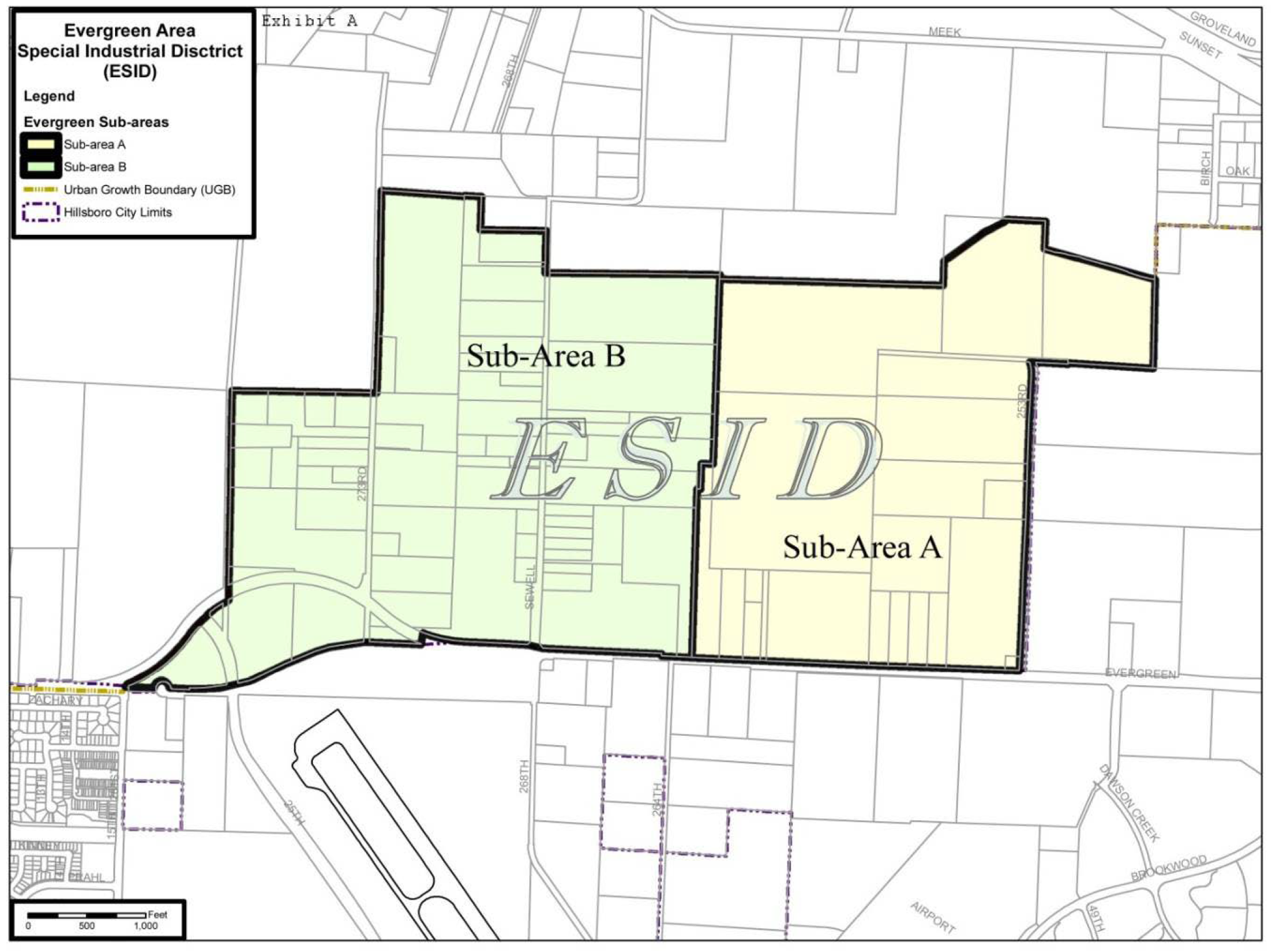
(Ord. 6401 § 1, 2022)
12.25.720 - Housing Types.
Table 12.25.720-1 lists housing types permitted in the ESID zone. Housing types are defined in Section 12.01.500.
(P) Permitted (C) Conditional (L) Limited (N) Not Permitted
(Ord. 6401 § 1, 2022; Ord. 6322 § 1, 2019)
12.25.730 - Uses.
Table 12.25.730-1 lists uses permitted, conditionally permitted, limited, or not permitted in the ESID zone. Unless a use is permitted or conditionally permitted in Table 12.25.730-1 or is determined to be permissible through a Director's Interpretation under Section 12.80.050, the use shall be excluded from, and may not be permitted to develop within the ESID Zone.
(P) Permitted (C) Conditional (L) Limited (N) Not Permitted
(Ord. 6417 § 1, 2022; Ord. 6401 § 1, 2022; Ord. 6322 § 1, 2019; Ord. 6294 § 1, 2019; Ord. 6149 § 1, 2015)
12.25.740 - Accessory Uses and Structures Permitted by Right.
Accessory uses vary based on the use categories contained in Subchapter 12.10. Accessory uses are permitted in conjunction with the primary industrial or commercial use on the site and subject to the same regulations as the primary use unless stated otherwise in the Code. Accessory structures as defined in Section 12.01.500 are permitted subject to the additional requirements in Section 12.40.104.
(Ord. 6401 § 1, 2022; Ord. 6323 § 1, 2019; Ord. 6322 § 1, 2019; Ord. 6149 § 1, 2015)
12.25.750 - Special Provisions Regarding Uses.
A.
Eating and Drinking Establishments, Office, and Retail Products and Services. The following limitations on the location of commercial land uses implement applicable Metro Urban Growth Management Functional Plan Title 4 restrictions on large retail commercial, professional offices and Title 4 Regionally Significant Industrial Area (RSIA) requirements.
1.
In the ESID zone, eating and drinking establishments, office, and retail products and services are considered support commercial services. Support commercial services shall be sited only in clusters on the NE Huffman Ave extension, at the locations indicated in the Comprehensive Plan Section 30 North Hillsboro Industrial Area Community Plan Figure 30-G. Free-standing, single use commercial uses or offices do not are not permitted in the ESID Zone.
2.
The number of support commercial service clusters described in paragraph 1 above shall be limited to 1 site in the East Evergreen sub-area and 1 site in the West Evergreen sub-area. Each cluster shall not exceed 10 acres in area.
3.
The support commercial service cluster described in paragraph 1 above shall not contain more than 50,000 square feet gross floor area (GFA). Within the cluster, the total floor area occupied by a single use, tenant or business shall not exceed 20,000 square feet GFA.
4.
Before the City approves the development of a support commercial service cluster as described in paragraphs 1 and 2 above, the following criteria must be met as applicable:
a.
For a cluster in the East Evergreen sub-area, buildings permits for at least 1,000,000 square feet GFA of permitted industrial development within that sub-area must be issued by the Building Department.
b.
For a cluster in the West Evergreen sub-area, building permits for at least 500,000 square feet GFA of permitted industrial development within that sub-area must be issued by the Building Department.
c.
Specific land uses to be included within a proposed Support Commercial Services cluster shall be consistent with the definition of that use in Section 12.25.790. If a question arises whether a proposed use is consistent with that definition, the Planning Director shall issue a written Interpretation of the consistency of the proposed use with the definition of "Support Commercial Services" pursuant to Section 12.80.050. The Director's determination shall be based on documents that describe how the proposed retail or professional service use satisfies the definition. The application for Director's Interpretation shall be submitted by the developer of the proposed support commercial services development or the developer's representative.
B.
Industrial Service and Manufacturing and Production Uses.
1.
Industrial service and manufacturing and production Uses in the East Evergreen and West Evergreen sub-areas shall be limited to the types of Uses shown in Table 12.25.750-1, as defined in Section 12.25.790.
2.
Unless a use is Permitted or Conditionally Permitted in Table 12.25.730-1 or is determined to be permissible through a Director's Interpretation under Section 12.80.050, the Use shall be excluded from, and may not be permitted to develop within the ESID Zone.
(Ord. 6401 § 1, 2022; Ord. 6294 § 1, 2019)
12.25.760 - Development Standards.
Base zone development standards in the ESID zone are listed in Table 12.25.760-1. Certain standards are illustrated in Figure 12.25.760-A.
* Standards illustrated in Figure 12.25.760-A
Figure 12.25.760-A:
Minimum Lot Dimensions, Setbacks
and Height Requirements in the ESID Zone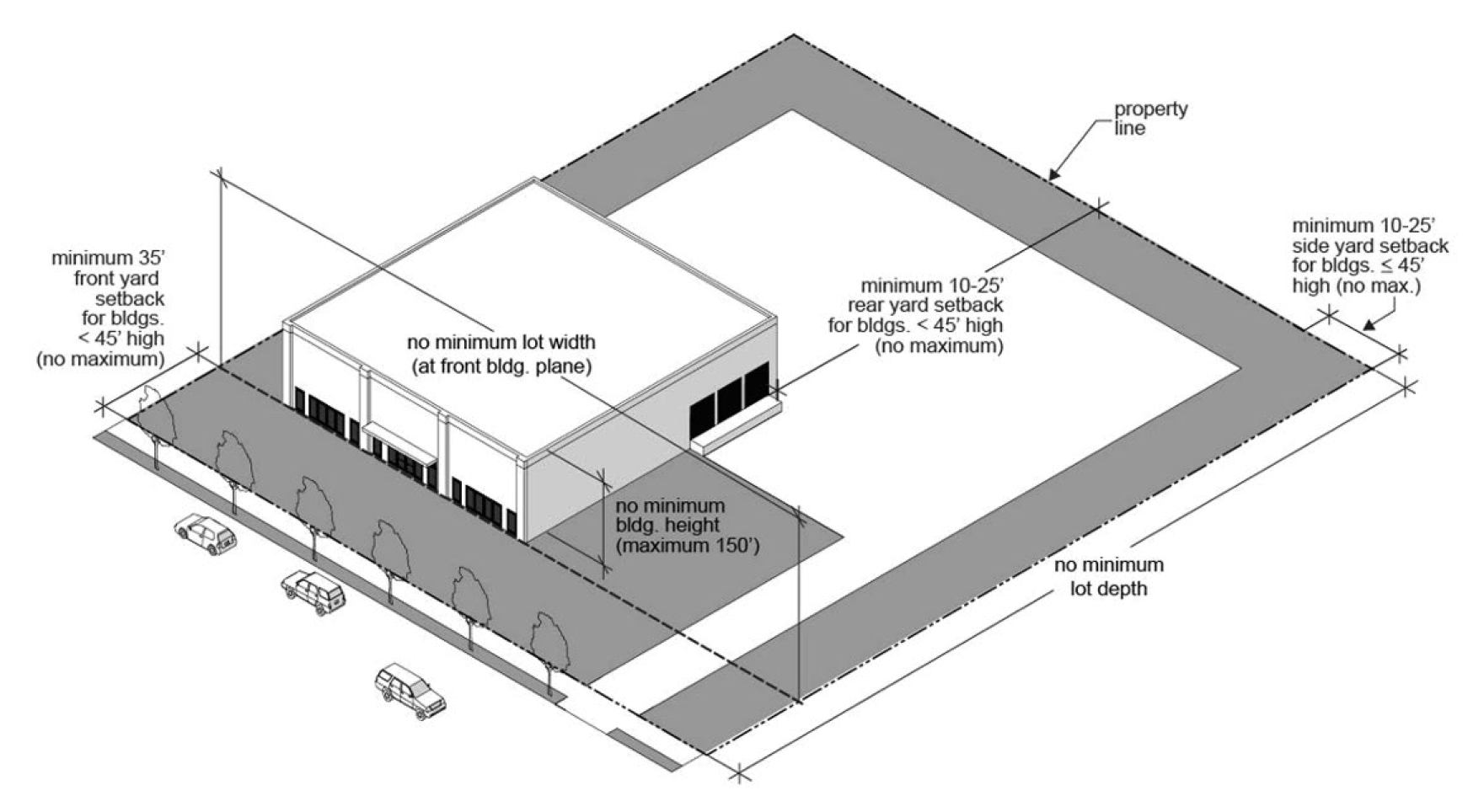
(Ord. 6401 § 1, 2022)
12.25.770 - Variances and Adjustments.
Applications for Variances and Adjustments to base zone standards in the ESID zone may be approved under 1 of 4 processes:
A.
As a Variance pursuant to Section 12.80.152;
B.
As a Minor Adjustment in conjunction with a primary Type II or Type III application pursuant to Section 12.80.154;
C.
As a Major Adjustment in conjunction with a primary Type III application pursuant to Section 12.80.156; or
D.
With a Significant Natural Resource Permit pursuant to Section 12.80.130.
(Ord. 6401 § 1, 2022; Ord. 6120 § 1, 2015)
12.25.780 - Other Pertinent Regulations.
A.
Applicable Sections. Additional standards such as parking, landscaping, vision clearance, and street improvements also apply to development in the ESID zone as follows:
•
Section 12.50.200 Site Design
•
Section 12.50.300 Vehicle Parking
•
Section 12.50.400 Bicycle Parking/Bicycle and Pedestrian Circulation and Connectivity
•
Section 12.50.500 Access and Street Standards
•
Section 12.50.600 Public Utilities, Site Grading and Storm Water Management Facilities Site Integration
•
Section 12.50.800 Design Standards for Non-Residential and Mixed-Use Development
B.
Site Development Standards. In addition to the standards listed in subsection A above, the following standards apply to all development in the ESID zone:
1.
Off-Street Parking and Loading. Off-street parking and loading are not permitted in required front yards, or in required side or rear yards abutting a residential zone, unless building setbacks are increased to 75 feet and a 20-foot landscaped buffer is provided adjacent to the property line.
2.
Site Storage and Maintenance.
a.
Materials, equipment and waste must be stored and grounds must be maintained in a manner which will not attract insects or vermin or create a health hazard.
b.
Yards adjacent to streets and those abutting a residential zone shall be landscaped and continuously in suitable groundcovers, trees or shrubs as required by Section 12.50.220. All other yards and unused property shall be maintained in grass or other suitable ground cover.
3.
Boundary Fences and Landscaping. Properties abutting a residential zone shall provide and maintain a dense evergreen landscape buffer with a minimum mature height of 7 feet.
a.
Yards adjacent to streets and those abutting a residential zone shall be landscaped and continuously in suitable groundcovers, trees or shrubs as required by Section 12.50.220. All other yards and unused property shall be maintained in grass or other suitable ground cover.
b.
Wire or similar open fences may be permitted at property lines adjacent to landscaped yards.
4.
Heat, Glare and Lighting.
a.
Except for exterior lighting, industrial operations producing heat or glare shall be conducted entirely within an enclosed building.
b.
Exterior lighting shall be shielded and directed away from adjacent properties as required by Section 12.50.240.
5.
Compliance with State Requirements. All uses or operations shall comply with current state air quality and noise statutes and rules as administered by the Department of Environmental Quality.
6.
Lot Size and Division Standards. Development in the ESID shall occur on lot sizes in compliance with the standards listed below.
a.
East Evergreen Sub-Area:
i.
Industrial developments shall have a minimum lot size of 50 acres. All other lots of record or contiguous lots of record in common ownership within the sub-area smaller than 50 acres may contain any business or use listed in Table 12.25.730-1.
ii.
Land division will be permitted for lots larger than 50 acres only if the division creates 1 lot or parcel of at least 50 acres and at least 1 parcel of 25 acres.
iii.
The 50-acre minimum lot size standard is intended to accomplish the following purposes:
•
Facilitate lot aggregation and consolidation and better accomplish an Urban Growth Boundary expansion condition of approval requiring creation of one 100-acre industrial lot within the Evergreen Area; and
•
Address ORS 197.532 (Ballot Measure 37) considerations.
b.
West Evergreen Sub-Area:
i.
Industrial developments shall have a minimum lot size of 10 acres. All other lots of record or contiguous lots of record in common ownership within the sub-area smaller than 10 acres may contain any business or use listed in Table 12.25.730-1.
ii.
Land division will be permitted for lots larger than 10 acres only if the division creates 1 lot or parcel of at least 10 acres and at least 1 parcel of 5 acres.
c.
The minimum lot sizes in paragraphs 1 and 2 above may be reduced to the extent necessary to allow the dedication and/or construction of public Collector or Arterial roadways necessary to implement Comprehensive Plan Section 20 Transportation and the adopted Transportation System Plan cited in Comprehensive Plan Section 23.
d.
The minimum lot sizes in paragraphs 1 and 2 above may also be reduced to accommodate the following conditions:
i.
The presence of a natural division of the lot(s) by a significant natural resource area, flood hazard area or other resource or hazard designation in which standards may restrict development under Subchapter 12.27; or
ii.
The intent to divide the lot(s) to provide for separate common or public ownership of natural areas, flood hazard areas or other natural resource or hazard areas within an industrial park.
(Ord. 6401 § 1, 2022; Ord. 6250 § 1, 2017)
12.25.790 - Definitions Unique to the ESID.
A.
"Sustainable Energy and Environmental Businesses." Industrial businesses and Uses engaged in the research and design or development, manufacturing, processing, and/or marketing of products or services associated with local, national and international sustainable energy and environmental industries. Such businesses include, but are not limited to, large and small firms and companies engaged in high technology research and product development and manufacturing; solar and wind energy products and parts manufacturing; and other similar industries. These businesses usually require variously sized properties, but especially large parcels (50 to 100 or more acres) to accommodate vertically-integrated business operations on a single site.
B.
"Biotech Campus." Industrial businesses and Uses engaged in research and design or development, manufacturing and processing, marketing (and combinations thereof) of bio-technology, bio-medical, bio-pharmaceutical business products or services and like-kind businesses. Biotech campuses usually require medium-sized parcels (35 to 50 or more acres).
C.
"Industrial Incubators, Start-ups and Spin-offs Business Parks." Specialized business parks that lease space or buildings to a mixture of small, emerging industrial companies evolving from or supporting larger nearby high tech, sustainable industries and bio-tech companies. Typical business parks have a common brand and image and are controlled by site-specific covenants or conditions and restrictions (CC&Rs). Business parks may provide raw industrial building space, industrial flex space, or both. Leased spaces often contain combined business office and product production operations. Business parks usually occupy medium-sized properties (20 to 40 acres).
D.
"Industry Research and Development (R&D) Parks." Business parks that primarily provide leasable industrial flex-space to vertically-integrated R&D businesses and research laboratories that develop new products and/or industry technologies. Industry R&D parks also usually occupy small-to-medium sized parcels (20 to 30 acres).
E.
"Industry Suppliers." Businesses that manufacture, process, or distribute production materials, parts, product components and business services used by high tech, sustainable industry and bio-tech businesses in the Portland region. Industry suppliers include, but are not limited to, suppliers of test equipment, uniforms and linens, lab supplies, sub-components and circuit boards, and packaging materials. Industry suppliers usually occupy smaller-sized parcels (10 to 20 or more acres).
F.
"Support Commercial Services." Commercial retail uses and professional services that primarily and directly serve daily needs of businesses and employees in the surrounding industrial area. Typical uses include food services and restaurants, banking, convenience shops, child care facilities, automated businesses support services and like-kind limited retail and professional business services. A support commercial service cluster usually occupies a small property (not more than 5 to 10 acres) located on a collector or arterial street and within reasonable walking or driving distance to/from businesses and employees in the surrounding industrial area.
G.
"Distribution Businesses." Warehouse and freight movement firms that store, repackage, deliver and move goods throughout the region, and therefore require convenient access to freeway and principal arterial streets such as Highway 26.
(Ord. 6401 § 1, 2022; Ord. 6322 § 1, 2019)
12.25.800 - HSID Helvetia Area Special Industrial District.
The HSID zone includes the following sections:
12.25.810 Purpose and Applicability
12.25.820 Housing Types
12.25.830 Uses
12.25.840 Accessory Uses and Structures Permitted by Right
12.25.850 Special Provisions Regarding Uses
12.25.860 Development Standards
12.25.870 Variances and Adjustments
12.25.880 Other Pertinent Regulations
12.25.890 Definitions Unique to the HSID
(Ord. 6401 § 1, 2022)
12.25.810 - Purpose and Applicability.
A.
Provide Large Industrial Sites. The HSID zone implements the Industrial Comprehensive Plan designation on properties added to the Urban Growth Boundary in 2005, providing opportunities for creation of larger industrial parcels through provisions that facilitate lot consolidation and land assembly.
B.
Provide Small to Medium Industrial Sites. The HSID standards also facilitate and accommodate business clusters on smaller industrial sites for business start-ups, incubators and spin-offs that derive from high-tech, sustainable industries and bio-tech/bio-medical/bio-pharmaceutical industry clusters and for supporting public and private facilities and utilities.
C.
Provide Sites for High Technology and Sustainable Industries. The HSID zone provides industrial sites to accommodate high technology and related companies and businesses and local, national and international "sustainable industries" businesses and companies (including uses that support or complement such companies and businesses).
D.
Provide Opportunities for Industrial Clusters. The standards of the HSID zone are intended to facilitate establishment, development and growth of a "sustainable industries" cluster and a "bio-tech/bio-medical/bio-pharmaceutical" industry cluster.
E.
Applicability. Properties eligible for the HSID zone designation are shown on Figure 12.25.810-A:
Figure 12.25.810-A:
Helvetia Area Special Industrial District Boundaries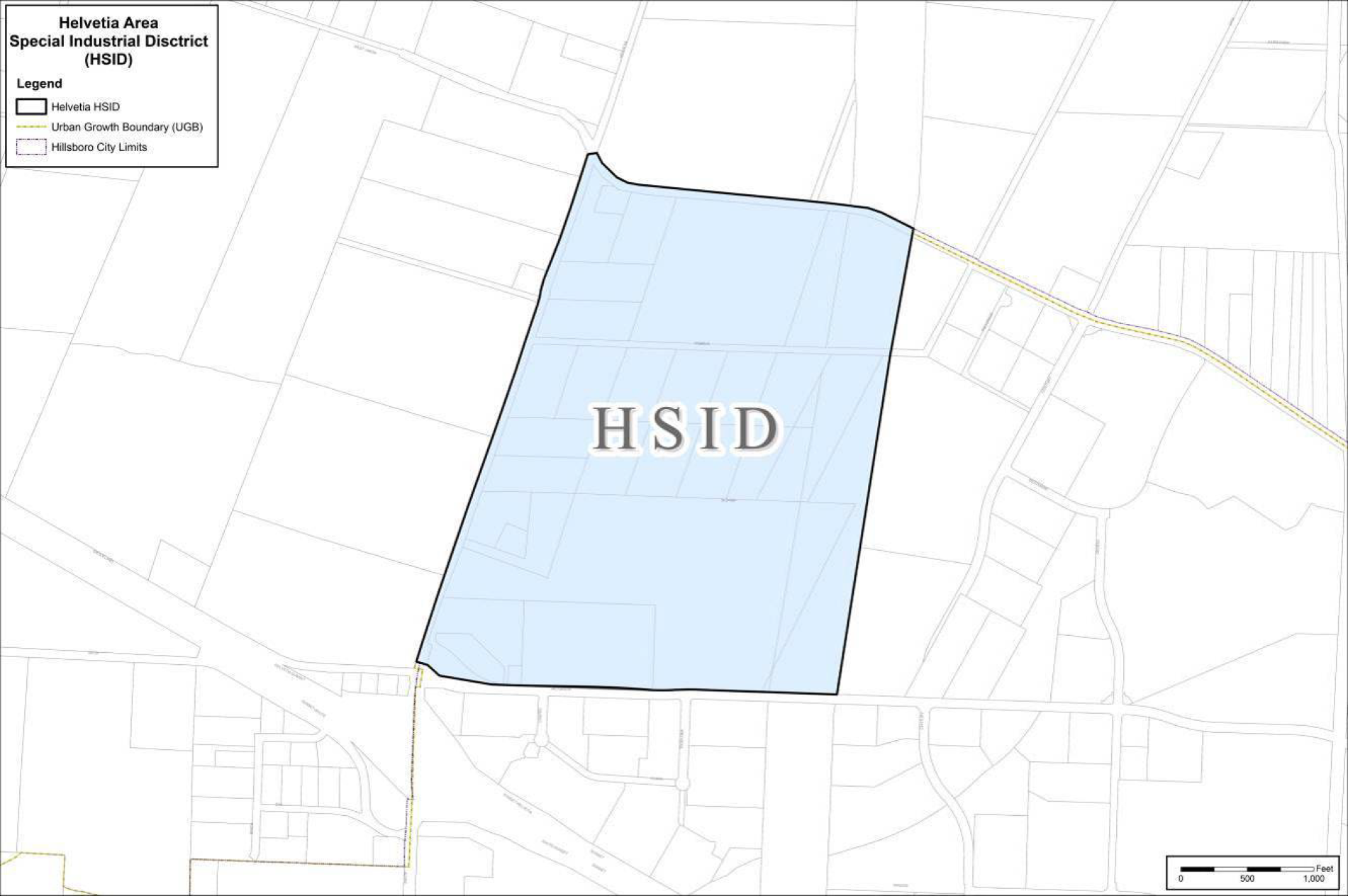
(Ord. 6401 § 1, 2022; Ord. 6322 § 1, 2019)
12.25.820 - Housing Types.
Table 12.25.820-1 lists housing types permitted in the HSID zone. Housing types are defined in Section 12.01.500.
(P) Permitted (C) Conditional (L) Limited (N) Not Permitted
(Ord. 6401 § 1, 2022; Ord. 6322 § 1, 2019)
12.25.830 - Uses.
Table 12.25.830-1 lists uses permitted, conditionally permitted, limited, or not permitted in the HSID zone. Unless a use is permitted or conditionally permitted in Table 12.25.830-1 or is determined to be permissible through a Director's Interpretation under Section 12.80.050, the use shall be excluded from, and may not be permitted to develop within the HSID Zone.
(P) Permitted (C) Conditional (L) Limited (N) Not Permitted
(Ord. 6417 § 1, 2022; Ord. 6401 § 1, 2022; Ord. 6322 § 1, 2019; Ord. 6294 § 1, 2019; Ord. 6149 § 1, 2015)
12.25.840 - Accessory Uses and Structures Permitted by Right.
Accessory uses vary based on the use categories contained in Subchapter 12.10. Accessory uses are permitted in conjunction with the primary industrial or commercial use on the site and subject to the same regulations as the primary use unless stated otherwise in the Code. Accessory structures as defined in Section 12.01.500 are permitted subject to the additional requirements in Section 12.40.104.
(Ord. 6401 § 1, 2022; Ord. 6323 § 1, 2019; Ord. 6322 § 1, 2019; Ord. 6149 § 1, 2015)
12.25.850 - Special Provisions Regarding Uses.
The following limitations on the location of commercial uses implement applicable Metro Urban Growth Management Functional Plan Title 4 restrictions on large retail commercial, professional offices and Title 4 Regionally Significant Industrial Area (RSIA) requirements.
A.
Eating and Drinking Establishments, Office, and Retail Products and Services. In the HSID zone, eating and drinking establishments, office, and retail products and services are considered support commercial services. In a single occupancy building, a support commercial service uses shall have a maximum square footage of 3,000 square feet. Multiple-occupancy buildings with support commercial services uses shall have a maximum square footage of 20,000 square feet.
B.
Educational Services. Educational service uses are limited to facilities whose primary purpose is to provide training to meet industrial needs.
C.
Industrial Service and Manufacturing and Production Uses. Industrial service and manufacturing and production uses in the HSID zone shall be limited to the types of uses listed below, as defined in Section 12.25.890.
1.
Sustainable, environmental, and energy businesses;
2.
Biotech campus;
3.
Industry research & development (R&D) parks;
4.
Industrial incubators, start-ups and spin-offs business parks;
5.
Distribution businesses;
6.
Industry suppliers;
7.
Support commercial services;
8.
Transportation facilities, including public improvements for streets, transit, parking, and bicycle and pedestrian facilities;
9.
Public service or utility uses and facilities;
10.
Other uses determined similar to the above uses under Section 12.80.050.
(Ord. 6401 § 1, 2022; Ord. 6322 § 1, 2019)
12.25.860 - Development Standards.
Base zone development standards in the ESID zone are listed in Table 12.25.860-1. Certain standards are illustrated in Figure 12.25.860-A.
* Standards illustrated in Figure 12.25.860-A
Figure 12.25.860-A:
Minimum Lot Dimensions, Setbacks
and Height Requirements in the HSID Zone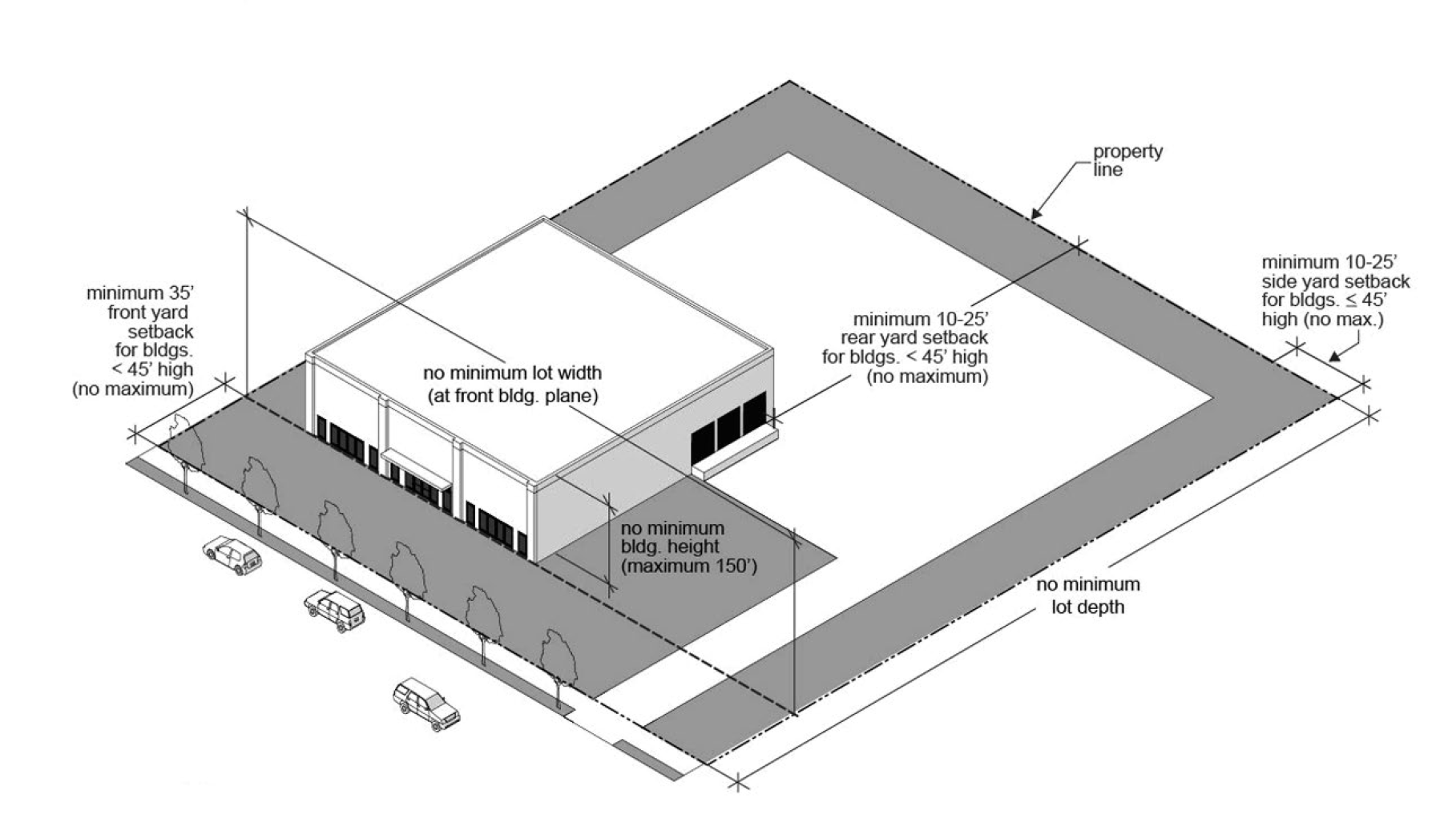
(Ord. 6401 § 1, 2022)
12.25.870 - Variances and Adjustments.
Applications for Variances and Adjustments to other base zone standards in the HSID zone may be approved under 1 of 4 processes:
A.
As a Variance pursuant to Section 12.80.152;
B.
As a Minor Adjustment in conjunction with a primary Type II or Type III application pursuant to Section 12.80.154;
C.
As a Major Adjustment in conjunction with a primary Type III application pursuant to Section 12.80.156; or
D.
With a Significant Natural Resource Permit application pursuant to Section 12.80.130.
(Ord. 6401 § 1, 2022; Ord. 6120 § 1, 2015)
12.25.880 - Other Pertinent Regulations.
A.
Applicable Sections. Additional standards such as parking, landscaping, vision clearance, and street improvements also apply to development in the HSID zone as follows:
•
Section 12.50.200 Site Design
•
Section 12.50.300 Vehicle Parking
•
Section 12.50.400 Bicycle Parking/Bicycle and Pedestrian Circulation and Connectivity
•
Section 12.50.500 Access and Street Standards
•
Section 12.50.600 Public Utilities, Site Grading and Storm Water Management Facilities Site Integration
•
Section 12.50.800 Design Standards for Non-Residential and Mixed-Use Development
B.
Site Development Standards. In addition to the standards listed in subsection A above, the following standards apply to all development in the HSID zone:
1.
Off-Street Parking and Loading. Off-street parking and loading are not permitted in required front yards, or in required side or rear yards abutting a residential zone, unless building setbacks are increased to 75 feet and a 20-foot landscaped buffer is provided adjacent to the property line.
2.
Site Storage and Maintenance.
a.
Materials, equipment and waste must be stored and grounds must be maintained in a manner which will not attract insects or vermin or create a health hazard.
b.
Yards adjacent to streets and those abutting a residential zone shall be landscaped and continuously in suitable groundcovers, trees or shrubs as required by Section 12.50.220. All other yards and unused property shall be maintained in grass or other suitable ground cover.
3.
Boundary Fences and Landscaping.
a.
Properties abutting a residential zone shall provide and maintain a dense evergreen landscape buffer with a minimum mature height of 7 feet.
b.
Yards adjacent to streets and those abutting a residential zone shall be landscaped and continuously in suitable groundcovers, trees or shrubs as required by Section 12.50.220. All other yards and unused property shall be maintained in grass or other suitable ground cover.
c.
Wire or similar open fences may be permitted at property lines adjacent to landscaped yards.
4.
Heat, Glare and Lighting.
a.
Except for exterior lighting, industrial operations producing heat or glare shall be conducted entirely within an enclosed building.
b.
Exterior lighting shall be shielded and directed away from adjacent properties as required by Section 12.50.240.
5.
Compliance with State Requirements. All Uses or operations shall comply with current state air quality and noise statutes and rules as administered by the Department of Environmental Quality.
6.
Lot Size and Division Standards. Development in the HSID shall occur on lot sizes in compliance with the standards listed below.
a.
Industrial developments shall have a minimum lot size of 10 acres. All other lots of record or contiguous lots of record in common ownership within the sub-area smaller than 10 acres may contain any business or use listed in Table 12.25.830-1.
b.
Land division will be permitted for lots larger than 10 acres only if the division creates 1 lot or parcel of at least 10 acres and at least 1 parcel of 5 acres.
c.
The 10-acre minimum lot size standard is intended to accomplish the following purposes:
i.
Facilitate lot aggregation and consolidation and better accomplish an Urban Growth Boundary expansion condition of approval requiring creation of one 50-acre industrial lot within the Helvetia Area; and
ii.
Address ORS 197.532 (Ballot Measure 37) considerations.
d.
The minimum lot sizes in Subsections a and b above may be reduced to the extent necessary to allow the dedication and/or construction of public Collector or Arterial roadways necessary to implement Comprehensive Plan Section 20 Transportation and the adopted Transportation System Plan cited in Comprehensive Plan Section 23.
e.
The minimum lot sizes in Subsections a and b above may also be reduced to accommodate the following conditions:
i.
The presence of a natural division of the lot(s) by a significant natural resource area, flood hazard area or other resource or hazard designation in which standards may restrict development under Subchapter 12.27; or
ii.
The intent to divide the lot(s) to provide for separate common or public ownership of natural areas, flood hazard areas or other natural resource or hazard areas within an industrial park.
(Ord. 6401 § 1, 2022; Ord. 6250 § 1, 2017)
12.25.890 - Definitions Unique to the HSID.
A.
"Sustainable Energy and Environmental Businesses." Industrial businesses and Uses engaged in the research and design or development, manufacturing, processing, and/or marketing of products or services associated with local, national and international sustainable energy and environmental industries. Such businesses include, but are not limited to large and small firms and companies engaged in high technology research and product development and manufacturing; solar and wind energy products and parts manufacturing; and other similar industries. These businesses usually require variously sized properties, but especially large parcels (50 to 100 or more acres) to accommodate vertically-integrated business operations on a single site.
B.
"Biotech Campus." Industrial businesses and Uses engaged in research and design or development, manufacturing and processing, marketing (and combinations thereof) of bio-technology, bio-medical, bio-pharmaceutical business products or services and like-kind businesses. Biotech campuses usually require medium-sized parcels (35 to 50 or more acres).
C.
"Industrial Incubators, Start-ups and Spin-offs Business Parks." Specialized business parks that lease space or buildings to a mixture of small, emerging industrial companies evolving from or supporting larger nearby high tech, sustainable industries and bio-tech companies. Typical business parks have a common brand and image and are controlled by site-specific covenants or conditions and restrictions (CC&Rs). Business parks may provide raw industrial building space industrial flex space, or both. Leased spaces often contain combined business office and product production operations. Business parks usually occupy medium-sized properties (20 to 40 acres).
D.
"Industry Research and Development (R&D) Parks." Business parks that primarily provide leasable industrial flex-space to vertically-integrated R&D businesses and research laboratories that develop new products and/or industry technologies. Industry R&D parks also usually occupy small-to-medium sized parcels (20 to 30 acres).
E.
"Industry Suppliers." Businesses that manufacture, process, or distribute production materials, parts, product components and business services used by high tech, sustainable industry and bio-tech businesses in the Portland region. Industry suppliers include, but are not limited to suppliers of test equipment, uniforms and linens, lab supplies, sub-components and circuit boards, and packaging materials. Industry suppliers usually occupy smaller-sized parcels (10 to 20 or more acres).
F.
"Support Commercial Services." Commercial retail Uses and professional services that primarily and directly serve daily needs of businesses and employees in the surrounding industrial area. Typical Uses include food services and restaurants, banking, convenience shops, child care facilities, automated businesses support services and like-kind limited retail and professional business services. A support commercial service Use usually occupies property or leased space located on a Collector or Arterial street and within reasonable walking or driving distance to/from businesses and employees in the surrounding industrial area.
G.
"Distribution Businesses." Warehouse and freight movement firms that store, repackage, deliver and move goods throughout the region, and therefore require convenient access to freeway and principal Arterial streets such as Highway 26.
(Ord. 6401 § 1, 2022)

