
Jamestown City Zoning Code
ARTICLE 8
ZONING DISTRICTS
Sec. 8.1.- Purpose.
In order to provide for the orderly development of Jamestown, preserve existing development patterns that contribute to the character and sense of place of the community, and to allow for creativity in the planning for future development, the Town hereby establishes zoning districts and their associated development standards.
Sec. 8.2. - Zoning Districts Created.
The following districts are created; this listing is in order of intensity of development permitted within the district, from least intense to most intense:
•
Agriculture (AG)
•
Parks and Recreation (PNR)
•
Single Family Residential (SFR)
•
Multi-Family Residential (MFR)
•
Residential/Main Street Transitional (R/MST)
•
Commercial/Main Street Transitional (C/MST)
•
Main Street Periphery (MSP)
•
Main Street (MS)
•
Civic (CIV)
•
Commercial (C)
•
Bypass (BD)
•
Industrial (IND)
•
Planned Unit Development (PUD)
In addition to the standard zoning districts, the following overlay districts are created to provide for more creativity in the development of land and/or to protect unique features of the Town:
•
Traditional Neighborhood Development Overlay (TND)
•
Cluster Development Overlay (CDO)
•
Scenic Corridor Overlay (SCO)
•
Campus Overlay (CO)
Sec. 8.3. - Description of Zoning Districts.
The zoning districts created by this ordinance are described as follows:
(A)
The Agriculture District (AG) is established to protect lands used for agricultural production and related activities. Farmland is a defining element of Jamestown's identity and the protection of these lands aids in preserving the character of the Town. Permitted uses are limited, with an emphasis on uses that are agricultural in nature. Development density is very low to encourage preservation of agricultural lands while discouraging large lot residential development. The Agriculture District can also be used to protect open spaces.
(B)
The Parks and Recreation District (PNR) is intended primarily for town-owned properties utilized, or planned for, public parks and recreation facilities. Allowed building/lot types in this district are urban workplace and civic. Properties in this district are primarily for use and enjoyment by the public as open space and/or recreation facilities and may include golf courses, public parks, trails, and other similar open spaces.
(C)
The Single-Family Residential District (SFR) provides for the completion of existing residential neighborhoods and the development of new residential neighborhoods in a pattern that encourages the wise use of land. Allowed building/lot types in the Single-Family District are detached house and civic building. Permitted uses are restricted to single family homes and their accessory uses, a limited number of related uses that serve the residential neighborhoods, and civic uses. Neighborhoods in this district are the dominant land use in Jamestown and are a major element in defining the character of the community.
Standards for the Single-Family Residential District ensure that new development maintains the character of the community. The Single-Family Residential District permits the completion and conformity of conventional residential subdivisions already existing or approved in sketch plan form by the Town of Jamestown prior to the effective date of these regulations. For new subdivisions, the Town encourages the clustering of development and protection of open space though the use of the Cluster Development Overlay District.
(D)
The Multi-Family Residential District (MFR) ensures the conformity of existing multifamily residential neighborhoods and provides for the development of new multi-family residential neighborhoods in a pattern that encourages the wise use of land. Allowed building/lot types in the Multi-Family District are attached house and multifamily. Neighborhoods in this district consist primarily of currently existing multi-family developments. Standards for the Multi-Family Residential District ensure that new development maintains the character of the community. The Multi-Family Residential District permits the completion and conformity of existing multi-family residential subdivisions already existing or approved in preliminary plat or sketch plan form by the Town of Jamestown prior to the effective date of these regulations. For new subdivisions or multi-family developments, the Town encourages the clustering of development and protection of open space though the use of the Cluster Development Overlay District.
(E)
The Residential/Main Street Transitional District (R/MST) provides for primarily infill residential development in the existing residential area(s) surrounding the Main Street Periphery District and its logical extensions. The intent of this district is to allow for a gradual transformation of existing low-density single-family development to high quality medium-density residential development, as a higher density residential development is needed to support the growing town center. Higher density residential development allows a greater number of households to walk or bike to the town center, thus reducing the parking demand in the downtown and providing environmental and health benefits. Allowed building/lot types in this district are the detached house, attached house, and civic building. Streets in the Residential/Main Street Transitional District should be interconnected, with streets and sidewalks providing a connection from Jamestown's downtown to the Single-Family Residential Districts. A range of housing types is encouraged.
(F)
The Commercial/Main Street Transitional District (C/MST) is established to accommodate existing and proposed uses located along that portion of West Main Street located to the west of the downtown between Dillon Road and Scientific Street. Development in this district accommodates a range of uses in a single-family home style development pattern, transitioning from the Main Street Districts to residential districts and commercial districts. Allowed building/lot types are single family detached and civic building. Standards in the Commercial/Main Street Transitional District are established to encourage new development, revitalization, reuse, and infill development in a manner that accommodates a range of uses while preserving historic development patterns and being sensitive to the adjacent districts. A range of uses, including retail, office, and residential, is permitted.
(G)
The Main Street Periphery District (MSP) provides for the development and maintenance of a range of uses in areas adjacent to Jamestown's downtown. Allowed building/lot types in this district are shopfront, multi-family cluster, detached house, attached house and civic building. In this district, the development pattern integrates retail, office, civic, educational, religious, and residential uses in an environment that is pedestrian friendly while acknowledging the role of the automobile as a means of transportation. Street and sidewalk networks providing multi-modal transportation options connect the Main Street Periphery District to the downtown and to surrounding neighborhoods. The Main Street Periphery District provides an area for the expansion of the Main Street District.
(H)
The Main Street District (MS) provides for new development, revitalization, reuse, and infill development in Jamestown's traditional downtown. A broad array of uses is permitted to enable the needs of residents and visitors to be met. Allowed building/lot types in this district are urban workplace, shopfront, attached house, detached house and civic building. The development pattern seeks to integrate shops, restaurants, services, workplaces, civic, educational, and religious facilities, and higher density housing in a compact, pedestrian-oriented environment. The Main Street District serves as the hub of the surrounding neighborhoods and of the broader community. The Main Street District may be expanded over time to meet the needs of the growing community for downtown facilities and services.
(I)
The Civic District (CIV) provides a location for large educational, medical, and public uses in a campus like environment. Large developments in the Civic District are encouraged to provide a master plan to the Town and request approval of the Campus Overlay District designation. Institutional uses in the Civic District are required to provide pedestrian connections on their campuses and, to the extent possible, develop an internal street system with structures fronting on the streets. Parking should not be the dominant visible element of the campuses developed for institutional uses.
(J)
The Commercial District (C) is established to provide for uses in areas where the dominant mode of transportation is the automobile. The auto-oriented street, lot, and building designs can create uncomfortable pedestrian environments. Allowed building/lot types are Highway Commercial and Civic Building. Dominant uses in this district are retail and office. The Commercial District is expected to serve Jamestown residents as well as persons who travel from surrounding communities. The development pattern in this district acknowledges the role of the automobile, with parking and access provided to ensure safety for the motoring public. Development standards in the Commercial District ensure the creation of a pleasant auto-oriented environment while enabling a compatible transition to uses in adjacent districts.
(K)
The Bypass District (B) is established to provide opportunities for compatible and sustainable development along the future Jamestown Bypass. Access to buildings in this district is provided through a secondary street network. The secondary street network is both auto-oriented and pedestrian oriented. Development standards in the Bypass District acknowledge that the automobile is the primary mode of transportation. Development and design standards encourage pedestrian scale development along the secondary street network. Goals of the Bypass District include providing a pleasant environment for motorists, a safe environment for pedestrians along the secondary streets; ensuring the safety of motorists and pedestrians; and preserving the capacity of the bypass to accommodate high traffic volumes at high speeds. Uses in this district include services, employment, residential and industrial. Allowed building/lot types include urban workplace, shopfront commercial, multi-family cluster, attached house and civic building.
(L)
The Industrial District (IND) is established to provide locations for industrial uses that, due to the scale of the buildings and/or the nature of the use, cannot be integrated into the community. Uses within the Industrial District are buffered from adjacent uses. The dominant uses in this district are manufacturing and warehouse storage. Small scale manufacturing and storage that is compatible with less intensive uses can and should be located in other districts. The Industrial District is reserved for uses which require very large buildings and/or large parking and loading facilities. Allowed building and lot types are highway commercial and civic building.
(M)
The Traditional Neighborhood Development Overlay District (TND) provides for the development of new neighborhoods and the revitalization or extension of existing neighborhoods. These neighborhoods are structured upon a fine network of interconnecting pedestrian-oriented streets and other public spaces. Traditional Neighborhood Developments (TNDs) provide a mixture of housing types and prices, prominently sited civic or community building(s), stores/offices/workplaces, and churches to provide a balanced mix of activities. A Traditional Neighborhood Development (TND) has a recognizable center and clearly defined edges; optimum size is a quarter mile from center to edge. A TND is urban in form, is typically an extension of the existing developed area of the town and has an overall residential density of four to 12 dwelling units per acre. TND districts should have a significant portion of land dedicated to open spaces.
(N)
The Cluster Development Overlay District (CDO) permits buildings to be clustered or grouped on a site, parcel, or property in order to optimize the use of land and resources. By clustering development, projects developed in accordance with these standards can obtain density bonuses while preserving unique natural features, efficiently providing infrastructure such as water, sewer, and streets, and organizing buildings on a site in a manner that promotes efficient multi-modal transportation. The Cluster Development Overlay District mandates the dedication of open space with density bonuses provided as an incentive for adhering to the standards. It is the intent of this district to be used for new development in undeveloped areas of the town and in already developed areas with low building value to land value ratios. Allowed building/lot types are multi-family, detached house, attached house, and civic building.
(O)
The Scenic Corridor Overlay District (SCO) is established to protect the pastoral scenes and open spaces that provide a sense of arrival for residents and visitors traveling the major entrance roads and gateways to the town. The pastoral scenes and undeveloped property along the entrance roads and gateways contribute significantly to Jamestown's community character and sense of place. The Scenic Corridor Overlay District provides development options for the owners of the property abutting the entrance roads and gateways. The goal of this district is to protect the scenic value of the corridors through a mix of incentives and development standards. These standards will preserve the rural character of the town by maintaining the sense of a rural corridor in an urban environment; provide an aesthetically appealing experience for those traveling the corridor; provide multi-modal transportation options for travel; and ensure a safe transportation corridor for motorists, bicyclists, and pedestrians. The detached house lot/building type is allowed in this district.
(P)
The Campus Overlay District (CO) is established to enable large institutional uses such as colleges, secondary schools, and medical facilities to develop their campuses in accordance with a master plan. Basic standards are established for the campus master plan, which, upon approval by the town of Jamestown, shall become the regulating plan for the development of the campus. Pedestrian access and interconnected streets within the campus are guiding principles within the Campus Overlay District. The civic building and urban workplace are the allowed lot/building types in this overlay district. To the extent possible, buildings should front on the internal street system.
(Q)
The Planned Unit Development (PUD) district recognizes that some projects on large tracts require much greater flexibility to enable applicants to create higher quality projects than are otherwise possible under the strict applications of the LDO and to promote a compatible mix of uses to instigate an integrated and sustainable development consistent with the town's unique character. This district shall also encourage and make possible design flexibility; multi-modal connectivity between uses; sensitivity to natural resources and environmental features; and facilitate the efficient provisions of infrastructure, utilities and adequate public facilities. The PUD district is not intended for use with subdivisions or developments which can be developed under the strict application of the minimum standards of the LDO, thereby resulting in a unique, high quality overall development. The specific procedures for review and approval of a PUD are found in section 8.4-5.1, Planned Unit Development. Above all, every PUD established, shall demonstrate consistency with the goals and policies established in the Town of Jamestown Land Development Plan and be designed to achieve greater protections of environmentally sensitive areas, architectural controls not normally associated with rezoning conditions, and other higher-quality standards. Most commonly, the PUD district would serve as a base zoning for larger-scale commercial, residential and mixed-use developments which may include overlay districts such as the Traditional Neighborhood (TND) Overlay District. A PUD shall enable an applicant the flexibility to create its own development standards and not to be restricted by existing LDO provisions if the result is a project that is found by the town council to be a higher quality project.
(Ord. No. 2023-01, Pt. 1, 1-17-2023)
Sec. 8.3.1. - Permitted Use Schedule.
(A)
Tabulation of Permitted Uses. Within each zoning district indicated on the Official Zoning Map and subject to all requirements and conditions specified in this ordinance, land, buildings, and structures shall only be used and buildings and structures shall only be erected which are intended or designed to be used for uses listed in the Permitted Use Schedule, Table 8-1 (Appendix 24). In the appropriate columns of Table 8-1 uses permitted by right in the various districts are indicated with a "P," uses requiring a special use permit are indicated by an "S," uses permitted by right subject to meeting additional development standards as set forth in Article 10 (Uses With Additional Standards) are indicated with a "A."
(B)
Formulation of Permitted Use Schedule.
1.
The Standard Industrial Classification Manual—1987 was utilized in the preparation of this table and shall be referred to as a guide for purposes of interpretation by the enforcement officer. SIC codes are used to refer to SIC Classifications. Entries with 0 or left blank in the Reference SIC column do not correspond to any classification in the SIC Manual.
2.
When a use is not listed in the Permitted Use Schedule, the enforcement officer shall classify it with that use in the table most similar to it. The SIC Manual shall serve as a guide in classifying any unlisted use. If the enforcement officer should determine that a use is not listed and is not similar to a use in the Permitted Use Schedule, then said use is prohibited.
3.
Rental and leasing of any commodity shall be permitted under the same classification and in the same districts as are sales of that commodity, unless rental or leasing of that commodity is listed separately in the Permitted Use Schedule.
4.
If a facility involves two (or more) activities with different SIC codes on the same zone lot, the facility shall be permitted only in those zoning districts where the more restricted activity is permitted.
Sec. 8.4. - Zoning District Development Standards.
The following development standards are established for each of the zoning districts to ensure the orderly development of the Town of Jamestown.
8.4-1.
Agriculture District (AG).
(A)
Intent. The Agriculture District (AG) is established to protect lands used for agricultural production and related activities. Farmland is a defining element of Jamestown's identity and the protection of these lands aids in preserving the character of the Town. Permitted uses are limited, with an emphasis on uses that are agricultural in nature. Development density is very low to encourage preservation of agricultural lands while discouraging large lot residential development. The Agriculture District can also be used to protect open spaces.
(B)
Permitted uses.
1.
Uses permitted by right:
See Table of Uses (Table 8.1).
2.
Uses permitted with additional standards:
See Table of Uses (Table 8.1).
3.
Uses permitted with conditions.
See Table of Uses (Table 8.1).
(C)
Permitted building and lot types.
Detached house
(D)
Permitted accessory uses.
Accessory dwelling units (subject to additional standards, see Section 10.1).
Accessory structures
Fences
Home occupations (subject to additional standards, see Section 10.1).
(E)
Permitted residential density.
0.20 units/acre
(F)
General requirements.
1.
Building placement, parking placement, building type, access, and lot arrangement shall be controlled by the lot and building type standards (Article 9) for the lot and building type permitted in the Agriculture District.
2.
In addition to the requirements established by the lot type standards and building type standards, the following shall apply in the Agriculture District:
(G)
Open space. Open space is defined as any area which is not divided into private or civic building lots, streets, rights-of-way, parking, or easements for purposes other than open space conservation. The provision and design of open space shall comply with the requirements set forth in Article 21.
(H)
Parking and landscaping. Parking shall comply with the requirements set forth in Article 12. Landscaping shall comply with the requirements set forth in Article 11.
8.4-2.
Single Family Residential District (SFR).
(A)
Intent. The Single-Family Residential District (SFR) provides for the completion of existing residential neighborhoods and the development of new residential neighborhoods in a pattern that encourages the wise use of land. Allowed building/lot types in the Single-Family District are detached house and civic building. Permitted uses are restricted to single family homes and their accessory uses, a limited number of related uses that serve the residential neighborhoods, and civic uses. Neighborhoods in this district are the dominant land use in Jamestown and are a major element in defining the character of the community. Standards for the Single-Family Residential District ensure that new development maintains the character of the community. The Single-Family Residential District permits the completion and conformity of conventional residential subdivisions already existing or approved in preliminary plat or sketch plan form by the Town of Jamestown prior to the effective date of these regulations. For new subdivisions, the Town encourages the clustering of development and protection of open space though the use of the Cluster Development Overlay District.
(B)
Permitted uses.
1.
Uses permitted by right:
See Table of Uses (Table 8.1)
2.
Uses permitted with additional standards:
See Table of Uses (Table 8.1).
3.
Uses permitted with conditions:
See Table of Uses (Table 8.1).
(B)
Permitted building and lot types.
Detached house
Civic building
(D)
Permitted accessory uses.
Accessory dwelling units (subject to additional standards, see Section 10.1).
Accessory structures
Fences
Home occupations (subject to additional standards, see Section 10.1).
(E)
Permitted residential density.
Four units/acre.
(F)
General requirements.
1.
Building placement, parking placement, building type, urban form, access, and lot arrangement shall be controlled by the lot and building type standards (Article 9) for the lot and building types permitted in the Single-Family Residential District.
2.
In addition to the requirements established by the lot type standards and building type standards, the following shall apply in the Single-Family Residential District:
(G)
Open space. Open space is defined as any area which is not divided into private or civic building lots, streets, rights-of-way, parking, or easements for purposes other than open space conservation. The provision and design of open space shall comply with the requirements set forth in Article 21.
(H)
Parking and landscaping. Parking shall comply with the requirements set forth in Article 12. Landscaping shall comply with the requirements set forth in Article 11.
8.4-3.
Multi-Family Residential District (MFR).
(A)
Intent. The Multi-Family Residential District (MFR) provides for existing multifamily residential neighborhoods and the development of new multi-family residential neighborhoods in a pattern that encourages the wise use of land. Allowed building/lot types in the Multi-Family District are attached house and multifamily. Neighborhoods in this district consist primarily of currently existing multi-family developments. Standards for the Multi-Family Residential District ensure that new development maintains the character of the community. The Multi-Family Residential District permits the completion and conformity of existing multi-family residential subdivisions already existing or approved in preliminary plat or sketch plan form by the Town of Jamestown prior to the effective date of these regulations. For new subdivisions or multi-family developments, the Town encourages the clustering of development and protection of open space though the use of the Cluster Development Overlay District.
(B)
Permitted uses.
1.
Uses permitted by right
See Table of Uses (Table 8.1)
2.
Uses permitted with additional standards:
See Table of Uses (Table 8.1).
3.
Uses permitted with conditions:
See Table of Uses (Table 8.1).
(C)
Permitted building and lot types multi-family.
Attached house
(D)
Permitted accessory uses.
Accessory structures
Fences
Home occupations (subject to additional standards, see Section 10.1)
(E)
Permitted residential density.
Six units/acre.
(F)
General requirements.
1.
Building placement, parking placement, building type, urban form, access, and lot arrangement shall be controlled by the lot and building type standards (Article 9) for the lot and building types permitted in the Multi-Family Residential District.
2.
In addition to the requirements established by the lot type standards and building type standards, the following shall apply in the Multi-Family Residential District:
(G)
Open space. Open space is defined as any area which is not divided into private or civic building lots, streets, rights-of-way, parking, or easements for purposes other than open space conservation. The provision and design of open space shall comply with the requirements set forth in Article 21.
(H)
Parking and landscaping. Parking shall comply with the requirements set forth in Article 12. Landscaping shall comply with the requirements set forth in Article 11.
8.4-4.
Residential/Main Street Transitional District (R/MST).
(A)
Intent. The Residential/Main Street Transitional District provides for primarily infill residential development in the existing residential area(s) surrounding the Main Street Periphery District and its logical extensions. The intent of this district is to allow for a gradual transformation of existing low-density single-family development to high quality medium-density residential development, as a higher density residential development is needed to support the Jamestown's growing downtown. Higher density residential development allows a greater number of households to walk or bike to the town center, thus reducing the parking demand in the downtown and providing environmental and health benefits. Allowed building/lot types in this district are the detached house, attached house, multifamily, and civic building. Streets in the Residential/Main Street Transitional District should be interconnected, with streets and sidewalks providing a connection from Jamestown's downtown to the Single-Family Residential Districts. A range of housing types is encouraged.
(B)
Permitted uses.
1.
Uses permitted by right:
See Table of Uses (Table 8.1).
2.
Uses permitted with additional standards:
See Table of Uses (Table 8.1).
3.
Uses permitted with conditions:
See Table of Uses (Table 8.1).
(C)
Permitted building and lot types.
Attached house
Detached house
Civic building
(D)
Permitted accessory uses.
Accessory dwelling units (subject to additional standards, see Section 10.1).
Accessory structures
Fences
Home occupations (subject to additional standards, see Section 10.1).
(E)
Permitted residential density.
Eight units/acre.
(F)
General requirements.
1.
Building placement, parking placement, building type, urban form, access, and lot arrangement shall be controlled by the lot and building type standards (Article 9) for the lot and building types permitted in the Residential/Main Street Transitional District.
2.
In addition to the requirements established by the lot type standards and building type standards, the following shall apply in the Residential/Main Street Transitional District:
(G)
Open space. Open space is defined as any area which is not divided into private or civic building lots, streets, rights-of-way, parking, or easements for purposes other than open space conservation. The provision and design of open space shall comply with the requirements set forth in Article 21.
(H)
Parking and landscaping. Parking shall comply with the requirements set forth in Article 12. Landscaping shall comply with the requirements set forth in Article 11.
8.4-5.
Commercial/Main Street Transitional District (C/MST).
(A)
Intent. The Commercial/Main Street Transitional District is established to accommodate existing and proposed uses located along that portion of West Main Street located to the east of the downtown between Dillon Road and Scientific Street. Development in this district accommodates a range of uses in a single-family home style development pattern, transitioning from the Main Street Districts to residential districts and commercial districts. Allowed building/lot types are single family detached, shopfront commercial, and civic building. Standards in the Commercial/Main Street Transitional District are established to encourage new development, revitalization, reuse, and infill development in a manner that accommodates a range of uses while preserving historic development patterns and being sensitive to the adjacent districts. A range of uses, including retail, office, and residential, is permitted.
(B)
Permitted uses.
1.
Uses permitted by right:
See Table of Uses (Table 8.1).
2.
Uses permitted with additional standards:
See Table of Uses (Table 8.1).
3.
Uses permitted with conditions:
See Table of Uses (Table 8.1).
(C)
Permitted building and lot types.
Detached house
Shopfront commercial
Civic building
(D)
Permitted accessory uses.
Accessory dwelling units (subject to additional standards, see Section 10.1)
Accessory structures
Fences
(E)
Permitted residential density.
Eight units/acre
(F)
General requirements.
1.
Building placement, parking placement, building type, urban form, access, and lot arrangement shall be controlled by the lot and building type standards (Article 9) for the lot and building types permitted in the Commercial/Main Street Transitional District.
2.
In addition to the requirements established by the lot type standards and building type standards, the following shall apply in the Commercial/Main Street Transitional District:
(G)
Open space. Open space is defined as any area which is not divided into private or civic building lots, streets, rights-of-way, parking, or easements for purposes other than open space conservation. The provision and design of open space shall comply with the requirements set forth in Article 21.
(H)
Parking, landscaping and buffers. Parking shall comply with the requirements set forth in Article 12. Landscaping, including required buffers, shall comply with the requirements set forth in Article 11.
8.4-5.1.
Planned Unit Development (PUD).
(A)
Intent. The Planned Unit Development District is established to accommodate commercial, residential and a mixed-use pattern of development on large-scale sites. Development in this district accommodates a range of uses, generally transitioning from commercial to residential districts throughout a site per an overall site-specific master development plan. The district is not limited to mixed-uses and may be entirely residential or entirely commercial in nature. Allowed building/lot types are detached house, attached house, highway commercial, shopfront commercial, multi-family cluster, urban workplace, accessory structures, fences and civic building. Standards in the PUD district are established to encourage new development and infill development in a manner that accommodates a range of uses while preserving historic development patterns and being sensitive to the adjacent districts. A wide range of uses is permitted. In return for greater flexibility in site design, PUD Districts are expected to deliver exceptional quality community designs that preserve critical environmental resources; provide high quality community amenities; incorporate creative design in the layout of buildings and circulation; ensure compatibility with surrounding land uses and neighborhood character; provide high quality architecture; and provide greater efficiency in the layout and provision of roads, utilities, and other infrastructure. It is expected, but not required, that the details of a PUD shall be carefully outlined and described in a development agreement negotiated with the town.
(B)
General applicability. Parcels of land which may be considered for PUD developments must exceed ten acres in size.Unless preempted or required by state or federal law, any LDO development standard may be modified upon approval by the town council and a finding that the result is a development of higher quality. The determination of what constitutes a higher quality development may include considerations such as mitigations of project impact, environmental protections, public dedications, architectural controls, provisions for open space, landscaping plans, access and network connectivity, and creation of trails or other facilities available to the broader public. Modifications to requirements in the town's Technical Standards Manual shall also be considered if the result is a project with equal or better performance. The requirements in subsections (C) through (F) below shall apply unless modified by the town council through a development agreement.
(C)
Permitted uses. In return for greater flexibility in site design, PUD Districts are expected to deliver exceptional quality community designs that preserve critical environmental resources; provide high quality community amenities; incorporate creative design in the layout of buildings and circulation; ensure compatibility with surrounding land uses and neighborhood character; provide high quality architecture; and provide greater efficiency in the layout and provision of roads, utilities, and other infrastructure. Thus, there are no inherent uses permitted by right. The applicant and town council shall consider a request for land uses during the course of the application for the zoning district.
(D)
Permitted residential density. To be submitted as part of overall site-specific master development plan which shall be reviewed by staff, recommended by planning board and approved by town council.
(E)
General requirements and development standards.
1.
An overall site-specific master development plan is required to be adopted as a condition of the base zoning and shall guide development throughout the parcel.
2.
Building placement, parking placement, building type, urban form, access, and lot arrangement shall be controlled by the overall site-specific master development plan adopted as part of the zoning district.
3.
Building setbacks shall be adopted as part of the overall site-specific master development plan.
4.
Landscaping and open space regulations shall be adopted as part of the overall site-specific master development plan.
5.
Sites shall conform to the Land Development Ordinance requirements with respect to watershed, soil erosion, and flood damage prevention. The provisions of these ordinances may not be altered by the PUD zoning district.
6.
Items not specifically addressed by the overall site-specific master development plan shall defer to the Jamestown Land Development Ordinances for guidance.
7.
All site-specific master development plans shall specify development standards applicable to each permitted use in the PUD. Development standards applicable to the PUD shall be those specified in the site-specific master development plan filed with the zoning map change. The site-specific master development plan shall establish the following development standards:
a.
The location of uses proposed by the PUD must be shown in the site-specific master development plan with a maximum density for each type of residential use; a maximum number of units for multi-family dwellings; and a maximum square footage for each type of non-residential use.
b.
The PUD shall demonstrate compliance with all North Carolina Building Codes and North Carolina Fire Codes.
c.
Pedestrian ways, bikeways and other transportation systems that encourage cluster and compact development.
d.
Land use patterns that promote and expand opportunities for walkability, connectivity, public transportation, and an efficient compact network of streets. Cul-de-sacs shall be minimized to the greatest extent possible.
e.
Identified active open space areas and those significant natural and environmental features that will be protected and preserved in their natural state, with special attention to be paid to preserving heritage and/or mature trees on the site.
f.
Architectural and design criteria that provide higher quality than routine developments. At least ten business days prior to the public hearing for approval, all residential uses proposed shall provide typical architectural elevations representative of the residential structures to be built to ensure the standards of this section are met.
g.
Phasing. The site-specific master development plan shall include a phasing plan for the development and associated infrastructure improvements. If development of the PUD is proposed to occur in more than one phase, then guarantees shall be provided that project improvements, including improvements required by the TIA and NCDOT. In phases that include residential, amenities that are necessary and desirable of the project, or that are of benefit to the town, are constructed within that phase of the project.
(F)
Other minimum requirements.
1.
Off-street parking and loading. The site-specific master development plan shall demonstrate compliance with the standards of the Jamestown Land Development Ordinances, except that variations from these standards may be permitted if a comprehensive parking and loading plan for the PUD is submitted as part of the PUD site-specific master development plan that is determined to be suitable for the PUD, and generally consistent with the intent and purpose of the off-street parking and loading standards.
2.
Signs. Signage shall demonstrate compliance with the Jamestown Land Development Ordinances, except that the standards can be varied if a master signage plan is submitted for review and approval concurrent with the site-specific master development plan and it is reviewed by town staff, recommended by the planning board and approved by town council to be suitable for the PUD and generally consistent with the intent and purpose of the sign standards of the LDO.
3.
Public facilities. The improvements standards and guarantees applicable to the public facilities that will serve the site shall comply with the Jamestown land development ordinances as well as the following standards:
a.
The site-specific master development plan demonstrates a safe and adequate on-site transportation circulation system. The on-site transportation circulation system shall be integrated with the off-site transportation circulation system of the Town. A traffic impact analysis (TIA) shall be required.
b.
The site-specific master development plan demonstrates a safe and adequate on-site system of potable water and wastewater lines that can accommodate the proposed development and are efficiently integrated into off-site potable water and wastewater public improvement plans. The site-specific master development plan shall include a proposed water and wastewater plan.
c.
Adequate off-site facilities for potable water supply, sewage disposal, solid waste disposal, electrical supply, fire protection and roads shall be planned and programmed for the development proposed in the site-specific master development plan.
d.
The development is conveniently located in relation to schools and public safety protection services.
4.
Natural resources and environmental protection. The site-specific master development plan must demonstrate compliance with the current regulatory standards of this ordinance related to natural resource and environmental protection in the Jamestown Land Development Ordinances.
8.4-6.
Main Street Periphery District (MSP).
(A)
Intent. The Main Street Periphery District provides for the development and maintenance of a range of uses in areas adjacent to Jamestown's downtown. In this district, the development pattern integrates retail, office, civic, educational, religious, and residential uses in an environment that is pedestrian friendly, while decreasing the size and mass of buildings in order to transition from the downtown into the surrounding areas. Street and sidewalk networks provide multi-modal transportation options that connect the Main Street Periphery District to the downtown and to the surrounding neighborhoods. The Main Street Periphery District provides an area for businesses to locate that need to be in the downtown but do not need to have high visibility on Main Street. The Main Street Periphery District also enables the potential future expansion of the Main Street District.
(B)
Permitted uses.
1.
Uses permitted by right:
See Table of Uses (Table 8.1).
2.
Uses permitted with additional requirements:
See Table of Uses (Table 8.1).
3.
Uses permitted with conditions:
See Table of Uses (Table 8.1).
(C)
Permitted building and lot types.
Shopfront commercial
Multi-family cluster
Detached house
Attached house
Civic building
(D)
Permitted accessory uses.
Accessory dwelling units (subject to additional requirements, see Section 10.1).
Fences
(E)
Permitted residential density.
Six units/acre.
(F)
General requirements.
1.
Building placement, parking placement, building type, urban form, access, and lot arrangement shall be controlled by the lot and building type standards (Article 9) for the lot and building types permitted in the Main Street Periphery District.
2.
In addition to the requirements established by the lot type standards and building type standards, the following shall apply in the Main Street Periphery District.
(G)
Open space. Open space is defined as any area which is not divided into private or civic building lots, streets, rights-of-way, parking, or easements for purposes other than open space conservation. The provision and design of open space shall comply with the requirements set forth in Article 21.
(H)
Parking, landscaping and buffers. Parking shall comply with the requirements set forth in Article 12. Landscaping, including required buffers, shall comply with the requirements set forth in Article 11.
8.4-7.
Main Street District (MS).
(A)
Intent. The Main Street District provides for new development, revitalization, reuse, and infill development in Jamestown's traditional downtown. A broad array of uses is permitted to enable the needs of residents, visitors, property owners and business owners to be met. The development pattern seeks to integrate shops, restaurants, services, workplaces, civic, educational, and religious facilities, and higher density housing in a compact, pedestrian-oriented environment. The Main Street District serves as the hub of the surrounding neighborhoods and of the broader community. The Main Street District may be expanded over time to meet the needs of the growing community for downtown facilities and services.
(B)
Permitted uses.
1.
Uses permitted by right:
See Table of Uses (Table 8.1).
2.
Uses permitted with additional requirements:
See Table of Uses (Table 8.1).
3.
Uses permitted with conditions:
See Table of Uses (Table 8.1).
(C)
Permitted building and lot types.
Urban workplace
Shopfront commercial
Detached house
Attached house
Civic building
(D)
Permitted accessory uses.
Fences
(E)
Permitted residential density.
Eight units/acre
(F)
General requirements.
1.
Building placement, parking placement, building type, urban form, access, and lot arrangement shall be controlled by the lot and building type standards (Article 9) for the lot and building types permitted in the Main Street District.
2.
In addition to the requirements established by the lot type standards and building type standards, the following shall apply in the Main Street District:
(G)
Open space. Open space is defined as any area which is not divided into private or civic building lots, streets, rights-of-way, parking, or easements for purposes other than open space conservation. The provision and design of open space shall comply with the requirements for urban open space set forth in Article 21.
(H)
Parking, landscaping and buffers. Parking shall comply with the requirements set forth in Article 12. Landscaping, including required buffers, shall comply with the requirements set forth in Article 11.
8.4-8.
Civic District (CIV).
(A)
Intent. The Civic District provides a location for public institutions and offices, such as schools and government offices, and for those uses that serve the public. Large developments in the Civic District are encouraged to provide a master plan to the Town and request approval of the Campus Overlay District designation. Institutional uses are required to provide pedestrian connections on their campuses and, to the extent possible, develop an internal street system with structures fronting on the streets. Parking should not be the dominant visible element of the campuses developed for institutional uses.
(B)
Permitted uses.
1.
Uses permitted by right.
See Table of Uses (Table 8.1)
2.
Uses permitted with additional standards.
See Table of Uses (Table 8.1)
3.
Uses permitted with conditions.
See Table of Uses (Table 8.1)
(C)
Permitted building and lot types.
Urban workplace
Civic building
(D)
Permitted accessory uses.
Accessory structures
Fences
(E)
Permitted residential density.
N/A (Dormitories permitted as part of approved master plan)
(F)
General requirements.
1.
Building placement, parking placement, building type, urban form, access, and lot arrangement shall be controlled by the lot and building type standards (Article 9) for the lot and building types permitted in the Civic District.
2.
In addition to the requirements established by the lot type standards and building type standards, the following shall apply in the Civic District.
(G)
Open space. Open space is defined as any area which is not divided into private or civic building lots, streets, rights-of-way, parking, or easements for purposes other than open space conservation. The provision and design of open space shall comply with the requirements set forth in Article 21.
(H)
Parking, landscaping and buffers. Parking shall comply with the requirements set forth in Article 12. Landscaping, including required buffers, shall comply with the requirements set forth in Article 11.
8.4-9.
Commercial District (C).
(A)
Intent. The Commercial District is established to provide for uses in areas where the dominant mode of transportation is the automobile. The auto-oriented street, lot, and building designs create uncomfortable pedestrian environments. Allowed building/lot types are Highway Commercial and Civic. Dominant uses in this district are retail and office. The Commercial District is expected to serve Jamestown residents as well as persons who travel from surrounding communities. The development pattern in this district acknowledges the role of the automobile, with parking and access provided to ensure safety for the motoring public as well as pedestrians. Development standards in the Commercial District ensure the creation of a pleasant auto-oriented environment while enabling a compatible transition to uses in adjacent districts.
(B)
Permitted uses.
1.
Uses permitted by right:
See Table of Uses (Table 8.1).
2.
Uses permitted with additional requirements:
See Table of Uses (Table 8.1).
3.
Uses permitted with conditions:
See Table of Uses (Table 8.1).
(C)
Permitted building and lot types.
Highway
Commercial
Civic
Building
(D)
Permitted accessory uses.
Fences
(E)
Permitted residential density.
N/A
(F)
General requirements.
1.
Building placement, parking placement, building type, urban form, access, and lot arrangement shall be controlled by the lot and building type standards (Article 9) for the lot and building types permitted in the Commercial District.
2.
In addition to the requirements established by the lot type standards and building type standards, the following shall apply in the Commercial District:
(G)
Open space. Open space is defined as any area which is not divided into private or civic building lots, streets, rights-of-way, parking, or easements for purposes other than open space conservation. The provision and design of open space shall comply with the requirements set forth in Article 21.
(H)
Parking, landscaping and buffers. Parking shall comply with the requirements set forth in Article 12. Landscaping, including required buffers, shall comply with the requirements set forth in Article 11.
8.4-10.
Bypass District (BD).
(A)
Intent. The Bypass District is established to provide opportunities for compatible and sustainable development along the future Jamestown Bypass. Access to buildings in this district is provided through a secondary street network. The secondary street network is both auto-oriented and pedestrian oriented. Development standards in the Bypass District acknowledge that the automobile is the primary mode of transportation. Development and design standards encourage pedestrian scale development along the secondary street network. Goals of the Bypass District include providing a pleasant environment for motorists, a safe environment for pedestrians along the secondary streets; ensuring the safety of motorists and pedestrians; and preserving the capacity of the bypass to accommodate high traffic volumes at high speeds. Uses in this district include services, employment, residential and industrial. Allowed building/lot types include urban workplace, shopfront commercial, multi-family cluster, attached house and civic building.
(B)
Permitted uses.
1.
Uses permitted by right:
See Table of Uses (Table 8.1).
2.
Uses permitted with additional standards:
See Table of Uses (Table 8.1).
3.
Uses permitted with conditions:
See Table of Uses (Table 8.1).
(C)
Permitted building and lot types.
Urban workplace
Shopfront commercial
Multi-family cluster
Attached house
Civic building
(D)
Permitted accessory uses.
Accessory structures
Fences
(E)
Permitted residential density.
Twelve units/acre
(F)
General requirements.
1.
Building placement, parking placement, building type, urban form, access, and lot arrangement shall be controlled by the lot and building type standards (Article 21) for the lot and building types permitted in the Main Street District.
2.
In addition to the requirements established by the lot type standards and building type standards, the following shall apply in the Bypass District:
(G)
Open space. Open space is defined as any area which is not divided into private or civic building lots, streets, rights-of-way, parking, or easements for purposes other than open space conservation. The provision and design of open space shall comply with the requirements set forth in Article 21.
(H)
Parking, landscaping and buffers. Parking shall comply with the requirements set forth in Article 12. Parking may be placed in between a building the bypass. However, parking shall not be in the required setback between a building and the bypass. Landscaping, including required buffers, shall comply with the requirements set forth in Article 11.
(I)
Access and frontage. No parcel shall have direct access from the bypass. All parcels are required to have access from a secondary street. All buildings are required to front a street other than the bypass. When a building is in between a secondary street and the bypass, that building shall front the secondary street. A conceptual layout of access and parking is shown below:
Image 8.4-10, Conceptual Bypass District Access and Parking Design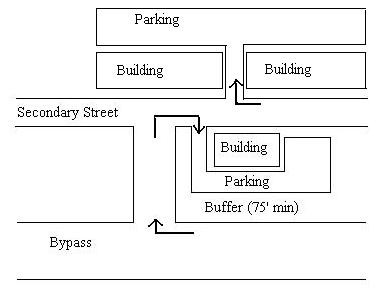
8.4-11.
Industrial District (IND).
(A)
Intent. The Industrial District is established to provide locations for industrial uses that, due to the scale of the buildings and/or the nature of the use, cannot be integrated into the community. Uses within the Industrial District are buffered from adjacent uses. The dominant uses in this district are manufacturing and warehouse storage. Small scale manufacturing and storage that is compatible with less intensive uses can and should be located in other districts. The Industrial District is reserved for uses which require very large buildings and/or large parking and loading facilities. Allowed building and lot types are highway commercial, shopfront commercial, and civic building.
(B)
Permitted uses.
1.
Uses permitted by right:
See Table of Uses (Table 8.1).
2.
Uses permitted with additional standards:
See Table of Uses (Table 8.1).
3.
Uses permitted with conditions:
See Table of Uses (Table 8.1).
(C)
Permitted building and lot types.
Highway commercial
Shopfront commercial
Civic building
(D)
Permitted accessory uses.
Accessory structures
Fences
(E)
Permitted residential density.
N/A
(F)
General requirements.
1.
Building placement, parking placement, building type, urban form, access, and lot arrangement shall be controlled by the lot and building type standards (Article 9) for the lot and building types permitted in the Industrial District.
2.
In addition to the requirements established by the lot type standards and building type standards, the following shall apply in the Industrial District:
(G)
Open space. Open space is defined as any area which is not divided into private or civic building lots, streets, rights-of-way, parking, or easements for purposes other than open space conservation. The provision and design of open space shall comply with the requirements set forth in Article 21.
(H)
Parking, landscaping and buffers. Parking shall comply with the requirements set forth in Article 12. Landscaping, including required buffers, shall comply with the requirements set forth in Article 11.
8.4-12.
Parks and Recreation District.
(A)
Intent. The Parks and Recreation District (PNR) is intended primarily for town-owned properties utilized, or planned for, public parks and recreation facilities. Allowed building/lot types in this district are urban workplace and civic. Properties in this district are primarily for use and enjoyment by the public as open space and/or recreation facilities and may include golf courses, public parks, trails, and other similar open spaces.
(B)
Permitted uses.
1.
Uses permitted by right:
See Table of Uses (Table 8.1).
2.
Uses permitted with additional standards:
See Table of Uses (Table 8.1).
3.
Uses permitted with conditions:
See Table of Uses (Table 8.1).
(C)
Permitted building and lot types.
Urban workplace
Civic building
(D)
Permitted accessory uses.
Accessory structures
Fences
(E)
Permitted residential density.
N/A
(F)
General requirements.
1.
Building placement, parking placement, building type, urban form, access, and lot arrangement shall be controlled by the lot and building type standards (Article 9) for the lot and building types permitted in the Parks and Recreation District.
2.
In addition to the requirements established by the lot type standards and building type standards, the following shall apply in the Parks and Recreation District.
(G)
Parking, landscaping and buffers. Parking shall comply with the requirements set forth in Article 12. Landscaping, including required buffers, shall comply with the requirements set forth in Article 11.
(Ord. No. 2023-01, Pt. 2, 1-17-2023)
Sec. 8.5. - Overlay Districts.
8.5-1.
Traditional Neighborhood Development Overlay (TND).
(A)
Intent. The Traditional Neighborhood Development Overlay District provides for the development of new neighborhoods and the revitalization or extension of existing neighborhoods. These neighborhoods are structured upon a fine network of interconnecting pedestrian-oriented streets and other public spaces. Traditional Neighborhood Developments (TNDs) provide a mixture of housing types and prices, prominently sited civic or community building(s), stores, offices, workplaces, and churches to provide a balanced mix of activities. A Traditional Neighborhood Development (TND) has a recognizable center and clearly defined edges; optimum size is a quarter mile from center to edge. A TND is urban in form, is typically an extension of the existing developed area of the town and has a residential density of four to 12 dwelling units per acre.
(B)
Permitted uses.
1.
Uses permitted by right:
See Table of Uses (Table 8.1).
2.
Uses permitted with additional standards:
See Table of Uses (Table 8.1).
3.
Uses permitted with conditions:
See Table of Uses (Table 8.1).
(C)
Permitted building and lot types.
Urban workplace
Shopfront commercial
Multi-family cluster
Detached house
Attached house
Civic building
(D)
Permitted accessory uses.
Accessory dwelling unit (subject to additional standards, see Section 10.1).
Accessory structures
Fences
Home occupations (subject to additional standards, see Section 10.1).
(E)
Permitted residential density.
Eight units/acre
(F)
General requirements.
1.
Building placement, parking placement, building type, urban form, access, and lot arrangement shall be controlled by the lot and building type standards (Article 9) for the lot and building types permitted in the Traditional Neighborhood Development District and by the standards set forth in Section 8.5-11.F(5) below.
2.
Along existing streets, new buildings shall respect the general spacing of structures, building mass and scale, and street frontage relationships of existing buildings.
•
New buildings which adhere to the scale, massing, volume, spacing, and setback of existing buildings along fronting streets exhibit demonstrable compatibility.
•
New buildings which exceed the scale and volume of existing buildings may demonstrate compatibility by varying the massing of buildings to reduce perceived scale and volume.
3.
On new streets, allowable building and lot types will establish the development pattern.
4.
A master plan in compliance with traditional neighborhood development standards shall be provided with the zoning permit submittal for a general district TND or with the application for reclassification to a conditional TND zoning district. The master plan shall include a topographic survey and shall show the location and hierarchy of streets and public open spaces, location of residential, commercial, and civic building lots, street sections and/or plans, a master sign program, an outline of any additional regulatory intentions, phasing, and any other information, including building elevations, which may be required to evaluate the interior pedestrian environment and conditions at project edges.
5.
Maximum development size: 200 acres
6.
Tracts larger than 200 acres shall be developed as multiple traditional neighborhood developments, each individually subject to all provisions.
7.
Maximum permitted densities: There shall be no maximum density in the TND.
8.
In addition to the requirements established by the lot type standards and building type standards, the following standards shall apply for properties wishing to be developed in accordance with the standards for the Traditional Neighborhood Development District:
(G)
TND design provisions.
1.
Neighborhood form.
The descriptions of traditional neighborhood building and lot types in Article 9 will determine the general arrangement and distribution of elements in a TND.
The area of the TND shall be divided into blocks, streets, lots, and open space.
Similar land uses shall generally front across each street. Dissimilar categories shall generally abut at rear lot lines. Corner lots which front on streets of dissimilar use shall generally observe the setback established on each fronting street.
2.
Streets.
Public streets shall provide access to all tracts and lots.
Streets and alleys shall, wherever practicable, terminate at other streets within the neighborhood and connect to existing and projected streets outside the development. Cul-de-sacs shall not exceed 250 feet in length, must be accessed from a street providing internal or external connectivity, shall be permanently terminated by a vehicular turnaround, and are permitted only where topography makes a street connection impracticable. In most instances, a "close" or "eyebrow" is preferred to a cul-de-sac. Vehicular turnarounds of various configurations are acceptable so long as emergency access is adequately provided. Pedestrian connections shall be provided as extensions of terminating streets or as public access easements where not precluded by topography or other physical constraints.
The average perimeter of all blocks within the TND should not exceed 1,350 feet. No block face should have a length greater than 500 feet without a dedicated alley or pathway providing through access.
A continuous network of rear alleys is recommended for all lots in a TND; rear alleys shall provide vehicular access to lots 60 feet or less in width.
Utilities may run along alleys.
TND streets shall be organized according to a hierarchy based on function, size, capacity, and design speed; streets and rights-of-way are therefore expected to differ in dimension. The proposed hierarchy of streets shall be indicated on the submitted site plan. Each street type in a TND shall be separately detailed. Street types as described in the Town of Jamestown Standards and Specifications Manual identify the street types permitted in a TND. An array of elements that are combined to meet the purposes of TND neighborhood streets: building placement line, optional utility allocation, sidewalk, planting strip, curb and gutter, optional parallel parking, and travel lane(s). Alternative methods of assembling the required street elements will be considered to allow neighborhood street designs that are most appropriate to setting and use.
To prevent the buildup of vehicular speed, disperse traffic flow, and create a sense of visual enclosure, long uninterrupted segments of straight streets should be avoided. Methods to achieve this interruption include: (1) a street can be interrupted by intersections designed to calm the speed and disperse the flow of traffic (see Town of Jamestown Standards and Specifications Manual) and terminate vistas with a significant feature (building, park, natural feature); (2) a street can be terminated with a public monument, specifically designed building facade, or a gateway to the ensuing space; (3) perceived street length can be reduced by a noticeable street curve where the outside edge of the curve is bounded by a building or other vertical elements that hug the curve and deflect the view; (4) other traffic calming configurations are acceptable so long as emergency access is adequately provided.
3.
Buildings and lots.
All lots shall share a frontage line with a street or square; lots fronting a square shall be provided rear alley access.
Consistent build-to lines shall be established along all streets and public space frontages; build-to lines determine the width and ratio of enclosure for each public street or space. A minimum percentage build-out at the build-to line shall be established on the plan along all streets and public square frontages.
Building and lot types shall comply with the descriptions provided in Article 9.
Large-scale, single use facilities (conference spaces, theaters, athletic facilities, etc.) shall generally occur behind or above smaller scale uses of pedestrian orientation. Such facilities may exceed maximum first floor area standards if so sited.
4.
Open space. Open space is defined as any area which is not divided into private or civic building lots, streets, rights-of-way, parking, or easements for purposes other than open space conservation. The provision and design of open space shall comply with the requirements set forth in Article 21.
5.
Parking, landscaping and buffers. Parking shall comply with the requirements set forth in Article 12. Landscaping, including required buffers, shall comply with the requirements set forth in Article 11.
8.5-2.
Cluster Development Overlay (CDO).
(A)
Intent. The Cluster Development Overlay District permits buildings to be clustered or grouped on a site, parcel, or property in order to optimize the use of land and resources. By clustering development, projects developed in accordance with these standards can obtain density bonuses while preserving unique natural features, efficiently providing infrastructure such as water, sewer, and streets, and organizing buildings on a site in a manner that promotes efficient multi-modal transportation. The Cluster Development Overlay District mandates the dedication of open space with density bonuses provided as an incentive for adhering to the standards. It is the intent of this district to be used for new development in undeveloped areas of the Town and in already developed areas with low building value to land value ratios. Allowed building/lot types are multi-family, detached house, attached house, and civic building. Within cluster development overlay districts, development may comply with the standards set forth in this section or with the standards of the underlying zoning district.
(B)
Applicability. The cluster development provisions set forth below may be applied, upon designation of the property as a Cluster Development Overlay District, to properties with a minimum lot size of two acres in all residential and agricultural zoning districts. The provisions of this section shall not be applicable in platted and recorded residential subdivisions where 75 percent or more of the homes within the subdivision have improvements that equal or exceed the land value (based on Guilford County Tax Department assessed values).
(C)
Permitted uses.
1.
Uses permitted by right.
See Table of Uses (Table 8.1).
2.
Uses permitted with additional standards.
See Table of Uses (Table 8.1).
3.
Uses permitted with conditions.
See Table of Uses (Table 8.1).
(D)
Permitted building and lot types.
Multi-family cluster
Detached house
Attached house
Civic building
(E)
Permitted accessory uses.
Accessory dwelling units (subject to additional standards, see Section 10.1)
Accessory structures
Fences
Home occupations (subject to additional standards, see Section 10.1)
(F)
Development standards. The following development standards shall apply to cluster developments approved in accordance with the provisions of this section:
1.
Maximum density shall be 150 percent of that permitted in the underlying zoning district.
2.
There shall be a minimum separation of 12 feet between all enclosed structures.
3.
Parking shall comply with the requirements set forth in Article 12, and shall not be located within 25 feet of an adjoining street right-of-way or property line except that parking may be closer than 25 feet from an adjoining street right-of-way if the parking is located beneath a building, with the parked vehicle entirely hidden from view from any right-of-way or property line.
4.
Building placement, parking placement, building type, urban form, access, and lot arrangement shall be controlled by the lot and building type standards (Article 9) for the lot and building types permitted in the Cluster Development Overlay District.
5.
In addition to the requirements established by the lot type standards and building type standards, the following shall apply in the Cluster Development Overlay District:
(G)
Landscaping and buffers. Landscaping, including required buffers, shall comply with the requirements set forth in Article 11.
(H)
Open space. Not less than 40 percent of the site shall be conveyed as common open space. Open space is defined as any area which is not divided into private or civic building lots, streets, rights-of-way, parking, or easements for purposes other than open space conservation. In addition to the requirements listed below, the provision and design of open space shall comply with the requirements set forth in Article 21.
1.
Common open space provided by a cluster development shall be conveyed as follows:
a.
To the Town of Jamestown and accepted by it for park, open space, agricultural, or other specified use or uses, provided that the conveyance is approved by the town council; or
b.
To a nonprofit organization whose principal purpose is the conservation of open space, to a corporation or trust owned or to be owned by the owners of lots or dwelling units within the cluster development, or to owners of shares within a cooperative development. If such a corporation or trust is used, ownership shall pass with the conveyances of the lots or dwelling units. Such corporation or trust shall maintain the property as open space.
2.
Where the common open space in a residential cluster development is conveyed pursuant to subparagraph 1.b above, a deed restriction enforceable by the Town of Jamestown shall be recorded that provides that the common open space shall:
a.
Be maintained in the authorized conditions(s); and
b.
Not be developed for principal uses, accessory uses (e.g., parking), or roadways, with the exception that gazebos, pavilions, shelters, or similar accessory uses, and structures may be constructed within the common open space upon approval of the planning director.
8.5-3.
Scenic Corridor Overlay (SCO).
(A)
Intent. The Scenic Corridor Overlay District is established to protect the pastoral scenes and open spaces that provide a sense of arrival for residents and visitors traveling the major entrance roads and gateways to the Town. The pastoral scenes and undeveloped property along the entrance roads and gateways contribute significantly to Jamestown's community character and sense of place. The Scenic Corridor Overlay District is meant to protect Jamestown's community character and heritage by preserving the historic development patterns along the Town's entrance roads and gateways while providing development options for the owners of the property abutting the entrance roads and gateways. The goal of this district is to protect the scenic value of the corridors through a mix of incentives and development standards. These standards will preserve the rural character of the Town by maintaining the sense of a rural corridor in an urban environment; provide an aesthetically appealing experience for those traveling the corridor; provide multi-modal options for travel; and ensure a safe transportation corridor for motorists, bicyclists, and pedestrians.
(B)
Types. Three types of scenic corridors are hereby created:
1.
Rural scenic corridor. A corridor along which development is limited, consisting largely of fields, pastures, and scattered residential uses. The rural scenic corridor evokes a sense of traveling through an undeveloped area, with pastoral scenes and a sense of being removed from the urban environment.
2.
Gateway scenic corridor. A corridor that serves as an entrance way to a place that is unique and different from other communities in the area. The gateway corridor provides a sense of arrival to a place that is special and different from the typical places. The gateway scenic corridor may be more developed than the rural scenic corridor, but the character of the development is such that those using the corridor are aware they are in a special place.
3.
Bypass scenic corridor. A corridor providing for buffering of the bypass to protect the traffic carrying capacity of the road and to provide for a pleasant experience for motorists using the bypass. The bypass scenic corridor requires an undeveloped setback from the bypass, ensuring that the bypass through Jamestown is unique and portrays the character of the community while enhancing the safety of motorists using the road.
(C)
Permitted uses.
1.
Uses permitted by right.
See Table of Uses (Table 8.1).
2.
Uses permitted with additional standards.
See Table of Uses (Table 8.1).
3.
Uses permitted with conditions.
See Table of Uses (Table 8.1).
(D)
Permitted building and lot types.
Detached house
Civic building
(E)
Permitted accessory uses.
Accessory structures (upon approval by town council as a special use)
Fences
(F)
Permitted residential density.
Four units/acre. (Residential buildings shall not be located within the scenic corridor easement.)
(G)
General requirements.
1.
Development pattern. Building placement, parking placement, building type, urban form, access, and lot arrangement shall be controlled by the lot and building type standards (Article 9) for the lot and building types permitted in the Scenic Corridor Overlay District.
2.
Activities permitted in the scenic corridor. In order to preserve the aesthetic quality of the scenic corridors, uses and activities within the designated scenic corridors shall be limited to the following:
a.
The scenic corridor easement may be used for passive recreation, agricultural uses, and equestrian uses. No other use shall be permitted within the scenic corridor easement.
b.
No building construction, parking, land disturbing activity, signs, tree removal, lighting (other than street lighting provided by the Town of Jamestown and driveway or private road lighting provided that said lighting is provided by full cutoff fixtures), or other development activity shall occur within the scenic corridor easement except as follows:
•
A bikeway, greenway, and/or other pedestrian/bicycle facility may be located within the scenic corridor easement.
•
Underground utilities and easements for underground utilities may be located within the scenic easement, provided that no above ground transmission or other equipment is located within the scenic easement.
•
Buildings used primarily for agricultural and/or equestrian related activities may be built in the scenic corridor easement upon approval by the town council as a special use. Parking shall be located behind the building, shall not be located within the scenic easement, and shall be buffered from the scenic corridor. The town council shall consider the following items in making the decision to allow aforesaid buildings in the scenic easement:
◦
The building's visual impact on the scenic corridor;
◦
The building's size;
◦
The compatibility of the building's architecture with community character and the purposes of the scenic corridor overlay district.
3.
Scenic corridor dimensions. The designated scenic corridors shall meet the following dimensional standards:
The width of the scenic easement within the rural scenic corridor shall be ten percent of the lot depth but no more than 100 feet from the edge of the public right-of-way. The planning director may require an additional scenic depth of up to 50 feet in order to preserve structures and/or vegetation deemed to be significant.
a.
The width of the scenic easement within the gateway scenic corridor shall be ten percent of the lot depth but no more than 50 feet from the edge of the highway right-of-way. The planning director may require an additional depth of up to 25 feet in order to preserve structures and/or vegetation deemed to be significant.
b.
The width of the scenic easement within the bypass scenic corridor shall be ten percent of the lot depth but no more than 75 feet from the edge of the public right-of-way. The planning director may require an additional depth of up to 25 feet in order to preserve structures and/or vegetation deemed to be significant.
4.
Scenic corridor provisions. The following provisions shall govern development within a designated scenic corridor:
a.
The area within the scenic easement may be dedicated to the Town as a conservation easement, provided it meets the standards for such an easement as established by applicable state and federal standards.
b.
Development density shall be calculated for the entire property, including the area within the scenic easement, with the exception that development density bonuses of up to 50 percent are given for the portion of the property within the scenic easement. In the event that the property owner provides a scenic easement wider than required by this ordinance, the density bonus may be increased up to 75 percent for the area located within the scenic easement. For example, Joe Jones owns a ten-acre property zoned single family residential (SFR). Two acres of his property are within the Scenic Corridor Overlay. His density is calculated as follows:
Base density @ 4 units/acre × 10 acres = 40 units 50% density bonus for 2 acres in scenic corridor easement
50% (2 acres × 4 units/acre) = 4-unit bonus
Total Density = 44 units
If Mr. Jones provides an easement wider than required, then he would receive a 75% density bonus for the area within the easement:
Base density @ 4 units/acre × 10 acres = 40 units 75% density bonus for 2 acres with wider easement
75% (2 acres × 4 units/acre) = 6-unit bonus Total Density = 46 units
c.
Development may be clustered on the portion of the property located outside the scenic easement. When cluster development is used, it shall follow the Cluster Development Overlay District regulations as outlined in Section 8.4 of this ordinance.
5.
Curb cuts. There shall be a minimum separation of 500 feet between curb cuts in the rural scenic corridors. This separation requirement may be waived by the planning director if the width of the property frontage would preclude a second curb cut meeting this spacing requirement
6.
Lot requirements. The lot type standards and building type standard permitted in the underlying district, as set forth in Section 8.4 and further described in Article 9, shall apply in the Scenic Corridor Overlay District.
(H)
Open space. Open space is defined as any area which is not divided into private or civic building lots, streets, rights-of-way, parking, or easements for purposes other than open space conservation. The provision and design of open space shall comply with the requirements set forth in Article 21. Land within the scenic easement may count for up to 100 percent of the open space required by Article 21 of this ordinance.
(I)
Parking and landscaping. Parking shall comply with the requirements set forth in Article 12. Landscaping shall comply with the requirements set forth in Article 11.
8.5-4.
Campus Overlay (CO)
(A)
Intent. The Campus Overlay District provides for the development of campuses for large institutional uses (secondary schools, colleges, and medical facilities) over time in accordance with an approved master plan. Basic standards are established in this section for campus developments and for the campus master plan, which, upon approval by the Town of Jamestown, shall become the regulating plan for the development of the campus. Pedestrian access and interconnected streets within the campus, with an internal street system, are guiding principles within the Campus Overlay District. The civic building and urban workplace are the allowed lot/building types in this overlay district. To the extent possible, buildings should front on the internal street system. The standards set forth in this section ensure that the campuses of large institutional uses fit seamlessly into the community, with the campus becoming an extension of the Town rather than an isolated island within the Town.
(B)
Applicability. The campus development provisions set forth below may be applied, upon designation of the property as a Campus Overlay District and approval of the master plan for campus development, on properties with a minimum area of five acres in all non-residential zoning districts.
(C)
Permitted uses.
1.
Uses permitted by right
See Table of Uses (Table 8.1)
2.
Uses permitted with additional standards
See Table of Uses (Table 8.1)
3.
Uses permitted with conditions
See Table of Uses (Table 8.1)
(D)
Permitted building and lot types.
Civic building
Urban workplace
(E)
Permitted accessory uses.
Accessory structures
Fences
(F)
Permitted residential density.
N/A (Dormitories permitted as part of approved master plan)
(G)
Development standards. The following development standards shall apply to cluster developments approved in accordance with the provisions of this section:
1.
Building placement, parking placement, building type, urban form, access, and lot arrangement shall be controlled by the lot and building type standards (Article 9) for the lot and building types permitted in the Campus Overlay District.
2.
A master plan shall be provided with the zoning application for reclassification to a Campus Overlay District. The master plan shall include a topographic survey and shall show the location and hierarchy of streets and open spaces, location of proposed and existing buildings, street sections and/or plans, a master sign program, an outline of any additional regulatory intentions, phasing, and any other information, including building elevations, which may be required to evaluate the interior pedestrian environment and conditions at project edges.
3.
To the extent possible, buildings shall front on internal streets or on exterior streets that abut the campus.
4.
Parking shall comply with the requirements set forth in Article 12 and shall not be located between the street and a building.
5.
Public streets shall provide access to all tracts and buildings on the campus. Streets and alleys shall, wherever practicable, terminate at other streets on the campus and connect to existing and projected streets outside the development.
6.
Sidewalks and pedestrian walkways shall provide access to and connect all buildings on the campus. Sidewalks and pedestrian walkways shall have a minimum width of five feet (8 feet for high pedestrian traffic areas).
(H)
Open space. Open space is defined as any area which is not divided into private or civic building lots, streets, rights-of-way, parking, or easements for purposes other than open space conservation. The provision and design of open space shall comply with the requirements set forth in Article 21.
(I)
Parking, landscaping and buffers. Parking shall comply with the requirements set forth in Article 12. Landscaping, including required buffers, shall comply with the requirements set forth in Article 11, Landscaping and Buffers.

