
Jamestown City Zoning Code
ARTICLE 13
STREETS
Sec. 13.1.- General.
Streets should be designed to suit their functions. Many streets, especially local ones, have purposes other than vehicular traffic. As an alternative to current N.C. Department of Transportation road standards, the following street standards are provided for non-state-maintained streets within the Town of Jamestown and for streets within the extraterritorial zoning jurisdiction that will be maintained by the Town upon annexation. Streets built to the standards identified in this section are eligible for town maintenance.
Streets in Jamestown should be inviting public space and integral components of community design. A hierarchical street network should accommodate a variety of uses, including bicycle, pedestrian, and transit routes. All streets should connect to help create a comprehensive network that enables the free movement of automobiles, bicyclists, and pedestrians. In order for this street network to be safe for motorists and pedestrians, design elements must consistently be applied to calm automobile traffic.
Where discrepancies occur between the text of this ordinance and the Town of Jamestown Technical Standards and Specifications Manual, the Technical Standards and Specifications Manual shall prevail.
Sec. 13.2. - Street Standards.
Streets in the Town of Jamestown shall:
13.2-1.
Interconnect. Interconnect within a development and with adjoining development to the maximum extent possible. Cul-de-sacs shall be allowed only where topographical and/or lot line configurations offer no practical alternatives for connections or through traffic. Street stubs shall be provided within development adjacent to open land to provide for future connections.
13.2-2.
Pedestrian Scaled. Be designed as the most prevalent public space of the Town and, thus, scaled to the pedestrian.
13.2-3.
Bordered by Sidewalks. Be bordered by sidewalks with a minimum width of five feet on both sides, with the exception of rural roads, lanes, alleys, and the undeveloped edge of neighborhood parkways. Sidewalks on one side of the road may be permitted in the Agricultural District to protect water quality. Sidewalks may be located in the street right-of-way, on private or public property, or in common areas. All sidewalks not located within the public right-of-way shall have a public access easement permitting public use of the sidewalk.
13.2-4.
Street Trees. Be lined with street trees located on both sides, with the exception of rural roads, lanes, alleys, and the undeveloped edge of neighborhood parkways. Street trees along streets in all non-urban areas shall be located in a planting strip as per the standards set forth in the Town of Jamestown Technical Standards and Specifications Manual.
13.2-5.
Public Streets. Streets shall be public. Private streets are permitted on a limited basis only in accordance with standards set forth in section Article 2 of this ordinance and when constructed in accordance with the standards set forth in the Jamestown Standards and Specifications Manual. Alleys will be classified as public or private depending on function, according to the street acceptance policy.
13.2-6.
Focus for Buildings. All principal buildings should front on public streets as dictated by the lot and building type standards of Article 9.
Sec. 13.3. - Intersections.
Segments of straight streets should be interrupted by intersections designed to:
13.3-1.
Reduce Speed. Disperse traffic flow and reduce speeds, thereby eliminating the creation of de facto collector streets with high speed, high volume traffic; and
13.3-2.
Terminate Vistas. Terminate vistas with a landmark such as a significant natural feature, a building, a small park, or other public space.
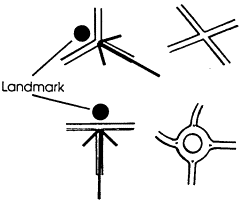
Other traffic calming measures such as neckdowns, chicanes, mid-block diverters, intersection diverters, curb bulbs, serial hill crests, and related devices will be considered on a case-by-case basis, based on safety and appropriateness in the proposed location.
Sec. 13.4. - Blocks.
Street blocks defined by public streets are the fundamental design elements of traditional neighborhoods. In urban conditions, any dimension of a block may range from 250 to 500 linear feet between cross streets. In major subdivisions the dimension of blocks may not exceed 800 linear feet between cross streets. Within large-lot subdivisions the blocks may be up to 1,500 feet. The block pattern should continue to establish the development pattern at the project edge. Where a longer block will reduce the number of railroad grade crossings, major stream crossings, or where longer blocks will result in an arrangement of street connections, lots and public space more consistent with this article and Article 11 of this ordinance, the technical review committee may authorize greater block lengths at the time of subdivision preliminary plat review and approval.
Sec. 13.5. - Street Plan.
The layout of streets should provide structure to the neighborhoods. The formality of the street plan will vary depending upon site conditions and topography. Unique site conditions should be used to create special neighborhood qualities. The street plan for new developments should reflect the character of the Town of Jamestown and comply with the standards set forth in Section 13.2 above.
Sec. 13.6. - Street Design.
Designs should permit comfortable use of the street by motorists, pedestrians, and bicyclists. Pavement widths, design speeds, and the number of motor travel lanes should be minimized to enhance safety for motorists and non-motorists alike. The specific design of any given street must consider the building types which have frontage and the relationship of the street to the overall town street network. The following specifications apply to street design:
13.6-1.
Street Trees and Sidewalks. Street trees and sidewalks are required on both sides of public streets except rural roads, lanes, alleys, and the undeveloped edge of neighborhood parkways except that sidewalks may be permitted on only one side of the street to accommodate low impact design in the Agricultural District. The street tree planting strip should be a minimum of five feet in width and sidewalks shall be a minimum of five feet in width unless otherwise provided. On commercial streets, sidewalks should be a minimum of seven feet in width. A ten feet minimum width sidewalk with tree grates or cut-outs is required and 12 feet is encouraged on commercial streets, on properties and streets adjacent to schools, and especially in the Main Street District. Generally, canopy trees shall be planted at a spacing not to exceed 40 feet on center. Where overhead utility lines preclude the use of canopy trees, small maturing trees may be substituted, planted 30 feet on center.
13.6-2.
On-street parking. On-street parking is recommended where building type and use will generate regular parking use. Occasional on-street parking can be accommodated without additional pavement width. For streets that serve workplace and storefront buildings, on-street parking lane(s) are required and should be marked as such. An on-street parking lane on at least one side of the street is recommended on streets serving attached houses and detached houses with lots 60 feet or less in width. On-street parking must also be provided on one side of any street adjacent to a square, park or other urban open space. Parallel on-street parking width is seven feet to eight feet. On-street parking should be parallel; angled parking is only permitted as an intentional design element along the main street(s) of the retail center in a Traditional Neighborhood Development (TND) District.
13.6-3.
Design Speeds. Design speeds should not exceed 30 miles per hour on any neighborhood street. Only arterials and town boulevards may exceed this design speed.
13.6-4.
Traffic Control Plans. Traffic control plans showing signage and pavement markings shall be prepared in accordance with the guidance of the Manual on Uniform Traffic Control Devices. The developer is responsible for the initial installation of the devices or markings and the maintenance thereof until the public accepts the street for maintenance.
Design standards and specifications for town streets are set forth in the Town of Jamestown Standards and Specifications Manual. The street specifications in this manual may only be varied in accordance with the design principles set forth above and as approved by the technical review committee during the site plan or subdivision plat review process.
13.6-5.
Cul-de-sacs. Cul-de-sacs shall have a minimum five feet pedestrian access easement, and shall have paved pedestrian connections, where practicable to encourage pedestrian access connectivity. See Additional cul-de-sac standards in Article 16.2-7, Street Design.

