
Jamestown City Zoning Code
ARTICLE 9
BUILDING AND LOT TYPE STANDARDS
Sec. 9.1.- Purpose.
The purpose of this article is to establish standards for the buildings and lots permitted in each of the zoning districts established in Article 8. The standards set forth below are established to ensure that new development and construction is compatible with the character of the Town of Jamestown, that it accomplished the purposes of this ordinance, and that it achieves the goals identified in the Town's comprehensive plan and other plans.
Sec. 9.2. - Detached House Lot and Building Type.
9.2-1.
Description. The detached house is the most prevalent building type in Jamestown. The detached house building type is generally found in residential neighborhoods, although it may coexist with other, similarly scaled buildings in commercial or mixed-use areas. Where possible, structures shall be designed to maintain a harmonious image of the neighborhood when viewed from a distance. Where appropriate and possible, structures shall be designed to terminate vistas. Within the limits described below, these regulations shall apply to all houses built on public streets. For detached homes on large lots accessed by a private drive-in rural areas, building placement and site planning shall be dictated by landscape features and landscape preservation.
The photograph below is an example for illustration purposes only and is not intended
to regulate lot/building styles, patterns, or forms.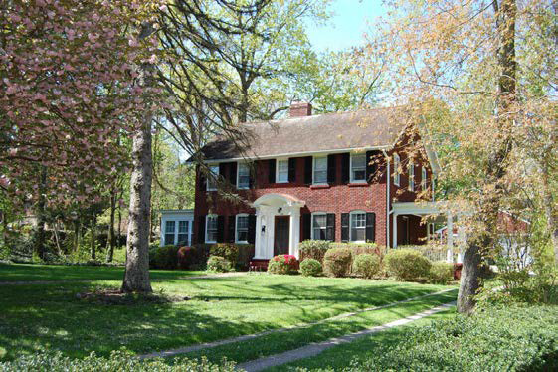
9.2-2.
Detached House Lot Type.
|
Building Placement/Parking/
Vehicle Access |
Encroachment/Pedestrian Access/
Commercial Use Standards |
|---|---|
 |  |
|
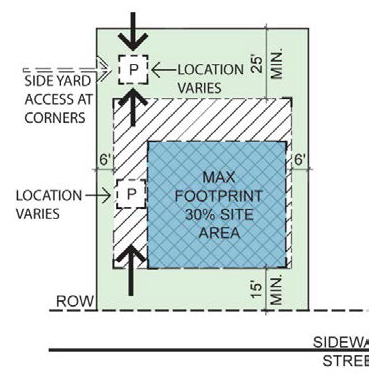
1. Buildings shall be placed on the lot within zone represented by the hatched area.
2. Along new streets: A) the front setback shall be 15' behind street ROW; B) the rear setback shall be 25 feet from the rear property line; C) the side setbacks on interior lots shall be 6' from the side property line; D) the side setback on corner lots for the side of the building that faces the street shall be ⅗ the distance of the front building setback (i.e., if the front of the building is set back 50 feet from street ROW on a corner lot, the minimum side setback for the side of the building facing the street would be 30 feet). |
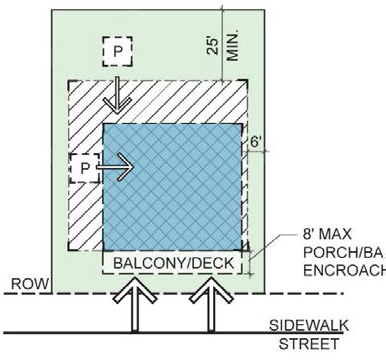
1. Primary pedestrian access into the building shall be from the street frontage line
(indicated by larger arrow). Secondary access may be from parking areas (indicated
by smaller arrows).
2. Balconies, stoops, stairs, open porches, bay windows, and, and awnings are permitted to encroach into the front setback area up to 8'. 3. Mechanical equipment shall not encroach into any required setback. |
|
3. Along existing streets and in the Single-Family Residential District, the minimum
lot width and front, side, and rear setbacks of new buildings shall be equal to the
average setbacks of existing buildings on the same side of the street within 400'.
However, if there are 2 or less buildings within 400' on the same side of the street
from the subject parcel, the standards for new streets apply.
4. In the Residential/Main Street Transitional District, where the average setback of existing buildings within 400' exceeds 35', the setback of any new building may be up to 20' closer to street ROW from the setback of an adjacent building, existing or proposed, in order to negotiate a gradual transition to a more urban development pattern. 5. Building placement may be further defined by zoning districts. 6. Accessory structures shall be located at least 5' behind the primary structure and shall have a minimum 6' side and rear setback. 7. Only in the most exceptional circumstances having to do with extreme topography or very special design composition may the rules of residential building placement be varied. |
4. Commercial Use in a Detached House (Main Street, Main Street Periphery, Commercial/Main
Street Transitional, TND Overlay Districts) shall comply with the following:
a. Parking shall be located in the side or rear yards only. If provided in the side yards, the parking area shall not exceed 25% of the frontage line and shall not be in the yards adjacent to a street. b. Parking areas on adjacent mixed use lots shall be connected whenever practical. c. Trash containers shall be located in the rear yard. If adjacent to existing single-family residential uses, trash containers shall be limited to residential rollout containers only (no dumpsters). d. Mechanical equipment at ground level shall be placed on the parking lot side of the building away from buildings on adjacent sites and shall be screened from view by an opaque screen. e. Hedges, garden walls, or knee walls may be built on property lines or as the continuation of building walls. A garden wall, hedge or knee wall (knee wall should be a min. 2.5' in height, max 3.5' in height) shall be installed along any street frontage adjacent to parking areas. Knee walls should be built of brick, stone or other decorative masonry material, or should be built of wrought iron or other decorative metal and shall generally match the historic architectural style of Jamestown. |
|
8. The maximum building coverage for the primary structure shall be 30% of the lot
area.
9. Garages may be detached (entered from front, side, or rear), or attached to the main dwelling, with or without habitable rooms above. Front loaded garages, if provided, shall meet the standards of Article 2. 10. A detached garage may be located only in the rear yard or side yard. 11. Points of permitted front or rear access to parking indicated by arrows. On corner lots, side yard access is also permitted. |
f. Building façades shall be generally parallel to frontage property lines. Buildings
in all locations should relate the principal façade to the sidewalk and public space
of the street.
g. Building façades at street frontage lines shall be pedestrian oriented and of pedestrian scale. |
9.2-3.
Detached House Building Type.
| Permitted Height/Uses/Encroachments | Architectural Standards |
|---|---|
 |
Principles:
A. To perpetuate the unique building character of the Town and its environs, and to re-establish its local identity, development shall generally employ building styles that are compatible with the historic architectural vocabulary of the area in their external treatment (refer to Historical Places in Jamestown, Mary A. Browning, for historic architectural vocabulary). Manufactured homes will not be permitted as part of any multi-unit residential development. B. The front elevations facing the street and the overall massing shall communicate an emphasis on the human scale and the pedestrian environment. The intention of buildings in all locations must be to relate the principal façade to the sidewalk and public space of the street. C. Each building should be designed to form part of a larger composition of the area in which it is situated. Adjacent buildings should thus be of similar scale, height, and configuration. D. Building silhouettes should be generally consistent. The scale and pitch of roof lines should thus be similar across groups of buildings. |
|
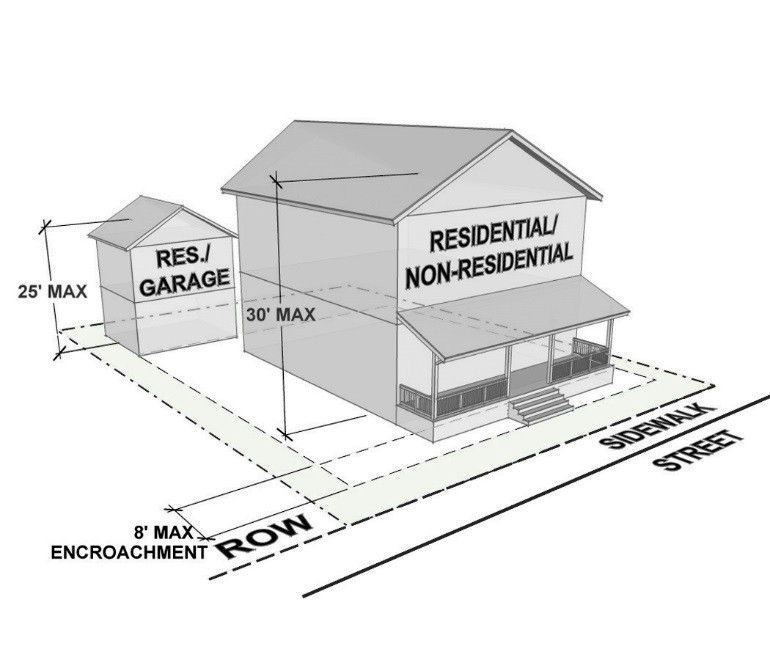
1. Building heights shall be measured as the vertical distance from the mean elevation
of the finished grade to a point representing the midpoint of the peak and eave heights.
2. Building height to the ridge may vary depending on the roof pitch. 3. Permitted uses are indicated above and are further controlled by zoning district standards. | |
|
Configurations:
A. Main roofs on residential buildings should be symmetrical gables or hips with a pitch of between 4:12 and 12:12. Monopitch (shed) roofs should be attached to the wall of the main building. No monopitch roof should be less than 4:12. Grandiose roof pitches with multiple changes of outline are acceptable. It is recommended that accessory buildings have roof pitches that conform to those of the main building. B. Balconies should generally be simply supported by posts and beams. The support of cantilevered balconies should be assisted by visible brackets. C. Two wall materials may be combined horizontally on one façade. The "heavier" material should be below. D. Exterior chimneys should be finished in brick or stone. Techniques: A. Overhanging eaves may expose rafters. B. Flush eaves should be finished by profiled molding or gutters. |
Sec. 9.3. - Attached House Lot Type and Building Type Standards.
9.3-1.
Description. The attached house is a rowhouse, a townhouse, or a duplex. Traditional southern homes in Savannah and Charleston provide a historic model. The Southside neighborhood in Greensboro provides a good contemporary example. Generally, building plans will have narrow frontages with the plan depth being greater than its width. Groups of attached house buildings that are not integrated into a pedestrian oriented mixed-use urban pattern shall not be permitted within Jamestown.
Attached house structures should complement the neighborhood through their design, location on the site, and building materials.
The photograph below is an example for illustration purposes only and is not intended
to regulate lot/building styles, patterns, or forms.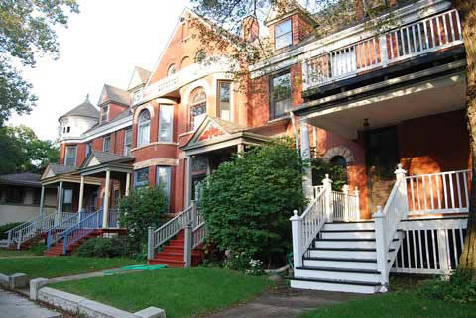
9.3-2.
Attached House Lot Type Standards.
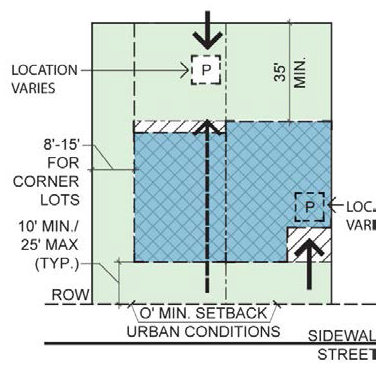
|
Building Placement/Parking/
Vehicle Access | Encroachment/Pedestrian Access |
|---|---|
 |  |
|
1. Buildings shall be placed on the lot within the zone represented by the hatched
area.
2. The front build-to line will range from 10' to 25' behind street ROW. Special site conditions such as topography or lot widths permit a larger setback. However, in more urban conditions, dwellings may be set up to the property line at the sidewalk. 3. There shall be at least 12' of separation between units that are not attached. In the case where a corner unit is on a street corner the side build-to-line shall be 8'—15'. Special site conditions such as topography or lot widths permit a larger yard. |
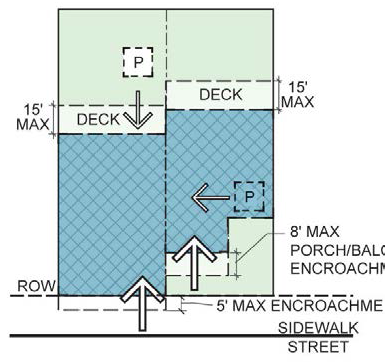
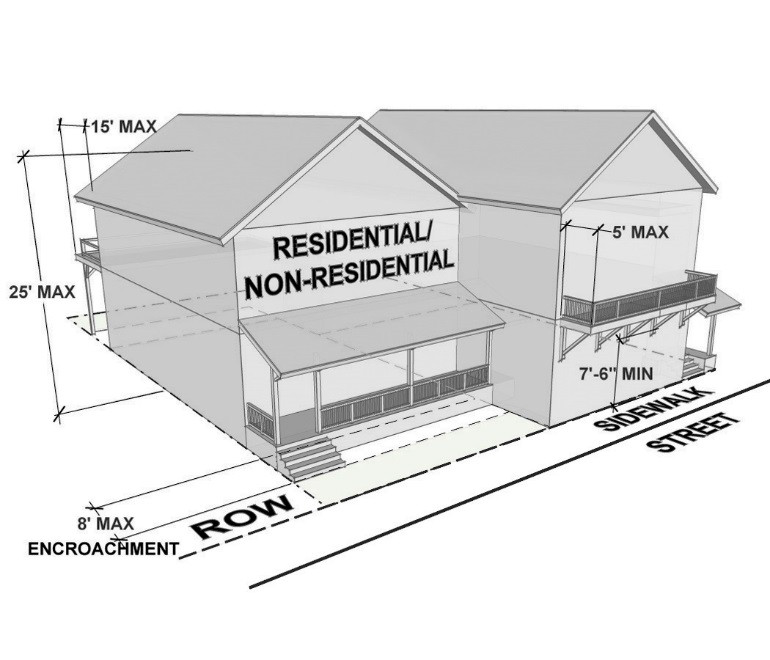
1. For buildings set up to the sidewalk, Balconies and bay windows at an upper level
and their supports at ground level are permitted and encouraged within the sidewalk
as shown by the shaded area. Encroachments affixed to the building and horizontally
protruding more than 6" from the face of the building must have a minimum 7'6" clearance
from the finished grade. Encroaching awnings should cover the entire sidewalk within
the permitted distance shown by the shaded area.
2. For buildings set back from sidewalk, balconies, stoops, stairs, unenclosed porches and bay windows are permitted to encroach into the front setback area up to 8'. |
|
4. Only in the most exceptional circumstances having to do with extreme topography
or very special design composition may these rules of residential building placement
be varied.
5. Building façades shall be generally parallel to front and rear property lines. All buildings generally should front onto a public street, with an exception for buildings in a TND or cluster development. Buildings in these developments may front onto a courtyard or other common space. 6. Front loaded garages, if provided, shall meet the standards of Article 2. 7. Points of permitted access to parking indicated by arrows. 8. Accessory structures shall be located at least 5' behind the primary structure and shall have the same side setbacks as the main structure. Accessory structures shall have a minimum 10' rear setback. |
3. Main pedestrian access to the building is from the street (indicated by larger
arrow). Secondary access may be from parking areas (indicated by smaller arrow).
4. Decks shall be constructed only in an established rear yard and are permitted to encroach into the rear setback up to 15'. |
9.3-3.
Attached House Building Type.
| Permitted Height and Uses | Architectural Standards |
|---|---|
 |
Principles:
A. To perpetuate the unique building character of the Town and its environs, and to re-establish its local identity, development shall generally employ building styles that are compatible with the historic architectural vocabulary of the area in their external treatment (refer to Historical Places in Jamestown, Mary A. Browning, for historic architectural vocabulary). Manufactured homes shall not be permitted as part of any multi-unit residential development under this ordinance. B. The front elevations facing the street, and the overall massing shall communicate an emphasis on the human scale and the pedestrian environment. The intention of buildings in all locations must be to relate the principal façade to the sidewalk and public space of the street. Setbacks should be used in a manner which encourages pedestrian activity. C. Each building should be designed to form part of a larger composition of the area in which it is situated. D. Building silhouettes should be generally consistent. The scale and pitch of roof lines should thus be similar across groups of buildings. |
|
1. Building heights shall be measured as the vertical distance from the mean elevation
of the finished grade to a point representing the midpoint of the peak and eave heights.
2. Building height to the ridge may vary depending on the roof pitch. 3. Permitted uses are indicated on the graphic above and are further controlled by zoning district standards. | |
|
E. Porches should form a predominant motif of house designs and be located on the
front or to the side of the dwelling. When attached to the front, they shall extend
over at least 15% of the front façade. All porches should be constructed of materials
in keeping with those of the main building.
F. Front loaded garages, if provided, shall meet the standards of Article 2. Configurations: A. Main roofs on residential buildings shall be symmetrical gables or hips with a pitch of between 4:12 and 12:12. Monopitch (shed) roofs are allowed only if they are attached to the wall of the main building. No monopitch shall be less than 4:12. All accessory buildings shall have roof pitches that conform to those of the main buildings. B. Balconies should generally be simply supported by posts and beams. For balconies overhanging the sidewalk, supports should be from visible brackets, as supports cannot be located in the sidewalk. The support of cantilevered balconies should be assisted by visible brackets. C. Two wall materials may be combined horizontally on one façade. The "heavier" material should be below. | |
|
D. Exterior chimneys should be finished in brick or stucco.
Techniques: A. Overhanging eaves may expose rafters. B. Flush eaves should be finished by profiled molding or gutters. |
Sec. 9.4. - Multi-Family Lot Type and Building Type Standards.
9.4-1.
Description. The multi-family building is a residential building accommodating several households. In traditional towns, this building type coexists with a variety of other building types and is located in or near a mixed-use district. A successful contemporary design permits its integration with other building types through the coordination of site and building design. The multi-family building type helps to build the residential density necessary for mixed-use areas to function properly by helping to create a base of people who can walk to goods and services. Where possible, structures shall be designed to terminate vistas.
Structures should be designed to establish the design template and serve as a key focal point in the neighborhood.
The photograph below is an example for illustration purposes only and is not intended
to regulate lot/building styles, patterns, or forms.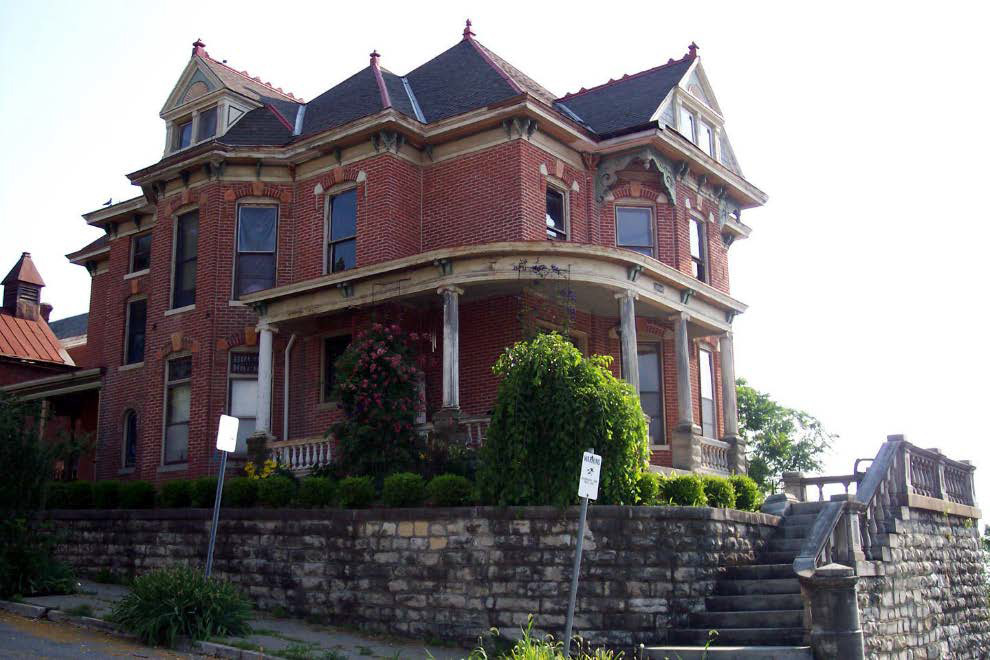
9.4-2.
Multi-Family Lot Type Standards.
|
Building Placement/Parking/
Vehicle Access | Encroachment/Pedestrian Access |
|---|---|
 |  |
|
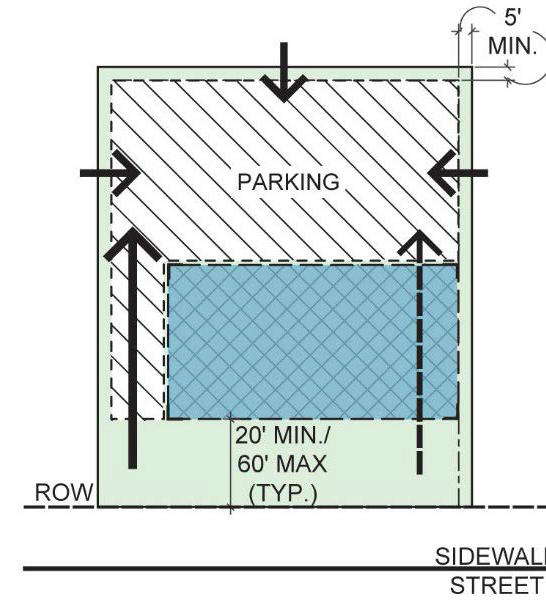
1. Buildings shall be placed on the lot within the zone represented within the hatched
area.
2. In most cases, the front build-to line will be 20'—35' behind street ROW in residential districts. Special site conditions such as topography, pattern of lot widths, or setbacks of existing buildings permit a larger setback. In districts that allow commercial uses and where this building type is allowed, multi-family buildings may be set up to the sidewalk if the sum of the sidewalk and planting strip width are 12' or greater. |
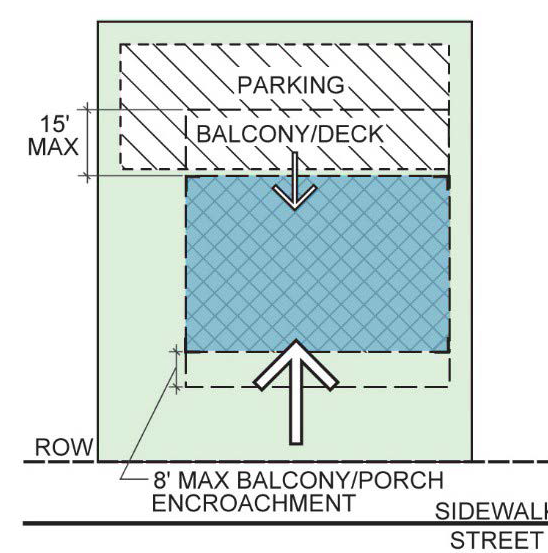
1. For buildings set back from sidewalk, balconies, stoops, stairs, open porches,
bay windows, and awnings are permitted to encroach into setback area up to 8'.
2. Attached decks are permitted to encroach into the rear setback up to 15 feet. 3. For buildings set up to the sidewalk, Balconies and bay windows at an upper level and their supports at ground level are permitted within the sidewalk as shown by the shaded area. Encroachments affixed to the building and horizontally protruding more than 6" from the face of the building must have a minimum 7'6" clearance from the finished grade. |
|
3. Corners: Setback at street corners will generally replicate frontage conditions.
However, side setbacks on a minor street may be less than the front dimension.
4. Within the limits described, side and rear setbacks will vary depending upon buffering requirements. When no buffer is required, a minimum 5' side and rear setback is required. 5. Building façades shall be generally parallel to front property lines. All buildings shall front onto a public street. All ground floor residential units with exterior access shall front a public street, unless specifically exempted by one of the provisions of Article 2. 6. Parking shall be located to the rear of the building, unless there are extenuating circumstances that make it impractical to park in the rear of the building, in which case parking may be permitted to the side. When parking is permitted to the side of the building, the parking area shall comprise no more than 35% of the road frontage and shall be buffered according to the buffering standards in Article 11. 7. Points of permitted access to the parking indicated by arrows. | 4. Main pedestrian access to the building and to individual units is from the street (indicated by larger arrow), unless specifically exempted by one of the provisions of section___. Secondary access may be from parking areas (indicated by smaller arrow). |
|
8. Hedges, garden walls, or knee walls may be built on property lines or as the continuation
of building walls. A garden wall, hedge or knee wall (knee wall should be a min. 2.5'
in height, max 3.5' in height) shall be installed along any street frontage adjacent
to parking areas. Knee walls should be built of brick, stone or other decorative masonry
material, or should be built of wrought iron or other decorative metal and shall generally
match the historic architectural style of Jamestown.
9. Trash containers shall be located in a rear parking area (see Parking Regulations) and shall be screened from the right-of-way per standards set forth in Article 11. 10. Mechanical equipment at ground level shall be placed on the parking lot side of building away from buildings on adjacent sites and shall be screened from view per standards set forth in Article 11. |
9.4-3.
Multi-Family Building Type Standards.
| Permitted Height and Uses | Architectural Standards |
|---|---|
 |
Principles:
A. To perpetuate the unique building character of the Town and its environs, and to re-establish its local identity, development shall generally employ building styles that are compatible with the historic architectural vocabulary of the area in their external treatment (refer to Historical Places in Jamestown, Mary A. Browning, for historic architectural vocabulary). B. The front elevations facing the street, and the overall massing shall communicate an emphasis on the human scale and the pedestrian environment. Buildings in all locations shall relate the principal façade to the sidewalk and public space of the street. C. Each building should be designed to form part of a larger composition of the area in which it is situated. Adjacent buildings should thus be of similar scale, height, and configuration. D. Building silhouettes should be generally consistent. The scale and pitch of roof lines should thus be similar across groups of buildings. |
|
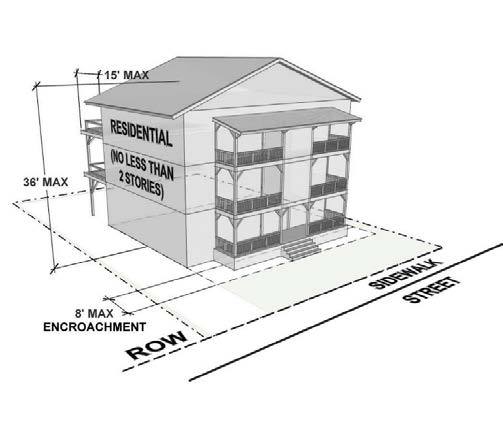
1. For buildings with flat roofs, building height shall be measured as the vertical
distance from the mean elevation of the existing grade to the highest finished roof
surface. The height of parapet walls is not counted in the building height calculations
and may vary depending upon the need to screen mechanical equipment.
2. For buildings with pitched roofs, building heights shall be measured as the vertical distance from the mean elevation of the finished grade to a point representing the midpoint of the peak and eave heights. 3. Building height to the ridge may vary depending on the roof pitch. 4. Permitted uses are indicated above and are further controlled by zoning district standards. | |
| 5. Buildings shall have no less than 2 stories. |
E. Porches should form a predominant motif of building designs and be located on the
front or to the side of the dwelling. When attached to the front, they should extend
over at least 15% of the front façade. All porches should be constructed of materials
in keeping with those of the main building.
F. Front loaded garages, if provided, shall meet the standards of Article 2. G. At a minimum, the Americans with Disabilities Act standards for accessibility shall be met. Configurations: A. Main roofs on multi-family buildings shall be symmetrical gables, hips with a pitch of between 4:12 and 12:12 or flat roofs with a parapet wall. Monopitch (shed) roofs are allowed only if they are attached to the wall of the main building. No monopitch shall be less than 4:12. All accessory buildings shall have roof pitches that conform to those of the main building. B. Balconies should generally be simply supported by posts and beams. The support of cantilevered balconies should be assisted by visible brackets. |
|
C. Two wall materials may be combined horizontally on one façade. The "heavier" material
should be below.
D. Exterior chimneys should be finished in brick or stucco. Techniques: A. Overhanging eaves may expose rafters. B. Flush eaves should be finished by profiled molding or gutters. |
Sec. 9.5. - Civic Building Lot and Building Type.
9.5-1.
Description. Civic buildings are used for purposes that are public in nature (e.g., schools, libraries, government buildings, and churches). These buildings must be designed to take their appropriate places within neighborhoods as integral parts of the community. It is expected that the scale and architectural sophistication of these buildings will match their civic importance. Civic structures should be designed to serve as key focal points in the neighborhood. When located at intersections or other appropriate locations, civic buildings shall be designed to terminate vistas. The intention of buildings in all locations must be to relate the principal façade to the sidewalk and public space of the street. Civic buildings shall not be set back on the lot behind a standard parking lot; however, a plaza may be used for occasional parking and/or passenger drop-off. Large institutions with multiple buildings, such as Guilford Technical Community College, are encouraged to adopt campus master plans. When a campus master plan is adopted and approved by town council, the campus master plan shall take precedence over these regulations.
The photograph below is an example for illustration purposes only and is not intended
to regulate lot/building styles, patterns, or forms.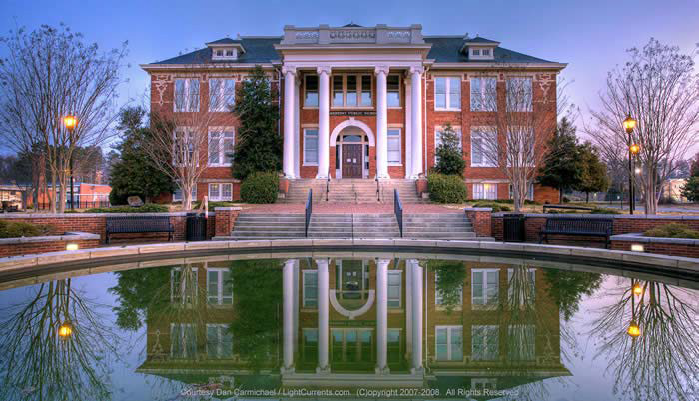
9.5-2.
Civic Building Lot Type.
|
Building Placement/Parking/
Vehicle Access | Encroachment/Pedestrian Access |
|---|---|
 |  |
|
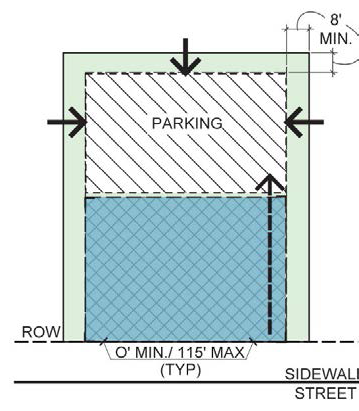
1. Buildings shall be placed on the lot within the zone represented by the hatched
area. In most cases, the build-to line will range from 0' to 115' behind street ROW.
Special site conditions such as topography, lot width, or provision of a green or
plaza will permit a larger building setback.
2. Side and rear setbacks will vary according to side and rear buffer requirements as set forth in Article 11, with a minimum 8-foot setback when no buffer is required. |
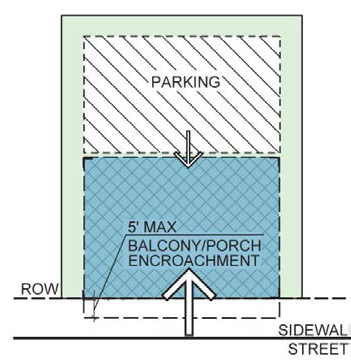
1. Balconies, bay windows, arcades, awnings and porches at an upper level and their
supports at ground level are permitted and encouraged within the sidewalk as shown
by the shaded area. Encroachments affixed to the building and horizontally protruding
more than 6" from the face of the building must have a minimum 7'6" clearance from
the finished grade. Encroaching awnings should cover the entire sidewalk within the
permitted distance shown by the shaded area.
2. For buildings set back from the sidewalk, balconies, stoops stairs, open porches, bay windows, and awnings are permitted to encroach into front setback area up to 8'. |
|
3. Parking shall be located to the rear of the building; sideyard parking shall occupy
no more than 25% of the primary frontage line and shall not be placed in any sideyard
abutting an intersecting street. Where dimensions of existing lots restrict parking
behind buildings, the limitations on sideyard parking may be modified.
4. A planting strip, lawn or defined plaza should be provided to relate the building to the street. 5. Generally, building and street façades must be parallel to frontage property lines. 6. Points of permitted access to the parking indicated by arrows. 7. Hedges, garden walls, or knee walls may be built on property lines or as the continuation of building walls. A garden wall, hedge or knee wall (knee wall should be a min. 2.5' in height, max 3.5' in height) shall be installed along any street frontage adjacent to parking areas. Knee walls should be built of brick, stone or other decorative masonry material, or should be built of wrought iron or other decorative metal and shall generally match the historic architectural style of Jamestown. | 3. Main pedestrian access to the building is from the street (indicated by larger arrow). Secondary access may be from parking areas (indicated by smaller arrow). |
|
8. Parking areas on adjacent lots shall be connected with vehicular and pedestrian
connections wherever practical.
9. Trash containers shall be located in a rear parking area (see Parking Regulations) and shall be screened from the right-of-way per standards set forth in Article 11. 10. Mechanical equipment at ground level shall be placed on the parking lot side of building away from buildings on adjacent sites and shall be screened from view per standards set forth in Article 11. |
9.5-3.
Building Type/Civic Building.
| Permitted Height and Uses | Architectural Standards |
|---|---|
 |
Principles:
A. To perpetuate the unique building character of the Town and its environs, and to re-establish its local identity, development shall generally employ building styles that are compatible with the historic architectural vocabulary of the area in their external treatment (refer to Historical Places in Jamestown, Mary A. Browning, for historic architectural vocabulary). B. Building elevations fronting or visible from public streets shall be clad with masonry, wood, stucco, or similar material. Vinyl siding shall not comprise a street fronting building face. C. The front elevations facing the street, and the overall massing shall communicate an emphasis on the human scale and the pedestrian environment. D. Each building should be designed to form part of a larger composition of the area in which it is situated. Adjacent buildings should thus be of similar scale, height, and configuration. |
|
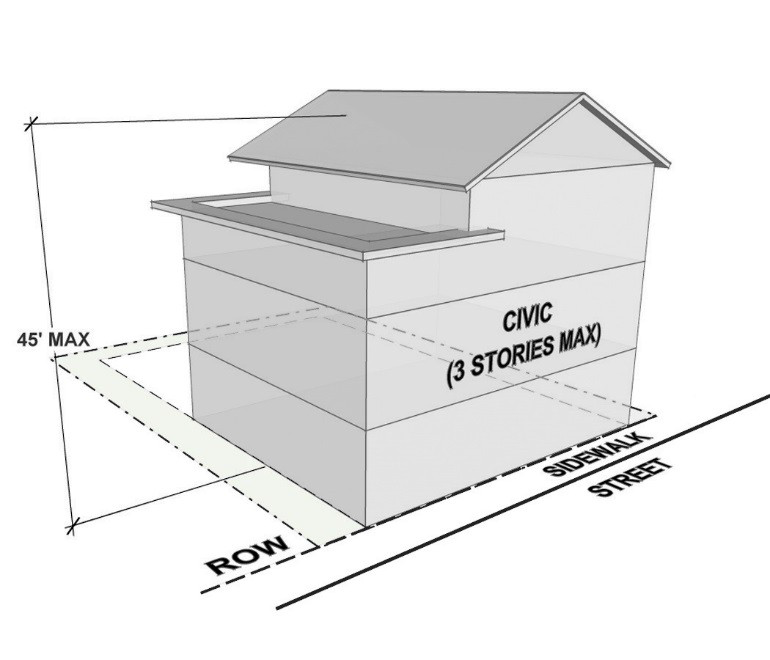
1. For buildings with flat roofs, building height shall be measured as the vertical
distance from the mean elevation of the existing grade to the highest finished roof
surface. The height of parapet walls is not counted in the building height calculations
and may vary depending upon the need to screen mechanical equipment.
2. For buildings with pitched roofs, building heights shall be measured as the vertical distance from the mean elevation of the finished grade to a point representing the midpoint of the peak and eave heights. 3. Building height to the ridge may vary depending on the roof pitch. | |
|
4. Permitted uses are indicated in the above graphic and are further controlled by
zoning district standards.
5. Buildings shall have a maximum height of 60 feet. |
E. Schools, churches, and government buildings shall be built so that they terminate
a street vista whenever possible, and shall be of sufficient design quality to create
visual anchors for the community and serve as focal points for the neighborhood.
Configurations: A. Two wall materials may be combined horizontally on one façade. The "heavier" material should be below the "lighter" material and the "heavier" material can cover the first floor only (i.e., brick below wood siding). B. Street level windows should be untinted. Tinted glass with a minimum visual transmittance factor of 35 is permitted. Mirrored or reflective glass is not permitted in any location. Clear textured glass is allowed in restrooms with windows. Stained glass or decorative art glass is permitted. C. Windows shall be of square or vertical proportion. Special windows may be circular or regular polygons. D. Flat roof lines are allowed. |
|
Techniques:
A. A. Windows should be set to the inside of the building face wall. B. All rooftop equipment shall be screened from view from public rights-of-way by a building material that matches the structure or is visually compatible with the structure. The screening apparatus should be incorporated as part of the architectural theme. |
Sec. 9.6. - Shopfront Commercial Lot and Building Type.
9.6-1.
Description. The shopfront building is a small-scale structure that can accommodate a variety of uses. The structure is typically a maximum of 15,000 square feet. A group of shopfront buildings can be combined to form a mixed-use neighborhood center. Individual shopfront buildings can be used to provide some commercial service, such as a convenience store or restaurant, in close proximity to homes. Traditional commercial buildings in historic southern towns provide good examples. Hotels, inns, and conference centers may be placed in shopfront or mixed-use buildings. Structures shall be designed to encourage pedestrian activity and interest. When located at the end of a block or other appropriate location, structures shall be designed to terminate vistas.
The photograph below is an example for illustration purposes only and is not intended
to regulate lot/building styles, patterns, or forms.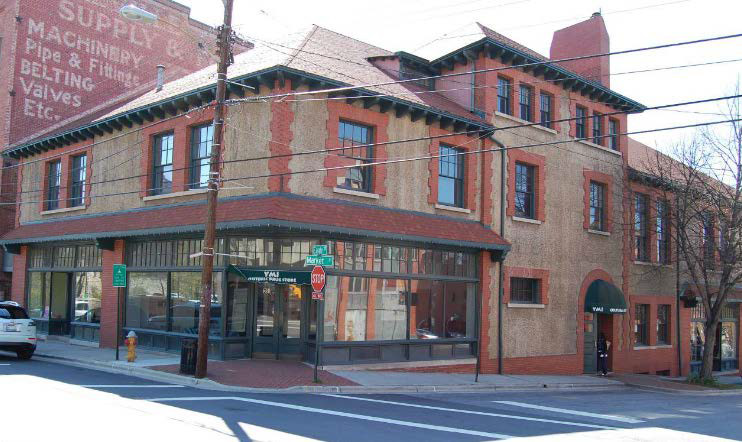
9.6-2.
Shopfront Lot Type.
|
Building Placement/Parking/
Vehicle Access | Encroachment/Pedestrian Access to Building |
|---|---|
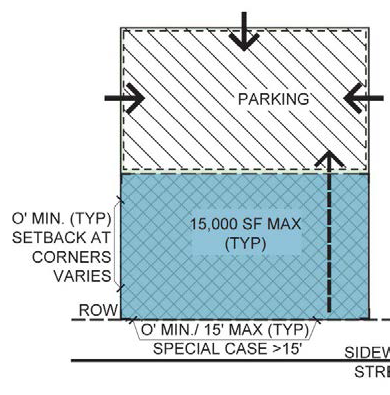 |  |
| 1. Buildings shall be placed on the lot within the zone represented by the hatched area. In most cases, the build-to line will range from 0' to 15' behind the street ROW. Within the limits described above, front setbacks will vary depending upon site conditions. Special site conditions such as topography, pattern of lot widths, or setbacks of existing buildings on the same block permit a larger setback. Setbacks should be used in a manner that encourages pedestrian activity. For example, squares or spatially defined plazas within building setback areas can act as focal points for pedestrians. |
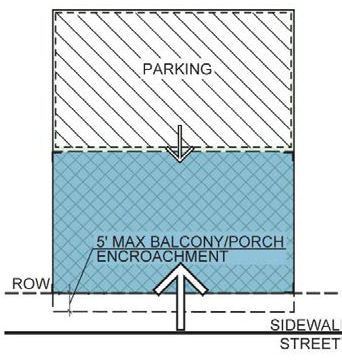
1. Balconies, bay windows, arcades, awnings and porches at an upper level and their
supports at ground level are permitted and encouraged within the sidewalk as shown
by the shaded area. Encroachments affixed to the building and horizontally protruding
more than 6" from the face of the building must have a minimum 7'6" clearance from
the finished grade. Encroaching awnings should cover the entire sidewalk within the
permitted distance shown by the shaded area.
2. Primary pedestrian access into the building shall be from the street frontage line (indicated by larger arrow). Secondary access may be from parking areas (indicated by smaller arrows). |
|
Corners: Setback at street corners will generally replicate frontage conditions. Side
setbacks on a minor street may be less than the front dimension.
2. Side and rear setbacks will vary according to side and rear buffer requirements as set forth in Article 11, with a minimum 0-foot setback when no buffer is required. 3. Building façades shall be generally parallel to frontage property lines. Buildings in all locations should relate the principal façade to the sidewalk and public space of the street. 4. Parking shall be located primarily to the rear of the building; sideyard parking shall occupy no more than 25% of the primary frontage line and shall not be placed in any sideyard abutting an intersecting street. Where dimensions of existing lots restrict parking behind buildings, the limitations on parking may be modified by TRC using "equal or better" performance standards. 5. Points of permitted access to the parking indicated by arrows. | |
|
6. Hedges, garden walls, or knee walls may be built on property lines or as the continuation
of building walls. A garden wall, hedge or knee wall (knee wall should be a min. 2.5'
in height, max 3.5' in height) shall be installed along any street frontage adjacent
to parking areas. Knee walls should be built of brick, stone or other decorative masonry
material, or should be built of wrought iron or other decorative metal and shall generally
match the historic architectural style of Jamestown.
7. Parking areas on adjacent lots shall be connected with vehicular and pedestrian connections wherever practical. 8. Trash containers shall be located in a rear parking area (see Parking Regulations, Article 12) and shall be screened from the right-of-way. 9. Mechanical equipment at ground level shall be placed on the parking lot side of building away from buildings on adjacent sites and shall be screened from view by an opaque screen or fence. | |
| 10. Building façades at street frontage lines shall be pedestrian oriented and of pedestrian scale. The building's design shall promote pedestrian activity and pedestrian-driven commerce. The sidewalk shall be an extension of the street level businesses' operations. As such, pedestrians should be able to preview businesses' merchandise and/or dine from the sidewalk (Business activities shall not impede on the required pedestrian travel widths and shall not encroach more than 5 feet into the sidewalk). |
9.6-3.
Shopfront Building Type.
| Permitted Height and Uses | Architectural Standards |
|---|---|
 |
Principles:
A. To perpetuate the unique building character of the Town and its environs, and to re-establish its local identity, development shall generally employ building styles that are compatible with the historic architectural vocabulary of the area in their external treatment (refer to Historical Places in Jamestown, Mary A. Browning, for historic architectural vocabulary). B. Building elevations fronting or visible from public streets shall be clad with masonry, wood, stucco, or similar material. Vinyl siding shall not comprise a street fronting building face. C. The front elevations facing the street, and the overall massing shall communicate an emphasis on the human scale and the pedestrian environment. D. Each building should be designed to form part of a larger composition of the area in which it is situated. Adjacent buildings should thus be of similar scale, height, and configuration. E. Drive-through customer services, if permitted in the district, must be located at the rear of the building or on a side which does not abut a street. F. Trailers (mobile units) may not be used as permanent workplace buildings. |
|
1. For buildings with flat roofs, building height shall be measured as the vertical
distance from the mean elevation of the existing grade to the highest finished roof
surface. The height of parapet walls is not counted in the building height calculations
and may vary depending upon the need to screen mechanical equipment.
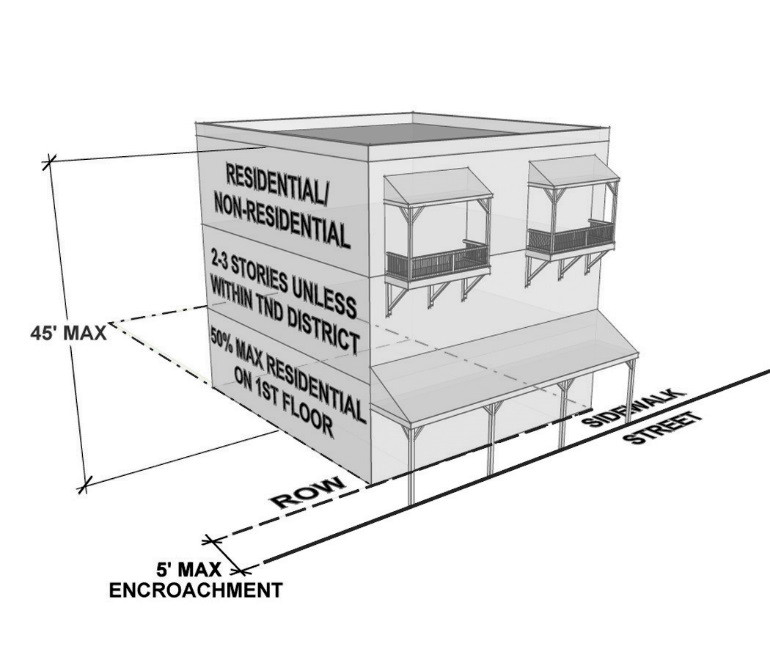
2. For buildings with pitched roofs, building heights shall be measures as the vertical distance from the mean elevation of the finished grade to a point representing the midpoint of the peak and eave heights. 3. Building height to the ridge may vary depending on the roof pitch. 4. Permitted uses are indicated in the above graphic and are further controlled by zoning district standards. | |
| 5. Most shopfront buildings will have mixed-uses within the same footprint and, as such, should exhibit a vertical component. Buildings should have no less than 2 stories, but exceptions may be made by TRC using an "equal or better" performance standard. TRC shall take into account any existing architecture in buildings located within a 250' radius around the subject parcel. Buildings shall have no more than 3 stories, unless the building is in a TND district, in which case the maximum number of stories is not regulated (note: maximum height still applies). |
Configurations:
A. Two wall materials may be combined horizontally on one façade. The "heavier" material should be below the "lighter" material and the "heavier" material can cover the first floor only (i.e., brick below wood siding). B. Street level windows shall be untinted. Tinted glass with a minimum visual transmittance factor of 35 is permitted. Mirrored or reflective glass is not permitted in any location. C. Windows shall be of square or vertical proportion. Special windows may be circular or regular polygons. Techniques: A. Windows should be set to the inside of the building face wall. B. All rooftop equipment shall be screened from view from public rights-of-way by a building material that matches the structure or is visually compatible with the structure. The screening apparatus should be incorporated as part of the architectural theme. |
Sec. 9.7. - Urban Workplace Lot and Building Type.
9.7-1.
Description. The urban workplace building may be a large structure (15,000+ square feet) and can have one or multiple tenants. Office, light industrial, and commercial tenants are typical. Southern mill villages often provide examples of how these buildings can reasonably coexist with other businesses and homes. These buildings serve as employment centers and commercial service locations. The buildings will provide space for industry and large offices, as well as hotels, conference facilities, and large retail uses such as a full-service grocery store. Structures shall be designed to serve as key focal points and to establish the design template for the area. When located at the end of a block or other appropriate location, structures shall be designed to terminate vistas.
The photograph below is an example for illustration purposes only and is not intended
to regulate lot/building styles, patterns, or forms.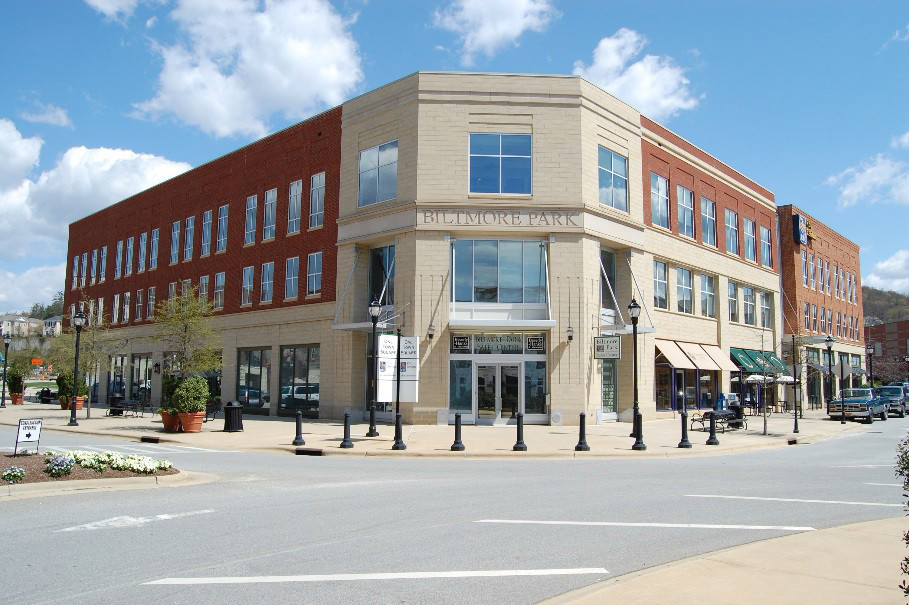
9.7-2.
Urban Workplace Lot Type.
|
Building Placement/Parking/
Vehicle Access | Encroachment/Pedestrian Access to Building |
|---|---|
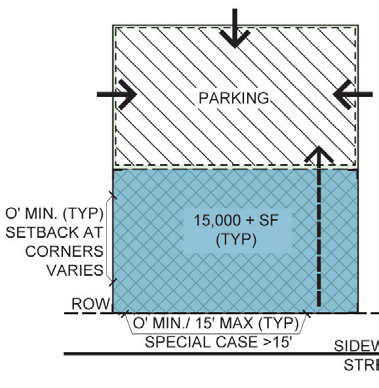 |  |
| 1. Buildings shall be placed on the lot within the zone represented by the hatched area. In most cases, the build-to line will range from 0' to 15' behind the street ROW. Within the limits described above, front setbacks will vary depending upon site conditions. Special site conditions such as topography, pattern of lot widths, or setbacks of existing buildings on the same block permit a larger setback. Setbacks should be used in a manner that encourages pedestrian activity. For example, squares or spatially defined plazas within building setback areas can act as focal points for pedestrians. |
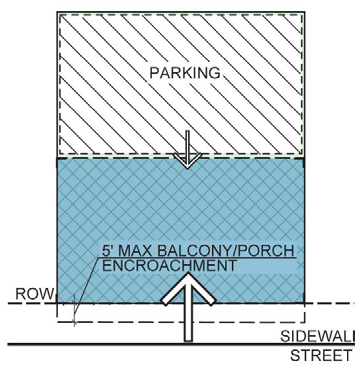
1. Balconies, bay windows, arcades, awnings and porches at an upper level and their
supports at ground level are permitted and encouraged within the sidewalk as shown
by the shaded area. Encroachments affixed to the building and horizontally protruding
more than 6" from the face of the building must have a minimum 7'6" clearance from
the finished grade. Encroaching awnings should cover the entire sidewalk within the
permitted distance shown by the shaded area.
2. Primary pedestrian access into the building shall be from the street frontage line (indicated by larger arrow). Secondary access may be from parking areas (indicated by smaller arrows). |
|
Corners: Setback at street corners will generally replicate frontage conditions. Side
setbacks on a minor street may be less than the front dimension.
2. Side and rear setbacks will vary according to side and rear buffer requirements as set forth in Article 11, with a minimum 0-foot setback when no buffer is required. 3. Front and rear building façades shall be generally parallel to frontage property lines. The façade shall be determined by the massing of the building. Buildings in all locations should relate the principal façade to the sidewalk and public space of the street. 4. Parking shall be located primarily to the rear of the building; sideyard parking shall occupy no more than 35% of the primary frontage line and shall not be placed in any sideyard abutting an intersecting street. Where dimensions of existing lots restrict parking behind buildings, the limitations on sideyard parking may be modified. 5. Points of permitted access to the parking indicated by arrows. | |
|
6. Hedges, garden walls, or knee walls may be built on property lines or as the continuation
of building walls. A garden wall, hedge or knee wall (knee wall should be a min. 2.5'
in height, max 3.5' in height) shall be installed along any street frontage adjacent
to parking areas. Knee walls should be built of brick, stone or other decorative masonry
material, or should be built of wrought iron or other decorative metal and shall generally
match the historic architectural style of Jamestown.
7. Parking areas on adjacent lots shall be connected with vehicular and pedestrian connections wherever practical. 8. Trash containers shall be located in a rear parking area (see Parking Regulations, Article 12) and shall be screened from the right-of-way per standards set forth in Article 11. 9. Mechanical equipment at ground level shall be placed on the parking lot side of building away from buildings on adjacent sites and shall be screened from view per standards set forth in Article 11. | |
| 10. Building façades at street frontage lines shall be pedestrian oriented and of pedestrian scale. The building's design shall promote pedestrian activity and pedestrian-driven commerce. The sidewalk shall be an extension of the street level businesses' operations. As such, pedestrians should be able to preview businesses' merchandise and/or dine from the sidewalk (Business activities shall not impede on the required pedestrian travel widths and shall not encroach more than 5 feet into the sidewalk unless curb bulb-outs and/or other alternatives for pedestrian travel can be identified and constructed). |
9.7-3.
Urban Workplace Building Type.
| Permitted Height and Uses | Architectural Standards |
|---|---|
 |
Principles:
A. To perpetuate the unique building character of the Town and its environs, and to re-establish its local identity, development shall generally employ building styles that are compatible with the historic architectural vocabulary of the area in their external treatment (refer to Historical Places in Jamestown, Mary A. Browning, for historic architectural vocabulary). B. Building elevations fronting or visible from public streets shall be clad with masonry, wood, stucco, or similar material. Vinyl siding shall not comprise a street fronting building face. C. The front elevations facing the street, and the overall massing shall communicate an emphasis on the human scale and the pedestrian environment. D. Each building should be designed to form part of a larger composition of the area in which it is situated. Adjacent buildings should thus be of similar scale, height, and configuration. E. Drive-through customer services, if permitted in the district, must be located at the rear of the building or on a side which does not abut a street. F. Trailers (mobile units) may not be used as permanent workplace buildings. |
|
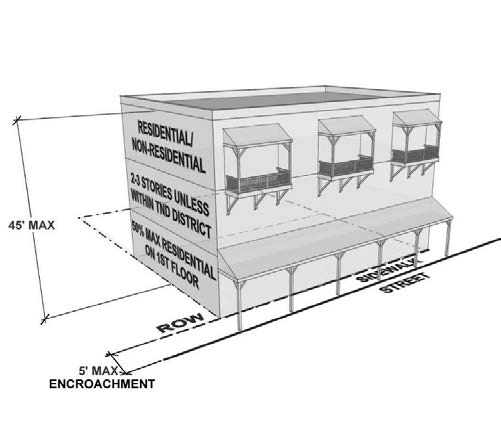
1. For buildings with flat roofs, building height shall be measured as the vertical
distance from the mean elevation of the existing grade to the highest finished roof
surface. The height of parapet walls is not counted in the building height calculations
and may vary depending upon the need to screen mechanical equipment.
2. For buildings with pitched roofs, building heights shall be measures as the vertical distance from the mean elevation of the finished grade to a point representing the midpoint of the peak and eave heights. 3. Building height to the ridge may vary depending on the roof pitch. 4. Permitted uses are indicated in the above graphic and are further controlled by zoning district standards. | |
| 5. Buildings shall have no less than 2 stories. Buildings shall have no more than 3 stories, unless the building is in a TND district, in which case the maximum number of stories is not regulated (note: maximum height still applies). |
Configurations:
A. Two wall materials may be combined horizontally on one façade. The "heavier" material should be below the "lighter" material and the "heavier" material can cover the first floor only (i.e., brick below wood siding). B. Street level windows shall be untinted. Tinted glass with a minimum visual transmittance factor of 35 is permitted. Mirrored or reflective glass is not permitted in any location. C. Windows shall be of square or vertical proportion. Special windows may be circular or regular polygons. Techniques: A. Windows should be set to the inside of the building face wall. B. All rooftop equipment shall be screened from view from public right-of-ways by a building material that matches the structure or is visually compatible with the structure. The screening apparatus should be incorporated as part of the architectural theme. |
Sec. 9.8. - Highway Lot Type and Building Type Standards.
9.8-1.
Description. This building type generally comprises fast food retail, drive through banks, motels, industry, and other highway dependent uses.
These regulations are designed to bring these building types into a framework of town streets and provide for an aesthetically pleasing suburban environment. Structures should be designed to present an interesting and uniquely Jamestown design to the passing motorist.
Access shall be designed to not impede safe traffic movement.
The photograph below is an example for illustration purposes only and is not intended
to regulate lot/building styles, patterns, or forms.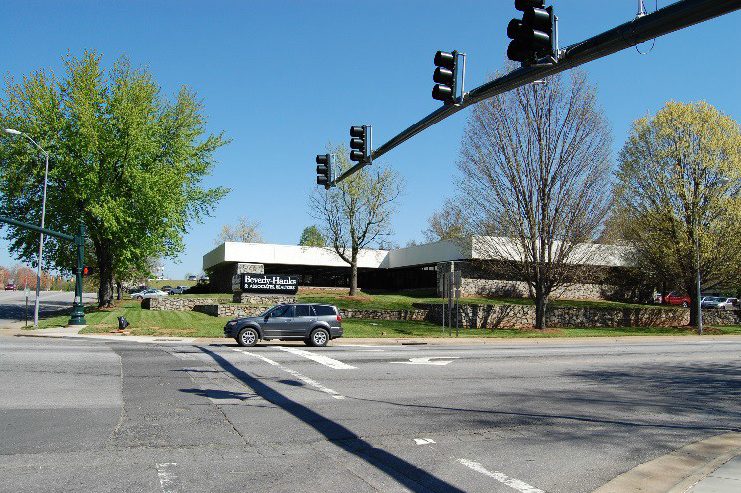
9.8-2.
Highway Lot Type Standards.
|
Building Placement/Parking/
Vehicle Access | Vehicular Circulation/Pedestrian Access |
|---|---|
 |  |
|
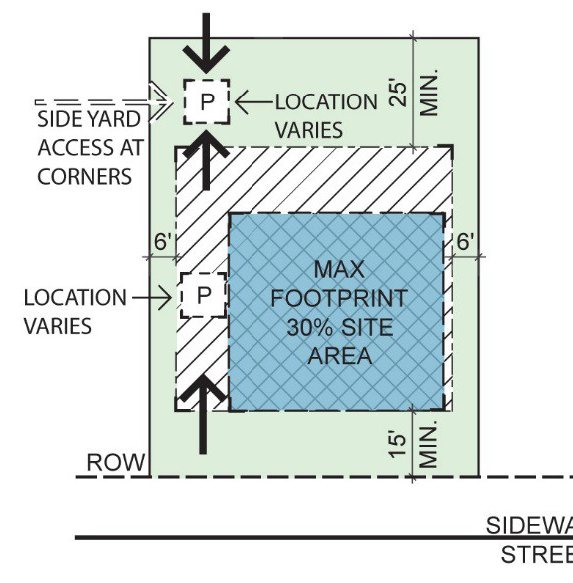
1. Buildings shall be placed on the lot within the zone represented by the hatched
area. In most cases, the build-to line will be 20' to 60' behind street ROW.
Special site conditions such as topography, pattern of lot widths, or setbacks of existing buildings on the same street within 500 feet of the proposed building may permit a larger setback. 2. Side and rear setbacks will vary according to side and rear buffer requirements as set forth in Article 11, with a minimum 5-foot setback when no buffer is required. 3. Building façades shall be generally parallel to frontage property lines. |
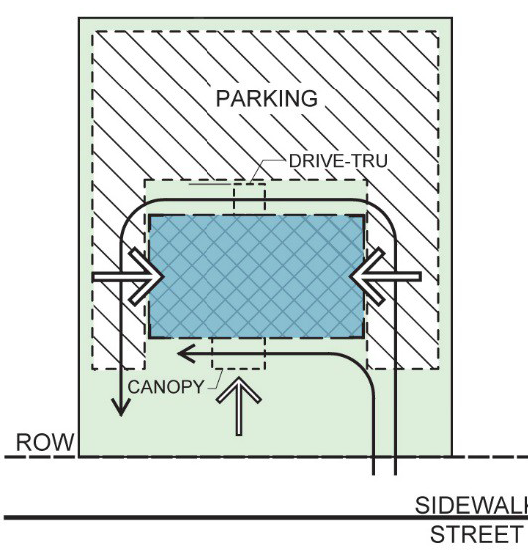
1. Main pedestrian access to the building may be from the side (indicated by the larger
arrows) and shall not be from the rear. If the primary pedestrian access is from the
side of the building, secondary pedestrian access must be from the front (indicated
by the smaller arrow). However, primary pedestrian access to the building may be from
the front.
2. Drive-throughs, gasoline and fuel pumps, and auto-oriented service facilities shall be located to the rear of the building. 3. Entrance canopies (for motels, etc.) shall be oriented towards the primary street. 4. Typical vehicular circulation movement is indicated by thin line arrows. |
|
4. Parking shall be located to the rear and/or side of the building. Sideyard parking
may occupy no more than 35% of the principal frontage line and shall be buffered from
the street according to the buffer requirements as set forth in Article 11. Parking shall not be placed in any sideyard abutting an intersecting street. Where
dimensions of existing lots restrict parking behind buildings, the limitations on
sideyard parking may be modified.
5. Points of permitted access to the parking indicated by arrows. 6. Hedges, garden walls, or knee walls may be built on property lines or as the continuation of building walls. A garden wall, hedge or knee wall (knee wall should be a min. 2.5' in height, max 3.5' in height) shall be installed along any street frontage adjacent to parking areas. Knee walls should be built of brick, stone or other decorative masonry material, or should be built of wrought iron or other decorative metal, and shall generally match the historic architectural style of Jamestown. 7. Parking areas on adjacent lots shall be connected with vehicular and pedestrian connections wherever practical. | |
|
8. Trash containers shall be located in the rear parking area and shall be screened
from the right-of-way per standards set forth in section Article 11.
9. Mechanical equipment at ground level shall be placed on the parking lot side of building away from buildings on adjacent sites and shall be screened from view per standards set forth in Article 11. |
9.8-3.
Highway Building Type Standards.

