
Jamestown City Zoning Code
ARTICLE 21
OPEN SPACE
Sec. 21.1.- Purpose.
The open space standards contained herein are established to provide for the reservation of open spaces in both residential and non-residential developments located in the Town of Jamestown and its area of jurisdiction. Preservation of open space in developing areas serves a variety of purposes, including meeting the recreational needs of residents, improving the aesthetic character of the community, reducing stormwater runoff, and enhancing air quality. The standards set forth below establish regulations for open space in residential and non-residential developments.
Sec. 21.2. - Open Space.
Although open space can be agricultural or natural in character, open space is typically planned and developed as part of a residential or non-residential development. The following standards are hereby established for open space, with the exception of The Main Street District, which shall be exempt from the requirements of this section.
21.2-1.
Open Space Land Area Requirements. Open space shall be provided in accordance with the following table for:
(A)
Initial residential development containing eight or more units.
(B)
Redevelopment or additional development that adds eight or more units.
(C)
Initial nonresidential or mixed-use development.
(D)
Redevelopment or additional development that adds 25 percent more nonresidential or mixed-use floor area.
21.2-2.
Land Designated As Future Open Space. Regardless of the requirements and exemptions of this subsection, any portion of the site of the proposed development that is designated as future open space or greenway in any official plan adopted by the Town of Jamestown shall be reserved for open space. This area may be counted toward the total amount of open space required for the development.
If the total amount of land required to comply with the area designated as future open space or greenway is less than the total amount of open space required for the development by the above table, then the developer shall provide additional open space to meet the requirement of the above table. If the amount of land designated as future open space or greenway exceeds the total amount of open space required by the above table, then the developer must still provide the open space designated in the official adopted plan.
As compensation for any open space dedication associated with implementing any official adopted plan above that requirement listed in the above table, the developer is eligible for a density bonus of one dwelling unit per each 1,000 square feet of land area in excess of that required in the above table or 500 square feet of nonresidential gross floor area per each 1,000 square feet of land area in excess of that required in the above table, up to a maximum of a 25 percent increase above the maximum density or intensity allowed in the applicable zoning district.
All other regulations, such as erosion control and watershed requirements, shall be complied with when using the density bonus provision of this section.
21.2-3.
Minimum Open Space Area. Individual areas designated as open space areas shall not contain less than 500 square feet, although smaller areas may be approved by the planning director if the intent of this ordinance is determined to be met.
21.2-4.
Improvement of Open Space. With the exception of Natural and Agricultural Open Space, open space shall be planned and improved, accessible and usable by persons living nearby. Improved shall mean cleared of underbrush and debris and may contain one or more of the following improvements: landscaping, walls, fences, walks, statues, fountains, ball fields, and/or playground equipment. Walls and fences shall be made of brick, stone, wrought iron, or wood and shall not exceed three and one-half feet in height. (Exceptions: fences used in conjunction with ball fields).
21.2-5.
Design and Location. In major subdivisions and multi-building developments in all zoning districts except Agricultural, open space shall be integrated into the design of the site. In subdivisions where 50 percent or more of the lots are less than one acre in size, open space shall be located within one-quarter mile of at least 90 percent of the building lots, as measured along the rights-of-way of streets providing access between the two. In subdivisions where 50 percent or more of the lots are one acre or more in size, open space shall be located within one-half mile of at least 90 percent of the building lots, as measured along the rights-of-way of streets providing access between the two.
21.2-6.
Focal Point. Open space features should provide focal points for the neighborhood. A central square or green, for example, may comprise a majority of the open space. There should be a hierarchy of open space within new neighborhoods so that open space serves the needs of multiple age groups.
21.2-7.
Types of Open Space. Open space types include squares, parks, forecourts, plazas, greenways, and natural and agricultural. Standards for these open space types are set forth below:
(A)
Squares.
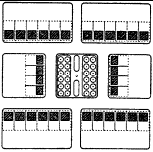
Squares are areas for passive recreational use. Squares shall be bounded by streets on a minimum of three sides or 75 percent of their perimeter.
Squares should be used in tight urban environments where residents have little yard space. Squares are used to bring a more natural landscape into an urban environment. As such, not more than 25 percent of a square should be impervious surface coverage. Hardscaping should be decorative, (example brick pavers instead of asphalt for walkways).
Minimum size: 500 sq. feet
Maximum Size: ½ acre
(B)
Parks.
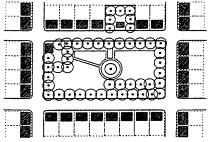
Parks are areas for passive or active recreational use. Parks should be bounded by streets on a minimum of two sides or 50 percent of their perimeter.
Minimum Size: ¼ acre
Maximum Size: three Acres. Maximum size may exceed three acres if the park serves
multiple neighborhoods or preserves environmental features.
Parks should be areas where passive and active recreation occur simultaneously (example: park benches for elderly and a tot-lot for young children), encouraging intergenerational interactions among park users.
(C)
Forecourt.
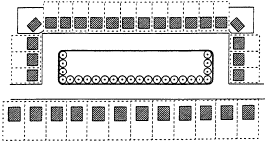
Forecourts are open spaces that act as buffers between residential buildings and streets or non-residential buildings. Forecourts are entirely bounded by buildings or streets. It is recommended that forecourts be planted parallel to all street rights-of-way.
Minimum Size: 500 square feet
Maximum Size: ¼ acre
(D)
Plaza.
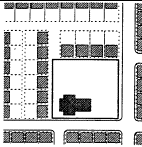
A plaza is an open area adjacent to a civic or commercial building. Plazas should be planted with deciduous trees to provide shade in the summer (example: the N.C. State Capital Building lawn in Raleigh, NC). Plazas function as gathering places and may incorporate a variety of non-permanent activities such as outdoor farmers markets or craft fairs. Limited parking is permissible on plazas. Plazas should match the architectural style of the buildings that they are adjacent to regarding materials and design. Plazas shall be level or gently sloping.
Minimum Size: 2000 square feet
Maximum Size - ¾ acre
(E)
Greenways.
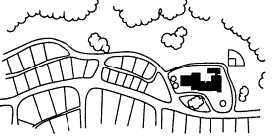
Greenways are spaces designed to incorporate natural settings such as creeks and significant stands of trees within a neighborhood.
Greenways should have streets or pedestrian ROWs parallel to or integrated into at least 75 percent of their length. Greenways are used for walking, jogging, biking, and they are used as wildlife corridors. Greenways may have infrequent small-scale active recreational facilities such as playgrounds, although the majority of greenways should be for passive recreation.
(F)
Natural and Agricultural Open Space.
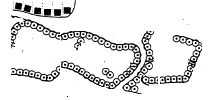
Natural and agricultural open space preserves agricultural lands, environmentally sensitive areas, scenic views, cultural features, and rural character that would likely be lost through conventional development approaches. To accomplish this goal, the Town of Jamestown encourages creativity and allows for greater flexibility in the design of developments through use of the Cluster Development Overlay District (Article 8).
Natural and agricultural open space shall be placed in preserves, which may adjoin housing areas that have been designed more compactly to create larger areas that may be enjoyed equally by all residents of the development.
21.2-8.
Open Space Ownership and Conservation Easement. Open space may be owned or administered by one or a combination of the following methods: fee simple ownership by a unit of government or private non-profit land conservancy; owned by a homeowners' association; or by individual private ownership such as a farmer, developer or other private entity that maintains the open space (i.e., farming, equestrian facility, etc.).
All lands within areas required to be maintained as open space shall be protected by a permanent conservation easement, prohibiting further development, and setting other standards safeguarding the site's special resources from negative changes.
Public use of the open space may be limited to residents of the development except for land used for public sidewalks and multi-use trails.
21.2-9.
Maintenance. The owner or lessee of the property designated as the open space shall be responsible for the maintenance of the open space area. Landscaped areas shall be maintained in good condition and the entire area shall be kept clear of debris. Failure to maintain the area shall constitute a violation of this ordinance and subject the violator to the penalty provisions of Article 23 if not corrected within 30 days of notification. Alternatively, if acceptable to the Town, as applicable, the land may be dedicated to the city for public use and thereafter maintained by the Town.
21.2-10.
Land Acceptable for Open Space Designation. The classes of land enumerated below may be utilized to meet the requirements of this section:
(A)
Open water, wetlands, and undisturbed floodplains may account for up to 50 percent of the requirement.
(B)
Land used for public sidewalks significantly in excess of standard sidewalk requirements, streetscape and hardscape areas accessible to the public including sidewalk cafe areas, areas containing public art, and similar urban open space amenities.
(C)
Land on which locally or nationally designated historic structures are located and determined to be contributing to the designation.
(D)
Land which exceeds a ten percent slope may be used to provide up to 50 percent of the required open space if existing slopes and vegetation so designated remain undisturbed.
(E)
Land used for stormwater retention, provided such land is natural in appearance and is not separately fenced, may be used for up to 50 percent of the required open space; green roofs are eligible to be counted as open space under this provision. Additionally, land used for stormwater retention, provided such land is natural in appearance and is not separately fenced, that is developed using best management practices (e.g., constructed wetlands, rain gardens, green roofs or similar features), and either exceeds the required amount of retention or treats off-site stormwater may be used for up to 100 percent of the required open space at the discretion of the planning director after consultation with the public works director.
(F)
Land available to residents or tenants for active or passive recreation, including parks, walking trails not used to meet sidewalk requirements, playgrounds, benches, picnic tables, and similar land uses or facilities.
(G)
Land that is suitable for agriculture, land that has environmentally sensitive areas (e.g., mature trees), or land that has cultural significance (e.g., important view such as a rural entrance into Town).
21.2-11.
Land Not Acceptable for Open Space Designation. The classes of land enumerated below shall not be utilized to meet the requirements of this section:
(A)
Land that is contaminated with hazardous or toxic waste or materials as defined by state or federal regulations, with the exception of land covered by an approved mitigation plan and deemed acceptable to the Town or land that is designated in an officially adopted open space or greenway master plan.
(B)
Land occupied by streets, drives, parking areas, required landscape buffers, or structures other than recreational structures.
(C)
Land with a minimum width less than 24 feet unless part of a greenway system or specifically approved by the planning director. Mixed use developments in the TND district are exempt from the minimum width requirement.
Sec. 21.3. - Fee-in-Lieu.
For open space requirements of 5,000 or less square feet in area and not involving property designated as a greenway on any official plan adopted by the Town of Jamestown, a property owner may elect to pay a fee-in-lieu of open space instead of providing the open space provided that the planning director deems that there is reasonable existing or future open space proximate to the subject parcel. For other required open space areas, a property owner may pay a fee-in-lieu of open space designation for all or a portion of the open space requirement if such fee-in-lieu is acceptable to the Town. For developments and subdivisions containing more than 50 residential units, the fee-in-lieu option may only be used for up to 50 percent of the open space requirements in order to ensure that these larger projects provide on-site open space for their residents.
This fee shall be calculated by using the pro rata value of the designated property relative to the value of the entire site to be developed using tax appraisal data; for properties covered by agricultural or other exemptions, the Town may utilize a separate appraisal method in its sole discretion. Funds collected in this manner shall be maintained in a separate account and shall be used to purchase or to enhance recreational use of property provided such features are reasonably proximate to the site(s) from which the funds are collected. Where practical, the collected fees for each project shall be designated for specific parks and recreation acquisitions and/or enhancements by the Town.

