
Jamestown City Zoning Code
ARTICLE 2
GENERAL PROVISIONS
Sec. 2.1.- General Requirements.
Upon the adoption of this ordinance, no structure shall be erected nor use established in conflict with:
•
The district regulations of Article 8,
•
The building and lot regulations of Article 9,
•
The street regulations of Article 13,
•
The off-street parking regulations of Article 12,
•
The landscape regulations of Article 11, the open space regulations of Article 21,
•
The general provisions of Article 2, or
•
The sign regulations of Article 17.
Sec. 2.2. - Street Frontage Required.
Any lot on which a building (or buildings) is to be erected or use is to be established shall abut a public street with the following exceptions:
•
Any lot for which a residential use has been legally established prior to the effective date of this ordinance provided the lot is served by a private and exclusive recorded easement of at least 15 feet in width connecting said lot to a public street, may be used as if it abutted a street, provided that it is served by a driveway located on said easement. A driveway accessible by emergency equipment must be located on said easement. Lots created under these provisions shall be known as "easement-access lots."
•
Any lot for which a non-residential use has been legally established prior to the effective date of this ordinance, provided the lot is served by a private, exclusive recorded easement of at least 15 feet in width connecting said lot to a public street, may be construed in the same manner as a lot abutting a street provided that it is served with a driveway built to appropriate standards located on the permanent, recorded easement.
•
Up to four residential lots may be served by a private street meeting the standards for private streets set forth in article the Town of Jamestown Standards and Specifications Manual.
•
A site-specific development plan may be considered for approval in the Main Street, Main Street Periphery, Residential/Main Street Transitional, TND Overlay, Cluster Development Overlay, or Campus Overlay districts where residential and/or non-residential lots and/or structures front upon a private courtyard, carriageway, mid-block private alleyway with courtyard, or pedestrian way, or urban open space as defined in Article 3, where adequate access by emergency vehicles is maintained by way of a street or alley and where the off-street placement of uses does not diminish the orientation of building fronts to the public street.
•
A site-specific development plan may be considered for approval in the Civic and Campus Overlay Districts to permit interior lot access by private drives so long as business and emergency access is furnished to all interior building sites and proposed buildings at the perimeter of the development front upon a public street or are buffered in accordance with this ordinance. Subdivisions should be primarily served by public streets and use of private drives should be minimal. Private drives may be appropriate where property configuration or environmental constraints make their use a practical alternative. Private drives serving uses in the Civic and Campus Overlay Districts shall be constructed in accordance with the standards for commercial streets as found in the Town of Jamestown Standards and Specifications Manual and sidewalks shall be provided on at least one side of the private drive.
•
To access a lot or lots in the Commercial or Bypass District, where factors beyond developer control, such as a limited-access highway, an existing development, or the location of an existing intersection, prohibit completing a street connection, a private drive may be substituted for the interior street which cannot be connected to the public network.
Sec. 2.3. - One Principal Building on a Lot; Exceptions.
Only one principal building and its customary accessory building(s) may be erected on any lot, except that multiple buildings which, taken together, compose a single principal use may be erected on a single lot as permitted by the district regulations and described by building and lot type.
Sec. 2.4. - Lot Size.
No lot, even though it may consist of one or more adjacent lots of record, shall be reduced in size such that the requirements for building and lot type cannot be met, or the standards for the spacing of structures and street frontage cannot be respected. This prohibition shall not be construed to prevent the purchase, dedication, or condemnation of narrow strips of land for public utilities or street or sidewalk right-of-way purposes.
Sec. 2.5. - Lot Width.
The required width of a lot, as set forth in Article 8 of this ordinance, shall be measured at the required front setback line.
Sec. 2.6. - Yard Designation.
2.6-1.
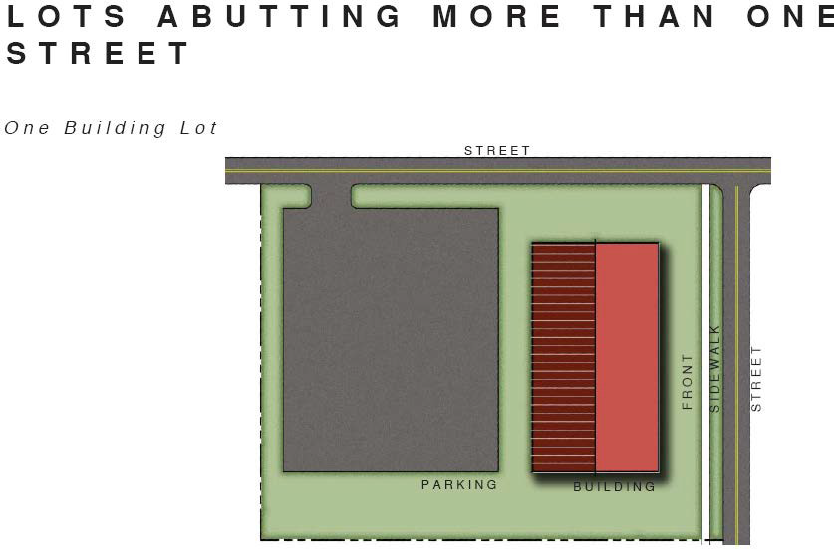
Lots Abutting More Than One Street. On lots that abut more than one street, building and lot shall generally front upon the more pedestrian-oriented street, given the arrangement of existing and proposed streets and drives, and the orientation of buildings on adjoining lots.
2.6-2.
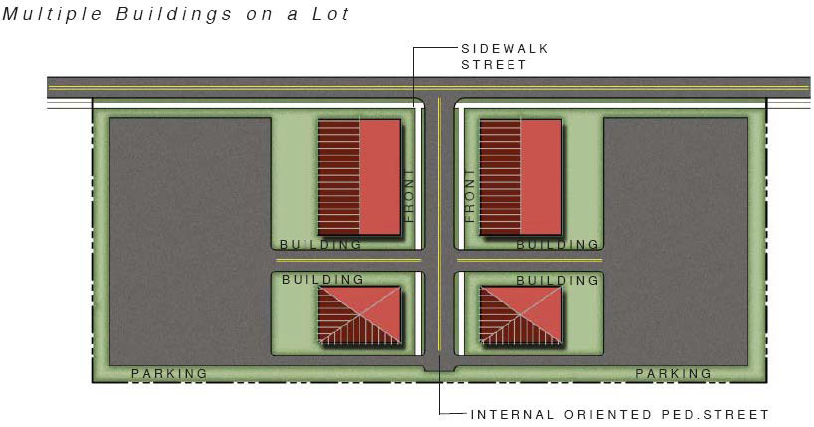
Multiple Buildings on a Lot. Where multiple buildings are permitted on a single platted lot, each building shall generally front upon a pedestrian-oriented street, external or internal to the development; side and rear yard designations shall be determined on the basis of building orientation.
2.6-3.
Irregularly Shaped Lots. On irregularly shaped lots, the location of the required front, side, and rear yards will be determined by the planning director. The determination will be based on the spirit and intent of this ordinance to achieve an appropriate spacing of buildings and orientation to the street(s).
Sec. 2.7. - Yard Dimensions for Corner Lots.
2.7-1.
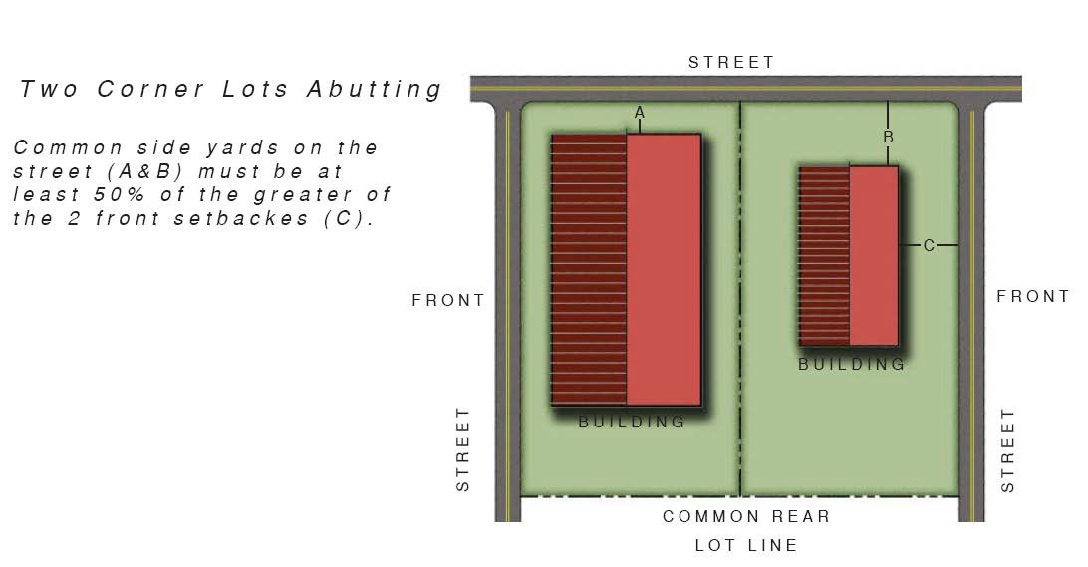
Two Corner Lots Abutting at Rear. If two corner lots are separated by a common rear lot line, the common side yards of the lots on the street must be at least 50 percent of the greater of the two front setbacks, existing or required.
2.7-2.
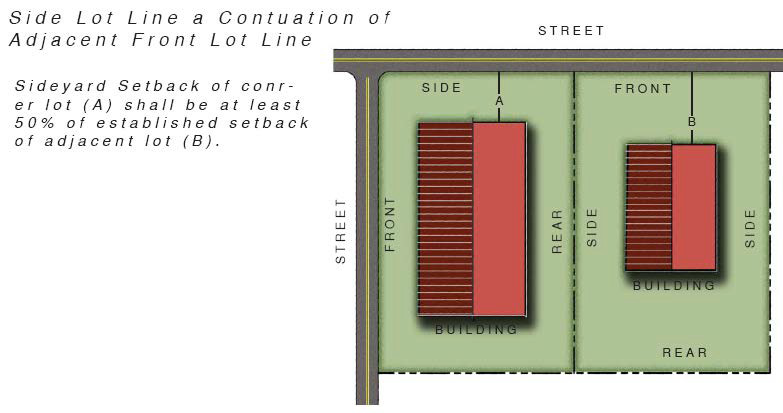
Side Lot Line a Continuation of Adjacent Lot Front Lot Line. In any district, where the side lot line of a corner lot is substantially a continuation of the front lot line of the lot to its rear, the required side yard of the corner lot shall (a) be at least 50 percent of the established front setback of the adjacent lot or (b) establish a transition between existing buildings by stepping toward the street or back from the street a distance equal to the lesser building setback + one-half of the difference between the setbacks of the adjoining buildings.
2.7-3.
Buildings on Corner Lots. Buildings on corner lots shall be positioned on the corner as required by the building and lot type standards for the zoning district in which the lot is located.
Sec. 2.8. - Through Lots.
If both the front and rear yards of a lot abut public streets, then the rear building line shall respect the alignment of buildings on the back street while the front building line shall respect the alignment of buildings on the fronting street.
Sec. 2.9. - Height Limitation.
2.9-1.
Building Type Controls. The height of habitable buildings and components is controlled by building type (see Article 9).
2.9-2.
Building Components Exceeding Height Limitation. Structures and structural components not intended for human occupancy (including towers, steeples, flagpoles, chimneys, water tanks, or similar structures) may exceed the height limit of buildings. Components of civic buildings that extend above the height limit shall follow the standards for the civic building type (Article 9). When adjacent to a lot or lots located in a residential district, any part of a non-civic structure that extends above the height limit must be separated from the residential lot by a distance equal to its height measured from the ground.
2.9-3.
Exceptions to Height Limitation. The height limitations of this section shall not apply to public utility poles and lines, skylights, and roof structures for elevators, stairways, tanks, heating, ventilation, and air-conditioning equipment, or similar equipment for the operation and maintenance of a building, and any device used to screen such structures and equipment.
2.9-4.
Height of Communication towers. Commercial communication towers, where permitted, may exceed the height limit for structures when the standards for these towers, as set forth in Article 25, are met.
Sec. 2.10. - Structures and Uses Limited in Yards.
2.10-1.
No Principal Structure in Setback. No principal building or structure shall be located within any required setback or yard, forward of the build-to line for a principal structure, within any setback or yard established by a recorded plat, nor in any required buffer or screen.
2.10-2.
No Accessory Structure in Setback. Except as otherwise provided in this article, no accessory structure shall be located within an established setback or required side yard, nor within six feet of a side or rear lot line. Where permitted, detached accessory dwellings may be located no closer than ten feet to the right-of-way or easement of an abutting mid-block alley, nor closer than ten feet to an abutting rear property line. Fences, walls, security gates, paths, walkways, mailboxes, utility poles, lighting fixtures, patios at grade, and similar features may be located in an established setback or required yard, so long as the sight triangle on corner lots is protected according to the provisions of Section 2.11 of this ordinance. If the accessory structure exceeds the height of the principal structure, it must meet the minimum side yard and be at least 15 feet from the rear lot line.
2.10-3.
Fences. Fences may be located in any yard, established or required, according to the standards of Section 2.13-2 of this ordinance.
2.10-4.
Signs. Signs may be located in an established front setback or a side yard abutting a public street as permitted by the provisions of Article 17, Sign Standards.
2.10-5.
Transit Shelters. Transit shelters may be located in any setback or yard which abuts a street provided the sight triangle on corner lots is protected according to the provisions of Section 2.11 of this ordinance.
2.10-6.
Off-Street Parking. Off-street parking areas, maneuvering areas for parking, and loading areas are prohibited in the established front building setback, which shall be landscaped, in any established side yard abutting a street, which shall be landscaped, and in any required buffer or screen. This restriction shall not apply to:
(A)
A driveway that crosses a front yard to provide access from the street to a parking area;
(B)
An individual driveway, including conventional appurtenances thereto such as basketball goals, designed to also serve as a parking area for a detached or duplex dwelling;
(C)
Plazas associated with civic buildings that have been designed and approved for occasional use as secondary parking areas;
(D)
The frontage along a town street for which specific streetscape plan and section have been adopted by the town council to include limited parking and access in a series of fronting yards;
(E)
Maneuvering areas for loading or delivery activities in the established setbacks and yards of buildings in mixed-use zoning districts where the location of buildings that were legally constructed without the provision of these areas preclude them from being located out of established setbacks and yards. Maneuvering areas for parking, loading, or delivery activities are prohibited in the public right-of-way in residential and commercial districts.
2.10-7.
Outdoor Storage. No outdoor storage of goods and materials or refuse containers shall be located in any established setback or established side yard abutting a street, nor in any required buffer or screen, except for the temporary placement of refuse for scheduled curb side collection.
2.10-8.
Architectural Features. Notwithstanding other provisions of this section, architectural features such as cornices, eaves, bays, awnings, steps, gutters, and fire escapes may project up to three feet into an established or required yard; additional encroachment is permitted for certain building and lot types established in article 10.
2.10-9.
Subordinate Structures. Subordinate structures attached to single-family homes, such as decks, garages, porches, utility rooms, and similar features may extend into the required rear yard up to 25 percent of the rear yard's depth and may consume up to 20 percent of the rear yard's area. Attached garages accessed from rear alleys may extend into the required rear yard to within three feet of the alley right-of-way or easement and may consume up to 50 percent of the rear yard's area. Such extensions may not exceed 50 percent of the width of the dwelling at the rear building line.
2.10-10.
Backflow Preventers. Above-ground backflow preventers are expressly prohibited in the established front yards of buildings where underground backflow preventers or a location outside of the established front yard is technically feasible according to the standards and requirements of the public services department. Where there is no reasonable alternative to locating an above-ground backflow preventer in the established front yard, the structure housing the device shall be covered in a non-reflective material and shall be surrounded, on all sides visible from public streets and abutting properties, by a landscaped opaque screen that matches that architectural style of the primary building.
Sec. 2.11. - Clear Sight Triangle at Street Intersection.
2.11-1.
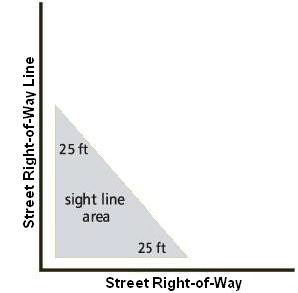
Sight Triangle Required. Unless provided otherwise, a clear view at each corner of an intersection shall be maintained by establishing an unobstructed "sight triangle." The extent of the required sight triangle varies according to the speed limit of streets forming the intersection. For streets signed 35 MPH or greater, the area to be clear of view obstructions at unsignalized intersections is the triangular area formed by the point of intersection of street right-of-way lines and a point located along each right-of-way line at a distance of 35 feet from the point of intersection. For intersecting streets signed for less than 35 MPH, the area to be clear of view obstructions at unsignalized intersections is the triangular area formed by the point of intersection of street right-of-way lines and a point located along each right-of-way line at a distance of 25 feet from the point of intersection.
Site Triangle Illustration for Streets Signed for Less Than 35 MPH:
2.11-2.
No Obstruction in Sight Triangle. No planting, structure, sign, fence, wall, manmade berm, or other obstruction to vision shall be installed, constructed, set out, or maintained so as to obstruct cross-visibility in the sight triangle between 30 inches and 72 inches above the level of the center of the street intersection.
2.11-3.
Modifications to Limitations. The limitations of this section may be modified in the instances noted below, so long as adequate visibility is maintained relative to the intended speed limit:
(A)
Existing natural grades;
(B)
Trees trimmed such that no limbs or foliage extend into the area between 30 and 72 inches above the level of the adjacent intersection;
(C)
Fire hydrants, public utility poles, street markers, government signs, electrical junction boxes, and traffic control devices;
(D)
Buildings located in the Main Street District or the mixed-use center of the TND District;
(E)
The approved and intentional use of traffic calming techniques to reduce speed; these include, but are not limited to, a series of hill crests, neckdowns, intersection diverters, and curb bulbs.
Sec. 2.12. - Building Separation.
All detached principal structures in all districts shall preserve a minimum building separation of ten feet, except for Urban Workplace, Shopfront Commercial, and Attached House Lot/Building Types in the Main Street District, Main Street Periphery District, Bypass District, or the mixed-use center of the TND District. All detached accessory structures in all districts shall maintain a minimum building separation of four feet, as measured from the overhang. Buildings may be considered attached if attached through the use of a breezeway or similar structure.
Sec. 2.13. - Permitted Accessory Uses in All Districts.
2.13-1.
Accessory Uses and Structures. Accessory uses and structures that are clearly related to and incidental to the permitted principal use or structure on the lot are permitted by right. Accessory-type uses shall not be permitted to become the principal use if a principal use structure is removed. Such lots will be required to replace the principal use on the lot or will be considered nonconforming.
2.13-2.
Fences and Walls.
(A)
A zoning permit issued by the planning director shall be required for all fences and walls. The process for obtaining a zoning permit is set forth in Article 7.5 of this ordinance.
(B)
Location.
(1)
Fences shall not be erected over easements such as, but not limited to, access easements, utility easements, drainage easements, or any other public easement, without the explicit approval of the public services and planning departments. If fences or other barriers are allowed to cross such easements, the public services director may require the installer or landowner to install gates or other access points per standards and specifications set by the public services director to ensure access to such easements in the future as necessary and to minimize damage to private property.
(2)
It is advised to construct the fence at least six inches inside the property line to avoid any civil disputes with abutting property owner(s).
(3)
If there is a homeowner's association that regulates the property, those regulations should be observed as well. The planning department does NOT enforce such regulations but the owner is advised to adhere to the regulations, if they exist.
(C)
Height.
(1)
Established front yard, side yard, and rear yard abutting a street. Minimum of two feet maximum of five feet. Fences shall not exceed five feet in height in front of a line parallel to the front of the principal structure on the lot.
(2)
Rear or side yard that does not abut a street. Fence may not exceed eight feet in height.
(3)
Corner lot. Fence may not exceed five feet in height in established backyard abutting street unless placed 15 or more feet inside the property boundary.
(4)
Decorative caps or spires that extend above the highest horizontal member of the fence shall not be included in the measurement of height.
(5)
To maintain an even fence line, a fence or freestanding wall erected on uneven ground may increase the height limit by not more than one foot at any point of depression.
(6)
Agriculture district. Fences located along any property line abutting a public right-of-way or street, and along side property lines within the required 35-foot front setback, shall not exceed five feet in height. Fences along all other interior side and rear property lines shall not exceed eight feet in height.
(D)
Materials.
(1)
Permitted. Masonry wall, solid wood fence, decorative wood fence, vinyl fence.
a.
Permitted in side or rear yard only. Chain link-type fences coated with a vinyl coating in the colors of black, brown, or green.
(2)
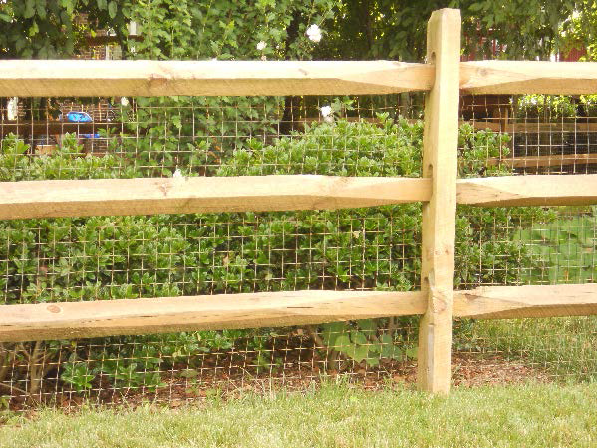
Permitted with conditions. Galvanized chain link, welded wire, or similar fencing materials, if used, shall be placed on the interior side of a masonry wall, solid wood fence, or decorative wood or vinyl fence that is equal to or greater in height than the chain link or welded wire fencing and demonstrates effective screening capability. (For example, the photograph below demonstrates a four feet high welded wire fence attached to the interior of a decorative split rail fence of equal height or greater that would perform to the standards of this section).
(3)
Prohibited. Galvanized chain link (non-coated), welded wire, or similar fencing materials. Chain link fencing with woven slats of opaque material or other treatments intended to simulate an opaque fence shall not be permitted.
(4)
Commercial district. Fences of chain link or similar material are permitted in the first 15 feet of an established yard abutting a street or alley only if placed on the interior side of a masonry wall or solid wood fence and planted with a semi-opaque vegetative screen between wall or fence and street or alley. Beyond the first 15 feet abutting a street or alley, such materials may be used if screened on the exterior side by evergreen shrubs planted no farther apart than six feet on center, minimum height two and one-half feet at installation, or if obscured from view by other screening method(s) which perform at the same or a higher level and are approved by the planning department. In a commercial or industrial district where the side or rear yard abuts a residential or mixed-use district, chain link, welded wire, or similar fencing materials, if used, shall be placed on the interior side of a masonry wall, solid wood fence, or decorative wood fence that is equal to or greater in height than the secure fencing and demonstrates effective screening capability. Additionally, a semi-opaque vegetative screen shall be required on the exterior side of the fence.
(5)
Agriculture district. Galvanized wire, barbed wire, welded or woven wire, livestock/cattle fences are allowed in properties within the Agriculture zoning district if the proposed fence does not face right-of-way designated as a Scenic Corridor Overlay. Electric fencing is allowed, provided warning signage is installed per Jamestown sign standards (Section 17.6-1). Additionally, a Type D Buffer Yard shall be required on the exterior side of the fence when adjacent to any residential district.
(6)
Maintenance of existing non-conforming materials. Existing non-conforming fence materials may be repaired and maintained with the same or similar material.
2.13-3.
Parking Lots. For parking lots as principal or accessory uses, the landscape and buffering standards of Article 11 shall control.
2.13-4.
On-site Land Clearing and Inert Debris (LCID) Landfill.
(A)
Any on-site LCID landfill must obtain a permit from and comply with the standards of Guilford County and the State of North Carolina.
(B)
Any such landfill must be closed in an approved fashion within six months of completion of construction or within 12 months of cessation of construction if the development project has not been completed.
(C)
The location of any such landfill must be indicated on the sketch site development plan and the final site development plan. Further, any parcel or lot which contains any part of any such landfill must have notification of the existence and extent of the landfill recorded as part of the deed for the lot or parcel.
(D)
No portion of any such landfill may be located within 35 feet of any property line which constitutes the external boundary of the project. This includes structures, equipment storage, parking areas, and fill areas, except that access drives may cross this area.
(E)
A surety bond or irrevocable letter of credit in an amount to be determined by the consulting engineer must be provided to ensure that any active landfill area will be closed in an approved fashion. The amount of the bond will be based upon the maximum acreage expected to be in use at any given time.
2.13-5.
Petroleum Storage. Petroleum storage, accessory to a permitted principal use or building, shall comply with the Fire Prevention Code of the National Board of Fire Underwriters.
2.13-6.
Temporary Construction-Related Uses. Temporary buildings and storage of materials provided that the use is in conjunction with the construction of a building on the same lot or on an adjacent lot; the temporary uses shall be terminated upon completion of construction.
2.13-7.
Swimming Pools. Swimming pools located on any site, including single-family residential sites, shall be:
(A)
Located in a side or rear yard only;
(B)
Located a minimum of 15 feet from any property line; and
(C)
Completely enclosed by a fence or wall no less than four feet but no more than eight feet in height above grade as measured on the side of the fence or wall which faces away from the swimming pool. This fence or wall shall enclose the pool itself and may include any other additional portions of the lot. All fence or wall openings into the pool area shall be equipped with a gate that opens outward away from the pool and shall be self-closing and have a self-latching device.
(Ord. of 8-19-2025(1))
Sec. 2.14. - Standards for Construction; Developer Responsibility.
Where standards and responsibility for infrastructure construction, including but not limited to streets, sidewalks, and landscaping, are specified in this ordinance or other ordinances of the Town of Jamestown, those standards shall control. Where standards are not specified, construction shall be in conformance with the standards set forth in the Town of Jamestown Standards and Specifications Manual.
Sec. 2.15. - Guarantee in Lieu of Construction of Required Improvements.
2.15-1.
Provision of Guarantee. In lieu of completion of construction of required improvements, including but not limited to streets, sidewalks, landscaping, parking, and utilities, prior to issuance of a certificate of completion or final plat, the property owner or developer may elect to provide one of the following performance guarantees in an amount determined by the Town:
(A)
Submit to the Town a surety bond by a company authorized to do business in North Carolina; or
(B)
Provide a letter of credit payable to the Town of Jamestown, issued by a financial institution licensed to do business in the state of North Carolina; or
(C)
Deposit or place in escrow a certified check or cash in an amount determined by the Town. Portions of the security deposit may be released as work progresses.
When submitting a performance guarantee, the Town and the developer shall enter into an agreement specifying the term of the guarantee, the required improvements to be completed for the release of the guarantee, and the amount of the guarantee. The performance bond or irrevocable letter of credit shall be in an amount equal to 125 percent of the estimated cost of completion of the required improvements, as determined by the Town. The performance guarantee shall secure the completion of construction of the improvements shown on the approved site development plan. The performance guarantee shall have an initial term of one year and shall include a provision for automatic renewal each year. Failure to make good faith progress toward the completion of the required improvements or failure to maintain the performance guarantee shall result in the revocation of the approval of the site development plan and any permits issued as a result of the site development plan approval. If an extension is required to complete the required improvements, the current performance guarantee may be extended or a new guarantee issued in the same manner as the initial guarantee for the remaining improvements provided that such extension or a new agreement is made at least 60 days prior to the expiration of the initial term of the agreement.
2.15-2.
Construction Easement. The Town of Jamestown, in its sole discretion, may require a temporary construction easement permitting the Town of Jamestown or its designee(s) to access the property for the purpose of constructing/installing the guaranteed improvements. Such an instrument shall be provided with a performance guarantee. The temporary construction easement shall be valid until all guaranteed improvements have been constructed/installed and approved or accepted by the Town. The temporary construction easement shall pass to all successive owners until the guaranteed improvements have been constructed/installed and approved or accepted by the Town and shall be recorded in the office of the Guilford County Register of Deeds with recording fees to be paid by the applicant/landowner.
2.15-3.
Failure to Perform. Failure to initiate construction of the improvements within one year of the date the performance guarantee agreement was accepted by the Town of Jamestown may result in the Town constructing the improvements, with the cost to be paid from the performance guarantee. The entity holding the escrow account shall, if requested by the Town pay all or any portion of the guarantee fund to the Town up to the amount needed to complete the improvements based on an estimate by the Town. The Town at its discretion may spend such portion of said funds as deemed necessary to complete all or any portion of the required improvements. The Town shall return to the property owner/developer any funds not spent in completing the improvements. Default on a project does not release the developer from responsibility for the completion of the improvements. The Town may release a portion or all of any security posted as the improvements are completed and approved by the Town. In the event that the amount of the guarantee on hand is insufficient to pay for the completion of the improvements, the property owner shall pay to the Town of Jamestown the total amount of the insufficiency. If the Town is not paid, the amount of the insufficiency shall constitute a lien on the property in favor of the Town.
Sec. 2.16. - Regulation of Nuisances.
2.16-1.
Noise. No use shall be operated so as to generate recurring noises that are unreasonably loud, cause injury, or create a nuisance to any person of ordinary sensitivities. No nonresidential use shall be operated so as to generate any noise in an adjacent residential or mixed-use district, as detected in that district without instruments, that is louder than the noise which could be generally expected from uses permitted in that district.
2.16-2.
Fumes and Odors. No use shall emit fumes, gasses, or odors in concentrations or amounts that cause injury or create a nuisance to any person of ordinary sensitivities on another property.
2.16-3.
Vibration. No use shall be operated so as to generate inherent or recurring ground vibrations detectable at the property line without instruments.
Sec. 2.17. - General Standards for Driveway Permitting.
2.17-1.
Review Required. No driveway or other point of access to a street maintained by the North Carolina Department of Transportation shall be constructed, relocated, or altered unless a driveway permit or other approval is obtained from the North Carolina Department of Transportation. The applicant shall comply with the standards for driveways established by the North Carolina Department of Transportation. All driveway plans shall be reviewed by the Town of Jamestown prior to construction of the driveway.
2.17-2.
Projects Composed of Multiple Buildings and Lots. For development projects composed of multiple buildings and lots, access to the pre-existing public street system shall be determined by the location of proposed intersecting streets. No parcel of land which is a functional part of the overall development, even though it may be removed by the developer from the rest of the project area by subdivision or by metes and bounds description, shall be permitted to have driveway access to the public streets bounding the project area.
2.17-3.
Access to Subdivision Lots. In a residential major subdivision, access to individual lots from streets constructed as part of the subdivision shall be reviewed and approved at the time each building permit is issued.
2.17-4.
Location and Design of Access. Determination of the location and design of access to the public street system shall be made by the planning director and other professional reviewers based on a contextual examination of the site, surrounding development, potential traffic generated on the site, current and future surface transportation system needs, special polices that might exist for the corridor being accessed, and state of the practice principles for access management as promulgated by the Institute of Transportation Engineers and the Transportation Research Board.
Sec. 2.18. - Special Requirements for Lots along Thoroughfares.
2.18-1.
Authorization. Pursuant to G.S. § 160A-306 (which states that cities and counties shall have authority to (1) classify all or a portion of the streets within their jurisdictions according to their size, present, and anticipated traffic load, and other characteristics relevant to the achievement of the purposes of this section, and (2) establish by ordinance minimum distances that buildings and other permanent structures or improvements constructed along each class or type of street shall be set back from the right-of-way line or the centerline of an existing or proposed street) the following requirements shall apply.
2.18-2.
Minimum Setbacks Along Thoroughfares. The build-to or setback line for any lot which abuts a thoroughfare classified on the High Point Urbanized Area Thoroughfare Plan shall be measured from the right-of-way line outlined in the table below (Table 2.18-2) if existing right-of-way is of lesser width. The proposed right-of-way line established for each classification of the thoroughfare is as follows:
2.18-3.
Transitional Setback for Lots Along Thoroughfares. A transitional setback or yard shall be established for each lot which abuts a thoroughfare that has an existing right-of-way which is not as wide as the ultimate right-of-way established for that thoroughfare. The transitional setback or yard area established for lots abutting thoroughfares can be used for any purpose allowed by the particular zoning district, except for those permanent uses which are prohibited in the established setbacks or yards. At the time that the proposed right-of-way is dedicated or otherwise acquired for roadway purposes, the property owner shall be responsible for the removal of any uses from the transitional setback or yard that are not otherwise permitted in the yard by the district regulations. The property owner shall have one year from the date of right-of-way acquisition to remove any such uses.
2.18-4.
Exceptions. The standards herein prescribing setback from the proposed right-of-way line will not apply to any development for which a site-specific development plan has been approved prior to the effective date of regulations requiring setback from proposed right-of-way lines along thoroughfares. Nor shall they apply to structures in the Main Street District, Main Street Periphery District, or mixed-use center in a PUD or TND Overlay District.
2.18-5.
Right to Appeal. An affected property owner shall have the right to appeal transitional yard or setback requirements to the board of adjustment for variance or modification as they apply to a particular piece of property. The board of adjustment may vary or modify these requirements upon a showing that:
(A)
The peculiar nature of the property results in unnecessary hardships that impede carrying out the strict letter of the requirements, and
(B)
Balancing the public interest in enforcing the setback requirements and the interest of the owner, the grant of relief is required by considerations of justice and equity.
In granting relief, the board of adjustment may impose reasonable and appropriate conditions and safeguards to protect the interests of neighboring properties. The board of adjustment's decision shall be subject to review by the superior court by proceedings in the nature of certiorari in accordance with G.S. § 160(D)-406(k).
Sec. 2.19. - Standards for Residential Garages and Parking in Residential Districts.
2.19-1—2.19-4.
Reserved.
Editor's note— These subsections repealed due to legislative changes (S.L. 2015-86 (S.25)) effective June 19, 2015.
2.19-5.
Parking on Residential Streets. Parking shall be allowed along all residential streets except along alleys, designated bike lanes, and areas specifically signed for no parking. Vehicles shall park so as not to block access to properties.
2.19-6.
No Parking in Right-of-Way. In no case shall on-site residential parking extend into the public right-of-way or an easement for a public sidewalk on private property.
2.19-7.
On-Street Parking Meeting Residential Parking Requirement. Designated on-street parking at the lot front may be counted toward all or part of the parking requirement of a dwelling unit.
2.19-8.
Location of Detached Garages. Detached garages may only be placed in the established rear or side yard.
2.19-9.
Reserved.
Editor's note— This section repealed due to legislative changes (S.L. 2015-86 (S.25)) effective June 19, 2015.
2.19-10.
Storage of Vehicles on Street. Vehicles shall not be parked on the street for extended periods such that they appear to be stored on the street. The planning director, at his/her discretion, may require the removal of vehicles that appear to be stored on the street in the interest of protecting the public safety and welfare.
2.19-11.
Parking of Oversize Vehicles in Residentially Zoned Areas. Oversized vehicles, which are defined as those which exceed 19,500 pounds GVWR or are used to transport hazardous materials are prohibited from parking or being stored in residentially zoned districts whether they are located on private or public property. This shall not be construed as preventing the temporary parking of delivery trucks, construction vehicles working on-site during normal business hours, moving vans, church vans or buses, emergency vehicles, and vehicles which deliver goods or services.
2.19-12.
Parking of Unlicensed Vehicles. Provisions for parking unlicensed vehicles in residentially zoned districts shall be as follows:
(A)
No more than two motor vehicles that do not have a current, valid license plate and are not fully enclosed in a permanent structure shall be permitted outside on any premises, provided such vehicles are registered to the occupant of the premises or immediate family member of the occupant as the record title of the vehicle.
(B)
No unlicensed motor vehicle shall be permitted outside of any premises (i.e., on the street).
(C)
Vehicles described in paragraphs (A) and (B) are not permitted to be located within any established setback or any established side yards which abut a street or any required side yards as mandated by these regulations or any street right-of-way. If stored in the rear yard, the vehicle(s) must be a minimum of five feet off the rear property line.
(D)
Vehicles described in paragraphs (A) and (B) are not permitted on vacant or undeveloped parcels.
(E)
Vehicles described in paragraphs (A) and (B) are not permitted on public streets or public right-of-way.
Sec. 2.20. - Sidewalks for New Development and Expansion/Improvement of Existing Development.
2.20-1.
Sidewalk Required. Sidewalks shall be required along new and existing streets fronting the following new development and expansions of and improvements to existing development:
(A)
All new commercial development.
(B)
Expansions to existing commercial development or use where the gross floor area of the expansion is equal to or greater than 50 percent of the gross floor area of the pre-expansion development or use.
(C)
Improvements to existing commercial development or use when the cost of the improvement is equal to or greater than 50 percent of the value of the existing development (building) or use as determined by the Guilford County Tax Office.
(D)
All residential development with two or more residential units.
(E)
One single-family home on a single lot when the lot being developed is adjacent to a lot on which an existing sidewalk is located and the construction of a sidewalk on the lot being developed would be a logical extension of the pedestrian network.
2.20-2
Sidewalks along new streets. Sidewalks shall be required along both sides of new streets. In the case of private streets, sidewalks shall be required on one side of new streets. Regardless of streets being public or private, the developer of new street networks may petition the technical review committee (TRC) to waive the requirement for sidewalks along new streets for developments located in the watershed critical area where additional built-upon area may be detrimental to water quality. The TRC shall apply an "equal or better" performance standard to the request and the developer shall be required to comply with conditions placed upon them by the TRC.
2.20-3.
Sidewalks Along Alleys. Sidewalks shall not be required along alleys.
2.20-4.
Standards for Sidewalks. Sidewalks shall comply with the design and construction standards set forth in the Town of Jamestown Standards and Specifications Manual.
(Ord. of 07-16-2024(1), 7-16-2024)
Sec. 2.21. - Green Building Incentives.
2.21-1.
Purpose. In order to promote sustainable development practices, the Town of Jamestown may grant in all zoning districts, in addition to any other density bonus, an additional density bonus of up to 20 percent for residential developments and/or up to a ten percent increase in the maximum footprint allowed for non-residential uses that meet or exceed N.C. Healthy Built Homes, LEED, or Energy Star performance qualifications.
2.21-2.
Certification. Evidence of the developer's/applicant's commitment to comply with sustainable performance qualifications shall be provided to the Town of Jamestown prior to plan approval. (Evidence may consist of architectural plans, specifications, etc.) Compliance with such qualifications shall be certified by an independent third party and no final CO and/or certificate of completion shall be issued for the project until compliance with the qualifications has been certified by an independent third party. Should the developer/applicant not comply with the approved plans, the Town of Jamestown shall have the authority to revoke any building permits, stop work, hold certificates of occupancy, or any other method available to it under Article 23, Administration and Enforcement, for addressing violations of this ordinance.
Sec. 2.22. - Utility Standards.
2.22-1.
Underground Installation. In order to promote a more aesthetically pleasing landscape, minimize hazards and outages from falling power lines, and to facilitate passage on streets and sidewalks; the Town of Jamestown will require newly developed properties and those properties with redevelopment or improvements exceeding 50 percent of the tax value (per Guilford County tax records) of the property to install utility (including but not limited to electric lines, phone, and cable) lines underground. Existing electric power distribution and transmission lines that are in place prior to subdivision plat or development plan approval and which are located outside of the boundaries of the parcel(s) of land that contains the proposed subdivision or development plan shall be exempt from this requirement; however; the relocation of such existing lines underground is encouraged (see G.S. § 160D-804(h)). In the event that the underground installation of such lines is determined to be unfeasible due to site conditions (cost shall NOT be a factor), then the applicant may appeal to the technical review committee (TRC) in writing stating why they should be exempted from this requirement. TRC shall then hold the applicant to an "equal or better" performance standard and may grant a minor modification to allow alternatives to underground installation.
2.22-2.
Street Lighting. In order to promote a more aesthetically pleasing landscape and to provide for the safety of the Town's citizens; the Town of Jamestown shall require newly developed properties and those properties with redevelopment or improvements exceeding 50 percent of the tax value of the property to install street lighting along any public or private street. Such street lighting may be decorative in nature but shall be "full cut-off" unless approved by the public services director. All fixtures must be approved by the public services director prior to installation. Exceptions may be approved by TRC, as in 2.22-1.
Sec. 2.23. - Regulations for Residential Detached Accessory Structures.
2.23-1.
Purpose. In order to promote the orderly development of residential properties, the Town of Jamestown may regulate accessory structures in areas of residential development. The following development guidelines shall be enforced in all zoning districts where detached residential dwelling uses are permitted. Individual accessory structures shall not be permitted within multi-family, townhome, duplex or condominium developments unless submitted as part of an overall site development plan.
2.23-2.
Location. Accessory structures may not be located in the front yard unless the property is greater than three acres in size. On lots greater than three acres in size, the accessory structure must be a minimum of 150 feet from the edge of any street right-of-way. Accessory structures must be a minimum of five feet from any side or rear property line and a minimum of five feet from any principal structure. On corner lots, accessory structures shall be located a minimum of 15 feet from any street right-of-way.
2.23-3.
Size. There is not a limit to the number of accessory buildings permissible on a lot. However, the cumulative square footage of all accessory buildings shall not exceed the size requirements listed below:
(A)
Lots less than one acre in size: structure(s) may not exceed more than one-half of the heated square footage of the ground floor of the principal structure or 800 square feet.
(B)
Lots between one acre and 2.99 acres in size: structure(s) may not exceed more than one-half of the heated square footage of the ground floor of the principal structure or 1,200 square feet.
(C)
Lots three acres in size or larger: structure(s) may not exceed more than three times the heated square footage of the ground floor of the principal structure or 3,000 square feet.
(D)
Lots zoned for agricultural use: there shall not be a restriction on the cumulative total of square footages of accessory buildings on property zoned for agricultural uses.
(E)
No accessory building shall be permitted to be located within any easement.
(F)
No accessory building shall be permitted to exceed the height of the principal structure.
(G)
Exterior finishes cannot be of highly reflective metal.

