


Kuna City Zoning Code
PART 14
- OFF-STREET PARKING AND LOADING FACILITIES
5-8-1401: - GENERAL REQUIREMENTS:
A.
No building or structure shall be erected, substantially altered or its use changed unless permanently maintained off-street parking and loading spaces have been provided in accordance with the provisions of this chapter.
B.
Changes in building or structure that trigger the need for a increased parking: Whenever an existing building or structure is changed or enlarged in terms of its floor area, number of employees, number of dwelling units, seating capacity that, in turn, creates a need for an increase in the number of parking spaces, the developer shall add additional parking spaces according to the city's parking standards. If a building or structure's footprint is enlarged due to increase in employees, number of dwelling units, floor area, seating capacity, or similar enhancements by more than fifty (50) percent, the developer shall not only provide additional parking spaces but also bring the building or structure into full compliance with the city's parking standards.
(Ord. No. 2024-06, § 2, 4-16-2024)
5-8-1402: - STANDARDS:
A.
Location of parking spaces: The following regulations shall govern the location of off-street parking spaces and areas:
1.
On- or off-site parking spaces that are relied upon for commercial, office, industrial or public uses shall be located within five hundred (500) feet distance of the entryway of the principal use. On- or off-site parking spaces relied upon for apartments, dormitories, group living facilities or other residential uses shall be located within three hundred (300) feet distance of the entryway of the principal use.
B.
Loading space requirements and dimensions: Off-street loading spaces for commercial uses shall be provided in accordance with the following table:
Notes:
For each additional seventy-five thousand (75,000) or fraction thereof, an additional type A space will be provided.
Type B spaces are thirty-five (35) feet in length.
Type A spaces are sixty-five (65) feet in length.
1.
Size: The size of an off-street loading space shall not be less than the following, exclusive of access platform and loading areas:
2.
Convenient access: Convenient access to loading spaces from streets or alleys shall be provided; they shall not be less than twelve (12) feet in width.
3.
Location of required loading facilities: Off-street loading facilities shall not project into the public right-of-way, setback, or easement area. In no circumstance shall the required off-street loading berths be part of the area used to satisfy off-street parking requirements.
4.
Design and location of entrances and exits: Design and location of entrances and exits for required off-street loading areas shall be subject to review of the director.
C.
Maintenance: The owner of property used for parking and/or loading shall maintain such area in good condition without holes and free of all dust, trash and other debris.
D.
Paving: The required number of parking and loading spaces as set forth in section 5-9-3, "Parking Space Requirements," of this chapter, together with driveways, aisles and other circulation areas, shall be improved with such material to provide a durable and dust-free surface and approved by the city engineer. Gravel or dirt surfaces shall not be permitted for any parking or loading areas within R-2, R-4, R-6, R-8, R-12, R-20, C-1, C-2, C-3, CBD, or P zones.
1.
Exception: Within M-1 and M-2 zones parking areas, driveways, aisles and other circulation areas shall be paved. Storage areas that are enclosed by solid fencing or other means of approved screening shall be a dust-free surface such as road mix, gravel, recycled asphalt, and other approved like surfaces. Granular material shall be treated with magnesium chloride no later than June 15th yearly.
E.
Drainage: All parking and loading areas shall provide for proper drainage of surface water to prevent the drainage of such water onto adjacent properties or walkways.
F.
Lighting: Any parking area which is intended to be used during non-daylight hours shall be properly, illuminated to avoid accidents. Any lights used to illuminate a parking lot shall be so arranged as to reflect the light away from the adjoining property.
G.
Access: Any parking area shall be designed in such a manner that any vehicle leaving or entering the parking area from or onto a public or private street shall be traveling in a forward motion. Access driveways for parking areas or loading spaces shall be located in such a way that any vehicle entering or leaving such area shall be clearly visible by a pedestrian or motorist approaching the access or driveway from a public or private street.
H.
Striping: All parking areas with twelve (12) or more contiguous parking spaces shall be striped with double lines (six (6) inches both sides of center) between stalls to facilitate the parking movement.
I.
Screening and/or landscaping: Whenever a permitted parking area is located in or adjacent to a residential district or residential use(s), it shall be effectively screened on all of its sides adjoining or facing the residential district or residential use(s) by a wall, solid fence or hedge that is approved by the city's design review committee or planning and zoning commission. The solid fence or wall shall be five (5) feet in height and maintained in good condition and free of nonparking related signage/advertising. The placement of a fence or wall for buffer mitigation purposes shall be according to the city's fencing or wall provisions found at KCC § 5-8-1006. Landscaping provided in lieu of a wall or fence shall consist of a strip of land no less than ten (10) feet wide, planted with an evergreen hedge or dense planting of evergreen shrubs, with a year-round source of irrigation. The planting material shall not be less than four (4) feet in height at the time of planting and reviewed and approved by the city forester. Parking lot placement, layout and construction for a planned unit development (PUD) is noted at KCC § 5-8-1103.G. In the event that terrain or other natural features are situated such that the erection of a fence, wall or planting screen will not serve the intended purpose the director will consider alternative buffer mitigation proposals.
J.
Parking lot landscape buffer requirements: An irrigated landscaped buffer shall be installed when a parking lot is located adjacent to a public right-of-way. The developer shall provide a ten-foot wide landscape buffer between the right-of-way and the parking lot and plant this area with a minimum of one (1) shade tree and five (5) shrubs per thirty-five (35) linear feet of street frontage, excluding driveway openings.
K.
Wheel blocks: Whenever a parking lot extends to a property line, wheel blocks or other suitable devices shall be installed to prevent any part of a parked vehicle from extending beyond the property line.
L.
Minimum distance and setbacks: No part of any parking area containing ten (10) or more vehicle spaces shall be installed closer than twenty (20) feet to the property line of an adjoining residential dwelling unit, school, hospital or public care institution unless separated by an acceptable screening strategy.
M.
Disabled vehicles: The parking of a disabled vehicle within a residential or commercial district for a period of more than two (2) weeks shall be prohibited, unless such vehicle is stored in an enclosed garage or other accessory building. Upon a violation of this subsection, the disabled vehicle shall be towed to a place of safekeeping at the expense of the owner of said vehicle.
N.
Joint use: Two (2) or more nonresidential uses may jointly provide and use parking spaces when their hours of operation do not normally overlap, providing that a written agreement approved by the director shall be filed with the application for a zoning permit.
O.
Large vehicle parking: Any vehicle that exceeds ten thousand (10,000) pounds in weight or is longer than twenty-two (22) feet in length shall be parked in designated parking areas or parking spaces established for the oversize vehicle accommodation. Accordingly, trucks that meet these parameters may not be parked on public streets, rights-of-way, easements or property setback areas, other than temporarily for local delivery purposes. This parking restriction shall apply in all but the manufacturing [M] and agricultural [A] zones. If a parking area is established primarily for oversized vehicles it shall rely upon the following space dimensions for their accommodation: Parking stalls shall be a minimum twelve (12) feet wide and seventy-five (75) feet in length for big rigs, long trailers, semi-trucks/tractor trailers and other oversized vehicles. Angled parking spaces will require more parking stall length based on the geometry. Parking lot stalls shall be constructed to be perpendicular to street and building alignments where possible. Driveway entrances shall be a minimum thirty (30) feet wide. Driveway and parking surfaces shall be paved according to city standards, to include, retaining the impervious parking surface stormwater on-site. Additionally, the vertical clearance height for oversized vehicles parking is a minimum fifteen (15) feet. Parking aisle widths and turning movement separation distances (radius) will be determined on a case-by-case basis. Manufacturing districts shall provide one (1) truck loading space for every ten thousand (10,000) square feet of gross floor area.
P.
Minimum standards for parking:
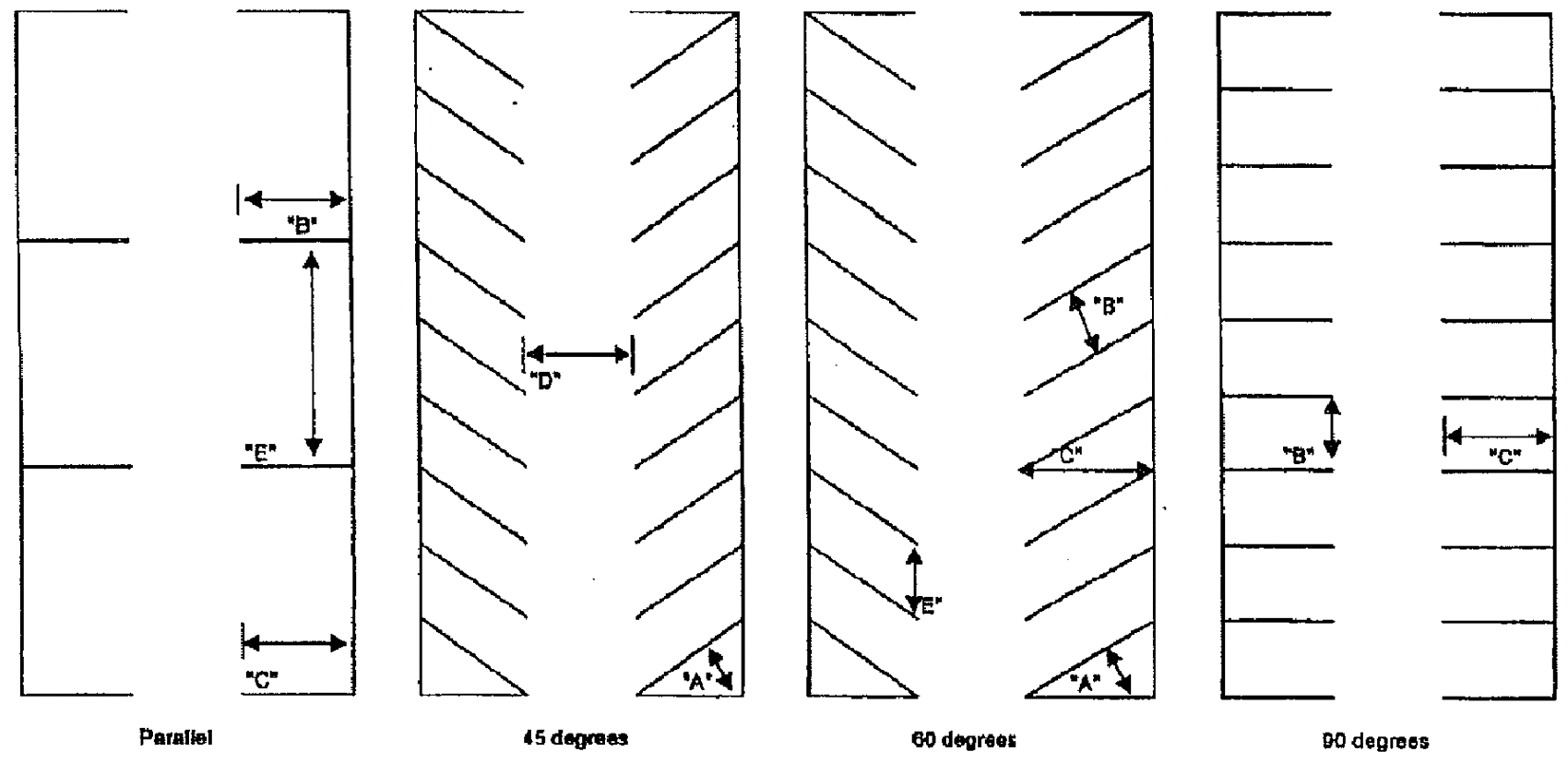
In high turnover or where loading is necessary (i.e., grocery stores, department stores, or hardware stores) the minimum width goes up to ten (10) feet.
Handicapped parking, minimum width of nine (9) feet, six (6) inches.
(Ord. No. 2024-06, § 2, 4-16-2024)
5-8-1403: - PARKING SPACE REQUIREMENTS:
For the purpose of this chapter the following parking space requirements shall apply:
(Ord. No. 2024-06, § 2, 4-16-2024; Ord. No. 2025-01, § 4, 2-18-2025)
5-8-1404: - GENERAL INTERPRETATIONS:
A.
In the interpretation of this chapter, the following shall govern:
1.
Parking spaces for other permitted or special uses not listed in this chapter shall be recommended by the director and determined by the council.
2.
Fractional numbers shall be increased to the next whole number.
3.
Where there is an adequate public transit system or public parking or where, for any other reason, parking demand is unusually low, such as on-street parking space provisions cited above, may be reduced proportionately by the Commission.
(Ord. No. 2024-06, § 2, 4-16-2024)
5-8-1405: - PUBLIC OR PRIVATE COMMERCIAL/INDUSTRIAL PARKING LOTS:
A.
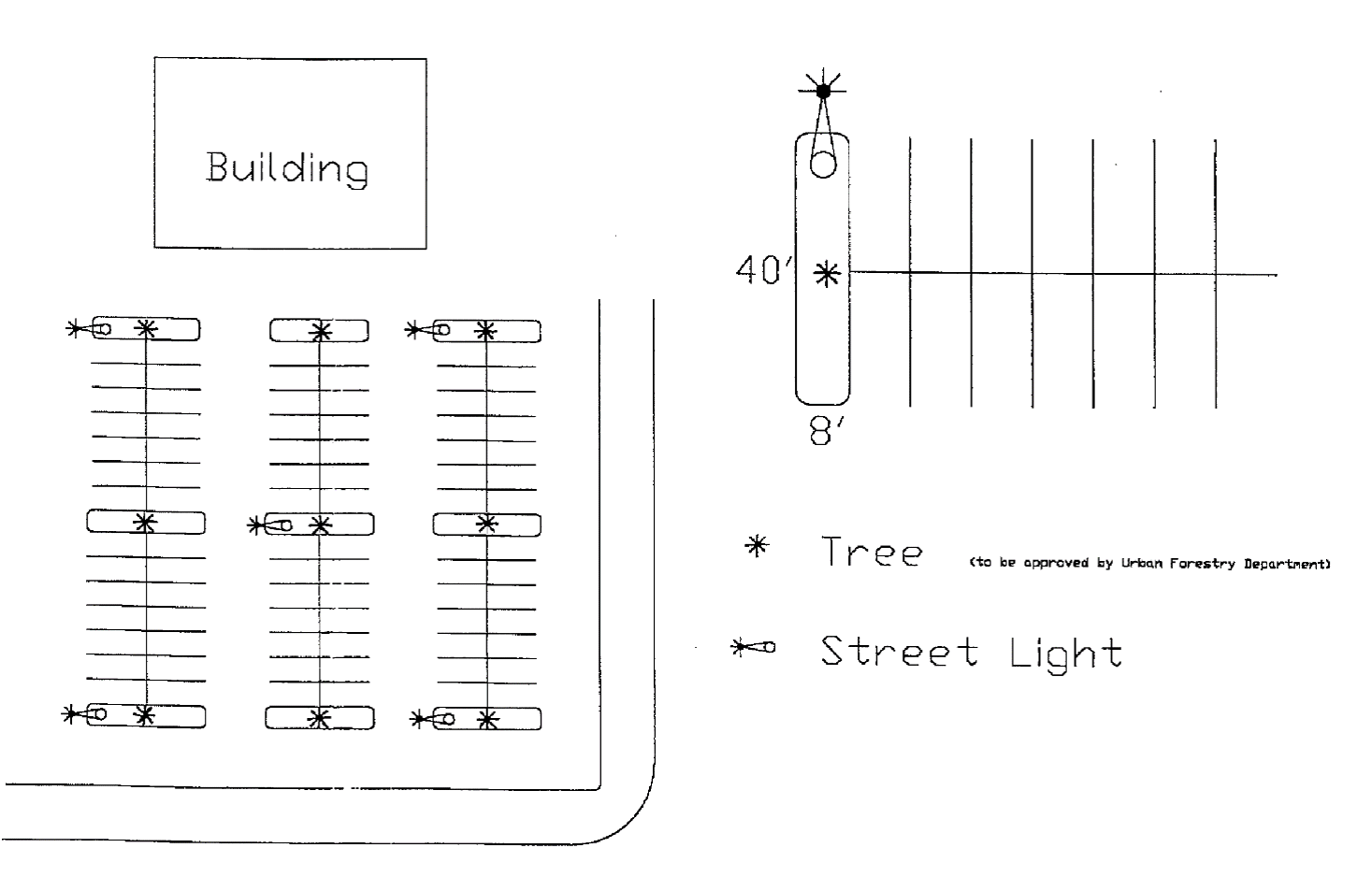
All commercial/industrial parking lots with thirty (30) or more spaces will construct a landscape island in accordance with the following:
1.
Landscaping:
a.
Every fourteen (14) parking spaces or one hundred twenty-six (126) feet.
b.
Minimum width of eight (8) feet.
c.
Subsurface drainage and compaction-resistant soil.
d.
Minimum of one (1) tree per island. Tree list must be submitted and approved.
e.
Minimum tree size is two-inch caliper.
f.
Landscaping must be maintained.
g.
Dead or damaged trees must be replaced within six (6) months.
2.
Lighting:
a.
Every fourteen (14) parking spaces or one hundred twenty-six (126) feet alternating with the landscaping island is required.
b.
Lighting shall be shielded or not more than a twenty-five-degree angle to provide lighting for security, but not excessive to neighboring properties.
(Ord. No. 2024-06, § 2, 4-16-2024)