
Kuna City Zoning Code
PART 9
- DESIGN REVIEW
5-8-901: - DESIGN REVIEW:
A.
Purpose:
1.
To produce attractive developments with unique character and quality architectural design.
2.
To provide greater attention to the design, scale and location of structures in relationship to surrounding properties and streets.
3.
To protect the safety and convenience of pedestrian access within developments and to build attractive pedestrian amenities.
4.
To encourage the use of high-quality building and landscape architectural design principles, styles and materials to create a sustainable and pleasing environment for residents and visitors alike.
B.
Applicability:
1.
Design review shall be required for the following:
a.
Signs.
b.
All new commercial, industrial, duplexes, multi-family (three (3) or more units under one (1) roof) and townhomes/rowhomes.
c.
Landscaping for all new commercial, industrial, duplexes, multi-family (three (3) or more units under one (1) roof) and townhomes.
d.
Commercial, industrial and residential parking lots.
e.
Subdivision common areas.
f.
Existing commercial, industrial, duplex, multi-family (three (3) or more units under one (1) roof) and townhomes/rowhomes structure and site alterations, additions and modifications as determined by the Planning and Zoning Director.
2.
Administrative design review shall be required for the following:
a.
All signs, unless otherwise listed as exempt in Chapter 10 of this title.
b.
New commercial and industrial structures less than one hundred twenty (120) square feet.
c.
Exterior building alterations to existing buildings, including but not limited to, the addition, removal or modification of architectural elements, such as doors, windows and awnings, unless otherwise determined by the Director.
d.
Existing building remodels where all or a portion of a structure is modified, including entrances, facades, rooflines and building expansions or a change in exterior materials and/or color scheme unless otherwise determined by the Director.
e.
Existing site alterations, including, but not limited to, the addition, removal, or modification of site improvements and/or features, such as landscaping and parking, unless otherwise determined by the Director.
f.
Conversions from residential uses to commercial or industrial uses.
g.
Proposed changes in land use and/or building use.
3.
The following items are excluded from design review and administrative design review:
a.
An individual duplex or townhome/rowhome consisting of a maximum of two (2) dwelling units.
b.
The construction, addition, removal or modification of detached single-family homes.
c.
Interior Tenant Improvements.
C.
Process:
1.
The Design Review and Administrative Design Review processes are determined by Chapter 4 "Application Procedures, Requirements and Decision Authority and Process," of this title.
2.
Following completion of construction and site improvement installation, all structures and site improvements are subject to Design Review Compliance Inspections.
D.
Required findings: In order to grant approval for a design review application, the decision-making body shall determine that the proposed structural and/or site designs meet or exceed the standards listed in the "City of Kuna Architecture and Site Design Manual" and this title.
E.
Timeline:
1.
Any approval issued through either the Design Review or Administrative Design Review processes shall lapse and become null and void twelve (12) months following the date on which the approval was given, unless, prior to the expiration date, construction or development is commenced and diligently pursued toward completion on the site which was the subject of the application.
2.
Upon written request to the Director, containing the reasons thereof, the Director may grant extensions of time for approved design review applications, provided the director finds the proposed development complies with current ordinance requirements.
F.
Modifications: After approval of a design review application, the applicant may request modification to the approved development plans or conditions. Such request shall be made upon the most current form provided by the Planning and Zoning Department and shall be determined pursuant to the following standards:
1.
Administrative modification: The Director is authorized to make a determination on minor modification requests as specified below:
a.
Modifications proposed for any development application process as an administrative design review.
b.
Minor relocation of building pads or dwelling units due to conditions such as unanticipated topography, road alignment or easements; provided that the modification does not significantly alter the site design in terms of parking layouts, vehicular circulation, landscape design and other similar components of the development plans, provided ordinance requirements are still met.
c.
A change in building design relating to items such as materials, colors, window and door locations and mechanical units, provided the design remains essentially the same as that previously approved by the Planning and Zoning Commission (acting as Design Review Committee).
d.
A minor modification to a recreation area or open space design, but not elimination or a significant reduction.
e.
A minor change to landscape design/plant material changes.
f.
A minor change to parking lot/site plan.
g.
A request to modify or remove a condition of approval established by the Planning and Zoning Director through the administrative design review process.
2.
Design review committee modification: The following modifications shall require approval from the Commission (acting as Design Review Committee):
a.
Any change that may impact an adjoining residential neighborhood.
b.
Any requests that would significantly alter the approved design of the site and/or building as determined by the Director.
c.
A request to modify or remove a condition of approval established by the Commission (acting as Design Review Committee).
(Ord. No. 2024-06, § 2, 4-16-2024)
5-8-902: - EFFECT OF OTHER PROVISIONS:
If any provision of this chapter is found to be in conflict with any other provision of any zoning, building, fire safety or health ordinance or other provision of this Code, the provision which establishes the higher and/or more restrictive design standard shall prevail. However, in order to foster rehabilitation of older districts and comply with unforeseen future needs of the overlay districts, the design review committee may, at its discretion, suspend or relax some or all requirements found in this Code, and provided that action does not compromise health and safety considerations if they determine a particular site, setting, or use to be of historical significance and thus, warranting such consideration.
(Ord. No. 2024-06, § 2, 4-16-2024)
5-8-903: - DEFINITIONS:
Certain words or phrases used in this chapter shall be interpreted as defined within a particular section, as defined within this chapter, or as defined in Chapter 2 of this title, with the more specific and/or more restrictive definition controlling. Any other words or phrases not specifically defined shall be interpreted to give this chapter its most reasonable application.
(Ord. No. 2024-06, § 2, 4-16-2024)
5-8-904: - DESIGN REVIEW OVERLAY DISTRICTS:
A.
Area of district: The design review overlay district encompasses the entire city limits including any land annexed into the city after the date of adoption hereof.
B.
Proposed developments: Any proposed development located within the design review overlay district shall be harmonious with and in accordance with the general objectives and with any specific objective of the comprehensive plan.
C.
Areas of development: There are six (6) specifically defined areas of development within the design review overlay district. The general purpose of each of those areas is described below. Any development which meets the criteria for design review, as set forth in this chapter, that is not within the specific areas described below, shall be required to comply with the general requirements of this chapter and not the specific requirements for the CBD, C, M, P and A:
1.
Central business district (CBD): The CBD district is established to promote development expansion and urban renewal in Kuna's downtown areas. The district is poised to accommodate a variety of business, institutional, public, quasi-public, cultural, residential and other related uses to create a mix of activities necessary to sustain a viable downtown.
2.
Commercial (C):
a.
Neighborhood commercial district (C-1): The purpose of the C-1 district is to accommodate a wide variety of low impact commercial activities to meet the daily needs of nearby neighborhood residents. This district is an appropriate designation for a neighborhood center and mixed-use to be established.
b.
Area commercial district (C-2): The purpose of the C-2 district is to promote the establishment of general business uses that are larger in scale than found in the neighborhood commercial district. The commercial development should have direct access to collector or arterial roadways. This district is an appropriate designation for a neighborhood center and mixed-use to be established.
c.
Service commercial district (C-3): The purpose of the C-3 district is to promote the development of more intensive larger scale commercial type activities with the ability to directly access collector or arterial roadways. The district is also established to address the needs of large space users whose customers make frequent purchases. The activities of the service commercial district are more intensive in character than those found in other commercial zones and may include business activities that are semi-industrial in nature. This district is an appropriate designation for a community commercial to be established.
3.
Manufacturing/industrial (M):
a.
Light manufacturing/industrial district (M-1): The M-1 district is established to promote the development of manufacturing and wholesale business operations that are clean, quiet and free of hazardous or objectionable elements such as noise, odor, dust, smoke or glare. The manufacturer is expected to operate the business enterprise entirely within enclosed structures and design the operation to accommodate industrial type traffic and loading demands. The manufacturing site is expected to be attractively designed and preferably constructed in a business park-like setting. Research activities are encouraged in this district. This district is intended to serve as a transitional buffer between heavy type manufacturing uses and less intense commercial and industrial type uses.
b.
Heavy manufacturing/industrial district (M-2): The M-2 district is intended to accommodate manufacturing, processing and warehouse activities. Businesses locating in this district may produce objectionable or hazardous noise, odor, dust, smoke and glare. Therefore, the district is not intended for general public access due to the exposure risks. The manufacture business is expected to operate entirely within enclosed structures that are designed to accommodate industrial type traffic and loading demands. The M-3 district, which is limited to mining uses, has been consolidated with the M-2 district.
4.
Public district (P): The purpose of the P district is to accommodate the placement of public or quasi-public facilities such as schools, parks, greenbelt, cemeteries, post offices, fire stations, administrative and cultural buildings that are necessary to the community's advancement. This district is an appropriate designation for a neighborhood center and mixed-use to be established.
5.
Arterial roadway (A): Any road designated as arterial on the Kuna Comprehensive Plan and/or Ada County Long-Range Highway and Street Map and/or any highway.
Where any parcel is located within more than one (1) of the six (6) design review development areas, the entire parcel shall be considered to be within the development area with the more restrictive land use requirements. If the developer is expanding or enlarging uses or structures on a land parcel located in more than one (1) zoning district, they will be required to rezone the parcel to a single zone.
(Ord. No. 2024-06, § 2, 4-16-2024)
5-8-905: - DESIGN REQUIREMENTS, OBJECTIVES AND CONSIDERATIONS:
A.
General objectives and considerations: The following apply to the entire design review overlay district including CBD, C, M, P and A zoning districts. Additional requirements for the CBD, C, M, P, and A zoning districts are set forth in subsections C through I of this section and, to the extent there is a conflict with this section, the specific requirements for the CBD, C, M, P and A zoning districts shall control. The objectives are separated into two (2) sections: Site design and building design. Specific aspects of design should be examined to determine whether the proposed development will provide a desirable environment for its occupants as well as for its neighbors, and whether, aesthetically, the composition, materials, textures and colors meet the intent of this chapter. The following shall be considered in reviewing the application:
1.
Site design objectives: The site plan design shall minimize the impact of traffic on adjacent streets; provide for safe pedestrian access and use; and provide appropriate, safe vehicle parking, by showing:
a.
The functional relationship of the structures and the site in relation to its surroundings;
b.
The impact and effect of the site development plan on traffic conditions on contiguous streets and adjoining properties or neighborhoods;
c.
The site layout with respect to separation or integration of vehicular, pedestrian and bicycle traffic patterns;
d.
The arrangement and adequacy of off-street parking facilities relative to access points, building location and total site development to prevent traffic conflict or congestion;
e.
The location, arrangement and dimensions of truck loading ramps, docks, and bays and vehicle service facilities;
f.
The access, parking lot, and interior roadway illumination plans and hours of operation;
g.
The required driver, pedestrian and bicycle sight distance requirements of the project and their relationship to adjacent streets, driveways and properties;
h.
The coordination of the site development with planned right-of-way alignments, acquisitions and street improvements;
i.
The graphic delineation of traffic circulation patterns to avoid confusion, congestion and conflicts;
j.
The continued maintenance of traffic, parking and lighting systems;
k.
The protection of views and vistas in relation to urban design and aesthetic considerations; and
l.
The provision of safe pedestrian and bicycle connections between neighborhoods and commercial areas.
2.
Site landscaping: The site landscaping shall minimize impact on adjacent properties through the proper use of screening with sound and sight buffers, and unsightly areas shall be concealed or screened and the design review committee shall consider:
a.
The location, height and materials of walls, fences, hedges and screen plantings to ensure harmony with adjacent development;
b.
The location and type of new plantings, with due regard to preservation of specimen and landmark trees, and to maintenance of all plantings;
c.
The provision of screen plantings or other screening methods reasonably required to conceal outdoor storage areas, trash receptacles, service areas, truck loading areas, utility buildings and other unsightly developments;
d.
The design and use of open spaces and parks; and
e.
The permanent maintenance of all landscaped areas and fencing.
3.
Site grading and drainage: The on-site grading and drainage shall be designed so as to maximize land use benefits and to minimize off-site impact and provide for slope and soil stabilization to prevent erosion and the city engineer shall consider and approve at construction:
a.
The existing and proposed grading relative to soil removal, fill work, retainage, soil stabilization, erosion control on the site and the adjacent terrain and streets, and adoption of the development to the existing site contours;
b.
The planting of groundcovers or shrubbery to prevent dust, to stabilize soils and embankments and to control erosion;
c.
Existing and proposed storm drainage ways, canals, floodway and floodplains relative to flow or alignment alterations, containment and endangerment of health; and
d.
The maintenance of floodway, floodplains, drainage ways, channels, culverts, head gates, canals and soils.
4.
Utilities: Utility service systems shall not detract from building or site design. Cable, electrical and telephone service systems shall be installed underground. All roof-mounted mechanicals shall be completely screened from view through the use of a parapet wall when utilizing a flat roof design or shall be enclosed within the building when utilizing a roof design other than a flat roof. "Screened from view" shall mean "not visible" at the same level or elevation of the parapet wall (e.g., the perspective generally as shown on an elevation plan).
5.
Improvement Standards: Site improvements shall comply with section 5-9-402 of the KCC as determined by the Director in consultation with the City Engineer.
6.
Building design:
a.
Building mass: The mass of the building shall be reviewed for its relationship with existing development in the immediate surrounding area and with the allowed use proposed by the applicant.
b.
Proportion of building: The height to width relationship of new structures shall be compatible and consistent with the architectural character of the area and proposed use.
c.
Relationship of openings in the buildings: Openings in the building shall provide interest through the use of such features as balconies, bays, porches, covered entries, overhead structures, awnings, changes in building facade and roofline alignment, to provide shadow relief. Avoid monotonous flat planes.
d.
Relationship of exterior materials: The approving authority shall determine the appropriateness of materials as they relate to building mass, shadow relief, and existing area development and use of color to provide blending of materials with the surrounding area and building use. The functional appropriateness of the proposed building design shall be considered as it relates to the proposed use.
B.
Architectural requirements, building materials, fence and deck/patio materials, colors, and architectural appurtenance height limitation: If a material proposed for construction is not listed in this section it shall be upon the discretion of the approving authority to determine the appropriateness of such material.
1.
Exterior walls and soffits:
a.
Wood: A variety of wood types and finishes are acceptable. Log siding and wood shingles; synthetic board and batten-sidings are permitted as accents and plywood is prohibited;
b.
Fiber cement;
c.
Masonite: Horizontal lap only, maximum six-inch reveal;
d.
Textured tilt-up concrete with accent reveals;
e.
Textured pour-in-place concrete with accent reveals;
f.
Masonry: Brick, natural rock/stone, synthetic stone, decorative block. Smooth-face block for accent only;
g.
Stucco: Is an allowable product;
h.
EIFS (Exterior insulation finish system-stucco): Permitted for accent purpose;
i.
Other applications are encouraged such as: Exposed beams, fabric awnings, cornices/dentils, shutters, dormers, cupolas, columns;
j.
Metal: Metal siding shall be anodized, shall have a concealed fastener system, a silicon polyester finish or equivalent, and special design treatments to enhance its appearance. These treatments may include brick or masonry wainscot treatments along exterior walls and accent-colored metals. Metal siding is prohibited on the portion of any building facing a road to include sections within the front facade that may be perpendicular to the road but associated with the face of the building oriented towards the road. A waiver of this subsection may be allowed where the applicant shows that the metal is architecturally compatible with the surrounding buildings; with other nonmetal city buildings; and designed, and situated, to eliminate a utilitarian look contrary to the intent of this subsection. In addition to the metal siding prohibition listed in this subsection it shall be prohibited in the CBD design review overlay district areas.
2.
Roofs:
a.
Wood shakes/shingles;
b.
Architectural grade textured composition shingles;
c.
Tile: Cementitous, clay;
d.
Slate;
e.
Metal: Standing seam, batten seam (concealed fasteners required);
f.
Flat roof specification: Single-ply, built up (both nonreflective).
3.
Fences:
a.
Vinyl;
b.
Block masonry and stucco products;
c.
Brick;
d.
Wrought iron: Aluminum or steel;
e.
Reserved.
f.
Other fence building materials may be utilized on a case-by-case basis.
g.
Alternative methods of compliance:
(1)
Conditions: The design review committee shall have authority to vary on a case-by-case basis the required fencing standards where an alternative requirement would address unique site conditions and allow design flexibility while still serving the intent of the design review ordinance. Request for use of alternative fencing material schemes is justified only when one (1) or more of the following conditions apply:
(A)
The site was subject to the conversion process of a residential dwelling becoming a commercial use;
(B)
The site involves space limitations or unusually shaped parcels;
(C)
Topography, vegetation or other site conditions are such that full compliance is impossible or impractical; or
(D)
Safety considerations are involved.
(2)
Request for alternative method of compliance: The applicant must provide the design review committee with a written request if an alternative method of compliance is proposed. The request shall state which requirement as set forth within this section is to be modified, what project conditions stated within the subsection 3.g.(1) of this section justify using the proposed alternative, and how the proposed alternative equals or exceeds said requirement.
Fence construction and fence design features are subject to design and building inspection reviews to address strength and compatibility issues. Fences are subject to height limitations, location placement requirements and a building permit stated within KCC 5-8-1005. Constantine or razor wire fencing is prohibited in Kuna except to accommodate demonstrated industrial or commercial security fencing needs.
4.
Decks and patios:
a.
Concrete (stamped finish and smooth finish);
b.
Brick pavers;
c.
Wood-polymer composite lumber;
d.
Wood (pressure-treated, redwood).
5.
Colors:
a.
Earthen tones are encouraged.
b.
Flat or low gloss finishes are encouraged.
c.
Roof-mounted mechanicals, all vents protruding through the roof, and similar features shall be painted so as to match the color of the roof (if not screened).
d.
Exposed metal flashing or trim will be anodized or painted to blend with the exterior colors of the building.
6.
Architectural appurtenance height limitations: Public utility structures, spires, poles, belfries, cupolas, antennas, water tanks, ventilators, chimneys, steeples, towers or other appurtenances usually placed above a structure's roof level and not intended for human occupancy or placed as a stand-alone feature that exceed the zone's maximum allowable height, as noted in KCC § 5-8-504: Official Height and Area Standards, shall be approved as a height exception; unless the director determines the appurtenance's height poses a health, safety or aesthetic issue requiring compliance with the corresponding zoning district height limitation or other standards.
C.
Requirements of the commercial, public, arterial roadway districts (CBD, C, O, P and A zoning districts):
1.
Architectural character:
a.
Height: Height of buildings shall comply with section 5-8-504 of the KCC.
b.
Ground floor requirements: The ground floor (street level) of new buildings shall accommodate pedestrian-friendly elements. The design should accommodate a variety of potential uses that may not be contemplated at the time of construction. Any use must meet the requirements set forth in section 5-8-503 of the KCC.
c.
Other floor options: The design should accommodate the ground floor uses as listed in this section. Any use must meet the requirements set forth in KCC § 5-8-503, except for apartments on floors other than the ground floor shall be a permitted use.
d.
Orientation: The building layout in these development area districts shall be designed so that at least seventy (70) percent of a building's ground level, street facing facade is constructed to abut and orient toward the public sidewalk or plaza. A deviation from this percentage requirement will require the design review committee's approval.
e.
Exterior surfaces: The exterior vertical surface of a building shall be designed to minimize the environmental impacts such as glare, reflected heat and wind. High quality, nonreflective architectural materials are particularly encouraged.
f.
Building entries: Each principal building on a site shall have clearly defined, highly visible customer entrances that extend from and face the front of the building and feature no less than three (3) of the following:
(1)
Canopies or porticos.
(2)
Overhangs.
(3)
Recesses/projections.
(4)
Arcades.
(5)
Raised corniced parapets over the door.
(6)
Peaked roof forms or arches.
(7)
Architectural details such as tile work and moldings which are integrated into the building structure and design.
(8)
Integral planters or wing walls that incorporate landscaped areas and/or places for sitting.
(9)
Outdoor patios.
(10)
Display windows.
(11)
Other proposed features acceptable to the approving authority.
Each store located in the principal building shall have at least one (1) exterior customer entrance, which shall conform to the above requirements.
g.
Detailing: Architectural detailing shall be an important consideration for design approval. Attention to detail in architectural elements shall include, but is not limited to, walls, pilasters, parapets, cornices, columns, windows, doors, awnings, exterior lighting, ledges, eaves, colors and materials.
h.
Other: The applicant may use other nonconflicting architectural detailing, materials and colors as set forth in this chapter.
i.
Roofs: Roofs shall have no less than two (2) of the following attributes:
(1)
Parapets concealing flat roofs and rooftop equipment such as HVAC units from public view. The average height of such parapets shall not exceed fifteen (15) percent of the height of the supporting wall and such parapets shall not at any point exceed one-third of the height of the supporting wall. The parapets shall feature three-dimensional cornice treatment. Overhanging eaves shall extend no less than three (3) feet past the supporting walls.
(2)
Overhanging building eaves shall extend at least three (3) feet past the supporting walls. Eaves extending into public rights-of-way may require a license agreement.
(3)
Sloping roofs that do not exceed the average height of the supporting walls. No roof slope shall be less than three (3) inches vertical rise for every one (1) foot of horizontal run or more than one (1) foot of vertical rise for every one (1) foot of horizontal run (12/12 pitch).
(4)
Three (3) or more roof slope planes.
(5)
Other roof attributes acceptable to the reviewable authority.
j.
Materials and colors: Exterior building materials shall be made of durable, high-quality materials, including but not limited to:
(1)
Brick.
(2)
Wood.
(3)
Sandstone.
(4)
Other native stone.
(5)
Tinted, textured concrete masonry units.
(6)
Other materials as deemed appropriate by the approving authority.
(7)
Facade colors shall be comprised of subtle, neutral or earth-tone colors and feature low reflectivity. Building trim and accent areas may feature brighter colors. Exterior building materials should not feature:
(A)
Tilt-up concrete panels.
(B)
Prefabricated steel panels.
k.
Facades:
(1)
Facades greater than fifty (50) feet in length, measured horizontally, shall incorporate wall plane projections of recesses having a depth of at least three (3) percent of the length of the facade extending as least twenty (20) percent of its length.
(2)
Ground floor facades that face public streets other than the side opposite the main entrance shall have arcades, display windows, entry areas, awnings, or other such features along no less than sixty (60) percent of the horizontal length.
(3)
Building facades must include a repeating pattern that shall include no less than three (3) of the elements listed below (at least one (1) of these elements shall repeat horizontally). All elements shall repeat at intervals of no more than twenty (20) feet, either horizontally or vertically.
(A)
Color change.
(B)
Texture change.
(C)
Material change.
(D)
Change in plane: no less than twelve (12) inches in width, such as an offset, reveal, or projecting rib.
2.
Setbacks and lot coverage: If the setback and lot coverage requirements noted below conflict with KCC § 5-8-503, the following prescriptions shall control:
a.
The distance between the face of a building located at the intersection of two (2) streets and the back of curb shall meet the city's clear vision triangle standards.
b.
Front and street side setbacks shall be for pedestrian amenities. The city encourages adjoining property owners to collaborate in the placement of public amenities. Suggested amenities include: Public art, landscape treatment, seating, flowers/shrubs, all tree displays in movable planters, outdoor dining, plazas, streetscape extension and bike racks.
c.
The structure's footprint relative to lot coverage shall meet the official height and area regulations found in KCC § 5-8-503.
d.
Structures shall tie visibly to adjoining structures relying upon screening walls, facade walls, courtyards and landscaping for that connection.
3.
Landscaping and streetscape: All landscaping shall comply with the landscape requirements contained in Chapter 10 of this title.
4.
Windows: All structures require street level windows including the sides of structures occupying corner lots. Windows shall be inserted in the structure within two (2) horizontal feet of the sidewalk and may extend vertically to the top of the first level. Street level windows shall be designed to entice the shopper. A maximum of ten (10) percent of the window area (each pane calculated individually) may be encroached by opaque signage. Stenciled signage or other signage types that allow visual penetration through the lettering is encouraged. Window reflective glazing is prohibited. Windows may be recessed to allow patrons to view displays out of the pedestrian flow. Bay windows may extend into the right-of-way (sidewalk area) through permit. Upper-level windows shall be appropriately framed by the structure's architectural features and consistent with historic treatment in the downtown area. Unframed windows are not permitted.
5.
Sidewalks: Sidewalks shall comply with KCC § 5-8-908F and the Kuna Comprehensive Plan (Bike Path Plan).
6.
Planning considerations: In reviewing an application the approving authority shall consider public restrooms; locations should be sought which are safe and convenient for public use. Suitable locations include public parking areas and sites adjacent to, or within, private development.
D.
Central business district (CBD):
1.
Purpose: The CBD district is established to promote development expansion and urban renewal in Kuna's downtown areas. The district is poised to accommodate a variety of business, institutional, public, quasi-public, cultural, residential and other related uses to create a mix of activities necessary to sustain a viable downtown.
2.
Parking:
a.
Off-street parking shall be behind buildings where physically possible. If the parcel is developed as a parking lot, a landscape buffer shall be provided between the parking lot and any street. Additional landscaping may be required.
b.
Provide on-street parking (where applicable).
c.
Shared parking shall be encouraged. The placement of an off-street parking facility in the CBD development area district where the facility will be located adjacent to a residential district or residential use(s), the parking facility shall be visually and audibly screened on all sides adjoining or facing the residential district or residential use(s). Safe pedestrian and bicycle connections between the residential neighborhood and the off-street parking area should be provided if feasible.
d.
Shall comply with part 14 of Chapter 8 of this title.
3.
Lighting:
a.
Outside lighting should be consistent with dark sky applications.
b.
Downtown businesses are encouraged to rely on ambient street lighting for the safe illumination of the sidewalk area.
c.
Low wattage lighting may be used to highlight an entryway, provided no glare is cast out onto the sidewalk. Merchants are also encouraged to illuminate window displays and interior spaces, provided that no glare is cast onto the sidewalk area.
d.
Flashing or strobe-type lighting is prohibited.
e.
Street lamp lighting is encouraged.
f.
The applicant shall comply with KCC § 5-9-402.
E.
Commercial (C-1, C-2, C-3 zoning districts):
1.
Purpose:
a.
Neighborhood commercial district (C-1): The purpose of the C-1 district is to accommodate a wide variety of low impact commercial activities to meet the daily needs of nearby neighborhood residents.
b.
Area commercial district (C-2): The purpose of the C-2 district is to promote the establishment of general business uses that are larger in scale than found in the neighborhood commercial district. The commercial development should have direct access to collector or arterial roadways.
c.
Service commercial district (C-3): The purpose of the C-3 district is to promote the development of more intensive larger scale commercial type activities with the ability to directly access collector or arterial roadways. The district is also established to address the needs of large space users whose customers make frequent purchases. The activities of the service commercial district are more intensive in character than those found in other commercial zones and may include business activities that are semi-industrial in nature.
2.
Parking:
a.
Shared parking shall be encouraged in this district.
b.
The placement of an off-street parking facility in the C-1, C-2, C-3 development area districts where the facility will be located adjacent to a residential district or residential use(s), the parking facility shall be visually and audibly screened on all sides adjoining or facing the residential district or residential use(s). Safe pedestrian and bicycle connections between the residential neighborhood and the off-street parking area should be provided if feasible.
c.
Shall comply with Part 14 of Chapter 8 of this title.
3.
Lighting:
a.
Outside lighting should be consistent with dark sky applications. Businesses are encouraged to rely on ambient lighting provided by street lights for the safe illumination of the sidewalk area.
b.
Low wattage lighting may be used to highlight an entryway.
c.
Flashing or strobe-type lighting is prohibited.
d.
The applicant shall comply with KCC § 5-9-402.B.19.
F.
Manufacturing/industrial (M-1 and M-2 zoning district):
1.
Purpose:
a.
Light manufacturing district (M-1): The M-1 district is established to promote the development of manufacturing and wholesale business operations that are clean, quiet and free of hazardous or objectionable elements such as noise, odor, dust, smoke or glare. The manufacturer is expected to operate the business enterprise entirely within enclosed structures and design the operation to accommodate industrial type traffic and loading demands. The manufacturing site is expected to be attractively designed. Research activities are encouraged in this district. This district is intended to serve as a transitional buffer between heavy type manufacturing uses and less intense commercial and industrial type uses.
b.
Heavy manufacturing district (M-2): The M-2 district is intended to accommodate manufacturing, processing and warehouse activities. Businesses locating in this district may produce objectionable or hazardous noise, odor, dust, smoke and glare. Therefore, the district is not intended for general public access due to the exposure risks. The manufacture business is expected to operate entirely within enclosed structures that are designed to accommodate industrial type traffic and loading demands. The M-3 district, which is limited to mining uses, has been consolidated with the M-2 district.
2.
Exterior surfaces: The exterior vertical surface of a building shall be designed to minimize the environmental impacts such as glare, reflected heat and wind. In this district high-quality, nonreflective architectural materials are particularly encouraged.
3.
Detailing: Architectural detailing shall be an important consideration for design approval. Attention to detail in architectural elements shall include, but is not limited to: Walls, pilasters, parapets, cornices, columns, windows, doors, awnings, exterior lighting, ledges, eaves, colors and materials.
4.
Other: Use of other nonconflicting architectural detailing, materials and colors as set forth in this chapter.
5.
Parking: Parking shall comply with Part 14 of Chapter 8 of this title.
6.
Landscaping and streetscape: All landscaping shall comply with the landscape requirements contained in Chapter 10 of this title.
7.
Lighting:
a.
Shall comply with KCC § 5-9-402.B.19.
b.
Flashing or strobe-type lighting is prohibited.
8.
Sidewalks: Sidewalks must comply with KCC § 5-8-908.F and the Kuna Comprehensive Plan (Bike Path Plan).
G.
Public district (P):
1.
Purpose: The purpose of the P district is to accommodate the placement of public and quasi-public service facilities such as schools, parks, greenbelt, cemeteries, post offices, fire stations, administrative and cultural buildings that are necessary to the community's advancement.
2.
Parking:
a.
Shared parking shall be encouraged.
b.
Off-street public parking areas may be required. Safe pedestrian and bicycle connections between the residential neighborhood and the off-street parking area should be provided where feasible to do so.
3.
Landscaping and streetscape: All landscaping shall comply with the landscape requirements contained in Chapter 10 of this title.
4.
Lighting:
a.
Shall comply with KCC § 5-9-402.B.19.
b.
Flashing or strobe-type lighting is prohibited.
H.
Arterial roadway (A):
1.
Purpose: To provide a sense of entry into the city and to help define its portals.
2.
Parking:
a.
Direct access to parking areas from arterial roads is discouraged.
b.
Shared drive access points to parking shall be used wherever possible.
3.
Landscaping and streetscape:
a.
All landscaping shall comply with the landscape requirements contained in Chapter 10 of this title.
b.
Frontage and backage roads are encouraged.
c.
All development abutting Highway 69 and Kuna Mora Road must comply with Chapter 8, Part 6, of this title.
4.
Lighting:
a.
Shall comply with KCC § 5-9-402.B.19.
b.
Flashing or strobe-type lighting is prohibited.
I.
Planning considerations: In reviewing an application pursuant to this chapter, approving authority shall give consideration to roadway or driveway entry statements: A licensed agreement may be required by ACHD and/or ITD having jurisdiction if the entry statement is proposed to be placed within a public right-of-way would require approval of the agency with jurisdiction.
(Ord. No. 2024-06, § 2, 4-16-2024)
5-8-906: - LARGE RETAIL ESTABLISHMENT DESIGN MANUAL:
OVERVIEW:
A.
Definition: For the purposes of this section, the following term shall have the meaning ascribed to it in this subsection:
1.
Commercial/industrial large retail establishment: A retail establishment consisting of greater than twenty-four thousand nine hundred ninety-nine (24,999) square feet of projected roof area or gross floor area, including attached structures and unenclosed sales and display areas, and less than sixty-five thousand (65,000) square feet of projected roof area or gross floor area, including attached structures and unenclosed sales and display areas.
B.
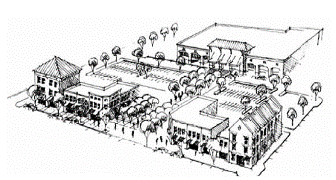
Introduction: The city adopted an ordinance on large retail developments to study the community impacts of the "superstore" phenomenon in more detail and to provide the community with clear and enforceable policies to mitigate those impacts. The main goal is to encourage development that contributes to Kuna as a unique place by reflecting its physical character and adding to it in appropriate ways. Large retail developments depending on high visibility and access from major public streets. As a result, their layout and design have a direct effect upon the functionality, character, and attractiveness of major streetscapes and pathways in a city. It should be noted that these design standards herein are to apply as a requirement only to those developments defined herein as "large retail establishments" (those retail buildings that have roof area or floor areas of twenty-four thousand nine hundred ninety-nine (24,999) square feet or more). The purpose of these standards and guidelines are to augment and work in concert with existing criteria in the commercial zoning districts and other applicable sections of this title relating to large retail developments. Where more specific interpretations and standards herein apply to the design of "large retail establishment," they shall prevail over other sections of this Code. These standards and guidelines require a basic level of architectural variety, compatible scale, pedestrian and bicycle access, and mitigation of negative impacts. The standards are by no means intended to limit creativity; it is the city's hope that they will serve as a useful tool for design professionals engaged in site specific design context.
C.
Procedure: The following standards and guidelines are intended to be used as a design aid by developers proposing "large retail establishments" in areas of the city zoned to permit such uses; and as an evaluation tool by the city staff and the design review committee in their review processes. These standards and guidelines apply to all projects which are processed according to the criteria for "large retail establishments," uses and/or as part of planned unit developments that include a component meeting the "large retail establishments" code definition, but may optionally be utilized as a tool when reviewing any "large retail establishment." "Standards" are mandatory. In the case of conflicting or competing provisions between this design manual and the Kuna Zoning Code, the more restrictive or specific provision shall apply. Where terms used in this design manual are defined within the zoning code, such definitions shall apply for purposes of administering this design manual. The design review committee is empowered to grant variances to the mandatory standards under the following circumstances:
1.
The strict application of the standard would result in peculiar and exceptional practical difficulties or exceptional and undue hardship upon the owner of the affected property; or
2.
The alternative site planning and building design approach meets the design objectives as stated in the standard, equally well or better than would compliance with the standard; and
3.
In either of the foregoing circumstances, the variance may be granted without substantial detriment to the public good.
(Ord. No. 2024-06, § 2, 4-16-2024)
5-8-907: - AESTHETIC CHARACTER:
A.
Facades and exterior walls:
1.
Guideline: Facades should be articulated to reduce the massive scale and the uniform, impersonal appearances of large retail buildings and provide visual interest that will be consistent with the community's identity, character and scale. The intent is to encourage a more human scale that Kuna residents will be able to identify with their community.
2.
Standards:
a.
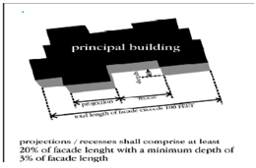
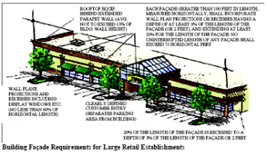
Facades greater than one hundred (100) feet in length, measured horizontally, shall incorporate wall plane projections or recesses having a depth of at least three (3) percent of the length of the facade extending at least twenty (20) percent of the length of the facade. No uninterrupted length of any facade shall exceed seventy-five (75) horizontal feet.
b.
Ground floor facades that face public streets, with the exception of the side opposite the main entrance, shall have arcades, display windows, entry areas, awnings, or other such features along no less than sixty (60) percent of their horizontal length.
B.
Multiple smaller stores within a principal building:
1.
Guideline: The presence of smaller retail stores gives an establishment a "pedestrian-friendly" appearance by creating variety, breaking up large expanses, and expanding the range of the site's activities. Windows and window displays of such stores should be used to contribute to the "human scale" and visual interest of exterior facades. The standards presented in this section are directed toward those situations where additional, smaller stores, with separate, exterior customer entrances are located in principal buildings.
2.
Standard: Principal buildings that contain additional, separately owned stores or tenants which occupy less than twenty-five thousand (25,000) square feet of gross floor area, and have separate, exterior customer entrances, shall meet the following:
a.
The street level facade of such stores shall be transparent between three (3) feet and eight (8) feet above the walkway grade for no less than sixty (60) percent of the horizontal length of the building facade of such additional stores.
b.
Windows shall be recessed and should include visually prominent sills, shutters, or other such forms of framing.
C.
Detail features:
1.
Guideline: Buildings should have architectural features and patterns that provide visual interest, at the scale of the pedestrian, reduce massive aesthetic effects, and recognize local character. The elements in the following standard should be integral parts of the building fabric, and not superficially applied trim or graphics, or paint.
2.
Standard:
a.
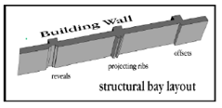
Building facades must include a repeating pattern that shall include no less than three (3) of the elements listed below (at least one (1) of these elements shall repeat horizontally). All elements shall repeat at intervals of no more than thirty (30) feet, either horizontally or vertically:
(1)
Color change.
(2)
Texture change.
(3)
Material change.
(4)
Expression of architectural or structural bay through a change in plane no less than twelve (12) inches in width, such as an offset, reveal, or projecting rib.
D.
Roofs:
1.
Guideline: Variations in rooflines should be used to add interest and reduce the massive scale of large buildings. Roof features should complement the character of adjoining neighborhoods.
2.
Standards: Roofs shall have no less than two (2) of the following features:
a.
Parapets concealing flat roofs and rooftop equipment such as HVAC units from public view. The average height of such parapets shall not exceed fifteen (15) percent of the height of the supporting wall and such parapets shall not at any point exceed one-third of the height of the supporting wall. Such parapets shall feature three-dimensional cornice treatment.
b.
Overhanging eaves, extending no less than three (3) feet past the supporting walls. Eaves extending into public rights-of-way may require a license agreement.
c.
Sloping roofs that do not exceed the average height of the supporting walls. No roof slope shall be less than three (3) inches vertical rise for every one (1) foot of horizontal run and less than or equal to one (1) foot of vertical rise for every one (1) foot of horizontal run.
d.
Three (3) or more roof slope planes.
E.
Materials and colors:
1.
Guideline: Exterior building materials and colors comprise a significant part of the visual impact of a building. Therefore, they should be aesthetically pleasing and compatible with materials and colors used in adjoining neighborhoods.
2.
Standards:
a.
Predominant exterior building materials shall be high quality materials. These include, without limitation:
(1)
Brick.
(2)
Wood.
(3)
Sandstone.
(4)
Other native stone.
(5)
Tinted, textured concrete masonry units.
(6)
Other materials as deemed appropriate by the design review committee.
b.
Facade colors shall be low reflectance, subtle, neutral or earth-tone colors.
c.
Building trim and accent areas may feature brighter colors, including primary colors. Small amounts of nonflashing, neon tubing, is an acceptable feature for building trim or accent areas.
d.
Predominant exterior building materials should not include the following:
(1)
Tilt-up concrete panels.
(2)
Prefabricated steel panels.
F.
Entryways:
1.
Guideline: Entryway design elements and variations should give orientation and aesthetically pleasing character to the building. Additionally, entryways should act as a transition zone between the parking and traffic aisles and the store itself. The standards identify desirable entryway design features.
2.
Standards:
a.
Each principal building on a site shall have clearly defined, highly visible customer entrances, extending from the front of the building, and featuring no less than three (3) of the following:
(1)
Canopies or porticos.
(2)
Overhangs.
(3)
Recesses/projections.
(4)
Arcades.
(5)
Raised corniced parapets over the door.
(6)
Peaked roof forms or arches.
(7)
Architectural details such as tile work and moldings which are integrated into the building structure and design.
(8)
Integral planters or wing walls that incorporate landscaped areas and/or places for sitting.
(9)
Outdoor patios.
(10)
Display windows.
b.
Where additional stores will be located in the principal building, each such store shall have at least one (1) exterior customer entrance, which shall conform to the above requirements.
G.
Sign standards:
1.
Only one (1) freestanding sign shall be allowed on each street frontage.
2.
Wall signage allowances shall be as specified in the zoning code.
3.
All other sign regulations, as specified in the zoning code shall apply.
(Ord. No. 2024-06, § 2, 4-16-2024)
5-8-908: - SITE DESIGN AND RELATIONSHIP TO SURROUNDING COMMUNITY:
A.
Entrances:
1.
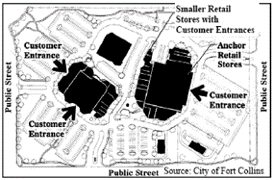
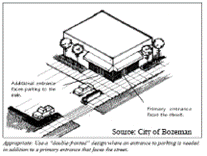
Guideline: Large retail buildings should feature multiple entrances. Multiple building entrances reduce walking distances from cars, facilitate pedestrian and bicycle access from public sidewalks, and provide convenience where certain entrances offer access to individual stores or departments of a store. Multiple entrances also mitigate the effect of the unbroken walls and neglected areas that often characterize building facades that face adjacent land uses.
2.
Standard: At least two (2) sides of a large retail establishment shall feature customer entrances. The two (2) required sides shall be those planned to have the highest level of public pedestrian activity, and one (1) of the sides shall be that which most directly faces a street with pedestrian access. The other of the two (2) sides may face a second street with pedestrian access, and/or a main parking lot area. All entrances shall be architecturally prominent and clearly visible from the abutting public street. Movie theaters are exempt from this requirement.
B.
Vehicular access:
1.
Guideline: Access to retail parking should be designed such that it avoids, to the extent possible, impacts to the existing adjacent street system - specifically the continued ability of an adjacent arterial to function as designed.
2.
Standards: Whenever feasible, the primary vehicular access point to the site shall not be via an adjacent major arterial street.
C.
Parking lots:
1.
Guideline: Parking areas should provide safe, convenient and efficient access. They should be distributed around large buildings in order to shorten the distance to other buildings and public sidewalks, provide for attractive landscaping, and to reduce the overall scale of the paved surface. If buildings are located closer to streets, the scale of the complex is reduced, pedestrian traffic is encouraged, and architectural details take on added importance. Additionally, traffic calming devices should be encouraged for pedestrian safety.
2.
Standards:
a.
Safety plan: A parking and pedestrian walk-ability safety plan needs to be submitted and approved. The plan may require a pathway or sidewalks between parking for pedestrian safety and walk-ability. Parking lot design must include detailed information on nonmotorized pedestrian access to and through the development.
b.
Provide adequate and easily accessible cart corrals.
c.
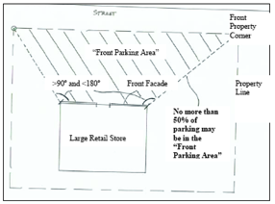
Parking lot location: No more than fifty (50) percent of the large retail establishment's off-street parking area shall be located between the front of the building and the abutting street(s) (the "front parking area"). Developers are encouraged to place parking to the sides or rear of the establishment.
d.
The front parking area: The front parking area is that portion of the parking lot that is situated between a nonresidential building and the street. It is the city's desire to encourage parking to be installed to the sides and rear of a building, rather than to the front of the building and particularly for the siting parking should be installed to the rear of the building where possible.
The "front parking area" as defined as the area lying between the front of the building and the street shall be determined by drawing a line from the front corners of the building to the nearest complementary property corners.
Any parking space sufficient in size to accommodate motorcycle or bicycle parking that is a minimum ninety (90) square feet in area (one-half a standard parking space) shall be counted as a parking space in the front parking area.
e.
Parking pod specifications and limitations:
(1)
The large retail establishment's designated off-street parking areas (parking lot) shall be designed such that every one hundred forty (140) parking stalls (a parking "pod") are separated from one another by a minimum thirty-foot wide landscape barrier that includes a pedestrian walkway. The pod separation is in addition to the requirement that parking areas, or "bays" with more than thirty (30) contiguous parking stalls, be divided by landscaped strips. The large retail parking lot's internal landscape strips shall be, a minimum, six (6) feet wide. The large retail parking lots' external landscape widths shall be according to the city's landscape standards found in Chapter 10 of this title.
(2)
The maximum number of parking spaces for any large retail establishment shall not exceed one hundred fifty (150) percent or one and one-half (1½) times the minimum parking required for the use.
D.
Back sides:
1.
Guideline: The rear (side opposite the main entrance of the principal retail use) of buildings often presents an unattractive view of blank walls, loading areas, storage areas, HVAC units, garbage receptacles, and other such features. Architectural and landscaping features should mitigate these impacts. If a building is designed to have customer entrances on all sides the following three (3) standards shall not apply.
2.
Standards: The large retail establishment's building facade shall be setback a minimum of thirty-five (35) feet from the nearest rear yard property line. Where the rear side of the building is adjacent to existing or planned residential uses, the buffer yard requirements will need to meet city landscape standards.
a.
The rear setback of the large retail building shall also incorporate at least one (1) of the special design features found in subsection G, "Central features and community spaces," of this section.
b.
Additional screening such as attractive two-thirds closed fencing (no chain-link) shall be used if the residential use is directly adjacent to the rear of the building, and not separated by, a road, major pathway, or other similar feature extending the entirety of the lot line held in common with the residential use.
E.
Outdoor storage, trash collection and loading areas:
1.
Guideline: Loading areas and outdoor storage areas exert visual and noise impacts on surrounding neighborhoods. These areas, when visible from adjoining properties and/or public streets, should be screened, recessed or enclosed. While screens and recesses can effectively mitigate these impacts, the selection of inappropriate screening materials can exacerbate the problem. Appropriate locations for loading and outdoor storage areas include areas between buildings, where more than one (1) building is located on a site and such buildings are not more than forty (40) feet apart, or on those sides of buildings that do not have customer entrances.
2.
Standards:
a.
Areas for outdoor storage, truck parking, trash collection or compaction, loading, or other such uses shall not be directly visible from abutting streets.
b.
Outdoor storage, trash removal or compaction, loading, delivery and other similar type business functions shall be located a minimum twenty (20) feet from any public street, public sidewalk, or internal pedestrian way. These uses/functions shall not be permitted within one hundred (100) feet of the boundary of a property used for residential purposes or a residentially zoned district.
c.
Loading docks, truck parking, outdoor storage, utility meters, HVAC equipment, trash collection, trash compaction, and other service functions shall be incorporated into the overall design of the building and the landscaping so that the visual and acoustic impacts of these functions are fully contained and out of view from adjacent properties and public streets, and no attention is attracted to the functions by the use of screening materials that are different from or inferior to the principal materials of the building and landscape.
d.
Non-enclosed areas for the storage and sale of seasonal inventory shall be permanently defined and screened with walls and/or fences. Materials, colors, and design of screening walls and/or fences and the cover shall conform to those used as predominant materials and colors on the building. If such areas are to be covered, then the covering shall conform to those used as predominant materials and colors on the building.
F.
Pedestrian/bicycle flows:
1.
Guidelines: Pedestrian and bicycle accessibility opens auto-oriented developments to the neighborhood, reducing traffic impacts and enabling the development to project a friendlier, more inviting image. This section sets forth standards for public sidewalks and internal pedestrian/bicycle circulation systems that can provide user-friendly access as well as pedestrian/bicycle safety, shelter, and convenience within the large retail development grounds. Additionally, vehicle drive-up facilities should be well-planned to avoid circulation problems with pedestrians and cyclists.
2.
Standards: A minimum eight-foot wide sidewalk shall be provided along all sides of the large retail establishment lot abutting the public street unless otherwise specified, no less than eight (8) feet in width, shall also be provided along the full length of the building and along any building facade featuring a customer entrance, or abutting public parking areas. These sidewalks shall be located a minimum six (6) feet from the building's facade and separated from the building by an irrigated landscape strip, except where features such as arcades or entryways are part of the facade.
a.
Continuous internal pedestrian walkways shall be provided, in the most direct manner possible, from the public sidewalks along abutting streets, adjacent paths, and/or rights-of-way to the principal entrances of all principal buildings on the site. At a minimum, walkways shall connect focal points of activity including, but not limited to, transit stops, street crossings, building and store entry points, and shall feature adjoining landscaped areas.
b.
Internal pedestrian walkways provided in conformance with the above standards shall provide weather protection features such as awnings or arcades within thirty (30) feet of all customer entrances.
c.
All internal pedestrian walkways shall be distinguished from driving surfaces through the use of durable, low maintenance surface materials such as pavers, bricks, or scored concrete to enhance pedestrian safety and comfort, as well as the attractiveness of the walkways.
G.
Central features and community spaces:
1.
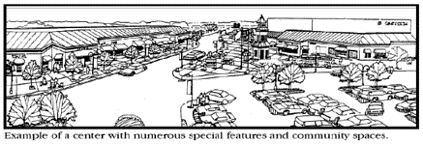
Guidelines: Buildings should offer attractive and inviting pedestrian scale features, spaces and amenities. Entrances and parking lots should be configured to be functional and inviting with walkways conveniently tied to logical destinations. Bus stops and drop-off/pick-up points should be considered as integral parts of the configuration. Pedestrian ways should be anchored by special design features such as towers, arcades, porticos, pedestrian light fixtures, bollards, planter walls, and other architectural elements that define circulation ways and outdoor spaces. Examples of outdoor spaces are plazas, patios, courtyards and window shopping areas. The features and spaces should enhance the building and the large retail development as integral parts of the community fabric.
2.
Standards: The developer of the large retail establishment shall provide community and public spaces in the form of a patio, plaza, or picnic area that is no less than eight hundred (800) square feet in area.
a.
Additionally, at least two (2) of the following are to be provided, one (1) of which shall be at the rear side of the building: Patio/seating area; pedestrian plaza with benches; public transit stop amenities (benches, shelter, etc.); outdoor playground area; water feature; public art feature; landscaped picnic area or other such deliberately shaped area; and/or a focal feature or amenity that, in the judgment of the design review committee or the planning and zoning commission, adequately enhances such community and public spaces. Any such area shall have direct access to the public sidewalk network and such features shall not be constructed of materials that are inferior to the principal materials of the building and landscape.
H.
Delivery/loading operations:
1.
Guidelines: Delivery and loading operations should not disturb adjoining neighborhoods, or other uses.
2.
Standards:
a.
Outdoor storage, trash removal or compaction, loading, delivery and other similar type business functions shall be located a minimum twenty (20) feet from any public street, public sidewalk or internal pedestrian way. These uses/functions shall not be permitted within one hundred (100) feet of the boundary of a property used for residential purposes or a residentially zoned district.
I.
Minimum landscaping standards:
1.
Guidelines: Use landscaping to enhance the internal attractiveness of the site, break large expanses of parking, and mitigate impacts to surrounding properties as a result of the development.
2.
Standards: A minimum of fifteen (15) percent of the large retail establishment lot area shall be landscaped according to the city's landscape requirements.
a.
Site landscaping:
(1)
The applicant shall submit a complete landscape plan, drawn to scale, showing all live plant materials, associated species list, and nonplant materials to be installed on the site in order to meet the landscape requirement;
(2)
All plant materials, except existing native plants not damaged during construction or xeriscape species shown not to require regular watering, shall be irrigated by underground sprinkler systems set on a timer in order to obtain proper watering duration and ease of maintenance.
(Ord. No. 2024-06, § 2, 4-16-2024)
5-8-909: - USES:
The DR district does not affect uses of land that may be permitted in the various zoning districts. All uses of land shall be determined under the provisions of this chapter.
(Ord. No. 2024-06, § 2, 4-16-2024)
5-8-910: - DESIGN REVIEW APPLICATION REQUIRED:
Prior to application for a permit to erect, construct, alter, move, remodel, or reface or otherwise change the use of the building or structure in the DR district, the applicant must file an application with the Director upon a form prescribed by the Council.
(Ord. No. 2024-06, § 2, 4-16-2024; Ord. No. 2025-37, § 6, 11-5-2025)
5-8-911: - PROCEDURE FOR APPROVAL:
A.
Date of application acceptance: The date of application acceptance shall be the date the applicant submits to the planning and zoning department the final required information including the application fee.
B.
Fees: The Council shall, by resolution, establish fees for all zoning applications or petitions authorized by this title.
C.
Review: Following the receipt of an application, the Director shall review the application within sixty (60) days. Failure of the Director to accept a completed application shall be deemed a denial of the application. An application that is not completed within sixty (60) days shall become null and void and will be required to be resubmitted.
D.
Written decision: The applicant shall be provided written findings of fact and conclusions of law in accord with I.C. § 67-6519, stating the reasons for the decision reached. All conditions of approval shall be attached to the written decision.
(Ord. No. 2024-06, § 2, 4-16-2024)
5-8-912: - APPEAL:
A.
Appeal of design review decisions: An applicant or affected party may appeal any final decision on an administrative review application by the Director or any final decision on a DR committee decision to the Council. The applicant or affected party shall file a written notice of appeal stating specifically the decision(s) to be reviewed by the DR committee or Council and the grounds for the appeal with the Director before 5:00 p.m. of the tenth calendar day, or the next business day following the tenth calendar day should the tenth day fall on a weekend or holiday, after the final decision or determination has been made and provided in writing to the applicant. The basis of the appeal shall include at a minimum the following:
1.
Name, mailing address, and telephone number of the appealing party.
2.
Date and subject matter of the final decision(s) being appealed.
3.
Applicable city code provisions the appealing party designates as relevant to the decision and/or appeal.
4.
Any perceived hardships the appealing party claims are a result of the final decision(s) being appealed.
5.
Every reason the final decision(s) being appealed is claimed to be in error.
B.
Hearings: Hearings before the Commission or Council on such appeals shall be scheduled in accordance with Chapter 1 of this title and shall be a de novo review of the decision.
(Ord. No. 2024-06, § 2, 4-16-2024)
5-8-913: - TERM OF APPROVAL:
Any approval given pursuant to the provisions of this chapter shall lapse and become null and void twelve (12) months following the date on which it was given, unless, prior to the expiration date, construction or development is commenced and diligently pursued toward completion on the site which was the subject of the application. Upon written request to the Director, containing the reasons thereof, the Director may grant extensions of time for approved design review applications, provided the director finds the proposed development complies with current ordinance requirements.
(Ord. No. 2024-06, § 2, 4-16-2024)
5-8-914: - MODIFICATIONS:
After approval of a design review application, the applicant may request a modification(s) to the approved development plans or conditions. Such request shall be made upon an application form and shall be determined pursuant to the standards set forth in this chapter.
A.
Administrative approvals: The Director is authorized to approve minor modifications as specified below:
1.
Modifications proposed for any development application processed as an administrative design review in accordance with KCC § 5-8-910.
2.
Minor relocation of building pads or dwelling units due to conditions such as unanticipated topography, road alignment or easements; provided that the modification does not significantly alter the site design in terms of parking layouts, vehicular circulation, landscape design and other similar components of the development plans, provided ordinance requirements are still met.
3.
An increase or decrease in a proposed setback, provided ordinance requirements are still met.
4.
A change in building design relating to items such as materials, colors, window and door locations and mechanical units, provided the design remains essentially the same as that previously approved by the design review board.
5.
A minor modification to a recreation area or open space design, but not elimination or a significant reduction.
6.
A minor change to landscape design/plant material changes.
7.
A minor change to parking lot/site plan.
B.
DR committee design review action: The following modifications shall require an approval from the DR committee:
1.
Any change that may impact an adjoining residential neighborhood.
2.
Any requests that in the opinion of the director would significantly alter the design of the site and/or building(s).
3.
A request to change or delete a condition of approval established by the DR committee.
(Ord. No. 2024-06, § 2, 4-16-2024)
5-8-915: - RESTRICTIONS ON OTHER REQUIRED DOCUMENTS:
No building or zoning permits shall be issued to any applicant from within the DR district until the design review application has been specifically approved in writing by the director or DR committee and is in full compliance with this Code.
(Ord. No. 2024-06, § 2, 4-16-2024)
5-8-916: - SURETIES:
Prior to the issuance of a temporary certificate of occupancy, a surety in the form of an irrevocable letter of credit, certificate of deposit, or cash, in the amount equal to one hundred twenty-five (125) percent of the estimated construction costs of site improvements, landscaping and irrigation shall be provided by the owner/developer and held by the city until said construction, landscaping and irrigation is complete. Construction cost estimates shall be reviewed and approved by the city zoning director prior to city acceptance of said surety. The surety initiation and extension fees shall be established by resolution of the city council. No final certificate of occupancy shall be issued until the required construction, landscaping and irrigation is complete pursuant to KCC §§ 5-10-11 and 5-10-22.
(Ord. No. 2024-06, § 2, 4-16-2024)
5-8-918: - INSPECTION:
A.
When required: At the request of the design review board, the zoning director shall cause to be inspected each applicant development and shall issue an inspection report to the design review board. Each project will be inspected based on the requirements of this chapter.
B.
Certificate of occupancy: The building inspector shall not issue a final certificate of occupancy to the applicant until all of the requirements of the design review applications, as approved by the design review board, have been complied with.
(Ord. No. 2024-06, § 2, 4-16-2024)

