
Lansing City Zoning Code
ARTICLE XIII
SIGNS
Sec. 56-407.- Purpose.
The purpose of this article is to provide a legal framework for the comprehensive regulation of signs in the village. It recognizes the need for adequate identification, advertising and communication that is structurally sound, well-maintained and attractive in appearance. To achieve this purpose, this article is intended to control the height, area, type, location and other similar aspects of signs and sign structures, while also:
(1)
Preserving the noncommercial character of the residential neighborhoods.
(2)
Providing reasonable, yet appropriate, conditions for identifying businesses and services rendered in commercial, institutional and industrial areas.
(3)
Reducing traffic hazards by restricting signs and lights that exceed a viewer's capacity to receive information or that increase the potential for accidents created by signage which distract or obstruct a viewer's vision.
(4)
Protecting the health, safety, comfort, convenience and general welfare of the village residents.
(Ord. of 5-1-2003, § 13.1)
Sec. 56-408. - Prohibited.
The following signs shall be prohibited:
(1)
Signs which move, or give the appearance of movement including, but not limited to, signs that flutter, undulate, swing, rotate, oscillate or otherwise move by natural or artificial means, and signs containing flashing or running lights giving the illusion of movement. The following are exceptions to this prohibition:
a.
Temporary signs such as pennants, banners and streamers shall not be deemed to fall within this prohibition; provided a sign permit is first obtained from the building commissioner pursuant to section 56-97.
b.
Time and temperature signs shall not be deemed to fall within this prohibition.
(2)
Roof signs.
(3)
Off-premises signs, with the exception of those located within 300 feet of the I-94 right-of-way which may only be approved by the village board of trustees.
(4)
Signs which imitate traffic signs including, but not limited to, signs which incorporate the words STOP, DANGER, WARNING, CAUTION, or GO SLOW, unless such language is part of the name of a business. Signs which are accessory to a parking lot shall not be deemed to fall within this prohibition.
(5)
Signs placed on parked vehicles or trailers where the apparent purpose is to advertise a product or to direct the public to a business or activity located on or off the same premises, or trailers or sign vehicles where the apparent purpose is to advertise a product or to direct the public to a business or activity located on or off the same premises.
(6)
Flashing signs or lights.
(7)
Signs which display obscene, indecent or immoral matter.
(8)
Human sign. A sign held by or attached to a human for the purposes of advertising or otherwise drawing attention to an individual, business, commodity, service or product. This can also include a person dressed in costume for the purpose of advertising or drawing attention to an individual, business, commodity, service or product. Exception: Nonprofit Lansing-based organization that are doing fund-raises, such as a car wash.
(9)
Portable signs. Portable signs such as sandwich board or "A" frame signs.
(Ord. of 5-1-2003, § 13.2; Ord. No. 16-025, §§ 1, 2, 7-5-2016)
Sec. 56-409. - Exempt signs.
The following signs shall be exempt from the permit requirements set forth in section 56-97; provided, however, they meet the remaining requirements of this article as well as any limitation set forth herein.
(1)
Public service. Signs used for safety purposes relative to the repair or maintenance of streets, sidewalks or utilities in a public right-of-way.
(2)
Address numbers. Address numbers not exceeding two square feet in area.
(3)
Governmental. Signs and public notices erected or required by governmental bodies, or authorized for a public purpose by any law, statute, or ordinance.
(4)
Public information. Signs identifying the telephone, restrooms and similar facilities; providing no advertising matter accompanies the sign.
(5)
Government flags. Flags of any country, state or unit of local government. Flag poles accompanying such flags shall be limited to a height of 20 feet in residential districts and 40 feet in nonresidential districts.
(6)
Corporate flags. Corporate flags, when flown in conjunction with the flag of the United States of America; provided such corporate flag is no larger than 24 square feet in area.
(7)
Memorial plaques. Memorial plaques and cornerstones, when permanently affixed to a building or premises.
(8)
Institutional identification and bulletin boards. Identification signs, notices, and bulletin boards for public, charitable, religious, educational or similar type of organizations/institutions when not exceeding 16 square feet and located on the same premises as the institution.
(9)
Time and temperature. Time and temperature signs containing computer generated messages, such as a public service time, temperature and date, not exceeding 18 square feet.
(10)
Political. Temporary political signs limited in size to four feet by four feet in sign area shall be located on private property a minimum distance of five feet from any property line.
(11)
Historical identification. Signs for property designated by the federal, state or local governments as a historical location, site or landmark.
(12)
Real estate (residential). Real estate signs in the type and number listed below:
a.
Signs advertising the sale, lease or rent of property; provided:
1.
No sign shall exceed eight square feet in area.
2.
No sign shall be erected more than six feet from the finished floor and not displayed above the second floor of a multistory building.
3.
No more than one sign per street frontage is displayed.
4.
Only the current real estate or leasing contact shall be permitted to post signs on the property.
5.
Every sign is located on the same premises as the subject property.
6.
Every sign is removed seven days after the closing or execution of the lease.
7.
No flashing or lighted signs.
8.
No banners, flags, or pendants allowed on property.
b.
Signs identifying a real estate open house; provided:
1.
No sign shall exceed six square feet in area.
2.
No more than four signs per property shall be displayed.
3.
The signs may be located at any intersection within one square mile of the subject property, but only one sign per intersection per property shall be allowed.
4.
Every sign shall have attached to it identification denoting the person or agency responsible for its placement and removal.
(12.1)
Real estate (commercial). Real estate signs in the type and number listed below:
a.
Signs advertising the sale, lease or rent of property; provided:
1.
No sign shall exceed 32 square feet in area, without staff approval.
2.
No sign shall be erected more than six feet from the finished floor and not displayed above the second floor of a multistory building.
3.
No more than one sign per street frontage is displayed, without staff approval.
4.
Only the current real estate or leasing contact shall be permitted to post signs on the property.
5.
Every sign is located on the same premises as the subject property.
6.
Every sign is removed seven days after the closing or execution of the lease.
(13)
Miscellaneous information matter. Matter appearing on gasoline pumps, newspaper vending boxes, automatic teller machines, and other vending machines, or matter appearing on or adjacent to entry doors such as "Push," "Pull," "Open" and "Closed," or matter appearing on display windows or doors denoting hours of operation, credit cards accepted, and similar information.
(14)
Construction. On individual residential lots construction signs shall be permitted. One nonilluminated temporary sign bearing the name of the general contractor or subcontractor shall be permitted during construction or remodeling on the premises upon which they are placed. Total gross area shall not exceed 12 square feet. Construction signs shall be removed within seven days after substantial completion of the construction.
(15)
Portable and wheeled signs. Portable and wheeled signs that include sandwich board and "A" frame signs shall be permitted on the properties of commercial or institutional establishments; provided they are maintained in good condition and are located a minimum of five feet from any property line. Such signs shall not be located in a manner that obstructs the public right-of-way and/or public sidewalk. Illuminated portable and wheeled signs or those that flash or have running lights shall be prohibited.
(Ord. of 5-1-2003, § 13.3; Ord. No. 10-023, § 1, 11-16-2010; Ord. No. 16-025, §§ 3—5, 7-5-2016)
Sec. 56-410. - Locational requirements.
(a)
No sign shall be erected or maintained at the intersection of any streets in such a manner as to obstruct the free and clear vision of a driver of a vehicle or a pedestrian. Monument signs shall be required to meet the site distance requirements of section 56-265(g).
(b)
No sign shall be erected or maintained so as to prevent the free ingress or egress from any door, window or fire escape, and no signs shall be attached to a stand pipe or fire escape.
(c)
No person shall place, paste, print of affix, in any manner, a handbill, sign, poster, advertisement or notice of any kind in any public right-of-way.
(Ord. of 5-1-2003, § 13.4; Ord. No. 16-025, § 6, 7-5-2016)
Sec. 56-411. - Illumination.
(a)
Location and design of light sources. Whenever an external artificial light source is used to illuminate a sign, such source shall be located, shielded and directed so as to not be visible from any public street or private residence. No receptacle or device housing a permitted light source which is attached to the sign itself shall protrude more than 15 inches from the face of the sign or building to which it is attached. If ground lighting is used to illuminate a sign, the receptacle or device should not protrude more than 12 inches and must be fully screened from view by landscaping.
(b)
Level. In no event shall the illumination of any sign, resulting from any internal or external artificial light source, exceed 100 footcandles at the sign face. All artificial illumination shall be so designed, located, shielded, and directed as to prevent the casting of direct light upon adjacent property or streets.
(c)
Signs adjacent to residential areas. Signs located on a lot abutting a residential district or a sign within 100 feet of any residentially-zoned area shall be so designed, located, shielded and directed as to prevent the casting of direct light upon adjacent properties or streets.
(Ord. of 5-1-2003, § 13.5)
Sec. 56-412. - Area computation.
The following principles shall control the computation of sign area:
(1)
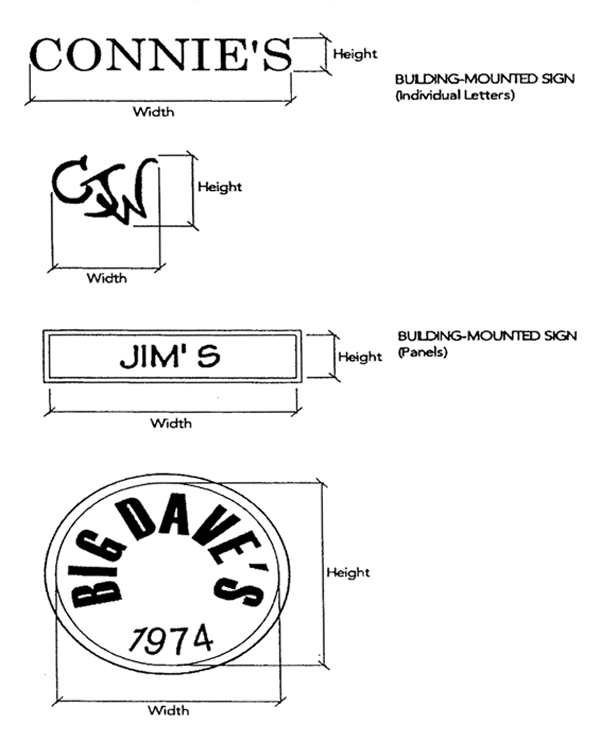
Individual signs. The area of a sign face shall be computed by means of the smallest square, circle, rectangle or triangle, or combination thereof, that will encompass the extreme limits of the writing, representation, emblem or other display, together with any material or color forming an integral part of the background or the display or used to differentiate the sign from the backdrop or structure against which it is placed, but not including, any supporting framework or bracing, unless such framework or bracing is made part of the message or face of the sign. See the illustrations (Figures 56-5 and 56-6) that follow.
(2)
Multiple-faced signs. The sign area for a sign with more than one face shall be computed by adding together the area of all sign faces visible from any one point. When two identical sign faces are placed back to back, so that both faces cannot be viewed from any point at the same time, and when such sign faces are part of the same sign structure and are no more than 42 inches apart, the sign area shall be computed by the measurement of one of the faces.
Figure 56-5. Calculation of Freestanding Sign Area
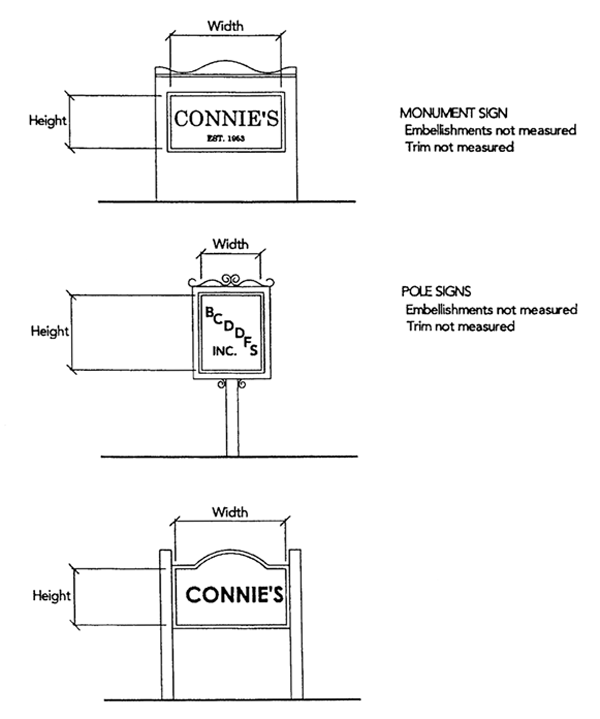
Figure 56-6. Calculation of Building-Mounted Sign Area
(Ord. of 5-1-2003, § 13.6)
Sec. 56-413. - Construction and design standards governed by building code.
All signs shall meet the construction and design standards set forth for signs in the building code.
(Ord. of 5-1-2003, § 13.7)
Sec. 56-414. - Litter control.
All signs, and the premises surrounding the sign, shall be maintained in a clean, sanitary and inoffensive condition, and free and clear of all noxious substances, rubbish and weeds.
(Ord. of 5-1-2003, § 13.8)
Sec. 56-415. - Maintenance.
Every sign established in the village shall, at all times, be maintained in good structural and aesthetic condition, including all metal parts and supports thereof that are not galvanized or of rust-resistant metals. The building commissioner shall have the authority to inspect any sign and order any remedial action authorized thereunder.
(Ord. of 5-1-2003, § 13.9; Ord. No. 16-025, § 7, 7-5-2016)
Sec. 56-416. - Landscape requirements.
Pole and monument signs shall be required to be maintained with landscaping at the base of the sign. The landscaping provided shall consist of a square, rectangle, oval or circle, the area of which shall be a minimum of three feet in width on each side of the sign base.
(Ord. of 5-1-2003, § 13.10)
Sec. 56-417. - Wind pressure and dead-load requirements.
All signs and sign structures shall be designed and constructed to withstand wind pressures and dead-loads as required by the building code.
(Ord. of 5-1-2003, § 13.11)
Sec. 56-418. - Identification and marking.
Each sign hereafter erected or remodeled shall bear, in a prominent position thereon, a clearly legible identification plate, stating the name of the person responsible for its construction and erection. Electrical signs shall be marked with input amperes at full-load input.
(Ord. of 5-1-2003, § 13.12)
Sec. 56-419. - Standards by type.
The following signs require a permit and are subject to the following standards based on sign type:
(1)
Pole signs.
a.
Materials. All pole signs shall have a surface or facing of incombustible material; provided, however, that combustible structural trim may be used thereon.
b.
Construction. All letters, figures, characters or representations, in cut-out or irregular form, maintained in conjunction with, attached to, or superimposed on, any sign shall be safely and securely attached to the sign structure.
c.
Setback. No pole sign shall be constructed closer than five feet from any property line. The setback distance shall be measured from the outermost portion of the sign to the property line. Where a public sidewalk is constructed over a property line, the setback shall be five feet measured from the outermost portion of sign to the nearest edge of the sidewalk. Pole signs shall also meet the requirements of section 56-265(g).
d.
Supports. All monument signs shall be securely built, constructed and erected upon posts and standards sunk at least three feet below the natural surface of the ground. The standards shall be supported and braced in the rear thereof, extending from the top thereof to a point in the ground of at least a distance equal to one-half the height of such sign, measured along the ground, from the posts or standards on which the same is erected.
e.
Landscaping. Unless waived by the planning and zoning board of appeals, all pole signs shall be landscaped with shrubs and/or ornamental plants around the base of the sign. The landscaped area shall be a minimum of three feet in width and protected with concrete curbing.
(2)
Monument signs.
a.
Materials. All monument signs shall have a surface or facing of incombustible material; provided, however, that combustible structural trim may be used thereon.
b.
Construction. All letters, figures, characters or representations, in cut-out or irregular form, maintained in conjunction with, attached to, or superimposed on, any sign shall be safely and securely attached to the sign structure.
c.
Setback. No monument sign shall be constructed closer than five feet from any property line. The distance shall be measured from the outermost portion of the sign to the property line. Where a public sidewalk is constructed over a property line, the setback shall be five feet measured from the outermost portion of the sign to the nearest edge of the sidewalk. Monument signs shall also meet the requirements of section 56-265(g).
d.
Supports. All monument signs shall be securely built, constructed and erected in conformance with the building code.
e.
Landscaping. Unless waived by the planning and zoning board of appeals, all monument signs shall be landscaped with shrubs and/or ornamental plants around the base of the sign. The landscaped area shall be a minimum of three feet in width and protected with concrete curbing.
(3)
Wall signs, including projecting signs.
a.
Materials. All wall signs shall have a surface or facing of incombustible material; provided, however, that combustible structural trim may be used thereon.
b.
Projection into the public right-of-way and beyond the building face. No wall sign shall be permitted to extend more than 24 inches from the face of the wall, with the exception that projecting signs that are oriented at a 90 degree angle from the wall may project into the right-of-way in the CBD and B2 districts. No projecting signs in the CBD or B2 districts shall be permitted to extend beyond a point two feet inside the curbline. Projecting signs in the B2 district shall meet the state department of transportation (IDOT) standards for permitted projection into the public right-of-way, where applicable. Signs projecting into IDOT public rights-of-way shall be mounted at a minimum clearance of 14 feet above the public right-of-way, or alternative height specified by IDOT. All other projecting signs shall be constructed and erected so that the lowest portion thereof shall be no less than eight feet above the level of the sidewalk or public thoroughfare. Signs shall not extend past the top of the wall and roof, nor extend beyond the ends of the wall to which the signs are attached. Existing projecting signs in districts other than the CBD district that advertise a business operating on the same premises may be retained; provided the sign receives regular maintenance.
c.
Supports. All wall signs shall be safely and securely attached to the building wall. The method of attachment must be in accordance with all applicable sections of this article and the building code, details of which must be shown on the permit plans and approved by the building commissioner. Wall signs shall be architecturally integrated into the design of the building, and thus wall supports, brackets, and other hardware that attach signs to the building shall be located in a manner that is not visually obtrusive. These supports and other hardware shall be promptly removed upon removal of the sign.
d.
Location. Wall signs shall be installed at the sign band line of the business front and shall be installed no higher than the building height or 20 feet above curb level, whichever is lower. No wall sign shall cover, wholly or partially, any wall opening, nor project beyond the ends or top of the wall to which it is attached.
(4)
Awnings.
a.
Materials. Awnings may be constructed of cloth or metal; provided, however, all frames and supports shall be of metal.
b.
Projection into the public right-of-way. All awnings shall be constructed and erected so that the lowest portion thereof shall be no less than eight feet above the level of the sidewalk or public thoroughfare. No awning shall be permitted to extend beyond a point two feet inside the curbline.
c.
Supports. Every awning shall be securely attached to and supported by the building. Posts or columns beyond the building line shall not be permitted for awnings. No awning shall be attached to the wood jambs, frames or other wood members of a building, frame buildings excepted, when such building is less than ten feet from public property.
d.
Maintenance. Every awning shall be rolled or folded against the building wall, except when serving as protection from the sun, rain, snow or other inclement weather.
(5)
Canopies/marquees.
a.
Materials. Canopies and marquees may be constructed of cloth or metal hood; provided, however, all the frames and supports shall be constructed of metal.
b.
Projection into the public right-of-way. All canopies and marquees shall be constructed and erected so that the lowest portion thereof shall be no less than eight feet above the level of the sidewalk or public thoroughfare. No canopy or marquee shall be permitted to extend beyond a point two feet inside the curbline.
c.
Supports. The framework of all canopies shall be designed by an architect or structural engineer and approved by the building commissioner and shall be in compliance with the building code.
d.
Width. No canopy or marquee shall be permitted to exceed eight feet in width.
(6)
Temporary signs are subject to the regulations outlined below.
a.
Sign types and size: Temporary signs are limited to those outlined below. If a proposed sign is note listed, the planning and development director may determine if the proposed sign is similar and compatible with the allowable signs and permit such temporary signs, in accordance with the regulations of this chapter.
1.
Feather Flag Signs: Limited to two per site and shall not exceed 15 in height.
2.
Temporary Wall/Banners: Limited to one per public right-of-way and shall not exceed six feet in height.
3.
Temporary Free Standing Signs: Limited to one per public right-of-way and shall not exceed three feet in height.
4.
Inflatable Signs: Limited to one per business and shall not exceed 25 feet in height.
b.
Duration. Temporary signs, including banners shall not be erected and maintained for a period in excess of 15 days, unless an extension to no more than 30 days is approved by the building commissioner. Temporary inflatable balloon signs shall not be erected and maintained for a period in excess of ten days.
c.
Weight limitation. Any temporary sign, regardless of exempt status, weighing in excess of 50 pounds must be approved by the building commissioner and conform to the requirements of the village building code.
d.
Projection into public right-of-way and beyond the building face. No temporary sign shall extend over or into any street, alley, sidewalk, or other public thoroughfare a distance greater than six inches from the wall upon which it is erected, and shall not be placed, nor project, over any wall opening.
e.
Construction. Every temporary sign shall be securely fastened, at all four corners, to a wall, building or other support structure by means of wire, cable, string, rope, or other suitable material. Inflatable balloon signs shall only be permitted where the applicant provides a letter of consent from the property owner to allow for the erection of any building-mounted inflatable balloon sign.
f.
Limitation. The advertisement contained on any temporary sign shall pertain only to the business industry or pursuit conducted on or within the premises on which such sign is erected or maintained. This provision shall not apply to signs of a civic, political, or religious nature. Temporary signs are permitted if they are in conjunction with a grand opening, special sale, promotion, or similar type event.
(7)
Community event signs.
a.
Permits. Permits are required. There will be no fees associated with community event signs and will be issued in the order the department receives the application.
b.
Location. Community event signs can only be placed at the approved locations, the northeast corner of Ridge Road and Burnham Avenue, next to the Fireman's Memorial, and at the northeast corner of Ridge Road and Wentworth Avenue. No more than one sign per location.
c.
Duration. Signs may be placed 14 days prior to the event and must be removed two days after the event has taken place.
(8)
Commercial electronic reader boards.
a.
Commercial electronic reader boards are a special use with the planning and zoning board to set limitations on locations, brightness and general guidelines for types of advertisement.
(9)
Rope lighting.
a.
Permits. Permits required and fees should be the same as neon lights, which are $0.20 per linear foot.
b.
Location. Allowed in B2 and B3 zoning districts as an accent to the street facing side of the building or windows.
c.
Construction. Lighting shall be directly plugged into an outlet. No use of extension cords allowed.
d.
Intensity. Light intensity shall be no more than one footcandle, as measured horizontally at any property line.
e.
Duration. Lights can only be on during business hours.
f.
Holiday. Rope lighting used for holiday decorations shall be subject to regulations set forth in section 46-539 of this Code.
(10)
Portable electronic signs.
a.
Type. Limited to "open" signs only, not for advertisement of services or goods.
b.
Location. One "open" per street facing side of business.
c.
Construction. Sign must be directly plugged into an outlet. No use of extension cords.
(Ord. of 5-1-2003, § 13.13; Ord. No. 16-025, §§ 8, 9, 7-5-2016; Ord. No. 23-032, § 26, 8-15-2023)
Sec. 56-420. - Regulation by district classification.
(a)
Residential districts. It shall be unlawful for any person to construct or maintain a sign in any residential district, except as shown here in the following table.
_____
Table 56-420 Sign Requirements for Residential Districts
_____
(b)
Business, manufacturing and special purpose districts. It shall be unlawful for any person to construct or maintain a sign in any business district, M1 district or the AT district without a sign permit. Freestanding signs (i.e., pole or monument signs) shall not be permitted unless a minimum setback from the sidewalk is provided. All freestanding signs are prohibited in the CBD district and pole signs are prohibited in the B1-T district. For the purposes of providing sign uniformity, a property may incorporate both wall and monument signs or wall and pole signs. However, the use of monument signs in conjunction with pole signs is prohibited. All except exempt signs identified in Table 56-420 require a sign permit.
(c)
Special conditions for automotive service stations. The following requirements apply to automotive service stations.
(1)
Matter appearing on gas pumps as purchased or installed shall not be considered a signs for purposes of this chapter. In addition to all other signs permitted by this article, an automobile service station may display one sign no larger than four square feet above each pump island stating "Self-Service" or "Full-Service" and the current price per gallon.
(2)
For computing sign area for automobile service stations, the area of all signs located on a gas station canopy and changeable copy included as part of freestanding signs shall be included in the sign area calculation.
(d)
Nonresidential districts. Sign regulations for nonresidential districts are found in Table 56-422.
(Ord. of 5-1-2003, § 13.14; Ord. No. 16-025, § 10, 7-5-2016)
Sec. 56-421. - Variations.
A variation from the strict application of these provisions may be sought pursuant to section 56-101.
(Ord. of 5-1-2003, § 13.15; Ord. No. 23-032, § 27, 8-15-2023)
Sec. 56-422. - Master sign plan regulations.
(a)
Purpose and intent. The intent of permitting a master sign plan and associated regulations in lieu of the standards set forth in this article is to provide flexibility in the types, number and sign area requirements for individual signs permitted by this article in exchange for the development of an integrated, high quality master plan for signage for larger-scale developments and/or shopping districts. By no means is the master sign plan option to be a surrogate for the variation process, therefore no flexibility shall be granted to permit signs that are otherwise prohibited or to permit additional sign height and/or total sign area for all signs, than would otherwise be permitted for the development by this article. The master sign plan shall clearly set forth the maximum permitted sign area that would be permitted for all signs under this article for the entire development. Within that maximum permitted overall sign area for the entire development, the number, type and sign area of individual signs may be varied; provided they are designed in a coordinated manner.
(b)
Authority. Planned developments, commercial shopping center, office/industrial parks, universities, colleges, medical centers, institutions having multibuilding campuses, or any association of merchants or building owners doing business within a specified area of the village, may establish a master sign plan and associated regulations for their property or district subject to review and approval by the planning and zoning board of appeals. Persons desiring to obtain approval of a master sign plan shall submit the coordinated sign plan and associated regulations/standards together with any additional material requested to the building commissioner.
(c)
Review procedure. The planning and zoning board of appeals shall hold a public hearing in accordance with section 56-93 to review the proposed master sign plan and associated regulations/standards.
_____
Table 56-422 Sign Requirements for Nonresidential Districts
NOTES:
In the case where there are multiple uses in a single structure (i.e., commercial strip shopping center) one wall sign is permitted for each business, however, the aggregate total square footage of all signs shall not exceed the limits set forth in this section.
_____
(d)
Conditions for approval. No master sign plan will be approved by the planning and zoning board of appeals, unless the master sign plan and regulations are binding upon all persons or entities in the planned development, shopping center, campus, or specific area within the village to which the regulations are intended to apply.
(e)
Application. Upon approval of a master sign plan by the planning and zoning board of appeals, such plan and regulations shall be observed by the persons affected in lieu of compliance with this article.
(f)
Private agreements. Nothing in this article shall prevent any building owner or association of merchants from establishing by lease or other form of agreement sign regulations which are more stringent than those set forth in this article.
(Ord. of 5-1-2003, § 13.16; Ord. No. 16-025, § 11, 7-5-2016)
Sec. 56-423. - Enforcement.
(a)
Building commissioner's authority. The building commissioner is hereby authorized to enforce the provisions of this article.
(b)
Inspections permitted. The building commissioner may inspect, at such times as he deems necessary, each sign or sign structure regulated by this article for the purpose of ascertaining whether the sign is in compliance with this article or any other relevant code, law or ordinance.
(c)
Unsafe and unlawful signs.
(1)
Duty to remove or repair. The following requirements pertain to unsafe or unlawful signs:
a.
Should the building commissioner find any sign regulated by this article to be unsafe, unlawful or a menace to the public, or constructed, erected or maintained in violation of the provisions of this article, he shall cause notice to be given to the holder of the permit.
b.
If the holder of the permit should fail to remove the sign or bring the sign or other advertising structure into compliance, the building commissioner may cause, at the holder's or property owner's expense, the sign or other advertising structure to be removed or brought into compliance.
c.
If the holder or owner fails to pay the costs and expenses of such repair or removal within 30 days of the notice, then such costs and expenses shall become a lien against the property. In addition, the building commissioner shall refuse to issue a sign permit to any holder or owner who refuses to pay the costs and expenses assessed under this provision.
(2)
Unlawful signs. Unlawful signs, regardless of type, shall be removed within one week of the time when notice was perfected.
(3)
Signs causing immediate peril. The building commissioner may cause any sign or other advertising structure, which is in immediate peril to persons or property, to be removed summarily without notice.
(d)
Signs no longer in use. The following requirements apply to abandoned signs:
(1)
Removal. Any sign advertising a defunct business, or an unavailable product or service, shall be taken down and removed by the owner, agent or person having the control of the premises upon which the sign is located within 180 days of the business vacating the premises.
(2)
Notice. The building commissioner shall give notice to the owner or to any person occupying the property that the sign on his premises is in violation.
(3)
Failure to comply. Failure to comply with the notice within the time specified shall cause the building commissioner to authorized removal. Expenses related to the removal shall be the responsibility of the owner of the premises upon which such sign is located.
(4)
Lien. The building commissioner shall notify the owner or occupant of the premises of the total costs incurred for such repair or removal of the sign. If the owner or occupant fails to pay the costs and expenses of such repair or removal within 30 days of the notice, then such costs and expenses shall become a lien against the property.
(Ord. of 5-1-2003, § 13.17)
Sec. 56-424. - Nonconforming signs.
(a)
Authority to continue. Any lawful sign located within the village at the effective date of the ordinance from which this article is derived that does not conform to the provisions of this article, may continue; provided the sign remains in conformance with the provisions of this section.
(b)
Conditions of lawful status. For the purposes of this article, legal nonconforming status shall be conferred only on signs authorized by a sign permit or variance of a preceding ordinance, code or law or, if no sign permit was required under the applicable preceding laws, the sign was otherwise in compliance with the requirements of the preceding ordinance, code or law.
(c)
Termination of lawful status. The following requirements pertain to the termination of lawful status:
(1)
Legal nonconforming status shall terminate if:
a.
A sign is structurally altered such that its nonconforming aspects increase;
b.
The sign is relocated, replaced or moved in any way; and
c.
The sign is damaged and the cost of repair is more than 50 percent of its replacement value, where an application for site plan review is filed for the property on which the sign is located, or where a business use is discontinued or the building or space becomes vacant for a period of at least 180 days.
(2)
Upon the occurrence of any of the events mentioned in subsection (c)(1) of this section, the sign shall be immediately brought into compliance with this article in conjunction with a new sign permit or it shall be removed.
(3)
For the purpose of this subsection the changing of copy shall not be considered the replacement of an existing legal nonconforming sign; provided it occurs within 180 days of discontinuation of the previous use.
(d)
Ordinary maintenance and repair. Nothing in this section shall relieve the owner or beneficial user of a legal nonconforming sign, or the owner of the property on which the legal nonconforming sign is located, from the provisions of this article regarding safety, maintenance and repair. Normal maintenance, including repainting, cleaning or routine repair of a legal nonconforming sign, shall not be deemed to be a condition which triggers a loss of lawful status described in subsection (c) of this section, unless such maintenance increases the nonconforming aspects of the sign.
(Ord. of 5-1-2003, § 13.18)
Sec. 56-425. - Classic sign designation.
Because the village recognizes that certain existing signs that do not conform with this article are particularly unique and/or have historic value, it hereby establishes a process to permit the village to review requests for the designation of classic signs in accordance with the provisions of section 56-101. If the planning and zoning board of appeals determines that a request for a classic sign designation is valid based on the following criteria, it may approve the request provided it is authorized by the property owner. Once designated, the classic sign shall be deemed to be conforming, and thus lose its nonconforming status; provided the sign is maintained in good condition and its physical integrity remains intact. The criteria for designation are as follows:
(1)
The sign has a unique design that makes it recognized as an identity element of the community;
(2)
It is more than 20 years old; and/or
(3)
It architecturally contributes to establishing the overall character of the area where it is located.
(Ord. of 5-1-2003, § 13.19)
Sec. 56-426. - Revocation.
All rights and privileges acquired under the provisions of this article are merely licensed and are revocable at anytime by the village. Revocation of a sign permit will be in accordance with section 56-101.
(Ord. of 5-1-2003, § 13.20)

