
Lansing City Zoning Code
ARTICLE XIV
DEFINITIONS
Sec. 56-456.- Definitions; generic use terms; rules of construction.
(a)
Definitions. The following words, terms, and phrases, when used in this chapter, shall have the meanings ascribed to them in this subsection, except where the context clearly indicates a different meaning:
Abandonment means to cease use of a property, intentionally or otherwise.
Abut means to share a common lot line or zoning district boundary, without being separated by a street or alley.
Accessory building means a building which is located on the same lot as, and of a nature customarily incidental and subordinate to, another building or structure, and the use of which is clearly incidental and subordinate to that of the other building or structure.
Accessory structure or use means a structure or use which:
(1)
Is subordinate to and serves a principal structure or principal use.
(2)
Is subordinate in area, extent or purpose to the principal structure or principal use served.
(3)
Contributes to the comfort, convenience or necessity of the occupants of the principal structure or principal use served.
(4)
Is located on the same zoning lot as the principal structure or principal use served, with the single exception of such accessory off-street parking facilities as are permitted to locate elsewhere than on the same zoning lot with the building or use served.
Addition or expansion means any of the following: an increase in floor area of a building; a modification to the roof line of a building such as by the construction of a dormer that increases the amount of floor space devoted to human use or occupancy; or the reconstruction of a building or structure which is not accompanied by a change in the use of a lot.
Adult uses includes, but is not limited to, the following:
(1)
Adult bookstore means an establishment having at least 25 percent of its sales or display area devoted to:
a.
Books, magazines, films for sale or for viewing on premises by use of motion picture devices or by coin-operated means; and
b.
Periodicals which are distinguished or characterized by their emphasis on matter depicting, describing or relating to specified anatomical activities or specified anatomical areas; or
c.
An establishment with a segment or section devoted to the sale or display of such materials; or
d.
An establishment that holds itself out to the public as a purveyor of such materials based upon its:
1.
Signage;
2.
Advertising;
3.
Displays;
4.
Actual sales;
5.
Presence of video preview or coin-operated booths;
6.
Exclusion of minors from the establishment's premises; or
7.
Any other factors showing the establishment's primary purpose is to purvey such material.
(2)
Adult entertainment cabaret means a public or private establishment which:
a.
Features topless dancers, strippers, go-go dancers, male or female impersonators, lingerie or bathing suit fashion shows;
b.
Not infrequently features entertainers who display specified anatomical areas or features entertainers who, by reason of their appearance or conduct, perform in a manner which is designed primarily to appeal to the prurient interest of the patron; or
c.
Features entertainers who engage in, or are engaged in explicit simulation of, specified sexual activities.
(3)
Adult health spa/sauna means:
a.
A health spa, sauna or massage parlor:
1.
Which excludes minors by reason of age;
2.
Provides steam baths, heat bathing, massage, alcohol rub, fomentation, electric or magnetic treatment, or similar treatment or manipulation of the human body; and
3.
Is distinguished or characterized by an emphasis on specified sexual activities or specified anatomical areas.
b.
The term "adult health spa/sauna" does not include health clubs, health spas, salons or similar establishments that offer massage therapy or other manipulation of the human body that is provided by a licensed massage therapist.
(4)
Adult hotel/motel means a hotel, motel or similar commercial establishment offering public accommodations for any form of consideration that provides patrons with closed-circuit television transmissions, films, motion pictures, videocassettes or videocassette recorders, slides, or other photographic reproductions for viewing or recording, characterized by an emphasis upon the depiction or description of specified sexual activities or specified anatomical areas and/or rents, leases, or lets any room for less than a six-hour period, or rents, leases or lets any single room more than twice in a 24-hour period.
(5)
Adult motion picture theater means a building or area used for presenting materials distinguished or characterized by an emphasis on matter depicting, describing or relating to specified sexual activities or specified anatomical areas for observation by patrons therein.
(6)
Adult novelty store means an establishment:
a.
Having a substantial or significant portion of its sales or stock in trade consisting of toys, devices, clothing novelties, lotions and other items distinguished or characterized by their emphasis on or use for specialized sexual activities or specified anatomical areas; or
b.
Holds itself out to the public as a purveyor of such materials based upon its:
1.
Signage;
2.
Advertising;
3.
Displays;
4.
Actual sales;
5.
Exclusion of minors from the establishment's premises; or
6.
Any other factors showing the establishment's primary purpose is to purvey such material.
(7)
Specified sexual activities means:
a.
Human genitals in a state of sexual stimulation or arousal;
b.
Acts of human masturbation;
c.
Sexual intercourse or sodomy; and
d.
The fondling or other erotic touching of human genitals, pubic region, buttock or female breasts.
(8)
Specified anatomical areas means:
a.
Less than completely and opaquely covered human genitals, pubic region, buttock or female breasts below a point immediately above the top of the areola; and
b.
Human genitals in a discernable turgid state, even if completely and opaquely covered.
Agriculture, growing of crops includes the use of land for planting, nourishing, caring for, and gathering of plants including, but is not limited to, forages and sod crops, grains and seed crops, fruits and vegetables, nursery stock and ornamental products. The term "agriculture, growing of crops" does not include the keeping of livestock, pigeons or poultry.
Airport includes:
(1)
The village airport;
(2)
Heliports;
(3)
Flight training schools;
(4)
Aircraft hangers;
(5)
Airport repair and maintenance facilities;
(6)
Aircraft chartering operations;
(7)
Air freight operations; and
(8)
Accessory maintenance, storage and commercial uses that directly serve airport users.
Alley means a public right-of-way which normally affords a secondary means of access to abutting property.
Alteration means any change in size, shape, character, occupancy or use of a building or structure.
Antenna means any structure or device used for the purpose of collecting or transmitting electromagnetic waves including, but not limited to, directional antennas, such as panels or microwave or satellite dishes and omnidirectional dishes, such as whip antennas.
Art gallery/studio includes premises used principally for the sale, display and exhibition of fine arts and craft products.
(1)
The term "art gallery/studio" does include the accessory production or instruction in the production of arts and crafts using paint, clay, fabric or other medium. An artist studio is a less intensive use that does not involve the manufacture of items such as furniture or glass-blown objects, which require the use of electric tools or chemical processes.
(2)
The term "art gallery/studio" also does not include an art studio located within the home of an artist that is considered a home occupation.
Assisted living facility includes:
(1)
Institutional facilities that provide daily assistance and longterm residence for disabled or elderly individuals, and which include:
a.
Common dining and activity facilities;
b.
Convenience features designed for the needs of residents, such as:
1.
Emergency call systems;
2.
Grab bars and handrails;
3.
Special door hardware, cabinets, appliances, passageways, and doorways designed to accommodate wheelchairs; and
4.
The provision of social and medical services, including:
(i)
Meal services;
(ii)
Transportation;
(iii)
Housekeeping;
(iv)
Nursing; and
(v)
Organized social activities.
(2)
The term "assisted living facility" does not include the terms "community residence," "hospital," or "dwellings, multiple-family" for independent senior living.
Automobile sales and rental includes retail establishments that sell or lease new or used automobiles or motorcycles or other similar motorized transportation vehicles. An automobile dealership may maintain an inventory of the vehicles for sale or lease on-site. Secondary support uses may also exist upon the same site, such as:
(1)
Maintenance, repair, and service areas;
(2)
Indoor parts storage areas; and
(3)
Financial services areas.
Automobile service and repair, major, includes but shall not be limited to, establishments involved in engine rebuilding or major reconditioning of worn or damaged motor vehicles or trailers, towing and collision service, including body, frame or fender straightening or repair, and overall painting of motor vehicles. Such establishments often require the storage of vehicles to be repaired.
Automobile service and repair, minor, includes:
(1)
Establishments where gasoline and/or fuel oil are sold and where oil, grease, batteries, tires, and automobile accessories may be supplied and dispensed at retail and/or where the following services may be rendered in fully-enclosed bays and sales made and no other.
a.
Sale and servicing of spark plugs, batteries, and distributors and distributor parts.
b.
Tire servicing and repair, but not recapping or regrooving.
c.
Replacement or adjustments of mufflers and tail pipes, water hose, fan belts, brake fluid, light bulbs, fuses, floor mats, seat covers, windshield wipers and wiper blades, grease retainers, wheel bearings, mirrors, and the like.
d.
Radiator cleaning and flushing, provision of water, antifreeze and the like.
e.
Washing, polishing, detailing, and sale of automotive washing and polishing materials.
f.
Greasing and lubrication.
g.
Providing and repairing fuel pumps, oil pumps and lines.
h.
Servicing and repair of carburetors.
i.
Adjusting and repairing brakes.
j.
Minor motor adjustments not involving the removal of the head or crankcase or racing motor.
k.
Provision of beverages, packaged foods, fast food, tobacco, lottery tickets and similar convenience goods for gasoline supply station customers, but only as accessory and incidental to the principal operation.
l.
Provision of road maps and other informational material to customers and restroom facilities.
(2)
The term "minor motor vehicle service and repair" does not include services and activities in the definition of "major motor vehicle service and repair" or "truck terminal/repair."
Awning means a roof-like cover, which may be made of cloth or metal, with a metal frame attached to a building that projects from the wall of a building when in use and may overhang a public sidewalk, but is capable of retraction to a position flat against the building when not in use. The term "awning" does not include a canopy.
Balcony means a platform that projects from the exterior wall of a building above the ground floor, which:
(1)
Is exposed to the open air;
(2)
Has direct access to the interior of the building; and
(3)
Is not supported by posts or columns extending to the ground.
Balloon means an inflated nonporous object filled with heated gas or a gas lighter than air.
Banquet facility means a for-profit establishment where public and private events are held. These establishments are over 3,500 SF and may include live entertainment, with approval of a special use and alcohol, with approval of a liquor license.
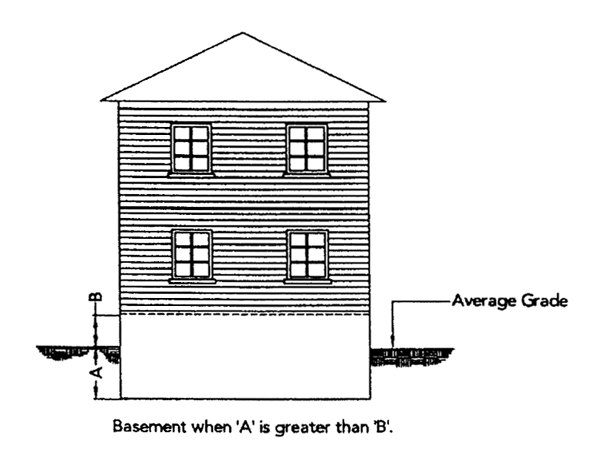
Basement means a portion of a building located partly underground, but having more than half its clear floor-to-ceiling height below the average grade of the adjoining ground. See the following example:
Figure 56-7. Basement
Bay window means a window which projects outward from the building, beginning at least two feet aboveground and does not rest on the building foundation or on the ground.
Bed and breakfast establishment includes single-family residences, occupied by the owner or resident manager, which offer lodging on a temporary basis to paying guests in a room without cooking facilities, and may offer breakfast or other meals to these guests. The term "bed and breakfast establishment" is differentiated from a "hotel/motel" in that they were typically designed originally as a single-family residence and are open to transient guests.
Block means a tract of land bounded by streets, or by a combination of one or more streets and public parks, cemeteries, railroad rights-of-way, corporate boundary lines, or watercourse.
Blockface means the properties abutting on one side of the street and lying between the two nearest intersecting or intercepting streets, or nearest intersecting or intercepting street and railroad right-of-way, public parks, cemeteries, corporate boundary line or watercourse.
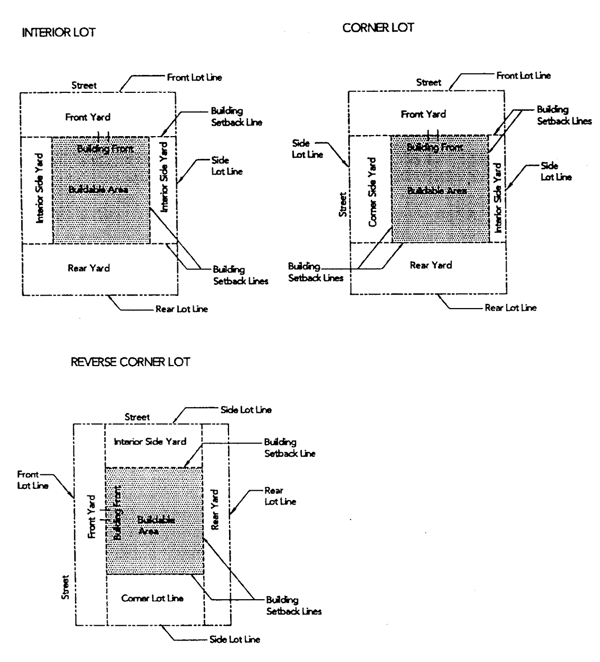
Buildable area means the area of the lot enclosed within the front, side and rear yard required setbacks.
Building means any structure built for the support, shelter or enclosure of persons, animals, chattels or movable property of any kind, which is permanently affixed to the land.
Building, accessory. See Accessory building.
Building, completely enclosed, means a building separated on all sides from the adjacent open space, or from other buildings or other structures, by a permanent roof and by exterior walls, having only windows and normal entrance or exit doors or by party walls.
Building, detached, means a building surrounded by an open space on the same lot.
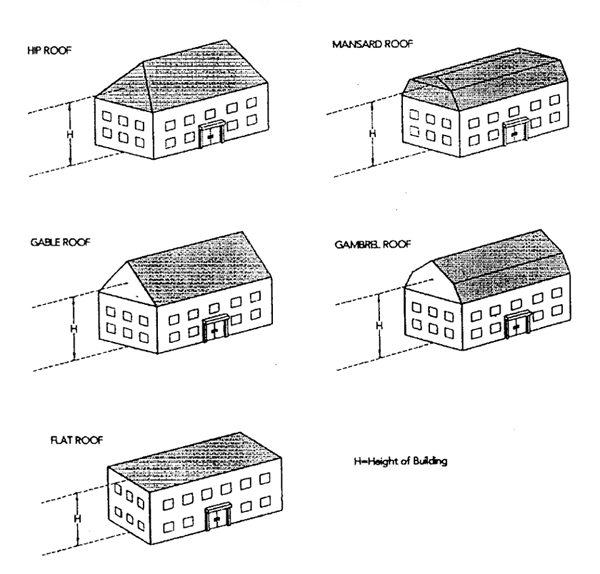
Building height means:
(1)
The vertical distance measured from the average finished grade, or proposed finished grade, in the case of a:
a.
Flat roof; at the front of the building to the highest point of the roof;
b.
Mansard roof; to the deck line; and
c.
Gable, hip or gambrel roof; to the mean point between the eaves and the ridge.
(2)
The term "building height" does not include chimneys, spires, steeples, towers, elevator penthouses, tanks and similar projections when calculating the height. See the following example:
Figure 56-8. Building Height
Building line means the outside of the main wall of the structure in the direction of measurement.
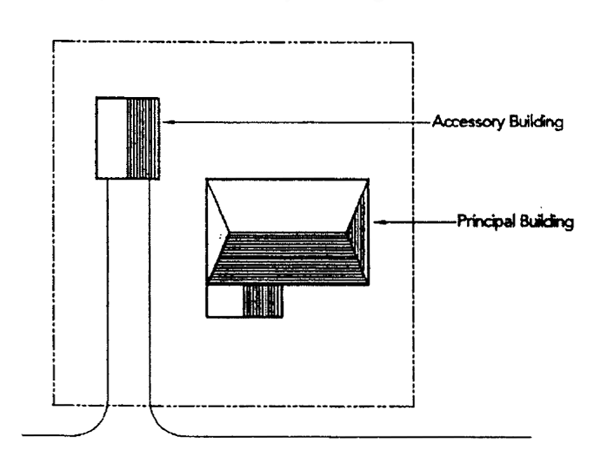
Building, principal, means a nonaccessory building where the a principal use of the lot, on which it is located, is conducted. See the following example.
Figure 56-9. Principal and Accessory Buildings
Building, residential, means a building which is arranged, designed, used or intended to be used for residential occupancy by one or more families or lodgers, and includes, but is not limited to, the following types:
(1)
Single-family detached dwellings;
(2)
Two-family dwellings;
(3)
Townhouse dwellings; and
(4)
Multiple-family dwellings.
Building, temporary, means any building not designed to be permanently located, placed or affixed in the place where it is or where it is intended to be placed.
Bulk means the size and setbacks of buildings or structures and the location of same with respect to one another. The term "bulk" includes the following:
(1)
Size and height of buildings.
(2)
Location of exterior walls at all levels in relation to lot lines, streets or to other buildings.
(3)
Gross floor area of buildings in relation to lot area (floor area ratio).
(4)
All open spaces allocated to buildings.
(5)
Amount of lot area provided per dwelling unit.
Bulletin board means a sign used to announce meetings or programs to be held on the premises of a church, school, auditorium, library, museum, community recreation center or similar noncommercial places of assembly.
Business means an occupation, employment or enterprise which occupies time, attention, labor and materials, or wherein merchandise is exhibited or sold, or where services are offered.
Caliper means a horticultural method of measuring the diameter of nursery stock. For trees less than four inches in diameter, the measurement shall be taken at six inches above the ground level. For trees greater than four inches in diameter up to and including 12 inches, the caliper measurement must be taken at 12 inches above the ground level. For trees greater than 12 inches in diameter, the trunk is measured at breast height which is 4½ feet above the ground level.
Canopy means a structure other than an awning, made of cloth or metal, with metal frames attached to a building, which may project over a sidewalk, and carried by a frame supported by the ground or sidewalk and is not a completely enclosed structure and does not raise, nor is capable of retraction.
Capacity means the maximum number of persons that can avail themselves of the services or goods of the entire, or a portion of the, establishment, at any one time with reasonable comfort.
Carport means an open-sided roofed automobile shelter, usually formed by extension of the roof from the side of a building.
Cemeteries includes cemeteries for the burial of people or animals, mausoleums and memorial parks, excluding crematoriums.
Cigar lounge means a business establishment that caters to patrons who smoke cigars, and is dedicated, in whole or in part, to the smoking of cigars.
Closed cup flash point means the lowest temperature at which a combustible liquid, under prescribed conditions, will give off a flammable vapor, which will burn momentarily.
Clubs and lodges includes buildings and facilities that are operated by a corporation, association or membership organization for a social, educational or recreational purpose primarily for members and their guests, and not primarily operated for-profit, nor to render a service customarily carried on as a business.
College/university includes public or private colleges, universities, junior colleges, or other institutions of higher learning that primarily teach classes that would count toward a bachelor's degree and the institutions associated dormitories. The term "college/university" does not include a special instructional school.
Commercial temporary outdoor sales includes short-term outdoor sales of merchandise, by either a store owner or occupant, outside the store on either the public sidewalk, a private sidewalk or pedestrian area.
Commercial trailer and/or construction trailer means any trailer, with or without lettering, flat or enclosed, used for commercial or business purposes, represented by a "TA" or greater license plate designation.
Commercial vehicle means any vehicle used for commercial or business purposes, with or without lettering, with a gross weight of 10,000 pounds or more, any bus or vehicle designed to transport more than nine passengers, including the driver.
Community hall means a non-profit establishment where public and private events are held. Such establishments are owned and operated by government agencies and tax districts.
Community residence, large, includes residential facilities shared by seven or more disabled or elderly individuals and resident staff, who live together as a single housekeeping unit in a longterm, family-like environment in which staff persons provide care, education and participation in community activities for the residents in order to enable them to live as independently as possible in a residential environment. The term "large community residence" does not include:
(1)
Institutional assisted living facilities;
(2)
An alcoholism or drug treatment center;
(3)
A work release facility for convicts or ex-convicts; or
(4)
Other facilities serving as an alternative to incarceration.
Community residence, small, includes residential facilities shared by six or fewer disabled or elderly individuals and resident staff, who live together as a single housekeeping unit in a longterm, family-like environment in which staff persons provide care, education and participation in community activities for the residents in order to enable them to live as independently as possible in a residential environment. The term "small community residence" does not include:
(1)
An alcoholism or drug treatment center;
(2)
A work release facility for convicts or ex-convicts; or
(3)
Other facilities serving as an alternative to incarceration.
Condominum means the concept in ownership of real estate wherein the parcel is registered under the Illinois Condominium Act and local ordinances, if any.
Conforming building or structure means any building or structure which:
(1)
Complies with all the regulations of this chapter, and any amendment hereto, governing bulk for the zoning district in which such building or structure is located.
(2)
Is designed or intended for a conforming use.
(3)
Example: An office building in a business district or a factory building in a manufacturing district.
Contiguous means adjoining or abutting.
Convent/monastery/seminary includes the dwelling units of a religious order or congregation.
Cultural facilities includes services to the public including, but not limited to, museums, cultural centers, aquariums and libraries operated by a public, private or nonprofit organization. The term "cultural facilities" does not include:
(1)
Places of worship; or
(2)
Clubs and lodges.
Curb level means the level of the established curb in front of a building or structure measured at the center of such front. Where no curb level has been established it shall be deemed to be the established level of the centerline of the street surface, in front of a building or structure, measured at the centerline of such front.
Currency exchange means an establishment that, for compensation, engages in the business of cashing checks, warrants, drafts, money orders or other commercial paper serving the same purpose. The term "currency exchange" does not include financial institution, retail goods establishment or personal service establishment, where the cashing of checks or money orders is incidental to the principal use.
Day care center includes any child or adult care facility, whether established for gain or otherwise, which regularly provides care for less than 24 hours per day for more than three children or adults in a facility other than a residential building. The term "day care center" does not include programs operated by public or private elementary and secondary schools, or institutions of higher learning, which serve children who are three years of age or older.
Day care home includes any dwelling in which a permanent occupant of the dwelling receives for care more than three and up to a maximum of 12 children, for gain or otherwise, for less than 24 hours per day. The maximum of 12 children includes the family's natural, foster or adopted children and all other occupants under the age of 12. The term "day care home" does not include facilities which receive children from a single household.
Day care home, group, includes any dwelling in which a permanent occupant of the dwelling receives for care more than 12 and up to a maximum of 16 children, for gain or otherwise, for less than 24 hours per day. The maximum of 16 children includes the family's natural, foster or adopted children and all other occupants under the age of 12. The term "group day care home" does not include facilities which receive children from a single household.
Decibel means a unit of measurement of the intensity (loudness) of sound. Sound level meters employed to measure the intensity of sound are calibrated in decibels.
Deck means an structure that is attached or unattached to the principal building, which is open to the sky, and provides a platform that is raised more than one foot above the ground. A deck can be made of any material.
Density means the number of dwelling units per unit of land measure.
Disposal includes sanitary landfill operations for the disposal of municipal garbage of the village. The term "disposal" does not include a materials salvage yard and/or recycling operation, sludge disposal or storage, energy recovery or generating from waste materials, or disposal of radioactive waste materials.
District means a portion of the village within which certain uniform regulations and requirements, or various combinations thereof, apply under the provisions of this chapter.
Drive-through facilities includes all retail and service facilities that accommodate the motor vehicles of patrons and from which the occupants of the motor vehicle may make purchases or transact business.
Driveway means any impervious, semipervious (e.g. "grass-crete") or compacted gravel surface providing direct ingress and egress to a parking space.
Dwelling means a building, or portion thereof, but not an automobile house trailer, designed or used exclusively for residential occupancy, including single-family dwellings, two-family dwellings, townhouse dwellings, and multiple-family dwellings, but not including, hotel/motel or bed and breakfast establishments.
Dwelling, attached, means a dwelling which is joined to another dwelling at one or more sides by a party walls.
Dwelling, detached, means a dwelling which is entirely surrounded by open space on the same lot.
Dwelling, multiple-family, includes buildings containing three or more dwelling units that are not designed as townhouse dwellings, where each unit is provided with an individual entrance to the outdoors or to a common hallway with other dwelling units above and/or below.
(1)
The term "multiple-family dwelling" includes:
a.
Apartment buildings;
b.
Condominiums; and
c.
Independent living senior housing.
(2)
The term "multiple-family dwelling" does not include townhouse dwellings.
Dwelling, single-family, includes detached buildings containing only one dwelling unit surrounded by yards. The term "single-family dwelling does not include manufactured homes, mobile homes, travel trailers, housing mounted on self-propelled or drawn vehicles, tents, or other forms of temporary housing or portable housing. See the following examples.
Figure 56-10. Single-Family Dwelling and Townhouse Dwelling Units
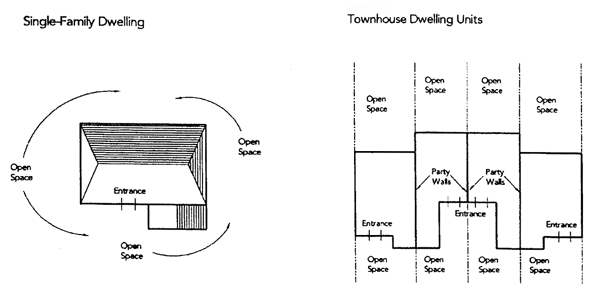
Dwelling, townhouse, includes buildings having three or more dwelling units that are arranged side by side sharing common fire resistive walls without openings, and each occupying an exclusive vertical space without another dwelling unit above or below. Each dwelling unit shall have at least one individual entrance to the outdoors. The term "townhouse dwelling" includes apartments, condominiums and independent living senior housing. The term "townhouse dwelling" does not include multiple-family dwellings. See Dwelling, single-family.
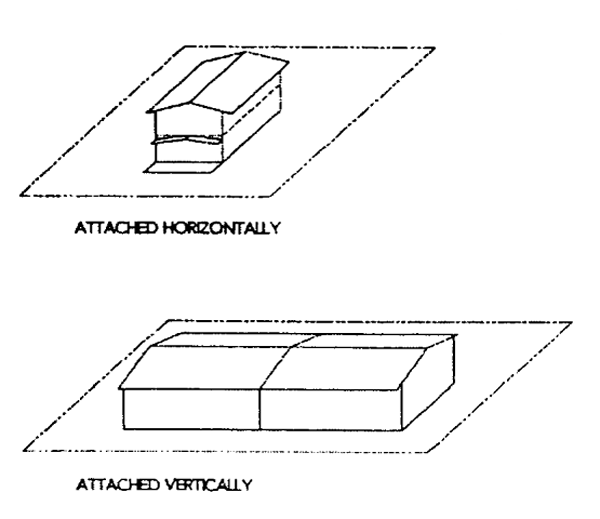
Dwelling, two-family, includes detached buildings containing two dwellings units surrounded by yards, and attached either vertically or horizontally. See the following example.
Figure 56-11. Two-Family Dwelling Units
Dwelling unit means a dwelling unit consisting of a group of rooms constituting all or part of a dwelling, which are arranged, designed, used or intended for use exclusively as living quarters for one family, and which include permanently installed bathroom and kitchen facilities.
Easement means the right to use or benefit from the land of another, for a restricted purpose, without compensating the owner.
Eave means the projecting lower edges of a roof extending beyond the vertical wall of a building.
Erect means to construct, or allow to be constructed. The term "erect" does not include any activity when performed as an incident to the change of advertising message or normal maintenance of a sign or sign structure.
Establishment, business means a place of business carrying on operations, the ownership and management of which are separate and distinct from those of any other place of business located on the same zoning lot, and where access to such business establishment is separate and distinct from direct access to any other place of business.
Event venue means a for-profit establishment where public and private events are held. Such events include parties (birthday, shower, retirement) and meetings (corporate/business). These establishments are less than 3,500 SF, with no live entertainment, no alcohol on the premises, or the retail sale of products other than those associated with the primary business. Food preparation is not done on premises, but rather catered.
Family means either two or more persons, each related to the other by blood, marriage or adoption, together with usual domestic servants and not more than one bona fide guest, all living together as a single housekeeping unit and using common kitchen facilities (that is, a related family); or four or fewer persons, all of whom are not necessarily related to each of the others by blood, marriage or adoption, all living together as a single housekeeping unit and using common kitchen facilities (that is, an unrelated family). The term "unrelated family" does not include persons living together in a community residence or nursing home.
Farmstand means a structure or vehicle used in the sale of agricultural produce, in season, which is grown by the seller. More than one farm may sell at a single stand.
Fence means a structure that is a barrier and which is used as a means of protection or confinement providing privacy, security, weather control, aesthetic appearance and/or boundary definition for land and land uses and made of material such as, but not limited to, steel, aluminum, wood and/or masonry material.
Financial institution includes establishments, the principal use or purpose of which is the provision of financial services including, but not limited to, bank facilities for teller and walk-up automated teller machines ("ATMs"), credit unions, savings and loan institutions, and mortgage companies. The term "financial institutions" does not include currency exchange. For financial institutions with drive-up teller or ATM facilities see "Drive-through facilities."
Floor area (for determining floor area ratio) means the sum of the gross horizontal areas of the several floors of the building measured from the exterior faces of the exterior walls or from the centerline of walls separating two buildings. The term "floor area" of a building includes any floor area when more than one-half of the area height is above the established curb level or above the finished lot grade level, where curb level has not been established, elevator shafts and stairwells at each floor, floor space used for mechanical equipment, except equipment, open or enclosed, located on the roof, penthouses, attic space having head room of seven feet, ten inches or more, interior balconies and mezzanines and enclosed porches, and floor area devoted to accessory uses, including any space devoted to off-street parking or loading within parking garages/structures. The term "floor area" does not include surface parking. The floor area of structures devoted to bulk storage of materials including, but not limited to, grain elevators and petroleum storage tanks, shall be determined on the basis of height in feet, ten feet in height shall equal one floor.
Floor area, gross (for determining off-street parking and loading requirements), when prescribed as the basis of measurement for off-street parking spaces and loading berths for any use, means the sum of the gross horizontal areas of the several floors of the building, or portion thereof, devoted to such use, including accessory storage areas located within selling or working space such as counters, racks or closets, and any basement floor area devoted to retailing activities, to the production or processing of goods, or to business or professional offices. However, the term "gross floor area," for the purpose of measurement for off-street parking spaces, does not include:
(1)
The floor area devoted primarily to storage purposes, except as otherwise noted;
(2)
The floor area devoted to off-street parking or loading facilities, including aisles, ramps and maneuvering space or basement floor area other than the area devoted to:
a.
Retailing activities;
b.
The production or processing of goods; or
c.
To business or professional offices.
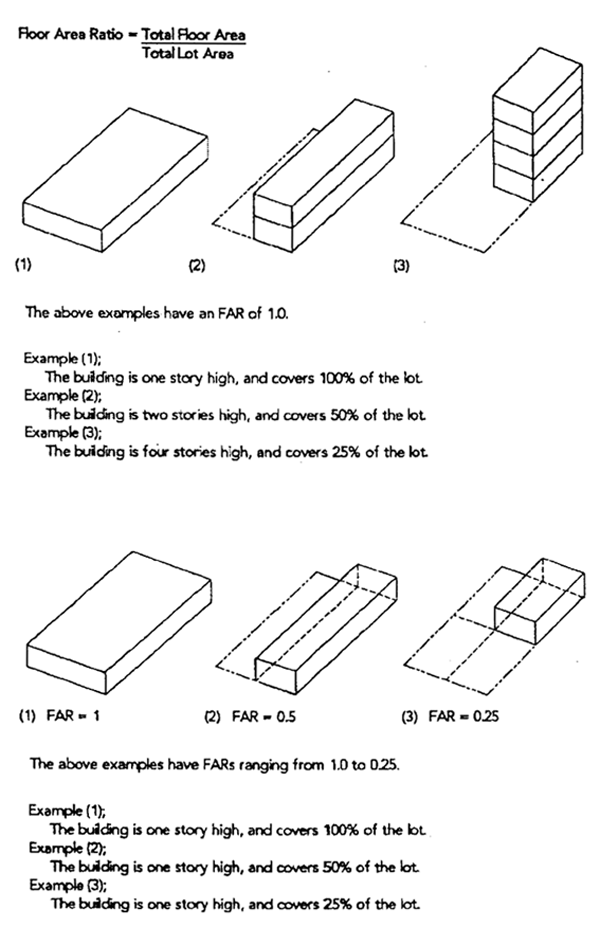
Floor area ratio means the numerical value obtained through dividing the gross floor area of a building by the lot area on which such building is located. See the following example.
Figure 56-12. Floor Area Ratio (FAR)
Footcandle means the illumination at all points one-foot distant from a uniform light source of one candle power.
Free burning means a rate of combustion described by a material that burns actively and easily supports combustion.
Frequency means the number of oscillations per second in a sound wave and is an index of the pitch of the resulting sound.
Frontage means that dimension of property fronting on one side of a street between the two nearest intersecting streets, measured along the line of the street, or, if dead-ended, then that dimension of property abutting on one side between an intersecting street and the dead end of the street.
Frontage, zoning lot, means that dimension of property of such zoning lot fronting on a street and measured between side lot lines.
Garage, private, means an accessory building, or an accessory portion of the principal building, including a carport, which is intended and used for storing the private passenger vehicles of the family or a resident upon the premises, and in which no business, service or industry connected directly or indirectly with automotive vehicles is carried on; provided that not more than one-half of the space may be rented for the private vehicles of persons not a resident on the premises, except that all the space in a garage of one- or two-car capacity may be so rented.
Gazebo means an accessory structure detached from any other building on the premises and unenclosed by solid walls, except that such structure may have a roof.
Grade means the average level of the finished surface of the ground adjacent to the exterior walls of the building or structure.
Heavy retail and service includes:
(1)
Retail and/or service activities that have regular exterior service or storage areas, or partially enclosed structures including, but not limited to:
a.
Home improvement centers;
b.
Lumber and other building materials;
c.
Garden centers and greenhouses;
d.
Landscape;
e.
Construction;
f.
Lawn maintenance contractor yards;
g.
Bulk materials sales and storage; and
h.
Playground equipment sales and rental.
(2)
The term "heavy retail and service" does not include:
a.
Materials salvage yard and/or recycling operation; or
b.
Retail service establishment without regular exterior service or storage.
Height means the vertical distance from grade to the highest point of a structure. See also Building height.
Home occupation includes:
(1)
An occupation carried on in a dwelling unit by the resident thereof and up to only one additional person that is not an occupant of the dwelling unit; provided that the use is limited in extent and incidental and secondary to the use of the dwelling unit for residential purposes and does not change the character thereof.
(2)
The term "home occupation" also includes, but is not limited to, the following uses:
a.
Art studios and massage therapy clinics that meet the licensing requirements of the Village Code;
b.
Dressmaking;
c.
Homes offices; and
d.
Teaching.
(3)
The term "home occupation" does not include the following uses:
a.
The operation of any wholesale or retail business, unless conducted by mail;
b.
Manufacturing;
c.
Repair shops;
d.
Barbershops or beauty parlors;
e.
Stables or kennels;
f.
Restaurants; or
g.
Other activities that produce noxious matter or constitute a public nuisance.
Hookah lounge means a smoking establishment whose business operation, whether as its primary use or as an ancillary use, is devoted to the on-premises use of hookahs. The term "hookah lounge" includes but is not limited to establishments variously known as hookah parlors, hookah cafes, and hookah bars.
Hospital includes institutions providing physical or mental health services, in-patient or overnight accommodations, and medical or surgical care of the sick and injured. The term "hospital" does not include a medical/dental clinic or assisted living facility.
Hotel/motel includes facilities where guestrooms or suites are reserved to provide temporary living and sleeping accommodations for temporary or transient guests, with no provisions in such rooms for cooking in any individual room or suite. The term "hotel/motel" also includes accessory uses such as restaurants, lounges and meeting rooms. The term "hotel/motel" does not include a bed and breakfast establishment.
Household recreational equipment means recreation equipment or structures, customarily and typically found on a residential lot, incidental to and associated with a dwelling unit located on the same lot.
(1)
The term "household recreational equipment" includes:
a.
Play equipment;
b.
Swimming pools;
c.
Spas;
d.
Tennis courts;
e.
Basketball backboards/hoops; and
f.
Skateboard half pipes;
(2)
The term "household recreational equipment" does not include:
a.
Lawn furniture and ornaments;
b.
Barbeques; or
c.
Satellite dishes.
Human sign means a sign held by or attached to a human for the purposes of advertising or otherwise drawing attention to an individual, business, commodity, service or product. This can also include a person dressed in costume for the purpose of advertising or drawing attention to an individual business, commodity, service or product.
Incompatible use means a use which is incapable of direct association with certain other uses because it is contradictory, incongruous or discordant.
Indoor amusement includes, but is not limited to, commercial or nonprofit indoor health and exercise clubs, skating rinks, bowling alleys, indoor sports clubs, golf domes, and indoor establishments where pool or billiards, foosball, table tennis, shuffleboard, pinball machines, video games or any other games of recreation or amusement are provided for public patronage, where the insertion of a coin, slug, or token or the payment of a fee is required, and where five or more such tables or game machines are present. The term "indoor amusement" does include any accessory uses, such as snack bars, pro shops, and locker rooms, which are designed and intended primarily for the use of patrons of the principal recreational use or indoor recreation.
Indoor recreation includes, but is not limited to, indoor recreation facilities, community centers, gymnasiums, indoor tennis or other racquet courts, indoor sports arenas, auditoriums, indoor swimming pools, or similar uses which are enclosed in buildings and are open to all community residents or those living within certain developments or neighborhoods. The term "indoor recreation" does include any accessory uses, such as snack bars, pro shops, and locker rooms, which are designed and intended primarily for the use of patrons of the principal recreational use. The term "indoor recreation" specifically excludes commercial and nonprofit indoor facilities that are included as indoor amusement.
Intense burning means a rate of combustion described by a material that burns with a high degree of activity and is consumed rapidly.
Kennel includes any lot or premises, or portion thereof, on which more than four dogs, cats and other household domestic animals, over four months of age, are kept or on which more than two such animals are boarded for compensation.
Live entertainment/dancing includes any establishment including, but not limited to, a restaurant or tavern/bar, or portion thereof, that is utilized for live performers or patrons engaged in singing, performing, karaoke, dancing, or playing musical instruments. The term "live entertainment/dancing" does not include a theater, indoor/outdoor amusement, or indoor/outdoor recreation, where live performances may occasionally be held.
Logo means a business trademark or symbol.
Lot means a zoning lot, except as the context shall indicate a lot of record, in which case a "lot" is a lot of record.
Lot area means the area of a horizontal plane bounded by the front, side and corner lot lines.
Lot area, gross, means the area of a horizontal plane bounded by the front, side and rear lot lines, but not including, any area occupied by the waters of a duly recorded lake or river.
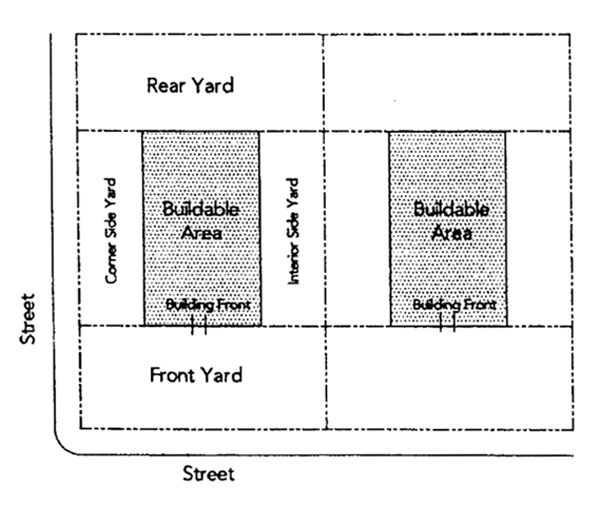
Lot, corner, means a lot situated at the intersection of two streets, the interior angle of such intersection not exceeding 135 degrees Fahrenheit. See the following example.
Figure 56-13. Corner Lot
Lot coverage, non-residential, means a measure of intensity of land use that represents the portion of a site that is covered by the principal building and detached accessory buildings and structures.
Lot coverage, residential means a measure of intensity of land use that represents the portion of a site that is covered by the principal building and the following:
(1)
Garages;
(2)
Sheds;
(3)
Swimming pools;
(4)
Gazebos;
(5)
Patios/decks;
(6)
Driveways; and
(7)
Sidewalks/impervious paths.
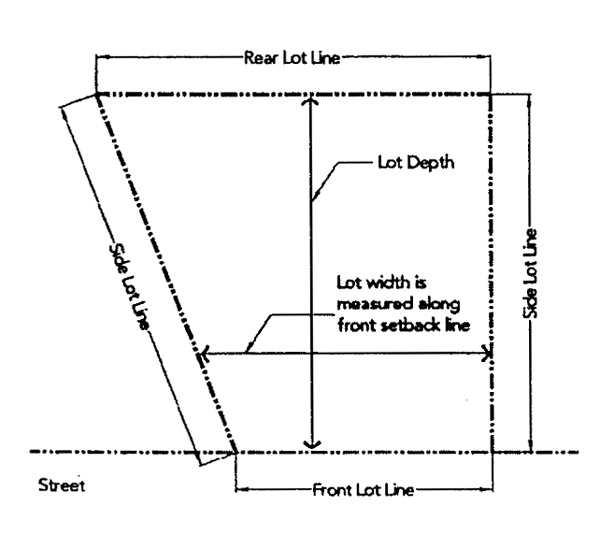
Lot depth means the mean horizontal distance between the front lot line and the rear lot line of a lot measured within the lot boundaries.
Lot line, front, means that boundary of a lot which is along an existing or dedicated public street, or where no public street exists, is along a public way, where such public way is not a dedicated street the right-of-way of such public way shall be deemed to be 66 feet, unless otherwise provided. The owner of a corner lot may select either street lot line as the front lot line.
Lot line, rear, means that boundary of a lot which is most distant from, and is, or most nearly is, parallel to, the front lot line.
Lot line, side, means any boundary of a lot which is not a front lot line or a rear lot line.
Lot of record means a lot which is part of a subdivision, the plat of which has been recorded in the office of the recorder of deeds or a parcel of land, the deed to which was recorded in the office of said recorder prior to the adoption of the ordinance from which this chapter is derived and which met all lot dimension requirements in effect at the time of recording.
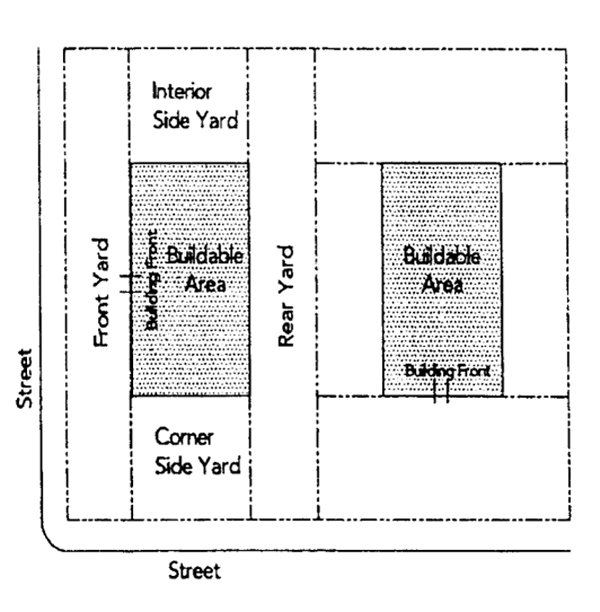
Lot, reversed corner, means a corner lot the street side lot line of which is substantially a continuation of the front lot line of the first lot to its rear. See the following example.
Figure 56-14. Reverse Corner Lot
Lot, through, means a lot having a pair of opposite lot lines along two more or less, parallel public streets, and which is not a corner lot. On a through lot both street lines shall be deemed front lot lines. See the following example.
Figure 56-15. Through Lot
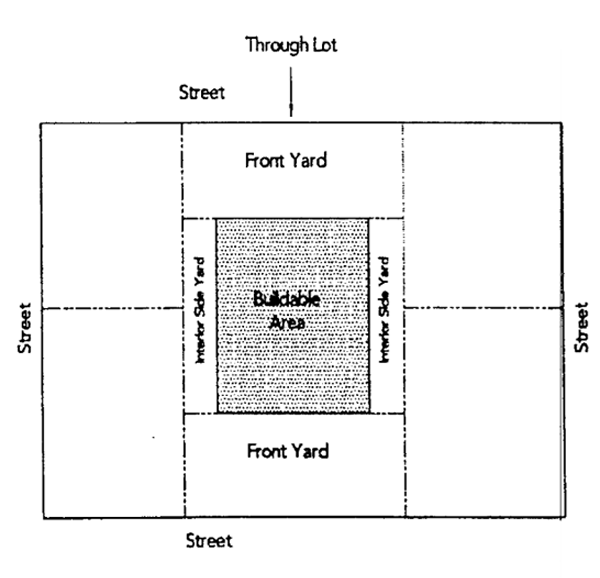
Lot, zoning, means a lot which is a single tract of land located within a single block, which, at the time of filing for a building permit, is designated by its owner or developer as a tract to be used, developed or built upon as a unit, under single ownership or control. Therefore, a "zoning lot" may or may not coincide with a lot of record.
Lot width means the horizontal distance between the side lot lines of a lot measured at the building setback line. See the following example.
Figure 56-16. Lot Width
Manufacturing includes, but is not limited to, assembly, fabrication or processing of goods and materials from processed or previously manufactured materials. The term "manufacturing" includes the capability of operation in such a manner as to control the external effects of the manufacturing process on the use and enjoyment of adjacent property or the environment in terms of noise, smoke, soot, dirt, vibration, odor, glare, or health and safety hazards.
(1)
The term "maufacturing" does include accessory retail and service uses that primarily serve its employees including, but not limited to:
a.
Day care centers;
b.
Restaurants; and
c.
Dry cleaning establishments.
(2)
The term "manufacturing" also does not include abattoirs, acid manufacturing, arsenals, creosote treatment or manufacture, fat rendering, fertilizer manufacturing, fireworks or explosive manufacturing or storage, dumping or reduction of garbage, dead animals, offal or refuse, ore reduction, petroleum processing or refining, pyroxylin manufacturing, salt works, soap manufacturing, smelters, stock yard or slaughter of animals, tallow grease or lard manufacturing or treatment, tanning, curing, or storage of rawhides or skins, tar distillation or manufacturing, landfill operations, or any other similar use that does not meet the environmental performance standards included in section 56-265.
Materials salvage yard and/or recycling operation includes facilities or areas for the storing, keeping, selling, dismantling, compressing, or salvaging of scrap or discarded material, equipment, or vehicles.
(1)
The term "scrap or discarded material" includes, but not be limited to:
a.
Metal;
b.
Paper;
c.
Rags;
d.
Tires;
e.
Bottles;
f.
Motor vehicle parts;
g.
Machinery;
h.
Structural steel;
i.
Equipment; and
j.
Appliances.
(2)
The term "materials salvage yard and/or recycling operation" includes facilities for separating trash and debris from recoverable resources, such as:
a.
Paper products;
b.
Glass;
c.
Metal cans; and
d.
Other recyclable products.
Medical cannabis cultivation center—Conditional use. Medical cannabis cultivation center operating in strict compliance with the Compassionate Use of Medical Cannabis Pilot Program Act (410 ILCS 130/1 et seq.), as amended, and the regulations promulgated thereunder and that also meet the following additional requirements:
(1)
The cultivation center must be currently registered with the Illinois Department of Agriculture (or a successor agency) and be in good standing.
(2)
A cultivation center may not be located within 2,500 feet of the property line of a pre-existing public or private preschool or elementary or secondary school or day care center, day care home, group day care home, part day child care facility or an area zoned for residential use.
(3)
Medical cannabis inventory and cannabis infused products may not be displayed or stored in an area accessible to the public.
(4)
A cultivation center shall have appropriate security measures, in accordance with state regulations, to deter and prevent the theft of cannabis and unauthorized entrance into area containing cannabis. A cultivation center shall also have functioning security cameras that film the entire interior area and also exterior cameras that film the exterior of the center in all directions.
(5)
All cultivation of cannabis must take place in an enclosed, locked facility. The cultivation center location shall only be accessed by the cultivation center agents working for the registered cultivation center, department of agriculture staff performing inspections, department of public health staff performing inspections, law enforcement or other emergency personnel, and contractors working on jobs unrelated to medical cannabis, such as installing or maintaining security devices or performing electrical wiring.
(6)
Medical cannabis may not be consumed on the site of a cultivation center.
(7)
Exterior signage shall comply with the sign ordinance, except that signs or exterior building surfaces depicting or simulating cannabis, cannabis infused products, smoking or cannabis paraphernalia shall not be permitted.
(8)
A cultivation center shall operate in strict compliance with the Compassionate Use of Medical Cannabis Pilot Program (410 ILCS 130/1 et seq.), as amended, and all regulations promulgated thereunder.
Medical cannabis dispensary—Conditional use. Medical cannabis dispensary organization operating in strict compliance with the Compassionate Use of Medical Cannabis Pilot Program Act (410 ILCS 130/1 et seq.), as amended, and the regulations promulgated thereunder, and that also meet the following additional requirements:
(1)
The dispensary must be currently registered with the Illinois Department of Financial and Professional Regulation (or a successor agency) and be in good standing.
(2)
A dispensary may not be located within 1,000 feet of the property line of a pre-existing public or private preschool or elementary or secondary school or day care center, day care home, group day care home, part day child care facility or other dispensary. A registered dispensing organization may not be located in a house, apartment, condominium or an area zoned for residential use.
(3)
A dispensary may not be located in the offices of a physician.
(4)
A dispensary may be open to the public between the hours of 8:00 a.m. and 8:00 p.m. on any day of the week, including holidays.
(5)
A dispensary may not utilize amplified music outdoors.
(6)
Medical cannabis inventory and cannabis infused products may not be displayed or stored in an area accessible to the public.
(7)
A dispensary shall have appropriate private security on the premises to deter and prevent the theft of cannabis and unauthorized entrance into areas containing cannabis. A dispensary shall also have functioning security cameras that film the entire interior area of the dispensary and also exterior cameras that film the exterior of the dispensary in all directions.
(8)
Medical cannabis may not be consumed on the site of a dispensary.
(9)
Exterior signage shall comply with the sign ordinance, except that signs or exterior building surfaces depicting or simulating cannabis, cannabis infused products, smoking or cannabis paraphernalia shall not be permitted.
(10)
A dispensary shall operate in strict compliance with the Compassionate Use of Medical Cannabis Pilot Program Act (410 ILCS 130/1 et seq.), as amended, and all regulations promulgated thereunder.
Medical/dental clinic includes establishments offering the provision of medical/dental care that provides services beyond those typically offered at medical or dental offices, exclusively on an outpatient basis.
(1)
Such outpatient services would include:
a.
X-rays (nondental);
b.
On-site testing laboratories;
c.
Rehabilitation therapy facilities;
d.
Emergency treatment;
e.
Diagnostic services;
f.
Training;
g.
Administration; and
h.
Services to outpatients.
(2)
The term "medical/dental clinic" is differentiated from the term "hospital" in that they do not provide inpatient services.
Memorial plaque means a plaque designating the names of buildings and/or date of erection and other items, such as the architect, contractor or others involved in the creation of the building, cut into or attached to a building surface.
Mezzanine means an intermediate or fractional story between the floor and ceiling of a main story, used for a purpose accessory to the principal use. A mezzanine is usually just above the ground or main floor and extends over only part of the main floor.
Moderate burning means a rate of combustion described by a material that supports combustion and is consumed slowly as it burns.
Nameplate means a sign indicating the name and address of a building or the name of an occupant thereof and the practice of a permitted occupation therein.
Neon sign means an electric sign lit by long luminous gas-discharge tubes that contain neon or other gases.
Nonconforming building or structure means any building or structure which was lawfully established prior to, and existing on, the effective date of the ordinance from which this chapter is derived and which does not conform to the requirements of this chapter for the zoning district in which it is located.
Nonconforming lot means a lot of record that does not meet the lot area or lot width requirements of this chapter for the zoning district in which it is located.
Nonconforming use means a use of land, buildings or structures, which was lawfully established prior to, and being conducted on, the effective date of the ordinance from which this chapter is derived and which does not conform to the requirements of this chapter for the zoning district in which it is located.
Noxious material means material which is capable of causing injury or malaise to living organisms or is capable of causing detrimental effects upon the health or the psychological, social or economic well-being of human beings.
Octave and filter means an electrical frequency analyzer designed according to the standards formulated by the American Standards Association and used in conjunction with a sound-level meter to take measurements in specific octave intervals.
Octave band means a term denoting all the frequencies between any given frequency and double that frequency.
Odorous matter means any matter or material that yields an odor which is offensive in any way.
Office, corporate headquarters, includes business uses that typically occupy an entire office building, or large portion thereof, or a complex of buildings whose purpose is to be the administrative center of a large business enterprise.
(1)
The term "corporate headquarters office" includes accessory retail and service uses that primarily serve its employees including, but not limited to:
a.
Day care centers;
b.
Restaurants; and
c.
Dry cleaning establishments.
(2)
The term "corporate headquarters office" is differentiated from the term "professional office" in that it typically does not offer retail or similar services that generate walk-in traffic.
Office, government, includes administrative and business uses, which may or may not offer service to the consuming public, and that is engaged in the processing, manipulation or application of business information or professional expertise for village, county, state, or federal government. The term "government office" includes post offices, except those with distribution centers, which shall be classified as warehouse/distribution. The term "government office" does not include public service facilities.
Office, professional, includes business uses, which may or may not offer services to the consuming public, and that is engaged in the processing, manipulation or application of business information or professional expertise. An office use is not materially involved in fabricating, assembling or warehousing of physical products for the retail or wholesale market, nor is an office engaged in the repair of products or retail services.
(1)
The term "professional office" includes, but is not limited to:
a.
Professional offices for nonprofit organizations;
b.
Accounting;
c.
Investment services;
d.
Insurance, contracting, architecture, engineering and legal services; and
e.
Real estate services.
(2)
The term "professional office" also includes doctor, veterinarian and dentist offices.
Operations facility, ambulance/bus/taxicab, includes an area and building where emergency medical ambulances, buses, taxicabs or other livery vehicles are stored, dispatched, and/or loading and unloading is carried on regularly, and where minor maintenance of these vehicles is performed. The term "ambulance/bus/taxicab operations facilities" does not include public service facilities that dispatch, store and/or maintain the vehicles of the village fire, police, or other municipal departments or school facilities.
Ordinance means this chapter, and any and all amendments thereto, as and when such amendments become effective. Unless the context specifically requires otherwise, all references to this chapter shall be deemed to refer to any certificate, permit, approval, resolution or ordinance granted or adopted pursuant to this zoning chapter.
Outdoor amusement means:
(1)
The term "outdoor amusement" includes, but is not limited to:
a.
Public, nonprofit or commercial fairgrounds;
b.
Outdoor stadiums;
c.
Outdoor theaters;
d.
Raceways;
e.
Rodeos;
f.
Music arenas;
g.
Theme parks;
h.
Amusement parks;
i.
Miniature golf establishments;
j.
Water slides;
k.
Batting cages;
l.
Skateboarding courses;
m.
Go-cart courses;
n.
Shooting ranges; and
o.
Any accessory uses, such as snack bars, which are designed and intended primarily for the use of patrons of the principal recreational use.
(2)
The term "outdoor amusement" does not include outdoor recreation uses or recreation facilities included as parks/playgrounds.
Outdoor seating means a dining area of designated size with seats and/or tables located outdoors of a contiguous restaurant. This seating may be in addition to the indoor seating area.
Outdoor recreation includes, but is not limited to:
(1)
Active recreation facilities, including:
a.
Public or private golf courses;
b.
Golf driving ranges;
c.
Outdoor swimming pools;
d.
Tennis courts;
e.
Ball fields;
f.
Ball courts;
g.
Skateboard facilities; and
h.
Other similar facilities which are not enclosed in buildings and are open to the public or are operated on a commercial or membership basis primarily for the use of persons who do not reside on the same lot as that on which the recreational use is located.
(2)
The term "outdoor recreation" also includes any accessory uses, such as snack bars, pro shops, and club houses, which are designed and intended primarily for the use of patrons of the principal recreational use.
(3)
The term "outdoor recreation" does not include outdoor amusement uses or recreation facilities included as parks/playgrounds.
Outdoor storage means the keeping outside of an enclosed building for more than 24-consecutive hours, other than as a temporary use as regulated herein, of goods, motor vehicles, machinery, equipment or other materials, except parked motor vehicles used by the occupants of a premises or their guests in residential districts. The term "outdoor storage" does not include:
(1)
Parking lots;
(2)
Waste facilities;
(3)
Materials salvage yards and/or recycling facilities; or
(4)
Outdoor sales and display areas.
Owner means a titleholder of record, or if title is held in trust, the beneficiary of the trust.
Parking garage/structure includes public or private structures or portion thereof composed of one or more levels of floors used exclusively for the parking of motor vehicles, whether public or private. A parking structure may be totally below grade (as in an underground parking garage), or either partially or totally above grade, with those levels being either open or enclosed.
Parking lot, off-street includes public or private open areas, other than a street or public right-of-way, used for the temporary storage (parking) of operable passenger automobiles and commercial vehicles and available to the public, whether for compensation, for free, or as an accommodation for clients, employees or customers. The term "off-street parking lot" also includes the areas provided for residents, employees and visitors of multiple-family dwellings, which is available to the general public.
Parking space means an area, enclosed or unenclosed, which is reserved or intended for the parking of one motor vehicle and is accessible to and from a street or other public right-of-way.
Parks/playgrounds includes, but is not limited to, public and private open space, parks, botanical gardens, arboretums, and forest preserve property, which may be improved with such amenities for passive recreation such as trails, gardens, benches and play equipment. "Parks/Playgrounds" shall not include active, outdoor recreation facilities.
Particulate matter means dust, smoke or any other form of airborne pollution in the form of minute separate particles.
Party wall means a wall that is common to, but divides, contiguous buildings. The term "party wall" means a wall containing no openings and extending from its footing below finished-ground grade to the height of the exterior surface of the roof.
Patio means an impervious surface no higher than one foot above the ground, which is designed and intended for recreational use by people rather than as a parking space.
Performance standard means a criterion established to control noise, odor, smoke, toxic or noxious matter, vibration, fire and explosive hazards, or glare or heat generated by, or inherent in, uses of land or buildings.
Person with a disability means any individual whose disability is attributable to mental, intellectual or physical impairments, or a combination of mental, intellectual or physical impairments, is likely to continue for a significant amount or time or indefinitely, results in functional limitations in three or more of the following areas or major life activities: self care, receptive or expressive language, learning, mobility, self-direction, capacity for independent living and economic self-sufficiency, and reflects the person's need for a combination and sequence of special interdisciplinary or generic care, treatment or other services, which are of a lifelong or extended duration.
Personal services establishment includes establishments for the provision of personal services directly to the consumer. This use shall include, but shall not be limited to:
(1)
Barbershops and beauty parlors;
(2)
Laundry and dry cleaning establishments (plant off-premises);
(3)
Funeral homes/mortuaries;
(4)
Tanning salons;
(5)
Tailoring shops;
(6)
Domestic pet grooming;
(7)
Shoe repair shops; and
(8)
Travel agencies and the like.
Places of worship include churches, temples, synagogues, or other gathering places, which may or may not have schools as part of the complex and/or meeting facilities, and accessory uses, such as parish houses, recreational facilities or other nonprofit operations that serve members of the congregation and/or community.
Planned development means a single, unified development of a parcel of land, or contiguous parcels of land, of a size sufficient to create its own character, controlled by a single landowner or by a group of landowners in common agreement as to control, the character of which is compatible with adjacent parcels and the intent of the zoning district in which it is located. The term "planned development" includes mixed-use development and/or which departs from requirements of the applicable district regulations or other requirements of this chapter, in return for assurances of the overall quality of the development, including any specific features, which may be of exceptional benefit to the community as a whole.
Porch means a covered platform which projects from the exterior wall of a building, has direct access to the street level of the building, and which may be supported by posts and has no roof supporting walls on three sides.
Property lines means the lines bounding a zoning lot.
Public means the provision of a service to ten or more zoning lots, such as in the public sewer system.
Public service facilities includes dispatch, storage, office, and maintenance facilities and garages for government entities including, but not limited to, public works and police and fire departments.
Public way means any sidewalk, street, alley, highway or other public thoroughfare.
Railroad right-of-way means a strip of land with tracts and auxiliary facilities for track operation. The term "railroad right-of-way" does not include:
(1)
Freight depots or stations;
(2)
Loading platforms;
(3)
Train sheds;
(4)
Warehouses;
(5)
Car or locomotive shops; or
(6)
Car yards.
Recreational vehicle means every camping trailer, motor home, mini-motor home, travel trailer, truck, camper or van camper, and any boat, snowmobile, jet ski or personal water craft, all terrain vehicle, including trailers used to transport any such recreational vehicle and any similar vehicle used for recreational purposes.
Refuse means all waste products resulting from human habitation or the conduct of business or industry, except sewage.
Research and development uses includes facilities for scientific laboratory research in scientific, medical or technology-intensive fields.
(1)
The term "research and development uses" includes, but is not limited to:
a.
Biotechnology;
b.
Pharmaceuticals;
c.
Genetics;
d.
Plastics;
e.
Polymers;
f.
Resins;
g.
Coatings;
h.
Fibers;
i.
Fabrics;
j.
Films;
k.
Heat transfers;
l.
Radiation research; and
m.
Accessory retail and service uses that primarily serve its employees including, but not limited to:
1.
Day care centers;
2.
Restaurants; and
3.
Dry cleaning establishments.
(2)
The term "research and development uses" does not include facilities for the manufacture or sale of products, except as incidental to the main purpose of the laboratory or research facility.
Restaurant includes establishments, the primary purpose of which, is to prepare and serve a variety of food for consumption on the premises within the building, or seated in parked motor vehicles on the premises, or for carry-out and consumption off the premises. The term "restaurant" does not include taverns/bars where the primary purpose is the sale of alcoholic beverage, or snack bars or refreshment stands that are accessory to recreational or amusement facilities. For restaurants that have driveup windows, entertainment, and/or outdoor seating, see Drive-through facilities,Live entertainment/dancing and Outdoor cafes, respectively.
Retail goods establishment includes establishments, the primary purpose of which is the sale of physical goods, products, or merchandise directly to the consumer.
(1)
The term "retail good establishment" includes, but not be limited to, stores that sell:
a.
Groceries;
b.
Hardware;
c.
Clothing;
d.
Auto parts;
e.
Jewelry; and
f.
Shoes.
(2)
The term "retail goods establishment" does not include heavy retail and service establishments characterized by regular exterior service or storage activities.
Right-of-way means a strip of land designated for use for vehicular or pedestrian access or passage or for the installation of railroad tracks, utility lines or similar facilities.
Ringlemann chart is described in the U.S. Bureau of Mines Information Circular 6888 and illustrates graduated shades of grey for use in estimating the light-obscuring capacity of smoke density.
Ringlemann number is the number of the area on the Ringelmann chart that coincides most nearly with the visual density of emission or the light-obscuring capacity of the smoke.
Rope lighting means tiny lights, either incandescent bulbs or light emitting diodes (LEDs), which are spaced about an inch apart and covered in heavy-duty plastic tubing.
Satellite dish means any disc antenna, whether flat, concave or parabolic, designed to receive signals from satellites or other sources, or to transmit such signals to a receiving station for noncommercial purposes.
School, specialized instructional, includes institutions engaged in specialized instructional areas for all ages, such as, but not limited to:
(1)
Driving;
(2)
Trade;
(3)
Vocational;
(4)
Art;
(5)
Music; and
(6)
Dance.
Schools, primary or secondary, includes public, private or parochial institutions primarily engaged in academic instruction for all or part of grades K through 12, and recognized or approved by the state. The term "primary or secondary schools" includes accessory day care centers for children over the age of three.
Self-storage includes enclosed storage facilities containing independent, fully enclosed bays leased to individuals exclusively for long-term storage of household goods or personal property.
Setback means the minimum horizontal distance between the front line of the building or structure and the front property line. See the following example.
Figure 56-17. Building Setback
Sign means any object, device or structure, or part thereof, used to advertise, identify, display, direct or attract attention to an object, person, institution, organization, business, product, service, event or location by any means, including words, letters, figures, designs, symbols, fixtures, colors, illumination or projected images. The term "signs" does not include the flag or emblem of any nation, state, village, organization, public notice, work of art that in no way identifies a product, or scoreboards located on athletic fields.
Sign area means the area of a sign face shall be computed by means of the smallest square, circle, rectangle or triangle, or combination thereof, that will encompass the extreme limits of the writing, representation, emblem or other display, together with any material or color forming an integral part of the background or the display or used to differentiate the sign from the backdrop or structure against which it is placed, but not including any supporting framework or bracing, unless such framework or bracing is made part of the message or face of the sign.
Sign, awning, means a sign that is mounted, painted on or attached to an awning. No such sign shall project vertically above or horizontally beyond the physical dimensions of such awning.
Sign, canopy, means a sign that is painted on, printed on, or attached to a canopy.
Sign, classic, means a sign that meets some or all of the following criteria and therefore may be designated as a classic sign:
(1)
Its unique design makes it recognized as a identity element of the community;
(2)
It is more than 20 years old; and
(3)
It architecturally contributes to establishing the overall character of the area where it is located.
Sign, directional, means an on-premises sign designed to guide vehicular and/or pedestrian traffic by using such words as "Entrance," "Exit," "Parking," "One-Way" or similar directional instructions, but not including any advertising message.
Sign, directory, means a secondary sign on which the names and locations of occupants, or the use of a building or property, are identified.
Sign face means that part of the sign which is or can be used to identify, to advertise, to communicate information, or for visual representation that attracts the attention of the public for any purpose. The term "sign face" includes any background or surrounding material, panel, trim or ornamentation, color, and direct or self-illumination that differentiates the sign from the building, structure, backdrop surface or object upon or against which it is placed. The term "sign face" does not include any portion of the support structure for the sign; provided that no message, symbol or any of the previously described elements of a sign face is placed on, or designated part of, the support structure.
Sign, flashing, means any illuminated sign on which the artificial light is not maintained stationary, or constant in intensity and color at all times when such sign is in use. For the purposes of this chapter, the term "flashing sign" includes any revolving, illuminated sign shall be considered a flashing sign. The term "flashing sign" does not include a pole-supported business or brand-identification sign in which the only movement is the slow rotation on its supporting member so as to be visible from all directions.
Sign, government, means any temporary or permanent sign erected and maintained for any official governmental purpose.
Sign, graphics, means any lettering, numerals, figures, designs, symbols, or other drawings or images used to create a sign.
Sign, height, means the distance from the mean elevation of the adjacent finished grade to the highest point of a sign as measured from the bottom of the finished grade at the base of the sign.
Sign, identification, means a sign giving the name, trademark or other readily recognized symbol or address, or any combination thereof, of a building, business, development or establishment on the premises where it is located.
Sign, monument, means any sign, other than a pole sign placed upon or supported by the ground, independently of any other structure.
Sign, nonconforming, means any sign which was lawfully erected in compliance with applicable village regulations and maintained prior to the effective date of the ordinance from which this chapter is derived, and which fails to conform to all the applicable standards and restrictions of this chapter.
Sign, pole, means a sign erected and maintained on one or two freestanding masts or poles and not attached to any building. The term "pole sign" does not include a monument sign.
Sign, political, means a sign that advertises a candidate or issue to be voted upon on a definite election day.
Sign, portable, means any sign designed to be transported or movable including, but not limited to, signs with wheels or with wheels removed, signs with chassis or support constructed without wheels, signs designed to be transported by trailer, wheels, or boat, signs converted to or constructed as an A- or T-frame sign, or signs painted, mounted or affixed on a motor vehicle or boat for advertising purposes, parked on or off the public right-of-way or shore, and visible from the public right-of-way or shore, except signs identifying the related business when the motor vehicle or boat is being used in the day-to-day operations of that business.
Sign, portable electronic, means a sign that is not permanently fixed to a structure and the power source is not directly wired into the sign. This does not include neon signs.
Sign, public service, means a sign or device displaying only the time, temperature, stock market quotes or civic messages.
Sign, roof, means a sign that is mounted or painted on the roof of a building, or that is wholly dependent upon a building for support, and that projects above the roof.
Sign structure and support means any structure that supports, or is capable of supporting, a sign, including a decorative cover.
Sign, temporary, means a sign, banner, pennant, valance or advertising display constructed of cloth, paper, fabric or other lightweight temporary material, with or without a structural frame, intended for a limited period of display.
Sign, wall, means a flat sign or solid face construction, which is placed against a building or other structure and attached to the exterior front, rear or side wall of a building or other structure.
Sign, window, means a sign that is applied, attached to or suspended from the exterior or interior of a window or located within the interior of a structure so its message can be read from the exterior of the structure.
Slow burning or incombustible means materials, which do not in themselves constitute an active fuel for the spread of combustion. A material which will not ignite, nor actively support combustion during an exposure for five minutes to a temperature of 1,200 degrees Fahrenheit shall be designated incombustible.
Smoke unit means the number obtained when the smoke density in Ringelmann number is multiplied by the time of emission in minutes. The term "smoke unit" is calculated by:
(1)
Taking a Ringelmann density reading at least once a minute during the period of observation;
(2)
Multiplying each reading by the time in minutes during which it was observed; and
(3)
Adding the various products together to give the total number of smoke units observed during the entire observation period.
Sound level means an operation or use is the intensity of sound, measured in decibels, produced by such operation or use.
Sound level meter means an instrument standardized by the American Standards Association for measurement of intensity of sound.
Stoop means an exterior floor typically, but not necessarily, constructed of concrete and/or masonry, with a finished floor elevation at least six inches higher than the adjacent ground level, and utilized primarily as an access platform to a building.
Story means that portion of a building included between the surface of a floor and the surface of the floor next above, or if there is no floor above, the space between the floor and the ceiling or roof above it. A basement shall be counted as a story for the purposes of this chapter, when more than one-half of such basement height is above the established curb level or finished lot grade level at the front of the building where curb level has not been established.
Story, half, means that portion of a building under a gable, hip or mansard roof.
Street (avenue, place, road, terrace, court, lane) means a public or private right-of-way which affords a primary means of access to abutting property, excepting driveways to buildings.
Street, arterial, means a street designed as an arterial street in the comprehensive plan.
Street, collector, means a street designed as a collector in the comprehensive plan.
Street level means the story of a building that has its floor at the closest level to the street, with direct pedestrian access to that story from the outside.
Street, local, means a street that is not an arterial or a collector street.
Structural alteration means any change, other than incidental repairs, which would prolong the life of the supporting members of a building, such as:
(1)
Bearing walls;
(2)
Columns;
(3)
Beams;
(4)
Girders; or
(5)
Foundations.
Structure means any improvement upon land, the use of which requires a permanent or temporary location on the ground or attachment to something having a permanent or temporary location on the ground. The term "structure" includes, but is not limited to:
(1)
Buildings;
(2)
Signs;
(3)
Fences; and
(4)
Decks, etc.
Tavern/bar includes business establishments engaged primarily in the retail sale or distribution of alcoholic beverages to public patrons for consumption on the establishment's premises.
(1)
The term "tavern/bar" includes:
a.
Beer bars;
b.
Parlors;
c.
Lounges;
d.
Cabarets;
e.
Night clubs; and
f.
Any accessory sale of prepared food.
(2)
For the definition of the term "taverns/bars" with entertainment, see Live entertainment/dancing.
Temporary means existing for a period of no more than six months.
Tempoary contractor and real estate sales office includes watchman's trailers, construction equipment sheds, contractor or real estate sale trailers, and similar uses incidental to a construction project and sales of homes within a newly constructed development.
Temporary storage trailer means a portable unit that is not permanently affixed to the ground, intended to be used for storage of merchandise and consumer goods and materials. The term "temporary storage trailer" also means a trailer designed to be transported, after fabrication, on its own wheels (attached or detachable) or on a flatbed or other trailer. The term "temporary storage trailer" includes, but is not limited to:
(1)
Trailers referred to as semitruck trailers;
(2)
Overseas storage containers; and
(3)
Ship-to-shore cargo containers.
Tent means any structure or enclosure, the roof of which and/or one-half or more of the sides, are constructed of silk, cotton, canvas, fabric or a similar light material.
Terrace means an open area with a paved platform and a flat roof or roof-like structure and adjacent on at least one side to a building, but not adjacent to any entrance to a building.
Theater includes indoor establishments where motion pictures or live performances are offered for public viewing, where entrance money is received for admission.
Toxic matter or materials means those materials which are capable of causing injury to living organisms by chemical means when present in relatively small amounts.
Transportation stations and terminals includes facilities or locations where the principal use is the handling, receiving and transfer of passenger and/or freight train or bus traffic, and may include accessory loading and unloading, and storing or transfer of freight and other equipment used to accomplished the foregoing activities.
Truck terminal/repair includes premises used for the fueling, loading and unloading of trucks, where storage of cargo is incidental to the primary function of motor freight shipment, and where minor maintenance and repair of these types of vehicles is performed. Such a facility shall be designed to accommodate five or more trucks.
Unified control means the combination of two or more tracts of land wherein each owner has agreed that his tract of land shall be developed as part of a planned development and shall be subject to the control of this chapter applicable to the planned development.
Use means the purpose or activity for which the land or building thereon is designed, arranged or intended, or for which it is occupied or maintained, and shall include any manner of performance of such activity.
Use, accessory. See Accessory structure or use.
Use, permitted means a use which may be lawfully established in a particular district; provided it conforms with all requirements, regulations and performance standards (if any) of such district.
Use, principal, means the main use of land or buildings as distinguished from a subordinate or accessory use.
Use, special, means either public or private, which, because of its unique characteristics, cannot be properly classified as a permitted use in a particular district. After due consideration, in each case, of the impact of such use upon neighboring land, and of the public need for the particular use at the particular location, such "special use" may or may not be granted.
Utilties, community/regional, includes generation and regional facilities, such as regional switching stations, pump storage, sewer/water treatment, and other facilities not housed inside small-scale buildings. The term "community/regional utilities" does not include local utilities or disposal.
Utilities, local, includes pump stations, utility substations or transmission and local distribution facilities, including telephone, sewer/water and utilities housed in small-scale buildings. The term "local utilities" does not include community/regional utilities and disposal.
Variation means limited relief from the requirements of this chapter granted to a particular property with special circumstances, where strict application of those requirements will create a practical difficulty or particular hardship prohibiting the use of land in a manner otherwise allowed under this chapter. Such limited relief does not change the underlying zoning of the parcel of the allowed uses.
Warehouse/distribution includes structures, or a part thereof, or an area used principally for the storage or distribution of goods and merchandise to retailers, nonresidential users, or to other wholesalers. The term "warehouse/distribution" does not include truck terminal/repair or manufacturing.
Waste facilities includes waste facilities where wastes are handled for transhipment to a disposal facility. The term "waste facilities" includes trash compaction and transfer stations, but shall not include disposal and materials salvage yard and/or recycling operation.
Wireless communications facilities includes transmitters, antenna structures, monopoles and other types of installations used for the provision of personal wireless services.
Yard means an open space, on the same zoning lot with a building or structure, unoccupied and unobstructed from its lowest level to the sky, except as otherwise permitted in this chapter. A yard extends along a lot line and to a depth or width specified in the yard requirements for the zoning district in which such zoning lot is located. See Yard, interior side for example.
Yard, corner side, means a side yard on a corner lot which faces a public street. See Yard, interior side for example.
Yard, front, means a yard extending along the full length of the front lot line between the side lot lines. On corner lots, the front lot line shall be the lot line faced by the front door. See Yard, interior side for example.
Yard, interior side, means a side yard that is located immediately adjacent to another zoning lot or to an alley separating such side yard from another zoning lot. See following example.
Figure 56-18. Yards
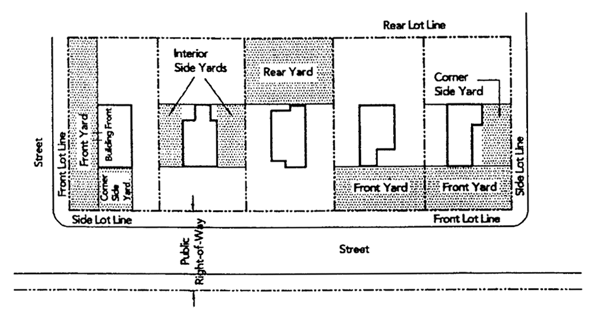
Yard, rear, means a yard extending along the full length of the rear lot line between the side lot lines and directly opposite from the front yard. See Yard, interior side for example.
Yard, side, means a yard extending along a side lot line from the front yard to the rear yard. See Yard, interior side for example.
Zoning map means the Village of Lansing Zoning Map incorporated herein as a part hereof, designating zoning districts.
(b)
Generic use terms. Certain terms in this article are defined to be inclusive of many uses in order to eliminate overly detailed lists of uses in the zoning districts established by this chapter. These terms shall be referred to in this chapter as "generic use" definitions.
(1)
A generic use definition has two components:
a.
A brief listing of examples of uses intended to be included within the scope of the definition; and
b.
An identification (where appropriate) of certain uses that are not meant to be included by the term.
(2)
A use that is not specifically listed in a zoning district or does not fall within a generic use definition as defined in this article, or as interpreted by the planning and zoning board of appeals pursuant to section 56-103, is prohibited.
(c)
Applicability. The language set forth in the text of this chapter shall be interpreted in accordance with the following rules of construction:
(1)
The singular number includes the plural and the plural the singular.
(2)
The present tense includes the past and future tenses and the future includes the present.
(3)
The word "shall" is mandatory while the word "may" is permissive.
(4)
The masculine gender includes the feminine and neuter.
(5)
Whenever a word or term defined hereinafter appears in the text of this chapter, its meaning shall be construed as set forth in the definition thereof. Any word appearing in parenthesis, between a word and its definition herein, shall be construed in the same sense as that word. Words herein not defined shall be interpreted in accordance with the definitions considered to be normal dictionary usage.
(6)
All measured distances expressed in feet shall be to the nearest integral foot. If a fraction is one-half foot or more, the integral foot next above shall be taken.
(7)
The following words and terms, wherever they occur in this chapter, shall be construed as here defined.
(Ord. of 5-1-2003, §§ 14.1—14.3; Ord. No. 14-011, § 2, 7-15-2014; Ord. No. 16-025, § 12, 7-5-2016; Ord. No. 23-032, § 28, 8-15-2023)
_____

