
Lansing City Zoning Code
ARTICLE IX
SITE DEVELOPMENT STANDARDS
Sec. 56-265.- General provisions.
(a)
Number of buildings on a lot. In all residential districts, there shall be no more than one principal building on a lot, unless approved as part of a planned unit development.
(b)
Activities within an enclosed building. Within all nonresidential zoning districts, all activities, including storage, merchandise display, repairs, services, commercial and manufacturing activities shall be conducted wholly within an enclosed building, except in accordance with section 56-387. Outdoor storage is also permitted in accordance with section 56-387; provided that all others requirements of this chapter are met.
(c)
Lots must have frontage. All lots shall front on a public or private street.
(d)
Maintenance of required yards. No lot shall be reduced in area so that the yards become less than required by this article. The minimum yard required for a building or structure shall not be considered a yard space for any other building or structure.
(e)
Control over bulk. All buildings and structures erected after the effective date of the ordinance from which this article is derived shall meet the requirements for the zoning district in which the structure or building is located. No existing building shall be enlarged, altered, reconstructed or relocated in such a manner that conflicts with the requirements of the zoning district in which the building or structure shall be located.
(f)
Prohibited use of land and buildings. No building, structure or land shall be used for any use other than one that is allowed as a permitted or special use in the zoning district in which such building, structure or land is located. However, buildings, structures or land may be used for a temporary use, as specified in section 56-290, or accessory use, as specified in section 56-266; provided that such building, structure or use complies with all other requirements of this article.
(g)
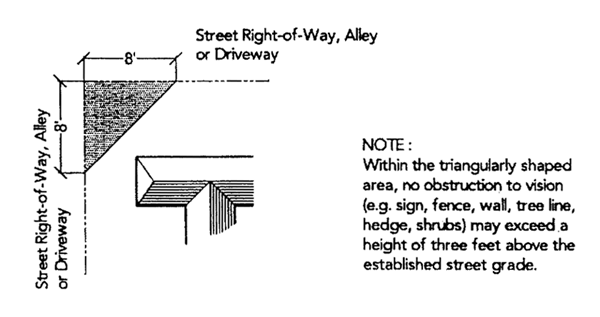
View obstruction. No property owner shall plant, construct or maintain upon any land or premises within the village any fence, wall, hedge, or other structure or object which will interfere with, obstruct the view of, or create a safety hazard for any motor vehicle being driven on a public or private street, whether such obstruction is on public or private property. In addition, no property owner shall plant, construct or maintain upon any land or premises within the village any fence, wall, hedge, or other structure or object that exceeds three feet in height within the eight-foot site distance triangle, unless the area between three and eight feet in height is generally maintained as open and free of opaque, solid obstructions.
(1)
The site vision triangle is created at:
a.
The intersection of two streets;
b.
A street and an alley;
c.
A driveway and a street; or
d.
A driveway and an alley.
(2)
The site distance triangle shall be as follows:
Figure 56-1. Sight Distance Triangle
(Ord. of 5-1-2003, § 9.1)
Sec. 56-266. - Accessory building, structures and uses.
(a)
Detached garages, sheds, cabanas, and gazebos.
(1)
Time of construction. No accessory building shall be constructed prior to the construction of the principal building to which it is accessory.
(2)
Permitted yards. No accessory building shall be permitted to be constructed within a front or corner side yard, beyond the building line of the house.
(3)
Percentage of required yard occupied by accessory buildings and maximum permitted size of detached garages. No detached accessory building shall occupy more than 30 percent of any required yard. Individual detached garages shall not exceed a total of 750 square feet in building area.
(4)
Maximum permitted height. No detached accessory building shall exceed 15 feet in height.
(5)
Required rear yard setbacks. Accessory buildings shall be located a minimum of three feet from a rear property line.
(6)
Required interior side yard setback. Accessory buildings shall meet the minimum side yard setback requirement for principal buildings in the zoning district in which they are located.
(7)
Required corner side yard setback. Accessory buildings shall meet the minimum corner side yard setback requirement for principal buildings in the zoning district in which they are located.
(8)
Required setbacks on reverse corner lots. Accessory buildings located in a required rear yard on reversed corner lots shall maintain a minimum setback from the lot line abutting the street equal to two-thirds the required front yard for the property abutting to the rear. Accessory buildings shall not encroach into the required yards adjacent to the street. In addition, no accessory building shall be located within five feet of any rear lot line that coincides with the side lot line, or portion thereof, of property in any residential district.
(9)
Minimum distance from other buildings. Accessory buildings shall be located a minimum of ten feet from the principal building on the lot and a minimum of five feet from all other buildings on the zoning lot or abutting properties.
(10)
Occupancy prohibited. Occupancy of any accessory building as a dwelling unit is prohibited.
(11)
No accessory building or structure shall be located within an easement. And at no time shall an accessory structure/building be installed in such a manner or location that will impede the flow of water.
(b)
Arbors and trellises. Arbors and trellises that are detached from the building are permitted encroachments in any yard; provided that they comply with the following requirements:
(1)
Each surface of the arbor or trellis shall be at least 50 percent open.
(2)
The maximum permitted height shall be nine feet, the maximum width shall be six feet, and maximum depth shall be three feet.
(3)
Any gate shall meet all fence regulations.
(4)
The arbor or trellis shall be set back a minimum of one foot from any public sidewalk.
(c)
Decks, terraces, and patios. Decks may be raised no more than two feet aboveground; terraces and patios are permitted in the front or corner side yard if they meet the front or corner side yard setback requirement for principal buildings in the zoning district in which they are located. Decks, terraces, and patios are permitted in any required interior side or rear yard; provided that they conform to all other requirements of this article. Decks raised two feet or less aboveground may be located in any interior side or rear yard; provided that they are set back a minimum of three feet from any interior side or rear lot line. Decks raised more than two feet aboveground shall only be permitted in the rear yard; provided that they are located no closer than three feet from any rear lot line, and do not have an adverse impact on stormwater or impede the flow of water.
(d)
Porches. Attached, roofed or unroofed, unenclosed porches are only permitted in the front or corner side yard if they meet the front or corner side yard setback requirement for principal buildings in the zoning district in which they are located. Such porches are permitted in any required interior side or rear yard; provided that they are set back a minimum of three feet from any interior side or rear lot line. Enclosed porches shall be subject to all yard and bulk requirements of the applicable zoning district. Stoops are not considered porches.
(e)
Mechanical equipment. In any zoning district, heating, ventilation and air conditioning equipment may only be located in the interior side or rear yard. Ground-mounted mechanical equipment shall be located a minimum of eight feet from any interior side lot line and a minimum of three feet from any rear lot line. Any heating, ventilation or air conditioning equipment located on the roof of any structure in any zoning district shall be screened either by an architectural element of the building (e.g., a parapet) or by a solid wall. Roof-mounted equipment shall be located at least six feet from any supporting wall of the building, so as to permit safe access to the roof by the fire department.
(f)
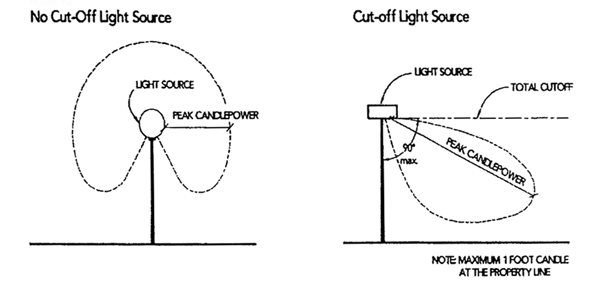
Exterior lighting. Lighting for all sites shall be according to the standards established by the IESNA (Illuminating Engineering Society of North America). All exterior lighting shall be designed, located, and mounted at heights no greater than 35 feet above grade. Light fixtures with and without cutoff fixtures as shown in the following illustration, shall be permitted; provided that light intensity shall be no more than one footcandle, as measured horizontally at any property line. Notwithstanding the foregoing, outdoor lighting for a park or school athletic field may be mounted at heights up to 70 feet; provided the light standard is located a minimum of 20 feet from a residential lot line.
(1)
In addition to the lighting controls outlined above, exterior lighting in residential areas, except street lighting and those required by village ordinance, shall be shielded and/or directed in such a manner that it illuminates only the user's premises and does not spill over into neighboring residential areas so as to interfere with the peaceful enjoyment of residential or public properties. Lighting levels shall be subject to the foot-candle requirements outlined above.
(2)
Flood lights are only permitted when they are down-lighted and installed such that the fixture shall be aimed down at least 45 degrees from vertical.
(3)
The planning and development director may require shields to be installed on any lights determined to be a nuisance before, during or after the installation when needed to further reduce glare and lighting trespass.
(4)
Luminaires used for uplighting for flags, address markers, trees, architectural features, and low landscape lighting must be located, aimed, and shielded so that direct illumination is focused exclusively on the object and away from adjoining properties and public thoroughfares.
Figure 56-2. No Cut-Off Light Source/Cut-off Light Source
(g)
Fences, walls, and hedges.
(1)
Fences on private property.
a.
A fence, wall, or hedge may be erected, placed, maintained, or grown along a lot line on residential zoned property, or adjacent thereto, to a height not exceeding six feet above ground level, except if said residentially-zoned property is adjacent to any non-residentially zoned property, then the height may be no more than eight feet. And at no time shall a fence be installed in such a manner or location that will impede the flow of water.
b.
No such fence, wall or hedge shall be located within the required front or corner side yard setback.
c.
Fences, walls and hedges shall be constructed in conformance with section 56-265(g).
d.
Where permitted, fences, walls and hedges shall be set back a minimum of one foot from any public sidewalk. Hedges, or any landscape material, located between a fence and a public street, alley or sidewalk, shall be pruned and maintained so as not to encroach into or obstruct the public way.
e.
On back to back corner lots, fences, walls and hedges may be located within front or corner side yards, provided they are not located within the required front or corner side yard setback (see Table 56-267). Fences, walls and hedges may be located elsewhere on the lot provided they are set back a minimum of one foot from the public sidewalk to a height of six feet if there is not a dedicated alley behind the lot. If there is a dedicated alley, the fence near the intersection of the alley and side street shall be constructed at such height and of a material that maintains open and clear the site distance triangle, as defined by section 56-265(g).
f.
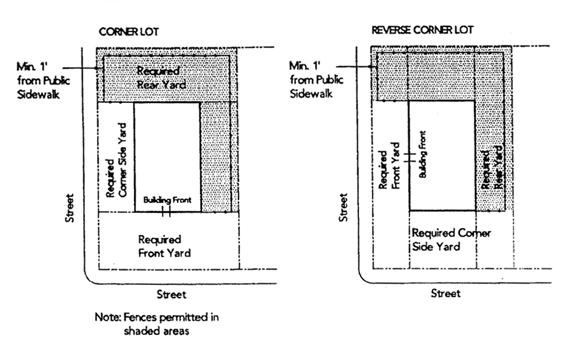
On reverse corner lots, fences, walls and hedges may be located within front or corner side yards; provided that they are not located within the required front or corner side yard setback, with the exception of areas indicated in the following graphic and Table 56-267. Fences, walls, and hedges may be located in these areas; provided they are set back a minimum of one foot from the public sidewalk to a height of six feet. If there is a dedicated alley between the corner lot, the fence near the intersection of the alley and side street shall be constructed at such height and of a material that maintains open and clear the site distance triangle, as defined by section 56-265(g).
Figure 56-3. Fences Permitted on Corner Lot
g.
All fences shall be constructed with the finished side facing the exterior of the property. All posts shall be placed on the inside of the fence.
h.
Barbed or razor wire is prohibited in all residential districts. Barbed wire may be used for security fencing along the top of a chainlink fence in commercial and industrial districts, only where it does not abut a residential district.
i.
All refuse dumpsters and outdoor storage shall be screened in accordance with article XII, landscape and screening, of this chapter.
j.
Fences around swimming pools shall meet the requirements of subsection (h) of this section.
(2)
Fences in the public right-of-way. To construct a fence in the public right-of-way, a property owner shall be required to get a special use permit in accordance with section 56-100. If a special use permit is approved by the village board, the applicant shall be required to adhere to the requirements of subsection (g)(1) of this section, and shall execute a license agreement in a form approved by the village attorney, which will provide, among other matters, that:
a.
Such license agreement is terminable by the village at anytime;
b.
The applicant will provide acceptable insurance coverage to the village for any possible liability that might occur on the premises;
c.
The applicant shall indemnify the village against any and all claims; and
d.
The applicant will assume the responsibility for landscaping and maintenance costs related to the subject premises.
(h)
Swimming pools. In addition to the requirements for swimming pools contained in the building code, swimming pools are permitted, subject to the following:
(1)
Swimming pools shall be located a minimum of seven feet from any property line and from any principal or accessory building or structure.
(2)
Swimming pools shall be located a minimum of ten feet from any overhead electric service lines and a minimum of five feet from any underground electric service line.
(3)
All pools shall be fenced. If the yard is fenced, the fence shall be a minimum of four feet in height. If only the pool area is fenced, the fence shall be a minimum of six feet in height and shall be equipped with an internal self-locking device.
(i)
Accessibility ramps. Handicapped accessible ramps shall be designed to be as unobtrusive as possible. Such ramps shall be located no closer than three feet from any side lot line and no closer than ten feet from any front lot line. Handicapped accessible ramps may also include, where required by the state administrative code, a landing deck that does not exceed five feet by five feet. Any handicapped accessible ramp not meeting the requirements of this section may be approved by the planning and zoning board of appeals; provided there is no other practical conforming location on the lot and a physician certifies in writing that the ramp is medically necessary. Accessibility ramps shall be removed after they are no longer medically necessary.
(j)
Satellite receiving antenna. Satellite receiving antennas not exceeding eight feet in diameter shall be permitted subject to the following:
(1)
A building permit shall be obtained for any antenna that is greater than two feet in diameter, or any antenna and associated support structure (e.g., mast) that is taller than two feet in height.
(2)
It shall be neutral in color and bear no advertising emblem or information other than the name of the manufacturer in letters not to exceed two inches in height.
(3)
It shall not be obtrusive in appearance.
(4)
It shall be limited to one per lot or per building.
(5)
In residential and business districts, building-mounted antenna shall only be permitted on the roof, chimney, or on the side or rear wall of the building. Additional requirements shall apply to roof-mounted satellite receiving antennas (see building code, appendix A, section 308.1).
(6)
In residential districts, ground-mounted antenna shall only be permitted to be located in a rear yard if it is a minimum of six feet from any property line and two feet from any easement. It shall not exceed 15 feet in height measured from ground level to the top of any portion of the satellite receiving antenna. Units mounted at ground level shall be enclosed by a fence of a minimum height of four feet.
(7)
In nonresidential districts, if ground-mounted, the antenna shall not be located in a front yard. The full visual impact of the satellite receiving antenna shall be reduced by screening. If the subject parcel adjoins a residential district, all antennas shall be set back a minimum of ten feet from any lot line or two feet away from any easement.
(8)
Satellite receiving antenna and their associated support structures that are larger than eight feet in diameter or that are taller than 12 feet in height shall only be permitted as a special use.
(k)
Outdoor fireplaces. Barrels, half-barrels, and drums are not permitted to be utilized as outdoor fireplaces. Outdoor fireplaces and fixed, permanent masonry fire pits shall comply with the village fire code, other applicable village ordinances, and any additional safety measures required by the fire department.
(Ord. of 5-1-2003, § 9.2; Ord. No. 23-032, § 22, 8-15-2023)
_____
Sec. 56-267. - Permitted encroachments.
Permitted encroachments are listed in this table.
Table 56-267 Permitted Encroachments
Y= Permitted
N= Not Permitted
NOTES:
1 See section 56-266(g)(1)f for fence requirements for reverse corner lots.
(Ord. of 5-1-2003, § 9.3)
_____
Sec. 56-268. - Environmental performance standards.
All uses shall comply with the performance standards established in this article, unless any federal, state, county, or village law, ordinance or regulation establishes a more restrictive standard, in which case the more restrictive standard shall apply.
(1)
Noise.
a.
Sound levels shall be measured with a sound level meter and associated octave band filter manufactured according to standards prescribed by the American Standards Association. Measurements shall be made using the flat network of the sound level meter. Impulsive type noises shall be subject to the performance standards hereinafter prescribed; provided that such noises shall be capable of being accurately measured with such equipment. Noises capable of being so measured, for the purpose of this chapter, shall be those noises which cause rapid fluctuations of the needle of the sound level meter with a variation of no more than plus or minus two decibels. Noises incapable of being so measured, such as those of an irregular and intermittent nature, shall be controlled so as not to become a nuisance to adjacent uses.
b.
At no point on the boundary of a residence or business district shall the sound intensity level of any individual operation or plant (other than the operation of motor vehicles or other transportation facilities) exceed the decibel levels in the designated octave bands shown in the following table:
Table 56-268 Noise Performance Standards
(2)
Smoke and particulate matter.
a.
The emission of smoke or particulate matter in such manner or quantity as to endanger or be detrimental to the public health, safety, comfort or welfare is hereby declared to be a public nuisance and shall henceforth be unlawful.
b.
For the purpose of grading the density of smoke, the Ringelmann chart, published and used by the United States Bureau of Mines shall be employed. The emission of smoke or particulate matter of a density greater than No. 2 on the Ringelmann Chart is prohibited at all times, except as otherwise provided hereinafter.
c.
The emission from all sources within any lot area of particulate matter containing more than ten percent particles having a particle diameter larger than 44 microns, is prohibited.
d.
Dust and other types of air pollution, borne by the wind from such sources as storage areas, yards, roads and the like, within lot boundaries, shall be kept to a minimum by appropriate landscaping, paving, oiling, fencing or other acceptable means. Emission of particulate matter from such sources, in excess of the weight limitation hereinafter specified, is prohibited.
e.
The emission of more than eight smoke units per hour per stack is prohibited, including smoke of a density in excess of Ringelmann No. 2. However, during a one-hour period in each 24-hour day, each stack may emit up to 16 smoke units when blowing soot or cleaning fires. Only during fire-cleaning periods, however, shall smoke of Ringelmann No. 3 be permitted, and then for not more than three minutes.
(3)
Toxic or noxious matter. No activity or operation shall cause, at anytime, across the boundaries of the lot wherein it is located, discharge of toxic or noxious matter, in such concentrations as to be detrimental to or endanger the health, safety, comfort, convenience and general welfare, or cause injury or damage to property or business.
(4)
Odors. The emission of odorous matter in such a quantity as to be readily detectable at any point along lot lines, or as to produce a public nuisance or hazard beyond property lines, is prohibited.
(5)
Fire and explosion hazard.
a.
The storage, utilization or manufacture of materials or products ranging from incombustible to moderate burning, as determined for liquids by a closed cup flashpoint of no less than 187 degrees Fahrenheit, is permitted, subject to compliance with all other performance standards for the M1 or AT districts.
b.
The storage, utilization or manufacture of materials or products ranging from free or active burning to intense burning, as determined for liquids by a closed cup flashpoint of less than 187 degrees Fahrenheit, but no less than 105 degrees Fahrenheit, is permitted, subject to compliance with all other performance standards for the M1 or AT districts and; provided that the following conditions are met:
1.
Said materials or products shall be stored, utilized or produced within completely enclosed buildings or structures having incombustible exterior walls.
2.
All such buildings or structures shall be setback at least 40 feet from lot lines or, in lieu thereof, all such buildings or structures shall be protected throughout by an automatic sprinkler system complying with the installation requirements prescribed by the National Fire Protection Association or, if the materials, goods, or products are liquids, the protection thereof shall be in conformity with standards prescribed by the National Fire Protection Association.
c.
The utilization in manufacturing processes of materials which produce flammable explosive vapors or gases, as determined for liquids by a closed cup flashpoint of less than 105 degrees Fahrenheit, shall be permitted in M1 district; provided that the:
1.
Final manufactured product does not itself have a closed cup flashpoint of less than 187 degrees Fahrenheit.
2.
Use and storage of such materials shall be in conformity with the standards prescribed by the National Fire Protection Association and the village.
3.
Storage of more than 50,000 gallons of materials or products having a closed cup flashpoint of less than 105 degrees Fahrenheit (exclusive of storage of underground tanks and exclusive of storage of finished products in original sealed containers), is prohibited.
4.
Storage of more than 100,000 gallons of materials or products having a closed cup flashpoint of less than 187 degrees Fahrenheit (exclusive of storage of underground tanks and exclusive of storage of finished products in original sealed containers), is prohibited.
(6)
Glare or heat. Any operation producing intense glare or heat shall be performed within a completely enclosed building in such a manner as not to create a public nuisance or hazard along lot lines. Exposed sources of light shall be shielded so as not to create a public nuisance across lot lines. Exterior lighting shall be subject to the standards contained in section 56-266(f).
(7)
Vibration. No earthborne vibration from any operations of any use shall be detectable at any point off the lot on which the use is located.
(Ord. of 5-1-2003, § 9.4)

