
Lansing City Zoning Code
CHAPTER 1240
PURPOSE AND DEFINITIONS
1240.01.- Short title.
This Title Six of Part Twelve of these Codified Ordinances shall be known and may be cited as the "Zoning Ordinance of the City of Lansing" or just the "Zoning Code."
(Ord. No. 1331, § 1, 5-5-25)
1240.02. - Enabling authority.
This ordinance establishes comprehensive zoning regulations for the City of Lansing, and provides for the administration, enforcement, and amendment of those regulations, in accordance with the provisions of the Michigan Zoning Enabling Act (Public Act 110 of 2006), as amended, being M.C.L. 125.581 et seq., and the Michigan Planning Enabling Act (Public Act 33 of 2008), as amended, being M.C.L. 125.3801 et seq.
(Ord. No. 1331, § 1, 5-5-25)
1240.02.01. - Applicability.
This Zoning Code applies only to real property within the corporate limits of the City of Lansing. It does not apply to any real property treated as part of the City of Lansing by virtue of an intergovernmental agreement pursuant to the Michigan Intergovernmental Conditional Transfer of Property by Contract Act (Public Act 425 of 1984) (a "425 Agreement"). Zoning for any real property subject to a 425 Agreement shall be governed by the terms of that 425 Agreement. Any zoning classification in a 425 Agreement that pre-existed this ordinance shall persist, notwithstanding such classification is no longer in this ordinance.
(Ord. No. 1331, § 1, 5-5-25)
1240.03. - Purpose.
The purpose and intent of this Zoning Ordinance is to:
(a)
Protect the public health, safety, general welfare and investment-backed expectations of property owners by ensuring some level of certainty in the land use pattern, arrangement and compatibility of uses.
(b)
Be consistent with the Michigan Zoning Enabling Act.
(c)
Implement the vision for development as specified in the Design Lansing Comprehensive Plan ("the Plan").
(d)
Maintain consistency with the development patterns of architecture, setbacks and intensity of development that are already in conformance with the Plan.
(e)
Create incentives to encourage additional preservation and development quality than is required in this ordinance.
(Ord. No. 1331, § 1, 5-5-25)
1240.04.01. - Construction of language.
The following rules of construction apply to the text of this ordinance:
(a)
The particular shall control the general.
(b)
In case of any difference of meaning or implication between the text of this ordinance and any caption or illustration, the text shall control.
(c)
The word "shall" is always mandatory and not discretionary. The word "may" is permissive, with the decision made by the Zoning Administrator or any other City staff noted, Planning Commission, City Council or Board of Zoning Appeals; as indicated.
(d)
Words used in the present tense shall include the future and words used in the singular number shall include the plural, and the plural the singular, unless the context clearly indicates the contrary.
(e)
The word "building" includes the word "structure." The word "build" includes the words "erect" and "construct." A "building" or "structure" includes any part thereof.
(f)
The phrase "used for" includes "arranged for," "designed for," "intended for," "maintained for," or "occupied for."
(g)
The term "including" means "including, but not limited to" and the term "such as" means "such as, but not limited to" unless otherwise noted.
(h)
The word "person" has the same definition as in Chapter 202 of the Codified Ordinances of Lansing.
(i)
Unless the context clearly indicates the contrary, where a regulation involves two or more items, conditions, provisions or events connected by the conjunction "and," "or," "either … or," the conjunction shall be interpreted as follows.
(1)
"And" indicates that all the connected items, conditions, provisions or events shall apply.
(2)
"Or" indicates that the connected items, conditions, provisions, or events may apply singly or in any combination (i.e. "or" also means "and/or").
(3)
"Either … or" indicates that the connected items, conditions, provisions or events shall apply singly but not in combination.
(j)
The terms "abutting" or "adjacent to" include contiguous property along the lot lines of the subject site including those in another community. The first lot may be directly across a public right-of-way from the second lot.
(k)
The word "days" shall mean calendar days and include all weekend days and holidays.
(l)
Terms not herein defined shall have the meaning customarily assigned to them.
In an instance where graphics are used in the ordinance, text prevails over graphics, which are shown to assist the reader.
For ease of use, some terms are defined in the sections containing the regulations to which they apply.
(Ord. No. 1331, § 1, 5-5-25)
1240.04.02. - Definitions.
As used in this Zoning Ordinance, unless otherwise provided:
Accessory building or structure means a detached structure on the same lot with, and of a nature customarily incidental and subordinate to, a principal structure, and occupied or devoted exclusively to an accessory use.
Accessory use means a use which meets all of the following criteria:
(1)
It is clearly incidental to the principal use.
(2)
It is customarily found in connection with the principal use.
(3)
It is subordinate to the principal use.
(4)
It is located on the same lot as the principal use, except as otherwise permitted in this Zoning Code.
Adjacent residential district means the residential district to which the majority of the subject site is contiguous, abutting or located directly across a public right-of-way.
Adult care facilities means:
(1)
Adult care facilities, state-licensed. A facility for the care of adults, over 18 years of age, as licensed and regulated by the State under Michigan Public Act 218 of 1979, and rules promulgated by the State Department of Human Services, providing foster care to adults. It includes facilities and foster care homes for adults who are aged, mentally ill, developmentally disabled, or physically handicapped who require supervision on an ongoing basis, but do not require continuous nursing care. An adult foster care facility does not include nursing homes, homes for the aged, hospitals, alcohol or substance abuse rehabilitation center, or a residential center for persons released from or assigned to a correctional facility.
(2)
Adult day-care facility. A facility other than a private residence, which provides care for more than six adults for less than 24-hour period.
(3)
Adult foster care family home. A private home with the approved capacity to receive six or fewer adults to be provided with foster care for 24 hours a day for five or more days a week and for two or more consecutive weeks. This may include adult day care for six or fewer adults. The adult foster care family home licensee must be a member of the household and an occupant of the residence.
(4)
Adult foster care large group home. A private home with approved capacity to receive at least 13, but not more than 20, adults to be provided supervision, personal care, and protection, in addition to room and board, for compensation, for 24 hours a day, five or more days a week, and for two or more consecutive weeks. This may include adult day care for 20 or fewer adults.
(5)
Adult foster care small group home. A private home with the approved capacity to receive more than six, but not more than 12 or fewer, adults who are provided supervision, personal care, and protection in addition to room and board, for 24 hours a day, five or more days a week, and for two or more consecutive weeks for compensation. This may include adult day care for 12 or fewer adults.
(6)
Adult congregate care facility. A private home with the approved capacity to receive more than 20 adults for 24 hours a day, five or more days a week, and for two or more consecutive weeks.
(7)
Convalescent or nursing home. A structure with sleeping rooms, where persons are housed or lodged and are furnished with meals, nursing and limited medical care.
Adult uses. See definitions related to adult uses in Section 1250.02.09.
Alley means any dedicated public right-of-way affording a secondary means of access to abutting property.
Animal hospital means a structure or lot where animals are given medical or surgical care or treatment.
Applicant means a person having a legal, equitable or leasehold interest in a lot, or a representative of such person, who is making a request pursuant to this Zoning Code.
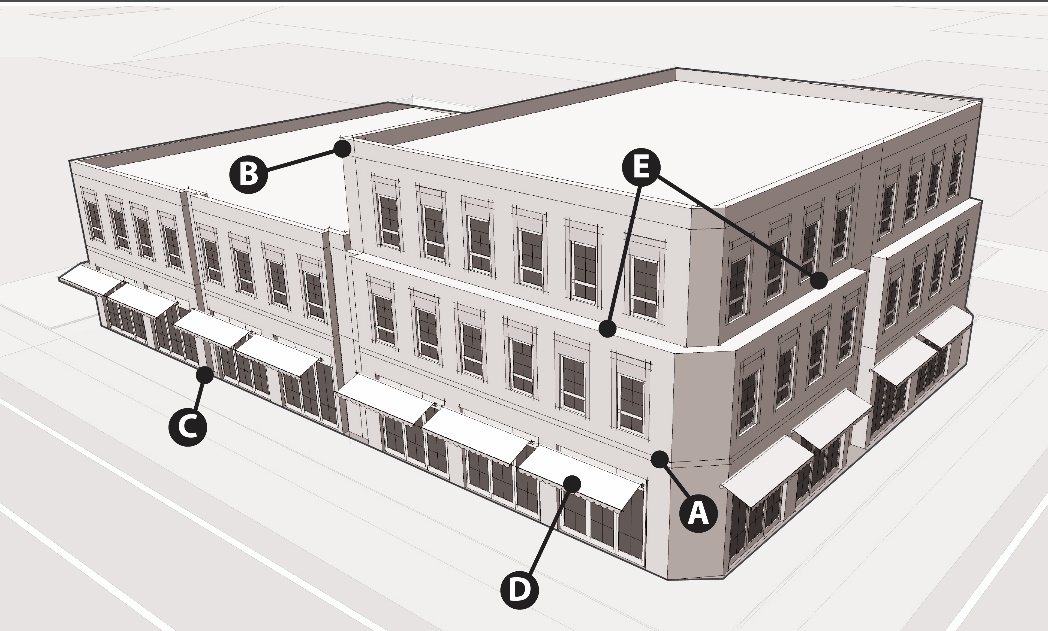
Architectural elements means physical features that relate to building architecture and character such as, but not limited to:
A
Belt courses;
B
Cornices/moldings;
C
Columns or recesses;
D
Awnings/canopies; and
E
Step-backs; as depicted below.
Figure 1
Articulation means architectural variations in a building wall that accentuates details of the building design and can define a building base, middle and top, and variety along the facade. Horizontal and vertical articulation is achieved by using changes in architectural elements to promote varied front building lines and interesting, non-uniform and non-repetitive facade designs.
Bar. See "Restaurant: Bar/lounge/tavern."
Basement or cellar means that portion of a structure between floor and ceiling which is partly below and partly above grade. A basement is so located that the vertical distance from grade to the floor below is less than the vertical distance from grade to ceiling. A cellar is that portion of a structure between floor and ceiling which is wholly or partly below grade and so located that the vertical distance from grade to the floor below is equal to or greater than the vertical distance from grade to ceiling.
Bed and breakfast inn means any dwelling in which overnight accommodations are provided or offered for transient guest for compensation, including provision for a morning meal only for the overnight guest only. A bed and breakfast is distinguished from a motel in that a bed and breakfast establishment shall have only one set of kitchen facilities, employ only those living in the house or up to one additional employee, and have facade style that is compatible with surrounding homes.
Bedroom means a room within a dwelling unit that meets the following criteria:
(1)
It is intended to be used, or is used, for sleeping purposes.
(2)
It contains a floor area of not less than 70 square feet.
(3)
It is not the only room in the dwelling unit (e.g., an efficiency dwelling unit).
Berm means an earthen mound designed to separate one area from another.
Block face means the cumulative property on one side of a street exhibiting one of the following characteristics:
(1)
The property lying between two intersecting streets or public rights-of-way;
(2)
The property lying between an intersecting street and railroad right-of-way, river or stream; or
(3)
The property lying between a public right-of-way, railroad right-of-way, river or stream and the corporate boundaries of the City.
Boarding house means a structure in which lodgers rent a bedroom for extended periods of time and share common areas of the house such as kitchens, bathrooms, and lounging rooms, and where some services such as meals, laundry, and cleaning may be offered. A boarding house must have staff on-site or on-call for 24 hours a day.
Boundary line means the dividing line between zoning districts and/or subdivisions.
Buffer means a land area that separates one land use from another. Such area may be landscaped and may also contain a berm, fence or other screening material.
Building means an independent structure having a roof supported by columns or walls, intended and/or used for shelter or enclosure of persons or chattels. When any portion of a structure is completely separated from every other part by division walls from the ground up, and without openings, each portion of such structure shall be deemed a separate structure. This refers to both temporary and permanent structures, and includes tents, sheds, garages, stables, greenhouses or other accessory structures. A building does not include such structures with interior areas not normally accessible for human use, such as gas holders, tanks, smokestacks, grain elevators, coal bunkers, oil cracking towers or similar structures.
Building Code means the Stille-Derossett-Hale-Single State Construction Code Act, Act 230 of 1972, known as the Michigan Building Code, with amendments, adopted by reference as part of these Codified Ordinances.
Building frontage means the percentage of the building facade that adjoins the front setback or build-to line.
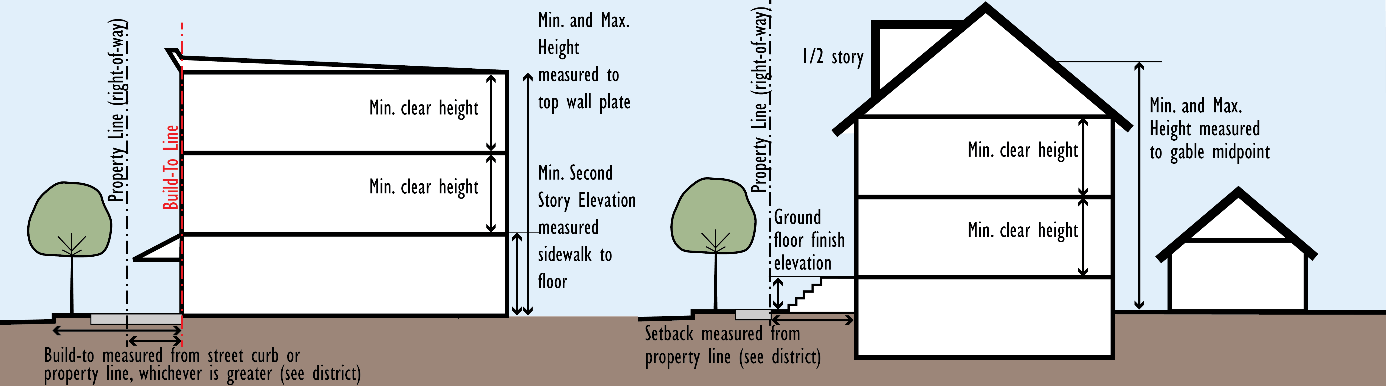
Building height means the vertical distance from the grade at the front of a structure to the highest point of the coping of a flat roof; the average height between the eaves and a ridge or to the deck line of a mansard roof; or the average height between the plate and ridge of a gable, hip or gambrel roof; in all cases, excluding minor projections such as finials, chimneys, vent pipes, aerials, or other appurtenance of similar scale.
Build-to line means the building line to which a building must be constructed.
Figure 2
Business means an office, commercial or industrial use entered into for the purpose of financial gain, earning a livelihood or improving a person's economic conditions and desires.
Campground means any area of land containing recreation facilities, and which may contain cabins, tents, recreational vehicles, shelters, or accommodations used for either overnight camping or day camp purposes, or otherwise designed for seasonal or other temporary recreational stays.
Canopy means an ornamental or roof-like structure which is fastened to a structure and used for protection.
Carport means an accessory structure used primarily to shelter private motor vehicles. A carport is attached to the principal structure and is completely open on not less than two sides.
Child care/residential care facilities means:
(1)
Child care facility. A facility for the care of children under 18 years of age, as licensed and regulated by the State under Michigan Public Act 116 of 1973 and the associated rules promulgated by the State Department of Human Services.
(2)
Child care centers, nursery schools, and day nurseries. A facility, other than a private residence, receiving pre-school or school age children for group care for periods of less than 24 hours a day, and where the parents or guardians are not immediately available to the child. It includes a facility which provides care for not less than two consecutive weeks, regardless of the number of hours of care per day. The facility is generally described as a child care center, day care center, day nursery, nursery school, parent cooperative preschool, play group, or drop-in center. "Child care center" or "day care center" does not include a Sunday school conducted by a religious organization where children are cared for during short periods of time while persons responsible for such children are attending religious services.
(3)
Family day care home (seven or fewer children less than 24 hours per day). A private home in which not more than seven minor children are received for care and supervision for periods of less than 24 hours a day, unattended by a parent or legal guardian, except children related to an adult member of the family by blood, marriage or adoption. It includes a home that gives care to an unrelated child for more than four weeks during a calendar year.
(4)
Group day care home (eight to 14 children less than 24 hours per day). A private home in which more than seven but not more than 14 children are given care and supervision for periods of less than 24 hours a day unattended by a parent or legal guardian, except children related to an adult member of the family by blood, marriage or adoption. It includes a home that gives care to an unrelated child for more than four weeks during a calendar year.
(5)
Foster family group home. A private home in which more than four but less than seven children, who are not related to an adult member of the household by blood, marriage, or adoption, are provided care for 24 hours a day, for four or more days a week, for two or more consecutive weeks, unattended by a parent or legal guardian.
(6)
Foster family home. A private home in which one but not more than six minor children, who are not related to an adult member of the household by blood, marriage, or adoption, are given care and supervision for 24 hours a day, for four or more days a week, for two or more consecutive weeks, unattended by a parent or legal guardian.
Church means a structure used to conduct a religious service, including, but not limited to, the usual accessory structures and uses, such as convents, rectories, parsonages, monasteries, gymnasiums and church halls. See "Places of worship."
Clear height means within a structure, the distance between the floor and ceiling. For entrances and other external building features, the unobstructed distance from the ground to the bottom of the lowest element above.
Clinic means an establishment where human patients who are not lodged overnight are admitted for examination and treatment by physicians, dentists, or similar professionals. A medical clinic may incorporate customary laboratories and pharmacies incidental to or necessary for its operation or to the service of its patients, but may not include facilities for overnight patient care or major surgery. A clinic includes, but is not limited to, a medical/drug testing facility and blood/plasma donation centers.
Comprehensive plan means a master plan described by Public Act 33 of 2008, as amended.
Construction means the putting together of materials to build a new structure or to restore, reconstruct, extend, enlarge or repair an existing structure. This definition does not apply to Section 1250.06.
Construction, start of means the first placement of permanent construction of a structure, other than a mobile home, on a site, such as the pouring of slabs or footings or any work beyond the stage of excavation. "Permanent construction" does not include land preparation, such as clearing, grading and filling; the installation of streets and/or walkways; excavation for a basement, cellar, footings, piers or foundations or for the erection of temporary forms; or the installation on the property of accessory structures, such as garages or sheds, not occupied as dwelling units or part of the main structure. For a structure, other than a mobile home, without a basement, cellar or poured footings, "start of construction" includes the first permanent framing or assembly of the structure or any part thereof on its piling or foundation. For premanufactured homes, "start of construction" means the affixing of the premanufactured home to its permanent site. For mobile homes within mobile home parks or mobile home subdivisions, "start of construction" is the date on which the construction of facilities for servicing the site on which the mobile home is to be affixed, including, at a minimum, the construction of streets, either final site grading or the pouring of concrete pads and the installation of utilities is completed.
Consumer goods delivery means a business that warehouses retail goods for sale and direct delivery to customers, but does not allow walk-in customers.
Contiguous means abutting.
Cottage court means a grouping of at least three, but no more than six, dwelling units oriented around a shared street, access drive, or internal courtyard. Subject to the requirements of Subsection 1250.04.07.
Cumulative means increasing or enlarging by successive addition through all points in time.
Damaged means an item that still functions as it was intended, but is missing parts or has parts that have suffered some degree of destruction.
Department means the Department of Economic Development and Planning, or its successor.
Deteriorated means an item which still functions as it was intended, but is missing parts or requires substantial maintenance.
Development agreement means a contract between a local jurisdiction and a property owner within the jurisdiction detailing a development plan for the property.
Drive-through (thru) business means a business establishment so developed that its retail or service character is wholly or partly dependent on providing a driveway approach and service windows or facilities for vehicles in order to serve patrons food and beverages in a ready-to-consume state from a drive-through window to patrons in motor vehicles. A drive-through restaurant may or may not also have indoor seating.
Driveway means that space specifically designated and used for the movement of motor vehicles, trailers, and watercraft to or from a parcel.
Duplex. See "Dwelling, two-family."
Dwelling, multiple means a structure or portion of a structure which contains three or more dwelling units.
Dwelling, single-family means a structure designed and/or used exclusively for residential purposes for one family only and containing one dwelling unit.
Dwelling, two-family means an attached or semidetached structure used for residential occupancy by two families living independently of each other. Such dwelling is also known as a "duplex dwelling."
Dwelling unit means a structure or a portion of a structure on a permanent foundation with one or more rooms, including a bathroom and complete kitchen facilities, which rooms are arranged, designed or used as living quarters for one family.
Dwelling unit, efficiency means a dwelling unit of not more than one room in addition to a kitchen and bathroom.
Elevation, secondary means the building elevation built along the build-to line on the secondary frontage.
Emergency services facility includes, but is not limited to, public or private civil defense, ambulance or fire service.
Excavation means any breaking of ground, except for agricultural purposes, ground care and landscaping.
Extension means an addition to the floor area of an existing structure, an increase in the intensity of a use, an enlargement of land area utilized by a specific use or an increase in the activity of a use.
Facade, primary means the building elevation built along the build-to line on the primary frontage.
Fair market value means an estimate of the actual worth of a lot, structure or combination thereof, which estimate is made by a licensed real estate broker or assessor experienced and qualified in the appraisal of real estate using appropriate appraisal techniques, as determined by the City Assessor.
Family means any one of the following (see also "family, functional" hereof):
(1)
An individual;
(2)
An individual or two or more persons related by blood, marriage or adoption, together with not more than two other persons as roomers; or
(3)
Two or more persons related by blood, marriage, or adoption, with not more than two of the unrelated persons as roomers.
Family, functional means a group of persons, but not more than three adults, which group does not meet the definition of "family" above hereof, living in a dwelling unit as a single housekeeping unit and intending to live together as a group for the indefinite future. "Functional family" does not include a fraternity, sorority, club, hotel or other group of persons whose association is temporary or commercial in nature."
Fence means any wall (except a retaining wall), screen, partition or similar structure existing on a yard or parcel of land, which structure encloses land, divides land into distinct portions, separates contiguous properties, obstructs the passage of light or air into adjacent land or obstructs the vision of motorists on or near public roads. Barbed wire shall not be considered part of a fence for purposes of determining the height thereof.
Fenestration means openings in the building wall, including windows, doors and open areas. When measuring fenestration, framing elements (such as muntins) with a dimension less than one inch are considered part of the opening.
Filling means the permanent depositing or dumping of any matter onto or into the ground, except for agricultural purposes, ground care or landscaping.
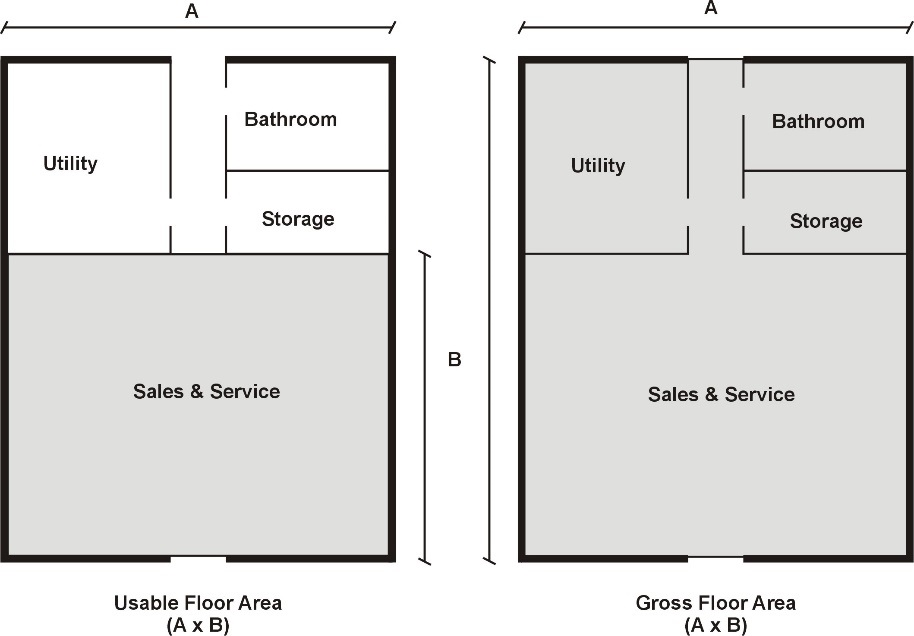
Floor area means the sum of the horizontal areas of each story of a structure measured from the exterior faces of the exterior walls.
Floor area, usable, for the purpose of computing parking, means that area used for or intended to be used for the sale of merchandise or services, or for use to serve patrons, clients or customers. Such floor area which is used or intended to be used for hallways, stairways, elevator shafts, utility or sanitary facilities or the storage or processing of merchandise shall be excluded from this computation of "usable floor area." Measurement of usable floor area shall be the sum of the horizontal areas of each story of a structure measured from the interior faces of the exterior walls.
Figure 3
Footcandle means a unit of luminance amounting to one lumen per square foot.
Frontage means the front part of a property that faces the street, as measured in linear feet.
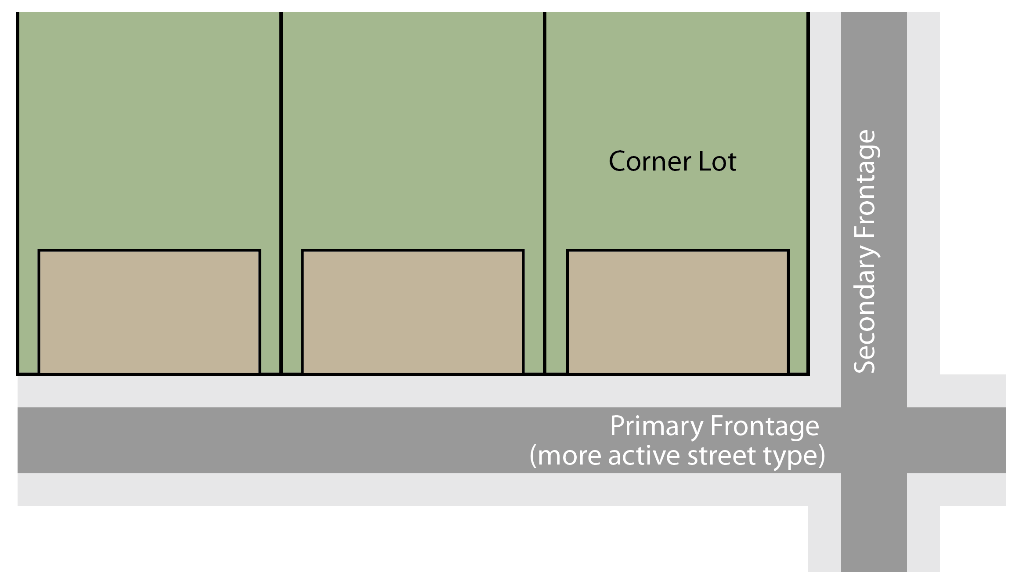
Frontage, primary means the primary frontage applies to parcels that front on more than one street. The primary frontage shall be considered the property line that abuts the street that either:
(1)
Is envisioned to be the most pedestrian-oriented, according to the street typologies described in the Comprehensive Plan and defined in this ordinance (see "street types"). In these cases the primary frontage should be considered the more active street type per the list in Section 1242.03.
(2)
Or, in the case where the above is not clear or where both streets are the same type, the applicant may decide which frontage is the primary, subject to Zoning Administrator's approval.
Frontage, secondary applies to parcels that front on more than one street. The secondary property lines are those which are not the primary frontage (see "Frontage, primary").
Figure 4
Frontage types means the design for the front facade of a building type, as described below:
(1)
Porch. A porch is a frontage type applicable to lower density residential buildings and designed to provide covered, outdoor seating space for residents. Porches can project beyond the setback line towards the right-of-way and/or can wrap around the side of the building. An "enclosed porch" is surrounded on all sides by glass, screen, wood, brick, plastic, or other materials permitted by the Building Code. An "open porch" is one that is not enclosed.
(2)
Stoop. A stoop is a small, elevated landing space above the sidewalk level which provides entry into the building. Stoops must be covered and may project beyond the building setback line towards the right-of-way.
(3)
Storefront. A frontage type appropriate for the ground floor of commercial/retail buildings. Storefronts provide large windows with transparent views into the building interior. Awnings may be incorporated into the frontage design, projecting beyond the building setback line.
(4)
Permanent outdoor seating. An area that involves the sale or delivery of any prepared food or beverage for consumption in a defined area on the premises but outside of the building in which it is prepared. Examples of defined areas include a deck, patio, mall, garden, or balcony.
Funeral home means a structure used and occupied by a professional licensed mortician for burial preparation and funeral services.
Garage means an accessory structure for the storage of motor vehicles.
Garage, private means an accessory structure which is used primarily for the parking of private motor vehicles operated as accessory uses. A private garage has access through an overhead door and has a hard-surfaced driveway leading to the structure from a property line.
Garage, public means any garage other than a private garage.
Garden means the growing of plants for human consumption, including berries, herbs, vegetables, seeds, or other similar products incorporated into, and used as food and flowers, but not including plants grown for commercial sale or purposes. Gardens that are accessory to a primary permitted use are allowed by right in all residential districts. Gardens that are the primary use of a lot are permitted in all residential districts, subject to compliance with all applicable standards of the Lansing zoning ordinances and sign ordinance, including, but not limited to, setback, building height, placement and lot coverage, landscape, screening and buffering and sign restrictions; and also subject to all other applicable State laws and City ordinances, including, but not limited to, noise and other nuisances as defined by City ordinance, except that vegetation as described in a defined garden may exceed eight inches in height.
Garden structure means a structure used for the purpose of enclosing a garden, including the incidental use and storage of gardening implements, machinery, equipment and appurtenances used in the onsite gardening activities. Garden structures are permitted in all residential districts, subject to compliance with setback, lot coverage, building height and all other applicable requirements of the Zoning Ordinance and building codes.
Gardening means the growing of a garden or the act of working in a garden.
Golf course means a comparatively large, unobstructed acreage involving enough room over which to walk or ride, point to point, over a generally prescribed course, and to strive to send a ball long distances with variable accuracy, all without unreasonably endangering other players or intruding upon them.
Governmental entity means the Federal Government, this State or any of its instrumentalities; a county, city, township, village, school district, community college district or community hospital district; any agency authorized to exercise a governmental function in a limited geographical area or other political subdivision; any instrumentality of one or more of such units; or any of such units and one or more other states or political subdivision of such states.
Grade means the lowest point of elevation within the area between the exterior surface of the structure and the property line. If the property line is more than five feet from the exterior surface of the structure, "grade" means the lowest point of elevation between the exterior surface of the structure and a line five feet from the exterior surface of the structure.
Green building means a structure that uses practices and materials that are environmentally responsible and resource-efficient throughout a building's life cycle, from siting to design, construction, operation, maintenance, renovation, and demolition. Although new technologies are constantly being developed to complement current practices in creating greener structures, the common objective is that green buildings are designed to reduce the overall impact of the built environment on human health and the natural environment by:
(1)
Efficiently using energy, water, and other resources.
(2)
Protecting occupant health and improving employee productivity.
(3)
Reducing waste, pollution and environmental degradation.
Greenhouse, commercial means a glass or less than opaque enclosure which exceeds 150 square feet in floor area and is designed or used for the cultivation or protection of plants; or a glassed enclosure, regardless of size, designed or used for the cultivation or protection of plants for commercial purposes.
Hedge means a dense row of low branching trees, shrubs, vines or other plants which encloses land, divides land into distinct portions, separates contiguous properties, obstructs the passage of light and air into adjacent land or obstructs the vision of motorists on or near public roads.
Home occupation means a business conducted in a dwelling unit by a person with legal or equitable interest in the dwelling unit.
Hospital means a health facility offering in-patient, overnight care and services for observation, diagnosis and active treatment of human patients with a medical, surgical, obstetric, chronic or rehabilitative condition requiring the daily direction or supervision of a physician.
Horizontal mixed-use. See "Mixed-use, horizontal."
Hotel means a building or part of a building, with a common entrance or entrances, in which the dwelling units or rooming units are used primarily for transient occupancy, and/or in which one or more of the following services are offered: maid service, furnishing of linen, telephone, secretarial or desk service, and bellboy service. A hotel may contain within it a restaurant or cocktail lounge, public banquet halls, or meeting rooms.
Housing cooperative means a group of individuals connected by membership in an incorporated cooperative, sharing occupancy and control of a dwelling and who live together as a housekeeping unit that share common areas of the house such as kitchens, bathrooms, and lounging rooms. A housing cooperative shall be subject to the requirements of Section 1250.02.11. Different cooperative models with persons living in separate dwelling units not sharing common kitchen and bathroom facilities shall not be subject to the requirements of Section 1250.02.11, but shall follow all other applicable provisions of this Zoning Ordinance.
Incentive means regulatory flexibility, reductions, or rewards that may be granted to a development or project that provides certain recognized benefits or elements that go beyond the minimum requirements. The level of incentive granted is relative to the extent of the recognized benefit provided.
Integrated parking means a feature of a building that utilizes a portion of the ground level for vehicle storage and parking.
Intensity of use means the amount of activity associated with a specific use. Intensity of use shall be determined by the Economic Development and Planning Department based on the following criteria:
(1)
Amount of vehicular traffic generated;
(2)
Amount of pedestrian traffic generated;
(3)
Noise, odor and air pollution generated;
(4)
Potential for litter or debris;
(5)
Type and storage of materials connected with the use;
(6)
Total residential units and density if residential; and
(7)
Total structure coverage and structure height on the parcel.
Junk means any of the following products which are stored in the open and which are damaged or deteriorated or are in such a condition that the product cannot be used for the purpose for which it was manufactured:
(1)
Machinery;
(2)
Appliances;
(3)
Merchandise with missing parts;
(4)
Scrap metal; and
(5)
Scrap materials, including, but not limited to, rags, paper or building materials.
Junk vehicle means a vehicle which cannot be driven upon the public streets for reasons including, but not limited to, being wrecked, abandoned, in a state of disrepair, or incapable of moving under its own power.
Junkyard means a lot used to store or process junk and junk vehicles.
Kennel means the keeping on a lot for commercial purposes of four or more dogs, cats or other household pets which are more than six months old. Keeping includes, but is not limited to, boarding, breeding or training.
Loading space or area means an off-street space on the same lot with a structure or group of structures for the temporary parking of a commercial vehicle while loading and unloading merchandise or materials, and having direct and unobstructed access to a public street or alley. "Unobstructed" does not preclude the use of security devices.
Lodging facility means building(s) or part of a building, where by prearrangement transient or extended-stay guests are provided a sleeping room and a bathroom in return for payment. A lodging facility has staff on-site or on-call 24 hours a day and may include, but is not limited to, hotel, motel or motor lodge, or hostel.
Lot means a parcel of land consisting of one or more lots of record occupied or intended to be occupied by a principal structure or use and any accessory structure or by any other use or activity permitted on the parcel of land. Lot includes the open spaces and yards required under this Zoning Code and has its frontage on a public street or road either dedicated to the public or designated on a recorded subdivision plat. Corner, interior and through lots are described as follows:
(1)
Corner lot. A lot where the interior angle of two adjacent sides at the intersection of two streets is less than 135 degrees. A lot abutting upon a curved street is a corner lot if the radius of the arc is less than 150 feet and the tangents to the curve at the two points where the lot lines meet the curve or the straight street line extended form an interior angle of less than 135 degrees.
(2)
Interior lot. A lot other than a corner lot.
(3)
Through lot. An interior lot having frontage on two more or less parallel streets.
Figure 5
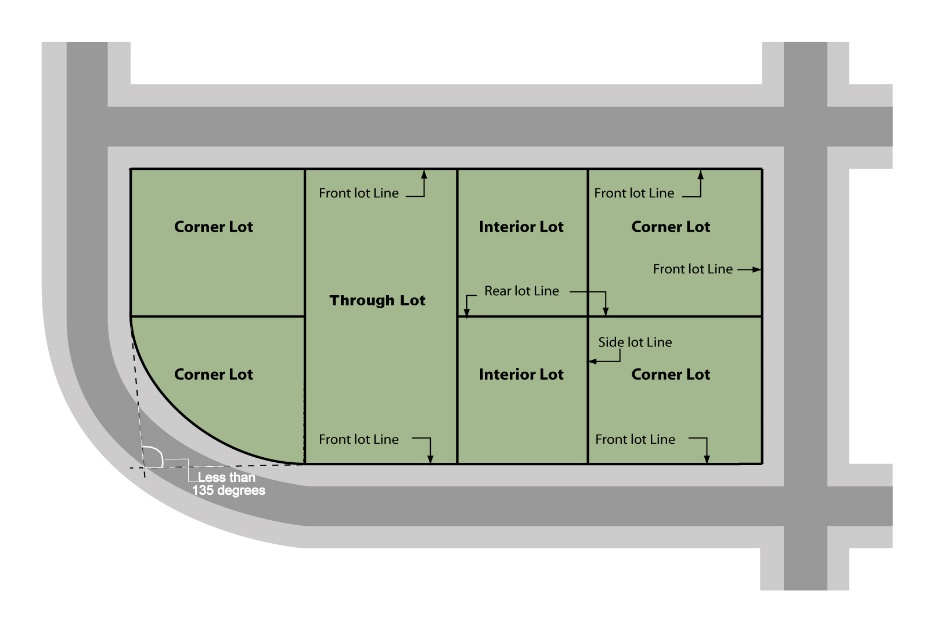
Lot area means the total horizontal area within the lot lines of the lot.
Lot coverage means the part or percentage of lot area, not including right-of-way, occupied by buildings, structures and hard-surfaced parking areas.
Lot depth means the horizontal distance between front and rear lot lines, measured along the median between the side lot lines.
Lot line means any of the lines bounding a lot.
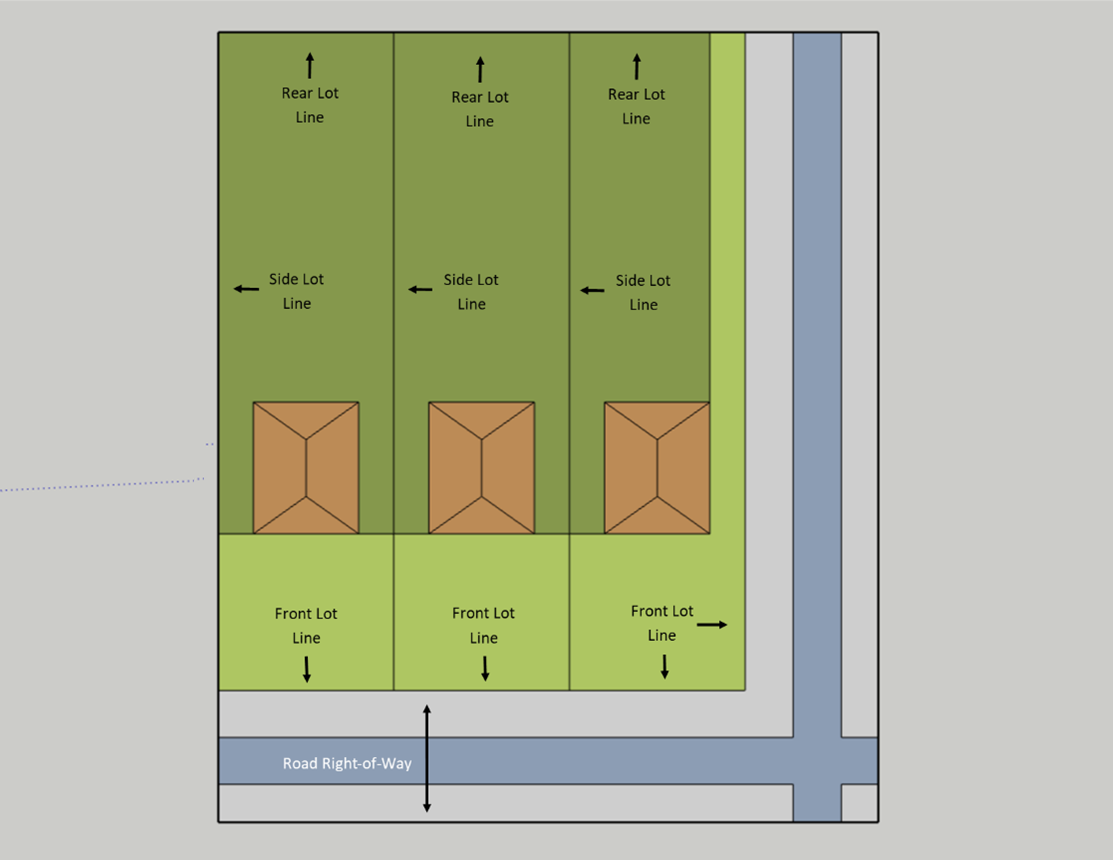
Lot line, front means the line separating a lot from the right-of-way line of a street.
Lot line, rear means a lot line which is opposite the front lot line. In the case of a corner lot, the rear lot line may be opposite either front lot line, but there shall be only one rear lot line. In the case of a lot converging toward the rear, the rear lot line shall be an imaginary line parallel to the front lot line, not less than ten feet long and wholly within the lot.
Lot line, side means any lot line not a front lot line or a rear lot line.
Figure 6
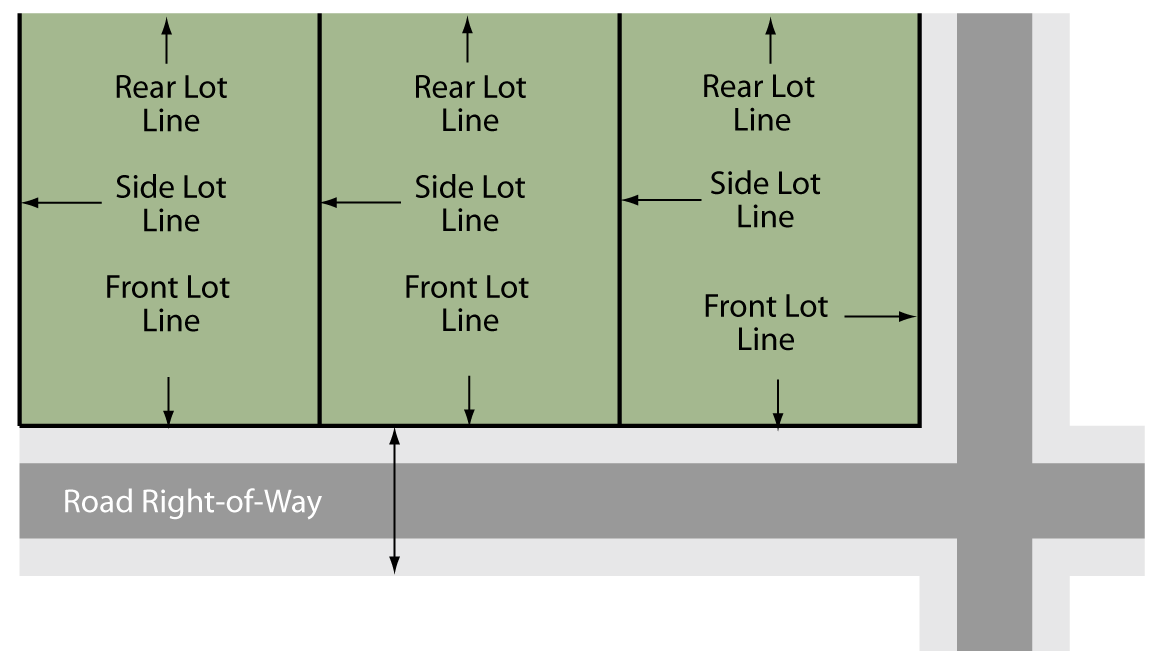
Lot of record means a parcel of land which is part of a subdivision, the dimension and configuration of which has been recorded on a map in the office of the Register of Deeds for the appropriate county, or a parcel described by metes and bounds in any instrument of conveyance recorded at the appropriate Register of Deeds.
Lot width means the horizontal distance from one side lot line to the opposite side lot line, beginning and ending where the side lot lines meet the required setback from the front lot line.
Figure 7
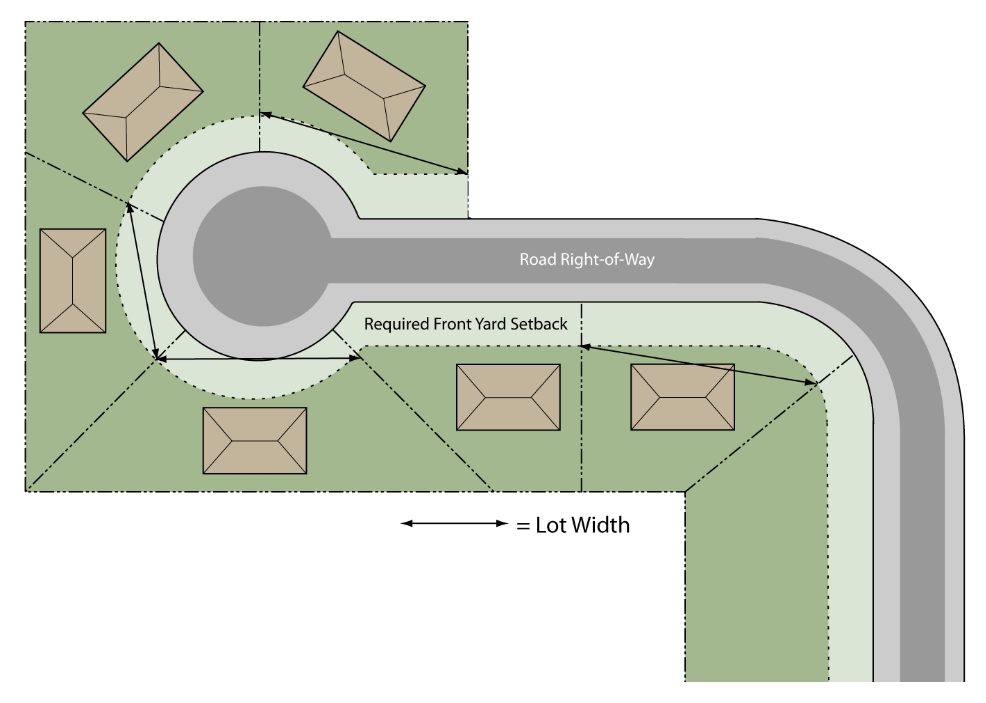
Low impact development means land development that uses nature, through preserving or recreating natural landscape features and minimizing effective imperviousness, to manage stormwater.
Maintenance of structure means to keep up, to keep from change, to preserve, to hold or keep in any particular state or condition or to support what has already been brought into existence.
Mid-rise and high-rise means a medium-to large-size structure that can incorporate a mixture of uses and may often have integrated parking. Mid-rise buildings are typically four to eight floors in height, and high-rise buildings are nine or more floors in height.
Mixed-use means a development that blends a combination of residential and nonresidential where those functions are physically and functionally integrated. Mixed-use development typically uses a combination of vertical and horizontal mixed-use development practices.
(1)
Mixed-use, horizontal. Horizontal mixed-use refers to development patterns where uses within a development site or along a block are mixed along the extent of the building and/or development. Horizontal mixed-use can be combined with vertical mixed-use.
(2)
Mixed-use, vertical. Vertical mixed-use refers to development patterns where uses within a building are mixed, often with retail or active commercial uses on the ground and lower floors, and office or residential uses on the upper floors.
Mobile home means a structure, transportable in one or more sections, which is built on a chassis and designed to be used as a dwelling, with or without a permanent foundation, when connected to the required utilities, and includes the plumbing, heating, air conditioning and electrical systems contained in the structure.
Mobile home park means a parcel or tract of land under the control of a person upon which three or more mobile homes are located on a continual, non-recreational basis and which is offered to the public for that purpose regardless of whether a charge is made therefor, together with any building, structure, enclosure, street, equipment, or facility used or intended for use incident to the occupancy of a mobile home.
Motel means a series of attached, semidetached or detached rental units containing a bedroom and a bathroom. A motel provides for overnight lodging which is offered to the public for compensation and caters primarily to the public traveling by motor vehicle.
Motor vehicle means any self-propelled vehicle, whether operable or not, and includes, but is not limited to, an automobile, bus, truck, pickup truck, truck tractor, van, motorcycle, wrecker or construction equipment such as loaders/backhoes, bulldozers, rollers and forklifts.
Motor vehicle repair station means a use where minor repairs (as defined in "motor vehicle service station") are performed and any of the following major repairs are performed: bumping, vehicle painting, replacement of body parts and collision service, engine repair, engine rebuilding or replacement, replacement of transmission or internal transmission parts, and rebuilding or reconditioning of motor vehicles.
Motor vehicle service station means a use for supplying gasoline, oil and minor accessories at retail directly to the customer and which performs minor repairs. "Minor repairs" means: engine tune up, alternator or generator replacement, battery replacement, fan belt replacement, radiator hose replacement, radiator repair or replacement, tire and strut repair or replacement, wheel balancing, oil change, windshield repair or replacement, brake repair or replacement, muffler and exhaust system replacement, front end alignment, and automobile washing and detailing.
Nonconformity means a use, structure or lot which does not conform with a use or dimensional provision or any combination of a use or dimensional provision of this Zoning Code, but which use, structure or land was lawfully established prior to the effectiveness date of such use or dimensional provision.
Nonresidential use means any use not a residential use.
Nursery means any land used to raise trees, shrubs, flowers and other plants for sale or for transplanting.
Nursing home. See "Adult care facilities."
Occupant means a person who takes or enters upon possession of all or part of a building, parcel, or lot.
Off-street parking facility means an off-street parking surface lot or an off-street parking structure.
Off-street parking structure means a structure which provides for vehicular parking spaces, along with drives and aisles for maneuvering, so as to provide access for entrance and exit for the parking of two or more vehicles.
Off-street parking surface lot means the use of an area for vehicular parking spaces, along with drives and aisles for maneuvering, so as to provide access for entrance and exit for the parking of more than two vehicles on the surface of a lot.
Office means a structure in which a person transacts his or her business or carries on his or her stated occupation.
Open space means the ground area, and the space above such ground area, which is unimpeded from the ground to the sky by any structure, except that the area may be used for landscaping, gardening or recreational purposes such as swimming, shuffleboard, tennis or similar uses. Parking lots and storage areas for vehicles and material shall not be considered as open space.
Open storage means any of the following items which are stored in the open and which are inoperable, damaged and/or deteriorated in such a condition that any such item cannot be used for the purpose for which it was manufactured, or is not reasonably associated with the principal use of the lot itself, including, but not limited to, motor vehicles, machinery, appliances, motor vehicle parts; and other materials, including, but not limited to, metal, pipes, rags, papers or building materials.
Outdoor play space means the outside area on a lot reserved at a day care or group day care home for outside exercise, large motor skill development and play space of children.
Outdoor storage means the keeping, in an unroofed area, of any goods, materials, merchandise or vehicles for sale.
Panelized structure means a structure consisting of preconstructed units for walls, roofs, and floors, which may include structural framing, windows, doors, exterior finishes, interior wall finishes, installed wiring, plumbing and insulation, which is brought on-site and erected thereon on a permanent foundation.
Parcel means a tract of land officially described and registered under one ownership.
Parking space means an area of defined length and width for the parking of motor vehicles. Such area shall be exclusive of drives, aisles or entrances giving access thereto.
Peak hour parking demand means the number of parking spaces required during the highest intensity of use.
Perimeter line or boundary line means the exterior limits of a lot.
Personal service establishment means any premises or business in which collaborative creative workspace or services for persons are performed, including, but not limited to, "makerspace", shoe repair, tailoring, beauty parlors, nail salons, tanning salons, or barbershops.
Places of assembly means any structure wherein persons regularly gather for, entertainment, social, educational, or recreational activities, or political purposes including, but not limited to, theaters, fraternal organizations, community centers, and trade union halls.
Places of worship means any structure wherein persons regularly gather for religious activity including, but not limited to, churches, synagogues, mosques, and temples, and the usual accessory structures and uses, such as convents, rectories, parsonages, monasteries, and church halls.
Planned unit development means an office, residential, commercial, industrial or mixed complex developed as a single entity by one person, which complex contains more than one structure on a lot, not including accessory structures, and which is planned and developed as an integral unit in a single development operation according to the requirements of Chapter 1264.
Plot plan means a diagram depicting the existing and proposed structures, lot lines, setbacks, parking areas and the location of any known wells.
Porch. See "Frontage type."
Premanufactured unit means an assembly of materials or products intended to comprise all or part of a building or structure, and that is assembled at other than the final location of the unit of the building or structure by a repetitive process under circumstances intended to ensure uniformity of quality and material content.
Primary facade. See "Facade, primary."
Primary frontage. See "Frontage, primary."
Principal use means the primary, major, main, leading, outstanding or chief use which a lot serves or is intended to serve.
Probate means the period of probate, as defined in Public Act 386 of 1998, as amended, being M.C.L. 700.1101 et seq.
Production facilities means facilities for the production of consumer goods such as food, beverages, art, clothing, textiles, etc. and have a minimum of 20 percent floor area dedicated to retail sales.
Public utility means electric light and power companies, whether private, public, corporate or cooperative; gas companies; water, telephone, telegraph, oil, gas and pipeline companies; motor carriers; and all public transportation and communication agencies other than railroads and railroad companies.
Real property means a lot, plot or parcel of land recorded and located in the City of Lansing.
Recognized benefit means the provision of certain elements or improvements that are desired by the City, as either expressed in the Comprehensive Plan or as stated in the Zoning Ordinance, or that go beyond the minimum requirements.
Reconstruction means the act of rebuilding a structure to meet the standards of the Building Code or Housing Code.
Recreational equipment means a watercraft, vehicle, or other conveyance designed to be used primarily off of public streets and roads, and not regulated by the Michigan Vehicle Code, including, by way of example, but not limited to: snowmobiles; boats and boat trailers; jet skis, floats and rafts, including transportation equipment.
Recreational facility means a structure or open space which provides activities including, but not limited to, swimming, racquet sports, exercise and fitness rooms or areas, or gymnasiums.
Recreational vehicle means a vehicle primarily designed and used as temporary living quarters for recreational, camping, or travel purposes, including a vehicle having its own motor power or a vehicle mounted on or drawn by another vehicle. This includes, by way of example, but is not limited to: travel trailers; camp trailers; tent trailers; campers, pop-up campers, and pickup campers; folding tent trailers; and utility trailers.
Repair means to restore to a sound or good state after decay, injury, dilapidation or partial destruction.
Residential use means a use all or part of a lot, parcel, or building as a single-family, two-family or multifamily residence, or residential child care facility, and accessory uses thereto.
Restaurant means an establishment serving foods and/or beverages to a customer in a ready-to-consume state. The method of operation may be characteristic of a carry-out, drive-in, drive-through, fast food, standard restaurant, or lounge/tavern, or combination thereof, as defined below:
(1)
Restaurants with outdoor seating. A use that involves the sale or delivery of any prepared food or beverage for consumption in a defined area on premises but outside of the building in which it is prepared. Examples of defined areas include an external deck, patio, mall, garden, balcony or sidewalk.
(2)
Carry-out restaurant. A use that involves the sale of food, beverages, and/or desserts in disposable or edible containers or wrappers in a ready-to-consume state for consumption mainly off the premises. A carry out restaurant differs from a drive-through restaurant in that a customer must park and walk up to the restaurant or an employee must exit the restaurant and deliver the food to a customer in a parked car.
(3)
Drive-in restaurant. A use that involves delivery of prepared food so as to allow its consumption within a motor vehicle while parked on the premise.
(4)
Drive-through restaurant. A use that involves the delivery of prepared food to the customer within a vehicle, typically passing through a pass-through window, for consumption off of the premises.
(5)
Standard restaurant. A standard restaurant is a use that involves either of the following:
a.
The delivery of prepared food by waiters and waitresses to customers seated at tables within a completely enclosed building.
b.
The prepared food is acquired by customers at a cafeteria line and is subsequently consumed by the customers within a completely enclosed building.
(6)
Bar/lounge/tavern. A bar, lounge or tavern is a type of restaurant that is operated primarily for the dispensing of alcoholic beverages. The preparation and sale of food or snacks to customers may be permitted.
Restoration means to put back into original or historic condition.
Resumption means to begin the use of a nonconformity after it has been previously discontinued from use.
Retail store means an establishment which primarily serves the surrounding neighborhood and includes, but is not limited to, the following: limited service food store, drug store, hardware store, laundry or cleaners pickup, jewelry store, florist, gift shop, book store, clothing store, photographer, and bakery whose products are sold only on the premises.
Rooming house means a single-family detached dwelling which is owner-occupied and serves as the principal residence of the owner, in which up to three lodgers rent rooms for extended periods of time and share common areas of the house such as kitchens, bathrooms, and lounging rooms.
Salvage yard means a lot where any product, including, but not limited to, any of the following, is taken apart in such a way that the usable parts are separated from the unusable: motor vehicles, machinery, appliances, fixtures, goods, and merchandise.
Setback means the minimum horizontal distance measured from the lot line, as required under this ordinance, for the front, side, or rear property line as appropriate.
Figure 8
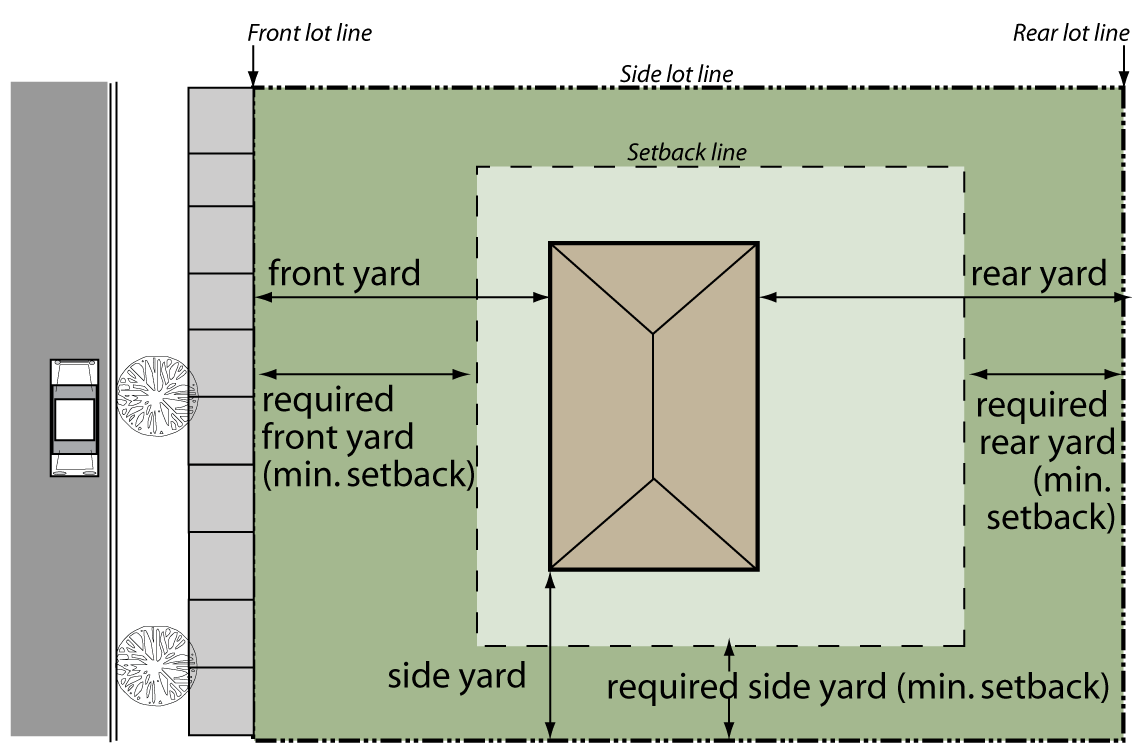
Shared parking means a parking facility that serves two or more parcels of land or multiple uses under different ownership. A recorded shared parking agreement is generally used.
Sheltered care facility means a governmental or nongovernmental establishment having as its principal function the provision of supervision, personal care, and protection for more than six adults, in addition to room and board, for up to 24 hours a day, five or more days a week and for two or more consecutive weeks, with or without compensation. "Sheltered care facility" includes, but is not limited to, emergency shelters, facilities for persons who are homeless, parolees, ex-offenders, aged, or developmentally or physically disabled, who may require supervision on an on-going basis but do not require continuous nursing care. A sheltered care facility does not include any of the following:
(1)
A nursing home licensed under Article 17 of Public Act 368 of 1978, as amended, being M.C.L.A. 333.20101 to 333.22181;
(2)
A hospital licensed under Article 17 of Public Act 368; or
(3)
A hospital for the mentally ill or a facility for the developmentally disabled operated by the department of mental health under Public Act 258 of 1974, as amended, being M.C.L.A. 330.1001 to 330.2106.
Shopping center means a grouping of two or more business establishments developed in accordance to an overall plan and designed and built as an interrelated project. Buildings constructed on outlots shall not be considered part of the shopping center unless access and parking easements are provided.
Site plan means a plan that conforms to the requirements contained in Chapter 1260.
Solar energy systems means the mechanical and utility equipment that converts sun energy into electricity using photovoltaics (PV) panels that are either ground-mounted, wall-mounted, roof-mounted, or part of a solar array.
Stable means a structure used to keep horses for commercial purposes.
Stoop. See "Frontage types."
Storage means the holding or safekeeping of goods to await the happening of some future event or contingency which will call for the removal of the goods.
Storefront. See "Frontage types."
Street means a public thoroughfare, avenue, road, highway, boulevard, parkway, way, drive, lane or court which affords the principal means of access to abutting property.
Street, private means a street which is not public.
Street type means a classification or typologies for streets that considers the characteristics of vehicle travel (speed and volume), the street's function in the transportation network (types of travel accommodated: through traffic, cross-town, connections to highways or local), the extent of pedestrian and bicycle accommodation, typical types of land uses served, the design context (block length, building setbacks), and access system design. In many cases, a streets classification may change as it traverses different zoning districts. The following street types are illustrated on the official Street Typology Map:
(1)
Expressway. Restricted access divided Interstate and U.S. highways for motor vehicle use only that are typically under the jurisdiction of the State of Michigan or the Federal Highway Administration.
(2)
Non-local streets:
a.
Activity corridor. An arterial or major Street that traverses an area that typically is designed to promote a multi-modal balance between vehicle, pedestrian and bicycle travel. Such streets may have more frequent traffic signals, a higher level of service of public transit, on-street parking, and more abundant locations for pedestrian crossings to encourage activity along the sidewalks.
b.
Prime connector. Major collector streets that link higher class streets with local streets. Prime connector typically traverse residential districts and are designed for moderate traffic speeds and volumes, often with special design features to bicyclists.
c.
Suburban corridor. A class of arterial or major streets that are similar in traffic function as arterial corridors, but typically are lined with more suburban style auto-oriented development with lower density and deeper setbacks.
d.
Arterial corridor. Major streets that, compared to most other types of streets, are designed to accommodate higher volumes of vehicle traffic and often are "cross town" routes that are, or may connect with, state trunklines or roads in adjacent communities. May also be referred to as principal or major arterials.
e.
Neighborhood connector. Minor residential collector streets that link local streets with higher classes of streets. Neighborhood connectors are designed for lower traffic volumes and speeds to complement the character of the neighborhoods served. Dedicated bike facilities may be provided.
(3)
Local street. Lowest traffic streets providing access to residents. Lanes are typically unmarked with on-street parking and stop-controlled intersections.
Structural alteration means any change in the supporting members of a building, such as bearing walls, columns, beams or girders, or any substantial changes in the roof and exterior walls.
Structure means that which is built or constructed, an edifice or building of any kind or any piece of work artificially built up or composed of parts joined together in some definite manner.
Structure, minor means a structure having a replacement cost of not more than $5,000.00.
Structure, temporary means a structure which is located on a lot for less than one year, or, if the structure is connected with a construction activity on a lot, until the construction activity is completed.
Substitution means to put in place of another.
Tavern. See "Restaurant: Bar/tavern."
Temporary use means any use that is not permitted as a principal use, accessory use or a conditional use in a zoning district, and which is limited in its duration.
Townhouse means a group of dwellings having party walls with each other and located side by side.
Trailer means a vehicle with or without motive power, other than a pole-trailer, designed for carrying property or persons and for being drawn by a motor vehicle and so constructed that no part of its weight rests upon the towing vehicle. As defined in this code, trailer is not exclusive of recreational vehicle.
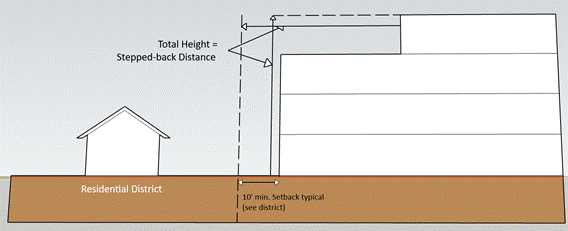
Upper floor step backs means for the elevation adjacent to a residential district (R-1, R-2, R-3, and R-MX), the floors above the third story shall be tiered-back so that the highest point of the building is setback from the adjacent residential district a distance at least equal to the height of the building.
Figure 9
Use means:
(1)
Any purpose for which a structure or lot may be designed, arranged, intended, maintained or occupied; or
(2)
Any activity, occupation, business or operation carried on in a structure or on a lot.
Vertical mixed-use. See "Mixed-use, vertical."
Yard means a space on a lot with a structure, which space is unobstructed and unoccupied from the ground upward, except as occupied or obstructed as permitted in this Zoning Code.
(1)
Front yard means a yard extending across the full width of a lot between the front of the structure containing the principal use and the front lot lines.
(2)
Rear yard means a yard extending the full width of a lot between the rearmost structure containing the principal use and the rear lot line, the depth of which is the least distance between the rear lot line and the rear of the structure containing the principal use.
(3)
Side yard means a space within a lot between a side lot line and a structure containing the principal use or an attached accessory structure, whichever is closer to the side lot line. A side yard extends on each side of a lot from the end of the front lot line to the beginning of the rear lot line of the lot.
Figure 10
Zoning variance means a modification of the strict letter of this Zoning Code granted by the Board of Zoning Appeals when, by reason of exceptional conditions, the strict application of this Zoning Code results in peculiar, exceptional or practical difficulties or unnecessary hardship to the owner of the lot.
(Ord. No. 1331, § 1, 5-5-25)

