
Lansing City Zoning Code
CHAPTER 1250
GENERAL PROVISIONS
1250.01.- Scope of application.
The standards and regulations listed in this chapter shall apply to all uses, buildings and structures within all zoning except where it is specified to be district- or use-specific.
(Ord. No. 1331, § 1, 5-5-25)
1250.02.01. - Uses.
Determination of "similar uses." Since every type of potential use cannot be addressed in the Zoning Ordinance, the Zoning Administrator shall be authorized to permit "similar uses" which closely resemble the uses listed for a given zoning district. In making this determination, the Zoning Administrator shall use criteria including, but not limited to, the nature of the use, scale, aesthetics, traffic generated, parking, potential impact on property values, noise, vibration, dust, smoke, odor, glare and other objectionable impacts in terms of health, safety and welfare, provided that the proposed use would not constitute a violation of any other Federal, State or local law or regulation. Once a proposed similar use is permitted, the proposed use shall comply with all standards and conditions that apply to that zoning district.
(Ord. No. 1331, § 1, 5-5-25)
1250.02.02. - Home occupations.
A home occupation which meets all of the following conditions shall be permitted as an accessory use to any single-family residential use or residential unit in a duplex:
(a)
No person, other than a member of the family residing in the dwelling unit, shall engage in the home occupation and no more than one primary caregiver, as that term is defined in the Michigan Medical Marihuana Act, being MCL 333.26421 et seq., as amended, shall engage in the activities of a primary caregiver on any lot.
(b)
The use of the dwelling unit as a home occupation shall be clearly incidental and subordinate to its use for residential purposes.
(c)
Not more than 20 percent of the gross floor area of the dwelling unit is used in any way for the home occupation.
(d)
No change occurs in the outside appearance of the dwelling.
(e)
No signs shall be posted on the lot advertising any home occupation.
(f)
The sale of goods does not occur in the dwelling unit or on the lot on which the dwelling unit is located.
(g)
No parking or outdoor storage of vehicles, goods, materials, or equipment that is directly related to the home occupation and not customarily associated with a residential use.
(h)
No equipment is used, except equipment which is normally used for purely domestic or household purposes. Equipment not normally used for purely domestic or household purposes or any portion of the dwelling unit where energy use and heat generation resulting from the growth of marihuana exceeds levels reasonably attributable to residential uses are permitted if the Board of Zoning Appeals approves such use. The Board shall approve of such use if it is satisfied that the intensity of use will not be increased to a level that will adversely impact any lot within 300 feet of the lot seeking Board approval and that any energy use and heat generation resulting from the growth of marihuana exceeding levels reasonably attributable to residential uses has been approved by the Fire Marshal or his or her designee and the Building Safety Office.
(i)
No activity related to the occupation occurring on the premises including clients, customers, or pickup and delivery vehicles shall adversely impact the surrounding neighborhood or the right of surrounding residents to quiet enjoyment of their property, including, but not limited to, the creation of noise, vibrations, odors, heat, glare, unnatural light, or electrical interference detectable beyond the property line; or have any pickup, delivery, or other trip by motor vehicle related to the home occupation before 7:00 a.m. or after 7:00 p.m. and not more than a total of five pickups, deliveries or customer/client visits each day during the permitted time.
(j)
For purposes of this subsection, any term defined by 21 U.S.C. 860(e) shall have the meaning given to it by 21 U.S.C. 860(e). No person who engages in the activities of a primary caregiver as a home occupation shall engage in the transfer, distribution, or administration to any patient:
(1)
Within 1,000 feet of the real property comprising a public or private elementary, vocational, or secondary school; a public or private college, junior college, or university; a playground; a church or other structure in which religious services are conducted; a facility at which substance abuse prevention services or substance abuse treatment and rehabilitation services, as those terms are defined in part 61 of PA 368 of 1978, being MCL 333.6101 et seq., are offered; or
(2)
Within 100 feet of a public or private youth center, public swimming pool, or video arcade facility.
(k)
All marihuana plants shall be kept in an enclosed, locked facility, as that term is defined in the Michigan Medical Marihuana Act.
(l)
This section shall apply to every person engaging in the activities of a primary caregiver as a home occupation, regardless of whether or not the activities commenced prior to the enactment of this section.
(Ord. No. 1331, § 1, 5-5-25)
1250.02.03. - Temporary buildings, structures, uses and events.
(a)
Temporary construction buildings and storage trailers. Temporary construction buildings, structures, uses and storage trailers may be permitted, after review and approval of the Building Official, subject to the following conditions:
(1)
Temporary construction buildings.
a.
Temporary buildings and structures may only be used for the storage of construction materials, tools, supplies and equipment for construction management and supervision offices, and for temporary on-site sanitation, solid waste or fuel facilities, related to construction activity on the same lot.
b.
No temporary building or structure shall be used as a dwelling unit.
c.
Temporary construction structures may be on-site up to 30 days prior to the start of a building's construction and must be removed within 30 days following the completion of a building's construction. In the event construction is not progressing meaningful toward completion or paused indefinitely, all temporary construction-related buildings or materials including, but not limited to, storage structures and equipment, except for perimeter safety fencing, shall be removed within 30 days following the delivery of written notice from the Zoning Administrator.
(2)
Temporary trailers.
a.
Enclosed trailers may be used for the temporary storage of materials only in commercial and industrial zoning districts and when such materials are in the process of being received or shipped.
b.
The trailer(s) shall not be used for permanent storage of materials.
c.
Each trailer shall be equipped with a current trailer license as issued by a state and be in proper operating condition to be used upon the streets and roadways of this State.
d.
The use of trailer(s) for temporary storage shall be limited to three trailers for the permitted principal use.
(b)
Temporary outdoor uses, activities and special events.
(1)
Temporary outdoor uses and activities, such as but not limited to art shows, sidewalk sales, carnivals, auto shows, and boat shows, may be approved for a period not to exceed ten consecutive days; provided, the proposed use or event is found to be: temporary in character; not detrimental to adjacent property; not disturbing to the public peace; and will not create undue traffic congestion or hazards. Temporary events, accessory to and on the same lot as a principal permitted use, may be approved by the building official. Any temporary event that is conducted on public right-of-way or City owned property shall require City Council approval.
(2)
Tent sales in a parking lot for individual businesses shall be permitted in all commercial and industrial zoning districts as an accessory use to a primary permitted use. All merchandise sold shall be that of the regular retail use in the principal building of the site. Each business shall be limited to one tent sale per calendar year for a maximum of ten consecutive days. The area occupied by the tent sale shall not exceed ten percent of the floor area of the permanent retail space of the business and the longest dimension of the tent shall not exceed the width of the permanent retail space of the business. Tent sales shall be located in a manner that does not conflict with site circulation for vehicles or pedestrians. A site plan shall be provided for administrative approval by the building official showing the location of the proposed tent, existing structures, sufficient off-street parking, utilities, lighting and signs prior to initiation of such activity.
(c)
Residential temporary uses and structures.
(1)
A temporary structure or a temporary use which meets all of the following conditions shall be permitted in a residential district:
a.
Temporary structures are permitted for storage purposes only and must be placed in a side or rear yard or on an approved driveway.
b.
In the case of a temporary use, the Planning Office shall review a request in accordance with the standards outlined in Section 1262.02(f)(1) through 1262.02(f)(9) and shall approve the request, deny it or approve it with conditions.
c.
Temporary structures and uses may be permitted for a period not to exceed two weeks, and upon request may be extended twice for a period not to exceed two weeks for each extension.
(2)
The temporary use of a permanent structure as a real estate office for the purpose of marketing new residential development which meets all of the following conditions shall be permitted in a residential district:
a.
The temporary use of the permanent structure is located within the residential development.
b.
The temporary use of the permanent structure shall be removed after three years, or after 90 percent of the residential development is sold, whichever comes first.
(3)
In no instance shall a person inhabit, live in, or occupy a tent, camper, recreational vehicle or other temporary structure upon any property, unless as part of a permitted campground, as defined in this ordinance.
(Ord. No. 1331, § 1, 5-5-25)
1250.02.04. - Keeping of animals.
(a)
Definitions. As used in this section:
Livestock means horses, cattle, sheep, goats, poultry, pigs and other useful animals normally kept or raised on a farm, including pygmy goats and potbelly pigs.
Wild animal means any animal not domesticated by humans or any animal which a person is prohibited from possessing by law. Wild animals shall include, but shall not be limited to, the families of the following: alligator, deer, opossum, badger, wild dog, dog-wolf, coyote, weasel, bear, raccoon, skunk, wild cat, lemur, marten, poisonous spider, poisonous lizard, snake, and primate (excluding humans).
(b)
Household pets.
(1)
The keeping of household pets, including dogs, cats, fish, birds, hamsters and other animals generally regarded as commonly housed inside human dwellings as household pets, is permitted as an accessory use in any zoning district.
(2)
No more than three dogs, four months of age and older, shall be kept or housed in or at one dwelling unit.
(c)
Wild animals. The keeping of wild animals, as defined in this ordinance, shall be prohibited in any residential zoning district.
(d)
Livestock. No livestock or poultry shall be owned, kept, possessed, harbored or kept charge of except as provided for below:
(1)
No more than five hens may be kept on any one- or two-family residential property, and no roosters, ducks, peacocks, turkeys or emus shall be allowed;
(2)
Hens must be kept in an enclosure so constructed or repaired as to keep the hens confined on the owner's property, and to prevent rats, mice, or other rodents from being harbored underneath, or within the walls of the enclosure;
(3)
A covered enclosure or fenced enclosure shall not be located closer than ten feet from the property line of any adjacent property, nor closer than 40 feet from any residential structure on an adjacent property, unless the adjacent property owner consents in writing to the Zoning Administrator;
(4)
All feed and other items associated with the keeping of hens that are likely to attract or to become infested with or infected by rats, mice, or other rodents, shall be protected so as to prevent rats, mice, or other rodents from gaining access to or coming into contract with them.
(Ord. No. 1331, § 1, 5-5-25)
1250.02.05. - Restrictions on demolition and reuse of lots.
No permit for demolition of a primary structure may be issued if the intended use is for non-required parking or if the property on which the structure is located is zoned for nonresidential purposes and the intended use is for open space, unless the request satisfies one of the following:
(a)
The structure is being demolished to accommodate construction of a development plan approved by the City. A demolition permit being authorized under this condition shall not be issued until a site plan has been submitted to the City for review and approval in accordance with the requirements of Chapter 1260.
(b)
A special land use permit for parking has been approved by the Lansing City Council.
(c)
The owner of the property can demonstrate, to the satisfaction of the Director of the Economic Development and Planning Department that:
(1)
Demolition of the structure will not disrupt the established land use/development pattern in the area in which it is located.
(2)
Redevelopment or reuse of the site will have no negative impacts on the adjoining property owners.
(3)
Redevelopment or reuse of the site will be consistent with the land use pattern being advanced in the Comprehensive Plan.
(4)
The additional parking is necessary to accommodate the parking needs of the use that it is intended to serve during a typical day and no other options for providing said parking are reasonably available.
(5)
The structure proposed for demolition is deemed to be a threat to the health, safety and welfare of the community by the City of Lansing Building Safety Office, Code Compliance Office, or Fire Department.
(Ord. No. 1331, § 1, 5-5-25)
1250.02.06. - Vehicle parking, service, and storage.
(a)
All districts.
(1)
Commercial vehicles used as signs are prohibited. No commercial vehicle may be parked for a time period exceeding 48 hours for the intended purpose, as determined by the Zoning Administrator, of advertising a product or serving as a business sign.
(2)
All vehicles must be incidental to the primary use.
(3)
An accessory use on a lot shall not include the storage of junk or junk vehicles, or trash.
(b)
Residential districts.
(1)
The parking or storage of the following shall not be permitted in a residential district except within a completely enclosed building, or except as permitted and regulated by Section 1250.02.08:
a.
A vehicle with three or more axles, with or without a trailer;
b.
A bus/motor coach, box truck, semi-tractor/trailer, construction vehicle, farm vehicle or equipment including, but not limited to, a trailer, backhoe or dump truck;
c.
A vehicle with a gross weight exceeding 10,000 pounds;
d.
A vehicle which exceeds 12 feet in height or 35 feet in length; and
e.
A mobile dwelling unit that is not located in a designated and approved mobile home park or recreational vehicle park.
(2)
The parking of essential public service vehicles (e.g., ambulance) where the vehicle is operated by the homeowner or the occupant of the dwelling is exempt from these provisions.
(3)
The parking of one flatbed tow truck or wrecker may be parked on an approved driveway within a side or rear yard where it is obstructed from view of adjoining residential properties by a six-foot high opaque fence or dense plant materials.
(4)
The parking of one utility trailer on an approved driveway is permitted on each single-family or two-family residential lot. Additional utility trailers must be parked in a completely enclosed structure. Utility trailers shall not be considered a "vehicle" subject to the restrictions of Subsection (8) listed herein.
(5)
An accessory structure shall not be used to service or repair a motor vehicle owned by a person other than a person residing on the premises on which the accessory structure is located.
(6)
An accessory use on a residential lot shall not include motor vehicle repair, except repair to a vehicle owned by a person residing on the premises so long as the repair is completed within a 24-hour period and is limited to:
a.
Changing oil or other fluids;
b.
Minor tune-up;
c.
Tire rotation; and
d.
Changing brake pads if the vehicle is supported in a safe manner.
(7)
No accessory structure may be a public garage.
(8)
An accessory use of a lot may include the parking of up to four operable vehicles or one operable vehicle for each licensed driver residing in the dwelling, whichever is greater.
(9)
The outdoor storage of vehicles, goods, materials, or equipment that is not directly related to or customarily associated with a residential use shall be prohibited.
(Ord. No. 1331, § 1, 5-5-25)
1250.02.07. - Parking and storage of recreational vehicle and recreational equipment in all districts.
The following standards shall apply in all districts:
(a)
Recreational vehicles shall not be connected to sanitary facilities, shall not be occupied or inhabited, and shall be locked at all times.
(b)
Recreational vehicles and recreational equipment greater than eight feet in width or 25 feet in length must be parked on a paved surface or approved driveway in the side or rear yard and must be set back at least three feet from the side and rear property lines.
(c)
No more than two recreational vehicles or recreational equipment, or a combination thereof, shall be stored on a residential lot.
(d)
One recreational vehicle or recreational equipment, not exceeding 25 feet in length, may be parked or stored on an approved driveway.
(e)
Regardless of size, one recreational vehicle may be temporarily parked anywhere on a paved surface or on an approved driveway within a residential lot for up to 72 hours within a seven-day time period for the purpose of loading and unloading or for normal maintenance and cleaning.
(f)
Recreational vehicles and equipment may not be stored or parked on a residential lot for the purpose of making major repairs, refurbishing, or reconstruction of the recreational vehicle or equipment.
(Ord. No. 1331, § 1, 5-5-25)
1250.02.08. - Restaurants and taverns with outdoor seating.
Outdoor seating areas on private property accessory to a restaurant or bar are permitted only after approval by the Zoning Administrator of a plan, and subject to the following requirements:
(a)
The seating area shall be delineated with permanently or semi-permanently affixed railings or ornamental walls that are a minimum of three feet tall.
(b)
Pedestrian circulation and access to the building entrance shall not be impaired. Access to the outdoor seating shall be provided only through doors leading into the building.
(c)
The seating area shall be kept free of debris and litter. Written procedures for cleaning and trash containment and removal must be submitted.
(d)
Additional signage shall not be permitted.
(e)
Requests for outdoor seating shall include submission to the Zoning Administrator of a plan that demonstrates compliance with the above requirements.
(Ord. No. 1331, § 1, 5-5-25)
1250.02.09. - Adult businesses.
(a)
Intent. In the development and execution of this chapter, it is recognized that there are some uses which, because of their very nature, are recognized as having serious objectionable operational characteristics, particularly when several of them are concentrated under certain circumstances thereby having deleterious effects upon the adjacent areas. Special regulations of these uses is necessary to insure that these adverse effects will not contribute to the blighting or downgrading of the surrounding neighborhood. These special regulations are itemized in this section. The primary control or regulation is for the purpose of preventing a concentration of these uses in any one area or next to residential zones.
(b)
Definitions. As used in this section, the following terms shall have the meanings indicated:
Adult bookstore means an establishment which excludes minors, as defined in M.C.L.A. 722.51 et seq., and has, as a significant portion of its stock in trade, books, periodicals, magazines, newspapers, pamphlets, pictures, photographs, motion picture films and/or videotapes, or novelty items or paraphernalia which are distinguished or characterized by their emphasis on matter depicting, describing or relating to "specified sexual activities" or "specified anatomical areas," or an establishment with a segment or section devoted to the sale or display of such material which exceeds percent of the floor area of the establishment.
Adult business means adult bookstores, adult movie theaters, adult personal service businesses, adult cabarets, adult novelty businesses, massage parlors and nude modeling studios, or any combination thereof, as defined in this section, which meets one or more of the criteria defined in "Adult business, significant portion."
Adult business, significant portion means a business where a significant portion of the stock in trade or services provided meets at least one of the following criteria:
(1)
Thirty-five percent or more of the stock, materials, novelties or services provided are classified as adult materials and/or services as defined herein.
(2)
Thirty-five percent or more of the usable floor area of the building is used for the sale, display and/or provision of services classified as adult materials and/or services, as defined herein.
(3)
The advertising (on signs, in publications, on television or radio and/or other media forms) associated with the business depicts, describes or relates to specified sexual activities and/or specified anatomical areas.
Adult cabaret means an establishment (which may or may not include the service of food or beverages) having as an activity the presentation or display of male or female impersonators, dancers, entertainers, waiters, waitresses or employees who display specified anatomical areas, as defined herein.
Adult mini-motion-picture theater means as defined above with a capacity for 50 or fewer persons.
Adult motion picture theater means an establishment, in a completely enclosed building or room, which excludes minors, with a capacity for more than or persons as defined in M.C.L.A. 722.51 et seq., and offers, for an admission fee, membership fee or other valuable consideration, the viewing of motion picture films, videotapes, pictures or photographs, cable television, satellite transmissions or other visual media, which are distinguished or characterized by their emphasis on matter depicting, describing or relating to specified sexual activity or specified anatomical areas, as defined herein, for the observation of patrons therein.
Adult novelties means objects, items, and/or devices offered for sale which are designed for sexual stimulation or which simulate human genitals.
Adult personal service business means a business having as its principal activity a person, while nude or while displaying specified anatomical areas, as defined herein, providing personal services for another person. Such businesses include, but are not limited to, modeling studios, body painting studios, wrestling studios and conversation parlors.
Buttock includes the perineum and anus of any person.
Massage means offering for sale through the use of physical, mechanical or other devices, the manipulation of body muscle or tissue by rubbing, stroking, kneading, tapping or vibrating of the body of another.
Massage parlor means an enterprise of a nonmedical nature specializing in the manipulation of body tissues for remedial or hygienic purposes, as by rubbing, stroking, or kneading with the hand or instrument.
Nude modeling studio means a place which offers as its principal activity the providing of models to display specified anatomical areas, as defined herein, for artists and photographers for a fee.
Offered for sale means offered in exchange for money, a membership fee or any other valuable consideration.
Sexual intercourse means genital coitus, fellatio, cunnilingus, anal intercourse or any other intrusion, however slight, of any person's body, or of any object into the genital or anal openings of another's body.
Specified anatomical areas means:
(1)
Less than completely and opaquely covered human genitals, pubic region, buttock and female breast below a point immediately above the top of the areola.
(2)
Human male genitals in a discernibly turgid state, even if completely and opaquely covered.
Specified sexual activities means human genitals in a state of sexual stimulation or arousal, acts of human masturbation, sexual intercourse or sodomy, fondling or other erotic touching of human genitals, pubic region or buttock or female breast.
Sodomy means sexual bestiality.
(c)
Location of uses. Any existing building or land, or new building hereafter erected, converted or structurally altered, used for an adult business, shall meet all of the following conditions:
(1)
No adult business, as defined herein, shall be permitted within a 1,000-foot radius of an existing adult business. Measurement of the 1,000-foot radius shall be made from the outermost boundaries of the lot or parcel upon which the proposed adult use will be situated.
(2)
No adult business, as defined herein, shall be permitted within a 300-foot radius of any residentially used or zoned land as depicted on the official Zoning Map and defined in this Zoning Code. Measurement of the 300-foot radius shall be made from the outermost boundaries of the lot or parcel upon which the proposed adult use will be situated.
(3)
No adult business, as defined herein, shall be permitted within a 300-foot radius of a school, library, park, playground, licensed group day care center, church, convent, monastery, synagogue or similar place of worship or other place of public congregation. Measurement of the 300-foot radius shall be made from the outermost boundaries of the lot or parcel upon which the proposed adult use will be situated.
(4)
No adult business, as defined herein, shall be permitted within the Capitol Center District, as defined in Section 1442.23(b) of the Building and Housing Code.
(d)
Miscellaneous requirements.
(1)
No person shall reside in or permit any person to reside in the premises of an adult business.
(2)
The provisions of this section regarding massage parlors shall not apply to hospitals, sanitariums, nursing homes, medical clinics or the offices of a physician, surgeon, chiropractor, osteopath, psychologist, clinical social worker or family counselor who is licensed to practice his or her respective profession in the State of Michigan, or who is permitted to practice temporarily under the auspices of an associate or an establishment duly licensed in the State of Michigan, clergymen, certified members of the American Massage and Therapy Association and certified members of the International Myomassethics Federation who have a current massage therapist license through the Lansing City Clerk.
(Ord. No. 1331, § 1, 5-5-25)
1250.02.10. - Mobile food vending.
(a)
Mobile food vending means any pushed, towed, or motorized cart or vehicle designed and equipped to prepare or serve, and sell food or drink prepared on-site or beforehand, to the general public, whether consumed on-site or elsewhere.
(b)
All mobile food vending businesses are required to be licensed with the City Clerk's Office per Chapter 844 of the Code of Ordinances, as amended.
(c)
No mobile food vending shall be permitted within the DT-3 District except as part of a temporary special event lasting no more than 24 hours.
(d)
Mobile food vending vehicles and any materials associated therewith, including, but not limited to, trash receptacles and seating areas, shall not occupy or obstruct any sidewalk, alley, maneuvering aisle, fire lane, driveway, or entrance to a permanent structure on or adjacent to the property upon which it is located.
(e)
Mobile food vending vehicles shall not occupy any on-street parking space, on-street shoulder area or public right-of-way, or any corner clearance area at a street intersection or driveway as defined in Section 1250.03.03.
(f)
Trash container(s) for public use shall be provided and all waste shall be disposed of by the vendor to prevent unsanitary or unsightly conditions. Vendors are responsible for the proper disposal of all grey water, grease, and other food waste, which shall not be dumped or disposed of on or into public property including, but not limited to, storm drains and surface discharge.
(g)
No power cable shall extend on or across any parking lot, driveway or sidewalk except in a safe, concealed manner designed to prevent tripping.
(h)
No person who operates any mobile food vending vehicle shall:
(1)
Block any of the minimum required parking spaces for any on-site or adjacent business;
(2)
Provide amplified music, announcements, or solicitations; or
(3)
Place signs/banners in or alongside the public right-of-way or across roadways. Signs must be permanently affixed to or painted on the mobile food vehicle or mobile vending cart.
(i)
Co-location:
(1)
No more than two mobile food vending vehicles shall co-locate on one parcel except during temporary special events.
(2)
More than two mobile food vending vehicles may co-locate on one parcel with the following conditions subject to the site plan review requirements of Section 1260.03 and 1260.04 or a plot plan accepted by the Zoning Administrator:
a.
Mobile food vending vehicles shall comply with all provisions of Section 1250.02.12(a) through (h);
b.
The site shall follow the applicable landscaping requirements of Section 1252.06 and 1252.07;
c.
At least one trash receptacle per mobile food vending vehicle shall be provided somewhere on the site; and
d.
At least one outdoor seating area per mobile food vending vehicle shall be provided somewhere on the site.
(Ord. No. 1331, § 1, 5-5-25)
1250.02.11. - Housing cooperative.
(a)
A housing cooperative as defined in this ordinance must verify their approved incorporation filing to the Zoning Administrator.
(b)
No more than two residents allowed per 70 square feet of bedroom space in a dwelling.
(c)
No portion of the dwelling shall be licensed as or used as a short-term rental.
(d)
A property manager, owner, or resident must be listed as the responsible party for the dwelling with the City and serve as a point of contact to address any complaints.
(Ord. No. 1331, § 1, 5-5-25)
1250.03.01. - Projections into yards.
Certain architectural features may project into the required yards as follows:
(a)
Permitted projections into required yards.
Table 1250.03.01(a)
* See additional regulations in this ordinance.
(Ord. No. 1331, § 1, 5-5-25)
1250.03.02. - Supplementary height regulations.
The following structural appurtenances may be permitted to exceed the height limitations for the authorized use, as follows:
(a)
Structural extensions appropriate to the building design, such as cornices, shall be limited to five feet above the allowable height limit.
(b)
Roof-mounted solar energy systems on a building or accessory structure may exceed the allowable height limit of the district by up to 36 inches.
(Ord. No. 1331, § 1, 5-5-25)
1250.03.03. - Sight visibility at corners and driveways.
(a)
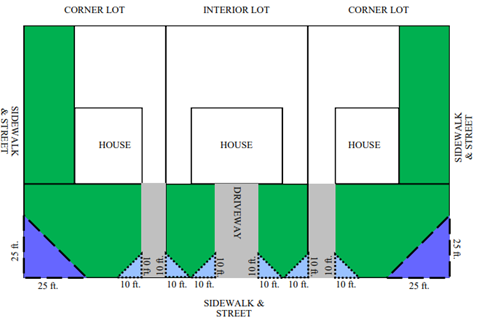
Corner clearance at street intersections. No fence, wall, shrubbery, sign or other obstruction to vision above a height of three feet from the established street grades shall be permitted within the triangular area formed at the intersection of any street right-of-way lines by a straight line drawn between said right-of-way lines at a distance along each line of 25 feet from their point of intersection.
(b)
Visibility at driveways. No fence, wall, shrubbery, sign or hedge shall materially obstruct the vision of motorists entering any street, alley, or other public way open to vehicular traffic from a driveway adjacent thereto. The area of a lot to which this applies is the area within a triangle joining the point of the intersection of the lot line and the side edge of the driveway, a point on the driveway edge line ten feet from such intersection (away from the right-of-way) and a point on the lot line ten feet from such intersection (away from the driveway).
Figure 89
(Ord. No. 1331, § 1, 5-5-25)
_____
1250.04.01. - Accessory buildings and structures, and attached garages.
Zoning requirements of this subsection shall not apply to accessory dwelling units.
(a)
In general, applies to all districts.
(1)
Accessory buildings and structures are permitted only in connection with and incidental to a principal building or use permitted within the zoning district in which it is located.
(2)
No accessory building or structure shall be occupied or utilized unless the principal structure to which it is accessory is occupied or utilized.
(3)
An accessory building or structure must be located in the same zoning district as the principal building or structure on a lot.
(4)
Where the accessory building or structure is structurally attached to a principal building or structure, it shall be subject to all the regulations of this chapter applicable to principal buildings and structures except as otherwise noted in this section.
(5)
Accessory buildings and structures shall not be occupied for dwelling purposes.
(6)
Detached accessory structures shall not be permitted in a front yard and shall be set back at least three feet from side or rear lot line. Detached accessory structures that are 1,000 square feet or more in area shall be set back not less than six feet from any side or rear lot line. If an accessory structure is attached to a structure containing the principal use, it shall meet all dimensional requirements imposed upon the structure containing the principal use, except as provided in this section.
(7)
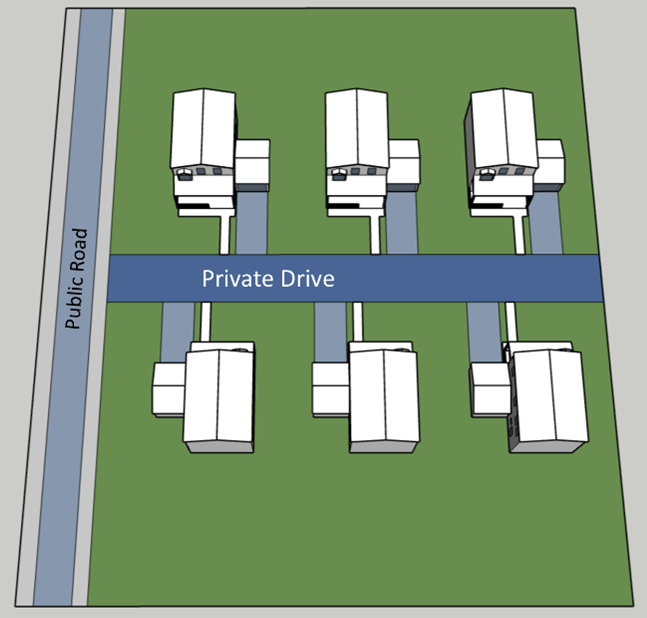
Attached garages shall not project closer to a public or private street or internal drives used for access for sites containing multiple dwelling units, than the building wall(s) of the unit facing a street or drive.
Figure 90
(8)
The maximum building height of any detached accessory building shall be 15 feet, as defined in Chapter 1240.
(9)
The design and building materials of any accessory building shall be consistent with the character of the principal building on the property.
(10)
The floor area of an accessory building shall not exceed the ground floor area of the principal building.
(11)
Accessory structures for an approved nonresidential use shall comply with the setback requirements for the principal structures and shall provide landscaping, screening and buffering in accordance with Chapter 1252.
(12)
Shipping containers, and box and semi-truck trailers are only permitted as a temporary structure for storage purposes and may be permitted for a period not to exceed two weeks, and upon request to the Zoning Administrator may be extended twice for a period not to exceed two weeks for each extension.
(b)
Applies to residential districts.
(1)
Single-family residential lots shall have no more than one storage shed and one garage or detached carport. Residential lots that contain a legally conforming duplex may have one accessory structure, which may be a garage, carport or storage building, for each unit. Multiple family residential lots may have one accessory building, which may be a garage, carport or storage building, for each legally conforming, multiple family residential building on the property.
(2)
The maximum floor area of an accessory structure, for each unit in a duplex, shall be 600 square feet on a lot less than 10,000 square feet in size and 720 square feet on a lot greater than 10,000 square feet in size.
(3)
The following size limitations shall apply to buildings that are accessory to a single-family residential dwelling:
Table 1250.04.01. Accessory Structure Size Maximums
(4)
Accessory buildings and structures combined shall cover no more than 35 percent of a rear yard.
(5)
The floor area of additions and structures attached to the private garage, including, but not limited to, covered patios, decks, storage areas and carports, shall be included in calculating the total allowable floor area of that garage.
(6)
The floor area of a garage or carport space in a planned unit shall not exceed 770 square feet, per unit.
(7)
On through lots, an accessory structure located behind the principal structure shall conform to the front yard setback of the district in which it is located.
(8)
Uncovered and unenclosed decks, patios, terraces and porches elevated six inches or more above grade in any residential district shall be set back a minimum of three feet from any side lot line and may project up to seven feet into the required front and rear yard setbacks.
(9)
An accessory structure shall not involve the operation of a business.
(10)
Ground-mounted solar energy systems shall be screened from adjoining residential uses by landscaping, tree coverage, opaque fencing, or any combination thereof.
(11)
All exterior electrical lines associated with ground-mounted Solar Energy Systems shall be buried below the surface of the ground.
(12)
Photovoltaic panels, devices, and support structures of ground-mounted solar energy systems shall be restricted to a maximum height of six feet when orientated at a maximum tilt as measured from the existing grade.
(Ord. No. 1331, § 1, 5-5-25)
1250.04.02. - Mechanical equipment.
(a)
Ground- and building-mounted mechanical equipment including, but not limited to, heating units, cooling units, air handling units, refrigeration units, blowers, ventilating fans, water and gas meters, elevator housing and tanks are subject to the following regulations:
(1)
Mechanical equipment and utilities located on or around any nonresidential or multiple-family building shall be screened from public view. Such screening shall be of a height sufficient to screen the equipment.
(2)
Alternatives for screening materials for ground-mounted mechanical and utilities shall include a solid wall, fence, evergreen plantings, berms and/or other decorative features compatible with the principal building. In a nonresidential zoning district, ground-mounted mechanical equipment shall not be located within 20 feet of any residential district.
(b)
Roof-mounted equipment shall not exceed a height of ten feet above the surrounding roof surface, and shall occupy no more than 15 percent of the total roof area.
(c)
All roof-mounted equipment shall be screened by parapet walls or a pitched roof of sufficient height to screen rooftop equipment and the screening shall be integrated into the architectural design of the building meeting the standards noted in Chapter 1246 - Architectural Standards. Screening is not required if such equipment is not visible when standing at grade level not less than 200 feet from the front entrance of the building. Where adjacent to any residential district, all roof-mounted mechanical units must be setback a minimum of 20 feet from the side of the building facing the residential district and screened using solid architectural materials that meet the standards noted in Chapter 1246 - Architectural Standards and that provide sound attenuation.
(Ord. No. 1331, § 1, 5-5-25)
1250.04.03. - Exterior lighting.
(a)
Definitions.
Canopy structure means any overhead protective structure which is constructed in such a manner as to allow pedestrians/vehicles to pass under.
Flood or spot light means any light fixture or lamp that incorporates a reflector or refractor to concentrate the light output into a directed beam in a particular direction.
Glare means direct light emitted by a lamp, luminous tube lighting or other light source.
Lamp means the component of the luminaire that produces the actual light including luminous tube lighting.
Light fixture means the assembly that holds a lamp and may include an assembly housing, a mounting bracket or pole socket, a lamp holder, a ballast, a reflector or mirror, and a refractor or lens. A light fixture also includes the assembly for luminous tube and fluorescent lighting.
Light pollution means artificial light which causes a detrimental effect on the environment, enjoyment of the night sky or causes undesirable glare or unnecessary illumination of adjacent properties.
Light trespass means the shining of light produced by a luminaire beyond the boundaries of the property on which it is located.
Luminaire means the complete lighting system including the lamp and light fixture.
Luminous tube lighting means gas filled tubing which, when subjected to high voltage, becomes luminescent in a color characteristic of the particular gas used, e.g., neon, argon, etc.
Outdoor light fixtures means outdoor artificial illuminating devices, outdoor fixtures, lamps and other similar devices, permanently installed or portable, used for flood lighting, general illumination or advertisement.
Shielded fixture means outdoor light fixtures shielded or constructed so that light rays emitted by the fixture are projected below the horizontal plane passing through the lowest point on the fixture from which light is emitted, e.g. "shoebox-type" fixtures. A luminaire mounted in a recessed fashion under a canopy or other structure such that the surrounding structure effectively shields the light in the same manner is also considered fully shielded for the purposes of this chapter.
(b)
Lighting standards. Unless otherwise exempted by this Section, all lighting must comply with the following standards:
(1)
Freestanding pole lighting.
a.
Exterior lighting shall be fully shielded and directed downward to prevent off-site glare. Fixed (not adjustable), downward-directed fixtures shall be used in an effort to maintain a unified lighting standard throughout the City and prevent "sky glow."
b.
The intensity of light shall not exceed five foot-candles within any site. For sites abutting a residential district or use, the intensity of light cannot exceed 0.5 foot-candles at the property line. A maximum of ten foot-candles is permitted within a site for gasoline stations and automobile dealerships as long as the light intensity does not exceed the allowable intensities at the property line.
c.
The Zoning Administrator may approve decorative light fixtures as an alternative to shielded fixtures when it can be proven that there will be no off-site glare and the proposed fixtures are necessary to preserve the intended character of the site.
d.
The maximum height of parking lot light fixtures shall be 20 feet, except that the Zoning Administrator may permit a maximum height of 30 feet within commercial, mixed use, industrial, research and office zoning districts and for institutional uses in residential districts when the poles are no closer than 150 feet to a residential district or use.
(2)
Building-mounted lighting.
a.
Building-mounted lighting shall be fully shielded and directed downward to prevent off-site glare. Fixed (not adjustable), downward-directed fixtures shall be used in an effort to maintain a unified lighting standard throughout the City and prevent "sky glow."
b.
The intensity of light shall not exceed five foot-candles within any site. For sites abutting a residential district or use, the intensity of light cannot exceed 0.5 foot-candles at the property line. A maximum of ten foot-candles is permitted within a site for gasoline stations and automobile dealerships as long as the light intensity does not exceed the allowable intensities at the property line.
c.
The Zoning Administrator may approve decorative light fixtures as an alternative to shielded fixtures when it can be proven that there will be no off-site glare and the proposed fixtures will improve the appearance of the site.
d.
Luminous-tube and exposed-bulb fluorescent lighting is prohibited as an architectural detail on all buildings, e.g. along the roof line and eaves, around windows, etc. The Zoning Administrator may approve internally illuminated architectural bands when it can be shown that the treatment will enhance the appearance of the building or is necessary for security purposes.
(3)
Window lighting.
a.
Any light fixtures visible through a window must be shielded to prevent glare at the property line.
b.
Luminous tube and exposed bulb fluorescent lighting (visible from the property line) is prohibited.
(4)
Maintenance. All freestanding poles, building-mounted lighting, light fixtures, and light bulbs must be maintained in a proper state of repair and free from hazardous conditions.
(c)
Exemptions. The following are exempt from the lighting requirements of this article, except that the Zoning Administrator may take steps to eliminate the impact of the exempted items when deemed necessary to protect the health, safety and welfare of the public:
(1)
Sports field lighting, in use no later than 11:00 p.m. Other sports field lighting may be approved by the Zoning Administrator after a determination that compliance with the standards in this Section have been met to the greatest extent possible, and that all efforts possible were made to minimize any negative impacts to surrounding uses.
(2)
Swimming pools.
(3)
Holiday decorations.
(4)
Window displays without glare.
(5)
Shielded pedestrian walkway lighting.
(6)
Residential lighting with no off-site glare.
(7)
Street lights.
(Ord. No. 1331, § 1, 5-5-25)
1250.04.04. - Waste receptacles and enclosures.
(a)
Waste receptacles may be permitted as accessory to any use except single-family or two-family residential uses, subject to the following conditions:
(1)
Waste receptacles must be clearly accessible to servicing vehicles.
(2)
A concrete pad, at least two feet greater than the dimension of the waste receptacle on all sides, shall be provided.
(3)
Waste receptacles shall be screened on all sides. Such screening shall be constructed of an earth mound, brick or decorative concrete block or an opaque wood or vinyl fence with a minimum height of six feet or one foot above the height of the enclosed dumpster, whichever is greater.
(4)
Access gates must provide screening and may be of wood construction or chain-link with screen slats.
(5)
Waste receptacles and their screening enclosures shall be located as far from residential districts/uses as practical.
(6)
Waste receptacles and their screening enclosures shall be located in such a manner as to minimize impacts on adjacent properties by not obstructing or impeding views from windows, doorways, or outdoor gathering areas.
(7)
Stormwater runoff near waste receptacles shall be directed away from storm drains.
(8)
The location of waste receptacles shall be indicated on the site plans and the location and screening shall be subject to approval of the Zoning Administrator.
(9)
Detail drawings or a note shall be provided on the plan to assure that the above requirements are met.
(b)
The requirements of [Subsection] 1250.04.04(a) shall not apply to portable trash containers intended for curbside pick-up.
(Ord. No. 1331, § 1, 5-5-25)
1250.04.05. - Collection bins.
(a)
Purpose. The purpose of this section is to regulate collection bins in the City of so that they remain clean, safe and do not create hazards to pedestrians or to vehicular traffic.
(b)
Definitions. As used in this section, unless otherwise provided:
Code compliance office means the Code Compliance Supervisor or his or her authorized representative.
Collection bin means any container, receptacle, or similar device that is located on any parcel or lot of record within the City and that is used for soliciting and collecting the receipt of clothing, household items, or other salvageable personal property. This term does not include recycle bins for the collection of recyclable material, any rubbish or garbage receptacle.
Collection bin operator means a person who owns, operates, supervises or otherwise is in control of collection bins to solicit collections of salvageable personal property.
Property owner means any person, agent, firm or corporation having a legal or equitable interest in the property; or recorded in the official records of the State, county or municipality as holding title to the property.
Public service department means the Director of Public Service or his or her authorized representative.
(c)
Permit required. No person or entity shall cause or permit the installation or placement of a collection bin upon any real property located within the City of Lansing, whether public or private, without first obtaining an annual permit from the City Clerk.
(d)
Permit application. An application for a collection bin permit, as required by this section shall be made to the City Clerk upon forms provided by the City. Such application shall be filed with the City Clerk not less than 30 days prior to date that the collection bin is placed on real property. One annual permit is required for each collection bin. The application shall contain the following information:
(1)
An affidavit and acknowledgment from the property owner, giving written permission to place a collection bin on the property owner's real property, as well as an acknowledgment of receipt of a copy of this chapter, and a signed statement agreeing to obey all of its requirements.
(2)
A site plan indicating the placement of the collection bin, in compliance with the requirements of this section.
(3)
The name, address, telephone number and e-mail address of the applicant, property owner and collection bin operator.
(4)
The name, address, telephone number and e-mail address of the agent or person who will be available during regular business hours and will be responsible for compliance.
(5)
A photograph of the collection bin to be installed.
(6)
The number to a 24-hour hotline for overflow events.
(7)
A nonrefundable fee determined by resolution as set by City Council.
(8)
A copy of the license and registration from the State of Michigan under the Michigan Consumer Protection Act and the Charitable Organizations Solicitations Act if statutorily required.
(9)
In order to bring existing collection bins into compliance with this section, collection bin operators, of existing collection bins, shall have 30 days from the adoption of this chapter to submit a permit application to the City Clerk.
(e)
Permit form, effective periods and renewal. The City Clerk shall issue a permit for compliant collection bins that conform to the following:
(1)
A collection bin permit is valid for a one-year period. The renewal application must be filed not later than 30 days before the current permit expires.
(2)
If the permit expires and the permit is not renewed, the collection bin must be removed from the real property within a maximum of ten days after expiration of the permit.
(f)
Permitted locations.
(1)
Collection bins are allowed in all commercial and industrial districts.
(2)
Collection bins shall not be located within 1,000 feet from another collection bin as measured along a straight line from one box to the other.
(g)
Standards for bin and surrounding area. Collection bins shall conform to the following standards:
(1)
Collection bins shall be maintained in good condition and appearance with no structural damage, holes or visible rust and shall be free of graffiti.
(2)
Collection bins are required to be placed on a paved or concrete surface. Collection bins must be level and stable.
(3)
Collection bins shall be locked and be equipped with a secure safety chute so contents cannot be accessed by anyone other than those responsible for the retrieval of the contents.
(4)
The collection bins shall be emptied with such frequency and regularity as to ensure that it does not overflow and materials do not accumulate outside the collection bin.
(5)
The collection bin operator and property owner shall maintain, or cause to be maintained, the area surrounding the bins free from any overflow collection items, furniture, rubbish, debris, hazardous materials, and noxious odors. To extent provided by law, the collection bin operator and/or property owner shall be jointly and severally responsible for the City's cost to abate any nuisance.
(6)
Collection bins shall be located on a parcel where there is a functioning and permitted use. Collection bins shall not be permitted:
a.
On any land used or zoned residential;
b.
On any unimproved parcel; or
c.
Where the principal use of the land has been closed or unoccupied for more than 30 days.
(7)
One collection bin on a single lot of record is allowed.
(8)
The total size of a collection bin is limited to a maximum dimension of five feet by five feet by seven feet.
(9)
Collection bins shall not cause a visual obstruction, as determined by the Transportation Engineer, City Engineer or Director of Public Service Department, to vehicular or pedestrian traffic.
(10)
No collection bin shall be placed closer than ten feet from:
a.
A public or private sidewalk except that this provision does not apply to a private sidewalk as long as the sidewalk maintains a five-foot clearance;
b.
A public right-of-way;
c.
A driveway; or
d.
A side or rear property line of adjacent property used for purposes.
(11)
Collection bins shall not be placed in a designated fire lane, in or adjacent to a handicap parking space, or block a building entrance or exit.
(12)
Collection bins shall be made of durable metal or UV resistant molded hard plastic or fiberglass material that is fire resistant or fire proof.
(h)
Identification of collection bins.
(1)
Collection bins shall have signage on each bin that identifies the name, mailing address, email address, website and phone number of the collection bin operator. The collection bin signage may include a company logo. Total sign area on the collection bin signage may not exceed six square feet per side. The font size used on the sign shall not be less than one inch in height.
(2)
The collection bin must prominently display at all times a readable permit identification sticker provided by the City.
(i)
Permit revocation, removal of collection bins and liability.
(1)
If the Public Service Department and/or Code Compliance Office determines that a collection bin has been placed or is being maintained in violation of this chapter, a correction notice shall be sent by regular United States Mail to the collection bin operator and property owner of the real property on which the collection bin has been placed, as shown on the most recent permit application. In the event there is not on file a permit application made for the collection bin within 24 months immediately preceding the date of violation, the correction notice shall be sent to the real property tax payer of record in the Assessor's Office. The correction notice shall describe the offending condition and the actions necessary to correct the condition. The correction notice shall provide that the offending condition be corrected or abated within seven calendar days after mailing.
(2)
If the offending condition is not corrected or abated within the seven calendar days after mailing, the City or the City's contractor shall clean-up the collection bin area.
(3)
All costs incurred by the City or the City's contractor associated with the correction or abatement of a collection bin shall be the responsibility of the property owner and collection bin owner. If such obligation is not paid within 30 days after mailing of a billing of costs to the property owner, the City may place a lien upon such real property enforceable as a tax lien in the manner prescribed by the general laws of this State against the property and collected as in the case of general property tax. If the same is not paid prior to the preparation of the next assessment roll of the City, the amount shall be assessed as a special tax against such premises on the next assessment roll and collected thereunder.
(4)
The City Clerk shall have the right to revoke any permit issued hereunder if:
a.
Offending conditions cited in a correction notice are not corrected or abated within seven days after mailing;
b.
Placement or conditions of the bin or surrounding area violate any applicable State or Federal law;
c.
Any governmental authority or agency determines that the collection bin has violated the Michigan Consumer Protection Act and/or the Charitable Organizations and Solicitations Act or other statute enacted to regulate or govern collection bins.
(5)
Upon revocation of permit issued pursuant to this chapter, the collection bin shall be removed from the real property within ten calendar days and, if not so removed within the time period, the City or the City's contractor may remove, store or dispose of the collection bin.
(6)
All costs incurred by the City or the City's contractor associated with removal, storage or disposal of a collection bin shall be the responsibility of the property owner and collection bin owner. If such obligation is not paid within 30 days after mailing of a billing of costs to the property owner, the City may place a lien upon such real property enforceable as a tax lien in the manner prescribed by the general laws of this State against the property and collected as in the case of general property tax. If the same is not paid prior to the preparation of the next assessment roll of the City, the amount shall be assessed as a special tax against such premises on the next assessment roll and collected thereunder.
(7)
If a collection bin permit is revoked, the collection bin operator shall not be eligible for a new permit for one year from the date of revocation.
(j)
Appeal to City Council. Any person aggrieved by the decision rendered by the City Clerk in granting or denying an application for a permit under this article or in revoking a permit issued under this article may appeal that decision to the City Council. The Public Service Department shall make written findings of fact in support of any license revocation. The appeal shall be made by filing a written request with the City Clerk setting forth the grounds for the appeal not later than ten days after receiving notice of the revocation by the City Clerk. In the event that the written request is filed with the City Clerk, Council shall hold a public hearing on the revocation, and shall have the power to reverse, affirm or modify the decision of the City Clerk. Council shall, in its determination, make written findings of fact supporting its decision. The determination by Council shall be final, subject to appeal to a court of competent jurisdiction.
(k)
Penalty and remedies.
(1)
In addition to revocation of permit pursuant to this section any person violating the provisions of this article is guilty of a municipal civil infraction.
(2)
In addition to the penalty provided in Subsection (a) of this section, any condition caused or permitted to exist in violation of the provisions of this chapter, or any ordinance, shall be deemed a new and separate offense for each day that such condition continues to exist.
(3)
Nothing in this chapter shall prevent the City from pursuing any other remedy provided by law in conjunction with or in lieu of prosecuting persons under this section for violation of this chapter.
(4)
The collection bin operator and real property owner shall be jointly and severally liable for each violation and for payment of any fines and costs.
(Ord. No. 1331, § 1, 5-5-25)
1250.04.06. - Fences and hedges.
(a)
Purpose; application. In order to protect the use and enjoyment of properties by providing for the passage of air and light; to protect the public welfare and safety by providing for the safe movement of motor vehicles and pedestrians; and to facilitate efficient police and fire-fighting services, no person shall erect, construct, modify, maintain, plant or grow any fence, hedge, tree, shrub, plant or vine or cause or permit the same to be done in violation of this chapter.
(b)
Definitions. As used in this chapter:
Safety hazard means any fence which is not in conformity with this section.
(c)
Limitations.
(1)
Front yard.
a.
No fence or hedge shall exceed a height of three feet within a front yard, unless otherwise permitted herein.
b.
In front yard corner lots, an unobstructed clear vision corner shall be maintained as specified in [Section] 1250.03.03.
c.
For driveways not on a corner, an unobstructed clear vision corner shall be maintained as specified in Section 1250.03.03(b).
d.
A fence within the front yard of a residentially zoned or used property may be erected or maintained to a height above three feet, but not to exceed a height of four feet, if the fence meets all of the following requirements:
1.
The fence consists of at least 50 percent of open spaces uniformly distributed along its surface above a height of three feet.
2.
Vision through the fence is not materially obstructed from any angle so as to obstruct the view of vehicular traffic on adjacent streets or public ways or of pedestrian traffic on adjacent sidewalks.
e.
A fence within the front yard of a commercial, industrial, or institutional zoned or used property, or a residential property with more than 20 units, may be erected or maintained to a height above three feet, but not to exceed a height of six feet, or eight feet for industrially zoned or used properties, if the fence meets all of the following requirements:
1.
The fence consists of at least 75 percent of open spaces uniformly distributed along its surface above a height of three feet.
2.
Vision through the fence is not materially obstructed from any angle so as to obstruct the view of vehicular traffic on adjacent streets or public ways or of pedestrian traffic on adjacent sidewalks.
3.
The fence is made only of wrought iron or other material resembling a wrought iron fence.
f.
Fence types including uncoated chain-link, wire, cyclone, wood pallets, livestock, event or crowd control, snow fencing and fences made of flexible materials, or similar fences are prohibited in front yards in all zoning districts.
g.
A hedge within a front yard may be planted, grown or maintained to a height above three feet if the hedge meets all of the following requirements:
1.
The property owner prepares and submits to the Zoning Administrator a written plan which complies with the requirements for landscaping, screening and buffering plans as set forth in this section.
2.
The abutting road is not a local street as defined the Comprehensive Plan, or the abutting property is used for industrial purposes.
3.
The hedge does not obstruct the vision of motorists and complies with paragraphs "1250.04.06(c)(1)b." and "1250.04.06(c)(1)c." hereof.
4.
All abutting property owners submit a written statement that they do not object to the plan.
5.
The plan is approved by the Zoning Administrator.
h.
A fence must be securely anchored into the ground in accordance with the fence design and shall not include materials not designed, intended, or manufactured for residential properties including, but not limited to, plywood, wood pallets, scrap wood, scrap metal, or construction materials; cattle gate fencing; or chicken wire fencing.
(2)
Side and rear yard.
a.
No fence or hedge within a side yard or rear yard shall exceed six feet in height but may be permitted to a maximum height of eight feet, if all of the following requirements can be met:
1.
The property is zoned for commercial or industrial land use, or in the case of properties zoned for residential uses, the abutting property is zoned for commercial or industrial land use.
2.
The topography of the subject property is generally one or more feet lower than the abutting property, or the health or safety of the owner or occupant of the subject property is endangered by uses of the abutting property.
3.
The fence is approved by the Zoning Administrator.
(3)
Grade level.
a.
The grade shall not be increased or altered for the purpose of constructing the fence at a higher level than the natural grade level at the fence line.
b.
The fence may be erected at a continuous even level where the grade at the fence line is uneven, as long as it follows the average natural grade upon which it is being erected.
(d)
Materials.
(1)
Fences shall be constructed of one or more of the following materials: chain-link, treated wood, brick, poured concrete, wrought-iron, vinyl or similar material that is approved by the Zoning Administrator.
(2)
Barbed wire on fences may be utilized in the IND-1 Industrial District only upon the written request of the applicant and written approval by the Zoning Administrator. Approval of such request shall be based on demonstrated need, safety and reasonableness. Under no circumstances will any fence six feet in height or less, within ten feet of a public sidewalk, or within 30 feet from a neighboring parcel which has a residential use, be permitted to use barbed wire. Barbed wire shall not extend more than three vertical feet above the top of the fence.
(3)
No fence shall contain razor wire, concertina wire or similar type of wire, or carry any electrical current.
(4)
Berms. If earth berms are to be constructed, they shall have a maximum slope of 3:1 and shall be sodded or seeded or utilize other ground cover. Berm height, width, location and materials must be approved by the Department.
(5)
No materials including, but not limited to, plywood, wood pallets, scrap wood, scrap metal, construction materials, tarp, cloth, plastic covering, or other flexible material shall be affixed to a fence or used to create a fence, barrier, or privacy screen.
(e)
Swimming pool fences.
(1)
Except as otherwise provided in this chapter, every swimming pool with a depth of 24 inches at any point and/or a volume of 150 cubic feet or more must be maintained within an adequate enclosure surrounding the pool area that complies with the following provisions:
a.
The pool enclosure shall extend not less than four feet above the ground. All enclosures shall be self-closing and self-latching with latches placed at least four feet above the ground. No opening in a pool enclosure fence or gate shall be designed or maintained so as to permit access to the pool except under the supervision of the pool owner or by his permission.
b.
Pool enclosure fences shall be constructed so as to prohibit the passage of a sphere larger than four inches in diameter through any opening or under the fence. Pool enclosure fences shall be designed to withstand substantial (200 pounds per square foot) concentrated horizontal loads at any point in the fence.
(f)
Unsafe or dangerous fences; failure to maintain.
(1)
No owner, occupant or agent in charge shall keep or maintain any fence which is unsafe or dangerous. A fence shall be deemed unsafe or dangerous whenever:
a.
Any portion has been damaged by wind, flood, fire or other cause in such a manner that structural strength or stability is appreciably less than it was previous to such event.
b.
Any portion of any structural member of the fence is likely to fall, to become detached or dislodged or to collapse and thereby injure persons or damage property.
(g)
Repair or removal; remedies of City. The Department of Economic Development and Planning may order the repair or removal of any fence that does not comply with the provisions of Section 1250.04.06 in accordance with the following procedures:
(1)
Upon finding that a fence is in violation of the provisions of this chapter, the Department shall issue a written notice to the owner of the property upon which the fence is located. The notice shall be sent by mail or delivered in person and shall:
a.
Include a description of the violation(s).
b.
Cite the applicable ordinance provisions.
c.
Specify a reasonable time period for correcting the violation(s).
(2)
If the owner fails to comply with the notice within the specified time frame, the Department may issue a final notice following the same procedures as the first notice.
(3)
Failure to comply with the notice(s) shall result in issuance of a civil fine and/or issuance of a District Court citation requesting a court order of compliance.
(h)
Nonconforming fences. Existing fences or sections thereof that do not comply with the provisions of this ordinance may be replaced or reconstructed, as long as not more than 50 percent of the conforming fence or sections thereof are replaced or reconstructed over the life of the original fence. Nothing herein is intended to prohibit general maintenance and minor repairs as necessary to ensure that the fence is not a threat to the safety of persons or property.
(i)
Conflict of laws. All ordinances or parts of ordinances in these Codified Ordinances which require fences that are inconsistent with this chapter shall remain effective and nothing in this chapter shall be construed to limit the authority or power granted elsewhere in these Codified Ordinances to any City department, board or commission to require fences in appropriate circumstances which deviate from the requirements of this chapter.
(Ord. No. 1331, § 1, 5-5-25)
1250.04.07. - Cottage courts.
General requirements. All dwelling units within a cottage court as defined in Section 1240.02 shall comply with the requirements of Section 1244.02 in addition to the following requirements:
(a)
Permitted districts. Cottage courts are permitted in the R-3, R-MX, MFR, R-AR, and DT-1 zoning districts.
(b)
Number of dwellings. A cottage court shall have at least three, but no more than six, units that may be detached single-family dwellings or duplexes.
(c)
Orientation. The front wall and primary entrance to dwellings that are closest to the public street or private access drive must be oriented toward said street. All other dwellings must be oriented toward a street, alley, access drive, or courtyard or pathway.
(d)
Size. Each dwelling shall have at least 400, but no more than 1,200 square feet of living space.
(e)
Height. Each dwelling shall be a minimum of 15 feet in height but in no instance shall exceed 25 feet in height.
(f)
Front setback. No dwelling unit shall be located closer to a public street than the required setback of the zoning district in which the property is located.
(g)
Side and rear setbacks. All dwellings shall have a minimum setback of ten feet from each side property line and 20 feet from a rear property line.
(h)
Setbacks between dwellings. Detached dwellings shall be separated by a distance of at least ten feet from every other dwelling.
(i)
Private outdoor area. Each dwelling shall have a minimum of 120 square feet of private outdoor space (e.g. patio, porch, deck, garden).
(j)
Maximum lot coverage. The ground floor area of all buildings shall not exceed 60 percent of the total lot area. The total amount of impervious surfaces shall not exceed 75 percent of the lot area.
(k)
Parking.
(1)
One off-street parking space per unit is required.
(2)
All parking spaces must be accessed via an internal street or access drive and may be consolidated into one shared parking lot.
(3)
All shared parking areas within ten feet of an adjacent residentially used property must be screened by a six-foot opaque fence, subject to the requirements of Section 1250.04.06.
(l)
Short-term rental restriction. No dwelling unit shall be utilized for a short-term rental.
(Ord. No. 1331, § 1, 5-5-25)
1250.04.08. - Accessory dwelling units.
(a)
Definitions.
Accessory dwelling unit means a dwelling unit detached from and accessory to a principal single-family dwelling, also known as an ADU.
(b)
In general, applies to all accessory dwelling units only.
(1)
In addition to the following requirements, an accessory dwelling unit is subject to all requirements of Section 1244.02, unless otherwise permitted.
(2)
Only one ADU is allowed on lots with an existing single-family principal dwelling in the R-1, R-2, R-3, R-MX, and DT-1 zoning districts.
(3)
An ADU shall be detached in the rear yard subject to the size limitations of this chapter or be part of an accessory building (such as a converted garage or carriage house), subject to the size limitations of maximum square footage of detached accessory garages in Table 1250.04.01.
(4)
An ADU may have its first-floor finish elevation built at finished grade.
(5)
A principal structure shall not be divided into two dwelling units for use as an accessory dwelling unit.
(6)
An ADU is limited to a maximum of two bedrooms.
(7)
For any lot, the principal structure or the ADU shall be owner-occupied. If either the ADU, or the principal structure is leased, it must be registered and properly licensed as a rental by the Code Compliance Office.
(c)
Site layout requirements.
(Ord. No. 1332, § 1, 5-5-25)
1250.05.01. - Reception antenna facilities.
(a)
In all single-family zoning districts, the installation and/or use of a reception antenna facility having a diameter in excess of three feet shall be permitted only as an accessory use and only as authorized in this section.
(b)
A ground-mounted reception antenna facility shall be located in the rear yard only and shall be located no closer than six feet from a side or rear lot line.
(c)
A roof-mounted reception antenna facility shall be located on that portion of the roof adjacent to the rear yard of the property and a structure-mounted facility shall be located in the rear yard only.
(d)
Excluded from the regulations of this section are conventional VHF and UHF television.
(Ord. No. 1331, § 1, 5-5-25)
1250.05.02. - Wireless communications towers and antennas.
(a)
Purpose. The purpose of this section is to establish general guidelines for the siting of wireless communications towers and antennas. The goals of this section are to:
(1)
Protect residential areas, property values, and land uses from potential adverse impacts of towers and antennas;
(2)
Strongly encourage the location of towers in nonresidential areas;
(3)
Minimize the total number of towers throughout the community;
(4)
Strongly encourage the appropriate placement of new and existing towers;
(5)
Strongly encourage the joint use of new and existing tower sites as a primary option rather than construction of additional single-use towers;
(6)
Strongly encourage users of towers and antennas to locate them, to the extent possible, in areas where the adverse impact on the community is minimal;
(7)
Strongly encourage users of towers and antennas to configure them in a way that minimizes displeasing aesthetics of the towers and antennas through careful design, siting, landscape screening, and innovative camouflaging techniques;
(8)
Enhance the ability of the providers of telecommunications services to provide such services to the community quickly, effectively, and efficiently;
(9)
Consider, to the extent permitted by law, the public health and safety impacts of communication towers; and
(10)
Avoid potential damage to adjacent properties from tower failure through engineering, design, and careful siting of tower structures.
In furtherance of these goals, the City shall give due consideration to the City's Comprehensive Plan, Zoning Map, existing land uses, and environmentally sensitive areas in approving sites for the location of towers and antennas.
(b)
Definitions. For the purposes of this chapter, the following words and phrases shall have the meanings set forth below:
Alternative tower structure means clock towers, bell steeples, light poles and similar alternative-design mounting structures that camouflage or conceal the presence of antennas or towers.
Antenna means any exterior transmitting or receiving device mounted on a tower, building or structure and used in communications that radiate or capture electromagnetic waves, digital signals, analog signals, radio frequencies (excluding radar signals), wireless telecommunications signals or other communication signals.
FAA means the Federal Aviation Administration.
FCC means the Federal Communications Commission.
Height means, when referring to a tower or other structure, the distance measured from the finished grade of the parcel to the highest point on the tower or other structure, including the base pad and any antenna.
Preexisting towers and preexisting antennas means any tower or antenna for which a building permit or special land use permit has been properly issued prior to the effective date of this ordinance, including permitted towers or antennas that have not yet been constructed so long as such approval is current and not expired.
Tower means any structure that is designed and constructed primarily for the purpose of supporting one or more antennas for telephone, radio and similar communication purposes, including self-supporting lattice towers, guyed towers, or monopole towers. The term includes radio and television transmission towers, microwave towers, common-carrier towers, cellular telephone towers, alternative tower structures, and the like. The term includes the structure and any support thereto.
(c)
Applicability.
(1)
New towers and antennas. All new towers or antennas in the City shall be subject to these regulations, except as provided in Subsections 1250.05.02(c)(2) through 1250.05.02(c)(4), inclusive.
(2)
Amateur radio station/receive only antennas. This chapter shall not govern any tower, or the installation of any antenna, that is under 70 feet in height and is owned and operated by a federally-licensed amateur radio station operator or is used exclusively for those antennas defined in Code of Federal Regulations 1.4000.
(3)
Preexisting towers or antennas. Preexisting towers and preexisting antennas shall not be required to meet the requirements of this section, other than the requirements of Subsections 1250.05.02(d)(6) and 1250.05.02(d)(7).
(4)
AM array. For purposes of implementing this chapter, an AM array, consisting of one or more tower units and supporting ground system which functions as one am broadcasting antenna, shall be considered one tower. Measurements for setbacks and separation distances shall be measured from the outer perimeter of the towers included in the AM array. Additional tower units may be added within the perimeter of the AM array by right.
(d)
General requirements.
(1)
Principal or accessory use. Antennas and towers may be considered either principal or accessory uses. A different existing use of an existing structure on the same lot shall not preclude the installation of an antenna or tower on such lot.
(2)
Lot size. For purposes of determining whether the installation of a tower or antenna complies with district development regulations, including, but not limited to, setback requirements, lot-coverage requirements, and other such requirements, the dimensions of the entire lot shall control, even though the antennas and/or towers may be located on leased parcels within such lot.
(3)
Inventory of existing sites. Each applicant for an antenna and/or tower shall provide to the Zoning Administrator an inventory of its existing towers, antennas, or sites approved for towers or antennas, that are either within the jurisdiction of the City or within one mile of the border thereof, including specific information about the location, height, and design of each tower. Information submitted to the Zoning Administrator shall be considered public information. The Zoning Administrator may share such information with the public and other applicants applying for special land use permits under this ordinance or other organizations seeking to locate antennas within the jurisdiction of the City, provided, however that the Zoning Administrator is not, by sharing such information, in any way representing or warranting that such sites are available or suitable.
(4)
Aesthetics. Towers and antennas shall meet the following requirements:
a.
Except as otherwise required for an alternative tower structure, towers shall either maintain a galvanized steel finish or, subject to any applicable standards of the FAA, be painted a neutral color so as to reduce visual obtrusiveness.
b.
At a tower site, the design of the buildings and related structures shall, to the extent possible, use materials, colors, textures, screening, and landscaping that will blend them into the natural setting and surrounding buildings.
c.
If an antenna is installed on a structure other than a tower, the antenna and supporting electrical and mechanical equipment must be of a neutral color that is identical to, or closely compatible with, the color of the supporting structure so as to make the antenna and related equipment as visually unobtrusive as possible.
(5)
Lighting. Towers shall not be artificially lighted, unless required by the FAA or other applicable authority. If lighting is required, the lighting alternatives and design chosen must cause the least disturbance to the surrounding views. Lighting may be provided on an alternative tower structure to enhance its camouflaging or concealing effect. All lighting must be approved by the City.
(6)
State or Federal requirements. All towers must meet or exceed current standards and regulations of the FAA, the FCC, and any other agency of the State or Federal government with the authority to regulate towers and antennas. If such standards and regulations are changed, then the owners of the towers and antennas governed by this chapter shall bring such towers and antennas into compliance with such revised standards and regulations within six months of the effective date of such standards and regulations, unless a different compliance schedule is mandated by the controlling State or Federal agency. Failure to bring towers and antennas into compliance with such revised standards and regulations shall constitute grounds for the removal of the tower or antenna at the owner's expense.
(7)
Building codes; safety standards. To ensure the structural integrity of towers, the owner of a tower shall ensure that it is maintained in compliance with standards contained in applicable state or local building codes and the applicable standards for towers that are published by the electronic industries association, as amended from time to time. If, upon inspection, the City concludes that a tower fails to comply with such codes and standards and constitutes a danger to persons or property, then upon notice being provided to the owner of the tower, the owner shall have 30 days to bring such tower into compliance with such standards. Failure to bring such tower into compliance within said 30 days shall constitute grounds for the removal of the tower or antenna at the owner's expense.
(8)
Measurement. For purposes of measurement, tower setbacks and separation distances shall be calculated and applied to facilities located in the City irrespective of municipal and county jurisdictional boundaries.
(9)
Not essential services. Towers and antennas shall be regulated and permitted pursuant to this chapter and shall not be regulated or permitted as essential services, public utilities, or private utilities.
(10)
Public notice. For purposes of this chapter, any special land use request, variance request, or appeal of a special land use shall require public notice to the LPD neighborhood watch coordinators, and all neighborhood associations, property owners, neighborhood associations, neighborhood watches, and all property owners and occupants of properties that are located within 1,000 feet of the parcel that is the subject of the request, in addition to any notice otherwise required by the Zoning Code.
(11)
Signs. No signs shall be allowed on an antenna or tower.
(12)
Buildings and support equipment. Buildings and support equipment associated with antennas or towers shall comply with the requirements of Section 1250.05.02(h).
(13)
Multiple antenna/tower plan. The City encourages the users of towers and antennas to submit a single application for approval of multiple towers and/or antenna sites. Applications for approval of multiple sites shall be given priority in the review process.
(14)
Height. No tower shall exceed 120 feet, unless a variance is approved by the Board of Zoning Appeals.
(e)
Permitted use. The following use is deemed to be a permitted use and shall not require a special land use permit: antennas or towers located on property owned, leased, or otherwise controlled by the City provided a license or lease authorizing such antenna or tower has been approved by the Council.
(f)
Administratively approved uses.
(1)
General. The following provisions shall govern the issuance of administrative approvals for towers and antennas.
a.
The Zoning Administrator may administratively approve the uses listed in this section.
b.
Each applicant for administrative approval shall apply to the Zoning Administrator providing the information set forth in Subsections 1250.05.02(g)(2)a. and 1250.05.02(g) (2)c. of this section and a refundable fee as established by resolution of Council to reimburse the City for the costs and expenses incurred in reviewing the application. No application for an administratively approved use shall be considered by the Zoning Administrator until all conditions required in the resolution of Council have been met.
c.
The Zoning Administrator shall respond to each such application within 60 days after receiving it by either approving or denying the application. If the Zoning Administrator fails to respond to the applicant within said 60 days, then the application shall be deemed to be approved.
d.
In connection with any such administrative approval, the Zoning Administrator may, in order to encourage shared use, administratively waive any zoning district setback requirements in Section 1250.05.02(g)(2)d. or separation distances between towers in Section 1250.05.02(g)(2)e. by up to 50 percent.
e.
In connection with any such administrative approval, the Zoning Administrator may, in order to encourage the use of monopoles, administratively allow the reconstruction of an existing tower to monopole construction.
f.
If an administrative approval is denied, the applicant shall file an application for a special land use permit pursuant to Section 1250.05.02(g) prior to filing any appeal that may be available under the Zoning Code.
(2)
List of administratively approved uses. The following uses may be approved by the Zoning Administrator after conducting an administrative review:
a.
Locating a tower or antenna, including the placement of additional buildings or other supporting equipment used in connection with said tower or antenna, in any heavy industrial zoning district, provided that there is no residential property adjacent to the district.
b.
Locating antennas on existing structures or towers consistent with the terms of Subsections 1. and 2. below.
1.
Antennas on existing structures. Any antenna which is not attached to a tower may be approved by the Zoning Administrator as an accessory use to any commercial mixed-use or residential multi-family structure of eight or more dwelling units, provided:
i.
The antenna does not extend more than 30 feet above the highest point of the structure;
ii.
The antenna complies with all applicable FCC and FAA regulations; and
iii.
The antenna complies with all applicable building codes.
2.
Antennas on existing towers. An antenna which is attached to an existing tower may be approved by the Zoning Administrator and, to minimize the displeasing aesthetics associated with the proliferation and clustering of towers, collocation of antennas by more than one carrier on existing towers shall take precedence over the construction of new towers, provided such collocation is accomplished in a manner consistent with the following:
i.
A tower which is modified or reconstructed to accommodate the collocation of an additional antenna shall be of the same tower type as the existing tower, unless the Zoning Administrator allows reconstruction as a monopole.
ii.
Height.
A.
An existing tower may be modified or rebuilt to a taller height, not to exceed 30 feet over the tower's existing height, to accommodate the collocation of an additional antenna.
B.
The height change referred to in Subsection A. above may only occur one time per communication tower.
C.
The additional height referred to in Subsection A. above shall not require an additional distance separation as set forth in Section 1250.05.02(g). The tower's premodification height shall be used to calculate such distance separations.
iii.
Onsite location.
A.
A tower which is being rebuilt to accommodate the collocation of an additional antenna may be moved onsite within 50 feet of its existing location.
B.
After the tower is rebuilt to accommodate collocation, only one tower may remain on the site.
C.
A relocated onsite tower shall continue to be measured from the original tower location for purposes of calculating separation distances between towers pursuant to Subsection 1250.05.02(g) (2)e. The relocation of a tower hereunder shall in no way be deemed to cause a violation of Subsection 1250.05.02(g) (2)e.
D.
The onsite relocation of a tower which comes within a location that is less than the separation distances to residential units or residentially zoned lands as established in Subsection 1250.05.02(g)(2)e. shall only be permitted when approved by the Zoning Administrator.
(3)
Installing a cable microcell network through the use of multiple low-powered transmitters/receivers attached to existing wireline systems, such as conventional cable or telephone wires, or similar technology that does not require the use of towers.
(g)
Special land use permits.
(1)
General. The following provisions shall govern the issuance of special land use permits for towers or antennas by the Council following review and recommendation by the Planning Commission:
a.
If the tower or antenna is not a permitted use under Section 1250.05.02(e) of this chapter, then a special land use permit shall be required for the construction of a tower or the placement of an antenna in all zoning districts.
b.
Applications for special land use permits under this section shall be subject to the procedures and requirements of Chapter 1262 - Special Land Use Permits, of the Zoning Code, except as modified in this section.
c.
In granting a special land use permit, the Council may impose conditions to the extent the Council concludes such conditions are necessary to minimize any adverse effect of the proposed tower on adjoining properties. In addition to any other conditions, Council may require an applicant to post with the City Clerk cash, a certified check, an irrevocable letter of credit issued by a bank, or a surety bond in an amount sufficient to pay for the removal of the tower in case the tower is abandoned as set forth in Section 1250.05.02(i). The surety bond shall be open ended and shall be executed by the applicant and a United States based corporate surety authorized to do business in this State as a surety. Any surety bond or irrevocable letter of credit shall be in a form approved by the City Attorney, and shall be made payable to the City. In the event that an abandoned tower is removed at the applicant's expense, the bond, instrument of credit, cash deposit or certified check shall be released to the applicant.
d.
Any information of an engineering nature that the applicant submits, whether civil, mechanical, or electrical, shall be certified by a licensed professional engineer.
e.
An applicant for a special land use permit shall submit the information described in this section, the information described in Section 1250.05.02(d), and, in addition to any other fee required by law, a refundable fee as established by resolution of the Council to reimburse the City for the costs and expenses incurred in reviewing the application. No application for a special land use permit shall be considered by the Planning Commission until all conditions required in the resolution of council shall have been met.
(2)
Towers.
a.
Information required. In addition to any information required for applications for special land use permits pursuant to Chapter 1262 - Special Land Use Permits, of the Zoning Code, applicants for a special land use permit for a tower shall submit the following information with the application or, with respect to other information deemed by the Zoning Administrator to be necessary to assess compliance with this chapter pursuant to Subsection 1. below, as soon as reasonably practicable as determined by the Zoning Administrator:
1.
A scaled site plan clearly indicating the location, type and height of the proposed tower, on-site land uses and zoning, adjacent land uses and zoning (including when adjacent to other municipalities), Comprehensive Plan classification of the site and all properties within the applicable separation distances set forth in Subsection 1250.05.02(g) (2)e., adjacent roadways, proposed means of access, setbacks from property lines, elevation drawings of the proposed tower and any other structures, topography, parking, and other information deemed by the Zoning Administrator to be necessary to assess compliance with this ordinance.
2.
Legal description of the parent tract and leased parcel (if applicable).
3.
The setback distance between the proposed tower and the nearest residential unit, platted residentially zoned properties, and unplatted residentially zoned properties.
4.
The separation distance from other towers described in the inventory of existing sites submitted pursuant to Subsection 1250.05.02(d)(3) shall be shown on an updated site plan or map. The applicant shall also identify the type of construction of the existing tower(s) and the owner/operator of the existing tower(s), if known.
5.
A landscape plan showing specific landscape materials.
6.
Method of fencing, and finished color and, if applicable, the method of camouflage and illumination.
7.
A description of compliance with Subsections 1250.05.02(d) (3), (4)—(7), (11), and (12), 1250.05.02(g)(2)d.
8.
Subsection 1250.05.02(g)(2)e. and all applicable Federal, State or local laws.
9.
A notarized statement by the applicant as to whether construction of the tower will accommodate collocation of additional antennas for future users.
10.
Evidence at the time of application of a lease or an option to lease by a telecommunications provider with the owner of the property in question.
11.
A description of the suitability of the use of existing towers, other structures or alternative technology not requiring the use of towers or structures to provide the services to be provided through the use of the proposed new tower, including specifics as to why such towers, structures or alternative technologies are not suitable or feasible in lieu of a tower.
12.
A description of the feasible location(s) of future towers or antennas within the City based upon existing physical, engineering, technological or geographical limitations in the event the proposed tower is erected.
b.
Factors considered in granting special land use permits for towers. In addition to any standards for consideration of special land use permit applications pursuant to Chapter 1262 - Special Land Use Permits, of the Zoning Code, the Council may consider the following factors and any other factors allowed by law in determining whether to issue a special land use permit, although the Council may waive or reduce the burden on the applicant of one or more of these criteria if the Council concludes that the goals of this chapter are better served thereby:
1.
Height of the proposed tower;
2.
Proximity of the tower to residential structures and residential district boundaries;
3.
Nature of uses on adjacent and nearby properties;
4.
Surrounding topography;
5.
Surrounding tree coverage and foliage;
6.
Design of the tower, with particular reference to design characteristics that have the effect of reducing or eliminating visual obtrusiveness;
7.
Proposed ingress and egress;
8.
Evidence at the time of application of a lease or an option to lease by a telecommunications provider with the owner of the property in question; and
9.
Availability of suitable existing towers, other structures, or alternative technologies not requiring construction of a new tower, as discussed in Subsection 1250.05.02(g)(2)c. of this chapter.
c.
Availability of suitable existing towers, other structures, or alternative technology. No new tower shall be permitted unless the applicant demonstrates to the reasonable satisfaction of the Council that no existing tower, structure or alternative technology that does not require the use of towers or structures can accommodate the applicant's proposed antenna. An applicant shall submit information requested by the Council related to the availability of suitable existing towers, other structures or alternative technology. Evidence submitted to demonstrate that no existing tower, structure or alternative technology can accommodate the applicant's proposed antenna may consist of any of the following:
1.
No existing towers or structures are located within the geographic area which meets the applicant's engineering requirements.
2.
Existing towers or structures are not of sufficient height to meet the applicant's engineering requirements.
3.
Existing towers or structures do not have sufficient structural strength to support the applicant's proposed antenna and related equipment.
4.
The applicant's proposed antenna would cause electromagnetic interference with the antenna on the existing towers or structures, or the antenna on the existing towers or structures would cause interference with the applicant's proposed antenna.
5.
The fees, costs, or contractual provisions required by the owner in order to share an existing tower or structure or to adapt an existing tower or structure for sharing are unreasonable. Costs exceeding new tower development are presumed to be unreasonable.
6.
The applicant demonstrates that there are other limiting factors that render existing towers and structures unsuitable.
7.
The applicant demonstrates that an alternative technology that does not require the use of towers or structures, such as a cable microcell network using multiple low-powered transmitters/receivers attached to a wireline system, is unsuitable. Costs of alternative technology that exceed new tower or antenna development shall not be presumed to render the technology unsuitable.
d.
Setbacks. The following setback requirements shall apply to all towers for which a special land use permit is required; provided, however, that the Council may reduce the standard setback requirements if the goals of this chapter would be better served thereby:
1.
Towers must be set back a distance equal to at least 75 percent of the height of the tower from any adjoining lot line.
2.
Guys and accessory buildings must satisfy the minimum zoning district setback requirements.
e.
Separation. The following separation requirements shall apply to all towers and antennas for which a special land use permit is required; provided, however, that the Council may reduce the standard separation requirements if the goals of this chapter would be better served thereby:
1.
Separation from off-site uses/designated areas.
i.
Tower separation shall be measured from the base of the tower to the lot line of the off-site uses and/or designated areas as specified in Table 1250.05.A.
ii.
Separation requirements for towers shall comply with the minimum standards established in Table 1250.05.A.
Table 1250.05.A.
Footnotes:
1. Includes modular homes and mobile homes used for living purposes.
2. Separation measured from base of tower to closest building setback line.
3. Includes any unplatted residential use properties without a valid preliminary subdivision plan or valid development plan approval and any multifamily residentially zoned land greater than duplex.
2.
Separation distances between towers.
i.
Separation distances between towers shall be applicable for and measured between the proposed tower and preexisting towers. The separation distances shall be measured by drawing or following a straight line between the base of the existing tower and the proposed base, pursuant to a site plan, of the proposed tower. The separation distances (listed in linear feet) shall be as shown in Table 1250.05.B.
Table 1250.05.B.
f.
Security fencing. Towers shall be enclosed by security fencing not less than six feet in height and shall also be equipped with an appropriate anti-climbing device; provided however, that the council may waive such requirements, as it deems appropriate.
g.
Landscaping. The following requirements shall govern the landscaping surrounding towers for which a special land use permit is required; provided, however, that the Council may waive such requirements if the goals of this chapter would be better served thereby:
1.
Tower facilities shall be landscaped with a buffer of plant materials that effectively screens the view of the tower compound from property used for residences. The standard buffer shall consist of a landscaped strip at least four feet wide outside the perimeter of the compound.
2.
In locations where the visual impact of the tower would be minimal, the landscaping requirement may be reduced, deferred, or waived.
3.
Existing mature tree growth and natural landforms on the site shall be preserved to the maximum extent possible. In some cases, such as towers sited on large, wooded lots, natural growth around the property perimeter may be a sufficient buffer; in these cases, landscaping may be deferred during the time period that the natural growth provides a sufficient buffer.
(h)
Building or other equipment storage.
(1)
Antennas mounted on structures or rooftops. The equipment cabinet or structure used in association with antennas shall comply with the following:
a.
The cabinet or structure shall not contain more than 36 square feet of gross floor area or be more than seven feet in height. In addition, for buildings and structures which are less than 65 feet in height, the related unmanned equipment structure, if over 36 square feet of gross floor area or seven feet in height, shall be located on the ground and shall not be located on the roof of the structure.
b.
If the equipment structure is located on the roof of a building, the area of the equipment structure and other equipment and structures shall not occupy more than five percent of the gross roof area.
c.
Equipment storage buildings or cabinets shall comply with all applicable building codes.
(2)
Antennas mounted on utility poles or light poles. The equipment cabinet or structure used in association with antennas shall be located in accordance with the following:
a.
In all residential districts, the equipment cabinet or structure may be located:
1.
In a front or side yard provided the cabinet or structure is no greater than six feet in height or 12 square feet of gross ground area, including foundation pad and the cabinet/structure is located a minimum of ten feet from all lot lines, and the cabinet/structure is screened by an evergreen hedge with a height of at least 36 inches.
2.
In a rear yard, provided the cabinet or structure is no greater than seven feet in height or 36 square feet in gross ground area, including foundation pad. The cabinet/structure shall be screened by an evergreen hedge with an ultimate height of eight feet and a planted height of at least 36 inches.
b.
In industrial and commercial mixed-use districts, the equipment cabinet or structure shall be no greater than seven feet in height or 42 square feet in gross ground area, including foundation pad. The structure or cabinet shall be screened by an evergreen hedge with an ultimate height of eight feet and a planted height of at least 36 inches. In all other instances, structures or cabinets shall be screened from view of all residential properties which abut or are directly across the street from the structure or cabinet by a solid fence six feet in height or an evergreen hedge with an ultimate height of eight feet and a planted height of at least 36 inches.
(3)
Antennas located on towers. The related unmanned equipment structure shall not contain more than 200 square feet of gross floor area or be more than 12 feet in height, and shall be located in accordance with the minimum yard requirements of the zoning district in which it is located.
(4)
Modification of building size requirements. The requirements of Subsections 1250.05.02(h)(1) through 1250.05.02(h)(3) may be modified by the council to encourage collocation.
(i)
Removal of abandoned antennas and towers. Any antenna or tower that is not operated for a continuous period of 12 months shall be considered abandoned, and the owner of such antenna or tower shall remove the same within 90 days of receipt of notice from the City notifying the owner of such abandonment. Failure to remove an abandoned antenna or tower within said 90-day period shall be grounds for the City to remove, or cause the removal of, the tower or antenna at the owner's expense. If there are two or more users of a single tower, then this provision shall not become effective until all users cease using the tower.
(j)
Nonconforming uses.
(1)
No expansion of nonconforming use. Towers that are constructed, and antennas that are installed, in accordance with the provisions of this section shall not be deemed to constitute the expansion of a nonconforming use or structure.
(2)
Preexisting towers. Preexisting towers shall be allowed to continue their usage as they presently exist. Routine maintenance (including replacement with a new tower of like construction and height) shall be permitted on such preexisting towers. New construction other than routine maintenance on a preexisting tower shall comply with the requirements of this chapter.
(Ord. No. 1331, § 1, 5-5-25)
1250.05.03. - Wind energy conversion systems (WECS).
(a)
Intent and purpose. The purpose of this section is to establish guidelines for siting wind turbines and wind energy facilities. This section's goals are as follows:
(1)
To promote the safe, effective, and efficient use of wind energy systems installed to reduce the on-site consumption of electricity supplied by utility companies.
(2)
To lessen potential adverse impacts wind energy systems may have on residential areas through careful design, siting, noise limitations, and other techniques.
(3)
To avoid potential damage to adjacent properties from turbine failure through engineering and proper siting of turbine structures.
(b)
Definitions.
Commercial wind energy conversion system means any WECS that is designed and built to provide electricity to the electric utility power grid as an ongoing commercial enterprise or for commercial profit.
Decibel means the unit of measurement used to express the magnitude of sound pressure and sound intensity.
Roof-mounted wind energy conversion system means a single wind energy conversion system that is mounted to the roof of any structure.
Shadow flicker means alternating changes in light intensity caused by the moving blade of a wind energy system casting shadows on the ground and stationary objects, such as a window at a dwelling.
Temporary meteorological towers (TMT) means a tower of monopole design which is designed and built to hold wind resource testing devices such as anemometers, wind vanes and accessory equipment and which is to remain in place for no more than 18 months.
Wind energy conversion system (WECS) means any device such as a turbine, windmill or charger that converts wind energy to a usable form of energy.
(c)
Permitted uses.
(1)
Permitted accessory use. Each parcel of property may contain one of the following which shall be considered lawful accessory uses in all zoning districts:
a.
One TMT, up to the maximum allowable height of the zoning district in which it is located.
b.
One WECS, up to the maximum allowable height of the zoning district in which it is located.
c.
One roof-mounted WECS, per building, with may extend no more than ten feet above the area of the roof structure to which it is attached.
(2)
Special land use. All commercial WECSs regardless of height, a WECSs or TMTs that exceeds the maximum height allowed within the zoning district in which it is located, up to a maximum height of 150 feet, buildings with more than one roof-mounted WECS and parcels of land with more than one freestanding WECS shall be permitted as a special land use in all industrial zoning districts, and shall be subject to the provisions of Chapter 1262 - Special Land Use Permits.
(d)
Application. Application process: The following information shall be provided with all applications for WECSs and TMTs:
(1)
Applicant information. Name, address and contact information.
(2)
Legal description. A legal description of the property on which the system would be located.
(3)
Plot plan and documentation. The plot plan shall include maps showing the physical features and land uses of the project area, both before and after construction of the proposed wind energy system. The plot plan shall include:
a.
The project area boundaries.
b.
The location, height and dimensions of all existing and proposed and fencing.
c.
Distance of proposed structure from all property lines and structures.
d.
The location and dimensions of all temporary and permanent access roads.
e.
All new infrastructure above ground related to the project.
f.
The location of all overhead utility wires.
(4)
Additional documentation.
a.
Insurance. Proof of the applicant's appropriate liability insurance.
b.
Sound pressure level. Documentation of the manufacturers designed sound pressure levels (decibels) for unit to be installed.
c.
Certifications. Certification that applicant has complied or will comply with all applicable State and Federal laws and regulations.
d.
Grant of authority. The applicant shall provide evidence of ownership of the land which the WECS or TMT is to be located and the written consent of the land owner if different from the applicant. If the applicant is leasing land the applicant shall provide a copy of the lease agreement and the land owner's written authorization for the applicant to construct the structure.
(e)
Standards and requirements. All WECSs and TMTs shall comply with the following standards and requirements:
(1)
Property setbacks.
a.
The distance between a freestanding WECS or TMT and the nearest property line shall be at least 1.5 times the height of the tower.
b.
No part of a freestanding WECS or TMT, including guy wire anchors, may extend closer than ten feet to the owner's property line.
(2)
Height.
a.
Freestanding WECSs and TMTs shall have a height not greater than 150 feet.
b.
Roof-mounted WECSs shall not exceed a height of ten feet above the uppermost peak of the roof to which it is attached.
c.
For freestanding WECSs and TMTs, the height shall be measured from the existing grade to the tip of the turbine blade at its highest point.
d.
The applicant shall demonstrate compliance with all FAA lighting regulations and the Michigan Tall Structures Act as part of the approval process, if applicable.
(3)
Location and other required setbacks.
a.
No freestanding WECS or TMT shall be located within a front yard of any residential, commercial or office zoning district.
b.
Roof-mounted wind energy systems shall be setback from the building edge a distance equal to one-half the diameter of its rotor and blades.
c.
The distance between a WECS or TMT and any road or public right-of-way shall be at least 1.5 times the height of the WECS or TMT.
d.
Distance between. The distance between a freestanding and any other freestanding WECS shall be at least 1.5 times the height of the taller of the two WECSs.
(4)
Noise.
a.
Audible noise or the sound pressure level of a WESC or TMT shall not exceed 55 decibels at any property line.
b.
No WESC or TMT shall create, regardless of decibel levels, any ticking, humming, or other sound which annoys.
c.
Noise and sound pressure levels may be temporarily exceeded short-term events such as utility outages and/or severe wind storms.
(5)
Lighting. WECS and TMT shall not be artificially lighted unless required by the FAA or other applicable authority. Where FAA lighting is required, minimum FAA lighting standards shall not be exceeded. All FAA lighting shall be shielded to the extent possible to reduce glare and visibility from the ground. The tower shaft shall not be illuminated unless required by the FAA.
(6)
Shadow flicker. No WECS or TMT shall cause shadow flicker upon any building on a neighboring property.
(7)
Vibrations. No WECS or TMT shall produce vibrations through the ground that are humanly perceptible beyond the parcel on which it is located.
(8)
Construction codes, towers and interconnections standards.
a.
WECS and TMT shall comply with all applicable State construction codes and local building permit requirements.
b.
WECS and TMT shall comply with Federal Aviation Administration requirements, the Michigan Airport Zoning Act (PA 23 of 1950), The Michigan Tall Structures Act (PA 259 of 1959), and any other applicable State or Federal laws or regulations.
c.
A WECS that is tied to the electrical grid shall comply with Michigan Public Service Commission and utility interconnection requirements.
(9)
Safety.
a.
Design safety certification. The safety of the design of every WECS or TMT shall be certified by the applicant's professional engineer, or certified installer/technician. The standard for certification shall be included with the permit application. If WECS or TMT construction is approved, the professional engineer shall that the construction and installation of the WECS or TMT meets or exceeds the manufacturer's construction and installation standards, and any applicable State and Federal laws and regulations prior to operation.
b.
Controls and brakes. Every WECS or TMT shall be equipped with manual and automatic controls/braking systems to limit rotation speeds to the designed limits of the WECS or TMT. The applicant's professional engineer, installer or technician must certify that the rotor and overspeed controls conform to applicable design standards. No changes or alterations from the certified design shall be permitted unless accompanied by a professional engineer's, installer or technician's statement of certification approved by the City.
c.
Lightning. Every WECS or TMT shall have lightning protection.
d.
Guy wires. If a TMT is supported by guy wires, the wires shall be clearly visible to a height of at least six feet above the guy wire anchors. All permanent WECS must be of a freestanding monopole design and guy wires shall not be used.
e.
Grade clearance. The minimum vertical blade tip clearance from grade shall be 20 feet for any WECS or TMT employing a horizontal axis rotor.
f.
Ice throw. Every WECS or TMT shall be designed so that ice throw or ice shedding does not cross the property lines of the site or impinge on any right-of-way or overhead utility line.
g.
Interference. Every WECS or TMT shall be designed and operated to minimize or mitigate interference with electromagnetic communications, such as radio, telephone, microwave or television signals.
h.
Climb prevention. Every freestanding WECS or TMT must be protected by anti-climbing devices such as:
1.
Fences with locking portals at least eight feet high;
2.
Anti-climbing devices 12 feet from base of pole; and
3.
Anchor points for TMT guy wires shall be enclosed by a fence at least six feet in height or shall be located within the confines of a yard that is completely surrounded by a fence at least six feet in height.
i.
Warnings. A visible warning sign of high voltage shall be placed at the base of every commercial WECS. The sign must have at least six-inch letters with three-quarter-inch stroke. Such signs shall be located at all points of site ingress and egress. In addition to warning signs and signs required by law, every commercial [WECS] shall be equipped with a sign containing owner identification and contact information. No other signs are permitted.
(f)
Appearance. All WECSs and TMTs shall comply with the following standards and requirements:
(1)
All permanent freestanding WECSs must be of monopole design and guy wires shall not be used.
(2)
Color. Towers and blades shall be painted a non-reflective neutral color approved by the City or as otherwise required by law.
(3)
Visual appearance; power lines. The design of the WECS buildings and related structures shall, to the extent reasonably possible, use materials, colors, textures, screening and landscaping that will blend WECS components with the natural setting and existing environment. The electrical collection system shall be placed underground within the interior of each parcel at a depth designed to accommodate any existing land use to the maximum extent practicable. The collection system may be placed overhead adjacent to public roadways, at points of interconnection to the electric grid or in other areas as necessary.
(g)
Abandonment and removal. The following regulations shall apply to all WECSs and TMTs:
(1)
A WECS or TMT that has not been in operation for 12 consecutive months shall be deemed to have been abandoned. The Zoning Administrator shall issue a notice of abandonment to the owner of a WECS or TMT, giving the owner 30 days to respond. If the owner provides information demonstrating that the system has not been abandoned and is still in compliance with all requirements of this ordinance and the Building Code, the notice of abandonment shall be withdrawn. If the tower is determined to be abandoned, the owner shall be given 60 days to remove the WECS or TMT. If the owner fails to comply, the Zoning Administrator shall have the WECS or TMT removed at the owner's expense.
(2)
The City may require that a tower be removed in accordance with the above standards if any portion of the system becomes a nuisance, is damaged or is in any way deemed to be detrimental to the public health, safety and welfare as determined by the City Building Inspector.
(h)
Insurance and maintenance. The following requirements shall apply to all WECSs and TMTs:
(1)
Liability insurance. The owner or operator of a commercial WECS shall maintain a current commercial liability and property damage insurance policy with coverage limits acceptable to the City pertaining to installation and operation of the commercial WECS. The amount and terms of the policy shall be established as a condition of special land use permit approval. The City and land owner shall be named as additional insured. Certificates of insurance shall be provided to the City annually.
(2)
Annual inspection; maintenance. The WECS and surrounding area shall be maintained in accordance with industry standards. Every commercial WECS must be inspected annually by a professional engineer or authorized installer/technician to certify that the WECS is in good working condition and is not a hazard to persons or property. Certification records shall be submitted annually to the City.
(Ord. No. 1331, § 1, 5-5-25)
1250.06. - Floodplain regulation.
(a)
Intent. It is the intent of this ordinance to protect human life, health, and property from flood conditions, to preserve the ability of floodplains to carry and discharge a base flood, and to significantly reduce potential hazards as a result of flood conditions within the City of Lansing. Further, it is the purpose of this ordinance to comply with the statutory and regulatory requirements of the National Flood Insurance Program.
(b)
Definitions.
Area of special flood hazard means the land in the flood plain within a community subject to a one percent or greater chance of flooding in any given year.
Base flood means the flood having a one percent chance of being equaled or exceeded in any given year; also known as the 100-year flood.
Development means any manmade modification to unimproved or improved real estate, including, but not limited to: buildings, pools, decks or other structures, mining, dredging, filling, grading, paving, excavation, or drilling operations or storage of equipment or materials.
Encroachment means development or a structure which is located within the area of special flood hazard.
Flood or flooding:
(1)
A general and temporary condition of partial or complete inundation of normally dry land areas from:
a.
The overflow of inland or tidal waters;
b.
The unusual and rapid accumulation or runoff of surface waters from any source;
c.
Mudflows; and
(2)
The collapse or subsidence of land along the shore of a lake or other body of water as a result of erosion or undermining caused by waves or currents of water exceeding anticipated cyclical levels or suddenly caused by an unusually high water level in a natural body of water, accompanied by a severe storm, or by an unanticipated force of nature, such as flash flood or an abnormal tidal surge, or by some similarly unusual and unforeseeable event which results in flooding, as defined in the section.
Flood damage means any damage to persons, materials, supplies, property or real estate caused by and as a direct result of flooding and/or the influence of flood conditions.
Floodplain means any land area susceptible to being inundated by water from any source (see definition of flooding).
Floodplain and floodway boundaries means the boundaries of the floodplain and floodway that coincide with the boundaries of the areas indicated as such in the most current report entitled "Ingham County, Michigan (All Jurisdictions)" dated August 16, 2011 and the Flood Insurance Rate Map (FIRMS) panel number(s) of 26065C; 0013D, 0014D, 0018D, 0020D, 0108D, 0126D, 0127D, 0128D, 0129D, 0131D, 0132D, 0133D, 0134D, 0136D, 0137D, 0139D, 0141D, 0142D, 0143D, 0144D, 0151D, 0153D, 0154D, 0161D, 0162D, and 0170D, dated August 16, 2011.
Flood insurance rate map (FIRM) means an official map of a community, on which the Federal Emergency Management Agency has delineated both the areas of special flood hazards and the risk premium zones applicable to the community.
Floodway or regulatory floodway means the designated area of a river or other watercourse and the adjacent land areas that must be reserved from development or construction activity in order to discharge the base flood without cumulatively increasing the water surface elevation beyond these areas.
New construction means structures and/or development for which the "start of construction" commenced on or after the effective date of this ordinance, and includes any subsequent improvements to structures.
Ordinary high water mark means a point that represents the maximum rise of a body of water in non-flood conditions.
Structure means a walled and/or roofed building that is principally above ground.
Substantial improvement means any repair, reconstruction, addition, or other improvement of a structure, the cost of which equals or exceeds 50 percent of the market value of the structure either,
(1)
Before the improvement or repair is started; or
(2)
If the structure has been damaged and is being restored, before the damage occurred.
For the purposes of this definition, "substantial improvement" is considered to occur when the first alteration of any wall, ceiling, floor, or other structural part of the building commences, whether or not that alteration affects the external dimensions of the structure. The term does not, however, include either:
(1)
Any project for improvement of a structure to comply with existing state or local health, sanitary, or safety code specifications which are the minimum necessary to assure safe conditions; or
(2)
Any alteration of a structure listed on the National Register of Historic Places or a State inventory of historic places.
Watercourse means any natural or artificial drainage way wherein waters flow either continuously or intermittently, including any adjacent areas subject to flooding. Watercourses include both natural and manmade open ditches, streams, enclosed storm drains, lakes, and ponds.
(c)
General standards for flood hazard reduction. All new construction and substantial improvements within an area of special flood hazard, shall be constructed by methods and practices that minimize flood damage including, but not limited to:
(1)
Be designed and anchored to prevent flotation, collapse, or lateral movement of the structure;
(2)
Be constructed with materials and utility equipment resistant to flood damage;
(3)
All new and replacement water supply systems shall not allow infiltration of flood waters into the systems;
(4)
All public utilities and facilities shall be designed, constructed and located to minimize or eliminate flood damage.
(5)
Drainage and on-site stormwater management shall be provided to reduce damage to structures created by flood hazards.
(d)
Specific base flood elevation standards.
(1)
On the basis of the most recent available base flood elevation data the following standards shall apply in the area of special flood hazard:
a.
All new construction and substantial improvements of residential structures shall have the lowest floor, including basement, elevated to a minimum of one foot above the base flood level.
b.
All new construction and substantial improvements of structures shall have either:
1.
The lowest floor, including basement, elevated to a minimum of one foot above the base flood elevation; or
2.
Be constructed such that below base flood elevation, together with attendant utility and sanitary facilities:
i.
The structure is watertight, with walls impermeable to the passage of water; and
ii.
Is constructed with structural components having the ability to neutralize hydrostatic and hydrodynamic loads; and
iii.
The effects of buoyancy must be resisted.
A registered professional engineer or architect shall certify that the standards of this subparagraph are satisfied, and that the flood proofing methods employed are adequate to withstand the flood depth, pressures, velocities, impact and uplift forces and other factors associated with a base flood in the location of the structure. Such certification shall be submitted to the Building Safety Office, and shall indicate the elevation to which the structure is flood proofed.
(2)
The most recent base flood elevation data received from the Federal Emergency Management Agency shall take precedence over data from other sources.
(e)
Construction.
(1)
Any use permitted by right or by special conditions for the zoning district applicable to the land in question, as governed by this Zoning Ordinance, shall be permitted in a designated floodplain, subject to compliance with all rules and regulations of the Federal Emergency Management Agency's National Flood Insurance Program and all applicable requirements of the City and the State Department of Natural Resources/Environmental Quality.
(2)
Where topographical data, engineering studies or other studies are needed to determine the effects of flooding on a structure and/or the effects of the structure on the flow of water, the applicant shall submit such data or studies. All such data shall be prepared by a registered professional engineer, architect or land surveyor.
(3)
No construction shall be allowed within a 100-year floodplain without obtaining the necessary permits from all City, State and Federal authorities.
(4)
Encroachments, new construction, substantial improvements and development shall be prohibited within the floodway. Exception to this prohibition shall only be made upon certification by a registered professional engineer and the Michigan Department of Environmental Quality that the proposed development will not result in any increases in the base flood elevation during a base flood discharge.
(5)
Dumping or backfilling with any material or excavation in any manner is prohibited, unless:
a.
Through compensating excavation and shaping of the floodplain, the flow and impounding capacity of the floodplain will be maintained or improved, will not cause an increase in the flood hazard or damage from floods and will not allow water to collect in pools that will stagnate.
b.
No significantly measurable reduction in the flow or capacity of the floodplain thereby results.
c.
Adequate site plans and engineering drawings shall be submitted to effectively show the final results of all dumping, backfilling or excavation.
d.
Alteration of any floodplain area shall be subject to approval by the State of Michigan Department of Natural Resources/Environmental Quality.
(6)
The construction or location of bridges, outdoor play equipment, bleachers and similar outdoor equipment and appurtenances and the storage of materials or equipment is prohibited in a floodplain, unless such elements would not cause any significant obstruction to the flood or reduction in the impoundment capacity of the floodplain and would not suffer flood damage.
(f)
Special permit required. A special permit is required for use of the floodplain on parcels of one-half acre or more in size. Such requests shall be made in writing, to the Planning Office and shall be submitted to the Planning Office for recommendation, to the Public Service Department for its technical report and to the Building Safety Office for compliance with all applicable building codes relative to construction in a 100-year floodplain, before final action is taken by the City Council.
(g)
Nonliability of City. The degree of flood protection required by this ordinance is considered reasonable for regulatory purposes and is based upon National and State regulations and standards. Larger floods and increased flood elevations may occur on occasions. Approval of the use of land, construction and/or development under this ordinance shall not be considered a guarantee or warranty of safety or damage from flood events. This ordinance does not imply that areas outside the area of special flood hazard will be free from flood damage, nor does this ordinance create liability on the part of the City of Lansing or any officer or employees thereof for any flood damages that result from reliance on this ordinance or any administrative decision lawfully made thereunder.
(Ord. No. 1331, § 1, 5-5-25)
1250.07. - Vested rights.
Nothing in this chapter shall be interpreted or construed to give rise to permanent vested rights in the continuation of any particular use, density, Zone District, neighborhood classification or permissible activity therein. All land, buildings, structures, uses and designations are hereby declared to be subject to such subsequent amendment, change or modification as may be necessary for the preservation or protection of the public health, safety, and welfare.
(Ord. No. 1331, § 1, 5-5-25)

