
Lansing City Zoning Code
CHAPTER 1252
LANDSCAPING
1252.01.- Applicability.
(a)
Landscaping for all districts in the City shall comply with the standards of this section.
(b)
An approved landscape, screening and buffering plan that meets the requirements of this section is required prior to approval of a site plan for activities listed in Section 1260.02 - Site Plans Required.
(Ord. No. 1331, § 1, 5-5-25)
1252.02. - Planting plan specifications.
(a)
A planting plan shall be provided to include the following:
(1)
Minimum scale of one inch equals 50 feet.
(2)
Existing and proposed contours with contour interval not to exceed two feet.
(3)
The planting plan shall indicate, to scale, the location, spacing and starting size for all proposed landscape material within the required buffer or landscaped area.
(4)
Typical straight cross section including slope, height and width of berms and type of ground cover or height and type of construction for all proposed walls, including footings.
(5)
Significant construction details to resolve specific site conditions, e.g., tree wells to preserve existing trees, culverts to maintain natural drainage patterns.
(6)
Planting and staking details in either text or drawing form to insure proper installation and establishment of proposed plant materials.
(7)
A tree survey identifying the location and species of existing trees 12 inches or greater in caliper, measured at 12 inches off the ground, and identifying which trees are to be preserved. The Zoning Administrator may require an evaluation of the quality of the trees for purposes of determining which trees should be removed or preserved.
(b)
The requirements of an approved landscape, screening and buffering plan shall remain in force, unless written revision is approved by the Zoning Ordinance.
(c)
The landscaping shown on the approved landscape, screening and buffering plan shall be maintained according to Section 1252.09. Any plants in the approved plan that die shall be replaced within a reasonable time, but in no case shall such time exceed four months. The replacement plants shall meet the purpose of the original specifications of an approved landscape, screening and buffering plan.
(Ord. No. 1331, § 1, 5-5-25)
1252.03. - Plant material sizes and spacing.
(a)
Trees and woody shrubs shall not be placed closer than three feet to the fence line or property line as measured from the center of root ball. Branches of trees may extend over property line, but shrubs must be properly trimmed at the property line. Adjacent property owners reserve the right to trim branches of vegetation extending onto their property.
(b)
Evergreen trees shall have a minimum starting size of at least five feet in height.
(c)
Deciduous trees shall have a minimum starting size of at least two caliper inches.
(d)
Shrubs shall have a minimum starting size of at least 24 inches in height and spread and spaced a distance apart equal to or less than 75 percent of the shrub's mature spread diameter.
(Ord. No. 1331, § 1, 5-5-25)
1252.04. - Species.
(a)
Mixing of species. The overall landscape plan shall not contain more than 33 percent of any one plant species. The use of trees native to the area, and mixture of trees from the same species association, is encouraged in all landscaped area.
(b)
At least 75 percent of trees required in the overall landscape plan shall be made up of native tree species as identified by the State of Michigan or Michigan State University—Extension.
(c)
The lack of use of native vegetation species with deep roots in rain gardens, bioswales, buffer areas, and other forms of naturalized landscaping to accomplish the goal of stormwater retention and may be cause for rejection of the landscape plan.
(d)
Prohibited species. Species deemed invasive by the State of Michigan or Michigan State University will be heavily disfavored during landscape plan review. Such invasive species may be rejected at the discretion of the Zoning Administrator.
(Ord. No. 1331, § 1, 5-5-25)
1252.05. - Interior site landscaping.
(a)
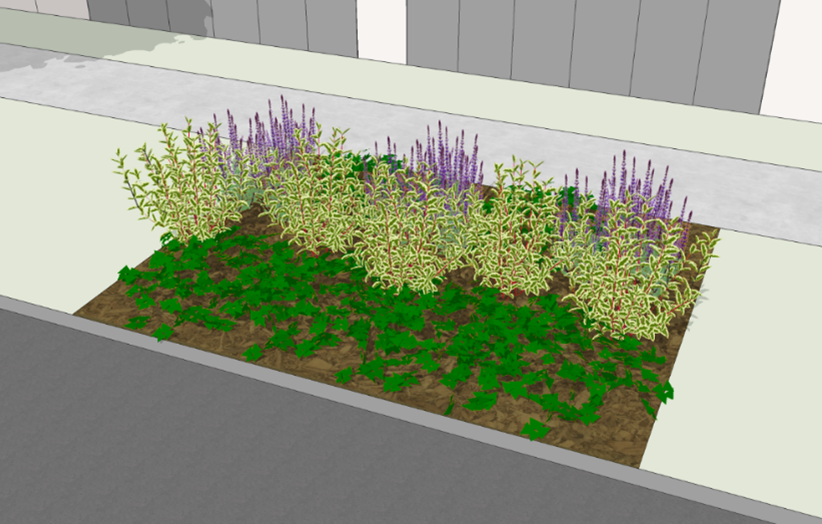
A landscape planting bed is that area comprised of trees, evergreen shrubs, living plant ground covers, perennials/annuals, or a combination thereof, which may be delineated by wood chips, mulch, decorative pavers, and/or rocks.
Figure 91
(b)
The public right-of-way, which is that area between the back of the curb of the roadway and the public sidewalk or lot line, for all residentially zoned or used property, must be landscaped with living grass lawn.
(c)
Areas of lot coverage that are not paved or occupied by building footprint must be landscaped with living grass lawn, living plant ground covers, perennial/shrub beds, or a combination thereof.
(d)
Ground covers other than living plants (e.g. stone chips, rock, mulch) must be arranged in a deliberate manner and may not exceed more than 25 percent of the site landscape area. All ground covers must be controlled on site and not allowed to freely migrate or spill onto the public sidewalk, public rights-of-way, or into storm drains.
(Ord. No. 1331, § 1, 5-5-25)
1252.06. - Nonresidential right-of-way and front setback planting.
(a)
Street yard landscaping within the public rights-of-way.
(1)
Public rights-of-way shall be planted with grass. Trees, shrubs, or other ground covers may be planted within the right-of-way with permission from the City Forester and the City Engineer, or their assigns.
(2)
The City, in consultation with the Public Service Department, may require street trees to be planted within the public right-of-way where they do not already exist.
(3)
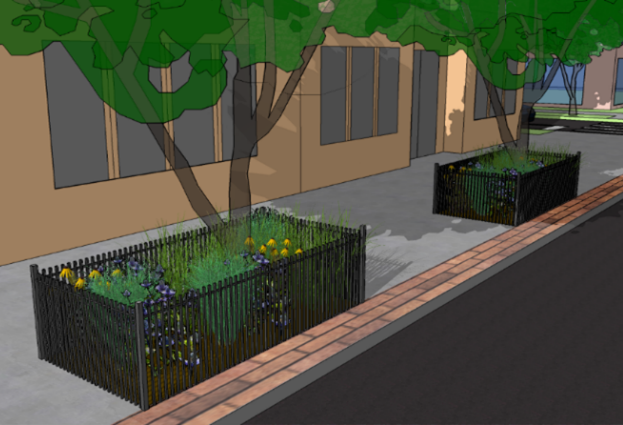
Rights-of-way yards abutting activity corridors shall incorporate decorative paving and streetscape elements if such elements exist on adjoining parcels. Plant material shall be located in tree wells, bioswales, and above ground planters and shall be approved by the Department of Public Service.
Figure 92
(b)
Between sidewalk and parking.
(1)
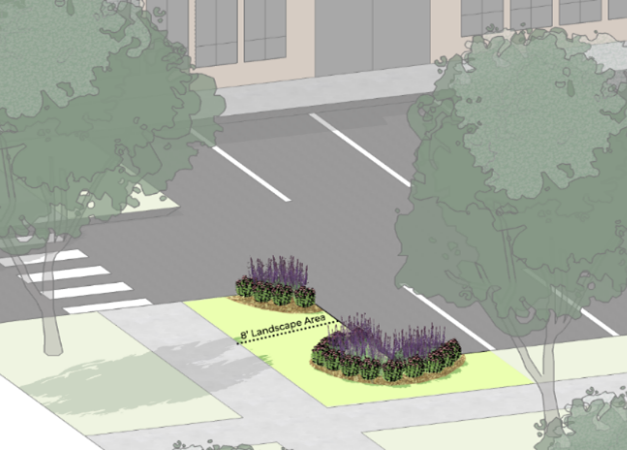
There shall be a landscaping setback area of at least eight feet, and no greater than 20 feet, but in no case further than the average front setback of the block, between the edge of sidewalk and parking lot edge, which shall consist of lawn and landscape planting beds.
(2)
Landscape planting beds shall be a minimum of 25 percent of the landscape setback area.
(3)
Setback areas must have at least one deciduous tree that will have a mature height of at least 30 feet for every 30 feet of frontage or part thereof and a minimum of one shrub shall be planted for each ten lineal feet of frontage, or portion thereof.
(4)
These landscape requirements are in addition to other screening or buffer requirements as indicated in the applicable zoning district section.
(5)
Landscape planting beds shall be a minimum of 50 percent of the front, side, and rear landscaping setback areas for all 'off-street parking surface lots' permitted by a special land use permit in addition to the trees required in Subsections 1252.07(b) and 1252.07(c).
Figure 93
(c)
Between sidewalk and building.
(1)
Nonresidential setback landscaping between the edge of sidewalk and building face shall consist of lawn, landscape planting beds, and paved pedestrian areas.
(2)
Landscape planting beds shall be a minimum of 25 percent of the landscape setback area. This may be reduced to zero percent in areas where the public sidewalk is immediately adjacent to the building face.
(3)
Setback areas greater than 20 feet in depth must plant at least one deciduous tree for every 30 feet of frontage or part thereof and a minimum of one shrub shall be planted for each ten lineal feet of frontage, or portion thereof.
(4)
These landscape requirements are in addition to other screening or buffer requirements as indicated in the applicable zoning district section.
(Ord. No. 1331, § 1, 5-5-25)
1252.07. - Parking lot landscaping.
Parking lot landscaping shall be arranged in a manner that improves the safety of pedestrian and vehicular traffic, guides traffic movement, improves the environment and improves the appearance of the parking area and site. Parking lot landscaping shall be provided in accordance with the following standards:
(a)
There shall be a minimum five-foot landscaping setback area between the parking lot and the side and rear property lines, unless the parking lot is shared by or a part of the circulation network between adjoining properties.
(b)
In all industrial districts, one tree for each 6,000 square feet of the total of the paved driveway and parking lot surface is required.
(c)
In all other districts, one tree shall be required for each 4,000 square feet of paved driveway and parking lot surface, provided that no fewer than two trees are provided.
(d)
All of the required parking lot trees and landscape areas shall be placed within landscape islands inside of the parking lot or the area within ten feet surrounding the parking lot.
(e)
For all parking lots greater than 40,000 square feet, at least 50 percent of all required parking lot trees shall be placed within landscape islands inside of the parking lot.
(f)
Each tree shall be provided with an open land area of not less than 150 square feet to provide area for infiltration and with a minimum radius of six feet at the trunk of the tree for protection. If a sprinkled irrigation system is provided, the open land areas can be reduced to no less than 75 square feet. Tree plantings shall also be protected from automobiles with curbing or other suitable device that incorporate curb cuts or other openings and grading to capture stormwater.
(g)
All parking lots within 20 feet of a residentially zoned or used property shall be screened by a buffer containing evergreen shrubs and trees, screen fence or screen wall (75 percent or more opaque and six feet in height), or any combination thereof that forms a continuous visual buffer at the property line.
(h)
Landscaping shall be installed such that, when mature, it does not obscure traffic signs, fire hydrants, lighting, drainage patterns on site or adjacent properties, or obstruct vision for safety of ingress or egress.
(i)
Living grass lawn shall be planted within parking lot islands.
(j)
To protect stormwater drains from debris, landscaping rocks and mulch must be properly contained on site and may only be installed as weed control directly around plants. Non-plant material shall not exceed 25 percent of the parking lot island surface area.
(Ord. No. 1331, § 1, 5-5-25)
1252.08. - Buffering and screening.
(a)
A landscaped buffer shall be provided between the subject site and all adjacent residentially zoned or used properties if the subject building(s) of the site plan is within 25 feet of the adjoining property line and if existing landscaping, tree cover, or fencing/screening does not exist.
(b)
At least one tree that will have a mature height of at least 30 feet for each 30 linear feet, or fraction of buffer area shall be provided along all front, side, and rear setback areas where they do not already exist.
(c)
Landscape buffers shall consist of evergreen shrubs, evergreen trees, fencing/screen walls (75 percent or more opaque), or any combination thereof that forms a contiguous visual buffer.
(d)
At least 40 percent of the overall area must be covered by plant materials at the time of planting.
(e)
The Zoning Administrator may allow a consistent 75 percent or more opaque, six-foot tall screen wall or fence for the entire length of the adjoining property line to provide buffering that meets the intent of this section. If a screen wall or fence is used for all of the buffer area, the overall landscape buffer width may be eliminated except for the trees required in Section 1252.08(b).
(f)
Where a screen wall or fence is not otherwise required, the Zoning Administrator may require an opaque screening within the buffer area, to block views and contain materials. Screening shall be provided in the form of a six-foot tall ornamental fence or wall, capable of keeping paper and other debris from blowing off the premises.
(Ord. No. 1331, § 1, 5-5-25)
1252.09. - Maintenance.
(a)
Plant materials, including lawn, shall be kept trimmed and maintained so as to promote proper growth and a neat and orderly appearance.
(b)
Trees and shrubs shall be trimmed to avoid conflicts with pedestrian use of the sidewalk.
(c)
Landscaping at corner properties shall be planted to provide the clear vision required in Section 1250.03.03. Landscaping in the clear vision triangle shall not contain obstructions greater than 36 inches in height.
(d)
Weeds shall be kept under control.
(e)
Buffer strips shall be properly maintained according to the types of materials utilized. Cover materials shall be maintained in a manner as specified at the time of the plan's approval.
(f)
Landscape/buffer areas shall be kept free from refuse and debris.
(g)
No buildings or parking or storage of materials or vehicles shall be allowed in any designated buffer strips, unless approved by the Zoning Administrator.
(Ord. No. 1331, § 1, 5-5-25)
1252.10. - Waivers and implementation.
(a)
If the Zoning Administrator, upon inspection, determines that suitable landscaping, screening and buffering on a site already exists or that such landscaping, screening and buffering should not be required, then the provisions requiring landscaping, screening and buffering may be waived in whole or in part. However, such waiver shall not apply to the maintenance portion of this chapter.
(b)
Criteria which shall be used when considering a waiver shall include, but shall not be limited to:
(1)
Existing natural vegetation;
(2)
Topography;
(3)
Existing wetland, floodplain and poor soils areas;
(4)
Existing and proposed building placement;
(5)
Building heights;
(6)
Adjacent land uses;
(7)
Distance between land uses;
(8)
Dimensional conditions unique to the parcel;
(9)
Traffic sight distances;
(10)
Traffic operational characteristics on and off site;
(11)
Visual, noise and air pollution levels;
(12)
Presence of utility easements and adjacent utility corridors
(13)
Health, safety and welfare of the City;
(c)
The Zoning Administrator may consider fewer plantings than otherwise required if larger plantings are proposed.
(d)
If, in the determination of the Zoning Administrator, the weather makes it impossible or impractical to implement or maintain the landscape, screening and buffering plan prior to issuance of a certificate of occupancy or approval of the completed building or site improvements, the Zoning Administrator may grant an extension of up to six months to fully implement the landscape plan. Failure to implement the landscape plan shall be considered a violation of this Zoning Ordinance and subject to the enforcement procedures contained herein.
(Ord. No. 1331, § 1, 5-5-25)

