
Lansing City Zoning Code
CHAPTER 1254
PARKING
1254.01.01. - Parking requirements in general.
(a)
Purpose. Off-street parking and loading areas are to be designed, maintained and operated in a manner that will ensure adequate parking is provided, provide uncongested access for emergency vehicles, limit interference with the pedestrian realm and, where appropriate, protect surrounding uses from undesirable impacts of traffic and parking. Site access standards are intended to reduce the potential for crashes and congestion through a reduction of conflict points associated with traffic movements at other access points or street intersections. The standards of this section apply at the time of erection, enlargement or change in use, of any principal building or structure.
(b)
Compliance required. In each zoning district the off-street parking requirements for the storage or parking of a motor vehicle for the use of occupants, employees or patrons, in a structure which is erected, constructed, substituted, resumed or extended after the effective date of this Zoning Code (Ordinance 1273, passed March 8, 2021), shall be as prescribed in this chapter. The determination of the required number of off-street parking spaces and the regulation of such spaces shall be as described in this chapter.
(c)
Ownership of parking lot. All off-street parking shall be under the direct control, either by ownership, lease, or other legally binding agreement, of the beneficial user of the property. If the off-street parking is controlled by lease and the lease is discontinued, it shall be the obligation of the beneficial user of the property served to provide replacement parking that meets the requirements of this chapter.
(d)
Storage. Off-Street Parking areas shall not be used for the storage of vehicles, trailers, new or used merchandise, supplies, equipment, storage containers, junk, junk vehicles, or construction materials not associated with a valid building permit, unless otherwise permitted by the Zoning District in which the property is located.
(e)
Off-street parking areas shall not be used for automobile repair or for any other types of repair, assembly, or material processing activities unless otherwise permitted by the zoning district in which the property is located.
(f)
Pedestrian safety. Off-street parking area shall have dedicated pedestrian walkways connecting the parking lot and subject building(s). Off-street parking areas and parking surface lots greater than 50,000 square feet shall have dedicated interior pedestrian walkways demarcated by raised sidewalk, decorative paving, striping, or other similar method to meet the intent of this provision.
(Ord. No. 1331, § 1, 5-5-25)
1254.01.02. - Location; expansion; encroachments.
Except as provided in Subsections (a) to (c) hereof, all required off-street parking for a principal use, conditional use, special land use or nonconforming use shall be located on the same lot on which such principal use, conditional use, special land use or nonconforming use is located. Permitted locations for off-street parking are marked with an "X" in Table 1254.01.02 and also described by district in Chapters 1243, 1244, and 1245.
Table 1254.01.02: Permissible Off-Street Parking Lot Locations
(a)
The off-street parking for a lot which is zoned IND-1 or INST-1 may be located on a separate lot, if the following three conditions are met:
(1)
The lot does not contain a cabaret, as defined by Section 808.01.
(2)
The separate lot is zoned IND-1 or INST-1.
(3)
The separate lot is not more than 5,280 feet, measured from the closest point on the closest lot line of the separate lot to the closest point on the closest lot line of the lot served, provided that is said parking is more than 1,000 feet from the principal use then a shuttle service shall be provided.
(b)
Off-street parking for nonresidential uses on a lot which is zoned a Commercial Mixed-Use District may be located on a separate lot if the following three conditions are met:
(1)
The lot does not contain a cabaret, as defined by Section 808.01.
(2)
The separate lot is zoned a Commercial Mixed-Use District.
(3)
The separate lot is not more than 300 feet, as measured from the closest point on the closest lot line of the separate lot to the closest point on the closest lot line of the lot served.
(c)
Valet parking, approved as noted in Section 1254.01.04 may be on another lot.
(d)
Limits on parking expansion. Applies to properties in the MX-2 and DT-3 zoning districts and properties along an activity corridor street type.
(1)
When demolition of a building, lot combination of two or more properties, or lot split of a property has taken place, the expansion or increase of an off-street parking lot shall not extend into the front yard of a parcel.
(2)
The Zoning Administrator may waive the limitations hereof if the property owner can demonstrate that the intent of the zoning district is maintained.
(Ord. No. 1331, § 1, 5-5-25)
1254.01.03. - Parking required.
(a)
Factors for calculation of parking.
(1)
Gross floor area. Where floor area is the unit for determining the required number of off-street parking and loading spaces, said unit shall mean the gross floor area (GFA), unless otherwise noted.
(2)
Usable floor area. Where the floor area measurement is specified as usable floor area, parking requirements shall apply to all internal building areas excluding the floor area used for incidental service, storage, mechanical equipment rooms, heating/cooling systems and similar uses, and other areas nor intended for use by the general public. Where these areas are not yet defined, usable floor area shall be considered to be 75 percent of the gross floor area.
(3)
Bench seating. In calculating bench seating for places of assembly, each 24 inches of benches, pews or other such seating shall be counted as one seat.
(4)
Employees. Where the number of spaces required is based on the number of employees, calculations shall be based upon the maximum number of employees likely to be on the premises during the peak shift.
(5)
Fractional requirements. When units of measurements determining the number of required parking or loading spaces result in a fractional space, any fraction up to and including one-half shall be disregarded and fractions over one-half shall require one additional parking space.
(6)
Similar uses. If a use is not specifically described in Table 1254.01.03, the minimum number of spaces for the use shall be determined by the Zoning Administrator by requiring the minimum number of spaces for a use which is listed and is similar to the use in question.
(b)
Table 1254.01.03 Parking Requirements. Vehicle parking spaces shall be provided in accordance with the Table 1254.01.03. The required parking shall include barrier free parking as required per Section 1254.01.05, bike parking per Section 1254.02.02 and loading/unloading zones per Section 1254.01.17.
(c)
Limits on excessive parking. In order to minimize excessive areas of pavement which reduces aesthetic standards and contribute to high rates of storm water runoff, exceeding the minimum parking space requirements by more than 20 percent shall only be allowed with approval by the Zoning Administrator. In granting such additional space, the Zoning Administrator shall determine that such parking will be required, based on documented evidence, to accommodate the use on a typical day. Except in industrial districts or an institutional use, the spaces exceeding the 20 percent minimum must be made available for public parking.
(Ord. No. 1331, § 1, 5-5-25)
1254.01.04. - Factors to permit a reduction from the amount of parking required.
(a)
Shared parking on the same lot. Where two or more uses are present on the premises, parking requirements shall be calculated for each use, based on the Table 1254.01.03. However, the Zoning Administrator may permit a reduction for shared parking between two or more uses where the applicant can document that the amount of parking provided will meet the peak needs of the uses collectively as noted in Subsection 1254.01.04(c) below.
(b)
Shared parking on adjacent lots. Two or more buildings or uses may collectively provide the required off-street parking, in which case the required number of parking spaces for the uses calculated individually may be reduced by the Zoning Administrator by up to 25 percent, provided a parking study is provided as noted in Subsection 1254.01.04(c) below and a signed agreement is provided by the property owners in a form acceptable to the City Attorney.
(c)
Parking reductions. The Zoning Administrator may permit a reduction of the required number of parking spaces based upon one or more of the following:
(1)
Owner shall provide documentation such as a parking study or traffic count taken from developments of a similar size and use which demonstrate that the amount of parking provided will be sufficient to accommodate the needs of the proposed use(s) during peak demand. This shall include delivery needs, the number of employees in the largest shift, the number of residential units by bedroom count, and a projection of the maximum number of visitors to the site during its most active time. The City may require the owner to submit a plan for providing additional parking, up to the required amount if the actual parking needed exceeds the parking provided.
(2)
Owner demonstrates that there is available shared parking available, either in a municipal lot, parking structure, or shared with another property. For shared use of a private lot, the owner shall demonstrate that there will be sufficient parking available for all users during the time of peak shared demand.
(3)
Owner provides incentives for employees to use public transit, bicycle, or live within walking distance of the use. In such case the applicant shall provide information on the program that demonstrates effectiveness to the City. This could include priority on-site bicycle parking, stipends for use of transit, employee reward programs for non-single occupant vehicle commutes or similar incentives. The accepted parking reduction program would be a condition of zoning approval.
(4)
The amount of required parking may be reduced if a shared car or program is provided. The amount of the reduction shall be determined by the Zoning Administrator, with input from the Transportation Engineer, in consideration of the number of shared vehicles provided and the level of availability.
(d)
Valet parking. The Zoning Administrator may allow a reduction in on-site parking required for valet parking provided the valet parking area is under the same ownership as the principal use or is leased and that a shared parking agreement has been approved by the City Attorney. Such parking agreement shall be considered as part of the permitted use such that, if the parking agreement is no longer valid, the City may restrict the use to the scale of parking available.
(e)
Exceptions in the DT-3, MX-C, and MX-2 districts:
(1)
Properties located within the DT-3 district are exempt from the requirements of Section 1254.01.03.
(2)
Properties zoned MX-C, located on the north side of the 900 block and east half of the 1000 block of West Saginaw Street, are exempt from the requirements of Section 1254.01.03, except that at least one off-street parking space shall be required for each residential unit. The required parking spaces must be located within 300 feet of the property they serve and may be located on City-owned off-street parking lots and private parking lots where a permit has been issued or an agreement has been established allowing use of the parking spaces on a 24-hour basis.
(3)
Properties zoned MX-2 are exempt from the requirements of Section 1254.01.03, with the following exceptions:
a.
Properties in the MX-2 District on South Cedar Street must provide parking in accordance with Section 1254.01.03.
b.
Properties in the MX-2 District that have frontage on East Michigan Avenue or adjoin properties that have frontage on East Michigan Avenue, except those located in the 2000 block on both the north and south sides of the street, must provide at least 20 percent of the on-street parking required by Section 1254.01.03.
c.
At least one off-street street parking space shall be required for each residential unit in the MX-2 District.
d.
All required parking spaces in the MX-2 districts must be located within 300 feet of the property they serve and may be located on City-owned off-street parking lots and private parking lots where a permit has been issued or an agreement has been established allowing use of the parking spaces on a 24-hour basis.
(Ord. No. 1331, § 1, 5-5-25)
1254.01.05. - Barrier free parking requirements.
Within each parking lot, signed and marked barrier free spaces shall be in accordance with the Michigan Department of Labor, Construction Code Commission, Barrier Free Design Division.
(Ord. No. 1331, § 1, 5-5-25)
1254.01.06. - Storage of merchandise and vehicles.
(a)
The storage of merchandise, equipment, and motor vehicles for sale is prohibited in the off-street parking area, if such storage reduces the number of off-street parking spaces available below the number required by Section 1254.01.03.
(b)
No motor vehicle that is inoperable, stripped, dismantled, or in a state of disassembly or disrepair shall be kept on any exterior premises, except as permitted and as regulated by the zoning district of the property upon which such vehicle is located.
(Ord. No. 1331, § 1, 5-5-25)
1254.01.07. - Parking space dimensions.
(a)
Except for single-family or two-family dwellings, required off-street parking shall be designed pursuant to this section.
(b)
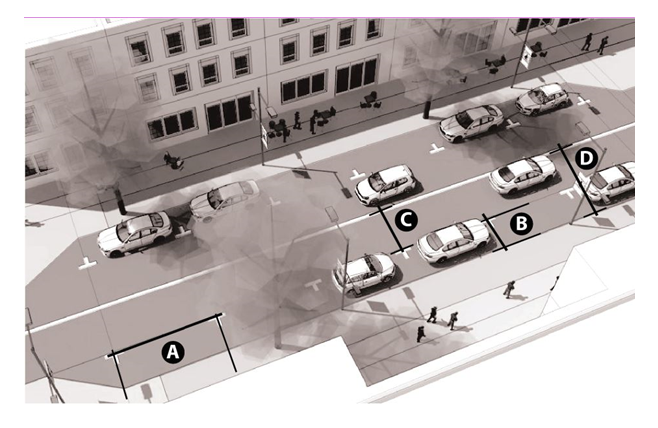
Dimensions. All parking spaces and maneuvering aisles shall be designed and marked with minimum dimensions described:
Figure 94
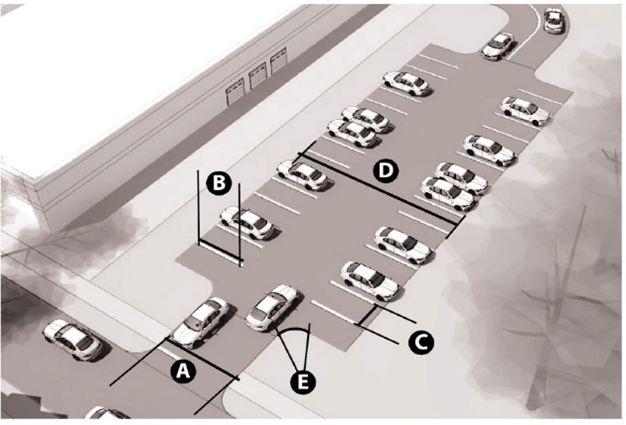
Figure 95
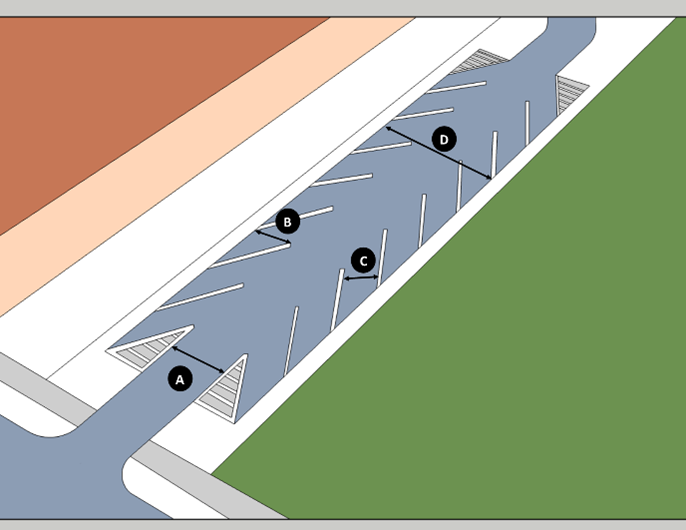
Figure 96
(4)
Space length may be reduced by up to two feet if an unobstructed overhang of not less than two feet is provided, such as a landscaped area or sidewalk. A sidewalk shall have a minimum width of seven feet where abutting a parking area.
(c)
Islands.
(1)
Mid-bay islands: minimum of nine feet wide.
(2)
Between facing bays: minimum of six feet wide.
(3)
End-cap islands: minimum of six feet wide.
(d)
If requested by an applicant, the width of a parking space and any dimension described in [Subsection] (b) above may be varied by the Transportation Engineer, based upon all of the following criteria:
(1)
The size of vehicles which use the lot;
(2)
The turnover rate;
(3)
The shape of the lot;
(4)
Sound traffic flow principles;
(5)
The use of the lot; and
(6)
Adequacy of signs that provide information or restrict parking in certain spaces.
(Ord. No. 1331, § 1, 5-5-25)
1254.01.08. - Surfacing.
(a)
Except as provided for in Subsections (b) and (c) hereof, off-street parking and loading areas, including access drives, shall be hard-surfaced with either Portland cement or asphalt.
(b)
An alternative surface, including, but not limited to, permeable or pervious materials, may be approved by the Zoning Administrator, if circumstances exist which justify the alternative surface, and if the City Engineer believes the alternative surface will not result in an unreasonable amount of sediment being deposited in the sewers, and so long as the alternative surface is maintained in a dust-controlled condition.
(c)
A lot used temporarily for off-street parking may be surfaced with gravel, so long as the temporary use does not extend for more than two years, and so long as the surface is maintained in a dust-controlled condition.
(Ord. No. 1331, § 1, 5-5-25)
1254.01.09. - Grading and drainage.
(a)
The City Engineer shall approve the grading of required off-street parking areas, based upon the design standards promulgated by the American Association of State and Highway Transportation Officials.
(b)
The City Engineer shall approve drainage of required off-street parking areas, if the drainage may adequately be served by an existing storm sewage system.
(Ord. No. 1331, § 1, 5-5-25)
1254.01.10. - Signs, striping, and maintenance.
(a)
The City may require the installation of pavement markings and signs to direct circulation, provide information, and identify restrictions on use of parking spaces and loading areas.
(b)
Except for single-family or two-family dwellings parking spaces shall be striped and such striping shall be maintained.
(c)
Maintenance of parking lot.
(1)
All off-street parking and loading facilities shall be maintained free of accumulated snow, debris or other materials which prevent full use and occupancy of such facilities except for temporary periods of no more than five days in the event of heavy rainfall or snowfall.
(2)
Off-street parking and loading facilities must be maintained in a proper state of repair and free from hazardous conditions.
(Ord. No. 1331, § 1, 5-5-25)
1254.01.11. - Ingress and egress.
(a)
The number and location of points of ingress and egress to off-street parking areas developed after the effective date of this Zoning Code (Ordinance 1273, passed March 8, 2021) shall be approved by the Transportation Engineer.
(b)
The number of access points shall be the minimum necessary to provide reasonable access as determined by the City Transportation Engineer.
(c)
To reduce conflicts which can contribute to congestion and crash potential, access shall be located as far from signalized intersections as is practical.
(d)
Access shall be located to minimize conflicts with through traffic, pedestrians, bicyclists and movements into access points adjacent to the property or across the street. To confirm this, a site plan shall include driveways across from the property frontage and adjacent access points.
(e)
The City Transportation Engineer may require redesign, relocation, easements for a shared access system or restrict some movements at an access point to provide safe and efficient operations.
(f)
Each ingress and egress to and from any off-street parking area located in an area zoned for other than single-family residential use shall be at least five feet from any adjacent property located in any single-family residential district.
(g)
All parking spaces shall be provided adequate access by means of maneuvering lanes. Backing directly into a street is prohibited.
(Ord. No. 1331, § 1, 5-5-25)
1254.01.12. - Unobstructed access.
(a)
Except as provided in Subsection (b) or (c) hereof, each required off-street parking space shall be arranged in a way which provides for unobstructed access to a public right-of-way. Unobstructed access shall not be construed to prohibit security devices.
(b)
In the case of a lot used as a single-family dwelling, one of the two off-street parking spaces required by Table 1254.01.03 may be obstructed from access to a public right-of-way by another parking space, if all of the following conditions are met:
(1)
The obstructed space is located on an approved driveway.
(2)
The obstructed space is not in the front yard.
(3)
The driveway is surfaced pursuant to the requirements of Section 1254.01.09.
(4)
The unobstructed space is directly behind the obstructed space.
(c)
In the case of a lot used as a two-family dwelling, two of the four off-street parking spaces required by Table 1254.01.03 may be obstructed from access to a public right-of-way by another parking space, if all of the following conditions are met:
(1)
The obstructed space is located behind the front line of the dwelling.
(2)
The obstructed space is not in the front yard.
(3)
The driveway is surfaced pursuant to the requirements of Section 1254.01.09.
(4)
The unobstructed space is directly behind the obstructed space.
(d)
No sidewalks, driveways, maneuvering aisles, fire lanes, or building accesses shall be obstructed by the parking, storage, or display of vehicles, merchandise, equipment, supplies, or any other items.
(Ord. No. 1331, § 1, 5-5-25)
1254.01.13. - Lighting.
All lighting used to illuminate any off-street parking area shall be so installed as to be confined within and directed onto the parking area only.
(Ord. No. 1331, § 1, 5-5-25)
1254.01.14. - Vehicle stops.
A vehicle stop shall be provided for any parking space if the space abuts a public right-of-way, sidewalk, or landscaping or screening required by Chapter 1252, and shall either be one of the following or be approved by the Transportation Engineer:
(1)
A concrete curb;
(2)
A concrete, or similar durable material, stop properly anchored; or
(3)
A steel or concrete post at least three feet in height.
(Ord. No. 1331, § 1, 5-5-25)
1254.01.15. - Changes to a parking lot.
(a)
An area designated as required off-street parking may be changed to another use or encroached upon, so long as the minimum requirements of Table 1254.01.03 continue to be met.
(b)
Changes to parking areas other than for single-family detached homes or duplexes on individual lots shall be approved as part of a site plan. Minor changes to the parking layout, such as a reconfiguration, as determined by the Zoning Administrator, shall require submittal of a parking plan which indicates property lines, existing and proposed ground elevations at two-foot contour intervals, the number of spaces, calculations for meeting the minimum space requirements of this article, dimensions of aisles, driveways and typical parking stalls, location of curbs and curb blocks, location and size of signs, existing and proposed landscaping, existing and proposed lighting and drainage facilities.
(c)
Reduction prohibited. A substitution, alteration or deletion of any off-street parking shall not have the effect of reducing the off-street parking below the number required in Table 1254.01.03.
(Ord. No. 1331, § 1, 5-5-25)
1254.01.16. - Loading.
When on premise space for standing, loading, and unloading vehicles is necessary for uses involving the receipt or distribution of goods, the following provisions shall apply:
(a)
Traffic flow. The size of the loading area shall be sufficient to prevent undue interference with adjacent required parking spaces, maneuvering aisles, or traffic flow on public streets.
(b)
Alleys. Where an alley exists at the rear of the building, the loading area may be computed from the centerline of the alley.
(c)
Location. Loading/unloading areas and docks shall not be provided in the front yard or on any building side facing and directly visible to a public street. Where possible, loading areas shall be integrated into the design of the building to minimize visibility.
(d)
Screening. Loading docks and loading areas facing a residential district shall be adequately screened by a wall and/or landscaping.
(e)
Not included with parking. Required loading areas shall not be included in calculations for off-street parking space requirements.
(f)
Size. The size of all required loading/unloading spaces shall be at least ten feet by 50 feet or 500 square feet in area, with a clearance of at least 14 feet in height. The Zoning Administrator may modify this requirement for uses that will involve smaller delivery trucks such as offices.
(g)
An alternative surface, including, but not limited to, gravel, may be approved by the Zoning Administrator, if circumstances exist which justify the alternative surface, and if the City Engineer believes the alternative surface will not result in an unreasonable amount of sediment being deposited in the sewers, and so long as the alternative surface is maintained in a dust-controlled condition.
(Ord. No. 1331, § 1, 5-5-25)
1254.01.17. - Front yard parking.
(a)
Prohibitions; exceptions.
(1)
In residential districts no person shall park or place a motor vehicle, trailer, watercraft, or recreational vehicle or equipment, in a front yard. However, this section shall not apply:
a.
To vehicles parked or placed in a lawfully established driveway;
b.
While engaged in actual loading or unloading;
c.
Where permitted pursuant to any other provision of these Codified Ordinances;
d.
Where prior to the effective date of this ordinance, parking areas were lawfully established in front yards by variance or in accordance with the ordinance that was in effect at the time that the parking area was established.
(2)
In no instance shall gravel, stone, blocks, pavers, cement, asphalt or other similar materials be placed in front of the front building wall of a building to be used as a parking surface.
(b)
Driveways.
(1)
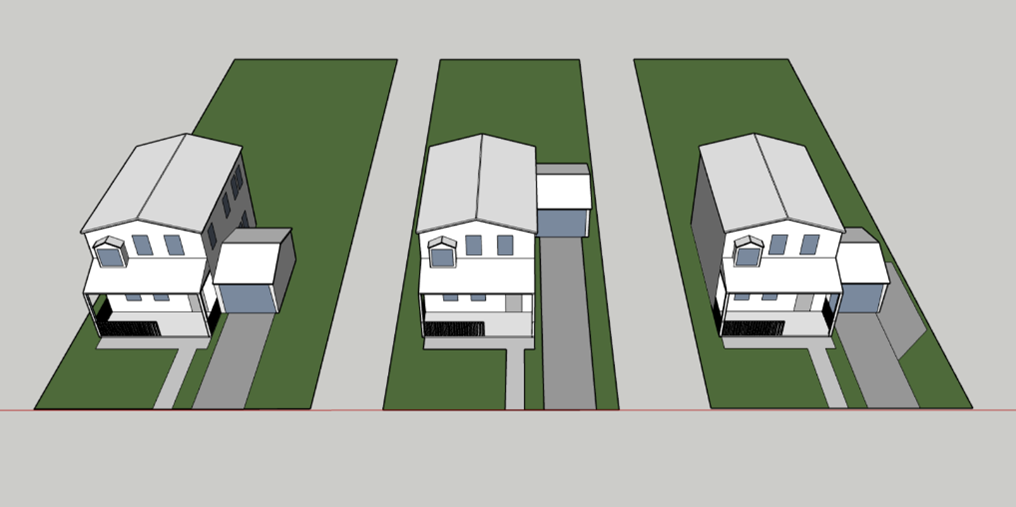
A driveway may not exceed 20 feet in width or the width of the opening to the garage to which it provides access within the front yard of a single-family or two-family residential property and shall in no case be in front of the front wall of the dwelling. A driveway may not exceed 20 feet in width for a residential property where the driveway is not required to provide two-way vehicular access to a parking lot that lawfully contains more than four parking spaces in the side or rear yard.
Figure 97
(2)
Each residentially zoned or used parcel is permitted one driveway via one curb cut.
(3)
A second driveway may be permitted after review and approval by the Zoning Administrator and the Department of Public Service.
a.
A second driveway may be permitted on corner lots that have at least 100 feet of frontage on one of the two streets, on through lots, or to eliminate a shared driveway provided that the existing driveway continues to serve the adjacent parcel of land. Approval of a second driveway may only be granted if it is necessary in order to accommodate parking for the allowable number of vehicles on the site.
b.
A two-family dwelling with side-by-side units may be permitted two driveways after review and approval by the Zoning Administrator and the Department of Public Service.
(4)
In no instance shall a driveway extend in front of the front building wall of a residential building.
(Ord. No. 1331, § 1, 5-5-25)
1254.02.01. - Definitions.
For purposes of this chapter:
APBP Guidelines means the second edition of the bicycle parking guidelines issued by the Association of Pedestrian and Bicycle Professionals.
Bicycle locker means a locked compartment for the storage of a single bicycle.
Bicycle parking space means a secure structure designed and available exclusively for the storage of a bicycle.
Bicycle room means a room with controlled access for users of bicycles to be stored in the room.
Long-term bicycle parking space means bicycle parking that is covered and enclosed on all four sides.
Short-term bicycle parking space means any bicycle parking space that is not a long-term bicycle parking space.
(Ord. No. 1331, § 1, 5-5-25)
1254.02.02. - Required bicycle parking spaces.
Bicycle parking spaces shall be provided for the benefit of any structure identified in Section 1254.02.04 or Section 1254.02.05 if, after the effective date of this chapter:
(a)
A site plan for the property on which the structure is located must be submitted to the Planning Office;
(b)
The property on which the structure is located is rezoned to a district other than a residential district; or
(c)
A special land use permit is granted for the property on which the structure is located.
(Ord. No. 1331, § 1, 5-5-25)
1254.02.03. - Bicycle parking guidelines.
(a)
To the extent feasible and unless otherwise provided by this chapter or the City of Lansing Bicycle Parking Guidelines promulgated by the Zoning Administrator, property owners are encouraged to conform to the APBP Guidelines.
(b)
During the operating hours of the structure identified in Sections 1254.02.04 and 1254.02.05, bicycle parking spaces required by this chapter shall be lighted at an illumination level of at least 0.4 foot-candles.
(c)
Bicycle parking spaces shall be located within 100 feet of an entrance to the structure or inside the structure.
(d)
Bicycle parking spaces shall be adequately maintained and kept free of mud, debris, ice, and snow.
(e)
Each short-term bicycle parking space provided pursuant to the provisions of this chapter shall support a bicycle in an upright position; allow both the bicycle frame and the front wheel to be locked; be securely anchored; have a hard surface, such as asphalt, concrete, or brick pavers, with dimensions of at least six feet by two feet; be constructed of materials that resist cutting, rusting, bending, and deformation; and be installed in accordance with the City of Lansing Bicycle Parking Guidelines promulgated by the Zoning Administrator based on the APBP Guidelines, maintenance of uniformity among Michigan communities, and other best practices.
(f)
Long-term bicycle parking spaces provided pursuant to the provisions of this chapter shall be provided in:
(1)
Bicycle lockers that ensure adequate clearance for simultaneous users;
(2)
Bicycle racks in locked cages; or
(3)
Bicycle rooms.
(Ord. No. 1331, § 1, 5-5-25)
1254.02.04. - Short-term bicycle parking requirements based on land use.
(a)
For purposes of this section:
(1)
Every 24 inches of bench seating shall be counted as one seat.
(2)
Numbers resulting from the prescribed formulas shall be rounded up from one-half to the next whole number in calculating the number of required bicycle parking spaces.
(b)
Property owners shall provide the following number of short-term bicycle parking spaces for the benefit of the corresponding specified structures:
Table 1254.02.04. Short-Term Bicycle Required Parking Spaces
(Ord. No. 1331, § 1, 5-5-25)
1254.02.05. - Offset of required off-street parking spaces.
The number of off-street parking spaces required by Section 1254.01 will be reduced by one space, with a maximum reduction of 20 percent of the number of off-street parking spaces required by Table 1254.01.03, for each of the following:
(a)
Every six bicycle parking spaces provided in excess of those required by this chapter; or
(b)
Every six short-term bicycle parking spaces covered by a permanent structure approved by the Zoning Administrator.
(Ord. No. 1331, § 1, 5-5-25)

