
Maryland Heights City Zoning Code
ARTICLE 12
- SUPPLEMENTARY DISTRICT REGULATIONS
Sec. 25-12.1.- Purpose.
Unless otherwise stated, the regulations hereafter established shall apply within all zoning districts established by this chapter. These general regulations supplement and qualify the district regulations appearing elsewhere in this chapter.
(Ord. No. 2008-3179, § 1, 12-18-08)
Sec. 25-12.2. - Access to nonresidential district.
No land which is located in a residential district shall be used for providing the primary access to land located in a nonresidential district unless incorporated as part of a planned district.
(Ord. No. 2008-3179, § 1, 12-18-08)
Sec. 25-12.3. - Accessory buildings and structures.
A.
Scope. This subsection shall apply to all accessory buildings and structures except the following:
1.
Accessory buildings and structures in the "R-6" Multi-Family Residential District, which shall conform with standards set forth in Section 25-11.7, "R-6" Multi-Family Residential District.
2.
Landscaping-related structures, which shall conform with the standards set forth in Section 25-12.4, Landscaping-Related Structures.
3.
Swimming pools, which shall conform with the standards set forth in Section 25-12.5, Swimming Pools.
4.
Temporary storage units, which shall conform with the standards set forth in Section 25-25.2, Temporary Storage Units.
B.
No accessory building or structure shall be used prior to the establishment of the main building, except as a temporary construction facility for the main building.
C.
Permits. Accessory buildings and structures shall require the following permits, based on the ground floor area of the structure:
1.
Those two hundred (200) square feet and under in area shall require a zoning permit.
2.
Those over two hundred (200) square feet in area shall require a building permit.
D.
Accessory buildings and structures in the "NU" Non-Urban District.
1.
Coverage. The combined gross area of all detached accessory buildings and structures shall not exceed two (2) percent of the lot area.
2.
Setbacks. Accessory buildings and structures shall meet the required setbacks of the "NU" Non-Urban District.
3.
Height. Accessory buildings and structures shall meet the height requirements of the "NU" Non-Urban District.
E.
Accessory buildings and structures in the "C" Commercial, "M" Manufacturing, and "RD" Redevelopment Districts.
1.
Two (2) accessory buildings or structures shall be permitted on each lot as follows:
a.
Accessory buildings and structures of one hundred twenty (120) square feet or less shall comply with the following:
i.
Location. Such buildings and structures shall only be allowed in the rear yard behind the main building. In instances where this requirement is technically infeasible, as determined by the city planner, an alternative location may be approved.
ii.
Setbacks. Such buildings and structures shall be set back at least three (3) feet from the side and rear property lines.
iii.
Height. Such buildings and structures shall be limited to a maximum height of ten (10) feet.
b.
Accessory buildings and structures in excess of one hundred twenty (120) square feet shall comply with the following:
i.
Number. No more than one (l) such building or structure shall be permitted.
ii.
Location. Such building or structure shall only be allowed in the rear yard behind the primary building. An alternate location may be approved by the planning commission in instances where this requirement is impractical or infeasible in accordance with provision "vii" below.
iii.
Area. Said building or structure shall be limited to three (3) percent or less of the lot area. Planning commission approval shall be required for such building or structure in excess of five hundred (500) square feet in area in accordance with provision "vii" below.
iv.
Height. Such building or structure shall not exceed the height limitations of the underlying zoning district or fifty (50) feet, whichever is less. Planning commission approval shall be required for such building or structure in excess of the primary building's height (as determined by the city planner) in accordance with provision "vii" below.
v.
Design. Accessory buildings or structures in excess of two hundred (200) square feet in area shall complement and be generally consistent with the primary building in design, color, and materials, subject to the review and approval of the city planner during the building permit review process.
vi.
Use. The proposed building or structure shall be used solely for accessory purposes related to the use of the primary building. In no circumstance shall an additional use or business occupy the accessory building or structure.
vii.
Planning commission review required. In accordance with provisions "ii", "iii", and "iv" above, certain accessory structures shall be subject to the review and approval of the planning commission. The burden of proof shall be on the applicant to prove the following:
• The proposed footprint, height, and/or location is/are appropriate given the context of the lot and the neighborhood.
• The proposed design and use of the accessory building or structure are appropriate given the design and use of the primary building.
• The proposed building or structure will not adversely impact the character of the neighborhood or result in a substantial detriment to adjoining property owners.
F.
Accessory buildings and structures in the "R-1" through "R-5" single-family residential districts.
1.
Use. The use of the accessory building or structure shall be incidental and subordinate to the single-family residential use of the property. Use of accessory buildings for commercial purposes or accessory dwelling units is not permitted.
2.
Number. Each residential lot shall be permitted one (1) accessory building or structure of one hundred twenty (120) square feet or less and additional buildings or structures in accordance with Table 12.1, Accessory Buildings and Structures on Residential Properties.
TABLE 12.1, ACCESSORY BUILDINGS AND STRUCTURES ON RESIDENTIAL PROPERTIES
* Not including the one (1) permitted building or structure of one hundred twenty (120) square feet or less.
3.
Accessory buildings and structures of one hundred twenty (120) square feet or less shall comply with the following:
a.
Location. Such buildings and structures may be allowed only in the rear yard and shall be located behind the main building. In instances where this requirement is technically infeasible, as determined by the city planner, an alternative location may be approved.
b.
Setbacks. Such buildings and structures shall be set back at least three (3) feet from the side and rear property lines.
c.
Height. Such buildings and structures shall be limited to a maximum height of ten (10) feet.
4.
Accessory buildings and structures in excess of one hundred twenty (120) square feet shall comply with the following:
a.
Setbacks. Such building or structure shall meet the required setbacks of the zoning district.
b.
Height. Such building or structure shall not exceed the height of the principal building.
c.
Design.
i.
Accessory buildings in excess of two hundred (200) square feet in area shall be consistent with the dwelling in design, subject to the review and approval of the city planner. Buildings shall be in keeping with residential neighborhoods, avoiding the appearance of commercial or Quonset-style buildings.
ii.
Accessory buildings or structures in excess of the total living area of the dwelling, as determined by the St. Louis County Assessor, shall be subject to the review and approval of the planning commission. The burden of proof shall be on the applicant to prove the following:
• The intended use of the proposed building or structure is truly incidental and subordinate to the residential use of the property.
• The area of the proposed building or structure is appropriate given the context of the lot.
• The location of the proposed building or structure is appropriate relative to the street and adjoining dwellings.
• The area and location of the proposed building or structure is appropriate relative to any other accessory building(s) on the lot.
• The proposed building or structure will not adversely impact the character of the neighborhood or result in a substantial detriment to adjoining property owners.
5.
Appeal of the city planner's decision. In the event of a disagreement between the applicant and the city planner regarding the provisions of this subsection, such disagreement shall be submitted to the planning commission, which shall make the decision on such disagreement, provided the applicant shall also have the right to appeal such decision pursuant to Section 25-9, Variances, of the zoning code and to pursue any other available legal or equitable remedy.
(Ord. No. 2008-3179, § 1, 12-18-08; Ord. No. 2011-3531, § 4, 7-21-11; Ord. No. 2014-3890, § 1, 6-5-14; Ord. No. 2018-4364, § 1, 8-2-18; Ord. No. 2020-4541, § 1, 9-3-20; Ord. No. 2025-4961, § 1, 6-5-25)
Sec. 25-12.4. - Landscaping-related structures.
A.
Minimum yard requirements. The following landscaping-related structures shall not be considered accessory structures for the purpose of yard requirements:
1.
Arbors.
2.
Benches.
3.
Landscaping timbers used to define yard areas, not exceeding twenty-four (24) inches in height.
4.
Statuary.
5.
Trellises.
6.
Yard lighting.
B.
Landscaping timbers used to define yard areas, exceeding twenty-four (24) inches in height, shall be subject to the requirements of section 25-12.7, retaining walls.
C.
Gazebos and pergolas.
1.
Permits. Gazebos and pergolas shall require the following permits, based on the ground floor area of the structure:
a.
Those two hundred (200) square feet and under in area shall require a zoning permit.
b.
Those over two hundred (200) square feet in area shall require a building permit.
2.
Number. Gazebos and pergolas shall count toward the total number of accessory buildings or structures permitted on each lot in accordance with section 25-12.3, accessory buildings and structures.
3.
Gazebos and pergolas not exceeding one hundred twenty (120) square feet shall be subject to the following requirements:
a.
Said structures shall be set back a minimum of ten (10) feet from any road right-of-way.
b.
Said structures shall be set back a minimum of three (3) feet from any side or rear property line.
c.
Said structures shall be limited to a maximum of ten (10) feet in height.
4.
Gazebos and pergolas in excess of one hundred twenty (120) square feet shall be subject to the following requirements:
a.
Said structures shall meet all required setbacks of the zoning district. Where a lesser setback is stipulated for accessory structures, such structure shall meet the lesser setback.
b.
Said structures shall be allowed only in the rear yard and shall be located behind the main building.
c.
Said structures shall be limited to a maximum area of five hundred (500) square feet.
d.
Said structures shall not exceed the height of the principal building.
(Ord. No. 2008-3179, § 1, 12-18-08; Ord. No. 2011-3531, § 5, 7-21-11; Ord. No. 2014-3890, § 2, 6-5-14)
Sec. 25-12.5. - Swimming pools.
A swimming pool exceeding two (2) feet in depth shall require a building permit. Pools requiring a building permit must meet the setback requirements of the zoning district. A building permit for a swimming pool will not be issued without the approval of the electric utility provider. All pools not requiring a building permit shall comply with the setbacks for detached accessory structures.
(Ord. No. 2008-3179, § 1, 12-18-08)
Sec. 25-12.6. - Fences.
This section contains the minimum regulations for the erection or alteration of fences (which shall include other physical security measures) in the city.
A.
General provisions.
1.
Unless otherwise noted, all fences erected, altered, or replaced in the city shall require a free zoning permit. Routine maintenance of a fence does not require a permit.
2.
All requests for fences shall be reviewed by the city planner. Applicants shall supply the city planner with a completed application, plot plan, and other documentation as the city planner deems necessary.
3.
Fences surrounding a swimming pool shall meet the requirements of the International Building Code, as adopted, and shall be subject to a building permit.
4.
It shall be the responsibility of property owners to ensure that fences are constructed entirely within the subject property.
5.
It shall be the responsibility of the property owner to ensure that a fence does not block or obstruct the flow of stormwater.
6.
No provision of these fence requirements shall be construed as the right of the property owner to erect a fence on a public easement for any purpose.
7.
All fences shall be constructed in a workmanlike manner in accordance with accepted construction practices and methods. Wood and vinyl fences shall be installed with proper posts and supports. Use of a chain link fence to support wood or vinyl fences (or vice versa) shall be prohibited.
8.
The finished side of fences shall face outward. All visible supports and other structural components shall face in toward the subject property.
9.
Property owners shall be responsible for properly maintaining fences, including removal of any fences that become unsightly or a menace to public safety, health or welfare.
10.
The city planner may waive the design requirements of this section for a temporary fence, subject to issuance of a zoning permit. Said permit shall include conditions and limitations including the permissible design, height, and location of the fence as well as the duration of the permit.
11.
All fences erected prior to enactment of the Zoning Code shall be considered nonconforming and as such shall be allowed to remain in place or repaired in accordance with section 25-7, Nonconforming lots, structures, and uses.
B.
Fence regulations for residential properties.
1.
Materials.
a.
Fences shall be constructed of wood, vinyl, aluminum, or steel chain link.
b.
Fences or walls constructed of masonry or stone shall be permitted, subject to a building permit.
c.
The use of barbed wire shall be prohibited.
d.
The use of privacy slats, fabric, hardware cloth, or other similar material shall be prohibited.
e.
Electric fences and battery-charged fences shall be prohibited.
f.
Fences constructed of other materials may be allowed, subject to the review and approval of the planning commission. In making their decision on the request, the planning commission shall consider:
i.
The quality and durability of the proposed material(s); and
ii.
Any potential adverse impacts on safety or neighborhood character.
g.
Wire or plastic mesh fencing, such as chicken wire, shall be allowed within the interior of the property for gardening or animal deterrent purposes without a fence permit. Such fencing shall be prohibited along the perimeter of the property.
2.
Height. Fences shall be limited to a height of six (6) feet with an overall installed height of seventy-eight (78) inches above finished grade on the subject property's side of the fence.
3.
Location.
a.
On an interior lot:
i.
A fence shall be allowed within the minimum side and rear yards.
ii.
A fence shall not extend beyond the front façade of the dwelling into the front yard, as determined by the city planner.
b.
On a corner lot:
i.
A fence shall be allowed within the minimum side and rear yards.
ii.
A fence shall not extend beyond the front façade of the dwelling into the primary front yard. The primary front yard shall be determined by the city planner based upon the property address, the orientation of the dwelling, and/or the location of the primary entrance.
iii.
A fence shall be allowed within the minimum secondary front yard. However, a sight proof fence shall not be permitted within the sight distance triangle.
c.
On a double-frontage lot:
i.
A fence shall be allowed within the minimum side yards.
ii.
A fence shall not extend beyond the front façade of the dwelling into the front yard.
iii.
A fence shall be allowed up to the right-of-way line of the rear street frontage as determined by the city planner based on upon the property address, the orientation of the dwelling, the location of the primary entrance, and/or the established character of the street.
C.
Fence regulations for all nonresidential properties.
1.
Materials.
a.
Fences shall be constructed of wood, vinyl, aluminum, or steel chain link.
b.
Fences or walls constructed of masonry or stone shall be permitted, subject to a building permit.
c.
For screening purposes, chain link fences may include privacy slats or fabric, subject to the review and approval of the city planner.
d.
The city planner may approve the use of barbed wire for security purposes if the lowest strand is at least seven (7) feet above grade. A request stating the reason for barbed wire must be made in writing by the property owner.
e.
Electric fences shall be prohibited.
f.
Battery-charged fences shall be permitted in accordance with RSMo 67.301, provided that:
i.
The accompanying nonelectric perimeter fence is a minimum of eight (8) feet in height; and
ii.
Is constructed of a sight proof material such as wood or vinyl or chain link incorporating privacy slats or fabric.
g.
Fences constructed of other materials may be allowed, subject to the review and approval of the planning commission. In making their decision on the request, the planning commission shall consider:
i.
The quality and durability of the proposed material(s); and
ii.
Any potential adverse impacts on safety or neighborhood character.
h.
Wire or plastic mesh fencing, such as chicken wire, shall be allowed within the interior of the property for gardening or animal deterrent purposes without a fence permit. Such fencing shall be prohibited along the perimeter of the property.
2.
Height. Fences shall be limited to a height of six (6) feet with an overall installed height of seventy-eight (78) inches above finished grade on the subject property's side of the fence, except as follows:
a.
Fences up to a maximum height of eight (8) feet with an overall installed height of one hundred two (102) inches in overall height above finished grade on the subject property's side of the fence for security and/or screening purposes, subject to the review and approval of the city planner.
b.
Battery-charged electric fences shall be limited to ten (10) feet in height or, if part of a nonelectric fence or wall, no more than two (2) feet higher than the nonelectric fence or wall, whichever is higher, in accordance with RSMo 67.494.
3.
Location.
a.
On an interior lot:
i.
A fence shall be allowed within the minimum side and rear yards.
ii.
A fence shall not extend beyond the front building line (front yard setback) into the front yard.
b.
On a corner lot:
i.
A fence shall be allowed within the minimum side and rear yards.
ii.
A fence shall not extend beyond the front building line (front yard setback) into the front yard. The primary front yard shall be determined by the city planner based upon the property address, the orientation of the dwelling, and/or the location of the primary entrance.
iii.
A fence shall be allowed within the minimum secondary front yard. However, a sight proof fence shall not be permitted within the sight distance triangle.
c.
On a double-frontage lot:
i.
A fence shall be allowed within the minimum side yards.
ii.
A fence shall not extend beyond the front building line (front yard setback) into the front yard.
iii.
A fence shall be allowed up to the right-of-way line of the rear street frontage as determined by the city planner based on upon the property address, the orientation of the building, the location of the primary entrance, and/or the established character of the street.
d.
Notwithstanding the above, the planning commission may review and approve fences within the front yard of nonresidential properties. In making their decision on the request, the planning commission shall consider:
• Whether the location is needed for adequate security or screening;
• The quality and durability of the proposed material(s); and
• Any potential adverse impacts on neighborhood character.
(Ord. No. 2008-3179, § 1, 12-18-08; Ord. No. 2011-3517, § 1, 6-2-11; Ord. No. 2011-3531, § 6, 7-21-11; Ord. No. 2019-4425, § 1, 4-18-19; Ord. No. 2022-4685, § 1, 5-19-22)
Sec. 25-12.7. - Retaining walls.
A.
The total height of retaining walls shall be based on the height of the retained fill.
B.
All retaining walls exceeding twenty-four (24) inches in height shall require a building permit, subject to the review and approval of the city planner and building commissioner. Such walls shall meet the following requirements:
1.
The retaining wall shall not encroach on an adjoining property.
2.
The retaining wall shall be constructed of inorganic material such as landscape masonry, concrete, brick, or stone. Painting of masonry shall be subject to the review and approval of the city planner.
3.
The retaining wall shall not be constructed on a utility easement without a waiver or consent from the utility company holding rights to said easement.
C.
Repair of existing railroad tie walls.
1.
Where existing railroad tie walls are being repaired, treated wood ties may be used provided that no more than twenty (20) percent of the face of the wall in its entirety is being replaced. Repairs to the wall will be considered as cumulative.
2.
Once the maximum of twenty (20) percent has been reached, the wall must be replaced in its entirety with inorganic material.
3.
At the discretion of community development staff, prior to approval of a permit for said repairs, the owner/applicant may be required to provide (at their expense) a report prepared by a licensed engineer registered in the State of Missouri confirming the condition and integrity of the wall in question. This report will be reviewed by the building commissioner and a determination will be made whether the proposed repair is sufficient to maintain structural integrity or whether the wall must be replaced.
(Ord. No. 2008-3179, § 1, 12-18-08; Ord. No. 2014-3936, § 1, 11-6-14; Ord. No. 2016-4149, § 1, 7-21-16)
Sec. 25-12.8. - Satellite dish antennae.
A.
Satellite dish antennae may be installed, erected, and maintained within all zoning districts of the city, but only in accordance with the provisions of this subsection. The term "antenna" as used herein shall mean any device incorporating a reflective surface that is solid, open mesh, or bar configured and is in the shape of a shallow dish, cone, horn, or cornucopia. Such device shall be used to transmit and/or receive radio or electromagnetic waves between terrestrially and/or orbitally based uses. This device may be external to or attached to the main building as specified herein. This subsection shall not apply to satellite dish antennae less than one (1) meter in area.
B.
General regulations; all districts.
1.
Every installation of an outside dish antenna shall be installed and maintained in compliance with the building code.
2.
Each installation shall require a building permit.
3.
Application for such a permit shall include the submittal of a site plan which will include distances from street and lot lines, height above ground, type and amount of proposed screening, diameter of antenna and other pertinent information as may be required by the city planner and/or building commissioner.
4.
The owner of the satellite antenna agrees to accept the sole responsibility for the legal access to a conveyance of satellite television communications. Said owner agrees to hold the city harmless from any litigation which may result from unauthorized commercial use of satellite transmission and agrees to indemnify the city for expenses incurred as a result of any litigation involving the city, which may arise from unauthorized commercial use of satellite transmissions.
5.
All installations shall be located to prevent obstructions of the antenna's reception window. Each applicant shall include a diagram which identifies said window and the location of the installation.
6.
Except as otherwise stated below, all antennae shall be located in the rear yard setback. On corner lots, no antennae shall extend beyond the front setback lines.
C.
Non-urban and residential district regulations. In any "NU" non urban and "R" residential district, satellite dish antenna shall be erected as follows:
1.
Only one (1) satellite dish antenna per lot shall be permitted.
2.
In any residential district, one (1) ground mounted satellite earth station may be erected per lot to a maximum height of twenty (20) feet above adjacent ground level, provided:
a.
The diameter of such antennae shall not exceed ten (10) feet.
b.
Such antennae shall only be located in the rear yard.
c.
The antennae shall be neutral in color and, to the extent possible, compatible in character and appearance with the surrounding neighborhood.
3.
Satellite dish antennae with a diameter measuring less than one (1) meter may be installed on the main building in a manner consistent with typical television antennae.
4.
Satellite dish antennae shall be used for private, non-commercial messages.
D.
Commercial or industrial districts. In any "C" commercial district or "M" industrial district, antennae shall be erected as follows:
1.
Only one (1) satellite dish antennae shall be allowed per lot except as may be permitted in a planned district. Where multiple tenants exist on a lot, the city planner may consider additional antennae upon request.
2.
Satellite dish antennae may be either ground or roof mounted.
3.
All ground mounted antennae shall comply with the following:
a.
Ground mounted satellite dish antennae shall not exceed twelve (12) meters (39.4 feet) in diameter.
b.
Antennae shall be screened through the addition of architectural features and/or landscaping that harmonize with the elements and characteristics of the property.
The city planner shall approve all screening prior to issuance of a building permit. Where the antennae abut an "R" residential district, such screening may be waived by the city planner if the antennae are set back a distance of at least five (5) times its diameter.
c.
All ground mounted satellite dish antennae shall be located in the rear yard except as may be permitted in a planned development district.
4.
Roof top antennae shall not exceed the diameter allowed in subsection D.3.a. of this section. In no case shall the height of any antennae exceed the height limitations established for the main building.
5.
All satellite dish antennae shall be neutral in color and, to the extent possible, compatible in character and appearance with the surrounding neighborhood.
6.
Satellite dish antennae shall not be used to advertise a product or service.
(Ord. No. 2008-3179, § 1, 12-18-08; Ord. No. 2019-4425, § 2, 4-18-19)
Sec. 25-12.9. - Animals.
A.
Animals may be kept in accordance with the regulations of chapter 5, animals, of the Municipal Code.
B.
Farm animals.
1.
Farm animals may be kept on any non-urban or single-family residential property of three (3) acres or more.
2.
On single-family residential properties, all such animals may be kept only for the personal use and enjoyment of the property owner and not for commercial purposes
3.
Setbacks. No stable or shed providing shelter for farm animals, other than chickens, shall be located within fifty (50) feet of the property line.
(Ord. No. 2008-3179, § 1, 12-18-08; Ord. No. 2015-4015, § 2, 7-2-15)
Sec. 25-12.10. - Yard exceptions.
A.
Commercial/industrial front yards. In "C-1," "C-2," to "M-1," and "M-2" districts inclusive, where buildings located in the same block on the same side of a street have provided front yards of greater depth then herein required, the planning commission may require a similar setback for buildings or structures constructed thereafter.
B.
Rear yards abutting railroad right-of-way. No rear yard shall be required in "C-2," "M-1," "M-2," "RD-M," or "RD-C" districts where the rear yard adjoins a railway right-of-way.
C.
Easements. No building permit shall be issued for a structure on an easement without the expressed written consent of all parties holding interest in the easement.
D.
Right-of-way dedications. Land dedicated to street right-of-way shall not be included in computing minimum lot area for the purposes of the zoning code. However, if, through dedication of street right-of-way, the area of any lot or parcel already established via the provisions of the subdivision code is decreased below the minimum area required in the applicable zoning district, development rights shall not be denied.
E.
Corner lots. Each corner lot shall have a rear yard and side yard with minimum setback requirements of the applicable zoning district. The side and rear yards shall be identified by the owner of the corner lot when plans are submitted for the first building on the property.
F.
Structural projections. Every part of a required yard shall be open from its lowest point to the sky, unobstructed, except as follows:
1.
In all "R" residential districts, a handicap accessibility ramp may encroach into the minimum front yard to the smallest extent necessary to perform its proper function.
2.
Skylights, sills, belt courses, cornices and ornamental features may project into any yard a maximum of twelve (12) inches.
3.
Chimneys and flues, not exceeding seventy-two (72) inches in width, may project into side or rear yards a maximum of twenty-four (24) inches.
4.
Roof overhangs may project into any yard a maximum of eighteen (18) inches, except that roof overhangs on the south side of a building may project forty-eight (48) inches into a side or rear yard but no closer than forty-eight (48) inches to a property line.
5.
Slab type porches or paved terraces having a maximum height of not more than twelve (12) inches above ground elevation at any point may project into any yard except that the projection into the front yard shall not exceed ten (10) feet.
6.
In all "R" residential districts, air conditioning units may extend into side or rear yards a maximum of thirty (30) inches, with air conditioning units including mounting pedestals not to exceed forty-eight (48) inches in height above ground elevation within said side or rear yards.
7.
Canopy overhangs for service stations may project a maximum of eighteen (18) inches into required front yards.
8.
Radio or television receiving antenna shall not exceed a height of fifteen (15) feet above the roof line.
G.
Accessory structures.
1.
The city planner may reduce the minimum rear yard setback for an accessory structure over one hundred twenty (120) square feet in area on a residential property in situations where:
a.
Satisfying the minimum rear yard setback would present a substantial hardship due to the topography of the property;
b.
Satisfying the minimum rear yard setback would negatively impact stormwater drainage on the subject property and adjoining properties;
c.
The property has an irregular shape, particularly as it relates to the rear property line; or
d.
The minimum rear yard setback is unnecessary because the property abuts nonresidential property or subdivision common ground.
2.
In no case shall the rear setback be less than the minimum side yard setback of the underlying zoning district.
3.
To authorize a reduction in the minimum rear yard setback, the city planner must find:
a.
The circumstances of section 25-12.10.G.1 apply to the subject property;
b.
Adhering to the minimum rear yard setback would create a practical difficulty or hardship;
c.
The lesser setback will not result in a substantial adverse impact on adjoining properties; and
d.
The lesser setback will not result in a substantial adverse impact on neighborhood character.
4.
Rights of appeal. The city planner's decision may be appealed to the board of adjustment in accordance with section 25-9, Variances, of the zoning code.
(Ord. No. 2008-3179, § 1, 12-18-08; Ord. No. 2018-4308, § 8, 2-15-18; Ord. No. 2022-4710, § 1, 8-4-22)
Sec. 25-12.11. - Carports on single-family residential lots.
A.
Scope. This subsection shall apply to all pre-existing or proposed carports on single-family residential lots. Carports on multi-family residential lots are governed by subsection 25-11.7.D.15, accessory buildings—covered parking.
B.
Specific intent. It is the specific intent of this section to:
1.
Ensure that existing single-family homes conform with the parking requirements to the greatest extent possible.
2.
Ensure that existing carports are used for their intended purpose of vehicle storage.
3.
Ensure that existing carports do not negatively impact neighborhood character.
C.
Parking space required. An unobstructed space measuring at least six (6) feet by sixteen (16) feet shall be maintained within the carport for the purpose of parking an automobile. In the case of carports designed to accommodate two (2) automobiles, two (2) such unobstructed spaces shall be provided.
D.
Construction of new carports on single-family residential lots is not permitted.
E.
Replacement or restoration.
1.
Pre-existing carports may be replaced or restored provided that:
a.
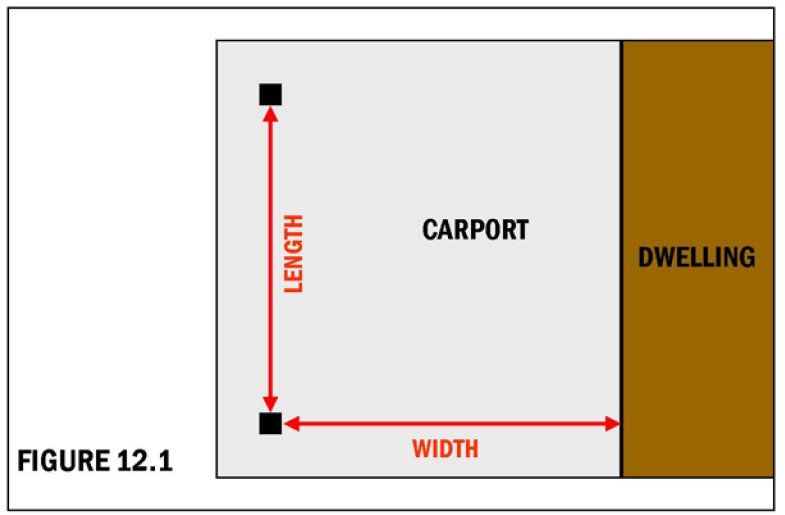
Neither the length nor the width of the carport is increased. For the purpose of this provision, the length and width shall be measured from the nearest edges of the poles, supports, or wall of the dwelling to each other (see figure 12.1). Structural or aesthetic changes which do not increase the length or width of the carport shall be permitted.
b.
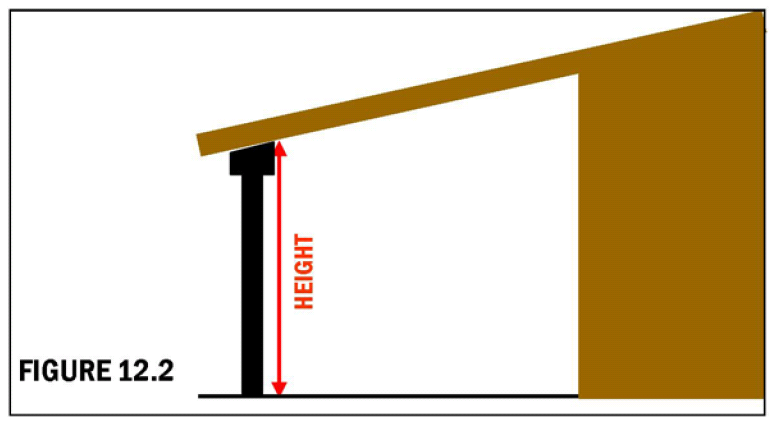
The height of the carport is not increased. For the purpose of this provision, the height of the carport shall be its lowest clearance height (see figure 12.2).
c.
In the case of a carport detached from the dwelling, the carport is not destroyed to an extent sixty (60) percent or greater of the carport's replacement value as determined by the building commissioner. Replacement or restoration of detached carports is subject to the provisions of section 25-12.3, accessory buildings and structures.
2.
The city planner shall have the authority to allow nominal increases in length, width, or height of the carport based on a finding that:
a.
The expansion is necessary to meet the specific intent of this subsection; and
b.
The resulting carport would otherwise meet all other requirements of the zoning code with regard to setbacks, height, and lot coverage.
3.
In the event of a disagreement between the applicant and the city planner as to the findings required in subsection 25-12.11.E.2, said disagreement shall be submitted to the planning commission, which shall make the decision on such disagreement, provided the applicant shall have the right to appeal such decision pursuant to section 25-9, variances.
(Ord. No. 2009-3298, § 1, 10-1-09; Ord. No. 2013-3819, § 7, 11-21-13)

