
Maryland Heights City Zoning Code
ARTICLE 25
- TEMPORARY STRUCTURES AND OUTDOOR STORAGE
Sec. 25-25.1.- Scope.
Unless otherwise stated, the regulations hereafter established shall apply within all zoning districts established by this chapter.
(Ord. No. 2008-3179, § 1, 12-18-08)
Sec. 25-25.2. - Temporary storage units.
A.
Location on single-family residential properties. Placement of temporary storage units on single-family residential properties shall meet all of the following provisions:
1.
The unit shall be placed in the driveway or other paved surface.
2.
The unit shall not be placed within any public right-of-way including sidewalks.
B.
Location in multi-family residential complexes. Placement of temporary storage units in multi-family residential complexes shall meet all of the following provisions:
1.
The unit shall be placed in a parking space.
2.
The unit shall not be placed within any drive aisle or public right-of-way including sidewalks.
C.
Alternative location. At the discretion of the city planner, the unit may be placed in an alternative location, provided that the alternative location does not create an unsafe condition.
D.
Duration. Temporary storage units may be placed on or at a property for a period not to exceed thirty (30) calendar days in a single calendar year, unless in association with ongoing construction activities carried out pursuant to a valid building permit.
E.
Temporary storage units shall be locked and secured by the property owner or tenant at all times when loading or unloading is not taking place.
F.
Storage of hazardous material within temporary storage units is prohibited.
G.
Signs. Signage on temporary storage units shall be as per article 15 of this chapter.
(Ord. No. 2008-3179, § 1, 12-18-08)
Sec. 25-25.3. - Buildings or trailers for temporary or emergency use.
A.
A temporary building or trailer may be used as a construction office, field office or for storage of materials to be used in connection with the development of the tract on which the building or trailer is located, provided that:
1.
The location of said temporary building or trailer shall meet the following requirements:
a.
The location shall be reviewed and approved by the city planner.
b.
The location shall not interfere with sight distance or on-site circulation.
c.
The location shall not cause a substantial adverse impact on the public right-of-way or adjoining properties.
d.
In the event of a disagreement regarding the proper location, such disagreement shall be submitted to the planning commission for recommendation to the city council, which shall make the decision on such disagreement, provided the applicant shall have the right to appeal such decision pursuant to section 25-9, variances, of the zoning code and to pursue any other available legal or equitable remedy.
2.
Signs shall be in accordance with either section 25-15.10.H, construction signs, or section 25-15.11.L, construction signs, as appropriate.
3.
Said temporary building or trailer shall be removed:
a.
From said tract within forty-five (45) days after completion of the development; or
b.
Within thirty (30) days after:
i.
Voluntary suspension of work on the project;
ii.
Revocation of building permits; or
iii.
An order by the building commissioner upon a finding by him that said temporary structure is deemed hazardous to the public health and welfare.
B.
A temporary sales office may be established in a display dwelling unit or temporary building provided that the office is closed, the operation discontinued, and all temporary structures and facilities removed from the tract:
1.
Within thirty (30) days after all lots or dwelling units have been sold, rented, or leased; or
2.
After the passage of thirty (30) days from the date of the last transaction after ninety (90) percent of the development has been sold, rented, or leased.
C.
A trailer may be used as a field office or claims adjusting office in connection with a natural disaster or similar event, provided that:
1.
Said occupancy permit shall be valid for a minimum of thirty (30) days and a maximum of ninety (90) days as determined by the city planner based on information provided by the applicant and the extent of the event.
2.
In the case of extenuating circumstances, an extension to the ninety (90) day occupancy may be granted by the planning commission. The applicant shall apply for said extension in writing, thoroughly explaining the circumstances which necessitate the extension.
3.
The location of said trailer shall meet the following requirements:
a.
The location shall be reviewed and approved by the city planner.
b.
The location shall not interfere with sight distance or on-site circulation.
c.
The location shall not cause a substantial adverse impact on the public right-of-way or adjoining properties.
d.
In the event of a disagreement regarding the proper location, such disagreement shall be submitted to the planning commission for recommendation to the city council, which shall make the decision on such disagreement, provided the applicant shall have the right to appeal such decision pursuant to section 25-9, variances, of the zoning code and to pursue any other available legal or equitable remedy.
(Ord. No. 2008-3179, § 1, 12-18-08; Ord. No. 2012-3600, § 1, 2-16-12; Ord. No. 2013-3819, §§ 11, 12, 11-21-13)
Editor's note— Ord. No. 2012-3600, § 1, adopted Feb. 16, 2012, changed the title of § 25-25.3 from building structures for temporary or emergency use to buildings or trailers for temporary or emergency use.
Sec. 25-25.4. - Screening of outdoor storage, mechanical equipment, and utilities.
A.
Purpose. The purpose of this section is to provide screening requirements for external trash receptacles, recycling storage areas, mechanical equipment, external emergency generators, building mounted utilities, utility boxes and facilities, loading docks, receiving areas, and outdoor storage areas.
B.
Scope. These regulations shall apply to all external trash receptacles, recycling storage areas, mechanical equipment, external emergency generators, building mounted utilities, utility boxes and facilities, loading docks, receiving areas, and outdoor storage areas in the "R-6", "C", "M", "RD", and "PD" zoning districts except where otherwise indicated.
C.
Trash receptacles, dumpsters, and recycling storage areas.
1.
Trash receptacles, dumpsters, and recycling storage areas shall be located so as to result in the minimum visual exposure to the public right-of-way.
2.
Trash receptacles, dumpsters, and recycling storage areas shall be screened as follows:
a.
If visible from any public right-of-way, screening shall consist of a minimum six-foot high sight-proof enclosure which meets the following requirements:
i.
The sight-proof enclosure shall be constructed of materials that are visually compatible with the architecture of the main building;
ii.
Materials and methods of construction, including earthberming, shall be subject to the review and approval of the city planner; and
iii.
Criteria for enclosure approval shall include, but are not limited to, quality of materials, compatibility with the principal structure, security, and ease of access.
b.
If not visible from any public right-of-way, screening shall consist of a minimum six-foot high enclosure which meets the following requirements:
i.
The enclosure shall be a minimum of seventy-five (75) percent opaque;
ii.
Materials may include of chain link fencing with slats or fabric, wood, vinyl, masonry, or stone; and
iii.
Criteria for enclosure approval shall include, but are not limited to, quality of materials, compatibility with the principal structure, security, and ease of access.
D.
Mechanical equipment and emergency generators.
1.
All emergency generators, rooftop mechanical equipment, HVAC, and other ground, wall and roof-mounted accessories (including satellite TV and electronic data dishes and antennae) shall be located so as to result in the minimum visual exposure to the public right-of-way.
2.
If a building is situated such that emergency generators, mechanical equipment, or other accessories are visible from any public right-of-way, all such equipment must be hidden from view to the maximum extent possible using an approved screening device that is integral to the character and function of the building.
3.
All external emergency generators adjacent to residential districts shall include sound buffering cabinets and enclosures which meet the following requirements:
a.
The maximum height of the screening enclosure shall be determined by the city planner.
b.
Criteria for heights over eight (8) feet shall include, but are not limited to:
i.
Quality of materials.
ii.
Compatibility with the principal structure.
iii.
Security.
iv.
Sound baffling.
4.
Testing of emergency generators. Where the city planner determines that adjacent land uses will be substantially impacted by the testing of emergency generators, said testing shall be scheduled during the times of minimum occupancy of the adjacent uses, and shall not continue for more than thirty (30) minutes.
5.
Operation of emergency generators. The operation of any emergency generator shall not exceed a decibel level of sixty-five (65) decibels outside of a one hundred-foot radius of the enclosure or at the property line of any adjacent residential structure.
E.
Building mounted utilities.
1.
Building mounted utilities, such as meters and electrical panels, shall be located so as to result in the minimum visual exposure to the public right-of-way.
2.
If a building is situated such that building mounted utilities are visible from any public right-of-way, the city planner shall determine the appropriate method for screening the utilities from public view including:
a.
Blending or integrating the building mounted utilities into the building facade using enclosures, paint or other finishes; and/or
b.
Landscaping. A screen consisting of plant materials that conforms to section 25-16.10, landscaping requirements for buffer areas and screening.
F.
Utility boxes.
1.
Scope. In addition to the general applicability under subsection B, scope, these requirements shall also apply to utility boxes in new subdivisions in any residential zoning district, other than minor subdivisions and lot consolidations.
2.
Utility boxes shall be shall be located so as to result in the minimum visual exposure to the public right-of-way.
3.
If a utility box is situated such that it is visible from any public right-of-way, the city planner shall determine the appropriate screening method which may include:
a.
Blending the utility box into the surrounding environment or utilizing it for public art using enclosures, paint or other finishes.
b.
Fencing or walls. Fences or walls shall be:
i.
Constructed of wood, vinyl, masonry, or stone;
ii.
Constructed of a compatible material with that of the principal building; and
iii.
Of a height and width equal to or greater than the utility box.
c.
Landscaping. A screen consisting of plant materials that conforms to section 25-16.10, landscaping requirements for buffer areas and screening.
d.
A combination of any of the above methods.
4.
Any screening material shall accommodate maintenance or inspection thereof with the use of appropriate panels, and/or hinged gates if necessary.
G.
Utility facilities.
1.
Pump stations and other utility facilities in all zoning districts shall be located so as to result in the minimum visual exposure to any public right-of-way or dwelling.
2.
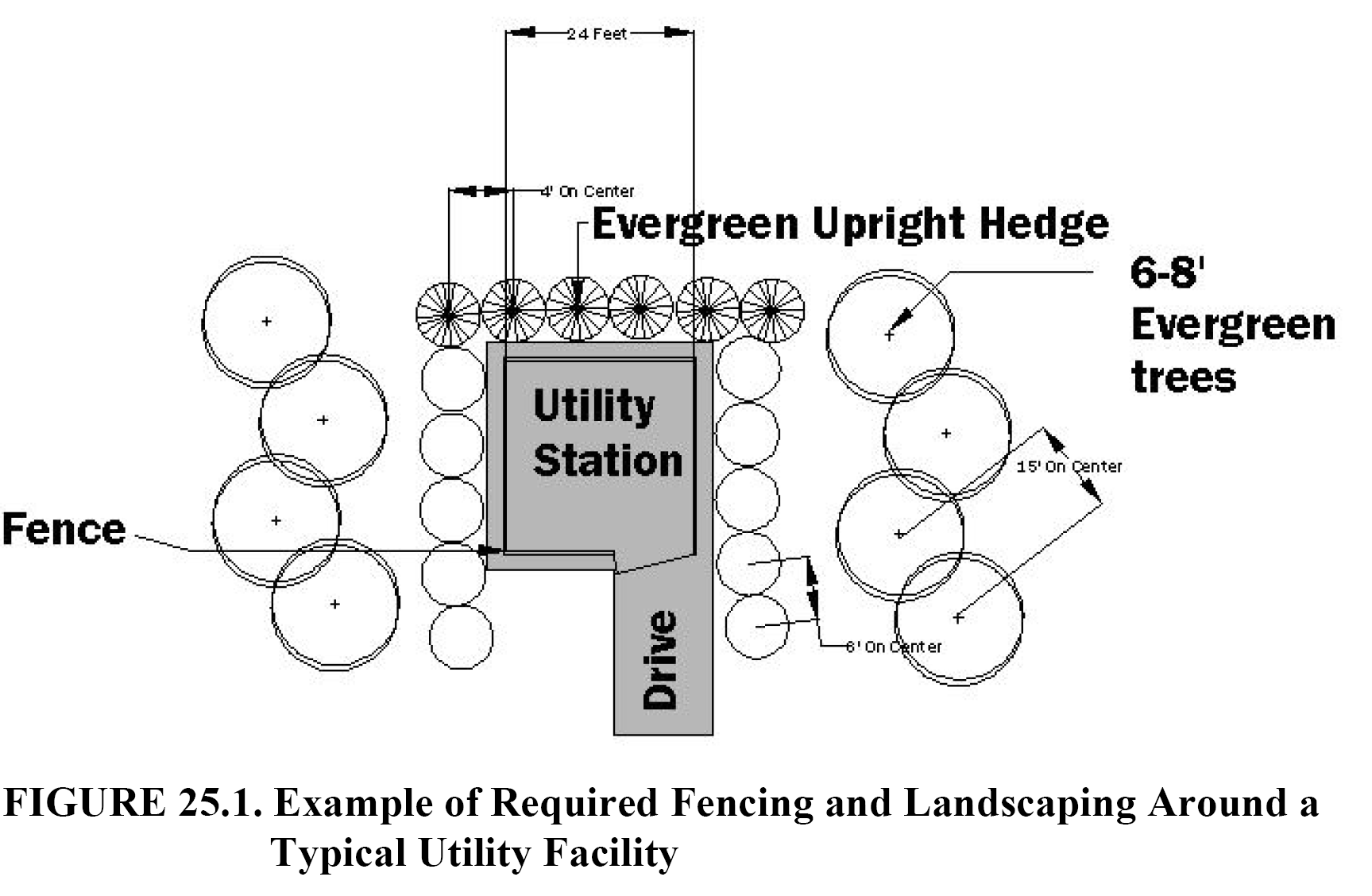
If a pump station or other utility facility is situated such that it is visible from any public right-of-way or dwelling, it must be must be appropriately screened using fencing and landscaping as follows:
a.
Fencing or walls.
i.
Fencing shall not exceed six (6) feet in height. Where additional height is needed for security, demonstrated need must be submitted to and approved by the city planner;
ii.
Fencing or walls shall consist of wrought iron, black or dark green vinyl coated chain link, masonry, stone, wood, or vinyl; and
iii.
Barbed wire is prohibited in residential zoning districts.
b.
Landscaping. An upright evergreen hedge shall be required as follows:
i.
Evergreens shall be planted four (4) feet on center and extend four (4) feet beyond the fence line.
ii.
At the time of planting, plant material shall be six (6) feet in height.
iii.
At the access area the planting shall extend eight (8) feet beyond the fence or two (2) additional plants.
iv.
Six- to eight-foot high evergreen trees shall be planted on either side of the utility station, three (3) for every twenty-four (24) feet of linear length of the utility station.
c.
In lieu of, or in addition to, landscaping and fencing, the utility facility may be placed within an enclosed structure. Said structure shall be integrated into the development, using the same materials and architectural style of the principal building on the site, subject to the review and approval of the city planner.
H.
Loading docks and receiving areas.
1.
To the maximum extent possible, all loading docks and receiving areas shall be located out of view or visually screened from any public right-of-way or dwelling.
2.
If a loading dock or receiving area is situated such that it is visible from any public right-of-way or dwelling, the city planner shall determine the appropriate screening method which may include one or more of the following:
a.
Fencing or walls. Fences or walls shall be:
i.
Constructed of materials that are visually compatible with the architecture of the main building;
ii.
Chain-link, wire mesh, woven wire, or other wire-based fencing shall be prohibited; and
iii.
A minimum of six (6) feet in height.
b.
Landscaping. A screen consisting of plant materials that conforms to section 25-16.10, landscaping requirements for buffer areas and screening.
I.
Outdoor storage areas.
1.
Outdoor storage of materials and equipment, not including outdoor display of merchandise for sale or rent, shall be located so as to result in the minimum visual exposure to any public right-of-way or dwelling.
2.
Screening from the public right-of-way. Where outdoor storage areas are visible from any public right-of-way, the city planner shall determine the appropriate screening method to achieve a one hundred (100) percent opaque screen, which may include one or more of the following:
a.
Fencing or walls. Fences or walls shall conform to the following requirements:
i.
Fences or walls shall be a minimum of six (6) feet in height;
ii.
Fencing or walls may be constructed of wood, vinyl, masonry, or stone; and
iii.
If security fencing is used, it shall be placed on the interior side of the opaque screen.
b.
Landscaping. A screen consisting of plant materials that conforms to section 25-16.10, landscaping requirements for buffer areas and screening.
3.
Screening from the public right-of-way—Exception. When it is necessary, for security reasons, to grant limited visibility from the right-of-way into the outdoor storage area, the city planner shall determine the appropriate screening method to achieve a minimum seventy-five (75) percent opaque screen which may include one or more of the following:
a.
Fencing or walls. Fences or walls shall conform to the following requirements:
i.
Fences or walls shall be a minimum of six (6) feet in height; and
ii.
Fencing or walls may be constructed of chain link fencing with slats or fabric.
b.
Landscaping. A screen consisting of plant materials that conforms to section 25-16.10, landscaping requirements for buffer areas and screening.
4.
Buffering and screening from dwellings. Where outdoor storage areas abut any property zoned "NU", "R", or "RD-MXD" zoning district (but are not visible from any public right-of-way), a landscaped yard of at least twenty-five (25) feet in width shall be provided along the "NU", "R", or "RD-MXD" zoning district property line in accordance with section 25-16.10 landscaping requirements for buffer areas and screening.
5.
Screening from other developments. Where outdoor storage areas abut non-residential developments (but are not visible from any public right-of-way), the city planner shall determine the appropriate screening method to achieve a minimum seventy-five (75) percent opaque screen which may include one or more of the following:
a.
Fencing or walls. Fences or walls shall conform to the following requirements:
i.
Fences or walls shall be a minimum of six (6) feet in height; and
ii.
Fencing or walls may be constructed of chain link fencing with slats or fabric, wood, vinyl, masonry, or stone.
b.
Landscaping. A screen consisting of plant materials that conforms to section 25-16.10, landscaping requirements for buffer areas and screening.
(Ord. No. 2008-3179, § 1, 12-18-08)

