
Maryland Heights City Zoning Code
ARTICLE 14
- PARKING AND LOADING REGULATIONS3
Editor's note— Ord. No. 2014-3945, § 1, adopted November 20, 2014, repealed the former article 14, §§ 25-14.1—25-14.13, and enacted a new article 14 as set out herein. The former article 14 pertained to similar subject matter and derived from Ord. No. 2008-3179, § 1, adopted December 18, 2008; Ord. No. 2010-3441, § 3, adopted October 21, 2010, and Ord. No. 2011-3531, § 7, adopted July 21, 2011.
Sec. 25-14.1.- Purpose.
The purpose of this section is to set forth regulations for adequate off-street parking and loading for all uses within the city.
(Ord. No. 2014-3945, § 1, 11-20-14)
Sec. 25-14.2. - Intent.
It is the intent of this section to:
A.
Ensure sufficient off-street parking and loading facilities are provided in proportion to the demand created by the use.
B.
Facilitate orderly traffic circulation patterns within parking and maneuvering areas.
C.
Mitigate the impact of parking lots on public rights-of-way and adjoining uses.
D.
Reduce underutilized or redundant vehicle parking areas.
(Ord. No. 2014-3945, § 1, 11-20-14)
Sec. 25-14.3. - Scope.
A.
Off-street parking and loading facilities shall be provided as specified in this section for:
1.
For all buildings and structures erected and all uses of land established after the effective date of the zoning code.
2.
The increase in intensity of use, whenever the intensity of use of any building, structure, or premises shall be increased through the addition of dwelling units, seating capacity, employees or other units of measurement described herein.
3.
The new use, whenever the existing use of a building or structure shall hereafter be changed to a new use so as to increase the required parking and loading facilities in accordance with the requirements of the zoning code.
4.
Expansions or additions to existing parking areas and driveways.
B.
Damage to nonconforming buildings. Any conforming or legally nonconforming building or use which was in existence on the effective date of the zoning code, which is subsequently damaged or destroyed by fire, collapse, explosion or other cause, and which is reconstructed, reestablished or repaired, off-street parking or loading facilities equivalent to any maintained at the time of such damage or destruction shall be restored or continued in operation. However, in no case shall it be necessary to restore or maintain parking or loading facilities in excess of those required in this section.
C.
Planned districts or conditional use permits. The parking requirements and regulations of this section may be waived or modified within planned districts or conditional use permits.
(Ord. No. 2014-3945, § 1, 11-20-14; Ord. No. 2016-4122, § 4, 4-21-16)
Sec. 25-14.4. - Computation and interpretation of requirements.
A.
Typical minimum parking requirements are provided in appendix B, land use and required parking matrix, of the zoning code.
B.
Typical minimum parking and loading requirements for shopping centers are provided in section 25-14.12, off-street parking and loading requirements for shopping centers.
C.
When no typical minimum parking or loading requirement is specified, or when one (1) or more of the parking requirements may be construed as applicable to the same use, lot, or building, the final determination of required parking shall be made by the city planner.
D.
Parking lots may not have more than one hundred twenty (120) percent of the minimum number of required spaces, except as follows:
1.
If an applicant requests between one hundred twenty (120) percent and one hundred fifty (150) percent of the minimum number of required parking spaces, the applicant must present a parking-traffic study prepared by a traffic engineer to the city planner, and demonstrate by clear and convincing evidence that the expected vehicle use and parking space demand for the development will require more than one hundred twenty (120) percent of the minimum number of required spaces.
2.
If an applicant requests more than one hundred fifty (150) percent of the minimum number of required spaces, the applicant must present a parking-traffic study prepared by a traffic engineer to the planning commission, and demonstrate by clear and convincing evidence that the expected vehicle use and parking space demand for the development will require more than one hundred fifty (150) percent of the minimum number of required spaces.
E.
Except as otherwise provided, parking spaces in non-residential areas shall be based on the gross floor area. Based upon a study which examines the building's use and operation, the city planner may base the parking calculation upon net usable area. However, the difference between the net usable area and the gross floor area shall not be greater than fifteen (15) percent. Net usable area shall be calculated by subtracting the areas of the following from the gross floor area:
1.
Elevator shafts and stairwells;
2.
Floor spaces and shafts for mechanical or electrical equipment;
3.
Janitorial rooms and related storage;
4.
Dressing and locker rooms;
5.
Employee cafeteria and lounge areas;
6.
Restrooms;
7.
Entrance lobbies;
8.
Storage areas accessory to the main use; and
9.
Interior parking and loading areas for vehicles or equipment.
F.
Where fractional spaces result, the parking spaces required shall be the next highest whole number.
G.
Where no minimum requirement is specified, or when one (1) or more parking requirements may be construed as applicable to the same use, lot, or building, the final determination of required parking shall be made by the city planner.
H.
When the occupancy load of a building used for public assembly (i.e., nightclubs, restaurants, etc.) exceeds the available number of parking spaces, there shall be a corresponding reduction in the maximum occupancy of the building. A ratio of two and one-half (2.5) persons per parking stall shall be used to calculate the reduction in occupancy.
I.
Except as otherwise provided, the number of employees shall be compiled on the basis of maximum number of persons employed on the premises at one time on an average day or night, whichever is greater. Seasonal variations in employment may be recognized and used by the city planner.
(Ord. No. 2014-3945, § 1, 11-20-14)
Sec. 25-14.5. - Minimum off-street parking dimensions.
A.
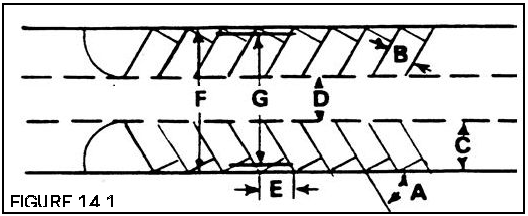
Except as otherwise provided for in this section, the required dimensions of off-street parking areas shall be as set forth in table 14.1, required parking dimensions.
Table/Figure 14.1. Legend:
A. Parking angle
B. Stall width
C. Aisle to curb
D. Aisle width
E. Curb length per stall
F. Curb to curb
G. Center to center width of double row with aisle between
B.
In the event that the desired parking angle is not specified by the above table, the city planner, upon review by the city engineer, may specify other equivalent dimensions associated with the desired parking angle by interpolating from dimensions listed in table 14.1 and figure 14.1.
C.
A minimum stall width of ten (10) feet is required for motor vehicle oriented businesses as established in section 25-23, motor vehicle oriented businesses, of the zoning code.
D.
Additional aisle width may be required where the aisle serves as the principal means of access to on-site buildings or structures.
E.
On-site parallel parking stalls shall be nine (9) feet by twenty-two (22) feet adjacent to a twenty-two (22) foot two-way lane or fifteen (15) feet where adjacent to a one-way lane.
F.
Curbed islands are required at ends of aisles where the city engineer determines they are necessary for traffic control or drainage.
(Ord. No. 2014-3945, § 1, 11-20-14)
Sec. 25-14.6. - Off-street parking design standards.
A.
Required parking surface.
1.
Each single-family residential driveway and/or parking area shall have a thoroughly compacted subgrade and shall be properly drained and surfaced with:
a.
Portland cement concrete having a minimum compressive strength of three thousand (3,000) pounds per square inch when twenty-eight (28) days old and containing not less than six (6) sacks of Portland cement, per cubic yard of concrete and having a minimum thickness of six (6) inches in a driveway apron area which intersects a street with sidewalk and a minimum thickness of four (4) inches in all other areas;
b.
Asphaltic concrete construction consisting of a minimum six (6) inch base of crushed rock well compacted on a thoroughly compacted subgrade covered with minimum two (2) inch asphaltic hot-mix; or
c.
Other materials providing a continuous surface and strength and service characteristics equivalent to subparagraphs a. and b., above and approved in writing by the city engineer.
d.
An alternative dust free surface for properties located in the "NU" non-urban district if approved in writing by the city engineer.
e.
Residential driveways established before the effective date of the zoning code that do not meet the above surfacing requirements may continue to be used and maintained.
2.
Each off-street parking area serving a use other than single-family residence shall have a thoroughly compacted subgrade and shall be properly drained and surfaced with:
a.
Portland cement concrete having a minimum compressive strength of three thousand (3,000) pounds per square inch when twenty-eight (28) days old and containing not less than six (6) sacks of Portland cement, per cubic yard of concrete and having a minimum thickness of six (6) inches;
b.
Asphaltic concrete construction consisting of a minimum eight (8) inch base of crushed rock well compacted on a thoroughly compacted subgrade covered with minimum two (2) inch asphaltic hot-mix;
c.
An alternative paving surface such as permeable or porous pavement or pavers if approved in writing by the city engineer; or
d.
An alternative dust free surface for properties located in the "NU" non-urban district if approved in writing by the city engineer.
B.
All areas for off-street parking and loading in the "C", "M", "RD", and "PD" zoning districts shall be so arranged that vehicles at no time shall be required to back into any street or roadway to gain access thereto. However, this provision shall not apply to single-family dwellings within the "PD-R" or "RD-MXD" zoning districts.
C.
Off-street parking areas in the "C", "M", "RD", and "PD" zoning districts shall provide ingress and egress to any public right-of-way only at such locations as approved by the city department of public works. Review and approval by the state highway and transportation department and/or the county department of highways and traffic, depending on which has jurisdiction over the public right-of-way, may also be required.
D.
In all zoning districts, off-street parking spaces and loading areas shall be located on the same lot as the use to be served except as provided herein. Said spaces shall not encroach into any public right-of-way.
E.
Parking lot setback and buffer requirements.
1.
Setback requirements adjacent to street rights-of-way. In the "R-6," "C-1," "C-2," "M-1," "M-2," "RD-C," or "RD-M" zoning districts, or in any non-residential site zoned "RD-MXD" or "PD," no unenclosed parking or loading space or internal drive, except for ingress and egress drives, shall be closer to the street right-of way than fifteen (15) feet. The area within fifteen (15) feet of the street right-of-way shall be landscaped in accordance with subsection 25-16.9.B, Landscaping Along Parking Lot Perimeters.
2.
Setback requirements adjacent to side and rear property lines. In the "R-6," "C-1," "C-2," "M-1," "M-2," "RD-C," or "RD-M" zoning districts, or in any non-residential site zoned "RD-MXD" or "PD," no unenclosed parking or loading space or internal drive shall be closer than six (6) feet to a side property line or ten (10) feet to a rear property line. All parking setbacks shall be landscaped in accordance with subsection 25-16.9.B, Landscaping Along Parking Lot Perimeters.
3.
Residential and non-urban buffer requirements.
a.
In the "C-1" or "C-2" zoning districts, or in any non-residential site zoned "RD-MXD," when adjoining a non-urban or residential zoning district, no unenclosed parking or loading space or internal drive shall be closer than twelve (12) feet to a side or rear property line.
b.
In the "R-6," "M-1," or "PD" zoning districts, when adjoining a Non-Urban District or residential zoning district, no unenclosed parking or loading space or internal drive shall be closer than twenty-five (25) feet to a side or rear property line.
c.
In a "M-2" Office, Service, and Intensive Manufacturing District, when adjoining a non-urban or residential zoning district, no unenclosed parking or loading space or internal drive shall be closer than fifty (50) feet to a side or rear property line.
d.
Those parking setbacks that adjoin a non-urban or residential zoning district shall be screened in accordance with section 25-16.10, Landscaping Requirements for Buffer Areas and Screening.
4.
Waivers and modifications. The provisions of section 25-14.6.E, Parking Lot Setback and Buffer Requirements, may be waived or modified by the planning commission as follows:
a.
Application. Applications for waivers or modifications shall be made to the city planner for recommendation to the planning commission.
b.
Review criteria. The requested waiver or modification may be approved by the planning commission, provided that:
i.
The lesser setbacks and buffers proposed sufficiently mitigates the impact of parking lots on public rights-of-way and adjoining uses as intended by the parking regulations; and
ii.
The lesser setbacks and buffers are consistent with setbacks and buffers provided on surrounding properties; and
iii.
Sufficient landscaping and/or screening measures are provided to mitigate the impact of the parking lot in lieu of the typically required setbacks and buffers; and
iv.
Such waiver or modification will not have any deleterious effect on the existing or future development of adjacent properties; and
v.
Such waiver or modification will not negatively impact adjoining residential properties.
F.
All screening and landscaping shall be installed in conformance with subsection 25-13.5.C, corner visibility. Said landscaping shall be approved by the city planner.
G.
All off-street spaces or loading areas shall be constructed to the City of Maryland Heights standards. Said parking shall be maintained in a clean, orderly and dust free condition. Parking and loading areas shall be provided with adequate storm water drainage in accordance with the requirements of the Metropolitan St. Louis Sewer District or other governing agency, and the City of Maryland Heights Department of Public Works, as applicable.
H.
The illumination of off-street parking and loading areas shall be in accordance with section 25.18, lighting design standards.
I.
All non-residential off-street parking and loading spaces shall be striped.
(Ord. No. 2014-3945, § 1, 11-20-14; Ord. No. 2016-4122, § 5, 4-21-16; Ord. No. 2018-4359, § 1, 7-19-18; Ord. No. 2018-4388, § 9, 11-15-18; Ord. No. 2020-4541, § 2, 9-3-20; Ord. No. 2023-4841, § 1, 12-7-23)
Sec. 25-14.7. - Parking spaces designated for physically handicapped persons.
A.
Designated accessible parking spaces shall be at least eight (8) feet wide, with a five (5) foot access aisle immediately adjacent. Two (2) accessible parking spaces may share a common access aisle.
B.
Designated accessible parking spaces shall be located on the shortest possible accessible circulation route to an accessible entrance of the building. In separate parking structures or lots which do not serve a particular building, accessible parking spaces shall be located on the shortest possible pedestrian route to an accessible pedestrian entrance of the parking facility.
C.
Each designated accessible parking space shall be provided with a freestanding sign bearing the international symbol of accessibility in white on a blue background. Said sign shall be centered at the interior end of the parking space at a minimum height of sixty (60) inches from the bottom of the sign to the parking space finished grade. The sign or sign structure shall not display any other message or advertisement.
D.
The required number of designated accessible parking spaces shall be as shown in Table 25-14.2, Required Handicapped Parking.
TABLE 25-14.2. REQUIRED HANDICAPPED PARKING
E.
Said designated accessible parking spaces shall be inclusive of the total number required.
F.
One (1) in every four (4) designated accessible parking spaces shall be:
1.
Served by an access aisle a minimum of eight (8) feet wide;
2.
Designated "lift van accessible only" with signs that meet the requirements of the Americans with Disabilities Act, as amended.
(Ord. No. 2014-3945, § 1, 11-20-14; Ord. No. 2018-4388, § 2, 11-15-18)
Sec. 25-14.8. - Off-street parking restrictions.
A.
No off-street parking or loading space required under this Code shall be used for any other purpose except for special events as per section 13-181, special events, of the Code.
B.
The following vehicles (including trailers) shall not be parked outside a garage on any lot in a "R" residential zoning district except for the expressed temporary purposes of making deliveries (e.g., moving van) of goods or service:
1.
Vehicles having a gross weight, whether loaded or unloaded, in excess of twenty thousand (20,000) pounds or exceeding twenty-two (22) feet in length with the following exceptions:
a.
Recreational vehicles for personal use owned and operated by an occupant of the dwelling where the vehicle is parked.
b.
Boats and boat trailers for personal use owned and operated by an occupant of the dwelling where the vehicle is parked.
c.
Pickup trucks or vans for personal and commercial use operated by an occupant of the dwelling where the vehicle is parked.
d.
Trailers in excess of twenty-two (22) feet for personal use of an occupant of the dwelling where the trailers is parked, subject to the following requirements:
i.
Parked behind the forward-most face of the building.
ii.
Parked on a paved or similar surface in accordance with subsection 25-14.6.A, required parking surface.
iii.
Setback no less than three (3) feet from the side and rear property lines.
2.
Construction vehicles and equipment including, but not limited to, tractors, backhoes, blades, buckets, bulldozers, compactors, crane scrapers, excavators, and front-end loaders.
3.
Vehicles designed or modified to serve a special purpose including, but not limited to, tow trucks, dump trucks, stake-bed trucks, flatbed trucks, step vans, refuse or garbage trucks, buses, fire engines, ambulances, and ice cream trucks with the following exceptions:
a.
Buses parked on the lot of, and used in conjunction with places of worship, schools, recreational facilities, and residential care facilities.
b.
Police cars.
c.
Taxi cabs.
d.
Vehicles with bicycle racks, roof racks, or similar mounting accessories, which shall not be considered "modified for a special purpose."
4.
Vehicles designed or modified for advertising or business identification purposes, not including stock motor vehicles with business name, logo, or advertisements painted or otherwise affixed when operated by an occupant of the dwelling where they are parked.
5.
Agricultural, lawn, or landscaping vehicles, equipment, and attachments including, but not limited to, agricultural tractors, farm implements, mowing equipment, bush hogs, trimmers, spreaders, and their attachments, not including such vehicles, equipment, and attachments used exclusively to farm established agricultural property on which they are kept or to maintain property on which they are kept.
C.
Vehicles parked on residentially zoned properties shall be parked in the driveway. Vehicles parked on commercially or industrially zoned properties shall be parked in parking or loading spaces. Parking on the lawn or landscaped areas shall not be permitted.
(Ord. No. 2014-3945, § 1, 11-20-14; Ord. No. 2018-4388, § 3, 11-15-18)
Sec. 25-14.9. - Off-site parking.
A.
Where practical difficulties exist in providing on-site parking or if public safety or convenience would be better served by locating parking on a separate lot or parcel, the city planner may issue a zoning permit for such off-site parking for uses in the "C," "M," "RD," or "PD" zoning districts subject to the following conditions:
1.
Required parking spaces for the physically handicapped shall not be located off-site.
2
Off-site parking spaces shall be located on a lot in the "C," "M," "RD," or "PD" zoning district.
3.
No off-site parking space shall be located more than five hundred (500) feet from a public entrance of the use served, as measured along a pedestrian pathway.
4.
Off-site parking shall not be separated from the use served by a street of more than four (4) lanes in width.
5.
Off-site parking shall not:
a.
Create a hazard to pedestrians or vehicular traffic;
b.
Produce unreasonable traffic congestion;
c.
Interfere with safe and convenient access to other parking areas in the vicinity; or
d.
Adversely impact surrounding properties.
B.
Review and approval. The applicant shall submit:
1.
A parking plan for review and approval by the city planner; and
2.
An appropriate legal instrument of agreement between the owners of the various properties involved for review and approval by the city attorney.
3.
Fees. Filing and review fees as established by the city council.
C.
Recording. Subsequent to approval, said parking plan and legal instrument of agreement shall be recorded with the county recorder of deeds. Such recorded plans and agreement shall be binding upon the owners of the properties involved and their successors and assigns and shall limit and control the use of land included in the plan to those uses and conditions approved by the city planner and agreed to by the owners of the properties involved.
(Ord. No. 2014-3945, § 1, 11-20-14)
Sec. 25-14.10. - Shared parking.
A.
The city planner may issue a zoning permit for shared use of a parking lot for uses in the "C", "M", "RD", or "PD" zoning districts subject to the following conditions:
1.
The uses sharing the parking lot are unlikely to produce a substantial demand for parking at the same time.
2.
Required parking spaces for the physically handicapped shall not be reduced.
3.
If the shared parking is for uses on different lots or parcels, the criteria of 25-14.9.A. shall be met.
B.
Review and approval. The applicant shall submit:
1.
A shared parking study which clearly establishes that the required parking for the uses will occupy the shared parking spaces at different times of the day, week, month, or year for review and approval by the city planner, and
2.
An appropriate legal instrument of agreement between all land owners participating in the shared parking for review and approval by the city attorney.
3.
Fees. Filing and review fees as established by the city council.
(Ord. No. 2014-3945, § 1, 11-20-14)
Sec. 25-14.11. - Parking deferral.
A.
Where a developer has demonstrated that their parking demand is less than the minimum required by this section of the zoning code, the city planner may issue a zoning permit to approve a reduction in the number of off-street parking spaces required in this section, provided that the following are submitted and approved by the city planner:
1.
Proof of a reduced parking need based on the operational characteristics of the proposed use, including but not limited to the number of employees, the number of company vehicles, the number of expected visitor trips to the property, and the construction phasing and occupancy schedule;
2.
A final conditions site plan depicting all improvements and landscaping on the site when the full number of required parking spaces are provided; and
3.
An interim conditions site plan depicting the improvements and landscaping of the area of deferred parking.
4.
Fees. Filing and review fees as established by the city council.
B.
A letter of approval for the parking deferral from the city planner and the accepted site plans shall be filed with the county recorder of deeds.
C.
The city planner may, at any time, require the completion of on-site parking improvements, in whole or in part, upon a finding that the terms of the recorded approval letter have changed. The city planner shall provide the developer with ten (10) days written notice, by mail or personal service, of the city planner's intent to require the completion of parking improvements. The city planner shall also provide the developer the opportunity to be heard regarding the grounds for requiring the completion of parking improvements. In the case of disagreement between the developer and the city planner regarding the completion of on-site parking improvements, the director of community development or his or her designee shall conduct a contested hearing to resolve the disagreement.
D.
The developer or the developer's successor shall complete the required parking improvements within one hundred twenty (120) days of notification, in accordance with the previously submitted site plan.
(Ord. No. 2014-3945, § 1, 11-20-14)
Sec. 25-14.12. - Off-street parking and loading requirements for shopping centers.
A.
Applicability. The minimum parking requirements for shopping centers are applicable where an integrated group of commercial establishment is planned, developed, owned, and managed as a unit.
B.
Minimum parking requirements. The minimum parking requirements for shopping centers shall be as per table 14.3, parking requirements for shopping centers.
C.
Minimum loading requirements. Loading spaces for shopping centers shall be provided as if the entire shopping center is used for that use which requires the most spaces. When authorized by the city planner and where it has been demonstrated by study of the combined uses and customary operation of the uses that adequate loading would be provided, this requirement may be reduced by up to twenty (20) percent.
(Ord. No. 2014-3945, § 1, 11-20-14)
Sec. 25-14.13. - Minimum loading requirements.
A.
Loading requirements shall be determined by the city planner according to the nature of the specific use and its needs. Generally, the minimum loading requirements shall be as per either table 25-14.4.A or table 25-14.4.B, required loading spaces.
B.
Table 25-14.4.A shall apply to the following uses:
1.
Building and development and heavy and civil engineering construction except associated administrative offices.
2.
Special trade contractors.
3.
Manufacturing.
4.
Printing, except quick printing and copy centers (LUC #32314).
5.
Wholesalers.
6.
Motor vehicle dealers, except aircraft dealers (LUC #44125).
7.
Furniture and home furnishing stores.
8.
Building material and supplies stores, except paint and wallpaper stores (LUC #44125).
9.
Supermarkets, department stores, warehouse clubs, and supercenters.
10.
Nonstore retailers.
11.
Air and surface transportation.
12.
Postal services and packing and crating services.
13.
Warehousing and storage.
14.
Motion picture and video distribution.
15.
Rental and leasing services, except passenger cars (LUC #53211), trucks, RVs, and utility trailers (LUC #53212), formal wear and costumes (LUC #53222), video tapes and discs (LUC #53223), and party supplies (LUC #53233).
16.
Exhibition halls and conference centers.
17.
Laundries, dry cleaning, and linen supply.
C.
Table 25-14.4.B shall apply to the following uses:
1.
Quick printing and copy centers.
2.
Automotive parts and accessories stores.
3.
Electronics and appliances stores.
4.
Paint and wallpaper stores.
5.
Food and beverage stores except supermarkets, department stores, warehouse clubs, and supercenters.
6.
Health and personal care services.
7.
Gasoline stations with convenience stores.
8.
Retail stores.
9.
Telecommunications resellers.
10.
Libraries and archives.
11.
Rental and leasing of passenger cars (LUC #53211), trucks, RVs, and utility trailers (LUC #53212), formal wear and costumes (LUC #53222), video tapes and discs (LUC #53223), and party supplies (LUC #53233).
12.
Services such as building and grounds maintenance.
13.
Convention and trade show organizers.
14.
Health care services, except ambulance services (LUC #62191).
15.
Nursing care services.
16.
Counseling services.
17.
Full and limited service hotels.
18.
Foodservice contractors and caterers.
D.
Where a building is used for multiple uses, and where the floor area used for each use is below the minimum required for loading area, but the aggregate floor area used is greater than the minimum, then the loading space shall be provided as if the entire building is used for that use which requires the most spaces.
E.
Each ten (10) feet × forty (40) feet loading space shall have a height clear of obstruction of not less than fourteen (14) feet.
(Ord. No. 2014-3945, § 1, 11-20-14)
Sec. 25-14.14. - Parking for educational uses.
A.
Information required. Prior to issuance of an occupancy permit for a use in the educational services category of appendix B, land use and required parking matrix, of the zoning code, the applicant shall submit the following information to the city planner:
1.
General description of the type of training that will occur;
2.
Class schedule;
3.
Number of student seats (where fixed seating is present);
4.
Number of students per class;
5.
Approximate age range of students;
6.
Number of faculty/staff on the maximum shift;
7.
Number and location of parking spaces devoted to this use;
8.
Number of vehicles customarily used in operation of the use or stored on the premises; and
9.
If shared parking is proposed: A list of other businesses/uses on site, their square footages and/or number of employees, and their hours of operation.
B.
Review criteria. The city planner shall review the information provided by the applicant to determine whether sufficient parking can be provided on site for the proposed use. In making this determination, the city planner shall consider the following criteria:
1.
Sufficient parking for the maximum number of students on site at any given time shall be provided. In general, this shall be one (1) parking space per student on the maximum shift. In cases where class schedules overlap or have the potential to overlap from a traffic/parking standpoint, additional parking may be required.
2.
Sufficient parking for the number of faculty/staff on the maximum shift shall be provided. In general, this shall be one (1) parking space per faculty/staff member on the maximum shift.
3.
One (1) space per vehicle customarily used in operation of the use or stored on the premises shall be provided.
4.
The city planner may consider shared parking on sites with multiple businesses/uses when the businesses/uses sharing the parking lot are unlikely to produce a substantial demand for parking at the same time.
5.
The city planner may consider off-site parking in accordance with section 25-14.9, off-site parking, of the zoning code.
C.
Decision. Based on the determination above, the city planner may:
1.
Approve the zoning on the occupancy permit;
2.
Approve the zoning on the occupancy permit with limitations (including, but not limited to, maximum number of students on the maximum shift); or
3.
Deny the zoning on the occupancy permit.
D.
Appeal. The applicant may appeal the city planner's decision to the board of adjustment in accordance with section 25-9, variances, of the zoning code.
(Ord. No. 2016-4182, § 1, 11-17-16)

