
Mesa City Zoning Code
ARTICLE 4
DEVELOPMENT REGULATIONS
CHAPTER 31 - STANDARDS FOR SPECIFIC USES AND ACTIVITIES[1]
Editor's note— Previously, Chapter 31 derived from Ord. No. 5233, 6-2-14.
CHAPTER 36 - NONCONFORMING AND PROCEDURALLY CONFORMING[2]
Editor's note—Ord. No. 5963, § 1, adopted October 6, 2025, repealed the former Ch. 36, §§ 11-36-1—11-36-7, and enacted a new Ch. 36 as set out herein. The former Ch. 36 pertained to nonconforming uses, structures, and lots.
11-30-1: - PURPOSE AND APPLICABILITY
A.
General Purposes of the Site Development Standards. The purposes of this Chapter are to:
1.
Prescribe development and site regulations that establish a framework for diverse, comfortable, safe and sustainable neighborhoods;
2.
Enhance existing community character and encourage transitions to more mixed- use community centers characterized by attractive urban design, high quality architecture, vibrant public spaces, and pedestrian amenities where appropriate;
3.
Encourage orderly, well-planned development of individual sites;
4.
Encourage development that fits seamlessly into attractive, viable neighborhoods and improves areas that are in transition;
5.
Ensure appropriately designed and maintained site features that incorporate Community Policing Through Environmental Design (CPTED) principles and allow natural surveillance;
6.
Ensure development functions efficiently and screens unsightly and utilitarian elements and uses from public view;
7.
Contribute to the pedestrian environment by prescribing a safe, shaded network of walkways that connect destinations on-site to destinations on the public street, and to adjacent development.
B.
Applicability. The standards apply, except where specifically stated, to development in all districts. These standards shall be used in conjunction with the standards for each Zoning District located in Article 2, Base Zoning District Regulations and Article 3, Overlay District Regulations. When a conflict exists, the standards specific to a Zoning District, or approved by a plan as part of an applicable overlay district, shall override these regulations.
11-30-2: - BUILDING PROJECTIONS INTO SETBACKS
In all districts, awnings, eaves, overhangs, light shelves and basement window wells may encroach not more than 3 feet into any required yard, but shall not be closer than 2 feet to any property line. Additional standards for building projections into Setbacks for the agricultural and residential districts are located in Sections 11-4-3, Agricultural District - Development Standards, 11-5-4, Residential Districts - Development Standards for the RSL District and 11-5-5, Residential Districts - Development Standards for the RM District, respectively.
11-30-3: - EXCEPTIONS TO HEIGHT LIMITS
A.
Allowed Projections above Height Limits. The structures listed in Table 11-30-3 may exceed the maximum permitted Building Height for the district in which they are located, subject to the limitations stated in the table below, and further if no portion of a structure in excess of the Building Height limit may be used for sleeping quarters or advertising.
B.
Airfield Overlay District. Notwithstanding any other provisions of this section, there shall be no exceptions to the specified height limits within the AF Airfield Overlay Districts, unless authorized by the approval of a Special Use Permit in accordance with Chapter 70, Conditional Use Permits.
C.
Additional Exceptions. The Design Review Board may approve additional exceptions to the height limits specified in this Ordinance only upon a finding by the Board that:
1.
The proposed development does not exceed the maximum number of stories or residential densities permitted in the Zoning District in which it is located; and.
2.
At least one of the following items is present:
a.
Increased Setbacks, enhanced Landscaping, or other Screening measures effectively mitigate the impact of the Building Height; or
b.
The exception is necessary to accommodate the proposed uses or activities within the building or structure; or
c.
The architectural style of the building or structure places the exception at a central point or in a limited area such as a dome, sphere, or other geometric solid.
11-30-4: - FENCES AND FREESTANDING WALLS
Design Objective: Fences and walls should be an integral design component of the project that identify public areas; direct movement of visitors, define areas intended for private use and allow natural surveillance.
Fences, freestanding walls, and similar structures shall comply with the standards of this section.
A.
AG, RS, RSL, RM, and DR Districts.
1.
Maximum Height.
a.
Front Yards. No opaque or non-transparent Fence or freestanding wall within or along the exterior boundary of the required Front Yard shall exceed a height of 3.5 feet. Fences or freestanding walls over 3.5 feet high are allowed in Front Yards, provided the Fence or freestanding wall does not exceed a maximum height of 4.5 feet, and the topmost 1.5 feet is visually transparent and not opaque.
b.
Side and Rear Yards. No Fence or freestanding wall within or along the exterior boundary of the required side or Rear Yards shall exceed a height of 6 feet.
2.
Corral Fences. Corral Fences are only allowed for the keeping of livestock and similar large animals. Corral Fences are permitted in the Agricultural, RS-90 and RS-43 districts subject to conformance with the following standards:
a.
Materials. Corral Fences shall be constructed of masonry, wrought iron, pipe-rail, or similar material, but shall not be of solid construction or made of metal wire, such as chain-link or barbed wire;
b.
Transparency. Corral Fences shall maintain a minimum transparency of 66 percent of the exterior surface of the Fence to keep visibility into the property and allow the transfer of light and air; and
c.
Maximum Height. Corral Fences shall not exceed six (6) feet in height.
3.
Building Area. When located in the buildable area, the maximum height for Fences and freestanding walls is the maximum height allowable in the applicable district.
4.
Decorative Features. One entry gateway, trellis, or other entry structure is permitted in the required front or Street-facing Side Yard of each lot, provided the maximum height or width of the structure does not exceed 10 feet in either direction. Such decorative feature shall not have any solid obstruction that exceeds 2 feet in diameter between the height of 3 and 10 feet.
5.
DR Districts. Whenever a new multiple residence project is constructed or an existing Single Residence is converted to a multiple residence use, a privacy wall shall be constructed along the property lines separating the multiple residence use, its parking areas and driveways from any existing Single Residence. The privacy wall shall be of masonry construction with stucco, mortar wash or other finish to match that of the main building and shall be 6 feet in height. The privacy wall shall extend along interior side Lot Lines to the front-yard Setback of the main building or to the front-yard Setback of the existing adjacent residence, whichever is closer to the Street Right-Of-Way, but shall not extend past said Setback into the Front Yard without being reduced in height to a maximum of 3.5 feet.
6.
Prohibited Materials. The use of barbed wire, razor wire, embedded glass shards, ultra barrier, electrified and other hazardous fencing is prohibited, except for the use of barbed wire fencing used for livestock enclosures.
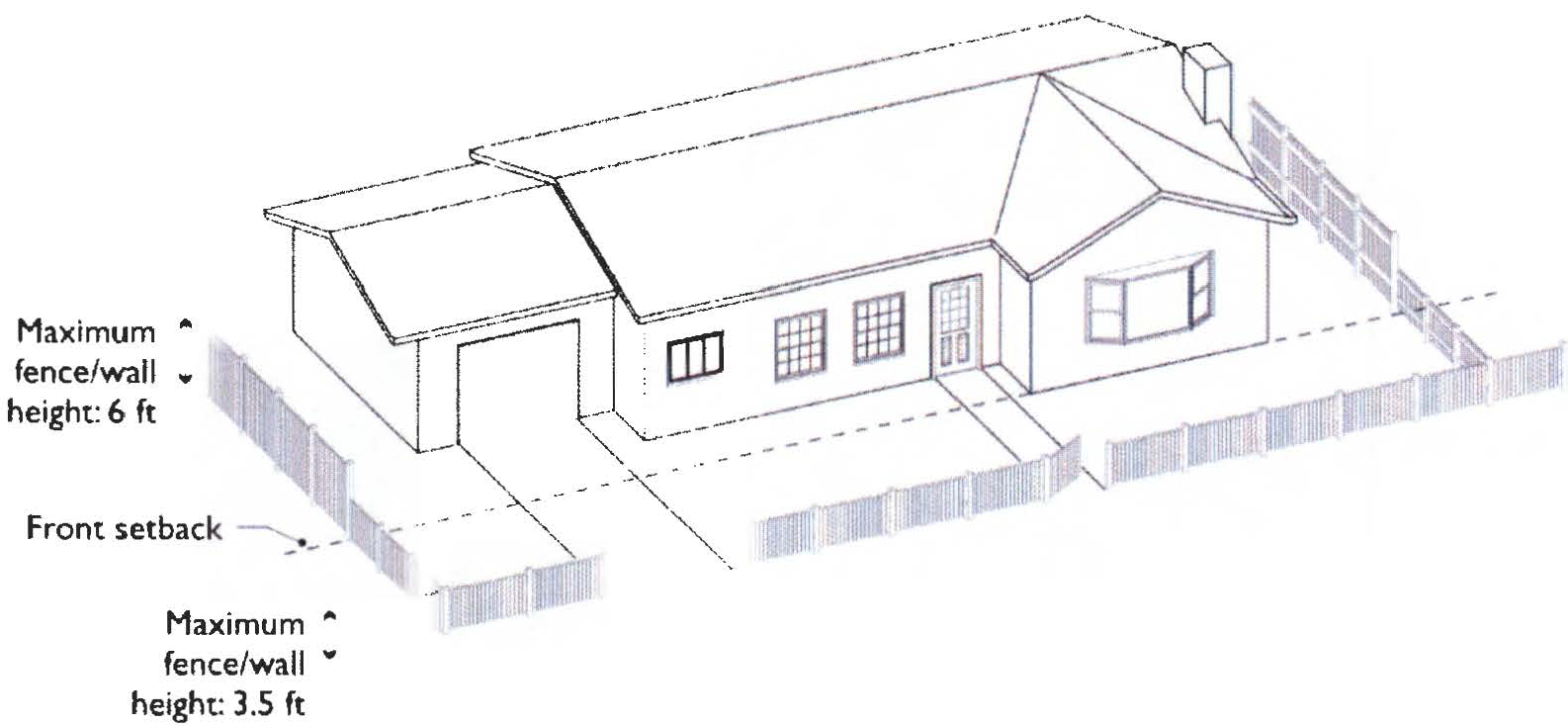
FIGURE 11-30-4.A: FENCES
B.
All Other Zoning Districts.
1.
Maximum Height.
a.
Front Yards and Required Street Side Yards. No Fence or freestanding wall within or along the exterior boundary of the required Front Yard shall exceed a height of 3.5-feet.
b.
Rear Yards and Interior Side Yards. No Fence or freestanding wall within or along the exterior boundary of the required interior side or Rear Yards shall exceed a height of 8-feet.
c.
Building Area. When located in the buildable area, the maximum height for Fences and freestanding walls is the maximum height allowable in the applicable district.
2.
Fence Materials in Commercial and Employment Districts.
a.
Materials. Walls and Fences shall be constructed of high-quality materials, such as tinted, textured blocks; brick; stone; or ornamental metal; and shall complement the design of an overall development and its surroundings.
i.
Chain link may only be used when not visible from public view.
ii.
Wood fencing is not allowed, except wood may be used in conjunction with metal frames for gates used in conjunction with required Screening walls.
iii.
The use of barbed wire, razor wire, embedded glass shards, ultra barrier, electrified and other hazardous fencing is prohibited in Street-facing yards or where adjacent to any public Right-Of-Way.
C.
Visibility at Intersections. Notwithstanding any other provisions of this Section, Fences and walls shall comply with the standards of Section 11-30-14, Visibility at Intersections.
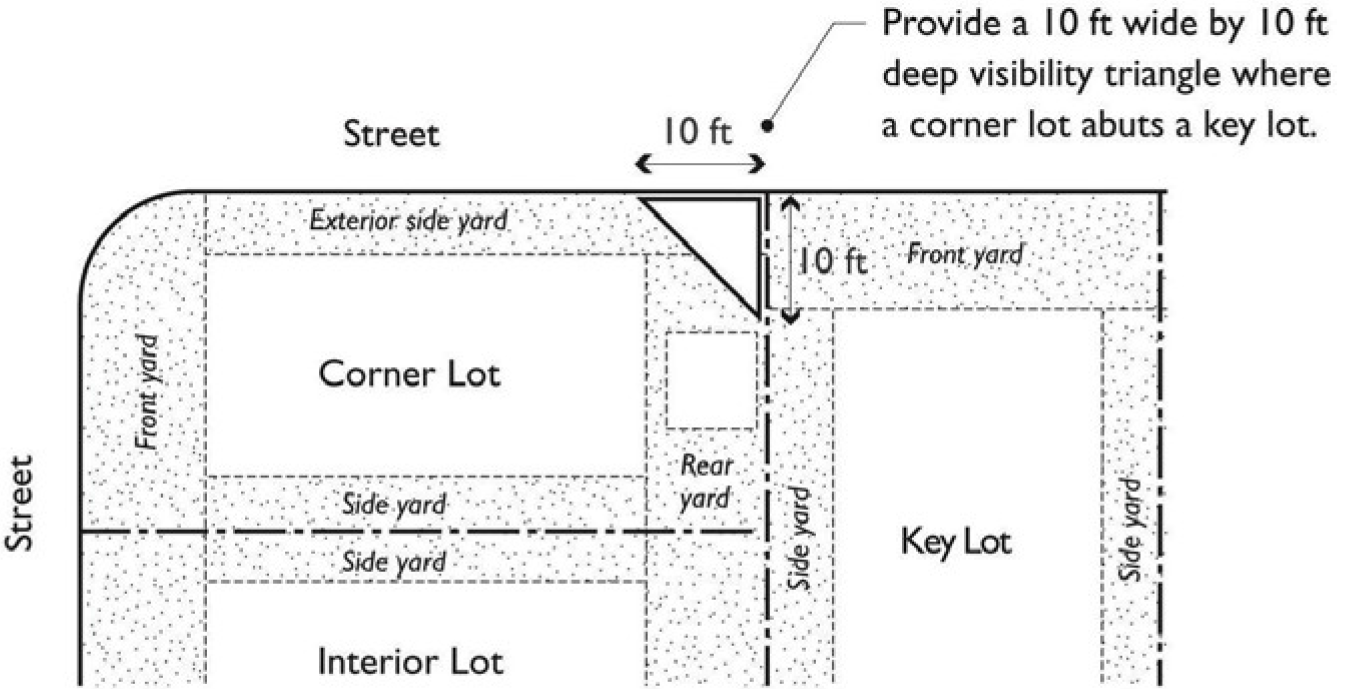
FIGURE 11-30-4.D CORNER LOT ABUTTING A KEY LOT
D.
Corner Lots Abutting a Key Lot. In the event the rear property line of a Corner Lot abuts a side property line of an adjoining Key Lot, a 10-foot deep by 10-foot wide visibility triangle shall be maintained over the Corner Lot, starting at the intersection of the rear and Street side property lines of the Corner Lot. See diagram above, 11-30-4D.
E.
Fence Articulation. The maximum length of continuous, unbroken and uninterrupted Fence or wall plane adjacent to Right-Of-Way or private Streets functioning as public roads shall be forty (40) feet. Articulation shall be provided through the use of columns, Landscaping pockets and/or a change to different materials.
(Ord. No. 5544, §§ 6—8, 12-9-19)
11-30-5: - LIGHTING AND ILLUMINATION
The objective of this section is to promote well designed lighting that can enhance the design of a building or site by highlighting interesting architectural details, calling attention to interesting textures and colors, and focusing attention to primary site features. Such lighting should be controlled to minimize adverse impacts to abutting residential uses.
A.
Applicability: The requirements of this Section shall apply to all projects except Single Residence swellings and duplex residence dwellings (2 dwellings on one lot or parcel).
B.
Parking Lot Illumination.
1.
Light standards shall be located only within the parking area or, where permitted, the outdoor storage area, and shall not encroach into required perimeter landscape areas.
2.
House side shields shall be provided on all light standards adjacent to residential development.
3.
Building mounted lights shall maintain the same heights as specified in B, below.
4.
For additional standards refer to the Mesa Lighting and Electrical Code; Title 4, Chapter 4 of the Mesa City Code.
C.
Maximum Height of Lighting Fixtures. Design Objective: Provide sufficient height to safely light areas without impacting adjacent residential development or contributing to light pollution.
1.
Lighting fixtures, including freestanding light poles as well as building-mounted lights, shall not exceed the maximum heights specified in Table 11-30-5 below.
2.
Exceptions to the maximum height of lighting fixtures may be approved by the Zoning Administrator, after a review of a photometric study for compliance with Section 11-30-5(A). Such exceptions may include requirements for use light control devices, such as fully shielded or full cut-off fixtures, to reduce glare and light-spillage onto abutting properties.
D.
Exposed Exterior Building Illumination. Design Objective: Contribute to the safety of the nighttime environments and accentuate architectural elements.
1.
Findings for Approval. The use of exposed neon, argon, LED or krypton tubing, exposed incandescent lighting, or other exposed artificial lighting to outline any structure or portion thereof may be authorized after review and approval by the Design Review Board. The Board shall approve exposed building illumination only upon a finding that such illumination:
a.
Constitutes a design component of the overall building architecture; and
b.
Is integrated into the primary physical elements of the building or development, and is harmonious with the architectural style of the structure(s); and
c.
Serves only for the purpose of embellishing the nighttime architecture of the building, and does not portray an advertising message; and
d.
Is compatible with the land use and architecture of adjacent developments.
2.
Substantial Conformance Required. Any approval by the Design Review Board for exposed building illumination requires finding that the structure or building complex on which the lighting is to be used shall be in substantial compliance with all current Mesa City Code requirements and regulations.
3.
Full Functionality Required for Use. If any component of the lighting system becomes nonfunctional, neither the entire lighting system, nor any portion thereof, may be illuminated until the entire lighting system is repaired.
E.
Compliance with Mesa Lighting and Electrical Code. All lighting shall comply with the Mesa Lighting and Electrical Code (Title 4, Chapter 4 of the Mesa City Code).
F.
Control of Light Trespass. Project lighting shall be designed to minimize glare and light trespass from the project site to adjacent residential properties.
G.
Maximum Light Spillage. For light spillage, the light level at the boundary of the project, measured 36-inches above ground level, shall be not more than 0.5 foot candles (5 Lux) above ambient light level.
H.
Illuminate Pedestrian Paths. Pedestrian paths connecting the project to the public Sidewalks, connecting buildings on the same project, and the public pedestrian entry foundation base of the building shall be illuminated during the twilight and evening hours the project is active and open to the public.
I.
Consistent Fixture Design. Fixture designs used shall be harmonious with the building design, and with the architectural theme of the overall project, including multiple building projects.
J.
Gradual Transition of Exterior Lighting Levels. The relative brightness of light used may vary throughout the project, provided the transition from higher levels to lower levels of illumination of illumination shall be gradual, without extreme or abrupt degrees of change between higher levels of illumination and natural ambient darkness.
K.
Highlight Building Entries. Focus attention on primary entries to buildings with illumination directed to highlight the entry and adjacent architectural details. Generally, lighting levels at the primary public entry shall be higher than lighting levels away from the public entry.
L.
Lighting to Enhance Design. Lighting shall embellish nighttime architecture by illuminating activity areas, calling attention to details of the building design; and highlighting the relief of building features and/or the texture of building materials.
(Res. No. 12269, §§ 10, 11, 9-23-24; Ord. No. 5883, § 3, 10-7-24)
11-30-6: - LOTS AND LAND DIVISIONS
Design Objectives: To promote orderly growth and harmonious development by ensuring land divisions result in lots, tracts, or parcels of land of adequate size and configuration that are compatible with the intent of the zoning district. Land divisions should create parcels that are suitable for their intended use, contribute to cohesive neighborhood patterns, support safe and convenient access, and uphold the long-term viability of public infrastructure and services.
A.
Legal Nonconforming Lot or Parcel. Any lot or parcel of land recorded in the Maricopa County Recorder's Office and lawfully created prior to the effective date of this Ordinance, and that has an area, width, depth, or street frontage less than the minimum required by the zoning district in which it is located, shall be considered a legal lot and may be used as a building site. All other applicable regulations for the zoning district in which the lot is located shall continue to apply.
B.
Lot Dimension Requirements. No lot, tract, or parcel of land shall be divided in a manner which results in an area, width, depth, or open space less than the minimum required by the zoning district in which it is located, except:
1.
For the purposes of providing public rights-of-way or for conveying a portion of a lot, tract, or parcel of land to a public governing authority for a publicly beneficial use through a land purchase, dedication, or gift; or
2.
If modifications to the area, width, depth, or open space have been approved by the City Council or Board of Adjustment.
C.
Individual Yard and Open Space Requirements. No yard or other open space required around any building designed to comply with the provisions of this Ordinance shall again be used as a yard or other open space for another lot or parcel.
D.
Permitted Number of Dwelling Units. No lot shall be divided in a way that results in a lot containing more dwelling units than permitted by the zoning district in which the lot is located.
E.
Land Split. The division of land into two (2) or three (3) tracts or parcels shall require approval of a Land Split in accordance with Title 9 Chapter 6 of the Mesa City Code.
1.
When dividing developed land, required separation distances established by the Building Code, as well as open space requirements set forth in this Ordinance, must be maintained.
2.
All resulting tracts or parcels shall also comply with all applicable regulations of the zoning district in which they are located.
F.
Buildings Crossing Lot Lines. Where two (2) or more lots are used as a building site and where buildings cross lot lines, the entire area shall be considered one (1) lot, except that the front of the parcel shall be determined to be the front of the individual lots as originally platted or recorded.
G.
Street Frontage Required. Every lot shall have frontage on a dedicated public street or private street unless the lot is a unit in a condominium subdivision.
H.
Future Right-of-Way. Where future width lines for rights-of-way have been established, all required yards and setbacks shall be measured from the future width lines.
I.
Zoning Ordinance and Plat Conflicts. Where a conflict exists between yards or setbacks required by this Ordinance and yards or setbacks specified on a plat, the requirements of this Ordinance shall control, except when a modification to such yard or setback was approved by City Council or the Board of Adjustment
(Ord. No. 5949, § 3, 7-1-25)
11-30-7: - OUTDOOR STORAGE
The objective of this section is to maintain an attractive environment for the community, adjacent businesses and residents while allowing open storage of goods, materials, machines, equipment, and vehicles or parts when necessary for business purposes in specific locations.
A.
Applicability: Open storage of goods, materials, machines, equipment, and vehicles or parts outside of a building (considered collectively as a general activity) for more than 24 hours shall conform to the standards of this Section. The regulations of this Section do not apply to temporary storage of construction materials reasonably required for construction work on the premises pursuant to a valid building permit.
B.
Permitted Locations. Table 11-30-7 states the districts where outdoor storage is permitted and prohibited.
C.
Screening and Setbacks. Storage areas visible from public Streets shall be screened.
1.
Screening Walls. Screening walls and Fences shall be at least eight (8) feet in height. If located on a Street facing front or Side Yard, the Fence shall be placed to meet required Street side Setbacks.
2.
Landscaping. Landscaping is not required within screened storage areas.
3.
Setback. A Setback shall be provided for material stored outdoors at the ratio of 1:1 from all Lot Lines equal to total height of stored material above the required eight (8) foot screen wall.
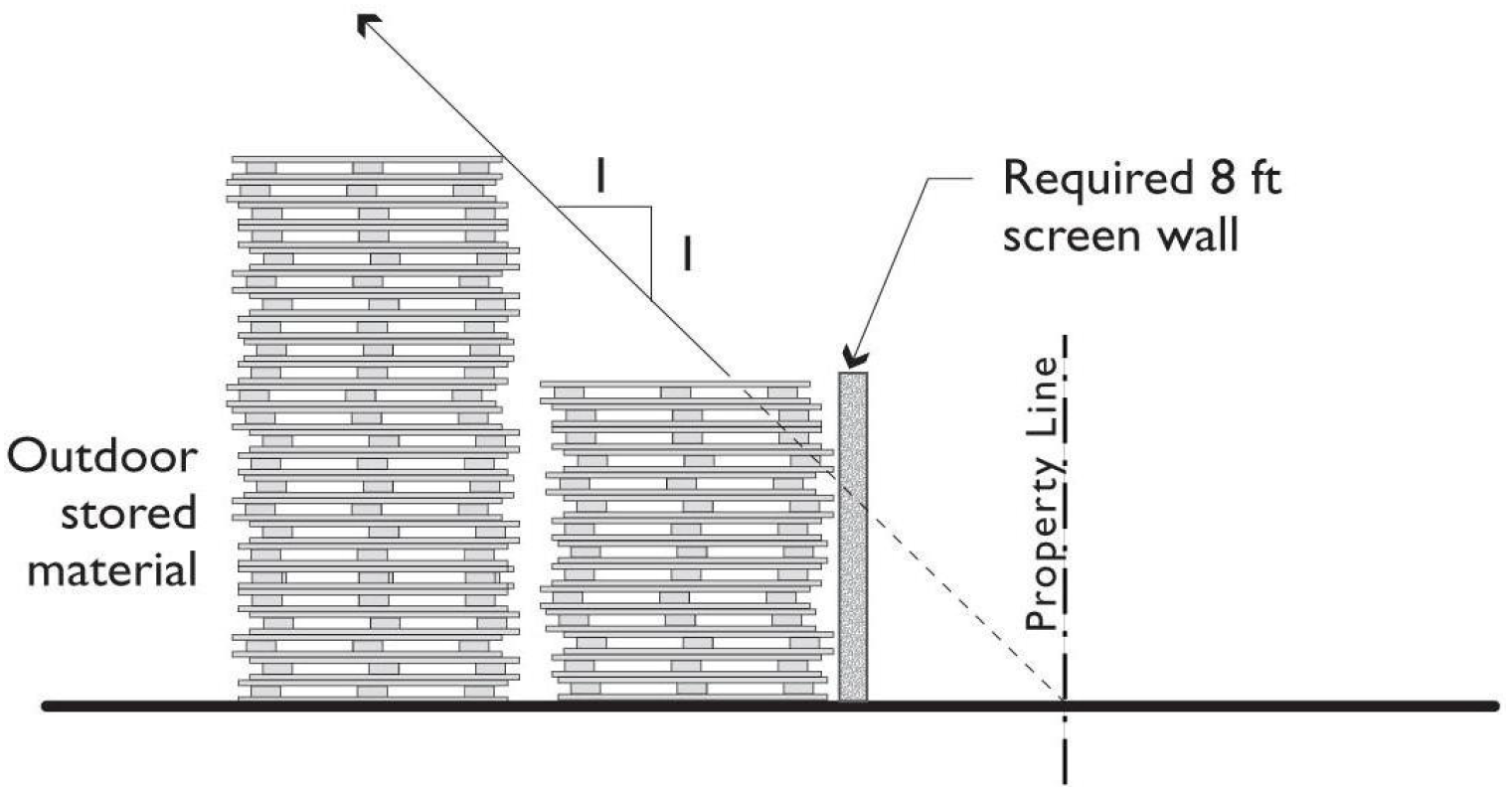
FIGURE 11-30-7.C(1)
(Ord. No. 5759, § 1, 12-8-22; Ord. No. 5814, § 2, 10-16-23; Res. No. 12269, § 12, 9-23-24; Ord. No. 5883, § 3, 10-7-24)
11-30-8: - PEDESTRIAN CONNECTIONS
Design Objective: Encourage people to walk by providing safe, convenient, comfortable and efficient pedestrian connections.
Pedestrian walkways shall be provided in office, employment, commercial, mixed-use and multi- family residential developments. These walkways shall be designed to serve internal pedestrian circulation needs, and shall connect to public Sidewalks and transit stops. Pedestrian access must be provided according to the following standards:
A.
Connection to Public Sidewalk. An on-site walkway shall connect the main entry of each building or each primary entry to a public Sidewalk on each Street frontage of the site, and to any transit stop adjacent to the site. On at least one frontage, such walkway shall be provided along the shortest practical distance between the main building entry and Sidewalk, generally no more than 125 percent of the straight-line distance. The distance may increase up to 50% of the total straight-line distance in the event the route is designed to take account of afternoon shade patterns from buildings or similar shading devices.
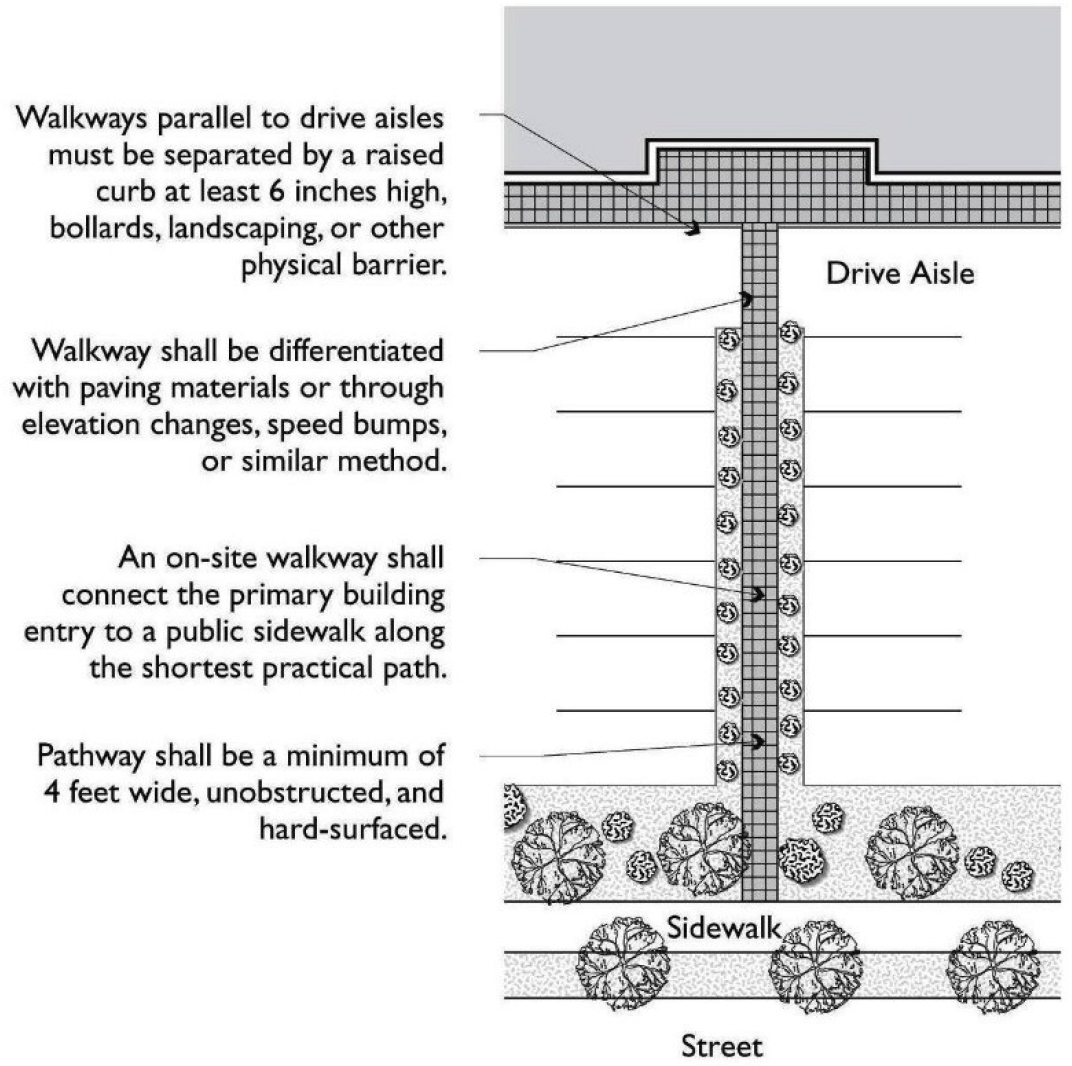
FIGURE 11-30-8.A: PEDESTRIAN ACCESS THROUGH PARKING AREA
B.
Internal Connections. A system of pedestrian walkways shall connect all buildings on a site to each other, to on-site automobile and bicycle parking areas, and to any on-site recreational or Open Space areas or pedestrian amenities.
C.
Connections across Parking Areas. See Section 11-32-4(G)3.
D.
Materials and Width. Pedestrian walkways shall be at least 5 feet in width and paved with a hard, durable surface.
E.
Separation. Where a pedestrian walkway is parallel and adjacent to an auto travel lane, it must be raised and separated from the auto travel lane by a raised curb at least 6 inches high, decorative bollards, or other physical barrier.
F.
Shade at Entries. At customer entrances, pedestrian walkways shall be provided with weather protection such as canopies, awnings, arcades and trellises.
11-30-9: - SCREENING
Design Objective: Encourage attractive, safe buildings and sites by Screening non-architectural elements and uses from public view and providing for transitions between uses.
A.
Screening of Mechanical Equipment. Design Objective: Integrate visual Screening of necessary mechanical equipment into the architecture of buildings to ensure development is attractive, clutter-free and safe.
Except the AG, RS, DR-1and RSL districts, all exterior mechanical equipment, whether on a roof, on the side of a structure, or on the ground, shall be screened from public view. Exterior mechanical equipment to be screened includes, but is not limited to heating, ventilation, air conditioning, refrigeration equipment, plumbing lines, ductwork, transformers, satellite dishes, smoke exhaust fans, service entry section and similar utility devices. Exceptions may be approved by the Zoning Administrator when warranted. Screening shall be architecturally integrated into the main structure with regard to materials, color, shape, and size to appear as an integral part of the building or structure. Equipment shall be screened from public view, public Right-Of-Way, parking areas and on-site pedestrian walkways and amenities. Screening materials shall be opaque and durable. When Screening with plants, evergreen types of vegetation shall be planted and maintained. Plant material sizes and types shall be selected and installed, and maintained so that at the time of building occupancy, and continuously afterwards, such plants effectively screen their respective equipment. The use of wood, expanded metal lath, and chain link for Screening is prohibited. The following additional Screening standards apply:
1.
Roof-Mounted Equipment. Roof-mounted equipment Screening shall be constructed as an encompassing monolithic unit, rather than as several individual screens (i.e., multiple equipment screens, or "hats," surrounding individual elements shall not be permitted). The height of the Screening element shall equal or exceed the height of the structure's tallest piece of installed equipment.
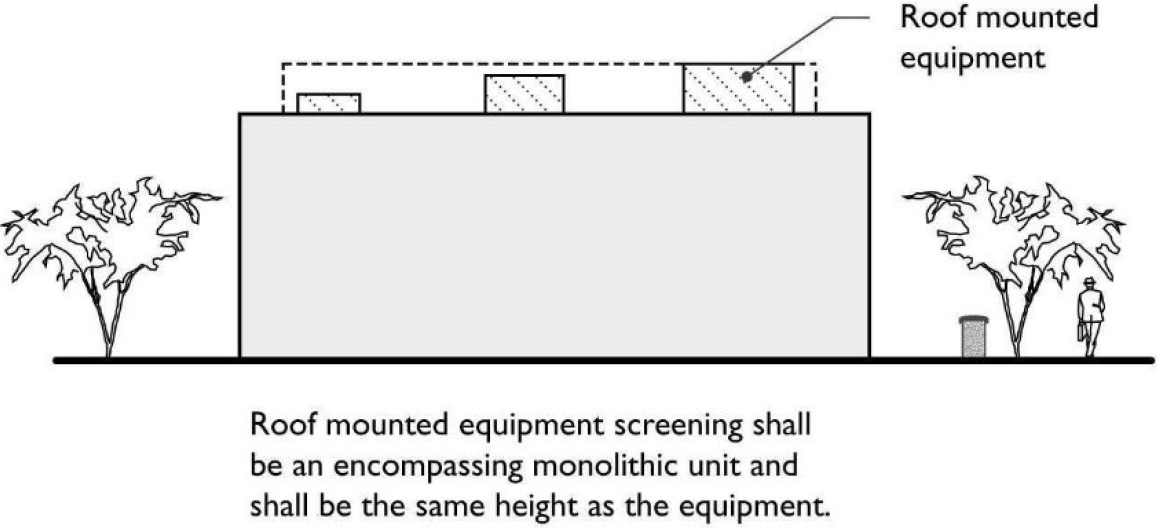
FIGURE 11-30-9.A.1: SCREENING OF ROOF-MOUNTED EQUIPMENT
2.
Ground-Mounted Equipment. Ground-mounted equipment facing a Street or not otherwise separated from the Street by intervening building(s) shall be screened to a height of at least 12 inches above the equipment. Screening devices shall consist of decorative walls and/or berms (2:1 maximum slope) with supplemental plant materials including trees, shrubs and groundcovers. For screen walls that are 3 feet in height or lower, vegetative materials may be substituted for 50 percent of the Screening device.

FIGURE 11-30-9.A.2: SCREENING OF GROUND-MOUNTED
EQUIPMENT
3.
Exterior Wall Equipment. Wall-mounted equipment, including but not limited to electrical meters, electrical distribution cabinets, service entry section (SES), fire sprinkler equipment and similar valves and cabinets that face a Street, or public parking and are not recessed and/or separated from the Street by intervening building(s) shall be screened. Screening devices shall incorporate elements of the building design, e.g. shape, color, texture and material. Vegetative materials may be substituted for up to 50 percent of the Screening devices when used in conjunction with screen walls that are 3 feet in height or lower.
B.
Truck Docks, Loading, and Service Areas. Truck docks, loading, delivery and service bays shall be screened according to the standards of Section 11-30-13.
C.
Roof Access Ladders and Fire Sprinkler Risers. Design Objective: Reduce visual clutter at the skyline.
The location of roof-access ladders and fire sprinkler risers shall be, within the interior of the structure.
D.
Outdoor Storage. Screening for outdoor storage shall be according to the standards of Section 11-30-7, Outdoor Storage.
E.
Drive-through Windows and Automated Car Washes. Design Objective: Reduce potential visual glare of headlights with Screening that is an integral part of the site and Landscaping theme.
Screening for vehicle lanes for drive-through windows and automated car wash openings shall be from public Streets to a height of 40 inches. Screening devices shall consist of walls and/or berms with supplemental plant materials.
F.
Auto Service Bays. Design Objective: Reduce view into open service bays, integrate Screening device with project theme, and attenuate noise emanating from power-assisted tools.
1.
Adjacent Residential or Mixed Use. When the automobile/vehicle repair or service use is within 200 feet of a residential or mixed-use development without an intervening Street, the follow standards shall apply along the common property line:
a.
Bay doors located within 100 feet of an adjacent residential or mixed-use development shall be oriented away from the adjacent use.
b.
Bay doors located between 100 feet and 200 feet of an adjacent residential or mixed use development and oriented such that the bay doors would be visible from the adjacent use shall be screened with an intervening building or an 8' tall screen wall.
c.
Bay doors located more than 200 feet from an adjacent residential or mixed use development and oriented such that the bay doors would be visible from the residential or mixed use development shall be screened by an intervening building or a 6' screen wall.
2.
Screening from Adjacent Streets. Screening of bay door openings shall be accomplished based upon the following preferences:
a.
The use of intervening buildings such that the bays doors are not visible from the Street(s).
b.
The bay doors are Setback from the Street a distance of 200 feet or greater.
c.
Orient the building such that the bay doors are perpendicular to the centerline axis of the abutting Street. For Corner Lots, the bay doors shall be oriented perpendicular to the Street with the highest functional classification identified in the Mesa Transportation Plan. In the event that the functional Street classifications are equivalent, the orientation creating the smallest noise impact on adjacent residential development shall be used.
d.
When bay doors are less than 200 feet from an adjacent Street and the bay doors are less than perpendicular to a Street, Screening shall be provided at least 6' high. Screening shall be at least 50% opaque and may include Landscaping.
3.
Landscape Screening. Large-canopy trees and shrubs shall be used to provide Screening to the bay doors when the bays are visible from the adjacent Street.
4.
Noise Reduction. Air compressors and similar devices shall be housed in enclosed rooms designed to attenuate sound a minimum of 25 db.
G.
Trash and Refuse Collection Areas. Design Objective: Reduce visual clutter of trash and refuse collection areas and integrate Screening device with project theme.
Trash and refuse collection areas shall be screened so as to not be visible from a public Street or parking area. Latching gates shall be provided for trash enclosure openings where visible from Street and/or public parking areas. Orient openings away from public Right-Of-Way, where possible. See Section 11-30-12.
H.
Parking Areas. Design Objectives: Reduce potential visual glare of headlights and reduce the visual clutter of parking fields with Screening that is integral to the site and Landscaping theme.
Parking areas and drive aisles shall be screened from Street(s) with masonry wall, berm or combination of walls/berms and densely planted Landscaping or "vertical wire trellis panels". No more than 40 percent of the Screening shall be accomplished with dense Landscaping.
1.
Screen walls shall vary in height from 32 to 40 inches and shall be offset or staggered by at least 24 inches at intervals of no more than 50 feet.
2.
The Screening device shall vary in height from 12 to 18 inches when lawful display of automobiles, trucks, Recreational Vehicles, Manufactured Homes, boats, motorcycles, and utility trailers is adjacent to public Streets.
3.
Screen walls shall be composed of brick, stone, stucco, or other quality durable material that complements the theme of the project and shall include a decorative cap or top finish as well as edge detail at wall ends.
4.
Berms shall be contoured and covered with a combination of vegetative and inert ground cover. If a contoured Screening berm is installed, 24" box trees may be substituted for required 36" box trees.
5.
Screen wall and/or berm height shall be measured from the finish grade of the parking lot.
6.
When using a screen wall there shall be a landscaped Setback of at least 5 feet between the screen wall and the edge of the parking area.
7.
A Setback of at least 10 feet shall be provided between the screen wall and the Right-Of-Way.
I.
Common Property Lines. Design Objective: Fences and walls that screen building(s), facilities or activities of the site from adjacent development should be an effective buffer and an integral design component of the project.
A Screening wall of 6 feet in height shall be provided on the interior Lot Lines of any lot that contains any commercial use, industrial use, public or semi-public use (except Cemetery or Public Park and Recreation Facility), or transportation, communication and utilities use, as described in Chapter 86, Descriptions of Use Classifications and Use Types, and abuts a residential district or residential use. Such Screening wall shall be provided at the rime of new construction or expansion of buildings, or changes from one use classification to another non-residential use classification.
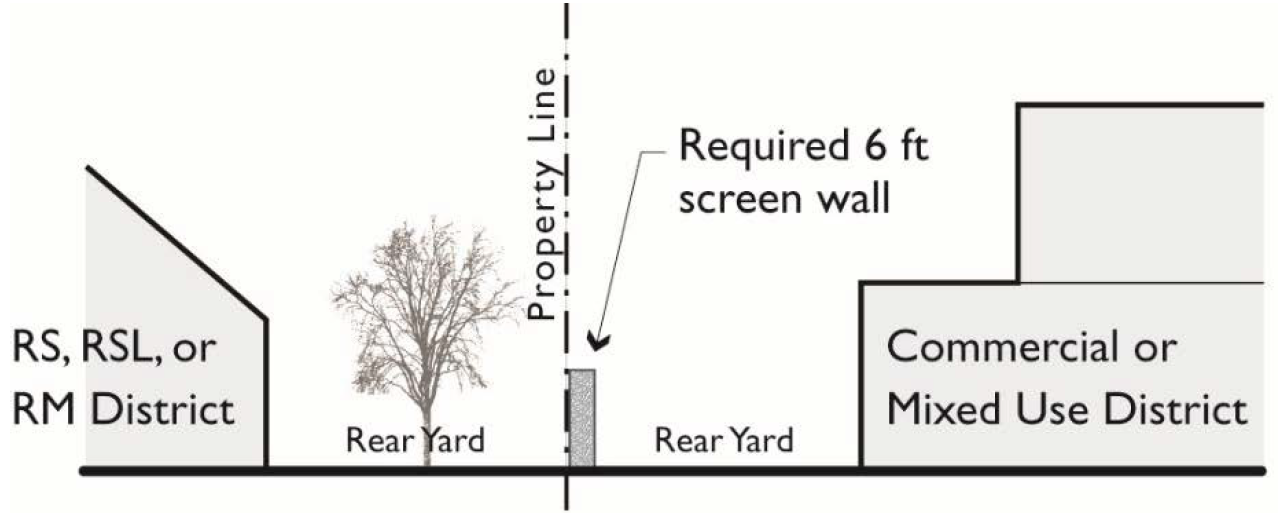
FIGURE 11-30-9.I: SCREENING ALONG RESIDENTIAL DISTRICT BOUNDARIES
1.
Location. Screening walls shall follow the Lot Line of the lot to be screened, or shall be so arranged within the boundaries of the lot so as to substantially hide from adjoining lots the building, facility, or activity required to screened.
2.
Materials. Industrial uses must provide a solid Screening wall of stucco, decorative block, or concrete panel. Screening walls for other uses may be constructed of stucco, decorative block, concrete panel, or other substantially equivalent material. Chain-link fencing does not fulfill the Screening wall requirement.
3.
Berms. A landscaped earth berm may be used in combination with, or in lieu of, the above types of Screening walls.
4.
Relationship to Fence and Wall Height Limits. If the minimum height required for Screening walls exceeds the maximum permitted height of Fences and freestanding walls for the Zoning District, then an alternative Screening solution shall be provided for review and approval by the Planning Director that meets the intent of the Screening requirement.
5.
Exception. In locations where commercial and multiple residence properties share a common interior property line the requirements for Screening can be waived, except for loading and service areas, if the waiver of the Screening will facilitate a more integrated design and development allowing greater pedestrian connection between the uses.
J.
Roof-mounted Solar Equipment. Design Objective: Allow solar panels and other solar equipment to be placed on roofs in a manner that is aesthetically pleasing without creating excess shadows on the equipment.
Solar equipment placed on flat roofs shall be screened a minimum of 60% of the height of the equipment. Roof mounted equipment laying flat on a sloped roof, without additional structures elevating the panels from collectors do not require any additional Screening device.
(Ord. No. 5928, § 20, 2-3-25)
11-30-10: - SETBACKS AT INTERSECTIONS
A.
Minimum Setback. Design Objective: Provide Open Space at intersections to enhance or establish distinctive locations.
Within the required Setbacks at intersections, integrate way-finding features such as attractive plantings, pedestrian paving, lighting, monument signage and/or Street furniture. All parking areas, and drive aisles shall be set back from Street intersections according to the standards in Table 11-30-10.
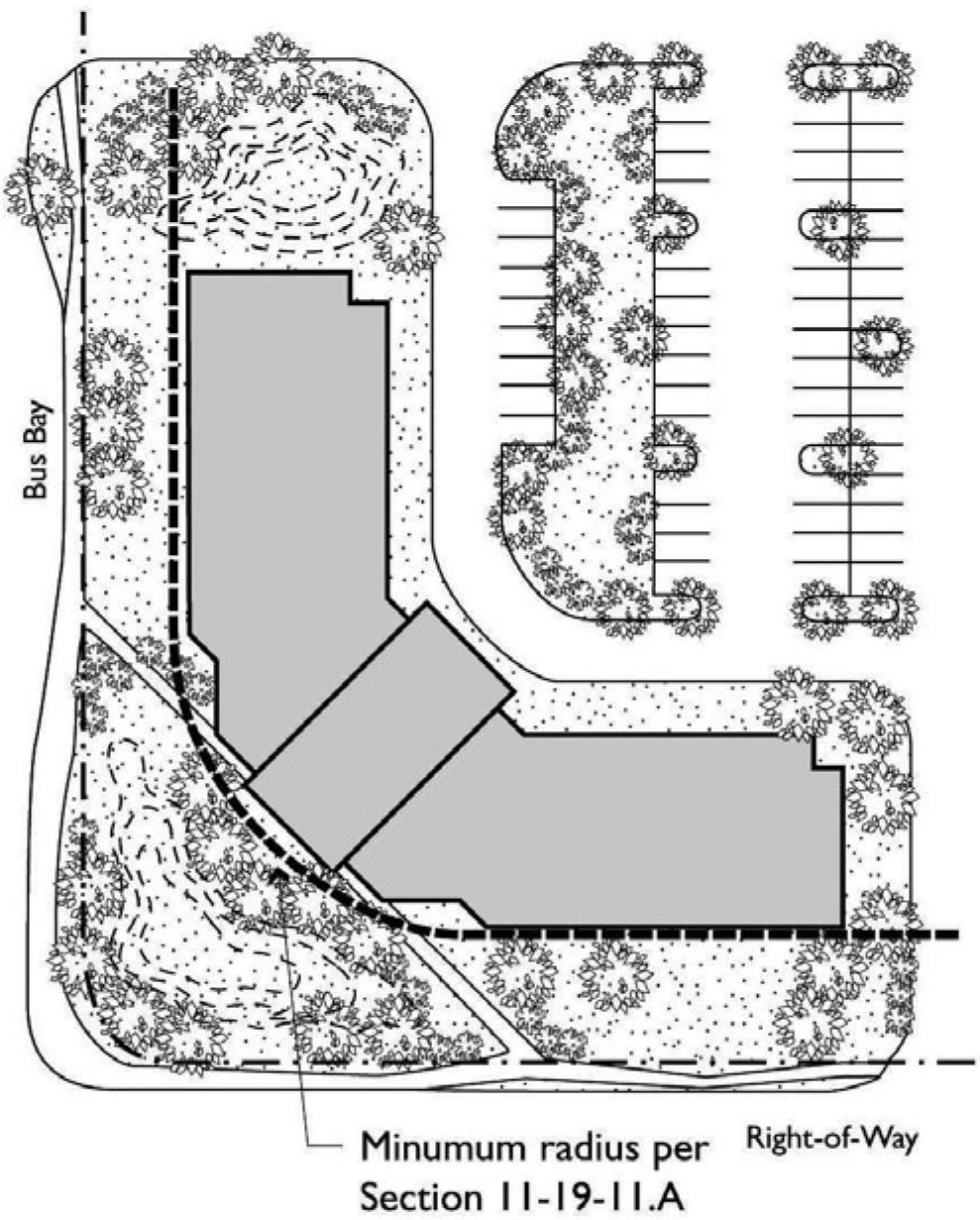
FIGURE 11-30-10.A: CORNER SETBACKS
B.
Landscaping. Corner Setbacks shall be landscaped according to the standards of Chapter 33, Landscaping.
11-30-11: - SWIMMING POOLS
Swimming pools and other bodies of water located in any Zoning District must be developed in compliance with the following standards:
A.
A swimming pool shall not be located in the required Front Yard or a Side Yard required for vehicle access, required landscaped areas or closer than 4 feet from the water's edge to any Lot Line.
B.
Contained bodies of water either above or below ground level with the container being 18 inches or more in depth at any point or wider than 8 feet at any point, shall conform to the location and fencing requirements for swimming pools.
C.
Swimming pools shall be secured from unauthorized access by an enclosure as provided in Title 4, Chapters 2 (Mesa Building Code) or 3 (Mesa Residential Code), as applicable, of the Mesa City Code.
11-30-12: - TRASH AND REFUSE COLLECTION AREAS
Design Objectives: Trash and refuse collection areas, including enclosures, should be an integral component of the project. The areas should be safe and convenient. The location should not be visually prominent.
A.
General Applicability Requirements and Alternatives.
1.
General Applicability Requirements. Solid waste and recycling-container enclosures are required for new dwelling groups consisting of 4 or more Dwelling Units and for all commercial or industrial developments in which the aggregate gross Floor Area exceeds 10,000 square feet. Designs must meet Mesa Standard Details.
2.
Alternatives. Alternatives to standard requirements may be considered by the Planning Director and Solid Waste Management Director.
B.
Location. All enclosures shall comply with all applicable Building and Fire Codes and shall meet the following requirements.
1.
The solid waste and recycling storage area shall not be located within any required Front Yard, Street Side Yard, any required parking and landscaped areas, or any other area required by the Mesa City Code to be constructed and maintained unencumbered according to fire and other applicable building and public safety codes.
2.
Solid waste and recycling areas shall be consolidated to minimize the number of collection sites and located so as to reasonably equalize the distance from the building spaces they serve.
3.
Storage areas shall be located so that the trucks and equipment used by the City of Mesa solid waste and recycling collector(s) have sufficient maneuvering areas.
C.
Materials, Construction and Design.
1.
Minimum Height of Screening. Solid waste and recycling storage areas located outside or on the exterior of any building shall be screened to a minimum height of 6-feet.
2.
Enclosure Material. Enclosure material shall be solid masonry or concrete tilt- up with decorated exterior-surface finish compatible to the main structure(s).
3.
Gate Material. Gate material shall be decorative, solid, heavy-gauge metal or a heavy-gauge metal frame with a covering of a view-obscuring material.
4.
Access to Enclosure from Residential Projects. Each solid waste and recycling enclosure serving a residential project shall be designed to allow walk-in access without having to open the main enclosure gate.
5.
Protection for Enclosures. Concrete curbs or equivalent shall protect enclosures from adjacent vehicle parking and travel ways.
6.
Landscaping. When feasible the perimeter of the recycling and trash enclosure shall be planted with drought resistant Landscaping, including a combination of shrubs and/or climbing evergreen vines.
7.
Lighting. All trash collection areas shall be well lit with a minimum 1 foot candle.
11-30-13: - TRUCK DOCKS, LOADING AND SERVICE AREAS
Design Objectives: Reduce the negative impact of noise and activity associated with truck docks, loading and service areas on quieter activities of adjacent properties. Minimize the impact of visual clutter associated with open bay doors and parked trucks being loaded and unloaded from adjacent lots and Street Rights-Of-Way.
Truck docks, loading, and service areas shall be located and screened as follows:
A.
Minimum Distance from Residential District. Truck docks, loading, and service areas are not permitted within 50 feet of the boundary of any residential district or use.
B.
Location on Lot. In all districts except the GI, and HI Districts, truck docks, loading areas and service areas must be located at the rear or side of buildings, rather than facing a Street.
C.
Screening. Truck docks, loading areas, and service areas located in any Zoning District shall be screened from any adjacent residential districts or uses. Docks, loading and service areas in any district except the GI and HI Districts shall be screened from public view. Screening shall consist of a solid masonry wall at least 8 feet in height or opaque automated gates.
11-30-14: - VISIBILITY AT INTERSECTIONS
Notwithstanding any other provisions of this section, no Fence, wall, shrubbery, sign or other obstruction to vision between a height of 3 feet and 8 feet above the centerline grades of the intersecting Streets shall be erected, placed, planted, allowed to grow or maintained within the triangular yard space formed by the intersecting center lines and a line joining points on such center lines 80 feet from the point of intersection. Where a conflict occurs between this requirement and the Subdivision Regulations, the more restrictive provision shall apply.
11-30-15: - SOLAR PANELS AND OTHER ALTERNATIVE ENERGY PRODUCTION FACILITIES
A.
Solar Panels. The following standards are applicable solar panels used for the primary purpose of providing energy for the immediate site or development:
1.
Attached solar panels. In all Zoning Districts, solar panels attached to sloped roofs shall be located entirely on the roof. Solar panels located behind parapets on flat roofs shall comply with Table 11-30-3: Allowed Projections Above Height Limits.
2.
Detached, freestanding solar panels. Detached or freestanding solar panel structures are permitted only in Single Residence districts and shall comply with all location, maximum height and maximum roof area requirements of Detached Accessory Structures, Section 11-5-7(B).
B.
Solar Farms and Alternative Energy Production Facilities. Design Objective: Reduce the impact of large energy production utilities.
Solar farms and other alternative energy production facilities shall be permitted in accordance with the requirements of Article 2 and the following:
1.
Setbacks and Landscaping. In all districts where permitted, provide the Setbacks and Landscaping required for that district.
2.
Screening. Solar panels and equipment used for solar farms and/or alternative energy production facilities shall be screened from the public view of the Street right-of- way by walls and Fences that are the height of the panels and equipment or at least 8 feet in height, whichever is less.
11-30-16: - PORTABLE STORAGE CONTAINERS (PSC)
Portable Storage Containers are permitted only in accordance with the following requirements:
A.
Minimum Standard. The construction of the PSC shall conform to requirements set by the International Standards Organization for portable shipping containers, ISO 6346.
B.
Temporary Use during Construction. PSCs are permitted as a temporary storage device for use during construction, remodeling, or redevelopment of permanent on-site buildings and facilities:
1.
When either of the following occurs:
a.
In all Agriculture (AG), multiple residence (RM), all commercial and all industrial Zoning Districts, and for non-residential uses in Mixed Use (MX) and all Transect districts, if no building permit is required for the type of construction taking place, the temporary use of the PSC is subject to the issuance of an Administrative Use Permit by the Development Services Division in accordance with requirements of Chapter 70 of this Zoning Ordinance.
b.
In all Zoning Districts, when a building permit is required for the type of construction taking place, the temporary use of use of the PSC may be authorized in conjunction with the issuance of a building permit in accordance with Title 4 of the Mesa City Code.
2.
Applications for a building permit or Administrative Use Permit, as applicable (Item 1, above), shall include a plan which specifies the number, size, and location of the storage containers.
3.
The temporary use of PSCs is limited to the lesser of the following time periods:
a.
When authorized in conjunction with the issuance of a building permit, the temporary use shall be limited to the time in which the construction, remodeling, or redevelopment of permanent on-site buildings and facilities is actively taking place; or
b.
When authorized with the issuance of an Administrative Use Permit, the temporary use shall be limited to 6-months, or until such time as the construction, remodeling, or redevelopment activity is completed, whichever occurs first. If the construction, remodeling, or redevelopment activity remains active and extends beyond 6-months, then the use permit may be renewed, but no more than 2 times.
4.
The PSC shall be removed within 7-days of the completion of:
a.
The construction, remodeling, or redevelopment activities;
b.
The construction activities authorized by the construction permit; or
c.
The expiration of the use permit.
5.
In all Single Residence (RS) and Single Residence-Small Lot (RSL) districts, PSCs used during construction with the issuance of a building permit shall be limited to no more than one PSC per residential lot.
6.
PSCs shall not be located in retention basins, drive aisles, fire lanes, loading zones, or any other location that may cause hazardous conditions, or constitute a threat to public safety.
C.
Temporary or Periodic Commercial Storage. In the LC and GC commercial districts, and in the PEP and LI industrial districts, PSCs may be used as a periodic, intermittent, or isochronal use for a temporary period of time and accessory to a primary permitted use, subject to the approval of a special use permit in accordance with Chapters 67 and 70 of this Zoning Ordinance. In addition to specifying and limiting the number, size, location, and duration of the storage containers, the special use permit may require additional measures to ensure compatibility with adjacent land uses, such as increased Setbacks, screen walls, Landscaping, exterior materials and color.
D.
Permanent Storage in Industrial Districts. In those industrial districts for which outdoor storage is expressly allowed (i.e., LI, GI and HI Districts), PSCs may be used for permanent outdoor storage, subject to:
1.
All requirements for the placement of outdoor storage specified for the applicable Zoning District;
2.
Compliance with all requirements of Section 11-30-7 with regard to placement and Screening of outdoor storage; and
3.
Placement of the PSC in a manner such that it is not located in landscape areas, designated Open Space, retention basins, drive aisles, fire lanes, required parking spaces, loading zones, or any other location that may cause hazardous conditions, or constitute a threat to public safety.
E.
Permanent Storage in Downtown Business District 2. In the DB-2 district, a PSC shall only be used for outdoor storage, subject to:
1.
Approval of a Special Use Permit in accordance with Chapters 67 and 70 of this Zoning Ordinance;
2.
Compliance with all requirements for the placement of outdoor storage specified by Section 11-30-7 with regard to placement and Screening of outdoor storage; and
3.
Placement of the PSC in a manner such that it is not located in landscape areas, designated Open Space, retention basins, drive aisles, fire lanes, required parking spaces, loading zones or any other location that may cause hazardous conditions, or constitute a threat to public safety.
F.
Temporary Use in Residential Districts for Loading and Unloading of Household Goods. In residential districts (RS, RSL and RM), Downtown Residence (DR-1, DR-2 and DR-3), and residential uses in all Transect districts (T3N, T4N, T4NF, T4MS, T5N, T5MSF, and T6MS), the temporary placement of a portable storage container on a residential lot for the purpose of loading and unloading household contents is only permitted for a period of time not exceeding seven (7) days in a calendar year.
G.
Permanent Use in Single Residence and Agriculture Districts. The permanent use of PSCs is permitted only in the RS-43, RS-90 and AG Zoning Districts, and only in accordance with the following requirements:
1.
The placement, Floor Area, and size of the portable storage containers shall be in conformance with the same requirements specified for detached Accessory Buildings in Section 11-30-17.
2.
A building permit is required before installation, with a field inspection following installation.
3.
The PSC shall be placed upon an elevated pad that is a minimum of 4-inches above average natural grade of the ground within a 4-foot radius of the exterior walls of the PSC.
4.
One or more of the following aesthetic treatments to the exterior physical appearance of the PSC are required. At minimum:
a.
A veneer of a durable building material similar to and congruous in appearance with the primary dwelling shall be attached to the PSC; or
b.
Landscaping of sufficient density is installed and maintained so as to block the visibility of the PSC from across property lines of all directly abutting properties, or from across a Right-of-Way from a property that would otherwise directly abut the site. This Landscaping Screening may be through the use of a hedge or other Landscaping growing adjacent or on the PSC. If this alternative is used, the PSC shall be painted a color considered compatible with the color of the associated Primary Residence; or,
c.
A combination of partial veneer treatments, compatible paint colors, and/or landscape treatments that result in the appearance of the PSC being aesthetically congruous with the Primary Residence, and undiscernible from a detached Accessory Building of standard construction.
5.
Openings created for placement of doors and/or windows in the PSC are only permitted if no cuts or structural alterations are made to the primary structural frame of the PSC.
(Ord. No. 5249, 10-6-14)
11-30-17: - DETACHED ACCESSORY BUILDINGS OR STRUCTURES
The purpose of this Section is to aid in the comfort, convenience, and enjoyment of a lot or parcel by providing standards for the allowance and placement of detached Accessory Buildings or Structures that place reasonable limitations to minimize impacts on access to light, air, and spacing relative to adjacent lots and parcels.
A.
General Requirements. Detached Accessory Buildings or Structures located on lots or parcels in Agricultural (AG), Single Residence (RS), Small Lot Single Residence (RSL), Downtown Residential (DR), and Multiple Residence (RM) districts are permitted subject to the following provisions:
1.
The Primary Building shall be under construction or fully constructed on a lot or Parcel of Land prior to initiating construction of a detached Accessory Building or Structure;
2.
Detached Accessory Buildings or Structures shall not be constructed or used for dwelling purposes, except as an Accessory Dwelling Unit as provided in Section 11-31-3 of this Title;
3.
Detached Accessory Buildings or Structures shall adhere to the maximum building coverage and maximum Lot Coverage requirements of the underlying Zoning District;
4.
The combined gross floor area of all detached accessory buildings or structures, shall not exceed 100% of the gross floor area of the primary building, unless approved by a Special Use Permit; and
5.
No detached Accessory Building or Structure shall encroach into any recorded Easement.
B.
Building Height and Location.
1.
Detached Accessory Buildings or Structure: Less than or equal to 200 Square Feet. Detached Accessory Buildings or Structures 200 square feet or less in Gross Floor Area shall comply with all of the following requirements:
a.
May be located within the required rear, side, or Street Side Yards.
b.
Shall not be located in the required Front Yard or between the front of the Primary Building and the Street.
c.
On Corner Lots or parcels abutting a Key Lot, detached Accessory Buildings or Structures shall not be located closer to the Street than the Primary Building on the adjacent Key Lot.
d.
Shall not be located closer than six (6) feet to the Primary Building.
e.
Shall not exceed eight (8) feet in height at the peak of the roof unless the detached Accessory Building or Structure complies with the height and location requirements in Subsection (B)(2)(d) or Subsection (B)(2)(e) below.
f.
No portion of the Accessory Building or Structure shall overhang the property line or cause water to shed or drain from the roof of the Accessory Building or Structure onto a neighboring property.
2.
Detached Accessory Buildings or Structures: Greater than 200 Square Feet. Detached Accessory Buildings or Structures greater than 200 square feet in Gross Floor Area shall comply with all of the following requirements:
a.
Shall not be located in the required Front Yard or between the Primary Building and the Street.
b.
Shall not be located closer than six (6) feet to the Primary Building.
c.
On Corner Lots or parcels abutting a Key Lot, detached Accessory Buildings or Structures shall not be located closer to the Street than the Primary Building on the adjacent Key Lot.
d.
Shall not exceed the maximum Building Height of the underlying Zoning District, or the height of the Primary Building as measured at the peak of the roof, whichever is less, unless approved by a Special Use Permit.
e.
In addition to the height maximum in Subsection (d), the below requirements must be met for the detached Accessory Building or Structure, as applicable. If the height of the Accessory Building or Structure is:
i.
Equal to or less than 15 feet in height at the peak of the roof, the detached Accessory Building or Structure may be located within the rear, side, or Street Side Yards but shall not be located closer than five (5) feet from the side, Street-side, and rear property lines.
ii.
Over 15 feet in height at the peak of the roof, the detached Accessory Building or Structure shall not be located within any rear, side, or Street Side Yard, and shall adhere to the Setback requirements of the underlying Zoning District.
f.
No portion of the Accessory Building or Structure shall overhang the property line or cause water to shed or drain from the roof of the Accessory Building or Structure onto a neighboring property.
(Ord. No. 5814, § 3, 10-16-23; Ord. No. 5883, § 1, 10-7-24; Ord. No. 5950, § 1, 7-8-25)
11-31-1: - PURPOSE AND APPLICABILITY
The purpose of this Chapter is to establish standards for specific uses and activities that are permitted or conditionally permitted in multiple zones. For each Zoning District, uses and activities that are permitted or conditionally permitted shall comply with the regulations and standards of this Chapter, as well as any applicable standard found in each Zoning District.
11-31-2: - ACCESSORY USES
An Accessory Use shall be secondary to a primary use and shall be allowed only in conjunction with a Principal Use or building to which it relates, in any Zoning District. Accessory use regulations are found in the use regulations tables in Article 2 and 3 of this Zoning Ordinance and are subject to the regulations of the primary use and specific standards found in this Chapter.
11-31-3: - ACCESSORY DWELLING UNIT
The purpose of this Chapter is to provide opportunities for Accessory Dwelling Units (ADUs) while minimizing impacts to surrounding uses and properties.
A.
Applicability.
1.
One (1) attached ADU and one (1) detached ADU are permitted per lot or parcel in any of the following Zoning Districts where a Single Residence is allowed: Agricultural, Residential, Commercial and Mixed Use, and Downtown.
2.
Any lot or parcel containing an existing Single Residence is permitted one (1) attached ADU and one (1) detached ADU regardless of the Zoning District.
3.
One (1) additional detached ADU is permitted on a lot or parcel that is one (1) acre or more in size on a lot or parcel that meets the requirements in Subsection (A)(1) or (A)(2) above if at least one (1) of the ADUs is used as a restricted-affordable Dwelling Unit, which is defined as a Dwelling Unit that either, through a private deed restriction or a Development Agreement with the City, is rented to households earning up to eighty percent (80%) of the area median income.
B.
General Requirements.
1.
There are no minimum lot size requirements to establish an ADU.
2.
An ADU shall have a separate and independent entrance from the Primary Residence.
3.
An ADU may contain either a partial Kitchen or full Kitchen, but no more than one (1) Kitchen per ADU is allowed.
4.
An ADU in a Historic District shall comply with Chapter 74 of the Zoning Ordinance.
5.
An ADU shall comply with all applicable building code requirements for residential dwellings.
6.
Manufactured Homes, Recreational Vehicles (RV), and trailers shall not be used as an ADU.
C.
Unit Size. The interior Habitable Area of an ADU shall not exceed 75% of the Primary Residence's interior Habitable Area, or 1,000 square feet, whichever is less.
D.
Setbacks.
1.
New Structures—Attached or Detached.
a.
A minimum side and rear setback of five (5) feet shall be provided for all side and rear setbacks.
b.
Front and secondary front (street side) setbacks shall comply with the primary residence setback requirements for the underlying zoning district.
2.
Existing Detached Accessory Building or Structure Conversion.
a.
Conforming Detached Accessory Building or Structure.
i.
An existing Detached Accessory Building or Structure that complies with the setback requirements in Section 11-30-17 (Detached Accessory Buildings or Structures) but does not comply with the setback requirements in Subsection (D)(1) above may be converted to an ADU without requiring additional setbacks.
ii.
Any expansion or addition to accommodate an ADU shall comply with the setback requirements of Subsection (D)(1) above.
b.
Legal Non-Conforming Detached Accessory Building or Structure.
i.
An existing Detached Accessory Building or Structure that does not comply with the setback requirements in Section 11-30-17 (Detached Accessory Buildings or Structures) or the setback requirements in Subsection (D)(1) above, may be converted to an ADU without requiring additional setbacks.
ii.
An expansion or addition to accommodate an ADU may be constructed in compliance with Subsection (D)(1) above, or in line with the existing non-conforming setback, provided it does not further increase the existing non-conformity.
3.
Primary Residence.
a.
Primary Residence Renovation. A primary residence may be internally renovated to include an ADU and shall not require additional setbacks. Any expansion or addition to the primary residence to accommodate an ADU is subject to the following:
i.
Ground Floor Addition. Any ground floor addition constructed to accommodate an ADU shall comply with the setback requirements outlined in Subsection (D)(1) above.
ii.
Second-Story Addition. Any second-story addition constructed to accommodate an ADU shall comply with the setback requirements for the primary residence.
b.
Legal Non-Conforming Structures.
i.
A primary residence that does not conform to the required setbacks for the underlying zoning district or the setback requirements in Subsection (D)(1) above, may be internally renovated to accommodate an ADU without requiring additional setbacks.
ii.
An expansion or addition to accommodate an ADU may be constructed in compliance with Subsection (D)(1) above, or in line with the existing non-conforming setback, provided it does not further increase the existing non-conformity.
E.
Lot Coverage and Building Coverage. An ADU shall comply with all Lot Coverage and building coverage requirements of the underlying Zoning District.
F.
Height. The height of an attached or detached ADU shall comply with the primary residence height requirements for the underlying zoning district.
G.
Parking.
1.
No additional parking spaces are required for an ADU.
2.
If a Garage or Carport is converted to an ADU, covered parking for the primary residence is not required to be replaced elsewhere on the lot or parcel.
H.
Utilities.
1.
An ADU shall be provided with water, sewer, and electric utilities.
2.
An ADU shall be served by the same water, sewer and electric utility providers and meters as the primary residence.
3.
An ADU may not be built on top of a current or planned public utility easement of any kind unless the property owner receives written consent from any utilities currently using the public utility easement or that may use the public utility easement in the future.
(Ord. No. 5814, § 4, 10-16-23; Ord. No. 5883, § 2, 10-7-24; Ord. No. 5950, § 2, 7-8-25)
11-31-4: - ANIMAL KEEPING (AG AND ACCESSORY TO RESIDENTIAL USES)
Keeping animals in AG and residential zones is allowed, subject to compliance with Title 8Article 4.
A Special Use Permit may be approved for the keeping of livestock in excess of the number permitted in Section 8-6-21 of the Mesa City Code, or for the keeping of livestock on a parcel less than 35,000 square feet, as specified in Section 8-6-21 of the Mesa City Code, only upon a finding by the Zoning Administrator acting as a hearing officer/Board of Adjustment that all three of the following are present:
A.
The applicant has demonstrated that the number of livestock proposed is consistent with the number historically kept on the property.
B.
The keeping of livestock is for private use and enjoyment and does not constitute a commercial use, unless otherwise authorized in this Chapter.
C.
The keeping of livestock will be in accordance with all other provisions of Title 8Article 4, of the Mesa City Code, including proper sanitation and placement of barns, pens, and corrals.
11-31-5: - AUTOMOBILE RENTALS; AUTOMOBILE/VEHICLE SALES AND LEASING
Automobile Rental, and Automobile/Vehicle Sales and Leasing, each as described in Section 11- 86-4, shall be located, developed, and operated in compliance with the land use regulations in Article 2 and the following standards:
A.
Landscaping. In addition to perimeter and foundation base Landscaping requirements, Landscaping shall comprise a minimum of 10 percent of the site area.
B.
Vehicle Display. A maximum of 30 percent of the Street side landscape area may be used for vehicle display. A minimum 12-foot wide planter strip shall separate vehicle display areas from Sidewalks along the Streets. Vehicle display encroachments wider that 30-feet shall be separated by a minimum distance of 30-feet between similar vehicle displays that encroaches into the Street side landscape area (illustration needed).
C.
Vehicle Loading and Unloading. Vehicle loading and unloading shall occur on-site.
D.
Vehicle Display Platforms.
1.
Elevated platforms or other structures or devices used for the display of vehicles associated with an approved vehicle sales or rental facility are permitted, provided such platforms, structures, or devices:
a.
Shall only be located in areas currently approved or authorized for vehicle display; and
b.
Shall not project into or over required landscape areas, drive aisles, or fire lanes; and
c.
Shall not be located closer to the public Street than the existing, at-grade vehicle display area; and
d.
Shall not exceed four feet (4') in height as measured from the mean finished grade of the display surface.
2.
Only one (1) vehicle shall be displayed on each platform, structure, or device.
3.
The number of display platforms, structures, or devices shall not exceed a ratio of one (1) per one hundred feet (100') of lineal Street frontage of the at-grade display area (exclusive of driveways).
4.
The Design Review Board may approve modifications or variations to the above provisions when such platforms, structures, or devices are a component of a site development plan reviewed and approved in accordance with Section 11-18-9 of this Title. Such modifications or variations shall only be approved upon a finding by the Board that such platforms, structures, or devices:
a.
Constitute a design component, or incorporate architectural features, associated with the Primary Buildings or structures on the development site; and
b.
Serve only to enhance the visibility of vehicles, and do not display or portray an advertising message, or commercial signage; and
c.
Will not impede or obstruct the visibility of traffic maneuvering on the development site or traveling upon the public-Street; and
d.
Incorporate increased Setbacks, enhanced Landscaping, or other Screening measures to effectively mitigate the impact of the platforms.
11-31-6: - AUTOMOBILE/VEHICLE REPAIR, MAJOR AND MINOR
Major Automobile/Vehicle Repair, and Minor Automobile/Vehicle Service and Repair, each as described in Section 11-86-4, shall be located, developed, and operated in compliance with the land use regulations in Article 2 and the following standards:
A.
Minimum Lot Size. 1 acre, unless part of a larger group commercial center.
B.
Screening. Car service and storage areas shall be screened per Sections 11-30-9(F), Auto Service Bays and 11-30-9(H), Parking Areas.
C.
Litter. No used or discarded automotive parts or equipment or disabled, junked, or wrecked vehicles may be stored outside of the main building.
D.
Noise. All body and fender work, or similar noise-generating activity, shall be enclosed in masonry or similar building with sound attenuating measures incorporated into the building design and construction to absorb noise to comply with Title 6, Chapter 12 of the Mesa City Code. Bay openings shall be oriented so as to minimize the effects of sound emanating from the auto repair building towards residential uses, towards outdoor restaurant seating and outdoor reception areas. Compressors shall be located within separately enclosed, sound attenuated rooms.
11-31-7: - AUTOMOBILE/VEHICLE WASHING
Automobile Washing, as described in Section 11-86-4, shall be located, developed, and operated in compliance with the land use regulations in Article 2 and the following standards:
A.
Location. Automobile/Vehicle Washing, as a primary use, is only allowed on sites with at least one frontage on an arterial Street.
B.
Setbacks. No building or structure shall be located within 20 feet of any interior Lot Line abutting a residential Zoning District.
C.
Drive-up Aisles and Required Queuing Area. Drive-up aisles shall be at least 11 feet wide; if adjacent to a Street, they shall be screened as specified in Section 11-30-9(E), Drive-through Windows and Automated Car Washes. The drive-up aisle shall provide queuing space, with no encroachment into required landscape areas or building Setbacks, for at minimum:
1.
4 vehicles per pull-through rack for each automatic wash bay.
2.
3 vehicles per bay for self-serve, coin-operated and/or hand wash facilities.
D.
Landscaping. Automobile/Vehicle Washing, as a primary use, in addition to perimeter, parking lot and foundation base Landscaping requirements, Landscaping shall comprise a minimum of 10 percent of the site area.
E.
Litter. One permanent, non-combustible trash receptacle per wash bay is required.
F.
Noise. Sound attenuating measures shall be incorporated into the building design and construction to absorb noise such that the sound level readings at the Street and at interior property lines are no more than 55 decibels. Mechanical equipment for centralized vacuum equipment shall be housed in an enclosed room.
G.
Additional Special Use Permit Criteria. When a Special Use Permit is required by Article 2, each of the following items shall be included in the evaluation:
1.
The number of automobile related activities within 600-feet of an intersection of arterial Streets shall not exceed 2, including automobile/vehicle washing, automobile service stations, automobile sales or rental lots, or automobile/vehicle repair.
2.
Proposed locations within "-U" designated areas shall be oriented with canopies and fuel dispensing equipment away from the Street, either to the side or to the rear of a building.
3.
Compliance with all development standards for the applicable Zoning District, including compliance with all requirements for automobile related services located in all mixed districts and "-U" designated districts.
4.
The use is found to be in compliance with the General Plan, applicable Sub-area plans and other recognized development plans or policies, and will be compatible with surrounding uses;
5.
Evidence that acceptable documentation is present demonstrating that the building or site proposed for the use shall adequately provide paved parking and on-site circulation in a manner that minimizes impacts on adjacent sites; and existing or proposed improvements to the site shall minimize dust, fugitive light, glare, noise, offensive smells and traffic impacts on neighboring residential sites.
6.
A finding that a plan of operation has been submitted, which includes, but is not limited to, acceptable evidence of compliance with all zoning, building, and fire safety regulations.
7.
A finding that a "good neighbor policy" in narrative form has been submitted, which includes, but is not limited to, descriptions of acceptable measures to ensure ongoing compatibility with adjacent uses. Such policies shall include, but are not limited to, the name and telephone number of the manager or person responsible for the operation of the facility; complaint response procedures, including investigation, remedial action, and follow-up; and litter control measures.
8.
Evidence that acceptable documentation is present demonstrating that the building or site proposed for the use is in, or will be brought into, substantial conformance with all current City development standards, including, but not limited to, Landscaping, parking, screen walls, signage, and design guidelines
11-31-8: - BED AND BREAKFAST INNS
Bed and Breakfast Inns, as described in Section 11-86-4, shall be located, developed and operated in compliance with the land use regulations in Article 2 and the following standards:
A.
Location of Parking: All parking shall be located behind the Front Yard building Setback for the Zoning District, and be designed to facilitate the exiting of vehicles in a forward motion from the site onto the adjacent Street. Parking for sites located in RM districts shall not encroach into any required side and Rear Yards, nor any required landscape areas.
B.
Additional Requirements for Sites located in RS and DR Districts. In addition, sites located within the RS and DR districts shall comply with the following:
1.
Minimum lot area. When located in Single Residence (RS) districts, the minimum lot area shall be 15,000 square feet or greater.
2.
On-site resident. When located in Single Residence (RS) or Downtown Residence (DR) districts, the operation of the facility shall include an on-site resident owner or manager.
3.
Outdoor facilities. In addition to compliance with all building Setback requirements for the Zoning District, all unenclosed outdoor buildings open on 1 or more sides, miscellaneous structures, decks and swimming pools shall maintain a minimum separation of 20-feet from abutting Single Residence lots.
4.
Signage. The site shall be limited to 1 attached sign that is no greater than 4 square feet. Any verbiage on the sign shall be limited to the name of the facility and the address. Use of an internally illuminated sign is prohibited.
C.
Special Use Permit Criteria. Review of the Special Use Permit required for Bed and Breakfast Inns located in RS districts shall be based on the following:
1.
Historic Sites. Preference may be given to sites located within Approved Historic or Historic Landmark Overlay Districts, without the site being located in close proximity to an arterial Street, as stated in 2, below.
2.
Proximity to Arterial Streets. Sites should be located within a traveling distance on public Streets of 300-feet from a major arterial Street, and should have no more than 1 turning movement on a public Street before accessing the public Street leading to the arterial Street.
3.
Facility-Lot Area Balance. The size and number of on-site improvements should be balanced against the size of the lot in order to maintain the appearance of the site as being compatible with the context and character of the surrounding neighborhood. Factors to consider in reviewing this balance include:
a.
Providing facilities needed to minimize impacts on adjacent properties at a scale limited to that needed to achieve the intended result; and
b.
Restricting non-residential structures; and
c.
Providing adequate Screening (by structure, Screening wall and/or vegetation) of the view of parking spaces from the adjacent Street(s).
11-31-9: - COMMERCIAL USES IN ANY RESIDENCE DISTRICTS
Any Special Use Permit request for a commercial land use classifications in a residence district shall be reviewed in accordance with the following criteria:
A.
Applicable Policies. The use is found to be in compliance with the General Plan, and with applicable Sub Area Plans, Neighborhood Plans and other recognized development plans or policies, and will be compatible with surrounding uses; and
1.
Site Plan. A finding that an acceptable site plan has been submitted for review and consideration.
2.
Operational Plan. A finding that an acceptable operational plan in narrative form has been submitted for review and consideration, which includes, but is not limited to, descriptions of acceptable measures to ensure ongoing compatibility with adjacent uses, Such policies shall include, but are not limited to, the name and telephone number of the manager or person responsible for the operation of the facility; complaint response procedures, including investigation, remedial action, and follow-up; and litter control measures; and
3.
Addresses Adverse Impacts. Evidence that acceptable documentation is present demonstrating that the building or site proposed for the use shall adequately provide paved parking and on-site circulation in a manner that minimizes impacts on adjacent sites; and existing or proposed improvements to the site shall minimize dust, fugitive light, glare, noise, offensive smells and traffic impacts on neighboring residential sites.
11-31-10: - COMMUNITY GARDENS
Community Gardens, as described in Section 11-86-3 shall be located, developed, and operated in compliance with the land use regulations in Article 2 and the following standards:
A.
Type and Size Restrictions. Community gardens shall be limited in type and size by Zoning District as follows:
1.
Agricultural. Gardens may be divided into individual plots or farmed collectively. There is no maximum size for individual plots or for the aggregate garden area.
2.
RS-35, RS-43, and RS-90. Gardens may be divided into individual plots or farmed collectively. Individual plots may be of any size, the maximum size of the aggregate garden area is limited to one (1) acre.
3.
All Other Districts. Garden areas may only be developed as individual garden plots. The individual garden plots may be no larger than 400 square feet and the maximum size of the aggregate garden area is limited to ½ acre.
B.
Setbacks. Site features, such as raised planting beds and storage sheds, are not allowed in the required Setback. Plantings are allowed in required yards provided they comply with site visibility triangles of Section 11-30-14, Visibility at Intersections.
C.
Storage Buildings. Storage Buildings shall conform to the following standards:
1.
Maximum area: 200 square feet;
2.
Maximum height: 10 feet:
3.
Location: within the buildable area and placed in the rear one-half of the lot;
4.
Number: One (1) storage shed per site for gardens one (1) acre or less; maximum 2 storage sheds for sites larger than one (1) acre.
D.
Lighting. Overhead lighting is prohibited.
E.
Parking. No more than 2 vehicles shall be permitted onsite, excluding those parked within an enclosed structure. Parking spaces shall be paved with an approved dust proof material.
F.
Maintenance. The site shall be kept clear of weeds, debris and waste in conformance with Mesa City Code, Section 8-6-3. All composting shall be done in a screened area or within a container. All tools and equipment shall be stored or screened from view when not in use.
G.
Fences. Fences, including trellises, are allowed in required yards subject to the standards governing Fence location, maintenance, height and design of Section 11-30-4, Fences and Freestanding Walls. Exception: chain link Fence material may be used in the Community Garden.
11-31-11: - CONVENIENCE MARKETS
Convenience Markets, as described in Section 11-86-4, shall be located, developed, and operated in compliance with the land use regulations in Article 2 and the following standards:
A.
Maximum Building Size. 5,000 square feet.
B.
Setbacks. No building or structure shall be located within 20 feet of an interior Lot Line abutting a residential Zoning District.
C.
Litter. One permanent, non-flammable trash receptacle shall be installed in the parking area adjacent to the entrance/exit of the market.
11-31-12: - CORRECTIONAL TRANSITIONAL HOUSING FACILITIES (CTHF)
Correctional Transitional Housing Facility (CTHF), as described in Section 11-86-2, shall be located, developed, and operated in compliance with the land use regulations in Article 2 and the following standards:
A.
Location.
1.
Separation from Dissimilar Uses.
(a)
A minimum distance of 500 feet from any residential Zoning District.
(b)
A minimum distance of 1,200 feet from any of the following:
(i)
A public or private school building with kindergarten programs or any of grades one (1) through 12, and any recreational area adjacent to such school; and
(ii)
A public park; and
(iii)
Any existing community residence or assisted living facility.
2.
Separation from Similar Uses. A minimum distance of 5,280 feet from any other CTHF.
B.
Criteria for Review of Council Use Permit. The review of the Council Use Permit shall include a review and determination regarding the following items:
1.
The use is found to be in compliance with the General Plan and other recognized development plans or policies, and will be compatible with surrounding uses; and
2.
A finding that a plan of operation has been submitted, which includes, but is not limited to, acceptable evidence of compliance with all zoning, building, and fire safety regulations; and
3.
A finding that a "good neighbor policy" in narrative form has been submitted, which includes, but is not limited to, descriptions of acceptable measures to ensure ongoing compatibility with adjacent uses. Such policies shall include, but are not limited to, the name and telephone number of the manager or person responsible for the operation of the facility; complaint response procedures, including investigation, remedial action, and follow-up; and litter control measures; and
4.
Evidence that acceptable documentation is present demonstrating that the building or site proposed for the use is in, or will be brought into, substantial conformance with all current City Development Standards, including, but not limited to, Landscaping, parking, screen walls, signage, and design guidelines.
C.
Registration and Renewal. To register with the City, a correctional transitional housing facility requires a council use permit to operate. the applicant must submit to the City an application for a council use permit in accordance with section 11-67, and provide evidence demonstrating compliance with this section. Registration of a correctional transitional housing facility is valid for one (1) year and must be renewed annually on or before the expiration date of the registration.
D.
General Operations. Correctional transitional housing facilities shall submit an operational plan demonstrating:
1.
Compliance with all zoning, building, and fire safety regulations including, but not limited to, evidence demonstrating that the building and the proposed site will be brought into substantial conformance with all current city development standards, including, but not limited to, Landscaping, parking, screen walls, signage, and design guidelines;
2.
Compliance with state laws and regulations;
3.
Provisions of on-site supervision, by qualified staff, for all hours during which residents are on the premises; and
4.
Security measures that are sufficient to protect the safety of residents and other citizens in the vicinity of the facility.
(Ord. No. 5631, § 1, 7-8-21)
11-31-13: - LARGE DAY CARE GROUP HOMES
Large Day Care Group Home, as described in Section 11-86-2, shall be located, developed, and operated in compliance with the Land Use Regulations in Article 2 and the following standards:
A.
The location of the home is registered with the Planning Division and evidence of certification by the Arizona Department of Health Services is provided to the City;
B.
No identification is visible from a public Street by signage, graphics, display, or other visual means;
C.
The building complies with all applicable building and fire safety regulations;
D.
A 6-foot-high solid (opaque) Fence or wall is provided between all outdoor play areas and adjacent properties, except within the required Front Yard, in which fencing requirements shall comply with in the requirements of Section 11-30-4, Fences and Freestanding Walls; and
E.
A separation between large day care group homes of 600 feet or by the presence of significant intervening physical features between an existing large day care group home and the proposed large day care group home, such as arterial Streets, canals, parks, or similar buffering features or developments.
11-31-14: - COMMUNITY RESIDENCES
A community residence (family and transitional) shall be located, developed and operated in compliance with the land use regulations in Article 2 and the following standards:
A.
General Requirements.
1.
Spacing Requirements. A minimum distance of 1,200 feet from the closest existing community residence, assisted living home, or assisted living center, as measured under Section 11-2-3(D), unless separated by a significant intervening natural or manmade feature such as, but not limited to, a canal, municipal Open Space of at least ten (10) acres (e.g., park, golf course, etc.), a railroad, or a highway, that is approved by the Zoning Administrator.
2.
Occupancy. Five (5) up to a maximum of ten (10) individuals (not including staff).
3.
Licensure and Certification. A community residence must obtain one (1) or more of the following:
(a)
License or certification from the State of Arizona required to operate the proposed community residence; or
(b)
Certification by the Arizona Recovery Housing Association if not required to be licensed by the State of Arizona; or
(c)
A "Permanent" Oxford House Charter.
B.
Community Residences Requiring a Conditional Use Permit. In certain Zoning Districts community residences are not allowed by right but require the approval of a conditional use permit. A conditional use permit shall be granted only if the governing body finds that the applicant has demonstrated that all of the following criteria are met:
1.
The proposed use will be compatible with the residential uses allowed as of right in the Zoning District;
2.
The proposed use in combination with any existing community residences, assisted living homes, and assisted living centers will not result in a clustering of such uses or alter the residential character of the surrounding neighborhood by creating or intensifying an institutional atmosphere; and
3.
The proposed use will not interfere with normalization and community integration of the residents of any existing community residences, assisted living homes, or assisted living centers, and that the presence of other existing community residences, assisted living homes, or assisted living centers will not interfere with normalization and community integration of the residents of the proposed use;
4.
The applicant has submitted a "good neighbor policy" in narrative form that includes:
(a)
A description of acceptable measures to ensure ongoing compatibility with adjacent uses;
(b)
The name and telephone number of the manager or person responsible for the operation of the facility;
(c)
Complaint response procedures including investigation, remedial action, and follow-up procedures; and
(d)
The proposed use complies with all other development standards in this Chapter.
C.
Registration, Renewal, and Revocation. A community residence must register with the City and renew its registration as set forth below:
1.
Registration Process for Community Residences That Do Not Require a Conditional Use Permit. An applicant for a community residence that does not require a conditional use permit to operate and is not requesting a reasonable accommodation under Section 11-31-14(D), must register with the City by submitting the City's registration application according to Chapter 67, Common Procedures. If the use complies with all City requirements, the applicant will receive provisional registration approval from the planning division. To obtain final registration, the applicant must provide evidence of the required license or certification within 120 days from the date the provisional registration was approved.
2.
Registration Process For a Community Residence That Requires a Conditional Use Permit or is Requesting a Reasonable Accommodation. A community residence that requires a conditional use permit to operate or that requests a reasonable accommodation to the standards in Section 11-31-14(a), must register with the city by submitting the City's application for a conditional use permit according to Chapter 67, Common Procedures, and by providing evidence of compliance with all City requirements. The request will be reviewed by the applicable governing body. approval of the conditional use permit grants the applicant provisional registration. To obtain final registration, the applicant must provide evidence of the required license or certification within 120 days from the date the provisional registration was approved; except registration for a community residence that is granted a reasonable accommodation to the license and certification requirement is considered final and no other action is required.
3.
Registration Renewal. Registration of a community residence is valid for one (1) year and must be renewed annually on or before the expiration date of the registration. To renew a registration, the operator of a community residence shall submit to City an application for renewal and evidence of a current state license, certification or Oxford House Charter.
4.
Revocation. The registration and conditional use permit obtained by a community residence may be revoked as set forth in this section:
(a)
Facilities Without a Conditional Use Permit. In the event the license, certification or Oxford House Charter for a community residence is denied or revoked, the City of Mesa registration will automatically terminate after 15 calendar days of the date of the City's written notification to the applicant; and the community residence must cease operation 45 calendar days from the date of the City's written notification.
(b)
Facilities With a Conditional Use Permit. A community residence that requires a conditional use permit to operate or that has applied for or received a special use permit for a reasonable accommodation and whose license, certification, or oxford house charter required in Section 11-31-14(a)(3) is denied or revoked, the City of Mesa registration shall automatically terminate, and the conditional use permit is subject to the revocation process in Chapter 70. If the conditional use permit is revoked, the community residence must cease operation within 45 calendar days from the date the conditional use permit is revoked.
D.
Reasonable Accommodation. A community residence that does not meet the spacing, occupancy or licensure requirements may request a reasonable accommodation through the special use permit process. The accommodation being sought must be reasonable and necessary to afford individual(s) with disabilities an equal opportunity to use and enjoy housing that is the subject of the request. The process to apply for a special use permit are provided in Chapter 67, Common Procedures, except a citizen participation plan and report is not required.
1.
Accommodation to Spacing Requirements. A special use permit to the spacing requirements shall be granted only if the governing body finds that the applicant has demonstrated that the proposed use meets all of the following criteria:
(a)
The proposed use will not interfere with the community integration of the residents of any existing community residences, assisted living homes, or assisted living centers, or their ability to interact with neighbors without disabilities; and the presence of other community residences, assisted living homes, or assisted living centers will not interfere with the community integration and interaction of the residents of the proposed use;
(b)
The proposed use in combination with any existing community residences, assisted living homes, or assisted living centers will not alter the residential character of the surrounding neighborhood by creating or intensifying an institutional atmosphere or by creating or intensifying a de facto social service district by clustering or concentrating community residences, assisted living homes, or assisted living centers; and
(c)
The proposed use complies with all other development standards in this Chapter.
2.
Accommodation to Licensure Requirements. When the state, Arizona Recovery Housing Association or Oxford House does not offer a license, certification, or charter for the type of community residence and the population it will serve, the community residence may request a special use permit. the special use permit shall be granted only if the governing body finds that the applicant has demonstrated that all of the following criteria are met:
(a)
The proposed use will operate in a manner effectively similar to a licensed or certified community residence;
(b)
Staff will be adequately trained under standards typically required by the state or Oxford House for a community residence;
(c)
The proposed use will have operating rules and practices that will protect residents from abuse, exploitation, fraud, theft, insufficient support, use of illegal drugs or alcohol, and misuse of prescription medications;
(d)
The proposed use will emulate a family and will operate to achieve community integration; and
(e)
The proposed use otherwise complies with all other development standards in this Chapter.
3.
Accommodation to Occupancy Limits. A community residence that wants to house more than ten (10) people may request a special use permit. A special use permit shall be granted only if the governing body finds that the applicant has demonstrated that the proposed community residence meets all of the following criteria:
(a)
The number of residents over ten (10) is needed for therapeutic viability of the proposed community residence;
(b)
The number of residents in the proposed community residence will emulate and operate as a family rather than a boarding house, skilled nursing facility, short-term rental, treatment center, social service facility or other nonresidential uses; and will not interfere with the community integration of the occupants of any existing community residences, assisted living homes, or assisted living centers;
(c)
The primary function of the proposed community residence is residential where any treatment is merely incidental to the residential use of the property;
(d)
The proposed community residence has sufficient parking for the requested number of occupants so as not to impact the adjacent properties; and
(e)
The proposed use complies with all other standards in this Chapter.
(Ord. No. 5632, § 7, 7-8-21; Ord. No. 5858, § 3, 7-1-24)
Editor's note— Ord. No. 5632, § 7, adopted July 8, 2021, repealed the former section 11-31-14, and enacted a new section 11-31-14 as set out herein. The former section 11-31-14 pertained to group homes for the handicapped.
11-31-15: - HOSPITALS AND CLINICS
Hospitals and Clinics, as described in Section 11-86-3 shall be located, developed, and operated in compliance with the land use regulations in Article 2 and the following standards:
A.
Patient Entrances: Patient entrances shall:
1.
Be clearly distinctive from the remainder of the building, and be readily visible from the public Street;
2.
Be identified by directional signage in conformance with requirements of Article 5;
3.
Include an extended foundation base to provide a patient drop-off area of a minimum 900 sq. ft., extending a minimum 20-feet measured perpendicular from the patient entrance door "See FIGURE 11-31-15.A & 11-31-15.B"; and
4.
Pedestrian connections within parking areas, to other buildings on site, and to the public Street and transit shall follow the requirements of Section 11-30-8, Pedestrian Connections and Section 11-32-4(G)3, Pedestrian Access.
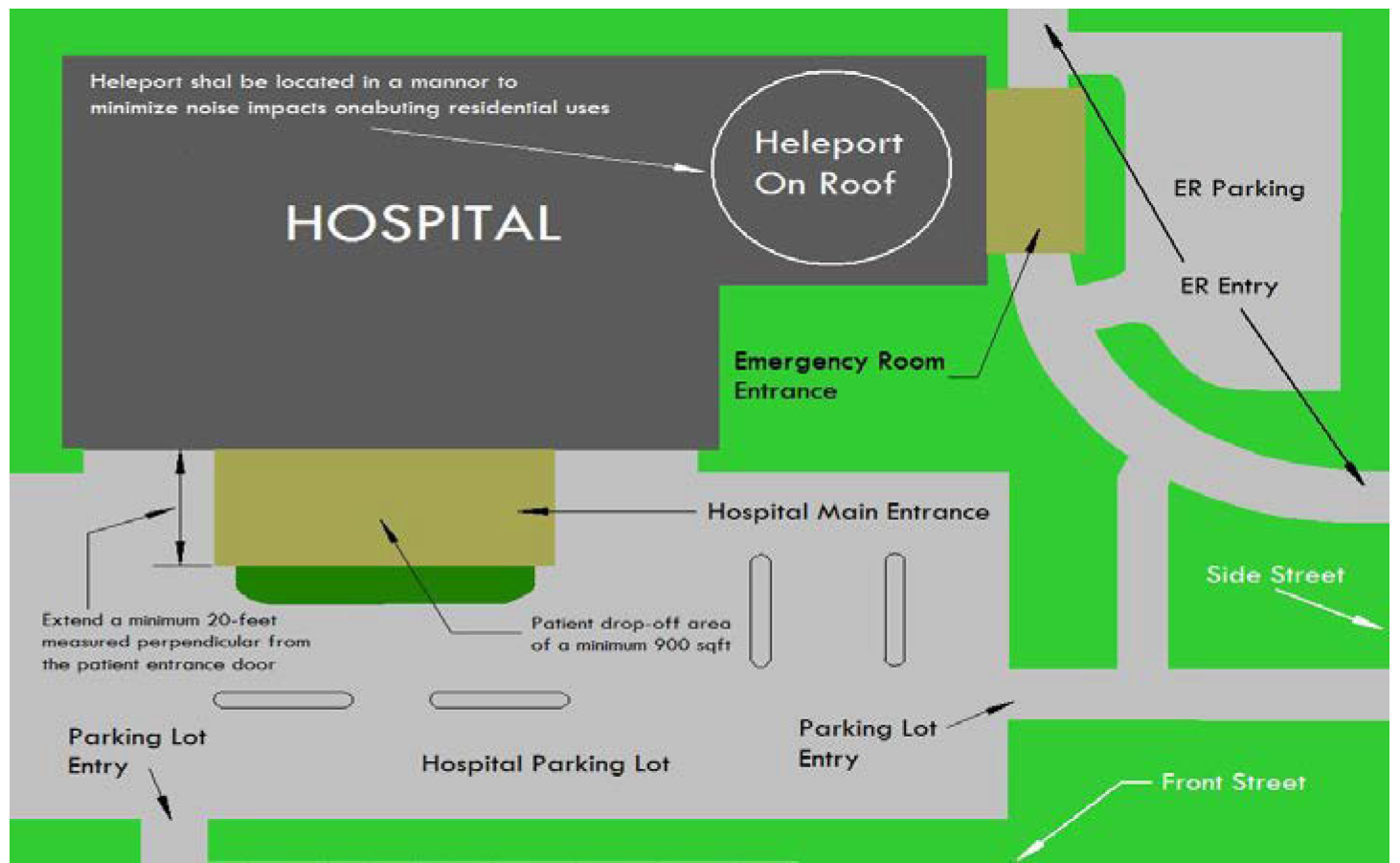
FIGURE 11-31-15.A: HOSPITALS AND CLINICS
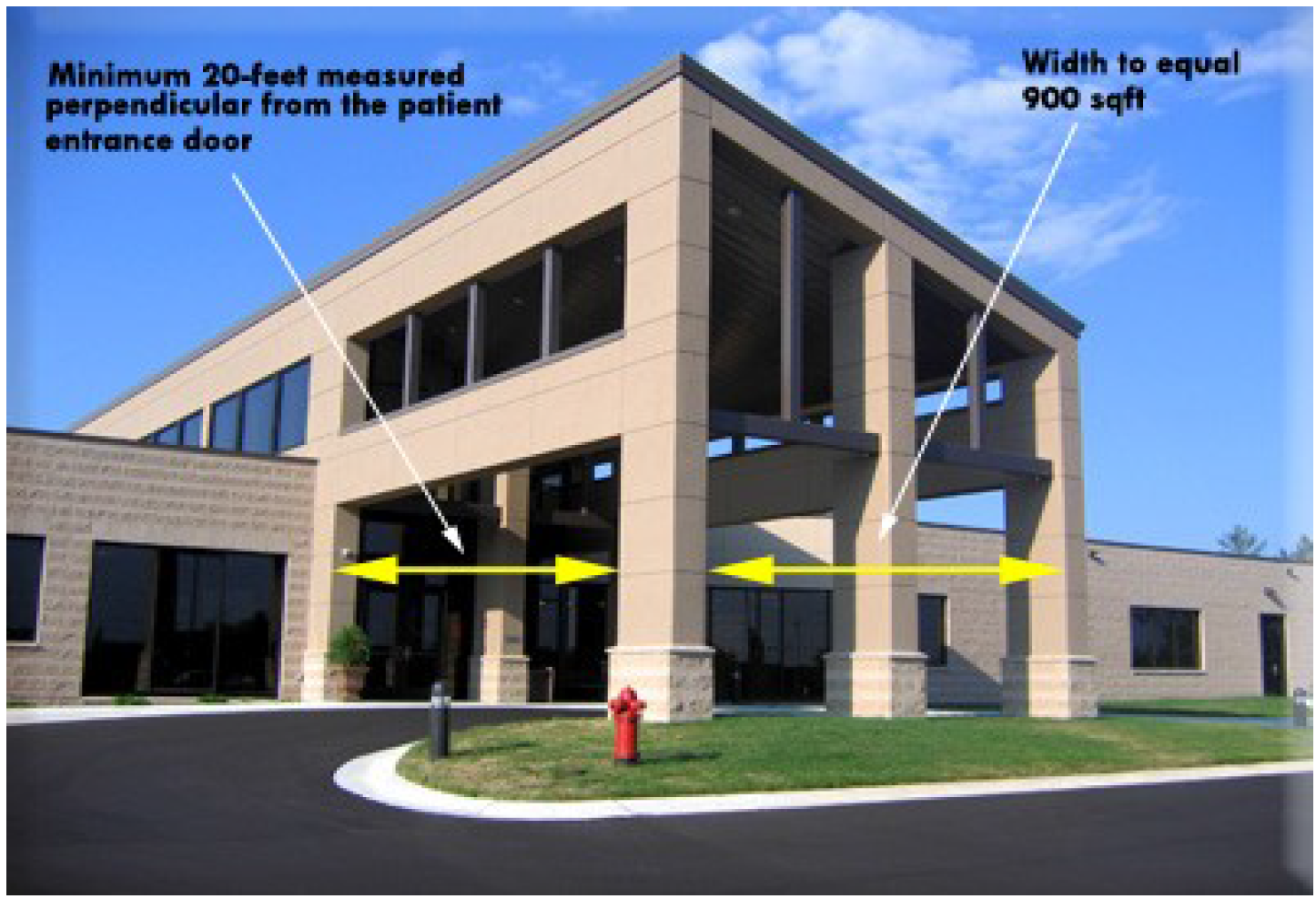
FIGURE 11-31-15.B: PATIENT ENTRANCES
B.
Emergency Room Access. Emergency room access shall be separate and distinct from the patient entrance(s), with directional signage in conformance with the requirements of Article 5. Vehicle access drives leading to the Emergency Room shall be direct from the Street and separated from parking lanes and spaces by intervening buildings, extruded curbs and landscape islands. "See FIGURE 11-31-15.C and 11-31-15.D"
FIGURE 11-31-15.C.1: EMERGENCY ROOM ACCESS

FIGURE 11-31-15.D: EMERGENCY ROOM ACCESS
C.
Storage of Liquid Chemicals and Bulk Materials. Liquid oxygen and other similar materials stored outdoors and in bulk shall be screened from ground-level view by the building, screen wall, or screen walls in combination with landscape materials. If landscape materials are used, the mature height of the plant according to ANA standards may be taken into consideration, provided the size of the tree at planting is a minimum of 36-inch box.
D.
Heliports. "See Figure 11-31-15.A" Heliports associated with a hospital are permitted, and shall be located in a manner to minimize noise impacts on abutting residential uses, according to the following preferences:
1.
First Preference: Ground on side of building opposite any abutting residential areas.
2.
Second Preference: Roof level of building less than the highest point on side of building away from residential areas.
3.
Third Preference: Roof at top of building.
11-31-16: - LARGE COMMERCIAL DEVELOPMENT
Large Commercial Development, as described in Section 11-86-4, buildings shall be located, developed and operated in compliance with the land use regulations in Article 2, and the following standards:
A.
Section 11-6-3 Standards Apply. Large Commercial Development shall comply with all requirements of Section 11-6-3, without regard to minimum Floor Area requirements.
B.
Customer Entrances. All entries designed for general public and customer access to the building shall:
1.
Be clearly visually distinctive from the remainder of the building, and be readily visible from the public Street;
2.
Include an extended foundation base to provide a customer drop-off area of a minimum 900 square feet, extending a minimum 20-feet measured perpendicular from the public entrance door. See Figures 11-31-16.B.2 and 11-31-16.B.2.2; and
3.
Comply with the requirements of Section 11-30-8, Pedestrian Connections and Section 11-32-4(G)3, Pedestrian Access regarding all pedestrian connections within parking areas to other buildings on site, to the public Street, and to transit stops or stations.
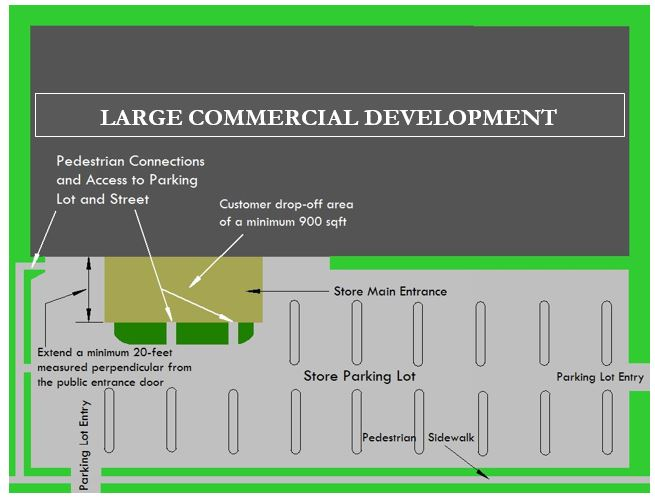
FIGURE 11-31-16.B.2: STORE ENTRIES
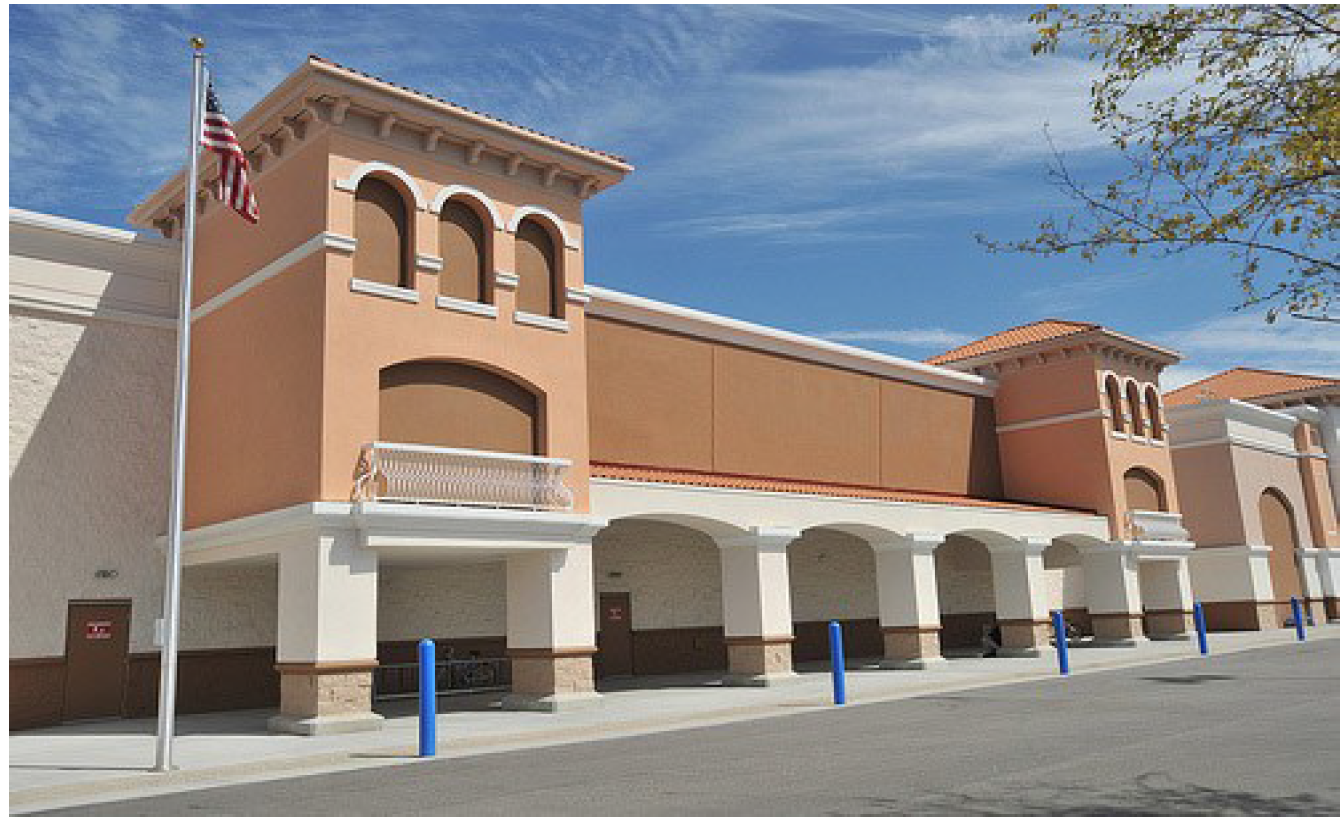
FIGURE 11-31-16.B.2.2: STORE ENTRIES
C.
Large Commercial Development in "-U" Designated Areas. In addition to the development standards specified in Section 11-6-43, Large Commercial Development buildings located in "-U" designated areas shall comply with the following requirements:
1.
Number of Store Entries. Buildings greater than 200-feet wide shall provide a minimum of 2 public entries to the store building. Store buildings greater than 300-feet wide shall provide public entries from the Street at a ratio of 1 entry for every 150 linear feet of building width. Public entries shall have a minimum separation of 50-feet between entries.
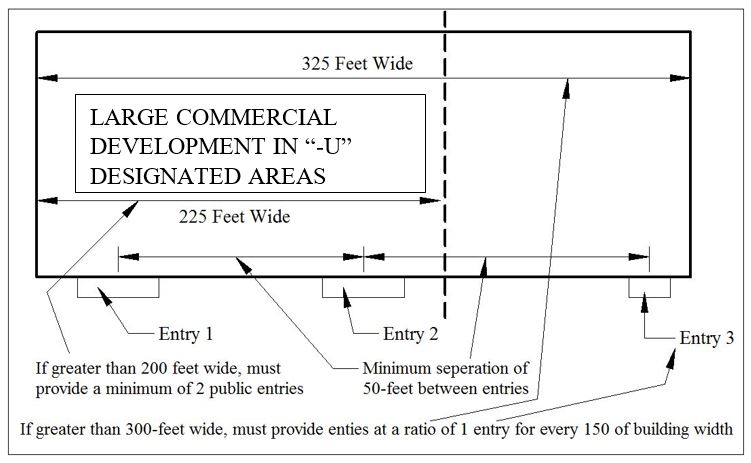
FIGURE 11-31-16.C.1: NUMBER OF STORE ENTRIES
2.
Maximum Setback Standard. The ground level of a building or buildings shall be placed no further back than the maximum Setback for a minimum of 65 percent of the width of the building.
3.
Corner Properties. Where a property fronts on 2 or more Streets, the building shall be placed at the maximum Setback or closer to the Street Right-Of-Way on 2 sides for at least 65 percent of the building width on one Street side, and for 50 percent of the building width on the second side. For lots fronting more than 2 Streets, this requirement shall be met along the frontage of the two Streets with the highest functional classification identified in the Mesa Transportation Plan. If all Streets adjacent to the property have the same functional classification, the developer shall choose which 2 Street frontages apply.
D.
Criteria for Review of Council Use Permit. When required, the review of the Council Use Permit for a Large Commercial Development shall include a review and determination regarding the following items:
1.
The use is found to be in compliance with the General Plan and other recognized development plans or policies, and will be compatible with surrounding uses; and
2.
A finding that a plan of operation has been submitted, which includes, but is not limited to, acceptable evidence of compliance with all zoning, building, and fire safety regulations; and
3.
A finding that a "good neighbor policy" in narrative form has been submitted, which includes, but is not limited to, descriptions of acceptable measures to ensure ongoing compatibility with adjacent uses. Such policies shall include, but are not limited to, the name and telephone number of the manager or person responsible for the operation of the facility; complaint response procedures, including investigation, remedial action, and follow-up; and litter control measures; and
4.
Evidence that acceptable documentation is present demonstrating that the building or site proposed for the use is in, or will be brought into, substantial conformance with all current City development standards, including, but not limited to, Landscaping, parking, screen walls, signage, and design guidelines; and
5.
Evidence that acceptable documentation is present demonstrating that the building or site proposed for the use shall adequately provide paved parking and on-site circulation in a manner that minimizes impacts on adjacent sites; and existing or proposed improvements to the site shall minimize dust, fugitive light, glare, noise, offensive smells and traffic impacts on neighboring residential sites.
(Ord. No. 5544, § 10, 12-9-19; Ord. No. 5928, § 21, 2-3-25)
11-31-17: - LIVE/WORK UNITS
Live-Work Units, as described in Section 11-86-4, shall be located, developed, and operated in compliance with the land use regulations in Article 2 and the following standards:
A.
Establishment. Live/Work Units may be established through new construction or through the conversion of existing commercial or industrial buildings that were designed, constructed and received an occupancy permit for such non-residential uses. See Figure 11-31-17.A.
B.
Allowable Uses. Work activities in Live/Work Units are limited to uses as permitted in the base Zoning District in which the Live/Work Units are located.
C.
Sale or Rental of Portions of Unit Prohibited. No portion of a Live/Work Unit may be separately rented or sold as a commercial space for a person or persons not living on the premises, or as a residential space for a person or persons not working on the premises.
D.
Floor Area Distribution. At least 30 percent of the net Floor Area of a Live/Work Unit must be designated for work activities. An applicant shall submit a floor plan of all proposed units to the Planning Division to demonstrate compliance with this regulation.
E.
Outdoor Living Area. Common or private on-site Open Space shall be provided for the use of occupants at a rate of at least 150 square feet per Live/Work Unit. This space may be attached to individual units or located on the roof or adjoining the building in a Rear Yard.
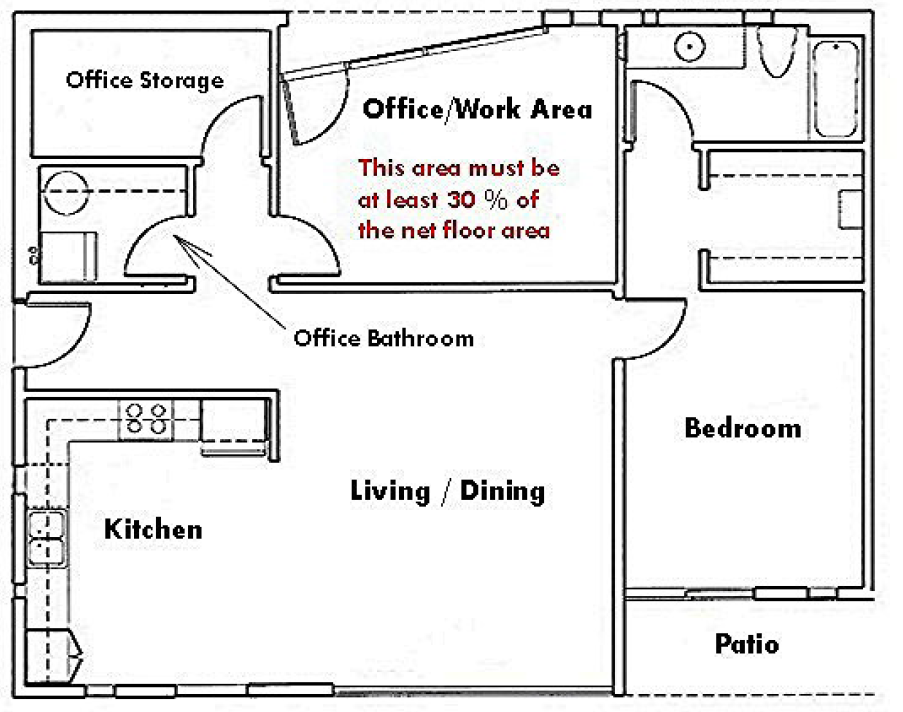
FIGURE 11-31-17.A: LIVE/WORK
11-31-18: - DRIVE-THRU AND PICK-UP WINDOW FACILITIES
Drive-thru Facilities, Pick-up Window Facilities, and Drive-up ATM/Teller Windows as described in Section 11-86-4, shall be located, developed, and operated in compliance with the land use regulations in Article 2 and the following standards:
A.
Purpose. The purpose of this Section is to mitigate potential impacts of Drive-thru Facilities, Pick-up Window Facilities, and Drive-up ATM/Teller Windows, including but not limited to, visual, traffic, and noise impacts, and to ensure that these facilities are developed to enhance the city's urban form.
B.
General Requirements.
1.
A drive-thru lane, pick-up lane, or drive lane serving a Drive-up ATM/Teller Window must be physically separated from non-drive-thru traffic areas or nonpick-up traffic areas with a minimum five (5) foot wide raised landscape median. See Figure 11-31-18.A.
2.
A minimum two (2) foot wide foundation base must be provided along any exterior building wall that is adjacent to a drive-thru lane, pick-up lane, or drive lane serving a Drive-up ATM/Teller Window. See Figure 11-31-18.A.
3.
Awnings or architecturally integrated weather protection structures must be provided over drive-thru windows and pick-up windows. Such awning or weather protection structure must be architecturally integrated in proportion, color, material, and texture to the building it serves.
C.
Onsite Circulation and Stacking Study.
1.
An Onsite Circulation and Stacking Study is required with every application for a new Drive-thru Facility.
2.
Pick-up Window Facilities and Drive-up ATM/Teller Windows are exempt from this requirement.
3.
The Onsite Circulation and Stacking Study shall include the following:
a.
Description of onsite operations including:
i.
Business hours of operation.
ii.
The method by which a customer order is placed and processed.
iii.
Peak demand hours.
iv.
The time required to serve a typical customer.
v.
A description of how sound from external operations will be attenuated from neighboring properties.
b.
Description of onsite traffic activity, including:
i.
Arrival rates of customers.
ii.
Anticipated vehicular stacking required.
iii.
An onsite circulation plan showing points of entry to the site, stacking locations and distances, and anticipated patterns of onsite circulation.
iv.
A mitigation plan describing how backup stacking will be addressed so that vehicles are not blocking internal drives or backing up onto roadways.
v.
An evaluation of uses within 1,200 feet of the proposed development identifying cumulative traffic impacts and mitigation efforts to ensure that vehicles are not blocking internal drives or backing up onto roadways.
c.
Other information deemed necessary by the Planning Director or their designee to review the proposal including additional information to determine whether the proposal has appropriate traffic circulation, and stacking.
D.
Stacking Requirements.
1.
Drive-thru Facilities and Pick-Up Window Facilities. Drive-thru Facilities and Pick-up Window Facilities must conform to the following stacking requirements: A minimum 50-foot-long distance must be provided between the entrance of a drive-thru lane or pick-up lane and a Street access driveway or cross access drive aisle. Distance measured from the entrance of the drive-thru lane or pick-up lane to the Right-Of-Way, property line or edge of Street access driveway or cross access drive aisle. See Figure 11-31-18.A.
2.
Additional Drive-thru Facility Requirements. In addition to the stacking requirement in Subsection (1) above, Drive-thru Facilities must conform to the following stacking requirements:
a.
A minimum 100-foot-long stacking distance must be provided between the drive-thru window and order-placing speaker. Distance measured from the leading edge of the drive-thru window along the centerline of the drive-thru lane to the far edge of the order placing speaker. See Figure 11- 31-18.A.
b.
A minimum 40-foot-long stacking distance must be provided between the order-placing box and the entry to a drive-thru lane. Distance measured from the leading edge of the order-placing box along the centerline of the drive-thru lane to the entrance of the drive-thru lane. See Figure 11-31-18.A.
3.
Additional Pick-up Window Facility Requirements. In addition to the stacking requirements in Subsection (1) above, Pick-up Window Facilities must conform to the following stacking requirements: A minimum 100-foot-long stacking distance must be provided between the pick-up window and the entrance of the pick-up lane. Distance measured from the leading edge of the pick-up window along the centerline of the pick-up lane to the entrance of the pick-up lane.
4.
Drive-Up ATM/Teller Window Requirements. A minimum 40-foot-long stacking distance must be provided for each Drive-up ATM/Teller Window. Distance measured from the leading edge of the ATM/Teller window along the centerline of the stacking lane to the entry of the stacking area.
5.
Modifications to Stacking Requirements. Modifications to the stacking requirements found in this Section may be approved through the site plan review process if the Planning Director or their designee determines, based on the Onsite Circulation and Stacking Study, that the proposed modifications to the stacking requirements are sufficient to meet the demands of the development, including the traffic circulation, and stacking demands.
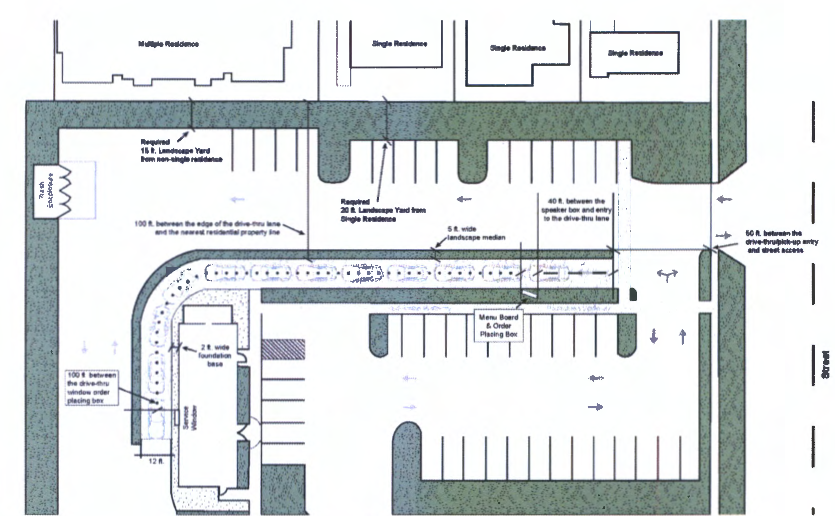
FIGURE 11-31-18.A DRIVE-THRU AND PICK-UP FACILITIES
E.
Screening/Buffering Requirements. Drive-thru Facilities, Pick-up Window Facilities, and Drive-up ATM/Teller Windows shall conform to the following Screening requirements:
1.
A drive-thru lane or pick-up lane is not permitted to be located parallel to arterial roadways. Where physical site conditions prevent a non-parallel configuration, the drive-thru lane or pick up lane must conform to the required Landscaping per Table 11-33-3.A.4 and provide either:
a.
A 40-inch-high screen wall adjacent to the arterial roadway that extends the entire length of the drive-thru lane or pick-up lane, along with two (2) additional trees per 25 feet of linear Street frontage, and two (2) additional shrubs per 25 feet of linear Street frontage; or
b.
An architecturally integrated awning, canopy, or trellis system that covers and screens the entire drive-thru lane or pick-up lane from the Street, one (1) additional tree per 25 feet of linear Street frontage, and two (2) additional shrubs per 25 feet of linear Street frontage.
2.
Separation from Residential Uses and Residential Districts.
a.
A 100-foot distance must be provided between the drive-thru lane or pickup lane and any residential use or property zoned with a Residential District (i.e., RS, RSL, RM).
b.
The Planning Director, or their designee, may approve a distance less than 100 feet if a sound study submitted by the applicant demonstrates that the drive-thru noise level at the property line will not exceed 60 dB.
c.
If the ambient noise level exceeds 60 dB, the noise study must demonstrate that the Drive-thru Facility will not increase the existing noise level.
d.
Distance shall be measured from the far edge of the drive-thru lane to the property line containing the residential use or property zoned with a Residential District.
F.
Employee Protection Requirements. Drive-thru Facilities whose operations include employees who take orders outside of the eating establishment must provide a raised two (2) foot wide pedestrian path and an architecturally compatible shade structure along the area in which employees are staged and take orders.
(Ord. No. 5544, § 11, 12-9-19; Ord. No. 5813, § 2, 10-16-23)
11-31-19: - OUTDOOR EATING AREAS
Outdoor eating areas in conjunction with an eating and drinking establishment, as described in Section 11-86-4, shall be located, developed, and operated in compliance with the land use regulations in Article 2 and the following standards:
A.
Downtown Core, Form Based Code Transect, Commercial District with a "-U" Designation.
1.
Location. Within the Downtown Core District (DC), Form Based Code Transect Districts, and any Commercial District with a "-U" Designation, an outdoor eating area is permitted only in the following locations:
a.
Within the buildable area of the lot; or
b.
Within the Right-Of-Way, on a public Sidewalk, provided a minimum six (6) foot wide contiguous portion of the public Sidewalk remains unobstructed for pedestrian use. Review and approval of an encroachment permit by the City Engineer is required for any outdoor eating area located on a public Sidewalk.
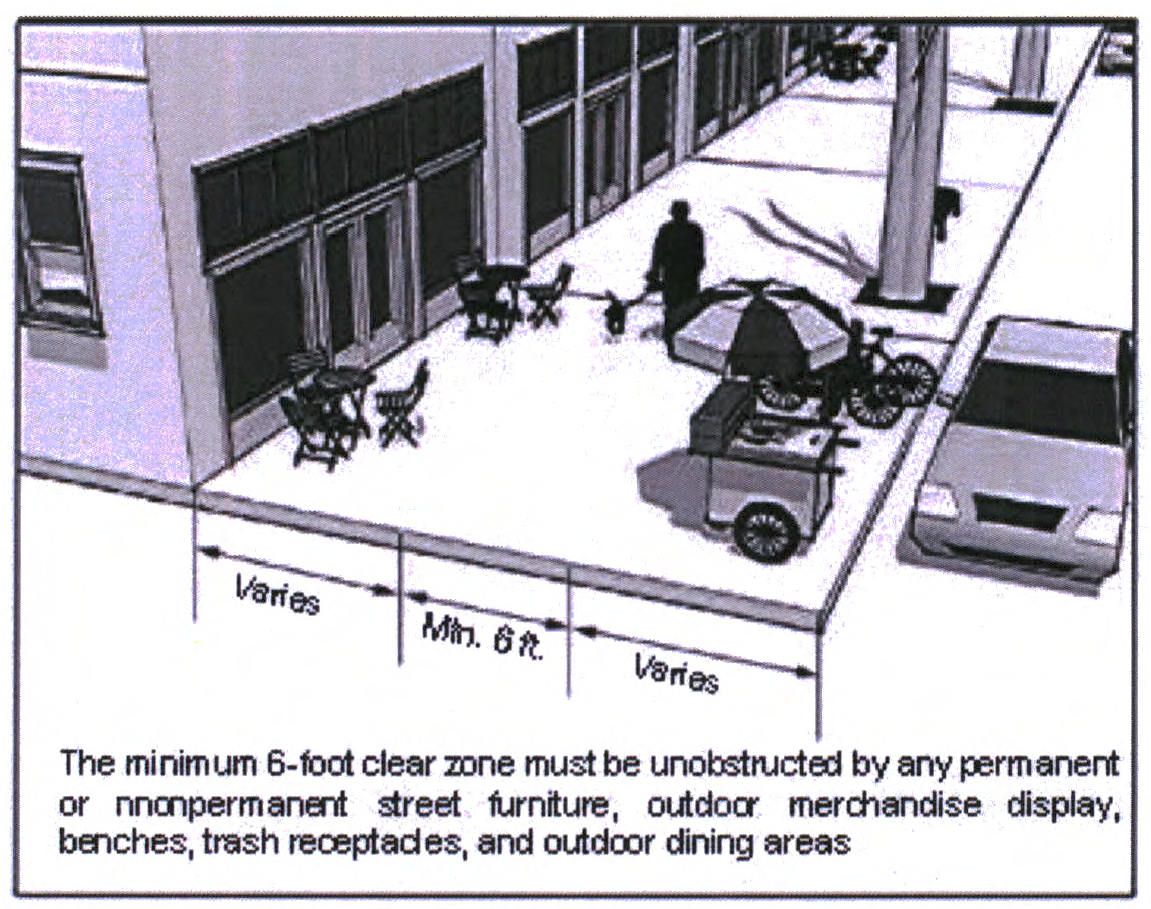
FIGURE 11-31-19.A.1: OUTDOOR EATING
ALL OTHER ZONING DISTRICTS
B.
All other Zoning Districts.
1.
Locations. In all other Zoning Districts in which an outdoor eating area is permitted, an outdoor eating area is permitted only in the following location:
a.
Within the buildable area of the lot; or
b.
The outdoor eating area may encroach up to one-half the depth of a Street-side landscape yard and may encroach into the required foundation base area as long as a minimum five (5) foot contiguous pedestrian walkway remains unobstructed for pedestrian use.
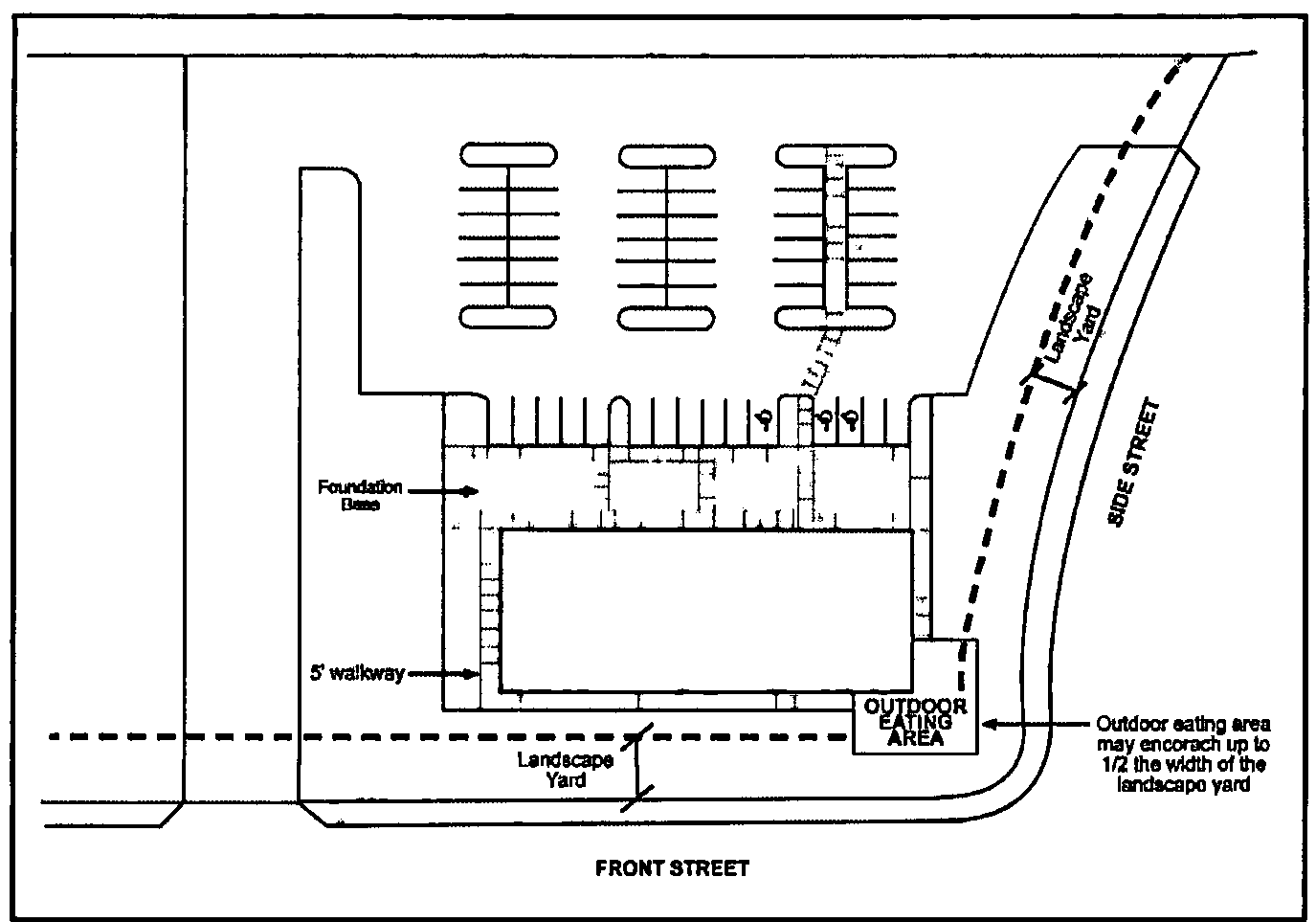
FIGURE 11-31-19.A.2: OUTDOOR EATING
AREAS
C.
Outdoor eating area barriers. Barriers are meant to demarcate the section provided for an outdoor eating area, for both temporary and permanent outdoor eating areas. Barriers, such as but not limited to, fencing, decorative planters, or other architectural enclosures of the outdoor eating area, must comply with the following standards.
1.
Applicability. Barriers must be provided at the following outdoor eating areas:
a.
Outdoor eating areas with more than four (4) tables or more than eight (8) seats unless approved through an encroachment permit.
b.
Outdoor eating areas with alcohol service.
2.
Barrier height. An outdoor eating area barrier within the Right-Of-Way or within the required front Setback may have a maximum height of 42 inches.
3.
Design. Outdoor eating area barriers shall consist of durable, high-quality materials, shall compliment the architecture of the building which they serve, and adhere to any design guidelines established for the area in which the eating and drinking establishment is located.
4.
Prohibited barriers. Outdoor eating area barriers may not be constructed with chain link fencing, chicken wire, cyclone fencing, sway ropes, fabric, or canvas.
D.
Fixtures. Fixtures, such as but not limited to, furniture, awnings, umbrellas, planters, heaters, lighting fixtures, enclosure legs or supports, may be used in conjunction with an outdoor eating area and must comply with the following standards:
1.
Location. Fixtures shall not be located or project beyond the outdoor eating area barrier, if present. Fixtures shall not encroach into the pedestrian walkway.
2.
Overhead fixtures. Permanent, attached shade structures must be adequately secured and shall comply with the provisions of the Mesa Building Code, Title 4 of the Mesa City Code.
3.
Refuse storage area. Trash receptacles and enclosures must comply with Section 11-30-12 and may not be located within the Right-Of-Way unless approved through an encorachment permit.
E.
Signage. Signs associated with outdoor eating areas must comply with the Mesa Sign Ordinance and may not be located within the Right-Of-Way in accordance with Section 11-45-1: Prohibited Signs.
(Ord. No. 5758, § 2, 12-8-22)
11-31-20: - OUTDOOR DISPLAY
Outdoor display, as described in Chapter 87, shall be located, developed, and operated in compliance with the land use regulations in Article 2 and the following standards:
A.
An outdoor display is permitted only in conjunction with a lawfully established primary business.
B.
An outdoor display shall only contain goods sold by the primary business.
C.
Location. An outdoor display shall be located adjacent to the front facade of the primary business.
1.
Multi-tenant building. When located outside of a multitenant building, an outdoor display shall not extend beyond the tenant frontage of the primary business.
2.
Downtown Core. When located within the Downtown Core (DC) Zoning District, an outdoor display may be located within the Right-Of-Way, on a public Sidewalk, provided a minimum six (6) foot wide contiguous portion of the public Sidewalk remains unobstructed for pedestrian use.
3.
An outdoor display may not be located within landscape areas, parking lots, drive-aisles, loading zones, or fire lanes.
D.
Hours of operation. Outdoor displays may only operate during the hours of operation of the primary business. All structures, signs, equipment, and displays associated with an outdoor display must be stored indoors at all times when the primary business is closed to the public, unless the outdoor display is permitted as a permanent location on an approved site plan.
(Ord. No. 5759, § 3, 12-8-22)
Editor's note— Ord. No. 5759, § 3, adopted December 8, 2022, repealed the former § 11-31-20, and enacted a new § 11-31-20 as set out herein. The former § 11-31-20 pertained to outdoor retail sales.
11-31-21: - PAWN SHOPS
Pawn Shops, as described in Section 11-86-4, shall be located, developed, and operated in compliance with the land use regulations in Article 2 and the following standards:
A.
License required. A pawn broker license issued pursuant to Title 5, Chapter 7 of the Mesa City Code is required, or evidence of current and/or future compliance with all requirements of Mesa City Code Title 5, Chapter 7 pertaining to the issuance of a pawn broker's license.
B.
Location.
1.
Minimum distance from another pawn shop: 1,200 feet. Minimum distance from a public or private school: 1,200 feet.
2.
Exceptions to the 1,200 foot separation requirement may be approved by the City Council upon a finding that there are significant intervening physical features, such as arterial Street, canals, parks, or similar buffering features or developments, between a proposed pawn shop and an existing pawn shop or Public or Private School.
C.
Criteria for Review of Council Use Permit. The review of the Council Use Permit shall include a review and determination regarding the following items:
1.
The use is found to be in compliance with the General Plan and other recognized development plans or policies, and will be compatible with surrounding uses; and
2.
A finding that a plan of operation has been submitted, which includes, but is not limited to, acceptable evidence of compliance with all zoning, building, and fire safety regulations; and
3.
A finding that a "good neighbor policy" in narrative form has been submitted, which includes, but is not limited to, descriptions of acceptable measures to ensure ongoing compatibility with adjacent uses. Such policies shall include, but are not limited to, the name and telephone number of the manager or person responsible for the operation of the facility; complaint response procedures, including investigation, remedial action, and follow-up; and litter control measures; and
4.
Evidence that acceptable documentation is present demonstrating that the building or site proposed for the use is in, or will be brought into, substantial conformance with all current City Development Standards, including, but not limited to, Landscaping, parking, screen walls, signage, and design guidelines.
5.
Evidence that acceptable documentation is present demonstrating that the building or site proposed for the use shall adequately provide paved parking and on-site circulation in a manner that minimizes impacts on adjacent sites; and existing or proposed improvements to the site shall minimize dust, fugitive light, glare, noise, offensive smells and traffic impacts on neighboring residential sites.
11-31-22: - PLACES OF WORSHIP
Places of Worship, as described in Section 11-86-4, shall be located, developed, and operated in compliance with the land use regulations in Article 2 and the following standards:
A.
Accessory Uses. Accessory uses customarily found in conjunction with Places of Worship, including parish houses, parsonages, rectories, seminaries, classrooms, and convents, are permitted, provided that such Accessory Uses are located on the same lot or contiguous lot with the religious facility.
B.
Athletic Facilities and Day Care Centers. Athletic facilities and day care centers in conjunction with Places of Worship require approval of a Special Use Permit.
C.
Residential Districts. Places of Worship located in residence districts shall:
1.
Locate buildings within the required Setbacks for the building Setbacks specified for that Zoning District;
2.
Comply with design standards for the LC district, unless located within an area designated by the U Character Designator, when it would then comply with LC- U design standards
D.
Building Setback, Building Height, Parking, Landscaping and Screening Standards. Places of Worship shall comply with each of the following:
1.
The building Setback and Building Height requirements established by the Zoning District for which the Places of Worship is located; unless modified as a Building Height exception pursuant to Section 11-30-3.
2.
Landscaping and Screening requirements as specified for a LC development, pursuant to Section 11-30-9 and Chapter 33. In the event character designators "-U" or "-A" are established for the Places of Worship site, the development standards associated with such character designators shall also apply. site, the development standards associated with such character designators shall also apply.
3.
All parking requirements specified in Chapter 32.
11-31-23: - RECYCLING COLLECTION AND PROCESSING FACILITIES
A.
Recycling Collection Facilities, as described in Section 11-86-5 shall be located pursuant to the requirements of Article 2, and developed and operated in compliance with the following standards:
1.
Location. The facility must be established in conjunction with an existing commercial use or community service facility and not obstruct pedestrian or vehicular circulation.
2.
Minimum Distance from an R (RS, RSL or RM) Zones shall be 100 feet.
3.
Maximum Size:
a.
Small Indoor Collection Facility shall occupy no more than 1000 square feet of space.
b.
Reverse Vending Machines shall occupy no more than 350 square feet of space
4.
Power-Driven Equipment. Power-driven processing equipment, except for reverse vending machines, is not permitted.
5.
Storage Container. All recyclable material must be stored in containers. Materials may not be left outside of containers. Containers shall be stored within an enclosed building, when required by the Zoning District. For reverse vending machines, such containers shall be stored within the machine.
6.
Maintenance. Facilities must be maintained free of litter and any other undesirable materials, and mobile facilities for which truck or containers are removed at the end of the collection day, must be swept at the end of the collection day.
7.
Required Container Information. Containers shall be clearly marked to identify the type of materials that may be deposited; the facility shall be clearly marked to identify the name and telephone number of the facility operator and the hours of operation, and display a notice stating that no material shall be left outside of the building or reverse recycling machine.
8.
Reduction of Parking. Occupation of parking spaces by a reverse vending facility and by the attendant (if present) may not reduce available parking spaces below the minimum number required for the site.
B.
Recycling Processing Facilities shall be located pursuant to the requirements of Article 2, and developed and operated in compliance with the following standards:
1.
Operation—Fence, Wall or Enclosed Building Required. All operations and storage, including all equipment used in conducting such use, other than parking, shall be conducted within an enclosed building or within an area enclosed by a solid wall or solid Fence.
2.
Specifications for Walls and Fences.
a.
All Fences and walls shall be of a uniform height, and shall be a minimum of eight feet and shall not exceed 15 feet in height. Where Fences or walls exceed a height of 10 feet and are located on Street or highway frontages, they shall be set back at least three feet from the Lot Line. The area between the Fence and the Lot Line shall be fully landscaped according to the specifications described in this section.
b.
All Fences and walls open to view from any Street or highway or any area in a residential, agricultural or commercial zone shall be constructed of the following materials:
i.
Metallic panels, at least .024 inches thick, painted with a "baked on" enamel or similar permanent finish;
ii.
Masonry;
iii.
Other materials comparable to the foregoing if approved by the Director.
c.
Other required Fences may be constructed of material other than as specified above.
d.
All Fences and walls shall be constructed in workmanlike manner and shall consist solely of new materials unless the Director approves the substitution of used materials where, in his opinion, such used materials will provide the equivalent in service, appearance and useful life.
e.
All Fences and walls, excluding masonry and approved permanent-finish panels, shall be painted a uniform, neutral color, excluding black, which blends with the surrounding terrain, and improvements shall be maintained in a neat, orderly condition at all times. Such Fence or wall shall contain no painted signs or posters except as approved by the Director.
f.
Modifications, When Authorized. The Director may modify Fences or walls not exposed to view from any Street or highway or any area in a residential, agricultural or commercial zone:
i.
Where an adjoining lot is located within a GI zone, and is developed with an automobile dismantling yard, junk and salvage yard, scrap metal processing yard, or other open storage use displaying similar characteristics; or
ii.
Where substantial Fences, walls or buildings on abutting properties serve to enclose such yard as well or better than the required wall or Fence. Should the use, Fence, wall or building providing justification for such modification be removed, a new wall or Fence shall be provided in compliance with this section within six months from the date of such removal.
C.
Paving of Yards. All areas of the yard open to vehicular passage shall be paved with an asphalt surfacing or an oil and aggregate mixture to prevent emission of dust or tracking of mud onto public Rights-Of-Way; provided, however, the Director may approve other paving materials which provide, in his opinion, the equivalent in service and useful life.
D.
Storage Limitations.
1.
Salvage or junk shall not be placed or allowed to remain outside of the enclosed yard area, but may be stored above the height of the Fence or wall, provided such storage is not within 10 feet of an exterior Lot Line.
2.
Where the land upon which the yard is located is in a GI zone, and such storage above said Fence or wall is not within 500 feet of any different Zoning District other than a GI zone, the 10-foot Setback shall not apply.
11-31-24: - SCHOOLS
Schools, as that term is defined in Section 11-86-3 shall be located, developed, and operated in compliance with the land use regulations in Article 2 and the following standards:
A.
Accessory Uses. Accessory uses customarily found in conjunction with schools, including classrooms, dormitories, stadiums, and auditoriums are permitted provided such Accessory Uses are located on the same lot or contiguous lot with the school.
B.
Building Setback, Building Height, Parking, Landscaping and Screening Standards. Schools shall:
1.
Comply with the building Setback and Building Height requirements established by the Zoning District for which the School is located; unless modified as a Building Height exception pursuant to Section 11-30-3;
2.
Comply with Landscaping and Screening requirements as specified for a LC development, pursuant to Chapters 6 and Chapter 33; and
3.
Comply with all parking requirements specified in Chapter 32.
4.
In the event the school is located in a Downtown, Mixed or "-U" designated district, Section 11-6-4, Special Standards for Districts with "-U" Character Designator shall apply rather than Section 8-6-3.
11-31-25: - SERVICE STATIONS
Service Stations, as described in Section 11-86-4, shall be located, developed, and operated in compliance with the land use regulations in Article 2 and the following standards:
A.
Location. Maximum number of service stations permitted at an arterial intersection is total of 2.
B.
Minimum Frontage. 100 feet on each Street.
C.
Pump Canopy. Pump islands shall be covered by a canopy that matches or complements the design of the main structure.
D.
Landscaping. Landscaping shall comprise a minimum 10 percent of the site area, exclusive of required Setbacks, and include an irrigation system that is permanent, below- grade, and activated by automatic timing controls.
E.
Fencing. Masonry only.
F.
Lighting. All exterior light sources, including canopy, perimeter, and flood, shall be stationary, and shielded or recessed within the roof canopy to ensure that all light is directed away from adjacent properties and public Rights-Of-Way. No lens of any lighting fixture may extend below the shielding device. Lighting shall not be of a high intensity so as to cause a traffic hazard, be used as an advertising element, or adversely affect adjacent properties.
G.
Litter. A minimum of 1 permanent, non-flammable trash receptacle shall be installed at each pump island.
H.
Urban Character Designator Design Standards. When located in a "-U" designated district, the main structure containing the office, cashier, retail shop and/or other services shall be placed between the pump canopy and the Street Right-Of-Way no further back from the property line than the maximum Setback. When located on a corner, the Street with the higher functional classification shall be used to determine compliance with this requirement.
I.
Criteria for Review of Special Use Permit. When required, the review of the Special Use Permit for a Service Station shall include a review and determination regarding the following items:
1.
The use is found to be in compliance with the General Plan, applicable Sub Area Plans, and other recognized development plans or policies, and will be compatible with surrounding uses; and
2.
A finding that a plan of operation has been submitted, which includes, but is not limited to, acceptable evidence of compliance with all zoning, building, and fire safety regulations; and
3.
A finding that a "good neighbor policy" in narrative form has been submitted, which includes, but is not limited to, descriptions of acceptable measures to ensure ongoing compatibility with adjacent uses, including sound attenuation, lighting control measures, and vehicular access and traffic control. Such policies shall include, but are not limited to, the name and telephone number of the position, manager or person responsible for the operation of the facility; complaint response procedures, including investigation, remedial action, and follow-up; and litter control measures; and
4.
Evidence that acceptable documentation is present demonstrating that the building or site proposed for the use is in, or will be brought into, substantial conformance with all current City Development Standards, including, but not limited to, Landscaping, parking, screen walls, signage, and design guidelines.
5.
Evidence that acceptable documentation is present demonstrating that the building or site proposed for the use shall adequately provide paved parking and on-site circulation in a manner that minimizes impacts on adjacent sites; and existing or proposed improvements to the site shall minimize dust, fugitive light, glare, noise, offensive smells and traffic impacts on neighboring residential sites.
11-31-26: - SOCIAL SERVICE FACILITIES
Social Service Facilities, as described in Section 11-86-3 shall be located, developed, and operated in compliance with the land use regulations in Article 2 and the following standards:
A.
Location. Social Service Facilities are not allowed on Main Street, within the designated Town Center Redevelopment Area.
B.
Minimum Standards. All Social Service Facilities shall provide: adequate and accessible sanitary facilities, including lavatories, rest rooms and refuse containers; sufficient patron seating facilities for dining, whether indoor or outdoor; effective Screening devices such as Landscaping and masonry Fences in conjunction with outdoor activity areas; a plan of operation, including but not limited to, patron access requirements, hours of operation, measures used to control potential client congregation on the site during non-operating hours, security measures, litter control, and noise attenuation. Further, evidence of compliance with all Building and Fire Safety regulations and any other measures determined by the City Council to be necessary and appropriate to ensure compatibility of the proposed use or uses with the surrounding area shall be provided with permit applications.
C.
Applicable Guidelines. All Social Service Facilities are subject to the Social Service Facilities Guidelines adopted by the City.
D.
Criteria for Review of Council Use Permit. When required, the review of the Council Use Permit shall include a review and determination regarding the following items:
1.
The use is found to be in compliance with the General Plan, Sub Area Plans and other recognized development plans or policies, including the Social Service Facility Guidelines and will be compatible with surrounding uses; and
2.
A finding that a plan of operation has been submitted, which includes, but is not limited to, acceptable evidence of compliance with all zoning, building, and fire safety regulations; and
3.
A finding that a "good neighbor policy" in narrative form has been submitted, which includes, but is not limited to, descriptions of acceptable measures to ensure ongoing compatibility with adjacent uses. Such policies shall include, but are not limited to, the name and telephone number of the manager or person responsible for the operation of the facility; complaint response procedures, including investigation, remedial action, and follow-up; and litter control measures; and
4.
Evidence that acceptable documentation is present demonstrating that the building or site proposed for the use is in, or will be brought into, substantial conformance with all current City Development Standards, including, but not limited to, Landscaping, parking, screen walls, signage, and design guidelines.
11-31-27: - SPECIAL EVENTS
A.
Special events as defined in Chapter 87 of this Title are permitted in all Zoning Districts, provided that:
1.
The event is licensed in accordance with the provisions of Title 5 of the Mesa City Code;
2.
The duration of the event does not exceed the time period specified in the special event license or a maximum of 4 consecutive days, whichever is less;
3.
No more than 4 events are conducted on the same premises during the calendar year;
4.
The site of the event is adequately served by utilities and sanitary facilities; and
5.
The event will not present a safety hazard or public disturbance and will not cause substantial adverse impacts on surrounding properties or land uses by creating excessive noise, glare, heat, dust, odors, or pollutants as determined by the Director and Fire Marshal.
B.
Special events shall be conducted only on a lot that has an approved dust proof parking surface with permanent driveway access. Decomposed granite or Aggregate Base Course (ABC) gravel surfacing may be substituted for paving subject to approval by the Director and Fire Marshal.
C.
Facilities, structures, and utilities shall be installed and maintained in conformance with all applicable building, fire, traffic, and zoning regulations.
D.
The maximums specified in subsections A(2) and (3) of this Section may be exceeded:
1.
Outside of the Downtown Events Overlay District. Only as authorized by approval of a Temporary Use Permit or Special Use Permit in accordance with Article 7 of this Ordinance.
2.
Within the Downtown Events Overlay District. Without limit to the number of events that may occur in a calendar year. Individual events that exceed the maximum of four (4) days per event shall require a Special Use Permit in accordance with Article 7 of this Ordinance.
(Ord. No. 5759, § 4, 12-8-22)
11-31-28: - ASSISTED LIVING CENTERS, NURSING AND CONVALESCENT HOMES
Assisted living centers and nursing and convalescent homes as defined in Section 11-86-2, shall be located, developed, and operated in compliance with the land use regulations in Article 2 and the following standards:
A.
General Requirements
1.
Distance from a Major Intersection. The assisted living center or nursing and convalescent home must be located a minimum distance of 600 feet from the following intersections, as measured in accordance with the rules of measurement in Section 11-2-3(C):
a.
Highway and arterial Street;
b.
Highway and collector Street;
c.
Arterial Street and arterial Street; or
d.
Arterial Street and collector Street.
2.
Separation from Similar Uses. The assisted living center or nursing and convalescent homes must be separated a minimum distance of 1,200 feet from the closest assisted living center, nursing and convalescent home, or community residence as measured in accordance with Section 11-2-3(C), unless separated by a significant intervening natural or manmade feature, such as a municipal Open Space of at least ten (10) acres in size (e.g. park, golf course, etc.), a railroad, or a highway, that is approved by the zoning administrator.
3.
Licensure. The assisted living facility or nursing and convalescent home must obtain the license the State of Arizona requires to operate the proposed use. A copy of the state issued license must be submitted with the applicant's registration application or within 30 days from the date the license for the proposed use is issued.
4.
Registration. The assisted living center or nursing and convalescent home must register with the City as set forth in this section.
A.
Registration process for assisted living centers and nursing and convalescent homes that do not require a conditional use permit. To register with the City, when the assisted living center or nursing and convalescent home does not require a council use permit to operate, the applicant must submit the City's registration application in accordance with Section 11-67 and provide evidence demonstrating compliance with this section. If the facility complies with all City requirements, the applicant will receive provisional registration approval from the planning division. To obtain final registration, the applicant must provide to City a copy of the state issued license required in Section 11-31-28(a)(3) above within 30 days from the date of issuance.
B.
Assisted living center and nursing and convalescent homes that require a council use permit. To register with the City, when the assisted living center or nursing and convalescent home requires a council use permit to operate, the applicant must submit the City's application for a council use permit in accordance with Section 11-67 and provide evidence demonstrating compliance with this section. The request for a conditional use permit will be reviewed by the applicable governing body. Approval of the conditional use permit grants the applicant provisional registration approval. To obtain final registration approval, the applicant must provide to City a copy of the state issued license required in Section 11-31-28(a)(3) above within 30 days from the date of issuance.
5.
The assisted living center or nursing and convalescent home must comply with all applicable federal, state, county, and local requirements for the location and operation of the facility.
6.
The assisted living center or nursing and convalescent home must provide adequate access for emergency vehicles.
B.
Council Use Permit Criteria. When a proposed assisted living center or nursing and convalescent home is required to obtain a council use permit, the council use permit will only be granted if the governing body finds that the use conforms to the criteria in Section 11-70-6 of the Mesa Zoning Ordinance and all of the following criteria:
1.
The proposed use in combination with any existing assisted living facilities, nursing and convalescent homes or group homes for the handicapped will not alter the character of the area by creating or intensifying an institutional atmosphere or by creating or intensifying a de facto social service district by clustering assisted living facilities, nursing and convalescent homes or group homes for the handicapped in a particular area; and
2.
The proposed use in combination with other existing assisted living facilities, nursing and convalescent homes, group homes for the handicapped and other land uses that typically generate higher calls for service to the fire department, will not overburden or have an adverse impact on the city's fire department or the fire district where the proposed use will be located; and
3.
Whether the location and operational characteristics of the proposed use will have an adverse impact on vehicular traffic and other public facilities and services.
(Ord. No. 5592, § 5, 12-1-20; Ord. No. 5632, § 3, 7-8-21)
11-31-29: - TEMPORARY PARKING LOTS
A.
Stadiums, performing arts centers, competitive aquatics facilities, and similar public event facilities, with a required parking count of at least 300 spaces, are permitted to utilize temporary or overflow parking lots in DB-1, DB-2 and DC districts, subject to the issuance of a Special Use Permit, in accordance with Article 7 of this Ordinance.
B.
A Special Use Permit may be approved for a Temporary Parking Lot that:
1.
Has an approved dust-proofed surface;
2.
Is screened from an adjacent residential use by an opaque Fence or similar feature at least 6 feet in height;
3.
Has lighting that is fully screened to prevent light spillover onto adjacent properties, if lighting is provided on the temporary parking lot;
4.
Is located within 1,200 feet of the public facility being served. The 1,200 feet shall be measured directly from the nearest edge of the property lines between the proposed temporary parking lot and the public event facility;
5.
Is in conformance with City Council policies; and
6.
Is compatible with, and not detrimental to, adjacent properties or the neighborhood in general.
C.
Conditions of approval may be stipulated by the Zoning Administrator or Board of Adjustment to ensure compatibility with adjacent land uses.
11-31-30: - TEMPORARY USES
A.
Temporary outdoor sales. Temporary outdoor sales, as described in Section 11-86-9, requires approval of a temporary use permit in compliance with Section 11-70-4 and must be located, developed, and operated in compliance with the land use requirements in Article 2 and subject to the requirements in this section.
1.
Placement in the Downtown Core and Form Based Code Transect Districts. Temporary outdoor sales, including associated temporary displays and structures, may occur within the Right-Of-Way, on a public Sidewalk, provided a minimum six (6) foot wide contiguous portion of the public Sidewalk remains unobstructed for pedestrian use.
2.
Placement in all other Zoning Districts. Temporary outdoor sales, including associated temporary displays and structures, may not occur within or encroach into driveways, landscape areas, parking spaces required for the primary use, within Right-Of-Way, or within 25 feet of a Street.
3.
Temporary structures. A temporary structure such as a tent, pop-up, umbrella or covering, measuring over 400 square feet requires the issuance of a building permit and approval by the Fire Marshal.
4.
Signs. All signs associated with a temporary outdoor sale must comply with Title 11, Article 5: Sign Ordinance and must be removed upon cessation of the temporary use or upon expiration of the temporary use permit, whichever occurs first.
5.
Hours of operation. A temporary outdoor sale may only operate between 9:00 a.m. and 10:00 p.m. all temporary structures, signs, equipment, and display of merchandise associated with the temporary outdoor sale must be removed from the site or otherwise stored in enclosed buildings at all times when the temporary outdoor sale is closed to the public.
6.
Discontinuance of use. All temporary structures, equipment, temporary signs, and display of merchandise associated with the temporary outdoor sale must be removed from the site upon cessation of the temporary use or upon expiration of the temporary use permit, whichever occurs first.
7.
Site restoration. The site must be restored to the same condition it was prior to commencement of the temporary outdoor sale, including but not limited to, the removal of all debris, litter, and other evidence of the temporary outdoor sale, within 72 hours of cessation of the temporary outdoor sale or upon expiration of the temporary use permit, whichever occurs first.
B.
Temporary outdoor entertainment. Temporary outdoor entertainment, as described in Section 11-86-9, requires approval of a temporary use permit in compliance with Section 11-70-4 and must be located, developed, and operated in compliance with the land use requirements in Article 2 and subject to the requirements in this section.
1.
Placement.
a.
Minimum lot area. A temporary outdoor entertainment may only be located on a site that is a minimum of five (5) acres in size.
b.
Setback from residential uses. All areas, structures, and operational items associated with a temporary outdoor entertainment, such as but not limited to, parking areas, storage areas and structures, stands, stages, tents, restroom facilities, trash receptacles and enclosures, and lighting, must be located at least 250 feet from all residential uses except for residential uses which are a part of an approved mixed-use development.
2.
Duration. A temporary outdoor entertainment is permitted to operate for up to twenty-one (21) consecutive days. An additional three (3) days is allowed before and after the event for set-up and take-down.
3.
Hours of operation. A temporary outdoor entertainment may only operate between 9:00 a.m. and 11:00 p.m.
4.
Signs. All signs associated with a temporary outdoor entertainment must comply with Title 11, Article 5: Sign Ordinance and must be removed upon cessation of the temporary use or upon expiration of the temporary use permit, whichever occurs first.
5.
Site restoration. The site must be restored to the same condition it was prior to commencement of the temporary outdoor entertainment, including but not limited to, the removal of all debris, litter, and other evidence of the temporary outdoor entertainment, within 72 hours of cessation of the temporary outdoor entertainment or upon expiration of the temporary use permit, whichever occurs first.
(Ord. No. 5759, § 5, 12-8-22)
Editor's note— Ord. No. 5759, § 5, adopted December 8, 2022, repealed the former § 11-31-30, and enacted a new § 11-31-30 as set out herein. The former § 11-31-30 pertained to temporary uses: swap meets and farmer's markets.
11-31-31: - RESIDENTIAL USES IN COMMERCIAL DISTRICTS
A.
Residential uses are permitted in the NC, LC, GC, and MX Districts as provided in Section 11-6-2, if located, developed and operated in compliance with the following standards:
1.
Commercial Floor Area Requirements.
a.
Projects with only single-Story buildings. A project that contains only single-Story (1-Story) buildings may include residential if a minimum of 60 percent of the gross Floor Area (GFA) of all the buildings for the project is reserved for commercial uses.
b.
Projects with multiple-Story buildings or a mixture of single-Story (1-Story) and multiple-Story buildings. A project that contains multiple-Story buildings or a mixture of single-Story and multiple-Story buildings may include residential if:
(i)
A minimum of 60 percent of the gross Floor Area (GFA) of all the buildings for the project is reserved for commercial uses; and
(ii)
A minimum of 65 percent of the ground floor of each multi-Story building is reserved for commercial uses.
2.
Maximum Density. Maximum residential density shall be no more than 15 Dwelling Units per acre in the NC district, and no more than 25 Dwelling Units per acre in the LC and GC districts.
B.
Live-work units are permitted in the NC, LC and GC districts, subject to approval of a Special Use Permit. A maximum of one (1) live-work unit is permitted per parcel.
C.
Caretakers' residences are permitted in the NC, LC, GC, and OC districts, subject to approval of a Special Use Permit. A maximum of one (1) caretakers' residence is permitted per parcel.
D.
Projects that comply with the residential density maximums specified in Table 11-6-3A, and the commercial Floor Area requirements in Section 11-31-31(A)(1) above require Site Plan Review, as described in Chapter 69.
E.
Modifications to Development Standards.
1.
Maximum Density. Projects that exceed the residential density maximums specified in Section 11-31-31(A)(2) above require approval of a Council Use Permit (even if the development complies with the commercial Floor Area requirements in Section 11-31-31(A)(1)).
2.
Commercial Floor Area Requirements. Modification to the commercial Floor Area requirements in Section 11-31-31(A)(1) above require approval of a council use permit.
F.
Criteria for Review of Council Use Permit. When required, the review of the Council Use Permit shall include a review and determination regarding the following items:
1.
The use is found to be in compliance with the General Plan, Sub-Area Plans and other recognized development plans or policies, and will be compatible with surrounding uses; and
2.
A finding that a plan of operation has been submitted, which includes, but is not limited to, acceptable evidence of compliance with all zoning, building, and fire safety regulations; and
3.
A finding that a "good neighbor policy" in narrative form has been submitted, which includes, but is not limited to, descriptions of acceptable measures to ensure ongoing compatibility with adjacent uses; including measures to assure that commercial activity will remain as a viable activity on this site; and
4.
Evidence that acceptable documentation is present demonstrating that the building or site proposed for the use is in, or will be brought into, substantial conformance with all current City development standards, including, but not limited to, Landscaping, parking, screen walls, signage, and design guidelines; and
5.
The overall project conforms to the intent and character of the Zoning District and is part of a well integrated mixed-use project.
(Ord. No. 5593, § 9, 12-1-20)
11-31-32: - SUPERIOR DESIGN
For a project to reflect Superior Design it will incorporate all of the following elements:
A.
Holistic Approach to Project Design. Varied, high-quality, regionally-appropriate building materials, used in distinctive building forms, building massing and detailing that result in a note-worthy example of holistic site design, architecture, Landscaping and signage; and
B.
Responsive Approach to Site and Sub-Area Context. Architectural and landscape architecture details and features that reflect the character defined in Sub-Area Plans or the General Plan's placetype urban design characteristics, that are harmonious with adjacent development patterns, integrate with the physical conditions of the immediate site, and create a unique sense of place; and
C.
Sustainable Design. Site design, architecture and Landscaping features that address the local climate to reduce summer sun penetration and provide summer sun shade protection for pedestrians, promote energy and water conservation, promote the preservation or creation of Open Space, provide for and encourage the use of multiple modes of transportation, utilize existing infrastructure, and create the opportunity for social interaction; and
D.
Exceeds Standards. Provision of details and features that exceed the criteria and standards specified in Sections 11-5-3, 11-5-5, 11-6-43, 11-6-4 (AS applicable), 11-7-3, 11-8-5, 11-8-6 and Chapters 30 through 34, where applicable; and
E.
Great Public Spaces. Details and features that create attractive, comfortable environments for pedestrians; ensure safe, useful and well integrated open or public spaces; and include high quality amenities.
(Ord. No. 5544, § 12, 12-9-19; Ord. No. 5928, § 22, 2-3-25)
11-31-33: - HOME OCCUPATIONS
Home Occupations, as described in Chapter 87, shall be located, developed, and operated in compliance with the Land Use Regulations in Article 2, and the following standards:
A.
In all Residential, Commercial, Mixed-use, and Downtown Districts, the following standards apply. Noncompliance with any provision of this section is a violation of this ordinance.
1.
Non-resident employees are prohibited from working at a Home Occupation site unless, the property is zoned AG, RS-90, or RS-43 and approved by a Special Use Permit as required by Subsection (B) below.
2.
Exterior storage and exterior display of materials, goods, and equipment is prohibited at a Home Occupation site.
3.
A Home Occupation site may not be used for day-long or long-term parking of vehicles associated with or used by non-resident employees or clients, whether for personal or business use.
4.
Any short-term parking needed for employees or clients shall be located either on the Home Occupation site or on the street immediately in front of the residence.
5.
There shall be no exterior indication of a nonresidential use at a Home Occupation site, except that one (1) non-illuminated, static sign, no larger than three (3) square feet in area, either attached to the building or placed in a window, is allowed.
B.
In the AG, RS-90 and RS-43 Districts, approval of a Special Use Permit is required to permit the following:
1.
Up to two (2) non-resident employees.
2.
One (1) additional on-site, independently accessed parking space for each non-resident employee. The parking space(s) shall be located on a dust-proof surface, and shall be in addition to the required minimum parking for the residence.
(Ord. No. 5950, § 3, 7-8-25)
11-31-34: - MARIJUANA FACILITIES
Medical marijuana dispensaries, dual licensee facilities, marijuana cultivation facilities, and marijuana infusion facilities, each as defined in the zoning ordinance, are permitted subject to the regulations in this section. Recreational marijuana establishments are only permitted when operated as a dual licensee facility.
A.
General Requirements. A medical marijuana dispensary, dual licensee facility, marijuana cultivation facility, and marijuana infusion facility is permitted only in the LI and GI districts, provided that evidence has been demonstrated of compliance with all of the following:
1.
Spacing requirements for medical marijuana dispensaries and dual licensee facilities. Each medical marijuana dispensary and each dual licensee facility shall be separated from the following uses as follows:
(a)
A minimum distance of 5,280 feet from the nearest registered medical marijuana dispensary or dual licensee facility, including any medical marijuana dispensary, dual licensee facility or marijuana establishment located in neighboring jurisdictions, except as provided in Subsections 11-31-34(A)(1)(a)(i) and 11-31-34(A)(1)(a)(iii).
(i)
Qualified Marijuana Facility. An existing marijuana facility may be located a minimum distance of 1,000 feet from the nearest registered medical marijuana dispensary or dual licensee facility if the existing marijuana facility is:
1.
Located on or relocates to a large industrial development;
2.
Setback from a major roadway by at least 300 feet; and
3.
Separated from the nearest registered medical marijuana dispensary or dual licensee facility by the major roadway.
(ii)
The distance in Subsection 11-31-34(A)(1)(a)(i) is measured from the support wall, post or column of the existing marijuana facility along the Street to the nearest support wall, post or column of the nearest registered medical marijuana dispensary or dual licensee facility.
(iii)
Relocation Eligible Marijuana Facility. A relocation eligible marijuana facility is permitted a one-time relocation if the new location compared to the location on the effective date of Ordinance No. 5845 results in greater separation and Setbacks (an increase in distance) between: (1) the relocation eligible marijuana facility and the nearest qualified marijuana facility, (2) the relocation eligible marijuana facility and the nearest Right-Of-Way, and (3) the relocation eligible marijuana facility and the nearest intersection of public Streets. Other than the exception stated in the prior sentence, the relocation eligible marijuana facility must comply with all requirements of the zoning ordinance.
(iv)
The following definitions apply to Subsection 11-31-34(A)(1)(a):
"Existing Marijuana Facility" means a medical marijuana dispensary or dual licensee facility that prior to the effective date of Ordinance No. 5845 had registered with the City and was operating within the corporate boundaries of the City as evidenced by a certificate of occupancy issued by the City.
"Large Industrial Development" means a single Parcel of Land zoned LI or GI that is at least 80-acres in size, or a Parcel of Land zoned LI or GI that in combination with adjoining parcels of land zoned LI or GI that are not separated by a Right-Of-Way dedicated to the City are collectively at least 80-acres in size.
"Major Roadway" means a highway, six lane arterial roadway, or a roadway identified as a future six lane arterial in the Mesa 2040 Transportation Plan, as may be amended from time to time.
"Qualified Marijuana Facility" means an existing marijuana facility that meets the requirements for the exception to the minimum distance in Subsection 11-31-34(A)(1)(a)(i).
"Registered Medical Marijuana Dispensary or Dual Licensee Facility" means and includes both: (1) a medical marijuana dispensary or dual licensee facility that is registered or had registered with the City and is currently operating within the corporate boundaries of the City as evidenced by a certificate of occupancy issued by the City, and (2) a medical marijuana dispensary, dual licensee facility, or marijuana establishment that is currently operating in a neighboring jurisdiction.
"Relocation Eligible Marijuana Facility" means an existing marijuana facility that, on the effective date of Ordinance No. 5845, is located less than 5,280 feet from the nearest qualified marijuana facility.
(b)
A minimum distance of 2,400 feet from:
(i)
A community residence;
(ii)
A correctional transitional housing facility; and
(iii)
A social service facility.
(c)
A minimum distance of 1,200 feet from the following land uses, unless separated by a canal, railroad track, or highway (when separated by a canal, railroad track, or highway, the distance is measured from the support wall, post or column of the medical marijuana dispensary or dual licensee facility along the Street to the Lot Line of the subject land use.):
(i)
A church located in the RS, RM, DR, T3N, T4N, or T5N Districts;
(ii)
A library;
(iii)
A school; and
(iv)
A public park located in the LI or GI districts.
(d)
A minimum distance of 500 feet from the following land uses, unless separated by a canal, railroad track, or highway (when separated by a canal, railroad track, or highway, the distance is measured from the support wall, post or column of the medical marijuana dispensary or dual licensee facility along the Street to the Lot Line of the subject land use.):
(i)
A day care center and pre-school;
(ii)
A public park located in all Zoning Districts except LI or GI; and
(iii)
A privately owned Open Space and recreation area as designated on the applicable plan of development approved by the City that is maintained by a homeowner's association.
2.
Spacing Requirements for Marijuana Cultivation and Infusion Facilities. Each marijuana cultivation facility and each marijuana infusion facility shall be separated from the following uses as follows:
(a)
A minimum distance of 2,400 feet from the nearest medical marijuana dispensary, dual licensee facility, off-site cultivation facility or off-site marijuana infusion facility. This spacing requirement does not apply to a marijuana cultivation facility or marijuana infusion facility and the specific medical marijuana dispensary or dual licensee facility it serves.
(b)
A minimum distance of 1,200 feet from any of the following land uses, unless separated by a canal, railroad track, or highway (when separated by a canal, railroad track or highway, the distance is measured from the support wall, post or column of the marijuana cultivation or marijuana infusion facility along the Street to the Lot Line of the subject land use.):
(i)
A church located in the RS, RM, DR, T3N, T4N, or T5N Districts;
(ii)
A library;
(iii)
A school; and
(iv)
A public park located in the LI or GI Districts.
(c)
A minimum distance of 500 feet from any of the following land uses, unless separated by a canal, railroad track, or highway (when separated by a canal, railroad track or highway, the distance is measured from the support wall, post or column of the marijuana cultivation or marijuana infusion facility along the Street to the Lot Line of the subject land use.):
(i)
A day care center and pre-school;
(ii)
A public park located in all Zoning Districts except LI or GI; and
(iii)
A privately owned Open Space and recreation area, as designated on the applicable plan of development approved by the City, that is maintained by a homeowner's association.
3.
State Registration and Approval to Operate. Each medical marijuana dispensary and each dual licensee facility must obtain a valid dispensary registration certificate and an approval to operate (ATO) in accordance with state law.
4.
City Registration. Each medical marijuana dispensary, dual licensee facility, marijuana cultivation facility, and marijuana infusion facility must register with the planning division in accordance with Chapter 67 and the process set forth in this section.
(a)
The following information shall be provided to the planning division in order to register with the City:
(i)
A complete application filed with the office of the planning division.
(ii)
Name, mailing address, telephone number, and e-mail address of the individual, non-profit organization, or business entity operating the facility. If a non-profit organization or business entity registers the facility, contact information for the individual responsible for managing the facility shall also be provided.
(iii)
A written narrative describing how the location and the proposed improvements comply with the requirements of this Ordinance including but not limited to the spacing requirements.
(iv)
If applicable, the name(s) and location(s) of any off-site Marijuana Cultivation Facility or Marijuana Infusion Facility, or both, associated with the Marijuana Dispensary or Dual Licensee Facility, and its operations.
(v)
Written acknowledgement that the marijuana facility has complied with all state security requirements including applicable administrative codes and record keeping.
(vi)
A Medical Marijuana Dispensary must provide a copy of its current ADHS dispensary registration certificate and ATO. A Dual Licensee Facility must provide a copy of its current ADHS dispensary registration certificate, license, and ATO.
(vii)
Any other information deemed necessary by the City to process the registration request.
(b)
Registration Non-Transferable. A Medical Marijuana Dispensary or a Dual Licensee Facility may not transfer or assign its City registration.
5.
Registration Renewal. City registration is valid for one (1) year from the date of approval of the City registration and must be renewed annually on or before the expiration date of the registration. To renew the City's registration, a complete application for renewal and evidence of current state registration certificate, license, and ATO, as applicable, must be provided.
6.
Revocation. The Zoning Administrator may revoke the City's registration upon finding:
(a)
The applicant made or provided false or misleading information or statements or both to City staff during the application process; the application contains false or misleading information; or the fees required by the schedule of fees and charges have not been paid; or
(b)
The required ADHS dispensary registration certificate or ATO is denied or revoked.
(c)
In the event that a Marijuana Facility's City registration is revoked, the Zoning Administrator will provide written notice to the applicant. The City of Mesa registration will automatically terminate 15 calendar days after written notification was provided to the applicant; and the Marijuana Facility must cease operation 45 calendar days from the date of the City's written notification.
B.
Development Standards. Each Medical Marijuana Dispensary, Dual Licensee Facility, Marijuana Cultivation Facility, and Marijuana Infusion Facility shall be housed in a permanent building and shall comply with the following development standards:
1.
Facility Size.
a.
Medical Marijuana Dispensaries and Dual Licensee Facilities. The maximum floor area of an individual Medical Marijuana Dispensary or an individual Dual Licensee Facility is 5,000 square feet.
b.
Marijuana Cultivation Facilities. The maximum floor area of an individual cultivation facility is 25,000 square feet.
c.
Marijuana Infusion Facilities. The maximum floor area of an individual infusion facility is 10,000 square feet, of which no more than 2,500 square feet shall be used for storage of marijuana related product or marijuana related materials used in the production of product.
d.
Combined Facilities. A Medical Marijuana Dispensary and a Dual Licensee Facility may operate a Marijuana Cultivation Facility, Marijuana Infusion Facility, or both, at a single location, provided the maximum floor area for each facility does not exceed the maximum floor area specified for each individual facility above.
2.
Marijuana Facility Use Restrictions. Marijuana facilities may not include:
a.
A drive-through window;
b.
Outdoor seating;
c.
Outdoor vending machines; or
d.
Temporary, portable, or self-powered mobile facilities.
3.
Hours of Operation. A Medical Marijuana Dispensary and a Dual Licensee Facility shall only be open to the public between 8:00 a.m. and 9:00 p.m. of the same calendar day.
4.
Medical Marijuana Dispensaries and Dual Licensee Facilities shall remain in compliance with all applicable state laws and regulations.
(Ord. No. 5388, 6-26-17; Ord. No. 5437, 5-7-18; Ord. No. 5633, § 1, 7-8-21; Ord. No. 5845, § 1, 2-5-24; Ord. No. 5947, § 3, 7-1-25)
11-31-35: - RECREATIONAL VEHICLE STORAGE IN RESIDENTIAL ZONING DISTRICTS
Recreational Vehicle Storage Lots that have been developed as part of a residential neighborhood and historically been used solely to serve the needs of that residential community may be allowed to expand the use in the RS district and provide storage service to people outside of the adjacent neighborhood, subject to approval of a Special Use Permit, in accordance with Chapter 70 of this zoning ordinance.
A.
The review of the special use permit shall be based upon the following items:
1.
The applicant has demonstrated that the storage of Recreational Vehicles has historically taken place on this site, and that the continued use of this lot for open air storage of Recreational Vehicles is consistent with this historical usage.
2.
Screening of the storage lot is achieved through either: 1) a combination of a minimum 6-foot high masonry wall and 15-foot wide landscape buffer with trees planted at 20-foot on center; or 2) a minimum 8-foot high, fully grouted masonry wall.
3.
The site may be accessed directly from an arterial or collector Street.
4.
Landscaping along Street frontages complies with Landscaping requirements for the LC Zoning District where adjacent to arterial Streets, and at minimum substantially complies with LC Zoning District Landscaping requirements where adjacent to Streets not classified as a collector or arterial Street.
B.
Signs associated with this activity:
1.
All signs facing Single Residence land uses shall remain non-illuminated.
2.
The maximum area of any individual sign shall be 32 square feet.
3.
The maximum height of any detached sign shall be no higher than 8-feet.
4.
The number of signs shall not exceed two per Street front in which direct vehicular access to the Storage Lot is available.
11-31-36: - DATA CENTERS
A.
Applicability.
1.
Data Center as an Accessory Use. A Data Center that meets all of the criteria (a through c below) may be considered an accessory use and is not subject to the requirements of this Section 11-31-36. Accessory use criteria:
a.
The Data Center exclusively serves the enterprise functions of the on-site property owner or tenant.
b.
The Data Center does not lease data storage or processing services to third parties.
c.
The Data Center occupies no more than 10% of the total gross floor area of all buildings on the site.
2.
Data Center as a Principal Use. Data Center, as defined in Section 11-86-5, is prohibited in every zoning district, except that a Data Center may be permitted in the Planned Area Development (PAD) Overlay District that is used in combination with the General Industrial (GI) or Heavy Industrial (HI) base zoning district only if the Data Center is specifically permitted by the City Council with the approval of the rezoning to the subject PAD Overlay District. Additionally, all Data Centers as a principal use shall be located, developed, and operated in compliance with the Land Use Regulations in Article 2 and the following standards.
B.
Purpose. The purpose of this Section is to:
1.
Promote public health, safety, and general welfare by ensuring that potential adverse impacts from Data Centers and their associated mechanical equipment, including impacts on the availability, capacity, and distribution of utility services, including water, wastewater, gas, and electricity are mitigated; and
2.
Minimize the physical, environmental, and visual impacts of Data Centers and their associated mechanical equipment on surrounding areas by promoting high-quality design and ensuring compatibility with adjacent land uses and the community.
C.
Permitted Zoning Districts.
1.
PAD Overlay District Required. A Data Center may be permitted within a PAD Overlay District when applied in combination with the General Industrial (GI) or Heavy Industrial (HI) base zoning districts, but only if specifically authorized by the City Council as part of the PAD Overlay District approval.
2.
Data Center as an Accessory Use. A Data Center may be permitted as an accessory use in the Commercial and Employment zoning districts without requiring a PAD Overlay District and is not subject to the requirements of this Section 11-31-36.
D.
Relation to Other Regulations. Where a conflict occurs between the provisions of this Section and any other City Code, ordinance, resolution, or regulation, the more restrictive provision shall control.
E.
Application Requirements. In addition to the application requirements of Section 11-67-2 and application guides posted on the Development Services website, all development applications for a Data Center shall include all the following:
1.
Project Narrative. A project narrative that describes how the Data Center is consistent with the General Plan, any other applicable City plan or policies, and is compatible with surrounding uses.
2.
Operational Plan. An operational plan that provides evidence of compliance with all zoning, building, and fire safety regulations.
3.
Good Neighbor Policy. A good neighbor policy describing all the following:
a.
The measures that will be taken to ensure ongoing compatibility with adjacent uses including sound attenuation, lighting control measures, vehicular access and traffic control, and litter control measures.
b.
Complaint response procedures, including the name and telephone number of the person responsible for the operation of the facility; and procedures for investigation, remedial action, and follow-up.
4.
Water Consumption and Thermal Management Report. A water consumption and thermal management report which describes all the following:
a.
Cooling System. The proposed cooling system for the Data Center and whether the Data Center will be water-cooled or air-cooled.
b.
Water Usage.
i.
The estimated amount of total water in acre feet that will be used by the proposed project and associated land use for a calendar year, along with a monthly breakdown of projected water demand for each month within that year.
ii.
The estimated amount of water in million gallons per day that will be used by the proposed project during a typical 24-hour operational period under normal conditions, including anticipated usage patterns.
iii.
The estimated amount of water in million gallons per day to be used by the proposed project in a 24-hour period on its highest water consumption day.
iv.
The estimated highest instantaneous flow rate in million gallons per day that will be used by the project along with the minimum, average, and maximum durations and frequencies of these flow conditions.
v.
Indicate high consumption operational flexibility. Identify if high water demands can be aligned with the City's low-demand periods.
vi.
The number of the proposed water meters and the size of each water meter for the proposed project.
vii.
Proof that the applicant or property owner submitted a complete Sustainable Water Service Application to the City's Water Resources Department.
5.
Wastewater Report. Proof that the applicant or property owner submitted a complete Industrial User Survey, or its equivalent under City Code Title 8, Chapter 4 (Sanitary Sewer Regulations) to the City's Water Resources Department.
6.
Electric and Natural Gas (Energy) Service Report. If located in the City's service area for electric or natural gas utility services:
a.
The estimated annual and monthly demand for electric and natural gas utility services.
b.
An assessment of future energy needs for the proposed project.
7.
Initial Sound Study. An initial sound study performed by a third-party acoustical consultant which documents all the following:
a.
The baseline sound levels on the project site.
b.
The baseline sound levels measured at the property line of the nearest residential zoning district, residential use, or other sensitive uses as reasonably determined by the Planning Director.
8.
Citizen Participation. In addition to the Citizen Participation requirements of Section 11-67-3, all the following Citizen Participation measures are required:
a.
Neighborhood Meeting.
i.
The applicant shall hold a minimum of two (2) neighborhood meetings with residents to describe the project, including the project design, proposed sound-mitigation, lighting control measures, vehicular access and traffic control, and litter control measures.
ii.
A representative of the developer or owner with decision-making authority on the design of the Data Center shall attend the neighborhood meetings.
b.
Neighborhood Meeting Notification.
i.
Mailed Notice. The applicant shall notify all property owners and homeowners' associations within a half-mile radius of the exterior boundary of the property that is the subject of the application, based on the last assessment.
ii.
Notice Timeframe. Written notice shall be provided by first class mail a minimum of 15-days prior to each neighborhood meeting.
c.
Site Posting.
i.
The applicant shall post a sign on the proposed Data Center site at least 15-days before each neighborhood meeting.
ii.
The sign shall be located along an arterial street or other high-visibility location as reasonably determined by the Planning Director.
iii.
The sign shall include all the following content and shall be reviewed and approved by the Planning Director before installation:
(1)
The applicant name and contact information.
(2)
A brief description of the Data Center project.
(3)
The date, time, and location of the neighborhood meeting.
(4)
The applicant shall remove the sign after the neighborhood meeting(s), but not sooner.
F.
Development Standards.
1.
Modifications and Deviations Not Permitted. The development standards contained within this Section and the development standards contained within Chapter 7 of the Zoning Ordinance, when applied to a Data Center, may not be modified through a Planned Area Development (PAD) Overlay, Bonus Intensity Zone (BIZ) Overlay, Alternative Compliance, or Special Use Permit (SUP), except for the maximum building height specified in Subsection (3) below.
2.
Separation from Residential Zoning Districts and Residential Uses. A Data Center and all associated mechanical equipment, including but not limited to battery storage, power generation, cooling, ventilating, or other equipment that supports the Data Center, shall be located at least 400 feet from the property line of the nearest residential zoning district, residential use, or other sensitive use as reasonably determined by the Planning Director.
3.
Height. The maximum height of a Data Center, including all associated equipment, is 60 feet.
4.
Building Placement and Design. In addition to the development standards contained within Chapter 7 of the Zoning Ordinance, a Data Center shall adhere to all the following standards:
a.
Quality Development Design Guidelines. Be designed in compliance with Chapter 5 of the City's Quality Development Design Guidelines.
b.
Orientation. The Data Center's primary (front) façade shall be oriented towards adjacent arterial roadways and intersections.
c.
Building Design Based on Sound Study.
i.
Based on the results of the initial sound study, the Data Center shall be designed and built to incorporate sound mitigation methods sufficient to prevent the sound levels emanating from the Data Center (as determined by a third-party acoustical consultant) from exceeding the ambient noise levels at the property line of the nearest residential zoning district, residential use, or other sensitive use as determined by the Planning Director that were observed in the baseline study.
ii.
Design specifications for such sound mitigation shall be provided to the City and incorporated into the building design before building permit approval.
5.
Architectural Design. In addition to the requirements of Chapter 7 of the Zoning Ordinance, a Data Center shall adhere to all the following standards:
a.
Quality Development Design Guidelines. Be designed in compliance with Chapter 5 of the City's Quality Development Design Guidelines.
b.
All Side Architecture. Architectural detailing on façades may vary depending on visibility and orientation. However, all façades that are publicly visible—whether from the street, neighboring properties, or public vantage points—shall have architectural detailing equivalent to the primary façade.
c.
Multi-planar Façades. In addition to the Site Planning and Design Standards of Chapter 7, a Data Center shall include multi-planar façades every 150 feet which are offset a minimum three (3) feet vertically and horizontally from the main building façade.
d.
Glazing Requirements. A Data Center building shall incorporate windows or glass panels on a minimum of 40% of the front façade and 15% on all other façades.
e.
Architectural Features. Architectural features shall be integrated into the design of Data Center buildings to create visual interest and establish a cohesive architectural identity—particularly at entryways and areas of public interface. All buildings shall incorporate at least five (5) of the following architectural features:
i.
Overhangs. Overhangs shall project a minimum three (3) feet from the building façade.
ii.
Canopies. Canopies shall extend a minimum four (4) feet from the building façade.
iii.
Arcades. Arcades shall provide a clear depth of six (6) feet and a minimum height of 10 feet.
iv.
Window Shrouds. Window shrouds shall project a minimum of six (6) inches around the entire window frame.
v.
Raised Corniced Parapets Over Primary Entrances. Raised corniced parapets shall extend a minimum of 18 inches above the adjacent roofline and six (6) inches horizontally from the wall.
vi.
Tower Elements. Tower elements shall be either one (1) story taller than the adjacent massing.
vii.
Frameless Corner Glass. Each glass wall shall be a minimum eight (8) feet wide, with a seamless corner radius or joint.
viii.
Flying Roof Forms. Roofs elements shall have a slope of at least 15 degrees and project a minimum four (4) feet beyond the main wall.
ix.
Murals. Murals shall encompass an area of 50 square feet.
x.
Decorative Architectural Grilles, Laser-Cut Metal Screens, or Louvres. Decorative architectural grilles, laser-cut metal screens, or louvres shall be a minimum four (4) feet wide or 12 square feet in area.
xi.
Architectural Lighting. Architectural lighting shall illuminate at least 25% of the primary façade length or highlight a minimum of three (3) distinct architectural components.
xii.
Other architectural feature approved by the Planning Director.
6.
Truck Docks, Loading, and Service Areas.
a.
Truck docks, loading, and service areas shall not face or be visible from public rights-of-way or residential uses.
b.
When possible, buildings should be used to screen truck docks, loading, and service areas.
c.
Where building locations do not offer screening or in the case of phased development plans, truck docks, loading, and service areas shall be fully screened by a solid masonry wall at least eight (8) feet in height.
7.
Fences and Freestanding Walls. In addition to the development standards of Section 11-30-4, Data Centers shall adhere to all the following standards:
a.
Architectural Compatibility. Walls and fences shall be designed to complement the architectural style of the Data Center and surrounding development.
b.
Articulation. Walls and fences shall be articulated every 40 feet through the use of either of the following:
i.
A column that is offset a minimum eight (8) inches from the horizontal plane of the wall or fence and extends a minimum eight (8) inches above the main body of the wall or fence.
ii.
A landscape pocket which is three (3) feet deep by five (5) feet wide.
c.
Decorative Cap. All wall or fence columns shall have a decorative cap.
d.
Prohibited Materials.
i.
The use of barbed wire, razor wire, embedded glass shards, or ultra barrier is prohibited.
ii.
The use of chain link or electrified fencing may only be used for internal security purposes and shall be fully screened from public view.
8.
Mechanical Equipment. Mechanical equipment, including but not limited to battery storage, power generation, cooling, ventilating, or other equipment that supports the Data Center, shall adhere to all the following standards:
a.
Screening. Be screened to reduce visual and noise impact using one (1) or more of the following methods:
i.
Integrated into the building architecture and screened by a wall that appears as a natural extension of the building.
ii.
With a solid masonry wall at least eight (8) feet in height or tall enough to fully screen the tallest piece of equipment.
b.
Location. Be located away from primary entrances, public-facing façades, residential uses or zoning districts, private or public roadways, and when possible, at the rear or side of the building.
c.
Architectural Consistency.
i.
Screening elements shall be designed as a seamless extension of the Data Center's architecture, avoiding exposed industrial-looking enclosures.
ii.
Screening elements shall use materials and colors that match the primary Data Center building.
9.
Substation Screening.
a.
Height.
i.
Substations, whether private or public, shall be screened to a height at least one (1) foot above the tallest piece of ground-mounted equipment.
ii.
If the required screen wall exceeds 10 feet in height, vertical articulation is permitted, provided that:
(1)
A line-of-sight study demonstrates that the tallest piece of groundmounted equipment is fully screened from public viewpoints at multiple angles; and
(2)
The vertical modulation does not exceed 15% of the wall's total height.
b.
Enclosure Design. Substations, whether private or public, shall be screened using walls, fencing, berming, landscaping, or other alternative methods.
i.
Screen Walls 10 Feet in Height or Shorter. Substation screen walls that are 10 feet in height or shorter shall comply with the development standards in Section 11-31-16(F)(7) and Section 11-30-4 for Fences and Freestanding Walls, and be designed to match any proposed publicly facing wall within the development.
ii.
Screen Walls Greater than 10 Feet in Height. Substation screen walls greater than 10 feet in height shall:
(1)
Consist of a 10-foot solid masonry wall that uses materials and finishes that match any proposed publicly facing wall within the development; and
(2)
A decorative louvered, slated, or perforated upper screen, no more than 75% opaque, mounted above the masonry wall.
10.
Utilities.
a.
The Data Center shall bear the full cost of undergrounding any adjacent or on-site electrical infrastructure that would otherwise be provided via overhead distribution and/or transmission as deemed necessary by the City of Mesa Development Services Department in its sole discretion and approved by the applicable utility.
b.
When the Data Center is located within the City's electric or natural gas service territories, the City may require a Data Center to source and transmit its own electric or natural gas commodity to a point of the City's electric or natural gas system as determined in the City's sole discretion.
c.
The Data Center may be subject to other requirements from the applicable energy utility when located outside of the City's electric or natural gas service territories.
G.
Operational Requirements.
1.
Modifications and Deviations Not Permitted. The operational standards contained within this Section may not be modified through a Planned Area Development (PAD) Overlay, Bonus Intensity Zone (BIZ) Overlay, Alternative Compliance, Special Use Permit (SUP), Variance or otherwise.
2.
Sound Study at Certificate of Occupancy or Certificate of Completion Stage.
a.
Within 30 days of the issuance of a certificate of occupancy or certificate of completion, whichever occurs first, the Data Center operator shall conduct a sound study performed by a third-party acoustical consultant.
b.
The study shall document noise levels emanating from the Data Center measured at the property line of the nearest residential zoning district, residential use, or other sensitive uses as reasonably determined by the Planning Director, during peak routine operation of the Data Center mechanical equipment.
3.
Annual Sound Study Required.
a.
The Data Center operator shall perform an annual sound study during peak routine operation of the Data Center mechanical equipment for five (5) years after completion of the initial post-construction sound study.
b.
The study shall document noise levels emanating from the Data Center as measured at the property line of the nearest residential zoning district, residential use, or other sensitive uses as reasonably determined by the Planning Director.
c.
The Data Center operator shall provide the results of the sound study to the City within 30 days of the anniversary of the date on which the certificate of occupancy or certificate of completion was issued by the City.
4.
Backup Generators. If the Data Center operator intends to use backup power generators on the parcel, the operator shall maintain a public website announcing the times when the generators will be in operation.
a.
Any routine operation of the backup generators, including for testing purposes, shall be announced on the website at least 24 hours in advance.
b.
The operator shall also notify the City of Mesa Public Information Office at least 24 hours in advance of a test.
c.
Unless the generators are supplying backup electrical supply during a power outage or an electric utility demand response event, backup generators may only operate between the hours of 9:00 a.m. and 5:00 p.m., Monday through Friday, excluding holidays.
d.
Upon request by City staff, the Data Center operator shall provide the address of the website and QR code where the notices required by this Section are published.
e.
Any generating systems that are capable of operating in parallel with the City of Mesa's electric utility or in an islanded manner within the City of Mesa's electric utility will be subject to a generator interconnection process and interconnection study. In all instances, the Data Center operator shall be responsible for all interconnection costs and costs of distribution system protection related to the operation of the generating system.
(Ord. No. 5957, § 3, 7-8-25)
11-31-37: - BATTERY ENERGY STORAGE SYSTEM (BESS) AND BESS FACILITIES
All BESS and BESS Facilities shall be located, developed, and operated in compliance with the Land Use Regulations in Article 2 and the following standards and all requirements related to BESS and BESS Facilities in both Title 4 - Building Regulations and Title 7 - Fire Regulations of the Mesa City Code.
A.
Purpose. The purpose of this Section is to identify regulations for the installation and use of BESS and BESS Facilities to:
1.
Promote public health, safety, and general welfare of residents and property by ensuring that potential adverse impacts from BESS and BESS Facilities are addressed and mitigated; and
2.
Provide specific requirements for siting, construction, operation, and decommissioning of BESS and BESS Facilities; and
3.
Minimize the potential physical, environmental, and visual impacts of BESS and BESS Facilities on surrounding areas by ensuring compatibility with surrounding land uses and the community.
B.
Applicability.
1.
BESS Facilities - Principal Use.
a.
A BESS Facility, as defined in Section 11-86-5, that has a nameplate capacity equal to or greater than 5,000 kilowatts (5 megawatt) is a principal use and is prohibited in every zoning district, except that such BESS Facility may be permitted in the Planned Area Development (PAD) Overlay District that is used in combination with the General Industrial (GI) or Heavy Industrial (HI) base zoning district only if such BESS Facility is specifically permitted by the City Council with the approval of the rezoning to the subject PAD Overlay District.
b.
Additionally, all BESS Facilities as a principal use shall be located, developed, and operated in compliance with the Land Use Regulations in Article 2 and the standards of this Section 11-31-37.
2.
BESS - Accessory Uses.
a.
A BESS, as defined in Section 11-86-5, that is determined by the Planning Director to be an accessory use is not subject to this Section 11-31-37.
b.
To be determined an accessory use, a BESS shall, at a minimum, meet all of the following criteria:
i.
The BESS has a nameplate capacity less than 5,000 kilowatts (5 megawatt).
ii.
The BESS exclusively serves the enterprise functions of the on-site property owner or tenant.
C.
Permitted Zoning Districts.
1.
Principal Use - PAD Overlay District Required. All BESS Facilities, that are a principal use as defined in Subsection (B)(1) above, are prohibited in every zoning district, except that a BESS Facility as a principal use may be permitted in the Planned Area Development (PAD) Overlay District that is used in combination with the General Industrial (GI) or Heavy Industrial (HI) base zoning district only if the BESS Facility is specifically permitted by the City Council with the approval of the rezoning to the subject PAD Overlay District.
2.
Accessory Use - PAD Overlay District Not Required. A BESS, that is an accessory use as defined in Subsection (B)(2) above, may be permitted as an accessory use as set forth in the Land Use Regulations in Article 2 or, for PC Districts, ID Districts, and EO Districts, as set forth in the adopted plan without requiring a PAD Overlay District.
D.
Relation to Other Regulations. Where a conflict occurs between the provisions of this Section and any other City Code, ordinance, resolution, or regulation, the more restrictive provision shall control.
E.
Application Requirements. In addition to the application requirements of Section 11-67-2 and application guides posted on the Development Services Department website, all applications for a BESS Facility shall follow all applicable requirements of the Mesa City Code and shall include all of the following:
1.
Project Narrative. A project narrative that includes all of the following:
a.
A description of how the BESS Facility is consistent with the General Plan and any other applicable City plan or policies, and is compatible with surrounding land uses and the community.
b.
Nameplate capacity.
c.
All proposed phasing or augmentation plans.
2.
Operational Plan. An operational plan that includes all of the following:
a.
Compliance Statement. A compliance statement that evidences compliance with all applicable zoning, building, and fire safety regulations, and federal, state, and local environmental laws.
b.
Preliminary Emergency Response Plan. A preliminary emergency response plan describing the procedures for safe shutdown, de-energizing, or isolation of equipment and systems under emergency conditions to reduce the risk of fire, electric shock, and personal injuries, and for safe start-up following cessation of emergency conditions.
c.
Preliminary Decommissioning Plan. A preliminary decommissioning plan describing the anticipated life of the BESS Facility, the steps required for the complete physical removal of BESS components, and the method for removal and disposal of all solid and hazardous waste.
3.
Good Neighbor Policy. A good neighbor policy describing all of the following:
a.
The measures that will be taken to ensure ongoing compatibility with surrounding uses, including, but not limited to, safety measures and emergency response, sound attenuation, lighting control measures, vehicular access and traffic control, and litter control measures.
b.
Complaint response procedures, including, but not limited to, the name and telephone number of the person responsible for the operation of the BESS Facility; and procedures for emergency response, investigation, remedial action, and follow-up.
4.
Initial Sound Study. An initial sound study performed by a third-party acoustical consultant, which documents each of the following:
a.
The baseline sound levels on the project site.
b.
The baseline sound levels measured at the property line of the nearest residential zoning district, residential use, church, park, school, or other sensitive uses as reasonably determined by the Planning Director.
c.
If access to the property line of the nearest residential zoning district, residential use, church, park, school, or other sensitive use cannot be obtained from the property owner, the Planning Director may allow the use of sound modeling to estimate the noise levels.
5.
Citizen Participation. In addition to the Citizen Participation requirements of Section 11-67-3, all the following Citizen Participation measures are required:
a.
Neighborhood Meeting.
i.
The applicant shall hold a minimum of two (2) neighborhood meetings with residents to describe the project, including, but not limited to, the project design, proposed safety measures, emergency response, sound-mitigation, lighting control measures, vehicular access and traffic control, and litter control measures.
ii.
Representatives of the developer or owner with both the expertise in the potential safety concerns and the decision-making authority on the design of the BESS Facility shall attend the neighborhood meetings.
b.
Neighborhood Meeting Notification.
i.
Mailed Notice. The applicant shall notify all property owners and homeowners' associations within a half-mile radius of the exterior boundary of the property that is the subject of the application, based on the last assessment.
ii.
Notice Timeframe. Written notice shall be provided by first class mail a minimum of 15 days before each neighborhood meeting.
c.
Site Posting.
i.
The applicant shall post a sign on the property that is the subject of the application a minimum of 15 days before each neighborhood meeting.
ii.
The sign shall be located along an arterial street or other high- visibility location as reasonably determined by the Planning Director.
iii.
The sign shall include all the following content and shall be reviewed and approved by the Planning Director before installation:
(1)
The applicant name and contact information.
(2)
A brief description of the BESS Facility project.
(3)
The date, time, and location of the neighborhood meetings.
iv.
The applicant shall remove the sign after the neighborhood meetings, but not sooner.
F.
Development Standards - BESS Facilities.
1.
Modifications and Deviations Not Permitted. The development standards contained within this Section and the development standards contained within Chapter 7 of this Ordinance, when applied to a BESS Facility, may not be modified through a Planned Area Development (PAD) Overlay, Bonus Intensity Zone (BIZ) Overlay, Alternative Compliance, or Special Use Permit (SUP).
2.
Separation Requirements. A BESS Facility and all associated mechanical equipment, including but not limited to power generation, cooling, ventilating, or other equipment that supports the BESS Facility, shall be separated from the following zoning districts, uses, and buildings as follows:
a.
Residential Zoning Districts and Uses. A minimum distance of 1,000 feet from the nearest point of the BESS Facility site screening wall to the nearest point of the property line of the nearest residential zoning district (except property owned by a utility provider) or residential use.
b.
Church, Park, School, or Other Sensitive Use. A minimum distance of 400 feet from the nearest point of the BESS Facility site screening wall to the nearest point of the property line of the nearest church, park, school, or other sensitive use as reasonably determined by the Planning Director.
c.
Commercial and Industrial Buildings. A minimum distance of 150 feet from the nearest point of the BESS Facility site screening wall to the nearest support wall, post, or column of the nearest commercial or industrial building.
3.
BESS Spacing. The spacing of BESS within a BESS Facility shall be designed to comply with all requirements of Title 7 — Fire Regulations of the Mesa City Code as it relates to internal setbacks and clear zones around all structures.
4.
Fire Access Drives and Drive Aisles. Each BESS within a BESS Facility shall be provided fire access to emergency response personnel via a fire access drive meeting all of the following requirements:
a.
All drive aisles shall be paved in accordance with Section 11-32-2(C) of this Ordinance.
b.
All fire access drives and drive aisles shall be designed to comply with all requirements of Title 7 — Fire Regulations of the Mesa City Code.
5.
Portable Storage Containers. The use of all Portable Storage Containers (PSC) shall be subject to requirements of Section 11-30-16.
6.
Site Screening. A BESS Facility shall be fully screened with an opaque wall or fence and shall meet all of the following standards:
a.
Substations. Substations are not subject to these requirements and are regulated by the screening requirements of Section (F)(7) below.
b.
Height. The height of the wall or fence shall be one (1) foot above the tallest piece of equipment.
c.
Permitted Materials.
i.
Walls and fences shall be constructed of high-quality materials, such as tinted, textured blocks; brick; stone; or ornamental metal.
ii.
The use of chain link or electrified fencing may only be used for internal security purposes and shall be fully screened from streetfacing yards, residential zoning districts, and residential use-facing yards, and fully screened where adjacent to any public right-of-way.
d.
Prohibited Materials.
i.
Wood fencing is not allowed, except that wood may be used in conjunction with metal frames for gates used in conjunction with required screening walls.
ii.
The use of barbed wire, razor wire, embedded glass shards, ultra barrier, electrified, or other hazardous screening is prohibited.
e.
Articulation. Walls and fences shall be articulated every 40 feet using either of the following:
i.
A column that is offset a minimum of eight (8) inches from the horizontal plane of the wall or fence and extends a minimum of eight (8) inches above the main body of the wall or fence.
ii.
A landscape pocket which is a minimum of three (3) feet deep by five (5) feet wide.
f.
Decorative Cap. All wall or fence columns shall have a decorative cap.
7.
Substation Screening. All substations and related equipment, whether private or public, shall meet all of the following standards:
a.
Height.
i.
The substation and related equipment shall be fully screened to a height of at least one (1) foot above the tallest piece of groundmounted equipment (e.g., buspar, transformer, etc.).
ii.
If the required screen wall exceeds 10 feet in height, vertical articulation is permitted, provided that:
A line-of-sight study demonstrates that the tallest piece of groundmounted equipment is fully screened from public viewpoints at multiple angles; and
(1)
The vertical modulation does not exceed 15% of the wall's total height.
b.
Enclosure Design When Adjacent to Public Right-of-Way. Substations that are adjacent to a public right-of-way shall be screened using walls, or alternative methods.
i.
Screen Walls 10 Feet in Height or Shorter. Substation screen walls that are 10 feet in height or shorter shall comply with the development standards in Subsection 11-31-37(F)(6) and Section 11-30-4 for Fences and Freestanding Walls, and be designed to match any proposed publicly facing wall on the project site.
ii.
Screen Walls Greater than 10 Feet in Height. Substation screen walls greater than 10 feet in height shall:
(1)
Consist of a 10-foot solid masonry wall that uses materials and finishes that match any proposed publicly facing wall within the development; and
(2)
A decorative louvered, slated, or perforated upper screen, no more than 75% opaque, mounted above the masonry wall.
c.
Enclosure Design When Located Internal to the Site. Substations that are located internal to the project site shall be screened using walls, fencing, or other alternative methods.
i.
Screen walls and fences shall be a maximum of 10 feet in height with a decorative louvered, slated, or perforated upper screen, no more than 75% opaque, mounted above the masonry wall; or
ii.
The enclosure may be a fully decorative louvered, slated, or perforated screen, no more than 75% opaque.
8.
Utilities.
a.
The BESS Facility shall bear the full cost of undergrounding any adjacent or on-site electrical infrastructure that would otherwise be provided via overhead distribution and/or transmission as deemed necessary by the Development Services Department in its sole discretion and approved by the applicable utility provider.
b.
The BESS Facility may be subject to other requirements from the applicable utility provider when located outside of the City's electric or natural gas service territories.
G.
Operational Requirements.
1.
Ongoing Sound Studies.
a.
Sound Study at Certificate of Occupancy or Certificate of Completion Stage.
i.
Within 30 days of the issuance of a certificate of occupancy or certificate of completion, whichever occurs first, the operator shall conduct a sound study performed by a third-party acoustical consultant.
ii.
The study shall document noise levels emanating from the BESS Facility, during peak routine operation measured at the property line of the nearest residential zoning district, residential use, church, park, school, or other sensitive use as reasonably determined by the Planning Director.
iii.
If access to the property line of the nearest residential zoning district, residential use, church, park, school, or other sensitive use cannot be obtained from the property owner, the Planning Director may allow the use of sound modeling to estimate the noise levels.
iv.
If the noise levels exceed the baseline sound levels identified in the initial sound study, a mitigation plan shall be submitted with the sound study outlining the measures that will be taken to reduce the noise levels to the levels documented in the initial sound study.
v.
All mitigation measures identified in the sound study shall be implemented, and proof provided to the City, within 60 days of submitting the sound study.
b.
Annual Sound Study Required.
i.
The operator shall perform an annual sound study during peak routine operation for five (5) years after completion of the Sound Study at Certificate of Occupancy or Certificate of Completion Stage as identified in (a) above.
ii.
The study shall document noise levels emanating from the BESS Facility as measured at the property line of the nearest residential zoning district, residential use, church, park, school, or other sensitive use as reasonably determined by the Planning Director.
iii.
If access to the property line of the nearest residential zoning district, residential use, church, park, school, or other sensitive use cannot be obtained from the property owner, the Planning Director may allow the use of sound modeling to estimate the noise levels.
iv.
The operator shall provide the results of the sound study to the City within 30 days of the anniversary of the date on which the certificate of occupancy or certificate of completion was issued by the City.
v.
If the noise levels exceed the baseline sound levels identified in the initial sound study, a mitigation plan shall be submitted with the sound study outlining the measures that will be taken to reduce the noise levels to the levels documented in the initial sound study.
vi.
All mitigation measures identified in the sound study shall be implemented, and proof provided to the City, within 60 days of submitting the sound study.
2.
Augmentation. All long-term augmentation needs shall be accounted for in the original approval through an approved site plan, and phasing plan.
a.
Permitted Augmentation. Augmentation of a BESS or BESS Facility is permitted and does not require a modification to original entitlements if it complies with the approved site plan and phasing plan.
b.
Approval Required.
i.
Augmentation that requires modification to the approved site plan or phasing plan shall follow the procedures in Chapter 69 of this Ordinance; except
ii.
Augmentations that increase the nameplate capacity of the BESS or BESS Facility shall require City Council approval.
3.
Ownership or Operator Changes.
a.
If the owner or operator of a BESS Facility changes or the owner of the property changes, the new owner or operator of the BESS Facility or property shall notify the Development Services Department within 30 days of the change.
b.
Project approvals will remain in effect; however, the successor owner or operator assumes all obligations of the project, site plan approval, and permitting approvals, and all required documentation (e.g., Good Neighbor Policy, Decommissioning Plan etc.) shall be updated with the new owner or operator information.
(Ord. No. 5976, § 7, 1-12-26)
11-31-38: - MIDDLE HOUSING
A.
Eligibility. A Middle Housing project is permitted:
1.
On a lot or parcel of land zoned for Single Residence use within one (1) mile of the downtown area; or
2.
In a new Single Residence development greater than 10 contiguous acres provided that:
a.
Middle Housing occupies no more than 20% of the developments total net area; and
b.
Middle Housing occupies no more than 20% of the lots within the development.
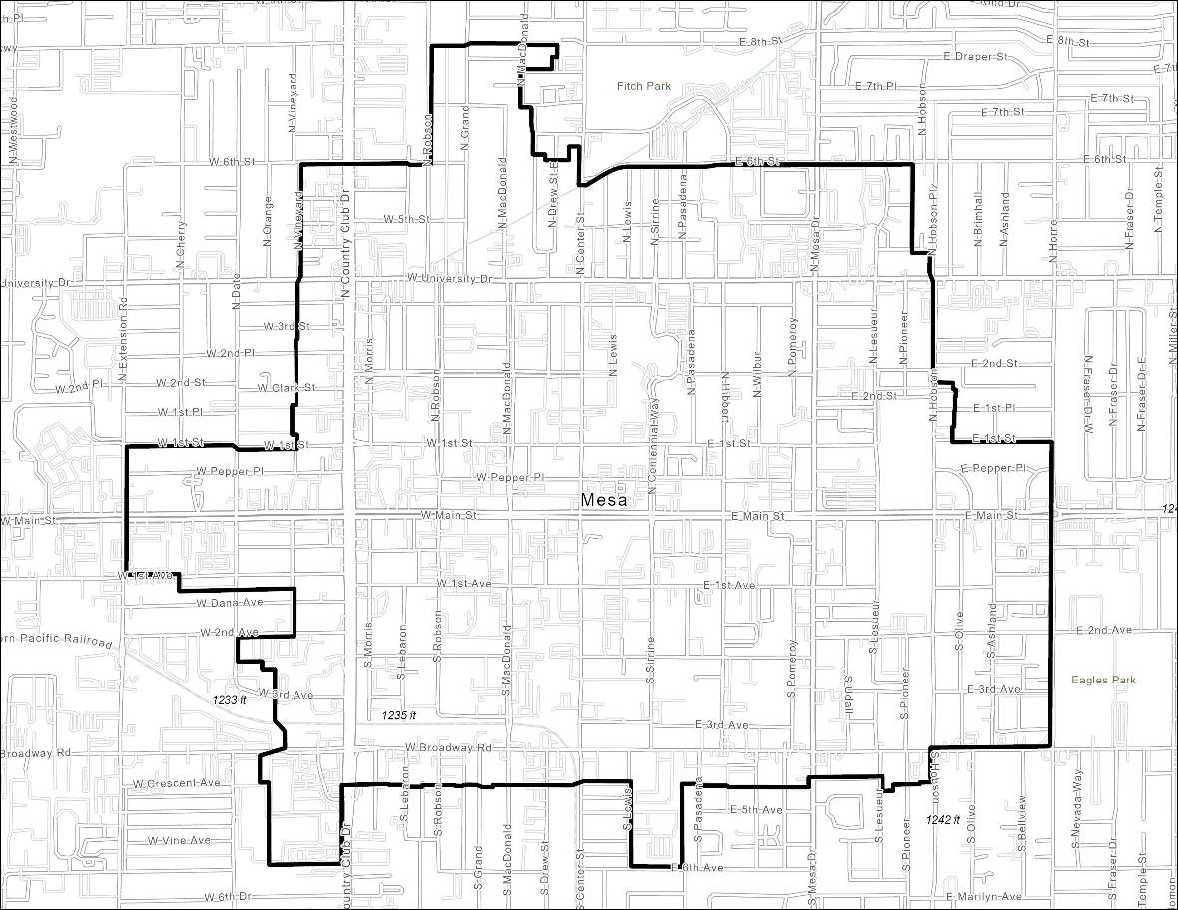
FIGURE 11-31-38.A.1: DOWNTOWN MESA
B.
Development Standards. All proposed Middle Housing projects shall comply with the development standards of the underlying base zoning district, except:
1.
Maximum building coverage may exceed the underlying base zoning district standard but shall not exceed 50% of the lot or parcel of land; and
2.
Maximum lot coverage may exceed the maximum building coverage by 10% but shall not exceed 60% of the lot or parcel of land.
C.
Application.
1.
Projects Within One (1) Mile of the Downtown Area. An applicant seeking to develop a Middle Housing project within one (1) mile of the downtown area shall submit with their required building permit the following:
a.
A Middle Housing application that confirms eligibility with Subsection (A)(1) above; and
b.
A plot plan demonstrating full compliance with all applicable development standards.
2.
New Single Residence Development. An applicant proposing Middle Housing within a new Single Residence development shall submit the following with a Zoning application—or, if no rezoning is required, with a Land Division application:
a.
A Middle Housing application that confirms eligibility with Subsection (A)(2) above; and
b.
A site plan demonstrating full compliance with all applicable development standards.
3.
Projects Within Historic District or Historic Landmark Overlay Districts. An applicant seeking to develop a Middle Housing project within a Historic District (HD) or Historic Landmark (HL) Overlay District must:
a.
Submit a Middle Housing application in accordance with either Subsection (C)(1) or (C)(2) above; and
b.
Comply with all procedures and standards for HD and HL Overlay Districts set forth in Title 11, Chapter 74.
(Ord. No. 5989, § 4, 12-8-25)
11-32-1: - PURPOSE AND APPLICABILITY
A.
Purpose. The purpose of this Chapter is to provide standards for parking and loading facilities to accommodate the various land uses permitted by this Ordinance. It is the intent of this Chapter to require the minimum number of on-site parking and loading spaces with maneuvering areas, driveways, and surface materials for the efficient movement of vehicular traffic, and to provide flexibility in meeting these requirements for sites with special needs. Additional purposes of this Chapter include:
1.
Ensuring the provision of safe and convenient places to park personal transportation vehicles, including automobiles, bicycles and motorcycles,
2.
Providing paved surfaces and alternative dust control measures to control and reduce the amount of dust and PM-10 particulates released to the atmosphere,
3.
Limiting the area of land consumed by parking through allowances for reductions to the number of required parking spaces and allowances for sharing of parking spaces among multiple uses where appropriate,
4.
Minimizing conflicts between pedestrian and vehicular circulation,
5.
Reducing the scale of paved surfaces and shading these surfaces, to reduce heat gain that contributes to the urban heat island effect, and
6.
Encourage sustainable development by promoting the use of alternative modes of transportation, walking and bicycling through recalibrating parking regulations for mixed use and transit-oriented developments.
B.
Applicability. The parking and loading requirements of this Chapter apply to all development in the City. They may be modified pursuant to the provisions for certain base districts and overlay districts.
1.
Additions to Existing Buildings and Changes in Use. When a change in use, expansion of a use, or expansion of Gross Floor Area creates an increase of 5% or more in the number of required off-Street parking or loading spaces, based on the initially approved and constructed facility or development, off-Street parking and loading shall be provided according to the provisions of this Chapter. The additional parking shall be required only for such addition, enlargement, or change in use and not for the entire building or site. A change in occupancy is not considered a change in use for the purpose of this paragraph unless the new occupancy is in a different land use classification, based on the descriptions found in Chapter 86, than the former occupant.
2.
Alterations that Increase Number of Dwelling Units. If an alteration to an existing building increases the number of residential Dwelling Units on the site, off-Street parking to serve the new Dwelling Units shall be provided according to the provisions of this Chapter. This requirement does not apply to an Accessory Dwelling Unit.
3.
When Required. Off-Street parking and loading facilities required by this Chapter shall be constructed or installed prior to the issuance of a Certificate of Occupancy for the uses that they serve.
(Res. No. 12269, § 13, 9-23-24; Ord. No. 5883, § 3, 10-7-24)
11-32-2: - GENERAL REGULATIONS AND STANDARDS
A.
Location. All required parking and loading spaces and maneuvering areas shall be located on the lot upon which the use served is located, except that parking spaces may also be located upon a contiguous lot incorporated into the development site. Parking spaces and maneuvering areas shall not be located within the required front yard in any Single Residence District or in any required front or corner Side Yard or landscaped area in any other Zoning District, except driveways that directly and immediately allow a vehicle to access the site from a street or abutting property.
B.
Commercial Vehicles. No commercial vehicle having a gross vehicle weight rating (GVWR) exceeding 13,000 pounds and is intended to be used primarily for commercial purposes rather than private or individual use shall be parked overnight or stored on any residential lot.
C.
Standards. The following standards apply to required onsite parking and loading spaces, maneuvering areas, and access:
1.
Required parking and loading spaces, maneuvering areas, and driveways shall be paved with asphalt, concrete, paving stone, or masonry to a sufficient thickness to withstand repeated vehicular traffic, except in Single Residence and Agricultural uses. The Zoning Administrator, in collaboration with the City Engineer, may establish alternative standards for porous surface paving.
2.
Required parking spaces shall be permanently marked and shall be accessible from a Street or alley by a driveway or aisle such that all vehicles shall approach the Street or alley in forward motion, except in Single Residence and Agricultural uses. See Section 11-32-4(G).
3.
Failure by the owner of the site to maintain the parking surface and markings according to the industry standards and schedules shall be considered a violation of this Ordinance.
D.
Compact Parking. On a site with at least 10 required parking spaces, up to 20 percent of the total required parking spaces may be compact spaces, provided that the following standards are met:
1.
Where covered parking is required all covered parking spaces shall be standard size;
2.
All compact spaces are to be designated with a sign or pavement marking; and
3.
Compact spaces shall be distributed throughout the parking area, with no more than 9 compact spaces in a single cluster. Each cluster of up to 9 spaces shall be separated by a minimum radius of at least 60-feet from the next cluster of compact parking spaces.
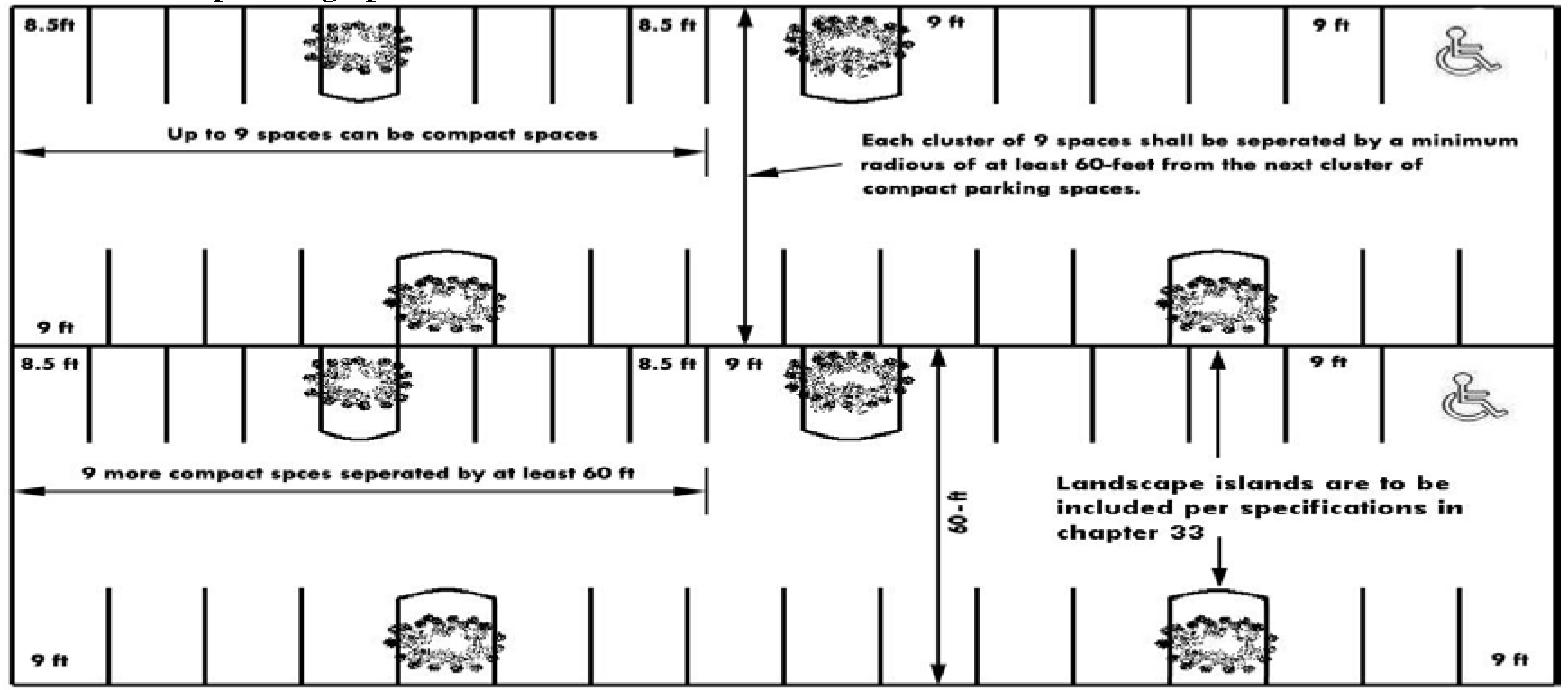
FIGURE 11-32-2.D: COMPACT PARKING SPACES
E.
Accessible Parking. Accessible parking spaces shall be provided and maintained pursuant to Section 4-2-1(G) of the Mesa City Code pertaining to the Arizonans with Disabilities Act of 1992.
F.
Structured Parking. The exterior elevations of any multi-level parking structure must be designed so as to screen or conceal parked cars from view from public streets and open space on the first and second floors of the structure. The floors of structured parking garages must be screened or concealed by one (1) or more of the following methods:
1.
Ground-Floor Commercial. The garage's ground-level Street frontage (except for driveways and pedestrian entrances) for the designated front of the structure shall be improved with retail sales, food and beverage sales, eating and drinking establishments, personal services, or similar pedestrian-oriented uses.
2.
Landscaping. Landscaping shall be provided in the form of perimeter planters within openings of the structure, and/or the incorporation of hanging baskets, flower boxes, or planting trellises.
3.
Setback. A parking structure that does not incorporate ground-floor retail or other commercial use or is not otherwise screened or concealed at street frontages on the first and second levels, must provide a densely planted landscaped yard that is a minimum of 10 feet in depth, or the required setback for the district in which it is located, whichever is greater.
4.
Combination of Opaque Screen Walls and Open Decorative Panels. A combination of opaque screening devices and decorative panels may be used to screen parking within above ground structures. Opaque screen walls shall not be higher than 3'-6" relative to the abutting floor height, and shall not exceed 45 percent of the aggregate surface area of the exterior wall. Decorative panels or other devices with opacity of at least 40% shall be used to screen the remainder. The decorative panels shall be constructed of durable materials, such as iron, steel, copper, aluminum, formed concrete, glass block, brick or other textured masonry.
5.
Design Review Board Review of Alternative Architectural Structure. The Design Review Board may approve parking garage structures that incorporate attractive architectural forms and detailing that have interest equal to an occupied structure.
G.
Recreational Vehicle (RV) Parking. See Section 11-34-5(B) regarding temporary parking requirements for recreational vehicles.
H.
Size of Parking Spaces and Maneuvering Aisles. Parking spaces and maneuvering aisles shall be provided to meet the minimum dimensions required by this subsection. Screening walls, roof support posts, columns, or other structural members shall not intrude into the required dimensions for parking spaces.
1.
Standard Parking Spaces. The minimum basic dimension for standard parking spaces is 9 feet by 18 feet. Table 11-32-2-H-1 provides the dimensions of spaces (stalls) and aisles according to the angle of parking spaces.
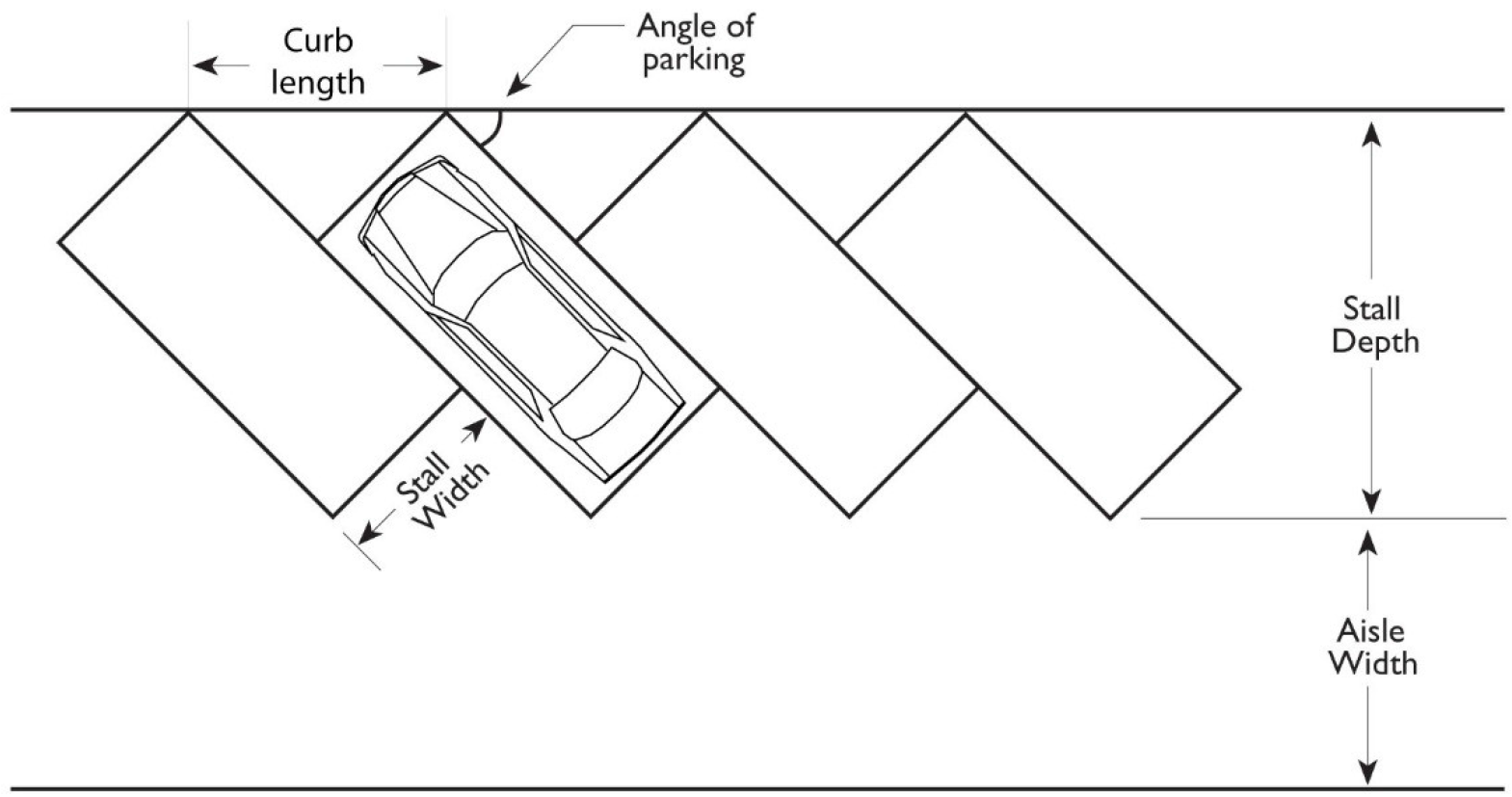
FIGURE 11-32-2.H.1: PARKING SPACES AND AISLES
2.
Compact Parking Spaces. The minimum basic dimension for compact parking stalls shall be 8 feet by 16 feet. Table 11-32-2.H.2 provides the dimensions of spaces and aisles according to angle of parking spaces. See Table 11-32-2.H.2.
3.
Loading Spaces. If loading spaces are provided they shall be a minimum 10 feet by 30 feet.
I.
Size of Parking Spaces for Motorcycles, Scooters, and Golf Carts. Motorcycle and scooter parking spaces shall have a minimum dimension of 5 feet by 9 feet. Golf cart parking spaces shall have a minimum dimension of 5 feet by 10 feet.
J.
Drive Aisle without Associated Parking Spaces. One-way drive aisles that do not provide access to parking or loading spaces shall be at least 12-feet wide. 2-way drive aisles that do not provide access to parking or loading spaces shall be at least 20-feet wide.
11-32-3: - PARKING SPACES REQUIRED
A.
The following chart specifies the minimum parking spaces required for each permitted use (For exceptions, see Sections 11-32-5, 11-32-6, and 11-32-7):
B.
Basis of Calculation. The on-site parking requirements specified in this section are based on gross floor area unless otherwise stated.
1.
In the case of mixed uses, the total requirements for off-street parking spaces shall be the sum of the requirements of the various uses computed separately as specified in this Section, and the off-street parking space for one use shall not be considered as providing the required off-street parking for any other use, unless a Shared Parking Plan has been approved in accordance with the requirements of Section 11-32-5.
2.
In case of fractional results in calculating parking requirements from the chart above, the required number shall be rounded up to the nearest whole number.
C.
Maximum Parking Spaces. The number of parking spaces provided by any development in surface parking lots shall not exceed 125% of the minimum required spaces in Table 11-32-3(A), except as follows:
1.
Office developments may provide higher parking ratio not to exceed 8 spaces per 1,000 square feet GFA when office development includes the following:
a.
A minimum of 60,000 square feet.
b.
The minimum density ratio of employees per gross floor area shall be 1 employee per 200 square feet.
2.
Parking within the building footprint of a structure (e.g., rooftop parking, below grade parking, multi-level parking structure).
3.
When a change in use to an existing development causes a lower parking requirement.
4.
Parking spaces managed for shared parking.
5.
An administrative use permit is required to provide more surface parking than the maximum standard and additional landscape is required in compliance with Section 11-33-4, Interior Parking Lot Landscaping.
6.
Phased projects do not need to comply with the maximum parking space requirement until the final phase is constructed.
D.
Covered Spaces. Covered parking spaces shall be provided as follows:
1.
Single Residences shall provide a minimum of two (2) covered parking spaces per unit, except no additional parking space is required for an Accessory Dwelling Unit.
2.
Multiple-Residence projects shall provide a minimum of one (1) covered parking space per unit.
3.
Office-use developments requiring a minimum of 10 parking spaces or more shall provide a minimum of one (1) covered parking space per office or suite plus one (1) additional space.
4.
Covered spaces may be counted concurrently with the minimum aggregate parking space requirements for the development.
E.
Minimum Number. Unless otherwise specifically stated in this Ordinance, all uses, except Single Residences, shall provide at least 4 on-site parking spaces.
F.
Credit for On-Street Spaces. On-street parking spaces located immediately adjacent to the frontage of properties in the EO, MX, DB, and DC Districts or districts with a "-U" designator, may be counted toward required off-street parking for non-residential uses. One on-Street parking space may be substituted for each required off-street space. These provisions only apply to Street frontages where on-street parking is allowed and provided. The parking space credit shall be determined at the time of site plan approval.
G.
Uses not Specified. The parking requirement for any use not listed in Table 11-32-3(A) shall be determined by the Zoning Administrator based upon the requirements for the most similar comparable use, the particular characteristics of the proposed use, and any other relevant data regarding parking demand. In order to make this determination, the Zoning Administrator may require the applicant to submit a parking demand study or other information, at the applicant's cost.
H.
Credit for On-Street Spaces. On-street parking spaces immediately adjacent to the frontage of properties in the EO, ME, PE, and DC Districts or districts with a "-U" designator, may be counted toward required off-Street parking for non-residential uses. One on-Street parking space may be substituted for each required off-street space. These provisions only apply to Street frontages where on-Street parking is allowed and provided. The parking space credit shall be determined at the time of site plan approval.
(Ord. No. 5281, 5-4-15; Ord. No. 5633, § 1, 7-8-21; Res. No. 12269, §§ 14, 15, 9-23-24; Ord. No. 5883, § 3, 11-7-24; Ord. No. 5957, § 5, 7-8-25; Ord. No. 5989, § 5, 12-8-25)
11-32-4: - PARKING AREA DESIGN
A.
Setback of Cross Drive Aisles. Parking spaces along main drive aisles connecting directly to a Street and drive aisles that cross such main drive aisles shall be set back at least 50 ft from the property line abutting the Street.
B.
Parallel Parking Spaces Abutting Wall or Fence. Each parallel parking space adjoining a wall, Fence, column, or other obstruction higher than 0.5 feet shall be increased by 2 feet on each obstructed side, provided that the increase may be reduced by 0.25 feet for each one foot of unobstructed distance from the edge of a required aisle, measured parallel to the depth of the parking space. See Figure 11-32-4.A.
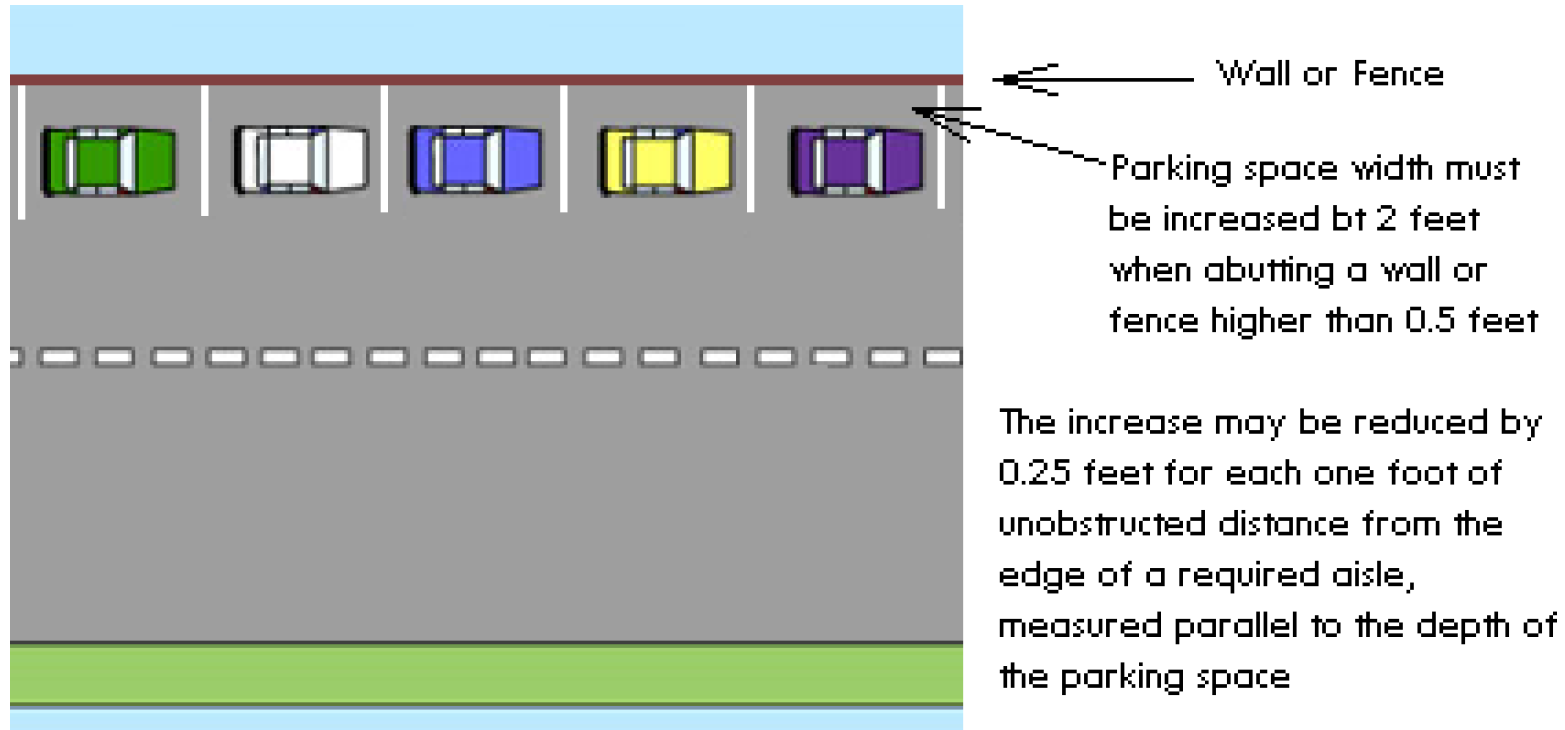
FIGURE 11-32-4.A: PARALLEL PARKING SPACES ABUTTING WALL OR FENCE
C.
Optional Double-Line Striping. Each parking space shall measure at least 9 feet from center to center, with double stripes 2 feet apart.
D.
Long-Term Parking. In parking areas, or portions of parking areas, restricted to employee use rather than customer or visitor use, and in which a vehicle is not normally moved during the period of an employee's work shift, the width of parking spaces may be reduced to 8.5 feet for standard and compact spaces.
E.
Minimum Dimensions for Residential Carports. Each single-car carport shall measure at least 10 feet wide by 20 feet long. Each double carport shall measure at least 18 feet wide by 20 feet long. The width of the carport is to be measured from inside face of support to inside face of opposite support. The carport roof shall cover the entire 20-foot length of the space.
F.
Minimum Dimensions for Residential Enclosed Garages. Enclosed Garages serving residential uses shall be constructed to meet the following minimum inside dimensions.
1.
A single-car garage shall be at least 10 feet wide and 22 feet long.
2.
A double-car garage shall be at least 20 feet wide and 22 feet long.
3.
A garage for tandem parking shall be at least 10 feet wide and 44 feet long.
G.
Circulation and Safety.
1.
Internal Circulation.
a.
Visibility shall be assured for pedestrians, bicyclists, and motorists entering individual parking spaces, circulating within a parking facility, and entering or leaving a parking facility.
b.
Internal circulation patterns, and the location and traffic direction of all access drives, shall be designed and maintained in accordance with accepted principles of traffic engineering and traffic safety.
c.
Off-Street parking and loading areas shall be provided with sufficient maneuvering room so that all vehicles can enter and exit from a public Street by forward motion only. This regulation does not apply to parking areas serving single-family residences served by individual driveways. The maneuvering of vehicles necessary to enter or exit loading areas shall not occur on City streets.
d.
Parking lots shall be designed so that solid waste, emergency, and other public service vehicles can provide service without backing unreasonable distances or making other dangerous or hazardous turning movements.
2.
Parking Lot Layout. No more than 200 parking spaces shall be allowed together in one group or cluster. Parking lot clusters shall be separated by Landscaping, pedestrian connections, cross aisles, retention basins or similar features.
a.
In office-use and industrial projects, a minimum 25 percent of the required parking spaces shall be provided within 200 feet of the building served, with the balance of the required parking within 400 feet.
b.
In commercial and mixed-use projects, a minimum of 50 percent of the required parking spaces shall be located within 300 feet of the building served.
c.
In residential projects, required parking spaces shall be arranged to provide at least one parking space per unit within 200 feet of the dwelling units they are intended to serve.
d.
Drive aisle intersections are to be perpendicular to each other.
e.
Separate vehicular and pedestrian circulation systems shall be provided.
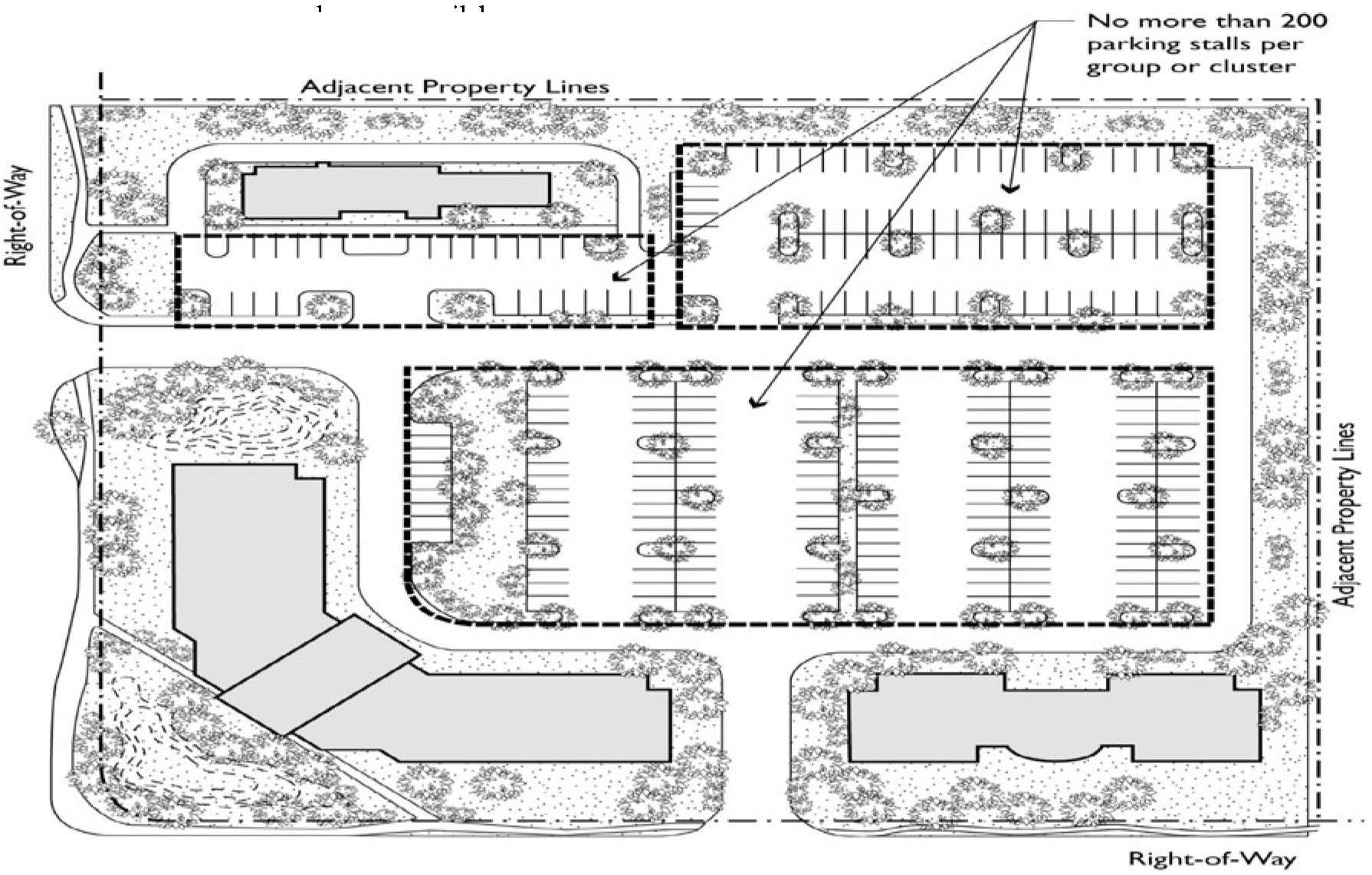
FIGURE 11-32-4.H.2: PARKING LOT LAYOUT
3.
Pedestrian Access. Design Objective: Provide a safe, convenient and comfortable network of pedestrian walkways within parking areas for users and residents.
The design standards described below shall be provided for multi-family residential developments of 5 or more units and for commercial, mixed-use, and/or industrial developments that are 80 feet or more in depth and/or include 50 or more parking spaces.
a.
Pedestrian Safety. Parking lot design should be laid out in a way to minimize the times pedestrians would typically have to walk between parked cars and then cross a drive aisle to get to locations on the site. Internal circulations systems shall be clearly defined.
b.
Materials and Width. Walkways shall provide at least 5 feet of unobstructed width and be hard-surfaced with a material that differs from the drive aisle by composition, texture, or through the use of a differing color that is integral to the material.
c.
Identification. Pedestrian walkways shall be clearly differentiated from driveways, parking aisles, and parking and loading spaces through the use of elevation changes, a different paving material, or similar method. Where a pedestrian Sidewalk crosses a vehicle lane, the pedestrian Sidewalk shall be raised a minimum of 3-inches above the vehicle lane and made distinct by use of textured paving and contrasting color.
d.
Separation. Where a pedestrian walkway is parallel and adjacent to an auto travel lane, it must be raised and separated from the auto travel lane by a raised curb at least 6 inches high, decorative bollards, or other physical barrier.
H.
Electric Vehicle Charging Stations. If spaces for electric cars are provided, allowed compact parking spaces can be increased by 1% for every 2 electric car charging stations; up to a maximum of 25-percent of the total minimum required.
I.
Additional Requirements. For additional design requirements related to parking, See Chapter 33 (Landscaping), as well as Sections 11-30-5 (Lighting and Illumination), Section 11-30-8 (Pedestrian Connections), 11-30-9 (Screening), 11-30-12 (Trash and Refuse Collection Areas), and 11-30-13 (Truck Docks, Loading, and Service Areas).
J.
Alternative Parking Area Designs. Where an applicant can demonstrate to the satisfaction of the approval authority that variations on the dimensions otherwise required by this Section are warranted in order to achieve to environmental design and sustainable building objectives (i.e. certification under the LEEDTM Green Building Rating System or an equivalent), a specific parking area design may be approved.
11-32-5: - SHARED PARKING
A.
Description. Shared parking represents an arrangement in which 2 or more nonresidential uses, or a mixed-use residential development, with different peak parking periods (hours of operation) use the same off-Street parking spaces to meet their off-Street parking requirements.
B.
Authorization and Criteria.
1.
Permit Requirement. An administrative use permit may be approved, allowing shared parking arrangements for nonresidential uses with different hours of operation in accordance with the requirements of Section 11-70-3.
2.
Criteria for Approval. Up to 100% of the parking required for one use may be supplied by the off-Street parking spaces provided for another use if the Zoning Administrator determines:
a.
that the various activities will have peak parking demands at different periods of the day or week; and,
b.
based on competent evidence provided by the applicant, that there is no substantial conflict in the principal operating hours of the uses for which the sharing of parking is proposed.
3.
Application Requirements. A request for approval of a shared parking arrangement must be accompanied by such information determined by the Zoning Administrator to be necessary to evaluate the peak parking demand characteristics or difference in hours and/or days of operation, including, but not limited to, a description of the uses and their operational characteristics, a site plan including a description of pedestrian access, and a parking study prepared by a licensed professional traffic engineer or equivalent qualified professional which justifies the reduction in parking requested.
4.
Location of Shared Parking Facility. A facility or land use activity for which shared parking is proposed must be located within 660 feet of the shared parking, measured from the entrance of the use to the nearest parking space within the shared parking lot. A Shared Parking Facility greater than 660 feet from the location of the activity served may be reviewed and approved through a Special Use Permit, pursuant to Chapter 70.
5.
Agreement. An agreement providing for the shared use of parking areas, executed by the parties involved, must be filed with the Zoning Administrator in approved form, and then recorded with the Office of the Maricopa County Recorder. Shared parking privileges will continue in effect only as long as the agreement, binding on all parties, remains in force. Agreements must guarantee long-term availability of the parking, commensurate with the use served by the parking. If a shared parking agreement lapses or is no longer valid, then parking must be provided as otherwise required by this Chapter.
11-32-6: - PARKING REDUCTIONS
Required parking for any use may be reduced through approval of a special use permit, pursuant to Chapter 70, unless specified otherwise, and the following:
A.
Criteria for Approval. A special use permit for reduced parking shall only be issued if the following criteria are found to be true:
1.
Special conditions—including but not limited to the nature of the proposed operation; proximity to frequent transit service; transportation characteristics of persons residing, working, or visiting the site—exist that will reduce parking demand at the site;
2.
The use will adequately be served by the proposed parking; and
3.
Parking demand generated by the project will not exceed the capacity of or have a detrimental impact on the supply of on-Street parking in the surrounding area.
B.
Parking Demand Study. In order to evaluate a proposed project's compliance with the above criteria, the Zoning Administrator may require submittal of a parking demand study that substantiates the basis for granting a reduced number of spaces and includes any of the following information:
1.
Total square footage of all uses within existing and proposed development and the square footage devoted to each type of use.
2.
A survey of existing on-Street and off-Street parking within 300 feet of the project site.
3.
Standard parking requirements for the use, based on Table 11-32-3(A).
4.
Estimated parking demand for the use, using any available existing parking generation studies from the Institute for Transportation Engineers (ITE) or other professionally recognized, and/or accredited sources. If appropriate parking demand studies are not available, the City may require the applicant to conduct a parking demand survey of a development similar to the proposed.
5.
Comparison of proposed parking supply with parking requirements.
6.
A shared parking analysis, as appropriate.
7.
A description any other characteristics of the site or measures being undertaken that could result in reduced parking demand, including staggered work shifts, telecommuting, shuttles to transit stations, or similar programs.
8.
Other information as required by the City.
C.
Optional Transit Reduction.
1.
Except residence uses, the following reductions may be factored directly when determining the minimum number of parking spaces required for a development, and do not require an Special Use Permit to be approved by the Zoning Administrator:
a.
The minimum number of parking spaces may be reduced by up to 10% for sites in which the closest portion of the requested parcel is no more than a ¼ of a mile (1320-linear feet) radius from a light rail station or bus rapid transit stop.
b.
The minimum number of parking spaces may be reduced by up to 5 percent for sites in which the closest portion of the requested parcel is no more than a ½ of a mile (2640 linear feet) radius from a light rail station or bus rapid transit stop.
c.
The distances specified shall be measured in a straight line from the nearest property line of the development site to the nearest pay kiosk, shade canopy, or transit stop sign post, whichever is closest.
2.
Additional reductions to the minimum number of parking spaces may be requested through the Special Use Permit process described in Paragraph A of this Section.
11-32-7: - ALTERNATIVE COMPLIANCE WITH MINIMUM PARKING REQUIREMENTS
A.
Authorized Alternatives. The Zoning Administrator is authorized to approve alternative compliance parking permits for the following:
1.
Off-site parking (See C, below);
2.
Valet parking (See D, below);
3.
Transit accessibility (See E, below);
4.
Residential Special Needs (See F, below); and
5.
Community building(s) for residential developments (See G, below).
B.
Special Use Permit Required. Applicants seeking approval of an alternative compliance parking plan must secure approval of a special use permit, pursuant to Chapter 70.
C.
Off-Site Parking. The Zoning Administrator may permit all or a portion of the required off-Street parking spaces to be located on a remote and separate lot from the lot on which the principal use is located, subject to the standards of this Section.
1.
Location. No off-site parking space may be located more than 1,000 feet from the primary entrance of the use served, measured along the shortest legal, practical walking route. This distance limitation may be waived by the Zoning Administrator if adequate assurances are offered that van or shuttle service will be operated between the off-site parking areas and the principal use.
2.
Off-Site Parking Agreement. An agreement providing for the use of off-site parking, executed by the parties involved, must be filed with the Zoning Administrator, in an approved form. Off-site parking privileges will continue in effect only as long as the agreement, binding on all parties, remains in force. Agreements must guarantee long-term availability of the parking, commensurate with the use served by the parking, and shall be recorded with the County Recorder's Office. If an off-site parking agreement lapses or is no longer valid, then parking must be provided as otherwise required by this Chapter.
D.
Valet Parking. Valet parking may be authorized through a Special Use Permit as a means of satisfying up to 100 percent of otherwise applicable off-Street parking ratios. In order to approve an alternative parking plan for valet parking the Zoning Administrator must determine that the proposal satisfies the approval criteria of off-site parking (see Subsection C., above) and that the valet parking will not cause interference with the public use of Rights-Of-Way or imperil public safety.
E.
Transit Accessibility. The Zoning Administrator may authorize up to a 33 percent (total) reduction in parking ratios for uses located within 1320-feet (¼ mile) of a BRT or light rail stop with 30-minute or more frequent service during the hours of 7:00 a.m. to 9:00 a.m. and 5:00 p.m. to 7:00 p.m. The basis point for determining the reduction shall be the aggregate number of parking spaces for the total development required before any reductions have been applied.
F.
Residential Special Needs. If a developer can demonstrate that a Multi-Family Residential or Group Residential housing project designed for residents with special needs, such as senior citizens or handicapped individuals, will not generate a need for as much parking as such a project designed for a general market, the approving body shall have the authority to allow a reduction in the number of required parking spaces. Upon conversion of a senior citizen or other special needs group housing project to a general market apartment or condominium complex, parking must be provided consistent with the requirements of Table 11-32-3(A).
G.
Community Building(s) for Residential Developments. Community buildings used for the common benefit of residents within residential Subdivisions and located within approved PAD overlay districts; or otherwise designed to be used by multiple-residence projects such as townhouse developments, apartments, residential condominiums, RV parks or manufactured home parks may substitute up to 50 percent of required full-size parking spaces with golf-cart spaces, motorcycle/scooter spaces, or bicycle parking. Up to 50 percent of the substituted spaces may be bicycle parking.
11-32-8: - BICYCLE AND MOTORCYCLE PARKING
A.
Bicycle Parking.
1.
Spaces Required.
a.
Bicycle parking is required for multi-unit residential buildings and nonresidential development. Unless otherwise expressly stated, buildings and uses subject to bicycle parking requirements must provide at least 3 bicycle parking spaces or at least 1 bicycle space per 10 on-site vehicle parking spaces actually provided, whichever is greater. After the first 50 bicycle parking spaces are provided, the required number of additional bicycle parking spaces is 1 space per 20 vehicle parking spaces.
b.
The requirements of subsection a and b, above, notwithstanding, the following minimum bicycle parking requirements apply to colleges, universities, schools and libraries:
i.
Elementary and junior high school: 1 bicycle parking space per 1000 square feet;
ii.
High school: 1 bicycle parking space per 1500 square feet;
iii.
Colleges and universities: 1 bicycle parking space per 5 vehicle parking spaces provided; and
iv.
Libraries: 1 bicycle space per 5 vehicle parking spaces provided.
2.
Design and Location.
a.
General. Required bicycle parking spaces must:
i.
Consist of racks or lockers anchored so that they cannot be easily removed and of solid construction, resistant to rust, corrosion, hammers, and saws;
ii.
Allow both the bicycle frame and the wheels to be locked using a standard U-lock;
iii.
Be designed so as not to cause damage to the bicycle;
iv.
Facilitate easy locking without interference from or to adjacent bicycles and maintain a separation of at least 24 inches from the nearest wall; and
v.
Be located in close proximity to entrances and other high activity areas, highly visible, active, well-lighted areas without interfering with pedestrian movements.
b.
Size. Required bicycle parking spaces for nonresidential uses must have minimum dimensions of 2 feet in width by 6 feet in length, with a minimum overhead vertical clearance of 7 feet.
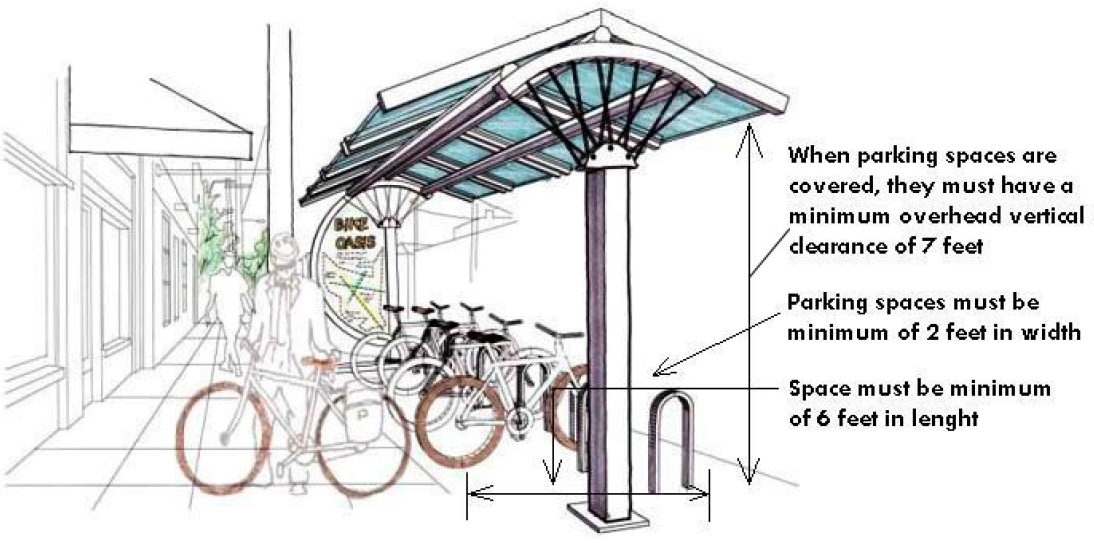
FIGURE 11-32-8.A: BICYCLE PARKING SPACES
c.
Location. Required bicycle parking may be located indoors or outdoors. Such spaces must be located out of the ROW unless an encroachment agreement is approved. If required bicycle parking facilities are not visible from the abutting Street or the building's main entrance, signs must be posted indicating their location.
B.
Motorcycle and Scooter Parking. For any nonresidential use providing 50 or more off- Street spaces, a maximum of 2 required off-Street parking spaces per 50 vehicle spaces may be reduced in size or otherwise redesigned to accommodate parking for motorcycles and scooters. When provided, motorcycle and scooter parking must be identified by a sign. Motorcycle and scooter parking shall be counted concurrently as part of the minimum number of vehicle spaces required for the development.
11-33-1: - PURPOSE AND APPLICABILITY
A.
Purpose. This Chapter establishes standards for Landscaping. The purpose of the Landscaping standards are to:
1.
Improve the appearance of the community by requiring aesthetically pleasing Landscaping on public and private sites:
2.
Soften the appearance of urban development;
3.
Ensure appropriately designed and maintained Landscaping elements that allow natural surveillance;
4.
Generate and preserve community identity to reinforce a sense of place that is unique to various neighborhoods throughout the City;
5.
Encourage the use of native or adapted plant species and demonstrate appropriate design and maintenance techniques; and
6.
Provide environmental improvements such as mitigating air and storm water pollution, providing shade and reducing the effects of the urban heat island.
B.
Applicability. The regulations of this Chapter shall apply to:
1.
Proposed Developments. These standards may be augmented, modified or replaced with specific Landscaping standards adopted by the City Council for the Town Center Area, and for other areas of the City as defined by the General Plan or similarly adopted City Council policies.
2.
Existing Properties. When there is a change in the distinguishing traits or primary exterior features of the use of a building or land as evidenced by increased parking requirements or a change in the building occupancy designation, after the effective date of this Ordinance, the standards of this Chapter apply.
C.
Exempt Projects. The requirements of this Chapter do not apply to:
1.
Additions to existing nonresidential or residential construction that add less than 20 percent to the existing Floor Area;
2.
The establishment of an Accessory Use on the same lot as an existing primary use, with no expansion of Floor Area or outdoor area occupied; and
3.
A change in occupancy of a building that does not involve a change in use.
(Ord. No. 5544, § 13, 12-9-19)
11-33-2: - GENERAL REQUIREMENTS
A.
Landscaped Areas. Required landscaped areas shall be maintained free from encroachment by any use, structure, vehicle, or feature not a part of the Landscaping design, except as specified in Chapter 33.
1.
Where turf abuts decomposed granite or similar inorganic landscape material, a hardscape edging material such as brick or concrete curb/mow-strip shall be provided.
2.
Electric vehicle charging stations may be placed in parking lot landscape islands. If necessary, shrubs and ground cover may be eliminated to accommodate the charging equipment.
B.
Tree Size. Required trees shall be a minimum size as specified in the Arizona Nursery Association "Recommended Tree Specification" latest edition, a copy of which will be maintained on file by the Planning Division.
C.
Tree Substitution.
1.
Palm. Palm trees may be substituted for 20 % of the total required trees along Streets and driveways according to the following table:
2.
Saguaros. Saguaros may be substituted for 10% of the total required trees along Streets and driveways according to the following table:
Exception. A higher percentage, up to a maximum of 30 % of the total number of tree required, may be approved by the Zoning Administrator within the defined boundaries of the Desert Uplands area.
3.
Ocotillos. Ocotillo plants may be substituted for 10% of the total required trees along Streets and driveways, at a ratio of two ocotillo plants for each required tree. Note: Any fractional amounts are rounded up to the next whole number.
Exception: A higher percentage, up to a maximum of 30% of the total number of trees required, may be approved by the Zoning Administrator within the defined boundaries of the Desert Uplands area.
D.
Shrubs. Required shrubs shall have a minimum mature growth height of 18 inches. At least 50% of required shrubs shall be a minimum of 5 gallons in size upon installation, but in no case shall any shrub be less than one (1)-gallon size.
E.
Open space. Fifty percent (50%) of all required Open Space shall contain live plant material.
1.
To ensure that landscape materials are measured as accurately and equitably, the guidelines in Table 11-33-2-e shall be used to determine what portion of a lot or Right-Of-Way is landscaped with live plant materials other than turf and provides the square footage credit for various types of plants.
2.
Ground cover may be of two types:
a.
Vegetative ground cover consisting of living plant materials generally characterized by primary horizontal growth, as well as secondary vertical growth, generally not exceeding 18 inches in height; and
b.
Inert ground cover consisting of gravel, decomposed granite, crushed rock, desert tree mulch or other approved materials. The use of "desert cobble" that looks like the desert floor, consisting of natural desert covers and seed mix, is encouraged.
F.
Irrigation Systems. Required irrigation systems shall be underground automatic watering systems, unless the lot is served by functioning flood irrigation.
G.
Paving and Hardscape Materials. Paving and ground treatment shall be an integral part of site and landscape design.
H.
Selection of Plant Materials. The physical characteristics of the species and variety of plants selected, at maturity, shall correspond closely with the design objectives listed for each of the respective landscape requirements, including the following:
1.
Characteristics of trees and shrubs used in locations required for Screening and buffering shall include dense foliage and relatively wide diameters.
2.
Trees and shrubs with thorns, spines and sharp points should not be placed within 7' of Sidewalks and/or vehicular roadways and should not be placed within 3' of median island curbing. Exceptions may be made for plants placed in controlled locations, such as plazas and outdoor seating, clearly designed as being away from access aisles, connecting routes or through pathways.
3.
Trees designated to meet the shading requirements of the ordinance shall meet at least 50% of the required shading within 4 years and the full shading within 8 years.
I.
Maintenance of Landscaping.
1.
An irrigation system shall be provided to all landscaped areas containing living plant materials, unless otherwise approved.
2.
Lack of maintenance as above described, shall constitute a violation of this Ordinance. The property owner and/or occupant or lessee shall be held jointly and severally liable for any infraction of the requirements set forth in this Chapter.
3.
In the event a plant specified as required on an approved landscape plan dies or is removed, the property owner and or occupant or lessee are jointly responsible and shall replace the plant with one of a similar species with a similar size as specified in the approved landscape plan.
4.
Landscape Plans shall designate plant material to be kept in either a natural state (minimal pruning) or a formal state (regularly trimmed and pruned to a sculpted appearance). Plant materials shall be maintained as designated.
a.
Property owners shall maintain Landscaping in accordance with the best management practices of the Landscaping industry. Pollarding of trees and similar practices of over pruning are discouraged.
J.
Installation of Landscaping. Landscaping shall be installed with adequate precautions to insure survival, as shown on the approved development plan or landscape plan, prior to the issuance of a Certificate of Occupancy for the building or use.
K.
Perimeter Landscaping. Required landscaped areas adjacent to the property lines of the site shall be installed with the first phase of construction when adjacent to residential districts.
L.
Undeveloped Parcel within a Group Commercial, Industrial, or Office Project. Extruded concrete curbing and a 5 foot-wide landscape area along the undeveloped edge(s) shall be provided, unless otherwise approved.
M.
Substantial Conformance. Landscaping installation shall be in substantial conformance with the approved plans. Significant alteration in the design or installation without appropriate plan amendment approval is subject to the withholding of final inspection approval.
N.
Curbing. Where wheel stops are required to prevent vehicular intrusion, poured-in-place continuous concrete curbing or decorative bollards shall be installed.
O.
Parking. When a parking space abuts a landscape island or planter, a poured-in-place continuous concrete wheel stop or curbing shall be provided.
P.
Right-of-Way. Landscaping of adjacent undeveloped Right-Of-Way is required in addition to the minimum on-site requirements. Right-of-way Landscaping shall be limited to non-vegetative ground cover and low-water-use plants, including those drought-tolerant plants listed by the Arizona Department of Water Resources for the Phoenix Active Management Area. The Planning Division will maintain a list of such plants.
Q.
Parking Lot/Site Lighting. Light standards shall be located only within the parking area.
1.
Light Standard Heights. Maximum standard height shall be 14 feet when within 50 feet of the perimeter of the development and adjacent to a residential use. When adjacent to any other use, the maximum height shall be 20 feet within 50 feet of the perimeter. The maximum height shall be 25 feet everywhere else on the site.
2.
House side shields shall be provided on all light standards adjacent to residential development.
3.
Building mounted lights shall maintain the same heights as specified above.
4.
For additional standards refer to the City of Mesa Lighting Code.
(Ord. No. 5544, § 14, 12-9-19; Ord. No. 5814, § 5, 10-16-23)
11-33-3: - PERIMETER LANDSCAPING
A.
Streets.
1.
Allowable Uses. Landscape yards shall be exclusively maintained as landscaped areas with plant materials and may include monument signs, parking screen walls, and retention basins.
2.
Exceptions. Outdoor seating for restaurants may encroach:
a.
In M and -A designated areas, up to 50 percent of the width of the required landscape area.
b.
In -U designated areas, the entire width of the required landscape area.
3.
Basis for Calculation. Plant materials shall be calculated based on a linear module of 25 feet. Trees and shrubs may be clustered.
4.
Numbers of Plants:
5.
"-U" Character Designations, DC and MX districts. All new development shall provide shade with canopy trees, shade structures or building overhangs for at least 50% of Sidewalk along Street frontages.
6.
Minimum Size. Minimum size of plant materials shall be as follows:
a.
Trees.
i.
A minimum of 25 percent of the total required trees shall be 36-inch or larger box trees.
ii.
A minimum of 50 percent of the total required trees shall be 24-inch box trees.
iii.
No trees shall be smaller than 15-gallon size.
iv.
When located in front of buildings that could contain commercial signage, install trees that branch at sufficient height to allow people to see the signage beyond the tree.
b.
Shrubs.
i.
A minimum of 50 percent of the total required shrubs shall be 5-gallon size or larger.
ii.
No shrubs shall be less than one (1)-gallon size.
c.
Substitutions. Substitutions for the above requirements may be made according to the following table.
7.
All landscape areas shall be either covered with decomposed granite, "desert varnish or cobble", desert tree mulch, turf, and/or acceptable alternative with supplemental shrubs and ground covers, accents, flowers, vines. Fifty percent of the landscape area shall be vegetative material at maturity.
8.
All landscape plant material should be appropriate for the developed environment.
B.
Required Landscape Yards. Landscaping should provide a visual buffer, screen view of objectionable uses, provide a transition between adjacent development, shade paved and unpaved surfaces, and screen nighttime light from adjacent property.
1.
Landscaping for Non-Single Residence Uses adjacent to Single Residence Uses or Districts.
a.
Width.
i.
Sites less than five (5) acres adjacent to an RS or RSL district, must provide a minimum 20-foot landscape yard.
ii.
Sites five (5) acres or more adjacent to an RS or RSL district must provide a minimum 25-foot landscape yard.
b.
Ground Treatment.
i.
The entire landscape yard shall be either covered with decomposed granite, "desert varnish or cobble", desert tree mulch and/or turf or as approved.
ii.
Landscape yards shall remain free from parking, driveways, and encroachment by any structures that are not part of the Landscaping design.
c.
Number of Plants.
1.
Screening. Landscape yards not visible from public parking/drive aisles and adjacent to loading, service and unsightly areas shall have a minimum of five (5) non-deciduous trees per 100 linear feet of adjacent property line (1 tree per 20 linear feet) or shall have continuous tree canopy between 6 feet—20 feet in height at maturity, 50 percent canopy within five (5) years, 70 percent canopy within seven (7) years and 100 percent within 10 years.
ii.
Areas visible from public parking or drive aisles. A minimum of four (4) non-deciduous trees and 20 shrubs per 100 linear feet of adjacent property line shall be provided.
iii.
Transition Areas. A planted transition between visible areas and loading/service areas shall be provided.
d.
Size of Plants. Required trees shall be at least 24-inch box size.
e.
Wall. Refer to Section 11-30-9 (Screening) for standards regarding Screening design of exterior walls and equipment.
2.
Landscaping for Non-Single Residence Uses Adjacent to Other Non-Single Residence uses or districts.
a.
Width.
i.
Group C-O-I Development. Properties that are part of group commercial, office, industrial development, as defined in Chapter 87, must provide a seven (7) foot wide perimeter landscape yard except where a cross-access drive aisle occurs within the required landscape yard.
ii.
Non-Group C-O-I Development. Properties that are not part of a group C-O-I Development, as defined in Chapter 87, must provide a 15-foot landscape yard except where a cross-access drive aisle occurs within the required landscape yard.
b.
Ground Treatment. The entire landscaped yard shall be either covered with decomposed granite, "desert varnish or cobble", desert tree mulch and/or turf as approved. Supplemental shrubs and ground covers including accents, flowers, and vines shall provide 50 percent vegetative ground coverage.
c.
Number of Plants. A minimum of three (3) non-deciduous trees and 20 shrubs per 100 linear feet of adjacent property line shall be provided. In the event of fractional results, the resulting number will be rounded to the next highest whole number. Shrubbery and ground covers are not necessary if the area is not visible from public parking and drive aisles.
d.
Size of Plants. A minimum of 50 percent of the required trees shall be at least 24-inch box size. The balance of the required trees shall be at least 15-gallon-size trees.
i.
Exception. Trees within LI, GI and HI Districts may be 15-gallon-size throughout.
e.
Plant types. In areas with no pedestrian activity, appropriate low water use desert trees shall be planted.
(Ord. No. 5544, § 15, 12-9-19; Ord. No. 5593, § 10, 12-1-20; Ord. No. 5814, § 6, 10-16-23)
11-33-4: - INTERIOR PARKING LOT LANDSCAPING
A.
Applicability. The interior parking lot Landscaping standards of this section apply to all off-Street parking lots containing 10 or more parking spaces. They do not apply to vehicle/equipment storage lots or vehicle and equipment sales lots. In addition, refer to Chapter 32 for additional parking lot standards.
B.
Landscape Islands.
1.
Parking lot landscape islands shall be installed at each end of a row of stalls and in between for maximum 8 contiguous parking spaces.
2.
Landscape islands shall be a minimum of eight feet wide and 15 feet in length for single-row and 30 feet in length for double-row parking. All measurements are to face of curb.
3.
Radius curbing shall be provided along drive aisles with a minimum 4 foot radius.
4.
For rows of more than 16 parking spaces, landscape islands shall be staggered.
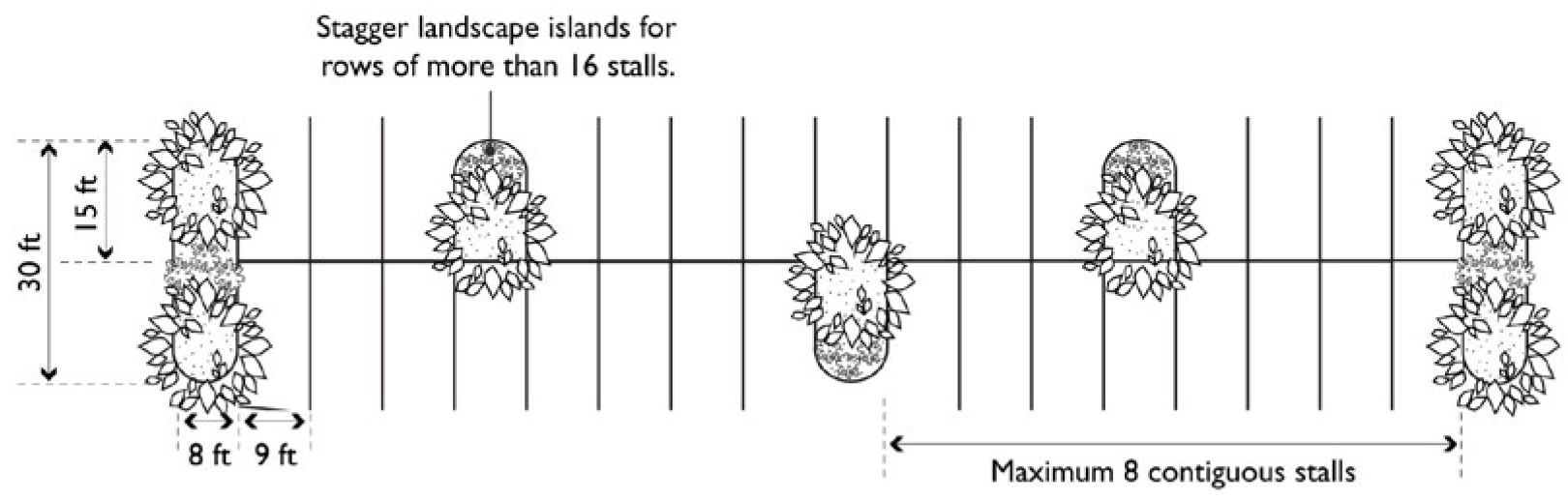
FIGURE 11-33-4.B.4: INTERIOR PARKING LOT LANDSCAPE
ISLANDS
5.
The maximum length of a covered parking canopy shall be 15 parking stalls in a row. Landscape islands may be eliminated when a conflict with the covered parking canopy occurs.
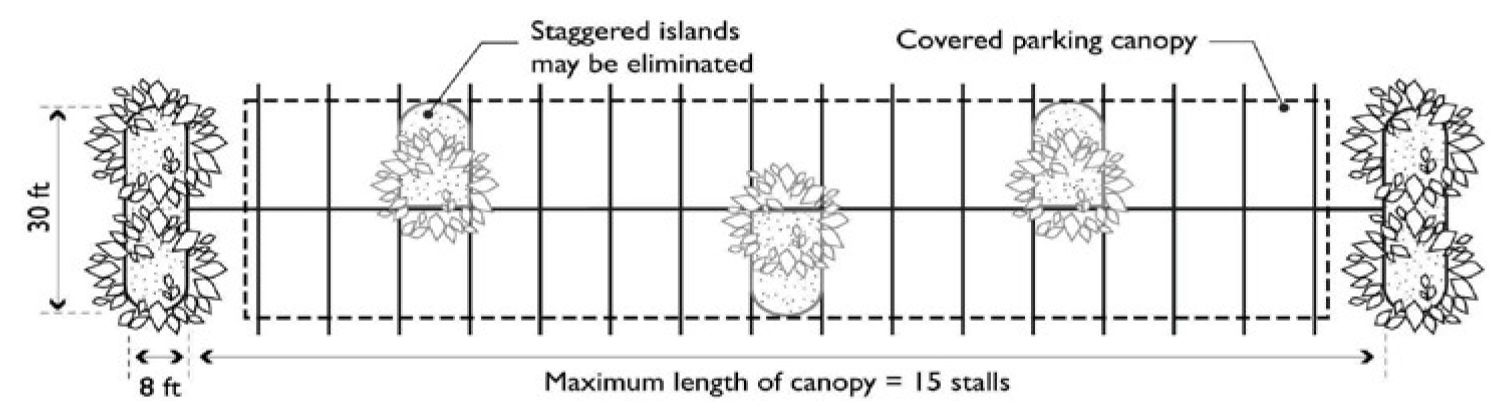
FIGURE 11-33-4.B.5: INTERIOR PARKING LOT COVERED PARKING CANOPY
6.
When parking canopies are adjacent to each other in a single row, the total length of each canopy shall not exceed 15 parking stalls and the adjoining canopies shall be separated by at least a 24-foot-wide landscape island as depicted in the following illustration.
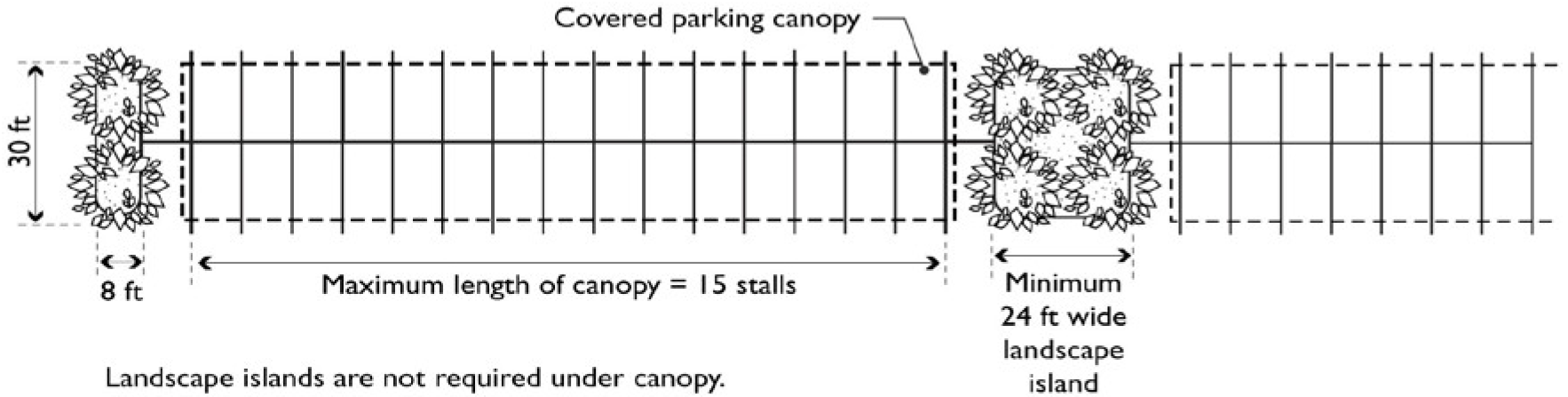
FIGURE 11-33-4.B.6: INTERIOR PARKING LOT COVERED PARKING
CANOPY
7.
For parking lots containing more than 200 spaces, one 8-foot-by-15-foot staggered landscape island may be replaced with 2 landscape islands of at least 25 square feet clear landscape area each. Each landscape island/ planter shall contain at least 1 tree and 3 shrubs. These landscape islands/ planters may be designed in any combination of shape and size provided the minimum clear landscape area dimension is 5 feet.
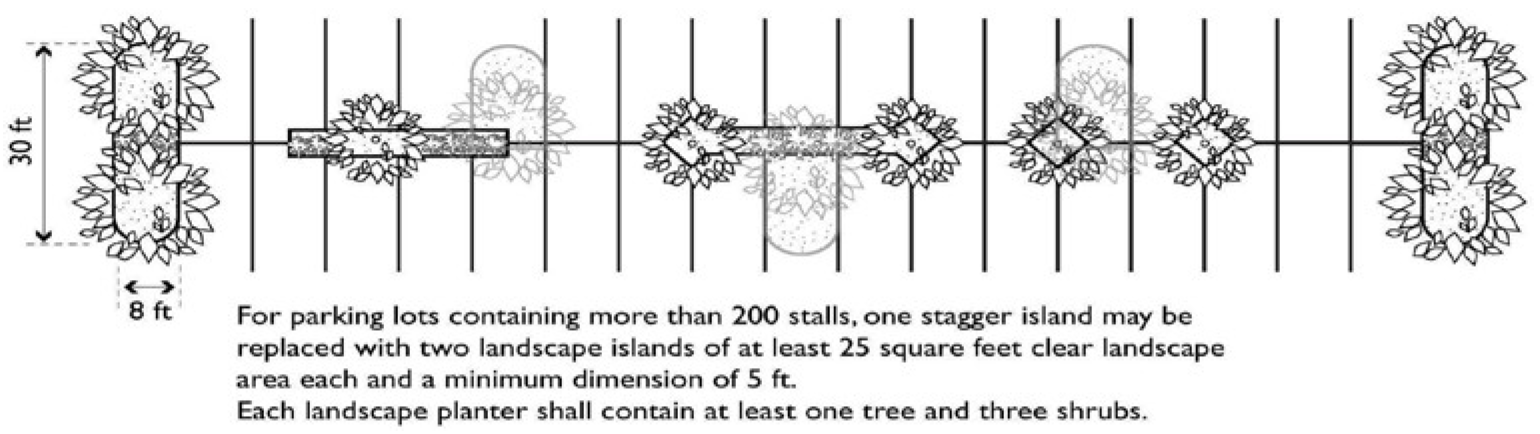
FIGURE 11-33-4.B.7: INTERIOR PARKING LOT LANDSCAPE ISLANDS
C.
Medians. Where divider medians occur adjacent to head-in parking, allow for vehicle overhang and shall be as follows:
1.
Single-Row Parking. Minimum 7-foot landscape area measured from face of curb to face of curb is required. The required median width does not include a Sidewalk.
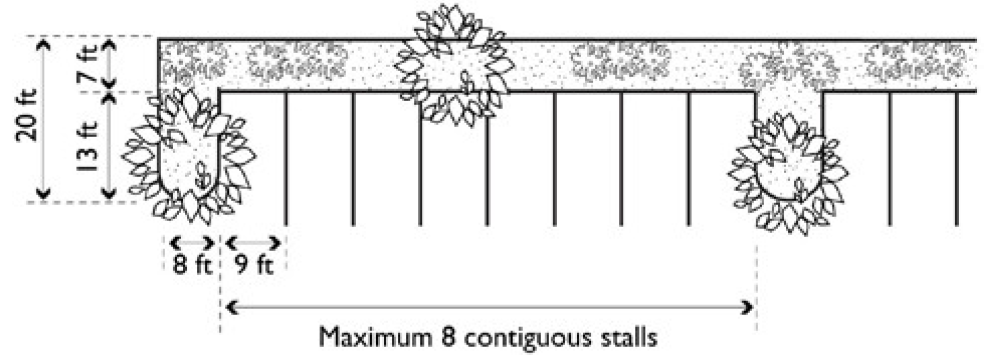
FIGURE 11-33-4.C.1: INTERIOR PARKING LOT
LANDSCAPE ISLANDS
2.
Double-Row Parking. Minimum 8-foot landscape area measured from face of curb to face of curb. Required median width does not include Sidewalk.
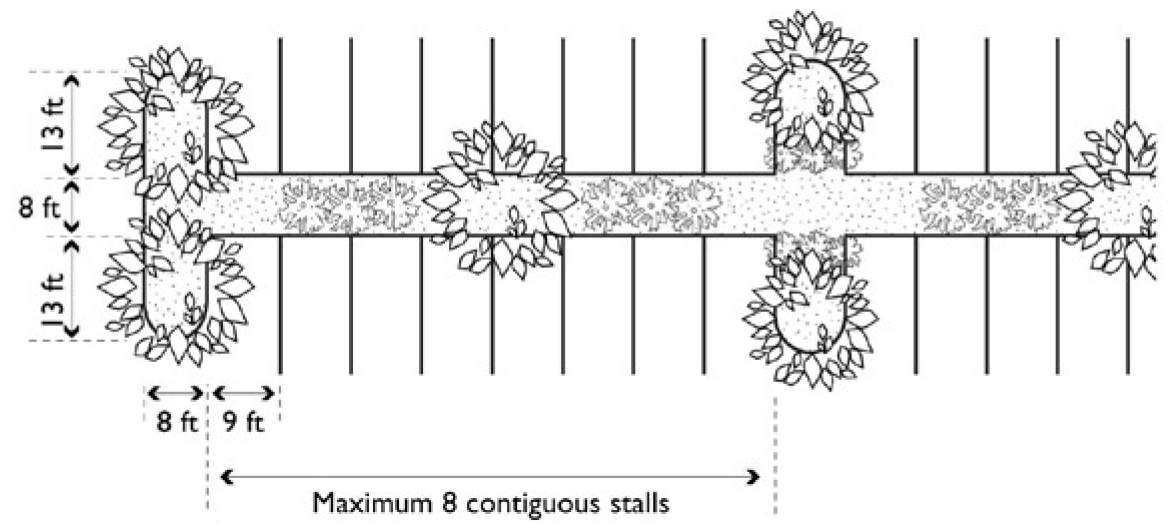
FIGURE 11-33-4.C.2: INTERIOR PARKING LOT MEDIAN DOUBLE ROW PARKING
3.
Medians with Sidewalks. When a Sidewalk is located within median, shade trees should be placed so that at least 25 percent of the Sidewalk is shaded, at noon.
D.
Plant Materials.
1.
Number of Plants.
a.
Parking lot landscape islands. One shade tree and three shrubs shall be provided for every 15-foot parking island.
b.
Parking lot divider medians. In addition to the above requirements, minimum 1 shade tree and 6 shrubs shall be provided for every 8 parking spaces.
2.
Size of Plants. A minimum 10 percent of the required trees for parking lot interior Landscaping shall be 36-inch box. The balance of the required trees shall be at least 24-inch box. Substitution based on plant size is not permissible for trees planted within the interior of a parking lot.
3.
Ground Treatment. All landscape planting areas that are not dedicated to trees or shrubs shall be decomposed granite and/or turf or as approved.
11-33-5: - FOUNDATION BASE
All buildings shall provide a foundation base of plant materials such as trees, shrubs, ground covers, and/or accent plants and hardscape such as decorative pavement adjacent to the exterior walls. Pedestrian areas and building entrance plazas should be shaded with trees and shade structures.
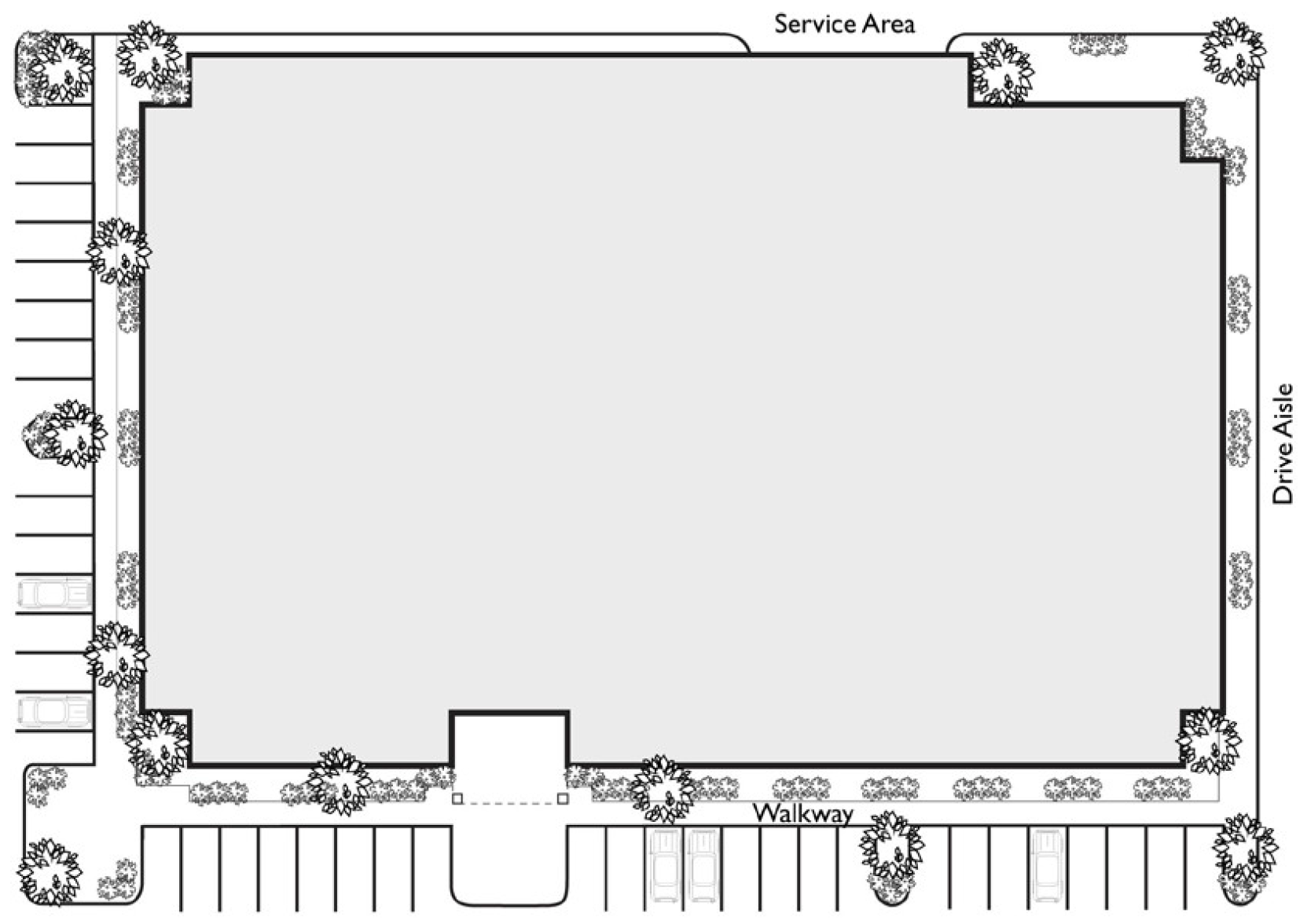
FIGURE 11-33-5: FOUNDATION BASE
A.
Foundation Base along Exterior Walls.
1.
Exterior Walls with Public Entrance. A 15-foot-wide foundation base shall be provided, measured from face of building to face of curb along the entire length of the exterior wall. For buildings with corner entries, both adjacent walls require a 15-foot-wide foundation base.

FIGURE 11-33-5.A.1: FOUNDATION BASE AT EXTERIOR WALL WITH PUBLIC ENTRANCE
a.
For buildings larger than 10,000 square feet with parking spaces that abut the foundation base, additional foundation base width is required as follows:
i.
Typical Building Entrances. An additional foundation base shall be provided at the entrance to create an entry plaza area. The plaza area shall have a minimum width and depth of 20 feet, and a minimum area of 900 square feet.
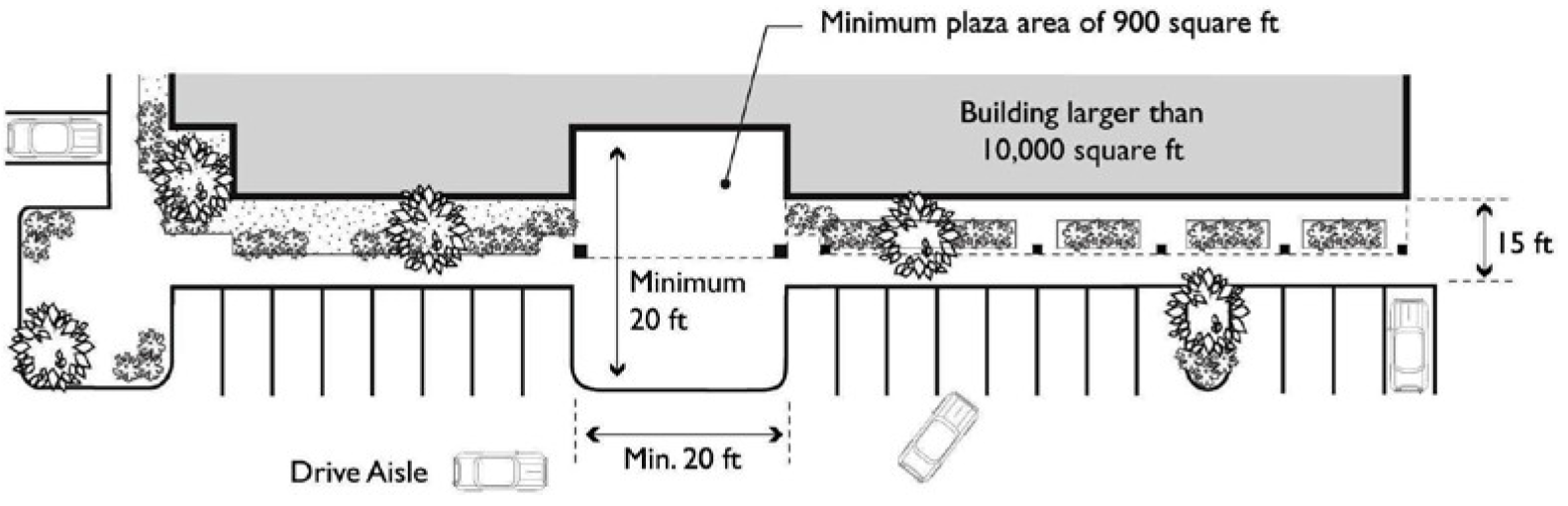
FIGURE 11-33-5.A.1.A: FOUNDATION BASE AT BUILDING
ENTRANCE
ii.
Buildings with Corner Entrances. A foundation base shall be provided to ensure an area equivalent to 900 square feet.
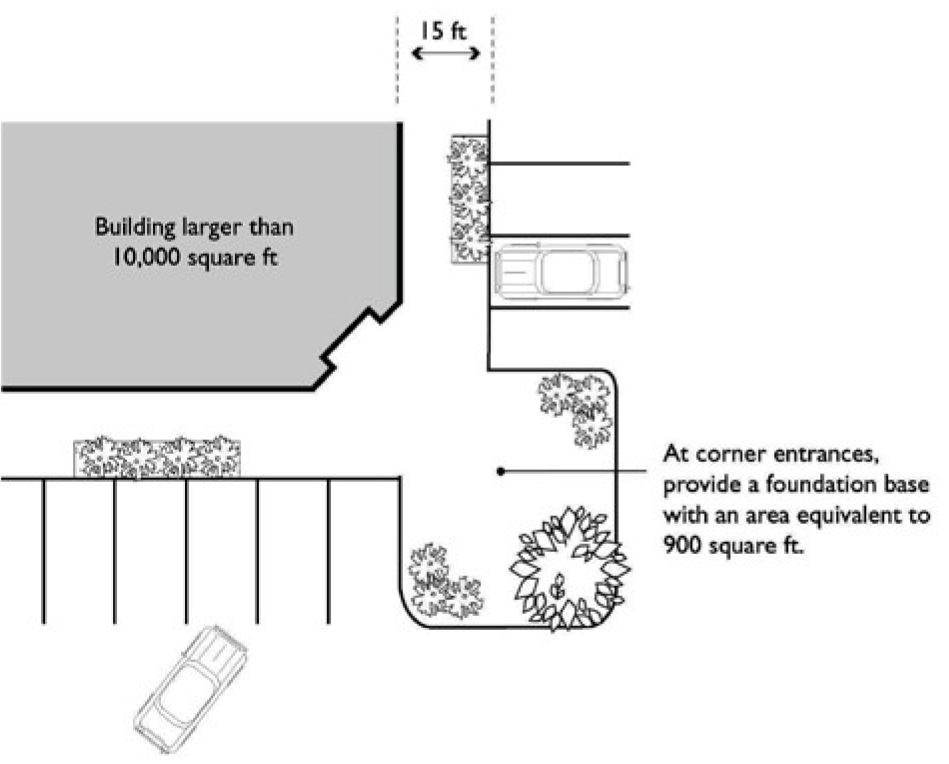
FIGURE 11-33-5.A.1.B: FOUNDATION BASE WITH CORNER ENTRANCE
b.
Medical Buildings Less Than 10,000 Square Feet. A 13-foot-wide patient drop-off area shall be provided with at least one 5-foot-wide accessible Sidewalk.
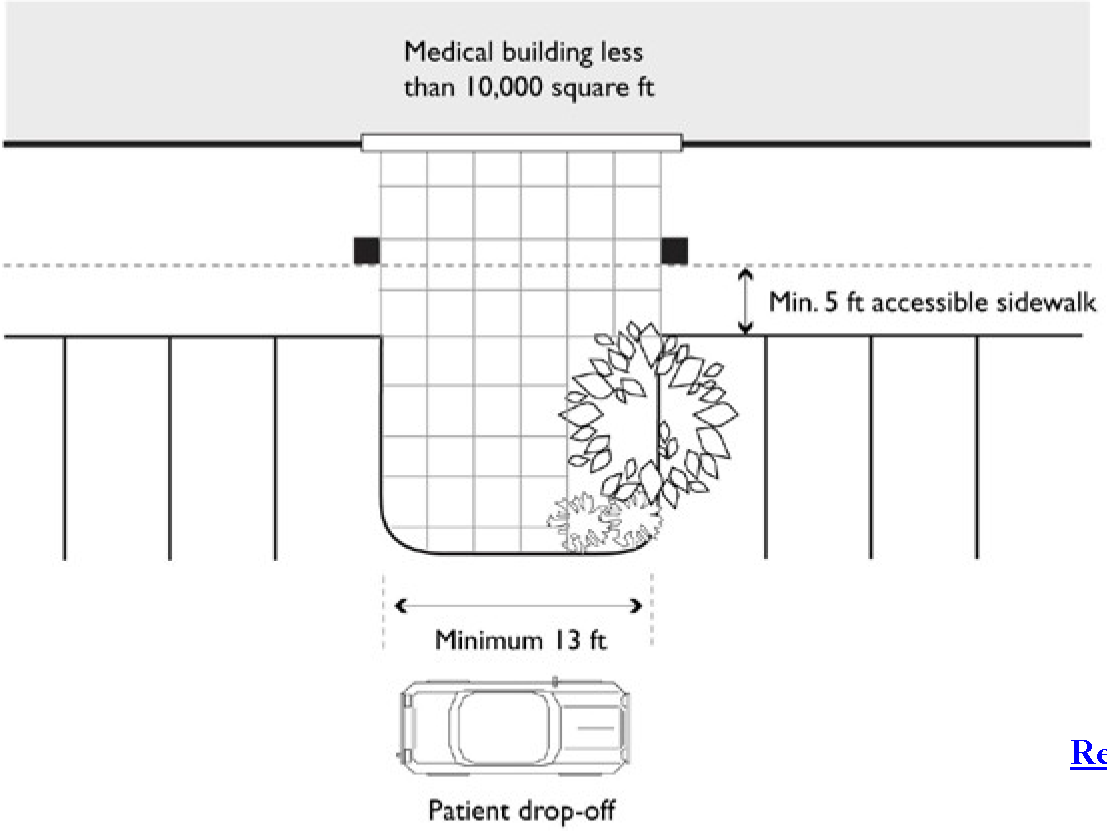
FIGURE 11-33-5.A.1.C: FOUNDATION BASE AT MEDICAL BUILDINGS
2.
Exterior Walls without a Public Entrance.
a.
A minimum 10-foot-wide foundation base shall be provided, measured from face of building to face of curb along the entire length of the exterior wall adjacent to parking stalls.
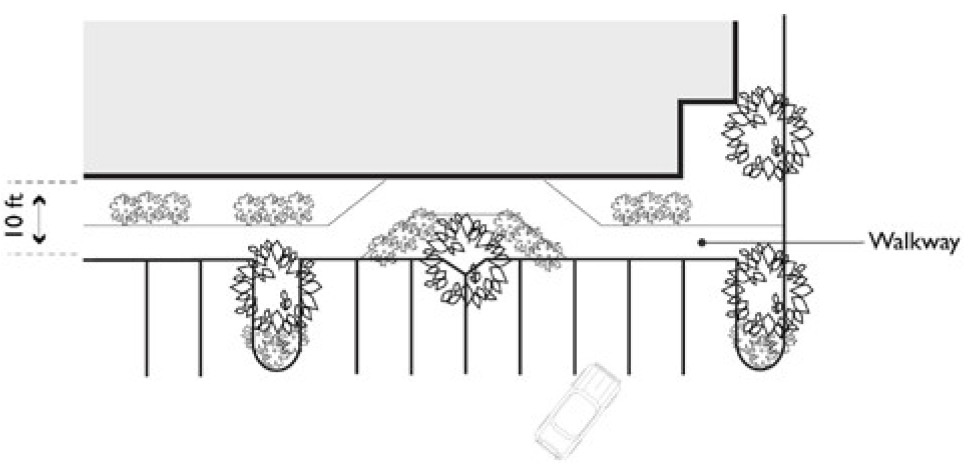
FIGURE 11-33-5.A.2.A: FOUNDATION BASE EXTERIOR WALL WITHOUT A
PUBLIC ENTRANCE
b.
A minimum 5-foot-wide foundation base shall be provided, measured from face of building to face of curb along the entire length of the exterior wall adjacent to drive aisles as illustrated.
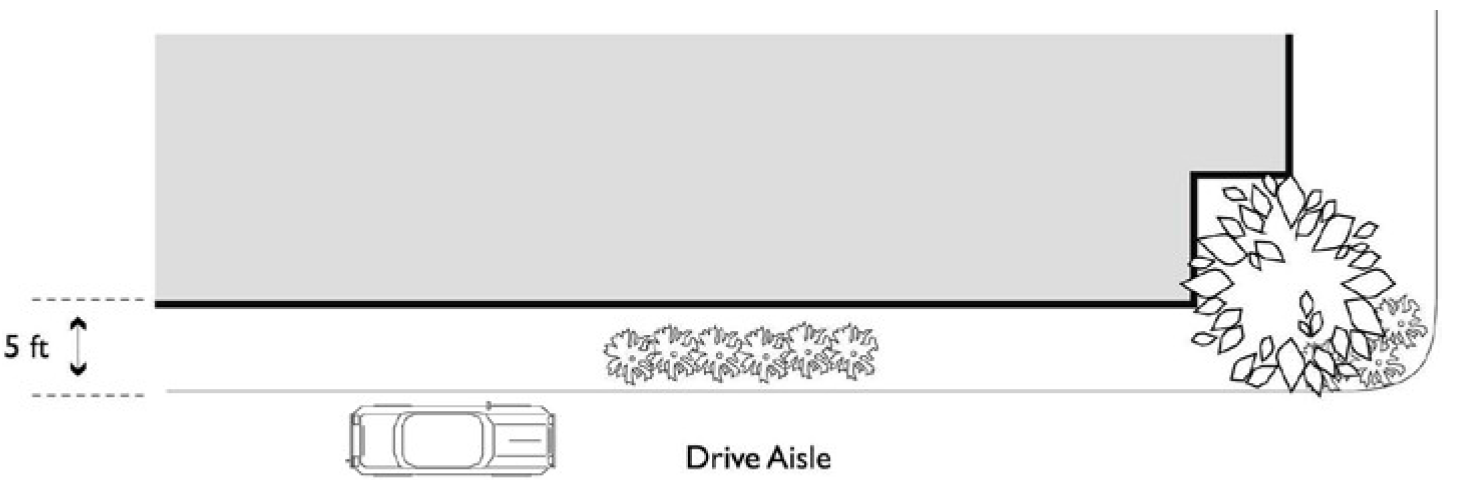
FIGURE 11-33-5.A.2.B: FOUNDATION BASE AT EXTERIOR WALL WITHOUT A PUBLIC ENTRANCE
3.
Averaging Depth of Foundation Base. The designated depth of the foundation base may be less than the minimum required depth (as specified above), provided:
a.
That for each location in which the depth is less, a corresponding location along the same foundation base exceeds the minimum depth by the same amount; (for example, if 15 feet is the minimum required depth of a foundation base, the foundation base may be reduced to 10 feet at one (1) point provided that an equal portion of the same foundation base depth extends to 20 feet in depth) and;
b.
In all cases involving principally pedestrian access points into a building, the foundation base shall be no less than 5 feet in depth.
c.
The foundation base area remains equivalent to or more than the amount of foundation base area that would be provided if the edge of the foundation base remained parallel to the building elevation.
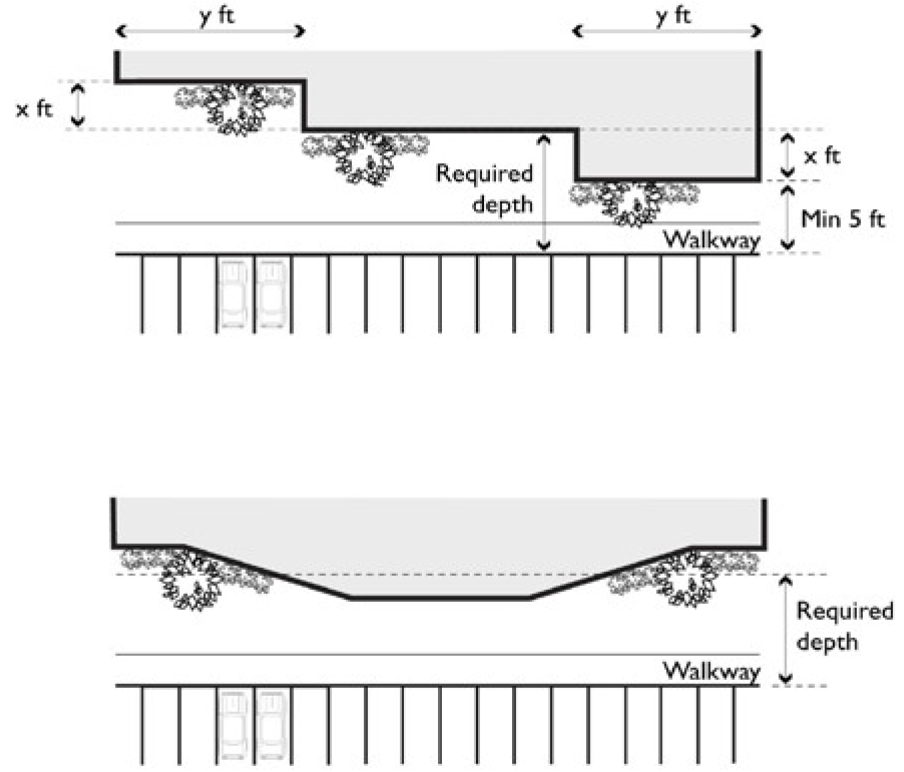
FIGURE 11-33-5.A.3: AVERAGING FOUNDATION BASE
B.
Landscape Area in Foundation Base.
1.
Number of Trees. A minimum one (1) tree per 50 linear feet or less of exterior wall length of a building shall be provided. Trees in a parking lot and within 30 feet of the building may be counted toward this requirement. Any calculation resulting in a percentage of a whole tree shall be rounded up to the nearest whole.
2.
Size of Trees. A minimum 10 percent of the required trees in foundation base shall be at least 36-inch box size. The balance of the required trees shall be 24- inch box size. Substitution of landscape plants based on plant size is not permissible for trees planted within a required foundation base.
3.
Plant Material within Foundation Base.
a.
Exterior Walls Visible From Public Parking or Right-of-Way with Public Entrances. A landscape area shall be provided equal in length to 33 percent (minimum) of adjacent exterior wall.
b.
Exterior Walls Visible From Public Parking or Right-of-Way without Public Entrances. A landscape area shall be provided equal in length to 25 percent (minimum) of adjacent exterior wall.
c.
Exterior Walls Not Visible From Public Parking or Right-of-Way without Public Entrances. A landscape area shall be provided equal in length to 10 % (minimum) of adjacent exterior wall.
4.
Trees shall be in planters that are at least 8 feet wide. Other plant material shall be in planters that are at least 3 feet wide.
5.
If the foundation base contains expansive soils (as determined by a certified engineer) the plant material shall be placed away from the building.
C.
Setback for Raised Planter Boxes. Raised planter boxes shall be 5 feet minimum from drive aisles and parking stalls.
D.
Setback for Columns in Foundation Base. Columns shall be 5 feet minimum from drive aisles and parking stalls.
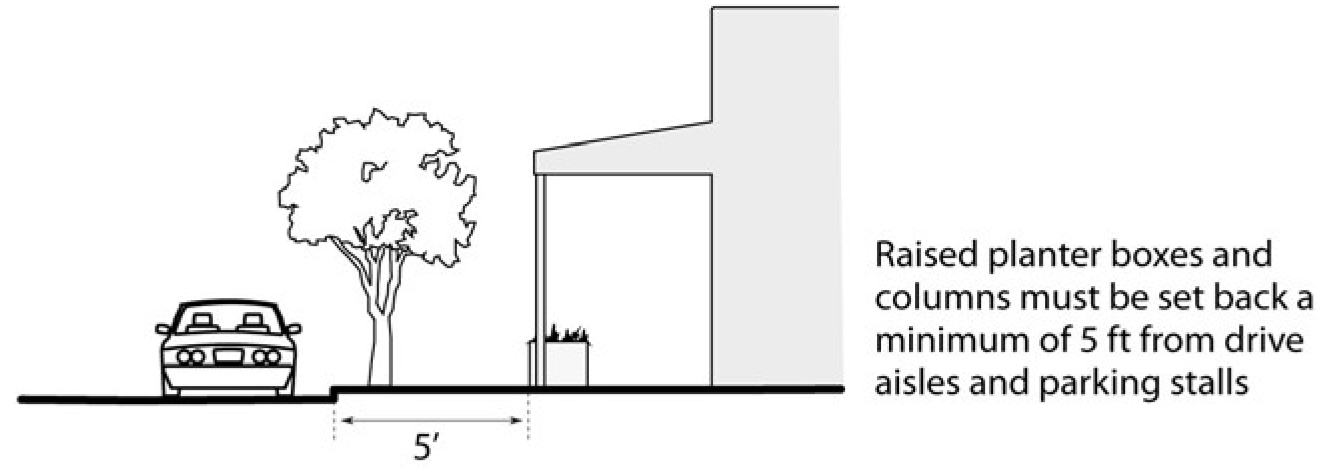
FIGURE 11-33-5.D: SETBACKS FOR RAISED PLANTER BOXES AND COLUMNS
E.
Exceptions.
1.
Loading and Service Areas. A foundation base is not required along exterior walls at overhead doors.
2.
Foundation Base Adjacent to Drive-Thru Lanes. Provide 2-foot-wide foundation base along exterior wall, except at window.
11-33-6: - RETENTION BASINS
A.
In both residential and nonresidential developments, the basin design shall be incorporated with the overall site plan by providing access, landscape, amenities.
B.
Retention basin layout shall be irregular in shape, contoured and designed as an integral part of the Landscaping theme, and shall not take on the appearance of a ditch. The depth of water in retention basins shall not exceed 3 feet 6 inches.
C.
A 3-foot transition area shall be provided where the retention basin side exceeds 6-to-1 slope measured horizontal to vertical and basin is adjacent to Right-Of-Way and Sidewalks. Transition area shall be less than 6-to-1 slope. A maximum 4-to-1 slope allowed in other locations.
D.
Retaining walls shall not exceed 25 percent of the basin perimeter (measured at the high waterline). The maximum height of retaining walls is 18 inches.
E.
Retention basins along public Streets that incorporate retaining walls shall utilize catch basins and pipes to collect and direct water to the bottom of the basins. Where retention basins occur along arterial Streets, berms shall be provided along 33 % of basin frontage. Berms are to be 4-to-1 (horizontal-to-vertical) maximum slope, 2 feet high. Within public Right-Of-Way maximum slope is 6 to 1. Berming shall not obstruct run-off from Streets into the retention basin.
F.
Retention basin design shall provide consolidated basins. Multiple, small retention areas are not acceptable unless basins are interconnected and designed per the City of Mesa Engineering Manual.
G.
Landscaping shall be provided in all areas of the retention basin (slope, top, and bottom).
11-33-7: - ALTERNATIVE LANDSCAPE PLAN
An applicant who can demonstrate that the intent of this Chapter can be exceeded, in whole or in part, may submit an Alternative Landscape Plan (ALP) prepared in accordance with the following principles and design criteria. The ALP shall include a narrative that clearly details the modifications being requested and explains how they enhance the landscape design principles listed below.
A.
Design Principles. In order to qualify for consideration, an ALP shall demonstrate compliance with at least 6 of the following principles:
1.
Innovative Design. Innovative use of plant materials and design techniques in response to unique characteristics of the site.
2.
Native Vegetation. Preservation or incorporation of existing native vegetation.
3.
Plant Variety. Use of a variety of plant material, including plants of color, form, and texture, in excess of the minimum requirements.
4.
Naturalistic Design. Incorporation of naturalistic design principles, such as variations in topography, meandering or curvilinear plantings, and grouping of dominant plant materials (trees, large shrubs) in a manner consistent with native vegetation. Bio-swales are encouraged adjacent to all paved areas.
5.
Compatibility with Surrounding Uses. A greater degree of compatibility with surrounding uses than a standard landscape plan would offer. The number of trees required should depend on the type of tree planted, not some set number. There cannot be a trade off in the number of trees due to the size of the tree at initial planting because what is needed is the ultimate Screening.
6.
Water Efficiency. Use of water-efficient irrigation systems, such as rain water harvesting that allows paved surfaces to drain to adjacent bio-swales and spread rain water more evenly throughout the site, and xeriscaping at appropriate locations.
7.
Storm Water Management. Use of bio-swales with plant material and desert varnish clean storm water before it percolates into the ground.
8.
Site-Specific Attributes. The design incorporates specific environmental attributes such as soil, hydrology, and vegetative communities unique to the site, and which are compatible with environmental features on adjacent properties. Additional design attributes may include incorporation of Landscaping selections for the consistency of the Streetscape in character areas.
9.
Tree Substitution. Substitution resulting in fewer, larger, and more mature trees to replace the required numbers of smaller varieties when placed in perimeter areas at the inverse of the ratios stated in Table 11-33-3.A. (Example: One 60-inch box tree may substitute for four 15-gallon trees when approved by the Zoning Administrator through the use of an ALP.
10.
Plant Viability and Longevity. The landscape plan takes into account the effect of plants on the surrounding activities over the lifetime of the land use, and attempts to promote the viability and long term maturation of plants. It does this by:
a.
Accounting for microclimates and the specific context of the plant's location in choosing of plant varieties.
b.
The use of advanced installation techniques, such a structured soils and Silva cells, to promote the permeability of air and water into the root zone of the plant, and to resist compaction of the soils.
c.
Accounting for the effects that plants may have on a site as the plants mature into adult forms, providing shade while limiting potential restrictions on visibility of the site from adjacent Streets; including consideration of visibility of signs, vehicle traffic sight angles, and the type and context of the specific land use.
11.
Overhead Utility Line Easements. For those portions of sites impacted by the presence of overhead utility lines, the landscape plan:
a.
Uses plants from an approved list suggested by the Arizona Community Tree Council for placement near utility lines (a copy of which shall be kept on file in the Planning Division office), or
b.
Makes other design considerations to meet the intent of the landscape requirements while reducing potential interference of mature plants limbs growing up into vertical space occupied by suspended utility cables.
B.
Allowable Modifications. The following standards may be modified by an ALP:
1.
General Requirements.
a.
Allowed percentage of palm tree and saguaro substitution.
b.
Ground treatment materials.
c.
Irrigation type and coverage.
d.
Landscape buffer along undeveloped edges.
e.
Right-of-way Landscaping and plant types.
2.
Perimeter Landscaping.
a.
Minimum percent of vegetative ground coverage.
b.
Minimum size of plant materials.
c.
Substituting smaller trees with larger, more mature varieties.
3.
Interior Parking Lot Landscaping.
a.
Length and width of required landscape islands.
b.
Size and number of plants on landscaped islands.
4.
Foundation Base.
a.
Width of foundation base.
b.
Size of entry plaza area.
C.
Review, Approval and Required Findings. An ALP shall be reviewed and evaluated as follows:
1.
An application for an ALP may be submitted:
a.
In conjunction with any request, including rezoning, site plan review or modification, Design Review, Council Use Permit, Special Use Permit, variance, or building permit applications.
b.
As a separate application for Administrative Use Permit in accordance with Section 11-70-3, following approval of any processes mentioned in C.1.a, above.
2.
An ALP may be approved upon finding that:
a.
There are unique characteristics of the property, site design, or use that warrant special consideration to modify or deviate from the requirements of this Section and that these characteristics are not self-created.
b.
The ALP meets or exceeds the minimum requirements of this section, while recognizing the unusual site design or use restraints on the property.
c.
Approval of an ALP will provide for both increased consistency and compatibility with adjacent properties.
d.
The ALP conforms to the allowable modifications listed in subsection B, above, and no exceptions to the limitations on the standards that may be modified are requested.
11-34-1: - PURPOSE AND INTENT
A.
Purpose. This Chapter is to provide for Manufactured Home and Recreational Vehicle Parks and Subdivisions which are suitably developed for the placement and occupancy of Manufactured Homes or Recreational Vehicles for residential purposes on rented, leased, or owned spaces with the necessary Accessory Uses and amenities.
B.
Intent. These regulations are intended to enable the development of unique, well-planned projects incorporating a variety of manufactured and vehicle-based housing for permanent or seasonal occupancy. It is also the intent of this Chapter to provide adequate regulations to preserve the residential character of the development and to prohibit inappropriate and incompatible land uses.
11-34-2: - PERMITTED USES
A.
Permitted Uses in Recreational Vehicle Parks and Subdivisions:
1.
Recreational Vehicle Parks.
a.
One (1) Recreational Vehicle or one (1) Recreational Vehicle Park Model is permitted on each approved space.
b.
Manufactured Homes and Dwelling Units of conventional construction are prohibited, except as permitted for Recreational Vehicle accessory structures per Section 11-34-2(12).
2.
RECREATIONAL VEHICLE SUBDIVISIONS.
a.
One (1) Recreational Vehicle or one (1) Recreational Vehicle Park Model is permitted on each approved lot; or
b.
One (1) Dwelling Unit of conventional construction is permitted on each approved lot, subject to the following:
i.
Compliance with Title 4, Building Regulations;
ii.
Compliance with Title 9, Chapter 6, Subdivision Regulations; and
iii.
Compliance with the required yard Setbacks outlined in Section 11-34-3, unless modified with a Planned Area Development Overlay.
c.
Accessory Dwelling Units shall be permitted in accordance with Section 11-31-3: Accessory Dwelling Unit.
d.
Manufactured Homes are prohibited, except as permitted per Section 11-34-2(A)(12).
3.
Recreational Vehicle Accessory Structures, as defined in Chapter 87, Definitions are permitted if the accessory structure:
a.
Is no more than one (1) Story;
b.
Is directly accessible through an internal opening to the Recreational Vehicle or Recreational Vehicle Park Model;
c.
Is no greater in size than 100% of the Floor Area of the Recreational Vehicle or Recreational Vehicle Park Model;
d.
Is removed within 60 days of removal of the Recreational Vehicle or Recreational Vehicle Park Model;
e.
Conforms to Title 4, Building Regulations; and
f.
Conforms to all other applicable development standards, including required yard Setbacks and parking requirements.
4.
Storage Buildings. Storage Buildings, attached or detached, subject to:
a.
A maximum area of 120 square feet;
b.
A maximum height that shall not exceed the height of the Recreational Vehicle or Recreational Vehicle Park Model; and
c.
Is located within the buildable area unless placed in the rear quarter of the space or lot and separated from the Recreational Vehicle or Recreational Vehicle Park Model by at least six (6) feet.
5.
Manager's office and residence, which may be of conventional construction.
6.
Recreation and social centers, which may be used for dancing, crafts, hobbies, games, childcare, meetings, banquets, theatrical performances, movie viewing, and similar entertainment uses which are intended and used primarily as a resident amenity. Such facility may be of conventional construction.
7.
Outdoor recreation facilities such as parks, swimming pools, ramadas, playground equipment, shuffleboard and tennis courts, putting greens, and similar recreational uses intended for use by the residents of the park or Subdivision.
8.
Common-use laundry facilities, maintenance buildings, and security guard houses, which may be of conventional construction.
9.
Designated areas for boat and Recreational Vehicle or Recreational Vehicle Park Model storage which are used solely by the residents of the park or Subdivision.
10.
Recreation center parking lots and guest parking areas.
11.
Accessory Retail Activities, as defined in Chapter 87, Definitions provided:
a.
All proprietors and vendors shall possess valid business licenses and permits as required by the Mesa City Code; and
b.
All signs, flyers, and advertising that describe or relate to accessory retail activities shall not be visible from beyond the boundaries of the Recreational Vehicle Park or Subdivision; and
c.
Such activities shall not exceed more than one (1) every seven (7) days; and
d.
Each separate activity shall not exceed more than four (4) consecutive hours.
12.
Manufactured Homes allowed with Special Use Permit.
a.
Manufactured Homes may be used only in the RM-2-PAD, RM-4, and RM-4-PAD Zoning Districts subject to the approval of a Special Use Permit, in accordance with the provisions contained in Chapter 70, provided the area of the RV Park or RV Subdivision is 10 acres or greater.
b.
The minimum area may include an abutting Manufactured Home Park or Subdivision which shares common development improvements, such as reciprocal access, circulation lanes, and recreation areas.
c.
The Special Use Permit shall only be approved upon a finding that the Recreational Vehicle Park or Subdivision is in substantial compliance with all of the following:
i.
The minimum area and minimum width of lots or spaces for Recreational Vehicle Park or Subdivision, as applicable; and
ii.
The minimum Setbacks, and parking for Recreational Vehicle Parks or Subdivisions, as applicable; and
iii.
A minimum ratio of 100 square feet of Open Space or recreation area for each lot or space. Designated Open Space or recreation area in excess of the minimum required for an abutting Manufactured Home Park or Subdivision used to meet the minimum area requirement above may be included to satisfy the open or recreation space requirement. In the event that insufficient Open Space or recreation area exists upon initial approval, a phasing plan may be submitted and approved that will provide, over the course of time, the minimum Open Space or recreation area needed to comply with the specified ratio. Such a phasing plan shall show installation of all required additional Open Space or recreation area before installation of a Manufactured Home within the Recreational Vehicle Park or Subdivision that exceeds a threshold level of 66% of the lots or spaces within the Recreational Vehicle Park or Subdivision that contains Manufactured Homes; and
iv.
Perimeter Landscaping and perimeter Screening walls.
d.
The development requirements pertaining to the park or Subdivision contained in this Subsection may be modified through approval of the Special Use Permit, provided the modifications will substantially comply with the intent of these provisions, as evidenced by lot or space size, lot or space area, or Open Space and recreation areas in excess of the minimum required. Such modification may not exceed a deviation of more than 10% below the required minimum. In no instance, shall the minimum separation between units be less than six (6) feet.
e.
A Manufactured Home Accessory Structure, as defined in Chapter 87, is permitted when a Special Use Permit for a Manufactured Home is approved provided that it is developed in accordance with the development standards for a Manufactured Home Accessory Structure.
B.
Permitted Uses in Manufactured Home Parks:
1.
One (1) Manufactured Home is permitted on each approved space.
2.
Dwelling units of conventional construction are prohibited.
3.
Manufactured Home Accessory Structures as defined in Chapter 87, Definitions, are permitted if the accessory structure:
a.
Is no more than one (1) Story;
b.
Is directly accessible through an internal opening to the Manufactured Home;
c.
Is no greater in size than 100% of the Floor Area of the Manufactured Home;
d.
Is removed within 60 days of removal of the Manufactured Home; and
e.
Conforms to Title 4, Building Regulations; and
f.
Conforms to all other applicable development standards, including Setbacks and parking requirements.
4.
Storage Buildings. Storage Buildings, attached or detached, are subject to:
a.
A maximum area of 150 square feet;
b.
A maximum height of 10 feet;
c.
Location within the buildable area unless placed in the rear quarter of the space and separated from the Manufactured Home by at least six (6) feet.
5.
Manager's office and residence, which may be of conventional construction.
6.
Recreation and social centers, which may be used for dancing, crafts, hobbies, games, childcare, meetings, banquets, theatrical performances, movie viewing, and similar entertainment uses which are intended and used primarily as a resident amenity. Such facility may be of conventional construction.
7.
Outdoor recreation facilities such as parks, swimming pools, ramadas, playground equipment, shuffleboard and tennis courts, putting greens, and similar recreational uses intended for use by the residents of the park.
8.
Common-use laundry facilities, maintenance buildings, and security guard houses, which may be of conventional construction.
9.
Designated areas for boat and Recreational Vehicle storage which are used solely by the residents of the park.
10.
Recreation center parking lots and guest parking areas.
11.
Accessory Retail Activities, provided:
a.
All proprietors and vendors shall possess valid business licenses and permits as required by the Mesa City Code; and
b.
All signs, flyers, and advertising that describe or relate to accessory retail activities shall not be visible from beyond the boundaries of the Manufactured Home Park; and
c.
Such activities shall not exceed more than one every seven (7) days; and
d.
Each separate activity shall not exceed more than four (4) consecutive hours.
C.
Permitted Uses in Manufactured Home Subdivisions:
1.
One (1) Manufactured Home is permitted on each approved lot; or
2.
One (1) Dwelling Unit of conventional construction is permitted on each approved lot, subject to the following:
a.
Compliance with Title 4, Building Regulations;
b.
Compliance with Title 9, Chapter 6, Subdivision Regulations; and
c.
Compliance with the required yard Setbacks outlined in Section 11-34-3, unless modified with a Planned Area Development Overlay.
3.
Accessory Dwelling Units shall be permitted in accordance with Section 11-31-3: Accessory Dwelling Unit.
4.
No Recreational Vehicle or Recreational Vehicle Park Model shall be permitted on a Manufactured Home lot for living purposes.
5.
Manufactured Home Accessory Structures as defined in Chapter 87, Definitions, are permitted if the Accessory Structure:
a.
Is no more than one (1) Story;
b.
Is directly accessible through an internal opening to the Manufactured Home;
c.
Is no greater in size than 100% of the Floor Area of the Manufactured Home;
d.
Is removed within 60 days of removal of the Manufactured Home; and
e.
Conforms to Title 4, Building Regulations; and
f.
Conforms to all other applicable development standards, including Setbacks and parking requirements.
6.
Detached Accessory Buildings in accordance with Section 11-30-17: Detached Accessory Buildings.
7.
Recreation and social centers, which may be used for dancing, crafts, hobbies, games, childcare, meetings, banquets, theatrical performances, movie viewing, and similar entertainment uses which are intended and used primarily as a resident amenity. Such facility may be of conventional construction.
8.
Outdoor recreation facilities such as parks, swimming pools, ramadas, playground equipment, shuffleboard and tennis courts, putting greens, and similar recreational uses intended for use by the residents of the Subdivision.
9.
Common-use laundry facilities, maintenance buildings, and security guard houses, which may be of conventional construction.
10.
Designated areas for boat and Recreational Vehicle storage which are used solely by the residents of the Subdivision.
11.
Recreation center parking lots and guest parking areas.
(Res. No. 12269, § 16, 9-23-24; Ord. No. 5883, § 3, 10-7-24; Ord. No. 5943, § 1, 6-2-25)
11-34-3: - ZONING, AREA, DENSITY, YARD, RECREATIONAL, AND PARKING REGULATIONS
Table 11-34-3, below, specifies the required zoning, minimum area, maximum densities, minimum yard Setback, minimum recreational area, and minimum parking regulation for all parks and Subdivisions.
Table 11-34-3 Footnotes
1.
Minimum space size 9' x 18': may be tandem but may not be located in the required Front Yard Setback.
2.
Minimum of 10' on one side for vehicle access and/or l 0' on Street side of Corner Lot or space.
3.
Net acre means after deduction of existing and/or proposed Rights-Of-Way.
4.
Public or private Streets, Vehicle Storage areas and exterior boundary Landscaping shall not be located in this area.
5.
Required yard Setbacks are measured from any portion of the unit or accessory structures to the space lease line or Lot Line.
6.
Setbacks are measured from required screen walls.
7.
Minimum width of 28' for spaces not designated for park trailers or Manufactured Homes.
8.
Manufactured Home Subdivisions may be approved for use as part of an infill site when approved in conjunction with an ID-1 or ID-2 Zoning District, as per Chapter 12 of this Title. When the ID-1 or ID-2 zoning is used to authorize a Manufactured Home Subdivision, the project site may be less than 10 acres.
(Ord. No. 5943, §§ 2, 3, 6-2-25)
11-34-4: - DEVELOPMENT REQUIREMENTS
A.
Requirements for Recreational Vehicle Parks and Subdivisions.
1.
A minimum of 5% of the required recreational area shall be enclosed within a recreation hall or building. Public or private Streets, Vehicle Storage areas, and exterior boundary Landscaping areas shall not be included when calculating required recreational area.
2.
Landscaping shall be provided in accordance with the default landscape requirements of Chapter 33, Landscaping, for a project located in a RM, Multiple Residence District, unless a different character designator is approved by City Council for the site.
3.
A 6 foot high masonry screen wall shall be required along all park and Subdivision boundaries. Such wall shall be placed on the interior side of the required landscape strip.
4.
Access to lots or spaces shall be from the interior of the park or Subdivision.
5.
Private Streets shall be paved to a minimum width of 28 feet including required Sidewalks when flush with the surface of the paving.
6.
Concrete Sidewalks at least 2 feet in width shall be provided on each side of interior private Streets.
7.
Required parking spaces shall be paved with either 2 inches of asphalt or 4 inches of concrete.
B.
Requirements for Manufactured Home Parks and Subdivisions.
1.
All room additions shall be structurally independent of the Manufactured Home itself but may be attached to the Manufactured Home by weather stripping.
2.
Landscaping on the perimeter of the site shall be provided in accordance with the default landscape requirements of Chapter 6, Commercial and Mixed Use Districts, and Chapter 33, Landscaping, for a project located in a RM, Multiple Residence District, unless a different character designator is approved by City Council for the site.
3.
A 6 foot high masonry screen wall shall be required along all park and Subdivision boundaries. Such wall shall be placed on the interior side of the required landscape strip.
4.
Access to lots or spaces shall be from the interior of the park or Subdivision.
5.
Private Streets shall be paved to a minimum width of 32 feet including required Sidewalks when flush with the surface of the paving.
6.
Concrete Sidewalks at least 2 feet in width shall be provided on each side of interior private Streets.
7.
Required parking spaces shall be paved with either 2 inches of asphalt or 4 inches of concrete.
C.
Additional Requirements for Manufactured Home Parks. A minimum of 10% of the required recreational area shall be enclosed within a recreation hall or building. Public or private Streets, Vehicle Storage areas, and exterior boundary Landscaping areas shall not be included when calculating required recreational area.
11-34-5: - GENERAL PROVISIONS
A.
Locations Outside of Parks and Subdivisions.
1.
Permitted uses for Manufactured Homes or Recreational Vehicles outside of a park or Subdivision are limited to the following:
a.
As a sales office for Manufactured Home or Recreational Vehicle sales.
b.
With approval of a Special Use Permit pursuant to Chapter 70 Conditional Use Permits, as quarters for a night watchman or caretaker, provided no person other than the night watchman or caretaker shall occupy the unit.
c.
As a construction field office for use by contractors while a permanent building is under construction.
d.
As a temporary place of business for the owner or lessee during the course of construction of a new building on the site, or during remodeling of an existing building or tenant space.
e.
As a temporary sales office for the sale of homes in a conventional Subdivision.
f.
As staff residences for comprehensive youth residences as defined by Chapter 87, Definitions, limited to Manufactured Homes only, and subject to the approval of a Special Use Permit in accordance with Section 11-5-8, Comprehensive Youth Residence, and Chapter 70 Conditional Use Permits.
2.
Prior to the use of a Manufactured Home or Recreational Vehicle for Items 1.b, 1.c, 1.d, and 1.e (above) enumerated in this Section, an Administrative Use Permits for the unit shall be obtained from the Building Safety Division, and the Use Permit shall be nontransferable from one owner or lessee to another.
a.
Except Item 1.d (above), the Use Permit shall expire on December 31 of each year, unless earlier revoked. A Use Permit fee shall be collected when the Use Permit is issued.
b.
Use Permits issued for Item 1.d (above) shall be valid for the duration that a building permit associated with the building or remodeling activity remains active. In the event that no building permit is required, then the Use Permit shall remain valid for a maximum of 6-months, and may be renewed once if the applicant can demonstrate to the Zoning Administrator that the remodeling activity remains on-going and active.
B.
Temporary Parking. Manufactured homes and Recreational Vehicles shall not be parked, stored, or occupied on any property which is not part of an approved Manufactured Home or Recreational Vehicle Park, Subdivision, sales, or storage lot or approved under this Chapter. Temporary Parking of a Manufactured Home or Recreational Vehicle outside of an approved Manufactured Home Park, Manufactured Home Subdivision, Recreational Vehicle Park or Recreational Vehicle Subdivision is limited to the following:
1.
Emergency parking of a Manufactured Home, Recreational Vehicle, or Recreational Vehicle Park Model for a period of no longer than one (1) hour is permitted on any public thoroughfare subject to the provisions of the parking and traffic regulations of the City of Mesa.
2.
The temporary parking of a Recreational Vehicle on a public Street in a residential area for the purposes of loading, unloading, or cleaning for a period of time not to exceed 48 hours shall also be permitted subject to the parking and traffic regulations of the City of Mesa and provided the vehicle is not parked so as to create a traffic hazard or obstruct traffic visibility.
3.
On-site parking or storage of a Recreational Vehicle in accordance with the following, provided such Recreational Vehicle is not used for living quarters or commercial purposes:
a.
Within an enclosed Accessory Building or Garage in all Zoning Districts.
b.
Where Outdoor Storage is otherwise allowed in the Commercial and Industrial Districts.
c.
On residential lots containing less than 5 Dwelling Units:
i.
For Lots of a minimum 15,000 sq. ft. or greater, anywhere within the buildable area behind the front line of the Dwelling Unit; or anywhere within the Rear Yard; or in the Side Yard behind the front line of the Dwelling Unit provided such Recreational Vehicle does not exceed 40-ft. in length exclusive of tongue.
ii.
For Lots less than a minimum 15,000 sq. ft. or greater, anywhere within the buildable area behind the front line of the Dwelling Unit; or anywhere within the Rear Yard; or in the Side Yard behind the front line of the Dwelling Unit provided such Recreational Vehicle does not exceed 30 ft. in length exclusive of tongue.
iii.
A Recreational Vehicle parked in the Side Yard which exceeds 6 feet in height as measured from grade and is visible from a public Street shall be screened from such public Street by a 6 ft. high opaque Fence.
d.
On residential lots containing 5 or more Dwelling Units: only on an approved parking space; or within an approved, designated storage area.
4.
The temporary parking of a Recreational Vehicle in the Front Yard on a residential lot for the purposes of loading, unloading, or cleaning shall be permitted for a period of time not to exceed 72 hours provided the Recreational Vehicle is not used for living quarters or business purposes. While temporarily located as provided herein, the Recreational Vehicle shall not be parked so as to obstruct traffic visibility.
C.
Conversion. The conversion of an existing Manufactured Home or Recreational Vehicle Park to another residential use shall be subject to approval set forth in the amendment requirements established in Chapter 67 Common Procedures. When an existing Manufactured Home or Recreational Vehicle Park is converted to another residential use, the area so converted shall be zoned to limit the number of Dwelling Units per area that can be constructed thereon to a density compatible with existing residential development in the surrounding area.
D.
Permits.
1.
It shall be unlawful for any person to install a Manufactured Home, park trailer, Recreational Vehicle awning, Recreational Vehicle patio enclosure, Manufactured Home room addition, or any electrical, plumbing, or mechanical component without first obtaining a permit or permits from the Building Official or his designee as specified in Mesa Administrative Code, Title 4, Chapter 1 of the Mesa City Code.
2.
No person shall install any park trailer or Recreational Vehicle awning or construct any Recreational Vehicle patio enclosure without approval of the property owner, the owner's agent, or other authorized representative.
(Ord. No. 5943, § 4, 6-2-25)
11-35-1: - PURPOSE
The purpose of this Chapter is to provide a comprehensive set of requirements and standards for the development, siting, installation, and operation of wireless communications Antennas and related facilities. These regulations are intended to protect and promote public safety, community welfare, and the aesthetic quality of the city consistent with the goals, objectives, and policies of the General Plan while providing for managed development of wireless telecommunications infrastructure, consistent with the Federal Telecommunications Act of 1996 and related requirements in State law. The specific objectives of this Chapter are to:
A.
Establish regulations and guidelines for the governance of Wireless Telecommunications Facilities that recognize the unique land use distribution, topography, and aesthetics of the community while preserving the rights of wireless telecommunications providers;
B.
Protect residential areas and land uses from visual blight, safety impacts associated with attractive nuisance, and degradation of residential character;
C.
Promote the location of Towers in non-residential areas and minimize the total number of Towers throughout the community;
D.
Establish the joint use of new and existing Tower sites as a primary option instead of construction of single-use Towers;
E.
Locate Towers and Antennas in areas where the overall impact on the community is minimal, now and in the future; to configure them in a way that minimizes the adverse visual impact of the Towers and Antennas through careful aesthetic design, siting, landscape Screening, and innovative camouflaging techniques;
F.
Enhance the ability of providers of wireless telecommunications services to construct necessary infrastructure to provide such services to the community quickly, effectively and efficiently;
G.
Avoid potential damage to adjacent properties from Tower failure through careful siting of Tower structures;
H.
Create and preserve telecommunication facilities that will serve as an important and effective part of the City's emergency response network;
I.
Promote fair and effective wireless communication services and ensure that a broad range of competitive wireless services with high quality telecommunications infrastructure are available to serve the community; and,
J.
Establish preferred locations and design preferences for the siting of telecommunications infrastructure.
11-35-2: - APPLICABILITY; EXCEPTIONS
The regulations in this Chapter apply to all Antennas and wireless communications facilities on property, other than the public Right-Of-Way, with the following exceptions:
A.
Amateur Radio Antennas. Amateur radio Antennas that do not exceed 75 feet in height when fully extended, are owned and operated by a federally-licensed amateur radio station operator who resides on the same property, and comply with the following requirements:
1.
Not located in the area between the front of a building and the Front Lot Line or side Street Lot Line or any required parking or loading area;
2.
Not exceeding a height of 10 feet within in a required Side Yard or required Rear Yard, or in any parking or loading area; and,
3.
Not more than one Antenna Structure on a lot may exceed a height of 30 feet.
B.
Broadcast Antennas. Direct broadcast, one-way Multipoint Distribution Services, and television broadcast Antennas that are one meter (39 inches) or less in diameter or diagonal measurement and are not located in the area between the front of a building and the Front Lot Line, in a required Side Yard or required Rear Yard, or in any parking or loading area; and do not extend above the maximum permitted height of the Zoning District.
C.
Receive-only Antennas for Residential Uses in Any District and Non-Residential Uses in Residential Districts. A single Ground or Building-Mounted receive-only radio or television antenna that does not exceed the maximum height permitted in the district where it is located and is for the sole use of a resident who resides on the same property, including any mast, or a receive-only radio or television satellite dish antenna, subject to the following restrictions:
1.
Satellite Dish One Meter or Less. A satellite dish one meter or less in diameter is allowed if it is not located in a required Front Yard or any other yard abutting a Street and is not closer to the Front Lot Line than the front line of the primary dwelling or other principal building subject to the following requirements, unless the Zoning Administrator approves an exception as provided for in Chapter 66:
a.
Maximum height of 10 feet within a required side or Rear Yard;
b.
Maximum height of 75 feet within the buildable area of the lot; and,
c.
Not more than one such structure per lot shall exceed a height of 30 feet.
2.
Satellite Dish Greater than One Meter. A satellite dish greater than one meter in diameter is allowed if it is not located within a required Front Yard or Side Yard abutting a Street, and is screened from view from any public Right-Of-Way and adjoining property.
D.
Receive-only Antennas Non-Residential Districts. A single ground or building- mounted receive-only radio or television antenna that does not exceed the maximum height permitted in the district where it is located and is for the sole use of a legally established business or other non-residential occupant of the same property, including any mast, or a receive-only radio or television satellite dish antenna, subject to the following restrictions:
1.
Satellite Dish Two Meters or Less. A satellite dish that does not exceed 2 meters in diameter is permitted anywhere on a lot in a mixed use, commercial or industrial district so long as the location does not reduce required parking, diminish pedestrian or vehicular access, or require removal of Landscaping maintained as a condition of project approval. If more than one satellite dish of 2-meters or less is used for the same tenant, the dishes shall be screened from public view by a parapet or Screening wall.
2.
Satellite Dish Greater than Two Meters. A satellite dish greater than 2 meters in diameter is permitted provided that it is not located within a required Front Yard or Side Yard abutting a Street and is screened from view from any public Right-Of-Way and adjoining property.
E.
Pre-existing Towers. Any Tower or antenna for which a permit has been properly issued that was lawfully erected prior to the effective date of this Ordinance shall not be required to meet the requirements of this Ordinance unless there has been a cessation of operations for 6 months. These Towers and Antennas shall be referred to in this Ordinance as "pre-existing" Towers or Antennas and are allowed to continue as they presently exist, but will be considered lawful nonconforming legal uses subject to the Chapter 36, Non-Conforming Uses, Structures, and Lots. Maintenance, reasonable repairs and alterations to existing Towers and Antennas are permitted if they do not enlarge or extend the Tower structure or equipment enclosures or change the number, type, dimensions, power rating, or frequency range of the antenna or Antennas. New facilities and all other alterations, modifications, and additions shall comply with the requirements of this Chapter.
F.
Exemptions.
1.
Any antenna or wireless communications facility that has been established pursuant to a permit issued by the Federal Communications Commission (FCC) when such permit or the FCC rules and regulations specifically provide that the antenna or facility is exempt from local regulation.
2.
Any wireless communications facility or Antenna Structure that is designed and used exclusively for public safety purposes.
11-35-3: - GENERAL REQUIREMENTS
A.
Federal or State Requirements. All Towers and Antennas must meet or exceed current standards and regulations of the FCC, the Federal Aviation Administration (FAA), and any other agency of the State or Federal government with the authority to regulate Towers and Antennas. If such standards and regulations are changed, then the owners of the Towers and Antennas governed by this Chapter shall bring such Towers and Antennas into compliance with such revised standards and regulations within 6 months of the effective date of such standards and regulations, unless a different compliance schedule is mandated by the controlling State or Federal agency. Failure to bring Towers and Antennas into compliance with such revised standards and regulations shall constitute grounds for the removal of the Tower or antenna at the owner's expense.
B.
Building Codes and Safety Standards. To ensure the structural integrity of Towers, the owner of a Tower shall ensure that it is maintained in compliance with standards contained in applicable State or local building codes and the applicable standards for Towers that are published by the Electronic Industries Association, as amended from time to time.
11-35-4: - APPLICATION REQUIREMENTS
In addition to meeting the standard application submittal requirements for zoning clearances specified in Chapter 68, Zoning Clearance, or for Special Use Permit specified in Chapter 67, Common Procedures, and Chapter 70, Conditional Use Permits, applications for wireless communications facilities shall include the following:
A.
Pre-application Meeting Required. A pre-application conference with the City Zoning Administrator, or their designees, is required prior to submittal of an application for wireless telecommunications facility, or proposed modifications to existing facilities. A minimum of one week before the meeting, the applicant shall provide a description of the location of the facility, a conceptual summary of the project, and a draft sketch of the site plan and elevation of the project. At the pre-application meeting, the Zoning Administrator or designee shall provide a list of submittal requirements for that project, based on the requirements of this Ordinance, the land use activities occurring at this site and in the immediate proximity of the site, suggestions for increasing the compatibility of the facility with the existing or planned activities taking place on surrounding properties, and increasing the aesthetic quality of the facility
B.
Map and Inventory of Existing Sites. Each applicant for an antenna or Antenna Structure shall provide to the Planning Division an inventory of the service provider's existing facilities that are either within the jurisdiction of the City or within one-quarter mile of the City's border, including a map showing the location of the provider's existing facilities that serve customers in Mesa and adjacent areas and the specific site that is the subject of the application. The inventory shall provide specific information about the location, height, power rating, frequency range, and design of each facility or Tower structure. The Planning Division may share such information with other applicants applying for administrative approvals or use permits under this Chapter or other organizations seeking to locate Antennas within the jurisdiction of the City; provided, however, that the Planning Division is not, by sharing such information, in any way representing or warranting that such sites are available or suitable.
C.
Description of Proposed Facility. Each applicant shall provide:
1.
A site plan, plans, and elevations drawn to scale that identify all Antennas by type (e.g. microcell; ground- building- or roof-mounted, etc.) and all related equipment. Elevations shall include all structures or locations on which facilities are proposed to be located.
2.
A description of the proposed approach for Screening or camouflaging all facilities from public view including plans for installation and maintenance of Landscaping, sample exterior materials and colors, and an explanation of the measures by which the proposed facility will be camouflaged or rendered not readily visible. If any part of the proposed facility would be readily visible, the application shall explain why it not possible to further reduce its visual impact. Any representation that the use of state of the art design techniques and technology is not feasible shall be supported by technical and financial analysis.
3.
If any part of the facility will be readily visible from the public Right-Of-Way or from surrounding properties, a visual impact analysis of the proposed wireless communications facility, including scaled elevation diagrams within the context of buildings on and adjacent to the site of the facility, before and after photo simulations, and a map depicting from where the photos were taken. The Zoning Administrator may require the submission of photo overlays, scaled models, renderings, or mockups to document the effectiveness of techniques proposed to minimize visibility of the facility.
4.
When an applicant proposes anything other than the most favored siting and design approach based on the preferences and priorities established in Section 11-35-5(A) and (B), the application must include technical information demonstrating that a higher ranked option is not technically feasible in light of the provider's service objectives.
5.
If a new ground-mounted facility or a Tower is proposed, the application must include an explanation as to why co-location or other facility types are not feasible to meet the provider's service objectives.
D.
Compliance Verification. Each applicant shall provide:
1.
Copies of, or a sworn statement by an authorized representative of the applicant, that applicant holds all applicable licenses or other approvals required by the Federal Communications Commission (FCC) and any other agency of the Federal or State government with authority to regulate telecommunications facilities that are required in order for the applicant to construct the proposed facility.
2.
Documentation of, or a sworn statement by an authorized representative of the applicant, that applicant is in compliance with all conditions imposed in conjunction with such licenses or approvals, a description of the number, type, power rating, frequency range, and dimensions of Antennas, equipment cabinets, and related wireless communications facilities proposed to be installed, and engineering calculations demonstrating that the proposed facility will comply with all applicable FCC requirements and standards.
E.
Peer Review. The application shall include sufficient information for an approved radio frequency specialist or electrical engineer specializing in Electromagnetic Field (EMF) or Radio Frequency Radiation (RFR) studies (hereinafter, "an approved specialist") retained by the City to provide peer review of the information submitted in response to Subdivisions C and D of this Section.
1.
The application shall also include an agreement to pay the reasonable actual cost and a reasonable administrative fee for hiring an approved specialist to provide peer review.
2.
Any proprietary information disclosed to the City or its specialist in confidence is not intended to be included in a public record and shall remain confidential and not be disclosed to any third party without the express consent of the applicant unless such disclosure is required by law. The City and/or its specialist shall return all proprietary information to the applicant and not retain any copies of such information once its decision is final. Notwithstanding the above, information provided to the City may be subject to public disclosure under the Arizona public records law.
F.
Financial Assurances. Prior to obtaining a building permit to erect or install the proposed facility, the applicant shall either secure a bond or provide financial assurances, in a form acceptable to the City Manager, for the removal of the facility in the event that its use is abandoned or the approval is otherwise terminated.
G.
Other Information. The Zoning Administrator may request additional information when it is deemed necessary to process the application in compliance with the requirements of this Chapter. This may include, but is not limited to,
1.
Information concerning noise that might be generated by equipment associated with a wireless telecommunication facility, such as air conditioning equipment,
2.
Photographs of the existing circumstances and context found at the proposed facility to assess what if any conditions may be needed to assure compatibility with surrounding land uses.
3.
Additional photographic simulations from site angles specified by the Zoning Administrator.
4.
General information about potential alternative sites considered in addition to the proposed location.
H.
Site Plan Review Required. Any application proposing the placement of communications equipment on or within architectural forms added to existing structures and which may involve a height exception that requires review by the Planning & Zoning Board shall be made in accordance with the procedures in Chapter 69, Site Plan Review, of this Ordinance.
11-35-5: - LOCATION, DESIGN, AND OPERATION REQUIREMENTS
The following requirements apply to all wireless communications facilities that are not exempt from regulation under this Chapter unless the decision-making authority approves a Special Use Permit pursuant to Chapter 70, Conditional Use Permits.
A.
Location Preferences. The preferred locations for wireless communication facilities are in the following order:
1.
On existing non-residential structures such as buildings, communication Towers, or utility facilities located more than 300 feet from a residential zone, without modification to the structures.
2.
On existing signal, power, light or similar kinds of permanent poles located more than 300 feet from a residential zone.
3.
Co-located with existing wireless telecommunication facilities that conform to the requirements of this Ordinance.
4.
Limited, General and Heavy Industrial Districts sites more than 300-feet from a residential zone.
5.
Camouflaged, stealth, or building-mounted facilities in Limited and General Commercial Districts or in Planned Employment Park Districts.
6.
Camouflaged, stealth or building-mounted facilities on non-residential structures, including monopoles, in any Agricultural or Residential District.
B.
Design Preferences. The preferred design approaches for new wireless communication facilities are in the following order:
1.
Building or structure mounted Antennas designed and sited to be completely concealed from view or not readily visible because of integration into design of non-residential buildings or structures erected and approved for use other than as wireless telecommunications support. Examples of Antennas completely integrated into the structure include existing parapet replacements, bell Towers, steeples, clock Towers and cupolas.
2.
Building or structure mounted Antennas set back from roof edge, concealed and not visible from the public Right-Of-Way or from surrounding residential properties or minor faux-structural alterations. Examples include faux penthouses and parapet additions.
3.
Building or structure mounted Antennas below roof-line (façade mount, pole mount) visible from public Right-Of-Way but artistically integrated into the existing structure and painted to match existing structure.
4.
Freestanding camouflaged structures visible from public Right-Of-Way and from surrounding residential properties. Examples include steeples, sculptures and clock Towers.
5.
Building or structure mounted Antennas above the roof-line visible from public Right-Of-Way or from surrounding residential properties behind frequency- transparent panels.
6.
Freestanding stealth tree, such as monopalm.
7.
Freestanding monopoles or other antenna Towers.
C.
Location of Facilities. Wireless telecommunication facilities shall be located where the existing topography, vegetation, buildings or other structures provide the greatest amount of Screening and in compliance with the following requirements.
1.
No new facility shall be sited on or above a ridgeline.
2.
Within Residential and Mixed Use Districts, no new freestanding Antenna Structure, including Towers, lattice Towers, and monopoles, shall be located within 1,000 feet of another freestanding facility unless mounting on a building or co-location on an existing pole or Tower is not feasible and techniques have been used to camouflage, screen, or otherwise minimize the visual impact of the facility to the extent feasible.
3.
Within Commercial and Employment Districts, new freestanding Antenna Structures, including Towers, lattice Towers, and monopoles, may be located within 1,000 feet of another freestanding facility, provided a stealth or camouflaged design is used.
4.
Ground-mounted wireless telecommunication facilities shall be located in close proximity to existing above-ground utilities, such as permanent electrical Towers, light poles, trees of comparable heights, and in areas where they will not detract from the appearance of the City.
5.
Facilities may only be located on a property zoned for a residential or agriculture use if the Antennas, Antenna Structures, and all related equipment can be sited to comply with the Setback and separation requirements of this Chapter. Exceptions of up to 30% of the Setback and up to 75% of the separation requirements may be considered as part of a Special Use Permit request when the application includes stealth or camouflaged facilities.
D.
Height of Facilities. The height limitations for each Zoning District applicable to buildings and structures shall apply to all Towers and Antennas that are not exempt from regulation except as provided in this Chapter. The height of building-mounted Antennas shall include the height of that portion of the building on which the antenna is mounted. In determining the height of portable "crank-up" or similar Towers whose height is adjustable, the height of the Tower shall be the maximum height to which it is capable of being raised.
1.
Roof-mounted or facade-mounted Antennas proposed on an existing building, or on a Tower, pole or other structure shall not extend or project more than 15 feet above the existing height of the building or structure.
2.
Antenna support equipment for stand-alone facilities (not attached to a building) shall be screened by a minimum 6-foot high masonry wall unless placed within a fully enclosed building. When placed in a building, the building design shall be no taller than one (1) Story or 15 feet in height with elevations designed and constructed in a manner compatible with building designs typically found in the area.
3.
Antenna support equipment that is roof mounted shall meet the Screening requirements specified in Section 11-30-9 of this Ordinance.
E.
Required Separation and Setbacks. Antenna structures and Antennas that are not exempt from regulation under this Chapter shall be Setback from property lines and separated from other Antenna Structures in compliance with the following requirements.
1.
Antenna structures other than alternative Antenna Structures must be set back from any property in residential use a distance equal to the twice the height of the structure. Alternative Antenna Structures shall be Setback from residential uses a distance equal to the height of the structure plus one (1)-foot.
2.
Antenna structures, including alternative Antenna Structures, must be set back from public Right-Of-Way a distance equal to the height of the structure plus one foot.
3.
In Non-Residential Districts, all free-standing Antenna Structures, except for alternative Tower structures, must be at least 1,000 foot feet from another free-standing Antenna Structure, unless appropriate camouflage or stealth techniques have been used to minimize the visual impact of the facility to the extent feasible and mounting on a building or co-location on an existing facility is not feasible.
4.
All wireless communications facilities and related equipment shall comply with the required building Setbacks for the Zoning District in which the facility is located. However, in no instance shall the facility (including antennae and equipment) be located closer than 5 feet to any property line. Exception: Antenna support equipment that is not placed within enclosed buildings provided the surrounding security wall complies with the maximum Fence height requirements as found in Section 11-30-4, Fences and Freestanding Walls.
F.
Design Standards. Antennas, antenna support structures, and related equipment shall be located, designed and screened to blend with the existing natural or built surroundings and existing supporting structures.
1.
Facilities that are not camouflage or stealth shall close mount all panel Antennas.
2.
Stealth or camouflaged facilities shall not have antenna mounts that extend beyond the outside edge of the materials used to provide the stealth or camouflage design.
3.
When freestanding, non-stealth Tower elements are used, Antennas and support structures, where utilized, shall be monopole type.
4.
Monopole support structures shall not exceed 4 feet in diameter unless technical evidence is provided showing that a larger diameter is necessary to attain the proposed Tower height and that the proposed Tower height is necessary.
5.
Wireless telecommunications facility support structures and Antennas shall be a non-glossy color and/or exterior finish so as to minimize visual impacts from surrounding properties. Example: galvanized steel for freestanding, non-stealth facilities; fiberglass artificial bark cladding for stealth tree-like facilities.
6.
All facilities shall be designed and located to minimize their visibility to the greatest extent feasible. All Wireless Telecommunications Facilities proposed for locations where they would be readily visible from the public Right-Of-Way or from the habitable living areas of residential units within 100 feet shall incorporate appropriate techniques to disguise the facility and/or blend into the surrounding environment, to the extent feasible. Facilities shall be compatible in scale and integrated architecturally with the design of surrounding buildings or the natural setting.
7.
No telecommunications antenna or ancillary support equipment shall be located within a front or corner side Setback except for facilities that are completely placed within sub-grade vaults no higher than the maximum height of a Fence within a Street or front Setback, pursuant to Section 11-30-4, Fences and Freestanding Walls.
8.
Support structures and site areas for wireless telecommunications antenna shall be designed and of adequate size to allow at least one additional wireless service provider to co-locate on the structure. Stealth facilities are exempted from this requirement.
9.
Towers shall not be artificially lighted unless required by the FAA or other applicable government authority. All objects affecting navigable airspace must comply with Federal Aviation Regulation Section 77 and must be in conformance with the current restrictions for land within one mile of a runway.
10.
All proposed fencing shall be constructed of masonry, and provide decorative texture, color and design in a manner compatible with the adjacent buildings and properties within the surrounding area and shall be designed to limit graffiti.
11.
Within the Desert Uplands area, as defined on page 33 in Section 9-6-5(A) of the Mesa City Code, Desert Uplands design standards shall apply, including compatibility of stealth and camouflage facilities with the list of approved landscape plant materials.
G.
Required Signs. A permanent, weather-proof identification sign, approximately 16 inches by 32 inches in size, must be placed on the gate of the Fence surrounding the facility or, if there is no Fence, on the facility itself. The sign must identify the facility operator(s), provide the operator's address, and specify a 24-hour telephone number for reaching the operator or an agent authorized to provide 24/7 response to emergency situations.
H.
Required Landscaping. Sites with Antennas, antenna support structures, and related equipment shall be landscaped with a buffer of plant materials that effectively screens views of the base of support structures and equipment facilities from adjacent residential property or from any public Right-Of-Way, path or trail.
1.
The standard buffer shall consist of a continuous landscaped strip with a minimum radius of 4 feet around the perimeter of the installation.
2.
Existing mature tree growth and natural land forms on the site shall be preserved to the maximum extent possible. In some cases, Towers sited on large lots, natural vegetation around the property perimeter may serve as a sufficient buffer.
3.
Street trees and other Landscaping may be required for telecommunications facilities proposed on lots lacking Street frontage Landscaping.
4.
As determined by the context of the site and design preference proposed, additional Landscaping, such secondary plantings of trees similar in appearance to the stealth design of the telecommunications facility, may be conditioned as part of the approval to mitigate the visual impact of the facility.
I.
Operation and Maintenance Standards. All wireless communications facilities shall at all times comply with the following operation and maintenance standards.
1.
Wireless telecommunications facilities and related equipment, including lighting, Fences, shields, cabinets, and poles, shall be maintained in good repair, free from trash, debris, litter, graffiti and other forms of vandalism, and any damage from any cause shall be repaired as soon as reasonably possible so as to minimize occurrences of dangerous conditions or visual blight. Graffiti shall be removed from any facility or equipment as soon as practicable, and in no instance more than 48 hours from the time of notification by the City.
2.
The owner or operator of a facility shall be responsible for maintaining Landscaping in accordance with the approved landscape plan and for replacing any damaged or dead trees, foliage, or other Landscaping elements shown on the approved plan. Amendments or modifications to the landscape plan shall be submitted to the Zoning Administrator for approval.
3.
Each facility shall be operated in a manner that will minimize noise impacts to surrounding residents and persons using nearby parks, trails, and similar recreation areas.
a.
Except for emergency repairs, testing and maintenance activities that will be audible beyond the property line shall only occur between the hours of 7:00 a.m. and 7:00 p.m. on Monday through Friday, excluding holidays.
b.
All air conditioning units and any other equipment that may emit noise that would be audible from beyond the property line shall be enclosed or equipped with noise attenuation devices to the extent necessary to ensure compliance with applicable noise limitations in Title 6, Chapter 12 of the Mesa City Code.
c.
Backup generators shall only be operated during periods of power outages or for testing. Any testing of the backup generators should occur during daylight hours.
d.
For the protection of emergency response personnel, each telecommunications facility shall have an on-site emergency "kill switch" to de-energize all RF-related circuitry and components at the site. For collocation facilities, a single "kill switch" shall be installed that will de-energize all carriers at the facility in the event of an emergency.
11-35-6: - REVIEW AND APPROVAL PROCEDURES
A.
The following wireless communication facilities are permitted by right with a Zoning Certificate issued under the provisions of Chapter 68, Zoning Clearance, if they comply with all applicable requirements of Section 11-35-5. All other facilities that are not exempt from regulation require approval of a Special Use Permit by the Zoning Administrator or Board of Adjustment, pursuant to Chapter 70, Conditional Use Permits and this Section:
1.
The following facilities when located on a property in non-residential use in any Commercial or Industrial District:
a.
Any microcell facility.
b.
Any antenna that is mounted on any existing building or other structure when the overall height of the antenna and its supporting Tower, pole or mast does not exceed the maximum height of Zoning District in which it is located, or when attached to existing Street light, or utility poles.
c.
Any camouflaged facility designed and built to appear as an architectural element of an existing building, or as an architectural structure designed to be consistent with the approved design theme for the development site, provided:
i.
All materials and design elements used in the camouflaged design are compatible with the approved materials, colors and design of the buildings and structures used for the development site;
ii.
The overall height of the camouflaged facility is no higher than twice the maximum height permitted for the Zoning District;
iii.
The facility is a minimum distance of twice the proposed height of the facility from a Residential Zoning District.
2.
The following facilities when located on a property in non-residential use in any Industrial District:
a.
Any free standing Antenna Structure and its supporting Tower, pole, or mast that complies with all applicable Setback ordinances, provided:
i.
The overall height of the antenna and its supporting structure does not exceed a height of 70-feet; and
ii.
The location of the facility is a minimum of 300-feet from a residence.
b.
Freestanding Stealth facilities provided the overall height of the facility (not including stealth related masking features for Antennas and antenna mounts) and its supporting structure does not exceed and height of 70- feet.
3.
The following facilities when located on a property in any Zoning District:
a.
Any building mounted facility, including roof mounts and wall mounts, provided any additional height required for the facility is less than 15- feet above the height of the existing building.
b.
Any co-located facilities mounted on existing freestanding poles or Towers, provided:
i.
Any additional height required for the facility is less than 15-feet above the initial approved height of the pole or Tower;
ii.
The existing number of communication providers with facilities on the pole does not exceed 3. Co-location of a fourth provider shall require approval of a Special Use Permit.
4.
Undergrounding Required. All wires and/or cables necessary for operation of an antenna shall be placed underground or attached flush with the surface of the building or the structure of the antenna.
B.
All requests for Special Use Permit, height exceptions, or Zoning Clearance review shall follow the procedures set forth in Article 7, Administration, and the following requirements:
1.
Any application that proposes construction of a new Antenna Structure or alternative Tower structure or placement of a new antenna on an existing structure of any type shall require a pre-application meeting with Planning Division staff. This meeting is intended to provide significant preliminary information on the project, discuss development alternatives, and determine the appropriate review procedure.
2.
Any application that proposes construction of a new Antenna Structure or alternative Tower structure or involves the placement of any type of communications equipment on or within an architectural form that requires an exception to a height limit shall require review by the Planning & Zoning Board.
C.
The Zoning Administrator may approve the following modifications to existing structures provided the modification is consistent with the requirements of this Chapter and any applicable conditions of approval of a Special Use Permit.
1.
The use of a single Tower by multiple carriers unless conditions of the Special Use Permit specify otherwise.
2.
An increase in the height of an existing antenna support structures that does not exceed 10 feet, provided, the increase in height is used to facilitate the co- location of another communications provider on the same structure and does not exceed the maximum height set forth in other applicable City requirements for a Tower on that site.
3.
An application for building-mounted equipment provided the request is consistent with the requirements of this Chapter and other applicable City requirements and will not increase the height of an existing structure by more than 15 feet.
D.
Approval of a Special Use Permit by the Zoning Administrator acting as a Hearing Officer or Board of Adjustment is required for the following:
1.
Any proposal for a new, freestanding communications facility or to increase the height of an existing antenna support structure greater than 15-feet in any agricultural or residential district;
2.
Any application for a building or roof-mounted structure that would exceed the height of the existing structure by more than 15 feet, except applications as listed in Paragraph A, above; and
3.
Any application that proposes an exception to any applicable requirement in Section 11-35-5.
E.
In addition to any other findings that this Ordinance requires, in order to approve any Special Use Permit for a facility subject to regulation by this Chapter, the decision-making authority must find, based on substantial information in the record including, where required, technical analysis by an approved radio frequency engineers, calculations by a State-licensed structural engineer, or other evidence that:
1.
The proposed telecommunication facility will comply with all applicable state and federal standards and requirements;
2.
The proposed project is consistent with the general requirements of this Chapter and any specific requirements applicable to the proposed facility;
3.
The proposed antenna or related facility, operating alone and in conjunction with other telecommunications facilities, will comply with all applicable state and federal standards and requirements; and either:
a.
Will not be readily visible; or
b.
Will be readily visible, but it is not feasible to incorporate additional measures that would make the facility not readily visible.
4.
The facility, if it is not a microcell or co-located, is necessary to prevent or fill a significant gap in coverage or capacity shortfall in the applicant's service area, and is the least intrusive feasible means of doing so;
5.
If the proposed facility is a satellite dish or parabolic antenna exceeding 39 inches in diameter, that a smaller or less intrusive antenna cannot feasibly accomplish the provider's technical objectives and that the facility will not be readily visible;
6.
If a new antenna support structure is proposed or the applicant proposes to extend the height of an existing Tower, that the applicant has made good faith and reasonable efforts to locate a telecommunication facility on a support structure other than a new monopole or lattice Tower or to accomplish co-location and that no existing Tower or structure in the vicinity can accommodate the applicant's proposed antenna;
7.
If a modification of height, separation, Setback, Landscaping or other requirements of Section 11-35-5 is proposed, that the proposed modification is consistent with the purposes of this Chapter and will be the least intrusive feasible means of meeting the service provider's objectives;
8.
If the proposed location is in a Residential district that the location is necessary for the provision of personal wireless services to Mesa residents and businesses, or their owners, customers, guests, or invitees, or other persons traveling in or about the City based on substantial evidence that siting the facility outside of a Residential district is infeasible and without the proposed facility, the operator will be unable to provide personal wireless services to its customers in the proposed coverage area, or unable to provide the capacity necessary to meet call volumes
9.
If the proposed location is readily visible from the Habitable Area of a Dwelling Unit within 300 feet or from a public Right-Of-Way, public park, or other public recreation or cultural facility, that:
a.
It is not feasible to provide the service at another location or to incorporate additional measures such as a decrease in height, increase in the number of number of facilities, increase in Setback, change in design, relocation relative to other structures or natural features, that would further reduce its visibility; and
b.
The proposed telecommunication facility provides an important link in applicant's service area build-out and is necessary to meet its service needs to City residents.
F.
The Zoning Administrator Hearing Officer or Board of Adjustment may waive or modify requirements of this Chapter upon advice of the City Attorney that denial of the application would have the effect of prohibiting the provision of telecommunications services, unreasonably discriminating among service providers, or constituting any other violation of State or Federal Law. The applicant shall have the burden of proving that the denial or requirement for compliance would violate applicable Federal or State Law.
11-35-7: - CESSATION OF OPERATIONS
A.
The service provider shall notify the Zoning Administrator of the intent to vacate a site at least 30 days prior to the vacation. The permit for any antenna or Tower that is not operated for a continuous period of 12 months shall be deemed lapsed and the site will be considered abandoned unless:
1.
The Zoning Administrator has determined that the same operator resumed operation within 6 months of the notice; or
2.
The Planning Division has received an application to transfer the permit to another service provider.
B.
No later than 90 days from the date the use is discontinued, the owner of the abandoned antenna or Tower or the owner of the property on which the facilities are sited shall remove all equipment and improvements associated with the use and shall restore the site to its original condition as shown on the plans submitted with the original approved application or as required by the Zoning Administrator. The provider or owner may use any bond or other assurances provided by the operator under Section 11-35-4(E) to do so. The owner or his agent shall provide written verification of the removal of the wireless communications facility within 30 days of the date the removal is completed.
C.
If the antenna or Tower is not removed within the time limits stipulated in subsections A and B, the site shall be deemed to be a nuisance and Zoning Administrator may cause the antenna or Tower to be removed at the owners' expense or by calling any bond or other financial assurance provided to the City under Section 11-35-4(E) to pay for removal. If there are 2 or more service providers using a single Tower, then the abandonment period shall not begin until all service providers have ceased using the Tower.
The requirement for removal of equipment in compliance with this Section shall be included as a provision in any lease of private property for wireless communication facilities.
11-36-1: - PURPOSE AND APPLICABILITY
A.
Purpose. This Chapter establishes provisions for the regulation of land uses, lots or parcels, structures, and sites that were lawfully established prior to the adoption or amendment of the Zoning Ordinance, or annexation into the City, but which would now be prohibited, restricted, or regulated differently under the requirements of the Zoning Ordinance or the Zoning Map and therefore do not comply with some or all of the requirements of the Zoning Ordinance.
B.
Applicability.
1.
Approved Modifications. Where a variance or modification has been granted that results in a development standard or feature that does not conform to the requirements of the Zoning Ordinance, the development standard or feature shall be deemed conforming, and this Chapter shall not apply.
2.
Illegal Nonconformities. Land uses, lots or parcels, structures, and sites that were not lawfully established in compliance with the Zoning Ordinance or requirements of the applicable county or municipality, if established prior to annexation, are illegal nonconformities and are ineligible for the nonconforming provisions of this Chapter. Illegal nonconformities are subject to enforcement actions, up to and including removal and termination.
(Ord. No. 5963, § 1, 10-6-25)
11-36-2: - DEFINITIONS
A.
Legal Nonconforming Use. A land use that prior to the effective date of the Zoning Ordinance, subsequent amendment to the Zoning Ordinance, or annexation, was lawfully established—meaning it complied with all applicable requirements of the Zoning Ordinance, or requirements of the county or municipality in which it was located, in effect at the time it was approved—but does not comply with all current applicable Zoning Ordinance requirements. Legal Nonconforming Use does include Legal Procedurally Conforming Use.
B.
Legal Procedurally Conforming Use. A land use that meets one of the following criteria:
1.
A building permit was issued for the land use prior to the issuance of a written interpretation by the Zoning Administrator in which the land use was determined to not be within any classification or use in the Zoning Ordinance and therefore prohibited in every zoning district, or
2.
An ordinance was adopted that amends the Zoning Ordinance regulations applicable to a certain land use and contains a section titled "Legal Procedurally Conforming Use" that specifically provides how that certain land use will be, or will remain, a Legal Procedurally Conforming Use.
C.
Legal Nonconforming Lot or Parcel. A lot or parcel recorded prior to the effective date of the Zoning Ordinance, subsequent amendment to the Zoning Ordinance, or annexation, that was lawfully established—meaning it complied with all applicable dimensional standards in the Zoning Ordinance, or requirements of the county or municipality in which it was located, in effect at the time it was recorded—but does not comply with all current applicable dimensional standards in the Zoning Ordinance.
D.
Legal Nonconforming Structure. A structure that prior to the effective date of the Zoning Ordinance, subsequent amendment to the Zoning Ordinance, or annexation, was lawfully constructed—meaning it complied with all requirements of the Zoning Ordinance, or requirements of the county or municipality in which it was located, in effect at the time it was constructed—but does not comply with all current applicable development standards in the Zoning Ordinance. Legal Nonconforming Structure does not include Legal Procedurally Conforming Structure.
E.
Legal Procedurally Conforming Structure. A structure that meets one of the following criteria:
1.
A building permit was issued for the structure prior to the issuance of a written interpretation by the Zoning Administrator in which the land use that the structure is occupied by or devoted to was determined to not be within any classification or use in the Zoning Ordinance and therefore prohibited in every zoning district, or
2.
An ordinance was adopted that amends the Zoning Ordinance regulations applicable to a certain land use and contains a section titled "Legal Procedurally Conforming Structure" that specifically provides how a structure occupied by or devoted to that certain land use will be, or will remain, a Legal Procedurally Conforming Structure.
F.
Legal Nonconforming Site. A lot or parcel containing site improvements (such as but not limited to landscaping, parking, drive aisles, fencing, or screening) that prior to the effective date of the Zoning Ordinance, subsequent amendment to the Zoning Ordinance, or annexation, were lawfully constructed—meaning the site improvements complied with all requirements of the Zoning Ordinance, or requirements of the county or municipality in which the lot or parcel was located, in effect at the time the site improvements on the lot or parcel were constructed—but the site improvements do not comply with all current applicable development standards in the Zoning Ordinance.
(Ord. No. 5963, § 1, 10-6-25)
11-36-3: - LEGAL NONCONFORMING USES AND LEGAL PROCEDURALLY CONFORMING USES
A.
Right to Continue a Legal Nonconforming Use or Legal Procedurally Conforming Use.
1.
Right to Continue. A Legal Nonconforming Use or Legal Procedurally Conforming Use may continue to operate within the structure(s), area(s), or spaces(s) which it occupied when lawfully established, subject to the provisions of this Section.
2.
Change of Ownership, Tenancy, or Management. Changes of ownership, tenancy, or management of a lot, parcel, or structure occupied by or devoted to an existing Legal Nonconforming Use or Legal Procedurally Conforming Use shall not affect its right to continue.
3.
Discontinued Legal Nonconforming Use or Legal Procedurally Conforming Use. If a Legal Nonconforming Use or Legal Procedurally Conforming use is discontinued for a period of one (1) year or more, the right to operate such use shall terminate. Any subsequent use of the lot, parcel, or structure shall comply with all applicable requirements of the Zoning Ordinance.
a.
Determination of Discontinued Use. The Zoning Administrator shall determine whether the use was discontinued for a period of one (1) year or more resulting in the termination of the right to operate such use.
b.
Burden of Proof. It shall be the burden of the owner/operator of the use to provide evidence of continual operation of the use, such as a valid business license, monthly business receipts, or tax returns showing business activity during the time period in question.
B.
Limitations on Legal Nonconforming Uses and Legal Procedurally Conforming Uses.
1.
Expansion to Other Structures, Areas, Lots or Parcels. A Legal Nonconforming Use or Legal Procedurally Conforming Use shall not be expanded to any other structure, area, lot, or parcel that it did not occupy when lawfully established; except an existing Single Residence use may construct an Accessory Dwelling Unit to the extent allowed by, and in compliance with Section 11-31-3 of the Zoning Ordinance.
2.
Expansion Within a Conforming Structure. A Legal Nonconforming Use or Legal Procedurally Conforming Use may expand within the conforming structure it occupied when lawfully established, subject to the land use regulations in Article 2 for the base zoning district in which it is located.
3.
Expansion Within a Legal Nonconforming Structure. A Legal Nonconforming Use or Legal Procedurally Conforming Use shall not be expanded within a Legal Nonconforming Structure; except an existing Single Residence use may construct an Accessory Dwelling Unit to the extent allowed by, and in compliance with Section 11-31-3 of the Zoning Ordinance.
(Ord. No. 5963, § 1, 10-6-25)
11-36-4: - LEGAL NONCONFORMING STRUCTURES AND LEGAL PROCEDURALLY CONFORMING STRUCTURES
A.
Right to Maintain a Legal Nonconforming Structure or Legal Procedurally Conforming Structure. Maintenance of Legal Nonconforming Structures or Legal Procedurally Conforming Structures is permitted provided that the maintenance does not enlarge or extend, the structure, except as allowed by Section 11-36-4(B)(3).
B.
Limitations on Legal Nonconforming Structures and Legal Procedurally Conforming Structures.
1.
Structural Repairs or Alterations to Legal Nonconforming Structures. Structural repairs or alterations to a Legal Nonconforming Structure are only permitted when the Building Official determines:
a.
The structural repair or alteration is immediately necessary to protect public health and safety of the occupants of the structure, or occupants of adjacent property; and
b.
The cost of the structural repair or alteration does not exceed 50% of the cost to reconstruct the entire structure, exclusive of the foundation.
2.
Structural Repairs or Alterations to Legal Procedurally Conforming Structures. Structural repairs or alterations to a Legal Procedurally Conforming Structure are only permitted if the structural repair or alteration does not enlarge or extend the structure, except as allowed by Section 11-36-4(B)(3).
3.
Expansions or Enlargements of Legal Nonconforming Structures and Legal Procedurally Conforming Structures. A Legal Nonconforming Structure or Legal Procedurally Conforming Structure shall not be expanded or enlarged except as follows:
a.
Expansions or Enlargements Required to Meet Law. Legal Nonconforming Structures or Legal Procedurally Conforming Structures may be expanded or enlarged when necessary to meet federal, state, or City requirements, including development standards for the zoning district in which the structure is located.
b.
Expansions or Enlargements into Nonconforming Yards. Legal Nonconforming Structures or Legal Procedurally Conforming Structures that are located within required yards may be expanded or enlarged only if the expansion or enlargement does not:
i.
Further reduce an existing nonconforming yard;
ii.
Further reduce a nonconforming lot coverage or floor area ratio requirement; or
iii.
Increase the required number of off-street parking spaces, unless additional parking is provided per current parking standards.
c.
Expansions or Enlargements of Legal Nonconforming Structures or Legal Procedurally Conforming Structures Containing a Single Residence or Duplex Use. Expansions or enlargements of a Legal Nonconforming Structure or Legal Procedurally Conforming Structure that contain a Single Residence or Duplex Use may be permitted only if the expansion or enlargement:
i.
Does not increase the gross floor area by more than 75%;
ii.
Does not increase the number of dwelling units on the lot or parcel; and
iii.
Conforms to all applicable requirements of the Zoning Ordinance.
C.
Reconstruction and Restoration of Legal Nonconforming Structures and Legal Procedurally Conforming Structures.
1.
Reconstruction and Restoration of Legal Nonconforming Structures. A Legal Nonconforming Structure that is damaged or partially destroyed may be reconstructed and restored as follows:
a.
Reconstructed and Restored to its Previous Condition. A Legal Nonconforming Structure may be reconstructed and restored to its previous condition, without needing to comply with the Zoning Ordinance, only if:
i.
The reconstructed and restored portions of the structure do not exceed the size, extent, or configuration that existed immediately prior to the damage or destruction;
ii.
The cost of reconstruction and restoration does not exceed 50% of the cost to reconstruct the entire structure, exclusive of the foundation; and
iii.
The use that occupied the structure immediately prior to the damage or destruction is reestablished in the reconstructed or restored structure.
b.
Limits to Reconstruction and Restoration of Legal Nonconforming Structures. If the cost of reconstruction and restoration of a Legal Nonconforming Structure exceeds 50% of the cost to reconstruct the entire structure, exclusive of the foundation, the following shall apply:
i.
The reconstruction and restoration of the structure shall comply with all requirements of the Zoning Ordinance, unless the Zoning Administrator approves an Administrative Use Permit that:
(1)
Permits the structure to be reconstructed or restored to a lesser size, extent, or configuration than existed immediately prior to the damage or destruction; and
(2)
Requires the use that occupied the structure immediately prior to the damage or destruction to be reestablished in the reconstructed or restored structure.
ii.
In no instance may the structure be reconstructed or restored if the cost to reconstruct or restore the structure exceeds 75% of the cost to reconstruct the entire structure, exclusive of the foundation.
2.
Reconstruction and Restoration of Legal Procedurally Conforming Structures. A Legal Procedurally Conforming Structure that is damaged or destroyed (whether wholly or partially) may be reconstructed and restored to its previous condition, without needing to comply with the Zoning Ordinance, only if:
a.
The reconstructed and restored portions of the structure do not exceed the size, extent, and configuration that existed immediately prior to the damage or destruction; and
b.
The use that occupied the structure immediately prior to the damage or destruction is reestablished in the reconstructed or restored structure.
(Ord. No. 5963, § 1, 10-6-25)
11-36-5: - LEGAL NONCONFORMING SITES
A.
Right to Maintain. Maintenance of Legal Nonconforming Sites is permitted provided that the maintenance does not enlarge, extend, or reconfigure the site, except as allowed in Subsection B below.
B.
Alterations and Enlargements to Legal Nonconforming Sites. Alterations or enlargements to a Legal Nonconforming Site may be permitted only if they do not expand a Legal Nonconforming Use or Legal Procedurally Conforming Use, except as allowed by Section 11-36-3(B), and they meet at least one (1) of the below:
1.
The alterations or enlargements comply with all applicable requirements of the Zoning Ordinance; or
2.
The alterations or enlargements are necessary to meet federal, state, or City requirements.
(Ord. No. 5963, § 1, 10-6-25)

