
Mesa City Zoning Code
ARTICLE 7
ADMINISTRATION
CHAPTER 66 - PLANNING AGENCY[1]
Editor's note— Previously, Chapter 66 derived from Ord. No. 5472, 11-6-18.
CHAPTER 67 - COMMON PROCEDURES[2]
Editor's note— Previously, Chapter 67 derived from Ord. No. 5472, 11-6-18.
CHAPTER 71 - DESIGN REVIEW[3]
Editor's note— Previously, Chapter 71 derived from Ord. No. 5472, 11-6-18.
CHAPTER 74 - HISTORIC DISTRICT AND HISTORIC LANDMARK PROCEDURES[4]
Editor's note— Previously, Chapter 74 derived from Ord. No. 5472, 11-6-18.
CHAPTER 77 - APPEALS[5]
Editor's note— Previously, Chapter 77 derived from Ord. No. 5472, 11-6-18.
11-66-1: - PURPOSE
This Chapter identifies the bodies, officials, and administrators with designated responsibilities under various parts and chapters of the Zoning Ordinance. Subsequent chapters of this article provide detailed information regarding various procedures, applications, and permits including zoning, and General Plan text and map amendments, fees, and enforcement. When carrying out their assigned duties and responsibilities, all bodies, administrators, and officials shall interpret and apply the provisions of this Ordinance as minimum requirements adopted to implement the policies and achieve the objectives of the General Plan and Zoning Ordinance.
11-66-2: - PLANNING AND ZONING BOARD
A.
Establishment and Organization of the Planning and Zoning Board. The Planning and Zoning Board is established by Section 406 of the Mesa City Charter and Section 2-1-1 of the Mesa City Code. The Board's organization and duties are described in Title 2 - Boards and Commissions, Chapter 1, Planning and Zoning Board, of the Mesa City Code.
1.
Board Membership. The Planning and Zoning Board shall be composed of seven (7) regular members and three (3) alternates appointed by the City Council.
2.
Qualifications of Members.
a.
Regular Board Members. The composition of the regular Board members shall include:
i.
Two (2) design professionals (e.g., architect, landscape architect, engineer, urban planner, interior designer or similar design-related profession);
ii.
One (1) contractor or developer; and
iii.
Four (4) citizens selected at-large from the community.
b.
Alternate Board Members. At least one (1) alternate to the Planning and Zoning Board shall be a design professional (e.g., architect, landscape architect, engineer, urban planner, interior designer or similar design-related profession).
B.
Meetings.
1.
Meetings of the Board shall be open to the public and the minutes of its proceedings, showing the votes of each member and records of its examinations and other official actions shall be kept and filed in the Planning Division Office as a public record. The Secretary of the Board shall be the Planning Director, or a member of the Planning Division staff as designated by the Planning Director.
2.
At least four (4) members shall be present to conduct a meeting. No matter shall be considered unless there are at least four (4) members present who are eligible and qualified to vote on the matter.
3.
The concurring vote of a majority of the Board members present shall be necessary to pass a motion.
4.
A chair and vice-chair shall be elected annually from among its regular members.
5.
The Chair, or in the Chair's absence the Vice Chair, shall lead the meeting, maintain order, and be the final decision maker for all meeting management questions.
C.
Authority and Duties of the Planning and Zoning Board. In addition to the powers and duties established in Title 2 - Boards and Commissions, Planning and Zoning Board of the Mesa City Code, the Planning and Zoning Board shall:
1.
Hear and Make Recommendations. The Planning and Zoning Board shall hear and make recommendations to City Council on the following:
a.
Zoning Map, Zoning Ordinance, and General Plan Amendments. Amendments to the Zoning Map, Zoning Ordinance, or amendments to the General Plan.
b.
Council Use Permits. Requests for a Council Use Permit.
c.
PC District Matters. Matters specified in an adopted Planned Community Plan for a PC District for action by City Council or amendments to a Planned Community Plan.
d.
Joint Public/Private Projects. Joint public/private projects in designated redevelopment areas.
e.
Redevelopment Plans and Adopted Plans. Proposed redevelopment plans or amendments to adopted plans.
f.
Redevelopment Actions. Proposed redevelopment actions to the Council which are consistent with adopted plans and stated redevelopment goals.
g.
Design of Buildings, Structures, Landscaping, and Open Space. Issues concerning exterior design of buildings, structures, landscaping, and open space.
h.
Directed by City Council. Other matters as directed by the City Council.
2.
Hear and Take Action On. The Planning and Zoning Board shall hear and take action on the following:
a.
Special Use Permits. Special Use Permits (SUP) when requested in conjunction with another request requiring action or recommendation by the Planning and Zoning Board, as authorized by this Subsection C.
i.
Any Planning and Zoning Board approval of an SUP that requires the associated request to be approved by the City Council shall be conditioned upon Council approval of the associated request.
ii.
In the event the City Council denies the associated request, the SUP shall also be considered denied.
b.
Development Plan Review. Development Plan Reviews as specified in Chapter 69: Development Plan Review.
c.
PC District Matters. Matters specified in an adopted Community Plan for a PC District.
d.
Planning Director Appeals. Appeals of the Planning Director, or designee's, decision on Development Plan Review requests.
e.
Conditioned Matters. Matters specified by conditions of approval or stipulations on the property, whether adopted by ordinance, resolution, or otherwise; requiring Planning and Zoning Board approval.
f.
Board Business. Rules for the conduct of Planning and Zoning Board business.
(Ord. No. 5949, § 4, 7-1-25; Ord. No. 5997, § 2, 1-26-26)
11-66-3: - BOARD OF ADJUSTMENT
A.
Establishment and Organization of the Board of Adjustment. A Board of Adjustment is hereby established pursuant to A.R.S. § 9-462.06 and Section 409 of the City Charter. The Board shall elect a chair and vice-chair, annually, who shall have power to administer oaths and to take evidence.
B.
Meetings.
1.
Meetings of the Board shall be open to the public and the minutes of its proceedings, showing the votes of each member and records of its examinations and other official actions, shall be kept and filed in the Planning Division as a public record. The Secretary of the Board shall be the Zoning Administrator, or a member of the Planning Division staff as designated by the Planning Director.
2.
No Variance, Special Use Permit, Substantial Conformance Improvement Permit, Development Incentive Permit, or appeal of an interpretation of the Zoning Ordinance or other provision of the City Code shall be acted upon until a public hearing has been held.
3.
Not less than 4 members of the Board shall be present to conduct a hearing. No matter shall be considered unless there are at least 4 members present who are eligible and qualified to vote on the matter.
4.
The concurring vote of 4 members of the Board shall be necessary to reverse any order or decision of the Zoning Administrator or to decide in favor of the applicant on any matter upon which it is required to pass or to effect any variation from the terms and conditions of this Zoning Ordinance or of the City Code within the jurisdiction of the Board as authorized by the City Council.
5.
The Chair, or in the Chair's absence the Vice Chair, shall lead the meeting, maintain order, and be the final decision maker for all meeting management questions.
C.
Authority and Duties of the Board of Adjustment.
1.
The Board of Adjustment shall:
a.
Hear and decide appeals in which it is alleged there is an error in an order, requirement, or decision made by the Zoning Administrator in the enforcement of the provisions of this Ordinance or other sections of the City Code within the jurisdiction of the Zoning Administrator.
b.
Hear and decide appeals from the action of the Zoning Administrator, acting in either an administrative role or the Hearing Officer role, in the interpretation of the provisions of this ordinance.
c.
Hear and decide appeals from the action of the Zoning Administrator as the Hearing Officer in the granting or denying of variances, the issuance of Special Use Permits, Substantial Conformance Improvement Permits (SCIPs) or Development Incentive Permits (DIPs).
d.
Hear and decide the issuance of Special Use Permits (SUPs), Substantial Conformance Improvement Permits (SCIPs) or Development Incentive Permits (DIPs), required by the City Code.
e.
Authorize variances from the terms of this zoning ordinance pursuant to the provisions of A.R.S. § 9-462.06.
f.
Hear and decide all matters referred to the Board by the Zoning Administrator.
g.
Take any and all actions referred to the Board by the City Council, or as specified by A.R.S. § 9-462.06; or Section 409 of the City Charter.
2.
The Board shall prescribe in connection with any Special Use Permit, Development Incentive Permit, Substantial Conformance Improvement Permit, interpretation, or variance, such conditions as the Board may deem necessary in order to fully carry out the provisions and intent of this Zoning Ordinance.
3.
The Board of Adjustment shall not make any changes in the uses permitted in any zoning classification or zoning district, or make any changes in the terms of the Zoning Ordinance; provided that the restriction in this paragraph shall not affect the authority to grant variances.
4.
The Board of Adjustment may adopt rules for the conduct of its business.
11-66-4: - HISTORIC PRESERVATION BOARD
A.
Establishment and Organization of the Historic Preservation Board. Historic Preservation Board is established and organized as established in Title 2 - Boards and Commissions, in the Mesa City Code. The duties of the Historic Preservation Board shall be in conformance with those established in Title 2 - Boards and Commissions, in the Mesa City Code.
B.
Meetings.
1.
Meetings of the Board are open to the public and the minutes of its proceedings are kept and filed in the office of the Historic Preservation Officer as a public record. The Secretary of the Board is the Historic Preservation Officer or his/her designee.
2.
At least 4 members of the Board shall be present to conduct a meeting. No matter shall be considered unless there are at least 4 members present who are eligible and qualified to vote on the matter and an affirmative vote of a majority of the quorum present and voting shall be required to pass a motion.
3.
The Board shall meet at least 4 times per calendar year.
4.
The Chair, or in the Chair's absence the Vice Chair, shall lead the meeting, maintain order, and be the final decision maker for all meeting management questions.
C.
Authority and Duties of the Historic Preservation Board. The Historic Preservation Board shall have the powers and duties described in Title 2 - Boards and Commissions, in the Mesa City Code.
1.
Hear and/or make recommendations on other matters as directed by the City Council.
2.
The Board may adopt rules for the conduct of its business.
11-66-5: - PLANNING HEARING OFFICER
A.
Establishment of the Planning Hearing Officer. The Planning Hearing Officer is hereby established in the Mesa Planning Division. The Planning Hearing Officer shall be appointed by the City Manager on the basis of training and experience regarding the conduct of hearings, knowledge of the General Plan and knowledge of the Zoning Ordinance.
B.
Authority and duties of the Planning Hearing Officer. When referred by the Planning Director, the Planning Hearing Officer shall:
1.
Recommend action to the City Council on requests for amendments to the Zoning Map, on requests for Council Use Permit, Subdivision Plat Approvals, Applications for Site Plan Review and Site Plan Modifications, when such requests are determined by the Planning Director as appropriate to be heard by the Planning Hearing Officer pursuant to the Planning Hearing Officer guidelines.
2.
Hear and take action on requests for Site Plan Reviews and Site Plan Modifications when not otherwise conditioned for review and approval by City Council, or the request does not involve the need to amend a condition of approval as stated in the adopting ordinance.
3.
Consider and decide preliminary plats as part of the platting procedures and requirements described in the Subdivision Regulations, Title 9, Chapter 6, of the Mesa City Code.
4.
Hear, make recommendations and/or decide matters relating to a PC District, as specified in Chapter 11 of this Ordinance, and the applicable Community Plan as adopted by City Council and including all approved amendments to the Community Plan.
5.
Hear and make recommendations on other matters as directed by the City Manager or City Council.
11-66-6: - DESIGN REVIEW BOARD
A.
Establishment and Organization of the Design Review Board. The Design Review Board is established by Title 2 - Boards and Commissions, Design Review Board of the Mesa City Code.
1.
Qualification of Members. The composition of the Board shall include:
a.
Two (2) licensed architects;
b.
Two (2) other design professionals (e.g., architect, landscape architect, engineer, urban planner, interior designer or similar design-related profession);
c.
One (1) contractor or developer; and
d.
Two (2) citizens selected at-large from the community.
2.
Rules of Conduct. The Board shall adopt rules for the conduct of its business. The Board may, in such rules, delegate certain responsibilities and/or tasks to be performed by a subcommittee or subcommittees of the Board.
B.
Meetings.
1.
Meetings of the Board are open to the public and the minutes of its proceedings are kept and filed in the Planning Division office as a public record. The Secretary of the Board is the Planning Director or a member of the Planning Division staff designated by the Planning Director.
2.
At least four (4) members of the Board shall be present to conduct a meeting and an affirmative vote of a majority of the quorum present and voting shall be required to pass a motion.
3.
The concurring vote of four (4) of the Board members present is necessary to pass a motion to approve an appeal of a decision of the Planning Director.
4.
The Chair, or in the Chair's absence the Vice Chair, shall lead the meeting, maintain order, and be the final decision maker for all meeting management questions.
5.
The Board shall meet as needed.
C.
Authority and Duties of the Design Review Board. In addition to the powers and duties established in Title 2 - Boards and Commissions, Design Review Board of the Mesa City Code, the Design Review Board shall:
1.
Hear and Make Recommendations. The Design Review Board shall hear and make recommendations on the following:
a.
Alternative Compliance. Requests for Alternative Compliance to the Site Planning and Design Standards of Chapters 5, 6, 7, and 8 of this Ordinance.
b.
Municipal Projects. Municipal projects of the City of Mesa, including all fire stations, libraries, parking lots with over 50 spaces, and any municipal building or project of the City of Mesa that meets the applicability for Development Plan Review in Chapter 69 of this Ordinance.
c.
PC District Matters. Matters specified in an adopted Planned Community Plan for a PC District.
d.
Planning Director Referral. Projects referred by the Planning Director.
e.
Directed by City Council. Other matters as directed by the City Council.
2.
Hear and Take Action On. The Design Review Board shall hear and take action on the following:
a.
Planning Director Appeals. Appeals of the Planning Director, or designee's, decision on Alternative Compliance requests.
b.
Conditioned Matters. Matters specified by conditions of approval or stipulations on the property, whether adopted by ordinance, resolution, or otherwise; requiring Design Review Board approval.
(Ord. No. 5997, § 3, 1-26-26)
11-66-7: - ZONING ADMINISTRATOR
A.
Establishment of the Office of the Zoning Administrator. The office of Zoning Administrator is hereby established in the Mesa Development Services Department. The Zoning Administrator shall be designated by the Development Services Department Manager and serves under the direction of the Planning Director.
B.
Authority and Duties of the Zoning Administrator. The Zoning Administrator is the city official established pursuant to A.R.S. § 9-462.05 and charged with responsibility for enforcement of the Zoning Ordinance. In addition, the Zoning Administrator acts in either an administrative role or as a Hearing Officer and shall have the following duties and authorities:
1.
Zoning Administrator in Administrative Role:
a.
Accomplish all administrative actions required by this Ordinance, including the giving of notice, scheduling of hearings, preparation of reports, and receiving and processing appeals.
b.
Interpret the Zoning Ordinance to the public, City Departments and other branches of government, and subject to general and specific policies established by the City Council. The Zoning Administrator may determine which requests for interpretations may be decided through an administrative process or reviewed and decided through a public hearing process as described in Item 2, below.
c.
Undertake preliminary discussions with, and provide advice to, applicants requesting assistance.
d.
Serve as Secretary to the Board of Adjustment, or delegate such duties to qualified parties.
e.
Make recommendations on changes and improvements in Ordinance regulations and procedures.
f.
Determine the location of any district boundary shown on the Zoning Map adopted as part of this ordinance when such location is in dispute.
g.
Review, consider and decide exceptions and alternative plans or alternative standards as authorized by this ordinance, based strictly upon the limitations and criteria specified for that exception, alternative standard or alternative plan.
h.
Review, consider and decide Zoning Permits, Administrative Use Permits, and Temporary Use Permits as authorized by this ordinance, based strictly upon the limitations and criteria specified for Zoning Permits, Administrative Use Permits, and Temporary Use Permits.
i.
Interpret any provisions of this ordinance.
j.
Make decisions on other sections of the City Code which are within the jurisdiction of the Zoning Administrator.
k.
Refer any matter within the Zoning Administrator's authority to the Board of Adjustment.
2.
As a Hearing Officer conduct public hearings to:
a.
Interpret any provisions of this Ordinance when the Zoning Administrator, acting in administrative role, refers an interpretation to the Hearing Officer.
b.
Hear and decide Special Use Permits, Development Incentive Permits, and Substantial Conformance Improvement Permits as required by the City Code.
c.
Authorize variances from the terms of this Zoning Ordinance pursuant to the provisions of A.R.S. § 9-462.06.
d.
Prescribe in connection with any Special Use Permit, Development Incentive Permit, Substantial Conformance Improvement Permit, or any Variance such conditions as deemed necessary in order to fully carry out the provisions and intent of this Ordinance.
e.
Refer any matter within the Zoning Administrator Hearing Officer's authority to the Board of Adjustment.
C.
Limits to Authority and Duties. The Zoning Administrator shall not make any changes in the uses permitted in any zoning classification or zoning district, or make any change in the terms of the Zoning Ordinance; provided that the restriction in this paragraph shall not affect the authority to grant variances.
11-66-8: - DOWNTOWN DEVELOPMENT COMMITTEE
A.
The Downtown Development Committee. The Downtown Development Committee has been decommissioned by deletion of Section 2-20-1 of the Mesa City Code pursuant to Ordinance 4960, dated December 7, 2009.
B.
Modifications. All decided applications for which a condition of approval requires a future revision or modification of that decision to be reviewed by the Downtown Development Committee for either recommendation or decision shall instead be reviewed by the Planning & Zoning Board or Design Review Board, as determined by the Planning Director. The determination shall be based on the type of modification or revision requested.
11-67-1: - PURPOSE
This chapter establishes procedures that are common to the application and processing of all permits and approvals provided for in the Zoning Ordinance, unless superseded by specific requirement of this Ordinance or State law.
11-67-2: - APPLICATIONS, SUPPORTING MATERIALS AND FEES
A.
Applicants. The following persons may file an application:
1.
The owner of the subject property; or
2.
An agent representing the owner, duly authorized to do so in writing by the owner.
B.
Applications. Applications required by this ordinance shall be filed with the office of the Planning Division and include all of the following:
1.
An application, provided by the City.
2.
The required documents and information in a form acceptable to the Planning Division.
3.
Additional materials, as required. The Zoning Administrator may require the submission of supporting materials as part of the application, including but not limited to, statements, photographs, plans, drawings, renderings, models, material samples and other items necessary to describe existing conditions and the proposed project.
4.
The required fee.
C.
Pre-application or Pre-submittal Conference Required. Before filing any applications described by paragraphs E through H, below, the applicant shall submit a preliminary description of the proposal, accompanied by a fee specified by the adopted fee schedule, for review and comment by Planning Division staff. This preliminary description shall include, at minimum, a site plan and project narrative; both of sufficient scope and detail so as to allow a basic review of location, land area, land use, land use intensity, traffic generation and adjacent streets, stormwater drainage, utility service, and previous case history. The Planning Director or a Planning Division staff member designated by the Planning Director shall return comments to the applicant based on this preliminary review in writing, and orally at a subsequent conference between the applicant, Planning Division staff, and staff members of other City departments submitting comments. The need for the conference and fee may be waived by the Planning Director if it is determined sufficient information already exists regarding the request and case site.
D.
Payment, Waiver and Refund of Application Fees.
1.
Schedule of Fees. The City shall establish fees for all application types. Payment of the fee is required in order for an application to be complete. No application shall be processed without payment of the applicable fee unless a fee waiver or deferral has been approved by the Development Services Department Director.
2.
Fee Waiver or Deferral. No fee shall be required when the applicant is the City, or if it is waived or deferred by the Development Services Department Director based upon a finding of unique financial hardship or in unique circumstances where it would be unreasonable to impose the normal fee, or to impose such fee at the usual time.
3.
Refund of Fees. Once an application is filed with the Planning Division, no part of any application fee shall be refundable, unless the Development Services Department Director determines such a refund is justified on the basis of unique financial hardship and factual circumstances. No refund shall be made for any application that has been denied.
11-67-3: - CITIZEN PARTICIPATION
A.
Citizen Participation Plan. Every application that requires a public hearing in accordance with this Chapter shall be accompanied by a Citizen Participation Plan designed to provide effective, early and continuous public participation that includes at least the following:
1.
A contact list or method for notifying adjacent landowners and other potentially affected citizens of the proposed action, that shall include, but is not limited to:
a.
Property owners within the maximum public hearing notice area required for that type of application,
b.
Residents, registered neighborhoods, and homeowners associations that may be impacted as a result of the application, and other neighborhood entities identified by the City,
c.
Interested parties which have requested that they be placed on a contact list for this application, and
d.
Interested parties that have been identified by the City.
2.
A general description of how interested persons and those on the contact list may obtain information and updates on the project, such as newsletters, mailings, and meetings.
3.
A general description of how interested persons, including those on the contact list, will be provided an opportunity to discuss the proposal with the applicant, such as neighborhood meetings, phone contacts, or door-to-door visits.
4.
The applicant's proposed schedule for implementation of the Citizen Participation Plan.
5.
How the applicant plans to keep the City informed on the status of the implementation of its Citizen Participation Plan, such as providing staff copies of notices prior to meetings with citizens, and contact lists used to notify interested parties.
B.
Citizen Participation Report. The requirements in this Section apply in addition to any notice provisions required elsewhere in this Zoning Ordinance, or by Arizona Revised Statutes (ARS).
1.
Applicants shall provide a written Citizen Participation Report on the results of implementing their Citizen Participation Plan at least 10 City business days prior to the first scheduled public hearing. The Citizen Participation Report shall include the following information:
a.
A summary of neighborhood meetings, if held, including when and where they were held, number in attendance (copies of sign-in sheets), and results achieved at the meeting(s);
b.
A summary of citizen concerns, issues and problems expressed during the citizen participation process, and how these have been addressed through changes or stipulations to the project; and
c.
Copies of comment letters, petitions, and other pertinent information received from residents and other interested parties.
2.
City of Mesa staff may apply the Citizen Participation Guidelines, Resolution 7283 (adopted November 2, 1998) as needed to meet the requirements of this section.
3.
Failure to comply with the citizen participation provisions of this section, or a determination that such efforts were insufficient to provide adequate opportunities for citizen participation, may result in postponement, rescheduling or denial of an application.
11-67-4: - REVIEW OF APPLICATIONS
A.
Determination of Administratively Complete Applications. The Planning Director, or a member of the Planning Division staff designated by the Planning Director, shall determine whether an application is administratively complete.
1.
Administrative Completeness Review. Except for residential zoning applications discussed in Section 11-67-(4)(A)(2) below, a determination of completeness will occur as follows:
a.
Administratively Incomplete Application. If an application is incomplete, notification to the applicant shall be sent listing any additional forms, information, and/or fees that are necessary to complete the application.
b.
Administratively Complete Application. When an application is determined to be complete, a notation on the application shall make a record of that date. If required, a public hearing shall be scheduled and the applicant shall be notified of the date and time.
2.
Residential Zoning Application Administrative Completeness Review. This section only applies to applications that meet the definition of a residential zoning application in Chapter 87 of the zoning ordinance.
a.
Administrative Completeness Review Time Frame. For each residential zoning application, the City shall determine if the application is administratively complete within 30 calendar days after receiving the application.
b.
Administratively Incomplete Applications. If it is determined the application is administratively incomplete:
i.
The City shall provide the applicant with a written notice that includes a comprehensive list of the specific deficiencies within 30 calendar days of receiving the application.
ii.
Upon issuance of the written notice, the administrative completeness review time frame and overall time frame, as defined in A.R.S. § 41-1072, are suspended from the date the notice is issued until the City receives the resubmitted application.
iii.
The City shall have 15 calendar days to determine if the resubmitted application and determine whether every deficiency has been resolved for administrative completeness.
B.
Approval or Denial of Residential Zoning Applications. After determining a residential zoning application is complete:
1.
The decision-making body shall approve or deny the application within 180 calendar days of the application being determined administratively complete.
2.
The City may extend the time frame to approve or deny the application beyond 180 calendar days as follows:
a.
For extenuating circumstances the planning director may grant a one-time extension of no more than 30 calendar days; or
b.
At the request of the applicant the Planning Director may grant extensions in 30 calendar day increments.
C.
Exceptions. The provisions within this section related to residential zoning applications do not apply to:
1.
Land that is designated as a district of historical significance pursuant to A.R.S. 9-462.01(A)(10);
2.
An area that is designated as historic on the National Register of Historic Places; or
3.
A lot or parcel that is currently zoned with a planned area development (PAD) overlay.
D.
Annexation Procedures. Annexations shall be considered by City Council in accordance with the procedures specified in Chapter 78.
E.
Additional Fee for Planning Hearing Officer. When an application is determined by the Planning Director as appropriate to be heard by the Planning Hearing Officer pursuant to the Planning Hearing Officer guidelines, the applicant may elect to have the matter placed before the Planning Hearing Officer by submitting the additional fee as specified in a schedule adopted by resolution by the City Council.
F.
Conditions Requiring Mandatory Supermajority Vote by City Council. In the event the City Council is asked to decide upon any proposed Rezoning Amendment, Council Use Permit, Development Unit Plan, Site Plan Review or Site Plan Modification, amendments to such proposals, or appeals of any such proposals, and upon evidence that all conditions described in subsections 1. and 2. below, have been satisfied, then the proposal shall become effective only by favorable vote of three-fourths (¾) of all members of the City Council. If any members of the City Council are unable to vote on such a question because of a conflict of interest, then the required number of votes for passage of the question shall be three-fourths (¾) of the remaining membership of the City Council, provided that such required number of votes shall in no event be less than a majority of the full membership of the Council. For the purposes of this section, the required number of votes shall be rounded to the nearest whole number.
1.
A written protest, signed by the property owners opposing the proposal is filed by the owners of 20-percent or more of the area and number of lots, tracts, and condominium units within the zoning area, as defined in A.R.S. § 9-462.04.
2.
Signed written protests must be filed in the office of the City Clerk by no later than 12:00 noon the Monday of the week prior to the City Council meeting at which the proposal is scheduled to be considered, unless City offices are closed on that Monday because of a local, State or national holiday, then the protest must be filed by 12:00 noon the next business day.
(Ord. No. 5405, 8-28-17; Ord. No. 5905, § 1, 12-9-24)
11-67-5: - PUBLIC NOTICE
A.
Notice of Public Hearing.
1.
City Council, Planning and Zoning Board, and Planning Hearing Officer. Any applications to the City Council, Planning and Zoning Board or the Planning Hearing Officer shall:
A.
Provide the same notice of Public Hearing as required by A.R.S. § 9-462.04; and
B.
Post the subject property no less than 15 days prior to the first scheduled hearing; and
C.
Provide additional notice by first class mail a minimum of 15-days prior to the first scheduled hearing date to all owners of property located within 500-feet of the exterior boundary of the property that is the subject of the application, based on the last assessment.
2.
Board of Adjustment and Zoning Administrator. Any applications to the Board of Adjustment or Zoning Administrator acting as the Hearing Officer shall provide:
A.
The same notice of Public Hearing as required by A.R.S. § 9-462.06(F); and
B.
Additional notice by first class mail a minimum of 15 days prior to the scheduled hearing date to all owners of property located within the following distances of the exterior boundary of the property that is the subject of the application, based on the last assessment:
I.
For any single residence, duplex, or single lot RV or manufactured home: 150 feet.
II.
For any other request: 500 feet.
3.
Design Review Board. Any application to the Design Review Board shall send notice by first class mail a minimum of 15 days prior to the scheduled meeting or work session date to all owners of property located within 500 feet of the exterior boundary of the property that is the subject of the application, based on the last assessment.
B.
Administrative Site Plan. Each initial site plan or minor site plan modification that is eligible for administrative approval shall:
1.
Provide notice by first class mail, to all owners of property located within 500 feet of the exterior boundary of the property that is the subject of the application, based on the last assessment. Notice must be within 15 days after the date the planning division determines the application is complete (i.e., eligible for administrative approval).
2.
The public has ten (10) days from the postmark on the notice to submit comments on the proposed request to the Planning Division.
C.
Contents of Public Notice. Any public notice shall include the following information:
1.
A general description of the proposed project or action and the location of the real property, if any, that is the subject of the application;
2.
The date, time, location, and purpose of the public hearing or the date of action when no public hearing is required;
3.
The identity of the hearing body or officer;
4.
The names of the applicant or the owner of the property that is the subject of the application; and
5.
In addition to the items listed above, mailed notice shall include the following:
a.
A copy of the proposed plans;
b.
A statement that any interested person or authorized agent may appear, and be heard at a public hearing, if a public hearing is required; and
c.
A statement describing how to submit written comments.
6.
It shall be the responsibility of the applicant to maintain the posting once erected until after the last hearing.
D.
Notwithstanding the notice requirements of this section, the failure of any person or entity to receive notice shall not constitute grounds for any court to invalidate the actions of the City of Mesa for which the notice was given.
(Ord. No. 5591, § 1, 12-1-20)
11-67-6: - CONDUCT OF PUBLIC HEARINGS
A public hearing held pursuant to this Ordinance shall comply with the following procedures:
A.
Public Hearing Testimony. Any person may appear at a public hearing and submit oral or written evidence, either individually or as a representative of a person or an organization. Each person who appears at a public hearing shall be identified, state their name and address, and, if appearing on behalf of a person or organization, state the name and mailing address of the person or organization being represented. The presiding officer may establish time limits for individual testimony and may require that individuals with shared concerns select one or more spokespersons to present testimony on behalf of those individuals.
B.
Continuance of Public Hearing. The body conducting the public hearing may, by motion, continue the public hearing to a fixed date, time and place or may continue the item to an undetermined date and provide notice of the continued hearing as set forth in Section 11-67-5.
C.
Investigations. The body conducting the hearing may cause such investigations to be made as it deems necessary and in the public interest on any matter to be heard by it. Such investigation may be made by a committee of one or more members of the body conducting the hearing or by members of its staff or its agents or employees. The facts established by such investigation shall be submitted to the body conducting the hearing either in writing, to be filed with the records of the matter, or in testimony before the body, and may be considered by the body in making its decision.
D.
Record of Hearing. The body conducting the hearing shall cause a written summary of all pertinent testimony heard at such public hearing, together with a record of the names and addresses of all persons testifying, to be prepared and filed with the papers relating to such matter.
11-67-7: - RECORDS OF ACTIONS TAKEN
Unless otherwise specified in this Ordinance, the minutes of the meeting where a decision is made shall be the official record of any action taken or decision made to approve, approve with conditions, modify, revoke or deny any discretionary permit or discretionary approval (e.g., Site Plan Review, Certificate of Appropriateness) under this Ordinance.
A.
Date of Action. The responsible body shall decide to approve, modify, revoke, or deny any discretionary permit or discretionary approval following the close of the public hearing, or if no public hearing is required, at a public meeting within the time period required by this Ordinance. The date of action shall be the date of the meeting where a motion or other action is approved.
B.
Notice of Action. After the Zoning Administrator or other responsible body takes any action to approve, modify, or deny an application that is subject to appeal under the terms of this Ordinance, Notice of Action shall be sent to the Applicant. The Notice shall describe the action taken, including any applicable conditions, and shall list any required findings that were the basis for the decision. The Notice shall be mailed within seven calendar days from the date of taking the action, to the Applicant at the address (including electronic addresses) stated in the application and to any other person or entity who has filed a written request of such notification.
C.
Findings. Findings shall be required for any action of the Zoning Administrator acting as a Hearing Officer and for the Board of Adjustment, as required by A.R.S. § 9-462.06 or this Ordinance, and shall be based upon personal observations, consideration of the application, plans, testimony, reports, and other materials that constitute the administrative record and shall be stated in writing in the resolution by or meeting minutes of the decision-making authority. The findings shall be set forth in the notice that the City issues following an appealable decision by the Zoning Administrator or other responsible body and in the minutes of the meeting or other record where the decision making authority documents its decision.
11-67-8: - EFFECTIVE DATES
A.
Approvals Subject to Appeal. A final decision on an application for any discretionary approval subject to appeal (e.g., a use permit, variance, or site plan approval) shall become effective after the expiration of the appeal period following the date of action, unless an appeal is filed. In accordance with paragraph B, below, no building permit or business license shall be issued until the day following the expiration of the appeal period, unless the applicant signs a waiver explaining that they understand and accept the risk of proceeding before the appeal period ends.
B.
Exercising Approval at Risk. An approved variance or Special Use Permit or an interpretation favorable to the applicant may be exercised at the applicant's sole risk, and a construction permit (if required) may be issued subsequent to the approval by the Zoning Administrator or Board of Adjustment. However, if an appeal of the decision is filed in accordance with the provisions of this Ordinance that reverses in whole or in part or modifies the decision and that causes any construction or use commenced as a result of exercising the decision to be in conflict with the appellate body's decision, then such construction permit may be revoked in accordance with the appellate body's decision and any such construction or use may constitute a violation of this Ordinance and may be subject to removal or cessation by the applicant, property owner, or his agent.
11-67-9: - EXPIRATIONS AND EXTENSIONS
A.
Expirations.
1.
The Planning and Zoning Board, Planning Hearing Officer, Zoning Administrator acting as a Hearing Officer, Board of Adjustment, or City Council, in the granting of any permit, (also referred to as discretionary approval), or permit modification, for which the body has authority, may specify the time within which the proposed use must be undertaken and actively and continuously pursued. The Planning and Zoning Board, Planning Hearing Officer, Zoning Administrator acting as a Hearing Officer, Board of Adjustment, or City Council, may impose upon the permit a term of such period of time as is found to be consistent with the purposes of the use and necessary to safeguard the public safety, health and welfare. If no time period is otherwise specified, any permit granted under this Ordinance may be declared expired and of no further force and effect if it is not exercised or extended within one year of its issuance. The permit is considered exercised by completion of one of the following:
a.
A permit for the use of a building or a property is exercised when, if required, a valid City business license has been issued, and the permitted use has commenced on the property in reliance on that permit.
b.
A permit for the construction of a building, structure, or sign is exercised when a valid City building permit, if required, is issued, and construction has lawfully commenced in reliance upon that permit.
2.
Approved Variances may be declared expired and of no further force and effect if it is not exercised or extended within 1 year of the date of approval. The variance is considered exercised when a valid city building permit, if required, is issued, and construction has lawfully commenced in reliance upon that permit.
3.
An approved initial site plan, major site plan modification, or design review expires and is no longer in effect if it is not exercised or extended within two years of the date of approval. A minor site plan modification is effective for a period of two years from the date the initial site plan associated with the minor site plan modification was approved. An approved initial site plan, site plan modification or design review is considered exercised by completion of one of the following:
a.
A valid city business license, if required, is issued, and the permitted use has commenced on the property.
b.
A valid city building permit, if required, is issued, and construction has lawfully commenced.
B.
Extensions. The Zoning Administrator may approve a one-year extension of any permit or approval granted under this Ordinance upon receipt of an application with the required fee prior to the expiration date. All other extensions shall require approval by the original approving body.
(Ord. No. 5591, § 2, 12-1-20)
11-67-10: - MODIFICATIONS TO APPROVED PLANS
For those sections of this Ordinance that provide a modification or amendment process, such as Chapter 69: Site Plan Review and Chapter 76: Amendments to Zoning Map, this section does not apply. This section only applies if this Ordinance does not provide a modification or amendment process. This section sets forth the criteria for minor and major modifications. It also provides the review and approval process for minor modifications.
A.
Minor Modifications. A modification is considered minor if it does not materially alter the approved plan or other approval, will not intensify any potentially detrimental effects of the project and is consistent with the original findings and all conditions of approval approved by the Planning Director or designee, the Board of Adjustment, Design Review Board, Planning Hearing Officer, Planning & Zoning Board, or City Council. The Planning Director, in the Planning Director's discretion, determines if a modification is minor. A modification that is not determined minor by the Planning Director is a major modification subject to subsection B. below.
1.
Review Process for Minor Modifications. Minor modifications are reviewed administratively by the Planning Director or the Planning Director's designee. The Planning Director or designee may take action on, or impose conditions upon, the modification to protect adjacent properties, preserve neighborhood character, mitigate adverse environmental impacts or other public health and safety reasons. The Planning Director, in the Planning Director's discretion, may require a minor modification go through the public hearing process for review and consideration by the appropriate decision-making body as required by this Ordinance.
B.
Major Modifications. A modification is considered major if it changes, eliminates or affects a condition of approval (whether adopted by resolution, ordinance or otherwise) such as a change to a discretionary permit, approved plan, or building plan or materially alters a previous approval or plan. Additionally, any modification not determined minor by the planning director is a major modification. This section does not provide the review and approval process for major modifications. A modification that is determined major will require the submission of a new application to start the process from the beginning and must follow the applicable review and approval process set forth in this Ordinance and have the request approved by the appropriate decision-making body.
(Ord. No. 5591, § 3, 12-1-20)
11-67-11: - REVOCATION OF PERMITS APPROVED THROUGH A PUBLIC HEARING PROCESS
Any Council Use Permit (CUP), Special Use Permit (SUP), Development Incentive Permit (DIP), or Substantial Conformance Improvement Permit (SCIP) granted under this Chapter may be revoked if any of the conditions or terms of such permit are violated or if any law or ordinance is violated in connection therewith.
A.
Initiation of Proceeding.
1.
The City Council, by its own action, or following a recommendation from the Planning & Zoning Board or Zoning Administrator, may initiate revocation proceedings regarding Council Use Permits.
2.
The Board of Adjustment, following a recommendation from the Zoning Administrator, may initiate revocation proceedings for Special Use Permits, DIPs and SCIPs.
B.
Public Notice. Notice that the possible revocation of the permit has been scheduled for hearing shall be made pursuant to the requirements of Section 11-67-5, Notice of Public Hearing.
C.
Public Hearing. The public hearing regarding the revocation of a permit shall be conducted in the same manner as was used for the approval of the use permit, pursuant to Chapter 70.
D.
Required Finding for Revocation. The City Council, or Board of Adjustment, as applicable, may revoke a permit if it makes any of the following findings:
1.
That approval was obtained by means of fraud or misrepresentation of a material fact;
2.
That the permittee or holder of the permit has failed to initiate construction or undertake the use in question within a 1 year period following the effective date of the permit or variance;
3.
That the use in question has ceased to exist or has been suspended for one year or more;
4.
That there is or has been a violation of or failure to observe the terms or conditions of the permit or the use has been conducted in violation of the provisions of this Ordinance, law or regulation; or
5.
That the use to which the permit or applies has been conducted in a manner detrimental to the public safety, health and welfare, or so as to be a nuisance.
11-67-12: - APPEALS
A final decision is subject to appeal according to the standards in Chapter 77 - Appeals. Table 11-67-12 summarizes the appeal process for each body issuing a final decision.
(Ord. No. 5997, § 4, 1-26-26)
11-68-1: - PURPOSE
This Chapter establishes procedures for conducting zoning clearance to ensure that each new or expanded use or structure complies with the applicable requirements of this Ordinance. Having made such determination, the City shall establish a record of the Zoning Clearance that document the initial establishment of a use, or the construction of a structure, which is allowed as a matter of right.
11-68-2: - APPLICABILITY
Zoning clearance is required for buildings or structures erected, constructed, altered, repaired or moved, which require a building permit, the use of vacant land, changes in the use of land or building, or for substantial expansions in the use of land or building.
11-68-3: - REVIEW AND DECISION
A.
Determination. The Zoning Administrator shall determine whether the Zoning Ordinance allows the proposed uses or structures by right. A Zoning Certificate shall be issued if the Zoning Administrator determines that the proposed use or building is allowed as a matter of right by the Zoning Ordinance, and conforms to all the applicable development and use standards. An approved Zoning Certificate may include attachments of other written or graphic information, including but not limited to, statements, numeric data, site plans, floor plans and building elevations and sections, as a record of the proposal's conformity with the applicable regulations of this Chapter.
B.
Exceptions. No Zoning Certificate shall be required for the continuation of lawful uses and structures approved or permitted prior to the adoption of this ordinance, uses and structures that are not subject to any building or zoning regulations, or other uses or buildings already subject to Council Use Permit, Special Use Permit, variances or other discretionary approvals in the district in which they are located.
11-68-4: - APPEALS
The applicant or any other aggrieved party may appeal a determination of zoning conformance pursuant to the provisions of Chapter 77, Appeals.
11-69-1: - PURPOSE
This Chapter establishes objectives, standards, and procedures for reviewing new site plans ("Initial Site Plan") as well as modifications to approved site plans ("Site Plan Modification"). The specific purpose of the site plan review process is to:
A.
Ensure the proposed development plan is in compliance with the provisions of this Ordinance.
B.
Eliminate or minimize potential land use conflicts and provide effective transitions between abutting parcels appropriate to the context of the circumstance.
C.
Mitigate any adverse impacts on adjacent developments or land uses that may be caused by specific proposed land uses.
D.
Ensure high-quality development and encourage development options that are designed in an aesthetically pleasing manner and incorporate public spaces that are integral to the project.
E.
Ensure a safe and efficient traffic circulation system, foster the provision of adequate off-street parking and off-street loading facilities, bicycle facilities and pedestrian amenities, and support a multi-modal transportation system. Encourage improved connectivity between abutting residential, commercial, educational, employment and recreational uses.
F.
Achieve goals, objectives, and policies of the General Plan, sub-area plans and other policies adopted by the City Council.
(Res. No. 11603, § 1, 11-16-2020; Ord. No. 5594, § 1, 12-1-2020)
11-69-2: - APPLICABILITY
The following development proposals are required to go through the site plan review process. This Section applies to both Initial Site Plan reviews and Site Plan Modifications:
A.
A project that includes multiple residence, three or more attached single residences, or more than two dwelling units per lot. Site plan review is not required for a project with only one detached single residence.
B.
A project that includes mixed use, commercial or industrial uses and either has frontage on an arterial or collector street or is part of a larger development or center, or both, that has frontage on an arterial or collector street.
C.
Mixed use, commercial or industrial projects that have more than 20,000 square feet of gross floor area.
D.
A modification to an existing commercial or industrial development that either has frontage on an arterial street or is part of a larger development or center, or both, that has frontage on an arterial street; and the modification includes either:
1.
A change in the required parking or the site's circulation, including access points, or the addition of a drive-thru;
2.
A change in use, occupancy designation, or density; or
3.
A change in outside storage or outside display area, irrespective of whether the building or primary use has expanded.
E.
Parking garages.
F.
Municipal Projects. All fire stations and libraries, parking lots with over 50 spaces, and any municipal building or project of the City of Mesa that meets the criteria in this Section.
G.
The project is located on property in which the ordinance adopting the zoning, rezoning or Council Use Permit is conditioned upon site plan review.
H.
Any other projects identified in this Ordinance as requiring site plan review.
(Res. No. 11603, § 1, 11-16-2020; Ord. No. 5594, § 1, 12-1-2020)
11-69-3: - APPLICATION REQUIREMENTS
An application for an Initial Site Plan review or Site Plan Modification must be filed with the Planning Division in accordance with the application procedures in Chapter 67, Common Procedures. In addition, an Initial Site Plan or Site Plan Modification shall comply with the citizen participation and public notice requirements in Chapter 67.
(Res. No. 11603, § 1, 11-16-2020; Ord. No. 5594, § 1, 12-1-2020)
11-69-4: - INITIAL SITE PLAN REVIEW PROCEDURES
A project that is required to go through the site plan review process under Section 11-69-2 and is located on property, or a portion thereof, that does not have a previously approved site plan or the approved site plan has expired is required to submit for and obtain approval of an Initial Site Plan. The applicable governing body, as set forth in this Section, will review the Initial Site Plan following the procedures described herein. The Zoning Administrator shall determine if a request is for an Initial Site Plan review. A site plan that is not considered an Initial Site Plan by the Zoning Administrator is a Site Plan Modification and subject to the procedures and review processes in Section 11-69-7.
A.
Eligibility for Administrative Review. In certain circumstances an Initial Site Plan may be administratively approved. An Initial Site Plan is not entitled to the administrative review and approval process but may qualify if the Zoning Administrator determines the Initial Site Plan is eligible. An Initial Site Plan is eligible for administrative review and approval if the Zoning Administrator determines the Initial Site Plan satisfies all of the following:
1.
Complies with all applicable requirements in this Ordinance and any adopted sub-area plans;
2.
Complies with all conditions of approval or stipulations on the property (regardless of whether the condition of approval was approved by ordinance, resolution, or otherwise);
3.
The proposed development does not require a Rezone, Planned Area Development Overlay (PAD), Council Use Permit (CUP), Bonus Intensity Overlay Zone (BIZ), or Special Use Permit (SUP); and
4.
The proposed development will not have an adverse impact on adjacent properties.
B.
Administrative Review Process. Administrative review of an Initial Site Plan may be conducted by the Planning Director or the Planning Director's designee. The Planning Director or designee shall use the review criteria set forth in Section 11-69-5 to evaluate the Initial Site Plan and may take action on, or impose conditions upon, the Initial Site Plan as set forth in Section 11-69-6. The Planning Director, in the Planning Director's sole discretion, may require an Initial Site Plan go through the public hearing process as set forth in Section 11-69-4(D) below.
C.
Requirements for Review by City Council and Planning & Zoning Board. If the Zoning Administrator determines an Initial Site Plan is not eligible for administrative approval under Section 11-69-4(A), the Initial Site Plan must go through the public hearing review and approval process in Section 11-69-4(D).
D.
Public Hearing Review Process.
1.
Planning & Zoning Review. The Planning and Zoning Board shall use the review criteria set forth in Section 11-69-5 to evaluate the initial site plan and may take action on, or impose conditions upon, the initial site plan as set forth in Section 11-69-6.
The following Initial Site Plans are reviewed by the Planning and Zoning Board through the public hearing process:
a.
An Initial Site Plan associated with a proposed development that only requires a Special Use Permit.
b.
An Initial Site Plan eligible for administrative review but referred to the Planning & Zoning Board by the Planning Director.
2.
City Council Review. The following Initial Site Plans are subject to recommendation by the Planning and Zoning Board and review and approval by the City Council.
a.
An Initial Site Plan associated with a Rezone, Planned Area Development Overlay (PAD), Council Use Permit (CUP), or Bonus Intensity Overlay Zone (BI).
b.
An Initial Site Plan that does not comply with a condition of approval or stipulation on the property (regardless of whether the condition of approval was approved by ordinance, resolution, or otherwise).
c.
Any Initial Site Plan not eligible for administrative review and not subject to approval by the Planning and Zoning Board in Section 11-69-4(D)(1).
3.
The City Council shall use the review criteria set forth in Section 11-69-5 to evaluate the Initial Site Plan and may take action on, or impose conditions upon, the Initial Site Plan, as set forth in Section 11-69-6.
(Res. No. 11603, § 1, 11-16-2020; Ord. No. 5594, § 1, 12-1-2020; Ord. No. 5759, §§ 6, 7, 12-8-22)
11-69-5: - REVIEW CRITERIA
When conducting an Initial Site Plan review or Site Plan Modification, the Planning Director or Planning Director's designee, the Planning & Zoning Board, and the City Council shall evaluate and determine if the project satisfies all of the following criteria:
A.
The project is consistent with and conforms to the adopted General Plan and any applicable sub-area or neighborhood area plans (except no analysis of the use if it is permitted in the zoning district on the property), is consistent with the development standards of this Ordinance, and is consistent with and meets the intent of any applicable design guidelines.
B.
The project is consistent with all conditions of approval imposed on the property whether by ordinance, resolution or otherwise.
C.
The overall design of the project, including but not limited to the site layout, architecture of the buildings or structures, scale, massing, exterior design, landscaping, lighting, and signage, will enhance the appearance and features of the site and surrounding natural and built environment.
D.
The site plan is appropriate to the function of the project and will provide a suitable environment for occupants, visitors, and the general community.
E.
Project details, colors, materials, and landscaping are internally consistent, fully integrated with one another, and used in a manner that is visually consistent with the proposed architectural design.
F.
The project is compatible with neighboring development by avoiding big differences in building scale and character between developments on adjoining lots in the same zoning district and providing a harmonious transition in scale and character between different districts.
G.
The project contributes to the creation of a visually interesting built environment that includes a variety of building styles and designs with well-articulated structures that present well designed building facades, rooflines, and building heights within a unifying context that encourages increased pedestrian activity and promotes compatibility among neighboring land uses within the same or different districts.
H.
The streetscapes, including street trees, lighting, and pedestrian furniture, are consistent with the character of activity centers, commercial districts, and nearby residential neighborhoods.
I.
Street frontages are attractive and interesting for pedestrians and provide for greater safety by allowing for surveillance of the street by people inside buildings and elsewhere.
J.
The proposed landscaping plan is suitable for the type of project and site conditions and will improve the appearance of the community by enhancing the building and site design; and the landscape plan incorporates plant materials that are drought-tolerant, will minimize water usage, and are compatible with Mesa's climate.
(Res. No. 11603, § 1, 11-16-2020; Ord. No. 5594, § 1, 12-1-2020)
11-69-6: - ACTION & CONDITIONS OF APPROVAL
The Planning Director or Planning Director's designee, the Planning & Zoning Board, and the City Council may approve, modify, approve with conditions, or deny an Initial Site Plan or Site Plan Modification. Conditions of approval that may be imposed include:
A.
Additional building setbacks;
B.
Additional landscaping;
C.
Height and area limitations of structures;
D.
Limited vehicular access;
E.
Walls, fences, and screening devices;
F.
Noise attenuation construction; or
G.
Any other restriction or requirement necessary to protect adjacent properties, preserve neighborhood character, or mitigate adverse environmental impacts.
(Res. No. 11603, § 1, 11-16-2020; Ord. No. 5594, § 1, 12-1-2020)
11-69-7: - MODIFICATIONS TO APPROVED SITE PLANS
A change to a previously approved site plan or a site plan that is not considered an Initial Site Plan by the Zoning Administrator is a Site Plan Modification. Depending on the degree and type of change, the modification will be classified as minor or major and reviewed by the applicable governing body as provided in this Section. The proposed modification is minor or major as set forth in this Section 11-69-7.
A.
Minor Modifications to an Approved Site Plan and Eligibility for Administrative Review. In the following circumstances, a Site Plan Modification is minor and may be administratively approved by the Planning Director or the Planning Director's designee.
1.
A modification to a Site Plan that was administratively approved by the Planning Director or the Planning Director's designee and that is not a modification listed in Section 11-69-7(D)(1).
2.
A modification to an approved Site Plan if the Zoning Administrator determines the modification is minor. A modification to an approved Site Plan will be considered minor if the Zoning Administrator determines the modification meets the criteria in both Subsections (A) and (B) below:
a.
The modification meets at least one of the following four criteria:
i.
A change to the design that does not deviate from any applicable design review requirements or adopted design guidelines; or
ii.
A change in landscape area or open space area that is less than 10% and not greater than 2.5 acres; or
iii.
A change in the total building footprint (floor area, height, or dimensions) that is 10% or less and no more than 5,000 square feet; or
iv.
A minimal adjustment to: i) the building footprint, location, or orientation; ii) the pad location; iii) the configuration of a parking lot or drive aisles; iv) project amenities such as, but not limited to, recreational facilities, pedestrian amenities, fencing or other screening material; v) residential density; or vi) the approved phasing plan.
b.
In addition to meeting one of the four criteria listed in Subsection (A) above, the modification must also meet all of the following criteria:
i.
Complies with all applicable requirements in this Ordinance and any adopted sub-area plans; and
ii.
Complies with all conditions of approval or stipulations on the property (regardless of whether the condition of approval was approved by ordinance, resolution, or otherwise); and
iii.
Is consistent with the purpose and intent of the approved site plan; and
iv.
The proposed development does not require a Rezone, Planned Area Development Overlay (PAD), Council Use Permit (CUP), Bonus Intensity Overlay Zone (BIZ), or Special Use Permit (SUP); and
v.
The change will not have an adverse impact on adjacent properties; and
vi.
The change has not previously been determined to be a major Site Plan Modification.
B.
Administrative Review Procedures for Minor Site Plan Modifications. The Planning Director or the Planning Director's designee shall use the review criteria set forth in Section 11-69-5 to evaluate the Site Plan Modification and may take action on, or impose conditions upon, the Site Plan Modification, as set forth in Section 11-69-6. The Planning Director, in the Planning Director's sole discretion, may require a minor Site Plan Modification go through the public hearing process as set forth in Section 11-69-7(D).
C.
Major Modifications to an Approved Site Plan. If a Site Plan Modification is not minor and therefore not eligible for administrative approval under Section 11-69-7(A), the modification is considered major and must go through the public hearing review process set forth in Section 11-69-7(D).
D.
Public Hearing Review Procedures for Major Site Plan Modifications. The Site Plan Modifications identified in this Section are considered major. The Planning & Zoning Board and the City Council shall use the review criteria set forth in Section 11-69-5 to evaluate the Site Plan Modification and may take action on, or impose conditions upon, the Site Plan Modification, as set forth in Section 11-69-6. Major modifications to an approved site plan must go through the public hearing review process as set forth below:
1.
Site Plan Modifications Reviewed by the Planning & Zoning Board and Approved by City Council. The following Site Plan Modifications are subject to recommendation by the Planning & Zoning Board and review and approval by the City Council:
a.
A Site Plan Modification for a project that requires a Rezone, Planned Area Development Overlay (PAD), Council Use Permit (CUP), Bonus Intensity Overlay Zone (BIZ), or other City Council action.
b.
A modification to a site plan approved by City Council and the requested modification does not meet the criteria in Section 11-69-7(A).
c.
A Site Plan Modification that does not comply with or eliminates a condition of approval of the zoning ordinance authorizing the zoning on the property requires a rezoning to amend, modify or remove the condition of approval. The rezoning must be approved by City Council prior to, or concurrently with, City Council's review of the Site Plan Modification.
d.
A modification to an approved site plan and the requested modification was previously submitted to the City and determined by the City to require a rezoning. The rezoning must be approved by City Council prior to, or concurrently with, City Council's review of the Site Plan Modification.
e.
A modification that is substantially similar (as determined by the Planning Director) to a modification the City previously reviewed and determined required a rezoning will also require a rezoning. The rezoning must be approved by City Council prior to, or concurrently with, City Council's review of the Site Plan Modification.
2.
Site Plan Modifications Reviewed and Approved by the Planning & Zoning Board. The following site plan modifications are subject to review and approval by the Planning & Zoning Board:
a.
A minor Site Plan Modification that is eligible for administrative review but referred to the Planning & Zoning Board by the Planning Director.
b.
All major modifications not listed in Section 11-69.7(D)(1).
(Res. No. 11603, § 1, 11-16-2020; Ord. No. 5594, § 1, 12-1-2020; Ord. No. 5759, §§ 8, 9, 12-8-22; Ord. No. 5815, § 1, 10-16-23)
11-69-8: - APPEALS
Any decision on an Initial Site Plan, Site Plan Modification, or determination under this Chapter 69 is subject to the appeal provisions of Chapter 77, Appeals, and Section 11-67-12.
(Res. No. 11603, § 1, 11-16-2020; Ord. No. 5594, § 1, 12-1-2020)
11-69-9: - EFFECTIVE DATE, RENEWAL AND LAPSE OF APPROVAL
An approved Initial Site Plan or major Site Plan Modification is only effective for a period of two years from the date of approval and shall lapse and expire after the two-year period as provided in Section 11-67-9 unless the two-year period is extended as provided in Section 11-67-9. A minor Site Plan Modification does not extend the two-year period an Initial Site Plan is effective. A minor Site Plan Modification is only effective for a period of two years from the date the Initial Site Plan associated with the minor Site Plan Modification was approved. If an approved Initial Site Plan or Site Plan Modification (minor or major) lapses or expires, any proposed development on the property must submit a new application and go back through the site plan review process as outlined in this Chapter.
(Res. No. 11603, § 1, 11-16-2020; Ord. No. 5594, § 1, 12-1-2020)
11-70-1: - PURPOSE
This Chapter describes the process and general requirements applicable to those uses for which a Conditional Use Permit is required. These uses require special consideration to ensure that they can be designed, located, and operated in a manner that will not interfere with the use and enjoyment of surrounding properties. The purpose of the conditional use permit application process is to evaluate possible adverse impacts and to minimize them, where possible, through the imposition of specific conditions of approval. If adverse impacts cannot be appropriately resolved, the use is not appropriate in that location or configuration.
11-70-2: - BURDEN OF PROOF
The applicant has the burden of proving that the application meets the Ordinance requirements for granting of any use permit. No structure, facility, or use approved by conditional use permit may be modified, enlarged or expanded, without obtaining an approved modification to the Conditional Use Permit. The application for modification shall be processed as a new conditional use permit application under this Ordinance. The issuance of a Conditional Use Permit may require that the existing development site be brought into substantial conformance with the terms of the Mesa City Code in effect on the date the use permit is approved, including but not limited to: landscaping, screening, parking, and storm water retention.
11-70-3: - ADMINISTRATIVE USE PERMIT
A.
Administrative Use Permit (AUP). An AUP is a discretionary written authorization issued through the Planning Director upon a finding that the activity or use conforms with the intent of this Ordinance and any required findings. An AUP may be limited by a specific period of time.
B.
Uses and Activities Subject to an Administrative Use Permit. Uses and activities requiring an AUP are identified in this Ordinance, including but not limited to, Article 2, Base Zones, Article 4, Development Regulations, Article 5, Sign Ordinance, and Article 6, Form-Based Code.
C.
Permit Application and Procedures. The procedures for requesting an AUP are provided in Chapter 67, Common Procedures, except a citizen participation plan and report is not required.
D.
Required Findings. An AUP shall be granted only if the Planning Director determines that the project, as submitted or modified, conforms to all of the following criteria:
1.
The proposed project will advance the goals and objectives of, and is consistent with, the purposes and policies of the General Plan and any other applicable City plan or policies;
2.
The location, size, design, and operating characteristics of the proposed project are consistent with the purposes of the district where it is located and conforms with the General Plan and with any other applicable City plans or policies;
3.
The proposed project will not be injurious or detrimental to the adjacent or surrounding properties in the area, nor will the proposed project or improvements be injurious or detrimental to the neighborhood or to the general welfare of the City; and
4.
Adequate public services, public facilities and public infrastructure are available to serve the proposed project.
(Ord. No. 5631, § 2, 7-8-21)
11-70-4: - TEMPORARY USE PERMIT
A temporary use permit is a discretionary authorization for certain uses that are intended to be of limited duration and will not permanently alter the character or physical conditions of the site where they occur. All temporary uses must comply with the requirements in Section 11-31-30 for temporary uses, as applicable, and all the requirements below:
A.
Uses subject to Temporary Use Permits. Uses requiring a temporary use permit are established in the use tables in Chapters 4 through 15 and Chapter 56. Uses requiring a temporary use permit will also require a Special Event License in accordance with Title 5 of the Mesa City Code.
B.
Permit application and procedures. In addition to the applicable requirements and procedures provided in Chapter 67, Common Procedures, the following specific procedures apply:
1.
A completed application for a Temporary Use Permit must be submitted at least 45 days before the use is intended to begin.
2.
The application must include all information required in the official process guide and application packet for temporary use permits made available by the Development Services Department. The Zoning Administrator or designee may require additional information as necessary, based on the nature of the proposed temporary use.
3.
Written property owner permission is required for all temporary uses.
4.
Each occurrence of a temporary use requires a separate completed application and approval of a temporary use permit.
C.
Required findings. A Temporary Use Permit shall only be granted if the Zoning Administrator determines that the proposed temporary use, as submitted or modified, conforms to all of the following criteria:
1.
The proposed use will not permanently alter the site on which it is located;
2.
The proposed use will not unreasonably affect or have a negative impact on adjacent properties, their owners and occupants, or the surrounding neighborhood, and will not in any other way constitute a nuisance or be detrimental to the health, safety, peace, comfort, or general welfare of persons residing or working in the area of such use or the general welfare of the City;
3.
The proposed use is consistent with land uses permitted by the Zoning District within which the site is located, and land uses consistent with the general plan land use designation of the site;
4.
The proposed use complies with all development standards applicable to the Zoning District in which the use is located unless specifically stated otherwise in Section 11-31-30: Temporary Uses; and
5.
The proposed site, if undeveloped, contains sufficient land area to allow the temporary use to occur, including sufficient room for parking, traffic movements, and structures associated with the temporary use.
D.
Permit duration, extensions and revocation.
1.
Duration. A Temporary Use Permit must not exceed the duration established for the use, and if no duration is established for the use, the duration of the temporary use permit will be limited to 90 days per calendar year.
2.
Occurrence. No more than three (3) temporary uses may occur on one property per calendar year.
3.
Extensions. The Zoning Administrator may extend a temporary use permit as follows:
a.
One time for a maximum of 30 additional calendar days per calendar year.
b.
Any extension beyond the extension granted by the Zoning Administrator as set forth above must be processed as a Special Use Permit and approved by the Board of Adjustment.
c.
When considering an extension of a Temporary Use Permit, the Zoning Administrator, or Board of Adjustment, may impose reasonable conditions deemed necessary to achieve the findings for a Temporary Use Permit listed above. The conditions may include but need not be limited to: regulation of vehicular ingress and egress and traffic circulation; regulation of dust control surfaces; regulation of lighting; regulation of hours of operation; submission of final plans to ensure compliance with conditions of approval, and such other conditions as the Zoning Administrator or Board of Adjustment may deem appropriate.
4.
Revocation. The Zoning Administrator may revoke a Temporary Use Permit at any time, if the use no longer satisfies the criteria required by Section 11-70-4(C) or poses a threat to public health, safety, or welfare.
(Ord. No. 5759, § 10, 12-8-22)
11-70-5: - SPECIAL USE PERMIT
A.
Special Use Permit (SUP). A SUP is a discretionary permit issued by the Zoning Administrator or Board of Adjustment.
B.
Uses Subject to Special Use Permits. Uses requiring a SUP are established in the use tables in Chapters 4 through 11.
C.
Permit Requirements. Permit requirements for some uses requiring a SUP are provided in Chapter 31, Standards for Specific Uses and Activities.
D.
Permit Application and Procedures. The procedures for review and consideration of a SUP are as provided in the Chapter 67, Common Procedures, except a citizen participation plan and report is not required.
E.
Required Findings. A SUP shall only be granted if the approving body determines that the project as submitted or modified conforms to all of the following criteria. It if is determined that it is not possible to make all of the required findings, the application shall be denied. The specific basis for denial shall be established in the record.
1.
Approval of the proposed project will advance the goals and objectives of and is consistent with the policies of the General Plan and any other applicable City plan and/or policies;
2.
The location, size, design, and operating characteristics of the proposed project are consistent with the purposes of the district where it is located and conform with the General Plan and with any other applicable City plan or policies;
3.
The proposed project will not be injurious or detrimental to the adjacent or surrounding properties in the area, nor will the proposed project or improvements be injurious or detrimental to the neighborhood or to the general welfare of the City; and
4.
Adequate public services, public facilities and public infrastructure are available to serve the proposed project.
F.
Revocation of Special Use Permits. A Special Use Permit granted pursuant to this Chapter may be suspended, revoked, or modified by the Zoning Administrator, after holding a public hearing to determine whether any condition, stipulation, or term of the approval of the Use Permit has been violated. At least 30-days' notice shall be public hearing, and all of the noticing and hearing requirements of Chapter 67 shall apply.
11-70-6: - COUNCIL USE PERMITS
A.
Council Use Permits (CUP). A CUP is a discretionary permit issued by the City Council after review and recommendation by the Planning & Zoning Board.
B.
Uses Subject to Council Use Permits. Uses requiring a CUP are established in the use tables in Chapters 4 through 11.
C.
Permit Application and Procedures. The procedures for review and consideration of a CUP are as provided in the Chapter 67, Common Procedures.
D.
Review Criteria. A CUP shall only be granted if the approving body determines that the project as submitted or modified conforms to all of the following criteria. It if is determined that it is not possible to meet all of the review criteria, the application shall be denied. The specific basis for denial shall be established in the record.
1.
Approval of the proposed project will advance the goals and objectives of and is consistent with the policies of the General Plan and any other applicable City plan and/or policies:
2.
The location, size, design, and operating characteristics of the proposed project are consistent with the purposes of the district where it is located and conform with the General Plan and with any other applicable City plan or policies;
3.
The proposed project will not be injurious or detrimental to the adjacent or surrounding properties in the area of the proposed project or improvements in the neighborhood or to the general welfare of the City; and
4.
Adequate public services, public facilities and public infrastructure are available to serve the proposed project.
E.
Revocation of Council Use Permits. Any CUP granted under this Chapter may be revoked if any of the conditions or terms of such permit are violated or if any law or ordinance is violated in connection therewith.
1.
Initiation of Proceeding. The City Council, by its own action, or following a recommendation from the Planning & Zoning Board or Zoning Administrator, may initiate revocation proceedings.
2.
Public Notice. Notice that the possible revocation of the Council Use Permit has been scheduled for hearing before the City Council shall be made pursuant to the requirements of Section 11-67-5, Notice of Public Hearing.
3.
Public Hearing. The public hearing regarding the revocation of a use permit or variance shall be conducted pursuant to requirements of Section 11-67-6, Conduct of Public Hearings.
4.
Decision of the City Council. The City Council may revoke the Council Use Permit if it makes any of the following findings:
a.
That approval was obtained by means of fraud or misrepresentation of a material fact;
b.
That the permittee or holder of the permit has failed to initiate construction or undertake the use in question within a 1 year period following the effective date of the permit or variance;
c.
That the use in question has ceased to exist or has been suspended for 1 year or more;
d.
That there is or has been a violation of or failure to observe the terms or conditions of the permit or variance, or the use has been conducted in violation of the provisions of this Ordinance, law or regulation; or
e.
That the use to which the permit or variance applies has been conducted in a manner detrimental to the public safety, health and welfare, or so as to be a nuisance.
11-70-7: - APPEALS; EXPIRATION AND EXTENSION; MODIFICATION
Use permits are subject to the expiration, extension, modification and appeal provisions of Chapter 67, Common Procedures and Chapter 77, Appeals.
11-71-1: - PURPOSE
This Chapter establishes objectives, standards, and procedures for conducting Design Review (DR). These regulations shall be carried out in a manner that encourages creative and appropriate solutions while avoiding unnecessary delays in project approval. The specific purposes of Design Review are to:
A.
Ensure that the proposed development plan will be in compliance with the provisions of this Ordinance.
B.
Ensure high quality development and encourage development options that are designed in an aesthetically pleasing manner and incorporate public spaces that are integral to the project.
C.
Achieve goals, objective, and policies of the comprehensive plan, sub-area plans, and other policies adopted by the City Council.
11-71-2: - APPLICABILITY
A.
Design Review shall be required for development proposals including the following:
1.
Buildings 4 or more stories in height.
2.
Multiple-residence and attached single residence projects that exceed the standard density of the RM-2 density range.
3.
Mixed-use, commercial and/or industrial projects that have frontage on an arterial or collector street or that are part of an existing or planned development that has frontage on an arterial or collector street.
4.
Mixed use, commercial and/or industrial projects that have, or will have, greater than 20,000 square feet of gross floor area.
5.
Modifications to existing commercial or industrial projects having frontage on an arterial street or that are part of an existing or planned development having frontage on an arterial street that involve:
a.
A change in the distinguishing traits or primary features of the use of a building or land as evidenced by increased parking requirements, change in occupancy designation, change in outside storage, or other features.
b.
The predominant primary architectural features or materials of existing buildings, such as changes to horizontal or vertical elements of exterior walls, building trim, roof shape or composition, detailing, building height or roof line, and parapets. Such review is limited to the specific architectural building features proposed for modification.
6.
Parking garages.
7.
Municipal projects of the City of Mesa, including fire stations, libraries, parking lots with over 50 spaces, and any building or facility meeting the above height, size, or location criteria set forth above. Projects not subject to Design Review include streets, walls and fences, well sites, and road widening.
8.
Review of proposed alternatives to aesthetic-related design standards when specified as a review option to the design standard stated by this Ordinance.
B.
Design Review may be required, at the option of the decision making authority, in conjunction with any of the following:
1.
As a condition of approval included in any ordinance adopting a Rezoning or attached to the approval of a Council Use Permit, or
2.
As a condition attached to the approval of a Special Use Permit, Development Incentive Permits (DIP), or Substantial Conformance Improvement Permit (SCIP) by the Board of Adjustment, Zoning Administrator Hearing Officer, or Planning & Zoning Board, whichever is applicable.
C.
Design Review is not required for individual, detached single-family residences.
11-71-3: - APPLICATION REQUIREMENTS
Applications for DR shall be filed with the Planning Division in accordance with the application procedures in Chapter 67, Common Procedures.
11-71-4: - PUBLIC NOTICE
Public Notice shall be provided for all projects subject to Design Review subject to provisions of Section 11-67-5, Public Notice.
11-71-5: - PROCEDURES
A.
Staff Review Applications. Following submittal of a complete application with the required fees, review of DR applications shall be completed as follows:
1.
Notice of DR applications shall be mailed in accordance with Section 11-71-4.
2.
New applications requiring DR approval shall be distributed to the Design Review Board for input and direction by the Design Review Board members at a work session prior to staff action on the proposal.
3.
Following input received by the Design Review Board members at the work session, staff shall approve, approve with conditions, return the application for modification, or deny the request. Prior to taking final action, the Planning Director shall notify any citizens who have expressed interest in the application and provide them the opportunity to review and comment on the final plan.
4.
The applicant may request further review by the Design Review Board during the staff review process. The applicant may also appeal staff decisions to the next available Design Review Board meeting.
B.
Design Review Board Applications. Those applications requiring Design Review Board action shall be processed based on the procedures described in Chapter 67, Common Procedures.
C.
Appeals of Planning Director Design Review Decisions to the Design Review Board. Any appeal of a Planning Director decision regarding a Design Review application shall follow the procedures described in Chapter 77, Appeals.
11-71-6: - REVIEW CRITERIA
A.
Review Criteria. When conducting DR, the Planning Director and the Design Review Board shall be guided by whether the project satisfies the following criteria.
1.
The project is consistent with:
a.
Applicable goals, objectives and policies of the general plan and any applicable sub-area or neighborhood area plans;
b.
All of the development standards of this ordinance;
c.
Other adopted Council policies, as may be applicable; and
d.
Any specific conditions of approval placed on the zoning of the property.
2.
The overall design of the project including its scale, massing, site plan, exterior design, and landscaping will enhance the appearance and features of the project site, the street type, and surrounding natural and built environment.
3.
The overall design will create a distinctive and appealing community by providing architectural interest in areas visible from streets, sidewalks, and public areas.
4.
The project site plan is appropriate to the function of the project and will provide a suitable environment for occupants, visitors, and the general community.
5.
Project details, colors, materials, and landscaping, are internally consistent, fully integrated with one another, and used in a manner that is visually consistent with the proposed architectural design and creates a safe, attractive and inviting environment at the ground floor of buildings on sides used by the public.
6.
The project is compatible with neighboring development by avoiding big differences in building scale and character between developments on adjoining lots in the same zoning district and providing a harmonious transition in scale and character between different districts.
7.
The project contributes to the creation of a visually interesting built environment that includes a variety of building styles and designs with well-articulated structures that present well designed building facades on all sides, rooflines, and building heights within a unifying context that encourages increased pedestrian activity and promotes compatibility among neighboring land uses within the same or different districts.
8.
The project creates visual variety and relief in buildings and avoids a large-scale, bulky, or box-like appearance.
9.
The streetscapes, including street trees, lighting, and pedestrian furniture, are consistent with the character of activity centers, commercial districts and nearby residential neighborhoods.
10.
Street frontages are attractive and interesting for pedestrians and provide for greater safety by allowing for surveillance of the street by people inside buildings and elsewhere.
11.
The proposed landscaping plan is suitable for the type of project and site conditions and will improve the appearance of the community by enhancing the building and site design; and the landscape plan incorporates plant materials that are drought-tolerant, will minimize water usage, and are compatible with Mesa's climate.
12.
The project has been designed to be energy efficient including, but not limited to, building siting, and landscape design. The project also mitigates the effects of solar exposure for users and pedestrians. For purposes of this criterion, buildings that meet environmental standards such as LEED™, Green Globes, or equivalent third-party certification are considered to be energy efficient.
B.
Conditions of Approval. To achieve the purposes of the DR, the Planning Director or Design Review Board may impose reasonable conditions to achieve the review criteria in paragraph (A), above and ensure land use compatibility, including one or more of the following:
1.
Modification to building articulation;
2.
Modification to or additional landscaping;
3.
Modification to the height of structures to achieve design objectives;
4.
Walls, fences and screening devices;
5.
Noise attenuating construction; or
6.
Any other restriction necessary to provide compatible development with adjacent properties, preserve neighborhood character, or mitigate adverse environmental impacts.
11-71-7: - MINOR AND MAJOR MODIFICATIONS
A.
After approval of a project, subsequent modifications of the approval may be granted by the Planning Director, when it is determined that the modifications are minor, such as minor dimensional changes and building configurations. Such requests shall be made in writing and be accompanied by the required fee.
B.
Any modification that is considered a major modification by the Planning Director, such as changes in uses, densities, or other major changes, shall be considered a new application, subject to the procedures described for new application in this Section for Design Review.
11-71-8: - APPEALS, EXPIRATIONS AND EXTENSIONS
A.
Design Review decisions by the Planning Director or the Design Review Board are subject to the appeal provisions of Chapter 77, Appeals.
B.
Design Review approvals are subject to the expiration and extension provisions of Section 11-67-9, expirations and extensions.
11-72-1: - PURPOSE AND APPLICABILITY
This chapter is intended to provide incentives for the development of smaller tracts of land that would have difficulty meeting current development standards, having been bypassed by previous developments, and where land assembly either is not available, or is available only to a limited extent. Development Incentive Permits (DIPs) may be approved to allow incentives for the development of parcels that meet the following criteria:
A.
Area.
1.
Total area of the parcel does not exceed 2.5 net acres, and the parcel has been in its current configuration for more than 10 years; or
2.
Total area of the site does not exceed 5 net acres and was created by the assembly of 2 or more individual, contiguous parcels.
B.
Utilities. The parcel is served by, or has direct access to, existing utility distribution facilities.
C.
Surrounding Development. The parcel is surrounded by properties within a 1,200 foot radius in which:
1.
The total developable land area is not more than 25 percent vacant; and
2.
Greater than 50 percent of the total numbers of lots or parcels have been developed 15 or more years ago.
11-72-2: - INCENTIVES
Development incentives that may be granted by the DIP shall be limited to modifications to building setbacks, landscaping design, onsite parking, building height, right of way dedication, and other site development provisions contained in this Ordinance.
11-72-3: - REQUIRED FINDINGS
A DIP shall not be granted unless the Zoning Administrator, acting at the Hearing Officer, or Board of Adjustment shall find upon sufficient evidence:
A.
The proposed development is consistent with the General Plan, any other applicable Council adopted plans and/policies, and the permitted uses as specified in this Ordinance;
B.
The incentives do not allow development that is more intense than the surrounding neighborhood; commensurate with existing development within a 1200 foot radius of the by-passed property; and,
C.
The architectural elements, construction and landscape materials, and other site improvements of the proposed development meet the intent of the Design Standards of this Ordinance.
11-72-4: - CONDITIONS OF APPROVAL
After the conclusion of the hearing, the Board of Adjustment or Zoning Administrator Hearing Officer may approve, modify, approve with conditions or deny the proposed Development Incentive Permits. The Board or Hearing Officer may condition any approval, and such conditions may include, but are not limited to: review by the Design Review Board; conditions to assure implementation of the submitted plan in accordance with the Mesa General Plan, and other applicable policies and plans adopted by the City; conditions to achieve the purpose and intent of the requested zoning district; and conditions to achieve reasonable compatibility with the proposed use and adjacent land uses.
11-72-5: - APPEALS; EXPIRATION AND EXTENSIONS; MODIFICATIONS
A.
DIPs are subject to the appeal provisions of Chapter 77, Appeals.
B.
DIPs are subject to the expiration and extension provisions of Section 11-67-9, Expiration and Extension.
C.
A minor modification of a DIP granted pursuant to this Chapter may be approved under Section 11-67-10(A), Modifications of Approvals. Changed plans, including changes in conditions of approval of a DIP shall be treated as a new application; see Section 11-67-10(B), Changed Plan.
11-73-1: - PURPOSE AND APPLICABILITY
The purpose of this chapter is to establish a review process by which improvement standards required by this Ordinance can be incrementally installed on non-conforming sites when such sites are enlarged; buildings are replaced, extended or have additions constructed; or other site modification developed. The intent is to recognize existing site constraints, and work proportionately with the degree of improvement being sought by the applicant to also improve the property based upon the development standards adopted by the Ordinance, and therefore bring non-conforming developments into substantial compliance with this Ordinance through approval of a Substantial Conformance Improvement Permit (SCIP).
11-73-2: - ALLOWED MODIFICATIONS
The only development requirements that may be modified in a SCIP are building setbacks, landscaping design, on-site parking, building height, right of way dedication, and other site development provisions, contained in this Ordinance.
11-73-3: - REQUIRED FINDINGS
A SCIP shall not be granted unless the Zoning Administrator, acting as a Hearing Officer, or Board of Adjustment shall find upon sufficient evidence that:
A.
The entire development site will be brought into substantial conformance. Substantial conformance shall mean physical improvements to the existing development site which constitute the greatest degree of compliance with this Ordinance that can be attained without causing or creating any of the following conditions:
1.
The demolition or reconstruction of existing buildings or other significant structures (except signs); or
2.
The cessation of the existing conforming use, or the preclusion of any other lawful, permitted use.
3.
The creation of new non-conforming conditions.
B.
The improvements authorized by the SCIP will result in a development that is compatible with, and not detrimental to, adjacent properties or neighborhoods.
11-73-4: - CONDITIONS OF APPROVAL
After the conclusion of the hearing, the Board of Adjustment or Zoning Administrator Hearing Officer may approve, modify, approve with conditions or disapprove the proposed Substantial Conformance Improvement Permit. The Board or Hearing Officer may condition any approval, and such conditions may include, but are not limited to: review by the Design Review Board; conditions to assure implementation of the submitted plan in accordance with the Mesa General Plan, and other applicable policies and plans adopted by the City; conditions to achieve the purpose and intent of the requested zoning district; and conditions to achieve reasonable compatibility with the proposed use and adjacent land uses.
11-73-5: - APPEALS; EXPIRATION AND EXTENSIONS; MODIFICATIONS
A.
SCIPs are subject to the appeal provisions of Chapter 77, Appeals.
B.
SCIPs are subject to the expiration and extension provisions of Section 11-67-9, Expiration and Extensions.
C.
A minor modification of a SCIP granted pursuant to this Chapter may be approved under Section 11-67-10(A), Modifications of Approvals. Changed plans, including changes in conditions of approval of a variance shall be treated as a new application; see Section 11-67-10(B), Changed Plan.
11-74-1: - PURPOSE
This Chapter establishes uniform procedures for the designation and regulation of Historic Landmarks and historic preservation overlay districts in order to preserve and maintain such landmarks and districts, consistent with the General Plan and State Law.
11-74-2: - DESIGNATION OF HISTORIC PRESERVATION DISTRICTS AND HISTORIC LANDMARKS
Upon compliance with the minimum criteria established in Section 11-23-4, Criteria for Historic Districts (HD) and Landmarks (HL), for the establishment of an HD or HL Overlay District, an application for such overlay may be made following the requirements for a zoning amendment as set forth in Chapter 76, Amendments to Zoning Map.
A.
Eligible Applications. In addition to the requirements of Chapter 76 and the payment of the fee as specified in the fee schedule adopted by the City Council, the application must include the following items:
1.
An application for the HD Overlay District must include a petition with signatures of a minimum of 50% plus one (1) of the number of owners within the boundaries of the proposed Historic District, and who also control at least 50% of the property area to be included in the Historic District.
2.
An application for the HL Overlay District must include either:
a.
A petition with signatures of a minimum of 50% plus one of the owners within the boundaries of the Historic Landmark, and who also control 50% of the property area to be included in the proposed Historic Landmark; or,
b.
A petition of at least 50 qualified electors residing within the City of Mesa.
B.
Review of Application. When an application is deemed complete, the Historic Preservation Officer (HPO) shall proceed with the review process specified in this Ordinance. A hearing shall be scheduled before the Historic Preservation Board (HPB) within 30 days of the application being deemed complete. Following review and recommendation by the Historic Preservation Board the application shall be reviewed by the Planning & Zoning Board at their next available meeting. Following review and recommendation by the Planning & Zoning Board the application will be presented to the City Council at its next available meeting.
C.
Posted Notice. Notice of the public meeting of the Historic Preservation Board shall be posted on the property in question at least 15 days in advance of the said meeting. A notice of the time and place and purpose of the meeting shall be published at least one (1) time in the local newspaper of the City, not less than 15 days prior to the hearing. It shall not be the responsibility of the City to maintain the posting once erected.
D.
Minutes. Minutes of the meeting will be kept and findings of the Historic Preservation Board forwarded to the Planning & Zoning Board. Copies of the minutes will be kept with the permanent record of the application.
E.
Council Authority to Remove Property from a Proposed Designation. The City Council shall not include any property within a proposed Historic District or a proposed Historic Landmark when the owner has objected in writing or at a public hearing to such a designation, and may remove any property from a proposed designation if the owner of record has not responded to a request for comments on the proposed rezoning and designation as a Historic District or Historic Landmark. The City intends that these designations be voluntary and acceptable to affected property owners.
F.
Procedure to Remove Property from Adopted District. The procedure to remove the Historic Preservation Zoning District or Historic Landmark Zoning District designation shall be the same procedure specified by this Ordinance to establish a Historic District or Historic Landmark overlay.
11-74-3: - CERTIFICATES OF APPROPRIATENESS
A.
Certificate of Appropriateness Required. Activities, such as, but not limited to, changes to or installation of items listed below to be performed on or in connection with any building, structure, site, included in an HD or HL Overlay District shall require a Certificate of Appropriateness.
1.
Additions
2.
Awnings or canopies
3.
Carports; garages
4.
Decks
5.
Doors, door frames
6.
Driveways
7.
Exterior walls; fencing
8.
Fire escapes, exterior stairs, exterior elevators, and ramps for the handicapped
9.
Painting of historically unpainted surfaces including wood, stone, brick, terra cotta, concrete and marble
10.
Parapet walls
11.
Pool & Pool Cages
12.
Porch and balcony railings or decorative detailing
13.
Roofs; skylights
14.
Screen windows and doors; windows and window frames
15.
Siding
16.
Signs
B.
Submittal Requirements for a Certificate of Appropriateness. Alteration, new construction, and rehabilitation, to an existing structure involving items listed in Subsection A of Section 11-74-3 on a site located within a proposed or approved HD or HL Overlay District shall require submittal to the Historic Preservation Officer (HPO) of the following items:
1.
An application, on such form(s) and accompanied by such fee(s) as may be adopted. Applications may be obtained in the Office of Historic Preservation.
2.
Photographs of the existing property;
3.
Drawings, to approximate scale, of the site plan, floor plan(s) and elevations of the proposed work, indicating materials and color scheme;
4.
If signage is part of the proposed work, drawings, to approximate scale, showing size and location of proposed signage, type of lettering to be used, and indication of color and type of illumination, if any; and
5.
Any other information that the HPO may reasonably deem necessary to review the proposed work.
C.
Review Procedures. The following procedures will be used for review of applications for Certificate of Appropriateness:
1.
Within 10 City Business days of receiving the application for a Certificate of Appropriateness, the Historic Preservation Officer shall determine whether approval may be given for a building or a demolition permit, or shall provide written findings as to why the clearance was not approved. The decision of the Historic Preservation Officer shall be based upon compliance of the request with the United States Secretary of the Interior's "Standards for Rehabilitation" appearing 36 CFR Part 68. Additional guidelines, as proposed by the Historic Preservation Board and approved by the City Council, may also be used by the Historic Preservation Officer, provided the guidelines are not inconsistent with the Secretary's Standards.
2.
The Certificate of Appropriateness shall be effective from the time of issuance by the Historic Preservation Officer or the Historic Preservation Board until the expiration of the building permit obtained for the specified improvements. A Certificate of Appropriateness is effective for 2 years unless there is an active building permit.
D.
Ordinary Maintenance and Repair.
1.
Ordinary maintenance and repair of any exterior architectural feature of a designated Historic Landmark or a site within a HD or HL overlay zone shall be permitted, provided the maintenance does not change the material, design, or alter the features that contribute to the distinctive character and general appearance of the landmark or site.
2.
A Certificate of Appropriateness shall not be required for ordinary maintenance and repair, in-kind replacement of materials or painting historic materials, which are currently painted (i.e. wood, brick, stone or stucco).
11-74-4: - DEMOLITION PERMITS
A.
Proposed Districts or Landmarks. For a period of 6 months from the date of application for a proposed HD or HL designation, demolition of structures and sites within an area shall not proceed except in conformance with the following:
1.
An application for demolition must be submitted to the HPO.
2.
The HPO shall consider the request and either approve or deny the request within 20 city business days.
3.
If the building or structure is less than 40 years old and meets one (1) of the following circumstances the HPO shall approve the demolition:
a.
The building or structure is determined not to contain historic or architectural significance; or,
b.
The building or structure is determined not to essentially contribute to the historic features of the area.
4.
If the building or structure is 40 years old or greater and/or the HPO finds that the conditions of #3 above are not met, the request for demolition shall be considered following the requirements of Subsection (B) below.
5.
If the HD or HL overlay district is not approved by the City Council within 6 months of the application filing date, the HPO shall then approve the request for demolition.
B.
Approved Districts or Landmarks. On properties with an approved HD or HL overlay district, a request for demolition shall be granted only if either of the following exists:
1.
The Building Official, in conjunction with the HPO and the City Manager, determines that the building or structure is currently an imminent hazard to the public safety and repairs and/or renovation would be impractical; or,
2.
The HPB determines that both of the following are found:
a.
The building or structure is of minimal historic significance because of its location, conditions, modifications, or other factors; and,
b.
Demolition of the building or structure would be inconsequential to the preservation of historic properties in the vicinity.
C.
Actions Subsequent to Denial of a Request for Demolition. In the event a request for a demolition permit is denied for either a proposed or an existing district, issuance of a demolition permit by the Building Official will be delayed 180 from the effective date of the denial by the HPO. During the 180 day period the applicant may appeal the decision of the HPO to the HPB. In addition, the HPO, the HPB, and the applicant shall meet to attempt to negotiate and develop an agreement and/or plan to preserve the building or structure. The agreement and/or plan may include public and private financial assistance, consideration of alternative land uses and/or zoning districts, expansions or additions to the building or structure within its historical context, adaptive reuse of the site, or public or private purchase of the property. If no plan and/or agreement is achieved, a clearance to issue a demolition permit will be forwarded to the Building Official at the applicant's request any time after the prescribed 180 days are passed.
11-74-5: - APPEALS
A.
Appeals from the HPO. Decisions of the HPO with regards to interpretation of Overlay District Design Guidelines, Certificate of Appropriateness, and demolition requests may be appealed to the HPB. Appeals are subject to the appeal provisions of Chapter 77, Appeals and Section 11-67-12.
B.
Appeals from the HPB. Decisions of the HPB are subject to the appeal provisions of Chapter 77, Appeals, and Section 11-67-12.
11-75-1: - PURPOSE AND APPLICABILITY
This Chapter establishes procedures for making changes to the General Plan as provided for in State Law when there are compelling reasons to do so as a result of changes in conditions or circumstances unforeseen at the time of adoption or last amendment of the General Plan. These circumstances include, but are not limited to, changes in State or Federal law and problems and opportunities that were unanticipated at the time of adoption or last amendment. This amendment process is not intended to relieve particular hardships nor to confer special privileges or rights upon any person, but only to make adjustments necessary in light of changed conditions or changes in public policy. In addition to the requirements of this Chapter, all General Plan amendments shall conform to the requirements of A.R.S. § 9-461.06 (Adoption and Amendment of General Plan).
11-75-2: - INITIATION OF AMENDMENTS
Application for amendment of the Mesa General Plan designation applicable to a piece of property shall be made in the office of the Planning Division on an application form provided by the City. The application shall be accompanied by payment of the applicable fee. Pursuant to A.R.S. § 9-461.06, the City has adopted criteria for determining whether a proposed amendment is a "major amendment", in which case such amendments shall be presented at a public hearing held within twelve months after the proposal is made.
(Ord. No. 5928, § 25, 2-3-25)
11-75-3: - PUBLIC NOTICE, HEARING AND REVIEW PROCEDURES
Any notice, public hearings and action regarding any amendment to the Mesa General Plan shall be in conformance with the requirements of A.R.S. § 9-461.06, including:
A.
Public Notice. In addition to the procedures set forth in Chapter 67, Common Procedures, Public Notice of hearings by the Planning & Zoning Board and the City Council for General Plan amendments shall be given as required in A.R.S. § 9-461.06.
B.
Planning and Zoning Board: Public Hearing and Action.
1.
Public Hearing. All General Plan amendments shall be subject to two public hearings by the Planning & Zoning Board in conformance with the requirements of A.R.S. § 9-461.06, and which shall be conducted in conformance with the provisions of Chapter 67, Common Procedures.
2.
Action. After the conclusion of the second hearing, the Planning & Zoning Board will forward a recommendation regarding the proposed General Plan amendment to the City Council for its consideration.
C.
City Council: Public Hearing and Action.
1.
Hearing. The City Council shall conduct a public hearing in conformance with the provisions of A.R.S. § 9-461.06 and Chapter 67, Common Procedures.
2.
Action. After the conclusion of the hearing, the City Council may approve, modify, or disapprove the proposed amendment. Active applications may only be amended in compliance with Council adopted policy.
11-76-1: - PURPOSE AND APPLICABILITY
Any amendment to this Zoning Ordinance which changes any property from one zone to another, which imposes any regulation or which removes or modifies any regulation or condition of approval previously imposed in the City's zoning authority, is a rezoning and shall be adopted in the manner set forth in this Chapter. In addition to the requirements of this Chapter, amendments to the Zoning Map shall conform to the requirements of Section 9-462.03 et seq. of Arizona Revised Statutes (Zoning Ordinance Amendment Procedure).
(Ord. No. 5591, § 4, 12-1-20)
11-76-2: - INITIATION OF AMENDMENTS
Application for amendment of the Mesa Zoning Map shall be made in the office of the Planning Division on an application form provided by the City. The application shall be accompanied by payment of the applicable fee.
11-76-3: - PUBLIC NOTICE, HEARING AND REVIEW PROCEDURES
Public notice of hearings by the Planning & Zoning Board and the City Council for Zoning Map Amendments shall be given as specified in Chapter 67, Common Procedures. A Citizen Participation Plan must be submitted and followed, and the results documented in the Citizen Participation Report required by Section 11-67-3, Citizen Participation.
11-76-4: - PUBLIC HEARING
All Zoning Map Amendments shall be subject to a minimum of one public hearing by the Planning & Zoning Board and to one public hearing by the City Council prior to adoption.
11-76-5: - PLANNING AND ZONING BOARD ACTION
A.
Hearing. The Planning & Zoning Board shall conduct a public hearing in conformance with the provisions of Chapter 67, Common Procedures.
B.
Action. After the conclusion of the hearing, the Planning & Zoning Board may approve, modify, approve with conditions or disapprove the proposed Zoning Map for City Council consideration.
11-76-6: - CITY COUNCIL ACTION
A.
Hearing. The City Council shall conduct a public hearing in conformance with the provisions of Chapter 67, Common Procedures.
B.
Action. After the conclusion of the hearing, the City Council may approve, modify, approve with conditions or disapprove the proposed Zoning Map. Conditions to approval may include, but are not limited to: future site plan review, conditions to assure implementation of the submitted plan in accordance with the Mesa General Plan, and other applicable policies and plans adopted by the City; conditions to achieve the purpose and intent of the requested zoning district; conditions to achieve reasonable compatibility with the proposed use and adjacent land uses, and additional or different approval processes than those normally required by this Ordinance.
11-77-1: - PURPOSE AND APPLICABILITY
This Chapter establishes uniform procedures for appeals of final decisions by the Historic Preservation Officer, Planning Director, Zoning Administrator, Zoning Administrator Hearing Officer, Board of Adjustment, Planning and Zoning Board, Planning Hearing Officer, Design Review Board, and the Historic Preservation Board.
11-77-2: - RIGHTS OF APPEAL
Appeals may be filed by the applicant, by the owner of property, or by any other person aggrieved by a decision that may be appealed under the provisions of this Ordinance.
11-77-3: - TIME LIMITS
Unless otherwise specified in State or federal law, all appeals except of Board of Adjustment decisions shall be filed in writing within 15 calendar days after the date of the action being appealed. Appeals of Board of Adjustment decisions shall be filed within 30 calendar days of the Board rendering its decision. Calendar days are inclusive of all business days, non-business days, weekends and holidays. In the event the time limit for appeals ends on a non-business day, holiday or weekend, the time limit shall be extended to the close of business of the next business day.
11-77-4: - PROCEDURES
A.
Proceedings Stayed by Appeal. The timely filing of an appeal may stay all City-related proceedings in the matter appealed including, but not limited to, the issuance of demolition permits, building permits, and business licenses. Proceedings in which an appeal has been filed to County, State or Federal Courts or jurisdictions may only be stayed by action from those jurisdictions.
B.
Filing of Appeals.
1.
Appeals of Specified Decisions. All decisions of the Historic Preservation Officer, Planning Director, Zoning Administrator acting in an administrative or Hearing Officer role, Planning and Zoning Board, Planning Hearing Officer, Design Review Board, and Historic Preservation Board may be appealed to the appropriate body as specified in Chapter 67 by filing a written notice of appeal. The notice of appeal shall set forth, in concise language, the following:
a.
Date of appeal;
b.
Name of person filing the appeal (appellant) and any individual representing appellant;
c.
Address to which notices shall be sent;
d.
Contact information such as telephone number and/or e-mail address of appellant or representative to be contacted regarding the appeal;
e.
Action or decision being appealed and the date of such action or decision;
f.
Description of requested outcome if the appeal is granted;
g.
Grounds for appeal; and,
h.
Address and case number involved.
2.
Appeals of Board of Adjustment Decisions. Any person aggrieved by the decision of the Board of Adjustment, or officer or department of the City of Mesa affected by a decision of the Board may, at any time within 30 days after the Board has rendered its decision, file a complaint of special action in Superior Court to review the Board's decision. Filing the complaint does not stay proceedings on the decision sought to be reviewed, but the court may, on application, grant a stay, and on final hearing, may affirm or reverse, in whole or in part, or modify the decision reviewed.
C.
Public Notice. Notice of an appeal heard by the City Council, Planning and Zoning Board, Board of Adjustment, or Design Review Board, shall be:
1.
Provided in the same manner required in Chapter 67, for the appropriate hearing body, and
2.
Provided to all persons who spoke on the matter at any prior hearings on the same matter, if such persons provided their names and addresses at the time they spoke at the prior hearing.
D.
Appeals to the Board of Adjustment.
1.
Appeals to the Board shall be made in conformance with A.R.S. § 9-462.06.
2.
Board of Adjustment Action. The Board of Adjustment shall conduct a public hearing de novo, and shall review all relevant information, including but not limited to the application, plans, related project materials that were the subject of the original decision, any additional materials as may be presented at the appeal hearing, and any written correspondence submitted after the appeal has been filed, information observed by a site visit if made, and may take one of the following actions:
a.
Make a decision; or
b.
Remand the matter to the Zoning Administrator to cure a deficiency in the record or proceedings.
3.
Board of Adjustment Decision. The Board of Adjustment may approve, approve with conditions, or deny an appeal, and may prescribe reasonable conditions in connection with its decision as may be necessary in order to fully carry out the purpose and intent of the provisions of this Zoning Ordinance.
E.
Appeals to the Design Review Board.
1.
Design Review Board Action. The Design Review Board shall conduct a public meeting and review the appeal, the record, including the application, plans, related project materials that were the subject of the original decision, any additional materials as may be presented at the meeting, and any written correspondence submitted after the appeal has been filed, and may take one of the following actions:
a.
Make a decision; or
b.
Remand the matter to the Planning Director to cure a deficiency in the record or proceedings.
2.
Design Review Board Decision. The Design Review Board may approve, approve with conditions, or deny an appeal, and may prescribe reasonable conditions in connection with its decision as may be necessary in order to fully carry out the purpose and intent of the provisions of this Zoning Ordinance.
F.
Appeals to the Planning and Zoning Board.
1.
Planning and Zoning Board Action. The Planning and Zoning Board shall conduct a public hearing, and review the appeal, the record, including the application, plans, related project materials that were the subject of the original decision, any additional materials as may be presented at the appeal hearing, and any written correspondence submitted after the appeal has been filed, and may take one of the following actions:
a.
Make a decision; or
b.
Remand the matter to the Planning Director to cure a deficiency in the record or proceedings.
2.
Planning and Zoning Board Decision. The Planning and Zoning Board may approve, approve with conditions, or deny an appeal, and may prescribe reasonable conditions in connection with its decision as may be necessary in order to fully carry out the purpose and intent of the provisions of this Zoning Ordinance.
G.
Appeals to the Historic Preservation Board.
1.
Historic Preservation Board Action. The Historic Preservation Board shall conduct a public meeting and review the appeal, the record, including the application, plans, related project materials that were the subject of the original decision, any additional materials as may be presented at the appeal hearing, and any written correspondence submitted after the appeal has been filed, and may take one of the following actions:
a.
Make a decision; or
b.
Remand the matter to the Historic Preservation Officer to cure a deficiency in the record or proceedings.
2.
Historic Preservation Board Decision. The Historic Preservation Board may approve, approve with conditions, or deny an appeal, and may prescribe reasonable conditions in connection with its decision as may be necessary in order to fully carry out the purpose and intent of the provisions of this Zoning Ordinance.
H.
Appeals to the City Council. The City Council shall review the appeal, the record, and any written correspondence submitted after the appeal has been filed, and at the Council's discretion, review any additional materials that may be presented at the meeting. After the review, the Council may take one of the following actions:
1.
Conduct a public hearing, after which it may affirm, reverse, or modify the previous decision; or
2.
Remand the matter to the Planning and Zoning Board, Planning Hearing Officer, Design Review Board, or Historic Preservation Board (as deemed appropriate) for additional review and consideration, or to cure a deficiency in the record or proceedings.
11-77-5: - STANDARDS OF REVIEW
When reviewing any decision on appeal, the same standards and criteria shall apply as were required for the original decision.
11-78-1: - PURPOSE
This Chapter establishes uniform procedures for annexation of property not within the City limits and subsequent zoning of that property.
11-78-2: - INITIATION OF ANNEXATIONS
Applications for annexation shall be made in the office of the Planning Division on a form provided by the city and shall be accompanied by the required fee.
11-78-3: - PROCEDURES
A.
Process.
1.
Requests for annexation by any owner of property located outside the City limits shall be made in the Planning Division in accordance with Section 11-67-3, Application Forms, Supporting Materials and Fees.
2.
Upon compliance with State statutes and City regulations and processes, annexation applications shall be forwarded to the City Council for the public hearing required by A.R.S. § 9-471.A.3 prior to release of the annexation petition.
3.
If the City Council accepts the request for annexation, official annexation petitions shall be prepared by staff to be circulated by the requesting property owners following the public hearing for the release of the petition.
4.
When all provisions of A.R.S. § 9-471 et seq. have been complied with, the City Council shall hold the required public hearings to consider an ordinance authorizing annexation of the property into the City.
B.
Zoning of Annexed Properties. Areas under consideration for annexation may be zoned at the time of annexation or within 6 months after the annexation to City zoning districts comparable to, but not greater in intensity than the County zoning applicable to the property immediately preceding annexation. In the event that City zoning is not established with annexation, the area shall be considered to be zoned as shown on the Official Maricopa County Geographic Information Systems (GIS) Portal Zoning Map of the Maricopa County Planning and Zoning Commission until City zoning is applied to the property.
C.
Construction and Building Permits.
1.
Maricopa County Building Permits validly issued pursuant to County requirements not more than 60 days prior to the effective date of annexation, shall be accepted by the Building Official as valid permits for a period of 60 days after the effective date of annexation. If construction has not commenced on or before the 60th day after the effective date of annexation, a City building permit shall be required.
2.
For buildings under construction with a valid building permit issued by Maricopa County prior to the effective date of an annexation ordinance, a City building permit shall not be required, but the Building Official shall require that buildings constructed under such County building permit shall be structurally safe and shall conform to pertinent County zoning regulations in effect at the time the County permit was issued.
11-78-4: - EXISTING USES AND STRUCTURES
A.
Any use or activity conducted contrary to County zoning regulations at the effective date of annexation and not constituting a legal non-conforming use under the County zoning regulations shall not be considered a legal non-conforming use by the City.
B.
Any use or activity conducted in conformance with County zoning regulations at the effective date of annexation and not in conformance with this Ordinance shall be considered a legal non-conforming use by the City.
C.
Any use, activity or structure that is existing at the effective date of annexation, under a Maricopa County Use Permit with a time limit imposed, may continue for the remainder of the time limit. Any extension of this time limit requires City approval of a Conditional Use Permit pursuant to Chapter 70, Conditional Use Permits, of this Ordinance. The type of Conditional Use Permit required shall be determined according to the regulations for the City zoning district where the use is located. If, after the expiration of the Maricopa County Use Permit, no Conditional Use Permit is specified or approved for that activity, then the property shall require rezoning to a conforming zoning district permitting the activity, or the activity may continue only as a legal nonconforming use, subject to the requirements of Chapter 36, Nonconforming Uses, Structures, and Lots.
D.
Any legal lot or parcel of land duly recorded in the Maricopa County Recorder's Office prior to the effective date of this Ordinance and having an area, width, depth, or street frontage less than that required in the Zoning District regulations in which such lot or parcel is situated, shall be deemed to be a lot and may be used as a building site, provided that all other regulations for the City of Mesa Zoning District shall apply.
E.
Building setbacks established by Maricopa County overlay zoning or Special Use Permit, for residential developments including manufactured home parks and subdivisions, shall be enforced. Conventional residential developments without county overlay zoning or Special Use Permit shall have setbacks as specified in this Zoning Ordinance.
11-79-1: - PURPOSE
This Chapter establishes the responsibilities of various departments, officials and public employees of the City to enforce the requirements of this Title and sets forth the procedures the City will use to identify, abate, remove, and enjoin those uses, structures, or buildings that are deemed to be in violation of this Ordinance.
11-79-2: - COMMENCEMENT OF AN ACTION
A.
The City Manager or designee is authorized to commence an enforcement action under this Ordinance by issuing a citation for civil sanctions under this Chapter. They may also seek the issuance of a complaint by the Mesa City Prosecutor for criminal prosecution of habitual offenders as defined in this Chapter.
B.
Nothing in this Section shall preclude City employees from seeking voluntary compliance with the provisions of this Ordinance, or from enforcing this Ordinance through notices of violations, warnings or through other informal devices designed to achieve compliance in the most efficient and effective manner under the circumstances.
C.
Violations of this Ordinance are in addition to any other violation established by law, and this Ordinance shall not be interpreted as limiting the penalties, actions, or abatement procedures which may be taken by the City or other persons under other laws, ordinances, or rules.
D.
Any owner or occupant who causes, permits, facilitates, aids, or abets any violation of this Ordinance, or who fails to perform any act or duty required pursuant to this Ordinance, is subject to the enforcement provisions of this Ordinance. The owner, occupant, or responsible party may be individually and jointly responsible for the violations, the prescribed civil or criminal sanctions, and for abating the violations and for any associated costs and fees.
11-79-3: - CIVIL VIOLATIONS AND CITATION
A.
A civil action for violations of this Ordinance may be commenced by issuance of a citation.
B.
The citation will be substantially in the form established by the City Manager or Designee. It shall advise the responsible party of the violation(s) committed, either by written description of the violations or by designation of the City Code Section that was violated. The Civil Hearing Officer may permit amendments to the citation if substantial rights of the responsible party are not thereby prejudiced. The citation shall direct the responsible party to pay the civil sanction and all applicable fees as specified in Section 11-79-4 within the time period specified on the citation. The citation shall be served by personal service, or by serving the citation pursuant to A.R.S. § 9-500.21.
C.
The responsible party shall, within the time period specified on the citation, either pay the fine or appear in person or through an authorized representative before the Clerk of the Civil Hearing Officer and admit or deny the allegations contained in the citation. If the responsible party timely pays the fine and fees, either in person or by mailing payment to the City, the allegations in the citation shall be deemed admitted and such person shall be deemed responsible for having committed the offense(s) described in the citation. If the responsible party appears and admits the allegations, the Civil Hearing Officer shall enter judgment against the responsible party in the amount of the fine assessed. If the responsible party appears and denies the allegations contained in the citation, the Civil Hearing Officer shall set the matter for hearing.
D.
The responsible party shall, within 10 days of the issuance of the citation, either pay the civil sanction and the fees, or appear in person or through an attorney before the Civil Hearing Officer and admit or deny the allegations contained in the citation. If the responsible party pays the civil sanction and the fees, either in person or by mailing payment to the City, the allegations in the citation shall be deemed admitted and such person shall be deemed responsible for having committed the offense(s) described in the citation. If the responsible party appears and admits the allegations, the Civil Hearing Officer shall enter judgment against the responsible party in the amount of the civil sanction, plus any applicable fees designated in Section 11-79-4. If the responsible party appears and denies the allegations contained in the citation, the Civil Hearing Officer shall set the matter for hearing.
E.
If a person served with a citation fails to pay the fine and to appear on or before the time directed to appear or at the time set for hearing by the Civil Hearing Officer, the allegations in the complaint shall be deemed admitted and the Civil Hearing Officer shall enter a finding of responsible and a judgment for the City and impose the appropriate sanction.
F.
All proceedings before the Civil Hearing Officer shall be informal and without a jury, except that testimony shall be given under oath or affirmation. The technical rules of evidence do not apply, except for statutory provisions relating to privileged communications. If the allegations in the citation are denied, the City is required to prove violations of this Ordinance by a preponderance of the evidence. No pre-hearing discovery shall be permitted except under extraordinary circumstances, as determined by the Civil Hearing Officer. The Civil Hearing Officer is authorized to make such orders as may be necessary or appropriate to fairly and efficiently determine the truth and decide the case at hand.
G.
If, after hearing all evidence the Civil Hearing Officer determines the responsible party is responsible for the alleged violation, and after entering a judgment of responsible and setting a civil sanction as specified in section 11-79-4(A), the Civil Hearing Officer may order a compliance hearing and set a date for such hearing. Upon presentation of evidence and testimony by the Code Compliance Officer at the compliance hearing that the violation(s) specified in the complaint has been abated, the Civil Hearing Officer may reduce all or a portion of the civil sanction commensurate with the cost borne by the defendant to achieve compliance or the Civil Hearing Officer may vacate the previous judgment and dismiss the citation(s).
H.
An appeal from final judgments of the Civil Hearing Officer may be taken pursuant to the Arizona Rules of Procedure for Special Actions.
I.
Any civil fine or judgment for civil sanctions taken pursuant to this Article shall constitute a lien against the real property of the responsible party that may be perfected by recording a copy of the judgment with the Maricopa County Recorder. Any judgment for civil fines or penalties pursuant to this Chapter may be collected as any other civil judgment.
11-79-4: - CIVIL PENALTIES
A.
Any owner, occupant or responsible party who is found responsible for a civil violation of this Ordinance, whether by admission, default, or after a hearing, shall pay a civil sanction of not less than $150 or more than $1,500, per citation. A second finding of responsibility within 24 months of the commission of a prior violation of this Chapter shall result in a civil sanction of not less than $250 or more than $2,500. A third finding of responsibility within 36 months of the commission of a prior violation of this Chapter shall result in a civil sanction of not less than $500 or more than $2,500. In addition to the civil sanction, the responsible party shall pay the applicable fees and charges set forth in the City's Development and Sustainability Department (Code Compliance) Schedule of Fees and Charges, and may be ordered to pay any other applicable fees and charges.
B.
The 36 month provision of subsection (A) of this Section shall be calculated by the dates the violations were committed. The owner, occupant, or responsible party shall receive the enhanced sanction upon a finding of responsibility for any violation of this Chapter that was committed within 36 months of the commission of another violation for which the owner or responsible party was convicted or was otherwise found responsible, irrespective of the order in which the violations occurred or whether the prior violation was civil or criminal.
C.
Each day in which a violation of this Ordinance continues, or the failure to perform any act or duty required by this Ordinance or by the Civil Hearing Officer continues, shall constitute a separate civil offense.
11-79-5: - HABITUAL OFFENDER
A.
A person who commits a violation of this Ordinance after previously having been found responsible for committing 3 or more civil violations of this Ordinance within a 24 month period — whether by admission, by payment of the fine, by default, or by judgment after hearing — shall be guilty of a class 1 criminal misdemeanor. The Mesa City Prosecutor is authorized to file a criminal class 1 complaint in the Mesa City Court against habitual offenders. For purposes of calculating the 24-month period under this paragraph, the dates of the commission of the offenses are the determining factor.
B.
Upon conviction of a violation of this Subsection, the Court may impose a sentence or incarceration not to exceed 6 months in jail; or a fine not to exceed $2,500, exclusive of penalty assessments prescribed by law; or both. The Court shall order a person who has been convicted of a violation of this Section to pay a fine of not less than $500 for each count upon which a conviction has been obtained. A judge shall not grant probation to or suspend any part or all of the imposition or execution of a sentence required by this Subsection except on the condition that the person pay the mandatory minimum fines as provided in this Subsection.
C.
Every action or proceeding under this Section shall be commenced and prosecuted in accordance with the laws of the State of Arizona relating to criminal misdemeanors and the Arizona Rules of Criminal Procedure.
11-79-6: - FAILURE TO PROVIDE EVIDENCE OF IDENTITY
A person who fails or refuses to provide evidence of his or her identity to a duly authorized agent of the City upon request, when such agent has reasonable cause to believe the person has committed a violation of this Ordinance, is guilty of a misdemeanor. Evidence of identity under this Section shall consist of a person's full name, residence address, and date of birth.
11-80-1: - PURPOSE AND APPLICABILITY
Variances are authorized as set forth in Arizona Revised Statutes A.R.S. § 9-462.06 and as set forth in this Ordinance.
11-80-2: - PROCEDURES
Applications for variances shall be submitted, reviewed, and heard in accordance with the procedures described in Chapter 67.
11-80-3: - REQUIRED FINDINGS
A variance shall not be granted unless the Zoning Administrator, when acting as a Hearing Officer, or Board of Adjustment shall find upon sufficient evidence make a determination:
A.
There are special circumstances applicable to the property, including its size, shape, topography, location, or surroundings, and
B.
That such special circumstances are pre-existing, and not created by the property owner or appellant; and
C.
The strict application of the zoning ordinance will deprive such property of privileges enjoyed by other property of the same classification in the same zoning district; and
D.
Any variance granted will assure that the adjustment authorized shall not constitute a grant of special privileges inconsistent with the limitations upon other properties in the vicinity and zone in which such property is located.
11-80-4: - USE VARIANCES PROHIBITED
No variance shall be granted to permit a use not otherwise permitted in the applicable zoning district.
11-80-5: - CONDITIONS OF APPROVAL
In approving a variance, the Zoning Administrator, acting as a Hearing Officer, or Board of Adjustment may impose reasonable conditions necessary to insure that the variance shall not constitute a grant of special privilege inconsistent with the limitations upon other properties in the vicinity and the zoning district in which the subject property is located, including but not limited to the following:
A.
Ensure that the project conforms in all significant respects with the General Plan and with any other applicable plans or policies adopted by the City;
B.
Achieve the general purposes of this Ordinance and the specific purposes of the zoning district in which the site is located;
C.
Protect the public health, safety, and general welfare; or
D.
Ensure operation and maintenance of the use in a manner compatible with existing and potential uses in the surrounding area.
11-80-6: - APPEALS; EXPIRATION AND EXTENSIONS; MODIFICATIONS
A.
Variances are subject to the appeal provisions of Chapter 77, Appeals.
B.
Variances are subject to the expiration and extension provisions of Section 11-67-9, Expiration and Extensions.
C.
A minor modification of a variance granted pursuant to this Chapter may be approved under Section 11-67-10. Changed plans, including changes in conditions of approval of a variance shall be treated as a new application; see Section 11-67-10(B).
11-81-1: - PURPOSE
The purpose of the Adaptive Reuse Permit is to promote and facilitate the development and redevelopment of underutilized or abandoned buildings in accordance with A.R.S. § 9-462.10.
It is in the public interest to maximize efficiency of public services, infrastructure, and facilities as a means to achieve focused growth and provide a cost-effective method of municipal service delivery. The intent of the adaptive reuse permit is to:
A.
Provide relief from certain development standards as incentives to stimulate re-investment and reuse of existing buildings.
B.
Reduce, simplify, or eliminate the processes otherwise required to modify existing buildings, structures, and sites.
C.
Permit flexibility in the use of buildings to expand their economic options.
(Ord. No. 5904, § 5, 12-9-24; Ord. No. 5946, § 1, 7-1-25)
11-81-2: - APPLICABILITY
A.
Multiple Residence Reuse.
1.
All or part of an existing building located on an existing commercial, office, or mixed-use parcel, as defined in Chapter 87 of this Ordinance, that meets the eligibility requirements in Section 11-81-3 below may receive an adaptive reuse permit for the building to be reused to provide for multiple residence reuse.
2.
Allows for the partial or complete demolition or renovation of an existing building.
B.
Adaptive Reuse.
1.
All or a part of an existing building located on an existing commercial, office, or mixed-use parcel, as defined in Chapter 87 of this Ordinance that meets the eligibility requirements in Section 11-81-3 below may receive an Adaptive Reuse Permit for the building to be reused for adaptive reuse.
2.
Allows for the partial, but not the complete, demolition of an existing building.
(Ord. No. 5904, § 5, 12-9-24; Ord. No. 5946, § 1, 7-1-25)
11-81-3: - ELIGIBILITY
To qualify for an Adaptive Reuse Permit, a parcel must meet all of the following criteria:
A.
Location. The parcel must be located within an allowed area identified in Map 11-81-3.A below.
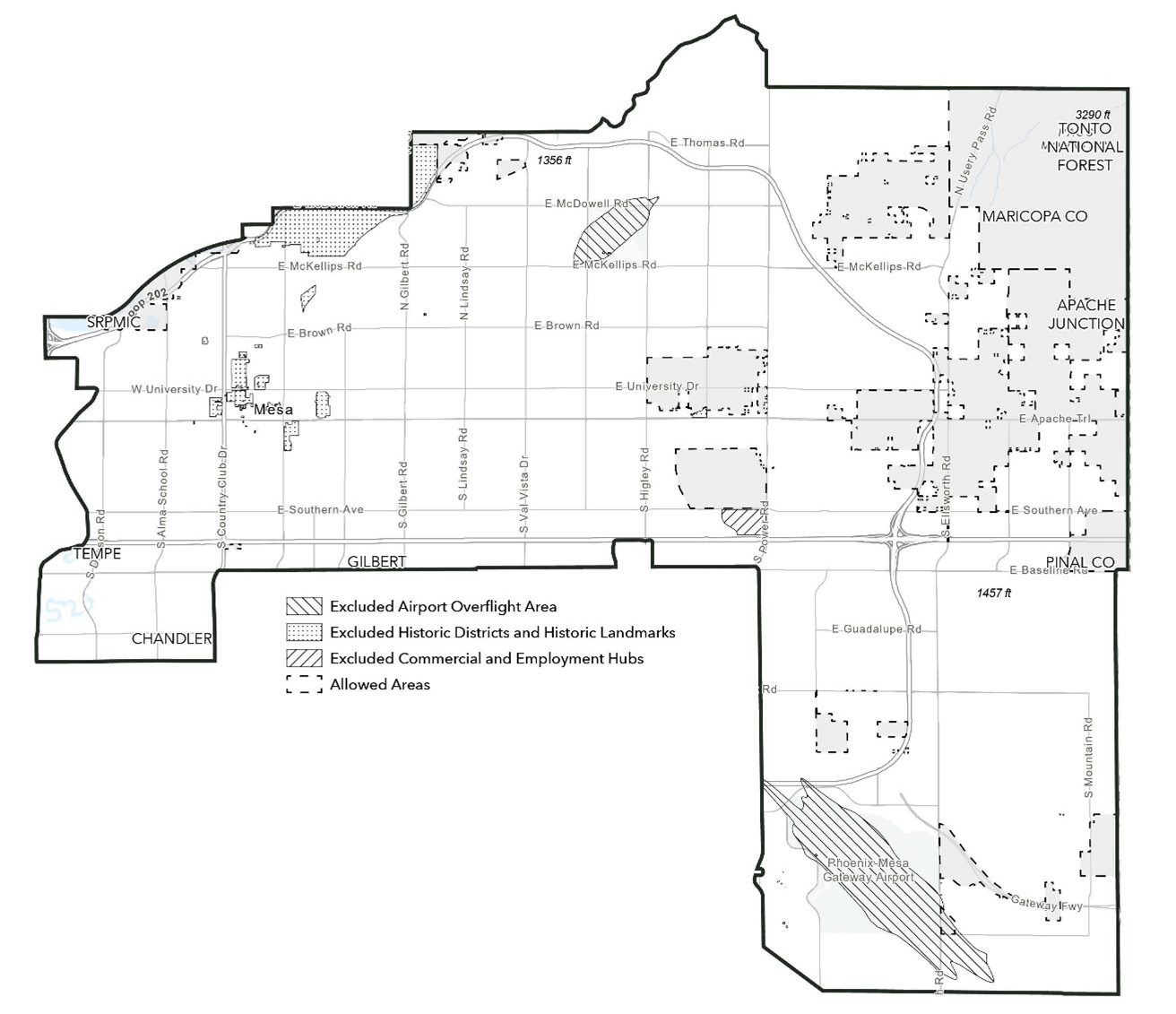
MAP 11-81-3.A
B.
Parcel Size. The parcel or parcels of land must be at least one (1) acre but no more than 20 acres in size.
C.
Building Condition and Vacancy. The parcel must contain a building in a state of disrepair or have at least 50% vacancy in the total leasable square footage.
D.
Affordable Housing. Ten percent (10%) or more of the total dwelling units must be set aside for moderate-income housing, low-income housing, or any combination thereof, for a period of at least 20 years from the issuance of an initial certificate of occupancy for the building. For the purpose of calculating the 10%, the required number of dwelling units will be rounded up to the next whole number.
(Ord. No. 5904, § 5, 12-9-24; Ord. No. 5946, § 1, 7-1-25)
11-81-4: - APPLICATION CAP, TRACKING, AND REPORTING
A.
Application Cap. No more than 457 existing commercial, office, or mixed-use parcels may be redeveloped for multiple residence reuse or adaptive reuse through an adaptive reuse permit.
B.
Tracking. The City shall track the number of parcels redeveloped pursuant to this Chapter and shall stop accepting Adaptive Reuse Permit applications when the total number of the following equals 457 parcels:
1.
The number of parcels redeveloped using an Adaptive Reuse Permit; plus
2.
The number of parcels with approved Adaptive Reuse Permits that have not yet completed construction; plus
3.
The number of parcels with pending Adaptive Reuse Permit applications.
C.
Affordable Housing Requirements and Reporting.
1.
Restrictions or Guarantees. In order to ensure compliance with A.R.S. § 9-462.10, as a condition of final approval of an Adaptive Reuse Permit, the applicant shall provide to the City a deed restriction, restrictive covenant, or other restriction or guarantee that may be approved by the City, ensuring that 10% of the housing units shall be reserved for moderate-income housing, low-income housing, or any combination thereof for a period of at least 20 years from the issuance of a certificate of occupancy.
2.
Annual report. To ensure continued compliance with A.R.S. § 9-462.10, for a period of twenty years, the property owner of a parcel with an Adaptive Reuse Permit shall annually provide the City with a report demonstrating that 10% of the units are reserved for moderate-income housing, low-income housing, or a combination thereof.
3.
Redevelopment. In the event an Adaptive Reuse Permit building is approved for redevelopment to a different use through the City's normal processes and procedures, the requirements in this Subsection (C) shall no longer be applicable and the City shall, upon request of the property owner, acknowledge release of the restriction or guarantee required in Subsection (C)(1).
(Ord. No. 5904, § 5, 12-9-24; Ord. No. 5946, § 1, 7-1-25)
11-81-5: - LAND USE REGULATIONS
Multiple residence reuse and adaptive reuse do not have to comply with Section 11-31-31 (Residential Uses in Commercial Districts) and are not subject to any public hearing.
(Ord. No. 5904, § 5, 12-9-24; Ord. No. 5946, § 1, 7-1-25)
11-81-6: - DEVELOPMENT STANDARDS FOR AN ADAPTIVE REUSE PERMIT
A.
Multiple Residence Reuse Development Standards.
1.
Determining Applicable Development Standards.
a.
Development standards for multiple residence reuses shall be based on the development standards for the zoning district with the greatest density in the City of Mesa within one (1) mile of the parcel being redeveloped that is either a multiple residence base zoning district or a zoning district that allows residential development.
b.
If there are no multiple residence base zoning districts or zoning districts that allow residential development in the City of Mesa within one (1) mile of the parcel being redeveloped, the development standards for multiple residence reuses shall be based on the development standards for either the geographically closest zoning district in the City of Mesa with the greatest density that is either a multiple residence base zoning district or allows residential development.
c.
A multiple residence reuse project constructed pursuant to this chapter cannot be used to determine the development standards applicable to a subsequent multiple residence reuse.
2.
Specific Height Restrictions.
a.
Except as allowed by Subsection (C) below, the maximum building height for a multiple residence reuse building shall not exceed five stories; and
b.
Portions of multiple residence projects, located within 100 feet of a single residence use or zoning district are limited to two (2) stories in height.
B.
Adaptive Reuse Development Standards. The development standards for adaptive reuses shall be based on the development standards for the underlying zoning district in accordance with Article 2 and Article 4 of this Ordinance.
C.
Non-Conforming Structures—Multiple Residence Reuse and Adaptive Reuse.
1.
Non-conforming Building Height. Existing buildings that exceed the maximum building height permitted by the underlying zoning district for multiple residence use and that receive an adaptive reuse permit may remain at their existing height may be expanded to the maximum allowable density for the proposed multiple residential use.
2.
Non-conforming Yards. Existing buildings with a yard setback less than the minimum required yard for the proposed multiple residential use may remain in their current location unless easements are located within the setback areas.
(Ord. No. 5904, § 5, 12-9-24; Ord. No. 5946, § 1, 7-1-25)
11-81-7: - APPEALS; EXPIRATION AND EXTENSIONS; MODIFICATIONS
A.
Appeals. Adaptive Reuse Permits are subject to the appeal provisions of Chapter 77, Appeals, in this Ordinance.
B.
Expiration and Extensions. An Adaptive Reuse Permit is not subject to the expiration and extension requirements of Section 11-76-9 of this Ordinance.
C.
Modifications to an Approved Adaptive Reuse Permit. Proposed modifications to an approved Adaptive Reuse Permit, including change of use or modifications to approved plans, shall be submitted to the Planning Division for review to ensure conformance with the eligibility criteria in this Chapter and required processes.
(Ord. No. 5904, § 5, 12-9-24; Ord. No. 5946, § 1, 7-1-25)

