
Mesa City Zoning Code
ARTICLE 8
LAND USE CLASSIFICATIONS AND DEFINITIONS
CHAPTER 87 - DEFINITIONS
Accessory building or structure: A detached subordinate building or structure that is customarily incidental to the primary building and on the same lot or parcel of land with the primary building.
Accessory structure, manufactured home: A subordinate building or structure that is customarily incidental to the main building and on the same lot or parcel of land with the main building for living purposes, garages, carports, ramadas, awnings, patios or similar floor area related definitions.
Accessory use: A use customarily incidental to, related and clearly subordinate to a principal use established on the same lot or parcel of land, which accessory use does not alter said principal use nor serve property other than the lot or parcel of land on which the principal use is located. "Appurtenant use" means the same as accessory use.
Adaptive reuse: Conversion of an existing building from the use for which it was constructed to multiple residence use by maintaining some or all of the building elements.
Adaptive reuse permit: Permit issued for an existing commercial, office, or mixed-use parcel for an existing building to be redeveloped as a multiple residence reuse or adaptive reuse.
Adjoining: Two or more lots or parcels of land sharing a common boundary line, or 2 or more objects in contact with each other. Lots or parcels of land which touch at corners only shall not be deemed adjoining. "Abut" or "abutting" and "contiguous" means the same as adjoining.
Adult: A person who is 18 years of age or older.
Advertising For Hire Sign: A sign on which display space is made available to a person in exchange for rent, fee, or other consideration; does not include the owner of the sign, operator of the sign or the occupant of a parcel who rents tenant space on the same parcel or group C-O-I development as the sign.
Aggrieved person: Any person who has concerns with or believes they will be negatively affected by a decision.
Airport-related definitions: See Section 11-19-3, Definitions Specific to Airfield Overlay Districts.
Alley: A public right-of-way used to provide secondary vehicular access to properties which abut it.
Alteration: Any addition or modification that changes the exterior architectural appearance or materials of a structure or object. Alteration includes changes in exterior surfaces, changes in materials, additions, remodels, demolitions, and relocation of buildings or structures, but excludes ordinary maintenance and repairs.
ANA Standards. Standardized plant nursery trade definitions of plant size, including container size, trunk caliper, plant height and canopy radius for trees and shrubs as determined by the Arizona Nurseryman's Association.
Apartment, one-bedroom: A dwelling unit in an apartment house that contains a maximum of 3 habitable rooms, 1 of which shall be a kitchen.
Apartment, two or more bedroom: A dwelling unit in an apartment house that contains more than 3 habitable rooms, 1 of which shall be a kitchen.
Apartment house: A building, or a portion of a building, designed or used for occupancy by 3 or more families living independently of each other, and containing 3 or more dwelling units.
Area, net: A portion of a lot, or parcel of land which is:
1.
Not included as a proposed public or private facility such as an alley, highway or street, or other necessary public site within a proposed development project;
2.
Subject to an easement where the owner of the underlying land has the right to use the entire surface except that portion where the owner of the easement may place utility poles or minor utility structures.
Arterial street: See street, arterial.
Assisted living center: An assisted living facility that provides resident rooms or dwelling units to 11 or more residents.
Assisted living facility: A residential care institution, including adult foster care, that is licensed by the State of Arizona to provide supervisory care services, personal care services or directed care services on a continuing basis.
Assisted living home: An assisted living facility that provides resident rooms to 10 or fewer residents.
Automobile display space: Any permanently maintained space so located and arranged as to permit the display of a motor vehicle, including passenger vehicles, automobiles, trucks, motorcycles, scooters and self-propelled off-road equipment.
Automobile parking space, compact: Any permanently maintained space, having a width of not less than 8 feet and a length of not less than 16 feet, so located and arranged as to permit direct access to and from the parking space without crossing an adjacent parking space, and the storage of a passenger automobile of compact size.
Automobile parking space, standard: Any permanently maintained space, having a width of not less than 9 feet and a length of not less than 18 feet, so located and arranged as to permit direct access to and from the parking space without crossing an adjacent parking space, and the storage of a passenger automobile of standard size.
Automobile storage space: Any permanently maintained space so located and arranged as to permit the storage of a passenger automobile of standard size, without regard to how the parking space is accessed.
BATTERY ENERGY STORAGE SYSTEM (BESS) RELATED DEFINITIONS
Augmentation: The process of adding new components to, modifying existing components, or replacing components of, an existing BESS facility.
Nameplate capacity: The maximum amount of energy that a BESS or BESS Facility can supply or store under specific conditions. It is also referred to as rated capacity or peak capacity, and is expressed in megawatts (MW) or kilowatts (KW) for power. The associated energy capacity, sometimes referred to as nameplate energy capacity, represents the total amount of energy the system can store or deliver over time, expressed in megawatt-hours (MWH) or kilowatt-hours (KWH).
Bay door or bay entry: Openings into a building wider than 6-feet, and designed for use principally by a vehicle to access a building, typically for vehicle parking, storage, repair or maintenance, or to access a building such as a warehouse or factory.
Bicycle parking, long-term: Bicycle parking, designed to serve employees, students, residents, commuters, and others who generally stay at a site for four hours or longer.
Bicycle parking, short-term: Bicycle parking designed to serve shoppers, customers, messengers, guests, and other visitors to a site who generally stay for a period of less than 4 hours.
Billboard: A permanent off-site sign or a portable off-site sign more than thirty-two (32) square feet or an advertising for hire sign.
Body piercing: The creation of an opening in the human body for the purpose of inserting jewelry or other decoration, including the piercing of an ear, lip, tongue, nose, or eyebrow. "Body piercing" does not include piercing an ear with a disposable, single-use stud or solid needle that is applied using a mechanical device to force the needle or stud through the ear.
Buffer: To promote separation and compatibility between land uses of different intensities. The term buffer may also be used to describe the methods used to promote compatibility, such as a landscape buffer.
BUILDING RELATED DEFINITIONS:
Building: Any structure having a roof supported by columns or by walls and intended for the shelter, housing or enclosure of persons, animals, or property of any kind.
Building addition: An extension or increase in floor area, height, or volume of an existing building. To qualify as an addition, the new construction must share a common wall with the existing building, with the point of attachment measuring at least 20% of the length of the common wall to which it is attached.
Building, enclosed: A building composed of rigid walls on all sides, and a roof.
Building height: The vertical distance from the natural mean ground elevation of the lot to the top of the parapet of a flat roof or the mean height between the plate line and the ridge of mansard, gable, hip, shed, or similar roof, excluding embellishment.
Building, pre-engineered metal: An enclosed structure with siding consisting of large, modular metal panels, often available in standardized kit form from a manufacturer and assembled on-site.
Build-to line: The maximum distance a building or other structure may be placed from an adjacent property line or future width right-of-way line.
By-passed parcel: Any lot or parcel which meets all of the following:
1.
Does not exceed 2.5 net acres, and has been in its current configuration for more than 10 years or does not exceed 5 net acres and was created by the assembly of individual, contiguous parcels, each not more than 2.5 acres in area; and
2.
Is served by, or has direct access to, existing utility distribution facilities; and
3.
Is surrounded by properties within a 1,200-foot radius in which:
a.
The total developable land area is not more than 25% vacant; and
b.
Greater than 50% of the total number of lots or parcels have been developed 15 or more years ago.
Caretaker: A person residing on the premises of an employer and who is receiving meaningful compensation to assume the primary responsibility for the necessary repair, maintenance, supervision or security of the real or personal property of the employer which is located on the same or contiguous lots or parcels of land.
Carport: An accessory structure that is roofed but permanently open on at least 2 sides and maintained for the storage of motor vehicles.
Centerline: The centerline established by the city engineer for any proposed or dedicated public way.
Chapter: A chapter set out in this Ordinance, unless another ordinance or statute is mentioned.
Charitable organization: Any benevolent, philanthropic, patriotic, not-for-profit, or eleemosynary group, association or corporation, or such organization purporting to be such, which solicits and collects funds for charitable purposes.
Child: A person under 18 years of age.
City Charter: The Mesa City Charter.
Commercial vehicle: Any vehicle currently registered as such with the state Department of Motor Vehicles or equivalent out-of-state or federal agency and is used primarily in the conduct of a business as opposed to private family or individual use.
Condition of use: A development standard determined to be necessary to permit harmonious classification of a use as listed in a zone and therefore a prerequisite to place, or for application to place, such use as classified.
Corral fence: A structure consisting of vertical posts with horizontal connectors, so constructed that 66 percent or more of the vertical surface is open. Corral fences do not include chain link fences.
Cross-access: A driveway or drive aisle which connects two (2) or more adjacent parcels without using a roadway.
Density: The number of dwelling units per unit of land area.
Density bonus: A density increase over the otherwise maximum allowable residential density provided in this Ordinance.
Desert cobble: Refers to a process that re-creates the look of the rugged desert floor by salvaging and redistributing the top four inches of native soil and native "Desert Pavement" cobble. The desert cobble textures allow the establishment of plant communities by providing a protected place to take root.
Desert Uplands Area: Area described by Section 9-6-5(A) of the Mesa City Code, and generally bounded by the West line of the Central Arizona Project (CAP) Canal on the West, Tonto National Forest on the North, Pinal County on the East, and University Drive on the South.
Development: Any manmade change to improved or unimproved real estate, including but not limited to the division of a parcel of land into 2 or more parcels; the construction, reconstruction, conversion, structural alteration, relocation, or enlargement of any structure; any mining, excavation, landfill or land disturbance; and any use or extension of the use of land.
Disability. (1) A physical or mental impairment that substantially limits one or more of an individual's major life activities or impairs an individual's ability to live independently; (2) having a record of such an impairment; or (3) being regarded as having such an impairment. A person with a disability does not include an individual who is currently using alcohol or illegal drugs (as defined in Section 102 of the Controlled Substances Act (21 United States Code 802)), or using legal drugs to which they are addicted nor individuals who constitute a direct threat to the health and safety of others. Disability and direct threat will be interpreted consistent with the Americans with Disabilities Act (42 United States Code 12101, et seq.), as amended, and the Federal Fair Housing Act (42 United States Code 3601—3619).
Domestic animal: An animal which is commonly maintained in residence with man.
Dripline: A vertical line extending from the outermost portion of a tree canopy to the ground. Potential dripline is based on the average tree canopy diameter, as determined by the Arizona Nurseryman's Association.
Driveway: An access way that provides vehicular access between a street or alley and the on-site parking or loading facilities.
Duplex: Two (2) dwelling units on the same lot or parcel that are designed for residential occupancy by not more than two (2) families living independently from each other, each with separate sleeping, cooking, and sanitary facilities. Unless otherwise provided, a Duplex consists of two (2) attached units (side-by-side or stacked). For the purposes of middle housing, the dwelling units may be attached, detached, or semi-detached.
Dwelling unit: A room or suite of rooms including permanent provisions for living, sleeping, eating, sanitation, and cooking, and designed or occupied as separate living quarters.
Easement: A portion of land created by grant or agreement for specific purpose; an easement is the right, privilege or interest which one party has in the land of another.
Effective date: The date on which a permit or other approval becomes enforceable or otherwise takes effective, rather than the date it was signed or circulated.
Emergency: A sudden unexpected occurrence demanding immediate action to prevent or mitigate loss or damage to life, health, property or essential public services.
Equipment cabinet or enclosure: A cabinet or structure used to house equipment associated with any utility.
Existing commercial, office, or mixed-use parcel: A parcel of land that is zoned as a Commercial or Mixed-Use District as of the effective date of this ordinance.
Façade: The exterior elevation of a building extending vertically from the grade to the top of a parapet wall or eave, and horizontally across the entire width of the building elevation.
Factory-built building: Any building, including a dwelling unit or habitable room thereof, which is either wholly or in substantial part manufactured at an off-site location to be assembled on site, except that it does not include a manufactured home, recreational vehicle or mobile home. All factory built buildings shall be consistent with all requirements of the Arizona Department of Housing for factory built buildings.
Family. An individual or two (2) or more individuals related by blood, marriage or adoption, or a group of no more than four (4) unrelated individuals, living together as a single housekeeping unit. A family includes a couple in a domestic relationship and biological, adopted, and foster children of either partner. The term family includes unrelated persons with developmental disabilities (as defined in A.R.S. § 36-581) living together in compliance with A.R.S. § 36-582.
Feasible: Capable of being accomplished in a successful manner within a reasonable period of time, taking into account economic, environmental, social and technological factors.
Fence: An artificially-constructed barrier of any material or combination of materials erected to enclose or screen an area of land.
FLOOR AREA RELATED DEFINITIONS:
Floor area, gross (GFA): The sum of the gross horizontal area of each floor of a building or structure, measured from the exterior face of an exterior wall of a freestanding structure, or from the center of common walls of attached buildings, including carports, garages, basements, mezzanines, interior balconies, and all upper stories or levels.
Floor area (net floor area, habitable area): The gross floor area (GFA) exclusive of garages, ventilation shafts, shafts, elevators, stairways, corridors, toilet rooms, mechanical rooms, carports, closets, storage and equipment storage rooms, open porches, balconies, courts, atriums, lobby areas, basements, and attics.
Floor area ratio (FAR): The numerical value obtained through dividing the aboveground gross floor area of a building or buildings located on a lot or parcel of land by the total area of such lot or parcel of land.
Foundation base: The area adjacent to the exterior walls of a building containing hardscape, (entry plazas, covered walkways, sidewalks), ground cover, or landscaping.
Fourplex: Four (4) dwelling units on the same lot or parcel that are designed for residential occupancy by not more than four (4) families living independently from each other, each with separate sleeping, cooking, and sanitary facilities. Unless otherwise provided, a fourplex consists of four (4) attached units (side-by-side or stacked). For the purposes of middle housing, the dwelling units may be attached, detached, or semi-detached.
Frontage, building: The exterior building wall of a ground floor business establishment oriented toward a public street, highway or parkway.
Frontage, street or highway: That portion of a lot or parcel of land which borders a public street, highway or parkway.
Front parking area: The parking area located in front of a building's primary façade. Determined by drawing a line from the front corners of the building to the front property corners.
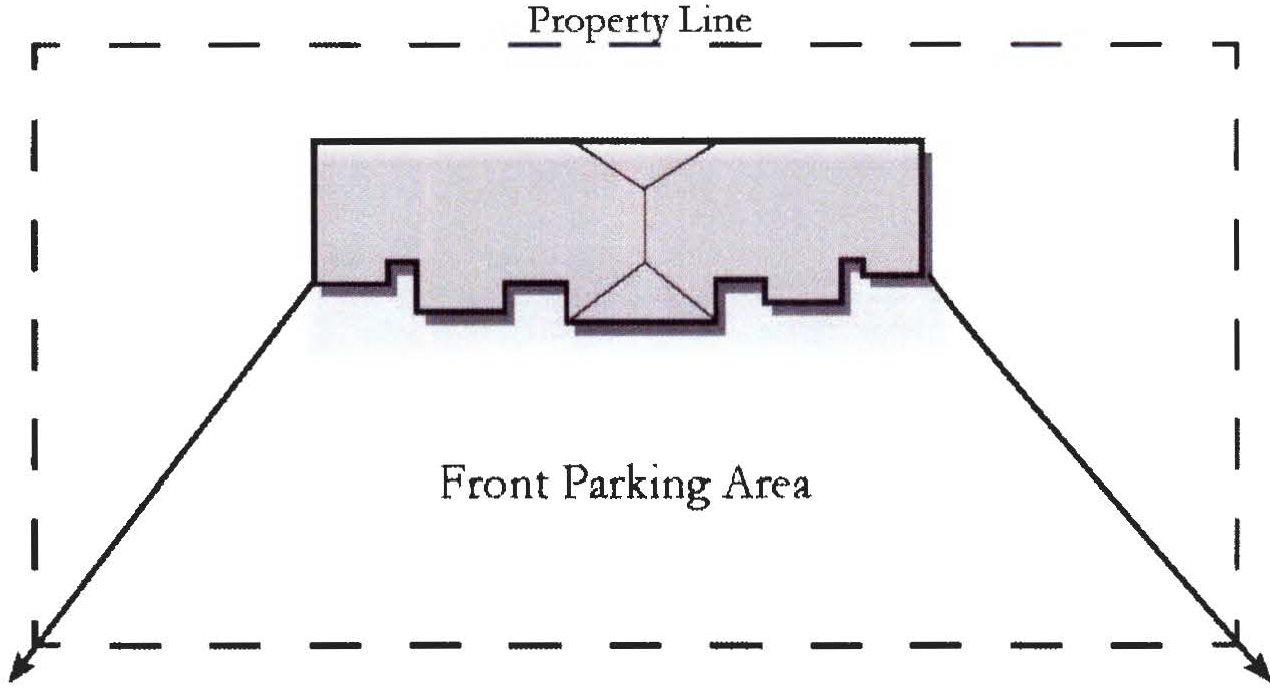
FIGURE 11-87-1.A: FRONT PARKING AREA
Future width right-of-way line: The planned maximum width of a public freeway, road, or street, determined by the City Traffic Engineer for local, collector and arterial streets, as determined by the applicable Transportation, Freeway or Major Street Plan adopted by the City, Maricopa County, and/or the State of Arizona for arterial streets and freeways.
Garage: A building or portion of a building that is enclosed and roofed and designed for the parking of motor vehicles.
General Development Standards: Design standards, parking requirements and other zoning related Development Standards specified in:
A.
A Community Plan and adopted with a particular Planned Community (PC) District, as specified in Chapter 11,
B.
An Infill Incentive Plan and adopted with a particular Infill Development (ID) District, as specified in Chapter 12, or
C.
An EO development plan and adopted with a particular Economic Opportunity (EO) District, as specified in Chapter 14.
These standards would include the type of standards and requirements specifically associated with land uses listed in Article 2, or generally applicable as found in Article 4, and/or Article 5. The term includes building setbacks, maximum building heights, parking stall sizes, parking ratios, minimum building separation requirements, landscape setbacks, landscape planting ratios attached and detached permanent signs, and other similar requirements. The term does not include permitted land uses, prohibited land uses, and uses requiring a conditional use permit. As a general rule, dimensional General Development Standards include requirements which are characterized by minimum or maximum physical characteristics that can be measured as floor area, width, length, depth or height.
General Plan: The General Plan of the City of Mesa, and all elements thereof.
Glare: The effect produced by a light source within the visual field that is sufficiently brighter than the level to which the eyes are adapted, such as to cause annoyance, discomfort or loss of visual performance and ability.
GRADE-RELATED DEFINITIONS:
Grade, below: Location of any facility or part of a facility located underground or beneath ground level.
Grade, existing: The elevation of a lot or parcel prior to approved demolition, excavation, fill, construction or modification.
Grade, finished: The final elevation of the lot or parcel, paved or unpaved, when all construction and landscaping are complete. Grade refers to finished grade unless otherwise stated.
Grade, finished floor: The elevation of the ground floor of the building.
Grade, natural: The elevation of a lot or parcel unaffected by construction techniques such as fill, excavation, landscaping or berming. Mean natural grade refers to the elevation midway between the highest and lowest elevations on the lot or parcel.
Group C-O-I Development: A commercial, office, or industrial master planned development containing three (3) or more businesses which share facilities such as driveways, parking, and pedestrian walkways and which is designed to provide a single area in which the public can obtain varied products and services.
Habitable (area, living area or space): See "net floor area."
Hardscape: Part of a building's grounds consisting of structures, such as plazas, retaining walls and sidewalks, made with materials such as but not limited to, concrete and sidewalk pavers.
Hazardous materials: Includes any substance characterized as flammable solids, corrosive liquids, radioactive materials, oxidizing material, highly toxic materials, poisonous gases, reactive materials, unstable materials, hypergolic materials and pyrophoric materials and any substance or mixture of substances which is an irritant, a strong sensitizer or which generates pressure through exposure to heat, decomposition or other means.
Height of building or structure: See "building height."
Home occupations: A business or professional activity conducted on the same lot or parcel as a residential dwelling unit, which is clearly incidental and secondary to the primary function as a residential dwelling unit. The business or professional activity must not negatively impact the residential character of the neighborhood or the health, safety, and welfare of neighbors.
Permitted home occupations may include but are not limited to: Artist studios, personal services, therapy, consulting, law office, real estate, insurance, professional office, professional design services, music and fine arts instruction, swim lessons, and small-scale E-Commerce that service five (5) or fewer individuals at a time.
Home occupations exclude the on-site exchange of sold or bartered goods (exceptions made for occasional and infrequent exchanges), vehicle repair commercial warehousing or storage - indoor or outdoor, or manufacturing of products using hazardous materials or equipment not typically found in household settings.
Illegal use: Any use of land or building that does not have the currently required permits and/or was originally constructed and/or established without permits required for the use at the time it was brought into existence.
Initial site plan: A site plan for a property, or a portion thereof, that does not have a previously approved site plan, or the approved site plan has expired.
Kitchen: Any room or space used, or intended or designed to be used for cooking or the preparation of food.
Large vehicle: Any vehicle with a gross vehicle weight rating (GVWR) exceeding 13,000 pounds and intended to be used primarily for commercial purposes rather than use as for private or personal individual trips.
Lamp: Any source created to produce optical radiation (i.e. "light"), often called a bulb or tube.
Land Use Group (LUG): A category, grouping or association of land uses and activities, arranged as permitted, conditional, and prohibited land uses, when used in association with an EO or PC Ddistrict as a part of an adopted EO Development Plan (for EO Districts) or community plan (for PC Districts). In each case, the permitted and conditional land use activities shall be individually listed and grouped, together into specified categories (LUGS), assigned a name or title, and generally described with purpose and intent statements related to how the category or grouping of land uses relates back to the implementation and administration of the adopted EO Development Plan or community plan, as may be applicable. Further, each LUG may also provide specific standards associated with the land use and development of the assigned parcels. Such groups may be based in whole or in part on existing Mesa base zoning districts or may be new categories.
Landscape yard: An area intended to provide buffering between land uses of different intensities through the use of setbacks, landscaping, berms, fences, walls or a combination thereof.
Landscaping: The planting, configuration and maintenance of trees, ground cover, shrubbery and other plant material, decorative natural and structural features (walls, fences, hedges, trellises, fountains, sculptures), earth patterning and bedding materials, and other similar site improvements that serve an aesthetic or functional purpose.
Light shelf: An exterior architectural element that allows reflective daylight to penetrate deep into a building.
Lighting, exterior: Any equipment or fixture located or used to provide illumination of outdoor areas, objects or activities.
Lighting fixture: Light fixtures include but are not limited to the lamp, pole, post, ballast, reflector, lens diffuser, shielding, electrical wiring, and other necessary or auxiliary components.
Lighting system: All exterior man-made lighting sources, associated infrastructure and controls on a site.
Light trespass: Unwanted light that falls on neighboring properties or public rights-of-way. Light trespass also includes glare or distraction for observers away from the area for which the light is intended.
LOT-RELATED DEFINITIONS:
Lot, corner: A lot or parcel of land situated at the intersection of 2 or more parkways, highways or streets, which parkways, highways or streets have an angle of intersection measured within said lot or parcel of land of not more than 135 degrees.
Lot, coverage: The area of a lot that is covered with impervious surfaces, such as buildings, patios or decks with roofs, carports, tennis courts, parking lots or any other type of structure. Swimming pools, exclusive of decking, are not considered impervious surfaces for the purposes of calculation.
Lot, flag: A lot or parcel of land taking access by a strip, owner of which lot or parcel of land has fee-simple title to said strip extending from the main portion of the lot or parcel of land to the adjoining parkway, highway or street.
Lot, interior: A lot or parcel of land other than a corner or flag lot.
Lot, key: An interior lot adjoining the rear lot line of a corner lot.
Lot line: A boundary line of a lot or of a parcel of land.
Lot line, front: A line separating the front yard from the parkway, highway or street upon which the yard fronts; or, in the case of a flag lot where the front yard is oriented toward an adjoining lot, the line separating such front yard from the adjoining lot.
Lot line, rear: A lot line which is opposite and most distant from the front lot line. For a triangular shaped lot, the rear lot line shall mean a line 10 feet to the length within the lot which is parallel to the front lot line, or parallel to the chord of a curved front lot line, and the maximum distance from the front lot line.
Lot line, side: Any lot boundary line which is not a front lot line or a rear lot line.
Lot, through: A lot having frontage on 2 parallel or approximately parallel parkways, highways and/or streets.
Low-income housing: Housing for a person or persons whose household income does not exceed 80% of the area median income.
Maintenance and repair: The repair or replacement of individual building components or paint, stucco or other exterior finishes that restores the character, scope, size or design of a structure to its previously existing, authorized, and undamaged condition. This definition shall not include replacement of primary structural elements or complete replacement of the building or structure.
MANUFACTURED HOME (MH) RELATED DEFINITIONS:
Accessory retail activity: An intermittent or periodic commercial event held at a recreation or social hall and characterized by the sale or barter of merchandise to residents of the Recreational Vehicle Park, Manufactured Home Park, or Recreation Vehicle Subdivision specifically associated with said recreation or social hall.
Accessory structure, manufactured home: A one (1) story habitable room, storage building, garage, carport, ramada, and awning. Patios and similar structures which may include window screens, knee walls, and other partial enclosures as specified in the Mesa Building Code (MBC), Chapter 4-2.
Manufactured home: A residential dwelling unit certified as a manufactured home pursuant to the Federal Manufactured Housing Construction and Safety Standards Act of 1974 and the Arizona Office of Manufactured Housing Statutes, A.R.S. § 41-4001-4010, and regulations. This term does not include conventionally built dwelling units, factory built dwelling units, Mobile Homes, Recreational Vehicle Park Models, or Recreational Vehicles.
Manufactured home lot: A parcel of land within an approved Manufactured Home Subdivision as shown in the records of the Maricopa County Recorder's Office.
Manufactured home park: An approved residential development, owned by one (1) entity, in which individual manufactured home spaces are provided whether or not a charge is made for such accommodation.
Manufactured Home Subdivision: An approved residential subdivision, as shown in the records of the Maricopa County Recorder's Office, that is designed in accordance with subdivision regulations, in which individual manufactured home lots are platted.
Manufacturing: The process of creating a finished product by fabrication or from raw materials, especially by means of a larger scale industrial operation.
MARIJUANA RELATED DEFINITIONS
Marijuana. All parts of the plant of the genus cannabis, whether growing or not, as well as the seeds from the plant, the resin extracted from any part of the plant, and every compound, manufacture, salt, derivative, mixture, or preparation of the plant or its seeds or resin.
A.
Includes cannabis as defined in A.R.S. § 13-3401.
B.
Does not include industrial hemp, the fiber produced from the stalks of the plant of the genus cannabis, oil or cake made from the seeds of the plant, sterilized seeds of the plant that are incapable of germination, or the weight of any other ingredient combined with marijuana to prepare topical or oral administrations, food, drink or other products.
Marijuana concentrate. Resin extracted from any part of a plant of the genus cannabis and every compound, manufacture, salt, derivative, mixture or preparation of that resin or tetrahydrocannabinol. Marijuana concentrate does not include industrial hemp or the weight of any other ingredient combined with cannabis to prepare topical or oral administrations, food, drink or other products.
Marijuana cultivation. To propagate, breed, grow, prepare, and package marijuana.
Marijuana establishment. An entity licensed by the Arizona Department of Health Services to operate all of the following:
A.
A single retail location at which the licensee may sell marijuana and marijuana products to consumers, cultivate marijuana and manufacture marijuana products.
B.
A single off-site cultivation location at which the licensee may cultivate marijuana, process marijuana and manufacture marijuana products, but from which marijuana and marijuana products may not be transferred or sold to consumers.
C.
A single off-site location at which the licensee may manufacture marijuana products and package and store marijuana and marijuana products, but from which marijuana and marijuana products may not be transferred or sold to consumers.
Marijuana manufacturing. To compound, blend, extract, infuse or otherwise make or prepare a marijuana product.
Marijuana processing. To harvest, dry, cure, trim or separate parts of the marijuana plant.
Marijuana products. Marijuana concentrate and products that are composed of marijuana and other ingredients and that are intended for consumption, including edible products, ointments, and tinctures.
Massage and massage services: Should include any method of pressure on or friction against, or stroking, kneading, rubbing, tapping, pounding, manipulation, or stimulating the external parts of the body, with or without the aid of any mechanical or electrical apparatus or appliances, with or without supplementary aids such as rubbing alcohol, liniments, antiseptics, oils, powders, creams, lotions, ointments, or other similar preparations.
Massing: The volumetric design or three-dimensional form of a building or structure.
Minerals: Any naturally occurring chemical element or compound, or groups of elements and compounds, formed from inorganic processes and organic substances, including, but not limited to, coal, peat and bituminous rock, but excluding geothermal resources, natural gas and petroleum.
Moderate-income housing: Housing for a person or persons whose household income does not exceed 120% of the area median income.
Multiple residence reuse: Conversion of an existing building from the use for which it was constructed to a "multi-family residential development" as that term is defined in A.R.S. § 9-462.10(H).
New application: A "new application" or the phrase "subject to a new application" means the proposed development, modification to an approved permit, plan or approval, or other request or approval sought requires the applicant to start the process from the beginning in accordance with the applicable review and approval processes, and subject to approval by the appropriate decision-making body, as required by this Ordinance. By way of example, a request to modify an approved variance would require an application for a new variance for review and approval by the Board of Adjustment.
Occupancy, change in: The discontinuance of an existing use and the substitution therefore of a use of a different occupancy category as defined in the International Building Code.
Occupant: The person occupying or having custody of a structure or premises as a lessee or other.
Occupant load: The total number of persons that may occupy a building or structure, or portion thereof, at any one time as provided by the Building Code.
Occupiable space: See "habitable (area, living area or space)."
Off-site sign: A sign portraying information or directing attention to a business, activity, commodity, service, product, or entertainment which is not conducted, sold, or offered on the premises upon which the sign is located. Does not include portable signs thirty-two (32) square feet or less.
On-site: Located on the lot that is the subject of discussion.
Open space: The area or areas of a lot or parcel intended to provide light and air, and is designed for either scenic or recreational purposes, excluding buildings, parking, driveways and other vehicular surfaces.
Open space, common: An open space intended for the shared, common use of the occupants of a development.
Open space, private: An open space intended for the exclusive use of the occupants of a dwelling unit.
Ordinance: An ordinance of the City of Mesa.
Outdoor display: The outdoor display or outdoor sale of goods which is conducted not entirely within a structure or enclosed area and is directly related to a business establishment with a permanent structure on the same parcel of property upon which the outdoor display is located. The business establishment with a permanent structure on the same parcel as the outdoor display is referred to as the "primary business".
Outside storage: The storage of goods, equipment or materials outside of a building for any purpose other than outside display.
Owner: The person indicated on the records of the Maricopa County Assessor, or other official body, as the owner of record of the property in question.
Parcel of land: A contiguous quantity of land, owned by or recorded as the property of a person.
Parking lots or parking buildings: Readily accessible areas within structures or surface parking areas, inclusive of aisles, driveways, ramps and columns, maintained exclusively for the parking of vehicles, not including areas for the parking or storage of commercial vehicles.
Pedestrian Oriented Use: A land use intended to encourage walking customers and which, generally, does not limit the number of customers by required appointments or otherwise excluding the general public. A pedestrian-oriented use may suggest or require appointments for services when primarily for the convenience of the customer, such as reservations for restaurants, beauticians or opticians to avoid being turned away due to unavailability. Where feasible the pedestrian oriented use shall have external entrances directly accessible from public sidewalk space. At a minimum, the business shall be of those generally considered to be open typical business hours that can range from 4—10 hours a day, and 4—7 days a week.
Permit: Any special use permit, council use permit, temporary use permit, license, certificate, approval, or other entitlement for development and/or use of property as required by any public agency.
Permitted use: Any use allowed in a zoning district without a requirement for approval of a discretionary use permit, but subject to any restrictions applicable to that zoning district.
Person: Any individual, firm, co-partnership, joint adventure, association, social club, fraternal organization, corporation, estate, trust, business trust, receiver, syndicate, this and any other city, county, municipality, district or other political subdivision, or any other group or combination acting as a unit.
Plan specific: The development standard described, such as a setback, landscaping plant ratio, parking ratio or a maximum building height requirement, is set by description noted graphically by the plans that have been approved/adopted during the entitlement review process required for that project.
Plasma center: Any facility used in the collection, storage, or distribution of liquid blood plasma.
Porch: Structure or appendage of a building adjacent to a building entrance, typically covered and/or elevated from adjacent grade, and open with no walls on at least one (1) side.
Portable Ssgn: A freestanding sign not permanently affixed, anchored or secured to a permanent foundation.
Portable storage containers (PSC): A device in the shape of a rectangular solid; constructed of metal, consisting of four vertical walls, a floor and a ceiling and in which at least one vertical end is designed as door (typically either as a side-hinged door, or as an overhead bay door). The dimensions of a PSC shall not exceed 102-inches (8-foot, 6-inches) in height and 96-inches (8-feet) in width. Lengths may vary in increments of 10-feet (10-feet, 20-feet…) but may not exceed nominal 40-feet in length. PSCs include devices initially designed to facilitate the shipping of containerized cargo and constructed entirely of steel in a manner consistent with ISO 6346, and are being reused to facilitate secure storage, and/or temporary offices or studios, but not habitable space as defined in the Mesa Building Code.
Primary building: A building in which the main or dominant use of the lot or parcel is conducted.
Primary residence: A Single Residence as defined in Chapter 86, Section 11-86-2.
Principal use: A primary or dominant use established, or proposed to be established, on a lot or parcel of land.
Private street: See "street, private."
Project: Any proposal for a new or changed use or for new construction, alteration, or enlargement of any structure that is subject to the provisions of this Title.
Public street: See "street, public."
RECREATIONAL VEHICLE (RV) RELATED DEFINITIONS:
Accessory retail activity: An intermittent or periodic commercial event, held at a recreation or social hall and characterized by the sale or barter of merchandise to residents of the Recreational Vehicle Park, Manufactured Home Park, or recreation vehicle subdivision specifically associated with said recreation or social hall.
Accessory structure, recreational vehicle: A subordinate building or structure that is customarily incidental to a Recreational Vehicle or Recreational Vehicle Park Model and is located on the same lot or parcel of land as the Recreational Vehicle or Recreational Vehicle Park Model, which is used for living purposes, garages, carports, ramadas, awnings, patios or similar.
Recreational vehicle (RV): A vehicular portable structure, which can be towed, hauled or driven, primarily designed as temporary living accommodation for recreational, camping, and travel use and not designed for permanent residential or commercial purposes that: (1) contains its own motive power; (2) is drawn by another vehicle; or (3) is mounted on another vehicle. This term does not include conventionally built dwelling units, factory built dwelling units, or manufactured homes.
Recreational vehicle lot: A parcel of land within an approved Recreational Vehicle subdivision, as shown in the records of the Maricopa County Recorder's Office.
Recreational vehicle (RV) park: An approved residential development, owned by one (1) entity, in which individual recreational vehicle spaces are provided whether or not a charge is made for such accommodation.
Recreational Vehicle (RV), Park Model: A recreational vehicle built on a single chassis, mounted on wheels, which has a gross trailer area not exceeding four hundred (400) square feet in the set-up mode, and is certified by the manufacturer as complying with the ANSI A119.5 standards for recreational park trailer. This term does not include conventionally built dwelling units, factory built dwelling units, or manufactured homes.
Recreational vehicle space: A site within an approved recreational vehicle park which is shown in the records of the planning division and which is designed and intended for the accommodation of one (1) recreational vehicle.
Recreational Vehicle (RV) Subdivision: An approved residential subdivision, as shown in the records of the Maricopa County Recorder's Office, that is designed in accordance with subdivision regulations, in which individual recreational lots are platted.
Renovation, exterior façade: A resurfacing of an existing building frontage.
Residential care institution: A health care institution other than a hospital or a nursing care institution which provides resident beds or dwelling units, supervisory care services, personal care service, directed care services or health-related services for persons who do not need inpatient nursing care.
Residential zoning application: A rezoning application to change a property from any zoning district to a residential zoning district or use; or an application that removes or modifies any regulation or condition of approval for a residential zoned property or use previously imposed by ordinance.
Responsible party: A person who knows or has reason to know of the existence of any violation of this chapter on that person's property or property which that person occupies or controls, in whole or in part, including but not limited to an owner, occupant, lessor, lessee, manager, managing agent, licensee or any person who has legal care or control of the property.
Roof area: That portion of a lot or parcel covered by the roof structure of all buildings, excluding the eves and overhangs, but including covered porches, patios and carports.
Roof profile: shape or form of the roof above residential dwelling units, such as gable, gambrel, hip, mansard, parapet, pitched and shed.
Room, habitable: An enclosing subdivision in a building commonly used for sleeping, living, cooking or dining purposes, excluding closets, pantries, bath or toilet rooms, service rooms, connecting corridors, laundries, unfinished attics, foyers, storage space, cellars, utility rooms, and similar spaces.
Screening: A wall, fence, hedge, informal planting, or berm, provided for the purpose of buffering a building or activity from neighboring areas or from the street.
Section: A section of the ordinance codified in this Title 11, unless some other ordinance or statute is mentioned.
Setback: The area between a property line and a building or structure which must be kept clear or open.
Sidewalk: A paved, surfaced, or leveled area used as a pedestrian walkway.
Single housekeeping unit. A person or group of persons jointly occupying a single dwelling unit that: (1) has access to and the joint use of all common areas such as the kitchen and eating areas of the dwelling unit; (2) shares household activities and responsibilities, such as meals, chores, or expenses; and (3) has no limits on length of tenancy, except for those imposed by a lease or rental agreement.
Site plan review: The process in which the City reviews a site plan which includes both an initial site plan and a site plan modification. In certain contexts, the term clearly applies only to initial site plan reviews and in other context only to site plan modifications.
Solid fill: Any inorganic, noncombustible materials, insoluble in water, such as soil, rock, sand or gravel that can be used for grading land or filling depressions.
Special event: A temporary activity that is conducted on property that is not specifically zoned, authorized, or otherwise approved for such use and which complies with all the following:
A.
The activity is intended for purposes of entertainment, education, commercial promotion, or cultural, religious, ethnic, or political expression.
B.
The activity occurs outside or in a temporary structure.
C.
Special event includes parades, sporting events, circuses, fairs, carnivals, festivals, religious revivals, political rallies, vehicle shows and displays, and similar recognized temporary activities.
D.
Special event does not include wedding and funeral ceremonies, elections, garage or yard sales held at a private residence, or charity car washes.
Special event, City-sponsored: A special event produced and funded by the City.
Special event, City-supported: A Special Event initiated by an outside or community group and supported by the City, in the City's sole discretion and based on available City resources.
Stand: A structure for the display and sale of products with no space for customers within the structure itself.
Story: Is that portion of a building included between the upper surface of any floor and the upper surface of the floor next above, except that the topmost story shall be that portion of a building included between the upper surface of the topmost floor and the roof above. "Story" includes a basement, but not a cellar.
Temporary use permit (TUP). A TUP is a discretionary permit issued by the Zoning Administrator in accordance with Sections 11-31-30 and 11-70-4 of the Zoning Ordinance for a temporary use that is conducted on property specifically zoned, authorized, or otherwise approved for such use.
STREET-RELATED DEFINITIONS:
Highway: Includes any expressway, freeway, or parkway.
Freeway: A restricted access highway.
Parkway: A road having park-like landscaping features, and may or may not have a central landscaped median, with a right-of-way width of not less than 80 feet.
Right-of-way: A strip of land intended to be used as a road, railroad, electric transmission line, oil or gas pipeline, water line, sanitary storm sewer or other similar use.
Road: An open way used for the passage of vehicles, and includes alleys, streets and highways.
Street: Any public street, avenue, boulevard, road, lane, parkway, place, viaduct, easement for access, or other way which is an existing state, county, or municipal roadway; or a street or way shown in a plat heretofore approved pursuant to law or approved by official action; or a street or way in a plat duly filed and recorded in the County Recorder's Office. A street includes the land between the right-of-way lines, whether improved or unimproved, and may be comprised of pavement shoulders, curbs, gutter, sidewalks, parking areas, and landscape areas.
Street, arterial: A general term including section line and major streets and state or county highways providing a system for citywide through traffic movement.
Street, collector: Provides the traffic movement within neighborhoods of the City, between major streets and local streets, and for direct access to abutting property.
Street, cul-de-sac: A short local street permanently terminated in a vehicular turnaround; provides direct access to a limited number of adjacent properties.
Street, frontage: The linear distance that a lot, parcel, or development site abuts a public or private street, measured along the property line that directly borders the street right-of-way.
Street, half: Any street improved to a width of less than 34 feet or with concrete curb and sidewalk on only one (1) side of said street.
Street, local: Provides for direct access to residential, commercial, industrial, or other abutting land; primarily for local traffic movements with connections to collector and/or major streets.
Street, private: Real property recorded as improved roadway for pedestrian and motor vehicle traffic, constructed and maintained by private parties.
Street, public: Real property dedicated for, and recorded as, public right-of-way for pedestrian and motor vehicle traffic, having a minimum width of 30 feet. The term shall not include public right-of-way designated for limited access freeways or public alleys.
STRUCTURE RELATED DEFINITIONS:
Structural alteration: Any change of the supporting members of a building, such as bearing walls, columns, beams or girders, floor joists, ceiling joists, or roof rafters.
Structure: Anything constructed or erected which requires a fixed location on the ground, or is attached to something having a fixed location on the ground.
Structure, attached: A structure that is connected to another structure and dependent on a division wall(s) or common wall(s) for structural support or enclosure. (SYN: detached building)
Structure, detached: A structure which is physically separated from and not dependent on another structure for structural support or enclosure. (SYN: detached building)
Structure, semi-detached: A structure that is connected to another structure but is not dependent on a division wall(s) or common wall(s) for structural support or enclosure.
Suite, guest: A combination of 2 or more guest rooms.
Swimming pool: A contained body of water used for bathing or swimming purposes either above or below ground level with the container being 18 or more inches in depth at any point, and/or wider than 8 feet at any point measured on the long axis.
Tandem parking. The placement of parking spaces one behind the other, or "end-to-end", such that the second space furthest from the access drive is accessed only by crossing the first space nearest the access drive.
Tattooing: To insert pigment under the surface of the human skin by pricking with a needle or otherwise to produce an indelible mark or figure visible through the skin.
TELECOMMUNICATIONS RELATED DEFINITIONS:
Alternative tower structure: Artificial trees, clock towers, bell steeples, light poles and similar alternative-design mounting structures that camouflage or conceal the presence of antennas or towers.
Antenna: Any system of poles, panels, rods, reflecting discs, wires or similar devices used for the transmission or reception of electromagnetic signals, including but not limited to radio waves and microwaves. An antenna does not include the support structure the antenna(s) is mounted upon.
Antenna, amateur radio: A ground-, building-, or tower-mounted antenna operated by a federally licensed amateur radio operator as part of the Amateur Radio Service and as designated by the Federal Communications Commission (FCC).
Antenna, building- or structure-mounted: Antenna mounted to the side of a building, or structure that transmits or receives electromagnetic signals.
Antenna, direct broadcast satellite service (DBS): An antenna, usually a small home receiving dish, designed to receive direct broadcast from a satellite.
Antenna, ground-mounted: Any antenna that is not mounted on a pole, a structure, or the roof or wall of a building.
Antenna, multipoint distribution services (MDS): An antenna designed to receive video programming services via multi-point distribution services, including multipoint, multichannel distribution services, instructional television fixed services, and local multipoint distribution services.
Antenna, roof-mounted: An antenna directly attached or affixed to the roof of an existing structure.
Antenna, satellite: Any antenna used to receive and/or transmit radio or television signals from orbiting communications satellites.
Antenna, Satellite Earth Station: An antenna designed to receive and/or transmit radio frequency signals directly to and/or from a satellite.
Antenna, Television Broadcast Service (TVBS): An antenna designed to receive only television broadcast signals.
Antenna structure: An antenna array and its associated support structure, such as a mast or tower (not including a suspended simple wire antenna), that is used for the purpose of transmitting and/or receiving electromagnetic signals, including but not limited to radio waves and microwaves.
Antenna structure, freestanding: An antenna structure or mast that is not attached to any part of a building, fence, or other such structure. Freestanding antenna structures include communications towers, wooden utility poles, and concrete and steel monopoles. If the total height of the structure, including the antenna, is at least 17 feet high, it shall be treated as a monopole.
Antenna structure, monopole: An antenna structure, often tubular in shape, usually made of metal, reinforced concrete, or wood and which is at least 17 feet in height. A monopole may also be an alternative tower structure that is designed to replicate a tree or other natural feature.
Communication equipment building: A building housing operating electrical and mechanical equipment necessary for the conducting of a public utility communications business, with or without personnel.
Co-location: The location of two or more wireless communications facilities owned or used by more than one public or private entity on a single support structure or otherwise sharing a common location. Co-location shall also include the location of wireless communications facilities with other facilities such as buildings, water tanks, light standards, and other utility facilities and structures.
Distributed Antenna System (DAS): A system of small antennas installed on existing infrastructure such as telephone poles and streetlights throughout an area, which are interconnected by fiber optic cable to a central hub location, and are generally designed to support multiple wireless carriers.
Microcell facility: A wireless communication facility serving a single carrier and consisting of an antenna no larger than 4 feet in height or, if tubular, no more than 6 feet long and 4 inches in diameter comprised of a networked set of antennas that are connected with each other and to a wireless service source, such that a one (1) or more high-power antennas that serve a given area are replaced by a group of lower-power antennas to serve the same geographic area.
Readily visible: An object that can be identified as a wireless telecommunications facility when viewed with the naked eye.
Related equipment: All equipment ancillary to the transmission and reception of voice and data via radio frequencies. Such equipment may include, but is not limited to, cable, conduit, and connectors.
Service provider: Any authorized provider of wireless communications services.
Stealth facility: Any commercial wireless communications facility that is designed to blend into the surrounding environment by means of screening, concealment, or camouflage. The antenna and supporting antenna equipment are either not readily visible beyond the property on which they are located, or, if visible, appear to be part of the existing landscape or environment rather than identifiable as a wireless communications facility. Stealth
Technically feasible: In light of technical feasibility, radio signal transmitting and receiving requirements, aesthetics, electromagnetic fields, costs, landowner permission, facility owner permission, and all necessary approvals under this Chapter.
Tower: Means any structure that is designed or constructed primarily for the purpose of supporting one or more antennas, including self-supporting lattice towers, guyed towers, or monopole towers. The term includes, but is not limited to, radio and television Transmission Towers, microwave towers, common-carrier towers, cellular telephone towers, alternative tower structures and the like.
Townhouse: Two (2) or more attached dwelling units constructed in a row (side-by-side), each with separate sleeping, cooking, and sanitary facilities, each sharing at least one (1) common wall with an adjacent unit, and each served by its own exterior entrance. no dwelling unit may be stacked (located above or below another).
Triplex: Three (3) dwelling units on the same lot or parcel that are designed for residential occupancy by not more than three (3) families living independently from each other, each with separate sleeping, cooking, and sanitary facilities. Unless otherwise provided, a triplex consists of three (3) attached units (side-by-side or stacked). For the purposes of middle housing, the dwelling units may be attached, detached, or semi-detached.
Wireless communications facility: Personal wireless service facilities as defined by the federal Telecommunications Act of 1996 including, but not limited to, facilities that transmit and/or receive electromagnetic signals for cellular radio telephone service, personal communications services, enhanced specialized mobile services, paging systems, and related technologies. Such facilities include antennas, microwave dishes, parabolic antennas, and all other types of equipment used in the transmission or reception of such signals; telecommunication towers or similar structures supporting said equipment; associated equipment cabinets and/or buildings; and all other accessory development used for the provision of personal wireless services. These facilities do not include radio and television broadcast towers and government-operated public safety networks.
TRANSIT RELATED DEFINITIONS:
Bus-rapid transit (BRT): The use of regularly scheduled passenger bus service along a major transportation corridor, typically arterial streets, with limited stops or stations typically occurring at intersecting in proximity to arterial and/or collector streets.
Light-rail: The use of regularly scheduled passenger service utilizing trains on fixed-rail along a major transportation corridor, typically arterial streets, with limited stops or stations typically occurring at street intersections in proximity to arterial and/or collector streets.
Station: The stopping place in a transportation system designed or intended to be used for the receiving or discharging of passengers and cargo, but shall not provide for the storage of the conveyance vehicle and shall not include any appurtenant facilities other than a shelter and ticketing facilities for passengers. Stations include train stations, bus stations, and similar transit stations.
Stop: Locations designated by the transit authority in which patrons may access or exit from regularly scheduled light rail, BRT or bus service.
Terminal: Means any facility designed or intended to be used for the receiving or discharging of passengers or cargo and providing for the temporary or permanent storage of the conveyance vehicle. Terminals include train terminals, Airports, bus terminals, Freight Terminals, harbor terminals, or any combination of the above commonly referred to as multipurpose terminals.
Theater: An enclosed building used for public assembly and/or entertainment, including sports events, theatrical performances, concerts and recitals, circuses, stock shows and conventions. "Theater" includes auditoriums.
Transparent or non-opaque: Any surface, screen, window, wall, or other structural element through which objects can be clearly seen by the human eye.
Use: Includes construction, establishment, maintenance, alteration, moving onto, enlargement and occupation. Wherever this title prohibits the "use" of any premises for any purposes, such premises and any building, structure or improvement on such premises shall not be used, occupied, altered or improved for such purpose, and no building, structure or improvement on such premises shall be erected, constructed, established, maintained, allowed to remain, altered, moved onto or enlarged which is designed, arranged or intended to be occupied or used for such purpose.
Visible: Capable of being seen (whether or not legible) by a person of normal height and visual acuity.
Warehousing: A business in which goods and/or merchandise are stored as a principle activity, including shipping or distribution activities.
Wheel Stop: A physical barrier sufficient in size to prevent the movement of automobiles or other vehicles over or past such barrier.
Wild animal: Any wild, exotic, dangerous or nondomestic animal, including but not limited to mammals, fowl, fish or reptiles.
YARD-RELATED DEFINITIONS:
Yard: A minimum required open area adjacent to a lot line to be free from any structure, except as otherwise permitted by this Title 11 of the Mesa City Code.
Yard, front: A yard extending across the full width of the lot or parcel of land. On corner lots, the front yard shall be located across the narrower frontage of the lot.
Yard, rear: A yard extending across the full width of the lot or parcel of land.
Yard, side/rear: That portion of a lot or parcel in which the rear and side yards extended overlap, typically occurring in the extreme rear corner(s) of the lot.
Yard, side, corner: A yard bounded by a highway or street, extending from the required front yard, or the highway line on which the property fronts where no front yard is required, to the required rear yard or to the rear lot line where no rear yard is required.
Yard, side, interior: A yard extending from the required front yard, or the highway line on which the property fronts where no front yard is required, to the required rear yard or to the rear lot line where no rear yard is required on other than a corner side yard.
Zone or zoning district: A specifically delineated geographic area in the city within which regulations and requirements uniformly govern the use, placement, spacing, and size of land and buildings.
(Ord. No. 5514, § 2, 7-8-19; Ord. No. 5544, § 18, 12-9-19; Ord. No. 5591, § 5, 12-1-20; Ord. No. 5592, § 6, 12-1-20; Ord. No. 5632, § 6, 7-8-21; Ord. No. 5633, § 1, 7-8-21; Ord. No. 5759, § 12, 12-8-22; Ord. No. 5814, § 9, 10-16-23; Ord. No. 5847, § 6, 3-4-24; Ord. No. 5862, § 4, 7-8-24; Res. No. 12269, § 20, 9-23-24; Ord. No. 5883, § 3, 10-7-24; Ord. No. 5904, § 4, 12-9-24; Ord. No. 5905, § 2, 12-9-24; Ord. No. 5943, § 5, 6-2-25; Ord. No. 5946, § 2, 7-1-25; Ord. No. 5949, § 5, 7-1-25; Ord. No. 5950, § 4, 7-8-25; Ord. No. 5989, § 7, 12-8-25; Ord. No. 5976, § 9, 1-12-26)
11-86-1: - PURPOSE AND APPLICABILITY
A.
Use classifications describe one (1) or more uses of land having similar characteristics, but do not list every use or activity that may appropriately be within the classification.
B.
If a proposed use or activity is not explicitly listed in this Chapter, the Zoning Administrator has the authority to:
1.
Determine whether the proposed use or activity is within or equivalent to a use specifically listed in this Chapter; or
2.
Not within or equivalent to any use specifically listed in this Chapter.
C.
When making its determination, the Zoning Administrator may consider among other things whether the characteristics and impact are similar to, and substantially compatible with, a use specifically listed in this Chapter (e.g., scale, function, noise, traffic); any incompatibilities or greater impacts; how the proposed use functions within the building; future reuse or redevelopment of the building; and industry terms or definitions in other Chapters of the Zoning Ordinance.
D.
If the Zoning Administrator determines a proposed use or activity is within or equivalent to a use listed in this Chapter the proposed use or activity will be treated in the same manner as the use it is deemed to be within or equivalent to, and the same requirements for the use under the applicable zoning district will apply such as Land Use Regulations, Development Regulations including Standards for Specific Uses and Activities, and Administrative Regulations.
E.
If the Zoning Administrator determines that a proposed use is not within or equivalent to a use listed in this Chapter the proposed use is not allowed unless otherwise permitted in an approved plan as set forth in Article 2 or an approved Overlay Zone as set forth in Article 3.
(Ord. No. 5962, § 2, 9-22-25)
11-86-2: - RESIDENTIAL USE CLASSIFICATIONS
Assisted Living Center: An Assisted Living Facility that provides resident rooms or dwelling units to 11 or more residents.
Assisted Living Facility: A residential care institution, including adult foster care, that is licensed by the State of Arizona to provide supervisory care services, personal care services or directed care services on a continuing basis.
Assisted Living Home: An Assisted Living Facility that provides resident rooms for five (5) to ten (10) residents.
Boarding House. A residential dwelling for five (5) or more unrelated individuals in which the owner(s) provides lodging for compensation. A boarding house is occupied by individuals where rent is charged separately for the individual rooms or partitioned areas and may or may not be equipped with kitchen facilities and congregate dining facilities. The term shall include similar congregate living arrangements but does not include community residences, hotels, motels, residential inns or bed and breakfasts.
Community Residence. A community residence is a residential living arrangement for five to ten individuals with disabilities, excluding staff, living as a family in a single dwelling unit who are in need of the mutual support furnished by other residents of the community residence as well as the support services, if any, provided by the staff of the community residence. Residents may be self-governing or supervised by a sponsoring entity or its staff, which provides habilitative or rehabilitative services related to the residents' disabilities. A community residence seeks to emulate a biological family to foster normalization of its residents and integrate them into the surrounding community. Its primary purpose is to provide shelter in a family-like environment. Medical treatment is incidental as in any home. Supportive interrelationships between residents are an essential component. Community residence includes sober living homes and assisted living homes but does not include any other group living arrangement for unrelated individuals who are not disabled nor any shelter, rooming house, boarding house or transient occupancy.
Family Community Residence. A community residence is a relatively permanent living arrangement with no limit on the length of tenancy as determined in practice or by the rules, charter, or other governing documents of the community residence. The minimum length of tenancy is typically a year or longer.
Transitional Community Residence. A community residence that provides a relatively temporary living arrangement with a limit on length of tenancy less than a year that is measured in weeks or months, as determined either in practice or by the rules, charter, or other governing document of the community residence.
Comprehensive Youth Residence. A dwelling or dwellings maintained by an organization for the purpose of caring for ten (10) or more minor children, separated from their parents or legal guardians, through the use of on-site resident staff. Such staff are not related to the minor children by blood, marriage or adoption, and the children are not considered legal wards of the staff. The facility shall be licensed by the State of Arizona.
Correctional Transitional Housing Facility (CTHF). A supervised residential center where individuals who are completing a sentence, reside for a defined period of time for counseling, job placement assistance, and similar services that assist in transitioning from institutional to community living. A CTHF is not exempt from the tax imposed under Mesa City Code § 5-10-445. The term shall include any boarding house, dormitory, or apartment building or other dwelling when developed, promoted, advertised, or operated as a CTHF, but shall not include community residences, or any facility providing counseling or other services to individuals who do not reside on the premises. The maximum number of residents is limited to 30.
Day Care Group Home. A facility, the primary use of which is a residence, in which care of children through the age of 12 years is regularly provided for compensation for periods of less than 24 hours per day.
Small Day Care Group Home. Home daycare for less than 5 children full- or part-time.
Large Day Care Group Home. Home day care for not less than 5 children full-time and part-time but no more than 10 children full-time and part-time.
Group Foster Home. A home licensed by the State of Arizona as a group foster home that is maintained by an individual or individuals having the care or control of five (5) to ten (10) minor children who are not: (1) related to such individuals or to each other by blood, marriage, or adoption; or (2) legal wards of such individuals.
Home Occupations: An ancillary use in any Residence or Mixed-Use district which:
A.
Is clearly incidental to a residence use;
B.
Is subordinate to the purpose of the residence use;
C.
Contributes to the comfort, convenience, or necessity of occupants in the residence use;
D.
Is located on the same lot or parcel as the residence use served;
E.
Includes swimming lessons, babysitting, and fine arts instruction, each for 5 or fewer persons;
F.
Includes door-to-door and telephone solicitation;
G.
Includes uses and activities that can be conducted entirely indoors without negatively impacting the residential character of the neighborhood or health, safety, and welfare of neighbors; and
H.
Excludes on-site exchange of sold or bartered goods (exceptions made for occasional and infrequent exchanges), on-site vehicle repair as a commercial use, commercial warehousing or storage - indoor or outdoor, non-resident employees working in the home, or manufacturing of products using hazardous materials or equipment not typically found in household settings.
Manufactured Home Park. An approved residential development as shown in the records of the Planning Division in which individual spaces are provided for the placement of a Manufactured Home for dwelling unit purposes, whether or not a charge is made for such accommodation.
Manufactured Home Subdivision. A residential subdivision as shown in the records of the Maricopa County Recorder's Office, designed and approved in accordance with planned area development and subdivision regulations, in which individual ownership of a lot is permitted for the placement of a Manufactured Home for dwelling unit purposes.
Middle Housing: Duplexes, Triplexes, Fourplexes, and Townhouses that are compatible in scale, form and character with single residence dwelling units and that contain two or more attached, detached, stacked or clustered homes.
Multiple Residence. Two or more primary dwelling units on a single lot. Types of Multiple Residence dwellings include duplexes, garden apartments, and multi-story apartment buildings. Each dwelling unit is designed for occupancy by one family.
Recreational Vehicle Park. An approved residential development as shown in the records of the Planning Division in which individual spaces are provided for parking of 1 Recreational Vehicle per space for temporary portable housing purposes, whether or not a charge is made for such accommodation.
Recreational Vehicle Subdivision. A residential subdivision as shown in the records of the Maricopa County Recorder's Office, designed and approved in accordance with planned area development and subdivision regulations, in which individual ownership of a lot is permitted for the placement of a Recreational Vehicle for temporary portable housing purposes.
Single Residence. A dwelling unit designed for occupancy by one family and located on a separate lot or parcel from any other unit (except Accessory Dwelling Units, where permitted). This classification includes individual manufactured housing units and individual Recreational Vehicles when used as residences in RV Parks and Subdivisions. A Single Residence may also be referred to as a "Primary Residence" (see Chapter 87 of this Title).
Detached. A Single Residence dwelling unit that is not attached to any other dwelling unit (except accessory living quarters, where permitted).
Attached. A Single Residence dwelling unit, located singly on a lot or parcel, but attached through common vertical walls to one or more dwellings on abutting lots or parcels.
Accessory Dwelling Unit (ADU). An attached or detached Self-Contained living unit that is on the same lot or parcel as a Single-Family dwelling of greater square footage than the Accessory Dwelling Unit, that includes its own sleeping and sanitation facilities and that may include its own kitchen.
Skilled Nursing Facility. A health care institution other than a Hospital, Assisted Living Facility or Nursing and Convalescent Home which provides resident beds or dwelling units, supervisory care services, personal care service, directed care services or health-related services for persons on a temporary basis. Skilled Nursing Facilities do not emulate a family and normalization and community integration are not among their core goals. This classification does not include Community Residences, Assisted Living Homes, Assisted Living Centers, or Social Service Facilities.
(Ord. No. 5592, § 6, 12-1-20; Ord. No. 5632, § 5, 7-8-21; Ord. No. 5814, § 7, 10-16-23; Res. No. 12269, § 17, 9-23-24; Ord. No. 5883, § 3, 10-7-24; Ord. No. 5989, § 6, 12-8-25)
11-86-3: - PUBLIC AND SEMI-PUBLIC USE CLASSIFICATIONS
Cemeteries. Land dedicated to burial of the dead, including mausoleums, crypts, and accessory sales, and maintenance facilities, but not including Funeral Parlors, Mortuaries or Crematories.
Clubs and Lodges. Meeting, recreational, or social facilities of a private or nonprofit organization primarily for use by members or guests. This classification includes union halls and social clubs.
Colleges and Trade Schools, Public or Private. Post-secondary educational institutions providing curricula of a general, religious or professional nature, typically granting recognized certification of professional training and/or accredited degrees, including Conference Centers and academic retreats associated with such institutions. This classification includes business and computer schools, management training, technical and Trade Schools, but excludes personal instructional services, such as music lessons. Incidental training or instruction done in conjunction with an on-site business use permitted as a primary activity in the zoning district shall not be considered a business or Trade School.
Colleges or Universities. Public or Private. A post-secondary institution of higher learning that grants associate and/or bachelor's degrees, and may also have research facilities and/or professional schools that grant master and/or doctoral degrees. This classification includes community colleges that grant associate degrees, and/or certificates of completion in business or technical fields.
Commercial Trade Schools. Public or Private. Schools established to provide teaching of clerical, managerial, or artistic skills, such as accounting, data processing, or computer repair. This classification excludes establishments providing training for activities that are not otherwise allowed in the zoning district.
Industrial Trade Schools. Public or Private. Schools offering training in industrial trades, such as welding or metal fabrication.
Community Center. Any noncommercial facility established primarily for the benefit and service of the population of the community in which it is located. Examples include youth centers and senior centers. This classification excludes community facilities operated in conjunction with an approved residential or commercial use that are not generally available to the public.
Community Garden. Area of land managed and maintained by a group of individuals to grow and harvest food crops and/or non-food, ornamental crops, such as flowers, for personal or group use, consumption or donation. The area may be divided into separate plots for cultivation by one or more individuals or may be farmed collectively by members of the group and may include common areas maintained and used by group members.
Cultural Institutions. Public or non-profit institutions engaged primarily in the display or preservation of objects of interest in the arts or sciences that are open to the public on a regular basis. This classification includes performing arts centers for theater, dance, and events; libraries; museums; historical sites; aquariums; art galleries; and zoos and botanical gardens.
Day Care Centers. Establishments providing non-medical care for persons on a less than 24-hour basis other than Day Care Group Homes. This classification includes nursery schools, preschools, and day care facilities for children or adults, and any other day care facility licensed by the State of Arizona.
Government Offices. Administrative, clerical, or public contact offices of a government agency, including postal facilities, together with incidental storage and maintenance of vehicles. This classification excludes equipment service centers and similar facilities that primarily provide maintenance and repair services and storage facilities for vehicles and equipment (See Public Maintenance Facilities).
Hospitals and Clinics. Facilities providing medical, surgical, psychiatric, or emergency medical services to sick or injured persons. This classification includes facilities for inpatient or outpatient treatment, including substance-abuse programs as well as training, research, and administrative services for patients and employees.
Clinics. Facilities other than Hospitals where patients are admitted for examinations and treatment by one (1) or more physicians, on either a "walk-in" or "appointment" basis. Patients are treated on an outpatient basis and are not admitted for overnight treatment or observation. This classification includes emergency medical services offered exclusively on an out-patient basis, such as urgent care centers, as well as licensed facilities offering substance abuse treatment, blood banks and plasma centers.
Hospitals. Institutions providing medical and surgical care to the sick or injured, including operating facilities and beds for patients to stay overnight. These establishments may include Nursing facilities, extended care facilities, physical therapy, gift shops, retail pharmacies, employee housing, temporary housing for patient families, cafeterias or restaurants, and related uses operated primarily for the benefit of patients, staff, and visitors.
Nursing and Convalescent Homes. Establishment that provide 24-hour medical, convalescent or chronic care to individuals who, by reason of advanced age, chronic illness or infirmity, are unable to care for themselves, and is licensed as a skilled Nursing facility by the State of Arizona, including but not limited to, rest homes and convalescent Hospitals, but not Residential Care, Hospitals, or Clinics.
Parks and Recreation Facilities, Public. Parks, playgrounds, recreation facilities, trails, wildlife preserves, and related open spaces, all of which are noncommercial. This classification also includes playing fields, courts, gymnasiums, swimming pools, picnic facilities, tennis courts, and golf courses, botanical gardens, as well as related food concessions or community centers within the facilities.
Places of Worship. A facility for religious worship and incidental religious education and offices, and may include private schools (Grades: Kindergarten through 12) for primary or secondary education, as defined in this section. This classification includes churches, temples, and other facilities used primarily for religious services or activities.
Public Safety Facilities. Facilities providing public-safety and emergency services, including police and fire protection and emergency medical services, with incidental storage, and maintenance facilities.
Public Maintenance Facilities. Facilities providing maintenance and repair services for vehicles and equipment and materials storage areas. This classification includes equipment service centers, and similar public facilities.
Schools, Public or Private. Facilities for primary or secondary education, including public schools, charter schools, and private institutions having curricula of general academic education consistent with the academic requirements of the State of Arizona, including kindergarten, elementary, junior high school, and high school, including accessory facilities traditionally associated with schools, such as athletic stadia, cafeterias and libraries.
Social Service Facility. A facility where the primary purpose is to provide either: 1) on-site food, clothing, shelter, employment or other related services, such as counseling for employment, or other services for individuals with limited ability for self care; or 2) alcohol, drug, or substance abuse or other treatment or medical programs or services, such as detoxification, where shelter is incidental and of limited duration. The term includes homeless shelters, charity dining facilities, rescue missions, day labor hiring centers, substance abuse and detoxification center, and similar facilities, but does not include care facilities such as community residence, group foster home, correctional transitional housing facilities, Nursing and Convalescent Homes, or assisted living facilities.
(Ord. No. 5814, § 8, 10-16-23)
11-86-4: - COMMERCIAL USE CLASSIFICATIONS
Animal Sales and Services:
Small Animal Day Care. Facilities in which owners of small animals, principally dogs and cats, may contract with the operator for the keeping of pets for short, temporary periods, usually 1 day or less, but occasionally up to a week or so while the pet owner(s) are unable to care for the animals.
Boarding Stables. Facilities in which equines are kept for sale or hire to the general public. Breeding, boarding, or training of equines may also be conducted.
Kennels. Facilities for keeping, boarding, training, breeding or maintaining for commercial purposes, 4 or more dogs, cats, or other household pets not owned by the kennel owner or operator. This classification excludes pet shops and animal Hospitals that provide 24-hour accommodation of animals receiving medical or grooming services.
Pet Stores. Retail sales of animals and/or services, including grooming, for animals on a commercial basis. This classification excludes dog walking and similar pet care services not carried out at a fixed location, and excludes pet supply stores that do not sell animals or provide on-site animal services.
Veterinary Services. Medical care for small and large animals on a commercial basis. This classification allows 24-hour accommodation of animals receiving medical or grooming services but does not include kennels. This classification includes animal Hospitals and clinics providing services such as medical examinations, diagnosis, and procedures; dispensing of medications for animals; providing surgical procedures, and space for supervised recuperation from medical and surgical procedures.
Artists' Studios. Work space for artists and artisans, including individuals practicing one of the fine arts or performing arts, or skilled in an applied art or craft. There must be incidental retail sales of items produced on the premises. This category may also include incidental instruction.
Automobile/Vehicle Sales and Services:
Accessory Automobile Rentals. Rental and/or parking of automobiles or light-duty sport utility vehicles as an accessory use to a motel, hotel or resort, or an individual tenant space in a Group C-O-I Development with a limited number of on-site parking spaces available to the rental office. Incidental maintenance of vehicles takes place off site at another facility.
Automobile Rentals. Rental of automobiles, including storage and incidental maintenance.
Automobile/Vehicle Sales and Leasing. Sales or leasing of automobiles, motorcycles, trucks, and motor homes, including storage and incidental maintenance.
Automobile/Vehicle Repair, Major. Repair of automobiles, trucks, motorcycles, motor homes, and Recreational Vehicles, including the sale, installation, and servicing of related equipment and parts, generally on an overnight basis. This classification includes auto repair shops, body and fender shops, transmission shops, but excludes vehicle dismantling or salvaging and tire re-treading or recapping.
Automobile/Vehicle Service and Repair, Minor. The service and repair of automobiles, light-duty trucks, and motorcycles, including the sale, installation, and servicing of related equipment and parts. This classification includes quick-service oil, tune-up, wheel and brake shops, muffler shops, auto glass services, and tire sales and installation, where repairs are made or service provided in enclosed bays and no vehicles are stored overnight. This classification excludes establishments providing engine repair, body and fender work, vehicle painting, or towing. It also excludes repair of heavy trucks or construction vehicles.
Automobile/Vehicle Washing. Washing, waxing, vacuuming, or cleaning of automobiles or similar light vehicles, including automatic, self-serve and hand washing facilities.
Large Vehicle and Equipment Sales, Service, and Rental. Sales, servicing, rental, fueling, and washing of large trucks, trailers, tractors, and other equipment used for personal, construction, agricultural, or landscape gardening activities. Includes large vehicle operation training facilities. Sales of new or used automobiles or trucks are excluded from this classification.
Service Station. Establishments primarily engaged in retailing automotive fuels or retailing these fuels in combination with activities, such as providing repair services; selling automotive oils, replacement parts, and accessories; and/or providing food services.
Towing and Impound. Establishments primarily engaged in towing light or heavy motor vehicles, both local and long distance. These establishments may provide incidental services, such as vehicle storage and emergency road repair services (For automobile/dismantling, See Salvage and Wrecking).
Banks and Financial Institutions. Financial institutions providing retail banking services. This classification includes only those institutions engaged in the on-site circulation of money, including credit unions and businesses offering check-cashing facilities, but excluding non-chartered financial institutions.
With Drive-Through Facilities. Establishments providing banking services to patrons remaining in automobiles.
Banquet and Conference Centers. Facilities that are rented for short-term events such as weddings, receptions, banquets, and conferences, as a principal business activity (not accessory to another use such as a Place of Worship or Community Center).
Bed and Breakfast Inns. Establishments providing not more than 5 guest rooms for lodging on a less than weekly basis typically in a converted single-residence or multi-residence dwelling, with incidental eating and drinking service provided from a single kitchen for lodgers and residents only.
Boat and Recreational Vehicle Storage: The parking, keeping or placing of boats, Recreational Vehicles, and associated equipment, such as but not limited to, utility trailers, jet skis, snow mobiles, and all terrain vehicles.
Building Materials and Services. Retailing, wholesaling, or rental of building supplies or equipment. This classification includes lumber yards, tool and equipment sales or rental establishments, and includes establishments devoted principally to taxable retail sales to individuals for their own use. This definition does not include hardware stores less than 10,000 square feet in floor area (See Retail Sales) or Contractors' Yards.
Business Services. Establishments that primarily provide goods and services to other businesses on a fee or contract basis, including printing and copying, blueprint services, advertising and mailing, equipment rental and leasing, office security, custodial services, photo finishing, and model building.
Commercial Entertainment. Provision of spectator entertainment to the general public including live and motion picture theaters and concert halls. This category excludes cabarets, nightclubs, and similar establishments providing entertainment incidental to food or beverage sales.
Commercial Recreation. Provision of participant or spectator recreation to the general public, excluding public park and recreation facilities.
Small-Scale. This classification includes small, generally indoor facilities, that occupy less than 50,000 square feet of building area, such as billiard parlors, bowling centers, card rooms, dance studios, exercise studios, health clubs, yoga studios, dance halls, small tennis club facilities, poolrooms, and amusement arcades. This classification may include restaurants, snack bars, and other incidental food and beverage services to patrons.
Large-Scale. This classification includes large, generally outdoor facilities such as amusement and theme parks, sports stadiums and arenas, racetracks, amphitheaters, driving ranges, golf courses (daily fee), as well as indoor facilities with more than 50,000 square feet in building area, including fitness centers, gymnasiums, handball, racquetball, or large tennis club facilities; ice or roller skating rinks; swimming or wave pools; miniature golf courses; archery or indoor shooting ranges; riding stables; campgrounds; stables, etc. This classification may include restaurants, snack bars, and other incidental food and beverage services to patrons.
Drive-Up ATM/Teller Window. Banking and financial institutions that provide a driveway approach for automobiles to serve patrons remaining in an automobile, including stand-alone automated teller machines, automated teller machines attached to a building or structure, and service windows on a building or structure.
Drive-Thru Facilities. Establishments providing goods, food, or beverage through a window to patrons remaining in an automobile, where an order menu board is present, and orders are placed on site via an order menu box or via an employee taking orders from patrons remaining in an automobile.
Eating and Drinking Establishments. Businesses primarily engaged in serving prepared food and/or beverages for consumption on or off the premises.
Bars/Clubs/Lounges. Businesses serving beverages for consumption on the premises as a primary use including on-sale service of alcohol including beer, wine, or mixed drinks, and businesses that do not meet the definition of Full Service or Limited Service Restaurants.
Coffee Shops/Cafes. Establishments that primarily serve nonalcoholic beverages, such as coffee, juices, or sodas for consumption on or near the premises, or a specialty snack, such as ice cream, frozen yogurt, cookies or popcorn.
Restaurants, Bar and Grill. Restaurants providing food and beverage services to patrons who order and are served while seated and pay after eating. Takeout service may be provided, but a minimum of 30 percent of gross sales revenue must be from serving food to be classified as a Bar and Grill Restaurant.
Restaurants, Full Service. Restaurants providing food and beverage services to patrons who order and are served while seated and pay after eating. Takeout service may be provided, but a minimum of 40 percent of gross sales revenue must be from serving food to be classified as a Full Service Restaurant.
Restaurants, Limited Service. Establishments where food and beverages may be consumed on the premises, taken out, or delivered, but where no table service is provided. This classification includes cafeterias, fast-food restaurants, carryout sandwich shops, limited service pizza parlors and delivery shops, self-service restaurants, snack bars and takeout restaurants. A minimum of 40 percent of gross sales revenue must be from serving food to be classified as a Limited Service Restaurant.
With Outdoor Eating Areas. Provision of outdoor dining facilities on the same property or in the adjacent right-of-way.
Farmer's Markets. Periodic outdoor sales activities involving the display and sale of fresh produce and locally produced food and beverage items, including baked goods, jams, jellies, and similar food products. The display and sale of hand-crafted artisan items may be considered as an accessory activity, provided the principal activity remains the sale of the food- or produce-related items.
Food and Beverage Sales. Retail sales of food and beverages for off-site preparation and consumption. Typical uses include food markets, groceries, and retail bakeries.
Convenience Market. Retail establishments that sell a limited line of groceries, prepackaged food items, tobacco, magazines, and other household goods, primarily for off-premises consumption and typically found in establishments with long or late hours of operation and a relatively small building of less than 5,000 square feet. This classification includes small retail stores located on the same parcel as or operated in conjunction with a service station.
General Market. Retail markets of food and grocery items for offsite preparation and consumption. Typical uses include supermarkets and specialty food stores, such as bakeries, candy, nuts and confectionary stores, meat or produce markets, vitamins and health food stores, cheese stores and delicatessens.
Funeral Parlors and Mortuaries. An establishment primarily engaged in the provision of services involving the care, preparation, or disposition of the human dead and conducting memorial services. Typical uses include a crematory, columbarium, mausoleum, or mortuary.
Hotels and Motels. Establishments offering lodging to transient patrons. These establishments may provide additional accessory services, such as conference and meeting rooms, restaurants, bars, or recreation facilities available to guests and the general public. This classification includes motor lodges, motels, hostels, extended-stay hotels, and tourist courts, but does not include rooming houses, boarding houses, or private residential clubs. The lengths of stays for the majority of guests at these facilities are for 30 days or less.
Laboratories. Establishments providing medical, dental or optical laboratory services or establishments providing photographic, analytical, research and development or testing services.
Large Commercial Development. Commercial buildings over 25,000 square feet or commercial centers with four (4) or more buildings whose combined gross floor area exceeds 25,000 square feet.
Light Fleet-Based Services. Passenger transportation services, local delivery services, medical transport, and other businesses that rely on fleets of 3 or more vehicles with rated capacities less than 10,000 lbs. This classification includes parking, dispatching, and offices for taxicab and limousine operations, ambulance services, non-emergency medical transport, local messenger and document delivery services, home cleaning services, and similar businesses. This classification does not include towing operations (See Automobile/Vehicle Sales and Service, Towing and Impound) or taxi or delivery services with 2 or fewer fleet vehicles on-site (See Business Services).
Live/Work Unit. A commercial or industrial unit with incidental residential accommodations that includes adequate working space reserved for office, commercial or industrial use and regularly used for such purpose by 1 or more persons residing in the unit and a cooking space and sanitary facilities in conformance with applicable building standards. Up to 67 percent of the gross floor area may be reserved for and primarily used as living space.
Maintenance and Repair Services. The on-site maintenance or repair of office machines, household appliances, furniture, and similar items. This classification excludes maintenance and repair of vehicles or boats (See Automotive Sales and Services) and personal apparel (See Personal Services).
Non-chartered Financial Institution. A business, other than a state or federally chartered bank, credit union, mortgage lender or savings and loan association, that offers check cashing services and loans for payment of a percentage fee. Specifically included are check cashing businesses that charge a percentage fee for cashing a check or negotiable instrument, and payday loan businesses that make loans upon assignment of wages received. Excluded are retail uses in which a minimum of 70 percent of the floor area of the store is devoted to the display or sale of merchandise.
Off-Track Betting Establishment. A facility in which simulcasting of horse or dog racing events held away from the facility are shown for the purpose of pari-mutuel wagering. Operated as an accessory use to an Eating and Drinking Establishment as defined by this Chapter, and authorized by issuance of an Off-site Teletrack Wagering Permit in accordance with ARS 5-112, and AAD R19-2-401 and following.
Offices:
Business and Professional. Offices of firms or organizations providing professional, executive, management, administrative or design services, such as accounting, architectural, computer software design, engineering, graphic design, interior design, investment, and legal offices.
Medical and Dental. Offices where medical and dental services are provided by physicians, dentists, chiropractors, optometrists, and similar medical professionals. This classification also includes physical therapy, massage therapy, and counseling services related to medical conditions.
Parking, Commercial. Surface lots and structures offering parking to the public for a fee when such use is not incidental to another activity.
Personal Services. Provision of recurrently needed services of a personal nature. This classification includes barber and beauty shops, seamstresses, tailors, dry cleaning agents (excluding large-scale bulk cleaning plants), shoe repair shops, self-service laundries, photocopying and photo finishing services, and travel agencies.
Pick-Up Window Facilities. Establishments providing goods, food, or beverage through a window to patrons remaining in an automobile, where orders are placed by patrons before reaching the establishment, and where no order menu board, order menu box, or employee taking orders from patrons remaining in an automobile are present. An establishment which uses parking spaces designated for pick up orders rather than a window are not included in this definition.
Plant Nurseries and Garden Centers. Establishments primarily engaged in retailing nursery and garden products - such as trees, shrubs, plants, seeds, bulbs, and sod - that are predominantly grown elsewhere. These establishments may sell a limited amount of a product they grow themselves. This classification includes wholesale and retail nurseries offering plants for sale.
Retail Sales:
General. The retail sale or rental of merchandise not specifically listed under another use classification. This classification includes department stores, clothing stores, furniture stores, pet supply stores, small hardware stores (with 25,000 square feet or less of floor area), and businesses retailing the following goods: toys, hobby materials, handcrafted items, jewelry, cameras, photographic supplies and services (including portraiture and retail photo processing), medical supplies and equipment, pharmacies, electronic equipment, records, sporting goods, kitchen utensils, hardware, appliances, antiques, art galleries, art supplies and services, paint and wallpaper, carpeting and floor covering, office supplies, bicycles, video rental, and new automotive parts and accessories (excluding vehicle service and installation). Retail sales may be combined with other services such as office machine, computer, electronics, and similar small-item repairs. This classification includes secondhand and wholesale stores.
Pawn Shops. A business in which a principal business activity involves advancing money on the security of pledged goods or purchasing tangible personal property on the condition that it may be redeemed or repurchased by the seller for a fixed or variable price within a fixed or variable period of time.
Swap Meets and Flea Markets. Occasional or periodic commercial activities held in an open area where: 1) groups of sellers rent space to display, barter or sell goods to the public; and/or 2) one or more sellers bring goods for auction to the public. A swap meet is composed of semi-enclosed or outdoor stalls, stands or spaces, and is distinguished from a farmer's market or craft fair in that the principal items sold, displayed or bartered at a swap meet are not fresh produce items, art items or handicrafts.
Tattoo and Body Piercing Parlors. Establishments whose principal business activity is one (1) or more of the following: 1) using ink or other substances that result in the permanent coloration of the skin through the use of needles or other instruments designed to contact or puncture the skin; or 2) creation of an opening in the body of a person for the purpose of inserting jewelry or other decoration. Exception: Piercing earlobes as an accessory or subordinate activity when done at a shop or store selling jewelry as primary activity.
(Ord. No. 5544, § 17, 12-9-19; Ord. No. 5593, § 12, 12-1-20; Ord. No. 5758, § 3, 12-8-22; Ord. No. 5813, § 3, 10-16-23)
11-86-5: - EMPLOYMENT AND INDUSTRIAL USE CLASSIFICATIONS
Airport and Aircraft Facilities:
Aircraft Refueling Stations. Any facility used for storing flammable liquids, combustible liquids, liquefied flammable gas, or flammable gas, and/or the location of equipment used for dispensing such fuels into the tanks of aircraft, or storing transportable equipment that delivers such fuels to be dispensed where the aircraft is parked.
Aircraft Light Maintenance. The replacement of a pre-manufactured part, or repair of any part of an existing aircraft, including incidental painting and body work, conducted entirely within an enclosed building.
Airport Transit Station. A facility designed to facilitate the transfer of passengers to, from or between transit-oriented transportation systems at an Airport.
Airport-related Long Term Parking Lot. Commercial or non-commercial parking lots at Airports intended for the storage of the personal vehicles of Airport passengers or Airport employees for periods of time longer than 24-hours.
Heliports. An area designed for take-off and landing of helicopters, and including support buildings intended to support and facilitate this function.
Battery Energy Storage System (BESS). Electrochemical devices that charge or collect energy from the grid or a generation facility, store that energy, and then discharge that energy at a later time to provide electricity or other grid services. A BESS includes battery cells; thermal, battery, and energy management systems; inverters; and related control and safety components.
Battery Energy Storage System Facility (BESS Facility). The physical site and all associated infrastructure and mechanical equipment necessary for the installation, operation, and maintenance of the BESS, including, but not limited to, enclosures; electrical, power generation, cooling, and ventilating equipment; access roads; substations; interconnection facilities; and supporting structures.
Cement Plants. A facility for the refinement or mixing of Portland cement, asphalt cement and cement-related products, including concrete, asphalt millings, and concrete batch plants.
Data Center. A facility, or portion of a facility, whose principal use is to store and manage computer systems, servers, networking equipment, and components related to digital data operations. This includes related infrastructure, office space, and staff areas necessary to support digital data operations. For purposes of this definition, digital data operations include the storage, processing, and distribution of digital information and may encompass activities related to artificial intelligence, block-chain technology, cryptocurrency mining, computational modeling, weather modeling, genome sequencing, and other computationally intensive applications.
Handicraft/Custom Manufacturing. Manufacture of crafts, art, sculpture, stained glass, jewelry, apparel, furniture, cabinet making, and similar items using hand tools and small mechanical devices.
Hazardous Waste Facility. All contiguous land and structures, other appurtenance, and improvements on the sites used for the treatment, transfer, storage, disposal or recycling of hazardous waste management units, or combinations of these units.
Incineration of Garbage or Organic Matter. Burning to ashes of carbon-based refuse or waste that is derived from materials produced during the life-cycle of plants or animals. Organic matter includes paper, wood, food and plastic, as well as the waste products of these and similar materials.
Light Assembly/Cabinetry. Putting together, fabricating, or making minor modifications to pre-manufactured items or pre-cut lumber as a last step for items intended to be sold as finished products. Includes assembling cabinets, furniture making and welding of pre-made parts, but excludes metal extrusion, sawmills, and manufacturing.
Manufacturing, General. Manufacturing of products from extracted or raw materials or recycled or secondary materials, or bulk storage and handling of such products and materials. This classification includes operations such as biomass energy conversion; food and beverage processing; textile mills; production apparel manufacturing; photographic processing plants; leather and allied product manufacturing; wood product manufacturing; paper manufacturing; chemical manufacturing; plastics and rubber products manufacturing; nonmetallic mineral product manufacturing; primary metal manufacturing; fabricated metal product manufacturing; recycling materials processing facilities in which post-consumer materials are sorted, condensed, baled, or transformed; and automotive, ship, aircraft, and heavy equipment manufacturing.
Manufacturing, Limited. Establishments engaged in light industrial activities taking place primarily within enclosed buildings and producing minimal impacts on nearby properties. This classification includes operations such as manufacturing finished parts or products primarily from previously prepared materials; commercial laundries and dry cleaning plants; Mobile Home manufacturing; monument works; printing, engraving and publishing; computer and electronic product manufacturing; furniture and related product manufacturing; and industrial services.
Marijuana Cultivation Facility. A building, structure or premises used for the growing or storage of medical marijuana (cannabis spp.) and registered with the Arizona Department of Health Services (DHS) as related to a dispensary.
Marijuana: Dual Licensee Facility. An entity licensed by the Arizona Department of Health Services (ADHS) to operate both a medical marijuana dispensary and a marijuana establishment. The retail of recreational marijuana and medical marijuana must occur at the same location. Recreational marijuana sales may only occur in conjunction with medical marijuana sales regardless of the license held.
Marijuana Establishment. An entity licensed by the Arizona Department of Health Services to operate all of the following:
A.
A single retail location at which the licensee may sell marijuana and marijuana products to consumers, cultivate marijuana and manufacture marijuana products.
B.
A single off-site cultivation location at which the licensee may cultivate marijuana, process marijuana and manufacture marijuana products, but from which marijuana and marijuana products may not be transferred or sold to consumers.
C.
A single off-site location at which the licensee may manufacture marijuana products and package and store marijuana and marijuana products, but from which marijuana and marijuana products may not be transferred or sold to consumers.
Marijuana Infusion Facility. A facility that incorporates medical marijuana (cannabis spp.) by the means of cooking, blending, or incorporation into consumable, edible or transdermal goods.
Meat Slaughterhouse or Packing Plant. A facility for the slaughtering and processing of animals and the refining of their by-products.
Medical Marijuana Dispensary. An entity registered, certified and authorized by ADHS as a "Nonprofit medical marijuana dispensary" that acquires, possesses, cultivates, manufactures, delivers, transfers, transports, supplies, sells or dispenses marijuana or related supplies and educational materials to cardholders.
Metal Refining, Casting or Extrusion. An industrial facility engaged in the production of metal parts or components by use of dies, casts or other similar methods.
Metal Smelting, Industrial. An industrial facility engaged in the production of metal parts and components from metal ore or molten metal products.
Oil Refinery/Petroleum Distillation. Oil related industrial activities involving the processing or manufacture of substances; such as tar, asphalt, asphalt felt, fuels, lubricating oils and greases, paving blocks made of asphalt, creosoted lumber and wood products, other compositions of tar and asphalt with other materials, and roofing cements and coatings.
Recycling Facility. A center for the collection and/or processing of recyclable materials.
Small Collection Facility. A center where the public may donate, redeem or sell recyclable materials, which may include the following, where allowed by the applicable zoning district:
a.
Reverse Vending Machines;
b.
Small indoor collection facilities which occupy an area of 1,000 square feet or less;
Large Collection Facility. Large collection facilities that occupy an area of more than 1,000 square feet and/or include permanent structures.
Processing Facility. A structure or enclosed space used for the collection and processing of recyclable materials for shipment, or to an end-user's specifications, by such means as baling, briquetting, cleaning, compacting, crushing, flattening, grinding, mechanical sorting, re-manufacturing and shredding. Processing facilities include the following types:
a.
A light Processing Facility occupies an area of under 45,000 square feet of collection, processing and storage area, and averages two outbound truck shipments each day. Light processing facilities are limited to baling, briquetting, compacting, crushing, grinding, shredding and sorting of source separated recyclable materials. A light Processing Facility shall not shred, compact, or bale ferrous metals other than food and beverage containers; and
b.
A heavy Processing Facility is any Processing Facility other than a light Processing Facility.
Research and Development. Establishments primarily engaged in scientific research, and the design, development, engineering, and testing of high-technology electronic, industrial or scientific products in advance of product manufacturing. The production of products, plans, or designs may be part of this classification when the primary purpose of such production is research, development, or evaluation, rather than sale. Typical uses include biotechnology firms, electronic research firms, or pharmaceutical research laboratories.
Salvage and Wrecking. Storage and dismantling of vehicles and equipment for sale of parts, as well as their collection, storage, exchange or sale of goods including, but not limited to, used building materials, used containers or steel drums, used tires, and similar or related articles or property.
Tanneries. An industrial activity whose principal business is the conversion of rawhides into leather by use of chemical or other methods.
Warehousing and Storage. Storage and distribution facilities with limited sales to the public on-site or restricted direct public access.
Contractor's Yards. Outdoor storage of construction materials or equipment.
Indoor Warehousing and Storage. Storage within an enclosed building of commercial goods prior to their distribution to wholesale and retail outlets and the storage of industrial equipment, products and materials including but not limited to automobiles, feed, and lumber. Also includes cold storage, draying or freight, moving and storage, and warehouses. This classification excludes Data Centers, the storage of hazardous chemical, mineral, and explosive materials.
Outdoor Storage. Storage of vehicles or commercial goods (other than construction materials) in open lots.
Mini-Storage. Facilities offering storage for individual use. An on-site residence may be present for use by the site manager and family.
Wholesale. Establishments engaged in the distribution and sale of items for resale by retail stores, or bulk sale of goods to other professional business, industrial, or institutional users. Such activities are characterized through sales of items in large or gross quantities and not as individual items, and such establishments are typically not open to the general public for the purpose of offering items for individual sale or consumption of goods.
(Ord. No. 5633, § 1, 7-8-21; Ord. No. 5957, § 6, 7-8-25; Ord. No. 5976, § 8, 1-12-26)
11-86-6: - TRANSPORTATION, COMMUNICATIONS, AND UTILITIES USE CLASSIFICATIONS
Airports. Facilities for the takeoff and landing of airplanes, including runways, aircraft storage buildings, public terminal buildings and parking, and support activities such as Airport operations and air traffic control.
Heliports. Facilities for the takeoff and landing of helicopters, as a primary use. Heliports typically contain one or more helipads and may have limited facilities, such as fuel, lighting, a windsock, or even hangars.
Communication Facilities:
Antenna and Transmission Towers. Broadcasting and other communication services accomplished through electronic or telephonic mechanisms, as well as structures designed to support one (1) or more reception/transmission systems. Examples of Transmission Towers include, but shall not be limited to, radio towers, television towers, telephone exchange/microwave relay towers, and cellular telephone transmission/personal communications systems towers.
Facilities within Buildings. Includes radio, television, or recording studios; telephone switching centers; excludes Antennae and Transmission Towers.
Freight/Truck Terminals and Warehouses. Facilities for local or worldwide freight, courier, local messenger, and postal services by truck or rail.
Solar Farms. A facility in which the principal activity is the production or conversion of energy from sunlight in the form of electricity or heat for distribution to uses, activities or facilities outside of the immediate location or vicinity.
Transportation Passenger Terminals. Facilities for passenger transportation operations. This classification includes rail stations, bus terminals, and scenic and sightseeing facilities, but does not include Airports or Heliports.
Utilities, Major. Generating plants, electric substations, solid waste collection, including transfer stations and materials recovery (recycling processing) facilities, solid waste treatment and disposal, water or wastewater treatment plants, and similar facilities of public agencies or public utilities.
Utilities, Minor. Facilities necessary to support established uses involving only minor structures, such as electrical distribution lines, electric vehicle charging stations, reverse vending machines and underground water and sewer lines.
11-86-7: - AGRICULTURAL AND EXTRACTIVE USE CLASSIFICATIONS
Agriculture: Farming, including plowing, tillage, cropping and installation of best management practices, seeding, cultivating, or harvesting for the production of food and fiber products (except commercial logging and timber harvesting).
Crop and Animal Raising. The raising of tree, vine, field, forage, and other plant crops intended to provide food or fibers, as well as keeping, grazing, or feeding of animals for animal products, animal increase, or value increase, and dairying as an accessory use on farms with dairy cattle. The classification excludes wholesale or retail nurseries (See Plant Nurseries and Garden Centers).
Mining and Quarrying. The extraction of nonmetallic minerals, including dredging and sand and gravel pit operations. This classification includes surface mining operations.
11-86-8: - MIXED-USE CLASSIFICATIONS
Mixed-Use Development: The development of a parcel(s) of land, building(s) or structure(s) with more than one (1) type of land use, such as residential, office, retail, public, or entertainment, where the different land uses on the parcel or parcels form a cohesive development with shared vehicular and pedestrian access and parking areas between the parcels, different land uses or both.
Horizontal Mixed-Use: A project that includes two (2) or more attached or detached single-story buildings with a combination of land uses (e.g., residential and commercial).
Vertical Mixed-Use: A project that includes one or more attached or detached multiple-story buildings containing both non-residential and residential dwelling units which are functionally integrated by the use of shared vehicular and pedestrian access and parking areas.
(Ord. No. 5593, § 13, 12-1-20)
11-86-9: - TEMPORARY USE CLASSIFICATIONS
Temporary Outdoor Entertainment. A temporary use, occurring outside or in a temporary structure that provides entertainment or amusement through performance, attraction, or experiential exhibit, including but not limited to, concerts, haunted houses, corn mazes, circuses, carnivals, or similar uses.
Temporary Outdoor Sales. A temporary use involving the temporary, occasional, or periodic display and sale of goods held outdoors, or in semi-enclosed or outdoor stalls, or in temporary structures, including but not limited to, Flea Markets, Swap Meets, Farmers Markets, parking lot sales, art fairs, pop-up markets, Christmas tree lots, pumpkin lots, and firework stands. Temporary outdoor sales exclude garage and yard sales held at a private residence, sales not held at a stationary location, and mobile food vending.
(Ord. No. 5759, § 11, 12-8-22)

