
Mesa City Zoning Code
ARTICLE 5
SIGN ORDINANCE
CHAPTER 41 - INTRODUCTORY AND GENERAL PROVISIONS[1]
Editor's note— Previously, Chapter 41 derived from Ord. No. 5457, 7-9-18.
CHAPTER 42 - PORTABLE SIGNS[2]
Editor's note— Previously, Chapter 42 derived from Ord. No. 5457, 7-9-18.
CHAPTER 43 - PERMANENT SIGNS[3]
Editor's note— Previously, Chapter 43 derived from Ord. No. 5457, 7-9-18.
CHAPTER 44 - HISTORIC SIGNS[4]
Editor's note— Previously, Chapter 44 derived from Ord. No. 5457, 7-9-18.
CHAPTER 45 - PROHIBITED SIGNS[5]
Editor's note— Previously, Chapter 45 derived from Ord. No. 5457, 7-9-18.
CHAPTER 46 - USE PERMITS, VARIANCES, AND INTERPRETATIONS[6]
Editor's note— Previously, Chapter 46 derived from Ord. No. 5457, 7-9-18.
CHAPTER 47 - SIGN PERMITS[7]
Editor's note— Previously, Chapter 47 derived from Ord. No. 5457, 7-9-18.
CHAPTER 48 - LEGAL NONCONFORMING SIGNS[8]
Editor's note— Previously, Chapter 48 derived from Ord. No. 5457, 7-9-18.
CHAPTER 49 - MAINTENANCE, REMOVAL, DISPOSAL, VIOLATIONS, AND ENFORCEMENT[9]
Editor's note— Previously, Chapter 49 derived from Ord. No. 5457, 7-9-18.
CHAPTER 50 - DEFINITIONS OF TERMS USED IN THE SIGN ORDINANCE[10]
Editor's note— Previously, Chapter 50 derived from Ord. No. 5457, 7-9-18.
11-41-1: - FINDINGS AND PURPOSE
A.
Findings. Signs can obstruct views, distract motorists, obstruct pedestrians or vehicular traffic flow, create a safety hazard, create aesthetic blight and visual clutter, and pose other problems that legitimately call for regulation.
B.
Purpose. The purpose of this Sign Ordinance is to regulate the size, illumination, movement or appearance of movement, materials, location, height, and condition of all signs, as defined herein, and to allow and to promote sign communication in a manner that:
1.
Preserves and protects public health, safety, and welfare within the City of Mesa;
2.
Assure the use of a variety of sign forms designed to be sensitive to the context of the location, as a reasonable method of visual communication between groups and individuals;
3.
Enhances the flow of traffic and the convenience, ease, and enjoyment of travel within the City of Mesa;
4.
Restricts circumstances that might otherwise result in injury or damage because of distractions, or obstructions of vision attributable to sign placement or size, or to the illumination of signs that may become a source of undo glare, distraction, or light pollution;
5.
Avoids visual clutter that may contribute to traffic accidents or is potentially harmful to vehicular traffic or pedestrian safety;
6.
Promotes the aesthetic and environmental values of the community by providing for signs that do not impair property values, business opportunities, community appearance, or the attractiveness of the City as a place to visit, live, work, and shop;
7.
Allows signs that are appropriate in scale to the zoning district in which they are located;
8.
Provides for signs as an effective channel of communication, while ensuring that sign forms are aesthetically designed and proportioned in relation to adjacent structures on the same lot or development site, and that are compatible with their surroundings; and
9.
Promotes the effectiveness of signs by preventing their overconcentration, improper placement, deterioration, and excessive size and number.
10.
Supports and enhances commerce within the City.
11-41-2: - APPLICABILITY
A.
Subject of this Sign Ordinance. All signs are subject to the provisions of this Sign Ordinance as it pertains to:
1.
The allowance of signs (principally the number, form, material, size, and structure of signs);
2.
The review and consideration of sign plans and permits;
3.
The entitlement and issuance of permits;
4.
The location and placement of signs on all buildings, structures, and land;
5.
The integration of the design of signs with associated building architecture; and
6.
The maintenance of signs.
B.
The provisions of this Sign Ordinance do not apply to the following:
1.
Address numbers as required by the Mesa Fire Code;
2.
Government Signs;
3.
Traffic Control Signs, Markings, and Devices;
4.
Signs authorized by Arizona Revised Statutes;
5.
Public Transportation Signs; and
6.
Signs specified as mandatory by any provision of the Mesa City Code.
C.
Most Restrictive Provision Applies. Except when otherwise authorized by an approved Council Use Permit, Special Use Permit, Administrative Use Permit, or Variance, the most restrictive provision shall prevail in cases in which two or more provisions of this Sign Ordinance appear to conflict.
D.
Controlling Document. This Sign Ordinance is not intended to repeal, abrogate, annul, or in any way impair or interfere with other City provisions, allowances, or ordinances, except those specifically repealed by this Sign Ordinance. Where this Sign Ordinance imposes a greater restriction on a sign than is imposed or required by other Mesa City Codes, provisions, allowances, ordinance, the provisions of this Sign Ordinance control.
E.
Definitions Used. Definitions for specific terms used in this Sign Ordinance are principally found in Chapter 50 of this Sign Ordinance. Additional definitions are also provided in Chapters 86 and 87 of the Zoning Ordinance, and in the Mesa City Code. Definitions not included in this Sign Ordinance, the Zoning Ordinance, or the Mesa City Code are as defined in a widely circulated dictionary commonly considered to be accurate and noteworthy.
F.
Effect on Previously Approved Sign Permits and Comprehensive Sign Plans. All sign permits and comprehensive sign plans approved after January 1 st , 1987, and in effect prior to the effective date of this Sign Ordinance, shall remain in effect. Signs authorized by such comprehensive sign plans shall be developed in accordance with the standards specified by that adopted sign plan, and any applicable conditions or stipulations associated with the approval of that sign plan. The development standards and requirements of this Sign Ordinance apply if not specifically modified by the applicable adopted sign plan. The Zoning Administrator may approve minor modifications to approved plans, regarding specific design, height, number, or sign area, that do not exceed the maximums allowed by this Sign Ordinance.
11-41-3: - GENERAL REQUIREMENTS
All signs shall conform to the following requirements:
A.
Building Regulations. All signs, including portable signs and electric signs, shall conform to the requirements of the Mesa Building Code, Title 4 of the Mesa City Code.
B.
Illumination.
1.
The light source, direct or indirect, for a sign(s) is oriented or shielded so the light source is not directly visible from any adjacent residential use, or from a public thoroughfare.
2.
Direct illumination by incandescent sources shall:
a.
Incorporate a dimming and/or a screening device when using bulbs rated at greater than eleven (11) watts, or equivalent measurement; and
b.
Not exceed a rating of forty (40) watts, or equivalent measurement, for any individual bulb.
3.
No illuminated sign is placed or constructed on a vacant or undeveloped lot, or parcel.
4.
The following types of illumination are prohibited:
a.
Flashing, blinking or rotating lights;
b.
Metal halide lighting;
c.
High or low-pressure sodium light bulbs; and
d.
Mercury vapor light sources.
5.
Within the Desert Uplands Area (see Section 9-6-5 of the Mesa City Code for map), illuminated signs shall not exceed a 0.4-foot candle or equivalent light level.
6.
The illumination of any sign shall conform to the requirements of the Mesa Lighting and Electrical Code, Title 4 of the Mesa City Code.
7.
Outline illumination of buildings using a non-shielded or exposed illumination (neon, argon, LED or similar) source shall comply with Section 11-30-5-D of the Zoning Ordinance for Exposed Building Illumination.
C.
Sound or Odor. No sign shall emit a sound or odor.
D.
Prohibited Placement and Locations of Signs.
1.
Within, on, or projecting over the right-of-way, unless it is in the Downtown Pedestrian Area defined in Chapter 50.
2.
On public property.
3.
Placed in a manner that interferes with pedestrian movement or obstructs ADA access.
4.
Placed in a manner that obstruct the visibility of any authorized traffic sign, traffic signal, or another traffic control device.
5.
Affixed to fuel tanks, storage containers, or solid waste receptacles; except signs related to the manufacturer's or installer's identification, warning signs, and placards, and information otherwise required by law.
6.
Tacked, painted, burned, cut, pasted, or otherwise affixed to trees, shrubs, posts, fences, ladders, benches, or similar supports if visible from across the property boundary or from the right-of-way.
7.
Placed in a manner that prevents ingress or egress from any window or door, or other exit-way required by the Mesa Building Code, and amendments, or by the Mesa Fire Code.
8.
Covers the architectural features of a building, such as dormers, insignias, pilasters, soffits, transoms, trims, columns, or similar architectural elements or devices.
9.
Placed on the roof of a building or extends higher than the highest point of the portion of the building to which the sign is attached.
10.
Attached to a standpipe, gutter, drain, or fire escape, or placed in a manner that impairs roof access.
11.
Located contrary to the standards of horizontal and vertical clearance from electrical wires and conductors found in the Mesa Lighting and Illumination Code, and the National Electrical Code Safety Standards.
E.
Signs for Nonconforming Uses. New signs for a nonconforming use are permitted in accordance with permitted signage for the zoning district in which the nonconforming use is located. Existing signs must be maintained consistent with the requirements of Section 11-49-1.
11-41-4: - REPEAL AND SEVERABILITY
A.
If any section, subsection, paragraph, sentence, clause or phrase of this Sign Ordinance is for any reason held to be invalid or unconstitutional by the decision of any court of competent jurisdiction, such decision shall not affect the validity of the remaining portions of this Sign Ordinance. The City of Mesa hereby declares that it would have passed this Sign Ordinance, and each section, subsection, sentence, clause and phrase thereof, regardless of the fact that any or one or more sections, subsections, sentences, clauses or phrases be declared invalid or unconstitutional.
B.
Effects on Previous Proceedings. Nothing contained in this Sign Ordinance affect rights and duties that matured, penalties that were incurred, and proceedings that begun before its effective date, notwithstanding the provisions of subsection (A) of this Section.
11-41-5: - CONSENT OF THE PROPERTY OWNER REQUIRED
No person shall construct, place, display, or maintain any sign without the written consent of the property owner, the property owner's agent, or an authorized representative.
11-41-6: - NONCOMMERCIAL MESSAGE SUBSTITUTIONS ALLOWED
Notwithstanding any other provision of this Sign Ordinance to the contrary, any noncommercial message may be substituted for the message placed on any sign permitted by this Sign Ordinance.
11-41-7: - STANDARDS OF MEASUREMENT
A.
Sign Area Measurement. Sign area for all sign types is measured as follows:
1.
Sign copy is measured as a minimum area contained within the sum of one (1) or two (2) smallest tangent rectangle(s) or other standard regular geometric shapes (e.g.: circle, triangle, regular ellipse, regular rhombus or regular parallelogram), or combination of rectangles or standard regular geometric shapes (e.g.: rectangle and circle, two (2) triangles, or a circle and a rhombus) that will enclose both the sign copy and the background, as shown in Figure 11-41-7-A. When two (2) shapes are used, the shapes must include at least one (1) point of common tangency between the two (2) shapes.
2.
The background portion of a sign is included in the sign area measurement when the surface of a building or background panel to which the sign copy is mounted, affixed, painted, or textured, is clearly distinct when compared to the color, texture, or materials used on the building or mounting structure.
3.
A sign as individual letters, logos, or similar graphics painted or mounted directly on a wall, fascia, mansard, or parapet of a building or surface of another structure are measured based on the calculation described in Section 11-41-7-B that encloses the entire proposed sign in total, as shown in Figure 11-41-7-B.
4.
Sign copy mounted, affixed, or painted on a distinct illuminated surface or illuminated element of a building or structure is measured as the entire illuminated surface or illuminated element that contains sign copy, as shown in Figure 11-41-7-A.
5.
Window sign area is computed by calculating each windowpane or panel. A group of windowpanes or panels is considered one (1) window if the windowpanes or panels are adjoined or are not separated by more than six (6) inches. The area for each building face and window is separate. The building face includes any doors or walls with varying wall planes.
6.
A multi-face sign, as shown in Figure 11-41-7-D, is measured as follows:
a.
Two (2) face sign:
i.
If the interior angle between the two sign faces is forty-five (45) degrees or less, the sign area is one (1) sign face only. If the angle between the two (2) sign faces is greater than forty-five (45) degrees, the sign area is the sum of the areas of the two (2) sign faces.
ii.
If the faces of the signs at the closest point are separated by a horizontal distance of two (2) feet or more, even when placed on the same sign support structure, the sign area is the sum of the areas of the two (2) sign faces.
b.
Three (3) or more face sign:
i.
The sign area is fifty percent (50%) of the sum of the areas of all vertical sign faces.
c.
Sign sculpture, statue, or three-dimensional figure:
i.
Spherical, free-form, sculptural, or other non-planar sign area is measured as fifty percent (50%) of the sum of the areas using only the four (4) vertical sides of the smallest four (4) vertical sided polyhedron that encompasses the sign structure (six (6) total sides when counting top and bottom), as shown in Figure 11-41-7-D. No more than four-vertical flat polyhedron faces are used to calculate the sign area for a non-planar sign.
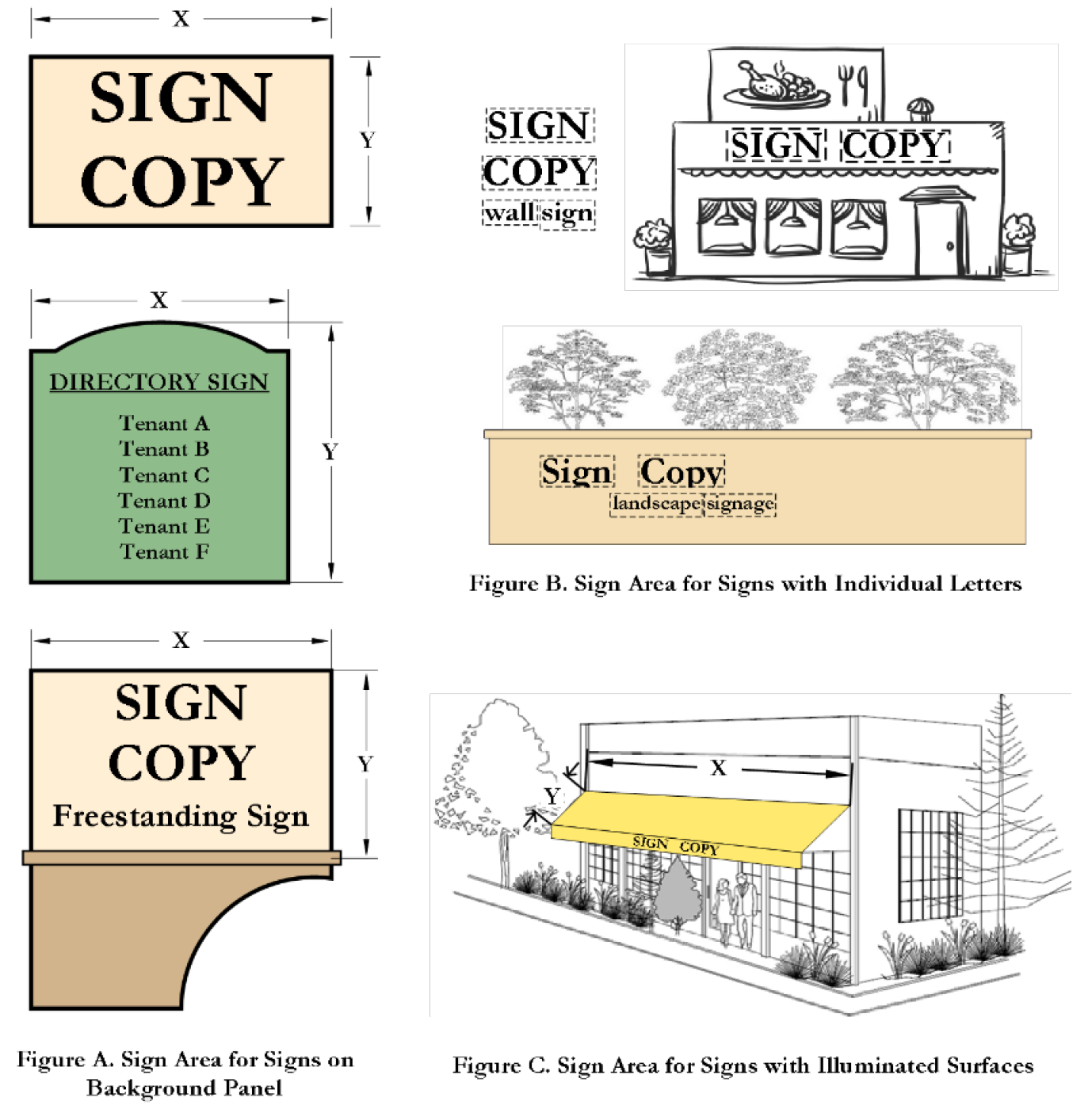
FIGURES 11-41-7-A THROUGH C
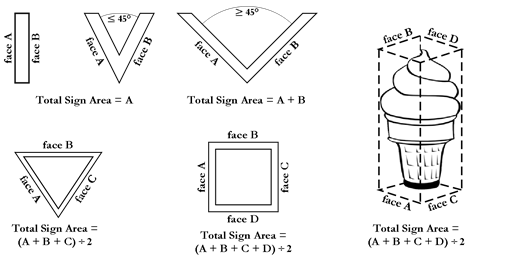
FIGURE 11-41-7-D
B.
Sign Height Measurement. Sign height is measured as follows:
1.
Freestanding Signs. Sign height is measured as the vertical distance from the average elevation of the finished grade within an eight (8) foot radius from all sides of the sign at the base of a sign to the top of the sign, exclusive of any filling, berms, mounds, or landscaping solely for the purpose of locating the sign, excluding decorative embellishments as defined in Section 11-50-2, and authorized in Section 11-43-3.
a.
If natural grade at the base of a sign is higher than the grade of the adjacent road, and the grade has not been artificially raised by fill or other means to a height above the adjacent road, then sign height is measured from the base of the sign at natural grade, as shown in Figure 11-41-7-E.
b.
If natural grade at the base of a sign is lower than the grade of an adjacent road, or has been reduced to provide a storm water retention basin, then the height of the sign is measured from the top of curb elevation, as shown in Figure 11-41-7-F.
c.
Consideration of natural grade does not include the use of berms or increases in building construction pads, grading of the site, importing of sand, gravel, or other similar means to artificially increase the natural grade level of a site.
2.
Building Mounted Signs. The height of wall, fascia, mansard, parapet, or other building mounted signs is the vertical distance measured from the base of the wall on which the sign is located to the top of the sign, as shown in Figure 11-41-7-G.
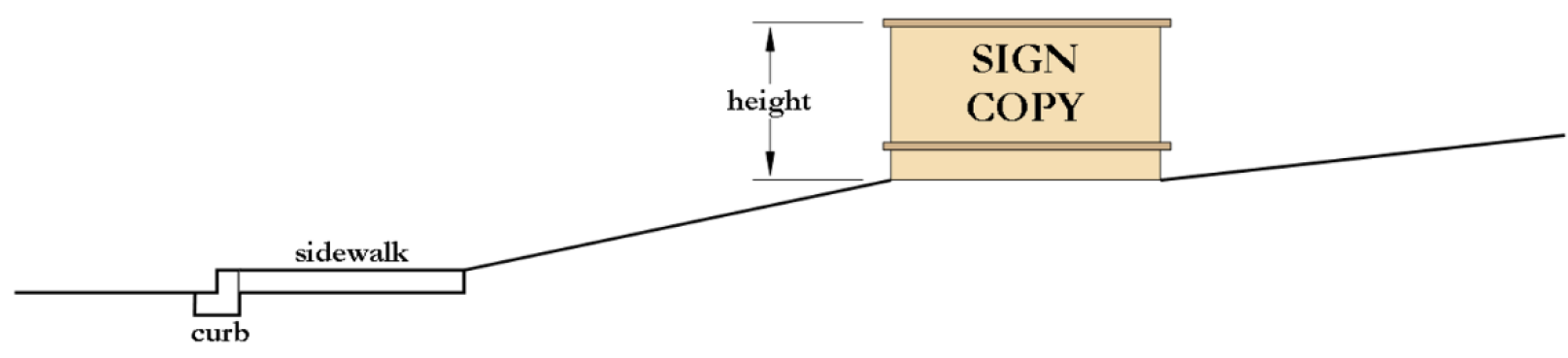
FIGURE E. FREESTANDING SIGN HEIGHT - SIGNS HIGHER THAN THE GRADE OF AN ADJACENT ROAD
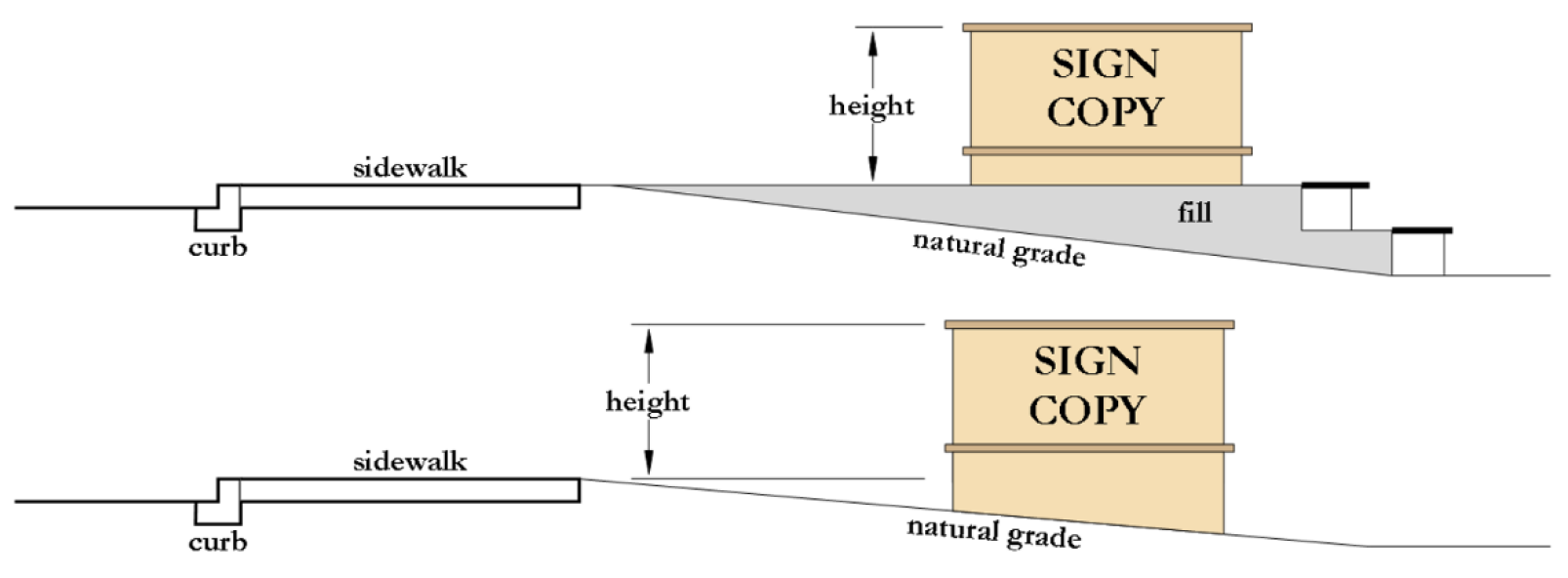
FIGURE F. FREESTANDING SIGN HEIGHT - SIGNS LOWER THAN THE GRADE OF AN ADJACENT ROAD
FIGURES 11-41-7-E and 11-41-7-F
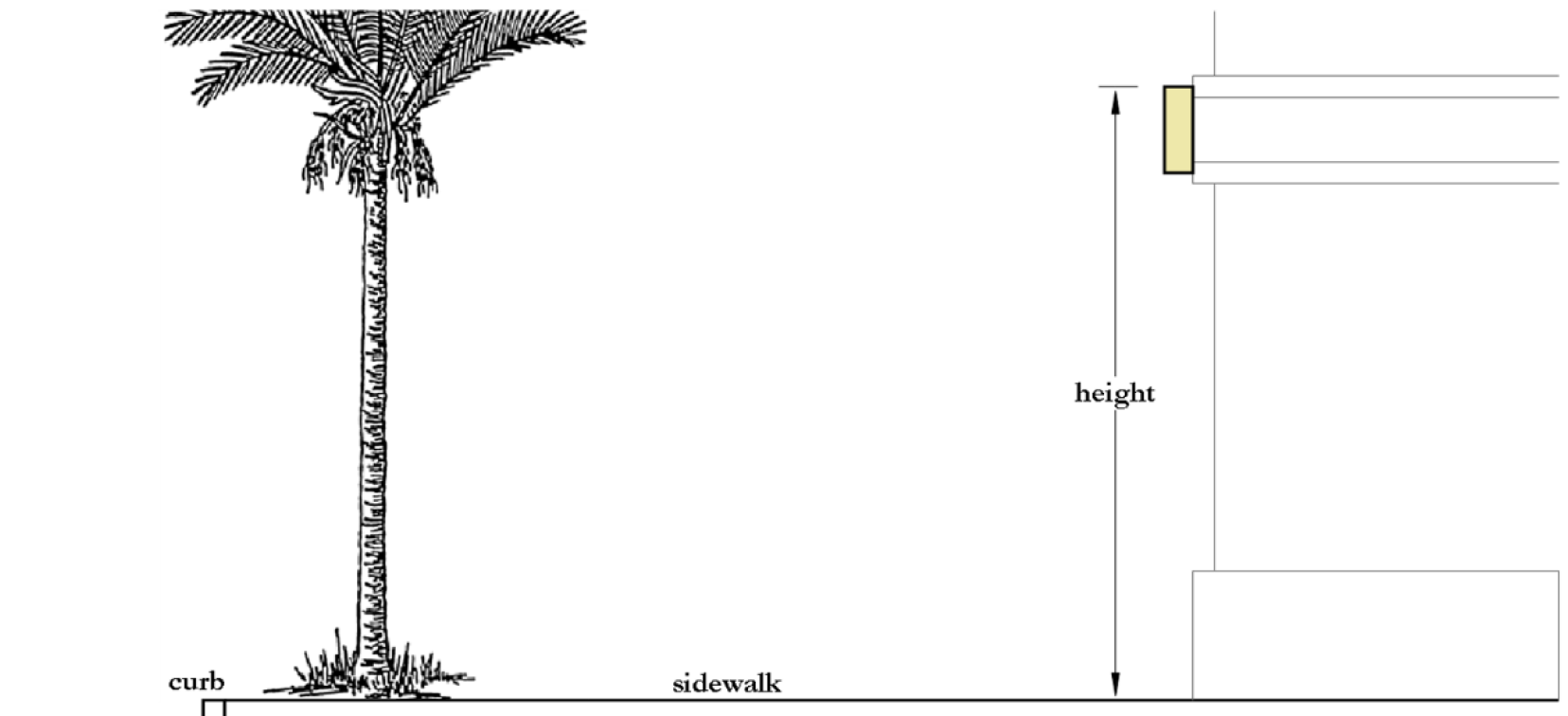
FIGURE 11-41-7-G
C.
Sign Illumination Measurement. The illuminance of an electronic message panel shall be measured with an illuminance meter set to measure foot-candles accurate to two (2) decimals. Illuminance shall be measured with the unit turned off, and again with the unit turned on displaying a white image for a full color-capable electronic message panel, or a solid message for a single-color electronic message panel. Both measurements shall be taken perpendicular to the face of the electronic message panel at a distance determined by the total square footage of the electronic message panel as provided in Table 11-41-7-C below.
(Ord. No. 5256, 11-3-14)
11-41-8: - SIGHT VISIBILITY TRIANGLES
No sign shall interfere with visibility at street intersections or driveways as provided in the City of Mesa Engineering and Design Standards Section 211 - Sight Distance and Visibility Guidelines.
A.
Permanent Signs. No permanent sign is allowed above the height of three (3) feet.
B.
Portable Signs. Portable signs are allowed in the sight visibility triangle, only as follows:
1.
The portable sign does not exceed three (3) feet in height.
2.
In the RS, RSL, and DR-1 districts or T3N transect, one (1) portable sign exceeding three (3) feet high is allowed within fifteen (15) feet of the edge of pavement or face of curb, as may be applicable, of any streets, roads or highways providing two (2) or less vehicular traffic lanes.
11-41-9: - RESPONSIBLE PARTY
A.
Posting Sign. The person, group, or organization directing the posting, installation, or erection of a sign is responsible for assuring the compliance of the sign with the requirements of this Sign Ordinance. This includes the removal, maintenance, replacement, or alteration of the sign, as may be applicable.
B.
Owner or Occupant. If the person directing the posting, installation, or erection of the sign does not remove, maintain, replace, or alter the sign in accordance with the requirements of this Sign Ordinance, then the property owner or occupant of the building, where the sign is posted, is responsible for either replacing the sign with a sign that complies with this Sign Ordinance or removing the sign.
11-42-1: - PURPOSE AND GENERAL PROVISIONS
Purpose. The City finds that an overconcentration of portable signs is a distraction to motorists, interferes with the visibility of the traveling public, and creates aesthetic blight and visual clutter. In addition to Section 11-41-1, the purpose of this Chapter is to:
A.
Identify and provide for a variety of portable sign types;
B.
Provide for the appropriate size and number of portable signs in a manner consistent with the design and aesthetic standards of the City of Mesa urban design characteristics as specified in the Mesa General Plan; and
C.
Assure that opportunities for portable signs do not create visual clutter or in an over-concentration of portable signs that result in a distraction to motorists or interfere with the visibility of the traveling public.
(Ord. No. 5928, § 23, 2-3-25)
11-42-2: - PORTABLE SIGN ALLOWANCES BY ZONING DISTRICT FOR DEVELOPED PROPERTY
A.
Allowances for the size, number, and height of portable signs for a lot or parcel are determined by the zoning district and lot size as provided in the Tables in this Section. The Tables in this Section are used to calculate the maximum number, size, and height of signs that may be used on a property. The types of portable signs allowed are provided in Table 11-42-3. The portable sign must conform to the standards provided in both Sections 11-42-2 and 11-42-3, the more restrictive standards apply.
B.
Example: A property owner wants to display portable signs at a three (3) acre shopping center in the LC zoning district. The shopping center is located at a street intersection. Using Table 11-42-2-E, the center is allowed two (2) portable signs per street front. The property has two street fronts; therefore, the property owner is allowed to display up to four (4) portable signs. The maximum individual portable sign area is twelve (12) square feet and the total portable sign area allowance for the property is twenty-four (24) square feet With this allowance, use the information in Table 11-42-3 to select the portable sign type(s) for the property, as illustrated by the examples in Table 11-42-2-B.
C.
Agriculture and Single-Residence. The allowances for the size, number, and height of portable signs per lot or parcel in AG, RS, RSL, DR-1, and T3N are provided below in Table 11-42-2-C.
D.
Multi-Residence, Office, and Light Commercial. The allowances for the size, number, and height of portable signs per lot or parcel in RM, DR-2, DR-3, OC, NC, DB-1, and T4N are provided below in Table 11-42-2-D.
(1) Portable sign types are limited to the size and height provided in Table 11-42-3.
(2) Air activated and balloon sign maximum heights are provided in Table 11-42-3. Sign area of balloons are not counted against the maximum aggregate sign area. See section 11-42-6 for additional requirements for fabric signs.
E.
Commercial and Industrial. The allowances for the size, number, and height of portable signs per lot or parcel in LC, GC, DB-2, PEP, LI, GI, HI, and EO are provided in Table 11-42-2-E.
(1) Portable sign types are limited to the size and height provided in Table 11-42-3.
(2) Air activated and balloon sign maximum heights are provided in Table 11-42-3. Sign area of balloons are not counted against the maximum aggregate sign area. See section 11-42-6 for additional requirements for fabric signs.
F.
Neighborhood and Main Street Transects. The allowances for the size, number, and height of portable signs for each building in the T4NF, T4MS, T5N, and T5MSF are provided in Table 11-42-2-F.
(1) Portable sign types are limited to the size and height provided in Table 11-42-3.
(2) See section 11-42-6 for additional requirements for fabric signs.
G.
Mixed-Use and Urban. The allowances for the size, number, and height of portable signs for each building in the MX, DC, T5MS, T6MS, and all districts with a 'U' character designator are provided in Table 11-42-2-G.
(1) Portable sign types are limited to the size and height provided in Table 11-42-3.
(2) See section 11-42-6 for additional requirements for wall banners.
H.
Downtown Pedestrian Area.
1.
The downtown area is an intense pedestrian area with buildings built to the property line thus requiring some allowance for signage in or over the right of way. The sign requirements and allowances have been adjusted for the downtown to meet the unique needs of this area.
2.
A business owner within the DPA, can display portable signs within the right-of-way subject to all of the following conditions:
a.
Annually apply for and obtain an Administrative Use Permit (AUP) from the City of Mesa Planning Director or designee. The AUP is valid for one (1) year from the date of issuance.
b.
Renew the AUP within thirty (30) days of the expiration date of the current AUP. The Planning Director shall renew the AUP provided that, on the date of application, the business owner is in compliance with all provisions of the Sign Ordinance and further provided that, on the date of application, the use of portable signs within the DPA is still an allowed use under the Sign Ordinance.
c.
The application and renewal of the AUP requires submission of a Certificate of Insurance which complies with the City's current insurance requirements.
d.
Obtain an encroachment permit from the City Engineer.
e.
The portable sign does not interfere with pedestrian movement or obstruct ADA access. A minimum access width of five (5) feet is maintained along all sidewalks and building entrances accessible to the public.
f.
The portable sign does not encroach into required off-street parking areas, and does not create site visibility conflicts or other traffic hazards.
g.
The portable sign is only displayed during the operating hours of the business and is removed during non-business hours.
h.
The portable sign is maintained in good condition throughout the term of the AUP.
11-42-3: - CLASSIFICATIONS AND DESCRIPTIONS
A.
Permitted Portable Sign Types. The portable signs as defined in Chapter 50 and described in Table 11-42-3 are permitted in accordance with the requirements set forth in this Sign Ordinance. The Table identifies the specific types of portable signs permitted in a zoning district and establishes the maximum size and height. The height(s) and size(s) in Table 11-42-3 do not increase the sign allowance established in Tables 11-42-2; the more restrictive standards from Tables 11-42-2-C through G and Table 11-42-3 apply.
| Table 11-42-3: Portable Sign Types | ||||||
|---|---|---|---|---|---|---|
| Description | Sign Type/Maximums | Illustrative Examples | Permitted Zoning | |||
| Rigid: A sign made of durable, non-pliant material such as wood, sheet metal, plastic, or other lightweight rigid material | A-frame or T-frame: A light weight portable sign resting atop the ground without penetrating the ground.
Max. Size: 8 sq. ft. Max. Height: 4 ft. | 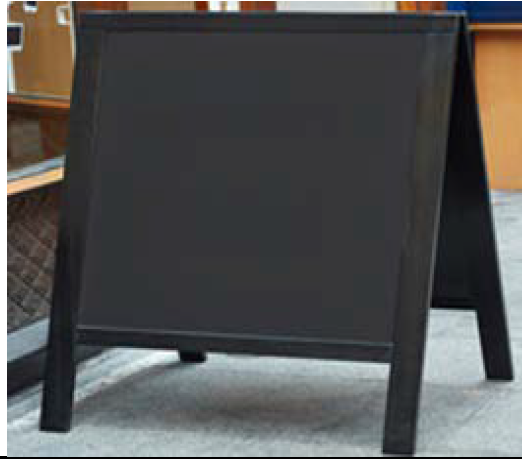 | AG | RS | RSL | RM |
| OC | NC | LC | GC | |||
| DR-1 | DR-2 | DR-3 | MX | |||
| DB-1 | DB-2 | DC | PEP | |||
| LI | GI | HI | EO | |||
| T3N | T4N | T4NF | T4MS | |||
| T5N | T5MSF | T5MS | T6MS | |||
| Attached: Affixed to a building or wall. |  | AG | RS | RSL | RM | |
| OC | NC | LC | GC | |||
| DR-1 | DR-2 | DR-3 | MX | |||
| DB-1 | DB-2 | DC | PEP | |||
| LI | GI | HI | EO | |||
| T3N | T4N | T4NF | T4MS | |||
| T5N | T5MSF | T5MS | T6MS | |||
| Detached: Affixed to post(s) or stake(s) that penetrates the ground.
Max. Size: 32 sq. ft. Max. Height: 8 ft. |  | AG | RS | RSL | RM | |
| OC | NC | LC | GC | |||
| DR-1 | DR-2 | DR-3 | MX | |||
| DB-1 | DB-2 | DC | PEP | |||
| LI | GI | HI | EO | |||
| T3N | T4N | T4NF | T4MS | |||
| T5N | T5MSF | T5MS | T6MS | |||
| Semi-rigid: A sign made of cardboard, foam-core, thin plastic, paper, or other quasi-rigid but less durable material. | Detached Yard: Affixed to a stake(s), post(s), or other device that penetrates the ground.
Max. Size: 6 sq. ft. Max. Height: 3-feet |  | AG | RS | RSL | RM |
| OC | NC | LC | GC | |||
| DR-1 | DR-2 | DR-3 | MX | |||
| DB-1 | DB-2 | DC | PEP | |||
| LI | GI | HI | EO | |||
| T3N | T4N | T4NF | T4MS | |||
| T5N | T5MSF | T5MS | T6MS | |||
| Fabric: A sign made of durable fabric or similar pliant flexible material. | Detached Banners: Fabric affixed to a stake, post, or other device that penetrates the ground.
Max. Size: 12 sq. ft. Max. Height: 6-feet | 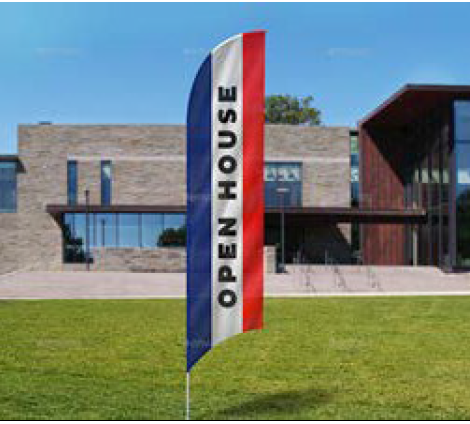 | AG | RS | RSL | RM |
| OC | NC | LC | GC | |||
| DR-1 | DR-2 | DR-3 | MX | |||
| DB-1 | DB-2 | DC | PEP | |||
| LI | GI | HI | EO | |||
| T3N | T4N | T4NF | T4MS | |||
| T5N | T5MSF | T5MS | T6MS | |||
| Wall Banners: Fabric affixed to a building, wall, or fence.
Max. Size: 32 sq. ft. Max. Height: Less than roof or parapet |  | AG | RS | RSL | RM | |
| OC | NC | LC | GC | |||
| DR-1 | DR-2 | DR-3 | MX | |||
| DB-1 | DB-2 | DC | PEP | |||
| LI | GI | HI | EO | |||
| T3N | T4N | T4NF | T4MS | |||
| T5N | T5MSF | T5MS | T6MS | |||
| Air Activated: A sign that moves or makes motions when wind is applied powered means.
Max. Height: 12-feet |  | AG | RS | RSL | RM | |
| OC | NC | LC | GC | |||
| DR-1 | DR-2 | DR-3 | MX | |||
| DB-1 | DB-2 | DC | PEP | |||
| LI | GI | HI | EO | |||
| T3N | T4N | T4NF | T4MS | |||
| T5N | T5MSF | T5MS | T6MS | |||
| Balloons: A bag or similar flexible, non-rigid enclosure, that holds air or gas attached by
a tether to a fixed place.
Max. Height: 20-feet |  | AG | RS | RSL | RM | |
| OC | NC | LC | GC | |||
| DR-1 | DR-2 | DR-3 | MX | |||
| DB-1 | DB-2 | DC | PEP | |||
| LI | GI | HI | EO | |||
| T3N | T4N | T4NF | T4MS | |||
| T5N | T5MSF | T5MS | T6MS | |||
 | Not Allowed | |||||
 | Allowed | |||||
| Note: Portable sign allowances for properties in ID-1, ID-2, or PC districts are permitted as provided in the plan approved for that development or as allowed in the base zoning district. | ||||||
11-42-4: - PORTABLE SIGNS FOR UNDEVELOPED PROPERTY
A.
Allowance for Undeveloped Lots or Parcels. Any lot or parcel that is vacant, devoid of any development, or that is currently under construction, may utilize the portable sign allowance provided in this Section.
B.
Prompt Removal. Detached signs authorized under this Section shall be removed from a vacant lot or parcel within one (1) week after the issuance of a Certificate of Occupancy or equivalent.
11-42-5: - NON-RESIDENTIAL USES IN RESIDENTIAL ZONING DISTRICTS
In the AG, RS, and RSL zoning districts, non-residential land use classifications as defined in Sections 11-86-3, 11-86-4, 11-86-5, and 11-86-6 may use portable signs in accordance with Section 11-42-2-D.
11-42-6: - FABRIC SIGNS
In zoning districts where allowed per Table 11-42-3, each multi-residence development, or each occupancy in a non-residential development may display one (1) fabric sign, on property that is developed, if an Administrative Use Permit is approved. The fabric sign may be displayed for a maximum of thirty (30) days per calendar year. The days do not need to be consecutive, and may be divided into several separate periods provided the number of days, in aggregate, does not exceed thirty (30) per calendar year, with each calendar year beginning on January 1st. Additionally, each occupancy in a non-residential development is permitted additional fabric signs if a Temporary Use Permit (TUP) is approved authorizing a temporary use on the property. The display of the fabric sign is only allowed during the time-period the TUP is valid.
A.
Wall Banners. In addition to the requirements in this Section, 11-42-2, and 11-42-3, wall banners shall comply with the following:
1.
All corners of the banner must be fastened securely to the building, wall, or fence in a manner that prevents high winds from removing or separating the banner from the building, wall, or fence or causes the banner to flap;
2.
Provide vents to ensure the banner withstands the wind; and
3.
Provide a minimum clearance of eight (8) feet above grade when placed above an area open for the common or general use of the public.
B.
Detached Banners. In addition to the requirements in this Section, 11-42-2, and 11-42-3, detached banners must be secured to the ground in a manner that prevents high winds from removing the banner.
C.
Air Activated and Balloons. In addition to the requirements in this Section, 11-42-2, and 11-42-3, air activated and balloons shall comply with the following:
1.
Secured to the ground in a manner that prevents high winds from removing the air activated or balloon sign; and
2.
Located at least fifty (50) feet from the right-of-way.
11-42-7: - VEHICLE SIGNS
Vehicle signs are allowed if the following conditions are satisfied:
A.
The vehicle complies with Section 8-6-3(A) of the Mesa City Code;
B.
The vehicle is parked in an authorized location and in a lawful manner that is not distinct or different from the pre-determined parking area design; and
C.
During periods of inactivity exceeding two (2) days, the vehicle is parked in a manner so that the sign is not visible from the right-of-way, or if this is not possible, is parked as far from the right-of-way as possible.
11-43-1: - PURPOSE AND INTENT
In addition to the items listed in Section 11-41-1, the purpose and intent of regulating signs used as permanent fixtures includes:
A.
Keeping the scale of permanent signs proportionate in height, size, number, and illumination to the intensity and context of land use in the vicinity of the sign, including the specific location of the sign;
B.
Utilizing shapes, details, materials, and illumination on permanent sign devices and structures in a manner that furthers, enhances, and reinforces the architectural design theme of the related development; and
C.
Maintaining and enhancing the aesthetic character of permanent signs based upon the context in which they are located.
11-43-2: - DESIGN STANDARDS FOR PERMANENT SIGNS AND SIGN STRUCTURES
A.
Architectural Compatibility. Permanent signs and sign structures shall:
1.
Be designed to be attractive and artistic;
2.
Incorporate design features associated with the buildings or structures, and should constitute an architectural component of the overall development that is compatible with, and not incongruous to, the architectural style and character of the development of the property associated with the sign; and
3.
Utilize materials and design themes consistent with the architectural design theme of the development, as expressed by the building architecture, landscaping, and overall site development.
B.
Attached Permanent Signs.
1.
Design Standards. Attached permanent signs must comply with the following design standards:
a.
A sign shall be mounted so that the attachment device is not visible or discernible and shall consist of the following:
i.
Individual letters such as pan channel or other durable material or
ii.
An architecturally designed cabinet that is irregular and freeform in shape.
b.
A sign attached to a single tenant building shall not exceed more than fifty-percent (50%) of the width of the building elevation upon which the attached sign is placed.
c.
A sign attached to a single tenant space of a multiple tenant building, as determined by the issuance of a separate Certificate of Occupancy for the specific tenant space, shall not exceed more than seventy-five percent (75%) of the width of the front of the occupancy upon which the attached sign is placed.
d.
Placed on the elevation of the same tenant space for which the Certificate of Occupancy is issued.
e.
Opaque backgrounds shall be provided on internally illuminated signs so that only the sign copy is illuminated.
f.
A wall mounted sign shall be placed below parapet or eave.
g.
Roof signs are not permitted.
h.
Signs are permitted on a false mansard roof, awning, or canopy. Signs placed in these locations shall comply with the following:
i.
Installed in a manner where angle iron supports, guy wires, braces, or secondary supports, are not visible.
ii.
Appear to be an architectural or integral part of the roof.
iii.
All parts of the sign are below the highest portion of the building or roof where the sign is attached.
2.
Design Guidelines:
a.
Letters attached or anchored to the face of an exposed standard raceway should be architecturally designed and integrated into the building.
b.
If non-standard raceways are used the following design guidelines shall be followed:
i.
As a background where the raceway is not discernable. Raceway is designed as splash cabinet following the shape of the letters where the area of the cabinet is included in the total attached sign area as provided in the example shown in Figure 11-43-2-B-2-b-i;

FIGURE 11-43-2-B-2-b-i
ii.
Integrated and a part of the design that acts as a backdrop where the area of the raceway is included in the total attached sign area as provided in the example shown in Figure 11-43-2-B-2-b-ii; or
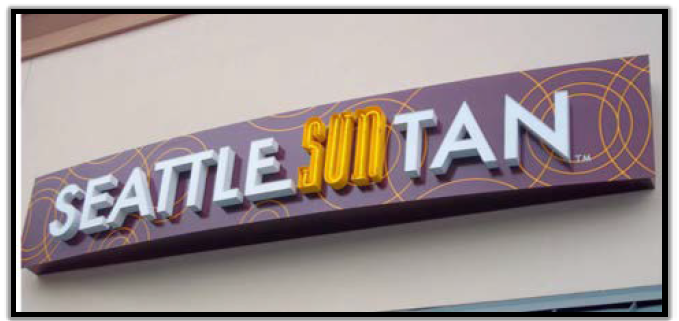
FIGURE 11-43-2-B-2-b-ii
iii.
Integrated into the design where letters are mounted to the top of the raceway cabinet as provided in the examples shown in Figures 11-43-2-B-2-b-iii.
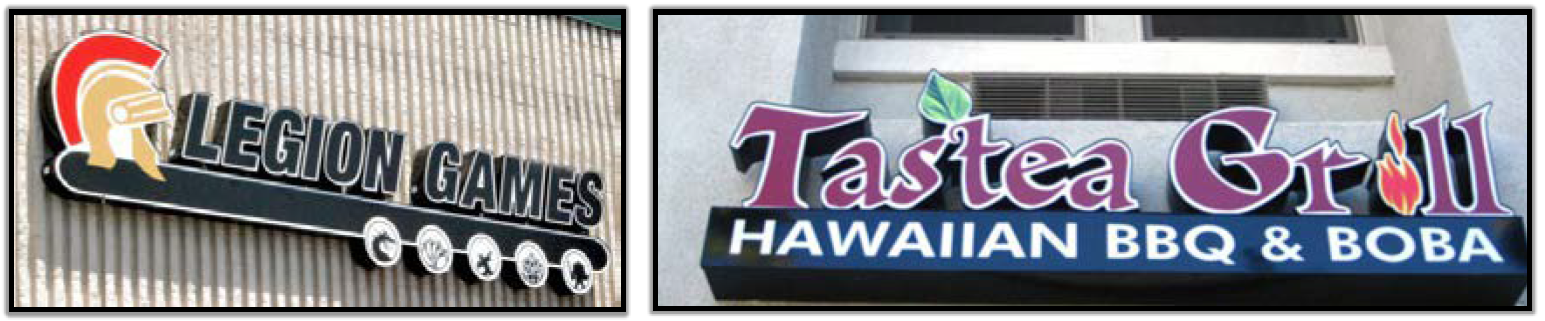
FIGURE 11-43-2-B-2-b-iii
c.
Raceways shall either:
i.
Be finished to match the color of the building adjacent to the raceway and design elements of the building or
ii.
When a raceway is provided as an architectural enhancement to the building elevation, the raceway must be in a contrasting color and material.
C.
Detached Permanent and Freestanding Signs. Detached permanent and freestanding signs must complement design features associated with the buildings or structures, and constitute an architectural component of the overall development.
1.
Design Standards. Detached permanent and freestanding signs must comply with the following design standards:
a.
The sign structure must consist of metal, masonry, or a similar durable construction material using one (1) of the following styles:
i.
A single base where the width of the base is a minimum of seventy-five percent (75%) of the width of the sign copy, or
ii.
A base consisting of two (2) or more posts or columns in which the width of all posts or columns, in aggregate, is a minimum of thirty-three percent (33%) of the width of the sign copy.
b.
An internally illuminated sign shall comply with the requirements of Section 11-41-3-B, and shall provide either:
i.
An opaque background so only the sign copy is illuminated; or
ii.
A translucent background of no more than fifty-percent (50%) opacity.
c.
No detached permanent sign is allowed within seventy-five (75) feet of any other detached permanent sign on the same parcel or Group C-O-I Development site.
d.
For streets or roads with three (3) or more traffic lanes, a sign is not allowed within fifteen (15) feet of the face of curb or edge of pavement, when no curb exists.
e.
If a sign is placed at the street intersection of a corner parcel and is visible from both streets or both frontages, the sign may not exceed the maximum height and area allowed for the longer street frontage. The area of the sign is deducted from the total aggregate sign height, sign area, and number of signs permissible on the corner parcel.
2.
Design Guidelines:
a.
The sign copy should not exceed a horizontal-to-vertical ratio of two to one (2:1).
b.
A sign may consist of more than one (1) sign panel provided all sign panels are attached to one (1) common integrated sign structure. When multiple sign panels are used, the area of the sign is calculated as one (1) aggregate sign area of all panels used.
c.
Embellishment should complement the primary design elements or unique architectural features of the buildings or structures.
d.
Embellishment added to a sign structure may extend above the allowable height, up to a maximum extension of twenty-percent (20%) of the permitted height of the sign.
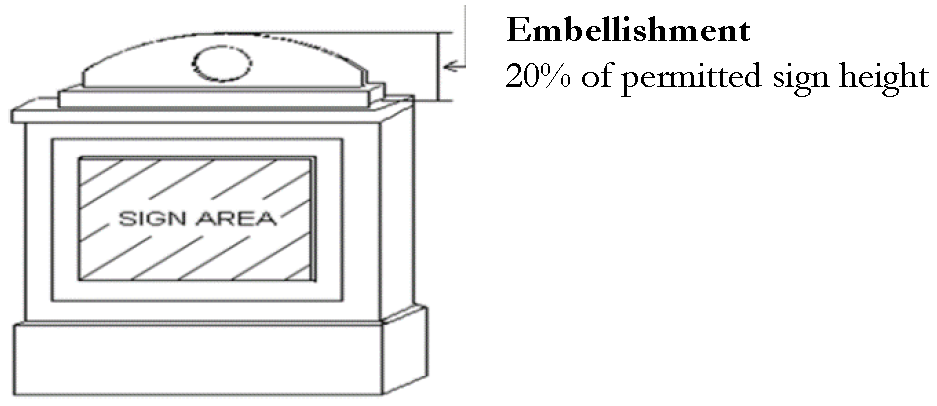
FIGURE 11-43-2-C-2-d
11-43-3: - PERMANENT SIGN ALLOWANCES BY ZONING DISTRICT
The following Tables include the sign allowances for attached and detached permanent signs by zoning district. The "Additional Requirements" column lists additional standards that apply. Individual number(s) placed in parentheses [ex: (1)] refer to footnotes appearing immediately below or following the Table.
A.
Attached and detached permanent sign allowances in AG, RS, RSL, DR-1, T3N, and T4N are provided in Table 11-43-3-A.
(1) A lot or parcel allowed to operate a non-residential land use is allowed to increase the maximum area of each permitted sign to thirty-two (32) sq. ft. with a maximum height of eight (8) feet if detached, or below the top of the parapet or eave, if wall mounted (no roof signs). Increased sign allowance under this provision does not apply to Home Occupations as authorized by Section 11-31-33 in the Zoning Ordinance.
B.
Attached and detached permanent sign allowances for RM, DR-2, DR-3, T4NF, and T5N are provided in Table 11-43-3-B.
(1) A non-residential use in T4NF is allowed one (1) additional attached sign on a street and one (1) additional attached sign on an alley frontage, not to exceed thirty-two (32) sq. ft.
(2) Street classification is based on the Mesa Transportation Plan.
C.
The following two (2) Tables provide the attached and detached permanent sign allowances for OC. The maximum aggregate sign allowance for all signage (attached and detached) is thirty-two (32) sq. ft.
(1) The sign area applies only to occupancies with an exterior wall. When there is more than one (1) exterior wall, the longest wall can be used to calculate the maximum sign allowance.
(2) Each occupant with an exterior wall is allowed this minimum individual sign area regardless of the front foot of the building occupancy.
D.
The following four (4) Tables provide the attached and detached permanent sign allowances in NC, LC, GC, PS, PEP, LI, GI, and HI.
1.
The standard allowances for attached signs per occupancy are provided in Table 11-43-3-D-1.
(1) If an occupancy(s) has more than one exterior wall, the longest wall is used to calculate the sign allowance.
(2) Each occupant is allowed a minimum of twenty-four (24) sq. ft. of sign area regardless of front foot of building occupancy.
2.
In lieu of the standard attached sign allowances in Table 11-43-3-D-1, a single occupant pad building under 5,000 sq. ft. of gross floor area may use the attached sign allowance in Table 11-43-3-D-2.
(1) Sign shall not exceed more than 50% of the width of the building elevation.
(2) A single-occupant pad building is allowed a minimum of 24 sq. ft. of sign area regardless of the widest building elevation.
3.
The standard allowances for detached signs per development are provided in Table 11-43-3-D-3.
4.
In lieu of the standard detached sign allowances in Table 11-43-D-3, commercial use developments with a minimum of three (3) separate occupants and more than four-hundred (400) feet of frontage along a single street frontage may use the detached sign allowance in Table 11-43-3-D-4 for one (1) sign within the development.
E.
Attached and detached sign allowances in DB-1, DB-2, and DC (outside of the Downtown Pedestrian Area [DPA]) are provided in Table 11-43-3-E. In addition to the requirements in this Chapter, a sign in this Sub-section has the following additional requirements:
1.
Attached signs must use individual letters. An attached cabinet sign is not permitted.
2.
Neon signs are permitted provided the neon is complementary and harmonious with the primary color(s), style, and architecture of the building or development.
3.
A comprehensive sign plan is required for sign(s) located on the upper story of a building when the building exceeds two (2) stories in height.
(1) A sign attached to a single tenant building shall not exceed more than fifty percent (50%) of the width of the building elevation upon which the attached sign is placed. A sign attached to a single tenant space of a multi-tenant building, as determined by the issuance of a separate Certificate of Occupancy for the specific tenant space, shall not exceed more than seventy-five percent (75%) of the width of the front of the occupancy upon which the attached sign is placed.
(2) An attached sign is allowed on the occupant's building only.
(3) The sign copy horizontal-to-vertical ratio cannot exceed two to one (2:1).
F.
Attached permanent sign allowances in DC (in the DPA), T4MS, T5MSF, T5MS, and T6MS are provided in Table 11-43-3-F.
(1) Must use individual letters. An attached cabinet sign is not permitted.
(2) A window sign is only allowed on the first and second story of the building.
(3) An awning sign is only allowed on the ground floor of the building. Two-story architectural entry elements may include an awning sign over the entry.
(4) A wall-mounted sign is allowed on the colonnade in lieu of a wall-mounted sign on the building.
(5) A comprehensive sign plan is required for a sign(s) located on the upper story of a building when the building exceeds two (2) stories.
(6) Cannot be illuminated.
(7) A neon sign is permitted provided the neon is complementary and harmonious with the primary color(s), style, and architecture of the building or development.
(8) A projecting sign mounted at the corner of the building must be installed at a forty-five-degree (45°) angle. A Projecting sign mounted on a wall parallel to the street must be mounted at a ninety-degree (90°) angle. A projecting sign must maintain a twelve (12) feet minimum separation from any other projecting sign.
(9) A projecting sign is permitted in lieu of a wall-mounted sign. A projecting sign cannot be placed on the colonnade.
(10) Exposed bulbs are allowed when the bulbs are an integral component of the design of a marquee.
(11) A projecting sign shall not extend more than four (4) feet from the face of the building and no more than two (2) feet above the parapet.
G.
ID District. Attached and detached permanent sign allowances for properties in the ID District are permitted as follows:
1.
Signs in the ID-1 District are permitted as provided in the base zoning district, unless specified otherwise in the adopted infill incentive plan, or by an adopted comprehensive sign plan approved in accordance with Section 11-45-3.
2.
Signs in the ID-2 District are permitted as provided in the adopted infill incentive plan, or by an adopted comprehensive sign plan approved in accordance with Section 11-45-3.
H.
PC District. Attached and detached permanent sign allowances for properties in the PC District shall be as specified in the community plan, or by an adopted comprehensive sign plan approved in accordance with Section 11-45-3.
I.
EO District. Attached and detached permanent sign allowances for properties in the EO District shall be as specified in the specific EO District Development Plan, or by an adopted comprehensive sign plan approved in accordance with Section 11-45-3.
J.
Multiple Residence Districts with an Urban Character Designator. Signs in the RM Districts with an urban character designator shall comply with the requirements of an analogous transect in the Form-Based Code, as referenced in Table 11-43-3-K.
K.
Commercial Districts with an Urban Character Designator. Signs in Commercial Districts with an urban character designator shall comply with the requirements of an analogous transect in the Form-Based Code, as referenced in Table 11-43-3-L.
11-43-4: - DRIVE-THRU AND DRIVEWAY SIGNS
Driveway and Drive-Thru Lane Signs. Driveway and drive-thru lane signs do not count against the detached permanent sign allowance.
11-43-5: - ELECTRONIC MESSAGE PANELS
Permanent signs may use electronic message panels, when the panel is not considered animated, and in compliance with the following requirements, as may be applicable:
A.
Standards for Message Display. Each message is displayed for a minimum period of eight (8) seconds with no movement or motion. As defined below, message change is permitted through fade, dissolve, travel, or scrolling modes not to exceed two (2) seconds in transition.
1.
Fade: A sign where static messages are changed by means of varying light intensity, where the first message gradually reduces intensity to the point of not being legible and the subsequent message gradually increases intensity to the point of legibility.
2.
Dissolve: A sign where static messages are changed by means of varying light intensity or pattern, where the first message gradually appears to dissipate and lose legibility simultaneous to the gradual appearance and legibility of the subsequent message.
3.
Travel: A sign where the message is changed by the apparent horizontal movement of the letters or graphic elements of the message.
4.
Scrolling: A sign where the message is changed by the apparent vertical movement of the letters or graphic elements of the message.
B.
Lighting Controls Required. The electronic message panel shall include automatic lighting control technology, such as the use of photocells, to control and vary the intensity of lighting depending on the amount of ambient light present (e.g. daytime, nighttime, partial shade or cloudy conditions).
1.
Nighttime Illumination Limit. The intensity of the lighting from dusk until dawn shall not exceed a 0.3 foot-candle difference between the off and solid message measurements using the illumination measure provided in Section 11-41-7-C.
2.
The electronic message panel shall not be illuminated between 11:00 p.m. and sunrise if the following conditions exist:
a.
The sign is located in or within one-hundred fifty (150) feet of Single Residence (RS), Downtown Residential 1 and 2 (DR-1 and DR-2), Multiple Residence (RM), or Small Lot Residence (RSL) zoning districts, or in a T3 Neighborhood (T3N); and
b.
There is no intervening building or other permanent structure that completely screens the electronic message panel from the residential site.
3.
Certification. Prior to the issuance of a sign permit for an electronic message panel, the applicant shall provide a written certification from the owner of the sign attesting that said owner has read and understands the provisions of this Section, Section 11-41-3-B, and 11-41-7-C, and agrees to abide by said Section, and agrees to cooperate with City of Mesa staff with regards to any nighttime testing that may be necessary should the 0.3 foot-candle limitation be at question.
C.
Wall Signs. An electronic message panel may be used as a wall sign.
11-43-6: - FLAGPOLES AND FLAGS
Flagpoles and flags shall comply with the following standards:
A.
Flagpoles.
1.
No more than three (3) flagpoles are allowed on an individual lot or parcel, or within a Group C-O-I Development. This limitation applies to model home offices in single residence subdivisions, multiple tenant non-residential developments, and similar multi-user sites. A flagpole may be wall-mounted or in-ground.
2.
An in-ground flagpole may require a building permit as required by Title 4 of the Mesa City Code to ensure the flagpole is structurally sound and complies with all requirements of the Zoning Ordinance.
3.
The minimum setback for in-ground flagpoles shall equal one-half (½) the setback required for a principal building as set forth by the zoning district in which it is located.
4.
The height of wall-mounted and in-ground flagpoles is regulated by Section 11-30-3, Exceptions to Height Limits in the Zoning Ordinance.
B.
Flags.
1.
A sign permit is not required to display a flag.
2.
The length of each flag, which is the longer side of a flag that is perpendicular to the flagpole, shall not exceed one-third (1/3) of the in-ground flagpole height on which the flag is attached. When attached to a wall-mounted flagpole, the length of the flag shall not exceed one-third (1/3) of the maximum height allowed by the zoning district in which the flag is displayed.
3.
Unless otherwise required or authorized by state law, no more than two (2) flags are allowed on a flagpole, from a flag bracket, or on a flag stanchion.
4.
Flags may be externally illuminated in compliance with the provisions of the Mesa Building Code.
11-43-7: - FREEWAY LANDMARK MONUMENTS (FLM)
A.
Purpose and Intent. The purpose and intent of this Section is to:
1.
Promote the effectiveness of individual Freeway Landmark Monuments by preventing the over concentration, improper placement, deterioration, excessive size, and excessive number.
2.
Regulate advertising distractions that may contribute to traffic accidents, thereby protecting travelers from injury or damage due to distraction or obstruction of vision, and enhancing the flow of traffic, visual environment, and the convenience, ease, and enjoyment of travel along Mesa's freeways.
3.
Assure that public benefits derived from expenditures of public funds for the improvement and beautification of freeways and other public structures and spaces are protected by exercising reasonable control over the character and design of large sign structures.
B.
Applicability. The provisions of this Section prevail if conflicts occur with other portions of the Sign Ordinance and govern Freeway Landmark Monuments, regardless of which provisions imposes a greater restriction.
C.
Eligibility Requirements. To be eligible for a Freeway Landmark Monument, a development site must meet the following requirements:
1.
Zoning Districts. The development site must be zoned Limited Commercial (LC), General Commercial (GC), Planned Employment Park (PEP), Light Industrial (LI), or General Industrial (GI). If the development site is zoned Planned Community (PC) or Infill District-2 (ID-2), a Freeway Landmark Monument may be permitted in conjunction with a commercial or industrial use, if specified as permitted in the approved Community Plan or Infill Plan.
2.
Minimum Site Area.
a.
The development site must be at least thirty (30) contiguous acres in size.
b.
This requirement may be met by one parcel of land thirty (30) acres or more in size, or a combination of adjoining parcels of land that are not separated by a right-of-way dedicated to the City, that are collectively thirty (30) acres or more in size.
3.
Frontage. The development site must have frontage on a freeway and an intersecting arterial street.
D.
Authorization. Freeway Landmark Monuments require the following recommendations and approvals:
1.
Recommendation by the Design Review Board;
2.
Recommendation by the Planning and Zoning Board;
3.
Approval and issuance of a Council Use Permit in accordance with Section 11-70-6 of the Zoning Ordinance and the standards contained within this Section; and
4.
Issuance of a sign permit in accordance with Title 11, Chapter 47 of the Zoning Ordinance.
E.
General Development Standards. Freeway Landmark Monuments are required to comply with A.R.S. Title 28, Chapter 23, Article 1, and the development standards established in this Section.
F.
Number, Sign Area, and Height Requirements.
1.
Maximum Number.
a.
Eligible development sites are allowed a maximum of one (1) Freeway Landmark Monument, except as set forth in Subsection (b) below.
b.
Eligible development sites with more than 2,000 linear feet of freeway frontage and that are 60 contiguous acres or more in size are allowed a maximum of two (2) Freeway Landmark Monuments.
2.
Sign Area.
a.
The maximum sign area of a Freeway Landmark Monument is determined by the following ratio: maximum one (1) square foot of total sign area per two (2) lineal feet of freeway or arterial frontage, whichever is greater.
b.
In no instance may the maximum sign area exceed 750 square feet.
3.
Maximum Height.
a.
The maximum height of a Freeway Landmark Monument, including any support structures, attachments, and embellishments, shall not exceed sixty (60) feet, unless a modification to the maximum height is granted as set forth in Section 11-43-7(J)(l) and Subsection c. below.
b.
Height Measurement.
i.
If the natural grade at the base of a Freeway Landmark Monument is higher than, or at the same grade as the freeway, the Freeway Landmark Monument height shall be measured as a vertical distance from the average elevation of the natural grade within a 50-foot radius from all sides of the Freeway Landmark Monument base to the highest point of the Freeway Landmark Monument.
ii.
If natural grade at the base of the Freeway Landmark Monument is lower than the grade of the freeway or has been reduced to provide a storm water retention basin, the heigh of the Freeway Landmark Monument shall be measured from the freeway elevation to the highest point of the Freeway Landmark Monument.
c.
Height Exception. A modification to the maximum height limit may be granted per Section 11-43-7(J)(1), if the following are demonstrated:
i.
A 60-foot-tall sign is not visible from a vehicle approaching on the same side of the freeway within a sufficient distance to permit vehicles to safely exit the freeway;
ii.
The proposed sign is no higher than reasonably necessary for the topmost portion of the sign (including sign embellishment) to be visible from a vehicle approaching on the same side of the freeway and located within sufficient distance to permit vehicles to safely exit the freeway; and
iii.
Visibility of sign area assigned to tenant(s) may not be used as the basis to justify additional sign height.
d.
If a height modification is granted, the maximum height of a Freeway Landmark Monument may be increased but shall not exceed ninety (90) feet.
G.
Spacing Requirements.
1.
Freeway Landmark Monuments.
a.
No portion of a Freeway Landmark Monument may be placed within 2,000 feet of another Freeway Landmark Monument distance measured from the nearest edge of the Freeway Landmark Monument face to the nearest edge of the nearest Freeway Landmark Monument face on the same side of the freeway.
b.
No more than three (3) Freeway Landmark Monuments are permitted on one (1) side of the freeway within one (1) lineal mile of freeway frontage.
2.
Billboards. No portion of a Freeway Landmark Monument may be placed within 1,000 feet of a Billboard, including Billboards located on adjacent properties or in neighboring jurisdictions, the distance measured from the nearest edge of the Freeway Landmark Monument face to the nearest edge of the nearest Billboard face.
3.
Residential Zoning District or Residential Use.
a.
No portion of a Freeway Landmark Monument may be placed within 500 feet of a Residential Zoning District (RS, RSL, or RM) or residential use unless:
i.
The residential use is part of a mixed-use development; or
ii.
A line-of-sight study or balloon test is conducted and demonstrates the Freeway Landmark Monument will not be visible to or from any Residential Zoning District or residential use within 500 feet.
b.
In no case may any portion of the Freeway Landmark Monument be placed within 400 feet of a residential use that is not part of a mixed-use development or a Residential Zoning District.
4.
Setback Requirements. Setbacks for Freeway Landmark Monuments must adhere to the standards of the underlying base zoning district except for setbacks from the freeway, in which the following setbacks shall apply:
a.
Minimum Setback from Freeway. The minimum setback to a freeway right-of-way is zero (0) feet, distance measured from the nearest edge of the Freeway Landmark Monument face to the nearest edge of the freeway right-of-way.
b.
Maximum Setback from Freeway. A Freeway Landmark Monument must be located within 250 feet of a freeway right-of-way, distance measured from the furthest edge of the Freeway Landmark Monument face to the nearest edge of the freeway right-of-way.
c.
Encroachment into Right-of-Way Prohibited. No portion of a Freeway Landmark Monument shall overhang or encroach into the right-of-way.
H.
Design Standards.
1.
Architectural Compatibility. Freeway Landmark Monuments must complement the development site's primary architecture by incorporating design elements from the development site, such as, materials, form, texture, color, and finish.
2.
Materials. Freeway Landmark Monuments shall be constructed with low maintenance, architectural-grade surfacing materials such as metal, masonry, ceramic tile, glass or stucco.
3.
Project Identification. The project or destination name should be clearly visible and located towards the topmost visible portion of the Freeway Landmark Monument or located vertically along the side of the Freeway Landmark Monument.
4.
Lighting Controls.
a.
Exposed Lighting. A Freeway Landmark Monument, or portion thereof, may be outlined by exposed neon, argon or krypton tubing, exposed incandescent lighting, or other exposed artificial lighting provided that the subject exposed lighting complies with all of the following:
i.
It constitutes a design component of the overall Freeway Landmark Monument architecture;
ii.
Is integrated into the primary physical elements of the Freeway Landmark Monument and is harmonious with the architectural style of the structure;
iii.
Serves only the purpose of embellishing the nighttime architecture of the Freeway Landmark Monument, and does not portray an advertising message;
iv.
Is compatible with the land use and architecture of adjacent developments; and
v.
Complies with Section 11-41-3(B) of the Zoning Ordinance regarding signage illumination and the National Electrical Code, as evidenced by submittal of complete design plans and specifications.
b.
Internal illumination.
i.
Internally illuminated signs shall have opaque backgrounds so that only the sign copy is illuminated.
ii.
Where a background is integral to the design of a corporate image or registered trademark, the background is to be colored to mute the amount of illumination.
c.
Nighttime Illumination.
i.
Nighttime illumination is limited to the sign copy or sign message.
ii.
Illumination must be extinguished in nighttime hours (from 11:00 p.m. until sunrise).
d.
Maintenance. If any component of the lighting becomes nonfunctional, none of the lighting system may be illuminated until the entire lighting system is repaired and is functioning as intended.
I.
Electronic Message Display.
1.
Copy Change. Copy may not change more than once every eight (8) seconds.
2.
Message Animation Prohibited.
a.
Animation, video, flashing, blinking, or moving lights are prohibited.
b.
In the transition between copy, there shall not be any sense of movement from one message to the next. No continuous, traveling or scrolling displays are allowed.
3.
Electronic Message Display Lighting Controls.
a.
Automatic Dimming. Electronic message displays must include automatic lighting control technology to dim, control, and vary the intensity of the display based on ambient light conditions (e.g. evening and nighttime) through a photoelectric sensor that detects ambient light levels and automatically adjusts the display intensity to ensure compliance with the maximum nit levels in this Section 11-437(1).
b.
Evening Illumination. The intensity of the electronic message display lighting shall not exceed 300 nits in full white mode in evening hours (from sunset until 11:00 p.m.).
c.
Nighttime Illumination. Illumination of electronic message displays must be extinguished in nighttime hours (from 11:00 p.m. until sunrise).
d.
Certification. The applicant must provide written certification from the sign manufacturer that the sign's light intensity has been factory pre-set not to exceed the limits specified above, and the intensity level is protected from end-user manipulation by password-protected software or other method.
J.
Modifications to Development Standards. City Council may approve modifications or alternatives to the development standards in this Section upon finding:
1.
Site Characteristics. The development site contains unique or unusual physical conditions, such as topography, proportion, sire, or relation the freeway that would limit or restrict visibility; or
2.
Design.
a.
The proposed or existing development exhibits unique characteristics of land use, architectural style, development site location, physical scale, historical interest or other distinguishing feature that represents a clear variation from conventional development; and
b.
Such modifications or alternatives are consistent with the intent of these Freeway Landmark Monument provisions and will result in conditions that are commensurate with or superior to the development standards contained in this Section.
K.
Maintenance.
1.
All Freeway Landmark Monuments must be maintained according to this Section 11-43-7(K).
2.
It is unlawful for a Freeway Landmark Monument to remain in a damaged or deteriorated condition that constitutes a danger or hazard to public safety or a visual blight.
3.
All Freeway Landmark Monuments must be maintained to the following standards of structural repair and visual appearance:
a.
All structural and nonstructural components must be positioned and secured in accordance with approved plans for the Freeway Landmark Monument;
b.
Any deteriorated, damaged, or weakened components must be promptly repaired or replaced;
c.
All copy and painted surfaces of a Freeway Landmark Monument must be free of chipping, peeling, rusting or other oxidation of metals, and fading of colors;
d.
Freeway Landmark Monuments must be maintained in working order; and
e.
If a permit is required per Title 4 of the Mesa City Code for any Freeway Landmark Monument maintenance or repair activities, the permit must be obtained prior to commencing work and all work must be done in accordance with permit requirements.
(Ord. No. 5886, § 1, 11-18-24)
11-43-8: - MURALS
Any portion of a mural that contains sign copy that is more than two (2) inches in height and is of sufficient size that it is readable or identifiable from beyond the lot boundary or within fifty (50) feet of the sign, whichever is greater, is counted against the maximum allowed sign area.
11-43-9: - STATUES, SCULPTURES AND THREE-DIMENSIONAL FIGURES
A.
Permitted. Signs that include statues, sculptures, or other three-dimensional figures are permitted in all Multiple Residence, Commercial, and Industrial Districts and Transects.
B.
Sign Allowance. Fifty percent (50%) of the area of the statue, sculpture, or three-dimensional figure shall be deducted from the total allowable sign area for that tenant, development or parcel (as applicable) if it meets the following criteria:
1.
The figure is either:
a.
Attached to the building and placed within one-hundred (100) feet from the nearest right-of-way; or
b.
Detached from the building and placed within one-hundred (100) feet from the nearest right-of-way; and,
2.
The vertical height of the figure is more than twelve (12) feet; and,
3.
The longest horizontal distance of the figure is more than ten (10) feet.
Statues, Sculptures and Three-Dimensional Figures that do not meet the criteria above will not be deducted from the total allowable sign area for that tenant, development or parcel.
11-43-10: - SUBDIVISION ENTRY SIGNS
A.
Allowance. A subdivision may display permanent signs subject to all of the following:
1.
No more than two (2) entries to the subdivision may display a sign. Each entry is limited to either:
a.
Two (2) wall-mounted, single face signs; one (1) on each side of an entry; or
b.
One (1) double-faced monument sign placed on one (1) side of an entry and oriented so the long axis is perpendicular to the intersecting street.
2.
Each sign shall not exceed twenty (20) square-feet of sign area.
3.
Signs shall consist of low-maintenance materials; such as metal or ceramic tile.
4.
Signs shall be located on private property, and not within the right-of-way.
B.
Illumination of Subdivision Entry Signs.
1.
Source of illumination. Subdivision entry signs may only utilize indirect lighting, such as halo illumination, or downcast exterior illumination in compliance with Section 4-1-4 of the Mesa City Code.
2.
Upcast exterior illumination and interior illumination through a translucent panel are prohibited.
11-43-11: - WINDOW SIGNS
Window signs are allowed and regulated as follows:
A.
In zoning districts and transects as provided in Tables 11-43-3-E and 11-43-3-F.
B.
In all other zoning districts:
1.
Window signs may cover up to twenty-five percent (25%) of the area of the window and shall not be counted towards the maximum attached allowable sign area.
11-44-1: - HISTORIC SIGNS
A.
Purpose and Intent. This Section provides standards and procedures for the preservation and maintenance of a sign designated as historic. The intent of this Section is to recognize the historic character of Mesa's older commercial areas through the preservation of historic signs.
B.
Eligibility. A sign is designated historic if it meets the following criteria:
1.
The sign has been in continuous existence, at its present location, for not less than fifty (50) years and the appearance of the sign has remained substantially the same during this time-period;
2.
The sign is of exemplary technology, craftsmanship, and design for the period in which it was constructed;
3.
The sign uses historic sign materials from the time-period of the signs construction, and has retained those materials;
4.
The sign uses some form of exposed neon lighting, electrified glass tubes, bulbs that contain rarefied neon, or another means of illumination for the time-period in which the sign was established; and
5.
The sign is unique in that it demonstrates extraordinary aesthetic quality, creativity, or innovation.
C.
Application Requirements. Only the sign owner may initiate a request for historic sign designation. The sign owner must apply, to the office of the Planning Division, in accordance with the application procedures in Chapter 67 of the Zoning Ordinance except that a Citizen Participation Plan is not required. In addition to the requirements in Chapter 67, the application must include the following:
1.
A project narrative that includes:
a.
The original construction date and location of the sign;
b.
Statements and evidence of the height, size, location, materials and design of the sign, such as photographs, original drawings, approved permits, site plans, or other materials; and
c.
Any other document(s) necessary to show the sign meets the eligibility requirements in Sub-section B.
2.
A restoration and maintenance plan demonstrating:
a.
The sign is in operational order, or if the sign is not in operational order, identify the steps and the time frame necessary to make the sign operational within one-hundred and eighty (180) days. Include a list of any parts and materials that need to be replaced;
b.
The sign is structurally sound, or if the sign is not structurally sound, outline the steps and the time frame necessary to make the sign structurally sound. Explain the process that will be used to ensure the sign maintains its historic character; and
c.
Historic materials are available to continue maintenance of the sign and structure in its historic character.
D.
Review Procedures. The Historic Preservation Officer (HPO) determines whether an application is complete. When an application is determined complete, a hearing is scheduled before the Hearing Preservation Board. The Historic Preservation Board will conduct a public hearing and render a decision. The Historic Preservation Board may approve the designation of a historic sign if the sign satisfies the review criteria in Sub-section E. The Historic Preservation Board may impose reasonable conditions to achieve the review criteria in Sub-section E, including but not limited to a statement of the character defining elements that must be maintained.
E.
Review Criteria. When determining whether a sign is historic, the Historic Preservation Board must find that the sign(s) satisfies the following criteria:
1.
The sign has been at its present location for not less than fifty (50) years.
2.
The sign uses exemplary technology, craftsmanship, or design for the time-period in which it was constructed.
3.
The sign uses historic materials for the time-period it was constructed and the availability of materials to maintain the historic character of the sign.
4.
If the sign is not operational, the ability to restore the sign within one-hundred eighty (180) days.
5.
If the sign uses exposed neon lighting, electrified glass tubes, bulbs that contain rarefied neon, or another means of illumination, it shall be from the time-period in which it was constructed.
6.
The sign has a unique design that demonstrates aesthetic quality, creativity, or innovation.
F.
Public Notice. Notice of the public hearing of the Historic Preservation Board shall be mailed at least fifteen (15) days before the scheduled hearing date by first class mail to all owners of property located within three-hundred (300) feet of the exterior boundary of the property that contains the proposed historic sign, based on the last assessment. The contents of the notice shall comply with 11-67-5-C of the Zoning Ordinance.
G.
Revocation of Historic Sign Designation. The Historic Preservation Officer may revoke a historic sign designation if the sign is not maintained, modified, or repaired consistent with the Historic Preservation Board's findings and conditions of approval. A sign owner may appeal the Historic Preservation Officer's decision to the Historic Preservation Board, as provided in Chapter 77 of the Zoning Ordinance.
H.
Restoration, Maintenance and Repair. The owner of a historic sign must restore, maintain, and repair the sign in accordance with this Section.
1.
Restoration. Approval of a historic sign is subject to the sign being operational and restored consistent with the conditions approved by the Historic Preservation Board within one-hundred and eighty (180) days of the Board's approval. If a sign is not restored consistent with the conditions approved by the Board or is not operational within one-hundred and eighty (180) days of the Board's approval, the historic sign designation is automatically revoked. The owner of the historic sign can appeal this decision to the Historic Preservation Board as provided in Chapter 77.
2.
Maintenance. Ordinary maintenance and repair of the historic sign is permitted, provided the maintenance does not change the material or design of the sign or alter the sign's character defining elements as per the Historic Preservation Board's approval.
3.
Repair. If a historic sign is damaged or partially destroyed, the historic sign must either be removed, or restored or rebuilt consistent with the character defining elements of the Historic Preservation Board's approval.
4.
Modifications. The Historic Preservation Officer may approve modifications to a historic sign that are consistent with the original findings and conditions approved by the Historic Preservation Board. The owner of the historic sign can appeal the Historic Preservation Office's decision to the Historic Preservation Board as provided in Chapter 77.
I.
Demolition Permits. Prior to demolition of a designated historic sign, the consideration of a demolition permit, in accordance with the provisions in Sections 11-74-4-B-1, 11-74-4-B-2, and 11-74-4-C of the Zoning Ordinance, is required.
J.
Effect of Designation. When a sign is designated as a historic sign and restored to its historic function and appearance:
1.
The sign is exempt from the height and size requirements of this Sign Ordinance;
2.
The sign is considered legal, conforming and the property on which the sign is located may redevelop without having to bring the historic sign into conformance with this Sign Ordinance; and,
3.
The amount of sign area contained in the historic sign does not count toward the sign area or height allowed on the property.
11-45-1: - PROHIBITED SIGNS
A.
The following signs are prohibited:
1.
Discontinued Signs.
2.
Pennants, streamers, and whirligigs.
3.
Portable Message Center Signs.
4.
Reflective Signs.
5.
Animated Signs.
6.
Signs that employ intermittent or flashing illumination, stereopticon, motion picture, rotation or other movement, visible moving parts, or any device creating the optical illusion of motion.
7.
Signs that emit sound or odor.
8.
The use of strobe lights or similar intermittent light devices, separately, or as part of a sign or to illuminate a sign.
9.
Any sign which is structurally unsafe, unsafely installed, or otherwise hazardous to physical safety.
10.
Signs not authorized by the property owner.
B.
The following signs and conditions are prohibited:
1.
Signs that are located within the right-of-way, other than signs governed by Sections 11-43-3-E and 11-43-3-F.
2.
Signs that do not comply with the location, size, or use restrictions of this Sign Ordinance.
3.
Signs placed so as to prevent or inhibit free ingress to or egress from any door, window, entry, exit, fire escape, building or site required by the Mesa Building Code, or by the Mesa Fire Code.
4.
Signs attached to any public utility pole or structure, streetlight, tree, fence, fire hydrant, bridge, curb, sidewalk, park bench, bus bay, or other location on public property.
5.
Signs placed in a location which obstructs the view of any traffic sign, signal, or other traffic-control sign, or of a vehicle operator entering, exiting, or traveling upon the right-of-way.
6.
Signs that by way of shape, color, or position are confused with any authorized traffic-control or public directional sign.
7.
Signs not maintained pursuant to Chapter 49.
C.
The installation, construction, or display of any prohibited sign is unlawful and a violation of this Sign Ordinance.
(Ord. No. 5847, § 2, 3-4-24)
11-46-1: - ADMINISTRATIVE USE PERMITS, SPECIAL USE PERMITS, COUNCIL USE PERMITS, AND VARIANCES
A.
Administrative Use Permits, Special Use Permits, and Council Use Permits. If an Administrative Use Permit (AUP), Special Use Permit (SUP), or Council Use Permit (CUP) is required by this Sign Ordinance, an applicant shall apply with the office of the Planning Division. The application is processed in accordance with Chapter 67 and reviewed in accordance with Chapter 70 of the Zoning Ordinance.
B.
Variances. An applicant requesting a variance from the provisions of this Sign Ordinance shall apply to the office of the Planning Division. The request is processed in accordance with Chapter 67 and reviewed in accordance with Chapter 80 of the Zoning Ordinance and ARS 9-462.06.
11-46-2: - INTERPRETATIONS
A.
Authorization. A person requesting an interpretation of the provision(s) of this Sign Ordinance shall make the request to the Zoning Administrator as provided in Section 11-66-7 of the Zoning Ordinance.
B.
Limits of interpretations. An interpretation may not change the basic term(s) and provision(s) of this Sign Ordinance.
C.
Considerations required in making interpretation. All interpretations of this Sign Ordinance are exercised with consideration of all policies, purposes, and guidelines established by the Mesa City Council, the intent set forth herein in this Sign Ordinance, and in a manner that is consistent with the First Amendment guarantee of free speech.
11-46-3: - COMPREHENSIVE SIGN PLANS
A.
Authorization. The Zoning Administrator Hearing Officer or the Board of Adjustment may approve a comprehensive sign plan for a proposed or existing development or building in conjunction with the granting of a Special Use Permit in accordance with Chapters 67 and 70 of the Zoning Ordinance.
B.
Purpose and Intent. The purpose of a comprehensive sign plan is to provide for the establishment of signage criteria that are tailored to a specific development or location, and which may vary from specific Sign Ordinance provisions. The intent is to provide for flexible sign criteria that promote superior design through architectural integration of the site, buildings, and signs. This does not allow for consideration of sign types allowed within a zoning district.
C.
Minimum Required Elements of Comprehensive Sign Plan. A comprehensive sign plan shall include the location, size, height, construction material, color, type of illumination, and orientation of all proposed permanent and portable signs, and any other document(s) necessary to determine if the plan meets the review criteria.
D.
Review criteria. The Zoning Administrator Hearing Officer or the Board of Adjustment may approve a comprehensive sign plan containing elements which exceed the permitted height, area, and number of signs specified in this Sign Ordinance if the comprehensive sign plan conforms to the required findings in 11-70-5 of the Zoning Ordinance and upon a finding that:
1.
The development site contains unique or unusual physical conditions, such as topography, proportion, size, or relation to a public street that would limit or restrict normal sign visibility; or
2.
The proposed or existing development exhibits unique characteristics of land use, architectural style, site location, physical scale, historical interest, or other distinguishing features that represent a clear variation from conventional development; or
3.
The proposed signage incorporates special design features such as lighting, materials and craftsmanship, murals, or statuaries that reinforce or are integrated with the building architecture.
E.
Sign Permit Required. A sign permit is required for the construction and placement of individual signs contained in an approved comprehensive sign plan.
F.
Modification and Expiration of Approved Sign Plans. An approved comprehensive sign plan expires in accordance with Section 11-67-9 of the Zoning Ordinance. If a plan expires, the sign allowance for the property is based on the provisions in Chapters 42 and 43 of this Sign Ordinance unless a new comprehensive sign plan is approved.
11-47-1: - SIGN PERMITS, INSPECTIONS, FEES, AND PENALTIES
A sign requiring a permit shall be erected, constructed, or relocated in compliance with all requirements of Title 4, Chapter 1 of the Mesa City Code including the requirements relating to permits, inspections, fees, and penalties.
11-47-2: - SIGNS AND ACTIONS NOT REQUIRING A SIGN PERMIT
A.
A sign permit is not required for the following signs or defined actions if such sign or action complies with the provisions of this Sign Ordinance. (Note: An electric permit is still required for any exterior electric signs.)
1.
A change in sign face with no structural or electrical changes or alterations.
2.
All signs six (6) square feet or less in area and not otherwise prohibited by Chapter 45 of this Sign Ordinance;
3.
Unilluminated portable signs thirty-two (32) square feet or less in area, and specifically listed as permitted by Chapter 42 of this Sign Ordinance;
4.
Standard sign maintenance, as defined in Section 11-50-1;
5.
Relocation of a sign when required as an action of the City or another governmental agency;
6.
Window Sign;
7.
Flag; or
8.
Vehicle Sign.
B.
All other signs or actions require a sign permit.
11-47-3: - SIGN PERMIT APPLICATION REQUIREMENTS
Application Requirements. An applicant must apply for a sign permit in compliance with Sections 4-1-4 of the Mesa City Code. In addition to the requirements in Section 4-1-4, the application must include:
A.
All required fees;
B.
Graphic depictions of the sign, in plan and elevation views, including:
1.
A description of the sign type and materials used for the sign and sign structure;
2.
Dimensions of the sign or sign panel defining the proposed sign area including sign copy;
3.
Dimensions of the sign structure; and
4.
Sign location.
C.
Construction specifications, including structural calculations;
D.
Specifications and designs for electrical components and wiring (if applicable);
E.
The method of attachment if the sign is attached to a building or similar structure;
F.
Design of structural members for attached signs; and
G.
Scale drawings depicting the following:
1.
Location(s) and distance(s) of the leading edge of the sign (attached or detached) that is closest to:
a.
The adjacent property line(s) that is not coterminous with a right-of-way line;
b.
The future width line of the closest adjacent street; and
c.
The right-of-way; and
2.
The zoning for the parcel where the proposed sign(s) are located and the zoning for all abutting parcels.
H.
Demonstrated conformance with the conditions of any approved use permit.
I.
Demonstrate there are no unauthorized signs on the property by providing current photographs of the entire property.
11-47-4: - GENERAL PROVISIONS
A.
Public or Private Nuisance. A sign permit issued by the City does not constitute permission or authorization to maintain a public or private nuisance, and does not constitute a defense in any action to abate a nuisance.
B.
Sites Displaying Existing Prohibited Signs. The City will not issue a sign permit for new or additional signs if a site currently displays an unlawful or prohibited sign(s). The City may issue a sign permit provided the term of the permit specifies the modification or removal of all unlawful or prohibited signs on the property.
C.
Conformance with Approved Plans. A sign for which a sign permit is issued shall be constructed, installed, maintained, or displayed in complete conformance with all terms, requirements, and stipulations specified by the approved plans and sign permit, including visual appearance requirements as specified in Section 11-43-3.
11-47-5: - REQUIRED INSPECTIONS
A sign which requires a sign permit is subject to the following inspections, unless waived by the Building Official or designee:
A.
Footing inspections on all detached signs, including situations where square footage or panels are added to existing detached signs.
B.
Electric inspections on all electrical signs, prior to placement.
C.
Final inspection which includes structural members, height, design, materials, and area.
D.
Any other inspections required by Title 4 of the Mesa City Code.
11-47-6: - SIGN PERMIT REQUIRED FOR COMPREHENSIVE SIGN PLAN
A sign permit is required for a sign(s) authorized by an approved Special Use Permit for a Comprehensive Sign Plan. The applicant must submit a sign permit application prior to the expiration of the Special Use Permit.
11-47-7: - SIGNS PLACED WITHIN FUTURE WIDTH LINE OF RIGHT-OF-WAY
A.
A sign permit for a sign(s) proposed within the future width line of right-of-way as specified in Section 11-2-3-L of the Zoning Ordinance, and not within the right-of-way, is allowed if authorized by:
1.
An approved variance, or
2.
As a replacement sign in accordance with Section 11-47-2-A-5 of this Sign Ordinance.
B.
The sign owner must enter into the City's sign agreement. The sign agreement requires approval by the Planning Director. The City, upon receipt of an executed sign agreement, will issue a sign permit. The sign owner is responsible for the cost of relocating the sign(s), at the owners' expense, to an authorized location outside of the right-of-way when the right-of-way is widened or when required by the City in conjunction with a public improvement.
C.
The sign owner must submit a Certificate of Insurance that complies with the City's current insurance requirements.
11-47-8: - APPEAL OF DENIAL OR REFUSAL TO ISSUE A SIGN PERMIT
When the Building Official or designee, in consultation with the Zoning Administrator, refuses to issue a sign permit on the grounds of violation of this Sign Ordinance, the applicant or the owner of property owner may appeal the decision to the Board of Adjustment in accordance with Section 11-77-3 of the Zoning Ordinance. When the Building Official or designee refuses to issue a sign permit on the grounds of violation of the Building or Electrical Code, The applicant or the owner of the property may appeal such decision to the Building Board of Appeals in accordance with Title 4 of the Mesa City Code.
11-47-9: - REVOCATION AND EXPIRATION OF A SIGN PERMIT
A.
Pursuant to Title 4 of the Mesa City Code, the Building Official or designee may suspend or revoke a sign permit.
B.
A sign permit expires if work under the sign permit is not commenced within one-hundred eighty (180) days of the issuance of the sign permit. The Building Official or designee may extend the sign permit if an applicant submits a request in writing demonstrating justifiable cause.
11-48-1: - MAINTENANCE, ALTERATION, OR REMOVAL OF LEGAL NONCONFORMING SIGNS
A.
A legal nonconforming sign shall be maintained and may continue only in the manner and to the extent that it existed at the time of adoption of this Sign Ordinance, amendment to this Sign Ordinance, or extension of boundaries because of annexation into the Mesa corporate limits.
B.
A legal nonconforming sign structure shall not be re-erected, relocated, or replaced unless it is brought into compliance with the requirements of this Sign Ordinance. If property is rezoned at the request or initiation of the property owner, including the opt-in process, the City, as a condition of the zoning, may require any nonconforming sign or sign structure be removed or brought into conformance with the provisions of this Sign Ordinance.
C.
Any legal nonconforming sign shall be removed or rebuilt in full conformity to the terms of this Sign Ordinance if it is damaged or allowed to deteriorate to such an extent that the cost of repair or restoration is fifty-percent (50%) or more of the cost of reconstruction of the sign. In the event the sign is considered prohibited or discontinued, the sign shall be removed.
D.
Existing detached signs located within the future width line of a street, as specified in Section 11-2-3-L, are not subject to the limits and conditions specified in Section 11-48-1-A through C provided the signs are in compliance with all other applicable provisions of this Sign Ordinance.
11-48-2: - LEGAL NONCONFORMING SIGNS ON A SEVERED PARCEL
A.
Notwithstanding any other provision of this Chapter, legal nonconforming signs that are located on a parcel of property which is severed from a larger parcel of property and acquired by a public entity for public use by condemnation, purchase, or dedication, may be relocated on the remainder parcel without extinguishing the legal nonconforming status of that sign if the nonconforming sign:
1.
Is not increased in area or height;
2.
Remains structurally unchanged except for reasonable repairs or alterations;
3.
Is placed in the same relative position on the remaining property that it occupied prior to the relocation; and
4.
Is relocated in a manner to comply with all applicable safety requirements.
B.
After relocation, pursuant to this Sub-section, the legal nonconforming sign is subject to all provisions of this Sign Ordinance.
11-49-1: - MAINTENANCE
A.
General Provisions. All conforming and legal nonconforming signs and sign structures, shall be maintained according to this Chapter. It is unlawful for a sign or sign structure to remain in a damaged, deteriorated condition that constitutes a danger or hazard to public safety or a visual blight. All signs shall be maintained to the following standards of structural repair and visual appearance:
1.
All structural and nonstructural components are positioned and secured in accordance with approved plans for the sign;
2.
Any deteriorated, damaged, or weakened components are promptly repaired or replaced;
3.
All sign copy and painted surfaces of a sign are free of chipping, peeling, rusting or other oxidation of metals, and fading of colors, as detectable from beyond the lot boundary or within fifty (50) feet of the sign, whichever is less;
4.
Components composed of plastic, acrylic, and other artificial or non-organic material compositions are free of cracks, holes, buckling, or any other condition affecting the strength and stability of the component, as detectable from beyond the lot boundary or within fifty (50) feet of the sign, whichever is less; and
5.
Electrical signs are maintained in working order. Minimum maintenance requirements for electrical signs and electrical systems include but are not limited to: prompt removal and replacement of all defective bulbs, fluorescent tubes, neon or other inert gas light segments, damaged or deteriorated electrical wiring and diodes, and malfunctioning control devices and related circuitry.
B.
If a permit is required per Title 4 of the City Code for any sign or sign structure maintenance or repair activities, the permit must be obtained prior to commencing work.
11-49-2: - DETERIORATED SIGNS
A.
A sign that is damaged or deteriorated:
1.
Constitute a danger or hazard to public safety, and
2.
A sign is considered visual blight, particularly when the following conditions are present:
a.
The sign is not repaired shortly after being damaged, and remains damaged;
b.
A sign continues to deteriorate, generally because of lack of basic maintenance or repair; or
c.
A sign cannot fully function or operate as designed, generally because of a lack of basic maintenance or repair.
B.
A sign that remains damaged, deteriorated, or shows evidence of a lack of basic maintenance is prohibited.
C.
Evidence of lack of basic maintenance shall include, but is not limited to:
1.
Peeling, faded or deteriorating paint;
2.
Cracked damaged, rusting or missing parts, posts or sign cabinets;
3.
Incomplete, uneven or partial illumination (applicable to signs intended as illuminated), including non-functional light sources;
4.
Faded, cracked, or damaged sign panels;
5.
Any condition affecting the strength and stability of the component;
6.
Electric signs no longer in working order, including: defective bulbs, tubes, neon light segments, damaged or deteriorating electrical wiring, and malfunctioning control devices and related circuitry.
11-49-3: - PENALTIES FOR LACK OF SIGN MAINTENANCE
It is a violation of this Sign Ordinance for the owner of a sign to fail to maintain, repair or replace defective, malfunctioning, or broken parts of the sign, as described in this Chapter.
11-49-4: - REMOVAL OF SIGNS
A.
Declaration of a Public Nuisance. A sign is a public nuisance when in violation of the requirements of the Mesa City Code.
B.
Notice. Before removing or bringing action to require the removal of any illegal, prohibited, or nonconforming sign, except for those signs in Sub-section D below, the City Manager or designee shall provide notice to the owner of the sign or the owner of the premises on which the sign is located. The notice shall state the reasons for removal, listing the deficiencies or defects in the sign with reasonable definiteness, and the penalties. The notice shall include what repairs or maintenance, if any, will make the sign conform to the requirements of the City Code. The notice shall specify that the sign must be removed or made to conform with the requirements of the Mesa City Code within the time-period identified in this Chapter. Service of notice shall be by any of the following methods:
1.
By first class mail, postage prepaid, addressed to the owner, occupant, agent, manager, or responsible person at the last known address. Service by mail is deemed complete upon deposit in the U.S. mail;
2.
By certified or registered mail;
3.
Hand delivery to the record owner, occupant, agent, manager, or responsible person of the premises where the violation occurred, or to the person responsible for the violation;
4.
By publication; or
5.
By serving the owner, occupant, agent, manager, or responsible person in the same manner as provided by the Arizona Rules of Civil Procedure.
C.
Notice Period. The notice period for permanent signs is twenty-eight (28) days and the notice period for portable signs is three (3) days. If the owner or lessee of the premises where the sign is located has not complied with this Chapter by the end of the notice period, the City Manager or designee may pursue enforcement as authorized in Section 11-49-5 of this Sign Ordinance.
D.
Notice Not Required. The City Manager or designee is not required to provide written notice before removing or bringing action to require the removal of the following:
1.
A sign that is placed within the right-of-way in violation of this Sign Ordinance;
2.
A Prohibited or illegal sign placed on public property;
3.
A sign that creates an immediate threat to public safety; and
4.
A sign that is dangerous or defective.
E.
Removal of Signs. The City Manager, or designee, is authorized to remove any sign posted in violation of this Sign Ordinance that are not removed or replaced by the owner or other responsible party when required in accordance with the provisions of this Sign Ordinance. The City may also file a civil complaint against the person who posted the sign to recover the costs of removing the sign.
F.
Disposal of Signs. A sign removed in accordance with this Chapter may be impounded as evidence, or disposed of as abandoned property, unless claimed by the owner within thirty (30) days. Any sign removed by the City Manager or designee, pursuant with the provisions of this Sign Ordinance, shall become the property of the City and may be disposed in any manner deemed appropriate by the City. The cost of removal of the sign by the City is considered a debt owed to the City by the owner of the sign and the owner of the property, and is recoverable in an appropriate court action by the City, or by assessment against the property in accordance with Chapter 79 of the Zoning Ordinance. The cost of abatement or removal shall include any and all incidental expenses incurred by the City in connection with the sign abatement or removal.
11-49-5: - VIOLATIONS
A.
It is unlawful and constitutes a public nuisance for any person, firm, or corporation to construct, place, install, alter, change, maintain, or use any sign contrary to or in violation of any provision:
1.
Of this Sign Ordinance;
2.
Designated as a condition of approval of a land use action required by the Zoning Ordinance; or
3.
Designated as a condition of approval for a sign or building permit.
B.
The installation, construction, or display of any illegal or prohibited sign is unlawful and a violation of this Sign Ordinance.
11-49-6: - ENFORCEMENT
Enforcement of the provisions of this Sign Ordinance shall be pursuant to the provisions contained in Chapter 79 of the Zoning Ordinance.
11-50-1: - GENERAL PROVISIONS RELATED TO DEFINITIONS
This Chapter lists definitions of terms used primarily in chapters and sections of this Sign Ordinance (Article 5 of the Mesa Zoning Ordinance), but may be applicable as the context demands for other related portions of the Zoning Ordinance and Mesa City Code. The terms are listed in alphabetical order. The photographs and illustrations used in this Chapter are intended to provide generalized examples and illustrate broad concepts, and are not to be used as exclusive or limited examples, or considered regulatory in nature. If a conflict exists between what is illustrated by the drawing or photograph, and the narrative text description in the definition, then the narrative text description is considered the controlling definition.
11-50-2: - DEFINITIONS: A THROUGH C
Abandoned Sign: See Discontinued Sign.
Advertising For Hire Sign: As defined in Chapter 87 - Definitions.
Awning Sign: A sign that is a part of or attached to an awning.
Billboard: As defined in Chapter 87 - Definitions.
Blade Sign: A sign attached to a thin or narrow architectural feature of a building façade that projects from the building façade, typically at a ninety-degree (90°) angle.
Cabinet Sign: An internally illuminated sign in which a removable sign face, usually with translucent sign graphics, is enclosed within a single case, and the source of illumination is not visible. A cabinet sign may be multi-faced.
Canopy Sign: See Awning Sign.
Copy: The letters, numerals, figures, symbols, illustrations, logos, and graphic characters used to make up the sign message.
(Ord. No. 5847, § 3, 3-4-24)
11-50-3: - DEFINITIONS: D THROUGH F
Discontinued Sign: A sign or sign structure located on a property that has been vacant or unoccupied for a consecutive period of one-hundred eighty (180) days or more, regardless of whether the owner intends to abandon the sign.
Downtown Pedestrian Area: The Downtown Pedestrian Area (DPA) is designated, as depicted in Figure 11-50-3-A below, as the east side of Country Club Drive to the west side of Mesa Drive, the south side of 1st Street to the north side of 1st Avenue. The centerline of the streets shall be construed to be the boundaries. This area is characterized as the most intensely developed governmental, cultural, and business core.
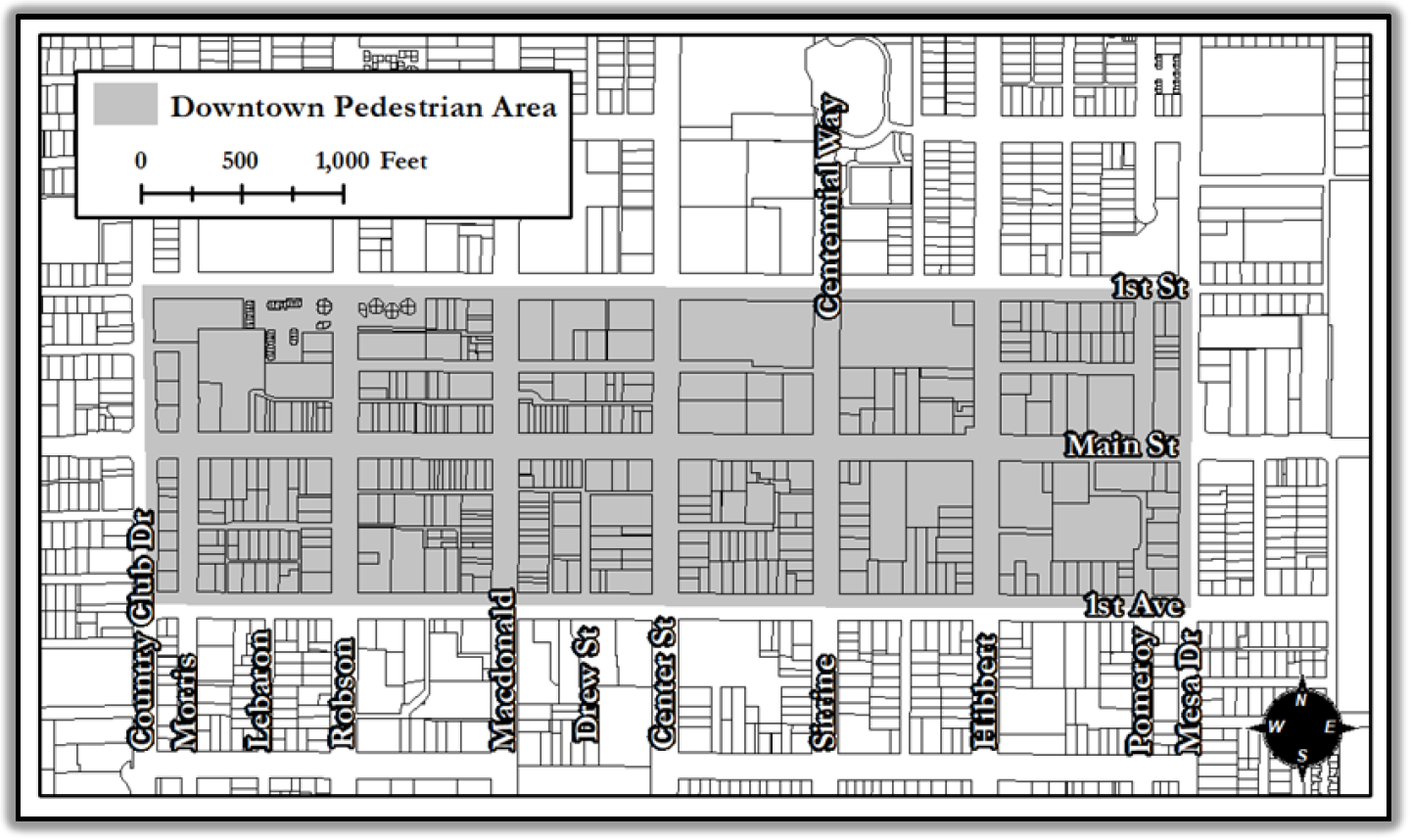
FIGURE 11-50-3-A: DOWNTOWN PEDESTRIAN AREA
Drive-thru Sign: A detached permanent sign not exceeding thirty-two (32) square feet in area and eight (8) feet in height located within five (5) feet of a drive-thru lane where the sign copy is designed to be readable only by the occupants of a vehicle in the drive-thru lane and the sign copy is not readable across a property line unless the property line is shared between parcels within the same Group C-O-I Development.
Driveway Sign: A detached permanent sign not exceeding three (3) square feet in area and three (3) feet in height located within five (5) feet of a driveway or drive aisle and within twenty (20) feet from a future width line of the adjacent public street.
Electric Sign: Any sign containing electrical wiring which is attached or intended to be attached to an electrical energy source, does not include signs illuminated by an exterior light source that is not an integral part of the sign.
Electronic Message Panel: A sign that is capable of displaying copy that is electronically or mechanically changed by remote or automatic means.
Embellishment: Structural or decorative elements of a sign incorporating representations of the significant architectural features of the associated building or development; does not include the portion of the sign structure counted as the sign area.
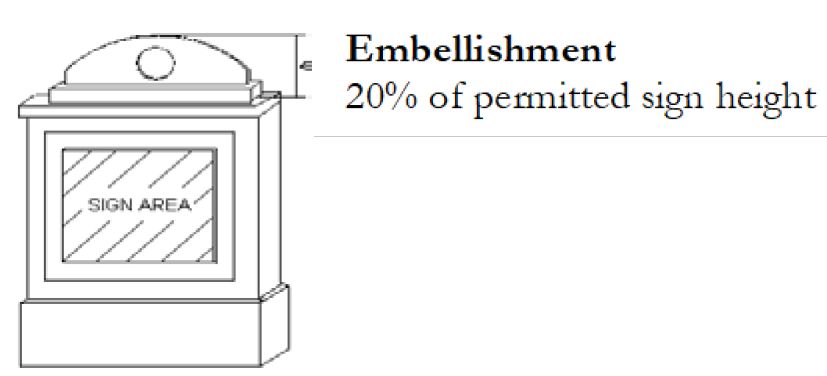
FIGURE 11-50-3-B: EMBELLISHMENT
Flashing Illumination: Illumination in which the artificial source of light is intermittent in intensity and/or color.
Freestanding Sign: Same as Permanent Sign, Detached.
Freeway Landmark Monument: A sign structure which exceeds sixteen (16) feet in height or one-hundred twenty (120) square feet in area, and is intended to be visible from an adjacent designated state or federal freeway.
Front Foot: The maximum lineal dimension of an exterior wall, excluding canopies and projections, measured on a straight-line parallel to a fronting street. For purposes of this definition, all pad buildings and pad occupancies within a Group C-O-I Development, located on a corner parcel, are defined as having exterior walls fronting on both streets.
11-50-4: - DEFINITIONS: G THROUGH K
Government Sign: Any sign, posting, or notice constructed, posted, installed, maintained or required by a city, county, federal, or state governmental agency in carrying out its responsibility to protect the public health, safety, and welfare, including but not limited to, emergency and warning signs necessary for public safety or civil defense; posting of legal notices; official traffic, fire, and police signs, signals, and devices; traffic signs, traffic control devices, or streets signs erected and maintained by an authorized public agency; signs showing the location of public facilities; signs for government sponsored events; signs placed by the government on buildings of historical significance; and government speech pursuant to case law. Government signs are allowed in every zoning district and are not governed by this Sign Ordinance.
Grade: The top of curb or edge of pavement where no curb exists.
Hanging Sign: A sign suspended from, and located entirely under a covered porch, covered walkway, or an awning.
FIGURE 11-50-4-A: HANGING SIGN: PERPENDICULAR TO THE BUILDING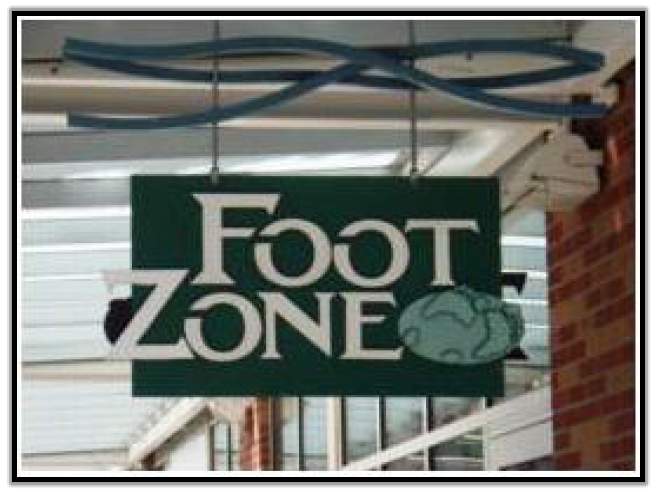
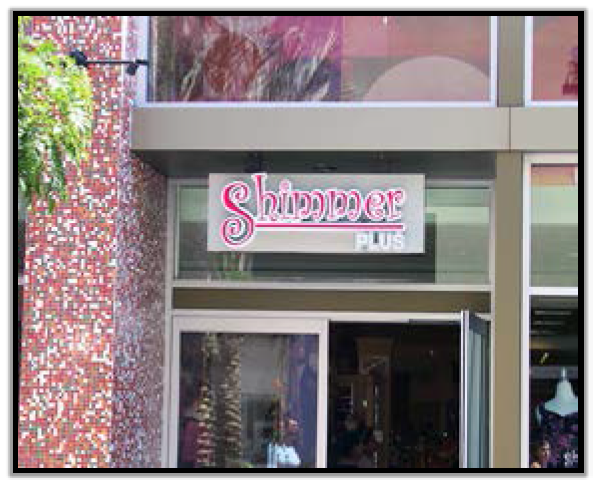
Height: The vertical distance to the top of a sign, excluding embellishment, measured from the nearest curb, sidewalk, or street grade.
11-50-5: - DEFINITIONS: L THROUGH N
Legal Nonconforming Sign: Any permanent sign which is not permitted by this Sign Ordinance, but which, when first constructed, was legally permitted by the City or the political subdivision then having jurisdiction and regulation over the construction of the sign.
Maintenance: The repair or replacement in-kind of individual sign components including paper, fabric, or plastic copy panels; electrical wiring and bulbs; or paint, stucco, or other exterior finishes. Shall not include the replacement of metal or wood cabinets, structural faces, supporting structural members, primary uprights, posts and poles, or the sign in its entirety.
Monument Sign: A detached permanent sign mounted or incorporated into a solid, self-supporting base.
Mural: A painted work of visual art or pictorial representation applied to or incorporated into a structure or wall, with the exception of a window, that can be viewed from public places, alleys, rights-of-way. A painted work of visual art or pictorial representation applied to or incorporated into a window is a window sign.
(Ord. No. 5593, § 11, 12-1-20)
11-50-6: - DEFINITIONS: O THROUGH R
Off-site Sign: As defined in Chapter 87 - Definitions.
Outdoor Display Case: A sign consisting of a lockable metal or wood framed cabinet with a transparent window or windows, mounted onto a building wall or freestanding support.
Permanent Sign, Attached: A sign made of durable material permanently anchored to a building or wall.
Permanent Sign, Detached: A sign which is intended to and is constructed in a manner that is permanent, on its own foundation and structural supports, and is detached from any supporting elements of a building. Sign structures are constructed of materials, such as brick, stone, metal, concrete, carved wood that is treated for durability when exposed to the weather, or related materials considered durable and of architectural quality.
Pole Sign: A permanent detached sign supported by one (1) or more uncovered or exposed uprights, supports, or braces.
Portable Message Center Sign: A portable sign larger than eight (8) square feet mounted, painted, placed on, attached or affixed to a trailer or resting atop the ground without penetrating the surface.
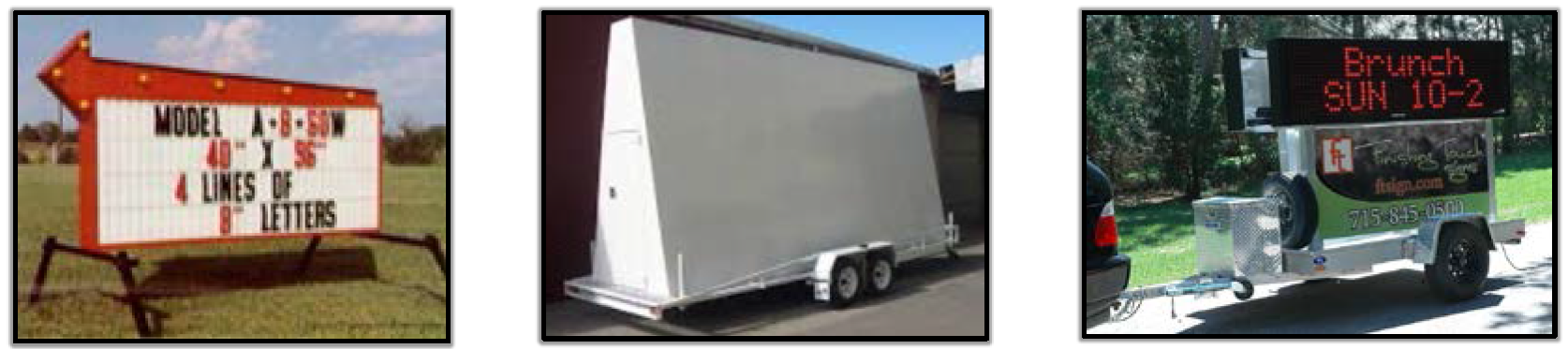
FIGURE 11-50-6-A to C: EXAMPLES OF PORTABLE MESSAGE CENTER SIGNS
Portable Sign: A sign constructed of fabric, canvas, vinyl, cardboard, foam-core, plywood, sheet metal, plastic, or other light weight material that is neither permanently installed in the ground nor permanently affixed to a building or structure. Portable signs include signs resting atop the ground, or affixed to the ground by a temporary anchoring system such as, but not limited to, stakes or ballast or footing for large portable signs. This definition includes a-frame, t-frame, attached rigid, detached rigid, yard, detached banner, and wall banner sign.
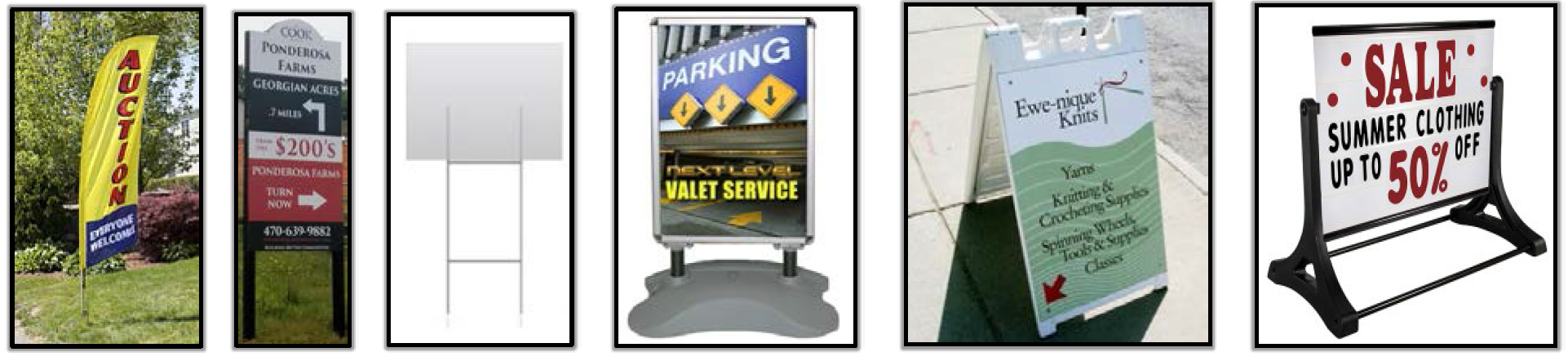
FIGURE 11-450-6-D through I: EXAMPLES OF PORTABLE SIGNS
Projecting Sign: A sign attached to a building or structure in such a manner that its face is not parallel to the building or structure to which it is attached.
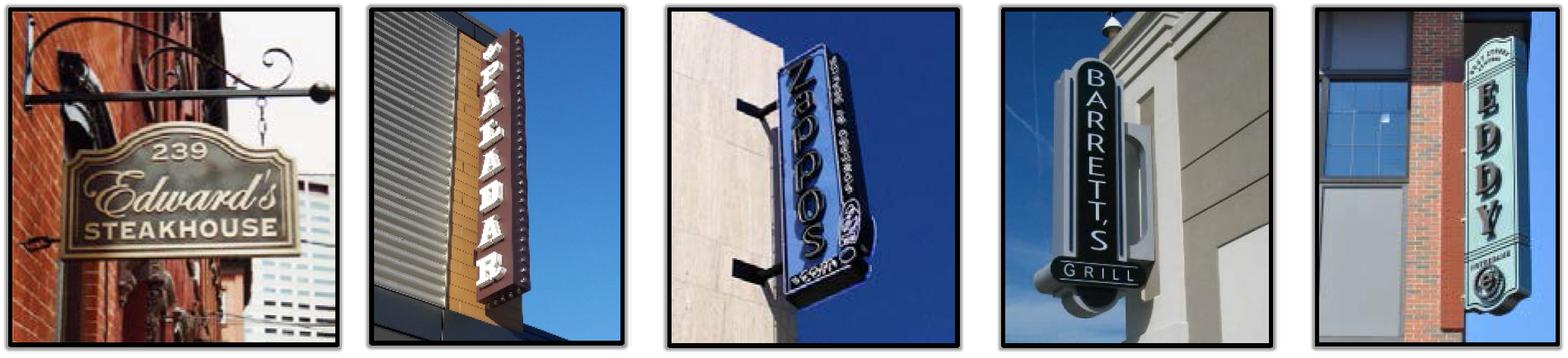
FIGURE 11-50-6-J through N: EXAMPLES OF PROJECTING SIGNS
Public Transportation Sign: A sign installed as part of a City transit program that is located at a bus or transit stop, bus or transit shelter facility, bike share station, bus or bike kiosk, or other bus, transit or bike structure.
Roof Sign: A sign placed on a flat or sloped roof.
(Ord. No. 5847, § 4, 3-4-24)
11-50-7: - DEFINITIONS: S THROUGH V
Sign: Any identification, description, illustration, symbol, or device which is designed to identify, announce, direct, or inform, which is affixed or painted directly or indirectly upon a building, vehicle, structure, or land that is visible from:
1.
Beyond the property boundaries except within a Group C-O-I Development; or
2.
Beyond the perimeter boundaries of a Group C-O-I Development; or
3.
The right-of-way.
Sign Structure: The supports, uprights, braces and framework of a sign.
Vehicle Sign: A sign mounted, painted, placed on, attached or affixed to a trailer, watercraft, truck, automobile, or other form of motor vehicle. The term shall not include a symbol, mark, or other medium of identity that is intrinsic, inherent, or otherwise belonging to the vehicle by nature of its manufacture, or a license plate frame, bumper sticker, spare tire cover, or similar appurtenance.
11-50-8: - DEFINITIONS: W THROUGH Z
Wall Sign: A permanent or portable sign mounted flat against or painted on the wall of a building or structure with the exposed face of the sign in a plan parallel to the face of the wall. This does not include window signs.
Window Sign: A sign that is applied to, placed on, affixed to, or painted on a window; or suspended or placed in front of or thirty-six (36) inches behind a window so that it is visible from the exterior of the building or structure.
11-51-1: - BILLBOARDS
A.
Billboards, including Off-Site Signs, and Advertising for Hire Signs, are prohibited in all zoning districts except that Billboards, including Off-Site Signs, and Advertising for Hire Signs, are permitted in an approved Billboard Overlay District in compliance with Chapter 25 of the Zoning Ordinance.
B.
Billboards, including Off-Site Signs, and Advertising for Hire Signs, are governed by and must comply with Chapter 25 - Billboard Overlay District.
(Ord. No. 5847, § 5, 3-4-24)

