


Milpitas City Zoning Code
SECTION 53
Off-Street Parking Regulations22
Editor's note— Ord. No. 38.785, § 7, adopted April 7, 2009, amended the Code by repealing former Section 53, §§ XI-10-53.01—XI-10-53.23, and adding a new Section 53. Former Section 53 pertained to similar subject matter, and derived from Ord. 38, adopted March 15, 1955; Ord. 38.384, adopted October 26, 1976; Ord. 38.530, adopted July 21, 1981; Ord. 38.546, adopted May, 1982; Ord. 38.665, adopted October 29, 1991; Ord. 38.675, October 20, 1992; Ord. 38.702, adopted August 15, 1995; Ord. 38.708, adopted August 6, 1996; Ord. 38.716, adopted September 15, 1998; Ord. 38.759, adopted April 2, 2002; Ord. 38.760, adopted September 17, 2002; Ord. 38.761, adopted May 20, 2003; Ord. 38.763, adopted April 20, 2004; and Ord. 38.776, adopted March 18, 2008.
XI-10-53.01 - Purpose and Intent
The following off-street parking requirements are regulations which are established in order to achieve, among others, the following purposes:
1.
To establish minimum requirements for the off-street parking of motor vehicles in accordance with the use established on the property;
2.
To relieve congestion on streets, and to provide more fully for movement of traffic, maneuvering of emergency vehicles or street maintenance equipment;
3.
To protect neighborhoods from vehicular traffic congestion generated by the adjacent nonresidential uses of land; and
4.
To promote the general welfare and convenience and prosperity of residential, commercial and manufacturing developments which depend upon the availability of off-street parking facilities.
(Ord. No. 38.855, § 8, 6/18/24; Ord. No. 38.785, § 7, 4-7-09)
XI-10-53.03 - Applicability
Off-street parking spaces shall be provided in accordance with the schedule in Table 53.09-3, Number of Parking Spaces Required, of this Section and improved as per Section 54.03 as a condition precedent to the occupancy of an institutional, commercial or manufacturing use and in conformance with other provisions of this Chapter:
1.
Whenever a building is constructed; or
2.
Whenever an existing building or use is altered, resulting in an increase in floor area, seating capacity or other units of measurement specified herein for required parking or loading facilities; or
3.
Whenever the use of an existing building is changed to a use requiring fifty percent (50%) or more off-street parking spaces, as determined by the provisions of Table 53.09-3, Number of Parking Spaces Required, of this Section.
(Ord. No. 38.855, § 8, 6/18/24; Ord. No. 38.785, § 7, 4-7-09)
XI-10-53.05 - Maintenance of Off-Street Parking
A.
Continuation of Off-Street Parking. All off-street parking spaces shall continue unobstructed in operation, shall not be used for vehicle repair work of any kind unless within a building, and shall not be reduced below the required size as long as the primary use remains, unless an equivalent number of spaces is provided for said use in another approved location. This does not apply to those parking spaces which are established on a voluntary basis which are in excess of the requirements of this Chapter.
B.
Temporary Sales, Storage and Advertising. The sale or storage of merchandise in permissive parking areas may be allowed by the Zoning Administrator through the approval of a Minor Site Development Permit and subject to such reasonable conditions as may be deemed necessary by the Planning Commission to ensure adequate parking, access and circulation.
In no event shall any off-street parking space (permissive or otherwise) or lot be used for the stopping, standing or parking of any vehicle(s) for either the purpose of selling such vehicle (excluding an approved car sales lot), or advertising any other property, services or products on said vehicle.
C.
Maintenance. All parking areas shall be kept clean and free of dirt, oil, mud or trash; pavement and striping shall be maintained in a continuous state of good repair.
D.
Acknowledgment of Parking Spaces in Residential Projects. For new residential tract, multi-family or condominium projects, the amount and type of parking available to each dwelling unit shall be clearly stated within the CC&Rs in large font and bold lettering to the approval of the City Attorney or designee.
(Ord. No. 38.855, § 8, 6/18/24; Ord. No. 38.834, § 8, 8/20/19; Ord. No. 38.785, § 7, 4-7-09)
XI-10-53.07 - Types of Parking Allowed
A.
Standard Parking Spaces. The number of parking spaces required for various land uses shall be as required in Table 53.09-3, Number of Parking Spaces Required. Parking spaces shall be designed as required in Subsection 53.13, Design Standards for Off-Street Parking Facilities, of this Chapter.
B.
Compact Parking Spaces. For parking areas and garages containing ten (10) or more stalls serving the following uses in Subsection 53.07(B)(1), up to forty percent (40%) of the required and non-required stalls may be designed as compact stalls to accommodate compact cars.
1.
Applicable uses.
a.
Commercial uses (CO, C1, C2, HS, TC zones).
i.
Standards. Compact stalls shall be dispersed throughout the parking lot.
b.
Industrial uses.
i.
Research and Development (R and D) facilities.
ii.
Manufacturing facilities.
iii.
Warehouse/distribution facilities.
iv.
Other industrial uses deemed appropriate by the Planning Commission.
c.
Multi-Family Residential uses.
i.
Projects within R3, R4, and R5 zones.
2.
Design Standards. See Subsection 53.13, Design Standards for Off-Street Parking Facilities, of this Section.
C.
Disabled Accessible Parking Spaces. Parking spaces for the disabled shall comply in all respects with the requirements of the California Code of Regulations (State Building Code) or Federal law, where such prevails over State law.
D.
Tandem Parking Spaces.
1.
Applicability. Tandem parking may be allowed with the approval of a Conditional Use Permit, in accordance with Section 57.04, Conditional Use Permits, of this Chapter.
2.
Standards.
a.
Maximum allowed.
i.
A maximum of seventy-five percent (75%) of parking required for residential uses may be tandem parking in projects with open structured parking facilities (e.g. single level or multi-level parking structures).
ii.
A maximum of fifty percent (50%) of parking required for residential uses may be tandem parking in projects with private individual garages.
b.
Tandem parking spaces shall be a maximum of two (2) parking spaces deep.
c.
When tandem parking spaces are used in private garages or other parking facilities with more than two (2) parking spaces, they shall be assigned and marked for resident use.
E.
Bicycle or Motorcycle Parking Spaces. The number of parking spaces required for various land uses shall be as required in Table 53.09-3, Number of Parking Spaces Required. Parking spaces shall be designed as required in Subsection 53.13, Design Standards for Off-Street Parking Facilities, of this Chapter.
(Ord. No. 38.855, § 8, 6/18/24; Ord. No. 38.785, § 7, 4-7-09)
XI-10-53.09 - Off-Street Parking Required by Land Use
A.
Enforcement and Interpretation of Parking Requirements.
1.
Number of Off-Street Parking Spaces Required. The number of off-street parking spaces required for the land uses identified in the Permitted and Conditional Use Tables of this Chapter are listed in Table 53.09-3, Number of Parking Spaces Required, except where parking requirements are established in Section 13, Special Uses, of this Chapter, or exceptions to these requirements are granted in accordance with this Section.
2.
Uses not specified. In the case of a use not specifically mentioned in Table 53.09-3, Number of Parking Spaces Required, or elsewhere in this Chapter, the requirements for off-street parking facilities shall be determined by the Planning Commission through the Interpretation process, in accordance with Section 61, Interpretation, of this Chapter, based on uses which create similar demands for off-street parking spaces. The Planning Commission may draw upon the experience of other local cities to make their decision.
3.
New Buildings Without Tenants. If the type of tenants that will occupy a nonresidential building, or the nonresidential portion of a mixed-use building, is not known at the time the new building is being proposed, the number of parking spaces required for the nonresidential uses will be determined through the discretionary review process.
4.
Mixed occupancies and uses. When two or more uses are located in the same lot or parcel of land or within the same building, the number of off-street parking spaces required shall be the sum total of the requirements of the various individual uses computed separately in accordance with the provisions of this Section and Section 13, Special Uses, when applicable.
Exception: For alternative parking computation in accordance with Subsection 53.11, Shared Parking, of this Chapter.
5.
Measurement Standards and Definitions. For the purpose of determining off-street parking requirements, the following definitions and standards shall apply:
a.
Gross Floor Area: The total of all the floors measured from the interior faces of the building, and outdoor areas used for retail purposes.
b.
Net Floor Area (NFA): Net Floor Area shall mean the Gross Floor Areas less twenty percent (20%).
c.
Seat: The number of seating units installed or indicated, or each twenty-four (24) lineal inches of benches, pews, or space for loose chairs. For places of meeting or assembly that do not include fixed seating, seven (7) square feet shall equal one (1) seat.
d.
Employees/students: The maximum number of employees/students on the principal shift or period.
e.
Fractional Measurements: When units or measurements determining the number of required off-street parking spaces result in a requirement of fractional space, any fraction up to and including (.49) shall be rounded down to the nearest whole number and fractions including and over (.50) shall be rounded up to the nearest whole number. For example, 7.41 would be rounded to 7 and 7.61 would be rounded to 8.
6.
More than One Parking Ratio. Where more than one (1) parking ratio is shown for a particular use, the required number of spaces shall be the total of all ratios shown. For example, the parking requirement for hotel is "1 per unit, 2 for the manager's unit." The total parking requirement for a hotel is the sum of the required parking for the units and two (2) spaces for the manager's unit.
B.
Permissive Parking Facilities. Nothing in this Section shall prevent the voluntary establishment of off-street parking facilities in excess of the requirements of this Section to serve any existing use of land or buildings, provided that all regulations herein governing the location, size and access design, improvement and operation of such facilities are adhered to.
C.
Number of Parking Spaces Required. The number of off-street parking spaces required for various land uses shall be as listed in Table 53.09-3, Number of Parking Spaces Required, except for those listed specifically elsewhere in this Chapter. Unless otherwise indicated, the parking requirements are for square feet of gross floor area occupied by the use and, in the case of nonresidential uses, include the parking required for customers and employees.
Exceptions:
1.
Where a portion of a structure is used for automobile parking, that portion shall not be counted in calculating the required parking for the structure. If parking is eliminated and the space is occupied by another use, parking shall be required for the use as indicated for the use in this Chapter.
2.
Metro Specific Plan Area. Off-street parking requirements and bicycle parking requirements for all uses in the Metro Specific Plan area are as follows:
Table 53.09-1
Vehicle Parking Requirements in the Metro Zones
1 Valet, tandem spaces, and mechanical lift stalls are counted as individual spaces.
Table 53.09-2
Bicycle Parking Requirements in the Metro Zones
Table 53.09-3
Number of Parking Spaces Required
1 Refer to Subsection 2.03, Definitions, of this Chapter for a full description of "Commercial Services."
2 For loading and unloading: One (1) parking space per six (6) children up to five (5) spaces and thereafter one (1) space per ten (10) children. Driveways, garage aprons and street frontage may be counted if appropriate permits are first received when calculating spaces for child care homes. Tandem spaces are prohibited.
3 Exceptions for Child Care Requirements: The parking and loading/unloading requirements for child care facilities may in the Planning Commission's discretion be reduced, based on an empirical study (provided by the applicant) which establishes no adverse effects will occur as a result. The required number of loading/unloading spaces may be reduced without a study by one (1) space for each employee permanently assigned to load and unload children from vehicles.
4 Applicable to new and existing projects being remodeled resulting in additional bedrooms submitted for approval after April 7, 2009. Existing projects or projects either entitled or submitted active planning applications prior to April 7, 2009 shall use the parking regulations in effect at the time of entitlement or application submittal. For R4, R5, MXD/MXD2/MXD3 zones, 15% guest parking is legal and conforming for projects entitled or active planning applications submitted prior to April 7, 2009.
5 Refer to Subsection XI-10-53.15, Parking Standards for Hotels and Motels, of this Chapter for allowed reductions to minimum parking requirements.
(Ord. No. 38.855, § 8, 6/18/24; Ord. No. 38.848, § 9, 11/15/22; Ord. No. 38.845, § 13, 6/21/22; Ord. No. 38.841, § 5, 5/4/21; Ord. No. 38.835, § 8, 3/3/20; Ord. No. 38.839, § 14, 12/3/19; Ord. No. 38.808, § 5, 5/21/13; Ord. No. 38.785, § 7, 4/7/09)
XI-10-53.11 - Shared Parking
A.
Purpose and Intent. Dedicated parking areas for individual uses, especially when provided in new developments, can result in less efficient land usage, lower floor area ratios, and more environmental/water quality impacts.
Shared parking is typically applied when land uses have different parking demand patterns and are able to use the same parking spaces/areas throughout the day. Shared parking is most effective when these land uses have significantly different peak parking characteristics that vary by time of day, day of week, and/or season of the year. In these situations, shared parking strategies will result in fewer total parking spaces needed when compared to the total number of spaces needed for each land use or business separately.
B.
Applicability. Shared parking may be applied in the following situations:
1.
In mixed-use developments, which include one or more businesses that are complementary, ancillary, or support other activities. A typical mix of uses includes, but is not limited to: residential, office, restaurants, retail, colleges, churches, cinemas, and special event situations if they can demonstrate that demand patterns vary among uses.
2.
In shopping centers, when more than twenty percent (20%) of gross leasable area is occupied by dining and entertainment uses, (not including pad restaurants, unless they are located within 300 feet of the main shopping center building) shared parking may be applied.
C.
Required Review. Shared parking proposals may be allowed with the approval of a Conditional Use Permit, in accordance with Subsection 57.04, Conditional Use Permits, of this Chapter.
D.
Calculation of Parking Spaces Required with Shared Parking. The minimum number of parking spaces for a mixed use development or where shared parking strategies are proposed shall be determined by a study prepared following the procedures of the Urban Land Institute Shared Parking Report, ITE Shared Parking Guidelines, or other approved procedures. A formal study may be waived for small developments where there is established experience with the land use mix and its impact is expected to be minimal. The actual number of parking spaces required shall be based on well-recognized sources of parking data such as the ULI or ITE reports. If standard rates are not available or limited, the applicant may collect data at similar sites to establish local parking demand rates. If the shared parking plan assumes use of an existing parking facility, then field surveys may be conducted to determine actual parking accumulation. If possible, these surveys should consider the seasonal peak period for the combination of land uses involved.
E.
Location of Shared Parking Spaces. Shared spaces shall be located within three hundred (300) feet of the use entrances they serve. Up to fifty percent (50%) of nonresidential spaces may be provided at greater distances if dedicated shuttle bus or van service is provided. Clear, safe pedestrian connections must be provided.
F.
Captive Market Parking Requirements. For uses that are considered ancillary to a larger business, no additional parking may be required. Examples of this case include a coffee or snack shop within an office or hotel development, a copy/package store within a business park or redevelopment of small retail uses in a large business district. Parking requirements for similar ancillary uses may be reduced to account for the likely cross patronage among the adjacent uses located within a maximum walking distance of three hundred (300) feet. Parking requirements may be reduced up to ninety percent (90%) as appropriate.
G.
Agreement Between Sharing Property Owners. If a parking facility is to serve two (2) or more separate properties, a legal agreement between property owners guaranteeing access to, use of, and management of designated spaces shall be executed to the satisfaction of the City.
H.
Shared Parking Plan. A shared parking plan shall be submitted to the Planning Division with the following information:
1.
Site plan and required parking calculations of parking spaces intended for shared parking and their proximity to land uses that they will serve.
2.
A signage plan that directs drivers to the most convenient parking areas for each particular use or group of uses (if such distinctions can be made).
3.
A pedestrian circulation plan that shows connections and walkways between parking areas and land uses. These paths should be as direct and short as possible.
(Ord. No. 38.855, § 8, 6/18/24; Ord. No. 38.785, § 7, 4-7-09)
XI-10-53.13 - Design Standards
A.
Location of Parking.
1.
Location of Parking in Relationship to a Use.
a.
Residential Uses: Parking required for all residential uses shall conform with all of the following: (i) be located within the same project site as the use; (ii) be less than 300 feet away from the residential unit it serves; and (iii) shall not be located on any public street, public right-of-way or in any other public area.
b.
Commercial Services and Retail Stores in the Metro or Midtown Specific Plan Areas: Commercial service and retail uses may meet its parking requirements with on-street parking if the project satisfies all of the following conditions: (i) the project site is located within the Metro or Midtown Specific Plan Areas; (ii) the on-street parking space is located along the project site frontage directly serving and adjacent to the use; (iii) no more than 50 percent of the required parking spaces shall be allocated on-street unless the commercial or retail use requires ten or less parking spaces; (iv) the on-street parking space is located less than 300 feet away from the use it serves; and (v) the on-street parking space shall be designated as limited time parking in accordance with the California Vehicle Code.
c.
Other Uses: Required parking for all other uses shall conform with all of the following: (i) be located within the same project site as the use; (ii) be less than 300 feet away from the use for which the parking is required, as provided for in Table 53.09-3 Number of Parking Spaces Required or Section 13, Special Uses, of this Chapter; and, (iii) shall not be located on any public street, public right-of-way or in any other public area.
2.
Location of Residential Parking, Permitted. Vehicles on private property used for residential purposes shall be parked only in paved parking spaces or in driveways which comply with the following standards:
a.
The driveway provides access to required parking spaces; and
b.
The vehicle is not blocking access to parking for other residential units.
3.
Each automobile parking stall shall be so located that no automobile is required to back onto any public street or sidewalk to leave the parking stall, parking bay or driveway except from a lot in an "R2" or more restrictive zone containing not more than two (2) dwelling units.
4.
Parking Location for R5, MXD2 and MXD3 projects.
a.
No parking spaces area allowed within the front or street side setback areas.
b.
Parking must be located behind buildings to minimize visibility from public streets.
c.
At least seventy percent (70%) of the street facing perimeter of above-ground parking shall be wrapped with habitable space.
Exception: Exceptions may be allowed through the approval of a Conditional Use Permit, if the design quality of the structure is equivalent to habitable space.
d.
Parking may be partially above grade along the street, provided that no more than four (4) feet of the structure is above grade. The above-grade area must be wrapped with continuous landscaping that screens parking garage openings.
5.
Parking Structure access for R5, MXD2 and MXD3 projects.
a.
No more than one curb cut per street frontage is allowed.
b.
Parking structure entrances shall be no greater than twenty-two (22) feet wide.
c.
Parking structure access points shall be set back from the curb so that a car can pull up to the entry gate or ticket machine without blocking the sidewalk.
B.
Parking Space Size.
1.
Individual garage.
a.
Each parking space with a minimum width of ten (10) feet and a minimum length of twenty (20) feet shall be required in residential garages meeting both of the following criteria:
i.
The individual garage contains four (4) or fewer parking spaces;
ii.
The individual garage does not include circulation elements such as driveway aisles, but consists primarily of parking spaces.
2.
Compact Spaces
a.
Each stall shall be legibly marked "compact stall" or "small car" on the stall surface. Compact stalls may be used only for the above-listed buildings and uses and only within the Industrial zoning district.
b.
Parking stalls shall be dispersed throughout the parking lot and not concentrated to discourage oversized vehicles from using the stalls.
3.
Tandem Spaces
a.
Each residential garage tandem (two parking spaces) shall have a minimum width of ten (10) feet and a minimum length of thirty-eight (38) feet.
4.
Bicycle or Motorcycle Spaces. Any existing or proposed parking facility may utilize, on a substitution basis, on-site parking spaces for bicycle or motorcycle spaces.
a.
Said bicycle spaces shall be raised a minimum of six (6) inches from grade of the adjacent parking facility.
b.
One parking space may be omitted for each eight (8) bicycle spaces provided.
c.
One parking space may be omitted for each two (2) motorcycle spaces provided.
d.
Bicycle spaces shall measure at least two (2) feet by seven (7) feet and shall be located in groups of four (4) and shall be of the following three types:
i.
A rack which secures the frame, or
ii.
An enclosed bike locker, or
iii.
A fenced, covered, locked or guarded bike storage area.
e.
Motorcycle spaces shall measure four (4) feet by eight (8) feet and shall be provided with adequate unobstructed maneuvering areas to permit easy access to the space.
f.
In no instance shall credit for motorcycle or bicycle parking or combination thereof exceed five percent (5%) of the total required parking spaces.
C.
Required Improvements. All parking areas and access driveways shall have a smoothly graded, stabilized and dustless surface with adequate drainage so that injury will not be caused to adjacent properties. Bumper guards or curbs shall be provided in order to define parking spaces or limits of paved areas.
Also refer to Section 54.03 of this Chapter for Improvement of Parking Areas.
D.
Screening and Landscaping. All open automobile parking areas which abut upon a public street right-of-way shall provide landscaping to a depth of at least ten (10) feet of said street right-of-way and of any adopted plan line, with openings for walkway or drive purposes. Each landscaped planter in said parking facility shall be contained with a six (6) inch raised concrete curb (extruded curbing not permitted). Installation of an irrigation system shall be provided for in each planter area.
E.
Lighting. All lights used to illuminate a parking area shall be designed, located and arranged so as to reflect the light away from any street and any adjacent premises.
F.
Signs. Directional signs are permitted in parking areas in accordance with the adopted Sign Ordinance.
G.
Fencing. A solid masonry wall a minimum height of six (6) feet shall be required on all common property lines when any parking area is established abutting residentially zoned property or property shown on the adopted General Plan as being Residential. The architectural design of said wall shall be to the approval of the Planning Commission through the Site Development Permit process in accordance with Subsection 57.03, Site Development Permits and Minor Site Development Permits, of this Chapter.
H.
Angles and Dimensions
1.
Vehicle Overhang. Vehicles may overhang two (2) feet into any landscape area or private walkway if the walkway is a minimum six (6) feet in width, but in no event shall the overhang be permitted within any public right-of-way.
2.
Stall and drive aisle dimensions. The stall and drive aisle dimensions shall be as follows:
Table 53.13-1\Parking Stall and Drive Aisle Dimensions
1 Reference to Figure 53.13-1, Parking Stall and Drive Aisle Dimensions
Figure 53.13-1 Parking Stall and Drive Aisle Dimensions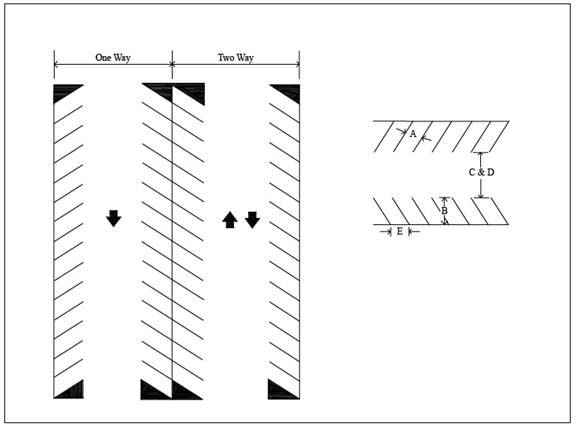
3.
Backing Space in Residential Projects. A minimum unobstructed vehicular maneuvering distance of 25 feet measured from the opening of the garage or carport shall be provided, except as otherwise permitted in this section.
4.
Parking Structures. The parking stall and drive aisle dimensions for Parking Structures, as defined in this Chapter, may be modified with the approval of a Conditional Use Permit in accordance with Section 57 of this Chapter.
(Ord. No. 38.855, § 8, 6/18/24; Ord. No. 38.815, § 2, 9-2-14; Ord. No. 38.785, § 7, 4-7-09)
XI-10-53.15 - Allowed Reductions to Required Parking for Lodging Uses
A.
Allowed Reductions to Minimum Required Parking. The required parking for lodging uses, including hotels, motels, and extended stay hotels, may be reduced by up to 30 percent at the discretion of the decision-making authority based on a demonstrated program to reduce demand for on-site parking and maximize the efficient use of parking areas. A reduction in required parking shall be granted based on a point system as described in Subsection XI-10-53.15.C.
B.
An applicant requesting a reduction to the minimum required parking for a lodging use shall submit a written description of all proposed parking demand reduction and site design measures and a written justification of the anticipated reduction in parking demand that would result from implementation of such measures.
C.
Point System for Calculation of Parking Reduction. The decision-making authority may grant a reduction in the required number of parking spaces for lodging uses, as outlined in Table 53.15-1, according to the total number of points scored for implementation of parking demand reduction and site design measures.
Table 53.15-1
Point System for Parking Reduction for Lodging Uses
1.
Parking Reduction for Lodging Near Fixed Guideway Transit. A parking reduction may be granted for a lodging establishment within one-half (0.5) mile of a fixed guideway transit station. Fixed guideway transit means a public transit facility that uses and occupies a separate right-of-way or rail line for the exclusive use of public transit vehicles (15 points).
2.
On-Site Parking Demand Reduction and Site Design Measures for Lodging Uses. Any combination of the following measures may be incorporated into the site plan and operational plan for a hotel, motel, or extended stay hotel to support a reduction in the minimum required on-site parking:
a.
Shared parking agreement with owners of other property or properties in the vicinity of the lodging establishment pursuant to Subsection XI-10-53.11, Shared Parking, of this Chapter. The shared parking spaces must be located within 0.25 mile of the lodging use (10 points for a number of shared parking spaces totaling between 10 and 20 percent of the base parking space requirement for the lodging use; 15 points for a number of shared parking spaces totaling more than 20 percent of the base parking space requirement for the lodging use).
b.
Providing free monthly transit passes for employees. To qualify for this measure a lodging use must be located within 0.5 mile of a transit route (bus or rail) with service frequency of every 15 minutes or less between the hours of 7:00 a.m. and 7:00 p.m. (10 points).
c.
Providing free 24-hour airport guest shuttle service (10 points).
d.
Providing free guest shuttle service to other key destinations (including but not limited to BART and VTA light rail stations, San Jose Diridon Caltrain Station, Levi's Stadium, and major commercial centers) (5 points for shuttle service serving one or two destinations, 10 points for shuttle service serving three or more destinations).
e.
Providing free shared cars for guest use with dedicated, permanent on-site parking spaces for the shared cars . To qualify for this measure the lodging use must provide at least one shared car for every 50 guest rooms (when applying this calculation, any fractional number of required shared cars shall be rounded up to the nearest whole number) (10 points).
f.
Providing on-site, free micromobility devices for guest use. To qualify for this measure the lodging use must provide at least one shared micromobility device for every 50 guest rooms (when applying this calculation, any fractional number of required shared micromobility devices shall be rounded up to the nearest whole number). The operator of the lodging establishment shall obtain approval from the Planning Director or designee for the proposed placement and use of micromobility devices prior to commencing operations. The operator of the lodging establishment shall maintain micromobility devices in good working order at all times (5 points).
g.
Providing valet parking (on-site or at an off-site shared parking location) (5 points for a number of valet parking spaces totaling between 10 and 20 percent of the base parking space requirement for the lodging use; 10 points for a number of valet parking spaces totaling more than 20 percent of the base parking space requirement for the lodging use).
h.
Mechanical lifts for vehicles (if provided, lifts must be operated by staff of the lodging establishment) (5 points for a number of mechanical lift spaces totaling between 10 and 20 percent of the base parking space requirement for the lodging use; 10 points for a number of mechanical lift spaces totaling more than 20 percent of the base parking space requirement for the lodging use).
i.
Charging a daily fee of $25 or more for on-site parking of guest vehicles (10 points).
j.
Offering prepaid transit cards (Clipper) to guests (5 points).
k.
Featuring public transportation information and links on lodging establishment's website (schedules and route maps for Valley Transportation Authority [VTA] bus and light rail and/or Bay Area Rapid Transit [BART] regional rail) (3 points).
l.
Providing dedicated on-site passenger pickup/dropoff zones (3 points).
m.
Active marketing of guest shuttle services, on-site shared cars, and/or on-site shared micromobility devices, via the lodging establishment's website and other electronic and/or print advertising materials (3 points).
n.
Other measures as proposed by lodging establishment operator (points to be determined by the decision-making authority based on the potential for parking demand reduction of the proposed measure).
(Ord. No. 38.855, § 8, 6/18/24; Ord. No. 38.841, § 6, 5/4/21)