


Milpitas City Zoning Code
SECTION 6
Mixed Use Zones and Standards4
Prior ordinance history—Ords. 38, 38.18, 38.19, 38.22, 38.207, 38.339, 38.687, 38.702, 38.761, 38.763 and 38.776.
XI-10-6.01 - Purpose and Intent
A.
Mixed Use ("MXD") Zoning District. The purpose of the MXD zoning district is to encourage a compatible mix of residential, retail, entertainment, office and commercial service uses within the framework of a pedestrian-oriented streetscape. It is intended that the residential and commercial use allowed in the "MXD" District combine to provide for an "around-the-clock-environment" with urban open areas (i.e. plazas, squares) that serve multiple purposes and can be used for special events.
B.
High Density Mixed Use ("MXD2") Zoning District. The purpose of the MXD2 zoning district is to encourage a mix of retail, restaurant, entertainment, and commercial service uses on the ground floor with residential or office uses on the floors above while maintaining a pedestrian-oriented streetscape. It is intended that the retail or restaurant space required will ensure neighborhood-oriented retail and services are provided within walking distance of high density residential development.
C.
Very High Density Mixed Use ("MXD3") Zoning District. The purpose of the MXD3 zoning district is to provide very-high density housing, retail and employment uses.
D.
Neighborhood Commercial Mixed Use ("NCMU") Zoning District. The purpose of the NCMU zoning district is to encourage a compatible mix of residential, retail, entertainment, office, and commercial uses. It is intended that the neighborhood-serving active uses such as grocery stores, retail, restaurants, and personal services at key locations on the ground level will help create a pedestrian oriented streetscape and public spaces. The NCMU Zoning District is subdivided into three subdistricts:
1.
NCMU1 allows commercial or mixed-use development the primary function as a commercial center to provide goods and services to the immediate neighborhood. The mix of uses may be vertical or horizontal.
2.
NCMU2 allows commercial or mixed-use development with some active commercial storefronts along the street frontages.
3.
NCMU3 allows commercial, mixed use, or residential only development with no minimum commercial FAR. NCMU3 includes parcels that are less suitable for commercial use, such as those located on secondary streets, lacking street frontages, or adjacent to residential zones.
E.
Town Center (TC) Zone. The purpose and intent of this zone is to provide for an area that supports a wide range of administrative, business, entertainment, dining, and cultural activities along with some residential uses in the geographic center of the City to suit the varying lifestyles of residents and visitors alike. The area is easily accessible via the City's transportation network. The TC Zoning District is subdivided into three subdistricts:
1.
TC1 allows commercial or mixed-use development with the primary function as a commercial center to provide goods and services to the immediate neighborhood and larger community. The mix of uses may be vertical or horizontal.
2.
TC2 allows commercial or mixed-use development with active commercial storefronts along the street frontages.
3.
TC3 allows commercial, mixed-use or residential only development with no minimum commercial FAR. TC 3 includes parcels that are less suitable for retail uses, such as those located on secondary streets, lacking street frontages, or adjacent to residential zones.
(Ord. No. 38.857, § 3, 5/6/25; Ord. No. 38.803, § 7, 4/17/12; Ord. 38.777 (8) (part), 6/17/08)
XI-10-6.02 - Mixed Use Regulations
A.
Permitted and Conditionally Permitted Uses.
1.
Primary uses. The uses identified in Table 6.02-1, Mixed Use Zone Uses, shall be the primary uses allowed to occur on a property. All uses except for those noted shall be conducted within enclosed structures. The primary uses identified in Table 6.02-1 shall be permitted or conditionally permitted, as indicated:
2.
Accessory Uses.
a.
Massage Services. Massage services may be allowed as an accessory use to any permitted or conditionally permitted medical office, medical clinic, chiropractor practice, acupuncture practice, physical therapist, fitness and athletic facility, health care facility (such as hospitals, nursing homes and sanitariums), and accredited school, college, and university. Massage services, limited to massage of the head, neck, shoulders, hands and feet may be allowed as an accessory use to any permitted or conditionally permitted beauty salon, barbershop, and healing art practices. This section shall not exempt any person or business from complying with all the provisions of Title III, Chapter 6.
B.
Prohibited Uses. The following uses are prohibited:
1.
Uses where the symbol "NP" appears within Table 6.02-1.
2.
The following uses are not permitted in any mixed use zone:
a.
Adult Businesses as defined in Subsection 13.04, Adult Businesses, of this Chapter.
b.
Disinfecting and extermination business.
c.
Ground level residential in the Ground Level Commercial Area as shown on the Midtown Specific Plan Land Use Map, Figure 3.1 and Zoning Map.
d.
Outdoor storage of vehicles.
e.
Private self-storage facilities
f.
Single family detached dwellings
g.
Two family dwelling units
C.
Other Uses. Any other uses may be considered by the Planning Commission that are similar in accordance with the procedure, prescribed in Subsection 10-54.02, Other Uses Permitted by Commission, of this Chapter.
Table XI-10-6.02-1
Mixed Use Zone Uses
1 Refer to Subsection XI-10-6.02-1(B), Performance standards for certain uses, of this Chapter, for standards.
2 Copy/quick-printing shops and mailbox rental facilities shall be permitted in all MXD, MXD2 (Ground Floor), MXD3, and all NCMU zones. All other uses classified as Business Support Services shall not be permitted in these zones.
3 Grocery stores with floor area up to 15,000 square feet are permitted. Grocery stores exceeding 15,000 square feet may be permitted subject to the approval of a Conditional Use Permit pursuant to Subsection XI-10-57.04 of this Chapter.
4 Refer to Subsection XI-10-6.02-1, Special Uses, of this Chapter, for standards.
5 When located on the ground floor, retail sales of products related to the Personal Services provided shall be offered at the front of the premises near the pedestrian entrance and shall comprise at least 10 percent of the floor area of the business establishment.
6 Refer to Subsection XI-10-6.02-1(B) Performance standards for certain uses, of this Chapter.
7 Refer to Subsection XI-10-6.02-2, Quasi-Public Uses, of this Chapter, for standards.
8 Massage establishments are subject to Title III, Chapter 6 of the Milpitas Municipal Code and Subsection XI-10-13.16 of this title. Refer to Subsection XI-10-13.16, of this Title, for special provisions for massage establishments.
9 Reserved
10 For parks, playgrounds or community center owned and operated by a government agency or a nonprofit community organization.
11 Ground level residential is prohibited in the Ground Level Commercial Area as shown on the Midtown Specific Plan Land Use Map, Figure 3.1.
12 Uses serving upper-floor residential uses, such as common gathering space, lobby, and resident services, may be allowed as ground floor uses where residential uses would otherwise not be permitted.
14 Only allowed within multi-family dwellings, subject to the requirements of Subsection XI-10-13.08, Accessory Dwelling Units, of this Chapter.
15 Indoor or outdoor music is permitted as an accessory use on the same parcel in conjunction with a restaurant or bar that is a principal permitted use or approved conditional use in the MXD, MXD2, MXD3, and NCMU zones. See also Subsection XI-10-6.06(B) for additional regulations.
16 Refer to Subsection XI-10-13.18, Mobile Food Vending, of this Chapter.
17 Refer to Subsection XI-10-13.11(E), Model Home Complexes and Sales Offices, of this Chapter for temporary tract offices.
18 Which include only permitted uses.
19 Refer to Section XI-10-54.07, Planned Unit Developments, of this Chapter, for standards.
20 Refer to Section XI-10-13.11(D), Temporary Seasonal Sales, of this Chapter.
21 Only allowed within a dwelling unit, subject to the requirements of Subsection XI-10-13.17, Short-Term Rentals, of this Chapter.
22 New and used auto, recreational vehicle and boat sales, excluding commercial vehicles, trucks, buses, vans, and farm equipment, with accessory repairs and services, only allowed if fully enclosed within a building. Bicycle and auto rental agency, excluding commercial vehicles, trucks, buses, vans, boats and RV rentals, only if fully enclosed within a building.
23 Refer to Subsection XI-10-6.02-2, Special Uses, of this Chapter, for standards. Service stations shall follow the "General development policy: Gasoline service stations, and automotive service centers" adopted by the City Council on December 19, 1995.
6.02-1 Mixed Use Zone Special Uses
A.
Special Uses within all MXD zones. Certain uses noted in Table 6.02-1, Mixed Use Zone Uses may be allowed through the approval of a Conditional Use Permit and Minor Conditional Use Permits, in accordance with Subsection 57.04, Conditional Use Permits, of this Chapter, if they are not located within one thousand (1,000) feet of another same use listed below. This distance shall be measured from the property line of the parcel where such use is located.
1.
Auto service uses, including but not limited to: gasoline service stations, car washes, tire shops, towing without vehicle storage and auto repair shops of all kinds, radiators, paint, body, glass, brakes, upholstery, and other similar types.
2.
Local transportation service facilities (e.g. taxi, parcel service, ambulance, armored car, and van storage) without outdoor storage of vehicles.
3.
Pawnshops.
B.
Performance Standards for Certain Uses. For uses requiring approval of a Minor Conditional Use Permit by staff, in accordance with Section XI-10-57.04, Conditional Use Permits and Minor Conditional Use Permits, of this Chapter, the following performance standards below shall be met.
1.
Auto Brokers. Auto Brokers may be permitted by right if the following standards are met:
a.
Local Sales and Use Tax. In order to assist the City of Milpitas in its efforts to receive direct distribution of the local tax on materials associated with the project, the California Sales and Use Tax (the "Local Tax") shall be allocated to the project site, to the extent reasonably possible. Evidence of tax allocation or cause as to why such allocation cannot be made shall be submitted at the time of business license submittal.
2.
Auto Service Uses. Auto Service uses shall comply with the following standards:
a.
All operations shall be conducted completely within an enclosed building.
b.
Entrances to the service bays shall not be open to the street but shall be designed to face the rear or interior side property line.
3.
Artisans, Plumbing, Metalworking, Sign Shops and Woodworking or glass working shops. These uses shall comply with the following standards:
a.
All operations shall be conducted completely within an enclosed building.
b.
There shall be no dust, fume, or odor either emitted from the premise.
c.
The operations shall not create excessive vibrations.
d.
The operations shall be consistent with the City's noise standards.
e.
Plumbing, metalworking, sign shops, woodworking or glass working shops shall not be closer than 1,000 feet of another same use measured from the property line.
4.
Personal Services, Business Support Services, and Repair and Cleaning-Small Items uses shall comply with the following:
a.
When located within the MXD zone:
i.
Located in the area designated for ground floor retail and are less than or equal to ten thousand (10,000) square feet in gross floor area;
ii.
Located in the areas not designated for ground floor retail and are less than or equal to fifty thousand (50,000) square feet in gross floor area.
b.
When located within the MXD2 and MXD3 zones they are less than or equal to fifty thousand (50,000) square feet in gross floor area;
c.
They are not open past 10:00 p.m.;
d.
They are not specifically noted in Table 6.02-1, Mixed Use Zone Uses, of this chapter, requiring Conditional Use Permit approval or listed as a prohibited use;
e.
They are not listed as a prohibited use in Section 10-6.02 (B), Prohibited Uses, of this Chapter.
If items a through c above are not met, then approval of a Conditional Use Permit is required in accordance with Subsection 57.04, Conditional Use Permits and Minor Conditional Use Permits, of this Chapter. Exceptions to the requirement for a Conditional Use Permit for such uses may be granted at the discretion of the Planning Director on a case-by-case basis, based upon a review of site-specific conditions.
5.
Group Instruction uses shall comply with the following standards:
a.
No loitering shall be permitted before or after any classes or sessions.
6.
Restaurants may be permitted provided:
a.
They have only ancillary on-premise consumption of beer and wine associated with food sales;
b.
They have no separate bar area;
c.
When located within the MXD2 and MXD3 zones they are located on the ground floor facing a public street designated as a retail mixed use street; and
d.
They conform to the performance standards listed in this subsection (e) below.
If items (a) through (c) above are not met, then approval of a Conditional Use Permit is required in accordance with Section 57, of this Chapter.
e.
Restaurant Performance Standards. Restaurants shall comply with the following performance standards:
i.
Seating shall not exceed that which the amount of parking allocated for the restaurant space would allow. A sign measuring at least one (1) foot by one (1) foot, with a lettering height of at least three (3) inches, shall be placed in a conspicuous location near the restaurant front entrance stating the maximum total seating allowed. Outdoor seating is allowed if it has been approved as part of the facility's Minor Site Development Permit or Site Development Permit and is operated in conformance with any conditions of that approval.
ii.
The restaurant shall comply with the City Council's Guidelines for Recycling Enclosures (Resolution No. 6296).
iii.
The restaurant shall incorporate measures to reduce odors to acceptable levels, including, but not limited to, installation of a scrubber, carbon filter or similar equipment, on the roof vent to control odors.
iv.
All the facility's floor drains, trash compactors and indoor mat and equipment washing areas shall be drained to the sanitary sewer.
v.
Where applicable, the restaurant shall maintain an active account with a tallow hauling company.
vi.
The restaurant shall prepare and implement a program assigning restaurant staff responsibility for complying with the following guidelines which shall be adhered to while the restaurant is in operation:
1)
Wash all containers and equipment in the kitchen areas so that wash water may drain into the sanitary sewer.
2)
Keep garbage dumpsters clean inside and out; replace very dirty dumpsters with new, clean ones.
3)
Double bag waste to prevent leaking.
4)
Place, do not drop or throw, waste-filled bags, to prevent leaking.
5)
Keep the ground under and around the garbage dumpsters swept.
6)
Sprinkle the ground lightly after sweeping with a mixture of water and a little bleach.
7)
Hold training sessions to instruct employees on the proper procedures in the handling and disposal of food items; the general maintenance and use of the compactor and any other procedures that would assist the business in complying with all State and local health and sanitation standards. A record of such training must be kept to prove compliance with this requirement.
8)
Post signs (in English and multi-lingual) inside the premises for all employees identifying procedures for food delivery and garbage disposal.
9)
All garbage bins shall be stored in the garbage enclosure except for the twelve (12) hours immediately before and after garbage collection.
7.
Retail and Offices shall comply with the following:
a.
When located within the MXD zone:
i.
Located in the area designated for ground floor retail and are less than or equal to ten thousand (10,000) square feet in gross floor area;
ii.
Located in the areas not designated for ground floor retail and are less than or equal to fifty thousand (50,000) square feet in gross floor area.
b.
When located within the MXD2 and MXD3 zones they are less than or equal to fifty thousand (50,000) square feet in gross floor area;
c.
Reserved.
d.
They are not open past 10:00 p.m.;
e.
They are not specifically noted in Table 6.02-1, Mixed Use Zone Uses, of this Chapter, requiring Conditional Use Permit approval or listed as a prohibited use; and
f.
They are not listed as a prohibited use in Section 10-6.02 (B), Prohibited Uses, of this Chapter.
If items a through c above are not met, then approval of a Conditional Use Permit is required in accordance with Section 57, Conditional Use Permits and Minor Conditional Use Permits, of this Chapter.
C.
Mixed Use and Residential-Only Development Projects in the NCMU and TC zones.
1.
Mixed use developments in the NCMU and TC zones shall provide commercial or active spaces designed to accommodate neighborhood-serving commercial uses at the ground level, and may include residential units. A proposed project in NCMU1, NCMU2, TC1, and TC2 shall include a minimum non-residential component in full compliance with the requirements of its zoning district as defined in section 11-10-6.04 Mixed Use Zone General Development Standards.
2.
100% affordable developments in NCMU1, NCMU2, TC1, and TC2 are exempt from the minimum non-residential requirement.
a.
100 percent of the residential units must be affordable to low-income (earning up to 80 percent of area median income) and/or very low income (earning up to 50 percent of area median income) households, as defined by the U.S. Department of Housing and Urban Development.
b.
Affordability requirements shall be administered through a deed restriction, such as a restrictive covenant or other legally enforceable recorded instrument, for a minimum term of 55 years.
6.02-2 Quasi-Public Uses within MXD, NCMU, and TC Zones
A.
Churches and religious institutions are permitted in any location within the MXD, NCMU, and TC Zones.
B.
The following quasi-public uses may be permitted within the MXD zones provided their location is first approved by the Planning Commission, in accordance with Subsection 57.04, Conditional Use Permits and Minor Conditional Use Permits, of this Chapter, and they are not located within 1,000 feet of the parcel boundary of another quasi-public use listed below. This distance shall be measured from the property line of the parcel where such use is located.
1.
Places of meeting or assembly, such as auditoriums, banquet halls, and fraternal or union halls.
2.
Hospitals or sanitariums.
3.
Private elementary, middle or high schools.
4.
Vocational schools, if not found objectionable due to noise, odor, vibration or other similar health, safety and welfare basis.
(Ord. No. 38.857, § 3, 5/6/25; Ord. No. 38.848, § 7, 11/15/22; Ord. No. 38.847, § 7, 8/16/22; Ord. No. 38.845, § 7, 6/21/22; Ord. No. 38.840, § 5, 6/16/20; Ord. No. 38.835, § 6, 3/3/20; Ord. No. 38.839, § 8, 12/3/19; Ord. No. 38.829, § 3, 6/6/17; Ord. No. 38.822, § 3, 5/5/15; Ord. No. 38.810, § 6, 12/3/13; Ord. No. 38.803, § 7, 4/17/12; Ord. No. 38.795, § 22, 4/6/10; Ord. 38.784 (1)—(3), 12/16/08; Ord. 38.780 (10)—(17), 8/19/08; Ord. 38.777 (8), 6/17/08)
XI-10-6.03 - Affordable Housing
Affordable housing units should be provided in all new housing projects. Except as provided in Subsection XI-10-6.02-1(C)(2), while twenty percent (20%) is the minimum goal, affordable unit requirements will be determined on a project by project basis, taking into consideration the size and location of the project, the type of housing unit, proximity to transit and the mix of affordable units in the vicinity.
(Ord. No. 38.857, § 3, 5/6/25; Ord. No. 38.803, § 7, 4/17/12; Ord. 38.777 (8) (part), 6/17/08)
XI-10-6.04 - Mixed Use Zone General Development Standards
A.
Standards within Specific Plan Areas. For properties located within a Specific Plan, refer to the Specific Plan for development standards. When a standard is not listed within the Specific Plan, the standards listed within the zoning ordinance shall govern.
B.
General Standards. The following minimum requirements shall be observed. The minimum requirement shall be one of the following for the district classification as designated on the zoning map.
Table XI-10-6.04-1
Mixed Use Zone Development Standards
1 For MXD3 properties, density may be averaged over contiguous parcels.
2 To mitigate the effects of adjacent service commercial or light industrial uses, increased setbacks and other measures, such as solid six-foot fence or masonry wall, shall be considered on a case by case basis by the Planning Commission during the Site Development Permit process, taking into consideration the nature of adjacent uses.
3 See Note 2 above.
4 Within the MXD zone, special architectural features, such as towers or corner elements may be up to 55 ft.
Table XI-10-6.04-2
NCMU Zone Development Standards
1 For NCMU3 properties, density may be averaged over contiguous parcels.
2 To mitigate the effects of adjacent service commercial or light industrial uses, increased setbacks and other measures, such as solid six-foot fence or masonry wall, shall be considered on a case by case basis by the Planning Commission during the Site Development Permit process, taking into consideration the nature of adjacent uses.
3 See Note 2 above.
4 Redevelopment of an existing commercial property to include new residential uses shall calculate the minimum commercial FAR upon the redeveloped portion of the property only. The Review Authority shall have the discretion to give credit to any retained commercial areas on the same parcel or adjacent parcels under common ownership when calculating the required minimum FAR.
Table XI-10-6.04-3
TC Zone Development Standards
1 For TC3 properties, density may be averaged over contiguous parcels.
2 To mitigate the effects of adjacent service commercial or light industrial uses, increased setbacks and other measures, such as solid six-foot fence or masonry wall, shall be considered on a case by case basis by the Planning Commission during the Site Development Permit process, taking into consideration the nature of adjacent uses.
3 See Note 2 above.
4 Redevelopment of an existing commercial property to include new residential uses shall calculate the minimum commercial FAR upon the redeveloped portion of the property only. The Review Authority shall have the discretion to give credit to any retained commercial areas on the same parcel or adjacent parcels under common ownership when calculating the required minimum FAR.
NCMU2 and TC2 Minimum Commercial Floor Area Diagram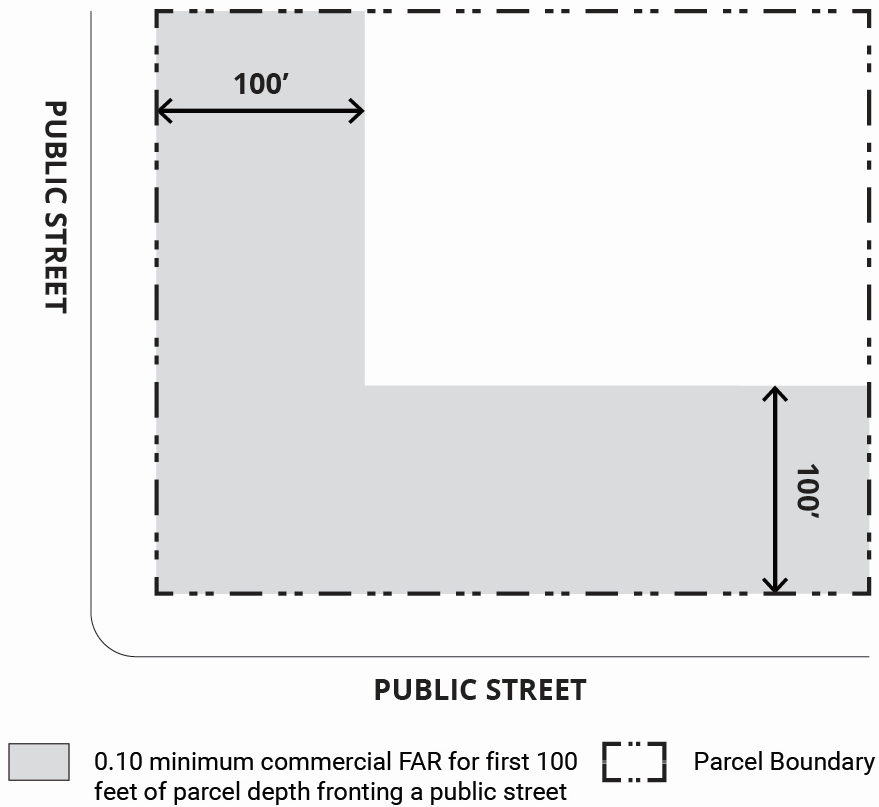
C.
Multi-Family Residential Density within Mixed Use zones.
1.
MXD Standards.
a.
The minimum number of multi-family residential units may be reduced for parcels less than 20,000 square feet.
b.
In buildings which have ground floor retail, restaurant, child care, or commercial service uses as allowed in Table 6.02-1, Mixed Use Zone Uses, the square footage of said uses does not contribute to the density limits.
2.
MXD2 Standards.
a.
The minimum number of multi-family residential units may be reduced for parcels less than 20,000 square feet.
b.
Units with four bedrooms shall be counted as 1.5 units when calculating density.
c.
In buildings which have ground floor retail, restaurant, child care, or commercial service uses as allowed in Table 6.02-1, Mixed Use Zone Uses, the square footage of said uses does not contribute to the density limits.
3.
MXD3 Standards.
a.
Units with four bedrooms shall be counted as 1.5 units when calculating density.
b.
In buildings which have ground floor retail, restaurant, child care, or commercial service uses as allowed in Table 6.02-1, Mixed Use Zone Uses, the square footage of said uses does not contribute to the density limits.
4.
NCMU1, NCMU2, and NCMU3 Standards.
a.
Residential units with four bedrooms shall be counted as 1.5 units when calculating density.
5.
TC1, TC2, and TC3 standards
a.
Residential units with four bedrooms shall be counted as 1.5 units when calculating density.
D.
Front and Street-Side Yard Setbacks. The following standards shall apply to front and street-side yard setbacks:
1.
All MXD, NCMU, and TC zones.
a.
Where a public easement prevents a building from being located at its required minimum or maximum setbacks, the building shall be located as close to the back of said easement as possible.
b.
Trellises, canopies and fabric awnings may project up to five (5) into minimum front and street side setback areas and public right of ways, provided they are not less than eight (8) feet above the sidewalk.
c.
All buildings shall be oriented towards the street. Primary building entrances shall be oriented toward the street. For buildings located on a corner lots, either street primary building entrances may be oriented to either street.
2.
MXD zones:
a.
All areas.
i.
Balconies, bay windows, porches, stoops, trellises, canopies and awnings may project into the minimum setback areas provided at least sixty percent (60%) of the required setback area is landscaping.
ii.
A building's first floor may be recessed from either the maximum front and street side building setback line or the specified build-to-line for the purposes of an arcade, or a small gathering/dining or special entry area.
The arcade shall have a minimum height of (8) feet, a minimum width of eight (8) feet. Other recessed areas may have maximum depth of ten (10) feet, and may not exceed forty percent (40%) of the building's street facing elevation. An entry door area up to nine (9) feet wide may be recessed up to four (4) feet from the back of the sidewalk.
b.
Within the Midtown Specific Plan.
i.
The Ground Level Commercial Area (as shown on the Specific Plan Land Use Map, Figure 3.1), shall have a build-to-line that is fifteen (15) feet behind the curb. The fifteen (15) feet between the curb and the building build-to-line shall be developed with sidewalk and street trees.
c.
Outside the Midtown Specific Plan.
i.
Minimum of eight (8) feet and a maximum of fifteen (15) feet from back of sidewalk. The sidewalk shall be based on either the existing sidewalk or assumed ten (10) foot wide sidewalk, whichever is wider.
3.
MXD2 zones:
a.
All areas.
i.
Balconies, bay windows, porches, stoops, trellises, canopies and awnings may project into the setback areas up to the property line.
ii.
A building's first floor may be recessed from the front and street side building setback line for the purposes of an arcade, outdoor dining area, or special entry area.
The arcade shall have a minimum height of (8) feet, and a minimum width of eight (8) feet. Other recessed areas may have a maximum depth of ten (10) feet, and may not exceed twenty percent (20%) of the building's street facing elevation. An entry door area up to nine (9) feet wide may be recessed up to four (4) feet from the front and street-side building setback.
b.
Within the Transit Area Specific Plan.
i.
Setbacks are defined and illustrated in the street sections of Chapter 5 of the Transit Area Specific Plan.
c.
Outside the Transit Area Specific Plan.
i.
Minimum eight (8) feet and a maximum of fifteen (15) feet from back of sidewalk.
E.
Floor Area Ratio, Non-Residential. In addition to the standards listed in Table 6.04-1 Mixed Use Zone Development Standards for MXD2 and MXD3 zoned properties, the following shall apply:
1.
A Floor Area Ratio of two and a half (2.5) for non-residential buildings may be considered for individual sites with a Conditional Use Permit, in accordance with Section 57, Conditional Uses Permitted by Commission, of this Chapter.
2.
There are no FAR or density limits for hotels.
3.
In buildings which have ground floor retail, restaurant, child care, or commercial service uses as provided for in Table 6.02-1, Mixed Use Zone Uses, the square footage of said uses does not contribute to the FAR calculation.
4.
Buildings which include both non-residential uses and residential uses on the upper floors shall be considered "non-residential," and Floor Area Ratio standards shall apply.
F.
Landscaping. All required front and street setback areas shall be landscaped or paved to allow for outdoor seating, display or goods, or street furniture.
G.
Park and Open Space Requirements for Residential Uses.
1.
Areas within Midtown Specific Plan.
a.
All residential projects within the Midtown Specific Plan area shall provide park land at a ratio of three and one-half (3½) acres per one thousand (1,000) population. Up to one and one-half (1½) of each three and one-half (3½) total park acres required (43%) may be satisfied by the provision of private recreational areas. The remaining park land requirement must be satisfied by either dedication of land to the City for public parks and open space, or payment of an in-lieu fee, as set forth in Section 9 (Park Dedication) of the Milpitas Subdivision Ordinance (Title XI, Chapter 1).
b.
A minimum of twenty-five percent (25%) of the total site shall be usable open space or recreational facilities. Balconies, porches, or roof decks may be considered usable open space when properly developed for work, play or outdoor living areas.
c.
Balconies, porches, or roof decks may be considered usable open space when properly developed for work, play or outdoor living areas. Balconies and porches located above ground level with a minimum dimension of 4½ feet constructed for use by dwelling units shall be exempt from the useable open space dimension standards above and within Section 2 of this Chapter, and may be considered to satisfy usable open space requirements. Each dwelling unit shall be provided with private open space as follows:
i.
Balconies and porches (above ground level): minimum sixty (60) square feet; or
ii.
Patios (at ground level): minimum one hundred square feet.
2.
Areas within Transit Area Specific Plan.
a.
All residential projects shall provide park land at a ratio of three and one-half (3.5) acres per one thousand (1,000) population.
i.
Two (2) of the required three and one-half (3.5) acres must be satisfied by either dedication of land to the City for public parks and open space, or payment of an in-lieu fee, as set forth in Section 9 (Park Dedication) of the Milpitas Subdivision Ordinance (Title XI, Chapter 1). Land dedication is required if a park is shown on a property on Figure 3-8 of the Transit Area Specific Plan.
ii.
Up to one and one-half (1.5) of each three and one-half (3.5) total park acres required (43%) may be satisfied by the provision of private recreational areas. Private open space cannot be shared between separate developments.
b.
Each residential project shall provide adequate on-site usable open space or recreational facilities to the approval of the Planning Commission through the Site Development Permit process. Each dwelling unit shall be provided with private open space as follows:
i.
Balconies (above ground level): minimum forty (40) square feet; or
ii.
Patios and porches (at ground level): minimum fifty (50) square feet.
c.
All development projects shall dedicate land for parks if a park is shown on a property on Figure 3-8 of the Transit Area Specific Plan.
d.
All commercial development projects shall dedicate and/or improve public trails if a trail is shown on a property on Figure 3-8 of the Transit Area Specific Plan.
e.
Twenty percent (20%) of a landscape buffer area may count towards the public park and open space requirements when it includes trails or wide sidewalks connected to the pedestrian and bicycle network.
f.
Park Sites: Parks must be bordered by public streets, or public right-of-way such as a trail or railroad right-of-way, on at least three sides.
3.
Areas designated NCMU and TC
a.
Park Land. All residential projects shall provide park land at a ratio of three and one-half (3.5) acres per one thousand (1,000) population.
i.
Park Land must be satisfied by either dedication of land to the City for public parks and open space, or payment of an in-lieu fee, as set forth in Section 9 (Park Dedication) of the Milpitas Subdivision Ordinance (Title XI, Chapter 1).
b.
Publicly Accessible Parks and Open Spaces. All mixed use or residential only projects on sites between 3 acres and 5 acres shall dedicate 5% of total site area to publicly accessible parks and open space. All mixed use or residential only projects greater than 5 acres shall dedicate 10% of total site area to publicly accessible parks and open space. Publicly accessible parks, plazas, and open spaces provided to meet the requirement below may be counted towards the park land requirement above.
c.
Usable Open Space. A minimum of twenty-five percent (25%) of the total site shall be usable open space or recreational facilities. Usable open space may be provided as Common Open Space or Private Open Space.
5.
Areas outside Specific Plans.
a.
All residential projects outside a Specific Plan area shall comply with the park land dedication provisions provided in Section 9.06 (Amount of Park Land to be Dedicated) of the Milpitas Subdivision Ordinance.
H.
Parking Summary: Requirements are located in Section 53
1.
Areas designated NCMU and TC
a.
The minimum number of parking spaces required for residential uses shall be as follows:
Studio and 1-bedroom (up to 1,100 sf): 1 per unit
2-bedroom (up to 1,1100 sf): 1.5 per unit
3 or more bedrooms and/or 1,101 sf or larger: 2 per unit
b.
The minimum number of parking spaces required for commercial uses shall be 1 space per 300 sq. ft. of commercial use.
For other parking-related standards, refer to Section 53, Off Street Parking Regulations, of this Chapter.
TABLE IS EXCERPT FROM SECTION 53
(Ord. No. 38.857, § 3, 5/6/25; Ord. No. 38.828, §§ 2, 3, 2/21/17; Ord. No. 38.803, § 7, 4/17/12; Ord. No. 38.785, § 5, 4/7/09; Ord. 38.777 (6) (part), 6/17/08)
XI-10-6.05 - Reserved
Editor's note— Ord. No. 38.785, § 6, adopted April 7, 2009, amended the Code by repealing former § XI-10-6.05 in its entirety. Former § XI-10-6.05 pertained to off-street vehicle and bicycle parking, and derived from Ord. 38.777, adopted June 17, 2008.
XI-10-6.06 - Special Development Standards
A.
Utilities.
1.
Utilities shall be placed in underground or subsurface conduits.
2.
All mechanical equipment, ground transformers and meters shall be located and screened to minimize visual impacts.
3.
Rooftop mechanical equipment shall be concealed from street level views through roof designs that area architecturally integrated with the building, such as equipment wells and parapets.
4.
Public utility distribution meters, vaults and similar installations shall be consolidated in a single area whenever possible and located away from highly visible areas such as street corners and public open spaces.
5.
Backflow preventors shall be located within landscaped setback areas and painted black or dark green to minimize visual impact. Where no landscaped setback areas exist the backflow preventors shall be incorporated into the front of the building to minimize visual obtrusiveness.
6.
Refuse and recycling containers shall not be visible from a public or private street. Such containers shall be stored either within the parking facility of the building or within a vehicular accessway with screening designed to meet the requirements of this section.
7.
Trash enclosure walls shall incorporate building materials and colors that match the architecture of the building, and be well landscaped.
8.
All telecommunications antennas shall be building facade or roof mounted and screened appropriately.
9.
On Main Street only telecommunication facilities that are disguised to appear as a part of the building architecture (i.e. "stealth" antennas) may be used.
B.
Outdoor music
1.
Outdoor music as an accessory use in conjunction with a restaurant or bar in the MXD, MXD2, MXD3, NCMU, and TC zones shall be permitted for the entertainment and enjoyment of customers at the restaurant or bar during regular operating hours. Outdoor music as an accessory use shall be limited to the hours of 9:00 am to 11:00 pm.
2.
Recorded background music may be permitted outdoors on public sidewalks and other public areas subject to the standards of this Chapter and Title V - Public Health, Safety and Welfare, Chapter 213 - Noise Abatement.
3.
Noise levels for outdoor music, when permitted as an accessory use to a restaurant or bar, shall not exceed a maximum range of 70 to 90 decibels (dB). See also Title V - Public Health, Safety and Welfare, Subsections V-213-2 and V-213-3, for additional regulations.
4.
Larger outdoor music events, both live and recorded music, that are intended for the entertainment and enjoyment of the general public shall not be considered accessory uses and shall require a Special Event Permit pursuant to Section 15, Special Events and Activities, of this Chapter.
(Ord. No. 38.857, § 3, 5/6/25; Ord. No. 38.847, § 7, 8/16/22; Ord. No. 38.803, § 7, 4/17/12; Ord. 38.777 (8) (part), 6/17/08)
XI-10-6.07 - Exceptions to Standards
1.
Exceptions to all but the use, floor area ratio, density, and park land requirement regulations of this Section may be approved by the Planning Commission through approval of a Conditional Use Permit in accordance with the requirements of Section 57, Conditional Uses Permitted by Commission, of this Chapter.
2.
In addition to the required findings under Chapter 57, the Planning Commission must be able to make the following two additional findings for such exceptions:
a.
The exceptions meet the design intent identified within the Zoning District and/or Specific Plan and do not detract from the overall architectural, landscaping and site planning integrity of the proposed development.
b.
The exceptions allow for a public benefit not otherwise obtainable through the strict application of the specified standard.
(Ord. No. 38.857, § 3, 5/6/25; Ord. No. 38.803, § 7, 4/17/12; Ord. 38.777 (8) (part), 6/17/08)
XI-10-6.08 - Conformance with Specific Plans
Properties located within Specific Plans shall conform to the underlying Specific Plan in accordance with Section XI-10-11.06, Conformance with Specific Plans, of this Chapter.
(Ord. No. 38.857, § 3, 5/6/25; Ord. No. 38.803, § 7, 4/17/12; Ord. No. 38.795, § 23, 4/6/10)