


Milpitas City Zoning Code
SECTION 7
Industrial Zones and Standards
XI-10-7.01 - Purpose and Intent
A.
Light Industrial (M1) Zone. The M1 Light Industrial District is reserved for the construction, use and occupancy of buildings and facilities for office, research, limited and light manufacturing, and other uses compatible with the district.
B.
Heavy Industrial (M2) Zone. The M2 Heavy Industrial District is reserved for the construction, use, and occupancy of buildings and facilities for office, research, general manufacturing, warehousing and distribution and other uses compatible with the district.
C.
Industrial Park (MP) Zone. The MP District is intended to accommodate, in a park-like setting, a limited group of research, professional, packaging and distribution facilities and uses which may have unusual requirements for space, light, and air, and the operation of which are clean and quiet and which meet the standards set herein.
D.
Business Park Research and Development (BPRD) Zone. The purpose of the BPRD District is to designate specific areas of the city as important employment centers, especially for jobs in the high-tech industry. The BPRD zone is intended to accommodate business parks, high-intensity office buildings, advanced manufacturing, and other light industrial uses, and to enable the integration and growth of research and development, office, warehouse, and light manufacturing uses on consolidated sites with supportive ancillary uses such as restaurants, health/fitness centers, limited retail, and child care facilities.
(Ord. No. 38.855, § 6, 6/18/24; Ord. No. 38.803, § 8, 4/17/12; Ord. No. 38.789, § 9, 4-21-09)
XI-10-7.02 - Industrial Use Regulations
A.
Permitted and Conditionally Permitted Uses.
1.
Primary uses. The uses identified in Table XI-10-7.02-1, Industrial Zone Uses, shall be the primary uses allowed to occur on a property. All uses except for those noted shall be conducted within enclosed structures. The primary uses identified in Table XI-10-7.02-1 shall be permitted or conditionally permitted, as indicated:
2.
In the BPRD zone, all uses and activities must take place within an enclosed building.
3.
Accessory Uses. The following accessory uses are allowed when incidental to the primary use:
a.
In M1 and MP zones, incidental services, such as restaurants and recreation facilities for employee use only and when conducted in and entered from within the building or campus.
b.
Cafeterias may be permitted when ancillary to a primary use and associated with business or industrial uses.
c.
Banquet halls may be permitted with a Conditional Use Permit, in accordance with Section XI-10-57.04, when ancillary to convention centers, hotels or motels.
d.
In the BPRD, business support services, convenience retail, commercial athletic facilities, child care centers, and restaurants with or without on-site service of alcohol.
B.
Prohibited Uses. The following uses are prohibited:
1.
Uses where the symbol "NP" appears within Table XI-10-7.02-1.
2.
Uses that have been excluded from Table XI-10-7.02-1, unless they are found by the City to be similar to permitted or conditionally permitted uses in accordance with C below.
C.
Other Uses. Any other uses may be considered by the Planning Commission that are similar in accordance with the procedure prescribed in Subsection 10-54.02, Other Uses Permitted by Commission, of this Chapter.
Table XI-10-7.02-1
Industrial Zone Uses
1 Limited to accessory uses that support primary employment-generating uses on the same site. Accessory commercial uses such as restaurants and convenience retail shall be located on the ground floor and in an area of the development where they can be directly accessed by the public.
2 In accordance with the Title III, Chapter 4, Adult Business Ordinance and Subsection XI-10-13.04, Adult Businesses, of this Chapter.
3 Maximum 8,000 gross square feet in size.
4 Assembling, packaging, or distribution from previously prepared materials, such as cloth, plastic, paper, leather, precious or semi-precious metals or stones, electric or electronic instruments and devices such as television, radios, and pharmaceutical products.
5 Consistent with the intent and purpose of the BPRD Zone to support emerging industries within the high-tech sector, manufacturing and assembling of electric vehicles and other zero-emission vehicles, and/or component parts for such vehicles, may be permitted in this zone through approval of a Minor Conditional Use Permit in accordance with Subsection 57.04 of this Chapter. Manufacturing and assembling of conventional and hybrid vehicles with internal combustion engines, as a higher-intensity industrial use, is not permitted in the BPRD Zone.
6 When conducted wholly within a completely enclosed building or within an area enclosed on all sides with a solid wall or fence (e.g., chain link with slats) not less than eight feet in height.
7 Warehousing and distribution facilities up to 200,000 square feet are permitted in the BPRD Zone. Warehousing and distribution facilities that exceed 200,000 square feet may be allowed through the approval of a Conditional Use Permit, in accordance with Subsection 57.04 of this Chapter. In addition to the general required findings for a Conditional Use Permit, the following special finding must be made for approval to be granted for a warehousing and distribution facility greater than 200,000 square feet: That the proposed use will support the continued operations and/or growth of business in the high-tech sector, contributing to economic activity and employment opportunities in the Business Park Research and Development Zone.
8 Shall be ancillary to the primary use or associated with business or industrial uses.
9 State has authority over permitting process regarding public facilities.
10 Refer to Subsection XI-10-13.10, Farmers Markets, of this Chapter.
11 Includes service facilities, electric transmission and distribution substations and public utility service centers.
12 See Subsection XI-10-13.11(I), Temporary Public Safety Uses.
13 See Subsection XI-10-7.04(A)(1), Industrial Zone Special Development and Performance Standards.
14 Refer to Subsection XI-10-13.18, Mobile Food Vending, of this Chapter.
15 Entrances to the services bays shall not be open to the street, but shall be so designed to face the rear or interior side property line.
16 Within MP zones, rental and repair may be considered only when ancillary to new auto dealerships.
17 Mobile fueling is permitted when fueling service is ordered by an individual vehicle owner and the amount of fuel dispensed as part of any individual order does not exceed 50 gallons. Mobile fueling for fleet vehicles may be permitted subject to approval of a Conditional Use Permit. Refer also to the California Fire Code as amended by the City of Milpitas Municipal Code, Title V, Chapter 300.
18 Within MP zones, boat and camper sales are prohibited. Dealerships shall be on property at least three acres or greater in area.
(Ord. No. 38.855, § 6, 6/18/24; Ord. No. 38.848, § 8, 11/15/22; Ord. No. 38.845, § 8, 6/21/22; Ord. No. 38.837, §§ 7, 8, 11/5/19; Ord. No. 38.836, § 5, 9/3/19; Ord. No. 38.827, § 2, 2/21/17; Ord. No. 38.803, § 8, 4/17/12; Ord. No. 38.795, §§ 24, 25, 4/6/10; Ord. No. 38.789, § 9, 4/21/09)
XI-10.7.03 - Industrial Zone General Development Standards
A.
The following minimum or maximum requirements shall be observed.
Table XI-10-7.03-1
Industrial Zone Development Standards
B.
Areas of Lot Required to be Landscaped. Landscaped areas shall mean any area planted with plant material (trees, shrubs, ground cover, etc.). Landscape areas shall be exclusive of parking and vehicular traffic area (direct driveways excepted) and this shall be shown on the site plan in detail for Planning Commission approval.
The following areas shall be landscaped:
1.
Required front yard area.
2.
Required street side yard area.
This may be adjusted, by the Planning Commission, if it is found that adequate landscaping adjacent to the building(s) is provided to compensate for a reduction.
C.
Fences, Hedges and Walls. All planting, fencing and walls for new development, including but not restricted to fences and walls along rear and interior side property lines shall be approved by the Planning Commission. Modifications regarding landscaping, fencing and walls at existing developed sites shall be subject to the provisions of Subsection 54.10, Fences and Walls, of this Chapter.
D.
Utilities. All wires, pipes, cables and utility connections shall be placed in underground or subsurface conduits. All above ground transformers and vaults for new development shall be adequately screened to the approval of the Planning Commission. Modifications regarding subsurface conduits or above ground transformers and vaults at existing developed sites shall be subject to the provisions of Subsection 54.16, Trash Enclosures, Equipment and their Screening, of this Chapter.
E.
Areas for Collecting and Loading Recyclable Materials. There shall be provided areas for collecting and loading recyclable materials in accordance with the requirements of Subsection 54.12, Areas for collecting and loading recyclable materials, of this Chapter.
F.
Legal Nonconforming projects. Existing developments lawful at the time of installation or improvements which have been approved and a building permit issued prior to June 17, 1982, and installed in conformance with said approval and permit are considered legal nonconforming projects.
(Ord. No. 38.855, § 6, 6/18/24; Ord. No. 38.803, § 8, 4/17/12; Ord. No. 38.789, § 9, 4-21-09)
XI-10-7.04 - Industrial Zone Special Development and Performance Standards
A.
Performance Standards. For uses requiring approval of a Minor Conditional Use Permit by staff, in accordance with Section XI-10-57.04, Conditional Use Permits and Minor Conditional Use Permits, of this Chapter, the following performance standards shall be met.
1.
Auto Brokers. Auto Brokers may be permitted by right if the following standards are met:
a.
Local Sales and Use Tax. In order to assist the City of Milpitas in its efforts to receive direct distribution of the local tax on materials associated with the project, the California Sales and Use Tax (the "Local Tax") shall be allocated to the project site, to the extent reasonably possible. Evidence of tax allocation or cause as to why such allocation cannot be made shall be submitted at the time of business license submittal.
B.
Special Development Standards in All Industrial Zones.
1.
Abutting any R District. Where any Industrial District abuts any R District, there shall be provided 100 feet between any building on an industrially zoned parcel and the nearest property line of any R District. Applicants are advised that mitigating improvements may be needed to eliminate any adverse impacts from the residences and that additional requirements may be imposed on the developer to remedy the situation.
2.
Outdoor Storage. Outdoor storage for such things as trash and materials shall be permitted only when said storage areas are suitably screened with a solid wall or tight board fence and are located at least 100 feet from any R District and not within any required front or street side yard. Said location and screening of outdoor storage areas shall be to the approval of the Planning Commission. Modifications regarding outdoor storage at existing developed sites shall be subject to the provisions of Subsection 54.16, Trash Enclosures, Equipment and their Screening, of this Chapter.
3.
Places of Assembly. Places of Assembly are prohibited in the Heavy Industrial (M2) Zone and Business Park Research and Development (BPRD) Zone. When any place of assembly use is established in an M1 or MP zone after the effective date of this Ordinance, such use shall be subject to the following requirements:
a.
Applicant shall submit a review of potential hazardous site conditions and potential exposure of site users to these conditions. At a minimum, a Phase I Environmental Site Assessment (ESA) shall be performed for each proposed assembly use within the City's Light Industrial (M1), and Industrial Park (MP) zoning districts. Each individual project shall comply with the recommendations of the Phase I Environmental Site Assessment (which may include conducting Phase II sampling and implementing the recommendations of the Phase II ESA that may include cleanup of hazardous materials) and demonstrate that exposure of site users to hazardous materials conditions would be below established thresholds prior to approval of the Conditional Use Permit. In addition, an Accidental Release Assessment (ARA) shall be performed for each proposed assembly use within the City's Light Industrial (M1) and Industrial Park (MP) zoning districts to determine if unacceptable safety risks may result from the proposed change in use. The ARA shall review and evaluate any and all Risk Management Plans prepared for facilities in the vicinity under the California Accidental Release Prevention (CalARP) program. The environmental professional preparing the ARA shall determine, based on Alternative Release Scenarios, whether the proposed new assembly use would result in unacceptable safety risks due to proximity of uses handling or emitting acutely hazardous materials. If unacceptable risks are identified, the proposed use shall not be allowed.
b.
Applicant shall submit a further noise study. The noise study shall demonstrate that ambient noise conditions within the vicinity of the proposed assembly use do not exceed the City's "normally acceptable" Noise Compatibility Standard of 70 dBA Ldn. In the event that existing conditions exceed the "normally acceptable" standard the proposed assembly use may be required to install noise insulating materials to achieve the interior noise standard. Also as a condition of approval, proposed assembly uses shall be required to sign a disclosure of acknowledgment that they agree to operate within an existing industrial area and may be subject to noise levels that exceed the City of Milpitas's Noise Compatibility Standards for noise-sensitive uses.
c.
No assembly use shall install or otherwise use exterior public address systems or other noise generating equipment that exceeds the 70 dBA noise standard.
d.
No new structure shall be construed within the M1 or MP zoning district for use as a place of assembly and no more than 50% of the square footage of any existing structure within the M1 or MP zoning district shall be converted to use as a place of assembly.
e.
No exterior modifications to any existing structure within the M1 or MP zoning district shall be permitted if such modifications would materially alter the structure's appearance or future use as an industrial building.
C.
Special Development Standards in the MP and BPRD zones.
1.
Uses in the MP and BPRD zones shall:
a.
Emit no obnoxious, toxic or corrosive fumes or gases.
b.
Emit no odors perceptible at the property line.
c.
Emit no smoke. This does not preclude the use of backup or emergency generators.
d.
Discharge into the air no dust or other particular matter created by any industrial operations or emanating from any products stored prior or subsequent to processing.
e.
Produce no heat or glare perceptible beyond the lot boundaries.
f.
Utilize all lighting in a manner which produces no glare on public streets or on any other parcel.
g.
Produce no physical vibrations perceptible at or beyond the lot boundaries.
h.
Produce no electromagnetic radiation or radioactive emission injurious to human beings, animals or vegetation, except under controlled operations being conducted observing standards or methods or operation established by the Nuclear Regulatory Commission. Electromagnetic radiation or radioactive emissions shall not be of an intensity that interferes with the use of any other property.
i.
Do not engage in the production or storage of any material designed for use as an explosive, or in the use of such material in production.
j.
Indicate that all industrial uses shall use only gas, electricity, or preheated oil as a fuel; provided, however, that oil-burning equipment may be installed for stand-by emergency use only.
(Ord. No. 38.855, § 6, 6/18/24; Ord. No. 38.837, § 9, 11/5/19; Ord. No. 38.827, § 3, 2/21/17; Ord. No. 38.803, § 8, 4/17/12; Ord. No. 38.789, § 9, 4-21-09)
XI-10-7.05 - Special Design Standards for the BPRD Zone
A.
Building Entrances.
1.
At least one building entrance must be provided along the primary street frontage.
2.
The primary building entrance must incorporate a projection, recess, or combination of projection and recess at least 40 square feet in area and with a minimum depth of five feet.
B.
Façade Design and Articulation.
1.
Façades within 20 feet of a front or street side property line shall include windows, doors, other openings, or glazed areas for at least 40 percent of the building wall area located between 2.5 feet above the level of the sidewalk and the underside of the roof structure for portions of the façade within 75 feet of the street-facing main entry.
2.
No street-facing façade may run in a continuous plane for more than 90 feet without an opening.
Figure 7.05-1: Façade Design and Transparency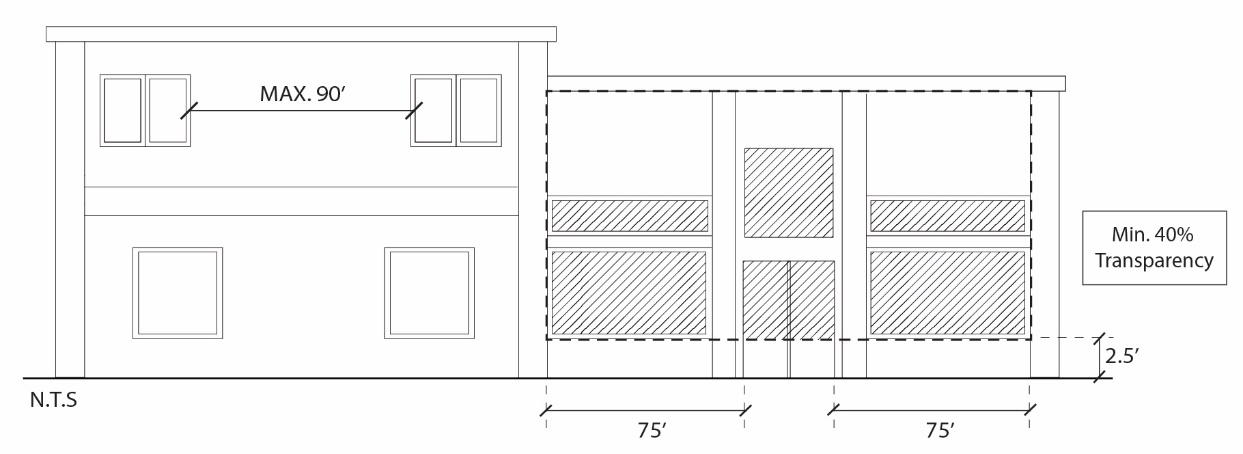
3.
All building façades must incorporate window trim and/or window recesses, architectural features, changes in material, changes in texture, or similar design elements that add visual interest to the façade. This includes a varied palette of materials, textures, and colors that emphasize details and changes in plane.
C.
Pedestrian and Bicycle Circulation.
1.
A system of pedestrian walkways shall connect all primary building entrances on a site to each other, to on-site vehicle and bicycle parking areas, and to any on-site open space areas, pedestrian amenities, and transit stops. Walkways may be located within public utility easement areas provided they are publicly accessible.
2.
Walkways between the primary building entrance and sidewalk shall be the shortest practical distance, generally no more than 125 percent of the straight-line distance.
3.
Walkways shall be hard-surfaced and paved with materials that are visually distinct from vehicular access areas in terms of composition, texture, and/or color.
4.
Where a required walkway crosses a driveway, parking area, or loading area, it must be clearly identifiable through a raised crosswalk, a different paving appearance, material, or similar method.
5.
Where a required walkway is parallel and adjacent to a vehicle travel area, it must be raised or separated from the vehicle travel lane by a raised curb at least four inches high, bollards, or other physical barrier.
Figure 7.05-2: On-Site Circulation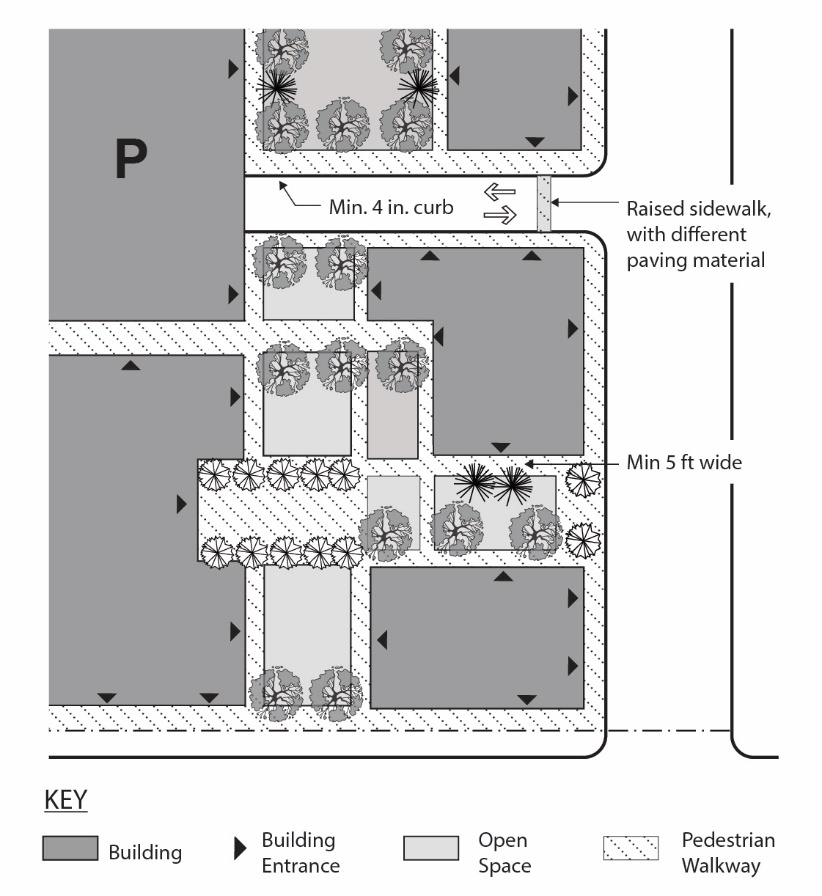
D.
Site Design for Large Projects. Projects over 80,000 gross square feet must provide the following:
1.
Landscaped areas and usable outdoor common open space [see Subsection XI-10-7.05(D)(2)] equal to a cumulative 10 percent of the site area that:
a.
Provides gathering space or opportunities for active or passive recreation and benches or other seating.
b.
Provides amenities that enhance the comfort, aesthetics, or usability of the space, including but not limited to trees and other landscaping, shade structures, drinking fountains, water features, or public art.
c.
Is separated from on-site parking areas by a minimum of 6 feet.
d.
May include on-site stormwater treatment areas and landscaped areas.
2.
A minimum of 400 square feet of outdoor eating facilities for the use of employees. Outdoor eating areas shall have a minimum dimension of 12 feet and shall include tables, seating and covering to provide protection from sun and weather conditions. Employee eating areas must be contiguous with required on-site public open space or provided in a separate area. This area may be included as part of the open space requirement.
3.
Stormwater detention facilities incorporated into the site landscaping. Refer also to Subsection VIII-5-3, Provisions for New and Rehabilitated Landscapes.
4.
A lighting, landscaping, and signage design concept for common areas. Refer also to Subsection XI-10-54.17 for general lighting standards and to Subsection XI-10-24 for general signs standards.
E.
Landscaping.
1.
The following areas shall be landscaped and may count toward the total area of site landscaping required by the zoning district standards.
a.
Street-Facing Setbacks, as required in Section 10-7.03.B of this Chapter.
b.
Interior Property Lines Abutting Residential Districts. A six-foot-wide landscape buffer yard planted with a mix of trees and shrubs shall be provided along interior property lines. At least one tree of at least 15-gallon size shall be planted per 20 linear feet or as appropriate based on canopy size at maturity to create a tree canopy over the buffer yard. In addition, at least three shrubs shall be planted per 20 lineal feet. At least 10 percent of the required trees shall be 24-inch box size.
c.
Building Perimeters. The portions of a building that face a public street or parking areas shall have one or more landscape planters, each a minimum of four feet in depth, installed along a minimum 20 percent of street-facing façades. This 20 percent may include landscape buffers located below windows and other transparent portions of the façade.
Figure 7.05-3: Landscape Planters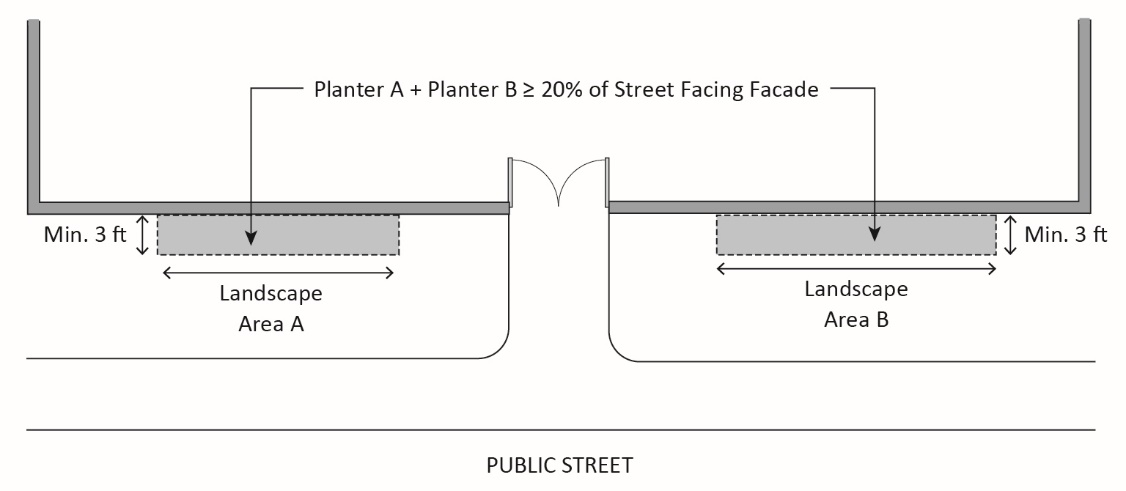
d.
Parking Areas. A minimum of 10 percent of any parking lot area shall be landscaped in the form of planted islands between rows of parking or between parking stalls. For the purpose of calculating required parking lot landscaping, parking lot areas are deemed to include parking and loading spaces as well as aisles, vehicle entry and exit areas, and any adjacent paved areas. Parking lot area does not include enclosed vehicle storage areas.
e.
Unused Areas. All areas of a project site not intended for a specific use, including areas planned for future phases of a phased development, shall be landscaped or left in a natural state.
2.
Landscaping Materials. In addition to the standards of Section VIII-5-3, Provisions for New and Rehabilitated Landscapes, the following landscape standards apply.
a.
General. Landscaping must consist of a combination of groundcovers, shrubs, vines, and trees. Landscaping may also include incidental features including stepping stones, benches, fountains, sculptures, decorative stones, or other ornamental features, placed within a landscaped setting. Landscaped areas may include paved or graveled surfaces, provided they do not cover more than 10 percent of the area required to be landscaped.
b.
Plant selection. Plants must be selected to control erosion and provide protection from wind and summer sun.
c.
Ground Cover Materials. Ground cover shall be of live plant material. Groundcover may include grasses. Non-plant materials including gravel, colored rock, cinder, bark, and similar materials shall not be used to meet the minimum planting area requirements required by this section, except with approval by the Zoning Administrator. Mulch must be confined to areas underneath shrubs and trees and is not a substitute for ground cover plants.
d.
Turf Allowance. The maximum amount of lawn in required landscape areas shall be 20 percent except for turf areas that comprise an essential component of a project (e.g., golf courses or playing fields), which are exempt from this limit. The installation of turf on slopes greater than 25 percent is prohibited.
e.
Size and Spacing. Plant materials shall be grouped in hydrozones in accordance with their respective water, cultural (soil, climate, sun and light) and maintenance needs. Plants shall be of adequate size and spacing at the time of installation to provide ample vegetation coverage. Minimum requirements include:
i.
Ground Covers. Ground cover plants other than grasses must be at least the four-inch pot size. Areas planted in ground cover plants other than grass seed or sod must be planted at a rate of one per 24 inches on center or less.
ii.
Shrubs. Shrubs shall be a minimum size of one gallon. When planted to serve as a hedge or screen, shrubs shall be planted with two to four feet of spacing, depending on the plant species.
iii.
Trees. Tree canopies shall cover a minimum of 30 percent of the total required landscape area. Of the total number of trees provided on site, at least 20 percent shall be of the same species.
(a)
A minimum of 15 percent of the trees planted shall be 24 inch-box or greater in size. All other trees shall be a minimum of 15 gallons in size with a one-inch diameter at breast height (dbh).
(b)
Newly planted trees shall be supported with double stakes or guy wires and tree guards per International Society for Arboriculture and American National Standards Institute standards.
(c)
Any trees planted along a sidewalk shall be 15 gallon trees no more than 30 feet apart on center.
(d)
Any tree to be planted along a lot line or adjacent to a structure shall be no closer to said lot line or structure than one-half the diameter of the particular species' drip line at maturity, measured from the center of the tree. Any tree that cannot be planted in the ground shall be planted in a planter box at least twice the width and depth of the root ball plus one additional foot in container diameter for every four feet of mature tree height.
F.
Parking and Loading.
1.
Parking Location.
a.
Required parking spaces shall be located on the same lot as the use they serve.
b.
Parking areas shall be set back from adjacent buildings and streets as follows:
i.
From Streets. Where parking is located between a building and street, a landscaped setback at least 10 feet wide must be provided between the parking area and adjacent right-of-way.
ii.
From On-Site Buildings. Parking areas must be separated from the front and side exterior walls of on-site buildings by walkways at least five feet in width.
c.
On-site parking shall not be located within a required setback.
2.
Parking Design.
a.
Access. Driveways shall not exceed 35 feet in width, except that driveways providing large truck access to truck bays shall not exceed 40 feet in width. All driveways must be located a minimum of 50 feet from the boundary of an abutting residential or open space zone.
b.
Screening. Parking and loading areas shall be screened from view from public streets and properties in abutting residential, mixed-use, or commercial zones, according to the following standards.
i.
Height. Screening of parking lots from adjacent public streets shall be a minimum of three feet in height. Screening of parking lots along interior lot lines that abut residential or open space districts shall be a minimum of six feet in height.
ii.
Design. Screening should generally be opaque, but may have some degree of transparency depending on method used (e.g., plant material), and must consist of one or any combination of the methods listed below:
(a)
Walls. Low-profile walls consisting of brick, stone, stucco, or other quality durable material and including a decorative cap or top finish as well as edge detail at wall ends.
(b)
Fences. An open fence of wood, wrought iron or similar high-quality, durable material combined with plant materials. This option does not include the use of chain-link or vinyl fencing.
(c)
Planting. Plant materials consisting of compact evergreen plants. Such plant materials must achieve a minimum height of two feet within 18 months after initial installation.
(d)
Berms. Berms planted with grass, ground cover, or other low-growing plant materials.
3.
Loading Areas. Truck docks, loading areas, and service areas within 100 feet of a public street shall not be visible from the public street. The outermost point of the truck docks, loading, and service areas are not permitted within 50 feet of the boundary of a residential district.
G.
Lighting.
1.
Fixtures. All exterior lighting fixtures shall be oriented downward, fully shielded, and certified by the International Dark Sky Association to prevent light intrusion into adjacent building buildings and sensitive habitat such as riparian habitat, streams, and wetlands.
2.
Controls. All exterior lighting must be capable of accepting controls that enable dimmers, timers motion sensors, or networking to avoid unnecessary lighting and energy use, especially in areas adjacent to sensitive habitat, such as riparian habitat, streams, and wetlands.
3.
On-Site Lighting.
a.
Ground-floor building façades and other areas, including parking lots, driveways, pedestrian and bicycle circulation areas, and recesses, shall be illuminated with lighting fixtures that meet the following minimum standards:
i.
Open parking lots: One foot-candle at ground level.
ii.
Pedestrian paths/bike paths: One foot-candle at ground level.
iii.
Covered parking: Five foot-candles at ground level.
b.
Electrical elements for exterior building lighting such as wires, conduits, and panel boxes shall be concealed from public view or painted to match the background surface color.
c.
Parking lot lighting shall be designed and installed so that light and glare is not directed onto residential use areas, adjacent public rights-of-way, or sensitive habitat, such as riparian habitat, streams, and wetlands.
4.
Prohibited Lighting. The following types of exterior lighting are prohibited:
a.
Mercury vapor luminaires;
b.
Searchlights;
c.
Sky beams;
d.
Upward-directed fixtures; and
e.
Aerial lasers.
(Ord. No. 38.855, § 6, 6/18/24)
Editor's note— Ord. No. 38.855, § 6, adopted June 18, 2024, amended the Code by renumbering former § XI-10-7.05 as a new § XI-10-7.06, and adding a new § XI-10-7.05.
XI-10-7.06 - Conformance with Specific Plans
Properties located within Specific Plans shall conform to the underlying Specific Plan in accordance with Section XI-10-11.06, Conformance with Specific Plans, of this Chapter.
(Ord. No. 38.855, § 6, 6/18/24; Ord. No. 38.803, § 8, 4/17/12; Ord. No. 38.795, § 26, 4/6/10; Ord. No. 38.789, § 9, 4/21/09)
Editor's note— Former § XI-10-7.05. See editor's note, § XI-10-7.05.