
Milpitas City Zoning Code
PART E
Chapter E.2 - DEFINITIONS OF TERMS
This Chapter provides definitions for terms that are commonly used throughout this Title.
Abandoned, Abandonment. When, for the period of time established in Chapter C.18 (Nonconforming Buildings, Structures, Uses, and Parcels) a nonconforming use is either vacated, the business license lapses, the lease is terminated, and/ or utilities are terminated.
Abate. To repair, replace, remove, destroy or otherwise remedy the condition in violation of this Title.
Abutting or Adjoining. Having a common property or zone boundary line.
Access. The place or way through which pedestrians and/or vehicles shall have safe, adequate, and usable ingress and egress to a property or use as required by this Title and the Milpitas Municipal Code.
Accessory Building. A subordinate building, whose purpose is clearly incidental to that of the main building or the use of the land, and which shall not contain living or sleeping quarters or storage for commercial vehicles in excess of three-quarter ton size. Accessory dwelling units, as defined in Chapter E.4 (Definition of Uses), are exempted from the prohibition against living and sleeping quarters. An accessory building shall be considered attached to the main building if:
1. It shares a common wall with the main building; or
2. It shares an integral roof structure having the same framing system and roof covering as the main building and has an exterior wall that is separated from the main structure by no more than 10 feet at any given point.
Accessory Structure. A structure subordinate to the primary use or principal building on the same lot and serving a purpose customarily incidental to the primary use or use of the principal building. An accessory structure does not meet the definition of an accessory building. Examples include, but are not limited to gazebos, covered patios, carports, and porte-cochères.
Accessory Use. See "accessory use" in Chapter E.4 (Definitions of Uses).
Active Use. A use that attracts walk-in visitors and has a high degree of transparency from the street. Active uses include but are not limited to retail, restaurants, bars, markets, theaters, salons, yoga studios, art studios/galleries, banks, offices, and clinics. Active uses also include ground floor residential shared amenities, such as a lobby, gym, or conference room.
Adjacent. Having a common border with, or being separated from such a common border by a right-of-way, alley, or easement. Properties separated by a street, alley, intersection, or other public right-of-way (other than an elevated interstate freeway), shall be considered adjacent when their property lines would touch in any way if drawn to the center line of such street, alleyway, intersection, or other public right-of-way.
Adult-Oriented Business Terms.
Adult Arcade. Any place to which the public is permitted or invited, wherein coin-operated, currency-operated or slug-operated or electronically, electrically or mechanically controlled still or motion picture machines, projectors, television sets, monitors, receivers, transmitters, video cassette players or other images producing devices are maintained to show images to five or fewer persons per machine at any one time, and where the images so displayed are distinguished or characterized by the depicting, describing or relating to specified sexual activities or specified anatomical areas.
Adult Bookstore. An establishment that has 30 percent or more of its stock in books, visual or audio representations which are distinguished or characterized by an emphasis upon the depiction or description of specified sexual activities and/or specified anatomical areas.
Adult Cabaret. A nightclub, restaurant, or similar business establishment which:
• Regularly features live performances which are distinguished or characterized by an emphasis upon the display of specified anatomical areas or specified sexual activities; and/or
• Which regularly features persons who appear seminude; and/or
• Shows films, computer generated images, motion pictures, video cassettes, slides, or other photographic reproductions 30 percent or more of the number of which are distinguished or characterized by an emphasis upon the depiction or description of specified sexual activities or specified anatomical areas.
Adult Hotel/Motel. A hotel or motel or similar commercial establishment which:
• Offers public accommodations, for any form of consideration, which provide patrons with closed-circuit television transmissions, films, motion pictures, video cassettes, slides, or other photographic reproductions which are characterized by the depiction or description of specified sexual activities or specified anatomical areas and which advertises the availability of this sexually oriented type of material by means of any off-premises advertising including but not limited to newspapers, magazines, pamphlets or leaflets, radio or television; and
• Offers a sleeping room for rent for a period of time that is less than 10 hours or allows a tenant or occupant of a sleeping room to sub-rent the room for a period of time that is less than 10 hours, or rents any single room more than twice in a 24-hour period.
Adult Motion Picture Theater. A business establishment in which for any form of consideration, films, motion pictures, video cassettes, video tapes, laser discs, slides or similar photographic or electronic reproductions are regularly shown and 30 percent or more of the number of which are distinguished or characterized by an emphasis upon the depiction or description of specified sexual activities or specified anatomical areas.
Adult Theater. A theater, concert hall, auditorium, or similar establishment which, for any form of consideration, regularly features live performances which are distinguished or characterized by an emphasis on the display of specified anatomical areas or specified sexual activities.
Distinguished or Characterized by an Emphasis Upon. The dominant or essential theme of the object described by such phrase. For instance, when the phrase refers to films which are distinguished or characterized by an emphasis upon the depiction or description of specified sexual activities or specified anatomical areas, the films so described are those whose dominant or predominant character and theme are the depiction of the enumerated sexual activities or anatomical areas.
Escort. A person who, for consideration, agrees or offers to act as a companion, guide, or date for another person, or who agrees or offers to privately model lingerie or to privately perform a striptease for another person.
Escort Agency. A person or business association who furnishes, offers to furnish, or advertises to furnish escorts as one of its primary business purposes for a fee, tip, or other consideration.
Establishment of an Adult Business. Any of the following:
1. The opening or commencement of any adult-oriented business as a new business;
2. The conversion of an existing business, whether or not an adult-oriented business, to any adult-oriented business as defined in this Title;
3. The addition of any of the adult-oriented businesses defined in this Title to any other existing adult-oriented business; or
4. The relocation of any adult-oriented business.
Nudity or a State of Nudity. The of the human male or female genitals, pubic area, or buttocks with less than a fully opaque covering, the showing of the female breast with less than a fully opaque covering of any part of the areola or nipple, or the showing of the covered male genitals in a discernible turgid state.
Regularly Features. With respect to an adult motion picture theater, theater, or adult cabaret, a regular and substantial course of conduct. The fact that live performances which are distinguished or characterized by an emphasis upon the display of specified anatomical areas or specified sexual activities occurs on two or more occasions within a 30-day period, three or more occasions within a 60-day period, or four or more occasions within a 180-day period, shall to the extent permitted by law be deemed to be a regular and substantial course of conduct.
Seminude. A state of dress in which clothing covers no more than the genitals, pubic region, and areolas of the female breast, as well as portions of the body covered by supporting straps or devices.
Specified Anatomical Areas. Any of the following:
1. Less than completely and opaquely covered human genitals, pubic region, buttocks, anus, or female breast below a point immediately above the top of the areola; or
2. Human male genitals in a discernibly turgid state, even if completely and opaquely covered; or
3. Any device, costume or covering that simulates any of the body parts included in (1) or (2) above.
Specified Sexual Activities. Any of the following:
1. The fondling or other erotic touching of human genitals, pubic region, buttocks, anus or female breasts;
2. Sex acts, actual or simulated, including intercourse, oral copulation, or sodomy;
3. Masturbation, actual or simulated;
4. Human genitals in a state of sexual stimulation, arousal or tumescence; or
5. Excretory functions as part of or in connection with any of the activities set forth in (1) through (4) above.
Alley. Any public thoroughfare which affords only a secondary means of access to adjacent property.
Allowed Use. Any use allowed in a zone and subject to the standards, restrictions, and approvals applicable to that zone and the use. May be a permitted use or a conditionally permitted use.
Amplified Sound. The use of any loudspeaker, public address system, amplifier, or any other device which electronically or mechanically increases the volume of the human voice, music, or any other sound.
Any Interested Party. Any person whom a Review Authority of the City finds and acknowledges as having a real and direct interest in any proceeding or action carried on, under, or as a result of the operation of, this Title.
Applicant. A person who requests in writing the approval of a permit, license, certificate, or other entitlement for use from the City. An applicant includes the owner of property for which the application is submitted or the owner's authorized agent.
Auto. Any motor vehicle requiring a license in compliance with the California Vehicle Code.
Basement. A story of a building that is partly or wholly located underground.
Bay Window. A window or set of windows jutting out from the wall of a building, rising from the ground and forming an alcove which may or may not add additional floor area or a sitting area within.
Bedroom. Any room which meets the minimum requirements of both the Zoning Ordinance and the Building Code for a habitable room, which is constructed in such a manner that less than 50 percent of one wall is open to an adjacent room or hallway and which can be readily used for private sleeping purposes.
Bicycle Parking Space. See "parking space, bicycle."
Block. A property so designated on an official map of the City, or the area of land bounded by streets, or by a street or streets, and railroad right-of-way, canal right-of-way, or unsubdivided acreage.
Building. A structure having a roof supported by columns or walls for the housing of, or for occupancy by, persons, animals, or chattels. Where a dwelling is separated by a division wall without openings, each portion of such dwelling shall be deemed a separate building.
Building Face or Building Façade. The outer surface of the main exterior wall of a building. For example, a building with a rectangular plan has four exterior walls and four building faces or facades.
Building Frontage. See "frontage, building."
Building Height. The vertical distance from finished grade. See also Subsection A.6.090.A (Measuring Building Height).
Building Official. The Director of the Office of Building Safety of the City of Milpitas or designee.
Building, Principal. A building in which the primary use of the lot on which it is situated is conducted.
Cannabis Terms.
Cannabis. All parts of the plants Cannabis sativa, Cannabis indica, or Cannabis ruderalis, whether growing or not; the seeds thereof; the resin, whether crude or purified, extracted from any part of the plant; and every compound, manufacture, salt, derivative, mixture, or preparation of the plant, its seeds, or resin. Cannabis also means the separated resin, whether crude or purified, obtained from marijuana. Cannabis includes "cannabis" as defined in the California Business and Professions Code section 26001 and in California Health and Safety Code section 11018.
Cannabis Cultivation. Any activity involving the planting, growing, harvesting, drying, curing, grading, or trimming of cannabis.
Cannabis Delivery. The commercial transfer of cannabis or cannabis products to a customer. Cannabis delivery also includes the use by a cannabis retailer of any technology platform that enables customers to arrange for or facilitate the commercial transfer by a licensed retailer of cannabis or cannabis products. Whether made directly by the individual or entity or indirectly through a third-party service or other intermediary, an offer to deliver includes any communication, action, or conduct that could be reasonably understood to convey a willingness to engage in cannabis delivery irrespective of the person or entity's actual or specific intent and includes advertisements, websites, or other media making the same suggestion.
Cannabis Delivery Service/Delivery Service. Any person or entity engaged in cannabis delivery or attempting or offering to engage in cannabis delivery.
Cannabis Distribution. The procurement, sale, and transport of cannabis and cannabis products and any other activity allowed under the State distributor license(s), including, but not limited to, cannabis storage, quality control and collection of State cannabis taxes.
Cannabis Manufacture. To compound, blend, extract, infuse, or otherwise make or prepare a cannabis product. Cannabis manufacture includes the production, preparation, propagation, or compounding of manufactured cannabis, or cannabis products either directly or indirectly or by extraction methods, or independently by means of chemical synthesis or by a combination of extraction and chemical synthesis at a fixed location that packages or repackages medical cannabis or cannabis products or labels or relabels its container.
Cannabis Microbusiness. Commercial cannabis business that must engage in at least three of the following commercial cannabis activities: cultivation, manufacturing using nonvolatile solvents, distribution, and/or retail.
Cannabis Product. Cannabis that has undergone a process whereby the plant material has been transformed into a concentrate, including, but not limited to, concentrated cannabis, or an edible or topical product containing cannabis or concentrated cannabis and other ingredients. Cannabis products include cannabis products as defined in Business and Professions Code section 26001.
Cannabis Retailer. Facility where cannabis or cannabis products are offered, either individually or in any combination, for retail sale, including an establishment that delivers cannabis and cannabis products as part of a retail sale or conducts sales exclusively by delivery. The term cannabis retailer includes any nonprofits that may be licensed under Business and Professions Code section 26070.5. For purposes of this Title, cannabis retailer also includes medical cannabis dispensaries, patient collectives and cooperatives operating, or proposing to operate, in accordance with the California Health and Safety Code section 11362.5 and/or the California Health and Safety Code section 11362.7 et seq., as may be amended.
Cannabis Testing Laboratory. A facility, entity, or site that offers or performs tests of cannabis or cannabis products.
Commercial Cannabis Use. Includes all cannabis cultivation, cannabis manufacture, cannabis distribution, cannabis testing laboratories, cannabis microbusinesses, cannabis retailers, cannabis delivery, and sale of cannabis and/or cannabis products, whether intended for medical or adult use, and whether or not such activities are carried out for profit. Commercial cannabis uses includes commercial cannabis activity as defined in California Business and Professions Code section 26001, and includes any activity that requires, or may require in the future, a license from a State licensing authority in accordance with California Business and Professions Code section 26000-26325, as may be amended. Commercial cannabis use does not include those activities allowed for personal use by persons 21 years of age or older, without any compensation whatsoever, in strict accordance with California Health and Safety Code section 11362.1 and does not include the activities of a qualified patient or a primary caregiver that are exempt from State licensure in accordance with California Business and Professions Code section 26033.
Enforcement Authority. The Chief of Police, the City Attorney, or any other person or persons designated by the Milpitas Municipal Code or the City Manager to enforce the City's cannabis regulations in this Title.
Indoor. Any location that is totally contained within a fully enclosed and secure private residence or accessory building located on the grounds of the private residence.
Medicinal Cannabis/Medicinal Cannabis Products. These terms shall have the same meaning as the definition set forth in Business and Professions Code section 26001.
Medicinal Cannabis Patient. Any one of the following:
Person with an Identification Card. As defined in Health and Safety Code section 11362.7. A person who possesses a currently valid identification card issued in compliance with Health and Safety Code Article 2.5 (commencing with section 11362.7) of Chapter 6 of Division 10.
Qualified Patient. As defined in Health and Safety Code section 11362.7. A person who possesses a currently valid physician's recommendation that complies with both Business and Professions Code Article 25 (commencing with section 2525) of Chapter 5 of Division 2 as all rules, regulations, and guidelines adopted by the Medical Board of California.
Non-Medicinal Cannabis/Non-Medicinal Cannabis Products. Cannabis or cannabis products, respectively, that does not qualify as medicinal cannabis, including commercial cannabis intended to be sold for non-medicinal use by an adult 21 years of age or older pursuant to state law.
Outdoor. Any location that is not totally contained within a fully enclosed and secure accessory building or primary residence.
Personal Cultivation. Cannabis cultivation for a natural person's own personal use and possession in accordance with the Milpitas Municipal Code and state law, including but not limited to California Health and Safety Code section 11362.1 and 11362.2, as may be amended, and such person does not sell or distribute cannabis to any other person. Personal use also means and includes cultivation of medical cannabis conducted by a qualified patient exclusively for personal medical use, and cultivation conducted by a primary caregiver for the personal medical purposes of no more than five specified qualified patients for whom they are the primary caregiver, in accordance with state law, including California Health and Safety Code section 11362.7 and 11362.765, as may be amended. Except as defined in this Title, personal cultivation does not include, and shall not authorize, any cultivation conducted as part of a business or commercial activity, including cultivation for compensation or retail or wholesale sales of cannabis.
Primary Caregiver. The primary caregiver for a medicinal cannabis patient and shall have the same meaning as the definition set forth in Health and Safety Code section 11362.7.
Car Share. A service that allows people to rent vehicles for short periods, typically through a web-based application, without needing to own a car.
Chief of Police. The Chief of Police of the City of Milpitas Police Department or designee.
City Attorney. The City Attorney of the City of Milpitas or designee.
City Clerk. The City Clerk of the City of Milpitas or designee.
City Engineer. The Director of the Engineering Department of the City of Milpitas or designee.
City Manager. The chief executive officer or manager of the City of Milpitas or designee.
City Official. An authorized officer of the City of Milpitas as appointed by the City Manager or City Council.
Civil Engineer. A person who holds a valid license in the branch of civil engineering, as defined in California Business and Professions Code section 6702.
Community Emergency Cache. A collection of disaster response supplies approved by the City's Office of Emergency Services that would benefit the surrounding community.
Compost. Safe and stable decayed organic material deriving from household or commercial waste that is beneficial to plant growth and may be used as a source of fertilizer or nutrient for plant.
Condominium. An estate in real property consisting of an undivided interest in common in a portion of a parcel of real property, together with a separate interest in space in a residential, industrial, or commercial building on such real property, such as an apartment, office, or store.
Condominium Conversion. A change in the type of ownership of a parcel or parcels of land, together with the existing attached structures, to that defined for a condominium project or a community apartment project regardless of the present or prior use of such land and structures and whether substantial improvements have been made or are to be made to such structures.
Continuing Violation. A violation, infringement or breach of a provision of this Title that is uninterrupted and lasts for a continuous period in excess of 24 hours.
Curb Grade. The elevation of the established curb in front of the building measured at the center of such front. Where no curb grade has been established, the City Engineer shall establish such curb grade or its equivalent for the purpose of this Title.
Curb Level. See "curb grade."
Department. The Planning Department of the City of Milpitas.
Diameter at Breast Height (DBH). The diameter of a tree's trunk, measured 4.5 feet up the trunk from the ground.
Director. The Planning Director of the City of Milpitas or designee.
Dwelling. A building or portion of a building designed exclusively for residential occupancy, including single-family, two-family, multi-family, and accessory dwellings, but not including hotels or motels.
Dwelling Unit. A habitable room or group of habitable rooms (e.g., living room, bedroom, den, library, recreation, studio, etc.) designed for occupancy by one or more persons living as a family or single household unit with common interior access to all living, kitchen, and bathroom areas. No dwelling unit may have more than one kitchen.
Ecological Restoration Project. A project to establish or reestablish a defined, indigenous, historic ecosystem on a site where the natural, original ecosystem of has been disturbed or degraded.
Efficiency Kitchen. An efficiency kitchen includes a cooking facility with appliances, and food-preparation counter space with a total area of at least 15 square feet and food-storage cabinets with a total of at least 30 square feet of shelf space.
Effective Date. The date upon which this Zoning Ordinance, or any subsequent amendment, is in full force and effect from and after its adoption by the Council.
Electronic Smoking Device. An electronic and/or battery-operated device, the use of which may resemble smoking that can be used to deliver an inhaled dose of nicotine or other substances. Includes any such device, whether manufactured, distributed, marketed, or sold as an electronic cigarette, an electronic cigar, an electronic cigarillo, an electronic pipe, an electronic hookah, vaporizer or any other product name or descriptor.
Elevation. A scaled drawing of the front, rear, or side of a building or structure. Also, a vertical distance above or below a fixed reference level, typically above sea level.
Erosion. The wear and removal of the material in the earth's crust from one site and the deposition at another.
Family. One or more persons living together as a single household unit.
Federal Communications Commission (FCC). An independent government agency responsible for regulating the radio, TV, and phone industries. The FCC regulates all interstate communications, such as wire, satellite and cable, and international communications originating or terminating in the United States.
Finished Grade. The final elevation of the ground surface after development.
First Amendment Event. Conduct, the sole or principal objective of which is the expression, dissemination or communication by verbal, visual, literary, or auditory means of opinion, views, or ideas. Expressive activity includes, but is not limited to, public oratory and distribution of literature.
Floor Area Ratio (FAR). The ratio of the total floor area of all buildings on a lot to the lot area. See Section A.6.080 (Determining Floor Area Ratio).
Foot-Candle. A quantitative unit of measure for luminance. One foot-candle is equal to the amount of light generated by one candle shining on one square foot surface located one foot away. It is equal to one lumen uniformly distributed over an area of one square foot.
Frontage. All the property fronting on one side of a street between intersecting or intercepting streets, or between a street and a right-of-way, waterway, end of dead-end street, or city boundary, measured along the street line. An intercepting street shall determine only the boundary of the frontage on the side of the street which it intercepts.
Frontage, Building. The length of a building wall as measured continuously in one plane for the entire length of the subject building, excluding eaves or roof overhangs. Where a building is visible from more than one street or parking area, the building frontage with the main public entry shall be designated as the primary building frontage with all other such frontages designated as secondary.
Fully-Shielded Light Fixture. See "light fixture, fully-shielded."
Garage. Any building with a permanent roof, enclosed on three sides with a garage door on the fourth side that is built and used for the purpose of storage/parking of automobiles, recreational vehicles (RVs), or offroad vehicles.
Good Neighbor Manual. A manual prepared by the City regarding the general rules of conduct to be followed when operating a short-term rental unit.
Gross Acre. The total area within the boundaries of a legal lot or parcel, including any area proposed to be dedicated or reserved for public right-of-way. Adjacent lands already dedicated for public right-of-way, including public roadways, easements or other areas, shall not be included as part of the gross acreage.
Gross Floor Area. The total area of all floors measured from the interior faces of the building, but not including areas for parking, basements, shaft enclosures, or unroofed inner courts unless any outdoor areas are used for commercial purposes.
Habitable Space. A room designed for living, sleeping, eating or food preparation, including but not limited to a living room, bedroom, bathroom, kitchen, den, study, library, home office, craft room, or recreational room and excluding areas such as garages.
Hazardous Material. A material identified as hazardous by California Health and Safety Code section 25502(n).
Hardscape. Any durable ground cover material (pervious and impervious) used in landscape design, including but not limited to concrete, asphalt, stone, brick, and gravel.
Hosting Platform. A business or person that provides a means through which an operator may offer a dwelling unit, or portion thereof, for short-term rentals. A hosting platform is usually, though not necessarily, provided through an internet-based platform. It generally allows a property owner or tenant to advertise the dwelling unit through a website provided by the hosting platform and provides a means for potential short-term rental transients to arrange short-term rentals, whether the short-term rental transient pays rent directly to the operator or to the hosting platform.
Impervious. Any surface or material that does not allow the passage of water through the material and into the underlying soil.
Individual Property Owner. A natural person holding fee title individually or jointly in the person's own name or a beneficiary of a trust that holds fee title. Does not include any corporation or corporate person of any kind (partnership, LP, LLC, C corp., S corp., etc.) except for a community land trust, as defined by California Revenue and Taxation Code section 402.1(a)(11)(C)(ii)) or a qualified nonprofit corporation as defined by California Revenue and Taxation Code section 214.15.
Intensity. The degree to which land is used, measured by a combination of the type of land used and the amount of land or floor area devoted to that use.
Invasive Plant Species. Species of plants not historically found in California that spread outside cultivated areas and can damage environmental or economic resources. Invasive species may be regulated by county agricultural agencies as noxious species. Lists of invasive plants are maintained at the California Invasive Plant Inventory and United States Department of Agriculture (USDA) invasive and noxious weeds database.
Kitchen. Any room, all or any part of which is designed and/or used for cooking and the preparation of food.
Landscape Architect. A person who holds a license to practice landscape architecture in the State of California, per Business and Professions Code section 5615.
Landscape Contractor. A person licensed by the State of California to construct, maintain, repair, install, or subcontract the development of landscape systems.
Light Fixture, Fully-Shielded. Light fixture or luminous tube constructed and mounted such that all light emitted by the fixture or tube, either directly from the lamp, tube, or a diffusing element, or indirectly by reflection or refraction from any part of the light fixture, is projected below the horizontal plane. If the lamp or tube, any reflective surface, or lens cover (clear or prismatic) is visible when viewed from above or directly from the side, from any angle around the fixture or tube, the fixture or tube is not fully shielded.
Light Fixture, Partially-Shielded. A light fixture constructed and mounted such that most light emitted by the fixture, either directly from the lamp or a diffusing element, or indirectly by reflection or refraction from any part of the fixture, is projected below the horizontal plane. Light emitted at or above the horizontal direction (sideways or upwards) arises only from incidental decorative elements or strongly colored or diffusing materials such as colored glass or plastic. Fixtures using spot or flood lamps are considered partially shielded.
Loading Area. An open area, other than a street or alley, used for the loading or unloading of vehicles.
Loading Space. An off-street space or berth on the same lot as a building, or contiguous to a group of buildings, designated for the temporary parking of a commercial vehicle while loading and unloading merchandise or materials, and which abuts upon a street or other appropriate means of access.
Lot. A parcel, tract, or area of land established by plat, subdivision, or as otherwise allowed by law, to be used, developed or built upon.
Corner Lot. A lot situated at the intersection of two or more streets having an angle of intersection of not more than 135 degrees.
Flag Lot. A lot having frontage upon, or access via an easement to, a public or private street by a narrow, private right-of-way.
Interior Lot. A lot other than a corner lot, flag lot, or through lot.
Irregular Lot. A lot which is shaped in a way that does not match the regular pattern of the lots on a block.
Key Lot. A lot with a side lot line that abuts the rear lot line of any one or more adjoining lots.
Reversed Corner Lot. A corner lot where the street side lot line of the lot is substantially a continuation of the front lot line of the lot to its rear.
Through Lot. A lot having frontage on two parallel or approximately parallel streets.
FIGURE E.2-1: LOT TYPES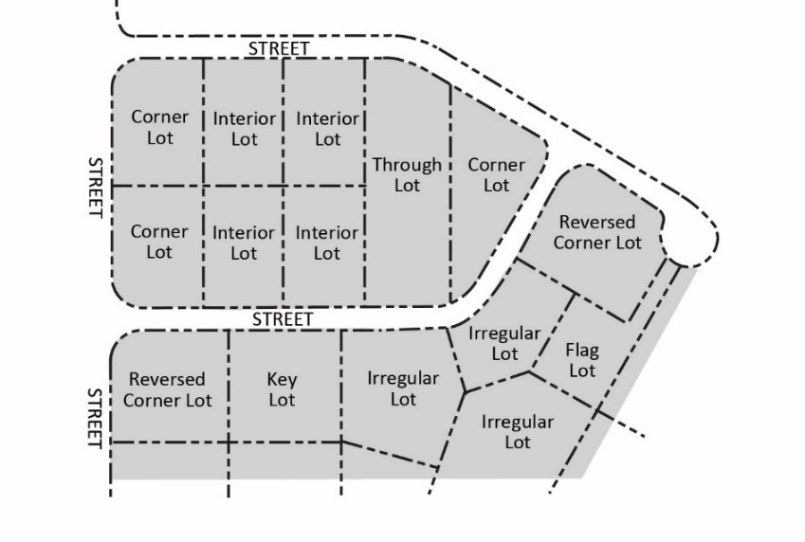
Lot Dimensions. The linear measurements of a parcel of land.
Lot Area. The total horizontal area within the lot lines of a lot.
Lot Depth. The horizontal distance between the front and rear lot lines, see Section A.6.030 (Measuring Lot Width and Depth).
Lot Width. The horizontal distance between the side lot lines, see Section A.6.030 (Measuring Lot Width and Depth).
Lot Lines. The boundary between a lot and other property or the public right-of-way.
Front Lot Line. On an interior lot, the line separating the lot from the street. On a corner lot, the shorter lot line abutting a street. On a through lot, the lot line abutting the street providing the primary access to the lot. On a flag lot, the interior lot line most parallel to and nearest the street from which access is obtained.
Interior Lot Line. Any lot line that is not adjacent to a street.
Rear Lot Line. The lot line that is opposite and most distant from the front lot line. Where no lot line is within 45 degrees of being parallel to the front lot line, a line 10 feet in length within the lot, parallel to and at the maximum possible distance from the front lot line, will be deemed the rear lot line for establishing the minimum rear setback.
FIGURE E.2-2: REAR LOT LINES, IRREGULAR LOTS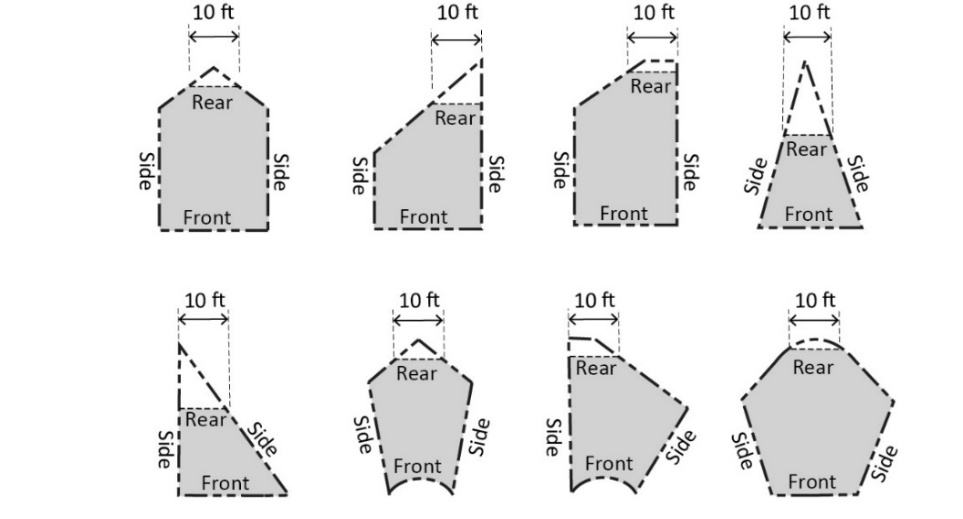
Side Lot Line. Any lot line that is not a front or rear lot line.
Street Side Lot Line. A side lot line of a corner lot that is adjacent to a street.
FIGURE E.2-3: LOT LINE TYPES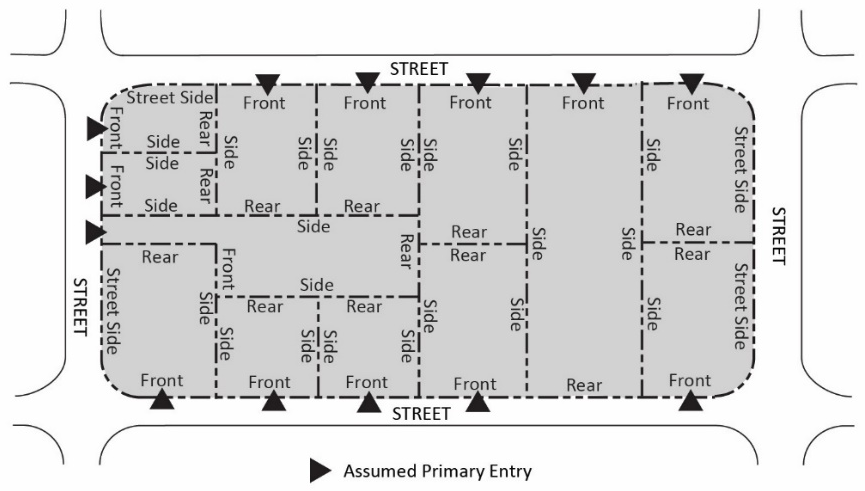
Lumen. The unit used to measure the actual amount of light which is produced by a light source.
Main Building. See "building, principal."
Major Street. A street having four or more vehicle travel lanes.
Manufacturing. The preparation, making, treatment, or processing of articles as merchandise.
Massage Establishment Terms.
Act. The Massage Therapy Act (Business and Professions Code section 4600, et seq.), as amended.
California Massage Therapy Council (CAMTC). California Massage Therapy Council established under California Business and Professions Code section 4602.
Certified Massage Practitioner or Massage Practitioner. A person who is currently certified as a massage practitioner by the CAMTC in accordance with California Business and Professions Code section 4604.1 and/or 4604.2.
Certified Massage Therapist or Massage Therapist. A person who is currently certified as a massage therapist by the CAMTC in compliance with California Business and Professions Code section 4604.
Compensation. The payment, loan, advance, donation, contribution, deposit, exchange, or gift of money or anything of value. In addition to accepting other forms of compensation, a person may be deemed to have received compensation for performing a massage when the massage is offered as part of a membership, as part of a package of services or as incidental to the purchase of a product.
Employee. Any person hired by a massage establishment who renders any service for the business/owner in exchange for any form of compensation from the business, including independent contractors.
Managing Officer/Employee. A person that can or does have or share ultimate control over the day-today operations of a business.
Massage. Any method of treating the external parts of the body, usually with the hands, so as to stimulate circulation and make muscles or joints supple, or relieve tension, for remedial, or health purposes offered in return for any form of compensation. Methods of massage include, but are not limited to, stroking, kneading, rubbing, tapping, pounding, or stimulating the external parts of the body with or without the aid of any mechanical or electrical apparatus or appliances. Massage may occur with or without supplementary aids such as rubbing alcohol, liniments, antiseptics, oils, powders, creams, lotions, ointments, or with or without other similar preparations commonly used in this practice or by baths, including but not limited to: Turkish, Russian, Swedish, Japanese, vapor, shower, electric tub, sponge, mineral, fomentation, or any other type of bath. Massage includes the application of various manipulation or touch techniques to the muscular structure and soft tissues of the human body as defined in the Act, California Business and Professions Code section 4601(e), and recognized as legitimate by CAMTC.
Massage Technician. Includes both a massage practitioner and a massage therapist.
Off-Premises Massage Service. Any business where a function of such business is to engage in or carry on massage, not at a fixed location but at a location designated by the customer, massage technician, or other person, and sometimes known as an out-call massage service.
Owner. Any individual who has any direct or indirect ownership interest in a massage establishment.
Sole Provider. A massage business where the owner owns 100 percent of the business, is the only person who provides massage for compensation at or for that business, and has no other employees, independent contractors or rent-space massage therapists.
Micromobility Device. A small, lightweight vehicle operating at a speed typically below 15 miles per hour and driven by the individual user, such as bicycles, e-bikes, and electric scooters.
Mixed Use Development. A development that consists of vertical or horizontal combination of residential and nonresidential uses within a single building or site.
Mobile Home. A transportable structure designed to be used as a dwelling unit when connected to required utilities, as defined by California Health and Safety Code section 18008.
Mulch. Any organic material such as leaves, bark, straw, compost, or inorganic mineral materials such as rocks, gravel, or decomposed granite, left loose and applied to the soil surface for the beneficial purposes of reducing evaporation, suppressing weeds, moderating soil temperature, and preventing soil erosion.
Natural Land Slope. The average slope of a lot in the "H" Hillside Combining District in percent, see Section B.22.030 (Maximum Allowable Densities and Minimum Lot Sizes).
Natural Person. An individual and living human being, as opposed to a legal person which may be a private (e.g., business entity or non-governmental organization) or public (i.e., government) entity.
Nonconforming Building. A building or structure, or portion of a building or structure, lawfully existing and built in compliance with all City land use and zoning laws in effect at the time, and which does not comply with current standards in this Title, including but not limited to height, setbacks, floor area ratio, or maximum lot coverage.
Nonconforming Use. Any use of land or property that was lawfully established pursuant to all applicable ordinances and laws at the time the use commenced, but which, due to the application of this Title or any amendment thereto, no longer complies with all of the applicable regulations and standards of the zone in which the use is located.
Occupation. A principal business, profession, or vocation in which one is regularly and habitually engaged for the purpose of compensation for a livelihood.
Openwork Design. Comprised of materials which results in a certain percentage of visual transparency within every square foot area, posts excluded.
Operator. A natural person who is the owner, lessee, or owner's agent to act on the owner's behalf to ensure compliance with this Title.
Outdoor Dining Area. Any outdoor area serving as an extension of the indoor customer seating area for a café or restaurant, which occupies space adjacent to the business that was formerly used for vehicle parking, pedestrian circulation, or similar use unrelated to the seating or customers.
Outdoor Music. Live music, both acoustic and amplified, including live individual musicians, bands, and disc jockeys (DJs), but not including karaoke, that takes place on a patio or other outdoor space. Outdoor music as defined and regulated in this Title shall also include recorded background music played outdoors at a public establishment such as a restaurant, bar, retail store, or other business.
Owner/Occupant. Any person owning property, as shown on the last equalized assessment roll for City taxes, or the lessee tenant, or other person having control or possession of the property.
Parade. An organized group marching in procession on a street. Parades do not include races, runs or other athletic events (i.e., a physical or endurance activity such as races, runs, walkathons, bicycle tours, or similar events).
Parcel. A legal lot of record.
Parking Space, Bicycle. A space dedicated to the parking of bicycles that typically includes supports to which the bicycle may be attached.
Parking Space, Vehicle. A space within a building or a private or public parking area for the parking of one vehicle.
Parkway. The area between a sidewalk and the curb or traffic lane. It may be planted or unplanted, and with or without pedestrian egress.
Partially-Shielded Light Fixture. See "light fixture, partially-shielded."
Paseo. A mall designed and used for pedestrian passage, including adjacent sidewalks, between two or more parallel streets and which is owned or controlled by the City.
Patio. A surfaced area (concrete, brick, stone, asphalt, pavers, or similar materials) for recreational outdoor living use, not for vehicular parking purposes.
Patio Cover. A one-story roofed structure open on one or more sides (provided, however, that the open sides may be closed with insect or plastic screening that is permeable material and not in any manner that would obstruct the free passage of light or air) used for recreational, outdoor living purposes only and not as carports, storage rooms, or habitable rooms.
Permittee. A person, company, corporation, or entity that has been issued a permit including owner(s) or lessee(s) of property or their agent(s), or person(s) who have contracted to purchase property contingent upon their ability to acquire the necessary permits under this Title, or the agent(s) of such persons, and all successors in interest.
Person. Any individual, partnership, joint venture, association, social club, fraternal organization, company, joint stock association, corporation, estate, trust, organization, business, business trust, public agency, school district, the State of California and its political subdivisions or instrumentalities, receiver, syndicate or any group or combination thereof, acting as a unit, including any trustee, receiver, or assignee.
Pervious. Any surface or material that allows the passage of water through the material and into the underlying soil.
Plaza. A public square or similar open area, including adjacent sidewalks, which is owned or controlled by the City.
Primary Use. The primary purpose for which a building, structure, or lot is designed, arranged, or intended, or for which they may be used, occupied, or maintained under this Title.
Principal Building. See "building, principal."
Private Residence. See "residence, private."
Property. All real property and fixtures, including, but not limited to, parking lots, sidewalks, gutters, driveways, walkways, and any building and structure located on such property.
Public Right-of-Way. As defined in Milpitas Municipal Code Section V-500-1.13 (Public Right-of-Way) of the Milpitas Municipal Code, the full width of the right-of-way of any street, as defined in the California Vehicle Code used by the general public, whether or not such street has been accepted as and declared to be part of the City system of streets, including streets forming a part of the State Highway System. Public right-of-way also includes easements where the City is the grantee of the easement and property owned by the City of Milpitas or the Milpitas Redevelopment Agency and any public park, trail, or right-of-way within the City of Milpitas.
Public Transit. As defined in California Government Code section 66313(l), a location, including, but not limited to, a bus stop or train station, where the public may access buses, trains, subways, and other forms of transportation that charge set fares, run on fixed routes, and are available to the public. Examples include, but are not limited to, Altamont Commuter Express (ACE), Bay Area Rapid Transit (BART), Alameda-Contra Costa (AC) Transit, Valley Transportation Authority (VTA) bus service and light rail, and paratransit.
Public Works Director. The Director of the Public Works Department of the City of Milpitas or designee.
Recreational Area. Areas, excluding private single-family residential areas, designated for active play, recreation or public assembly in parks, sports fields, picnic grounds, amphitheaters, or golf courses . Also, "recreation area."
Recyclable Material. Reusable material including but not limited to metals, glass, plastic and paper, which are intended for reuse, remanufacture, or reconstitution for the purpose of using the altered form. Recyclable material does not include refuse or hazardous materials. Recyclable material may include used motor oil collected and transported in accordance with the California Health and Safety Code.
Recycled Water. Treated or recycled wastewater of a quality suitable for non-potable uses such as landscape irrigation and water features, but not intended for human consumption.
Residence, Private. A house, an apartment unit, accessory dwelling unit, a mobile home, or other similar dwelling occupied for residential purposes.
Review Authority. The body or City staff person responsible for making decisions on zoning and related applications.
Setback. The distance between a property line and a building or structure that must be kept clear or open, except for the encroachments specifically permitted by this Title. See also Section A.6.060 (Measuring Setbacks).
Front Setback. The area extending the full width of the lot as measured from, and perpendicular to, a front lot line.
Interior Side Setback. The area extending from a front setback line to a rear setback line as measured from, and perpendicular to, an interior lot line.
Street Side Setback. The area extending from a front setback line to a rear setback line as measured from, and perpendicular to, a street side lot line.
Rear Setback. The area extending the full width of the lot as measured from, and perpendicular to, a rear lot line. Also see "lot lines" (rear lot line).
Slope. See "natural land slope."
Special Event. Any indoor or outdoor event that consists of any combination of the following:
1. A parade or assembly consisting of persons, animals, and/or vehicles, which is intended to assemble or travel in unison on any street, and which does not comply with applicable traffic regulations, laws, or controls.
2. An organized assemblage of persons at a plaza, park, or paseo, gathered for a common purpose under the direction or control of a person or organization.
3. An activity which involves blocking off a street or other use of a street which obstructs the normal street traffic.
4. An activity or event on a public right-of-way, plaza, paseo, park, or private property which involves:
• The placement or erection of equipment or temporary structures, including but not limited to a booth, tent, canopy, stage, barricade, fencing, generator, heating equipment, sound amplifier, vehicle, or float;
• The use of live animals, fireworks, pyrotechnics, electrical power and/or cabling, or equipment or materials that can create a risk of damage to public or private property or injury to persons;
• Cooking or the sale, preparation for sale or commercial distribution of food or beverages; or
• The sale of commercial merchandise, excluding commercial special events and sales consistent with C.10.230.D.4 (Commercial Special Events and Sales).
5. Examples of Special Events include, but are not limited to, concerts, parades, carnivals, fairs, festivals, block parties, public dances, street fairs, community events, sporting or athletic events, parties, meals, mobile food vending events, celebrations, and receptions.
Special Event Venue. The outdoor area for which a Special Event Permit has been issued.
Specific Plan. A detailed plan for the development of a specific area as described in California Government Code section 65450. Specific plans are a tool to implement the General Plan. A specific plan documents the proposed distribution, location, extent and intensity of major components of public and private transportation, sewage, water, drainage, solid waste disposal, energy, parks, and other essential facilities proposed to be located within or needed to support the land uses described in the plan, as well as implementation and financing methods and added benefits to the City and the community.
Story. That portion of a building included between the surface of any floor and the surface of the floor next above it, or if there is no floor above it, then the space between such floor and ceiling next above it.
Street. A permanently reserved thoroughfare which affords principal means of access to abutting property.
Structural Alteration. Any change which would tend to prolong the life of the supporting members of a building or structure, such as bearing walls, columns, beams, or girders.
Structure. Anything constructed or erected, which requires location on the ground or is attached to something having a location on the ground.
Turf. A groundcover surface of mowed grass. Turf may be natural (e.g., annual bluegrass, Kentucky bluegrass, perennial ryegrass, Bermudagrass, Kikuyu grass, seashore Paspalum) or synthetic.
Two-unit Project. The development of two primary dwelling units or, if there is already a primary dwelling unit on the lot, the development of a second primary dwelling unit on a legally subdivided lot. Also known as an "SB 9 unit" (see California Government Code section 65852.21).
Universal Design. An environment, or dwelling unit, designed and built to be accessed and used by all persons, regardless of ability or mobility.
Usable Open Space. Any outdoor open space, consistent with Section C.2.090 (Open Space), and which is not used as storage or for movement of motor vehicles.
Urban Lot Split. The subdivision of an existing, legally subdivided lot into two lots as allowed by Milpitas Municipal Code Section XI-1-31 (Urban Lot Splits).
Use. The purpose for which land or a building is arranged, designed or intended, or for which either land or building is or may be occupied or maintained.
Use, Allowed. See "allowed use."
Use, Primary. See "primary use."
Valley Transportation Authority (VTA). The Santa Clara Valley Transportation Authority.
Vehicle Parking Space. See "parking space, vehicle."
Walkway. A created surface, such as brick, stone, concrete, asphalt, pavers or similar material, intended to facilitate pedestrian or bicycle passage, and not used for vehicular parking purposes.
Wireless Telecommunications Terms.
Antenna. Any system of wires, poles, rods, reflecting discs, or similar devices used for the transmission or reception of electromagnetic waves when such system is operated or operating from a fixed location.
Base Station. A structure or equipment at a fixed location that enables FCC-licensed or authorized wireless communications between user equipment and a communications network. The term does not encompass a tower as defined in this subpart or any equipment associated with a tower.
• The term includes, but is not limited to, equipment associated with wireless communications services such as private, broadcast, and public safety services, as well as unlicensed wireless services and fixed wireless services such as microwave backhaul.
• The term includes, but is not limited to, radio transceivers, antennas, coaxial or fiber-optic cable, regular and backup power supplies, and comparable equipment, regardless of technological configuration (including distributed antenna systems and small-cell networks).
• The term includes any structure other than a tower that, at the time the relevant application is filed with the state or local government, supports or houses equipment described above that has been reviewed and approved under the applicable zoning or siting process, or under another state or local regulatory review process, even if the structure was not built for the sole or primary purpose of providing the support.
• The term does not include any structure that, at the time the relevant application is filed with the state or local government, does not support or house equipment described in above.
Colocation. Mounting or installing a wireless telecommunication facility on a pre-existing structure; and/or modifying a structure for the purpose of mounting or installing a wireless telecommunications facility on that structure. For the purposes of eligible facilities requests, colocation means the mounting or installation of transmission equipment on an existing tower or base station.
Commercial Wireless Communication Facility. A wireless communication facility operated by a for-profit business or for-profit purposes.
Eligible Facilities Request. Any request for modification of an existing tower or base station that does not substantially change the physical dimensions of such tower or base station, involving:
• Colocation of new transmission equipment;
• Removal of transmission equipment; or
• Replacement of transmission equipment.
Fixed Wireless Signal. Any commercial non-broadcast communications signals transmitted via wireless technology to and/or from a fixed customer location. Fixed wireless signals do not include, among other things, AM radio, FM radio, amateur ("HAM") radio, CB radio, and Digital Audio Radio Service (DARS) signals.
Hub or Relay Antenna. Any antenna that is used to receive or transmit fixed wireless signals for the distribution of fixed wireless services to multiple customer locations as long as the antenna serves a customer on whose premises it is located but excludes any hub or relay antenna that is used to provide any telecommunications services or services that are provided on a commingled basis with telecommunications services.
Lattice Tower. A type of tower; a three- or more-legged structure designed and erected on the ground to support wireless telecommunication antennas and connecting appurtenances.
Monopole. A type of tower; a structure of single pole (non-lattice) design and erected on the ground to support wireless telecommunications antennas and connecting appurtenances.
Noncommercial Wireless Communication Facility. A wireless communication facility operated by a government agency, a nonprofit organization, a for-profit business for nonprofit purposes or a private citizen for personal use. This use includes all amateur radio facilities.
Satellite Dish or Non-Satellite Dish. A sub-type of antenna incorporating a reflective surface that is solid, open mesh, or bar configured that is shallow dish, cone, horn, or cornucopia shaped, and is used to transmit and/or receive electromagnetic signals. This definition is meant to include, but is not limited to, what are commonly referred to as satellite earth stations, Television Receive Only (TVROs), and satellite microwave antennas.
Small Wireless Facilities. Facilities that meet each of the following conditions:
• The facilities:
- Are mounted on structures 50 feet or less in height including their antennas as defined in this Section;
- Are mounted on structures no more than 10 percent taller than other adjacent structures; or
- Do not extend existing structures on which they are located to a height of more than 50 feet or by more than 10 percent, whichever is greater;
• Each antenna associated with the deployment, excluding associated antenna equipment (as defined in the definition of antenna), is no more than three cubic feet in volume;
• All other wireless equipment associated with the structure, including the wireless equipment associated with the antenna and any pre-existing associated equipment on the structure, is no more than 28 cubic feet in volume;
• The facilities do not require antenna structure registration under 47 C.F.R. section 17.4;
• The facilities are not located on Tribal lands, as defined under 36 C.F.R. section 800.16(x); and
• The facilities do not result in human exposure to radiofrequency radiation in excess of the applicable safety standards specified in 47 C.F.R. section 1.1307(b).
Stealth Design. Improvements or treatments added to a wireless telecommunication facility which are intended to make the facility look like something other than a wireless tower or base station or to mask or blend the proposed facility into the existing structure or visual backdrop, in such a manner as to render it minimally visible to the casual observer.
Stealth Wireless Communications Facility. Any antenna that is designed to be architecturally integrated into a building and is architecturally consistent with the building design. Examples include a steeple, cupola or tower element on a building and do not include flag poles, monopoles or other structures designed to house antenna and resemble natural features.
Telecommunication Facility, Major. A communication facility that, due to size, scale, location, or other characteristics, is likely to have some detectable impact on adjacent uses or on the environment, including aesthetic or visual impacts, or that may have a cumulative impact citywide or on the regional environment due to the number of sites included or in combination with other projects. This definition includes freestanding antenna structures, including monopoles and towers, or the placement of a network of wireless communication facilities throughout an area onto existing structures, or other facilities which, as determined by the Director, warrant this classification.
Telecommunication Facility, Minor. A communication facility which by its size, scale, location, design, or combination of such measures, allows the facility to be aesthetically integrated into the surrounding environment so as not to be readily seen or recognized as a communication facility and is not likely to have some detectable impact on adjacent uses or on the environment.
Tower. Any structure built for the sole or primary purpose of supporting any FCC-licensed or authorized antennas and their associated facilities, including structures that are constructed for wireless communications services including, but not limited to, private, broadcast, and public safety services, as well as unlicensed wireless services and fixed wireless services such as microwave backhaul, and the associated site.
Yard. See "setback."
Zone. A specifically delineated area in the city within which regulations and requirements in this Title uniformly govern the use, placement, spacing, and size of land and buildings.
Zoning Administrator. The person designated to perform the duties and exercise the powers of the Zoning Administrator as set forth in this Title, or designee.
(Ord. No. 38.858, § 4, 9/2/25)
Chapter E.4 - DEFINITIONS OF USES
This Chapter provides definitions for all uses established in the use tables in Part XIII-B (Zone Regulations).
Accessory Dwelling Unit (ADU). As defined by California Government Code section 66313, an ADU is an attached or a detached residential dwelling unit that provides complete independent living facilities for one or more persons and is located on a lot with a proposed or existing primary residence. An ADU also includes an efficiency unit as defined in California Health and Safety Code section 17958.1 and a manufactured home as defined by California Health and Safety Code section 18007.
Accessory Dwelling Unit, Junior (JADU). A type of accessory dwelling unit defined by California Government Code section 66313 as a residential unit that is consistent with the following:
• Is no more than 500 square feet in size;
• Is contained entirely within an existing or proposed single-family structure;
• Includes its own separate sanitation facilities or shares sanitation facilities with the existing or proposed primary dwelling; and
• Includes an efficiency kitchen.
Accessory Use. A use that is customarily associated with, and is incidental and subordinate to, the primary use and located on the same lot as the primary use.
Adult-Oriented Business. See "adult-oriented business terms" in Chapter E.2 (Definitions of Terms).
Advanced Manufacturing. The use of innovative technologies to create existing and new products or to improve products and processes. Advanced manufacturing focuses on the rapid transfer of science and technology into production activities and may incorporate high technology elements such as information, automation, computation, software, sensing, artificial intelligence, machine learning, and networking. Advanced manufacturing may include storage space for raw materials and/or finished goods that actively supports the primary use.
Agriculture. See "cultivated agriculture."
Agricultural Processing Plant, Commercial. Facility that transforms, processes, and packages livestock or livestock products, or agricultural commodities, into goods that are used for intermediate or final consumption including goods for nonfood use. Includes animal slaughter.
Agricultural Supply Sales. An establishment or place of business primarily engaged in the retail or wholesale sale from the premises of farm supply, feed, grain, fertilizers, pesticides, and similar goods as well as the provision of agriculturally related services with incidental storage on a lot other than where the service is rendered.
Alcoholic Beverage Sales. Any beverage sales use that includes the sale of alcoholic beverages for off-premise consumption. This includes retail sales of liquor, beer, wine, and spirits and can be combined with a retail sales establishment such as a grocery store or convenience store, or it can be a stand-alone liquor store or wine shop.
Animal Husbandry. The care and raising of large livestock, including horses, cattle, swine, goats, sheep, alpacas, and similar animals. This includes any animal-related production uses incidental to the foregoing, such as grazing, grooming, shearing, and milking, but excludes animal slaughter, meat cutting and packing, stockyards or the commercial feeding of garbage or offal to swine or other animals.
Assembly. See "community assembly."
Auto Broker. An auto dealer or auto buying service as defined in California Vehicle Code section 166, who engages in the business of arranging, negotiating, assisting, or effectuating the purchase of a new or used motor vehicle, not owned by the dealer, on behalf of another. This use is limited to office work and does not include storage or parking of vehicles onsite.
Bank and Credit Union. Financial institutions, including federally-chartered banks, savings associations, industrial loan companies, and credit unions that provide retail banking services to individuals and businesses. Includes only those institutions engaged in the on-site circulation of money, and whose deposits are insured by the state or federal government and/or a state or federal sponsored entity, including credit unions.
Bar or Nightclub. Businesses serving beverages for consumption on the premises as a primary use, including serving alcohol such as beer, wine, and spirits. Dancing and live entertainment may also be conducted within the establishment. This use does not include microbreweries. See "food preparation" for tasting rooms that are accessory and subordinate to a brewery, winery, or distillery.
Bed and Breakfast. A residential property with one or more bedrooms dedicated to rental for a fee for overnight lodging of periods of 30 consecutive days or fewer and where meals may be provided to guests. A bed and breakfast is typically either owner-occupied or has the manager or proprietor of the lodging business living on the premises. This use type excludes short-term rentals.
Boarding House. An establishment where housing is provided for compensation, generally for stays of more than 30 days, for up to eight persons. Boarding houses typically have individual rooms for guests, shared bathroom facilities, and a single common kitchen. Meals may be served for guests and included as part of the cost of lodging.
Breweries, Distilleries, and Wineries. An establishment engaged in the brewing, distilling, and production of beer, wine, or other spirits. Tasting rooms that are accessory and subordinate to a brewery, winery, or distillery may be included in this use. This use does not include microbreweries.
Business and Professional Office. Offices of firms or organizations providing professional, executive, business, management, or administrative services, including but not limited to accounting, architectural, computer software design, engineering, consulting, graphic design, insurance, interior design, real estate, legal, and tax preparations offices. Also includes co-working spaces designed to accommodate individuals and organizations that provide such services.
Business Support Services. Establishments primarily within structures that provide other businesses with ancillary services that further or facilitate the other businesses' primary activity, including but not limited to commercial art and design (production); copying and quick-printing services; equipment rental businesses within structures; janitorial services; mailbox rentals; mail advertising services (reproduction and shipping); outdoor advertising services; protective services (other than office-related); rental, repairs and distribution of office or business equipment; and window cleaning.
Caretaker's Residence. A dwelling unit occupied by employees or caretakers of the primary use on the site.
Cemetery. Land used for the burial of the dead and dedicated for cemetery purposes, including crematories, mausoleums, and mortuaries only when operated in conjunction with and within the boundary of such cemetery.
Check Cashing Business. Establishments that, for compensation, engage in the business of cashing checks, warrants, drafts, money orders, or other commercial paper serving the same purpose. This classification also includes the business of deferred deposits, whereby the check casher refrains from depositing a personal check written by a customer until a specific date pursuant to a written agreement as provided in Civil Code section 1789.33. Check cashing businesses do not include state or federally chartered banks, savings associations, credit unions, or industrial loan companies. They also do not include retail sellers engaged primarily in the business of selling consumer goods, such as consumables to retail buyers, that cash checks or issue money order incidental to their main purpose or business.
Child Care Center. Establishments providing non-medical care for children on a less than 24-hour basis other than large/small family child care homes. This classification includes licensed nursery schools, preschools, and day care facilities for children, and any other day care facility licensed by the State of California. This use does not include after school program, summer camp, and tutoring facilities.
Civic/Government. Governmental facilities not otherwise included in other land use types, such as court facilities and post offices, together with storage and maintenance of City and public agency vehicles.
Collection Facility. A center for the acceptance, by donation, redemption, or purchase, of recyclable materials from the public where limited sorting and storing of such items is conducted on-site.
College/University, Private. A private college or university, excluding trade or vocational schools.
Commercial Athletic Facility. A facility for physical fitness training or athletic type games and sports, such as but not limited to, health clubs, tennis, gymnasiums, handball courts, racquetball courts; also including ancillary uses when incidental to the primary use, such as but not limited to, steam baths, weight training, aerobic classes, massage, saunas, and the retailing of athletic supplies to be used in the facility.
Commercial Fueling Facility. See "fueling facility, commercial."
Commissary or Catering. A fixed-location kitchen where food is stored and prepared for off-site vending or delivery. Commissaries may include shared-use commercial kitchens, private commercial kitchens, restaurant kitchens, and kitchens associated with civic and community organizations such as churches or social clubs. Also, includes catering service establishments.
Community Assembly. A facility for public or private meetings including clubs and lodges, community centers, senior centers, religious assembly facilities, convention centers, civic and private auditoriums, union halls, meeting halls for clubs and other membership organizations. This includes functionally related facilities for the use of members and attendees such as kitchens, multi-purpose rooms, and storage. It does not include gymnasiums or other sports facilities (see indoor sports and recreation) or facilities such as day care centers and schools, which are separately defined.
Major. Community assembly use that is over 2,000 gross square feet and has capacity for more than 200 seats.
Minor. Community assembly use that is 2,000 gross square feet or less and has capacity for no more than 200 seats.
Community Garden. Use of land for the cultivation, growing and harvesting of vegetables, herbs, flowers, and fruits, including the cultivation and tillage of soil and the production, cultivation, growing, and harvesting of any agricultural, floricultural, or horticultural commodity. Community gardens are typically owned and operated by public or non-profit agencies, and each garden plot is used and kept by an individual or a household. Excludes animal keeping or animal husbandry.
Construction Yard and Equipment Rental. Storage of construction materials or equipment on a site other than a construction site. Includes rental of large construction equipment and machinery. This classification may include parking/storage of contractor vehicles.
Convenience Store. A retail establishment selling food, beverages, and small convenience items such as personal hygiene products, cigarettes, magazines, and other everyday consumer items. Food and beverage products sold primarily consist of packaged and canned goods, prepared foods and hot drinks for immediate consumption, fountain beverages, etc., with less than 10 percent of net retail floor area allocated for the sale of fresh fruits, fresh vegetables, fresh meat and dairy products, and other similar perishable items. Convenience stores are smaller in floor area than supermarkets/grocery stores (typically 4,000 square feet or less) and have long or late hours of operation (open before 7:00 a.m. or after 10:00 p.m.).
Correctional Facility. A facility where people are held, generally as punishment for various crimes. This includes the detention/incarceration of people awaiting trial and/or who have been convicted of civil or criminal offenses; inmates and detainees under 24-hour supervision by the California Department of Corrections and Rehabilitation; and juvenile detention facilities. This use also includes parole offices.
Court Dwelling. See "dwelling, court."
Cultivated Agriculture. The planting, growing, and harvesting of crops or plants, or the preparation of land for this purpose, of more than one-half acre of land for viticulture, horticulture, pasturage, floriculture, or similar farming where a crop or final product is produced (but not necessarily offered for sale) for consumption. This use excludes community gardens.
Custom and Artisan Manufacturing. An establishment primarily engaged in on-site production of goods by hand manufacturing or artistic endeavor, which involves only the use of hand tools or small mechanical equipment and the incidental direct sale to consumers of only those goods produced on site. Includes, but is not limited to metalworking, pottery and ceramic studios, film processing, photo finishing, printmaking, lithography, glass furnace, or woodworking.
Data Center. A facility dedicated to the storage of computer and information technology systems and associated components for the storage, retrieval, and transmittal of electronic information.
Drive-Through Facility. A motor vehicle drive-through facility which is a commercial building or structure or portion thereof which is designed and/or used to provide goods and services to drivers while they remain seated in their vehicles. It includes, but is not limited to, banks and other financial institutions, fast food establishments, and pharmacies, but shall not include drive-in movies, service stations, or car wash operations.
Dwelling, Court. A residential development in which there are several freestanding single-family or two-family dwellings with separate walls clustered on a single lot. Units are typically arranged to face around a common open space or drive aisle. If subdivided, a maintenance agreement or homeowners association may govern common areas like driveways or open space.
Dwelling, Multi-Family. A building containing three or more dwelling units.
Dwelling, Single-Family. A dwelling unit designed for occupancy by one household, where all rooms are internally connected and internally accessible via habitable space, located on a separate lot from any other unit (except accessory dwelling units, where permitted), and have only one kitchen. This includes individual manufactured housing units installed on a foundation system pursuant to California Health and Safety Code section 18551, and the use of a single-family residential structure as employee housing for six or fewer employees consistent with California Health and Safety Code section 17021.5.
Dwelling, Two-Family. A residential building containing two dwelling units, both of which are located on a single parcel. The dwelling units are attached and may be located on separate floors or side-by-side. Excludes accessory dwelling units (see "accessory dwelling unit").
Elderly and Long-term Care. Establishment that provides 24-hour medical, convalescent, or chronic care to individuals who, by reason of advanced age, chronic illness or infirmity, are unable to care for themselves, and is licensed by the California Department of Public Health. Includes, but is not limited to skilled nursing facilities, rest homes, and convalescent hospitals. Does not include a residential care facility or hospital.
Emergency Shelter. Housing with minimal supportive services for homeless persons that is limited to occupancy of six months or less by a homeless person. No individual or household may be denied emergency shelter because of an inability to pay as set forth in the California Health and Safety Code section 50801(e), as may be amended.
Employee/Farmworker Housing. As described in California Health and Safety Code section 17021.6 and 17008, any employee housing consisting of no more than 36 beds in a group quarters or 12 units or spaces designed for use by a single family or household.
Family Child Care Home, Large. As defined by Health and Safety Code section 1596.78, a home in which the provider regularly provides care, protection, and supervision for up to 14 children for less than 24 hours per day.
Family Child Care Home, Small. As defined by Health and Safety Code section 1596.78, a home in which the provider regularly provides care, protection, and supervision for eight or fewer children for less than 24 hours per day.
Farmers' Market. An establishment offering for sale produce, prepared food items, and other artisan/craft goods and merchandise by certified growers and producers authorized to sell, directly to consumers, products that are produced on land the producer controls or taken in consignment from other producers. Excludes flea markets.
Firearms Dealer. An establishment engaged in the selling, dealing in, trading, or transferring firearms.
Fleet-Based Service. Passenger transportation services, local delivery services, medical transport, and other businesses that rely on fleets of three or more vehicles. This includes parking, dispatching, and offices for taxicab and limousine operations, ambulance services, non-emergency medical transport, home cleaning services, pedicab services, and similar businesses. This does not include towing operations (see "vehicle storage"), taxi or delivery services with two or fewer fleet vehicles on-site (see "business support services"), facilities that handle third party goods for local or worldwide delivery (see "freight and trucking yard") or last mile parcel processing/redistribution facilities (see "parcel hub").
Food and Beverage Processing and Preparation. Cooking, processing, packaging, bottling, and shipping of food products and/or non-alcoholic beverages for off-site sales. This does not include breweries, wineries, and distilleries; the slaughtering of live animals; or large-scale operations (see "commercial agricultural processing plant").
Freight and Trucking Yard. Facilities that handle third party goods for local or worldwide freight, courier, local messenger, and postal services by truck or rail. This includes fulfillment centers and parcel sorting centers, which provide storage and distribution of e-commerce products to consumers or end-users, either directly or through a parcel hub.
Fueling Facility, Commercial. A fueling facility designed for commercial customers which dispenses gasoline, diesel, or similar vehicle fuels, and which is not open to the general public, has no cash sales and provides no personal services on-site. This excludes mobile fueling.
Funeral Parlor and Mortuary. An establishment primarily engaged in the provision of services involving the care, preparation, or disposition of human remains and conducting memorial services. Typical uses include a crematory or mortuary. This use does not include cemeteries.
Grocery Store, Large. Retail establishments that primarily sell food, but also may sell other convenience and household goods, and may include a delicatessen or specialty food shop, baked goods, frozen foods, fruits, vegetables, meats, cheeses, dairy, and prepared food, and which occupy more than 25,000 square feet of gross floor area, but not more than 80,000 square feet of gross floor area.
Grocery Store, Small. Retail establishments with gross floor area less than 25,000 square feet that primarily sell food products, such as fresh fruits and vegetables, meats and seafood, dairy products, baked goods, packaged and prepared foods, and frozen foods, but that may also sell other convenience and household goods. May also include a delicatessen or other specialty food shop.
Group Living Accommodation. A building or portion of a building designed for or accommodating a residential use by persons not living together as a household. This use includes dormitories, convents and monasteries, and other types of organizational housing. This use does not include residential care facilities, nursing homes, hotels, single-room occupancy residences, or boarding houses, which are defined separately. Group living accommodations typically provide shared living quarters without separate kitchen or bathroom facilities for each room or unit.
Guest Ranch. Short-term lodging provided to visitors on property where agricultural activities take place (e.g., animal husbandry, cultivated agriculture) and that is not considered to be another lodging uses.
Home Occupation. A commercial use conducted on residential property by the inhabitants of the subject residence, which is incidental and secondary to the residential use of the dwelling.
Hospital. A state-licensed facility providing medical, psychiatric, or surgical services for sick or injured persons primarily on an in-patient basis, and including ancillary facilities for outpatient and emergency treatment, diagnostic services, training, research, administration, and services to patients, employees, or visitors.
Hotel. A commercial establishment providing lodging accommodations for a fee for transient guests, generally for stays of 30 days or fewer, with access to rooms or units primarily from interior lobbies, courts or halls. A hotel may include limited facilities for storage and preparation of food and beverages within individual rooms, such as coffee makers, mini refrigerators and microwave ovens.
Indoor Entertainment. Predominantly spectator uses conducted within an enclosed building. Typical uses include movie theaters, enclosed sports arenas, live performing arts venues, escape rooms, and video game activities and competitions such as e-sports.
Indoor Sports and Recreation. Predominantly participant sports conducted within an enclosed building. Typical uses include indoor bowling alleys, billiard parlors, ice and roller skating rinks, go-kart tracks, indoor shooting ranges, and trampoline parks. Excludes operations where activities are primarily class- or appointment-based such as yoga studios and personal trainers.
Industry, General. Manufacturing of products from extracted or raw materials or recycled or secondary materials, or bulk storage and handling of such products and materials, where operations are conducted primarily within an enclosed building. Includes, but is not limited to operations such as biomass energy conversion; textile mills; furniture and related product manufacturing; photographic processing plants; leather and allied product manufacturing; wood product manufacturing; paper manufacturing; plastics and rubber products manufacturing; and nonmetallic mineral product manufacturing.
Industry, Heavy. Manufacturing of products that include petroleum products, metals and/or metal processing, and hazardous chemicals. Includes automobile assembly and manufacturing and tire retreading or recapping.
Industry, Light. Establishments engaged in light industrial activities taking place primarily within enclosed buildings and producing minimal impacts on nearby properties. Includes, but is not limited to, operations such as manufacturing finished parts or products primarily from previously prepared materials; commercial laundries and dry cleaning plants; mobile home manufacturing; monument works; printing, engraving and publishing; electronics manufacturing not included under advanced manufacturing; and production apparel manufacturing.
Instruction Services. An establishment that offers specialized programs in improvement, information, and personal growth and development such as photography, fine arts, crafts, music, yoga, martial arts, dance, driving schools, health and wellness, and academic tutoring. Attendance is typically limited to hourly classes rather than full-day instruction. These establishments do not grant diplomas or degrees, though instruction may provide credits for diplomas or degrees granted by other institutions. Retail sales are permitted as an accessory use.
Group. Group instruction includes 10 or more students or clients at any one time.
Private/Small Group. Private instruction includes fewer than 10 students or clients at any one time.
Intermediate Processing Facility. A facility that receives, sorts, compresses or bales, and stores recyclable materials for efficient transfer to other processing facilities or to an end user.
Junior Accessory Dwelling Unit. See "accessory dwelling unit, junior."
Kennel. Facilities for keeping, boarding, training, breeding, or maintaining for commercial purposes, four or more dogs, cats, or other household pets more than four months of age and not owned by the kennel owner or operator for 24 hours or more.
Large Format Retail. Retail establishments over 80,000 square feet in size that sell merchandise and/or bulk goods primarily for individual consumption, including, but not limited to, department stores, home improvement stores, membership warehouses which emphasize bulk sales to the general public as well as to other businesses, and other big box format stores. Large format retail uses may include a grocery store sales component. Excludes home improvement stores with outdoor nursery or garden centers (see nursery and garden center).
Library/Museum. Public or quasi-public facilities primarily engaged in the display or preservation of objects of interest in the arts or sciences that are open to the public on a regular basis. Includes, but is not limited to aquariums, arboretums, art galleries and exhibitions, botanical gardens, historic sites and exhibits, libraries, and museums. May also include accessory retail uses such as gift/book shops, and restaurants.
Live-Work Unit. An integrated housing unit and working space that has been constructed for such use or converted from commercial or industrial use and structurally modified to accommodate residential occupancy and work activity in compliance with the California Building Code. Living space includes, but is not limited to, a sleeping area, a food preparation area, and a full bathroom. The working space is reserved for and regularly used by one or more occupants of the unit.
Low Barrier Navigation Center. Consistent with California Government Code section 65660, a service-enriched shelter focused on moving people into permanent housing that provides temporary living facilities while case managers connect individuals experiencing homelessness to income, public benefits, health, shelter, and housing services.
Maintenance and Repair Services. Establishments engaged in the maintenance or repair of office machines, household appliances, furniture, and similar large items. This classification excludes maintenance and repair of vehicles or boats (see vehicle repair and maintenance) and personal items such as apparel, shoes, and jewelry (see Repair/Cleaning/General Services, Small).
Massage Establishment. Any establishment having a fixed place of business where any person, firm, association, partnership, corporation, or other entity engages in, conducts, or carries on, or permits to be engaged in, conducted or carried on, any massage for compensation. Also includes, but is not limited to, any business providing off-premises massage services.
Massage Establishment, Accessory. An establishment that provides massage which is incidental to the primary business, where the owner of the primary business is responsible for the massage services and conduct of the massage technician(s) employed at the location.
Medical Office/Clinic. Office use providing consultation, diagnosis, therapeutic, preventive, or corrective medical treatment services by doctors, dentists, chiropractors, optometrists, psychotherapists, alternative healing practitioners such as acupuncturists, and similar practitioners of medical and healing arts for humans licensed for such practice by the State of California. Incidental medical and/or dental laboratories and research within the office that supports the on-site patient services is considered part of the office use. This use includes urgent care facilities. Excludes independent research laboratory facilities and hospitals (see medical support laboratory and see hospital).
Medical Support Laboratory. A facility for scientific laboratory analysis of medical resources. The analysis is generally performed for medical providers to support the medical provider's work on behalf of patients.
Microbreweries. A limited production brewery where beer is brewed, sold, and consumed on site and meets all applicable California Department of Alcoholic Beverage Control regulations. This use includes tasting rooms where alcoholic beverages are sold and consumed on site. Food service is subordinate to the sale of alcoholic beverages.
Mini-Storage or Self-Storage. Facilities offering enclosed storage with individual access for personal affects, furniture, and household goods. Typical provided in small individual units (e.g., 400 square feet or less) that are available for rental by the general public.
Mining and Quarrying. An operation that extracts gravel, sand, other construction aggregates, or minerals from the ground. Includes quarries and gravel pits.
Mobile Food Vending. The selling or offering to sell products from a mobile food vehicle, which includes the following uses:
Ice Cream Truck. A motorized vehicle selling ice cream or other frozen dairy or non-dairy dessert products on streets and in other public places.
Mobile Food Park. Site with two or more mobile food vehicles located together on the same parcel and operating at the same time for more than seven consecutive days.
Mobile Food Vending (Individual Vehicle). A motorized, wheeled vehicle or towed vehicle designed and equipped to store, prepare, serve and sell food, but which does not include ice cream trucks or mobile food vending wagons or pushcarts as regulated in Milpitas Municipal Code Subsection V-100-10.11 (Unlawful Parking—Peddlers, Vendors).
Mobile Fueling. A commercial service that offers on-demand fueling of motor vehicles at a specified location instead of at a service station. Mobile fueling may be provided to individual customers via the use of a mobile app, with fuel delivered to a home, office, or other location requested by the customer. Mobile fueling may also be provided for operators of fleet vehicles at a fixed, semi-permanent or permanent location.
Mobile Home Park. A development designed for and occupied by manufactured/mobile housing units consistent with the requirements of California Health and Safety Code section 18200 to 18700. A mobile home park includes facilities and amenities used in common by occupants who rent, lease, or own spaces for mobile home units/spaces through a subdivision, cooperative, condominium, or other form of resident ownership.
Motel. A building or group of attached or detached buildings providing lodging accommodations for a fee for transient guests, for stays of 30 days or fewer, with access to each room or unit through an exterior door. Motels are distinguished from hotels primarily in that the former provide direct independent access to, and adjoining parking for, guest rooms and do not provide 24-hour guest services.
Multi-Family Dwelling. See "dwelling, multi-family."
Nursery and Garden Center. An establishment primarily engaged in selling nursery and garden products, such as trees, shrubs, plants, seeds, bulbs, and sod that are predominantly grown offsite. This classification includes commercial and wholesale greenhouses and nurseries offering plants for sale.
Outdoor Entertainment. Predominantly spectator uses conducted in open or partially enclosed or screened facilities. Typical uses include outdoor theaters, partially enclosed sports arenas, racing facilities, outdoor concert facilities, amphitheaters, drive-in movie theaters, aquatic parks, and amusement parks.
Outdoor Sports and Recreation. Predominantly participant sports conducted in open or partially enclosed or screened facilities. Typical uses include commercial driving ranges, outdoor shooting and/or archery ranges, miniature golf courses, golf courses, outdoor go-karts, swimming pools, and tennis courts. This use excludes public golf courses, public swimming pools, and public tennis court or other public sport court facilities (e.g., basketball, pickleball, etc.) (see "park/playground"); and excludes common recreational facilities as accessory to a multi-family residential project or use.
Parcel Hub. A 'last mile' facility warehouse or similar establishment for the processing and/or redistribution of parcels or products to end-user customers. A parcel hub's primary function is moving a shipment from one mode of transport to vehicles with rated capacities less than 10,000 pounds, for delivery directly to consumers or end-users primarily within a 10-mile radius.
Park/Playground. Parks, playgrounds, trails, wildlife preserves, and related open spaces. This includes public playing fields, sports courts, picnic facilities, and related food concessions or community recreational buildings and structures.
Parking Lot. Open parking area(s) provided on property other than a public street, alley, or right-of-way that is the primary use on the lot (i.e., the parking lot is not providing the required off-street parking for land uses on the lot). May include park and ride lots. Use of the parking lot may be subject to a fee.
Parking Structure. A building or structure containing parking spaces that is the primary use on the lot (i.e., the parking structure is not providing the required off-street parking for land uses on the lot). May be located above or below grade, and use of the parking structure may be subject to a fee. May include park and ride structures.
Pawnbroker. A place of business where personal property is received and for which money is advanced, with the right of privilege granted to the person to whom said money is advanced to reclaim such property upon repayment of said money.
Personal Services. A commercial establishment which provides services of a personal or aesthetic nature directly to consumers, including but not limited to barber and beauty shops, nail salons, tanning salons, hair removal salons, tattoo and body piercing studios, spa/wellness center (excluding massage establishments), medical spas, and personal trainers.
Pet Day Care and Sales. Facilities for providing non-medical care for four or more dogs, cats, or other household pets not owned by the pet day care owner or operator, included but not limited to grooming services, on a less than 24-hour basis. This use includes retail sales of household pets and pet supplies, but excludes pet supply stores that do not sell animals or provide on-site animal services. Also excludes home-based pet day care services for a fee, such as dog walking services.
Primary Processing Facility. A facility that processes recyclable materials and acts as a final destination for recyclable materials.
Public Safety. Facilities providing public safety and emergency response services, including police and fire protection, with incidental storage, training, and maintenance facilities.
Public Utility. Facilities for the production, storage, treatment, transmission and/or distribution of electricity, natural gas, water, wastewater, and telecommunications and other similar essential services. Also includes service facilities, electric transmission and distribution substations, and public utility service centers.
Repair/Cleaning/General Services, Small. A commercial establishment that performs cleaning, repair, and alteration of small consumer and household items, including but not limited to dry cleaning pick-up stores without equipment that uses chemical solvents, laundromats (self-service laundries), photocopying and photo finishing services, tailor shops, watch and jewelry repair, shoe repair, home electronics repair, and locksmiths. Does not include repair of vehicles or boats (see vehicle repair and maintenance), personal services (see personal services), or maintenance and repair of large or bulky items (see maintenance and repair services).
Research and Development (R & D). Industrial or scientific research for the design, development, engineering and testing of high technology, clean technology, industrial, or scientific products. May include limited manufacturing as necessary for the production of prototypes, but excludes the full-scale manufacturing of final products. May also include storage space for raw materials and/or finished goods that actively supports the primary use.
Residential Care Facility. Consistent with Health and Safety Code section 1502, a facility licensed by the State of California to provide living accommodations and 24-hour care for persons requiring personal services, supervision, protection, or assistance for sustaining the activities of daily living. Living accommodations are group homes or shared living quarters with or without separate kitchen or bathroom facilities for each room or unit. This classification includes facilities that are operated for profit as well as those operated by public or not-for-profit institutions.
Resilience Hub. A community-serving facility designed to support residents and coordinate resource distribution and services before, during, or after a natural hazard event. Resilience hubs provide information as well as services and supplies, including but not limited to community gathering space, emergency supplies, basic medical care, internet access, and electronic device charging. They are typically outfitted with a solar and back-up battery storage system that can operate off the power grid and maintain power to the facility during grid outages.
Restaurant, Full Service. Restaurants that provide cooked-to-order food and beverage services to patrons who order and are served while seated and pay after eating. Takeout service may also be provided.
Restaurant, Limited Service. Establishments where food and beverages may be consumed on the premises, taken out, or delivered, but where no table service is provided. This includes, but is not limited to cafeterias, fast-food restaurants, carryout sandwich shops, limited-service pizza parlors and delivery shops, self-service restaurants, snack bars, and takeout restaurants. This use includes cafes, coffee shops, and bakeries with a retail storefront component.
Restaurant with Alcohol Service. Either a limited service restaurant that includes beer and wine service for on-site consumption and/or has a separate bar area; or a full service restaurant that includes liquor service for on-site consumption, and/or has a separate bar area.
Retail, Limited. An establishment which offers the sale of a limited line of merchandise that is generally necessary or desirable for everyday living or everyday business activities. Examples include small grocery stores offering primarily prepared or pre-packaged food and beverage items, small drugstores and variety stores, small stationery, office supply stores, shops selling other small household goods, and walk-out retail stores. This classification excludes convenience stores.
Retail Stores, General Merchandise. The retail sale or rental of merchandise not specifically listed under another use definition. This includes department stores, clothing stores, furniture stores, pharmacies, pet supply stores, flower shops (florist), art supply stores, music stores, book stores, and other businesses retailing (or renting) toys, hobby materials, handcrafted items, formalwear, music equipment and instruments, jewelry, cameras, candy, gifts and novelties, electronic equipment, sporting goods, hardware, appliances, antiques, art, paint and wallpaper, carpeting and floor covering, office supplies, bicycles, and new automotive parts and accessories, excluding vehicle service and installation (see vehicle repair and maintenance). Excludes large format retail and other sales-related uses more specifically described in other use definitions.
Riding Academy and Public Stables. Stables leased for the keeping of horses which may also include areas for horse riding and horse riding lessons.
Salvage and Wrecking. The dismantling of wrecked or decommissioned vehicles, appliances, or other metal products where usable parts are sold for use in operating vehicles and the unusable metal parts are sold to metal-recycling companies.
School, Private. A private institution of learning for students offering instruction in those courses of study required by the California Education Code and maintained in compliance with the standards set by the State Board of Education. This use includes kindergarten, elementary school, middle or junior high school, or high school.
School, Public. A public institution of learning for students offering instruction in those courses of study required by the California Education Code and maintained in compliance with the standards set by the State Board of Education. This use includes kindergarten, elementary school, middle or junior high school, and high school.
Service Station. Any premises used for supplying automotive fuel and oil at retail, direct to the customer, including minor accessories and services for automobiles such as tire air pumps and window washing, but not including automobile repairs.
Short-Term Rental (STR). The use of a dwelling unit, including, without limitation, a single-family, two-family, or multi-family dwelling unit, mobile home, or any portion of such dwellings, rented for occupancy for dwelling, lodging, or sleeping purposes for a period of 30 or fewer calendar days, counting portions of days as full calendar days.
Single-Family Dwelling. See "dwelling, single-family."
Single-Room Occupancy (SRO) Residence. A multi-tenant building consisting of single room dwelling units that are the primary residence of its occupants, containing either individual or shared kitchen and bathroom facilities. These units are small, generally less than 350 square feet.
Smoke/Tobacco Shop. A retail establishment primarily engaged in the selling of smoking and tobacco products and accessories, and other products, devices and components reasonably assumed to be used for smoking and/or the inhalation or ingestion of any substances. Tobacco products may include but are not limited to cigarettes, cigars, loose leaf tobacco, tobacco pipes, electronic smoking devices and accessories, vaporizers and accessories and any other product, device or component used in the inhalation of tobacco, nicotine or other substance. For the purposes of this definition only, "primarily engaged" means when 30 percent or more of products sold at the retail establishment are smoking and tobacco products and accessories, and other products, devices and components reasonably assumed to be used for smoking and/or the inhalation or ingestion of any substance.
Supportive Housing. Consistent with California Health and Safety Code section 50675.14, housing with no limit on length of stay, that is occupied by the target population as defined in U.S.C. section 11302 of Title 42, and that is linked to on-site or off-site services that assist the supportive housing resident in retaining the housing, improving their health status, and maximizing their ability to live and, when possible, work in the community.
Temporary Use. A use established for a specified period of time, with the intent to discontinue the use at the end of the designated time period.
Trade and Vocational School. An establishment where postsecondary education or training is received in a trade or craft, business, commerce, language, or other similar activity or occupational pursuit that is not otherwise described as a college/university, school, or instruction services. This use includes culinary schools.
Transitional Housing. Consistent with California Government Code section 65582, buildings configured as rental housing developments but operated under program requirements that require the termination of assistance and recirculating of the assisted unit to another eligible program recipient at a predetermined future point in time that shall be no less than six months from the beginning of the assistance.
Transportation Passenger Terminal/Facility. Facilities for passenger transportation operations, including rail stations, bus terminals, and associated service facilities, but does not include terminals serving airports or heliports.
Two-Family Dwelling. See "dwelling, two-family."
Vehicle Rental. Establishment providing for the rental of automobiles. Includes rental of passenger vehicles and light trucks/vans under 14,000 pounds and incidental repair/servicing and cleaning of rental vehicles. This use does not include car-sharing operations.
Vehicle Repair and Maintenance, Major. Repair of automobiles, trucks, motorcycles, motor homes, boats and recreational vehicles, including the sale, installation, and servicing of related equipment and parts. This classification includes the servicing and repair of engines, body and fender, transmission, axels, wheels and brake, tire sales and installation, tire treading and recapping, and vehicle painting. Excludes vehicle dismantling or salvaging (see "salvage and wrecking") and tire retreading or recapping (see "industry, heavy"). All activities listed under Vehicle Repair and Maintenance, Minor may also be included in major uses.
Vehicle Repair and Maintenance, Minor. The service and repair of automobiles, light-duty trucks, boats, and motorcycles, including the sale, installation, and servicing of related equipment and parts. This classification includes the replacement of small automotive parts and liquids as an accessory use to an automotive accessories and supply store, and quick-service oil, tune-up and brake and muffler shops, auto glass sales and replacement, window tinting, stereo and alarm sales, and tire sales where repairs are made or service provided in enclosed bays and no vehicles are stored overnight. This classification excludes disassembly, removal or replacement of major components such as engines, drive trains, transmissions or axles; automotive body and fender work, vehicle painting or other operations that generate excessive noise, objectionable odors, or hazardous materials, and repair of heavy trucks, limousines, or construction vehicles (see "vehicle repair and maintenance, major"). It also excludes towing services (see "vehicle storage") and fueling stations (see "service station").
Vehicle Sales and Leasing. Sale or lease, retail or wholesale, of automobiles, light trucks, motorcycles, motor homes, and trailers, together with associated incidental repair services and parts sales, but excluding body repair and painting. Includes, but is not limited to, automobile dealers and recreational vehicle sales agencies.
Vehicle Sales, Limited. A small-format showroom for the retail sale of automobiles and light trucks, typically within a retail storefront setting. Uses can include storage of no more than five vehicles onsite for display and/or test driving, which may be stored either indoors or outdoors on the same lot. Incidental vehicle repair services and parts sales are not permitted.
Vehicle Storage. The use of a site for the short-or long-term storage of automobiles, trucks, motorcycles, and/or other vehicles. Includes towing and impound lots.
Vehicle Washing. Washing, waxing, detailing, and/or cleaning of automobiles or similar light vehicles, including self-serve washing facilities.
Veterinary Clinic. Medical care for household pets on a commercial basis with no overnight (24-hour) accommodation of animals.
Veterinary Hospital or Services. Medical care for household pets on a commercial basis with 24-hour accommodation of animals, but does not include kennels. Also includes overnight (24-hour) accommodation of small animals for grooming services.
Warehousing and Distribution. A facility, primarily within an enclosed building, for the storage of commercial or industrial goods, products and materials and the associated on-site sorting, packing, staging, shipping, receiving, and distributing of goods to wholesale and retail outlets, including ancillary truck parking and dispatching. Also includes long-term, passive storage of furniture, household goods, or other commercial goods; and of industrial equipment, products, and materials. Warehousing and distribution facilities may include, but are not limited to, wholesale distribution, distribution centers, moving and transfer storage, cross-dock facilities, package handling centers, order fulfilment centers, and logistics centers. Excludes storage of raw materials and/or finished products as part of an active primary use (e.g., advanced manufacturing uses; general industry uses; light industry uses; research and development uses). Excludes parcel hubs.
Wholesale Sales. The selling and/or distributing of merchandise to retailers; industrial, commercial, or institutional buyers; or other wholesalers; or acting as agents or brokers in the buying and selling of merchandise to or for such entities.
Wireless Telecommunications Facility. A facility that transmits and/or receives electromagnetic signals. It includes antennas, microwave dishes, horns, and other types of equipment for the transmission or receipt of such signals, equipment, switches, wiring, cabling, power sources, shelters or cabinets associated with an antenna, telecommunication towers or similar structures supporting the equipment, equipment buildings, parking area and other accessory development. Also see wireless telecommunications terms in Chapter E.2 (Definitions of Terms).
(Ord. No. 38.858, § 4, 9/2/25)
Chapter E.6 - DEFINITIONS OF SIGN TERMS
This Chapter provides definitions for signs referred to in Chapter C.8 (Signs).
Abandoned Sign. A sign that identifies a business, lessor, owner, product, service, or activity that is no longer on the premises where the sign is displayed.
Changeable Copy. A portion of a permanent sign that is designed so that characters, letters, numbers, or illustrations can be manually or mechanically changed or rearranged without altering the face or surface of the sign.
Flag. A fabric sheet of square, rectangular, or triangular shape that is typically mounted on a pole.
Fluorescent Colors. The range of colors created through a synthetic pigmentation process in which ultraviolet light is absorbed and emitted at a different range within the color spectrum of the individual colors.
Freestanding. A permanent sign that is erected or mounted on its own self-supporting permanent structure or base detached from any supporting elements of a building.
Impact Resistive Plastic. Any plastic material capable of resisting 50 foot pounds of force as tested in accordance with American National Standards Institute (ANSI) and Underwriters Laboratory (UL) 972 Multiple Impact Test or any similar test procedure.
Incidental Sign. A sign which provides incidental information, including security, credit card acceptance, business hours, open/closed, directions to services and facilities, or menus.
Light-Emitting Diode (LED). A semiconductor diode that emits light when a voltage is applied to it.
Logo. A stylized group of letters, words, numbers, or symbols used to represent and distinguish a business or product.
Neon. An illumination source created when a glass tube filled with neon or other similar gas emits light when energized. The tube can be bent to form letters, symbols, or other shapes.
Pan Channel Letters. A specific type of permanent sign letter consisting of a metal pan enclosure fabricated in the shape of a letter. The metal pan enclosure is used to house the lighting and electrical components of the letter and can be mounted directly to wall of a building. The sign face is usually made of colored plastic attached to the metal pan to seal it off from pests and harsh weather.
Pan Channel Letters, Reverse. A specific type of sign letter consisting of a metal pan enclosure fabricated in the shape of a letter, numeral, or other shape in which the metal pan enclosure is used to house the lighting and electrical components of the letter and can be mounted directly to a wall. The sign face is made of the same solid opaque materials as the sides of the letters so that the front and sides of the sign letters do not emit light (e.g., halo-lit or reverse-lit signs).
Raceway. A metal electrical enclosure that forms a physical pathway for electrical wiring and components. An electric-sign raceway may serve as a visible mounting structure for a wall sign attached to the front of a storefront fascia.
Sign. A structure, device, figure, display, message placard, or other contrivance, or any part thereof, situated outdoors or indoors, which is designed, constructed, intended, or used to advertise, provide information in the nature of advertising, provide historical, cultural, archeological, ideological, political, religious, or social information, or direct or attract attention to an object, person, institution, business, product, service, message, event, or location by any means, including words, letters, figures, designs, symbols, fixtures, colors, or illumination.
Permanent Sign. A sign constructed of durable materials and intended to exist for the duration of time that the use or occupant is located on the premises.
Awning Sign. Any permanent sign that is part of or attached to an awning, or other fabric, plastic or structural protective cover located over a door, entrance, window, storefront, or outdoor service area.
Billboard Sign. A permanent, large format advertising displays or signs intended for viewing from extended distances, generally more than 50 feet.
Blade Sign. A permanent sign mounted to the wall of building by means of a bracket and which is typically hung perpendicular to the wall of the building.
Canopy Sign. A permanent sign that is painted on or mounted to a canopy, typically used to accent building entries.
Directional Sign. A permanent sign erected to inform the viewer of the approximate route, direction, or location of a facility or tenant.
Directory Sign. A permanent sign on a multi-tenant site or building providing information including a list of tenants and occupants, addresses, and suite numbers or a map of the building or complex. These signs are typically internal to a site and oriented to pedestrians or motorists circulating in a parking lot rather than vehicles travelling on a public street.
Electronic Message Sign. A permanent sign or portion of a sign that utilizes computer-generated messages or some other electronic means of changing its characters, letters, numbers, illustrations, display, color, and/or light intensity, including animated graphics and video, by electronic or automatic means. A single- or two-color LED sign is not an electronic message sign.
Monument Sign. A permanent freestanding sign, with a solid base that is at least 60 percent of than the width of the sign face.
Post Sign. A permanent sign mounted on either a single post or two or more posts.
Projecting Sign. A permanent sign that is perpendicular to the face of a building and projects outward from the building face.
Service Station Island Canopy Sign. A permanent sign mounted on or under a service station island canopy, including on a fascia.
Wall Sign. A permanent sign attached directly to an exterior wall or fascia of a building or structure, with the exposed face of the sign parallel to the plane of the wall or the fascia to which it is attached.
Window Sign, Permanent. A permanent sign posted, painted, placed, or affixed in, on, or within a window, or otherwise exposed to public view through a window. Also see "window sign, temporary."
Portable Sign. A sign not permanently attached to the ground, a building, structure, or other immovable object.
A-Frame or Upright Sign. A portable pedestrian-oriented sign constructed with two sides that is self-supported.
Feather Banner. A portable sign that is taller than it is wide and made of a flexible material (typically cloth, nylon, or vinyl) and mounted to a pole.
Sign Walker. A person attired or decorated with insignia, images, costumes, masks, or other symbols that display messages with the purpose of drawing attention to or advertising for an on-premise activity. Such person may or may not be holding a sign. Sign walkers may be also referred to as human mascots, sign spinners, or human signs.
Window Sign, Temporary. A temporary sign posted, painted, placed, or affixed in, on, or within a window, or otherwise exposed to public view through a window.
Yard Sign, Type I. A small portable sign typically constructed of corrugated plastic and supported on an H-shaped wire frame.
Temporary Sign. A sign intended for limited period of display which is not permanently affixed to a structure or window.
Balloon Sign. A temporary sign that is an air inflated object, which may be of various shapes, made of flexible fabric, resting on the ground or a structure, and equipped with a portable blower motor that provides a constant flow of air into the device. Balloon signs are restrained, attached or held in place by a cord, rope, cable, or similar method. See also the definition for air-activated graphics.
Banner Sign. A temporary sign constructed of cloth, bunting, plastic, paper, or similar material and securely attached to a wall or support structure. Flags are not considered temporary banners.
Yard Sign, Type II. A temporary sign mounted on a single post installed securely in the ground with a small sign hanging from a cross-bar mounted parallel to the ground.
Yard Sign, Type III. A temporary sign that is large and typically wooden which is mounted on two posts installed securely in the ground.
Sign Program. A specific set of design standards established for the purpose of unifying the design and appearance of a variety of signs associated with a multi-tenant or multi-use project, building, or complex of buildings.
Sign Projection. The distance by which a sign extends over public property or beyond the building line.
Sign Surface. The surface of the sign upon, against or through which the message is displayed or illustrated.
(Ord. No. 38.858, § 4, 9/2/25)

