


Milpitas City Zoning Code
SECTION 9
Metro Area Zones and Standards
XI-10-9.01 - Purpose and Intent
A.
Metro Multi-Family High Density Residential ("R3-Metro") Zoning District. The purpose of the R3-Metro zoning district is to create and enhance high-density residential areas (densities in the range of 30 to 40 dwelling units per acre) characterized by a mix of multi-family unit types and small-scale neighborhood businesses where appropriate. The R3-Metro zone implements the Multi-Family High Density Residential (MFH) land use designation as described in the Metro Specific Plan.
B.
Metro Multi-Family Very High Density Residential ("R4-Metro") Zoning District. The purpose of the R4-Metro zoning district is to create and enhance very high-density residential areas (densities in the range of 40 to 85 dwelling units per acre) characterized by low- and mid-rise multi-family residential buildings and compatible commercial uses where appropriate. The "R4" District is intended to provide for higher-density residential "villages" structured around transit stations, streets, creek side open spaces, trails and parks. The R4-Metro zone implements the Multi-Family Very High Density Residential (VHD) land use designation as described in the Metro Specific Plan.
C.
Metro Urban Residential ("R5-Metro") Zoning District. The purpose of the R5-Metro zoning district is to create and enhance very high-density residential areas (densities in the range of 70-120 dwelling units per acre) characterized by high-rise residential buildings and compatible commercial uses structured around transit stations. The R5-Metro zone implements the Urban Residential (URR) land use designation as described in the Metro Specific Plan.
D.
Metro High Density Mixed Use ("MXD2-Metro") Zoning District. The purpose of the MXD2-Metro zoning district is to create and enhance areas with a mix of retail, restaurant, entertainment, and commercial service uses on the ground floor and residential or office uses on upper stories, while maintaining a pedestrian-oriented streetscape (mixed-use FARs in the range of 1.0 to 2.5 and residential densities in the range of 40 to 85 dwelling units per acre). It is intended that the required active ground floor uses will ensure neighborhood-oriented retail and services are provided within walking distance of high-density residential development. The MXD2-Metro zone implements the Residential Retail Mixed Use (RRMU) land use designation as described in the Metro Specific Plan.
E.
Metro Very High Density Mixed Use ("MXD3-Metro") Zoning District. The purpose of the MXD3-Metro zoning district is to create and enhance urban areas characterized by a mix of very-high density housing, retail and employment uses (mixed-use FARs in the range of 2.5 to 5.0 and residential densities in the range of 85 to 250 dwelling units per acre). The MXD3-Metro zone implements the Boulevard Very High Density Mixed Use (BVMU) land use designation as described in the Metro Specific Plan.
F.
Metro Business Park Research and Development, Limited Residential; (BPRD-R-Metro) Zone. The purpose of the BPRD-R-Metro zoning district is to designate specific areas of the city as important employment centers, especially for jobs in the high-tech industry, with limited, integrated residential development (mixed-use FARs in the range of 1.0 to 5.0). The BPRD-R-Metro zone is intended to accommodate business parks, high-intensity office buildings, advanced manufacturing, other light industrial uses, and limited residential uses. It also enables the integration and growth of research and development, office, and light manufacturing uses on consolidated sites with supportive ancillary uses, typically on the ground floor, such as restaurants, health/fitness centers, limited retail, and child care facilities. The BPRD-R-Metro zone implements the Business Park Research and Development, Limited Residential (BPRD-H) land use designations as described in the Metro Specific Plan.
G.
Metro Business Park Research and Development (BPRD-Metro) Zone. The purpose of the BPRD-Metro zoning district is to designate specific areas of the city as important employment centers, especially for jobs in the high-tech industry (FARs in the range of 1.0 to 2.5, with additional FAR up to 4.0 for properties within 1,000 feet of the Milpitas Transit Center). The BPRD-Metro zone is intended to accommodate business parks, high-intensity office buildings, advanced manufacturing, and other light industrial uses, and to enable the integration and growth of research and development, office, and light manufacturing uses on consolidated sites with supportive ancillary uses, typically on the ground floor, such as restaurants, health/fitness centers, limited retail, and child care facilities. The BPRD-Metro zone implements the Business Park Research and Development (BPRD) land use designation as described in the Metro Specific Plan.
(Ord. No. 38.855, § 7, 6/18/24)
XI-10-9.02 - Metro Area General Use Regulations
A.
Permitted and Conditionally Permitted Uses.
1.
Primary uses. The uses identified in Table XI-10-9.02-1, Metro Area Zone Uses, shall be the primary uses allowed to occur on a property. All uses except for those noted shall be conducted within enclosed structures. The primary uses identified in Table XI-10-9.02-1 shall be permitted or conditionally permitted, as indicated:
B.
Prohibited Uses. The following uses are prohibited:
1.
Uses where the symbol "NP" appears within Table XI-10-9.02-1.
2.
The following uses are not permitted in any Metro zone:
a.
Adult Businesses as defined in Subsection 13.04, Adult Businesses, of this Chapter.
b.
Disinfecting and extermination business.
c.
Outdoor storage of vehicles.
d.
Private self-storage facilities.
e.
Drive through uses (restaurants, pharmacies, etc.).
C.
Mixed Use Development. Where a single parcel is proposed for development with two or more of the land uses listed in Table 9.02-1, Metro Area Zone Uses at the same time, the overall project will be subject to the permit with the highest level of review required by the Table for any individual use.
D.
Residential uses on Activity Streets and Neighborhood Streets. Residential units are not allowed on the ground floor facing any right-of-way designated as an Activity Street or Neighborhood Street by the Metro Specific Plan Figure 4-6, unless allowed by Subsection 9-05.B. Other residential spaces such as lobbies and common areas are permitted on the ground floor facing an Activity Street in accordance with Table XI-10-9.02-1.
E.
Other Uses. Any other uses may be considered by the Planning Commission that are similar in accordance with the procedure, prescribed in Subsection 10-54.02, Other Uses Permitted by Commission, of this Chapter.
Table XI-10-9.02-1
Metro Area Zone Uses
1 Limited to accessory use that supports primary employment-generating uses on the same site. Accessory commercial uses such as restaurants and limited retail shall be located on the ground floor and in an area of the development where they can be directly accessed by the public.
2 When located on the ground floor, retail sales of products related to the Personal Services provided shall be offered at the front of the premises near the pedestrian entrance and shall comprise at least 10 percent of the floor area of the business establishment.
3 No exterior display or advertising and such activities are conducted in spaces which are integral parts of a main building.
4 Allowed with an MCS when an accessory use to any permitted or conditionally permitted medical office, medical clinic, chiropractor practice, acupuncture practice, physical therapist, fitness and athletic facility, health care facility (such as hospitals, nursing homes and sanitariums), and accredited school, college, and university. Massage services, limited to massage of the head, neck, shoulders, hands and feet may be allowed with an MCS when an accessory use to any permitted or conditionally permitted beauty salon, barbershop, and healing art practices. This section shall not exempt any person or business from complying with all the provisions of Title III, Chapter 6.
5 A Conditional Use Permit is required for storage space that exceeds 25,000 square feet, and in no case may storage space exceed 300,000 square feet.
6 The raising of animals or fowl for commercial purposes and the sale of any products at retail on the premises is not allowed.
7 For uses owned and operated by a government agency. The approval process will require that the site be re-zoned to POS.
8 Allowed non-residential uses to be specified through the Conditional Use Permit process.
9 Indoor or outdoor music is permitted as an accessory use on the same parcel in conjunction with a restaurant or bar that is a principal permitted use or approved conditional use. See also Subsection XI-10-9.03(E)(6) for additional regulations.
10 Permitted when located on the ground floor facing a public street designated as an Activity Street. Requires a Conditional Use Permit when located elsewhere.
11 "Other live entertainment" Includes but is not limited to dancing, stand-up comedy, theatrical shows, magic shows, and karaoke.
12 Bicycle and auto rental agency, excluding commercial vehicles, trucks, buses, vans, boats and RV rentals, must be fully enclosed within a building.
13 Mobile fueling is permitted when fueling service is ordered by an individual vehicle owner and the amount of fuel dispensed as part of any individual order does not exceed 50 gallons. Mobile fueling for fleet vehicles is not permitted.
(Ord. No. 38.855, § 7, 6/18/24)
XI-10-9.03 - Metro Area Special Use Regulations
A.
Personal services, convenience stores, grocery stores, retail, repair and cleaning services, private and group instruction, and financial institutions within R3-Metro, R4-Metro and R5-Metro zones may be permitted provided they are:
1.
Less than or equal to 10,000 square feet in gross floor area;
2.
Not open past 10:00 p.m.;
3.
Conducted wholly within a building, except for approved outdoor seating areas;
4.
Not specifically noted in Table XI-10-9.02-1, Metro Zone Uses, of this Chapter, requiring Conditional Use Permit approval; and
5.
Not listed as a prohibited use in Section XI-10-9.02(B), Prohibited Uses, of this Chapter.
If items (1) through (3), above, are not met, then approval of a Conditional Use Permit is required in accordance with Section 10-57.04 of this Chapter.
B.
Quasi-Public Uses. The following uses may be permitted within the MXD2-Metro and MXD3-Metro zones provided their location is first approved by the Planning staff, the Zoning Administrator, or the Planning Commission (as applicable), in accordance with Subsection 57.04, Conditional Use Permits and Minor Conditional Use Permits, of this Chapter, and they are not located within 1,000 feet of the parcel boundary of another quasi-public use listed below. This distance shall be measured from the property line of the parcel where such use is located.
1.
Places of meeting or assembly, such as auditoriums, banquet halls, and fraternal or union halls. Churches and religious institutions are exempt from this spatial requirement.
2.
Private elementary, middle or high schools.
3.
Vocational schools, if not found objectionable due to noise, odor, vibration or other similar health, safety and welfare basis.
C.
Performance Standards for Certain Uses. For uses requiring approval of a Minor Conditional Use Permit by staff, in accordance with Section 10-57.04, Conditional Use Permits and Minor Conditional Use Permits, of this Chapter, the following performance standards below shall be met.
1.
The following uses may not be located within 1,000 feet of another same use listed below. This distance shall be measured from the property line of the parcel where such use is located.
a.
Vehicle Related Uses.
b.
Transportation facilities without outdoor storage of vehicles.
c.
Pawnshops.
2.
Auto Brokers. Auto Brokers are subject to the following standards:
a.
Local Sales and Use Tax. In order to assist the City of Milpitas in its efforts to receive direct distribution of the local tax on materials associated with the project, the California Sales and Use Tax (the "Local Tax") shall be allocated to the project site, to the extent reasonably possible. Evidence of tax allocation or cause as to why such allocation cannot be made shall be submitted at the time of business license submittal.
3.
Art and Artisans Studios shall comply with the following standards:
a.
All operations shall be conducted completely within an enclosed building.
b.
There shall be no dust, fume, or odor either emitted from the premise.
c.
The operations shall not create excessive vibrations.
d.
The operations shall be consistent with the City's noise standards.
4.
Outdoor Music in the MXD2-Metro and MXD3-Metro zones:
a.
Outdoor music as an accessory use in conjunction with a restaurant or bar shall be permitted for the entertainment and enjoyment of customers at the restaurant or bar during regular operating hours. Outdoor music as an accessory use shall be limited to the hours of 9:00 a.m. to 11:00 p.m.
b.
Recorded background music may be permitted outdoors on public sidewalks and other public areas subject to the standards of this Chapter and Title V - Public Health, Safety and Welfare, Chapter 213 - Noise Abatement.
c.
Noise levels for outdoor music, when permitted as an accessory use to a restaurant or bar, shall not exceed a maximum range of 70 to 90 decibels (dB). See also Title V - Public Health, Safety and Welfare, Subsections V-213-2 and V-213-3, for additional regulations.
d.
Larger outdoor music events, both live and recorded music, which are intended for the entertainment and enjoyment of the general public shall not be considered accessory uses and shall require a Special Event Permit pursuant to Section 15, Special Events and Activities, of this Chapter.
e.
Minor outdoor music events, both live and recorded music, which are hosted onsite by a business with nine or fewer employees shall be exempt from applicable permit and fee requirements.
5.
Restaurant Performance Standards. Restaurants shall comply with the following performance standards:
a.
Outdoor seating is allowed if it has been approved as part of the facility's Minor Site Development Permit or Site Development Permit and is operated in conformance with any conditions of that approval.
b.
Outdoor dining shall comply with the standards of Section 10-13.19 - Outdoor Dining.
c.
The restaurant shall comply with the City Council's Guidelines for Recycling Enclosures (Resolution No. 6296).
d.
The restaurant shall incorporate measures to reduce odors to acceptable levels, including, but not limited to, installation of a scrubber, carbon filter or similar equipment, on the roof vent to control odors.
e.
All the facility's floor drains, trash compactors and indoor mat and equipment washing areas shall be drained to the sanitary sewer.
f.
Where applicable, the restaurant shall maintain an active account with a tallow hauling company.
g.
The restaurant shall prepare and implement a program assigning restaurant staff responsibility for complying with the following guidelines which shall be adhered to while the restaurant is in operation:
i.
Wash all containers and equipment in the kitchen areas so that wash water may drain into the sanitary sewer.
ii.
Keep garbage dumpsters clean inside and out; replace very dirty dumpsters with new, clean ones.
iii.
Double bag waste to prevent leaking.
iv.
Place, do not drop or throw, waste-filled bags, to prevent leaking.
v.
Keep the ground under and around the garbage dumpsters swept.
vi.
Sprinkle the ground lightly after sweeping with a mixture of water and a little bleach.
vii.
Hold training sessions to instruct employees on the proper procedures in the handling and disposal of food items; the general maintenance and use of the compactor and any other procedures that would assist the business in complying with all State and local health and sanitation standards. A record of such training must be kept to prove compliance with this requirement.
viii.
Post signs (in English and multi-lingual) inside the premises for all employees identifying procedures for food delivery and garbage disposal.
ix.
All garbage bins shall be stored in the garbage enclosure except for the 12 hours immediately before and after garbage collection.
(Ord. No. 38.855, § 7, 6/18/24)
XI-10-9.04 - Metro Area General Development Standards
A.
Standards within the Metro Specific Plan area. For all Metro Area properties, refer to the Metro Specific Plan for development standards. When a standard is not listed within the Metro Specific Plan, the standards listed within the zoning ordinance shall govern.
B.
General Standards. The following requirements shall be observed.
Table XI-10-9.04-1
Metro Zones Development Standards
1 When determining the density of non-traditional housing configurations such as group living accommodations and single-room occupancy residences, three bedrooms may be counted as the equivalent of one unit.
2 Maximum allowed FAR is based on the following sliding scale:
• 2.5 for properties farther than 3,000 ft from the Milpitas Transit Center;
• 3.0 for properties within 3,000 ft from the Milpitas Transit Center;
• 3.5 for properties within 2,000 ft from the Milpitas Transit Center;
• 4.0 for properties within 1,000 ft from the Milpitas Transit Center.
3 Within 60 feet of adjacent existing residentially zoned parcels, building height shall be stepped down to a maximum of 10 feet higher than the maximum allowed height of the adjacent parcel.
4 A maximum 50% of base footprint may reach 85 feet in height and a maximum 25% of base footprint may reach 275 feet in height.
5 Required publicly accessible open space may include one or more of the following types of public open spaces: park, plaza, garden, public sitting area.
(Ord. No. 38.855, § 7, 6/18/24)
XI-10-9.05 - Metro Area Special Development Standards
A.
R3-Metro Zone.
1.
On-Site Utilities Requirements.
a.
Where the allowable dwelling units exceed six for a single parcel or the total area to be subdivided exceeds three acres, all on-site utilities are to be placed underground.
b.
Television antennas are to be centralized for structures of four or more units.
2.
Trash and Storage Areas and Areas for Collecting and Loading Recyclable Materials.
a.
There shall be provided areas for collecting and loading recyclable materials in accordance with the requirements of Section 10-54.12 of this Chapter.
b.
All outdoor storage and trash areas shall be within a completely enclosed building or behind a solid wall or tight board fence a minimum of six feet in height.
B.
2023-2031 Housing Element Rezone Sites. Rezone sites are listed in the City of Milpitas 2023-2031 Housing Element, Appendix E, Table E-14. Rezone sites within the Metro Specific Plan are sites R-11 to R-29, which all provide lower-income housing capacity (see City of Milpitas 2023-2031 Housing Element Table E-14 and Figures E-4 and E-5). On these rezone sites (sites R-11 to R-29), the following shall apply:
1.
Owner-occupied and rental multi-family housing uses shall be allowed by right (i.e., without any discretionary review) when at least 20 percent of the units will be affordable to lower income households.
2.
100 percent residential use is allowed.
3.
A minimum of 50 percent of the floor area in mixed-use projects must be occupied by residential use(s).
C.
BPRD-Metro and BPRD-R-Metro zones.
1.
Fences, Hedges and Walls.
a.
All planting, fencing and walls for new development, including but not restricted to fences and walls along rear and interior side property lines shall be approved by the review authority. Modifications regarding landscaping, fencing and walls at existing developed sites shall be subject to the provisions of Subsection 54.10, Fences and Walls, of this Chapter.
b.
Temporary buffers must be installed when residential uses are developed adjacent to existing industrial uses. The buffers, which may be fences, walls, or vegetation, are subject to the provisions of Subsection 54.10, Fences and Walls, of this Chapter and must be reviewed and approved by the City Planning Department. The temporary buffers may be removed if and when an adjacent site is redeveloped as a non-industrial use.
2.
Utilities. All wires, pipes, cables and utility connections shall be placed in underground or subsurface conduits. All above ground transformers and vaults for new development shall be adequately screened to the approval of the review authority. Modifications regarding subsurface conduits or above ground transformers and vaults at existing developed sites shall be subject to the provisions of Subsection 54.16, Trash Enclosures, Equipment and their Screening, of this Chapter.
3.
Loading dock/doors. A maximum of two loading docks are allowed for any single project and must be located out of view from the primary abutting right-of-way.
4.
Areas for Collecting and Loading Recyclable Materials. There shall be provided areas for collecting and loading recyclable materials in accordance with the requirements of Subsection 54.12, Areas for collecting and loading recyclable materials, of this Chapter.
5.
Legal Nonconforming projects. Existing developments lawful at the time of installation or improvements which have been approved and a building permit issued prior to June 17, 1982, and installed in conformance with said approval and permit are considered legal nonconforming projects.
6.
Uses in the BPRD-Metro and BPRD-R-Metro zones shall:
a.
Emit no obnoxious, toxic or corrosive fumes or gases.
b.
Emit no odors perceptible at the property line.
c.
Emit no smoke.
d.
Discharge into the air no dust or other particulate matter created by any industrial operations or emanating from any products stored prior or subsequent to processing.
e.
Produce no heat or glare perceptible beyond the lot boundaries.
f.
Utilize all lighting in a manner which produces no glare on public streets or on any other parcel.
g.
Produce no physical vibrations perceptible at or beyond the lot boundaries.
h.
Produce no electromagnetic radiation or radioactive emission injurious to human beings, animals or vegetation, except under controlled operations being conducted observing standards or methods or operation established by the Nuclear Regulatory Commission. Electromagnetic radiation or radioactive emissions shall not be of an intensity that interferes with the use of any other property.
i.
Do not engage in the production or storage of any material designed for use as an explosive, or in the use of such material in production.
j.
Indicate that all industrial uses shall use only gas, electricity, or preheated oil as a fuel; provided, however, that oil-burning equipment may be installed for stand-by emergency use only.
D.
Equipment and Screening in all Metro Zones.
1.
Trash enclosures and utility equipment (mechanical, electrical, and plumbing) may not be located within the front setback. Public utilities are excluded from this requirement.
2.
All exterior equipment and enclosures shall be screened or incorporated into the design of buildings so as not to be visible from public rights of way or public spaces.
3.
See also Subsection 54.16 - Trash Enclosures, Equipment and their Screening for standards related to equipment and screening.
(Ord. No. 38.855, § 7, 6/18/24)
XI-10-9.06 - Metro Area Special Design Standards
A.
All residential and residential mixed-use development must comply with the Milpitas Residential and Mixed-Use Objective Design Standards in addition to the standards of this Subsection 10-9.06. Where standards of this Subsection conflict with those of the Objective Design Standards, the Objective Design Standards supersede.
B.
All non-residential development in the BPRD-R-Metro, BPRD- Metro zones must comply with the standards of Section 10-7.05, Special Design Standards for the BPRD Zone in addition to the standards of this Subsection 10-9.06. Where standards of this Subsection conflict with those of Section 10-7.05, the more restrictive standard applies.
C.
Block Length.
1.
Blocks may not exceed 700 feet in length.
2.
Blocks more than 500 feet in length must incorporate a mid-block pedestrian and bicycle through connection.
D.
Building Articulation.
1.
In the R3-Metro, R4-Metro and R5-Metro zones, the third floor and above must be stepped-back from the ground-floor street-facing building façade by a minimum of 8 feet.
2.
In the MXD2-Metro and MXD3-Metro zones, the fourth floor and above must be stepped-back from the ground-floor street-facing building façade by a minimum of 8 feet.
3.
In the BPRD-R Zone, the fifth floor and above must be stepped-back from the ground-floor street-facing building façade by a minimum of 8 feet.
Figure 9.06-1: Building Step-Back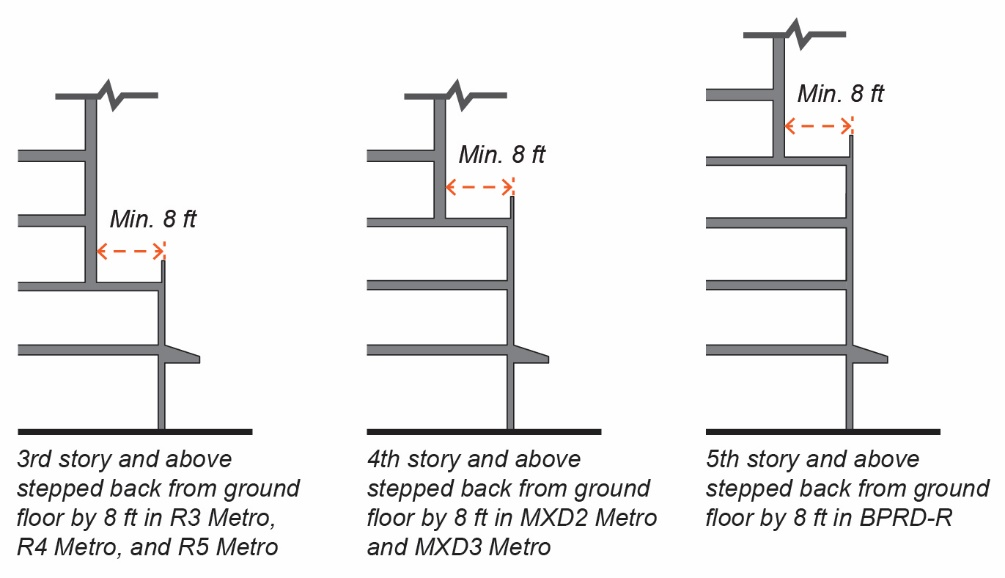
4.
Non-residential building façades over 80 feet in length shall break up long street walls through at least two of the following features: recesses a minimum six feet in depth; awnings; colonnades; projections a minimum four feet in depth; step-backs a minimum six feet in depth; window reveals; cornice treatment; and changes in color and material.
5.
Non-residential building height must vary such that the building has at least one change in height of at least one story. This may be achieved through changes in pitch, plane, orientation, a change in the number of stories, differentiated forms, projections and recesses and/or special architectural features such as towers.
E.
Ground Floor Commercial Design Standards. On retail mixed use streets, and in any other areas with ground floor retail, restaurant, and commercial service uses, the following standards apply:
1.
Ground floor spaces shall be a minimum of 60 feet in depth for a minimum of 50 percent of the space, and a minimum of 40 feet in depth for any remaining space.
2.
Floor to Ceiling Height.
a.
Retail: Minimum 18 feet floor-to-floor and a minimum 14 feet clear.
b.
Office: Minimum 14 feet.
3.
Building Entrances. There shall be at least one entrance per 100 feet of building frontage and the main entrance may not face a parking lot.
4.
Wall Plane Articulation. Windows, doors, columns, and other features shall be recessed or project forward, such that there is a six-inch difference between wall and window surfaces and a total of at least eighteen inches from the window to the outermost plane of a wall or column.
5.
Floor Elevation. Ground floor elevation shall be no more than two feet above or below the sidewalk level.
F.
Building Materials.
1.
Ground Floor Materials. All ground floor exterior materials shall be durable, quality materials, such as glass, concrete, precast concrete, aluminum and high quality metal panels, composite panels, stone, and stucco.
2.
Non-residential Building Materials. Primary building materials in all non-residential construction shall store carbon (e.g., wood, calcium carbonate-based cementitious substances, synthetic limestone).
3.
Glass Materials. Glass types shall be clear glass, frit glass, sandblasted glass, spandrel glass, or channel glass. Glazing should provide a high degree of light transmittance and be non-reflective.
4.
Roofing Materials. Roof design and materials shall include vegetated roofs, high-albedo built-up roofs, high albedo single-ply roofing, metal, terracotta tile, concrete tile, composite concrete tile, skylights, solar collectors, and photovoltaics.
5.
Window Materials. Vinyl-frame windows and doors are prohibited. Wood-framed windows must have metal or fiberglass cladding on the exterior. Metal-frame windows must be thermally broken.
G.
Unit Design.
1.
A minimum of 10 percent of units in any single residential project shall be designed to be accessible to all users using the principles of Universal Design.
2.
Public plazas shall be constructed with ADA-compliant ramps and tactile warning strips at the crosswalks. Equipment and facilities such as tables, trash cans, restrooms, and drinking fountains should allow for universal access, including people of all ages and ability levels.
H.
Landscaping and Site Design.
1.
All development projects shall include on-site vegetated stormwater treatment and landscaping and shade trees at a rate of one tree per 5,000 square feet of the residential building footprint and one tree for every 10,000 square feet of developed lot area for non-residential or mixed-use development.
2.
Where a creek runs under a site, the applicant must coordinate with the City Planning Department to daylight the waterway as part of the site design.
3.
All applicants shall also reference the Santa Clara Valley Urban Runoff Pollution Prevention Program C.3 Stormwater Handbook.
I.
Parks and Publicly Accessible Open Spaces.
1.
All development projects shall dedicate land for parks if a park is shown on the subject property on Figure 2-16: Existing and Proposed Parks, of the Metro Specific Plan.
2.
Privately-owned public open space must remain accessible and open to the public during business hours. Private single-access gates are prohibited.
3.
The Recreational Value System as described in the Metro Specific Plan Section 2.8, Parks and Public Spaces Framework, shall be used to ensure park improvements provide a diversity of active, contemplative, and social gathering experiences.
4.
Parks must be bordered by a public right-of-way such as a street, trail or railroad, on at least three sides, and must be clearly visible and accessible from all abutting rights-of-way.
5.
Small neighborhood-serving parks less than one-quarter acre must be located a minimum 500 feet from Montague Expressway, the Great Mall Parkway, or any rail line.
6.
Seating shall be provided in all publicly-accessible open spaces. Seating may include both moveable and fixed seating as well as seat walls, steps, boulders, and other multi-use objects and must be placed along pathways and within or near gathering spaces.
J.
Common and Private Open Spaces.
1.
Private open spaces may take the form of balconies, patios, gardens, porches, decks, or roof decks.
2.
Usable open space surfaces may be any combination of lawn, garden, flagstone, wood planking, concrete, or other dust-free surfacing, and may not exceed 10 percent slope.
3.
Universal access shall be provided to all rooftop amenities. An accessible path to a publicly accessible restroom on an adjacent floor or at the rooftop level shall be provided for any common outdoor open space on the rooftop.
4.
A minimum of 10 percent of common rooftop open spaces shall be landscaped using green roofs or planters.
K.
Parking Design. Where parking is required or proposed, it must comply with the following:
1.
Parking location. Off-street parking must be located in:
a.
Ground-floor "tuck-under" individually secured garages;
b.
Shared garages (podium or underground); or
c.
Above-ground structures "wrapped" with habitable uses.
2.
Tandem Parking. Tandem parking may be provided in accordance with the following:
a.
No more than two vehicles may be placed one behind the other.
b.
Both spaces shall be assigned to a single dwelling unit or to employees of the same non-residential establishment.
c.
Each tandem parking bay must be a minimum 40 feet in length by 10 feet in width.
3.
Ground-level visibility.
a.
Individually secured garages. Individually secured garages shall be accessed from a shared rear or side drive aisle where such abuts the property. Where individual garages are accessed from the right-of-way, garages shall occupy no more than 50 percent of the frontage of each unit.
Figure 9.06-2: Individual Garages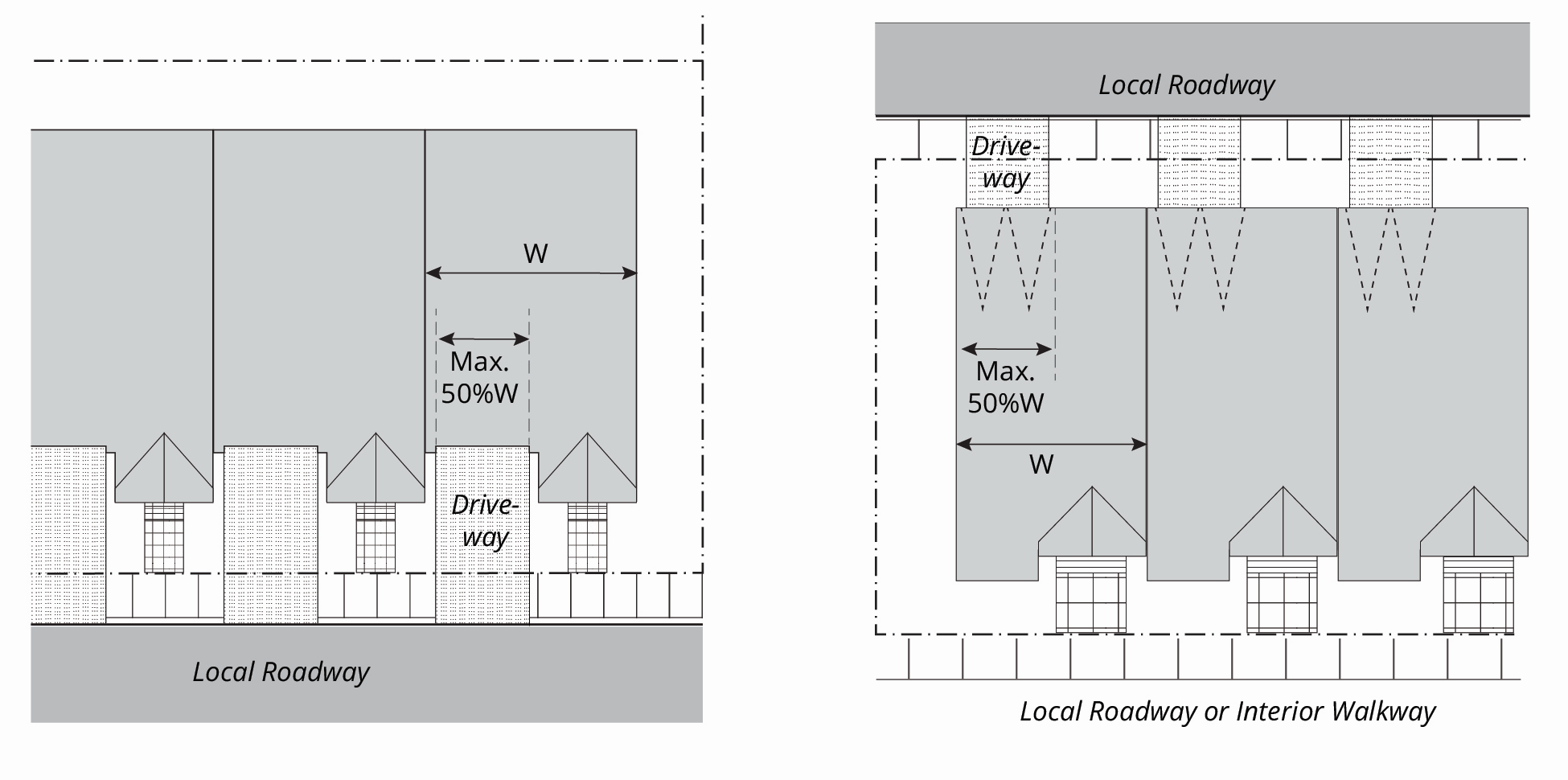
b.
Structured parking. Structured parking may not be located along the ground-level building frontage unless the parking is:
i.
Recessed a minimum of four feet from the rest of the building façade and screened with a living wall or textured or decorative screening; or
ii.
Designed such that the parking area is located in a basement, where the vertical distance from grade to the finished floor directly above the parking area is a maximum of 42 inches.
Figure 9.06-3: Structured Parking Ground Level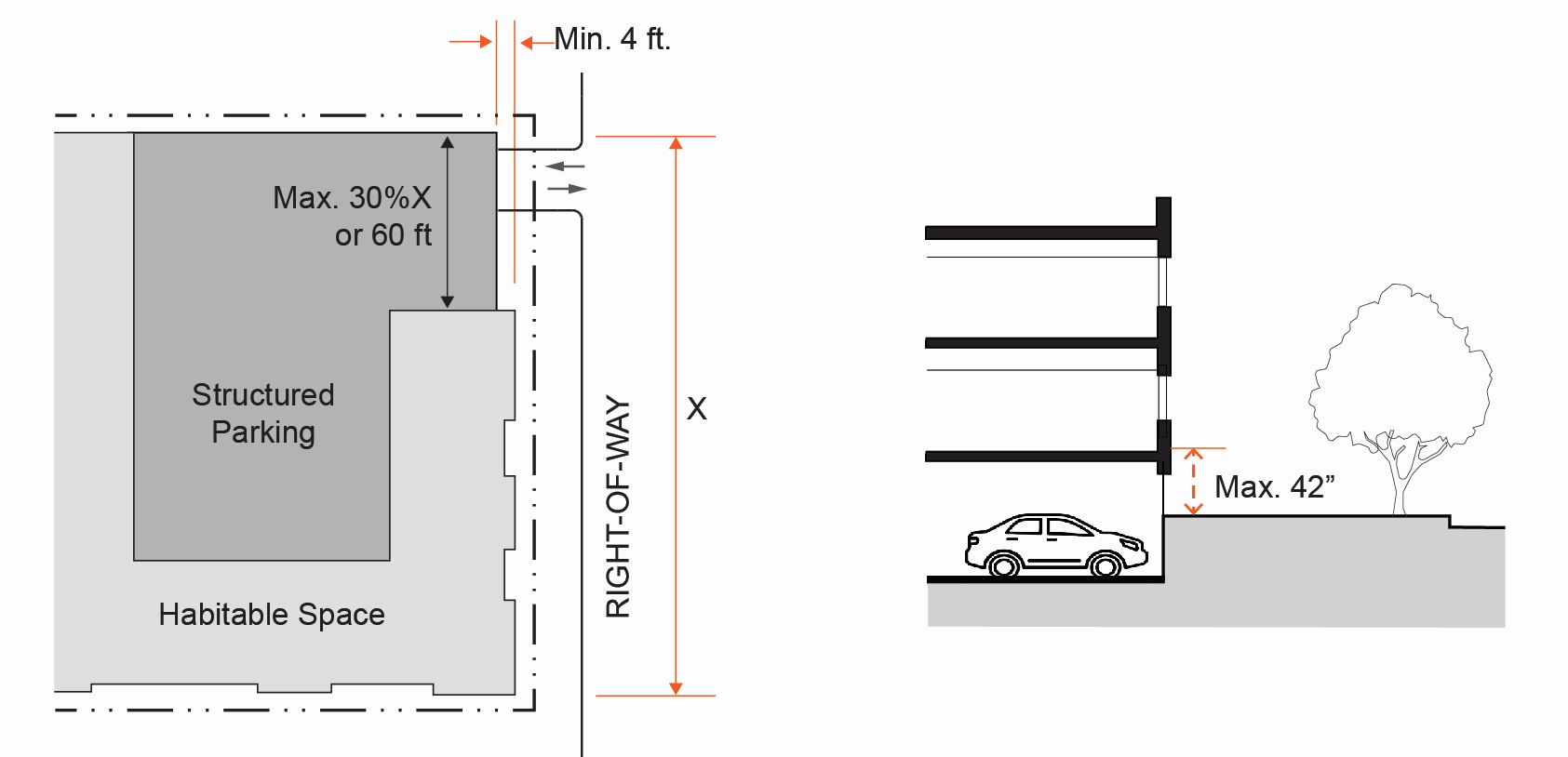
4.
Upper-level visibility. All upper-level street-facing structured parking must be screened from view from the right-of-way by at least one of the following features:
a.
Regular openings designed to resemble windows of habitable spaces that do not reflect the sloping floor lines of interior parking ramps on the façade;
b.
A trellis or living wall; or
c.
Textured or decorative screening.
5.
Vehicle access. Parking must comply with the following standards:
a.
A maximum of one driveway to shared parking is permitted on street frontages up to 120 feet in length; a maximum of two shared driveways are permitted on street frontages exceeding 120 feet in length.
b.
Controlled entrances to shared parking facilities (i.e., gates, doors, etc.) shall be located a minimum of 10 feet from the back of sidewalk.
c.
Vehicular entrances to parking areas shall be a minimum of 80 horizontal feet from vehicular entrances to parking areas on adjacent properties.
d.
Mechanical parking lifts are allowed in all structured parking configurations.
Figure 9.06-4: Parking Access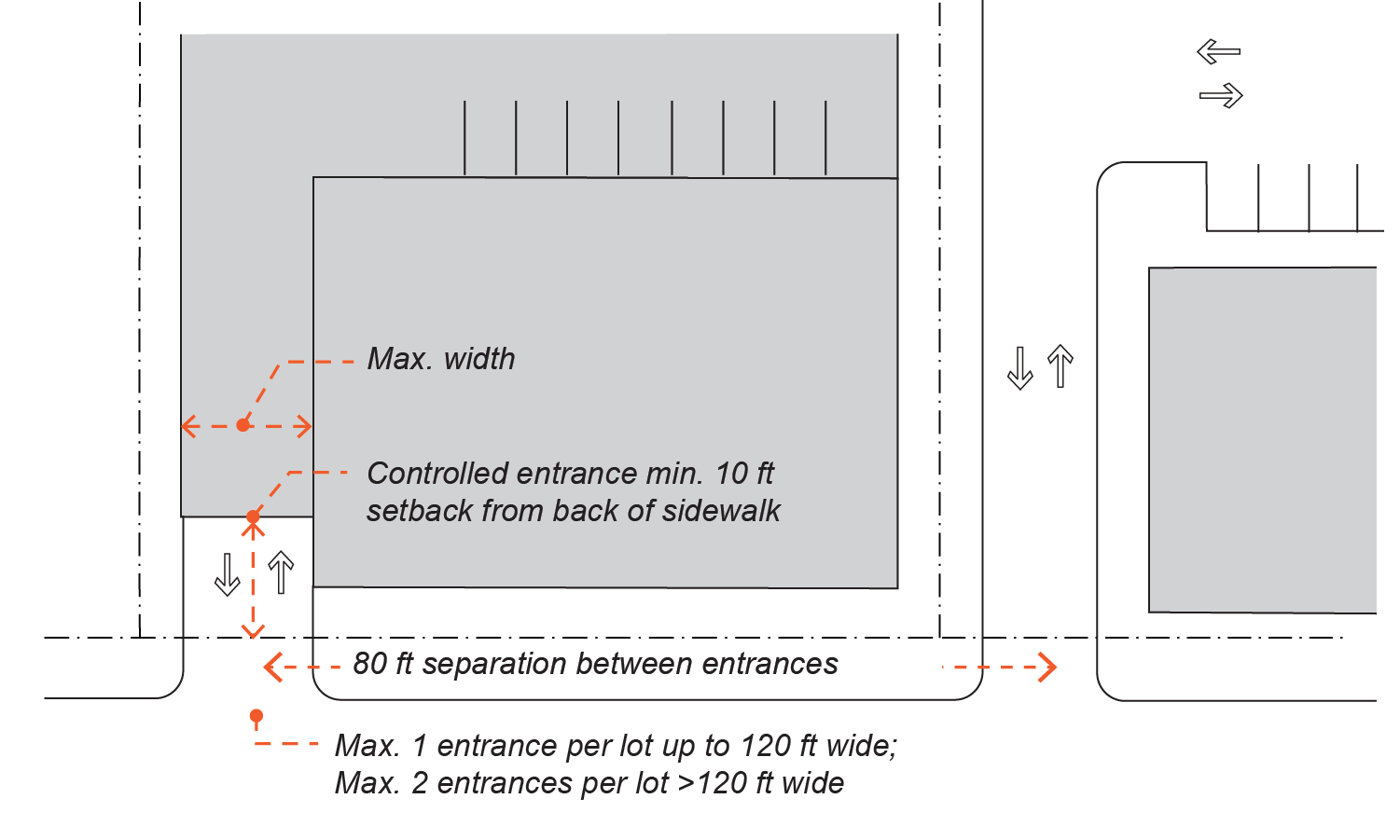
6.
Parking separation. Parking for residential units shall be physically separated from parking for non-residential uses through a controlled fence, gate, or other barrier.
L.
Pedestrian and Bicycle Circulation.
1.
A system of pedestrian walkways shall connect all primary buildings entrances on a site to each other, to on-site automobile and bicycle parking areas, and to any on-site open space areas, pedestrian amenities, and transit stops.
2.
Walkways shall be the shortest practical distance between the primary building entrance and sidewalk, generally no more than 125 percent of the straight-line distance.
3.
Walkways must link the entrances with on-site open spaces, on-site services, and other internal facilities.
4.
Walkways shall be a minimum of five feet wide, hard-surfaced, and paved with permeable materials.
5.
Where a required walkway crosses a driveway, parking area, or loading area, it must be clearly identifiable through a raised crosswalk, a different paving material, or similar method.
6.
Where a required walkway is parallel and adjacent to a vehicle travel area, it must be raised or separated from the vehicle travel lane by a raised curb at least four inches high, bollards, or other physical barrier.
M.
Utilities.
1.
Utilities shall be placed in underground or subsurface conduits.
2.
All mechanical equipment, ground transformers and meters shall be located and screened to minimize visual impacts.
3.
Rooftop mechanical equipment shall be concealed from street level views through roof designs that area architecturally integrated with the building, such as equipment wells and parapets.
4.
Public utility distribution meters, vaults and similar installations shall be consolidated in a single area whenever possible and located away from highly visible areas such as street corners and public open spaces.
5.
Backflow preventors shall be located within landscaped setback areas and painted black or dark green to minimize visual impact. Where no landscaped setback areas exist the backflow preventors shall be incorporated into the front of the building to minimize visual obtrusiveness.
6.
Refuse and recycling containers shall not be visible from a public or private street. Such containers shall be stored either within the parking facility of the building or within a vehicular accessway with screening designed to meet the requirements of this section.
7.
Trash enclosure walls shall incorporate building materials and colors that match the architecture of the building and be well landscaped.
8.
All telecommunications antennas shall be building façade or roof mounted and screened appropriately.
9.
On Main Street only telecommunication facilities that are disguised to appear as a part of the building architecture (i.e., "stealth" antennas) may be used.
(Ord. No. 38.855, § 7, 6/18/24)
XI-10-9.07 - Affordable Housing
Affordable housing units should be provided in all new housing projects consistent with Title XII, Chapter 1 (Affordable Housing Ordinance).
(Ord. No. 38.855, § 7, 6/18/24)
XI-10-9.08 - Exceptions to Standards
1.
Exceptions to all but the use, floor area ratio, density, and park land requirement regulations of this Section may be approved by the Planning Commission through approval of a Conditional Use Permit in accordance with the requirements of Section 57, Conditional Uses Permitted by Commission, of this Chapter.
2.
In addition to the required findings under Chapter 57, the Planning Commission must be able to make the following additional findings for such exceptions:
a.
The exceptions meet the design intent identified within the Zoning District and/or Specific Plan and do not detract from the overall architectural, landscaping and site planning integrity of the proposed development.
b.
The exceptions allow for a public benefit not otherwise obtainable through the strict application of the specified standard.
c.
The project design in its totality does not adversely impact adjoining properties to a greater degree than a project that complies with all development standards. Impacts to be considered include: access to sunlight, views, shadows on parks and open space, privacy, and noise.
(Ord. No. 38.855, § 7, 6/18/24)