
Milton City Zoning Code
ARTICLE 13
- STORMWATER MANAGEMENT
13.1 - PURPOSE; JURISDICTION; APPLICABILITY; INTENT
A.
Purpose. The purpose of this section is to provide a mechanism for the proper management of stormwater by ensuring that development activities do not adversely impact surface water and groundwater resources, and that adequate facilities are provided for the management of stormwater in terms of both quantity and quality.
B.
Jurisdiction and applicability. This section shall apply to all development and redevelopment activity within the city, with exemptions as noted below. Nothing in this section shall relieve the developer from complying with the state regulations in F.A.C. Ch. 62-25, and obtaining any required permits. Runoff calculations as required herein shall include stormwater originating in areas outside the city, which contribute to the total runoff for the site in question. The following exemptions and waivers shall apply:
(1)
Exemptions from stormwater management plan submission:
a.
One single-family, duplex, triplex, or quadraplex structure, or equivalent residential development; provided it is not part of a larger plan of development or sale and; provided that, in the opinion of the Public Works Director or his designee, the development will not increase the rate or volume of runoff from the residential lot or deposit pollutants or sediments beyond the boundary of the residential lot; and
b.
Developments, which discharge into a permitted regional stormwater discharge facility, which can meet appropriate treatment criteria.
(2)
Emergency exemptions. This section shall not be construed to prevent the doing of any act necessary to prevent material harm to real or personal property as a result of a present emergency. Emergency exemptions shall be reported consistent with the requirements of Article 3.
(3)
Waivers:
a.
A waiver of the stormwater management plan submission may be requested by submitting information, including:
i.
The name, address, and telephone number of the developer and owner;
ii.
A description and drawing of the proposed development;
iii.
The location of the development; and
iv.
Any other information requested by the city.
b.
The waiver may be granted if the information requested in subsection B(3)(a) of this section demonstrates that the development is not likely to:
i.
Significantly increase the rate or volume of runoff;
ii.
Have an adverse impact on a wetland, watercourse, or waterbody; or
iii.
Significantly contribute to the degradation of the water quality.
c.
Waivers of the stormwater management plan submission or requirements shall only apply to those developments, which limit the increase in impervious surfaces to 1,000 square feet or less and those that limit increases to 1,500 square feet or less of approved pervious pavement surfaces. If a waiver is provided, the owner assumes the engineer's responsibility. Any property that has received a waiver from the requirements of this article shall be ineligible to receive any future waivers.
d.
Waivers of the detention requirements may be requested for developments located near the point of charge of major watersheds; provided that, in the opinion of the City Manager or his designee, runoff from the development will not increase the potential for flooding downstream.
e.
No development shall be exempt from the stormwater treatment requirements, except as indicated in subsection B(1) of this section.
C.
Intent. The implementation of this Article is intended to accomplish the following:
(1)
Provide for reasonable use and development of property with minimum adverse effects to the environment;
(2)
Minimize public and private property damage resulting from erosion, sedimentation, flooding, and other stormwater-related problems;
(3)
Protect, restore, and maintain the chemical, physical, and biological quality and quantity of surface water and groundwater;
(4)
Minimize the transport of sediments and other pollutants to receiving waters;
(5)
Ensure that stormwater management systems are designed consistent with accepted engineering practices;
(6)
Promote the use of natural drainage features for stormwater management and discourage the alteration of such features;
(7)
Encourage the use of swales or other natural retention/detention system to increase infiltration, settle suspended solids, and remove pollutants;
(8)
Encourage the construction of drainage systems, which aesthetically and functionally approximate natural systems;
(9)
Facilitate recharge of groundwater systems;
(10)
Minimize adverse impacts from urbanization on the beneficial functioning of the hydrologic cycle;
(11)
Develop interagency relationships with other governmental units involved in stormwater management;
(12)
Require that developments be responsible for the provision of adequate stormwater controls in compliance with state stormwater requirements, or with more stringent requirements where necessary;
(13)
Provide special protection measures for waters with special quality designations, such as the Blackwater River, which is designated as an Outstanding Florida Waterbody by the state of Florida;
(14)
Ensure that future development and redevelopment activity complies with the city's adopted concurrency management system and related level-of-service standards;
(15)
Ensure the continuing adequacy of stormwater management systems by requiring proper maintenance and by implementing an effective inspection and enforcement program; and
(16)
Ensure the attainment of these objectives by requiring the approval and implementation of stormwater management plans for all activities, which may have an adverse impact upon community waters.
(Ord. No. 1992-23, § I, 10-10-2023; Ord. No. 06-25, § 1, 7-8-2025)
13.2 - EROSION AND SEDIMENTATION CONTROLS
A.
Introduction and Purpose.
(1)
During the construction process, soil is the most vulnerable to erosion by wind and water. This eroded soil endangers water resources by reducing water quality and causing the siltation of aquatic habitat for fish and other desirable species. Eroded soil also necessitates the repair of sewers and ditches, and the dredging of lakes. In addition, clearing and grading during construction causes the loss of native vegetation necessary for terrestrial and aquatic habitat, which reduces and negatively impacts the healthy living environment for the citizens of the city.
(2)
As a result, the purpose of this local regulation is to safeguard persons, protect property, prevent damage to the environment and promote the public welfare by guiding, regulating, and controlling the design, construction, use, and maintenance of any development or other activity which disturbs or breaks the topsoil or results in the movement of earth on land in the city.
B.
Permits.
(1)
No person shall be granted a site development permit for land disturbing activity without the city's approval of an erosion and sediment control plan. Land disturbing activities of one acre or more require an NPDES permit issued by FDEP.
(2)
No site development permit is required for the following activities:
a.
Any emergency activity that is immediately necessary for the protection of life, property or natural resources.
b.
Existing nursery and agricultural operations conducted as a permitted main or accessory use.
(3)
Permit submittal.
a.
Each application shall bear the name and address of the owner or developer of the site, and of any consulting firm retained by the applicant together with the name of the applicant's principal contact at such firm, the address of the proposed development site, and shall be accompanied by a filing fee and completed on a form acceptable to the city.
b.
Each application shall include a statement that any land clearing, construction, or development involving the movement of earth shall be in accordance with the erosion and sediment control plan, and that a certified contractor shall be responsible to ensure full compliance with these Land Development Regulations.
(4)
Review and approval.
a.
The city will review each application for a site development permit to determine its conformance with the provisions of this local regulation. Within 30 days after receiving an application, the city shall, in writing:
i.
Approve the permit application;
ii.
Approve the permit application subject to such reasonable conditions as may be necessary to secure substantially the objectives of these regulation, and issue the permit subject to these conditions; or
iii.
Disapprove the permit application, indicating the deficiencies and the procedure for submitting a revised application and submission.
b.
Pending the preparation and approval of a revised plan, development activities shall be allowed to proceed in accordance with conditions established by the city.
(5)
Use.
a.
No clearing, grading, cutting, or filling shall commence until erosion and sedimentation control devices have been properly installed and inspected by city staff in accordance with Subsection 13.6 between the areas to be disturbed and adjacent property, water bodies, watercourses, and wetlands.
b.
Minimal clearing and excavation required for the installation or erosion and sedimentation control devices is allowed.
c.
Erosion and sedimentation controls must be maintained until a permanent vegetative ground cover or other permanent controls are established. All disturbed areas shall be permanently stabilized through the establishment of ground cover upon completion of the development activities.
d.
All new residential construction shall require sodding of the entire disturbed area of the lot. A certificate of occupancy will not be issued prior to placement of the sod.
C.
Erosion and Sediment Control Plan.
(1)
The erosion and sediment control plan shall include:
a.
A natural resources map identifying soils, forest cover, and resources protected under other sections of these regulations;
i.
This map should be at a scale no smaller than one-inch equals 100 feet;
b.
A sequence of construction of the development site, including stripping and clearing, rough grading, construction of utilities, infrastructure, buildings, and final grading and landscaping;
c.
All erosion and sediment control measures necessary to meet the objectives of these regulations throughout all phases of construction and permanently, after completion of the site's development. Depending upon the complexity of the project, the drafting of intermediate plans may be required at the close of each season;
d.
Sodding of all disturbed areas required. Types of sod, type and rate of lime and fertilizer application, and kind and quality of mulching for both temporary and permanent vegetative control measures; and
e.
Provisions for the maintenance of control facilities, including easements.
(2)
Modifications to the plan.
a.
Major amendments of the erosion and sediment control plan shall be submitted to the city and shall be processed and approved, or disapproved, in the same manner as the original plans.
b.
Field modifications of a minor nature may be authorized by the city by written authorization to the permittee.
D.
Design Requirements. Grading, erosion control practices, sediment control practices, and waterway crossings shall meet the design criteria set forth in the most recent version of the city or the Florida Department of Environmental Protection's (FDEP's) Erosion and Sediment Control Manual, and shall be adequate to prevent the transportation of sediment from the site to the city's satisfaction.
(1)
Clearing and grading.
a.
Clearing and grading of natural resources, such as forests and wetlands, shall not be permitted, except when in compliance with all other sections of these regulations and the appropriate State authorization.
b.
Clearing techniques that retain natural vegetation and retain natural drainage patterns, as described in the FDEP's Erosion and Sediment Control Manual, shall be used to the city's satisfaction.
c.
Phasing shall be required on all sites disturbing greater than ten acres, with the size of each phase to be established at plan review and as approved by the city.
d.
Clearing, except that necessary to establish sediment control devices, shall not begin until all sediment control devices have been installed and have been stabilized.
e.
Cut and fill slopes shall be no greater than 2:1, except as approved by the city to meet other community or environmental objectives.
(2)
Erosion control. No erosion shall be allowed such that soil is discharged from the site of the adjacent public or private properties. Should sand erosion occur, the discarded soil should be removed within 24 hours and the permittee shall be subject to penalties as set forth in subsection 13.2(F).
a.
Soil must be stabilized within five days of clearing or inactivity in construction.
b.
If sodding has not become established within two weeks, the city may require that a non-vegetative option be employed.
c.
On steep slopes or in drainage-ways, special techniques that meet the design criteria outlined in the FDEP's Erosion and Sediment Control Manual shall be used to ensure stabilization.
d.
Soil stockpiles must be stabilized, covered at the end of each workday or surrounded with silt fence.
e.
Techniques shall be employed to prevent the blowing of dust or sediment from the site.
f.
Techniques that divert upland runoff past disturbed slopes shall be employed.
(3)
Sediment controls.
a.
Sediment controls shall be provided in the form of settling basins or sediment traps or tanks, and perimeter controls as necessary.
b.
Where possible, settling basins shall be designed in a manner that allows adaptation to provide long-term stormwater management.
c.
Adjacent properties shall be protected by the use of an approved vegetated buffer strip, in combination with perimeter controls.
(4)
Waterways and watercourses.
a.
When a wet watercourse must be crossed regularly during construction, a temporary stream crossing shall be provided, and an approval must be obtained from the city, the State/District and/or the U.S. Army Corps of Engineers.
b.
When in-channel work is conducted, the channel shall be stabilized before, during and after work.
c.
All on-site stormwater conveyance channels shall be designed according to the criteria outlined in the FDEP's Erosion and Sediment Control Manual.
d.
Stabilization adequate to prevent erosion and sedimentation must be provided at the outlets of all pipes and paved channels.
(5)
Construction site access.
a.
A temporary access road shall be provided at all sites.
b.
Other measures may be required, at the city's discretion, in order to ensure that construction vehicles do not track sediment onto public streets, or washed into storm drains.
E.
Inspection.
(1)
The city, or its designated agent, may make inspections as hereinafter required and shall either approve that portion of the work completed or shall notify the permittee wherein the work fails to comply with the erosion and sediment control plan as approved. Plans for grading, stripping, excavating, and filling work bearing the city's approval shall be maintained at the site during the progress of the work. In order to obtain inspections, the permittee shall notify the city at least two working days before the following:
a.
Start of construction;
b.
Erosion and sediment control measures are in place and stabilized;
c.
Site clearing has been completed;
d.
Rough grading has been completed;
e.
Final grading has been completed; and
f.
Final landscaping.
(2)
The permittee or his agent shall make regular inspections of all control measures in accordance with the inspection schedule outlined on the approved erosion and sediment control plan. The purpose of such inspections will be to determine the overall effectiveness of the control plan, and the need for additional control measures. All inspections shall be documented in written form and may be required to be submitted to the city at the time interval specified in the approved permit.
(3)
The city or its designated agent may enter the applicant's property as deemed necessary to make regular inspections to ensure the validity of the reports filed under subsection (E)(2) of this Subsection.
F.
Enforcement.
(1)
Stop work order; permit revocation. In the event that any person holding a site development permit pursuant to these regulations violates the permit's terms or implements site development in such a manner as to materially adversely affect the health, welfare, safety or persons residing or working in the neighborhood or development site so as to be materially detrimental to the public welfare or injurious to property or improvements in the neighborhood, the city may suspend or revoke the site development permit.
(2)
Violation and penalties. No person shall construct, enlarge, alter, repair, or maintain any grading, excavation, or fill, or cause the same to be done, contrary to or in violation of any terms of these regulations. Any person violating any of the provisions of these regulations shall be deemed guilty of a civil infraction, and each day during which any violation of any of the provisions of these regulations is committed, continued or permitted, shall constitute a separate infraction. Upon conviction of any such violation, such person, partnership, or corporation shall be punished by a fine according to the category 3, Ordinance No. 1151-04 of the code enforcement for the city and shall be required to pay all costs of enforcement. In addition to any other penalty authorized by this section, any person, partnership, or corporation convicted of violating any of the provisions of these regulations shall be required to bear the expense of such restoration.
G.
Best Management Practices.
(1)
Erosion shall be minimized and sediment retained on the development site through the application of the following best management practices and others, such as those outlined in Stormwater Best Management Practice (BMP) Selection and Implementation adopted by reference herein as a guide for Stormwater BMPs.
(2)
Allowable methods include, but are not limited to, the following:
a.
Limiting the amount of clearing necessary;
b.
Staging clearing activities to minimize the total area cleared at any one time;
c.
Temporary gravel construction entrances;
d.
Straw bale barriers are permitted but shall not be used extensively nor exclusively;
e.
Silt fences;
f.
Storm drain inlet protections;
g.
Temporary diversion dikes;
h.
Temporary sediment traps and basins;
i.
Temporary stream crossings;
j.
Seeding and sodding so as to establish ground cover; and
k.
Erosion control and seeding mats.
H.
Stormwater Sediment and Erosion Control Operation and Maintenance.
(1)
Introduction and purpose.
a.
After the construction period, homeowners and site operators need to maintain proper ground cover and landscaping to prevent soil erosion by wind and water. Erosion of soils from established private homes and other sites endanger water resources by reducing the water quality and increases municipal expenses. Eroded soil necessitates the repair of storm sewers and ditches, dredging of stormwater ponds and lakes.
b.
As a result, the purpose of this regulation is to safeguard persons, protect property, prevent damage to the environment, lower maintenance expenses and promote the public welfare by guiding, regulating and controlling the maintenance of proper ground cover and landscaping in the city.
(2)
Applicability. These regulations shall apply to all property within the city limits, developed lands and undeveloped lands, unless explicitly exempted by an authorized enforcement agency.
(3)
Responsibility for administration. The city shall administer, implement, and enforce the provisions of these regulations. The powers granted and duties imposed upon the authorized enforcement persons or entities acting in the beneficial interest of or in the employ of the city shall be authorized by the city manager.
(4)
General guidelines.
a.
All soil erosion and stormwater runoff control facilities and measures shall be maintained in accordance with the permit conditions and acceptable maintenance procedures. All residential and commercial sites shall maintain sufficient ground cover and landscaping to prevent soil erosion by wind and water.
b.
The person or organization responsible for the maintenance shall be the property owner (as designated in the current county tax roll), the occupant of the property and/or the person or organization designated in the soil erosion and stormwater runoff control plan and/or the permit applicant who submitted to the Planning and Development Department.
c.
The stormwater sediment and erosion control maintenance responsibility shall fall upon one of the following options:
i.
The property owner;
ii.
The property owners association or other nonprofit organization; provided that provisions for the financing of necessary maintenance are included in deed restrictions or other contractual agreements; and
iii.
The city, via dedication and acceptance by the city on the final plat.
(5)
Maintenance agreement specifications. If a maintenance agreement exists, it shall specify responsibilities for the financing maintenance and emergency repairs including, but not limited to, the procedures specified in these regulations.
(6)
Decision of maintenance option. The planning and development director, in agreement with the city manager, and the certified stormwater inspector, will make the final decision of what maintenance option is appropriate in a given situation. Natural features, proximity of the site to lakes, streams and protected wetlands, extent of impervious surfaces, size of the site and potential need for ongoing maintenance activities will be considered when making this decision.
(7)
Easements. The owners of all proposed developments which include stormwater management facilities, or which are located on land containing or bordering a watercourse, may be required to deed to the city adequate easements along such stormwater management facilities and/or watercourses in order to ensure proper access for inspection and maintenance.
a.
Stormwater management easements shall be provided by the property owner, if necessary, for: (i) access for facility inspections and maintenance; (ii) the preservation of the stormwater runoff conveyance; (iii) infiltration; and (iv) detention areas and facilities, including flood routes for the critical 100-year storm event. The purpose of the easement shall be specified in the maintenance agreement signed by the property owner.
b.
Stormwater management easements are required for all areas used for off-site stormwater control, unless the city grants a waiver.
c.
The planning and development director shall record the easements with the county court clerk prior to issuance of a permit.
(8)
Dedication of stormwater management facilities. Facilities which pass the final inspection required by Subsection 13.6(C) and which, in the city staff's opinion, would reasonably function as an integral part of the city maintained stormwater management system shall be dedicated to the city and thereafter shall be maintained by the city. The city shall not assume the maintenance of any facility which is not designed or operating in accordance with this section.
(9)
Stormwater management facility and warranty period. The developer or owner will maintain all stormwater management facilities for a period of two years from approval. All defects, erosion, and design flaws will be corrected to ensure proper function before final acceptance by the city. The failure to maintain and comply with this warranty requirement will be enforced pursuant to section 3.6, and subsection 13.2(H)(16).
(10)
Performance guarantees.
a.
Applicants proposing subdivision plats, road construction projects, or other development identified by the planning and development director with a high potential for soil erosion shall be required to post a cash escrow, letter of credit, or other acceptable form of performance security in an amount determined by the planning and development director, the city manager, and the certified stormwater inspector.
b.
Letters of credit, if used as a performance guarantee, shall extend for a minimum of the warrantee period, but no less than one year with the option of renewal. Letters of credit will be returned to the applicant when the site is certified by the licensed professional who designed the site plan and the site is completely stabilized to meet the requirements set forth by the planning and development director.
(11)
Construction certification by registered professional.
a.
For any sites that required a professional site plan, a certification letter shall be submitted after soil erosion and stormwater runoff control facilities have been installed to affirm that the construction has been completed in accordance with the approved soil erosion and stormwater runoff control plan. This certification letter can be prepared by one of the following registered professionals:
i.
Civil engineer;
ii.
Land surveyor;
iii.
Architect; or
iv.
Landscape architect.
b.
If there are changes during the course of construction, the planning and development director may require final "as-built" drawings for final approval of the site work.
(12)
Certificate of compliance. Upon receipt and approval of the certification letter, the planning and development director shall issue a notice of compliance to the property owner.
(13)
Finished floor elevation.
a.
Minimum finished habitable floor elevations (excluding basements) shall be eight inches above finished grade. If no sod is installed, the elevation shall be ten inches above finished grade. The finished grade shall be sloped downward from the foundation 2½ inches within ten feet or less including sidewalks, patios and driveways and then sloped a minimum 1/16 inch per foot to a positive drainage outfall.
b.
In all new subdivisions a sealed professional engineer's evaluation shall be required. The engineer's evaluation will include design data; calculations, drawings and applicable assumptions to establish the 100-year water surface profile for the area and shall be submitted to the city engineer. Upon review by the city engineer, a minimum finished habitable floor elevation of 14 inches above the expected 100-year water surface profile will be established and forwarded to the city Planning and Development Department where required.
c.
In areas determined by the city to be flood-prone with documented high-water elevations, a minimum finished habitable floor elevation of 18 inches above the high-water mark will be established by the city engineer. The finished floor elevation requirements shall be verified prior to the issuance of a certificate of occupancy by a certified elevation letter from a registered land surveyor or registered engineer.
These regulations are adopted to attempt to reduce flooding to habitable areas of single-family residences. It is recognized that no regulation will guarantee that such flooding will not occur. These regulations shall not be construed to impose any duty or liability against the city in relation to the enforcement of these regulations or in relation to any flooding which may occur.
(14)
Inspections.
a.
Authorized city representatives may enter at reasonable times upon any property to conduct on-site inspections. Such inspections may take place before, during, and after any earth change activity for which a permit has been issued.
b.
If upon inspection, existing site conditions are found not to be as stated in the permit or approved soil erosion, stormwater runoff control plan, or the stormwater pollution prevention plan (SWPPP), the city permit will be invalid. No earth disrupting work shall be undertaken, or continued, until revised plans have been submitted and a valid permit issued.
c.
Requests for revisions must be submitted to and approved by the planning and development director, in writing, before being effective, unless approved by the city field inspector on the site. If approved, a revised site plan shall be submitted for review and approval.
(15)
Stop work orders and emergency actions.
a.
If necessary to ensure compliance with the permit requirements, standards, and other provisions of these regulations, or to protect the public health, safety and welfare, a city employee who is a state-certified stormwater inspector may issue a stop work order for the purpose of preventing or minimizing accelerated soil erosion, stormwater runoff, or other conditions posing imminent and substantial danger to public health, safety, welfare, or natural resources.
b.
If necessary to protect public safety or water resources, including lakes, streams, protected wetlands, and other receiving bodies of water, a city employee who is a state-certified stormwater inspector may, but shall not be required to, initiate emergency action to abate imminent and substantial danger and risk, subject to these regulations. No duty or liability of the city is created by this provision.
c.
Except as otherwise provided through maintenance agreements, the property owner may be held responsible for reimbursing the city for all costs incurred as a result of any emergency action, including administrative costs; provided that a finding is made that the property owner violated the provisions of these regulations, a permit, or an approved maintenance agreement, subject to these regulations.
d.
The stop work order, when issued, may require all specified earth changing activities to be stopped. A copy of the stop work order may immediately be submitted to other state and local agencies with regulatory jurisdiction.
e.
If a city employed state-certified stormwater inspector determines that soil erosion and sedimentation of the waters of this city has or will reasonably occur from a parcel of land in violation of these regulations, the city may seek to enforce these regulations by notifying the person who owns the land, by mail, with return receipt requested, of the city determination. The notice may contain a description of the specific soil and sedimentation control measures which, if implemented by the property owner, would bring the owner into compliance. At a minimum, this may include the maintenance of a grassed yard on all single-family home sites and at all commercial/industrial developments.
f.
A person who owns land subject to these regulations shall implement and maintain soil erosion and stormwater runoff control measures in conformance with these regulations within ten days after the notice of violation has been given as specified in subsection H(16) of this section.
g.
Grassed areas and other areas of erosion control shall not be used for the parking or storage of materials or supplies.
(16)
Enforcement action. The general provisions are as follows:
a.
All earth changes in the city, including earth changes exempt from permit requirements, are subject to the enforcement provisions and penalties of these regulations.
b.
A person who owns land on which an earth change has been made that may result in or contribute to soil erosion or sedimentation of state waters, including any and all conveyance systems connected between the site and state waters, shall implement and maintain soil erosion and sedimentation control measures that will effectively reduce soil erosion or sedimentation from the land on which the earth change has been made.
c.
The city shall notify the Florida Department of Environmental Protection (FDEP) and/or Northwest Florida Water Management District (NWFWMD) of all violations of the state regulations regarding stormwater regulations through appropriate state notification procedures.
d.
Each act of violation, and every day upon which any violation shall occur or continues to occur, shall constitute a separate offense.
e.
A person who has not complied with these regulations and who, after notice, refuses to implement and maintain soil erosion control and stormwater runoff control measures and facilities in conformance with these regulations shall be subject to a fine in accordance with category 3, Ordinance No. 1151-04 of the code enforcement of the city, plus the cost of prosecution.
(Ord. No. 1992-23, § I, 10-10-2023)
13.3 - STORMWATER MANAGEMENT PLAN REQUIREMENTS
Development which is not exempt, and for which a waiver has not been issued pursuant to Subsection 13.1(B), shall submit a stormwater management plan to the Planning and Development Department. The plan must be approved prior to the recording of a plat or the subdividing of land; the alteration of any existing drainage system; or the commencement of any development activity.
A.
Preparation of Stormwater Management Plan. The stormwater management plan shall be prepared by a professional engineer registered in the state practicing within their area of expertise.
B.
Components of Stormwater Management Plan. For all nonexempt development for which a waiver has not been obtained, a stormwater management plan must be submitted. This plan shall not be approved unless it clearly indicates that the requirements in this section will be met. The stormwater management plan shall contain, at a minimum, the following:
(1)
The name, addresses, and telephone numbers of the owner and the developer. In addition, the legal description of the property shall be provided and its location with reference to such landmarks as major water bodies, adjoining roads, railroads, or subdivisions shall be clearly identified by a map.
(2)
The existing environmental and hydrologic conditions of the site and or receiving waters and wetlands shall be described in detail, including the following:
a.
The direction, flow rate, and volume of the stormwater runoff under existing conditions and, to the extent practicable, predevelopment conditions;
b.
The location of areas on the site where stormwater collects or percolates into the ground;
c.
A description of all watercourses, waterbodies, and wetlands on or adjacent to the site or into which stormwater flows. Information regarding their water quality and the current water quality classification, if any, given them by the state department of environmental protection shall be included;
d.
Groundwater levels, including seasonal fluctuations;
e.
Location of floodplains; and
f.
Description of vegetation, topography, and soils;
(3)
Proposed alterations of the site shall be described in detail, including:
a.
Changes in topography;
b.
Areas where vegetation will be cleared or otherwise destroyed;
c.
Areas that will be covered with an impervious surface and a description of the surfacing material; and
d.
The size and location of any buildings or other structures;
(4)
Predicted impacts of the proposed development on existing conditions shall be described in detail, including:
a.
Changes in water quality;
b.
Changes in groundwater levels;
c.
Changes in the incidence and duration of flooding on the site and upstream and downstream from it;
d.
Impacts on the quantity and quality of wetlands; and
e.
Impacts on the quantity and quality of vegetation;
(5)
All components of the drainage system and any measures for detention, retention, or infiltration of water or for the protection of water quality shall be described in detail, including:
a.
The channel direction, flow rate, volume and quality of stormwater that will be conveyed from the site, with a comparison to existing conditions and, to the extent practicable, predevelopment conditions;
b.
Detention and retention areas, including plans for the discharge of contained waters, maintenance plans, and predictions of water quality in those areas;
c.
Areas of the site to be used or reserved for percolation, including a prediction of the impact on groundwater quality;
d.
A plan for the control of erosion and sedimentation which describes in detail the type and location of control measures, the stage of development at which they will be put into place or used, and provisions for their maintenance. The use of control measures must be in accordance with Subsection 13.2.
e.
Any other information which the developer or the city believes is reasonably necessary for an evaluation of the development; and
(6)
Construction plans and specifications for all components of the stormwater management system.
(Ord. No. 1992-23, § I, 10-10-2023)
13.4 - PERFORMANCE AND DESIGN STANDARDS
A.
New Development. The following standards shall be applied to all new and permitted stormwater management facilities:
(1)
Stormwater treatment. The first one inch of runoff from development and off-site contributing areas shall be treated, or the first 1½ inches of runoff for drainage areas greater than 100 acres.
a.
The required treatment volume shall be recovered within 36 hours, following a storm event (72 hours with a safety factor of two).
b.
Soil percolation rates shall be conclusively verified by a geotechnical report, soil survey or other methods acceptable to the city.
c.
When under drains or side drains are utilized, the filter media shall conform to the following criteria:
i.
Permeability rate of 1.5 to 5.0 feet per hour;
ii.
Less than one percent silty clay and organic material;
iii.
Uniform coefficient of 1.5 to 4.0;
iv.
Effective grain size of 0.22 to 0.55 mm in diameter; and
v.
Media shall be tested by a certified testing lab and the results provided to the city for approval prior to installation.
(2)
Stormwater facilities.
a.
Detention facilities shall provide storage and retention for all critical storm events, up to and including, the 100-year, 24-hour storm event.
b.
Discharge from the detention facilities shall be limited to pre-development runoff rates for all storm events, up to and including, the 100-year storm event.
c.
One foot (minimum) of freeboard above the maximum calculated high-water elevation shall be provided for all detention facilities, unless in the opinion of the City Manager, with the concurrence of the city engineer and planning and development director, a reduction in the freeboard will not increase the potential for erosion, flooding, or other stormwater related problems.
d.
Bank slopes shall be limited to 3:1 slopes for city maintained facilities. Bank slopes greater than 3:1 may be used for private developments only with city approval.
e.
An emergency overflow shall be provided for all stormwater facilities. Overflows shall be protected by concrete, riprap or other acceptable stabilizing material, which will prevent the failure of the embankments during catastrophic storm events.
f.
The calculation of peak runoff rates for predevelopment conditions shall utilize the FDOT drainage manual, TR55 or other applicable formulas acceptable by the city for calculating time of concentration.
g.
Exfiltration systems may be used for private developments only.
h.
Discharge facilities shall include a baffle, skimmer, grease trap, or similar mechanism.
i.
Off-site treatment of stormwater is allowable if:
i.
It is not practicable to use on-site facilities, due to area limitations or other unique circumstances;
ii.
The conveyance system from the site to the off-site treatment facility has the capacity to convey the amount of stormwater runoff required to be treated by Subsection 13.4(A)(1) and,
iii.
The off-site treatment facility has the appropriate design and capacity to treat the anticipated stormwater runoff in accordance with the standards established in Subsection 13.4(A)(2).
j.
Small scale stormwater management practices, non-structural techniques, and better site planning to mimic natural hydrologic runoff characteristics and minimize the impact of land development on water resources must be given preference. Only when it is necessary is the use of a structural BMP warranted.
k.
Bio-retention Basins, also known as Rain Gardens, should be utilized whenever possible. Partial exfiltration systems can be utilized as well. For sites which contain less than 1,000 square feet of impervious surface, alternatives to stormwater detention or retention facilities that utilize landscaped buffers or natural area as a means of attenuating rate of runoff, are encouraged. The use of on-site stormwater management techniques such as bio-retention basins and others, shall follow the City of Milton Bio-retention and Conveyance Systems Design Guidelines, incorporated herein by reference and attached hereto in Appendix B.
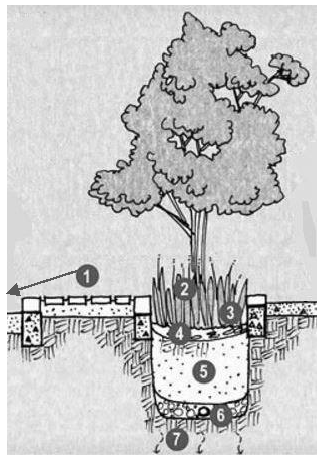 |
1. Parking Lot with curb cut.
2. Dense wet/dry tolerant vegetation. 3. 4—8 inch ponding depth. 4. 2—4 inch mulch depth. 5. 16—20 inch bio-retention planting soil. 6. For exfiltration or partial exfiltration system—perforated pipe in gravel. 7. Infiltration. * Overflow pipe to permitted retention or detention pond or other stormwater system component should be included. |
| Figure 13.4.1. Parking Lot Bio-retention Island Diagram | |
l.
Use of wetlands for stormwater discharge may be permitted as allowable by F.A.C. Ch. 62-25.
m.
Stormwater treatment facilities shall be designed per F.A.C. § 62-25.025 (1-5).
n.
The developer may be required to design stormwater management system to function in accordance with these regulations after all uphill property has been developed.
o.
All stormwater management facilities shall be designed and constructed to have a minimum 25-year life with replacement to be the responsibility of the owner of the facilities. Facilities that fail will be required to be redesigned or reengineered.
p.
In phased developments, the stormwater management system for each phase must be able to function independently.
q.
The use of natural drainage systems is required, to the maximum extent practicable.
r.
The alteration of natural drainage systems, such as dredging, clearing, widening, etc. shall be prohibited, unless no reasonable alternatives exist.
s.
Detention/retention areas whose banks have slopes steeper than 3:1 ratio and/or are more than 3 feet deep, shall be fenced and shall comply with the landscaping requirements of Article 12.
t.
Vegetated buffers of sufficient width to prevent erosion shall be retained or created along the banks of all detention/retention areas.
u.
Retention may be used for private development only with the city's approval.
v.
A maintenance plan shall be provided for all privately owned and maintained stormwater management systems. The maintenance plan must be approved by the city and acknowledged by the owner. The stormwater management system shall be maintained in perpetuity by the owner or their assigns or successors in accordance with the maintenance plan.
w.
All city maintained ponds five feet and deeper shall have maintenance ramps designed at 6:1 slope. The maintenance ramp shall be located in close proximity to the maintenance access point.
i.
There shall be a minimum ten-foot area between the lip of the pond and the pond fencing and/or site property line. The ten-foot buffer area shall have a slope no steeper than ten-foot horizontal to one-foot vertical (10:1). While the buffer area may be used in the pond maximum capacity and/or freeboard calculation, the buffer area shall not be used as a part of the one-inch retention.
x.
All ponds shall be required to have a positive discharge which shall be in the form of a weir or other impervious flow control device that provides a course for overflowing stormwater to exit the pond without damage to the pond banks.
(3)
Underground stormwater system standards.
a.
Generally. Underground stormwater seepage systems may be permitted in all zoning districts upon city staff approval to accomplish stormwater retention and percolation requirements provided those systems are designed for the prevention of clogging by fine material and for ease of clean with conventional sewer cleaning equipment.
b.
Design criteria.
i.
Underground stormwater treatment systems shall be designed by a licensed professional engineer.
ii.
Underground stormwater treatment systems shall be designed so as to accept a retention volume calculated for two inches of runoff from all contributing impervious areas.
iii.
A system overflow outfall shall be required.
iv.
The bottom of the stormwater treatment system shall be constructed a minimum of one foot above the estimated high groundwater elevation. The estimated high groundwater elevation and a modeled recovery analysis shall be performed by a licensed geotechnical engineer.
v.
Filtration media shall consist of a gravel or river rock to be approved by city staff. A limestone based or crushed concrete media is not permitted.
vi.
A pretreatment structure shall be incorporated to remove all debris and sedimentation from the stormwater runoff prior to entering the ex-filtration system.
vii.
Proper inspection and maintenance access ports/manholes shall be installed on all structures and ex-filtration termination points.
viii.
The design shall meet such site or project-specific additional criteria as the director of public works may require.
ix.
The design shall not allow or permit the grade of the site to be elevated above two feet from the existing grade of the adjoining properties or adjoining right-of-ways.
c.
Inspection and maintenance criteria.
i.
Upon initial construction completion, an "as-built" drawing confirming that the stormwater treatment system was constructed according to the city approved drawings shall be signed and sealed by the engineer of record and submitted to the city public works department.
ii.
Inspection, maintenance, and testing procedures (including report forms) shall be provided by the engineer of record and submitted to the city for approval, and approved by the city, before a permit is issued.
iii.
Monthly inspections shall be performed by responsible party and findings logged and/or recorded. Monthly inspection logs shall be submitted annually to the city public works department.
iv.
Routine maintenance and cleaning operations shall be performed and logged and/or recorded. Maintenance and cleaning logs shall be submitted annually to the city public works department.
v.
A volume test shall be performed on the underground stormwater treatment system and an engineer certified volume test report, satisfactory to the city, submitted every three years to the city public works department.
vi.
As a means of ensuring the future maintenance, repair, or replacement of the underground stormwater treatment system, the owner of the property shall be required to enter into an agreement suitable for recording in the public records, which shall run with the land and bind future owners of the property, reflecting the owner's responsibility to perform future maintenance, repairs, or replacement, as deemed reasonably necessary by the city, and in addition the owner's responsibility to pay for such future maintenance, repairs, or replacement, as deemed reasonably necessary by the city, regardless of by whom the future maintenance, repairs, or replacement is performed. The city shall have the right, but not the obligation, to perform or have performed future maintenance, repairs, or replacement, as deemed reasonably necessary by the city, and the property owner shall be responsible for the costs of such future maintenance, repairs, or replacement, the recorded agreement referred to herein shall reflect this obligation of the property owner.
(4)
Conveyance systems.
a.
Stormwater conveyance systems shall be designed to accommodate all critical duration storm events, up to and including, the 25-year, 24-hour storm event.
b.
All curb and gutters shall have a minimum slope of 0.30 percent.
c.
Conveyance pipes shall be sloped to achieve a minimal scouring velocity of two feet per second.
d.
Energy dissipaters, riprap, or other energy dissipating devices acceptable by the city shall be utilized at all discharge points into or out of the stormwater management facilities where velocities may create erosion problems.
e.
Gutter spread shall not exceed one-half of the driving lane width. Clarification: Gutter spread calculations shall be based on the five-year design storm.
(5)
Permits. The following permits shall be obtained, prior to approval by the city of the stormwater management plan:
a.
A general permit for new or modified stormwater discharge facilities from the Florida Department of Environmental Protection (FDEP) and/or Northwest Florida Water Management District (NWFWMD);
b.
A drainage connection permit from the state department of transportation for developments discharging into state owned rights-of-way; and
c.
An NPDES permit from the United States Environmental Protection Agency for developments of one (1) acres or more.
B.
Non-Conforming and Existing Development. Developments existing or permitted prior to the effective date of this Code and which are not in conformance with the provisions of these regulations may be continued, subject to the following conditions:
(1)
Developments, which are not exempt under Subsection 13.1, may not be expanded, altered, or redeveloped to the extent that impervious surface area is increased by more than 10 percent or 500 square feet, whichever is less.
(2)
Developments, which are not exempt under Subsection 13.1, may not be expanded, altered, or redeveloped to the extent that an approved pervious surface area is increased by more than 25 percent or 1,000 square feet, whichever is less.
(3)
The Performance and Design Standards identified in 13.4(A) above, for new development, shall apply to all construction and redevelopment projects where the construction value exceeds 50 percent of the assessed value of the improvements detailed on the most current tax assessment role. Building phases shall be combined to determine applicability of the 50 percent threshold criteria.
a.
The stormwater management requirements, for the redevelopment, renovation, or additions to existing buildings, which exceed the limits of 13.4(B)(1) and 13.4(B)(2) above but are below the 50 percent threshold of identified in 13.4(B)(3), shall be the retention onsite of the first one-half inch of stormwater runoff from all impervious surfaces.
b.
The stormwater retention requirements of this section shall be accomplished by utilizing surface, including bio-retention techniques and/or underground stormwater facilities.
c.
These stormwater management requirements for the retrofit of existing development do not allow properties constructed in conformance with the requirements for the first inch of retention to revert to a lesser requirement.
(4)
If a development is destroyed by any means, including fire, wind, and flood, to an extent of 50 percent or more of its assessed value, reconstruction shall be in conformance with the requirements of 13.4(A).
(5)
If the use of a development, which is not exempt under Subsection 13.1, is discontinued for six consecutive months, any future nonexempt use must conform to the provisions of this section; provided the requirements do not make the development unusable. In such case, a waiver may be requested in accordance with Subsection 13.1.
(6)
Non-Residential Retrofits and Incentives.
a.
For those non-residential developments existing or permitted prior to the effective date of this Code and which are not in conformance with the provisions of these regulations may undertake effective retrofitting of onsite existing stormwater facilities in order to improve surface runoff conditions.
b.
Stormwater facility improvements demonstrating increased retention/detention and reduced runoff may apply for a stormwater fee credit which may result in a stormwater utility fee reduction for the life of the improvements.
i.
Construction of any new stormwater facilities described above shall meet the performance and design standards of this Subsection 13.4(A).
c.
Approved methods of stormwater retention and runoff reduction may include but are not limited to the installation of approved pervious pavements, green roofs, bio-retention basins, raingardens, planter boxes, cisterns, buffer areas, detention/retention pond installation and/or expansion, and increased open space.
i.
Reductions in impervious surface area, provided that the reductions do not create a violation of any other applicable component of these regulations, shall receive the greatest reductions in stormwater utility fees.
d.
Reductions of runoff amounts or retention onsite of up to the first one-half inch of stormwater runoff shall result in up to a 50 percent reduction in the stormwater fee. Reductions of runoff amounts or retention onsite of amounts greater than the first one-half inch of stormwater runoff shall result in up to a 100 percent reduction in the stormwater fee.
e.
It is the responsibility of the applicant for any stormwater fee reduction to demonstrate the effectiveness of the stormwater runoff improvements. The extent of stormwater runoff reduction and method used will determine the level of demonstrated effectiveness required.
C.
Performance Standards for the Downtown Commercial Mixed-Use District.
(1)
In recognition of the existing developed density of properties within the central business district, special stormwater retention requirements are provided for the development or redevelopment of these properties as follows.
(2)
On properties within this district the stormwater retention requirement shall be either:
a.
The provision of onsite stormwater detention or retention of, at minimum, the first one-half inch of stormwater runoff from all impervious surfaces in surface or subsurface facilities, if and only if it can be determined by a certified engineer that the first one inch of stormwater runoff retention cannot be accomplished without undue harm or hardship; or
b.
The payment to the City of a fee, in lieu of stormwater management to be equal to the cost of providing stormwater detention facilities. These fees are to be earmarked and utilized by the city for construction and improvements to capital facilities of the offsite stormwater management system within the City drainage basin. Such cost estimates shall be certified by a registered engineer. The Board of Appeals shall act to resolve any conflicts or disputes regarding the appropriate fee in lieu of on-site stormwater management.
(3)
Development in the Historic District and/or the Community Redevelopment Areas may require additional approval.
(Ord. No. 1992-23, § I, 10-10-2023)
13.5 - INSPECTIONS
The following types of inspections shall be conducted by the city staff in order to ensure that stormwater management is accomplished in accordance with this section:
A.
Initial inspection. The purpose of the initial inspection is to verify the site-related information in the proposed stormwater management plan and to note any potential problems related to stormwater management or the control of erosion and sedimentation. The initial inspection shall be required prior to the approval of any stormwater management plan. The city manager or their designee, however, may waive the requirement for an initial inspection for a small residential development submitting a stormwater management plan pursuant to subsections 13.1 and 13.3.
B.
Erosion control inspection. The purpose of the erosion control inspection is to ensure that the proper erosion and sedimentation controls have been installed in accordance with subsection 13.2 and the developments approved stormwater management plan. The erosion control inspection is applicable to all developments, which are not exempt from implementing erosion and sedimentation controls, and should be scheduled prior to the development activity, but after the erosion and sedimentation controls have been installed. Additionally, inspections may be required after the development activity is completed in order to ensure that vegetation is being reestablished.
C.
Final inspection. The purpose of the final inspection is to ensure that the stormwater management system has been designed and constructed in accordance with the approved stormwater management plan. All developments required to submit a stormwater management plan shall be subject to a final inspection. Any significant inconsistencies between the stormwater management system and the approved stormwater management plan shall constitute a violation of these regulations and shall be subject to the enforcement provisions contained in Subsection 13.2(F).
(Ord. No. 1992-23, § I, 10-10-2023)
13.6 - PERVIOUS PAVEMENT SYSTEMS
A.
Approved Pervious Pavement System Guidelines.
(1)
Approved permeable pavements are considered on-site stormwater management practices and should have the same or very similar effectiveness with regards to the reduction of the volume and rate of stormwater runoff if properly installed.
(2)
Installation shall be completed to system design specifications by trained and experienced producers and construction contractors.
a.
Porous concrete, porous asphalt, and permeable pavers should all have similar underlying storage and support structures.
(3)
Installation of permeable pavement systems shall require diversion of runoff away from the installed surface until stabilization of the adjacent disturbed soils.
Table 13.6.1. Approved Pervious Pavements and Systems
B.
Considerations.
(1)
Advantages of Pervious Pavement.
a.
Can be used in place of traditional paved surfaces.
b.
Can fit into spaces of almost any size and be integrated into many different site layouts.
c.
Can be used as an alternative to traditional hardscape surfaces.
d.
Reduces ponding that can be associated with traditional hardscape surfaces.
e.
Provides ancillary benefits such as better conditions for trees, reduced heat island effect, quieter vehicular traffic, and reduced vehicular glare compared to standard asphalt.
(2)
Limitations of Pervious Pavement.
a.
Requires special consideration if used for high traffic loading areas or on heavy industrial sites where vehicles or equipment may contribute heavy sediment or gross pollutant loads to porous surfaces.
b.
Typically not suitable for steep slope applications.
c.
Requires frequent maintenance with specialized equipment to maintain performance.
d.
May degrade more rapidly if located in areas with frequent vehicular turning.
(3)
Design Considerations for Pervious Pavement.
a.
Design of paving sections must consider system stability based on anticipated structural loading.
b.
For systems that accept runoff from adjacent impervious and pervious areas, pretreatment will help to prevent clogging of porous surfaces.
c.
Porous pavement should not be used in areas where gasoline or other hazardous materials may be dispensed or handled.
C.
Installation Guidelines.
(1)
The thickness of the pervious concrete or asphalt layer is dependent upon use, site, and design. Although manufacture specifications should always be followed with installation, the typical base for a pervious concrete, asphalt, or paver system shall generally consist of the following:
a.
Choke course—This permeable layer is typically 1—2 inches thick and provides a level bed for the pervious concrete. It consists of small-sized, open-graded aggregate.
b.
Open-graded base reservoir—This aggregate layer is immediately beneath the choke layer. The base is typically 3—4 inches thick and consists of crushed stones typically ¾ to 3/16 inch. Besides storing water, this high infiltration rate layer provides a transition between the bedding and subbase layers.
c.
Open-graded subbase reservoir—The stone sizes are larger than the base, typically 2½ to ¾ inch stone. Like the base layer, water is stored in the spaces among the stones. The subbase layer thickness depends on water storage requirements and traffic loads. A subbase layer may not be required in pedestrian or residential driveway applications.
d.
Underdrain (optional)—In instances where pervious concrete is installed over low-infiltration rate soils, an underdrain facilitates water removal from the base and subbase. The underdrain is perforated pipe that ties into an outlet structure. Supplemental storage can be achieved by using a system of perforated pipes in the aggregate layers.
e.
Geotextile (optional)—This can be used to separate the subbase from the subgrade and prevent the migration of soil into the aggregate subbase or base.
f.
Subgrade—The layer of soil immediately beneath the aggregate base or subbase.
D.
Maintenance Guidelines.
(1)
If an approved pervious pavement system is proposed for a project the area of coverage shall be considered based on the design specifications at a rate no greater than what is identified in Article 2.2(H).
(2)
Sub-surface soil testing must demonstrate that the manufacture's specifications will be met to allow for percolations and other functions.
(3)
Design.
a.
Cleanouts, manholes, access panels and other access features must be provided to allow unobstructed and safe access for routine maintenance and inspection of inflow, outflow, underdrains, and storage systems.
b.
Observation wells must be provided for storage systems that include stone storage and must meet the following requirements:
i.
The observation well must be placed at the invert of the stone bed.
ii.
An observation well must be located near the center of the stone bed system to monitor the level and duration of water stored within the system (drain down time).
iii.
Adequate inspection and maintenance access to the observation well must be provided.
c.
A manhole may be used in lieu of an observation well if the invert of the manhole is installed at or below the bottom of the system and the manhole is configured in such a way that stormwater can flow freely between the system and the manhole at the systems invert.
(4)
Access features for underground storage systems.
a.
Access features must be provided for all underground storage systems that are not stone storage beds.
b.
A sufficient number of access points in the system must be provided to efficiently inspect and maintain the storage area.
c.
For cast-in-place vault systems, access features must consist of manholes or grated access panels or doors. Grated access panels are preferred to maintain airflow.
d.
For grid storage or other manufactured systems, follow the manufacturer's recommendations.
e.
Ladder access is required for vaults greater than four feet in height.
f.
Header pipes, at minimum 36-inch diameter, connected to manholes at each corner of the subsurface system must be provided. Alternatively, smaller header pipes may be used if cleanouts are provided on every second manifold pipe/header pipe junction, on alternating sides, of the system.
(Ord. No. 1992-23, § I, 10-10-2023; Ord. No. 06-25, § 1, 7-8-2025)
13.7 - ILLICIT DISCHARGE AND CONNECTION
A.
Purpose and intent. The purpose of these regulations is to provide for the health, safety, and general welfare of the citizens of the city through the regulation of non-stormwater discharges to the storm drainage system to the maximum extent practicable as required by federal and state law. These regulations establish the methods for controlling the introduction of pollutants into the municipal separate storm sewer system (MS4) in order to comply with the requirements of the National Pollutant Discharge Elimination System (NPDES) permit process. The objectives of these regulations are:
(1)
To regulate the contribution of pollutants to the municipal separate storm sewer system (MS4) by stormwater discharges by any user;
(2)
To prohibit illicit connections and discharges to the municipal separate storm sewer system; and
(3)
To establish the legal authority to carry out all inspection, surveillance and monitoring procedures necessary to ensure compliance with these regulations.
B.
Applicability. These regulations shall apply to all influents; liquid and solid, including water entering the storm drain system generated on any developed and undeveloped lands, unless explicitly exempted by an authorized enforcement agency.
C.
Responsibility for administration. The city shall provide qualified staff to administer, implement, and enforce the provisions of these regulations. The powers granted and duties imposed upon the authorized enforcement person or entities acting in the beneficial interest of or in the employ of the city shall be authorized by the city manager.
D.
Ultimate responsibility. The standards set forth herein and promulgated pursuant to these regulations are minimum standards; therefore these regulations do not intend, nor imply that compliance by any person will ensure that there will be no contamination, pollution, nor unauthorized discharge of pollutants.
E.
Discharge prohibitions.
(1)
Prohibition of illegal discharges. No person shall discharge or cause to be discharged into the municipal storm drain system or watercourses any materials including, but not limited to, pollutants or waters containing any pollutants that cause or contribute to a violation of applicable water quality standards, other than stormwater.
(2)
The commencement, conduct or continuance of any illegal discharge to the storm drain system is prohibited, except as described as follows:
a.
The following discharges are exempt from any discharge prohibitions established by these regulations:
1)
Water line flushing or other potable water sources, landscape irrigation or lawn watering, diverted stream flows, rising groundwater, groundwater infiltration to storm drains, uncontaminated pumped groundwater, foundation or footing drains (not including active groundwater dewatering systems), crawl space pumps, air conditioning condensation, springs, noncommercial washing of vehicles, natural riparian habitat or wetland flows, swimming pools (if dechlorinated; typically less than one PPM chlorine), firefighting activities, and any other water source not containing pollutants.
2)
Discharges specified in writing by the authorized enforcement agency as being necessary to protect the public health and safety.
3)
Dye testing is an allowable discharge, but requires a verbal notification to the authorized enforcement agency at least 24 hours prior to the time of the test. Any dye used for testing shall be certified by the contractor to be environmentally safe and he shall provide the city with documentation verifying the environmental effects of the dye.
4)
The prohibition shall not apply to any non-stormwater discharge permitted under an NPDES permit, waiver, or waste discharge order issued to the discharger and administered under the authority of the federal or state environmental protection agency; provided that the discharger is in full compliance with all permit requirements, waiver, or order and other applicable laws and regulations and; provided that written approval has been granted for any discharge to the storm drain system.
b.
Prohibition of illicit connections.
1)
The construction, use, maintenance or continued existence of illicit connections to the storm drain system is prohibited.
2)
This prohibition expressly includes, without limitation, illicit connections made in the past, regardless of whether the connection was permissible under law or practices applicable or prevailing at the time of connection.
3)
A person is considered to be in violation of these regulations if the person connects a line conveying sewage to the MS4, or allows such a connection to continue.
F.
Suspension of MS4 access.
(1)
Suspension due to illicit discharges in emergency situations. The city may, without prior notice, suspend MS4 discharge access to a person when such suspension is necessary to stop an actual or threatened discharge that presents or may present imminent and substantial danger to the environment, or to the health or welfare of persons, or to the MS4 or United States waters. If the violator fails to comply with a suspension order issued in an emergency, the authorized enforcement agency may take such steps as deemed necessary to prevent or minimize damage to the MS4 or United States waters, or to minimize danger to persons.
(2)
Suspension due to the detection of illicit discharge. Any person discharging to the MS4 in violation of these regulations may have their MS4 access terminated if such termination would abate or reduce an illicit discharge. The authorized enforcement agency will notify a violator of the proposed termination of its MS4 access. The violator may petition the authorized enforcement agency for a reconsideration and hearing.
(3)
Reinstating MS4 access deemed an offense. A person commits an offense if the person reinstates MS4 access to the premises terminated pursuant to this section, without the prior approval of the authorized enforcement agency.
G.
Industrial or construction activity discharges. Any person subject to an industrial or construction activity NPDES stormwater discharge permit shall comply with all provisions of such permit. Proof of compliance with said permit may be required in a form acceptable to the city, prior to allowing discharges to the MS4.
H.
Monitoring.
(1)
Applicability. This subsection applies to all facilities that have stormwater discharges associated with industrial activity, including construction activity.
(2)
Access to facilities.
a.
The city shall be permitted to enter and inspect facilities subject to regulation under these regulations as often as may be necessary to determine compliance with these regulations. If a discharger has security measures in force that require proper identification and clearance before entry onto its premises, the discharger shall make the necessary arrangements to allow access by city representatives.
b.
Facility operators shall allow the city ready access to all parts of the premises for the purposes of inspection, sampling, examination and copying of records that must be kept under the conditions of an NPDES permit to discharge stormwater, and the performance of any additional duties as defined by state and federal law.
c.
The city shall have the right to set up on any permitted facility such devices as are necessary in the opinion of the authorized enforcement agency to conduct monitoring and sampling of the facility's stormwater discharge.
d.
The city has the right to require the discharger to install monitoring equipment as necessary. The facility's sampling and monitoring equipment shall be maintained at all times in a safe and proper operating condition by the discharger at its own expense. All devices used to measure stormwater flow and quality shall be calibrated to ensure their accuracy.
e.
Any temporary or permanent obstruction to the safe and easy access to the facility to be inspected and/or sampled shall be promptly removed by the operator at the city's written or oral request and shall not be replaced. The costs of clearing such access shall be borne by the operator.
f.
Unreasonable delays in allowing the city access to a permitted facility is a violation of a stormwater discharge permit and of these regulations. A person who is the operator of a facility with a NPDES permit to discharge stormwater associated with industrial activity commits an offense if the person denies the authorized enforcement agency reasonable access to the permitted facility for the purpose of conducting any activity authorized or required by these regulations.
g.
If the city has been refused access to any part of the premises from which stormwater is discharged, and he is able to demonstrate probable cause to believe that there may be a violation of these regulations, or that there is a need to inspect and sample as part of a routine inspection and sampling program designed to verify compliance with these regulations or any order issued hereunder, or to protect the overall public health, safety, and welfare of the community, then the authorized enforcement agency may seek issuance of a search warrant from any court of competent jurisdiction.
I.
Requirement to prevent, control, and reduce stormwater pollutants by the use of best management practices.
(1)
The city will adopt requirements identifying the best management practices (BMPs) for any activity, operation, or facility that may cause or contribute to the pollution or contamination of stormwater, the storm drain system, environmentally sensitive lands, and/or Waters of the United States.
(2)
The owner or operator of a commercial or industrial establishment shall provide, at their own expense, reasonable protection from the accidental discharge of prohibited materials or other wastes into the municipal storm drain system or watercourses through the use of these structural and nonstructural BMPs.
(3)
Any person, partnership, or corporation responsible for a property or premises, which is, or may be, the source of an illicit discharge, may be required to implement, at said person's, partnership's, or corporation's expense, additional structural and nonstructural BMPs to prevent the further discharge of pollutants to the municipal separate storm sewer system. Upon conviction of any such violation, such person, partnership, or corporation shall be punished by a fine according to the category 3, Ordinance No. 1151-04 of the code enforcement for the city and shall be required to pay all costs of enforcement. In addition to any other penalty authorized by this section, any person, partnership, or corporation convicted of violating any of the provisions of these regulations shall be required to bear the expense of such restoration and are subject to all applicable enforcement requirements listed in Section 13.7(L)—(S) below.
(4)
Compliance with all terms and conditions of a valid NPDES permit authorizing the discharge of stormwater associated with industrial activity, to the extent practicable, shall be deemed compliance with the provisions of this section. These BMPs shall be part of a stormwater pollution prevention plan (SWPP) as necessary for compliance with the requirements of the NPDES permit.
J.
Watercourse protection. Every person owning property through which a watercourse passes, or such person's lessee, shall keep and maintain that part of the watercourse within the property free of trash, debris, and other obstacles that would pollute, contaminate, or significantly retard the flow of water through the watercourse. In addition, the owner or lessee shall maintain existing privately owned structures within or adjacent to a watercourse, so that such structures will not become a hazard to the use, function, or physical integrity of the watercourse.
K.
Notification of spills. Notwithstanding other requirements of law, as soon as any person responsible for a facility or operation, or responsible for emergency response for a facility or operation has information of any known or suspected release of materials which are resulting or may result in illegal discharges or pollutants discharging into stormwater, the storm drain system, or United States waters, said person shall take all necessary steps to ensure the discovery, containment, and cleanup of such release. In the event of such a release of hazardous materials said person shall immediately notify emergency response agencies of the occurrence via emergency dispatch services. In the event of a release of nonhazardous materials, said person shall notify the authorized enforcement agency in person or by phone or facsimile no later than the next business day. Notifications in person or by phone shall be confirmed by written notice addressed and mailed to the city within three business days of the phone notice. If the discharge of prohibited materials emanates from a commercial or industrial establishment, the owner or operator of such establishment shall also retain an on-site written record of the discharge and the actions taken to prevent its recurrence. Such records shall be retained for at least three years.
L.
Enforcement; notice of violation.
(1)
Enforcement personnel shall be qualified stormwater management inspectors as defined by the state department of environmental protection and code enforcement officers.
(2)
Requirements; contents. Whenever the city finds that a person has violated a prohibition or failed to meet a requirement of these regulations, the city may order compliance by written notice of violation to the responsible person. Such notice may require without limitation:
a.
The performance of monitoring, analyses, and reporting;
b.
The elimination of any illicit connections or discharges;
c.
That violating discharges, practices, or operations shall cease and desist;
d.
The abatement or remediation of stormwater pollution or contamination hazards and the restoration of any affected property;
e.
Payment of a fine to cover the administrative and remediation costs no less than category 3 of Ordinance No. 1151-04; and
f.
The implementation of source control or treatment BMPs.
(3)
Abatement/restoration; deadline; costs charged to violator. If abatement of a violation and/or restoration of the affected property is required, the notice shall set forth a deadline within which such remediation or restoration must be completed. Said notice shall further advise that, should the violator fail to remediate or restore within the established deadline, the work will be done by a designated governmental agency or a contractor and the expense thereof shall be charged to the violator.
M.
Appeal; notice; hearing. Any person receiving a notice of violation may appeal the determination of the authorized enforcement agency to the code enforcement hearing officer. The notice of appeal must be received within 15 days from the date of the notice of violation. A hearing on the appeal before the appropriate authority or his designee shall take place within 15 days from the date of receipt of the notice of appeal. The decision of the hearing officer shall be final.
N.
Enforcement post-appeal; city authority to enter property and cause abatement or restoration. If the violation has not been corrected pursuant to the requirements set forth in the notice of violation, or, in the event of an appeal, within 15 days of the hearing officer's decision upholding the decision of the authorized enforcement agent, then city representatives shall enter upon the subject private property and are authorized to take any and all measures necessary to abate the violation and/or restore the property. It shall be unlawful for any person, owner, agent or person in possession of any premises to refuse to allow the government agency or designated contractor to enter upon the premises for the purpose of abatement or restoration.
O.
Abatement costs.
(1)
Lien. Within 15 days after abatement of the violation, the property owner will be notified of the abatement costs, including administrative costs. The property owner may file a written protest objecting to the amount of the assessment within 15 days. If the amount due is not paid within a timely manner as determined by the decision of the municipal authority or by the expiration of the time in which to file an appeal, the charges shall become a special assessment against the property and shall constitute a lien on the property for the amount of the assessment.
(2)
Installment payments; interest. Any person violating any of the provisions of these regulations shall become liable to the city by reason of such violation. The liability shall be paid in no more than 12 equal payments. Interest at the rate of six percent per annum shall be assessed on the balance beginning on the first day following discovery of the violation.
P.
Injunctive relief. It shall be unlawful for any person to violate any provision or fail to comply with any of the requirements of these regulations. If a person has violated or continues to violate the provisions of these regulations, the city may petition for a preliminary or permanent injunction restraining the person from activities which would create further violations or compelling the person to perform abatement or remediation of the violation.
Q.
Compensatory action in lieu of legal proceedings, fines, etc. In lieu of enforcement proceedings, penalties, and remedies authorized by these regulations, the authorized enforcement agency may impose upon a violator alternative compensatory action, such as storm drain stenciling, attendance at compliance workshops, creek cleanup, etc.
R.
Violation deemed public nuisance. In addition to the enforcement processes and penalties provided, any condition caused or permitted to exist in violation of any of the provisions of these regulations is a threat to the public health, safety, and welfare, and is declared and deemed a nuisance, and may be summarily abated or restored at the violator's expense, and a civil action to abate, enjoin, or otherwise compel the cessation of such nuisance may be taken.
S.
Remedies not exclusive. The remedies listed in these regulations are not exclusive of any other remedies available under any applicable federal, state or local law and it is within the discretion of the authorized enforcement agency to seek cumulative remedies.
(Ord. No. 1992-23, § I, 10-10-2023)

