
Milton City Zoning Code
ARTICLE 6
- ZONING DISTRICT REGULATIONS
6.1 - GENERAL ZONING DISTRICT REGULATIONS
All development on a parcel of land within a Zoning District within the boundary lines of the City of Milton is subject to the standards of this Article for the applicable zoning district and to all of the applicable standards of this Code.
For Development Application and Review Processes, including Adjustments, refer to Articles 3 and 4 respectively.
For Allowable Uses refer to Article 7.
For Use Standards, including required Design Elements refer to Article 8.
For Site Development Standards and Accessory Structure Standards refer to Article 9.
For Resource Protection Standards Refer to Article 11.
For Landscaping standards refer to Article 12.
For Stormwater Standards refer to Article 13.
For Parking, Right-of-Way, and Access Management Standards refer to Articles 14 and 15 respectively.
For Sign Standards refer to Article 16.
For Subdivision and Planned Development Project Standards, refer to Articles 17 and 18 respectively.
(1)
Historic District Development. The Secretary of the Interior's Standards for Rehabilitation and Guidelines for Rehabilitating Historic Buildings and the City's Design Guidelines for the Historic District shall be adhered to within the designated Historic District. Development may require additional review.
(2)
Community Redevelopment Areas. Any development and/or redevelopment activity within the City's Community Redevelopment Area's and/or the Historic District shall require additional review and approval by the Historic Preservation Board and/or other Approval Authority.
(Ord. No. 1992-23, § I, 10-10-2023)
6.2 - RESIDENTIAL DISTRICTS
A.
Purpose/Intent Statements.
(1)
General Intent. In order to regulate and limit the height and size of buildings, to regulate public and private space and areas of open space within and surrounding buildings, to classify, regulate and restrict the location of trades and industries, and the location of buildings designed for specified industrial, business, residential and other uses, the land area within the city is hereby divided into the following zoning districts.
(2)
R-1AA Single-Family Residential Zoning District. The R-1AA Single-Family Residential Zoning District is intended to provide for a neighborhood environment of single-family detached dwellings located on larger lots of 12,500 square feet or more. Limited non-residential uses that are compatible with surrounding residential neighborhoods may be conditionally permitted by the City Council following review by the Planning Board.
(3)
R-1A Single-Family Residential Zoning District. The R-1A Single-Family Residential Zoning District is intended to provide for a neighborhood environment of single-family attached and detached dwellings located on 9,000 square foot lots that reflect the predominant pattern of single-family residential development in the Planning Area. Limited nonresidential uses that are compatible with surrounding residential neighborhoods may be conditionally permitted by the City Council following review by the Planning Board.
(4)
R-1 Single-Family Residential Zoning District. The R-1 Single-Family Residential Zoning District is intended to provide for a neighborhood environment of single-family attached and detached located on 7,500 square foot lots that have been established with a smaller lot size than the predominant pattern of single-family residential development. Lots platted prior to the date of the ordinance from which this article is derived shall have a minimum lot area of 5,000 square feet for each single-family dwelling. Limited non-residential uses that are compatible with surrounding residential neighborhoods may be conditionally permitted by the City Council following review by the Planning Board.
(5)
R-2 One and Two Family Residential Zoning District. The R-2 One- and Two-Family Residential Zoning District is intended to provide for a denser neighborhood environment of single-family detached and attached and two-family dwellings on lots with a smaller lot size ranging from 6,500 square feet for Single-Family to 10,000 square feet for Two-Family units, to provide for a more intensive form of residential development. Limited non-residential uses that are compatible with surrounding residential neighborhoods may be conditionally permitted by the City Council following review by the Planning Board. This district may function as a transitional zone between predominantly single-family neighborhoods and adjacent higher density multi-family neighborhoods, mixed-use areas, and non-residential areas.
(6)
R-3 Multi-Family Residential Zoning District. The R-3 Multi-Family Residential Zoning District is intended to provide for an environment of various dwelling types permitted at higher development densities, including single-family detached and attached, two-family, townhouse, condominium, and low to mid-rise multi-family dwellings. Neighborhood-commercial, live-work units, and light intensity commercial uses and services are encouraged. Furthermore, the District is intended to provide areas where a variety of housing types will exist with and among neighborhood commercial and institutional uses while at the same time creating a dominant architectural character and emphasizing pedestrian-oriented activities and ease of access.
B.
General Residential District Regulations.
(1)
Residential Districts Dimensional Standards for Non-Residential and Mixed-Use Structures in Addition to Tables 6.2.2 and 6.2.3.
a.
The front yard setback shall only be required on the primary side of the structure for which a lot has dual street frontage.
b.
Non-Residential and Mixed-Use Structures are prohibited from external and outside storage and the generation of noise pollution detected outside of the building or non-residential use.
c.
Where permitted, non-residential buildings may be increased in height; provided that the building is set back from all required yard lines one additional foot for each three feet such building exceeds the height limitation of the zoning district. However, no building shall exceed 48 feet in height except as provided in Subsection 4.2(K).
(2)
Permitted Intrusions. Intrusions into required building setbacks shall apply with the following additions. The following intrusions are permitted in any required building setback unless otherwise noted.
a.
Required driveways are permitted in the minimum setback.
b.
Awnings or overhanging eaves may be permitted to project into minimum setbacks provided the following conditions are met.
c.
The following materials are approved for the construction of awnings and overhanging eaves:
i.
Industry accepted metal;
ii.
Canvas; and
iii.
Woven vinyl.
d.
Awnings or overhanging eaves shall provide a minimum of nine feet clearance above grade and comply with building code requirements.
e.
Balconies above the first floor may be permitted to project into minimum setbacks up to four feet, provided the following conditions are met:
i.
Balconies may have roofs and are required to be open.
ii.
Balconies shall be at least ten feet above the sidewalk grade below.
f.
Bay windows above the first floor may be permitted to project into minimum setbacks provided the following conditions are met:
i.
Bay windows may not project more than three feet into minimum setbacks.
g.
Suspended planter or flower boxes above the first floor level may project up to 30 inches into minimum setbacks.
h.
Stoops, stairs, and porches may project into the minimum front yard setback up to five feet when applicable.
i.
Five feet of clear space shall be required between any projection of a structure and an adjacent property line and 10 feet of clear space between any projections of a structure from any projection of an adjacent structure.
(3)
Floor Area Ratio. The Development Authority may find it necessary to determine appropriate Intensity of use. Floor Area Ratio may be utilized in that determination. Typically FAR shall not exceed:
a.
Single-story building: 0.30;
b.
Two-story building: 0.60;
c.
Three-story building: 0.90;
d.
Four to six story building: 1.00.
(4)
Corner lots in Residential Districts.
a.
On corner lots in residential districts, the side yard regulations shall apply on the street side as well as on the opposing side yard. If a building on a corner lot does not face the same direction as the building on the adjoining lot on either street, there shall be a side yard adjacent to the street, on which the building does not face, no less in width than 50 percent of the front yard required on that street and no accessory building on such corner lot shall extend beyond the front yard line of that street. This regulation shall not prevent the erection of any accessory building in any case where the regulations cannot reasonably be complied with.
b.
On any corner lot abutting the side of another lot, no part of any structure within 25 feet of the common lot line shall be nearer the side street lot than the required front yard at such abutting lot;
(5)
Yard Area. Every part of a required yard shall be open from its lowest point to the sky unobstructed; except for the ordinary projection of sills, belt courses, cornices, buttresses, and ornamental features; provided, however, none of the projections indicated in Subsection 2.2, shall project into a minimum side yard more than 24 inches. Open or enclosed fire escapes, fireproof outside stairways and balconies projecting into a minimum yard or court no more than three and one-half feet, in addition to the ordinary projections of chimneys and flues may be permitted where the same are so placed as not to obstruct light and ventilation and shall not be considered as an increase to the floor area of the building;
(6)
Maximum Impermeable Surface Ratios. The ISR shall be adhered to in all districts. Pervious materials found in Table 13.5.1 may be utilized, with development approval, as driveways, walkways, side patios, porches, and other hardscaped design elements of a residential use and shall be considered at a reduced percentage of the total impermeable surface area calculation.
C.
Dimensional Standards in Residential Districts.
SF = Single Family; 2F = Duplex; MF = Multi-Family; TH = Town Home (House); CD = Condominium; SFT = Single Family Tiny House
Table 6.2.1. Residential District Dimensional Standards for Residential Uses
*Multi-Family Structures with greater than 4 dwelling units shall be at least two
stories in height;
**Following Fire and Life Safety Approval.
 |  |
| A. Side Setback: 12 feet minimum.
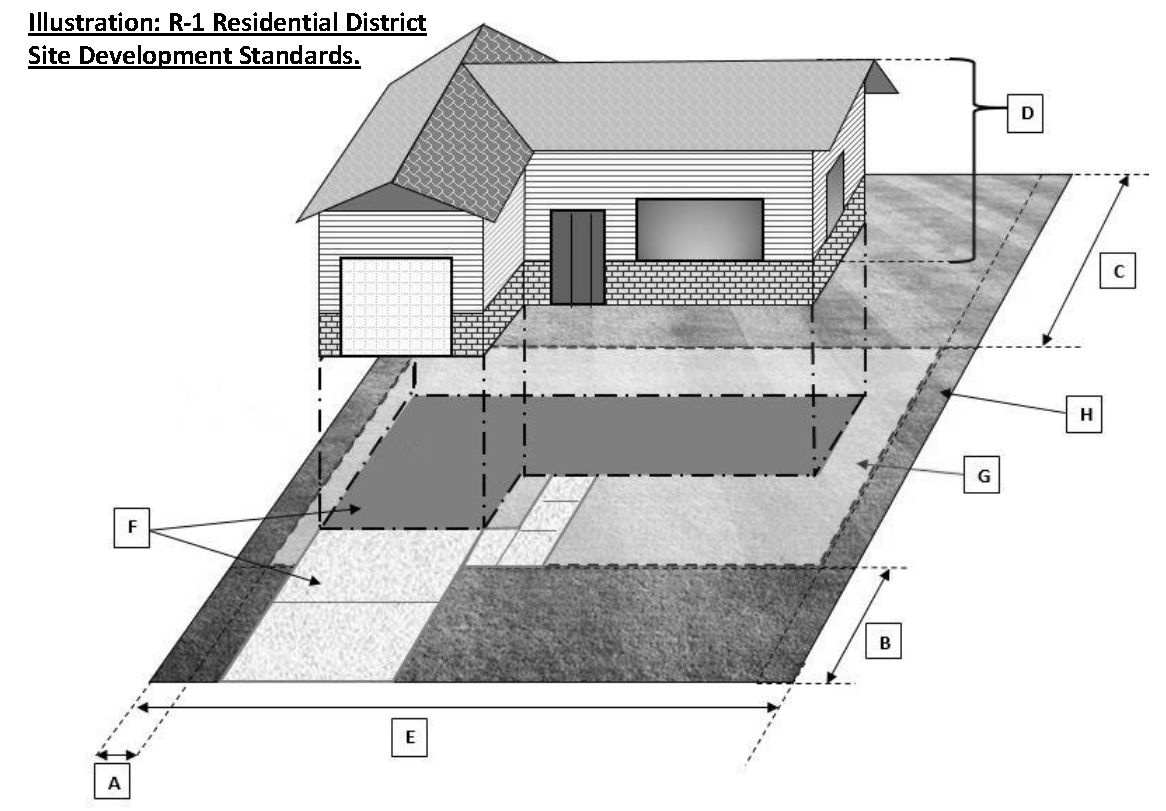
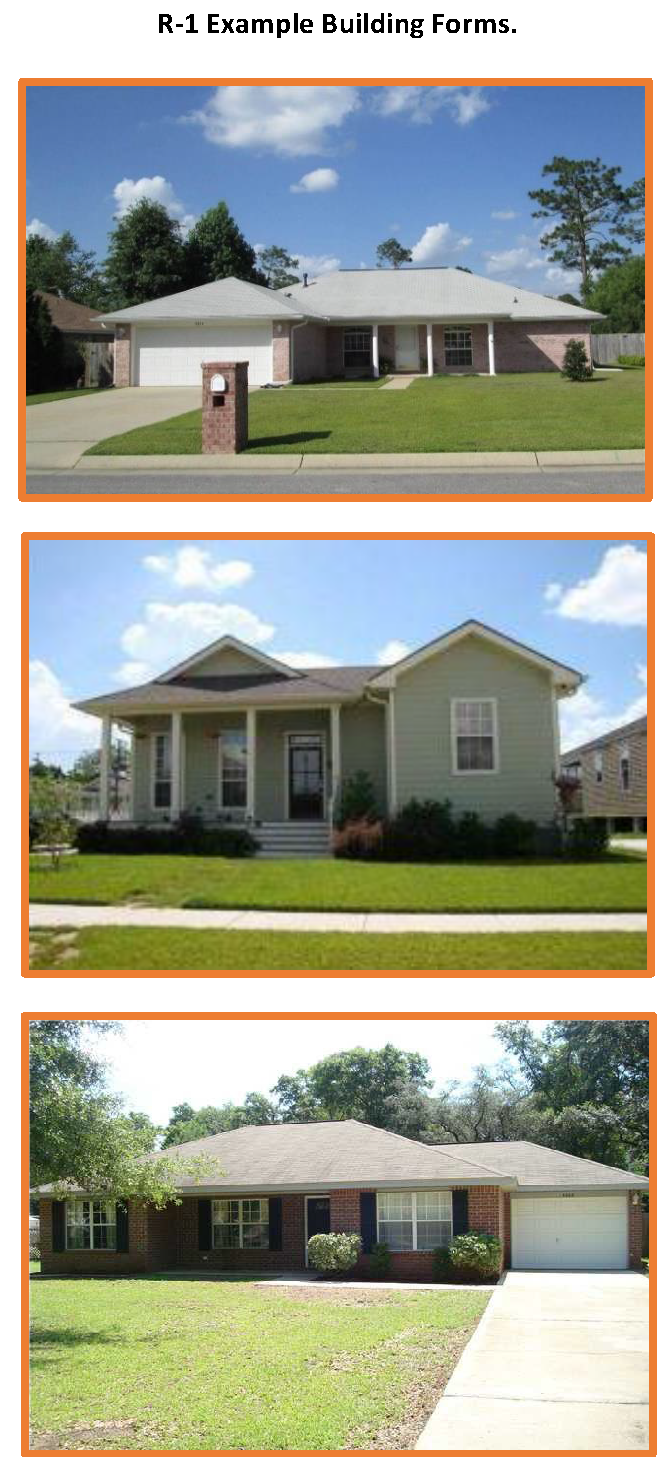
B. Front Setback: 25 feet minimum. C. Rear Setback: 20 feet minimum. D. Height: Measured from grade to highest point of the building. 36 feet maximum. E. Lot Width: 70 feet minimum. F. Impervious Surface Area. Determined by dividing the area of (F)* by the area of (H). 35% maximum. G. The Buildable Area is established by the intersections of the Front, Rear, and Side Setback lines. H. Lot Area, or Parcel Area: 7,500 square feet minimum. |
Table 6.2.2. Residential District Dimensional Standards for Non-Residential Uses
Table 6.2.3. Residential District Dimensional Standards for Mixed-Uses
| A. Side Setback: 10 feet (20 if adjacent to residential use) minimum.
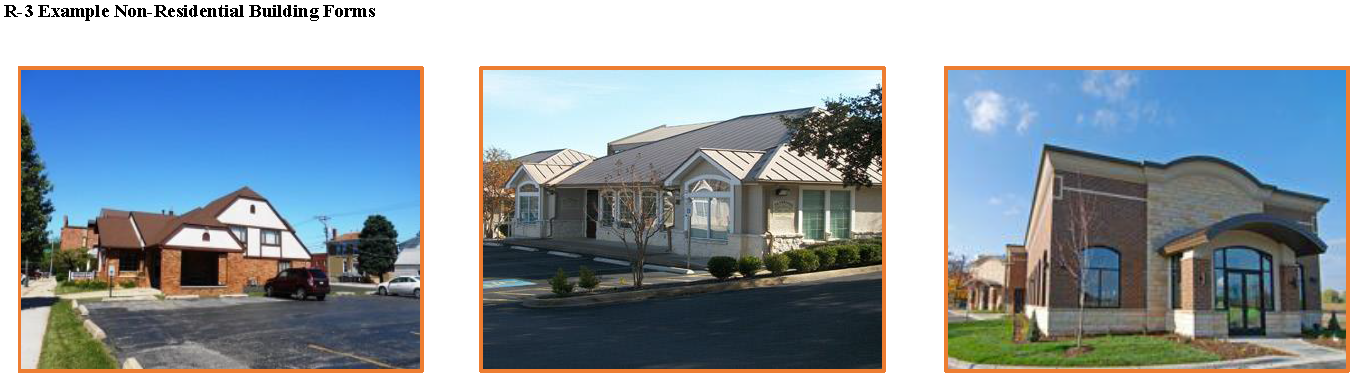
B. Front Setback: 25 feet minimum. C. Rear Setback: 10 feet (20 if adjacent to residential use) minimum. D. Lot Width: 80 feet minimum. E. Height: 36 feet maximum. F. Impervious Surface: 50% maximum. G. Buffer Yard Component: See Article 12 for Landscaping Standards. H. Open Space Component: 1,000 square feet minimum. I. Parking Lot: See Article 14 for Parking Lot Standards. J. Sidewalk: See Article 15 for Access Management Standards. K. Lot Area: 10,890 square feet minimum. | 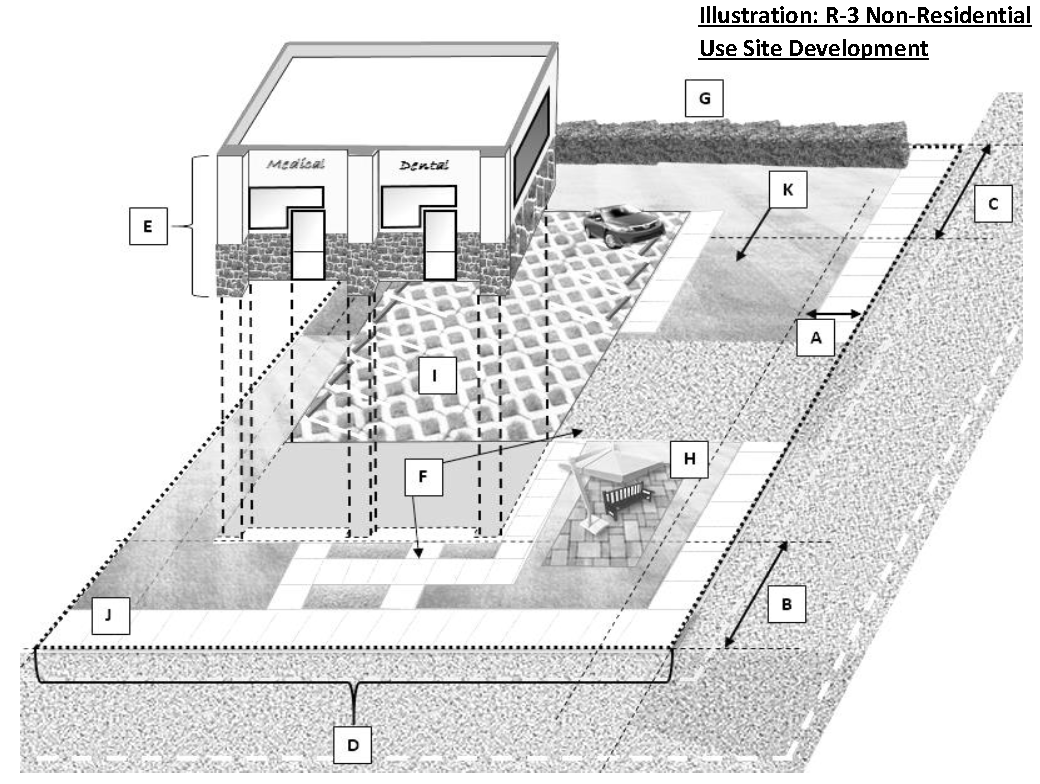 |
|---|
D.
Standards for Residential Conversions. Residential conversions of single-family dwellings into two-family dwellings and non-residential uses within the appropriate residential districts are permitted for dwellings that meet the following standards. Residential conversions require site plan review approval. Construction drawings and plans that describe the proposed conversion in detail are required as part of the application.
(1)
The existing single-family dwelling must have a minimum of 1,750 square feet or more in gross floor area if converting to a two-family dwelling. This gross floor area calculation does not include any basement area.
(2)
Upon conversion to a two-family dwelling, the unit mix should meet the gross floor area as calculated by the unit types below:
a.
Efficiency Unit: 750 square feet.
b.
One Bedroom: 900 square feet.
c.
Two Bedroom: 1,100 square feet.
d.
Three or More Bedroom: 1,300 square feet.
(3)
The dwelling must conform to the applicable dimensional standards for the district in which the building is located.
(4)
No residential conversion may violate any occupancy regulations.
(5)
One parking space must be provided for each additional dwelling unit.
(6)
Following the conversion, the exterior of the dwelling must retain its existing residential character.
(7)
Conversions of any structure must meet all applicable Fire and Life Safety Standards.
E.
Design Standards for Residential Districts.
(1)
General Architectural Standards, Building Materials, and Façade Features. The following residential design standards apply to new construction, substantial remodeling and repair or rehabilitation meant to remedy damage or deterioration of the exterior façade of an existing structure, and additions to existing structures.
a.
Exterior design and façade features, rooflines, massing, window and treatment types, and materials shall be compatible with the existing character of the surrounding residences.
b.
Exterior entrances from a public sidewalk or common open space are permitted for apartment or condominium units on the ground floor. These entrances shall be raised from the finished ground floor level of the sidewalk and shall appear to be designed as townhouses.
c.
All exterior walls, including parking structures, garages, and accessory structures shall be constructed of materials commonly used for residential structures in Santa Rosa County historically.
d.
No blank walls shall front public streets.
e.
A minimum of two distinct building materials from the approved list as provided in Subsection 2.2(B) must be utilized on all façades to provide architectural detail and interest.
f.
The architectural features, materials, and the articulation of the building's façade shall be continued on all sides visible from a public street.
g.
The front façade of the principle building on any lot shall face onto a public or private street.
h.
Any building (excluding parking garages and other accessory building) viewed from a public right-of-way or public open space shall either face such right-of-way or open space, or shall have a façade facing such area in keeping with the character of the front façade, including the utilization of window design and materials.
i.
Front and street sides of buildings visible from the public right-of-way shall include changes in relief such as columns, cornices, bases, fenestration, and fluted masonry. The top floor of any building shall contain a distinctive finish, consisting of a cornice, banding or other architectural termination.
j.
An expression line shall delineate divisions between floors of all buildings, and a cornice shall delineate the tops of façades for non-single-family buildings that do not utilize a pitched roof.
k.
All walls facing public streets shall have at least 15% transparency. Windows and entry doors shall be counted towards the minimum transparency standard.
(2)
Entry features.
a.
All ground floor non-residential uses shall have a main entrance from a public sidewalk or plaza.
b.
All ground floor, excluding single family and duplex residential, entrances shall be covered or inset with distinct architectural detail.
c.
Building entrances shall be defined and articulated with architectural elements such as pediments, columns, porticos, porches, overhangs, pent roofs, and hooded front doors or other similar architectural elements.
d.
Shall have a main entrance from a public sidewalk or common open space (excluding single-family residential structures).
e.
Mixed use residential entry features.
i.
Exterior entrances from a public sidewalk or common open space are permitted for apartment or condominium units on the ground floor. These entrances shall be raised from the finished ground floor level of the sidewalk and shall appear to be designed as townhouses.
f.
Multi-family apartment and condominium uses above the ground floor shall have interior unit entrances except:
i.
Exterior stairs are permitted for access to second and third floor units only if they are oriented towards a central plaza and/or not visible from any street.
(3)
Roofing Design, Materials and Features.
a.
Asphalt shingles, industry approved synthetic shingles, standing seam metal or tile roofs are allowed.
b.
Gable roofs, if provided shall have a minimum pitch of 6/12.
c.
Pitch roofs, if provided shall have a minimum pitch of 9/12.
d.
Other roof types shall be appropriate to the architectural style of the building.
e.
Architectural elements that add visual interest to the roof, such as dormers and masonry chimneys are strongly encouraged.
f.
Flat roofs shall require parapet screening. Parapets shall be constructed of the same material as the primary façade and should include a decorative cornice and/or coping or other approved accent. Roofs designs such as slant or shed roofs are not allowed for residential homes within any district.
(4)
Multi-family Specific Standards. In addition to Subsections E(1), (2), and (3) above.
a.
There must be a unifying architectural theme for the entire multi-family, condominium, or townhouse development, utilizing a common vocabulary of architectural forms, elements, materials, and/or colors in the entire structure.
b.
Building façades must include windows, projected or recessed entrances, overhangs, and other architectural features. Three-dimensional elements, such as balconies and bay windows, are encouraged to provide dimensional elements on a façade.
c.
The general minimum transparency requirements for residential districts apply to any façade facing a street as well as any façade facing common space or recreational space in a multi-family development.
d.
Flat roofs must include cornices, parapets, or similar architectural details to add variety and break up the roofline. Pitched roofs must provide dormers or other approved feature.
e.
There must be a minimum separation of 15 feet between sidewalls of row-house buildings. Where the front or rear wall of a row-house faces the front or rear wall of another row-house, the minimum required separation between such buildings must be 30 feet.
i.
Driveways and parking areas may be located within this minimum separation area.
(5)
Examples of Preferred Multi-Family Residential Design Elements.
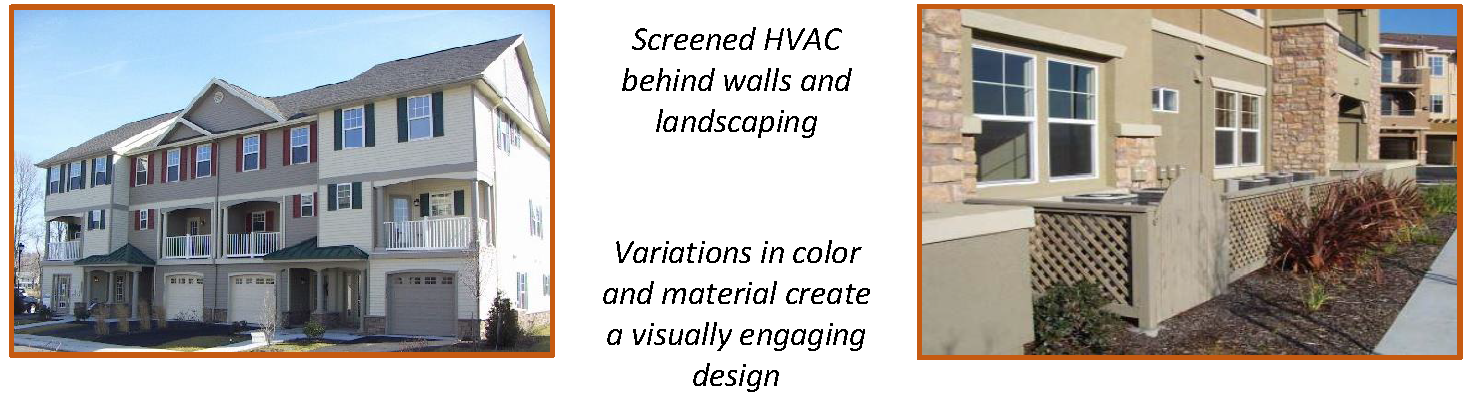
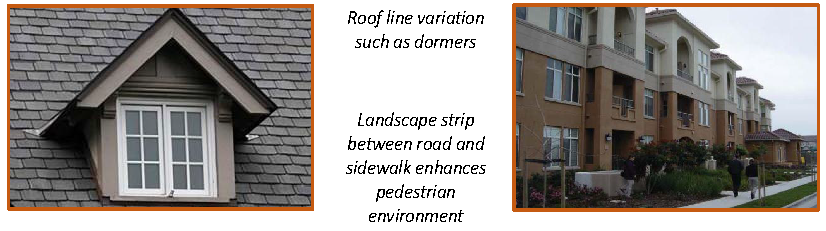
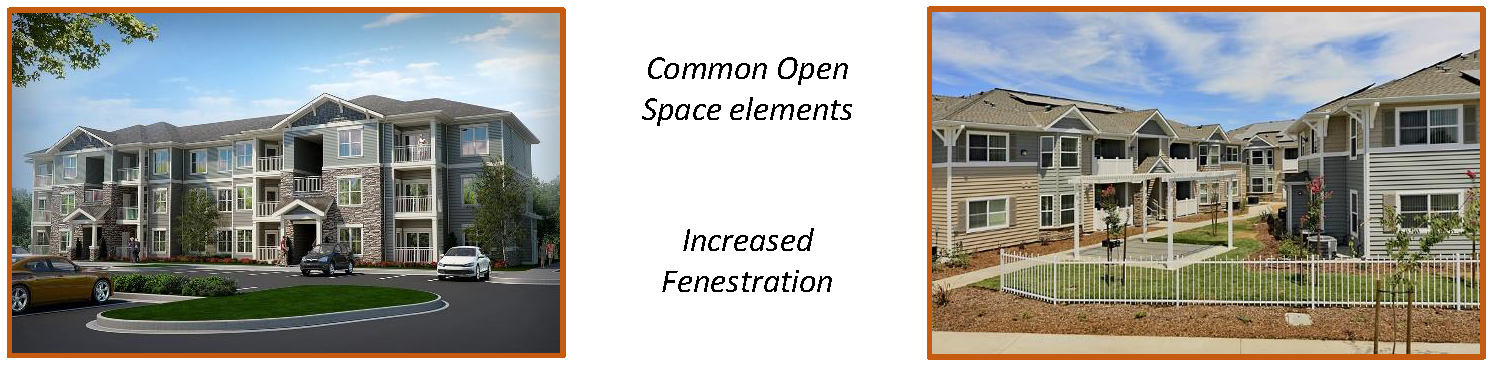
(6)
Tiny Home Specific Standards. All tiny homes shall be prepared in accordance with the specifications and requirements of Section 6.2(E), in addition to the specifications and requirements of 6.2(E) and Florida Building Code.
1)
Minimum Lot Area. All tiny homes shall have a minimum lot size of 3500 square feet.
2)
Structure Foundation. All tiny homes shall be constructed on a permanent foundation. Permanent foundations must be constructed of durable materials; i.e. concrete, mortared masonry, or treated wood and be site-built.
3)
Minimum Living Space. All tiny homes must have a minimum living space of 300 square feet. All tiny homes shall be constructed to include sleeping area, kitchen, and lavatory with shower or bathtub.
4)
Habitable Space. Habitable rooms must not be less than 70 square feet of floor area excluding kitchen areas. Habitable rooms must not be less than 7 feet in any horizontal direction. There shall be one habitable room with not less than 120 square feet.
5)
Habitable Rooms shall be provided with light and ventilation via fenestration not less than 10% of the floor area.
6)
Ceiling Height. Ceiling height must not be less than 7 feet in habitable spaces, hallways, bathrooms and lavatories. Ceiling heights less than 5 ft on portions of sloped ceilings or furred ceilings will not count towards the minimum required habitable space.
7)
Porches. Porches shall be full width on the front façade and shall be oriented towards common open space or street and designed to provide a sense of privacy between units. Porch shall be a minimum of (120) one hundred twenty square feet and a minimum of (8') eight feet deep on the common open spade side of the building. The square footage of the porch may be reduced to (60) sixty square feet if the unit has a front porch and secondary porch on another elevation. The rear porch must also be a minimum of (60) sixty square feet.
8)
Exterior walls. All exterior elevations shall have fenestration.
9)
Secondary Entrances. All secondary entrances are required to have a minimum five by five-foot porch.
10)
Structure Width. The minimum width of a tiny home must be at least 15 feet.
11)
Structure Height. The maximum height of a tiny home is 20 feet.
12)
Roofs must be Gabled or Hipped. Flat or shed roofs are not permissible.
13)
The desired architectural style for all Tiny Home Subdivisions will be Traditional Neighborhood Design (TND) or a vernacular that replicates the 1900s style representative of historic buildings in the City. Architectural style shall require approval from the Planning Department.
(Ord. No. 1992-23, § I, 10-10-2023; Ord. No. 1995-23 , § 1, 1-9-2024)
6.3 - COMMERCIAL DISTRICT STANDARDS
A.
Purpose Statements.
(1)
C-1 Neighborhood Commercial Zoning District. The C-1 Neighborhood Commercial District is intended to accommodate local non-residential uses that predominantly serve the needs of the nearby residential neighborhoods. They should be similar in character of the surrounding residential neighborhood. Apartment Complexes and single-family residential dwelling units may be allowed above the ground floor upon development authority approval. The purpose of this district is to allow for the full development of commercial uses while protecting nearby residential properties from the adverse effects of commercial activities. Multi-family development shall adhere to the standards required in the R-3 Zoning District.
(2)
C-2 General Commercial Zoning District. The C-2 General Commercial Zoning District is intended to accommodate those lands and structures used to provide for the retail of commodities and furnishings of selected services, trades and other commercial enterprises within the Planning Area. The C-2 District addresses primarily auto-oriented retail, both individual businesses and retail centers, with the intent of improving the pedestrian environment along the existing corridors. Limited mixed-use development with residential dwelling units above the ground floor and higher density, multi-family residential development may be allowed upon development authority approval. Multi-family development shall adhere to the standards required in the R-3 Zoning District.
(3)
C-3 High Intensity Commercial Zoning District. The purpose of the C-3 High Intensity Commercial Zoning District is to accommodate regional commercial centers, wholesale distribution, storage, and light manufacturing. The C-3 District provides for large-scale development that may generate a sizeable amount of traffic and typically requires significant off-street parking. High density multi-family development is allowed and shall adhere to the standards required in the R-3 Zoning District.
B.
General Commercial Districts Dimensional Standards.
(1)
Exception to Front Building Line Setback.
a.
Where the construction of a commercial structure is proposed within 50 feet of an existing commercial structure(s) and where the existing commercial structure(s) have been constructed at less than the minimum or maximum required front yard setback, then the development approval authority may permit construction of the proposed structure with a front yard setback less or greater than that required by these regulations; provided that the allowed setback is consistent with the average setback of the existing adjacent structures.
(2)
Ground floor area limitation.
a.
New commercial buildings may not exceed 100,000 gross square feet in ground floor area.
b.
New commercial buildings greater than 50,000 gross square feet must obtain special exception approval as identified in Article 3. In determining whether to grant an increase in ground floor size beyond 50,000 square feet, the board of adjustment and city council shall consider the following factors:
i.
The site has safe, immediate access to Highway 87, 89, and/or 90.
ii.
The building site will provide convenient interconnections with adjacent uses and properties that serve both pedestrians and automobiles.
iii.
The architectural design of the building reduces the perceived size of the building by appropriate articulations and variations in the massing, façade, roofline, materials, colors, and textures of the building exterior.
iv.
The building and site meets or exceeds all other standards set forth in this section and by this Unified Development Code.
v.
The owner/developer shall be required to reclaim the site for other development purposes if the facility is abandoned/unused for a period of 24 months.
(3)
Building height.
a.
Where permitted in a district, non-residential buildings may be increased in height; provided that the building is set back from all yard lines one additional foot for each three feet such building exceeds the height limit of the zoning district in which the building is located. However, no such structure shall exceed five stories or 60 feet in height, except as provided in Subsection 4.2(K). Height increase above those indicated in the underlying zoning district provided in section 6.3(C) may require Board of Adjustment approval.
b.
Any building of which 50 percent or more is located within 250 feet of the centerline of an arterial street shall be no more than three stories in height. A relief from height restrictions shall only be allowed if a variance approval is granted by the Board of Adjustments, in accordance with procedures in Article 3.
c.
In deciding whether to grant a height increase, the Board shall consider the following factors and others:
i.
Proximity and relationship of the proposed building to other buildings.
ii.
Fire and Life Safety.
iii.
Impact of the proposed building on single-family residences on nearby tracts.
iv.
Topography and vegetation that screen the view of the proposed building.
v.
On-site screening and/or landscaped buffers.
vi.
Provision of public open space in exchange for increased building height.
vii.
The effect of additional building height on traffic congestion.
viii.
Access of the site to major traffic arteries.
ix.
Economic development opportunities for the city.
x.
The necessity of greater building height to the function of the proposed use.
xi.
The quality of the architectural design and its compatibility with its surroundings.
(4)
Residential Standards for the C-1, C-2 and C-3 Commercial Districts. Residential subdivisions, where allowed, shall comply with the yard requirements of the underlying zoning district, the requirements of Subsection 6.2(E)(4), all applicable standards of this Code relating to landscaping, access management, parking, stormwater and other, as well as the following requirements:
a.
Reverse-fronting lots are required for residential subdivisions along streets classified as arterials or collectors, subject to subsection (4)(b) of this section. Reverse-fronting residential lots shall be platted with a landscaped access easement, meeting the requirements of Subsection 12.5, restricting vehicular access placed adjacent to the public right-of-way. Such easement shall be a minimum of 20 feet in depth and include one of the following:
i.
A continuous four-foot high solid wall constructed entirely of brick or stone masonry with decorative elements to include material and color changes, trim, and coping.
ii.
A four- to six-foot high fence constructed of a combination of brick or stone masonry pillars with iron pickets.
iii.
A four- to six-foot high wood privacy fence with a vegetated strip of canopy trees, shrubs, and groundcover that provide a full landscape buffer in front of the fence.
b.
If a residential lot is separated from the arterial or collector street by a minimum 20-foot wide landscaped strip and a residential street, a residential lot may face an arterial or a collector street. Multi-family development shall be required to install a network of sidewalks and walkways which connect to required common space and to existing sidewalks at each entrance/exit to the development.
If no such sidewalks exist, the development shall be required [to] install a minimum five (5) [foot] wide sidewalk the entire length of the development which abuts a public right-of-way. New multi-family developments shall be required to meet the multi-family dimensional standards found in table 6.2.1. Multi-family developments in these districts shall also be required to meet all parking, landscaping and access management standards, and these standards shall apply when in conflict with table 6.2.1.
(5)
Lot Standards.
a.
Lots should be rectangular in shape with a ratio of depth to frontage of 4:1.
C.
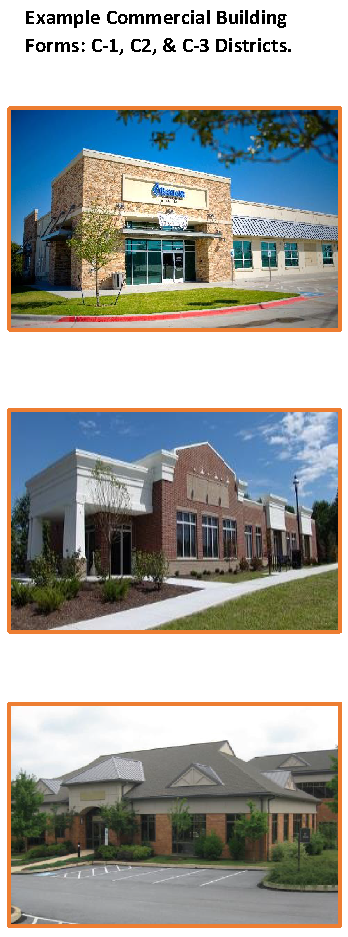
Dimensional Standards. Table 6.3.1: Commercial Districts Dimensional Standards for Non-Residential Structures establishes the dimensional standards for structures with no residential component in the commercial districts. These regulations apply to all uses within each district unless a different standard is listed for a specific use. Section 6.3.D has additional design standards that apply to development within the districts.
Table 6.3.1. Commercial District Dimensional Standards for Non-Residential Uses.
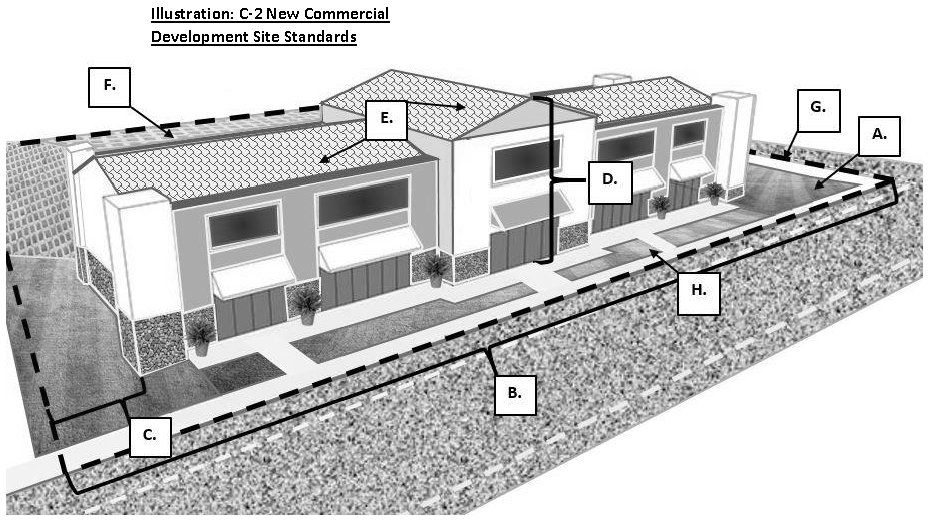 |  |
| A. Lot Area: One quarter (¼) acre
B. Lot Frontage: 100 feet C. Side Setback: 10 feet (15' when adjacent to Residential or Mixed-Use) D. Height: 48 feet maximum E. Impermeable Surface Ratio: 65 percent for new development F. Rear Parking Lot and Permeable surface (not required but a solution if impermeable surface ratio is exceeded) G. Lot Line H. Required Landscape Strip and Sidewalk |
D.
Commercial District Design Standards. The following design standards apply to new construction, substantial repair or rehabilitation meant to remedy damage or deterioration of the exterior façade of an existing structure, and additions to an existing structure.
Where residential uses are allowed they are subject to the applicable design standards in Subsection 6.2.
(1)
General Façade Requirements.
a.
Building façades that abut a public right-of-way, excluding alleys, must not contain blank wall areas that exceed 25 linear feet, measured parallel to the street.
b.
Building façades that abut a public right-of-way, excluding alleys, must include a repeating pattern with no less than two of the following elements: color change, texture change, material module change, or a wall articulation change such as a reveal, pilaster, or projecting rib. All elements must repeat at intervals indicated in the following:
i.
Building façades that are less than 500 feet long shall be modulated at intervals no greater than 75 feet in length.
ii.
Building façades that are more than 500 feet long shall be modulated with intervals no greater than 15 percent of the length of the façade.
iii.
See approved material and ratios list as provided in Subsection 2.2.
iv.
Alternative design and pattern repetition may be considered.
c.
All buildings of two or more stories must be designed with a definable base (ground floor), through the use of architectural features such as cornice treatments, recesses, corbeling, brick courses, accent or impression lines, and window designs.
d.
All buildings must have a public entrance from the sidewalk along the primary building frontage. Public entrances must be visually distinctive from the remaining portions of the façade along which they are located.
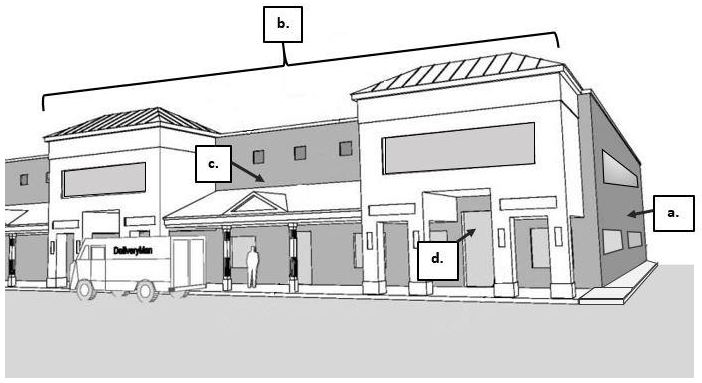
Figure 6.3.1. Commercial District Design Standards Diagram
(2)
General Roof Design Requirements.
a.
Rooflines over 100 linear feet in building length must be variegated, and incorporate major focal point features, such as a dormers, gables, or projected wall features. An element of variegation on the roofline must occur at intervals of no more than 50 feet.
b.
Parapet walls must feature three-dimensional cornice treatments or other shadow-creating details along their tops.
c.
Green roof, blue roof, and white roof designs are encouraged.
d.
Reflective roof surfaces that produce glare are prohibited, except for solar panels or white roofs intended to radiate absorbed or non-reflected solar energy and reduce heat transfer to the building, provided no hazard is created by the installation of such materials.
e.
Pitched roofs. All buildings less than 5,000 square feet of gross floor area must have a pitched roof with a minimum pitch of 2:12. All one-story buildings less than 10,000 gross square feet must have a pitched roof between 2:12 and 12:12; provided, however, that if a pitched roof is not possible, a combination of flat roof and pitched roof is desired. A pitched roof on the front and side of the building must be provided to screen view of any flat roof. Arcades, drive-under canopies, porches, and other features with pitched roofs must be created.
f.
Mansard roofs. Mansard roofs shall have a maximum pitch of 12:12 with a minimum 12-foot vertical surface length.
g.
Flat roofs. Exposed metal flashing shall be copper or factory finished sheet metal. If factory finished metal flashing is used, such as standing seam, the color must be subdued to blend with other materials or of a color to simulate weathered copper or bronze. All buildings with flat roofs shall include parapet articulation on the front façade of such building.
h.
Other. Drive-under canopies for gasoline pumps may have flat roof with vertical or factory formed facing of finished sheet metal.
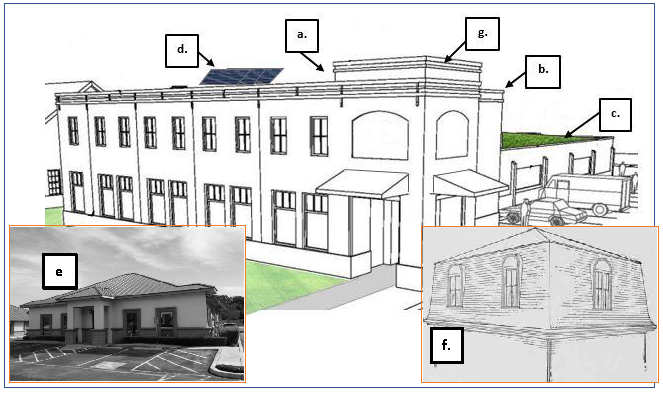
Figure 6.3.2. Commercial District Roof Design Diagram
(3)
Retail Center Design Standards.
a.
The site shall be designed so that there is safe pedestrian access to the center from the public right-of-way and safe pedestrian circulation within the development.
b.
A cohesive character is required through the use of coordinated hardscape treatment (special paving materials, lighting, street furniture, etc.) and landscaping.
c.
Retail Center Developments may satisfy front setback requirements with outlot building placement, provided they meet the other requirements of this Subsection and span at least 60% of the street frontage of the development.
d.
Outlot buildings.
i.
Outlot buildings must include showcase windows and entrances oriented toward both the street and the interior parking lot.
ii.
If outlot buildings are part of a multi-tenant retail center development:
1)
Outlot buildings fronting Collector or other Minor Street types, must define the street frontage by placement within 0' to 25' of the front lot line.
2)
Outlot buildings fronting Arterial Streets shall be permitted to the maximum front setback of the underlying zoning district.
iii.
A street presence for a mixed-use retail center must be created by locating part of the center or outlot buildings within 0' to 25' of the lot line for at least 30% of the frontage. The center or outlot buildings may be placed within a required setback to comply with this standard.
e.
Lot Configuration.
i.
Developments involving outlot buildings will be reviewed on a case-by-case basis and may be required to apply for a variance based on the parking configuration standards found within this Unified Development Code.
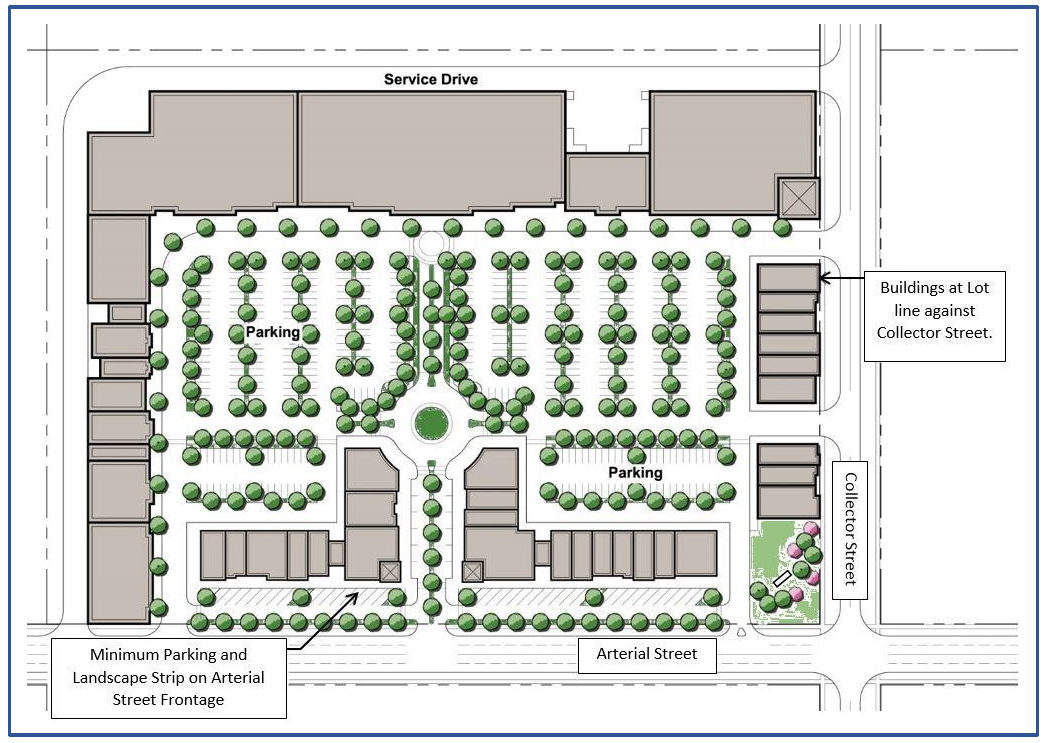
Figure 6.3.3. Outlot Building Setback Diagram.
(4)
Fenestration Standards.
a.
Windows shall be recessed no less than two inches or projected out from the façade plane to provide depth and shadow.
b.
The ground floor of all street fronting non-residential and mixed-use buildings shall maintain a minimum transparency of 30%. Store front windows shall begin no higher than two (2) feet above grade level.
c.
Upper floors of the front façade must maintain a transparency of 25% of the wall area of the story.
(Ord. No. 1992-23, § I, 10-10-2023)
6.4 - SPECIAL DISTRICTS STANDARDS
A.
Purpose Statements.
(1)
R-U Rural Urban District. The R-U Rural Urban District is a less restrictive district intended to provide for a reasonable and mixed-use of property while keeping with the surrounding area and nearby character and preventing blighted conditions to proliferate. This district is intended for those areas where development patterns are unclear and seeks to provide flexibility for a variety of uses and dimensional standards.
(2)
RC-1 Residential Commercial District. The RC-1 Residential Commercial District is intended to be a mixed-use district that will promulgate redevelopment of the downtown, historic, and riverfront areas of the City. The district provides for a more intensely developed midtown and downtown area with a planned mixture of residential, commercial, and office uses. Various ancillary uses and amenity features appropriate for midtown and downtown areas are encouraged. Traditional Neighborhood development with an interconnected network of circulation systems that facilitate walking, bicycling, and driving.
(3)
SSC-RC Stewart Street Corridor Residential Commercial District. The SSC-RC Mixed Use District designates, regulates, and restricts the location design and use of buildings and structures; to promote higher standards of exterior appearance of buildings and grounds; to stabilize and improve property value in a consistent manner while maintaining and improving the general character of the City; to promote health, safety, and general welfare; and thus to provide the economic and social benefits resulting from an improved and revitalized mixed-use corridor. It is further the purpose of this district to promulgate redevelopment and infill of the area as a planned mixture of residential, commercial, and other uses within a pedestrian friendly and multi-modal corridor providing for various ancillary uses, and amenity features appropriate for a mixed-use corridor.
(4)
D-CM Downtown Commercial Mixed-Use District. The Downtown Commercial Mixed-Use District is a multi-purpose district intended to establish standards for structures located within the downtown core area of the City. The District shall provide for high intensity development, mixed uses, and those arts and cultural facilities of varying intensities. Residential dwelling units shall only be allowed above the ground floor, unless the primary historical use of the property was residential. This District is intended as a central entertainment hub and gathering place for the surrounding residential-mixed use districts as well as the nucleus of commercial activity and civic festivals and events. The D-CM will further encourage connectivity and walkability as the surrounding R-C1 district promotes.
(5)
Public and Education District (P-E). It is the intent and purpose of the Public and Education district to provide for areas that will accommodate public uses.
(6)
Conservation District (CON). It is the intent and purpose of the Conservation district to preserve and protect those lands with valuable natural resources or features, from development impacts and encroachments. All land within the Conservation district is publicly owned.
(7)
Recreation District (REC). It is the intent of the Recreation district to provide land for public recreation, parks, and gathering places.
(8)
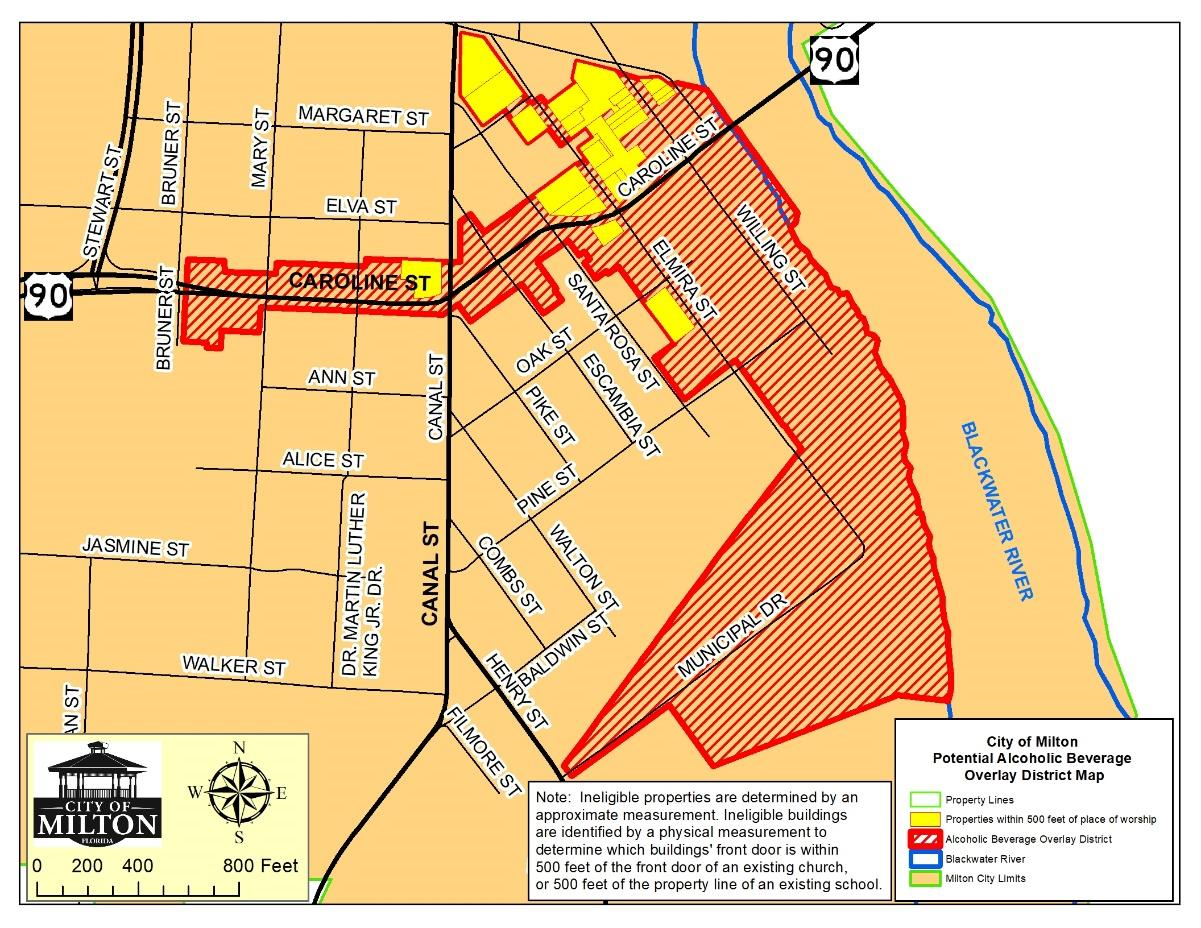
Alcoholic Beverage (On-Premise) Overlay District.
A.
Purpose. An Alcoholic Beverage (On-Premise) Overlay District ("ABOD") is an area designated within the City where property located within the ABOD district or districts may serve and sell beer, wine, and mixed beverages for on-premises consumption in accordance with applicable provisions of state law. Within the ABOD, bars and taverns are permitted in accordance with all applicable standards and laws, and Ch. 6 of the City of Milton Code of Ordinances.
B.
Development Regulations. Property located within an ABOD shall be developed and used in accordance with the underlying development and use regulations for the zoning district in which the property is located; provided, however, the sale of beer, wine, and mixed beverages for on-premises consumption is permitted within any non-residential use permitted within an ABOD subject to any additional use and development regulations set forth in section 6.4 A(8).
C.
Conflicts with Underlying Zoning. If the regulations applicable to a property located within an ABOD expressly (i) prohibit or (ii) require the approval of a specific permit for the development and use of property for bars or similar non-residential uses that involve the sale of beer, wine, and mixed beverages for on-premises consumption, the provisions relating to the permitted service and sale of beer, wine, and mixed beverages for on-premises consumption in the ABOD shall control except as provided in Chapter 6, Section 6-4, 6-5, and 6-6 of the City of Milton Code of Ordinances.
D.
Designated Alcoholic Beverage (On-Premise) Overlay District. The Alcoholic Beverage Overlay District Map ("ABOD") is incorporated herein and attached hereto by any reference as follows:
B.
General Special District Dimensional Standards.
(1)
Generally.
a.
Renovations of existing structures will be allowed for a structure covering 100 percent of the site area.
b.
Floor area ratio.
i.
No new structure shall be constructed or renovated with a floor area ratio in excess of 3.0, except as provided in Article 3.
ii.
No existing structure shall be renovated with a floor area ratio in excess of 3.0, except as provided in Article 3.
iii.
Structures used exclusively for parking shall not be included in floor area ratio calculations, but must meet all other requirements and shall be included in site coverage, impervious surface, and other yard regulations, etc.
(2)
Development within the R-U, R-C1, D-CM, and SSC-RC shall be limited as follows:
Table 6.4.1. Special District Dimensional Standards for Residential Uses
* Multi-Family Structures with greater than 4 dwelling units shall be at least two
stories in height;
** Following Fire and Life Safety Approval.
Table 6.4.2. Special District Dimensional Standards for Mixed-Use and Non-Residential Uses.
(3)
Development within the Conservation district shall be limited as follows:
a.
Development within conservation areas shall be restricted to the provision of public access and limited small scale improvements such as picnic facilities, boat ramps, etc., which enhance public use and enjoyment of the conservation area.
b.
Development within conservation areas shall seek to minimize environmental degradation through such means as preserving native vegetation and the use of previous materials for any parking area shall be encouraged.
(4)
Development within the P-E district shall be limited as follows:
a.
Public schools and municipal, county, state or federal office buildings located in the P-E district shall be developed in accordance with site and building requirements specified for the C-1 district;
b.
Major public utilities shall be developed in accordance with state regulations governing the permitting and design of such facilities and shall further comply with the performance standards set forth in Subsection 9.4.
(5)
Development within the REC district shall be limited as follows:
a.
Any development within public parks shall be in accordance with these Land Development Regulations, will seek to preserve open spaces and native vegetation through provision of vegetated nonuse areas in public parks, and shall minimize environmental degradation.
C.
Special District Design Standards.
(1)
Rural-Urban (R-U) District Design Standards. Residential development within the R-U district shall adhere to the standards identified within Subsection 6.2(E) of this Article. Single Family Tiny Houses shall adhere to the standards in 6.2(E) of this article and Single Family Tiny House subdivisions will adhere to the standards in 6.2(E) of this article and Section 17.10.
(2)
Residential-Commercial Mixed-Use (R-C1) District Specific Standards. A variety of architectural features and building materials are encouraged to give each building or group of buildings a distinct character. The character of the proposed structure must be in keeping with the community's architectural history for the CRAs and City historic district. The city planning department has examples of structures that meet this standard. Examples of these architectural styles include, but are not limited to, the Gulf Coast Classical and Victorian architectural styles that can be found in the book "A Pattern Book for Gulf Coast Neighborhoods." Included within each given architectural style of this tool are specific examples regarding windows and doors, porches, massing and composition, and materials. These design standards are recommended to be included and utilized in all new development projects in all Community Redevelopment Areas, as well as in the Milton Garden District, as defined in Section 2.1 of this Unified Development Code.
a.
Two special districts are located within the RC-1 zoning district:
i.
The Community Redevelopment Areas; and
ii.
The City Historic District.
b.
Any development activity or redevelopment activity within either area requires review and certification by the appropriate board.
c.
Any proposed major development activity located within the Community Redevelopment Areas shall require review by the Community Redevelopment Agency and issuance of a Land Use Certificate. If the proposed development activity is located within the city historic district and involves the alteration of any contributing historic structure, review by the Historic Preservation Board and issuance of a Certificate of Appropriateness is required.
d.
The review and approval process outlined in subsections C(2)(a) through C(3)(c) of this section shall precede the formal review process by the development approval authority. Specific design guidelines and requirements for development within the city historic district and community redevelopment areas are contained in Subsection 4.2(K).
e.
Guidelines for existing structures.
i.
The term "historically or architecturally significant structures" means those structures 50 years and older that lie within, not only the Historic District, the R-C1 district, but also the Community Redevelopment Areas.
ii.
Existing structures, if determined to be historic or architecturally significant, shall be protected from demolition or encroachment by incompatible structures or landscape development.
iii.
The U.S. Secretary of the Interior's Standards for Rehabilitation of Historic Properties shall be used as the criteria for renovating historic or architecturally significant structures.
f.
Guidelines for new structures.
i.
Height. New structures within the R-C1 district shall be no more than three stories for single-family residential or four stories for commercial, multifamily residential or mixed-use, except as provide in Subsection 4.2(K).
g.
Entries and façades.
i.
The architectural features, materials, and the articulation of a building's façade shall be continued on all sides visible from a public street.
ii.
The front façade of the principal building on any lot in the R-C1 shall face onto a public street.
iii.
The front façade shall not be oriented to face directly toward a parking lot.
iv.
Porches, pent roofs, roof overhangs, hooded front doors or other similar architectural elements shall define the front entrance to all residences.
v.
For commercial buildings, a minimum of 50 percent of the front façade on the ground floor shall be transparent, consisting of window or door openings allowing views into and out of the interior.
vi.
New structures on opposite sides of the same street should be of similar design. This provision shall not apply to buildings bordering civic uses.
h.
Guidelines for garages and secondary dwelling units.
i.
Garages and secondary dwelling units may be placed on a single-family detached residential lot within the principal building or an accessory building; provided that the secondary dwelling unit shall not exceed 800 square feet.
i.
Unless otherwise provided in this subsection, new commercial development shall adhere to the design standards specified in subsection 6.3(D).
(3)
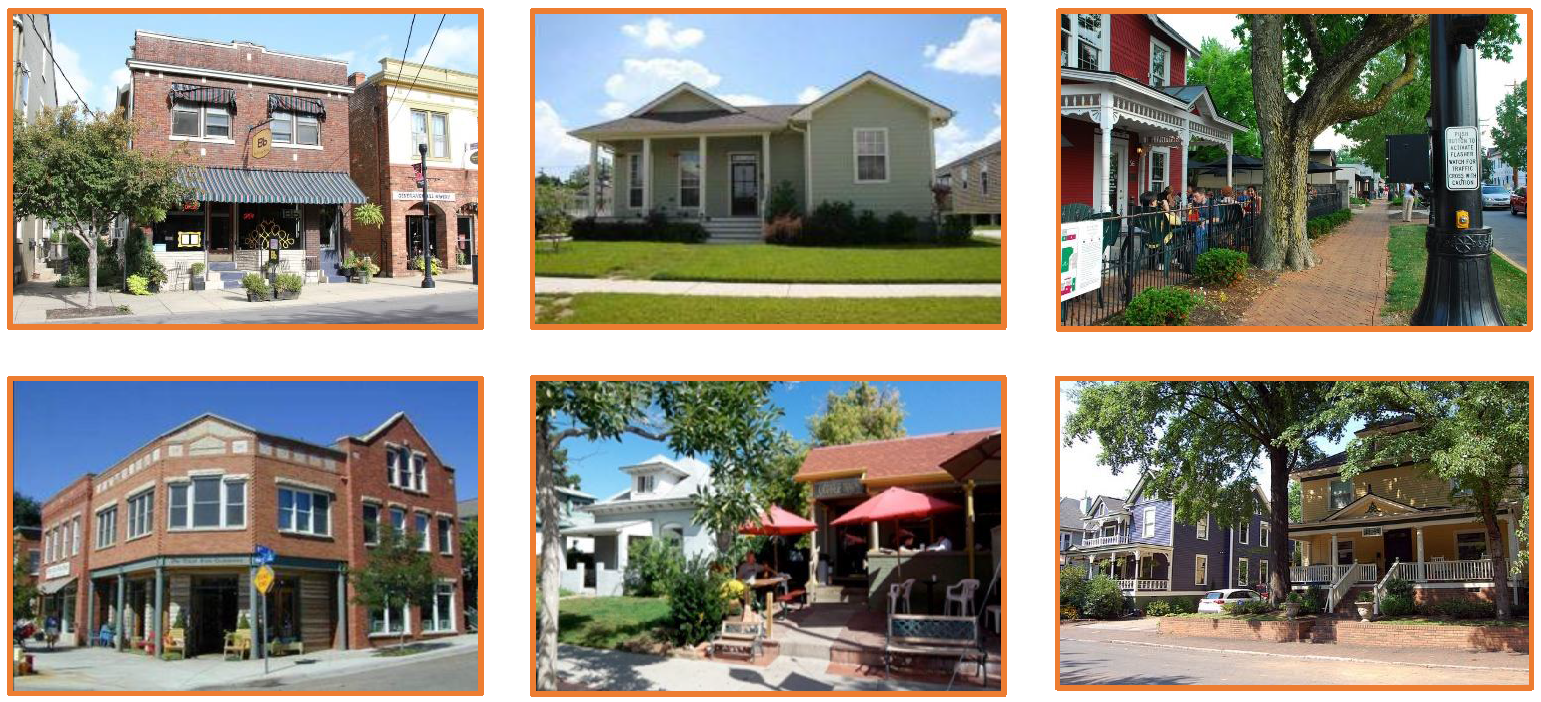
Examples of preferable R-C1 Mixed-use and Residential Development Forms.
(4)
Stewart Street Corridor Residential Commercial (SSC-RC) Mixed-Use District Specific Standards.
a.
New and Existing Residential Uses.
i.
If surrounded by commercial property, the same requirements as C-1 existing structures; provided that fire and life safety concerns can be met; and
ii.
In a residential setting where two sides or fewer are abutting commercial property, the same requirements as R-2 new residential.
b.
Standards for Conversions to Residential Use.
i.
Conversions require site plan review and approval.
1)
Submission of construction plans and drawings adequate for review and issuance of a building permit are required as part of the application;
2)
Submission of construction plans and drawings stamped by a certified engineer describing in detail the proposed conversion are required as part of the application for structures which include four or more dwelling units;
ii.
Upon conversion all residential units shall meet all applicable Florida Building Code requirements.
iii.
Converted structures shall be required to meet the minimum lot standards of the pre-conversion use.
1)
Conversions of existing structures with lot coverage ratios of up to 100 percent shall be permitted.
2)
Conversions costing more than 50 percent of the structure's assessed value shall be limited to a lot coverage ratio of no greater than 60 percent.
iv.
Landscaping. A minimum of 25 percent of the front yard area shall be dedicated to landscaping. Landscaping shall be provided outside of the public right-of-way. One or more of the following landscaping components shall be utilized to meet the required percentage of yard area:
1)
Grass or lawn area;
2)
Planter boxes and or potted plants; and
3)
Approved trees, shrubs, and ground cover materials.
4)
Approved Streetscape furnishings may be used in conjunction with the required landscaped area.
5)
Provision of public seating areas, fountains, public open space, and other approved streetscape furnishings and elements may reduce the required landscaped area by up to 10% when required area exceeds 450 square feet.
v.
On-site Parking.
1)
Single family to quad-family dwelling units shall require one parking space for each dwelling unit.
2)
Structures with five (5) or more dwelling units shall require 1.5 parking spaces per dwelling unit.
3)
Parking areas should be designed to utilize side and rear yards whenever possible.
vi.
Lighting.
1)
Conversions involving five (5) or more dwelling units shall be required to submit a lighting plan as part of the application and shall be required to meet all applicable lighting standards of this Code.
vii.
Required Façade Improvements.
1)
Façade improvements shall be required to the extent that a previously operated commercial use/structure can be viewed and generally interpreted as a residential structure by onlookers and passersby. Façade improvements shall at minimum include four of the following: General rehabilitation; Building and site cleaning; Repair and/or reconstruction of existing stucco, siding, brick or other; Painting; Exterior lighting changes/improvements in keeping with the standards of this Code; Landscaping and parking lot improvements as per the applicable standards of this Code.
2)
The following design guidelines and standards shall apply to residential conversions with a construction cost exceeding 50 percent of the structure's assessed value. Improvements should be designed to reduce massing and scope of the existing commercial structure. Design elements that can produce the desired effect include the following: Variations in roof form and parapet height; Pronounced recesses and projections; Distinct changes in texture and color of wall surfaces; Ground level arcades; Cornices; Vertical accents or focal points; Recessed or protected entry ways; and Enhanced window treatments.
3)
The use of a common palette of building materials shall be maintained for building façades to create a consistent and traditional architectural identity.
4)
Contrasting accent colors on any single façade shall be limited to no more than 25 percent of the total wall area for any single façade.
5)
All ground or roof-mounted mechanical, HVAC, and like systems shall be screened from public street view (within 300 feet) on all sides by an opaque wall or fence made of brick, stucco, split face block, or landscaping.
6)
For all commercial buildings, roof-mounted mechanical, HVAC, and like systems shall be screened from public street view (within 300 feet) on all sides by a raised parapet or pitched roof along the edge of the roofline.
7)
Refer to Subsection 2.2 for the Allowed building materials and ratios.
viii.
Dwelling units shall meet the following minimum area requirements:
1)
Efficiency unit: 500 square feet;
2)
One bedroom unit: 750 square feet;
3)
Two bedroom unit: 900 square feet;
4)
Three bedroom unit: 1,200 square feet.
ix.
Unless otherwise provided in this subsection, new commercial development shall adhere to the standards specified in subsection 6.3(D).
(5)
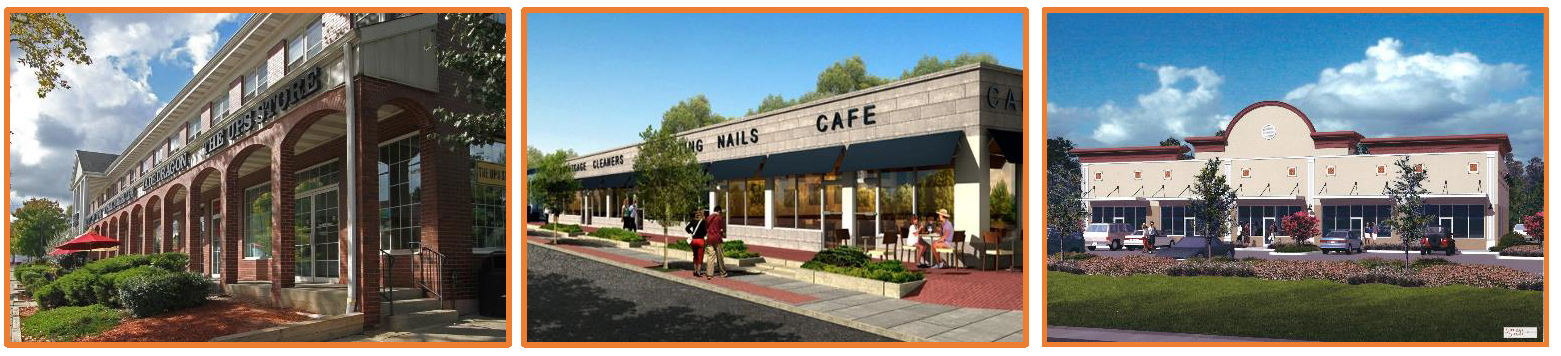
Examples of SSC-RC Commercial Development Forms:
(6)
Downtown Commercial Core Mixed-Use (D-CM) District Specific Standards. The D-CM lies within the Community Redevelopment Areas and parts of it lay within the Historic District. As such, any development and/or redevelopment activity within the D-CM shall require review and approval by the Historic Preservation Board and/or the Community Redevelopment Agency. The Secretary of the Interior's Standards for Rehabilitation and Guidelines for Rehabilitating Historic Buildings as well as the City's Design Guidelines Booklet shall be adhered to.
a.
Massing, Scale and Orientation Guidelines.
i.
The setback of new construction shall be consistent with how the district historically developed.
ii.
Buildings within the interior of a block should be built to the front property line resulting in a continuous building line.
iii.
In certain instances, buildings at the corners can be set back further, but should provide pedestrian amenities and landscaping within the front yard.
iv.
Whenever buildings are set back, the use of landscaping treatments, street furniture, and other elements shall be utilized to help define a continuous street edge.
v.
New commercial buildings should be no more than one story taller or shorter than adjacent buildings.
vi.
In certain circumstances, new construction on corner lots can be taller. However, buildings built to a larger scale than its neighbors shall be set back an appropriate distance from adjacent buildings and the street in order to minimize the visual impact due to the variation in scale.
vii.
A new building's overall proportion (height to width ratio) should be consistent with surrounding historic structures.
b.
Design, Proportion and Architectural Element Guidelines.
i.
The design of a new building should not attempt to create a false historic appearance, but rather complement buildings in the existing district. New construction should have its own character and style.
ii.
Use materials that are common to the district such as brick, stone, terra cotta, wood, and metal. Modern materials are appropriate on a new building, however, masonry should be the predominant material on the façade.
iii.
The fenestration of a new building should reflect that of existing historic structures within the district in proportion, shape, location, pattern and size. The ratio of solids to voids on a building's façade should reflect the buildings within the same block. Generally, 50 percent of the ground floor shall be transparent, with the remaining stories of a building having, the street facing façade at minimum, 25 percent transparency.
iv.
New construction should include storefront elements proportional to that of existing historic structures.
v.
Architectural details such as cornices, arches, and parapet walls give a building texture and define its scale. New construction should reflect that of existing structures. The orientation and pattern of windows, doors, and architectural details can help reduce the impact to new construction.
c.
Unless otherwise provided in this subsection, new commercial and mixed use development shall adhere to the standards specified in subsection 6.3(D).
(7)
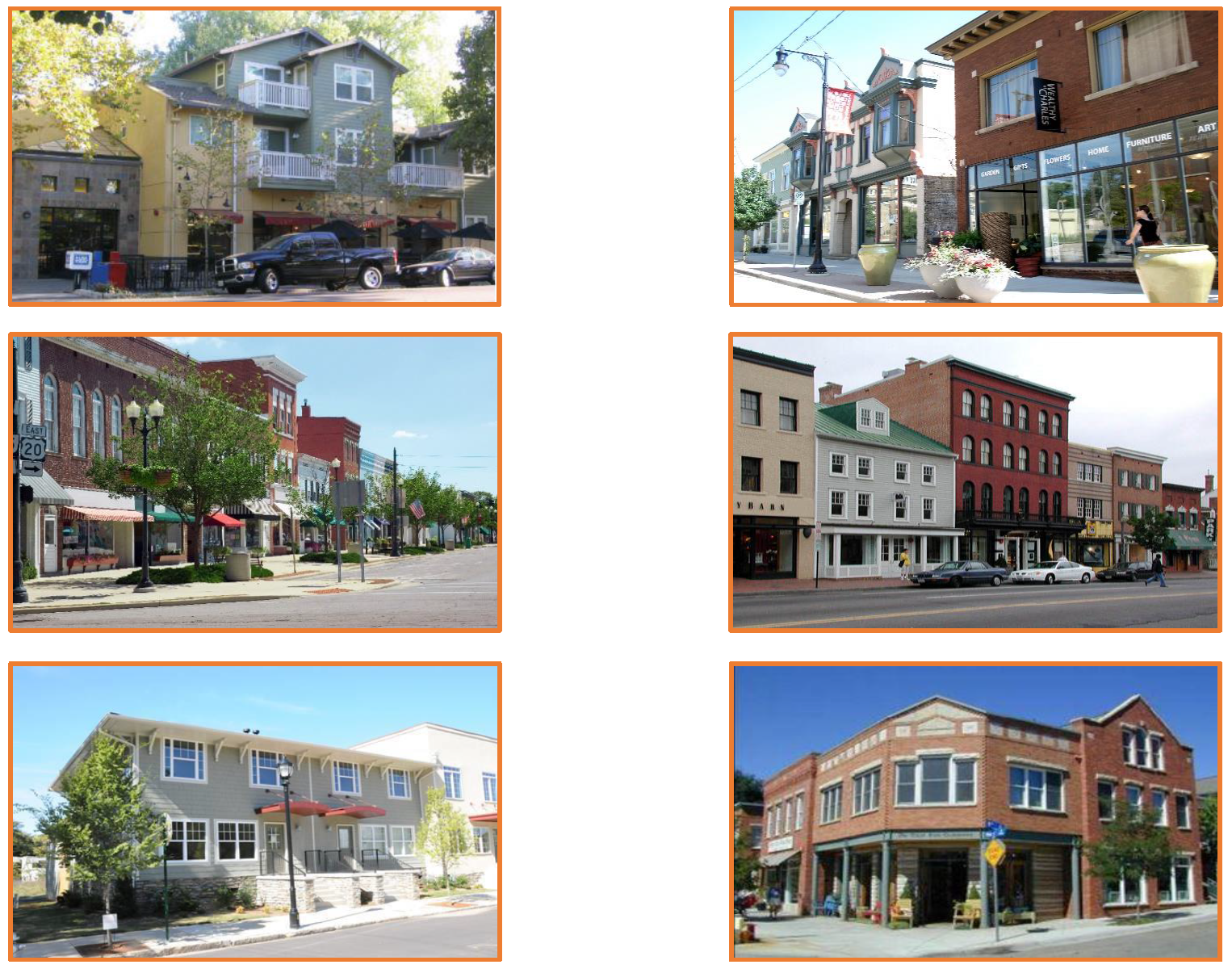
Examples of D-CM Mixed-Use and Commercial Development Architectural/Design Forms.
(Ord. No. 1992-23, § I, 10-10-2023; Ord. No. 20-24, § 1, 11-12-2024)
6.5 - MANUFACTURED HOME PARK AND SITE STANDARDS
Development of Manufactured Home sites and Parks are limited to manufactured homes only, which are subject to the following standards. Manufactured Homes are permitted only within the Rural Urban (R-U) Zoning District.
A.
Dimensional Standards. Table 6.5.1, Manufactured Home Park and Site Dimensional Standards, establishes the dimensional standards for manufactured home parks within the Rural Urban (R-U) District. Standards are provided for the manufactured home park development overall and for individual manufactured home sites within and outside of a park.
(1)
The boundaries of each manufactured home site must be clearly marked within a park.
Table 6.5.1. Manufactured Home Park and Site Dimensional Standards.
B.
Design Standards. Manufactured homes must meet the following standards:
(1)
The front entry must be a dominant feature on the front elevation of a manufactured home, using features such as porches, raised steps and stoops with roof overhangs, or decorative railings.
(2)
Windows, entrances, or other architectural features are required on all street-facing walls.
(3)
Each manufactured home must utilize roofing materials such as asphalt shingles and be similar in material and appearance to single-family dwellings.
(4)
The roof design must be a full height roof element with a minimum pitch of 3:12.
(5)
All manufactured homes must be designed with skirting that is constructed of fire-resistant material that meets the requirements of the building code.
(6)
The manufactured home must be set on a concrete slab or runway, and such slab or runway must be of a size large enough to accommodate a manufactured home in such a fashion that the concrete will extend at least one inch around the walls of the manufactured home on all sides.
(Ord. No. 1992-23, § I, 10-10-2023)

