
Milton City Zoning Code
APPENDIX B
THE CITY OF MILTON BIO-RETENTION AND CONVEYANCE SYSTEMS DESIGN GUIDELINES
The following design guidelines are intended to present developers within the City of Milton, information regarding the existence and potential of various alternative on-site stormwater management techniques. These guidelines are based on information found in the Florida Field Guide to Low Impact Development created by the University of Florida IFAS Extension. This guide provides a broad stroke of information on two commonly used methods of on-site stormwater treatment systems. Definitions, objectives, and considerations for these methods are outlined in the following passages. Installation and maintenance of these items shall be based on manufacturer and engineering specifications.
A. Bio-retention Areas.
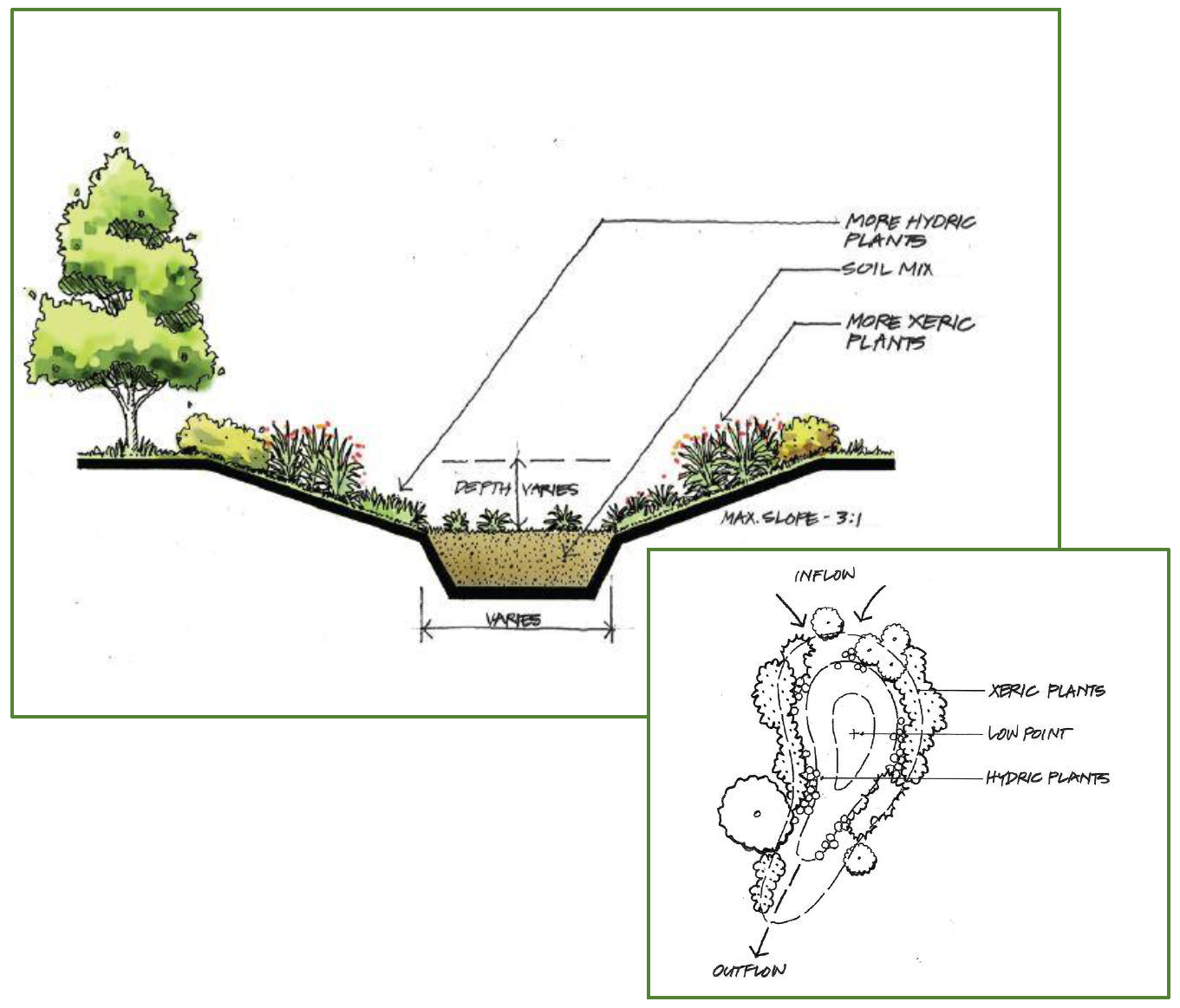
Description. Bio-retention basins, or areas, often referred to as Rain Gardens, are typically shallow planted depressions which are designed to retain or detain stormwater on-site before it is either infiltrated or discharged downstream. Rain Gardens typically refer to bio-retention basins which are smaller in scope and scale, often times utilized on individual residential lots and small non-residential developments. Bio-retention basins, on the other hand, are larger areas designed to handle more intense developments such as multi-family and larger non-residential sites as common areas.
Objective. Bio-retention basins, regardless of size, retain, filter, and treat stormwater runoff using the basin dimensions, soil types, and conditioning. Depending upon design, bio-retention basins can provide retention or detention of runoff to trap and remove suspended solids and also filter or absorb pollutants as part of infiltration or prior to discharge into the City's Stormwater System.
Applications. Generally speaking, bio-retention basins should be limited to the following types of developments. Size and design shall be dependent upon development size and type as well as the desired outcome of the basin.
Residential Yards, including Multi-family development;
Commercial Development;
Parking Lot Islands; and
Roadways.
Benefits.
1)
Water Protection—Bio-retention basins can remove pollutants through infiltration and plant uptake and absorption.
2)
Run-Off Reduction—Bio-retention basins are designed to capture and retain stormwater on-site reducing the need for larger holding ponds and stormwater transmission off-site.
3)
Improved Aesthetics—Bio-retention basins and rain gardens improve the aesthetic value of development and help to reduce irrigation costs.
Site and Design Considerations.
1)
Inflow and outflow characteristics of the site must be considered. As well as the basins place in the overall landscape design and treatment system.
2)
Generally these areas are utilized to encourage and increase infiltration. Location of the system in relation to other site components and soils should always be considered. For instance, bio-retention basins should not be placed where ponding historically occurred on site. Nor should a basin be placed over a septic tank.
3)
Infiltration systems must be designed with soil types and water table depths in mind. Underdrains may need to be incorporated where soil conductivity is low.
4)
Basin slope should be a maximum of 3:1. Ponding depths should not exceed 12 inches and ponding duration should not exceed 24 hours after a storm event.
5)
Safety concerns and mosquito mitigation should also be considered when designing a bio-retention system.
B. Bioswales.
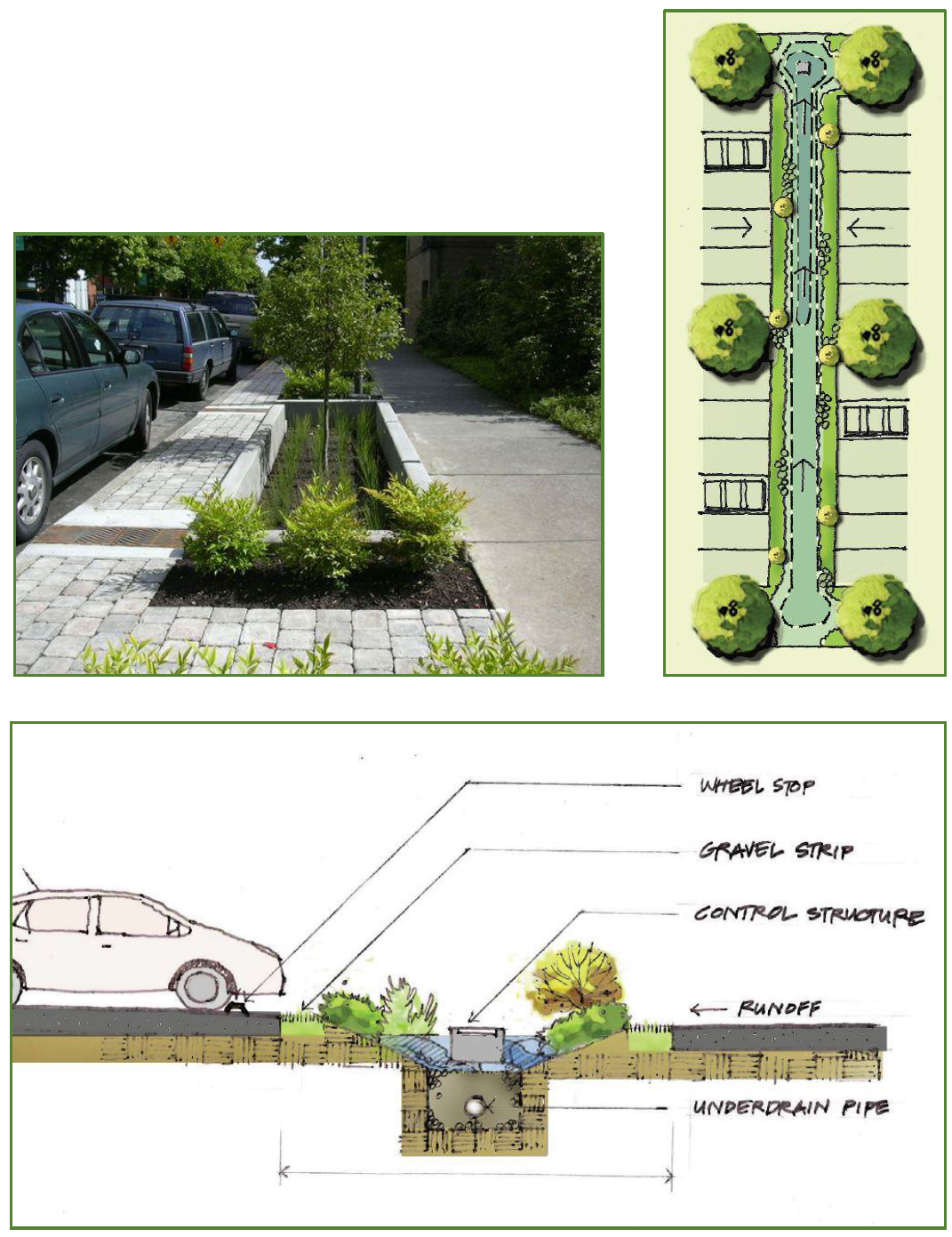
Description. A Bioswale is a vegetated swale or depression used to partially treat water quality, to retain and move stormwater run-off, and to attenuate flooding potential. Bioswales are similar to bio-retention basins in structure but are typically more linear in design.
Objective. Bioswales are designed to function as open-channels or drainage ways, which either convey or hold stormwater run-off. They can be used in conjunction with and as an enhancement of traditional stormwater systems or as a standalone alternative. Bioswales can be designed for transmission, or for storage and infiltration.
Applications.
1)
Bioswales can be used on a larger scale than Bio-retention basins and rain gardens. They are typically utilized in parking lot islands and medians, as roadside and even highway median systems. One of the most appropriate applications are within landscape buffer yards.
2)
There are typically two types of swales utilized by development: wet swales and dry swales.
3)
Wet swales use storage time and vegetation to reduce flow and trap pollutants and increase water quality. Dry swales are designed to facilitate infiltration of stormwater there by treating both the quantity and quality of stormwater run-off as well. Both designs are typically aspects of larger stormwater treatment systems and work best in conjunction with bio-retention basins and other infiltration areas.
Benefits. The benefits of bioswales are similar to bio-retention basins. They mitigate against flooding through infiltration or transmission of stormwater run-off, improve water quality through vegetative absorption and infiltration, and can be integrated into landscape designs as aesthetically pleasing components. Often times, if designed properly, with xeriscaping or other techniques, landscaping irrigation costs can be substantially lower than normal systems which require scheduled watering.
Site and Design Considerations. Again, there are a lot of similarities in the siting and design considerations between bioswales and bio-retention basins. Soil types, water table depth, and service area size all need to be considered as well as the amount of impervious surface area and the slope of the area being served.
1)
Bioswales should be used in areas that are not overly flat or in areas which are too steep.
2)
As a rule of thumb when designing a bioswale or system of bioswales, areas larger than ten acres with slopes greater than 5%, should not be served by a bioswale(s) alone but could certainly be utilized as a component of a larger stormwater system.
3)
Soil composition is an important consideration when determining placement and design of bioswale systems. As well as a bioswales' place in the larger landscaped area and stormwater system.
4)
Plant material selection is key to water quality treatment and to the effective life of a swale. Plants that are less water tolerant or non-native species may not survive or may not treat the water as well as others.
(Ord. No. 1992-23, § I, 10-10-2023)

